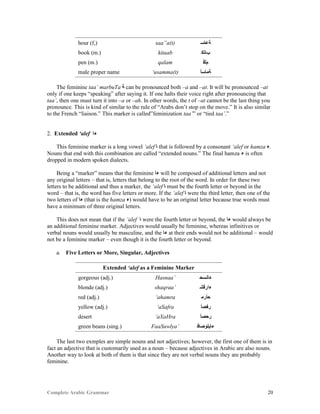
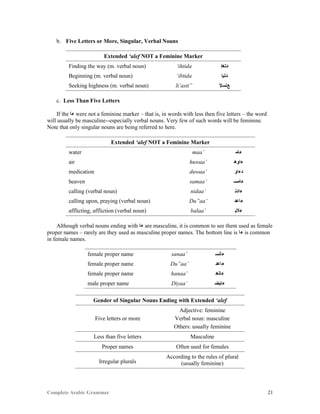
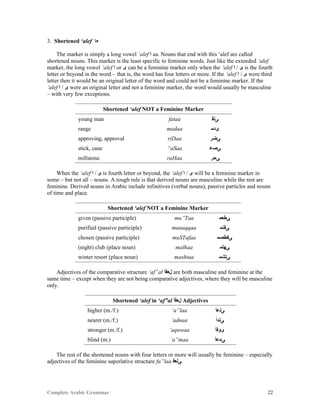
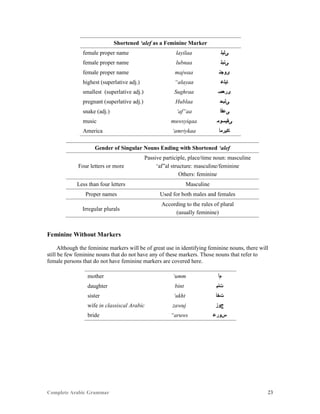
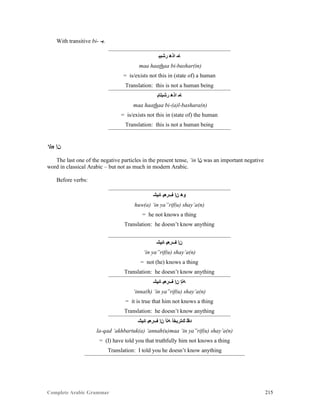
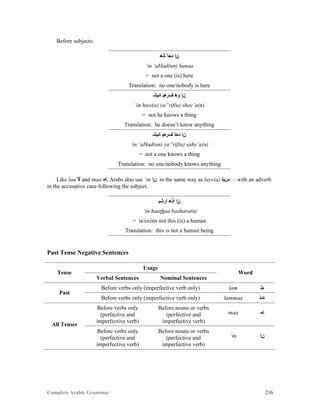
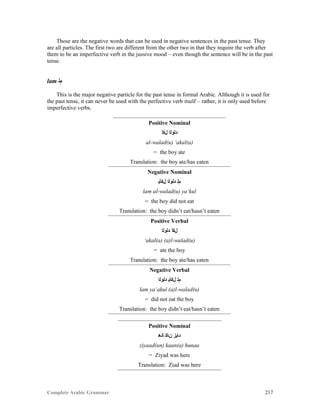
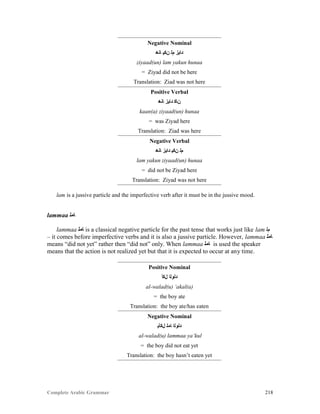
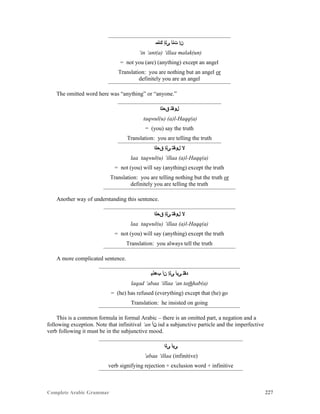
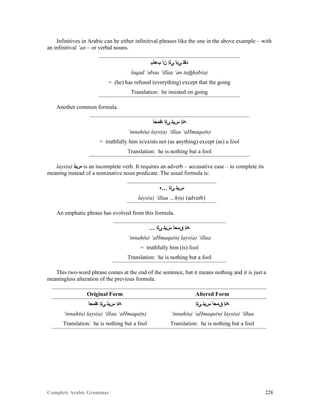
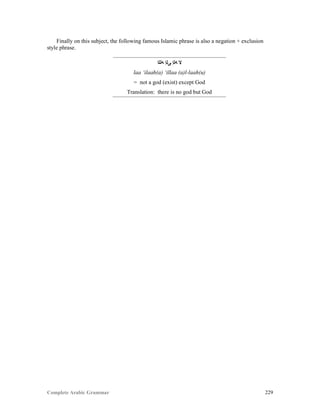
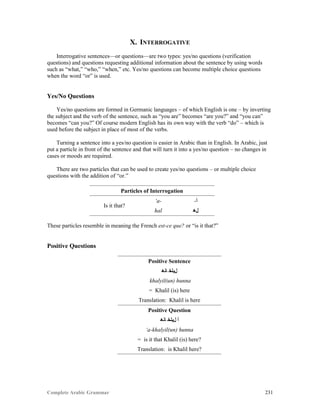
‫ﺜﺎﻨﻮﻴ‬‫ﺔ‬‫ﻨﻈﺭﻴ‬‫ﺔ‬‫ﻜﺎﻤﻠ‬‫ﺔ‬‫ﺒﺎﻠﻌﺭﺒﻴ‬‫ﺔ‬
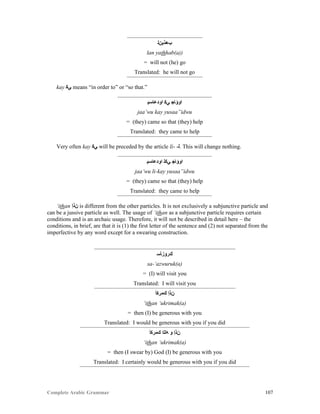
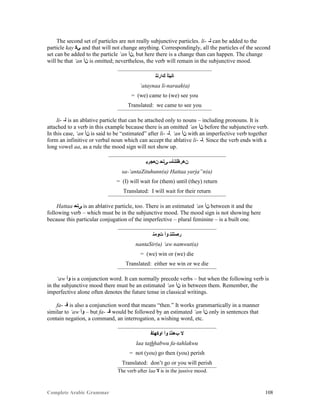
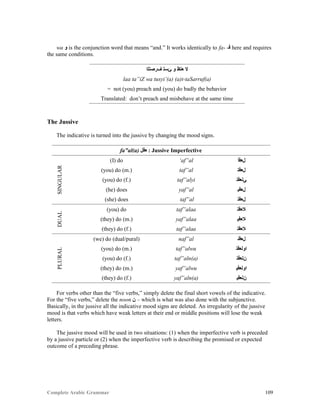
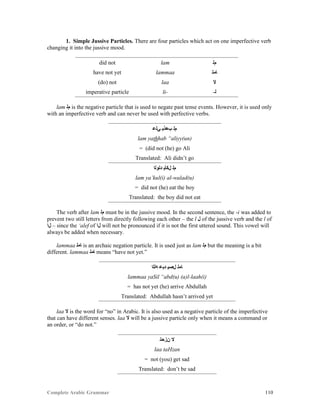
A COMPLETE
ARABIC GRAMMAR
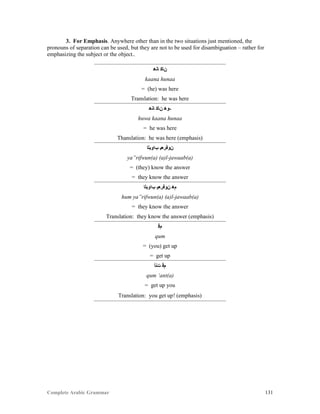
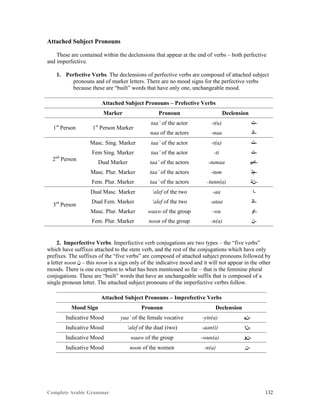
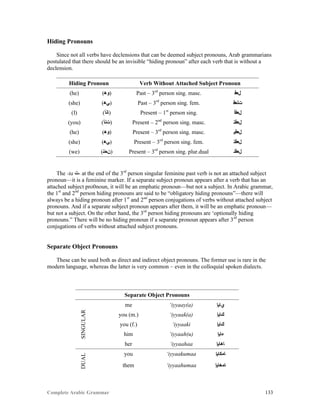
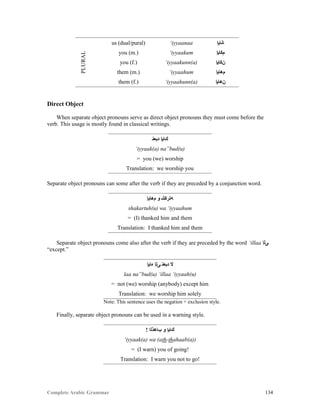
FOR ENGLISH-SPEAKING LEARNERS
OF THE ARABIC LANGUAGE
SECOND EDITION
by
JACK KULES, PH.D.
Complete Arabic Grammar 2
Copyright  2014
ISBN
Printed in the United States oif America
Complete Arabic Grammar 3
Table of Contents
Page
I. Introduction 5
II. Arabic Alphabet 7
III. Roots 15
IV. Nouns 19
V. Adjectives 53
VI. Verbs 67
VII. Pronouns 127
VIII. Arabic Sentences 167
IX. Negation 203
X. Interrogative 231
XI. Survival Phrases 279
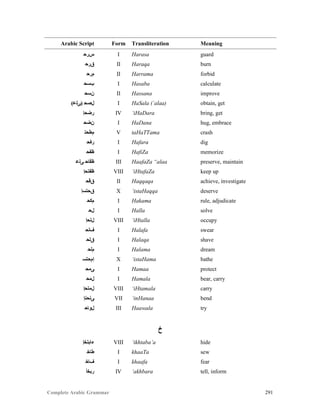
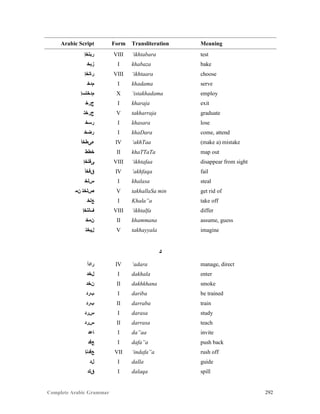
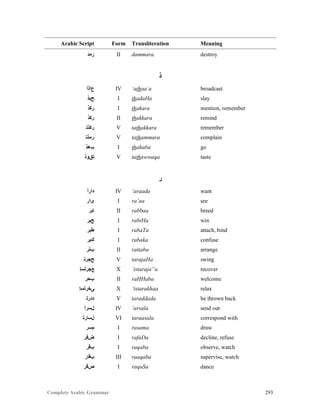
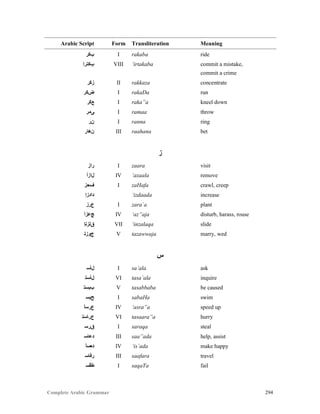
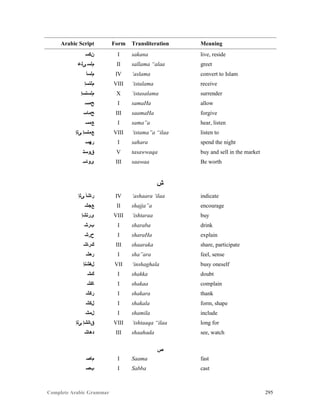
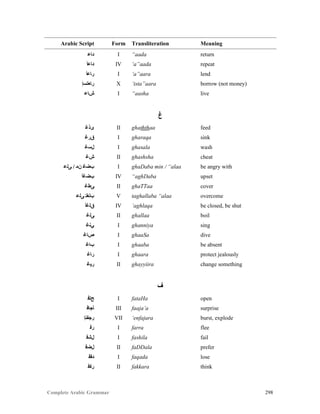
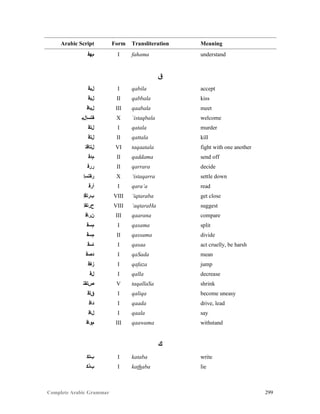
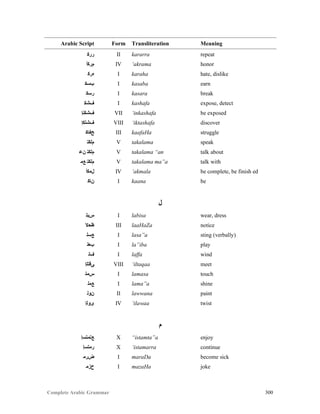
Appendix A – Glossary of Arabic Verbs 287
Arabic – English 289
English – Arabic 305
References 323
Complete Arabic Grammar 4
Complete Arabic Grammar 5
I. INTRODUCTION
Arabic is the most widespread of the living Semitic languages. Classified as South Central
Semitic, Arabic is related to Hebrew (spoken in Israel) and Amharic (spoke in Ethiopia) as well
as to the ancient Semitic languages. The earliest written inscriptions in Arabic were found on the
Arabian Peninsula and date from the early 4th
century AD. Many linguists consider Arabic to be
the most Semitic of the modern Semitic languages in terms of how completely it preserves the
features of Proto-Semitic – the common ancestor for all Semitic languages.
However, the preservation of those features of Proto-Semitic can mean, unfortunately, that
Arabic is not a very easy language to handle. The features include a set of sounds that can be hard
to pronounce by a non-native – fricatives, plosives and pharyngealized glottal stops (all the
Semitic guttural sounds produced far back in the mouth and throat). Old languages in general tend
to be very inflective – that is, a single word exhibits many changes in form to suit different tenses,
moods, genders, or numbers. This is another one of the preserved features of Proto-Semitic –
formal Arabic is very inflective and it has a large collection of declensions for different uses.
In fact, there are three spoken varieties of the Arabic language today. Classical or Koranic
Arabic is the form of Arabic which was used in the Koran (the Islamic holy book) as well as in
numerous literary texts from the 7th
to 9th
centuries. This form of Arabic is difficult to understand
by ordinary Arabs today. However, it is still used for reading and studying the Koran and for
other religious purposes. It is still the language of religious preaching.
Modern Standard Arabic is a modern version used in formal speaking, most television and
radio, and practically all written matter – including books, newspapers, magazines, documents of
every kind, and reading primers for small children. It differs minimally in morphology from
Classical Arabic, but it has significant differences in syntax and lexicon – reflecting the influence
of the modern spoken dialects and Western languages.
Colloquial or dialectal Arabic differs to the many regional varieties derived from old Arabic
dialects – spoken across North Africa and the Middle East – which constitute the everyday
spoken language. These dialects are not normally written, although a certain amount of literature
– particularly plays and poetry – exists in many of them. They are often used to varying degrees
in informal spoken media, such as soap operas and talk shows. Literary Arabic or formal Arabic
is the official language of all Arab countries and is the only form of Arabic taught in schools at all
stages.
Modern dialects differ from standard Arabic and from one another in pronunciation,
vocabulary and grammar. They are less complex and less inflective than classical Arabic, and
they are usually labeled according to major geographic areas – such as North African, Levantine,
Egyptian, and Gulf. Within these broad classifications the daily speech of urban, rural and
nomadic speakers is distinctively different.
The sociolinguistic situation of Arabic in modern times provides a prime example of the
linguistic phenomenon of diglossia – the normal use of two separate varieties of the same
language, usually in different social situations. In the case of Arabic, educated Arabs of any
nationality can be assumed to speak both their local dialect and their school-taught literary Arabic
– to an equal or lesser degree.
Complete Arabic Grammar 6
This text will attempt to cover the fundamentals of formal Arabic – both the classical and
modern standard varieties. Those are the written form forms that are universally understood.
Complete Arabic Grammar 7
II. ARABIC ALPHABET
Semitic languages are written from right to left. Ancient Mesopotamians wrote on stones with
chisels, and since most transcirbers were right-handed it was easier and more natural to them to
write from right to left. The Arabic script – which is derived from Aramaic – is based on 18
distinct shapes. Using a combination of dots above and below eight of these shapes, the full
complement of 28 characters can be fully spelled out.
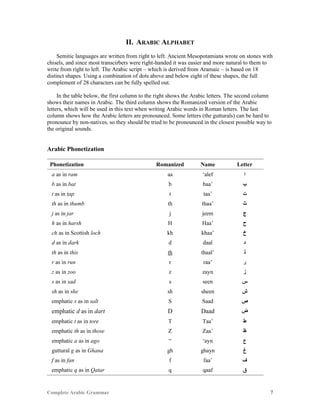
In the table below, the first column to the right shows the Arabic letters. The second column
shows their names in Arabic. The third column shows the Romanized version of the Arabic
letters, which will be used in this text when writing Arabic words in Roman letters. The last
column shows how the Arabic letters are pronounced. Some letters (the gutturals) can be hard to
pronounce by non-natives, so they should be tried to be pronounced in the closest possible way to
the original sounds.
Arabic Phonetization
Phonetization Romanized Name Letter
a as in ram aa ‘alef ‫ﺍ‬
b as in bat b baa’ ‫ﺐ‬
t as in tap t taa’ ‫ﺕ‬
th as in thumb th thaa’ ‫ﺙ‬
j as in jar j jeem ‫ﺝ‬
h as in harsh H Haa’ ‫ﺡ‬
ch as in Scottish loch kh khaa’ ‫ﺥ‬
d as in dark d daal ‫ﺩ‬
th as in this th thaal’ ‫ﺫ‬
r as in run r raa’ ‫ﺭ‬
z as in zoo z zayn ‫ﺯ‬
s as in sad s seen ‫ﺱ‬
sh as in she sh sheen ‫ﺵ‬
emphatic s as in salt S Saad ‫ﺹ‬
emphatic d as in dart D Daad ‫ﺽ‬
emphatic t as in tore T Taa’ ‫ﻁ‬
emphatic th as in those Z Zaa’ ‫ﻅ‬
emphatic a as in ago “ ‘ayn ‫ﻉ‬
guttural g as in Ghana gh ghayn ‫ﻍ‬
f as in fan f faa’ ‫ﻑ‬
emphatic q as in Qatar q qaaf ‫ﻕ‬
Complete Arabic Grammar 8
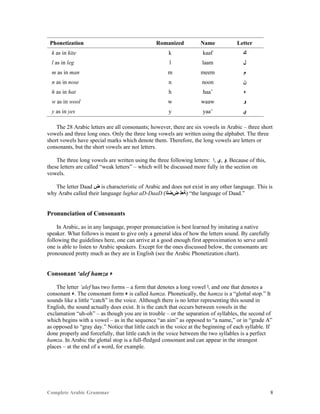
Phonetization Romanized Name Letter
k as in kite k kaaf ‫ﻚ‬
l as in leg l laam ‫ﻝ‬
m as in man m meem ‫ﻡ‬
n as in nose n noon ‫ﻥ‬
h as in hat h haa’ ‫ﻩ‬
w as in wool w waaw ‫ﻮ‬
y as in yes y yaa’ ‫ﻱ‬
The 28 Arabic letters are all consonants; however, there are six vowels in Arabic – three short
vowels and three long ones. Only the three long vowels are written using the alphabet. The three
short vowels have special marks which denote them. Therefore, the long vowels are letters or
consonants, but the short vowels are not letters.
The three long vowels are written using the three following letters: ‫,ﺍ‬ ‫,ﻱ‬ ‫.ﻮ‬ Because of this,
these letters are called “weak letters” – which will be discussed more fully in the section on
vowels.
The letter Daad ‫ﺽ‬ is characteristic of Arabic and does not exist in any other language. This is
why Arabs called their language lughat aD-DaaD (‫ﺽﺿﻟﺍ‬ ‫)ﺔﻌﻠ‬ “the language of Daad.”
Pronunciation of Consonants
In Arabic, as in any language, proper pronunciation is best learned by imitating a native
speaker. What follows is meant to give only a general idea of how the letters sound. By carefully
following the guidelines here, one can arrive at a good enough first approximation to serve until
one is able to listen to Arabic speakers. Except for the ones discussed below, the consonants are
pronounced pretty much as they are in English (see the Arabic Phonetization chart).
Consonant ‘alef hamza ‫ﺀ‬
The letter ‘alef has two forms – a form that denotes a long vowel ‫,ﺍ‬ and one that denotes a
consonant ‫.ﺀ‬ The consonant form ‫ﺀ‬ is called hamza. Phonetically, the hamza is a “glottal stop.” It
sounds like a little “catch” in the voice. Although there is no letter representing this sound in
English, the sound actually does exist. It is the catch that occurs between vowels in the
exclamation “uh-oh” – as though you are in trouble – or the separation of syllables, the second of
which begins with a vowel – as in the sequence “an aim” as opposed to “a name,” or in “grade A”
as opposed to “gray day.” Notice that little catch in the voice at the beginning of each syllable. If
done properly and forcefully, that little catch in the voice between the two syllables is a perfect
hamza. In Arabic the glottal stop is a full-fledged consonant and can appear in the strangest
places – at the end of a word, for example.
Complete Arabic Grammar 9
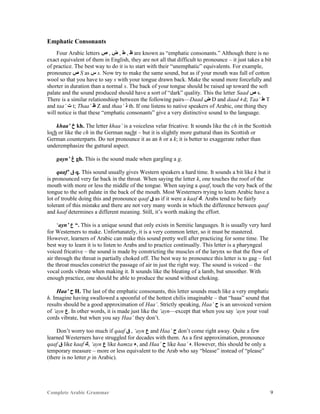
Emphatic Consonants
Four Arabic letters ‫ﺹ‬ , ‫ﺽ‬ , ‫ﻁ‬ , ‫ﻅ‬ are known as “emphatic consonants.” Although there is no
exact equivalent of them in English, they are not all that difficult to pronounce – it just takes a bit
of practice. The best way to do it is to start with their “unemphatic” equivalents. For example,
pronounce ‫ﺹ‬ S as ‫ﺱ‬ s. Now try to make the same sound, but as if your mouth was full of cotton
wool so that you have to say s with your tongue drawn back. Make the sound more forcefully and
shorter in duration than a normal s. The back of your tongue should be raised up toward the soft
palate and the sound produced should have a sort of “dark” quality. This the letter Saad ‫ﺹ‬ s.
There is a similar relationshiop between the following pairs—Daad ‫ﺽ‬ D and daad ‫ﺩ‬ d; Taa’ ‫ﻁ‬ T
and taa’ ‫ﺕ‬ t; Thaa’ ‫ﻅ‬ Z and thaa’ ‫ﺫ‬ th. If one listens to native speakers of Arabic, one thing they
will notice is that these “emphatic consonants” give a very distinctive sound to the language.
khaa’ ‫ﺥ‬ kh. The letter khaa’ is a voiceless velar fricative. It sounds like the ch in the Scottish
loch or like the ch in the German nacht – but it is slightly more guttural than its Scottish or
German counterparts. Do not pronounce it as an h or a k; it is better to exaggerate rather than
underemphasize the guttural aspect.
gayn’ ‫ﻍ‬ gh. This is the sound made when gargling a g.
qaaf’ ‫ﻕ‬ q. This sound usually gives Western speakers a hard time. It sounds a bit like k but it
is pronounced very far back in the throat. When saying the letter k, one touches the roof of the
mouth with more or less the middle of the tongue. When saying a qaaf, touch the very back of the
tongue to the soft palate in the back of the mouth. Most Westerners trying to learn Arabic have a
lot of trouble doing this and pronounce qaaf ‫ﻕ‬ as if it were a kaaf ‫.ﻚ‬ Arabs tend to be fairly
tolerant of this mistake and there are not very many words in which the difference between qaaf
and kaaf determines a different meaning. Still, it’s worth making the effort.
‘ayn’ ‫ﻉ‬ “. This is a unique sound that only exists in Semitic languages. It is usually very hard
for Westerners to make. Unfortunately, it is a very common letter, so it must be mastered.
However, learners of Arabic can make this sound pretty well after practicing for some time. The
best way to learn it is to listen to Arabs and to practice continually. This letter is a pharyngeal
voiced fricative – the sound is made by constricting the muscles of the larynx so that the flow of
air through the throat is partially choked off. The best way to pronounce this letter is to gag – feel
the throat muscles constrict the passage of air in just the right way. The sound is voiced – the
vocal cords vibrate when making it. It sounds like the bleating of a lamb, but smoother. With
enough practice, one should be able to produce the sound without choking.
Haa’ ‫ﺡ‬ H. The last of the emphatic consonants, this letter sounds much like a very emphatic
h. Imagine having swallowed a spoonful of the hottest chilis imaginable – that “haaa” sound that
results should be a good approximation of Haa’. Strictly speaking, Haa’ ‫ﺡ‬ is an unvoiced version
of ‘ayn ‫.ﻉ‬ In other words, it is made just like the ‘ayn—except that when you say ‘ayn your voal
cords vibrate, but when you say Haa’ they don’t.
Don’t worry too much if qaaf ‫ﻕ‬ , ‘ayn ‫ﻉ‬ and Haa’ ‫ﺡ‬ don’t come right away. Quite a few
learned Westerners have struggled for decades with them. As a first approximation, pronounce
qaaf ‫ﻕ‬ like kaaf ‫,ﻚ‬ ‘ayn ‫ﻉ‬ like hamza ‫,ﺀ‬ and Haa’ ‫ﺡ‬ like haa’ ‫.ﻩ‬ However, this should be only a
temporary measure – more or less equivalent to the Arab who say “blease” instead of “please”
(there is no letter p in Arabic).
Complete Arabic Grammar 10
Words
In most languages, putting letters together next to each other simply creates a word. However,
in Arabic putting letters as they are in a row does not create a word. This is not a word— ‫ﺭ‬ ‫ﺡ‬ ‫.ﺏ‬
Ancient Arabs – or more precisely Arameans – saw that it made more sense to join the letters of
each work together. So, the previous “word” would look like ‫ﺭﺣﺒ‬ or ‫ﺭ‬ + ‫ﺡ‬ + ‫ﺐ‬ = ‫,ﺭﺣﺒ‬ which
means “sea.”
To write and read Arabic one has to – in addition to knowing the letters – to know how each
letter is joined when it is at the beginning, middle or end of the word. Example:
‫ﻢ‬ + ‫ﻮ‬ + ‫ﻱ‬ = ‫ﻢﻮﻴ‬ which means “day.” Notice here that one of the letters – waaw ‫ﻮ‬ – was joined
from the right but not from the left; this happens. Other examples: ‫ﺐ‬ + ‫ﺍ‬ + ‫ﺕ‬ + ‫ﻚ‬ = ‫ﺐﺎﺘﻜ‬ which
means ”book” and ‫ﺃ‬ + ‫ﺍ‬ + ‫ﺵ‬ + ‫ﻉ‬ = ‫ﺀﺎﺷﻉ‬ which means “supper.”
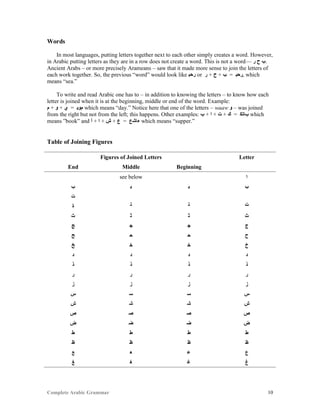
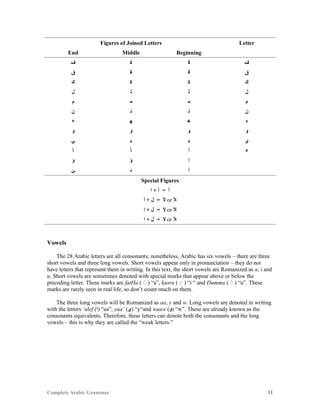
Table of Joining Figures
Figures of Joined Letters Letter
End Middle Beginning
see below ‫ﺍ‬
‫ﺐ‬ ‫ﺒ‬ ‫ﺒ‬ ‫ﺐ‬
‫ﺖ‬
‫ﺗ‬ ‫ﺘ‬ ‫ﺕ‬‫ﺓ‬
‫ﺚ‬ ‫ﺛ‬ ‫ﺜ‬ ‫ﺙ‬
‫ﺞ‬ ‫ﺟ‬ ‫ﺠ‬ ‫ﺝ‬
‫ﺢ‬ ‫ﺣ‬ ‫ﺤ‬ ‫ﺡ‬
‫ﺦ‬ ‫ﺧ‬ ‫ﺨ‬ ‫ﺥ‬
‫ﺪ‬ ‫ﺪ‬ ‫ﺪ‬ ‫ﺪ‬
‫ﺬ‬ ‫ﺬ‬ ‫ﺬ‬ ‫ﺬ‬
‫ﺮ‬ ‫ﺮ‬ ‫ﺮ‬ ‫ﺮ‬
‫ﺰ‬ ‫ﺰ‬ ‫ﺰ‬ ‫ﺰ‬
‫ﺲ‬ ‫ﺳ‬ ‫ﺴ‬ ‫ﺱ‬
‫ﺶ‬ ‫ﺷ‬ ‫ﺸ‬ ‫ﺵ‬
‫ﺺ‬ ‫ﺻ‬ ‫ﺼ‬ ‫ﺹ‬
‫ﺾ‬ ‫ﺿ‬ ‫ﻀ‬ ‫ﺽ‬
‫ﻂ‬ ‫ﻃ‬ ‫ﻄ‬ ‫ﻁ‬
‫ﻆ‬ ‫ﻇ‬ ‫ﻈ‬ ‫ﻅ‬
‫ﻊ‬ ‫ﻌ‬ ‫ﻋ‬ ‫ﻉ‬
‫ﻎ‬ ‫ﻐ‬ ‫ﻏ‬ ‫ﻍ‬
Complete Arabic Grammar 11
Figures of Joined Letters Letter
End Middle Beginning
‫ﻒ‬ ‫ﻔ‬ ‫ﻓ‬ ‫ﻑ‬
‫ﻖ‬ ‫ﻘ‬ ‫ﻗ‬ ‫ﻕ‬
‫ﻚ‬ ‫ﻜ‬ ‫ﻛ‬ ‫ﻙ‬
‫ﻞ‬ ‫ﻠ‬ ‫ﻟ‬ ‫ﻝ‬
‫ﻢ‬ ‫ﻤ‬ ‫ﻣ‬ ‫ﻡ‬
‫ﻦ‬ ‫ﻨ‬ ‫ﻧ‬ ‫ﻥ‬
‫ﻪ‬ ‫ﻬ‬ ‫ﻫ‬ ‫ﻩ‬
‫ﻮ‬ ‫ﻮ‬ ‫ﻮ‬ ‫ﻭ‬
‫ﻲ‬ ‫ﻴ‬ ‫ﻳ‬ ‫ﻱ‬
‫ﺄ‬ ‫ﺄ‬ ‫ﺃ‬ ‫ﺀ‬
‫ﺅ‬ ‫ﺆ‬ ‫ﺇ‬
‫ﺊ‬ ‫ﺋ‬ ‫ﺃ‬
Special Figures
‫ﺍ‬ + ‫ﺃ‬ = ‫ﺃ‬
‫ﺃ‬ + ‫ﻞ‬ = ‫ﻷ‬ or ‫ﻸ‬
‫ﺇ‬ + ‫ﻞ‬ = ‫ﻹ‬ or ‫ﻸ‬
‫ﺍ‬ + ‫ﻞ‬ = ‫ﻻ‬ or ‫ﻸ‬
Vowels
The 28 Arabic letters are all consonants; nonetheless, Arabic has six vowels – there are three
short vowels and three long vowels. Short vowels appear only in pronunciation – they do not
have letters that represent them in writing. In this text, the short vowels are Romanized as a, i and
u. Short vowels are sometimes denoted with special marks that appear above or below the
preceding letter. These marks are fatHa ( ) “a”, kasra ( ) “i “ and Dumma ( ) “u”. These
marks are rarely seen in real life, so don’t count much on them.
The three long vowels will be Romanized as aa, y and w. Long vowels are denoted in writing
with the letters ‘alef (‫)ﺍ‬ “aa”, yaa’ (‫)ﻱ‬ “y“and waaw (‫)ﻮ‬ “w”. These are already known as the
consonants equivalents. Therefore, these letters can denote both the consonants and the long
vowels – this is why they are called the “weak letters.”
Complete Arabic Grammar 12
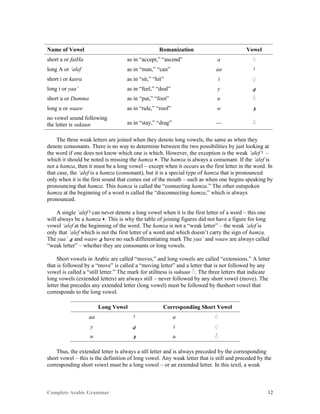
Name of Vowel Romanization Vowel
short a or fatHa as in “accept,” “ascend” a
long A or ‘alef as in “man,” “can” aa ‫ﺍ‬
short i or kasra as in “sit,” “hit” i
long i or yaa’ as in “feel,” “deal” y ‫ﻱ‬
short u or Dumma as in “put,” “foot” u
long u or waaw as in “rule,” “roof” w ‫ﻭ‬
no vowel sound following
the letter is sukuun as in “stay,” “drag” ---
The three weak letters are joined when they denote long vowels, the same as when they
denote consonants. There is no way to determine between the two possibilities by just looking at
the word if one does not know which one is which. However, the exception is the weak ‘alef ‫ﺍ‬ –
which it should be noted is missing the hamza ‫.ﺀ‬ The hamza is always a consonant. If the ‘alef is
not a hamza, then it must be a long vowel – except when it occurs as the first letter in the word. In
that case, the ‘alef is a hamza (consonant), but it is a special type of hamza that is pronounced
only when it is the first sound that comes out of the mouth – such as when one begins speaking by
pronouncing that hamza. This hamza is called the “connecting hamza.” The other outspoken
hamza at the beginning of a word is called the “disconnecting hamza,” which is always
pronounced.
A single ‘alef ‫ﺍ‬ can never denote a long vowel when it is the first letter of a word – this one
will always be a hamza ‫.ﺀ‬ This is why the table of joining figures did not have a figure for long
vowel ‘alef at the beginning of the word. The hamza is not a “weak letter” – the weak ‘alef is
only that ‘alef which is not the first letter of a word and which doesn’t carry the sign of hamza.
The yaa’ ‫ﻱ‬ and waaw ‫ﻱ‬ have no such differentiating mark The yaa’ and waaw are always called
“weak letter” – whether they are consonants or long vowels.
Short vowels in Arabic are called “moves,” and long vowels are called “extensions.” A letter
that is followed by a “move” is called a “moving letter” and a letter that is not followed by any
vowel is called a “still letter.” The mark for stillness is sukuun . The three letters that indicate
long vowels (extended letters) are always still – never followed by any short vowel (move). The
letter that precedes any extended letter (long vowel) must be followed by theshort vowel that
corresponds to the long vowel.
Long Vowel Corresponding Short Vowel
aa ‫ﺍ‬ a
y ‫ﻱ‬ i
w ‫ﻮ‬ u
Thus, the extended letter is always a stll letter and is always preceded by the corresponding
short vowel – this is the definition of long vowel. Any weak letter that is still and preceded by the
corresponding short vowel must be a long vowel – or an extended letter. In this textl, a weak
Complete Arabic Grammar 13
letter in Arabic script which does not carry any “move” can be assumed to be a long vowel –
“still” and preceded by a corresponding “move.”
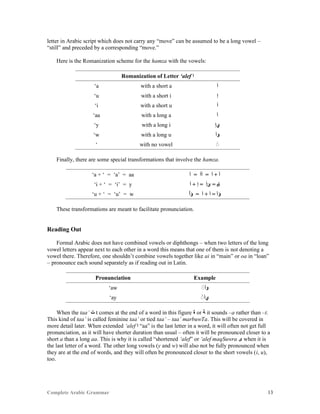
Here is the Romanization scheme for the hamza with the vowels:
Romanization of Letter ‘alef ‫ﺍ‬
‘a with a short a ‫ﺃ‬
‘u with a short i ‫ﺇ‬
‘i with a short u ‫ﺃ‬
‘aa with a long a ‫ﺁ‬
‘y with a long i ‫ﻱﺇ‬
‘w with a long u ‫ﻮﺃ‬
‘ with no vowel
Finally, there are some special transformations that involve the hamza.
‘a + ‘ = ‘a’ = aa ‫ﺁ‬ = ‫ﺃﺃ‬ = ‫ﺃ‬ + ‫ﺃ‬
‘i + ‘ = ‘i’ = y ‫ﺃ‬ + ‫ﺇ‬ = ‫ﺉﺃ‬ = ‫ﺈﻴ‬
‘u + ‘ = ‘u’ = w ‫ﺆﺃ‬ = ‫ﺃ‬ + ‫ﺃ‬ = ‫ﺅﺁ‬
These transformations are meant to facilitate pronunciation.
Reading Out
Formal Arabic does not have combined vowels or diphthongs – when two letters of the long
vowel letters appear next to each other in a word this means that one of them is not denoting a
vowel there. Therefore, one shouldn’t combine vowels together like ai in “main” or oa in “loan”
– pronounce each sound separately as if reading out in Latin.
Pronunciation Example
‘aw ‫ﻮﺃ‬
‘ay ‫ﻱﺃ‬
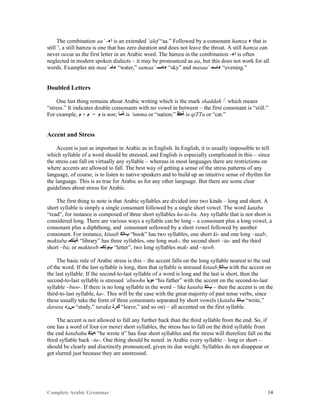
When the taa’ ‫ﺖ‬ t comes at the end of a word in this figure ‫ﺓ‬ or ‫ﺔ‬ it sounds –a rather than –t.
This kind of taa’ is called feminine taa’ or tied taa’ – taa’ marbuwTa. This will be covered in
more detail later. When extended ‘alef ‫ﺍ‬ “aa” is the last letter in a word, it will often not get full
pronunciation, as it will have shorter duration than usual – often it will be pronounced closer to a
short a than a long aa. This is why it is called “shortened ‘alef” or ‘alef maqSuwra ‫ﻯ‬ when it is
the last letter of a word. The other long vowels (y and w) will also not be fully pronounced when
they are at the end of words, and they will often be pronounced closer to the short vowels (i, u),
too.
Complete Arabic Grammar 14
The combination aa’ -‫ﺍﺀ‬ is an extended ‘alef “aa.” Followed by a consonant hamza ‫ﺀ‬ that is
still ’, a still hamza is one that has zero duration and does not leave the throat. A still hamza can
never occur as the first letter in an Arabic word. The hamza in the combination -‫ﺍﺀ‬ is often
neglected in modern spoken dialects – it may be pronounced as aa, but this does not work for all
words. Examples are maa’ ‫ﺀﺎﻤ‬ “water,” samaa’ ‫ﺀﺎﻤﺴ‬ “sky” and masaa’ ‫ﺀﺎﺴﻤ‬ “evening.”
Doubled Letters
One last thing remains about Arabic writing which is the mark shaddah which means
“stress.” It indicates double consonants with no vowel in between – the first consonant is “still.”
For example, ‫ﻢ‬ + ‫ﻢ‬ = ‫ﻢ‬ is mm; ‫ﺔﻤﺃ‬ is ‘umma or “nation;” ‫ﺔﻁﻗ‬ is qiTTa or “cat.”
Accent and Stress
Accent is just as important in Arabic as in English. In English, it is usually impossible to tell
which syllable of a word should be stressed, and English is especially complicated in this – since
the stress can fall on virtually any syllable – whereas in most languages there are restrictions on
where accents are allowed to fall. The best way of getting a sense of the stress patterns of any
language, of course, is to listen to native speakers and to build up an intuitive sense of rhythm for
the language. This is as true for Arabic as for any other language. But there are some clear
guidelines about stress for Arabic.
The first thing to note is that Arabic syllables are divided into two kinds – long and short. A
short syllable is simply a single consonant followed by a single short vowel. The word kataba
“read”, for instance is composed of three short syllables ka-ta-ba. Any syllable that is not short is
considered long. There are various ways a syllable can be long – a consonant plus a long vowel, a
consonant plus a diphthong, and consonant sollowed by a short vowel followed by another
consonant. For instance, kitaab ‫ﺐﺎﺘﻜ‬ “book” has two syllables, one short ki- and one long –taab;
maktaba ‫ﺔﺑﺘﻜﻤ‬ “library” has three syllables, one long mak-, the second short –ta- and the third
short –ba; or maktuwb ‫ﺏﻮﺘﻜﻤ‬ “letter”, two long syllables mak- and –tuwb.
The basic rule of Arabic stress is this – the accent falls on the long syllable nearest to the end
of the word. If the last syllable is long, then that syllable is stressed kitaab ‫ﺐﺎﺘﻜ‬ with the accent on
the last syllable. If the second-to-last syllable of a word is long and the last is short, then the
second-to-last syllable is stressed ‘abuwhu ‫ﻩﻮﺑﺃ‬ “his father” with the accent on the second-to-last
syllable –buw-. If there is no long syllable in the word – like kataba ‫ﺐﺘﻜ‬ – then the accent is on the
third-to-last syllable, ka-. This will be the case with the great majority of past tense verbs, since
these usually take the form of three consonants separated by short vowels (kataba ‫ﺐﺘﻜ‬ “write,”
darasa ‫ﺱﺭﺪ‬ “study,” taraka ‫ﻚﺭﺘ‬ “leave,” and so on) – all accented on the first syllable.
The accent is not allowed to fall any further back than the third syllable from the end. So, if
one has a word of four (or more) short syllables, the stress has to fall on the third syllable from
the end katabahu ‫ﻪﺒﺘﻜ‬ “he wrote it” has four short syllables and the stress will therefore fall on the
third syllable back –ta-. One thing should be noted: in Arabic every syllable – long or short –
should be clearly and disctinctly pronounced, given its due weight. Syllables do not disappear or
get slurred just because they are unstressed.
Complete Arabic Grammar 15
III. ROOTS
In Indo-European languages, such as English, the infinitive is uaually the basic form of the
verb from which the rest of the forms are derived. For example, the inifivitive “to talk” is the
source of many derived words – talking (present participle), talked (past participle), talk (present
simple), talked (past simple), and talk (noun). The main stem of the infinitive stays preserved,
while the inflection works by affixing parts to the stem – most of the time. Unfortunately in
Semitic languages things are a little bit more complex than that. In Arabic the basic source of all
the forms of a verb is called the “root” of the verb. The root is not a real word – rather it is usually
a set of three consonants that can be found in all the words that are related to it. Most roots are
composed of three consonants and very few are four or five consonants. The root can be easily
obtained from the 3rd
person singular masculine simple past form (the perfective) of the verb.
Look at these roots.
Meaning of Verb Root 3rd
Pers. Sing. Masc. Simple
Past Verb
(he) did f “ l ‫ﻞ‬ ‫ﻉ‬ ‫ﻑ‬ fa”ala ‫ﻞﻌﻓ‬
(he) wrote k t b ‫ﺐ‬ ‫ﺕ‬ ‫ﻚ‬ kataba ‫ﺐﺘﻛ‬
(he) studied d r s ‫ﺱ‬ ‫ﺭ‬ ‫ﺪ‬ darasa ‫ﺱﺭﺪ‬
(he) drew (a picture) r s m ‫ﻢ‬ ‫ﺱ‬ ‫ﺭ‬ rasama ‫ﻢﺴﺭ‬
(he) ate ‘ k l ‫ﻞ‬ ‫ﻚ‬ ‫ﺃ‬ ‘akala ‫ﻞﻜﺃ‬
(he) became bigger k b r ‫ﺭ‬ ‫ﺐ‬ ‫ﻚ‬ kabura ‫ﺭﺑﻜ‬
(he) knew “ l m ‫ﻢ‬ ‫ﻞ‬ ‫ﻉ‬ “alima ‫ﻢﻠﻋ‬
(he) rolled (something) d H r j ‫ﺝ‬ ‫ﺭ‬ ‫ﺡ‬ ‫ﺪ‬ daHraja ‫ﺝ‬ ‫ﺭﺤ‬ ‫ﺪ‬
Notice that the root is not a word – it is just a set of consonants. The consonants of the root
are separated by different vowels in different words. They can also be separated by other extra
consonants that do not belong to the root. The root is used to make all the forms of a verb. It is
used to make nouns as well. Each root pertains to a certain meaning – such as kataba ‫ﺐﺘﻛ‬ pertains
to ”writing.” The following is an example.
Meaning Words Derived from the Root ‫ﺐ‬ - ‫ﺕ‬ - ‫ﻚ‬
Verbs
wrote kataba ‫ﺐﺘﻛ‬
was written kutiba ‫ﺐﺘﻛ‬
wrote itself ‘inkataba ‫ﺐﺘﻛﻧﺇ‬
made to write / had to write ‘aktaba ‫ﺐﺘﻛﺇ‬
made to write kattaba ‫ﺐﺘﻛ‬
exchanged writing with kaataba ‫ﺐﺘﺎﻛ‬
exchanged writing with takaataba ‫ﺐﺘﺎﻛﺘ‬
underwrote ‘iktataba ‫ﺐﺘﺘﻛﺇ‬
Complete Arabic Grammar 16
Meaning Words Derived from the Root ‫ﺐ‬ - ‫ﺕ‬ - ‫ﻚ‬
Nouns
written / letter maktwub ‫ﺐﻮﺘﻛﻣ‬
book / dispatch kitaab ‫ﺐﺎﺘﻛ‬
writer kaatib ‫ﺐﺘﺎﻛ‬
writing kitaabat ‫ﺔﺒﺎﺘﻛ‬
desk / office maktab ‫ﺐﺘﻛﻤ‬
library / bookstore maktabat ‫ﺔﺒﺘﻛﻤ‬
phalanx katyibat ‫ﺔﺑﻴﺘﻛ‬
Basically all these words were created by taking the root kataba ‫ﺐ‬ ‫ﺕ‬ ‫ﻚ‬ and adding letters or
vowels to it. This is how Semitic languages work. Almost all Arabic words are structured on
roots.
Words in Arabic grammar belong to three categories:
Noun
‫ﻢﺴﺇ‬
‘ism
includes pronouns, adjectives and most adverbs
Verb
‫ﻝﻌﻓ‬
fa”ala
there are three verb structures in Arabic
Letter (particle)
‫ﻒﺮﺤ‬
Harafa
words that do not have roots
Small words that do not have known roots are not even qualified enough to carry the title of a
“word” in Arabic grammar. Most of these “letters” are prepositions. The three letters of the root
(or rarely four) are called the “original letters” of the word. The varying letters that appear
between the root letters are called the “additional letters.” The letters that can serve as additional
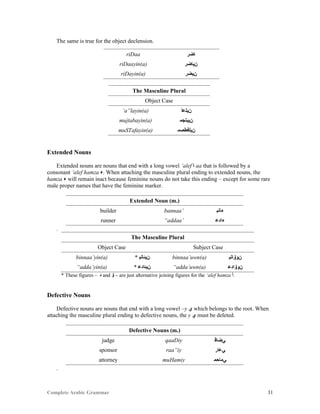
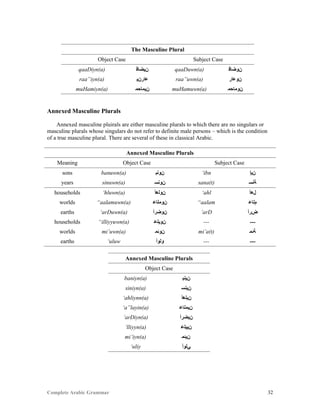
letters are ten— ‘alef hamza ‫,ﺃ‬ ‘alef ‫,ﺍ‬ taa’ ‫,ﺕ‬ seen ‫,ﺱ‬ laam ‫,ﻞ‬ meem ‫,ﻡ‬ noon ‫,ﻥ‬ haa’ ‫,ﻩ‬ waaw ‫,ﻮ‬
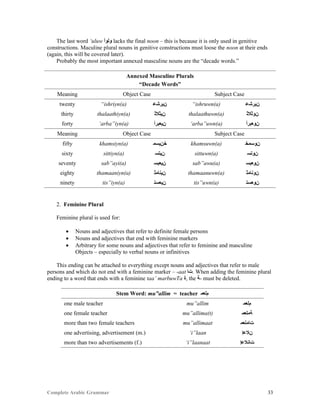
and yaa’ ‫.ﻱ‬ These letters are rounded up in the word sa’altmuwnyihaa ‫ﺎﻬﻳﻧﻮﻤﺘﻠﺄﺴ‬ “you asked me
for/about it.” There are standard patterns for adding those additional letters to the root. These
patterns are called ‘awuzaan ‫ﻦﺍﺯﻮﺃ‬ “measures” or ‘abnya ‫ﺔﻳﻧﺑﺃ‬ “structures.” For example:
‘infa”ala - did itself ‫ﻞﻌﻓﻧﺇ‬ fa”ala = did ‫ﻞﻌﻓ‬
‘inkasara = broke itself ‫ﺇﺮﺴﻜﻧ‬ kasara = broke ‫ﺮﺴﻜ‬
‘inSabba = poured itself ‫ﺐﺼﻧﺇ‬ Sabba = poured ‫ﺏﺼ‬
This structure ‘infa”ala has a specific sense that is different from the basic structure fa”ala.
Both are structures of active simple past (perfective) verbs. However, there is a difference
between the two that is reminiscent of the Latin or French difference between faire (do) and se
faire (be done). The ‘infa”ala structure is called a “reflexive” structure because it denotes a self-
directed action. These two structures will be standardized:
Complete Arabic Grammar 17
(he/it) did fa”ala ‫ﻞﻌﻓ‬
(he/it) did it himself/itself ‘infa”ala ‫ﻞﻌﻓﻧﺇ‬
Complete Arabic Grammar 18
Complete Arabic Grammar 19
IV. NOUNS
A noun in Arabic is a large concept that includes pronouns, adjectives, infinitives (verbal
nouns), and most of the adverbs. All nouns have two characteristics – gender and number. Every
noun in Arabic is either masculine or feminine – there are no neuter nouns in Arabic. Nouns are
four categories in Arabic:
 True masculine: words that refer to male humans or male animals
 Figurative masculine: masculine words that refer to objects
 True feminine: words that refer to female humans or female animals
 Figurative feminine: feminine weords that refer to objects
Unfortunatley there is no general rule to find out if a noun is masculine or feminine by just
looking at it. Although masculine nouns have no defining charcatertics, fortunately most – but not
all – of the feminine nouns can be easily identified by spotting feminine markers at their ends.
Feminine Markers
There are three feminine markers:
 Feminine taa’ = ‫ﺔ‬
 Extended ‘alef = ‫ﺀﺎ‬
 Shortened ‘alef = ‫ﻰ‬ / ‫ﺎ‬
1. Feminine taa’ ‫ﺔ‬
This important marker appears at the end of most feminine noun words. Nonetheless, it also
appears at the end of a few masculine proper names. If one sees a word that ends in this marker, it
will almost always be a feminine word.
male teacher mu”allim ‫ﻤﻢﻠﻌ‬
female teacher mu”allima(t) ‫ﺔﻤﻠﻌﻤ‬
make cat QiTT ‫ﻁﻗ‬
female cat QiTTa(t) ‫ﺔﻁﻗ‬
man rajul ‫ﻞﺠﺭ‬
woman ‘imra’a ‫ﺓﺍﺭﻤﺃ‬
male child Tifl ‫ﻝﻔﻁ‬
female child Tifla(t) ‫ﺔﻟﻔﻁ‬
male American (adj.) ‘amryikiyy ‫ﻲﻜﻴﺭﻤﺃ‬
female American (adj.) ‘amryikiyya(t) ‫ﺔﻴﻜﻴﺭﻤﺃ‬
female proper name faaTima(t) ‫ﺔﻤﻁﺎﻓ‬
female proper name “aa’yisha(t) ‫ﺔﺷﻴﺄﻋ‬
tree (f.) shajara(t) ‫ﺓﺭﺠﺸ‬
Complete Arabic Grammar 20
hour (f,) saa”a(t) ‫ﺔﻋﺎﺴ‬
book (m.) kitaab ‫ﺐﺎﺘﻜ‬
pen (m.) qalam ‫ﻢﻠﻗ‬
male proper name ‘usamma(t) ‫ﺔﻤﺎﺴﺃ‬
The feminine taa’ marbuTa ‫ﺔ‬ can be pronounced both –a and –at. It will be pronounced –at
only if one keeps “speaking” after saying it. If one halts their voice right after pronouncing that
taa’, then one must turn it into –a or –ah. In other words, the t of –at cannot be the last thing you
pronounce. This is kind of similar to the rule of “Arabs don’t stop on the move.” It is also similar
to the French “liaison.” This marker is called”feminization taa’” or “tied taa’.”
2. Extended ‘alef ‫ﺀﺎ‬
This feminine marker is a long vowel ‘alef ‫ﺎ‬ that is followed by a consonant ‘alef or hamza ‫.ﺀ‬
Nouns that end with this combination are called “extended nouns.” The final hamza ‫ﺀ‬ is often
dropped in modern spoken dialects.
Being a “marker” means that the feminine ‫ﺀﺎ‬ will be composed of additional letters and not
any original letters – that is, letters that belong to the root of the word. In order for these two
letters to be additional and thus a marker, the ‘alef ‫ﺎ‬ must be the fourth letter or beyond in the
word – that is, the word has five letters or more. If the ‘alef ‫ﺎ‬ were the third letter, then one of the
two letters of ‫ﺀﺎ‬ (that is the hamza ‫)ﺀ‬ would have to be an original letter because true words must
have a minimum of three original letters.
This does not mean that if the ’alef ‫ﺎ‬ were the fourth letter or beyond, the ‫ﺀﺎ‬ would always be
an additional feminine marker. Adjectives would usually be feminine, whereas infinitives or
verbal nouns would usually be masculine, and the ‫ﺀﺎ‬ at their ends would not be additional – would
not be a feminine marker – even though it is the fourth letter or beyond.
a. Five Letters or More, Singular, Adjectives
Extended ‘alef as a Feminine Marker
gorgeous (adj.) Hasnaa’ ‫ﺀﺎﻧﺴﺣ‬
blonde (adj.) shaqraa’ ‫ﺀﺍﺭﻗﺷ‬
red (adj.) ‘ahamra ‫ﺣﺃﺭﻤ‬
yellow (adj.) ‘aSafra ‫ﺭﻔﺼﺃ‬
desert ‘aXaHra ‫ﺭﺣﺼﺃ‬
green beans (sing.) FaaSuwlya’ ‫ﺀﺎﻴﻠﻮﺻﺎﻓ‬
The last two exmples are simple nouns and not adjectives; however, the first one of them is in
fact an adjective that is customarily used as a noun – because adjectives in Arabic are also nouns.
Another way to look at both of them is that since they are not verbal nouns they are probably
feminine.
Complete Arabic Grammar 21
b. Five Letters or More, Singular, Verbal Nouns
Extended ‘alef NOT a Feminine Marker
Finding the way (m. verbal noun) ‘ihtida ‫ﺪﺘﻫﺇ‬
Beginning (m. verbal noun) ‘ibtida ‫ﺩﺘﺒﺇ‬
Seeking highness (m. verbal noun) li’asti” ‫ﻊﺘﺴﻹ‬
c. Less Than Five Letters
If the ‫ﺀﺎ‬ were not a feminine marker – that is, in words with less then five letters – the word
will usually be masculine--especially verbal nouns. Very few of such words will be feminine.
Note that only singular nouns are being referred to here.
Extended ‘alef NOT a Feminine Marker
water maa’ ‫ﺀﺎﻤ‬
air huwaa’ ‫ﺀﺍﻮﻫ‬
medication duwaa’ ‫ﺪﺀﺍﻮ‬
heaven samaa’ ‫ﺀﺎﻤﺴ‬
calling (verbal noun) nidaa’ ‫ﺀﺍﺪﻨ‬
calling upon, praying (verbal noun) Du”aa’ ‫ﺀﺎﻋﺩ‬
afflicting, affliction (verbal noun) balaa’ ‫ﺀﻼﺒ‬
Although verbal nouns ending with ‫ﺀﺎ‬ are masculine, it is common to see them used as female
proper names – rarely are they used as masculine proper names. The bottom line is ‫ﺀﺎ‬ is common
in female names.
female proper name sanaa’ ‫ﺀﺎﻨﺴ‬
female proper name Du”aa’ ‫ﺀﺎﻋﺩ‬
female proper name hanaa’ ‫ﺀﺎﻨﻫ‬
male proper name Diyaa’ ‫ﺀﺎﻴﻀ‬
Gender of Singular Nouns Ending with Extended ‘alef
Five letters or more
Adjective: feminine
Verbal noun: masculine
Others: usually feminine
Less than five letters Masculine
Proper names Often used for females
Irregular plurals
According to the rules of plural
(usually feminine)
Complete Arabic Grammar 22
3. Shortened ‘alef ‫ﺀﺎ‬
The marker is simply a long vowel ‘alef ‫ﺍ‬ aa. Nouns that end with this ‘alef are called
shortened nouns. This marker is the least specific to feminine words. Just like the extended ‘alef
marker, the long vowel ‘alef ‫ﺍ‬ or ‫ﻯ‬ can be a feminine marker only when the ‘alef ‫ﺍ‬ / ‫ﻯ‬ is the fourth
letter or beyond in the word – that is, the word has four letters or more. If the ‘alef ‫ﺍ‬ / ‫ﻯ‬ were third
letter then it would be an original letter of the word and could not be a feminine marker. If the
‘alef ‫ﺍ‬ / ‫ﻯ‬ were an original letter and not a feminine marker, the word would usually be masculine
– with very few exceptions.
Shortened ‘alef NOT a Feminine Marker
young man fataa ‫ﻰﺘﻓ‬
range madaa ‫ﻯﺪﻤ‬
approving, approval riDaa ‫ﻰﺿﺭ‬
stick, cane “aSaa ‫ﻰﺻﻋ‬
millstone raHaa ‫ﻰﺣﺭ‬
When the ‘alef ‫ﺍ‬ / ‫ﻯ‬ is fourth letter or beyond, the ‘alef ‫ﺍ‬ / ‫ﻯ‬ will be a feminine marker in
some – but not all – nouns. A rough rule is that derived nouns are masculine while the rest are
feminine. Derived nouns in Arabic include infinitives (verbal nouns), passive particles and nouns
of time and place.
Shortened ‘alef NOT a Feminine Marker
given (passive participle) mu”Taa ‫ﻰﻁﻌﻤ‬
purified (passive participle) munaqqaa ‫ﻰﻘﻧﻤ‬
chosen (passive participle) muSTafaa ‫ﻰﻔﻃﺻﻤ‬
(night) club (place noun) malhaa ‫ﻰﻬﻠﻣ‬
winter resort (place noun) mashtaa ‫ﻰﺘﺸﻤ‬
Adjectives of the comparative structure ‘af”al ‫ﻞﻌﻓﺃ‬ are both masculine and feminine at the
same time – except when they are not being comparative adjectives, where they will be masculine
only.
Shortened ‘alef in ‘af”al ‫ﻞﻌﻓﺃ‬ Adjectives
higher (m./f.) ‘a”laa ‫ﻰﻠﻋﺃ‬
nearer (m./f.) ‘adnaa ‫ﻰﻨﺪﺃ‬
stronger (m./f.) ‘aquwaa ‫ﻯﻮﻓﺃ‬
blind (m.) ‘a”maa ‫ﻰﻤﻋﺃ‬
The rest of the shortened nouns with four letters or more will usually be feminine – especially
adjectives of the feminine superlative structure fu”laa ‫.ﻰﻠﻌﻓ‬
Complete Arabic Grammar 23
Shortened ‘alef as a Feminine Marker
female proper name layilaa ‫ﻰﻠﻴﻠ‬
female proper name lubnaa ‫ﻰﻨﺑﻠ‬
female proper name majwaa ‫ﻯﻮﺠﻧ‬
highest (superlative adj.) “alayaa ‫ﺎﻳﻠﻋ‬
smallest (superlative adj.) Sughraa ‫ﻯﺭﻌﺼ‬
pregnant (superlative adj.) Hublaa ‫ﻰﻠﺑﺣ‬
snake (adj.) ‘af”aa ‫ﻰﻋﻓﺃ‬
music muwsyiqaa ‫ﻰﻘﻴﺴﻮﻤ‬
America ‘amriykaa ‫ﺎﻜﻳﺭﻤﺃ‬
Gender of Singular Nouns Ending with Shortened ‘alef
Four letters or more
Passive participle, place/time noun: masculine
‘af”al structure: masculine/feminine
Others: feminine
Less than four letters Masculine
Proper names Used for both males and females
Irregular plurals
According to the rules of plural
(usually feminine)
Feminine Without Markers
Although the feminine markers will be of great use in identifying feminine nouns, there will
still be few feminine nouns that do not have any of these markers. Those nouns that refer to
female persons that do not have feminine markers are covered here.
mother ‘umm ‫ﻢﺃ‬
daughter bint ‫ﺕﻧﺑ‬
sister ‘ukht ‫ﺕﺨﺃ‬
wife in classiscal Arabic zawuj ‫ﺝﻮﺯ‬
bride “aruws ‫ﺱﻮﺮﻋ‬
Complete Arabic Grammar 24
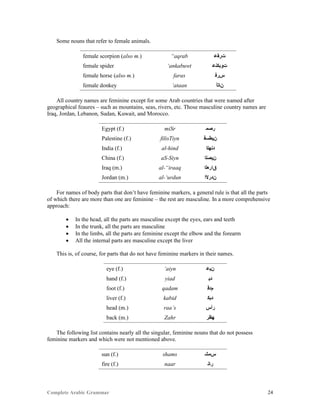
Some nouns that refer to female animals.
female scorpion (also m.) “aqrab ‫ﺕﺭﻘﻋ‬
female spider ‘ankabuwt ‫ﺕﻮﺒﻜﻧﻋ‬
female horse (also m.) faras ‫ﺱﺭﻓ‬
female donkey ‘ataan ‫ﻥﺎﺘﺃ‬
All country names are feminine except for some Arab countries that were named after
geographical feaures – such as mountains, seas, rivers, etc. Those masculine country names are
Iraq, Jordan, Lebanon, Sudan, Kuwait, and Morocco.
Egypt (f.) miSr ‫ﺭﺻﻤ‬
Palestine (f.) filisTiyn ‫ﻦﻳﻁﺴﻓ‬
India (f.) al-hind ‫ﺪﻧﻬﻠﺍ‬
China (f.) aS-Siyn ‫ﻦﻳﺼﻠﺍ‬
Iraq (m.) al-“iraaq ‫ﻕﺍﺭﻌﻠﺍ‬
Jordan (m.) al-‘urdun ‫ﻥﺪﺭﻷﺍ‬
For names of body parts that don’t have feminine markers, a general rule is that all the parts
of which there are more than one are feminine – the rest are masculine. In a more comprehensive
approach:
 In the head, all the parts are masculine except the eyes, ears and teeth
 In the trunk, all the parts are masculine
 In the limbs, all the parts are feminine except the elbow and the forearm
 All the internal parts are masculine except the liver
This is, of course, for parts that do not have feminine markers in their names.
eye (f.) ‘aiyn ‫ﻥﻳﻋ‬
hand (f.) yiad ‫ﺪﻴ‬
foot (f.) qadam ‫ﻢﺪﻗ‬
liver (f.) kabid ‫ﺪﺑﻜ‬
head (m.) raa’s ‫ﺭﺃﺱ‬
back (m.) Zahr ‫ﻬﻅﺭ‬
The following list contains nearly all the singular, feminine nouns that do not possess
feminine markers and which were not mentioned above.
sun (f.) shams ‫ﺱﻤﺸ‬
fire (f.) naar ‫ﺭﺎﻨ‬
Complete Arabic Grammar 25
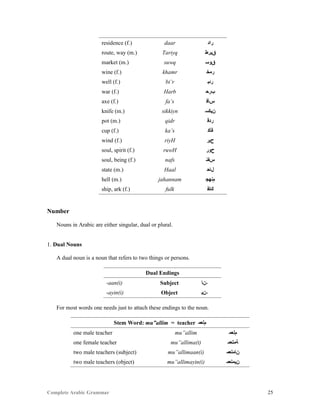
residence (f.) daar ‫ﺭﺍﺪ‬
route, way (m.) Tariyq ‫ﻖﻴﺭﻂ‬
market (m.) suwq ‫ﻖﻮﺴ‬
wine (f.) khamr ‫ﺭﻤﺧ‬
well (f.) bi’r ‫ﺭﺋﺒ‬
war (f.) Harb ‫ﺐﺭﺣ‬
axe (f.) fa’s ‫ﺱﺄﻓ‬
knife (m.) sikkiyn ‫ﻦﻴﻜﺴ‬
pot (m.) qidr ‫ﺭﺪﻗ‬
cup (f.) ka’s ‫ﻗﺄﻜ‬
wind (f.) riyH ‫ﺡﻴﺭ‬
soul, spirit (f.) ruwH ‫ﺡﻮﺭ‬
soul, being (f.) nafs ‫ﺲﻔﻧ‬
state (m.) Haal ‫ﻞﺎﺣ‬
hell (m.) jahannam ‫ﻢﻧﻬﺠ‬
ship, ark (f.) fulk ‫ﻚﻠﻓ‬
Number
Nouns in Arabic are either singular, dual or plural.
1. Dual Nouns
A dual noun is a noun that refers to two things or persons.
Dual Endings
-aan(i) Subject ‫-ﻦﺎ‬
-ayin(i) Object ‫-ﻦﻴ‬
For most words one needs just to attach these endings to the noun.
Stem Word: mu”allim = teacher ‫ﻢﻠﻌﻤ‬
one male teacher mu”allim ‫ﻢﻠﻌﻤ‬
one female teacher mu”allima(t) ‫ﺔﻤﻠﻌﻤ‬
two male teachers (subject) mu”allimaan(i) ‫ﻥﺎﻤﻠﻌﻤ‬
two male teachers (object) mu”allimayin(i) ‫ﻥﻳﻤﻠﻌﻤ‬
Complete Arabic Grammar 26
two females teachers (subject) mu”allimataan(i) ‫ﻥﺎﺘﻤﻠﻌﻤ‬
two female teachers (object) mu”allimatayin(i) ‫ﻥﻴﺘﻤﻠﻌﻤ‬
One can see how the feminine taa’ marbuwTa ‫-ﺓ‬ ought to be pronounced –at in the dual –
since it is no longer at the end of the word there is no possibility that one stops speaking right
after it. The dual ending shows obvious inflection with different grammatical cases – one should
pay attention to this.
Stem Word: mu”allim = teacher ‫ﻢﻠﻌﻤ‬
Nominative (Subject)
The two teachers (m.) are here.
mu”allimaan(i) ‫ﻥﺎﻤﻠﻌﻤ‬
The two teachers (f.) are here mu”allimtann(i)) ‫ﻥﺎﺘﻤﻠﻌﻤ‬
Accusative (Direct Object)
I saw the two teachers (m.).
mu”allimayin(i) ‫ﻥﻳﻤﻠﻌﻤ‬
I saw the two teachers (f.). mu”allimatayin(i) ‫ﻥﻴﺘﻤﻠﻌﻤ‬
Ablative (Indirect Object)
I gave it to the two teachers (m.).
mu”allimayin(i) ‫ﻥﻳﻤﻠﻌﻤ‬
I gave it to the two teachers (f.). mu”allimatayin(i) ‫ﻥﻴﺘﻤﻠﻌﻤ‬
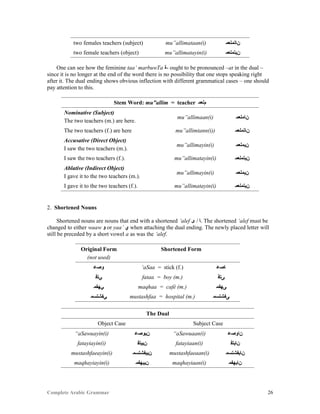
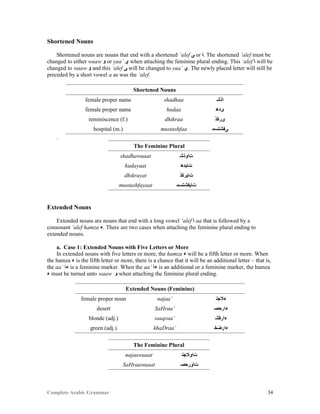
2. Shortened Nouns
Shortened nouns are nouns that end with a shortened ‘alef ‫ﻯ‬ / ‫.ﺎ‬ The shortened ‘alef must be
changed to either waaw ‫ﻮ‬ or yaa’ ‫ﻱ‬ when attaching the dual ending. The newly placed letter will
still be preceded by a short vowel a as was the ‘alef.
Original Form
(not used)
Shortened Form
‫ﻮﺼﻋ‬ ‘aSaa = stick (f.) ‫ﺎﺻﻋ‬
‫ﻲﺘﻓ‬ fataa = boy (m.) ‫ﻰﺘﻓ‬
‫ﻲﻬﻔﻤ‬ maqhaa = café (m.) ‫ﻰﻬﻔﻤ‬
‫ﻲﻔﺷﺘﺴﻤ‬ mustashfaa = hospital (m.) ‫ﻰﻔﺷﺘﺴﻤ‬
The Dual
Object Case Subject Case
“aSawuayin(i) ‫ﻥﻴﻮﺻﻋ‬ “aSawuaan(i) ‫ﻥﺍﻮﺻﻋ‬
fatayiayin(i) ‫ﻦﻳﻴﺘﻓ‬ fatayiaan(i) ‫ﻦﺎﻴﺘﻓ‬
mustashfaeayin(i) ‫ﻦﻴﻴﻔﺷﺘﺴﻤ‬ mustashfaeaan(i) ‫ﻦﺎﻴﻔﺷﺘﺴﻤ‬
maqhayiayin(i) ‫ﻥﻴﻴﻬﻔﻤ‬ maqhayiaan(i) ‫ﻥﺎﻴﻬﻔﻤ‬
Complete Arabic Grammar 27
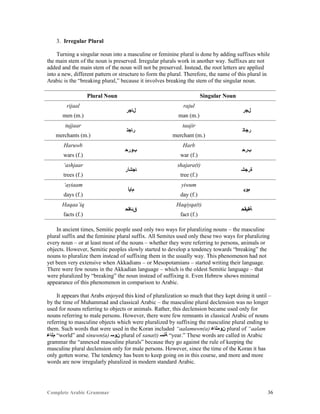
3. Extended Nouns
Extended nouns are nouns that end with a long vowel ‘alef ‫ﺎ‬ aa that is followed by a
consonant ‘alef hamza ‫.ﺀ‬ There are two cases when attaching the dual ending to extended nouns:
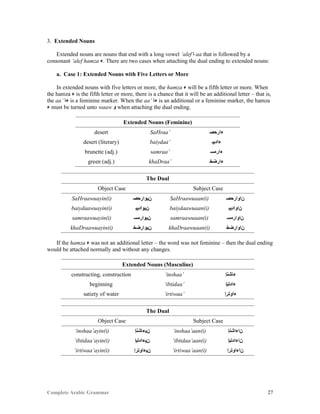
a. Case 1: Extended Nouns with Five Letters or More
In extended nouns with five letters or more, the hamza ‫ﺀ‬ will be a fifth letter or more. When
the hamza ‫ﺀ‬ is the fifth letter or more, there is a chance that it will be an additional letter – that is,
the aa’ ‫ﺀﺎ‬ is a feminine marker. When the aa’ ‫ﺀﺎ‬ is an additional or a feminine marker, the hamza
‫ﺀ‬ must be turned unto waaw ‫ﻮ‬ when attaching the dual ending.
Extended Nouns (Feminine)
desert SaHraa’ ‫ﺀﺍﺭﺣﺼ‬
desert (literary) baiydaa’ ‫ﺀﺍﺪﻴﺑ‬
brunette (adj.) samraa’ ‫ﺀﺍﺭﻤﺴ‬
green (adj.) khaDraa’ ‫ﺀﺍﺭﻀﺧ‬
The Dual
Object Case Subject Case
SaHraawuayin(i) ‫ﻥﻳﻮﺍﺭﺣﺼ‬ SaHraawuaan(i) ‫ﻦﺍﻮﺍﺭﺣﺼ‬
baiydaawuayin(i) ‫ﻥﻳﻮﺍﺪﻴﺑ‬ baiydaawuaan(i) ‫ﻦﺍﻮﺍﺪﻴﺑ‬
samraawuayin(i) ‫ﻥﻳﻮﺍﺭﻤﺴ‬ samraawuaan(i) ‫ﻥﺍﻮﺍﺭﻤﺴ‬
khaDraawuayin(i) ‫ﻥﻴﻮﺍﺭﻀﺧ‬ khaDraawuaan(i) ‫ﻥﺍﻮﺍﺭﻀﺧ‬
If the hamza ‫ﺀ‬ was not an additional letter – the word was not feminine – then the dual ending
would be attached normally and without any changes.
Extended Nouns (Masculine)
constructing, construction ‘inshaa’ ‫ﺀﺎﺸﻧﺇ‬
beginning ‘ibtidaa’ ‫ﺀﺍﺪﺘﺑﺇ‬
satiety of water ‘irtiwaa’ ‫ﺀﺍﻮﺘﺮﺇ‬
The Dual
Object Case Subject Case
‘inshaa’ayin(i) ‫ﻦﻴﺀﺎﺸﻧﺇ‬ ‘inshaa’aan(i) ‫ﻥﺍﺀﺍﺸﻧﺇ‬
‘ibtidaa’ayin(i) ‫ﻦﻴﺀﺍﺪﺘﺑﺇ‬ ‘ibtidaa’aan(i) ‫ﻥﺍﺀﺍﺪﺘﺑﺇ‬
‘irtiwaa’ayin(i) ‫ﻦﻴﺀﺍﻮﺘﺮﺇ‬ ‘irtiwaa’aan(i) ‫ﻥﺍﺀﺍﻮﺘﺮﺇ‬
Complete Arabic Grammar 28
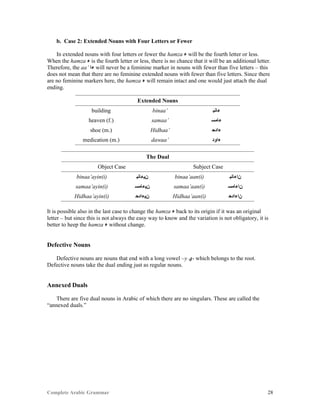
b. Case 2: Extended Nouns with Four Letters or Fewer
In extended nouns with four letters or fewer the hamza ‫ﺀ‬ will be the fourth letter or less.
When the hamza ‫ﺀ‬ is the fourth letter or less, there is no chance that it will be an additional letter.
Therefore, the aa’ ‫ﺀﺎ‬ will never be a feminine marker in nouns with fewer than five letters – this
does not mean that there are no feminine extended nouns with fewer than five letters. Since there
are no feminine markers here, the hamza ‫ﺀ‬ will remain intact and one would just attach the dual
ending.
Extended Nouns
building binaa’ ‫ﺀﺎﻧﺒ‬
heaven (f.) samaa’ ‫ﺀﺎﻤﺴ‬
shoe (m.) Hidhaa’ ‫ﺀﺍﺪﺤ‬
medication (m.) dawaa’ ‫ﺀﺍﻮﺪ‬
The Dual
Object Case Subject Case
binaa’ayin(i) ‫ﻥﻴﺀﺎﻧﺒ‬ binaa’aan(i) ‫ﻥﺍﺀﺎﻧﺒ‬
samaa’ayin(i) ‫ﻥﻴﺀﺎﻤﺴ‬ samaa’aan(i) ‫ﻥﺍﺀﺎﻤﺴ‬
Hidhaa’ayin(i) ‫ﻥﻴﺀﺍﺪﺤ‬ Hidhaa’aan(i) ‫ﻥﺍﺀﺍﺪﺤ‬
It is possible also in the last case to change the hamza ‫ﺀ‬ back to its origin if it was an original
letter – but since this is not always the easy way to know and the variation is not obligatory, it is
better to heep the hamza ‫ﺀ‬ without change.
Defective Nouns
Defective nouns are nouns that end with a long vowel –y ‫-ﻱ‬ which belongs to the root.
Defective nouns take the dual ending just as regular nouns.
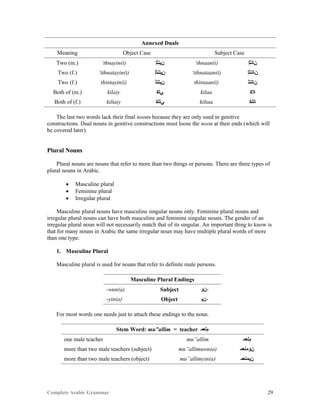
Annexed Duals
There are five dual nouns in Arabic of which there are no singulars. These are called the
“annexed duals.”
Complete Arabic Grammar 29
Annexed Duals
Meaning Object Case Subject Case
Two (m.) ‘thnayin(i) ‫ﻥﻳﻧﺛﺇ‬ ‘thnaan(i) ‫ﻥﺎﻧﺛﺇ‬
Two (f.) ‘ithnatayin(i) ‫ﻥﻳﺘﻧﺛﺇ‬ ‘ithnataan(i) ‫ﻥﺎﺘﻧﺛﺇ‬
Two (f.) thintayin(i) ‫ﻥﻳﺘﻧﺛ‬ thintaan(i) ‫ﻥﺎﺘﻧﺛ‬
Both of (m.) kilaiy ‫ﻲﻠﻜ‬ kilaa ‫ﻼﻜ‬
Both of (f.) kiltaiy ‫ﻲﺘﻠﻜ‬ kiltaa ‫ﺎﺘﻠﻜ‬
The last two words lack their final noons because they are only used in genitive
constructions. Dual nouns in genitive constructions must loose the noon at their ends (which will
be covered later).
Plural Nouns
Plural nouns are nouns that refer to more than two things or persons. There are three types of
plural nouns in Arabic.
 Masculine plural
 Feminine plural
 Irregular plural
Masculine plural nouns have masculine singular nouns only. Feminine plural nouns and
irregular plural nouns can have both masculine and feminine singular nouns. The gender of an
irregular plural noun will not necessarily match that of its singular. An important thing to know is
that for many nouns in Arabic the same irregular noun may have multiple plural words of more
than one type.
1. Masculine Plural
Masculine plural is used for nouns that refer to definite male persons.
Masculine Plural Endings
-wun(a) Subject ‫-ﻦﻮ‬
-yin(a) Object ‫-ﻦﻴ‬
For most words one needs just to attach these endings to the noun.
Stem Word: mu”allim = teacher ‫ﻢﻠﻌﻤ‬
one male teacher mu”allim ‫ﻢﻠﻌﻤ‬
more than two male teachers (subject) mu”allimuwn(a) ‫ﻥﻮﻤﻠﻌﻤ‬
more than two male teachers (object) mu”allimyin(a) ‫ﻥﻴﻤﻠﻌﻤ‬
Complete Arabic Grammar 30
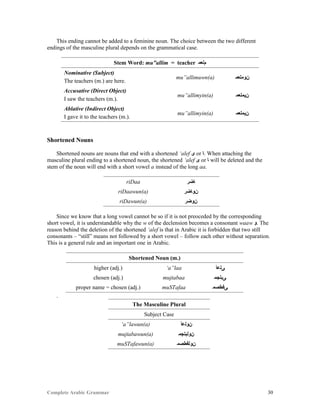
This ending cannot be added to a feminine noun. The choice between the two different
endings of the masculine plural depends on the grammatical case.
Stem Word: mu”allim = teacher ‫ﻢﻠﻌﻤ‬
Nominative (Subject)
The teachers (m.) are here.
mu”allimuwn(a) ‫ﻥﻮﻤﻠﻌﻤ‬
Accusative (Direct Object)
I saw the teachers (m.).
mu”allimyin(a) ‫ﻥﻳﻤﻠﻌﻤ‬
Ablative (Indirect Object)
I gave it to the teachers (m.).
mu”allimyin(a) ‫ﻥﻳﻤﻠﻌﻤ‬
Shortened Nouns
Shortened nouns are nouns that end with a shortened ‘alef ‫ﻯ‬ or ‫.ﺎ‬ When attaching the
masculine plural ending to a shortened noun, the shortened ‘alef ‫ﻯ‬ or ‫ﺎ‬ will be deleted and the
stem of the noun will end with a short vowel a instead of the long aa.
riDaa ‫ﺎﺿﺭ‬
riDaawun(a) ‫ﻦﻮﺎﺿﺭ‬
riDawun(a) ‫ﻦﻮﺿﺭ‬
Since we know that a long vowel cannot be so if it is not preoceded by the corresponding
short vowel, it is understandable why the w of the declension becomes a consonant waaw ‫.ﻮ‬ The
reason behind the deletion of the shortened ‘alef is that in Arabic it is forbidden that two still
consonants – “still” means not followed by a short vowel – follow each other without separation.
This is a general rule and an important one in Arabic.
Shortened Noun (m.)
higher (adj.) ‘a”laa ‫ﻰﻠﻋﺃ‬
chosen (adj.) mujtabaa ‫ﻰﺑﺘﺠﻤ‬
proper name = chosen (adj.) muSTafaa ‫ﻰﻓﻁﺼﻤ‬
.
The Masculine Plural
Subject Case
‘a”lawun(a) ‫ﻥﻮﻠﻋﺃ‬
mujtabawun(a) ‫ﻥﻮﻠﺑﺘﺠﻤ‬
muSTafawun(a) ‫ﻥﻮﻠﻓﻁﺼﻤ‬
Complete Arabic Grammar 31
The same is true for the object declension.
riDaa ‫ﺎﺿﺭ‬
riDaayin(a) ‫ﻦﻳﺎﺿﺭ‬
riDayin(a) ‫ﻦﻳﺿﺭ‬
The Masculine Plural
Object Case
‘a”layin(a) ‫ﻥﻴﻠﻋﺃ‬
mujtabayin(a) ‫ﻥﻴﺑﺘﺠﻤ‬
muSTafayin(a) ‫ﻥﻴﻠﻓﻁﺼﻤ‬
Extended Nouns
Extended nouns are nouns that end with a long vowel ‘alef ‫ﺎ‬ aa that is followed by a
consonant ‘alef hamza ‫.ﺀ‬ When attaching the masculine plural ending to extended nouns, the
hamza ‫ﺀ‬ will remain inact because feminine nouns do not take this ending – except for some rare
male proper names that have the feminine marker.
Extended Noun (m.)
builder bannaa’ ‫ﺀﺎﻧﺒ‬
runner “addaa’ ‫ﺀﺍﺪﻋ‬
.
The Masculine Plural
Object Case Subject Case
binnaa’yin(a) * ‫ﻦﻴﺌﺎﻧﺒ‬ binnaa’uwn(a) ‫ﻦﻮﯝﺎﻧﺒ‬
“adda’yin(a) * ‫ﻦﻴﺌﺍﺪﻋ‬ “adda’uwn(a) ‫ﻦﻮﯝﺍﺪﻋ‬
* These figures – ‫ﺌ‬ and ‫ﯝ‬ – are just alternative joining figures for the ‘alef hamza ‫.ﺃ‬
Defective Nouns
Defective nouns are nouns that end with a long vowel –y ‫ﻱ‬ which belongs to the root. When
attaching the masculine plural ending to defective nouns, the y ‫ﻱ‬ must be deleted.
Defective Nouns (m.)
judge qaaDiy ‫ﻲﺿﺎﻗ‬
sponsor raa”iy ‫ﻲﻋﺍﺭ‬
attorney muHamiy ‫ﻲﻤﺎﺤﻤ‬
.
Complete Arabic Grammar 32
The Masculine Plural
Object Case Subject Case
qaaDiyn(a) ‫ﻥﻴﺿﺎﻗ‬ qaaDuwn(a) ‫ﻦﻮﺿﺎﻗ‬
raa”iyn(a) ‫ﻋﺍﺭﻥﻴ‬ raa”uwn(a) ‫ﻦﻮﻋﺍﺭ‬
muHamiyn(a) ‫ﻥﻴﻤﺎﺤﻤ‬ muHamuwn(a) ‫ﻦﻮﻤﺎﺤﻤ‬
Annexed Masculine Plurals
Annexed masculine pluirals are either masculine plurals to which there are no singulars or
masculine plurals whose singulars do not refer to definite male persons – which is the condition
of a true masculine plural. There are several of these in classical Arabic.
Annexed Masculine Plurals
Meaning Object Case Subject Case
sons banuwn(a) ‫ﻥﻮﻨﺒ‬ ‘ibn ‫ﻥﻴﺇ‬
years sinuwn(a) ‫ﻥﻮﻧﺴ‬ sana(t) ‫ﺔﻧﺴ‬
households ‘hluwn(a) ‫ﻦﻮﻠﻫﺃ‬ ‘ahl ‫ﻞﻫﺃ‬
worlds “aalamuwn(a) ‫ﻥﻮﻣﻠﺎﻋ‬ “aalam ‫ﻢﻠﺎﻋ‬
earths ‘arDuwn(a) ‫ﻥﻮﻀﺮﺃ‬ ’arD ‫ﺾﺮﺃ‬
households “illiyyuwn(a) ‫ﻥﻮﻴﻠﻋ‬ --- ---
worlds mi’uwn(a) ‫ﻥﻮﺌﻤ‬ mi’a(t) ‫ﺔﺌﻤ‬
earths ‘uluw ‫ﻮﻠﻮﺃ‬ --- ---
Annexed Masculine Plurals
Object Case
baniyn(a) ‫ﻥﻴﻨﺒ‬
siniyn(a) ‫ﻥﻴﻧﺴ‬
‘ahliynn(a) ‫ﻦﻴﻠﻫﺃ‬
‘a”layin(a) ‫ﻥﻴﻣﻠﺎﻋ‬
‘arDiyn(a) ‫ﻥﻴﻀﺮﺃ‬
‘lliyyn(a) ‫ﻥﻴﻴﻠﻋ‬
mi’iyn(a) ‫ﻥﻴﺌﻤ‬
‘uliy ‫ﻲﻠﻮﺃ‬
Complete Arabic Grammar 33
The last word ‘uluw ‫ﻮﻠﻮﺃ‬ lacks the final noon – this is because it is only used in genitive
constructions. Maculine plural nouns in genitive constructions must loose the noon at their ends
(again, this will be covered later).
Probably the most important annexed masculine nouns are the “decade words.”
Annexed Masculine Plurals
“Decade Words”
Meaning Object Case Subject Case
twenty “ishriyn(a) ‫ﻥﻴﺮﺸﻋ‬ “ishruwn(a) ‫ﻥﻴﺮﺸﻋ‬
thirty thalaathiyn(a) ‫ﻥﻴﺜﻼﺜ‬ thalaathuwn(a) ‫ﻥﻮﺜﻼﺜ‬
forty ‘arba”iyn(a) ‫ﻦﻴﻌﺑﺭﺃ‬ ‘arba”uwn(a) ‫ﻦﻮﻌﺑﺭﺃ‬
Meaning Object Case Subject Case
fifty khamsiyn(a) ‫ﺧﻥﻳﺴﻤ‬ khamsuwn(a) ‫ﻥﻮﺴﻤﺧ‬
sixty sittiyn(a) ‫ﻥﻴﺘﺴ‬ sittuwn(a) ‫ﻥﻮﺘﺴ‬
seventy sab”ayi(a) ‫ﻥﻳﻌﺒﺴ‬ sab”awu(a) ‫ﻥﻮﻌﺒﺴ‬
eighty thamaaniyn(a) ‫ﻥﻴﻧﺎﻤﺜ‬ thamaanuwn(a) ‫ﻥﻮﻧﺎﻤﺜ‬
ninety tis”iyn(a) ‫ﻦﻳﻌﺴﺘ‬ tis”uwn(a) ‫ﻦﻮﻌﺴﺘ‬
2. Feminine Plural
Feminine plural is used for:
 Nouns and adjectives that refer to definite female persons
 Nouns and adjectives that end with feminine markers
 Arbitrary for some nouns and adjectives that refer to feminine and masculine
Objects – especially to verbal nouns or infinitives
This ending can be attached to everything except nouns and adjectives that refer to male
persons and which do not end with a feminine marker – -aat ‫.ﺕﺎ‬ When adding the feminine plural
ending to a word that ends with a feminine taa’ marbuwTa ‫,ﺓ‬ the ‫-ﺔ‬ must be deleted.
Stem Word: mu”allim = teacher ‫ﻢﻠﻌﻤ‬
one male teacher mu”allim ‫ﻢﻠﻌﻤ‬
one female teacher mu”allima(t) ‫ﺔﻤﻠﻌﻤ‬
more than two female teachers mu”allimaat ‫ﺕﺎﻤﻠﻌﻤ‬
one advertising, advertisement (m.) ‘i”laan ‫ﻦﻼﻋﺇ‬
more than two advertisements (f.) ‘i”laanaat ‫ﺕﺎﻧﻼﻋﺇ‬
Complete Arabic Grammar 34
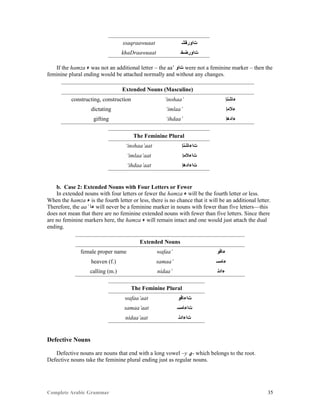
Shortened Nouns
Shortened nouns are nouns that end with a shortened ‘alef ‫ﻰ‬ or ‫.ﺎ‬ The shortened ‘alef must be
changed to either waaw ‫ﻮ‬ or yaa’ ‫ﻱ‬ when attaching the feminine plural ending. This ‘alef ‫ﺎ‬ will be
changed to waaw ‫ﻮ‬ and this ‘alef ‫ﻰ‬ will be changed to yaa’ ‫.ﻱ‬ The newly placed letter will still be
preceded by a short vowel a as was the ‘alef.
Shortened Nouns
female proper name shadhaa ‫ﺍﺫﺸ‬
female proper name hudaa ‫ﻯﺪﻫ‬
reminiscence (f.) dhikraa ‫ﻯﺭﻜﺫ‬
hospital (m.) mustashfaa ‫ﻰﻔﺷﺘﺴﻤ‬
.
The Feminine Plural
shadhawuaat ‫ﺖﺍﻮﺫﺸ‬
hudayaat ‫ﺖﺎﻴﺪﻫ‬
dhikrayat ‫ﺖﺎﻴﺭﻜﺫ‬
mustashfayaat ‫ﺖﺎﻴﻔﺷﺘﺴﻤ‬
Extended Nouns
Extended nouns are nouns that end with a long vowel ‘alef ‫ﺎ‬ aa that is followed by a
consonant ‘alef hamza ‫.ﺀ‬ There are two cases when attaching the feminine plural ending to
extended nouns.
a. Case 1: Extended Nouns with Five Letters or More
In extended nouns with five letters or more, the hamza ‫ﺀ‬ will be a fifth letter or more. When
the hamza ‫ﺀ‬ is the fifth letter or more, there is a chance that it will be an additional letter – that is,
the aa’ ‫ﺀﺎ‬ is a feminine marker. When the aa’ ‫ﺀﺎ‬ is an additional or a feminine marker, the hamza
‫ﺀ‬ must be turned unto waaw ‫ﻮ‬ when attaching the feminine plural ending.
Extended Nouns (Feminine)
female proper noun najaa’ ‫ﺀﻼﺠﻧ‬
desert SaHraa’ ‫ﺀﺍﺭﺣﺼ‬
blonde (adj.) ssaqraa’ ‫ﺀﺍﺭﻘﺸ‬
green (adj.) khaDraa’ ‫ﺀﺍﺭﻀﺧ‬
The Feminine Plural
najaawuaat ‫ﺖﺍﻮﻼﺠﻧ‬
SaHraawuaat ‫ﺖﺍﻮﺭﺣﺼ‬
Complete Arabic Grammar 35
ssaqraawuaat ‫ﺖﺍﻮﺭﻘﺸ‬
khaDraawuaat ‫ﺖﺍﻮﺭﻀﺧ‬
If the hamza ‫ﺀ‬ was not an additional letter – the aa’ ‫ﺖﺍﻮ‬ were not a feminine marker – then the
feminine plural ending would be attached normally and without any changes.
Extended Nouns (Masculine)
constructing, construction ‘inshaa’ ‫ﺀﺎﺸﻧﺇ‬
dictating ‘imlaa’ ‫ﺀﻼﻤﺇ‬
gifting ‘ihdaa’ ‫ﺀﺍﺩﻫﺇ‬
The Feminine Plural
‘inshaa’aat ‫ﺖﺍﺀﺎﺸﻧﺇ‬
‘imlaa’aat ‫ﺖﺍﺀﻼﻤﺇ‬
‘ihdaa’aat ‫ﺖﺍﺀﺍﺩﻫﺇ‬
b. Case 2: Extended Nouns with Four Letters or Fewer
In extended nouns with four letters or fewer the hamza ‫ﺀ‬ will be the fourth letter or less.
When the hamza ‫ﺀ‬ is the fourth letter or less, there is no chance that it will be an additional letter.
Therefore, the aa’ ‫ﺀﺎ‬ will never be a feminine marker in nouns with fewer than five letters—this
does not mean that there are no feminine extended nouns with fewer than five letters. Since there
are no feminine markers here, the hamza ‫ﺀ‬ will remain intact and one would just attach the dual
ending.
Extended Nouns
female proper name wafaa’ ‫ﺀﺎﻓﻮ‬
heaven (f.) samaa’ ‫ﺀﺎﻤﺴ‬
calling (m.) nidaa’ ‫ﺀﺍﺪﻧ‬
The Feminine Plural
wafaa’aat ‫ﺖﺍﺀﺎﻓﻮ‬
samaa’aat ‫ﺖﺍﺀﺎﻤﺴ‬
nidaa’aat ‫ﺖﺍﺀﺍﺪﻧ‬
Defective Nouns
Defective nouns are nouns that end with a long vowel –y ‫-ﻱ‬ which belongs to the root.
Defective nouns take the feminine plural ending just as regular nouns.
Complete Arabic Grammar 36
3. Irregular Plural
Turning a singular noun into a masculine or feminine plural is done by adding suffixes while
the main stem of the noun is preserved. Irregular plurals work in another way. Suffixes are not
added and the main stem of the noun will not be preserved. Instead, the root letters are applied
into a new, different pattern or structure to form the plural. Therefore, the name of this plural in
Arabic is the “breaking plural,” because it involves breaking the stem of the singular noun.
Plural Noun Singular Noun
rijaal
‫ﻞﺎﺠﺭ‬
rajul
‫ﻞﺟﺭ‬
men (m.) man (m.)
tujjaar
‫ﺭﺎﺠﺘ‬
taajir
‫ﺮﺠﺎﺘ‬
merchants (m.) merchant (m.)
Haruwb
‫ﺐﻮﺭﺣ‬
Harb
‫ﺐﺭﺣ‬
wars (f.) war (f.)
‘ashjaar
‫ﺎﺠﺷﺃﺭ‬
shajara(t)
‫ﺓﺭﺠﺸ‬
trees (f.) tree (f.)
‘ayiaam
‫ﻢﺎﻴﺃ‬
yiwum
‫ﻢﻮﻳ‬
days (f.) day (f.)
Haqaa’iq
‫ﻖﺌﺎﻘﺤ‬
Haqiyqa(t)
‫ﺔﻘﻴﻘﺣ‬
facts (f.) fact (f.)
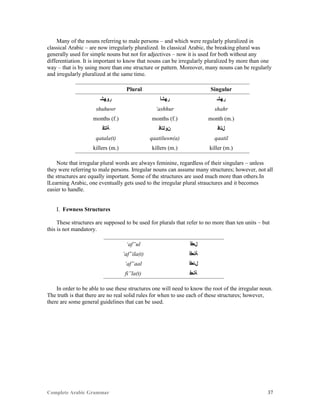
In ancient times, Semitic people used only two ways for pluralizing nouns – the masculine
plural suffix and the feminine plural suffix. All Semites used only these two ways for pluralizing
every noun – or at least most of the nouns – whether they were referring to persons, animals or
objects. However, Semitic peoples slowly started to develop a tendency towards “breaking” the
nouns to pluralize them instead of suffixing them in the usually way. This phenomenon had not
yet been very extensive when Akkadians – or Mesopotamians – started writing their language.
There were few nouns in the Akkadian language – which is the oldest Semitic language – that
were pluralized by “breaking” the noun instead of suffixing it. Even Hebrew shows minimal
appearance of this phenomenon in comparison to Arabic.
It appears that Arabs enjoyed this kind of pluralization so much that they kept doing it until –
by the time of Muhammad and classical Arabic – the masculine plural declension was no longer
used for nouns referring to objects or animals. Rather, this declension became used only for
nouns referring to male persons. However, there were few remnants in classical Arabic of nouns
referring to masculine objects which were pluralized by suffixing the masculine plural ending to
them. Such words that were used in the Koran included “aalamuwn(a) ‫ﻥﻮﻣﻠﺎﻋ‬ plural of “aalam
‫ﻢﻠﺎﻋ‬ “world” and sinuwn(a) ‫ﻥﻮﺴ‬ plural of sana(t) ‫ﺔﻧﺴ‬ “year.” These words are called in Arabic
grammar the “annexed masculine plurals” because they go against the rule of keeping the
masculine plural declension only for male persons. However, since the time of the Koran it has
only gotten worse. The tendency has been to keep going on in this course, and more and more
words are now irregularly pluralized in modern standard Arabic.
Complete Arabic Grammar 37
Many of the nouns referring to male persons – and which were regularly pluralized in
classical Arabic – are now irregularly pluralized. In classical Arabic, the breaking plural was
generally used for simple nouns but not for adjectives – now it is used for both without any
differentiation. It is important to know that nouns can be irregularly pluralized by more than one
way – that is by using more than one structure or pattern. Moreover, many nouns can be regularly
and irregularly pluralized at the same time.
Plural Singular
‫ﺭﻮﻬﺸ‬ ‫ﺭﻬﺸﺃ‬ ‫ﺭﻬﺸ‬
shuhuwr ‘ashhur shahr
months (f.) months (f.) month (m.)
‫ﺔﻠﺘﻗ‬ ‫ﻥﻮﻠﺘﺎﻗ‬ ‫ﻞﺘﺎﻗ‬
qatala(t) qaatiluwn(a) qaatil
killers (m.) killers (m.) killer (m.)
Note that irregular plural words are always feminine, regardless of their singulars – unless
they were referring to male persons. Irregular nouns can assume many structures; however, not all
the structures are equally important. Some of the structures are used much more than others.In
lLearning Arabic, one eventually gets used to the irregular plural strauctures and it becomes
easier to handle.
I. Fewness Structures
These structures are supposed to be used for plurals that refer to no more than ten units – but
this is not mandatory.
‘af”ul ‫ﻞﻌﻓﺃ‬
‘af”ila(t) ‫ﺔﻠﻌﻓﺃ‬
‘af”aal ‫ﻞﺎﻌﻓﺃ‬
fi”la(t) ‫ﺔﻠﻌﻓ‬
In order to be able to use these structures one will need to know the root of the irregular noun.
The truth is that there are no real solid rules for when to use each of these structures; however,
there are some general guidelines that can be used.
Complete Arabic Grammar 38
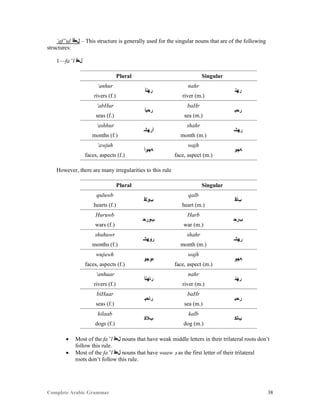
‘af”ul ‫ﻞﻌﻓﺃ‬ – This structure is generally used for the singular nouns that are of the following
structures:
1—fa”l ‫ﻞﻌﻓ‬
Plural Singular
‘anhur
‫ﺭﻬﻧﺃ‬
nahr
‫ﺭﻬﻧ‬
rivers (f.) river (m.)
‘abHur
‫ﺭﺤﺑﺃ‬
baHr
‫ﺭﺤﺑ‬
seas (f.) sea (m.)
‘ashhur
‫ﺃﺭﻬﺷ‬
shahr
‫ﺭﻬﺷ‬
months (f.) month (m.)
‘awjuh
‫ﻪﺠﻮﺃ‬
wajh
‫ﻪﺠﻮ‬
faces, aspects (f.) face, aspect (m.)
However, there are many irregularities to this rule
Plural Singular
quluwb
‫ﺐﻮﻠﻗ‬
qalb
‫ﺐﻠﻗ‬
hearts (f.) heart (m.)
Huruwb
‫ﺐﻮﺭﺤ‬
Harb
‫ﺐﺭﺣ‬
wars (f.) war (m.)
shuhuwr
‫ﺭﻮﻬﺷ‬
shahr
‫ﺭﻬﺷ‬
months (f.) month (m.)
wujuwh
‫ﻩﻮﺠﻮ‬
wajh
‫ﻪﺠﻮ‬
faces, aspects (f.) face, aspect (m.)
‘anhaar
‫ﺭﺎﻬﻧﺃ‬
nahr
‫ﺭﻬﻧ‬
rivers (f.) river (m.)
biHaar
‫ﺭﺎﺣﺑ‬
baHr
‫ﺭﺣﺒ‬
seas (f.) sea (m.)
kilaab
‫ﺐﻼﻜ‬
kalb
‫ﺐﻠﻜ‬
dogs (f.) dog (m.)
 Most of the fa”l ‫ﻞﻌﻓ‬ nouns that have weak middle letters in their trilateral roots don’t
follow this rule.
 Most of the fa”l ‫ﻞﻌﻓ‬ nouns that have waaw ‫ﻮ‬ as the first letter of their trilateral
roots don’t follow this rule.
Complete Arabic Grammar 39
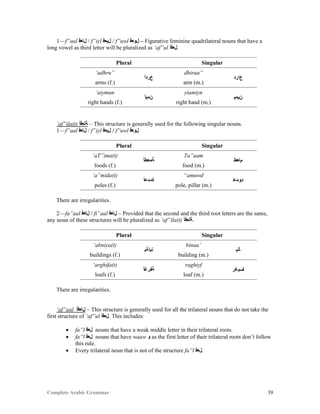
1—f”aal ‫ﻞﺎﻌﻓ‬ / f”iyl ‫ﻞﻴﻌﻓ‬ / f”uwl ‫ﻞﻮﻌﻓ‬ – Figurative feminine quadrilateral nouns that have a
long vowel as third letter will be pluralized as ‘af”ul ‫.ﻞﻌﻓﺃ‬
Plural Singular
‘adhru”
‫ﻉﺭﺩﺃ‬
dhiraa”
‫ﻉﺍﺭﺪ‬
arms (f.) arm (m.)
‘aiymun
‫ﻥﻣﻴﺃ‬
yiamiyn
‫ﻥﻴﻤﻴ‬
right hands (f.) right hand (m.)
‘af”ila(t) ‫ﺔﻠﻌﻓﺃ‬ – This structure is generally used for the following singular nouns.
1—f”aal ‫ﻞﺎﻌﻓ‬ / f”iyl ‫ﻞﻳﻌﻓ‬ / f”uwl ‫ﻞﻮﻌﻓ‬
Plural Singular
‘aT”ima(t)
‫ﺔﻤﻌﻁﺃ‬
Ta”aam
‫ﻢﺎﻌﻂ‬
foods (f.) food (m.)
‘a”mida(t)
‫ﺓﺪﻤﻋﺃ‬
“amuwd
‫ﺪﻮﻤﻋ‬
poles (f.) pole, pillar (m.)
There are irregularities.
2—fa”aal ‫ﻞﺎﻌﻓ‬ / fi”aal ‫ﻞﺎﻌﻓ‬ – Provided that the second and the third root letters are the same,
any noun of these structures will be pluralized as ‘af”ila(t) ‫.ﺔﻠﻌﻓﺃ‬
Plural Singular
‘abniya(t)
‫ﻧﺒﺃﺔﻳ‬
binaa’
‫ﺄﻧﺒ‬
buildings (f.) building (m.)
‘arghifa(t)
‫ﺔﻔﺭﻏﺃ‬
raghiyf
‫ﻒﻴﻏﺭ‬
loafs (f.) loaf (m.)
There are irregularities.
‘af”aal ‫ﻞﺎﻌﻓﺃ‬ – This structure is generally used for all the trilateral nouns that do not take the
first structure of ‘af”ul ‫.ﻞﻌﻓﺃ‬ This includes:
 fa”l ‫ﻞﻌﻓ‬ nouns that have a weak middle letter in their trilateral roots.
 fa”l ‫ﻞﻌﻓ‬ nouns that have waaw ‫ﻮ‬ as the first letter of their trilateral roots don’t follow
this rule.
 Every trilateral noun that is not of the structure fa”l ‫.ﻞﻌﻓ‬
Complete Arabic Grammar 40
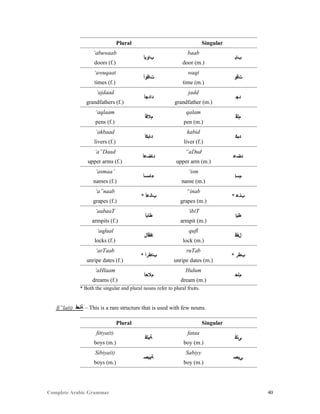
Plural Singular
‘abuwaab
‫ﺐﺍﻮﺒﺃ‬
baab
‫ﺐﺎﺑ‬
doors (f.) door (m.)
‘awuqaat
‫ﺕﺎﻗﻮﺃ‬
waqt
‫ﺕﻗﻮ‬
times (f.) time (m.)
‘ajdaad
‫ﺩﺍﺩﺠﺃ‬
jadd
‫ﺩﺠ‬
grandfathers (f.) grandfather (m.)
‘aqlaam
‫ﻢﻼﻗﺃ‬
qalam
‫ﻢﻠﻗ‬
pens (f.) pen (m.)
‘akbaad
‫ﺪﺎﺑﻜﺃ‬
kabid
‫ﺪﺒﻜ‬
livers (f.) liver (f.)
‘a”Daad
‫ﺩﺎﻀﻋﺃ‬
“aDud
‫ﺪﻀﻋ‬
upper arms (f.) upper arm (m.)
‘asmaa’
‫ﺀﺎﻤﺴﺃ‬
‘ism
‫ﻢﺴﺇ‬
names (f.) name (m.)
‘a”naab
* ‫ﺐﺎﻧﻋﺃ‬
“inab
* ‫ﺐﻧﻋ‬
grapes (f.) grapes (m.)
‘aabaaT
‫ﻃﺎﺒﺃ‬
‘ibiT
‫ﻃﺒﺇ‬
armpits (f.) armpit (m.)
‘aqfaal
‫ﺎﻔﻗﺃﻞ‬
qufl
‫ﻞﻔﻗ‬
locks (f.) lock (m.)
‘arTaab
* ‫ﺐﺎﻂﺭﺃ‬
ruTab
* ‫ﺐﻂﺭ‬
unripe dates (f.) unripe dates (m.)
‘aHlaam
‫ﻢﻼﺤﺃ‬
Hulum
‫ﻡﻠﺤ‬
dreams (f.) dream (m.)
* Both the singular and plural nouns refer to plural fruits.
fi”la(t) ‫ﺔﻠﻌﻓ‬ – This is a rare structure that is used with few nouns.
Plural Singular
fitiya(t)
‫ﺔﻳﺘﻓ‬
fataa
‫ﻰﺘﻓ‬
boys (m.) boy (m.)
Sibiya(t)
‫ﺔﻳﺒﺼ‬
Sabiyy
‫ﻲﺑﺼ‬
boys (m.) boy (m.)
Complete Arabic Grammar 41
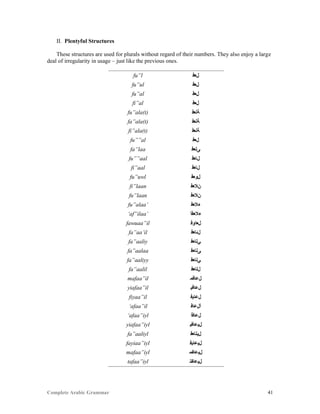
II. Plentyful Structures
These structures are used for plurals without regard of their numbers. They also enjoy a large
deal of irregularity in usage – just like the previous ones.
fu”l ‫ﻞﻌﻓ‬
fu”ul ‫ﻞﻌﻓ‬
fu”al ‫ﻞﻌﻓ‬
fi”al ‫ﻞﻌﻓ‬
fu”ala(t) ‫ﺔﻠﻌﻓ‬
fa”ala(t) ‫ﺔﻠﻌﻓ‬
fi”ala(t) ‫ﺔﻠﻌﻓ‬
fu””al ‫ﻞﻌﻓ‬
fa”laa ‫ﻰﻠﻌﻓ‬
fu””aal ‫ﻞﺎﻌﻓ‬
fi”aal ‫ﻞﺎﻌﻓ‬
fu”uwl ‫ﻞﻮﻌﻓ‬
fi”laan ‫ﻦﻼﻌﻓ‬
fu”laan ‫ﻦﻼﻌﻓ‬
fu”alaa’ ‫ﺀﻼﻌﻓ‬
‘af”ilaa’ ‫ﺀﻼﻌﻓﺃ‬
fawuaa”il ‫ﻞﻌﺍﻮﻓ‬
fa”aa’il ‫ﻝﺋﺎﻌﻓ‬
fa”aaliy ‫ﻲﻠﺎﻌﻓ‬
fa”aalaa ‫ﻰﻠﺎﻌﻓ‬
fa”aaliyy ‫ﻲﻠﺎﻌﻓ‬
fa”aalil ‫ﻞﻠﺎﻌﻓ‬
mafaa”il ‫ﻞﻋﺎﻓﻣ‬
yiafaa”il ‫ﻞﻋﺎﻓﻴ‬
fiyaa”il ‫ﻞﻋﺎﻴﻓ‬
‘afaa”il ‫ﺃﻞﻋﺎﻓ‬
‘afaa”iyl ‫ﻞﻋﺎﻓﺃ‬
yiafaa”iyl ‫ﻞﻴﻋﺎﻓﻴ‬
fa”aaliyl ‫ﻞﻴﻠﺎﻌﻓ‬
fayiaa”iyl ‫ﻞﻴﻋﺎﻴﻓ‬
mafaa”iyl ‫ﻞﻴﻋﺎﻔﻤ‬
tafaa”iyl ‫ﻞﻴﻋﺎﻔﺘ‬
Complete Arabic Grammar 42
More information about these structures will be covered later.
Gender of Plural Nouns
 Masculine Plurals – Nouns that end with a masculine plural ending are always
masculine words.
 Feminine Plurals – Nouns that end with a feminine plural ending are always feminine
words.
 Irregular Plurals – The gender of an irregular noun will not always match the
gender of its singular
Classically, all irregular plurals were considered and treated as singular feminine nouns—no
matter what the gender of the referents were. For example, one would say “this men” or “this
dishes” instead of “these men” or “these dishes” if “men” and “dishes” were irregular plurals.
Also one would say “the men does what she promises” instead of “the men do what they
promise.” However, irregular plurals of nouns referring to persons (like men and women) had
another possibility – such plurals could be treated as regular plural nouns alongside the general
rule of treating them as singular feminines.
In the modern language, irregular plurals referring to persons are usually treated as regular
plural nouns in terms of grammar – except for case declension where they will declined as
singulars. This will be covered in more detail later.
Grammatical Treatment of Irregular Plurals
Reference Gender Number
to persons matches the gender of the referents plural
to persons (classical) feminine singular
to objects or animals feminine singular
Note: In regard to case inflection, irregular plurals are always treated as singulars.
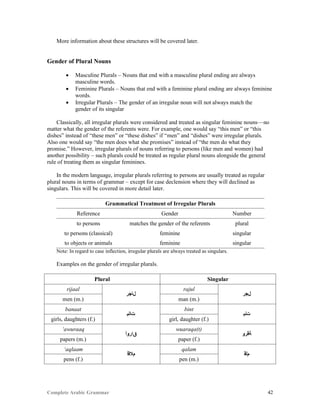
Examples on the gender of irregular plurals.
Plural Singular
rijaal
‫ﻞﺎﺠﺭ‬
rajul
‫ﻞﺠﺭ‬
men (m.) man (m.)
banaat
‫ﺕﺎﻧﺒ‬
bint
‫ﺕﻧﺒ‬
girls, daughters (f.) girl, daughter (f.)
‘awuraaq
‫ﻕﺍﺭﻮﺃ‬
wuaraqa(t)
‫ﺔﻗﺭﻮ‬
papers (m.) paper (f.)
‘aqlaam
‫ﻢﻼﻗﺃ‬
qalam
‫ﻢﻠﻗ‬
pens (f.) pen (m.)
Complete Arabic Grammar 43
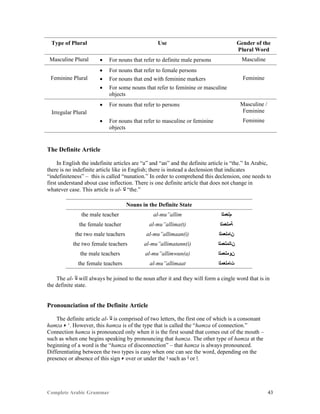
Type of Plural Use Gender of the
Plural Word
Masculine Plural  For nouns that refer to definite male persons Masculine
Feminine Plural
 For nouns that refer to female persons
 For nouns that end with feminine markers
 For some nouns that refer to feminine or masculine
objects
Feminine
Irregular Plural
 For nouns that refer to persons Masculine /
Feminine
 For nouns that refer to masculine or feminine
objects
Feminine
The Definite Article
In English the indefinite articles are “a” and “an” and the definite article is “the.” In Arabic,
there is no indefinite article like in English; there is instead a declension that indicates
“indefiniteness” – this is called “nunation.” In order to comprehend this declension, one needs to
first understand about case inflection. There is one definite article that does not change in
whatever case. This article is al- ‫ﻟﺍ‬ “the.”
Nouns in the Definite State
the male teacher al-mu”allim ‫ﻢﻠﻌﻤﻠﺍ‬
the female teacher al-mu”allima(t) ‫ﺔﻤﻠﻌﻤﻠﺍ‬
the two male teachers al-mu”allimaan(i) ‫ﻦﺎﻤﻠﻌﻤﻠﺍ‬
the two female teachers al-mu”allimatann(i) ‫ﻥﺎﺘﻤﻠﻌﻤﻠﺍ‬
the male teachers al-mu”allimwun(a) ‫ﻥﻮﻤﻠﻌﻤﻠﺍ‬
the female teachers al-mu”allimaat ‫ﺕﺎﻤﻠﻌﻤﻠﺍ‬
The al- ‫ﻟﺃ‬ will always be joined to the noun after it and they will form a cingle word that is in
the definite state.
Pronounciation of the Definite Article
The definite article al- ‫ﻟﺃ‬ is comprised of two letters, the first one of which is a consonant
hamza ‫ﺀ‬ ‘. However, this hamza is of the type that is called the “hamza of connection.”
Connection hamza is pronounced only when it is the first sound that comes out of the mouth –
such as when one begins speaking by pronouncing that hamza. The other type of hamza at the
beginning of a word is the “hamza of disconnection” – that hamza is always pronounced.
Differentiating between the two types is easy when one can see the word, depending on the
presence or absence of this sign ‫ﺀ‬ over or under the ‫ﺍ‬ such as ‫ﺃ‬ or ‫.ﺇ‬
Complete Arabic Grammar 44
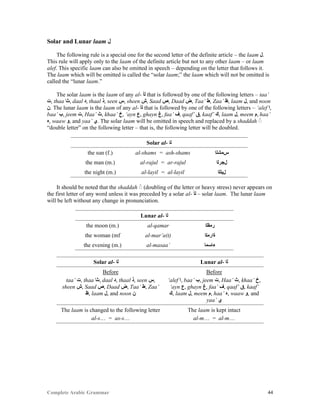
Solar and Lunar laam ‫ﻞ‬
The following rule is a special one for the second letter of the definite article – the laam ‫.ﻞ‬
This rule will apply only to the laam of the definite article but not to any other laam – or laam
alef. This specific laam can also be omitted in speech – depending on the letter that follows it.
The laam which will be omitted is called the “solar laam;” the laam which will not be omitted is
called the “lunar laam.”
The solar laam is the laam of any al- ‫ﻟﺃ‬ that is followed by one of the following letters – taa’
‫,ﺕ‬ thaa’‫,ﺚ‬ daal ‫,ﺩ‬ thaal ‫,ﺬ‬ seen ‫,ﺱ‬ sheen ‫,ﺵ‬ Saad ‫,ﺺ‬ Daad ‫,ﺽ‬ Taa’ ‫,ﻁ‬ Zaa’ ‫,ﻅ‬ laam ‫,ﻞ‬ and noon
‫.ﻥ‬ The lunar laam is the laam of any al- ‫ﻟﺃ‬ that is followed by one of the following letters – ‘alef ‫,ﺍ‬
baa’ ‫,ﺐ‬ jeem ‫,ﺕ‬ Haa’ ‫,ﺚ‬ khaa’ ‫,ﺥ‬ ‘ayn ‫,ﻉ‬ ghayn ‫,ﻍ‬ faa’ ‫,ﻒ‬ qaaf’ ‫,ﻕ‬ kaaf’ ‫,ﻚ‬ laam ‫,ﻞ‬ meem ‫,ﻢ‬ haa’
‫,ﻩ‬ waaw ‫,ﻮ‬ and yaa’ ‫.ﻱ‬ The solar laam will be omitted in speech and replaced by a shaddah
“double letter” on the following letter – that is, the following letter will be doubled.
Solar al- ‫ﻠﺍ‬
the sun (f.) al-shams = ash-shams ‫ﺱﻤﺸﻠﺍ‬
the man (m.) al-rajul = ar-rajul ‫ﻞﺠﺭﻠﺍ‬
the night (m.) al-layil = al-layil ‫ﻞﻳﻠﻠﺍ‬
It should be noted that the shaddah (doubling of the letter or heavy stress) never appears on
the first letter of any word unless it was preceded by a solar al- ‫ﻟﺃ‬ – solar laam. The lunar laam
will be left without any change in pronunciation.
Lunar al- ‫ﻠﺍ‬
the moon (m.) al-qamar ‫ﺮﻤﻘﻠﺍ‬
the woman (mf al-mar’a(t) ‫ﺓﺍﺭﻤﻠﺍ‬
the evening (m.) al-masaa’ ‫ﺀﺎﺴﻤﺍ‬
Solar al- ‫ﻠﺍ‬ Lunar al- ‫ﻠﺍ‬
Before
taa’ ‫,ﺕ‬ thaa’‫,ﺚ‬ daal ‫,ﺩ‬ thaal ‫,ﺬ‬ seen ‫,ﺱ‬
sheen ‫,ﺵ‬ Saad ‫,ﺺ‬ Daad ‫,ﺽ‬ Taa’ ‫,ﻁ‬ Zaa’
‫,ﻅ‬ laam ‫,ﻞ‬ and noon ‫ﻥ‬
Before
‘alef ‫,ﺍ‬ baa’ ‫,ﺐ‬ jeem ‫,ﺕ‬ Haa’ ‫,ﺚ‬ khaa’ ‫,ﺥ‬
‘ayn ‫,ﻉ‬ ghayn ‫,ﻍ‬ faa’ ‫,ﻒ‬ qaaf’ ‫,ﻕ‬ kaaf’
‫,ﻚ‬ laam ‫,ﻞ‬ meem ‫,ﻢ‬ haa’ ‫,ﻩ‬ waaw ‫,ﻮ‬ and
yaa’ ‫ﻱ‬
The laam is changed to the following letter
al-s… = as-s…
The laam is kept intact
al-m… = al-m…
Complete Arabic Grammar 45
Special Writing Conditions for al- ‫ﻟﺃ‬
The connecting hamza is not omitted in writing, except in the following two cases:
1. la- + al- ‫ﻠﺍ‬ + ‫.ﻻ‬ When the emphatic particle la ‫ﻻ‬ – certainly, indeed – precedes a word
beginning with the definite article al- ‫,ﻠﺍ‬ the hamza of the al- will be deleted in writing
as well as in pronunciation.
‫ﺭﻤﻗﻠﺍ‬ + ‫ﻞ‬ = ‫ﺭﻤﻗﻠﻻ‬
la- + al-qamar = la-l-qamar
certainly + the moon = certainly the moon
‫ﺱﻤﺸﻠﺍ‬ + ‫ﻞ‬ = ‫ﺱﻤﺸﻠﻻ‬
la- + al-shams = la-sh-shams
certainly + sun = certainly the sun
2. li- + al- ‫ﻠﺍ‬ + ‫.ﻠ‬ When the preposition li ‫ﻠ‬ – for, to, in order to – precedes a word
beginning with the definite article al- ‫,ﻠﺍ‬ the hamza of the al- will be deleted in writing
as well as in pronunciation.
‫ﺭﻤﻗﻠﺍ‬ + ‫ﻞ‬ = ‫ﺭﻤﻗﻠﻻ‬
li- + al-qamar = li-l-qamar
for/to + the moon = for/to the moon
‫ﺱﻤﺸﻠﺍ‬ + ‫ﻞ‬ = ‫ﺱﻤﺸﻠﻻ‬
li- + al-shams = li-sh-shams
for/to + sun = for/to the sun
Definite Nouns in Arabic
The definite nouns in Arabic are:
 Proper nouns – names of people, place, etc.
 Pronouns and demonstratives
 Nouns preceded by the definite article al- ‫ﻠﺍ‬
 Nouns forming the first part of a genitive construction
 Nouns in the vocative case
All of these things will be covered later.
Complete Arabic Grammar 46
Case Inflection
Unlike the other living Semitic languages, such as Hebrew, formal Arabic is a language that
exhibits vigorous case and mood inflection. Case inflection means that a noun – which includes in
Arabic adjectives – has multiple declensions or endings for different grammatical cases. For
example, the noun al-wualad ‫ﺪﻠﻮﻠﺍ‬ “the child” is not written completely this way – one has to
complete the noun by adding the appropriate case-ending for the grammatical case. There are
three grammatical cases in Arabic, so this word can have three different case-endings.
Case Declension of a Regular Singular Noun
Case Noun
Nominative al-wualad(u) ‫ﺪﻠﻮﻠﺍ‬
Accusative al-wualad(a) ‫ﺪﻠﻮﻠﺍ‬
Genitive al-wualad(i) ‫ﺪﻠﻮﻠﺍ‬
These designations of the cases are the ones traditionally used to refer to the three Arabic/
Semitic cases. However, these designations do not adequately express the mupltiple usages of
each case. The accusative case, for example, is used for about ten cases other than the actual
accusative – the direct object case.
Names of Arabic/Semitic Grammatical Cases
Western Name Arabic Name
Nominative al-raf”(u) ‫ﻊﻓﺭﻠﺍ‬
= the rising
Accusative an-naSb(u) ‫ﺐﺼﻧﻠﺍ‬
= the erecting
Genitive al-jarr(u) ‫ﺭﺠﻠﺍ‬
= the dragging
Case-Inflected and Non-Case-Inflected Words
Not every Arabic word goes under case or model inflection – case inflection is for nouns
)including adjectives), and mood-inflected is for verbs. There are Arabic words that do not show
any changes with regard to grammatical case or model. Each Arabic word belongs to either one
of two categories:
 Built words – words that do not exhibit case of mood inflection
 Arabized words – words that do exhibit case or mood inflection
The built words are generally the pronouns, the perfective (past) and imperative verbs, and all
the participles.
Complete Arabic Grammar 47
Case inflection is called in Arabic ‘i”raab ‫ﺐﺍﺭﻋﺇ‬ “Arabization.” This speaks of the mentality
of ancient Arabs who held eloquence in their language very precious. However, most regular
speakers of Arabic are – and were – not very talented in Arabizing their speech. This is why case
inflection is no longer present in the modern spoken dialects of Arabic. It is still taught at schools,
but there are really not many regular speakers who are good enough at it.
For most words the case- and mood-inflected endings will be nothing but different short
vowels. Some words, however, show variations in letters – like the case inflection of the dual and
masculine plural endings already mentioned. Thus, most of the case- and mood-inflected endings
do not appear in writing because short vowels are not usually written.
Case inflection in Arabic is difficult and it is important for a beginning learner to spend much
time on it. In this text, the case-inflected parts of words will be called the “case-signs.” This
designation is inspired from the Arabic one and it is better than case-endings because the cse-
inflected parts are not always the “endings” of words.
Arabs Don’t Stop on What Is Moving
Remember, in Arabic letters that are followed by short vowels are called “moving letters;”
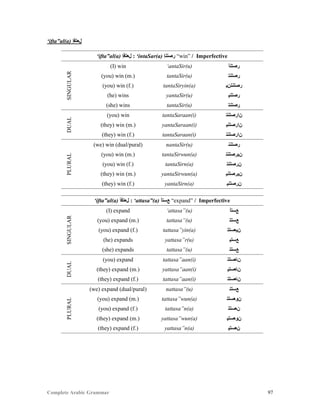
letters that are not followed by short vowels are called “still letters.” Some words end with still
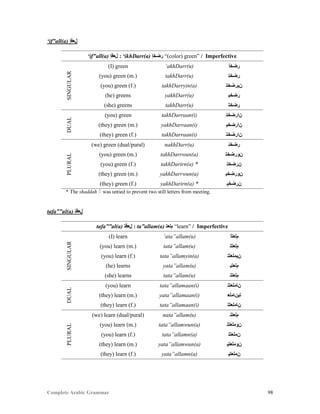
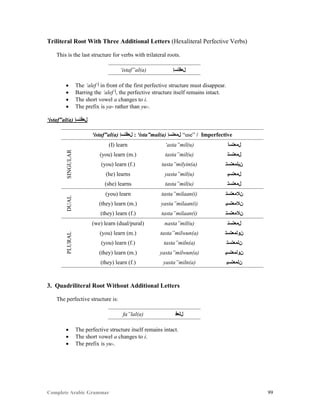
letters, others end with moving letters. While speaking proper Arabic, one cannot finish talking
by pronouncing the last letter as a moving letter – that is, one must ignore the final short vowel (if
there were one), thus making the final letter “still.” This is the old saying: “Arabs do not stop on a
moving.” For example, jaa’ al-wualad ‘ilaa al-madrasat al-yiwum ‫ﻢﻮﻴﻠﺍ‬ ‫ﺔﺴﺭﺪﻣﻠﺍ‬ ‫ﻰﻠﺇ‬ ‫ﺪﻠﻮﻠﺍ‬ ‫ﺀﺎﺠ‬ “The
boy came to school today.”
Actual Pronunciation Romanized Version Arabic Words
jaa’ jaa’(a) ‫ﺀﺎﺠ‬
jaa’a l-wualad jaa’(a) (a)l-wualad(u) ‫ﺪﻠﻮﻠﺍ‬ ‫ﺀﺎﺠ‬
jaa’a l-waladu ‘ilaa l-madrasa
jaa’(a) (a) l-walad(u) ‘ilaa
(a)l-madrasa(ti) ‫ﺔﺴﺭﺪﻣﻠﺍ‬ ‫ﻰﻠﺇ‬ ‫ﺪﻠﻮﻠﺍ‬ ‫ﺀﺎﺠ‬
jaa’a l-waladu ‘ilaa l-
madrasati l-yiwum
jaa’(a) (a) l-walad(u) ‘ilaa
(a)l-madrasa(ti) (a)l-yiwum(a) ‫ﻢﻮﻴﻠﺍ‬ ‫ﺔﺴﺭﺪﻣﻠﺍ‬ ‫ﻰﻠﺇ‬ ‫ﺪﻠﻮﻠﺍ‬ ‫ﺀﺎﺠ‬
The short vowels between brackets are not pronounced unless they are followed by other
sounds – this keeps the last letters as still letters. Long vowels, however, must be pronounced –
this is because long vowels are letters. The feminine taa’ marbuwTa ‫ﺓ‬ has its own comparable
rule. If one stops on the taa’ marbuwTa, it will become –a or –ah rather than –at. If one continues
speaking after it, one should fully pronounce it. Although the rule for ‫-ﺓ‬ is not obligatory, it is so
widely observed that almost nobody today stops on a fully pronouned –at.
Complete Arabic Grammar 48
Nunation
Nunation (or tanuwyin ‫)ﻥﻴﻮﻧﺗﻠﺍ‬ is the adding of a letter noon ‫ﻥ‬ to the end of a noun. The main
purpose of nunation is to confer the sense of “indefiniteness” on the noun or to make the noun in
the “indefinite state.” Nunation used to appear in writing as a letter noon ‫ﻥ‬ at the end of singular
nouns, but grammarians decided long ago that it was better not to write it to avoid confusion.
They agreed instead to indicate it by doubling the mark of the case-sign – or the “move” (the
short vowel) – on the last letter.
Definite State the male cate al-qiTT(u) ‫ﻂﻗﻠﺍ‬
Indefinite State a male cate qiTT(un) ‫ﻂﻗ‬
Definite State the female cate al-qiTTat(u) ‫ﺔﻂﻗﻠﺍ‬
Indefinite State a female cate qiTTa(tun) ‫ﺔﻂﻗ‬
Example of different cases.
Case-Sign Case Noun
Estimated Short u ar-raf”(u) wualad(un) ‫ﺪﻠﻮ‬
Apparent Short a an-naSb(u) wualada(n) ‫ﺍﺪﻠﻮ‬
Estimated Short i al-jarr(u) wualad(in) ‫ﺪﻠﻮ‬
“Estimated” means to Arabic grammarians “assumed” or “supposed.”
The –an version of nunation will be followed by an extended ‘alef ‫ﺍ‬ in writing. When
stopping on this particular nunation, it will be pronounced –aa instead of totally disappearing
from pronunciation like the other two types of nunation. The –un and –in nunations will not be
pronounced at all when one stops at them – similar to the rule of not stopping on a moving letter.
Most speakers of formal Arabic today do not change –an to –aa when they stop at it – rather it is
usually kept a pronounced –an. It might be said that this rule is a classical Arabic rule that is not a
rule anymore in modern standard Arabic.
The –an nunation after a feminine taa’ marbuwTah ‫ﺓ‬ will not be followed by an extended
‘alef ‫ﺍ‬ in writing, but the pronunciation rules are the same.
a school (f.) madrasata(n) ‫ﺔﺴﺭﺪﻤ‬
a young woman (f.) fataata(n) ‫ﺓﺎﺘﻓ‬
A marked difference from English about the indefinite marker is that all nouns in Arabic can
take it – whether singular, dual or plural. Dual and plural masculine nouns have inherenet
nunation in their structures. The nunation for these two types of words stands out with three
characteristics:
 It is written down as a letter noon ‫ﻦ‬ at the end of the word.
 It is always pronounced – whether one stops on it or not.
 It does not disappear with the presence of the definite article.
Complete Arabic Grammar 49
Indefinite State two children (m) wualadaan(i) ‫ﻥﺍﺩﻠﻮ‬
Definite State the two children (m) al-wualadaan(i) ‫ﻥﺍﺩﻠﻮﻠﺍ‬
Indfinite State teachers (m.) mu”allimuwn(a) ‫ﻥﻮﻤﻠﻌﻤ‬
Definite State the teachers (m) al-mu”allimuwn(a) ‫ﻥﻮﻤﻠﻌﻤﻠﺍ‬
Nunation for feminine and irregular plural nouns is just like that of singular nouns.
Definite State teachers (f.) mu”allimaat(un) ‫ﺕﺎﻤﻠﻌﻤ‬
Indefinite State the teachers (f.) al-mu”allimaat(u) ‫ﺕﺎﻤﻠﻌﻤﻟﺍ‬
Definite State children (m) ‘awulaad(un) ‫ﺪﻻﻮﺄ‬
Indefinite State the children (m.) al-‘awulaad(u) ‫ﺪﻻﻮﻸﺍ‬
Nunation does not always indicate indefiniteness. Nunation is used with people’s proper
names and those are always definite nouns. This is just one of the peculiarities of Arabic.
Muhammad muHammad(un) ‫ﺩﻤﺣﻤ‬
Ali “aliy(un) ‫ﻲﻠﻋ‬
However, proper names do not take the definite article al- -‫ﻠﺍ‬ – except if it was part of the
name itself. Proper names of places, rivers, etc., can sometimes take nunation but not always –
because nunation is not used for proper names of foreign origin that have more than three letters.
Nouns that are the first part of a genitive construction – or in other words, nouns that are in
the construct state – are always definite nouns and do not take nunation. The only definite
singular nouns that take nunation are usually people’s first names.
Shortened Nouns
Shortened nouns are nouns that end with a shortened ‘alef ‫ﻯ‬ / ‫.ﺎ‬ These nouns will always take
the –an nunation – and in all cases. When adding the nunation to a shortened noun it will be
placed on the letter preceding the final shortened ‘alef, not on the ‘alef itself.
fataa ‫ﻰﺘﻓ‬ a lad (m.)
Case-Sign Case Noun
Estimated Short u ar-raf”(u) fataa(n) ‫ﻰﺘﻓ‬
Apparent Short a an-naSb(u) fataa(n) ‫ﻰﺘﻓ‬
Estimated Short i al-jarr(u) fataa(n) ‫ﻰﺘﻓ‬
Complete Arabic Grammar 50
Extended Nouns
Extended nouns are nouns that end with a long vowel ‘alef ‫ﺍ‬ -aa that is followed by a
consonant ‘alef hamza ‫.ﺀ‬ Extended nouns will take nunation just like regular nouns—except that
when one adds nunation one would not add an extended a’lef after it in writing. However, the
pronunciation rules remain the same as those of the regular singular nouns.
ma’ ‫ﺀﺎﻤ‬ a water (m.)
Case-Sign Case Noun
Estimated Short u ar-raf”(u) maa’(un) ‫ﺀﺎﻤ‬
Apparent Short a an-naSb(u) maa’a(n) ‫ﺀﺎﻤ‬
Estimated Short i al-jarr(u) maa’(in) ‫ﺀﺎﻤ‬
There is no distinction in Arabic when it comes to countable and uncountable singular
nouns – they are all singular nouns.
Defective Nouns
Defective nouns are nouns that end with a long vowel –y ‫ﻱ‬ which belongs to the root. When
adding nunation to a defective noun, the final –y must be deleted in both writing and
pronunciation – except in the accusative case. The added nunation will always be –in (except in
the accusative).
qaaD ‫ﺽﺎﻗ‬ a judge (m.)
Case-Sign Case Noun
Estimated Short u ar-raf”(u) qaaD(in) ‫ﺽﺎﻗ‬
Apparent Short a an-naSb(u) qaaDiya(n) ‫ﺽﺎﻗ‬
Estimated Short i al-jarr(u) qaaD(in) ‫ﺽﺎﻗ‬
Case-Endings of Nouns in the Indefinite State
Noun Nominative Accusative Genitive
REGULAR
Singular -un -an -in
Dual -aan -ayn -ayn
Masculine Plural -wn -yn -yn
Feminine Plural -un -in -in
Irregular Plural -un -an -in
IRREGULAR
Shortened -n -n -n
Extended -un -an -in
Defective -in -an -in
Complete Arabic Grammar 51
When to Use Nunation
Nunation must be added to every indefinite noun. The only definite nouns that will take
nunation are first names of people and some rare names of places, rivers, etc. The definite nouns
in Arabic are:
 Proper names – names of people, places, etc.
 Pronouns and demonstratives
 Nouns preceded by the definite article al- ‫ﻠﺍ‬
 Nouns forming the first part of a genitive construction
 Nouns in the vocative case
The noon ‫ﻥ‬ of the dual and mascular plural nouns will always be there, except in one
condition – when the noun is the first part of a genitive construction. In this case the noon ‫ﻥ‬ will
be deleted just like any nunation.
There is a category of irregular nouns that is called the “forbidden to nunation.” These nouns
will not take nunation – even if they were indefinite. Most names of places, rivers, etc., are
forbidden to nunation. Any proper name of non-Arabic origin that have more than three letters is
forbidden to nunation. Proper names of unknown Arabic origins include most of the names of
towns and geographical features – even in Arabia itself. This is why nunation happens only with
first names of people but not with other proper nouns, in general – because most of those are
forbidden to nunation. Of course, first names have to be of known Arabic origin in order to be
nunated.
Complete Arabic Grammar 52
Complete Arabic Grammar 53
V. ADJECTIVES
Adjectives in Arabic follow the nouns or pronouns they modify in gender, number,
grammatical case, and the state of definiteness. They always come after the words they modify.
Adjectives in Arabic belong to the “noun” category and there are several types of nouns that can
serve as adjectives. These will be covered later.
This is a list of adjectives matching the modified word.
mu”allim(un)
‫ﻢﻠﻌﻣ‬
a teacher (m.)
jayyid(un)
‫ﺪﻴﺠ‬
a good (sing., m. adj.)
mu”allim(un) jayyid(un)
‫ﺪﻴﺠ‬ ‫ﻢﻠﻌﻣ‬
a good teacher (m)
mu”allima(tun) jayyida(tun)
‫ﺓﺪﻴﺠ‬ ‫ﺔﻣﻠﻌﻣ‬
a good teacher (f.)
al-mu”allim(u) (a)l-jayyid(u)
‫ﺪﻴﺠﻟﺍ‬ ‫ﻢﻠﻌﻣﻟﺍ‬
the good teacher (m.)
al-mu”allima(tu) (a)l-jayyida(tu)
‫ﺓﺪﻴﺠﻟﺍ‬ ‫ﺔﻣﻠﻌﻣﻟﺍ‬
the good teacher (f.)
mu”allimaan(i) jayyidaan(i)
‫ﻥﺍﺪﻴﺠ‬ ‫ﻥﺎﻤﻠﻌﻣ‬
two good teachers (m.)
al-mu”allimaan(i) al-jayyidaan(i)
‫ﻥﺍﺪﻴﺠﻠﺍ‬ ‫ﻥﺎﻤﻠﻌﻣﻠﺍ‬
the two good teachers (m.)
mu”allimataan(i) jayyidataan(i)
‫ﻥﺎﺘﺪﻴﺠ‬ ‫ﻥﺎﺘﻤﻠﻌﻣ‬
two good teachers (f.)
al-mu”allimataan(i) al-jayyidataan(i)
‫ﻥﺎﺘﺪﻴﺠﻠﺍ‬ ‫ﻥﺎﺘﻤﻠﻌﻣﻠﺍ‬
the two good teachers (f.)
mu”allimuwn(a) jayyiduwn(a)
‫ﻥﻮﺪﻴﺠ‬ ‫ﻥﻮﻤﻠﻌﻣ‬
good teachers (m.)
al-mu”allimuwn(a) al-jayyiduwn(a)
‫ﻥﻮﺪﻴﺠﻠﺍ‬ ‫ﻥﻮﻤﻠﻌﻣﻠﺍ‬
the good teachers (m.)
mu”allimaat(un) jayyidaat(un)
‫ﺕﺍﺪﻴﺠ‬ ‫ﺕﺎﻤﻠﻌﻣ‬
good teachers (f.)
al-mu”allimaat(u) al-jayyidaat(u)
‫ﺕﺍﺪﻴﺠﻠﺍ‬ ‫ﺕﺎﻤﻠﻌﻣﻟﺍ‬
The good teachers (f.)
Complete Arabic Grammar 54
Adjectives in general behave regularly. They are always feminized by adding one of the three
feminine markers to them; and they are always pluralized by adding one of the regular plural
endings to them – masculine or feminine. However, there are exceptions to this.
Feminine Adjectives
Feminine adjectives always have one of the three feminine markers attached. However, there
are a few structures that will not carry any such markers.
Case One: Adjectives that can be used only in reference to females but not males – such as
“pregnant” – do not usually have the feminine taa’ marbuwTah ‫ﺓ‬ attached, even though they
modify true feminine nouns and that have a taa’ marbuwTah ‫.ﺓ‬
Meaning Literal Translation Phrase
a pregnant wife
zawuja(tun) Haamil(un)
‫ﻞﻤﺎﺣ‬ ‫ﺔﺠﻮﺯ‬
a wife a pregnant
a divorced woman
‘imra’a(tun) Taaliq(un)
‫ﻕﻠﺎﻁ‬ ‫ﺓﺍﺮﻤﺇ‬
a woman a divorced
Here the noun had a feminine marker but the modifying adjective did not. Other adjectives of this
kind include:
Female-Only Adjectives
a spinster “aanis(un) ‫ﺱﻧﺎﻋ‬
a barren “aaghir(un) ‫ﺭﻘﺎﻋ‬
a nursing murDi”(un) ‫ﻊﺿﺮﻤ‬
a menstruating
Haa’iD(un) ‫ﺾﻴﺈﺤ‬
Taamith(un) ‫ﺚﻣﺎﻃ‬
a virgin
bikr(un) ‫ﺭﻜﺒ‬
batuwl(un) ‫ﻞﻮﺘﺑ‬
a widowed or a divorced thayyib(un) ‫ﺐﻳﺜ‬
a rebellious (wife) naashiz(un) ‫ﺯﺸﺎﻧ‬
a large-breasted
naahid(un) ‫ﺪﻫﺎﻧ‬
kaa”ib(un) ‫ﺐﻋﺎﻜ‬
an aged menopausal qaa”id(un) ‫ﺪﻋﺎﻗ‬
a prolific or lush wualuwd(un) ‫ﺪﻮﻠﻮ‬
a milch (cow) Haluwb(un) ‫ﺏﻮﻠﺣ‬
Complete Arabic Grammar 55
All of these adjectives lack the feminine taa’ marbuwTah ‫.ﺓ‬ The other feminine markers – the
extended ‘alef ‫ﻯ‬ and the shortened ‘alef ‫ﺃ‬ – cannot be removed from an adjective in this case as
simply as the feminine taa’ marbuwTah, or the adjective will become a senseless word. If a
feminine adjective of this kind ends with either one of the two feminine markers other than the
feminine taa’ marbuwTah, it will be kept there because there will not usually be a masculine
form of that adjective – one without feminine markers – and one cannot just remove the marker
because that would be mutilation of the word.
a virgin “adraa’(u) ‫ﺀﺍﺭﺪﻋ‬
a pregnant Hublaa ‫ﻰﻠﺑﺣ‬
Note: Nouns ending with feminine extended ‘alef or feminine shortened ’alef are
forbidden to nunation.
Case Two: Adjectives will not have any feminine markers when they assume one of the
following structures.
Example Type of Structure Structure
ghawur(un)
‫ﺭﻮﻳﻏ‬ active-participle-like fa”uwl(un) ‫ﻞﻮﻌﻓ‬
a jealous …
qatiyl(un)
‫ﻞﻳﺘﻗ‬ passive participle fa”iyl(un) ‫ﻞﻳﻌﻓ‬
a killed …
mi”Taa’(un)
‫ﺀﺎﻁﻌﻤ‬ emphatic mif”aal(un) ‫ﻞﺎﻌﻓ‬
a very giving …
Mi”Tiyr(un)
‫ﺮﻴﻃﻌﻣ‬ emphatic mifa”iyl(un) ‫ﻞﻳﻌﻓﻣ‬
a very using of perfume …
“adl(un)
‫ﻞﺪﻋ‬ verbal noun fa”l(un) ‫ﻞﻌﻓ‬
a just, fair …
Those five structures don’t take feminine endings when they modify feminine nouns. However,
case two is not always followed in the modern language.
Meaning Literal Tranlation Phrase
a jealous man
rajul(un) ghayiwur(un)
‫ﺭﻮﻳﻏ‬ ‫ﻞﺠﺭ‬
a man a jealous
a jealous woman
‘imra’a(tun) ghayiwur(un)
‫ﺭﻮﻴﻏ‬ ‫ﺓﺃﺮﻤﺇ‬
a woman a jealous
a jealous woman
(Modern Arabic)
‘imra’a(tun) ghayiwura(tun)
‫ﺓﺭﻮﻴﻏ‬ ‫ﺓﺃﺮﻤﺇ‬
a woman a jealous
Another thing about the structures of case two is that they do not take regular plural endinds – as
will be covered later.
Complete Arabic Grammar 56
Plural Adjectives
In perfect Classical Arabic irregular plurals were not supposed to be used in adjectives.
Adjectives had to be pluralized only by adding the regular plural endings – masculine or
feminine. However, there are certain adjective structures in Arabic that ca not have the regular
plural endings when their nouns have it. Instead, they are pluraized irregularly. All of the
structures mentioned that don’t carry feminine markers cannot accept masculine plural endings as
well. However, the structure fa”uwl(un) ‫ﻞﻮﻌﻓ‬ is often pluralized regularly against the rule. Here
are the other structures that do not take regular plural endings.
‘af”al(u) ‫ﻞﻌﻓﺃ‬ – Adjectives following this structure are of several kinds and they differ from
each other by the structure of the feminine form of the adjective. The kind that cannot take
regular plural endings is the one whose feminine form is af”aala’(u) ‫.ﺀﻻﺎﻌﻓﺃ‬ This kind belongs to
a category called in Arabic “active-participative-like adjectives.” It usually refers to a color or to
bodily characteristic (Form IX) – such as blond, burnette, blind, mute, deaf, lame, etc. Note: This
kind is forbidden to nunation, which means that it will not be nunated in addition to having an
irregular case-sign in the genitive case (-a instead of -i).
a red (s., m.) ‘aHmar(u) ‫ﺭﻣﺣﺃ‬
a red (s., f.) Hamaraa’(u) ‫ﺀﺍﺭﻣﺣ‬
red (p., m./f.) Humr(un) ‫ﺭﻣﺣ‬
a blond (s., m.) ‘ashqar(u) ‫ﺭﻘﺸﺃ‬
a blonde (s., f.) shaqraa’(u) ‫ﺀﺍﺭﻘﺸ‬
blond (p., m./f.) shuqr(un) ‫ﺭﻘﺸ‬
a blind (s., m.) ‘a”maa(u) ‫ﻰﻤﻋﺃ‬
a blinde (s., f.) “amiyaa’(u) ‫ﺀﺎﻳﻤﻋ‬
blind (p., m./f.) “umiy(un) ‫ﻲﻤﻋ‬
However, it is rather common for the feminine form of this structure to be pluralized
regularly. The following three plural adjectives, for example, are common.
red (p., f.) Hamraawuaat(un) ‫ﺖﺍﻮﺍﺭﻣﺣ‬
blonde (p., f.) shabraawuaat(un) ‫ﺕﺍﻮﺍﺭﻘﺸ‬
blind (p., f.) “amiyaawuaat(un) ‫ﺕﺍﻮﺎﻳﻤﻋ‬
fa”laan(u) ‫ﻥﻼﻌﻓ‬ – Similarly to the previous one, adjectives following this structure are of two
kinds that differ by the structure of their feminine forms. The kind that cannot take the regular
plural ending is the one whose feminine structure is fa”laa ‫ﻼﻌﻓ‬ – his kind is also forbidden to
nunation. The other kind has the feminine form fa”laana(tun) ‫ﺔﻨﻼﻌﻓ‬ and is rarer. There are 13
fa’laan adjectives in Arabic that are feminized as fa”laana(tun) ‫ﺔﻨﻼﻌﻓ‬ instead of fa”laa ‫ﻼﻌﻓ‬ – those
are not forbidden to nunation.
Complete Arabic Grammar 57
a thirsty (s., m.) “aTshaan(u) ‫ﻥﺎﺸﻁﻋ‬
a thirsty (s., f.) “aTshaa ‫ﻰﺸﻁﻋ‬
a thirsty (p., m./f.) “iTaash(un) ‫ﺶﺎﻁﻋ‬
Comparative Structure
‘af”al(u) ‫ﻞﻌﻓﺃ‬ adjectives that refer to colors and to bodily characteristics were discussed
previously. This same structure is also the comparative structure in Arabic. However, when it is
being a comparative structure it will have a different feminine form from the one mentioned
previously. The feminine of the comparative ‘af”al(u) is fu”alaa ‫.ﻼﻌﻓ‬ Nevertheless, fu”alaa is not
a comparative structure but is a superlative structure – even though it is the feminine of
comparative ‘af”al(u). The comparative structure in Arabic is only one – ‘af”al(u) – and it is
used for both masculine and feminine and singular and plural nouns. This will be covered in more
detail later. The important point here is that comparative adjectives in Arabic do not follow their
nouns either in gender or in number.
Plural Masculine Adjective Singular Masculine Adjective
‘afDal(u) = a better ‫ﻞﺿﻓﺃ‬ ‘afDal(u) = a better ‫ﻞﺿﻓﺃ‬
‘akbar(u) = a bigger ‫ﺭﺒﻜﺃ‬ ‘akbar(u) = a bigger ‫ﺭﺒﻜﺃ‬
Plural Feminine Adjective Singular Feminine Adjective
‘afDal(u) = a better ‫ﻞﺿﻓﺃ‬ ‘afDal(u) = a better ‫ﻞﺿﻓﺃ‬
‘akbar(u) = a better ‫ﺭﺒﻜﺃ‬ ‘akbar(u) = a better ‫ﺭﺒﻜﺃ‬
Note: All ‘af”al(u) ‫ﻞﻌﻓﺃ‬ structures are forbidden to nunation except for ones whose feminine
form is ‘af”ala(tun) ‫.ﺔﻠﻌﻓﺃ‬ Those are rare and are not comparatives – such as ‘armal(u) ‫ﻝﻤﺮﺃ‬ “a
widow” and ‘arbagh(u) ‫ﻎﺑﺭﺍ‬ “a pleasant.”
Meaning Literal Translation Phrase
a better assistant (m.) musaa”id(un) ‘afDal(u) ‫ﻞﻀﻓﺃ‬ ‫ﺩﻋﺎﺴﻤ‬
a better assistant (f.) musaa”ida(tun) ‘afDal(u) ‫ﻞﻀﻓﺃ‬ ‫ﺓﺩﻋﺎﺴﻤ‬
two better assistants (m.) musaa”idaan(i) ‘afDal(u) ‫ﻞﻀﻓﺃ‬ ‫ﻦﺍﺩﻋﺎﺴﻤ‬
two better assistants (f.) musaa”idataan(i) ‘afDal(u) ‫ﻞﻀﻓﺃ‬ ‫ﻥﺎﺘﺩﻋﺎﺴﻤ‬
better assistants (m.) musaa”iduwnd(a) ‘afDal(u) ‫ﻞﻀﻓﺃ‬ ‫ﻥﻮﺩﻋﺎﺴﻤ‬
better assistants (f.) musaa”idaa(tun) ‘afDal(u) ‫ﻞﻀﻓﺃ‬ ‫ﺕﺍﺩﻋﺎﺴﻤ‬
Complete Arabic Grammar 58
Adjective Irregularities in Arabic
Structure Plural Matching of Noun
Nunation
Masc. Fem. Masc. Fem Irreg Gender Number
Adjectives that can refer only to
females (such as “pregnant”)
No Yes
Yes No Yes Yes
fa”uwl(un)
Yes Yes
active-participle-like
fa”iyl(un)
No No
passive participle
mif”aal(un)
Emphatic
mif”iyl(un)
No No
Yes
No Yes Yes
Emphatic
fa”l(un)
verbal noun
‘af”al(u) fa”laa’(u)
No Yes Yes Yes
No
active-participle-like
‘af”al(u) fa”laa
Yes Yes
Masc Fem Masc Fem
comparative superlative No Yes No Yes
Structure Plural Matching of Noun
Nunation
Masc. Fem. Masc. Fem Gender Number
‘af”al(un) ‘af”atal(tun)
Yes Yes
Yes Yes
Yes
active-participle-like
fa”laan(u) fa”laa
No No No
active-participle-like
fa”laan(un) fa”laana(tun)
Yes Yes Yes
active-participle-like
Other Irregular Plural Adjectives
Other than the exceptions mentioned previously, irregular plural structures were not suppoed
to be used to form adjectives in proper Classical Arabic. However, this has always been widely
ignored and irregular plural adjectives are used in many other kinds of adjectives. There is one
main case – other than the ones mentioned previously – in which it is considered acceptable to
use an irregular plural adjective. That case is if the irregular plural adjective were of the following
structure.
Complete Arabic Grammar 59
Plural Singular
mafaa”iyl(u) ‫ﻞﻴﻋﺎﻔﻤ‬ maf”uwl(un) ‫ﻞﻮﻌﻔﻤ‬
The singular of this structure is a passive participle noun; the plural is forbidden to nunation.
When possible, this structure can be used instead of regular plurals – but it is not better than them.
Meaning Plural Singular
a famed (famous)
‫ﺮﻴﻫﺎﺸﻤ‬ ‫ﺭﻮﻬﺷﻤ‬
mashiyhiyr(u) mashhuwr(un)
an imprisoned
‫ﻦﻴﺠﺎﺴﻤ‬ ‫ﻥﻮﺠﺴﻤ‬
masaajiyn(u) masjuwn(un)
Adjectives Modifying Irregular Plural Nouns
As mentioned previously, the gender of an irregular plural noun will not always match the
gender of its singular word.
Grammatical Treatment of Irregular Plurals
Reference Gender Number
to persons matches the gender of the referents plural
to persons (classical) feminine singular
to objects or animals feminine singular
It was also mentioned that irregular plurals that refer to objects or animals are always treated
as if they were singular words. Knowing these facts it should be clear how the adjectives were
used in the following examples.
Singular
a mountain (m.) jabal(un) ‫ﻞﺑﺠ‬
a lofty (m.) shaahiq(un) ‫ﻕﻫﺎﺸ‬
a lofty mountain jabal(un) shaahiq(un) ‫ﻕﻫﺎﺸ‬ ‫ﻞﺑﺠ‬
Plural
mountains (f.) jibaal(un) ‫ﻞﺎﺑﺠ‬
a lofty (s., f.) shaahiqa(tun) ‫ﺔﻘﻫﺎﺸ‬
lofty mountains jibaal(un) shaahiqa(tun) ‫ﺔﻘﻫﺎﺸ‬ ‫ﻞﺎﺑﺠ‬
More examples are constructed as follows.
Complete Arabic Grammar 60
Singular Adjectives Singular Nouns
fathth(un)
‫ﺫﻓ‬
rajul(un)
‫ﻞﺠﺭ‬
a unique (m.) a man (m.)
Hakiym(un)
‫ﻢﻴﻜﺤ‬
mawuaqif(un)
‫ﻒﻗﻮﻤ‬
a wise (m.) a stance (m.)
TaaHin(un)
‫ﻥﺣﺎﻂ‬
ma”raka(tun)
‫ﺔﻜﺭﻌﻣ‬
a crushing (m.) a battle (f.)
‘afthaath(un)
‫ﺫﺍﺫﻗﺃ‬
rijaal(un)
‫ﻞﺎﺟﺭ‬
unique (m.) men (m.)
Suitable Adjectives Plural Nouns
Hakiyma(tun)
‫ﺔﻤﻴﻜﺤ‬
mawuaaqif(u)
‫ﻒﻗﺍﻮﻤ‬
wise (s., f) stances (f.)
TaaHina(tun)
‫ﺔﻧﺤﺎﻃ‬
ma”aarik(u)
‫ﻚﺮﺎﻌﻤ‬
crushing (s., f.) battles (f.)
Meaning Phrase
unique men rijaal(un) ‘afthaath(un) ‫ﺫﺍﺫﻗﺃ‬ ‫ﻞﺎﺟﺭ‬
wise stances mawuaaqif(u) Hakiyma(tun) ‫ﺔﻤﻴﻜﺤ‬ ‫ﻒﻗﺍﻮﻤ‬
crushing battles ma”aarik(u) TaaHina(tun) ‫ﺔﻧﺤﺎﻃ‬ ‫ﻤﻚﺮﺎﻌ‬
Note: ‫ﻒﻗﺍﻮﻤ‬ and ‫ﻚﺮﺎﻌﻤ‬ are both “forbidden to nunation” structures.
Multiple Adjectives
Adjectives that modify a single noun can be multiple.
‫ﻞﻴﺣﻧ‬ ‫ﻞﻳﻮﻃ‬ ‫ﻞﺠﺭ‬
rajul(un) Tawuuyil(un) naHiyl(un)
= a man a tall a thin
translation: a thin tall man
‫ﻳﻛﺫﻦﺎﺘ‬ ‫ﻥﺎﺘﻠﻳﻤﺠ‬ ‫ﻥﺎﺘﺑﻳﻃ‬ ‫ﻦﺎﺘﺎﺘﻓ‬
fataataan(i) Tayyibataan(i) jamiylataan(i) thakiyyataan(i)
= two young girls good beautiful smart
translation: two good, smart, beautiful young girls
It is also possible to use coordinators between the different adjectives, but they must be
placed between all the adjectives – not only before the last one.
Complete Arabic Grammar 61
‫ﻦﺎﺘﻳﻛﺫ‬ ‫ﻥﺎﺘﻠﻳﻤﺠ‬ ‫ﻥﺎﺘﺑﻳﻃ‬ ‫ﻦﺎﺘﺎﺘﻓ‬
fataataan(i) Tayyibataan(i) wa-jamiylataan(i) wa-thakiyyataan(i)
= two young girls good beautiful smart
translation: two good, smart, beautiful young girls
Adjectives as Nouns
Again, adjectives in Arabic are nouns. This is not only an issue of how we categorize them –
adjectives can function as real nouns in Arabic sentences.
‫ﻱﻜﺬ‬ ‫ﺍﺬﻫ‬
haathaa thakiyy(un)
= this (is) a clever (s., m.)
translation: this is a clever man
This sentence is not complete in English because it lacks a noun; but in Arabic it is a full
perfect sentence. This is because an adjective in Arabic has a normal nature in and of itself, and it
will not necessarily require another noun to complete its meaning.
‫ﺔﻴﻜﺬ‬ ‫ﻩﺬﻫ‬
haazih(i) thakiyya(tun)
= this (is) a clever (s., f.)
translation: this is a clever woman
‫ﺓﺪﻠﺒﻠﺍ‬ ‫ﻰﻠﺇ‬ ‫ﺍﻮﻤﺪﻗ‬ ‫ﺀﺎﻴﻧﻋﺍ‬
‘aghniyaa’(un) qadimwu ‘ilaa (a)l-balda(ti)
= rich (p., m.) came to the town
translation: rich people came to town
In an English sentence there is “the door of the house” – another way to say the same thing is
“the house’s door” or “the house-door.” This is the genitive construction, which expresses a
relationship of possession between two parts of the construction. In formal Arabic, there is not a
possessive preposition like “of” or any other possessive articles. The only way to say that
sentence is by virtue of the “construct state” of nouns and the genitive case.
Meaning Phrase
door of a house
baab(u) manzil(in)
‫ﻧﻤﻝﺯ‬ ‫ﺐﺎﺒ‬
door a house
the door of the house
baab(u) (a)l- manzil(i)
‫ﻝﺯﻧﻤﻠﺍ‬ ‫ﺐﺎﺒ‬
door the house
Complete Arabic Grammar 62
window of a house
naafitha(tu) manzil(in)
‫ﻝﺯﻧﻤ‬ ‫ﺓﺫﻓﺎﻧ‬
window a house
the wondow of the house
naafitha(tu) (a)l-manzil(i)
‫ﻝﺯﻧﻤﻠﺍ‬ ‫ﺓﺫﻓﺎﻧ‬
window the house
Every one of these phrases is a genitive construction. Two things can be noted about these
constructions:
 The first noun in each construction has neither a definite article nor an
indefinite declension
 The seconds nouns are in the genitive case instead of the regular nominative
case
These two notes are the components of any genitive construction in Arabic. The fact that the
first noun does not have a definite article attached (that is, was not in the definite case) nor does it
have an indefeinite declension attached (that is, was not in the indefinite case) leaves a new state
for nouns in Arabic. This is what is called the “construct state” of nouns – or the state of
“addition” in Arabic terminology.
The construct state exists in many Semitic languages. Whereas this state can mean
considerable changes to the noun structure in languages such as Hebrew and Syriac, in Arabic
there is not really that much change – just no definite article before nor nunation at the end of
nouns. The nunation must be removed even from the dual and masculine plural endings if the
noun has either of them.
Meaning of the Construct State
When a noun is in the construct state, it will have neither a definite nor an indefinite marker.
However, it will always be a definite noun—even if there were no definite article attached. Think
of it as if there were a hidden definite article before the noun. The definiteness of the construct
state is so strict that even the final noon ‫ﻥ‬ of the dual and the masculine plural endings will be
removed in this state—and this is the only case in Arabic where this happens to those two. The
second point is that changing a noun to the construct state will always impant a hidden possessive
“of” after the noun. This is the main point of the construct state anyway. So a noun in construct
will be like this—(the noun (of).
States of Nouns in the Nominative Case
SINGULAR
Indefinite State Definite State Construct State
‫ﻢﻠﻌﻤ‬ ‫ﻢﻠﻌﻤﻠﺍ‬ ‫ﻢﻠﻌﻤ‬
mu”allimun al-mu’allimu mu”allimu
a teacher (m.) the teacher (m.) (the) teacher (of) (m.)
‫ﺔﻤﻠﻌﻤ‬ ‫ﺔﻤﻠﻌﻤﻠﺍ‬ ‫ﺔﻤﻠﻌﻤ‬
mu”allimatun al-mu’allimatu mu”allimatu
a teacher (f.) the teacher (f.) (the) teacher (of) (f.)
Complete Arabic Grammar 63
Indefinite State Definite State Construct State
DUAL ‫ﻦﺎﻤﻠﻌﻤ‬ ‫ﻦﺎﻤﻠﻌﻤﻠﺍ‬ ‫ﺎﻤﻠﻌﻤ‬
mu”allimaani al-mu’allimaani mu”allimaa
two teachers (m.) the two teachers (m.) (the) two teachers (of) (m.)
‫ﻦﺎﺘﻤﻠﻌﻤ‬ ‫ﻦﺎﺘﻤﻠﻌﻤﻠﺍ‬ ‫ﺎﺘﻤﻠﻌﻤ‬
mu”allimataani al-mu’allimataani mu”allimataa
two teachers (f.) the two teachers (f.) (the) two teachers (of) (f.)
PLURAL
‫ﻦﻮﻤﻠﻌﻤ‬ ‫ﻦﻮﻤﻠﻌﻤﻠﺍ‬ ‫ﺍﻮﻤﻠﻌﻤ‬
mu”allimuwna al-mu’allimuwna mu”allimuw
the teachers (m.) the the teachers (m.) (the) teachers (of) (m.)
‫ﺕﺎﻣﻠﻌﻤ‬ ‫ﺕﺎﻤﻠﻌﻤﻠﺍ‬ ‫ﺕﺎﻤﻠﻌﻤ‬
mu”allimaatun al-mu’allimaaatu mu”allimaatu
the teachers (f.) the teachers (f.) (the) teachers (of) (f.)
States of Nouns in the Accusative Case
SINGULAR
Indefinite State Definite State Construct State
‫ﺎﻣﻠﻌﻤ‬ ‫ﻢﻠﻌﻤﻠﺍ‬ ‫ﻢﻠﻌﻤ‬
mu”allimayni al-mu’allimayni mu”allimay
a teacher (m.) the teacher (m.) (the) teacher (of) (m.)
‫ﺔﻤﻠﻌﻤ‬ ‫ﺔﻤﻠﻌﻤﻠﺍ‬ ‫ﺔﻤﻠﻌﻤ‬
mu”allimatan al-mu’allimata mu”allimata
a teacher (f.) the teacher (f.) (the) teacher (of) (f.)
DUAL
‫ﻦﻳﻤﻠﻌﻤ‬ ‫ﻦﻳﻤﻠﻌﻤﻠﺍ‬ ‫ﻲﻤﻠﻌﻤ‬
mu”allimayni al-mu’allimayni mu”allimay
two teachers (m.) the two teachers (m.) (the) two teachers (of) (m.)
‫ﻦﻴﺘﻤﻠﻌﻤ‬ ‫ﻦﻴﺘﻤﻠﻌﻤﻠﺍ‬ ‫ﻲﺘﻤﻠﻌﻤ‬
mu”allimatayni al-mu’allimatayni mu”allimatay
two teachers (f.) the two teachers (f.) (the) two teachers (of) (f.)
Indefinite State Definite State Construct State
PLURAL
‫ﻦﻴﻤﻠﻌﻤ‬ ‫ﻦﻴﻤﻠﻌﻤﻠﺍ‬ ‫ﻲﻤﻠﻌﻤ‬
mu”allimiyna al-mu’allimiyna mu”allimiy
the teachers (m.) the the teachers (m.) (the) teachers (of) (m.)
Complete Arabic Grammar 64
‫ﺕﺎﻣﻠﻌﻤ‬ ‫ﺕﺎﻤﻠﻌﻤﻠﺍ‬ ‫ﺕﺎﻤﻠﻌﻤ‬
mu”allimaatin al-mu’allimaaati mu”allimaati
the teachers (f.) the teachers (f.) (the) teachers (of) (f.)
States of Nouns in the Genitive Case
SINGULAR
Indefinite State Definite State Construct State
‫ﻢﻠﻌﻤ‬ ‫ﻢﻠﻌﻤﻠﺍ‬ ‫ﻢﻠﻌﻤ‬
mu”allimin al-mu’allimi mu”allimi
a teacher (m.) the teacher (m.) (the) teacher (of) (m.)
‫ﺔﻤﻠﻌﻤ‬ ‫ﺔﻤﻠﻌﻤﻠﺍ‬ ‫ﺔﻤﻠﻌﻤ‬
mu”allimatin al-mu’allimati mu”allimati
a teacher (f.) the teacher (f.) (the) teacher (of) (f.)
DUAL
‫ﻦﻳﻤﻠﻌﻤ‬ ‫ﻦﻳﻤﻠﻌﻤﻠﺍ‬ ‫ﻲﻤﻠﻌﻤ‬
mu”allimayni al-mu’allimayni mu”allimay
two teachers (m.) the two teachers (m.) (the) two teachers (of) (m.)
‫ﻦﻴﺘﻤﻠﻌﻤ‬ ‫ﻦﻴﺘﻤﻠﻌﻤﻠﺍ‬ ‫ﻲﺘﻤﻠﻌﻤ‬
mu”allimatayni al-mu’allimatayni mu”allimatay
two teachers (f.) the two teachers (f.) (the) two teachers (of) (f.)
PLURAL
‫ﻦﻴﻤﻠﻌﻤ‬ ‫ﻦﻴﻤﻠﻌﻤﻠﺍ‬ ‫ﻲﻤﻠﻌﻤ‬
mu”allimiyna al-mu’allimiyna mu”allimiy
the teachers (m.) the the teachers (m.) (the) teachers (of) (m.)
‫ﺕﺎﻣﻠﻌﻤ‬ ‫ﺕﺎﻤﻠﻌﻤﻠﺍ‬ ‫ﺕﺎﻤﻠﻌﻤ‬
mu”allimaatin al-mu’allimaaati mu”allimaati
the teachers (f.) the teachers (f.) (the) teachers (of) (f.)
The Second Part of the Genitive Construction
The part of the sentence before the hidden “of” is the first part of the genitive construction. It
can be a noun in the construct state or it can be a phrase – such as “the first two pages of the
book.” The first part of the genitive construction is called in Arabic “the added;” the second part
of the construction is the part after “of” and is called in Arabic “the added to.” The second part of
the genitive construction must always be in the genitive case. The second part of the construction
will not be in the construct state nor will it have anything to do with it – it will either be in the
definite or the indefinite state, just as usual.
Complete Arabic Grammar 65
two teachers (m.)
(first part)
mu”allimaan(i)
‫ﻦﺎﻤﻠﻌﻤ‬
a class
(second part)
Saff(un)
‫ﻒﺻ‬
the two teachers of a class (m.) mu”allimaan Saff(in) ‫ﻒﺻ‬ ‫ﺎﻤﻠﻌﻤ‬
two teachers (f.)
(first part)
mu”allimataan(i)
‫ﻦﺎﺘﻤﻠﻌﻤ‬
a class
(second part)
Saff(un)
‫ﻒﺻ‬
the two teachers of a class (f.) mu”allimataa Saaf(in) ‫ﻒﺻ‬ ‫ﺎﺘﻤﻠﻌﻤ‬
the teachers
(first part)
al-mu”allimaan(a)
‫ﻦﻮﻤﻠﻌﻤﻠﺍ‬
the class
(second part)
aS-Saff(u)
‫ﻒﺻﻠﺍ‬
the teachers of the class mu”allimuw (a)S-Saff(i) ‫ﻒﺻﻠﺍ‬ ‫ﺍﻮﻤﻠﻌﻤ‬
The ‘alef ‫ﺍ‬ after the waaw ‫ﻮ‬ in ‫ﺍﻮﻤﻠﻌﻤ‬ is silent.
More examples in which the first part is in other cases.
(I saw) the two teachers of the class
(m.)
mu”allimay (a)S-Saff(i)
‫ﻒﺻﻠﺍ‬ ‫ﻲﻤﻠﻌﻤ‬
(I saw) the two teachers of the class
(f.)
mu”allimatay (a)S-Saff(i)
‫ﻒﺻﻠﺍ‬ ‫ﻲﺘﻤﻠﻌﻤ‬
(I saw) the teachers oif the class (m.) mu”allimiy (a)S-Saff(i) ‫ﻒﺻﻠﺍ‬ ‫ﻠﻌﻤﻲﻤ‬
Examples on proper nouns.
Meaning Literal Translation Gentive Construction
Ali’s book
kitaab(u) “aliyy(in)
‫ﻲﻠﻋ‬ ‫ﺏﺎﺘﻛ‬
(the) book (of) Ali
Airport of Damascus
maTaar(u) dimashq(a)
‫ﻖﺸﻤﺪ‬ ‫ﺭﺎﻂﻣ‬
(the) airport (of) Damascus
Damashq (Damascus) ‫ﻖﺸﻤﺪ‬ is a “forbidden to nunation” word, so it has an irregular case sign
in the genitive case (-a) in addition to never taking nunation. Proper names are always definite
and don’t take al- ‫ﻠﺍ‬ before them. However, as mentioned before, first names of people and some
other proper nouns take nunation – even though they are definite.
Complete Arabic Grammar 66
Possessive Pronouns
Possessive pronouns such as “my” and “your” do not exist in Arabic – nor do ones such as
“mine” and “yours.” To say in Arabic that something is yours, one would use the genitive
construction described previously and say “(the) thing (of) me.” To say “your book and his book”
one would say “(the) book (of) you and (the) book (of) him.” This will be explained more fully
later.
“A” Thing of a Thing
A final issue about the genitive construction is how the following sentence is translated into
Arabic – “a door of a house.” It is impossible in Arabic for the first part of a gentive construction
to be indefinite. Thus, this kind of sentence is usually translated as follows into Atrabic.
‫ﻞﺯﻧﻣ‬ ‫ﺐﺎﺑ‬
baab(u) manzil(in)
(the) door (of) a house
There is not really that much difference between the two. However, if one was insisting on
having the first part indefinite, there is one trick that could be used – to use a preposition other
than the hidden “of” of the genitive construction. Usually that would be the particle li- -‫ﻝ‬ “for/to.”
‫ﻞﺯﻧﻣﻟ‬ ‫ﺐﺎﺑ‬
baab(un) li-manzil(in)
a door (of) a house
This is not a genitive construction. The word li- -‫ﻝ‬ is in the ablative case – which is the same
in Arabic as the gentive case.
Complete Arabic Grammar 67
VI. VERBS
Am / Is / Are Sentences
Every sentence in English requires a verb. One has to use at least one verb to make any
complete, meaningful sentence in English. In Arabic and Semitic languages it is also the same –
but for one exception. If in an English sentence one has the present tense that contains the verb
“to be,” the Arabic equivalent will not contain a “be” verb. In fact, it will not contain any verb at
all. Thus, there can be full sentences in Arabic that do not have any verbs. The verbless sentences
will be those like “Ahmed is here,” “they are in the room” and “where am I?” That is, sentences
containing “to be” verbs in the present tense.
‫ﺔﻳﻓﺎﺻ‬ ‫ﺀﺎﻣﺴﻠﺍ‬
as-samaa’(u) Saafiya(tun)
= the sky (is) a clear (sky)
translation: the sky is clear
‫ﺎﻧﻫ‬ ‫ﻥﻮﻣﻠﻌﻤﻠﺍ‬
al-mu”allimuyn(a) hunaa
= the teachers (are) here
translation: the teachers are hear
‫ﺪﻌﺘﺴﻣ‬ ‫ﺪﻤﺤﻣ‬
muHammad(un) musta”idd(un)
= Muhammad (is) a ready (man)
translation: Muhammad is ready
‫ﺓﺪﻳﻌﺴ‬ ‫ﻰﻠﻴﻠ‬
laylaa sa”iyda(tun)
= Layla (is) a happy (woman)
translation: Layla is happy
‫ﺐﻴﻃ‬ ‫ﺹﺧﺸ‬ ‫ﺕﻧﺃ‬
‘ant(a) shakhS(un) Tayyib(un)
= you (are) a person a kind
translation: you are a kind person
Remember that an adjective has to follow its noun in everything – including the state of
definiteness.
‫ﻢﻫ‬ ‫ﻦﻴﺃ‬
‘ayn(a) hum
= where (are) they
translation: where are they?
Complete Arabic Grammar 68
All these sentences belong to the category that is called in Arabic “nominal sentences”; those
are the sentences which begin with a noun word. The part of the sentence that is before the hidden
“be” – that is, the subject – is called “the start.”; the part after the “be” is the predicate.
Multiple Predicates
One “starter” can have multiple predicates.
‫ﻢﻴﺮﻜﻠﺍ‬ ‫ﻞﻴﺒﻧﻠﺍ‬ ‫ﻒﻴﺭﺸﻠﺍ‬ ‫ﻮﻫ‬ ‫ﺍﺫﺎﻫ‬
haathaa huw(a) (a)sh-shareef(u) (a)n-nabiyl(u) (a)l-kariym(u)
= this he (is) the honest the nobel the generous
translation: this is an honest, noble, generous man
huw(a) ‫ﻮﻫ‬ “he” is a redundant pronoun. Employing subject pronouns before the predicate in this
manner will be covered in the pronoun section.
“Coordinators” may be used between the different predicates.
‫ﻢﻴﺮﻜﻠﺍ‬ ‫ﻮ‬ ‫ﻞﻴﺒﻧﻠﺍ‬ ‫ﻮ‬ ‫ﻒﻴﺭﺸﻠﺍ‬ ‫ﻮﻫ‬ ‫ﺍﺫﺎﻫ‬
haathaa huw(a) (a)sh-shareef(u) wa-(a)n-nabiyl(u) wa-(a)l-kariym(u)
= this he (is) the honest and the nobel and the generous
translation: this is a very honest, noble, generous man
The coordinators must be placed between the predicates – not only before the last one. Note
that the verb “to be” will show up in the past and future tenses; it will be just like English in these
tenses. Thus we have covered the only case of verbless sentences in Arabic.
Tenses
 Past (perfective)
 Present (imperfective)
 Future (imperfective)
The major two verb structures in Arabic are the perfective and the imperfective. The present
and future tenses will both use the same structure – the imperfective – while for the past tense the
perfective structure is used. Arabic verbs also can have four different moods. Three of these – the
indicative, the subjunctive and the jussive – share on structure. The differences between them are
only in the different declensions that can be added to the same structure. The fourth mood – the
imperative – has its own distinct “built” structure.
Complete Arabic Grammar 69
Past Tense
Past tense in English has at least four different aspects.
Simple Past He did
Perfect Past He had done
Progrssive Past He was doing
Perfect Progressive Past He had been doing
In Arabic, the perfective verb, which is used the express the simple past, is always used to
express the perfect aspect – whether in the past, present or future tenses. The progressive aspect,
on the other hand, is always expressed by employing the imperfective verb – even in the past
tense. However, the perfect progressive aspect is not really present in Arabic.
Most verbs in Arabic have roots that consist of three letters. Some verbs have roots of four
letters, but there are no verbs that have more than four letters to their roots. Without the
employment of additional letters, three-letter roots can be structured in three different ways to
give different perfective verbs. With the additional letters there is a total of 12 possible, different
structures for the perfective verbs. Four-letter roots are structured in six different structures to
give different perfective verbs.
Structures of Arabic Verbs
(3rd
Person Masc. Sing. Perfective)
Example Structure – (He) Did
Triliteral Root
No Additional
Letters
jalas(s)
‫ﺱﻠﺠ‬ fa”al(a) ‫ﻞﻌﻓ‬
sat
Hasib(a)
‫ﺐﺴﺣ‬ fa”il(a) ‫ﻞﻌﻓ‬
thought
Saghur(a)
‫ﺮﻐﺻ‬ fa”ul(a) ‫ﻞﻌﻓ‬
became smaller
Triliteral Root
One Additional
Letter
‘akram(a)
‫ﻢﺭﻜﺃ‬ ‘af”al(a) ‫ﻞﻌﻓﺃ‬
dignified
“allam(a)
‫ﻢﻠﻋ‬ fa””al(a) ‫ﻞﻌﻓ‬
taught
qaatal(a)
‫ﻞﺘﺎﻗ‬ faa”al(a) ‫ﻞﻋﺎﻓ‬
fought
Complete Arabic Grammar 70
Example Structure – (He) Did
Triliteral Root
No Additional
Letters
jalas(s)
‫ﺱﻠﺠ‬ fa”al(a) ‫ﻞﻌﻓ‬
sat
Hasib(a)
‫ﺐﺴﺣ‬ fa”il(a) ‫ﻞﻌﻓ‬
thought
Saghur(a)
‫ﺮﻐﺻ‬ fa”ul(a) ‫ﻞﻌﻓ‬
became smaller
Triliteral Root
One Additional
Letter
‘akram(a)
‫ﻢﺭﻜﺃ‬ ‘af”al(a) ‫ﻞﻌﻓﺃ‬
dignified
“allam(a)
‫ﻢﻠﻋ‬ fa””al(a) ‫ﻞﻌﻓ‬
taught
qaatal(a)
‫ﻞﺘﺎﻗ‬ faa”al(a) ‫ﻞﻋﺎﻓ‬
fought
Triliteral Root
Two Additional
Letters
‘inHaaz(a)
‫ﺯﺎﺤﻧﺇ‬ ‘infa”al(a) ‫ﻞﻌﻓﻧﺇ‬
took aside
‘rtabak(a)
‫ﻚﺑﺘﺭﺇ‬ ‘ifta”al(a) ‫ﻞﻌﺘﻓﺇ‬
became disconcerted
‘iHmarr(a)
‫ﺭﻣﺤﺇ‬ ‘if”all(a) ‫ﻞﻌﻓﺇ‬
reddened
ta’akhkhar(a)
‫ﺭﺧﺎﺘ‬ tafa””al(a) ‫ﻞﻌﻓﺘ‬
was late
tasaa’al(a)
‫ﻞﺀﺎﺴﺘ‬ tafaa”al(a) ‫ﻞﻋﺎﻓﺘ‬
Wondered
Complete Arabic Grammar 71
Example Structure – (He) Did
Triliteral Root
Two Additional
Letters
‘inHaaz(a)
‫ﺯﺎﺤﻧﺇ‬ ‘infa”al(a) ‫ﻞﻌﻓﻧﺇ‬
took aside
‘rtabak(a)
‫ﻚﺑﺘﺭﺇ‬ ‘ifta”al(a) ‫ﻞﻌﺘﻓﺇ‬
became disconcerted
‘iHmarr(a)
‫ﺭﻣﺤﺇ‬ ‘if”all(a) ‫ﻞﻌﻓﺇ‬
reddened
ta’akhkhar(a)
‫ﺭﺧﺎﺘ‬ tafa””al(a) ‫ﻞﻌﻓﺘ‬
was late
tasaa’al(a)
‫ﻞﺀﺎﺴﺘ‬ tafaa”al(a) ‫ﻞﻋﺎﻓﺘ‬
Wondered
Triliteral Root
Three Additional
Letters
‘ista”mal(a)
‫ﻞﻤﻌﺘﺴﺇ‬ ‘istaf”al(a) ‫ﻞﻌﻓﺘﺴﺇ‬
used
‘ikhshawshan(a)
‫ﻥﺷﻮﺷﺧﺇ‬ ‘if”aw”al(a) ‫ﻞﻋﻮﻌﻓﺇ‬
roughened
‘ijlawwath(a)
‫ﺫﻮﻠﺠﺇ‬ ‘if”awwal(a) ‫ﻞﻮﻌﻓﺇ‬
hurried (for camles)
‘iHmaarr(a)
‫ﺭﺎﻣﺣﺇ‬ ‘if”aall(a) ‫ﻞﺎﻓﺇ‬
reddened so much
‘iq”ansas(a)
‫ﺱﺴﻧﻌﻗﺇ‬ ‘if”anlal(a) ‫ﻞﻠﻧﻌﻓﺇ‬
became hunchbacked
‘islanqaa(a)
‫ﻰﻘﻧﻠﺴﺇ‬ ‘if”anlaa(a) ‫ﻰﻠﻧﻌﻓﺇ‬
lied down
Complete Arabic Grammar 72
Example Structure – (He) Did
Quadriliteral
Root
No Additional
Letters
ba”thar(a)
‫ﺭﺛﻌﺑ‬ fa”lal(a) ‫ﻞﻠﻌﻓ‬
scattered
Hawqal(a)
‫ﻞﻗﻮﺣ‬ faw”al(a) ‫ﻞﻋﻮﻓ‬
became independent
rahwal(a)
‫ﻞﻮﻫﺭ‬ fa”wal(a) ‫ﻞﻮﻌﻓ‬
Hurried
bayTar(a)
‫ﺭﻁﻳﺑ‬ fay”al(a) ‫ﻞﻌﻴﻓ‬
treated (an animal)
sharfaf(a)
‫ﻒﻴﺮﺸ‬ fa”yal(a) ‫ﻞﻴﻌﻓ‬
cut
salqaa(a)
‫ﻰﻗﻠﺴ‬ fa”laa(a) ‫ﻌﻓﻰﻠ‬
lied down
qalnas(a)
‫ﺱﻧﻠﻗ‬ fa”nal(a) ‫ﻞﻧﻌﻓ‬
put a cap (on someone)
Quadriliteral
Root
One Additional
Letter
tadaHraj(a)
‫ﺝﺭﺣﺪﺘ‬ tafa”lal(a) ‫ﻞﻟﻌﻓﺘ‬
rolled
tashanTan(a)
‫ﻥﻃﻳﺸﺘ‬ tafay”al(a) ‫ﻞﻌﻳﻓﺘ‬
behaved badly
tasalqaa(a)
‫ﻰﻗﻟﺴﺘ‬ tafa”laa(a) ‫ﻰﻠﻌﻓﺘ‬
lied down
taqalnas(a)
‫ﺱﻧﻠﻗﺘ‬ tafa”nal(a) ‫ﻞﻧﻌﻓﺘ‬
wore a cap
tajawtab(a)
‫ﺐﺗﻮﺠﺘ‬ tafaw”al(a) ‫ﻞﻋﻮﻓﺘ‬
wore socks
tamaskan(a)
‫ﻦﻜﺴﻤﺘ‬ tamaf”al(a) ‫ﻞﻌﻓﻤﺘ‬
acted pitiful
tajalbab(a)
‫ﺐﺑﻟﺠﺘ‬ tafa”lal(a) ‫ﻞﻠﻌﻓﺘ‬
wore a djellaba
Quadriliteral
Root
Two Additional
Letters
‘iHranjam(a)
‫ﻢﺟﻧﺭﺤﺇ‬ ‘if”anlal(a) ‫ﻞﻠﻧﻌﻓﺇ‬
congregated (for camels)
‘iTma’ann(a)
‫ﻥﺄﻤﻃﺇ‬ ‘if”alall(a) ‫ﻞﻠﻌﻓﺇ‬
became unworried
Complete Arabic Grammar 73
All perfective verbs are “built” verbs. That is, they have only one possible mood and the ends
of the verbs never change. The third person, masculine, singular perfective – which is the source
of all other verbs – always ends in a short vowel -a fatHa at their end. The third person,
masculine, singular perfective verb will be conjugated to obtain other forms. The following is the
conjugation scheme for the structure fa”al(a) ‫.ﻞﻌﻓ‬ The conjugation technique is the same for all
the perfective structures.
Root ‫ﻞ‬ ‫ﻉ‬ ‫ﻒ‬ / Perfective
SINGULAR
(I) did fa”alt(u) ‫ﺖﻠﻌﻓ‬
(you) did (m.) fa”alt(a) ‫ﺖﻠﻌﻓ‬
(you) did (f.) fa”alti ‫ﺖﻠﻌﻓ‬
(he) did fa”al(a) ‫ﻞﻌﻓ‬
(she) did fa”alat ‫ﺖﻠﻌﻓ‬
DUAL
(you) did fa”altumaa ‫ﺎﻤﺘﻠﻌﻓ‬
(they) did (m.) fa”alaa ‫ﻼﻌﻓ‬
(they) did (f.) fa”alataa ‫ﺎﺘﻠﻌﻓ‬
PLURAL
(we) did (dual/pural) fa”alnaa ‫ﺎﻧﻠﻌﻓ‬
(you) did (m.) fa”altum ‫ﻡﺘﻠﻌﻓ‬
(you) did (f.) fa”altunn(a) ‫ﻥﺘﻠﻌﻓ‬
(they) did (m.) fa”altwu * ‫ﺍﻮﻠﻌﻓ‬
(they) did (f.) fa”aln(a) ‫ﻦﻠﻌﻓ‬
* The ‘alef ‫ﺍ‬ in -wu ‫-ﺍﻮ‬ is silent.
So the idea is that one has to attach an ending to the third person, masculine, singular
perfective of the verb – which depends on the subject. One has to delete the final short vowel
before attaching the ending. Those endings contain paricles that are considered subject pronouns
in Arabic grammar – these are called “attached subject pronouns” to differentiate them from the
“separate subject pronouns.” The verbs that don’t take attached subject pronouns are the third
person singulars. The ending of the third person, feminine, singular perfective is called “still
feminine taa’” and it is not a subject pronoun.
fa”al(a) ‫ﻞﻌﻓ‬ : “araf(a) ‫ﻒﺭﻋ‬ “knew” / Perfective
SINGULAR
(I) knew “araft(u) ‫ﺖﻓﺮﻋ‬
(you) knew (m.) “araft(a) ‫ﺖﻓﺮﻋ‬
(you) knew (f.) “arafti ‫ﺖﻓﺮﻋ‬
(he) knew “araf(a) ‫ﻒﺮﻋ‬
(she) knew “arafat ‫ﺖﻓﺮﻋ‬
DUAL
(you) knew “araftumaa ‫ﺎﻣﺘﻓﺮﻋ‬
(they) knew (m.) “arafaa ‫ﺎﻓﺮﻋ‬
(they) knew (f.) “arafataa ‫ﺎﺘﻓﺮﻋ‬
Complete Arabic Grammar 74
PLURAL
(we) knew (dual/pural) “arafnaa ‫ﺎﻧﻓﺮﻋ‬
(you) knew (m.) “araftum ‫ﻢﺘﻓﺮﻋ‬
(you) knew (f.) “araftunn(a) ‫ﻥﺘﻓﺮﻋ‬
(they) knew (m.) “araftwu ‫ﺍﻮﻓﺮﻋ‬
(they) knew (f.) “arafn(a) ‫ﻦﻓﺮﻋ‬
Next are examples for all the perfective structures.
Conjugated Example Structure
We sat
‫ﺎﻧﺴﻠﺠ‬ ‫ﺱﻠﺠ‬ ‫ﻞﻌﻓ‬
jalasnaa jalas(a)
I thought
‫ﺖﺒﺴﺣ‬ ‫ﺐﺴﺣ‬ ‫ﻞﻌﻓ‬
Hasibt(u) Hasib(a)
She / it became smaller
‫ﺕﺮﻐﺼ‬ ‫ﺮﻐﺼ‬ ‫ﻞﻌﻓ‬
Saghurat Saghur(a)
They dignified (m.)
‫ﺍﻮﻤﺭﻜﺃ‬ ‫ﻢﺮﻛﺃ‬ ‫ﻞﻌﻓﺃ‬
‘akramwu ‘akram(a)
You taught (dual)
‫ﺎﻣﺘﻣﻠﻋ‬ ‫ﻢﻠﻋ‬ ‫ﻞﻌﻓ‬
“allamtumaa ‘allam(a)
They fought (dual, m.)
‫ﻼﺘﺎﻗ‬ ‫ﻞﺘﺎﻗ‬ ‫ﻞﻋﺎﻓ‬
qaatalaa qaatal(a)
She / it exploded
‫ﺕﺮﺟﻔﻨﺇ‬ ‫ﺭﺠﻓﻧﺇ‬ ‫ﻞﻌﻓﻧﺇ‬
‘infajarat ‘infajar(a)
They became disconcerted (f.)
‫ﻦﻜﺑﺗﺭﺇ‬ ‫ﻚﺒﺘﺭﺇ‬ ‫ﻞﻌﺘﻓﺇ‬
‘irtabakn(a) ‘irtabak(a)
You reddened up (m.)
‫ﺖﺮﺮﻤﺣﺇ‬ ‫ﺮﻣﺤﺇ‬ ‫ﻞﻌﻓﺇ‬
‘iHmarart(a) ‘iHmarr(a)
They were late (dual, f.)
‫ﺎﺘﺮﺧﺎﺘ‬ ‫ﺭﺧﺎﺘ‬ ‫ﻞﻌﻓﺘ‬
ta’akhkharataa ta’akhkhar(a)
You wondered (m.)
‫ﻢﺘﻠﺀﺎﺴﺘ‬ ‫ﻞﺀﺎﺴﺘ‬ ‫ﻞﻋﺎﻓﺘ‬
tasaa’altum tasaa’al(a)
We used
‫ﺎﻧﻠﻤﻌﺘﺴﺇ‬ ‫ﻞﻤﻋﺘﺴﺇ‬
‫ﻞﻌﻓﺘﺴﺇ‬
‘ista”malnaa ‘ista”mal(a)
Complete Arabic Grammar 75
Conjugated Example Structure
You scattered (f.)
‫ﺕﺭﺜﻌﺑ‬ ‫ﺮﺜﻌﺑ‬
‫ﻞﻠﻌﻓ‬
ba”tharti ba”thar(a)
They rolled (dual, m.)
‫ﺎﺟﺭﺤﺪﺘ‬ ‫ﺝﺭﺣﺩﺘ‬
‫ﻞﻠﻌﻓﺘ‬
tadaHrajaa tadaHraj(a)
You behaved badly (m.)
‫ﺕﻧﻂﻳﺸﺘ‬ ‫ﻦﻂﻴﺷﺘ‬
‫ﻞﻌﻴﻓﺘ‬
tashayTant(a) tashayTan(a)
They acted pitiful (m.)
‫ﺍﻮﻧﻛﺴﻤﺘ‬ ‫ﻥﻜﺴﻤﺘ‬
‫ﻞﻌﻓﻤﺘ‬
tamaskanwu tamaskan(a)
I became unworried
‫ﺕﻧﻧﺎﻤﻁﺇ‬ ‫ﻦﺎﻤﻃﺇ‬
‫ﻞﻠﻌﻓﺇ‬
‘iTma’nant(u) ‘Tma’ann(a)
Doubled Verbs
Doubled verbs are verbs that have identical second and third root letters. The shaddah of
doubled verbs must be “untied” with certain declensions. Untying happens by inserting a short
vowel a (fatHa) between the two identical letters under the shaddah.
marr(a) ‫ﺭﻤ‬ “passed”
marr(a) ‫ﺭﻤ‬
marrt(u) ‫ﺖﺮﻤ‬
marart(u) ‫ﺕﺭﺭﻤ‬
The reason behind this change is to prevent two still letters from directly following each other –
the two raa’s ‫.ﺭ‬ This is an important law in the Arabic language.
fa”al(a) ‫ﻞﻌﻓ‬ : “araf(a) ‫ﺭﻤ‬ “passed” / Perfective
SINGULAR
(I) passed marart(u) ‫ﺖﺮﺮﻤ‬
(you) passed (m.) marart(a) ‫ﺖﺮﺮﻤ‬
(you) passed (f.) mararti ‫ﺖﺮﺮﻤ‬
(he) passed marr(a) ‫ﺮﻤ‬
(she) passed marrat ‫ﺮﻤﺖ‬
DUAL
(you) passed marartumaa ‫ﺎﻤﺘﺮﺮﻤ‬
(they) passed (m.) marraa ‫ﺍﺮﻤ‬
(they) passed (f.) marrataa ‫ﺎﺘﺮﻤ‬
Complete Arabic Grammar 76
PLURAL
(we) passed (dual/pural) mararnaa ‫ﺎﻧﺮﺮﻤ‬
(you) passed (m.) marartum ‫ﻢﺘﺮﺮﻤ‬
(you) passed (f.) marartunn(a) ‫ﻥﺘﺮﺮﻤ‬
(they) passed (m.) marrwu ‫ﺍﻮﺮﻤ‬
(they) passed (f.) mararn(a) ‫ﻥﺮﺮﻤ‬
The untying does not need to take place with the third person declensions – except with the plural
feminine third person declension, which is untied as well.
mithaal ‫ﻞﺎﺛﻤ‬ Verbs
mithaal verbs are verbs whose first original letter is a weak letter. mithaal verbs conjugate in
the past tense just like regular verbs.
Hollow Verbs
Hollow verbs are verbs that have a weak letter as the second original letter. For hollow verbs
whose weak letter is ‘alef ‫ﺍ‬ (the fake ‘alef), the a’lef must be deleted when adding any declension
other than the third person declensions – not counting the third person feminine plural declension,
to which the rule still applies.
qaal(a) ‫ﻞﺎﻗ‬ “said”
qaalt(a) ‫ﺖﻠﺎﻗ‬
qaalt(u) ‫ﺖﻠﺎﻗ‬
qult(u) ‫ﺕﻠﻗ‬
The reason behind this change is to prevent two still letters from directly following each other
– the ‘alef ‫ﺍ‬ and the laam ‫.ﻞ‬ This is the important rule of “stills don’t meet.” The deleted ‘alef was
replaced bythe short vowel u (Dumma) – determining this vowel is a problem in the verbs without
additional letters because there is no useful rule to depend on other than familiarizing oneself
with these verbs. However, if one was going to guess, the short vowel would often be the one that
corresponds to the middle letter of the root, as u (Dumma) corresponds to waaw ‫ﻮ‬ and i (kasra)
corresponds to yaa’ ‫ﻱ‬ – but this rule does not always work right.
fa”al(a) ‫ﻞﻌﻓ‬ : qaal(a) ‫ﻞﺎﻗ‬ “said” / Perfective
SINGULAR
(I) said qult(u) ‫ﺖﻟﻗ‬
(you) said (m.) qult(a) ‫ﺖﻟﻗ‬
(you) said (f.) qulti ‫ﺖﻟﻗ‬
(he) said qaal(a) ‫ﻝﺎﻗ‬
(she) said qaalat ‫ﺖﻟﺎﻗ‬
Complete Arabic Grammar 77
DUAL
(you) said qultumaa ‫ﺎﻤﺘﻟﻗ‬
(they) said (m.) qaalaa ‫ﻻﺎﻗ‬
(they) said (f.) qaalataa ‫ﺎﺗﻠﺎﻗ‬
PLURAL
(we) said (dual/pural) qulnaa ‫ﺎﻧﻟﻗ‬
(you) said (m.) qultum ‫ﻢﺘﻟﻗ‬
(you) said (f.) qultunn(a) ‫ﻥﺘﻟﻗ‬
(they) said (m.) qaalwu ‫ﺍﻮﻠﺎﻗ‬
(they) said (f.) quln(a) ‫ﻥﻟﻗ‬
Hollow verbs with more than three letters – verbs with additional letters – always take the
short vowel a (fatHa) instead of the extended ‘alef ‫.ﻯ‬
‘araad(a) ‫ﺪﺍﺭﺃ‬ “wanted”
‘araad(a) ‫ﺪﺍﺭﺃ‬
‘araadt(u) ‫ﺕﺪﺍﺭﺃ‬
‘aradt(u) ‫ﺕﺪﺭﺃ‬
‘af”al(a) ‫ﻞﻌﻓﺃ‬ : ‘araad(a) ‫ﺪﺍﺭﺃ‬ “wanted” / Perfective
SINGULAR
(I) wanted ‘aradt(u) ‫ﺕﺪﺭﺃ‬
(you) wanted (m.) ‘aradt(a) ‫ﺕﺪﺭﺃ‬
(you) wanted (f.) ‘aradti ‫ﺕﺪﺭﺃ‬
(he) wanted ‘araad(a) ‫ﺪﺍﺭﺃ‬
(she) wanted ‘araadat ‫ﺕﺪﺍﺭﺃ‬
DUAL
(you) wanted ‘aradtumaa ‫ﺎﻤﺘﺪﺭﺃ‬
(they) wanted (m.) ‘araadaa ‫ﺍﺪﺍﺭﺃ‬
(they) wanted (f.) ‘araadataa ‫ﺎﺘﺪﺍﺭﺃ‬
PLURAL
(we) wanted (dual/pural) ‘aradnaa ‫ﺎﻧﺪﺭﺃ‬
(you) wanted (m.) ‘aradtum ‫ﻢﺘﺪﺭﺃ‬
(you) wanted (f.) ‘aradtunn(a) ‫ﻥﺗﺪﺭﺃ‬
(they) wanted (m.) ‘araadwu ‫ﺍﻮﺪﺍﺭﺃ‬
(they) wanted (f.) ‘aradn(a) ‫ﻥﺪﺭﺃ‬
Complete Arabic Grammar 78
Defective Verbs
Defective verbs are verbs whose last original letter is a weak letter. Conjugating these verbs
correctly can be a bit tricky. When conjugating defective verbs without additional letters, the last
‘alef ‫ﺍ‬ always must be changed back to the original weak letter. Fortunately, this is easy because
the figure of the last ‘alef ‫ﺍ‬ tells its origin.
namaa ‫ﺎﻤﻧ‬ “grew”
namaa ‫ﺎﻤﻧ‬
namaat(u) ‫ﺕﺎﻤﻧ‬
namawt(u) ‫ﺕﻮﻤﻧ‬
The last “revived” weak letter was preceded by a short a (fatHa). This short vowel will be a
for verbs which end with ‘alef ‫ﺍ‬ or ‫.ﻯ‬ For the other verbs it will often be u (Dumma) for verbs that
end in waaw ‫ﻮ‬ and i (kasra) for verbs that end in yaa’ ‫.ﻱ‬ What is important here is that the extant
short vowel before the last weak letter will be preserved.
nasiy(a) ‫ﻲﺴﻧ‬ “forgot”
nasiy(a) ‫ﻲﺴﻧ‬
nasiyu ‫ﺍﻮﻴﺴﻧ‬
naswu ‫ﺍﻮﺴﻧ‬
naswu * ‫ﺍﻮﺴﻧ‬
* Remember that a still weak letter preceded by a
corresponding short vowel must be a long vowel.
fa”al(a) ‫ﻞﻌﻓ‬ : namaa ‫ﺎﻣﻧ‬ “grew” / Perfective
SINGULAR
(I) grew namawt(u) ‫ﺕﻮﻤﻧ‬
(you) grew (m.) namawt(a) ‫ﺕﻮﻤﻧ‬
(you) grew (f.) namawti ‫ﺕﻮﻤﻧ‬
(he) grew namaa ‫ﺎﻤﻧ‬
(she) grew namat ‫ﺕﻤﻧ‬
DUAL
(you) grew namawtumaa ‫ﺎﻤﺘﻮﻤﻧ‬
(they) grew (m.) namawaa ‫ﺍﻮﻤﻧ‬
(they) grew (f.) namataa ‫ﺎﺘﻤﻧ‬
PLURAL
(we) grew (dual/pural) namawnaa ‫ﺎﻧﻮﻤﻧ‬
(you) grew (m.) namwtum ‫ﻧﻢﺘﻮﻤ‬
(you) grew (f.) namawtunn(a) ‫ﻥﺘﻮﻤﻧ‬
(they) grew (m.) namaw ‫ﺍﻮﻤﻧ‬
(they) grew (f.) namawn(a) ‫ﻦﻮﻤﻧ‬
Complete Arabic Grammar 79
fa”al(a) ‫ﻞﻌﻓ‬ : nasyi(a) ‫ﻲﺴﻧ‬ “forgot” / Perfective
SINGULAR
(I) forgot nasyit(u) ‫ﺕﻴﺴﻧ‬
(you) forgot (m.) nasyit(a) ‫ﺕﻳﺴﻧ‬
(you) forgot (f.) nasyiti ‫ﺕﻴﺴﻧ‬
(he) forgot nasyi(a) ‫ﻲﺴﻧ‬
(she) forgot nasat ‫ﺕﻴﺴﻧ‬
DUAL
(you) forgot nasyitumaa ‫ﺎﻤﺘﻳﺴﻧ‬
(they) forgot (m.) nasyiaa * ‫ﺎﻴﺴﻧ‬
(they) forgot (f.) nasataa ‫ﺎﺘﺴﻧ‬
PLURAL
(we) forgot (dual/pural) nasyinaa ‫ﺘﻧﻴﺴﻧ‬
(you) forgot (m.) nasyitum ‫ﻢﺘﻳﺴﻧ‬
(you) forgot (f.) nasyitunn(a) ‫ﻦﺘﻳﺴﻧ‬
(they) forgot (m.) nasuw ‫ﺍﻮﺴﻧ‬
(they) forgot (f.) nasyin(a) ‫ﻥﻳﺴﻧ‬
* The y here was not still but rather followed by a long vowel. Therefore, it cannot be a long vowel.
Finally, it should be noted that for defective verbs with additional letters – verbs with more
than three letters – and which end in extended ‘alef’s ‫,ﺍ‬ the origin of those extended a’lef’s is
always yaa’ ‫.ﻱ‬ Those ‘alef’s always look like ‫ﻯ‬ instead of ‫ﺍ‬ – which should be a reminder.
Root Defective Verbs with Additional Letters
“ T y ‫ﻲ‬ ‫ﻃ‬ ‫ﻉ‬ ‘ataa” “gave” ‫ﻰﻁﻋﺃ‬
n h y ‫ﻱ‬ ‫ﻩ‬ ‫ﻥ‬ ‘intahaa “finished” ‫ﻰﻬﺘﻧﺇ‬
w l y ‫ﻱ‬ ‫ﻝ‬ ‫ﻮ‬ ‘istawlaa “captured” ‫ﻰﻠﻮﺘﺴﺇ‬
Defective verbs with additional letters are common. Conjugating them is not different from others
with additional letters.
‘anfa”al(a) ‫ﻞﻌﻓﻧﺇ‬ : ‘intahaa ‫ﻰﻬﺘﻧﺇ‬ “finished” / Perfective
SINGULAR
(I) finished ‘intahayt(u) ‫ﺕﻴﺴﻧ‬
(you) finished (m.) ‘intahayt(a) ‫ﺕﻳﺴﻧ‬
(you) finished (f.) ‘intahaytii ‫ﺕﻴﺴﻧ‬
(he) finished ‘intahaa ‫ﻲﺴﻧ‬
(she) finished ‘intahat ‫ﺕﻴﺴﻧ‬
DUAL
(you) finished ‘intahaytumaa ‫ﺎﻤﺘﻳﺴﻧ‬
(they) finished (m.) ‘intahayaa ‫ﺎﻴﺴﻧ‬
(they) finished (f.) ‘intahataa ‫ﺎﺘﺴﻧ‬
Complete Arabic Grammar 80
PLURAL
(we) finished (dual/pural) ‘intahaynaa ‫ﺘﻧﻴﺴﻧ‬
(you) finished (m.) ‘intahaytum ‫ﻢﺘﻳﺴﻧ‬
(you) finished (f.) ‘intahaytunn(a) ‫ﻦﺘﻳﺴﻧ‬
(they) finished (m.) “intahaw ‫ﺍﻮﺴﻧ‬
(they) finished (f.) ‘intahayn(a) ‫ﻥﻳﺴﻧ‬
Enfolding Verbs
Enfolding verbs embrace the definitions of both mithaal and defective verbs. They have two
weak letters – one at the beginning and the other at the end of the root. These verbs get the
dealing of both mithaal and defective verbs. Since mithaal verbs conjugate regularly in the past
tense, conjugating the enfolding verbs is very much like conjugating defective verbs.
fa”al(a) ‫ﻞﻌﻓ‬ : wafaa ‫ﻰﻓﻮ‬ “fulfilled” / Perfective
SINGULAR
(I) fulfilled wafayt(u) ‫ﺖﻴﻓﻮ‬
(you) fulfilled (m.) wafayt(a) ‫ﺖﻴﻓﻮ‬
(you) fulfilled (f.) wafayti ‫ﺖﻴﻓﻮ‬
(he) fulfilled wafaa ‫ﻰﻓﻮ‬
(she) fulfilled wafat ‫ﺖﻓﻮ‬
DUAL
(you) fulfilled wafaytumaa ‫ﺎﻤﺘﻴﻓﻮ‬
(they) fulfilled (m.) wafayaa ‫ﺎﻴﻓﻮ‬
(they) fulfilled (f.) wafataa ‫ﺎﺘﻓﻮ‬
PLURAL
(we) fulfilled (dual/pural) wafaynaa ‫ﺎﻧﻴﻓﻮ‬
(you) fulfilled (m.) wafaytum ‫ﻢﺘﻴﻓﻮ‬
(you) fulfilled (f.) wafaytunn(a) ‫ﻥﺘﻴﻓﻮ‬
(they) fulfilled (m.) wafuw ‫ﻮﺍﻮﻓ‬
(they) fulfilled (f.) wafayn(a) ‫ﻥﻴﻓﻮ‬
Meanings of Verb Structures
Adding additional letters to a trilateral verb confers a new meaning on the verb. Each verb
structure has its specific meaning. However, in real life it may not always be easy to identify the
general meaning of a structure with the beginning of a specific verb that belongs to that structure.
Complete Arabic Grammar 81
Example Meaning Structure
‫ﺭﺴﻛ‬
broke
did
(transitive or intransitive)
fa”al(a) ‫ﻞﻌﻓ‬
‫ﻢﻠﻋ‬
knew
did
(transitive or intransitive)
fa”il(a) ‫ﻞﻌﻓ‬
‫ﺭﺒﻛ‬
became (was) big(ger)
became (was) something
(intransitive)
fa”ul(a) ‫ﻞﻌﻓ‬
‫ﻡﻠﻋﺃ‬
made known, informed
made do
(causitive)
‘af”al(a) ‫ﻞﻌﻓﺃ‬
‫ﻢﻠﻋ‬
made known, taught
made do
(causitive)
fa””al(a) ‫ﻞﻌﻓ‬‫ﺮﺴﻜ‬
broke
did intensely
(intensive)
‫ﻞﺘﺎﻗ‬
sought to kill, fought
sought to do
(conative)
faa”al(a) ‫ﻞﻋﺎﻓ‬
‫ﻒﻋﺎﺿ‬
doubled
(augumentive)
‫ﺭﻮﺎﺣ‬
exchanged talking with,
conversed
exchanged doing with
(reciprocative)
‫ﺮﺴﻜﻧﺇ‬
broke itself, broke
did himself
(reflexive)
‘infa”al(a) ‫ﻞﻌﻓﻧﺃ‬
‫ﻊﻣﺘﺟﺇ‬
gathered himself, met
did himself
(reflexive)
‘ifta”al(a) ‫ﻞﻌﺗﻓﺇ‬
‫ﺭﻣﺤﺇ‬
became red, reddened
became “color”
(denotes color)
‘if”all(a) ‫ﻞﻌﻓﺇ‬‫ﺭﻮﻋﺇ‬
became blind
became “defect”
(denotes bodily defect)
‫ﺮﺴﻜﺘ‬
broke himself intensely,
broke
did himself intensely
(intensive reflexive)
tafa”al(a) ‫ﻞﻌﻓﺘ‬
‫ﻊﺠﺷﺘ‬
pretended to be brave, was
encouraged
Pretended to be
(afectation)
Complete Arabic Grammar 82
Example Meaning Structure
‫ﻥﻮﺎﻌﺘ‬
exchanged aiding with,
cooperated
exchanged doing with
(reciprocative)
tafaa”al(a) ‫ﻞﻋﺎﻓﺘ‬
‫ﺾﺮﺎﻤﺘ‬
pretended to be ill
pretended to be
(pretension)
‫ﻢﻠﺴﺘﺴﺇ‬
asked for safety,
surrendered
asked for
(request)
‘istaf”al(a) ‫ﻞﻌﻓﺘﺴﺇ‬
‫ﺖﻠﺠﺭﺘﺴﺇ‬
(she) became a man,
virilized
became something
(transformation)
‫ﺝﺮﺤﺪ‬
rolled
did
(transitive or intransitive)
fa”lal(a) ‫ﻞﻠﻌﻓ‬
‫ﺐﺑﻠﺠﺘ‬
wore a djellaba
(reflexive) tafa”lal(a) ‫ﻞﻠﻌﻓﺘ‬
‫ﻦﻄﻳﺷﺘ‬
made himself devil,
misbehaved
(reflexive) tafay”al(a) ‫ﻞﻌﻴﻓﺘ‬
‫ﻥﻜﺴﻤﺘ‬
made himself pitiful
(reflexive) tamaf”al(a) ‫ﻞﻌﻓﻤﺘ‬
‫ﻥﺄﻤﻂﺇ‬
made himself reassured,
was reassured
(reflexive) ‘if”alall(a) ‫ﻞﻠﻌﻓﺇ‬
It should be noted that all of these structures are active verbs – although the reflexive
structures can overlap in meaning with the passive. Each one of these structures has a passive
voice version, which will be covered later.
Tenses for the Perfectve Verb
The perfective structure is used to express different tenses in the following manner. Note that
in Arabic there are only three tenses – past, present and future. However, the following is just a
way to translate different Indo-European tenses to Arabic.
1. Simple Past
‫ﻞﻌﻓ‬
fa”al(a)
= (he) did
translation: he did
Complete Arabic Grammar 83
2. Anterior Past
‫ﻞﻌﻓ‬ ‫ﻦﺎﻜ‬
kaan(a) fa”al(a)
= (he) was did
translation: ~ he had done
When the perfective verb is preceded by kaan(a) ‫ﻦﺎﻜ‬ “was,” the formulation will mean
something very close to “he had done.”
3. Anterior Future
‫ﻞﻌﻓ‬ ‫ﻦﻮﻜﻳﺴ‬
sayakwun(u) fa”al(a)
= (he) will be did
translation: ~ he will have done
When the perfective verb is preceded by sayakwun ‫ﻦﻮﻜﻳﺴ‬ “will be” or sawfa yakwun ‫ﻦﻮﻜﻳ‬ ‫ﻒﻮﺴ‬
“will be,” the formulation will mean something very close to “he will have done.”
4. Perfect Present
‫ﻞﻌﻓ‬ ‫ﺪﻗ‬
qad fa”al(a)
= (he) has done
translation: he has done
The particle qad ‫ﺪﻗ‬ does not mean “have” or “has” but it does achieve a similar purpose when
it proceeds a perfective verb. It is common to add la- ‫-ﻞ‬ to qad for emphasis. This is more
common in Modern Standard Arabic.
‫ﻞﻌﻓ‬ ‫ﺪﻗﻠ‬
la-qad fa”al(a)
= (he) indeed has done
translation: he has done
The particle qad is also often used as an emphatic particle.
‫ﻪﻠﻤﻋ‬ ‫ﻲﻓ‬ ‫ﺪﺟﻣﻠﺍ‬ ‫ﺢﺠﻧ‬ ‫ﺪﻗ‬
qad najaH(a) (a)l-mujidd(u) fyi “amalih(i)
= (he) has succeeded the diligent in work (of) him
translation: the diligent succeeds at his work
Complete Arabic Grammar 84
The perfective verb is used here as a subjunctive verb, which is common in classical Arabic.
This is similar to the English “if I were there…”
5. Perfect Past
‫ﻞﻌﻓ‬ ‫ﺪﻗ‬ ‫ﻦﺎﻜ‬
kaan(a) qad fa”al(a)
= (he) was has done
translation: he had done
Remember that qad ‫ﺪﻗ‬ does not really mean “has” but is does its job. When qad is preceded
by the verb kaan(a) ‫ﻦﺎﻜ‬ “was,” the formulation will mean something like “he had done.” In this
case – the past perfect – it is not possible to add the emphatic la- ‫-ﻞ‬ to qad.
6. Perfect Future
‫ﻞﻌﻓ‬ ‫ﺪﻗ‬ ‫ﻦﻮﻜﻳﺴ‬
sayakwun(u) qad fa”al(a)
= (he) will be has done
translation: he will have done
When qad ‫ﺪﻗ‬ is proceded by sayakwun ‫ﻦﻮﻜﻳﺴ‬ “will be” or sawfa yakwun ‫ﻦﻮﻜﻳ‬ ‫ﻒﻮﺴ‬ “will be,” the
formulation will mean “he will have done..” In this case, too, it is not possible to add the
emphatic la- ‫-ﻞ‬ to qad. The particle qad can also precede the imperfective verb structure – but in
that case it will have a totally different function. It will confer a sense of uncertainty on the verb,
as will be seen. A final note about the usage of the perfective is that this verb can often be used as
a subjunctive verb – not only for the past tense but also for the present and future tense.
‫ﺖﺤﺠﻧ‬ ‫ﺖﺴﺭﺩ‬ ‫ﻥﺇ‬
‘in darast(a) najaht(a)
= if (you) studied (you) succeeded
translation: if you studied you would pass = if you study, you will pass
‫ﻪﻘﺌﺍﻮﺑ‬ ‫ﻩﺭﺎﺠ‬ ‫ﻥﻤﺃ‬ ‫ﻥﻤ‬ ‫ﻥﻤﺆﻤﻠﺍ‬
al-mu”min(u) man ‘amin(a) jaaruh(u) bawaa’iqah(u)
= the believer (is) who (he) was secured (from), neighbor (of) him, harms (of) him
translation: a believer is one whose neighbor wouldn’t have to worry about harm from him
The subject of the verb ‘amin(a) ‫ﻥﻤﺃ‬ “secured” was jaaruh(u) ‫.ﻩﺭﺎﺠ‬ The object of the same verb is
bawaa’iq(a) ‫.ﻕﺌﺍﻮﺑ‬ The pronoun -h(u) ‫ﻩ‬ “him” is referring to the believer.
Complete Arabic Grammar 85
Present Tense
Present tense in English has the following aspects.
simple present he does
perfect present he has done
progressive present he is doing
perfect progressive present he has been doing
It was stated earlier that there is no perfect progressive aspect for verbs in Arabic – that the
perfect aspect is expressed in all tenses by employing the perfective structure and that the
progressive aspect is expressed always by employing the imperfective structure. The imperfective
structure is also used for the simple present tense. Since the verbs are usually given in the
perfective form, one should know how to extract the root from them. The root letters can be used
then to fill the spaces in the imperfective structure formula.
Imperfective verbs are not “built words” as were the perfective verbs. They have endings that
differ depending on the mood of the verb. There are three different models for different endings –
indicative, subjunctive and jussive. Verbs in the imperative take different structures from the
regular imperfective ones – and those are built words, not inflective ones. This is why they will
be dealt with separately. Imperfective verbs can become built. This is when they are connected to
a specific particle that is called “noon of emphasis” – the energetic mood – or when they are in
the plural feminine conjugations.
Now we will take the different perfective structures and turn them into the indicative
imperfective.
1. Triliteral Root Without Additional Letters.
The perfective structures are:
fa”al(a) ‫ﻞﻌﻓ‬
fa”il(a) ‫ﻓﻞﻌ‬
fa”ul(a) ‫ﻞﻌﻓ‬
These structures share a similar conjugation technique.
fa”al(a) ‫ﻞﻌﻓ‬ / Imperfective
SINGULAR
(I) do ‘af”al(u) ‫ﺁﻞﻌﻓ‬
(you) do (m.) taf”al(a) ‫ﺘﻞﻌﻓ‬
(you) do (f.) taf”alyin(a) ‫ﺘﻠﻌﻓﻥﻴ‬
(he) does yaf”al(u) ‫ﻴﻞﻌﻓ‬
(she) does taf”al(u) ‫ﺘﻞﻌﻓ‬
Complete Arabic Grammar 86
DUAL
(you) do taf”alaan(i) ‫ﺘﻼﻌﻓﻦ‬
(they) do (m.) yaf”alaan(i) ‫ﻳﻼﻌﻓﻥ‬
(they) do (f.) taf”alaan(i) ‫ﺘﻼﻌﻓﻥ‬
PLURAL
(we) do (dual/pural) naf”al(u) ‫ﻧﻞﻌﻓ‬
(you) do (m.) taf”alwun(a) ‫ﺘﻠﻌﻓﻥﻮ‬
(you) do (f.) taf”aln(a) ‫ﺘﻠﻌﻓﻥ‬
(they) do (m.) yaf”alwun(a) ‫ﻳﻠﻌﻓﻥﻮ‬
(they) do (f.) yaf”aln(a) ‫ﻳﻠﻌﻓﻥ‬
The three bold letters represent the root letters. The underlined letters are unchangeable
additional letters. The indicative mood changes in the other two moods – they are totally dropped
away in the jussive. Notice that the plural feminine conjugations are “built” and do not have
mood signs. The short vowels are the changeable element of the structures, depending on each
verb and to which category it belongs. There are no specific rules for guessing what the short
vowel will be. fa”al(a) verbs cane take a, i or u in the imperfective; fa”il(a) verbs can take either
a or i; and fa”ul(a) verbs always take u – and these are always instransitive verbs.
fa”al(a) ‫ﻞﻌﻓ‬ : raQaSa ‫ﺹﻘﺭ‬ “dance” / Imperfective
SINGULAR
(I) dance ‘arquS(u) ‫ﺹﻘﺭﺃ‬
(you) dance (m.) tarquS(a) ‫ﺹﻘﺭﺘ‬
(you) dance (f.) tarquSyin(a) ‫ﻥﻴﺼﻘﺭﺘ‬
(he) dances yarquS (u) ‫ﺹﻘﺭﻴ‬
(she) dances tarquS (u) ‫ﺹﻘﺭﺘ‬
DUAL
(you) dance tarquSaan(i) ‫ﻥﺎﺼﻘﺭﺘ‬
(they) dance (m.) yarquSaan(i) ‫ﻥﺎﺼﻘﺭﻴ‬
(they) dance (f.) tarquSaan(i) ‫ﻥﺎﺼﻘﺭﺘ‬
PLURAL
(we) dance (dual/pural) narquS (u) ‫ﺹﻘﺭﻧ‬
(you) dance (m.) tarquSwun(a) ‫ﻥﻮﺼﻘﺭﺘ‬
(you) dance (f.) tarquSn(a) ‫ﻥﺼﻘﺭﺘ‬
(they) dance (m.) yarquSwun(a) ‫ﻥﻮﺼﻘﺭﻴ‬
(they) dance (f.) yarquSn(a) ‫ﻥﺼﻘﺭﻴ‬
It can be seen that the verb raQaSa ‫ﺹﻘﺭ‬ “dance” takes u (Dumma) when transformed to the
imperative. This is totally arbitrary; there is no way to guess if it was not known in advance.
Complete Arabic Grammar 87
Doubled Verbs
Doubled verbs are verbs that have identical second and third root letters – such as “add(a) ‫ﺪﻋ‬
“count”. The root is ‫ﺪ‬ ‫ﺪ‬ ‫.ﻉ‬ Knowing that this verb is a u verb, it we apply this root to the present
structure we will get:
yaf”ul(u) ‫ﻞﻌﻔﻴ‬
ya”dud(u) ‫ﺪﺪﻌﻴ‬
But for some reason Arabs wanted to preserve the shaddah , so they moved back the short
vowel and the result was as follows:
fa”al(a) ‫ﻞﻌﻓ‬ : “add(a) ‫ﺪﻋ‬ “count” / Imperfective
SINGULAR
(I) count ‘a”udd(u) ‫ﺪﻋﺃ‬
(you) count (m.) ta”udd(a) ‫ﺪﻌﺘ‬
(you) count (f.) ta”uddyin(a) ‫ﻦﻴﺪﻌﺘ‬
(he) counts ya”udd(u) ‫ﺪﻌﻳ‬
(she) counts ta”udd(u) ‫ﺪﻌﺘ‬
DUAL
(you) count ta”uddaan(i) ‫ﻦﺍﺪﻌﺘ‬
(they) count (m.) ya”uddaan(i) ‫ﻦﺍﺪﻌ‬
(they) count (f.) ta”uddaan(i) ‫ﻥﺍﺪﻌﺘ‬
PLURAL
(we) count (dual/pural) na”udd(u) ‫ﺪﻌﻨ‬
(you) count (m.) ta”uddwun(a) ‫ﻥﻮﺪﻌﺘ‬
(you) count (f.) ta”dudn(a) ‫ﻦﺪﺪﻌﺘ‬
(they) count (m.) ya”uddwun(a) ‫ﻥﻮﺪﻌﻳ‬
(they) count (f.) ya”dudn(a) ‫ﻥﺪﺪﻌﺘ‬
As can be seen, the plural feminine was spared from this transition – because of the rule of “still
letters don’t meet.” This transition applies to all doubled verbs, but the short vowels are still
changeable.
mithaal Verbs
mithaal verbs are verbs whose first original letter is a weak letter. When conjugating mithaal
verbs in the present, the first weak letter will be deleted if the verb is an i verb. This change is
applied only to trilateral verbs without additional letters – such as wa”ad(a) ‫ﺪﻋﻮ‬ “promise.” This
is an i verb.
yaf”il(u) ‫ﻞﻌﻔﻴ‬
ya”id(u) ‫ﺪﻋﻴ‬
Complete Arabic Grammar 88
fa”al(a) ‫ﻞﻌﻓ‬ : wa”ad(a) ‫ﺪﻋﻮ‬ “promise” / Imperfective
SINGULAR
(I) promise ‘a”id(u) ‫ﺪﻋﺃ‬
(you) promise (m.) ta”id(a) ‫ﺪﻌﺘ‬
(you) promise (f.) ta”idyin(a) ‫ﻦﻴﺪﻌﺘ‬
(he) promises ya”id(u) ‫ﺪﻌﻳ‬
(she) promises ta”id(u) ‫ﺪﻌﺘ‬
DUAL
(you) promise ta”idaan(i) ‫ﻦﺍﺪﻌﺘ‬
(they) promise (m.) ya”idaan(i) ‫ﻦﺍﺪﻌ‬
(they) promise (f.) ta”idaan(i) ‫ﻥﺍﺪﻌﺘ‬
PLURAL
(we) promise (dual/pural) na”id(u) ‫ﺪﻌﻨ‬
(you) promise (m.) ta”idwun(a) ‫ﻥﻮﺪﻌﺘ‬
(you) promise (f.) ta”idn(a) ‫ﻦﺪﻌﺘ‬
(they) promise (m.) ya”idwun(a) ‫ﻥﻮﺪﻌﻳ‬
(they) promise (f.) ya”idn(a) ‫ﻥﺪﻌﺘ‬
Hollow Verbs
Hollow verbs are verbs that have a weak letter as the second original letter. A key issue in
conjugating these verbs correctly is to have the true root of the verb – such as qaal(a) ‫ﻞﺎﻗ‬ “said.”
This verb is a u verb.
yaf”ul(u) ‫ﻞﻌﻔﻴ‬
yaqwul(u) ‫ﻝﻮﻗﻴ‬
fa”al(a) ‫ﻞﻌﻓ‬ : qaal(a) ‫ﻞﺎﻗ‬ “said” / Imperfective
SINGULAR
(I) say ‘aqwul(u) ‫ﻞﻮﻗﺃ‬
(you) say (m.) taqwul(a) ‫ﻞﻮﻗﺘ‬
(you) say (f.) taqwul(a) ‫ﻥﻴﻠﻮﻗﺘ‬
(he) says yaqwul(u) ‫ﻞﻮﻗﻴ‬
(she) says taqwul(u) ‫ﻞﻮﻗﺘ‬
DUAL
(you) say taqwulaan(i) ‫ﻥﻻﻮﻗﺘ‬
(they) say (m.) yaqwulaan(i) ‫ﻥﻻﻮﻗﻴ‬
(they) say (f.) taqwulaan(i) ‫ﻥﻻﻮﻗﺘ‬
Complete Arabic Grammar 89
PLURAL
(we) say (dual/pural) naqwul(u) ‫ﻞﻮﻗﻨ‬
(you) say (m.) taqwulwun(a) ‫ﻥﻮﻠﻮﻗﺘ‬
(you) say (f.) taquln(a) ‫ﻥﻠﻗﺘ‬
(they) say (m.) yaqwulwun(a) ‫ﻥﻮﻠﻮﻗﻴ‬
(they) say (f.) yaquln(a) ‫ﻥﻠﻗﻴ‬
Notice that when the rule is applied to the plural feminine one gets two still letters following
each other – -‫-ﻮ‬ and -‫-ﻞ‬ – and this was not acceptable as “still do not meet.” So the procedure here
is to remove the weak letter waaw ‫ﻮ‬ and bring back the short vowel u in its place – which means
losing a letter from the word because the short vowel is not a letter but rather a “move.”
Another hollow verb is baa”(a) ‫ﻉﺎﺒ‬ “sell.” This verb is an i verb.
yaf”il(u) ‫ﻞﻌﻔﻴ‬
yabyi”(u) ‫ﻊﻴﺑﻴﻴ‬
fa”al(a) ‫ﻞﻌﻓ‬ : baa”(a) ‫ﻉﺎﺑ‬ “sell” / Imperfective
SINGULAR
(I) sell ‘abyi”(u) ‫ﻊﻴﺒﺃ‬
(you) sell (m.) tabyi”(a) ‫ﻊﻴﺒﺘ‬
(you) sell (f.) tabyi”(a) ‫ﻥﻴﻠﻌﻴﺒﺘ‬
(he) sells yabyi”(u) ‫ﻊﻴﺒﻴ‬
(she) sells tabyi”(u) ‫ﻊﻴﺒﺘ‬
DUAL
(you) sell tabyi”aan(i) ‫ﻥﺎﻌﻴﺒﺘ‬
(they) sell (m.) yabyi”aan(i) ‫ﻥﺎﻌﻴﺒﻴ‬
(they) sell (f.) tabyi”aan(i) ‫ﻥﺎﻌﻴﺒﺘ‬
PLURAL
(we) sell (dual/pural) nabyi”(u) ‫ﻊﻴﺒﻨ‬
(you) sell (m.) tabyi”wun(a) ‫ﻥﻮﻌﻴﺒﺘ‬
(you) sell (f.) tabi”n(a) ‫ﻥﻌﺒﺘ‬
(they) sell (m.) yabyi”wun(a) ‫ﻥﻮﻌﻴﺒﻴ‬
(they) sell (f.) yabi”n(a) ‫ﻥﻌﺒﻴ‬
Again, to avoid the meeting of two still letters – ‫-ﻱ‬ and -‫-ﻉ‬ – in the plural feminine structures
the yaa’ ‫ﻱ‬ was changed to i.
The last hollow verb is khaaf(a) ‫ﻒﺎﺨ‬ “fear.” This verb is an a verb.
yaf”al(u) ‫ﻞﻌﻔﻴ‬
yakhaaf(u) ‫ﻒﺎﺧﻴ‬
Complete Arabic Grammar 90
fa”al(a) ‫ﻞﻌﻓ‬ : khaaf(a) ‫ﻒﺎﺨ‬ “fear” / Imperfective
SINGULAR
(I) fear ‘akhaaf(u) ‫ﻒﺎﺨﺃ‬
(you) fear (m.) takhaaf(a) ‫ﻒﺎﺨﺘ‬
(you) fear (f.) tabkhaaf(a) ‫ﻥﻴﻓﺎﺨﺘ‬
(he) fears yakhaaf(u) ‫ﻒﺎﺨﻴ‬
(she) fears takhaaf(u) ‫ﻒﺎﺨﺘ‬
DUAL
(you) fear takhaafaan(i) ‫ﻥﺎﻓﺎﺨﺘ‬
(they) fear (m.) yakhaafaan(i) ‫ﻥﺎﻓﺎﺨﻴ‬
(they) fear (f.) takhaafaan(i) ‫ﻥﺎﻓﺎﺨﺘ‬
PLURAL
(we) fear (dual/pural) nakhaaf(u) ‫ﻒﺎﺨﻨ‬
(you) fear (m.) takhaafwun(a) ‫ﻥﻮﻓﺎﺨﺘ‬
(you) fear (f.) takhaafn(a) ‫ﻥﻓﺨﺘ‬
(they) fear (m.) yakhaafwun(a) ‫ﻥﻮﻓﺎﺨﻴ‬
(they) fear (f.) yakhaafn(a) ‫ﻥﻓﺨﻴ‬
One more time, to avoid the meeting of two still letters – -‫-ﺍ‬ and -‫-ﻒ‬ - in the plural feminine
structures the ‘alef ‫ﺍ‬ is changed to a.
Defective Verbs
Defective verbs are verbs whose last original letter is a weak letter. In the imperfective i and
u verbs, the last weak of the perfective will be replaced by the long vowel which corresponds to
the original weak letter of the root. However, a verbs will always have the long vowel ‘alef ‫ﺍ‬ at
their end. An example is bakaa ‫ﻲﻜﺒ‬ “cry.” This verb is an i verb.
yaf”il(u) ‫ﻞﻌﻔﻴ‬
yabkyi ‫ﻲﻜﺒﻴ‬
The last weak letter will be turned into a long vowel. Note that the indicative mood sign
cannot appear after a long vowel – thus it will disappear. When such sign occurs after a long
vowel it is said to be “estimated” rather than “apparent’ – which is the normal situation. Here is
an example of an a verb – nisyi(a) ‫ﻲﺴﻧ‬ “forget.”
yaf”al(u) ‫ﻴﻞﻌﻔ‬
yansaa ‫ﻰﺴﻧﻴ‬
The last long weak letter was turned into long ‘alef ‫ﻯ‬ because the verb was an a verb, and the
indicative mood sign is estimated after the long ‘alef. The last example is – samaa ‫ﺎﻤﺴ‬ “rise
solemnly.” This verb is a u verb.
Complete Arabic Grammar 91
yaf”ul(u) ‫ﻞﻌﻔﻴ‬
yasmwu ‫ﻮﻤﺴﻴ‬
fa”al(a) ‫ﻞﻌﻓ‬ : samaa ‫ﺎﻤﺴ‬ “rise solemnly” / ImperfectiveSINGULAR
(I) rise ‘asmwu ‫ﻮﻣﺴﺃ‬
(you) rise (m.) tasmwu ‫ﻮﻣﺴﺘ‬
(you) rise (f.) tasmyin(a)) ‫ﻥﻴﻣﺴﺘ‬
(he) rises yasmwu ‫ﻮﻣﺴﻴ‬
(she) rises tasmwu ‫ﻮﻣﺴﺘ‬
DUAL
(you) rise tasmuwaan(i) ‫ﺘﻥﻮﻣﺴ‬
(they) rise (m.) yasmuwaan(i) ‫ﻥﺍﻮﻣﺴﻴ‬
(they) rise (f.) tasmuwaan(i) ‫ﻥﺍﻮﻣﺴﺘ‬
PLURAL
(we) rise (dual/pural) nasmwu ‫ﻮﻣﺴﻨ‬
(you) rise (m.) tasmwun(a) ‫ﻥﻮﻣﺴﺘ‬
(you) rise (f.) tasmwun(a) ‫ﻥﻮﻣﺴﺘ‬
(they) rise (m.) yasmwun(a) ‫ﻥﻮﻣﺴﻴ‬
(they) rise (f.) yasmwun(a) ‫ﻥﻮﻣﺴﻴ‬
Again we see the phenomenon of “stills do not meet.”
Enfolding Verbs
Enfolding verbs embrace the definitions of both mithaal and defective verbs. They have two
weak letters – one at the beginning and the other at the end of the root. These verbs getting the
dealing of both mithaal and defective verbs – the first letter is deleted like done for mithaal verbs
and the last letter is transformed into a long vowel like done to defective verbs. An example is—
waqaa ‫ﻰﻗﻮ‬ “protect.”
yaf”il(u) ‫ﻞﻌﻔﻴ‬
yaqyi ‫ﻲﻗﻴ‬
The first waaw ‫ﻮ‬ was deleted and the ‘alef ‫ﻯ‬ was transformed into yaa’ ‫.ﻱ‬
Complete Arabic Grammar 92
fa”al(a) ‫ﻞﻌﻓ‬ : waqaa ‫ﻰﻗﻮ‬ “protect” / Imperfective
SINGULAR
(I) protect ‘aqyi ‫ﻲﻗﺃ‬
(you) protect (m.) taqyi ‫ﻲﻗﺘ‬
(you) protect (f.) taqyin(a) ‫ﻥﻴﻗﺘ‬
(he) protects yaqyi ‫ﻲﻗﻴ‬
(she) protects taqyi ‫ﻲﻗﺘ‬
DUAL
(you) protect taqyiaan(i) ‫ﻥﻴﻗﺘ‬
(they) protect (m.) yaqyiaan(i) ‫ﻥﻳﻗﻴ‬
(they) protect (f.) taqyiaan(i) ‫ﻥﻴﻗﺘ‬
PLURAL
(we) protect (dual/pural) naqyi ‫ﻲﻗﻨ‬
(you) protect (m.) taqwun(a) ‫ﻥﻮﻗﺘ‬
(you) protect (f.) taqyin(a) ‫ﻥﻴﻗﺘ‬
(they) protect (m.) yaqwun(a) ‫ﻥﻮﻗﻴ‬
(they) protect (f.) yaqyin(a) ‫ﻥﻴﻗﻴ‬
The same issues that were faced when conjugating the defective verb arise in this formation.
2. Triliteral Root With Additional Letters
The perfective measures are:
‘af”al(a) ‫ﻞﻌﻓﺃ‬
fa””al(a) ‫ﻞﻌﻓ‬
faa”al(a) ‫ﻞﻋﺎﻓ‬
‘infa”al(a) ‫ﻞﻌﻓﻧﺇ‬
‘ifta”al(a) ‫ﻞﻌﺘﻓﺇ‬
‘if”all(a) ‫ﻞﻌﻓﺇ‬
tafa”al(a) ‫ﻞﻌﻓﺘ‬
tafaa”al(a) ‫ﻞﻋﺎﻓﺘ‬
‘istaf”al(a) ‫ﻞﻌﻓﺘﺴﺇ‬
These are all of the remaining perfective structures with trilateral roots. As can be seen, five
of these structures have an ‘alef ‫ﺃ‬ or ‫ﺇ‬ in front of them. These ‘alef’s are removed when forming
the imperfective structures.
Complete Arabic Grammar 93
Triltieral Root With One Additional Letter (Quadriliteral Perfective Verbs)
The perfective structures are:
‘af”al(a) ‫ﻞﻌﻓﺃ‬
fa””al(a) ‫ﻞﻌﻓ‬
faa”al(a) ‫ﻞﻋﺎﻓ‬
Quadriliteral perfective structures conjugate similarly when forming the imperative structures
of them.
PAST
faa”al(a) ‫ﻞﻋﺎﻓ‬ fa””al(a) ‫ﻞﻌﻓ‬ ‘af”al(a) ‫ﻞﻌﻓﺃ‬
PRESENT
yufaa”il(u) ‫ﻞﻋﺎﻓﻳ‬ yufa””il(u) ‫ﻞﻌﻓﻳ‬ yuf”il(u) ‫ﻞﻌﻓﻳ‬
 The ‘alef ‫ﺃ‬ in front of the first perfective structure automatically goes away.
 Barring the ‘alef ‫,ﺃ‬ the structure itself remains intact – the short vowel a (fatHa) is
changed to i (kasra).
 All quadrilateral perfective verbs are i verbs.
Following is the conjugation of each structure.
‘af”al(a) ‫ﻞﻌﻓﺃ‬
fa”al(a) ‫ﻞﻌﻓ‬ : ‘akram(a) ‫ﻢﺮﻜﺃ‬ “dignify” / Imperfective
SINGULAR
(I) dignify ‘ukrim(u) ‫ﻢﺮﻜﺃ‬
(you) dignify (m.) tukrim(u) ‫ﻢﺮﻜﺘ‬
(you) dignify (f.) takrimyin(a) ‫ﻥﻴﻣﺮﻜﺘ‬
(he) dignifies yukrim(u) ‫ﻢﺮﻜﻳ‬
(she) dignifies tukrim(u) ‫ﻢﺮﻜﺘ‬
DUAL
(you) dignify tukrimaan(i) ‫ﻦﺎﻤﺮﻜﺘ‬
(they) dignify (m.) yukrimaan(i) ‫ﻦﺎﻤﺮﻜﻳ‬
(they) dignify (f.) tukrimaan(i) ‫ﻦﺎﻤﺮﻜﺘ‬
Complete Arabic Grammar 94
PLURAL
(we) dignify (dual/pural) nukrim(u) ‫ﻢﺮﻜﻧ‬
(you) dignify (m.) tukrimwun(a) ‫ﻥﻮﻤﺮﻜﺘ‬
(you) dignify (f.) tukrimn(a) ‫ﻥﻣﺮﻜﺘ‬
(they) dignify (m.) yukrimwun(a) ‫ﻥﻮﻤﺮﻜﻳ‬
(they) dignify (f.) yukrimn(a) ‫ﻥﻤﺮﻜﻳ‬
There is a special case – ‘ayqan(a) ‫ﻥﻗﻳﺃ‬ “become certain.”
yuf”il(u) ‫ﻞﻌﻔﻴ‬
yuqin(u)i ‫ﻥﻗﻮﻳ‬
There is no specific reason for changing the yaa’ ‫ﻱ‬ to waaw ‫,ﻮ‬ except that Arabs found the
sound yuy to be hard to pronounce.
fa”al(a) ‫ﻞﻌﻓ‬ : waqaa ‫ﻥﻗﻮﻳ‬ “become certain” / Imperfective
SINGULAR
(I) become certain ‘yuqin(u) ‫ﻥﻗﻮﺃ‬
(you) become certain (m.) tyuqin(u) ‫ﻗﻮﺘﻥ‬
(you) become certain (f.) tyuqinyin(a) ‫ﻥﻴﻧﻗﻮﺘ‬
(he) becomes certain yuqin(u) ‫ﻥﻗﻮﻳ‬
(she) becomes certain tuqin(u) ‫ﻥﻗﻮﺘ‬
DUAL
(you) become certain tyuqinaan(i) ‫ﻥﺎﻧﻗﻮﺘ‬
(they) become certain (m.) yyuqinaan(i) ‫ﻥﺎﻧﻗﻮﻳ‬
(they) become certain (f.) tyuqinaan(i) ‫ﻥﺎﻧﻗﻮﺘ‬
PLURAL
(we) become certain
(dual/pural)
nauyqin(u) ‫ﻥﻗﻮﻨ‬
(you) become certain (m.) tyuqinun(a) ‫ﻥﻮﻧﻗﻮﺘ‬
(you) become certain (f.) tyuqinn(a) ‫ﻥﻗﻮﺘ‬
(they) become certain (m.) yuqinwun(a) ‫ﻥﻮﻧﻗﻮﻳ‬
(they) become certain (f.) yyuqinn(a) ‫ﻥﻗﻮﻳ‬
Other similar verbs to this one are ‘aysar(a) ‫ﺭﺴﻴﺃ‬ “to become rich” and ‘ayna”(a) ‫ﻊﻧﻴﺃ‬ “do.”
Complete Arabic Grammar 95
fa””al(a) ‫ﻞﻌﻓ‬
fa””al(a) ‫ﻞﻌﻓ‬ : “allam(a) ‫ﻢﻠﻋ‬ “teach” / Imperfective
SINGULAR
(I) teach ‘u”allim(u) ‫ﻢﻠﻋﺃ‬
(you) teach (m.) tu”allim(u) ‫ﻢﻠﻌﺘ‬
(you) teach (f.) tu”allimyin(a) ‫ﻦﻴﻤﻠﻌﺘ‬
(he) teaches yu”allim(u) ‫ﻢﻠﻌﻴ‬
(she) teaches tu”allim(u) ‫ﻢﻠﻌﺘ‬
DUAL
(you) teach tu”allimaan(i) ‫ﻥﺎﻤﻠﻌﺘ‬
(they) teach (m.) yu”allimaan(i) ‫ﻥﺎﻤﻠﻌﻳ‬
(they) teach (f.) tu”allimaan(i) ‫ﻥﺎﻤﻠﻌﺘ‬
PLURAL
(we) teach (dual/pural) nu”allim(u) ‫ﻢﻠﻌﻧ‬
(you) teach (m.) tu”allimwun(a) ‫ﻥﻮﻤﻠﻌﺘ‬
(you) teach (f.) tu”allimn(a) ‫ﻦﻤﻠﻌﺘ‬
(they) teach (m.) yu”allimwun(a) ‫ﻥﻮﻤﻠﻌﻳ‬
(they) teach (f.) yu”allimn(a) ‫ﻦﻤﻠﻌﻳ‬
faa”al(a) ‫ﻞﻋﺎﻓ‬
faa”al(a) ‫ﻞﻋﺎﻓ‬ : saa”ad(a) ‫ﺪﻋﺎﺴ‬ “help” / Imperfective
SINGULAR
(I) help ‘usaa”id(u) ‫ﺪﻋﺎﺴﺃ‬
(you) help (m.) tusaa”id(u) ‫ﺪﻋﺎﺴﺘ‬
(you) help (f.) tusaa”idyin(a) ‫ﺪﻋﺎﺴﺘﻦﻴ‬
(he) helps yusaa”idim(u) ‫ﺪﻋﺎﺴﻴ‬
(she) helps tusaa”idim(u) ‫ﺪﻋﺎﺴﺘ‬
DUAL
(you) help tusaa”idaan(i) ‫ﻦﺍﺪﻋﺎﺴﺘ‬
(they) help (m.) yusaa”idaan(i) ‫ﻦﺍﺪﻋﺎﺴﻴ‬
(they) help (f.) tusaa”idaan(i) ‫ﻦﺍﺪﻋﺎﺴﺘ‬
PLURAL
(we) help (dual/pural) nusaa”id(u) ‫ﺪﻋﺎﺴﻧ‬
(you) help (m.) tusaa”idwun(a) ‫ﻥﻮﺪﻋﺎﺴﺘ‬
(you) help (f.) tusaa”idn(a) ‫ﻥﺪﻋﺎﺴﺘ‬
(they) help (m.) yusaa”idwun(a) ‫ﻥﻮﺪﻋﺎﺴﻳ‬
(they) help (f.) yusaa”idn(a) ‫ﻥﺪﻋﺎﺴﻳ‬
Complete Arabic Grammar 96
Triltieral Root With One Additional Letter (Pentariliteral Perfective Verbs)
The perfective structures are:
‘infa”al(a) ‫ﻞﻌﻓﻧﺇ‬
‘ifta”al(a) ‫ﻞﻌﺘﻓﺇ‬
‘if”all(a) ‫ﻞﻌﻓﺇ‬
tafa””al(a) ‫ﻞﻌﻓﺘ‬
tafaa”al(a) ‫ﻞﻋﺎﻓﺘ‬
To form the perfective:
 The ‘alef ‫ﺃ‬ in front of the first past structure must disappear.
 Barring the ‘alef ‫,ﺃ‬ the perfective structure itself remains intact.
 The prefix is ya- rather than yu- for all of these verbs.
‘infa”al(a) ‫ﻞﻌﻓﻨﺇ‬
‘infa”al(a) ‫ﻞﻌﻓﻨﺇ‬ : ‘intZar(a) ‫ﺮﻆﺘﻧﺇ‬ “wait” / Imperfective
SINGULAR
(I) wait ‘antaZir(u) ‫ﺮﻆﺘﻧﺃ‬
(you) wait (m.) tantaZir(u) ‫ﺮﻆﺘﻧﺘ‬
(you) wait (f.) tantaZiryin(a) ‫ﻥﻴﺮﻆﺘﻧﺘ‬
(he) waits yantaZir(u) ‫ﺮﻆﺘﻧﻴ‬
(she) waits tantaZir(u) ‫ﺮﻆﺘﻧﺘ‬
DUAL
(you) wait tantaZaraan(i) ‫ﻦﺍﺮﻆﺘﻧﺘ‬
(they) wait (m.) yantaZaraan(i) ‫ﻦﺍﺮﻆﺘﻧﻴ‬
(they) wait (f.) tantaZaraan(i) ‫ﻦﺍﺮﻆﺘﻧﺘ‬
PLURAL
(we) wait (dual/pural) nantaZir(u) ‫ﺮﻆﺘﻧﻧ‬
(you) wait (m.) tantaZirwun(a) ‫ﻥﻴﺮﻆﺘﻧﺘ‬
(you) wait (f.) tantaZirn(a) ‫ﻥﺮﻆﺘﻧﺘ‬
(they) wait (m.) yantaZirwun(a) ‫ﻥﻴﺮﻆﺘﻧﻴ‬
(they) wait (f.) yantaZirn(a) ‫ﻥﺮﻆﺘﻧﻴ‬
Complete Arabic Grammar 97
‘ifta”al(a) ‫ﻞﻌﺘﻓﺇ‬
‘ifta”al(a) ‫ﻞﻌﺘﻓﺇ‬ : ‘intaSar(a) ‫ﺮﺼﺘﻧﺇ‬ “win” / Imperfective
SINGULAR
(I) win ‘antaSir(u) ‫ﺮﺼﺘﻧﺃ‬
(you) win (m.) tantaSir(u) ‫ﺮﺼﺘﻧﺘ‬
(you) win (f.) tantaSiryin(a) ‫ﺮﺼﺘﻧﺘﻥﻴ‬
(he) wins yantaSir(u) ‫ﺮﺼﺘﻧﻴ‬
(she) wins tantaSir(u) ‫ﺮﺼﺘﻧﺘ‬
DUAL
(you) win tantaSaraan(i) ‫ﻦﺍﺮﺼﺘﻧﺘ‬
(they) win (m.) yantaSaraan(i) ‫ﻦﺍﺮﺼﺘﻧﻴ‬
(they) win (f.) tantaSaraan(i) ‫ﻦﺍﺮﺼﺘﻧﺘ‬
PLURAL
(we) win (dual/pural) nantaSir(u) ‫ﺮﺼﺘﻧﻧ‬
(you) win (m.) tantaSirwun(a) ‫ﻥﻴﺮﺼﺘﻧﺘ‬
(you) win (f.) tantaSirn(a) ‫ﻥﺮﺼﺘﻧﺘ‬
(they) win (m.) yantaSirwun(a) ‫ﻥﻴﺮﺼﺘﻧﻴ‬
(they) win (f.) yantaSirn(a) ‫ﻥﺮﺼﺘﻧﻴ‬
‘ifta”al(a) ‫ﻞﻌﺘﻓﺃ‬ : ‘attasa”(a) ‫ﻊﺴﺘﺃ‬ “expand” / Imperfective
SINGULAR
(I) expand ‘attasa”(u) ‫ﻊﺴﺘﺃ‬
(you) expand (m.) tattasa”(u) ‫ﻊﺴﺘﺘ‬
(you) expand (f.) tattasa”yin(a) ‫ﻥﻴﻌﺴﺘﺘ‬
(he) expands yattasa”r(u) ‫ﻊﺴﺘﻴ‬
(she) expands tattasa”(u) ‫ﻊﺴﺘﺘ‬
DUAL
(you) expand tattasa”aan(i) ‫ﻥﺎﻌﺴﺘﺘ‬
(they) expand (m.) yattasa”aan(i) ‫ﻥﺎﻌﺴﺘﻴ‬
(they) expand (f.) tattasa”aan(i) ‫ﻥﺎﻌﺴﺘﺘ‬
PLURAL
(we) expand (dual/pural) nattasa”(u) ‫ﻊﺴﺘﻧ‬
(you) expand (m.) tattasa”wun(a) ‫ﻥﻮﻌﺴﺘﺘ‬
(you) expand (f.) tattasa”n(a) ‫ﻦﻌﺴﺘﺘ‬
(they) expand (m.) yattasa”wun(a) ‫ﻥﻮﻌﺴﺘﻳ‬
(they) expand (f.) yattasa”n(a) ‫ﻦﻌﺴﺘﻳ‬
Complete Arabic Grammar 98
‘if”all(a) ‫ﻞﻌﻓﺇ‬
‘if”all(a) ‫ﻞﻌﻓﺇ‬ : ‘ikhDarr(a) ‫ﺮﺿﺧﺇ‬ “(color) green” / Imperfective
SINGULAR
(I) green ‘akhDarr(u) ‫ﺮﺿﺧﺃ‬
(you) green (m.) takhDarr(u) ‫ﺮﺿﺧﺘ‬
(you) green (f.) takhDarryin(a) ‫ﻥﻴﺮﺿﺧﺘ‬
(he) greens yakhDarr(u) ‫ﺮﺿﺧﻳ‬
(she) greens takhDarr(u) ‫ﺮﺿﺧﺘ‬
DUAL
(you) green takhDarraan(i) ‫ﻦﺍﺮﺿﺧﺘ‬
(they) green (m.) yakhDarraan(i) ‫ﻦﺍﺮﺿﺧﻴ‬
(they) green (f.) takhDarraan(i) ‫ﻦﺍﺮﺿﺧﺘ‬
PLURAL
(we) green (dual/pural) nakhDarr(u) ‫ﺮﺿﺧﻧ‬
(you) green (m.) takhDarrwun(a) ‫ﻥﻮﺮﺿﺧﺘ‬
(you) green (f.) takhDarirn(a) * ‫ﻥﺮﺿﺧﺘ‬
(they) green (m.) yakhDarrwun(a) ‫ﻥﻮﺮﺿﺧﻳ‬
(they) green (f.) yakhDarirn(a) * ‫ﻥﺮﺿﺧﻳ‬
* The shaddah was untied to prevent two still letters from meeting.
tafa””al(a) ‫ﻞﻌﻓﺘ‬
tafa””al(a) ‫ﻞﻌﻓﺘ‬ : ta”allam(a) ‫ﻢﻠﻌﺘ‬ “learn” / Imperfective
SINGULAR
(I) learn ‘ata”allam(u) ‫ﻢﻠﻌﺘﺃ‬
(you) learn (m.) tata”allam(u) ‫ﻢﻠﻌﺘﺘ‬
(you) learn (f.) tata”allamyin(a) ‫ﻦﻴﻣﻠﻌﺘﺘ‬
(he) learns yata”allam(u) ‫ﻢﻠﻌﺘﻴ‬
(she) learns tata”allam(u) ‫ﻢﻠﻌﺘﺘ‬
DUAL
(you) learn tata”allamaan(i) ‫ﻥﺎﻤﻠﻌﺘﺘ‬
(they) learn (m.) yata”allamaan(i) ‫ﺘﻴﻥﺎﻤﻠﻌ‬
(they) learn (f.) tata”allamaan(i) ‫ﻥﺎﻤﻠﻌﺘﺘ‬
PLURAL
(we) learn (dual/pural) nata”allam(u) ‫ﻢﻠﻌﺘﻧ‬
(you) learn (m.) tata”allamwun(a) ‫ﻥﻮﻤﻠﻌﺘﺘ‬
(you) learn (f.) tata”allamn(a) ‫ﻥﻤﻠﻌﺘﺘ‬
(they) learn (m.) yata”allamwun(a) ‫ﻥﻮﻤﻠﻌﺘﻳ‬
(they) learn (f.) yata”allamn(a) ‫ﻥﻤﻠﻌﺘﻳ‬
Complete Arabic Grammar 99
Triliteral Root With Three Additional Letters (Hexaliteral Perfective Verbs)
This is the last structure for verbs with trilateral roots.
‘istaf”al(a) ‫ﻞﻌﻓﺘﺴﺇ‬
 The ‘alef ‫ﺃ‬ in front of the first perfective structure must disappear.
 Barring the ‘alef ‫,ﺃ‬ the perfective structure itself remains intact.
 The short vowel a changes to i.
 The prefix is ya- rather than yu-.
‘istaf”al(a) ‫ﻞﻌﻓﺘﺴﺇ‬
‘istaf”al(a) ‫ﻞﻌﻓﺘﺴﺇ‬ : ‘ista”mal(a) ‫ﻞﻣﻌﺘﺴﺇ‬ “use” / Imperfective
SINGULAR
(I) learn ‘asta”mil(u) ‫ﻞﻣﻌﺘﺴﺃ‬
(you) learn (m.) tasta”mil(u) ‫ﻞﻣﻌﺘﺴﺘ‬
(you) learn (f.) tasta”milyin(a) ‫ﻦﻳﻠﻣﻌﺘﺴﺘ‬
(he) learns yasta”mil(u) ‫ﻞﻣﻌﺘﺴﻴ‬
(she) learns tasta”mil(u) ‫ﻞﻣﻌﺘﺴﺘ‬
DUAL
(you) learn tasta”milaan(i) ‫ﻦﻼﻣﻌﺘﺴﺘ‬
(they) learn (m.) yasta”milaan(i) ‫ﻦﻼﻣﻌﺘﺴﻳ‬
(they) learn (f.) tasta”milaan(i) ‫ﻦﻼﻣﻌﺘﺴﺘ‬
PLURAL
(we) learn (dual/pural) nasta”mil(u) ‫ﻞﻣﻌﺘﺴﻨ‬
(you) learn (m.) tasta”milwun(a) ‫ﻥﻮﻠﻣﻌﺘﺴﺘ‬
(you) learn (f.) tasta”miln(a) ‫ﻦﻠﻣﻌﺘﺴﺘ‬
(they) learn (m.) yasta”milwun(a) ‫ﻥﻮﻠﻣﻌﺘﺴﻴ‬
(they) learn (f.) yasta”miln(a) ‫ﻦﻠﻣﻌﺘﺴﻴ‬
3. Quadriliteral Root Without Additional Letters
The perfective structure is:
fa”lal(a) ‫ﻞﻠﻌﻓ‬
 The perfective structure itself remains intact.
 The short vowel a changes to i.
 The prefix is yu-.
Complete Arabic Grammar 100
fa”lal(a) ‫ﻞﻠﻌﻓ‬
fa”l(a) ‫ﻞﻠﻌﻓ‬ : Tam’an(a) ‫ﻦﺄﻤﻃ‬ “reassure” / Imperfective
SINGULAR
(I) reassure ‘uTam’in(u) ‫ﻦﺌﻤﻃﺃ‬
(you) reassure (m.) tuTam’in(u) ‫ﻦﺌﻤﻃﺘ‬
(you) reassure (f.) tuTam’inyin(a) ‫ﻦﻴﻧﺌﻤﻃﺘ‬
(he) reassures yuTam’in(u) ‫ﻦﺌﻤﻃﻴ‬
(she) reassures tuTam’in(u) ‫ﻦﺌﻤﻃﺘ‬
DUAL
(you) reassure tuTam’inaan(i) ‫ﻦﺎﻧﺌﻤﻃﺗ‬
(they) reassure (m.) yuTam’inaan(i) ‫ﻦﺎﻧﺌﻤﻃﻴ‬
(they) reassure (f.) tuTam’inaan(i) ‫ﻦﺎﻧﺌﻤﻃﺗ‬
PLURAL
(we) reassure (dual/pural) nuTam’in(u) ‫ﻦﺌﻤﻃﻨ‬
(you) reassure (m.) tuTam’inwun(a) ‫ﻦﻮﻧﺌﻤﻃﺘ‬
(you) reassure (f.) tuTam’inn(a) ‫ﻦﺌﻤﻃﺘ‬
(they) reassure (m.) yuTam’inwun(a) ‫ﻦﻮﻧﺌﻤﻃﻴ‬
(they) reassure (f.) yuTam’inn(a) ‫ﻦﺌﻤﻃﻴ‬
4. Quadriliteral Root With Additional Letters (Quadrliteral Root With One
Additional Letter)
The perfective structures are:
tafa”lal(a) ‫ﻞﻠﻌﻓﺘ‬
tafay”al(a) ‫ﻞﻌﻴﻓﺘ‬
tamaf”al(a) ‫ﻞﻌﻓﻤﺘ‬
 The perfective structure itself remains intact.
 The short vowel a sats as a.
 The prefix is ya-.
Complete Arabic Grammar 101
tafa”lal(a) ‫ﻞﻠﻌﻓ‬
tafa”lal(a) ‫ﻞﻠﻌﻓ‬ : tadaHraj(a) ‫ﺥﺭﺤﺪﺘ‬ “roll” / Imperfective
SINGULAR
(I) roll ‘atadaHraj(u) ‫ﺥﺭﺤﺪﺘﺃ‬
(you) roll (m.) tatadaHraj(u) ‫ﺥﺭﺤﺪﺘﺘ‬
(you) roll (f.) tatadaHrajyin(a) ‫ﻥﻴﺠﺭﺤﺪﺘﺘ‬
(he) rolls yatadaHraj(u) ‫ﺥﺭﺤﺪﺘﻴ‬
(she) rolls tatadaHraj(u) ‫ﺥﺭﺤﺪﺘﺘ‬
DUAL
(you) roll tatadaHrajaan(i) ‫ﻦﺎﺠﺭﺤﺪﺘﺘ‬
(they) roll (m.) yatadaHrajaan(i) ‫ﺤﺪﺘﻴﻦﺎﺠﺭ‬
(they) roll (f.) tatadaHrajaan(i) ‫ﻦﺎﺠﺭﺤﺪﺘﺘ‬
PLURAL
(we) roll (dual/pural) natadaHraj(u) ‫ﺥﺭﺤﺪﺘﻨ‬
(you) roll (m.) tatadaHrajwun(a) ‫ﻥﻮﺠﺭﺤﺪﺘﺘ‬
(you) roll (f.) tatadaHrajn(a) ‫ﻦﺠﺭﺤﺪﺘﺘ‬
(they) roll (m.) yatadaHrajwun(a) ‫ﻥﻮﺠﺭﺤﺪﺘﻴ‬
(they) roll (f.) yatadaHrajn(a) ‫ﻦﺠﺭﺤﺪﺘﻴ‬
Quadriliteral Root With Additional Letters (Quadrliteral Root With Two
Additional Letters)
The perfective structures are:
‘if”alall(a) ‫ﻞﻠﻌﻓﺇ‬
 The ‘alef ‫ﺃ‬ in front of the first perfective structure must disappear.
 Barring the ‘alef ‫,ﺃ‬ the perfective structure itself remains intact.
 The short vowel a changes to i.
 The prefix is ya-.
‘if”alall(a) ‫ﻞﻠﻌﻓﺇ‬
‘if”alall(a) ‫ﻞﻠﻌﻓﺇ‬ : ‘iTma’ann(a) ‫ﻥﺄﻤﻂﺇ‬ “become unworried” / Imperfective
SINGULAR
(I) become unworried ‘aTma’inn(u) ‫ﻥﺌﻤﻂﺃ‬
(you) become unworried (m.) taTma’inn(u) ‫ﻥﺌﻤﻂﺘ‬
(you) become unworried (f.) taTma’innyin(a) ‫ﻥﻴﻧﺌﻤﻂﺘ‬
(he) becomes unworried yaTma’inn(u) ‫ﻥﺌﻤﻂﻳ‬
(she) becomes unworried taTma’inn(u) ‫ﻥﺌﻤﻂﺘ‬
Complete Arabic Grammar 102
DUAL
(you) become unworried taaTma’innjaan(i) ‫ﻥﺎﻧﺌﻤﻂﺘ‬
(they) become unworried (m.) yaaTma’innjaan(i) ‫ﻥﺎﻧﺌﻤﻂﻴ‬
(they) become unworried (f.) taaTma’innjaan(i) ‫ﻥﺎﻧﺌﻤﻂﺘ‬PLURAL
(we) become unworried
(dual/pural)
naTma’inn(u) ‫ﻥﺌﻤﻂﻧ‬
(you) become unworried (m.) taTma’innwun(a) ‫ﻥﻮﻧﺌﻤﻂﺘ‬
(you) become unworried (f.) taTma’inann(a) * ‫ﻥﻧﺌﻤﻂﺘ‬
(they) become unworried (m.) yaTma’innwun(a) ‫ﻥﻧﺌﻤﻂﻴ‬
(they) become unworried (f.) yaTma’inann(a) * ‫ﻥﻧﺌﻤﻂﻴ‬
* The shaddah was untied to prevent two still letters from meeting.
Finally, here is a list of all the structures.
Imperfective Perfective
yaf”al(u) ‫ﻞﻌﻓﻴ‬
fa”al(a)
‫ﻞﻌﻓ‬
yaf”il(u) ‫ﻞﻌﻓﻴ‬ ‫ﻞﻌﻓ‬
yaf”ul(u) ‫ﻞﻌﻓﻴ‬ ‫ﻞﻌﻓ‬
yuf”il(u) ‫ﻞﻌﻓﻴ‬ ‘af”al(a) ‫ﻞﻌﻓﺃ‬
yufa””il(u) ‫ﻞﻌﻓﻴ‬ fa””al(a) ‫ﻞﻌﻓ‬
yufaa”il(u) ‫ﻞﻋﺎﻓﻴ‬ faa”al(a) ‫ﻞﻋﺎﻓ‬
yanfa”il(u) ‫ﻓﻧﻴﻞﻌ‬ ‘infa”al(a) ‫ﻞﻌﻓﻧﺇ‬
yafta”il(u) ‫ﻞﻌﺘﻓﻴ‬ ‘ifta”al(a) ‫ﻞﻌﺘﻓﺇ‬
yaf”all(u) ‫ﻞﻌﻓﻴ‬ ‘if”all(a) ‫ﻞﻌﻓﺇ‬
yatafa””al(u) ‫ﻞﻌﻓﺘﻴ‬ tafa”al(a) ‫ﻞﻌﻓﺘ‬
yatafaa”al(u) ‫ﻞﻋﺎﻓﺘﻴ‬ tafaa”al(a) ‫ﻞﻋﺎﻓﺘ‬
yastaf”il(u) ‫ﻞﻌﻓﺘﺴﻴ‬ ‘istaf”al(a) ‫ﻞﻌﻓﺘﺴﺇ‬
yufa”lil(u) ‫ﻞﻠﻌﻓﻴ‬ fa”lal(a) ‫ﻞﻠﻌﻓ‬
yatafa”lal(u) ‫ﻞﻠﻌﻓﺘﻴ‬ tafa”lal(a) ‫ﻞﻠﻌﻓﺘ‬
yatafay”al(u) ‫ﻞﻌﻴﻓﺘﻴ‬ tafay”al(a) ‫ﻞﻌﻴﻓﺘ‬
yatamaf”al(u) ‫ﻞﻌﻓﻤﺘﻴ‬ tamaf”al(a) ‫ﻞﻌﻓﻣﺘ‬
yaf”alall(u) ‫ﻞﻌﻓﻴ‬ ‘if”alall(a) ‫ﻞﻠﻌﻓﺇ‬
Complete Arabic Grammar 103
Future Tense
The imperfective is the structure used for future tense in Arabic. In fact, this is the structure
that was employed most often in classical Arabic. However, in modern standard Arabic the
imperfective alone is often used to describe an action in the present tense. The future in modern
standard Arabic is usually formed by adding either one of two particles before the perfective.
sa- -‫ﺱ‬
sawfa ‫ﻒﻮﺴ‬
There is not any difference in usage between the two particles, and those do not affect the mood
or any characteristics of the verb.
Tenses for the Imperfective Structure
The imperfective structure is used in the following tenses.
1. Simple Present
‫ﻞﻌﻔﻴ‬
yaf”al(u)
(he) does
2. Simple Future
‫ﻞﻌﻔﻴﺴ‬
sa-yaf”al(u)
(he) will do
‫ﻞﻌﻔﻴ‬ ‫ﻒﻮﺴ‬
sawfa yaf”al(u)
(he) will do
3. Progressive Present
‫ﻞﻌﻔﻴ‬
yaf”al(u)
(he) is doing
4. Progressive Past
Complete Arabic Grammar 104
‫ﻞﻌﻔﻴ‬ ‫ﻥﺎﻜ‬
kaan(a) yaf”al(u)
(he) was doing
5. Progrssive Future
‫ﻞﻌﻔﻴ‬ ‫ﻥﻮﻜﻴﺴ‬
sa-yakwun(u) yaf”al(u)
(he) will be doing
‫ﻞﻌﻔﻴ‬ ‫ﻥﻮﻜﻴ‬ ‫ﻒﻮﺴ‬
sawfa yakwun(u) yaf”al(u)
(he) will be doing
A Scheme for All Tenses
Tense Formula
PAST
Simple Perfective
‫ﻝﻌﻓ‬
he did
Anterior Perfective
‫ﻝﻌﻓ‬ ‫ﻥﺎﻜ‬
he had done
Perfect Perfective
‫ﻝﻌﻓ‬ ‫ﺪﻗ‬ ‫ﻥﺎﻜ‬
he had done
Progressive Imperfective
‫ﻝﻌﻓﻴ‬ ‫ﻥﺎﻜ‬
he was doing
PRESENT
Simple Imperfective
‫ﻝﻌﻓﻴ‬
he does
Perfect Perfective
‫ﻝﻌﻓ‬ ‫ﺪﻗ‬
he has done
Progressive Imperfective
‫ﻝﻌﻓ‬
he is doing
FUTURE
Simple Imperfective
‫ﻝﻌﻓﻴﺴ‬
he will do
Anterior Perfective
‫ﻝﻌﻓ‬ ‫ﻥﻮﻛﻴﺴ‬
he will have done
Perfect Perfective
‫ﻝﻌﻓ‬ ‫ﺪﻗ‬ ‫ﻥﻮﻛﻴﺴ‬
he will have done
Complete Arabic Grammar 105
Tense Formula
Progressive Imperfective
‫ﻝﻌﻓﻴ‬ ‫ﻥﻮﻛﻴﺴ‬
he will be doing
Moods
Verb moods that exist in Arabic are:
 Indicative
 Subjunctive
 Jussive
 Energetic
 Imperative
All these moods are moods only of the imperfective verbs. This means that they can be
expressed in both the present and the future tenses. Perfective verbs, on the other hand, do not
take more than a single mood. This is why they are “built” words. The unique mood of the
perfective verbs is not really identified in Arabic grammar, in that it is thought that all perfective
verbs are built in the subjunctive mood – but this really does not matter since there is no other
mood that these verbs can take. Thus, there is only one mood in the past tense.
The first three moods – indicative, subjunctive and jussive – are obtained by altering the
declension (mood signs) of the indicative verbs; these are the verbs that have been dealt with so
far. The energetic mood is not considered a mood in Arabic grammar – it is obtained by attaching
a particle that is alled “noon of emphasis” to the end of the imperfective structure. The imperative
mood will take a different structure from the regular imperative one – this is why these verbs are
considered a third, separate category from the perfective and the imperfective in Arabic grammar.
The Subjunctive
The indicative is turned into the subjunctive by changing the mood signs at the end of the
verb.
fa”al(a) ‫ﻞﻌﻓ‬ : Subjunctive Imperfective
SINGULAR
(I) do ‘af”al(u) ‫ﻞﻌﻓﺃ‬
(you) do (m.) taf”al(u) ‫ﻞﻌﻓﺘ‬
(you) do (f.) taf”alyi ‫ﻲﻠﻌﻓﺘ‬
(he) does yaf”al(a) ‫ﻞﻌﻓﻳ‬
(she) does taf”al(a) ‫ﻞﻌﻓﺘ‬
DUAL
(you) do taf”alaa ‫ﻼﻌﻓﺘ‬
(they) do (m.) yaf”alaa ‫ﻼﻌﻓﻴ‬
(they) do (f.) taf”alaa ‫ﻼﻌﻓﺘ‬
Complete Arabic Grammar 106
PLURAL
(we) do (dual/pural) naf”al(a) ‫ﻓﻧﻞﻌ‬
(you) do (m.) taf”alwu ‫ﺍﻮﻠﻌﻓﺘ‬
(you) do (f.) taf”aln(a) ‫ﻦﻠﻌﻓﺘ‬
(they) do (m.) yaf”alwu ‫ﺍﻮﻠﻌﻓﻴ‬
(they) do (f.) yaf”aln(a) ‫ﻥﻠﻌﻓﻴ‬
The differences between the subjunctive and indicate imperfective verbs were that the indicative -
u is changed to -a, and the noon ‫ﻥ‬ is deleted. The plural feminine marker, as mentioned earlier, is
not mood inflected.
There are two distinct types of imperfective structures. The first type has a short vowel as a
sign of the mood, and the second type has the mood sign letter noon ‫.ﻥ‬ The verbs of the second
type are designated in Arabic grammar as “the five verbs.” For irregular verbs, mood inflection
for defective verbs may be seen. Determining when to use each mood is simple in Arabic – a verb
will be in the subjunctive mood only if it is preceded by what is called a “subjunctive particle.”
The subjunctive particles are the following.
Subjunctive Particles
that ‘an ‫ﻥﺃ‬
will not lan ‫ﻦﻠ‬
in order to kay ‫ﻲﻜ‬
then ‘ithan ‫ﻥﺫﺇ‬
Indicative Subjunctive Particles
so that li- -‫ﻠ‬
until Hattaa ‫ﻰﺘﺤ‬
or ‘aw ‫ﻮﺃ‬
then fa- -‫ﻓ‬
and wa- ‫ﻮ‬
‘an ‫ﻥﺃ‬ is used to form infinitives in Arabic just as “to” is used to form them in English. It
precedes the imperfective and it means “that.”
‫ﻢﻟﻌﺘ‬ ‫ﻥﺃ‬ ‫ﻳﺭﺃﺪ‬
‘uryid(u) ‘an ‘ata”allam(a)
= (I) want that (I) learn
Translated: I want to learn
‘an ‫ﻥﺃ‬ is used after verbs such as “want,” “can,” “try,” “love,” “hate,” etc., just like in
English. lan ‫ﻥﻠ‬ is the particle used to negate future events. It is used with imperfective.
Complete Arabic Grammar 107
‫ﺐﻫﺬﻳﻥﻠ‬
lan yathhab(a))
= will not (he) go
Translated: he will not go
kay ‫ﻲﻜ‬ means “in order to” or “so that.”
‫ﺍﻮﺪﻋﺎﺴﻴ‬ ‫ﻲﻜ‬ ‫ﺍﻮﺆﺎﺠ‬
jaa’wu kay yusaa”idwu
= (they) came so that (they) help
Translated: they came to help
Very often kay ‫ﻲﻜ‬ will be preceded by the article li- -‫.ﻠ‬ This will change nothing.
‫ﺍﻮﺪﻋﺎﺴﻴ‬ ‫ﻲﻜﻠ‬ ‫ﺍﻮﺆﺎﺠ‬
jaa’wu li-kay yusaa”idwu
= (they) came so that (they) help
Translated: they came to help
‘ithan ‫ﻥﺫﺇ‬ is different from the other particles. It is not exclusively a subjunctive particle and
can be a jussive particle as well. The usage of ‘ithan as a subjunctive particle requires certain
conditions and is an archaic usage. Therefore, it will not be described in detail here – the
conditions, in brief, are that it is (1) the first letter of the sentence and (2) not separated from the
imperfective by any word except for a swearing construction.
‫ﻚﺭﻮﺯﺄﺴ‬
sa-‘azwuruk(a)
= (I) will visit you
Translated: I will visit you
‫ﻚﻣﺭﻜﺃ‬ ‫ﻥﺬﺇ‬
‘ithan ‘ukrimak(a)
= then (I) be generous with you
Translated: I would be generous with you if you did
‫ﻚﻣﺭﻜﺃ‬ ‫ﻪﻠﻠﺍ‬ ‫ﻮ‬ ‫ﻥﺬﺇ‬
‘ithan ‘ukrimak(a)
= then (I swear by) God (I) be generous with you
Translated: I certainly would be generous with you if you did
Complete Arabic Grammar 108
The second set of particles are not really subjunctive particles. li- -‫ﻠ‬ can be added to the
particle kay ‫ﻲﻜ‬ and that will not change anything. Correspondingly, all the particles of the second
set can be added to the particle ‘an ‫,ﻥﺃ‬ but here there is a change than can happen. The change
will be that ‘an ‫ﻥﺃ‬ is omitted; nevertheless, the verb will remain in the subjunctive mood.
‫ﻚﺍﺭﻧﻠ‬ ‫ﺎﻧﻴﺘﺃ‬
‘ataynaa li-naraak(a)
= (we) came to (we) see you
Translated: we came to see you
li- -‫ﻠ‬ is an ablative particle that can be attached only to nouns – including pronouns. It is
attached to a verb in this example because there is an omitted ‘an ‫ﻥﺃ‬ before the subjunctive verb.
In this case, ‘an ‫ﻥﺃ‬ is said to be “estimated” after li- -‫.ﻠ‬ ‘an ‫ﻥﺃ‬ with an imperfective verb together
form an infinitive or verbal noun which can accept the ablative li- -‫.ﻠ‬ Since the verb ends with a
long vowel aa, as a rule the mood sign will not show up.
‫ﻥﻌﺠﺭﻴ‬ ‫ﻰﺘﺤ‬ ‫ﻥﻫﺭﻅﺘﻧﺄﺴ‬
sa-‘antaZituhunn(a) Hattaa yarja”n(a)
= (I) will wait for (them) until (they) return
Translated: I will wait for their return
Hattaa ‫ﻰﺘﺤ‬ is an ablative particle, too. There is an estimated ‘an ‫ﻥﺃ‬ between it and the
following verb – which must be in the subjunctive mood. The mood sign is not showing here
because this particular conjugation of the imperfective – plural feminine – is a built one.
‫ﺕﻮﻤﻧ‬ ‫ﻮﺃ‬ ‫ﺭﺻﺘﻧﻧ‬
nantaSir(u) ‘aw namwut(a)
= (we) win or (we) die
Translated: either we win or we die
‘aw ‫ﻮﺃ‬ is a conjunction word. It can normally precede verbs – but when the following verb is
in the subjunctive mood there must be an estimated ‘an ‫ﻥﺃ‬ in between them. Remember, the
imperfective alone often denotes the future tense in classical writings.
fa- -‫ﻓ‬ is also a conjunction word that means “then.” It works grammartically in a manner
similar to ‘aw ‫ﻮﺃ‬ – but fa- -‫ﻓ‬ would be followed by an estimated ‘an ‫ﻥﺃ‬ only in sentences that
contain negation, a command, an interrogation, a wishing word, etc.
‫ﺍﻮﻜﻬﺘﻓ‬ ‫ﻮﺃ‬ ‫ﺐﻫﺫﺘ‬ ‫ﻻ‬
laa tathhabwu fa-tahlakwu
= not (you) go then (you) perish
Translated: don’t go or you will perish
The verb after laa ‫ﻻ‬ is in the jussive mood.
Complete Arabic Grammar 109
wa ‫ﻮ‬ is the conjunction word that means “and.” It works identically to fa- -‫ﻓ‬ here and requires
the same conditions.
‫ﻒﺭﺼﺘﻠﺍ‬ ‫ﺊﺴﺘ‬ ‫ﻮ‬ ‫ﻌﺘﻅ‬ ‫ﻻ‬
laa ta”iZ wa tusyi’(a) (a)t-taSarruf(a)
= not (you) preach and (you) do badly the behavior
Translated: don’t preach and misbehave at the same time
The Jussive
The indicative is turned into the jussive by changing the mood signs.
fa”al(a) ‫ﻌﻓﻞ‬ : Jussive Imperfective
SINGULAR
(I) do ‘af”al ‫ﻞﻌﻓﺃ‬
(you) do (m.) taf”al ‫ﻞﻌﻓﺘ‬
(you) do (f.) taf”alyi ‫ﻲﻠﻌﻓﺘ‬
(he) does yaf”al ‫ﻞﻌﻓﻳ‬
(she) does taf”al ‫ﻞﻌﻓﺘ‬
DUAL
(you) do taf”alaa ‫ﻼﻌﻓﺘ‬
(they) do (m.) yaf”alaa ‫ﻼﻌﻓﻴ‬
(they) do (f.) taf”alaa ‫ﻼﻌﻓﺘ‬
PLURAL
(we) do (dual/pural) naf”al ‫ﻞﻌﻓﻧ‬
(you) do (m.) taf”alwu ‫ﺍﻮﻠﻌﻓﺘ‬
(you) do (f.) taf”aln(a) ‫ﻦﻠﻌﻓﺘ‬
(they) do (m.) yaf”alwu ‫ﺍﻮﻠﻌﻓﻴ‬
(they) do (f.) yaf”aln(a) ‫ﻥﻠﻌﻓﻴ‬
For verbs other than the “five verbs,” simply delete the final short vowels of the indicative.
For the “five verbs,” delete the noon ‫ﻥ‬ – which is what was also done with the subjunctive.
Basically, in the jussive all the indicative mood signs are deleted. An irregularity of the jussive
mood is that verbs which have weak letters at their end or middle positions will lose the weak
letters.
The jussive mood will be used in two situations: (1) when the imperfective verb is preceded
by a jussive particle or (2) when the imperfective verb is describing the promised or expected
outcome of a preceding phrase.
Complete Arabic Grammar 110
1. Simple Jussive Particles. There are four particles which act on one imperfective verb
changing it into the jussive mood.
did not lam ‫ﻢﻠ‬
have not yet lammaa ‫ﺎﻣﻠ‬
(do) not laa ‫ﻻ‬
imperative particle li- -‫ﻠ‬
lam ‫ﻢﻠ‬ is the negative particle that is used to negate past tense events. However, it is used only
with an imperfective verb and can never be used with perfective verbs.
‫ﻲﻠﻋ‬ ‫ﺐﻫﺬﻴ‬ ‫ﻢﻠ‬
lam yathhab “aliyy(un)
= (did not (he) go Ali
Translated: Ali didn’t go
‫ﺪﻠﻮﻠﺍ‬ ‫ﻞﻜﺄﻳ‬ ‫ﻢﻠ‬
lam ya’kul(i) al-walad(u)
= did not (he) eat the boy
Translated: the boy did not eat
The verb after lam ‫ﻢﻠ‬ must be in the jussive mood. In the second sentence, the -i was added to
prevent two still letters from directly following each other – the l ‫ﻞ‬ of the jussive verb and the l of
‫ﻞﺍ‬ – since the ‘alef of ‫ﻞﺍ‬ will not be pronounced if it is not the first uttered sound. This vowel will
always be added when necessary.
lammaa ‫ﺎﻣﻠ‬ is an archaic negation particle. It is used just as lam ‫ﻢﻠ‬ but the meaning is a bit
different. lammaa ‫ﺎﻣﻠ‬ means “have not yet.”
‫ﻪﻠﻠﺍ‬ ‫ﺪﺑﻋ‬ ‫ﻞﺼﻴ‬ ‫ﺎﻤﻠ‬
lammaa yaSil “abd(u) (a)l-laah(i)
= has not yet (he) arrive Abdullah
Translated: Abdullah hasn’t arrived yet
laa ‫ﻻ‬ is the word for “no” in Arabic. It is also used as a negative particle of the imperfective
that can have different senses. laa ‫ﻻ‬ will be a jussive particle only when it means a command or
an order, or “do not.”
‫ﻦﺯﺤﺗ‬ ‫ﻻ‬
laa taHzan
= not (you) get sad
Translated: don’t be sad
Complete Arabic Grammar 111
li- -‫ﻟ‬ is an imperative particle that turns the indicative verb into an order or a command. It can
be understood to mean “do.”
‫ﺎﻧﻫ‬ ‫ﻥﻤ‬ ‫ﺐﻫﺬﺘﻠ‬
li-tathhab min hunaa
= (you) go from here
Translated: go away from here
2. Double-Acting (Conditional) Jussive Words. These include particles and nouns;
they can act on two different imperfective verbs, changing their moods into the jussive – but they
can act on other words, too. The two conditional particles.
if
‘in ‫ﻦﺇ‬
‘ithmaa ‫ﺎﻤﺬﺇ‬
The second is archaic. An example of ‘in ‫.ﻦﺇ‬
‫ﺢﺠﻧﺘ‬ ‫ﺱﺭﺪﺗ‬ ‫ﻦﺇ‬
‘in tadrus tanjaH
= if (you) study (you) succeed
Translated: if you study you will pass
Conditional nouns are:
who man ‫ﻥﻣ‬
what maa ‫ﺎﻤ‬
wherever mah-maa ‫ﺎﻤﻬﻤ‬
when mataa ‫ﻰﺘﻣ‬
whenever mataa maa ‫ﺎﻤ‬ ‫ﻰﺘﻤ‬
when ‘ayyaan(a) ‫ﻥﺎﻴﺃ‬
whenever ‘ayyanaana maa ‫ﺎﻤ‬ ‫ﻥﺎﻴﺃ‬
how, when, where ‘annaa ‫ﻰﻧﺃ‬
where ‘ayn(a) ‫ﻥﻴﺃ‬
wherever ‘ayna-maa ‫ﺎﻣ‬ ‫ﻥﺎﻴﺃ‬
wherever Haythu-maa ‫ﺎﻤ‬ ‫ﺚﻴﺤ‬
however kayfa-maa ‫ﺎﻤ‬ ‫ﻒﻴﻜ‬
any ‘ayy(u) ‫ﻱﺃ‬
whichever ‘ayyu-maa ‫ﺎﻤ‬ ‫ﻱﺃ‬
Complete Arabic Grammar 112
All these nouns are built words except for the last two, which can have different case signs,
depending on the grammatical case.
‫ﺩﺼﺤﻳ‬ ‫ﻉﺭﺯﻴ‬ ‫ﻦﻤ‬
man yazra” yaHSud
= who plants harvests
Translated: he who plants harvests
‫ﻪﺑ‬ ‫ﻪﻠﻠﺍ‬ ‫ﻢﻜﺯﺠﻴ‬ ‫ﺍﻮﻣﺘ‬ ‫ﺎﻤ‬
maa ta”malyu yajzikum(i) (a)l-lah(u) bih(i)
= what (you) do (he) rewards you God by it
Translated: God will reward you by your deeds
The verb yajzay ‫ﻱﺯﺠﻳ‬ “reward” is a defective verb that loses its last weak letter as a sign for
being in the jussive mood. The -u after yazjikum ‫ﻢﻜﺯﺠﻴ‬ was to prevent two still letters from directly
following each other.
‫ﻝﺷﻔﺘ‬ ‫ﻞﻮﺎﺤﺘ‬ ‫ﺎﻤﻤ‬
mahmaa tuHaawil tafshal
= whatever (you) try (you) fail
Translated: whatever you try, you will fail
‫ﻲﻧﺪﺠﺘ‬ ‫ﺕﺄﺘ‬ ‫ﻰﺘﻤ‬
mataa ta’ti tajidnyi
= when (you) come (you) find me
Translated: when you come, you will find me
The verb ta’ti ‫ﺕﺄﺘ‬ “come” is a defective verb that loses its last weak letter as a sign for being
in the jussive mood.
‫ﺾﺭﻷﺍ‬ ‫ﺭﺿﺧﺘ‬ ‫ﺭﻄﻤﻠﺍ‬ ‫ﻃﻘﺴﻴ‬ ‫ﻥﻴﺃ‬
‘ayn(a) yasquT(i) (a)l-maTar(u) takhDarr(i) (a)l-‘arD(u)
= where (he) falls the rain (she) greens the earth
Translated: where the rain falls, the earth greens up
The -i after the jussive verbs are to prevent two still letters fromm directly following each other.
‫ﺄﻘﺪﺼﺃ‬ ‫ﻱﺪﺠﺘ‬ ‫ﻲﺒﻫﺬﺘ‬ ‫ﺎﻤﺛﻴﺤ‬
Haythumaa tathhaby itajidyi ‘aSdiqaa’
= wherever (you) go (you) find friends
Translated: wherever you go, you will meet new friends
Complete Arabic Grammar 113
3. Jussive Without Particle. This happens in conditional sentences that contain a
command, an interrogation or a wish.
‫ﺢﺟﻧﺘ‬ ‫ﺩﺠﺒ‬ ‫ﻞﻤﻋﺇ‬
‘i”mal bi-jidd(in) tanjaH
= (you) work with diligence (you) succeed
Translated: work hard, you’ll succeed
‫ﻩﺭﺰﺃ‬ ‫ﺐﻳﺭﻗ‬ ‫ﺮﻤﻋ‬ ‫ﺕﻴﻠ‬
layt(a) “mar(a) qaryib(un) ‘azurh(u)
= it is wished if Umar (is) near (I) visit him
Translated: I wish Umar were near so I could visit him
Imperative
The imperative mood in Arabic is used to command a second person – whether singular, dual
or plural. This mode is different from the other imperfective moods in that there is a new structure
for it. This structure is similar to the jussive mood – especially in terms of irregular verbs. There
is no imperative mood in the past tense; there is only one fixed mood in the past tense. The
imperative verbs – as imperfective verbs – denote both the present and the future tenses.
In Arabic grammar imperative verbs are considered a third category of verbs in addition to
the perfective and the imperfective. The imperfective verbs are “built” verbs since they do not
undergo mood inflection. Creating the imperative verb structure from the perfective one is similar
to creating the imperfective. The major steps in forming the imperfective are (1) adding the prefix
y- in front of the verb and the suitable suffix to its end, (2) chaging the short vowel, and (3)
removing the hamza ‫ﺀ‬ in front of the verb if it exists. Forming the imperative, for the most part,
will be only by implementing step (2) and adding the suitable suffix. That is, to get the imperative
structure one must change the short vowel in the perfective structure in an identical manner to
what would be done when forming the imperfective – one would also add the suitable
imperfective suffix. Excluding the three structures of fa”al(a) ‫,ﻞﻌﻓ‬ one can now form the
imperative for all the perfective structures based on what has been presented.
Imperative : you do! Perfective : (he) did
Sing. masc. ‘af”il ‫ﻞﻌﻓﺃ‬
‘af”al(a) ‫ﻞﻌﻓﺃ‬
Sing. fem. ‘af”ilyi ‫ﻲﻠﻌﻓﺃ‬
Dual ‘af”ilaa ‫ﻼﻌﻓﺃ‬
Plur. masc. ‘af”ilwu ‫ﺍﻮﻠﻌﻓﺃ‬
Plur. fem. ‘af”ilna ‫ﻓﺃﻦﻠﻌ‬
The three structures of fa”al(a) ‫,ﻞﻌﻓ‬ however, will require additional changes. For these, start
by getting the verb into the imperfective, then apply the following steps.
Complete Arabic Grammar 114
 Have the imperfective verb in the jussive mood – remove the mood signs.
fa”al(a) ‫ﻞﻌﻓ‬ : Imperfective (Jussive)
SING
(you) do (m.) taf”al ‫ﻞﻌﻓﺘ‬
(you) do (f.) taf”alyi ‫ﻲﻠﻌﻓﺘ‬
DUAL
(you) do taf”alaa ‫ﻼﻌﻓﺘ‬
PLUR
(you) do (m.) taf”alwu ‫ﺍﻮﻠﻌﻓﺘ‬
(you) do (f.) taf”aln(a) ‫ﻦﻠﻌﻓﺘ‬
 Remove the first letter from the verb.
SING
(you) do (m.) f”al ‫ﻞﻌﻓ‬
(you) do (f.) f”alyi ‫ﻲﻠﻌﻓ‬
DUAL
(you) do f”alaa ‫ﻼﻌﻓ‬
PLUR
(you) do (m.) f”alwu ‫ﺍﻮﻠﻌﻓ‬
(you) do (f.) f”aln(a) ‫ﻦﻠﻌﻓ‬
 Add hamza ‫ﺀ‬ + i (‫)ﺇ‬ in front of the verb.
fa”al(a) ‫ﻞﻌﻓ‬ : Imperative
SING
(you) do (m.) ‘if”al ‫ﻞﻌﻓﺇ‬
(you) do (f.) ‘if”alyi ‫ﻲﻠﻌﻓﺇ‬
DUAL
(you) do ‘if”alaa ‫ﻼﻌﻓﺇ‬
PLUR
(you) do (m.) ‘if”alwu ‫ﺍﻮﻠﻌﻓﺇ‬
(you) do (f.) ‘if”aln(a) ‫ﻦﻠﻌﻓﺇ‬
This was for the structure yaf”al(u) ‫.ﻞﻌﻓﻳ‬ Now apply the same exact steps for the structure
yaf”il(u) ‫.ﻞﻌﻓﻳ‬
Complete Arabic Grammar 115
 Add hamza ‫ﺀ‬ + u ( ‫ﺃ‬ )in front of the verb.
fa”al(a) ‫ﻞﻌﻓ‬ : Imperative
SING
(you) write (m.) ‘uktub ‫ﺐﺘﻛﺃ‬
(you) write (f.) ‘uktubyi ‫ﻲﺒﺘﻛﺃ‬
DUAL
(you) write ‘uktubaa ‫ﺎﺒﺘﻛﺃ‬
PLUR
(you) write (m.) ‘uktubwu ‫ﺍﻮﺒﺘﻛﺃ‬
(you) write (f.) ‘uktubn(a) ‫ﻦﺒﺘﻛﺃ‬
Finally, a general scheme.
Imperative Perfective
‘if”al ‫ﻞﻌﻓﺇ‬
‫ﻞﻌﻓ‬“if”il ‫ﻞﻌﻓﺇ‬
‘uf”ul ‫ﻞﻌﻓﺃ‬
‘af”il ‫ﻞﻌﻓﺃ‬ ‘af”al(a) ‫ﻞﻌﻓﺃ‬
fa””il ‫ﻞﻌﻓ‬ fa””al(a) ‫ﻞﻌﻓ‬
faa”il ‫ﻞﻋﺎﻓ‬ faa”al(a) ‫ﻞﻋﺎﻓ‬
‘infa”il ‫ﻞﻌﻓﻧﺇ‬ ‘infa”al(a) ‫ﻞﻌﻓﻧﺇ‬
‘ifta”il ‫ﻞﻌﺘﻓﺇ‬ ‘ifta”al(a) ‫ﻞﻌﺘﻓﺇ‬
‘if’all ‫ﻞﻌﻓﺇ‬ ‘if”all(a) ‫ﻞﻌﻓﺇ‬
tafa””al ‫ﻞﻌﻓﺘ‬ tafa”al(a) ‫ﻞﻌﻓﺘ‬
tafaa”al ‫ﻞﻋﺎﻔﺘ‬ tafaa”al(a) ‫ﻞﻋﺎﻔﺘ‬
‘istaf”il ‫ﻞﻌﻓﺘﺴﺇ‬ ‘istaf”al(a) ‫ﻞﻌﻓﺘﺴﺇ‬
fa”lil ‫ﻞﻠﻌﻓ‬ fa”lal(a) ‫ﻞﻠﻌﻓ‬
tafa”lal ‫ﻞﻠﻌﻓﺘ‬ tafa”lal(a) ‫ﻞﻠﻌﻓﺘ‬
tafay”al ‫ﻞﻌﻳﻓﺘ‬ tafay”al(a) ‫ﻞﻌﻳﻓﺘ‬
tamaf”al ‫ﻞﻌﻓﻤﺘ‬ tamaf”al(a) ‫ﺘﻞﻌﻓﻤ‬
‘if”alall ‫ﻞﻟﻌﻓﺇ‬ ‘if”alall(a) ‫ﻞﻟﻌﻓﺇ‬
Complete Arabic Grammar 116
Doubled Verbs
Doubled verbs are verbs that have identical second and third root letters. When conjugating
doubled verbs in the imperative one would do what was done to the regular verbs. The difference
here is that trilateral doubled perfective verbs do not take a hamza ‫ﺀ‬ in front of them when turned
into the imperative – except for the plural feminine conjugation.
 Start from the imperfective verb in the jussive mood.
“add(a) ‫ﺪﻋ‬ “count” : Imperfective (Jussive)
SING
(you) count (m.) ta”udd ‫ﺪﻌﺘ‬
(you) count (f.) ta”uddyi ‫ﻱﺪﻌﺘ‬
DUAL
(you) count ta”uddaa ‫ﺍﺪﻌﺘ‬
PLUR
(you) count (m.) ta”uddwu ‫ﺍﻮﺪﻌﺘ‬
(you) count (f.) ta”uddn(a) ‫ﻦﺪﻌﺘ‬
 Remove the first letter from the verb and that’s it – except for the plural dfeminine which
take a hamza ‫.ﺀ‬
“add(a) ‫ﺪﻋ‬ “count” : Imperative
SING
(you) count (m.) ”udd ‫ﺪﻋ‬
(you) count (f.) ”uddyi ‫ﻱﺪﻋ‬
DUAL
(you) count ”uddaa ‫ﺍﺪﻋ‬
PLUR
(you) count (m.) “uddwu ‫ﺍﻮﺪﻋ‬
(you) count (f.) ”uddn(a) ‫ﻦﺪﻋﺃ‬
mithaal Verbs
mithaal verbs are verbs whose first original letter is a weak letter. Similarly to what was done
above, when one forms imperatives from trilateral hollow perfective verbs, one does what was
done for the regular verbs except do not add a hamza ‫ﺀ‬ in front of the verb. However, this applies
only to mithaal verbs which lost their first weak letters when they were turned into the
imperfective. That is, only trilateral i verbs will not take the hamza ‫.ﺀ‬
Complete Arabic Grammar 117
Imperative Imperfective
(Jussive)
Perfective
promise
‫ﺪﻋ‬ ‫ﺪﻌﻴ‬ ‫ﺪﻋﻮ‬
“id ya”id wa”ad(a)
find
‫ﺩﺣ‬ ‫ﺩﺣﻴ‬ ‫ﺩﺣﻮ‬
jid yajid wajad(a)
come to
‫ﺪﻓ‬ ‫ﺪﻓﻴ‬ ‫ﺪﻓﻮ‬
fid yafid wafad(a)
Hollow Verbs
 Hollow verbs are verbs that have a weak letter as the second original letter. When
forming an imperative from a trilateral hollow perfective verb one does what was done
for the regular verbs except do not add a hamza ‫ﺀ‬ iin front of the verb.
qaal(a) ‫ﻞﺎﻗ‬ “say” : Imperfective (Jussive)
SING
(you) say (m.) taqul ‫ﻝﻗﺘ‬
(you) say (f.) taqwulyi ‫ﻲﻠﻮﻗﺘ‬
DUAL
(you) say taqwulaa ‫ﻻﻮﻗﺘ‬
PLUR
(you) say (m.) taqwulwu ‫ﺍﻮﻮﻗﺘ‬
(you) say (f.) taquln(a) ‫ﻦﻠﻗﺘ‬
qaal(a) ‫ﻞﺎﻗ‬ “say” : Imperative
SING
(you) say (m.) qul ‫ﻝﻗ‬
(you) say (f.) qwulyi ‫ﻲﻠﻮﻗ‬
DUAL
(you) say qwulaa ‫ﻻﻮﻗ‬
PLUR
(you) say (m.) qwulwu ‫ﺍﻮﻮﻗ‬
(you) say (f.) quln(a) ‫ﻦﻠﻗ‬
Complete Arabic Grammar 118
Defective Verbs
Defective verbs are verbs whose last original letter is a weak letter. Defective verbs are dealt
with just like regular verbs.
Enfolding Verbs
 Enfolding verbs “enfold” the definitions of both mithaal and defective verbs. They have
two weak letters – one at the beginning and the other at the end of the root. These verbs
get the dealing of both mithaal and defective verbs. When imperatives are formed from
trilateral enfolding perfective verbs one does what was done for the regular verbs except
do not add a hamza ‫ﺀ‬ in front of the verb. This applies only to i verbs which lost there
first weak letters when they were turned into the imperfective.
wafaa ‫ﻰﻓﻮ‬ “is loyal” : Imperfective (Jussive)
SING
(you) be loyal (m.) tafi ‫ﻒﺘ‬
(you) be loyal (f.) tafyi ‫ﺘﻲﻔ‬
DUAL
(you) be loyal tafiyaa ‫ﺎﻴﻔﺘ‬
PLUR
(you) be loyal (m.) tafwu ‫ﺍﻮﻘﺘ‬
(you) be loyal (f.) tafyin(a) ‫ﻦﻳﻔﺘ‬
wafaa ‫ﻰﻓﻮ‬ “is loyal”: Imperative
SING
(you) be loyal (m.)
fi
followed by other talk
‫ﻒ‬
fih
Not followed by other talk
‫ﻪﻔ‬
(you) be loyal (f.) fyi ‫ﻲﻔ‬
DUAL
(you) be loyal fiyaa ‫ﺎﻴﻔ‬
PLUR
(you) be loyal (m.) fwu ‫ﺍﻮﻘ‬
(you) be loyal (f.) fyin(a) ‫ﻦﻳﻔ‬
Complete Arabic Grammar 119
Passive Voice
The structures that have been dealt with were in the active voice. Now let’s turn the
perfective and the imperfective active voice structures into the passive voice ones.
Passive Perfective Verbs
The general rule is that the short vowel after the first letter is changed to u and the short
vowel of the second letter is changed to i.
Active : (he) did
fa”al(a) ‫ﻞﻌﻓ‬
fa”il(a) ‫ﻞﻌﻓ‬
fa”ul(a) ‫ﻞﻌﻓ‬
Passive : (he) was done
fu”il(a) ‫ﻞﻌﻓ‬
fu”il(a) ‫ﻞﻌﻓ‬
fu”il(a) ‫ﻞﻌﻓ‬
Hollow Verbs
Hollow verbs are verbs that have a weak letter as the second original letter. When turning
perfective hollow verbs into passive voice, the weak letter will always be turned into a long
vowel y ‫.ﻱ‬
Active : (he) did
qaal(a) = said ‫ﻞﺎﻗ‬
baa”(a) = sold ‫ﻉﺎﺒ‬
naam(a) = slept ‫ﻢﺎﻧ‬
‘ikhtaar(a) = chose ‫ﺭﺎﺘﺨﺇ‬
Passive : (he) was done
qyil(a) = was said ‫ﻞﻴﻗ‬
byi”(a) = was sold ‫ﻊﻴﺒ‬
nyim(a) = sleeping was done ‫ﻢﻳﻧ‬
‘ikhtyir(a) = was chosen ‫ﺭﻴﺘﺨﺇ‬
Complete Arabic Grammar 120
Defective Verbs
Defective verbs are verbs whose last original letter is a weak letter. When changing perfective
defective verbs into passive voice, the weak letter will always be turned into
-iy(a) ‫.-ﻱ‬
Active : (he) did
‘ataa = came to ‫ﻰﺗﺃ‬
da”aa = called ‫ﺎﻋﺪ‬
nasiy(a) = forgot ‫ﻲﺴﻧ‬
Passive : (he) was done
‘utiy(a) = was came to ‫ﻲﺗﺃ‬
du”iy(a) = was called ‫ﻲﻋﺪ‬
nusiy(a) = was forgotten ‫ﻲﺴﻧ‬
Notice that if one stops talking at one of these verbs, the ending will be -iy ‫-ﻱ‬ – by definition
of the long vowel. The remaining structures of perfective verbs are the following.
Active : (he) did
‘af”al(a) ‫ﻞﻌﻓﺃ‬
fa””al(a) ‫ﻞﻌﻓ‬
faa”al(a) ‫ﻞﻋﺎﻓ‬
‘infa”al(a) ‫ﻞﻌﻓﻧﺇ‬
‘ifta”al(a) ‫ﻞﻌﺘﻓﺇ‬
‘if”all(a) ‫ﻞﻌﻓﺇ‬
tafa””al(a) ‫ﻞﻌﻓﺘ‬
tafaa”al(a) ‫ﻞﻋﺎﻓﺘ‬
‘istaf”al(a) ‫ﻞﻌﻓﺘﺴﺇ‬
fa”lal(a) ‫ﻞﻟﻌﻓ‬
tafa”lal(a) ‫ﻞﻟﻌﻓﺘ‬
tafay”al(a) ‫ﻞﻌﻴﻓﺘ‬
tamaf”al(a) ‫ﻞﻌﻓﻤﺘ‬
‘if”alall(a) ‫ﻞﻟﻌﻓﺇ‬
Complete Arabic Grammar 121
Additional rules for forming the passive of these structures are:
 Long vowel ‘alef aa ‫ﺍ‬ will be turned to wu ‫.ﻮ‬
 For structures which begin with a ta- ‫,ﺕ‬ the second letter will also have to be
followed by an u.
 For structures which begin with an ‘i- ‫,ﺇ‬ the third letter will also have to be
followed by an u.
Passive : (he) was done
‘uf”il(a) ‫ﻞﻌﻓﺃ‬
fu””il(a) ‫ﻞﻌﻓ‬
fwu”il(a) ‫ﻞﻋﻮﻓ‬
‘unfu”al(a) ‫ﻞﻌﻓﻧﺃ‬
‘uftu”al(a) ‫ﻞﻌﺘﻓﺃ‬
‘ufull(a) ‫ﻞﻌﻓﺃ‬
tufu”il(a) ‫ﻞﻌﻓﺘ‬
tufwu”il(a) ‫ﻞﻋﻮﻓﺘ‬
‘ustuf”il(a) ‫ﻞﻌﻓﺘﺴﺃ‬
fu”lil(a) ‫ﻞﻟﻌﻓ‬
tufu”lil(a) ‫ﻞﻟﻌﻓﺘ‬
tufuy”il(a) ‫ﻞﻌﻴﻓﺘ‬
tumuf”il(a) ‫ﻞﻌﻓﻤﺘ‬
‘uf”ulill(a) ‫ﻞﻟﻌﻓﺃ‬
Tenses for the Passive Perfective Verb
The passive perfective verb is used in the following tenses.
1. Simple Past
‫ﻞﻌﻓ‬
fu”il(a)
= (he) was done
Translation: he was done
Complete Arabic Grammar 122
2. Anterior Past
‫ﻞﻌﻓ‬ ‫ﻦﺎﻜ‬
kaan(a) fu”il(a)
= (he) was was done
Translation: he had been done
3. Anterior Future
‫ﻞﻌﻓ‬ ‫ﻥﻮﻜﻴﺴ‬
sa-yakwun(u) fu”il(a)
= (he) will be was done
Translation: he will be done
4. Perfect Present
‫ﻞﻌﻓ‬ ‫ﺪﻗ‬
qad fu”il(a)
= (he) has been done
Translation: he has been done
5. Perfect Past
‫ﻞﻌﻓ‬ ‫ﺪﻗ‬ ‫ﻥﺎﻜ‬
kaan(a) qa) fu”il(a)
= (he) was has been done
Translation: he had been done
6. Perfect Future
‫ﻞﻌﻓ‬ ‫ﺪﻗ‬ ‫ﻥﻮﻛﺴ‬
sa-yakwun(u) qad fu”il(a)
= (he) will be has been done
Translation: he will have been done
Complete Arabic Grammar 123
Passive Imperfective Verbs
The general rule is that the short vowel after the first letter be changed to u and the short vowel
after the second letter be changed to a. This applies to all three moods.
Active : (he) does
yaf”al ‫ﻞﻌﻓﻴ‬
yaf”il ‫ﻞﻌﻓﻴ‬
yaf”ul ‫ﻞﻌﻓﻴ‬
Passive : (he) is (being) done
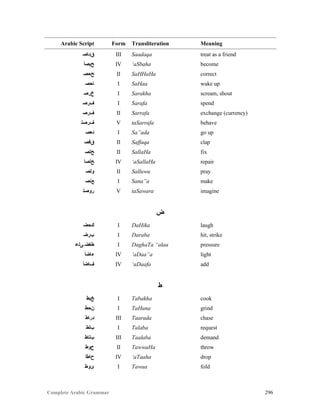
yuf”al ‫ﻞﻌﻓﻴ‬
yuf”al ‫ﻞﻌﻓﻴ‬
yuf”al ‫ﻞﻌﻓﻴ‬
Hollow Verbs
Hollow verbs are verbs that have a weak letter as the second original letter. When turning
imperfective hollow verbs into passive voice, the weak letter will always be turned into a long
vowel aa ‫.ﺍ‬
Active : (he) does
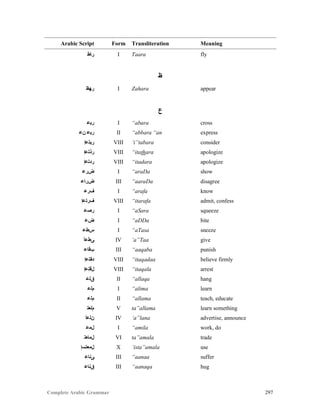
yaqwul = says ‫ﻞﻮﻗﻳ‬
yabyi” = sells ‫ﻉﻴﺒﻳ‬
yanaam = sleeps ‫ﻢﺎﻧﻳ‬
yakhtaar = chooses ‫ﺭﺎﺘﺨﻳ‬
Passive : (he) is (being) done
yuqwul = is (being) said ‫ﻞﺎﻗﻴ‬
yubaa” = is (being) sold ‫ﻉﺎﺒﻴ‬
yunaam = sleeping is (being) done ‫ﻢﺎﻧﻴ‬
yukhtaar = is (being) chosen ‫ﺭﺎﺘﺨﻴ‬
Complete Arabic Grammar 124
Defective Verbs
Defective verbs are verbs whose last original letter is a weak letter. When changing
imperfective defective verbs into the passive voice, the weak letter will always be turned into aa ‫.ﺍ‬
Active : (he) does
ya’tyi = comes to ‫ﻲﺗﺄﻴ‬
yad”wu = calls ‫ﻮﻋﺪﻴ‬
yansaa = forgets ‫ﻰﺴﻧﻴ‬
Passive : (he) is (being) done
yu’taa = is (being) came to ‫ﻰﺗﺆﻴ‬
yud”aa = is (being) called ‫ﻰﻋﺪﻴ‬
yunsaa = is (being) forgotten ‫ﻰﺴﻧﻴ‬
Changing the rest of the imperfective structures does not require any additional rules.
Active : (he) did
yaf”al ‫ﻞﻌﻓﻴ‬
yaf”il ‫ﻞﻌﻓﻴ‬
yaf”ul ‫ﻞﻌﻓﻴ‬
yuf”il ‫ﻞﻌﻓﻴ‬
yufa””il ‫ﻞﻌﻓﻴ‬
yufaa”il ‫ﻞﻋﺎﻓﻴ‬
yanfa”il ‫ﻞﻌﻓﻧﻴ‬
yafta”il ‫ﻞﻌﺘﻓﻴ‬
yaf”all ‫ﻞﻌﻓﻴ‬
yatafa””al ‫ﻞﻌﻓﺘﻴ‬
yatafaa”al ‫ﻞﻋﺎﻓﺘﻴ‬
yastaf”il ‫ﻞﻌﻓﺘﺴﻴ‬
yufa”lil ‫ﻞﻟﻌﻓﻴ‬
yatafa”lal ‫ﻞﻟﻌﻓﺘﻴ‬
Passive : (he) is (being) done
yuf”al ‫ﻞﻌﻓﻴ‬
yufa””al ‫ﻞﻌﻓﻴ‬
yufaa”il ‫ﻞﻋﺎﻓﻴ‬
Complete Arabic Grammar 125
Passive : (he) is (being) done
yunfa”al ‫ﻞﻌﻓﻧﻳ‬
yufta”al ‫ﻞﻌﺘﻓﻳ‬
yuf”all ‫ﻞﻌﻓﻳ‬
yutafa””al ‫ﻞﻌﻓﺘﻳ‬
yutafaa”al ‫ﻞﻋﺎﻓﺘﻳ‬
yustaf”al ‫ﻞﻌﻓﺘﺴﻴ‬
yufa”lal ‫ﻞﻟﻌﻓﻴ‬
yutafa”lal ‫ﻞﻟﻌﻓﺘﻴ‬
Adding the future tesne particles sa- -‫ﺴ‬ or sawfa ‫ﻒﻮﺴ‬ will not change anything in these
structures.
Tenses for the Passive Imperfective Verb
The passive imperfective verb is used in the following tenses.
1. Simple Present
‫ﻞﻌﻓﻳ‬
yuf”al(u)
= (he) is (being) done
Translation: it is (being) done
2. Simple Future
‫ﻞﻌﻓﻳﺴ‬
sa-yuf”al(u)
= (he) will be done
Translation: it will be done
‫ﻞﻌﻓﻳ‬ ‫ﻒﻭﺴ‬
sawfa yuf”al(u)
= (he) will be done
Translation: it will be done
Complete Arabic Grammar 126
3. Progressive Present
‫ﻞﻌﻓﻳ‬
yuf’al(u)
= (he) is being done
Translation: it is being done
4. Progressive Past
‫ﻞﻌﻓﻦﺎﻜ‬
kaan(a) yuf’al(u)
= (he) was being done
Translation: it was being done
5. Progressive Future
‫ﻞﻌﻓ‬ ‫ﻥﻮﻜﻳﺴ‬
sa-yakwun(u) yuf’al(u)
= (he) will be being done
Translation: it will be (being) done
‫ﻞﻌﻓ‬ ‫ﻥﻮﻜﻳ‬ ‫ﻒﻮﺴ‬
sawfa yakwun(u) yuf’al(u)
= (he) will be being done
Translation: it will be (being) done
Complete Arabic Grammar 127
VII. PRONOUNS
Pronouns in Arabic belong to the category of “nouns.” Therefore, everything that applies to
nouns will apply to pronouns. Pronouns have genders, numbers and grammatical case. Pronouns
are always definite nouns. Pronouns in Arabic are in four categories:
 Subject Pronouns
o Separate Subject Pronouns
o Attached Subject Pronouns
 Object Pronouns
o Separate Object Pronouns
o Attached Object Pronouns
Separate Subject Pronouns
SINGULAR
I ‘anaa ‫ﺎﻧﺃ‬
you (m.) ‘ant(a) ‫ﺕﻧﺃ‬
you (f.) ‘anti ‫ﺕﻧﺃ‬
he huw(a) ‫ﻮﻫ‬
she hiy(a) ‫ﻲﻫ‬
DUAL
you ‘antumaa ‫ﺎﻣﺘﻧﺃ‬
they humaa ‫ﺎﻫ‬
PLURAL
we (dual/pural) naHn(u) ‫ﻦﺤﻧ‬
you (m.) ‘antum ‫ﻢﺘﻧﺃ‬
you (f.) ‘antunn(a) ‫ﻥﺘﻧﺃ‬
they (m.) hum ‫ﻢﻫ‬
they (f.) hunn(a) ‫ﻥﻫ‬
In Arabic, a mixed group of males and females will always be referred to by the plural
masculine pronouns or conjunctions.
Separate pronouns work similarly to the English ones.
‫ﺪﻤﺣﺃ‬ ‫ﺎﻧﺃ‬
‘anaa ‘aHmad(u)
= I (am) Ahmad
Translation: I am Ahmad
Complete Arabic Grammar 128
Proper names must have noonation, but ‘aHmad ‫ﺪﻤﺣﺃ‬ cannot be noonated because it belongs
to the “forbidden to noonation” words – which cannot be noonated.
‫ﻒﺭﻌﺘ‬ ‫ﺖﻧﺃ‬
‘ant(a) ta”rif(u)
= you know
Translation: you know
‫ﺎﻧﻫ‬ ‫ﻥﺤﻧ‬
naHn(u) hunaa
= we (are) here
Translation: we are here
ʕ ‫ﻢﻫ‬ ‫ﻦﻤ‬
man hum ?
= who (are) they?
Translation: who are they?
One important difference from English is that separate subject pronouns can be omitted from
sentences in Arabic in many situations. This is because nominal declensions of the verbs make it
clear who the subject is – or as in Arabic grammar, those declensions are themselves subject
pronouns as will be seen shortly.
‫ﺔﻘﻴﻘﺤﻠﺍ‬ ‫ﺪﻴﺭﺃ‬
‘ureed(u) (a)l-Haqyiqa(ta)
= (I) want the truth
Translation: I want the truth
ʕ ‫ﻞﻌﻔﻧﺴ‬ ‫ﺍﺬﺎﻤ‬
maathaa sa-naf”al(u) ?
= what will (we) do?
Translation: what will we do?
Pronouns of Separation
Thanks to the many word declensions in Arabic – which often indicate the gender and the
number of the subject – separate subject pronouns have really little significance in regard to the
syntax of Arabic sentences. This is actually the case for all older languages as well – such as
Latin. However, separate subject pronouns are still used in Arabic. They are most often used
redundantly for emphasizing either the subject or the object of the sentence. Sometimes, however,
they can be important to clarify the meaning of a sentence – this will usually be when they are
used in present tense “be” sentences.
Complete Arabic Grammar 129
Separate subject pronouns are called “pronouns of separation” when they are used
without grammatical necessity. This will be the case for separate subject pronouns most of the
time. Pronouns of separation will be used in the following situations.
1. In Present Tense “Be” Sentences. This is a vital usage. If the subject and the
predicate of a present tense “be” sentence were both definite words, the meaning of the phrase
would be ambiguous.
‫ﺎﻧﻫ‬ ‫ﺭﻴﺪﻤﻠﺍ‬ ‫ﺒﺇﻢﻳﻫﺍﺭ‬
‘ibraahyim(u) (a)l-mudyir(u) hunaa
= Ibrahim, the manager, (is) here
= Ibrahim (is) the manager here
This dual meaning is because the word al-mudyir ‫ﺭﻴﺪﻤﻠﺍ‬ “the director” can be either an
adjective or a predicate. So, to make a distinction – a separation – between the two, it is usual to
add a separate subject pronoun in place of the non-existing “be” in present tense “be” sentences –
that is, between the subject and the predicate.
‫ﺎﻧﻫ‬ ‫ﺭﻴﺪﻤﻠﺍ‬ ‫ﻮﻫ‬ ‫ﻢﻳﻫﺍﺭﺒﺇ‬
‘ibraahyim(u) huw(a) (a)l-mudyir(u) hunaa
= Ibrahim he (is) manager here
Translation: Ibrahim is the manager here
A similar ambiguity can also occur when the subject and the predicate are both indefinite
words, but it is very uncommon in Arabic for the subject of a “be” sentence to be an indefinite
word. That is, a sentence of the type “a man is here” virtually would not be used in Arabic –
instead such sentences will often be expressed via demonstratives, such as “there is a man here.”
‫ﻦﻴﻤﺴﺎﻳ‬ ‫ﺖﺧﺃ‬ ‫ﻲﻫ‬ ‫ﺪﺎﻌﺴ‬
su”aad(u) hiy(a) ‘ukht(u) yaasamyin(a)
= Su’ad she (is) (the) sister (of) Jasmine
Translation: Su’ad is Jasmine’s sister
Both su”aad ‫ﺪﺎﻌﺴ‬ “Su’ad” and yaasmyin ‫ﺪﺎﻌﺴ‬ “Jasmine” are “forbidden to noonation;” hence
the irregular case signs. hiya ‫ﻲﻫ‬ “she” is used to disambiguate from “Su’ad, Jasmine’s sister, …”
but clearly it is not a must in this case because there was nothing after the clause ‘ukht(u)
yaasamyin(a) ‫ﻦﻴﻤﺴﺎﻳ‬ ‫ﺖﺧﺃ‬ “Jasmine’s sister.” So, one can say that the use of the separation pronoun
is optional in this case.
‫ﺐﺮﻐﻣﻠﺍ‬ ‫ﺔﻤﺻﺎﻋ‬ ‫ﻲﻫ‬ ‫ﻃﺎﺒﺭﻠﺍ‬
ar-rabaaT(u) hiy(a) “aaSima(tu) (a)l-maghrib(i)
= Rabat she (is) (the) capital (of) Morocco
Translation: Rabat is the capital of Morocco
Complete Arabic Grammar 130
hiya ‫ﻲﻫ‬ “she” is used to disambiguate from “Rabat, the capital of Morocco, …” Again, the
use of the separation pronoun is optional here.
2. Between verbs and Coordinators. The pronouns of separation are often used
between verbs and coordinator conjunctions.
‫ﺍﺪﻤﺤﻣ‬ ‫ﻮ‬ ‫ﺕﻫﺫ‬
thahab(a) wa muHammada(n)
= (he) went with Muhammad
Translation: he and Muhammad went
Here the separate subject pronoun allowed the coordinator wa ‫ﻮ‬ to have the meaning of
“and,” and the noun after the coordinator was in the nominative case again. However, it is still
possible for wa ‫ﻮ‬ to mean “with” in this sentence – one just needs to change the case as in the
following sentence.
‫ﺍﺪﻤﺤﻣ‬ ‫ﻮ‬ ‫ﻮﻫ‬ ‫ﺕﻫﺫ‬
thahab(a) huw(a) wa muHammada(n)
= went he with Muhammad
Translation: he went with Muhammad
So, it all depends on the case sign.
‫ﻡﻜﺎﺨﺃ‬ ‫ﻮ‬ ‫ﺍﻮﺒﻫﺫﺇ‬
‘ithhabwu wa ‘akhaakum
= (you) go with (the) brother (of) you
Translation: go with your brother
‘akhaa ‫ﻰﺧﺃ‬ “brother” is one of the “six nouns” that take irregular case signs.
‫ﻡﻜﻮﺨﺃ‬ ‫ﻮ‬ ‫ﻢﺘﻧﺃ‬ ‫ﺍﻮﺒﻫﺫﺇ‬
‘ithhabwu ‘antum wa ‘akhwukum
= go you and (the) brother (of) you
Translation: go you and your brother
‫ﻡﻜﺎﺨﺃ‬ ‫ﻮ‬ ‫ﻢﺘﻧﺃ‬ ‫ﺍﻮﺒﻫﺫﺇ‬
‘ithhabwu ‘antum wa ‘akhaakum
= go you with (the) brother (of) you
Translation: go with your brother
Complete Arabic Grammar 131
3. For Emphasis. Anywhere other than in the two situations just mentioned, the
pronouns of separation can be used, but they are not to be used for disambiguation – rather for
emphasizing the subject or the object..
‫ﺎﻧﻫ‬ ‫ﻥﺎﻜ‬
kaana hunaa
= (he) was here
Translation: he was here
‫ﺎﻧﻫ‬ ‫ﻥﺎﻜ‬ ‫-ﻮﻫ‬
huwa kaana hunaa
= he was here
Thanslation: he was here (emphasis)
‫ﺐﺍﻮﺒﻠﺍ‬ ‫ﻥﻮﻓﺮﻌﻴ‬
ya”rifwun(a) (a)l-jawaab(a)
= (they) know the answer
= they know the answer
‫ﺐﺍﻮﺒﻠﺍ‬ ‫ﻥﻮﻓﺮﻌﻴ‬ ‫ﻢﻫ‬
hum ya”rifwun(a) (a)l-jawaab(a)
= they know the answer
Translation: they know the answer (emphasis)
‫ﻢﻗ‬
qum
= (you) get up
= get up
‫ﺕﻧﺃ‬ ‫ﻢﻗ‬
qum ‘ant(a)
= get up you
Translation: you get up! (emphasis)
Complete Arabic Grammar 132
Attached Subject Pronouns
These are contained within the declensions that appear at the end of verbs – both perfective
and imperfective.
1. Perfective Verbs. The declensions of perfective verbs are composed of attached subject
pronouns and of marker letters. There are no mood signs for the perfective verbs
because these are “built” words that have only one, unchangeable mood.
Attached Subject Pronouns – Prefective Verbs
Marker Pronoun Declension
1st
Person 1st
Person Marker
taa’ of the actor -t(u) ‫-ﺖ‬
naa of the actors -naa ‫-ﺎﻧ‬
2nd
Person
Masc. Sing. Marker taa’ of the actor -t(a) ‫-ﺖ‬
Fem Sing. Marker taa’ of the actor -ti ‫-ﺖ‬
Dual Marker taa’ of the actors -tumaa ‫-ﺎﻤﻳ‬
Masc. Plur. Marker taa’ of the actors -tum ‫-ﻢﺘ‬
Fem. Plur. Marker taa’ of the actors -tunn(a) ‫-ﻥﺘ‬
3rd
Person
Dual Masc. Marker ‘alef of the two -aa ‫-ﺍ‬
Dual Fem. Marker ‘alef of the two -ataa ‫-ﺎﺘ‬
Masc. Plur. Marker waaw of the group -wu ‫-ﺍﻮ‬
Fem. Plur. Marker noon of the group -n(a) ‫-ﻥ‬
2. Imperfective Verbs. Imperfective verb conjugations are two types – the “five verbs”
which have suffixes attached to the stem verb, and the rest of the conjugations which have only
prefixes. The suffixes of the “five verbs” are composed of attached subject pronouns followed by
a letter noon ‫ﻥ‬ – this noon is a sign only of the indicative mood and it will not appear in the other
moods. There is one exception to what has been mentioned so far – that is the feminine plural
conjugations. These are “built” words that have an unchangeable suffix that is composed of a
single pronoun letter. The attached subject pronouns of the imperfective verbrs follow.
Attached Subject Pronouns – Imprefective Verbs
Mood Sign Pronoun Declension
Indicative Mood yaa’ of the female vocative -yin(a) ‫-ﻥﻴ‬
Indicative Mood ‘alef of the dual (two) -aan(i) ‫-ﻥﺍ‬
Indicative Mood waaw of the group -wun(a) ‫-ﻥﻮ‬
Indicative Mood noon of the women -n(a) ‫-ﻥ‬
Complete Arabic Grammar 133
Hiding Pronouns
Since not all verbs have declensions that can be deemed subject pronouns, Arab grammarians
postulated that there should be an invisible “hiding pronoun” after each verb that is without a
declension.
Hiding Pronoun Verb Without Attached Subject Pronoun
(he) (‫)ﻮﻫ‬ Past – 3rd
person sing. masc. ‫ﻞﻌﻓ‬
(she) (‫)ﻲﻫ‬ Past – 3rd
person sing. fem. ‫ﺖﻠﻌﻓ‬
(I) (‫)ﺎﻧﺃ‬ Present – 1st
person sing. ‫ﻞﻌﻓﺃ‬
(you) (‫)ﺕﻧﺃ‬ Present – 2nd
person sing. masc. ‫ﻞﻌﻓﺘ‬
(he) (‫)ﻮﻫ‬ Present – 3rd
person sing. masc. ‫ﻞﻌﻓﻴ‬
(she) (‫)ﻲﻫ‬ Present – 3rd
person sing. fem. ‫ﻞﻌﻓﺘ‬
(we) (‫)ﻦﺤﻧ‬ Present – 3rd
person sing. plur.dual ‫ﻞﻌﻓﻧ‬
The -ta ‫-ﺕ‬ at the end of the 3rd
person singular feminine past verb is not an attached subject
pronoun—it is a feminine marker. If a separate subject pronoun appears after a verb that has an
attached subject pro0noun, it will be an emphatic pronoun—but not a subject. In Arabic grammar,
the 1st
and 2nd
person hiding pronouns are said to be “obligatory hiding pronouns”—there will
always be a hiding pronoun after 1st
and 2nd
person conjugations of verbs without attached subject
pronouns. And if a separate subject pronoun appears after them, it will be an emphatic pronoun—
but not a subject. On the other hand, the 3rd
person hiding pronouns are ‘optionally hiding
pronouns.” There will be no hiding pronoun if a separate pronoun appears after 3rd
person
conjugations of verbs without attached subject pronouns.
Separate Object Pronouns
These can be used both as direct and indirect object pronouns. The former use is rare in the
modern language, whereas the latter is very common – even in the colloquial spoken dialects.
Separate Object Pronouns
SINGULAR
me ‘iyyaay(a) ‫ﻱﺎﻴﺇ‬
you (m.) ‘iyyaak(a) ‫ﻚﺎﻴﺇ‬
you (f.) ‘iyyaaki ‫ﻚﺎﻴﺇ‬
him ‘iyyaah(u) ‫ﻩﺎﻴﺇ‬
her ‘iyyaahaa ‫ﺎﻫﺎﻴﺇ‬
DUAL
you ‘iyyaakumaa ‫ﺎﻤﻜﺎﻴﺇ‬
them ‘iyyaahumaa ‫ﺎﻤﻫﺎﻴﺇ‬
Complete Arabic Grammar 134
PLURAL
us (dual/pural) ‘iyyaanaa ‫ﺎﻨﺎﻴﺇ‬
you (m.) ‘iyyaakum ‫ﻢﻜﺎﻴﺇ‬
you (f.) ‘iyyaakunn(a) ‫ﻥﻜﺎﻴﺇ‬
them (m.) ‘iyyaahum ‫ﻢﻫﺎﻴﺇ‬
them (f.) ‘iyyaahunn(a) ‫ﻥﻫﺎﻴﺇ‬
Direct Object
When separate object pronouns serve as direct object pronouns they must come before the
verb. This usage is mostly found in classical writings.
‫ﺪﺒﻌﻧ‬ ‫ﻚﺎﻳﺇ‬
‘iyyaak(a) na”bud(u)
= you (we) worship
Translation: we worship you
Separate object pronouns can some after the verb if they are preceded by a conjunction word.
‫ﻢﻫﺎﻳﺇ‬ ‫ﻮ‬ ‫ﻪﺘﺭﻜﺷ‬
shakartuh(u) wa ‘iyyaahum
= (I) thanked him and them
Translation: I thanked him and them
Separate object pronouns come also after the verb if they are preceded by the word ‘illaa ‫ﻰﻠﺇ‬
“except.”
‫ﻩﺎﻳﺇ‬ ‫ﻰﻠﺇ‬ ‫ﺪﺒﻌﻧ‬ ‫ﻻ‬
laa na”bud(u) ‘illaa ‘iyyaah(u)
= not (we) worship (anybody) except him
Translation: we worship him solely
Note: This sentence uses the negation + exclusion style.
Finally, separate object pronouns can be used in a warning style.
! ‫ﺐﺎﻫﺫﻠﺍ‬ ‫ﻮ‬ ‫ﻚﺎﻳﺇ‬
‘iyyaak(a) wa (ath-thahaab(a))
= (I warn) you of going!
Translation: I warn you not to go!
Complete Arabic Grammar 135
Warning Style
(I warn) you of …
sing. masc. ‘iyyaak(a) wa … h(u) ‫ﻮ…ﻩ‬ ‫ﻚﺎﻴﺇ‬
sing. fem. ‘iyyaak(i) wa … h(u) ‫ﻮ…ﻩ‬ ‫ﻚﺎﻴﺇ‬
dual ‘iyyaakumaa wa … h(u) ‫ﻮ…ﻩ‬ ‫ﺎﻜﺎﻴﺇ‬
plur. masc. ‘iyyaakum wa … h(u) ‫ﻮ…ﻩ‬ ‫ﻢﻜﺎﻴﺇ‬
plur. masc. ‘iyyaakunn(a) wa … h(u) ‫ﻮ…ﻩ‬ ‫ﻥﻜﺎﻴﺇ‬
Indirect Object
Separate object pronouns serve as indirect object pronouns only when the direct object is an
attached object pronoun.
‫ﺎﻫﺎﻴﺇ‬ ‫ﻲﻧﻃﻋﺃ‬
‘a”Tinyi ‘iyyaahaa
= give me her
Translation: give it to me
The attached object pronoun -nee ‫-ﻲﻧ‬ “me” serves as the direct object here, while the separate
object pronoun serves as the indirect object.
‫ﻚﻴﺪﻫﺃ‬ ‫ﻩﺎﻴﺇ‬
‘iyyaah(u) ‘uhdyik(a)
= him (I) present you
Translation: I give it to you as a present
Here, the separate object pronoun serves again as an indirect object, but it comes before the
verb. The direct object is the attached object pronoun -k(a) ‫-ﻙ‬ “you.”
Complete Arabic Grammar 136
Attached Object Pronouns
These are the object pronouns that are used most often. They can serve both as direct and
indirect object pronouns.
Attached Object Pronouns
SINGULAR
me -yi ‫-ﻲ‬
you (m.) -k(a) ‫-ﻚ‬
you (f.) -k(i) ‫-ﻚ‬
him ‘h(u) ‫-ﻪ‬
her -haa ‫-ﺎﻬ‬
DUAL
you -kumaa ‫-ﺎﻤﻜ‬
them -humaa ‫-ﺎﻤﻫ‬
PLURAL
us (dual/pural) -naa ‫-ﺎﻨ‬
you (m.) -kum ‫-ﻢﻜ‬
you (f.) -kunn(a) ‫-ﻥﻜ‬
them (m.) -hum ‫-ﻢﻫ‬
them (f.) -hunn(a) ‫-ﻥﻫ‬
Attached Object Pronouns
Marker Pronoun Declension
1st
Person
Sing. Marker yaa’ of the speaker -yi ‫-ﻲ‬
Plur. Marker naa of the speakers -naa ‫-ﺎﻧ‬
2nd
Person
Masc. Sing. Marker kaaf of the vocative -k(a) ‫-ﻚ‬
Fem Sing. Marker kaaf of the vocative -k(i) ‫-ﻚ‬
Dual Marker kaaf of the vocative -kumaa ‫-ﺎﻤﻜ‬
Masc. Plur. Marker kaaf of the vocative -kum ‫-ﻢﻜ‬
Fem. Plur. Marker kaaf of the vocative -kunn(a) ‫-ﻥﻜ‬
3rd
Person
Masc. Sing. Marker haa’ of the absence -h(u) ‫-ﻪ‬
Fem. Sing. Marker haa’ of the absence -haa ‫-ﺎﻬ‬
Dual Marker haa’ of the absence -humaa ‫-ﺎﻤﻬ‬
Masc. Plur. Marker haa’ of the absence -hum ‫-ﻬﻢ‬
Fem. Plur. Marker haa’ of the absence -hunn(a) ‫-ﻥﻬ‬
Complete Arabic Grammar 137
I. Indirect Object
This is often when the attached object pronoun is attached to verbs.
‫ﻚﺒﺣﺃ‬
‘auHibbuk(i)
= (I) love you (f., s.)
Translation: I love you
‫ﻚﺒﺣﺃ‬
‘auHibbuk(a)
= (I) love you (m., s.)
Translation: I love you
‫ﺎﻬﻠﻌﻓ‬
fa”alahaa
= (he) did her
Translation: he did it
‫ﻪﻣﻠﻋﺎﺴ‬
sa-‘u”allimuh(u)
= (I) will teach him
Translation: I will teach him
‫ﻢﻬﻓﺭﻌﻧ‬
na”rifuhum
= (we) know them (m., p.)
Translation: we know them
‫ﺎﻫﺎﺘﻠﺎﻗ‬
qaalataahaa
= (they) (f., d.) said her
Translation: they said it
A noon ‫ﻦ‬ will be prefixed to the attached first person singular object pronoun -yi ‫-ﻲ‬ to
become -nyi ‫-ﻲﻨ‬ in the following situations:
 When it is attached to verbs.
 When it is attached to either one of the two paricle min ‫ﻦﻤ‬ “from” and “an
‫ﻥﻋ‬ “about.”
This noon ‫ﻦ‬ is called the “noon of protection.”
Complete Arabic Grammar 138
! ‫ﻲﻧﻮﺪﻋﺎﺴ‬
saa”idwunyi
= (you) (m., p.) help me
Translation: help me!
‫ﻲﻧﻨﻓﺮﻌﻴﺴ‬
sa-ya”rifnanyi
= (they) (f., p.) will know me
Translation: they will know me
An additional waaw ‫ﻮ‬ will also be prefixed to the same pronoun when it is attached to a
second person masculine plural perfective verb. So, the -yi ‫-ﻲ‬ pronoun will become
-wunyi ‫.-ﻲﻨﻮ‬
‫ﻲﻧﻮﻤﺘﻴﺃﺭ‬
ra’aytumwunyi
= (you) (m., p.) saw me
Translation: you saw me
Attachment Form of Pronoun “me”
to nouns and most particle -yi ‫-ﻲ‬
to verbs and to the pasrticles -nyi ‫-ﻲﻧ‬
to second person masculine plural pefective verbs -wunyi ‫-ﻲﻧﻮ‬
Other changeable pronouns are the third person pronouns. Most Arabs of ancient times didn’t
like the following combinations:
ihu
yihu
ayhu
When these combinations occur, the -hu ‫ﻩ‬ of the attached pronoun will be changed to -hi ‫.ﻩ‬
Another way to say this is that the -hu ‫ﻩ‬ will become -hi ‫ﻩ‬ if the pronoun is preceded by a short
vowel i or a consonant letter yaa’ ‫.ﻱ‬
‫ﻪﻁﻋﺃ‬
‘a”Tih(i)
(you) (m., s.) give him
Translation: give him
Complete Arabic Grammar 139
‫ﻢﻬﻴﻂﻋﺃ‬
‘a”Tyihim
= (you) (f., s.) give them (m., p.)
Translation: give them
‫ﻥﻬﻴﺮﻴ‬
yuryihinn(a)
= (he) shows them (f., p.)
Translation: he shows them
Forms of Third Person Attached Object Pornouns
Preceded by i, yi or ay Regular
-hi(i) ‫-ﻩ‬ -h(u) ‫-ﻩ‬
-haa ‫-ﺎﻬ‬ -haa ‫-ﺎﻬ‬
-himaa ‫-ﺎﻤﻬ‬ -humaa ‫-ﺎﻤﻬ‬
-him ‫-ﻢﻬ‬ -hum ‫-ﻢﻬ‬
-hinn(a) ‫-ﻥﻬ‬ -hunn(a) ‫-ﻥﻬ‬
The attached object pronouns will also be in the direct object case when they are attached to
the verb-like particles. One of the reasons that these particles are designated like that is because
they can be attached to object pronouns.
‫ﻚﺎﻧﻫ‬ ‫ﺕﻧﻜ‬ ‫ﻲﻧﺗﻴﻠ‬
laytanyi kunt(u) hunaak(a)
= it is wished if me was there
Translation: I wish that I were there
layt(a) ‫ﺕﻴﻠ‬ is a verb-like particle that is used for wishing. Being verb-like, it takes the form -
nyi ‫-ﻲﻧ‬ of the first person singular attached object pronoun – me. The perfective verb kunt(u) ‫ﺕﻧﻜ‬
is used because perfective verbs in Arabic can be used as subjunctive verbs. This is similar to
English where the past form is also the subjunctive.
‫ﻞﺨﺍﺪﻠﺍ‬ ‫ﻲﻓ‬ ‫ﻪﻧﺇ‬
‘innah(u)fyi (a)l-daakhil(i)
= it is true that him in the inside
Translation: he is inside
Complete Arabic Grammar 140
‫ﻥﺘﺑﻫﺫ‬ ‫ﺪﻗ‬ ‫ﻦﻜﻧﻜﻠ‬
lakinnakunn(a) qad thahabtunn(a)
= but you (.f, p.) have gone
Translation: but you have gone
‫ﻢﻮﻴﻠﺍ‬ ‫ﺭﻃﻤﺘ‬ ‫ﺎﻬﻠﻌﻠ‬
‘a”allahaa tumTer(u) (a)l-yawm(a)
= it is hoped that her will rain today
Translation: I hope it will rain today
As for the first person singular attached object pronoun “me” and the verb-like particles,
these particles can all take the two forms interchangeably – except for layt(a) ‫ﺕﻴﻠ‬ to which it is
highly recommended that it take the form -nyi ‫-ﻲﻧ‬ only.
Forms of Verb-Like Partcicles with the First Person Singular
Attached Object Pronoun
‘innyi ‫ﻲﻧﺇ‬ ‘innanyi ‫ﻲﻧﻧﺇ‬
‘annyi ‫ﻲﻧﺃ‬ ‘annanyi ‫ﻲﻧﻧﺃ‬
ka’annyi ‫ﻲﻧﺎﻜ‬ ka’annanyi ‫ﻲﻧﻧﺎﻜ‬
lakinnyi ‫ﻲﻧﻜﻠ‬ lakinnanyi ‫ﻲﻧﻧﻜﻠ‬
la”allyi ‫ﻲﻧﻌﻠ‬ la”allanyi ‫ﻲﻧﻧﻌﻠ‬
--- --- laytanyi ‫ﻲﻧﺘﻴﻠ‬
II. Indirect Object
Attached object pronouns serve as indirect objects by attachment to nouns (to form genitive
constructions), to prepositions or to verbs along with other pronouns.
Indirect Objects of Verbs
This is an archaic usage. In the modern language the indirect – or second – object of a verb would
usually be referred to by a separate object pronoun.
‫ﻪﻜﺘﻴﻂﻋﺃ‬
‘a”Taytukah(u)
= (I) gave you him
Translation: I gave it to you
Complete Arabic Grammar 141
‫ﺎﻬﻴﻧﻮﻤﺘﻠﺄﺴ‬
sa’altumwunyihaa
= (you) (m., p.) asked me her
Translation: you asked me for it
or: you asked me about it
An important note here is that the order of pronouns attached to the verb does not depend on
which one is direct object and which one is indirect. Rather, the first person pronouns will always
come before the second person pronouns in order – and these will always come before the third
person pernouns.
Object Pronouns Attached to Nouns
Object pronouns will be attached to nouns to form genitive constructions.
1. Object Pronouns Attached to Singular Nouns
1) ar-raf” ‫ﻊﻓﺮﻠﺍ‬ case is the nominative or the subject case.
kitaab(un) ‫ﺐﺎﺘﻜ‬ “a book”
Meaning Literal Translation Example
my book kitaabyi = (the) book (of) me ‫ﻲﺒﺎﺘﻜ‬
your book (m., s.) kitaabuk(a) = (the) book (of) you ‫ﻚﺒﺎﺘﻜ‬
your book (f., s.) kitaabuk(i) = (the) book (of) you ‫ﻚﺒﺎﺘﻜ‬
his book kitaabuh(u) = (the) book (of) him ‫ﻪﺒﺎﺘﻜ‬
her book kitaabuhaa = (the) book (of) her ‫ﺎﻬﺒﺎﺘﻜ‬
your book (dual) kitaabukumaa = (the) book (of) you ‫ﺎﺘﻜﺎﻤﻜﺒ‬
their book (dual) kitaabuhumaa = (the) book (of) them ‫ﺎﻤﻬﺒﺎﺘﻜ‬
our book kitaabunaa = (the) book (of) us ‫ﺎﻧﺒﺎﺘﻜ‬
your book (m., p.) kitaabukum = (the) book (of) you ‫ﻢﻜﺒﺎﺘﻜ‬
your book (f., p.) kitaabukunna = (the) book (of) you ‫ﻦﻜﺒﺎﺘﻜ‬
their book (m., p.) kitaabuhum = (the) book (of) them ‫ﻢﻬﺒﺎﺘﻜ‬
their book (f., p.) kitaabuhunn(a) = (the) book (of) them ‫ﻥﻬﺒﺎﺘﻜ‬
Remember that the word forming the first part of a genitive construction is always a definite
word. Also note that the pronoun -yi ‫-ﻲ‬ “me” to a noun will not allow the case sign to appear – it
will be called “estimated” between the noun and the pronoun.
Complete Arabic Grammar 142
Attachment of First Person Singular Object Pronoun to Nouns Ending in a Long
Vowel
Long vowels at the end of nouns will turn the -yi or -iy into a -y(a). The same transformation
will also occur when adding the -yi to dual and masculine plural nouns.
‫ﺎﺼﻋﻱ‬
“aSaay(a)
= (the) stick (of) me
Translation: my stick (cane)
‫ﻲﻤﺎﺤﻤ‬
muHaamyiy(a) = muHaamiyy(a)
= (the) attorney (of) me
Translation: my attorney
The consonant -y is followed by a short vowel -a in this case in order to prevent two still
letters from directly following each other – which is a bad thing in Arabic.
2) an-naSb ‫ﺐﺼﻧﻠﺍ‬ case is the accusative, dative or vocative cases.
kitaab(an) ‫ﺐﺎﺘﻜ‬ “a book”
Meaning Literal Translation Example
my book kitaabyi = (the) book (of) me ‫ﻲﺒﺎﺘﻜ‬
your book (m., s.) kitaabak(a) = (the) book (of) you ‫ﻚﺒﺎﺘﻜ‬
your book (f., s.) kitaabak(i) = (the) book (of) you ‫ﻚﺒﺎﺘﻜ‬
his book kitaabah(u) = (the) book (of) him ‫ﻪﺒﺎﺘﻜ‬
her book kitaabahaa = (the) book (of) her ‫ﺎﻬﺒﺎﺘﻜ‬
your book (dual) kitaabakumaa = (the) book (of) you ‫ﺎﻤﻜﺒﺎﺘﻜ‬
their book (dual) kitaabahumaa = (the) book (of) them ‫ﺎﻤﻬﺒﺎﺘﻜ‬
our book kitaabanaa = (the) book (of) us ‫ﺎﻧﺒﺎﺘﻜ‬
your book (m., p.) kitaabakum = (the) book (of) you ‫ﻢﻜﺒﺎﺘﻜ‬
your book (f., p.) kitaabakunna = (the) book (of) you ‫ﻦﻜﺒﺎﺘﻜ‬
their book (m., p.) kitaabahum = (the) book (of) them ‫ﻢﻬﺒﺎﺘﻜ‬
their book (f., p.) kitaabahunn(a) = (the) book (of) them ‫ﻥﻬﺒﺎﺘﻜ‬
Complete Arabic Grammar 143
3) al-jarr ‫ﺐﺼﻧﻠﺍ‬ case is the ablative or the genitive cases. The regular case sign for this case is
a short vowel -i – which is one of the three sounds (-i, -yi and -ay) that lead to bad combinations
with third person pronouns.
kitaab(in) ‫ﺐﺎﺘﻜ‬ “a book”
Meaning Literal Translation Example
my book kitaabyi = (the) book (of) me ‫ﻲﺒﺎﺘﻜ‬
your book (m., s.) kitaabik(a) = (the) book (of) you ‫ﻚﺒﺎﺘﻜ‬
your book (f., s.) kitaabik(i) = (the) book (of) you ‫ﻚﺒﺎﺘﻜ‬
his book kitaabih(i) = (the) book (of) him ‫ﻪﺒﺎﺘﻜ‬
her book kitaabihaa = (the) book (of) her ‫ﺎﻬﺒﺎﺘﻜ‬
your book (dual) kitaabikumaa = (the) book (of) you ‫ﺎﻤﻜﺒﺎﺘﻜ‬
their book (dual) kitaabihimaa = (the) book (of) them ‫ﺎﻤﻬﺒﺎﺘﻜ‬
our book kitaabinaa = (the) book (of) us ‫ﺎﻧﺒﺎﺘﻜ‬
your book (m., p.) kitaabikum = (the) book (of) you ‫ﻢﻜﺒﺎﺘﻜ‬
your book (f., p.) kitaabikunna = (the) book (of) you ‫ﻦﻜﺒﺎﺘﻜ‬
their book (m., p.) kitaabihim = (the) book (of) them ‫ﻢﻬﺒﺎﺘﻜ‬
their book (f., p.) kitaabihinn(a) = (the) book (of) them ‫ﻥﻬﺒﺎﺘﻜ‬
2. Object Pronouns Attached to Dual Nouns
In the genitive construction section, it was noted that the noun declensions which have noon
‫ﻦ‬ at their ends – dual and masculine plural – must lose the noon ‫ﻦ‬ when they are the first part of a
genitive construction. This is still true in this case. As mentioned above, the form -y(a) of the first
person singular pronoun must be used instead of the standard -yi when adding the pronoun to dual
or masculine plural nouns.
1) ar-raf” ‫ﻊﻓﺮﻠﺍ‬ Case
kitaabaan(i) ‫ﻦﺎﺑﺎﺘﻜ‬ “two books”
Meaning Literal Translation Example
my two books kitaabaay(a) = (the) two books (of) me ‫ﻱﺎﺑﺎﺘﻜ‬
your two books (m., s.) kitaabaak(a) = (the) two books (of) you ‫ﻚﺎﺑﺎﺘﻜ‬
your two books (f., s.) kitaabaak(i) = (the) two books (of) you ‫ﻚﺎﺑﺎﺘﻜ‬
his two books kitaabaah(u) = (the) two books (of) him ‫ﻩﺎﺑﺎﺘﻜ‬
her two books kitaabaahaa = (the) two books (of) her ‫ﺎﻫﺎﺑﺎﺘﻜ‬
your two books (dual) kitaabaakumaa = (the) two books (of) you ‫ﺎﻤﻛﺎﺑﺎﺘﻜ‬
their two books (dual) kitaabaahumaa = (the) two books (of) them ‫ﺎﻤﻫﺎﺑﺎﺘﻜ‬
Complete Arabic Grammar 144
kitaabaan(i) ‫ﻦﺎﺑﺎﺘﻜ‬ “two books”
Meaning Literal Translation Example
our two books kitaabaanaa = (the) two books (of) us ‫ﺎﻧﺎﺑﺎﺘﻜ‬
your two books (m., p.) kitaabaakum = (the) two books (of) you ‫ﻢﻛﺎﺑﺎﺘﻜ‬
your two books (f., p.) kitaabaakunna = (the) two books (of) you ‫ﻦﻜﺎﺑﺎﺘﻜ‬
their two books (m., p.) kitaabaahum = (the) two books (of) them ‫ﻢﻫﺎﺑﺎﺘﻜ‬
their two books (f., p.) kitaabaahunn(a) = (the) two books (of) them ‫ﻥﻫﺎﺑﺎﺘﻜ‬
2) an-naSb ‫ﺐﺼﻧﻠﺍ‬ and al-jarr ‫ﺐﺼﻧﻠﺍ‬ Cases
kitaabayn(i) ‫ﻦﻴﺑﺎﺘﻜ‬ “two books”
Meaning Literal Translation Example
my two books kitaabyay(a) = (the) two books (of) me ‫ﻲﺑﺎﺘﻜ‬
your two books (m., s.) kitaabayk(a) = (the) two books (of) you ‫ﻚﻴﺑﺎﺘﻜ‬
your two books (f., s.) kitaabayk(i) = (the) two books (of) you ‫ﻚﻴﺑﺎﺘﻜ‬
his two books kitaabay(i) = (the) two books (of) him ‫ﻪﻴﺑﺎﺘﻜ‬
her two books kitaabayhaa = (the) two books (of) her ‫ﺎﻬﻴﺑﺎﺘﻜ‬
your two books (dual) kitaabaykumaa = (the) two books (of) you ‫ﺎﻤﻜﻳﺑﺎﺘﻜ‬
their two books (dual) kitaabayhimaa = (the) two books (of) them ‫ﻤﻬﻴﺑﺎﺘﻜﺎ‬
our two books kitaabaynaa = (the) two books (of) us ‫ﺎﻧﻴﺑﺎﺘﻜ‬
your two books (m., p.) kitaabaykum = (the) two books (of) you ‫ﻢﻛﻴﺑﺎﺘﻜ‬
your two books (f., p.) kitaabaykunna = (the) two books (of) you ‫ﻦﻛﻴﺑﺎﺘﻜ‬
their two books (m., p.) kitaabayhim = (the) two books (of) them ‫ﻢﻬﻴﺑﺎﺘﻜ‬
their two books (f., p.) kitaabayhinn(a) = (the) two books (of) them ‫ﻥﻬﻴﺑﺎﺘﻜ‬
3. Object Pronouns Attached to Masculine Plural Nouns
The noon ‫ﻥ‬ at the end of masculine plural nouns must go away when they form the first part
of a gentive construction. The form -y(a) of the first person singular pronoun must be used
instead of -yi.
1) ar-raf” ‫ﻊﻓﺮﻠﺍ‬ Case. The -wu ‫-ﻮ‬ signof this case will be turned to -yi ‫-ﻲ‬ when attaching
the first person singular pronoun -yi to the noun. Euphony is the only reason behind this
transformation and it does not mean that the case sign has changed – nor has the case of the noun
which is still the subject case.
Complete Arabic Grammar 145
mu”allimwun(a) ‫ﻥﻮﻣﻟﻌﻤ‬
mu”allimwuy(a) ‫ﻱﻮﻣﻟﻌﻤ‬
mu”allimyiy(a) ‫ﻲﻣﻟﻌﻤ‬
mu”allimwun(a) ‫ﻥﻮﻣﻟﻌﻤ‬ “teachers”
Meaning Literal Translation Example
my teachers mu”allimwuyi = (the) teachers (of) me ‫ﻲﻣﻟﻌﻤ‬
your teachers (m., s.) mu”allimwuk(a) = (the) teachers (of) you ‫ﻚﻮﻣﻟﻌﻤ‬
your teachers (f., s.) mu”allimwuk(i) = (the) teachers (of) you ‫ﻚﻮﻣﻟﻌﻤ‬
his teachers mu”allimwuh(u) = (the) teachers (of) him ‫ﻩﻮﻣﻟﻌﻤ‬
her teachers mu”allimwuhaa = (the) teachers (of) her ‫ﺎﻫﻮﻣﻟﻌﻤ‬
your teachers (dual) mu”allimwukumaa = (the) teachers (of) you ‫ﺎﻤﻛﻮﻣﻟﻌﻤ‬
their teachers (dual) mu”allimwuhumaa = (the) teachers (of) them ‫ﺎﻤﻫﻮﻣﻟﻌﻤ‬
our teachers mu”allimwunaa = (the) teachers (of) us ‫ﺎﻧﻮﻣﻟﻌﻤ‬
your teachers (m., p.) mu”allimwukum = (the) teachers (of) you ‫ﻢﻜﻮﻣﻟﻌﻤ‬
your teachers (f., p.) mu”allimwukunna = (the) teachers (of) you ‫ﻥﻜﻮﻣﻟﻌﻤ‬
their teachers (m., p.) mu”allimwuhum = (the) teachers (of) them ‫ﻢﻫﻮﻣﻟﻌﻤ‬
their teachers (f., p.) mu”allimwuhunn(a) = (the) teachers (of) them ‫ﻥﻫﻮﻣﻟﻌﻤ‬
2) an-naSb ‫ﺐﺼﻧﻠﺍ‬ and al-jarr ‫ﺐﺼﻧﻠﺍ‬ Cases. In these cases the sign will be -yi ‫,-ﻲ‬ which will
lead to bad combinations with the third person pronouns and thus there will be changes.
mu”allimyin(a) ‫ﻥﻳﻣﻟﻌﻤ‬ “teachers”
Meaning Literal Translation Example
my teachers mu”allimyiy(a) = (the) teachers (of) me ‫ﻲﻣﻟﻌﻤ‬
your teachers (m., s.) mu”allimyik(a) = (the) teachers (of) you ‫ﻚﻳﻣﻟﻌﻤ‬
your teachers (f., s.) mu”allimyik(i) = (the) teachers (of) you ‫ﻚﻳﻣﻟﻌﻤ‬
his teachers mu”allimyih(i) = (the) teachers (of) him ‫ﻪﻳﻣﻟﻌﻤ‬
her teachers mu”allimyihaa = (the) teachers (of) her ‫ﺎﻳﻣﻟﻌﻤ‬
your teachers (dual) mu”allimyikumaa = (the) teachers (of) you ‫ﺎﻤﻜﻳﻣﻟﻌﻤ‬
their teachers (dual) mu”allimyihimaa = (the) teachers (of) them ‫ﺎﻤﻬﻳﻣﻟﻌﻤ‬
our teachers mu”allimyinaa = (the) teachers (of) us ‫ﺎﻧﻳﻣﻟﻌﻤ‬
your teachers (m., p.) mu”allimyikum = (the) teachers (of) you ‫ﻢﻛﻳﻣﻟﻌﻤ‬
your teachers (f., p.) mu”allimyikunna = (the) teachers (of) you ‫ﻥﻛﻳﻣﻟﻌﻤ‬
Complete Arabic Grammar 146
mu”allimyin(a) ‫ﻥﻳﻣﻟﻌﻤ‬ “teachers”
Meaning Literal Translation Example
their teachers (m., p.) mu”allimyihim = (the) teachers (of) them ‫ﻢﻬﻳﻣﻟﻌﻤ‬
their teachers (f., p.) mu”allimyihinn(a) = (the) teachers (of) them ‫ﻥﻬﻳﻣﻟﻌﻤ‬
Feminine plural and irregular plural nouns will behave just like regular nouns when attached
to object pronouns
Forms of the First Person Singular Object Pronoun With Attachment to Nouns
Singular Nouns
not ending with long vowel
-yi
-y(a)
in Classical Arabic (Koran)
ending with long vowel -y(a)
Dual Nouns -y(a)
Plural Nouns -y(a)
4. Object Pronouns Attached to Noun Prepositions
Many prepositions in Arabic are nouns, and they can be attached to pronouns to form genitive
constructions just like any other nouns.
in front of him
‘amaamah(u)
(in) (the) front (of) him
‫ﻪﻤﺎﻤﺃ‬
behind her
khalfahaa)
(in) (the) back (of) her
‫ﺎﻫﻔﻠﺧ‬
underneath us
taHtanaa
(in) (the) underneath (of) us
‫ﺎﻧﺘﺤﺘ‬
after you (m., p.)
ba”dakum
(in) (the) “after” (of) you
‫ﻢﻜﺪﻌﺑ‬
before them (f., p.)
‘qablahunn(a))
(in) (the) f”before” (of) them
‫ﻥﻬﻠﺑﻗ‬
Object Pronouns Attached to Particles
Particles to which object pronouns can be attached are tiwo types—the verb-like particles
and the ablative paricles. The ablative particles are prepositions. Pronouns attached to them will
be—just like any other noun after an ablative particle—in the ablative case.
Complete Arabic Grammar 147
bi- ‫-ﺐ‬ “in / by / with”
Meaning Example
in / by / with me byi ‫ﻲﺑ‬
in / by / with you (m., s.) bik(a) ‫ﻚﺑ‬
in / by / with you (f., s.) bik(i) ‫ﻚﺑ‬
in / by / with him bih(i) ‫ﻪﺑ‬
in / by / with her bihaa ‫ﺎﻬﺑ‬
in / by / with you (dual) bikumaa ‫ﺎﻤﻜﺑ‬
in / by / with them (dual) bihimaa ‫ﺎﻣﻬﺑ‬
in / by / with us binaa ‫ﻬﻧﺑ‬
in / by / with you (m., p.) bikum ‫ﻢﻜﺑ‬
in / by / with you (f., p.) bikunn(a) ‫ﻥﻜﺑ‬
in / by / with them (m., p.) bikhim ‫ﻢﻬﺑ‬
in / by / with them (f., p.) bihinn(a) ‫ﻥﻬﺑ‬
Remember that the -hu of the third person pronouns must be turned to -hi when the pronoun
is preceded by one of the sounds -i, -yi and -ay.
fyi ‫ﻲﻓ‬ “in”
Meaning Example
in me fyiy(a) ‫ﻲﻓ‬
in you (m., s.) fyiyk(a) ‫ﻚﻳﻓ‬
in you (f., s.) fyiyk(i) ‫ﻚﻴﻓ‬
in him fyiyh(i) ‫ﻪﻴﻓ‬
in her fyiyhaa ‫ﺎﻬﻳﻓ‬
in you (dual) fyiykumaa ‫ﺎﻤﻜﻳﻓ‬
in them (dual) fyiyhimaa ‫ﺎﻣﻬﻴﻓ‬
in us fyiynaa ‫ﻬﻧﻳﻓ‬
in you (m., p.) fyiykum ‫ﻢﻜﻳﻓ‬
in you (f., p.) fyiykunn(a) ‫ﻥﻜﻳﻓ‬
in them (m., p.) fyiyhim ‫ﻢﻬﻳﻓ‬
in them (f., p.) fyiyhinn(a) ‫ﻥﻬﺑ‬
It was previously mentioned that the two particles min ‫ﻥﻤ‬ “from” and “an ‫ﻥﻋ‬ “about” are
attached to the -nyi ‫-ﻲﻧ‬ form of the first person singular object pronoun.
Complete Arabic Grammar 148
min ‫ﻲﻓ‬ “in”
Meaning Example
from me minyi ‫ﻲﻧﻤ‬
from you (m., s.) mink(a) ‫ﻚﻧﻤ‬
from you (f., s.) mink(i) ‫ﻚﻧﻤ‬
from him minh(u) ‫ﻪﻧﻤ‬
from her minhaa ‫ﺎﻬﻧﻤ‬
from you (dual) minkumaa ‫ﺎﻤﻜﻧﻤ‬
from them (dual) minhumaa ‫ﺎﻣﻬﻧﻤ‬
from us minnaa ‫ﺎﻧﻤ‬
from you (m., p.) minkum ‫ﻢﻜﻧﻤ‬
from you (f., p.) minkunn(a) ‫ﻥﻛﻧﻤ‬
from them (m., p.) minhum ‫ﻢﻬﻧﻤ‬
from them (f., p.) minhunn(a) ‫ﻦﻬﻧﻤ‬
“an ‫ﻥﻋ‬ “about”
Meaning Example
about me “annyi ‫ﻲﻧﻋ‬
about you (m., s.) “ank(a) ‫ﻚﻧﻋ‬
about you (f., s.) “ank(i) ‫ﻚﻧﻋ‬
about him “anh(u) ‫ﻪﻧﻋ‬
about her “anhaa ‫ﺎﻬﻧﻋ‬
about you (dual) “ankumaa ‫ﺎﻤﻜﻧﻋ‬
about them (dual) “anhumaa ‫ﺎﻣﻬﻧﻋ‬
about us “annaa ‫ﺎﻧﻋ‬
about you (m., p.) “ankum ‫ﻢﻜﻧﻋ‬
about you (f., p.) “ankunn(a) ‫ﻥﻛﻧﻋ‬
about them (m., p.) “anhum ‫ﻢﻬﻧﻋ‬
about them (f., p.) “anhunn(a) ‫ﻦﻬﻧﻋ‬
The two particles ‘ilaa ‫ﻰﻠﺤ‬ “to” and “alaa ‫ﻰﻠﻋ‬ “on” require modification when attached to
opbject pronouns.
Complete Arabic Grammar 149
‘ilaa ‫ﻰﻠﺇ‬ “to”
Meaning Example
to me ‘ilayy(a) ‫ﻲﻠﺇ‬
to you (m., s.) ‘ilayk(a) ‫ﻙﻳﻠﺇ‬
to you (f., s.) ‘ilayk(i) ‫ﻙﻳﻠﺇ‬
to him ‘ilayh(i) ‫ﻪﻳﻠﺇ‬
to her ‘ilayhaa ‫ﺎﻬﻳﻠﺇ‬
to you (dual) ‘ilaykumaa ‫ﻠﺇﺎﻣﻜﻳ‬
to them (dual) ‘ilayhimaa ‫ﺎﻣﻬﻳﻠﺇ‬
to us ‘ilanyaa ‫ﺎﻧﻳﻠﺇ‬
to you (m., p.) ‘ilaykum ‫ﻡﻛﻳﻠﺇ‬
to you (f., p.) ‘ilaykunn(a) ‫ﻥﻛﻳﻠﺇ‬
to them (m., p.) ‘ilayhim ‫ﻢﻬﻳﻠﺇ‬
to them (f., p.) ‘ilayhinn(a) ‫ﻦﻬﻳﻠﺇ‬
“alaa ‫ﻰﻠﻋ‬ “on”
Meaning Example
on me “alayy(a) ‫ﻲﻠﻋ‬
on you (m., s.) “alayk(a) ‫ﻙﻳﻠﻋ‬
on you (f., s.) “alayk(i) ‫ﻙﻳﻠﻋ‬
on him “alayh(i) ‫ﻪﻳﻠﻋ‬
on her “alayhaa ‫ﺎﻬﻳﻠﻋ‬
on you (dual) “alaykumaa ‫ﺎﻣﻜﻳﻠﻋ‬
on them (dual) “alayhimaa ‫ﺎﻣﻬﻳﻠﻋ‬
on us “alanyaa ‫ﺎﻧﻳﻠﻋ‬
on you (m., p.) “alaykum ‫ﻡﻛﻳﻠﻋ‬
on you (f., p.) “alaykunn(a) ‫ﻥﻛﻳﻠﻋ‬
on them (m., p.) “alayhim ‫ﻢﻬﻳﻠﻋ‬
on them (f., p.) “alayhinn(a) ‫ﻦﻬﻳﻠﻋ‬
The last Arabic article that can be attached to pronouns is li- -‫ﻠ‬ “for / to.” This particle will be
changed to la- when attached to object pronouns.
Complete Arabic Grammar 150
li- -‫ﻠ‬ “for / to”
Meaning Example
for / to me lyi ‫ﻲﻠ‬
for / to you (m., s.) lak(a) ‫ﻙﻠ‬
for / to you (f., s.) lak(i) ‫ﻙﻠ‬
for / to him lah(u) ‫ﻪﻠ‬
for / to her lahaa ‫ﺎﻬﻳ‬
for / to you (dual) lakumaa ‫ﺎﻣﻜﻠ‬
for / to them (dual) lahumaa ‫ﺎﻣﻬﻠ‬
for / to us lanaa ‫ﺎﻧﻠ‬
for / to you (m., p.) lakum ‫ﻡﻛﻠ‬
for / to you (f., p.) lakunn(a) ‫ﻥﻛﻠ‬
for / to them (m., p.) lahum ‫ﻢﻬﻠ‬
for / to them (f., p.) lahunn(a) ‫ﻦﻬﻠ‬
Why so many variations in pronouns? This is because classical Arabic was made out of many
different dialects of Arabic which were spoken in pre-Islamic Arabia. The irregularities seen with
pronouns reflect the differences that existed between these dialects. The differences can still be
seen today in the spoken dialects of Arabic, whose diversity was primarily determined by the
diversity of the dialects of old Arab tribes.
Demonstratives
Demonstratives in English are “this,” “that,” “these,” and “those.” In Arabic, demonstratives
are nouns, thus they have the characteristics of gender, number and case. There are so many
demonstratives in classical Arabic that only the ones that are usually used in modern life are
covered. Demonstratives are called in Arabic “nouns of pointing.”
1. Near Demonstratives
The basic forms of demonstratives are the near demonstratives. All demonstratives are “built”
words – do not change form with changing in grammatical case – except for the dual
demonstratives which are case inflected.
Complete Arabic Grammar 151
Demonstratives (Basic Forms)
this (m., s.) thaa ‫ﺍﺫ‬
this (f., s.) thyi ‫ﻱﺫ‬
these (m. dual)
thaan(i)
(subject)
‫ﻥﺍﺫ‬
thayn(i)
(object)
‫ﻥﻴﺫ‬
these (f. dual)
taan(i)
(subject)
‫ﻥﺎﺘ‬
tayn(i)
(object)
‫ﻥﻴﺎﺘ‬
these (plur.)
‘ulaa’(i) * ‫ﺀﻻﻮﺃ‬
‘ulaa * ‫ﻰﻠﻮﺃ‬
* The waaw ‫ﻮ‬ is silent.
The feminine singular demonstrative has so many variants in the classical language of which
none are used in the modern language. However, some of them may be heard in some spoken
dialects today.
Demonstratives for the
Feminine Singular
(Basic Forms)
“this”
thee ‫ﻱﺫ‬
thih ‫ﻩﺫ‬
thih(i) ‫ﻩﺫ‬
thihyi ‫ﻲﻫﺫ‬
thaat(u) ‫ﺖﺍﺫ‬
taa ‫ﺎﺘ‬
tyi ‫ﻲﺘ‬
tih ‫ﻪﺘ‬
tih(i) ‫ﻪﺘ‬
tihyi ‫ﻲﻬﺘ‬
All of these feminine singular demonstratives are also “built” words – except for thaat(u) ‫ﺖﺍﺫ‬
which is a really obsolete demomnstrative.
Complete Arabic Grammar 152
It is common to add a haa- -‫ﻫ‬ prefix to demonstratives. This prefix will change nothing in the
meaning. Note that the haa- lacks an extended ‘alef ‫ﺎ‬ in writing -‫ﻫ‬ when attached to most
demonstratives. This haa- is called the “haa- of attention.”
Demonstratives Attached to Attention haa-
(Basic Forms)
this (m., s.) haathaa ‫ﺍﺫﻫ‬
this (f., s.) haathyi ‫ﻱﺫﻫ‬
these (m. dual)
haathaan(i)
(subject)
‫ﻥﺍﺫﻫ‬
haathayn(i)
(object)
‫ﻥﻴﺫﻫ‬
these (f. dual)
haataan(i)
(subject)
‫ﻥﺎﺘﻫ‬
haatayn(i)
(object)
‫ﻥﻴﺎﺘﻫ‬
these (plur.) haa‘ulaa’(i) ‫ﺀﻻﻮﻫ‬
‘ulaa ‫ﻰﻠﻮﺃ‬ cannot take the haa- prefix, and this prefix takes a different figure haa ‫ﺎﻫ‬ when
attached to the feminine dual demonstratives.
Four of the feminine singular demonstratives can be prefized with attention haa-.
haathyi ‫ﻱﺫﻫ‬
haathih ‫ﻩﺫﻫ‬
haathih(i) ‫ﻩﺫﻫ‬
haathihyi ‫ﻲﻫﺫﻫ‬
Now to the bottom line – the near demonstratives that are really used in modern standard
Arabic are the following.
Complete Arabic Grammar 153
Commonly Used Near Demonstratives
this (m., s.) haathaa ‫ﺍﺫﻫ‬
this (f., s.) haathih(i) ‫ﻩﺫﻫ‬
these (m. dual)
haathaan(i)
(subject)
‫ﻥﺍﺫﻫ‬
haathayn(i)
(object)
‫ﻥﻴﺫﻫ‬
these (f. dual)
haataan(i)
(subject)
‫ﻥﺎﺘﺎﻫ‬
haatayn(i)
(object)
‫ﻥﻴﺎﺘﺎﻫ‬
these (plur.) haa‘ulaa’(i) ‫ﺀﻻﻮﻫ‬
‫ﻞﻳﻣﺟ‬ ‫ﻢﻮﻴ‬ ‫ﺍﺫﻫ‬
haathaa yawm(un) jamyil(un)
= this (is) a day a beautiful
Translation: this is a nice day
‫ﻩﺪﻴﺠ‬ ‫ﺔﺤﻴﺼﻧ‬ ‫ﻩﺬﻫ‬
haathih(i) naSyiHa(tun) jayyida(tun)
= this (is) an advice a good
Translation: this is good advice
‫ﻦﻮﻗﺪﺎﺼ‬ ‫ﻢﻮﻗ‬ ‫ﺀﻻﻮﻫ‬
haa’ullaa’(i) qawm(un) Saadiqwun(a)
= these (are) people honest
Translation: these are honest people
Since demonstratives are definite nouns, when the predicate is also definite there can be a
problem. This problem is similar to what has been described already concering separation
pronouns.
‫ﻢﻟﻌﻤﻠﺍ‬ ‫ﺍﺫﻫ‬
haathaa (a)l-mu”allim(u)
This phrase can mean either one of two things.
this teacher
this (is) the teacher
Complete Arabic Grammar 154
To make the distinction, a separation pronoun is used.
‫ﻢﻟﻌﻤﻠﺍ‬ ‫ﻮﻫ‬ ‫ﺍﺫﻫ‬
haathaa huw(a) (a)l-mu”allim(u)
= this he (is) the teacher
Translation: this is the techer
So, basically, according to the noun after the demonstrative there are the following three
situations.
this is a teacher
‫ﻢﻟﻌﻤ‬ ‫ﺍﺫﻫ‬
haathaa mu”allim(un)
this teacher
‫ﻢﻟﻌﻤﻠﺍ‬ ‫ﺍﺫﻫ‬
haathaa (a)l-mu”allim(u)
this is the teacher
‫ﻢﻟﻌﻤﻠﺍ‬ ‫ﻮﻫ‬ ‫ﺍﺫﻫ‬
haathaa huw(a) (a)l-mu”allim(u)
‫ﻥﺎﺘﺫﻴﻠﺘﻠﺍ‬ ‫ﺎﻤﻫ‬ ‫ﻥﺎﺘﺎﻫ‬
haataan(i) humaa (at-tilmyithataan(i)
= these they (are) the two students (f.)
Translation: these are the two students
humaa ‫ﺎﻤﻫ‬ is necessary here to distinguish the sentence “these are the two students” from
“these two students.”
‫ﻲﻘﻴﺪﺼ‬ ‫ﻮﻫ‬ ‫ﺍﺫﻫ‬
haathaa huw(a) Sadyiqyi
= this he (is) (the) friend (of) me
Translation: this is my friend
humaa ‫ﺎﻤﻫ‬ is not necessary like in the previous example. This phrase without the pronoun
could not mean anything other than “this is my friend.”
‫ﻲﻘﻴﺪﺼ‬ ‫ﺍﺫﻫ‬
haathaa Sadyiqyi
= this (is) (the) friend (of) me
Translation: this is my friend
Because there is no ambiguity here, the usage of a separation pronoun is optional.
Complete Arabic Grammar 155
‫ﺔﻜﻤ‬ ‫ﻩﺫﻫ‬
haathih(i) makka(tu)
= this (is) Mecca
Translation: this is Mecca
‫ﺔﻜﻤ‬ ‫ﻲﻫ‬ ‫ﻩﺫﻫ‬
haathih(i) hioy(a) makka(tu)
= this she (is) Mecca
Translation: this is Mecca
hiy(a) ‫ﻲﻫ‬ here is optional (emphatic).
‫ﻲﻫ‬ ‫ﻩﺫﻫ‬
haathih(i) hiy(a)
= this (is) she
Translation: this is her / here she is
hiy(a) ‫ﻲﻫ‬ here is a predicate but not a separation pronoun. Thus a rule can be stated: a
separation pronoun must be used after demonstratives only if the predicate is a noun attached to
the definite article al- -‫ﻠﺍ‬ – otherwise it is optional (emphatic).
2. Middle Demonstratives
Middle demonstratives are used to refer to things that are neither near nor far but in between.
They are obtained by adding a -k(a) ‫-ﻚ‬ suffix to the basic forms of demonstratives.
Demonstratives Attached to Vocative kaaf ‫ﻚ‬
that (m., s.) thaak(a) ‫ﻚﺍﺫ‬
that (f., s.) thyik(a) ‫ﻚﻴﺫ‬
those (m. dual)
thaanik(a)
(subject)
‫ﻚﻧﺍﺫ‬
thaynik(a)
(object)
‫ﻚﻧﻳﺫ‬
those (f. dual)
taanik(a)
(subject)
‫ﻚﻧﺎﺘ‬
taynik(a)
(object)
‫ﻚﻧﻴﺘ‬
those (plur.)
‘ulaa’ik(a) ‫ﻚﺋﻻﻮﺃ‬
‘ulaak(a) ‫ﻚﻻﻮﺃ‬
Complete Arabic Grammar 156
Only two of all the feminine singular demonstratives can take the vocative kaaf ‫.ﻚ‬
thyik(a) ‫ﻴﺫﻚ‬
tyik(a) ‫ﻚﻴﺘ‬
Here is the most difficult part – since this suffix is a “vocative kaaf” it will change in form
according to which person is being addressed with the sentence. These changes are very much a
classical aspect of Arabic rather than a modern one.
Demonstratives Attached to Vocative kaaf ‫ﻚ‬
Addressing Feminine Singular
that (m., s.) thaak(i) ‫ﻚﺍﺫ‬
that (f., s.) thyik(i) ‫ﻚﻴﺫ‬
those (m. dual)
thaanik(i)
(subject)
‫ﻚﻧﺍﺫ‬
thaynik(i)
(object)
‫ﻚﻧﻳﺫ‬
those (f. dual)
taanik(i)
(subject)
‫ﻚﻧﺎﺘ‬
taynik(i)
(object)
‫ﻚﻧﻴﺘ‬
those (plur.)
‘ulaa’ik(i) ‫ﻚﺋﻻﻮﺃ‬
‘ulaak(i) ‫ﻚﻻﻮﺃ‬
Demonstratives Attached to Vocative kaaf ‫ﻚ‬
Addressing Dual
that (m., s.) thaakumaa ‫ﺎﻣﻛﺍﺫ‬
that (f., s.) thyikumaa ‫ﺎﻣﻛﻳﺫ‬
those (m. dual)
thaanikumaa
(subject)
‫ﺎﻣﻛﻧﺍﺫ‬
thaynikumaa
(object)
‫ﺎﻣﻛﻧﻴﺫ‬
those (f. dual)
taanikumaa
(subject)
‫ﺎﻣﻛﻧﺎﺘ‬
taynikumaa
(object)
‫ﺎﻣﻛﻧﻳﺘ‬
those (plur.)
‘ulaa’ikumaa ‫ﺎﻤﻛﺋﻻﻮﺃ‬
‘ulaakumaa ‫ﺎﻣﻜﻻﻮﺃ‬
Complete Arabic Grammar 157
Demonstratives Attached to Vocative kaaf ‫ﻚ‬
Addressing Masculine Plural
that (m., s.) thaakum ‫ﻢﻛﺍﺫ‬
that (f., s.) thyikum ‫ﻢﻛﻳﺫ‬
those (m. dual)
thaanikum
(subject)
‫ﻢﻛﻧﺍﺫ‬
thaynikum
(object)
‫ﻢﻛﻧﻴﺫ‬
those (f. dual)
taanikum
(subject)
‫ﻢﻛﻧﺎﺘ‬
taynikum
(object)
‫ﻢﻛﻧﻳﺘ‬
those (plur.)
‘ulaa’ikum ‫ﻢﻛﺋﻻﻮﺃ‬
‘ulaakum ‫ﻢﻜﻻﻮﺃ‬
Demonstratives Attached to Vocative kaaf ‫ﻚ‬
Addressing Feminine Plural
that (m., s.) thaakunn(a) ‫ﻥﻛﺍﺫ‬
that (f., s.) thyikunn(a) ‫ﻥﻛﻳﺫ‬
those (m. dual)
thaanikunn(a)
(subject)
‫ﻥﻛﻧﺍﺫ‬
thaynikunn(a)
(object)
‫ﻥﻛﻧﻴﺫ‬
those (f. dual)
taanik nn(a)
(subject)
‫ﻥﻛﻧﺎﺘ‬
taynikunn(a)
(object)
‫ﻥﻛﻧﻳﺘ‬
those (plur.)
‘ulaa’ikunn(a) ‫ﻥﻛﺋﻻﻮﺃ‬
‘ulaakunn(a) ‫ﻥﻜﻻﻮﺃ‬
It is possible to add the attention haa- -‫ﻫ‬ to middle demonstratives – so that the basic
demonistratives will have two letters attached in the following manner.
Complete Arabic Grammar 158
that (m., s.) haathaak(a) ‫ﻚﺍﺫﻫ‬
that (f., s.) haatyik(a) ‫ﻚﻴﺘﻫ‬
those (m. dual)
haathaanik(a)
(subject)
‫ﻚﻧﺍﺫﻫ‬
haathaynik(a)
(object)
‫ﻚﻧﻳﺫﻫ‬
those (f. dual)
haataanik(a)
(subject)
‫ﻚﻧﺎﺘﻫ‬
haataynik(a)
(object)
‫ﻚﻧﻴﺘﻫ‬
those (plur.) haa‘ulaa’ik(a) ‫ﻚﺋﻻﻮﻫ‬
The “vocative kaaf” in these demonstratives is also changeable according to which person is
being addressed. The changing kaaf will de identical to that which is shown above.
3. Place Demonstratives
Place demonstratives also belong to the “nouns of pointing.” Therefore, they are also of three
types: near, middle and far.
1) Near Place Demonstratives. The near place demonstyrative that is used in Modern
Standard Arabic is:
here
‫ﺎﻧﻫ‬
hunaa
Other classical near demonstratives are the following.
here
hannaa ‫ﺎﻧﻫ‬
hinnaa ‫ﺎﻧﻫ‬
hannat ‫ﺕﻧﻫ‬
hanyi ‫ﻲﻧﻫ‬
With the addition of “haa of attention”:
here
haahunnaa ‫ﺎﻧﻬﻫ‬
haahannaa ‫ﺎﻧﻬﻫ‬
haahinnnat ‫ﺖﻧﻬﻫ‬
haahanyi ‫ﻲﻧﻬﻫ‬
Complete Arabic Grammar 159
2) Middle Place Demonstratives. These are obtained by adding the “vocative kaaf.”
They refer to things that are neither near nor far but in between.
there
‫ﻚﺎﻧﻫ‬
hunaak(a)
Classical ones:
there
hannaak(a) ‫ﻚﺎﻧﻫ‬
hinnaak(a) ‫ﻚﺎﻧﻫ‬
With “haa attention”:
there
haahunaak(a) ‫ﻚﺎﻧﻬﻫ‬
haahinnaak(a) ‫ﻚﺎﻧﻬﻫ‬
haahannaak(a) ‫ﻚﺎﻧﻬﻫ‬
3) Far Place Demonstratives. These are all used in modern Arabic.
there
thamm(a) ‫ﻢﺛ‬
thammat(a) ‫ﺔﻤﺜ‬
hunaalik(a) ‫ﻚﻟﺎﻧﻫ‬
The last one contains the “laam of distance.”
‫ﺎﻧﻫ‬ ‫ﻥﺤﻧ‬
naHn(u) hunaa
= we (are) here
Translation: we are here
‫ﺭﺧﺃ‬ ‫ﺭﻣﺃ‬ ‫ﻚﺎﻧﻫ‬
hunaak(a) ‘amr(un) ‘aakhar(u)
= there (is) a thing other
Translation: there is another thing
‫ﺔﺼﻳﻮﻋ‬ ‫ﺔﻠﻜﺸﻤ‬ ‫ﺔﻤﺜ‬
thammat(a) mushkila(tun) “awyiSa(tun)
= there (is) a problem a difficult
Translation: there is a difficult problem
Complete Arabic Grammar 160
Relative Pronouns
Relative pronouns in English include “who”, “whom”, “whose”, “which”, “what”, and “that.”
A relative pronoun links two clauses into a single complex clause. To this extent, it is a similar
function to a subordinating conjunction – however,unlike a conjunction, a relative pronoun stands
in place of a noun. For example, “This is the book which he bought.”
A relative pronoun in Arabic is called a “noun of the connected.” Being nouns, relative
pronouns have the characteristics of nouns – namely gender, number and grammatical case.
Relative pronouns are always definite words. Relative pronouns in English have some
characteristics that are not present in Arabic. In English, “that” is used for both humans and non-
humans. There is a similar word in Arabic, but it has to change to modify different numbers and
genders.
General Relative Pronouns
Who / Whom / Which / That
SING
.
Masculine al-lathyi ‫ﻱﺫﻠﺁ‬
Feminine al-latyi ‫ﻲﺘﻠﺁ‬
DUAL
Masculine
(Subject)
al-lathaan(i)
‫ﻥﺍﺫﻠﻠﺁ‬
Masculine
(Object)
al-lathayn(i)
‫ﻦﻴﺫﻠﻠﺁ‬
Feminine
(Subject)
al-lataan(i)
‫ﻦﺎﺘﻠﻠﺁ‬
Feminine
(Object)
al-latayn(i)
‫ﻦﻴﺘﻠﻠﺁ‬
PLURAL
Masculine
al-lathyin(a) ‫ﻦﻴﺫﻠﺁ‬
al-‘ulaa
(Archaic word)
‫ﻰﻠﻷﺁ‬
Feminine
al-laatyi ‫ﻲﺘﻼﻠﺁ‬
al-laa’yi ‫ﻲﺌﻼﻠﺁ‬
al-lawaatyi ‫ﻲﺘﺍﻮﻠﻠﺁ‬
These are major relative pronouins in Arabic. The only case-inflected ones are the dual
relative pronouns – the rest are “built” words. Each one of those words can be translated as
“that,” “who,” “whom,” or “which.” Apart from “that,” English uses specific relative pronouns
for humans and for non-humans. “Who” is used for humans – “I know who did that.” The Arabic
equivalent would be:
who / whom man ‫ﻦﻤ‬
This word is specific for humans and it has only this single form for all cases, numbers and
genders.
Complete Arabic Grammar 161
The relative pronoun “which” is specifically used for non-human in English. In Arabic there
is no such word and this word is translated to the general relative pronouns mentioned above.
The relative pronoun “what” also has an equivalent in Arabic – “I know what you did.”
what maa ‫ﺎﻤ‬
Usage of Relative Pronouns
1. General Relative Pronouns
These are the relative pronouns most commonly used. They can be translated as “who,”
“whom,” “which,” or “that.” They are used somewhat similarly in English, but the point here is
that they change in form to suit the antecedent.
‫ﺖﻴﺭﺘﺸﺇ‬ ‫ﻱﺫﻠﺁ‬ ‫ﺏﺎﺘﻜﻠﺍ‬ ‫ﺍﺬﻫ‬
haathaa (a)l-kitaab(u) (a)l-lathyi ‘ishtarayt(u)
= this (is) the book which/that (I) bought
Translation: this is the book that I bought
It is very common to add an attached object pronoun after the verb in such sentences.
‫ﻪﺘﻴﺭﺘﺸﺇ‬ ‫ﻱﺫﻠﺁ‬ ‫ﺏﺎﺘﻜﻠﺍ‬ ‫ﺍﺬﻫ‬
haathaa (a)l-kitaab(u) (a)l-lathyi ‘ishtaraytuh(u)
= this (is) the book which/that (I) bought him
Translation: this is the book that I bought
It is also common to add a redundant separation subject pronoun in such sentences.
‫ﺖﻴﺭﺘﺸﺇ‬ ‫ﻱﺫﻠﺁ‬ ‫ﺏﺎﺘﻜﻠﺍ‬ ‫ﺍﺬﻫ‬
haathaa huw(a) (a)l-kitaab(u) (a)l-lathyi ‘ishtaraytuh(u)
= this he (is) the book which/that (I) bought
Translation: this is the book that I bought
Other examples.
‫ﺎﻤﻬﺘﻴﺭﺘﺸﺇ‬ ‫ﻦﺍﺫﻠﻠﺁ‬ ‫ﻥﺍﺒﺎﺘﻜﻠﺍ‬ ‫ﺎﻤﻫ‬ ‫ﻥﺍﺬﻫ‬
haathaan(i) humaa (a)l-kitaabaan(i) (a)l-lathaan(i) ‘ishtaraytuhumaa
= those they (are) the two books that/which (I) bought them
Translation: those are the two books that I bought
Complete Arabic Grammar 162
‫ﺝﺮﺪﻠﺍ‬ ‫ﻲﻓ‬ ‫ﻦﻳﺫﻠﻠﺍ‬ ‫ﻥﻳﺭﺎﻧﻳﺩﻠﺍ‬ ‫ﺫﺧ‬
khuth(i) (a)d-dyinaarayn(i) (a)l-lathayn(i) fyi (a)d-durj(i)
= (you) take the two dinars that/which (are) in the drawer
Translation: take the two dinars that are in the drawer
‫ﻲﻧﻮﺪﺎﺴ‬ ‫ﻦﻴﺫﻠﺍ‬ ‫ﺱﺎﻧﻠﺍ‬ ‫ﻢﻫ‬ ‫ﻷﻮﻫ‬
haa’ulaa’(i) hum(u) (a)l-naas(u) (a)l-lathyin(a) saa”adwunyi
= those they (are) the people that/who helped me
Translation: those are the people who helped me
Note that when using the general relative pronouns it is often possible to omit the word to
which the relative pronoun refers – the antecedent.
‫ﻪﺘﻴﺭﺘﺸﺇ‬ ‫ﻱﺫﻠﺍ‬ ‫ﻮﻫ‬ ‫ﺍﺬﻫ‬
haathaa huw(a) (a)l-lathyi ‘ishtaraytuh(u)
= this he (is) that/which (I) bought him
Translation: this is what I bought
‫ﻲﻧﻮﺪﻋﺎﺴ‬ ‫ﻥﻳﺫﻠﺍ‬ ‫ﻢﻫ‬ ‫ﻸﻮﻫ‬
haa’ulaa’(i) hum(a) (a)l-lathyin(a) saa”adwunyi
= those they (are) that/who helped me
Translation: those are (the people) who helped me
2. Relative Pronoun “Who”
“Who” in English changes in form as in the following.
Subject Tom is the one who can do it.
Object Dan is the man whom I saw
Adpositional
Complement
Jenny is the woman with whom he is
happy.
Possessive John is the boy whose book this is.
Suprisingly, the Arabic equivalent does not change at all. It is a “built” word and it assumes a
sole form for all cases, numbers and genders.
who / whom man ‫ﻦﻤ‬
Complete Arabic Grammar 163
However, the usage of this word differs from English. For example in English, “Tom is the
one who can do it.” In Arabic this sentence will become “Tom is who can do it.” This is the major
point here – in Arabic the antecedent must go away when using the relative pronoun “who.”
Usually a separation subject pronoun will be added so the final structure will be “Tom he is who
can do it.”
Subject Case
‫ﺎﻬﻠﻌﻔﻳ‬ ‫ﻦﺃ‬ ‫ﻊﻳﻂﺘﺴﻳ‬ ‫ﻥﻤ‬ ‫ﻮﻫ‬ ‫ﻢﻮﺘ‬
twum(un) huw(a) man yastatyi”(u) ‘an yaf”alahaa
= Tom he (is) who (he) can that (he) do her
Translation: Tom is the one who can do it
‫ﻚﻠﻤﻴ‬ ‫ﺎﻣﺒ‬ ‫ﻊﻧﻘﻴ‬ ‫ﻥﻣ‬ ‫ﻲﻧﻐﻠﺍ‬
al-ghaniyy(u) man yaqna”(u) bimaa yamlik(u)
= the rich (is) who is sufficed with what (he) has
Translation: he who is suifficed with what he has is a rich person
‫ﻚﻠﻤﻴ‬ ‫ﺎﻣﺒ‬ ‫ﻊﻧﻘﻴ‬ ‫ﻥﻣ‬ ‫ﻮﻫ‬ ‫ﻲﻧﻐﻠﺍ‬
al-ghaniyy(u )huw(a) man yaqna”(u) bimaa yamlik(u)
= the rich (he) is who is sufficed with what (he) has
Translation: he who is sufficed with what he has is a rich person
Object Case
‫ﺖﻴﺃﺭ‬ ‫ﻥﻤ‬ ‫ﻮﻫ‬ ‫ﻦﺍﺩ‬
daan(un) huw(a) man ra’ayt(u)
= Dan he (is) whom (I) saw
Translation: Dan is the man whom I saw
And more commonly:
‫ﻪﺘﻴﺃﺭ‬ ‫ﻥﻤ‬ ‫ﻮﻫ‬ ‫ﻦﺍﺩ‬
daan(un) huw(a) man ra’aytuh(u)
= Dan he (is) whom (I) saw him
Translation: Dan is the man whom I saw
Complete Arabic Grammar 164
With Prepositions
The usage of relative pronouns as adpositional complements is not present in Arabic. For
example the English sentence, “Jenny is the woman with whom he is happy.” In order to translate
this sentence into Arabic, it must be rephrased first. Either one of the two types of relative
pronouns can be used.
1) The General Relative Pronoun (That). The structure in Arabic will be “Jenny is the
woman that he is happy with her.”
2) The Specific Relative Pronoun (Whom). The structure in Arabic will be “Jenny she is
whom he is happy with her.” It is not possible to delete the object pronoun after the preposition.
‫ﺎﻬﻌﻣ‬ ‫ﺪﻌﺴﻴ‬ ‫ﻲﺘﻠﺍ‬ ‫ﻠﺍﺓﺍﺭﻤ‬ ‫ﻲﻫ‬ ‫ﻲﻧﺠ‬
jennyi hiy(a) (a)l-mar’a(tu) (a)l-latyi yas”ad(u) ma”ahaa
= Jenny she (is) the woman that (he) is happy with her
Translation: Jenny is the woman that he is happy with
‫ﺎﻬﻌﻣ‬ ‫ﺪﻌﺴﻴ‬ ‫ﻲﻫ‬ ‫ﻲﻧﺠ‬
jennyi hiy(a) man yas”ad(u) ma”ahaa
= Jenny she (is) whom (he) is happy with her
Translation: Jenny is the woman whom he is happy with
Again, it is not possible to delete the final object pronoun in these two sentences.
The Possessive
Another usage of relative pronouns in English is in the possessive form “whose.” This type of
relative pronoun is not present at all in Arabic. An English example, “John is the boy whose book
this is.” In order to translate this sentence to Arabic it must be rephrased in either of the following
ways.
1) With the General Relative Pronoun (That). The structure in Arabic will be “John is the
boy that his book is this” or “John is the boy that this is his book.”
2) With the Specific Relative Pronoun (Whom). The structure in Arabic will be “John is who
his book is this” or “John is who this is his book.”
3) Without Any Relative Pronoun – The Best Way. The structure in Arabic will be “John is
the owner of this book.”
‫ﻪﺑﺎﺘﻛ‬ ‫ﺍﺫﻫ‬ ‫ﻱﺫﻠﺍ‬ ‫ﻲﺑﺼﻠﺍ‬ ‫ﻮﻫ‬ ‫ﻥﻮﺠ‬
jwun(un) huw(a) (a)S-Sabiyy(u) (a)l-lathyi haathaa kitaabuh(u)
= John he (is) the boy that this (is) (the) book (of) him
Translation: John is the boy whose book this is
Complete Arabic Grammar 165
‫ﺍﺫﻫ‬ ‫ﻪﺑﺎﺘﻛ‬ ‫ﺍﺫﻫ‬ ‫ﻥﻣ‬ ‫ﻮﻫ‬ ‫ﻥﻮﺠ‬
jwun(un) huw(a) man kitaabuh(u) haathaa
= John he (is) who (the) book (of) him (is) this
Translation: John is the boy whose book this is
‫ﺐﺎﺘﻛﻠﺍ‬ ‫ﺍﺫﻫ‬ ‫ﺐﺤﺎﺼ‬ ‫ﻮﻫ‬ ‫ﻥﻮﺠ‬
jwun(un) huw(a) SaaHib(u) haathaa (a)l-kitaab(i)
= John he (is) (the) owner (of) this book
Translation: John is the owner of this book
3. Relative Pronoun “What”
what maa ‫ﺎﻤ‬
Unlike “who,” the relative pronoun “what” in English is similar to the Arabic one in that the
antecedent is omitted in English, too. Therefore, it should be easy here.
‫ﺕﻠﻌﻓ‬ ‫ﺎﻤ‬ ‫ﻒﺭﻋﺃ‬
‘rif(u) maa fa”alt(a)
= (I) know what (you) did
Translation: I know what you did
Note that the word maathaa ‫ﺍﺫﺎﻤ‬ is related to maa ‫ﺎﻤ‬ and it works exactly like it – including as
a relative pronoun.
A final point about relative pronouns is the idea of restrictiveness. An English non-restrictive
relative clause is preceded by a pause in speech or a comma in writing – whereas a restrictive
clause normally is not. Compare the following sentences, which have two different meanings in
English.
 The builder, who erects very fine houses, will make a large profit.
 The builder who erects very fine houses will make a large profit.
In Arabic there are no restrictive relative clauses. The only possible form of relative clauses is
the second one.
Complete Arabic Grammar 166
A summary of relative pronouns in Arabic.
English Relative
Pronoun
Usage Arabic Equivalent
that
humans and non-
humans
‫ﻱﺫﻠﺍ‬
changeable form;
antecedent may be
omitted
which non-humans not present
who
humans
‫ﻥﺃ‬
no antencedentwhom
to whom humans not present
whose humans and non-
humans
not present
what
(no antecedent)
non-humans
‫ﺎﻣ‬
no antecedent
Complete Arabic Grammar 167
VIII. ARABIC SENTENCES
Every complete sentence in English must have at least a subject and a verb. This is also
generally true in Arabic; however, the organization of these elements in a sentence can be a bit
different in Arabic. In English sentences the subject usually precedes the verb. In Arabic there are
two types of sentences in regard to subject and verb order.
 Nominal sentences – sentences in which the subject precedes the verb
 Verbal sentences – sentences in which the verb precedes the subject
Usage of Each Type Of Sentence
Unlike English, where the change in the intonation of the speaker is probably the only way to
emphasize or stress different elements of the sentence, emphasis of different elements can be
achived in Arabic by alternating between the two types of sentences. Nominal sentences are used
when the subject is the most important element in the sentence and which the speaker seeks to
emphasize. Verbal sentences are in fact the normal tone – they are used when the speaker is not
stressing anything in particular or when the speaker seeks to stress the verb or the action.
Nominal Sentences
A nominal sentence in Arabic is a sentence that starts with the subject – a noun – and the verb
follows. The subject can be a noun, a pronoun, a demonstrative, or a relative clause. The defining
property of a nominal sentence is that the subject procedes the verb. Thus there are more than one
possibility for nominal sentences in the presence of an object, an adverb, a prepositional phrase,
etc. The first one is the standard or usual one.
Standard Structure of Nominal Sentences
Subject Verb Others
the boy reads his book Object
the boy reads fast Adverb
the boy reads in the library Prepositional
Phrase
the boy is smart Adjective
The other possible structures for nominal sentences are more rare.
Alternative Structures for Nominal Sentences
Others Subject Verb
in the library the boy reads
Others Subject Verb Others
in the library the boy reads his book
Subject Other Verb
the boy in the library reads
Complete Arabic Grammar 168
So the important point is that the subject always precedes the verb in nominal sentences.
Examples of nominal sentences.
Subject – Verb – Object
‫ﻪﺒﺎﺘﻜ‬ ‫ﺃﺭﻘﻴ‬ ‫ﺪﻠﻮﻠﺍ‬
al-walad(u) yaqra’(u) kitaabkah(u)
= the boy reads (the) book (of) him
Translation: the boy reads his book
Subject – Verb – Prepositional Phrase
‫ﺔﻘﻴﺪﺣﻠﺍ‬ ‫ﻲﻓ‬ ‫ﻥﺑﻌﻠﻴ‬ ‫ﺖﺎﻨﺒﻠﺍ‬
al-banaat(u) yal”abn(a) fyi (a)l-Hadyiqa(ti)
= the girls play in the yard/park
Translation: the girls are playing in the yard/park
“Be” Sentences
Earlier the fact that nominal, present tense “be” sentences do not have verbs – the verb “be”
is omitted in the present tense – was discussed. This is the only case in Arabic in which there is
no verb in the sentence. In these verbless sentences the stress usually falls on the predicate not the
subject – the part after the “be” – unless the intonation says otherwise.
Subject – Predicate
‫ﺎﻧﻫ‬ ‫ﻦﺴﺤ‬
Hasan(un) hunaa
= Hassan (is) here
Translation: Hassan is here
‫ﺐﻳﺻﻋ‬ ‫ﻢﻮﻴ‬ ‫ﺍﺫﻫ‬
haathaa yawm(un) “aSyib(un)
= this (is) a day a hard
Translation: this is a hard day
Subject – Predicate
‫ﺩﻮﻤﺤﻤ‬ ‫ﺔﺠﻮﺯ‬ ‫ﻲﻫ‬ ‫ﻰﻠﻴﻠ‬
laayla hiy(a) zawja(tu) maHmwud(in)
= Layla she (is) (the) wife (of) Mahmud
Translation: Layla is Mahmud’s wife
Complete Arabic Grammar 169
‫ﺭﺠﻣﻠﺍ‬ ‫ﻚﻠﺎﻤ‬ ‫ﻮﻫ‬ ‫ﻲﻘﻴﺪﺼ‬
Sadyiqyi huw(a) maalik(u) (a)l-matjar(i)
= (the) friend (of) me he (is) (the) owner (of) the shop
Translation: my friend is the owner of (owns) the shop
* ‫ﺭﺼﻣ‬ ‫ﺔﻤﺼﺎﻋ‬ ‫ﻲﻫ‬ ‫ﺓﺭﻫﺎﻗﻠﺍ‬
al-qaahira(tu) hiy(a) “aaSima(tu) miSr(a)
= Cairo she (is) (the) capital (of) Egypt
Translation: Cairo is the capital of Egypt
* Note: miSr ‫ﺭﺼﻣ‬ is a “forbidden to noonation” word and it takes an
irregular sign for the genitive case.
Sentences that begin with an indefinite word – such as “a man is here” – are not usually used
in Arabic. The demonstrative “there” will usually be used for such sentences.
‫ﺐﺎﺑﻠﺎﺑ‬ ‫ﻞﺠﺭ‬ ‫ﻚﺎﻧﻫ‬
hunaak(a) rajul(un) bi-l-baab(i)
= there (is) a man by the door
Translation: there is a man at the door
‫ﺎﻤ‬ ‫ﺪﺣﺍ‬ ‫ﺔﻤﺜ‬
thammat(a) ‘aHad(un) maa
= there (is) one-some
Translation: someone is there
Note that such sentences that begin with “there is” will not become “there was” when
rendered in the past tense – nor will they become “there will be” when in the future tense. To
change the tense of these sentences from the present to the past or the future, a verbal sentence is
usually used – that is, “was there a man at the door” or “will be there a man at the door.” These
will be covered in more detail during the discussion on verbal sentences.
“Be” sentences in the past tense have the perfective verb kaan(a) ‫ﻥﺎﻜ‬ “was” or one of its
conjugations.
Subject – Verb – Adverb
‫ﺔﻴﻓﺎﺼ‬ ‫ﺕﻧﺎﻜ‬ ‫ﺄﻤﺴﻠﺍ‬
as-samaa’(u) kaanat Saafiya(tan)
= the sky was (existed) clearly
Translation: the sky was clear
Complete Arabic Grammar 170
The verb “be” in Arabic requires an adverb after it rather than an adjective as in English. This
is only true when the verb appears but not when it is not apparent – such as in the present tense.
Such verbs are called in Arabic the “incomplete verbs.”
Subject – Verb – Adverb
‫ﻚﺎﻧﻫ‬ ‫ﻥﺎﻜ‬ ‫ﻦﻴﺴﺣ‬
Hasayn(un) kaan(a) hunakk(a)
= Hussein was there
Translation: Hussein was there
‫ﺎﺒﻴﺼﻋ‬ ‫ﺎﻤﻮﻴ‬ ‫ﻦﺎﻛ‬ ‫ﺍﺬﻫ‬
haathaa kaan(a) yawma(n) “aSyiba(n)
= this was (existed) a day a hard
Translation: this was a hard day
In the future tense, “be” verbs are sa-yakwun(u) ‫ﻦﻮﻛﻳﺴ‬ “will be” or sawf(a) yakwun(u) ‫ﻥﻮﻜﻳ‬
‫ﻒﻮﺴ‬ “will be.”
Subject – Verb – Adverb
‫ﺔﻴﻓﺎﺼ‬ ‫ﻥﻮﻜﺘﺴ‬ ‫ﺄﻣﺴﻠﺍ‬
as-samaa’(u) sa-takwun(u) Saafiyat(an)
= the sky will be (exist) clearly
Translation: the sky will be clear
Pronoun Sentences
Sentences which start with subject pronouns are nominal sentences. When there is a verb
after the subject pronoun, the pronoun can be kept or omitted. Third person subject pronouns will
always have an emphatic function if they are kept before the verb. The other pronouns – first and
second person – can and cannot have an emphatic function, depending on the intonation.
Subject – Verb
‫ﻒﺭﻋﺃ‬ ‫ﺎﻧﺃ‬
‘anaa ‘ar”rif(u)
= I know
Translation: I know
In this sentence the pronoun – a first person pronoun – is not emphatic unless the intonation
stresses it.
Complete Arabic Grammar 171
Verb – Hiding Subject
‫ﻒﺭﻋﺃ‬
‘ar”rif(u)
= know (I)
Translation: I know
This is a verbal sentence because the subject – a hiding pronoun after the verb – does not
precede the verb.
Subject – Predicate
‫ﺯﻫﺎﺟ‬ ‫ﺎﻧﺃ‬
‘anaa jaahiz(un)
= I (am) ready
Translation: I am ready
Subject – Verb – Adverb
‫ﺍﺯﻫﺎﺠ‬ ‫ﺕﻧﻜ‬ ‫ﺎﻧﺃ‬
‘anaa kunt(u) jaahiza(n)
= I was ready
Translation: I was ready
Verb – Attached Subject – Adverb
‫ﺍﺯﻫﺎﺠ‬ ‫ﺕﻧﻜ‬
kunt(u) jaahiza(n)
= was (I) ready
Translation: I was ready
Subject – Verb – Adverb
‫ﺍﺰﻫﺎﺠ‬ ‫ﻦﻮﻛﺄﺴ‬ ‫ﺎﻧﺃ‬
‘anaa sa-‘akwun(u) jaahiza(n))
= I will be ready
Translation: I will be ready
Complete Arabic Grammar 172
Verb – Hiding Pronoun – Adverb
‫ﺍﺯﻫﺎﺠ‬ ‫ﻥﻮﻜﺄﺴ‬
sa-‘akwun(u( jaahiza(n)
= will be (I) ready
Translation: I will be ready
Subject – Verb – Object
! ‫ﺔﻳﺑﺭﻌﻠﺍ‬ ‫ﺚﺪﺤﺘﺘ‬ ‫ﺕﻧﺃ‬
‘ant(a) tataHaddath(u) (a)l-“arabiyya(ta)
= you speak the Arabic
Translation: you speak Arabic!
Subject – Verb – Object
‫ﻲﻧﻧﻮﻗﺪﺼﺘ‬ ‫ﻻ‬ ‫ﻢﺘﻧﺃ‬
‘antum laa tuSaddiqwunanyi
= you not believe me
Translation: you do not believe me
Subject – Verb – Object
‫ﺍﺫﻫ‬ ‫ﻞﻌﻓ‬ ‫ﻮﻫ‬
huwa fa”al(a) haathaa
= he did this
Translation: he did this
Note: Third person pronoun is always emphatic.
Subject – Verb – Object
‫ﺍﺫﻫ‬ ‫ﺎﺘﻠﺎﻗ‬ ‫ﺎﻤﻫ‬
humaa qaalataa haathaa
= they (f. dual) said this
Translation: they said this
Subject – Predicate
‫ﻚﺎﻧﻫ‬ ‫ﻢﻫ‬
hum hunaak(a)
= they (m., p.) (are) there
Translation: they are there
Complete Arabic Grammar 173
Here, even though the pronoun is a third person pronoun, the stress came on the predicate
because this is a “be” sentence without a verb – so the stress falls on the predicate.
Nominal sentences can begin with other types of nouns.
Demonstrative
‫ﺪﻳﺮﺘ‬ ‫ﺎﻣ‬ ‫ﺪﺠﺘ‬ ‫ﺎﻧﻫ‬
hunaa tajid(u) maa turyid(u)
= here (you) find what(you) want
Translation: here you can find what you want
Relative Pronoun
‫ﺪﺼﺣ‬ ‫ﻉﺮﺯ‬ ‫ﻥﻤ‬
man zara”(a) HaSad(a)
= who planted harvested
Translation: he who planted harvested
Note that perfective verbs in Arabic can be used as
subjunctive verbs, which is somewhat similar to English.
Others
‫ﻲﻧﺪﺠﺘ‬ ‫ﺕﻳﺗﺃ‬ ‫ﺎﻤ‬ ‫ﻰﺘﻤ‬
mataa maa ‘atayt(a) tajidunyi
= whenever (you) came (you) will find me
Translation: whenever you come you will find me
A summary for nominal sentences.
The Subject The Verb The Stress
a noun any verb except “be” in present tense on the subject
a demonstrative
1st
and 2nd
person – changeable
a pronoun
3rd
person – on the subject
a noun
“be” in present tense –
not apparenta demonstrative
a pronoun
Complete Arabic Grammar 174
Verbal Sentences
A verbal sentence is a sentence that starts with the verb and the subject follows. The subject
can be a noun, a pronoun, a demonstrative, or a relative clause. The defining property of a verbal
sentence is that the verb precedes the subject. There are more than one possibility for verbal
sentences in the presence of an object, an adverb, a prepositional phrase, etc.
Standard Structure of Verbal Sentences
Verb Subject Object
read the boy his book Object
read the boy fast Adverb
read the boy in the library Prepositional Phrase
The other possible structures for verbal sentences are more rare.
Alternative Structures for Nominal Sentences
Others Verb Subject
‫ﺔﺑﺘﻜﻤﻠﺍ‬ ‫ﻲﻓ‬ ‫ﺃﺭﻘﻴ‬ ‫ﺪﻠﻮﻠﺍ‬
in the library read the boy
Others Verb Subject Others
‫ﺔﺑﺘﻜﻤﻠﺍ‬ ‫ﻲﻓ‬ ‫ﺃﺭﻘﻴ‬ ‫ﺪﻠﻮﻠﺍ‬ ‫ﻪﺑﺎﺘﻜ‬
in the library read the boy his book
Verb Other Subject
‫ﺃﺭﻘﻴ‬ ‫ﺔﺑﺘﻜﻤﻠﺍ‬ ‫ﻲﻓ‬ ‫ﺪﻠﻮﻠﺍ‬
read in the library the boy
The main point is that the verb always precedes the subject in verbal sentences.
Complete Arabic Grammar 175
Subject of Verbal Sentences
Subjects in verbal sentences may not always show up. There can be apparent, attached and
hiding subjects in verbal sentences.
1. Apparent Singular Subjects
Verb – Subject – Object
‫ﻪﺑﺎﺘﻜ‬ ‫ﺪﻠﻮﻠﺍ‬ ‫ﺃﺭﻘﻴ‬
yaqra’(u) (a)l-walad(u) kitaabah(u)
= read the boy (the) book (of) him
Translation: the boy reads his book
Compare this sentence with its nominal alternative in which the subject is the stressed
element.
Subject – Verb – Object
‫ﻪﺑﺎﺘﻜ‬ ‫ﺃﺭﻘﻴ‬ ‫ﺪﻠﻮﻠﺍ‬
al-walad(u) yaqra’(u) kitaabah(u)
= the boy reads (the) book (of) him
Translation: the boy reads his book
More examples on verbal sentences.
Verb – Subject – Adverb
‫ﺔﻳﻓﺎﺼ‬ ‫ﺀﺎﻤﺴﻠﺍ‬ ‫ﺕﻧﺎﻜ‬
kaan(a) (a)s-samaa’(u) Saafiya(tan)
= was (existed) the sky clearly
Translation: the sky was clear
The verb in Arabic requires an adverb after it rather than an adjective like in English. This is
only true when the verb appears but not when it is apparent – such as in the present tense. Such
verbs are called in Arabic the “incomplete verbs.”
Verb – Subject – Adverb
‫ﺎﺒﻴﺻﻋ‬ ‫ﺎﻤﻮﻴ‬ ‫ﺍﺫﻫ‬ ‫ﻥﺎﻜ‬
kaan(a) haathaa yawma(n) “aSyiba(n)
= was this a day a hard
Translation: this was a hard day
Complete Arabic Grammar 176
Verb – Subject – Adverb
‫ﺍﺪﻏ‬ ‫ﺎﻥﻫ‬ ‫ﺪﻣﺣﻣ‬ ‫ﻥﻮﻜﻴﺴ‬
sa-yakwun(u) muHammad(un) hunaa ghada(n)
= will be Muhammad here tomorrow
Translation: Muhammad will be here tomorrow
Verb – Attached Object – Subject
‫ﺎﻧﻫ‬ ‫ﻚﻧﺃ‬ ‫ﻲﻧﺭﺴﻴ‬
yasurrunyi ‘annak(a) hunaa
= please me that you (are) here
Translation: I am glad that you are here
Sentences which begin with an indefinite word – such as “a man is here” – are not usually
used in Arabic. The demonstrative “there” is usually used for such sentences.
‫ﺐﺎﺑﻠﺎﺑ‬ ‫ﻝﺠﺭ‬ ‫ﻚﺎﻧﻫ‬
hunaak(a) rajul(un) bi-l-baab(i)
= there (is) a man by the door
Translation: there is a man at the door
To change this sentence to the past tense from the present tense a verbal sentence is usually used.
‫ﺐﺎﺑﻠﺎﺑ‬ ‫ﻝﺠﺭ‬ ‫ﻚﺎﻧﻫ‬ ‫ﻦﺎﻛ‬
kaan(a) hunaak(a) rajul(un) bi-l-baab(i)
= was there a man by the door
Translation: there was a man at the door
‫ﺎﻤ‬ ‫ﺩﺣﺃ‬ ‫ﺔﻤﺜ‬ ‫ﻦﺎﻛ‬
kaan(a) thammat(a) ‘aHad(un) maa
= was there one-some
Translation: someone was there
The same thing about these sentences is true for the future tense. To change the tense of these
sentences to the future, a verbal sentence is usually used. Sentences of the type “there will be” are
not the usual way of doing it.
Complete Arabic Grammar 177
‫ﻥﻴﻮﻋﺪﻣﻠﺍ‬ ‫ﻥﻤ‬ ‫ﺭﻴﺜﻜﻠﺍ‬ ‫ﻧﻫﻚﺎ‬ ‫ﻥﻮﻜﻴﺴ‬
sa-yakwun(u) hunaak(a) (a)l-kathyir(u) min(a) (a)l-mad”wuyin(a)
= will be there many of the invited
Translation: there will be many guests
‫ﺔﺜﺭﺎﻛ‬ ‫ﺔﻤﺛ‬ ‫ﻥﻮﻛﻳﺴ‬
sa-yakwun(u) thammat(a) kaarithat(un)
= will be there a distaster
Translation: there will be a disaster
2. Apparent Dual and Plural Subjects
Now comes the tricky point about verbal sentences. Verbs in Arabic are conjugated in
different forms to suit different numbers and genders of the subjects. However, in verbal
sentences – if a verb is followed by an apparent noun subject – the verb will always be conjugated
in the singular form. This happens only with third person conjugations of verbs because those are
the only ones that can be followed by apparent noun subjects.
Verb – Subject – Prepositional Phrase
‫ﻪﻟﻤﻋ‬ ‫ﻰﻠﺇ‬ ‫ﻞﺠﺭﻠﺍ‬ ‫ﺐﻫﺫﻴ‬
yathhab(u) (a)r-rajul(u) ‘ilaa “amalih(i)
= go the man to (the) work (of) him
Translation: the man goes to (his) work
In this sentence the subject – the man – is singular and the verb is conjugated in the singular
form; so nothing unusual.
Verb – Subject – Prepositional Phrase
‫ﻢﻬﻟﺎﻤﻋﺃ‬ ‫ﻰﻠﺇ‬ ‫ﻞﺎﺠﺭﻠﺍ‬ ‫ﺐﻫﺫﻴ‬
yathhab(u) (a)r-rijaal(u) ‘ilaa ‘a”maalihim
= go the men to (the) works (of) them
Translation: the men go to (their) work
In this sentence the subject – the men – is plural, but it is an apparent noun so the verb ought
to be conjugated in the singular form. Note that in the nominal counterpart the verb must be
conjugated in the plural.
Complete Arabic Grammar 178
Verb – Subject – Prepositional Phrase
‫ﻢﻬﻟﺎﻤﻋﺃ‬ ‫ﻰﻠﺇ‬ ‫ﻦﻮﺑﻫﺫﻴ‬ ‫ﻞﺎﺠﺭﻠﺍ‬
(a)r-rijaal(u) yathhabwun(a)‘ilaa ‘a”maalihim
= the men go to (the) works (of) them
Translation: the men go to (their) work
Verb – Subject – Prepositional Phrase
‫ﻞﺤﻤﻠﺍ‬ ‫ﻰﻠﺇ‬ ‫ﻦﺎﺘﺪﻴﺴ‬ ‫ﺕﻠﺨﺪ‬
dakhalat sayyidataan(i) ‘ilaa (a)l-maHall(i)
= entered two ladies to the shop
Translation: two ladies entered the shop
The subject – two ladies – is dual, but since it is an apparent noun the verb is conjugated in
the singular form. The nominal version for comparison is:
Verb – Subject – Prepositional Phrase
‫ﻞﺤﻤﻠﺍ‬ ‫ﻰﻠﺇ‬ ‫ﺎﺘﻠﺨﺪ‬ ‫ﻦﺎﺘﺪﻴﺴ‬
sayyidataan(i) dakhalataa ‘ilaa (a)l-maHall(i)
= two ladies entered to the shop
Translation: two ladies entered the shop
Verb – Subject
‫ﺀﺎﺪﻋﻷﺍ‬ ‫ﻢﺰﻬﻴﺴ‬
sa-yuhzam(u) (a)l-‘a”daa’(u)
= will be defeated the enemies
Translation: the enemies will be defeated
The verb here is in the passive voice. It is in the singular conjugation even though the subject
is plural – because the subject is an apparent noun. To turn it into a nominal sentence, the
conjugation has to be changed to the plural.
Subject – Verb
‫ﺰﻬﻴﺴﻥﻮﻤ‬ ‫ﺀﺎﺪﻋﻷﺍ‬
al-‘a”daa’(u) sa-yuhzamwun(aq)
= the enemies will be defeated
Translation: the enemies will be defeated
Complete Arabic Grammar 179
Verb – Subject -- Adverb
‫ﺕﺍﺮﺿﺎﺤ‬ ‫ﺕﺎﻣﻠﻌﻤﻠﺍ‬ ‫ﻥﻮﻜﺘﺴ‬
sa-takwun(u) (a)l-mu”allimaat(u) HaaDiraat(in)
= will be the teachers (f.) present
Translation: the teachers will be present
Subject – Verb – Adverb
‫ﺕﺍﺮﺿﺎﺤ‬ ‫ﻥﻮﻜﻴﺴ‬ ‫ﺕﺎﻣﻠﻌﻤﻠﺍ‬
(a)l-mu”allimaat(u) sa-yakwun(a) HaaDiraat(in)
= the teacher (f.) will be present
Translation: the teachers will be present
Apparent noun subjects include things other than simple nouns in Arabic.
Demonstratives
Verb – Subject
‫ﻷﻮﻫ‬ ‫ﻪﻜﺴﻣﻴﺴ‬
sa-yumsikuh(u) haa’ulaa’(i)
= will catch him these
Translation: those will catch him
Relative Pronouns
Verb – Subject
‫ﺎﻧﻧﻮﺪﻋﺎﺴﻴﺴ‬ ‫ﻦﻳﺫﻠﺍ‬ ‫ﺀﺎﺟ‬
jaa’(a) al-lathyin(a) sa-yusaa”idwunnaa
= came who will help us
Translation: they who will help us came
Complete Arabic Grammar 180
Gender of Verbs
Verbs are always singular in a verbal sentence when the subject is an apparent third person
noun. The gender of these singular verbs would normally be masculine if the subject was
masculine – and feminine if the subject was feminine. However, feminine subjects can in fact
equally take masculine or feminine verbs in many situations.
Verb – Subject
‫ﺱﺄﻜﻠﺍ‬ ‫ﻊﻗﻮ‬
waqa”(a) (a)l-ka’s(u)
= fell the cup (f.)
Translation: the cup fell down
‫ﺱﺄﻜﻠﺍ‬ ‫ﺖﻌﻗﻮ‬
waqa”at(i) (a)l-ka’s(u)
= fell the cup (f.)
Translation: the cup fell down
The subject – the cup – is a feminine word. In the first sentence the verb is masculine and in
the second one the verb is feminine. Both are correct – this is possible only in verbal sentences if
the verb precedes the subject.
Verb – Subject
‫ﺖﺎﻧﺑﻠﺍ‬ ‫ﺖﺀﺎﺠ‬
jaa’t(i) (a)l-banaat(u)
= came the girls
Translation: the girls came
‫ﺖﺎﻧﺑﻠﺍ‬ ‫ﺀﺎﺠ‬
jaa’a (a)l-banaat(u)
= came the girls
Translation: the girls came
Again, both are correct.
There are two situations in which the verb must be feminine— - nd only feminine.
1) If the subject is an apparent true feminine noun – female person – that is directly
following the verb, without separating words. Broken or irregular plurals are excluded from this
rule.
Complete Arabic Grammar 181
Verb – Subject
‫ﺪﺎﻌﺴ‬ ‫ﺖﻌﺠﺭ‬
raja”at su”aad(u)
= returned Su’ad
Translation: Su’ad returned
In this sentence the verb must be feminine because the subject is a true female person.
2) If the subject is a pronoun referring to a feminine noun – whether it is a true or a
figurative feminine.
Verb – Hiding Subject – Prepostitional Phrase
‫ﺔﻓﺮﻐﻠﺍ‬ ‫ﻣﻥ‬ ‫ﺕﺟﺭﺧ‬
kharajat min(a) (a)l-ghurfa(ti)
= went out (she) from the room
Translation: she went out of the room
Any irregular plural can take a masculine verb. The other way around is also true – irregular
plurals can always take feminine verbs, even if the subject is a true masculine. Thus, irregular
plural subjects can take masculine and feminine verbs interchangeably in verbal sentences.
Verb – Subject
‫ﺔﻓﺮﻐﻠﺍ‬ ‫ﻥﻣ‬ ‫ﺕﺟﺭﺧ‬
qad jaa’at(i) (a)r-rijaal(u)
= have came the men
Translation: shethe men have come
In this sentence the subject is true masculine – yet the verb is feminine. This is because the
subject is an irregular plural word. It is always preferred that the gender of the verb matches the
gender of the subject. One good reason for that is simply to avoid any confusion or mistakes.
Attached and Hiding Subjects
In verbal sentences the subjects are often apparent. However, subjects of verbs can be omitted
in Arabic sentences. Since every complete sentence must have a subject, Arabic grammar deals
with this issue in the following manner.
Complete Arabic Grammar 182
If the verb has a declension, then this is the subject and it is called an “attached subject
pronoun.”
Attached Subject Pronouns
did (I) fa”alt(u) ‫ﺖﻠﻌﻓ‬
did (you – f., s.) fa”alt(i) ‫ﺖﻠﻌﻓ‬
did (they – m., p.) fa”alwu ‫ﺍﻮﻠﻌﻓ‬
do (they – m. dual) yaf”alaan(i) ‫ﻥﻼﻌﻓﻴ‬
do (they – m., p.) yaf”alwumn(a) ‫ﻥﻮﻠﻌﻓﻴ‬
do (they – f., p.) yaf”aln(a) ‫ﻦﻠﻌﻓﻴ‬
The only exception to this is the third person feminine singular perfective verb – which does
have a declension but it is not an attached subject pronoun, but rather a feminine marker.
did… (no subject) fa”alat ‫ﺖﻠﻌﻓ‬
If a separate subject pronoun appears after a verb that has an attached subject pronoun, it will be
an emphatic pronoun – but not the subject – as far as Arabic grammar is concerned.
If the verb does not have an attached pronoun, the subject will be an unseen pronoun that
follows the verb and is called a “hiding pronoun.”
Hiding Pronoun Verb Without Attached Pronoun
(he) (‫)ﻮﻫ‬ Past – 3rd
person masc. sing. ‫ﻞﻌﻓ‬
(she) (‫)ﻲﻫ‬ Past – 3rd
person fem. sing. ‫ﺕﻠﻌﻓ‬
(I) (‫)ﺎﻧﺃ‬ Present – 1st
person sing. ‫ﻞﻌﻓﺃ‬
(you) (‫)ﺖﻧﺃ‬ Present – 2nd
person masc. sing. ‫ﻞﻌﻓﺘ‬
(he) (‫)ﻮﻫ‬ Present – 3rd
person masc. sing. ‫ﻞﻌﻓﻴ‬
(she) (‫)ﻲﻫ‬ Present – 3rd
person fem. sing. ‫ﻞﻌﻓﺘ‬
(we) (‫)ﻥﺤﻧ‬ Present – 1st
person plur./dual ‫ﻞﻌﻓﻧ‬
Verb – Attached Subject – Object
‫ﺀﻲﺷ‬ ‫ﻞﻜ‬ ‫ﻢﺘﻟﻜﺃ‬ ‫ﺪﻗﻟ‬
laqad ‘akaltum kull(a) shay’(in)
= have eaten you every thing
Translation: you have eaten everything
Complete Arabic Grammar 183
Verb – Attached Subject – Prepositional Phrase
‫ﺔﺑﺘﻜﻤﻠﺍ‬ ‫ﻲﻓ‬ ‫ﻥﻮﺅﺭﻗﻴ‬
yaqra’wun(a) fyi (a)l-maktaba(ti)
= read (they) in the library
Translation: they read in the library
Note that it is unusual for sentences with only an attached or a hiding third person subject –
but not an apparent noun subject – to be used if they were not proceded by other words or related
sentences. The last example is not a good sentence in Arabic. Verb-like particles may be used in
such sentences.
Verb – Attached Subject – Adverb
‫ﺍﺯﻫﺎﺠ‬ ‫ﺕﻧﻛ‬
kunt(u) jaahiza(n)
= was I ready
Translation: I was ready
Verb – Attached Subject – Object
‫ﺐﺍﻮﺠﻟﺍ‬ ‫ﺎﻧﻓﺮﻋ‬
“arafnaa (a)l-jawaab(a)
= knew we the answer
Translation: we have found out the answer
Verb – Attached Subject – Verb
‫ﺐﺍﻮﺠﻟﺍ‬ ‫ﻑﺮﻌﻧ‬ ‫ﺎﻧﻜ‬
kunnaa na”rif(u) (a)l-jawaab(a)
= were we know the answer
Translation: we knew the answer
Examples on hiding subjects.
Verb – Hiding Subject – Object
‫ﻠﻧﺏﻌ‬ ‫ﻦﺃ‬ ‫ﺪﻴﺮﻧ‬
nuryid(u) ‘an nal”ab(a)
= want (we) that play (we)
Translation: we want to play
Complete Arabic Grammar 184
Verb – Hiding Subject – Object
‫ﺀﻲﺸ‬ ‫ﻞﻜ‬ ‫ﻝﻛﺃ‬ ‫ﺪﻗﻠ‬
laqad ‘akal(a) kull(a) sahy’(in)
= has eaten (he) every thing
Translation: he has eaten everything
Object – Verb – Hiding Subject
‫ﻢﻜﻠ‬ ‫ﻞﻮﻗﺃ‬ ‫ﻖﺣﻠﺍ‬
al-Haqq(a) ‘aqwul(u) lakum
= the truth say (I) to you (m., p.)
Translation: I tell you the truth
Verb – Hiding Subject – Adverb
‫ﺎﺒﻴﺻﻋ‬ ‫ﺎﻣﻮﻴ‬ ‫ﻥﺎﻛ‬
kaan(a) yawma(n) “aSyiba(n)
= was (he) a day a hard
Translation: it was a hard day
Verb – Hiding Subject – Adverb
‫ﺍﺰﻫﺎﺠﻥﻮﻜﺃ‬ ‫ﻒﻮﺴ‬
sawf(a) ‘akwun(u) jaahiza(n)
= will be (I) ready
Translation: I will be ready
Separate Subject Pronouns in Verbal Sentences
Although separate subject pronouns are apparent words, an important idea in Arabic grammar
is that separate subject pronouns (S.S.P.) are not the subjects in verbal sentences that contain
them – that is if they come after the verb. The subjects will still be either the attached subject
pronouns or the hiding pronouns – the separate subject pronouns are only emphatic words. Thus,
adding a separate subject pronoun to a verbal sentence will confer a marked emphatic effect on
the subject.
Complete Arabic Grammar 185
Verb – Hiding Subject – S.S.P. – Object
‫ﺏﺍﻮﺠﻠﺍ‬ ‫ﺕﻧﺃ‬ ‫ﻒﺮﻌﺘ‬
ta”rif(u) ‘ant(a) (a)l-jawaab(a)
= know you the answer
Translation: you know the answer
Compare with
Verb – Hiding Subject – Object
‫ﺏﺍﻮﺠﻠﺍ‬ ‫ﻒﺮﻌﺘ‬
ta”rif(u) (a)l-jawaab(a)
= know (you) the answer
Translation: you know the answer
More examples.
Verb – Attached Subject – S.S.P. –Object
‫ﺍﺯﻫﺎﺟ‬ ‫ﺎﻧﺃ‬ ‫ﺕﻧﻜ‬
kunt(u) ‘anaa jaahiza(n)
= was I ready
Translation: I was ready
The “I” here is stressed as well.
Verb – Attached Subject – S.S.P. – Object
‫ﻦﻳﺯﻫﺎﺠ‬ ‫ﻢﺘﻧﺃ‬ ‫ﻥﻮﻧﻮﻜﺘﺴ‬
sa-takwunwun(a) ‘antum jaahizwin(a)
= will be you (m., p.) ready
Translation: you will be ready
Since separate subject pronouns are not subjects in verbal sentences, verbs are conjugated in
the dual and the plural – will have attached pronouns – even if they are followed by dual or plural
apparent subject pronouns. This is contrary to the regular rules of verbal sentences with apparent
plural or dual noun subjects.
Verb – Attached Subject – S.S.P. – Prepositional Phrase
‫ﻞﺤﻤﻠﺍ‬ ‫ﻰﻠﺇ‬ ‫ﺎﻣﻫ‬ ‫ﻦﻼﺧﺪﺘ‬
tadkhulaan(i) humaa ‘ilaa (a)l-maHall(i)
= enter (f. dual) they to the shop
Translation: they enter the shop
Complete Arabic Grammar 186
Verb – Attached Subject – S.S.P. – Prepositional Phrase
‫ﻡﻬﻠﺎﻤﻋﺃ‬ ‫ﻰﻠﺇ‬ ‫ﻢﻫ‬ ‫ﻥﻮﺑﺤﺫﻳ‬
yathhabwun(a) hum ‘ilaa ‘a”maalihim
= go (m., p.) they to (the) works (of) them
Translation: they go to their work
A final grammatical note is that third person singular separate subject pronouns are regarded
differently here – those will be considered subjects if they appeared after verbs. This has to do
with the concept of “optionally hiding pronouns” and “obligatory hiding pronouns.”
Verb – Subject – Object
‫ﻪﻤﺎﻌﻁ‬ ‫ﻮﻫ‬ ‫ﻞﻜﺃ‬
‘akal(a) huw(a) Ta”aamah(u)
= ate he (the) food (of) him
Translation: he ate his food
Verb –Subject – Object
‫ﺎﻬﺑﺍﺭﺸ‬ ‫ﻲﻫ‬ ‫ﺕﺑﺭﺸ‬
sharibat hiy(a) sharaabahaa
= drank she (the) drinks (of) her
Translation: she drank her drinks
Additionally, a case in which the verbs of verbal sentences are conjugated regularly – in the
singular – if they are followed by dual or plural separate subject pronouns is if there is an
exclusive particle before the pronoun.
Negative Verb – Exclusion – Subject
‫ﻢﻫ‬ ‫ﻻﺇ‬ ‫ﺀﺎﺟ‬ ‫ﺎﻣ‬
maa jaa’(a) ‘illaa hum
= not came (3rd
m., s.) except/but them
Translation: nobody came except them
Negative Verb –Object – Exclusion – Subject
‫ﺕﻧﺇ‬ ‫ﻻﺇ‬ ‫ﺎﻬﻟﻌﻓ‬ ‫ﺎﻣ‬
maa fa”alahaa ‘illaa ‘ant(a)
= did not her/it except/but you
Translation: it is certainly you who did it
Complete Arabic Grammar 187
In these sentences the separate subject pronouns are actual subjects – not emphatic words.
This includes all of them – not only the third person singulars.
Verb-Like Particles
Verb-like particles are a very important group of particles that is commonly used in both
classical Arabic and modern standard Arabic.
Verb-Like Particles
it is true that ‘inna ‫ﻦﺇ‬
that ‘anna ‫ﻥﺃ‬
but laakinna ‫ﻥﻜﻠ‬
it is like that ka’anna ‫ﻦﺎﻜ‬
it is hoped for that / it
may be that la”all(a) ‫ﻞﻌﻠ‬
It is wished that layt(a) ‫ﺕﻳﻠ‬
The first four of these paricles are in fact all based on the same particle ‘inna ‫.ﻦﺇ‬ This word
comes from an unclear origin. However, Arabs regularly use this word as an “opening word” to
start a nominal sentence.
Nominal sentences are usually used in Arabic when one wishes to emphasize the subject. In
order to neutralize the emphatic effect of bringing the subject in front of the verb in nominal
sentences, Arabs use the verb-like particles (V.L.P.) – especially ‘inna ‫ﻦﺇ‬ – at the beginning of
nominal sentences to confer a “normal tone” on the sentence – counting on their verb-like nature,
which in a sense turns the sentence back into a verbal sentence. Although the literal meaning of
‘inna is “it is verified or true that” – which is an emphatic meaning – the actual purpose of using
‘inna is to de-emphasize the subject of a nominal sentence.
This is important because most of the speakers of other languages are not familiar with the
usage of verbal sentences and when they speak Arabic they usually use nominal sentences
without using the essential ‘inna – which can make them sound “not very native-like.”
Using ‘inna ‫ﻦﺇ‬
1. A verbal sentence (normal tone).
Verb – Subject – Object
‫ﻪﺑﺎﺘﻜ‬ ‫ﺪﻠﻮﻠﺍ‬ ‫ﺃﺭﻘﻴ‬
yaqra’(u) (a)l-walad(u) kitaabah(u)
= reads the boy (the) book (of) him
Translation: the boy reads his book
Complete Arabic Grammar 188
2. A nominal sentence (emphatic tone).
Subject – Verb – Object
‫ﻪﺑﺎﺘﻜ‬ ‫ﺃﺭﻘﻴ‬ ‫ﺪﻠﻮﻠﺍ‬
(a)l-walad(u) yaqra’(u) kitaabah(u)
= the boy reads (the) book (of) him
Translation: the boy reads his book
3. A nominal sentence with ‘inna (normal tone).
V.L.P – Subject – Verb – Object
‫ﻪﺑﺎﺘﻜ‬ ‫ﺃﺭﻘﻴ‬ ‫ﺪﻠﻮﻠﺍ‬ ‫ﻦﺇ‬
‘inna (a)l-walad(a) yaqra’(u) kitaabah(u)
= it is true that the boy reads (the) book (of) him
Translation: the boy reads his book
Using ‘inna requires simple things:
 That it be used in front of a nominal sentence – and only a nominal sentence.
 That the grammatical case of the subject of the nominal sentence be changed
from the nominative to the accusative case.
The changing of the subject’s case to the accusative is another reason for why ‘inna is called
a verb-like particle – because this seems as if the subject has become an object of ‘inna.
In Arabic the subject of a sentence that contains a verb-like particle is called “the noun of the
verb-like particle.” The predicate of the sentence is called “the predicate of the verb-like particle.”
More examples of ‘inna in different situations.
V.L.P – Subject – Predicate
‫ﺔﻴﻓﺎﺻ‬ ‫ﺀﺎﻤﺴﻟﺍ‬ ‫ﻦﺇ‬
‘inna (a)s-samaa’(a) Saafiya(tun)
= it is true that the sky (is) clear
Translation: the sky is clear
V.L.P – Subject – Predicate
‫ﺎﻧﻫ‬ ‫ﺎﻴﻠﻋ‬ ‫ﻦﺇ‬
‘inna “aliyya(n) hunaa
= truthfully Ali (is) here
Translation: Ali is here
Complete Arabic Grammar 189
V.L.P – Subject – Predicate
‫ﺐﻴﺼﻋ‬ ‫ﻢﻮﻴ‬ ‫ﺍﺬﻫ‬ ‫ﻦﺇ‬
‘inna haathaa yawm(un) “aSyib(un)
= truthfully this (is) a day a hard
Translation: this is a hard day
Not all nominal sentences can have a verb-like particle. For example, conditional sentences or
sentences that begin with a locational demonstrative cannot. If the subject is a separate pronoun it
must be changed to an attached object pronoun while adding ‘inna.
Subject – Predicate
‫ﺯﻫﺎﺠ‬ ‫ﺎﻧﺃ‬
‘anna jaahiz(un)
= I (am) a ready
Translation: I am ready
V.L.P – Subject – Predicate
‫ﺰﻫﺎﺠ‬ ‫ﻲﻧﺇ‬
‘innyi jaahiz(un)
= truthfully me (is) a ready
Translation: I am ready
A must case for using ‘inna is when the sentence begins with a third person subject pronoun –
otherwise it will be very emphatic.
Subject – Predicate
‫ﺔﻴﻜﺫ‬ ‫ﺓﺎﺘﻓ‬ ‫ﻲﻫ‬
hiy(a) fataa(tun) thakiyya(tun)
= she (is) a girl a smart
Translation: she is a smart girl
V.L.P – Subject – Predicate
‫ﺔﻴﻜﺫ‬ ‫ﺓﺎﺘﻓ‬ ‫ﺎﻬﻧﺇ‬
‘innahaa fataa(tun) thakiyya(tun)
= truthfully her (is) a girl a smart
Translation: she is a smart girl
Complete Arabic Grammar 190
Subject – Predicate
‫ﻲﻘﻴﺩﺼ‬ ‫ﻭﻫ‬
huw(a) Sadyiqyi
= he (is) (the) friend (of) me
Translation: he is my friend
V.L.P – Subject – Predicate
‫ﻲﻘﻴﺩﺼ‬ ‫ﻪﻧﺇ‬
‘innahu Sadyiqyi
= truthfully him (is) (the) friend (of) me
Translation: he is my friend
V.L.P – Subject – Predicate (Prepositional Phrase)
‫ﻞﺧﺍﺪﻠﺍ‬ ‫ﻲﻓ‬ ‫ﻪﻧﺇ‬
‘innah(u) fyi (a)d-daakhil(i)
= it is true that him (is) in the middle
Translation: he is inside
Subject – Predicate
‫ﻥﻮﺑﻴﻂ‬ ‫ﺱﺎﻧﺃ‬ ‫ﻢﻫ‬
hum ‘unaas(un) Tayyibwun(a)
= they (are) people kind
Translation: they are kind people
V.L.P – Subject – Predicate
‫ﻥﻮﺑﻴﻂ‬ ‫ﺱﺎﻧﺃ‬ ‫ﻪﻧﺇ‬
‘innahum ‘unaas(un) Tayyibwun(a)
= truthfully them (are) people kind
Translation: they are kind people
Complete Arabic Grammar 191
‘inna ‫ﻥﺇ‬ with Emphatic la- -‫ﻠ‬
A commonly used particle – especially in classical Arabic – is emphatic la- -‫.ﻠ‬ This la-
precedes many words for the purpose of emphasis. It also precedes nominal sentences.
‫ﻖﻴﺎﺼ‬ ‫ﺪﻴﺰﻠ‬
la-zayd(un) Saadiq(un)
= certainly Zayd (i) an honest
Translation: certainly Zayd is honest
‫ﻲﻘﻴﺎﺼ‬ ‫ﺪﻴﺰﻠ‬
la-huw(a) Sadyiqyi
= certainly he (is) (the) friend (of) me
Translation: certainly he is my friend
When using ‘inna with such sentences, the emphatic la- will have to be moved from before
the subject to before the predicate.
‫ﻖﻴﺎﺼ‬ ‫ﺍﺪﻳﺯ‬ ‫ﻥﺇ‬
‘inna zayda(n) la-Sadyiq(un)
= truthfully Zayd (is) certainly an honest
Translation: certainly Zayd is honest
‫ﻲﻘﻴﺎﺼ‬ ‫ﻪﻧﺇ‬
‘innahu la-Sadyiqyi
= truthfully him (is) certainly (the) friend (of) me
Translation: certainly he is my friend
This moved emphatic la- is called in Arabic the “slipped laam” because it slips from before
the subject to after it.
Why Verb-Like?
 They look like verbs and end with the perfective verb declension -a.
 They all carry meanings of verbs.
 They affect the subject of the nominal sentence by changing its case to the
Accusative – which is what verbs do with their objects.
 They can be attached to object pronouns like verbs.
Complete Arabic Grammar 192
Literal Senses of Verb-Like Particles
it is verified that ‘inna ‫ﻥﺇ‬
that it is verified that ‘anna ‫ﻦﺃ‬
but it is verified that laakinna ‫ﻥﻜﻠ‬
as/like it is verified that ka’anna ‫ﻥﺄﻜ‬
it is hoped that;
it may be that
la”all(a) ‫ﻞﻌﻠ‬
it is wished that layt(a) ‫ﺕﻴﻠ‬
Understanding Verb-Like Particles
In essence, verb-like particles are the following three.
Basic Verb-Like Particles
it is true that ‘inna ‫ﻥﺇ‬
it is hoped that;
it may be that
la”all(a) ‫ﻞﻌﻠ‬
it is wished that layt(a) ‫ﺕﻴﻠ‬
The other three particles are based on ‘inna as follows.
1. ‘anna ‫ﻦﺃ‬
‫ﻥﺇ‬ + ‫ﻥﺃ‬ = ‫ﻦﺃ‬
‘an + ‘inna = ‘anna
that it is true = that
‫ﻡﻮﻴﻠﺍ‬ ‫ﺪﻋﻮﻤﻠﺍ‬ ‫ﻦﺇ‬
‘inna (a)l-maw”id(a) (a)l-yawm(a)
= truthfully the appointment/date (is) today
Translation: the appointment/date is today
‫ﻡﻮﻴﻠﺍ‬ ‫ﺪﻋﻮﻤﻠﺍ‬ ‫ﻦﺃ‬ ‫ﺕﻧﻧﻅ‬
Zanant(u) ‘anna (a)l-maw”id(a) (a)l-yawm(a)
= (I) thought that truthfully the appointment/date (is) today
Translation: I thought that the appointment/date was today
Complete Arabic Grammar 193
The meaning of ‘anna ‫ﻦﺃ‬ is a complex meaning which is ‘an ‘inna ‫ﻥﺇ‬ ‫ﻥﺃ‬ “that it is true that.”
The non-reduced form ‘an ‘anna cannot be used and it has to be ‘anna.
‫ﺕﺪﻋ‬ ‫ﺪﻘﻠ‬
la-qad “udt(u)
= (I) have returned
Translation: I have returned / I am back
‫ﺕﺪﻋ‬ ‫ﺪﻘﻠ‬ ‫ﻲﻧﺇ‬
‘innyi qad ‘udt(u)
= truthfully me have returned
Translation: I have returned / I am back
‫ﺕﺪﻋ‬ ‫ﺪﻘﻠ‬ ‫ﻲﻧﺃ‬ ‫ﻮﻣﻠﻌﺘ‬ ‫ﻡﻠﺃ‬
‘alam ta”lamwu ‘annyi qad udt(u)
= is it that did not (you) know that truthfully me have returned
Translation: didn’t you know that I am back?
Note that ‘an ‫ﻦﺃ‬ is a particle which means “that.” However, it is used amonst only before
verbs – before verbal sentences – and not before nouns. Therefore, it cannot usually be used
before a nominal sentence unless combined with ‘inna ‫ﻥﺇ‬ to produce ‘anna ‫.ﻦﺃ‬
Two Words for “That”
That Usage
‘an ‫ﻦﺃ‬ verbal sentences (verbs)
‘anna ‫ﻦﺃ‬ Nominal sentences (nouns, pronouns, etc.
‘an ‫ﻦﺃ‬ is used in Arabic to produce infinitive phrases just as “to” is used in English. If the
verb after ‘an is an imperfective verb, it must be in the subjunctive mood.
‫ﻡﻠﻌﺘﺃ‬ ‫ﻦﺃ‬ ‫ﺪﻴﺮﺃ‬
‘uryid(u) ‘an ‘ata”allam(a)
= (I) want that (I) learn
Translation: I want to learn
‘an ‫ﻦﺃ‬ is used in front of nominal sentences in only one classical case – which is when ‘an
precedes an “explanatory phrase.”
Complete Arabic Grammar 194
‫ﺔﻛﻴﺸ‬ ‫ﻮ‬ ‫ﺏﺮﺣﻠﺍ‬ ‫ﻦﺃ‬ ‫ﻪﻴﻠﺇ‬ ‫ﻞﺴﺮﺄﻓ‬
fa-‘arsal(a) ‘ilayhi’an(i) (a)l-Harb(u) wa shyika(tun)
= then (he) sent to him that the war (is) immenent
Translation: so he sent him a message telling him that was is imminent
2. laakinna ‫ﻦﻜﻠ‬
‫ﻥﺇ‬ + ‫ﻦﻜﻠ‬ = ‫ﻥﻜﻟ‬
Laakin + ‘inna = laakinna
but it is true that = but
‫ﺐﻌﺻ‬ ‫ﻞﻌﻔﻠﺍ‬ ‫ﻥﻜﻠ‬ ‫ﻞﻬﺴ‬ ‫ﻡﻼﻜﻠﺍ‬
al-kalaam(u) sahl(un) laakinna (a)l-f”l(a) sa”b(un)
= the talking (is) easy but truthfully the doing (is) hard
Translation: talking is easy but doing is hard
The non-reduced form laakin ‘inna ‫ﻥﺇ‬ ‫ﻦﻜﻠ‬ cannot be used and it has to be laakinna ‫.ﻦﻜﻠ‬ It is
very habitual for Arabs to add an unnecessary wa ‫ﻮ‬ ”and” before both laakin ‫ﻦﻜﻠ‬ “but” and
laakinna ‫ﻦﻜﻠ‬ emphasized “but”. This “and” means nothing and does nothing.
‫ﺪﻌﺑ‬ ‫ﻩﺍﺭﻘﺃ‬ ‫ﻢﻠ‬ ‫ﻲﻧﻜﻠ‬ ‫ﻮ‬ ‫ﺐﺎﺘﻛﻠﺍ‬ ‫ﺕﻴﺭﺗﺸﺇ‬
‘ishtarayt(u) (a)l-kitaab(a) wa laakinnyi lam ‘aqra’h(u) ba”d(u)
= (I) bought the but but truthfully me did not read him yet
Translation: I bought the book but I have not read it yet
‫ﻦﺘﺑﻫﺫ‬ ‫ﺪﻗ‬ ‫ﻦﻜﻧﻜﻠ‬
laakinnakunn(a) qad thahabtunn(a)
= but truthfully you (f., p.) have gone
Translation: but you have gone
3. ka’anna ‫ﻦﺎﻜ‬
‫ﻥﺇ‬ + ‫ﻦﺄﻜ‬ = ‫ﻥﺄﻛ‬
ka’an + ‘inna = ka’anna
like that it is true that = it is like that
Complete Arabic Grammar 195
Some old Arabian dialects used ka’inna ‫ﻥﺈﻛ‬ instead of ka’anna ‫.ﻥﺄﻛ‬ The etymology of ka’inna
may be easier to track – ka” + ‘inna. ka’inna is still used in several Arabic spoken dialects today
– such as Egyptian Arabic.
‫ﺪﺴﺃ‬ ‫ﺍﺪﻳﺯ‬ ‫ﻥﺄﻜ‬
ka’anna zayda(n) ‘asad(un)
= it is like that Zayd (is) a lion
Translation: Zayd is like a lion
The sentence “Zayd is like a lion” cannot be translated literally to Arabic.
False – Nonsense
‫ﺪﺴﺄﻜ‬ ‫ﺩﻳﺰ‬
Zayd (is) like a lion
False – Nonsense
‫ﺪﺴﺄﻜ‬ ‫ﺩﻳﺰ‬ ‫ﻥﺇ‬
truthfully Zayd (is) like a lion
To make such a sentence, one must use the verb-like particle ka’anna ‫ﻥﺄﻜ‬ like in the
aforementioned example – that is, ka’anna “Zayd is a lion” = “it is like that Zayd is a lion.”
However, if the second word were a definite word, ka’anna would not need to be used – actually
it is better not to use ka’anna in this case, especially in modern Arabic.
‫ﺪﺴﻵﺎﻜ‬ ‫ﺪﻳﺯ‬
zayd(un) kal-‘asad(i)
= Zayd (is) like the lion
Translation: Zayd is like a lion
If ka’anna is used in this case, it will sound like a poetry line.
‫ﺪﺴﻵﺍ‬ ‫ﺪﻳﺯ‬ ‫ﻦﺄﻛ‬
ka’anna zayda(n) (a)l-‘asad(u)
= it is like that Zayd (is) the lion
Translation: Zayd is like a lion
Having the second word definite is more commonly used in Arabic to express ideas of the
type “something is like a something” or “someone is like a something.” Of course, using ka’anna
in such sentences is somewhat less affirmative – as the second word will be indefinite.
Complete Arabic Grammar 196
Sentences
Judgment
1st
Word 2nd
Word 3rd
Word
definite word
like
‫ﻛ‬
indefinite not good
definite good
ka’anna
‫ﻦﺄﻜ‬
definite word
indefinite good
definite good
How is “life is like a dream” translated into Arabic? There are two possible ways: the first
one.
‫ﻢﻟﺤﻠﺎﻜ‬ ‫ﺓﺎﻴﺤﻠﺍ‬
al-Hayaa(tu) kal-Hulum(i)
= the life (is) like the dream
Translation: life is like a dream
This translation gives the exact sense of the original sentence. The other way is to translate it.
‫ﻢﻟﺤ‬ ‫ﺓﺎﻴﺤﻠﺍ‬ ‫ﻥﺄﻛ‬
ka’nna (a)l-Hayaa(ta) Hulum(un)
= it is like that the life (is) a dream
Translation: life is like a dream
This translation confers a tinge of uncertainty on the original sentence.
Hoping and Wishing
The remaining two verb-like particles are “hoping” and “wishing.”
it is hoped that
it may be that
la”all(a) ‫ﻞﻌﻠ‬
it is wished that layt(a) ‫ﺖﻴﻠ‬
1. la”all(a) ‫ﻞﻌﻠ‬ or “all(a) ‫ﻞﻋ‬
A commonly-used verb-like particle, la”all(a) ‫ﻞﻌﻠ‬ indicates the hope as well as the expectation of
the speaker about something. Sometimes it indicates the mere expextation – including bad
expectations. la”all(a) is used only with nominal sentences and the subject of the sentence is in
the accusative case – just like the rest of the verb-like particles.
Complete Arabic Grammar 197
‫ﺍﺪﻏ‬ ‫ﻲﺘﺄﺘ‬ ‫ﺎﻣﻳﺭ‬ ‫ﻞﻌﻠ‬
la”all(a) riymaa ta’tyi ghada(n)
= it is hoped that Rima come tomorrow
Translation: I hope Rima will come tomorrow
‫ﺕﺎﻣ‬ ‫ﺪﻗ‬ ‫ﺾﻳﺭﻣﻟﺍ‬ ‫ﻞﻌﻠ‬
la”all(a) (a)l-maryiD(a) qad maat(a)
= maybe the patient has died
Translation: maybe the patient has died
‫ﺕﺎﻣ‬ ‫ﺪﻗ‬ ‫ﺾﻳﺭﻣﻟﺍ‬ ‫ﻞﻋ‬
”all(a) (a)l-maryiD(a) qad maat(a)
= maybe the patient has died
Translation: maybe the patient has died
‫ﻢﻴﻮﻠﺍ‬ ‫ﺭﻂﻣﺘ‬ ‫ﺎﻬﻠﻌﻠ‬
la”alahaa tumTer(u) (a)l-yawm(a)
= it is hoped that her will rain today
Translation: I hope it will rain today
2. layt(a) ‫ﺕﻴﻠ‬
layt(a) ‫ﺕﻴﻠ‬ is also a commonly used word. It indicates that the speaker is wishing that what he
says will happen or will be true. layt(a) works just like the other verb-like particles as far as
grammar is concerned.
‫ﺎﻣﻮﻳ‬ ‫ﺪﻮﻌﻴ‬ ‫ﺐﺎﺒﺷﻠﺍ‬ ‫ﺕﻴﻠ‬
layta (a)sh-shabaab(a) ya”wud(u) yawma(n)
= it is wished that the youth returns a day
Translation: I wish to be young again one day
‫ﻚﺎﻧﻫ‬ ‫ﺕﻧﻜ‬ ‫ﻲﻧﺘﻴﻠ‬
latyanyi kunt(u) hunaak(a)
= it is wished that me was there
Translation: I wish I was there
Complete Arabic Grammar 198
Verb-Like Particles + maa ‫ﺎﻣ‬
Verb-like particles can be used regularly with nominal sentences that begin with relative
pronouns such as “that,” “who,” “what,” etc. An example from classical poetry where the poet is
showing the pride of his people.
‫ﻞﻮﻃﺃ‬ ‫ﻮ‬ ‫ﺯﻋﺃ‬ ‫ﻪﻤﺎﻋﺪ‬ ‫ﺎﺘﻴﺒ‬ ‫ﺎﻧﺒ‬ ‫ﺀﺎﻣﺴﻠﺍ‬ ‫ﻚﻣﺴ‬ ‫ﻱﺫﻠﺍ‬ ‫ﻥﺇ‬
‘inna (a)l-lathyi samak(a) (a)s-samaa’(a) banaa lana bayta(n) da”aa’imuh(u) ‘a”azz(u) wa
‘aTwal(u)
= it is true that who raised the heaven built for us a house (the) foundation (of) him (are)
more excellent and taller
Translation: he who raised the heaven has built for us a bouse, the foundations of which are
higher and more excellent
al-lathyi ‫ﻱﺫﻠﺍ‬ is a general relative pronoun that can mean “who,” “whom” or “which.”
‫ﺐﺎﺻﺃ‬ ‫ﺪﻗ‬ ‫ﺍﺫﻫ‬ ‫ﻞﻌﻓ‬ ‫ﻥﻤ‬ ‫ﻥﺇ‬
‘inna man fa”al(a) haathaa qad ‘aSaab(a)
= truthfully who did this has done right
Translation: he who did this has done right
‫ﺐﺍﻮﺻﻠﺍ‬ ‫ﻭﻫ‬ ‫ﻪﻠﻌﻔﺘ‬ ‫ﺎﻣ‬ ‫ﻦﺇ‬
‘inna maa taf”aluh(u) huw(a) (a)S-Sawaab(u)
= truthfully what (you) are doing he (is) the right (thing)
Translation: what you are doing is the right thing
Now to the main point – verb-like particles can be combined with the relative pronoun maa ‫ﺎﻣ‬
“what” to give a single word with a reduced meaning.
Verb-Like Particles With maa ‫ﺎﻣ‬
‫ﺎﻣ‬ + ‫ﻥﺇ‬ = ‫ﺎﻤﻧﺇ‬
‘inna + maa = ‘innamaa
it is true that what …  it is true that …
‫ﺎﻣ‬ + ‫ﻥﺃ‬ = ‫ﺎﻤﻧﺃ‬
‘anna + maa = ‘annamaa
that it is true that what …  that it is true that …
Complete Arabic Grammar 199
Verb-Like Particles With maa ‫ﺎﻣ‬
‫ﺎﻣ‬ + ‫ﻥﻜﻠ‬ = ‫ﺎﻤﻧﻜﻠ‬
laakinna + maa = laakinnamaa
but it is true that what …  but …
‫ﺎﻣ‬ + ‫ﻥﺄﻜ‬ = ‫ﺎﻤﻧﺄﻜ‬
ka’anna + maa = ka’annamaa
like that it is true that what …  it is like that …
‫ﺎﻣ‬ + ‫ﻞﻌﻠ‬ = ‫ﺎﻤﻠﻌﻠ‬
la”all(a) + maa = la”allamaa
it is hoped that what …  it is hoped that …
it is may be that what …  it may be that …
‫ﺎﻣ‬ + ‫ﺕﻴﻠ‬ = ‫ﺎﻤﺘﻳﻠ‬
layt(a) + maa = laytamaa
it is wished that what …  it is wished that …
Verb-like particles plus maa ‫ﺎﻣ‬ were so commonly used in classical Arabic that they lost their
primary meanings and became just emphatic versions of the bare verb-like particles. Verb-like
particles plus maa will have no effect whatsoever on the case declensions in the following
sentence – regardless of the syntax. Moreover, verb-like particles plus maa are used with verbal
sentences – just like with nominal sentences. maa in this case is called in Arabic “inactivating
maa.”
‫ﺪﺣﺍﻮ‬ ‫ﻪﻠﺇ‬ ‫ﻮﻫ‬ ‫ﺎﻤﻧﺇ‬
‘innamaa huw(a) ‘ilaah(un) waaHid(un)
= truthfully what he (is) (s) a god a one  truthfully he (is) a
god a one
Translation: he is only one God
‫ﻖﺣﻠﺍ‬ ‫ﻞﻮﻘﺘ‬ ‫ﺎﻤﻧﺇ‬
‘innamaa taQwul(u) (a)l-Haqq(a)
= truthfully what you say (is) the truth  truthfully (you) say the
truth
Translation: what you say is nothing but the truth
‫ﺭﺪﺒﻠﺍ‬ ‫ﺎﻬﻬﺠﻮ‬ ‫ﺎﻤﻧﺄﻛ‬
ka’annamaa wajhuhaa (a)l-badr(u)
= it is like that what (the) face (of) her (is) (is) the full moon 
it is like that (the) face (of) her (is) the full moon
Translation: her face is like the full moon (beautiful)
Complete Arabic Grammar 200
‫ﺽﻴﺮﻣﻠﺍ‬ ‫ﻰﻔﺷﻴ‬ ‫ﺎﻤﻠﻌﻠ‬
la”allamaa yushfaa (a)l-maryiD(u)
= it is hoped that what (he) be healed (is) the patient  it is
hoped that (he) be healed the patient
Translation: I hope the patient will get well
Complete Arabic Grammar 201
IX. NEGATION
Negation in English is achieved by using the word “not” – is not, do not, etc. In Arabic there
are many words that are used to form negative sentences – each one having its specific use and
conditions.
Negative Words
Tense
Usage
Word
Verbal Sentences Nominal Sentences
Present
before verbs only
(imperfective verb only)
before nouns or verbs
(imperfective verb only)
lays(a)
‫ﻠﺱﻴ‬
is not
Present
and Future
before verbs only
(perfective and
imperfective verb only)
before nouns or verbs
(perfective and
imperfective verb only)
laa
‫ﻻ‬
not
All Tenses
before verbs only
(perfective and
imperfective verb only)
before nouns or verbs
(perfective and
imperfective verb only)
maa
‫ﺎﻣ‬
not
All Tenses
before verbs only
(perfective and
imperfective verb only)
before nouns or verbs
(perfective and
imperfective verb only)
‘in
‫ﻥﺇ‬
not
Past before verbs only (imperfective verb only)
lam
‫ﻢﻠ‬
did not
Past before verbs only (imperfective verb only)
lammaa
‫ﺎﻣﻠ‬
did not yet
Future before verbs only (imperfective verb only)
lan
‫ﻥﻠ‬
will not
Present not used
before nouns or verbs
(time words only)
laat(a)
‫ﺕﻻ‬
is not
However, there are four pricinple negative words that are commonly used in modern standard
Arabic.
Complete Arabic Grammar 202
Negative Words Commonly Used in Modern Standard Arabic
Usage Word
Before the predicate in present
tense “be” sentences (sentences
without verbs)
lays(a)
‫ﺱﻳﻠ‬
is not
Before verbs (past tense)
lam
‫ﻢﻠ‬
did not
Before vebrs (future tense)
lan
‫ﻥﻠ‬
will not
Before verbs (present tense and
imperative)
laa
‫ﻻ‬
not
Present Tense Negative Sentences
Tense
Usage
Word
Verbal Sentences Nominal Sentences
Present
Tense
Only
before verbs only
(imperfective verb only)
before nouns or verbs
(imperfective verb only)
lays(a) ‫ﺱﻴﻠ‬
not used before nouns only (time
words only)
laat(a) ‫ﺕﻻ‬
Present or
Future
before verbs only
(perfective and
imperfective verb)
before nouns or verbs
(perfective and
imperfective verb)
laa ‫ﻻ‬
All Tenses
before verbs only
(perfective and
imperfective verb only)
before nouns or verbs
(perfective and
imperfective verb only)
maa ‫ﺎﻣ‬
before verbs only
(perfective and
imperfective verb only)
before nouns or verbs
(perfective and
imperfective verb only)
‘in ‫ﻥﺇ‬
In order to turn a present tense positive sentence into a present tense negative sentence, these
are the words that can be used. All these words are particles (rootless) except for lays(a) ‫ﺱﻴﻠ‬ –
which is a perfective “frozen verb” in Arabic grammar. Aside from laat(a) ‫,ﺕﻻ‬ these words can
be used both in front of nouns and in front of verbs if the sentence is a nominal sentence – the
subject is before the verb. If the sentence is a verbal sentence – the verb is before the subject –
negative words can only be used before the verb, and not before the subject. For clarification:
Complete Arabic Grammar 203
 The boy reads his book (positive nominal)  The boy not reads his book (negative
nominal) or Not the boy reads his book (negative nominal)
 Read the boy his book (positive verbal)  Not read the boy his book (negative
verbal)
Possible Structures for Negative Nominal Sentences in Present Tense
Subject Negative Word Verb Others (e.g., Object)
the boy not reads his book
Negative Word Subject Verb Others (e.g., Object)
not the boy reads His book
The first structure – before the verb – is the better one and the one usually used.
Possible Structures for Negative verbal Sentences in Present Tense
Negative Word Verb Subject Others (e.g., Object)
not read the boy His book
A final note – negative words in nominal sentences with verb-like particles come after both
the particle and the subject.
Negative Nominal Sentences in Present Tense Wituh Verb-Like Particles
VLP Subject Negative Word Verb Others (e.g, Object)
truthfully the boy not reads his book
Here are the negatuives words used in present tense sentences successively.
lays(a) ‫ﺱﻳﻠ‬
The first word lays(a) ‫ﺱﻳﻠ‬ is the word commonly used for verb-less sentences. It is a negative
perfective frozen verb. This means that there is only a perfectve past form of this verb, but not the
other forms (imperfective and imperative). There are two theories for the etymology of lays(a).
One theory says that it originally came from a negated demonstrative. The other theory – which is
in accord with Arabic grammar and which appears to be the truthful one – is that it comes from
an obsolete verb. According to traditional Arabic courses:
‫ﻴﺃﺱ‬ + ‫ﻻ‬ = ‫ﺱﻴﻠ‬
‘ays(a) + laa = lays(a)
not + existed == not existed
However, lays(a) is always an incomplete verb – meaning, literally, “was not” – and it is
never used in its complete sense “existed not” in the Arabic that is practiced today. Although
lays(a) is a perfective verb, it can be used only for present tense sentences – imperfective verbs –
Complete Arabic Grammar 204
and it cannot be used for past or future tense sentences. Also, lays(a) can never coexist with the
verb yakwun ‫ﻥﻮﻜﻴ‬ “be” in one sentence.
Positive Nominal
‫ﻪﺒﺎﺘﻜ‬ ‫ﺃﺭﻘﻴ‬ ‫ﺪﻠﻮﻠﺍ‬
al-walad(u) yaqra’(u) kitaabah(u)
= the boy reads (the) book (of) him)
Translation: the boy reads his book or the boy is reading his book
Negative
is/exists not
‫ﻪﺒﺎﺘﻜ‬ ‫ﺃﺭﻘﻴ‬ ‫ﺪﻠﻮﻠﺍ‬ ‫ﺱﻴﻠ‬
lays(a) (a)l-walad(u) yaqra’(u) kitaabah(u)
= the boy reading (the) book (of) him)
Translation: the boy does not read his book or it is not the boy who reads
his book
or the boy is not reading his book or it is not the boy who is reading his
book
Negative (Best Choice)
‫ﻪﺒﺎﺘﻜ‬ ‫ﺃﺭﻘﻴ‬ ‫ﺱﻴﻠ‬ ‫ﺪﻠﻮﻠﺍ‬
al-walad(u) lays(a) yaqra’(u) kitaabah(u)
= the boy is/exists not reading (the) book (of) him)
Translation: the boys does not read his book or the boy is not reading his
book
Positive Verbal
‫ﻪﺒﺎﺘﻜ‬ ‫ﺪﻠﻮﻠﺍ‬ ‫ﻴﺃﺭﻘ‬
yaqr’(u) (a)l-walad(u) kitaabah(u)
= read the boy (the) book (of) him
Translation: the boys reads his book
Negative
‫ﻪﺒﺎﺘﻜ‬ ‫ﺪﻠﻮﻠﺍ‬ ‫ﺃﺭﻘﻴ‬ ‫ﺱﻴﻠ‬
lays(a) yaqr’(u) (a)l-walad(u) kitaabah(u)
= is/exists not reading the boy (the) book (of) him
Translation: the boys does not read his book or the boy is
not reading his book
To use the negative word directly before the verb in nominal sentences is the best choice –
because in this case these would not be two possibilities for the meaning of the sentence. When
Complete Arabic Grammar 205
the negative word precedes the subject, it may be negating only the subject but not the verb – and
it may also be negating both.
Positive Nominal
‫ﺎﻧﻫ‬ ‫ﺪﺣﺃ‬
‘ahmad hunaa
= Ahmad (is) here
Translation: Ahmad is here
Negative
‫ﻧﻫﺎ‬ ‫ﺪﺣﺃ‬ ‫ﺱﻴﻠ‬
lays(a) ‘ahmad hunaa
= is not Ahmad here
Translation: Ahmad is not here or it is not Ahmad who is
here
Negative (Best Choice)
‫ﺎﻧﻫ‬ ‫ﺱﻳﻠ‬ ‫ﺪﺣﺃ‬
‘ahmad(u) lays(a) hunaa
= Ahmad is not here
Translation: Ahmad is not here
Since lays(a) is a verb, it must be conjugated to suite different subjects. The middle letter of
the root is yaa’ ‫,ﻱ‬ so it is a hollow weak verb.
fa”ila ‫ﻞﻌﻓ‬ = lays(a) ‫ﺱﻴﻟ‬ // Frozen Verb
SINGULAR
(I) am not last(u) ‫ﺕﺴﻠ‬
(you) are not (m.) last(a) ‫ﺕﺴﻠ‬
(you) are not (f.) lasti ‫ﺕﺴﻠ‬
(he) is not lays(a) ‫ﺱﻴﻠ‬
(she) is not laysa) ‫ﺕﺴﻳﻠ‬
DUAL
(you) are not lastumma ‫ﺎﻣﺘﺴﻠ‬
(they) are not (m.) laysaa ‫ﺎﺴﻴﻟ‬
(they) are not (f.) laysataa ‫ﺎﺘﺴﻴﻟ‬
PLURAL
(we) are not (dual/pural) lasnaa ‫ﺎﻧﺴﻟ‬
(you) are not (m.) lastum ‫ﻢﺘﺴﻠ‬
(you) are not (f.) lastunn(a) ‫ﻥﺘﺴﻠ‬
(they) are not (m.) layswu ‫ﺍﻭﺴﻴﻠ‬
(they) are not (f.) nsn(a) ‫ﻥﺴﻠ‬
Complete Arabic Grammar 206
Positive Nominal
‫ﺔﻳﻓﺎﺻ‬ ‫ﺀﺎﻣﺴﻟﺍ‬
as-samaa’(u) Saafiyah(tun)
= the sky (is) a clear
Translation: the sky is clear
Negative
‫ﺔﻳﻓﺎﺻ‬ ‫ﺍﺀﺎﻣﺴﻟ‬ ‫ﺕﺴﻴﻠ‬
laysat(i) (a)s-samaa’(u) Saafiyah(tan)
= is not he sky a clear
Translation: the sky is not clear or it is not the
sky that is clear
Negative (Best Choice)
‫ﺔﻳﻓﺎﺻ‬ ‫ﺱﻳﻠ‬ ‫ﺀﺎﻣﺴﻟﺍ‬
as-samaa’(u) laysat Saafiyah(tan)
= the sky is not a clear
Translation: the sky is not clear
Remember that lays(a) is always an incomplete verb and it will always need an adverb to
complete its meaning – that is, the predicate of the positive sentence. Adverbs in Arabic are
always in the accusative case.
lays(a) ‫ﺱﻳﻠ‬ With Separate Subject Pronouns
The rules for separate subject pronouns with the presence of lays(a) are the same as those
without lays(a). In short, separate subject pronouns can be emphatic in nominal sentences –
before lays(a) – and they are always emphatic in verbal sentences – after lays(a).
Positive Nominal
‫ﺪﻳﻌﺴ‬ ‫ﺎﻧﺃ‬
‘anaa sa”yid(un)
= I (am) a happy
Translation: I am happy
Negative (Emphatic)
‫ﺪﻳﻌﺴ‬ ‫ﺎﻧﺃ‬ ‫ﺕﺴﻟ‬
last(u) ‘anaa sa”yida(n)
= am not I a happy
Translation: it is not me who is happy
Complete Arabic Grammar 207
Negative (Better Choice)
‫ﺪﻳﻌﺴ‬ ‫ﺕﺴﻠ‬ ‫ﺎﻧﺃ‬
‘anaa last(u) sa”yida(n)
= I am not a happy
Translation: I am not happy
Negative (Best Choice)
‫ﺪﻳﻌﺴ‬ ‫ﺕﺴﻠ‬
last(u) sa”yida(n)
= (I) am not a happy
Translation: I am not happy
lays(a) ‫ﺱﻳﻠ‬ With Verb-Like Particles
Negative words in nominal sentences with verb-like particles come after the particle and the
subject.
Positive
‫ﺐﺎﺠﻋ‬ ‫ﻞﻮﻘﻠ‬ ‫ﺍﺫﻫ‬ ‫ﻦﺇ‬
‘inna haathaa la-qawl(un) “ujaab(un)
= truthfully this (is) certainly a saying an astonishing
Translation: this is astonishing talk
Negative
‫ﺎﺒﺎﺠﻋ‬ ‫ﻻﻮﻘ‬ ‫ﺱﻳﻠ‬ ‫ﺍﺫﻫ‬ ‫ﻦﺇ‬
‘inna haathaa lays(a) qawla(n) “ujaaba(n)
= truthfully this is not a saying an astonishing
Translation: this is not astonishing talk
From this example it should be concluded that emphatic la- doesn’t
stay in negative sentences.
Just as it is an intransitive verb, lays(a) can be followed by the preposition bi- -‫ﺑ‬ “in/by/ with”
to relate it to an indirect object.
he died bed Meaningless sentence because an intransitive verb
cannot have a direct object
he died in bed Meaningful sentence because the preposition
relates the verb to the indirect object
Complete Arabic Grammar 208
So lays(a) ‫ﺱﻳﻠ‬ can have an indirect object instead of an adverb if it is followed by the
preposition bi- -‫.ﺑ‬
Subject – Incomplete Verb – Adverb
‫ﺔﻴﻓﺎﺼ‬ ‫ﺕﺴﻴﻠ‬ ‫ﺀﺎﻣﺴﻠﺍ‬
as-samaa’(u) laysat Saafiya(tan)
= the is/exists not clearly
Translation: the sky is not clear
Subject – Incomplete Verb – Preposition – Indirect Object
‫ﺔﻴﻓﺎﺼﺒ‬ ‫ﺕﺴﻴﻠ‬ ‫ﺀﺎﻣﺴﻠﺍ‬
as-samaa’(u) laysat bi-Saafiya(tin)
= the is/exists not clear (state)
Translation: the sky is not clear
Subject – Incomplete Verb – Preposition – Indirect Object
‫ﺔﻴﻓﺎﺼﺒ‬ ‫ﻴﻠﺕﺴ‬ ‫ﺀﺎﻣﺴﻠﺍ‬
as-samaa’(u) laysat bi-(a)S-Saafiya(ti)
= the is/exists not in the clear (state)
Translation: the sky is not clear
Subject – Incomplete Verb – Preposition – Indirect Object
‫ﺪﻴﻌﺴﺑ‬ ‫ﺕﺱﻠ‬ ‫ﺎﻧﺃ‬
‘anaa last(u) bi-sa”yid(in)
= I am/exist not in a happy (state)
Translation: I am not happy
Subject – Incomplete Verb – Preposition – Indirect Object
‫ﺪﻴﻌﺴﺑﻠﺎﺑ‬ ‫ﺕﺱﻠ‬ ‫ﺎﻧﺃ‬
‘anaa last(u) bi-(a)s-sa”yid(i)
= I am/exist not in the happy (state)
Translation: I am not happy
Subject – Incomplete Verb – Preposition – Indirect Object
‫ﺐﺎﺠﻋ‬ ‫ﻞﻮﻘﺑ‬ ‫ﺱﻳﻠ‬ ‫ﺍﺫﻫ‬ ‫ﻥﺇ‬
‘inna haathaa lays(a) bi-qawl(in) ‘ujaab(in)
= truthfully this is/exists not in (state of) a saying an astonishing
Translation: this is not an astonishing talk
Complete Arabic Grammar 209
Subject – Incomplete Verb – Preposition – Indirect Object
‫ﺐﺎﺠﻌﻠﺍ‬ ‫ﻞﻮﻘﻠﺎﺑ‬ ‫ﺱﻳﻠ‬ ‫ﺍﺫﻫ‬ ‫ﻥﺇ‬
‘inna haathaa lays(a) bi-(a)l- qawl(i) (a)l-‘ujaab(i)
= truthfully this is/exists not in (state of) the saying the astonishing
Translation: this is not an astonishing talk
In summary: a noun after lays(a) ‫ﺱﻳﻠ‬ will be an adverb (in accusative case) unless preceded
by the preposition bi-, where it will be an indirect object (in ablative case).
‫ﺱﻳﻠ‬
lays(a)
is/exists not
Subject Preposition Noun
the boy
happily
Adverb
accusative case
bi-
in
happy
Indirect Object
ablative case
lays(a) ‫ﺱﻳﻠ‬ in Modern Standard Arabic
The good use of lays(a) ‫ﺱﻳﻠ‬ in modern standard Arabic is in sentences without verbs – that
is, in present tense “be” sentences. lays(a) ‫ﺱﻳﻠ‬ will usually come after the subject and before the
predicate of such sentences. Several examples have already been presented above.
laat(a) ‫ﺖﻻ‬
laat(a) ‫ﺖﻻ‬ is a classical, unimportant negative particle that has very limited use. Although it
is a particle and not an incomplete verb, it works like lays(a) ‫ﺱﻳﻠ‬ – requires an adverb in the
accusative case following it. However, there are no limitations to how it is used.
 It must be followed exclusively by a noun.
 This noun must be a time word – like “day,” “time,” “hour,” etc.
 The subject of the sentence must be omitted and only the adverb appears.
‫ﻢﺩﻧﻣ‬ ‫ﺔﻋﺎﺳ‬ ‫ﺖﻻ‬
laat(a) saa”a(ta) mandam(in)
= is/exists not (the hour) (as) (the) hour (of) a regret
Translation: this is not a time to regret
The original complete form of this sentence would be the following – but not used.
Complete Arabic Grammar 210
‫ﻢﺩﻧﻣ‬ ‫ﺔﻋﺎﺳ‬ ‫ﺔﻋﺎﺴﻟﺍ‬ ‫ﺖﻻ‬
laat(a)(a)s-saa”a(tu) saa”a(ta) mandam(in)
= is/exists not the hour (as) (the) hour (of) a regret
Translation: this is not a time to regret
Another example from the Koran.
‫ﺺﺎﻧﻤ‬ ‫ﻥﻴﺣ‬ ‫ﺖﻻ‬ ‫ﻮ‬
wa laat(a) Hyin(a) manaaS(in)
= and is/exists not (the time) (as) (the) time (of) an escape
Translation: this is not the right time to avoid punishment, you
should have thought of it before
laa ‫ﻻ‬
The word for “no” in Arabic, laa ‫ﻻ‬ is the official word used for negation on imperfective
verbs in the present tense. In standard usage, it comes before the verb – and not the subject – of
the sentence.
‫ﺎﺌﻴﺸ‬ ‫ﻒﺮﻌﻴ‬ ‫ﻻ‬ ‫ﻮﻫ‬
huw(a) laa ya”rif(u) shay’a(n)
= he not knows a thing
Translation: he doesn’t know anything
‫ﺎﺌﻴﺸ‬ ‫ﻒﺮﻌﻴ‬ ‫ﻻ‬
laa ya”rif(u) shay’a(n)
= not (he) knows a thing
Translation: he doesn’t know anything
‫ﺎﺌﻴﺸ‬ ‫ﻒﺮﻌﻴ‬ ‫ﻻ‬ ‫ﻪﻧﺇ‬
‘inna0h(u) laa ya”rif(u) shay’a(n)
= is it true that him now knows a thing
Translation: he doesn’t know anything
‫ﺎﺌﻴﺸ‬ ‫ﻒﺮﻌﻴ‬ ‫ﻻ‬ ‫ﻪﻧﺃ‬ ‫ﻚﺘﺭﺑﺨﺃ‬ ‫ﺪﻘﻠ‬
la-qad ‘akhbartuk(a) ‘annah(u) laa ya”rif(u) shay’a(n)
= (I) have told you that truthfully him not knows a thing
Translation: I told you he doesn’t know anything
Complete Arabic Grammar 211
‫ﻚﺎﻧﻫ‬ ‫ﺎﺌﻴﺸ‬ ‫ﺪﺠﻴ‬ ‫ﻻ‬ ‫ﺐﻫﺫ‬ ‫ﻦﺇ‬
‘in thahab(a) laa yajid(u) shay’a(n) hunakk(a)
= if (he) went not (he) finds a thing there
Translation: if he went, he wouldn’t find anything there
The imperfective in the last example serves as a subjunctive verb.
Do Not!
When laa ‫ﻻ‬ comes before second person conjugations of imperfective verbs, it will mean a
negative command.
‫ﻞﺄﺴﺘ‬ ‫ﻻ‬
laa tas’al
= not (you) ask
Translation: don’t ask!
‫ﻲﻛﺤﻀﺘ‬ ‫ﻻ‬
laa taDHakyi
= not (you) laugh (f., s.)
Translation: don’t laugh!
When laa is used in this way – to give a negative command – it becomes a jussive particle
and the imperfective verb after it must be in the jussive mood.
When laa ‫ﻻ‬ precedes the subject instead of the verb, it will work either like lays(a) ‫ﺱﻴﻠ‬ – it
will require an adverb in the accusative case following it – like ‘inna ‫ﻦﺇ‬ – the subject will be in
the acusative case. However, the subject and the predicate must be indefinite when laa is used
before the subject.
The first usage – like lays(a) ‫ﺱﻳﻠ‬ – is a rather unusual way to use this particle in Arabic.
‫ﻼﻄﺎﻫ‬ ‫ﺭﻃﻣ‬ ‫ﻻ‬
laa maTar(un) haaTila(n)
= is/exists not a rain falling
Translation: no rain is falling or it is not raining or it
is not rain which is falling
Complete Arabic Grammar 212
‫ﺕﻴﺒﻠﺍ‬ ‫ﻲﻓ‬ ‫ﻝﺠﺭ‬ ‫ﻻ‬
laa rajal(un) fyi (a)l-bayt(i)
= is/exists not a man in the house
Translation: there is no man in the house or the man
in the house is not a man
The second way of using laa ‫ﻻ‬ before nouns – like ‘inna ‫ﻦﺇ‬ – is much more common. laa ‫ﻻ‬ is
usually used in this way to make a general statement; whereas the previous way of using laa ‫ﻻ‬ –
like lays(a) ‫ﺱﻳﻠ‬ – should be used when making a more specific statement.
‫ﺕﻴﺑﻠﺍ‬ ‫ﻲﻓ‬ ‫ﺩﺤﺃ‬ ‫ﻻ‬
laa ‘aHad(a) fyi (a)l-bayt(i)
= not a one (is) in the house
Translation: no one/nobody is in the house
‫ﺐﺎﻫﺫﻠﺍ‬ ‫ﻰﻠﻋ‬ ‫ﺆﺭﺠﻴ‬ ‫ﻞﺠﺮ‬ ‫ﻻ‬
laa rajul(a) yajru’(u) “alaa (a)th-zhahaab(i)
= not a man dares on the going
Translation: no man dares to go
As a norm in the second case, the subject after laa ‫ﻻ‬ will usually not be noonated – although
it will still be indefinite. The subject and the predicate must be indefinite when using negative laa
‫ﻻ‬ before the subject of a sentence. In Arabic grammar when laa ‫ﻻ‬ works like ‘inna ‫ﻦﺇ‬ it is called
“begating of genus laa.”
Neither . . . nor . . .
laa is used in Arabic to say “neither…nor…”
… ‫ﻻ‬ ‫ﻮ‬ … ‫ﻻ‬
laa … wa laa …
neither … nor …
‫ﻚﺍﺫ‬ ‫ﻻ‬ ‫ﻮ‬ ‫ﺍﺫﻫ‬ ‫ﻻ‬
laa haathaa wa laa thaak(a)
= not this and not that
Translation: neither this nor that
Complete Arabic Grammar 213
‫ﺕﻌﻣﺴ‬ ‫ﻻ‬ ‫ﻮ‬ ‫ﺍﺕﻴﺃﺭ‬ ‫ﻻ‬
laa ra’ayt(u) wa laa sami”t(u)
= not (I) saw and not (I) heard
Translation: neither did I see nor did I hear
Prefixed laa- -‫ﻻ‬
In modern Arabic laa ‫ﻻ‬ can often be prefixed to create new words much as non-, un-, in-, im-,
dis-, il-, and ir- are used in English words.
inorganic laa-“udwiyy(un) ‫ﻱﻮﺿﻋﻻ‬
irresponsible laa-mas’wul(un) ‫ﻞﻮﺆﺴﻣﻻ‬
infinite laa-mutanaah(in) ‫ﻩﺎﻧﺘﻣﻻ‬
The word ghayr(u) ‫ﺮﻴﻏ‬ “other than” is often used in a similar way; however, this word forms
a genitive construction with the noun following it and is not prefixed to it.
not organic ghayru “udwiyy(un) ‫ﻱﻮﺿﻋ‬ ‫ﺮﻴﻏ‬
not responsible ghayru mas’wul(un) ‫ﻞﻮﺆﺴﻣ‬ ‫ﺮﻴﻏ‬
not finite ghayru mutanaah(in) ‫ﻩﺎﻧﺘﻣ‬ ‫ﺮﻴﻏ‬
maa ‫ﺎﻤ‬
Although it is seldom used in formal Arabic, negative maa ‫ﺎﻤ‬ is the most commonly used
negative particle in the modern spoken dialects of Arabic. The usual usage of this particle in
classical Arabic is before perfective verbs, but it can also be used before imperfective verbs –
even though this is a rather awkward usage in the formal language.
‫ﺎﺌﻴﺸ‬ ‫ﻒﺮﻌﻴ‬ ‫ﺎﻤ‬ ‫ﻮﻫ‬
huw(a) maa ya”rif(u) shay’a(n)
= he not knows a thing
Translation: he doesn’t know anything
‫ﺎﺌﻴﺸ‬ ‫ﻒﺮﻌﻴ‬ ‫ﺎﻤ‬
maa ya”rif(u) shay’a(n)
= not (he) nows a thing
Translation: he doesn’t know anything
Complete Arabic Grammar 214
‫ﺎﺌﻴﺸ‬ ‫ﻒﺮﻌﻴ‬ ‫ﺎﻤ‬ ‫ﻪﻧﺇ‬
‘innah(u) huw(a) maa ya”rif(u) shay’a(n)
= it is true that him not knows a thing
Translation: he doesn’t know anything
‫ﺎﺌﻴﺸ‬ ‫ﻒﺮﻌﻴ‬ ‫ﺎﻤ‬ ‫ﻪﻧﺃ‬ ‫ﻚﺘﺭﺑﺨﺃ‬ ‫ﺪﻘﻠ‬
la-qad ‘akhbartuk(a) ‘annah(u)maa ya”rif(u) shay’a(n)
= (I) have told you that truthfully him not knows a thing
Translation: I told you doesn’t know anything
Before subjects:
‫ﺎﻧﻫ‬ ‫ﺪﺤﺃ‬ ‫ﺎﻤ‬
maa ‘aHad(un) hunaa
= not a one (is) here
Translation: no one/nobody is here
‫ﺎﺌﻴﺸ‬ ‫ﻒﺮﻌﻴ‬ ‫ﻮﻫ‬ ‫ﺎﻤ‬
maa huw(a) ya”rif(u) shay’a(n)
= not he nows a thing
Translation: he doesn’t know anything
‫ﺎﺌﻴﺸ‬ ‫ﻒﺮﻌﻴ‬ ‫ﺪﺤﺃ‬ ‫ﺎﻤ‬
maa ‘aHad(un) ya”rif(u) shay’a(n)
= not a one (knows a thing
Translation: no one/nobody knows anything
maa ‫ﺎﻤ‬ can also work like lays(a) ‫ﺱﻳﻠ‬ – that is, it will require an adverb in the accusative
case to follow it.
‫ﺍﺭﺷﺑ‬ ‫ﺍﺬﻫ‬ ‫ﺎﻤ‬
maa haathaa bashara(n)
= is/exists not this (is) a human
Translation: this is not a human being
Complete Arabic Grammar 215
With transitive bi- -‫.ﺒ‬
‫ﺭﺷﺑﺒ‬ ‫ﺍﺬﻫ‬ ‫ﺎﻤ‬
maa haathaa bi-bashar(in)
= is/exists not this in (state of) a human
Translation: this is not a human being
‫ﺭﺷﺑﻠﺎﺒ‬ ‫ﺍﺬﻫ‬ ‫ﺎﻤ‬
maa haathaa bi-(a)l-bashara(n)
= is/exists not this in (state of) the human
Translation: this is not a human being
‘in ‫ﻦﺇ‬
The last one of the negative particles in the present tense, ‘in ‫ﻦﺇ‬ was an important negative
word in classical Arabic – but not as much in modern Arabic.
Before verbs:
‫ﺎﺌﻴﺸ‬ ‫ﻒﺮﻌﻴ‬ ‫ﻦﺇ‬ ‫ﻮﻫ‬
huw(a) ‘in ya”rif(u) shay’a(n)
= he not knows a thing
Translation: he doesn’t know anything
‫ﺎﺌﻴﺸ‬ ‫ﻒﺮﻌﻴ‬ ‫ﻦﺇ‬
‘in ya”rif(u) shay’a(n)
= not (he) knows a thing
Translation: he doesn’t know anything
‫ﺎﺌﻴﺸ‬ ‫ﻒﺮﻌﻴ‬ ‫ﻦﺇ‬ ‫ﻪﻧﺇ‬
‘inna(h) ‘in ya”rif(u) shay’a(n)
= it is true that him not knows a thing
Translation: he doesn’t know anything
‫ﺎﺌﻴﺸ‬ ‫ﻒﺮﻌﻴ‬ ‫ﻦﺇ‬ ‫ﻪﻧﺃ‬ ‫ﻚﺘﺭﺑﺨﺃ‬ ‫ﺪﻘﻠ‬
la-qad ‘akhbartuk(a) ‘annah(u)maa ‘in ya”rif(u) shay’a(n)
= (I) have told you that truthfully him not knows a thing
Translation: I told you he doesn’t know anything
Complete Arabic Grammar 216
Before subjects:
‫ﺎﻧﻫ‬ ‫ﺪﺣﺃ‬ ‫ﻦﺇ‬
‘in ‘aHad(un) hunaa
= not a one (is) here
Translation: no one/nobody is here
‫ﺎﺌﻴﺸ‬ ‫ﻒﺮﻌﻴ‬ ‫ﻮﻫ‬ ‫ﻦﺇ‬
‘in huw(a) ya”rif(u) shay’a(n)
= not he knows a thing
Translation: he doesn’t know anything
‫ﺎﺌﻴﺸ‬ ‫ﻒﺮﻌﻴ‬ ‫ﺪﺣﺃ‬ ‫ﻦﺇ‬
‘in ‘aHad(un) ya”rif(u) sahy’a(n)
= not a one knows a thing
Translation: no one/nobody knows anything
Like laa ‫ﻻ‬ and maa ‫,ﺎﻤ‬ Arabs also use ‘in ‫ﻦﺇ‬ in the same way as lays(a) ‫ﺱﻳﻠ‬ – with an adverb
in the accusative case following the subject.
‫ﺍﺭﺷﺑ‬ ‫ﺍﺬﻫ‬ ‫ﻥﺇ‬
‘in haathaa bashara(n)
= is/exists not this (is) a human
Translation: this is not a human being
Past Tense Negative Sentences
Tense
Usage
Word
Verbal Sentences Nominal Sentences
Past
Before verbs only (imperfective verb only) lam ‫ﻢﻠ‬
Before verbs only (imperfective verb only) lammaa ‫ﺎﻤﻠ‬
All Tenses
Before verbs only
(perfective and
imperfective verb)
Before nouns or verbs
(perfective and
imperfective verb)
maa ‫ﺎﻣ‬
Before verbs only
(perfective and
imperfective verb)
Before nouns or verbs
(perfective and
imperfective verb)
‘in ‫ﻦﺇ‬
Complete Arabic Grammar 217
Those are the negative words that can be used in negative sentences in the past tense. They
are all particles. The first two are different from the other two in that they require the verb after
them to be an imperfective verb in the jussive mood – even though the sentence will be in the past
tense.
lam ‫ﻢﻠ‬
This is the major negative particle for the past tense in formal Arabic. Although it is used for
the past tense, it can never be used with the perfective verb itself – rather, it is only used before
imperfective verbs.
Positive Nominal
‫ﻞﻜﺃ‬ ‫ﺪﻠﻮﻠﺍ‬
al-walad(u) ‘akal(a)
= the boy ate
Translation: the boy ate/has eaten
Negative Nominal
‫ﻞﻜﺄﻴ‬ ‫ﺪﻠﻮﻠﺍ‬ ‫ﻡﻠ‬
lam al-walad(u) ya‘kul
= the boy did not eat
Translation: the boy didn’t eat/hasn’t eaten
Positive Verbal
‫ﺪﻠﻮﻠﺍ‬ ‫ﻞﻜﺃ‬
‘akal(a) (a)l-walad(u)
= ate the boy
Translation: the boy ate/has eaten
Negative Verbal
‫ﺪﻠﻮﻠﺍ‬ ‫ﻞﻜﺄﻴ‬ ‫ﻢﻠ‬
lam ya‘akul (a)l-walad(u)
= did not eat the boy
Translation: the boy didn’t eat/hasn’t eaten
Positive Nominal
‫ﺎﻧﻫ‬ ‫ﻥﺎﻜ‬ ‫ﺪﺎﻳﺰ‬
ziyaad(un) kaan(a) hunaa
= Ziyad was here
Translation: Ziad was here
Complete Arabic Grammar 218
Negative Nominal
‫ﺎﻧﻫ‬ ‫ﻥﻛﻴ‬ ‫ﻢﻠ‬ ‫ﺪﺎﻳﺰ‬
ziyaad(un) lam yakun hunaa
= Ziyad did not be here
Translation: Ziad was not here
Positive Verbal
‫ﺎﻧﻫ‬ ‫ﺪﺎﻳﺰ‬ ‫ﻥﺎﻜ‬
kaan(a) ziyaad(un) hunaa
= was Ziyad here
Translation: Ziad was here
Negative Verbal
‫ﺎﻧﻫ‬ ‫ﺪﺎﻳﺰ‬ ‫ﻥﻜﻴ‬ ‫ﻡﻟ‬
lam yakun ziyaad(un) hunaa
= did not be Ziyad here
Translation: Ziyad was not here
lam is a jussive particle and the imperfective verb after it must be in the jussive mood.
lammaa ‫ﺎﻤﻠ‬
lammaa ‫ﺎﻤﻠ‬ is a classical negative particle for the past tense that works just like lam ‫ﻡﻟ‬
– it comes before imperfective verbs and it is also a jussive particle. However, lammaa ‫ﺎﻤﻠ‬
means “did not yet” rather then “did not” only. When lammaa ‫ﺎﻤﻠ‬ is used the speaker
means that the action is not realized yet but that it is expected to occur at any time.
Positive Nominal
‫ﻞﻜﺃ‬ ‫ﺪﻠﻮﻠﺍ‬
al-walad(u) ‘akal(a)
= the boy ate
Translation: the boy ate/has eaten
Negative Nominal
‫ﻞﻜﺄﻴ‬ ‫ﺎﻤﻠ‬ ‫ﺪﻠﻮﻠﺍ‬
al-walad(u) lammaa ya‘kul
= the boy did not eat yet
Translation: the boy hasn’t eaten yet
Complete Arabic Grammar 219
Positive Verbal
‫ﺪﻠﻮﻠﺍ‬ ‫ﻞﻜﺃ‬
‘akal(a) (a)l-walad(u)
= ate the boy
Translation: the boy ate/has eaten
Negative Verbal
‫ﺪﻠﻮﻠﺍ‬ ‫ﻞﻜﺄﻴ‬ ‫ﺎﻤﻠ‬
lam ya‘akul(i) (a)l-walad(u)
= did not yet eat the boy
Translation: the boy hasn’t eaten yet
Note that when lammaa ‫ﺎﻤﻠ‬ comes before a perfective verb it has a totally different meaning.
In this case, it means something like “since that."
‫ﺢﺠﻧ‬ ‫ﺱﺮﺪ‬ ‫ﺎﻣﻠ‬
lammaa daras(a) najaH(a)
= since that (he) studied (he) succeed
Translation: since he studied, he passed
Finally, the word lammaa is used in almost all of the modern dialects of Arabic as a
conjunction word meaning “when” – such as lammaa ‘akalt ‫ﺖﻟﻜﺃ‬ ‫ﺎﻤﻠ‬ “when I ate…”
maa ‫ﺎﻣ‬ and ‘in ‫ﻥﺇ‬
maa ‫ﺎﻣ‬ and ‘in ‫ﻥﺇ‬ are used for all tenses. maa ‫ﺎﻣ‬ is frequently used in classical Arabic to
negate past tense sentences – but not as frequently as in modern standard Arabic. maa ‫ﺎﻣ‬ is also
the exclusive past tense negator used in the modern dialects of Arabic.
Positive Nominal
‫ﻞﻜﺃ‬ ‫ﺪﻠﻮﻠﺍ‬
al-walad(u) ‘akal(a)
= the boy ate
Translation: the boy ate/has eaten
Negative Nominal
‫ﻞﻜﺃ‬ ‫ﺎﻤ‬ ‫ﺪﻠﻮﻠﺍ‬
al-walad(u) maa ya‘kul
= the boy not ate
Translation: the boy didn’t eat/hasn’t eaten
Complete Arabic Grammar 220
Negative Nominal
‫ﻞﻜﺃ‬ ‫ﻥﺇ‬ ‫ﺪﻠﻮﻠﺍ‬
al-walad(u) maa ya‘kul
= the boy not ate
Translation: the boy didn’t eat/hasn’t eaten
Positive Verbal
‫ﺪﻠﻮﻠﺍ‬ ‫ﻞﻜﺃ‬
‘akal(a) al-walad(u)
= ate the boy
Translation: the boy ate/has eaten
Negative Verbal
‫ﺪﻠﻮﻠﺍ‬ ‫ﻞﻜﺃ‬ ‫ﺎﻤ‬
maa ‘akal(a) al-walad(u)
= not ate the boy
Translation: the boy didn’t eat/hasn’t eaten
Negative Verbal
‫ﺪﻠﻮﻠﺍ‬ ‫ﻞﻜﺃ‬ ‫ﻥﺇ‬
‘in ‘akal(a) al-walad(u)
= not ate the boy
Translation: the boy didn’t eat/hasn’t eaten
When maa ‫ﺎﻣ‬ or ‘in ‫ﻥﺇ‬ is used there is no need to change anything about the verb of the
sentence.
Future Tense Negative Sentences
Tense
Usage
Word
Verbal Sentences Nominal Sentences
Future Before verbs only (imperfective verb only) lan ‫ﻥﻠ‬
Present and
Future
Before verbs only
(perfective and
imperfective verb)
Before nouns and verbs
(perfective and
imperfective verb)
laa ‫ﻻ‬
All Tenses
Before verbs only
(perfective and
imperfective verb)
Before nouns and verbs
(perfective and
imperfective verb)
maa ‫ﺎﻤ‬
Before verbs only
(perfective and
imperfective verb)
Before nouns and verbs
(perfective and
imperfective verb)
‘in ‫ﻥﺇ‬
Complete Arabic Grammar 221
These are the negative words that can be seen in negative sentences in the future tense. They
are all particles. The first one of them is a subjunctive particle and it requires the imperfective
verb after it to be in the subjunctive mood.
lan ‫ﻥﻠ‬
lan ‫ﻥﻠ‬ is the principle negative particle for future tense in formal Arabic. It comes
before imperfective verbs and if there is a future tense particle before the verb – like sa- -
‫ﺴ‬ or sawfa ‫ﻒﻮﺴ‬ – it must be removed.
Positive Nominal
‫ﺍﺪﻏ‬ ‫ﺭﻓﺎﺴﺘﺴ‬ ‫ﻰﻣﻠﺴ‬
salmaa sa-tusaafir(u) ghada(n)
= Salma will travel tomorrow
Translation: Salma is traveling tomorrow
Negative Nominal
‫ﺍﺪﻏ‬ ‫ﺭﻓﺎﺴﺘﺴ‬ ‫ﻦﻠ‬ ‫ﻰﻣﻠﺴ‬
salmaa lan sa-tusaafir(u) ghada(n)
= Salma will not travel tomorrow
Translation: Salma is not traveling tomorrow
Positive Verbal
‫ﺍﺪﻏ‬ ‫ﻰﻣﻠﺴ‬ ‫ﺭﻓﺎﺴﺘﺴ‬
sa-tusaafir(u) salmaa ghada(n)
= will travel Salma tomorrow
Translation: Salma is traveling tomorrow
Negative Verbal
‫ﺍﺪﻏ‬ ‫ﻰﻣﻠﺴ‬ ‫ﺭﻓﺎﺴﺘﺴ‬ ‫ﻥﻠ‬
lan sa-tusaafir(u) salmaa ghada(n)
= will not travel Salma tomorrow
Translation: Salma is not traveling tomorrow
Positive Nominal
‫ﻥﻳﻧﺛﻻﺍ‬ ‫ﻢﻮﻴ‬ ‫ﺍﻮﺣﺻ‬ ‫ﻥﻮﻛﻴ‬ ‫ﺱﻘﻃﻠﺍ‬
aT-Taqs(u) yakwun(a) SaHwa(n) yawm(a) (a)l-‘ithnayn(i)
= the weather will be clear Monday
Translation: the weather will be clear on Monday
Complete Arabic Grammar 222
Negative Nominal
‫ﻥﻳﻧﺛﻻﺍ‬ ‫ﻢﻮﻴ‬ ‫ﺍﻮﺣﺻ‬ ‫ﻥﻮﻛﻴ‬ ‫ﻥﻠ‬ ‫ﺱﻘﻃﻠﺍ‬
aT-Taqs(u) lan yakwun(a) SaHwa(n) yawm(a) (a)l-‘ithnayn(i)
= the weather not will be clear Monday
Translation: the weather will not be clear on Monday
Positive Verbal
‫ﻥﻳﻧﺛﻻﺍ‬ ‫ﻢﻮﻴ‬ ‫ﺍﻮﺣﺻ‬ ‫ﺱﻘﻃﻠﺍ‬ ‫ﻥﻮﻛﻴﺴ‬
sa-yakwun(u) aT-Taqs(u) SaHwa(n) yawm(a) (a)l-‘ithnayn(i)
= will be the weather clear Monday
Translation: the weather will be clear on Monday
Negative Verbal
‫ﻥﻳﻧﺛﻻﺍ‬ ‫ﻢﻮﻴ‬ ‫ﺍﻮﺣﺻ‬ ‫ﺱﻘﻃﻠﺍ‬ ‫ﻥﻮﻛﻴﺴ‬ ‫ﻥﻠ‬
lan sa-yakwun(u) aT-Taqs(u) SaHwa(n) yawm(a) (a)l-‘ithnayn(i)
= not will be the weather clear Monday
Translation: the weather will not be clear on Monday
lan is a subjunctive particle and the imperfective verb after it must always be in the
subjunctive mood.
The future particle sawfa ‫ﻒﻮﺴ‬ can sometimes be used in negative future tense sentences –
but it must come before the negative word.
‫ﺍﺪﻏ‬ ‫ﻰﻣﻠﺴ‬ ‫ﺭﻓﺎﺴﺘ‬ ‫ﻥﻠ‬ ‫ﻒﻮﺴ‬
sawfa lan tusaafir(a) salmaa ghada(n)
= will not travel Salma tomorrow
Translation: Salma is not traveling tomorrow
‫ﻥﻳﻧﺛﻻﺍ‬ ‫ﻮﻴﻢ‬ ‫ﺍﻮﺣﺻ‬ ‫ﺱﻘﻃﻠﺍ‬ ‫ﻥﻮﻛﻴﺴ‬
aT-Taqs(u) sawfa lan yakwun(a) SaHwa(n) yawm(a) (a)l-‘ithnayn(i)
= the weather will not be clear Monday
Translation: the weather will be clear on Monday
Complete Arabic Grammar 223
laa ‫ﻻ‬
laa ‫ﻻ‬ works with imperfective verbs—and these can mean both the present and the future, laa
is used for negative sentences in both the present and the future.
Positive Nominal
‫ﺍﺪﻏ‬ ‫ﺭﻓﺎﺴﺘﺴ‬ ‫ﻰﻣﻠﺴ‬
salmaa sa-tusaafir(u) ghada(n)
= Salma will travel tomorrow
Translation: Salma is traveling tomorrow
Negative Nominal
‫ﺍﺪﻏ‬ ‫ﺭﻓﺎﺴﺘﺴ‬ ‫ﻻ‬ ‫ﻰﻣﻠﺴ‬
salmaa laa sa-tusaafir(u) ghada(n)
= Salma not will travel tomorrow
Translation: Salma is not traveling tomorrow
Positive Verbal
‫ﺍﺪﻏ‬ ‫ﻰﻣﻠﺴ‬ ‫ﺭﻓﺎﺴﺘﺴ‬
sa-tusaafir(u) salmaa ghada(n)
= will travel Salma tomorrow
Translation: Salma is traveling tomorrow
Negative Verbal
‫ﺍﺪﻏ‬ ‫ﻰﻣﻠﺴ‬ ‫ﺭﻓﺎﺴﺘﺴ‬ ‫ﻻ‬
laa sa-tusaafir(u) salmaa ghada(n)
= not will travel Salma tomorrow
Translation: Salma is not traveling tomorrow
‫ﻥﻳﻧﺛﻻﺍ‬ ‫ﻢﻮﻴ‬ ‫ﺍﻮﺣﺻ‬ ‫ﺱﻘﻃﻠﺍ‬ ‫ﻥﻮﻛﻴ‬ ‫ﻻ‬
laa yakwun(u) (a)T-Taqs(u)SaHwa(n) yawm(a) (a)l-‘ithnayn(i)
= not will be the weather clear Monday
Translation: the weather will notbe clear on Monday
‫ﺀﺎﺘﺸﻠﺍ‬ ‫ﻢﻮﻴ‬ ‫ﺍﻮﺣﺻ‬ ‫ﻥﻮﻛﻴ‬ ‫ﻻ‬ ‫ﺱﻘﻃﻠﺍ‬
aT-Taqs(u) laa yakwun(u) SaHwa(n) yawm(a) (a)sh-shitaa’(i)
= the weather not will be clear in the winter
Translation: the weather is not usually clear in winter
Complete Arabic Grammar 224
The future particle sawfa ‫ﻒﻮﺴ‬ can sometimes be used in negative future tense sentences –
but it must come before the negative word.
‫ﺍﺪﻏ‬ ‫ﻰﻣﻠﺴ‬ ‫ﺭﻓﺎﺴﺘ‬ ‫ﻻ‬ ‫ﻒﻮﺴ‬
sawfa laa tusaafir(u) salmaa ghada(n)
= will not travel Salma tomorrow
Translation: Salma is not traveling tomorrow
laa ‫ﻻ‬ + Perfective
laa ‫ﻻ‬ can often precede the perfective past verb in classical Arabic. However, this does not
mean that the sentence will be in the past tense necause laa ‫ﻻ‬ can not negate past tense events –
except in “neither.. nor…” constructions. If laa ‫ﻻ‬ came followed by a perfective verb, that verb
would be a subjunctive verb, not an actual past tense verb – because in Arabic, like English, the
perfective verbs are used as subjunctive verbs.
So, laa ‫ﻻ‬ plus a perfective verb is used for negative wishing – laa ‫ﻻ‬ in this construction will
mean something like “I wish not that…”
‫ﻪﻠﻠﺍ‬ ‫ﺢﻣﺴ‬ ‫ﻻ‬
laa samaH(a) (a)l-laah(u)
= I wish not that allow God
Translation: may God not allow that or God forbid
‫ﻪﻠﻠﺍ‬ ‫ﺭﺪﻗ‬ ‫ﻻ‬
laa qaddar(a) (a)l-laah(u)
= I wish not that predestine God
Translation: may God not predestine (that) or God forbid
‫ﻪﻠﻠﺍ‬ ‫ﻚﺤﻣﺴ‬ ‫ﻻ‬
laa samaHak(a) (a)l-laah(u)
= I wish not that forgive you God
Translation: may God not forgive you
Complete Arabic Grammar 225
maa ‫ﺎﻣ‬ and ‘in ‫ﻥﺇ‬
maa ‫ﺎﻣ‬ and ‘in ‫ﻥﺇ‬ are used for all tenses. They can be used to form negative sentences in the
future tense after removing the future particlpes – sa- -‫ﺴ‬ or sawfa ‫.ﻑﻮﺴ‬
Positive Nominal
‫ﺍﺪﻏ‬ ‫ﺭﻓﺎﺴﺘﺴ‬ ‫ﻰﻣﻠﺴ‬
salmaa sa-tusaafir(u) ghada(n)
= Salma will travel tomorrow
Translation: Salma is traveling tomorrow
Negative Nominal
‫ﺍﺪﻏ‬ ‫ﺭﻓﺎﺴﺘ‬ ‫ﺎﻣ‬ ‫ﻰﻣﻠﺴ‬
salmaa maa-tusaafir(u) ghada(n)
= Salma not will travel tomorrow
Translation: Salma is not traveling tomorrow
Negative Nominal
‫ﺍﺪﻏ‬ ‫ﺭﻓﺎﺴﺘ‬ ‫ﻥﺇ‬ ‫ﻰﻣﻠﺴ‬
salmaa ‘in tusaafir(u) ghada(n)
= Salma not will travel tomorrow
Translation: Salma is not traveling tomorrow
Positive Verbal
‫ﺍﺪﻏ‬ ‫ﻰﻣﻠﺴ‬ ‫ﺭﻓﺎﺴﺘﺴ‬
sa-tusaafir(u) salmaa ghada(n)
= will travel Salma tomorrow
Translation: Salma is traveling tomorrow
Negative Verbal
‫ﺍﺪﻏ‬ ‫ﻰﻣﻠﺴ‬ ‫ﺭﻓﺎﺴﺘ‬ ‫ﺎﻤ‬
maa tusaafir(u) salmaa ghada(n)
= not will travel Salma tomorrow
Translation: Salma isnot traveling tomorrow
Negative Verbal
‫ﺍﺪﻏ‬ ‫ﻰﻣﻠﺴ‬ ‫ﺭﻓﺎﺴﺘ‬ ‫ﻥﺇ‬
‘in tusaafir(u) salmaa ghada(n)
= not will travel Salma tomorrow
Translation: Salma isnot traveling tomorrow
Complete Arabic Grammar 226
A summary for the common negative words and their usage in modern standard Arabic – note
that the negative words are always placed before the verbs in this scheme.
Tense Positive Sentence Negative Sentence
Present
no verb
lays(a) before predicate
‫ﺲﻴﻠ‬
lays(a)
indicative imperfective
‫ﻞﻌﻔﻴ‬
yaf”al(u)
laa + indicative imperfective
‫ﻞﻌﻔﻴ‬ ‫ﻻ‬
laa yaf”al(u)
Past
perfective
‫ﻞﻌﻔ‬
fa”al(u)
lam + jussive imperfective
‫ﻞﻌﻔﻴ‬ ‫ﻡﻟ‬
lam yaf”al
Future
indicative imperfective
‫ﻌﻔﻴﻞ‬
yaf”al(u)
lan + subjunctive imperfective
‫ﻞﻌﻔﻴ‬ ‫ﻥﻟ‬
lan yaf”al(a)
Imperative
(present/future)
imperative
! ‫ﻞﻌﻔ‬
‘if”al
laa + 2nd
person jusstive imperfective
‫ﻞﻌﻔﺘ‬ ‫ﻻ‬
laa taf”al
Negation + Exclusion Emphatic Style
Arabs did not like talking much and this is why they had the saying “the best talking is what
would be little and significant” – ‫ﻞﺪ‬ ‫ﻮ‬ ‫ﻞﻗ‬ ‫ﺎﻣ‬ ‫ﻢﻼﻜﻠﺍ‬ ‫.ﺭﻴﺧ‬ This is why they liked it in parts of their
speech – even if they were important for the structure of sentences. This was common in Arabic
amnd Arab grammarians called such omitted parts “estimated” parts of speech. This is common
in Arabic and is called the “negation + exclusion emphatic” style.
‫ﻚﻠﻤ‬ ‫ﺖﻧﺃ‬
‘ant(a) malak(un)
= you (are) an angel
Translation: you are an angel
This is a nominal sentence. To make an emphatic version of this sentence using the negation
+ exclusion, one must negate the first part – the subject – and exclude the second part – the
predicate.
Complete Arabic Grammar 227
‫ﻚﻠﻤ‬ ‫ﻰﻠﺇ‬ ‫ﺖﻧﺃ‬ ‫ﻥﺇ‬
‘in ‘ant(a) ‘illaa malak(un)
= not you (are) (anything) except an angel
Translation: you are nothing but an angel or
definitely you are an angel
The omitted word here was “anything” or “anyone.”
‫ﻖﺤﻠﺍ‬ ‫ﻞﻮﻘﺘ‬
taqwul(u) (a)l-Haqq(a)
= (you) say the truth
Translation: you are telling the truth
‫ﻖﺤﻠﺍ‬ ‫ﻰﻠﺇ‬ ‫ﻞﻮﻘﺘ‬ ‫ﻻ‬
laa taqwul(u) ’illaa (a)l-Haqq(a)
= not (you) will say (anything) except the truth
Translation: you are telling nothing but the truth or
definitely you are telling the truth
Another way of understanding this sentence.
‫ﻖﺤﻠﺍ‬ ‫ﻰﻟﺇ‬ ‫ﻞﻮﻘﺘ‬ ‫ﻻ‬
laa taqwul(u) ’illaa (a)l-Haqq(a)
= not (you) will say (anything) except the truth
Translation: you always tell the truth
A more complicated sentence.
‫ﺐﻫﺫﻴ‬ ‫ﻥﺃ‬ ‫ﻰﻟﺇ‬ ‫ﻰﺒﺃ‬ ‫ﺪﻘﻠ‬
laqad ‘abaa ‘illaa ‘an tathhab(a)
= (he) has refused (everything) except that (he) go
Translation: he insisted on going
This is a common formula in formal Arabic – there is an omitted part, a negation and a
following exception. Note that infinitival ‘an ‫ﻥﺃ‬ isd a subjunctive particle and the imperfective
verb following it must be in the subjunctive mood.
‫ﻰﻠﺍ‬ ‫ﻰﺑﺃ‬
’abaa ‘illaa (infinitive)
verb signifying rejection + exclusion word + infinitive
Complete Arabic Grammar 228
Infinitives in Arabic can be either infinitival phrases like the one in the above example – with
an infinitival ‘an – or verbal nouns.
‫ﺐﻫﺫﻴ‬ ‫ﻥﺃ‬ ‫ﻰﻟﺇ‬ ‫ﻰﺒﺃ‬ ‫ﺪﻘﻠ‬
laqad ‘abaa ‘illaa ‘an tathhab(a)
= (he) has refused (everything) except that the going
Translation: he insisted on going
Another common formula.
‫ﺎﻘﻤﺣﺃ‬ ‫ﻰﻠﺇ‬ ‫ﺱﻴﻠ‬ ‫ﻪﻨﺇ‬
‘innah(u) lays(a) ‘illaa ‘aHmaqa(n)
= truthfully him is/exists not (as anything) except (as) a fool
Translation: he is nothing but a fool
lays(a) ‫ﺱﻴﻠ‬ is an incomplete verb. It requires an adverb – accusative case – to complete its
meaning instead of a nominative noun predicate. The usual formula is:
‫…ﻩ‬ ‫ﻰﻠﺍ‬ ‫ﺲﻳﻠ‬
lays(a) ‘illaa …h(u) (adverb)
An emphatic phrase has evolved from this formula.
… ‫ﻰﻠﺇ‬ ‫ﺱﻴﻠ‬ ‫ﻖﻤﺤﺃ‬ ‫ﻪﻧﺇ‬
‘innah(u) ‘aHmaqu(n) lays(a) ‘illaa
= truthfully him (is) fool
Translation: he is nothing but a fool
This two-word phrase comes at the end of the sentence, but it means nothing and it is just a
meaningless alteration of the previous formula.
Original Form Altered Form
‫ﺎﻘﻤﺣﺃ‬ ‫ﻰﻠﺇ‬ ‫ﺱﻴﻠ‬ ‫ﻪﻨﺇ‬ ‫ﻰﻠﺇ‬ ‫ﺱﻴﻠ‬ ‫ﻖﻤﺤﺃ‬ ‫ﻪﻧﺇ‬
‘innah(u) lays(a) ‘illaa ‘aHmaqa(n) ‘innah(u) ‘aHmaqu(n) lays(a) ‘illaa
Translation: he is nothing but a fool Translation: he is nothing but a fool
Complete Arabic Grammar 229
Finally on this subject, the following famous Islamic phrase is also a negation + exclusion
style phrase.
‫ﻪﻠﻠﺍ‬ ‫ﻰﻠﺇ‬ ‫ﻪﻠﺇ‬ ‫ﻻ‬
laa ‘ilaah(a) ‘illaa (a)l-laah(u)
= not a god (exist) except God
Translation: there is no god but God
Complete Arabic Grammar 230
Complete Arabic Grammar 231
X. INTERROGATIVE
Interrogative sentences—or questions—are two types: yes/no questions (verification
questions) and questions requesting additional information about the sentence by using words
such as “what,” “who,” “when,” etc. Yes/no questions can become multiple choice questions
when the word “or” is used.
Yes/No Questions
Yes/no questions are formed in Germanic languages – of which English is one – by inverting
the subject and the verb of the sentence, such as “you are” becomes “are you?” and “you can”
becomes “can you?” Of course modern English has its own way with the verb “do” – which is
used before the subject in place of most of the verbs.
Turning a sentence into a yes/no question is easier in Arabic than in English. In Arabic, just
put a particle in front of the sentence and that will turn it into a yes/no question – no changes in
cases or moods are required.
There are two particles that can be used to create yes/no questions – or multiple choice
questions with the addition of “or.”
Particles of Interrogation
Is it that?
‘a- -‫ﺃ‬
hal ‫ﻞﻫ‬
These particles resemble in meaning the French est-ce que? or “is it that?”
Positive Questions
Positive Sentence
‫ﺎﻧﻫ‬ ‫ﻞﻴﻟﺨ‬
khalyil(un) hunna
= Khalil (is) here
Translation: Khalil is here
Positive Question
‫ﺎﻧﻫ‬ ‫ﻞﻴﻟﺨ‬ ‫ﺃ‬
‘a-khalyil(un) hunna
= is it that Khalil (is) here?
Translation: is Khalil here?
Complete Arabic Grammar 232
Positive Question
‫ﺎﻧﻫ‬ ‫ﻞﻴﻟﺨ‬ ‫ﻞﻫ‬
hal khalyil(un) hunna
= is it that Khalil (is) here?
Translation: is Khalil here?
Positive Answer
‫ﺎﻧﻫ‬ ‫ﻞﻴﻟﺨ‬ ‫ﻢﻌﻧ‬
na”am khalyil(un) hunna
= yes Khalil (is) here
Translation: yes, Khalil is here
Negative Answer
‫ﺎﻧﻫ‬ ‫ﺱﻳﻠ‬ ‫ﻞﻴﻟﺨ‬ ‫ﻻ‬
laa khalyil(un) lays(a) hunna
= no Khalil is/exists not here
Translation: no, Khalil is not here
Negative Answer
‫ﺎﻧﻫ‬ ‫ﻞﻴﻟﺨ‬ ‫ﺱﻳﻠ‬ ‫ﻻ‬
laa lays(a) khalyil(un) hunna
= no is/exists not Khalil here
Translation: no, Khalil is not here
Note that these are many alternatives for forming a negative answer. These are the ones most
commonly used in modern standard Arabic.
Positive Sentence
‫ﺲﻤﺸﻤ‬ ‫ﺱﻘﻄﻠﺍ‬
aT-Taqs(u) mushmis(un)
= the weather (is) sunny
Translation: it is sunny
Positive Question
‫ﺲﻤﺸﻤ‬ ‫ﺱﻘﻄﻠﺁ‬
‘aa-T-Taqs(u) mushmis(un)
= is it that he weather (is) sunny?
Translation: it is sunny?
Complete Arabic Grammar 233
Positive Question
‫ﻤﺸﻤﺲ‬ ‫ﺱﻘﻄﻠﺍ‬ ‫ﻞﻫ‬
hal aT-Taqs(u) mushmis(un)
= is it that he weather (is) sunny?
Translation: it is sunny?
Positive Answer
‫ﺲﻤﺸﻤ‬ ‫ﺱﻘﻄﻠﺍ‬ ‫ﻢﻌﻧ‬
na”am aT-Taqs(u) mushmis(un)
= yes, the weather (is) sunny?
Translation: it is sunny?
Negative Answer
‫ﺲﻤﺸﻤ‬ ‫ﺲﻴﻠ‬ ‫ﺱﻘﻄﻠﺍ‬ ‫ﻻ‬
laa aT-Taqs(u) lays(a) mushmis(un)
= no, the weather is/exists not (as) sunny
Translation: no, it is not sunny
Negative Answer
‫ﺲﻤﺸﻤ‬ ‫ﺱﻘﻄﻠﺍ‬ ‫ﺲﻴﻠ‬ ‫ﻻ‬
laa lays(a) aT-Taqs(u) mushmis(un)
= no, is/exists not the weather (as) sunny
Translation: no, it is not sunny
Attachment of Interrogative ‘a- -‫ﺃ‬ to al- -‫ﻠﺍ‬
‫ﺭﻤﻘﻠﺁ‬ ‫ﺭﻤﻘﻠﺍ‬
’aa-l-qamar(u) (a)l-qamar(u)
is it that the moon? the moon
‫ﺱﻤﺸﻠﺁ‬ ‫ﺱﻤﺸﻠﺍ‬
’aa-sh-shams(u) (a)sh-shams(u)
is it that the sun? the sun
Complete Arabic Grammar 234
More examples.
Positive Sentence
‫ﺔﻴﺑﺮﻌﻟﺍ‬ ‫ﻢﻟﻛﺗﺗ‬
tatakallam(u) (a)l-“arabiyya(ta)
= (you)(m., s.) speak the Arabic
Translation: you speak Arabic or you are speaking Arabic
Positive Question
‫ﺔﻴﺑﺮﻌﻟﺍ‬ ‫ﻢﻟﻛﺗﺗ‬ ‫ﺃ‬
‘a-tatakallam(u) (a)l-“arabiyya(ta)
= is it that (you)(m., s.) speak the Arabic?
Translation: do you speak Arabic? or are you speaking Arabic
Positive Question
‫ﺔﻴﺑﺮﻌﻟﺍ‬ ‫ﻢﻟﻛﺗﺗ‬ ‫ﻞﻫ‬
hal tatakallam(u) (a)l-“arabiyya(ta)
= is it that (you)(m., s.) speak the Arabic?
Translation: do you speak Arabic? or are you speaking Arabic
Positive Answer
‫ﺔﻴﺑﺮﻌﻟﺍ‬ ‫ﻢﻟﻛﺗﺗ‬ ‫ﻡﻌﻧ‬
na”am ‘atakallam(u) (a)l-“arabiyya(ta)
= yes, (I) speak the Arabic
Translation: yes, I speak Arabic or yes, I am speaking Arabic
Negative Answer
‫ﺍﺔﻴﺑﺮﻌﻟ‬ ‫ﻢﻟﻛﺗﺗ‬ ‫ﻻ‬ ‫ﻻ‬
laa laa ‘atakallam(u) (a)l-“arabiyya(ta)
= no not (I) speak the Arabic
Translation: no, I speak do not Arabic or no, I am not speaking Arabic
Multiple Choice Questions
Multiple choice questions have the conjunction “or” in them – such as “do you like apples
more or bananas?” The particle hal ‫ﻞﻫ‬ is not used in questions containing the word “or” – only ‘a-
‫ﺃ‬ will be used.
In Arabic there are two versions of the conjunction “or” – one for regular sentences and
another one for questions or sentences preceded by ‘a- ‫.ﺃ‬ If the sentence containing “or” were not
preceded by ‘a-, the version ‘aw ‫ﻮﺍ‬ would be used for “or.” If the sentence were preceded by ‘a-,
the version ‘am ‫ﻢﺃ‬ would be used.
Complete Arabic Grammar 235
Positive Sentence
‫ﻖﺍﺭﻌﻠﺍ‬ ‫ﻮﺍ‬ ‫ﺎﻴﺭﻮﺴ‬ ‫ﺎﻣﺇ‬ ‫ﻡﺘﺭﺯ‬
zurtum ‘immaa swuryaa ‘aw(i) (a)l-‘iraaq(a)
= (you)(m., p.) visited either Syria or Iraq
Translation: you (have) visited either Syria or Iraq
Positive Question
‫ﻖﺍﺭﻌﻠﺍ‬ ‫ﻮﺍ‬ ‫ﺎﻴﺭﻮﺴ‬ ‫ﻢﺃ‬ ‫ﻡﺘﺭﺯ‬ ‫ﺃ‬
‘a-zurtum ‘am(i) swuryaa ‘am(i) (a)l-‘iraaq(a)
= is it that (you)(m., p.) visited Syria or Iraq?
Translation: did/have you visit(ed) either Syria or Iraq?
Positive Answer
‫ﻖﺍﺭﻌﻠﺍ‬ ‫ﻮ‬ ‫ﺎﻴﺭﻮﺴ‬ ‫ﺎﻧﺭﺯ‬
zurnaa swuryaa wa (a)l-‘iraaq(a)
= (we) visited Syria and Iraq
Translation: we (have) visited Syria and Iraq
Positive Answer
‫ﺎﻤﻬﻴﻜ‬ ‫ﺎﻧﺭﺯ‬
zurnaa kilayhimaa
= (we) visited (the) both (of) them
Translation: we (have) visited both of them
Negative Answer
‫ﺎﻣﻬﻧﻣ‬ ‫ﺎﻴﺃ‬ ‫ﺭﺯﻧ‬ ‫ﻡﻠ‬
lam nazur ‘aa(an) minhuma
= did not (we) visit any from/of them
Translation: we did/have not visit(ed) any of them or we
(have) visited neither of them
Note: Syria can also be written swuriyya(t) ‫.ﺔﻴﺮﻮﺴ‬ This is the only form
that was used before the 20th
century, and the form used by the people of
Syria itself until now. It is more correct from an Arabic point of view, but
the form used here is more common.
Positive Sentence
‫ﻻ‬ ‫ﻮﺍ‬ ‫ﻲﻧﺪﻋﺎﺴﺘﺴ‬ ‫ﺎﻣﺇ‬
‘immaa sa-tusaa”idunyi ‘aw laa
= will help me or not (you)(m., s.) = either
Translation: you are going to either help me or not
Complete Arabic Grammar 236
Positive Question
‫ﻻ‬ ‫ﻮﺍ‬ ‫ﻲﻧﺪﻋﺎﺴﺘﺴ‬ ‫ﺃ‬
‘a-sa-tusaa”idunyi ‘aw laa
= will help me or not (you)(m., s.) = is it that?
Translation: are you going to either help me or not?
Positive Answer
‫ﻚﺪﻋﺎﺴﺎﺴ‬ ‫ﻢﻌﻧ‬
na”am sa’tusaa”iduk(a)
= yes (I) will help you
Translation: yes, I am going to help you
Negative Answer
‫ﻚﺪﻋﺎﺴﺃ‬ ‫ﻥﻠ‬ ‫ﻻ‬
Laa lan ‘usa’tusaa”idak(a)
= no will not (I) help you
Translation: no, I am notoing to help you
‘a- -‫ﺃ‬ Meaning If or When
The particle ‘a- -‫ﺃ‬ becomes—in certain sentences – a conjunction word that introduces
alternatives like “if” and “when.”
‫ﺍﻮﺮﺿﺤﻴ‬ ‫ﻢﻠ‬ ‫ﻢﺃ‬ ‫ﺍﻮﺮﻀﺃ‬ ‫ﺀﺍﻮﺴ‬ ‫ﺃﺪﺒﻧﺴ‬
sa-nabda’(u) sawaa’(un) ‘a-HaDarwu ‘am lam yaHdDurwu
= (we) will begin a same (it is) if/whether (they)(m., p.) came or did not came
Translation: we will begin whether they came/showed up or not
The word sawaa’(un) ‫ﺀﺍﻮﺴ‬ “a same” is often used in such sentences, but it can be done
without it.
‫ﺍﻮﺮﺿﺤﻴ‬ ‫ﻢﻠ‬ ‫ﻢﺃ‬ ‫ﺍﻮﺮﻀﺃ‬ ‫ﺃﺪﺒﻧﺴ‬
sa-nabda’(u) ‘a-HaDarwu ‘am lam yaHdDurwu
= (we) will begin if/whether (they)(m., p.) came or did not came
Translation: we will begin whether they came/showed up or not
The ‘a- itself can also be omitted in such sentences.
Complete Arabic Grammar 237
‫ﺍﻮﺮﺿﺤﻴ‬ ‫ﻢﻠ‬ ‫ﻢﺃ‬ ‫ﺍﻮﺮﻀﺃ‬ ‫ﺀﺍﻮﺴ‬ ‫ﺃﺪﺒﻧﺴ‬
sa-nabda’(u) sawaa’(un) HaDarwu ‘am lam yaHdDurwu
= (we) will begin a same (it is) (if/whether) (they)(m., p.) came or did not came
Translation: we will begin whether they came/showed up or not
A mostly reduced version.
‫ﺍﻮﺮﺿﺤﻴ‬ ‫ﻢﻠ‬ ‫ﻡﺃ‬ ‫ﺍﻮﺮﻀﺃ‬ ‫ﺀﺍﻮﺴ‬ ‫ﺃﺪﺒﻧﺴ‬
sa-nabda’(u) HaDarwu ‘am lam yaHdDurwu
= (we) will begin (if/whether) (they)(m., p.) came or did not came
Translation: we will begin whether they came/showed up or not
Negative Questions
Negative sentences – such as “you don’t” – are turned into yes/no netagive questions – such
as “don’t you?” – by the same mechanism mentioned for positive sentences. However, the
particle ‘a- -‫ﺃ‬ is the one used in negative questions.
An important difference here from English lies in the answer to the question. If a question is a
negative question, then the answer must be with the word na”am ‫ﻢﻌﻧ‬ for agreement with the
negative sentence of the question – or for saying “no,” such as “no, I don’t” – and the word balaa
‫ﻰﻠﺑ‬ for disagreement with the negative sentence of the question – or for saying “yes”, such as
“yes, I do.”
Negative Sentence
‫ﺎﻧﻫ‬ ‫ﺲﻴﻟ‬ ‫ﻞﻴﻟﺧ‬
khalyil(un) lays(a) hunaa
= Khalil (is) not here
Translation: Khalil is not here
Negative Sentence
‫ﺎﻧﻫ‬ ‫ﻞﻴﻟﺧ‬ ‫ﺲﻴﻟ‬
lays(a) khalyil(un) hunaa
= (is) not Khalil here
Translation: Khalil is not here
Complete Arabic Grammar 238
Negative Sentence
‫ﺎﻧﻫ‬ ‫ﺲﻴﻟ‬ ‫ﻞﻴﻟﺧ‬
khalyil(un) lays(a) hunaa
= Khalil (is) not here
Translation: Khalil is not here
Negative Sentence
‫ﺎﻧﻫ‬ ‫ﻞﻴﻟﺧ‬ ‫ﺲﻴﻟ‬
lays(a) khalyil(un) hunaa
= (is) not Khalil here
Translation: Khalil is not here
Negative Question
‫ﺎﻧﻫ‬ ‫ﺲﻴﻟ‬ ‫ﻞﻴﻟﺧ‬ ‫ﺃ‬
‘a-khalyil(un) lays(a) hunaa
= it is that Khalil (is) not here?
Translation: is Khalil not here?
Negative Question
‫ﺎﻧﻫ‬ ‫ﻞﻴﻟﺧ‬ ‫ﺲﻴﻟ‬ ‫ﺃ‬
‘a- lays(a) khalyil(un) hunaa
= it is that (is) not Khalil here?
Translation: is not Khalil here?
Positive Answer
‫ﺎﻧﻫ‬ ‫ﺲﻴﻟ‬ ‫ﻞﻴﻟﺧ‬ ‫ﻢﻌﻧ‬
na”am Khalyil(un) lays(a) hunaa
= yes, Khalil (is) not here
Translation: no, Khalil is not here
Positive Answer
‫ﺎﻧﻫ‬ ‫ﻞﻴﻟﺧ‬ ‫ﺲﻴﻟ‬ ‫ﻢﻌﻧ‬
na”am lays(a) Khalyil(un) hunaa
= yes, (is) not Khalil here
Translation: no, Khalil is not here
Complete Arabic Grammar 239
Negative Answer
‫ﺎﻧﻫ‬ ‫ﻞﻴﻟﺧ‬ ‫ﻰﻠﺑ‬
balaa Khalyil(un) hunaa
= no, Khalil (is) here
Translation: yes, Khalil is here
Answering Negative Questions – Don’t you?
Agreement with the negative sentence –
no, I don’t
na”am ‫ﻢﻌﻧ‬
Disagreement with the negative sentence
– yes, I do
balaa ‫ﻰﻠﺑ‬
When the ‘a- -‫ﺃ‬ in the negative question is separated from the negative word by the subject,
the emphasis of the question is on the subject – making the question primarily about the subject
rather than the verb or the action. When the ‘a- in the negative question is followed directly by
the negative word, the emphasis of the question is on the the verb or action – making the question
primarily about the verb or action rather than the subject.
Negative Sentence
‫ﺎﺴﻤﺸﻣ‬ ‫ﺱﻳﻠ‬ ‫ﺱﻘﻄﻠﺍ‬
aT-Taqs(u) lays(a) mushmis(an)
= the weather (is) not sunny
Translation: it is not sunny
Negative Sentence
‫ﺎﺴﻤﺸﻣ‬ ‫ﺱﻘﻄﻠﺍ‬ ‫ﺱﻳﻠ‬
lays(a) aT-Taqs(u) mushmis(an)
= (is) not the weather sunny
Translation: it is not sunny
Negative Question
‫ﺎﺴﻤﺸﻣ‬ ‫ﺱﻳﻠ‬ ‫ﻠﺁﺱﻘﻄ‬
‘aa-T-Taqs(u) lays(a) mushmis(an)
= is it that the weather (is) not sunny?
Translation: is it not sunny?
Complete Arabic Grammar 240
Negative Question
‫ﺎﺴﻤﺸﻣ‬ ‫ﺱﻘﻄﻠﺍ‬ ‫ﺱﻳﻠ‬ ‫ﺃ‬
‘a-lays(a) (a)T-Taqs(u) mushmis(an)
= is it that (is) not the weather sunny?
Translation: is it not sunny
Positive Answer
‫ﺎﺴﻤﺸﻣ‬ ‫ﺱﻳﻠ‬ ‫ﺱﻘﻄﻠﺃ‬ ‫ﻢﻌﻧ‬
na”am (a)T-Taqs(u) lays(a) mushmis(an)
= yes, the weather (is) not sunny
Translation: no, it is not sunny
Positive Answer
‫ﺎﺴﻤﺸﻣ‬ ‫ﺱﻘﻄﻠﺍ‬ ‫ﺱﻳﻠ‬ ‫ﻡﻌﻧ‬
na”am ‘lays(a) (a)T-Taqs(u) mushmis(an)
= yes, (is) not the weather sunny
Translation: no, it is not sunny
Negative Answer
‫ﺎﺴﻤﺸﻣ‬ ‫ﺱﻘﻄﻠﺍ‬ ‫ﻰﻠﺒ‬
balaa (a)T-Taqs(u) mushmis(an)
= no, the weather is sunny
Translation: yes, it is sunny
Negative Sentence
‫ﻌﻟﺍﺔﻴﺒﺭ‬ ‫ﻢﻠﻜﺘﺘ‬ ‫ﻻ‬
laa tatakallam(u) (a)l-“arabiyya(ta)
= not (you)(m., s.) speak the Arabic
Translation: you don’t speak Arabic or you are not
speaking Arabic
Negative Question
‫ﺔﻴﺒﺭﻌﻟﺍ‬ ‫ﻢﻠﻜﺘﺘ‬ ‫ﻻ‬ ‫ﺃ‬
‘a-laa tatakallam(u) (a)l-“arabiyya(ta)
= is it that not (you)(m., s.) speak the Arabic?
Translation: don’t you speak Arabic? or aren’t you
not speaking Arabic?
Complete Arabic Grammar 241
Positive Answer
‫ﺔﻴﺒﺭﻌﻟﺍ‬ ‫ﻢﻠﻜﺘﺃ‬ ‫ﻻ‬ ‫ﻢﻌﻧ‬
na”am laa ‘atakallam(u) (a)l-“arabiyya(ta)
= yes, not (I) speak the Arabic
Translation: no, I don’t speak Arabic or no, I’m not
speaking Arabic?
Negative Answer
‫ﺔﻴﺒﺭﻌﻟﺍ‬ ‫ﻢﻠﻜﺘﺃ‬ ‫ﻰﻠﺑ‬
balaa ‘atakallam(u) (a)l-“arabiyya(ta)
= no, (I) speak the Arabic
Translation: yes, I do speak Arabic or yes, I am
speaking Arabic?
Negative Sentence
‫ﺎﺌﻴﺸ‬ ‫ﻞﻘﺘ‬ ‫ﻢﻠ‬
lam taqul shay’a(n)
= did not (you)(m., s.) say a thing
Translation: you didn’t say anything or you haven’t
said anything
Negative Question
‫ﺎﺌﻴﺸ‬ ‫ﻞﻘﺘ‬ ‫ﻢﻠﺃ‬
‘a-lam taqul shay’a(n)
= is it that did not (you)(m., s.) say a thing?
Translation: didn’t you say anything? or haven’t you
said anything?
Positive Answer
‫ﺎﺌﻴﺸ‬ ‫ﻞﻘﺃ‬ ‫ﻢﻠ‬ ‫ﻡﻌﻧ‬
na”am lam taqul shay’a(n)
= yes, did not (I) say a thing
Translation: no, I didn’t say anything or no, I haven’t
said anything
Complete Arabic Grammar 242
Negative Answer
‫ﺎﺌﻴﺸ‬ ‫ﻞﻘﺃ‬ ‫ﻰﻠﺑ‬
balaa taqul shay’a(n)
= no, (I) said a thing
Translation: yes, I did say something or yes, I have
said something
Negative Sentence
‫ﻙﺎﻧﻫ‬ ‫ﻥﻮﻜﺘ‬ ‫ﻥﻠ‬
lan takwun(a) hunaak(a)
= will not (you)(m., s.) be there
Translation: you won’t be there
Negative Question
‫ﻙﺎﻧﻫ‬ ‫ﻥﻮﻜﺘ‬ ‫ﻥﻠﺃ‬
‘a-lan takwun(a) hunaak(a)
= is it that will not (you)(m., s.) be there?
Translation: you won’t be there?
Positive Answer
‫ﻙﺎﻧﻫ‬ ‫ﻥﻮﻜﺃ‬ ‫ﻥﻠ‬ ‫ﻢﻌﻧ‬
na”am lan ‘akwun(a) hunaak(a)
= yes, will not (I) be there
Translation: no, I won’t be there
Negative Answer
‫ﻙﺎﻧﻫ‬ ‫ﻥﻮﻜﺃ‬ ‫ﻰﻠﺒ‬
balaa ‘akwun(a) hunaak(a)
= no, (I) will be there
Translation: yes, I will be there
Complete Arabic Grammar 243
‘a- -‫ﺃ‬ Conjunction
Arabs tend to use a lot of unnecessary “and’s” in their talk. Here is another manifestation of
this. However, the wa ‫ﻮ‬ “and” will not come here before the interrogative particle ‘a- -‫,ﺃ‬ but it will
rather come between it and the word following it.
‫ﺏﺍﻮﺟﻟﺍ‬ ‫ﻒﺭﻌﺘ‬ ‫ﻮ‬ ‫ﺃ‬
‘a- wa ta”rif(u) (a)l-jawaab(a)
= is it that and (you)(m., s.) know the answer? or and is it that (you)(m.,
s.) know the answer?
Translation: do you know the answer?
‫ﻝﻮﻗﺃ‬ ‫ﺎﻤ‬ ‫ﻲﻌﺘ‬ ‫ﻻ‬ ‫ﻮ‬ ‫ﺃ‬
‘a- wa laa ta”yi maa ‘aqwul(u)
= is it that and (you)(m., s.) not comprehend what (I) say? or and is it
that (you)(m., s.) not comprehend what (I) say?
Translation: don’t/won’t you understand what I’m saying? or
don’t/won’t you understand what I say?
‫ﺪﻌﺒ‬ ‫ﻥﻤﺆﺘ‬ ‫ﻡﻠ‬ ‫ﻮ‬ ‫ﺃ‬
‘a- wa lam tu’min ba”d(u))
= is it that and (you)(m., s.) did not believe yet? or and is it that
(you)(m., s.) did not believe yet?
Translation: haven’t you believed yet?
However, wa ‫ﻮ‬ “and” is not the only particle that can be inserted between ‘a- and the word
following it. Other conjunctions could be inserted as well – like fa- -‫ﻓ‬ “then/so” and thumm(a) ‫ﻡﺜ‬
“after that/afterwards.”
‫ﻝﻮﻗﺃ‬ ‫ﺎﻤ‬ ‫ﻲﻌﺘ‬ ‫ﻼﻓ‬ ‫ﺃ‬
‘a-fa-laa ta”yi maa ‘aqwul(u)
= is it that then/so (you)(m., s.) not comprehend what (I) say? or then/so is it that
(you)(m., s.) not comprehend what (I) say?
Translation: so don’t/won’t you understand what I’m saying? or so don’t/won’t
you understand what I say?
‫ﻪﺑ‬ ‫ﻢﺘﻧﻤﺃ‬ ‫ﻊﻗﻮ‬ ‫ﺎﻤ‬ ‫ﺍﺫﺇ‬ ‫ﻢﺜ‬ ‫ﺃ‬
‘a-thumm(a) ‘ithaa maa waqa”(a) ‘aamantum bih(i)
= is it that after that if that (he/it) fell (you)(m., p.) believed in him/it? or after
that is it that if that (he/it) fell (you)(m., p.) believed in him/it?
Translation: after that, if it happened, will you believe in it (the punishment)?
Complete Arabic Grammar 244
This is a difficult sentence from the Koran -the Muslim holy book.
 The verb waqa”(a) ‫ﻊﻗﻮ‬ “fell” means “happened” in classical Arabic.
 The verbs are in the perfective because it is a hypothetical situation, and tperfective
verbs in Arabic are used for hypothetical situations – sunjunctive mood.
 The word maa ‫ﺎﻤ‬ in this case is an infinitive maa – which means “that”, like
‘an ‫.ﻥﺃ‬
The insertion of conjunction words after ‘a- is common in the Koran.
Yes/No Words
There are many words for answering questions other than na”am ‫,ﻢﻌﻧ‬ laa ‫,ﻻ‬ and balaa ‫.ﻰﻠﺒ‬
Here is a listing of the main words.
Yes/No Words
Agreement (true) Disagreement (false)
Positive
Statement
na”am ‫ﻡﻌﻧ‬ laa ‫ﻻ‬
‘ajal ‫ﻞﺠﺃ‬
kallaa ‫ﻼﻜ‬‘iy ‫ﻱﺇ‬
Negative
Statement
na”am ‫ﻡﻌﻧ‬
balaa ‫ﻰﻠﺒ‬‘ajal ‫ﻞﺠﺃ‬
‘iy ‫ﻱﺇ‬
 The word kallaa ‫ﻼﻜ‬ is stronger than laa ‫ﻻ‬ and its usage in classical Arabic
imparted a jussive or a warning tone.
 The word ‘iy ‫ﻱﺇ‬ is typically followed by a swearing style in classical Arabic –
such as “yes, I swear by God.”
There are several other obsolete synonyms for na”am ‫.ﻡﻌﻧ‬
Classical Synonyms for na”am ‫ﻡﻌﻧ‬
jayr(i) ‫ﺭﻴﺠ‬
bajal ‫ﻞﺠﺒ‬
jalal ‫ﻝﻠﺟ‬
‘innah ‫ﻪﻧﺇ‬
Complete Arabic Grammar 245
Tag Questions
Tag questions in the English way generally are not used in Arabic. However, there is one
formula of a tag questions.
Tag Question In Arabic
‫ﻚﻠﺬﻜ‬ ‫ﺲﻳﻠ‬ ‫ﺃ‬
‘a-lays(a) ka-thaalik(a)
= is it that (he/it) (is) not like that?
Translation: isn’t it so?
‫ﻚﻠﺬﻜ‬ ‫ﺲﻳﻠ‬ ‫ﺃ‬ ‫ﻢﻠﻌﻴ‬ ‫ﻪﻨﺇ‬
‘innah(u) ya”lam(a) ‘a-lays(a) ka-thallik(a)
= it is true that him knows, isn’t it so?
Translation: he knows, doesn’t he?
‫ﻰﻠﺒ‬
balaa
Translation: yes (he does)
‫ﻢﻌﻧ‬
na”am
Translation: no (he doesn’t)
‫ﻚﻠﺬﻜ‬ ‫ﺲﻳﻠ‬ ‫ﺃ‬ ‫ﻪﻨﻴﺑﺤﺘ‬ ‫ﻻ‬ ‫ﺖﻨﺃ‬
‘ant(i) laa tuHibbyinah(u) ‘a-lays(a) ka-thaalik(a)
= you (f., s.) not love him, isn’t it so?
Translation: you don’t love him, do you?
‫ﻰﻠﺒ‬
balaa
Translation: no (I don’t)
‫ﻢﻌﻧ‬
na”am
Translation: yes (I do)
Note that laa ‫ﻻ‬ can often be used in place of na”am ‫ﻢﻌﻧ‬ in answering questions. This happens
especially when someone wished to make an answer very clear.
Complete Arabic Grammar 246
‫ﻚﻠﺬﻜ‬ ‫ﺲﻳﻠ‬ ‫ﺃ‬ ‫ﻢﻠﻌﻴ‬ ‫ﻪﻨﺇ‬
‘innah(u) tuHibbyinah(u) ‘a-lays(a) ka-thallik(a)
= it is true that you (f., s.) love him, isn’t it so?
Translation: you love him, don’t you? or you are in love
with him, aren’t you?
‫ﻻ‬
laa
Translation: no (I don’t/am not)!
‘a-lays(a) ka-thaalik(a) ‫ﻚﻠﺬﻜ‬ ‫ﺲﻳﻠ‬ ‫ﺃ‬ “Isn’t it so?”
Yes, it is so balaa ‫ﻟﺑﻰ‬
No, it is not so
na”am ‫ﻢﻌﻧ‬
laa ‫ﻻ‬
Introductory Particles
Also called “attention particles,” introductory particles are the Arabic equivalents of the Latin
ecce “behold.” They are used at the beginning of speech in classical Arabic – especially in
literary talk – but they do not mean anything specific. Two of these particles, literally speaking,
are based on the interrogative particle ‘a- -‫.ﺃ‬
Particles of Introduction/Attention
Literal Sense Particle
Is it that not? ‘a-laa ‫ﻻﺃ‬
Is it that not? ‘a-maa ‫ﺎﻤﺃ‬
Behold/here haa ‫ﺎﻫ‬
Vocative Particle (=o/oh) yaa ‫ﺎﻴ‬
No kallaa ‫ﻼﻜ‬
‫ﺖﻐﻠﺒ‬ ‫ﺪﻗ‬ ‫ﻲﻧﺇ‬ ‫ﻻﺃ‬
‘a-laa ‘innyi qad ballaght(u)
= behold truthfully me have informed
Translation: I have informed you
Complete Arabic Grammar 247
‫ﻖﻴﺪﺼﻠ‬ ‫ﻚﻧﺇ‬ ‫ﺎﻣﺃ‬
‘a-maa ‘innak(a) la-Saadiq(un)
= behold truthfully you (m., s.) (are) certainly honest
Translation: you are indeed telling the truth or you are
honest indeed
The particle haa ‫ﺎﻫ‬ “behold/here” has many uses in Arabic. One of the most notable uses is as
prefization to demonstratives. It is also often used to mean the Latin ecce or “behold.”
‫ﺎﻧﺃ‬ ‫ﺎﻫ‬
haa ‘anaa
= behold/here I (am)
Translation: here I am
‫ﻢﻫ‬ ‫ﺎﻫ‬
haa hum
= behold/here they (m., p.) (are)
Translation: here they are
‫ﺎﻧﻫ‬ ‫ﺎﻧﺃ‬ ‫ﺎﻫ‬
naa ‘anaa hunaa
= behold/here I (am) here
Translation: here I am
‫ﻚﺎﻧﻫ‬ ‫ﻢﻫ‬ ‫ﺎﻫ‬
haa hum hunaak(a)
= behold/here they (m., p.) (are) there
Translation: there they are
‫ﻥﺌﺠ‬ ‫ﺩﻗ‬ ‫ﺎﻫ‬
haa qad ji’n(a)
= behold/here they (f., p.) have come
Translation: here they come
yaa ‫ﺎﻴ‬ is the main vocative particle in Arabic. There is nothing like it in English – although it
is often translated to ”oh” or “O” as in “O God.” This particle is commonly used with the
meaning of the Latin ecce or “behold.”
Complete Arabic Grammar 248
‫ﺍﺫﻫ‬ ‫ﻝﺒﻗ‬ ‫ﺕﻤ‬ ‫ﻲﻧﺘﻴﻠ‬ ‫ﺎﻴ‬
yaa laytanyi mitt(u) qabl(a) haathaa
= behold it is wished if me died before this
Translation: I wish I had died before this or I wish I were
dead now
Interrogative Pronouns (Nouns)
Yes/no questions are formed by means of interrogative particles. The rest of the words used
in interrogation are all pronouns – nouns in Arabic grammar. They are used to form questions
about such details as “what,” “who,” “when,” “where,” etc.
Nouns of Interrogation
What maa ‫ﺎﻣ‬
Who man ‫ﻥﻣ‬
When
mataa ‫ﻰﺘﻤ‬
‘ayyaan(a) ‫ﻥﺎﻳﺃ‬
Where ‘ayn(a) ‫ﻥﻴﺃ‬
How kayf(a) ‫ﻒﻴﻜ‬
Now many
kam ‫ﻡﻜ‬
Now much
How
‘annaa ‫ﻰﻧﺃ‬When
Where
Which (of) ‘ayy(u) ‫ﻱﺃ‬
Except for ‘ayy(u) ‫,ﻱﺃ‬ all of the interrogative nouns are “built” words – which means that they do
not show case inflection. They also do not change to suit different genders or numbers. They are
used in a similar way to the interrogative particles.
1. What
‫ﺍﺫﻫ‬ ‫ﺎﻣ‬
maa haathaa
= what this (is)?
Translation: what is this?
Complete Arabic Grammar 249
‫ﺀﻲﺷﻠﺍ‬ ‫ﺍﺫﻫ‬ ‫ﺎﻣ‬
maa haathaa (a)sh-say’(u)
= what this the thing (is)?
Translation: what is this thing?
Question
‫ﻚﻤﺴﺇ‬ ‫ﺎﻤ‬
maa (‘i)smuk(a)
= what (the) name (of) you (is)?
Translation: what is your name?
Answer
‫ﻦﻣﺤﺮﻠﺍ‬ ‫ﺪﺒﻋ‬ ‫ﻲﻤﺴﺇ‬
‘ismyi ‘abd(u) (a)r-raHmaan(i)
= (the) name (of) me (is) (the) servant (of) the merciful
Translation: my name is Abdurrahman
‫ﺖﻠﻗ‬ ‫ﺎﻣ‬
maa qult(a)
= what (you)(m., s.) said (is)?
Translation: what did you say?
‫ﻥﻴﺪﻴﺮﺘ‬ ‫ﺎﻣ‬
maa turyidyin(a)
= what (you)(m., p.) want (is)?
Translation: what did you want?
‫ﻥﻮﻠﻮﻘﺘﺴ‬ ‫ﺎﻣ‬
maa sa-taqwulwun(a)
= what will (you)(m., s.) say (is)?
Translation: what will you say?
‫ﻙﺎﻧﻫ‬ ‫ﺪﺠﻮﻴ‬ ‫ﺎﻣ‬
maa ywujad(u) hunaak(a)
= what exists there (is)?
Translation: what is there?
Note: ywujad(u) ‫ﺪﺠﻮﻴ‬ is a passive verb and
the literal sense of it is “is/being found.”
Complete Arabic Grammar 250
maa + thaa ‫ﺍﺫ‬ + ‫ﺎﻤ‬
Interrogative maa ‫ﺎﻤ‬ is commonly combined to the demonstrative thaa ‫ﺍﺫ‬ “this” to form
maathaa ‫.ﺍﺬﺎﻤ‬ This combination changes noting, but it is commonly used – especially with verbs.
‫ﺍﺫ‬ + ‫ﺎﻤ‬ = ‫ﺍﺬﺎﻣ‬
maa + thaa = maathaa
what + this = what
‫ﺖﻠﻗ‬ ‫ﺍﺫﺎﻣ‬
maathaa qult(a)
= what (you)(m., s.) said (is)?
Translation: what did you say?
‫ﻥﻴﺪﻴﺮﺘ‬ ‫ﺍﺫﺎﻣ‬
maathaa turyidyin(a)
= what (you)(m., p.) want (is)?
Translation: what did you want?
‫ﻥﻮﻠﻮﻘﺘﺴ‬ ‫ﺍﺫﺎﻣ‬
maathaa sa-taqwulwun(a)
= what will (you)(m., s.) say (is)?
Translation: what will you say?
‫ﻙﺎﻧﻫ‬ ‫ﺪﺠﻮﻴ‬ ‫ﺍﺫﺎﻣ‬
maathaa ywujad(u) hunaak(a)
= what exists there (is)?
Translation: what is there?
maa + (‘a)l-lathyi ‫ﻱﺫﻠﺍ‬ + ‫ﺎﻤ‬
When used before a verb, interrogative maa ‫ﺎﻤ‬ can be followed by the general relative
pronoun (‘a)l-lathyi ‫ﻱﺫﻠﺍ‬ “which/what.” This also will change nothing. However, the difference
here is that the two words will not be combined into a single word.
‫ﺖﻠﻗ‬ ‫ﻱﺫﻠﺍ‬ ‫ﺎﻣ‬
maa (a)l-lathyi qult(a)
= what that (you)(m., s.) said (is)?
Translation: what did you say?
Complete Arabic Grammar 251
It is more usual ion Arabic to attach an object pronoun to the verb in such sentences – so the
sentence is as follows.
‫ﻪﺘﻠﻗ‬ ‫ﻱﺫﻠﺍ‬ ‫ﺎﻣ‬
maa (a)l-lathyi qultah(u)
= what that (you)(m., s.) said him (is)?
Translation: what did you say?
‫ﻪﻧﻴﺪﻴﺮﺘ‬ ‫ﻱﺫﻠﺍ‬ ‫ﺎﻣ‬
maa (a)l-lathyi turyidyinah(u)
= what that (you)(m., s.) want him (is)?
Translation: what do you want?
‫ﻪﻧﻮﻟﻮﻘﺘﺴ‬ ‫ﻱﺫﻠﺍ‬ ‫ﺎﻣ‬
maa (a)l-lathyi sa-taqwulwunah(u)
= what that will (you)(m., p.) say him (is)?
Translation: what will you say?
‫ﻚﺎﻧﻫ‬ ‫ﺪﺠﻮﻳ‬ ‫ﻱﺫﻠﺍ‬ ‫ﺎﻣ‬
maa (a)l-lathyi ywujad(u) hunaak(a)
= what that that exists there (is)?
Translation: what is there?
In the last sentence there is not a pronoun attached to the verb – this is an intransitive verb
and it is impossible for it to have an object.
maathaa + (‘a)l-lathyi ‫ﻱﺫﻠﺍ‬ + ‫ﺍﺬﺎﻤ‬
This combination is also possible – but not in the regular language. This is a pompous
mixture that can be found in classical literature and in the Koran.
‫ﻪﺘﻠﻗ‬ ‫ﻱﺫﻠﺍ‬ ‫ﺍﺫﺎﻣ‬
maathaa (a)l-lathyi qultah(u)
= what that (you)(m., s.) said him (is)?
Translation: what did you say?
‫ﻪﻧﻴﺪﻴﺮﺘ‬ ‫ﻱﺫﻠﺍ‬ ‫ﺍﺫﺎﻣ‬
maathaa (a)l-lathyi turyidyinah(u)
= what that (you)(m., s.) want him (is)?
Translation: what do you want?
Complete Arabic Grammar 252
‫ﻪﻧﻮﻟﻮﻘﺘﺴ‬ ‫ﻱﺫﻠﺍ‬ ‫ﺍﺫﺎﻣ‬
maathaa (a)l-lathyi sa-taqwulwunah(u)
= what that will (you)(m., p.) say him (is)?
Translation: what will you say?
‫ﻚﺎﻧﻫ‬ ‫ﺪﺠﻮﻳ‬ ‫ﻱﺫﻠﺍ‬ ‫ﺍﺫﺎﻣ‬
maathaa (a)l-lathyi ywujad(u) hunaak(a)
= what that that exists there (is)?
Translation: what is there?
What For/Why
Adding the preposition li- -‫ﻠ‬ “for” to maa ‫ﺎﻤ‬ will produce lima ‫ﻢﻠ‬ which means “what for” or
“why.”
‫ﺎﻤ‬ + ‫ﻠ‬ = ‫ﻢﻠ‬
li + maa = lima
for + twhat = what for or why
‫ﺍﺫﻫ‬ ‫ﻢﻠ‬
lima haathaa
= what for/why this (is)?
Translation: what is this for?
‫ﺎﻧﻫ‬ ‫ﺎﻧﺃ‬ ‫ﻢﻠ‬
lima ‘anna hunaa
= what for/why I (am) here?
Translation: why am I here?
‫ﺍﺫﻫ‬ ‫ﺖﻟﻌﻓ‬ ‫ﻢﻠ‬
lima fa”alt(a) haathaa
= what for/why (you)(m., s.) did this?
Translation: what did you do that for? or
why did you do that?
‫ﻥﻜﺣﻀﺘ‬ ‫ﻢﻠ‬
lima taDHakn(a)
= what for/why (you)(f., p.) laugh?
Translation: what are you laughing?
Complete Arabic Grammar 253
Similarly, li- -‫ﻟ‬ is added to maathaa ‫ﺍﺬﺎﻤ‬ to create the interrogative li-maathaa ‫ﺍﺬﺎﻤﻠ‬ which
means “what for” or “why” – just like lima ‫.ﻢﻠ‬
‫ﺍﺫﺎﻤ‬ + ‫ﻠ‬ = ‫ﺍﺫﺎﻣﻠ‬
li + maathaa = li-maathaa
for + that = what for or why
‫ﺍﺫﻫ‬ ‫ﺍﺫﺎﻣﻠ‬
li-maathaa haathaa
= what for/why this (is)?
Translation: what is this for?
‫ﺎﻧﻫ‬ ‫ﺎﻧﺃ‬ ‫ﺍﺫﺎﻣﻠ‬
li-maathaa ‘anna hunaa
= what for/why I (am) here?
Translation: why am I here?
‫ﺍﺫﻫ‬ ‫ﺖﻟﻌﻓ‬ ‫ﺍﺫﺎﻣﻠ‬
li-maathaa fa”alt(a) haathaa
= what for/why (you)(m., s.) did this?
Translation: what did you do that for? or
why did you do that?
‫ﻥﻜﺣﻀﺘ‬ ‫ﺍﺫﺎﻣﻠ‬
li-maathaa taDHakn(a)
= what for/why (you)(f., p.) laugh?
Translation: what are you laughing?
maa ‫ﺎﻣ‬ and maathaa ‫ﺍﺬﺎﻤ‬ as Relative Pronouns
Question
‫ﺪﻳﺭﻴ‬ ‫ﺍﺫﺎﻤ‬ ‫ﻒﺭﻌﺘﺃ‬
‘a-ta”rif(u) maathaa yuryid(u)
= is it that (you)(m., s.) know what (he) wants?
Translation: do you know what he wants
Complete Arabic Grammar 254
Answer
‫ﻢﻠﻋﺃ‬ ‫ﻦﺃ‬ ‫ﻲﻠ‬ ‫ﻦﻴﺃ‬ ‫ﻥﻤ‬ ‫ﻭ‬
wa min ‘ayn(a) lyi ‘an ‘a”lam(a)
= and from where for me that (I) know?
Translation: how should I possibly know?
The wa ‫ﻭ‬ “and” in the beginning of the second sentence is a superfluous
word. Arabs use a lot of unnecessary “and’s” in their speech.
2. Who
‫ﺖﻨﺃ‬ ‫ﻥﻤ‬
man ‘ant(a)
= who you (are)?
Translation: who are you?
‫ﺍﺬﻫ‬ ‫ﻥﻤ‬
man haathaa
= who this (is)?
Translation: who is this?
‫ﻝﺠﺭﻠﺍ‬ ‫ﺍﺬﻫ‬ ‫ﻥﻤ‬
man haathaa (a)r-rajul(u)
= who this the man (is)?
Translation: who is this man?
‫ﻢﻟﻌﻴ‬ ‫ﻥﻤ‬
man ya”lam(u)
= who knows (is)?
Translation: who knows?
‫ﻥﻮﺩﻴﺭﺘ‬ ‫ﻥﻤ‬
man turyidwun(a)
= whom (you)(m., p.) want (is)?
Translation: whom do you want?
man + thaa ‫ﺍﺫ‬ + ‫ﻥﻣ‬
Like maa ‫,ﺎﻣ‬ man ‫ﻥﻣ‬ can also be followed by the demonstrative thaa ‫ﺍﺫ‬ “this,” but they will
not form a single word in this case. However, this is a rare classical combination.
Complete Arabic Grammar 255
‫ﺖﻨﺃ‬ ‫ﺍﺫ‬ ‫ﻥﻤ‬
man thaa ‘ant(a)
= who you (are)?
Translation: who are you?
‫ﻢﻟﻌﻴ‬ ‫ﺍﺫ‬ ‫ﻥﻤ‬
man thaa ya”lam(u)
= who knows (is)?
Translation: who knows?
‫ﻥﻮﺩﻴﺭﺘ‬ ‫ﺍﺫ‬ ‫ﻥﻤ‬
man thaa turyidwun(a)
= whom (you)(m., p.) want (is)?
Translation: whom do you want?
man + (‘a)l-lathyi ‫ﻱﺫﻠﺍ‬ + ‫ﻥﻣ‬
When used before verbs, man ‫ﻥﻤ‬ can be followed by the general relative pronoun (a)l-lathyi
‫ﻱﺫﻠﺍ‬ “which/that.”
‫ﻢﻟﻌﻴ‬ ‫ﻠﺍﻱﺫ‬ ‫ﻥﻤ‬
man (a)l-lathyi ya”lam(u)
= who that knows (is)?
Translation: who knows?
‫ﻥﻮﺩﻴﺭﺘ‬ ‫ﻱﺫﻠﺍ‬ ‫ﻥﻤ‬
man (a)l-lathyi turyidwun(a)
= whom that (you)(m., p.) want (is)?
Translation: whom do you want?
The last sentence is usually expressed as follows.
‫ﻪﻧﻮﺩﻴﺭﺘ‬ ‫ﻱﺫﻠﺍ‬ ‫ﻥﻤ‬
man (a)l-lathyi turyidwunah(u)
= whom that (you)(m., p.) want him (is)?
Translation: whom do you want?
Complete Arabic Grammar 256
man ‫ﻥﻣ‬ as a Relative Pronoun
Question
‫ﺍﺫﻫ‬ ‫ﻞﻌﻓ‬ ‫ﻥﻤ‬ ‫ﺕﻴﺃﺭ‬ ‫ﻞﻫ‬
hal ra”ayt(a) man fa”al(a) haathaa
= is it that (you)(m., s.) saw who did this?
Translation: do have you seen who did this?
Answer
‫ﻮﻫ‬ ‫ﻦﻤ‬ ‫ﻡﻠﻋﺃ‬ ‫ﻲﻧﻜﻠ‬ ‫ﻮ‬ ‫ﻻ‬
laa wa laakinnyi ‘a”lam(u) man huw(a)
= no, but me know who he (is)
Translation: no, but I know who he is
The wa ‫ﻭ‬ “and” before laakinnyi ‫ﻲﻧﻜﻠ‬ in the second sentence
is superfluous.
3. When
‫ﺪﻋﻮﻣﻠﺍ‬ ‫ﻰﺘﻤ‬
mataa (a)l-maw”id(u)
= when the appointment/date (is)?
Translation: when is the appointment/date?
‫ﺖﻴﺘﺃ‬ ‫ﻰﺘﻤ‬
mataa ‘atayt(a)
= when (you)(m., s.) came?
Translation: when did you come?
‫ﺭﻓﺎﺴﺘﺴ‬ ‫ﻰﺘﻤ‬
mataa sa-tusaafir(a)
= when (you)(m., s.) will travel?
Translation: when will you leave/travel?
‫ﺎﻧﻫ‬ ‫ﻢﺘﻨﺃ‬ ‫ﻰﺘﻤ‬ ‫ﺫﻧﻤ‬
munth(u) mataa wa ‘antum hunaa
= since when and you (m., p.) (are) here?
Translation: how long have you been here?
Complete Arabic Grammar 257
‫ﺪﻻﻮﻻﺍ‬ ‫ﺀﺎﺟ‬ ‫ﻰﺘﻤ‬ ‫ﻢﻠﻌﺘ‬ ‫ﻞﻫ‬
hal ta”lam(u) mataa jaa’(a) (a)l-‘awlaad(u)
= is it that (you)(m., s.) know when came the children?
Translation: do you know when the children came?
The word ‘ayyaan(a) ‫ﻦﺎﻴﺃ‬ also means “when” – but it is classical and not used in modern Arabic.
‫ﻦﻮﺜﻌﺒﻴ‬ ‫ﻦﺎﻴﺃ‬ ‫ﻥﻮﺭﻌﺸﻴ‬ ‫ﺎﻤ‬ ‫ﻮ‬
wa maa yash”urwun(a) ‘ayyan(a) yub”athwun(a)
= and not (they)(m., p.) feel when (they)(m., p.) will be resurrected
Translation: and they don’t know when they will be resurrected
4. Where
‫ﺖﻧﺃ‬ ‫ﻦﻴﺃ‬
‘ayn(a) ‘ant(a)
= where are (you)(m., s.)?
Translation: where are you?
‫ﺀﺎﻧﺴ‬ ‫ﻦﻴﺃ‬
‘ayn(a) sanaa’(u)
= where Sana’a (female name) (is)?
Translation: where is Sana’a?
‫ﺖﻧﻜ‬ ‫ﻦﻴﺃ‬
‘ayn(a) kunti
= where were (you)(m., s.)?
Translation: where were you?
‫ﻢﻴﻘﺘ‬ ‫ﻦﻴﺃ‬
‘ayn(a) tuqyim(u)
= where dwell (you)(m., s.)?
Translation: where do you live? or where are you staying?
‫ﻦﺒﻫﺫﺘ‬ ‫ﺀﺎﻧﺴ‬ ‫ﻦﻴﺃ‬ ‫ﻰﻠﺇ‬
‘illaa ‘ayn(a) tathhabn(a)
To where(you)(f., p.) go?
Translation: where are you going?
Complete Arabic Grammar 258
‫ﺍﺫﻫ‬ ‫ﻚﻟ‬ ‫ﻦﻴﺃ‬ ‫ﻦﻤ‬
min ‘ayn(a) lak(a) haathaa
= from where for you this?
Translation: wherefrom have you gotten this?
‫ﺔﻠﻔﺣﻠﺍ‬ ‫ﻦﻴﺃ‬ ‫ﻡﻠﻌﺘ‬ ‫ﺃ‬
‘a-ta”lam(u) ‘ayn(a) (a)l-Hafla(tu)
= is it that (you)(m., s.) know ehere the party (is)?
Translation: do you know where the party is?
5. How
Question
‫ﻚﻠﺎﺤ‬ ‫ﻒﻴﻜ‬
kayf(a) Haaluk(a)
= how (the) state (of) you (m., s.) (is)?
Translation: how are you?
Answer
(‫)ﻚﻟ‬ ‫ﺍﺮﻛﺸ‬ ‫ﺭﻴﺨﺒ‬ ‫ﺎﻧﺃ‬
‘anaa bi-khayr(in) shukra(n) [lak(a)]
= I (am) in a well-being, thanking (to you)
Translation: I am fine, thanks
‫ﻮﻫ‬ ‫ﻒﻴﻜ‬
kayf(a) huw(a)
= how (is) he?
Translation: how is he?
‫ﺍﺫﻫ‬ ‫ﺕﻓﺮﻋ‬ ‫ﻒﻴﻜ‬
kayf(a) “arafti haathaa
= how (you)(f., s.) knew this?
Translation: how did you know this?
Question
‫ﻮﺪﺑﺃ‬ ‫ﻒﻴﻜ‬
kayf(a) ‘abdwu
= how (I) look?
Translation: how do I look?
Complete Arabic Grammar 259
Answer
‫ﺔﻌﺌﺍﺭ‬ ‫ﻥﻴﺪﺒﺘ‬
tabdyin raa’I”a(tan)
= (you)(f., s.) look magnificently
Translation: you look great/magnificent
Question
‫ﺐﻫﺫﻧﺴ‬ ‫ﻒﻴﻜ‬
kayf(a) sa-nathhab(u)
= how (we) will go?
Translation: how will we go?
Answer
‫ﺺﺎﺑﻠﺎﺒ‬ ‫ﺐﻫﺫﻧﺴ‬
sa-nathhab(u) bi-(a)l-baaS(i)
= (we) will go by bus
Translation: we will go by bus
‫ﺍﺫﻫ‬ ‫ﻒﺮﻋ‬ ‫ﻒﻴﻜ‬ ‫ﻚﺭﺒﺧﺃ‬ ‫ﻞﻫ‬
hal ‘akhbarak(i) kayf(a) “araf(a) haathaa
= is it that (he) told you (f., s.) how (he) knew this?
Translation: did he tell you how he knew this?
6. How Many / How Much
There is only one word to express these things in Arabic, kam ‫.ﻢﻜ‬ This word was originally
ka-maa ‫ﺎﻣﻜ‬ “like what” before it evolved to the form known today. The nouns after kam ‫ﻢﻜ‬ must
always be singular and in the accusative case.
‫ﻚﻳﺪﻠ‬ ‫ﺍﺩﻠﻮ‬ ‫ﻢﻛ‬
kam walada(n) ladayk(a)
= how many a child (in) (the) place (of) you (m., s.) (are)
Translation: how many children do you have?
The words ladaa ‫ﻯﺪﻠ‬ and “ind(a) ‫ﺪﻧﻋ‬ are somewhat similar in meaning to the
French chez, but they are also used for time meaning “at”—like in “at sunset.”
‫ﻚﺘﺭﺫﺤ‬ ‫ﺓﺮﻣ‬ ‫ﻢﻛ‬
kam maara(tan) Haththartuk(a)
= how many a time (I) warned you (m., s.) (are)?
Translation: how many times have I warned you?
Complete Arabic Grammar 260
‫ﻚﺘﺭﻇﺘﻧﺇ‬ ‫ﺔﻋﺎﺴ‬ ‫ﻡﻛ‬ ‫ﻡﻠﻌﺘ‬ ‫ﻞﻫ‬
hal ta”lam(u) kam saa”a(tan) ‘intaZartuk(a)
= is it that (you)(m., s.) know how many an hour (I) waited you (m., s.)?
Translation: do you know how many hours I’ve been waiting for you?
‫ﻝﻴﺯﺍﺭﺑﻠﺍ‬ ‫ﻦﺎﻜﺴ‬ ‫ﺪﺪﻋ‬ ‫ﻎﻠﺑﻴ‬ ‫ﻡﻜ‬
kam yablugh(u) “adad(u) sukkaan(i) (a)l-baraazyil(i)
= how much (he/it) reaches (the) number (of) (the) inhabitants (of) Brazil?
Translation: how much is the population of Brazil?
If the noun following kam is part of a gentive construction, it will not be in the accusative
case—but in the regular nominative case.
‫ﻥﻴﺭﻀﺣﻠﺍ‬ ‫ﺪﺪﻋ‬ ‫ﻡﻜ‬
kam “adad(u) (a)l-HaaDiryin(a)
= how much (the) number (of) the present (people) (is)?
Translation: how many people are present?
The noun following kam can be omitted.
‫ﺪﻳﺭﺘ‬ ‫ﻡﻜ‬
kam turyid(u)
= how much/many (you)(m., s.) want?
Translation: how much/many do you want?
‫ﺪﻳﺭﻳ‬ ‫ﺃﻪﻧ‬ ‫ﻚﻠ‬ ‫ﻞﺎﻗ‬ ‫ﻡﻜ‬
kam qaal(a) lak(a) ‘annh(u) yuryid(u)
= how much/many (he) said to you that him wants?
Translation: how much/many did he tell you he wanted?
‫ﻷﺅﻫ‬ ‫ﻡﻜ‬
kam haa’ulaa’(i)
= how many these (are)?
Translation: how many are these?
Complete Arabic Grammar 261
When asking about price, kam ‫ﻢﻛ‬ will be preceded by the preposition bi- -‫ﺒ‬ “in/by/with” – ‫ﻡﻜﺒ‬
Asking About Price
‫ﻡﻜﺑ‬ = ‫ﻡﻜ‬ + ‫ﺑ‬
bi + kam = bi-kam
by + how much = by how much (money)
The noun following bi-kam ‫ﻡﻜﺒ‬ is often omitted.
Question (Full Form)
‫ﺀﺍﺫﺣﻠﺍ‬ ‫ﺍﺫﻫ‬ ‫ﻡﻫﺭﺪ‬ ‫ﻡﻜﺒ‬
bi-kam dirhama(n) haathaa (a)l-Hithaa’(u)
= by how many a dirham (I may buy) this the shoe?
Translation: how many dirhams do these shoes cost?
The dirham is an old Arab currency unit—it is still used in
several Arab countries today.
Question (Reduced Form)
‫ﺀﺍﺫﺣﻠﺍ‬ ‫ﺍﺫﻫ‬ ‫ﻡﻜﺒ‬
bi-kam haathaa (a)l-Hithaa’(u)
= by how much (money) (I may buy) this the shoe?
Translation: how much are these shoes cost?
Answer
‫ﺎﻣﻫﺭﺪ‬ ‫ﻥﻴﺭﺸﻌﺑ‬
bi-“ishryin(a) dirhama(n)
= by twenty a dirham
Translation: the shoes cost twenty dirhams
kam Stating Numerousness
kam can be used in a style that is used to state numerousness instead of interrogation or
asking a question.
‫ﻚﺪﻧﻋ‬ ‫ﺐﺎﺘﻜ‬ ‫ﻥﻣ‬ ‫ﻡﻜ‬
kam min kitaab(in) “indak(a)
= how many of a book (is) (in) (the) place (of) you (m., s.)
= so many of a book (is) (in) (the) place (of) you (m., s.)
Translation: you have so many books!
Complete Arabic Grammar 262
Nouns after the preposition min ‫ﻥﻣ‬ “from/of” must be in the ablative case.
Numerousness Stating Style
‫ﻥﻤ‬ ‫ﻡﻜ‬
kam min
how many/much of = so many of
The min after kam in this style can often be omitted.
‫ﻚﺪﻧﻋ‬ ‫ﺐﺎﺘﻜ‬ ‫ﻡﻜ‬
kam kitaab(in) “indak(a)
= so many (of) a book (is) (in) (the) place (of) you (m., s.)
Translation: you have so many books!
Emphatic la- -‫ﻠ‬ can also be used here.
‫ﻚﺪﻧﻋ‬ ‫ﺐﺎﺘﻜ‬ ‫ﻥﻣ‬ ‫ﻡﻜﻠ‬
la-kam min kitaab(in) “indak(a)
= certainly so many of a book (is) (in) (the) place (of) you (m., s.)
Translation: you really have so many books!
‫ﻚﺪﻧﻋ‬ ‫ﺎﺘﻜﺐ‬ ‫ﻡﻜﻠ‬
la-kam kitaab(in) “indak(a)
= certainly so many (of) a book (is) (in) (the) place (of) you (m., s.)
Translation: you really have so many books!
‫ﻚﺘﺭﺫﺣ‬ ‫ﺓﺮﻣ‬ ‫ﻡﻜﻠ‬
la-kam marra(tin) Haththartuk(a)
= certainly so many (of) a time (I) warned you (m., s.)
Translation: I warned you so many times!
7. ‘annaa ‫ﻰﻧﺃ‬
This is an obsolete, classical interrogative word that may mean “how,” “when” or “where.”
‫ﻡﻼﻏ‬ ‫ﻲﻠ‬ ‫ﻥﻮﻜﻴ‬ ‫ﻰﻧﺃ‬
‘annaa yakwun(u) lyi ghulaam(un)
= how will be for me a boy?!
Translation: how am I going to have a son?!
Complete Arabic Grammar 263
8. Which
The pronoun ‘ayy(u) ‫ﻱﺃ‬ “which (of)” is the only interrogative word that undergoes case
inflection. The rest are all “built” words – which means that they do not have case inflection. This
pronoun only means “which?” when it is in the construct state or when it is a first part of a
genitive construction.
Which (of) … ?
Nominative ‘ayy(u) ‫ﻱﺃ‬
Accusative/Dative ‘ayy(a) ‫ﻱﺃ‬
Genitive/Ablative ‘ayy(i) ‫ﻱﺃ‬
The standard structure to begin a question with ‘ayy(u) ‫ﻱﺃ‬ is:
‘ayy(u) (of)-a unit-of-the units-verb
which (of)-a unit-of-the units-verb
‫ﻞﻤﺟﺃ‬ ‫ﺭﻮﺼﻠﺍ‬ ‫ﻥﻣ‬ ‫ﺓﺮﻮﺼ‬ ‫ﻱﺃ‬
‘ayy(u) Swurat(in) min(a) (a)S-Suwar(i) ‘ajmal(u)
= which (of) a picture of the pictures (is) prettier?
Translation: which one of the pictures is prettier than the rest? or
which one of the pictures is the prettiest?
However, as it isn usual in Arabic, this structure is rarely kept whole and usually parts will be
omitted.
(1) which (of)-the units-verb
(2) which (of)-a unit-verb
‫ﻞﻤﺟﺃ‬ ‫ﺭﻮﺼﻠﺍ‬ ‫ﻱﺃ‬
‘ayy(u) (a)S-Suwar(i) ‘ajmal(u)
= which (of) the pictures (is) prettier?
Translation: which picture is prettier than the rest? or
which picture is the prettiest?
‫ﻞﻤﺟﺃ‬ ‫ﺓﺭﻮﺼ‬ ‫ﻱﺃ‬
‘ayy(u) Swurat(in) ‘ajmal(u)
= which (of) a pictures (is) prettier?
Translation: which picture is prettier than the rest? or
which picture is the prettiest?
Complete Arabic Grammar 264
‫ﻞﻤﺟﺃ‬ ‫ﻥﻳﺘﺭﻮﺼﻠﺍ‬ ‫ﻱﺃ‬
‘ayy(u) (a)S-Swuratayn(i) ‘ajmal(u)
= which (of) the two pictures (is) prettier?
Translation: which picture is prettier?
‫ﺕﺪﺣﺘﺘ‬ ‫ﺕﺎﻐﻠﺍ‬ ‫ﻱﺃ‬
‘ayy(a) (a)l-lughaat(i) tataHaddath(u)
= which (of) the languages (you)(m., s.) speak?
Translation: which/what language do you speak? or
which/what language are you speaking?
‫ﺕﺪﺣﺘﺘ‬ ‫ﺕﺎﻐﻠﺍ‬ ‫ﻱﺃ‬
‘ayy(a) lughat(in) tataHaddath(u)
= which (of) a language (you)(m., s.) speak?
Translation: which/what language do you speak? or
which/what language are you speaking?
In the last two examples, ‘ayy(a) is in the accusative case because it is an object of the verb.
‫ﺖﻧﺃ‬ ‫ﻥﺪﻤﻠﺍ‬ ‫ﻱﺃ‬ ‫ﻥﻣ‬
min ‘ayy(i) (a)l-mudun(i) ‘ant(a)
= from which (of) the cities (are) you?
Translation: which city are you from?
‫ﺖﻧﺃ‬ ‫ﺔﻧﻳﺪﻤ‬ ‫ﻱﺃ‬ ‫ﻥﻣ‬
min ‘ayy(i) madyian(tin) ‘ant(a)
= from which (of) a city (are) you?
Translation: which city are you from?
In the last two examples, ‘ayy(i) is in the ablative case because it is preceded by a particle-
preposition or an ablative particle.
When ‘ayy(u) ‫ﻱﺃ‬ is followed by pronouns they are object pronouns – and thus they will be
attached.
‫ﺍﺫﻫ‬ ‫ﺫﺧﺃ‬ ‫ﻢﻜﻳﺃ‬
‘ayyukum ‘akhath(a) haathaa
= which (of) you (m., p.) took this?
Translation: which one of you took this?
Complete Arabic Grammar 265
The whole form of this sentence would be:
which (of)-a one-of-you-took-this
‫ﺍﺫﻫ‬ ‫ﺫﺧﺃ‬ ‫ﻢﻜﻧﻤ‬ ‫ﺪﺣﺍﻮ‬ ‫ﻱﺃ‬
‘ayy(u) waaHid(in) minkum ‘akhath(a) haathaa
= which (of) a one of you (m., p.) took this?
Translation: which one of you took this?
‫ﺕﻴﺃﺭ‬ ‫ﻡﻬﻴﺃ‬
‘ayyhum ra’ayt(a)
= which (of) you (m., p.) (you)(.m, s.) saw?
Translation: which of them did you see? or which of them
have you seen?
‫ﺎﻬﻠﺴﺭﺃ‬ ‫ﻥﻜﻴﺃ‬ ‫ﻰﻠﺇ‬
‘illaa ‘ayyikunn(a) ‘ursiluhaa
= to which (of) you (f., p.) (I) will send her/it?
Translation: to which of you will I send her/it? or to
whom of you should I send her/it?
Attachment of ‘ayy(u) ‫ﻱﺃ‬ to different object pronouns.
Attachment of ‘ayy(u) ‫ﻱﺃ‬ to Object Pronouns
Which (of) you (dual) ‘ayyukumaa ‫ﺎﻤﻜﻴﺃ‬
Which (of) them (dual) ‘ayyuhumaa ‫ﺎﻤﻬﻴﺃ‬
Which (of) us ‘ayyunaa ‫ﺎﻨﻴﺃ‬
Which (of) you (m., p.) ‘ayyukum ‫ﻢﻜﻴﺃ‬
Which (of) you (f., p.) ‘ayyukunn(a) ‫ﻥﻜﻴﺃ‬
Which (of) them (m., p.) ‘ayyuhum ‫ﻡﻬﻴﺃ‬
Which (of) them (f., p.) ‘ayyuhunn(a) ‫ﻥﻬﻴﺃ‬
Complete Arabic Grammar 266
‘ayy(u) ‫ﻱﺃ‬ Meaning “Any”
The meaning of ‘ayy(u) ‫ﻱﺃ‬ can change to “any” in questions and in negative statements.
Question
‫ﺔﻄﺑ‬ ‫ﻱﺃ‬ ‫ﺖﻴﺃﺮ‬ ‫ﻞﻫ‬
hal ra’ayt(a) ‘ayy(a) baTTat(in)
= is it that (you)(m., s.) saw which/any (of) a duck?
Translation: did you see which duck? or have you seen which
duck? or did you see any duck? or have you seen any duck?
Answer
‫ﺔﻄﺑ‬ ‫ﻱﺃ‬ ‫ﺭﺃ‬ ‫ﻡﻟ‬ ‫ﻻ‬
laa lam ’ara ‘ayy(a) baTTat(in)
No, not (I) saw any (of) a duck
Translation: dno, I didn’t see which duck? or I haven’t seen
which duck? or no, I didn’t see any duck? or no, I haven’t seen
any duck?
Any’s
Anybody ‘ayy(u) shahs(in) ‫ﺺﺨﺷ‬ ‫ﻱﺃ‬
Anyone
‘ayy(u) waahiD(in) ‫ﺾﺤﺍﻮ‬ ‫ﻱﺃ‬
‘ayy(u) ‘aHad(in) ‫ﺩﺤﺃ‬ ‫ﻱﺃ‬
Anything ‘ayy(u) shay’(in) ‫ﺊﺸ‬ ‫ﻱﺃ‬
Anytime
‘ayy(u) waqt(in) ‫ﺕﻗﻮ‬ ‫ﻱﺃ‬
‘ayy(u) zamaan(in) ‫ﺎﻤﺯﻥ‬ ‫ﻱﺃ‬
‘ayy(u) zaman(in) ‫ﻥﻤﺯ‬ ‫ﻱﺃ‬
‘ayy(u) Hyin(in) ‫ﻦﻴﺤ‬ ‫ﻱﺃ‬
‘ayy(u) ‘awaan(in) ‫ﻥﺍﻮﺃ‬ ‫ﻱﺃ‬
‘ayy(u) saa”a(tin) ‫ﺔﻋﺎﺴ‬ ‫ﻱﺃ‬
Anyway
‘ayy(u) Taryiqa(tin) ‫ﺔﻘﻴﺭﻂ‬ ‫ﻱﺃ‬
‘ayy(u) wasyila(tin) ‫ﺔﻠﻴﺴﻮ‬ ‫ﻱﺃ‬
Anywhere ‘ayy(u) makaan(in) ‫ﻥﺎﻜﻣ‬ ‫ﻱﺃ‬
Complete Arabic Grammar 267
‘ayy(un) ‫ﻱﺃ‬
When ‘ayy(u) ‫ﻱﺃ‬ is not in the construct state or not the first part of a genitive construction, it
will not only have noonation, but it will also lose its interrogative function – and will always
mean “any” instead of “which (of).”
Another variant of this phrase, which means just the same.
… ‫ﺖﺤﻤﺴ‬ ‫ﺍﺬﺇ‬
‘ithaa samaHt(a) …
= if (you)(m., s.) allowed …
However, “any” alone does not provide a full meaning. This word will usually be followed by
the preposition min ‫ﻥﻤ‬ “from/of” and a plural word or a pronoun referring to plural to complete its
meaning.
‘ayy(un)-min-the units
any-of-the units
‫ﻁﺑﻠﺍ‬ ‫ﻥﻤ‬ ‫ﻱﺃ‬ ‫ﺕﺄﻴ‬ ‫ﻢﻠ‬
lam ‘yati ‘ayy(un) min(a) (a)l-baTT(i)
= did not come any of the ducks
Translation: none of the ducks came or none of the
ducks have come
‫ﻢﻬﻧﻤ‬ ‫ﻱﺃ‬ ‫ﺭﺃ‬ ‫ﻢﻠ‬
lam ‘ara ‘ayy(un) minhum
= did not (I) see any of them
Translation: I didn’t see any of them or I haven’t seen
any of them
‫ﺎﻬﻧﻤ‬ ‫ﻱﺃ‬ ‫ﻮﺪﺠﺘ‬ ‫ﻥﻠ‬
lan tajidwu ‘ayy(un) minhaa
= will not (you)(m., p.) find any of her/it
Translation: you won’t find any of it/them
Complete Arabic Grammar 268
‘ayy(u) ‫ﻱﺃ‬ as Intensifier
‘ayy(u) ‫ﻱﺃ‬ can be used in an intensive style.
‫ﺪﺌﺎﻗ‬ ‫ﻱﺃ‬ ‫ﺩﺌﺎﻗ‬ ‫ﺩﺎﻳﺇ‬
‘iyaad(un) qaa’id(un) ‘ayy(un) qaa’id(in)
= Iyad (is) a leader which )of) a leader!
Translation: Iyad is a great leader! or Iyad is one hell of a
leader!
‫ﺭﺎﺣ‬ ‫ﻱﺃ‬ ‫ﺭﺎﺣ‬ ‫ﻮﺠﻠﺍ‬
al-jaww(u) Haarr(un) ‘ayy(u) Haar(in)
= the weather (is) a hot (one) which (of) a hot (one)
Translation: it is scorching hot!
Polite Request
The polite way to ask for something in English and other European languages would be by
using the subjunctive mood of verbs – such as “would you do this?” or “could you do that?” In
Arabic, there are several formulas for requests – and several of them use the subjunctive mood of
verbs as well. One of the most common phrases for a request in Arabic is:
… ‫ﺖﺤﻤﺴ‬ ‫ﻮﻠ‬
law samaHt(a) …
= if (you)(m., s.) allowed …
This formula is not a question. It uses the subjunctive mood of the verb “allow” – though in
the form of a perfectuive or past verb rather than a subjunctive imperfective or present verb.
Perfective verbs are often used as subjunctive verbs in Arabic. This phrase is followed by a
normal command, using the imperative mood of verbs.
‫ﻕﺒﻄﻠﺍ‬ ‫ﻲﻧﻠﻮﺎﻧ‬ ‫ﺖﺤﻤﺴ‬ ‫ﻮﻠ‬
law samaHt(a) naawilnyi (a)T-Tabaq(a)
= if (you)(m., s.) allowed, hand me the dish
Translation: please, hand me the dish
‫ﺖﺤﻤﺴ‬ ‫ﻮﻠ‬ ‫ﻕﺒﻄﻠﺍ‬ ‫ﻲﻧﻠﻮﺎﻧ‬
naawilnyi (a)T-Tabaq(a) law samaHt(a)
= hand me the dish if (you)(m., s.) allowed
Translation: hand me the dish, please
Complete Arabic Grammar 269
Another variant of this phrase, which means just the same.
… ‫ﺖﺤﻤﺴ‬ ‫ﺍﺬﺇ‬
‘ithaa samaHt(a) …
= if (you)(m., s.) allowed …
‫ﻠﺍﻕﺒﻄ‬ ‫ﻲﻧﻠﻮﺎﻧ‬ ‫ﺖﺤﻤﺴ‬ ‫ﺍﺬﺇ‬
‘ithaa samaHt(a) naawilnyi (a)T-Tabaq(a)
= if (you)(m., s.) allowed, hand me the dish
Translation: please, hand me the dish
‫ﺖﺤﻤﺴ‬ ‫ﺍﺬﺇ‬ ‫ﻕﺒﻄﻠﺍ‬ ‫ﻲﻧﻠﻮﺎﻧ‬
naawilnyi (a)T-Tabaq(a) ‘ithaa samaHt(a)
= hand me the dish if (you)(m., s.) allowed
Translation: hand me the dish, please
A third less common variant, which is used like the previous one.
… ‫ﺖﺤﻤﺴ‬ ‫ﻥﺇ‬
‘in samaHt(a) …
= if (you)(m., s.) allowed …
If You Are Allowed
Masc., Sing. law samaHt(a) ‫ﺖﺤﻤﺴ‬ ‫ﻮﻠ‬
Fem., Sing. law samaHt(i) ‫ﺖﺤﻤﺴ‬ ‫ﻮﻠ‬
Dual law samaHtumma ‫ﺎﻣﺘﺤﻤﺴ‬ ‫ﻮﻠ‬
Masc., Plur. law samaHtum ‫ﻢﺘﺤﻤﺴ‬ ‫ﻮﻠ‬
Fem., Plur. law samaHtunn(a) ‫ﻥﺘﺤﻤﺴ‬ ‫ﻮﻠ‬
The word law ‫ﻮﻠ‬ can be replaced with ‘ithaa ‫ﺍﺫﺇ‬ or ‘in ‫.ﻥﺇ‬
The phrase law samaHt(a) ‫ﺖﺤﻤﺴ‬ ‫ﻮﻠ‬ – usually translated to “please” or “excuse me” – can be
used in other ways than being followed by a direct command.
‫ﺖﺤﻤﺴ‬ ‫ﻮﻠ‬ ‫ﻚﻣﺴﺇ‬ ‫ﺎﻤ‬
maa (‘i)smuk(i) law samaHt(i)
= what (the) name (of) you (f., s.) (is) if (you)(f., s.) allowed?
Translation: what’s your name, please?
Complete Arabic Grammar 270
‫ﺀﺍﺫﺣﻠﺍ‬ ‫ﺍﺫﻫ‬ ‫ﻢﻜﺒ‬ ‫ﺖﺤﻤﺴ‬ ‫ﻮﻠ‬
law samaHt(a) bi-kam haathaa (a)l-Hithaa’(u)
= if (you)(m., s.) allowed, by how much this the shoe (is)?
Translation: excuse me, how much are these shoes?
Another phrase similar to law samaHt(a) ‫ﺖﺤﻤﺴ‬ ‫ﻠﻮ‬ that is very commin is:
… ‫ﻙﻠﻀﻓ‬ ‫ﻥﻤ‬
min faDlik(a) …
= from/of (the) favor (of) you (m., s.) …
This phrase does not use any subjunctive verbs. It is followed often by a direct command –
like the previous one. It is also usually translated to “please” or “excuse me.”
‫ﻢﻠﻘﻠﺍ‬ ‫ﻲﻧﻁﻋﺃ‬ ‫ﻙﻠﻀﻓ‬ ‫ﻥﻤ‬
min faDlik(a) ‘a”Tinyi (a)l-qalam(a)
= please, (you)(m., s.) give me the pen
Translation: please, give me the pen
‫ﻙﻠﻀﻓ‬ ‫ﻥﻤ‬ ‫ﻢﻠﻘﻠﺍ‬ ‫ﻲﻧﻁﻋﺃ‬
‘a”Tinyi (a)l-qalam(a) min faDlik(a)
= please, (you)(m., s.) give me the pen
Translation: give me the pen, please
‫ﻢﻜﻠﻀﻓ‬ ‫ﻥﻤ‬ ‫ﺍﺆﺪﻫ‬
hudwu’a(n) min faDlikum
= (I ask for) a quietness, please (m., p.)
Translation: quiet, please
Of Your Favor
Masc., Sing. min faDlik(a) ‫ﻙﻠﻀﻓ‬ ‫ﻥﻤ‬
Fem., Sing. min faDlik(i) ‫ﻙﻠﻀﻓ‬ ‫ﻥﻤ‬
Dual min faDlikumaa ‫ﺎﻣﻜﻠﻀﻓ‬ ‫ﻥﻤ‬
Masc., Plur. min faDlikum ‫ﻢﻜﻠﻀﻓ‬ ‫ﻥﻤ‬
Fem., Plur. min faDlikunna ‫ﻥﻜﻠﻀﻓ‬ ‫ﻥﻤ‬
Complete Arabic Grammar 271
A third way for a request us by using the following word:
… ‫ﺀﺎﺠﺮ‬
rajaa’a(n) …
= (I beg) a begging …
This is more urgent than the previous two. It also means “please” or “excuse me” and it is
used just like the formulas mentioned above; however, it has only this conjugation.
‫ﻲﻧﺪﻌﺴ‬ ‫ﺀﺎﺠﺮ‬
rajaa’a(n) saa”idnyi
= please (you)(m., s.) help me
Translation: please help me
‫ﺀﺎﺠﺮ‬ ‫ﻲﻧﺪﻌﺴ‬
saa”idnyi rajaa’a(n)
= (you)(m., s.) help me, please
Translation: help me, please
A common polite formula for a request in Arabic is the following.
… ‫ﻦﺃ‬ ‫ﻥﻜﻣﻣﻠﺍ‬ ‫ﻥﻣ‬ ‫ﻝﻫ‬
hal min(a) (a)l-mumkin(i) ‘an …
= is it that (he/it) (is) of the possible that … ?
Translation: is it possible that .. ?
The particle ‘an ‫ﻥﺃ‬ “that” is called in Arabic “infinitival ‘an” because it is used to form
“infinitival phrases” or infinitives – just similar to how the particle “to” is used to form infinitives
in English. An imperfective verb following ‘an must be in the subjunctive mood.
‫ﻲﻧﺩﻌﺴﺘ‬ ‫ﻦﺃ‬ ‫ﻥﻜﻣﻣﻠﺍ‬ ‫ﻥﻣ‬ ‫ﻝﻫ‬
hal min(a) (a)l-mumkin(i) ‘an tusaa”idanyi
= is it possible that (you)(m., s.) help me?
Translation: would/could you help me?
‫ﻲﻧﺩﻌﺴﺘ‬ ‫ﻦﺃ‬ ‫ﻥﻜﻣﻣﻠﺍ‬ ‫ﻥﻣ‬ ‫ﺃ‬
‘a-min(a) (a)l-mumkin(i) ‘an tusaa”idyinyi
= is it possible that (you)(f., s.) help me?
Translation: would/could you help me?
Complete Arabic Grammar 272
The difference in this variant is that the interrorgative particle ‘a- -‫ﺃ‬ is used instead of hal ‫ﻝﻫ‬ –
which changes nothing.
… ‫ﺢﻣﺴﺘ‬ ‫ﺃ‬
‘a-tasmaH(u) ‘an …
= is it that (you)(m., s.) allow that … ?
= is it that (you)(m., s.) will allow that … ?
‫ﺐﺎﺘﻜﻠﺍ‬ ‫ﺫﺧﺃ‬ ‫ﻥﺃ‬ ‫ﺘﺢﻣﺴ‬ ‫ﺃ‬
‘a-tasmaH(u) ‘an ‘aakhuth(a) (a)l-kitaab(a)
= is it that (you)(m., s.) will allow that (I) take the book?
Translation: may I take the book?
‫ﻻﺍﻮﺴ‬ ‫ﻚﻠﺋﺴﺃ‬ ‫ﺢﻣﺴﺘ‬ ‫ﻝﻫ‬
hal tasmaHyin(a) ‘an ‘as’alak(i) su’aala(n)
= is it that (you)(f., s.) will allow that (I) ask you a question
Translation: may I take ask you a question?
Will You Allow That … ?
Masc., Sing. ‘a-tasmaH(u) ‘an ‫ﻥﺃ‬ ‫ﺢﻣﺴﺘ‬ ‫ﺃ‬
Fem., Sing. ‘a-tasmaHyin(a) ‘an ‫ﻥﺃ‬ ‫ﻥﻴﺤﻣﺴﺘ‬ ‫ﺃ‬
Dual ‘a-tasmaHaan(i) ‘an ‫ﻥﺃ‬ ‫ﻥﺎﺤﻣﺴﺘ‬ ‫ﺃ‬
Masc., Plur. ‘a-tasmaHwun(a) ‘an ‫ﻥﺃ‬ ‫ﻥﻮﺤﻣﺴﺘ‬ ‫ﺃ‬
Fem., Plur. ‘a-tasmaHn(u) ‘an ‫ﻥﺃ‬ ‫ﻥﺤﻣﺴﺘ‬ ‫ﺃ‬
Urging Particles
Another way for a polite request in formal Arabic is by means of the “urging” particles.
Particles of “urging” or “inducement” are a set of particles used to “urge” somebody to do
something.
Urging Partciles
= will/would have?
= can/could have?
hal-laa ‫ﻼﻫ‬
‘a-laa ‫ﻻﺃ‬
‘allaa ‫ﻻﺃ‬
law-laa ‫ﻻﻮﻠ‬
law-maa ‫ﺎﻤﻮﻠ‬
Excluding the first one – hal-laa ‫ﻼﻫ‬ – all of theswe compound particles are
archaic and not used in modern Arabic.
Complete Arabic Grammar 273
The particle haa-laa ‫ﻼﻫ‬ is often used for a request – although it can also mean “reproach,”
depending on the situation.
‫ﻲﻧﺘﺪﻋﺎﺴ‬ ‫ﻼﻫ‬
hal-laa saa”adtanyi
= would have (you)(m., s.) helped me?
Translation: would/could you help me? or you
could have helped me
‫ﻲﻧﺩﻋﺎﺴ‬ ‫ﻼﻫ‬
hal-laa tusaa”idunyi
= will (you)(m., s.) help me?
Translation: will/can you help me?
When haa-laa ‫ﻼﻫ‬ is followed by an imperfective verb, it means only “urging” or request –
and maybe command.
‫ﻲﻧﺘﻧﻋﺃ‬ ‫ﻻﺃ‬
‘a-laa ‘a”antanyi
= would have (you)(m., s.) helped me?
Translation: would/could you help me? or you could have helped me
‫ﻥﻴﻗﺪﺎﺼﻠﺍ‬ ‫ﻥﻤ‬ ‫ﺖﻧﻜ‬ ‫ﻦﺇ‬ ‫ﺔﻛﺌﻼﻤﻠﺎﺒ‬ ‫ﺎﻧﻳﺘﺄﺘ‬ ‫ﺎﻣﻮﻠ‬
law-maa ta’tyinaa bi(a)l-malaa’ika(ti) ‘in kunt(a) min(a) (a)S-Saadiqyin(a)
= will (you)(m., s.) come (to) us with the angels if (you) were from/of the honest
(people)?
Translation: would/could you bring us the angels if you were honerst? or you could
have brought us the angels if you were honest
Common Ways for a Request in Arabic
Please/excuse me
law samaHt(a) … … ‫ﺖﺣﻣﺴ‬ ‫ﻮﻠ‬
min faDlik(a) … … ‫ﻚﻠﺿﻓ‬ ‫ﻥﻣ‬
rajaa’a(n) … … ‫ﺀﺎﺠﺮ‬
Is it possible that … ? hal min(a) (a)l-mumkin(i) ‘an … ? … ‫ﻥﺁ‬ ‫ﻣﻣﻠﺍﻥﻜ‬ ‫ﻥﻤ‬ ‫ﻞﻫ‬
Will you allow that … ? ‘a-tasmaH(u) ‘an … … ‫ﻥﺃ‬ ‫ﺢﻤﺴﺘ‬ ‫ﺃ‬
= will/would have … ?
= can/could have … ?
haa-laa … … ‫ﻼﻫ‬
Complete Arabic Grammar 274
Infinitival/Indefinite maa ‫ﺎﻣ‬
The word maa ‫ﺎﻣ‬ can mean several things in Arabic.
 It can be an interrogative pronoun meaning “what?”
 It can be a relative pronoun meaning “what…?”
 It can be a negative word meaning “not”
The remaining major function of maa ‫ﺎﻣ‬ is that it can be a word denoting indefiniteness or a
word functioning very much as infinitival ‘an ‫ﻦﺃ‬ which means “that” as in “I know that you like
it.” This kind of maa is translated most of the time to the English word “ever.”
Ever
“Ever” can be combined to several pronouns in English to confer a sense of indefiniteness of
them, such as “whatever,” “whenever,” “whoever,” etc. In Arabic, this is the job of maa ‫ﺎﻣ‬ . This
word is often used to confer a sense of indefiniteness on other words.
‫ﺎﻤ‬ + ‫ﻥﻴﺃ‬ = ‫ﺎﻤﻧﻴﺃ‬
‘ayn(a) + maa = ‘aynamaa
where + that = where that = wherever
‫ﺎﻤ‬ + ‫ﺎﻣ‬ = ‫ﺎﻣﻬﻣ‬
maa + maa = mah-maa
where + that = what that = whatever
Sometimes maa ‫ﺎﻣ‬ will be conjoined to the other word – like in the two examples – and
sometimes it will not. Following is a list of interrogative pronouns with infinitival/ indefinite maa
‫.ﺎﻣ‬
Interrogative Pronoun + maa ‫ﺎﻣ‬
Whatever mah-maa ‫ﺎﻣﻬﻣ‬
Whenever
mataa-maa ‫ﺎﻣ‬ ‫ﺎﻣ‬
‘ayyaana maa ‫ﺎﻣﻧﺎﻴﺃ‬
Wherever ‘ayna-maa ‫ﺎﻤﻧﻴﺃ‬
However kayfa-maa ‫ﺎﻤﻔﻴﻜ‬
Whichever ‘ayyu-maa ‫ﺎﻣﻴﺃ‬
Complete Arabic Grammar 275
‫ﻞﺷﻔﻣ‬ ‫ﻝﻮﺎﺣﺘ‬ ‫ﺎﻤﻬﻣ‬
mah-haa tuHaawil tafshal
= whatever (you)(m., s.) try (you)(m., s.) fail
Translation: whatever you try, you will fail
Note: This is a conditional style and the imperfective verbs here
must be in the jussive mood.
‫ﻲﻧﺪﺠﺘ‬ ‫ﺕﻴﺘﺃ‬ ‫ﺎﻤﺎﺘﻤ‬
mataa-maa ‘atayt(a) tajidnyi
= whenever (you)(m., s.) came (you)(m., s.) find me
Translation: when you come, you will find me
The first verb is a perfective verb because it is meant as a subjunctive verb.
‫ﺾﺭﻌﻠﺍ‬ ‫ﺮﻀﺧﺘ‬ ‫ﺭﻄﻤﻠﺍ‬ ‫ﻂﻘﺴﻴ‬ ‫ﺎﻤﻧﻳﺃ‬
‘ayna-maa tasquT(i) (a)l-maTar(u) takhDarr(i) (a)l-‘arD(u)
= wherever (he) fall the rain (she) green the earth
Translation: wherever the rain falls, the earth greens up
‫ﻥﻴﺄﺸﺘ‬ ‫ﺎﻤﻔﻴﻛ‬ ‫ﻲﺑﻫﺫﺇ‬
‘ithhabyi kayfa-maa tashaa’yin(a)
= (you)(f., s.) go however (you)(f., s.) wish
Translation: go however you like
The word “whoever/whomever” is not mentioned in the table. The indefinite pronouns
“whoever” and “whomever” are commonly used in English, but they are never used in Arabic.
The usually way of expressing these words in Arabic is by using the word ‘ayyu-maa ‫ﺎﻤ‬ ‫ﻱﺃ‬
“whichever.” For example, in Arabic “whoever knows this will be killed” would be spoken
“whichever of a man/woman knows this will be killed.” The word “whichever” has to be
followed by another noun to complement it.
‫ﺐﺍﻮﺜﻠﺍ‬ ‫ﻞﻨﻳ‬ ‫ﻲﻨﺪﻋﺎﺴﻴ‬ ‫ﻞﺠﺮ‬ ‫ﺎﻤﻴﺃ‬
‘ayyu-maa rajul(in) yusaa”idnyi yanal(i) (a)th-thawaab(a)
= whichever (of) a man helps me (he) gets the reward
Translation: whoever helps me will be rewarded
‫ﻊﻴﻃﺘﺴﺘ‬ ‫ﺔﻘﺸ‬ ‫ﺎﻤﻴﺃ‬ ‫ﻰﻠﻋ‬ ‫ﻲﻠ‬ ‫ﺭﺜﻋﺃ‬
‘a”thur lyi “alaa ‘ayyi-maa shaqqat(in) tastaTyi”(u)
= (you)(m., s.) trip for me on/over whichever (of) an apartment (you)(m., s.) can
Translation: find me whichever apartment you can
Note: The phrase ‘a”thur lyi ‫ﻲﻠ‬ ‫ﺭﺜﻋﺃ‬ “tripped over” figuratively means “found.”
Complete Arabic Grammar 276
Infinitival maa ‫ﺎﻣ‬ can be combined to many words other than the interrogative pronouns
mentioned above.
Whenever
Hyina-maa
‫ﺎﻤﻧﻳﺣ‬
(at the) time (of) that
waqta-maa
‫ﺎﻣﺘﻗﻮ‬
(at the) time (of) that
Until
raytha-maa
‫ﺎﻤﺜﻴﺭ‬
(the) slowing (of) that
Before that …
qabla-maa …
‫ﺎﻤﻠﺑﻗ‬
before that …
After that …
ba”da-maa …
‫ﺎﻣﺪﻌﺑ‬
after that …
Wherever
Haythu-maa
‫ﺎﻤﺘﻴﺣ‬
(at the) place (of) that
When/Where
“inda-maa
‫ﺎﻣﺪﻧﻋ‬
(at the) time/place (of) that
Like
mithla-maa
‫ﺎﻤﻟﺜﻤ‬
like that
Every time that …
kulla-maa …
‫ﺎﻤﻠﻜ‬
every that …
Maybe
rubba-maa
‫ﺎﻤﺒﺮ‬
there is a lot/a little (of) that
Especially
laa siyya-maa
‫ﺎﻤﻴﺴ‬ ‫ﻻ‬
not (a thing) like that
In order to/so that …
kay-maa …
‫ﺎﻤﻴﻜ‬
in order to that …
Like
ka-maa
‫ﺎﻣﻜ‬
like that
Some of these words may also be joined to the other types of maa ‫ﺎﻤ‬ – and some words may
be followed by the same infinitival maa ‫ﺎﻣ‬ without being joined to form a single word. Infinitival
maa ‫ﺎﻣ‬ can also be combined to several perfectuive verbs to produce adverbs.
Complete Arabic Grammar 277
Some
maa ‫ﺎﻤ‬ is the Arabic equivalent for the word “some” in such words as “somebody.” However,
in this case it will not mean “that” but it will be just a mere indicator of indefiniteness.
Some’s
Somebody
shakhS(un) maa
‫ﺎﻤ‬ ‫ﺺﺧﺸ‬
a person unspecific
Someone
‘aHad(un) maa
‫ﺎﻤ‬ ‫ﺪﺣﺃ‬
a one unspecific
Someday
yawm(a) maa
‫ﺎﻤ‬ ‫ﻡﻮﻳ‬
a day unspecific
Someway
Somehow
Somewise
bi-Taryiqa(tin) maa
‫ﺎﻤ‬ ‫ﺔﻘﻳﺭﻂﺑ‬
in a way inspecific
bi-wasyila(tin) maa
‫ﺎﻤ‬ ‫ﺔﻠﻴﺴﻮﺑ‬
in a way unspecific
Something
shay’(un) maa
‫ﺎﻤ‬ ‫ﺀﻲﺸ‬
a thing unspecific
Sometime
fyi waqt(in) maa
‫ﺎﻤ‬ ‫ﺕﻗﻮ‬ ‫ﻲﻓ‬
in a time unspecific
Somewhat
naw”a(n) maa
‫ﺎﻤ‬ ‫ﺎﻋﻮﻧ‬
a kind unspecific
‘ilaa Hadd(in) maa
‫ﺎﻤ‬ ‫ﺪﺤ‬ ‫ﻰﻠﺇ‬
to a limit unspecific
Somewhere
fyi makaan(in) maa
‫ﺎﻤ‬ ‫ﻦﺎﻜﻣ‬ ‫ﻲﻓ‬
in a place unspecific
 When “sometime” is an adjective meaning “former,” it will be in Arabic saabiq(un)
‫.ﻖﺑﺎﺴ‬
 “Sometimes” is usually understood as “some of the times,” so the word maa ‫ﺎﻣ‬ cannot
be used in translating this word – because it is only used with singular nouns, not
plural nouns. When translating “sometimes,” the actual word for “some” will be used
instead of the indefinite maa ‫ﺎﻣ‬ – or more commonly the word “times” alone will be
declined in the accusative case.
Complete Arabic Grammar 278
Sometimes
(at) times ‘aHyaana(n) ‫ﺎﻧﺎﻳﺤﺃ‬
in some (of) the times fyi ba”D(i) (a)l-‘aHyaan(i) ‫ﺎﻧﺎﻳﺤﻷﺍ‬ ‫ﺾﻌﺑ‬ ‫ﻲﻓ‬
in some (of) the times fyi ba”D(i) (a)l-‘awqaat(i) ‫ﺖﺎﻗﻮﻷﺍ‬ ‫ﺾﻌﺑ‬ ‫ﻲﻓ‬
‫ﺎﻤ‬ ‫ﻻﺍﺅﺴ‬ ‫ﻪﻴﻠﺎﺳﺃ‬
‘is’alyih(i) su’aala(n) maa
= (you)(f., s.) ask him a question unspecific
Translation: ask him some question
Meanings for maa ‫ﺎﻤ‬
Meaning Example
Interrogative
Pronoun
what … ? what is your name?
Relative Pronoun
what … what you did was outrageous
… what … I know what you did
Negative Word not you can not do that
Indefinite
ever whatever you do, I’ll find out about it
some (with
countable
singulars)
somebody left him glasses here
he was reading some book
Complete Arabic Grammar 279
XI. SURVIVAL PHRASES
Formal Arabic
Apart from the written language, survival phrases in formal Arabic are not really used
anywhere in real life – except on television, in theaters, etc.
I. Basics
yes
na”am ‫ﻢﻌﻨ‬
‘ajal ‫ﻞﺠﺃ‬
‘yi ‫ﻱﺇ‬
no
laa ‫ﻻ‬
kallaa ‫ﻼﻜ‬
okay
Hasana(n)
‫ﺣﺎﻧﺴ‬
fine
please
(to a male)
min faDlik(a)
‫ﻚﻠﺿﻓ‬ ‫ﻥﻤ‬
of your favor
law samaH(a)
‫ﺕﺣﻣﺴ‬ ‫ﻮﻠ‬
if you allowed
‘ithaa samaHt(a)
‫ﺕﺣﻣﺴ‬ ‫ﺍﺫﺇ‬
if you allowed
law ‘athint(a)
‫ﺖﻧﺫﺇ‬ ‫ﻮﻠ‬
if you allowed
‘ithaa ‘athint(a)
‫ﺖﻧﺫﺇ‬ ‫ﺍﺫﺇ‬
if you allowed
please
(to a female)
min faDliki
‫ﻚﻠﺿﻓ‬ ‫ﻥﻤ‬
of your favor
law samaHi
‫ﺕﺣﻣﺴ‬ ‫ﻮﻠ‬
if you allowed
‘ithaa samaHti
‫ﺕﺣﻣﺴ‬ ‫ﺍﺫﺇ‬
if you allowed
law ‘athinti
‫ﺖﻧﺫﺇ‬ ‫ﻮﻠ‬
if you allowed
‘ithaa ‘athinti
‫ﺖﻧﺫﺇ‬ ‫ﺍﺫﺇ‬
if you allowed
Complete Arabic Grammar 280
thank you
(to a male)
shukran
‫ﺍﺭﻛﺷ‬
thanks
shukran lak(a)
‫ﻚﻠ‬ ‫ﺍﺭﻛﺷ‬
thanks to you
‘ashkuruk(a)
‫ﻚﺭﻜﺷﺃ‬
I thank you
thank you
(to a female)
shukran
‫ﺍﺭﻛﺷ‬
thanks
shukran laki
‫ﻚﻠ‬ ‫ﺍﺭﻛﺷ‬
thanks to you
‘ashkuruki
‫ﻚﺭﻜﺷﺃ‬
I thank you
you’re welcome
(responding to
“thank you”)
“afwan
‫ﺍﻮﻔﻋ‬
(I beg) pardoning
“alaa (a)r-raHb(i) wa a(a)s-sa”a(ti)
‫ﺔﻌﺴﻟﺍ‬ ‫ﻮ‬ ‫ﺏﺤﺮﻠﺍ‬ ‫ﻰﻠﻋ‬(you have come) on wideness and
abundance
laa shukr(a) “alaa wa ‘ajib(in)
‫ﺐﺠﺃ‬ ‫ﻮ‬ ‫ﻰﻠﻋ‬ ‫ﺭﻜﺸ‬ ‫ﻻ‬
no thanks for a duty
excuse me
ma”thira(tan)
‫ﺓﺭﺬﻌﻤ‬
(I beg) excusing
“afwan
‫ﺍﻮﻔﻋ‬
(I beg) pardoning
excuse me
(male)
‘anaa ‘aasif(un)
‫ﻒﺴﺃ‬ ‫ﺎﻧﺃ‬
I (am) sorry
excuse me
(female)
‘anaa ‘aaifa(tun)
‫ﺔﻔﺴﺃ‬ ‫ﺎﻧﺃ‬
I (am) sorry
sorry
(male)
‘aasif(un)
‫ﻒﺴﺃ‬
sorry
sorry
(female)
‘aaifa(tun)
‫ﺔﻔﺴﺃ‬
sorry
no problem
laa mushkila(ta)
‫ﺔﻟﻜﺸﻤ‬ ‫ﻻ‬
no problem
Complete Arabic Grammar 281
hello
as-salaam(u) “alaykum
‫ﻢﻜﻴﻠﻋ‬ ‫ﻡﻼﺴﻠﺍ‬
the peace on you
hello
(response)
wa ‘alaykum(u) (a)s-salaam(u)
‫ﻡﻼﺴﻠﺍ‬ ‫ﻢﻜﻴﻠﻋ‬ ‫ﻮ‬
and on you the peace
welcome
marHaban)
‫ﺎﺒﺣﺭﻣ‬
(you have come to) wideness
‘ahlan
‫ﻼﻫﺃ‬
(you have come to) a family
‘ahlan wa sahlan
‫ﻼﻬﺴ‬ ‫ﻮ‬ ‫ﻼﻫﺃ‬
(you have come to) a family and a
plain land
good
morning
SabaaH(u) (a)l-khayr(i)
‫ﺮﻴﺧﻠﺍ‬ ‫ﺡﺎﺑﺼ‬
(the) morning of well being
In Classical Arabic
good morning
(to a male)
“im SabaaHa(n) ‫ﺎﺤﺎﺑﺻ‬ ‫ﻢﻋ‬
have a pleasant morning
“imt(a) Sabaaha(n) ‫ﺎﺤﺎﺑﺻ‬ ‫ﺕﻤﻋ‬
have a pleasant morning
good morning
(to a female)
“imyi SabaaHa(n) ‫ﺎﺤﺎﺑﺻ‬ ‫ﻲﻣﻋ‬
have a pleasant morning
“imti Sabaaha(n) ‫ﺎﺤﺎﺑﺻ‬ ‫ﺕﻤﻋ‬
have a pleasant morning
good afternoon not used
good evening
masaa’(u) (a)l-khayr(i)
‫ﺮﻴﺧﻠﺍ‬ ‫ﺀﺎﺴﻣ‬
(the) evening of well being
good evening
(to a male)
“im masaa’a(n)
‫ﺀﺎﺴﻣ‬ ‫ﻢﻋ‬
have a pleasant evening
“imt(a) masaa’a(n)
‫ﺀﺎﺴﻣ‬ ‫ﺕﻤﻋ‬
have a pleasant evening
good evening
(to a female)
“imyi massa’a(n)
‫ﺀﺎﺴﻣ‬ ‫ﻲﻣﻋ‬
have a pleasant evening
“imti masaa’a(n)
‫ﺀﺎﺴﻣ‬ ‫ﺕﻤﻋ‬
have a pleasant evening
Complete Arabic Grammar 282
good night
(to a male)
tuSbiH(u) “alaa khayr(in)
‫ﺭﻳﺨ‬ ‫ﻰﻠﻋ‬ ‫ﺢﺒﺼﺘ‬
you be in morning with well being
layla(tan) haani’a(tan)
‫ﺔﺋﻧﺎﻫ‬ ‫ﺔﻠﻴﻠ‬
(I wish you) a pleasant night
good night
(to a female)
tuSbiHyin(a) “alaa khayr(in)
‫ﺭﻳﺨ‬ ‫ﻰﻠﻋ‬ ‫ﻦﻴﺤﺒﺼﺘ‬
you be in morning with well being
layla(tan) haani’a(tan)
‫ﺔﺋﻧﺎﻫ‬ ‫ﺔﻠﻴﻠ‬
(I wish you) a pleasant night
goodbye
wadaa”an
‫ﺎﻋﺍﺩﻮ‬
(I beg) excusing
ma”(a) (a)s-salmaama(ti)
‫ﺔﻣﻼﺴﻠﺍ‬ ‫ﻊﻤ‬
(I beg) pardoning
see you later
(to a male)
‘ilaa (a)l-liqaa’(i)
‫ﺀﺎﻘﻟﻟﺍ‬ ‫ﻰﻠﺇ‬
to the meeting
‘araak(a) laaHiqan
‫ﺎﻘﺣﻻ‬ ‫ﻚﺍﺭﺃ‬
see you later
see you later
(to a female)
‘ilaa (a)l-liqaa’(i)
‫ﺀﺎﻘﻟﻟﺍ‬ ‫ﻰﻠﺇ‬
to the meeting
‘araaki laaHiqan
‫ﺎﻘﺣﻻ‬ ‫ﻚﺍﺭﺃ‬
see you later
II. Meeting and Greeting
How are you?
to a male
‫ﻚﻠﺎﺤ‬ ‫ﻒﻴﻜ‬
kayf(a) Haaluk(a)
= how (is) (the) state (of) you?
to a female
‫ﻚﻠﺎﺤ‬ ‫ﻒﻴﻜ‬
kayf(a) Haaluki
= how (is) (the) state (of) you?
Complete Arabic Grammar 283
I am fine, thanks
‫ﺍﺭﻜﺷ‬ ‫ﺭﻴﺨﺒ‬ ‫ﺎﻧﺃ‬
‘anaa bi-khayr(in) shukra(n)
= I (am) in well-being, thanks
I am very glad to meet you
male to male
‫ﻠﺑﻚﺋﺎﻘ‬ ‫ﺍﺪﺠ‬ ‫ﺪﻴﻌﺴ‬ ‫ﺎﻧﺃ‬
‘anaa sa”yid(un) jidda(n) bi-liqaa’ik(a)
= I (am) happy much for (the) meeting (of) you
female to female
‫ﻚﺋﺎﻘﻠﺑ‬ ‫ﺍﺪﺠ‬ ‫ﺓﺪﻴﻌﺴ‬ ‫ﺎﻧﺃ‬
‘anaa sa”yida(tun) jidda(n) bi-liqaa’iki
= I (am) happy much for (the) meeting (of) you
Do you speak English?
to a male
‫ﺔﻴﺯﻴﻠﻐﻧﻻﺍ‬ ‫ﺚﺪﺤﺘﺘ‬ ‫ﻞﻫ‬
hal tataHaddath(u) (a)l-‘inghlyiziyya(ta)
= is it that (you) speak English?
to a female
‫ﺔﻴﺯﻴﻠﻐﻧﻻﺍ‬ ‫ﻦﻴﺜﺪﺤﺘﺘ‬ ‫ﻞﻫ‬
hal tataHaddathyin(a) (a)l-‘inghlyiziyya(ta)
= is it that (you) speak English?
Does anyone here speak English?
‫ﺔﻴﺯﻴﻠﻐﻧﻻﺍ‬ ‫ﺚﺪﺤﺘﻳ‬ ‫ﻦﻤ‬ ‫ﺎﻧﻫ‬ ‫ﺪﺠﻮﻴ‬ ‫ﻞﻫ‬
hal ywujad(u) hunaa man yataHaddath(u) (a)l-
‘inghlyiziyya(ta)
= is it that (he) exists here who speaks English?
I only speak a little Arabic
‫ﻃﻘﻓ‬ ‫ﺔﻴﺑﺭﻌﻠﺍ‬ ‫ﻥﻤ‬ ‫ﻼﻴﻠﻗ‬ ‫ﺚﺪﺤﺘﺃ‬ ‫ﺎﻧﺃ‬
‘anaa ‘ataHaddath(u) qalyilan min(a) (a)l-
“arabiyya(ti) faqaT
= I speak a little of Arabic only
Complete Arabic Grammar 284
What is your name?
to a male
‫ﻚﻣﺴﺇ‬ ‫ﺎﻤ‬
maa (‘i)smuk(a)
= what (is) (the) name (of) you?
to a female
‫ﻚﻣﺴﺇ‬ ‫ﺎﻤ‬
maa (‘i)smuki
= what (is) (the) name (of) you?
My name is John
‫ﻥﻮﺠ‬ ‫ﻲﻣﺴﺇ‬
‘ismyi jwun(un)
= (the) name (of) me (is) John
I don’t understand
‫ﻢﻬﻓﺃ‬ ‫ﻢﻠ‬
lam ‘afham
= did not (I) understand
What did you say?
to a male
‫ﺖﻠﻗ‬ ‫ﺍﺬﺎﻤ‬
maathaa qult(a)
= what (you) said?
to a female
‫ﺖﻠﻗ‬ ‫ﺍﺬﺎﻤ‬
maathaa qulti
= what (you) said?
Can you speak more slowly?
to a male
‫ﺎﻁﺑﺃ‬ ‫ﻝﻜﺷﺑ‬ ‫ﺚﺪﺤﺘﺘ‬ ‫ﻥﺃ‬ ‫ﻚﻧﻜﻣﻴ‬ ‫ﻞﻫ‬
hal yumkinuk(a) ‘an tataHaddath(a) bi-shakl(in) ‘abta’(a)
= is it that (he/it) is possible for you that (you) speak in a slower manner?
Complete Arabic Grammar 285
to a female
‫ﺎﻁﺑﺃ‬ ‫ﻝﻜﺷﺑ‬ ‫ﻲﺛﺪﺤﺘﺘ‬ ‫ﻥﺃ‬ ‫ﻚﻧﻜﻣﻴ‬ ‫ﻞﻫ‬
hal yumkinuki ‘an tataHaddathyi bi-shakl(in) ‘abta’(a)
= is it that (she) is possible for you that (you) speak in a slower manner?
I understand perfectly
to a male
‫ﺎﻤﺎﻤﺘ‬ ‫ﻚﻣﻫﻓﺃ‬ ‫ﺎﻧﺃ‬
‘anaa ‘afhanuk(a) tamaama(n)
= I understand perfectly
to a female
‫ﺎﻤﺎﻤﺘ‬ ‫ﻚﻣﻫﻓﺃ‬ ‫ﺎﻧﺃ‬
‘anaa ‘afhanuki tamaama(n)
= I understand perfectly
III. Others
That’s enough
haathaa takfyi
‫ﺘﻲﻔﻛ‬ ‫ﺍﺫﻫ‬
this suffices
What is this?
maa haatha
‫ﺍﺫﻫ‬ ‫ﺎﻤ‬
what (is) this?
How much is this?
bi-kam haathaa
‫ﺍﺫﻫ‬ ‫ﻢﻜﺒ‬
by how much (is) this?
Where is … ?
‘ayn(a)
… ‫ﻥﻴﺃ‬
Where is … ?
Complete Arabic Grammar 286
Complete Arabic Grammar 287
Appendix A
Glossary of Arabic Verbs
Complete Arabic Grammar 288
Complete Arabic Grammar 289
Arabic – English
Arabic Script Form Transliteration Meaning
‫ﺍ‬
‫ﻰﺘﺃ‬ I ‘ataa come, arrive
‫ﺭﺜﺃ‬ II ‘aththara influence, affect
‫ﺭﺠﺎﺘﺴﺇ‬ X ‘istaajara rent, hire
‫ﺫﺧﺃ‬ I ‘akhatha gake, get
‫ﺭﺧﺄﺗ‬ V ta’akhkhara be late
‫ﻥﺫﺃ‬ I ‘athana permit, allow
‫ﻞﻜﺃ‬ I ‘akala eat
‫ﺃﻒﻠ‬ II ‘allafa author
‫ﺭﻣﺃ‬ I ‘amara order
‫ﻞﻣﺃ‬ I ‘amala hope
‫ﺏ‬
‫ﻉﺎﺒ‬ I baa”a sell
‫ﺚﺣﺒ‬ I baHatha search , seek
‫ﻦﻋ‬ ‫ﺚﺣﺒ‬ I baHatha “an look for, explore
‫ﺭﺤﺒﺃ‬ IV ‘abHara sail
‫ﺃﺪﺑ‬ I bada’a begin, start
‫ﻝﺪﺑ‬ II baddala replace, change
‫ﺭﺭﺑ‬ II barrara justify, acquit
‫ﻚﺭﺎﺒ‬ III baaraka bless
‫ﻢﺴﺘﺑﺇ‬ VIII ‘ibtasama smile
‫ﻖﺼﺒ‬ I baSaqa spit
‫ﺖﻏﺎﺒ‬ III baaghata surprise
‫ﻲﻘﺑ‬ I baqiya remain, stay
‫ﻰﻜﺒ‬ I bakaa cry, weep
‫ﻎﻠﺒ‬ II ballagha report
‫ﻎﻠﺒﺃ‬ IV ‘ablagha make, attain
‫ﻰﻧﺒ‬ I banaa build
‫ﻰﻫﺎﺒﺗ‬ VI tabaahaa be proud
Complete Arabic Grammar 290
Arabic Script Form Transliteration Meaning
‫ﺕ‬
‫ﻊﺑﺘ‬ I taba”a follow
‫ﻚﺮﺘ‬ I taraka leave, let be
‫ﺙ‬
‫ﺭﺎﺛﺃ‬ IV ‘athaara raise an issue
‫ﺕﺭﺛﺃ‬ IV ‘athrata prove
‫ﻰﻧﺛ‬ I thanaa bend
‫ﺝ‬
‫ﺀﺎﺟ‬ I jaa’a come
‫ﺐﺎﺟﺃ‬ IV ‘ajaaba answer, reply
‫ﺩﺩﺠ‬ II jaddada renew
‫ﺡﺭﺠ‬ I jariha wound, injure, hurt
‫ﺱﻠﺠ‬ I jalasa sit down
‫ﺪﻤﺟ‬ I jamada freeze, harden
‫ﻊﻤﺟ‬ I jama”a collect
‫ﻊﻤﺘﺠﺇ‬ VIII ‘ijtama”a meet, assemble
‫ﺐﻨﺟﺘ‬ V tajanaba avoid
‫ﻞﻫﺎﺠﺘ‬ VI tajaahala ignore
‫ﺯﻮﺎﺠﺘ‬ VI tajaawaza exceed
‫ﺡ‬
‫ﺝﺎﺗﺣﺇ‬ VIII ‘iHtaaja have need
‫ﻚﺎﺤ‬ I Haaka knit
‫ﺏﺣﺃ‬ IV ‘aHabba like, love
‫ﺯﺟﺣ‬ I Hajaza prevent, reserve
‫ﺚﺪﺣ‬ I Hadatha happen, take place, occur
‫ﺚﺩﺣﺘ‬ V taHaddatha talk, talk about, talk with
‫ﺪﺪﺤ‬ II Haddada define
‫ﺭﺫﺤ‬ II Haththara warn
Complete Arabic Grammar 291
Arabic Script Form Transliteration Meaning
‫ﺱﺮﺣ‬ I Harasa guard
‫ﻕﺮﺣ‬ II Haraqa burn
‫ﻢﺮﺣ‬ II Harrama forbid
‫ﺏﺴﺣ‬ I Hasaba calculate
‫ﻥﺴﺣ‬ II Hassana improve
(‫)ﻰﻠﻋ‬ ‫ﻞﺼﺣ‬ I HaSala (`alaa) obtain, get
‫ﺭﺿﺣﺇ‬ IV ‘iHaDara bring, get
‫ﻥﺿﺣ‬ I HaDana hug, embrace
‫ﻢﻃﺣﺘ‬ V taHaTTama crash
‫ﺭﻔﺤ‬ I Hafara dig
‫ﻆﻔﺣ‬ I HafiZa memorize
‫ﻰﻠﻋ‬ ‫ﻅﻓﺎﺣ‬ III HaafaZa “alaa preserve, maintain
‫ﻆﻔﺗﺣﺇ‬ VIII ‘iHtafaZa keep up
‫ﻖﻗﺣ‬ II Haqqaqa achieve, investigate
‫ﻖﺣﺘﺴﺇ‬ X ‘istaHaqqa deserve
‫ﻢﻛﺤ‬ I Hakama rule, adjudicate
‫ﻞﺣ‬ I Halla solve
‫ﻞﺘﺣﺇ‬ VIII ‘iHtalla occupy
‫ﻒﻠﺤ‬ I Halafa swear
‫ﻖﻠﺤ‬ I Halaqa shave
‫ﻢﻠﺤ‬ I Halama dream
‫ﺇﻢﺣﺘﺴ‬ X ‘istaHama bathe
‫ﻰﻤﺤ‬ I Hamaa protect
‫ﻞﻤﺣ‬ I Hamala bear, carry
‫ﻞﻤﺘﺣﺇ‬ VIII ‘iHtamala carry
‫ﻰﻧﺣﻧﺇ‬ VII ‘inHanaa bend
‫ﻞﻮﺎﺤ‬ III Haawala try
‫ﺥ‬
‫ﺀﺎﺒﺘﺧﺇ‬ VIII ‘ikhtaba’a hide
‫ﻂﺎﺧ‬ I khaaTa sew
‫ﻒﺎﺧ‬ I khaafa fear
‫ﺭﺑﺧﺃ‬ IV ‘akhbara tell, inform
Complete Arabic Grammar 292
Arabic Script Form Transliteration Meaning
‫ﺭﺑﺘﺧﺇ‬ VIII ‘ikhtabara test
‫ﺯﺑﺧ‬ I khabaza bake
‫ﺭﺎﺘﺧﺇ‬ VIII ‘ikhtaara choose
‫ﻢﺪﺧ‬ I khadama serve
‫ﻢﺪﺧﺘﺴﺇ‬ X ‘istakhadama employ
‫ﺝﺭﺧ‬ I kharaja exit
‫ﺝﺭﺧﺘ‬ V takharraja graduate
‫ﺭﺴﺧ‬ I khasara lose
‫ﺭﻀﺧ‬ I khaDara come, attend
‫ﺀﻰﻃﺧﺃ‬ IV ‘akhTaa (make a) mistake
‫ﺨﻂﻂ‬ II khaTTaTa map out
‫ﻰﻓﺘﺧﺇ‬ VIII ‘ikhtafaa disappear from sight
‫ﻖﻓﺧﺃ‬ IV ‘akhfaqa fail
‫ﺱﻠﺧ‬ I khalasa steal
‫ﻦﻤ‬ ‫ﺺﻠﺨﺘ‬ V takhallaSa min get rid of
‫ﻊﻠﺧ‬ I Khala”a take off
‫ﻒﻠﺘﺧﺇ‬ VIII ‘ikhtalfa differ
‫ﻥﻤﺨ‬ II khammana assume, guess
‫ﻞﻴﺨﺘ‬ V takhayyala imagine
‫ﺩ‬
‫ﺮﺍﺩﺃ‬ IV ‘adara manage, direct
‫ﻞﺨﺪ‬ I dakhala enter
‫ﻦﺧﺪ‬ II dakhkhana smoke
‫ﺏﺭﺩ‬ I dariba be trained
‫ﺏﺭﺩ‬ II darraba train
‫ﺱﺭﺩ‬ I darasa study
‫ﺱﺭﺪ‬ II darrasa teach
‫ﺎﻋﺪ‬ I da”aa invite
‫ﻊﻓﺪ‬ I dafa”a push back
‫ﻊﻓﺪﻧﺇ‬ VII ‘indafa”a rush off
‫ﻝﺪ‬ I dalla guide
‫ﻕﻠﺪ‬ I dalaqa spill
Complete Arabic Grammar 293
Arabic Script Form Transliteration Meaning
‫ﺭﻣﺪ‬ II dammara destroy
‫ﺫ‬
‫ﻉﺍﺬﺃ‬ IV ‘athaa`a broadcast
‫ﺢﺑﺫ‬ I thadaHa slay
‫ﺮﻜﺬ‬ I thakara mention, remember
‫ﺮﻜﺬ‬ II thakkara remind
‫ﺭﻜﺫﺘ‬ V tathakkara remember
‫ﺭﻤﺫﺘ‬ V tathammara complain
‫ﺐﻫﺫ‬ I thahaba go
‫ﺘﻖﻮﺬ‬ V tathawwaqa taste
‫ﺭ‬
‫ﺪﺍﺭﺃ‬ IV ‘araada want
‫ﻯﺍﺭ‬ I ra’aa see
‫ﺎﺑﺭ‬ II rabbaa breed
‫ﺢﺑﺭ‬ I rabiHa win
‫ﻁﺒﺭ‬ I rabaTa attach, bind
‫ﻚﺑﺭ‬ I rabaka confuse
‫ﺏﺘﺭ‬ II rattaba arrange
‫ﺢﺟﺭﺘ‬ V tarajaHa swing
‫ﻊﺠﺭﺘﺴﺇ‬ X ‘istaraja”a recover
‫ﺏﺣﺭ‬ II raHHaba welcome
‫ﻰﺧﺭﺗﺳﺇ‬ X ‘istarakhaa relax
‫ﺪﺪﺭﺘ‬ V taraddada be thrown back
‫ﻞﺴﺭﺃ‬ IV ‘arsala send out
‫ﻞﺴﺍﺭﺘ‬ VI taraasala correspond with
‫ﻢﺴﺭ‬ I rasama draw
‫ﺾﻓﺮ‬ I rafaDa decline, refuse
‫ﺐﻗﺭ‬ I raqaba observe, watch
‫ﺐﻗﺍﺭ‬ III raaqaba supervise, watch
‫ﺺﻗﺭ‬ I raqaSa dance
Complete Arabic Grammar 294
Arabic Script Form Transliteration Meaning
‫ﺐﻜﺭ‬ I rakaba ride
‫ﺏﻜﺘﺭﺇ‬ VIII ‘irtakaba commit a mistake,
commit a crime
‫ﺯﻜﺭ‬ II rakkaza concentrate
‫ﺾﻜﺭ‬ I rakaDa run
‫ﻊﻜﺮ‬ I raka”a kneel down
‫ﻰﻤﺭ‬ I ramaa throw
‫ﻥﺭ‬ I ranna ring
‫ﻦﻫﺍﺭ‬ III raahana bet
‫ﺯ‬
‫ﺭﺍﺯ‬ I zaara visit
‫ﻞﺍﺯﺃ‬ IV ‘azaala remove
‫ﻒﺤﺯ‬ I zaHafa crawl, creep
‫ﺪﺍﺪﺯﺇ‬ ‘izdaada increase
‫ﻉﺭﺯ‬ I zara`a plant
‫ﺞﻋﺯﺃ‬ IV ‘az”aja disturb, harass, rouse
‫ﻖﻠﺯﻧﺇ‬ VII ‘inzalaqa slide
‫ﺝﻮﺯﺘ‬ V tazawwaja marry, wed
‫ﺱ‬
‫ﻞﺄﺴ‬ I sa’ala ask
‫ﻞﺄﺴﺘ‬ VI tasa`ala inquire
‫ﺐﺑﺴﺘ‬ V tasabbaba be caused
‫ﺢﺒﺴ‬ I sabaHa swim
‫ﻉﺮﺴﺃ‬ IV ‘asra”a speed up
‫ﻉﺮﺎﺴﺘ‬ VI tasaara”a hurry
‫ﻖﺮﺴ‬ I saraqa steal
‫ﺪﻋﺎﺴ‬ III saa”ada help, assist
‫ﺪﻌﺴﺃ‬ IV ‘is`ada make happy
‫ﺭﻓﺎﺴ‬ III saafara travel
‫ﻃﻗﺴ‬ I saqaTa fail
Complete Arabic Grammar 295
Arabic Script Form Transliteration Meaning
‫ﻦﻜﺴ‬ I sakana live, reside
‫ﻰﻠﻋ‬ ‫ﻢﻠﺴ‬ II sallama “alaa greet
‫ﻢﻠﺴﺃ‬ IV ‘aslama convert to Islam
‫ﻢﻠﺘﺴﺇ‬ VIII ‘istalama receive
‫ﻢﻠﺴﺘﺴﺇ‬ X ‘istasalama surrender
‫ﺢﻤﺴ‬ I samaHa allow
‫ﺢﻤﺎﺴ‬ III saamaHa forgive
‫ﻊﻤﺴ‬ I sama”a hear, listen
‫ﻰﻠﺇ‬ ‫ﻊﻤﺘﺴﺇ‬ VIII ‘istama”a “ilaa listen to
‫ﺭﻬﺴ‬ I sahara spend the night
‫ﻕﻮﺴﺘ‬ V tasawwaqa buy and sell in the market
‫ﻯﻮﺎﺴ‬ III saawaa Be worth
‫ﺵ‬
‫ﻰﻠﺇ‬ ‫ﺭﺎﺸﺃ‬ IV ‘ashaara ‘ilaa indicate
‫ﻊﺠﺸ‬ II shajja”a encourage
‫ﻯﺭﺘﺸﺇ‬ VIII ‘ishtaraa buy
‫ﺐﺭﺸ‬ I sharaba drink
‫ﺡﺭﺷ‬ I sharaHa explain
‫ﻚﺮﺎﺸ‬ III shaaraka share, participate
‫ﺭﻌﺸ‬ I sha”ara feel, sense
‫ﻞﻐﺷﻧﺇ‬ VII ‘inshaghala busy oneself
‫ﻚﺸ‬ I shakka doubt
‫ﺎﻜﺸ‬ I shakaa complain
‫ﺮﻛﺸ‬ I shakara thank
‫ﻞﻜﺸ‬ I shakala form, shape
‫ﻞﻤﺷ‬ I shamila include
‫ﻰﻠﺇ‬ ‫ﻖﺎﺘﺸﺇ‬ VIII ‘ishtaaqa “ilaa long for
‫ﺩﻫﺎﺸ‬ III shaahada see, watch
‫ﺹ‬
‫ﻢﺎﺼ‬ I Saama fast
‫ﺐﺼ‬ I Sabba cast
Complete Arabic Grammar 296
Arabic Script Form Transliteration Meaning
‫ﻖﺪﺎﺼ‬ III Saadaqa treat as a friend
‫ﺢﺑﺼﺃ‬ IV ‘aSbaha become
‫ﺢﺣﺼ‬ II SaHHaHa correct
‫ﺎﺣﺻ‬ I SaHaa wake up
‫ﺥﺭﺻ‬ I Sarakha scream, shout
‫ﻒﺭﺻ‬ I Sarafa spend
‫ﻒﺭﺻ‬ II Sarrafa exchange (currency)
‫ﻒﺭﺻﺘ‬ V taSarrafa behave
‫ﺪﻌﺼ‬ I Sa”ada go up
‫ﻕﻓﺼ‬ II Saffaqa clap
‫ﺢﻠﺼ‬ II SallaHa fix
‫ﺢﻠﺼﺃ‬ IV ‘aSallaHa repair
‫ﻮﻠﺼ‬ II Salluwu pray
‫ﻊﻧﺼ‬ I Sana”a make
‫ﺭﻮﺼﺘ‬ V taSawara imagine
‫ﺽ‬
‫ﻚﺤﺿ‬ I DaHika laugh
‫ﺐﺭﺿ‬ I Daraba hit, strike
‫ﻰﻠﻋ‬ ‫ﻃﻐﻀ‬ I DaghaTa “alaa pressure
‫ﺀﺎﺿﺃ‬ IV ‘aDaa”a light
‫ﻒﺎﺿﺃ‬ IV ‘aDaafa add
‫ﻁ‬
‫ﺦﺑﻁ‬ I Tabakha cook
‫ﻦﺤﻃ‬ I TaHana grind
‫ﺪﺭﺎﻂ‬ III Taarada chase
‫ﺐﻠﻂ‬ I Talaba request
‫ﺐﻠﺎﻂ‬ III Taalaba demand
‫ﺡﻮﻄ‬ II TawwaHa throw
‫ﺡﺎﻄﺃ‬ IV ‘aTaaha drop
‫ﻯﻮﻂ‬ I Tawaa fold
Complete Arabic Grammar 297
Arabic Script Form Transliteration Meaning
‫ﺭﺎﻁ‬ I Taara fly
‫ﻅ‬
‫ﺭﻬﻅ‬ I Zahara appear
‫ﻉ‬
‫ﺭﺑﻋ‬ I “abara cross
‫ﻦﻋ‬ ‫ﺭﺒﻋ‬ II “abbara “an express
‫ﺭﺑﺘﻋﺇ‬ VIII ‘i”tabara consider
‫ﺭﺬﺘﻋﺇ‬ VIII “itathara apologize
‫ﺭﺩﺘﻋﺇ‬ VIII “itadara apologize
‫ﺾﺭﻋ‬ I “araDa show
‫ﺾﺭﺎﻋ‬ III “aaraDa disagree
‫ﻒﺭﻋ‬ I “arafa know
‫ﻑﺭﺘﻋﺇ‬ VIII “itarafa admit, confess
‫ﺮﺼﻋ‬ I “aSara squeeze
‫ﺾﻋ‬ I “aDDa bite
‫ﺱﻂﻋ‬ I “aTasa sneeze
‫ﻰﻃﻋﺃ‬ IV ‘a”Taa give
‫ﺐﻗﺎﻋ‬ III “aaqaba punish
‫ﺪﻘﺘﻋﺇ‬ VIII “itaqadaa believe firmly
‫ﻞﻗﺗﻋﺇ‬ VIII “itaqala arrest
‫ﻖﻠﻋ‬ II “allaqa hang
‫ﻢﻠﻋ‬ I “alima learn
‫ﻢﻟﻋ‬ II “allama teach, educate
‫ﻢﻠﻌﺘ‬ V ta”allama learn something
‫ﻥﻠﻋﺃ‬ IV ‘a”lana advertise, announce
‫ﻞﻤﻋ‬ I “amila work, do
‫ﻞﻤﺎﻌﺘ‬ VI ta”amala trade
‫ﻞﻤﻌﺘﺴﺇ‬ X ‘ista”amala use
‫ﻰﻨﺎﻋ‬ III “aanaa suffer
‫ﻖﻧﺎﻋ‬ III “aanaqa hug
Complete Arabic Grammar 298
Arabic Script Form Transliteration Meaning
‫ﺪﺎﻋ‬ I “aada return
‫ﺪﺎﻋﺃ‬ IV ‘a”aada repeat
‫ﺭﺎﻋﺃ‬ I ‘a”aara lend
‫ﺭﺎﻌﺘﺴﺇ‬ X ‘ista”aara borrow (not money)
‫ﺶﺎﻋ‬ I “aasha live
‫ﻍ‬
‫ﻯﺬﻏ‬ II ghaththaa feed
‫ﻕﺮﻏ‬ I gharaqa sink
‫ﻞﺴﻏ‬ I ghasala wash
‫ﺶﻏ‬ II ghashsha cheat
‫ﻰﻠﻋ‬ / ‫ﻥﻣ‬ ‫ﺐﻀﻏ‬ I ghaDaba min / “alaa be angry with
‫ﺐﺿﻏﺃ‬ IV “aghDaba upset
‫ﻰﻃﻏ‬ II ghaTTaa cover
‫ﻰﻠﻋ‬ ‫ﺐﻠﻐﺘ‬ V taghallaba “alaa overcome
‫ﻖﻠﻏﺃ‬ IV ‘aghlaqa be closed, be shut
‫ﻰﻠﻏ‬ II ghallaa boil
‫ﻲﻨﻏ‬ I ghanniya sing
‫ﺹﺎﻏ‬ I ghaaSa dive
‫ﺐﺎﻏ‬ I ghaaba be absent
‫ﺭﺎﻏ‬ I ghaara protect jealously
‫ﺭﻴﻏ‬ II ghayyiira change something
‫ﻑ‬
‫ﺢﺘﻓ‬ I fataHa open
‫ﺄﺠﺎﻓ‬ III faaja’a surprise
‫ﺭﺠﻔﻧﺇ‬ VII ‘enfajara burst, explode
‫ﺮﻓ‬ I farra flee
‫ﻞﺷﻓ‬ I fashila fail
‫ﻞﺿﻓ‬ II faDDala prefer
‫ﺪﻘﻓ‬ I faqada lose
‫ﺭﻜﻓ‬ II fakkara think
Complete Arabic Grammar 299
Arabic Script Form Transliteration Meaning
‫ﻢﻬﻓ‬ I fahama understand
‫ﻕ‬
‫ﻞﺑﻗ‬ I qabila accept
‫ﻞﺑﻗ‬ II qabbala kiss
‫ﻞﺒﺎﻗ‬ III qaabala meet
‫ﻘﺘﺴﺇﻞﺑ‬ X `istaqbala welcome
‫ﻞﺘﻗ‬ I qatala murder
‫ﻞﺘﻗ‬ II qattala kill
‫ﻞﺘﺎﻗﺘ‬ VI taqaatala fight with one another
‫ﻢﺪﻗ‬ II qaddama send off
‫ﺭﺭﻗ‬ II qarrara decide
‫ﺭﻘﺘﺴﺇ‬ X ‘istaqarra settle down
‫ﺃﺭﻗ‬ I qara’a read
‫ﺏﺭﺘﻗﺇ‬ VIII ‘iqtaraba get close
‫ﺡﺮﺘﻘﺇ‬ VIII ‘aqtaraHa suggest
‫ﻥﺮﺎﻗ‬ III qaarana compare
‫ﻢﺴﻗ‬ I qasama split
‫ﻢﺴﻗ‬ II qassama divide
‫ﺎﺴﻗ‬ I qasaa act cruelly, be harsh
‫ﺪﺻﻗ‬ I qaSada mean
‫ﺯﻔﻗ‬ I qafaza jump
‫ﻞﻗ‬ I qalla decrease
‫ﺺﻠﻘﺘ‬ V taqallaSa shrink
‫ﻖﻠﻗ‬ I qaliqa become uneasy
‫ﺪﺎﻗ‬ I qaada drive, lead
‫ﻞﺎﻗ‬ I qaala say
‫ﻢﻮﺎﻗ‬ III qaawama withstand
‫ﻚ‬
‫ﺐﺗﻜ‬ I kataba write
‫ﺏﺬﻜ‬ I kathaba lie
Complete Arabic Grammar 300
Arabic Script Form Transliteration Meaning
‫ﺮﺮﻜ‬ II kararra repeat
‫ﻢﺭﻜﺃ‬ IV ‘akrama honor
‫ﻩﺭﻜ‬ I karaha hate, dislike
‫ﺐﺴﻛ‬ I kasaba earn
‫ﺭﺴﻛ‬ I kasara break
‫ﻒﺸﻜ‬ I kashafa expose, detect
‫ﻒﺸﻜﻧﺇ‬ VII ‘inkashafa be exposed
‫ﻒﺸﺘﻜﺇ‬ VIII ‘iktashafa discover
‫ﺢﻔﺎﻜ‬ III kaafaHa struggle
‫ﻢﻠﻜﺘ‬ V takalama speak
‫ﻥﻋ‬ ‫ﻢﻠﻜﺘ‬ V takalama “an talk about
‫ﻊﻤ‬ ‫ﻢﻠﻜﺘ‬ V takalama ma”a talk with
‫ﻞﻤﻜﺃ‬ IV ‘akmala be complete, be finish ed
‫ﻦﺎﻜ‬ I kaana be
‫ﻝ‬
‫ﺱﺒﻠ‬ I labisa wear, dress
‫ﻆﺤﻻ‬ III laaHaZa notice
‫ﻊﺴﻠ‬ I lasa”a sting (verbally)
‫ﺐﻌﻠ‬ I la”iba play
‫ﻒﻠ‬ I laffa wind
‫ﻰﻗﺘﻠﺇ‬ VIII ‘iltaqaa meet
‫ﺱﻤﻠ‬ I lamasa touch
‫ﻊﻤﻟ‬ I lama”a shine
‫ﻦﻮﻠ‬ II lawwana paint
‫ﻯﻮﻠﺇ‬ IV ‘ilawaa twist
‫ﻡ‬
‫ﻊﺘﻤﺘﺴﺇ‬ X “istamta”a enjoy
‫ﺭﻣﺘﺴﺇ‬ X ‘istamarra continue
‫ﺾﺮﻤ‬ I maraDa become sick
‫ﺡﺯﻤ‬ I mazaHa joke
Complete Arabic Grammar 301
Arabic Script Form Transliteration Meaning
‫ﻕﺯﻤ‬ II mazzaqa tear
‫ﺢﺴﻤ‬ I masaHa erase
‫ﻚﺴﻣﺃ‬ IV ‘amsaka seize
‫ﻚﺴﻣﺘ‬ V tamassaka cling
‫ﻰﺸﻤ‬ I mashaa walk
‫ﻰﺸﻤﺘ‬ V tamashshaa walk, stroll, walk around
‫ﻊﺿﻣ‬ I maDagha chew
‫ﻦﻜﻤﺘ‬ V tamakkana enable
‫ﻼﻤ‬ I malaa fill
‫ﻊﻧﻤ‬ I mana”a prevent
‫ﻊﻧﺘﻤﺇ‬ VIII ‘imtana”a refrain
‫ﻰﻧﻤﺘ‬ V tamannaa want, wish
‫ﻥ‬
‫ﺢﺟﻧ‬ I najaHa succeed
‫ﺐﺦﺘﻧﺇ‬ VIII ‘intakhaba select
‫ﻢﺪﻧ‬ I nadama regret
‫ﻒﺯﻧ‬ I nazafa be drained
‫ﻞﺯﻨ‬ I nazala go down
‫ﺏﺴﺎﻧ‬ III naasaba fit
‫ﺦﺴﻧ‬ I nasakha copy
‫ﻲﺴﻧ‬ I nasiya forget
‫ﺭﺸﻧ‬ I nashara spread out
‫ﺢﺼﻧ‬ I NaSaHa advise
‫ﺭﻅﻧ‬ I naZara look
‫ﺭﻅﺘﻧﺇ‬ VIII ‘intaZara wait
‫ﻒﻆﻧ‬ II naZZafa clean
‫ﺦﻔﻧ‬ I nafakha blow
‫ﺦﻔﺘﻧﺇ‬ VIII ‘intafakha swell
‫ﺬﻔﻧ‬ II naffatha carry out, execute
‫ﺱﻓﻧﺘ‬ V tanaffasa breathe
‫ﺱﻓﺎﻧﺘ‬ VI tanaafasa compete
‫ﻖﻔﻧﺃ‬ IV ‘anfaqa spend
Complete Arabic Grammar 302
Arabic Script Form Transliteration Meaning
‫ﺪﻘﺘﻧﺇ‬ VIII ‘intaqada criticize
‫ﺬﻘﻨﺃ‬ IV ‘anqatha rescue
‫ﺶﻗﺎﻧ‬ III naaqasha discuss, argue
‫ﺶﻗﺎﻧﺘ‬ VI tanaaqasha debate
‫ﻞﻘﻨ‬ I naqala move, transfer, deliver
‫ﻞﻘﺘﻧﺇ‬ VIII ‘intaqala move about
‫ﻰﻠﺇ‬ ‫ﻞﻘﺘﻧﺇ‬ VIII ‘intaqala ‘ilaa move to
‫ﻰﻜﻧ‬ I nakaa hurt
‫ﻰﻤﻧ‬ I namaa grow
‫ﺾﻬﻧ‬ I nahaDa rise
‫ﻰﻬﻧﺃ‬ IV ‘anhaa end
‫ﻞﻮﺎﻧﺘ‬ VI tanaawala discuss, eat a meal
‫ﻢﺎﻨ‬ I naama sleep
‫ﻯﻮﻨ‬ I nawaa intend
‫ﻩ‬
‫ﺭﺠﻫ‬ I hajara abandon
‫ﺭﺠﺎﻫ‬ III haajara emigrate
‫ﻢﺟﺎﻫ‬ III haajama attack
‫ﻒﺪﻬﺘﺴﺇ‬ X ‘istahadafa target
‫ﻢﺪﻫ‬ I hadama demolish, tear down
‫ﺐﺭﻫ‬ I haraba escape
‫ﺯﻫ‬ I hazza shake
‫ﻢﺘﻫﺇ‬ VIII ‘ihtamma take care of
‫ﺱﻤﻫ‬ I hamasa whisper
‫ﻮ‬
‫ﺐﺛﻮ‬ I wathaba leap
‫ﻖﺛﻮ‬ I wathaqa trust
‫ﺩﺠﻮ‬ I wajada find
‫ﻪﺠﺍﻮ‬ III waajaha face
‫ﻞﺴﻮﺘ‬ V tawassala beg
Complete Arabic Grammar 303
Arabic Script Form Transliteration Meaning
‫ﻒﺼﻮ‬ I waSafa describe
‫ﻞﺼﻮ‬ I waSala arrive, reach
‫ﻞﺼﺍﻮ‬ III waaSala continue
‫ﻞﺼﺘﺇ‬ VIII ‘ittaSala call by telephone
‫ﻊﺿﻮ‬ I waDa”a place, put down
‫ﺪﻋﻮ‬ I wa”ada promise
‫ﻖﻓﺍﻮ‬ III waafaqa be acceptable, agree with
‫ﻊﻗﻮ‬ II waqqa”a sign
‫ﻊﻗﻮﺘ‬ V tawaqqa”a expect
‫ﻒﻗﻮ‬ I waqafa stand still, stand up
‫ﻒﻗﻮﺘ‬ V tawaqafa pause, stop
‫ﻥﺃ‬ ‫ﻒﻗﻮﺘ‬ V tawaqafa “an quit
‫ﻱ‬
‫ﻅﻘﻴﺘﺴﺇ‬ X ‘istayaqZa wake up
Complete Arabic Grammar 304
Complete Arabic Grammar 305
English – Arabic
English Arabic Script Form Transliteration
A
abandon ‫ﺭﺠﻫ‬ I hajara
(be) absent ‫ﺐﺎﻏ‬ I ghaaba
accept ‫ﻞﺑﻗ‬ I qabila
(be) acceptable ‫ﻖﻓﺍﻮ‬ III waafaqa
achieve ‫ﻖﻗﺣ‬ II Haqqaqa
add ‫ﻒﺎﺿﺃ‬ IV ‘aDaafa
adjudicate ‫ﻢﻛﺤ‬ I Hakama
admit ‫ﻑﺭﺘﻋﺇ‬ VIII ‘itarafa
advertise ‫ﻥﻠﻋﺃ‬ IV ‘a”lana
advise ‫ﺢﺼﻧ‬ I NaSaHa
affect ‫ﺭﺘﺃ‬ II ‘attara
Agree with ‫ﻖﻓﺍﻮ‬ III waafaqa
allow ‫ﻥﺬﺃ‬ I ‘athana
‫ﺢﻤﺴ‬ I samaHa
be angry with ‫ﻰﻠﻋ‬ / ‫ﻥﻣ‬ ‫ﺐﻀﻏ‬ I ghaDaba min / “alaa
announce ‫ﻥﻠﻋﺃ‬ IV ‘a”lana
answer ‫ﺐﺎﺟﺃ‬ IV ‘ajaaba
apologize ‫ﺭﺩﺘﻋﺇ‬ VIII ‘itadara
‫ﺭﺬﺘﻋﺇ‬ VIII ‘itathara
appear ‫ﺭﻬﻅ‬ I Zahara
acquit ‫ﺭﺭﺒ‬ II barrara
argue ‫ﺶﻗﺎﻧ‬ III naaqasha
arrange ‫ﺏﺘﺭ‬ II rattaba
arrest ‫ﻞﻗﺗﻋﺇ‬ VIII ‘itaqala
arrive ‫ﻞﺼﻮ‬ I waSala
‫ﻰﺘﺃ‬ I ‘ataa
ask ‫ﻞﺄﺴ‬ I Sa’ala
assemble ‫ﻊﻤﺘﺠﺇ‬ VIII ‘ijtama”a
assist ‫ﺪﻋﺎﺴ‬ III saa”ada
assume ‫ﻥﻤﺨ‬ II khammana
Complete Arabic Grammar 306
English Arabic Script Form Transliteration
attach ‫ﻁﺒﺭ‬ I rabaTa
attain ‫ﻎﻟﺑﺃ‬ IV ‘ablagha
attack ‫ﻢﺟﺎﻫ‬ III haajama
attend ‫ﺭﻀﺧ‬ I khaDara
author ‫ﻒﻠﺃ‬ II ‘allafa
avoid ‫ﺐﻨﺟﺘ‬ V tajanaba
B
bake ‫ﺯﺑﺧ‬ I khabaza
bathe ‫ﻢﺣﺘﺴﺇ‬ X ‘istaHama
be ‫ﻦﺎﻜ‬ I kaana
bear ‫ﻞﻤﺣ‬ I Hamala
become ‫ﺢﺑﺼﺃ‬ IV ‘aSbaha
beg ‫ﻞﺴﻮﺘ‬ V tawassala
begin ‫ﺃﺪﺑ‬ I bada”aa
behave ‫ﻒﺭﺻﺘ‬ V taSarrafa
believe firmly ‫ﺪﻘﺘﻋﺇ‬ VIII ‘itaqadaa
bend ‫ﻰﻧﺛ‬ I thanaa
‫ﻰﻧﺣﻧﺇ‬ VII ‘inhanaa
bet ‫ﻦﻫﺍﺭ‬ III raahana
bind ‫ﻁﺒﺭ‬ I rabaTa
bite ‫ﺾﻋ‬ I `aDDa
bless ‫ﻚﺭﺎﺒ‬ III baaraka
blow ‫ﺦﻔﻧ‬ I nafakha
boil ‫ﻰﻠﻏ‬ II ghallaa
borrow ‫ﺭﺎﻌﺘﺴﺇ‬ X ‘ista”aara
borrow (not money) ‫ﺭﺎﻌﺘﺴﺇ‬ X ‘ista”aara
break ‫ﺭﺴﻛ‬ I kasara
breathe ‫ﺱﻓﻧﺘ‬ V tanaffasa
breed ‫ﻰﺑﺭ‬ II rabbaa
bring ‫ﺭﺿﺣﺇ‬ IV ‘iHaDara
broadcast ‫ﻉﺍﺬﺃ‬ IV ‘athaa`a
build ‫ﻰﻧﺒ‬ I banaa
Complete Arabic Grammar 307
English Arabic Script Form Transliteration
burn ‫ﻕﺮﺣ‬ II Haraqa
burst ‫ﺭﺠﻔﻧﺇ‬ VII ‘enfajara
busy oneself ‫ﻞﻐﺷﻧﺇ‬ VII ‘inshaghala
buy ‫ﻯﺭﺘﺸﺇ‬ VIII ‘ishtaraa
buy and sell in the
market
‫ﻕﻮﺴﺘ‬ V tasawwaqa
C
calculate ‫ﺏﺴﺣ‬ I Hasaba
call by telephone ‫ﻞﺼﺘﺇ‬ VIII ‘ittaSala
(take) care of ‫ﻢﺘﻫﺇ‬ VIII ‘ihtamma
carry ‫ﻞﻤﺣ‬ I Hamala
‫ﻞﻤﺘﺣﺇ‬ VIII ‘iHtamala
carry out ‫ﺬﻔﻧ‬ II naffatha
cast ‫ﺐﺼ‬ I Sabba
(be) caused ‫ﺐﺑﺴﺘ‬ V tasabbaba
change ‫ﻞﺪﺑ‬ II baddala
change something ‫ﺭﻴﻏ‬ II ghayyiira
chase ‫ﺪﺭﺎﻂ‬ III Taarada
cheat ‫ﺶﻏ‬ II ghashsha
chew ‫ﻊﺿﻣ‬ I maDagha
choose ‫ﺭﺎﺘﺧﺇ‬ VIII ‘ikhtaara
clap ‫ﻕﻓﺼ‬ II Saffaqa
clean ‫ﻒﻆﻧ‬ II naZZafa
cling ‫ﻚﺴﻣﺘ‬ V tamassaka
(be) close ‫ﻖﻠﻏﺃ‬ IV ‘aghlaqa
(get) close ‫ﺏﺭﺘﻗﺇ‬ VIII ‘iqtaraba
come ‫ﻰﺘﺃ‬ I ‘ataa
‫ﺀﺎﺟ‬ I jaa’a
‫ﺭﻀﺧ‬ I khaDara
command ‫ﺭﻤﺃ‬ I ‘amara
commit a crime ‫ﺏﻜﺘﺭﺇ‬ VIII ‘irtakaba
commit a mistake ‫ﺏﻜﺘﺭﺇ‬ VIII ‘irtakaba
Complete Arabic Grammar 308
English Arabic Script Form Transliteration
compare ‫ﻥﺮﺎﻗ‬ III qaarana
complain ‫ﺭﻤﺫﺘ‬ V tathammara
‫ﺎﻜﺸ‬ I shakaa
(be) complete ‫ﻞﻤﻜﺃ‬ IV ‘akmala
compete ‫ﺱﻓﺎﻧﺘ‬ VI tanaafasa
concentrate ‫ﺯﻜﺭ‬ II rakkaza
confess ‫ﻒﺭﺘﻋﺇ‬ VIII ‘itarafa
confuse ‫ﻚﺑﺭ‬ I rabaka
consider ‫ﺭﺑﺘﻋﺇ‬ VIII ‘i”tabara
continue ‫ﺭﻣﺘﺴﺇ‬ X ‘istamarra
‫ﻞﺼﺍﻮ‬ III waaSala
convert to Islam ‫ﻢﻠﺴﺃ‬ IV ‘aslama
cook ‫ﺦﺑﻁ‬ I Tabakha
copy ‫ﺦﺴﻧ‬ I nasakha
correct ‫ﺢﺣﺼ‬ II SaHHaHa
correspond with ‫ﻞﺴﺍﺭﺘ‬ VI taraasala
cover ‫ﻰﻃﻏ‬ II ghaTTaa
crash ‫ﻢﻃﺣﺘ‬ V taHaTTama
crawl ‫ﻒﺤﺯ‬ I zaHafa
creep ‫ﻒﺤﺯ‬ I zaHafa
criticize ‫ﺪﻘﺘﻧﺇ‬ VIII ‘intaqada
cross ‫ﺭﺑﻋ‬ I `abara
(act) cruelly ‫ﺎﺴﻗ‬ I qasaa
cry ‫ﻰﻜﺒ‬ I bakaa
D
dance ‫ﺺﻗﺭ‬ I raqaSa
debate ‫ﺶﻗﺎﻧﺘ‬ VI tanaaqasha
decide ‫ﺭﺭﻗ‬ II qarrara
decline ‫ﺾﻓﺮ‬ I rafaDa
decrease ‫ﻞﻗ‬ I qalla
define ‫ﺪﺪﺤ‬ II Haddada
deliver ‫ﻞﻘﻨ‬ I naqala
Complete Arabic Grammar 309
English Arabic Script Form Transliteration
demand ‫ﺐﻠﺎﻂ‬ III Taalaba
demolish ‫ﻢﺪﻫ‬ I hadama
describe ‫ﻒﺼﻮ‬ I waSafa
deserve ‫ﻖﺣﺘﺴﺇ‬ X ‘istaHaqqa
destroy ‫ﺭﻣﺪ‬ II dammara
detect ‫ﻒﺸﻜ‬ I kashafa
differ ‫ﻒﻠﺘﺧﺇ‬ VIII ‘ikhtalqa
dig ‫ﺭﻔﺤ‬ I Hafara
direct ‫ﺮﺍﺩﺃ‬ IV ‘adara
disagree ‫ﺾﺭﺎﻋ‬ III “aaraDa
disappear from sight ‫ﻰﻓﺘﺧﺇ‬ VIII ‘ikhtafaa
discover ‫ﻒﺸﺘﻜﺇ‬ VIII ‘iktashafa
discuss ‫ﺶﻗﺎﻧ‬ III naaqasha
‫ﻞﻮﺎﻧﺘ‬ VI tanaawala
dislike ‫ﻩﺭﻜ‬ I karaha
disturb ‫ﺞﻋﺯﺃ‬ IV ‘az”aja
dive ‫ﺹﺎﻏ‬ I ghaaSa
divide ‫ﻢﺴﻗ‬ II qassama
do ‫ﻞﻤﻋ‬ I “amila
doubt ‫ﻚﺸ‬ I shakka
(be) drained ‫ﻒﺯﻧ‬ I nazafa
draw ‫ﻢﺴﺭ‬ I rasama
dream ‫ﻢﻠﺤ‬ I Halama
dress ‫ﺱﺒﻠ‬ I labisa
drink ‫ﺐﺭﺸ‬ I sharaba
drive ‫ﺪﺎﻗ‬ I qaada
drop ‫ﺡﺎﻄﺃ‬ IV ‘aTaaha
E
earn ‫ﺐﺴﻛ‬ I kasaba
eat ‫ﻞﻜﺃ‬ I ‘akala
eat a meal ‫ﻞﻮﺎﻧﺘ‬ VI tanaawala
educate ‫ﻢﻟﻋ‬ II “allama
Complete Arabic Grammar 310
English Arabic Script Form Transliteration
embrace ‫ﻥﺿﺣ‬ I HaDana
employ ‫ﻢﺪﺧﺘﺴﺇ‬ X ‘istakhadama
en able ‫ﻦﻜﻤﺘ‬ V tamakkana
encourage ‫ﻊﺠﺸ‬ II shajja”a
end ‫ﻰﻬﻧﺃ‬ IV ‘anhaa
enjoy ‫ﻊﺘﻤﺘﺴﺇ‬ X “istamta”a
enter ‫ﻞﺨﺪ‬ I dakhala
sweep ‫ﺢﺴﻤ‬ I masaHa
escape ‫ﺐﺭﻫ‬ I haraba
exceed ‫ﺯﻮﺎﺠﺘ‬ VI tajaawaza
exchange (currency) ‫ﻒﺭﺻ‬ II Sarrafa
execute ‫ﺬﻔﻧ‬ II naffazha
exit ‫ﺝﺭﺧ‬ I kharaja
expect ‫ﻊﻗﻮﺘ‬ V tawaqqa”a
explain ‫ﺡﺭﺷ‬ I sharaHa
explode ‫ﺭﺠﻔﻧﺇ‬ VII ‘enfajara
expose ‫ﻒﺸﻜ‬ I kashafa
(be) exposed ‫ﻒﺸﻜﻧﺇ‬ VII ‘inkashafa
explore ‫ﻥﻋ‬ ‫ﺚﺤﺑ‬ I baHatha “an
express ‫ﻦﻋ‬ ‫ﺭﺒﻋ‬ II “abbara “an
F
face ‫ﻪﺠﺍﻮ‬ III waajaha
fail ‫ﻖﻓﺧﺃ‬ IV ‘akhfaqa
‫ﻃﻗﺴ‬ I saqaTa
‫ﻞﺷﻓ‬ I fashila
fast ‫ﻢﺎﺼ‬ I Saama
fear ‫ﻒﺎﺧ‬ I khaafa
feed ‫ﻯﺬﻏ‬ II ghaththaa
feel ‫ﺭﻌﺸ‬ I sha”ara
fight one another ‫ﻞﺘﺎﻗﺘ‬ VI taqaatala
fill ‫ﻼﻤ‬ I malaa
find ‫ﺩﺠﻮ‬ I wajada
Complete Arabic Grammar 311
English Arabic Script Form Transliteration
(be) finished ‫ﻞﻤﻜﺃ‬ IV ‘akmala
fit ‫ﺏﺴﺎﻧ‬ III naasaba
fix ‫ﺢﻠﺼ‬ II SallaHa
flee ‫ﺭﺎﻁ‬ I Taara
fold ‫ﻯﻮﻂ‬ I Tawaa
follow ‫ﻊﺑﺘ‬ I taba”a
forbid ‫ﻢﺮﺣ‬ I Harrama
forget ‫ﻲﺴﻧ‬ I nasiya
forgive ‫ﺢﻤﺎﺴ‬ III saamaHa
form ‫ﻞﻜﺸ‬ I shakala
freeze ‫ﺪﻤﺟ‬ I jamada
(treat as a) friend ‫ﻖﺪﺎﺼ‬ III Saadaqa
G
get (‫)ﻰﻠﻋ‬ ‫ﻞﺼﺣ‬ I HaSala (“alaa)
‫ﺭﺿﺣﺇ‬ IV ‘iHaDara
‫ﺫﺧﺃ‬ I ‘akhatha
give ‫ﻰﻃﻋﺃ‬ IV ‘a”Taa
go ‫ﺐﻫﺫ‬ I thahaba
go down ‫ﻞﺯﻨ‬ I nazala
go up ‫ﺪﻌﺼ‬ I Sa”ada
graduate ‫ﺝﺭﺧﺘ‬ V takharraja
greet ‫ﻰﻠﻋ‬ ‫ﻢﻠﺴ‬ II sallama “alaa
‫ﻰﻴﻫ‬ I hayaa
grind ‫ﻦﺤﻃ‬ I TaHana
grow ‫ﻰﻤﻧ‬ I namaa
guard ‫ﺱﺮﺣ‬ I Harasa
guess ‫ﻥﻤﺨ‬ II khammana
guide ‫ﻝﺪ‬ I dalla
Complete Arabic Grammar 312
English Arabic Script Form Transliteration
H
hang ‫ﻖﻠﻋ‬ II “allaqa
happen ‫ﺚﺪﺣ‬ I Hadatha
(make) happy ‫ﺪﻌﺴﺃ‬ IV ‘is”ada
harass ‫ﺞﻋﺯﺃ‬ IV ‘az”aja
harden ‫ﺪﻤﺟ‬ I jamada
(be) harsh ‫ﻗﺎﺴ‬ I qasaa
hate ‫ﻩﺭﻜ‬ I karaha
hear ‫ﻊﻤﺴ‬ I sama”a
help ‫ﺪﻋﺎﺴ‬ III saa”ada
hide ‫ﺎﺒﺘﺧﺇ‬ VIII ‘ikhtabaa
hire ‫ﺭﺠﺎﺘﺴﺇ‬ V ‘istaajara
hit ‫ﺐﺭﺿ‬ I Daraba
honor ‫ﻢﺭﻜﺃ‬ IV ‘akrama
hope ‫ﻞﻣﺃ‬ I ‘amala
hug ‫ﻥﺿﺣ‬ I HaDana
‫ﻕﻧﺎﻋ‬ III “aanaqa
hurry ‫ﻉﺮﺎﺴﺘ‬ VI tasaara”a
hurt ‫ﺡﺭﺠ‬ I jariha
‫ﻰﻜﻧ‬ I nakaa
I
ignore ‫ﻞﻫﺎﺠﺘ‬ VI tajaahala
imagine ‫ﻞﻴﺨﺘ‬ V takhayyala
‫ﺭﻮﺼﺘ‬ V taSawara
immigrate ‫ﺭﺠﺎﻫ‬ III haajara
improve ‫ﻥﺴﺣ‬ II Hassana
include ‫ﻞﻤﺷ‬ I shamila
increase ‫ﺪﺍﺪﺯﺇ‬ ‘izdaada
indicate ‫ﻰﻠﺇ‬ ‫ﺭﺎﺸﺃ‬ IV ‘ashaara “ilaa
influence ‫ﺭﺘﺃ‬ II ‘attara
inform ‫ﺭﺑﺧﺃ‬ IV ‘akhbara
Complete Arabic Grammar 313
English Arabic Script Form Transliteration
injure ‫ﺡﺭﺠ‬ I jariha
inquire ‫ﻞﺄﺴﺘ‬ VI tasa`ala
intend ‫ﻯﻮﻨ‬ I nawaa
investigate ‫ﻖﻗﺣ‬ II Haqqaqa
invite ‫ﺎﻋﺪ‬ I da”aa
J
joke ‫ﺡﺯﻤ‬ I mazaHa
jump ‫ﺯﻔﻗ‬ I qafaza
justify ‫ﺭﺭﺒ‬ II barrara
K
keep up ‫ﻆﻔﺗﺣﺇ‬ VIII ‘iHtafaZa
kill ‫ﻞﺘﻗ‬ II qattala
kiss ‫ﻞﺑﻗ‬ II qabbala
kneel down ‫ﻊﻜﺮ‬ I raka”a
knit ‫ﻚﺎﺤ‬ I Haaka
know ‫ﻒﺭﻋ‬ I “arafa
L
(be) late ‫ﺭﺧﺄﺗ‬ VI ta’akhkhara
laugh ‫ﻚﺤﺿ‬ I DaHika
lead ‫ﺪﺎﻗ‬ I qaada
leap ‫ﺐﺛﻮ‬ I wathaba
learn ‫ﻢﻠﻋ‬ I “alima
learn something ‫ﻢﻠﻌﺘ‬ V Ta”allama
leave ‫ﻚﺮﺘ‬ I taraka
lend ‫ﺭﺎﻋﺃ‬ I ‘a”aara
let be ‫ﻚﺮﺘ‬ I taraka
lie ‫ﺏﺬﻜ‬ I kathaba
light ‫ﺀﺎﺿﺃ‬ IV ‘aDaa`a
like ‫ﺏﺣﺃ‬ IV ‘aHabba
Complete Arabic Grammar 314
English Arabic Script Form Transliteration
listen ‫ﻊﻤﺴ‬ I sama”
listen to ‫ﻰﻠﺇ‬ ‫ﻊﻤﺘﺴﺇ‬ VIII ‘istama”a ‘ilaa
live ‫ﻦﻜﺴ‬ I sakana
‫ﺶﺎﻋ‬ I “aasha
long for ‫ﻰﻠﺇ‬ ‫ﻖﺎﺘﺸﺇ‬ VIII ‘ishtaaqa ‘ilaa
look ‫ﺭﻅﻧ‬ I naZara
look for ‫ﻦﻋ‬ ‫ﺚﺣﺒ‬ I baHatha “an
lose ‫ﺭﺴﺧ‬ I khasara
‫ﺪﻘﻓ‬ I faqada
love ‫ﺏﺣﺃ‬ IV ‘aHabba
M
maintain ‫ﺘﻠﻋ‬ ‫ﻅﻓﺎﺣ‬ III HaafaZa “alaa
make ‫ﻎﻠﺑﺃ‬ IV ‘ablagha
‫ﻊﻧﺼ‬ I sana”a
manage ‫ﺮﺍﺩﺃ‬ IV ‘adara
map out ‫ﻂﻂﺨ‬ II khaTTaTa
marry ‫ﺝﻮﺯﺘ‬ V tazawwaja
mean ‫ﺪﺻﻗ‬ I qaSada
meet ‫ﻊﻤﺘﺠﺇ‬ VIII ‘ijtama”a
‫ﻞﺒﺎﻗ‬ III qaabala
‫ﻰﻗﺘﻠﺇ‬ VIII ‘iltaqaa
memorize ‫ﻆﻔﺣ‬ I HafiZa
mention ‫ﺮﻜﺬ‬ I thakara
(make a) mistake ‫ﺎﻃﺧﺃ‬ IV ‘akhTaa
move ‫ﻞﻘﻨ‬ I naqala
move about ‫ﻞﻘﺘﻧﺇ‬ VIII ‘intaqala
move to ‫ﻰﻠﺇ‬ ‫ﻞﻘﺘﻧﺇ‬ VIII ‘intaqala ‘ilaa
murder ‫ﻞﺘﻗ‬ I qatala
N
(have) need ‫ﺝﺎﺗﺣﺇ‬ VIII ‘iHtaaja
Complete Arabic Grammar 315
English Arabic Script Form Transliteration
notice ‫ﻆﺤﻻ‬ III laaHaZa
O
observe ‫ﺐﻗﺭ‬ I raqaba
obtain (‫)ﻰﻠﻋ‬ ‫ﻞﺼﺣ‬ I HaSala (“alaa)
occupy ‫ﻞﺘﺣﺇ‬ VIII ‘iHtalla
occur ‫ﺚﺪﺣ‬ I Hadatha
open ‫ﺢﺘﻓ‬ I fataHa
order ‫ﺭﻣﺃ‬ I ‘amara
overcome ‫ﻰﻠﻋ‬ ‫ﺐﻠﻐﺘ‬ V taghallaba “alaa
P
paint ‫ﻦﻮﻠ‬ II lawwana
participate ‫ﻚﺮﺎﺸ‬ III shaaraka
pause ‫ﻒﻗﻮﺘ‬ V tawaqafa
permit ‫ﻥﺫﺃ‬ I ‘azhana
place ‫ﻊﺿﻮ‬ I waDa”a
plant ‫ﻉﺭﺯ‬ I zara”a
play ‫ﺐﻌﻠ‬ I la”iba
pray ‫ﻮﻠﺼ‬ II Salluwu
prefer ‫ﻞﺿﻓ‬ II faDDala
preserve ‫ﻰﻠﻋ‬ ‫ﻅﻓﺎﺣ‬ III HaafaZa “alaa
pressure ‫ﻰﻠﻋ‬ ‫ﻃﻐﻀ‬ I DaghaTa “alaa
prevent ‫ﻰﻠﻏ‬ II ghallaa
‫ﻊﻧﻤ‬ I mana”a
promise ‫ﺪﻋﻮ‬ I wa”ada
protect ‫ﻰﻤﺤ‬ I Hamaa
protect jealously ‫ﺭﻳﻏ‬ I ghayara
(be) proud ‫ﻰﻫﺎﺒﺗ‬ VI tabaahaa
prove ‫ﺕﺭﺛﺃ‬ IV ‘athrata
punish ‫ﺐﻗﺎﻋ‬ III “aaqaba
push back ‫ﻊﻓﺪ‬ I dafa”a
put down ‫ﻊﺿﻮ‬ I waDa”a
Complete Arabic Grammar 316
English Arabic Script Form Transliteration
Q
quit ‫ﻥﺃ‬ ‫ﻒﻗﻮﺘ‬ V tawaqafa ‘an
R
raise an issue ‫ﺭﺎﺛﺃ‬ IV ‘athaara
reach ‫ﻞﺼﻮ‬ I waSala
read ‫ﺃﺭﻗ‬ I qara’a
(get) ready ‫ﺪﻌﺘﺴﺇ‬ X ‘ista”adda
receive ‫ﻢﻠﺘﺴﺇ‬ VIII ‘istalama
recover ‫ﻊﺠﺭﺘﺴﺇ‬ X ‘istaraja”a
refrain ‫ﻊﻧﺘﻤﺇ‬ VIII ‘imtana”a
regret ‫ﻢﺪﻧ‬ I nadama
relax ‫ﻰﺧﺭﺗﺳﺇ‬ X ‘istarakhaa
remain ‫ﻲﻘﺑ‬ I baqiya
remember ‫ﺮﻜﺬ‬ I thakara
‫ﺭﻜﺫﺘ‬ V tathakkara
remind ‫ﺮﻜﺬ‬ II thakkara
remove ‫ﻞﺍﺯﺃ‬ IV ‘azaala
renew ‫ﺩﺩﺠ‬ II jaddada
rent ‫ﺭﺠﺎﺘﺴﺇ‬ X ‘istaajara
repair ‫ﺢﻠﺼﺃ‬ IV ‘aSallaHa
repeat ‫ﺪﺎﻋﺃ‬ IV ‘a”aada
‫ﺮﺮﻜ‬ II kararra
replace ‫ﻝﺪﺑ‬ II baddala
reply ‫ﺐﺎﺟﺃ‬ IV ‘ajaaba
report ‫ﻎﻠﺒﺃ‬ II ballagha
request ‫ﺐﻠﻂ‬ I Talaba
rescue ‫ﺬﻘﻨﺃ‬ IV ‘anqazha
reserve ‫ﺯﺟﺣ‬ I Hajaza
reside ‫ﻦﻜﺴ‬ I sakana
return ‫ﺪﺎﻋ‬ I “aada
(get) rid of ‫ﻦﻤ‬ ‫ﻠﺨﺘﺺ‬ V takhallaSa min
Complete Arabic Grammar 317
English Arabic Script Form Transliteration
ride ‫ﺐﻜﺭ‬ I rakaba
ring ‫ﻥﺭ‬ I ranna
rise ‫ﺾﻬﻧ‬ I nahaDa
rouse ‫ﺞﻋﺯﺃ‬ IV ‘az”aja
rule ‫ﻢﻛﺤ‬ I Hakama
run ‫ﺾﻜﺭ‬ I rakaVa
rush off ‫ﻊﻓﺪﻧﺇ‬ VII ‘indafa”a
S
sail ‫ﺭﺤﺒﺃ‬ IV ‘abHara
say ‫ﻞﺎﻗ‬ I qaala
scream ‫ﺥﺭﺻ‬ I Sarakha
search ‫ﺚﺣﺒ‬ I baHatha
see ‫ﻯﺍﺭ‬ I ra’aa
‫ﺩﻫﺎﺸ‬ III shaahada
seek ‫ﺚﺣﺒ‬ I baHatha
seize ‫ﻚﺴﻣﺃ‬ IV ‘amsaka
select ‫ﺐﺦﺘﻧﺇ‬ VII ‘intakhaba
sell ‫ﻉﺎﺒ‬ I baa”a
send off ‫ﻢﺪﻗ‬ II qaddama
send out ‫ﻞﺴﺭﺃ‬ IV ‘arsala
sense ‫ﺭﻌﺸ‬ I sha”ara
serve ‫ﻢﺪﺧ‬ I khadama
settle down ‫ﺭﻘﺘﺴﺇ‬ X ‘istaqarra
sew ‫ﻂﺎﺧ‬ I khaaTa
shake ‫ﺯﻫ‬ I hazza
shape ‫ﻞﻜﺸ‬ I shakala
share ‫ﻚﺮﺎﺸ‬ III shaaraka
shave ‫ﻖﻠﺤ‬ I Halaqa
shine ‫ﻊﻤﻟ‬ I lama”a
shoot ‫ﻰﻠﻋ‬ ‫ﺭﺎﻧﻠﺍ‬ ‫ﻒﻠﻃﺃ‬ IV ‘aTlaq al-naar”alaa
shout ‫ﺥﺭﺻ‬ I Sarakha
show ‫ﺾﺭﻋ‬ I “araDa
Complete Arabic Grammar 318
English Arabic Script Form Transliteration
shrink ‫ﺺﻠﻘﺘ‬ V taqallaSa
(be) shut ‫ﻖﻠﻏﺃ‬ IV ‘aghlaqa
(become) sick ‫ﺾﺮﻤ‬ I maraDa
sign ‫ﻊﻗﻮ‬ II waqqa”a
sing ‫ﻲﻨﻏ‬ I ghaniya
sink ‫ﻕﺮﻏ‬ I gharaqa
sit down ‫ﺱﻠﺠ‬ I jalasa
slay ‫ﺢﺑﺫ‬ I thadaHa
sleep ‫ﻢﺎﻨ‬ I naama
slide ‫ﻖﻠﺯﻧﺇ‬ VII ‘inzalaqa
smile ‫ﻢﺴﺘﺑﺇ‬ VIII ‘ibtasama
smoke ‫ﻦﺧﺪ‬ II dakhkhana
sneeze ‫ﺱﻂﻋ‬ I “aTasa
solve ‫ﻞﺣ‬ I Halla
speak ‫ﻢﻠﻜﺘ‬ V takalama
speed up ‫ﻉﺮﺴﺃ‬ IV ‘asra”a
spend ‫ﻖﻔﻧﺃ‬ IV ‘anfaqa
spill ‫ﻕﻠﺪ‬ I dalaqa
spend ‫ﻒﺭﺻ‬ I Sarafa
spend the night ‫ﺭﻬﺴ‬ I sahara
spit ‫ﻖﺼﺒ‬ I baSaqa
split ‫ﻢﺴﻗ‬ I qasama
spread out ‫ﺭﺸﻧ‬ I nashara
squeeze ‫ﺮﺼﻋ‬ I `aSara
stand still ‫ﻒﻗﻮ‬ I waqafa
stand up to ‫ﻒﻗﻮ‬ I waqafa
start ‫ﺃﺪﺑ‬ I bada’a
stay ‫ﻲﻘﺑ‬ I baqiya
steal ‫ﺱﻠﺧ‬ I khalasa
‫ﻖﺮﺴ‬ I saraqa
sting (verbally) ‫ﻊﺴﻠ‬ I lasa”a
stop ‫ﻒﻗﻮﺘ‬ V tawaqafa
strike ‫ﺐﺭﺿ‬ I Daraba
Complete Arabic Grammar 319
English Arabic Script Form Transliteration
stroll ‫ﻰﺸﻤﺘ‬ V tamashshaa
struggle ‫ﺢﻔﺎﻜ‬ III kaafaHa
study ‫ﺱﺭﺩ‬ I darasa
succeed ‫ﺢﺟﻧ‬ I najaHa
suffer ‫ﻰﻨﺎﻋ‬ III “aanaa
suggest ‫ﺡﺮﺘﻘﺇ‬ VIII ‘aqtaraHa
supervise ‫ﺐﻗﺍﺭ‬ III raaqaba
surprise ‫ﺖﻏﺎﺒ‬ III baaghata
‫ﺄﺠﺎﻓ‬ III faaja’a
surrender ‫ﻢﻠﺴﺘﺴﺇ‬ X ‘istasalama
swear ‫ﻒﻠﺤ‬ I Halafa
swell ‫ﺦﻔﺘﻧﺇ‬ VIII ‘intafakha
swim ‫ﺢﺒﺴ‬ I sabaHa
swing ‫ﺢﺟﺭﺘ‬ tarajaHa
T
talk ‫ﺚﺩﺣﺘ‬ V taHaddatha
talk about ‫ﺚﺩﺣﺘ‬ V taHaddatha
‫ﻥﻋ‬ ‫ﻢﻠﻜﺘ‬ V takalama “an
talk with ‫ﺚﺩﺣﺘ‬ V taHaddatha
‫ﻊﻤ‬ ‫ﻢﻠﻜﺘ‬ V takalama ma”a
take ‫ﺫﺧﺃ‬ I ‘akhatha
take off ‫ﻊﻠﺧ‬ I khala”a
target ‫ﻒﺪﻬﺘﺴﺇ‬ X ‘istahadafa
taste ‫ﻖﻮﺬﺘ‬ V tathawwaqa
teach ‫ﺱﺭﺪ‬ II darrasa
‫ﻢﻟﻋ‬ II “allama
tear ‫ﻕﺯﻤ‬ II mazzaqa
tear down ‫ﻢﺪﻫ‬ I hadama
tell ‫ﺭﺑﺧﺃ‬ IV ‘akhbara
test ‫ﺭﺑﺘﺧﺇ‬ VIII ‘ikhtabara
thank ‫ﺮﻛﺸ‬ I shakara
think ‫ﺭﻜﻓ‬ II fakkara
Complete Arabic Grammar 320
English Arabic Script Form Transliteration
throw ‫ﻰﻤﺭ‬ I ramaa
‫ﺡﻮﻄ‬ II TawwaHa
(be) thrown back ‫ﺪﺪﺭﺘ‬ V taraddada
touch ‫ﺱﻤﻠ‬ I lamasa
trade ‫ﻞﻤﺎﻌﺘ‬ VI ta”amala
train ‫ﺏﺭﺩ‬ II darraba
be trained ‫ﺏﺭﺩ‬ I dariba
transfer ‫ﻞﻘﻨ‬ I naqala
travel ‫ﺭﻓﺎﺴ‬ III saafara
trust ‫ﻖﺛﻮ‬ I wathaqa
try ‫ﻞﻮﺎﺤ‬ III Haawala
twist ‫ﻯﻮﻠﺇ‬ IV ‘ilawaa
U
understand ‫ﻢﻬﻓ‬ I fahama
(become) uneasy ‫ﻖﻠﻗ‬ I qaliqa
upset ‫ﺐﺿﻏﺃ‬ IV ‘aghDaba
use ‫ﻞﻤﻌﺘﺴﺇ‬ X ‘ista”amala
V
visit ‫ﺭﺍﺯ‬ I zaara
W
wait ‫ﺭﻅﺘﻧﺇ‬ VIII ‘intaZara
wake up ‫ﺎﺣﺻ‬ I SaHaa
‫ﻅﻘﻴﺘﺴﺇ‬ X ‘istayaqZa
walk ‫ﻰﺸﻤ‬ I mashaa
walk around ‫ﻰﺸﻤﺘ‬ V tamashshaa
want ‫ﺭﺃﺪﺍ‬ IV ‘araada
‫ﻰﻧﻤﺘ‬ V tamannaa
warn ‫ﺭﺫﺤ‬ II Hazhzhara
wash ‫ﻞﺴﻏ‬ I ghasala
Complete Arabic Grammar 321
English Arabic Script Form Transliteration
watch ‫ﺐﻗﺭ‬ I raqaba
‫ﺐﻗﺍﺭ‬ III raaqaba
‫ﺩﻫﺎﺸ‬ III shaahada
wear ‫ﺱﺒﻠ‬ I labisa
wed ‫ﺝﻮﺯﺘ‬ V tazawwaja
weep ‫ﻰﻜﺒ‬ I bakaa
welcome ‫ﺏﺣﺭ‬ II raHHaba
‫ﻞﺑﻘﺘﺴﺇ‬ X `istaqbala
whisper ‫ﺱﻤﻫ‬ I hamasa
win ‫ﺢﺑﺭ‬ I rabiHa
wind ‫ﻒﻠ‬ I laffa
wish ‫ﻰﻧﻤﺘ‬ V tamannaa
withstand ‫ﻢﻮﺎﻗ‬ III qaawama
work ‫ﻞﻤﻋ‬ I “amila
(be) worth ‫ﻯﻮﺎﺴ‬ III saawaa
wound ‫ﺡﺭﺠ‬ I jariha
write ‫ﺐﺗﻜ‬ I kataba
X
Y
Z
Complete Arabic Grammar 322
Complete Arabic Grammar 323
References
Bateson, M.C. (2003). Arabic Language Handbook. Baltimore, MD: Georgetown
University Press.
Brustad, K.E. (2000). The Syntax of Spoken Arabic: A Comparative Study of Moroccan,
Egyptian, Syrian, and Kuwaiti Dialects. Baltimore, MD: Georgetown University
Press.
Cowan, J.M. (Ed.). (1976). Arabic-English Dictionary: The Hans Wehr Dictionary of
Modern Written Arabic. Ithaca, NY: Spoken Language Service.
Elgibali, A. & Badawi, S.M. (1996). Understanding Arabic: Essays in Contemporary
Arabic Linguistics in Honor of El-Said M. Badawi. Cairo: American University in
Cairo Press.
Haywood & Nahmad. (2000). A New Arabic Grammar of the Written Language.
Hampshire, UK: Lund Humphries Publishers Ltd.
Holes, C. (2004). Modern Arabic: Structures, Functions, and Varieties. Baltimore, MD:
Georgetown University Press.
Mumisa, M. (2003). Introducing Arabic. Birmingham, UK: Goodword Books.
Thelwall, R. & Sa’adeddin, M.A. (2003). Arabic: Handbook of the International
Phonetic Association. Cambridge, UK: Cambridge University Press.
Versteegh, K. (1997). The Arabic Language. New York: Cambridge University
Press.
Complete Arabic Grammar 324

Complete Arabic Grammar 2nd Ed

  • 1.
  • 2.
    Complete Arabic Grammar2 Copyright  2014 ISBN Printed in the United States oif America
  • 3.
    Complete Arabic Grammar3 Table of Contents Page I. Introduction 5 II. Arabic Alphabet 7 III. Roots 15 IV. Nouns 19 V. Adjectives 53 VI. Verbs 67 VII. Pronouns 127 VIII. Arabic Sentences 167 IX. Negation 203 X. Interrogative 231 XI. Survival Phrases 279 Appendix A – Glossary of Arabic Verbs 287 Arabic – English 289 English – Arabic 305 References 323
  • 4.
  • 5.
    Complete Arabic Grammar5 I. INTRODUCTION Arabic is the most widespread of the living Semitic languages. Classified as South Central Semitic, Arabic is related to Hebrew (spoken in Israel) and Amharic (spoke in Ethiopia) as well as to the ancient Semitic languages. The earliest written inscriptions in Arabic were found on the Arabian Peninsula and date from the early 4th century AD. Many linguists consider Arabic to be the most Semitic of the modern Semitic languages in terms of how completely it preserves the features of Proto-Semitic – the common ancestor for all Semitic languages. However, the preservation of those features of Proto-Semitic can mean, unfortunately, that Arabic is not a very easy language to handle. The features include a set of sounds that can be hard to pronounce by a non-native – fricatives, plosives and pharyngealized glottal stops (all the Semitic guttural sounds produced far back in the mouth and throat). Old languages in general tend to be very inflective – that is, a single word exhibits many changes in form to suit different tenses, moods, genders, or numbers. This is another one of the preserved features of Proto-Semitic – formal Arabic is very inflective and it has a large collection of declensions for different uses. In fact, there are three spoken varieties of the Arabic language today. Classical or Koranic Arabic is the form of Arabic which was used in the Koran (the Islamic holy book) as well as in numerous literary texts from the 7th to 9th centuries. This form of Arabic is difficult to understand by ordinary Arabs today. However, it is still used for reading and studying the Koran and for other religious purposes. It is still the language of religious preaching. Modern Standard Arabic is a modern version used in formal speaking, most television and radio, and practically all written matter – including books, newspapers, magazines, documents of every kind, and reading primers for small children. It differs minimally in morphology from Classical Arabic, but it has significant differences in syntax and lexicon – reflecting the influence of the modern spoken dialects and Western languages. Colloquial or dialectal Arabic differs to the many regional varieties derived from old Arabic dialects – spoken across North Africa and the Middle East – which constitute the everyday spoken language. These dialects are not normally written, although a certain amount of literature – particularly plays and poetry – exists in many of them. They are often used to varying degrees in informal spoken media, such as soap operas and talk shows. Literary Arabic or formal Arabic is the official language of all Arab countries and is the only form of Arabic taught in schools at all stages. Modern dialects differ from standard Arabic and from one another in pronunciation, vocabulary and grammar. They are less complex and less inflective than classical Arabic, and they are usually labeled according to major geographic areas – such as North African, Levantine, Egyptian, and Gulf. Within these broad classifications the daily speech of urban, rural and nomadic speakers is distinctively different. The sociolinguistic situation of Arabic in modern times provides a prime example of the linguistic phenomenon of diglossia – the normal use of two separate varieties of the same language, usually in different social situations. In the case of Arabic, educated Arabs of any nationality can be assumed to speak both their local dialect and their school-taught literary Arabic – to an equal or lesser degree.
  • 6.
    Complete Arabic Grammar6 This text will attempt to cover the fundamentals of formal Arabic – both the classical and modern standard varieties. Those are the written form forms that are universally understood.
  • 7.
    Complete Arabic Grammar7 II. ARABIC ALPHABET Semitic languages are written from right to left. Ancient Mesopotamians wrote on stones with chisels, and since most transcirbers were right-handed it was easier and more natural to them to write from right to left. The Arabic script – which is derived from Aramaic – is based on 18 distinct shapes. Using a combination of dots above and below eight of these shapes, the full complement of 28 characters can be fully spelled out. In the table below, the first column to the right shows the Arabic letters. The second column shows their names in Arabic. The third column shows the Romanized version of the Arabic letters, which will be used in this text when writing Arabic words in Roman letters. The last column shows how the Arabic letters are pronounced. Some letters (the gutturals) can be hard to pronounce by non-natives, so they should be tried to be pronounced in the closest possible way to the original sounds. Arabic Phonetization Phonetization Romanized Name Letter a as in ram aa ‘alef ‫ﺍ‬ b as in bat b baa’ ‫ﺐ‬ t as in tap t taa’ ‫ﺕ‬ th as in thumb th thaa’ ‫ﺙ‬ j as in jar j jeem ‫ﺝ‬ h as in harsh H Haa’ ‫ﺡ‬ ch as in Scottish loch kh khaa’ ‫ﺥ‬ d as in dark d daal ‫ﺩ‬ th as in this th thaal’ ‫ﺫ‬ r as in run r raa’ ‫ﺭ‬ z as in zoo z zayn ‫ﺯ‬ s as in sad s seen ‫ﺱ‬ sh as in she sh sheen ‫ﺵ‬ emphatic s as in salt S Saad ‫ﺹ‬ emphatic d as in dart D Daad ‫ﺽ‬ emphatic t as in tore T Taa’ ‫ﻁ‬ emphatic th as in those Z Zaa’ ‫ﻅ‬ emphatic a as in ago “ ‘ayn ‫ﻉ‬ guttural g as in Ghana gh ghayn ‫ﻍ‬ f as in fan f faa’ ‫ﻑ‬ emphatic q as in Qatar q qaaf ‫ﻕ‬
  • 8.
    Complete Arabic Grammar8 Phonetization Romanized Name Letter k as in kite k kaaf ‫ﻚ‬ l as in leg l laam ‫ﻝ‬ m as in man m meem ‫ﻡ‬ n as in nose n noon ‫ﻥ‬ h as in hat h haa’ ‫ﻩ‬ w as in wool w waaw ‫ﻮ‬ y as in yes y yaa’ ‫ﻱ‬ The 28 Arabic letters are all consonants; however, there are six vowels in Arabic – three short vowels and three long ones. Only the three long vowels are written using the alphabet. The three short vowels have special marks which denote them. Therefore, the long vowels are letters or consonants, but the short vowels are not letters. The three long vowels are written using the three following letters: ‫,ﺍ‬ ‫,ﻱ‬ ‫.ﻮ‬ Because of this, these letters are called “weak letters” – which will be discussed more fully in the section on vowels. The letter Daad ‫ﺽ‬ is characteristic of Arabic and does not exist in any other language. This is why Arabs called their language lughat aD-DaaD (‫ﺽﺿﻟﺍ‬ ‫)ﺔﻌﻠ‬ “the language of Daad.” Pronunciation of Consonants In Arabic, as in any language, proper pronunciation is best learned by imitating a native speaker. What follows is meant to give only a general idea of how the letters sound. By carefully following the guidelines here, one can arrive at a good enough first approximation to serve until one is able to listen to Arabic speakers. Except for the ones discussed below, the consonants are pronounced pretty much as they are in English (see the Arabic Phonetization chart). Consonant ‘alef hamza ‫ﺀ‬ The letter ‘alef has two forms – a form that denotes a long vowel ‫,ﺍ‬ and one that denotes a consonant ‫.ﺀ‬ The consonant form ‫ﺀ‬ is called hamza. Phonetically, the hamza is a “glottal stop.” It sounds like a little “catch” in the voice. Although there is no letter representing this sound in English, the sound actually does exist. It is the catch that occurs between vowels in the exclamation “uh-oh” – as though you are in trouble – or the separation of syllables, the second of which begins with a vowel – as in the sequence “an aim” as opposed to “a name,” or in “grade A” as opposed to “gray day.” Notice that little catch in the voice at the beginning of each syllable. If done properly and forcefully, that little catch in the voice between the two syllables is a perfect hamza. In Arabic the glottal stop is a full-fledged consonant and can appear in the strangest places – at the end of a word, for example.
  • 9.
    Complete Arabic Grammar9 Emphatic Consonants Four Arabic letters ‫ﺹ‬ , ‫ﺽ‬ , ‫ﻁ‬ , ‫ﻅ‬ are known as “emphatic consonants.” Although there is no exact equivalent of them in English, they are not all that difficult to pronounce – it just takes a bit of practice. The best way to do it is to start with their “unemphatic” equivalents. For example, pronounce ‫ﺹ‬ S as ‫ﺱ‬ s. Now try to make the same sound, but as if your mouth was full of cotton wool so that you have to say s with your tongue drawn back. Make the sound more forcefully and shorter in duration than a normal s. The back of your tongue should be raised up toward the soft palate and the sound produced should have a sort of “dark” quality. This the letter Saad ‫ﺹ‬ s. There is a similar relationshiop between the following pairs—Daad ‫ﺽ‬ D and daad ‫ﺩ‬ d; Taa’ ‫ﻁ‬ T and taa’ ‫ﺕ‬ t; Thaa’ ‫ﻅ‬ Z and thaa’ ‫ﺫ‬ th. If one listens to native speakers of Arabic, one thing they will notice is that these “emphatic consonants” give a very distinctive sound to the language. khaa’ ‫ﺥ‬ kh. The letter khaa’ is a voiceless velar fricative. It sounds like the ch in the Scottish loch or like the ch in the German nacht – but it is slightly more guttural than its Scottish or German counterparts. Do not pronounce it as an h or a k; it is better to exaggerate rather than underemphasize the guttural aspect. gayn’ ‫ﻍ‬ gh. This is the sound made when gargling a g. qaaf’ ‫ﻕ‬ q. This sound usually gives Western speakers a hard time. It sounds a bit like k but it is pronounced very far back in the throat. When saying the letter k, one touches the roof of the mouth with more or less the middle of the tongue. When saying a qaaf, touch the very back of the tongue to the soft palate in the back of the mouth. Most Westerners trying to learn Arabic have a lot of trouble doing this and pronounce qaaf ‫ﻕ‬ as if it were a kaaf ‫.ﻚ‬ Arabs tend to be fairly tolerant of this mistake and there are not very many words in which the difference between qaaf and kaaf determines a different meaning. Still, it’s worth making the effort. ‘ayn’ ‫ﻉ‬ “. This is a unique sound that only exists in Semitic languages. It is usually very hard for Westerners to make. Unfortunately, it is a very common letter, so it must be mastered. However, learners of Arabic can make this sound pretty well after practicing for some time. The best way to learn it is to listen to Arabs and to practice continually. This letter is a pharyngeal voiced fricative – the sound is made by constricting the muscles of the larynx so that the flow of air through the throat is partially choked off. The best way to pronounce this letter is to gag – feel the throat muscles constrict the passage of air in just the right way. The sound is voiced – the vocal cords vibrate when making it. It sounds like the bleating of a lamb, but smoother. With enough practice, one should be able to produce the sound without choking. Haa’ ‫ﺡ‬ H. The last of the emphatic consonants, this letter sounds much like a very emphatic h. Imagine having swallowed a spoonful of the hottest chilis imaginable – that “haaa” sound that results should be a good approximation of Haa’. Strictly speaking, Haa’ ‫ﺡ‬ is an unvoiced version of ‘ayn ‫.ﻉ‬ In other words, it is made just like the ‘ayn—except that when you say ‘ayn your voal cords vibrate, but when you say Haa’ they don’t. Don’t worry too much if qaaf ‫ﻕ‬ , ‘ayn ‫ﻉ‬ and Haa’ ‫ﺡ‬ don’t come right away. Quite a few learned Westerners have struggled for decades with them. As a first approximation, pronounce qaaf ‫ﻕ‬ like kaaf ‫,ﻚ‬ ‘ayn ‫ﻉ‬ like hamza ‫,ﺀ‬ and Haa’ ‫ﺡ‬ like haa’ ‫.ﻩ‬ However, this should be only a temporary measure – more or less equivalent to the Arab who say “blease” instead of “please” (there is no letter p in Arabic).
  • 10.
    Complete Arabic Grammar10 Words In most languages, putting letters together next to each other simply creates a word. However, in Arabic putting letters as they are in a row does not create a word. This is not a word— ‫ﺭ‬ ‫ﺡ‬ ‫.ﺏ‬ Ancient Arabs – or more precisely Arameans – saw that it made more sense to join the letters of each work together. So, the previous “word” would look like ‫ﺭﺣﺒ‬ or ‫ﺭ‬ + ‫ﺡ‬ + ‫ﺐ‬ = ‫,ﺭﺣﺒ‬ which means “sea.” To write and read Arabic one has to – in addition to knowing the letters – to know how each letter is joined when it is at the beginning, middle or end of the word. Example: ‫ﻢ‬ + ‫ﻮ‬ + ‫ﻱ‬ = ‫ﻢﻮﻴ‬ which means “day.” Notice here that one of the letters – waaw ‫ﻮ‬ – was joined from the right but not from the left; this happens. Other examples: ‫ﺐ‬ + ‫ﺍ‬ + ‫ﺕ‬ + ‫ﻚ‬ = ‫ﺐﺎﺘﻜ‬ which means ”book” and ‫ﺃ‬ + ‫ﺍ‬ + ‫ﺵ‬ + ‫ﻉ‬ = ‫ﺀﺎﺷﻉ‬ which means “supper.” Table of Joining Figures Figures of Joined Letters Letter End Middle Beginning see below ‫ﺍ‬ ‫ﺐ‬ ‫ﺒ‬ ‫ﺒ‬ ‫ﺐ‬ ‫ﺖ‬ ‫ﺗ‬ ‫ﺘ‬ ‫ﺕ‬‫ﺓ‬ ‫ﺚ‬ ‫ﺛ‬ ‫ﺜ‬ ‫ﺙ‬ ‫ﺞ‬ ‫ﺟ‬ ‫ﺠ‬ ‫ﺝ‬ ‫ﺢ‬ ‫ﺣ‬ ‫ﺤ‬ ‫ﺡ‬ ‫ﺦ‬ ‫ﺧ‬ ‫ﺨ‬ ‫ﺥ‬ ‫ﺪ‬ ‫ﺪ‬ ‫ﺪ‬ ‫ﺪ‬ ‫ﺬ‬ ‫ﺬ‬ ‫ﺬ‬ ‫ﺬ‬ ‫ﺮ‬ ‫ﺮ‬ ‫ﺮ‬ ‫ﺮ‬ ‫ﺰ‬ ‫ﺰ‬ ‫ﺰ‬ ‫ﺰ‬ ‫ﺲ‬ ‫ﺳ‬ ‫ﺴ‬ ‫ﺱ‬ ‫ﺶ‬ ‫ﺷ‬ ‫ﺸ‬ ‫ﺵ‬ ‫ﺺ‬ ‫ﺻ‬ ‫ﺼ‬ ‫ﺹ‬ ‫ﺾ‬ ‫ﺿ‬ ‫ﻀ‬ ‫ﺽ‬ ‫ﻂ‬ ‫ﻃ‬ ‫ﻄ‬ ‫ﻁ‬ ‫ﻆ‬ ‫ﻇ‬ ‫ﻈ‬ ‫ﻅ‬ ‫ﻊ‬ ‫ﻌ‬ ‫ﻋ‬ ‫ﻉ‬ ‫ﻎ‬ ‫ﻐ‬ ‫ﻏ‬ ‫ﻍ‬
  • 11.
    Complete Arabic Grammar11 Figures of Joined Letters Letter End Middle Beginning ‫ﻒ‬ ‫ﻔ‬ ‫ﻓ‬ ‫ﻑ‬ ‫ﻖ‬ ‫ﻘ‬ ‫ﻗ‬ ‫ﻕ‬ ‫ﻚ‬ ‫ﻜ‬ ‫ﻛ‬ ‫ﻙ‬ ‫ﻞ‬ ‫ﻠ‬ ‫ﻟ‬ ‫ﻝ‬ ‫ﻢ‬ ‫ﻤ‬ ‫ﻣ‬ ‫ﻡ‬ ‫ﻦ‬ ‫ﻨ‬ ‫ﻧ‬ ‫ﻥ‬ ‫ﻪ‬ ‫ﻬ‬ ‫ﻫ‬ ‫ﻩ‬ ‫ﻮ‬ ‫ﻮ‬ ‫ﻮ‬ ‫ﻭ‬ ‫ﻲ‬ ‫ﻴ‬ ‫ﻳ‬ ‫ﻱ‬ ‫ﺄ‬ ‫ﺄ‬ ‫ﺃ‬ ‫ﺀ‬ ‫ﺅ‬ ‫ﺆ‬ ‫ﺇ‬ ‫ﺊ‬ ‫ﺋ‬ ‫ﺃ‬ Special Figures ‫ﺍ‬ + ‫ﺃ‬ = ‫ﺃ‬ ‫ﺃ‬ + ‫ﻞ‬ = ‫ﻷ‬ or ‫ﻸ‬ ‫ﺇ‬ + ‫ﻞ‬ = ‫ﻹ‬ or ‫ﻸ‬ ‫ﺍ‬ + ‫ﻞ‬ = ‫ﻻ‬ or ‫ﻸ‬ Vowels The 28 Arabic letters are all consonants; nonetheless, Arabic has six vowels – there are three short vowels and three long vowels. Short vowels appear only in pronunciation – they do not have letters that represent them in writing. In this text, the short vowels are Romanized as a, i and u. Short vowels are sometimes denoted with special marks that appear above or below the preceding letter. These marks are fatHa ( ) “a”, kasra ( ) “i “ and Dumma ( ) “u”. These marks are rarely seen in real life, so don’t count much on them. The three long vowels will be Romanized as aa, y and w. Long vowels are denoted in writing with the letters ‘alef (‫)ﺍ‬ “aa”, yaa’ (‫)ﻱ‬ “y“and waaw (‫)ﻮ‬ “w”. These are already known as the consonants equivalents. Therefore, these letters can denote both the consonants and the long vowels – this is why they are called the “weak letters.”
  • 12.
    Complete Arabic Grammar12 Name of Vowel Romanization Vowel short a or fatHa as in “accept,” “ascend” a long A or ‘alef as in “man,” “can” aa ‫ﺍ‬ short i or kasra as in “sit,” “hit” i long i or yaa’ as in “feel,” “deal” y ‫ﻱ‬ short u or Dumma as in “put,” “foot” u long u or waaw as in “rule,” “roof” w ‫ﻭ‬ no vowel sound following the letter is sukuun as in “stay,” “drag” --- The three weak letters are joined when they denote long vowels, the same as when they denote consonants. There is no way to determine between the two possibilities by just looking at the word if one does not know which one is which. However, the exception is the weak ‘alef ‫ﺍ‬ – which it should be noted is missing the hamza ‫.ﺀ‬ The hamza is always a consonant. If the ‘alef is not a hamza, then it must be a long vowel – except when it occurs as the first letter in the word. In that case, the ‘alef is a hamza (consonant), but it is a special type of hamza that is pronounced only when it is the first sound that comes out of the mouth – such as when one begins speaking by pronouncing that hamza. This hamza is called the “connecting hamza.” The other outspoken hamza at the beginning of a word is called the “disconnecting hamza,” which is always pronounced. A single ‘alef ‫ﺍ‬ can never denote a long vowel when it is the first letter of a word – this one will always be a hamza ‫.ﺀ‬ This is why the table of joining figures did not have a figure for long vowel ‘alef at the beginning of the word. The hamza is not a “weak letter” – the weak ‘alef is only that ‘alef which is not the first letter of a word and which doesn’t carry the sign of hamza. The yaa’ ‫ﻱ‬ and waaw ‫ﻱ‬ have no such differentiating mark The yaa’ and waaw are always called “weak letter” – whether they are consonants or long vowels. Short vowels in Arabic are called “moves,” and long vowels are called “extensions.” A letter that is followed by a “move” is called a “moving letter” and a letter that is not followed by any vowel is called a “still letter.” The mark for stillness is sukuun . The three letters that indicate long vowels (extended letters) are always still – never followed by any short vowel (move). The letter that precedes any extended letter (long vowel) must be followed by theshort vowel that corresponds to the long vowel. Long Vowel Corresponding Short Vowel aa ‫ﺍ‬ a y ‫ﻱ‬ i w ‫ﻮ‬ u Thus, the extended letter is always a stll letter and is always preceded by the corresponding short vowel – this is the definition of long vowel. Any weak letter that is still and preceded by the corresponding short vowel must be a long vowel – or an extended letter. In this textl, a weak
  • 13.
    Complete Arabic Grammar13 letter in Arabic script which does not carry any “move” can be assumed to be a long vowel – “still” and preceded by a corresponding “move.” Here is the Romanization scheme for the hamza with the vowels: Romanization of Letter ‘alef ‫ﺍ‬ ‘a with a short a ‫ﺃ‬ ‘u with a short i ‫ﺇ‬ ‘i with a short u ‫ﺃ‬ ‘aa with a long a ‫ﺁ‬ ‘y with a long i ‫ﻱﺇ‬ ‘w with a long u ‫ﻮﺃ‬ ‘ with no vowel Finally, there are some special transformations that involve the hamza. ‘a + ‘ = ‘a’ = aa ‫ﺁ‬ = ‫ﺃﺃ‬ = ‫ﺃ‬ + ‫ﺃ‬ ‘i + ‘ = ‘i’ = y ‫ﺃ‬ + ‫ﺇ‬ = ‫ﺉﺃ‬ = ‫ﺈﻴ‬ ‘u + ‘ = ‘u’ = w ‫ﺆﺃ‬ = ‫ﺃ‬ + ‫ﺃ‬ = ‫ﺅﺁ‬ These transformations are meant to facilitate pronunciation. Reading Out Formal Arabic does not have combined vowels or diphthongs – when two letters of the long vowel letters appear next to each other in a word this means that one of them is not denoting a vowel there. Therefore, one shouldn’t combine vowels together like ai in “main” or oa in “loan” – pronounce each sound separately as if reading out in Latin. Pronunciation Example ‘aw ‫ﻮﺃ‬ ‘ay ‫ﻱﺃ‬ When the taa’ ‫ﺖ‬ t comes at the end of a word in this figure ‫ﺓ‬ or ‫ﺔ‬ it sounds –a rather than –t. This kind of taa’ is called feminine taa’ or tied taa’ – taa’ marbuwTa. This will be covered in more detail later. When extended ‘alef ‫ﺍ‬ “aa” is the last letter in a word, it will often not get full pronunciation, as it will have shorter duration than usual – often it will be pronounced closer to a short a than a long aa. This is why it is called “shortened ‘alef” or ‘alef maqSuwra ‫ﻯ‬ when it is the last letter of a word. The other long vowels (y and w) will also not be fully pronounced when they are at the end of words, and they will often be pronounced closer to the short vowels (i, u), too.
  • 14.
    Complete Arabic Grammar14 The combination aa’ -‫ﺍﺀ‬ is an extended ‘alef “aa.” Followed by a consonant hamza ‫ﺀ‬ that is still ’, a still hamza is one that has zero duration and does not leave the throat. A still hamza can never occur as the first letter in an Arabic word. The hamza in the combination -‫ﺍﺀ‬ is often neglected in modern spoken dialects – it may be pronounced as aa, but this does not work for all words. Examples are maa’ ‫ﺀﺎﻤ‬ “water,” samaa’ ‫ﺀﺎﻤﺴ‬ “sky” and masaa’ ‫ﺀﺎﺴﻤ‬ “evening.” Doubled Letters One last thing remains about Arabic writing which is the mark shaddah which means “stress.” It indicates double consonants with no vowel in between – the first consonant is “still.” For example, ‫ﻢ‬ + ‫ﻢ‬ = ‫ﻢ‬ is mm; ‫ﺔﻤﺃ‬ is ‘umma or “nation;” ‫ﺔﻁﻗ‬ is qiTTa or “cat.” Accent and Stress Accent is just as important in Arabic as in English. In English, it is usually impossible to tell which syllable of a word should be stressed, and English is especially complicated in this – since the stress can fall on virtually any syllable – whereas in most languages there are restrictions on where accents are allowed to fall. The best way of getting a sense of the stress patterns of any language, of course, is to listen to native speakers and to build up an intuitive sense of rhythm for the language. This is as true for Arabic as for any other language. But there are some clear guidelines about stress for Arabic. The first thing to note is that Arabic syllables are divided into two kinds – long and short. A short syllable is simply a single consonant followed by a single short vowel. The word kataba “read”, for instance is composed of three short syllables ka-ta-ba. Any syllable that is not short is considered long. There are various ways a syllable can be long – a consonant plus a long vowel, a consonant plus a diphthong, and consonant sollowed by a short vowel followed by another consonant. For instance, kitaab ‫ﺐﺎﺘﻜ‬ “book” has two syllables, one short ki- and one long –taab; maktaba ‫ﺔﺑﺘﻜﻤ‬ “library” has three syllables, one long mak-, the second short –ta- and the third short –ba; or maktuwb ‫ﺏﻮﺘﻜﻤ‬ “letter”, two long syllables mak- and –tuwb. The basic rule of Arabic stress is this – the accent falls on the long syllable nearest to the end of the word. If the last syllable is long, then that syllable is stressed kitaab ‫ﺐﺎﺘﻜ‬ with the accent on the last syllable. If the second-to-last syllable of a word is long and the last is short, then the second-to-last syllable is stressed ‘abuwhu ‫ﻩﻮﺑﺃ‬ “his father” with the accent on the second-to-last syllable –buw-. If there is no long syllable in the word – like kataba ‫ﺐﺘﻜ‬ – then the accent is on the third-to-last syllable, ka-. This will be the case with the great majority of past tense verbs, since these usually take the form of three consonants separated by short vowels (kataba ‫ﺐﺘﻜ‬ “write,” darasa ‫ﺱﺭﺪ‬ “study,” taraka ‫ﻚﺭﺘ‬ “leave,” and so on) – all accented on the first syllable. The accent is not allowed to fall any further back than the third syllable from the end. So, if one has a word of four (or more) short syllables, the stress has to fall on the third syllable from the end katabahu ‫ﻪﺒﺘﻜ‬ “he wrote it” has four short syllables and the stress will therefore fall on the third syllable back –ta-. One thing should be noted: in Arabic every syllable – long or short – should be clearly and disctinctly pronounced, given its due weight. Syllables do not disappear or get slurred just because they are unstressed.
  • 15.
    Complete Arabic Grammar15 III. ROOTS In Indo-European languages, such as English, the infinitive is uaually the basic form of the verb from which the rest of the forms are derived. For example, the inifivitive “to talk” is the source of many derived words – talking (present participle), talked (past participle), talk (present simple), talked (past simple), and talk (noun). The main stem of the infinitive stays preserved, while the inflection works by affixing parts to the stem – most of the time. Unfortunately in Semitic languages things are a little bit more complex than that. In Arabic the basic source of all the forms of a verb is called the “root” of the verb. The root is not a real word – rather it is usually a set of three consonants that can be found in all the words that are related to it. Most roots are composed of three consonants and very few are four or five consonants. The root can be easily obtained from the 3rd person singular masculine simple past form (the perfective) of the verb. Look at these roots. Meaning of Verb Root 3rd Pers. Sing. Masc. Simple Past Verb (he) did f “ l ‫ﻞ‬ ‫ﻉ‬ ‫ﻑ‬ fa”ala ‫ﻞﻌﻓ‬ (he) wrote k t b ‫ﺐ‬ ‫ﺕ‬ ‫ﻚ‬ kataba ‫ﺐﺘﻛ‬ (he) studied d r s ‫ﺱ‬ ‫ﺭ‬ ‫ﺪ‬ darasa ‫ﺱﺭﺪ‬ (he) drew (a picture) r s m ‫ﻢ‬ ‫ﺱ‬ ‫ﺭ‬ rasama ‫ﻢﺴﺭ‬ (he) ate ‘ k l ‫ﻞ‬ ‫ﻚ‬ ‫ﺃ‬ ‘akala ‫ﻞﻜﺃ‬ (he) became bigger k b r ‫ﺭ‬ ‫ﺐ‬ ‫ﻚ‬ kabura ‫ﺭﺑﻜ‬ (he) knew “ l m ‫ﻢ‬ ‫ﻞ‬ ‫ﻉ‬ “alima ‫ﻢﻠﻋ‬ (he) rolled (something) d H r j ‫ﺝ‬ ‫ﺭ‬ ‫ﺡ‬ ‫ﺪ‬ daHraja ‫ﺝ‬ ‫ﺭﺤ‬ ‫ﺪ‬ Notice that the root is not a word – it is just a set of consonants. The consonants of the root are separated by different vowels in different words. They can also be separated by other extra consonants that do not belong to the root. The root is used to make all the forms of a verb. It is used to make nouns as well. Each root pertains to a certain meaning – such as kataba ‫ﺐﺘﻛ‬ pertains to ”writing.” The following is an example. Meaning Words Derived from the Root ‫ﺐ‬ - ‫ﺕ‬ - ‫ﻚ‬ Verbs wrote kataba ‫ﺐﺘﻛ‬ was written kutiba ‫ﺐﺘﻛ‬ wrote itself ‘inkataba ‫ﺐﺘﻛﻧﺇ‬ made to write / had to write ‘aktaba ‫ﺐﺘﻛﺇ‬ made to write kattaba ‫ﺐﺘﻛ‬ exchanged writing with kaataba ‫ﺐﺘﺎﻛ‬ exchanged writing with takaataba ‫ﺐﺘﺎﻛﺘ‬ underwrote ‘iktataba ‫ﺐﺘﺘﻛﺇ‬
  • 16.
    Complete Arabic Grammar16 Meaning Words Derived from the Root ‫ﺐ‬ - ‫ﺕ‬ - ‫ﻚ‬ Nouns written / letter maktwub ‫ﺐﻮﺘﻛﻣ‬ book / dispatch kitaab ‫ﺐﺎﺘﻛ‬ writer kaatib ‫ﺐﺘﺎﻛ‬ writing kitaabat ‫ﺔﺒﺎﺘﻛ‬ desk / office maktab ‫ﺐﺘﻛﻤ‬ library / bookstore maktabat ‫ﺔﺒﺘﻛﻤ‬ phalanx katyibat ‫ﺔﺑﻴﺘﻛ‬ Basically all these words were created by taking the root kataba ‫ﺐ‬ ‫ﺕ‬ ‫ﻚ‬ and adding letters or vowels to it. This is how Semitic languages work. Almost all Arabic words are structured on roots. Words in Arabic grammar belong to three categories: Noun ‫ﻢﺴﺇ‬ ‘ism includes pronouns, adjectives and most adverbs Verb ‫ﻝﻌﻓ‬ fa”ala there are three verb structures in Arabic Letter (particle) ‫ﻒﺮﺤ‬ Harafa words that do not have roots Small words that do not have known roots are not even qualified enough to carry the title of a “word” in Arabic grammar. Most of these “letters” are prepositions. The three letters of the root (or rarely four) are called the “original letters” of the word. The varying letters that appear between the root letters are called the “additional letters.” The letters that can serve as additional letters are ten— ‘alef hamza ‫,ﺃ‬ ‘alef ‫,ﺍ‬ taa’ ‫,ﺕ‬ seen ‫,ﺱ‬ laam ‫,ﻞ‬ meem ‫,ﻡ‬ noon ‫,ﻥ‬ haa’ ‫,ﻩ‬ waaw ‫,ﻮ‬ and yaa’ ‫.ﻱ‬ These letters are rounded up in the word sa’altmuwnyihaa ‫ﺎﻬﻳﻧﻮﻤﺘﻠﺄﺴ‬ “you asked me for/about it.” There are standard patterns for adding those additional letters to the root. These patterns are called ‘awuzaan ‫ﻦﺍﺯﻮﺃ‬ “measures” or ‘abnya ‫ﺔﻳﻧﺑﺃ‬ “structures.” For example: ‘infa”ala - did itself ‫ﻞﻌﻓﻧﺇ‬ fa”ala = did ‫ﻞﻌﻓ‬ ‘inkasara = broke itself ‫ﺇﺮﺴﻜﻧ‬ kasara = broke ‫ﺮﺴﻜ‬ ‘inSabba = poured itself ‫ﺐﺼﻧﺇ‬ Sabba = poured ‫ﺏﺼ‬ This structure ‘infa”ala has a specific sense that is different from the basic structure fa”ala. Both are structures of active simple past (perfective) verbs. However, there is a difference between the two that is reminiscent of the Latin or French difference between faire (do) and se faire (be done). The ‘infa”ala structure is called a “reflexive” structure because it denotes a self- directed action. These two structures will be standardized:
  • 17.
    Complete Arabic Grammar17 (he/it) did fa”ala ‫ﻞﻌﻓ‬ (he/it) did it himself/itself ‘infa”ala ‫ﻞﻌﻓﻧﺇ‬
  • 18.
  • 19.
    Complete Arabic Grammar19 IV. NOUNS A noun in Arabic is a large concept that includes pronouns, adjectives, infinitives (verbal nouns), and most of the adverbs. All nouns have two characteristics – gender and number. Every noun in Arabic is either masculine or feminine – there are no neuter nouns in Arabic. Nouns are four categories in Arabic:  True masculine: words that refer to male humans or male animals  Figurative masculine: masculine words that refer to objects  True feminine: words that refer to female humans or female animals  Figurative feminine: feminine weords that refer to objects Unfortunatley there is no general rule to find out if a noun is masculine or feminine by just looking at it. Although masculine nouns have no defining charcatertics, fortunately most – but not all – of the feminine nouns can be easily identified by spotting feminine markers at their ends. Feminine Markers There are three feminine markers:  Feminine taa’ = ‫ﺔ‬  Extended ‘alef = ‫ﺀﺎ‬  Shortened ‘alef = ‫ﻰ‬ / ‫ﺎ‬ 1. Feminine taa’ ‫ﺔ‬ This important marker appears at the end of most feminine noun words. Nonetheless, it also appears at the end of a few masculine proper names. If one sees a word that ends in this marker, it will almost always be a feminine word. male teacher mu”allim ‫ﻤﻢﻠﻌ‬ female teacher mu”allima(t) ‫ﺔﻤﻠﻌﻤ‬ make cat QiTT ‫ﻁﻗ‬ female cat QiTTa(t) ‫ﺔﻁﻗ‬ man rajul ‫ﻞﺠﺭ‬ woman ‘imra’a ‫ﺓﺍﺭﻤﺃ‬ male child Tifl ‫ﻝﻔﻁ‬ female child Tifla(t) ‫ﺔﻟﻔﻁ‬ male American (adj.) ‘amryikiyy ‫ﻲﻜﻴﺭﻤﺃ‬ female American (adj.) ‘amryikiyya(t) ‫ﺔﻴﻜﻴﺭﻤﺃ‬ female proper name faaTima(t) ‫ﺔﻤﻁﺎﻓ‬ female proper name “aa’yisha(t) ‫ﺔﺷﻴﺄﻋ‬ tree (f.) shajara(t) ‫ﺓﺭﺠﺸ‬
  • 20.
    Complete Arabic Grammar20 hour (f,) saa”a(t) ‫ﺔﻋﺎﺴ‬ book (m.) kitaab ‫ﺐﺎﺘﻜ‬ pen (m.) qalam ‫ﻢﻠﻗ‬ male proper name ‘usamma(t) ‫ﺔﻤﺎﺴﺃ‬ The feminine taa’ marbuTa ‫ﺔ‬ can be pronounced both –a and –at. It will be pronounced –at only if one keeps “speaking” after saying it. If one halts their voice right after pronouncing that taa’, then one must turn it into –a or –ah. In other words, the t of –at cannot be the last thing you pronounce. This is kind of similar to the rule of “Arabs don’t stop on the move.” It is also similar to the French “liaison.” This marker is called”feminization taa’” or “tied taa’.” 2. Extended ‘alef ‫ﺀﺎ‬ This feminine marker is a long vowel ‘alef ‫ﺎ‬ that is followed by a consonant ‘alef or hamza ‫.ﺀ‬ Nouns that end with this combination are called “extended nouns.” The final hamza ‫ﺀ‬ is often dropped in modern spoken dialects. Being a “marker” means that the feminine ‫ﺀﺎ‬ will be composed of additional letters and not any original letters – that is, letters that belong to the root of the word. In order for these two letters to be additional and thus a marker, the ‘alef ‫ﺎ‬ must be the fourth letter or beyond in the word – that is, the word has five letters or more. If the ‘alef ‫ﺎ‬ were the third letter, then one of the two letters of ‫ﺀﺎ‬ (that is the hamza ‫)ﺀ‬ would have to be an original letter because true words must have a minimum of three original letters. This does not mean that if the ’alef ‫ﺎ‬ were the fourth letter or beyond, the ‫ﺀﺎ‬ would always be an additional feminine marker. Adjectives would usually be feminine, whereas infinitives or verbal nouns would usually be masculine, and the ‫ﺀﺎ‬ at their ends would not be additional – would not be a feminine marker – even though it is the fourth letter or beyond. a. Five Letters or More, Singular, Adjectives Extended ‘alef as a Feminine Marker gorgeous (adj.) Hasnaa’ ‫ﺀﺎﻧﺴﺣ‬ blonde (adj.) shaqraa’ ‫ﺀﺍﺭﻗﺷ‬ red (adj.) ‘ahamra ‫ﺣﺃﺭﻤ‬ yellow (adj.) ‘aSafra ‫ﺭﻔﺼﺃ‬ desert ‘aXaHra ‫ﺭﺣﺼﺃ‬ green beans (sing.) FaaSuwlya’ ‫ﺀﺎﻴﻠﻮﺻﺎﻓ‬ The last two exmples are simple nouns and not adjectives; however, the first one of them is in fact an adjective that is customarily used as a noun – because adjectives in Arabic are also nouns. Another way to look at both of them is that since they are not verbal nouns they are probably feminine.
  • 21.
    Complete Arabic Grammar21 b. Five Letters or More, Singular, Verbal Nouns Extended ‘alef NOT a Feminine Marker Finding the way (m. verbal noun) ‘ihtida ‫ﺪﺘﻫﺇ‬ Beginning (m. verbal noun) ‘ibtida ‫ﺩﺘﺒﺇ‬ Seeking highness (m. verbal noun) li’asti” ‫ﻊﺘﺴﻹ‬ c. Less Than Five Letters If the ‫ﺀﺎ‬ were not a feminine marker – that is, in words with less then five letters – the word will usually be masculine--especially verbal nouns. Very few of such words will be feminine. Note that only singular nouns are being referred to here. Extended ‘alef NOT a Feminine Marker water maa’ ‫ﺀﺎﻤ‬ air huwaa’ ‫ﺀﺍﻮﻫ‬ medication duwaa’ ‫ﺪﺀﺍﻮ‬ heaven samaa’ ‫ﺀﺎﻤﺴ‬ calling (verbal noun) nidaa’ ‫ﺀﺍﺪﻨ‬ calling upon, praying (verbal noun) Du”aa’ ‫ﺀﺎﻋﺩ‬ afflicting, affliction (verbal noun) balaa’ ‫ﺀﻼﺒ‬ Although verbal nouns ending with ‫ﺀﺎ‬ are masculine, it is common to see them used as female proper names – rarely are they used as masculine proper names. The bottom line is ‫ﺀﺎ‬ is common in female names. female proper name sanaa’ ‫ﺀﺎﻨﺴ‬ female proper name Du”aa’ ‫ﺀﺎﻋﺩ‬ female proper name hanaa’ ‫ﺀﺎﻨﻫ‬ male proper name Diyaa’ ‫ﺀﺎﻴﻀ‬ Gender of Singular Nouns Ending with Extended ‘alef Five letters or more Adjective: feminine Verbal noun: masculine Others: usually feminine Less than five letters Masculine Proper names Often used for females Irregular plurals According to the rules of plural (usually feminine)
  • 22.
    Complete Arabic Grammar22 3. Shortened ‘alef ‫ﺀﺎ‬ The marker is simply a long vowel ‘alef ‫ﺍ‬ aa. Nouns that end with this ‘alef are called shortened nouns. This marker is the least specific to feminine words. Just like the extended ‘alef marker, the long vowel ‘alef ‫ﺍ‬ or ‫ﻯ‬ can be a feminine marker only when the ‘alef ‫ﺍ‬ / ‫ﻯ‬ is the fourth letter or beyond in the word – that is, the word has four letters or more. If the ‘alef ‫ﺍ‬ / ‫ﻯ‬ were third letter then it would be an original letter of the word and could not be a feminine marker. If the ‘alef ‫ﺍ‬ / ‫ﻯ‬ were an original letter and not a feminine marker, the word would usually be masculine – with very few exceptions. Shortened ‘alef NOT a Feminine Marker young man fataa ‫ﻰﺘﻓ‬ range madaa ‫ﻯﺪﻤ‬ approving, approval riDaa ‫ﻰﺿﺭ‬ stick, cane “aSaa ‫ﻰﺻﻋ‬ millstone raHaa ‫ﻰﺣﺭ‬ When the ‘alef ‫ﺍ‬ / ‫ﻯ‬ is fourth letter or beyond, the ‘alef ‫ﺍ‬ / ‫ﻯ‬ will be a feminine marker in some – but not all – nouns. A rough rule is that derived nouns are masculine while the rest are feminine. Derived nouns in Arabic include infinitives (verbal nouns), passive particles and nouns of time and place. Shortened ‘alef NOT a Feminine Marker given (passive participle) mu”Taa ‫ﻰﻁﻌﻤ‬ purified (passive participle) munaqqaa ‫ﻰﻘﻧﻤ‬ chosen (passive participle) muSTafaa ‫ﻰﻔﻃﺻﻤ‬ (night) club (place noun) malhaa ‫ﻰﻬﻠﻣ‬ winter resort (place noun) mashtaa ‫ﻰﺘﺸﻤ‬ Adjectives of the comparative structure ‘af”al ‫ﻞﻌﻓﺃ‬ are both masculine and feminine at the same time – except when they are not being comparative adjectives, where they will be masculine only. Shortened ‘alef in ‘af”al ‫ﻞﻌﻓﺃ‬ Adjectives higher (m./f.) ‘a”laa ‫ﻰﻠﻋﺃ‬ nearer (m./f.) ‘adnaa ‫ﻰﻨﺪﺃ‬ stronger (m./f.) ‘aquwaa ‫ﻯﻮﻓﺃ‬ blind (m.) ‘a”maa ‫ﻰﻤﻋﺃ‬ The rest of the shortened nouns with four letters or more will usually be feminine – especially adjectives of the feminine superlative structure fu”laa ‫.ﻰﻠﻌﻓ‬
  • 23.
    Complete Arabic Grammar23 Shortened ‘alef as a Feminine Marker female proper name layilaa ‫ﻰﻠﻴﻠ‬ female proper name lubnaa ‫ﻰﻨﺑﻠ‬ female proper name majwaa ‫ﻯﻮﺠﻧ‬ highest (superlative adj.) “alayaa ‫ﺎﻳﻠﻋ‬ smallest (superlative adj.) Sughraa ‫ﻯﺭﻌﺼ‬ pregnant (superlative adj.) Hublaa ‫ﻰﻠﺑﺣ‬ snake (adj.) ‘af”aa ‫ﻰﻋﻓﺃ‬ music muwsyiqaa ‫ﻰﻘﻴﺴﻮﻤ‬ America ‘amriykaa ‫ﺎﻜﻳﺭﻤﺃ‬ Gender of Singular Nouns Ending with Shortened ‘alef Four letters or more Passive participle, place/time noun: masculine ‘af”al structure: masculine/feminine Others: feminine Less than four letters Masculine Proper names Used for both males and females Irregular plurals According to the rules of plural (usually feminine) Feminine Without Markers Although the feminine markers will be of great use in identifying feminine nouns, there will still be few feminine nouns that do not have any of these markers. Those nouns that refer to female persons that do not have feminine markers are covered here. mother ‘umm ‫ﻢﺃ‬ daughter bint ‫ﺕﻧﺑ‬ sister ‘ukht ‫ﺕﺨﺃ‬ wife in classiscal Arabic zawuj ‫ﺝﻮﺯ‬ bride “aruws ‫ﺱﻮﺮﻋ‬
  • 24.
    Complete Arabic Grammar24 Some nouns that refer to female animals. female scorpion (also m.) “aqrab ‫ﺕﺭﻘﻋ‬ female spider ‘ankabuwt ‫ﺕﻮﺒﻜﻧﻋ‬ female horse (also m.) faras ‫ﺱﺭﻓ‬ female donkey ‘ataan ‫ﻥﺎﺘﺃ‬ All country names are feminine except for some Arab countries that were named after geographical feaures – such as mountains, seas, rivers, etc. Those masculine country names are Iraq, Jordan, Lebanon, Sudan, Kuwait, and Morocco. Egypt (f.) miSr ‫ﺭﺻﻤ‬ Palestine (f.) filisTiyn ‫ﻦﻳﻁﺴﻓ‬ India (f.) al-hind ‫ﺪﻧﻬﻠﺍ‬ China (f.) aS-Siyn ‫ﻦﻳﺼﻠﺍ‬ Iraq (m.) al-“iraaq ‫ﻕﺍﺭﻌﻠﺍ‬ Jordan (m.) al-‘urdun ‫ﻥﺪﺭﻷﺍ‬ For names of body parts that don’t have feminine markers, a general rule is that all the parts of which there are more than one are feminine – the rest are masculine. In a more comprehensive approach:  In the head, all the parts are masculine except the eyes, ears and teeth  In the trunk, all the parts are masculine  In the limbs, all the parts are feminine except the elbow and the forearm  All the internal parts are masculine except the liver This is, of course, for parts that do not have feminine markers in their names. eye (f.) ‘aiyn ‫ﻥﻳﻋ‬ hand (f.) yiad ‫ﺪﻴ‬ foot (f.) qadam ‫ﻢﺪﻗ‬ liver (f.) kabid ‫ﺪﺑﻜ‬ head (m.) raa’s ‫ﺭﺃﺱ‬ back (m.) Zahr ‫ﻬﻅﺭ‬ The following list contains nearly all the singular, feminine nouns that do not possess feminine markers and which were not mentioned above. sun (f.) shams ‫ﺱﻤﺸ‬ fire (f.) naar ‫ﺭﺎﻨ‬
  • 25.
    Complete Arabic Grammar25 residence (f.) daar ‫ﺭﺍﺪ‬ route, way (m.) Tariyq ‫ﻖﻴﺭﻂ‬ market (m.) suwq ‫ﻖﻮﺴ‬ wine (f.) khamr ‫ﺭﻤﺧ‬ well (f.) bi’r ‫ﺭﺋﺒ‬ war (f.) Harb ‫ﺐﺭﺣ‬ axe (f.) fa’s ‫ﺱﺄﻓ‬ knife (m.) sikkiyn ‫ﻦﻴﻜﺴ‬ pot (m.) qidr ‫ﺭﺪﻗ‬ cup (f.) ka’s ‫ﻗﺄﻜ‬ wind (f.) riyH ‫ﺡﻴﺭ‬ soul, spirit (f.) ruwH ‫ﺡﻮﺭ‬ soul, being (f.) nafs ‫ﺲﻔﻧ‬ state (m.) Haal ‫ﻞﺎﺣ‬ hell (m.) jahannam ‫ﻢﻧﻬﺠ‬ ship, ark (f.) fulk ‫ﻚﻠﻓ‬ Number Nouns in Arabic are either singular, dual or plural. 1. Dual Nouns A dual noun is a noun that refers to two things or persons. Dual Endings -aan(i) Subject ‫-ﻦﺎ‬ -ayin(i) Object ‫-ﻦﻴ‬ For most words one needs just to attach these endings to the noun. Stem Word: mu”allim = teacher ‫ﻢﻠﻌﻤ‬ one male teacher mu”allim ‫ﻢﻠﻌﻤ‬ one female teacher mu”allima(t) ‫ﺔﻤﻠﻌﻤ‬ two male teachers (subject) mu”allimaan(i) ‫ﻥﺎﻤﻠﻌﻤ‬ two male teachers (object) mu”allimayin(i) ‫ﻥﻳﻤﻠﻌﻤ‬
  • 26.
    Complete Arabic Grammar26 two females teachers (subject) mu”allimataan(i) ‫ﻥﺎﺘﻤﻠﻌﻤ‬ two female teachers (object) mu”allimatayin(i) ‫ﻥﻴﺘﻤﻠﻌﻤ‬ One can see how the feminine taa’ marbuwTa ‫-ﺓ‬ ought to be pronounced –at in the dual – since it is no longer at the end of the word there is no possibility that one stops speaking right after it. The dual ending shows obvious inflection with different grammatical cases – one should pay attention to this. Stem Word: mu”allim = teacher ‫ﻢﻠﻌﻤ‬ Nominative (Subject) The two teachers (m.) are here. mu”allimaan(i) ‫ﻥﺎﻤﻠﻌﻤ‬ The two teachers (f.) are here mu”allimtann(i)) ‫ﻥﺎﺘﻤﻠﻌﻤ‬ Accusative (Direct Object) I saw the two teachers (m.). mu”allimayin(i) ‫ﻥﻳﻤﻠﻌﻤ‬ I saw the two teachers (f.). mu”allimatayin(i) ‫ﻥﻴﺘﻤﻠﻌﻤ‬ Ablative (Indirect Object) I gave it to the two teachers (m.). mu”allimayin(i) ‫ﻥﻳﻤﻠﻌﻤ‬ I gave it to the two teachers (f.). mu”allimatayin(i) ‫ﻥﻴﺘﻤﻠﻌﻤ‬ 2. Shortened Nouns Shortened nouns are nouns that end with a shortened ‘alef ‫ﻯ‬ / ‫.ﺎ‬ The shortened ‘alef must be changed to either waaw ‫ﻮ‬ or yaa’ ‫ﻱ‬ when attaching the dual ending. The newly placed letter will still be preceded by a short vowel a as was the ‘alef. Original Form (not used) Shortened Form ‫ﻮﺼﻋ‬ ‘aSaa = stick (f.) ‫ﺎﺻﻋ‬ ‫ﻲﺘﻓ‬ fataa = boy (m.) ‫ﻰﺘﻓ‬ ‫ﻲﻬﻔﻤ‬ maqhaa = café (m.) ‫ﻰﻬﻔﻤ‬ ‫ﻲﻔﺷﺘﺴﻤ‬ mustashfaa = hospital (m.) ‫ﻰﻔﺷﺘﺴﻤ‬ The Dual Object Case Subject Case “aSawuayin(i) ‫ﻥﻴﻮﺻﻋ‬ “aSawuaan(i) ‫ﻥﺍﻮﺻﻋ‬ fatayiayin(i) ‫ﻦﻳﻴﺘﻓ‬ fatayiaan(i) ‫ﻦﺎﻴﺘﻓ‬ mustashfaeayin(i) ‫ﻦﻴﻴﻔﺷﺘﺴﻤ‬ mustashfaeaan(i) ‫ﻦﺎﻴﻔﺷﺘﺴﻤ‬ maqhayiayin(i) ‫ﻥﻴﻴﻬﻔﻤ‬ maqhayiaan(i) ‫ﻥﺎﻴﻬﻔﻤ‬
  • 27.
    Complete Arabic Grammar27 3. Extended Nouns Extended nouns are nouns that end with a long vowel ‘alef ‫ﺎ‬ aa that is followed by a consonant ‘alef hamza ‫.ﺀ‬ There are two cases when attaching the dual ending to extended nouns: a. Case 1: Extended Nouns with Five Letters or More In extended nouns with five letters or more, the hamza ‫ﺀ‬ will be a fifth letter or more. When the hamza ‫ﺀ‬ is the fifth letter or more, there is a chance that it will be an additional letter – that is, the aa’ ‫ﺀﺎ‬ is a feminine marker. When the aa’ ‫ﺀﺎ‬ is an additional or a feminine marker, the hamza ‫ﺀ‬ must be turned unto waaw ‫ﻮ‬ when attaching the dual ending. Extended Nouns (Feminine) desert SaHraa’ ‫ﺀﺍﺭﺣﺼ‬ desert (literary) baiydaa’ ‫ﺀﺍﺪﻴﺑ‬ brunette (adj.) samraa’ ‫ﺀﺍﺭﻤﺴ‬ green (adj.) khaDraa’ ‫ﺀﺍﺭﻀﺧ‬ The Dual Object Case Subject Case SaHraawuayin(i) ‫ﻥﻳﻮﺍﺭﺣﺼ‬ SaHraawuaan(i) ‫ﻦﺍﻮﺍﺭﺣﺼ‬ baiydaawuayin(i) ‫ﻥﻳﻮﺍﺪﻴﺑ‬ baiydaawuaan(i) ‫ﻦﺍﻮﺍﺪﻴﺑ‬ samraawuayin(i) ‫ﻥﻳﻮﺍﺭﻤﺴ‬ samraawuaan(i) ‫ﻥﺍﻮﺍﺭﻤﺴ‬ khaDraawuayin(i) ‫ﻥﻴﻮﺍﺭﻀﺧ‬ khaDraawuaan(i) ‫ﻥﺍﻮﺍﺭﻀﺧ‬ If the hamza ‫ﺀ‬ was not an additional letter – the word was not feminine – then the dual ending would be attached normally and without any changes. Extended Nouns (Masculine) constructing, construction ‘inshaa’ ‫ﺀﺎﺸﻧﺇ‬ beginning ‘ibtidaa’ ‫ﺀﺍﺪﺘﺑﺇ‬ satiety of water ‘irtiwaa’ ‫ﺀﺍﻮﺘﺮﺇ‬ The Dual Object Case Subject Case ‘inshaa’ayin(i) ‫ﻦﻴﺀﺎﺸﻧﺇ‬ ‘inshaa’aan(i) ‫ﻥﺍﺀﺍﺸﻧﺇ‬ ‘ibtidaa’ayin(i) ‫ﻦﻴﺀﺍﺪﺘﺑﺇ‬ ‘ibtidaa’aan(i) ‫ﻥﺍﺀﺍﺪﺘﺑﺇ‬ ‘irtiwaa’ayin(i) ‫ﻦﻴﺀﺍﻮﺘﺮﺇ‬ ‘irtiwaa’aan(i) ‫ﻥﺍﺀﺍﻮﺘﺮﺇ‬
  • 28.
    Complete Arabic Grammar28 b. Case 2: Extended Nouns with Four Letters or Fewer In extended nouns with four letters or fewer the hamza ‫ﺀ‬ will be the fourth letter or less. When the hamza ‫ﺀ‬ is the fourth letter or less, there is no chance that it will be an additional letter. Therefore, the aa’ ‫ﺀﺎ‬ will never be a feminine marker in nouns with fewer than five letters – this does not mean that there are no feminine extended nouns with fewer than five letters. Since there are no feminine markers here, the hamza ‫ﺀ‬ will remain intact and one would just attach the dual ending. Extended Nouns building binaa’ ‫ﺀﺎﻧﺒ‬ heaven (f.) samaa’ ‫ﺀﺎﻤﺴ‬ shoe (m.) Hidhaa’ ‫ﺀﺍﺪﺤ‬ medication (m.) dawaa’ ‫ﺀﺍﻮﺪ‬ The Dual Object Case Subject Case binaa’ayin(i) ‫ﻥﻴﺀﺎﻧﺒ‬ binaa’aan(i) ‫ﻥﺍﺀﺎﻧﺒ‬ samaa’ayin(i) ‫ﻥﻴﺀﺎﻤﺴ‬ samaa’aan(i) ‫ﻥﺍﺀﺎﻤﺴ‬ Hidhaa’ayin(i) ‫ﻥﻴﺀﺍﺪﺤ‬ Hidhaa’aan(i) ‫ﻥﺍﺀﺍﺪﺤ‬ It is possible also in the last case to change the hamza ‫ﺀ‬ back to its origin if it was an original letter – but since this is not always the easy way to know and the variation is not obligatory, it is better to heep the hamza ‫ﺀ‬ without change. Defective Nouns Defective nouns are nouns that end with a long vowel –y ‫-ﻱ‬ which belongs to the root. Defective nouns take the dual ending just as regular nouns. Annexed Duals There are five dual nouns in Arabic of which there are no singulars. These are called the “annexed duals.”
  • 29.
    Complete Arabic Grammar29 Annexed Duals Meaning Object Case Subject Case Two (m.) ‘thnayin(i) ‫ﻥﻳﻧﺛﺇ‬ ‘thnaan(i) ‫ﻥﺎﻧﺛﺇ‬ Two (f.) ‘ithnatayin(i) ‫ﻥﻳﺘﻧﺛﺇ‬ ‘ithnataan(i) ‫ﻥﺎﺘﻧﺛﺇ‬ Two (f.) thintayin(i) ‫ﻥﻳﺘﻧﺛ‬ thintaan(i) ‫ﻥﺎﺘﻧﺛ‬ Both of (m.) kilaiy ‫ﻲﻠﻜ‬ kilaa ‫ﻼﻜ‬ Both of (f.) kiltaiy ‫ﻲﺘﻠﻜ‬ kiltaa ‫ﺎﺘﻠﻜ‬ The last two words lack their final noons because they are only used in genitive constructions. Dual nouns in genitive constructions must loose the noon at their ends (which will be covered later). Plural Nouns Plural nouns are nouns that refer to more than two things or persons. There are three types of plural nouns in Arabic.  Masculine plural  Feminine plural  Irregular plural Masculine plural nouns have masculine singular nouns only. Feminine plural nouns and irregular plural nouns can have both masculine and feminine singular nouns. The gender of an irregular plural noun will not necessarily match that of its singular. An important thing to know is that for many nouns in Arabic the same irregular noun may have multiple plural words of more than one type. 1. Masculine Plural Masculine plural is used for nouns that refer to definite male persons. Masculine Plural Endings -wun(a) Subject ‫-ﻦﻮ‬ -yin(a) Object ‫-ﻦﻴ‬ For most words one needs just to attach these endings to the noun. Stem Word: mu”allim = teacher ‫ﻢﻠﻌﻤ‬ one male teacher mu”allim ‫ﻢﻠﻌﻤ‬ more than two male teachers (subject) mu”allimuwn(a) ‫ﻥﻮﻤﻠﻌﻤ‬ more than two male teachers (object) mu”allimyin(a) ‫ﻥﻴﻤﻠﻌﻤ‬
  • 30.
    Complete Arabic Grammar30 This ending cannot be added to a feminine noun. The choice between the two different endings of the masculine plural depends on the grammatical case. Stem Word: mu”allim = teacher ‫ﻢﻠﻌﻤ‬ Nominative (Subject) The teachers (m.) are here. mu”allimuwn(a) ‫ﻥﻮﻤﻠﻌﻤ‬ Accusative (Direct Object) I saw the teachers (m.). mu”allimyin(a) ‫ﻥﻳﻤﻠﻌﻤ‬ Ablative (Indirect Object) I gave it to the teachers (m.). mu”allimyin(a) ‫ﻥﻳﻤﻠﻌﻤ‬ Shortened Nouns Shortened nouns are nouns that end with a shortened ‘alef ‫ﻯ‬ or ‫.ﺎ‬ When attaching the masculine plural ending to a shortened noun, the shortened ‘alef ‫ﻯ‬ or ‫ﺎ‬ will be deleted and the stem of the noun will end with a short vowel a instead of the long aa. riDaa ‫ﺎﺿﺭ‬ riDaawun(a) ‫ﻦﻮﺎﺿﺭ‬ riDawun(a) ‫ﻦﻮﺿﺭ‬ Since we know that a long vowel cannot be so if it is not preoceded by the corresponding short vowel, it is understandable why the w of the declension becomes a consonant waaw ‫.ﻮ‬ The reason behind the deletion of the shortened ‘alef is that in Arabic it is forbidden that two still consonants – “still” means not followed by a short vowel – follow each other without separation. This is a general rule and an important one in Arabic. Shortened Noun (m.) higher (adj.) ‘a”laa ‫ﻰﻠﻋﺃ‬ chosen (adj.) mujtabaa ‫ﻰﺑﺘﺠﻤ‬ proper name = chosen (adj.) muSTafaa ‫ﻰﻓﻁﺼﻤ‬ . The Masculine Plural Subject Case ‘a”lawun(a) ‫ﻥﻮﻠﻋﺃ‬ mujtabawun(a) ‫ﻥﻮﻠﺑﺘﺠﻤ‬ muSTafawun(a) ‫ﻥﻮﻠﻓﻁﺼﻤ‬
  • 31.
    Complete Arabic Grammar31 The same is true for the object declension. riDaa ‫ﺎﺿﺭ‬ riDaayin(a) ‫ﻦﻳﺎﺿﺭ‬ riDayin(a) ‫ﻦﻳﺿﺭ‬ The Masculine Plural Object Case ‘a”layin(a) ‫ﻥﻴﻠﻋﺃ‬ mujtabayin(a) ‫ﻥﻴﺑﺘﺠﻤ‬ muSTafayin(a) ‫ﻥﻴﻠﻓﻁﺼﻤ‬ Extended Nouns Extended nouns are nouns that end with a long vowel ‘alef ‫ﺎ‬ aa that is followed by a consonant ‘alef hamza ‫.ﺀ‬ When attaching the masculine plural ending to extended nouns, the hamza ‫ﺀ‬ will remain inact because feminine nouns do not take this ending – except for some rare male proper names that have the feminine marker. Extended Noun (m.) builder bannaa’ ‫ﺀﺎﻧﺒ‬ runner “addaa’ ‫ﺀﺍﺪﻋ‬ . The Masculine Plural Object Case Subject Case binnaa’yin(a) * ‫ﻦﻴﺌﺎﻧﺒ‬ binnaa’uwn(a) ‫ﻦﻮﯝﺎﻧﺒ‬ “adda’yin(a) * ‫ﻦﻴﺌﺍﺪﻋ‬ “adda’uwn(a) ‫ﻦﻮﯝﺍﺪﻋ‬ * These figures – ‫ﺌ‬ and ‫ﯝ‬ – are just alternative joining figures for the ‘alef hamza ‫.ﺃ‬ Defective Nouns Defective nouns are nouns that end with a long vowel –y ‫ﻱ‬ which belongs to the root. When attaching the masculine plural ending to defective nouns, the y ‫ﻱ‬ must be deleted. Defective Nouns (m.) judge qaaDiy ‫ﻲﺿﺎﻗ‬ sponsor raa”iy ‫ﻲﻋﺍﺭ‬ attorney muHamiy ‫ﻲﻤﺎﺤﻤ‬ .
  • 32.
    Complete Arabic Grammar32 The Masculine Plural Object Case Subject Case qaaDiyn(a) ‫ﻥﻴﺿﺎﻗ‬ qaaDuwn(a) ‫ﻦﻮﺿﺎﻗ‬ raa”iyn(a) ‫ﻋﺍﺭﻥﻴ‬ raa”uwn(a) ‫ﻦﻮﻋﺍﺭ‬ muHamiyn(a) ‫ﻥﻴﻤﺎﺤﻤ‬ muHamuwn(a) ‫ﻦﻮﻤﺎﺤﻤ‬ Annexed Masculine Plurals Annexed masculine pluirals are either masculine plurals to which there are no singulars or masculine plurals whose singulars do not refer to definite male persons – which is the condition of a true masculine plural. There are several of these in classical Arabic. Annexed Masculine Plurals Meaning Object Case Subject Case sons banuwn(a) ‫ﻥﻮﻨﺒ‬ ‘ibn ‫ﻥﻴﺇ‬ years sinuwn(a) ‫ﻥﻮﻧﺴ‬ sana(t) ‫ﺔﻧﺴ‬ households ‘hluwn(a) ‫ﻦﻮﻠﻫﺃ‬ ‘ahl ‫ﻞﻫﺃ‬ worlds “aalamuwn(a) ‫ﻥﻮﻣﻠﺎﻋ‬ “aalam ‫ﻢﻠﺎﻋ‬ earths ‘arDuwn(a) ‫ﻥﻮﻀﺮﺃ‬ ’arD ‫ﺾﺮﺃ‬ households “illiyyuwn(a) ‫ﻥﻮﻴﻠﻋ‬ --- --- worlds mi’uwn(a) ‫ﻥﻮﺌﻤ‬ mi’a(t) ‫ﺔﺌﻤ‬ earths ‘uluw ‫ﻮﻠﻮﺃ‬ --- --- Annexed Masculine Plurals Object Case baniyn(a) ‫ﻥﻴﻨﺒ‬ siniyn(a) ‫ﻥﻴﻧﺴ‬ ‘ahliynn(a) ‫ﻦﻴﻠﻫﺃ‬ ‘a”layin(a) ‫ﻥﻴﻣﻠﺎﻋ‬ ‘arDiyn(a) ‫ﻥﻴﻀﺮﺃ‬ ‘lliyyn(a) ‫ﻥﻴﻴﻠﻋ‬ mi’iyn(a) ‫ﻥﻴﺌﻤ‬ ‘uliy ‫ﻲﻠﻮﺃ‬
  • 33.
    Complete Arabic Grammar33 The last word ‘uluw ‫ﻮﻠﻮﺃ‬ lacks the final noon – this is because it is only used in genitive constructions. Maculine plural nouns in genitive constructions must loose the noon at their ends (again, this will be covered later). Probably the most important annexed masculine nouns are the “decade words.” Annexed Masculine Plurals “Decade Words” Meaning Object Case Subject Case twenty “ishriyn(a) ‫ﻥﻴﺮﺸﻋ‬ “ishruwn(a) ‫ﻥﻴﺮﺸﻋ‬ thirty thalaathiyn(a) ‫ﻥﻴﺜﻼﺜ‬ thalaathuwn(a) ‫ﻥﻮﺜﻼﺜ‬ forty ‘arba”iyn(a) ‫ﻦﻴﻌﺑﺭﺃ‬ ‘arba”uwn(a) ‫ﻦﻮﻌﺑﺭﺃ‬ Meaning Object Case Subject Case fifty khamsiyn(a) ‫ﺧﻥﻳﺴﻤ‬ khamsuwn(a) ‫ﻥﻮﺴﻤﺧ‬ sixty sittiyn(a) ‫ﻥﻴﺘﺴ‬ sittuwn(a) ‫ﻥﻮﺘﺴ‬ seventy sab”ayi(a) ‫ﻥﻳﻌﺒﺴ‬ sab”awu(a) ‫ﻥﻮﻌﺒﺴ‬ eighty thamaaniyn(a) ‫ﻥﻴﻧﺎﻤﺜ‬ thamaanuwn(a) ‫ﻥﻮﻧﺎﻤﺜ‬ ninety tis”iyn(a) ‫ﻦﻳﻌﺴﺘ‬ tis”uwn(a) ‫ﻦﻮﻌﺴﺘ‬ 2. Feminine Plural Feminine plural is used for:  Nouns and adjectives that refer to definite female persons  Nouns and adjectives that end with feminine markers  Arbitrary for some nouns and adjectives that refer to feminine and masculine Objects – especially to verbal nouns or infinitives This ending can be attached to everything except nouns and adjectives that refer to male persons and which do not end with a feminine marker – -aat ‫.ﺕﺎ‬ When adding the feminine plural ending to a word that ends with a feminine taa’ marbuwTa ‫,ﺓ‬ the ‫-ﺔ‬ must be deleted. Stem Word: mu”allim = teacher ‫ﻢﻠﻌﻤ‬ one male teacher mu”allim ‫ﻢﻠﻌﻤ‬ one female teacher mu”allima(t) ‫ﺔﻤﻠﻌﻤ‬ more than two female teachers mu”allimaat ‫ﺕﺎﻤﻠﻌﻤ‬ one advertising, advertisement (m.) ‘i”laan ‫ﻦﻼﻋﺇ‬ more than two advertisements (f.) ‘i”laanaat ‫ﺕﺎﻧﻼﻋﺇ‬
  • 34.
    Complete Arabic Grammar34 Shortened Nouns Shortened nouns are nouns that end with a shortened ‘alef ‫ﻰ‬ or ‫.ﺎ‬ The shortened ‘alef must be changed to either waaw ‫ﻮ‬ or yaa’ ‫ﻱ‬ when attaching the feminine plural ending. This ‘alef ‫ﺎ‬ will be changed to waaw ‫ﻮ‬ and this ‘alef ‫ﻰ‬ will be changed to yaa’ ‫.ﻱ‬ The newly placed letter will still be preceded by a short vowel a as was the ‘alef. Shortened Nouns female proper name shadhaa ‫ﺍﺫﺸ‬ female proper name hudaa ‫ﻯﺪﻫ‬ reminiscence (f.) dhikraa ‫ﻯﺭﻜﺫ‬ hospital (m.) mustashfaa ‫ﻰﻔﺷﺘﺴﻤ‬ . The Feminine Plural shadhawuaat ‫ﺖﺍﻮﺫﺸ‬ hudayaat ‫ﺖﺎﻴﺪﻫ‬ dhikrayat ‫ﺖﺎﻴﺭﻜﺫ‬ mustashfayaat ‫ﺖﺎﻴﻔﺷﺘﺴﻤ‬ Extended Nouns Extended nouns are nouns that end with a long vowel ‘alef ‫ﺎ‬ aa that is followed by a consonant ‘alef hamza ‫.ﺀ‬ There are two cases when attaching the feminine plural ending to extended nouns. a. Case 1: Extended Nouns with Five Letters or More In extended nouns with five letters or more, the hamza ‫ﺀ‬ will be a fifth letter or more. When the hamza ‫ﺀ‬ is the fifth letter or more, there is a chance that it will be an additional letter – that is, the aa’ ‫ﺀﺎ‬ is a feminine marker. When the aa’ ‫ﺀﺎ‬ is an additional or a feminine marker, the hamza ‫ﺀ‬ must be turned unto waaw ‫ﻮ‬ when attaching the feminine plural ending. Extended Nouns (Feminine) female proper noun najaa’ ‫ﺀﻼﺠﻧ‬ desert SaHraa’ ‫ﺀﺍﺭﺣﺼ‬ blonde (adj.) ssaqraa’ ‫ﺀﺍﺭﻘﺸ‬ green (adj.) khaDraa’ ‫ﺀﺍﺭﻀﺧ‬ The Feminine Plural najaawuaat ‫ﺖﺍﻮﻼﺠﻧ‬ SaHraawuaat ‫ﺖﺍﻮﺭﺣﺼ‬
  • 35.
    Complete Arabic Grammar35 ssaqraawuaat ‫ﺖﺍﻮﺭﻘﺸ‬ khaDraawuaat ‫ﺖﺍﻮﺭﻀﺧ‬ If the hamza ‫ﺀ‬ was not an additional letter – the aa’ ‫ﺖﺍﻮ‬ were not a feminine marker – then the feminine plural ending would be attached normally and without any changes. Extended Nouns (Masculine) constructing, construction ‘inshaa’ ‫ﺀﺎﺸﻧﺇ‬ dictating ‘imlaa’ ‫ﺀﻼﻤﺇ‬ gifting ‘ihdaa’ ‫ﺀﺍﺩﻫﺇ‬ The Feminine Plural ‘inshaa’aat ‫ﺖﺍﺀﺎﺸﻧﺇ‬ ‘imlaa’aat ‫ﺖﺍﺀﻼﻤﺇ‬ ‘ihdaa’aat ‫ﺖﺍﺀﺍﺩﻫﺇ‬ b. Case 2: Extended Nouns with Four Letters or Fewer In extended nouns with four letters or fewer the hamza ‫ﺀ‬ will be the fourth letter or less. When the hamza ‫ﺀ‬ is the fourth letter or less, there is no chance that it will be an additional letter. Therefore, the aa’ ‫ﺀﺎ‬ will never be a feminine marker in nouns with fewer than five letters—this does not mean that there are no feminine extended nouns with fewer than five letters. Since there are no feminine markers here, the hamza ‫ﺀ‬ will remain intact and one would just attach the dual ending. Extended Nouns female proper name wafaa’ ‫ﺀﺎﻓﻮ‬ heaven (f.) samaa’ ‫ﺀﺎﻤﺴ‬ calling (m.) nidaa’ ‫ﺀﺍﺪﻧ‬ The Feminine Plural wafaa’aat ‫ﺖﺍﺀﺎﻓﻮ‬ samaa’aat ‫ﺖﺍﺀﺎﻤﺴ‬ nidaa’aat ‫ﺖﺍﺀﺍﺪﻧ‬ Defective Nouns Defective nouns are nouns that end with a long vowel –y ‫-ﻱ‬ which belongs to the root. Defective nouns take the feminine plural ending just as regular nouns.
  • 36.
    Complete Arabic Grammar36 3. Irregular Plural Turning a singular noun into a masculine or feminine plural is done by adding suffixes while the main stem of the noun is preserved. Irregular plurals work in another way. Suffixes are not added and the main stem of the noun will not be preserved. Instead, the root letters are applied into a new, different pattern or structure to form the plural. Therefore, the name of this plural in Arabic is the “breaking plural,” because it involves breaking the stem of the singular noun. Plural Noun Singular Noun rijaal ‫ﻞﺎﺠﺭ‬ rajul ‫ﻞﺟﺭ‬ men (m.) man (m.) tujjaar ‫ﺭﺎﺠﺘ‬ taajir ‫ﺮﺠﺎﺘ‬ merchants (m.) merchant (m.) Haruwb ‫ﺐﻮﺭﺣ‬ Harb ‫ﺐﺭﺣ‬ wars (f.) war (f.) ‘ashjaar ‫ﺎﺠﺷﺃﺭ‬ shajara(t) ‫ﺓﺭﺠﺸ‬ trees (f.) tree (f.) ‘ayiaam ‫ﻢﺎﻴﺃ‬ yiwum ‫ﻢﻮﻳ‬ days (f.) day (f.) Haqaa’iq ‫ﻖﺌﺎﻘﺤ‬ Haqiyqa(t) ‫ﺔﻘﻴﻘﺣ‬ facts (f.) fact (f.) In ancient times, Semitic people used only two ways for pluralizing nouns – the masculine plural suffix and the feminine plural suffix. All Semites used only these two ways for pluralizing every noun – or at least most of the nouns – whether they were referring to persons, animals or objects. However, Semitic peoples slowly started to develop a tendency towards “breaking” the nouns to pluralize them instead of suffixing them in the usually way. This phenomenon had not yet been very extensive when Akkadians – or Mesopotamians – started writing their language. There were few nouns in the Akkadian language – which is the oldest Semitic language – that were pluralized by “breaking” the noun instead of suffixing it. Even Hebrew shows minimal appearance of this phenomenon in comparison to Arabic. It appears that Arabs enjoyed this kind of pluralization so much that they kept doing it until – by the time of Muhammad and classical Arabic – the masculine plural declension was no longer used for nouns referring to objects or animals. Rather, this declension became used only for nouns referring to male persons. However, there were few remnants in classical Arabic of nouns referring to masculine objects which were pluralized by suffixing the masculine plural ending to them. Such words that were used in the Koran included “aalamuwn(a) ‫ﻥﻮﻣﻠﺎﻋ‬ plural of “aalam ‫ﻢﻠﺎﻋ‬ “world” and sinuwn(a) ‫ﻥﻮﺴ‬ plural of sana(t) ‫ﺔﻧﺴ‬ “year.” These words are called in Arabic grammar the “annexed masculine plurals” because they go against the rule of keeping the masculine plural declension only for male persons. However, since the time of the Koran it has only gotten worse. The tendency has been to keep going on in this course, and more and more words are now irregularly pluralized in modern standard Arabic.
  • 37.
    Complete Arabic Grammar37 Many of the nouns referring to male persons – and which were regularly pluralized in classical Arabic – are now irregularly pluralized. In classical Arabic, the breaking plural was generally used for simple nouns but not for adjectives – now it is used for both without any differentiation. It is important to know that nouns can be irregularly pluralized by more than one way – that is by using more than one structure or pattern. Moreover, many nouns can be regularly and irregularly pluralized at the same time. Plural Singular ‫ﺭﻮﻬﺸ‬ ‫ﺭﻬﺸﺃ‬ ‫ﺭﻬﺸ‬ shuhuwr ‘ashhur shahr months (f.) months (f.) month (m.) ‫ﺔﻠﺘﻗ‬ ‫ﻥﻮﻠﺘﺎﻗ‬ ‫ﻞﺘﺎﻗ‬ qatala(t) qaatiluwn(a) qaatil killers (m.) killers (m.) killer (m.) Note that irregular plural words are always feminine, regardless of their singulars – unless they were referring to male persons. Irregular nouns can assume many structures; however, not all the structures are equally important. Some of the structures are used much more than others.In lLearning Arabic, one eventually gets used to the irregular plural strauctures and it becomes easier to handle. I. Fewness Structures These structures are supposed to be used for plurals that refer to no more than ten units – but this is not mandatory. ‘af”ul ‫ﻞﻌﻓﺃ‬ ‘af”ila(t) ‫ﺔﻠﻌﻓﺃ‬ ‘af”aal ‫ﻞﺎﻌﻓﺃ‬ fi”la(t) ‫ﺔﻠﻌﻓ‬ In order to be able to use these structures one will need to know the root of the irregular noun. The truth is that there are no real solid rules for when to use each of these structures; however, there are some general guidelines that can be used.
  • 38.
    Complete Arabic Grammar38 ‘af”ul ‫ﻞﻌﻓﺃ‬ – This structure is generally used for the singular nouns that are of the following structures: 1—fa”l ‫ﻞﻌﻓ‬ Plural Singular ‘anhur ‫ﺭﻬﻧﺃ‬ nahr ‫ﺭﻬﻧ‬ rivers (f.) river (m.) ‘abHur ‫ﺭﺤﺑﺃ‬ baHr ‫ﺭﺤﺑ‬ seas (f.) sea (m.) ‘ashhur ‫ﺃﺭﻬﺷ‬ shahr ‫ﺭﻬﺷ‬ months (f.) month (m.) ‘awjuh ‫ﻪﺠﻮﺃ‬ wajh ‫ﻪﺠﻮ‬ faces, aspects (f.) face, aspect (m.) However, there are many irregularities to this rule Plural Singular quluwb ‫ﺐﻮﻠﻗ‬ qalb ‫ﺐﻠﻗ‬ hearts (f.) heart (m.) Huruwb ‫ﺐﻮﺭﺤ‬ Harb ‫ﺐﺭﺣ‬ wars (f.) war (m.) shuhuwr ‫ﺭﻮﻬﺷ‬ shahr ‫ﺭﻬﺷ‬ months (f.) month (m.) wujuwh ‫ﻩﻮﺠﻮ‬ wajh ‫ﻪﺠﻮ‬ faces, aspects (f.) face, aspect (m.) ‘anhaar ‫ﺭﺎﻬﻧﺃ‬ nahr ‫ﺭﻬﻧ‬ rivers (f.) river (m.) biHaar ‫ﺭﺎﺣﺑ‬ baHr ‫ﺭﺣﺒ‬ seas (f.) sea (m.) kilaab ‫ﺐﻼﻜ‬ kalb ‫ﺐﻠﻜ‬ dogs (f.) dog (m.)  Most of the fa”l ‫ﻞﻌﻓ‬ nouns that have weak middle letters in their trilateral roots don’t follow this rule.  Most of the fa”l ‫ﻞﻌﻓ‬ nouns that have waaw ‫ﻮ‬ as the first letter of their trilateral roots don’t follow this rule.
  • 39.
    Complete Arabic Grammar39 1—f”aal ‫ﻞﺎﻌﻓ‬ / f”iyl ‫ﻞﻴﻌﻓ‬ / f”uwl ‫ﻞﻮﻌﻓ‬ – Figurative feminine quadrilateral nouns that have a long vowel as third letter will be pluralized as ‘af”ul ‫.ﻞﻌﻓﺃ‬ Plural Singular ‘adhru” ‫ﻉﺭﺩﺃ‬ dhiraa” ‫ﻉﺍﺭﺪ‬ arms (f.) arm (m.) ‘aiymun ‫ﻥﻣﻴﺃ‬ yiamiyn ‫ﻥﻴﻤﻴ‬ right hands (f.) right hand (m.) ‘af”ila(t) ‫ﺔﻠﻌﻓﺃ‬ – This structure is generally used for the following singular nouns. 1—f”aal ‫ﻞﺎﻌﻓ‬ / f”iyl ‫ﻞﻳﻌﻓ‬ / f”uwl ‫ﻞﻮﻌﻓ‬ Plural Singular ‘aT”ima(t) ‫ﺔﻤﻌﻁﺃ‬ Ta”aam ‫ﻢﺎﻌﻂ‬ foods (f.) food (m.) ‘a”mida(t) ‫ﺓﺪﻤﻋﺃ‬ “amuwd ‫ﺪﻮﻤﻋ‬ poles (f.) pole, pillar (m.) There are irregularities. 2—fa”aal ‫ﻞﺎﻌﻓ‬ / fi”aal ‫ﻞﺎﻌﻓ‬ – Provided that the second and the third root letters are the same, any noun of these structures will be pluralized as ‘af”ila(t) ‫.ﺔﻠﻌﻓﺃ‬ Plural Singular ‘abniya(t) ‫ﻧﺒﺃﺔﻳ‬ binaa’ ‫ﺄﻧﺒ‬ buildings (f.) building (m.) ‘arghifa(t) ‫ﺔﻔﺭﻏﺃ‬ raghiyf ‫ﻒﻴﻏﺭ‬ loafs (f.) loaf (m.) There are irregularities. ‘af”aal ‫ﻞﺎﻌﻓﺃ‬ – This structure is generally used for all the trilateral nouns that do not take the first structure of ‘af”ul ‫.ﻞﻌﻓﺃ‬ This includes:  fa”l ‫ﻞﻌﻓ‬ nouns that have a weak middle letter in their trilateral roots.  fa”l ‫ﻞﻌﻓ‬ nouns that have waaw ‫ﻮ‬ as the first letter of their trilateral roots don’t follow this rule.  Every trilateral noun that is not of the structure fa”l ‫.ﻞﻌﻓ‬
  • 40.
    Complete Arabic Grammar40 Plural Singular ‘abuwaab ‫ﺐﺍﻮﺒﺃ‬ baab ‫ﺐﺎﺑ‬ doors (f.) door (m.) ‘awuqaat ‫ﺕﺎﻗﻮﺃ‬ waqt ‫ﺕﻗﻮ‬ times (f.) time (m.) ‘ajdaad ‫ﺩﺍﺩﺠﺃ‬ jadd ‫ﺩﺠ‬ grandfathers (f.) grandfather (m.) ‘aqlaam ‫ﻢﻼﻗﺃ‬ qalam ‫ﻢﻠﻗ‬ pens (f.) pen (m.) ‘akbaad ‫ﺪﺎﺑﻜﺃ‬ kabid ‫ﺪﺒﻜ‬ livers (f.) liver (f.) ‘a”Daad ‫ﺩﺎﻀﻋﺃ‬ “aDud ‫ﺪﻀﻋ‬ upper arms (f.) upper arm (m.) ‘asmaa’ ‫ﺀﺎﻤﺴﺃ‬ ‘ism ‫ﻢﺴﺇ‬ names (f.) name (m.) ‘a”naab * ‫ﺐﺎﻧﻋﺃ‬ “inab * ‫ﺐﻧﻋ‬ grapes (f.) grapes (m.) ‘aabaaT ‫ﻃﺎﺒﺃ‬ ‘ibiT ‫ﻃﺒﺇ‬ armpits (f.) armpit (m.) ‘aqfaal ‫ﺎﻔﻗﺃﻞ‬ qufl ‫ﻞﻔﻗ‬ locks (f.) lock (m.) ‘arTaab * ‫ﺐﺎﻂﺭﺃ‬ ruTab * ‫ﺐﻂﺭ‬ unripe dates (f.) unripe dates (m.) ‘aHlaam ‫ﻢﻼﺤﺃ‬ Hulum ‫ﻡﻠﺤ‬ dreams (f.) dream (m.) * Both the singular and plural nouns refer to plural fruits. fi”la(t) ‫ﺔﻠﻌﻓ‬ – This is a rare structure that is used with few nouns. Plural Singular fitiya(t) ‫ﺔﻳﺘﻓ‬ fataa ‫ﻰﺘﻓ‬ boys (m.) boy (m.) Sibiya(t) ‫ﺔﻳﺒﺼ‬ Sabiyy ‫ﻲﺑﺼ‬ boys (m.) boy (m.)
  • 41.
    Complete Arabic Grammar41 II. Plentyful Structures These structures are used for plurals without regard of their numbers. They also enjoy a large deal of irregularity in usage – just like the previous ones. fu”l ‫ﻞﻌﻓ‬ fu”ul ‫ﻞﻌﻓ‬ fu”al ‫ﻞﻌﻓ‬ fi”al ‫ﻞﻌﻓ‬ fu”ala(t) ‫ﺔﻠﻌﻓ‬ fa”ala(t) ‫ﺔﻠﻌﻓ‬ fi”ala(t) ‫ﺔﻠﻌﻓ‬ fu””al ‫ﻞﻌﻓ‬ fa”laa ‫ﻰﻠﻌﻓ‬ fu””aal ‫ﻞﺎﻌﻓ‬ fi”aal ‫ﻞﺎﻌﻓ‬ fu”uwl ‫ﻞﻮﻌﻓ‬ fi”laan ‫ﻦﻼﻌﻓ‬ fu”laan ‫ﻦﻼﻌﻓ‬ fu”alaa’ ‫ﺀﻼﻌﻓ‬ ‘af”ilaa’ ‫ﺀﻼﻌﻓﺃ‬ fawuaa”il ‫ﻞﻌﺍﻮﻓ‬ fa”aa’il ‫ﻝﺋﺎﻌﻓ‬ fa”aaliy ‫ﻲﻠﺎﻌﻓ‬ fa”aalaa ‫ﻰﻠﺎﻌﻓ‬ fa”aaliyy ‫ﻲﻠﺎﻌﻓ‬ fa”aalil ‫ﻞﻠﺎﻌﻓ‬ mafaa”il ‫ﻞﻋﺎﻓﻣ‬ yiafaa”il ‫ﻞﻋﺎﻓﻴ‬ fiyaa”il ‫ﻞﻋﺎﻴﻓ‬ ‘afaa”il ‫ﺃﻞﻋﺎﻓ‬ ‘afaa”iyl ‫ﻞﻋﺎﻓﺃ‬ yiafaa”iyl ‫ﻞﻴﻋﺎﻓﻴ‬ fa”aaliyl ‫ﻞﻴﻠﺎﻌﻓ‬ fayiaa”iyl ‫ﻞﻴﻋﺎﻴﻓ‬ mafaa”iyl ‫ﻞﻴﻋﺎﻔﻤ‬ tafaa”iyl ‫ﻞﻴﻋﺎﻔﺘ‬
  • 42.
    Complete Arabic Grammar42 More information about these structures will be covered later. Gender of Plural Nouns  Masculine Plurals – Nouns that end with a masculine plural ending are always masculine words.  Feminine Plurals – Nouns that end with a feminine plural ending are always feminine words.  Irregular Plurals – The gender of an irregular noun will not always match the gender of its singular Classically, all irregular plurals were considered and treated as singular feminine nouns—no matter what the gender of the referents were. For example, one would say “this men” or “this dishes” instead of “these men” or “these dishes” if “men” and “dishes” were irregular plurals. Also one would say “the men does what she promises” instead of “the men do what they promise.” However, irregular plurals of nouns referring to persons (like men and women) had another possibility – such plurals could be treated as regular plural nouns alongside the general rule of treating them as singular feminines. In the modern language, irregular plurals referring to persons are usually treated as regular plural nouns in terms of grammar – except for case declension where they will declined as singulars. This will be covered in more detail later. Grammatical Treatment of Irregular Plurals Reference Gender Number to persons matches the gender of the referents plural to persons (classical) feminine singular to objects or animals feminine singular Note: In regard to case inflection, irregular plurals are always treated as singulars. Examples on the gender of irregular plurals. Plural Singular rijaal ‫ﻞﺎﺠﺭ‬ rajul ‫ﻞﺠﺭ‬ men (m.) man (m.) banaat ‫ﺕﺎﻧﺒ‬ bint ‫ﺕﻧﺒ‬ girls, daughters (f.) girl, daughter (f.) ‘awuraaq ‫ﻕﺍﺭﻮﺃ‬ wuaraqa(t) ‫ﺔﻗﺭﻮ‬ papers (m.) paper (f.) ‘aqlaam ‫ﻢﻼﻗﺃ‬ qalam ‫ﻢﻠﻗ‬ pens (f.) pen (m.)
  • 43.
    Complete Arabic Grammar43 Type of Plural Use Gender of the Plural Word Masculine Plural  For nouns that refer to definite male persons Masculine Feminine Plural  For nouns that refer to female persons  For nouns that end with feminine markers  For some nouns that refer to feminine or masculine objects Feminine Irregular Plural  For nouns that refer to persons Masculine / Feminine  For nouns that refer to masculine or feminine objects Feminine The Definite Article In English the indefinite articles are “a” and “an” and the definite article is “the.” In Arabic, there is no indefinite article like in English; there is instead a declension that indicates “indefiniteness” – this is called “nunation.” In order to comprehend this declension, one needs to first understand about case inflection. There is one definite article that does not change in whatever case. This article is al- ‫ﻟﺍ‬ “the.” Nouns in the Definite State the male teacher al-mu”allim ‫ﻢﻠﻌﻤﻠﺍ‬ the female teacher al-mu”allima(t) ‫ﺔﻤﻠﻌﻤﻠﺍ‬ the two male teachers al-mu”allimaan(i) ‫ﻦﺎﻤﻠﻌﻤﻠﺍ‬ the two female teachers al-mu”allimatann(i) ‫ﻥﺎﺘﻤﻠﻌﻤﻠﺍ‬ the male teachers al-mu”allimwun(a) ‫ﻥﻮﻤﻠﻌﻤﻠﺍ‬ the female teachers al-mu”allimaat ‫ﺕﺎﻤﻠﻌﻤﻠﺍ‬ The al- ‫ﻟﺃ‬ will always be joined to the noun after it and they will form a cingle word that is in the definite state. Pronounciation of the Definite Article The definite article al- ‫ﻟﺃ‬ is comprised of two letters, the first one of which is a consonant hamza ‫ﺀ‬ ‘. However, this hamza is of the type that is called the “hamza of connection.” Connection hamza is pronounced only when it is the first sound that comes out of the mouth – such as when one begins speaking by pronouncing that hamza. The other type of hamza at the beginning of a word is the “hamza of disconnection” – that hamza is always pronounced. Differentiating between the two types is easy when one can see the word, depending on the presence or absence of this sign ‫ﺀ‬ over or under the ‫ﺍ‬ such as ‫ﺃ‬ or ‫.ﺇ‬
  • 44.
    Complete Arabic Grammar44 Solar and Lunar laam ‫ﻞ‬ The following rule is a special one for the second letter of the definite article – the laam ‫.ﻞ‬ This rule will apply only to the laam of the definite article but not to any other laam – or laam alef. This specific laam can also be omitted in speech – depending on the letter that follows it. The laam which will be omitted is called the “solar laam;” the laam which will not be omitted is called the “lunar laam.” The solar laam is the laam of any al- ‫ﻟﺃ‬ that is followed by one of the following letters – taa’ ‫,ﺕ‬ thaa’‫,ﺚ‬ daal ‫,ﺩ‬ thaal ‫,ﺬ‬ seen ‫,ﺱ‬ sheen ‫,ﺵ‬ Saad ‫,ﺺ‬ Daad ‫,ﺽ‬ Taa’ ‫,ﻁ‬ Zaa’ ‫,ﻅ‬ laam ‫,ﻞ‬ and noon ‫.ﻥ‬ The lunar laam is the laam of any al- ‫ﻟﺃ‬ that is followed by one of the following letters – ‘alef ‫,ﺍ‬ baa’ ‫,ﺐ‬ jeem ‫,ﺕ‬ Haa’ ‫,ﺚ‬ khaa’ ‫,ﺥ‬ ‘ayn ‫,ﻉ‬ ghayn ‫,ﻍ‬ faa’ ‫,ﻒ‬ qaaf’ ‫,ﻕ‬ kaaf’ ‫,ﻚ‬ laam ‫,ﻞ‬ meem ‫,ﻢ‬ haa’ ‫,ﻩ‬ waaw ‫,ﻮ‬ and yaa’ ‫.ﻱ‬ The solar laam will be omitted in speech and replaced by a shaddah “double letter” on the following letter – that is, the following letter will be doubled. Solar al- ‫ﻠﺍ‬ the sun (f.) al-shams = ash-shams ‫ﺱﻤﺸﻠﺍ‬ the man (m.) al-rajul = ar-rajul ‫ﻞﺠﺭﻠﺍ‬ the night (m.) al-layil = al-layil ‫ﻞﻳﻠﻠﺍ‬ It should be noted that the shaddah (doubling of the letter or heavy stress) never appears on the first letter of any word unless it was preceded by a solar al- ‫ﻟﺃ‬ – solar laam. The lunar laam will be left without any change in pronunciation. Lunar al- ‫ﻠﺍ‬ the moon (m.) al-qamar ‫ﺮﻤﻘﻠﺍ‬ the woman (mf al-mar’a(t) ‫ﺓﺍﺭﻤﻠﺍ‬ the evening (m.) al-masaa’ ‫ﺀﺎﺴﻤﺍ‬ Solar al- ‫ﻠﺍ‬ Lunar al- ‫ﻠﺍ‬ Before taa’ ‫,ﺕ‬ thaa’‫,ﺚ‬ daal ‫,ﺩ‬ thaal ‫,ﺬ‬ seen ‫,ﺱ‬ sheen ‫,ﺵ‬ Saad ‫,ﺺ‬ Daad ‫,ﺽ‬ Taa’ ‫,ﻁ‬ Zaa’ ‫,ﻅ‬ laam ‫,ﻞ‬ and noon ‫ﻥ‬ Before ‘alef ‫,ﺍ‬ baa’ ‫,ﺐ‬ jeem ‫,ﺕ‬ Haa’ ‫,ﺚ‬ khaa’ ‫,ﺥ‬ ‘ayn ‫,ﻉ‬ ghayn ‫,ﻍ‬ faa’ ‫,ﻒ‬ qaaf’ ‫,ﻕ‬ kaaf’ ‫,ﻚ‬ laam ‫,ﻞ‬ meem ‫,ﻢ‬ haa’ ‫,ﻩ‬ waaw ‫,ﻮ‬ and yaa’ ‫ﻱ‬ The laam is changed to the following letter al-s… = as-s… The laam is kept intact al-m… = al-m…
  • 45.
    Complete Arabic Grammar45 Special Writing Conditions for al- ‫ﻟﺃ‬ The connecting hamza is not omitted in writing, except in the following two cases: 1. la- + al- ‫ﻠﺍ‬ + ‫.ﻻ‬ When the emphatic particle la ‫ﻻ‬ – certainly, indeed – precedes a word beginning with the definite article al- ‫,ﻠﺍ‬ the hamza of the al- will be deleted in writing as well as in pronunciation. ‫ﺭﻤﻗﻠﺍ‬ + ‫ﻞ‬ = ‫ﺭﻤﻗﻠﻻ‬ la- + al-qamar = la-l-qamar certainly + the moon = certainly the moon ‫ﺱﻤﺸﻠﺍ‬ + ‫ﻞ‬ = ‫ﺱﻤﺸﻠﻻ‬ la- + al-shams = la-sh-shams certainly + sun = certainly the sun 2. li- + al- ‫ﻠﺍ‬ + ‫.ﻠ‬ When the preposition li ‫ﻠ‬ – for, to, in order to – precedes a word beginning with the definite article al- ‫,ﻠﺍ‬ the hamza of the al- will be deleted in writing as well as in pronunciation. ‫ﺭﻤﻗﻠﺍ‬ + ‫ﻞ‬ = ‫ﺭﻤﻗﻠﻻ‬ li- + al-qamar = li-l-qamar for/to + the moon = for/to the moon ‫ﺱﻤﺸﻠﺍ‬ + ‫ﻞ‬ = ‫ﺱﻤﺸﻠﻻ‬ li- + al-shams = li-sh-shams for/to + sun = for/to the sun Definite Nouns in Arabic The definite nouns in Arabic are:  Proper nouns – names of people, place, etc.  Pronouns and demonstratives  Nouns preceded by the definite article al- ‫ﻠﺍ‬  Nouns forming the first part of a genitive construction  Nouns in the vocative case All of these things will be covered later.
  • 46.
    Complete Arabic Grammar46 Case Inflection Unlike the other living Semitic languages, such as Hebrew, formal Arabic is a language that exhibits vigorous case and mood inflection. Case inflection means that a noun – which includes in Arabic adjectives – has multiple declensions or endings for different grammatical cases. For example, the noun al-wualad ‫ﺪﻠﻮﻠﺍ‬ “the child” is not written completely this way – one has to complete the noun by adding the appropriate case-ending for the grammatical case. There are three grammatical cases in Arabic, so this word can have three different case-endings. Case Declension of a Regular Singular Noun Case Noun Nominative al-wualad(u) ‫ﺪﻠﻮﻠﺍ‬ Accusative al-wualad(a) ‫ﺪﻠﻮﻠﺍ‬ Genitive al-wualad(i) ‫ﺪﻠﻮﻠﺍ‬ These designations of the cases are the ones traditionally used to refer to the three Arabic/ Semitic cases. However, these designations do not adequately express the mupltiple usages of each case. The accusative case, for example, is used for about ten cases other than the actual accusative – the direct object case. Names of Arabic/Semitic Grammatical Cases Western Name Arabic Name Nominative al-raf”(u) ‫ﻊﻓﺭﻠﺍ‬ = the rising Accusative an-naSb(u) ‫ﺐﺼﻧﻠﺍ‬ = the erecting Genitive al-jarr(u) ‫ﺭﺠﻠﺍ‬ = the dragging Case-Inflected and Non-Case-Inflected Words Not every Arabic word goes under case or model inflection – case inflection is for nouns )including adjectives), and mood-inflected is for verbs. There are Arabic words that do not show any changes with regard to grammatical case or model. Each Arabic word belongs to either one of two categories:  Built words – words that do not exhibit case of mood inflection  Arabized words – words that do exhibit case or mood inflection The built words are generally the pronouns, the perfective (past) and imperative verbs, and all the participles.
  • 47.
    Complete Arabic Grammar47 Case inflection is called in Arabic ‘i”raab ‫ﺐﺍﺭﻋﺇ‬ “Arabization.” This speaks of the mentality of ancient Arabs who held eloquence in their language very precious. However, most regular speakers of Arabic are – and were – not very talented in Arabizing their speech. This is why case inflection is no longer present in the modern spoken dialects of Arabic. It is still taught at schools, but there are really not many regular speakers who are good enough at it. For most words the case- and mood-inflected endings will be nothing but different short vowels. Some words, however, show variations in letters – like the case inflection of the dual and masculine plural endings already mentioned. Thus, most of the case- and mood-inflected endings do not appear in writing because short vowels are not usually written. Case inflection in Arabic is difficult and it is important for a beginning learner to spend much time on it. In this text, the case-inflected parts of words will be called the “case-signs.” This designation is inspired from the Arabic one and it is better than case-endings because the cse- inflected parts are not always the “endings” of words. Arabs Don’t Stop on What Is Moving Remember, in Arabic letters that are followed by short vowels are called “moving letters;” letters that are not followed by short vowels are called “still letters.” Some words end with still letters, others end with moving letters. While speaking proper Arabic, one cannot finish talking by pronouncing the last letter as a moving letter – that is, one must ignore the final short vowel (if there were one), thus making the final letter “still.” This is the old saying: “Arabs do not stop on a moving.” For example, jaa’ al-wualad ‘ilaa al-madrasat al-yiwum ‫ﻢﻮﻴﻠﺍ‬ ‫ﺔﺴﺭﺪﻣﻠﺍ‬ ‫ﻰﻠﺇ‬ ‫ﺪﻠﻮﻠﺍ‬ ‫ﺀﺎﺠ‬ “The boy came to school today.” Actual Pronunciation Romanized Version Arabic Words jaa’ jaa’(a) ‫ﺀﺎﺠ‬ jaa’a l-wualad jaa’(a) (a)l-wualad(u) ‫ﺪﻠﻮﻠﺍ‬ ‫ﺀﺎﺠ‬ jaa’a l-waladu ‘ilaa l-madrasa jaa’(a) (a) l-walad(u) ‘ilaa (a)l-madrasa(ti) ‫ﺔﺴﺭﺪﻣﻠﺍ‬ ‫ﻰﻠﺇ‬ ‫ﺪﻠﻮﻠﺍ‬ ‫ﺀﺎﺠ‬ jaa’a l-waladu ‘ilaa l- madrasati l-yiwum jaa’(a) (a) l-walad(u) ‘ilaa (a)l-madrasa(ti) (a)l-yiwum(a) ‫ﻢﻮﻴﻠﺍ‬ ‫ﺔﺴﺭﺪﻣﻠﺍ‬ ‫ﻰﻠﺇ‬ ‫ﺪﻠﻮﻠﺍ‬ ‫ﺀﺎﺠ‬ The short vowels between brackets are not pronounced unless they are followed by other sounds – this keeps the last letters as still letters. Long vowels, however, must be pronounced – this is because long vowels are letters. The feminine taa’ marbuwTa ‫ﺓ‬ has its own comparable rule. If one stops on the taa’ marbuwTa, it will become –a or –ah rather than –at. If one continues speaking after it, one should fully pronounce it. Although the rule for ‫-ﺓ‬ is not obligatory, it is so widely observed that almost nobody today stops on a fully pronouned –at.
  • 48.
    Complete Arabic Grammar48 Nunation Nunation (or tanuwyin ‫)ﻥﻴﻮﻧﺗﻠﺍ‬ is the adding of a letter noon ‫ﻥ‬ to the end of a noun. The main purpose of nunation is to confer the sense of “indefiniteness” on the noun or to make the noun in the “indefinite state.” Nunation used to appear in writing as a letter noon ‫ﻥ‬ at the end of singular nouns, but grammarians decided long ago that it was better not to write it to avoid confusion. They agreed instead to indicate it by doubling the mark of the case-sign – or the “move” (the short vowel) – on the last letter. Definite State the male cate al-qiTT(u) ‫ﻂﻗﻠﺍ‬ Indefinite State a male cate qiTT(un) ‫ﻂﻗ‬ Definite State the female cate al-qiTTat(u) ‫ﺔﻂﻗﻠﺍ‬ Indefinite State a female cate qiTTa(tun) ‫ﺔﻂﻗ‬ Example of different cases. Case-Sign Case Noun Estimated Short u ar-raf”(u) wualad(un) ‫ﺪﻠﻮ‬ Apparent Short a an-naSb(u) wualada(n) ‫ﺍﺪﻠﻮ‬ Estimated Short i al-jarr(u) wualad(in) ‫ﺪﻠﻮ‬ “Estimated” means to Arabic grammarians “assumed” or “supposed.” The –an version of nunation will be followed by an extended ‘alef ‫ﺍ‬ in writing. When stopping on this particular nunation, it will be pronounced –aa instead of totally disappearing from pronunciation like the other two types of nunation. The –un and –in nunations will not be pronounced at all when one stops at them – similar to the rule of not stopping on a moving letter. Most speakers of formal Arabic today do not change –an to –aa when they stop at it – rather it is usually kept a pronounced –an. It might be said that this rule is a classical Arabic rule that is not a rule anymore in modern standard Arabic. The –an nunation after a feminine taa’ marbuwTah ‫ﺓ‬ will not be followed by an extended ‘alef ‫ﺍ‬ in writing, but the pronunciation rules are the same. a school (f.) madrasata(n) ‫ﺔﺴﺭﺪﻤ‬ a young woman (f.) fataata(n) ‫ﺓﺎﺘﻓ‬ A marked difference from English about the indefinite marker is that all nouns in Arabic can take it – whether singular, dual or plural. Dual and plural masculine nouns have inherenet nunation in their structures. The nunation for these two types of words stands out with three characteristics:  It is written down as a letter noon ‫ﻦ‬ at the end of the word.  It is always pronounced – whether one stops on it or not.  It does not disappear with the presence of the definite article.
  • 49.
    Complete Arabic Grammar49 Indefinite State two children (m) wualadaan(i) ‫ﻥﺍﺩﻠﻮ‬ Definite State the two children (m) al-wualadaan(i) ‫ﻥﺍﺩﻠﻮﻠﺍ‬ Indfinite State teachers (m.) mu”allimuwn(a) ‫ﻥﻮﻤﻠﻌﻤ‬ Definite State the teachers (m) al-mu”allimuwn(a) ‫ﻥﻮﻤﻠﻌﻤﻠﺍ‬ Nunation for feminine and irregular plural nouns is just like that of singular nouns. Definite State teachers (f.) mu”allimaat(un) ‫ﺕﺎﻤﻠﻌﻤ‬ Indefinite State the teachers (f.) al-mu”allimaat(u) ‫ﺕﺎﻤﻠﻌﻤﻟﺍ‬ Definite State children (m) ‘awulaad(un) ‫ﺪﻻﻮﺄ‬ Indefinite State the children (m.) al-‘awulaad(u) ‫ﺪﻻﻮﻸﺍ‬ Nunation does not always indicate indefiniteness. Nunation is used with people’s proper names and those are always definite nouns. This is just one of the peculiarities of Arabic. Muhammad muHammad(un) ‫ﺩﻤﺣﻤ‬ Ali “aliy(un) ‫ﻲﻠﻋ‬ However, proper names do not take the definite article al- -‫ﻠﺍ‬ – except if it was part of the name itself. Proper names of places, rivers, etc., can sometimes take nunation but not always – because nunation is not used for proper names of foreign origin that have more than three letters. Nouns that are the first part of a genitive construction – or in other words, nouns that are in the construct state – are always definite nouns and do not take nunation. The only definite singular nouns that take nunation are usually people’s first names. Shortened Nouns Shortened nouns are nouns that end with a shortened ‘alef ‫ﻯ‬ / ‫.ﺎ‬ These nouns will always take the –an nunation – and in all cases. When adding the nunation to a shortened noun it will be placed on the letter preceding the final shortened ‘alef, not on the ‘alef itself. fataa ‫ﻰﺘﻓ‬ a lad (m.) Case-Sign Case Noun Estimated Short u ar-raf”(u) fataa(n) ‫ﻰﺘﻓ‬ Apparent Short a an-naSb(u) fataa(n) ‫ﻰﺘﻓ‬ Estimated Short i al-jarr(u) fataa(n) ‫ﻰﺘﻓ‬
  • 50.
    Complete Arabic Grammar50 Extended Nouns Extended nouns are nouns that end with a long vowel ‘alef ‫ﺍ‬ -aa that is followed by a consonant ‘alef hamza ‫.ﺀ‬ Extended nouns will take nunation just like regular nouns—except that when one adds nunation one would not add an extended a’lef after it in writing. However, the pronunciation rules remain the same as those of the regular singular nouns. ma’ ‫ﺀﺎﻤ‬ a water (m.) Case-Sign Case Noun Estimated Short u ar-raf”(u) maa’(un) ‫ﺀﺎﻤ‬ Apparent Short a an-naSb(u) maa’a(n) ‫ﺀﺎﻤ‬ Estimated Short i al-jarr(u) maa’(in) ‫ﺀﺎﻤ‬ There is no distinction in Arabic when it comes to countable and uncountable singular nouns – they are all singular nouns. Defective Nouns Defective nouns are nouns that end with a long vowel –y ‫ﻱ‬ which belongs to the root. When adding nunation to a defective noun, the final –y must be deleted in both writing and pronunciation – except in the accusative case. The added nunation will always be –in (except in the accusative). qaaD ‫ﺽﺎﻗ‬ a judge (m.) Case-Sign Case Noun Estimated Short u ar-raf”(u) qaaD(in) ‫ﺽﺎﻗ‬ Apparent Short a an-naSb(u) qaaDiya(n) ‫ﺽﺎﻗ‬ Estimated Short i al-jarr(u) qaaD(in) ‫ﺽﺎﻗ‬ Case-Endings of Nouns in the Indefinite State Noun Nominative Accusative Genitive REGULAR Singular -un -an -in Dual -aan -ayn -ayn Masculine Plural -wn -yn -yn Feminine Plural -un -in -in Irregular Plural -un -an -in IRREGULAR Shortened -n -n -n Extended -un -an -in Defective -in -an -in
  • 51.
    Complete Arabic Grammar51 When to Use Nunation Nunation must be added to every indefinite noun. The only definite nouns that will take nunation are first names of people and some rare names of places, rivers, etc. The definite nouns in Arabic are:  Proper names – names of people, places, etc.  Pronouns and demonstratives  Nouns preceded by the definite article al- ‫ﻠﺍ‬  Nouns forming the first part of a genitive construction  Nouns in the vocative case The noon ‫ﻥ‬ of the dual and mascular plural nouns will always be there, except in one condition – when the noun is the first part of a genitive construction. In this case the noon ‫ﻥ‬ will be deleted just like any nunation. There is a category of irregular nouns that is called the “forbidden to nunation.” These nouns will not take nunation – even if they were indefinite. Most names of places, rivers, etc., are forbidden to nunation. Any proper name of non-Arabic origin that have more than three letters is forbidden to nunation. Proper names of unknown Arabic origins include most of the names of towns and geographical features – even in Arabia itself. This is why nunation happens only with first names of people but not with other proper nouns, in general – because most of those are forbidden to nunation. Of course, first names have to be of known Arabic origin in order to be nunated.
  • 52.
  • 53.
    Complete Arabic Grammar53 V. ADJECTIVES Adjectives in Arabic follow the nouns or pronouns they modify in gender, number, grammatical case, and the state of definiteness. They always come after the words they modify. Adjectives in Arabic belong to the “noun” category and there are several types of nouns that can serve as adjectives. These will be covered later. This is a list of adjectives matching the modified word. mu”allim(un) ‫ﻢﻠﻌﻣ‬ a teacher (m.) jayyid(un) ‫ﺪﻴﺠ‬ a good (sing., m. adj.) mu”allim(un) jayyid(un) ‫ﺪﻴﺠ‬ ‫ﻢﻠﻌﻣ‬ a good teacher (m) mu”allima(tun) jayyida(tun) ‫ﺓﺪﻴﺠ‬ ‫ﺔﻣﻠﻌﻣ‬ a good teacher (f.) al-mu”allim(u) (a)l-jayyid(u) ‫ﺪﻴﺠﻟﺍ‬ ‫ﻢﻠﻌﻣﻟﺍ‬ the good teacher (m.) al-mu”allima(tu) (a)l-jayyida(tu) ‫ﺓﺪﻴﺠﻟﺍ‬ ‫ﺔﻣﻠﻌﻣﻟﺍ‬ the good teacher (f.) mu”allimaan(i) jayyidaan(i) ‫ﻥﺍﺪﻴﺠ‬ ‫ﻥﺎﻤﻠﻌﻣ‬ two good teachers (m.) al-mu”allimaan(i) al-jayyidaan(i) ‫ﻥﺍﺪﻴﺠﻠﺍ‬ ‫ﻥﺎﻤﻠﻌﻣﻠﺍ‬ the two good teachers (m.) mu”allimataan(i) jayyidataan(i) ‫ﻥﺎﺘﺪﻴﺠ‬ ‫ﻥﺎﺘﻤﻠﻌﻣ‬ two good teachers (f.) al-mu”allimataan(i) al-jayyidataan(i) ‫ﻥﺎﺘﺪﻴﺠﻠﺍ‬ ‫ﻥﺎﺘﻤﻠﻌﻣﻠﺍ‬ the two good teachers (f.) mu”allimuwn(a) jayyiduwn(a) ‫ﻥﻮﺪﻴﺠ‬ ‫ﻥﻮﻤﻠﻌﻣ‬ good teachers (m.) al-mu”allimuwn(a) al-jayyiduwn(a) ‫ﻥﻮﺪﻴﺠﻠﺍ‬ ‫ﻥﻮﻤﻠﻌﻣﻠﺍ‬ the good teachers (m.) mu”allimaat(un) jayyidaat(un) ‫ﺕﺍﺪﻴﺠ‬ ‫ﺕﺎﻤﻠﻌﻣ‬ good teachers (f.) al-mu”allimaat(u) al-jayyidaat(u) ‫ﺕﺍﺪﻴﺠﻠﺍ‬ ‫ﺕﺎﻤﻠﻌﻣﻟﺍ‬ The good teachers (f.)
  • 54.
    Complete Arabic Grammar54 Adjectives in general behave regularly. They are always feminized by adding one of the three feminine markers to them; and they are always pluralized by adding one of the regular plural endings to them – masculine or feminine. However, there are exceptions to this. Feminine Adjectives Feminine adjectives always have one of the three feminine markers attached. However, there are a few structures that will not carry any such markers. Case One: Adjectives that can be used only in reference to females but not males – such as “pregnant” – do not usually have the feminine taa’ marbuwTah ‫ﺓ‬ attached, even though they modify true feminine nouns and that have a taa’ marbuwTah ‫.ﺓ‬ Meaning Literal Translation Phrase a pregnant wife zawuja(tun) Haamil(un) ‫ﻞﻤﺎﺣ‬ ‫ﺔﺠﻮﺯ‬ a wife a pregnant a divorced woman ‘imra’a(tun) Taaliq(un) ‫ﻕﻠﺎﻁ‬ ‫ﺓﺍﺮﻤﺇ‬ a woman a divorced Here the noun had a feminine marker but the modifying adjective did not. Other adjectives of this kind include: Female-Only Adjectives a spinster “aanis(un) ‫ﺱﻧﺎﻋ‬ a barren “aaghir(un) ‫ﺭﻘﺎﻋ‬ a nursing murDi”(un) ‫ﻊﺿﺮﻤ‬ a menstruating Haa’iD(un) ‫ﺾﻴﺈﺤ‬ Taamith(un) ‫ﺚﻣﺎﻃ‬ a virgin bikr(un) ‫ﺭﻜﺒ‬ batuwl(un) ‫ﻞﻮﺘﺑ‬ a widowed or a divorced thayyib(un) ‫ﺐﻳﺜ‬ a rebellious (wife) naashiz(un) ‫ﺯﺸﺎﻧ‬ a large-breasted naahid(un) ‫ﺪﻫﺎﻧ‬ kaa”ib(un) ‫ﺐﻋﺎﻜ‬ an aged menopausal qaa”id(un) ‫ﺪﻋﺎﻗ‬ a prolific or lush wualuwd(un) ‫ﺪﻮﻠﻮ‬ a milch (cow) Haluwb(un) ‫ﺏﻮﻠﺣ‬
  • 55.
    Complete Arabic Grammar55 All of these adjectives lack the feminine taa’ marbuwTah ‫.ﺓ‬ The other feminine markers – the extended ‘alef ‫ﻯ‬ and the shortened ‘alef ‫ﺃ‬ – cannot be removed from an adjective in this case as simply as the feminine taa’ marbuwTah, or the adjective will become a senseless word. If a feminine adjective of this kind ends with either one of the two feminine markers other than the feminine taa’ marbuwTah, it will be kept there because there will not usually be a masculine form of that adjective – one without feminine markers – and one cannot just remove the marker because that would be mutilation of the word. a virgin “adraa’(u) ‫ﺀﺍﺭﺪﻋ‬ a pregnant Hublaa ‫ﻰﻠﺑﺣ‬ Note: Nouns ending with feminine extended ‘alef or feminine shortened ’alef are forbidden to nunation. Case Two: Adjectives will not have any feminine markers when they assume one of the following structures. Example Type of Structure Structure ghawur(un) ‫ﺭﻮﻳﻏ‬ active-participle-like fa”uwl(un) ‫ﻞﻮﻌﻓ‬ a jealous … qatiyl(un) ‫ﻞﻳﺘﻗ‬ passive participle fa”iyl(un) ‫ﻞﻳﻌﻓ‬ a killed … mi”Taa’(un) ‫ﺀﺎﻁﻌﻤ‬ emphatic mif”aal(un) ‫ﻞﺎﻌﻓ‬ a very giving … Mi”Tiyr(un) ‫ﺮﻴﻃﻌﻣ‬ emphatic mifa”iyl(un) ‫ﻞﻳﻌﻓﻣ‬ a very using of perfume … “adl(un) ‫ﻞﺪﻋ‬ verbal noun fa”l(un) ‫ﻞﻌﻓ‬ a just, fair … Those five structures don’t take feminine endings when they modify feminine nouns. However, case two is not always followed in the modern language. Meaning Literal Tranlation Phrase a jealous man rajul(un) ghayiwur(un) ‫ﺭﻮﻳﻏ‬ ‫ﻞﺠﺭ‬ a man a jealous a jealous woman ‘imra’a(tun) ghayiwur(un) ‫ﺭﻮﻴﻏ‬ ‫ﺓﺃﺮﻤﺇ‬ a woman a jealous a jealous woman (Modern Arabic) ‘imra’a(tun) ghayiwura(tun) ‫ﺓﺭﻮﻴﻏ‬ ‫ﺓﺃﺮﻤﺇ‬ a woman a jealous Another thing about the structures of case two is that they do not take regular plural endinds – as will be covered later.
  • 56.
    Complete Arabic Grammar56 Plural Adjectives In perfect Classical Arabic irregular plurals were not supposed to be used in adjectives. Adjectives had to be pluralized only by adding the regular plural endings – masculine or feminine. However, there are certain adjective structures in Arabic that ca not have the regular plural endings when their nouns have it. Instead, they are pluraized irregularly. All of the structures mentioned that don’t carry feminine markers cannot accept masculine plural endings as well. However, the structure fa”uwl(un) ‫ﻞﻮﻌﻓ‬ is often pluralized regularly against the rule. Here are the other structures that do not take regular plural endings. ‘af”al(u) ‫ﻞﻌﻓﺃ‬ – Adjectives following this structure are of several kinds and they differ from each other by the structure of the feminine form of the adjective. The kind that cannot take regular plural endings is the one whose feminine form is af”aala’(u) ‫.ﺀﻻﺎﻌﻓﺃ‬ This kind belongs to a category called in Arabic “active-participative-like adjectives.” It usually refers to a color or to bodily characteristic (Form IX) – such as blond, burnette, blind, mute, deaf, lame, etc. Note: This kind is forbidden to nunation, which means that it will not be nunated in addition to having an irregular case-sign in the genitive case (-a instead of -i). a red (s., m.) ‘aHmar(u) ‫ﺭﻣﺣﺃ‬ a red (s., f.) Hamaraa’(u) ‫ﺀﺍﺭﻣﺣ‬ red (p., m./f.) Humr(un) ‫ﺭﻣﺣ‬ a blond (s., m.) ‘ashqar(u) ‫ﺭﻘﺸﺃ‬ a blonde (s., f.) shaqraa’(u) ‫ﺀﺍﺭﻘﺸ‬ blond (p., m./f.) shuqr(un) ‫ﺭﻘﺸ‬ a blind (s., m.) ‘a”maa(u) ‫ﻰﻤﻋﺃ‬ a blinde (s., f.) “amiyaa’(u) ‫ﺀﺎﻳﻤﻋ‬ blind (p., m./f.) “umiy(un) ‫ﻲﻤﻋ‬ However, it is rather common for the feminine form of this structure to be pluralized regularly. The following three plural adjectives, for example, are common. red (p., f.) Hamraawuaat(un) ‫ﺖﺍﻮﺍﺭﻣﺣ‬ blonde (p., f.) shabraawuaat(un) ‫ﺕﺍﻮﺍﺭﻘﺸ‬ blind (p., f.) “amiyaawuaat(un) ‫ﺕﺍﻮﺎﻳﻤﻋ‬ fa”laan(u) ‫ﻥﻼﻌﻓ‬ – Similarly to the previous one, adjectives following this structure are of two kinds that differ by the structure of their feminine forms. The kind that cannot take the regular plural ending is the one whose feminine structure is fa”laa ‫ﻼﻌﻓ‬ – his kind is also forbidden to nunation. The other kind has the feminine form fa”laana(tun) ‫ﺔﻨﻼﻌﻓ‬ and is rarer. There are 13 fa’laan adjectives in Arabic that are feminized as fa”laana(tun) ‫ﺔﻨﻼﻌﻓ‬ instead of fa”laa ‫ﻼﻌﻓ‬ – those are not forbidden to nunation.
  • 57.
    Complete Arabic Grammar57 a thirsty (s., m.) “aTshaan(u) ‫ﻥﺎﺸﻁﻋ‬ a thirsty (s., f.) “aTshaa ‫ﻰﺸﻁﻋ‬ a thirsty (p., m./f.) “iTaash(un) ‫ﺶﺎﻁﻋ‬ Comparative Structure ‘af”al(u) ‫ﻞﻌﻓﺃ‬ adjectives that refer to colors and to bodily characteristics were discussed previously. This same structure is also the comparative structure in Arabic. However, when it is being a comparative structure it will have a different feminine form from the one mentioned previously. The feminine of the comparative ‘af”al(u) is fu”alaa ‫.ﻼﻌﻓ‬ Nevertheless, fu”alaa is not a comparative structure but is a superlative structure – even though it is the feminine of comparative ‘af”al(u). The comparative structure in Arabic is only one – ‘af”al(u) – and it is used for both masculine and feminine and singular and plural nouns. This will be covered in more detail later. The important point here is that comparative adjectives in Arabic do not follow their nouns either in gender or in number. Plural Masculine Adjective Singular Masculine Adjective ‘afDal(u) = a better ‫ﻞﺿﻓﺃ‬ ‘afDal(u) = a better ‫ﻞﺿﻓﺃ‬ ‘akbar(u) = a bigger ‫ﺭﺒﻜﺃ‬ ‘akbar(u) = a bigger ‫ﺭﺒﻜﺃ‬ Plural Feminine Adjective Singular Feminine Adjective ‘afDal(u) = a better ‫ﻞﺿﻓﺃ‬ ‘afDal(u) = a better ‫ﻞﺿﻓﺃ‬ ‘akbar(u) = a better ‫ﺭﺒﻜﺃ‬ ‘akbar(u) = a better ‫ﺭﺒﻜﺃ‬ Note: All ‘af”al(u) ‫ﻞﻌﻓﺃ‬ structures are forbidden to nunation except for ones whose feminine form is ‘af”ala(tun) ‫.ﺔﻠﻌﻓﺃ‬ Those are rare and are not comparatives – such as ‘armal(u) ‫ﻝﻤﺮﺃ‬ “a widow” and ‘arbagh(u) ‫ﻎﺑﺭﺍ‬ “a pleasant.” Meaning Literal Translation Phrase a better assistant (m.) musaa”id(un) ‘afDal(u) ‫ﻞﻀﻓﺃ‬ ‫ﺩﻋﺎﺴﻤ‬ a better assistant (f.) musaa”ida(tun) ‘afDal(u) ‫ﻞﻀﻓﺃ‬ ‫ﺓﺩﻋﺎﺴﻤ‬ two better assistants (m.) musaa”idaan(i) ‘afDal(u) ‫ﻞﻀﻓﺃ‬ ‫ﻦﺍﺩﻋﺎﺴﻤ‬ two better assistants (f.) musaa”idataan(i) ‘afDal(u) ‫ﻞﻀﻓﺃ‬ ‫ﻥﺎﺘﺩﻋﺎﺴﻤ‬ better assistants (m.) musaa”iduwnd(a) ‘afDal(u) ‫ﻞﻀﻓﺃ‬ ‫ﻥﻮﺩﻋﺎﺴﻤ‬ better assistants (f.) musaa”idaa(tun) ‘afDal(u) ‫ﻞﻀﻓﺃ‬ ‫ﺕﺍﺩﻋﺎﺴﻤ‬
  • 58.
    Complete Arabic Grammar58 Adjective Irregularities in Arabic Structure Plural Matching of Noun Nunation Masc. Fem. Masc. Fem Irreg Gender Number Adjectives that can refer only to females (such as “pregnant”) No Yes Yes No Yes Yes fa”uwl(un) Yes Yes active-participle-like fa”iyl(un) No No passive participle mif”aal(un) Emphatic mif”iyl(un) No No Yes No Yes Yes Emphatic fa”l(un) verbal noun ‘af”al(u) fa”laa’(u) No Yes Yes Yes No active-participle-like ‘af”al(u) fa”laa Yes Yes Masc Fem Masc Fem comparative superlative No Yes No Yes Structure Plural Matching of Noun Nunation Masc. Fem. Masc. Fem Gender Number ‘af”al(un) ‘af”atal(tun) Yes Yes Yes Yes Yes active-participle-like fa”laan(u) fa”laa No No No active-participle-like fa”laan(un) fa”laana(tun) Yes Yes Yes active-participle-like Other Irregular Plural Adjectives Other than the exceptions mentioned previously, irregular plural structures were not suppoed to be used to form adjectives in proper Classical Arabic. However, this has always been widely ignored and irregular plural adjectives are used in many other kinds of adjectives. There is one main case – other than the ones mentioned previously – in which it is considered acceptable to use an irregular plural adjective. That case is if the irregular plural adjective were of the following structure.
  • 59.
    Complete Arabic Grammar59 Plural Singular mafaa”iyl(u) ‫ﻞﻴﻋﺎﻔﻤ‬ maf”uwl(un) ‫ﻞﻮﻌﻔﻤ‬ The singular of this structure is a passive participle noun; the plural is forbidden to nunation. When possible, this structure can be used instead of regular plurals – but it is not better than them. Meaning Plural Singular a famed (famous) ‫ﺮﻴﻫﺎﺸﻤ‬ ‫ﺭﻮﻬﺷﻤ‬ mashiyhiyr(u) mashhuwr(un) an imprisoned ‫ﻦﻴﺠﺎﺴﻤ‬ ‫ﻥﻮﺠﺴﻤ‬ masaajiyn(u) masjuwn(un) Adjectives Modifying Irregular Plural Nouns As mentioned previously, the gender of an irregular plural noun will not always match the gender of its singular word. Grammatical Treatment of Irregular Plurals Reference Gender Number to persons matches the gender of the referents plural to persons (classical) feminine singular to objects or animals feminine singular It was also mentioned that irregular plurals that refer to objects or animals are always treated as if they were singular words. Knowing these facts it should be clear how the adjectives were used in the following examples. Singular a mountain (m.) jabal(un) ‫ﻞﺑﺠ‬ a lofty (m.) shaahiq(un) ‫ﻕﻫﺎﺸ‬ a lofty mountain jabal(un) shaahiq(un) ‫ﻕﻫﺎﺸ‬ ‫ﻞﺑﺠ‬ Plural mountains (f.) jibaal(un) ‫ﻞﺎﺑﺠ‬ a lofty (s., f.) shaahiqa(tun) ‫ﺔﻘﻫﺎﺸ‬ lofty mountains jibaal(un) shaahiqa(tun) ‫ﺔﻘﻫﺎﺸ‬ ‫ﻞﺎﺑﺠ‬ More examples are constructed as follows.
  • 60.
    Complete Arabic Grammar60 Singular Adjectives Singular Nouns fathth(un) ‫ﺫﻓ‬ rajul(un) ‫ﻞﺠﺭ‬ a unique (m.) a man (m.) Hakiym(un) ‫ﻢﻴﻜﺤ‬ mawuaqif(un) ‫ﻒﻗﻮﻤ‬ a wise (m.) a stance (m.) TaaHin(un) ‫ﻥﺣﺎﻂ‬ ma”raka(tun) ‫ﺔﻜﺭﻌﻣ‬ a crushing (m.) a battle (f.) ‘afthaath(un) ‫ﺫﺍﺫﻗﺃ‬ rijaal(un) ‫ﻞﺎﺟﺭ‬ unique (m.) men (m.) Suitable Adjectives Plural Nouns Hakiyma(tun) ‫ﺔﻤﻴﻜﺤ‬ mawuaaqif(u) ‫ﻒﻗﺍﻮﻤ‬ wise (s., f) stances (f.) TaaHina(tun) ‫ﺔﻧﺤﺎﻃ‬ ma”aarik(u) ‫ﻚﺮﺎﻌﻤ‬ crushing (s., f.) battles (f.) Meaning Phrase unique men rijaal(un) ‘afthaath(un) ‫ﺫﺍﺫﻗﺃ‬ ‫ﻞﺎﺟﺭ‬ wise stances mawuaaqif(u) Hakiyma(tun) ‫ﺔﻤﻴﻜﺤ‬ ‫ﻒﻗﺍﻮﻤ‬ crushing battles ma”aarik(u) TaaHina(tun) ‫ﺔﻧﺤﺎﻃ‬ ‫ﻤﻚﺮﺎﻌ‬ Note: ‫ﻒﻗﺍﻮﻤ‬ and ‫ﻚﺮﺎﻌﻤ‬ are both “forbidden to nunation” structures. Multiple Adjectives Adjectives that modify a single noun can be multiple. ‫ﻞﻴﺣﻧ‬ ‫ﻞﻳﻮﻃ‬ ‫ﻞﺠﺭ‬ rajul(un) Tawuuyil(un) naHiyl(un) = a man a tall a thin translation: a thin tall man ‫ﻳﻛﺫﻦﺎﺘ‬ ‫ﻥﺎﺘﻠﻳﻤﺠ‬ ‫ﻥﺎﺘﺑﻳﻃ‬ ‫ﻦﺎﺘﺎﺘﻓ‬ fataataan(i) Tayyibataan(i) jamiylataan(i) thakiyyataan(i) = two young girls good beautiful smart translation: two good, smart, beautiful young girls It is also possible to use coordinators between the different adjectives, but they must be placed between all the adjectives – not only before the last one.
  • 61.
    Complete Arabic Grammar61 ‫ﻦﺎﺘﻳﻛﺫ‬ ‫ﻥﺎﺘﻠﻳﻤﺠ‬ ‫ﻥﺎﺘﺑﻳﻃ‬ ‫ﻦﺎﺘﺎﺘﻓ‬ fataataan(i) Tayyibataan(i) wa-jamiylataan(i) wa-thakiyyataan(i) = two young girls good beautiful smart translation: two good, smart, beautiful young girls Adjectives as Nouns Again, adjectives in Arabic are nouns. This is not only an issue of how we categorize them – adjectives can function as real nouns in Arabic sentences. ‫ﻱﻜﺬ‬ ‫ﺍﺬﻫ‬ haathaa thakiyy(un) = this (is) a clever (s., m.) translation: this is a clever man This sentence is not complete in English because it lacks a noun; but in Arabic it is a full perfect sentence. This is because an adjective in Arabic has a normal nature in and of itself, and it will not necessarily require another noun to complete its meaning. ‫ﺔﻴﻜﺬ‬ ‫ﻩﺬﻫ‬ haazih(i) thakiyya(tun) = this (is) a clever (s., f.) translation: this is a clever woman ‫ﺓﺪﻠﺒﻠﺍ‬ ‫ﻰﻠﺇ‬ ‫ﺍﻮﻤﺪﻗ‬ ‫ﺀﺎﻴﻧﻋﺍ‬ ‘aghniyaa’(un) qadimwu ‘ilaa (a)l-balda(ti) = rich (p., m.) came to the town translation: rich people came to town In an English sentence there is “the door of the house” – another way to say the same thing is “the house’s door” or “the house-door.” This is the genitive construction, which expresses a relationship of possession between two parts of the construction. In formal Arabic, there is not a possessive preposition like “of” or any other possessive articles. The only way to say that sentence is by virtue of the “construct state” of nouns and the genitive case. Meaning Phrase door of a house baab(u) manzil(in) ‫ﻧﻤﻝﺯ‬ ‫ﺐﺎﺒ‬ door a house the door of the house baab(u) (a)l- manzil(i) ‫ﻝﺯﻧﻤﻠﺍ‬ ‫ﺐﺎﺒ‬ door the house
  • 62.
    Complete Arabic Grammar62 window of a house naafitha(tu) manzil(in) ‫ﻝﺯﻧﻤ‬ ‫ﺓﺫﻓﺎﻧ‬ window a house the wondow of the house naafitha(tu) (a)l-manzil(i) ‫ﻝﺯﻧﻤﻠﺍ‬ ‫ﺓﺫﻓﺎﻧ‬ window the house Every one of these phrases is a genitive construction. Two things can be noted about these constructions:  The first noun in each construction has neither a definite article nor an indefinite declension  The seconds nouns are in the genitive case instead of the regular nominative case These two notes are the components of any genitive construction in Arabic. The fact that the first noun does not have a definite article attached (that is, was not in the definite case) nor does it have an indefeinite declension attached (that is, was not in the indefinite case) leaves a new state for nouns in Arabic. This is what is called the “construct state” of nouns – or the state of “addition” in Arabic terminology. The construct state exists in many Semitic languages. Whereas this state can mean considerable changes to the noun structure in languages such as Hebrew and Syriac, in Arabic there is not really that much change – just no definite article before nor nunation at the end of nouns. The nunation must be removed even from the dual and masculine plural endings if the noun has either of them. Meaning of the Construct State When a noun is in the construct state, it will have neither a definite nor an indefinite marker. However, it will always be a definite noun—even if there were no definite article attached. Think of it as if there were a hidden definite article before the noun. The definiteness of the construct state is so strict that even the final noon ‫ﻥ‬ of the dual and the masculine plural endings will be removed in this state—and this is the only case in Arabic where this happens to those two. The second point is that changing a noun to the construct state will always impant a hidden possessive “of” after the noun. This is the main point of the construct state anyway. So a noun in construct will be like this—(the noun (of). States of Nouns in the Nominative Case SINGULAR Indefinite State Definite State Construct State ‫ﻢﻠﻌﻤ‬ ‫ﻢﻠﻌﻤﻠﺍ‬ ‫ﻢﻠﻌﻤ‬ mu”allimun al-mu’allimu mu”allimu a teacher (m.) the teacher (m.) (the) teacher (of) (m.) ‫ﺔﻤﻠﻌﻤ‬ ‫ﺔﻤﻠﻌﻤﻠﺍ‬ ‫ﺔﻤﻠﻌﻤ‬ mu”allimatun al-mu’allimatu mu”allimatu a teacher (f.) the teacher (f.) (the) teacher (of) (f.)
  • 63.
    Complete Arabic Grammar63 Indefinite State Definite State Construct State DUAL ‫ﻦﺎﻤﻠﻌﻤ‬ ‫ﻦﺎﻤﻠﻌﻤﻠﺍ‬ ‫ﺎﻤﻠﻌﻤ‬ mu”allimaani al-mu’allimaani mu”allimaa two teachers (m.) the two teachers (m.) (the) two teachers (of) (m.) ‫ﻦﺎﺘﻤﻠﻌﻤ‬ ‫ﻦﺎﺘﻤﻠﻌﻤﻠﺍ‬ ‫ﺎﺘﻤﻠﻌﻤ‬ mu”allimataani al-mu’allimataani mu”allimataa two teachers (f.) the two teachers (f.) (the) two teachers (of) (f.) PLURAL ‫ﻦﻮﻤﻠﻌﻤ‬ ‫ﻦﻮﻤﻠﻌﻤﻠﺍ‬ ‫ﺍﻮﻤﻠﻌﻤ‬ mu”allimuwna al-mu’allimuwna mu”allimuw the teachers (m.) the the teachers (m.) (the) teachers (of) (m.) ‫ﺕﺎﻣﻠﻌﻤ‬ ‫ﺕﺎﻤﻠﻌﻤﻠﺍ‬ ‫ﺕﺎﻤﻠﻌﻤ‬ mu”allimaatun al-mu’allimaaatu mu”allimaatu the teachers (f.) the teachers (f.) (the) teachers (of) (f.) States of Nouns in the Accusative Case SINGULAR Indefinite State Definite State Construct State ‫ﺎﻣﻠﻌﻤ‬ ‫ﻢﻠﻌﻤﻠﺍ‬ ‫ﻢﻠﻌﻤ‬ mu”allimayni al-mu’allimayni mu”allimay a teacher (m.) the teacher (m.) (the) teacher (of) (m.) ‫ﺔﻤﻠﻌﻤ‬ ‫ﺔﻤﻠﻌﻤﻠﺍ‬ ‫ﺔﻤﻠﻌﻤ‬ mu”allimatan al-mu’allimata mu”allimata a teacher (f.) the teacher (f.) (the) teacher (of) (f.) DUAL ‫ﻦﻳﻤﻠﻌﻤ‬ ‫ﻦﻳﻤﻠﻌﻤﻠﺍ‬ ‫ﻲﻤﻠﻌﻤ‬ mu”allimayni al-mu’allimayni mu”allimay two teachers (m.) the two teachers (m.) (the) two teachers (of) (m.) ‫ﻦﻴﺘﻤﻠﻌﻤ‬ ‫ﻦﻴﺘﻤﻠﻌﻤﻠﺍ‬ ‫ﻲﺘﻤﻠﻌﻤ‬ mu”allimatayni al-mu’allimatayni mu”allimatay two teachers (f.) the two teachers (f.) (the) two teachers (of) (f.) Indefinite State Definite State Construct State PLURAL ‫ﻦﻴﻤﻠﻌﻤ‬ ‫ﻦﻴﻤﻠﻌﻤﻠﺍ‬ ‫ﻲﻤﻠﻌﻤ‬ mu”allimiyna al-mu’allimiyna mu”allimiy the teachers (m.) the the teachers (m.) (the) teachers (of) (m.)
  • 64.
    Complete Arabic Grammar64 ‫ﺕﺎﻣﻠﻌﻤ‬ ‫ﺕﺎﻤﻠﻌﻤﻠﺍ‬ ‫ﺕﺎﻤﻠﻌﻤ‬ mu”allimaatin al-mu’allimaaati mu”allimaati the teachers (f.) the teachers (f.) (the) teachers (of) (f.) States of Nouns in the Genitive Case SINGULAR Indefinite State Definite State Construct State ‫ﻢﻠﻌﻤ‬ ‫ﻢﻠﻌﻤﻠﺍ‬ ‫ﻢﻠﻌﻤ‬ mu”allimin al-mu’allimi mu”allimi a teacher (m.) the teacher (m.) (the) teacher (of) (m.) ‫ﺔﻤﻠﻌﻤ‬ ‫ﺔﻤﻠﻌﻤﻠﺍ‬ ‫ﺔﻤﻠﻌﻤ‬ mu”allimatin al-mu’allimati mu”allimati a teacher (f.) the teacher (f.) (the) teacher (of) (f.) DUAL ‫ﻦﻳﻤﻠﻌﻤ‬ ‫ﻦﻳﻤﻠﻌﻤﻠﺍ‬ ‫ﻲﻤﻠﻌﻤ‬ mu”allimayni al-mu’allimayni mu”allimay two teachers (m.) the two teachers (m.) (the) two teachers (of) (m.) ‫ﻦﻴﺘﻤﻠﻌﻤ‬ ‫ﻦﻴﺘﻤﻠﻌﻤﻠﺍ‬ ‫ﻲﺘﻤﻠﻌﻤ‬ mu”allimatayni al-mu’allimatayni mu”allimatay two teachers (f.) the two teachers (f.) (the) two teachers (of) (f.) PLURAL ‫ﻦﻴﻤﻠﻌﻤ‬ ‫ﻦﻴﻤﻠﻌﻤﻠﺍ‬ ‫ﻲﻤﻠﻌﻤ‬ mu”allimiyna al-mu’allimiyna mu”allimiy the teachers (m.) the the teachers (m.) (the) teachers (of) (m.) ‫ﺕﺎﻣﻠﻌﻤ‬ ‫ﺕﺎﻤﻠﻌﻤﻠﺍ‬ ‫ﺕﺎﻤﻠﻌﻤ‬ mu”allimaatin al-mu’allimaaati mu”allimaati the teachers (f.) the teachers (f.) (the) teachers (of) (f.) The Second Part of the Genitive Construction The part of the sentence before the hidden “of” is the first part of the genitive construction. It can be a noun in the construct state or it can be a phrase – such as “the first two pages of the book.” The first part of the genitive construction is called in Arabic “the added;” the second part of the construction is the part after “of” and is called in Arabic “the added to.” The second part of the genitive construction must always be in the genitive case. The second part of the construction will not be in the construct state nor will it have anything to do with it – it will either be in the definite or the indefinite state, just as usual.
  • 65.
    Complete Arabic Grammar65 two teachers (m.) (first part) mu”allimaan(i) ‫ﻦﺎﻤﻠﻌﻤ‬ a class (second part) Saff(un) ‫ﻒﺻ‬ the two teachers of a class (m.) mu”allimaan Saff(in) ‫ﻒﺻ‬ ‫ﺎﻤﻠﻌﻤ‬ two teachers (f.) (first part) mu”allimataan(i) ‫ﻦﺎﺘﻤﻠﻌﻤ‬ a class (second part) Saff(un) ‫ﻒﺻ‬ the two teachers of a class (f.) mu”allimataa Saaf(in) ‫ﻒﺻ‬ ‫ﺎﺘﻤﻠﻌﻤ‬ the teachers (first part) al-mu”allimaan(a) ‫ﻦﻮﻤﻠﻌﻤﻠﺍ‬ the class (second part) aS-Saff(u) ‫ﻒﺻﻠﺍ‬ the teachers of the class mu”allimuw (a)S-Saff(i) ‫ﻒﺻﻠﺍ‬ ‫ﺍﻮﻤﻠﻌﻤ‬ The ‘alef ‫ﺍ‬ after the waaw ‫ﻮ‬ in ‫ﺍﻮﻤﻠﻌﻤ‬ is silent. More examples in which the first part is in other cases. (I saw) the two teachers of the class (m.) mu”allimay (a)S-Saff(i) ‫ﻒﺻﻠﺍ‬ ‫ﻲﻤﻠﻌﻤ‬ (I saw) the two teachers of the class (f.) mu”allimatay (a)S-Saff(i) ‫ﻒﺻﻠﺍ‬ ‫ﻲﺘﻤﻠﻌﻤ‬ (I saw) the teachers oif the class (m.) mu”allimiy (a)S-Saff(i) ‫ﻒﺻﻠﺍ‬ ‫ﻠﻌﻤﻲﻤ‬ Examples on proper nouns. Meaning Literal Translation Gentive Construction Ali’s book kitaab(u) “aliyy(in) ‫ﻲﻠﻋ‬ ‫ﺏﺎﺘﻛ‬ (the) book (of) Ali Airport of Damascus maTaar(u) dimashq(a) ‫ﻖﺸﻤﺪ‬ ‫ﺭﺎﻂﻣ‬ (the) airport (of) Damascus Damashq (Damascus) ‫ﻖﺸﻤﺪ‬ is a “forbidden to nunation” word, so it has an irregular case sign in the genitive case (-a) in addition to never taking nunation. Proper names are always definite and don’t take al- ‫ﻠﺍ‬ before them. However, as mentioned before, first names of people and some other proper nouns take nunation – even though they are definite.
  • 66.
    Complete Arabic Grammar66 Possessive Pronouns Possessive pronouns such as “my” and “your” do not exist in Arabic – nor do ones such as “mine” and “yours.” To say in Arabic that something is yours, one would use the genitive construction described previously and say “(the) thing (of) me.” To say “your book and his book” one would say “(the) book (of) you and (the) book (of) him.” This will be explained more fully later. “A” Thing of a Thing A final issue about the genitive construction is how the following sentence is translated into Arabic – “a door of a house.” It is impossible in Arabic for the first part of a gentive construction to be indefinite. Thus, this kind of sentence is usually translated as follows into Atrabic. ‫ﻞﺯﻧﻣ‬ ‫ﺐﺎﺑ‬ baab(u) manzil(in) (the) door (of) a house There is not really that much difference between the two. However, if one was insisting on having the first part indefinite, there is one trick that could be used – to use a preposition other than the hidden “of” of the genitive construction. Usually that would be the particle li- -‫ﻝ‬ “for/to.” ‫ﻞﺯﻧﻣﻟ‬ ‫ﺐﺎﺑ‬ baab(un) li-manzil(in) a door (of) a house This is not a genitive construction. The word li- -‫ﻝ‬ is in the ablative case – which is the same in Arabic as the gentive case.
  • 67.
    Complete Arabic Grammar67 VI. VERBS Am / Is / Are Sentences Every sentence in English requires a verb. One has to use at least one verb to make any complete, meaningful sentence in English. In Arabic and Semitic languages it is also the same – but for one exception. If in an English sentence one has the present tense that contains the verb “to be,” the Arabic equivalent will not contain a “be” verb. In fact, it will not contain any verb at all. Thus, there can be full sentences in Arabic that do not have any verbs. The verbless sentences will be those like “Ahmed is here,” “they are in the room” and “where am I?” That is, sentences containing “to be” verbs in the present tense. ‫ﺔﻳﻓﺎﺻ‬ ‫ﺀﺎﻣﺴﻠﺍ‬ as-samaa’(u) Saafiya(tun) = the sky (is) a clear (sky) translation: the sky is clear ‫ﺎﻧﻫ‬ ‫ﻥﻮﻣﻠﻌﻤﻠﺍ‬ al-mu”allimuyn(a) hunaa = the teachers (are) here translation: the teachers are hear ‫ﺪﻌﺘﺴﻣ‬ ‫ﺪﻤﺤﻣ‬ muHammad(un) musta”idd(un) = Muhammad (is) a ready (man) translation: Muhammad is ready ‫ﺓﺪﻳﻌﺴ‬ ‫ﻰﻠﻴﻠ‬ laylaa sa”iyda(tun) = Layla (is) a happy (woman) translation: Layla is happy ‫ﺐﻴﻃ‬ ‫ﺹﺧﺸ‬ ‫ﺕﻧﺃ‬ ‘ant(a) shakhS(un) Tayyib(un) = you (are) a person a kind translation: you are a kind person Remember that an adjective has to follow its noun in everything – including the state of definiteness. ‫ﻢﻫ‬ ‫ﻦﻴﺃ‬ ‘ayn(a) hum = where (are) they translation: where are they?
  • 68.
    Complete Arabic Grammar68 All these sentences belong to the category that is called in Arabic “nominal sentences”; those are the sentences which begin with a noun word. The part of the sentence that is before the hidden “be” – that is, the subject – is called “the start.”; the part after the “be” is the predicate. Multiple Predicates One “starter” can have multiple predicates. ‫ﻢﻴﺮﻜﻠﺍ‬ ‫ﻞﻴﺒﻧﻠﺍ‬ ‫ﻒﻴﺭﺸﻠﺍ‬ ‫ﻮﻫ‬ ‫ﺍﺫﺎﻫ‬ haathaa huw(a) (a)sh-shareef(u) (a)n-nabiyl(u) (a)l-kariym(u) = this he (is) the honest the nobel the generous translation: this is an honest, noble, generous man huw(a) ‫ﻮﻫ‬ “he” is a redundant pronoun. Employing subject pronouns before the predicate in this manner will be covered in the pronoun section. “Coordinators” may be used between the different predicates. ‫ﻢﻴﺮﻜﻠﺍ‬ ‫ﻮ‬ ‫ﻞﻴﺒﻧﻠﺍ‬ ‫ﻮ‬ ‫ﻒﻴﺭﺸﻠﺍ‬ ‫ﻮﻫ‬ ‫ﺍﺫﺎﻫ‬ haathaa huw(a) (a)sh-shareef(u) wa-(a)n-nabiyl(u) wa-(a)l-kariym(u) = this he (is) the honest and the nobel and the generous translation: this is a very honest, noble, generous man The coordinators must be placed between the predicates – not only before the last one. Note that the verb “to be” will show up in the past and future tenses; it will be just like English in these tenses. Thus we have covered the only case of verbless sentences in Arabic. Tenses  Past (perfective)  Present (imperfective)  Future (imperfective) The major two verb structures in Arabic are the perfective and the imperfective. The present and future tenses will both use the same structure – the imperfective – while for the past tense the perfective structure is used. Arabic verbs also can have four different moods. Three of these – the indicative, the subjunctive and the jussive – share on structure. The differences between them are only in the different declensions that can be added to the same structure. The fourth mood – the imperative – has its own distinct “built” structure.
  • 69.
    Complete Arabic Grammar69 Past Tense Past tense in English has at least four different aspects. Simple Past He did Perfect Past He had done Progrssive Past He was doing Perfect Progressive Past He had been doing In Arabic, the perfective verb, which is used the express the simple past, is always used to express the perfect aspect – whether in the past, present or future tenses. The progressive aspect, on the other hand, is always expressed by employing the imperfective verb – even in the past tense. However, the perfect progressive aspect is not really present in Arabic. Most verbs in Arabic have roots that consist of three letters. Some verbs have roots of four letters, but there are no verbs that have more than four letters to their roots. Without the employment of additional letters, three-letter roots can be structured in three different ways to give different perfective verbs. With the additional letters there is a total of 12 possible, different structures for the perfective verbs. Four-letter roots are structured in six different structures to give different perfective verbs. Structures of Arabic Verbs (3rd Person Masc. Sing. Perfective) Example Structure – (He) Did Triliteral Root No Additional Letters jalas(s) ‫ﺱﻠﺠ‬ fa”al(a) ‫ﻞﻌﻓ‬ sat Hasib(a) ‫ﺐﺴﺣ‬ fa”il(a) ‫ﻞﻌﻓ‬ thought Saghur(a) ‫ﺮﻐﺻ‬ fa”ul(a) ‫ﻞﻌﻓ‬ became smaller Triliteral Root One Additional Letter ‘akram(a) ‫ﻢﺭﻜﺃ‬ ‘af”al(a) ‫ﻞﻌﻓﺃ‬ dignified “allam(a) ‫ﻢﻠﻋ‬ fa””al(a) ‫ﻞﻌﻓ‬ taught qaatal(a) ‫ﻞﺘﺎﻗ‬ faa”al(a) ‫ﻞﻋﺎﻓ‬ fought
  • 70.
    Complete Arabic Grammar70 Example Structure – (He) Did Triliteral Root No Additional Letters jalas(s) ‫ﺱﻠﺠ‬ fa”al(a) ‫ﻞﻌﻓ‬ sat Hasib(a) ‫ﺐﺴﺣ‬ fa”il(a) ‫ﻞﻌﻓ‬ thought Saghur(a) ‫ﺮﻐﺻ‬ fa”ul(a) ‫ﻞﻌﻓ‬ became smaller Triliteral Root One Additional Letter ‘akram(a) ‫ﻢﺭﻜﺃ‬ ‘af”al(a) ‫ﻞﻌﻓﺃ‬ dignified “allam(a) ‫ﻢﻠﻋ‬ fa””al(a) ‫ﻞﻌﻓ‬ taught qaatal(a) ‫ﻞﺘﺎﻗ‬ faa”al(a) ‫ﻞﻋﺎﻓ‬ fought Triliteral Root Two Additional Letters ‘inHaaz(a) ‫ﺯﺎﺤﻧﺇ‬ ‘infa”al(a) ‫ﻞﻌﻓﻧﺇ‬ took aside ‘rtabak(a) ‫ﻚﺑﺘﺭﺇ‬ ‘ifta”al(a) ‫ﻞﻌﺘﻓﺇ‬ became disconcerted ‘iHmarr(a) ‫ﺭﻣﺤﺇ‬ ‘if”all(a) ‫ﻞﻌﻓﺇ‬ reddened ta’akhkhar(a) ‫ﺭﺧﺎﺘ‬ tafa””al(a) ‫ﻞﻌﻓﺘ‬ was late tasaa’al(a) ‫ﻞﺀﺎﺴﺘ‬ tafaa”al(a) ‫ﻞﻋﺎﻓﺘ‬ Wondered
  • 71.
    Complete Arabic Grammar71 Example Structure – (He) Did Triliteral Root Two Additional Letters ‘inHaaz(a) ‫ﺯﺎﺤﻧﺇ‬ ‘infa”al(a) ‫ﻞﻌﻓﻧﺇ‬ took aside ‘rtabak(a) ‫ﻚﺑﺘﺭﺇ‬ ‘ifta”al(a) ‫ﻞﻌﺘﻓﺇ‬ became disconcerted ‘iHmarr(a) ‫ﺭﻣﺤﺇ‬ ‘if”all(a) ‫ﻞﻌﻓﺇ‬ reddened ta’akhkhar(a) ‫ﺭﺧﺎﺘ‬ tafa””al(a) ‫ﻞﻌﻓﺘ‬ was late tasaa’al(a) ‫ﻞﺀﺎﺴﺘ‬ tafaa”al(a) ‫ﻞﻋﺎﻓﺘ‬ Wondered Triliteral Root Three Additional Letters ‘ista”mal(a) ‫ﻞﻤﻌﺘﺴﺇ‬ ‘istaf”al(a) ‫ﻞﻌﻓﺘﺴﺇ‬ used ‘ikhshawshan(a) ‫ﻥﺷﻮﺷﺧﺇ‬ ‘if”aw”al(a) ‫ﻞﻋﻮﻌﻓﺇ‬ roughened ‘ijlawwath(a) ‫ﺫﻮﻠﺠﺇ‬ ‘if”awwal(a) ‫ﻞﻮﻌﻓﺇ‬ hurried (for camles) ‘iHmaarr(a) ‫ﺭﺎﻣﺣﺇ‬ ‘if”aall(a) ‫ﻞﺎﻓﺇ‬ reddened so much ‘iq”ansas(a) ‫ﺱﺴﻧﻌﻗﺇ‬ ‘if”anlal(a) ‫ﻞﻠﻧﻌﻓﺇ‬ became hunchbacked ‘islanqaa(a) ‫ﻰﻘﻧﻠﺴﺇ‬ ‘if”anlaa(a) ‫ﻰﻠﻧﻌﻓﺇ‬ lied down
  • 72.
    Complete Arabic Grammar72 Example Structure – (He) Did Quadriliteral Root No Additional Letters ba”thar(a) ‫ﺭﺛﻌﺑ‬ fa”lal(a) ‫ﻞﻠﻌﻓ‬ scattered Hawqal(a) ‫ﻞﻗﻮﺣ‬ faw”al(a) ‫ﻞﻋﻮﻓ‬ became independent rahwal(a) ‫ﻞﻮﻫﺭ‬ fa”wal(a) ‫ﻞﻮﻌﻓ‬ Hurried bayTar(a) ‫ﺭﻁﻳﺑ‬ fay”al(a) ‫ﻞﻌﻴﻓ‬ treated (an animal) sharfaf(a) ‫ﻒﻴﺮﺸ‬ fa”yal(a) ‫ﻞﻴﻌﻓ‬ cut salqaa(a) ‫ﻰﻗﻠﺴ‬ fa”laa(a) ‫ﻌﻓﻰﻠ‬ lied down qalnas(a) ‫ﺱﻧﻠﻗ‬ fa”nal(a) ‫ﻞﻧﻌﻓ‬ put a cap (on someone) Quadriliteral Root One Additional Letter tadaHraj(a) ‫ﺝﺭﺣﺪﺘ‬ tafa”lal(a) ‫ﻞﻟﻌﻓﺘ‬ rolled tashanTan(a) ‫ﻥﻃﻳﺸﺘ‬ tafay”al(a) ‫ﻞﻌﻳﻓﺘ‬ behaved badly tasalqaa(a) ‫ﻰﻗﻟﺴﺘ‬ tafa”laa(a) ‫ﻰﻠﻌﻓﺘ‬ lied down taqalnas(a) ‫ﺱﻧﻠﻗﺘ‬ tafa”nal(a) ‫ﻞﻧﻌﻓﺘ‬ wore a cap tajawtab(a) ‫ﺐﺗﻮﺠﺘ‬ tafaw”al(a) ‫ﻞﻋﻮﻓﺘ‬ wore socks tamaskan(a) ‫ﻦﻜﺴﻤﺘ‬ tamaf”al(a) ‫ﻞﻌﻓﻤﺘ‬ acted pitiful tajalbab(a) ‫ﺐﺑﻟﺠﺘ‬ tafa”lal(a) ‫ﻞﻠﻌﻓﺘ‬ wore a djellaba Quadriliteral Root Two Additional Letters ‘iHranjam(a) ‫ﻢﺟﻧﺭﺤﺇ‬ ‘if”anlal(a) ‫ﻞﻠﻧﻌﻓﺇ‬ congregated (for camels) ‘iTma’ann(a) ‫ﻥﺄﻤﻃﺇ‬ ‘if”alall(a) ‫ﻞﻠﻌﻓﺇ‬ became unworried
  • 73.
    Complete Arabic Grammar73 All perfective verbs are “built” verbs. That is, they have only one possible mood and the ends of the verbs never change. The third person, masculine, singular perfective – which is the source of all other verbs – always ends in a short vowel -a fatHa at their end. The third person, masculine, singular perfective verb will be conjugated to obtain other forms. The following is the conjugation scheme for the structure fa”al(a) ‫.ﻞﻌﻓ‬ The conjugation technique is the same for all the perfective structures. Root ‫ﻞ‬ ‫ﻉ‬ ‫ﻒ‬ / Perfective SINGULAR (I) did fa”alt(u) ‫ﺖﻠﻌﻓ‬ (you) did (m.) fa”alt(a) ‫ﺖﻠﻌﻓ‬ (you) did (f.) fa”alti ‫ﺖﻠﻌﻓ‬ (he) did fa”al(a) ‫ﻞﻌﻓ‬ (she) did fa”alat ‫ﺖﻠﻌﻓ‬ DUAL (you) did fa”altumaa ‫ﺎﻤﺘﻠﻌﻓ‬ (they) did (m.) fa”alaa ‫ﻼﻌﻓ‬ (they) did (f.) fa”alataa ‫ﺎﺘﻠﻌﻓ‬ PLURAL (we) did (dual/pural) fa”alnaa ‫ﺎﻧﻠﻌﻓ‬ (you) did (m.) fa”altum ‫ﻡﺘﻠﻌﻓ‬ (you) did (f.) fa”altunn(a) ‫ﻥﺘﻠﻌﻓ‬ (they) did (m.) fa”altwu * ‫ﺍﻮﻠﻌﻓ‬ (they) did (f.) fa”aln(a) ‫ﻦﻠﻌﻓ‬ * The ‘alef ‫ﺍ‬ in -wu ‫-ﺍﻮ‬ is silent. So the idea is that one has to attach an ending to the third person, masculine, singular perfective of the verb – which depends on the subject. One has to delete the final short vowel before attaching the ending. Those endings contain paricles that are considered subject pronouns in Arabic grammar – these are called “attached subject pronouns” to differentiate them from the “separate subject pronouns.” The verbs that don’t take attached subject pronouns are the third person singulars. The ending of the third person, feminine, singular perfective is called “still feminine taa’” and it is not a subject pronoun. fa”al(a) ‫ﻞﻌﻓ‬ : “araf(a) ‫ﻒﺭﻋ‬ “knew” / Perfective SINGULAR (I) knew “araft(u) ‫ﺖﻓﺮﻋ‬ (you) knew (m.) “araft(a) ‫ﺖﻓﺮﻋ‬ (you) knew (f.) “arafti ‫ﺖﻓﺮﻋ‬ (he) knew “araf(a) ‫ﻒﺮﻋ‬ (she) knew “arafat ‫ﺖﻓﺮﻋ‬ DUAL (you) knew “araftumaa ‫ﺎﻣﺘﻓﺮﻋ‬ (they) knew (m.) “arafaa ‫ﺎﻓﺮﻋ‬ (they) knew (f.) “arafataa ‫ﺎﺘﻓﺮﻋ‬
  • 74.
    Complete Arabic Grammar74 PLURAL (we) knew (dual/pural) “arafnaa ‫ﺎﻧﻓﺮﻋ‬ (you) knew (m.) “araftum ‫ﻢﺘﻓﺮﻋ‬ (you) knew (f.) “araftunn(a) ‫ﻥﺘﻓﺮﻋ‬ (they) knew (m.) “araftwu ‫ﺍﻮﻓﺮﻋ‬ (they) knew (f.) “arafn(a) ‫ﻦﻓﺮﻋ‬ Next are examples for all the perfective structures. Conjugated Example Structure We sat ‫ﺎﻧﺴﻠﺠ‬ ‫ﺱﻠﺠ‬ ‫ﻞﻌﻓ‬ jalasnaa jalas(a) I thought ‫ﺖﺒﺴﺣ‬ ‫ﺐﺴﺣ‬ ‫ﻞﻌﻓ‬ Hasibt(u) Hasib(a) She / it became smaller ‫ﺕﺮﻐﺼ‬ ‫ﺮﻐﺼ‬ ‫ﻞﻌﻓ‬ Saghurat Saghur(a) They dignified (m.) ‫ﺍﻮﻤﺭﻜﺃ‬ ‫ﻢﺮﻛﺃ‬ ‫ﻞﻌﻓﺃ‬ ‘akramwu ‘akram(a) You taught (dual) ‫ﺎﻣﺘﻣﻠﻋ‬ ‫ﻢﻠﻋ‬ ‫ﻞﻌﻓ‬ “allamtumaa ‘allam(a) They fought (dual, m.) ‫ﻼﺘﺎﻗ‬ ‫ﻞﺘﺎﻗ‬ ‫ﻞﻋﺎﻓ‬ qaatalaa qaatal(a) She / it exploded ‫ﺕﺮﺟﻔﻨﺇ‬ ‫ﺭﺠﻓﻧﺇ‬ ‫ﻞﻌﻓﻧﺇ‬ ‘infajarat ‘infajar(a) They became disconcerted (f.) ‫ﻦﻜﺑﺗﺭﺇ‬ ‫ﻚﺒﺘﺭﺇ‬ ‫ﻞﻌﺘﻓﺇ‬ ‘irtabakn(a) ‘irtabak(a) You reddened up (m.) ‫ﺖﺮﺮﻤﺣﺇ‬ ‫ﺮﻣﺤﺇ‬ ‫ﻞﻌﻓﺇ‬ ‘iHmarart(a) ‘iHmarr(a) They were late (dual, f.) ‫ﺎﺘﺮﺧﺎﺘ‬ ‫ﺭﺧﺎﺘ‬ ‫ﻞﻌﻓﺘ‬ ta’akhkharataa ta’akhkhar(a) You wondered (m.) ‫ﻢﺘﻠﺀﺎﺴﺘ‬ ‫ﻞﺀﺎﺴﺘ‬ ‫ﻞﻋﺎﻓﺘ‬ tasaa’altum tasaa’al(a) We used ‫ﺎﻧﻠﻤﻌﺘﺴﺇ‬ ‫ﻞﻤﻋﺘﺴﺇ‬ ‫ﻞﻌﻓﺘﺴﺇ‬ ‘ista”malnaa ‘ista”mal(a)
  • 75.
    Complete Arabic Grammar75 Conjugated Example Structure You scattered (f.) ‫ﺕﺭﺜﻌﺑ‬ ‫ﺮﺜﻌﺑ‬ ‫ﻞﻠﻌﻓ‬ ba”tharti ba”thar(a) They rolled (dual, m.) ‫ﺎﺟﺭﺤﺪﺘ‬ ‫ﺝﺭﺣﺩﺘ‬ ‫ﻞﻠﻌﻓﺘ‬ tadaHrajaa tadaHraj(a) You behaved badly (m.) ‫ﺕﻧﻂﻳﺸﺘ‬ ‫ﻦﻂﻴﺷﺘ‬ ‫ﻞﻌﻴﻓﺘ‬ tashayTant(a) tashayTan(a) They acted pitiful (m.) ‫ﺍﻮﻧﻛﺴﻤﺘ‬ ‫ﻥﻜﺴﻤﺘ‬ ‫ﻞﻌﻓﻤﺘ‬ tamaskanwu tamaskan(a) I became unworried ‫ﺕﻧﻧﺎﻤﻁﺇ‬ ‫ﻦﺎﻤﻃﺇ‬ ‫ﻞﻠﻌﻓﺇ‬ ‘iTma’nant(u) ‘Tma’ann(a) Doubled Verbs Doubled verbs are verbs that have identical second and third root letters. The shaddah of doubled verbs must be “untied” with certain declensions. Untying happens by inserting a short vowel a (fatHa) between the two identical letters under the shaddah. marr(a) ‫ﺭﻤ‬ “passed” marr(a) ‫ﺭﻤ‬ marrt(u) ‫ﺖﺮﻤ‬ marart(u) ‫ﺕﺭﺭﻤ‬ The reason behind this change is to prevent two still letters from directly following each other – the two raa’s ‫.ﺭ‬ This is an important law in the Arabic language. fa”al(a) ‫ﻞﻌﻓ‬ : “araf(a) ‫ﺭﻤ‬ “passed” / Perfective SINGULAR (I) passed marart(u) ‫ﺖﺮﺮﻤ‬ (you) passed (m.) marart(a) ‫ﺖﺮﺮﻤ‬ (you) passed (f.) mararti ‫ﺖﺮﺮﻤ‬ (he) passed marr(a) ‫ﺮﻤ‬ (she) passed marrat ‫ﺮﻤﺖ‬ DUAL (you) passed marartumaa ‫ﺎﻤﺘﺮﺮﻤ‬ (they) passed (m.) marraa ‫ﺍﺮﻤ‬ (they) passed (f.) marrataa ‫ﺎﺘﺮﻤ‬
  • 76.
    Complete Arabic Grammar76 PLURAL (we) passed (dual/pural) mararnaa ‫ﺎﻧﺮﺮﻤ‬ (you) passed (m.) marartum ‫ﻢﺘﺮﺮﻤ‬ (you) passed (f.) marartunn(a) ‫ﻥﺘﺮﺮﻤ‬ (they) passed (m.) marrwu ‫ﺍﻮﺮﻤ‬ (they) passed (f.) mararn(a) ‫ﻥﺮﺮﻤ‬ The untying does not need to take place with the third person declensions – except with the plural feminine third person declension, which is untied as well. mithaal ‫ﻞﺎﺛﻤ‬ Verbs mithaal verbs are verbs whose first original letter is a weak letter. mithaal verbs conjugate in the past tense just like regular verbs. Hollow Verbs Hollow verbs are verbs that have a weak letter as the second original letter. For hollow verbs whose weak letter is ‘alef ‫ﺍ‬ (the fake ‘alef), the a’lef must be deleted when adding any declension other than the third person declensions – not counting the third person feminine plural declension, to which the rule still applies. qaal(a) ‫ﻞﺎﻗ‬ “said” qaalt(a) ‫ﺖﻠﺎﻗ‬ qaalt(u) ‫ﺖﻠﺎﻗ‬ qult(u) ‫ﺕﻠﻗ‬ The reason behind this change is to prevent two still letters from directly following each other – the ‘alef ‫ﺍ‬ and the laam ‫.ﻞ‬ This is the important rule of “stills don’t meet.” The deleted ‘alef was replaced bythe short vowel u (Dumma) – determining this vowel is a problem in the verbs without additional letters because there is no useful rule to depend on other than familiarizing oneself with these verbs. However, if one was going to guess, the short vowel would often be the one that corresponds to the middle letter of the root, as u (Dumma) corresponds to waaw ‫ﻮ‬ and i (kasra) corresponds to yaa’ ‫ﻱ‬ – but this rule does not always work right. fa”al(a) ‫ﻞﻌﻓ‬ : qaal(a) ‫ﻞﺎﻗ‬ “said” / Perfective SINGULAR (I) said qult(u) ‫ﺖﻟﻗ‬ (you) said (m.) qult(a) ‫ﺖﻟﻗ‬ (you) said (f.) qulti ‫ﺖﻟﻗ‬ (he) said qaal(a) ‫ﻝﺎﻗ‬ (she) said qaalat ‫ﺖﻟﺎﻗ‬
  • 77.
    Complete Arabic Grammar77 DUAL (you) said qultumaa ‫ﺎﻤﺘﻟﻗ‬ (they) said (m.) qaalaa ‫ﻻﺎﻗ‬ (they) said (f.) qaalataa ‫ﺎﺗﻠﺎﻗ‬ PLURAL (we) said (dual/pural) qulnaa ‫ﺎﻧﻟﻗ‬ (you) said (m.) qultum ‫ﻢﺘﻟﻗ‬ (you) said (f.) qultunn(a) ‫ﻥﺘﻟﻗ‬ (they) said (m.) qaalwu ‫ﺍﻮﻠﺎﻗ‬ (they) said (f.) quln(a) ‫ﻥﻟﻗ‬ Hollow verbs with more than three letters – verbs with additional letters – always take the short vowel a (fatHa) instead of the extended ‘alef ‫.ﻯ‬ ‘araad(a) ‫ﺪﺍﺭﺃ‬ “wanted” ‘araad(a) ‫ﺪﺍﺭﺃ‬ ‘araadt(u) ‫ﺕﺪﺍﺭﺃ‬ ‘aradt(u) ‫ﺕﺪﺭﺃ‬ ‘af”al(a) ‫ﻞﻌﻓﺃ‬ : ‘araad(a) ‫ﺪﺍﺭﺃ‬ “wanted” / Perfective SINGULAR (I) wanted ‘aradt(u) ‫ﺕﺪﺭﺃ‬ (you) wanted (m.) ‘aradt(a) ‫ﺕﺪﺭﺃ‬ (you) wanted (f.) ‘aradti ‫ﺕﺪﺭﺃ‬ (he) wanted ‘araad(a) ‫ﺪﺍﺭﺃ‬ (she) wanted ‘araadat ‫ﺕﺪﺍﺭﺃ‬ DUAL (you) wanted ‘aradtumaa ‫ﺎﻤﺘﺪﺭﺃ‬ (they) wanted (m.) ‘araadaa ‫ﺍﺪﺍﺭﺃ‬ (they) wanted (f.) ‘araadataa ‫ﺎﺘﺪﺍﺭﺃ‬ PLURAL (we) wanted (dual/pural) ‘aradnaa ‫ﺎﻧﺪﺭﺃ‬ (you) wanted (m.) ‘aradtum ‫ﻢﺘﺪﺭﺃ‬ (you) wanted (f.) ‘aradtunn(a) ‫ﻥﺗﺪﺭﺃ‬ (they) wanted (m.) ‘araadwu ‫ﺍﻮﺪﺍﺭﺃ‬ (they) wanted (f.) ‘aradn(a) ‫ﻥﺪﺭﺃ‬
  • 78.
    Complete Arabic Grammar78 Defective Verbs Defective verbs are verbs whose last original letter is a weak letter. Conjugating these verbs correctly can be a bit tricky. When conjugating defective verbs without additional letters, the last ‘alef ‫ﺍ‬ always must be changed back to the original weak letter. Fortunately, this is easy because the figure of the last ‘alef ‫ﺍ‬ tells its origin. namaa ‫ﺎﻤﻧ‬ “grew” namaa ‫ﺎﻤﻧ‬ namaat(u) ‫ﺕﺎﻤﻧ‬ namawt(u) ‫ﺕﻮﻤﻧ‬ The last “revived” weak letter was preceded by a short a (fatHa). This short vowel will be a for verbs which end with ‘alef ‫ﺍ‬ or ‫.ﻯ‬ For the other verbs it will often be u (Dumma) for verbs that end in waaw ‫ﻮ‬ and i (kasra) for verbs that end in yaa’ ‫.ﻱ‬ What is important here is that the extant short vowel before the last weak letter will be preserved. nasiy(a) ‫ﻲﺴﻧ‬ “forgot” nasiy(a) ‫ﻲﺴﻧ‬ nasiyu ‫ﺍﻮﻴﺴﻧ‬ naswu ‫ﺍﻮﺴﻧ‬ naswu * ‫ﺍﻮﺴﻧ‬ * Remember that a still weak letter preceded by a corresponding short vowel must be a long vowel. fa”al(a) ‫ﻞﻌﻓ‬ : namaa ‫ﺎﻣﻧ‬ “grew” / Perfective SINGULAR (I) grew namawt(u) ‫ﺕﻮﻤﻧ‬ (you) grew (m.) namawt(a) ‫ﺕﻮﻤﻧ‬ (you) grew (f.) namawti ‫ﺕﻮﻤﻧ‬ (he) grew namaa ‫ﺎﻤﻧ‬ (she) grew namat ‫ﺕﻤﻧ‬ DUAL (you) grew namawtumaa ‫ﺎﻤﺘﻮﻤﻧ‬ (they) grew (m.) namawaa ‫ﺍﻮﻤﻧ‬ (they) grew (f.) namataa ‫ﺎﺘﻤﻧ‬ PLURAL (we) grew (dual/pural) namawnaa ‫ﺎﻧﻮﻤﻧ‬ (you) grew (m.) namwtum ‫ﻧﻢﺘﻮﻤ‬ (you) grew (f.) namawtunn(a) ‫ﻥﺘﻮﻤﻧ‬ (they) grew (m.) namaw ‫ﺍﻮﻤﻧ‬ (they) grew (f.) namawn(a) ‫ﻦﻮﻤﻧ‬
  • 79.
    Complete Arabic Grammar79 fa”al(a) ‫ﻞﻌﻓ‬ : nasyi(a) ‫ﻲﺴﻧ‬ “forgot” / Perfective SINGULAR (I) forgot nasyit(u) ‫ﺕﻴﺴﻧ‬ (you) forgot (m.) nasyit(a) ‫ﺕﻳﺴﻧ‬ (you) forgot (f.) nasyiti ‫ﺕﻴﺴﻧ‬ (he) forgot nasyi(a) ‫ﻲﺴﻧ‬ (she) forgot nasat ‫ﺕﻴﺴﻧ‬ DUAL (you) forgot nasyitumaa ‫ﺎﻤﺘﻳﺴﻧ‬ (they) forgot (m.) nasyiaa * ‫ﺎﻴﺴﻧ‬ (they) forgot (f.) nasataa ‫ﺎﺘﺴﻧ‬ PLURAL (we) forgot (dual/pural) nasyinaa ‫ﺘﻧﻴﺴﻧ‬ (you) forgot (m.) nasyitum ‫ﻢﺘﻳﺴﻧ‬ (you) forgot (f.) nasyitunn(a) ‫ﻦﺘﻳﺴﻧ‬ (they) forgot (m.) nasuw ‫ﺍﻮﺴﻧ‬ (they) forgot (f.) nasyin(a) ‫ﻥﻳﺴﻧ‬ * The y here was not still but rather followed by a long vowel. Therefore, it cannot be a long vowel. Finally, it should be noted that for defective verbs with additional letters – verbs with more than three letters – and which end in extended ‘alef’s ‫,ﺍ‬ the origin of those extended a’lef’s is always yaa’ ‫.ﻱ‬ Those ‘alef’s always look like ‫ﻯ‬ instead of ‫ﺍ‬ – which should be a reminder. Root Defective Verbs with Additional Letters “ T y ‫ﻲ‬ ‫ﻃ‬ ‫ﻉ‬ ‘ataa” “gave” ‫ﻰﻁﻋﺃ‬ n h y ‫ﻱ‬ ‫ﻩ‬ ‫ﻥ‬ ‘intahaa “finished” ‫ﻰﻬﺘﻧﺇ‬ w l y ‫ﻱ‬ ‫ﻝ‬ ‫ﻮ‬ ‘istawlaa “captured” ‫ﻰﻠﻮﺘﺴﺇ‬ Defective verbs with additional letters are common. Conjugating them is not different from others with additional letters. ‘anfa”al(a) ‫ﻞﻌﻓﻧﺇ‬ : ‘intahaa ‫ﻰﻬﺘﻧﺇ‬ “finished” / Perfective SINGULAR (I) finished ‘intahayt(u) ‫ﺕﻴﺴﻧ‬ (you) finished (m.) ‘intahayt(a) ‫ﺕﻳﺴﻧ‬ (you) finished (f.) ‘intahaytii ‫ﺕﻴﺴﻧ‬ (he) finished ‘intahaa ‫ﻲﺴﻧ‬ (she) finished ‘intahat ‫ﺕﻴﺴﻧ‬ DUAL (you) finished ‘intahaytumaa ‫ﺎﻤﺘﻳﺴﻧ‬ (they) finished (m.) ‘intahayaa ‫ﺎﻴﺴﻧ‬ (they) finished (f.) ‘intahataa ‫ﺎﺘﺴﻧ‬
  • 80.
    Complete Arabic Grammar80 PLURAL (we) finished (dual/pural) ‘intahaynaa ‫ﺘﻧﻴﺴﻧ‬ (you) finished (m.) ‘intahaytum ‫ﻢﺘﻳﺴﻧ‬ (you) finished (f.) ‘intahaytunn(a) ‫ﻦﺘﻳﺴﻧ‬ (they) finished (m.) “intahaw ‫ﺍﻮﺴﻧ‬ (they) finished (f.) ‘intahayn(a) ‫ﻥﻳﺴﻧ‬ Enfolding Verbs Enfolding verbs embrace the definitions of both mithaal and defective verbs. They have two weak letters – one at the beginning and the other at the end of the root. These verbs get the dealing of both mithaal and defective verbs. Since mithaal verbs conjugate regularly in the past tense, conjugating the enfolding verbs is very much like conjugating defective verbs. fa”al(a) ‫ﻞﻌﻓ‬ : wafaa ‫ﻰﻓﻮ‬ “fulfilled” / Perfective SINGULAR (I) fulfilled wafayt(u) ‫ﺖﻴﻓﻮ‬ (you) fulfilled (m.) wafayt(a) ‫ﺖﻴﻓﻮ‬ (you) fulfilled (f.) wafayti ‫ﺖﻴﻓﻮ‬ (he) fulfilled wafaa ‫ﻰﻓﻮ‬ (she) fulfilled wafat ‫ﺖﻓﻮ‬ DUAL (you) fulfilled wafaytumaa ‫ﺎﻤﺘﻴﻓﻮ‬ (they) fulfilled (m.) wafayaa ‫ﺎﻴﻓﻮ‬ (they) fulfilled (f.) wafataa ‫ﺎﺘﻓﻮ‬ PLURAL (we) fulfilled (dual/pural) wafaynaa ‫ﺎﻧﻴﻓﻮ‬ (you) fulfilled (m.) wafaytum ‫ﻢﺘﻴﻓﻮ‬ (you) fulfilled (f.) wafaytunn(a) ‫ﻥﺘﻴﻓﻮ‬ (they) fulfilled (m.) wafuw ‫ﻮﺍﻮﻓ‬ (they) fulfilled (f.) wafayn(a) ‫ﻥﻴﻓﻮ‬ Meanings of Verb Structures Adding additional letters to a trilateral verb confers a new meaning on the verb. Each verb structure has its specific meaning. However, in real life it may not always be easy to identify the general meaning of a structure with the beginning of a specific verb that belongs to that structure.
  • 81.
    Complete Arabic Grammar81 Example Meaning Structure ‫ﺭﺴﻛ‬ broke did (transitive or intransitive) fa”al(a) ‫ﻞﻌﻓ‬ ‫ﻢﻠﻋ‬ knew did (transitive or intransitive) fa”il(a) ‫ﻞﻌﻓ‬ ‫ﺭﺒﻛ‬ became (was) big(ger) became (was) something (intransitive) fa”ul(a) ‫ﻞﻌﻓ‬ ‫ﻡﻠﻋﺃ‬ made known, informed made do (causitive) ‘af”al(a) ‫ﻞﻌﻓﺃ‬ ‫ﻢﻠﻋ‬ made known, taught made do (causitive) fa””al(a) ‫ﻞﻌﻓ‬‫ﺮﺴﻜ‬ broke did intensely (intensive) ‫ﻞﺘﺎﻗ‬ sought to kill, fought sought to do (conative) faa”al(a) ‫ﻞﻋﺎﻓ‬ ‫ﻒﻋﺎﺿ‬ doubled (augumentive) ‫ﺭﻮﺎﺣ‬ exchanged talking with, conversed exchanged doing with (reciprocative) ‫ﺮﺴﻜﻧﺇ‬ broke itself, broke did himself (reflexive) ‘infa”al(a) ‫ﻞﻌﻓﻧﺃ‬ ‫ﻊﻣﺘﺟﺇ‬ gathered himself, met did himself (reflexive) ‘ifta”al(a) ‫ﻞﻌﺗﻓﺇ‬ ‫ﺭﻣﺤﺇ‬ became red, reddened became “color” (denotes color) ‘if”all(a) ‫ﻞﻌﻓﺇ‬‫ﺭﻮﻋﺇ‬ became blind became “defect” (denotes bodily defect) ‫ﺮﺴﻜﺘ‬ broke himself intensely, broke did himself intensely (intensive reflexive) tafa”al(a) ‫ﻞﻌﻓﺘ‬ ‫ﻊﺠﺷﺘ‬ pretended to be brave, was encouraged Pretended to be (afectation)
  • 82.
    Complete Arabic Grammar82 Example Meaning Structure ‫ﻥﻮﺎﻌﺘ‬ exchanged aiding with, cooperated exchanged doing with (reciprocative) tafaa”al(a) ‫ﻞﻋﺎﻓﺘ‬ ‫ﺾﺮﺎﻤﺘ‬ pretended to be ill pretended to be (pretension) ‫ﻢﻠﺴﺘﺴﺇ‬ asked for safety, surrendered asked for (request) ‘istaf”al(a) ‫ﻞﻌﻓﺘﺴﺇ‬ ‫ﺖﻠﺠﺭﺘﺴﺇ‬ (she) became a man, virilized became something (transformation) ‫ﺝﺮﺤﺪ‬ rolled did (transitive or intransitive) fa”lal(a) ‫ﻞﻠﻌﻓ‬ ‫ﺐﺑﻠﺠﺘ‬ wore a djellaba (reflexive) tafa”lal(a) ‫ﻞﻠﻌﻓﺘ‬ ‫ﻦﻄﻳﺷﺘ‬ made himself devil, misbehaved (reflexive) tafay”al(a) ‫ﻞﻌﻴﻓﺘ‬ ‫ﻥﻜﺴﻤﺘ‬ made himself pitiful (reflexive) tamaf”al(a) ‫ﻞﻌﻓﻤﺘ‬ ‫ﻥﺄﻤﻂﺇ‬ made himself reassured, was reassured (reflexive) ‘if”alall(a) ‫ﻞﻠﻌﻓﺇ‬ It should be noted that all of these structures are active verbs – although the reflexive structures can overlap in meaning with the passive. Each one of these structures has a passive voice version, which will be covered later. Tenses for the Perfectve Verb The perfective structure is used to express different tenses in the following manner. Note that in Arabic there are only three tenses – past, present and future. However, the following is just a way to translate different Indo-European tenses to Arabic. 1. Simple Past ‫ﻞﻌﻓ‬ fa”al(a) = (he) did translation: he did
  • 83.
    Complete Arabic Grammar83 2. Anterior Past ‫ﻞﻌﻓ‬ ‫ﻦﺎﻜ‬ kaan(a) fa”al(a) = (he) was did translation: ~ he had done When the perfective verb is preceded by kaan(a) ‫ﻦﺎﻜ‬ “was,” the formulation will mean something very close to “he had done.” 3. Anterior Future ‫ﻞﻌﻓ‬ ‫ﻦﻮﻜﻳﺴ‬ sayakwun(u) fa”al(a) = (he) will be did translation: ~ he will have done When the perfective verb is preceded by sayakwun ‫ﻦﻮﻜﻳﺴ‬ “will be” or sawfa yakwun ‫ﻦﻮﻜﻳ‬ ‫ﻒﻮﺴ‬ “will be,” the formulation will mean something very close to “he will have done.” 4. Perfect Present ‫ﻞﻌﻓ‬ ‫ﺪﻗ‬ qad fa”al(a) = (he) has done translation: he has done The particle qad ‫ﺪﻗ‬ does not mean “have” or “has” but it does achieve a similar purpose when it proceeds a perfective verb. It is common to add la- ‫-ﻞ‬ to qad for emphasis. This is more common in Modern Standard Arabic. ‫ﻞﻌﻓ‬ ‫ﺪﻗﻠ‬ la-qad fa”al(a) = (he) indeed has done translation: he has done The particle qad is also often used as an emphatic particle. ‫ﻪﻠﻤﻋ‬ ‫ﻲﻓ‬ ‫ﺪﺟﻣﻠﺍ‬ ‫ﺢﺠﻧ‬ ‫ﺪﻗ‬ qad najaH(a) (a)l-mujidd(u) fyi “amalih(i) = (he) has succeeded the diligent in work (of) him translation: the diligent succeeds at his work
  • 84.
    Complete Arabic Grammar84 The perfective verb is used here as a subjunctive verb, which is common in classical Arabic. This is similar to the English “if I were there…” 5. Perfect Past ‫ﻞﻌﻓ‬ ‫ﺪﻗ‬ ‫ﻦﺎﻜ‬ kaan(a) qad fa”al(a) = (he) was has done translation: he had done Remember that qad ‫ﺪﻗ‬ does not really mean “has” but is does its job. When qad is preceded by the verb kaan(a) ‫ﻦﺎﻜ‬ “was,” the formulation will mean something like “he had done.” In this case – the past perfect – it is not possible to add the emphatic la- ‫-ﻞ‬ to qad. 6. Perfect Future ‫ﻞﻌﻓ‬ ‫ﺪﻗ‬ ‫ﻦﻮﻜﻳﺴ‬ sayakwun(u) qad fa”al(a) = (he) will be has done translation: he will have done When qad ‫ﺪﻗ‬ is proceded by sayakwun ‫ﻦﻮﻜﻳﺴ‬ “will be” or sawfa yakwun ‫ﻦﻮﻜﻳ‬ ‫ﻒﻮﺴ‬ “will be,” the formulation will mean “he will have done..” In this case, too, it is not possible to add the emphatic la- ‫-ﻞ‬ to qad. The particle qad can also precede the imperfective verb structure – but in that case it will have a totally different function. It will confer a sense of uncertainty on the verb, as will be seen. A final note about the usage of the perfective is that this verb can often be used as a subjunctive verb – not only for the past tense but also for the present and future tense. ‫ﺖﺤﺠﻧ‬ ‫ﺖﺴﺭﺩ‬ ‫ﻥﺇ‬ ‘in darast(a) najaht(a) = if (you) studied (you) succeeded translation: if you studied you would pass = if you study, you will pass ‫ﻪﻘﺌﺍﻮﺑ‬ ‫ﻩﺭﺎﺠ‬ ‫ﻥﻤﺃ‬ ‫ﻥﻤ‬ ‫ﻥﻤﺆﻤﻠﺍ‬ al-mu”min(u) man ‘amin(a) jaaruh(u) bawaa’iqah(u) = the believer (is) who (he) was secured (from), neighbor (of) him, harms (of) him translation: a believer is one whose neighbor wouldn’t have to worry about harm from him The subject of the verb ‘amin(a) ‫ﻥﻤﺃ‬ “secured” was jaaruh(u) ‫.ﻩﺭﺎﺠ‬ The object of the same verb is bawaa’iq(a) ‫.ﻕﺌﺍﻮﺑ‬ The pronoun -h(u) ‫ﻩ‬ “him” is referring to the believer.
  • 85.
    Complete Arabic Grammar85 Present Tense Present tense in English has the following aspects. simple present he does perfect present he has done progressive present he is doing perfect progressive present he has been doing It was stated earlier that there is no perfect progressive aspect for verbs in Arabic – that the perfect aspect is expressed in all tenses by employing the perfective structure and that the progressive aspect is expressed always by employing the imperfective structure. The imperfective structure is also used for the simple present tense. Since the verbs are usually given in the perfective form, one should know how to extract the root from them. The root letters can be used then to fill the spaces in the imperfective structure formula. Imperfective verbs are not “built words” as were the perfective verbs. They have endings that differ depending on the mood of the verb. There are three different models for different endings – indicative, subjunctive and jussive. Verbs in the imperative take different structures from the regular imperfective ones – and those are built words, not inflective ones. This is why they will be dealt with separately. Imperfective verbs can become built. This is when they are connected to a specific particle that is called “noon of emphasis” – the energetic mood – or when they are in the plural feminine conjugations. Now we will take the different perfective structures and turn them into the indicative imperfective. 1. Triliteral Root Without Additional Letters. The perfective structures are: fa”al(a) ‫ﻞﻌﻓ‬ fa”il(a) ‫ﻓﻞﻌ‬ fa”ul(a) ‫ﻞﻌﻓ‬ These structures share a similar conjugation technique. fa”al(a) ‫ﻞﻌﻓ‬ / Imperfective SINGULAR (I) do ‘af”al(u) ‫ﺁﻞﻌﻓ‬ (you) do (m.) taf”al(a) ‫ﺘﻞﻌﻓ‬ (you) do (f.) taf”alyin(a) ‫ﺘﻠﻌﻓﻥﻴ‬ (he) does yaf”al(u) ‫ﻴﻞﻌﻓ‬ (she) does taf”al(u) ‫ﺘﻞﻌﻓ‬
  • 86.
    Complete Arabic Grammar86 DUAL (you) do taf”alaan(i) ‫ﺘﻼﻌﻓﻦ‬ (they) do (m.) yaf”alaan(i) ‫ﻳﻼﻌﻓﻥ‬ (they) do (f.) taf”alaan(i) ‫ﺘﻼﻌﻓﻥ‬ PLURAL (we) do (dual/pural) naf”al(u) ‫ﻧﻞﻌﻓ‬ (you) do (m.) taf”alwun(a) ‫ﺘﻠﻌﻓﻥﻮ‬ (you) do (f.) taf”aln(a) ‫ﺘﻠﻌﻓﻥ‬ (they) do (m.) yaf”alwun(a) ‫ﻳﻠﻌﻓﻥﻮ‬ (they) do (f.) yaf”aln(a) ‫ﻳﻠﻌﻓﻥ‬ The three bold letters represent the root letters. The underlined letters are unchangeable additional letters. The indicative mood changes in the other two moods – they are totally dropped away in the jussive. Notice that the plural feminine conjugations are “built” and do not have mood signs. The short vowels are the changeable element of the structures, depending on each verb and to which category it belongs. There are no specific rules for guessing what the short vowel will be. fa”al(a) verbs cane take a, i or u in the imperfective; fa”il(a) verbs can take either a or i; and fa”ul(a) verbs always take u – and these are always instransitive verbs. fa”al(a) ‫ﻞﻌﻓ‬ : raQaSa ‫ﺹﻘﺭ‬ “dance” / Imperfective SINGULAR (I) dance ‘arquS(u) ‫ﺹﻘﺭﺃ‬ (you) dance (m.) tarquS(a) ‫ﺹﻘﺭﺘ‬ (you) dance (f.) tarquSyin(a) ‫ﻥﻴﺼﻘﺭﺘ‬ (he) dances yarquS (u) ‫ﺹﻘﺭﻴ‬ (she) dances tarquS (u) ‫ﺹﻘﺭﺘ‬ DUAL (you) dance tarquSaan(i) ‫ﻥﺎﺼﻘﺭﺘ‬ (they) dance (m.) yarquSaan(i) ‫ﻥﺎﺼﻘﺭﻴ‬ (they) dance (f.) tarquSaan(i) ‫ﻥﺎﺼﻘﺭﺘ‬ PLURAL (we) dance (dual/pural) narquS (u) ‫ﺹﻘﺭﻧ‬ (you) dance (m.) tarquSwun(a) ‫ﻥﻮﺼﻘﺭﺘ‬ (you) dance (f.) tarquSn(a) ‫ﻥﺼﻘﺭﺘ‬ (they) dance (m.) yarquSwun(a) ‫ﻥﻮﺼﻘﺭﻴ‬ (they) dance (f.) yarquSn(a) ‫ﻥﺼﻘﺭﻴ‬ It can be seen that the verb raQaSa ‫ﺹﻘﺭ‬ “dance” takes u (Dumma) when transformed to the imperative. This is totally arbitrary; there is no way to guess if it was not known in advance.
  • 87.
    Complete Arabic Grammar87 Doubled Verbs Doubled verbs are verbs that have identical second and third root letters – such as “add(a) ‫ﺪﻋ‬ “count”. The root is ‫ﺪ‬ ‫ﺪ‬ ‫.ﻉ‬ Knowing that this verb is a u verb, it we apply this root to the present structure we will get: yaf”ul(u) ‫ﻞﻌﻔﻴ‬ ya”dud(u) ‫ﺪﺪﻌﻴ‬ But for some reason Arabs wanted to preserve the shaddah , so they moved back the short vowel and the result was as follows: fa”al(a) ‫ﻞﻌﻓ‬ : “add(a) ‫ﺪﻋ‬ “count” / Imperfective SINGULAR (I) count ‘a”udd(u) ‫ﺪﻋﺃ‬ (you) count (m.) ta”udd(a) ‫ﺪﻌﺘ‬ (you) count (f.) ta”uddyin(a) ‫ﻦﻴﺪﻌﺘ‬ (he) counts ya”udd(u) ‫ﺪﻌﻳ‬ (she) counts ta”udd(u) ‫ﺪﻌﺘ‬ DUAL (you) count ta”uddaan(i) ‫ﻦﺍﺪﻌﺘ‬ (they) count (m.) ya”uddaan(i) ‫ﻦﺍﺪﻌ‬ (they) count (f.) ta”uddaan(i) ‫ﻥﺍﺪﻌﺘ‬ PLURAL (we) count (dual/pural) na”udd(u) ‫ﺪﻌﻨ‬ (you) count (m.) ta”uddwun(a) ‫ﻥﻮﺪﻌﺘ‬ (you) count (f.) ta”dudn(a) ‫ﻦﺪﺪﻌﺘ‬ (they) count (m.) ya”uddwun(a) ‫ﻥﻮﺪﻌﻳ‬ (they) count (f.) ya”dudn(a) ‫ﻥﺪﺪﻌﺘ‬ As can be seen, the plural feminine was spared from this transition – because of the rule of “still letters don’t meet.” This transition applies to all doubled verbs, but the short vowels are still changeable. mithaal Verbs mithaal verbs are verbs whose first original letter is a weak letter. When conjugating mithaal verbs in the present, the first weak letter will be deleted if the verb is an i verb. This change is applied only to trilateral verbs without additional letters – such as wa”ad(a) ‫ﺪﻋﻮ‬ “promise.” This is an i verb. yaf”il(u) ‫ﻞﻌﻔﻴ‬ ya”id(u) ‫ﺪﻋﻴ‬
  • 88.
    Complete Arabic Grammar88 fa”al(a) ‫ﻞﻌﻓ‬ : wa”ad(a) ‫ﺪﻋﻮ‬ “promise” / Imperfective SINGULAR (I) promise ‘a”id(u) ‫ﺪﻋﺃ‬ (you) promise (m.) ta”id(a) ‫ﺪﻌﺘ‬ (you) promise (f.) ta”idyin(a) ‫ﻦﻴﺪﻌﺘ‬ (he) promises ya”id(u) ‫ﺪﻌﻳ‬ (she) promises ta”id(u) ‫ﺪﻌﺘ‬ DUAL (you) promise ta”idaan(i) ‫ﻦﺍﺪﻌﺘ‬ (they) promise (m.) ya”idaan(i) ‫ﻦﺍﺪﻌ‬ (they) promise (f.) ta”idaan(i) ‫ﻥﺍﺪﻌﺘ‬ PLURAL (we) promise (dual/pural) na”id(u) ‫ﺪﻌﻨ‬ (you) promise (m.) ta”idwun(a) ‫ﻥﻮﺪﻌﺘ‬ (you) promise (f.) ta”idn(a) ‫ﻦﺪﻌﺘ‬ (they) promise (m.) ya”idwun(a) ‫ﻥﻮﺪﻌﻳ‬ (they) promise (f.) ya”idn(a) ‫ﻥﺪﻌﺘ‬ Hollow Verbs Hollow verbs are verbs that have a weak letter as the second original letter. A key issue in conjugating these verbs correctly is to have the true root of the verb – such as qaal(a) ‫ﻞﺎﻗ‬ “said.” This verb is a u verb. yaf”ul(u) ‫ﻞﻌﻔﻴ‬ yaqwul(u) ‫ﻝﻮﻗﻴ‬ fa”al(a) ‫ﻞﻌﻓ‬ : qaal(a) ‫ﻞﺎﻗ‬ “said” / Imperfective SINGULAR (I) say ‘aqwul(u) ‫ﻞﻮﻗﺃ‬ (you) say (m.) taqwul(a) ‫ﻞﻮﻗﺘ‬ (you) say (f.) taqwul(a) ‫ﻥﻴﻠﻮﻗﺘ‬ (he) says yaqwul(u) ‫ﻞﻮﻗﻴ‬ (she) says taqwul(u) ‫ﻞﻮﻗﺘ‬ DUAL (you) say taqwulaan(i) ‫ﻥﻻﻮﻗﺘ‬ (they) say (m.) yaqwulaan(i) ‫ﻥﻻﻮﻗﻴ‬ (they) say (f.) taqwulaan(i) ‫ﻥﻻﻮﻗﺘ‬
  • 89.
    Complete Arabic Grammar89 PLURAL (we) say (dual/pural) naqwul(u) ‫ﻞﻮﻗﻨ‬ (you) say (m.) taqwulwun(a) ‫ﻥﻮﻠﻮﻗﺘ‬ (you) say (f.) taquln(a) ‫ﻥﻠﻗﺘ‬ (they) say (m.) yaqwulwun(a) ‫ﻥﻮﻠﻮﻗﻴ‬ (they) say (f.) yaquln(a) ‫ﻥﻠﻗﻴ‬ Notice that when the rule is applied to the plural feminine one gets two still letters following each other – -‫-ﻮ‬ and -‫-ﻞ‬ – and this was not acceptable as “still do not meet.” So the procedure here is to remove the weak letter waaw ‫ﻮ‬ and bring back the short vowel u in its place – which means losing a letter from the word because the short vowel is not a letter but rather a “move.” Another hollow verb is baa”(a) ‫ﻉﺎﺒ‬ “sell.” This verb is an i verb. yaf”il(u) ‫ﻞﻌﻔﻴ‬ yabyi”(u) ‫ﻊﻴﺑﻴﻴ‬ fa”al(a) ‫ﻞﻌﻓ‬ : baa”(a) ‫ﻉﺎﺑ‬ “sell” / Imperfective SINGULAR (I) sell ‘abyi”(u) ‫ﻊﻴﺒﺃ‬ (you) sell (m.) tabyi”(a) ‫ﻊﻴﺒﺘ‬ (you) sell (f.) tabyi”(a) ‫ﻥﻴﻠﻌﻴﺒﺘ‬ (he) sells yabyi”(u) ‫ﻊﻴﺒﻴ‬ (she) sells tabyi”(u) ‫ﻊﻴﺒﺘ‬ DUAL (you) sell tabyi”aan(i) ‫ﻥﺎﻌﻴﺒﺘ‬ (they) sell (m.) yabyi”aan(i) ‫ﻥﺎﻌﻴﺒﻴ‬ (they) sell (f.) tabyi”aan(i) ‫ﻥﺎﻌﻴﺒﺘ‬ PLURAL (we) sell (dual/pural) nabyi”(u) ‫ﻊﻴﺒﻨ‬ (you) sell (m.) tabyi”wun(a) ‫ﻥﻮﻌﻴﺒﺘ‬ (you) sell (f.) tabi”n(a) ‫ﻥﻌﺒﺘ‬ (they) sell (m.) yabyi”wun(a) ‫ﻥﻮﻌﻴﺒﻴ‬ (they) sell (f.) yabi”n(a) ‫ﻥﻌﺒﻴ‬ Again, to avoid the meeting of two still letters – ‫-ﻱ‬ and -‫-ﻉ‬ – in the plural feminine structures the yaa’ ‫ﻱ‬ was changed to i. The last hollow verb is khaaf(a) ‫ﻒﺎﺨ‬ “fear.” This verb is an a verb. yaf”al(u) ‫ﻞﻌﻔﻴ‬ yakhaaf(u) ‫ﻒﺎﺧﻴ‬
  • 90.
    Complete Arabic Grammar90 fa”al(a) ‫ﻞﻌﻓ‬ : khaaf(a) ‫ﻒﺎﺨ‬ “fear” / Imperfective SINGULAR (I) fear ‘akhaaf(u) ‫ﻒﺎﺨﺃ‬ (you) fear (m.) takhaaf(a) ‫ﻒﺎﺨﺘ‬ (you) fear (f.) tabkhaaf(a) ‫ﻥﻴﻓﺎﺨﺘ‬ (he) fears yakhaaf(u) ‫ﻒﺎﺨﻴ‬ (she) fears takhaaf(u) ‫ﻒﺎﺨﺘ‬ DUAL (you) fear takhaafaan(i) ‫ﻥﺎﻓﺎﺨﺘ‬ (they) fear (m.) yakhaafaan(i) ‫ﻥﺎﻓﺎﺨﻴ‬ (they) fear (f.) takhaafaan(i) ‫ﻥﺎﻓﺎﺨﺘ‬ PLURAL (we) fear (dual/pural) nakhaaf(u) ‫ﻒﺎﺨﻨ‬ (you) fear (m.) takhaafwun(a) ‫ﻥﻮﻓﺎﺨﺘ‬ (you) fear (f.) takhaafn(a) ‫ﻥﻓﺨﺘ‬ (they) fear (m.) yakhaafwun(a) ‫ﻥﻮﻓﺎﺨﻴ‬ (they) fear (f.) yakhaafn(a) ‫ﻥﻓﺨﻴ‬ One more time, to avoid the meeting of two still letters – -‫-ﺍ‬ and -‫-ﻒ‬ - in the plural feminine structures the ‘alef ‫ﺍ‬ is changed to a. Defective Verbs Defective verbs are verbs whose last original letter is a weak letter. In the imperfective i and u verbs, the last weak of the perfective will be replaced by the long vowel which corresponds to the original weak letter of the root. However, a verbs will always have the long vowel ‘alef ‫ﺍ‬ at their end. An example is bakaa ‫ﻲﻜﺒ‬ “cry.” This verb is an i verb. yaf”il(u) ‫ﻞﻌﻔﻴ‬ yabkyi ‫ﻲﻜﺒﻴ‬ The last weak letter will be turned into a long vowel. Note that the indicative mood sign cannot appear after a long vowel – thus it will disappear. When such sign occurs after a long vowel it is said to be “estimated” rather than “apparent’ – which is the normal situation. Here is an example of an a verb – nisyi(a) ‫ﻲﺴﻧ‬ “forget.” yaf”al(u) ‫ﻴﻞﻌﻔ‬ yansaa ‫ﻰﺴﻧﻴ‬ The last long weak letter was turned into long ‘alef ‫ﻯ‬ because the verb was an a verb, and the indicative mood sign is estimated after the long ‘alef. The last example is – samaa ‫ﺎﻤﺴ‬ “rise solemnly.” This verb is a u verb.
  • 91.
    Complete Arabic Grammar91 yaf”ul(u) ‫ﻞﻌﻔﻴ‬ yasmwu ‫ﻮﻤﺴﻴ‬ fa”al(a) ‫ﻞﻌﻓ‬ : samaa ‫ﺎﻤﺴ‬ “rise solemnly” / ImperfectiveSINGULAR (I) rise ‘asmwu ‫ﻮﻣﺴﺃ‬ (you) rise (m.) tasmwu ‫ﻮﻣﺴﺘ‬ (you) rise (f.) tasmyin(a)) ‫ﻥﻴﻣﺴﺘ‬ (he) rises yasmwu ‫ﻮﻣﺴﻴ‬ (she) rises tasmwu ‫ﻮﻣﺴﺘ‬ DUAL (you) rise tasmuwaan(i) ‫ﺘﻥﻮﻣﺴ‬ (they) rise (m.) yasmuwaan(i) ‫ﻥﺍﻮﻣﺴﻴ‬ (they) rise (f.) tasmuwaan(i) ‫ﻥﺍﻮﻣﺴﺘ‬ PLURAL (we) rise (dual/pural) nasmwu ‫ﻮﻣﺴﻨ‬ (you) rise (m.) tasmwun(a) ‫ﻥﻮﻣﺴﺘ‬ (you) rise (f.) tasmwun(a) ‫ﻥﻮﻣﺴﺘ‬ (they) rise (m.) yasmwun(a) ‫ﻥﻮﻣﺴﻴ‬ (they) rise (f.) yasmwun(a) ‫ﻥﻮﻣﺴﻴ‬ Again we see the phenomenon of “stills do not meet.” Enfolding Verbs Enfolding verbs embrace the definitions of both mithaal and defective verbs. They have two weak letters – one at the beginning and the other at the end of the root. These verbs getting the dealing of both mithaal and defective verbs – the first letter is deleted like done for mithaal verbs and the last letter is transformed into a long vowel like done to defective verbs. An example is— waqaa ‫ﻰﻗﻮ‬ “protect.” yaf”il(u) ‫ﻞﻌﻔﻴ‬ yaqyi ‫ﻲﻗﻴ‬ The first waaw ‫ﻮ‬ was deleted and the ‘alef ‫ﻯ‬ was transformed into yaa’ ‫.ﻱ‬
  • 92.
    Complete Arabic Grammar92 fa”al(a) ‫ﻞﻌﻓ‬ : waqaa ‫ﻰﻗﻮ‬ “protect” / Imperfective SINGULAR (I) protect ‘aqyi ‫ﻲﻗﺃ‬ (you) protect (m.) taqyi ‫ﻲﻗﺘ‬ (you) protect (f.) taqyin(a) ‫ﻥﻴﻗﺘ‬ (he) protects yaqyi ‫ﻲﻗﻴ‬ (she) protects taqyi ‫ﻲﻗﺘ‬ DUAL (you) protect taqyiaan(i) ‫ﻥﻴﻗﺘ‬ (they) protect (m.) yaqyiaan(i) ‫ﻥﻳﻗﻴ‬ (they) protect (f.) taqyiaan(i) ‫ﻥﻴﻗﺘ‬ PLURAL (we) protect (dual/pural) naqyi ‫ﻲﻗﻨ‬ (you) protect (m.) taqwun(a) ‫ﻥﻮﻗﺘ‬ (you) protect (f.) taqyin(a) ‫ﻥﻴﻗﺘ‬ (they) protect (m.) yaqwun(a) ‫ﻥﻮﻗﻴ‬ (they) protect (f.) yaqyin(a) ‫ﻥﻴﻗﻴ‬ The same issues that were faced when conjugating the defective verb arise in this formation. 2. Triliteral Root With Additional Letters The perfective measures are: ‘af”al(a) ‫ﻞﻌﻓﺃ‬ fa””al(a) ‫ﻞﻌﻓ‬ faa”al(a) ‫ﻞﻋﺎﻓ‬ ‘infa”al(a) ‫ﻞﻌﻓﻧﺇ‬ ‘ifta”al(a) ‫ﻞﻌﺘﻓﺇ‬ ‘if”all(a) ‫ﻞﻌﻓﺇ‬ tafa”al(a) ‫ﻞﻌﻓﺘ‬ tafaa”al(a) ‫ﻞﻋﺎﻓﺘ‬ ‘istaf”al(a) ‫ﻞﻌﻓﺘﺴﺇ‬ These are all of the remaining perfective structures with trilateral roots. As can be seen, five of these structures have an ‘alef ‫ﺃ‬ or ‫ﺇ‬ in front of them. These ‘alef’s are removed when forming the imperfective structures.
  • 93.
    Complete Arabic Grammar93 Triltieral Root With One Additional Letter (Quadriliteral Perfective Verbs) The perfective structures are: ‘af”al(a) ‫ﻞﻌﻓﺃ‬ fa””al(a) ‫ﻞﻌﻓ‬ faa”al(a) ‫ﻞﻋﺎﻓ‬ Quadriliteral perfective structures conjugate similarly when forming the imperative structures of them. PAST faa”al(a) ‫ﻞﻋﺎﻓ‬ fa””al(a) ‫ﻞﻌﻓ‬ ‘af”al(a) ‫ﻞﻌﻓﺃ‬ PRESENT yufaa”il(u) ‫ﻞﻋﺎﻓﻳ‬ yufa””il(u) ‫ﻞﻌﻓﻳ‬ yuf”il(u) ‫ﻞﻌﻓﻳ‬  The ‘alef ‫ﺃ‬ in front of the first perfective structure automatically goes away.  Barring the ‘alef ‫,ﺃ‬ the structure itself remains intact – the short vowel a (fatHa) is changed to i (kasra).  All quadrilateral perfective verbs are i verbs. Following is the conjugation of each structure. ‘af”al(a) ‫ﻞﻌﻓﺃ‬ fa”al(a) ‫ﻞﻌﻓ‬ : ‘akram(a) ‫ﻢﺮﻜﺃ‬ “dignify” / Imperfective SINGULAR (I) dignify ‘ukrim(u) ‫ﻢﺮﻜﺃ‬ (you) dignify (m.) tukrim(u) ‫ﻢﺮﻜﺘ‬ (you) dignify (f.) takrimyin(a) ‫ﻥﻴﻣﺮﻜﺘ‬ (he) dignifies yukrim(u) ‫ﻢﺮﻜﻳ‬ (she) dignifies tukrim(u) ‫ﻢﺮﻜﺘ‬ DUAL (you) dignify tukrimaan(i) ‫ﻦﺎﻤﺮﻜﺘ‬ (they) dignify (m.) yukrimaan(i) ‫ﻦﺎﻤﺮﻜﻳ‬ (they) dignify (f.) tukrimaan(i) ‫ﻦﺎﻤﺮﻜﺘ‬
  • 94.
    Complete Arabic Grammar94 PLURAL (we) dignify (dual/pural) nukrim(u) ‫ﻢﺮﻜﻧ‬ (you) dignify (m.) tukrimwun(a) ‫ﻥﻮﻤﺮﻜﺘ‬ (you) dignify (f.) tukrimn(a) ‫ﻥﻣﺮﻜﺘ‬ (they) dignify (m.) yukrimwun(a) ‫ﻥﻮﻤﺮﻜﻳ‬ (they) dignify (f.) yukrimn(a) ‫ﻥﻤﺮﻜﻳ‬ There is a special case – ‘ayqan(a) ‫ﻥﻗﻳﺃ‬ “become certain.” yuf”il(u) ‫ﻞﻌﻔﻴ‬ yuqin(u)i ‫ﻥﻗﻮﻳ‬ There is no specific reason for changing the yaa’ ‫ﻱ‬ to waaw ‫,ﻮ‬ except that Arabs found the sound yuy to be hard to pronounce. fa”al(a) ‫ﻞﻌﻓ‬ : waqaa ‫ﻥﻗﻮﻳ‬ “become certain” / Imperfective SINGULAR (I) become certain ‘yuqin(u) ‫ﻥﻗﻮﺃ‬ (you) become certain (m.) tyuqin(u) ‫ﻗﻮﺘﻥ‬ (you) become certain (f.) tyuqinyin(a) ‫ﻥﻴﻧﻗﻮﺘ‬ (he) becomes certain yuqin(u) ‫ﻥﻗﻮﻳ‬ (she) becomes certain tuqin(u) ‫ﻥﻗﻮﺘ‬ DUAL (you) become certain tyuqinaan(i) ‫ﻥﺎﻧﻗﻮﺘ‬ (they) become certain (m.) yyuqinaan(i) ‫ﻥﺎﻧﻗﻮﻳ‬ (they) become certain (f.) tyuqinaan(i) ‫ﻥﺎﻧﻗﻮﺘ‬ PLURAL (we) become certain (dual/pural) nauyqin(u) ‫ﻥﻗﻮﻨ‬ (you) become certain (m.) tyuqinun(a) ‫ﻥﻮﻧﻗﻮﺘ‬ (you) become certain (f.) tyuqinn(a) ‫ﻥﻗﻮﺘ‬ (they) become certain (m.) yuqinwun(a) ‫ﻥﻮﻧﻗﻮﻳ‬ (they) become certain (f.) yyuqinn(a) ‫ﻥﻗﻮﻳ‬ Other similar verbs to this one are ‘aysar(a) ‫ﺭﺴﻴﺃ‬ “to become rich” and ‘ayna”(a) ‫ﻊﻧﻴﺃ‬ “do.”
  • 95.
    Complete Arabic Grammar95 fa””al(a) ‫ﻞﻌﻓ‬ fa””al(a) ‫ﻞﻌﻓ‬ : “allam(a) ‫ﻢﻠﻋ‬ “teach” / Imperfective SINGULAR (I) teach ‘u”allim(u) ‫ﻢﻠﻋﺃ‬ (you) teach (m.) tu”allim(u) ‫ﻢﻠﻌﺘ‬ (you) teach (f.) tu”allimyin(a) ‫ﻦﻴﻤﻠﻌﺘ‬ (he) teaches yu”allim(u) ‫ﻢﻠﻌﻴ‬ (she) teaches tu”allim(u) ‫ﻢﻠﻌﺘ‬ DUAL (you) teach tu”allimaan(i) ‫ﻥﺎﻤﻠﻌﺘ‬ (they) teach (m.) yu”allimaan(i) ‫ﻥﺎﻤﻠﻌﻳ‬ (they) teach (f.) tu”allimaan(i) ‫ﻥﺎﻤﻠﻌﺘ‬ PLURAL (we) teach (dual/pural) nu”allim(u) ‫ﻢﻠﻌﻧ‬ (you) teach (m.) tu”allimwun(a) ‫ﻥﻮﻤﻠﻌﺘ‬ (you) teach (f.) tu”allimn(a) ‫ﻦﻤﻠﻌﺘ‬ (they) teach (m.) yu”allimwun(a) ‫ﻥﻮﻤﻠﻌﻳ‬ (they) teach (f.) yu”allimn(a) ‫ﻦﻤﻠﻌﻳ‬ faa”al(a) ‫ﻞﻋﺎﻓ‬ faa”al(a) ‫ﻞﻋﺎﻓ‬ : saa”ad(a) ‫ﺪﻋﺎﺴ‬ “help” / Imperfective SINGULAR (I) help ‘usaa”id(u) ‫ﺪﻋﺎﺴﺃ‬ (you) help (m.) tusaa”id(u) ‫ﺪﻋﺎﺴﺘ‬ (you) help (f.) tusaa”idyin(a) ‫ﺪﻋﺎﺴﺘﻦﻴ‬ (he) helps yusaa”idim(u) ‫ﺪﻋﺎﺴﻴ‬ (she) helps tusaa”idim(u) ‫ﺪﻋﺎﺴﺘ‬ DUAL (you) help tusaa”idaan(i) ‫ﻦﺍﺪﻋﺎﺴﺘ‬ (they) help (m.) yusaa”idaan(i) ‫ﻦﺍﺪﻋﺎﺴﻴ‬ (they) help (f.) tusaa”idaan(i) ‫ﻦﺍﺪﻋﺎﺴﺘ‬ PLURAL (we) help (dual/pural) nusaa”id(u) ‫ﺪﻋﺎﺴﻧ‬ (you) help (m.) tusaa”idwun(a) ‫ﻥﻮﺪﻋﺎﺴﺘ‬ (you) help (f.) tusaa”idn(a) ‫ﻥﺪﻋﺎﺴﺘ‬ (they) help (m.) yusaa”idwun(a) ‫ﻥﻮﺪﻋﺎﺴﻳ‬ (they) help (f.) yusaa”idn(a) ‫ﻥﺪﻋﺎﺴﻳ‬
  • 96.
    Complete Arabic Grammar96 Triltieral Root With One Additional Letter (Pentariliteral Perfective Verbs) The perfective structures are: ‘infa”al(a) ‫ﻞﻌﻓﻧﺇ‬ ‘ifta”al(a) ‫ﻞﻌﺘﻓﺇ‬ ‘if”all(a) ‫ﻞﻌﻓﺇ‬ tafa””al(a) ‫ﻞﻌﻓﺘ‬ tafaa”al(a) ‫ﻞﻋﺎﻓﺘ‬ To form the perfective:  The ‘alef ‫ﺃ‬ in front of the first past structure must disappear.  Barring the ‘alef ‫,ﺃ‬ the perfective structure itself remains intact.  The prefix is ya- rather than yu- for all of these verbs. ‘infa”al(a) ‫ﻞﻌﻓﻨﺇ‬ ‘infa”al(a) ‫ﻞﻌﻓﻨﺇ‬ : ‘intZar(a) ‫ﺮﻆﺘﻧﺇ‬ “wait” / Imperfective SINGULAR (I) wait ‘antaZir(u) ‫ﺮﻆﺘﻧﺃ‬ (you) wait (m.) tantaZir(u) ‫ﺮﻆﺘﻧﺘ‬ (you) wait (f.) tantaZiryin(a) ‫ﻥﻴﺮﻆﺘﻧﺘ‬ (he) waits yantaZir(u) ‫ﺮﻆﺘﻧﻴ‬ (she) waits tantaZir(u) ‫ﺮﻆﺘﻧﺘ‬ DUAL (you) wait tantaZaraan(i) ‫ﻦﺍﺮﻆﺘﻧﺘ‬ (they) wait (m.) yantaZaraan(i) ‫ﻦﺍﺮﻆﺘﻧﻴ‬ (they) wait (f.) tantaZaraan(i) ‫ﻦﺍﺮﻆﺘﻧﺘ‬ PLURAL (we) wait (dual/pural) nantaZir(u) ‫ﺮﻆﺘﻧﻧ‬ (you) wait (m.) tantaZirwun(a) ‫ﻥﻴﺮﻆﺘﻧﺘ‬ (you) wait (f.) tantaZirn(a) ‫ﻥﺮﻆﺘﻧﺘ‬ (they) wait (m.) yantaZirwun(a) ‫ﻥﻴﺮﻆﺘﻧﻴ‬ (they) wait (f.) yantaZirn(a) ‫ﻥﺮﻆﺘﻧﻴ‬
  • 97.
    Complete Arabic Grammar97 ‘ifta”al(a) ‫ﻞﻌﺘﻓﺇ‬ ‘ifta”al(a) ‫ﻞﻌﺘﻓﺇ‬ : ‘intaSar(a) ‫ﺮﺼﺘﻧﺇ‬ “win” / Imperfective SINGULAR (I) win ‘antaSir(u) ‫ﺮﺼﺘﻧﺃ‬ (you) win (m.) tantaSir(u) ‫ﺮﺼﺘﻧﺘ‬ (you) win (f.) tantaSiryin(a) ‫ﺮﺼﺘﻧﺘﻥﻴ‬ (he) wins yantaSir(u) ‫ﺮﺼﺘﻧﻴ‬ (she) wins tantaSir(u) ‫ﺮﺼﺘﻧﺘ‬ DUAL (you) win tantaSaraan(i) ‫ﻦﺍﺮﺼﺘﻧﺘ‬ (they) win (m.) yantaSaraan(i) ‫ﻦﺍﺮﺼﺘﻧﻴ‬ (they) win (f.) tantaSaraan(i) ‫ﻦﺍﺮﺼﺘﻧﺘ‬ PLURAL (we) win (dual/pural) nantaSir(u) ‫ﺮﺼﺘﻧﻧ‬ (you) win (m.) tantaSirwun(a) ‫ﻥﻴﺮﺼﺘﻧﺘ‬ (you) win (f.) tantaSirn(a) ‫ﻥﺮﺼﺘﻧﺘ‬ (they) win (m.) yantaSirwun(a) ‫ﻥﻴﺮﺼﺘﻧﻴ‬ (they) win (f.) yantaSirn(a) ‫ﻥﺮﺼﺘﻧﻴ‬ ‘ifta”al(a) ‫ﻞﻌﺘﻓﺃ‬ : ‘attasa”(a) ‫ﻊﺴﺘﺃ‬ “expand” / Imperfective SINGULAR (I) expand ‘attasa”(u) ‫ﻊﺴﺘﺃ‬ (you) expand (m.) tattasa”(u) ‫ﻊﺴﺘﺘ‬ (you) expand (f.) tattasa”yin(a) ‫ﻥﻴﻌﺴﺘﺘ‬ (he) expands yattasa”r(u) ‫ﻊﺴﺘﻴ‬ (she) expands tattasa”(u) ‫ﻊﺴﺘﺘ‬ DUAL (you) expand tattasa”aan(i) ‫ﻥﺎﻌﺴﺘﺘ‬ (they) expand (m.) yattasa”aan(i) ‫ﻥﺎﻌﺴﺘﻴ‬ (they) expand (f.) tattasa”aan(i) ‫ﻥﺎﻌﺴﺘﺘ‬ PLURAL (we) expand (dual/pural) nattasa”(u) ‫ﻊﺴﺘﻧ‬ (you) expand (m.) tattasa”wun(a) ‫ﻥﻮﻌﺴﺘﺘ‬ (you) expand (f.) tattasa”n(a) ‫ﻦﻌﺴﺘﺘ‬ (they) expand (m.) yattasa”wun(a) ‫ﻥﻮﻌﺴﺘﻳ‬ (they) expand (f.) yattasa”n(a) ‫ﻦﻌﺴﺘﻳ‬
  • 98.
    Complete Arabic Grammar98 ‘if”all(a) ‫ﻞﻌﻓﺇ‬ ‘if”all(a) ‫ﻞﻌﻓﺇ‬ : ‘ikhDarr(a) ‫ﺮﺿﺧﺇ‬ “(color) green” / Imperfective SINGULAR (I) green ‘akhDarr(u) ‫ﺮﺿﺧﺃ‬ (you) green (m.) takhDarr(u) ‫ﺮﺿﺧﺘ‬ (you) green (f.) takhDarryin(a) ‫ﻥﻴﺮﺿﺧﺘ‬ (he) greens yakhDarr(u) ‫ﺮﺿﺧﻳ‬ (she) greens takhDarr(u) ‫ﺮﺿﺧﺘ‬ DUAL (you) green takhDarraan(i) ‫ﻦﺍﺮﺿﺧﺘ‬ (they) green (m.) yakhDarraan(i) ‫ﻦﺍﺮﺿﺧﻴ‬ (they) green (f.) takhDarraan(i) ‫ﻦﺍﺮﺿﺧﺘ‬ PLURAL (we) green (dual/pural) nakhDarr(u) ‫ﺮﺿﺧﻧ‬ (you) green (m.) takhDarrwun(a) ‫ﻥﻮﺮﺿﺧﺘ‬ (you) green (f.) takhDarirn(a) * ‫ﻥﺮﺿﺧﺘ‬ (they) green (m.) yakhDarrwun(a) ‫ﻥﻮﺮﺿﺧﻳ‬ (they) green (f.) yakhDarirn(a) * ‫ﻥﺮﺿﺧﻳ‬ * The shaddah was untied to prevent two still letters from meeting. tafa””al(a) ‫ﻞﻌﻓﺘ‬ tafa””al(a) ‫ﻞﻌﻓﺘ‬ : ta”allam(a) ‫ﻢﻠﻌﺘ‬ “learn” / Imperfective SINGULAR (I) learn ‘ata”allam(u) ‫ﻢﻠﻌﺘﺃ‬ (you) learn (m.) tata”allam(u) ‫ﻢﻠﻌﺘﺘ‬ (you) learn (f.) tata”allamyin(a) ‫ﻦﻴﻣﻠﻌﺘﺘ‬ (he) learns yata”allam(u) ‫ﻢﻠﻌﺘﻴ‬ (she) learns tata”allam(u) ‫ﻢﻠﻌﺘﺘ‬ DUAL (you) learn tata”allamaan(i) ‫ﻥﺎﻤﻠﻌﺘﺘ‬ (they) learn (m.) yata”allamaan(i) ‫ﺘﻴﻥﺎﻤﻠﻌ‬ (they) learn (f.) tata”allamaan(i) ‫ﻥﺎﻤﻠﻌﺘﺘ‬ PLURAL (we) learn (dual/pural) nata”allam(u) ‫ﻢﻠﻌﺘﻧ‬ (you) learn (m.) tata”allamwun(a) ‫ﻥﻮﻤﻠﻌﺘﺘ‬ (you) learn (f.) tata”allamn(a) ‫ﻥﻤﻠﻌﺘﺘ‬ (they) learn (m.) yata”allamwun(a) ‫ﻥﻮﻤﻠﻌﺘﻳ‬ (they) learn (f.) yata”allamn(a) ‫ﻥﻤﻠﻌﺘﻳ‬
  • 99.
    Complete Arabic Grammar99 Triliteral Root With Three Additional Letters (Hexaliteral Perfective Verbs) This is the last structure for verbs with trilateral roots. ‘istaf”al(a) ‫ﻞﻌﻓﺘﺴﺇ‬  The ‘alef ‫ﺃ‬ in front of the first perfective structure must disappear.  Barring the ‘alef ‫,ﺃ‬ the perfective structure itself remains intact.  The short vowel a changes to i.  The prefix is ya- rather than yu-. ‘istaf”al(a) ‫ﻞﻌﻓﺘﺴﺇ‬ ‘istaf”al(a) ‫ﻞﻌﻓﺘﺴﺇ‬ : ‘ista”mal(a) ‫ﻞﻣﻌﺘﺴﺇ‬ “use” / Imperfective SINGULAR (I) learn ‘asta”mil(u) ‫ﻞﻣﻌﺘﺴﺃ‬ (you) learn (m.) tasta”mil(u) ‫ﻞﻣﻌﺘﺴﺘ‬ (you) learn (f.) tasta”milyin(a) ‫ﻦﻳﻠﻣﻌﺘﺴﺘ‬ (he) learns yasta”mil(u) ‫ﻞﻣﻌﺘﺴﻴ‬ (she) learns tasta”mil(u) ‫ﻞﻣﻌﺘﺴﺘ‬ DUAL (you) learn tasta”milaan(i) ‫ﻦﻼﻣﻌﺘﺴﺘ‬ (they) learn (m.) yasta”milaan(i) ‫ﻦﻼﻣﻌﺘﺴﻳ‬ (they) learn (f.) tasta”milaan(i) ‫ﻦﻼﻣﻌﺘﺴﺘ‬ PLURAL (we) learn (dual/pural) nasta”mil(u) ‫ﻞﻣﻌﺘﺴﻨ‬ (you) learn (m.) tasta”milwun(a) ‫ﻥﻮﻠﻣﻌﺘﺴﺘ‬ (you) learn (f.) tasta”miln(a) ‫ﻦﻠﻣﻌﺘﺴﺘ‬ (they) learn (m.) yasta”milwun(a) ‫ﻥﻮﻠﻣﻌﺘﺴﻴ‬ (they) learn (f.) yasta”miln(a) ‫ﻦﻠﻣﻌﺘﺴﻴ‬ 3. Quadriliteral Root Without Additional Letters The perfective structure is: fa”lal(a) ‫ﻞﻠﻌﻓ‬  The perfective structure itself remains intact.  The short vowel a changes to i.  The prefix is yu-.
  • 100.
    Complete Arabic Grammar100 fa”lal(a) ‫ﻞﻠﻌﻓ‬ fa”l(a) ‫ﻞﻠﻌﻓ‬ : Tam’an(a) ‫ﻦﺄﻤﻃ‬ “reassure” / Imperfective SINGULAR (I) reassure ‘uTam’in(u) ‫ﻦﺌﻤﻃﺃ‬ (you) reassure (m.) tuTam’in(u) ‫ﻦﺌﻤﻃﺘ‬ (you) reassure (f.) tuTam’inyin(a) ‫ﻦﻴﻧﺌﻤﻃﺘ‬ (he) reassures yuTam’in(u) ‫ﻦﺌﻤﻃﻴ‬ (she) reassures tuTam’in(u) ‫ﻦﺌﻤﻃﺘ‬ DUAL (you) reassure tuTam’inaan(i) ‫ﻦﺎﻧﺌﻤﻃﺗ‬ (they) reassure (m.) yuTam’inaan(i) ‫ﻦﺎﻧﺌﻤﻃﻴ‬ (they) reassure (f.) tuTam’inaan(i) ‫ﻦﺎﻧﺌﻤﻃﺗ‬ PLURAL (we) reassure (dual/pural) nuTam’in(u) ‫ﻦﺌﻤﻃﻨ‬ (you) reassure (m.) tuTam’inwun(a) ‫ﻦﻮﻧﺌﻤﻃﺘ‬ (you) reassure (f.) tuTam’inn(a) ‫ﻦﺌﻤﻃﺘ‬ (they) reassure (m.) yuTam’inwun(a) ‫ﻦﻮﻧﺌﻤﻃﻴ‬ (they) reassure (f.) yuTam’inn(a) ‫ﻦﺌﻤﻃﻴ‬ 4. Quadriliteral Root With Additional Letters (Quadrliteral Root With One Additional Letter) The perfective structures are: tafa”lal(a) ‫ﻞﻠﻌﻓﺘ‬ tafay”al(a) ‫ﻞﻌﻴﻓﺘ‬ tamaf”al(a) ‫ﻞﻌﻓﻤﺘ‬  The perfective structure itself remains intact.  The short vowel a sats as a.  The prefix is ya-.
  • 101.
    Complete Arabic Grammar101 tafa”lal(a) ‫ﻞﻠﻌﻓ‬ tafa”lal(a) ‫ﻞﻠﻌﻓ‬ : tadaHraj(a) ‫ﺥﺭﺤﺪﺘ‬ “roll” / Imperfective SINGULAR (I) roll ‘atadaHraj(u) ‫ﺥﺭﺤﺪﺘﺃ‬ (you) roll (m.) tatadaHraj(u) ‫ﺥﺭﺤﺪﺘﺘ‬ (you) roll (f.) tatadaHrajyin(a) ‫ﻥﻴﺠﺭﺤﺪﺘﺘ‬ (he) rolls yatadaHraj(u) ‫ﺥﺭﺤﺪﺘﻴ‬ (she) rolls tatadaHraj(u) ‫ﺥﺭﺤﺪﺘﺘ‬ DUAL (you) roll tatadaHrajaan(i) ‫ﻦﺎﺠﺭﺤﺪﺘﺘ‬ (they) roll (m.) yatadaHrajaan(i) ‫ﺤﺪﺘﻴﻦﺎﺠﺭ‬ (they) roll (f.) tatadaHrajaan(i) ‫ﻦﺎﺠﺭﺤﺪﺘﺘ‬ PLURAL (we) roll (dual/pural) natadaHraj(u) ‫ﺥﺭﺤﺪﺘﻨ‬ (you) roll (m.) tatadaHrajwun(a) ‫ﻥﻮﺠﺭﺤﺪﺘﺘ‬ (you) roll (f.) tatadaHrajn(a) ‫ﻦﺠﺭﺤﺪﺘﺘ‬ (they) roll (m.) yatadaHrajwun(a) ‫ﻥﻮﺠﺭﺤﺪﺘﻴ‬ (they) roll (f.) yatadaHrajn(a) ‫ﻦﺠﺭﺤﺪﺘﻴ‬ Quadriliteral Root With Additional Letters (Quadrliteral Root With Two Additional Letters) The perfective structures are: ‘if”alall(a) ‫ﻞﻠﻌﻓﺇ‬  The ‘alef ‫ﺃ‬ in front of the first perfective structure must disappear.  Barring the ‘alef ‫,ﺃ‬ the perfective structure itself remains intact.  The short vowel a changes to i.  The prefix is ya-. ‘if”alall(a) ‫ﻞﻠﻌﻓﺇ‬ ‘if”alall(a) ‫ﻞﻠﻌﻓﺇ‬ : ‘iTma’ann(a) ‫ﻥﺄﻤﻂﺇ‬ “become unworried” / Imperfective SINGULAR (I) become unworried ‘aTma’inn(u) ‫ﻥﺌﻤﻂﺃ‬ (you) become unworried (m.) taTma’inn(u) ‫ﻥﺌﻤﻂﺘ‬ (you) become unworried (f.) taTma’innyin(a) ‫ﻥﻴﻧﺌﻤﻂﺘ‬ (he) becomes unworried yaTma’inn(u) ‫ﻥﺌﻤﻂﻳ‬ (she) becomes unworried taTma’inn(u) ‫ﻥﺌﻤﻂﺘ‬
  • 102.
    Complete Arabic Grammar102 DUAL (you) become unworried taaTma’innjaan(i) ‫ﻥﺎﻧﺌﻤﻂﺘ‬ (they) become unworried (m.) yaaTma’innjaan(i) ‫ﻥﺎﻧﺌﻤﻂﻴ‬ (they) become unworried (f.) taaTma’innjaan(i) ‫ﻥﺎﻧﺌﻤﻂﺘ‬PLURAL (we) become unworried (dual/pural) naTma’inn(u) ‫ﻥﺌﻤﻂﻧ‬ (you) become unworried (m.) taTma’innwun(a) ‫ﻥﻮﻧﺌﻤﻂﺘ‬ (you) become unworried (f.) taTma’inann(a) * ‫ﻥﻧﺌﻤﻂﺘ‬ (they) become unworried (m.) yaTma’innwun(a) ‫ﻥﻧﺌﻤﻂﻴ‬ (they) become unworried (f.) yaTma’inann(a) * ‫ﻥﻧﺌﻤﻂﻴ‬ * The shaddah was untied to prevent two still letters from meeting. Finally, here is a list of all the structures. Imperfective Perfective yaf”al(u) ‫ﻞﻌﻓﻴ‬ fa”al(a) ‫ﻞﻌﻓ‬ yaf”il(u) ‫ﻞﻌﻓﻴ‬ ‫ﻞﻌﻓ‬ yaf”ul(u) ‫ﻞﻌﻓﻴ‬ ‫ﻞﻌﻓ‬ yuf”il(u) ‫ﻞﻌﻓﻴ‬ ‘af”al(a) ‫ﻞﻌﻓﺃ‬ yufa””il(u) ‫ﻞﻌﻓﻴ‬ fa””al(a) ‫ﻞﻌﻓ‬ yufaa”il(u) ‫ﻞﻋﺎﻓﻴ‬ faa”al(a) ‫ﻞﻋﺎﻓ‬ yanfa”il(u) ‫ﻓﻧﻴﻞﻌ‬ ‘infa”al(a) ‫ﻞﻌﻓﻧﺇ‬ yafta”il(u) ‫ﻞﻌﺘﻓﻴ‬ ‘ifta”al(a) ‫ﻞﻌﺘﻓﺇ‬ yaf”all(u) ‫ﻞﻌﻓﻴ‬ ‘if”all(a) ‫ﻞﻌﻓﺇ‬ yatafa””al(u) ‫ﻞﻌﻓﺘﻴ‬ tafa”al(a) ‫ﻞﻌﻓﺘ‬ yatafaa”al(u) ‫ﻞﻋﺎﻓﺘﻴ‬ tafaa”al(a) ‫ﻞﻋﺎﻓﺘ‬ yastaf”il(u) ‫ﻞﻌﻓﺘﺴﻴ‬ ‘istaf”al(a) ‫ﻞﻌﻓﺘﺴﺇ‬ yufa”lil(u) ‫ﻞﻠﻌﻓﻴ‬ fa”lal(a) ‫ﻞﻠﻌﻓ‬ yatafa”lal(u) ‫ﻞﻠﻌﻓﺘﻴ‬ tafa”lal(a) ‫ﻞﻠﻌﻓﺘ‬ yatafay”al(u) ‫ﻞﻌﻴﻓﺘﻴ‬ tafay”al(a) ‫ﻞﻌﻴﻓﺘ‬ yatamaf”al(u) ‫ﻞﻌﻓﻤﺘﻴ‬ tamaf”al(a) ‫ﻞﻌﻓﻣﺘ‬ yaf”alall(u) ‫ﻞﻌﻓﻴ‬ ‘if”alall(a) ‫ﻞﻠﻌﻓﺇ‬
  • 103.
    Complete Arabic Grammar103 Future Tense The imperfective is the structure used for future tense in Arabic. In fact, this is the structure that was employed most often in classical Arabic. However, in modern standard Arabic the imperfective alone is often used to describe an action in the present tense. The future in modern standard Arabic is usually formed by adding either one of two particles before the perfective. sa- -‫ﺱ‬ sawfa ‫ﻒﻮﺴ‬ There is not any difference in usage between the two particles, and those do not affect the mood or any characteristics of the verb. Tenses for the Imperfective Structure The imperfective structure is used in the following tenses. 1. Simple Present ‫ﻞﻌﻔﻴ‬ yaf”al(u) (he) does 2. Simple Future ‫ﻞﻌﻔﻴﺴ‬ sa-yaf”al(u) (he) will do ‫ﻞﻌﻔﻴ‬ ‫ﻒﻮﺴ‬ sawfa yaf”al(u) (he) will do 3. Progressive Present ‫ﻞﻌﻔﻴ‬ yaf”al(u) (he) is doing 4. Progressive Past
  • 104.
    Complete Arabic Grammar104 ‫ﻞﻌﻔﻴ‬ ‫ﻥﺎﻜ‬ kaan(a) yaf”al(u) (he) was doing 5. Progrssive Future ‫ﻞﻌﻔﻴ‬ ‫ﻥﻮﻜﻴﺴ‬ sa-yakwun(u) yaf”al(u) (he) will be doing ‫ﻞﻌﻔﻴ‬ ‫ﻥﻮﻜﻴ‬ ‫ﻒﻮﺴ‬ sawfa yakwun(u) yaf”al(u) (he) will be doing A Scheme for All Tenses Tense Formula PAST Simple Perfective ‫ﻝﻌﻓ‬ he did Anterior Perfective ‫ﻝﻌﻓ‬ ‫ﻥﺎﻜ‬ he had done Perfect Perfective ‫ﻝﻌﻓ‬ ‫ﺪﻗ‬ ‫ﻥﺎﻜ‬ he had done Progressive Imperfective ‫ﻝﻌﻓﻴ‬ ‫ﻥﺎﻜ‬ he was doing PRESENT Simple Imperfective ‫ﻝﻌﻓﻴ‬ he does Perfect Perfective ‫ﻝﻌﻓ‬ ‫ﺪﻗ‬ he has done Progressive Imperfective ‫ﻝﻌﻓ‬ he is doing FUTURE Simple Imperfective ‫ﻝﻌﻓﻴﺴ‬ he will do Anterior Perfective ‫ﻝﻌﻓ‬ ‫ﻥﻮﻛﻴﺴ‬ he will have done Perfect Perfective ‫ﻝﻌﻓ‬ ‫ﺪﻗ‬ ‫ﻥﻮﻛﻴﺴ‬ he will have done
  • 105.
    Complete Arabic Grammar105 Tense Formula Progressive Imperfective ‫ﻝﻌﻓﻴ‬ ‫ﻥﻮﻛﻴﺴ‬ he will be doing Moods Verb moods that exist in Arabic are:  Indicative  Subjunctive  Jussive  Energetic  Imperative All these moods are moods only of the imperfective verbs. This means that they can be expressed in both the present and the future tenses. Perfective verbs, on the other hand, do not take more than a single mood. This is why they are “built” words. The unique mood of the perfective verbs is not really identified in Arabic grammar, in that it is thought that all perfective verbs are built in the subjunctive mood – but this really does not matter since there is no other mood that these verbs can take. Thus, there is only one mood in the past tense. The first three moods – indicative, subjunctive and jussive – are obtained by altering the declension (mood signs) of the indicative verbs; these are the verbs that have been dealt with so far. The energetic mood is not considered a mood in Arabic grammar – it is obtained by attaching a particle that is alled “noon of emphasis” to the end of the imperfective structure. The imperative mood will take a different structure from the regular imperative one – this is why these verbs are considered a third, separate category from the perfective and the imperfective in Arabic grammar. The Subjunctive The indicative is turned into the subjunctive by changing the mood signs at the end of the verb. fa”al(a) ‫ﻞﻌﻓ‬ : Subjunctive Imperfective SINGULAR (I) do ‘af”al(u) ‫ﻞﻌﻓﺃ‬ (you) do (m.) taf”al(u) ‫ﻞﻌﻓﺘ‬ (you) do (f.) taf”alyi ‫ﻲﻠﻌﻓﺘ‬ (he) does yaf”al(a) ‫ﻞﻌﻓﻳ‬ (she) does taf”al(a) ‫ﻞﻌﻓﺘ‬ DUAL (you) do taf”alaa ‫ﻼﻌﻓﺘ‬ (they) do (m.) yaf”alaa ‫ﻼﻌﻓﻴ‬ (they) do (f.) taf”alaa ‫ﻼﻌﻓﺘ‬
  • 106.
    Complete Arabic Grammar106 PLURAL (we) do (dual/pural) naf”al(a) ‫ﻓﻧﻞﻌ‬ (you) do (m.) taf”alwu ‫ﺍﻮﻠﻌﻓﺘ‬ (you) do (f.) taf”aln(a) ‫ﻦﻠﻌﻓﺘ‬ (they) do (m.) yaf”alwu ‫ﺍﻮﻠﻌﻓﻴ‬ (they) do (f.) yaf”aln(a) ‫ﻥﻠﻌﻓﻴ‬ The differences between the subjunctive and indicate imperfective verbs were that the indicative - u is changed to -a, and the noon ‫ﻥ‬ is deleted. The plural feminine marker, as mentioned earlier, is not mood inflected. There are two distinct types of imperfective structures. The first type has a short vowel as a sign of the mood, and the second type has the mood sign letter noon ‫.ﻥ‬ The verbs of the second type are designated in Arabic grammar as “the five verbs.” For irregular verbs, mood inflection for defective verbs may be seen. Determining when to use each mood is simple in Arabic – a verb will be in the subjunctive mood only if it is preceded by what is called a “subjunctive particle.” The subjunctive particles are the following. Subjunctive Particles that ‘an ‫ﻥﺃ‬ will not lan ‫ﻦﻠ‬ in order to kay ‫ﻲﻜ‬ then ‘ithan ‫ﻥﺫﺇ‬ Indicative Subjunctive Particles so that li- -‫ﻠ‬ until Hattaa ‫ﻰﺘﺤ‬ or ‘aw ‫ﻮﺃ‬ then fa- -‫ﻓ‬ and wa- ‫ﻮ‬ ‘an ‫ﻥﺃ‬ is used to form infinitives in Arabic just as “to” is used to form them in English. It precedes the imperfective and it means “that.” ‫ﻢﻟﻌﺘ‬ ‫ﻥﺃ‬ ‫ﻳﺭﺃﺪ‬ ‘uryid(u) ‘an ‘ata”allam(a) = (I) want that (I) learn Translated: I want to learn ‘an ‫ﻥﺃ‬ is used after verbs such as “want,” “can,” “try,” “love,” “hate,” etc., just like in English. lan ‫ﻥﻠ‬ is the particle used to negate future events. It is used with imperfective.
  • 107.
    Complete Arabic Grammar107 ‫ﺐﻫﺬﻳﻥﻠ‬ lan yathhab(a)) = will not (he) go Translated: he will not go kay ‫ﻲﻜ‬ means “in order to” or “so that.” ‫ﺍﻮﺪﻋﺎﺴﻴ‬ ‫ﻲﻜ‬ ‫ﺍﻮﺆﺎﺠ‬ jaa’wu kay yusaa”idwu = (they) came so that (they) help Translated: they came to help Very often kay ‫ﻲﻜ‬ will be preceded by the article li- -‫.ﻠ‬ This will change nothing. ‫ﺍﻮﺪﻋﺎﺴﻴ‬ ‫ﻲﻜﻠ‬ ‫ﺍﻮﺆﺎﺠ‬ jaa’wu li-kay yusaa”idwu = (they) came so that (they) help Translated: they came to help ‘ithan ‫ﻥﺫﺇ‬ is different from the other particles. It is not exclusively a subjunctive particle and can be a jussive particle as well. The usage of ‘ithan as a subjunctive particle requires certain conditions and is an archaic usage. Therefore, it will not be described in detail here – the conditions, in brief, are that it is (1) the first letter of the sentence and (2) not separated from the imperfective by any word except for a swearing construction. ‫ﻚﺭﻮﺯﺄﺴ‬ sa-‘azwuruk(a) = (I) will visit you Translated: I will visit you ‫ﻚﻣﺭﻜﺃ‬ ‫ﻥﺬﺇ‬ ‘ithan ‘ukrimak(a) = then (I) be generous with you Translated: I would be generous with you if you did ‫ﻚﻣﺭﻜﺃ‬ ‫ﻪﻠﻠﺍ‬ ‫ﻮ‬ ‫ﻥﺬﺇ‬ ‘ithan ‘ukrimak(a) = then (I swear by) God (I) be generous with you Translated: I certainly would be generous with you if you did
  • 108.
    Complete Arabic Grammar108 The second set of particles are not really subjunctive particles. li- -‫ﻠ‬ can be added to the particle kay ‫ﻲﻜ‬ and that will not change anything. Correspondingly, all the particles of the second set can be added to the particle ‘an ‫,ﻥﺃ‬ but here there is a change than can happen. The change will be that ‘an ‫ﻥﺃ‬ is omitted; nevertheless, the verb will remain in the subjunctive mood. ‫ﻚﺍﺭﻧﻠ‬ ‫ﺎﻧﻴﺘﺃ‬ ‘ataynaa li-naraak(a) = (we) came to (we) see you Translated: we came to see you li- -‫ﻠ‬ is an ablative particle that can be attached only to nouns – including pronouns. It is attached to a verb in this example because there is an omitted ‘an ‫ﻥﺃ‬ before the subjunctive verb. In this case, ‘an ‫ﻥﺃ‬ is said to be “estimated” after li- -‫.ﻠ‬ ‘an ‫ﻥﺃ‬ with an imperfective verb together form an infinitive or verbal noun which can accept the ablative li- -‫.ﻠ‬ Since the verb ends with a long vowel aa, as a rule the mood sign will not show up. ‫ﻥﻌﺠﺭﻴ‬ ‫ﻰﺘﺤ‬ ‫ﻥﻫﺭﻅﺘﻧﺄﺴ‬ sa-‘antaZituhunn(a) Hattaa yarja”n(a) = (I) will wait for (them) until (they) return Translated: I will wait for their return Hattaa ‫ﻰﺘﺤ‬ is an ablative particle, too. There is an estimated ‘an ‫ﻥﺃ‬ between it and the following verb – which must be in the subjunctive mood. The mood sign is not showing here because this particular conjugation of the imperfective – plural feminine – is a built one. ‫ﺕﻮﻤﻧ‬ ‫ﻮﺃ‬ ‫ﺭﺻﺘﻧﻧ‬ nantaSir(u) ‘aw namwut(a) = (we) win or (we) die Translated: either we win or we die ‘aw ‫ﻮﺃ‬ is a conjunction word. It can normally precede verbs – but when the following verb is in the subjunctive mood there must be an estimated ‘an ‫ﻥﺃ‬ in between them. Remember, the imperfective alone often denotes the future tense in classical writings. fa- -‫ﻓ‬ is also a conjunction word that means “then.” It works grammartically in a manner similar to ‘aw ‫ﻮﺃ‬ – but fa- -‫ﻓ‬ would be followed by an estimated ‘an ‫ﻥﺃ‬ only in sentences that contain negation, a command, an interrogation, a wishing word, etc. ‫ﺍﻮﻜﻬﺘﻓ‬ ‫ﻮﺃ‬ ‫ﺐﻫﺫﺘ‬ ‫ﻻ‬ laa tathhabwu fa-tahlakwu = not (you) go then (you) perish Translated: don’t go or you will perish The verb after laa ‫ﻻ‬ is in the jussive mood.
  • 109.
    Complete Arabic Grammar109 wa ‫ﻮ‬ is the conjunction word that means “and.” It works identically to fa- -‫ﻓ‬ here and requires the same conditions. ‫ﻒﺭﺼﺘﻠﺍ‬ ‫ﺊﺴﺘ‬ ‫ﻮ‬ ‫ﻌﺘﻅ‬ ‫ﻻ‬ laa ta”iZ wa tusyi’(a) (a)t-taSarruf(a) = not (you) preach and (you) do badly the behavior Translated: don’t preach and misbehave at the same time The Jussive The indicative is turned into the jussive by changing the mood signs. fa”al(a) ‫ﻌﻓﻞ‬ : Jussive Imperfective SINGULAR (I) do ‘af”al ‫ﻞﻌﻓﺃ‬ (you) do (m.) taf”al ‫ﻞﻌﻓﺘ‬ (you) do (f.) taf”alyi ‫ﻲﻠﻌﻓﺘ‬ (he) does yaf”al ‫ﻞﻌﻓﻳ‬ (she) does taf”al ‫ﻞﻌﻓﺘ‬ DUAL (you) do taf”alaa ‫ﻼﻌﻓﺘ‬ (they) do (m.) yaf”alaa ‫ﻼﻌﻓﻴ‬ (they) do (f.) taf”alaa ‫ﻼﻌﻓﺘ‬ PLURAL (we) do (dual/pural) naf”al ‫ﻞﻌﻓﻧ‬ (you) do (m.) taf”alwu ‫ﺍﻮﻠﻌﻓﺘ‬ (you) do (f.) taf”aln(a) ‫ﻦﻠﻌﻓﺘ‬ (they) do (m.) yaf”alwu ‫ﺍﻮﻠﻌﻓﻴ‬ (they) do (f.) yaf”aln(a) ‫ﻥﻠﻌﻓﻴ‬ For verbs other than the “five verbs,” simply delete the final short vowels of the indicative. For the “five verbs,” delete the noon ‫ﻥ‬ – which is what was also done with the subjunctive. Basically, in the jussive all the indicative mood signs are deleted. An irregularity of the jussive mood is that verbs which have weak letters at their end or middle positions will lose the weak letters. The jussive mood will be used in two situations: (1) when the imperfective verb is preceded by a jussive particle or (2) when the imperfective verb is describing the promised or expected outcome of a preceding phrase.
  • 110.
    Complete Arabic Grammar110 1. Simple Jussive Particles. There are four particles which act on one imperfective verb changing it into the jussive mood. did not lam ‫ﻢﻠ‬ have not yet lammaa ‫ﺎﻣﻠ‬ (do) not laa ‫ﻻ‬ imperative particle li- -‫ﻠ‬ lam ‫ﻢﻠ‬ is the negative particle that is used to negate past tense events. However, it is used only with an imperfective verb and can never be used with perfective verbs. ‫ﻲﻠﻋ‬ ‫ﺐﻫﺬﻴ‬ ‫ﻢﻠ‬ lam yathhab “aliyy(un) = (did not (he) go Ali Translated: Ali didn’t go ‫ﺪﻠﻮﻠﺍ‬ ‫ﻞﻜﺄﻳ‬ ‫ﻢﻠ‬ lam ya’kul(i) al-walad(u) = did not (he) eat the boy Translated: the boy did not eat The verb after lam ‫ﻢﻠ‬ must be in the jussive mood. In the second sentence, the -i was added to prevent two still letters from directly following each other – the l ‫ﻞ‬ of the jussive verb and the l of ‫ﻞﺍ‬ – since the ‘alef of ‫ﻞﺍ‬ will not be pronounced if it is not the first uttered sound. This vowel will always be added when necessary. lammaa ‫ﺎﻣﻠ‬ is an archaic negation particle. It is used just as lam ‫ﻢﻠ‬ but the meaning is a bit different. lammaa ‫ﺎﻣﻠ‬ means “have not yet.” ‫ﻪﻠﻠﺍ‬ ‫ﺪﺑﻋ‬ ‫ﻞﺼﻴ‬ ‫ﺎﻤﻠ‬ lammaa yaSil “abd(u) (a)l-laah(i) = has not yet (he) arrive Abdullah Translated: Abdullah hasn’t arrived yet laa ‫ﻻ‬ is the word for “no” in Arabic. It is also used as a negative particle of the imperfective that can have different senses. laa ‫ﻻ‬ will be a jussive particle only when it means a command or an order, or “do not.” ‫ﻦﺯﺤﺗ‬ ‫ﻻ‬ laa taHzan = not (you) get sad Translated: don’t be sad
  • 111.
    Complete Arabic Grammar111 li- -‫ﻟ‬ is an imperative particle that turns the indicative verb into an order or a command. It can be understood to mean “do.” ‫ﺎﻧﻫ‬ ‫ﻥﻤ‬ ‫ﺐﻫﺬﺘﻠ‬ li-tathhab min hunaa = (you) go from here Translated: go away from here 2. Double-Acting (Conditional) Jussive Words. These include particles and nouns; they can act on two different imperfective verbs, changing their moods into the jussive – but they can act on other words, too. The two conditional particles. if ‘in ‫ﻦﺇ‬ ‘ithmaa ‫ﺎﻤﺬﺇ‬ The second is archaic. An example of ‘in ‫.ﻦﺇ‬ ‫ﺢﺠﻧﺘ‬ ‫ﺱﺭﺪﺗ‬ ‫ﻦﺇ‬ ‘in tadrus tanjaH = if (you) study (you) succeed Translated: if you study you will pass Conditional nouns are: who man ‫ﻥﻣ‬ what maa ‫ﺎﻤ‬ wherever mah-maa ‫ﺎﻤﻬﻤ‬ when mataa ‫ﻰﺘﻣ‬ whenever mataa maa ‫ﺎﻤ‬ ‫ﻰﺘﻤ‬ when ‘ayyaan(a) ‫ﻥﺎﻴﺃ‬ whenever ‘ayyanaana maa ‫ﺎﻤ‬ ‫ﻥﺎﻴﺃ‬ how, when, where ‘annaa ‫ﻰﻧﺃ‬ where ‘ayn(a) ‫ﻥﻴﺃ‬ wherever ‘ayna-maa ‫ﺎﻣ‬ ‫ﻥﺎﻴﺃ‬ wherever Haythu-maa ‫ﺎﻤ‬ ‫ﺚﻴﺤ‬ however kayfa-maa ‫ﺎﻤ‬ ‫ﻒﻴﻜ‬ any ‘ayy(u) ‫ﻱﺃ‬ whichever ‘ayyu-maa ‫ﺎﻤ‬ ‫ﻱﺃ‬
  • 112.
    Complete Arabic Grammar112 All these nouns are built words except for the last two, which can have different case signs, depending on the grammatical case. ‫ﺩﺼﺤﻳ‬ ‫ﻉﺭﺯﻴ‬ ‫ﻦﻤ‬ man yazra” yaHSud = who plants harvests Translated: he who plants harvests ‫ﻪﺑ‬ ‫ﻪﻠﻠﺍ‬ ‫ﻢﻜﺯﺠﻴ‬ ‫ﺍﻮﻣﺘ‬ ‫ﺎﻤ‬ maa ta”malyu yajzikum(i) (a)l-lah(u) bih(i) = what (you) do (he) rewards you God by it Translated: God will reward you by your deeds The verb yajzay ‫ﻱﺯﺠﻳ‬ “reward” is a defective verb that loses its last weak letter as a sign for being in the jussive mood. The -u after yazjikum ‫ﻢﻜﺯﺠﻴ‬ was to prevent two still letters from directly following each other. ‫ﻝﺷﻔﺘ‬ ‫ﻞﻮﺎﺤﺘ‬ ‫ﺎﻤﻤ‬ mahmaa tuHaawil tafshal = whatever (you) try (you) fail Translated: whatever you try, you will fail ‫ﻲﻧﺪﺠﺘ‬ ‫ﺕﺄﺘ‬ ‫ﻰﺘﻤ‬ mataa ta’ti tajidnyi = when (you) come (you) find me Translated: when you come, you will find me The verb ta’ti ‫ﺕﺄﺘ‬ “come” is a defective verb that loses its last weak letter as a sign for being in the jussive mood. ‫ﺾﺭﻷﺍ‬ ‫ﺭﺿﺧﺘ‬ ‫ﺭﻄﻤﻠﺍ‬ ‫ﻃﻘﺴﻴ‬ ‫ﻥﻴﺃ‬ ‘ayn(a) yasquT(i) (a)l-maTar(u) takhDarr(i) (a)l-‘arD(u) = where (he) falls the rain (she) greens the earth Translated: where the rain falls, the earth greens up The -i after the jussive verbs are to prevent two still letters fromm directly following each other. ‫ﺄﻘﺪﺼﺃ‬ ‫ﻱﺪﺠﺘ‬ ‫ﻲﺒﻫﺬﺘ‬ ‫ﺎﻤﺛﻴﺤ‬ Haythumaa tathhaby itajidyi ‘aSdiqaa’ = wherever (you) go (you) find friends Translated: wherever you go, you will meet new friends
  • 113.
    Complete Arabic Grammar113 3. Jussive Without Particle. This happens in conditional sentences that contain a command, an interrogation or a wish. ‫ﺢﺟﻧﺘ‬ ‫ﺩﺠﺒ‬ ‫ﻞﻤﻋﺇ‬ ‘i”mal bi-jidd(in) tanjaH = (you) work with diligence (you) succeed Translated: work hard, you’ll succeed ‫ﻩﺭﺰﺃ‬ ‫ﺐﻳﺭﻗ‬ ‫ﺮﻤﻋ‬ ‫ﺕﻴﻠ‬ layt(a) “mar(a) qaryib(un) ‘azurh(u) = it is wished if Umar (is) near (I) visit him Translated: I wish Umar were near so I could visit him Imperative The imperative mood in Arabic is used to command a second person – whether singular, dual or plural. This mode is different from the other imperfective moods in that there is a new structure for it. This structure is similar to the jussive mood – especially in terms of irregular verbs. There is no imperative mood in the past tense; there is only one fixed mood in the past tense. The imperative verbs – as imperfective verbs – denote both the present and the future tenses. In Arabic grammar imperative verbs are considered a third category of verbs in addition to the perfective and the imperfective. The imperfective verbs are “built” verbs since they do not undergo mood inflection. Creating the imperative verb structure from the perfective one is similar to creating the imperfective. The major steps in forming the imperfective are (1) adding the prefix y- in front of the verb and the suitable suffix to its end, (2) chaging the short vowel, and (3) removing the hamza ‫ﺀ‬ in front of the verb if it exists. Forming the imperative, for the most part, will be only by implementing step (2) and adding the suitable suffix. That is, to get the imperative structure one must change the short vowel in the perfective structure in an identical manner to what would be done when forming the imperfective – one would also add the suitable imperfective suffix. Excluding the three structures of fa”al(a) ‫,ﻞﻌﻓ‬ one can now form the imperative for all the perfective structures based on what has been presented. Imperative : you do! Perfective : (he) did Sing. masc. ‘af”il ‫ﻞﻌﻓﺃ‬ ‘af”al(a) ‫ﻞﻌﻓﺃ‬ Sing. fem. ‘af”ilyi ‫ﻲﻠﻌﻓﺃ‬ Dual ‘af”ilaa ‫ﻼﻌﻓﺃ‬ Plur. masc. ‘af”ilwu ‫ﺍﻮﻠﻌﻓﺃ‬ Plur. fem. ‘af”ilna ‫ﻓﺃﻦﻠﻌ‬ The three structures of fa”al(a) ‫,ﻞﻌﻓ‬ however, will require additional changes. For these, start by getting the verb into the imperfective, then apply the following steps.
  • 114.
    Complete Arabic Grammar114  Have the imperfective verb in the jussive mood – remove the mood signs. fa”al(a) ‫ﻞﻌﻓ‬ : Imperfective (Jussive) SING (you) do (m.) taf”al ‫ﻞﻌﻓﺘ‬ (you) do (f.) taf”alyi ‫ﻲﻠﻌﻓﺘ‬ DUAL (you) do taf”alaa ‫ﻼﻌﻓﺘ‬ PLUR (you) do (m.) taf”alwu ‫ﺍﻮﻠﻌﻓﺘ‬ (you) do (f.) taf”aln(a) ‫ﻦﻠﻌﻓﺘ‬  Remove the first letter from the verb. SING (you) do (m.) f”al ‫ﻞﻌﻓ‬ (you) do (f.) f”alyi ‫ﻲﻠﻌﻓ‬ DUAL (you) do f”alaa ‫ﻼﻌﻓ‬ PLUR (you) do (m.) f”alwu ‫ﺍﻮﻠﻌﻓ‬ (you) do (f.) f”aln(a) ‫ﻦﻠﻌﻓ‬  Add hamza ‫ﺀ‬ + i (‫)ﺇ‬ in front of the verb. fa”al(a) ‫ﻞﻌﻓ‬ : Imperative SING (you) do (m.) ‘if”al ‫ﻞﻌﻓﺇ‬ (you) do (f.) ‘if”alyi ‫ﻲﻠﻌﻓﺇ‬ DUAL (you) do ‘if”alaa ‫ﻼﻌﻓﺇ‬ PLUR (you) do (m.) ‘if”alwu ‫ﺍﻮﻠﻌﻓﺇ‬ (you) do (f.) ‘if”aln(a) ‫ﻦﻠﻌﻓﺇ‬ This was for the structure yaf”al(u) ‫.ﻞﻌﻓﻳ‬ Now apply the same exact steps for the structure yaf”il(u) ‫.ﻞﻌﻓﻳ‬
  • 115.
    Complete Arabic Grammar115  Add hamza ‫ﺀ‬ + u ( ‫ﺃ‬ )in front of the verb. fa”al(a) ‫ﻞﻌﻓ‬ : Imperative SING (you) write (m.) ‘uktub ‫ﺐﺘﻛﺃ‬ (you) write (f.) ‘uktubyi ‫ﻲﺒﺘﻛﺃ‬ DUAL (you) write ‘uktubaa ‫ﺎﺒﺘﻛﺃ‬ PLUR (you) write (m.) ‘uktubwu ‫ﺍﻮﺒﺘﻛﺃ‬ (you) write (f.) ‘uktubn(a) ‫ﻦﺒﺘﻛﺃ‬ Finally, a general scheme. Imperative Perfective ‘if”al ‫ﻞﻌﻓﺇ‬ ‫ﻞﻌﻓ‬“if”il ‫ﻞﻌﻓﺇ‬ ‘uf”ul ‫ﻞﻌﻓﺃ‬ ‘af”il ‫ﻞﻌﻓﺃ‬ ‘af”al(a) ‫ﻞﻌﻓﺃ‬ fa””il ‫ﻞﻌﻓ‬ fa””al(a) ‫ﻞﻌﻓ‬ faa”il ‫ﻞﻋﺎﻓ‬ faa”al(a) ‫ﻞﻋﺎﻓ‬ ‘infa”il ‫ﻞﻌﻓﻧﺇ‬ ‘infa”al(a) ‫ﻞﻌﻓﻧﺇ‬ ‘ifta”il ‫ﻞﻌﺘﻓﺇ‬ ‘ifta”al(a) ‫ﻞﻌﺘﻓﺇ‬ ‘if’all ‫ﻞﻌﻓﺇ‬ ‘if”all(a) ‫ﻞﻌﻓﺇ‬ tafa””al ‫ﻞﻌﻓﺘ‬ tafa”al(a) ‫ﻞﻌﻓﺘ‬ tafaa”al ‫ﻞﻋﺎﻔﺘ‬ tafaa”al(a) ‫ﻞﻋﺎﻔﺘ‬ ‘istaf”il ‫ﻞﻌﻓﺘﺴﺇ‬ ‘istaf”al(a) ‫ﻞﻌﻓﺘﺴﺇ‬ fa”lil ‫ﻞﻠﻌﻓ‬ fa”lal(a) ‫ﻞﻠﻌﻓ‬ tafa”lal ‫ﻞﻠﻌﻓﺘ‬ tafa”lal(a) ‫ﻞﻠﻌﻓﺘ‬ tafay”al ‫ﻞﻌﻳﻓﺘ‬ tafay”al(a) ‫ﻞﻌﻳﻓﺘ‬ tamaf”al ‫ﻞﻌﻓﻤﺘ‬ tamaf”al(a) ‫ﺘﻞﻌﻓﻤ‬ ‘if”alall ‫ﻞﻟﻌﻓﺇ‬ ‘if”alall(a) ‫ﻞﻟﻌﻓﺇ‬
  • 116.
    Complete Arabic Grammar116 Doubled Verbs Doubled verbs are verbs that have identical second and third root letters. When conjugating doubled verbs in the imperative one would do what was done to the regular verbs. The difference here is that trilateral doubled perfective verbs do not take a hamza ‫ﺀ‬ in front of them when turned into the imperative – except for the plural feminine conjugation.  Start from the imperfective verb in the jussive mood. “add(a) ‫ﺪﻋ‬ “count” : Imperfective (Jussive) SING (you) count (m.) ta”udd ‫ﺪﻌﺘ‬ (you) count (f.) ta”uddyi ‫ﻱﺪﻌﺘ‬ DUAL (you) count ta”uddaa ‫ﺍﺪﻌﺘ‬ PLUR (you) count (m.) ta”uddwu ‫ﺍﻮﺪﻌﺘ‬ (you) count (f.) ta”uddn(a) ‫ﻦﺪﻌﺘ‬  Remove the first letter from the verb and that’s it – except for the plural dfeminine which take a hamza ‫.ﺀ‬ “add(a) ‫ﺪﻋ‬ “count” : Imperative SING (you) count (m.) ”udd ‫ﺪﻋ‬ (you) count (f.) ”uddyi ‫ﻱﺪﻋ‬ DUAL (you) count ”uddaa ‫ﺍﺪﻋ‬ PLUR (you) count (m.) “uddwu ‫ﺍﻮﺪﻋ‬ (you) count (f.) ”uddn(a) ‫ﻦﺪﻋﺃ‬ mithaal Verbs mithaal verbs are verbs whose first original letter is a weak letter. Similarly to what was done above, when one forms imperatives from trilateral hollow perfective verbs, one does what was done for the regular verbs except do not add a hamza ‫ﺀ‬ in front of the verb. However, this applies only to mithaal verbs which lost their first weak letters when they were turned into the imperfective. That is, only trilateral i verbs will not take the hamza ‫.ﺀ‬
  • 117.
    Complete Arabic Grammar117 Imperative Imperfective (Jussive) Perfective promise ‫ﺪﻋ‬ ‫ﺪﻌﻴ‬ ‫ﺪﻋﻮ‬ “id ya”id wa”ad(a) find ‫ﺩﺣ‬ ‫ﺩﺣﻴ‬ ‫ﺩﺣﻮ‬ jid yajid wajad(a) come to ‫ﺪﻓ‬ ‫ﺪﻓﻴ‬ ‫ﺪﻓﻮ‬ fid yafid wafad(a) Hollow Verbs  Hollow verbs are verbs that have a weak letter as the second original letter. When forming an imperative from a trilateral hollow perfective verb one does what was done for the regular verbs except do not add a hamza ‫ﺀ‬ iin front of the verb. qaal(a) ‫ﻞﺎﻗ‬ “say” : Imperfective (Jussive) SING (you) say (m.) taqul ‫ﻝﻗﺘ‬ (you) say (f.) taqwulyi ‫ﻲﻠﻮﻗﺘ‬ DUAL (you) say taqwulaa ‫ﻻﻮﻗﺘ‬ PLUR (you) say (m.) taqwulwu ‫ﺍﻮﻮﻗﺘ‬ (you) say (f.) taquln(a) ‫ﻦﻠﻗﺘ‬ qaal(a) ‫ﻞﺎﻗ‬ “say” : Imperative SING (you) say (m.) qul ‫ﻝﻗ‬ (you) say (f.) qwulyi ‫ﻲﻠﻮﻗ‬ DUAL (you) say qwulaa ‫ﻻﻮﻗ‬ PLUR (you) say (m.) qwulwu ‫ﺍﻮﻮﻗ‬ (you) say (f.) quln(a) ‫ﻦﻠﻗ‬
  • 118.
    Complete Arabic Grammar118 Defective Verbs Defective verbs are verbs whose last original letter is a weak letter. Defective verbs are dealt with just like regular verbs. Enfolding Verbs  Enfolding verbs “enfold” the definitions of both mithaal and defective verbs. They have two weak letters – one at the beginning and the other at the end of the root. These verbs get the dealing of both mithaal and defective verbs. When imperatives are formed from trilateral enfolding perfective verbs one does what was done for the regular verbs except do not add a hamza ‫ﺀ‬ in front of the verb. This applies only to i verbs which lost there first weak letters when they were turned into the imperfective. wafaa ‫ﻰﻓﻮ‬ “is loyal” : Imperfective (Jussive) SING (you) be loyal (m.) tafi ‫ﻒﺘ‬ (you) be loyal (f.) tafyi ‫ﺘﻲﻔ‬ DUAL (you) be loyal tafiyaa ‫ﺎﻴﻔﺘ‬ PLUR (you) be loyal (m.) tafwu ‫ﺍﻮﻘﺘ‬ (you) be loyal (f.) tafyin(a) ‫ﻦﻳﻔﺘ‬ wafaa ‫ﻰﻓﻮ‬ “is loyal”: Imperative SING (you) be loyal (m.) fi followed by other talk ‫ﻒ‬ fih Not followed by other talk ‫ﻪﻔ‬ (you) be loyal (f.) fyi ‫ﻲﻔ‬ DUAL (you) be loyal fiyaa ‫ﺎﻴﻔ‬ PLUR (you) be loyal (m.) fwu ‫ﺍﻮﻘ‬ (you) be loyal (f.) fyin(a) ‫ﻦﻳﻔ‬
  • 119.
    Complete Arabic Grammar119 Passive Voice The structures that have been dealt with were in the active voice. Now let’s turn the perfective and the imperfective active voice structures into the passive voice ones. Passive Perfective Verbs The general rule is that the short vowel after the first letter is changed to u and the short vowel of the second letter is changed to i. Active : (he) did fa”al(a) ‫ﻞﻌﻓ‬ fa”il(a) ‫ﻞﻌﻓ‬ fa”ul(a) ‫ﻞﻌﻓ‬ Passive : (he) was done fu”il(a) ‫ﻞﻌﻓ‬ fu”il(a) ‫ﻞﻌﻓ‬ fu”il(a) ‫ﻞﻌﻓ‬ Hollow Verbs Hollow verbs are verbs that have a weak letter as the second original letter. When turning perfective hollow verbs into passive voice, the weak letter will always be turned into a long vowel y ‫.ﻱ‬ Active : (he) did qaal(a) = said ‫ﻞﺎﻗ‬ baa”(a) = sold ‫ﻉﺎﺒ‬ naam(a) = slept ‫ﻢﺎﻧ‬ ‘ikhtaar(a) = chose ‫ﺭﺎﺘﺨﺇ‬ Passive : (he) was done qyil(a) = was said ‫ﻞﻴﻗ‬ byi”(a) = was sold ‫ﻊﻴﺒ‬ nyim(a) = sleeping was done ‫ﻢﻳﻧ‬ ‘ikhtyir(a) = was chosen ‫ﺭﻴﺘﺨﺇ‬
  • 120.
    Complete Arabic Grammar120 Defective Verbs Defective verbs are verbs whose last original letter is a weak letter. When changing perfective defective verbs into passive voice, the weak letter will always be turned into -iy(a) ‫.-ﻱ‬ Active : (he) did ‘ataa = came to ‫ﻰﺗﺃ‬ da”aa = called ‫ﺎﻋﺪ‬ nasiy(a) = forgot ‫ﻲﺴﻧ‬ Passive : (he) was done ‘utiy(a) = was came to ‫ﻲﺗﺃ‬ du”iy(a) = was called ‫ﻲﻋﺪ‬ nusiy(a) = was forgotten ‫ﻲﺴﻧ‬ Notice that if one stops talking at one of these verbs, the ending will be -iy ‫-ﻱ‬ – by definition of the long vowel. The remaining structures of perfective verbs are the following. Active : (he) did ‘af”al(a) ‫ﻞﻌﻓﺃ‬ fa””al(a) ‫ﻞﻌﻓ‬ faa”al(a) ‫ﻞﻋﺎﻓ‬ ‘infa”al(a) ‫ﻞﻌﻓﻧﺇ‬ ‘ifta”al(a) ‫ﻞﻌﺘﻓﺇ‬ ‘if”all(a) ‫ﻞﻌﻓﺇ‬ tafa””al(a) ‫ﻞﻌﻓﺘ‬ tafaa”al(a) ‫ﻞﻋﺎﻓﺘ‬ ‘istaf”al(a) ‫ﻞﻌﻓﺘﺴﺇ‬ fa”lal(a) ‫ﻞﻟﻌﻓ‬ tafa”lal(a) ‫ﻞﻟﻌﻓﺘ‬ tafay”al(a) ‫ﻞﻌﻴﻓﺘ‬ tamaf”al(a) ‫ﻞﻌﻓﻤﺘ‬ ‘if”alall(a) ‫ﻞﻟﻌﻓﺇ‬
  • 121.
    Complete Arabic Grammar121 Additional rules for forming the passive of these structures are:  Long vowel ‘alef aa ‫ﺍ‬ will be turned to wu ‫.ﻮ‬  For structures which begin with a ta- ‫,ﺕ‬ the second letter will also have to be followed by an u.  For structures which begin with an ‘i- ‫,ﺇ‬ the third letter will also have to be followed by an u. Passive : (he) was done ‘uf”il(a) ‫ﻞﻌﻓﺃ‬ fu””il(a) ‫ﻞﻌﻓ‬ fwu”il(a) ‫ﻞﻋﻮﻓ‬ ‘unfu”al(a) ‫ﻞﻌﻓﻧﺃ‬ ‘uftu”al(a) ‫ﻞﻌﺘﻓﺃ‬ ‘ufull(a) ‫ﻞﻌﻓﺃ‬ tufu”il(a) ‫ﻞﻌﻓﺘ‬ tufwu”il(a) ‫ﻞﻋﻮﻓﺘ‬ ‘ustuf”il(a) ‫ﻞﻌﻓﺘﺴﺃ‬ fu”lil(a) ‫ﻞﻟﻌﻓ‬ tufu”lil(a) ‫ﻞﻟﻌﻓﺘ‬ tufuy”il(a) ‫ﻞﻌﻴﻓﺘ‬ tumuf”il(a) ‫ﻞﻌﻓﻤﺘ‬ ‘uf”ulill(a) ‫ﻞﻟﻌﻓﺃ‬ Tenses for the Passive Perfective Verb The passive perfective verb is used in the following tenses. 1. Simple Past ‫ﻞﻌﻓ‬ fu”il(a) = (he) was done Translation: he was done
  • 122.
    Complete Arabic Grammar122 2. Anterior Past ‫ﻞﻌﻓ‬ ‫ﻦﺎﻜ‬ kaan(a) fu”il(a) = (he) was was done Translation: he had been done 3. Anterior Future ‫ﻞﻌﻓ‬ ‫ﻥﻮﻜﻴﺴ‬ sa-yakwun(u) fu”il(a) = (he) will be was done Translation: he will be done 4. Perfect Present ‫ﻞﻌﻓ‬ ‫ﺪﻗ‬ qad fu”il(a) = (he) has been done Translation: he has been done 5. Perfect Past ‫ﻞﻌﻓ‬ ‫ﺪﻗ‬ ‫ﻥﺎﻜ‬ kaan(a) qa) fu”il(a) = (he) was has been done Translation: he had been done 6. Perfect Future ‫ﻞﻌﻓ‬ ‫ﺪﻗ‬ ‫ﻥﻮﻛﺴ‬ sa-yakwun(u) qad fu”il(a) = (he) will be has been done Translation: he will have been done
  • 123.
    Complete Arabic Grammar123 Passive Imperfective Verbs The general rule is that the short vowel after the first letter be changed to u and the short vowel after the second letter be changed to a. This applies to all three moods. Active : (he) does yaf”al ‫ﻞﻌﻓﻴ‬ yaf”il ‫ﻞﻌﻓﻴ‬ yaf”ul ‫ﻞﻌﻓﻴ‬ Passive : (he) is (being) done yuf”al ‫ﻞﻌﻓﻴ‬ yuf”al ‫ﻞﻌﻓﻴ‬ yuf”al ‫ﻞﻌﻓﻴ‬ Hollow Verbs Hollow verbs are verbs that have a weak letter as the second original letter. When turning imperfective hollow verbs into passive voice, the weak letter will always be turned into a long vowel aa ‫.ﺍ‬ Active : (he) does yaqwul = says ‫ﻞﻮﻗﻳ‬ yabyi” = sells ‫ﻉﻴﺒﻳ‬ yanaam = sleeps ‫ﻢﺎﻧﻳ‬ yakhtaar = chooses ‫ﺭﺎﺘﺨﻳ‬ Passive : (he) is (being) done yuqwul = is (being) said ‫ﻞﺎﻗﻴ‬ yubaa” = is (being) sold ‫ﻉﺎﺒﻴ‬ yunaam = sleeping is (being) done ‫ﻢﺎﻧﻴ‬ yukhtaar = is (being) chosen ‫ﺭﺎﺘﺨﻴ‬
  • 124.
    Complete Arabic Grammar124 Defective Verbs Defective verbs are verbs whose last original letter is a weak letter. When changing imperfective defective verbs into the passive voice, the weak letter will always be turned into aa ‫.ﺍ‬ Active : (he) does ya’tyi = comes to ‫ﻲﺗﺄﻴ‬ yad”wu = calls ‫ﻮﻋﺪﻴ‬ yansaa = forgets ‫ﻰﺴﻧﻴ‬ Passive : (he) is (being) done yu’taa = is (being) came to ‫ﻰﺗﺆﻴ‬ yud”aa = is (being) called ‫ﻰﻋﺪﻴ‬ yunsaa = is (being) forgotten ‫ﻰﺴﻧﻴ‬ Changing the rest of the imperfective structures does not require any additional rules. Active : (he) did yaf”al ‫ﻞﻌﻓﻴ‬ yaf”il ‫ﻞﻌﻓﻴ‬ yaf”ul ‫ﻞﻌﻓﻴ‬ yuf”il ‫ﻞﻌﻓﻴ‬ yufa””il ‫ﻞﻌﻓﻴ‬ yufaa”il ‫ﻞﻋﺎﻓﻴ‬ yanfa”il ‫ﻞﻌﻓﻧﻴ‬ yafta”il ‫ﻞﻌﺘﻓﻴ‬ yaf”all ‫ﻞﻌﻓﻴ‬ yatafa””al ‫ﻞﻌﻓﺘﻴ‬ yatafaa”al ‫ﻞﻋﺎﻓﺘﻴ‬ yastaf”il ‫ﻞﻌﻓﺘﺴﻴ‬ yufa”lil ‫ﻞﻟﻌﻓﻴ‬ yatafa”lal ‫ﻞﻟﻌﻓﺘﻴ‬ Passive : (he) is (being) done yuf”al ‫ﻞﻌﻓﻴ‬ yufa””al ‫ﻞﻌﻓﻴ‬ yufaa”il ‫ﻞﻋﺎﻓﻴ‬
  • 125.
    Complete Arabic Grammar125 Passive : (he) is (being) done yunfa”al ‫ﻞﻌﻓﻧﻳ‬ yufta”al ‫ﻞﻌﺘﻓﻳ‬ yuf”all ‫ﻞﻌﻓﻳ‬ yutafa””al ‫ﻞﻌﻓﺘﻳ‬ yutafaa”al ‫ﻞﻋﺎﻓﺘﻳ‬ yustaf”al ‫ﻞﻌﻓﺘﺴﻴ‬ yufa”lal ‫ﻞﻟﻌﻓﻴ‬ yutafa”lal ‫ﻞﻟﻌﻓﺘﻴ‬ Adding the future tesne particles sa- -‫ﺴ‬ or sawfa ‫ﻒﻮﺴ‬ will not change anything in these structures. Tenses for the Passive Imperfective Verb The passive imperfective verb is used in the following tenses. 1. Simple Present ‫ﻞﻌﻓﻳ‬ yuf”al(u) = (he) is (being) done Translation: it is (being) done 2. Simple Future ‫ﻞﻌﻓﻳﺴ‬ sa-yuf”al(u) = (he) will be done Translation: it will be done ‫ﻞﻌﻓﻳ‬ ‫ﻒﻭﺴ‬ sawfa yuf”al(u) = (he) will be done Translation: it will be done
  • 126.
    Complete Arabic Grammar126 3. Progressive Present ‫ﻞﻌﻓﻳ‬ yuf’al(u) = (he) is being done Translation: it is being done 4. Progressive Past ‫ﻞﻌﻓﻦﺎﻜ‬ kaan(a) yuf’al(u) = (he) was being done Translation: it was being done 5. Progressive Future ‫ﻞﻌﻓ‬ ‫ﻥﻮﻜﻳﺴ‬ sa-yakwun(u) yuf’al(u) = (he) will be being done Translation: it will be (being) done ‫ﻞﻌﻓ‬ ‫ﻥﻮﻜﻳ‬ ‫ﻒﻮﺴ‬ sawfa yakwun(u) yuf’al(u) = (he) will be being done Translation: it will be (being) done
  • 127.
    Complete Arabic Grammar127 VII. PRONOUNS Pronouns in Arabic belong to the category of “nouns.” Therefore, everything that applies to nouns will apply to pronouns. Pronouns have genders, numbers and grammatical case. Pronouns are always definite nouns. Pronouns in Arabic are in four categories:  Subject Pronouns o Separate Subject Pronouns o Attached Subject Pronouns  Object Pronouns o Separate Object Pronouns o Attached Object Pronouns Separate Subject Pronouns Separate Subject Pronouns SINGULAR I ‘anaa ‫ﺎﻧﺃ‬ you (m.) ‘ant(a) ‫ﺕﻧﺃ‬ you (f.) ‘anti ‫ﺕﻧﺃ‬ he huw(a) ‫ﻮﻫ‬ she hiy(a) ‫ﻲﻫ‬ DUAL you ‘antumaa ‫ﺎﻣﺘﻧﺃ‬ they humaa ‫ﺎﻫ‬ PLURAL we (dual/pural) naHn(u) ‫ﻦﺤﻧ‬ you (m.) ‘antum ‫ﻢﺘﻧﺃ‬ you (f.) ‘antunn(a) ‫ﻥﺘﻧﺃ‬ they (m.) hum ‫ﻢﻫ‬ they (f.) hunn(a) ‫ﻥﻫ‬ In Arabic, a mixed group of males and females will always be referred to by the plural masculine pronouns or conjunctions. Separate pronouns work similarly to the English ones. ‫ﺪﻤﺣﺃ‬ ‫ﺎﻧﺃ‬ ‘anaa ‘aHmad(u) = I (am) Ahmad Translation: I am Ahmad
  • 128.
    Complete Arabic Grammar128 Proper names must have noonation, but ‘aHmad ‫ﺪﻤﺣﺃ‬ cannot be noonated because it belongs to the “forbidden to noonation” words – which cannot be noonated. ‫ﻒﺭﻌﺘ‬ ‫ﺖﻧﺃ‬ ‘ant(a) ta”rif(u) = you know Translation: you know ‫ﺎﻧﻫ‬ ‫ﻥﺤﻧ‬ naHn(u) hunaa = we (are) here Translation: we are here ʕ ‫ﻢﻫ‬ ‫ﻦﻤ‬ man hum ? = who (are) they? Translation: who are they? One important difference from English is that separate subject pronouns can be omitted from sentences in Arabic in many situations. This is because nominal declensions of the verbs make it clear who the subject is – or as in Arabic grammar, those declensions are themselves subject pronouns as will be seen shortly. ‫ﺔﻘﻴﻘﺤﻠﺍ‬ ‫ﺪﻴﺭﺃ‬ ‘ureed(u) (a)l-Haqyiqa(ta) = (I) want the truth Translation: I want the truth ʕ ‫ﻞﻌﻔﻧﺴ‬ ‫ﺍﺬﺎﻤ‬ maathaa sa-naf”al(u) ? = what will (we) do? Translation: what will we do? Pronouns of Separation Thanks to the many word declensions in Arabic – which often indicate the gender and the number of the subject – separate subject pronouns have really little significance in regard to the syntax of Arabic sentences. This is actually the case for all older languages as well – such as Latin. However, separate subject pronouns are still used in Arabic. They are most often used redundantly for emphasizing either the subject or the object of the sentence. Sometimes, however, they can be important to clarify the meaning of a sentence – this will usually be when they are used in present tense “be” sentences.
  • 129.
    Complete Arabic Grammar129 Separate subject pronouns are called “pronouns of separation” when they are used without grammatical necessity. This will be the case for separate subject pronouns most of the time. Pronouns of separation will be used in the following situations. 1. In Present Tense “Be” Sentences. This is a vital usage. If the subject and the predicate of a present tense “be” sentence were both definite words, the meaning of the phrase would be ambiguous. ‫ﺎﻧﻫ‬ ‫ﺭﻴﺪﻤﻠﺍ‬ ‫ﺒﺇﻢﻳﻫﺍﺭ‬ ‘ibraahyim(u) (a)l-mudyir(u) hunaa = Ibrahim, the manager, (is) here = Ibrahim (is) the manager here This dual meaning is because the word al-mudyir ‫ﺭﻴﺪﻤﻠﺍ‬ “the director” can be either an adjective or a predicate. So, to make a distinction – a separation – between the two, it is usual to add a separate subject pronoun in place of the non-existing “be” in present tense “be” sentences – that is, between the subject and the predicate. ‫ﺎﻧﻫ‬ ‫ﺭﻴﺪﻤﻠﺍ‬ ‫ﻮﻫ‬ ‫ﻢﻳﻫﺍﺭﺒﺇ‬ ‘ibraahyim(u) huw(a) (a)l-mudyir(u) hunaa = Ibrahim he (is) manager here Translation: Ibrahim is the manager here A similar ambiguity can also occur when the subject and the predicate are both indefinite words, but it is very uncommon in Arabic for the subject of a “be” sentence to be an indefinite word. That is, a sentence of the type “a man is here” virtually would not be used in Arabic – instead such sentences will often be expressed via demonstratives, such as “there is a man here.” ‫ﻦﻴﻤﺴﺎﻳ‬ ‫ﺖﺧﺃ‬ ‫ﻲﻫ‬ ‫ﺪﺎﻌﺴ‬ su”aad(u) hiy(a) ‘ukht(u) yaasamyin(a) = Su’ad she (is) (the) sister (of) Jasmine Translation: Su’ad is Jasmine’s sister Both su”aad ‫ﺪﺎﻌﺴ‬ “Su’ad” and yaasmyin ‫ﺪﺎﻌﺴ‬ “Jasmine” are “forbidden to noonation;” hence the irregular case signs. hiya ‫ﻲﻫ‬ “she” is used to disambiguate from “Su’ad, Jasmine’s sister, …” but clearly it is not a must in this case because there was nothing after the clause ‘ukht(u) yaasamyin(a) ‫ﻦﻴﻤﺴﺎﻳ‬ ‫ﺖﺧﺃ‬ “Jasmine’s sister.” So, one can say that the use of the separation pronoun is optional in this case. ‫ﺐﺮﻐﻣﻠﺍ‬ ‫ﺔﻤﺻﺎﻋ‬ ‫ﻲﻫ‬ ‫ﻃﺎﺒﺭﻠﺍ‬ ar-rabaaT(u) hiy(a) “aaSima(tu) (a)l-maghrib(i) = Rabat she (is) (the) capital (of) Morocco Translation: Rabat is the capital of Morocco
  • 130.
    Complete Arabic Grammar130 hiya ‫ﻲﻫ‬ “she” is used to disambiguate from “Rabat, the capital of Morocco, …” Again, the use of the separation pronoun is optional here. 2. Between verbs and Coordinators. The pronouns of separation are often used between verbs and coordinator conjunctions. ‫ﺍﺪﻤﺤﻣ‬ ‫ﻮ‬ ‫ﺕﻫﺫ‬ thahab(a) wa muHammada(n) = (he) went with Muhammad Translation: he and Muhammad went Here the separate subject pronoun allowed the coordinator wa ‫ﻮ‬ to have the meaning of “and,” and the noun after the coordinator was in the nominative case again. However, it is still possible for wa ‫ﻮ‬ to mean “with” in this sentence – one just needs to change the case as in the following sentence. ‫ﺍﺪﻤﺤﻣ‬ ‫ﻮ‬ ‫ﻮﻫ‬ ‫ﺕﻫﺫ‬ thahab(a) huw(a) wa muHammada(n) = went he with Muhammad Translation: he went with Muhammad So, it all depends on the case sign. ‫ﻡﻜﺎﺨﺃ‬ ‫ﻮ‬ ‫ﺍﻮﺒﻫﺫﺇ‬ ‘ithhabwu wa ‘akhaakum = (you) go with (the) brother (of) you Translation: go with your brother ‘akhaa ‫ﻰﺧﺃ‬ “brother” is one of the “six nouns” that take irregular case signs. ‫ﻡﻜﻮﺨﺃ‬ ‫ﻮ‬ ‫ﻢﺘﻧﺃ‬ ‫ﺍﻮﺒﻫﺫﺇ‬ ‘ithhabwu ‘antum wa ‘akhwukum = go you and (the) brother (of) you Translation: go you and your brother ‫ﻡﻜﺎﺨﺃ‬ ‫ﻮ‬ ‫ﻢﺘﻧﺃ‬ ‫ﺍﻮﺒﻫﺫﺇ‬ ‘ithhabwu ‘antum wa ‘akhaakum = go you with (the) brother (of) you Translation: go with your brother
  • 131.
    Complete Arabic Grammar131 3. For Emphasis. Anywhere other than in the two situations just mentioned, the pronouns of separation can be used, but they are not to be used for disambiguation – rather for emphasizing the subject or the object.. ‫ﺎﻧﻫ‬ ‫ﻥﺎﻜ‬ kaana hunaa = (he) was here Translation: he was here ‫ﺎﻧﻫ‬ ‫ﻥﺎﻜ‬ ‫-ﻮﻫ‬ huwa kaana hunaa = he was here Thanslation: he was here (emphasis) ‫ﺐﺍﻮﺒﻠﺍ‬ ‫ﻥﻮﻓﺮﻌﻴ‬ ya”rifwun(a) (a)l-jawaab(a) = (they) know the answer = they know the answer ‫ﺐﺍﻮﺒﻠﺍ‬ ‫ﻥﻮﻓﺮﻌﻴ‬ ‫ﻢﻫ‬ hum ya”rifwun(a) (a)l-jawaab(a) = they know the answer Translation: they know the answer (emphasis) ‫ﻢﻗ‬ qum = (you) get up = get up ‫ﺕﻧﺃ‬ ‫ﻢﻗ‬ qum ‘ant(a) = get up you Translation: you get up! (emphasis)
  • 132.
    Complete Arabic Grammar132 Attached Subject Pronouns These are contained within the declensions that appear at the end of verbs – both perfective and imperfective. 1. Perfective Verbs. The declensions of perfective verbs are composed of attached subject pronouns and of marker letters. There are no mood signs for the perfective verbs because these are “built” words that have only one, unchangeable mood. Attached Subject Pronouns – Prefective Verbs Marker Pronoun Declension 1st Person 1st Person Marker taa’ of the actor -t(u) ‫-ﺖ‬ naa of the actors -naa ‫-ﺎﻧ‬ 2nd Person Masc. Sing. Marker taa’ of the actor -t(a) ‫-ﺖ‬ Fem Sing. Marker taa’ of the actor -ti ‫-ﺖ‬ Dual Marker taa’ of the actors -tumaa ‫-ﺎﻤﻳ‬ Masc. Plur. Marker taa’ of the actors -tum ‫-ﻢﺘ‬ Fem. Plur. Marker taa’ of the actors -tunn(a) ‫-ﻥﺘ‬ 3rd Person Dual Masc. Marker ‘alef of the two -aa ‫-ﺍ‬ Dual Fem. Marker ‘alef of the two -ataa ‫-ﺎﺘ‬ Masc. Plur. Marker waaw of the group -wu ‫-ﺍﻮ‬ Fem. Plur. Marker noon of the group -n(a) ‫-ﻥ‬ 2. Imperfective Verbs. Imperfective verb conjugations are two types – the “five verbs” which have suffixes attached to the stem verb, and the rest of the conjugations which have only prefixes. The suffixes of the “five verbs” are composed of attached subject pronouns followed by a letter noon ‫ﻥ‬ – this noon is a sign only of the indicative mood and it will not appear in the other moods. There is one exception to what has been mentioned so far – that is the feminine plural conjugations. These are “built” words that have an unchangeable suffix that is composed of a single pronoun letter. The attached subject pronouns of the imperfective verbrs follow. Attached Subject Pronouns – Imprefective Verbs Mood Sign Pronoun Declension Indicative Mood yaa’ of the female vocative -yin(a) ‫-ﻥﻴ‬ Indicative Mood ‘alef of the dual (two) -aan(i) ‫-ﻥﺍ‬ Indicative Mood waaw of the group -wun(a) ‫-ﻥﻮ‬ Indicative Mood noon of the women -n(a) ‫-ﻥ‬
  • 133.
    Complete Arabic Grammar133 Hiding Pronouns Since not all verbs have declensions that can be deemed subject pronouns, Arab grammarians postulated that there should be an invisible “hiding pronoun” after each verb that is without a declension. Hiding Pronoun Verb Without Attached Subject Pronoun (he) (‫)ﻮﻫ‬ Past – 3rd person sing. masc. ‫ﻞﻌﻓ‬ (she) (‫)ﻲﻫ‬ Past – 3rd person sing. fem. ‫ﺖﻠﻌﻓ‬ (I) (‫)ﺎﻧﺃ‬ Present – 1st person sing. ‫ﻞﻌﻓﺃ‬ (you) (‫)ﺕﻧﺃ‬ Present – 2nd person sing. masc. ‫ﻞﻌﻓﺘ‬ (he) (‫)ﻮﻫ‬ Present – 3rd person sing. masc. ‫ﻞﻌﻓﻴ‬ (she) (‫)ﻲﻫ‬ Present – 3rd person sing. fem. ‫ﻞﻌﻓﺘ‬ (we) (‫)ﻦﺤﻧ‬ Present – 3rd person sing. plur.dual ‫ﻞﻌﻓﻧ‬ The -ta ‫-ﺕ‬ at the end of the 3rd person singular feminine past verb is not an attached subject pronoun—it is a feminine marker. If a separate subject pronoun appears after a verb that has an attached subject pro0noun, it will be an emphatic pronoun—but not a subject. In Arabic grammar, the 1st and 2nd person hiding pronouns are said to be “obligatory hiding pronouns”—there will always be a hiding pronoun after 1st and 2nd person conjugations of verbs without attached subject pronouns. And if a separate subject pronoun appears after them, it will be an emphatic pronoun— but not a subject. On the other hand, the 3rd person hiding pronouns are ‘optionally hiding pronouns.” There will be no hiding pronoun if a separate pronoun appears after 3rd person conjugations of verbs without attached subject pronouns. Separate Object Pronouns These can be used both as direct and indirect object pronouns. The former use is rare in the modern language, whereas the latter is very common – even in the colloquial spoken dialects. Separate Object Pronouns SINGULAR me ‘iyyaay(a) ‫ﻱﺎﻴﺇ‬ you (m.) ‘iyyaak(a) ‫ﻚﺎﻴﺇ‬ you (f.) ‘iyyaaki ‫ﻚﺎﻴﺇ‬ him ‘iyyaah(u) ‫ﻩﺎﻴﺇ‬ her ‘iyyaahaa ‫ﺎﻫﺎﻴﺇ‬ DUAL you ‘iyyaakumaa ‫ﺎﻤﻜﺎﻴﺇ‬ them ‘iyyaahumaa ‫ﺎﻤﻫﺎﻴﺇ‬
  • 134.
    Complete Arabic Grammar134 PLURAL us (dual/pural) ‘iyyaanaa ‫ﺎﻨﺎﻴﺇ‬ you (m.) ‘iyyaakum ‫ﻢﻜﺎﻴﺇ‬ you (f.) ‘iyyaakunn(a) ‫ﻥﻜﺎﻴﺇ‬ them (m.) ‘iyyaahum ‫ﻢﻫﺎﻴﺇ‬ them (f.) ‘iyyaahunn(a) ‫ﻥﻫﺎﻴﺇ‬ Direct Object When separate object pronouns serve as direct object pronouns they must come before the verb. This usage is mostly found in classical writings. ‫ﺪﺒﻌﻧ‬ ‫ﻚﺎﻳﺇ‬ ‘iyyaak(a) na”bud(u) = you (we) worship Translation: we worship you Separate object pronouns can some after the verb if they are preceded by a conjunction word. ‫ﻢﻫﺎﻳﺇ‬ ‫ﻮ‬ ‫ﻪﺘﺭﻜﺷ‬ shakartuh(u) wa ‘iyyaahum = (I) thanked him and them Translation: I thanked him and them Separate object pronouns come also after the verb if they are preceded by the word ‘illaa ‫ﻰﻠﺇ‬ “except.” ‫ﻩﺎﻳﺇ‬ ‫ﻰﻠﺇ‬ ‫ﺪﺒﻌﻧ‬ ‫ﻻ‬ laa na”bud(u) ‘illaa ‘iyyaah(u) = not (we) worship (anybody) except him Translation: we worship him solely Note: This sentence uses the negation + exclusion style. Finally, separate object pronouns can be used in a warning style. ! ‫ﺐﺎﻫﺫﻠﺍ‬ ‫ﻮ‬ ‫ﻚﺎﻳﺇ‬ ‘iyyaak(a) wa (ath-thahaab(a)) = (I warn) you of going! Translation: I warn you not to go!
  • 135.
    Complete Arabic Grammar135 Warning Style (I warn) you of … sing. masc. ‘iyyaak(a) wa … h(u) ‫ﻮ…ﻩ‬ ‫ﻚﺎﻴﺇ‬ sing. fem. ‘iyyaak(i) wa … h(u) ‫ﻮ…ﻩ‬ ‫ﻚﺎﻴﺇ‬ dual ‘iyyaakumaa wa … h(u) ‫ﻮ…ﻩ‬ ‫ﺎﻜﺎﻴﺇ‬ plur. masc. ‘iyyaakum wa … h(u) ‫ﻮ…ﻩ‬ ‫ﻢﻜﺎﻴﺇ‬ plur. masc. ‘iyyaakunn(a) wa … h(u) ‫ﻮ…ﻩ‬ ‫ﻥﻜﺎﻴﺇ‬ Indirect Object Separate object pronouns serve as indirect object pronouns only when the direct object is an attached object pronoun. ‫ﺎﻫﺎﻴﺇ‬ ‫ﻲﻧﻃﻋﺃ‬ ‘a”Tinyi ‘iyyaahaa = give me her Translation: give it to me The attached object pronoun -nee ‫-ﻲﻧ‬ “me” serves as the direct object here, while the separate object pronoun serves as the indirect object. ‫ﻚﻴﺪﻫﺃ‬ ‫ﻩﺎﻴﺇ‬ ‘iyyaah(u) ‘uhdyik(a) = him (I) present you Translation: I give it to you as a present Here, the separate object pronoun serves again as an indirect object, but it comes before the verb. The direct object is the attached object pronoun -k(a) ‫-ﻙ‬ “you.”
  • 136.
    Complete Arabic Grammar136 Attached Object Pronouns These are the object pronouns that are used most often. They can serve both as direct and indirect object pronouns. Attached Object Pronouns SINGULAR me -yi ‫-ﻲ‬ you (m.) -k(a) ‫-ﻚ‬ you (f.) -k(i) ‫-ﻚ‬ him ‘h(u) ‫-ﻪ‬ her -haa ‫-ﺎﻬ‬ DUAL you -kumaa ‫-ﺎﻤﻜ‬ them -humaa ‫-ﺎﻤﻫ‬ PLURAL us (dual/pural) -naa ‫-ﺎﻨ‬ you (m.) -kum ‫-ﻢﻜ‬ you (f.) -kunn(a) ‫-ﻥﻜ‬ them (m.) -hum ‫-ﻢﻫ‬ them (f.) -hunn(a) ‫-ﻥﻫ‬ Attached Object Pronouns Marker Pronoun Declension 1st Person Sing. Marker yaa’ of the speaker -yi ‫-ﻲ‬ Plur. Marker naa of the speakers -naa ‫-ﺎﻧ‬ 2nd Person Masc. Sing. Marker kaaf of the vocative -k(a) ‫-ﻚ‬ Fem Sing. Marker kaaf of the vocative -k(i) ‫-ﻚ‬ Dual Marker kaaf of the vocative -kumaa ‫-ﺎﻤﻜ‬ Masc. Plur. Marker kaaf of the vocative -kum ‫-ﻢﻜ‬ Fem. Plur. Marker kaaf of the vocative -kunn(a) ‫-ﻥﻜ‬ 3rd Person Masc. Sing. Marker haa’ of the absence -h(u) ‫-ﻪ‬ Fem. Sing. Marker haa’ of the absence -haa ‫-ﺎﻬ‬ Dual Marker haa’ of the absence -humaa ‫-ﺎﻤﻬ‬ Masc. Plur. Marker haa’ of the absence -hum ‫-ﻬﻢ‬ Fem. Plur. Marker haa’ of the absence -hunn(a) ‫-ﻥﻬ‬
  • 137.
    Complete Arabic Grammar137 I. Indirect Object This is often when the attached object pronoun is attached to verbs. ‫ﻚﺒﺣﺃ‬ ‘auHibbuk(i) = (I) love you (f., s.) Translation: I love you ‫ﻚﺒﺣﺃ‬ ‘auHibbuk(a) = (I) love you (m., s.) Translation: I love you ‫ﺎﻬﻠﻌﻓ‬ fa”alahaa = (he) did her Translation: he did it ‫ﻪﻣﻠﻋﺎﺴ‬ sa-‘u”allimuh(u) = (I) will teach him Translation: I will teach him ‫ﻢﻬﻓﺭﻌﻧ‬ na”rifuhum = (we) know them (m., p.) Translation: we know them ‫ﺎﻫﺎﺘﻠﺎﻗ‬ qaalataahaa = (they) (f., d.) said her Translation: they said it A noon ‫ﻦ‬ will be prefixed to the attached first person singular object pronoun -yi ‫-ﻲ‬ to become -nyi ‫-ﻲﻨ‬ in the following situations:  When it is attached to verbs.  When it is attached to either one of the two paricle min ‫ﻦﻤ‬ “from” and “an ‫ﻥﻋ‬ “about.” This noon ‫ﻦ‬ is called the “noon of protection.”
  • 138.
    Complete Arabic Grammar138 ! ‫ﻲﻧﻮﺪﻋﺎﺴ‬ saa”idwunyi = (you) (m., p.) help me Translation: help me! ‫ﻲﻧﻨﻓﺮﻌﻴﺴ‬ sa-ya”rifnanyi = (they) (f., p.) will know me Translation: they will know me An additional waaw ‫ﻮ‬ will also be prefixed to the same pronoun when it is attached to a second person masculine plural perfective verb. So, the -yi ‫-ﻲ‬ pronoun will become -wunyi ‫.-ﻲﻨﻮ‬ ‫ﻲﻧﻮﻤﺘﻴﺃﺭ‬ ra’aytumwunyi = (you) (m., p.) saw me Translation: you saw me Attachment Form of Pronoun “me” to nouns and most particle -yi ‫-ﻲ‬ to verbs and to the pasrticles -nyi ‫-ﻲﻧ‬ to second person masculine plural pefective verbs -wunyi ‫-ﻲﻧﻮ‬ Other changeable pronouns are the third person pronouns. Most Arabs of ancient times didn’t like the following combinations: ihu yihu ayhu When these combinations occur, the -hu ‫ﻩ‬ of the attached pronoun will be changed to -hi ‫.ﻩ‬ Another way to say this is that the -hu ‫ﻩ‬ will become -hi ‫ﻩ‬ if the pronoun is preceded by a short vowel i or a consonant letter yaa’ ‫.ﻱ‬ ‫ﻪﻁﻋﺃ‬ ‘a”Tih(i) (you) (m., s.) give him Translation: give him
  • 139.
    Complete Arabic Grammar139 ‫ﻢﻬﻴﻂﻋﺃ‬ ‘a”Tyihim = (you) (f., s.) give them (m., p.) Translation: give them ‫ﻥﻬﻴﺮﻴ‬ yuryihinn(a) = (he) shows them (f., p.) Translation: he shows them Forms of Third Person Attached Object Pornouns Preceded by i, yi or ay Regular -hi(i) ‫-ﻩ‬ -h(u) ‫-ﻩ‬ -haa ‫-ﺎﻬ‬ -haa ‫-ﺎﻬ‬ -himaa ‫-ﺎﻤﻬ‬ -humaa ‫-ﺎﻤﻬ‬ -him ‫-ﻢﻬ‬ -hum ‫-ﻢﻬ‬ -hinn(a) ‫-ﻥﻬ‬ -hunn(a) ‫-ﻥﻬ‬ The attached object pronouns will also be in the direct object case when they are attached to the verb-like particles. One of the reasons that these particles are designated like that is because they can be attached to object pronouns. ‫ﻚﺎﻧﻫ‬ ‫ﺕﻧﻜ‬ ‫ﻲﻧﺗﻴﻠ‬ laytanyi kunt(u) hunaak(a) = it is wished if me was there Translation: I wish that I were there layt(a) ‫ﺕﻴﻠ‬ is a verb-like particle that is used for wishing. Being verb-like, it takes the form - nyi ‫-ﻲﻧ‬ of the first person singular attached object pronoun – me. The perfective verb kunt(u) ‫ﺕﻧﻜ‬ is used because perfective verbs in Arabic can be used as subjunctive verbs. This is similar to English where the past form is also the subjunctive. ‫ﻞﺨﺍﺪﻠﺍ‬ ‫ﻲﻓ‬ ‫ﻪﻧﺇ‬ ‘innah(u)fyi (a)l-daakhil(i) = it is true that him in the inside Translation: he is inside
  • 140.
    Complete Arabic Grammar140 ‫ﻥﺘﺑﻫﺫ‬ ‫ﺪﻗ‬ ‫ﻦﻜﻧﻜﻠ‬ lakinnakunn(a) qad thahabtunn(a) = but you (.f, p.) have gone Translation: but you have gone ‫ﻢﻮﻴﻠﺍ‬ ‫ﺭﻃﻤﺘ‬ ‫ﺎﻬﻠﻌﻠ‬ ‘a”allahaa tumTer(u) (a)l-yawm(a) = it is hoped that her will rain today Translation: I hope it will rain today As for the first person singular attached object pronoun “me” and the verb-like particles, these particles can all take the two forms interchangeably – except for layt(a) ‫ﺕﻴﻠ‬ to which it is highly recommended that it take the form -nyi ‫-ﻲﻧ‬ only. Forms of Verb-Like Partcicles with the First Person Singular Attached Object Pronoun ‘innyi ‫ﻲﻧﺇ‬ ‘innanyi ‫ﻲﻧﻧﺇ‬ ‘annyi ‫ﻲﻧﺃ‬ ‘annanyi ‫ﻲﻧﻧﺃ‬ ka’annyi ‫ﻲﻧﺎﻜ‬ ka’annanyi ‫ﻲﻧﻧﺎﻜ‬ lakinnyi ‫ﻲﻧﻜﻠ‬ lakinnanyi ‫ﻲﻧﻧﻜﻠ‬ la”allyi ‫ﻲﻧﻌﻠ‬ la”allanyi ‫ﻲﻧﻧﻌﻠ‬ --- --- laytanyi ‫ﻲﻧﺘﻴﻠ‬ II. Indirect Object Attached object pronouns serve as indirect objects by attachment to nouns (to form genitive constructions), to prepositions or to verbs along with other pronouns. Indirect Objects of Verbs This is an archaic usage. In the modern language the indirect – or second – object of a verb would usually be referred to by a separate object pronoun. ‫ﻪﻜﺘﻴﻂﻋﺃ‬ ‘a”Taytukah(u) = (I) gave you him Translation: I gave it to you
  • 141.
    Complete Arabic Grammar141 ‫ﺎﻬﻴﻧﻮﻤﺘﻠﺄﺴ‬ sa’altumwunyihaa = (you) (m., p.) asked me her Translation: you asked me for it or: you asked me about it An important note here is that the order of pronouns attached to the verb does not depend on which one is direct object and which one is indirect. Rather, the first person pronouns will always come before the second person pronouns in order – and these will always come before the third person pernouns. Object Pronouns Attached to Nouns Object pronouns will be attached to nouns to form genitive constructions. 1. Object Pronouns Attached to Singular Nouns 1) ar-raf” ‫ﻊﻓﺮﻠﺍ‬ case is the nominative or the subject case. kitaab(un) ‫ﺐﺎﺘﻜ‬ “a book” Meaning Literal Translation Example my book kitaabyi = (the) book (of) me ‫ﻲﺒﺎﺘﻜ‬ your book (m., s.) kitaabuk(a) = (the) book (of) you ‫ﻚﺒﺎﺘﻜ‬ your book (f., s.) kitaabuk(i) = (the) book (of) you ‫ﻚﺒﺎﺘﻜ‬ his book kitaabuh(u) = (the) book (of) him ‫ﻪﺒﺎﺘﻜ‬ her book kitaabuhaa = (the) book (of) her ‫ﺎﻬﺒﺎﺘﻜ‬ your book (dual) kitaabukumaa = (the) book (of) you ‫ﺎﺘﻜﺎﻤﻜﺒ‬ their book (dual) kitaabuhumaa = (the) book (of) them ‫ﺎﻤﻬﺒﺎﺘﻜ‬ our book kitaabunaa = (the) book (of) us ‫ﺎﻧﺒﺎﺘﻜ‬ your book (m., p.) kitaabukum = (the) book (of) you ‫ﻢﻜﺒﺎﺘﻜ‬ your book (f., p.) kitaabukunna = (the) book (of) you ‫ﻦﻜﺒﺎﺘﻜ‬ their book (m., p.) kitaabuhum = (the) book (of) them ‫ﻢﻬﺒﺎﺘﻜ‬ their book (f., p.) kitaabuhunn(a) = (the) book (of) them ‫ﻥﻬﺒﺎﺘﻜ‬ Remember that the word forming the first part of a genitive construction is always a definite word. Also note that the pronoun -yi ‫-ﻲ‬ “me” to a noun will not allow the case sign to appear – it will be called “estimated” between the noun and the pronoun.
  • 142.
    Complete Arabic Grammar142 Attachment of First Person Singular Object Pronoun to Nouns Ending in a Long Vowel Long vowels at the end of nouns will turn the -yi or -iy into a -y(a). The same transformation will also occur when adding the -yi to dual and masculine plural nouns. ‫ﺎﺼﻋﻱ‬ “aSaay(a) = (the) stick (of) me Translation: my stick (cane) ‫ﻲﻤﺎﺤﻤ‬ muHaamyiy(a) = muHaamiyy(a) = (the) attorney (of) me Translation: my attorney The consonant -y is followed by a short vowel -a in this case in order to prevent two still letters from directly following each other – which is a bad thing in Arabic. 2) an-naSb ‫ﺐﺼﻧﻠﺍ‬ case is the accusative, dative or vocative cases. kitaab(an) ‫ﺐﺎﺘﻜ‬ “a book” Meaning Literal Translation Example my book kitaabyi = (the) book (of) me ‫ﻲﺒﺎﺘﻜ‬ your book (m., s.) kitaabak(a) = (the) book (of) you ‫ﻚﺒﺎﺘﻜ‬ your book (f., s.) kitaabak(i) = (the) book (of) you ‫ﻚﺒﺎﺘﻜ‬ his book kitaabah(u) = (the) book (of) him ‫ﻪﺒﺎﺘﻜ‬ her book kitaabahaa = (the) book (of) her ‫ﺎﻬﺒﺎﺘﻜ‬ your book (dual) kitaabakumaa = (the) book (of) you ‫ﺎﻤﻜﺒﺎﺘﻜ‬ their book (dual) kitaabahumaa = (the) book (of) them ‫ﺎﻤﻬﺒﺎﺘﻜ‬ our book kitaabanaa = (the) book (of) us ‫ﺎﻧﺒﺎﺘﻜ‬ your book (m., p.) kitaabakum = (the) book (of) you ‫ﻢﻜﺒﺎﺘﻜ‬ your book (f., p.) kitaabakunna = (the) book (of) you ‫ﻦﻜﺒﺎﺘﻜ‬ their book (m., p.) kitaabahum = (the) book (of) them ‫ﻢﻬﺒﺎﺘﻜ‬ their book (f., p.) kitaabahunn(a) = (the) book (of) them ‫ﻥﻬﺒﺎﺘﻜ‬
  • 143.
    Complete Arabic Grammar143 3) al-jarr ‫ﺐﺼﻧﻠﺍ‬ case is the ablative or the genitive cases. The regular case sign for this case is a short vowel -i – which is one of the three sounds (-i, -yi and -ay) that lead to bad combinations with third person pronouns. kitaab(in) ‫ﺐﺎﺘﻜ‬ “a book” Meaning Literal Translation Example my book kitaabyi = (the) book (of) me ‫ﻲﺒﺎﺘﻜ‬ your book (m., s.) kitaabik(a) = (the) book (of) you ‫ﻚﺒﺎﺘﻜ‬ your book (f., s.) kitaabik(i) = (the) book (of) you ‫ﻚﺒﺎﺘﻜ‬ his book kitaabih(i) = (the) book (of) him ‫ﻪﺒﺎﺘﻜ‬ her book kitaabihaa = (the) book (of) her ‫ﺎﻬﺒﺎﺘﻜ‬ your book (dual) kitaabikumaa = (the) book (of) you ‫ﺎﻤﻜﺒﺎﺘﻜ‬ their book (dual) kitaabihimaa = (the) book (of) them ‫ﺎﻤﻬﺒﺎﺘﻜ‬ our book kitaabinaa = (the) book (of) us ‫ﺎﻧﺒﺎﺘﻜ‬ your book (m., p.) kitaabikum = (the) book (of) you ‫ﻢﻜﺒﺎﺘﻜ‬ your book (f., p.) kitaabikunna = (the) book (of) you ‫ﻦﻜﺒﺎﺘﻜ‬ their book (m., p.) kitaabihim = (the) book (of) them ‫ﻢﻬﺒﺎﺘﻜ‬ their book (f., p.) kitaabihinn(a) = (the) book (of) them ‫ﻥﻬﺒﺎﺘﻜ‬ 2. Object Pronouns Attached to Dual Nouns In the genitive construction section, it was noted that the noun declensions which have noon ‫ﻦ‬ at their ends – dual and masculine plural – must lose the noon ‫ﻦ‬ when they are the first part of a genitive construction. This is still true in this case. As mentioned above, the form -y(a) of the first person singular pronoun must be used instead of the standard -yi when adding the pronoun to dual or masculine plural nouns. 1) ar-raf” ‫ﻊﻓﺮﻠﺍ‬ Case kitaabaan(i) ‫ﻦﺎﺑﺎﺘﻜ‬ “two books” Meaning Literal Translation Example my two books kitaabaay(a) = (the) two books (of) me ‫ﻱﺎﺑﺎﺘﻜ‬ your two books (m., s.) kitaabaak(a) = (the) two books (of) you ‫ﻚﺎﺑﺎﺘﻜ‬ your two books (f., s.) kitaabaak(i) = (the) two books (of) you ‫ﻚﺎﺑﺎﺘﻜ‬ his two books kitaabaah(u) = (the) two books (of) him ‫ﻩﺎﺑﺎﺘﻜ‬ her two books kitaabaahaa = (the) two books (of) her ‫ﺎﻫﺎﺑﺎﺘﻜ‬ your two books (dual) kitaabaakumaa = (the) two books (of) you ‫ﺎﻤﻛﺎﺑﺎﺘﻜ‬ their two books (dual) kitaabaahumaa = (the) two books (of) them ‫ﺎﻤﻫﺎﺑﺎﺘﻜ‬
  • 144.
    Complete Arabic Grammar144 kitaabaan(i) ‫ﻦﺎﺑﺎﺘﻜ‬ “two books” Meaning Literal Translation Example our two books kitaabaanaa = (the) two books (of) us ‫ﺎﻧﺎﺑﺎﺘﻜ‬ your two books (m., p.) kitaabaakum = (the) two books (of) you ‫ﻢﻛﺎﺑﺎﺘﻜ‬ your two books (f., p.) kitaabaakunna = (the) two books (of) you ‫ﻦﻜﺎﺑﺎﺘﻜ‬ their two books (m., p.) kitaabaahum = (the) two books (of) them ‫ﻢﻫﺎﺑﺎﺘﻜ‬ their two books (f., p.) kitaabaahunn(a) = (the) two books (of) them ‫ﻥﻫﺎﺑﺎﺘﻜ‬ 2) an-naSb ‫ﺐﺼﻧﻠﺍ‬ and al-jarr ‫ﺐﺼﻧﻠﺍ‬ Cases kitaabayn(i) ‫ﻦﻴﺑﺎﺘﻜ‬ “two books” Meaning Literal Translation Example my two books kitaabyay(a) = (the) two books (of) me ‫ﻲﺑﺎﺘﻜ‬ your two books (m., s.) kitaabayk(a) = (the) two books (of) you ‫ﻚﻴﺑﺎﺘﻜ‬ your two books (f., s.) kitaabayk(i) = (the) two books (of) you ‫ﻚﻴﺑﺎﺘﻜ‬ his two books kitaabay(i) = (the) two books (of) him ‫ﻪﻴﺑﺎﺘﻜ‬ her two books kitaabayhaa = (the) two books (of) her ‫ﺎﻬﻴﺑﺎﺘﻜ‬ your two books (dual) kitaabaykumaa = (the) two books (of) you ‫ﺎﻤﻜﻳﺑﺎﺘﻜ‬ their two books (dual) kitaabayhimaa = (the) two books (of) them ‫ﻤﻬﻴﺑﺎﺘﻜﺎ‬ our two books kitaabaynaa = (the) two books (of) us ‫ﺎﻧﻴﺑﺎﺘﻜ‬ your two books (m., p.) kitaabaykum = (the) two books (of) you ‫ﻢﻛﻴﺑﺎﺘﻜ‬ your two books (f., p.) kitaabaykunna = (the) two books (of) you ‫ﻦﻛﻴﺑﺎﺘﻜ‬ their two books (m., p.) kitaabayhim = (the) two books (of) them ‫ﻢﻬﻴﺑﺎﺘﻜ‬ their two books (f., p.) kitaabayhinn(a) = (the) two books (of) them ‫ﻥﻬﻴﺑﺎﺘﻜ‬ 3. Object Pronouns Attached to Masculine Plural Nouns The noon ‫ﻥ‬ at the end of masculine plural nouns must go away when they form the first part of a gentive construction. The form -y(a) of the first person singular pronoun must be used instead of -yi. 1) ar-raf” ‫ﻊﻓﺮﻠﺍ‬ Case. The -wu ‫-ﻮ‬ signof this case will be turned to -yi ‫-ﻲ‬ when attaching the first person singular pronoun -yi to the noun. Euphony is the only reason behind this transformation and it does not mean that the case sign has changed – nor has the case of the noun which is still the subject case.
  • 145.
    Complete Arabic Grammar145 mu”allimwun(a) ‫ﻥﻮﻣﻟﻌﻤ‬ mu”allimwuy(a) ‫ﻱﻮﻣﻟﻌﻤ‬ mu”allimyiy(a) ‫ﻲﻣﻟﻌﻤ‬ mu”allimwun(a) ‫ﻥﻮﻣﻟﻌﻤ‬ “teachers” Meaning Literal Translation Example my teachers mu”allimwuyi = (the) teachers (of) me ‫ﻲﻣﻟﻌﻤ‬ your teachers (m., s.) mu”allimwuk(a) = (the) teachers (of) you ‫ﻚﻮﻣﻟﻌﻤ‬ your teachers (f., s.) mu”allimwuk(i) = (the) teachers (of) you ‫ﻚﻮﻣﻟﻌﻤ‬ his teachers mu”allimwuh(u) = (the) teachers (of) him ‫ﻩﻮﻣﻟﻌﻤ‬ her teachers mu”allimwuhaa = (the) teachers (of) her ‫ﺎﻫﻮﻣﻟﻌﻤ‬ your teachers (dual) mu”allimwukumaa = (the) teachers (of) you ‫ﺎﻤﻛﻮﻣﻟﻌﻤ‬ their teachers (dual) mu”allimwuhumaa = (the) teachers (of) them ‫ﺎﻤﻫﻮﻣﻟﻌﻤ‬ our teachers mu”allimwunaa = (the) teachers (of) us ‫ﺎﻧﻮﻣﻟﻌﻤ‬ your teachers (m., p.) mu”allimwukum = (the) teachers (of) you ‫ﻢﻜﻮﻣﻟﻌﻤ‬ your teachers (f., p.) mu”allimwukunna = (the) teachers (of) you ‫ﻥﻜﻮﻣﻟﻌﻤ‬ their teachers (m., p.) mu”allimwuhum = (the) teachers (of) them ‫ﻢﻫﻮﻣﻟﻌﻤ‬ their teachers (f., p.) mu”allimwuhunn(a) = (the) teachers (of) them ‫ﻥﻫﻮﻣﻟﻌﻤ‬ 2) an-naSb ‫ﺐﺼﻧﻠﺍ‬ and al-jarr ‫ﺐﺼﻧﻠﺍ‬ Cases. In these cases the sign will be -yi ‫,-ﻲ‬ which will lead to bad combinations with the third person pronouns and thus there will be changes. mu”allimyin(a) ‫ﻥﻳﻣﻟﻌﻤ‬ “teachers” Meaning Literal Translation Example my teachers mu”allimyiy(a) = (the) teachers (of) me ‫ﻲﻣﻟﻌﻤ‬ your teachers (m., s.) mu”allimyik(a) = (the) teachers (of) you ‫ﻚﻳﻣﻟﻌﻤ‬ your teachers (f., s.) mu”allimyik(i) = (the) teachers (of) you ‫ﻚﻳﻣﻟﻌﻤ‬ his teachers mu”allimyih(i) = (the) teachers (of) him ‫ﻪﻳﻣﻟﻌﻤ‬ her teachers mu”allimyihaa = (the) teachers (of) her ‫ﺎﻳﻣﻟﻌﻤ‬ your teachers (dual) mu”allimyikumaa = (the) teachers (of) you ‫ﺎﻤﻜﻳﻣﻟﻌﻤ‬ their teachers (dual) mu”allimyihimaa = (the) teachers (of) them ‫ﺎﻤﻬﻳﻣﻟﻌﻤ‬ our teachers mu”allimyinaa = (the) teachers (of) us ‫ﺎﻧﻳﻣﻟﻌﻤ‬ your teachers (m., p.) mu”allimyikum = (the) teachers (of) you ‫ﻢﻛﻳﻣﻟﻌﻤ‬ your teachers (f., p.) mu”allimyikunna = (the) teachers (of) you ‫ﻥﻛﻳﻣﻟﻌﻤ‬
  • 146.
    Complete Arabic Grammar146 mu”allimyin(a) ‫ﻥﻳﻣﻟﻌﻤ‬ “teachers” Meaning Literal Translation Example their teachers (m., p.) mu”allimyihim = (the) teachers (of) them ‫ﻢﻬﻳﻣﻟﻌﻤ‬ their teachers (f., p.) mu”allimyihinn(a) = (the) teachers (of) them ‫ﻥﻬﻳﻣﻟﻌﻤ‬ Feminine plural and irregular plural nouns will behave just like regular nouns when attached to object pronouns Forms of the First Person Singular Object Pronoun With Attachment to Nouns Singular Nouns not ending with long vowel -yi -y(a) in Classical Arabic (Koran) ending with long vowel -y(a) Dual Nouns -y(a) Plural Nouns -y(a) 4. Object Pronouns Attached to Noun Prepositions Many prepositions in Arabic are nouns, and they can be attached to pronouns to form genitive constructions just like any other nouns. in front of him ‘amaamah(u) (in) (the) front (of) him ‫ﻪﻤﺎﻤﺃ‬ behind her khalfahaa) (in) (the) back (of) her ‫ﺎﻫﻔﻠﺧ‬ underneath us taHtanaa (in) (the) underneath (of) us ‫ﺎﻧﺘﺤﺘ‬ after you (m., p.) ba”dakum (in) (the) “after” (of) you ‫ﻢﻜﺪﻌﺑ‬ before them (f., p.) ‘qablahunn(a)) (in) (the) f”before” (of) them ‫ﻥﻬﻠﺑﻗ‬ Object Pronouns Attached to Particles Particles to which object pronouns can be attached are tiwo types—the verb-like particles and the ablative paricles. The ablative particles are prepositions. Pronouns attached to them will be—just like any other noun after an ablative particle—in the ablative case.
  • 147.
    Complete Arabic Grammar147 bi- ‫-ﺐ‬ “in / by / with” Meaning Example in / by / with me byi ‫ﻲﺑ‬ in / by / with you (m., s.) bik(a) ‫ﻚﺑ‬ in / by / with you (f., s.) bik(i) ‫ﻚﺑ‬ in / by / with him bih(i) ‫ﻪﺑ‬ in / by / with her bihaa ‫ﺎﻬﺑ‬ in / by / with you (dual) bikumaa ‫ﺎﻤﻜﺑ‬ in / by / with them (dual) bihimaa ‫ﺎﻣﻬﺑ‬ in / by / with us binaa ‫ﻬﻧﺑ‬ in / by / with you (m., p.) bikum ‫ﻢﻜﺑ‬ in / by / with you (f., p.) bikunn(a) ‫ﻥﻜﺑ‬ in / by / with them (m., p.) bikhim ‫ﻢﻬﺑ‬ in / by / with them (f., p.) bihinn(a) ‫ﻥﻬﺑ‬ Remember that the -hu of the third person pronouns must be turned to -hi when the pronoun is preceded by one of the sounds -i, -yi and -ay. fyi ‫ﻲﻓ‬ “in” Meaning Example in me fyiy(a) ‫ﻲﻓ‬ in you (m., s.) fyiyk(a) ‫ﻚﻳﻓ‬ in you (f., s.) fyiyk(i) ‫ﻚﻴﻓ‬ in him fyiyh(i) ‫ﻪﻴﻓ‬ in her fyiyhaa ‫ﺎﻬﻳﻓ‬ in you (dual) fyiykumaa ‫ﺎﻤﻜﻳﻓ‬ in them (dual) fyiyhimaa ‫ﺎﻣﻬﻴﻓ‬ in us fyiynaa ‫ﻬﻧﻳﻓ‬ in you (m., p.) fyiykum ‫ﻢﻜﻳﻓ‬ in you (f., p.) fyiykunn(a) ‫ﻥﻜﻳﻓ‬ in them (m., p.) fyiyhim ‫ﻢﻬﻳﻓ‬ in them (f., p.) fyiyhinn(a) ‫ﻥﻬﺑ‬ It was previously mentioned that the two particles min ‫ﻥﻤ‬ “from” and “an ‫ﻥﻋ‬ “about” are attached to the -nyi ‫-ﻲﻧ‬ form of the first person singular object pronoun.
  • 148.
    Complete Arabic Grammar148 min ‫ﻲﻓ‬ “in” Meaning Example from me minyi ‫ﻲﻧﻤ‬ from you (m., s.) mink(a) ‫ﻚﻧﻤ‬ from you (f., s.) mink(i) ‫ﻚﻧﻤ‬ from him minh(u) ‫ﻪﻧﻤ‬ from her minhaa ‫ﺎﻬﻧﻤ‬ from you (dual) minkumaa ‫ﺎﻤﻜﻧﻤ‬ from them (dual) minhumaa ‫ﺎﻣﻬﻧﻤ‬ from us minnaa ‫ﺎﻧﻤ‬ from you (m., p.) minkum ‫ﻢﻜﻧﻤ‬ from you (f., p.) minkunn(a) ‫ﻥﻛﻧﻤ‬ from them (m., p.) minhum ‫ﻢﻬﻧﻤ‬ from them (f., p.) minhunn(a) ‫ﻦﻬﻧﻤ‬ “an ‫ﻥﻋ‬ “about” Meaning Example about me “annyi ‫ﻲﻧﻋ‬ about you (m., s.) “ank(a) ‫ﻚﻧﻋ‬ about you (f., s.) “ank(i) ‫ﻚﻧﻋ‬ about him “anh(u) ‫ﻪﻧﻋ‬ about her “anhaa ‫ﺎﻬﻧﻋ‬ about you (dual) “ankumaa ‫ﺎﻤﻜﻧﻋ‬ about them (dual) “anhumaa ‫ﺎﻣﻬﻧﻋ‬ about us “annaa ‫ﺎﻧﻋ‬ about you (m., p.) “ankum ‫ﻢﻜﻧﻋ‬ about you (f., p.) “ankunn(a) ‫ﻥﻛﻧﻋ‬ about them (m., p.) “anhum ‫ﻢﻬﻧﻋ‬ about them (f., p.) “anhunn(a) ‫ﻦﻬﻧﻋ‬ The two particles ‘ilaa ‫ﻰﻠﺤ‬ “to” and “alaa ‫ﻰﻠﻋ‬ “on” require modification when attached to opbject pronouns.
  • 149.
    Complete Arabic Grammar149 ‘ilaa ‫ﻰﻠﺇ‬ “to” Meaning Example to me ‘ilayy(a) ‫ﻲﻠﺇ‬ to you (m., s.) ‘ilayk(a) ‫ﻙﻳﻠﺇ‬ to you (f., s.) ‘ilayk(i) ‫ﻙﻳﻠﺇ‬ to him ‘ilayh(i) ‫ﻪﻳﻠﺇ‬ to her ‘ilayhaa ‫ﺎﻬﻳﻠﺇ‬ to you (dual) ‘ilaykumaa ‫ﻠﺇﺎﻣﻜﻳ‬ to them (dual) ‘ilayhimaa ‫ﺎﻣﻬﻳﻠﺇ‬ to us ‘ilanyaa ‫ﺎﻧﻳﻠﺇ‬ to you (m., p.) ‘ilaykum ‫ﻡﻛﻳﻠﺇ‬ to you (f., p.) ‘ilaykunn(a) ‫ﻥﻛﻳﻠﺇ‬ to them (m., p.) ‘ilayhim ‫ﻢﻬﻳﻠﺇ‬ to them (f., p.) ‘ilayhinn(a) ‫ﻦﻬﻳﻠﺇ‬ “alaa ‫ﻰﻠﻋ‬ “on” Meaning Example on me “alayy(a) ‫ﻲﻠﻋ‬ on you (m., s.) “alayk(a) ‫ﻙﻳﻠﻋ‬ on you (f., s.) “alayk(i) ‫ﻙﻳﻠﻋ‬ on him “alayh(i) ‫ﻪﻳﻠﻋ‬ on her “alayhaa ‫ﺎﻬﻳﻠﻋ‬ on you (dual) “alaykumaa ‫ﺎﻣﻜﻳﻠﻋ‬ on them (dual) “alayhimaa ‫ﺎﻣﻬﻳﻠﻋ‬ on us “alanyaa ‫ﺎﻧﻳﻠﻋ‬ on you (m., p.) “alaykum ‫ﻡﻛﻳﻠﻋ‬ on you (f., p.) “alaykunn(a) ‫ﻥﻛﻳﻠﻋ‬ on them (m., p.) “alayhim ‫ﻢﻬﻳﻠﻋ‬ on them (f., p.) “alayhinn(a) ‫ﻦﻬﻳﻠﻋ‬ The last Arabic article that can be attached to pronouns is li- -‫ﻠ‬ “for / to.” This particle will be changed to la- when attached to object pronouns.
  • 150.
    Complete Arabic Grammar150 li- -‫ﻠ‬ “for / to” Meaning Example for / to me lyi ‫ﻲﻠ‬ for / to you (m., s.) lak(a) ‫ﻙﻠ‬ for / to you (f., s.) lak(i) ‫ﻙﻠ‬ for / to him lah(u) ‫ﻪﻠ‬ for / to her lahaa ‫ﺎﻬﻳ‬ for / to you (dual) lakumaa ‫ﺎﻣﻜﻠ‬ for / to them (dual) lahumaa ‫ﺎﻣﻬﻠ‬ for / to us lanaa ‫ﺎﻧﻠ‬ for / to you (m., p.) lakum ‫ﻡﻛﻠ‬ for / to you (f., p.) lakunn(a) ‫ﻥﻛﻠ‬ for / to them (m., p.) lahum ‫ﻢﻬﻠ‬ for / to them (f., p.) lahunn(a) ‫ﻦﻬﻠ‬ Why so many variations in pronouns? This is because classical Arabic was made out of many different dialects of Arabic which were spoken in pre-Islamic Arabia. The irregularities seen with pronouns reflect the differences that existed between these dialects. The differences can still be seen today in the spoken dialects of Arabic, whose diversity was primarily determined by the diversity of the dialects of old Arab tribes. Demonstratives Demonstratives in English are “this,” “that,” “these,” and “those.” In Arabic, demonstratives are nouns, thus they have the characteristics of gender, number and case. There are so many demonstratives in classical Arabic that only the ones that are usually used in modern life are covered. Demonstratives are called in Arabic “nouns of pointing.” 1. Near Demonstratives The basic forms of demonstratives are the near demonstratives. All demonstratives are “built” words – do not change form with changing in grammatical case – except for the dual demonstratives which are case inflected.
  • 151.
    Complete Arabic Grammar151 Demonstratives (Basic Forms) this (m., s.) thaa ‫ﺍﺫ‬ this (f., s.) thyi ‫ﻱﺫ‬ these (m. dual) thaan(i) (subject) ‫ﻥﺍﺫ‬ thayn(i) (object) ‫ﻥﻴﺫ‬ these (f. dual) taan(i) (subject) ‫ﻥﺎﺘ‬ tayn(i) (object) ‫ﻥﻴﺎﺘ‬ these (plur.) ‘ulaa’(i) * ‫ﺀﻻﻮﺃ‬ ‘ulaa * ‫ﻰﻠﻮﺃ‬ * The waaw ‫ﻮ‬ is silent. The feminine singular demonstrative has so many variants in the classical language of which none are used in the modern language. However, some of them may be heard in some spoken dialects today. Demonstratives for the Feminine Singular (Basic Forms) “this” thee ‫ﻱﺫ‬ thih ‫ﻩﺫ‬ thih(i) ‫ﻩﺫ‬ thihyi ‫ﻲﻫﺫ‬ thaat(u) ‫ﺖﺍﺫ‬ taa ‫ﺎﺘ‬ tyi ‫ﻲﺘ‬ tih ‫ﻪﺘ‬ tih(i) ‫ﻪﺘ‬ tihyi ‫ﻲﻬﺘ‬ All of these feminine singular demonstratives are also “built” words – except for thaat(u) ‫ﺖﺍﺫ‬ which is a really obsolete demomnstrative.
  • 152.
    Complete Arabic Grammar152 It is common to add a haa- -‫ﻫ‬ prefix to demonstratives. This prefix will change nothing in the meaning. Note that the haa- lacks an extended ‘alef ‫ﺎ‬ in writing -‫ﻫ‬ when attached to most demonstratives. This haa- is called the “haa- of attention.” Demonstratives Attached to Attention haa- (Basic Forms) this (m., s.) haathaa ‫ﺍﺫﻫ‬ this (f., s.) haathyi ‫ﻱﺫﻫ‬ these (m. dual) haathaan(i) (subject) ‫ﻥﺍﺫﻫ‬ haathayn(i) (object) ‫ﻥﻴﺫﻫ‬ these (f. dual) haataan(i) (subject) ‫ﻥﺎﺘﻫ‬ haatayn(i) (object) ‫ﻥﻴﺎﺘﻫ‬ these (plur.) haa‘ulaa’(i) ‫ﺀﻻﻮﻫ‬ ‘ulaa ‫ﻰﻠﻮﺃ‬ cannot take the haa- prefix, and this prefix takes a different figure haa ‫ﺎﻫ‬ when attached to the feminine dual demonstratives. Four of the feminine singular demonstratives can be prefized with attention haa-. haathyi ‫ﻱﺫﻫ‬ haathih ‫ﻩﺫﻫ‬ haathih(i) ‫ﻩﺫﻫ‬ haathihyi ‫ﻲﻫﺫﻫ‬ Now to the bottom line – the near demonstratives that are really used in modern standard Arabic are the following.
  • 153.
    Complete Arabic Grammar153 Commonly Used Near Demonstratives this (m., s.) haathaa ‫ﺍﺫﻫ‬ this (f., s.) haathih(i) ‫ﻩﺫﻫ‬ these (m. dual) haathaan(i) (subject) ‫ﻥﺍﺫﻫ‬ haathayn(i) (object) ‫ﻥﻴﺫﻫ‬ these (f. dual) haataan(i) (subject) ‫ﻥﺎﺘﺎﻫ‬ haatayn(i) (object) ‫ﻥﻴﺎﺘﺎﻫ‬ these (plur.) haa‘ulaa’(i) ‫ﺀﻻﻮﻫ‬ ‫ﻞﻳﻣﺟ‬ ‫ﻢﻮﻴ‬ ‫ﺍﺫﻫ‬ haathaa yawm(un) jamyil(un) = this (is) a day a beautiful Translation: this is a nice day ‫ﻩﺪﻴﺠ‬ ‫ﺔﺤﻴﺼﻧ‬ ‫ﻩﺬﻫ‬ haathih(i) naSyiHa(tun) jayyida(tun) = this (is) an advice a good Translation: this is good advice ‫ﻦﻮﻗﺪﺎﺼ‬ ‫ﻢﻮﻗ‬ ‫ﺀﻻﻮﻫ‬ haa’ullaa’(i) qawm(un) Saadiqwun(a) = these (are) people honest Translation: these are honest people Since demonstratives are definite nouns, when the predicate is also definite there can be a problem. This problem is similar to what has been described already concering separation pronouns. ‫ﻢﻟﻌﻤﻠﺍ‬ ‫ﺍﺫﻫ‬ haathaa (a)l-mu”allim(u) This phrase can mean either one of two things. this teacher this (is) the teacher
  • 154.
    Complete Arabic Grammar154 To make the distinction, a separation pronoun is used. ‫ﻢﻟﻌﻤﻠﺍ‬ ‫ﻮﻫ‬ ‫ﺍﺫﻫ‬ haathaa huw(a) (a)l-mu”allim(u) = this he (is) the teacher Translation: this is the techer So, basically, according to the noun after the demonstrative there are the following three situations. this is a teacher ‫ﻢﻟﻌﻤ‬ ‫ﺍﺫﻫ‬ haathaa mu”allim(un) this teacher ‫ﻢﻟﻌﻤﻠﺍ‬ ‫ﺍﺫﻫ‬ haathaa (a)l-mu”allim(u) this is the teacher ‫ﻢﻟﻌﻤﻠﺍ‬ ‫ﻮﻫ‬ ‫ﺍﺫﻫ‬ haathaa huw(a) (a)l-mu”allim(u) ‫ﻥﺎﺘﺫﻴﻠﺘﻠﺍ‬ ‫ﺎﻤﻫ‬ ‫ﻥﺎﺘﺎﻫ‬ haataan(i) humaa (at-tilmyithataan(i) = these they (are) the two students (f.) Translation: these are the two students humaa ‫ﺎﻤﻫ‬ is necessary here to distinguish the sentence “these are the two students” from “these two students.” ‫ﻲﻘﻴﺪﺼ‬ ‫ﻮﻫ‬ ‫ﺍﺫﻫ‬ haathaa huw(a) Sadyiqyi = this he (is) (the) friend (of) me Translation: this is my friend humaa ‫ﺎﻤﻫ‬ is not necessary like in the previous example. This phrase without the pronoun could not mean anything other than “this is my friend.” ‫ﻲﻘﻴﺪﺼ‬ ‫ﺍﺫﻫ‬ haathaa Sadyiqyi = this (is) (the) friend (of) me Translation: this is my friend Because there is no ambiguity here, the usage of a separation pronoun is optional.
  • 155.
    Complete Arabic Grammar155 ‫ﺔﻜﻤ‬ ‫ﻩﺫﻫ‬ haathih(i) makka(tu) = this (is) Mecca Translation: this is Mecca ‫ﺔﻜﻤ‬ ‫ﻲﻫ‬ ‫ﻩﺫﻫ‬ haathih(i) hioy(a) makka(tu) = this she (is) Mecca Translation: this is Mecca hiy(a) ‫ﻲﻫ‬ here is optional (emphatic). ‫ﻲﻫ‬ ‫ﻩﺫﻫ‬ haathih(i) hiy(a) = this (is) she Translation: this is her / here she is hiy(a) ‫ﻲﻫ‬ here is a predicate but not a separation pronoun. Thus a rule can be stated: a separation pronoun must be used after demonstratives only if the predicate is a noun attached to the definite article al- -‫ﻠﺍ‬ – otherwise it is optional (emphatic). 2. Middle Demonstratives Middle demonstratives are used to refer to things that are neither near nor far but in between. They are obtained by adding a -k(a) ‫-ﻚ‬ suffix to the basic forms of demonstratives. Demonstratives Attached to Vocative kaaf ‫ﻚ‬ that (m., s.) thaak(a) ‫ﻚﺍﺫ‬ that (f., s.) thyik(a) ‫ﻚﻴﺫ‬ those (m. dual) thaanik(a) (subject) ‫ﻚﻧﺍﺫ‬ thaynik(a) (object) ‫ﻚﻧﻳﺫ‬ those (f. dual) taanik(a) (subject) ‫ﻚﻧﺎﺘ‬ taynik(a) (object) ‫ﻚﻧﻴﺘ‬ those (plur.) ‘ulaa’ik(a) ‫ﻚﺋﻻﻮﺃ‬ ‘ulaak(a) ‫ﻚﻻﻮﺃ‬
  • 156.
    Complete Arabic Grammar156 Only two of all the feminine singular demonstratives can take the vocative kaaf ‫.ﻚ‬ thyik(a) ‫ﻴﺫﻚ‬ tyik(a) ‫ﻚﻴﺘ‬ Here is the most difficult part – since this suffix is a “vocative kaaf” it will change in form according to which person is being addressed with the sentence. These changes are very much a classical aspect of Arabic rather than a modern one. Demonstratives Attached to Vocative kaaf ‫ﻚ‬ Addressing Feminine Singular that (m., s.) thaak(i) ‫ﻚﺍﺫ‬ that (f., s.) thyik(i) ‫ﻚﻴﺫ‬ those (m. dual) thaanik(i) (subject) ‫ﻚﻧﺍﺫ‬ thaynik(i) (object) ‫ﻚﻧﻳﺫ‬ those (f. dual) taanik(i) (subject) ‫ﻚﻧﺎﺘ‬ taynik(i) (object) ‫ﻚﻧﻴﺘ‬ those (plur.) ‘ulaa’ik(i) ‫ﻚﺋﻻﻮﺃ‬ ‘ulaak(i) ‫ﻚﻻﻮﺃ‬ Demonstratives Attached to Vocative kaaf ‫ﻚ‬ Addressing Dual that (m., s.) thaakumaa ‫ﺎﻣﻛﺍﺫ‬ that (f., s.) thyikumaa ‫ﺎﻣﻛﻳﺫ‬ those (m. dual) thaanikumaa (subject) ‫ﺎﻣﻛﻧﺍﺫ‬ thaynikumaa (object) ‫ﺎﻣﻛﻧﻴﺫ‬ those (f. dual) taanikumaa (subject) ‫ﺎﻣﻛﻧﺎﺘ‬ taynikumaa (object) ‫ﺎﻣﻛﻧﻳﺘ‬ those (plur.) ‘ulaa’ikumaa ‫ﺎﻤﻛﺋﻻﻮﺃ‬ ‘ulaakumaa ‫ﺎﻣﻜﻻﻮﺃ‬
  • 157.
    Complete Arabic Grammar157 Demonstratives Attached to Vocative kaaf ‫ﻚ‬ Addressing Masculine Plural that (m., s.) thaakum ‫ﻢﻛﺍﺫ‬ that (f., s.) thyikum ‫ﻢﻛﻳﺫ‬ those (m. dual) thaanikum (subject) ‫ﻢﻛﻧﺍﺫ‬ thaynikum (object) ‫ﻢﻛﻧﻴﺫ‬ those (f. dual) taanikum (subject) ‫ﻢﻛﻧﺎﺘ‬ taynikum (object) ‫ﻢﻛﻧﻳﺘ‬ those (plur.) ‘ulaa’ikum ‫ﻢﻛﺋﻻﻮﺃ‬ ‘ulaakum ‫ﻢﻜﻻﻮﺃ‬ Demonstratives Attached to Vocative kaaf ‫ﻚ‬ Addressing Feminine Plural that (m., s.) thaakunn(a) ‫ﻥﻛﺍﺫ‬ that (f., s.) thyikunn(a) ‫ﻥﻛﻳﺫ‬ those (m. dual) thaanikunn(a) (subject) ‫ﻥﻛﻧﺍﺫ‬ thaynikunn(a) (object) ‫ﻥﻛﻧﻴﺫ‬ those (f. dual) taanik nn(a) (subject) ‫ﻥﻛﻧﺎﺘ‬ taynikunn(a) (object) ‫ﻥﻛﻧﻳﺘ‬ those (plur.) ‘ulaa’ikunn(a) ‫ﻥﻛﺋﻻﻮﺃ‬ ‘ulaakunn(a) ‫ﻥﻜﻻﻮﺃ‬ It is possible to add the attention haa- -‫ﻫ‬ to middle demonstratives – so that the basic demonistratives will have two letters attached in the following manner.
  • 158.
    Complete Arabic Grammar158 that (m., s.) haathaak(a) ‫ﻚﺍﺫﻫ‬ that (f., s.) haatyik(a) ‫ﻚﻴﺘﻫ‬ those (m. dual) haathaanik(a) (subject) ‫ﻚﻧﺍﺫﻫ‬ haathaynik(a) (object) ‫ﻚﻧﻳﺫﻫ‬ those (f. dual) haataanik(a) (subject) ‫ﻚﻧﺎﺘﻫ‬ haataynik(a) (object) ‫ﻚﻧﻴﺘﻫ‬ those (plur.) haa‘ulaa’ik(a) ‫ﻚﺋﻻﻮﻫ‬ The “vocative kaaf” in these demonstratives is also changeable according to which person is being addressed. The changing kaaf will de identical to that which is shown above. 3. Place Demonstratives Place demonstratives also belong to the “nouns of pointing.” Therefore, they are also of three types: near, middle and far. 1) Near Place Demonstratives. The near place demonstyrative that is used in Modern Standard Arabic is: here ‫ﺎﻧﻫ‬ hunaa Other classical near demonstratives are the following. here hannaa ‫ﺎﻧﻫ‬ hinnaa ‫ﺎﻧﻫ‬ hannat ‫ﺕﻧﻫ‬ hanyi ‫ﻲﻧﻫ‬ With the addition of “haa of attention”: here haahunnaa ‫ﺎﻧﻬﻫ‬ haahannaa ‫ﺎﻧﻬﻫ‬ haahinnnat ‫ﺖﻧﻬﻫ‬ haahanyi ‫ﻲﻧﻬﻫ‬
  • 159.
    Complete Arabic Grammar159 2) Middle Place Demonstratives. These are obtained by adding the “vocative kaaf.” They refer to things that are neither near nor far but in between. there ‫ﻚﺎﻧﻫ‬ hunaak(a) Classical ones: there hannaak(a) ‫ﻚﺎﻧﻫ‬ hinnaak(a) ‫ﻚﺎﻧﻫ‬ With “haa attention”: there haahunaak(a) ‫ﻚﺎﻧﻬﻫ‬ haahinnaak(a) ‫ﻚﺎﻧﻬﻫ‬ haahannaak(a) ‫ﻚﺎﻧﻬﻫ‬ 3) Far Place Demonstratives. These are all used in modern Arabic. there thamm(a) ‫ﻢﺛ‬ thammat(a) ‫ﺔﻤﺜ‬ hunaalik(a) ‫ﻚﻟﺎﻧﻫ‬ The last one contains the “laam of distance.” ‫ﺎﻧﻫ‬ ‫ﻥﺤﻧ‬ naHn(u) hunaa = we (are) here Translation: we are here ‫ﺭﺧﺃ‬ ‫ﺭﻣﺃ‬ ‫ﻚﺎﻧﻫ‬ hunaak(a) ‘amr(un) ‘aakhar(u) = there (is) a thing other Translation: there is another thing ‫ﺔﺼﻳﻮﻋ‬ ‫ﺔﻠﻜﺸﻤ‬ ‫ﺔﻤﺜ‬ thammat(a) mushkila(tun) “awyiSa(tun) = there (is) a problem a difficult Translation: there is a difficult problem
  • 160.
    Complete Arabic Grammar160 Relative Pronouns Relative pronouns in English include “who”, “whom”, “whose”, “which”, “what”, and “that.” A relative pronoun links two clauses into a single complex clause. To this extent, it is a similar function to a subordinating conjunction – however,unlike a conjunction, a relative pronoun stands in place of a noun. For example, “This is the book which he bought.” A relative pronoun in Arabic is called a “noun of the connected.” Being nouns, relative pronouns have the characteristics of nouns – namely gender, number and grammatical case. Relative pronouns are always definite words. Relative pronouns in English have some characteristics that are not present in Arabic. In English, “that” is used for both humans and non- humans. There is a similar word in Arabic, but it has to change to modify different numbers and genders. General Relative Pronouns Who / Whom / Which / That SING . Masculine al-lathyi ‫ﻱﺫﻠﺁ‬ Feminine al-latyi ‫ﻲﺘﻠﺁ‬ DUAL Masculine (Subject) al-lathaan(i) ‫ﻥﺍﺫﻠﻠﺁ‬ Masculine (Object) al-lathayn(i) ‫ﻦﻴﺫﻠﻠﺁ‬ Feminine (Subject) al-lataan(i) ‫ﻦﺎﺘﻠﻠﺁ‬ Feminine (Object) al-latayn(i) ‫ﻦﻴﺘﻠﻠﺁ‬ PLURAL Masculine al-lathyin(a) ‫ﻦﻴﺫﻠﺁ‬ al-‘ulaa (Archaic word) ‫ﻰﻠﻷﺁ‬ Feminine al-laatyi ‫ﻲﺘﻼﻠﺁ‬ al-laa’yi ‫ﻲﺌﻼﻠﺁ‬ al-lawaatyi ‫ﻲﺘﺍﻮﻠﻠﺁ‬ These are major relative pronouins in Arabic. The only case-inflected ones are the dual relative pronouns – the rest are “built” words. Each one of those words can be translated as “that,” “who,” “whom,” or “which.” Apart from “that,” English uses specific relative pronouns for humans and for non-humans. “Who” is used for humans – “I know who did that.” The Arabic equivalent would be: who / whom man ‫ﻦﻤ‬ This word is specific for humans and it has only this single form for all cases, numbers and genders.
  • 161.
    Complete Arabic Grammar161 The relative pronoun “which” is specifically used for non-human in English. In Arabic there is no such word and this word is translated to the general relative pronouns mentioned above. The relative pronoun “what” also has an equivalent in Arabic – “I know what you did.” what maa ‫ﺎﻤ‬ Usage of Relative Pronouns 1. General Relative Pronouns These are the relative pronouns most commonly used. They can be translated as “who,” “whom,” “which,” or “that.” They are used somewhat similarly in English, but the point here is that they change in form to suit the antecedent. ‫ﺖﻴﺭﺘﺸﺇ‬ ‫ﻱﺫﻠﺁ‬ ‫ﺏﺎﺘﻜﻠﺍ‬ ‫ﺍﺬﻫ‬ haathaa (a)l-kitaab(u) (a)l-lathyi ‘ishtarayt(u) = this (is) the book which/that (I) bought Translation: this is the book that I bought It is very common to add an attached object pronoun after the verb in such sentences. ‫ﻪﺘﻴﺭﺘﺸﺇ‬ ‫ﻱﺫﻠﺁ‬ ‫ﺏﺎﺘﻜﻠﺍ‬ ‫ﺍﺬﻫ‬ haathaa (a)l-kitaab(u) (a)l-lathyi ‘ishtaraytuh(u) = this (is) the book which/that (I) bought him Translation: this is the book that I bought It is also common to add a redundant separation subject pronoun in such sentences. ‫ﺖﻴﺭﺘﺸﺇ‬ ‫ﻱﺫﻠﺁ‬ ‫ﺏﺎﺘﻜﻠﺍ‬ ‫ﺍﺬﻫ‬ haathaa huw(a) (a)l-kitaab(u) (a)l-lathyi ‘ishtaraytuh(u) = this he (is) the book which/that (I) bought Translation: this is the book that I bought Other examples. ‫ﺎﻤﻬﺘﻴﺭﺘﺸﺇ‬ ‫ﻦﺍﺫﻠﻠﺁ‬ ‫ﻥﺍﺒﺎﺘﻜﻠﺍ‬ ‫ﺎﻤﻫ‬ ‫ﻥﺍﺬﻫ‬ haathaan(i) humaa (a)l-kitaabaan(i) (a)l-lathaan(i) ‘ishtaraytuhumaa = those they (are) the two books that/which (I) bought them Translation: those are the two books that I bought
  • 162.
    Complete Arabic Grammar162 ‫ﺝﺮﺪﻠﺍ‬ ‫ﻲﻓ‬ ‫ﻦﻳﺫﻠﻠﺍ‬ ‫ﻥﻳﺭﺎﻧﻳﺩﻠﺍ‬ ‫ﺫﺧ‬ khuth(i) (a)d-dyinaarayn(i) (a)l-lathayn(i) fyi (a)d-durj(i) = (you) take the two dinars that/which (are) in the drawer Translation: take the two dinars that are in the drawer ‫ﻲﻧﻮﺪﺎﺴ‬ ‫ﻦﻴﺫﻠﺍ‬ ‫ﺱﺎﻧﻠﺍ‬ ‫ﻢﻫ‬ ‫ﻷﻮﻫ‬ haa’ulaa’(i) hum(u) (a)l-naas(u) (a)l-lathyin(a) saa”adwunyi = those they (are) the people that/who helped me Translation: those are the people who helped me Note that when using the general relative pronouns it is often possible to omit the word to which the relative pronoun refers – the antecedent. ‫ﻪﺘﻴﺭﺘﺸﺇ‬ ‫ﻱﺫﻠﺍ‬ ‫ﻮﻫ‬ ‫ﺍﺬﻫ‬ haathaa huw(a) (a)l-lathyi ‘ishtaraytuh(u) = this he (is) that/which (I) bought him Translation: this is what I bought ‫ﻲﻧﻮﺪﻋﺎﺴ‬ ‫ﻥﻳﺫﻠﺍ‬ ‫ﻢﻫ‬ ‫ﻸﻮﻫ‬ haa’ulaa’(i) hum(a) (a)l-lathyin(a) saa”adwunyi = those they (are) that/who helped me Translation: those are (the people) who helped me 2. Relative Pronoun “Who” “Who” in English changes in form as in the following. Subject Tom is the one who can do it. Object Dan is the man whom I saw Adpositional Complement Jenny is the woman with whom he is happy. Possessive John is the boy whose book this is. Suprisingly, the Arabic equivalent does not change at all. It is a “built” word and it assumes a sole form for all cases, numbers and genders. who / whom man ‫ﻦﻤ‬
  • 163.
    Complete Arabic Grammar163 However, the usage of this word differs from English. For example in English, “Tom is the one who can do it.” In Arabic this sentence will become “Tom is who can do it.” This is the major point here – in Arabic the antecedent must go away when using the relative pronoun “who.” Usually a separation subject pronoun will be added so the final structure will be “Tom he is who can do it.” Subject Case ‫ﺎﻬﻠﻌﻔﻳ‬ ‫ﻦﺃ‬ ‫ﻊﻳﻂﺘﺴﻳ‬ ‫ﻥﻤ‬ ‫ﻮﻫ‬ ‫ﻢﻮﺘ‬ twum(un) huw(a) man yastatyi”(u) ‘an yaf”alahaa = Tom he (is) who (he) can that (he) do her Translation: Tom is the one who can do it ‫ﻚﻠﻤﻴ‬ ‫ﺎﻣﺒ‬ ‫ﻊﻧﻘﻴ‬ ‫ﻥﻣ‬ ‫ﻲﻧﻐﻠﺍ‬ al-ghaniyy(u) man yaqna”(u) bimaa yamlik(u) = the rich (is) who is sufficed with what (he) has Translation: he who is suifficed with what he has is a rich person ‫ﻚﻠﻤﻴ‬ ‫ﺎﻣﺒ‬ ‫ﻊﻧﻘﻴ‬ ‫ﻥﻣ‬ ‫ﻮﻫ‬ ‫ﻲﻧﻐﻠﺍ‬ al-ghaniyy(u )huw(a) man yaqna”(u) bimaa yamlik(u) = the rich (he) is who is sufficed with what (he) has Translation: he who is sufficed with what he has is a rich person Object Case ‫ﺖﻴﺃﺭ‬ ‫ﻥﻤ‬ ‫ﻮﻫ‬ ‫ﻦﺍﺩ‬ daan(un) huw(a) man ra’ayt(u) = Dan he (is) whom (I) saw Translation: Dan is the man whom I saw And more commonly: ‫ﻪﺘﻴﺃﺭ‬ ‫ﻥﻤ‬ ‫ﻮﻫ‬ ‫ﻦﺍﺩ‬ daan(un) huw(a) man ra’aytuh(u) = Dan he (is) whom (I) saw him Translation: Dan is the man whom I saw
  • 164.
    Complete Arabic Grammar164 With Prepositions The usage of relative pronouns as adpositional complements is not present in Arabic. For example the English sentence, “Jenny is the woman with whom he is happy.” In order to translate this sentence into Arabic, it must be rephrased first. Either one of the two types of relative pronouns can be used. 1) The General Relative Pronoun (That). The structure in Arabic will be “Jenny is the woman that he is happy with her.” 2) The Specific Relative Pronoun (Whom). The structure in Arabic will be “Jenny she is whom he is happy with her.” It is not possible to delete the object pronoun after the preposition. ‫ﺎﻬﻌﻣ‬ ‫ﺪﻌﺴﻴ‬ ‫ﻲﺘﻠﺍ‬ ‫ﻠﺍﺓﺍﺭﻤ‬ ‫ﻲﻫ‬ ‫ﻲﻧﺠ‬ jennyi hiy(a) (a)l-mar’a(tu) (a)l-latyi yas”ad(u) ma”ahaa = Jenny she (is) the woman that (he) is happy with her Translation: Jenny is the woman that he is happy with ‫ﺎﻬﻌﻣ‬ ‫ﺪﻌﺴﻴ‬ ‫ﻲﻫ‬ ‫ﻲﻧﺠ‬ jennyi hiy(a) man yas”ad(u) ma”ahaa = Jenny she (is) whom (he) is happy with her Translation: Jenny is the woman whom he is happy with Again, it is not possible to delete the final object pronoun in these two sentences. The Possessive Another usage of relative pronouns in English is in the possessive form “whose.” This type of relative pronoun is not present at all in Arabic. An English example, “John is the boy whose book this is.” In order to translate this sentence to Arabic it must be rephrased in either of the following ways. 1) With the General Relative Pronoun (That). The structure in Arabic will be “John is the boy that his book is this” or “John is the boy that this is his book.” 2) With the Specific Relative Pronoun (Whom). The structure in Arabic will be “John is who his book is this” or “John is who this is his book.” 3) Without Any Relative Pronoun – The Best Way. The structure in Arabic will be “John is the owner of this book.” ‫ﻪﺑﺎﺘﻛ‬ ‫ﺍﺫﻫ‬ ‫ﻱﺫﻠﺍ‬ ‫ﻲﺑﺼﻠﺍ‬ ‫ﻮﻫ‬ ‫ﻥﻮﺠ‬ jwun(un) huw(a) (a)S-Sabiyy(u) (a)l-lathyi haathaa kitaabuh(u) = John he (is) the boy that this (is) (the) book (of) him Translation: John is the boy whose book this is
  • 165.
    Complete Arabic Grammar165 ‫ﺍﺫﻫ‬ ‫ﻪﺑﺎﺘﻛ‬ ‫ﺍﺫﻫ‬ ‫ﻥﻣ‬ ‫ﻮﻫ‬ ‫ﻥﻮﺠ‬ jwun(un) huw(a) man kitaabuh(u) haathaa = John he (is) who (the) book (of) him (is) this Translation: John is the boy whose book this is ‫ﺐﺎﺘﻛﻠﺍ‬ ‫ﺍﺫﻫ‬ ‫ﺐﺤﺎﺼ‬ ‫ﻮﻫ‬ ‫ﻥﻮﺠ‬ jwun(un) huw(a) SaaHib(u) haathaa (a)l-kitaab(i) = John he (is) (the) owner (of) this book Translation: John is the owner of this book 3. Relative Pronoun “What” what maa ‫ﺎﻤ‬ Unlike “who,” the relative pronoun “what” in English is similar to the Arabic one in that the antecedent is omitted in English, too. Therefore, it should be easy here. ‫ﺕﻠﻌﻓ‬ ‫ﺎﻤ‬ ‫ﻒﺭﻋﺃ‬ ‘rif(u) maa fa”alt(a) = (I) know what (you) did Translation: I know what you did Note that the word maathaa ‫ﺍﺫﺎﻤ‬ is related to maa ‫ﺎﻤ‬ and it works exactly like it – including as a relative pronoun. A final point about relative pronouns is the idea of restrictiveness. An English non-restrictive relative clause is preceded by a pause in speech or a comma in writing – whereas a restrictive clause normally is not. Compare the following sentences, which have two different meanings in English.  The builder, who erects very fine houses, will make a large profit.  The builder who erects very fine houses will make a large profit. In Arabic there are no restrictive relative clauses. The only possible form of relative clauses is the second one.
  • 166.
    Complete Arabic Grammar166 A summary of relative pronouns in Arabic. English Relative Pronoun Usage Arabic Equivalent that humans and non- humans ‫ﻱﺫﻠﺍ‬ changeable form; antecedent may be omitted which non-humans not present who humans ‫ﻥﺃ‬ no antencedentwhom to whom humans not present whose humans and non- humans not present what (no antecedent) non-humans ‫ﺎﻣ‬ no antecedent
  • 167.
    Complete Arabic Grammar167 VIII. ARABIC SENTENCES Every complete sentence in English must have at least a subject and a verb. This is also generally true in Arabic; however, the organization of these elements in a sentence can be a bit different in Arabic. In English sentences the subject usually precedes the verb. In Arabic there are two types of sentences in regard to subject and verb order.  Nominal sentences – sentences in which the subject precedes the verb  Verbal sentences – sentences in which the verb precedes the subject Usage of Each Type Of Sentence Unlike English, where the change in the intonation of the speaker is probably the only way to emphasize or stress different elements of the sentence, emphasis of different elements can be achived in Arabic by alternating between the two types of sentences. Nominal sentences are used when the subject is the most important element in the sentence and which the speaker seeks to emphasize. Verbal sentences are in fact the normal tone – they are used when the speaker is not stressing anything in particular or when the speaker seeks to stress the verb or the action. Nominal Sentences A nominal sentence in Arabic is a sentence that starts with the subject – a noun – and the verb follows. The subject can be a noun, a pronoun, a demonstrative, or a relative clause. The defining property of a nominal sentence is that the subject procedes the verb. Thus there are more than one possibility for nominal sentences in the presence of an object, an adverb, a prepositional phrase, etc. The first one is the standard or usual one. Standard Structure of Nominal Sentences Subject Verb Others the boy reads his book Object the boy reads fast Adverb the boy reads in the library Prepositional Phrase the boy is smart Adjective The other possible structures for nominal sentences are more rare. Alternative Structures for Nominal Sentences Others Subject Verb in the library the boy reads Others Subject Verb Others in the library the boy reads his book Subject Other Verb the boy in the library reads
  • 168.
    Complete Arabic Grammar168 So the important point is that the subject always precedes the verb in nominal sentences. Examples of nominal sentences. Subject – Verb – Object ‫ﻪﺒﺎﺘﻜ‬ ‫ﺃﺭﻘﻴ‬ ‫ﺪﻠﻮﻠﺍ‬ al-walad(u) yaqra’(u) kitaabkah(u) = the boy reads (the) book (of) him Translation: the boy reads his book Subject – Verb – Prepositional Phrase ‫ﺔﻘﻴﺪﺣﻠﺍ‬ ‫ﻲﻓ‬ ‫ﻥﺑﻌﻠﻴ‬ ‫ﺖﺎﻨﺒﻠﺍ‬ al-banaat(u) yal”abn(a) fyi (a)l-Hadyiqa(ti) = the girls play in the yard/park Translation: the girls are playing in the yard/park “Be” Sentences Earlier the fact that nominal, present tense “be” sentences do not have verbs – the verb “be” is omitted in the present tense – was discussed. This is the only case in Arabic in which there is no verb in the sentence. In these verbless sentences the stress usually falls on the predicate not the subject – the part after the “be” – unless the intonation says otherwise. Subject – Predicate ‫ﺎﻧﻫ‬ ‫ﻦﺴﺤ‬ Hasan(un) hunaa = Hassan (is) here Translation: Hassan is here ‫ﺐﻳﺻﻋ‬ ‫ﻢﻮﻴ‬ ‫ﺍﺫﻫ‬ haathaa yawm(un) “aSyib(un) = this (is) a day a hard Translation: this is a hard day Subject – Predicate ‫ﺩﻮﻤﺤﻤ‬ ‫ﺔﺠﻮﺯ‬ ‫ﻲﻫ‬ ‫ﻰﻠﻴﻠ‬ laayla hiy(a) zawja(tu) maHmwud(in) = Layla she (is) (the) wife (of) Mahmud Translation: Layla is Mahmud’s wife
  • 169.
    Complete Arabic Grammar169 ‫ﺭﺠﻣﻠﺍ‬ ‫ﻚﻠﺎﻤ‬ ‫ﻮﻫ‬ ‫ﻲﻘﻴﺪﺼ‬ Sadyiqyi huw(a) maalik(u) (a)l-matjar(i) = (the) friend (of) me he (is) (the) owner (of) the shop Translation: my friend is the owner of (owns) the shop * ‫ﺭﺼﻣ‬ ‫ﺔﻤﺼﺎﻋ‬ ‫ﻲﻫ‬ ‫ﺓﺭﻫﺎﻗﻠﺍ‬ al-qaahira(tu) hiy(a) “aaSima(tu) miSr(a) = Cairo she (is) (the) capital (of) Egypt Translation: Cairo is the capital of Egypt * Note: miSr ‫ﺭﺼﻣ‬ is a “forbidden to noonation” word and it takes an irregular sign for the genitive case. Sentences that begin with an indefinite word – such as “a man is here” – are not usually used in Arabic. The demonstrative “there” will usually be used for such sentences. ‫ﺐﺎﺑﻠﺎﺑ‬ ‫ﻞﺠﺭ‬ ‫ﻚﺎﻧﻫ‬ hunaak(a) rajul(un) bi-l-baab(i) = there (is) a man by the door Translation: there is a man at the door ‫ﺎﻤ‬ ‫ﺪﺣﺍ‬ ‫ﺔﻤﺜ‬ thammat(a) ‘aHad(un) maa = there (is) one-some Translation: someone is there Note that such sentences that begin with “there is” will not become “there was” when rendered in the past tense – nor will they become “there will be” when in the future tense. To change the tense of these sentences from the present to the past or the future, a verbal sentence is usually used – that is, “was there a man at the door” or “will be there a man at the door.” These will be covered in more detail during the discussion on verbal sentences. “Be” sentences in the past tense have the perfective verb kaan(a) ‫ﻥﺎﻜ‬ “was” or one of its conjugations. Subject – Verb – Adverb ‫ﺔﻴﻓﺎﺼ‬ ‫ﺕﻧﺎﻜ‬ ‫ﺄﻤﺴﻠﺍ‬ as-samaa’(u) kaanat Saafiya(tan) = the sky was (existed) clearly Translation: the sky was clear
  • 170.
    Complete Arabic Grammar170 The verb “be” in Arabic requires an adverb after it rather than an adjective as in English. This is only true when the verb appears but not when it is not apparent – such as in the present tense. Such verbs are called in Arabic the “incomplete verbs.” Subject – Verb – Adverb ‫ﻚﺎﻧﻫ‬ ‫ﻥﺎﻜ‬ ‫ﻦﻴﺴﺣ‬ Hasayn(un) kaan(a) hunakk(a) = Hussein was there Translation: Hussein was there ‫ﺎﺒﻴﺼﻋ‬ ‫ﺎﻤﻮﻴ‬ ‫ﻦﺎﻛ‬ ‫ﺍﺬﻫ‬ haathaa kaan(a) yawma(n) “aSyiba(n) = this was (existed) a day a hard Translation: this was a hard day In the future tense, “be” verbs are sa-yakwun(u) ‫ﻦﻮﻛﻳﺴ‬ “will be” or sawf(a) yakwun(u) ‫ﻥﻮﻜﻳ‬ ‫ﻒﻮﺴ‬ “will be.” Subject – Verb – Adverb ‫ﺔﻴﻓﺎﺼ‬ ‫ﻥﻮﻜﺘﺴ‬ ‫ﺄﻣﺴﻠﺍ‬ as-samaa’(u) sa-takwun(u) Saafiyat(an) = the sky will be (exist) clearly Translation: the sky will be clear Pronoun Sentences Sentences which start with subject pronouns are nominal sentences. When there is a verb after the subject pronoun, the pronoun can be kept or omitted. Third person subject pronouns will always have an emphatic function if they are kept before the verb. The other pronouns – first and second person – can and cannot have an emphatic function, depending on the intonation. Subject – Verb ‫ﻒﺭﻋﺃ‬ ‫ﺎﻧﺃ‬ ‘anaa ‘ar”rif(u) = I know Translation: I know In this sentence the pronoun – a first person pronoun – is not emphatic unless the intonation stresses it.
  • 171.
    Complete Arabic Grammar171 Verb – Hiding Subject ‫ﻒﺭﻋﺃ‬ ‘ar”rif(u) = know (I) Translation: I know This is a verbal sentence because the subject – a hiding pronoun after the verb – does not precede the verb. Subject – Predicate ‫ﺯﻫﺎﺟ‬ ‫ﺎﻧﺃ‬ ‘anaa jaahiz(un) = I (am) ready Translation: I am ready Subject – Verb – Adverb ‫ﺍﺯﻫﺎﺠ‬ ‫ﺕﻧﻜ‬ ‫ﺎﻧﺃ‬ ‘anaa kunt(u) jaahiza(n) = I was ready Translation: I was ready Verb – Attached Subject – Adverb ‫ﺍﺯﻫﺎﺠ‬ ‫ﺕﻧﻜ‬ kunt(u) jaahiza(n) = was (I) ready Translation: I was ready Subject – Verb – Adverb ‫ﺍﺰﻫﺎﺠ‬ ‫ﻦﻮﻛﺄﺴ‬ ‫ﺎﻧﺃ‬ ‘anaa sa-‘akwun(u) jaahiza(n)) = I will be ready Translation: I will be ready
  • 172.
    Complete Arabic Grammar172 Verb – Hiding Pronoun – Adverb ‫ﺍﺯﻫﺎﺠ‬ ‫ﻥﻮﻜﺄﺴ‬ sa-‘akwun(u( jaahiza(n) = will be (I) ready Translation: I will be ready Subject – Verb – Object ! ‫ﺔﻳﺑﺭﻌﻠﺍ‬ ‫ﺚﺪﺤﺘﺘ‬ ‫ﺕﻧﺃ‬ ‘ant(a) tataHaddath(u) (a)l-“arabiyya(ta) = you speak the Arabic Translation: you speak Arabic! Subject – Verb – Object ‫ﻲﻧﻧﻮﻗﺪﺼﺘ‬ ‫ﻻ‬ ‫ﻢﺘﻧﺃ‬ ‘antum laa tuSaddiqwunanyi = you not believe me Translation: you do not believe me Subject – Verb – Object ‫ﺍﺫﻫ‬ ‫ﻞﻌﻓ‬ ‫ﻮﻫ‬ huwa fa”al(a) haathaa = he did this Translation: he did this Note: Third person pronoun is always emphatic. Subject – Verb – Object ‫ﺍﺫﻫ‬ ‫ﺎﺘﻠﺎﻗ‬ ‫ﺎﻤﻫ‬ humaa qaalataa haathaa = they (f. dual) said this Translation: they said this Subject – Predicate ‫ﻚﺎﻧﻫ‬ ‫ﻢﻫ‬ hum hunaak(a) = they (m., p.) (are) there Translation: they are there
  • 173.
    Complete Arabic Grammar173 Here, even though the pronoun is a third person pronoun, the stress came on the predicate because this is a “be” sentence without a verb – so the stress falls on the predicate. Nominal sentences can begin with other types of nouns. Demonstrative ‫ﺪﻳﺮﺘ‬ ‫ﺎﻣ‬ ‫ﺪﺠﺘ‬ ‫ﺎﻧﻫ‬ hunaa tajid(u) maa turyid(u) = here (you) find what(you) want Translation: here you can find what you want Relative Pronoun ‫ﺪﺼﺣ‬ ‫ﻉﺮﺯ‬ ‫ﻥﻤ‬ man zara”(a) HaSad(a) = who planted harvested Translation: he who planted harvested Note that perfective verbs in Arabic can be used as subjunctive verbs, which is somewhat similar to English. Others ‫ﻲﻧﺪﺠﺘ‬ ‫ﺕﻳﺗﺃ‬ ‫ﺎﻤ‬ ‫ﻰﺘﻤ‬ mataa maa ‘atayt(a) tajidunyi = whenever (you) came (you) will find me Translation: whenever you come you will find me A summary for nominal sentences. The Subject The Verb The Stress a noun any verb except “be” in present tense on the subject a demonstrative 1st and 2nd person – changeable a pronoun 3rd person – on the subject a noun “be” in present tense – not apparenta demonstrative a pronoun
  • 174.
    Complete Arabic Grammar174 Verbal Sentences A verbal sentence is a sentence that starts with the verb and the subject follows. The subject can be a noun, a pronoun, a demonstrative, or a relative clause. The defining property of a verbal sentence is that the verb precedes the subject. There are more than one possibility for verbal sentences in the presence of an object, an adverb, a prepositional phrase, etc. Standard Structure of Verbal Sentences Verb Subject Object read the boy his book Object read the boy fast Adverb read the boy in the library Prepositional Phrase The other possible structures for verbal sentences are more rare. Alternative Structures for Nominal Sentences Others Verb Subject ‫ﺔﺑﺘﻜﻤﻠﺍ‬ ‫ﻲﻓ‬ ‫ﺃﺭﻘﻴ‬ ‫ﺪﻠﻮﻠﺍ‬ in the library read the boy Others Verb Subject Others ‫ﺔﺑﺘﻜﻤﻠﺍ‬ ‫ﻲﻓ‬ ‫ﺃﺭﻘﻴ‬ ‫ﺪﻠﻮﻠﺍ‬ ‫ﻪﺑﺎﺘﻜ‬ in the library read the boy his book Verb Other Subject ‫ﺃﺭﻘﻴ‬ ‫ﺔﺑﺘﻜﻤﻠﺍ‬ ‫ﻲﻓ‬ ‫ﺪﻠﻮﻠﺍ‬ read in the library the boy The main point is that the verb always precedes the subject in verbal sentences.
  • 175.
    Complete Arabic Grammar175 Subject of Verbal Sentences Subjects in verbal sentences may not always show up. There can be apparent, attached and hiding subjects in verbal sentences. 1. Apparent Singular Subjects Verb – Subject – Object ‫ﻪﺑﺎﺘﻜ‬ ‫ﺪﻠﻮﻠﺍ‬ ‫ﺃﺭﻘﻴ‬ yaqra’(u) (a)l-walad(u) kitaabah(u) = read the boy (the) book (of) him Translation: the boy reads his book Compare this sentence with its nominal alternative in which the subject is the stressed element. Subject – Verb – Object ‫ﻪﺑﺎﺘﻜ‬ ‫ﺃﺭﻘﻴ‬ ‫ﺪﻠﻮﻠﺍ‬ al-walad(u) yaqra’(u) kitaabah(u) = the boy reads (the) book (of) him Translation: the boy reads his book More examples on verbal sentences. Verb – Subject – Adverb ‫ﺔﻳﻓﺎﺼ‬ ‫ﺀﺎﻤﺴﻠﺍ‬ ‫ﺕﻧﺎﻜ‬ kaan(a) (a)s-samaa’(u) Saafiya(tan) = was (existed) the sky clearly Translation: the sky was clear The verb in Arabic requires an adverb after it rather than an adjective like in English. This is only true when the verb appears but not when it is apparent – such as in the present tense. Such verbs are called in Arabic the “incomplete verbs.” Verb – Subject – Adverb ‫ﺎﺒﻴﺻﻋ‬ ‫ﺎﻤﻮﻴ‬ ‫ﺍﺫﻫ‬ ‫ﻥﺎﻜ‬ kaan(a) haathaa yawma(n) “aSyiba(n) = was this a day a hard Translation: this was a hard day
  • 176.
    Complete Arabic Grammar176 Verb – Subject – Adverb ‫ﺍﺪﻏ‬ ‫ﺎﻥﻫ‬ ‫ﺪﻣﺣﻣ‬ ‫ﻥﻮﻜﻴﺴ‬ sa-yakwun(u) muHammad(un) hunaa ghada(n) = will be Muhammad here tomorrow Translation: Muhammad will be here tomorrow Verb – Attached Object – Subject ‫ﺎﻧﻫ‬ ‫ﻚﻧﺃ‬ ‫ﻲﻧﺭﺴﻴ‬ yasurrunyi ‘annak(a) hunaa = please me that you (are) here Translation: I am glad that you are here Sentences which begin with an indefinite word – such as “a man is here” – are not usually used in Arabic. The demonstrative “there” is usually used for such sentences. ‫ﺐﺎﺑﻠﺎﺑ‬ ‫ﻝﺠﺭ‬ ‫ﻚﺎﻧﻫ‬ hunaak(a) rajul(un) bi-l-baab(i) = there (is) a man by the door Translation: there is a man at the door To change this sentence to the past tense from the present tense a verbal sentence is usually used. ‫ﺐﺎﺑﻠﺎﺑ‬ ‫ﻝﺠﺭ‬ ‫ﻚﺎﻧﻫ‬ ‫ﻦﺎﻛ‬ kaan(a) hunaak(a) rajul(un) bi-l-baab(i) = was there a man by the door Translation: there was a man at the door ‫ﺎﻤ‬ ‫ﺩﺣﺃ‬ ‫ﺔﻤﺜ‬ ‫ﻦﺎﻛ‬ kaan(a) thammat(a) ‘aHad(un) maa = was there one-some Translation: someone was there The same thing about these sentences is true for the future tense. To change the tense of these sentences to the future, a verbal sentence is usually used. Sentences of the type “there will be” are not the usual way of doing it.
  • 177.
    Complete Arabic Grammar177 ‫ﻥﻴﻮﻋﺪﻣﻠﺍ‬ ‫ﻥﻤ‬ ‫ﺭﻴﺜﻜﻠﺍ‬ ‫ﻧﻫﻚﺎ‬ ‫ﻥﻮﻜﻴﺴ‬ sa-yakwun(u) hunaak(a) (a)l-kathyir(u) min(a) (a)l-mad”wuyin(a) = will be there many of the invited Translation: there will be many guests ‫ﺔﺜﺭﺎﻛ‬ ‫ﺔﻤﺛ‬ ‫ﻥﻮﻛﻳﺴ‬ sa-yakwun(u) thammat(a) kaarithat(un) = will be there a distaster Translation: there will be a disaster 2. Apparent Dual and Plural Subjects Now comes the tricky point about verbal sentences. Verbs in Arabic are conjugated in different forms to suit different numbers and genders of the subjects. However, in verbal sentences – if a verb is followed by an apparent noun subject – the verb will always be conjugated in the singular form. This happens only with third person conjugations of verbs because those are the only ones that can be followed by apparent noun subjects. Verb – Subject – Prepositional Phrase ‫ﻪﻟﻤﻋ‬ ‫ﻰﻠﺇ‬ ‫ﻞﺠﺭﻠﺍ‬ ‫ﺐﻫﺫﻴ‬ yathhab(u) (a)r-rajul(u) ‘ilaa “amalih(i) = go the man to (the) work (of) him Translation: the man goes to (his) work In this sentence the subject – the man – is singular and the verb is conjugated in the singular form; so nothing unusual. Verb – Subject – Prepositional Phrase ‫ﻢﻬﻟﺎﻤﻋﺃ‬ ‫ﻰﻠﺇ‬ ‫ﻞﺎﺠﺭﻠﺍ‬ ‫ﺐﻫﺫﻴ‬ yathhab(u) (a)r-rijaal(u) ‘ilaa ‘a”maalihim = go the men to (the) works (of) them Translation: the men go to (their) work In this sentence the subject – the men – is plural, but it is an apparent noun so the verb ought to be conjugated in the singular form. Note that in the nominal counterpart the verb must be conjugated in the plural.
  • 178.
    Complete Arabic Grammar178 Verb – Subject – Prepositional Phrase ‫ﻢﻬﻟﺎﻤﻋﺃ‬ ‫ﻰﻠﺇ‬ ‫ﻦﻮﺑﻫﺫﻴ‬ ‫ﻞﺎﺠﺭﻠﺍ‬ (a)r-rijaal(u) yathhabwun(a)‘ilaa ‘a”maalihim = the men go to (the) works (of) them Translation: the men go to (their) work Verb – Subject – Prepositional Phrase ‫ﻞﺤﻤﻠﺍ‬ ‫ﻰﻠﺇ‬ ‫ﻦﺎﺘﺪﻴﺴ‬ ‫ﺕﻠﺨﺪ‬ dakhalat sayyidataan(i) ‘ilaa (a)l-maHall(i) = entered two ladies to the shop Translation: two ladies entered the shop The subject – two ladies – is dual, but since it is an apparent noun the verb is conjugated in the singular form. The nominal version for comparison is: Verb – Subject – Prepositional Phrase ‫ﻞﺤﻤﻠﺍ‬ ‫ﻰﻠﺇ‬ ‫ﺎﺘﻠﺨﺪ‬ ‫ﻦﺎﺘﺪﻴﺴ‬ sayyidataan(i) dakhalataa ‘ilaa (a)l-maHall(i) = two ladies entered to the shop Translation: two ladies entered the shop Verb – Subject ‫ﺀﺎﺪﻋﻷﺍ‬ ‫ﻢﺰﻬﻴﺴ‬ sa-yuhzam(u) (a)l-‘a”daa’(u) = will be defeated the enemies Translation: the enemies will be defeated The verb here is in the passive voice. It is in the singular conjugation even though the subject is plural – because the subject is an apparent noun. To turn it into a nominal sentence, the conjugation has to be changed to the plural. Subject – Verb ‫ﺰﻬﻴﺴﻥﻮﻤ‬ ‫ﺀﺎﺪﻋﻷﺍ‬ al-‘a”daa’(u) sa-yuhzamwun(aq) = the enemies will be defeated Translation: the enemies will be defeated
  • 179.
    Complete Arabic Grammar179 Verb – Subject -- Adverb ‫ﺕﺍﺮﺿﺎﺤ‬ ‫ﺕﺎﻣﻠﻌﻤﻠﺍ‬ ‫ﻥﻮﻜﺘﺴ‬ sa-takwun(u) (a)l-mu”allimaat(u) HaaDiraat(in) = will be the teachers (f.) present Translation: the teachers will be present Subject – Verb – Adverb ‫ﺕﺍﺮﺿﺎﺤ‬ ‫ﻥﻮﻜﻴﺴ‬ ‫ﺕﺎﻣﻠﻌﻤﻠﺍ‬ (a)l-mu”allimaat(u) sa-yakwun(a) HaaDiraat(in) = the teacher (f.) will be present Translation: the teachers will be present Apparent noun subjects include things other than simple nouns in Arabic. Demonstratives Verb – Subject ‫ﻷﻮﻫ‬ ‫ﻪﻜﺴﻣﻴﺴ‬ sa-yumsikuh(u) haa’ulaa’(i) = will catch him these Translation: those will catch him Relative Pronouns Verb – Subject ‫ﺎﻧﻧﻮﺪﻋﺎﺴﻴﺴ‬ ‫ﻦﻳﺫﻠﺍ‬ ‫ﺀﺎﺟ‬ jaa’(a) al-lathyin(a) sa-yusaa”idwunnaa = came who will help us Translation: they who will help us came
  • 180.
    Complete Arabic Grammar180 Gender of Verbs Verbs are always singular in a verbal sentence when the subject is an apparent third person noun. The gender of these singular verbs would normally be masculine if the subject was masculine – and feminine if the subject was feminine. However, feminine subjects can in fact equally take masculine or feminine verbs in many situations. Verb – Subject ‫ﺱﺄﻜﻠﺍ‬ ‫ﻊﻗﻮ‬ waqa”(a) (a)l-ka’s(u) = fell the cup (f.) Translation: the cup fell down ‫ﺱﺄﻜﻠﺍ‬ ‫ﺖﻌﻗﻮ‬ waqa”at(i) (a)l-ka’s(u) = fell the cup (f.) Translation: the cup fell down The subject – the cup – is a feminine word. In the first sentence the verb is masculine and in the second one the verb is feminine. Both are correct – this is possible only in verbal sentences if the verb precedes the subject. Verb – Subject ‫ﺖﺎﻧﺑﻠﺍ‬ ‫ﺖﺀﺎﺠ‬ jaa’t(i) (a)l-banaat(u) = came the girls Translation: the girls came ‫ﺖﺎﻧﺑﻠﺍ‬ ‫ﺀﺎﺠ‬ jaa’a (a)l-banaat(u) = came the girls Translation: the girls came Again, both are correct. There are two situations in which the verb must be feminine— - nd only feminine. 1) If the subject is an apparent true feminine noun – female person – that is directly following the verb, without separating words. Broken or irregular plurals are excluded from this rule.
  • 181.
    Complete Arabic Grammar181 Verb – Subject ‫ﺪﺎﻌﺴ‬ ‫ﺖﻌﺠﺭ‬ raja”at su”aad(u) = returned Su’ad Translation: Su’ad returned In this sentence the verb must be feminine because the subject is a true female person. 2) If the subject is a pronoun referring to a feminine noun – whether it is a true or a figurative feminine. Verb – Hiding Subject – Prepostitional Phrase ‫ﺔﻓﺮﻐﻠﺍ‬ ‫ﻣﻥ‬ ‫ﺕﺟﺭﺧ‬ kharajat min(a) (a)l-ghurfa(ti) = went out (she) from the room Translation: she went out of the room Any irregular plural can take a masculine verb. The other way around is also true – irregular plurals can always take feminine verbs, even if the subject is a true masculine. Thus, irregular plural subjects can take masculine and feminine verbs interchangeably in verbal sentences. Verb – Subject ‫ﺔﻓﺮﻐﻠﺍ‬ ‫ﻥﻣ‬ ‫ﺕﺟﺭﺧ‬ qad jaa’at(i) (a)r-rijaal(u) = have came the men Translation: shethe men have come In this sentence the subject is true masculine – yet the verb is feminine. This is because the subject is an irregular plural word. It is always preferred that the gender of the verb matches the gender of the subject. One good reason for that is simply to avoid any confusion or mistakes. Attached and Hiding Subjects In verbal sentences the subjects are often apparent. However, subjects of verbs can be omitted in Arabic sentences. Since every complete sentence must have a subject, Arabic grammar deals with this issue in the following manner.
  • 182.
    Complete Arabic Grammar182 If the verb has a declension, then this is the subject and it is called an “attached subject pronoun.” Attached Subject Pronouns did (I) fa”alt(u) ‫ﺖﻠﻌﻓ‬ did (you – f., s.) fa”alt(i) ‫ﺖﻠﻌﻓ‬ did (they – m., p.) fa”alwu ‫ﺍﻮﻠﻌﻓ‬ do (they – m. dual) yaf”alaan(i) ‫ﻥﻼﻌﻓﻴ‬ do (they – m., p.) yaf”alwumn(a) ‫ﻥﻮﻠﻌﻓﻴ‬ do (they – f., p.) yaf”aln(a) ‫ﻦﻠﻌﻓﻴ‬ The only exception to this is the third person feminine singular perfective verb – which does have a declension but it is not an attached subject pronoun, but rather a feminine marker. did… (no subject) fa”alat ‫ﺖﻠﻌﻓ‬ If a separate subject pronoun appears after a verb that has an attached subject pronoun, it will be an emphatic pronoun – but not the subject – as far as Arabic grammar is concerned. If the verb does not have an attached pronoun, the subject will be an unseen pronoun that follows the verb and is called a “hiding pronoun.” Hiding Pronoun Verb Without Attached Pronoun (he) (‫)ﻮﻫ‬ Past – 3rd person masc. sing. ‫ﻞﻌﻓ‬ (she) (‫)ﻲﻫ‬ Past – 3rd person fem. sing. ‫ﺕﻠﻌﻓ‬ (I) (‫)ﺎﻧﺃ‬ Present – 1st person sing. ‫ﻞﻌﻓﺃ‬ (you) (‫)ﺖﻧﺃ‬ Present – 2nd person masc. sing. ‫ﻞﻌﻓﺘ‬ (he) (‫)ﻮﻫ‬ Present – 3rd person masc. sing. ‫ﻞﻌﻓﻴ‬ (she) (‫)ﻲﻫ‬ Present – 3rd person fem. sing. ‫ﻞﻌﻓﺘ‬ (we) (‫)ﻥﺤﻧ‬ Present – 1st person plur./dual ‫ﻞﻌﻓﻧ‬ Verb – Attached Subject – Object ‫ﺀﻲﺷ‬ ‫ﻞﻜ‬ ‫ﻢﺘﻟﻜﺃ‬ ‫ﺪﻗﻟ‬ laqad ‘akaltum kull(a) shay’(in) = have eaten you every thing Translation: you have eaten everything
  • 183.
    Complete Arabic Grammar183 Verb – Attached Subject – Prepositional Phrase ‫ﺔﺑﺘﻜﻤﻠﺍ‬ ‫ﻲﻓ‬ ‫ﻥﻮﺅﺭﻗﻴ‬ yaqra’wun(a) fyi (a)l-maktaba(ti) = read (they) in the library Translation: they read in the library Note that it is unusual for sentences with only an attached or a hiding third person subject – but not an apparent noun subject – to be used if they were not proceded by other words or related sentences. The last example is not a good sentence in Arabic. Verb-like particles may be used in such sentences. Verb – Attached Subject – Adverb ‫ﺍﺯﻫﺎﺠ‬ ‫ﺕﻧﻛ‬ kunt(u) jaahiza(n) = was I ready Translation: I was ready Verb – Attached Subject – Object ‫ﺐﺍﻮﺠﻟﺍ‬ ‫ﺎﻧﻓﺮﻋ‬ “arafnaa (a)l-jawaab(a) = knew we the answer Translation: we have found out the answer Verb – Attached Subject – Verb ‫ﺐﺍﻮﺠﻟﺍ‬ ‫ﻑﺮﻌﻧ‬ ‫ﺎﻧﻜ‬ kunnaa na”rif(u) (a)l-jawaab(a) = were we know the answer Translation: we knew the answer Examples on hiding subjects. Verb – Hiding Subject – Object ‫ﻠﻧﺏﻌ‬ ‫ﻦﺃ‬ ‫ﺪﻴﺮﻧ‬ nuryid(u) ‘an nal”ab(a) = want (we) that play (we) Translation: we want to play
  • 184.
    Complete Arabic Grammar184 Verb – Hiding Subject – Object ‫ﺀﻲﺸ‬ ‫ﻞﻜ‬ ‫ﻝﻛﺃ‬ ‫ﺪﻗﻠ‬ laqad ‘akal(a) kull(a) sahy’(in) = has eaten (he) every thing Translation: he has eaten everything Object – Verb – Hiding Subject ‫ﻢﻜﻠ‬ ‫ﻞﻮﻗﺃ‬ ‫ﻖﺣﻠﺍ‬ al-Haqq(a) ‘aqwul(u) lakum = the truth say (I) to you (m., p.) Translation: I tell you the truth Verb – Hiding Subject – Adverb ‫ﺎﺒﻴﺻﻋ‬ ‫ﺎﻣﻮﻴ‬ ‫ﻥﺎﻛ‬ kaan(a) yawma(n) “aSyiba(n) = was (he) a day a hard Translation: it was a hard day Verb – Hiding Subject – Adverb ‫ﺍﺰﻫﺎﺠﻥﻮﻜﺃ‬ ‫ﻒﻮﺴ‬ sawf(a) ‘akwun(u) jaahiza(n) = will be (I) ready Translation: I will be ready Separate Subject Pronouns in Verbal Sentences Although separate subject pronouns are apparent words, an important idea in Arabic grammar is that separate subject pronouns (S.S.P.) are not the subjects in verbal sentences that contain them – that is if they come after the verb. The subjects will still be either the attached subject pronouns or the hiding pronouns – the separate subject pronouns are only emphatic words. Thus, adding a separate subject pronoun to a verbal sentence will confer a marked emphatic effect on the subject.
  • 185.
    Complete Arabic Grammar185 Verb – Hiding Subject – S.S.P. – Object ‫ﺏﺍﻮﺠﻠﺍ‬ ‫ﺕﻧﺃ‬ ‫ﻒﺮﻌﺘ‬ ta”rif(u) ‘ant(a) (a)l-jawaab(a) = know you the answer Translation: you know the answer Compare with Verb – Hiding Subject – Object ‫ﺏﺍﻮﺠﻠﺍ‬ ‫ﻒﺮﻌﺘ‬ ta”rif(u) (a)l-jawaab(a) = know (you) the answer Translation: you know the answer More examples. Verb – Attached Subject – S.S.P. –Object ‫ﺍﺯﻫﺎﺟ‬ ‫ﺎﻧﺃ‬ ‫ﺕﻧﻜ‬ kunt(u) ‘anaa jaahiza(n) = was I ready Translation: I was ready The “I” here is stressed as well. Verb – Attached Subject – S.S.P. – Object ‫ﻦﻳﺯﻫﺎﺠ‬ ‫ﻢﺘﻧﺃ‬ ‫ﻥﻮﻧﻮﻜﺘﺴ‬ sa-takwunwun(a) ‘antum jaahizwin(a) = will be you (m., p.) ready Translation: you will be ready Since separate subject pronouns are not subjects in verbal sentences, verbs are conjugated in the dual and the plural – will have attached pronouns – even if they are followed by dual or plural apparent subject pronouns. This is contrary to the regular rules of verbal sentences with apparent plural or dual noun subjects. Verb – Attached Subject – S.S.P. – Prepositional Phrase ‫ﻞﺤﻤﻠﺍ‬ ‫ﻰﻠﺇ‬ ‫ﺎﻣﻫ‬ ‫ﻦﻼﺧﺪﺘ‬ tadkhulaan(i) humaa ‘ilaa (a)l-maHall(i) = enter (f. dual) they to the shop Translation: they enter the shop
  • 186.
    Complete Arabic Grammar186 Verb – Attached Subject – S.S.P. – Prepositional Phrase ‫ﻡﻬﻠﺎﻤﻋﺃ‬ ‫ﻰﻠﺇ‬ ‫ﻢﻫ‬ ‫ﻥﻮﺑﺤﺫﻳ‬ yathhabwun(a) hum ‘ilaa ‘a”maalihim = go (m., p.) they to (the) works (of) them Translation: they go to their work A final grammatical note is that third person singular separate subject pronouns are regarded differently here – those will be considered subjects if they appeared after verbs. This has to do with the concept of “optionally hiding pronouns” and “obligatory hiding pronouns.” Verb – Subject – Object ‫ﻪﻤﺎﻌﻁ‬ ‫ﻮﻫ‬ ‫ﻞﻜﺃ‬ ‘akal(a) huw(a) Ta”aamah(u) = ate he (the) food (of) him Translation: he ate his food Verb –Subject – Object ‫ﺎﻬﺑﺍﺭﺸ‬ ‫ﻲﻫ‬ ‫ﺕﺑﺭﺸ‬ sharibat hiy(a) sharaabahaa = drank she (the) drinks (of) her Translation: she drank her drinks Additionally, a case in which the verbs of verbal sentences are conjugated regularly – in the singular – if they are followed by dual or plural separate subject pronouns is if there is an exclusive particle before the pronoun. Negative Verb – Exclusion – Subject ‫ﻢﻫ‬ ‫ﻻﺇ‬ ‫ﺀﺎﺟ‬ ‫ﺎﻣ‬ maa jaa’(a) ‘illaa hum = not came (3rd m., s.) except/but them Translation: nobody came except them Negative Verb –Object – Exclusion – Subject ‫ﺕﻧﺇ‬ ‫ﻻﺇ‬ ‫ﺎﻬﻟﻌﻓ‬ ‫ﺎﻣ‬ maa fa”alahaa ‘illaa ‘ant(a) = did not her/it except/but you Translation: it is certainly you who did it
  • 187.
    Complete Arabic Grammar187 In these sentences the separate subject pronouns are actual subjects – not emphatic words. This includes all of them – not only the third person singulars. Verb-Like Particles Verb-like particles are a very important group of particles that is commonly used in both classical Arabic and modern standard Arabic. Verb-Like Particles it is true that ‘inna ‫ﻦﺇ‬ that ‘anna ‫ﻥﺃ‬ but laakinna ‫ﻥﻜﻠ‬ it is like that ka’anna ‫ﻦﺎﻜ‬ it is hoped for that / it may be that la”all(a) ‫ﻞﻌﻠ‬ It is wished that layt(a) ‫ﺕﻳﻠ‬ The first four of these paricles are in fact all based on the same particle ‘inna ‫.ﻦﺇ‬ This word comes from an unclear origin. However, Arabs regularly use this word as an “opening word” to start a nominal sentence. Nominal sentences are usually used in Arabic when one wishes to emphasize the subject. In order to neutralize the emphatic effect of bringing the subject in front of the verb in nominal sentences, Arabs use the verb-like particles (V.L.P.) – especially ‘inna ‫ﻦﺇ‬ – at the beginning of nominal sentences to confer a “normal tone” on the sentence – counting on their verb-like nature, which in a sense turns the sentence back into a verbal sentence. Although the literal meaning of ‘inna is “it is verified or true that” – which is an emphatic meaning – the actual purpose of using ‘inna is to de-emphasize the subject of a nominal sentence. This is important because most of the speakers of other languages are not familiar with the usage of verbal sentences and when they speak Arabic they usually use nominal sentences without using the essential ‘inna – which can make them sound “not very native-like.” Using ‘inna ‫ﻦﺇ‬ 1. A verbal sentence (normal tone). Verb – Subject – Object ‫ﻪﺑﺎﺘﻜ‬ ‫ﺪﻠﻮﻠﺍ‬ ‫ﺃﺭﻘﻴ‬ yaqra’(u) (a)l-walad(u) kitaabah(u) = reads the boy (the) book (of) him Translation: the boy reads his book
  • 188.
    Complete Arabic Grammar188 2. A nominal sentence (emphatic tone). Subject – Verb – Object ‫ﻪﺑﺎﺘﻜ‬ ‫ﺃﺭﻘﻴ‬ ‫ﺪﻠﻮﻠﺍ‬ (a)l-walad(u) yaqra’(u) kitaabah(u) = the boy reads (the) book (of) him Translation: the boy reads his book 3. A nominal sentence with ‘inna (normal tone). V.L.P – Subject – Verb – Object ‫ﻪﺑﺎﺘﻜ‬ ‫ﺃﺭﻘﻴ‬ ‫ﺪﻠﻮﻠﺍ‬ ‫ﻦﺇ‬ ‘inna (a)l-walad(a) yaqra’(u) kitaabah(u) = it is true that the boy reads (the) book (of) him Translation: the boy reads his book Using ‘inna requires simple things:  That it be used in front of a nominal sentence – and only a nominal sentence.  That the grammatical case of the subject of the nominal sentence be changed from the nominative to the accusative case. The changing of the subject’s case to the accusative is another reason for why ‘inna is called a verb-like particle – because this seems as if the subject has become an object of ‘inna. In Arabic the subject of a sentence that contains a verb-like particle is called “the noun of the verb-like particle.” The predicate of the sentence is called “the predicate of the verb-like particle.” More examples of ‘inna in different situations. V.L.P – Subject – Predicate ‫ﺔﻴﻓﺎﺻ‬ ‫ﺀﺎﻤﺴﻟﺍ‬ ‫ﻦﺇ‬ ‘inna (a)s-samaa’(a) Saafiya(tun) = it is true that the sky (is) clear Translation: the sky is clear V.L.P – Subject – Predicate ‫ﺎﻧﻫ‬ ‫ﺎﻴﻠﻋ‬ ‫ﻦﺇ‬ ‘inna “aliyya(n) hunaa = truthfully Ali (is) here Translation: Ali is here
  • 189.
    Complete Arabic Grammar189 V.L.P – Subject – Predicate ‫ﺐﻴﺼﻋ‬ ‫ﻢﻮﻴ‬ ‫ﺍﺬﻫ‬ ‫ﻦﺇ‬ ‘inna haathaa yawm(un) “aSyib(un) = truthfully this (is) a day a hard Translation: this is a hard day Not all nominal sentences can have a verb-like particle. For example, conditional sentences or sentences that begin with a locational demonstrative cannot. If the subject is a separate pronoun it must be changed to an attached object pronoun while adding ‘inna. Subject – Predicate ‫ﺯﻫﺎﺠ‬ ‫ﺎﻧﺃ‬ ‘anna jaahiz(un) = I (am) a ready Translation: I am ready V.L.P – Subject – Predicate ‫ﺰﻫﺎﺠ‬ ‫ﻲﻧﺇ‬ ‘innyi jaahiz(un) = truthfully me (is) a ready Translation: I am ready A must case for using ‘inna is when the sentence begins with a third person subject pronoun – otherwise it will be very emphatic. Subject – Predicate ‫ﺔﻴﻜﺫ‬ ‫ﺓﺎﺘﻓ‬ ‫ﻲﻫ‬ hiy(a) fataa(tun) thakiyya(tun) = she (is) a girl a smart Translation: she is a smart girl V.L.P – Subject – Predicate ‫ﺔﻴﻜﺫ‬ ‫ﺓﺎﺘﻓ‬ ‫ﺎﻬﻧﺇ‬ ‘innahaa fataa(tun) thakiyya(tun) = truthfully her (is) a girl a smart Translation: she is a smart girl
  • 190.
    Complete Arabic Grammar190 Subject – Predicate ‫ﻲﻘﻴﺩﺼ‬ ‫ﻭﻫ‬ huw(a) Sadyiqyi = he (is) (the) friend (of) me Translation: he is my friend V.L.P – Subject – Predicate ‫ﻲﻘﻴﺩﺼ‬ ‫ﻪﻧﺇ‬ ‘innahu Sadyiqyi = truthfully him (is) (the) friend (of) me Translation: he is my friend V.L.P – Subject – Predicate (Prepositional Phrase) ‫ﻞﺧﺍﺪﻠﺍ‬ ‫ﻲﻓ‬ ‫ﻪﻧﺇ‬ ‘innah(u) fyi (a)d-daakhil(i) = it is true that him (is) in the middle Translation: he is inside Subject – Predicate ‫ﻥﻮﺑﻴﻂ‬ ‫ﺱﺎﻧﺃ‬ ‫ﻢﻫ‬ hum ‘unaas(un) Tayyibwun(a) = they (are) people kind Translation: they are kind people V.L.P – Subject – Predicate ‫ﻥﻮﺑﻴﻂ‬ ‫ﺱﺎﻧﺃ‬ ‫ﻪﻧﺇ‬ ‘innahum ‘unaas(un) Tayyibwun(a) = truthfully them (are) people kind Translation: they are kind people
  • 191.
    Complete Arabic Grammar191 ‘inna ‫ﻥﺇ‬ with Emphatic la- -‫ﻠ‬ A commonly used particle – especially in classical Arabic – is emphatic la- -‫.ﻠ‬ This la- precedes many words for the purpose of emphasis. It also precedes nominal sentences. ‫ﻖﻴﺎﺼ‬ ‫ﺪﻴﺰﻠ‬ la-zayd(un) Saadiq(un) = certainly Zayd (i) an honest Translation: certainly Zayd is honest ‫ﻲﻘﻴﺎﺼ‬ ‫ﺪﻴﺰﻠ‬ la-huw(a) Sadyiqyi = certainly he (is) (the) friend (of) me Translation: certainly he is my friend When using ‘inna with such sentences, the emphatic la- will have to be moved from before the subject to before the predicate. ‫ﻖﻴﺎﺼ‬ ‫ﺍﺪﻳﺯ‬ ‫ﻥﺇ‬ ‘inna zayda(n) la-Sadyiq(un) = truthfully Zayd (is) certainly an honest Translation: certainly Zayd is honest ‫ﻲﻘﻴﺎﺼ‬ ‫ﻪﻧﺇ‬ ‘innahu la-Sadyiqyi = truthfully him (is) certainly (the) friend (of) me Translation: certainly he is my friend This moved emphatic la- is called in Arabic the “slipped laam” because it slips from before the subject to after it. Why Verb-Like?  They look like verbs and end with the perfective verb declension -a.  They all carry meanings of verbs.  They affect the subject of the nominal sentence by changing its case to the Accusative – which is what verbs do with their objects.  They can be attached to object pronouns like verbs.
  • 192.
    Complete Arabic Grammar192 Literal Senses of Verb-Like Particles it is verified that ‘inna ‫ﻥﺇ‬ that it is verified that ‘anna ‫ﻦﺃ‬ but it is verified that laakinna ‫ﻥﻜﻠ‬ as/like it is verified that ka’anna ‫ﻥﺄﻜ‬ it is hoped that; it may be that la”all(a) ‫ﻞﻌﻠ‬ it is wished that layt(a) ‫ﺕﻴﻠ‬ Understanding Verb-Like Particles In essence, verb-like particles are the following three. Basic Verb-Like Particles it is true that ‘inna ‫ﻥﺇ‬ it is hoped that; it may be that la”all(a) ‫ﻞﻌﻠ‬ it is wished that layt(a) ‫ﺕﻴﻠ‬ The other three particles are based on ‘inna as follows. 1. ‘anna ‫ﻦﺃ‬ ‫ﻥﺇ‬ + ‫ﻥﺃ‬ = ‫ﻦﺃ‬ ‘an + ‘inna = ‘anna that it is true = that ‫ﻡﻮﻴﻠﺍ‬ ‫ﺪﻋﻮﻤﻠﺍ‬ ‫ﻦﺇ‬ ‘inna (a)l-maw”id(a) (a)l-yawm(a) = truthfully the appointment/date (is) today Translation: the appointment/date is today ‫ﻡﻮﻴﻠﺍ‬ ‫ﺪﻋﻮﻤﻠﺍ‬ ‫ﻦﺃ‬ ‫ﺕﻧﻧﻅ‬ Zanant(u) ‘anna (a)l-maw”id(a) (a)l-yawm(a) = (I) thought that truthfully the appointment/date (is) today Translation: I thought that the appointment/date was today
  • 193.
    Complete Arabic Grammar193 The meaning of ‘anna ‫ﻦﺃ‬ is a complex meaning which is ‘an ‘inna ‫ﻥﺇ‬ ‫ﻥﺃ‬ “that it is true that.” The non-reduced form ‘an ‘anna cannot be used and it has to be ‘anna. ‫ﺕﺪﻋ‬ ‫ﺪﻘﻠ‬ la-qad “udt(u) = (I) have returned Translation: I have returned / I am back ‫ﺕﺪﻋ‬ ‫ﺪﻘﻠ‬ ‫ﻲﻧﺇ‬ ‘innyi qad ‘udt(u) = truthfully me have returned Translation: I have returned / I am back ‫ﺕﺪﻋ‬ ‫ﺪﻘﻠ‬ ‫ﻲﻧﺃ‬ ‫ﻮﻣﻠﻌﺘ‬ ‫ﻡﻠﺃ‬ ‘alam ta”lamwu ‘annyi qad udt(u) = is it that did not (you) know that truthfully me have returned Translation: didn’t you know that I am back? Note that ‘an ‫ﻦﺃ‬ is a particle which means “that.” However, it is used amonst only before verbs – before verbal sentences – and not before nouns. Therefore, it cannot usually be used before a nominal sentence unless combined with ‘inna ‫ﻥﺇ‬ to produce ‘anna ‫.ﻦﺃ‬ Two Words for “That” That Usage ‘an ‫ﻦﺃ‬ verbal sentences (verbs) ‘anna ‫ﻦﺃ‬ Nominal sentences (nouns, pronouns, etc. ‘an ‫ﻦﺃ‬ is used in Arabic to produce infinitive phrases just as “to” is used in English. If the verb after ‘an is an imperfective verb, it must be in the subjunctive mood. ‫ﻡﻠﻌﺘﺃ‬ ‫ﻦﺃ‬ ‫ﺪﻴﺮﺃ‬ ‘uryid(u) ‘an ‘ata”allam(a) = (I) want that (I) learn Translation: I want to learn ‘an ‫ﻦﺃ‬ is used in front of nominal sentences in only one classical case – which is when ‘an precedes an “explanatory phrase.”
  • 194.
    Complete Arabic Grammar194 ‫ﺔﻛﻴﺸ‬ ‫ﻮ‬ ‫ﺏﺮﺣﻠﺍ‬ ‫ﻦﺃ‬ ‫ﻪﻴﻠﺇ‬ ‫ﻞﺴﺮﺄﻓ‬ fa-‘arsal(a) ‘ilayhi’an(i) (a)l-Harb(u) wa shyika(tun) = then (he) sent to him that the war (is) immenent Translation: so he sent him a message telling him that was is imminent 2. laakinna ‫ﻦﻜﻠ‬ ‫ﻥﺇ‬ + ‫ﻦﻜﻠ‬ = ‫ﻥﻜﻟ‬ Laakin + ‘inna = laakinna but it is true that = but ‫ﺐﻌﺻ‬ ‫ﻞﻌﻔﻠﺍ‬ ‫ﻥﻜﻠ‬ ‫ﻞﻬﺴ‬ ‫ﻡﻼﻜﻠﺍ‬ al-kalaam(u) sahl(un) laakinna (a)l-f”l(a) sa”b(un) = the talking (is) easy but truthfully the doing (is) hard Translation: talking is easy but doing is hard The non-reduced form laakin ‘inna ‫ﻥﺇ‬ ‫ﻦﻜﻠ‬ cannot be used and it has to be laakinna ‫.ﻦﻜﻠ‬ It is very habitual for Arabs to add an unnecessary wa ‫ﻮ‬ ”and” before both laakin ‫ﻦﻜﻠ‬ “but” and laakinna ‫ﻦﻜﻠ‬ emphasized “but”. This “and” means nothing and does nothing. ‫ﺪﻌﺑ‬ ‫ﻩﺍﺭﻘﺃ‬ ‫ﻢﻠ‬ ‫ﻲﻧﻜﻠ‬ ‫ﻮ‬ ‫ﺐﺎﺘﻛﻠﺍ‬ ‫ﺕﻴﺭﺗﺸﺇ‬ ‘ishtarayt(u) (a)l-kitaab(a) wa laakinnyi lam ‘aqra’h(u) ba”d(u) = (I) bought the but but truthfully me did not read him yet Translation: I bought the book but I have not read it yet ‫ﻦﺘﺑﻫﺫ‬ ‫ﺪﻗ‬ ‫ﻦﻜﻧﻜﻠ‬ laakinnakunn(a) qad thahabtunn(a) = but truthfully you (f., p.) have gone Translation: but you have gone 3. ka’anna ‫ﻦﺎﻜ‬ ‫ﻥﺇ‬ + ‫ﻦﺄﻜ‬ = ‫ﻥﺄﻛ‬ ka’an + ‘inna = ka’anna like that it is true that = it is like that
  • 195.
    Complete Arabic Grammar195 Some old Arabian dialects used ka’inna ‫ﻥﺈﻛ‬ instead of ka’anna ‫.ﻥﺄﻛ‬ The etymology of ka’inna may be easier to track – ka” + ‘inna. ka’inna is still used in several Arabic spoken dialects today – such as Egyptian Arabic. ‫ﺪﺴﺃ‬ ‫ﺍﺪﻳﺯ‬ ‫ﻥﺄﻜ‬ ka’anna zayda(n) ‘asad(un) = it is like that Zayd (is) a lion Translation: Zayd is like a lion The sentence “Zayd is like a lion” cannot be translated literally to Arabic. False – Nonsense ‫ﺪﺴﺄﻜ‬ ‫ﺩﻳﺰ‬ Zayd (is) like a lion False – Nonsense ‫ﺪﺴﺄﻜ‬ ‫ﺩﻳﺰ‬ ‫ﻥﺇ‬ truthfully Zayd (is) like a lion To make such a sentence, one must use the verb-like particle ka’anna ‫ﻥﺄﻜ‬ like in the aforementioned example – that is, ka’anna “Zayd is a lion” = “it is like that Zayd is a lion.” However, if the second word were a definite word, ka’anna would not need to be used – actually it is better not to use ka’anna in this case, especially in modern Arabic. ‫ﺪﺴﻵﺎﻜ‬ ‫ﺪﻳﺯ‬ zayd(un) kal-‘asad(i) = Zayd (is) like the lion Translation: Zayd is like a lion If ka’anna is used in this case, it will sound like a poetry line. ‫ﺪﺴﻵﺍ‬ ‫ﺪﻳﺯ‬ ‫ﻦﺄﻛ‬ ka’anna zayda(n) (a)l-‘asad(u) = it is like that Zayd (is) the lion Translation: Zayd is like a lion Having the second word definite is more commonly used in Arabic to express ideas of the type “something is like a something” or “someone is like a something.” Of course, using ka’anna in such sentences is somewhat less affirmative – as the second word will be indefinite.
  • 196.
    Complete Arabic Grammar196 Sentences Judgment 1st Word 2nd Word 3rd Word definite word like ‫ﻛ‬ indefinite not good definite good ka’anna ‫ﻦﺄﻜ‬ definite word indefinite good definite good How is “life is like a dream” translated into Arabic? There are two possible ways: the first one. ‫ﻢﻟﺤﻠﺎﻜ‬ ‫ﺓﺎﻴﺤﻠﺍ‬ al-Hayaa(tu) kal-Hulum(i) = the life (is) like the dream Translation: life is like a dream This translation gives the exact sense of the original sentence. The other way is to translate it. ‫ﻢﻟﺤ‬ ‫ﺓﺎﻴﺤﻠﺍ‬ ‫ﻥﺄﻛ‬ ka’nna (a)l-Hayaa(ta) Hulum(un) = it is like that the life (is) a dream Translation: life is like a dream This translation confers a tinge of uncertainty on the original sentence. Hoping and Wishing The remaining two verb-like particles are “hoping” and “wishing.” it is hoped that it may be that la”all(a) ‫ﻞﻌﻠ‬ it is wished that layt(a) ‫ﺖﻴﻠ‬ 1. la”all(a) ‫ﻞﻌﻠ‬ or “all(a) ‫ﻞﻋ‬ A commonly-used verb-like particle, la”all(a) ‫ﻞﻌﻠ‬ indicates the hope as well as the expectation of the speaker about something. Sometimes it indicates the mere expextation – including bad expectations. la”all(a) is used only with nominal sentences and the subject of the sentence is in the accusative case – just like the rest of the verb-like particles.
  • 197.
    Complete Arabic Grammar197 ‫ﺍﺪﻏ‬ ‫ﻲﺘﺄﺘ‬ ‫ﺎﻣﻳﺭ‬ ‫ﻞﻌﻠ‬ la”all(a) riymaa ta’tyi ghada(n) = it is hoped that Rima come tomorrow Translation: I hope Rima will come tomorrow ‫ﺕﺎﻣ‬ ‫ﺪﻗ‬ ‫ﺾﻳﺭﻣﻟﺍ‬ ‫ﻞﻌﻠ‬ la”all(a) (a)l-maryiD(a) qad maat(a) = maybe the patient has died Translation: maybe the patient has died ‫ﺕﺎﻣ‬ ‫ﺪﻗ‬ ‫ﺾﻳﺭﻣﻟﺍ‬ ‫ﻞﻋ‬ ”all(a) (a)l-maryiD(a) qad maat(a) = maybe the patient has died Translation: maybe the patient has died ‫ﻢﻴﻮﻠﺍ‬ ‫ﺭﻂﻣﺘ‬ ‫ﺎﻬﻠﻌﻠ‬ la”alahaa tumTer(u) (a)l-yawm(a) = it is hoped that her will rain today Translation: I hope it will rain today 2. layt(a) ‫ﺕﻴﻠ‬ layt(a) ‫ﺕﻴﻠ‬ is also a commonly used word. It indicates that the speaker is wishing that what he says will happen or will be true. layt(a) works just like the other verb-like particles as far as grammar is concerned. ‫ﺎﻣﻮﻳ‬ ‫ﺪﻮﻌﻴ‬ ‫ﺐﺎﺒﺷﻠﺍ‬ ‫ﺕﻴﻠ‬ layta (a)sh-shabaab(a) ya”wud(u) yawma(n) = it is wished that the youth returns a day Translation: I wish to be young again one day ‫ﻚﺎﻧﻫ‬ ‫ﺕﻧﻜ‬ ‫ﻲﻧﺘﻴﻠ‬ latyanyi kunt(u) hunaak(a) = it is wished that me was there Translation: I wish I was there
  • 198.
    Complete Arabic Grammar198 Verb-Like Particles + maa ‫ﺎﻣ‬ Verb-like particles can be used regularly with nominal sentences that begin with relative pronouns such as “that,” “who,” “what,” etc. An example from classical poetry where the poet is showing the pride of his people. ‫ﻞﻮﻃﺃ‬ ‫ﻮ‬ ‫ﺯﻋﺃ‬ ‫ﻪﻤﺎﻋﺪ‬ ‫ﺎﺘﻴﺒ‬ ‫ﺎﻧﺒ‬ ‫ﺀﺎﻣﺴﻠﺍ‬ ‫ﻚﻣﺴ‬ ‫ﻱﺫﻠﺍ‬ ‫ﻥﺇ‬ ‘inna (a)l-lathyi samak(a) (a)s-samaa’(a) banaa lana bayta(n) da”aa’imuh(u) ‘a”azz(u) wa ‘aTwal(u) = it is true that who raised the heaven built for us a house (the) foundation (of) him (are) more excellent and taller Translation: he who raised the heaven has built for us a bouse, the foundations of which are higher and more excellent al-lathyi ‫ﻱﺫﻠﺍ‬ is a general relative pronoun that can mean “who,” “whom” or “which.” ‫ﺐﺎﺻﺃ‬ ‫ﺪﻗ‬ ‫ﺍﺫﻫ‬ ‫ﻞﻌﻓ‬ ‫ﻥﻤ‬ ‫ﻥﺇ‬ ‘inna man fa”al(a) haathaa qad ‘aSaab(a) = truthfully who did this has done right Translation: he who did this has done right ‫ﺐﺍﻮﺻﻠﺍ‬ ‫ﻭﻫ‬ ‫ﻪﻠﻌﻔﺘ‬ ‫ﺎﻣ‬ ‫ﻦﺇ‬ ‘inna maa taf”aluh(u) huw(a) (a)S-Sawaab(u) = truthfully what (you) are doing he (is) the right (thing) Translation: what you are doing is the right thing Now to the main point – verb-like particles can be combined with the relative pronoun maa ‫ﺎﻣ‬ “what” to give a single word with a reduced meaning. Verb-Like Particles With maa ‫ﺎﻣ‬ ‫ﺎﻣ‬ + ‫ﻥﺇ‬ = ‫ﺎﻤﻧﺇ‬ ‘inna + maa = ‘innamaa it is true that what …  it is true that … ‫ﺎﻣ‬ + ‫ﻥﺃ‬ = ‫ﺎﻤﻧﺃ‬ ‘anna + maa = ‘annamaa that it is true that what …  that it is true that …
  • 199.
    Complete Arabic Grammar199 Verb-Like Particles With maa ‫ﺎﻣ‬ ‫ﺎﻣ‬ + ‫ﻥﻜﻠ‬ = ‫ﺎﻤﻧﻜﻠ‬ laakinna + maa = laakinnamaa but it is true that what …  but … ‫ﺎﻣ‬ + ‫ﻥﺄﻜ‬ = ‫ﺎﻤﻧﺄﻜ‬ ka’anna + maa = ka’annamaa like that it is true that what …  it is like that … ‫ﺎﻣ‬ + ‫ﻞﻌﻠ‬ = ‫ﺎﻤﻠﻌﻠ‬ la”all(a) + maa = la”allamaa it is hoped that what …  it is hoped that … it is may be that what …  it may be that … ‫ﺎﻣ‬ + ‫ﺕﻴﻠ‬ = ‫ﺎﻤﺘﻳﻠ‬ layt(a) + maa = laytamaa it is wished that what …  it is wished that … Verb-like particles plus maa ‫ﺎﻣ‬ were so commonly used in classical Arabic that they lost their primary meanings and became just emphatic versions of the bare verb-like particles. Verb-like particles plus maa will have no effect whatsoever on the case declensions in the following sentence – regardless of the syntax. Moreover, verb-like particles plus maa are used with verbal sentences – just like with nominal sentences. maa in this case is called in Arabic “inactivating maa.” ‫ﺪﺣﺍﻮ‬ ‫ﻪﻠﺇ‬ ‫ﻮﻫ‬ ‫ﺎﻤﻧﺇ‬ ‘innamaa huw(a) ‘ilaah(un) waaHid(un) = truthfully what he (is) (s) a god a one  truthfully he (is) a god a one Translation: he is only one God ‫ﻖﺣﻠﺍ‬ ‫ﻞﻮﻘﺘ‬ ‫ﺎﻤﻧﺇ‬ ‘innamaa taQwul(u) (a)l-Haqq(a) = truthfully what you say (is) the truth  truthfully (you) say the truth Translation: what you say is nothing but the truth ‫ﺭﺪﺒﻠﺍ‬ ‫ﺎﻬﻬﺠﻮ‬ ‫ﺎﻤﻧﺄﻛ‬ ka’annamaa wajhuhaa (a)l-badr(u) = it is like that what (the) face (of) her (is) (is) the full moon  it is like that (the) face (of) her (is) the full moon Translation: her face is like the full moon (beautiful)
  • 200.
    Complete Arabic Grammar200 ‫ﺽﻴﺮﻣﻠﺍ‬ ‫ﻰﻔﺷﻴ‬ ‫ﺎﻤﻠﻌﻠ‬ la”allamaa yushfaa (a)l-maryiD(u) = it is hoped that what (he) be healed (is) the patient  it is hoped that (he) be healed the patient Translation: I hope the patient will get well
  • 201.
    Complete Arabic Grammar201 IX. NEGATION Negation in English is achieved by using the word “not” – is not, do not, etc. In Arabic there are many words that are used to form negative sentences – each one having its specific use and conditions. Negative Words Tense Usage Word Verbal Sentences Nominal Sentences Present before verbs only (imperfective verb only) before nouns or verbs (imperfective verb only) lays(a) ‫ﻠﺱﻴ‬ is not Present and Future before verbs only (perfective and imperfective verb only) before nouns or verbs (perfective and imperfective verb only) laa ‫ﻻ‬ not All Tenses before verbs only (perfective and imperfective verb only) before nouns or verbs (perfective and imperfective verb only) maa ‫ﺎﻣ‬ not All Tenses before verbs only (perfective and imperfective verb only) before nouns or verbs (perfective and imperfective verb only) ‘in ‫ﻥﺇ‬ not Past before verbs only (imperfective verb only) lam ‫ﻢﻠ‬ did not Past before verbs only (imperfective verb only) lammaa ‫ﺎﻣﻠ‬ did not yet Future before verbs only (imperfective verb only) lan ‫ﻥﻠ‬ will not Present not used before nouns or verbs (time words only) laat(a) ‫ﺕﻻ‬ is not However, there are four pricinple negative words that are commonly used in modern standard Arabic.
  • 202.
    Complete Arabic Grammar202 Negative Words Commonly Used in Modern Standard Arabic Usage Word Before the predicate in present tense “be” sentences (sentences without verbs) lays(a) ‫ﺱﻳﻠ‬ is not Before verbs (past tense) lam ‫ﻢﻠ‬ did not Before vebrs (future tense) lan ‫ﻥﻠ‬ will not Before verbs (present tense and imperative) laa ‫ﻻ‬ not Present Tense Negative Sentences Tense Usage Word Verbal Sentences Nominal Sentences Present Tense Only before verbs only (imperfective verb only) before nouns or verbs (imperfective verb only) lays(a) ‫ﺱﻴﻠ‬ not used before nouns only (time words only) laat(a) ‫ﺕﻻ‬ Present or Future before verbs only (perfective and imperfective verb) before nouns or verbs (perfective and imperfective verb) laa ‫ﻻ‬ All Tenses before verbs only (perfective and imperfective verb only) before nouns or verbs (perfective and imperfective verb only) maa ‫ﺎﻣ‬ before verbs only (perfective and imperfective verb only) before nouns or verbs (perfective and imperfective verb only) ‘in ‫ﻥﺇ‬ In order to turn a present tense positive sentence into a present tense negative sentence, these are the words that can be used. All these words are particles (rootless) except for lays(a) ‫ﺱﻴﻠ‬ – which is a perfective “frozen verb” in Arabic grammar. Aside from laat(a) ‫,ﺕﻻ‬ these words can be used both in front of nouns and in front of verbs if the sentence is a nominal sentence – the subject is before the verb. If the sentence is a verbal sentence – the verb is before the subject – negative words can only be used before the verb, and not before the subject. For clarification:
  • 203.
    Complete Arabic Grammar203  The boy reads his book (positive nominal)  The boy not reads his book (negative nominal) or Not the boy reads his book (negative nominal)  Read the boy his book (positive verbal)  Not read the boy his book (negative verbal) Possible Structures for Negative Nominal Sentences in Present Tense Subject Negative Word Verb Others (e.g., Object) the boy not reads his book Negative Word Subject Verb Others (e.g., Object) not the boy reads His book The first structure – before the verb – is the better one and the one usually used. Possible Structures for Negative verbal Sentences in Present Tense Negative Word Verb Subject Others (e.g., Object) not read the boy His book A final note – negative words in nominal sentences with verb-like particles come after both the particle and the subject. Negative Nominal Sentences in Present Tense Wituh Verb-Like Particles VLP Subject Negative Word Verb Others (e.g, Object) truthfully the boy not reads his book Here are the negatuives words used in present tense sentences successively. lays(a) ‫ﺱﻳﻠ‬ The first word lays(a) ‫ﺱﻳﻠ‬ is the word commonly used for verb-less sentences. It is a negative perfective frozen verb. This means that there is only a perfectve past form of this verb, but not the other forms (imperfective and imperative). There are two theories for the etymology of lays(a). One theory says that it originally came from a negated demonstrative. The other theory – which is in accord with Arabic grammar and which appears to be the truthful one – is that it comes from an obsolete verb. According to traditional Arabic courses: ‫ﻴﺃﺱ‬ + ‫ﻻ‬ = ‫ﺱﻴﻠ‬ ‘ays(a) + laa = lays(a) not + existed == not existed However, lays(a) is always an incomplete verb – meaning, literally, “was not” – and it is never used in its complete sense “existed not” in the Arabic that is practiced today. Although lays(a) is a perfective verb, it can be used only for present tense sentences – imperfective verbs –
  • 204.
    Complete Arabic Grammar204 and it cannot be used for past or future tense sentences. Also, lays(a) can never coexist with the verb yakwun ‫ﻥﻮﻜﻴ‬ “be” in one sentence. Positive Nominal ‫ﻪﺒﺎﺘﻜ‬ ‫ﺃﺭﻘﻴ‬ ‫ﺪﻠﻮﻠﺍ‬ al-walad(u) yaqra’(u) kitaabah(u) = the boy reads (the) book (of) him) Translation: the boy reads his book or the boy is reading his book Negative is/exists not ‫ﻪﺒﺎﺘﻜ‬ ‫ﺃﺭﻘﻴ‬ ‫ﺪﻠﻮﻠﺍ‬ ‫ﺱﻴﻠ‬ lays(a) (a)l-walad(u) yaqra’(u) kitaabah(u) = the boy reading (the) book (of) him) Translation: the boy does not read his book or it is not the boy who reads his book or the boy is not reading his book or it is not the boy who is reading his book Negative (Best Choice) ‫ﻪﺒﺎﺘﻜ‬ ‫ﺃﺭﻘﻴ‬ ‫ﺱﻴﻠ‬ ‫ﺪﻠﻮﻠﺍ‬ al-walad(u) lays(a) yaqra’(u) kitaabah(u) = the boy is/exists not reading (the) book (of) him) Translation: the boys does not read his book or the boy is not reading his book Positive Verbal ‫ﻪﺒﺎﺘﻜ‬ ‫ﺪﻠﻮﻠﺍ‬ ‫ﻴﺃﺭﻘ‬ yaqr’(u) (a)l-walad(u) kitaabah(u) = read the boy (the) book (of) him Translation: the boys reads his book Negative ‫ﻪﺒﺎﺘﻜ‬ ‫ﺪﻠﻮﻠﺍ‬ ‫ﺃﺭﻘﻴ‬ ‫ﺱﻴﻠ‬ lays(a) yaqr’(u) (a)l-walad(u) kitaabah(u) = is/exists not reading the boy (the) book (of) him Translation: the boys does not read his book or the boy is not reading his book To use the negative word directly before the verb in nominal sentences is the best choice – because in this case these would not be two possibilities for the meaning of the sentence. When
  • 205.
    Complete Arabic Grammar205 the negative word precedes the subject, it may be negating only the subject but not the verb – and it may also be negating both. Positive Nominal ‫ﺎﻧﻫ‬ ‫ﺪﺣﺃ‬ ‘ahmad hunaa = Ahmad (is) here Translation: Ahmad is here Negative ‫ﻧﻫﺎ‬ ‫ﺪﺣﺃ‬ ‫ﺱﻴﻠ‬ lays(a) ‘ahmad hunaa = is not Ahmad here Translation: Ahmad is not here or it is not Ahmad who is here Negative (Best Choice) ‫ﺎﻧﻫ‬ ‫ﺱﻳﻠ‬ ‫ﺪﺣﺃ‬ ‘ahmad(u) lays(a) hunaa = Ahmad is not here Translation: Ahmad is not here Since lays(a) is a verb, it must be conjugated to suite different subjects. The middle letter of the root is yaa’ ‫,ﻱ‬ so it is a hollow weak verb. fa”ila ‫ﻞﻌﻓ‬ = lays(a) ‫ﺱﻴﻟ‬ // Frozen Verb SINGULAR (I) am not last(u) ‫ﺕﺴﻠ‬ (you) are not (m.) last(a) ‫ﺕﺴﻠ‬ (you) are not (f.) lasti ‫ﺕﺴﻠ‬ (he) is not lays(a) ‫ﺱﻴﻠ‬ (she) is not laysa) ‫ﺕﺴﻳﻠ‬ DUAL (you) are not lastumma ‫ﺎﻣﺘﺴﻠ‬ (they) are not (m.) laysaa ‫ﺎﺴﻴﻟ‬ (they) are not (f.) laysataa ‫ﺎﺘﺴﻴﻟ‬ PLURAL (we) are not (dual/pural) lasnaa ‫ﺎﻧﺴﻟ‬ (you) are not (m.) lastum ‫ﻢﺘﺴﻠ‬ (you) are not (f.) lastunn(a) ‫ﻥﺘﺴﻠ‬ (they) are not (m.) layswu ‫ﺍﻭﺴﻴﻠ‬ (they) are not (f.) nsn(a) ‫ﻥﺴﻠ‬
  • 206.
    Complete Arabic Grammar206 Positive Nominal ‫ﺔﻳﻓﺎﺻ‬ ‫ﺀﺎﻣﺴﻟﺍ‬ as-samaa’(u) Saafiyah(tun) = the sky (is) a clear Translation: the sky is clear Negative ‫ﺔﻳﻓﺎﺻ‬ ‫ﺍﺀﺎﻣﺴﻟ‬ ‫ﺕﺴﻴﻠ‬ laysat(i) (a)s-samaa’(u) Saafiyah(tan) = is not he sky a clear Translation: the sky is not clear or it is not the sky that is clear Negative (Best Choice) ‫ﺔﻳﻓﺎﺻ‬ ‫ﺱﻳﻠ‬ ‫ﺀﺎﻣﺴﻟﺍ‬ as-samaa’(u) laysat Saafiyah(tan) = the sky is not a clear Translation: the sky is not clear Remember that lays(a) is always an incomplete verb and it will always need an adverb to complete its meaning – that is, the predicate of the positive sentence. Adverbs in Arabic are always in the accusative case. lays(a) ‫ﺱﻳﻠ‬ With Separate Subject Pronouns The rules for separate subject pronouns with the presence of lays(a) are the same as those without lays(a). In short, separate subject pronouns can be emphatic in nominal sentences – before lays(a) – and they are always emphatic in verbal sentences – after lays(a). Positive Nominal ‫ﺪﻳﻌﺴ‬ ‫ﺎﻧﺃ‬ ‘anaa sa”yid(un) = I (am) a happy Translation: I am happy Negative (Emphatic) ‫ﺪﻳﻌﺴ‬ ‫ﺎﻧﺃ‬ ‫ﺕﺴﻟ‬ last(u) ‘anaa sa”yida(n) = am not I a happy Translation: it is not me who is happy
  • 207.
    Complete Arabic Grammar207 Negative (Better Choice) ‫ﺪﻳﻌﺴ‬ ‫ﺕﺴﻠ‬ ‫ﺎﻧﺃ‬ ‘anaa last(u) sa”yida(n) = I am not a happy Translation: I am not happy Negative (Best Choice) ‫ﺪﻳﻌﺴ‬ ‫ﺕﺴﻠ‬ last(u) sa”yida(n) = (I) am not a happy Translation: I am not happy lays(a) ‫ﺱﻳﻠ‬ With Verb-Like Particles Negative words in nominal sentences with verb-like particles come after the particle and the subject. Positive ‫ﺐﺎﺠﻋ‬ ‫ﻞﻮﻘﻠ‬ ‫ﺍﺫﻫ‬ ‫ﻦﺇ‬ ‘inna haathaa la-qawl(un) “ujaab(un) = truthfully this (is) certainly a saying an astonishing Translation: this is astonishing talk Negative ‫ﺎﺒﺎﺠﻋ‬ ‫ﻻﻮﻘ‬ ‫ﺱﻳﻠ‬ ‫ﺍﺫﻫ‬ ‫ﻦﺇ‬ ‘inna haathaa lays(a) qawla(n) “ujaaba(n) = truthfully this is not a saying an astonishing Translation: this is not astonishing talk From this example it should be concluded that emphatic la- doesn’t stay in negative sentences. Just as it is an intransitive verb, lays(a) can be followed by the preposition bi- -‫ﺑ‬ “in/by/ with” to relate it to an indirect object. he died bed Meaningless sentence because an intransitive verb cannot have a direct object he died in bed Meaningful sentence because the preposition relates the verb to the indirect object
  • 208.
    Complete Arabic Grammar208 So lays(a) ‫ﺱﻳﻠ‬ can have an indirect object instead of an adverb if it is followed by the preposition bi- -‫.ﺑ‬ Subject – Incomplete Verb – Adverb ‫ﺔﻴﻓﺎﺼ‬ ‫ﺕﺴﻴﻠ‬ ‫ﺀﺎﻣﺴﻠﺍ‬ as-samaa’(u) laysat Saafiya(tan) = the is/exists not clearly Translation: the sky is not clear Subject – Incomplete Verb – Preposition – Indirect Object ‫ﺔﻴﻓﺎﺼﺒ‬ ‫ﺕﺴﻴﻠ‬ ‫ﺀﺎﻣﺴﻠﺍ‬ as-samaa’(u) laysat bi-Saafiya(tin) = the is/exists not clear (state) Translation: the sky is not clear Subject – Incomplete Verb – Preposition – Indirect Object ‫ﺔﻴﻓﺎﺼﺒ‬ ‫ﻴﻠﺕﺴ‬ ‫ﺀﺎﻣﺴﻠﺍ‬ as-samaa’(u) laysat bi-(a)S-Saafiya(ti) = the is/exists not in the clear (state) Translation: the sky is not clear Subject – Incomplete Verb – Preposition – Indirect Object ‫ﺪﻴﻌﺴﺑ‬ ‫ﺕﺱﻠ‬ ‫ﺎﻧﺃ‬ ‘anaa last(u) bi-sa”yid(in) = I am/exist not in a happy (state) Translation: I am not happy Subject – Incomplete Verb – Preposition – Indirect Object ‫ﺪﻴﻌﺴﺑﻠﺎﺑ‬ ‫ﺕﺱﻠ‬ ‫ﺎﻧﺃ‬ ‘anaa last(u) bi-(a)s-sa”yid(i) = I am/exist not in the happy (state) Translation: I am not happy Subject – Incomplete Verb – Preposition – Indirect Object ‫ﺐﺎﺠﻋ‬ ‫ﻞﻮﻘﺑ‬ ‫ﺱﻳﻠ‬ ‫ﺍﺫﻫ‬ ‫ﻥﺇ‬ ‘inna haathaa lays(a) bi-qawl(in) ‘ujaab(in) = truthfully this is/exists not in (state of) a saying an astonishing Translation: this is not an astonishing talk
  • 209.
    Complete Arabic Grammar209 Subject – Incomplete Verb – Preposition – Indirect Object ‫ﺐﺎﺠﻌﻠﺍ‬ ‫ﻞﻮﻘﻠﺎﺑ‬ ‫ﺱﻳﻠ‬ ‫ﺍﺫﻫ‬ ‫ﻥﺇ‬ ‘inna haathaa lays(a) bi-(a)l- qawl(i) (a)l-‘ujaab(i) = truthfully this is/exists not in (state of) the saying the astonishing Translation: this is not an astonishing talk In summary: a noun after lays(a) ‫ﺱﻳﻠ‬ will be an adverb (in accusative case) unless preceded by the preposition bi-, where it will be an indirect object (in ablative case). ‫ﺱﻳﻠ‬ lays(a) is/exists not Subject Preposition Noun the boy happily Adverb accusative case bi- in happy Indirect Object ablative case lays(a) ‫ﺱﻳﻠ‬ in Modern Standard Arabic The good use of lays(a) ‫ﺱﻳﻠ‬ in modern standard Arabic is in sentences without verbs – that is, in present tense “be” sentences. lays(a) ‫ﺱﻳﻠ‬ will usually come after the subject and before the predicate of such sentences. Several examples have already been presented above. laat(a) ‫ﺖﻻ‬ laat(a) ‫ﺖﻻ‬ is a classical, unimportant negative particle that has very limited use. Although it is a particle and not an incomplete verb, it works like lays(a) ‫ﺱﻳﻠ‬ – requires an adverb in the accusative case following it. However, there are no limitations to how it is used.  It must be followed exclusively by a noun.  This noun must be a time word – like “day,” “time,” “hour,” etc.  The subject of the sentence must be omitted and only the adverb appears. ‫ﻢﺩﻧﻣ‬ ‫ﺔﻋﺎﺳ‬ ‫ﺖﻻ‬ laat(a) saa”a(ta) mandam(in) = is/exists not (the hour) (as) (the) hour (of) a regret Translation: this is not a time to regret The original complete form of this sentence would be the following – but not used.
  • 210.
    Complete Arabic Grammar210 ‫ﻢﺩﻧﻣ‬ ‫ﺔﻋﺎﺳ‬ ‫ﺔﻋﺎﺴﻟﺍ‬ ‫ﺖﻻ‬ laat(a)(a)s-saa”a(tu) saa”a(ta) mandam(in) = is/exists not the hour (as) (the) hour (of) a regret Translation: this is not a time to regret Another example from the Koran. ‫ﺺﺎﻧﻤ‬ ‫ﻥﻴﺣ‬ ‫ﺖﻻ‬ ‫ﻮ‬ wa laat(a) Hyin(a) manaaS(in) = and is/exists not (the time) (as) (the) time (of) an escape Translation: this is not the right time to avoid punishment, you should have thought of it before laa ‫ﻻ‬ The word for “no” in Arabic, laa ‫ﻻ‬ is the official word used for negation on imperfective verbs in the present tense. In standard usage, it comes before the verb – and not the subject – of the sentence. ‫ﺎﺌﻴﺸ‬ ‫ﻒﺮﻌﻴ‬ ‫ﻻ‬ ‫ﻮﻫ‬ huw(a) laa ya”rif(u) shay’a(n) = he not knows a thing Translation: he doesn’t know anything ‫ﺎﺌﻴﺸ‬ ‫ﻒﺮﻌﻴ‬ ‫ﻻ‬ laa ya”rif(u) shay’a(n) = not (he) knows a thing Translation: he doesn’t know anything ‫ﺎﺌﻴﺸ‬ ‫ﻒﺮﻌﻴ‬ ‫ﻻ‬ ‫ﻪﻧﺇ‬ ‘inna0h(u) laa ya”rif(u) shay’a(n) = is it true that him now knows a thing Translation: he doesn’t know anything ‫ﺎﺌﻴﺸ‬ ‫ﻒﺮﻌﻴ‬ ‫ﻻ‬ ‫ﻪﻧﺃ‬ ‫ﻚﺘﺭﺑﺨﺃ‬ ‫ﺪﻘﻠ‬ la-qad ‘akhbartuk(a) ‘annah(u) laa ya”rif(u) shay’a(n) = (I) have told you that truthfully him not knows a thing Translation: I told you he doesn’t know anything
  • 211.
    Complete Arabic Grammar211 ‫ﻚﺎﻧﻫ‬ ‫ﺎﺌﻴﺸ‬ ‫ﺪﺠﻴ‬ ‫ﻻ‬ ‫ﺐﻫﺫ‬ ‫ﻦﺇ‬ ‘in thahab(a) laa yajid(u) shay’a(n) hunakk(a) = if (he) went not (he) finds a thing there Translation: if he went, he wouldn’t find anything there The imperfective in the last example serves as a subjunctive verb. Do Not! When laa ‫ﻻ‬ comes before second person conjugations of imperfective verbs, it will mean a negative command. ‫ﻞﺄﺴﺘ‬ ‫ﻻ‬ laa tas’al = not (you) ask Translation: don’t ask! ‫ﻲﻛﺤﻀﺘ‬ ‫ﻻ‬ laa taDHakyi = not (you) laugh (f., s.) Translation: don’t laugh! When laa is used in this way – to give a negative command – it becomes a jussive particle and the imperfective verb after it must be in the jussive mood. When laa ‫ﻻ‬ precedes the subject instead of the verb, it will work either like lays(a) ‫ﺱﻴﻠ‬ – it will require an adverb in the accusative case following it – like ‘inna ‫ﻦﺇ‬ – the subject will be in the acusative case. However, the subject and the predicate must be indefinite when laa is used before the subject. The first usage – like lays(a) ‫ﺱﻳﻠ‬ – is a rather unusual way to use this particle in Arabic. ‫ﻼﻄﺎﻫ‬ ‫ﺭﻃﻣ‬ ‫ﻻ‬ laa maTar(un) haaTila(n) = is/exists not a rain falling Translation: no rain is falling or it is not raining or it is not rain which is falling
  • 212.
    Complete Arabic Grammar212 ‫ﺕﻴﺒﻠﺍ‬ ‫ﻲﻓ‬ ‫ﻝﺠﺭ‬ ‫ﻻ‬ laa rajal(un) fyi (a)l-bayt(i) = is/exists not a man in the house Translation: there is no man in the house or the man in the house is not a man The second way of using laa ‫ﻻ‬ before nouns – like ‘inna ‫ﻦﺇ‬ – is much more common. laa ‫ﻻ‬ is usually used in this way to make a general statement; whereas the previous way of using laa ‫ﻻ‬ – like lays(a) ‫ﺱﻳﻠ‬ – should be used when making a more specific statement. ‫ﺕﻴﺑﻠﺍ‬ ‫ﻲﻓ‬ ‫ﺩﺤﺃ‬ ‫ﻻ‬ laa ‘aHad(a) fyi (a)l-bayt(i) = not a one (is) in the house Translation: no one/nobody is in the house ‫ﺐﺎﻫﺫﻠﺍ‬ ‫ﻰﻠﻋ‬ ‫ﺆﺭﺠﻴ‬ ‫ﻞﺠﺮ‬ ‫ﻻ‬ laa rajul(a) yajru’(u) “alaa (a)th-zhahaab(i) = not a man dares on the going Translation: no man dares to go As a norm in the second case, the subject after laa ‫ﻻ‬ will usually not be noonated – although it will still be indefinite. The subject and the predicate must be indefinite when using negative laa ‫ﻻ‬ before the subject of a sentence. In Arabic grammar when laa ‫ﻻ‬ works like ‘inna ‫ﻦﺇ‬ it is called “begating of genus laa.” Neither . . . nor . . . laa is used in Arabic to say “neither…nor…” … ‫ﻻ‬ ‫ﻮ‬ … ‫ﻻ‬ laa … wa laa … neither … nor … ‫ﻚﺍﺫ‬ ‫ﻻ‬ ‫ﻮ‬ ‫ﺍﺫﻫ‬ ‫ﻻ‬ laa haathaa wa laa thaak(a) = not this and not that Translation: neither this nor that
  • 213.
    Complete Arabic Grammar213 ‫ﺕﻌﻣﺴ‬ ‫ﻻ‬ ‫ﻮ‬ ‫ﺍﺕﻴﺃﺭ‬ ‫ﻻ‬ laa ra’ayt(u) wa laa sami”t(u) = not (I) saw and not (I) heard Translation: neither did I see nor did I hear Prefixed laa- -‫ﻻ‬ In modern Arabic laa ‫ﻻ‬ can often be prefixed to create new words much as non-, un-, in-, im-, dis-, il-, and ir- are used in English words. inorganic laa-“udwiyy(un) ‫ﻱﻮﺿﻋﻻ‬ irresponsible laa-mas’wul(un) ‫ﻞﻮﺆﺴﻣﻻ‬ infinite laa-mutanaah(in) ‫ﻩﺎﻧﺘﻣﻻ‬ The word ghayr(u) ‫ﺮﻴﻏ‬ “other than” is often used in a similar way; however, this word forms a genitive construction with the noun following it and is not prefixed to it. not organic ghayru “udwiyy(un) ‫ﻱﻮﺿﻋ‬ ‫ﺮﻴﻏ‬ not responsible ghayru mas’wul(un) ‫ﻞﻮﺆﺴﻣ‬ ‫ﺮﻴﻏ‬ not finite ghayru mutanaah(in) ‫ﻩﺎﻧﺘﻣ‬ ‫ﺮﻴﻏ‬ maa ‫ﺎﻤ‬ Although it is seldom used in formal Arabic, negative maa ‫ﺎﻤ‬ is the most commonly used negative particle in the modern spoken dialects of Arabic. The usual usage of this particle in classical Arabic is before perfective verbs, but it can also be used before imperfective verbs – even though this is a rather awkward usage in the formal language. ‫ﺎﺌﻴﺸ‬ ‫ﻒﺮﻌﻴ‬ ‫ﺎﻤ‬ ‫ﻮﻫ‬ huw(a) maa ya”rif(u) shay’a(n) = he not knows a thing Translation: he doesn’t know anything ‫ﺎﺌﻴﺸ‬ ‫ﻒﺮﻌﻴ‬ ‫ﺎﻤ‬ maa ya”rif(u) shay’a(n) = not (he) nows a thing Translation: he doesn’t know anything
  • 214.
    Complete Arabic Grammar214 ‫ﺎﺌﻴﺸ‬ ‫ﻒﺮﻌﻴ‬ ‫ﺎﻤ‬ ‫ﻪﻧﺇ‬ ‘innah(u) huw(a) maa ya”rif(u) shay’a(n) = it is true that him not knows a thing Translation: he doesn’t know anything ‫ﺎﺌﻴﺸ‬ ‫ﻒﺮﻌﻴ‬ ‫ﺎﻤ‬ ‫ﻪﻧﺃ‬ ‫ﻚﺘﺭﺑﺨﺃ‬ ‫ﺪﻘﻠ‬ la-qad ‘akhbartuk(a) ‘annah(u)maa ya”rif(u) shay’a(n) = (I) have told you that truthfully him not knows a thing Translation: I told you doesn’t know anything Before subjects: ‫ﺎﻧﻫ‬ ‫ﺪﺤﺃ‬ ‫ﺎﻤ‬ maa ‘aHad(un) hunaa = not a one (is) here Translation: no one/nobody is here ‫ﺎﺌﻴﺸ‬ ‫ﻒﺮﻌﻴ‬ ‫ﻮﻫ‬ ‫ﺎﻤ‬ maa huw(a) ya”rif(u) shay’a(n) = not he nows a thing Translation: he doesn’t know anything ‫ﺎﺌﻴﺸ‬ ‫ﻒﺮﻌﻴ‬ ‫ﺪﺤﺃ‬ ‫ﺎﻤ‬ maa ‘aHad(un) ya”rif(u) shay’a(n) = not a one (knows a thing Translation: no one/nobody knows anything maa ‫ﺎﻤ‬ can also work like lays(a) ‫ﺱﻳﻠ‬ – that is, it will require an adverb in the accusative case to follow it. ‫ﺍﺭﺷﺑ‬ ‫ﺍﺬﻫ‬ ‫ﺎﻤ‬ maa haathaa bashara(n) = is/exists not this (is) a human Translation: this is not a human being
  • 215.
    Complete Arabic Grammar215 With transitive bi- -‫.ﺒ‬ ‫ﺭﺷﺑﺒ‬ ‫ﺍﺬﻫ‬ ‫ﺎﻤ‬ maa haathaa bi-bashar(in) = is/exists not this in (state of) a human Translation: this is not a human being ‫ﺭﺷﺑﻠﺎﺒ‬ ‫ﺍﺬﻫ‬ ‫ﺎﻤ‬ maa haathaa bi-(a)l-bashara(n) = is/exists not this in (state of) the human Translation: this is not a human being ‘in ‫ﻦﺇ‬ The last one of the negative particles in the present tense, ‘in ‫ﻦﺇ‬ was an important negative word in classical Arabic – but not as much in modern Arabic. Before verbs: ‫ﺎﺌﻴﺸ‬ ‫ﻒﺮﻌﻴ‬ ‫ﻦﺇ‬ ‫ﻮﻫ‬ huw(a) ‘in ya”rif(u) shay’a(n) = he not knows a thing Translation: he doesn’t know anything ‫ﺎﺌﻴﺸ‬ ‫ﻒﺮﻌﻴ‬ ‫ﻦﺇ‬ ‘in ya”rif(u) shay’a(n) = not (he) knows a thing Translation: he doesn’t know anything ‫ﺎﺌﻴﺸ‬ ‫ﻒﺮﻌﻴ‬ ‫ﻦﺇ‬ ‫ﻪﻧﺇ‬ ‘inna(h) ‘in ya”rif(u) shay’a(n) = it is true that him not knows a thing Translation: he doesn’t know anything ‫ﺎﺌﻴﺸ‬ ‫ﻒﺮﻌﻴ‬ ‫ﻦﺇ‬ ‫ﻪﻧﺃ‬ ‫ﻚﺘﺭﺑﺨﺃ‬ ‫ﺪﻘﻠ‬ la-qad ‘akhbartuk(a) ‘annah(u)maa ‘in ya”rif(u) shay’a(n) = (I) have told you that truthfully him not knows a thing Translation: I told you he doesn’t know anything
  • 216.
    Complete Arabic Grammar216 Before subjects: ‫ﺎﻧﻫ‬ ‫ﺪﺣﺃ‬ ‫ﻦﺇ‬ ‘in ‘aHad(un) hunaa = not a one (is) here Translation: no one/nobody is here ‫ﺎﺌﻴﺸ‬ ‫ﻒﺮﻌﻴ‬ ‫ﻮﻫ‬ ‫ﻦﺇ‬ ‘in huw(a) ya”rif(u) shay’a(n) = not he knows a thing Translation: he doesn’t know anything ‫ﺎﺌﻴﺸ‬ ‫ﻒﺮﻌﻴ‬ ‫ﺪﺣﺃ‬ ‫ﻦﺇ‬ ‘in ‘aHad(un) ya”rif(u) sahy’a(n) = not a one knows a thing Translation: no one/nobody knows anything Like laa ‫ﻻ‬ and maa ‫,ﺎﻤ‬ Arabs also use ‘in ‫ﻦﺇ‬ in the same way as lays(a) ‫ﺱﻳﻠ‬ – with an adverb in the accusative case following the subject. ‫ﺍﺭﺷﺑ‬ ‫ﺍﺬﻫ‬ ‫ﻥﺇ‬ ‘in haathaa bashara(n) = is/exists not this (is) a human Translation: this is not a human being Past Tense Negative Sentences Tense Usage Word Verbal Sentences Nominal Sentences Past Before verbs only (imperfective verb only) lam ‫ﻢﻠ‬ Before verbs only (imperfective verb only) lammaa ‫ﺎﻤﻠ‬ All Tenses Before verbs only (perfective and imperfective verb) Before nouns or verbs (perfective and imperfective verb) maa ‫ﺎﻣ‬ Before verbs only (perfective and imperfective verb) Before nouns or verbs (perfective and imperfective verb) ‘in ‫ﻦﺇ‬
  • 217.
    Complete Arabic Grammar217 Those are the negative words that can be used in negative sentences in the past tense. They are all particles. The first two are different from the other two in that they require the verb after them to be an imperfective verb in the jussive mood – even though the sentence will be in the past tense. lam ‫ﻢﻠ‬ This is the major negative particle for the past tense in formal Arabic. Although it is used for the past tense, it can never be used with the perfective verb itself – rather, it is only used before imperfective verbs. Positive Nominal ‫ﻞﻜﺃ‬ ‫ﺪﻠﻮﻠﺍ‬ al-walad(u) ‘akal(a) = the boy ate Translation: the boy ate/has eaten Negative Nominal ‫ﻞﻜﺄﻴ‬ ‫ﺪﻠﻮﻠﺍ‬ ‫ﻡﻠ‬ lam al-walad(u) ya‘kul = the boy did not eat Translation: the boy didn’t eat/hasn’t eaten Positive Verbal ‫ﺪﻠﻮﻠﺍ‬ ‫ﻞﻜﺃ‬ ‘akal(a) (a)l-walad(u) = ate the boy Translation: the boy ate/has eaten Negative Verbal ‫ﺪﻠﻮﻠﺍ‬ ‫ﻞﻜﺄﻴ‬ ‫ﻢﻠ‬ lam ya‘akul (a)l-walad(u) = did not eat the boy Translation: the boy didn’t eat/hasn’t eaten Positive Nominal ‫ﺎﻧﻫ‬ ‫ﻥﺎﻜ‬ ‫ﺪﺎﻳﺰ‬ ziyaad(un) kaan(a) hunaa = Ziyad was here Translation: Ziad was here
  • 218.
    Complete Arabic Grammar218 Negative Nominal ‫ﺎﻧﻫ‬ ‫ﻥﻛﻴ‬ ‫ﻢﻠ‬ ‫ﺪﺎﻳﺰ‬ ziyaad(un) lam yakun hunaa = Ziyad did not be here Translation: Ziad was not here Positive Verbal ‫ﺎﻧﻫ‬ ‫ﺪﺎﻳﺰ‬ ‫ﻥﺎﻜ‬ kaan(a) ziyaad(un) hunaa = was Ziyad here Translation: Ziad was here Negative Verbal ‫ﺎﻧﻫ‬ ‫ﺪﺎﻳﺰ‬ ‫ﻥﻜﻴ‬ ‫ﻡﻟ‬ lam yakun ziyaad(un) hunaa = did not be Ziyad here Translation: Ziyad was not here lam is a jussive particle and the imperfective verb after it must be in the jussive mood. lammaa ‫ﺎﻤﻠ‬ lammaa ‫ﺎﻤﻠ‬ is a classical negative particle for the past tense that works just like lam ‫ﻡﻟ‬ – it comes before imperfective verbs and it is also a jussive particle. However, lammaa ‫ﺎﻤﻠ‬ means “did not yet” rather then “did not” only. When lammaa ‫ﺎﻤﻠ‬ is used the speaker means that the action is not realized yet but that it is expected to occur at any time. Positive Nominal ‫ﻞﻜﺃ‬ ‫ﺪﻠﻮﻠﺍ‬ al-walad(u) ‘akal(a) = the boy ate Translation: the boy ate/has eaten Negative Nominal ‫ﻞﻜﺄﻴ‬ ‫ﺎﻤﻠ‬ ‫ﺪﻠﻮﻠﺍ‬ al-walad(u) lammaa ya‘kul = the boy did not eat yet Translation: the boy hasn’t eaten yet
  • 219.
    Complete Arabic Grammar219 Positive Verbal ‫ﺪﻠﻮﻠﺍ‬ ‫ﻞﻜﺃ‬ ‘akal(a) (a)l-walad(u) = ate the boy Translation: the boy ate/has eaten Negative Verbal ‫ﺪﻠﻮﻠﺍ‬ ‫ﻞﻜﺄﻴ‬ ‫ﺎﻤﻠ‬ lam ya‘akul(i) (a)l-walad(u) = did not yet eat the boy Translation: the boy hasn’t eaten yet Note that when lammaa ‫ﺎﻤﻠ‬ comes before a perfective verb it has a totally different meaning. In this case, it means something like “since that." ‫ﺢﺠﻧ‬ ‫ﺱﺮﺪ‬ ‫ﺎﻣﻠ‬ lammaa daras(a) najaH(a) = since that (he) studied (he) succeed Translation: since he studied, he passed Finally, the word lammaa is used in almost all of the modern dialects of Arabic as a conjunction word meaning “when” – such as lammaa ‘akalt ‫ﺖﻟﻜﺃ‬ ‫ﺎﻤﻠ‬ “when I ate…” maa ‫ﺎﻣ‬ and ‘in ‫ﻥﺇ‬ maa ‫ﺎﻣ‬ and ‘in ‫ﻥﺇ‬ are used for all tenses. maa ‫ﺎﻣ‬ is frequently used in classical Arabic to negate past tense sentences – but not as frequently as in modern standard Arabic. maa ‫ﺎﻣ‬ is also the exclusive past tense negator used in the modern dialects of Arabic. Positive Nominal ‫ﻞﻜﺃ‬ ‫ﺪﻠﻮﻠﺍ‬ al-walad(u) ‘akal(a) = the boy ate Translation: the boy ate/has eaten Negative Nominal ‫ﻞﻜﺃ‬ ‫ﺎﻤ‬ ‫ﺪﻠﻮﻠﺍ‬ al-walad(u) maa ya‘kul = the boy not ate Translation: the boy didn’t eat/hasn’t eaten
  • 220.
    Complete Arabic Grammar220 Negative Nominal ‫ﻞﻜﺃ‬ ‫ﻥﺇ‬ ‫ﺪﻠﻮﻠﺍ‬ al-walad(u) maa ya‘kul = the boy not ate Translation: the boy didn’t eat/hasn’t eaten Positive Verbal ‫ﺪﻠﻮﻠﺍ‬ ‫ﻞﻜﺃ‬ ‘akal(a) al-walad(u) = ate the boy Translation: the boy ate/has eaten Negative Verbal ‫ﺪﻠﻮﻠﺍ‬ ‫ﻞﻜﺃ‬ ‫ﺎﻤ‬ maa ‘akal(a) al-walad(u) = not ate the boy Translation: the boy didn’t eat/hasn’t eaten Negative Verbal ‫ﺪﻠﻮﻠﺍ‬ ‫ﻞﻜﺃ‬ ‫ﻥﺇ‬ ‘in ‘akal(a) al-walad(u) = not ate the boy Translation: the boy didn’t eat/hasn’t eaten When maa ‫ﺎﻣ‬ or ‘in ‫ﻥﺇ‬ is used there is no need to change anything about the verb of the sentence. Future Tense Negative Sentences Tense Usage Word Verbal Sentences Nominal Sentences Future Before verbs only (imperfective verb only) lan ‫ﻥﻠ‬ Present and Future Before verbs only (perfective and imperfective verb) Before nouns and verbs (perfective and imperfective verb) laa ‫ﻻ‬ All Tenses Before verbs only (perfective and imperfective verb) Before nouns and verbs (perfective and imperfective verb) maa ‫ﺎﻤ‬ Before verbs only (perfective and imperfective verb) Before nouns and verbs (perfective and imperfective verb) ‘in ‫ﻥﺇ‬
  • 221.
    Complete Arabic Grammar221 These are the negative words that can be seen in negative sentences in the future tense. They are all particles. The first one of them is a subjunctive particle and it requires the imperfective verb after it to be in the subjunctive mood. lan ‫ﻥﻠ‬ lan ‫ﻥﻠ‬ is the principle negative particle for future tense in formal Arabic. It comes before imperfective verbs and if there is a future tense particle before the verb – like sa- - ‫ﺴ‬ or sawfa ‫ﻒﻮﺴ‬ – it must be removed. Positive Nominal ‫ﺍﺪﻏ‬ ‫ﺭﻓﺎﺴﺘﺴ‬ ‫ﻰﻣﻠﺴ‬ salmaa sa-tusaafir(u) ghada(n) = Salma will travel tomorrow Translation: Salma is traveling tomorrow Negative Nominal ‫ﺍﺪﻏ‬ ‫ﺭﻓﺎﺴﺘﺴ‬ ‫ﻦﻠ‬ ‫ﻰﻣﻠﺴ‬ salmaa lan sa-tusaafir(u) ghada(n) = Salma will not travel tomorrow Translation: Salma is not traveling tomorrow Positive Verbal ‫ﺍﺪﻏ‬ ‫ﻰﻣﻠﺴ‬ ‫ﺭﻓﺎﺴﺘﺴ‬ sa-tusaafir(u) salmaa ghada(n) = will travel Salma tomorrow Translation: Salma is traveling tomorrow Negative Verbal ‫ﺍﺪﻏ‬ ‫ﻰﻣﻠﺴ‬ ‫ﺭﻓﺎﺴﺘﺴ‬ ‫ﻥﻠ‬ lan sa-tusaafir(u) salmaa ghada(n) = will not travel Salma tomorrow Translation: Salma is not traveling tomorrow Positive Nominal ‫ﻥﻳﻧﺛﻻﺍ‬ ‫ﻢﻮﻴ‬ ‫ﺍﻮﺣﺻ‬ ‫ﻥﻮﻛﻴ‬ ‫ﺱﻘﻃﻠﺍ‬ aT-Taqs(u) yakwun(a) SaHwa(n) yawm(a) (a)l-‘ithnayn(i) = the weather will be clear Monday Translation: the weather will be clear on Monday
  • 222.
    Complete Arabic Grammar222 Negative Nominal ‫ﻥﻳﻧﺛﻻﺍ‬ ‫ﻢﻮﻴ‬ ‫ﺍﻮﺣﺻ‬ ‫ﻥﻮﻛﻴ‬ ‫ﻥﻠ‬ ‫ﺱﻘﻃﻠﺍ‬ aT-Taqs(u) lan yakwun(a) SaHwa(n) yawm(a) (a)l-‘ithnayn(i) = the weather not will be clear Monday Translation: the weather will not be clear on Monday Positive Verbal ‫ﻥﻳﻧﺛﻻﺍ‬ ‫ﻢﻮﻴ‬ ‫ﺍﻮﺣﺻ‬ ‫ﺱﻘﻃﻠﺍ‬ ‫ﻥﻮﻛﻴﺴ‬ sa-yakwun(u) aT-Taqs(u) SaHwa(n) yawm(a) (a)l-‘ithnayn(i) = will be the weather clear Monday Translation: the weather will be clear on Monday Negative Verbal ‫ﻥﻳﻧﺛﻻﺍ‬ ‫ﻢﻮﻴ‬ ‫ﺍﻮﺣﺻ‬ ‫ﺱﻘﻃﻠﺍ‬ ‫ﻥﻮﻛﻴﺴ‬ ‫ﻥﻠ‬ lan sa-yakwun(u) aT-Taqs(u) SaHwa(n) yawm(a) (a)l-‘ithnayn(i) = not will be the weather clear Monday Translation: the weather will not be clear on Monday lan is a subjunctive particle and the imperfective verb after it must always be in the subjunctive mood. The future particle sawfa ‫ﻒﻮﺴ‬ can sometimes be used in negative future tense sentences – but it must come before the negative word. ‫ﺍﺪﻏ‬ ‫ﻰﻣﻠﺴ‬ ‫ﺭﻓﺎﺴﺘ‬ ‫ﻥﻠ‬ ‫ﻒﻮﺴ‬ sawfa lan tusaafir(a) salmaa ghada(n) = will not travel Salma tomorrow Translation: Salma is not traveling tomorrow ‫ﻥﻳﻧﺛﻻﺍ‬ ‫ﻮﻴﻢ‬ ‫ﺍﻮﺣﺻ‬ ‫ﺱﻘﻃﻠﺍ‬ ‫ﻥﻮﻛﻴﺴ‬ aT-Taqs(u) sawfa lan yakwun(a) SaHwa(n) yawm(a) (a)l-‘ithnayn(i) = the weather will not be clear Monday Translation: the weather will be clear on Monday
  • 223.
    Complete Arabic Grammar223 laa ‫ﻻ‬ laa ‫ﻻ‬ works with imperfective verbs—and these can mean both the present and the future, laa is used for negative sentences in both the present and the future. Positive Nominal ‫ﺍﺪﻏ‬ ‫ﺭﻓﺎﺴﺘﺴ‬ ‫ﻰﻣﻠﺴ‬ salmaa sa-tusaafir(u) ghada(n) = Salma will travel tomorrow Translation: Salma is traveling tomorrow Negative Nominal ‫ﺍﺪﻏ‬ ‫ﺭﻓﺎﺴﺘﺴ‬ ‫ﻻ‬ ‫ﻰﻣﻠﺴ‬ salmaa laa sa-tusaafir(u) ghada(n) = Salma not will travel tomorrow Translation: Salma is not traveling tomorrow Positive Verbal ‫ﺍﺪﻏ‬ ‫ﻰﻣﻠﺴ‬ ‫ﺭﻓﺎﺴﺘﺴ‬ sa-tusaafir(u) salmaa ghada(n) = will travel Salma tomorrow Translation: Salma is traveling tomorrow Negative Verbal ‫ﺍﺪﻏ‬ ‫ﻰﻣﻠﺴ‬ ‫ﺭﻓﺎﺴﺘﺴ‬ ‫ﻻ‬ laa sa-tusaafir(u) salmaa ghada(n) = not will travel Salma tomorrow Translation: Salma is not traveling tomorrow ‫ﻥﻳﻧﺛﻻﺍ‬ ‫ﻢﻮﻴ‬ ‫ﺍﻮﺣﺻ‬ ‫ﺱﻘﻃﻠﺍ‬ ‫ﻥﻮﻛﻴ‬ ‫ﻻ‬ laa yakwun(u) (a)T-Taqs(u)SaHwa(n) yawm(a) (a)l-‘ithnayn(i) = not will be the weather clear Monday Translation: the weather will notbe clear on Monday ‫ﺀﺎﺘﺸﻠﺍ‬ ‫ﻢﻮﻴ‬ ‫ﺍﻮﺣﺻ‬ ‫ﻥﻮﻛﻴ‬ ‫ﻻ‬ ‫ﺱﻘﻃﻠﺍ‬ aT-Taqs(u) laa yakwun(u) SaHwa(n) yawm(a) (a)sh-shitaa’(i) = the weather not will be clear in the winter Translation: the weather is not usually clear in winter
  • 224.
    Complete Arabic Grammar224 The future particle sawfa ‫ﻒﻮﺴ‬ can sometimes be used in negative future tense sentences – but it must come before the negative word. ‫ﺍﺪﻏ‬ ‫ﻰﻣﻠﺴ‬ ‫ﺭﻓﺎﺴﺘ‬ ‫ﻻ‬ ‫ﻒﻮﺴ‬ sawfa laa tusaafir(u) salmaa ghada(n) = will not travel Salma tomorrow Translation: Salma is not traveling tomorrow laa ‫ﻻ‬ + Perfective laa ‫ﻻ‬ can often precede the perfective past verb in classical Arabic. However, this does not mean that the sentence will be in the past tense necause laa ‫ﻻ‬ can not negate past tense events – except in “neither.. nor…” constructions. If laa ‫ﻻ‬ came followed by a perfective verb, that verb would be a subjunctive verb, not an actual past tense verb – because in Arabic, like English, the perfective verbs are used as subjunctive verbs. So, laa ‫ﻻ‬ plus a perfective verb is used for negative wishing – laa ‫ﻻ‬ in this construction will mean something like “I wish not that…” ‫ﻪﻠﻠﺍ‬ ‫ﺢﻣﺴ‬ ‫ﻻ‬ laa samaH(a) (a)l-laah(u) = I wish not that allow God Translation: may God not allow that or God forbid ‫ﻪﻠﻠﺍ‬ ‫ﺭﺪﻗ‬ ‫ﻻ‬ laa qaddar(a) (a)l-laah(u) = I wish not that predestine God Translation: may God not predestine (that) or God forbid ‫ﻪﻠﻠﺍ‬ ‫ﻚﺤﻣﺴ‬ ‫ﻻ‬ laa samaHak(a) (a)l-laah(u) = I wish not that forgive you God Translation: may God not forgive you
  • 225.
    Complete Arabic Grammar225 maa ‫ﺎﻣ‬ and ‘in ‫ﻥﺇ‬ maa ‫ﺎﻣ‬ and ‘in ‫ﻥﺇ‬ are used for all tenses. They can be used to form negative sentences in the future tense after removing the future particlpes – sa- -‫ﺴ‬ or sawfa ‫.ﻑﻮﺴ‬ Positive Nominal ‫ﺍﺪﻏ‬ ‫ﺭﻓﺎﺴﺘﺴ‬ ‫ﻰﻣﻠﺴ‬ salmaa sa-tusaafir(u) ghada(n) = Salma will travel tomorrow Translation: Salma is traveling tomorrow Negative Nominal ‫ﺍﺪﻏ‬ ‫ﺭﻓﺎﺴﺘ‬ ‫ﺎﻣ‬ ‫ﻰﻣﻠﺴ‬ salmaa maa-tusaafir(u) ghada(n) = Salma not will travel tomorrow Translation: Salma is not traveling tomorrow Negative Nominal ‫ﺍﺪﻏ‬ ‫ﺭﻓﺎﺴﺘ‬ ‫ﻥﺇ‬ ‫ﻰﻣﻠﺴ‬ salmaa ‘in tusaafir(u) ghada(n) = Salma not will travel tomorrow Translation: Salma is not traveling tomorrow Positive Verbal ‫ﺍﺪﻏ‬ ‫ﻰﻣﻠﺴ‬ ‫ﺭﻓﺎﺴﺘﺴ‬ sa-tusaafir(u) salmaa ghada(n) = will travel Salma tomorrow Translation: Salma is traveling tomorrow Negative Verbal ‫ﺍﺪﻏ‬ ‫ﻰﻣﻠﺴ‬ ‫ﺭﻓﺎﺴﺘ‬ ‫ﺎﻤ‬ maa tusaafir(u) salmaa ghada(n) = not will travel Salma tomorrow Translation: Salma isnot traveling tomorrow Negative Verbal ‫ﺍﺪﻏ‬ ‫ﻰﻣﻠﺴ‬ ‫ﺭﻓﺎﺴﺘ‬ ‫ﻥﺇ‬ ‘in tusaafir(u) salmaa ghada(n) = not will travel Salma tomorrow Translation: Salma isnot traveling tomorrow
  • 226.
    Complete Arabic Grammar226 A summary for the common negative words and their usage in modern standard Arabic – note that the negative words are always placed before the verbs in this scheme. Tense Positive Sentence Negative Sentence Present no verb lays(a) before predicate ‫ﺲﻴﻠ‬ lays(a) indicative imperfective ‫ﻞﻌﻔﻴ‬ yaf”al(u) laa + indicative imperfective ‫ﻞﻌﻔﻴ‬ ‫ﻻ‬ laa yaf”al(u) Past perfective ‫ﻞﻌﻔ‬ fa”al(u) lam + jussive imperfective ‫ﻞﻌﻔﻴ‬ ‫ﻡﻟ‬ lam yaf”al Future indicative imperfective ‫ﻌﻔﻴﻞ‬ yaf”al(u) lan + subjunctive imperfective ‫ﻞﻌﻔﻴ‬ ‫ﻥﻟ‬ lan yaf”al(a) Imperative (present/future) imperative ! ‫ﻞﻌﻔ‬ ‘if”al laa + 2nd person jusstive imperfective ‫ﻞﻌﻔﺘ‬ ‫ﻻ‬ laa taf”al Negation + Exclusion Emphatic Style Arabs did not like talking much and this is why they had the saying “the best talking is what would be little and significant” – ‫ﻞﺪ‬ ‫ﻮ‬ ‫ﻞﻗ‬ ‫ﺎﻣ‬ ‫ﻢﻼﻜﻠﺍ‬ ‫.ﺭﻴﺧ‬ This is why they liked it in parts of their speech – even if they were important for the structure of sentences. This was common in Arabic amnd Arab grammarians called such omitted parts “estimated” parts of speech. This is common in Arabic and is called the “negation + exclusion emphatic” style. ‫ﻚﻠﻤ‬ ‫ﺖﻧﺃ‬ ‘ant(a) malak(un) = you (are) an angel Translation: you are an angel This is a nominal sentence. To make an emphatic version of this sentence using the negation + exclusion, one must negate the first part – the subject – and exclude the second part – the predicate.
  • 227.
    Complete Arabic Grammar227 ‫ﻚﻠﻤ‬ ‫ﻰﻠﺇ‬ ‫ﺖﻧﺃ‬ ‫ﻥﺇ‬ ‘in ‘ant(a) ‘illaa malak(un) = not you (are) (anything) except an angel Translation: you are nothing but an angel or definitely you are an angel The omitted word here was “anything” or “anyone.” ‫ﻖﺤﻠﺍ‬ ‫ﻞﻮﻘﺘ‬ taqwul(u) (a)l-Haqq(a) = (you) say the truth Translation: you are telling the truth ‫ﻖﺤﻠﺍ‬ ‫ﻰﻠﺇ‬ ‫ﻞﻮﻘﺘ‬ ‫ﻻ‬ laa taqwul(u) ’illaa (a)l-Haqq(a) = not (you) will say (anything) except the truth Translation: you are telling nothing but the truth or definitely you are telling the truth Another way of understanding this sentence. ‫ﻖﺤﻠﺍ‬ ‫ﻰﻟﺇ‬ ‫ﻞﻮﻘﺘ‬ ‫ﻻ‬ laa taqwul(u) ’illaa (a)l-Haqq(a) = not (you) will say (anything) except the truth Translation: you always tell the truth A more complicated sentence. ‫ﺐﻫﺫﻴ‬ ‫ﻥﺃ‬ ‫ﻰﻟﺇ‬ ‫ﻰﺒﺃ‬ ‫ﺪﻘﻠ‬ laqad ‘abaa ‘illaa ‘an tathhab(a) = (he) has refused (everything) except that (he) go Translation: he insisted on going This is a common formula in formal Arabic – there is an omitted part, a negation and a following exception. Note that infinitival ‘an ‫ﻥﺃ‬ isd a subjunctive particle and the imperfective verb following it must be in the subjunctive mood. ‫ﻰﻠﺍ‬ ‫ﻰﺑﺃ‬ ’abaa ‘illaa (infinitive) verb signifying rejection + exclusion word + infinitive
  • 228.
    Complete Arabic Grammar228 Infinitives in Arabic can be either infinitival phrases like the one in the above example – with an infinitival ‘an – or verbal nouns. ‫ﺐﻫﺫﻴ‬ ‫ﻥﺃ‬ ‫ﻰﻟﺇ‬ ‫ﻰﺒﺃ‬ ‫ﺪﻘﻠ‬ laqad ‘abaa ‘illaa ‘an tathhab(a) = (he) has refused (everything) except that the going Translation: he insisted on going Another common formula. ‫ﺎﻘﻤﺣﺃ‬ ‫ﻰﻠﺇ‬ ‫ﺱﻴﻠ‬ ‫ﻪﻨﺇ‬ ‘innah(u) lays(a) ‘illaa ‘aHmaqa(n) = truthfully him is/exists not (as anything) except (as) a fool Translation: he is nothing but a fool lays(a) ‫ﺱﻴﻠ‬ is an incomplete verb. It requires an adverb – accusative case – to complete its meaning instead of a nominative noun predicate. The usual formula is: ‫…ﻩ‬ ‫ﻰﻠﺍ‬ ‫ﺲﻳﻠ‬ lays(a) ‘illaa …h(u) (adverb) An emphatic phrase has evolved from this formula. … ‫ﻰﻠﺇ‬ ‫ﺱﻴﻠ‬ ‫ﻖﻤﺤﺃ‬ ‫ﻪﻧﺇ‬ ‘innah(u) ‘aHmaqu(n) lays(a) ‘illaa = truthfully him (is) fool Translation: he is nothing but a fool This two-word phrase comes at the end of the sentence, but it means nothing and it is just a meaningless alteration of the previous formula. Original Form Altered Form ‫ﺎﻘﻤﺣﺃ‬ ‫ﻰﻠﺇ‬ ‫ﺱﻴﻠ‬ ‫ﻪﻨﺇ‬ ‫ﻰﻠﺇ‬ ‫ﺱﻴﻠ‬ ‫ﻖﻤﺤﺃ‬ ‫ﻪﻧﺇ‬ ‘innah(u) lays(a) ‘illaa ‘aHmaqa(n) ‘innah(u) ‘aHmaqu(n) lays(a) ‘illaa Translation: he is nothing but a fool Translation: he is nothing but a fool
  • 229.
    Complete Arabic Grammar229 Finally on this subject, the following famous Islamic phrase is also a negation + exclusion style phrase. ‫ﻪﻠﻠﺍ‬ ‫ﻰﻠﺇ‬ ‫ﻪﻠﺇ‬ ‫ﻻ‬ laa ‘ilaah(a) ‘illaa (a)l-laah(u) = not a god (exist) except God Translation: there is no god but God
  • 230.
  • 231.
    Complete Arabic Grammar231 X. INTERROGATIVE Interrogative sentences—or questions—are two types: yes/no questions (verification questions) and questions requesting additional information about the sentence by using words such as “what,” “who,” “when,” etc. Yes/no questions can become multiple choice questions when the word “or” is used. Yes/No Questions Yes/no questions are formed in Germanic languages – of which English is one – by inverting the subject and the verb of the sentence, such as “you are” becomes “are you?” and “you can” becomes “can you?” Of course modern English has its own way with the verb “do” – which is used before the subject in place of most of the verbs. Turning a sentence into a yes/no question is easier in Arabic than in English. In Arabic, just put a particle in front of the sentence and that will turn it into a yes/no question – no changes in cases or moods are required. There are two particles that can be used to create yes/no questions – or multiple choice questions with the addition of “or.” Particles of Interrogation Is it that? ‘a- -‫ﺃ‬ hal ‫ﻞﻫ‬ These particles resemble in meaning the French est-ce que? or “is it that?” Positive Questions Positive Sentence ‫ﺎﻧﻫ‬ ‫ﻞﻴﻟﺨ‬ khalyil(un) hunna = Khalil (is) here Translation: Khalil is here Positive Question ‫ﺎﻧﻫ‬ ‫ﻞﻴﻟﺨ‬ ‫ﺃ‬ ‘a-khalyil(un) hunna = is it that Khalil (is) here? Translation: is Khalil here?
  • 232.
    Complete Arabic Grammar232 Positive Question ‫ﺎﻧﻫ‬ ‫ﻞﻴﻟﺨ‬ ‫ﻞﻫ‬ hal khalyil(un) hunna = is it that Khalil (is) here? Translation: is Khalil here? Positive Answer ‫ﺎﻧﻫ‬ ‫ﻞﻴﻟﺨ‬ ‫ﻢﻌﻧ‬ na”am khalyil(un) hunna = yes Khalil (is) here Translation: yes, Khalil is here Negative Answer ‫ﺎﻧﻫ‬ ‫ﺱﻳﻠ‬ ‫ﻞﻴﻟﺨ‬ ‫ﻻ‬ laa khalyil(un) lays(a) hunna = no Khalil is/exists not here Translation: no, Khalil is not here Negative Answer ‫ﺎﻧﻫ‬ ‫ﻞﻴﻟﺨ‬ ‫ﺱﻳﻠ‬ ‫ﻻ‬ laa lays(a) khalyil(un) hunna = no is/exists not Khalil here Translation: no, Khalil is not here Note that these are many alternatives for forming a negative answer. These are the ones most commonly used in modern standard Arabic. Positive Sentence ‫ﺲﻤﺸﻤ‬ ‫ﺱﻘﻄﻠﺍ‬ aT-Taqs(u) mushmis(un) = the weather (is) sunny Translation: it is sunny Positive Question ‫ﺲﻤﺸﻤ‬ ‫ﺱﻘﻄﻠﺁ‬ ‘aa-T-Taqs(u) mushmis(un) = is it that he weather (is) sunny? Translation: it is sunny?
  • 233.
    Complete Arabic Grammar233 Positive Question ‫ﻤﺸﻤﺲ‬ ‫ﺱﻘﻄﻠﺍ‬ ‫ﻞﻫ‬ hal aT-Taqs(u) mushmis(un) = is it that he weather (is) sunny? Translation: it is sunny? Positive Answer ‫ﺲﻤﺸﻤ‬ ‫ﺱﻘﻄﻠﺍ‬ ‫ﻢﻌﻧ‬ na”am aT-Taqs(u) mushmis(un) = yes, the weather (is) sunny? Translation: it is sunny? Negative Answer ‫ﺲﻤﺸﻤ‬ ‫ﺲﻴﻠ‬ ‫ﺱﻘﻄﻠﺍ‬ ‫ﻻ‬ laa aT-Taqs(u) lays(a) mushmis(un) = no, the weather is/exists not (as) sunny Translation: no, it is not sunny Negative Answer ‫ﺲﻤﺸﻤ‬ ‫ﺱﻘﻄﻠﺍ‬ ‫ﺲﻴﻠ‬ ‫ﻻ‬ laa lays(a) aT-Taqs(u) mushmis(un) = no, is/exists not the weather (as) sunny Translation: no, it is not sunny Attachment of Interrogative ‘a- -‫ﺃ‬ to al- -‫ﻠﺍ‬ ‫ﺭﻤﻘﻠﺁ‬ ‫ﺭﻤﻘﻠﺍ‬ ’aa-l-qamar(u) (a)l-qamar(u) is it that the moon? the moon ‫ﺱﻤﺸﻠﺁ‬ ‫ﺱﻤﺸﻠﺍ‬ ’aa-sh-shams(u) (a)sh-shams(u) is it that the sun? the sun
  • 234.
    Complete Arabic Grammar234 More examples. Positive Sentence ‫ﺔﻴﺑﺮﻌﻟﺍ‬ ‫ﻢﻟﻛﺗﺗ‬ tatakallam(u) (a)l-“arabiyya(ta) = (you)(m., s.) speak the Arabic Translation: you speak Arabic or you are speaking Arabic Positive Question ‫ﺔﻴﺑﺮﻌﻟﺍ‬ ‫ﻢﻟﻛﺗﺗ‬ ‫ﺃ‬ ‘a-tatakallam(u) (a)l-“arabiyya(ta) = is it that (you)(m., s.) speak the Arabic? Translation: do you speak Arabic? or are you speaking Arabic Positive Question ‫ﺔﻴﺑﺮﻌﻟﺍ‬ ‫ﻢﻟﻛﺗﺗ‬ ‫ﻞﻫ‬ hal tatakallam(u) (a)l-“arabiyya(ta) = is it that (you)(m., s.) speak the Arabic? Translation: do you speak Arabic? or are you speaking Arabic Positive Answer ‫ﺔﻴﺑﺮﻌﻟﺍ‬ ‫ﻢﻟﻛﺗﺗ‬ ‫ﻡﻌﻧ‬ na”am ‘atakallam(u) (a)l-“arabiyya(ta) = yes, (I) speak the Arabic Translation: yes, I speak Arabic or yes, I am speaking Arabic Negative Answer ‫ﺍﺔﻴﺑﺮﻌﻟ‬ ‫ﻢﻟﻛﺗﺗ‬ ‫ﻻ‬ ‫ﻻ‬ laa laa ‘atakallam(u) (a)l-“arabiyya(ta) = no not (I) speak the Arabic Translation: no, I speak do not Arabic or no, I am not speaking Arabic Multiple Choice Questions Multiple choice questions have the conjunction “or” in them – such as “do you like apples more or bananas?” The particle hal ‫ﻞﻫ‬ is not used in questions containing the word “or” – only ‘a- ‫ﺃ‬ will be used. In Arabic there are two versions of the conjunction “or” – one for regular sentences and another one for questions or sentences preceded by ‘a- ‫.ﺃ‬ If the sentence containing “or” were not preceded by ‘a-, the version ‘aw ‫ﻮﺍ‬ would be used for “or.” If the sentence were preceded by ‘a-, the version ‘am ‫ﻢﺃ‬ would be used.
  • 235.
    Complete Arabic Grammar235 Positive Sentence ‫ﻖﺍﺭﻌﻠﺍ‬ ‫ﻮﺍ‬ ‫ﺎﻴﺭﻮﺴ‬ ‫ﺎﻣﺇ‬ ‫ﻡﺘﺭﺯ‬ zurtum ‘immaa swuryaa ‘aw(i) (a)l-‘iraaq(a) = (you)(m., p.) visited either Syria or Iraq Translation: you (have) visited either Syria or Iraq Positive Question ‫ﻖﺍﺭﻌﻠﺍ‬ ‫ﻮﺍ‬ ‫ﺎﻴﺭﻮﺴ‬ ‫ﻢﺃ‬ ‫ﻡﺘﺭﺯ‬ ‫ﺃ‬ ‘a-zurtum ‘am(i) swuryaa ‘am(i) (a)l-‘iraaq(a) = is it that (you)(m., p.) visited Syria or Iraq? Translation: did/have you visit(ed) either Syria or Iraq? Positive Answer ‫ﻖﺍﺭﻌﻠﺍ‬ ‫ﻮ‬ ‫ﺎﻴﺭﻮﺴ‬ ‫ﺎﻧﺭﺯ‬ zurnaa swuryaa wa (a)l-‘iraaq(a) = (we) visited Syria and Iraq Translation: we (have) visited Syria and Iraq Positive Answer ‫ﺎﻤﻬﻴﻜ‬ ‫ﺎﻧﺭﺯ‬ zurnaa kilayhimaa = (we) visited (the) both (of) them Translation: we (have) visited both of them Negative Answer ‫ﺎﻣﻬﻧﻣ‬ ‫ﺎﻴﺃ‬ ‫ﺭﺯﻧ‬ ‫ﻡﻠ‬ lam nazur ‘aa(an) minhuma = did not (we) visit any from/of them Translation: we did/have not visit(ed) any of them or we (have) visited neither of them Note: Syria can also be written swuriyya(t) ‫.ﺔﻴﺮﻮﺴ‬ This is the only form that was used before the 20th century, and the form used by the people of Syria itself until now. It is more correct from an Arabic point of view, but the form used here is more common. Positive Sentence ‫ﻻ‬ ‫ﻮﺍ‬ ‫ﻲﻧﺪﻋﺎﺴﺘﺴ‬ ‫ﺎﻣﺇ‬ ‘immaa sa-tusaa”idunyi ‘aw laa = will help me or not (you)(m., s.) = either Translation: you are going to either help me or not
  • 236.
    Complete Arabic Grammar236 Positive Question ‫ﻻ‬ ‫ﻮﺍ‬ ‫ﻲﻧﺪﻋﺎﺴﺘﺴ‬ ‫ﺃ‬ ‘a-sa-tusaa”idunyi ‘aw laa = will help me or not (you)(m., s.) = is it that? Translation: are you going to either help me or not? Positive Answer ‫ﻚﺪﻋﺎﺴﺎﺴ‬ ‫ﻢﻌﻧ‬ na”am sa’tusaa”iduk(a) = yes (I) will help you Translation: yes, I am going to help you Negative Answer ‫ﻚﺪﻋﺎﺴﺃ‬ ‫ﻥﻠ‬ ‫ﻻ‬ Laa lan ‘usa’tusaa”idak(a) = no will not (I) help you Translation: no, I am notoing to help you ‘a- -‫ﺃ‬ Meaning If or When The particle ‘a- -‫ﺃ‬ becomes—in certain sentences – a conjunction word that introduces alternatives like “if” and “when.” ‫ﺍﻮﺮﺿﺤﻴ‬ ‫ﻢﻠ‬ ‫ﻢﺃ‬ ‫ﺍﻮﺮﻀﺃ‬ ‫ﺀﺍﻮﺴ‬ ‫ﺃﺪﺒﻧﺴ‬ sa-nabda’(u) sawaa’(un) ‘a-HaDarwu ‘am lam yaHdDurwu = (we) will begin a same (it is) if/whether (they)(m., p.) came or did not came Translation: we will begin whether they came/showed up or not The word sawaa’(un) ‫ﺀﺍﻮﺴ‬ “a same” is often used in such sentences, but it can be done without it. ‫ﺍﻮﺮﺿﺤﻴ‬ ‫ﻢﻠ‬ ‫ﻢﺃ‬ ‫ﺍﻮﺮﻀﺃ‬ ‫ﺃﺪﺒﻧﺴ‬ sa-nabda’(u) ‘a-HaDarwu ‘am lam yaHdDurwu = (we) will begin if/whether (they)(m., p.) came or did not came Translation: we will begin whether they came/showed up or not The ‘a- itself can also be omitted in such sentences.
  • 237.
    Complete Arabic Grammar237 ‫ﺍﻮﺮﺿﺤﻴ‬ ‫ﻢﻠ‬ ‫ﻢﺃ‬ ‫ﺍﻮﺮﻀﺃ‬ ‫ﺀﺍﻮﺴ‬ ‫ﺃﺪﺒﻧﺴ‬ sa-nabda’(u) sawaa’(un) HaDarwu ‘am lam yaHdDurwu = (we) will begin a same (it is) (if/whether) (they)(m., p.) came or did not came Translation: we will begin whether they came/showed up or not A mostly reduced version. ‫ﺍﻮﺮﺿﺤﻴ‬ ‫ﻢﻠ‬ ‫ﻡﺃ‬ ‫ﺍﻮﺮﻀﺃ‬ ‫ﺀﺍﻮﺴ‬ ‫ﺃﺪﺒﻧﺴ‬ sa-nabda’(u) HaDarwu ‘am lam yaHdDurwu = (we) will begin (if/whether) (they)(m., p.) came or did not came Translation: we will begin whether they came/showed up or not Negative Questions Negative sentences – such as “you don’t” – are turned into yes/no netagive questions – such as “don’t you?” – by the same mechanism mentioned for positive sentences. However, the particle ‘a- -‫ﺃ‬ is the one used in negative questions. An important difference here from English lies in the answer to the question. If a question is a negative question, then the answer must be with the word na”am ‫ﻢﻌﻧ‬ for agreement with the negative sentence of the question – or for saying “no,” such as “no, I don’t” – and the word balaa ‫ﻰﻠﺑ‬ for disagreement with the negative sentence of the question – or for saying “yes”, such as “yes, I do.” Negative Sentence ‫ﺎﻧﻫ‬ ‫ﺲﻴﻟ‬ ‫ﻞﻴﻟﺧ‬ khalyil(un) lays(a) hunaa = Khalil (is) not here Translation: Khalil is not here Negative Sentence ‫ﺎﻧﻫ‬ ‫ﻞﻴﻟﺧ‬ ‫ﺲﻴﻟ‬ lays(a) khalyil(un) hunaa = (is) not Khalil here Translation: Khalil is not here
  • 238.
    Complete Arabic Grammar238 Negative Sentence ‫ﺎﻧﻫ‬ ‫ﺲﻴﻟ‬ ‫ﻞﻴﻟﺧ‬ khalyil(un) lays(a) hunaa = Khalil (is) not here Translation: Khalil is not here Negative Sentence ‫ﺎﻧﻫ‬ ‫ﻞﻴﻟﺧ‬ ‫ﺲﻴﻟ‬ lays(a) khalyil(un) hunaa = (is) not Khalil here Translation: Khalil is not here Negative Question ‫ﺎﻧﻫ‬ ‫ﺲﻴﻟ‬ ‫ﻞﻴﻟﺧ‬ ‫ﺃ‬ ‘a-khalyil(un) lays(a) hunaa = it is that Khalil (is) not here? Translation: is Khalil not here? Negative Question ‫ﺎﻧﻫ‬ ‫ﻞﻴﻟﺧ‬ ‫ﺲﻴﻟ‬ ‫ﺃ‬ ‘a- lays(a) khalyil(un) hunaa = it is that (is) not Khalil here? Translation: is not Khalil here? Positive Answer ‫ﺎﻧﻫ‬ ‫ﺲﻴﻟ‬ ‫ﻞﻴﻟﺧ‬ ‫ﻢﻌﻧ‬ na”am Khalyil(un) lays(a) hunaa = yes, Khalil (is) not here Translation: no, Khalil is not here Positive Answer ‫ﺎﻧﻫ‬ ‫ﻞﻴﻟﺧ‬ ‫ﺲﻴﻟ‬ ‫ﻢﻌﻧ‬ na”am lays(a) Khalyil(un) hunaa = yes, (is) not Khalil here Translation: no, Khalil is not here
  • 239.
    Complete Arabic Grammar239 Negative Answer ‫ﺎﻧﻫ‬ ‫ﻞﻴﻟﺧ‬ ‫ﻰﻠﺑ‬ balaa Khalyil(un) hunaa = no, Khalil (is) here Translation: yes, Khalil is here Answering Negative Questions – Don’t you? Agreement with the negative sentence – no, I don’t na”am ‫ﻢﻌﻧ‬ Disagreement with the negative sentence – yes, I do balaa ‫ﻰﻠﺑ‬ When the ‘a- -‫ﺃ‬ in the negative question is separated from the negative word by the subject, the emphasis of the question is on the subject – making the question primarily about the subject rather than the verb or the action. When the ‘a- in the negative question is followed directly by the negative word, the emphasis of the question is on the the verb or action – making the question primarily about the verb or action rather than the subject. Negative Sentence ‫ﺎﺴﻤﺸﻣ‬ ‫ﺱﻳﻠ‬ ‫ﺱﻘﻄﻠﺍ‬ aT-Taqs(u) lays(a) mushmis(an) = the weather (is) not sunny Translation: it is not sunny Negative Sentence ‫ﺎﺴﻤﺸﻣ‬ ‫ﺱﻘﻄﻠﺍ‬ ‫ﺱﻳﻠ‬ lays(a) aT-Taqs(u) mushmis(an) = (is) not the weather sunny Translation: it is not sunny Negative Question ‫ﺎﺴﻤﺸﻣ‬ ‫ﺱﻳﻠ‬ ‫ﻠﺁﺱﻘﻄ‬ ‘aa-T-Taqs(u) lays(a) mushmis(an) = is it that the weather (is) not sunny? Translation: is it not sunny?
  • 240.
    Complete Arabic Grammar240 Negative Question ‫ﺎﺴﻤﺸﻣ‬ ‫ﺱﻘﻄﻠﺍ‬ ‫ﺱﻳﻠ‬ ‫ﺃ‬ ‘a-lays(a) (a)T-Taqs(u) mushmis(an) = is it that (is) not the weather sunny? Translation: is it not sunny Positive Answer ‫ﺎﺴﻤﺸﻣ‬ ‫ﺱﻳﻠ‬ ‫ﺱﻘﻄﻠﺃ‬ ‫ﻢﻌﻧ‬ na”am (a)T-Taqs(u) lays(a) mushmis(an) = yes, the weather (is) not sunny Translation: no, it is not sunny Positive Answer ‫ﺎﺴﻤﺸﻣ‬ ‫ﺱﻘﻄﻠﺍ‬ ‫ﺱﻳﻠ‬ ‫ﻡﻌﻧ‬ na”am ‘lays(a) (a)T-Taqs(u) mushmis(an) = yes, (is) not the weather sunny Translation: no, it is not sunny Negative Answer ‫ﺎﺴﻤﺸﻣ‬ ‫ﺱﻘﻄﻠﺍ‬ ‫ﻰﻠﺒ‬ balaa (a)T-Taqs(u) mushmis(an) = no, the weather is sunny Translation: yes, it is sunny Negative Sentence ‫ﻌﻟﺍﺔﻴﺒﺭ‬ ‫ﻢﻠﻜﺘﺘ‬ ‫ﻻ‬ laa tatakallam(u) (a)l-“arabiyya(ta) = not (you)(m., s.) speak the Arabic Translation: you don’t speak Arabic or you are not speaking Arabic Negative Question ‫ﺔﻴﺒﺭﻌﻟﺍ‬ ‫ﻢﻠﻜﺘﺘ‬ ‫ﻻ‬ ‫ﺃ‬ ‘a-laa tatakallam(u) (a)l-“arabiyya(ta) = is it that not (you)(m., s.) speak the Arabic? Translation: don’t you speak Arabic? or aren’t you not speaking Arabic?
  • 241.
    Complete Arabic Grammar241 Positive Answer ‫ﺔﻴﺒﺭﻌﻟﺍ‬ ‫ﻢﻠﻜﺘﺃ‬ ‫ﻻ‬ ‫ﻢﻌﻧ‬ na”am laa ‘atakallam(u) (a)l-“arabiyya(ta) = yes, not (I) speak the Arabic Translation: no, I don’t speak Arabic or no, I’m not speaking Arabic? Negative Answer ‫ﺔﻴﺒﺭﻌﻟﺍ‬ ‫ﻢﻠﻜﺘﺃ‬ ‫ﻰﻠﺑ‬ balaa ‘atakallam(u) (a)l-“arabiyya(ta) = no, (I) speak the Arabic Translation: yes, I do speak Arabic or yes, I am speaking Arabic? Negative Sentence ‫ﺎﺌﻴﺸ‬ ‫ﻞﻘﺘ‬ ‫ﻢﻠ‬ lam taqul shay’a(n) = did not (you)(m., s.) say a thing Translation: you didn’t say anything or you haven’t said anything Negative Question ‫ﺎﺌﻴﺸ‬ ‫ﻞﻘﺘ‬ ‫ﻢﻠﺃ‬ ‘a-lam taqul shay’a(n) = is it that did not (you)(m., s.) say a thing? Translation: didn’t you say anything? or haven’t you said anything? Positive Answer ‫ﺎﺌﻴﺸ‬ ‫ﻞﻘﺃ‬ ‫ﻢﻠ‬ ‫ﻡﻌﻧ‬ na”am lam taqul shay’a(n) = yes, did not (I) say a thing Translation: no, I didn’t say anything or no, I haven’t said anything
  • 242.
    Complete Arabic Grammar242 Negative Answer ‫ﺎﺌﻴﺸ‬ ‫ﻞﻘﺃ‬ ‫ﻰﻠﺑ‬ balaa taqul shay’a(n) = no, (I) said a thing Translation: yes, I did say something or yes, I have said something Negative Sentence ‫ﻙﺎﻧﻫ‬ ‫ﻥﻮﻜﺘ‬ ‫ﻥﻠ‬ lan takwun(a) hunaak(a) = will not (you)(m., s.) be there Translation: you won’t be there Negative Question ‫ﻙﺎﻧﻫ‬ ‫ﻥﻮﻜﺘ‬ ‫ﻥﻠﺃ‬ ‘a-lan takwun(a) hunaak(a) = is it that will not (you)(m., s.) be there? Translation: you won’t be there? Positive Answer ‫ﻙﺎﻧﻫ‬ ‫ﻥﻮﻜﺃ‬ ‫ﻥﻠ‬ ‫ﻢﻌﻧ‬ na”am lan ‘akwun(a) hunaak(a) = yes, will not (I) be there Translation: no, I won’t be there Negative Answer ‫ﻙﺎﻧﻫ‬ ‫ﻥﻮﻜﺃ‬ ‫ﻰﻠﺒ‬ balaa ‘akwun(a) hunaak(a) = no, (I) will be there Translation: yes, I will be there
  • 243.
    Complete Arabic Grammar243 ‘a- -‫ﺃ‬ Conjunction Arabs tend to use a lot of unnecessary “and’s” in their talk. Here is another manifestation of this. However, the wa ‫ﻮ‬ “and” will not come here before the interrogative particle ‘a- -‫,ﺃ‬ but it will rather come between it and the word following it. ‫ﺏﺍﻮﺟﻟﺍ‬ ‫ﻒﺭﻌﺘ‬ ‫ﻮ‬ ‫ﺃ‬ ‘a- wa ta”rif(u) (a)l-jawaab(a) = is it that and (you)(m., s.) know the answer? or and is it that (you)(m., s.) know the answer? Translation: do you know the answer? ‫ﻝﻮﻗﺃ‬ ‫ﺎﻤ‬ ‫ﻲﻌﺘ‬ ‫ﻻ‬ ‫ﻮ‬ ‫ﺃ‬ ‘a- wa laa ta”yi maa ‘aqwul(u) = is it that and (you)(m., s.) not comprehend what (I) say? or and is it that (you)(m., s.) not comprehend what (I) say? Translation: don’t/won’t you understand what I’m saying? or don’t/won’t you understand what I say? ‫ﺪﻌﺒ‬ ‫ﻥﻤﺆﺘ‬ ‫ﻡﻠ‬ ‫ﻮ‬ ‫ﺃ‬ ‘a- wa lam tu’min ba”d(u)) = is it that and (you)(m., s.) did not believe yet? or and is it that (you)(m., s.) did not believe yet? Translation: haven’t you believed yet? However, wa ‫ﻮ‬ “and” is not the only particle that can be inserted between ‘a- and the word following it. Other conjunctions could be inserted as well – like fa- -‫ﻓ‬ “then/so” and thumm(a) ‫ﻡﺜ‬ “after that/afterwards.” ‫ﻝﻮﻗﺃ‬ ‫ﺎﻤ‬ ‫ﻲﻌﺘ‬ ‫ﻼﻓ‬ ‫ﺃ‬ ‘a-fa-laa ta”yi maa ‘aqwul(u) = is it that then/so (you)(m., s.) not comprehend what (I) say? or then/so is it that (you)(m., s.) not comprehend what (I) say? Translation: so don’t/won’t you understand what I’m saying? or so don’t/won’t you understand what I say? ‫ﻪﺑ‬ ‫ﻢﺘﻧﻤﺃ‬ ‫ﻊﻗﻮ‬ ‫ﺎﻤ‬ ‫ﺍﺫﺇ‬ ‫ﻢﺜ‬ ‫ﺃ‬ ‘a-thumm(a) ‘ithaa maa waqa”(a) ‘aamantum bih(i) = is it that after that if that (he/it) fell (you)(m., p.) believed in him/it? or after that is it that if that (he/it) fell (you)(m., p.) believed in him/it? Translation: after that, if it happened, will you believe in it (the punishment)?
  • 244.
    Complete Arabic Grammar244 This is a difficult sentence from the Koran -the Muslim holy book.  The verb waqa”(a) ‫ﻊﻗﻮ‬ “fell” means “happened” in classical Arabic.  The verbs are in the perfective because it is a hypothetical situation, and tperfective verbs in Arabic are used for hypothetical situations – sunjunctive mood.  The word maa ‫ﺎﻤ‬ in this case is an infinitive maa – which means “that”, like ‘an ‫.ﻥﺃ‬ The insertion of conjunction words after ‘a- is common in the Koran. Yes/No Words There are many words for answering questions other than na”am ‫,ﻢﻌﻧ‬ laa ‫,ﻻ‬ and balaa ‫.ﻰﻠﺒ‬ Here is a listing of the main words. Yes/No Words Agreement (true) Disagreement (false) Positive Statement na”am ‫ﻡﻌﻧ‬ laa ‫ﻻ‬ ‘ajal ‫ﻞﺠﺃ‬ kallaa ‫ﻼﻜ‬‘iy ‫ﻱﺇ‬ Negative Statement na”am ‫ﻡﻌﻧ‬ balaa ‫ﻰﻠﺒ‬‘ajal ‫ﻞﺠﺃ‬ ‘iy ‫ﻱﺇ‬  The word kallaa ‫ﻼﻜ‬ is stronger than laa ‫ﻻ‬ and its usage in classical Arabic imparted a jussive or a warning tone.  The word ‘iy ‫ﻱﺇ‬ is typically followed by a swearing style in classical Arabic – such as “yes, I swear by God.” There are several other obsolete synonyms for na”am ‫.ﻡﻌﻧ‬ Classical Synonyms for na”am ‫ﻡﻌﻧ‬ jayr(i) ‫ﺭﻴﺠ‬ bajal ‫ﻞﺠﺒ‬ jalal ‫ﻝﻠﺟ‬ ‘innah ‫ﻪﻧﺇ‬
  • 245.
    Complete Arabic Grammar245 Tag Questions Tag questions in the English way generally are not used in Arabic. However, there is one formula of a tag questions. Tag Question In Arabic ‫ﻚﻠﺬﻜ‬ ‫ﺲﻳﻠ‬ ‫ﺃ‬ ‘a-lays(a) ka-thaalik(a) = is it that (he/it) (is) not like that? Translation: isn’t it so? ‫ﻚﻠﺬﻜ‬ ‫ﺲﻳﻠ‬ ‫ﺃ‬ ‫ﻢﻠﻌﻴ‬ ‫ﻪﻨﺇ‬ ‘innah(u) ya”lam(a) ‘a-lays(a) ka-thallik(a) = it is true that him knows, isn’t it so? Translation: he knows, doesn’t he? ‫ﻰﻠﺒ‬ balaa Translation: yes (he does) ‫ﻢﻌﻧ‬ na”am Translation: no (he doesn’t) ‫ﻚﻠﺬﻜ‬ ‫ﺲﻳﻠ‬ ‫ﺃ‬ ‫ﻪﻨﻴﺑﺤﺘ‬ ‫ﻻ‬ ‫ﺖﻨﺃ‬ ‘ant(i) laa tuHibbyinah(u) ‘a-lays(a) ka-thaalik(a) = you (f., s.) not love him, isn’t it so? Translation: you don’t love him, do you? ‫ﻰﻠﺒ‬ balaa Translation: no (I don’t) ‫ﻢﻌﻧ‬ na”am Translation: yes (I do) Note that laa ‫ﻻ‬ can often be used in place of na”am ‫ﻢﻌﻧ‬ in answering questions. This happens especially when someone wished to make an answer very clear.
  • 246.
    Complete Arabic Grammar246 ‫ﻚﻠﺬﻜ‬ ‫ﺲﻳﻠ‬ ‫ﺃ‬ ‫ﻢﻠﻌﻴ‬ ‫ﻪﻨﺇ‬ ‘innah(u) tuHibbyinah(u) ‘a-lays(a) ka-thallik(a) = it is true that you (f., s.) love him, isn’t it so? Translation: you love him, don’t you? or you are in love with him, aren’t you? ‫ﻻ‬ laa Translation: no (I don’t/am not)! ‘a-lays(a) ka-thaalik(a) ‫ﻚﻠﺬﻜ‬ ‫ﺲﻳﻠ‬ ‫ﺃ‬ “Isn’t it so?” Yes, it is so balaa ‫ﻟﺑﻰ‬ No, it is not so na”am ‫ﻢﻌﻧ‬ laa ‫ﻻ‬ Introductory Particles Also called “attention particles,” introductory particles are the Arabic equivalents of the Latin ecce “behold.” They are used at the beginning of speech in classical Arabic – especially in literary talk – but they do not mean anything specific. Two of these particles, literally speaking, are based on the interrogative particle ‘a- -‫.ﺃ‬ Particles of Introduction/Attention Literal Sense Particle Is it that not? ‘a-laa ‫ﻻﺃ‬ Is it that not? ‘a-maa ‫ﺎﻤﺃ‬ Behold/here haa ‫ﺎﻫ‬ Vocative Particle (=o/oh) yaa ‫ﺎﻴ‬ No kallaa ‫ﻼﻜ‬ ‫ﺖﻐﻠﺒ‬ ‫ﺪﻗ‬ ‫ﻲﻧﺇ‬ ‫ﻻﺃ‬ ‘a-laa ‘innyi qad ballaght(u) = behold truthfully me have informed Translation: I have informed you
  • 247.
    Complete Arabic Grammar247 ‫ﻖﻴﺪﺼﻠ‬ ‫ﻚﻧﺇ‬ ‫ﺎﻣﺃ‬ ‘a-maa ‘innak(a) la-Saadiq(un) = behold truthfully you (m., s.) (are) certainly honest Translation: you are indeed telling the truth or you are honest indeed The particle haa ‫ﺎﻫ‬ “behold/here” has many uses in Arabic. One of the most notable uses is as prefization to demonstratives. It is also often used to mean the Latin ecce or “behold.” ‫ﺎﻧﺃ‬ ‫ﺎﻫ‬ haa ‘anaa = behold/here I (am) Translation: here I am ‫ﻢﻫ‬ ‫ﺎﻫ‬ haa hum = behold/here they (m., p.) (are) Translation: here they are ‫ﺎﻧﻫ‬ ‫ﺎﻧﺃ‬ ‫ﺎﻫ‬ naa ‘anaa hunaa = behold/here I (am) here Translation: here I am ‫ﻚﺎﻧﻫ‬ ‫ﻢﻫ‬ ‫ﺎﻫ‬ haa hum hunaak(a) = behold/here they (m., p.) (are) there Translation: there they are ‫ﻥﺌﺠ‬ ‫ﺩﻗ‬ ‫ﺎﻫ‬ haa qad ji’n(a) = behold/here they (f., p.) have come Translation: here they come yaa ‫ﺎﻴ‬ is the main vocative particle in Arabic. There is nothing like it in English – although it is often translated to ”oh” or “O” as in “O God.” This particle is commonly used with the meaning of the Latin ecce or “behold.”
  • 248.
    Complete Arabic Grammar248 ‫ﺍﺫﻫ‬ ‫ﻝﺒﻗ‬ ‫ﺕﻤ‬ ‫ﻲﻧﺘﻴﻠ‬ ‫ﺎﻴ‬ yaa laytanyi mitt(u) qabl(a) haathaa = behold it is wished if me died before this Translation: I wish I had died before this or I wish I were dead now Interrogative Pronouns (Nouns) Yes/no questions are formed by means of interrogative particles. The rest of the words used in interrogation are all pronouns – nouns in Arabic grammar. They are used to form questions about such details as “what,” “who,” “when,” “where,” etc. Nouns of Interrogation What maa ‫ﺎﻣ‬ Who man ‫ﻥﻣ‬ When mataa ‫ﻰﺘﻤ‬ ‘ayyaan(a) ‫ﻥﺎﻳﺃ‬ Where ‘ayn(a) ‫ﻥﻴﺃ‬ How kayf(a) ‫ﻒﻴﻜ‬ Now many kam ‫ﻡﻜ‬ Now much How ‘annaa ‫ﻰﻧﺃ‬When Where Which (of) ‘ayy(u) ‫ﻱﺃ‬ Except for ‘ayy(u) ‫,ﻱﺃ‬ all of the interrogative nouns are “built” words – which means that they do not show case inflection. They also do not change to suit different genders or numbers. They are used in a similar way to the interrogative particles. 1. What ‫ﺍﺫﻫ‬ ‫ﺎﻣ‬ maa haathaa = what this (is)? Translation: what is this?
  • 249.
    Complete Arabic Grammar249 ‫ﺀﻲﺷﻠﺍ‬ ‫ﺍﺫﻫ‬ ‫ﺎﻣ‬ maa haathaa (a)sh-say’(u) = what this the thing (is)? Translation: what is this thing? Question ‫ﻚﻤﺴﺇ‬ ‫ﺎﻤ‬ maa (‘i)smuk(a) = what (the) name (of) you (is)? Translation: what is your name? Answer ‫ﻦﻣﺤﺮﻠﺍ‬ ‫ﺪﺒﻋ‬ ‫ﻲﻤﺴﺇ‬ ‘ismyi ‘abd(u) (a)r-raHmaan(i) = (the) name (of) me (is) (the) servant (of) the merciful Translation: my name is Abdurrahman ‫ﺖﻠﻗ‬ ‫ﺎﻣ‬ maa qult(a) = what (you)(m., s.) said (is)? Translation: what did you say? ‫ﻥﻴﺪﻴﺮﺘ‬ ‫ﺎﻣ‬ maa turyidyin(a) = what (you)(m., p.) want (is)? Translation: what did you want? ‫ﻥﻮﻠﻮﻘﺘﺴ‬ ‫ﺎﻣ‬ maa sa-taqwulwun(a) = what will (you)(m., s.) say (is)? Translation: what will you say? ‫ﻙﺎﻧﻫ‬ ‫ﺪﺠﻮﻴ‬ ‫ﺎﻣ‬ maa ywujad(u) hunaak(a) = what exists there (is)? Translation: what is there? Note: ywujad(u) ‫ﺪﺠﻮﻴ‬ is a passive verb and the literal sense of it is “is/being found.”
  • 250.
    Complete Arabic Grammar250 maa + thaa ‫ﺍﺫ‬ + ‫ﺎﻤ‬ Interrogative maa ‫ﺎﻤ‬ is commonly combined to the demonstrative thaa ‫ﺍﺫ‬ “this” to form maathaa ‫.ﺍﺬﺎﻤ‬ This combination changes noting, but it is commonly used – especially with verbs. ‫ﺍﺫ‬ + ‫ﺎﻤ‬ = ‫ﺍﺬﺎﻣ‬ maa + thaa = maathaa what + this = what ‫ﺖﻠﻗ‬ ‫ﺍﺫﺎﻣ‬ maathaa qult(a) = what (you)(m., s.) said (is)? Translation: what did you say? ‫ﻥﻴﺪﻴﺮﺘ‬ ‫ﺍﺫﺎﻣ‬ maathaa turyidyin(a) = what (you)(m., p.) want (is)? Translation: what did you want? ‫ﻥﻮﻠﻮﻘﺘﺴ‬ ‫ﺍﺫﺎﻣ‬ maathaa sa-taqwulwun(a) = what will (you)(m., s.) say (is)? Translation: what will you say? ‫ﻙﺎﻧﻫ‬ ‫ﺪﺠﻮﻴ‬ ‫ﺍﺫﺎﻣ‬ maathaa ywujad(u) hunaak(a) = what exists there (is)? Translation: what is there? maa + (‘a)l-lathyi ‫ﻱﺫﻠﺍ‬ + ‫ﺎﻤ‬ When used before a verb, interrogative maa ‫ﺎﻤ‬ can be followed by the general relative pronoun (‘a)l-lathyi ‫ﻱﺫﻠﺍ‬ “which/what.” This also will change nothing. However, the difference here is that the two words will not be combined into a single word. ‫ﺖﻠﻗ‬ ‫ﻱﺫﻠﺍ‬ ‫ﺎﻣ‬ maa (a)l-lathyi qult(a) = what that (you)(m., s.) said (is)? Translation: what did you say?
  • 251.
    Complete Arabic Grammar251 It is more usual ion Arabic to attach an object pronoun to the verb in such sentences – so the sentence is as follows. ‫ﻪﺘﻠﻗ‬ ‫ﻱﺫﻠﺍ‬ ‫ﺎﻣ‬ maa (a)l-lathyi qultah(u) = what that (you)(m., s.) said him (is)? Translation: what did you say? ‫ﻪﻧﻴﺪﻴﺮﺘ‬ ‫ﻱﺫﻠﺍ‬ ‫ﺎﻣ‬ maa (a)l-lathyi turyidyinah(u) = what that (you)(m., s.) want him (is)? Translation: what do you want? ‫ﻪﻧﻮﻟﻮﻘﺘﺴ‬ ‫ﻱﺫﻠﺍ‬ ‫ﺎﻣ‬ maa (a)l-lathyi sa-taqwulwunah(u) = what that will (you)(m., p.) say him (is)? Translation: what will you say? ‫ﻚﺎﻧﻫ‬ ‫ﺪﺠﻮﻳ‬ ‫ﻱﺫﻠﺍ‬ ‫ﺎﻣ‬ maa (a)l-lathyi ywujad(u) hunaak(a) = what that that exists there (is)? Translation: what is there? In the last sentence there is not a pronoun attached to the verb – this is an intransitive verb and it is impossible for it to have an object. maathaa + (‘a)l-lathyi ‫ﻱﺫﻠﺍ‬ + ‫ﺍﺬﺎﻤ‬ This combination is also possible – but not in the regular language. This is a pompous mixture that can be found in classical literature and in the Koran. ‫ﻪﺘﻠﻗ‬ ‫ﻱﺫﻠﺍ‬ ‫ﺍﺫﺎﻣ‬ maathaa (a)l-lathyi qultah(u) = what that (you)(m., s.) said him (is)? Translation: what did you say? ‫ﻪﻧﻴﺪﻴﺮﺘ‬ ‫ﻱﺫﻠﺍ‬ ‫ﺍﺫﺎﻣ‬ maathaa (a)l-lathyi turyidyinah(u) = what that (you)(m., s.) want him (is)? Translation: what do you want?
  • 252.
    Complete Arabic Grammar252 ‫ﻪﻧﻮﻟﻮﻘﺘﺴ‬ ‫ﻱﺫﻠﺍ‬ ‫ﺍﺫﺎﻣ‬ maathaa (a)l-lathyi sa-taqwulwunah(u) = what that will (you)(m., p.) say him (is)? Translation: what will you say? ‫ﻚﺎﻧﻫ‬ ‫ﺪﺠﻮﻳ‬ ‫ﻱﺫﻠﺍ‬ ‫ﺍﺫﺎﻣ‬ maathaa (a)l-lathyi ywujad(u) hunaak(a) = what that that exists there (is)? Translation: what is there? What For/Why Adding the preposition li- -‫ﻠ‬ “for” to maa ‫ﺎﻤ‬ will produce lima ‫ﻢﻠ‬ which means “what for” or “why.” ‫ﺎﻤ‬ + ‫ﻠ‬ = ‫ﻢﻠ‬ li + maa = lima for + twhat = what for or why ‫ﺍﺫﻫ‬ ‫ﻢﻠ‬ lima haathaa = what for/why this (is)? Translation: what is this for? ‫ﺎﻧﻫ‬ ‫ﺎﻧﺃ‬ ‫ﻢﻠ‬ lima ‘anna hunaa = what for/why I (am) here? Translation: why am I here? ‫ﺍﺫﻫ‬ ‫ﺖﻟﻌﻓ‬ ‫ﻢﻠ‬ lima fa”alt(a) haathaa = what for/why (you)(m., s.) did this? Translation: what did you do that for? or why did you do that? ‫ﻥﻜﺣﻀﺘ‬ ‫ﻢﻠ‬ lima taDHakn(a) = what for/why (you)(f., p.) laugh? Translation: what are you laughing?
  • 253.
    Complete Arabic Grammar253 Similarly, li- -‫ﻟ‬ is added to maathaa ‫ﺍﺬﺎﻤ‬ to create the interrogative li-maathaa ‫ﺍﺬﺎﻤﻠ‬ which means “what for” or “why” – just like lima ‫.ﻢﻠ‬ ‫ﺍﺫﺎﻤ‬ + ‫ﻠ‬ = ‫ﺍﺫﺎﻣﻠ‬ li + maathaa = li-maathaa for + that = what for or why ‫ﺍﺫﻫ‬ ‫ﺍﺫﺎﻣﻠ‬ li-maathaa haathaa = what for/why this (is)? Translation: what is this for? ‫ﺎﻧﻫ‬ ‫ﺎﻧﺃ‬ ‫ﺍﺫﺎﻣﻠ‬ li-maathaa ‘anna hunaa = what for/why I (am) here? Translation: why am I here? ‫ﺍﺫﻫ‬ ‫ﺖﻟﻌﻓ‬ ‫ﺍﺫﺎﻣﻠ‬ li-maathaa fa”alt(a) haathaa = what for/why (you)(m., s.) did this? Translation: what did you do that for? or why did you do that? ‫ﻥﻜﺣﻀﺘ‬ ‫ﺍﺫﺎﻣﻠ‬ li-maathaa taDHakn(a) = what for/why (you)(f., p.) laugh? Translation: what are you laughing? maa ‫ﺎﻣ‬ and maathaa ‫ﺍﺬﺎﻤ‬ as Relative Pronouns Question ‫ﺪﻳﺭﻴ‬ ‫ﺍﺫﺎﻤ‬ ‫ﻒﺭﻌﺘﺃ‬ ‘a-ta”rif(u) maathaa yuryid(u) = is it that (you)(m., s.) know what (he) wants? Translation: do you know what he wants
  • 254.
    Complete Arabic Grammar254 Answer ‫ﻢﻠﻋﺃ‬ ‫ﻦﺃ‬ ‫ﻲﻠ‬ ‫ﻦﻴﺃ‬ ‫ﻥﻤ‬ ‫ﻭ‬ wa min ‘ayn(a) lyi ‘an ‘a”lam(a) = and from where for me that (I) know? Translation: how should I possibly know? The wa ‫ﻭ‬ “and” in the beginning of the second sentence is a superfluous word. Arabs use a lot of unnecessary “and’s” in their speech. 2. Who ‫ﺖﻨﺃ‬ ‫ﻥﻤ‬ man ‘ant(a) = who you (are)? Translation: who are you? ‫ﺍﺬﻫ‬ ‫ﻥﻤ‬ man haathaa = who this (is)? Translation: who is this? ‫ﻝﺠﺭﻠﺍ‬ ‫ﺍﺬﻫ‬ ‫ﻥﻤ‬ man haathaa (a)r-rajul(u) = who this the man (is)? Translation: who is this man? ‫ﻢﻟﻌﻴ‬ ‫ﻥﻤ‬ man ya”lam(u) = who knows (is)? Translation: who knows? ‫ﻥﻮﺩﻴﺭﺘ‬ ‫ﻥﻤ‬ man turyidwun(a) = whom (you)(m., p.) want (is)? Translation: whom do you want? man + thaa ‫ﺍﺫ‬ + ‫ﻥﻣ‬ Like maa ‫,ﺎﻣ‬ man ‫ﻥﻣ‬ can also be followed by the demonstrative thaa ‫ﺍﺫ‬ “this,” but they will not form a single word in this case. However, this is a rare classical combination.
  • 255.
    Complete Arabic Grammar255 ‫ﺖﻨﺃ‬ ‫ﺍﺫ‬ ‫ﻥﻤ‬ man thaa ‘ant(a) = who you (are)? Translation: who are you? ‫ﻢﻟﻌﻴ‬ ‫ﺍﺫ‬ ‫ﻥﻤ‬ man thaa ya”lam(u) = who knows (is)? Translation: who knows? ‫ﻥﻮﺩﻴﺭﺘ‬ ‫ﺍﺫ‬ ‫ﻥﻤ‬ man thaa turyidwun(a) = whom (you)(m., p.) want (is)? Translation: whom do you want? man + (‘a)l-lathyi ‫ﻱﺫﻠﺍ‬ + ‫ﻥﻣ‬ When used before verbs, man ‫ﻥﻤ‬ can be followed by the general relative pronoun (a)l-lathyi ‫ﻱﺫﻠﺍ‬ “which/that.” ‫ﻢﻟﻌﻴ‬ ‫ﻠﺍﻱﺫ‬ ‫ﻥﻤ‬ man (a)l-lathyi ya”lam(u) = who that knows (is)? Translation: who knows? ‫ﻥﻮﺩﻴﺭﺘ‬ ‫ﻱﺫﻠﺍ‬ ‫ﻥﻤ‬ man (a)l-lathyi turyidwun(a) = whom that (you)(m., p.) want (is)? Translation: whom do you want? The last sentence is usually expressed as follows. ‫ﻪﻧﻮﺩﻴﺭﺘ‬ ‫ﻱﺫﻠﺍ‬ ‫ﻥﻤ‬ man (a)l-lathyi turyidwunah(u) = whom that (you)(m., p.) want him (is)? Translation: whom do you want?
  • 256.
    Complete Arabic Grammar256 man ‫ﻥﻣ‬ as a Relative Pronoun Question ‫ﺍﺫﻫ‬ ‫ﻞﻌﻓ‬ ‫ﻥﻤ‬ ‫ﺕﻴﺃﺭ‬ ‫ﻞﻫ‬ hal ra”ayt(a) man fa”al(a) haathaa = is it that (you)(m., s.) saw who did this? Translation: do have you seen who did this? Answer ‫ﻮﻫ‬ ‫ﻦﻤ‬ ‫ﻡﻠﻋﺃ‬ ‫ﻲﻧﻜﻠ‬ ‫ﻮ‬ ‫ﻻ‬ laa wa laakinnyi ‘a”lam(u) man huw(a) = no, but me know who he (is) Translation: no, but I know who he is The wa ‫ﻭ‬ “and” before laakinnyi ‫ﻲﻧﻜﻠ‬ in the second sentence is superfluous. 3. When ‫ﺪﻋﻮﻣﻠﺍ‬ ‫ﻰﺘﻤ‬ mataa (a)l-maw”id(u) = when the appointment/date (is)? Translation: when is the appointment/date? ‫ﺖﻴﺘﺃ‬ ‫ﻰﺘﻤ‬ mataa ‘atayt(a) = when (you)(m., s.) came? Translation: when did you come? ‫ﺭﻓﺎﺴﺘﺴ‬ ‫ﻰﺘﻤ‬ mataa sa-tusaafir(a) = when (you)(m., s.) will travel? Translation: when will you leave/travel? ‫ﺎﻧﻫ‬ ‫ﻢﺘﻨﺃ‬ ‫ﻰﺘﻤ‬ ‫ﺫﻧﻤ‬ munth(u) mataa wa ‘antum hunaa = since when and you (m., p.) (are) here? Translation: how long have you been here?
  • 257.
    Complete Arabic Grammar257 ‫ﺪﻻﻮﻻﺍ‬ ‫ﺀﺎﺟ‬ ‫ﻰﺘﻤ‬ ‫ﻢﻠﻌﺘ‬ ‫ﻞﻫ‬ hal ta”lam(u) mataa jaa’(a) (a)l-‘awlaad(u) = is it that (you)(m., s.) know when came the children? Translation: do you know when the children came? The word ‘ayyaan(a) ‫ﻦﺎﻴﺃ‬ also means “when” – but it is classical and not used in modern Arabic. ‫ﻦﻮﺜﻌﺒﻴ‬ ‫ﻦﺎﻴﺃ‬ ‫ﻥﻮﺭﻌﺸﻴ‬ ‫ﺎﻤ‬ ‫ﻮ‬ wa maa yash”urwun(a) ‘ayyan(a) yub”athwun(a) = and not (they)(m., p.) feel when (they)(m., p.) will be resurrected Translation: and they don’t know when they will be resurrected 4. Where ‫ﺖﻧﺃ‬ ‫ﻦﻴﺃ‬ ‘ayn(a) ‘ant(a) = where are (you)(m., s.)? Translation: where are you? ‫ﺀﺎﻧﺴ‬ ‫ﻦﻴﺃ‬ ‘ayn(a) sanaa’(u) = where Sana’a (female name) (is)? Translation: where is Sana’a? ‫ﺖﻧﻜ‬ ‫ﻦﻴﺃ‬ ‘ayn(a) kunti = where were (you)(m., s.)? Translation: where were you? ‫ﻢﻴﻘﺘ‬ ‫ﻦﻴﺃ‬ ‘ayn(a) tuqyim(u) = where dwell (you)(m., s.)? Translation: where do you live? or where are you staying? ‫ﻦﺒﻫﺫﺘ‬ ‫ﺀﺎﻧﺴ‬ ‫ﻦﻴﺃ‬ ‫ﻰﻠﺇ‬ ‘illaa ‘ayn(a) tathhabn(a) To where(you)(f., p.) go? Translation: where are you going?
  • 258.
    Complete Arabic Grammar258 ‫ﺍﺫﻫ‬ ‫ﻚﻟ‬ ‫ﻦﻴﺃ‬ ‫ﻦﻤ‬ min ‘ayn(a) lak(a) haathaa = from where for you this? Translation: wherefrom have you gotten this? ‫ﺔﻠﻔﺣﻠﺍ‬ ‫ﻦﻴﺃ‬ ‫ﻡﻠﻌﺘ‬ ‫ﺃ‬ ‘a-ta”lam(u) ‘ayn(a) (a)l-Hafla(tu) = is it that (you)(m., s.) know ehere the party (is)? Translation: do you know where the party is? 5. How Question ‫ﻚﻠﺎﺤ‬ ‫ﻒﻴﻜ‬ kayf(a) Haaluk(a) = how (the) state (of) you (m., s.) (is)? Translation: how are you? Answer (‫)ﻚﻟ‬ ‫ﺍﺮﻛﺸ‬ ‫ﺭﻴﺨﺒ‬ ‫ﺎﻧﺃ‬ ‘anaa bi-khayr(in) shukra(n) [lak(a)] = I (am) in a well-being, thanking (to you) Translation: I am fine, thanks ‫ﻮﻫ‬ ‫ﻒﻴﻜ‬ kayf(a) huw(a) = how (is) he? Translation: how is he? ‫ﺍﺫﻫ‬ ‫ﺕﻓﺮﻋ‬ ‫ﻒﻴﻜ‬ kayf(a) “arafti haathaa = how (you)(f., s.) knew this? Translation: how did you know this? Question ‫ﻮﺪﺑﺃ‬ ‫ﻒﻴﻜ‬ kayf(a) ‘abdwu = how (I) look? Translation: how do I look?
  • 259.
    Complete Arabic Grammar259 Answer ‫ﺔﻌﺌﺍﺭ‬ ‫ﻥﻴﺪﺒﺘ‬ tabdyin raa’I”a(tan) = (you)(f., s.) look magnificently Translation: you look great/magnificent Question ‫ﺐﻫﺫﻧﺴ‬ ‫ﻒﻴﻜ‬ kayf(a) sa-nathhab(u) = how (we) will go? Translation: how will we go? Answer ‫ﺺﺎﺑﻠﺎﺒ‬ ‫ﺐﻫﺫﻧﺴ‬ sa-nathhab(u) bi-(a)l-baaS(i) = (we) will go by bus Translation: we will go by bus ‫ﺍﺫﻫ‬ ‫ﻒﺮﻋ‬ ‫ﻒﻴﻜ‬ ‫ﻚﺭﺒﺧﺃ‬ ‫ﻞﻫ‬ hal ‘akhbarak(i) kayf(a) “araf(a) haathaa = is it that (he) told you (f., s.) how (he) knew this? Translation: did he tell you how he knew this? 6. How Many / How Much There is only one word to express these things in Arabic, kam ‫.ﻢﻜ‬ This word was originally ka-maa ‫ﺎﻣﻜ‬ “like what” before it evolved to the form known today. The nouns after kam ‫ﻢﻜ‬ must always be singular and in the accusative case. ‫ﻚﻳﺪﻠ‬ ‫ﺍﺩﻠﻮ‬ ‫ﻢﻛ‬ kam walada(n) ladayk(a) = how many a child (in) (the) place (of) you (m., s.) (are) Translation: how many children do you have? The words ladaa ‫ﻯﺪﻠ‬ and “ind(a) ‫ﺪﻧﻋ‬ are somewhat similar in meaning to the French chez, but they are also used for time meaning “at”—like in “at sunset.” ‫ﻚﺘﺭﺫﺤ‬ ‫ﺓﺮﻣ‬ ‫ﻢﻛ‬ kam maara(tan) Haththartuk(a) = how many a time (I) warned you (m., s.) (are)? Translation: how many times have I warned you?
  • 260.
    Complete Arabic Grammar260 ‫ﻚﺘﺭﻇﺘﻧﺇ‬ ‫ﺔﻋﺎﺴ‬ ‫ﻡﻛ‬ ‫ﻡﻠﻌﺘ‬ ‫ﻞﻫ‬ hal ta”lam(u) kam saa”a(tan) ‘intaZartuk(a) = is it that (you)(m., s.) know how many an hour (I) waited you (m., s.)? Translation: do you know how many hours I’ve been waiting for you? ‫ﻝﻴﺯﺍﺭﺑﻠﺍ‬ ‫ﻦﺎﻜﺴ‬ ‫ﺪﺪﻋ‬ ‫ﻎﻠﺑﻴ‬ ‫ﻡﻜ‬ kam yablugh(u) “adad(u) sukkaan(i) (a)l-baraazyil(i) = how much (he/it) reaches (the) number (of) (the) inhabitants (of) Brazil? Translation: how much is the population of Brazil? If the noun following kam is part of a gentive construction, it will not be in the accusative case—but in the regular nominative case. ‫ﻥﻴﺭﻀﺣﻠﺍ‬ ‫ﺪﺪﻋ‬ ‫ﻡﻜ‬ kam “adad(u) (a)l-HaaDiryin(a) = how much (the) number (of) the present (people) (is)? Translation: how many people are present? The noun following kam can be omitted. ‫ﺪﻳﺭﺘ‬ ‫ﻡﻜ‬ kam turyid(u) = how much/many (you)(m., s.) want? Translation: how much/many do you want? ‫ﺪﻳﺭﻳ‬ ‫ﺃﻪﻧ‬ ‫ﻚﻠ‬ ‫ﻞﺎﻗ‬ ‫ﻡﻜ‬ kam qaal(a) lak(a) ‘annh(u) yuryid(u) = how much/many (he) said to you that him wants? Translation: how much/many did he tell you he wanted? ‫ﻷﺅﻫ‬ ‫ﻡﻜ‬ kam haa’ulaa’(i) = how many these (are)? Translation: how many are these?
  • 261.
    Complete Arabic Grammar261 When asking about price, kam ‫ﻢﻛ‬ will be preceded by the preposition bi- -‫ﺒ‬ “in/by/with” – ‫ﻡﻜﺒ‬ Asking About Price ‫ﻡﻜﺑ‬ = ‫ﻡﻜ‬ + ‫ﺑ‬ bi + kam = bi-kam by + how much = by how much (money) The noun following bi-kam ‫ﻡﻜﺒ‬ is often omitted. Question (Full Form) ‫ﺀﺍﺫﺣﻠﺍ‬ ‫ﺍﺫﻫ‬ ‫ﻡﻫﺭﺪ‬ ‫ﻡﻜﺒ‬ bi-kam dirhama(n) haathaa (a)l-Hithaa’(u) = by how many a dirham (I may buy) this the shoe? Translation: how many dirhams do these shoes cost? The dirham is an old Arab currency unit—it is still used in several Arab countries today. Question (Reduced Form) ‫ﺀﺍﺫﺣﻠﺍ‬ ‫ﺍﺫﻫ‬ ‫ﻡﻜﺒ‬ bi-kam haathaa (a)l-Hithaa’(u) = by how much (money) (I may buy) this the shoe? Translation: how much are these shoes cost? Answer ‫ﺎﻣﻫﺭﺪ‬ ‫ﻥﻴﺭﺸﻌﺑ‬ bi-“ishryin(a) dirhama(n) = by twenty a dirham Translation: the shoes cost twenty dirhams kam Stating Numerousness kam can be used in a style that is used to state numerousness instead of interrogation or asking a question. ‫ﻚﺪﻧﻋ‬ ‫ﺐﺎﺘﻜ‬ ‫ﻥﻣ‬ ‫ﻡﻜ‬ kam min kitaab(in) “indak(a) = how many of a book (is) (in) (the) place (of) you (m., s.) = so many of a book (is) (in) (the) place (of) you (m., s.) Translation: you have so many books!
  • 262.
    Complete Arabic Grammar262 Nouns after the preposition min ‫ﻥﻣ‬ “from/of” must be in the ablative case. Numerousness Stating Style ‫ﻥﻤ‬ ‫ﻡﻜ‬ kam min how many/much of = so many of The min after kam in this style can often be omitted. ‫ﻚﺪﻧﻋ‬ ‫ﺐﺎﺘﻜ‬ ‫ﻡﻜ‬ kam kitaab(in) “indak(a) = so many (of) a book (is) (in) (the) place (of) you (m., s.) Translation: you have so many books! Emphatic la- -‫ﻠ‬ can also be used here. ‫ﻚﺪﻧﻋ‬ ‫ﺐﺎﺘﻜ‬ ‫ﻥﻣ‬ ‫ﻡﻜﻠ‬ la-kam min kitaab(in) “indak(a) = certainly so many of a book (is) (in) (the) place (of) you (m., s.) Translation: you really have so many books! ‫ﻚﺪﻧﻋ‬ ‫ﺎﺘﻜﺐ‬ ‫ﻡﻜﻠ‬ la-kam kitaab(in) “indak(a) = certainly so many (of) a book (is) (in) (the) place (of) you (m., s.) Translation: you really have so many books! ‫ﻚﺘﺭﺫﺣ‬ ‫ﺓﺮﻣ‬ ‫ﻡﻜﻠ‬ la-kam marra(tin) Haththartuk(a) = certainly so many (of) a time (I) warned you (m., s.) Translation: I warned you so many times! 7. ‘annaa ‫ﻰﻧﺃ‬ This is an obsolete, classical interrogative word that may mean “how,” “when” or “where.” ‫ﻡﻼﻏ‬ ‫ﻲﻠ‬ ‫ﻥﻮﻜﻴ‬ ‫ﻰﻧﺃ‬ ‘annaa yakwun(u) lyi ghulaam(un) = how will be for me a boy?! Translation: how am I going to have a son?!
  • 263.
    Complete Arabic Grammar263 8. Which The pronoun ‘ayy(u) ‫ﻱﺃ‬ “which (of)” is the only interrogative word that undergoes case inflection. The rest are all “built” words – which means that they do not have case inflection. This pronoun only means “which?” when it is in the construct state or when it is a first part of a genitive construction. Which (of) … ? Nominative ‘ayy(u) ‫ﻱﺃ‬ Accusative/Dative ‘ayy(a) ‫ﻱﺃ‬ Genitive/Ablative ‘ayy(i) ‫ﻱﺃ‬ The standard structure to begin a question with ‘ayy(u) ‫ﻱﺃ‬ is: ‘ayy(u) (of)-a unit-of-the units-verb which (of)-a unit-of-the units-verb ‫ﻞﻤﺟﺃ‬ ‫ﺭﻮﺼﻠﺍ‬ ‫ﻥﻣ‬ ‫ﺓﺮﻮﺼ‬ ‫ﻱﺃ‬ ‘ayy(u) Swurat(in) min(a) (a)S-Suwar(i) ‘ajmal(u) = which (of) a picture of the pictures (is) prettier? Translation: which one of the pictures is prettier than the rest? or which one of the pictures is the prettiest? However, as it isn usual in Arabic, this structure is rarely kept whole and usually parts will be omitted. (1) which (of)-the units-verb (2) which (of)-a unit-verb ‫ﻞﻤﺟﺃ‬ ‫ﺭﻮﺼﻠﺍ‬ ‫ﻱﺃ‬ ‘ayy(u) (a)S-Suwar(i) ‘ajmal(u) = which (of) the pictures (is) prettier? Translation: which picture is prettier than the rest? or which picture is the prettiest? ‫ﻞﻤﺟﺃ‬ ‫ﺓﺭﻮﺼ‬ ‫ﻱﺃ‬ ‘ayy(u) Swurat(in) ‘ajmal(u) = which (of) a pictures (is) prettier? Translation: which picture is prettier than the rest? or which picture is the prettiest?
  • 264.
    Complete Arabic Grammar264 ‫ﻞﻤﺟﺃ‬ ‫ﻥﻳﺘﺭﻮﺼﻠﺍ‬ ‫ﻱﺃ‬ ‘ayy(u) (a)S-Swuratayn(i) ‘ajmal(u) = which (of) the two pictures (is) prettier? Translation: which picture is prettier? ‫ﺕﺪﺣﺘﺘ‬ ‫ﺕﺎﻐﻠﺍ‬ ‫ﻱﺃ‬ ‘ayy(a) (a)l-lughaat(i) tataHaddath(u) = which (of) the languages (you)(m., s.) speak? Translation: which/what language do you speak? or which/what language are you speaking? ‫ﺕﺪﺣﺘﺘ‬ ‫ﺕﺎﻐﻠﺍ‬ ‫ﻱﺃ‬ ‘ayy(a) lughat(in) tataHaddath(u) = which (of) a language (you)(m., s.) speak? Translation: which/what language do you speak? or which/what language are you speaking? In the last two examples, ‘ayy(a) is in the accusative case because it is an object of the verb. ‫ﺖﻧﺃ‬ ‫ﻥﺪﻤﻠﺍ‬ ‫ﻱﺃ‬ ‫ﻥﻣ‬ min ‘ayy(i) (a)l-mudun(i) ‘ant(a) = from which (of) the cities (are) you? Translation: which city are you from? ‫ﺖﻧﺃ‬ ‫ﺔﻧﻳﺪﻤ‬ ‫ﻱﺃ‬ ‫ﻥﻣ‬ min ‘ayy(i) madyian(tin) ‘ant(a) = from which (of) a city (are) you? Translation: which city are you from? In the last two examples, ‘ayy(i) is in the ablative case because it is preceded by a particle- preposition or an ablative particle. When ‘ayy(u) ‫ﻱﺃ‬ is followed by pronouns they are object pronouns – and thus they will be attached. ‫ﺍﺫﻫ‬ ‫ﺫﺧﺃ‬ ‫ﻢﻜﻳﺃ‬ ‘ayyukum ‘akhath(a) haathaa = which (of) you (m., p.) took this? Translation: which one of you took this?
  • 265.
    Complete Arabic Grammar265 The whole form of this sentence would be: which (of)-a one-of-you-took-this ‫ﺍﺫﻫ‬ ‫ﺫﺧﺃ‬ ‫ﻢﻜﻧﻤ‬ ‫ﺪﺣﺍﻮ‬ ‫ﻱﺃ‬ ‘ayy(u) waaHid(in) minkum ‘akhath(a) haathaa = which (of) a one of you (m., p.) took this? Translation: which one of you took this? ‫ﺕﻴﺃﺭ‬ ‫ﻡﻬﻴﺃ‬ ‘ayyhum ra’ayt(a) = which (of) you (m., p.) (you)(.m, s.) saw? Translation: which of them did you see? or which of them have you seen? ‫ﺎﻬﻠﺴﺭﺃ‬ ‫ﻥﻜﻴﺃ‬ ‫ﻰﻠﺇ‬ ‘illaa ‘ayyikunn(a) ‘ursiluhaa = to which (of) you (f., p.) (I) will send her/it? Translation: to which of you will I send her/it? or to whom of you should I send her/it? Attachment of ‘ayy(u) ‫ﻱﺃ‬ to different object pronouns. Attachment of ‘ayy(u) ‫ﻱﺃ‬ to Object Pronouns Which (of) you (dual) ‘ayyukumaa ‫ﺎﻤﻜﻴﺃ‬ Which (of) them (dual) ‘ayyuhumaa ‫ﺎﻤﻬﻴﺃ‬ Which (of) us ‘ayyunaa ‫ﺎﻨﻴﺃ‬ Which (of) you (m., p.) ‘ayyukum ‫ﻢﻜﻴﺃ‬ Which (of) you (f., p.) ‘ayyukunn(a) ‫ﻥﻜﻴﺃ‬ Which (of) them (m., p.) ‘ayyuhum ‫ﻡﻬﻴﺃ‬ Which (of) them (f., p.) ‘ayyuhunn(a) ‫ﻥﻬﻴﺃ‬
  • 266.
    Complete Arabic Grammar266 ‘ayy(u) ‫ﻱﺃ‬ Meaning “Any” The meaning of ‘ayy(u) ‫ﻱﺃ‬ can change to “any” in questions and in negative statements. Question ‫ﺔﻄﺑ‬ ‫ﻱﺃ‬ ‫ﺖﻴﺃﺮ‬ ‫ﻞﻫ‬ hal ra’ayt(a) ‘ayy(a) baTTat(in) = is it that (you)(m., s.) saw which/any (of) a duck? Translation: did you see which duck? or have you seen which duck? or did you see any duck? or have you seen any duck? Answer ‫ﺔﻄﺑ‬ ‫ﻱﺃ‬ ‫ﺭﺃ‬ ‫ﻡﻟ‬ ‫ﻻ‬ laa lam ’ara ‘ayy(a) baTTat(in) No, not (I) saw any (of) a duck Translation: dno, I didn’t see which duck? or I haven’t seen which duck? or no, I didn’t see any duck? or no, I haven’t seen any duck? Any’s Anybody ‘ayy(u) shahs(in) ‫ﺺﺨﺷ‬ ‫ﻱﺃ‬ Anyone ‘ayy(u) waahiD(in) ‫ﺾﺤﺍﻮ‬ ‫ﻱﺃ‬ ‘ayy(u) ‘aHad(in) ‫ﺩﺤﺃ‬ ‫ﻱﺃ‬ Anything ‘ayy(u) shay’(in) ‫ﺊﺸ‬ ‫ﻱﺃ‬ Anytime ‘ayy(u) waqt(in) ‫ﺕﻗﻮ‬ ‫ﻱﺃ‬ ‘ayy(u) zamaan(in) ‫ﺎﻤﺯﻥ‬ ‫ﻱﺃ‬ ‘ayy(u) zaman(in) ‫ﻥﻤﺯ‬ ‫ﻱﺃ‬ ‘ayy(u) Hyin(in) ‫ﻦﻴﺤ‬ ‫ﻱﺃ‬ ‘ayy(u) ‘awaan(in) ‫ﻥﺍﻮﺃ‬ ‫ﻱﺃ‬ ‘ayy(u) saa”a(tin) ‫ﺔﻋﺎﺴ‬ ‫ﻱﺃ‬ Anyway ‘ayy(u) Taryiqa(tin) ‫ﺔﻘﻴﺭﻂ‬ ‫ﻱﺃ‬ ‘ayy(u) wasyila(tin) ‫ﺔﻠﻴﺴﻮ‬ ‫ﻱﺃ‬ Anywhere ‘ayy(u) makaan(in) ‫ﻥﺎﻜﻣ‬ ‫ﻱﺃ‬
  • 267.
    Complete Arabic Grammar267 ‘ayy(un) ‫ﻱﺃ‬ When ‘ayy(u) ‫ﻱﺃ‬ is not in the construct state or not the first part of a genitive construction, it will not only have noonation, but it will also lose its interrogative function – and will always mean “any” instead of “which (of).” Another variant of this phrase, which means just the same. … ‫ﺖﺤﻤﺴ‬ ‫ﺍﺬﺇ‬ ‘ithaa samaHt(a) … = if (you)(m., s.) allowed … However, “any” alone does not provide a full meaning. This word will usually be followed by the preposition min ‫ﻥﻤ‬ “from/of” and a plural word or a pronoun referring to plural to complete its meaning. ‘ayy(un)-min-the units any-of-the units ‫ﻁﺑﻠﺍ‬ ‫ﻥﻤ‬ ‫ﻱﺃ‬ ‫ﺕﺄﻴ‬ ‫ﻢﻠ‬ lam ‘yati ‘ayy(un) min(a) (a)l-baTT(i) = did not come any of the ducks Translation: none of the ducks came or none of the ducks have come ‫ﻢﻬﻧﻤ‬ ‫ﻱﺃ‬ ‫ﺭﺃ‬ ‫ﻢﻠ‬ lam ‘ara ‘ayy(un) minhum = did not (I) see any of them Translation: I didn’t see any of them or I haven’t seen any of them ‫ﺎﻬﻧﻤ‬ ‫ﻱﺃ‬ ‫ﻮﺪﺠﺘ‬ ‫ﻥﻠ‬ lan tajidwu ‘ayy(un) minhaa = will not (you)(m., p.) find any of her/it Translation: you won’t find any of it/them
  • 268.
    Complete Arabic Grammar268 ‘ayy(u) ‫ﻱﺃ‬ as Intensifier ‘ayy(u) ‫ﻱﺃ‬ can be used in an intensive style. ‫ﺪﺌﺎﻗ‬ ‫ﻱﺃ‬ ‫ﺩﺌﺎﻗ‬ ‫ﺩﺎﻳﺇ‬ ‘iyaad(un) qaa’id(un) ‘ayy(un) qaa’id(in) = Iyad (is) a leader which )of) a leader! Translation: Iyad is a great leader! or Iyad is one hell of a leader! ‫ﺭﺎﺣ‬ ‫ﻱﺃ‬ ‫ﺭﺎﺣ‬ ‫ﻮﺠﻠﺍ‬ al-jaww(u) Haarr(un) ‘ayy(u) Haar(in) = the weather (is) a hot (one) which (of) a hot (one) Translation: it is scorching hot! Polite Request The polite way to ask for something in English and other European languages would be by using the subjunctive mood of verbs – such as “would you do this?” or “could you do that?” In Arabic, there are several formulas for requests – and several of them use the subjunctive mood of verbs as well. One of the most common phrases for a request in Arabic is: … ‫ﺖﺤﻤﺴ‬ ‫ﻮﻠ‬ law samaHt(a) … = if (you)(m., s.) allowed … This formula is not a question. It uses the subjunctive mood of the verb “allow” – though in the form of a perfectuive or past verb rather than a subjunctive imperfective or present verb. Perfective verbs are often used as subjunctive verbs in Arabic. This phrase is followed by a normal command, using the imperative mood of verbs. ‫ﻕﺒﻄﻠﺍ‬ ‫ﻲﻧﻠﻮﺎﻧ‬ ‫ﺖﺤﻤﺴ‬ ‫ﻮﻠ‬ law samaHt(a) naawilnyi (a)T-Tabaq(a) = if (you)(m., s.) allowed, hand me the dish Translation: please, hand me the dish ‫ﺖﺤﻤﺴ‬ ‫ﻮﻠ‬ ‫ﻕﺒﻄﻠﺍ‬ ‫ﻲﻧﻠﻮﺎﻧ‬ naawilnyi (a)T-Tabaq(a) law samaHt(a) = hand me the dish if (you)(m., s.) allowed Translation: hand me the dish, please
  • 269.
    Complete Arabic Grammar269 Another variant of this phrase, which means just the same. … ‫ﺖﺤﻤﺴ‬ ‫ﺍﺬﺇ‬ ‘ithaa samaHt(a) … = if (you)(m., s.) allowed … ‫ﻠﺍﻕﺒﻄ‬ ‫ﻲﻧﻠﻮﺎﻧ‬ ‫ﺖﺤﻤﺴ‬ ‫ﺍﺬﺇ‬ ‘ithaa samaHt(a) naawilnyi (a)T-Tabaq(a) = if (you)(m., s.) allowed, hand me the dish Translation: please, hand me the dish ‫ﺖﺤﻤﺴ‬ ‫ﺍﺬﺇ‬ ‫ﻕﺒﻄﻠﺍ‬ ‫ﻲﻧﻠﻮﺎﻧ‬ naawilnyi (a)T-Tabaq(a) ‘ithaa samaHt(a) = hand me the dish if (you)(m., s.) allowed Translation: hand me the dish, please A third less common variant, which is used like the previous one. … ‫ﺖﺤﻤﺴ‬ ‫ﻥﺇ‬ ‘in samaHt(a) … = if (you)(m., s.) allowed … If You Are Allowed Masc., Sing. law samaHt(a) ‫ﺖﺤﻤﺴ‬ ‫ﻮﻠ‬ Fem., Sing. law samaHt(i) ‫ﺖﺤﻤﺴ‬ ‫ﻮﻠ‬ Dual law samaHtumma ‫ﺎﻣﺘﺤﻤﺴ‬ ‫ﻮﻠ‬ Masc., Plur. law samaHtum ‫ﻢﺘﺤﻤﺴ‬ ‫ﻮﻠ‬ Fem., Plur. law samaHtunn(a) ‫ﻥﺘﺤﻤﺴ‬ ‫ﻮﻠ‬ The word law ‫ﻮﻠ‬ can be replaced with ‘ithaa ‫ﺍﺫﺇ‬ or ‘in ‫.ﻥﺇ‬ The phrase law samaHt(a) ‫ﺖﺤﻤﺴ‬ ‫ﻮﻠ‬ – usually translated to “please” or “excuse me” – can be used in other ways than being followed by a direct command. ‫ﺖﺤﻤﺴ‬ ‫ﻮﻠ‬ ‫ﻚﻣﺴﺇ‬ ‫ﺎﻤ‬ maa (‘i)smuk(i) law samaHt(i) = what (the) name (of) you (f., s.) (is) if (you)(f., s.) allowed? Translation: what’s your name, please?
  • 270.
    Complete Arabic Grammar270 ‫ﺀﺍﺫﺣﻠﺍ‬ ‫ﺍﺫﻫ‬ ‫ﻢﻜﺒ‬ ‫ﺖﺤﻤﺴ‬ ‫ﻮﻠ‬ law samaHt(a) bi-kam haathaa (a)l-Hithaa’(u) = if (you)(m., s.) allowed, by how much this the shoe (is)? Translation: excuse me, how much are these shoes? Another phrase similar to law samaHt(a) ‫ﺖﺤﻤﺴ‬ ‫ﻠﻮ‬ that is very commin is: … ‫ﻙﻠﻀﻓ‬ ‫ﻥﻤ‬ min faDlik(a) … = from/of (the) favor (of) you (m., s.) … This phrase does not use any subjunctive verbs. It is followed often by a direct command – like the previous one. It is also usually translated to “please” or “excuse me.” ‫ﻢﻠﻘﻠﺍ‬ ‫ﻲﻧﻁﻋﺃ‬ ‫ﻙﻠﻀﻓ‬ ‫ﻥﻤ‬ min faDlik(a) ‘a”Tinyi (a)l-qalam(a) = please, (you)(m., s.) give me the pen Translation: please, give me the pen ‫ﻙﻠﻀﻓ‬ ‫ﻥﻤ‬ ‫ﻢﻠﻘﻠﺍ‬ ‫ﻲﻧﻁﻋﺃ‬ ‘a”Tinyi (a)l-qalam(a) min faDlik(a) = please, (you)(m., s.) give me the pen Translation: give me the pen, please ‫ﻢﻜﻠﻀﻓ‬ ‫ﻥﻤ‬ ‫ﺍﺆﺪﻫ‬ hudwu’a(n) min faDlikum = (I ask for) a quietness, please (m., p.) Translation: quiet, please Of Your Favor Masc., Sing. min faDlik(a) ‫ﻙﻠﻀﻓ‬ ‫ﻥﻤ‬ Fem., Sing. min faDlik(i) ‫ﻙﻠﻀﻓ‬ ‫ﻥﻤ‬ Dual min faDlikumaa ‫ﺎﻣﻜﻠﻀﻓ‬ ‫ﻥﻤ‬ Masc., Plur. min faDlikum ‫ﻢﻜﻠﻀﻓ‬ ‫ﻥﻤ‬ Fem., Plur. min faDlikunna ‫ﻥﻜﻠﻀﻓ‬ ‫ﻥﻤ‬
  • 271.
    Complete Arabic Grammar271 A third way for a request us by using the following word: … ‫ﺀﺎﺠﺮ‬ rajaa’a(n) … = (I beg) a begging … This is more urgent than the previous two. It also means “please” or “excuse me” and it is used just like the formulas mentioned above; however, it has only this conjugation. ‫ﻲﻧﺪﻌﺴ‬ ‫ﺀﺎﺠﺮ‬ rajaa’a(n) saa”idnyi = please (you)(m., s.) help me Translation: please help me ‫ﺀﺎﺠﺮ‬ ‫ﻲﻧﺪﻌﺴ‬ saa”idnyi rajaa’a(n) = (you)(m., s.) help me, please Translation: help me, please A common polite formula for a request in Arabic is the following. … ‫ﻦﺃ‬ ‫ﻥﻜﻣﻣﻠﺍ‬ ‫ﻥﻣ‬ ‫ﻝﻫ‬ hal min(a) (a)l-mumkin(i) ‘an … = is it that (he/it) (is) of the possible that … ? Translation: is it possible that .. ? The particle ‘an ‫ﻥﺃ‬ “that” is called in Arabic “infinitival ‘an” because it is used to form “infinitival phrases” or infinitives – just similar to how the particle “to” is used to form infinitives in English. An imperfective verb following ‘an must be in the subjunctive mood. ‫ﻲﻧﺩﻌﺴﺘ‬ ‫ﻦﺃ‬ ‫ﻥﻜﻣﻣﻠﺍ‬ ‫ﻥﻣ‬ ‫ﻝﻫ‬ hal min(a) (a)l-mumkin(i) ‘an tusaa”idanyi = is it possible that (you)(m., s.) help me? Translation: would/could you help me? ‫ﻲﻧﺩﻌﺴﺘ‬ ‫ﻦﺃ‬ ‫ﻥﻜﻣﻣﻠﺍ‬ ‫ﻥﻣ‬ ‫ﺃ‬ ‘a-min(a) (a)l-mumkin(i) ‘an tusaa”idyinyi = is it possible that (you)(f., s.) help me? Translation: would/could you help me?
  • 272.
    Complete Arabic Grammar272 The difference in this variant is that the interrorgative particle ‘a- -‫ﺃ‬ is used instead of hal ‫ﻝﻫ‬ – which changes nothing. … ‫ﺢﻣﺴﺘ‬ ‫ﺃ‬ ‘a-tasmaH(u) ‘an … = is it that (you)(m., s.) allow that … ? = is it that (you)(m., s.) will allow that … ? ‫ﺐﺎﺘﻜﻠﺍ‬ ‫ﺫﺧﺃ‬ ‫ﻥﺃ‬ ‫ﺘﺢﻣﺴ‬ ‫ﺃ‬ ‘a-tasmaH(u) ‘an ‘aakhuth(a) (a)l-kitaab(a) = is it that (you)(m., s.) will allow that (I) take the book? Translation: may I take the book? ‫ﻻﺍﻮﺴ‬ ‫ﻚﻠﺋﺴﺃ‬ ‫ﺢﻣﺴﺘ‬ ‫ﻝﻫ‬ hal tasmaHyin(a) ‘an ‘as’alak(i) su’aala(n) = is it that (you)(f., s.) will allow that (I) ask you a question Translation: may I take ask you a question? Will You Allow That … ? Masc., Sing. ‘a-tasmaH(u) ‘an ‫ﻥﺃ‬ ‫ﺢﻣﺴﺘ‬ ‫ﺃ‬ Fem., Sing. ‘a-tasmaHyin(a) ‘an ‫ﻥﺃ‬ ‫ﻥﻴﺤﻣﺴﺘ‬ ‫ﺃ‬ Dual ‘a-tasmaHaan(i) ‘an ‫ﻥﺃ‬ ‫ﻥﺎﺤﻣﺴﺘ‬ ‫ﺃ‬ Masc., Plur. ‘a-tasmaHwun(a) ‘an ‫ﻥﺃ‬ ‫ﻥﻮﺤﻣﺴﺘ‬ ‫ﺃ‬ Fem., Plur. ‘a-tasmaHn(u) ‘an ‫ﻥﺃ‬ ‫ﻥﺤﻣﺴﺘ‬ ‫ﺃ‬ Urging Particles Another way for a polite request in formal Arabic is by means of the “urging” particles. Particles of “urging” or “inducement” are a set of particles used to “urge” somebody to do something. Urging Partciles = will/would have? = can/could have? hal-laa ‫ﻼﻫ‬ ‘a-laa ‫ﻻﺃ‬ ‘allaa ‫ﻻﺃ‬ law-laa ‫ﻻﻮﻠ‬ law-maa ‫ﺎﻤﻮﻠ‬ Excluding the first one – hal-laa ‫ﻼﻫ‬ – all of theswe compound particles are archaic and not used in modern Arabic.
  • 273.
    Complete Arabic Grammar273 The particle haa-laa ‫ﻼﻫ‬ is often used for a request – although it can also mean “reproach,” depending on the situation. ‫ﻲﻧﺘﺪﻋﺎﺴ‬ ‫ﻼﻫ‬ hal-laa saa”adtanyi = would have (you)(m., s.) helped me? Translation: would/could you help me? or you could have helped me ‫ﻲﻧﺩﻋﺎﺴ‬ ‫ﻼﻫ‬ hal-laa tusaa”idunyi = will (you)(m., s.) help me? Translation: will/can you help me? When haa-laa ‫ﻼﻫ‬ is followed by an imperfective verb, it means only “urging” or request – and maybe command. ‫ﻲﻧﺘﻧﻋﺃ‬ ‫ﻻﺃ‬ ‘a-laa ‘a”antanyi = would have (you)(m., s.) helped me? Translation: would/could you help me? or you could have helped me ‫ﻥﻴﻗﺪﺎﺼﻠﺍ‬ ‫ﻥﻤ‬ ‫ﺖﻧﻜ‬ ‫ﻦﺇ‬ ‫ﺔﻛﺌﻼﻤﻠﺎﺒ‬ ‫ﺎﻧﻳﺘﺄﺘ‬ ‫ﺎﻣﻮﻠ‬ law-maa ta’tyinaa bi(a)l-malaa’ika(ti) ‘in kunt(a) min(a) (a)S-Saadiqyin(a) = will (you)(m., s.) come (to) us with the angels if (you) were from/of the honest (people)? Translation: would/could you bring us the angels if you were honerst? or you could have brought us the angels if you were honest Common Ways for a Request in Arabic Please/excuse me law samaHt(a) … … ‫ﺖﺣﻣﺴ‬ ‫ﻮﻠ‬ min faDlik(a) … … ‫ﻚﻠﺿﻓ‬ ‫ﻥﻣ‬ rajaa’a(n) … … ‫ﺀﺎﺠﺮ‬ Is it possible that … ? hal min(a) (a)l-mumkin(i) ‘an … ? … ‫ﻥﺁ‬ ‫ﻣﻣﻠﺍﻥﻜ‬ ‫ﻥﻤ‬ ‫ﻞﻫ‬ Will you allow that … ? ‘a-tasmaH(u) ‘an … … ‫ﻥﺃ‬ ‫ﺢﻤﺴﺘ‬ ‫ﺃ‬ = will/would have … ? = can/could have … ? haa-laa … … ‫ﻼﻫ‬
  • 274.
    Complete Arabic Grammar274 Infinitival/Indefinite maa ‫ﺎﻣ‬ The word maa ‫ﺎﻣ‬ can mean several things in Arabic.  It can be an interrogative pronoun meaning “what?”  It can be a relative pronoun meaning “what…?”  It can be a negative word meaning “not” The remaining major function of maa ‫ﺎﻣ‬ is that it can be a word denoting indefiniteness or a word functioning very much as infinitival ‘an ‫ﻦﺃ‬ which means “that” as in “I know that you like it.” This kind of maa is translated most of the time to the English word “ever.” Ever “Ever” can be combined to several pronouns in English to confer a sense of indefiniteness of them, such as “whatever,” “whenever,” “whoever,” etc. In Arabic, this is the job of maa ‫ﺎﻣ‬ . This word is often used to confer a sense of indefiniteness on other words. ‫ﺎﻤ‬ + ‫ﻥﻴﺃ‬ = ‫ﺎﻤﻧﻴﺃ‬ ‘ayn(a) + maa = ‘aynamaa where + that = where that = wherever ‫ﺎﻤ‬ + ‫ﺎﻣ‬ = ‫ﺎﻣﻬﻣ‬ maa + maa = mah-maa where + that = what that = whatever Sometimes maa ‫ﺎﻣ‬ will be conjoined to the other word – like in the two examples – and sometimes it will not. Following is a list of interrogative pronouns with infinitival/ indefinite maa ‫.ﺎﻣ‬ Interrogative Pronoun + maa ‫ﺎﻣ‬ Whatever mah-maa ‫ﺎﻣﻬﻣ‬ Whenever mataa-maa ‫ﺎﻣ‬ ‫ﺎﻣ‬ ‘ayyaana maa ‫ﺎﻣﻧﺎﻴﺃ‬ Wherever ‘ayna-maa ‫ﺎﻤﻧﻴﺃ‬ However kayfa-maa ‫ﺎﻤﻔﻴﻜ‬ Whichever ‘ayyu-maa ‫ﺎﻣﻴﺃ‬
  • 275.
    Complete Arabic Grammar275 ‫ﻞﺷﻔﻣ‬ ‫ﻝﻮﺎﺣﺘ‬ ‫ﺎﻤﻬﻣ‬ mah-haa tuHaawil tafshal = whatever (you)(m., s.) try (you)(m., s.) fail Translation: whatever you try, you will fail Note: This is a conditional style and the imperfective verbs here must be in the jussive mood. ‫ﻲﻧﺪﺠﺘ‬ ‫ﺕﻴﺘﺃ‬ ‫ﺎﻤﺎﺘﻤ‬ mataa-maa ‘atayt(a) tajidnyi = whenever (you)(m., s.) came (you)(m., s.) find me Translation: when you come, you will find me The first verb is a perfective verb because it is meant as a subjunctive verb. ‫ﺾﺭﻌﻠﺍ‬ ‫ﺮﻀﺧﺘ‬ ‫ﺭﻄﻤﻠﺍ‬ ‫ﻂﻘﺴﻴ‬ ‫ﺎﻤﻧﻳﺃ‬ ‘ayna-maa tasquT(i) (a)l-maTar(u) takhDarr(i) (a)l-‘arD(u) = wherever (he) fall the rain (she) green the earth Translation: wherever the rain falls, the earth greens up ‫ﻥﻴﺄﺸﺘ‬ ‫ﺎﻤﻔﻴﻛ‬ ‫ﻲﺑﻫﺫﺇ‬ ‘ithhabyi kayfa-maa tashaa’yin(a) = (you)(f., s.) go however (you)(f., s.) wish Translation: go however you like The word “whoever/whomever” is not mentioned in the table. The indefinite pronouns “whoever” and “whomever” are commonly used in English, but they are never used in Arabic. The usually way of expressing these words in Arabic is by using the word ‘ayyu-maa ‫ﺎﻤ‬ ‫ﻱﺃ‬ “whichever.” For example, in Arabic “whoever knows this will be killed” would be spoken “whichever of a man/woman knows this will be killed.” The word “whichever” has to be followed by another noun to complement it. ‫ﺐﺍﻮﺜﻠﺍ‬ ‫ﻞﻨﻳ‬ ‫ﻲﻨﺪﻋﺎﺴﻴ‬ ‫ﻞﺠﺮ‬ ‫ﺎﻤﻴﺃ‬ ‘ayyu-maa rajul(in) yusaa”idnyi yanal(i) (a)th-thawaab(a) = whichever (of) a man helps me (he) gets the reward Translation: whoever helps me will be rewarded ‫ﻊﻴﻃﺘﺴﺘ‬ ‫ﺔﻘﺸ‬ ‫ﺎﻤﻴﺃ‬ ‫ﻰﻠﻋ‬ ‫ﻲﻠ‬ ‫ﺭﺜﻋﺃ‬ ‘a”thur lyi “alaa ‘ayyi-maa shaqqat(in) tastaTyi”(u) = (you)(m., s.) trip for me on/over whichever (of) an apartment (you)(m., s.) can Translation: find me whichever apartment you can Note: The phrase ‘a”thur lyi ‫ﻲﻠ‬ ‫ﺭﺜﻋﺃ‬ “tripped over” figuratively means “found.”
  • 276.
    Complete Arabic Grammar276 Infinitival maa ‫ﺎﻣ‬ can be combined to many words other than the interrogative pronouns mentioned above. Whenever Hyina-maa ‫ﺎﻤﻧﻳﺣ‬ (at the) time (of) that waqta-maa ‫ﺎﻣﺘﻗﻮ‬ (at the) time (of) that Until raytha-maa ‫ﺎﻤﺜﻴﺭ‬ (the) slowing (of) that Before that … qabla-maa … ‫ﺎﻤﻠﺑﻗ‬ before that … After that … ba”da-maa … ‫ﺎﻣﺪﻌﺑ‬ after that … Wherever Haythu-maa ‫ﺎﻤﺘﻴﺣ‬ (at the) place (of) that When/Where “inda-maa ‫ﺎﻣﺪﻧﻋ‬ (at the) time/place (of) that Like mithla-maa ‫ﺎﻤﻟﺜﻤ‬ like that Every time that … kulla-maa … ‫ﺎﻤﻠﻜ‬ every that … Maybe rubba-maa ‫ﺎﻤﺒﺮ‬ there is a lot/a little (of) that Especially laa siyya-maa ‫ﺎﻤﻴﺴ‬ ‫ﻻ‬ not (a thing) like that In order to/so that … kay-maa … ‫ﺎﻤﻴﻜ‬ in order to that … Like ka-maa ‫ﺎﻣﻜ‬ like that Some of these words may also be joined to the other types of maa ‫ﺎﻤ‬ – and some words may be followed by the same infinitival maa ‫ﺎﻣ‬ without being joined to form a single word. Infinitival maa ‫ﺎﻣ‬ can also be combined to several perfectuive verbs to produce adverbs.
  • 277.
    Complete Arabic Grammar277 Some maa ‫ﺎﻤ‬ is the Arabic equivalent for the word “some” in such words as “somebody.” However, in this case it will not mean “that” but it will be just a mere indicator of indefiniteness. Some’s Somebody shakhS(un) maa ‫ﺎﻤ‬ ‫ﺺﺧﺸ‬ a person unspecific Someone ‘aHad(un) maa ‫ﺎﻤ‬ ‫ﺪﺣﺃ‬ a one unspecific Someday yawm(a) maa ‫ﺎﻤ‬ ‫ﻡﻮﻳ‬ a day unspecific Someway Somehow Somewise bi-Taryiqa(tin) maa ‫ﺎﻤ‬ ‫ﺔﻘﻳﺭﻂﺑ‬ in a way inspecific bi-wasyila(tin) maa ‫ﺎﻤ‬ ‫ﺔﻠﻴﺴﻮﺑ‬ in a way unspecific Something shay’(un) maa ‫ﺎﻤ‬ ‫ﺀﻲﺸ‬ a thing unspecific Sometime fyi waqt(in) maa ‫ﺎﻤ‬ ‫ﺕﻗﻮ‬ ‫ﻲﻓ‬ in a time unspecific Somewhat naw”a(n) maa ‫ﺎﻤ‬ ‫ﺎﻋﻮﻧ‬ a kind unspecific ‘ilaa Hadd(in) maa ‫ﺎﻤ‬ ‫ﺪﺤ‬ ‫ﻰﻠﺇ‬ to a limit unspecific Somewhere fyi makaan(in) maa ‫ﺎﻤ‬ ‫ﻦﺎﻜﻣ‬ ‫ﻲﻓ‬ in a place unspecific  When “sometime” is an adjective meaning “former,” it will be in Arabic saabiq(un) ‫.ﻖﺑﺎﺴ‬  “Sometimes” is usually understood as “some of the times,” so the word maa ‫ﺎﻣ‬ cannot be used in translating this word – because it is only used with singular nouns, not plural nouns. When translating “sometimes,” the actual word for “some” will be used instead of the indefinite maa ‫ﺎﻣ‬ – or more commonly the word “times” alone will be declined in the accusative case.
  • 278.
    Complete Arabic Grammar278 Sometimes (at) times ‘aHyaana(n) ‫ﺎﻧﺎﻳﺤﺃ‬ in some (of) the times fyi ba”D(i) (a)l-‘aHyaan(i) ‫ﺎﻧﺎﻳﺤﻷﺍ‬ ‫ﺾﻌﺑ‬ ‫ﻲﻓ‬ in some (of) the times fyi ba”D(i) (a)l-‘awqaat(i) ‫ﺖﺎﻗﻮﻷﺍ‬ ‫ﺾﻌﺑ‬ ‫ﻲﻓ‬ ‫ﺎﻤ‬ ‫ﻻﺍﺅﺴ‬ ‫ﻪﻴﻠﺎﺳﺃ‬ ‘is’alyih(i) su’aala(n) maa = (you)(f., s.) ask him a question unspecific Translation: ask him some question Meanings for maa ‫ﺎﻤ‬ Meaning Example Interrogative Pronoun what … ? what is your name? Relative Pronoun what … what you did was outrageous … what … I know what you did Negative Word not you can not do that Indefinite ever whatever you do, I’ll find out about it some (with countable singulars) somebody left him glasses here he was reading some book
  • 279.
    Complete Arabic Grammar279 XI. SURVIVAL PHRASES Formal Arabic Apart from the written language, survival phrases in formal Arabic are not really used anywhere in real life – except on television, in theaters, etc. I. Basics yes na”am ‫ﻢﻌﻨ‬ ‘ajal ‫ﻞﺠﺃ‬ ‘yi ‫ﻱﺇ‬ no laa ‫ﻻ‬ kallaa ‫ﻼﻜ‬ okay Hasana(n) ‫ﺣﺎﻧﺴ‬ fine please (to a male) min faDlik(a) ‫ﻚﻠﺿﻓ‬ ‫ﻥﻤ‬ of your favor law samaH(a) ‫ﺕﺣﻣﺴ‬ ‫ﻮﻠ‬ if you allowed ‘ithaa samaHt(a) ‫ﺕﺣﻣﺴ‬ ‫ﺍﺫﺇ‬ if you allowed law ‘athint(a) ‫ﺖﻧﺫﺇ‬ ‫ﻮﻠ‬ if you allowed ‘ithaa ‘athint(a) ‫ﺖﻧﺫﺇ‬ ‫ﺍﺫﺇ‬ if you allowed please (to a female) min faDliki ‫ﻚﻠﺿﻓ‬ ‫ﻥﻤ‬ of your favor law samaHi ‫ﺕﺣﻣﺴ‬ ‫ﻮﻠ‬ if you allowed ‘ithaa samaHti ‫ﺕﺣﻣﺴ‬ ‫ﺍﺫﺇ‬ if you allowed law ‘athinti ‫ﺖﻧﺫﺇ‬ ‫ﻮﻠ‬ if you allowed ‘ithaa ‘athinti ‫ﺖﻧﺫﺇ‬ ‫ﺍﺫﺇ‬ if you allowed
  • 280.
    Complete Arabic Grammar280 thank you (to a male) shukran ‫ﺍﺭﻛﺷ‬ thanks shukran lak(a) ‫ﻚﻠ‬ ‫ﺍﺭﻛﺷ‬ thanks to you ‘ashkuruk(a) ‫ﻚﺭﻜﺷﺃ‬ I thank you thank you (to a female) shukran ‫ﺍﺭﻛﺷ‬ thanks shukran laki ‫ﻚﻠ‬ ‫ﺍﺭﻛﺷ‬ thanks to you ‘ashkuruki ‫ﻚﺭﻜﺷﺃ‬ I thank you you’re welcome (responding to “thank you”) “afwan ‫ﺍﻮﻔﻋ‬ (I beg) pardoning “alaa (a)r-raHb(i) wa a(a)s-sa”a(ti) ‫ﺔﻌﺴﻟﺍ‬ ‫ﻮ‬ ‫ﺏﺤﺮﻠﺍ‬ ‫ﻰﻠﻋ‬(you have come) on wideness and abundance laa shukr(a) “alaa wa ‘ajib(in) ‫ﺐﺠﺃ‬ ‫ﻮ‬ ‫ﻰﻠﻋ‬ ‫ﺭﻜﺸ‬ ‫ﻻ‬ no thanks for a duty excuse me ma”thira(tan) ‫ﺓﺭﺬﻌﻤ‬ (I beg) excusing “afwan ‫ﺍﻮﻔﻋ‬ (I beg) pardoning excuse me (male) ‘anaa ‘aasif(un) ‫ﻒﺴﺃ‬ ‫ﺎﻧﺃ‬ I (am) sorry excuse me (female) ‘anaa ‘aaifa(tun) ‫ﺔﻔﺴﺃ‬ ‫ﺎﻧﺃ‬ I (am) sorry sorry (male) ‘aasif(un) ‫ﻒﺴﺃ‬ sorry sorry (female) ‘aaifa(tun) ‫ﺔﻔﺴﺃ‬ sorry no problem laa mushkila(ta) ‫ﺔﻟﻜﺸﻤ‬ ‫ﻻ‬ no problem
  • 281.
    Complete Arabic Grammar281 hello as-salaam(u) “alaykum ‫ﻢﻜﻴﻠﻋ‬ ‫ﻡﻼﺴﻠﺍ‬ the peace on you hello (response) wa ‘alaykum(u) (a)s-salaam(u) ‫ﻡﻼﺴﻠﺍ‬ ‫ﻢﻜﻴﻠﻋ‬ ‫ﻮ‬ and on you the peace welcome marHaban) ‫ﺎﺒﺣﺭﻣ‬ (you have come to) wideness ‘ahlan ‫ﻼﻫﺃ‬ (you have come to) a family ‘ahlan wa sahlan ‫ﻼﻬﺴ‬ ‫ﻮ‬ ‫ﻼﻫﺃ‬ (you have come to) a family and a plain land good morning SabaaH(u) (a)l-khayr(i) ‫ﺮﻴﺧﻠﺍ‬ ‫ﺡﺎﺑﺼ‬ (the) morning of well being In Classical Arabic good morning (to a male) “im SabaaHa(n) ‫ﺎﺤﺎﺑﺻ‬ ‫ﻢﻋ‬ have a pleasant morning “imt(a) Sabaaha(n) ‫ﺎﺤﺎﺑﺻ‬ ‫ﺕﻤﻋ‬ have a pleasant morning good morning (to a female) “imyi SabaaHa(n) ‫ﺎﺤﺎﺑﺻ‬ ‫ﻲﻣﻋ‬ have a pleasant morning “imti Sabaaha(n) ‫ﺎﺤﺎﺑﺻ‬ ‫ﺕﻤﻋ‬ have a pleasant morning good afternoon not used good evening masaa’(u) (a)l-khayr(i) ‫ﺮﻴﺧﻠﺍ‬ ‫ﺀﺎﺴﻣ‬ (the) evening of well being good evening (to a male) “im masaa’a(n) ‫ﺀﺎﺴﻣ‬ ‫ﻢﻋ‬ have a pleasant evening “imt(a) masaa’a(n) ‫ﺀﺎﺴﻣ‬ ‫ﺕﻤﻋ‬ have a pleasant evening good evening (to a female) “imyi massa’a(n) ‫ﺀﺎﺴﻣ‬ ‫ﻲﻣﻋ‬ have a pleasant evening “imti masaa’a(n) ‫ﺀﺎﺴﻣ‬ ‫ﺕﻤﻋ‬ have a pleasant evening
  • 282.
    Complete Arabic Grammar282 good night (to a male) tuSbiH(u) “alaa khayr(in) ‫ﺭﻳﺨ‬ ‫ﻰﻠﻋ‬ ‫ﺢﺒﺼﺘ‬ you be in morning with well being layla(tan) haani’a(tan) ‫ﺔﺋﻧﺎﻫ‬ ‫ﺔﻠﻴﻠ‬ (I wish you) a pleasant night good night (to a female) tuSbiHyin(a) “alaa khayr(in) ‫ﺭﻳﺨ‬ ‫ﻰﻠﻋ‬ ‫ﻦﻴﺤﺒﺼﺘ‬ you be in morning with well being layla(tan) haani’a(tan) ‫ﺔﺋﻧﺎﻫ‬ ‫ﺔﻠﻴﻠ‬ (I wish you) a pleasant night goodbye wadaa”an ‫ﺎﻋﺍﺩﻮ‬ (I beg) excusing ma”(a) (a)s-salmaama(ti) ‫ﺔﻣﻼﺴﻠﺍ‬ ‫ﻊﻤ‬ (I beg) pardoning see you later (to a male) ‘ilaa (a)l-liqaa’(i) ‫ﺀﺎﻘﻟﻟﺍ‬ ‫ﻰﻠﺇ‬ to the meeting ‘araak(a) laaHiqan ‫ﺎﻘﺣﻻ‬ ‫ﻚﺍﺭﺃ‬ see you later see you later (to a female) ‘ilaa (a)l-liqaa’(i) ‫ﺀﺎﻘﻟﻟﺍ‬ ‫ﻰﻠﺇ‬ to the meeting ‘araaki laaHiqan ‫ﺎﻘﺣﻻ‬ ‫ﻚﺍﺭﺃ‬ see you later II. Meeting and Greeting How are you? to a male ‫ﻚﻠﺎﺤ‬ ‫ﻒﻴﻜ‬ kayf(a) Haaluk(a) = how (is) (the) state (of) you? to a female ‫ﻚﻠﺎﺤ‬ ‫ﻒﻴﻜ‬ kayf(a) Haaluki = how (is) (the) state (of) you?
  • 283.
    Complete Arabic Grammar283 I am fine, thanks ‫ﺍﺭﻜﺷ‬ ‫ﺭﻴﺨﺒ‬ ‫ﺎﻧﺃ‬ ‘anaa bi-khayr(in) shukra(n) = I (am) in well-being, thanks I am very glad to meet you male to male ‫ﻠﺑﻚﺋﺎﻘ‬ ‫ﺍﺪﺠ‬ ‫ﺪﻴﻌﺴ‬ ‫ﺎﻧﺃ‬ ‘anaa sa”yid(un) jidda(n) bi-liqaa’ik(a) = I (am) happy much for (the) meeting (of) you female to female ‫ﻚﺋﺎﻘﻠﺑ‬ ‫ﺍﺪﺠ‬ ‫ﺓﺪﻴﻌﺴ‬ ‫ﺎﻧﺃ‬ ‘anaa sa”yida(tun) jidda(n) bi-liqaa’iki = I (am) happy much for (the) meeting (of) you Do you speak English? to a male ‫ﺔﻴﺯﻴﻠﻐﻧﻻﺍ‬ ‫ﺚﺪﺤﺘﺘ‬ ‫ﻞﻫ‬ hal tataHaddath(u) (a)l-‘inghlyiziyya(ta) = is it that (you) speak English? to a female ‫ﺔﻴﺯﻴﻠﻐﻧﻻﺍ‬ ‫ﻦﻴﺜﺪﺤﺘﺘ‬ ‫ﻞﻫ‬ hal tataHaddathyin(a) (a)l-‘inghlyiziyya(ta) = is it that (you) speak English? Does anyone here speak English? ‫ﺔﻴﺯﻴﻠﻐﻧﻻﺍ‬ ‫ﺚﺪﺤﺘﻳ‬ ‫ﻦﻤ‬ ‫ﺎﻧﻫ‬ ‫ﺪﺠﻮﻴ‬ ‫ﻞﻫ‬ hal ywujad(u) hunaa man yataHaddath(u) (a)l- ‘inghlyiziyya(ta) = is it that (he) exists here who speaks English? I only speak a little Arabic ‫ﻃﻘﻓ‬ ‫ﺔﻴﺑﺭﻌﻠﺍ‬ ‫ﻥﻤ‬ ‫ﻼﻴﻠﻗ‬ ‫ﺚﺪﺤﺘﺃ‬ ‫ﺎﻧﺃ‬ ‘anaa ‘ataHaddath(u) qalyilan min(a) (a)l- “arabiyya(ti) faqaT = I speak a little of Arabic only
  • 284.
    Complete Arabic Grammar284 What is your name? to a male ‫ﻚﻣﺴﺇ‬ ‫ﺎﻤ‬ maa (‘i)smuk(a) = what (is) (the) name (of) you? to a female ‫ﻚﻣﺴﺇ‬ ‫ﺎﻤ‬ maa (‘i)smuki = what (is) (the) name (of) you? My name is John ‫ﻥﻮﺠ‬ ‫ﻲﻣﺴﺇ‬ ‘ismyi jwun(un) = (the) name (of) me (is) John I don’t understand ‫ﻢﻬﻓﺃ‬ ‫ﻢﻠ‬ lam ‘afham = did not (I) understand What did you say? to a male ‫ﺖﻠﻗ‬ ‫ﺍﺬﺎﻤ‬ maathaa qult(a) = what (you) said? to a female ‫ﺖﻠﻗ‬ ‫ﺍﺬﺎﻤ‬ maathaa qulti = what (you) said? Can you speak more slowly? to a male ‫ﺎﻁﺑﺃ‬ ‫ﻝﻜﺷﺑ‬ ‫ﺚﺪﺤﺘﺘ‬ ‫ﻥﺃ‬ ‫ﻚﻧﻜﻣﻴ‬ ‫ﻞﻫ‬ hal yumkinuk(a) ‘an tataHaddath(a) bi-shakl(in) ‘abta’(a) = is it that (he/it) is possible for you that (you) speak in a slower manner?
  • 285.
    Complete Arabic Grammar285 to a female ‫ﺎﻁﺑﺃ‬ ‫ﻝﻜﺷﺑ‬ ‫ﻲﺛﺪﺤﺘﺘ‬ ‫ﻥﺃ‬ ‫ﻚﻧﻜﻣﻴ‬ ‫ﻞﻫ‬ hal yumkinuki ‘an tataHaddathyi bi-shakl(in) ‘abta’(a) = is it that (she) is possible for you that (you) speak in a slower manner? I understand perfectly to a male ‫ﺎﻤﺎﻤﺘ‬ ‫ﻚﻣﻫﻓﺃ‬ ‫ﺎﻧﺃ‬ ‘anaa ‘afhanuk(a) tamaama(n) = I understand perfectly to a female ‫ﺎﻤﺎﻤﺘ‬ ‫ﻚﻣﻫﻓﺃ‬ ‫ﺎﻧﺃ‬ ‘anaa ‘afhanuki tamaama(n) = I understand perfectly III. Others That’s enough haathaa takfyi ‫ﺘﻲﻔﻛ‬ ‫ﺍﺫﻫ‬ this suffices What is this? maa haatha ‫ﺍﺫﻫ‬ ‫ﺎﻤ‬ what (is) this? How much is this? bi-kam haathaa ‫ﺍﺫﻫ‬ ‫ﻢﻜﺒ‬ by how much (is) this? Where is … ? ‘ayn(a) … ‫ﻥﻴﺃ‬ Where is … ?
  • 286.
  • 287.
    Complete Arabic Grammar287 Appendix A Glossary of Arabic Verbs
  • 288.
  • 289.
    Complete Arabic Grammar289 Arabic – English Arabic Script Form Transliteration Meaning ‫ﺍ‬ ‫ﻰﺘﺃ‬ I ‘ataa come, arrive ‫ﺭﺜﺃ‬ II ‘aththara influence, affect ‫ﺭﺠﺎﺘﺴﺇ‬ X ‘istaajara rent, hire ‫ﺫﺧﺃ‬ I ‘akhatha gake, get ‫ﺭﺧﺄﺗ‬ V ta’akhkhara be late ‫ﻥﺫﺃ‬ I ‘athana permit, allow ‫ﻞﻜﺃ‬ I ‘akala eat ‫ﺃﻒﻠ‬ II ‘allafa author ‫ﺭﻣﺃ‬ I ‘amara order ‫ﻞﻣﺃ‬ I ‘amala hope ‫ﺏ‬ ‫ﻉﺎﺒ‬ I baa”a sell ‫ﺚﺣﺒ‬ I baHatha search , seek ‫ﻦﻋ‬ ‫ﺚﺣﺒ‬ I baHatha “an look for, explore ‫ﺭﺤﺒﺃ‬ IV ‘abHara sail ‫ﺃﺪﺑ‬ I bada’a begin, start ‫ﻝﺪﺑ‬ II baddala replace, change ‫ﺭﺭﺑ‬ II barrara justify, acquit ‫ﻚﺭﺎﺒ‬ III baaraka bless ‫ﻢﺴﺘﺑﺇ‬ VIII ‘ibtasama smile ‫ﻖﺼﺒ‬ I baSaqa spit ‫ﺖﻏﺎﺒ‬ III baaghata surprise ‫ﻲﻘﺑ‬ I baqiya remain, stay ‫ﻰﻜﺒ‬ I bakaa cry, weep ‫ﻎﻠﺒ‬ II ballagha report ‫ﻎﻠﺒﺃ‬ IV ‘ablagha make, attain ‫ﻰﻧﺒ‬ I banaa build ‫ﻰﻫﺎﺒﺗ‬ VI tabaahaa be proud
  • 290.
    Complete Arabic Grammar290 Arabic Script Form Transliteration Meaning ‫ﺕ‬ ‫ﻊﺑﺘ‬ I taba”a follow ‫ﻚﺮﺘ‬ I taraka leave, let be ‫ﺙ‬ ‫ﺭﺎﺛﺃ‬ IV ‘athaara raise an issue ‫ﺕﺭﺛﺃ‬ IV ‘athrata prove ‫ﻰﻧﺛ‬ I thanaa bend ‫ﺝ‬ ‫ﺀﺎﺟ‬ I jaa’a come ‫ﺐﺎﺟﺃ‬ IV ‘ajaaba answer, reply ‫ﺩﺩﺠ‬ II jaddada renew ‫ﺡﺭﺠ‬ I jariha wound, injure, hurt ‫ﺱﻠﺠ‬ I jalasa sit down ‫ﺪﻤﺟ‬ I jamada freeze, harden ‫ﻊﻤﺟ‬ I jama”a collect ‫ﻊﻤﺘﺠﺇ‬ VIII ‘ijtama”a meet, assemble ‫ﺐﻨﺟﺘ‬ V tajanaba avoid ‫ﻞﻫﺎﺠﺘ‬ VI tajaahala ignore ‫ﺯﻮﺎﺠﺘ‬ VI tajaawaza exceed ‫ﺡ‬ ‫ﺝﺎﺗﺣﺇ‬ VIII ‘iHtaaja have need ‫ﻚﺎﺤ‬ I Haaka knit ‫ﺏﺣﺃ‬ IV ‘aHabba like, love ‫ﺯﺟﺣ‬ I Hajaza prevent, reserve ‫ﺚﺪﺣ‬ I Hadatha happen, take place, occur ‫ﺚﺩﺣﺘ‬ V taHaddatha talk, talk about, talk with ‫ﺪﺪﺤ‬ II Haddada define ‫ﺭﺫﺤ‬ II Haththara warn
  • 291.
    Complete Arabic Grammar291 Arabic Script Form Transliteration Meaning ‫ﺱﺮﺣ‬ I Harasa guard ‫ﻕﺮﺣ‬ II Haraqa burn ‫ﻢﺮﺣ‬ II Harrama forbid ‫ﺏﺴﺣ‬ I Hasaba calculate ‫ﻥﺴﺣ‬ II Hassana improve (‫)ﻰﻠﻋ‬ ‫ﻞﺼﺣ‬ I HaSala (`alaa) obtain, get ‫ﺭﺿﺣﺇ‬ IV ‘iHaDara bring, get ‫ﻥﺿﺣ‬ I HaDana hug, embrace ‫ﻢﻃﺣﺘ‬ V taHaTTama crash ‫ﺭﻔﺤ‬ I Hafara dig ‫ﻆﻔﺣ‬ I HafiZa memorize ‫ﻰﻠﻋ‬ ‫ﻅﻓﺎﺣ‬ III HaafaZa “alaa preserve, maintain ‫ﻆﻔﺗﺣﺇ‬ VIII ‘iHtafaZa keep up ‫ﻖﻗﺣ‬ II Haqqaqa achieve, investigate ‫ﻖﺣﺘﺴﺇ‬ X ‘istaHaqqa deserve ‫ﻢﻛﺤ‬ I Hakama rule, adjudicate ‫ﻞﺣ‬ I Halla solve ‫ﻞﺘﺣﺇ‬ VIII ‘iHtalla occupy ‫ﻒﻠﺤ‬ I Halafa swear ‫ﻖﻠﺤ‬ I Halaqa shave ‫ﻢﻠﺤ‬ I Halama dream ‫ﺇﻢﺣﺘﺴ‬ X ‘istaHama bathe ‫ﻰﻤﺤ‬ I Hamaa protect ‫ﻞﻤﺣ‬ I Hamala bear, carry ‫ﻞﻤﺘﺣﺇ‬ VIII ‘iHtamala carry ‫ﻰﻧﺣﻧﺇ‬ VII ‘inHanaa bend ‫ﻞﻮﺎﺤ‬ III Haawala try ‫ﺥ‬ ‫ﺀﺎﺒﺘﺧﺇ‬ VIII ‘ikhtaba’a hide ‫ﻂﺎﺧ‬ I khaaTa sew ‫ﻒﺎﺧ‬ I khaafa fear ‫ﺭﺑﺧﺃ‬ IV ‘akhbara tell, inform
  • 292.
    Complete Arabic Grammar292 Arabic Script Form Transliteration Meaning ‫ﺭﺑﺘﺧﺇ‬ VIII ‘ikhtabara test ‫ﺯﺑﺧ‬ I khabaza bake ‫ﺭﺎﺘﺧﺇ‬ VIII ‘ikhtaara choose ‫ﻢﺪﺧ‬ I khadama serve ‫ﻢﺪﺧﺘﺴﺇ‬ X ‘istakhadama employ ‫ﺝﺭﺧ‬ I kharaja exit ‫ﺝﺭﺧﺘ‬ V takharraja graduate ‫ﺭﺴﺧ‬ I khasara lose ‫ﺭﻀﺧ‬ I khaDara come, attend ‫ﺀﻰﻃﺧﺃ‬ IV ‘akhTaa (make a) mistake ‫ﺨﻂﻂ‬ II khaTTaTa map out ‫ﻰﻓﺘﺧﺇ‬ VIII ‘ikhtafaa disappear from sight ‫ﻖﻓﺧﺃ‬ IV ‘akhfaqa fail ‫ﺱﻠﺧ‬ I khalasa steal ‫ﻦﻤ‬ ‫ﺺﻠﺨﺘ‬ V takhallaSa min get rid of ‫ﻊﻠﺧ‬ I Khala”a take off ‫ﻒﻠﺘﺧﺇ‬ VIII ‘ikhtalfa differ ‫ﻥﻤﺨ‬ II khammana assume, guess ‫ﻞﻴﺨﺘ‬ V takhayyala imagine ‫ﺩ‬ ‫ﺮﺍﺩﺃ‬ IV ‘adara manage, direct ‫ﻞﺨﺪ‬ I dakhala enter ‫ﻦﺧﺪ‬ II dakhkhana smoke ‫ﺏﺭﺩ‬ I dariba be trained ‫ﺏﺭﺩ‬ II darraba train ‫ﺱﺭﺩ‬ I darasa study ‫ﺱﺭﺪ‬ II darrasa teach ‫ﺎﻋﺪ‬ I da”aa invite ‫ﻊﻓﺪ‬ I dafa”a push back ‫ﻊﻓﺪﻧﺇ‬ VII ‘indafa”a rush off ‫ﻝﺪ‬ I dalla guide ‫ﻕﻠﺪ‬ I dalaqa spill
  • 293.
    Complete Arabic Grammar293 Arabic Script Form Transliteration Meaning ‫ﺭﻣﺪ‬ II dammara destroy ‫ﺫ‬ ‫ﻉﺍﺬﺃ‬ IV ‘athaa`a broadcast ‫ﺢﺑﺫ‬ I thadaHa slay ‫ﺮﻜﺬ‬ I thakara mention, remember ‫ﺮﻜﺬ‬ II thakkara remind ‫ﺭﻜﺫﺘ‬ V tathakkara remember ‫ﺭﻤﺫﺘ‬ V tathammara complain ‫ﺐﻫﺫ‬ I thahaba go ‫ﺘﻖﻮﺬ‬ V tathawwaqa taste ‫ﺭ‬ ‫ﺪﺍﺭﺃ‬ IV ‘araada want ‫ﻯﺍﺭ‬ I ra’aa see ‫ﺎﺑﺭ‬ II rabbaa breed ‫ﺢﺑﺭ‬ I rabiHa win ‫ﻁﺒﺭ‬ I rabaTa attach, bind ‫ﻚﺑﺭ‬ I rabaka confuse ‫ﺏﺘﺭ‬ II rattaba arrange ‫ﺢﺟﺭﺘ‬ V tarajaHa swing ‫ﻊﺠﺭﺘﺴﺇ‬ X ‘istaraja”a recover ‫ﺏﺣﺭ‬ II raHHaba welcome ‫ﻰﺧﺭﺗﺳﺇ‬ X ‘istarakhaa relax ‫ﺪﺪﺭﺘ‬ V taraddada be thrown back ‫ﻞﺴﺭﺃ‬ IV ‘arsala send out ‫ﻞﺴﺍﺭﺘ‬ VI taraasala correspond with ‫ﻢﺴﺭ‬ I rasama draw ‫ﺾﻓﺮ‬ I rafaDa decline, refuse ‫ﺐﻗﺭ‬ I raqaba observe, watch ‫ﺐﻗﺍﺭ‬ III raaqaba supervise, watch ‫ﺺﻗﺭ‬ I raqaSa dance
  • 294.
    Complete Arabic Grammar294 Arabic Script Form Transliteration Meaning ‫ﺐﻜﺭ‬ I rakaba ride ‫ﺏﻜﺘﺭﺇ‬ VIII ‘irtakaba commit a mistake, commit a crime ‫ﺯﻜﺭ‬ II rakkaza concentrate ‫ﺾﻜﺭ‬ I rakaDa run ‫ﻊﻜﺮ‬ I raka”a kneel down ‫ﻰﻤﺭ‬ I ramaa throw ‫ﻥﺭ‬ I ranna ring ‫ﻦﻫﺍﺭ‬ III raahana bet ‫ﺯ‬ ‫ﺭﺍﺯ‬ I zaara visit ‫ﻞﺍﺯﺃ‬ IV ‘azaala remove ‫ﻒﺤﺯ‬ I zaHafa crawl, creep ‫ﺪﺍﺪﺯﺇ‬ ‘izdaada increase ‫ﻉﺭﺯ‬ I zara`a plant ‫ﺞﻋﺯﺃ‬ IV ‘az”aja disturb, harass, rouse ‫ﻖﻠﺯﻧﺇ‬ VII ‘inzalaqa slide ‫ﺝﻮﺯﺘ‬ V tazawwaja marry, wed ‫ﺱ‬ ‫ﻞﺄﺴ‬ I sa’ala ask ‫ﻞﺄﺴﺘ‬ VI tasa`ala inquire ‫ﺐﺑﺴﺘ‬ V tasabbaba be caused ‫ﺢﺒﺴ‬ I sabaHa swim ‫ﻉﺮﺴﺃ‬ IV ‘asra”a speed up ‫ﻉﺮﺎﺴﺘ‬ VI tasaara”a hurry ‫ﻖﺮﺴ‬ I saraqa steal ‫ﺪﻋﺎﺴ‬ III saa”ada help, assist ‫ﺪﻌﺴﺃ‬ IV ‘is`ada make happy ‫ﺭﻓﺎﺴ‬ III saafara travel ‫ﻃﻗﺴ‬ I saqaTa fail
  • 295.
    Complete Arabic Grammar295 Arabic Script Form Transliteration Meaning ‫ﻦﻜﺴ‬ I sakana live, reside ‫ﻰﻠﻋ‬ ‫ﻢﻠﺴ‬ II sallama “alaa greet ‫ﻢﻠﺴﺃ‬ IV ‘aslama convert to Islam ‫ﻢﻠﺘﺴﺇ‬ VIII ‘istalama receive ‫ﻢﻠﺴﺘﺴﺇ‬ X ‘istasalama surrender ‫ﺢﻤﺴ‬ I samaHa allow ‫ﺢﻤﺎﺴ‬ III saamaHa forgive ‫ﻊﻤﺴ‬ I sama”a hear, listen ‫ﻰﻠﺇ‬ ‫ﻊﻤﺘﺴﺇ‬ VIII ‘istama”a “ilaa listen to ‫ﺭﻬﺴ‬ I sahara spend the night ‫ﻕﻮﺴﺘ‬ V tasawwaqa buy and sell in the market ‫ﻯﻮﺎﺴ‬ III saawaa Be worth ‫ﺵ‬ ‫ﻰﻠﺇ‬ ‫ﺭﺎﺸﺃ‬ IV ‘ashaara ‘ilaa indicate ‫ﻊﺠﺸ‬ II shajja”a encourage ‫ﻯﺭﺘﺸﺇ‬ VIII ‘ishtaraa buy ‫ﺐﺭﺸ‬ I sharaba drink ‫ﺡﺭﺷ‬ I sharaHa explain ‫ﻚﺮﺎﺸ‬ III shaaraka share, participate ‫ﺭﻌﺸ‬ I sha”ara feel, sense ‫ﻞﻐﺷﻧﺇ‬ VII ‘inshaghala busy oneself ‫ﻚﺸ‬ I shakka doubt ‫ﺎﻜﺸ‬ I shakaa complain ‫ﺮﻛﺸ‬ I shakara thank ‫ﻞﻜﺸ‬ I shakala form, shape ‫ﻞﻤﺷ‬ I shamila include ‫ﻰﻠﺇ‬ ‫ﻖﺎﺘﺸﺇ‬ VIII ‘ishtaaqa “ilaa long for ‫ﺩﻫﺎﺸ‬ III shaahada see, watch ‫ﺹ‬ ‫ﻢﺎﺼ‬ I Saama fast ‫ﺐﺼ‬ I Sabba cast
  • 296.
    Complete Arabic Grammar296 Arabic Script Form Transliteration Meaning ‫ﻖﺪﺎﺼ‬ III Saadaqa treat as a friend ‫ﺢﺑﺼﺃ‬ IV ‘aSbaha become ‫ﺢﺣﺼ‬ II SaHHaHa correct ‫ﺎﺣﺻ‬ I SaHaa wake up ‫ﺥﺭﺻ‬ I Sarakha scream, shout ‫ﻒﺭﺻ‬ I Sarafa spend ‫ﻒﺭﺻ‬ II Sarrafa exchange (currency) ‫ﻒﺭﺻﺘ‬ V taSarrafa behave ‫ﺪﻌﺼ‬ I Sa”ada go up ‫ﻕﻓﺼ‬ II Saffaqa clap ‫ﺢﻠﺼ‬ II SallaHa fix ‫ﺢﻠﺼﺃ‬ IV ‘aSallaHa repair ‫ﻮﻠﺼ‬ II Salluwu pray ‫ﻊﻧﺼ‬ I Sana”a make ‫ﺭﻮﺼﺘ‬ V taSawara imagine ‫ﺽ‬ ‫ﻚﺤﺿ‬ I DaHika laugh ‫ﺐﺭﺿ‬ I Daraba hit, strike ‫ﻰﻠﻋ‬ ‫ﻃﻐﻀ‬ I DaghaTa “alaa pressure ‫ﺀﺎﺿﺃ‬ IV ‘aDaa”a light ‫ﻒﺎﺿﺃ‬ IV ‘aDaafa add ‫ﻁ‬ ‫ﺦﺑﻁ‬ I Tabakha cook ‫ﻦﺤﻃ‬ I TaHana grind ‫ﺪﺭﺎﻂ‬ III Taarada chase ‫ﺐﻠﻂ‬ I Talaba request ‫ﺐﻠﺎﻂ‬ III Taalaba demand ‫ﺡﻮﻄ‬ II TawwaHa throw ‫ﺡﺎﻄﺃ‬ IV ‘aTaaha drop ‫ﻯﻮﻂ‬ I Tawaa fold
  • 297.
    Complete Arabic Grammar297 Arabic Script Form Transliteration Meaning ‫ﺭﺎﻁ‬ I Taara fly ‫ﻅ‬ ‫ﺭﻬﻅ‬ I Zahara appear ‫ﻉ‬ ‫ﺭﺑﻋ‬ I “abara cross ‫ﻦﻋ‬ ‫ﺭﺒﻋ‬ II “abbara “an express ‫ﺭﺑﺘﻋﺇ‬ VIII ‘i”tabara consider ‫ﺭﺬﺘﻋﺇ‬ VIII “itathara apologize ‫ﺭﺩﺘﻋﺇ‬ VIII “itadara apologize ‫ﺾﺭﻋ‬ I “araDa show ‫ﺾﺭﺎﻋ‬ III “aaraDa disagree ‫ﻒﺭﻋ‬ I “arafa know ‫ﻑﺭﺘﻋﺇ‬ VIII “itarafa admit, confess ‫ﺮﺼﻋ‬ I “aSara squeeze ‫ﺾﻋ‬ I “aDDa bite ‫ﺱﻂﻋ‬ I “aTasa sneeze ‫ﻰﻃﻋﺃ‬ IV ‘a”Taa give ‫ﺐﻗﺎﻋ‬ III “aaqaba punish ‫ﺪﻘﺘﻋﺇ‬ VIII “itaqadaa believe firmly ‫ﻞﻗﺗﻋﺇ‬ VIII “itaqala arrest ‫ﻖﻠﻋ‬ II “allaqa hang ‫ﻢﻠﻋ‬ I “alima learn ‫ﻢﻟﻋ‬ II “allama teach, educate ‫ﻢﻠﻌﺘ‬ V ta”allama learn something ‫ﻥﻠﻋﺃ‬ IV ‘a”lana advertise, announce ‫ﻞﻤﻋ‬ I “amila work, do ‫ﻞﻤﺎﻌﺘ‬ VI ta”amala trade ‫ﻞﻤﻌﺘﺴﺇ‬ X ‘ista”amala use ‫ﻰﻨﺎﻋ‬ III “aanaa suffer ‫ﻖﻧﺎﻋ‬ III “aanaqa hug
  • 298.
    Complete Arabic Grammar298 Arabic Script Form Transliteration Meaning ‫ﺪﺎﻋ‬ I “aada return ‫ﺪﺎﻋﺃ‬ IV ‘a”aada repeat ‫ﺭﺎﻋﺃ‬ I ‘a”aara lend ‫ﺭﺎﻌﺘﺴﺇ‬ X ‘ista”aara borrow (not money) ‫ﺶﺎﻋ‬ I “aasha live ‫ﻍ‬ ‫ﻯﺬﻏ‬ II ghaththaa feed ‫ﻕﺮﻏ‬ I gharaqa sink ‫ﻞﺴﻏ‬ I ghasala wash ‫ﺶﻏ‬ II ghashsha cheat ‫ﻰﻠﻋ‬ / ‫ﻥﻣ‬ ‫ﺐﻀﻏ‬ I ghaDaba min / “alaa be angry with ‫ﺐﺿﻏﺃ‬ IV “aghDaba upset ‫ﻰﻃﻏ‬ II ghaTTaa cover ‫ﻰﻠﻋ‬ ‫ﺐﻠﻐﺘ‬ V taghallaba “alaa overcome ‫ﻖﻠﻏﺃ‬ IV ‘aghlaqa be closed, be shut ‫ﻰﻠﻏ‬ II ghallaa boil ‫ﻲﻨﻏ‬ I ghanniya sing ‫ﺹﺎﻏ‬ I ghaaSa dive ‫ﺐﺎﻏ‬ I ghaaba be absent ‫ﺭﺎﻏ‬ I ghaara protect jealously ‫ﺭﻴﻏ‬ II ghayyiira change something ‫ﻑ‬ ‫ﺢﺘﻓ‬ I fataHa open ‫ﺄﺠﺎﻓ‬ III faaja’a surprise ‫ﺭﺠﻔﻧﺇ‬ VII ‘enfajara burst, explode ‫ﺮﻓ‬ I farra flee ‫ﻞﺷﻓ‬ I fashila fail ‫ﻞﺿﻓ‬ II faDDala prefer ‫ﺪﻘﻓ‬ I faqada lose ‫ﺭﻜﻓ‬ II fakkara think
  • 299.
    Complete Arabic Grammar299 Arabic Script Form Transliteration Meaning ‫ﻢﻬﻓ‬ I fahama understand ‫ﻕ‬ ‫ﻞﺑﻗ‬ I qabila accept ‫ﻞﺑﻗ‬ II qabbala kiss ‫ﻞﺒﺎﻗ‬ III qaabala meet ‫ﻘﺘﺴﺇﻞﺑ‬ X `istaqbala welcome ‫ﻞﺘﻗ‬ I qatala murder ‫ﻞﺘﻗ‬ II qattala kill ‫ﻞﺘﺎﻗﺘ‬ VI taqaatala fight with one another ‫ﻢﺪﻗ‬ II qaddama send off ‫ﺭﺭﻗ‬ II qarrara decide ‫ﺭﻘﺘﺴﺇ‬ X ‘istaqarra settle down ‫ﺃﺭﻗ‬ I qara’a read ‫ﺏﺭﺘﻗﺇ‬ VIII ‘iqtaraba get close ‫ﺡﺮﺘﻘﺇ‬ VIII ‘aqtaraHa suggest ‫ﻥﺮﺎﻗ‬ III qaarana compare ‫ﻢﺴﻗ‬ I qasama split ‫ﻢﺴﻗ‬ II qassama divide ‫ﺎﺴﻗ‬ I qasaa act cruelly, be harsh ‫ﺪﺻﻗ‬ I qaSada mean ‫ﺯﻔﻗ‬ I qafaza jump ‫ﻞﻗ‬ I qalla decrease ‫ﺺﻠﻘﺘ‬ V taqallaSa shrink ‫ﻖﻠﻗ‬ I qaliqa become uneasy ‫ﺪﺎﻗ‬ I qaada drive, lead ‫ﻞﺎﻗ‬ I qaala say ‫ﻢﻮﺎﻗ‬ III qaawama withstand ‫ﻚ‬ ‫ﺐﺗﻜ‬ I kataba write ‫ﺏﺬﻜ‬ I kathaba lie
  • 300.
    Complete Arabic Grammar300 Arabic Script Form Transliteration Meaning ‫ﺮﺮﻜ‬ II kararra repeat ‫ﻢﺭﻜﺃ‬ IV ‘akrama honor ‫ﻩﺭﻜ‬ I karaha hate, dislike ‫ﺐﺴﻛ‬ I kasaba earn ‫ﺭﺴﻛ‬ I kasara break ‫ﻒﺸﻜ‬ I kashafa expose, detect ‫ﻒﺸﻜﻧﺇ‬ VII ‘inkashafa be exposed ‫ﻒﺸﺘﻜﺇ‬ VIII ‘iktashafa discover ‫ﺢﻔﺎﻜ‬ III kaafaHa struggle ‫ﻢﻠﻜﺘ‬ V takalama speak ‫ﻥﻋ‬ ‫ﻢﻠﻜﺘ‬ V takalama “an talk about ‫ﻊﻤ‬ ‫ﻢﻠﻜﺘ‬ V takalama ma”a talk with ‫ﻞﻤﻜﺃ‬ IV ‘akmala be complete, be finish ed ‫ﻦﺎﻜ‬ I kaana be ‫ﻝ‬ ‫ﺱﺒﻠ‬ I labisa wear, dress ‫ﻆﺤﻻ‬ III laaHaZa notice ‫ﻊﺴﻠ‬ I lasa”a sting (verbally) ‫ﺐﻌﻠ‬ I la”iba play ‫ﻒﻠ‬ I laffa wind ‫ﻰﻗﺘﻠﺇ‬ VIII ‘iltaqaa meet ‫ﺱﻤﻠ‬ I lamasa touch ‫ﻊﻤﻟ‬ I lama”a shine ‫ﻦﻮﻠ‬ II lawwana paint ‫ﻯﻮﻠﺇ‬ IV ‘ilawaa twist ‫ﻡ‬ ‫ﻊﺘﻤﺘﺴﺇ‬ X “istamta”a enjoy ‫ﺭﻣﺘﺴﺇ‬ X ‘istamarra continue ‫ﺾﺮﻤ‬ I maraDa become sick ‫ﺡﺯﻤ‬ I mazaHa joke
  • 301.
    Complete Arabic Grammar301 Arabic Script Form Transliteration Meaning ‫ﻕﺯﻤ‬ II mazzaqa tear ‫ﺢﺴﻤ‬ I masaHa erase ‫ﻚﺴﻣﺃ‬ IV ‘amsaka seize ‫ﻚﺴﻣﺘ‬ V tamassaka cling ‫ﻰﺸﻤ‬ I mashaa walk ‫ﻰﺸﻤﺘ‬ V tamashshaa walk, stroll, walk around ‫ﻊﺿﻣ‬ I maDagha chew ‫ﻦﻜﻤﺘ‬ V tamakkana enable ‫ﻼﻤ‬ I malaa fill ‫ﻊﻧﻤ‬ I mana”a prevent ‫ﻊﻧﺘﻤﺇ‬ VIII ‘imtana”a refrain ‫ﻰﻧﻤﺘ‬ V tamannaa want, wish ‫ﻥ‬ ‫ﺢﺟﻧ‬ I najaHa succeed ‫ﺐﺦﺘﻧﺇ‬ VIII ‘intakhaba select ‫ﻢﺪﻧ‬ I nadama regret ‫ﻒﺯﻧ‬ I nazafa be drained ‫ﻞﺯﻨ‬ I nazala go down ‫ﺏﺴﺎﻧ‬ III naasaba fit ‫ﺦﺴﻧ‬ I nasakha copy ‫ﻲﺴﻧ‬ I nasiya forget ‫ﺭﺸﻧ‬ I nashara spread out ‫ﺢﺼﻧ‬ I NaSaHa advise ‫ﺭﻅﻧ‬ I naZara look ‫ﺭﻅﺘﻧﺇ‬ VIII ‘intaZara wait ‫ﻒﻆﻧ‬ II naZZafa clean ‫ﺦﻔﻧ‬ I nafakha blow ‫ﺦﻔﺘﻧﺇ‬ VIII ‘intafakha swell ‫ﺬﻔﻧ‬ II naffatha carry out, execute ‫ﺱﻓﻧﺘ‬ V tanaffasa breathe ‫ﺱﻓﺎﻧﺘ‬ VI tanaafasa compete ‫ﻖﻔﻧﺃ‬ IV ‘anfaqa spend
  • 302.
    Complete Arabic Grammar302 Arabic Script Form Transliteration Meaning ‫ﺪﻘﺘﻧﺇ‬ VIII ‘intaqada criticize ‫ﺬﻘﻨﺃ‬ IV ‘anqatha rescue ‫ﺶﻗﺎﻧ‬ III naaqasha discuss, argue ‫ﺶﻗﺎﻧﺘ‬ VI tanaaqasha debate ‫ﻞﻘﻨ‬ I naqala move, transfer, deliver ‫ﻞﻘﺘﻧﺇ‬ VIII ‘intaqala move about ‫ﻰﻠﺇ‬ ‫ﻞﻘﺘﻧﺇ‬ VIII ‘intaqala ‘ilaa move to ‫ﻰﻜﻧ‬ I nakaa hurt ‫ﻰﻤﻧ‬ I namaa grow ‫ﺾﻬﻧ‬ I nahaDa rise ‫ﻰﻬﻧﺃ‬ IV ‘anhaa end ‫ﻞﻮﺎﻧﺘ‬ VI tanaawala discuss, eat a meal ‫ﻢﺎﻨ‬ I naama sleep ‫ﻯﻮﻨ‬ I nawaa intend ‫ﻩ‬ ‫ﺭﺠﻫ‬ I hajara abandon ‫ﺭﺠﺎﻫ‬ III haajara emigrate ‫ﻢﺟﺎﻫ‬ III haajama attack ‫ﻒﺪﻬﺘﺴﺇ‬ X ‘istahadafa target ‫ﻢﺪﻫ‬ I hadama demolish, tear down ‫ﺐﺭﻫ‬ I haraba escape ‫ﺯﻫ‬ I hazza shake ‫ﻢﺘﻫﺇ‬ VIII ‘ihtamma take care of ‫ﺱﻤﻫ‬ I hamasa whisper ‫ﻮ‬ ‫ﺐﺛﻮ‬ I wathaba leap ‫ﻖﺛﻮ‬ I wathaqa trust ‫ﺩﺠﻮ‬ I wajada find ‫ﻪﺠﺍﻮ‬ III waajaha face ‫ﻞﺴﻮﺘ‬ V tawassala beg
  • 303.
    Complete Arabic Grammar303 Arabic Script Form Transliteration Meaning ‫ﻒﺼﻮ‬ I waSafa describe ‫ﻞﺼﻮ‬ I waSala arrive, reach ‫ﻞﺼﺍﻮ‬ III waaSala continue ‫ﻞﺼﺘﺇ‬ VIII ‘ittaSala call by telephone ‫ﻊﺿﻮ‬ I waDa”a place, put down ‫ﺪﻋﻮ‬ I wa”ada promise ‫ﻖﻓﺍﻮ‬ III waafaqa be acceptable, agree with ‫ﻊﻗﻮ‬ II waqqa”a sign ‫ﻊﻗﻮﺘ‬ V tawaqqa”a expect ‫ﻒﻗﻮ‬ I waqafa stand still, stand up ‫ﻒﻗﻮﺘ‬ V tawaqafa pause, stop ‫ﻥﺃ‬ ‫ﻒﻗﻮﺘ‬ V tawaqafa “an quit ‫ﻱ‬ ‫ﻅﻘﻴﺘﺴﺇ‬ X ‘istayaqZa wake up
  • 304.
  • 305.
    Complete Arabic Grammar305 English – Arabic English Arabic Script Form Transliteration A abandon ‫ﺭﺠﻫ‬ I hajara (be) absent ‫ﺐﺎﻏ‬ I ghaaba accept ‫ﻞﺑﻗ‬ I qabila (be) acceptable ‫ﻖﻓﺍﻮ‬ III waafaqa achieve ‫ﻖﻗﺣ‬ II Haqqaqa add ‫ﻒﺎﺿﺃ‬ IV ‘aDaafa adjudicate ‫ﻢﻛﺤ‬ I Hakama admit ‫ﻑﺭﺘﻋﺇ‬ VIII ‘itarafa advertise ‫ﻥﻠﻋﺃ‬ IV ‘a”lana advise ‫ﺢﺼﻧ‬ I NaSaHa affect ‫ﺭﺘﺃ‬ II ‘attara Agree with ‫ﻖﻓﺍﻮ‬ III waafaqa allow ‫ﻥﺬﺃ‬ I ‘athana ‫ﺢﻤﺴ‬ I samaHa be angry with ‫ﻰﻠﻋ‬ / ‫ﻥﻣ‬ ‫ﺐﻀﻏ‬ I ghaDaba min / “alaa announce ‫ﻥﻠﻋﺃ‬ IV ‘a”lana answer ‫ﺐﺎﺟﺃ‬ IV ‘ajaaba apologize ‫ﺭﺩﺘﻋﺇ‬ VIII ‘itadara ‫ﺭﺬﺘﻋﺇ‬ VIII ‘itathara appear ‫ﺭﻬﻅ‬ I Zahara acquit ‫ﺭﺭﺒ‬ II barrara argue ‫ﺶﻗﺎﻧ‬ III naaqasha arrange ‫ﺏﺘﺭ‬ II rattaba arrest ‫ﻞﻗﺗﻋﺇ‬ VIII ‘itaqala arrive ‫ﻞﺼﻮ‬ I waSala ‫ﻰﺘﺃ‬ I ‘ataa ask ‫ﻞﺄﺴ‬ I Sa’ala assemble ‫ﻊﻤﺘﺠﺇ‬ VIII ‘ijtama”a assist ‫ﺪﻋﺎﺴ‬ III saa”ada assume ‫ﻥﻤﺨ‬ II khammana
  • 306.
    Complete Arabic Grammar306 English Arabic Script Form Transliteration attach ‫ﻁﺒﺭ‬ I rabaTa attain ‫ﻎﻟﺑﺃ‬ IV ‘ablagha attack ‫ﻢﺟﺎﻫ‬ III haajama attend ‫ﺭﻀﺧ‬ I khaDara author ‫ﻒﻠﺃ‬ II ‘allafa avoid ‫ﺐﻨﺟﺘ‬ V tajanaba B bake ‫ﺯﺑﺧ‬ I khabaza bathe ‫ﻢﺣﺘﺴﺇ‬ X ‘istaHama be ‫ﻦﺎﻜ‬ I kaana bear ‫ﻞﻤﺣ‬ I Hamala become ‫ﺢﺑﺼﺃ‬ IV ‘aSbaha beg ‫ﻞﺴﻮﺘ‬ V tawassala begin ‫ﺃﺪﺑ‬ I bada”aa behave ‫ﻒﺭﺻﺘ‬ V taSarrafa believe firmly ‫ﺪﻘﺘﻋﺇ‬ VIII ‘itaqadaa bend ‫ﻰﻧﺛ‬ I thanaa ‫ﻰﻧﺣﻧﺇ‬ VII ‘inhanaa bet ‫ﻦﻫﺍﺭ‬ III raahana bind ‫ﻁﺒﺭ‬ I rabaTa bite ‫ﺾﻋ‬ I `aDDa bless ‫ﻚﺭﺎﺒ‬ III baaraka blow ‫ﺦﻔﻧ‬ I nafakha boil ‫ﻰﻠﻏ‬ II ghallaa borrow ‫ﺭﺎﻌﺘﺴﺇ‬ X ‘ista”aara borrow (not money) ‫ﺭﺎﻌﺘﺴﺇ‬ X ‘ista”aara break ‫ﺭﺴﻛ‬ I kasara breathe ‫ﺱﻓﻧﺘ‬ V tanaffasa breed ‫ﻰﺑﺭ‬ II rabbaa bring ‫ﺭﺿﺣﺇ‬ IV ‘iHaDara broadcast ‫ﻉﺍﺬﺃ‬ IV ‘athaa`a build ‫ﻰﻧﺒ‬ I banaa
  • 307.
    Complete Arabic Grammar307 English Arabic Script Form Transliteration burn ‫ﻕﺮﺣ‬ II Haraqa burst ‫ﺭﺠﻔﻧﺇ‬ VII ‘enfajara busy oneself ‫ﻞﻐﺷﻧﺇ‬ VII ‘inshaghala buy ‫ﻯﺭﺘﺸﺇ‬ VIII ‘ishtaraa buy and sell in the market ‫ﻕﻮﺴﺘ‬ V tasawwaqa C calculate ‫ﺏﺴﺣ‬ I Hasaba call by telephone ‫ﻞﺼﺘﺇ‬ VIII ‘ittaSala (take) care of ‫ﻢﺘﻫﺇ‬ VIII ‘ihtamma carry ‫ﻞﻤﺣ‬ I Hamala ‫ﻞﻤﺘﺣﺇ‬ VIII ‘iHtamala carry out ‫ﺬﻔﻧ‬ II naffatha cast ‫ﺐﺼ‬ I Sabba (be) caused ‫ﺐﺑﺴﺘ‬ V tasabbaba change ‫ﻞﺪﺑ‬ II baddala change something ‫ﺭﻴﻏ‬ II ghayyiira chase ‫ﺪﺭﺎﻂ‬ III Taarada cheat ‫ﺶﻏ‬ II ghashsha chew ‫ﻊﺿﻣ‬ I maDagha choose ‫ﺭﺎﺘﺧﺇ‬ VIII ‘ikhtaara clap ‫ﻕﻓﺼ‬ II Saffaqa clean ‫ﻒﻆﻧ‬ II naZZafa cling ‫ﻚﺴﻣﺘ‬ V tamassaka (be) close ‫ﻖﻠﻏﺃ‬ IV ‘aghlaqa (get) close ‫ﺏﺭﺘﻗﺇ‬ VIII ‘iqtaraba come ‫ﻰﺘﺃ‬ I ‘ataa ‫ﺀﺎﺟ‬ I jaa’a ‫ﺭﻀﺧ‬ I khaDara command ‫ﺭﻤﺃ‬ I ‘amara commit a crime ‫ﺏﻜﺘﺭﺇ‬ VIII ‘irtakaba commit a mistake ‫ﺏﻜﺘﺭﺇ‬ VIII ‘irtakaba
  • 308.
    Complete Arabic Grammar308 English Arabic Script Form Transliteration compare ‫ﻥﺮﺎﻗ‬ III qaarana complain ‫ﺭﻤﺫﺘ‬ V tathammara ‫ﺎﻜﺸ‬ I shakaa (be) complete ‫ﻞﻤﻜﺃ‬ IV ‘akmala compete ‫ﺱﻓﺎﻧﺘ‬ VI tanaafasa concentrate ‫ﺯﻜﺭ‬ II rakkaza confess ‫ﻒﺭﺘﻋﺇ‬ VIII ‘itarafa confuse ‫ﻚﺑﺭ‬ I rabaka consider ‫ﺭﺑﺘﻋﺇ‬ VIII ‘i”tabara continue ‫ﺭﻣﺘﺴﺇ‬ X ‘istamarra ‫ﻞﺼﺍﻮ‬ III waaSala convert to Islam ‫ﻢﻠﺴﺃ‬ IV ‘aslama cook ‫ﺦﺑﻁ‬ I Tabakha copy ‫ﺦﺴﻧ‬ I nasakha correct ‫ﺢﺣﺼ‬ II SaHHaHa correspond with ‫ﻞﺴﺍﺭﺘ‬ VI taraasala cover ‫ﻰﻃﻏ‬ II ghaTTaa crash ‫ﻢﻃﺣﺘ‬ V taHaTTama crawl ‫ﻒﺤﺯ‬ I zaHafa creep ‫ﻒﺤﺯ‬ I zaHafa criticize ‫ﺪﻘﺘﻧﺇ‬ VIII ‘intaqada cross ‫ﺭﺑﻋ‬ I `abara (act) cruelly ‫ﺎﺴﻗ‬ I qasaa cry ‫ﻰﻜﺒ‬ I bakaa D dance ‫ﺺﻗﺭ‬ I raqaSa debate ‫ﺶﻗﺎﻧﺘ‬ VI tanaaqasha decide ‫ﺭﺭﻗ‬ II qarrara decline ‫ﺾﻓﺮ‬ I rafaDa decrease ‫ﻞﻗ‬ I qalla define ‫ﺪﺪﺤ‬ II Haddada deliver ‫ﻞﻘﻨ‬ I naqala
  • 309.
    Complete Arabic Grammar309 English Arabic Script Form Transliteration demand ‫ﺐﻠﺎﻂ‬ III Taalaba demolish ‫ﻢﺪﻫ‬ I hadama describe ‫ﻒﺼﻮ‬ I waSafa deserve ‫ﻖﺣﺘﺴﺇ‬ X ‘istaHaqqa destroy ‫ﺭﻣﺪ‬ II dammara detect ‫ﻒﺸﻜ‬ I kashafa differ ‫ﻒﻠﺘﺧﺇ‬ VIII ‘ikhtalqa dig ‫ﺭﻔﺤ‬ I Hafara direct ‫ﺮﺍﺩﺃ‬ IV ‘adara disagree ‫ﺾﺭﺎﻋ‬ III “aaraDa disappear from sight ‫ﻰﻓﺘﺧﺇ‬ VIII ‘ikhtafaa discover ‫ﻒﺸﺘﻜﺇ‬ VIII ‘iktashafa discuss ‫ﺶﻗﺎﻧ‬ III naaqasha ‫ﻞﻮﺎﻧﺘ‬ VI tanaawala dislike ‫ﻩﺭﻜ‬ I karaha disturb ‫ﺞﻋﺯﺃ‬ IV ‘az”aja dive ‫ﺹﺎﻏ‬ I ghaaSa divide ‫ﻢﺴﻗ‬ II qassama do ‫ﻞﻤﻋ‬ I “amila doubt ‫ﻚﺸ‬ I shakka (be) drained ‫ﻒﺯﻧ‬ I nazafa draw ‫ﻢﺴﺭ‬ I rasama dream ‫ﻢﻠﺤ‬ I Halama dress ‫ﺱﺒﻠ‬ I labisa drink ‫ﺐﺭﺸ‬ I sharaba drive ‫ﺪﺎﻗ‬ I qaada drop ‫ﺡﺎﻄﺃ‬ IV ‘aTaaha E earn ‫ﺐﺴﻛ‬ I kasaba eat ‫ﻞﻜﺃ‬ I ‘akala eat a meal ‫ﻞﻮﺎﻧﺘ‬ VI tanaawala educate ‫ﻢﻟﻋ‬ II “allama
  • 310.
    Complete Arabic Grammar310 English Arabic Script Form Transliteration embrace ‫ﻥﺿﺣ‬ I HaDana employ ‫ﻢﺪﺧﺘﺴﺇ‬ X ‘istakhadama en able ‫ﻦﻜﻤﺘ‬ V tamakkana encourage ‫ﻊﺠﺸ‬ II shajja”a end ‫ﻰﻬﻧﺃ‬ IV ‘anhaa enjoy ‫ﻊﺘﻤﺘﺴﺇ‬ X “istamta”a enter ‫ﻞﺨﺪ‬ I dakhala sweep ‫ﺢﺴﻤ‬ I masaHa escape ‫ﺐﺭﻫ‬ I haraba exceed ‫ﺯﻮﺎﺠﺘ‬ VI tajaawaza exchange (currency) ‫ﻒﺭﺻ‬ II Sarrafa execute ‫ﺬﻔﻧ‬ II naffazha exit ‫ﺝﺭﺧ‬ I kharaja expect ‫ﻊﻗﻮﺘ‬ V tawaqqa”a explain ‫ﺡﺭﺷ‬ I sharaHa explode ‫ﺭﺠﻔﻧﺇ‬ VII ‘enfajara expose ‫ﻒﺸﻜ‬ I kashafa (be) exposed ‫ﻒﺸﻜﻧﺇ‬ VII ‘inkashafa explore ‫ﻥﻋ‬ ‫ﺚﺤﺑ‬ I baHatha “an express ‫ﻦﻋ‬ ‫ﺭﺒﻋ‬ II “abbara “an F face ‫ﻪﺠﺍﻮ‬ III waajaha fail ‫ﻖﻓﺧﺃ‬ IV ‘akhfaqa ‫ﻃﻗﺴ‬ I saqaTa ‫ﻞﺷﻓ‬ I fashila fast ‫ﻢﺎﺼ‬ I Saama fear ‫ﻒﺎﺧ‬ I khaafa feed ‫ﻯﺬﻏ‬ II ghaththaa feel ‫ﺭﻌﺸ‬ I sha”ara fight one another ‫ﻞﺘﺎﻗﺘ‬ VI taqaatala fill ‫ﻼﻤ‬ I malaa find ‫ﺩﺠﻮ‬ I wajada
  • 311.
    Complete Arabic Grammar311 English Arabic Script Form Transliteration (be) finished ‫ﻞﻤﻜﺃ‬ IV ‘akmala fit ‫ﺏﺴﺎﻧ‬ III naasaba fix ‫ﺢﻠﺼ‬ II SallaHa flee ‫ﺭﺎﻁ‬ I Taara fold ‫ﻯﻮﻂ‬ I Tawaa follow ‫ﻊﺑﺘ‬ I taba”a forbid ‫ﻢﺮﺣ‬ I Harrama forget ‫ﻲﺴﻧ‬ I nasiya forgive ‫ﺢﻤﺎﺴ‬ III saamaHa form ‫ﻞﻜﺸ‬ I shakala freeze ‫ﺪﻤﺟ‬ I jamada (treat as a) friend ‫ﻖﺪﺎﺼ‬ III Saadaqa G get (‫)ﻰﻠﻋ‬ ‫ﻞﺼﺣ‬ I HaSala (“alaa) ‫ﺭﺿﺣﺇ‬ IV ‘iHaDara ‫ﺫﺧﺃ‬ I ‘akhatha give ‫ﻰﻃﻋﺃ‬ IV ‘a”Taa go ‫ﺐﻫﺫ‬ I thahaba go down ‫ﻞﺯﻨ‬ I nazala go up ‫ﺪﻌﺼ‬ I Sa”ada graduate ‫ﺝﺭﺧﺘ‬ V takharraja greet ‫ﻰﻠﻋ‬ ‫ﻢﻠﺴ‬ II sallama “alaa ‫ﻰﻴﻫ‬ I hayaa grind ‫ﻦﺤﻃ‬ I TaHana grow ‫ﻰﻤﻧ‬ I namaa guard ‫ﺱﺮﺣ‬ I Harasa guess ‫ﻥﻤﺨ‬ II khammana guide ‫ﻝﺪ‬ I dalla
  • 312.
    Complete Arabic Grammar312 English Arabic Script Form Transliteration H hang ‫ﻖﻠﻋ‬ II “allaqa happen ‫ﺚﺪﺣ‬ I Hadatha (make) happy ‫ﺪﻌﺴﺃ‬ IV ‘is”ada harass ‫ﺞﻋﺯﺃ‬ IV ‘az”aja harden ‫ﺪﻤﺟ‬ I jamada (be) harsh ‫ﻗﺎﺴ‬ I qasaa hate ‫ﻩﺭﻜ‬ I karaha hear ‫ﻊﻤﺴ‬ I sama”a help ‫ﺪﻋﺎﺴ‬ III saa”ada hide ‫ﺎﺒﺘﺧﺇ‬ VIII ‘ikhtabaa hire ‫ﺭﺠﺎﺘﺴﺇ‬ V ‘istaajara hit ‫ﺐﺭﺿ‬ I Daraba honor ‫ﻢﺭﻜﺃ‬ IV ‘akrama hope ‫ﻞﻣﺃ‬ I ‘amala hug ‫ﻥﺿﺣ‬ I HaDana ‫ﻕﻧﺎﻋ‬ III “aanaqa hurry ‫ﻉﺮﺎﺴﺘ‬ VI tasaara”a hurt ‫ﺡﺭﺠ‬ I jariha ‫ﻰﻜﻧ‬ I nakaa I ignore ‫ﻞﻫﺎﺠﺘ‬ VI tajaahala imagine ‫ﻞﻴﺨﺘ‬ V takhayyala ‫ﺭﻮﺼﺘ‬ V taSawara immigrate ‫ﺭﺠﺎﻫ‬ III haajara improve ‫ﻥﺴﺣ‬ II Hassana include ‫ﻞﻤﺷ‬ I shamila increase ‫ﺪﺍﺪﺯﺇ‬ ‘izdaada indicate ‫ﻰﻠﺇ‬ ‫ﺭﺎﺸﺃ‬ IV ‘ashaara “ilaa influence ‫ﺭﺘﺃ‬ II ‘attara inform ‫ﺭﺑﺧﺃ‬ IV ‘akhbara
  • 313.
    Complete Arabic Grammar313 English Arabic Script Form Transliteration injure ‫ﺡﺭﺠ‬ I jariha inquire ‫ﻞﺄﺴﺘ‬ VI tasa`ala intend ‫ﻯﻮﻨ‬ I nawaa investigate ‫ﻖﻗﺣ‬ II Haqqaqa invite ‫ﺎﻋﺪ‬ I da”aa J joke ‫ﺡﺯﻤ‬ I mazaHa jump ‫ﺯﻔﻗ‬ I qafaza justify ‫ﺭﺭﺒ‬ II barrara K keep up ‫ﻆﻔﺗﺣﺇ‬ VIII ‘iHtafaZa kill ‫ﻞﺘﻗ‬ II qattala kiss ‫ﻞﺑﻗ‬ II qabbala kneel down ‫ﻊﻜﺮ‬ I raka”a knit ‫ﻚﺎﺤ‬ I Haaka know ‫ﻒﺭﻋ‬ I “arafa L (be) late ‫ﺭﺧﺄﺗ‬ VI ta’akhkhara laugh ‫ﻚﺤﺿ‬ I DaHika lead ‫ﺪﺎﻗ‬ I qaada leap ‫ﺐﺛﻮ‬ I wathaba learn ‫ﻢﻠﻋ‬ I “alima learn something ‫ﻢﻠﻌﺘ‬ V Ta”allama leave ‫ﻚﺮﺘ‬ I taraka lend ‫ﺭﺎﻋﺃ‬ I ‘a”aara let be ‫ﻚﺮﺘ‬ I taraka lie ‫ﺏﺬﻜ‬ I kathaba light ‫ﺀﺎﺿﺃ‬ IV ‘aDaa`a like ‫ﺏﺣﺃ‬ IV ‘aHabba
  • 314.
    Complete Arabic Grammar314 English Arabic Script Form Transliteration listen ‫ﻊﻤﺴ‬ I sama” listen to ‫ﻰﻠﺇ‬ ‫ﻊﻤﺘﺴﺇ‬ VIII ‘istama”a ‘ilaa live ‫ﻦﻜﺴ‬ I sakana ‫ﺶﺎﻋ‬ I “aasha long for ‫ﻰﻠﺇ‬ ‫ﻖﺎﺘﺸﺇ‬ VIII ‘ishtaaqa ‘ilaa look ‫ﺭﻅﻧ‬ I naZara look for ‫ﻦﻋ‬ ‫ﺚﺣﺒ‬ I baHatha “an lose ‫ﺭﺴﺧ‬ I khasara ‫ﺪﻘﻓ‬ I faqada love ‫ﺏﺣﺃ‬ IV ‘aHabba M maintain ‫ﺘﻠﻋ‬ ‫ﻅﻓﺎﺣ‬ III HaafaZa “alaa make ‫ﻎﻠﺑﺃ‬ IV ‘ablagha ‫ﻊﻧﺼ‬ I sana”a manage ‫ﺮﺍﺩﺃ‬ IV ‘adara map out ‫ﻂﻂﺨ‬ II khaTTaTa marry ‫ﺝﻮﺯﺘ‬ V tazawwaja mean ‫ﺪﺻﻗ‬ I qaSada meet ‫ﻊﻤﺘﺠﺇ‬ VIII ‘ijtama”a ‫ﻞﺒﺎﻗ‬ III qaabala ‫ﻰﻗﺘﻠﺇ‬ VIII ‘iltaqaa memorize ‫ﻆﻔﺣ‬ I HafiZa mention ‫ﺮﻜﺬ‬ I thakara (make a) mistake ‫ﺎﻃﺧﺃ‬ IV ‘akhTaa move ‫ﻞﻘﻨ‬ I naqala move about ‫ﻞﻘﺘﻧﺇ‬ VIII ‘intaqala move to ‫ﻰﻠﺇ‬ ‫ﻞﻘﺘﻧﺇ‬ VIII ‘intaqala ‘ilaa murder ‫ﻞﺘﻗ‬ I qatala N (have) need ‫ﺝﺎﺗﺣﺇ‬ VIII ‘iHtaaja
  • 315.
    Complete Arabic Grammar315 English Arabic Script Form Transliteration notice ‫ﻆﺤﻻ‬ III laaHaZa O observe ‫ﺐﻗﺭ‬ I raqaba obtain (‫)ﻰﻠﻋ‬ ‫ﻞﺼﺣ‬ I HaSala (“alaa) occupy ‫ﻞﺘﺣﺇ‬ VIII ‘iHtalla occur ‫ﺚﺪﺣ‬ I Hadatha open ‫ﺢﺘﻓ‬ I fataHa order ‫ﺭﻣﺃ‬ I ‘amara overcome ‫ﻰﻠﻋ‬ ‫ﺐﻠﻐﺘ‬ V taghallaba “alaa P paint ‫ﻦﻮﻠ‬ II lawwana participate ‫ﻚﺮﺎﺸ‬ III shaaraka pause ‫ﻒﻗﻮﺘ‬ V tawaqafa permit ‫ﻥﺫﺃ‬ I ‘azhana place ‫ﻊﺿﻮ‬ I waDa”a plant ‫ﻉﺭﺯ‬ I zara”a play ‫ﺐﻌﻠ‬ I la”iba pray ‫ﻮﻠﺼ‬ II Salluwu prefer ‫ﻞﺿﻓ‬ II faDDala preserve ‫ﻰﻠﻋ‬ ‫ﻅﻓﺎﺣ‬ III HaafaZa “alaa pressure ‫ﻰﻠﻋ‬ ‫ﻃﻐﻀ‬ I DaghaTa “alaa prevent ‫ﻰﻠﻏ‬ II ghallaa ‫ﻊﻧﻤ‬ I mana”a promise ‫ﺪﻋﻮ‬ I wa”ada protect ‫ﻰﻤﺤ‬ I Hamaa protect jealously ‫ﺭﻳﻏ‬ I ghayara (be) proud ‫ﻰﻫﺎﺒﺗ‬ VI tabaahaa prove ‫ﺕﺭﺛﺃ‬ IV ‘athrata punish ‫ﺐﻗﺎﻋ‬ III “aaqaba push back ‫ﻊﻓﺪ‬ I dafa”a put down ‫ﻊﺿﻮ‬ I waDa”a
  • 316.
    Complete Arabic Grammar316 English Arabic Script Form Transliteration Q quit ‫ﻥﺃ‬ ‫ﻒﻗﻮﺘ‬ V tawaqafa ‘an R raise an issue ‫ﺭﺎﺛﺃ‬ IV ‘athaara reach ‫ﻞﺼﻮ‬ I waSala read ‫ﺃﺭﻗ‬ I qara’a (get) ready ‫ﺪﻌﺘﺴﺇ‬ X ‘ista”adda receive ‫ﻢﻠﺘﺴﺇ‬ VIII ‘istalama recover ‫ﻊﺠﺭﺘﺴﺇ‬ X ‘istaraja”a refrain ‫ﻊﻧﺘﻤﺇ‬ VIII ‘imtana”a regret ‫ﻢﺪﻧ‬ I nadama relax ‫ﻰﺧﺭﺗﺳﺇ‬ X ‘istarakhaa remain ‫ﻲﻘﺑ‬ I baqiya remember ‫ﺮﻜﺬ‬ I thakara ‫ﺭﻜﺫﺘ‬ V tathakkara remind ‫ﺮﻜﺬ‬ II thakkara remove ‫ﻞﺍﺯﺃ‬ IV ‘azaala renew ‫ﺩﺩﺠ‬ II jaddada rent ‫ﺭﺠﺎﺘﺴﺇ‬ X ‘istaajara repair ‫ﺢﻠﺼﺃ‬ IV ‘aSallaHa repeat ‫ﺪﺎﻋﺃ‬ IV ‘a”aada ‫ﺮﺮﻜ‬ II kararra replace ‫ﻝﺪﺑ‬ II baddala reply ‫ﺐﺎﺟﺃ‬ IV ‘ajaaba report ‫ﻎﻠﺒﺃ‬ II ballagha request ‫ﺐﻠﻂ‬ I Talaba rescue ‫ﺬﻘﻨﺃ‬ IV ‘anqazha reserve ‫ﺯﺟﺣ‬ I Hajaza reside ‫ﻦﻜﺴ‬ I sakana return ‫ﺪﺎﻋ‬ I “aada (get) rid of ‫ﻦﻤ‬ ‫ﻠﺨﺘﺺ‬ V takhallaSa min
  • 317.
    Complete Arabic Grammar317 English Arabic Script Form Transliteration ride ‫ﺐﻜﺭ‬ I rakaba ring ‫ﻥﺭ‬ I ranna rise ‫ﺾﻬﻧ‬ I nahaDa rouse ‫ﺞﻋﺯﺃ‬ IV ‘az”aja rule ‫ﻢﻛﺤ‬ I Hakama run ‫ﺾﻜﺭ‬ I rakaVa rush off ‫ﻊﻓﺪﻧﺇ‬ VII ‘indafa”a S sail ‫ﺭﺤﺒﺃ‬ IV ‘abHara say ‫ﻞﺎﻗ‬ I qaala scream ‫ﺥﺭﺻ‬ I Sarakha search ‫ﺚﺣﺒ‬ I baHatha see ‫ﻯﺍﺭ‬ I ra’aa ‫ﺩﻫﺎﺸ‬ III shaahada seek ‫ﺚﺣﺒ‬ I baHatha seize ‫ﻚﺴﻣﺃ‬ IV ‘amsaka select ‫ﺐﺦﺘﻧﺇ‬ VII ‘intakhaba sell ‫ﻉﺎﺒ‬ I baa”a send off ‫ﻢﺪﻗ‬ II qaddama send out ‫ﻞﺴﺭﺃ‬ IV ‘arsala sense ‫ﺭﻌﺸ‬ I sha”ara serve ‫ﻢﺪﺧ‬ I khadama settle down ‫ﺭﻘﺘﺴﺇ‬ X ‘istaqarra sew ‫ﻂﺎﺧ‬ I khaaTa shake ‫ﺯﻫ‬ I hazza shape ‫ﻞﻜﺸ‬ I shakala share ‫ﻚﺮﺎﺸ‬ III shaaraka shave ‫ﻖﻠﺤ‬ I Halaqa shine ‫ﻊﻤﻟ‬ I lama”a shoot ‫ﻰﻠﻋ‬ ‫ﺭﺎﻧﻠﺍ‬ ‫ﻒﻠﻃﺃ‬ IV ‘aTlaq al-naar”alaa shout ‫ﺥﺭﺻ‬ I Sarakha show ‫ﺾﺭﻋ‬ I “araDa
  • 318.
    Complete Arabic Grammar318 English Arabic Script Form Transliteration shrink ‫ﺺﻠﻘﺘ‬ V taqallaSa (be) shut ‫ﻖﻠﻏﺃ‬ IV ‘aghlaqa (become) sick ‫ﺾﺮﻤ‬ I maraDa sign ‫ﻊﻗﻮ‬ II waqqa”a sing ‫ﻲﻨﻏ‬ I ghaniya sink ‫ﻕﺮﻏ‬ I gharaqa sit down ‫ﺱﻠﺠ‬ I jalasa slay ‫ﺢﺑﺫ‬ I thadaHa sleep ‫ﻢﺎﻨ‬ I naama slide ‫ﻖﻠﺯﻧﺇ‬ VII ‘inzalaqa smile ‫ﻢﺴﺘﺑﺇ‬ VIII ‘ibtasama smoke ‫ﻦﺧﺪ‬ II dakhkhana sneeze ‫ﺱﻂﻋ‬ I “aTasa solve ‫ﻞﺣ‬ I Halla speak ‫ﻢﻠﻜﺘ‬ V takalama speed up ‫ﻉﺮﺴﺃ‬ IV ‘asra”a spend ‫ﻖﻔﻧﺃ‬ IV ‘anfaqa spill ‫ﻕﻠﺪ‬ I dalaqa spend ‫ﻒﺭﺻ‬ I Sarafa spend the night ‫ﺭﻬﺴ‬ I sahara spit ‫ﻖﺼﺒ‬ I baSaqa split ‫ﻢﺴﻗ‬ I qasama spread out ‫ﺭﺸﻧ‬ I nashara squeeze ‫ﺮﺼﻋ‬ I `aSara stand still ‫ﻒﻗﻮ‬ I waqafa stand up to ‫ﻒﻗﻮ‬ I waqafa start ‫ﺃﺪﺑ‬ I bada’a stay ‫ﻲﻘﺑ‬ I baqiya steal ‫ﺱﻠﺧ‬ I khalasa ‫ﻖﺮﺴ‬ I saraqa sting (verbally) ‫ﻊﺴﻠ‬ I lasa”a stop ‫ﻒﻗﻮﺘ‬ V tawaqafa strike ‫ﺐﺭﺿ‬ I Daraba
  • 319.
    Complete Arabic Grammar319 English Arabic Script Form Transliteration stroll ‫ﻰﺸﻤﺘ‬ V tamashshaa struggle ‫ﺢﻔﺎﻜ‬ III kaafaHa study ‫ﺱﺭﺩ‬ I darasa succeed ‫ﺢﺟﻧ‬ I najaHa suffer ‫ﻰﻨﺎﻋ‬ III “aanaa suggest ‫ﺡﺮﺘﻘﺇ‬ VIII ‘aqtaraHa supervise ‫ﺐﻗﺍﺭ‬ III raaqaba surprise ‫ﺖﻏﺎﺒ‬ III baaghata ‫ﺄﺠﺎﻓ‬ III faaja’a surrender ‫ﻢﻠﺴﺘﺴﺇ‬ X ‘istasalama swear ‫ﻒﻠﺤ‬ I Halafa swell ‫ﺦﻔﺘﻧﺇ‬ VIII ‘intafakha swim ‫ﺢﺒﺴ‬ I sabaHa swing ‫ﺢﺟﺭﺘ‬ tarajaHa T talk ‫ﺚﺩﺣﺘ‬ V taHaddatha talk about ‫ﺚﺩﺣﺘ‬ V taHaddatha ‫ﻥﻋ‬ ‫ﻢﻠﻜﺘ‬ V takalama “an talk with ‫ﺚﺩﺣﺘ‬ V taHaddatha ‫ﻊﻤ‬ ‫ﻢﻠﻜﺘ‬ V takalama ma”a take ‫ﺫﺧﺃ‬ I ‘akhatha take off ‫ﻊﻠﺧ‬ I khala”a target ‫ﻒﺪﻬﺘﺴﺇ‬ X ‘istahadafa taste ‫ﻖﻮﺬﺘ‬ V tathawwaqa teach ‫ﺱﺭﺪ‬ II darrasa ‫ﻢﻟﻋ‬ II “allama tear ‫ﻕﺯﻤ‬ II mazzaqa tear down ‫ﻢﺪﻫ‬ I hadama tell ‫ﺭﺑﺧﺃ‬ IV ‘akhbara test ‫ﺭﺑﺘﺧﺇ‬ VIII ‘ikhtabara thank ‫ﺮﻛﺸ‬ I shakara think ‫ﺭﻜﻓ‬ II fakkara
  • 320.
    Complete Arabic Grammar320 English Arabic Script Form Transliteration throw ‫ﻰﻤﺭ‬ I ramaa ‫ﺡﻮﻄ‬ II TawwaHa (be) thrown back ‫ﺪﺪﺭﺘ‬ V taraddada touch ‫ﺱﻤﻠ‬ I lamasa trade ‫ﻞﻤﺎﻌﺘ‬ VI ta”amala train ‫ﺏﺭﺩ‬ II darraba be trained ‫ﺏﺭﺩ‬ I dariba transfer ‫ﻞﻘﻨ‬ I naqala travel ‫ﺭﻓﺎﺴ‬ III saafara trust ‫ﻖﺛﻮ‬ I wathaqa try ‫ﻞﻮﺎﺤ‬ III Haawala twist ‫ﻯﻮﻠﺇ‬ IV ‘ilawaa U understand ‫ﻢﻬﻓ‬ I fahama (become) uneasy ‫ﻖﻠﻗ‬ I qaliqa upset ‫ﺐﺿﻏﺃ‬ IV ‘aghDaba use ‫ﻞﻤﻌﺘﺴﺇ‬ X ‘ista”amala V visit ‫ﺭﺍﺯ‬ I zaara W wait ‫ﺭﻅﺘﻧﺇ‬ VIII ‘intaZara wake up ‫ﺎﺣﺻ‬ I SaHaa ‫ﻅﻘﻴﺘﺴﺇ‬ X ‘istayaqZa walk ‫ﻰﺸﻤ‬ I mashaa walk around ‫ﻰﺸﻤﺘ‬ V tamashshaa want ‫ﺭﺃﺪﺍ‬ IV ‘araada ‫ﻰﻧﻤﺘ‬ V tamannaa warn ‫ﺭﺫﺤ‬ II Hazhzhara wash ‫ﻞﺴﻏ‬ I ghasala
  • 321.
    Complete Arabic Grammar321 English Arabic Script Form Transliteration watch ‫ﺐﻗﺭ‬ I raqaba ‫ﺐﻗﺍﺭ‬ III raaqaba ‫ﺩﻫﺎﺸ‬ III shaahada wear ‫ﺱﺒﻠ‬ I labisa wed ‫ﺝﻮﺯﺘ‬ V tazawwaja weep ‫ﻰﻜﺒ‬ I bakaa welcome ‫ﺏﺣﺭ‬ II raHHaba ‫ﻞﺑﻘﺘﺴﺇ‬ X `istaqbala whisper ‫ﺱﻤﻫ‬ I hamasa win ‫ﺢﺑﺭ‬ I rabiHa wind ‫ﻒﻠ‬ I laffa wish ‫ﻰﻧﻤﺘ‬ V tamannaa withstand ‫ﻢﻮﺎﻗ‬ III qaawama work ‫ﻞﻤﻋ‬ I “amila (be) worth ‫ﻯﻮﺎﺴ‬ III saawaa wound ‫ﺡﺭﺠ‬ I jariha write ‫ﺐﺗﻜ‬ I kataba X Y Z
  • 322.
  • 323.
    Complete Arabic Grammar323 References Bateson, M.C. (2003). Arabic Language Handbook. Baltimore, MD: Georgetown University Press. Brustad, K.E. (2000). The Syntax of Spoken Arabic: A Comparative Study of Moroccan, Egyptian, Syrian, and Kuwaiti Dialects. Baltimore, MD: Georgetown University Press. Cowan, J.M. (Ed.). (1976). Arabic-English Dictionary: The Hans Wehr Dictionary of Modern Written Arabic. Ithaca, NY: Spoken Language Service. Elgibali, A. & Badawi, S.M. (1996). Understanding Arabic: Essays in Contemporary Arabic Linguistics in Honor of El-Said M. Badawi. Cairo: American University in Cairo Press. Haywood & Nahmad. (2000). A New Arabic Grammar of the Written Language. Hampshire, UK: Lund Humphries Publishers Ltd. Holes, C. (2004). Modern Arabic: Structures, Functions, and Varieties. Baltimore, MD: Georgetown University Press. Mumisa, M. (2003). Introducing Arabic. Birmingham, UK: Goodword Books. Thelwall, R. & Sa’adeddin, M.A. (2003). Arabic: Handbook of the International Phonetic Association. Cambridge, UK: Cambridge University Press. Versteegh, K. (1997). The Arabic Language. New York: Cambridge University Press.
  • 324.