Peace Corps Swaziland 
Pre-Departure siSwati Language 
Materials
2 
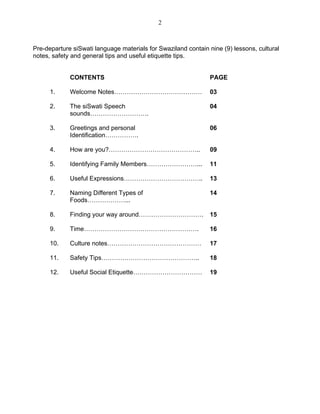
Pre-departure siSwati language materials for Swaziland contain nine (9) lessons, cultural notes, safety and general tips and useful etiquette tips. 
CONTENTS 
PAGE 
1. 
Welcome Notes…………………………………… 
03 
2. 
The siSwati Speech sounds………………………. 
04 
3. 
Greetings and personal Identification……………. 
06 
4. 
How are you?…………………………………….. 
09 
5. 
Identifying Family Members……………………... 
11 
6. 
Useful Expressions……………………………….. 
13 
7. 
Naming Different Types of Foods………………... 
14 
8. 
Finding your way around…………………………. 
15 
9. 
Time………………………………………………. 
16 
10. 
Culture notes……………………………………… 
17 
11. 
Safety Tips……………………………………….. 
18 
12. 
Useful Social Etiquette…………………………… 
19
3 
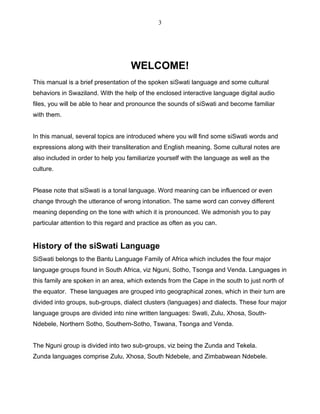
WELCOME! 
This manual is a brief presentation of the spoken siSwati language and some cultural behaviors in Swaziland. With the help of the enclosed interactive language digital audio files, you will be able to hear and pronounce the sounds of siSwati and become familiar with them. 
In this manual, several topics are introduced where you will find some siSwati words and expressions along with their transliteration and English meaning. Some cultural notes are also included in order to help you familiarize yourself with the language as well as the culture. 
Please note that siSwati is a tonal language. Word meaning can be influenced or even change through the utterance of wrong intonation. The same word can convey different meaning depending on the tone with which it is pronounced. We admonish you to pay particular attention to this regard and practice as often as you can. 
History of the siSwati Language 
SiSwati belongs to the Bantu Language Family of Africa which includes the four major language groups found in South Africa, viz Nguni, Sotho, Tsonga and Venda. Languages in this family are spoken in an area, which extends from the Cape in the south to just north of the equator. These languages are grouped into geographical zones, which in their turn are divided into groups, sub-groups, dialect clusters (languages) and dialects. These four major language groups are divided into nine written languages: Swati, Zulu, Xhosa, South- Ndebele, Northern Sotho, Southern-Sotho, Tswana, Tsonga and Venda. 
The Nguni group is divided into two sub-groups, viz being the Zunda and Tekela. 
Zunda languages comprise Zulu, Xhosa, South Ndebele, and Zimbabwean Ndebele.
4 
Tekela languages comprise siSwati of Swaziland and siSwati of kaNgwane stretching from the Mpumalanga Province in South Africa to the South Eastern Transvaal. 
Of note here is that out of these dialects, siSwati is the only one that has attained recognition as a language in its own right. It has acquired written status and is used as the medium of instruction in schools in Swaziland and kaNgwane. Which is one of the reasons we expect you to learn the spoken siSwati Language. To be able to TALK with the people of the host country, more especially those you will be directly working with 
These lessons will help you learn normal conversation in siSwati, rather than focusing on formalities. 
As a Peace Corps Volunteer in Swaziland, you will have to adjust to some pronunciation difficulties and deal with some social attitudes and cultural norms. So, get ready for a new experience and challenge and welcome to Swaziland… 
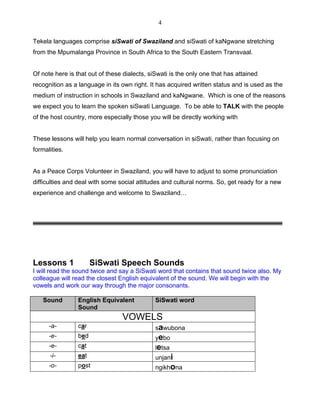
Lessons 1 SiSwati Speech Sounds 
I will read the sound twice and say a SiSwati word that contains that sound twice also. My colleague will read the closest English equivalent of the sound. We will begin with the vowels and work our way through the major consonants. 
Sound 
English Equivalent Sound 
SiSwati word 
VOWELS 
-a- 
car 
sawubona 
-e- 
bed 
yebo 
-e- 
cat 
letsa 
-i- 
eat 
unjani 
-o- 
post 
ngikhona
5 
-u- 
roof 
Unjani wena 
CONSONANTS 
-b- 
baby 
Babe [father/ older male] 
-bh- 
ball 
Bhuti [brother] 
-c- 
Resembles the English click of annoyance written as ‘tut- tut’ 
Cela [ask] 
-ch- 
Cha [no] 
-d- 
Day 
Dadisha [study] 
-f- 
Fun 
Fundza [read/learn/study] 
-g- 
Girl 
Ligundvwane [rat] 
-gc- 
Ligciwane [virus] 
-h- 
house 
Hamba [walk / go] 
-hh- 
Hhula [cut hair] 
-hl- 
Hlola [check , peep , test] 
-j- 
Jump 
Jayiva [dance] 
-k- 
school 
Kudla [food] 
-kh- 
kill 
Khuluma [speak] 
-l- 
lay 
Likati [cat] 
-m- 
mom 
Make [mother] 
-mb- 
amber 
Mbabane [capital city in Swaziland] 
-n- 
no 
Noma 
-ng- 
Think /sing 
ngikhona 
-p- 
space 
Lipalishi 
-ph- 
pace 
Liphepha 
-s- 
similar 
Sifo 
-sh- 
shy 
Shaya 
-t- 
stake 
Situlo 
-th- 
take 
Thula 
-v- 
van 
Vala
6 
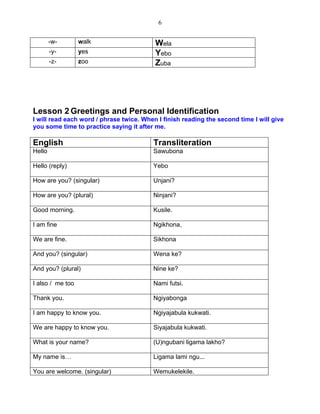
-w- 
walk 
Wela 
-y- 
yes 
Yebo 
-z- 
zoo 
Zuba 
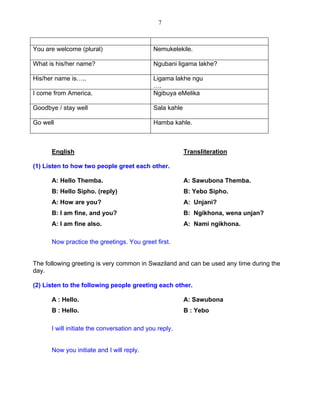
Lesson 2 Greetings and Personal Identification 
I will read each word / phrase twice. When I finish reading the second time I will give you some time to practice saying it after me. 
English 
Transliteration 
Hello 
Sawubona 
Hello (reply) 
Yebo 
How are you? (singular) 
Unjani? 
How are you? (plural) 
Ninjani? 
Good morning. 
Kusile. 
I am fine 
Ngikhona, 
We are fine. 
Sikhona 
And you? (singular) 
Wena ke? 
And you? (plural) 
Nine ke? 
I also / me too 
Nami futsi. 
Thank you. 
Ngiyabonga 
I am happy to know you. 
Ngiyajabula kukwati. 
We are happy to know you. 
Siyajabula kukwati. 
What is your name? 
(U)ngubani ligama lakho? 
My name is… 
Ligama lami ngu... 
You are welcome. (singular) 
Wemukelekile.
7 
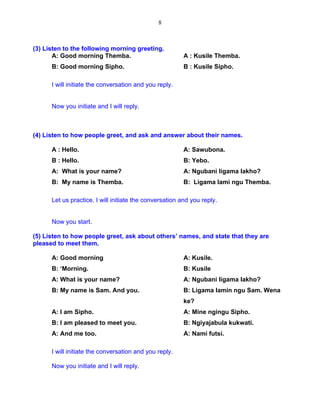
You are welcome (plural) 
Nemukelekile. 
What is his/her name? 
Ngubani ligama lakhe? 
His/her name is….. 
Ligama lakhe ngu 
…. 
I come from America. 
Ngibuya eMelika 
Goodbye / stay well 
Sala kahle 
Go well 
Hamba kahle. 
English Transliteration 
(1) Listen to how two people greet each other. 
A: Hello Themba. A: Sawubona Themba. 
B: Hello Sipho. (reply) B: Yebo Sipho. 
A: How are you? A: Unjani? 
B: I am fine, and you? B: Ngikhona, wena unjan? 
A: I am fine also. A: Nami ngikhona. 
Now practice the greetings. You greet first. 
The following greeting is very common in Swaziland and can be used any time during the day. 
(2) Listen to the following people greeting each other. 
A : Hello. A: Sawubona 
B : Hello. B : Yebo 
I will initiate the conversation and you reply. 
Now you initiate and I will reply.
8 
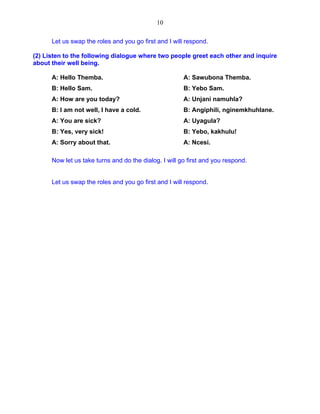
(3) Listen to the following morning greeting. 
A: Good morning Themba. A : Kusile Themba. 
B: Good morning Sipho. B : Kusile Sipho. 
I will initiate the conversation and you reply. 
Now you initiate and I will reply. 
(4) Listen to how people greet, and ask and answer about their names. 
A : Hello. A: Sawubona. 
B : Hello. B: Yebo. 
A: What is your name? A: Ngubani ligama lakho? 
B: My name is Themba. B: Ligama lami ngu Themba. 
Let us practice. I will initiate the conversation and you reply. 
Now you start. 
(5) Listen to how people greet, ask about others’ names, and state that they are pleased to meet them. 
A: Good morning A: Kusile. 
B: ‘Morning. B: Kusile 
A: What is your name? A: Ngubani ligama lakho? 
B: My name is Sam. And you. B: Ligama lamin ngu Sam. Wena ke? 
A: I am Sipho. A: Mine ngingu Sipho. 
B: I am pleased to meet you. B: Ngiyajabula kukwati. 
A: And me too. A: Nami futsi. 
I will initiate the conversation and you reply. 
Now you initiate and I will reply.
9 
Lesson 3 How are you today? 
I will read each phrase twice. When I finish reading the second time I will give you some time to practice saying it after me. 
English 
Transliteration 
How are you? (singular) 
Unjani? 
How are you (plural) 
Ninjani? 
Good 
Kahle / kuhle. 
I am fine 
Ngikhona. 
I am well 
Ngiyaphila. 
I am tired 
Ngidziniwe. 
I am happy 
Ngijabulile. 
I am not well 
Angiphili. 
I have a flu / cold 
Nginemkhuhlane. 
I am sick 
Ngiyagula. 
Today. 
Namuhla. 
(1) Listen to how these two people greet each other, and inquire about the health questions. 
A: Good morning Sam. A: Kusile Sam. 
B: ‘Morning Themba. B: Kusile Themba. 
A: How are you today? A: Unjani namuhla? 
B: I am well, and you? B: Ngiyaphila wena ke? 
A: I am also well. A: Nami ngiyaphila 
B: That is good. B: Kuhle. 
Now let us take turns and do the dialog. I will go first and you respond.
10 
Let us swap the roles and you go first and I will respond. 
(2) Listen to the following dialogue where two people greet each other and inquire about their well being. 
A: Hello Themba. A: Sawubona Themba. 
B: Hello Sam. B: Yebo Sam. 
A: How are you today? A: Unjani namuhla? 
B: I am not well, I have a cold. B: Angiphili, nginemkhuhlane. 
A: You are sick? A: Uyagula? 
B: Yes, very sick! B: Yebo, kakhulu! 
A: Sorry about that. A: Ncesi. 
Now let us take turns and do the dialog. I will go first and you respond. 
Let us swap the roles and you go first and I will respond.
11 
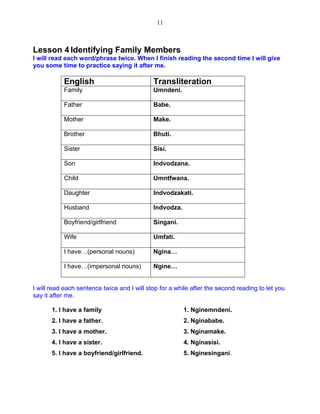
Lesson 4 Identifying Family Members 
I will read each word/phrase twice. When I finish reading the second time I will give you some time to practice saying it after me. 
English 
Transliteration 
Family 
Umndeni. 
Father 
Babe. 
Mother 
Make. 
Brother 
Bhuti. 
Sister 
Sisi. 
Son 
Indvodzana. 
Child 
Umntfwana. 
Daughter 
Indvodzakati. 
Husband 
Indvodza. 
Boyfriend/girlfriend 
Singani. 
Wife 
Umfati. 
I have…(personal nouns) 
Ngina… 
I have…(impersonal nouns) 
Ngine… 
I will read each sentence twice and I will stop for a while after the second reading to let you say it after me. 
1. I have a family 1. Nginemndeni. 
2. I have a father. 2. Nginababe. 
3. I have a mother. 3. Nginamake. 
4. I have a sister. 4. Nginasisi. 
5. I have a boyfriend/girlfriend. 5. Nginesingani.
12 
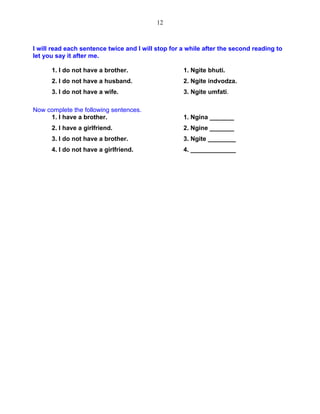
I will read each sentence twice and I will stop for a while after the second reading to let you say it after me. 
1. I do not have a brother. 1. Ngite bhuti. 
2. I do not have a husband. 2. Ngite indvodza. 
3. I do not have a wife. 3. Ngite umfati. 
Now complete the following sentences. 
1. I have a brother. 1. Ngina _______ 
2. I have a girlfriend. 2. Ngine _______ 
3. I do not have a brother. 3. Ngite ________ 
4. I do not have a girlfriend. 4. _____________
13 
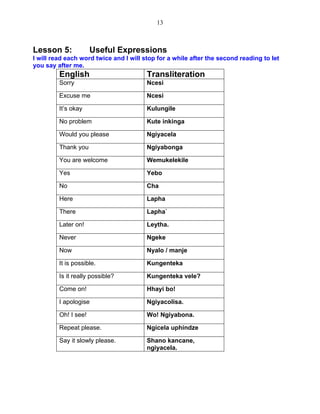
Lesson 5: Useful Expressions 
I will read each word twice and I will stop for a while after the second reading to let you say after me. 
English 
Transliteration 
Sorry 
Ncesi 
Excuse me 
Ncesi 
It’s okay 
Kulungile 
No problem 
Kute inkinga 
Would you please 
Ngiyacela 
Thank you 
Ngiyabonga 
You are welcome 
Wemukelekile 
Yes 
Yebo 
No 
Cha 
Here 
Lapha 
There 
Lapha` 
Later on! 
Leytha. 
Never 
Ngeke 
Now 
Nyalo / manje 
It is possible. 
Kungenteka 
Is it really possible? 
Kungenteka vele? 
Come on! 
Hhayi bo! 
I apologise 
Ngiyacolisa. 
Oh! I see! 
Wo! Ngiyabona. 
Repeat please. 
Ngicela uphindze 
Say it slowly please. 
Shano kancane, ngiyacela.
14 
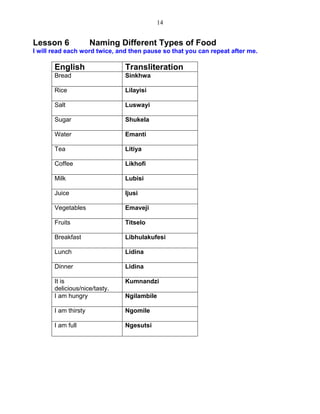
Lesson 6 Naming Different Types of Food 
I will read each word twice, and then pause so that you can repeat after me. 
English 
Transliteration 
Bread 
Sinkhwa 
Rice 
Lilayisi 
Salt 
Luswayi 
Sugar 
Shukela 
Water 
Emanti 
Tea 
Litiya 
Coffee 
Likhofi 
Milk 
Lubisi 
Juice 
Ijusi 
Vegetables 
Emaveji 
Fruits 
Titselo 
Breakfast 
Libhulakufesi 
Lunch 
Lidina 
Dinner 
Lidina 
It is delicious/nice/tasty. 
Kumnandzi 
I am hungry 
Ngilambile 
I am thirsty 
Ngomile 
I am full 
Ngesutsi
15 
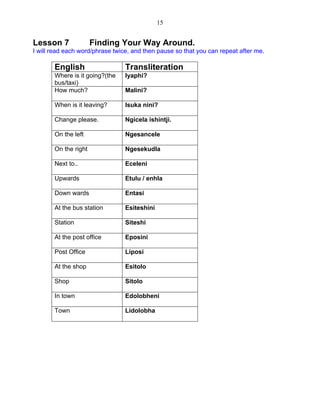
Lesson 7 Finding Your Way Around. 
I will read each word/phrase twice, and then pause so that you can repeat after me. 
English 
Transliteration 
Where is it going?(the bus/taxi) 
Iyaphi? 
How much? 
Malini? 
When is it leaving? 
Isuka nini? 
Change please. 
Ngicela ishintji. 
On the left 
Ngesancele 
On the right 
Ngesekudla 
Next to.. 
Eceleni 
Upwards 
Etulu / enhla 
Down wards 
Entasi 
At the bus station 
Esiteshini 
Station 
Siteshi 
At the post office 
Eposini 
Post Office 
Liposi 
At the shop 
Esitolo 
Shop 
Sitolo 
In town 
Edolobheni 
Town 
Lidolobha
16 
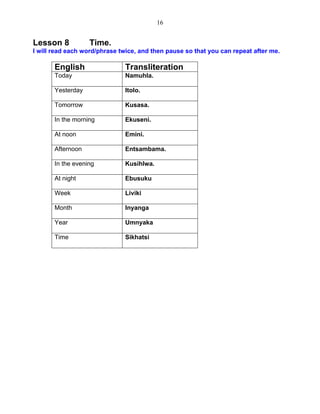
Lesson 8 Time. 
I will read each word/phrase twice, and then pause so that you can repeat after me. 
English 
Transliteration 
Today 
Namuhla. 
Yesterday 
Itolo. 
Tomorrow 
Kusasa. 
In the morning 
Ekuseni. 
At noon 
Emini. 
Afternoon 
Entsambama. 
In the evening 
Kusihlwa. 
At night 
Ebusuku 
Week 
Liviki 
Month 
Inyanga 
Year 
Umnyaka 
Time 
Sikhatsi
17 
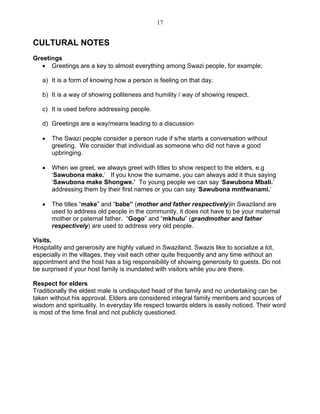
CULTURAL NOTES 
Greetings 
• Greetings are a key to almost everything among Swazi people, for example; 
a) It is a form of knowing how a person is feeling on that day. 
b) It is a way of showing politeness and humility / way of showing respect. 
c) It is used before addressing people. 
d) Greetings are a way/means leading to a discussion 
• The Swazi people consider a person rude if s/he starts a conversation without greeting. We consider that individual as someone who did not have a good upbringing. 
• When we greet, we always greet with titles to show respect to the elders, e.g ‘Sawubona make.’ If you know the surname, you can always add it thus saying ‘Sawubona make Shongwe.’ To young people we can say ‘Sawubona Mbali.’ addressing them by their first names or you can say ‘Sawubona mntfwanami.’ 
• The titles “make” and “babe” (mother and father respectively)in Swaziland are used to address old people in the community, it does not have to be your maternal mother or paternal father. “Gogo” and “mkhulu” (grandmother and father respectively) are used to address very old people. 
Visits. 
Hospitality and generosity are highly valued in Swaziland. Swazis like to socialize a lot, especially in the villages, they visit each other quite frequently and any time without an appointment and the host has a big responsibility of showing generosity to guests. Do not be surprised if your host family is inundated with visitors while you are there. 
Respect for elders 
Traditionally the eldest male is undisputed head of the family and no undertaking can be taken without his approval. Elders are considered integral family members and sources of wisdom and spirituality. In everyday life respect towards elders is easily noticed. Their word is most of the time final and not publicly questioned.
18 
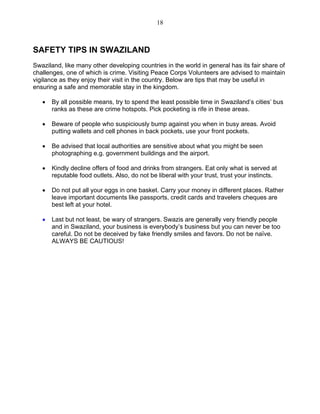
SAFETY TIPS IN SWAZILAND 
Swaziland, like many other developing countries in the world in general has its fair share of challenges, one of which is crime. Visiting Peace Corps Volunteers are advised to maintain vigilance as they enjoy their visit in the country. Below are tips that may be useful in ensuring a safe and memorable stay in the kingdom. 
• By all possible means, try to spend the least possible time in Swaziland’s cities’ bus ranks as these are crime hotspots. Pick pocketing is rife in these areas. 
• Beware of people who suspiciously bump against you when in busy areas. Avoid putting wallets and cell phones in back pockets, use your front pockets. 
• Be advised that local authorities are sensitive about what you might be seen photographing e.g. government buildings and the airport. 
• Kindly decline offers of food and drinks from strangers. Eat only what is served at reputable food outlets. Also, do not be liberal with your trust, trust your instincts. 
• Do not put all your eggs in one basket. Carry your money in different places. Rather leave important documents like passports, credit cards and travelers cheques are best left at your hotel. 
• Last but not least, be wary of strangers. Swazis are generally very friendly people and in Swaziland, your business is everybody’s business but you can never be too careful. Do not be deceived by fake friendly smiles and favors. Do not be naïve. ALWAYS BE CAUTIOUS!
19 
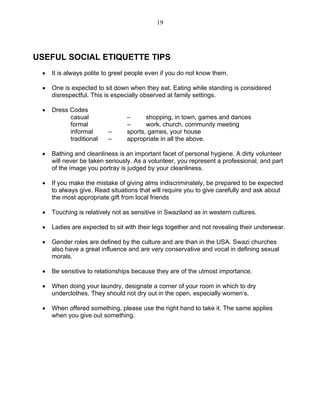
USEFUL SOCIAL ETIQUETTE TIPS 
• It is always polite to greet people even if you do not know them. 
• One is expected to sit down when they eat. Eating while standing is considered disrespectful. This is especially observed at family settings. 
• Dress Codes 
casual – shopping, in town, games and dances 
formal – work, church, community meeting 
informal – sports, games, your house 
traditional – appropriate in all the above. 
• Bathing and cleanliness is an important facet of personal hygiene. A dirty volunteer will never be taken seriously. As a volunteer, you represent a professional, and part of the image you portray is judged by your cleanliness. 
• If you make the mistake of giving alms indiscriminately, be prepared to be expected to always give. Read situations that will require you to give carefully and ask about the most appropriate gift from local friends 
• Touching is relatively not as sensitive in Swaziland as in western cultures. 
• Ladies are expected to sit with their legs together and not revealing their underwear. 
• Gender roles are defined by the culture and are than in the USA. Swazi churches also have a great influence and are very conservative and vocal in defining sexual morals. 
• Be sensitive to relationships because they are of the utmost importance. 
• When doing your laundry, designate a corner of your room in which to dry underclothes. They should not dry out in the open, especially women’s. 
• When offered something, please use the right hand to take it. The same applies when you give out something.

Basic siSwati Language Course

  • 1.
    Peace Corps Swaziland Pre-Departure siSwati Language Materials
  • 2.
    2 Pre-departure siSwatilanguage materials for Swaziland contain nine (9) lessons, cultural notes, safety and general tips and useful etiquette tips. CONTENTS PAGE 1. Welcome Notes…………………………………… 03 2. The siSwati Speech sounds………………………. 04 3. Greetings and personal Identification……………. 06 4. How are you?…………………………………….. 09 5. Identifying Family Members……………………... 11 6. Useful Expressions……………………………….. 13 7. Naming Different Types of Foods………………... 14 8. Finding your way around…………………………. 15 9. Time………………………………………………. 16 10. Culture notes……………………………………… 17 11. Safety Tips……………………………………….. 18 12. Useful Social Etiquette…………………………… 19
  • 3.
    3 WELCOME! Thismanual is a brief presentation of the spoken siSwati language and some cultural behaviors in Swaziland. With the help of the enclosed interactive language digital audio files, you will be able to hear and pronounce the sounds of siSwati and become familiar with them. In this manual, several topics are introduced where you will find some siSwati words and expressions along with their transliteration and English meaning. Some cultural notes are also included in order to help you familiarize yourself with the language as well as the culture. Please note that siSwati is a tonal language. Word meaning can be influenced or even change through the utterance of wrong intonation. The same word can convey different meaning depending on the tone with which it is pronounced. We admonish you to pay particular attention to this regard and practice as often as you can. History of the siSwati Language SiSwati belongs to the Bantu Language Family of Africa which includes the four major language groups found in South Africa, viz Nguni, Sotho, Tsonga and Venda. Languages in this family are spoken in an area, which extends from the Cape in the south to just north of the equator. These languages are grouped into geographical zones, which in their turn are divided into groups, sub-groups, dialect clusters (languages) and dialects. These four major language groups are divided into nine written languages: Swati, Zulu, Xhosa, South- Ndebele, Northern Sotho, Southern-Sotho, Tswana, Tsonga and Venda. The Nguni group is divided into two sub-groups, viz being the Zunda and Tekela. Zunda languages comprise Zulu, Xhosa, South Ndebele, and Zimbabwean Ndebele.
  • 4.
    4 Tekela languagescomprise siSwati of Swaziland and siSwati of kaNgwane stretching from the Mpumalanga Province in South Africa to the South Eastern Transvaal. Of note here is that out of these dialects, siSwati is the only one that has attained recognition as a language in its own right. It has acquired written status and is used as the medium of instruction in schools in Swaziland and kaNgwane. Which is one of the reasons we expect you to learn the spoken siSwati Language. To be able to TALK with the people of the host country, more especially those you will be directly working with These lessons will help you learn normal conversation in siSwati, rather than focusing on formalities. As a Peace Corps Volunteer in Swaziland, you will have to adjust to some pronunciation difficulties and deal with some social attitudes and cultural norms. So, get ready for a new experience and challenge and welcome to Swaziland… Lessons 1 SiSwati Speech Sounds I will read the sound twice and say a SiSwati word that contains that sound twice also. My colleague will read the closest English equivalent of the sound. We will begin with the vowels and work our way through the major consonants. Sound English Equivalent Sound SiSwati word VOWELS -a- car sawubona -e- bed yebo -e- cat letsa -i- eat unjani -o- post ngikhona
  • 5.
    5 -u- roof Unjani wena CONSONANTS -b- baby Babe [father/ older male] -bh- ball Bhuti [brother] -c- Resembles the English click of annoyance written as ‘tut- tut’ Cela [ask] -ch- Cha [no] -d- Day Dadisha [study] -f- Fun Fundza [read/learn/study] -g- Girl Ligundvwane [rat] -gc- Ligciwane [virus] -h- house Hamba [walk / go] -hh- Hhula [cut hair] -hl- Hlola [check , peep , test] -j- Jump Jayiva [dance] -k- school Kudla [food] -kh- kill Khuluma [speak] -l- lay Likati [cat] -m- mom Make [mother] -mb- amber Mbabane [capital city in Swaziland] -n- no Noma -ng- Think /sing ngikhona -p- space Lipalishi -ph- pace Liphepha -s- similar Sifo -sh- shy Shaya -t- stake Situlo -th- take Thula -v- van Vala
  • 6.
    6 -w- walk Wela -y- yes Yebo -z- zoo Zuba Lesson 2 Greetings and Personal Identification I will read each word / phrase twice. When I finish reading the second time I will give you some time to practice saying it after me. English Transliteration Hello Sawubona Hello (reply) Yebo How are you? (singular) Unjani? How are you? (plural) Ninjani? Good morning. Kusile. I am fine Ngikhona, We are fine. Sikhona And you? (singular) Wena ke? And you? (plural) Nine ke? I also / me too Nami futsi. Thank you. Ngiyabonga I am happy to know you. Ngiyajabula kukwati. We are happy to know you. Siyajabula kukwati. What is your name? (U)ngubani ligama lakho? My name is… Ligama lami ngu... You are welcome. (singular) Wemukelekile.
  • 7.
    7 You arewelcome (plural) Nemukelekile. What is his/her name? Ngubani ligama lakhe? His/her name is….. Ligama lakhe ngu …. I come from America. Ngibuya eMelika Goodbye / stay well Sala kahle Go well Hamba kahle. English Transliteration (1) Listen to how two people greet each other. A: Hello Themba. A: Sawubona Themba. B: Hello Sipho. (reply) B: Yebo Sipho. A: How are you? A: Unjani? B: I am fine, and you? B: Ngikhona, wena unjan? A: I am fine also. A: Nami ngikhona. Now practice the greetings. You greet first. The following greeting is very common in Swaziland and can be used any time during the day. (2) Listen to the following people greeting each other. A : Hello. A: Sawubona B : Hello. B : Yebo I will initiate the conversation and you reply. Now you initiate and I will reply.
  • 8.
    8 (3) Listento the following morning greeting. A: Good morning Themba. A : Kusile Themba. B: Good morning Sipho. B : Kusile Sipho. I will initiate the conversation and you reply. Now you initiate and I will reply. (4) Listen to how people greet, and ask and answer about their names. A : Hello. A: Sawubona. B : Hello. B: Yebo. A: What is your name? A: Ngubani ligama lakho? B: My name is Themba. B: Ligama lami ngu Themba. Let us practice. I will initiate the conversation and you reply. Now you start. (5) Listen to how people greet, ask about others’ names, and state that they are pleased to meet them. A: Good morning A: Kusile. B: ‘Morning. B: Kusile A: What is your name? A: Ngubani ligama lakho? B: My name is Sam. And you. B: Ligama lamin ngu Sam. Wena ke? A: I am Sipho. A: Mine ngingu Sipho. B: I am pleased to meet you. B: Ngiyajabula kukwati. A: And me too. A: Nami futsi. I will initiate the conversation and you reply. Now you initiate and I will reply.
  • 9.
    9 Lesson 3How are you today? I will read each phrase twice. When I finish reading the second time I will give you some time to practice saying it after me. English Transliteration How are you? (singular) Unjani? How are you (plural) Ninjani? Good Kahle / kuhle. I am fine Ngikhona. I am well Ngiyaphila. I am tired Ngidziniwe. I am happy Ngijabulile. I am not well Angiphili. I have a flu / cold Nginemkhuhlane. I am sick Ngiyagula. Today. Namuhla. (1) Listen to how these two people greet each other, and inquire about the health questions. A: Good morning Sam. A: Kusile Sam. B: ‘Morning Themba. B: Kusile Themba. A: How are you today? A: Unjani namuhla? B: I am well, and you? B: Ngiyaphila wena ke? A: I am also well. A: Nami ngiyaphila B: That is good. B: Kuhle. Now let us take turns and do the dialog. I will go first and you respond.
  • 10.
    10 Let usswap the roles and you go first and I will respond. (2) Listen to the following dialogue where two people greet each other and inquire about their well being. A: Hello Themba. A: Sawubona Themba. B: Hello Sam. B: Yebo Sam. A: How are you today? A: Unjani namuhla? B: I am not well, I have a cold. B: Angiphili, nginemkhuhlane. A: You are sick? A: Uyagula? B: Yes, very sick! B: Yebo, kakhulu! A: Sorry about that. A: Ncesi. Now let us take turns and do the dialog. I will go first and you respond. Let us swap the roles and you go first and I will respond.
  • 11.
    11 Lesson 4Identifying Family Members I will read each word/phrase twice. When I finish reading the second time I will give you some time to practice saying it after me. English Transliteration Family Umndeni. Father Babe. Mother Make. Brother Bhuti. Sister Sisi. Son Indvodzana. Child Umntfwana. Daughter Indvodzakati. Husband Indvodza. Boyfriend/girlfriend Singani. Wife Umfati. I have…(personal nouns) Ngina… I have…(impersonal nouns) Ngine… I will read each sentence twice and I will stop for a while after the second reading to let you say it after me. 1. I have a family 1. Nginemndeni. 2. I have a father. 2. Nginababe. 3. I have a mother. 3. Nginamake. 4. I have a sister. 4. Nginasisi. 5. I have a boyfriend/girlfriend. 5. Nginesingani.
  • 12.
    12 I willread each sentence twice and I will stop for a while after the second reading to let you say it after me. 1. I do not have a brother. 1. Ngite bhuti. 2. I do not have a husband. 2. Ngite indvodza. 3. I do not have a wife. 3. Ngite umfati. Now complete the following sentences. 1. I have a brother. 1. Ngina _______ 2. I have a girlfriend. 2. Ngine _______ 3. I do not have a brother. 3. Ngite ________ 4. I do not have a girlfriend. 4. _____________
  • 13.
    13 Lesson 5:Useful Expressions I will read each word twice and I will stop for a while after the second reading to let you say after me. English Transliteration Sorry Ncesi Excuse me Ncesi It’s okay Kulungile No problem Kute inkinga Would you please Ngiyacela Thank you Ngiyabonga You are welcome Wemukelekile Yes Yebo No Cha Here Lapha There Lapha` Later on! Leytha. Never Ngeke Now Nyalo / manje It is possible. Kungenteka Is it really possible? Kungenteka vele? Come on! Hhayi bo! I apologise Ngiyacolisa. Oh! I see! Wo! Ngiyabona. Repeat please. Ngicela uphindze Say it slowly please. Shano kancane, ngiyacela.
  • 14.
    14 Lesson 6Naming Different Types of Food I will read each word twice, and then pause so that you can repeat after me. English Transliteration Bread Sinkhwa Rice Lilayisi Salt Luswayi Sugar Shukela Water Emanti Tea Litiya Coffee Likhofi Milk Lubisi Juice Ijusi Vegetables Emaveji Fruits Titselo Breakfast Libhulakufesi Lunch Lidina Dinner Lidina It is delicious/nice/tasty. Kumnandzi I am hungry Ngilambile I am thirsty Ngomile I am full Ngesutsi
  • 15.
    15 Lesson 7Finding Your Way Around. I will read each word/phrase twice, and then pause so that you can repeat after me. English Transliteration Where is it going?(the bus/taxi) Iyaphi? How much? Malini? When is it leaving? Isuka nini? Change please. Ngicela ishintji. On the left Ngesancele On the right Ngesekudla Next to.. Eceleni Upwards Etulu / enhla Down wards Entasi At the bus station Esiteshini Station Siteshi At the post office Eposini Post Office Liposi At the shop Esitolo Shop Sitolo In town Edolobheni Town Lidolobha
  • 16.
    16 Lesson 8Time. I will read each word/phrase twice, and then pause so that you can repeat after me. English Transliteration Today Namuhla. Yesterday Itolo. Tomorrow Kusasa. In the morning Ekuseni. At noon Emini. Afternoon Entsambama. In the evening Kusihlwa. At night Ebusuku Week Liviki Month Inyanga Year Umnyaka Time Sikhatsi
  • 17.
    17 CULTURAL NOTES Greetings • Greetings are a key to almost everything among Swazi people, for example; a) It is a form of knowing how a person is feeling on that day. b) It is a way of showing politeness and humility / way of showing respect. c) It is used before addressing people. d) Greetings are a way/means leading to a discussion • The Swazi people consider a person rude if s/he starts a conversation without greeting. We consider that individual as someone who did not have a good upbringing. • When we greet, we always greet with titles to show respect to the elders, e.g ‘Sawubona make.’ If you know the surname, you can always add it thus saying ‘Sawubona make Shongwe.’ To young people we can say ‘Sawubona Mbali.’ addressing them by their first names or you can say ‘Sawubona mntfwanami.’ • The titles “make” and “babe” (mother and father respectively)in Swaziland are used to address old people in the community, it does not have to be your maternal mother or paternal father. “Gogo” and “mkhulu” (grandmother and father respectively) are used to address very old people. Visits. Hospitality and generosity are highly valued in Swaziland. Swazis like to socialize a lot, especially in the villages, they visit each other quite frequently and any time without an appointment and the host has a big responsibility of showing generosity to guests. Do not be surprised if your host family is inundated with visitors while you are there. Respect for elders Traditionally the eldest male is undisputed head of the family and no undertaking can be taken without his approval. Elders are considered integral family members and sources of wisdom and spirituality. In everyday life respect towards elders is easily noticed. Their word is most of the time final and not publicly questioned.
  • 18.
    18 SAFETY TIPSIN SWAZILAND Swaziland, like many other developing countries in the world in general has its fair share of challenges, one of which is crime. Visiting Peace Corps Volunteers are advised to maintain vigilance as they enjoy their visit in the country. Below are tips that may be useful in ensuring a safe and memorable stay in the kingdom. • By all possible means, try to spend the least possible time in Swaziland’s cities’ bus ranks as these are crime hotspots. Pick pocketing is rife in these areas. • Beware of people who suspiciously bump against you when in busy areas. Avoid putting wallets and cell phones in back pockets, use your front pockets. • Be advised that local authorities are sensitive about what you might be seen photographing e.g. government buildings and the airport. • Kindly decline offers of food and drinks from strangers. Eat only what is served at reputable food outlets. Also, do not be liberal with your trust, trust your instincts. • Do not put all your eggs in one basket. Carry your money in different places. Rather leave important documents like passports, credit cards and travelers cheques are best left at your hotel. • Last but not least, be wary of strangers. Swazis are generally very friendly people and in Swaziland, your business is everybody’s business but you can never be too careful. Do not be deceived by fake friendly smiles and favors. Do not be naïve. ALWAYS BE CAUTIOUS!
  • 19.
    19 USEFUL SOCIALETIQUETTE TIPS • It is always polite to greet people even if you do not know them. • One is expected to sit down when they eat. Eating while standing is considered disrespectful. This is especially observed at family settings. • Dress Codes casual – shopping, in town, games and dances formal – work, church, community meeting informal – sports, games, your house traditional – appropriate in all the above. • Bathing and cleanliness is an important facet of personal hygiene. A dirty volunteer will never be taken seriously. As a volunteer, you represent a professional, and part of the image you portray is judged by your cleanliness. • If you make the mistake of giving alms indiscriminately, be prepared to be expected to always give. Read situations that will require you to give carefully and ask about the most appropriate gift from local friends • Touching is relatively not as sensitive in Swaziland as in western cultures. • Ladies are expected to sit with their legs together and not revealing their underwear. • Gender roles are defined by the culture and are than in the USA. Swazi churches also have a great influence and are very conservative and vocal in defining sexual morals. • Be sensitive to relationships because they are of the utmost importance. • When doing your laundry, designate a corner of your room in which to dry underclothes. They should not dry out in the open, especially women’s. • When offered something, please use the right hand to take it. The same applies when you give out something.