ADDRESSING MODES &
DATA TRANSFER
INSTRUCTION OF 8085
MICROPROCESSOR
Presented by : Vaibhavi K. Patel (140133103025)
: Roshni M. Patel (140133103026)
: Chinmayee N. Samal (140133103027)
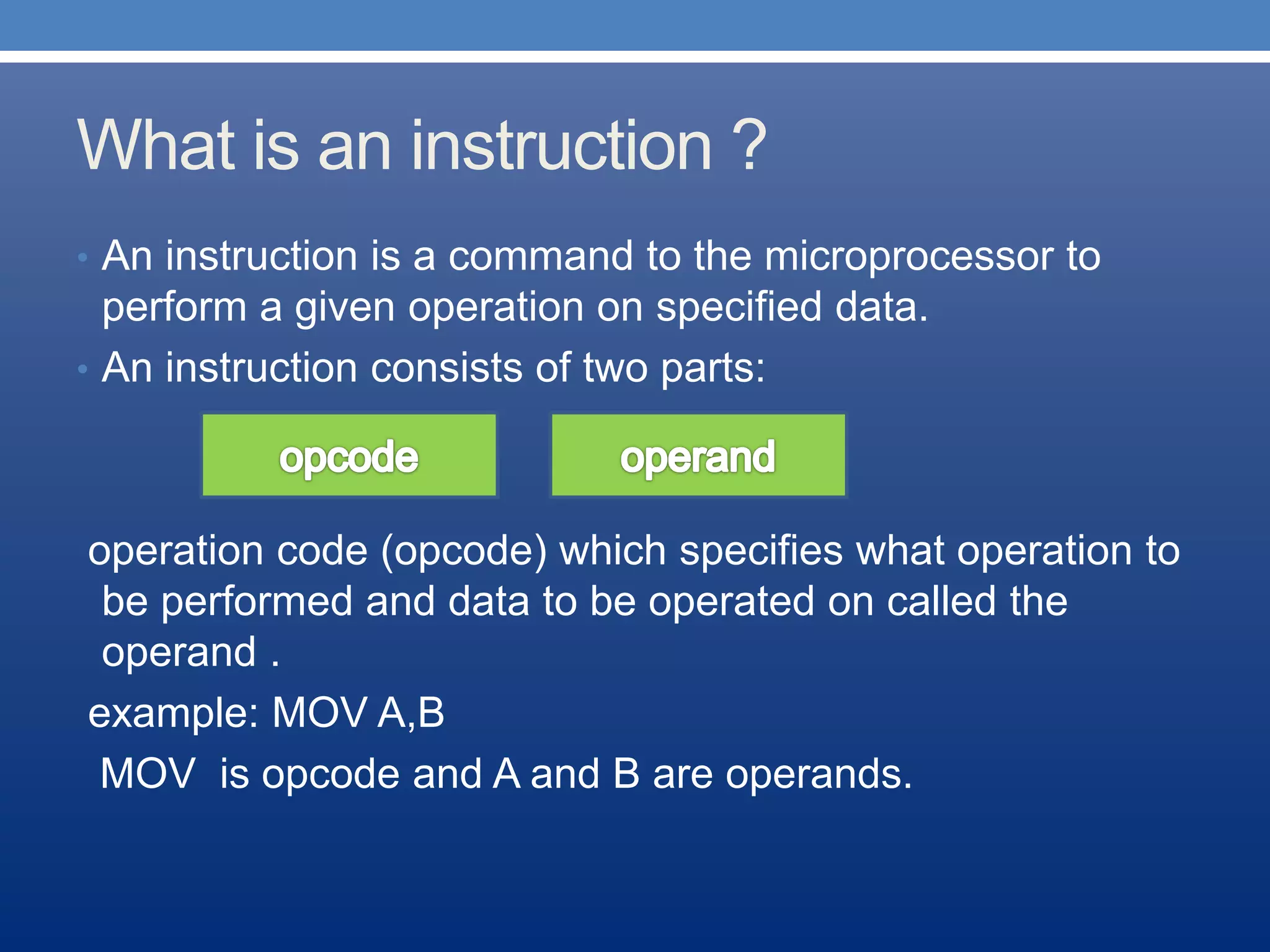
What is an instruction ?
• An instruction is a command to the microprocessor to
perform a given operation on specified data.
• An instruction consists of two parts:
operation code (opcode) which specifies what operation to
be performed and data to be operated on called the
operand .
example: MOV A,B
MOV is opcode and A and B are operands.
Addressing modes of 8085
Definition:-
The various ways of specifying operands for an
instruction are called addressing modes.
The method by which the address of source of data
or the address of destination of result is given in the
instruction is called Addressing Modes.
 The term addressing mode refers to the way in
which the operand of the instruction is specified.
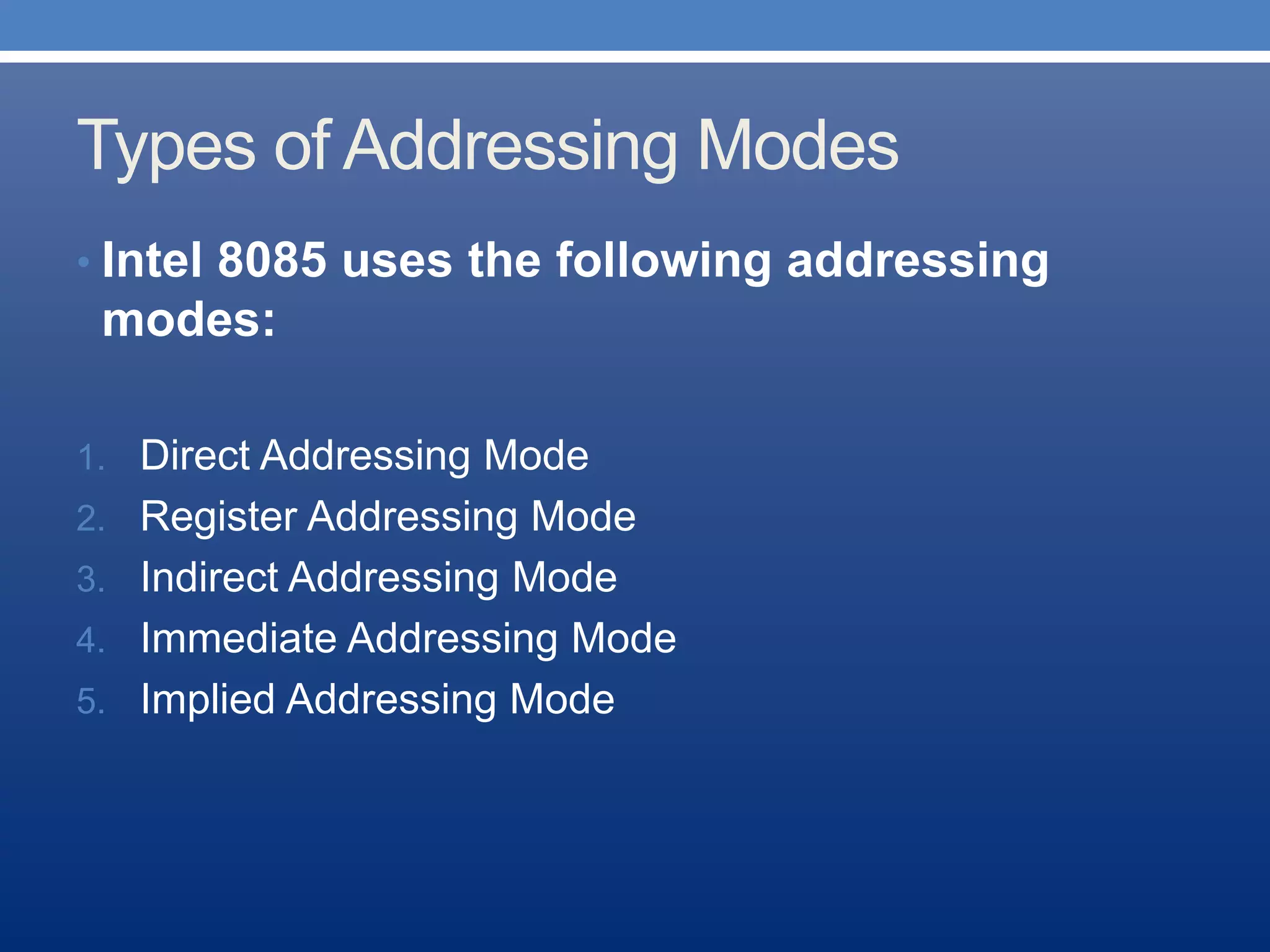
Types of Addressing Modes
• Intel 8085 uses the following addressing
modes:
1. Direct Addressing Mode
2. Register Addressing Mode
3. Indirect Addressing Mode
4. Immediate Addressing Mode
5. Implied Addressing Mode
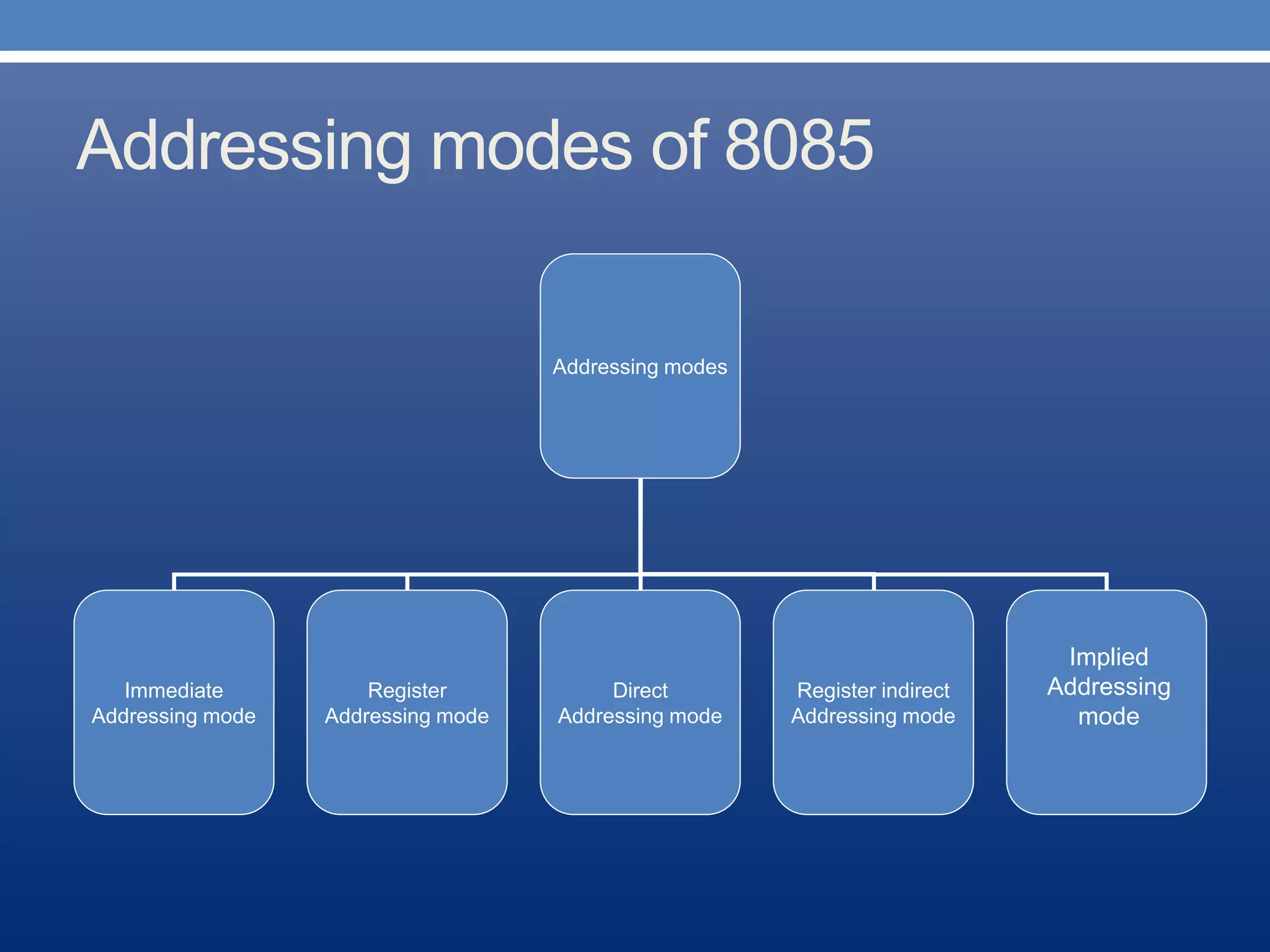
Addressing modes
Immediate
Addressing mode
Register
Addressing mode
Direct
Addressing mode
Register indirect
Addressing mode
Indexed
Addressing mode
Implied
Addressing
mode
Addressing modes of 8085
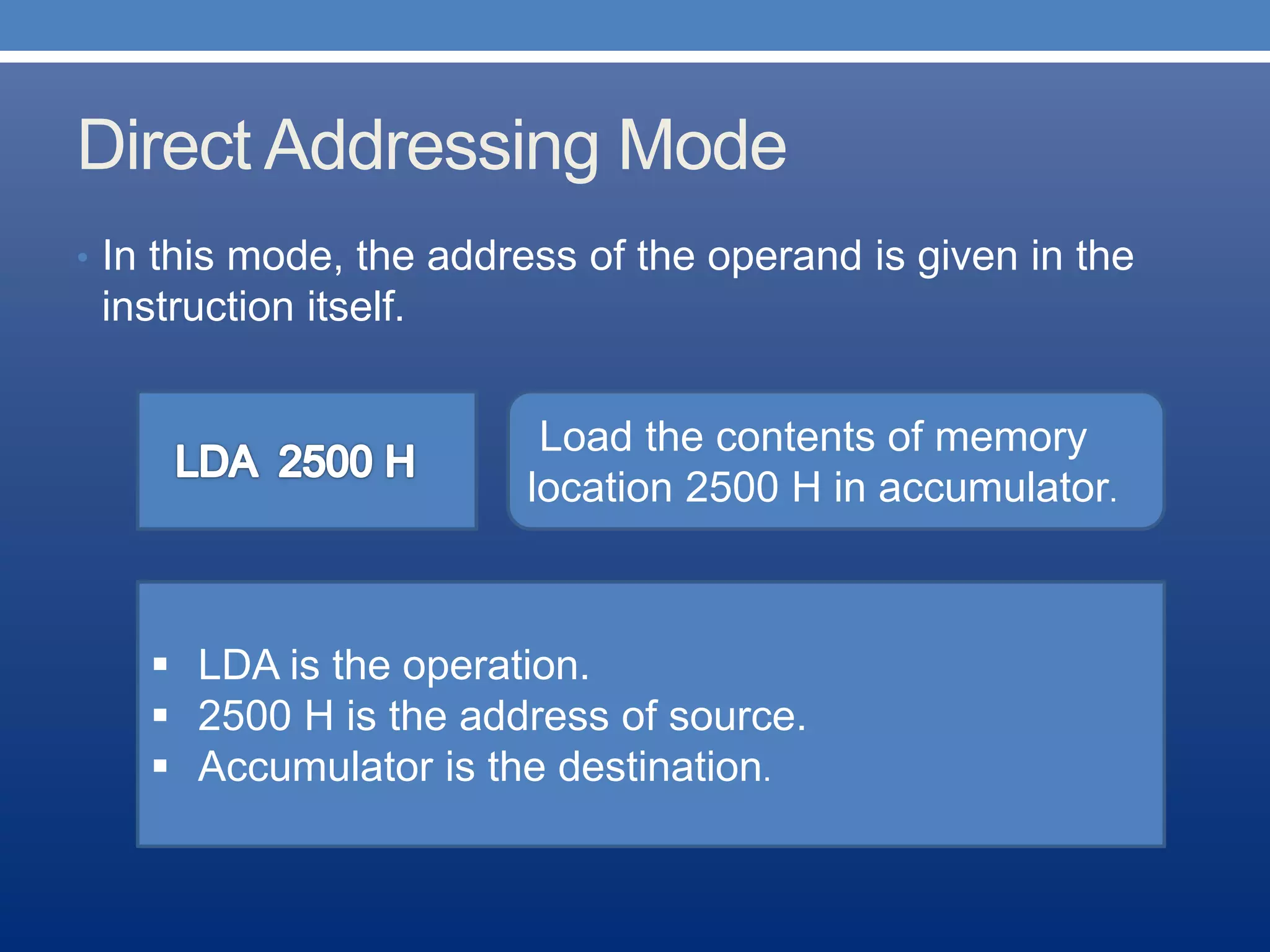
Direct Addressing Mode
• In this mode, the address of the operand is given in the
instruction itself.
Load the contents of memory
location 2500 H in accumulator.
H
 LDA is the operation.
 2500 H is the address of source.
 Accumulator is the destination.
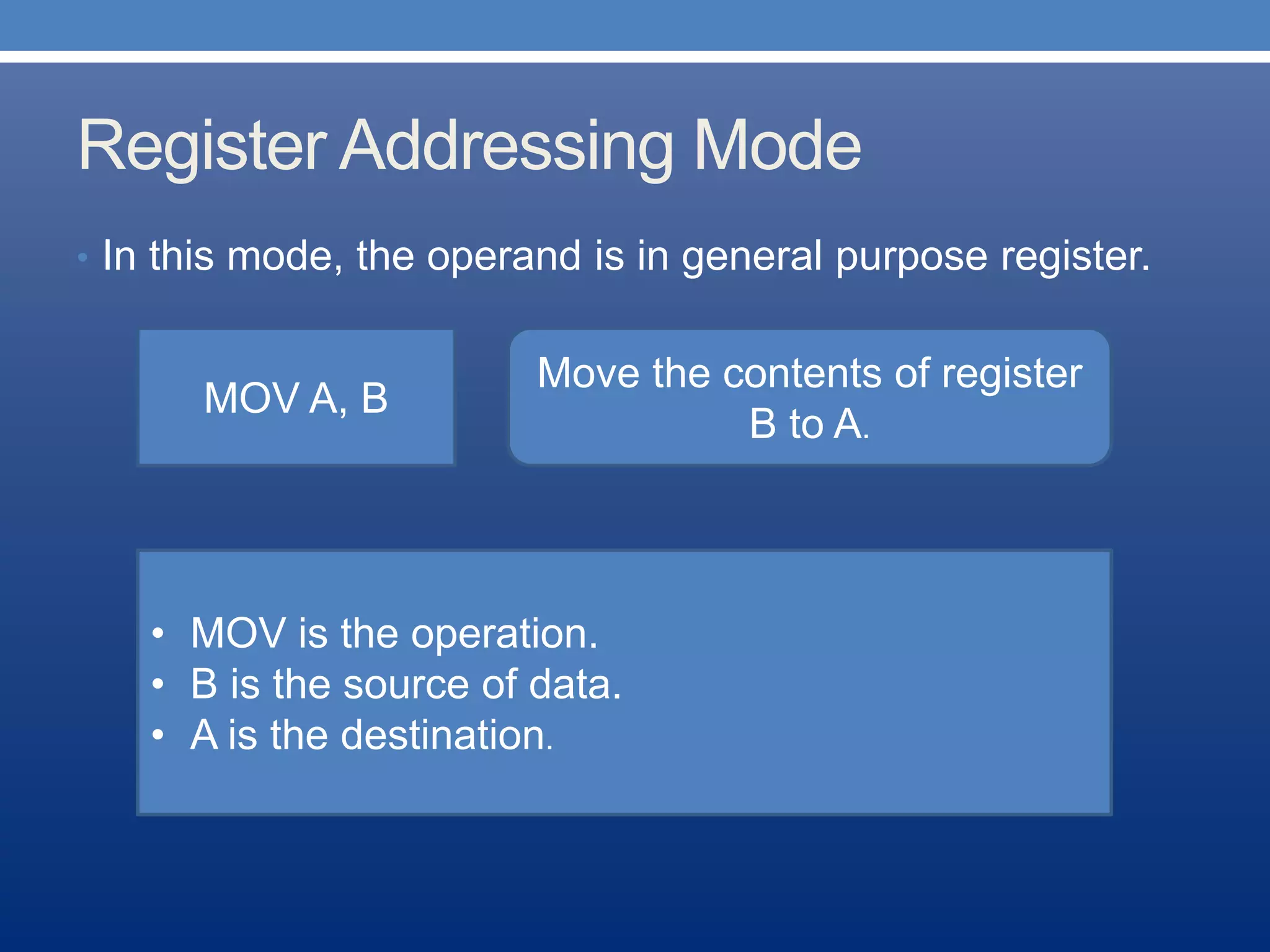
Register Addressing Mode
• In this mode, the operand is in general purpose register.
MOV A, B
Move the contents of register
B to A.
• MOV is the operation.
• B is the source of data.
• A is the destination.
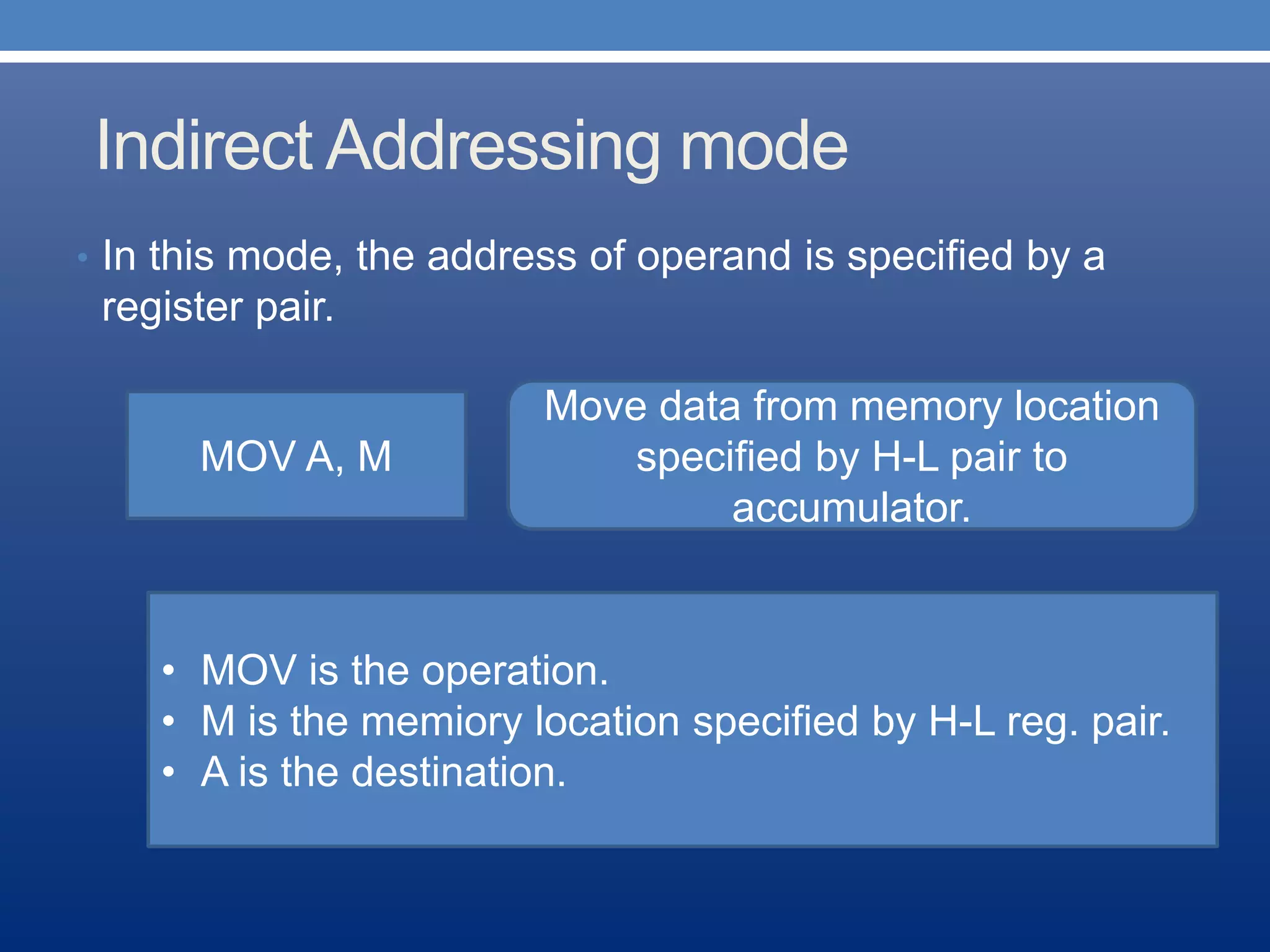
Indirect Addressing mode
• In this mode, the address of operand is specified by a
register pair.
MOV A, M
Move data from memory location
specified by H-L pair to
accumulator.
• MOV is the operation.
• M is the memiory location specified by H-L reg. pair.
• A is the destination.
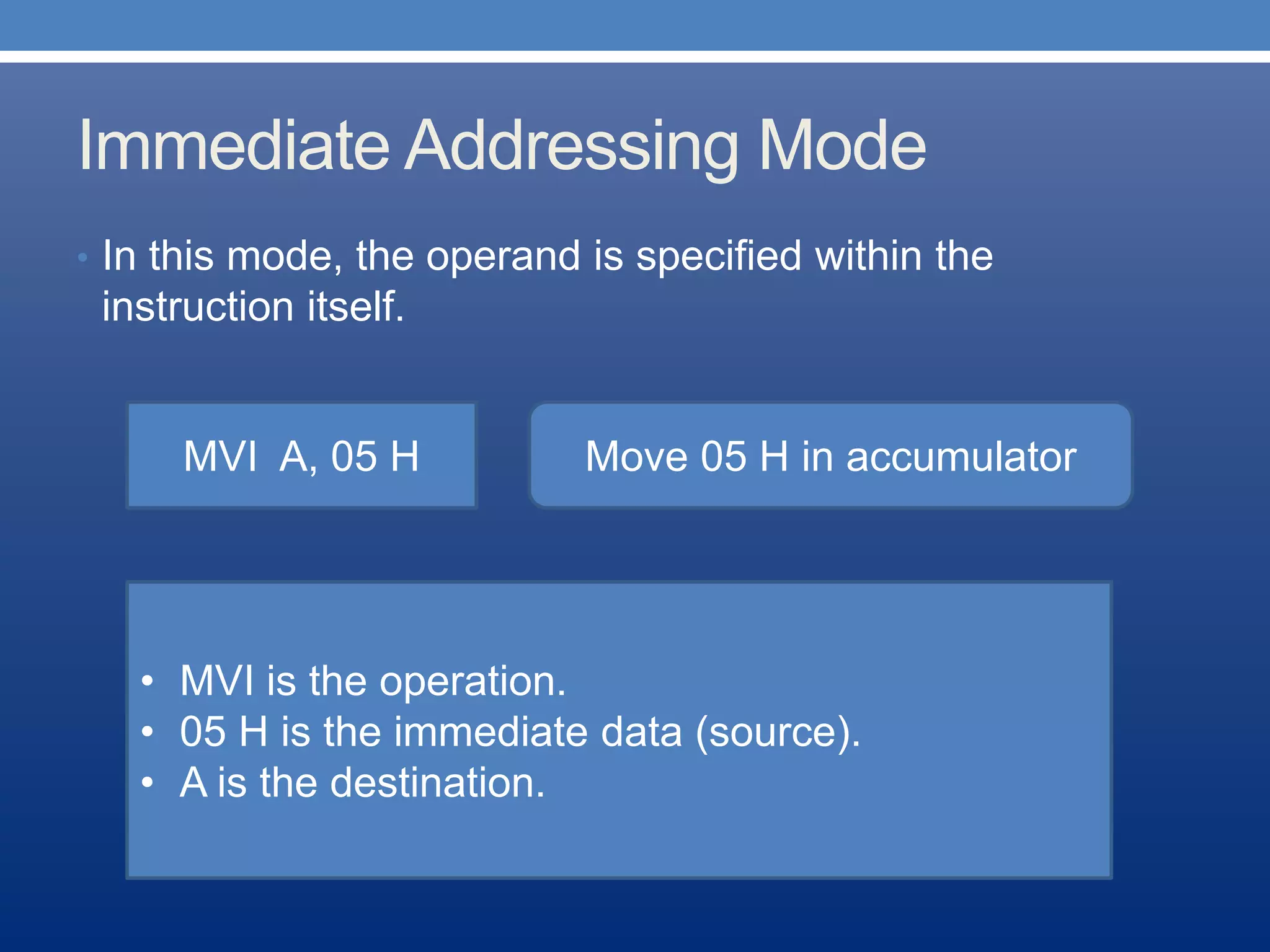
Immediate Addressing Mode
• In this mode, the operand is specified within the
instruction itself.
MVI A, 05 H Move 05 H in accumulator
• MVI is the operation.
• 05 H is the immediate data (source).
• A is the destination.
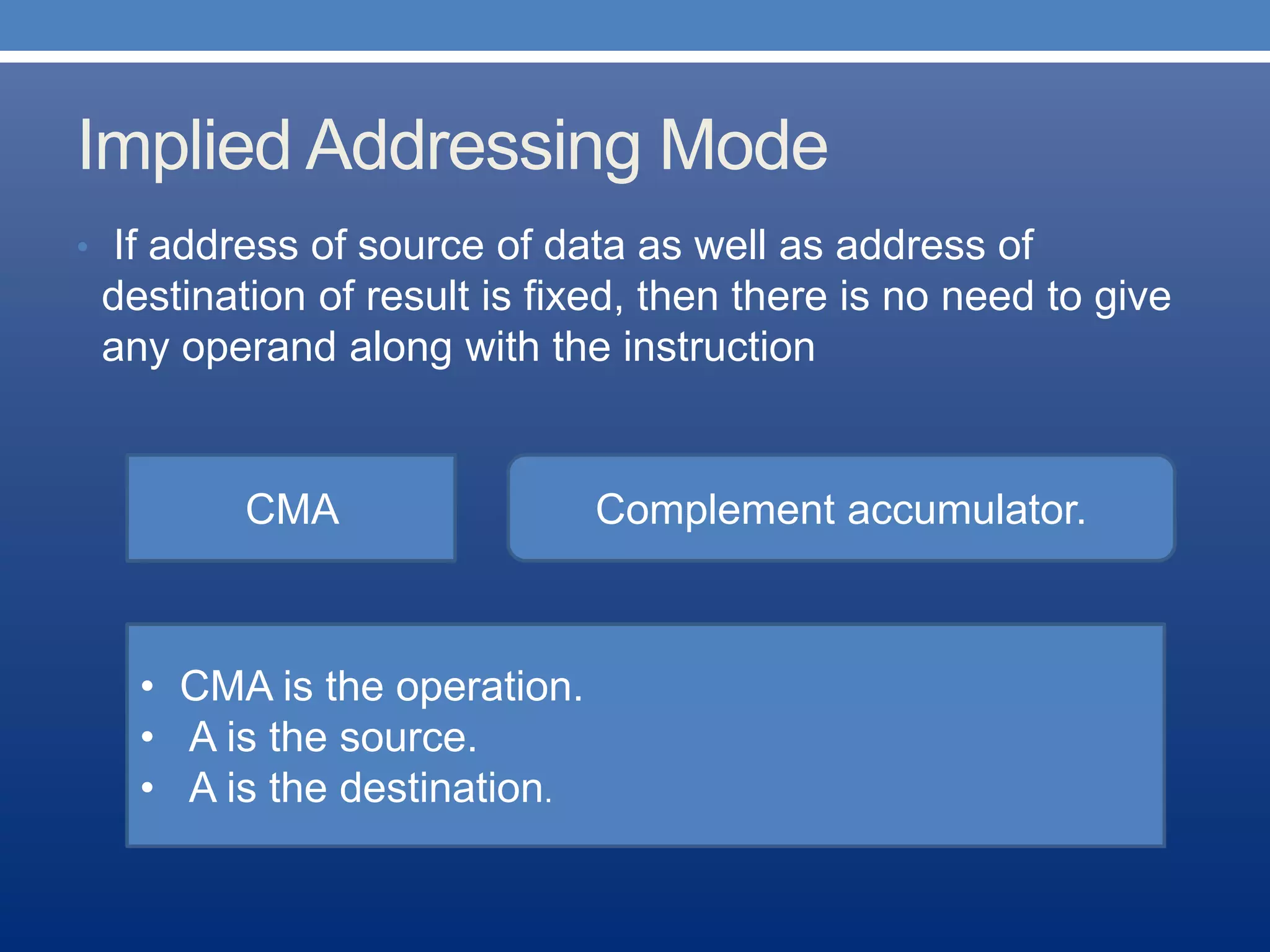
Implied Addressing Mode
• If address of source of data as well as address of
destination of result is fixed, then there is no need to give
any operand along with the instruction
CMA Complement accumulator.
• CMA is the operation.
• A is the source.
• A is the destination.
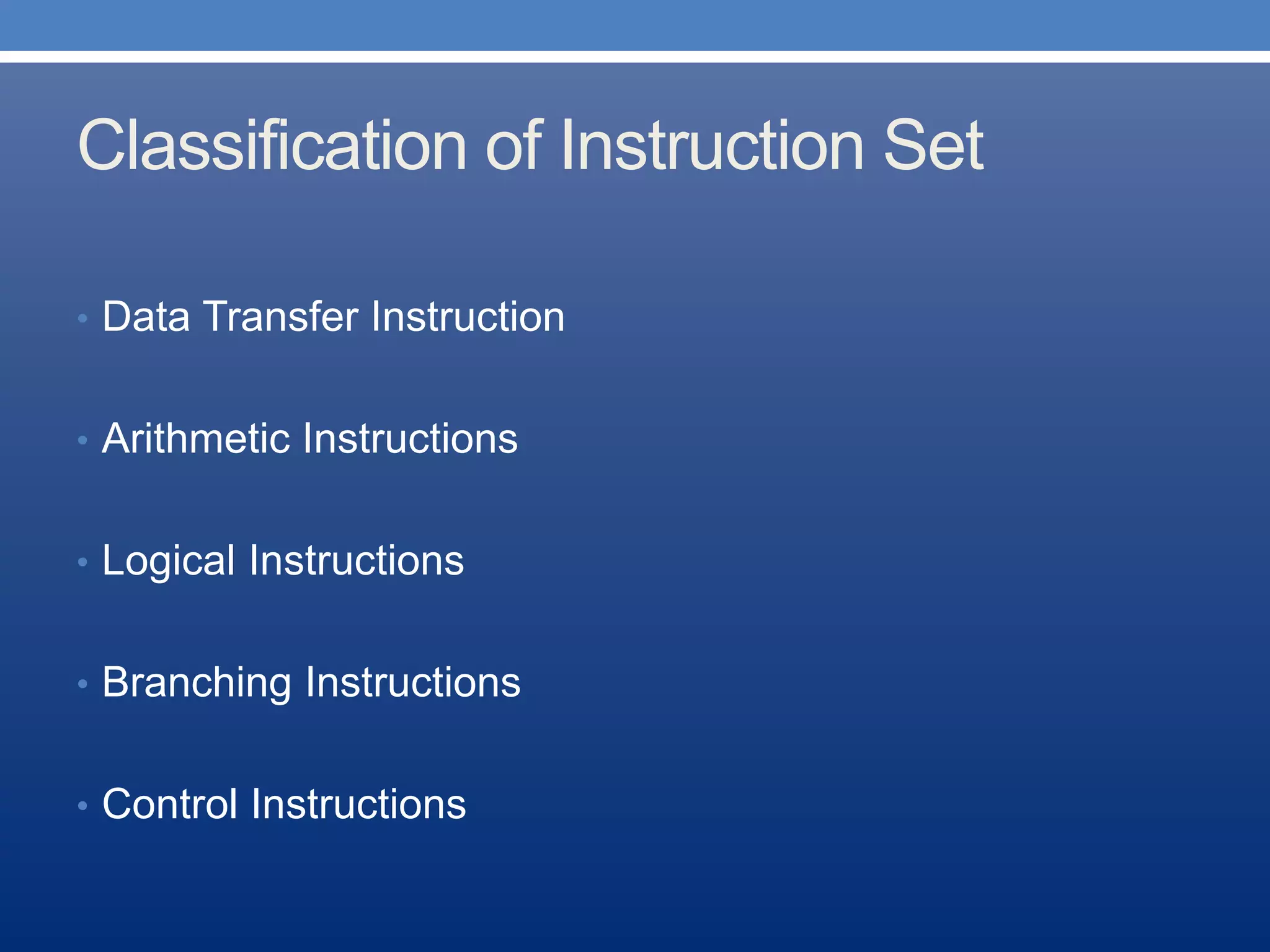
Classification of Instruction Set
• Data Transfer Instruction
• Arithmetic Instructions
• Logical Instructions
• Branching Instructions
• Control Instructions
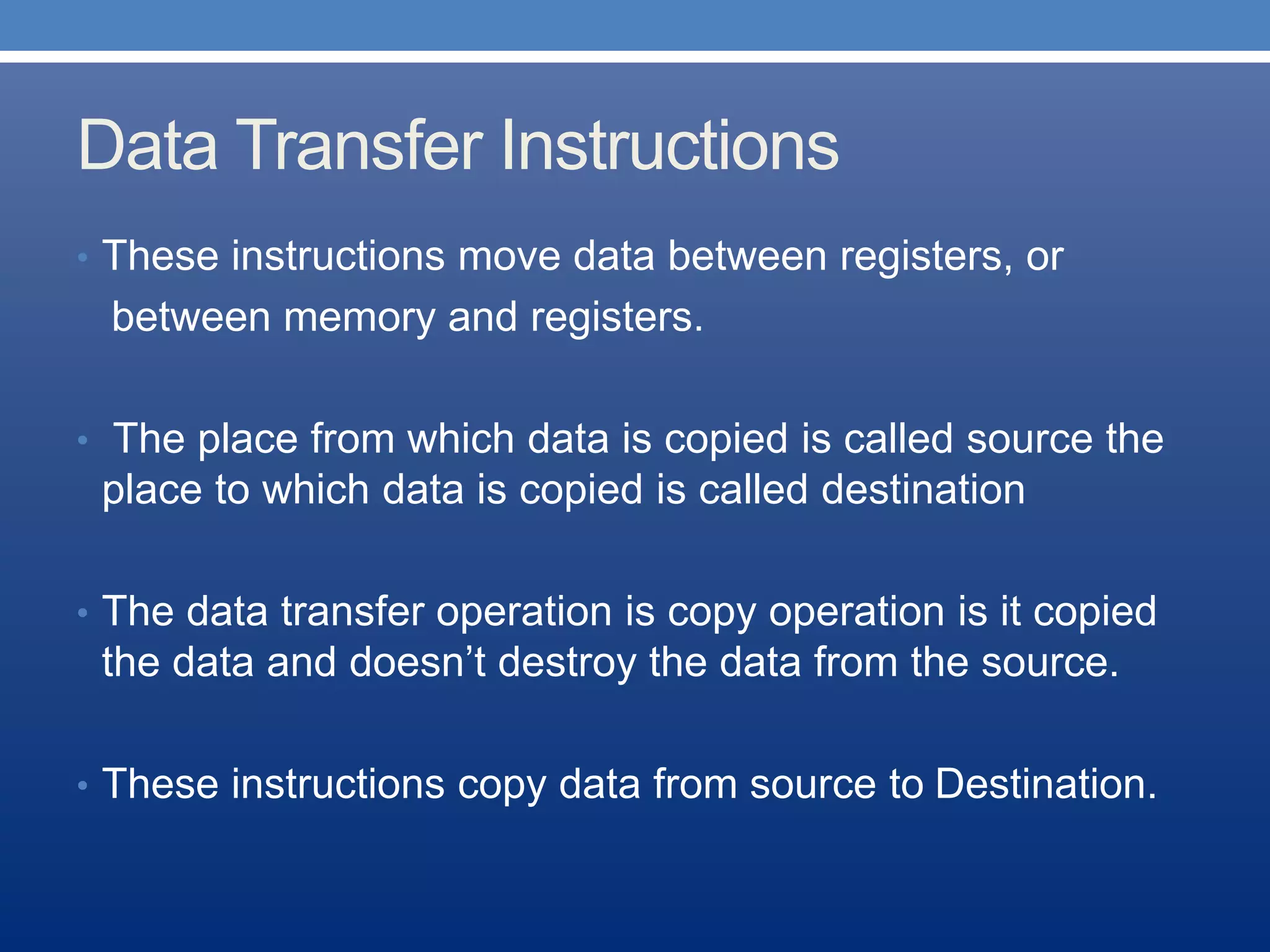
Data Transfer Instructions
• These instructions move data between registers, or
between memory and registers.
• The place from which data is copied is called source the
place to which data is copied is called destination
• The data transfer operation is copy operation is it copied
the data and doesn’t destroy the data from the source.
• These instructions copy data from source to Destination.
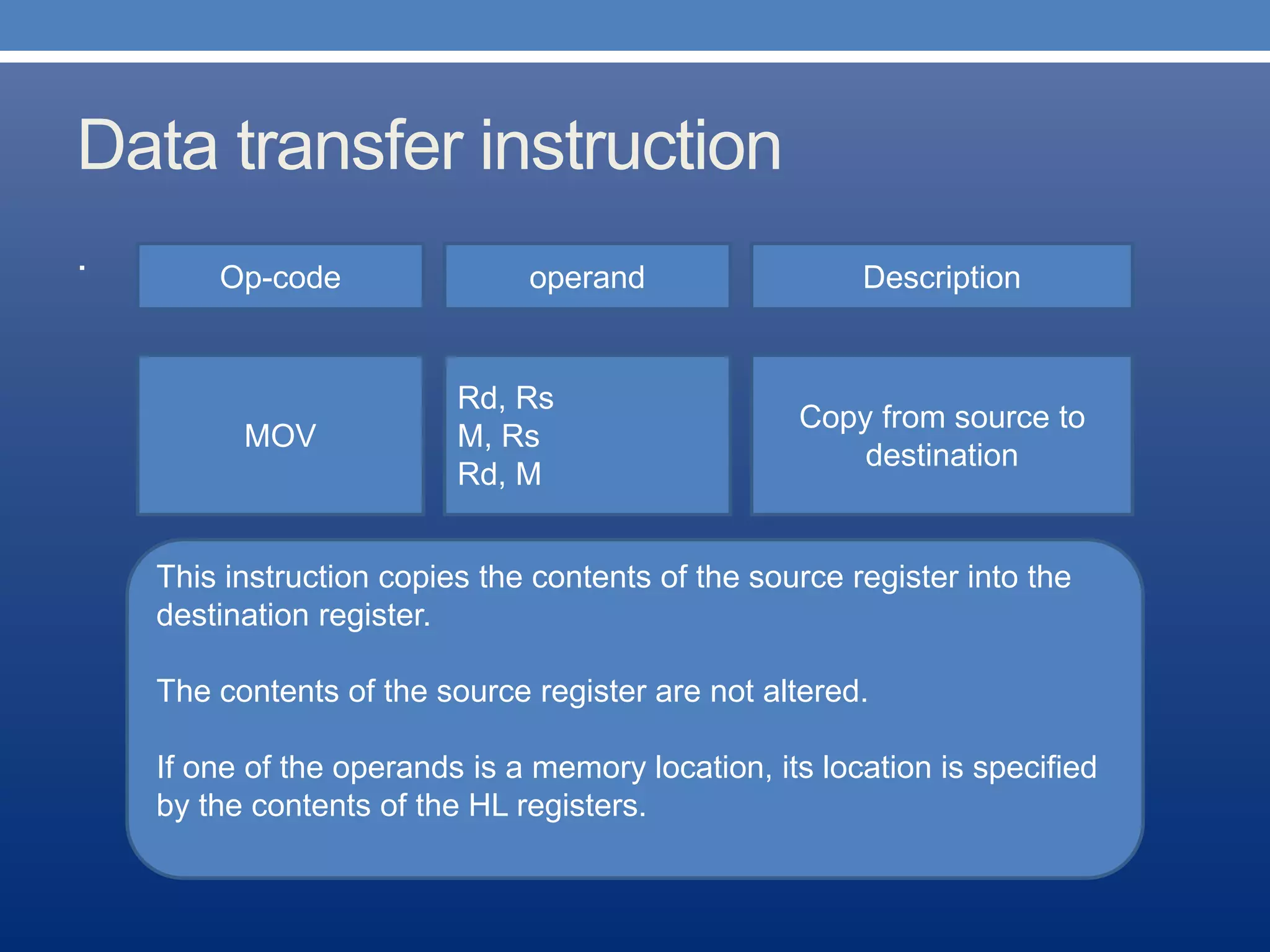
Data transfer instruction
. Op-code operand Description
Copy from source to
destination
MOV
Rd, Rs
M, Rs
Rd, M
This instruction copies the contents of the source register into the
destination register.
The contents of the source register are not altered.
If one of the operands is a memory location, its location is specified
by the contents of the HL registers.
Data transfer instruction
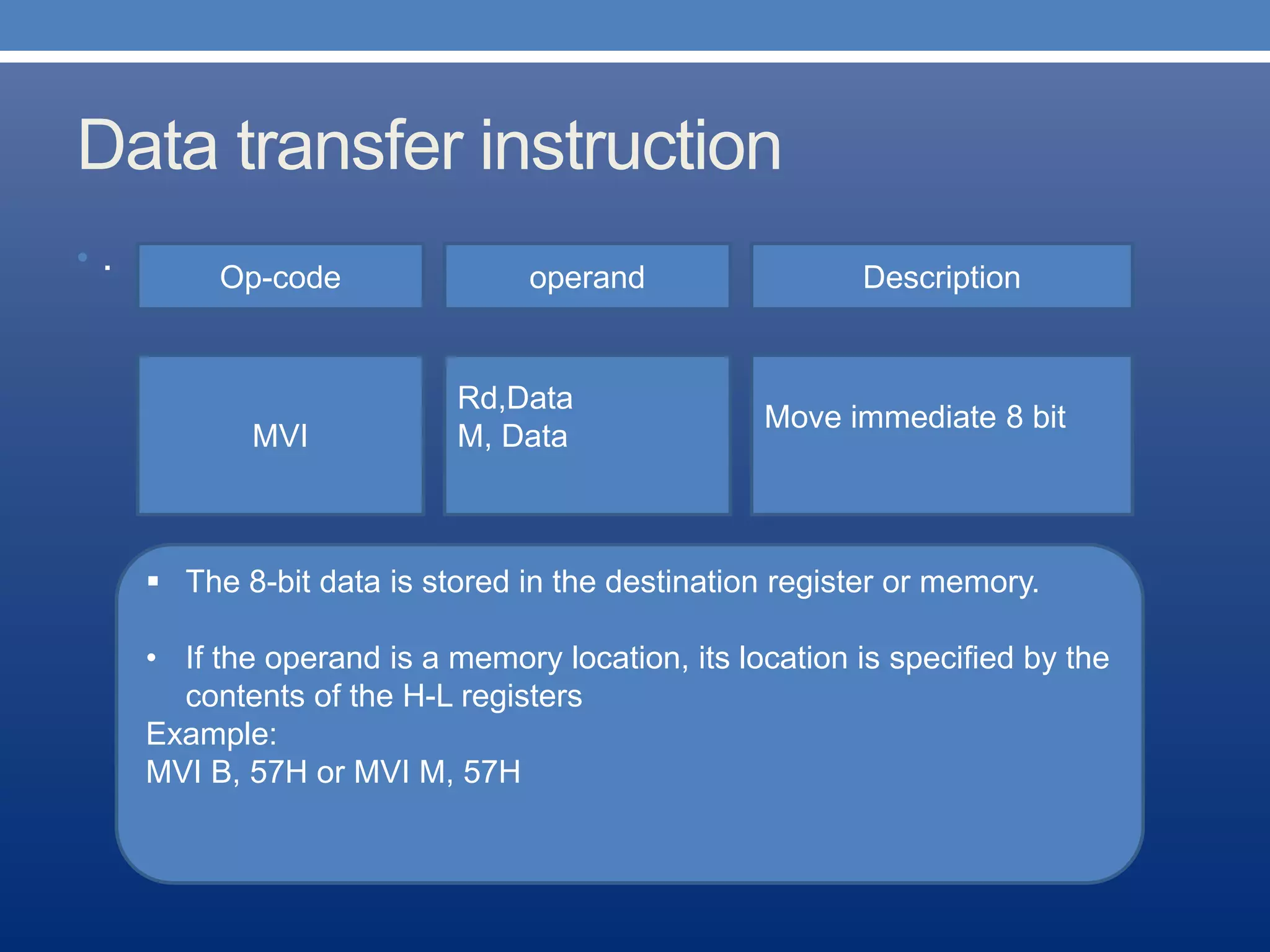
• . Op-code operand Description
Move immediate 8 bit
MVI
Rd,Data
M, Data
 The 8-bit data is stored in the destination register or memory.
• If the operand is a memory location, its location is specified by the
contents of the H-L registers
Example:
MVI B, 57H or MVI M, 57H
Data transfer instruction
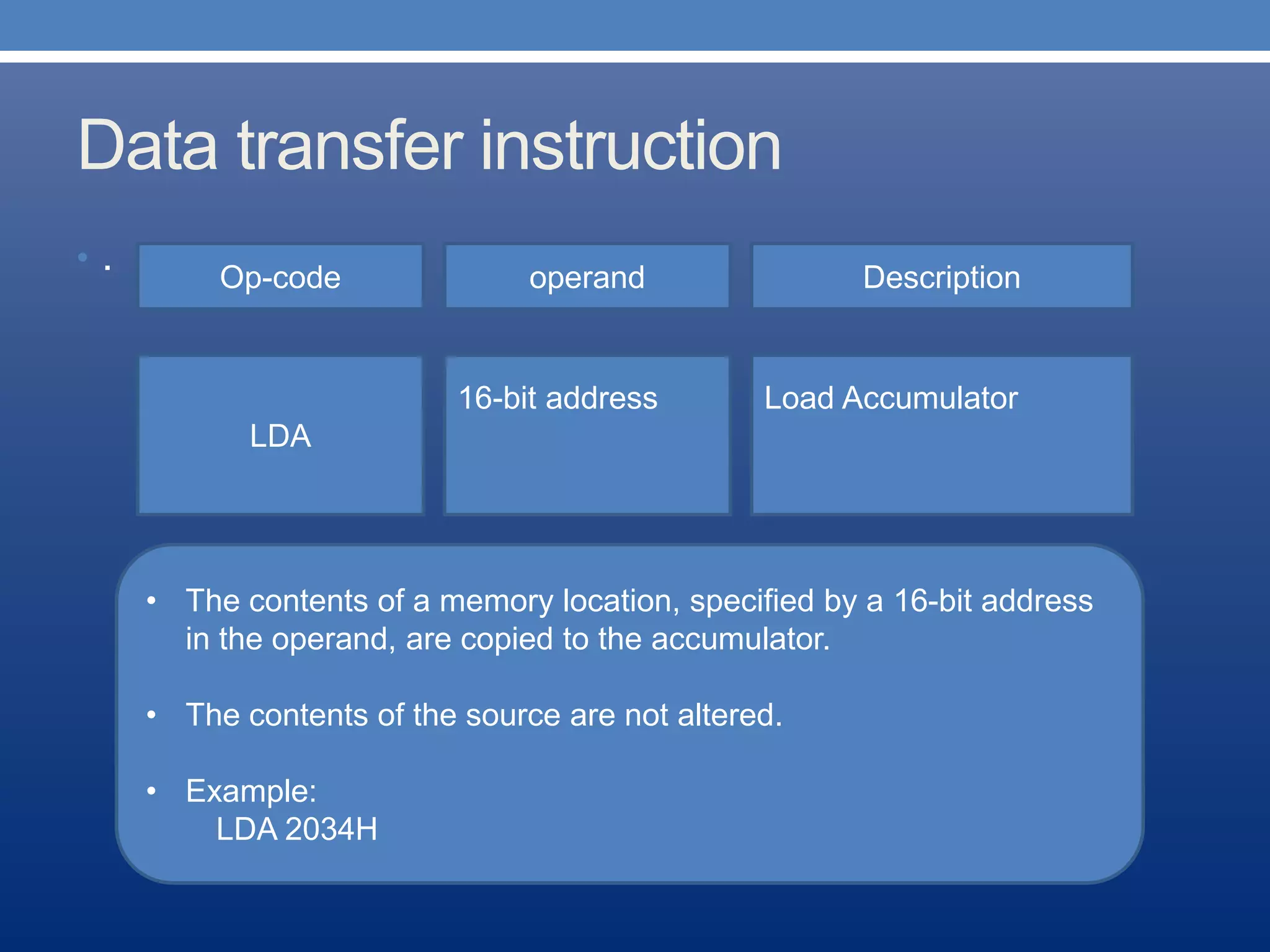
• . Op-code operand Description
Load Accumulator
LDA
16-bit address
• The contents of a memory location, specified by a 16-bit address
in the operand, are copied to the accumulator.
• The contents of the source are not altered.
• Example:
LDA 2034H
Data transfer instruction
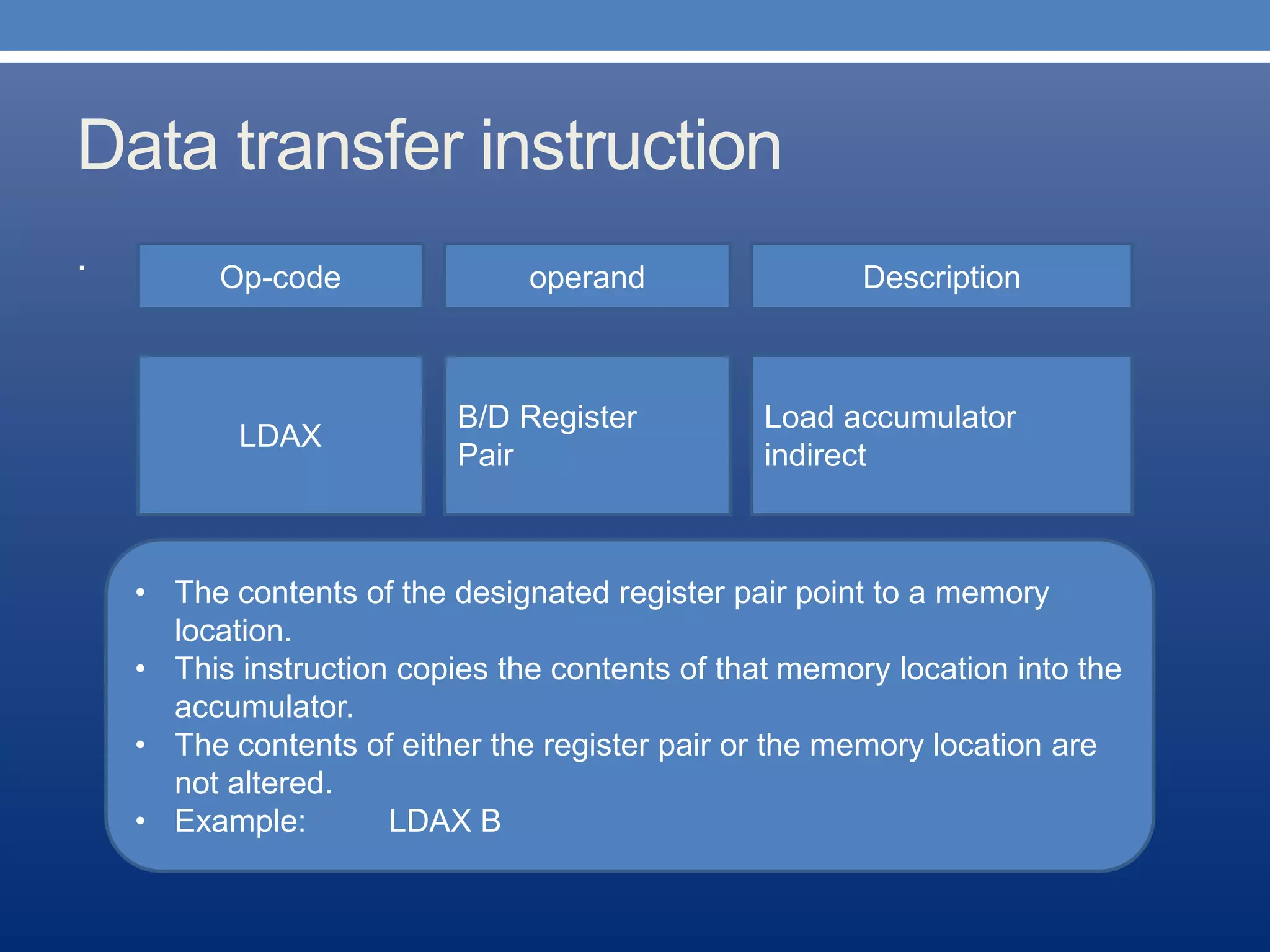
. Op-code operand Description
Load accumulator
indirect
LDAX
B/D Register
Pair
• The contents of the designated register pair point to a memory
location.
• This instruction copies the contents of that memory location into the
accumulator.
• The contents of either the register pair or the memory location are
not altered.
• Example: LDAX B
Data Transfer Instructions
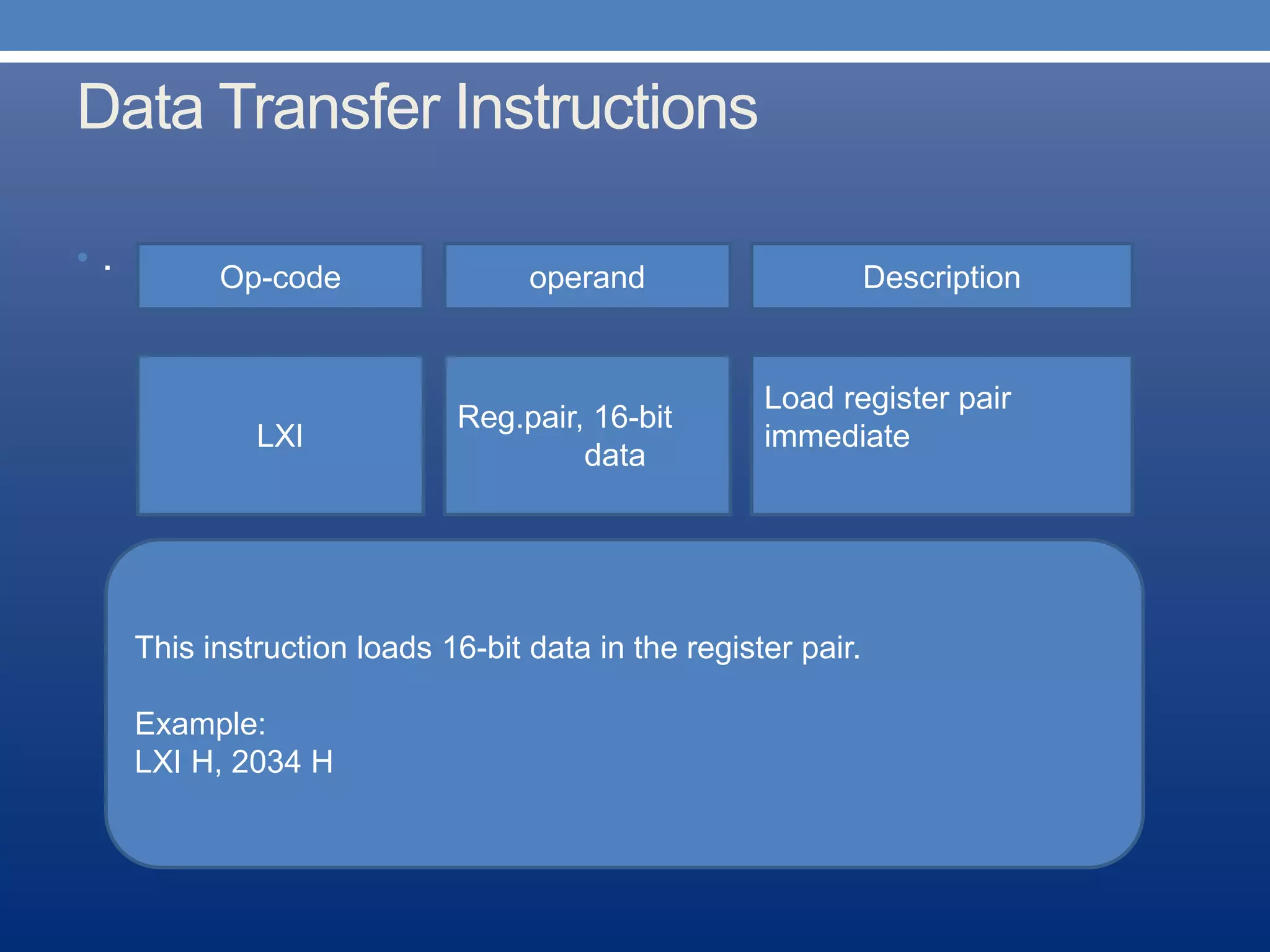
• . Op-code operand Description
Load register pair
immediateLXI
Reg.pair, 16-bit
data
This instruction loads 16-bit data in the register pair.
Example:
LXI H, 2034 H
Data Transfer Instructions
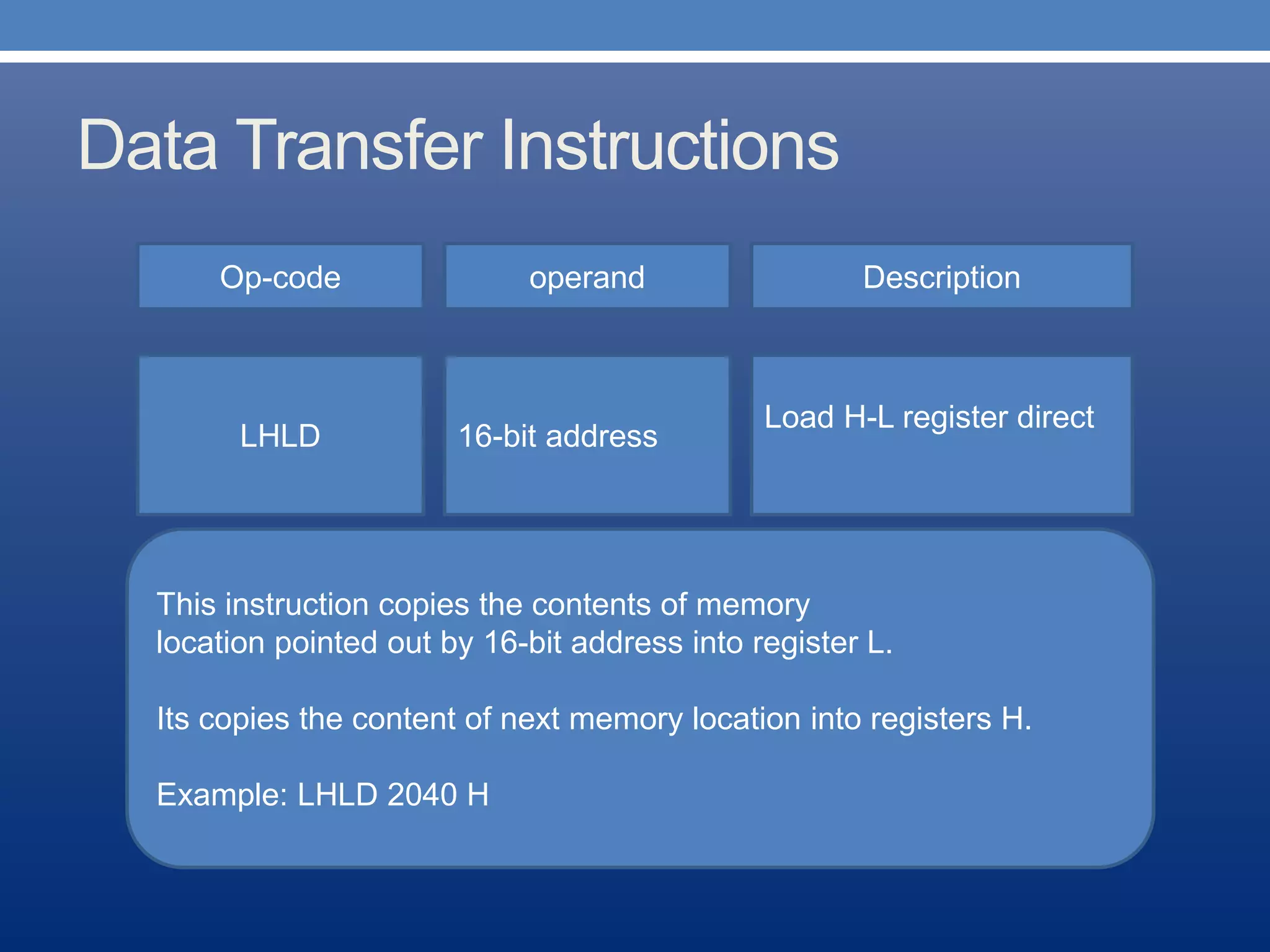
Op-code operand Description
Load H-L register direct
LHLD 16-bit address
This instruction copies the contents of memory
location pointed out by 16-bit address into register L.
Its copies the content of next memory location into registers H.
Example: LHLD 2040 H
Data Transfer Instructions
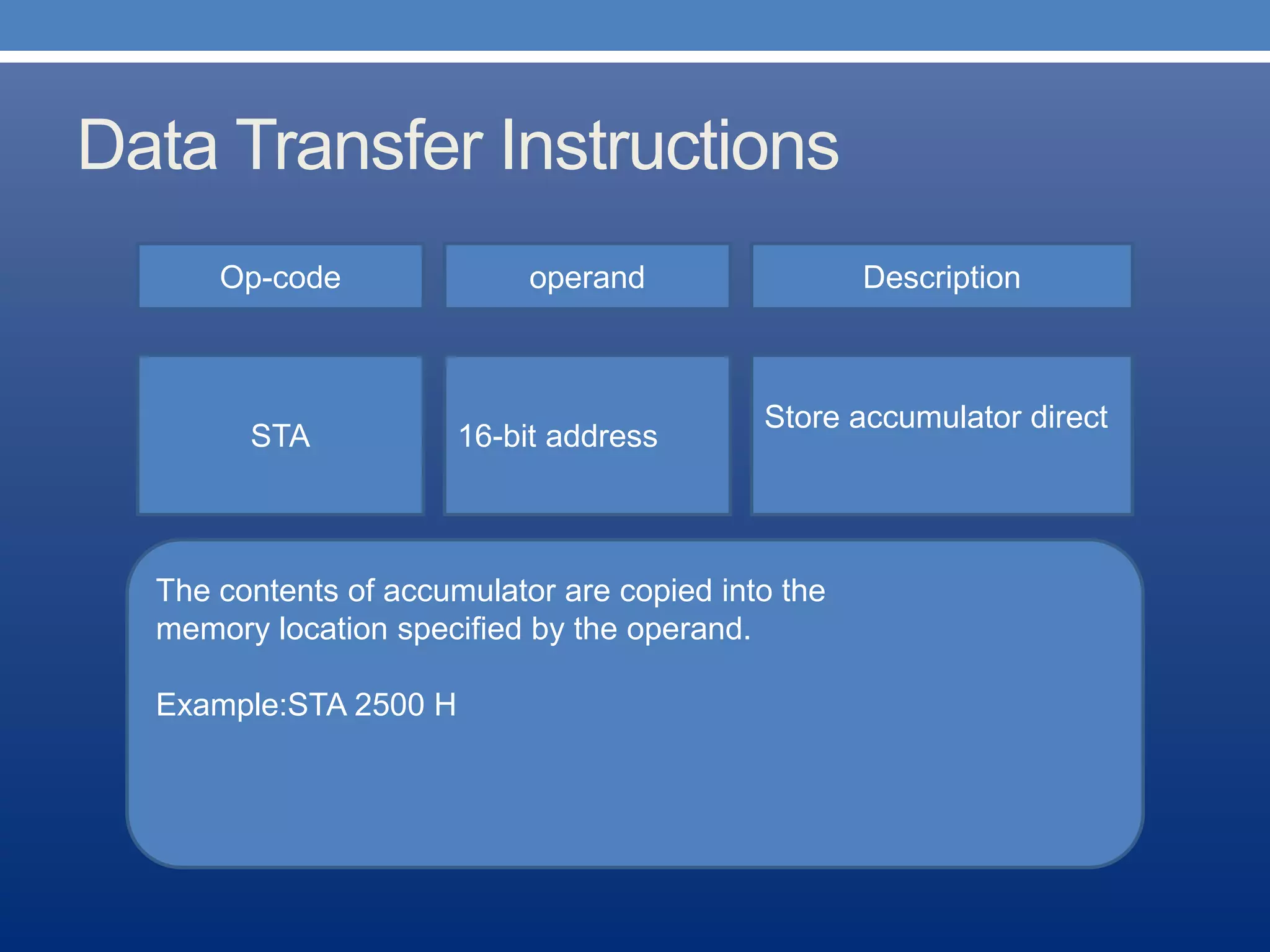
Op-code operand Description
Store accumulator direct
STA 16-bit address
The contents of accumulator are copied into the
memory location specified by the operand.
Example:STA 2500 H
Data Transfer Instructions
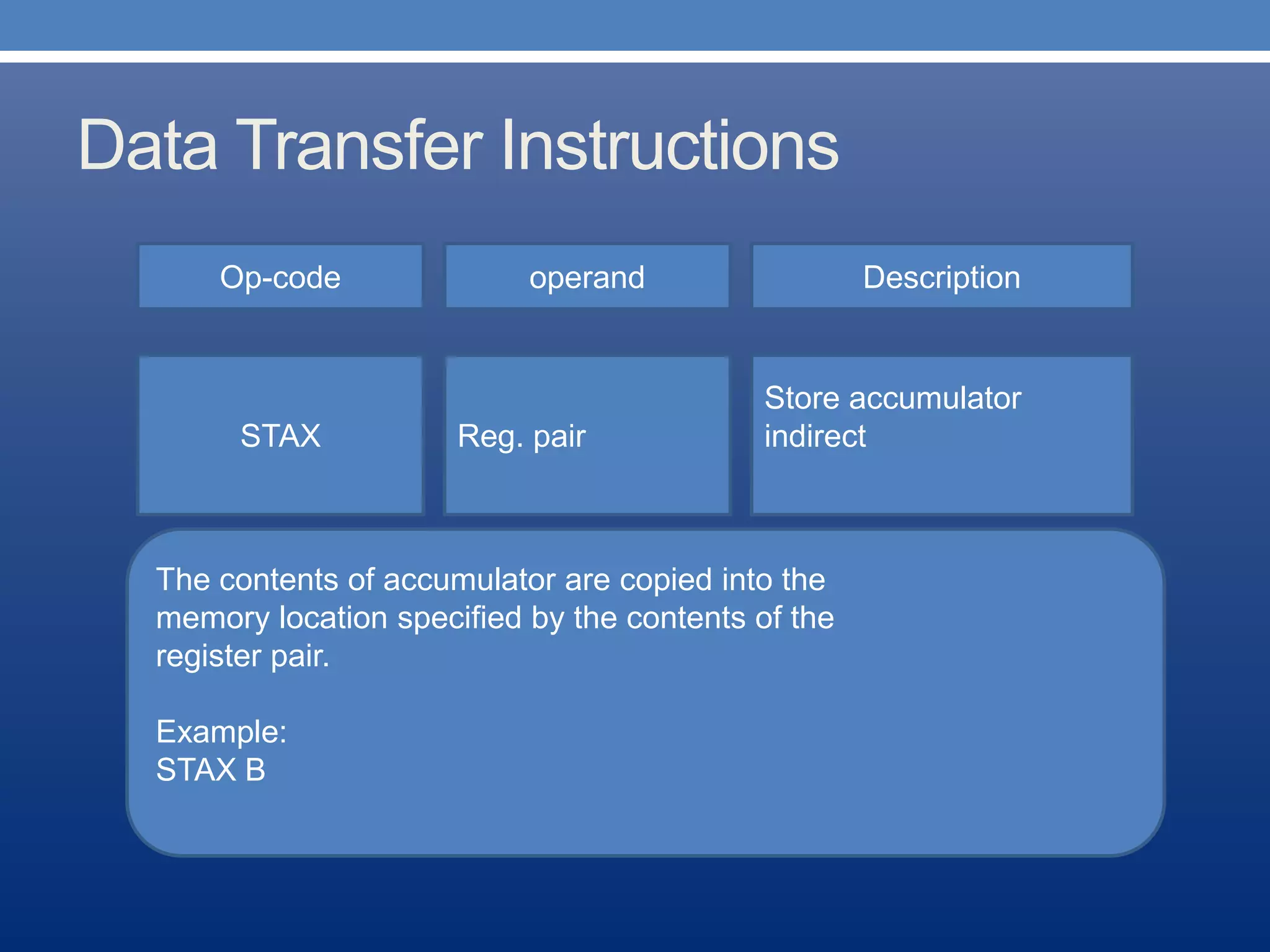
Op-code operand Description
Store accumulator
indirectSTAX Reg. pair
The contents of accumulator are copied into the
memory location specified by the contents of the
register pair.
Example:
STAX B
Data Transfer Instructions
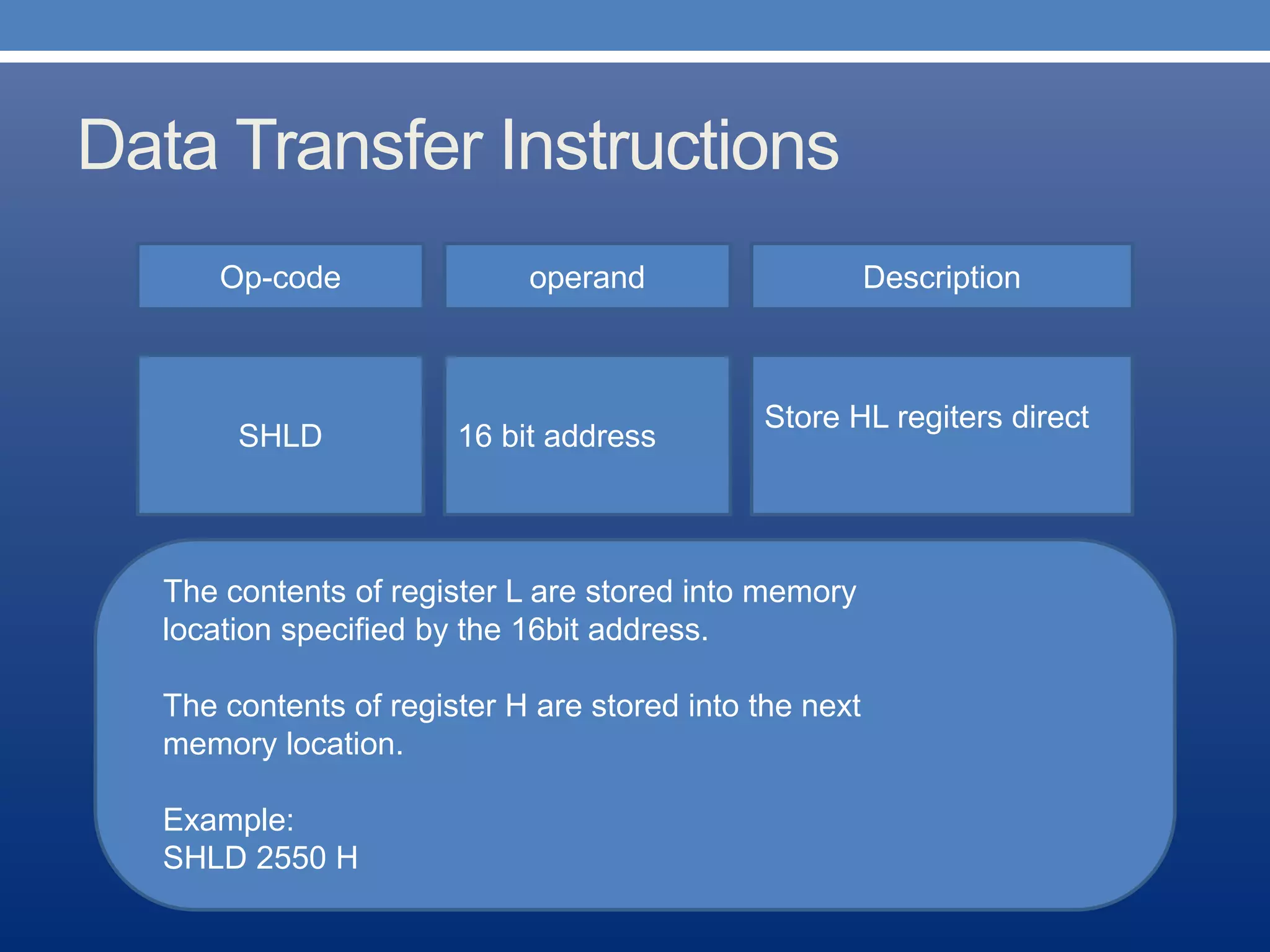
Op-code operand Description
Store HL regiters direct
SHLD 16 bit address
The contents of register L are stored into memory
• location specified by the 16bit address.
• The contents of register H are stored into the next
• memory location.
• Example:
• SHLD 2550 H
Data Transfer Instructions
Op-code operand Description
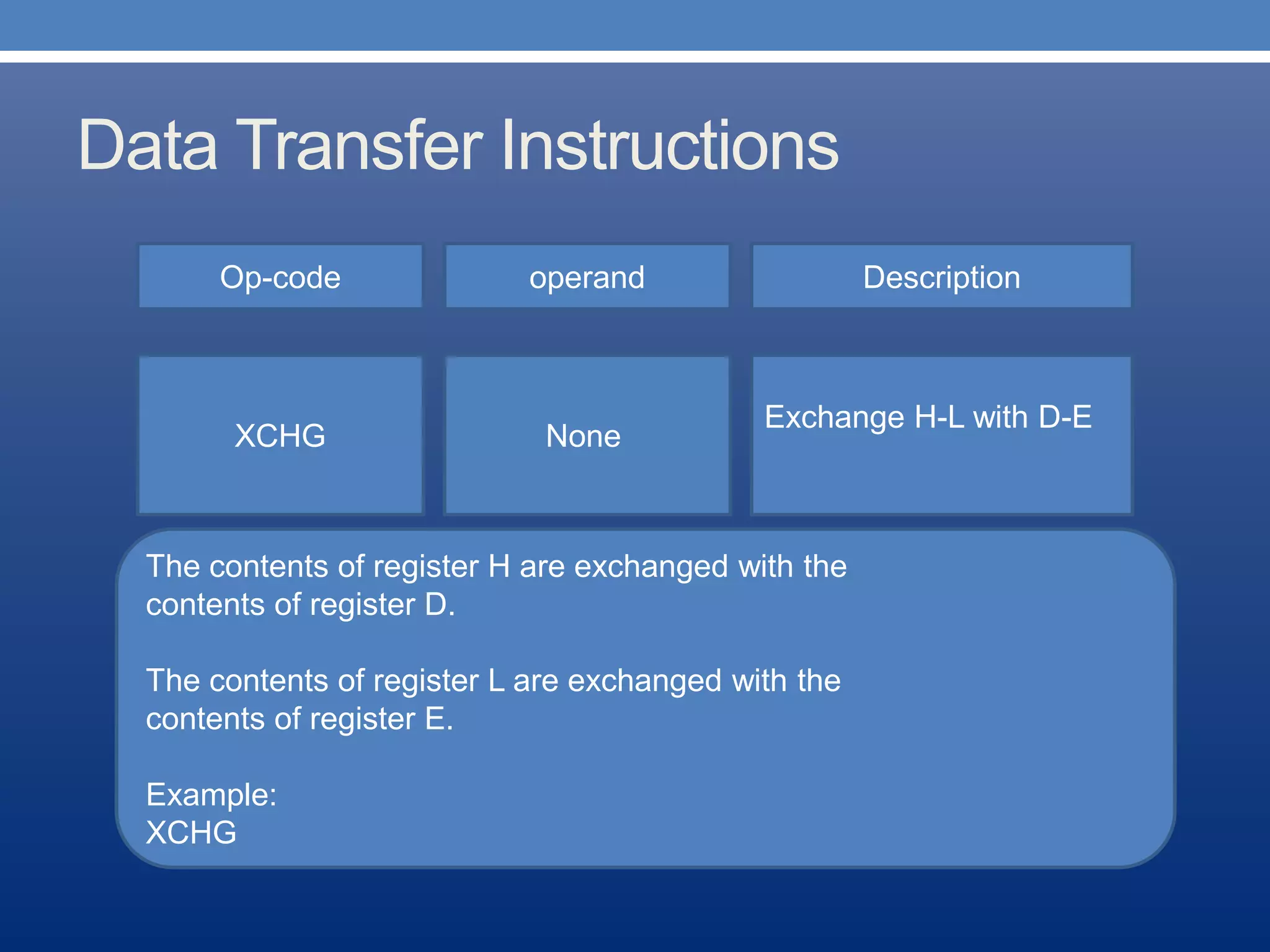
Exchange H-L with D-E
XCHG None
The contents of register H are exchanged with the
contents of register D.
The contents of register L are exchanged with the
contents of register E.
Example:
XCHG
Data Transfer Instructions
Op-code operand Description
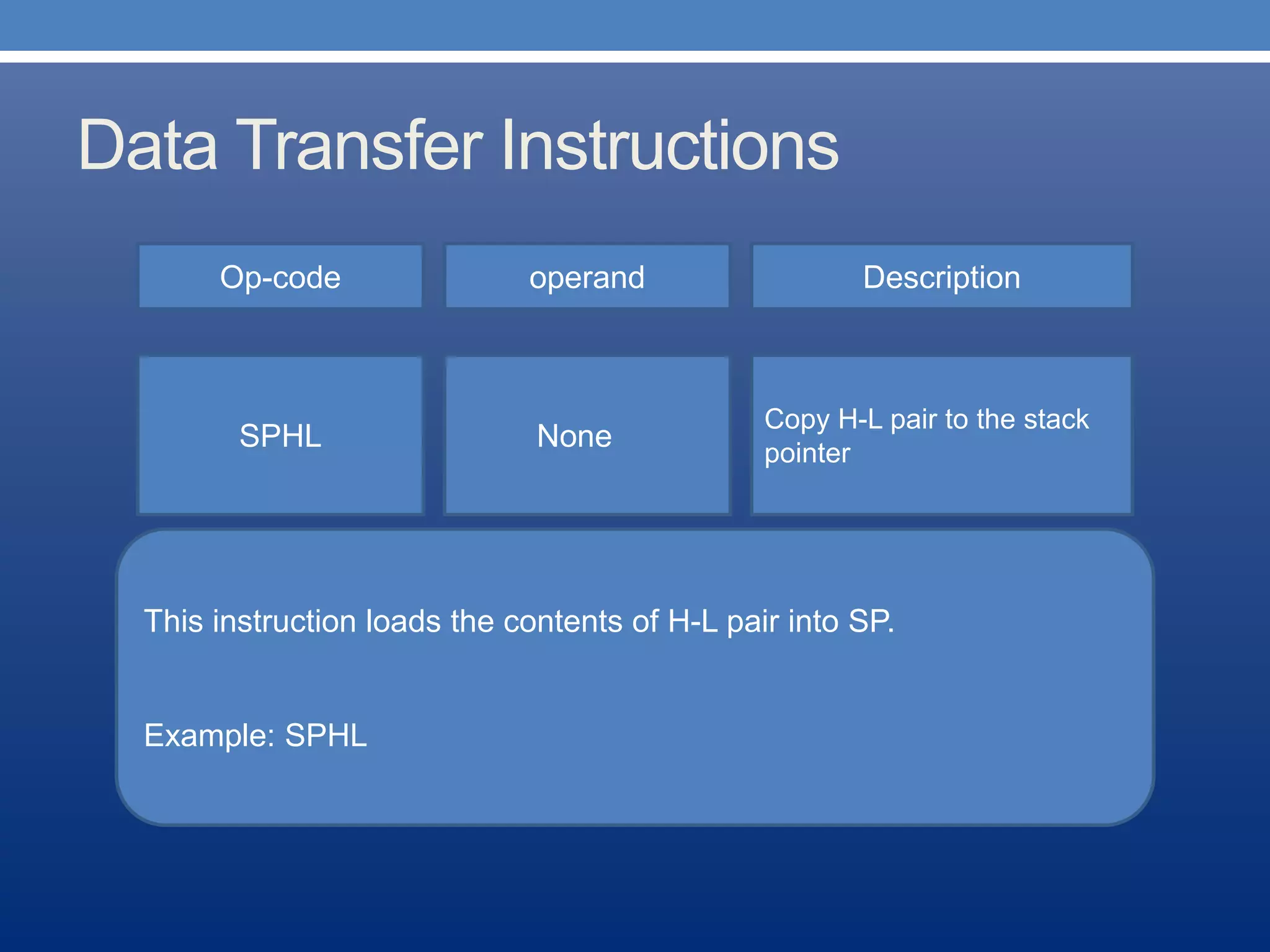
Copy H-L pair to the stack
pointer
SPHL None
This instruction loads the contents of H-L pair into SP.
Example: SPHL
Data Transfer Instructions
Op-code operand Description
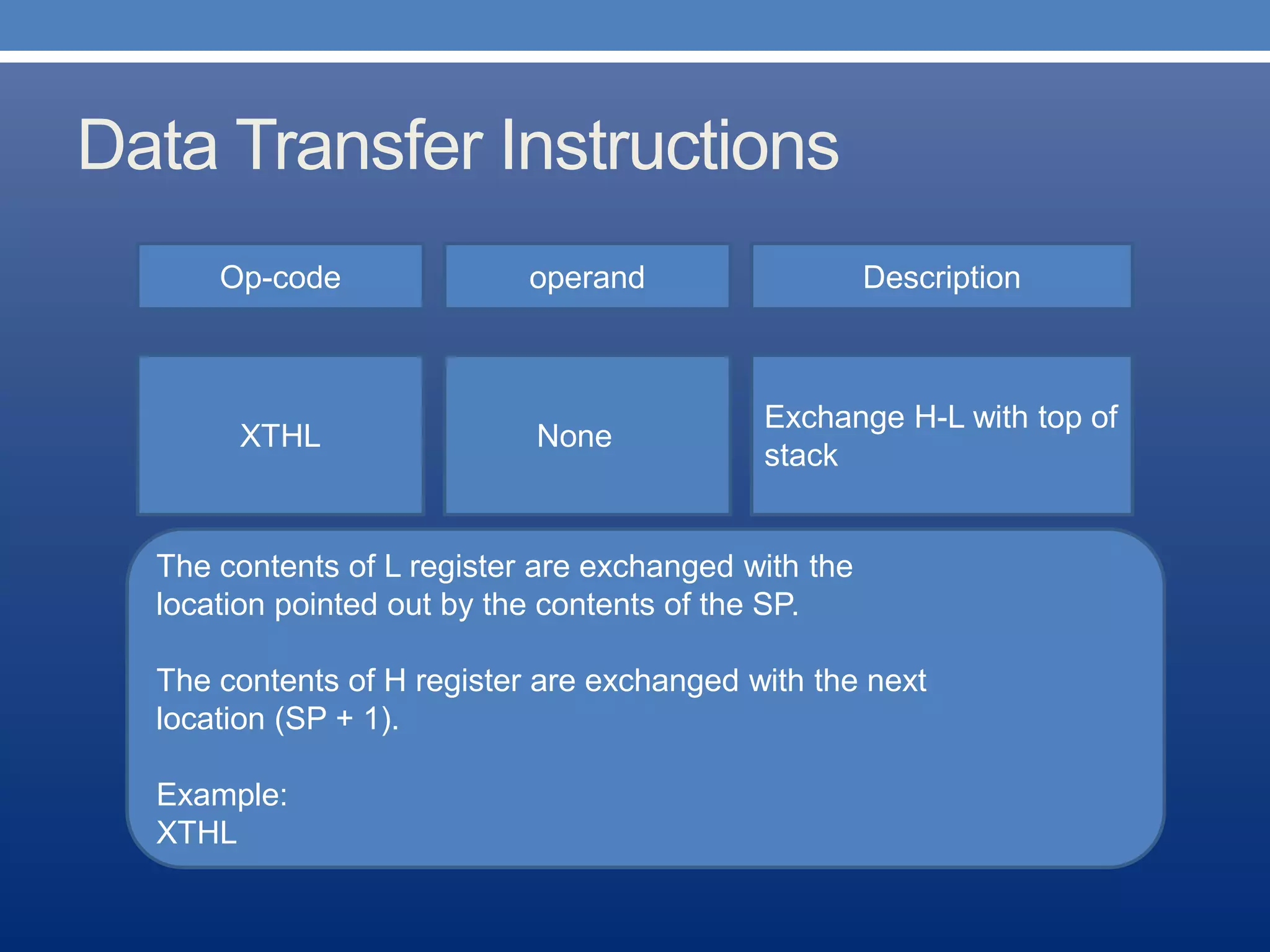
Exchange H-L with top of
stack
XTHL None
The contents of L register are exchanged with the
location pointed out by the contents of the SP.
The contents of H register are exchanged with the next
location (SP + 1).
Example:
XTHL
Data Transfer Instructions
Op-code operand Description
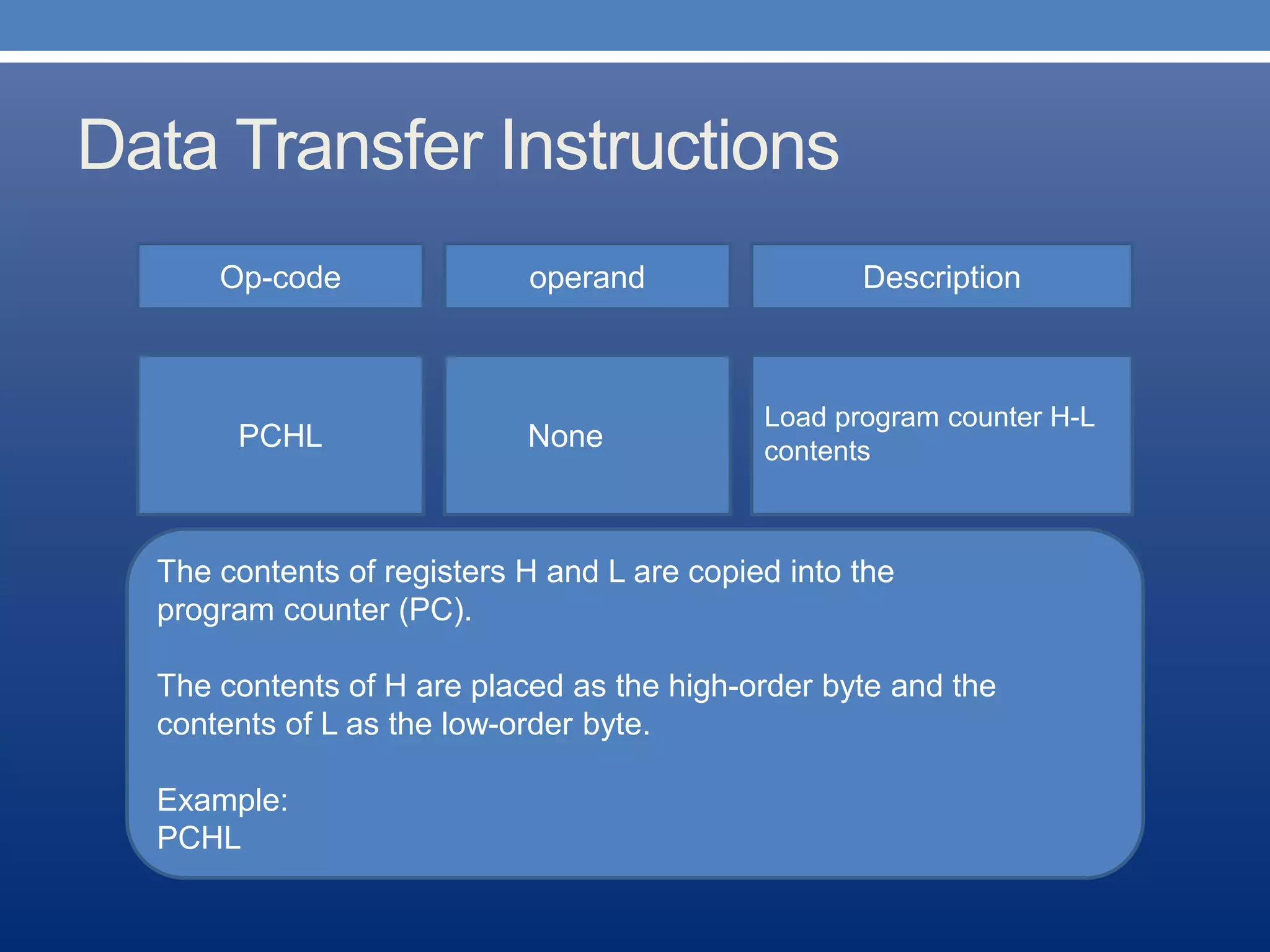
Load program counter H-L
contentsPCHL None
The contents of registers H and L are copied into the
program counter (PC).
The contents of H are placed as the high-order byte and the
contents of L as the low-order byte.
Example:
PCHL
Data Transfer Instructions
Op-code operand Description
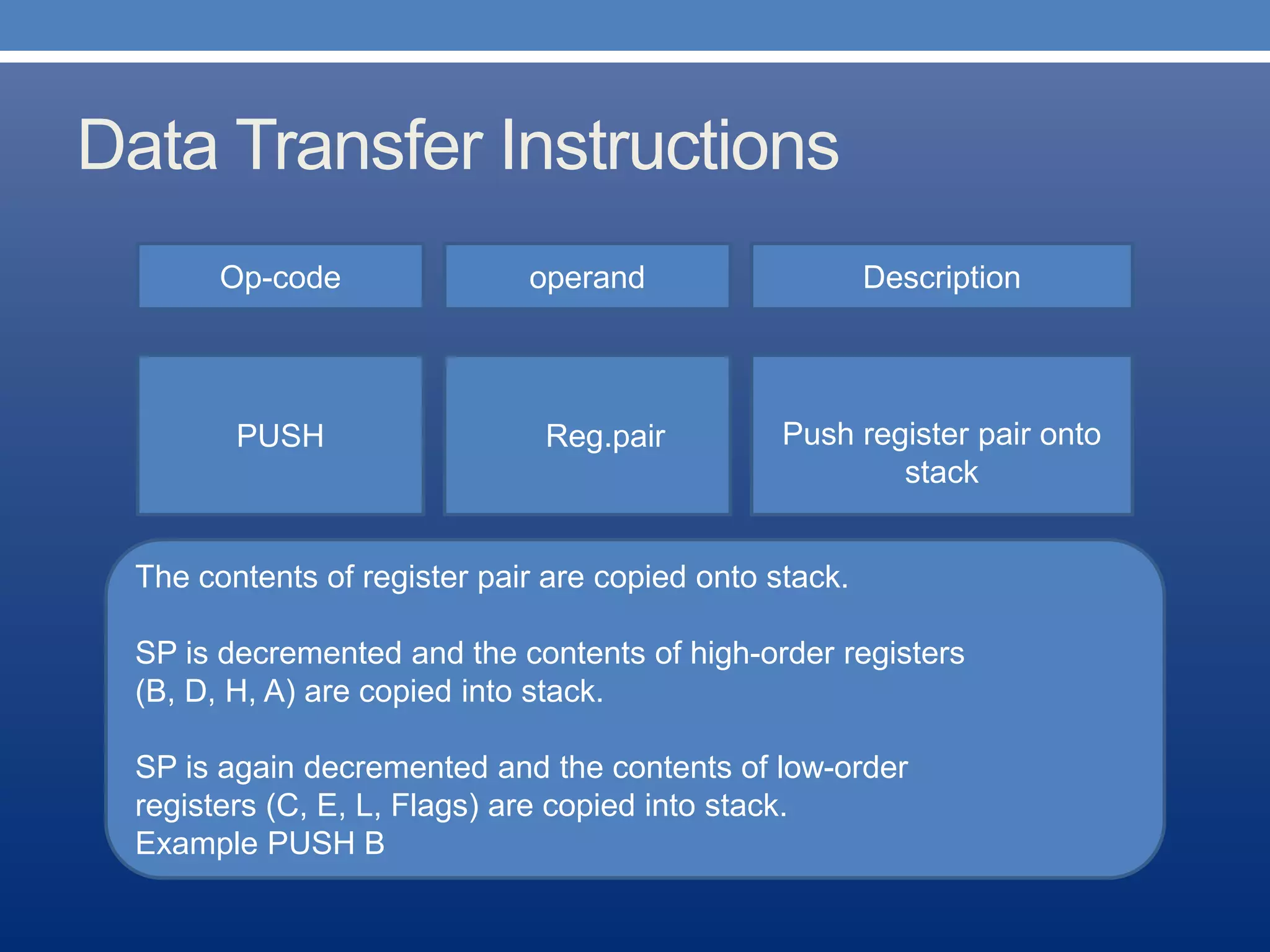
Push register pair onto
stack
PUSH Reg.pair
The contents of register pair are copied onto stack.
SP is decremented and the contents of high-order registers
(B, D, H, A) are copied into stack.
SP is again decremented and the contents of low-order
registers (C, E, L, Flags) are copied into stack.
Example PUSH B
Data Transfer Instructions
Op-code operand Description
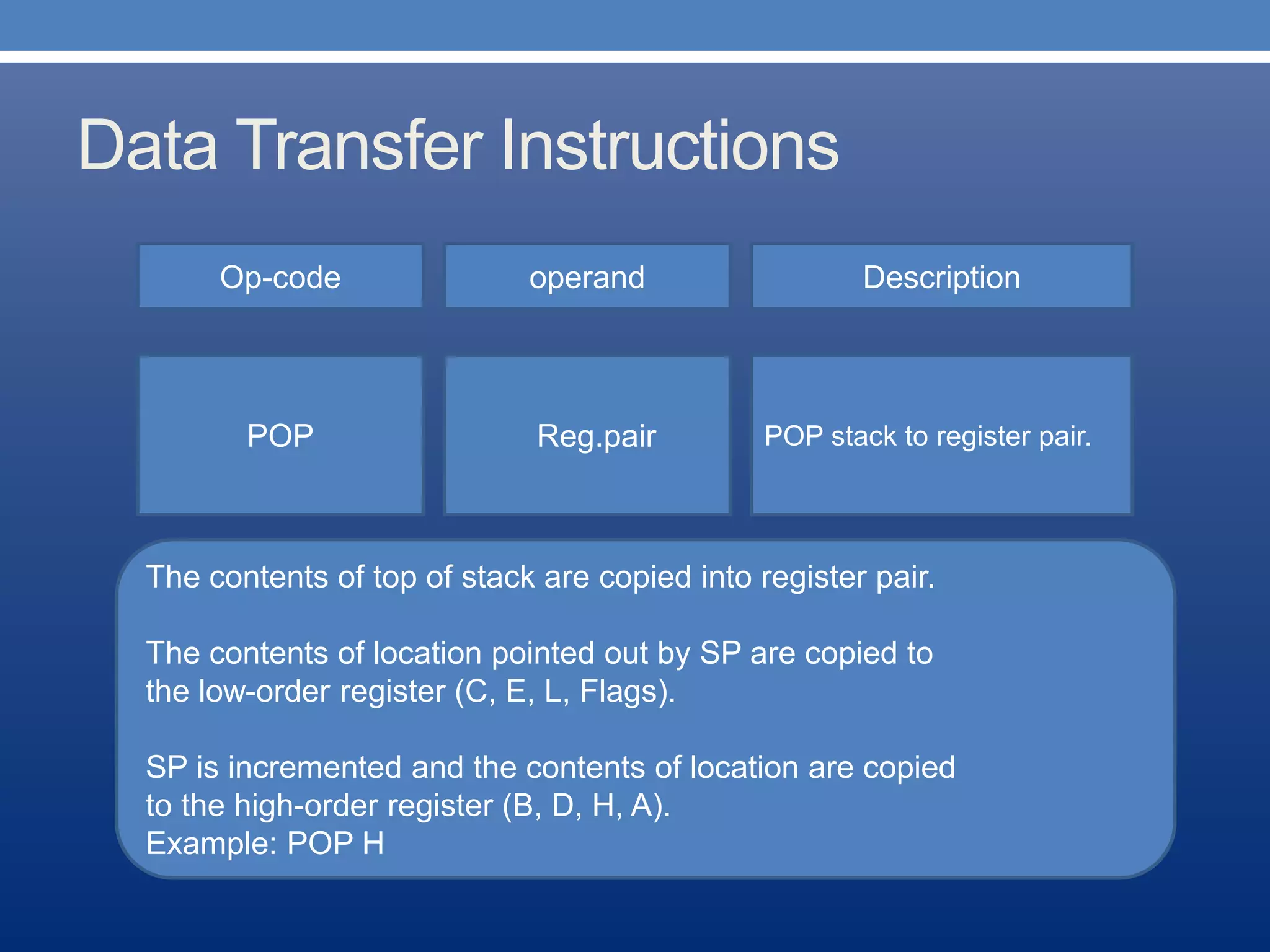
POP stack to register pair.POP Reg.pair
The contents of top of stack are copied into register pair.
The contents of location pointed out by SP are copied to
the low-order register (C, E, L, Flags).
SP is incremented and the contents of location are copied
to the high-order register (B, D, H, A).
Example: POP H
Data Transfer Instructions
Op-code operand Description
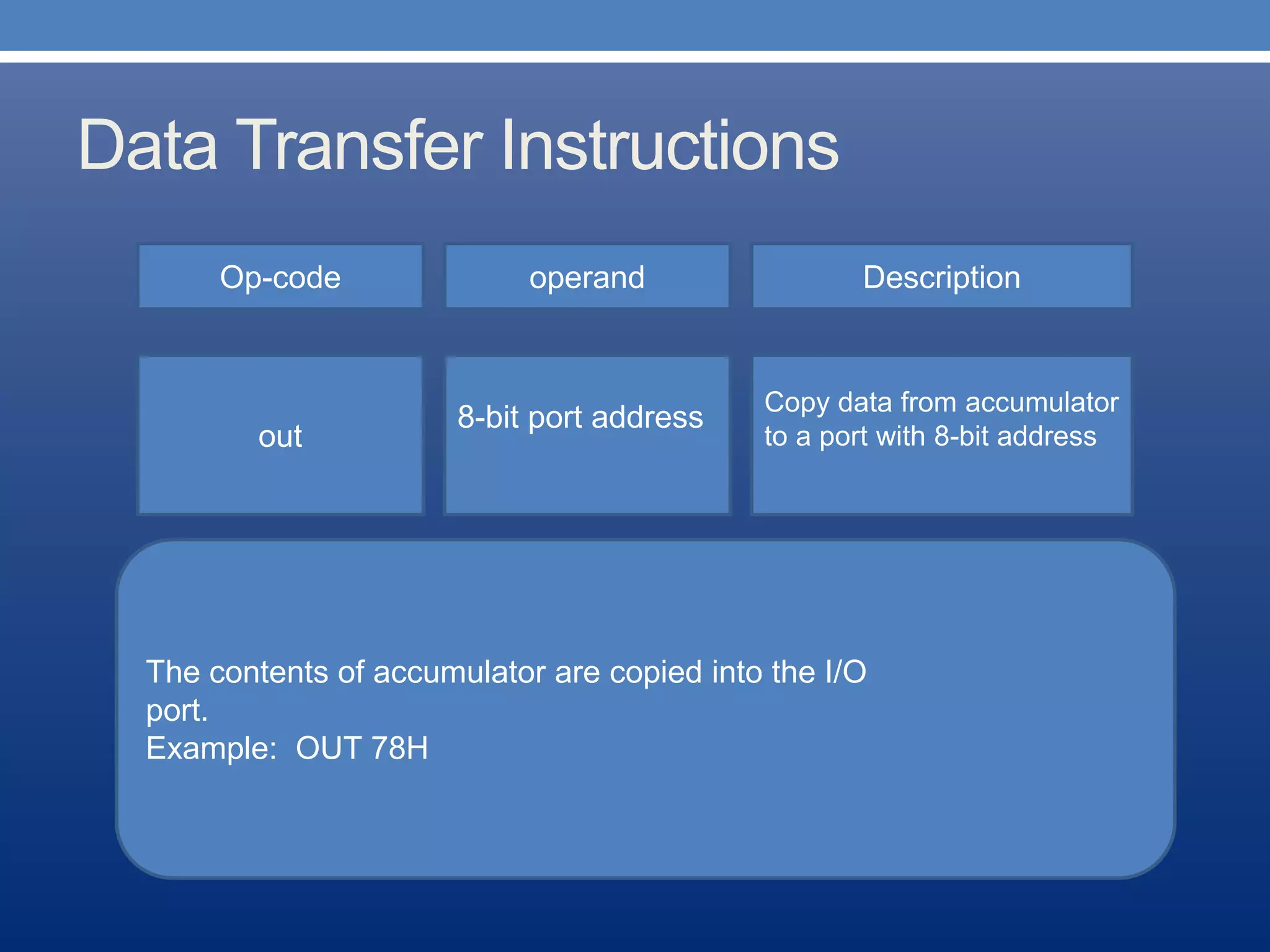
Copy data from accumulator
to a port with 8-bit addressout
8-bit port address
The contents of accumulator are copied into the I/O
port.
Example: OUT 78H
Data Transfer InstructionsData Transfer Instructions
Op-code operand Description
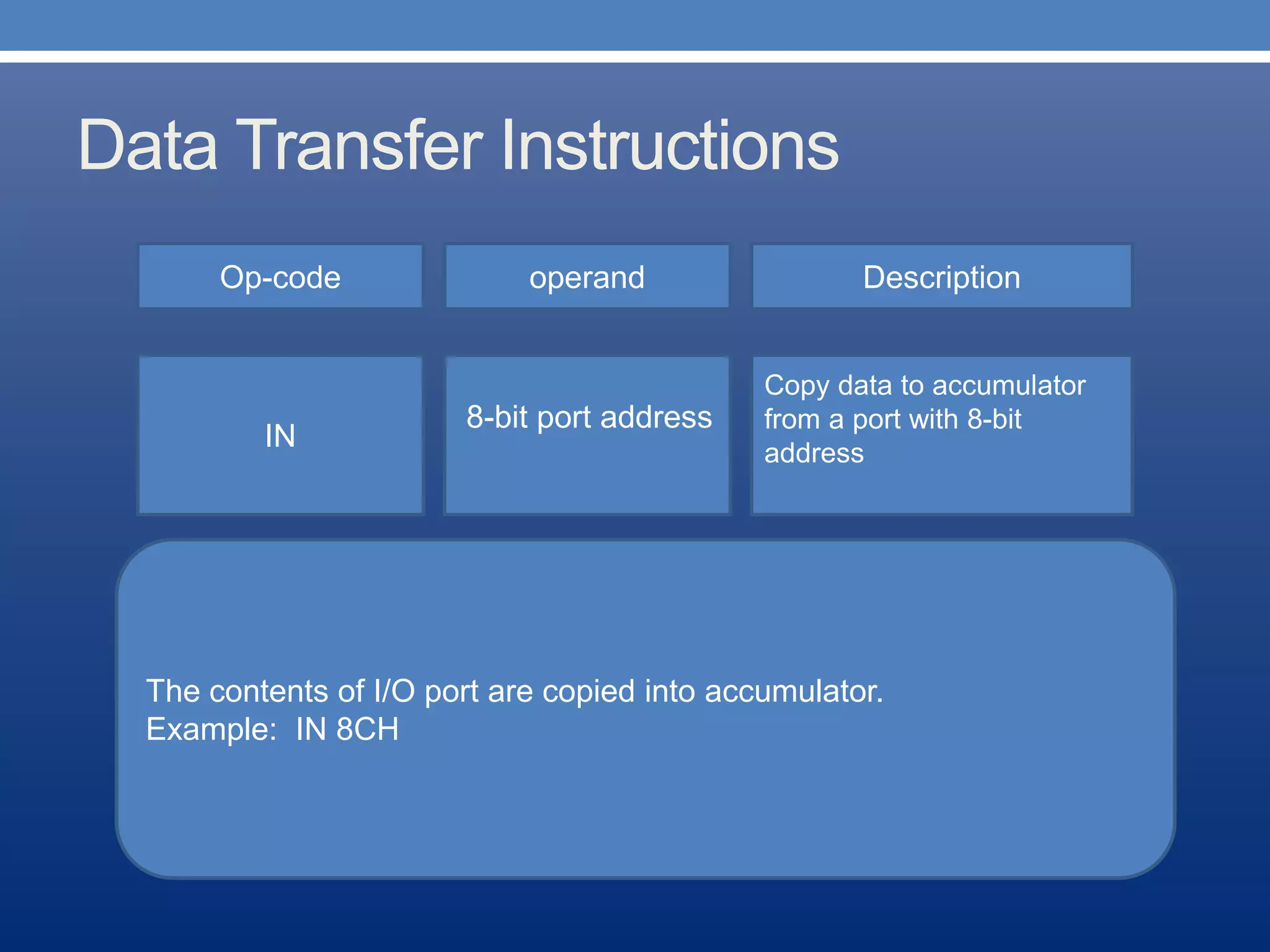
Copy data to accumulator
from a port with 8-bit
address
IN
8-bit port address
The contents of I/O port are copied into accumulator.
Example: IN 8CH
Addressing mode & data transfer instruction of 8085

Addressing mode & data transfer instruction of 8085

  • 1.
    ADDRESSING MODES & DATATRANSFER INSTRUCTION OF 8085 MICROPROCESSOR Presented by : Vaibhavi K. Patel (140133103025) : Roshni M. Patel (140133103026) : Chinmayee N. Samal (140133103027)
  • 2.
    What is aninstruction ? • An instruction is a command to the microprocessor to perform a given operation on specified data. • An instruction consists of two parts: operation code (opcode) which specifies what operation to be performed and data to be operated on called the operand . example: MOV A,B MOV is opcode and A and B are operands.
  • 3.
    Addressing modes of8085 Definition:- The various ways of specifying operands for an instruction are called addressing modes. The method by which the address of source of data or the address of destination of result is given in the instruction is called Addressing Modes.  The term addressing mode refers to the way in which the operand of the instruction is specified.
  • 4.
    Types of AddressingModes • Intel 8085 uses the following addressing modes: 1. Direct Addressing Mode 2. Register Addressing Mode 3. Indirect Addressing Mode 4. Immediate Addressing Mode 5. Implied Addressing Mode
  • 5.
    Addressing modes Immediate Addressing mode Register Addressingmode Direct Addressing mode Register indirect Addressing mode Indexed Addressing mode Implied Addressing mode Addressing modes of 8085
  • 6.
    Direct Addressing Mode •In this mode, the address of the operand is given in the instruction itself. Load the contents of memory location 2500 H in accumulator. H  LDA is the operation.  2500 H is the address of source.  Accumulator is the destination.
  • 7.
    Register Addressing Mode •In this mode, the operand is in general purpose register. MOV A, B Move the contents of register B to A. • MOV is the operation. • B is the source of data. • A is the destination.
  • 8.
    Indirect Addressing mode •In this mode, the address of operand is specified by a register pair. MOV A, M Move data from memory location specified by H-L pair to accumulator. • MOV is the operation. • M is the memiory location specified by H-L reg. pair. • A is the destination.
  • 9.
    Immediate Addressing Mode •In this mode, the operand is specified within the instruction itself. MVI A, 05 H Move 05 H in accumulator • MVI is the operation. • 05 H is the immediate data (source). • A is the destination.
  • 10.
    Implied Addressing Mode •If address of source of data as well as address of destination of result is fixed, then there is no need to give any operand along with the instruction CMA Complement accumulator. • CMA is the operation. • A is the source. • A is the destination.
  • 11.
    Classification of InstructionSet • Data Transfer Instruction • Arithmetic Instructions • Logical Instructions • Branching Instructions • Control Instructions
  • 12.
    Data Transfer Instructions •These instructions move data between registers, or between memory and registers. • The place from which data is copied is called source the place to which data is copied is called destination • The data transfer operation is copy operation is it copied the data and doesn’t destroy the data from the source. • These instructions copy data from source to Destination.
  • 13.
    Data transfer instruction .Op-code operand Description Copy from source to destination MOV Rd, Rs M, Rs Rd, M This instruction copies the contents of the source register into the destination register. The contents of the source register are not altered. If one of the operands is a memory location, its location is specified by the contents of the HL registers.
  • 14.
    Data transfer instruction •. Op-code operand Description Move immediate 8 bit MVI Rd,Data M, Data  The 8-bit data is stored in the destination register or memory. • If the operand is a memory location, its location is specified by the contents of the H-L registers Example: MVI B, 57H or MVI M, 57H
  • 15.
    Data transfer instruction •. Op-code operand Description Load Accumulator LDA 16-bit address • The contents of a memory location, specified by a 16-bit address in the operand, are copied to the accumulator. • The contents of the source are not altered. • Example: LDA 2034H
  • 16.
    Data transfer instruction .Op-code operand Description Load accumulator indirect LDAX B/D Register Pair • The contents of the designated register pair point to a memory location. • This instruction copies the contents of that memory location into the accumulator. • The contents of either the register pair or the memory location are not altered. • Example: LDAX B
  • 17.
    Data Transfer Instructions •. Op-code operand Description Load register pair immediateLXI Reg.pair, 16-bit data This instruction loads 16-bit data in the register pair. Example: LXI H, 2034 H
  • 18.
    Data Transfer Instructions Op-codeoperand Description Load H-L register direct LHLD 16-bit address This instruction copies the contents of memory location pointed out by 16-bit address into register L. Its copies the content of next memory location into registers H. Example: LHLD 2040 H
  • 19.
    Data Transfer Instructions Op-codeoperand Description Store accumulator direct STA 16-bit address The contents of accumulator are copied into the memory location specified by the operand. Example:STA 2500 H
  • 20.
    Data Transfer Instructions Op-codeoperand Description Store accumulator indirectSTAX Reg. pair The contents of accumulator are copied into the memory location specified by the contents of the register pair. Example: STAX B
  • 21.
    Data Transfer Instructions Op-codeoperand Description Store HL regiters direct SHLD 16 bit address The contents of register L are stored into memory • location specified by the 16bit address. • The contents of register H are stored into the next • memory location. • Example: • SHLD 2550 H
  • 22.
    Data Transfer Instructions Op-codeoperand Description Exchange H-L with D-E XCHG None The contents of register H are exchanged with the contents of register D. The contents of register L are exchanged with the contents of register E. Example: XCHG
  • 23.
    Data Transfer Instructions Op-codeoperand Description Copy H-L pair to the stack pointer SPHL None This instruction loads the contents of H-L pair into SP. Example: SPHL
  • 24.
    Data Transfer Instructions Op-codeoperand Description Exchange H-L with top of stack XTHL None The contents of L register are exchanged with the location pointed out by the contents of the SP. The contents of H register are exchanged with the next location (SP + 1). Example: XTHL
  • 25.
    Data Transfer Instructions Op-codeoperand Description Load program counter H-L contentsPCHL None The contents of registers H and L are copied into the program counter (PC). The contents of H are placed as the high-order byte and the contents of L as the low-order byte. Example: PCHL
  • 26.
    Data Transfer Instructions Op-codeoperand Description Push register pair onto stack PUSH Reg.pair The contents of register pair are copied onto stack. SP is decremented and the contents of high-order registers (B, D, H, A) are copied into stack. SP is again decremented and the contents of low-order registers (C, E, L, Flags) are copied into stack. Example PUSH B
  • 27.
    Data Transfer Instructions Op-codeoperand Description POP stack to register pair.POP Reg.pair The contents of top of stack are copied into register pair. The contents of location pointed out by SP are copied to the low-order register (C, E, L, Flags). SP is incremented and the contents of location are copied to the high-order register (B, D, H, A). Example: POP H
  • 28.
    Data Transfer Instructions Op-codeoperand Description Copy data from accumulator to a port with 8-bit addressout 8-bit port address The contents of accumulator are copied into the I/O port. Example: OUT 78H
  • 29.
    Data Transfer InstructionsDataTransfer Instructions Op-code operand Description Copy data to accumulator from a port with 8-bit address IN 8-bit port address The contents of I/O port are copied into accumulator. Example: IN 8CH