COMMUNITY
COGNIZANT
MASTERING DIGITAL
How to Navigate the Shift to the
Digital Business Era
United States • 2016
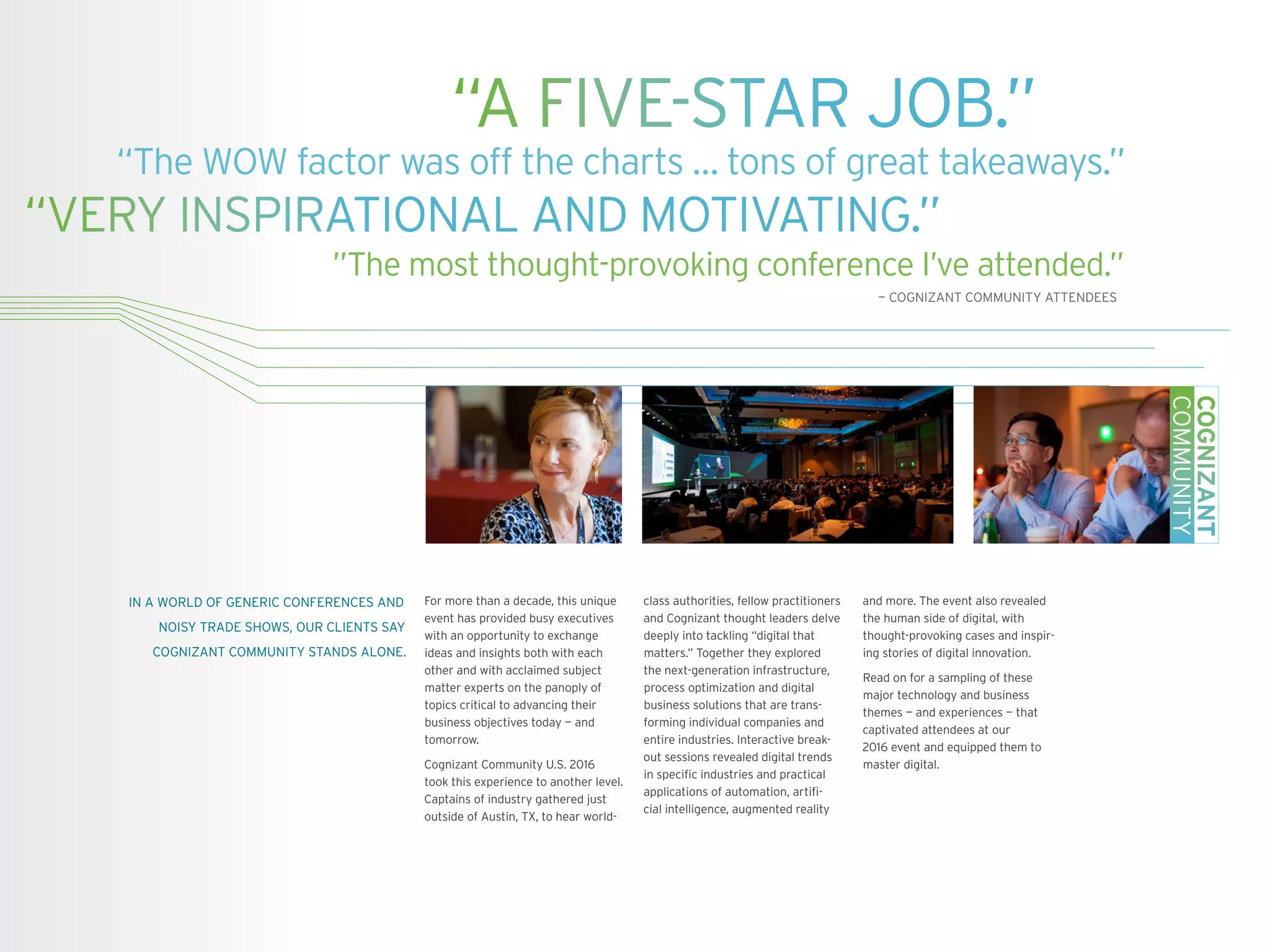
For more than a decade, this unique
event has provided busy executives
with an opportunity to exchange
ideas and insights both with each
other and with acclaimed subject
matter experts on the panoply of
topics critical to advancing their
business objectives today — and
tomorrow.
Cognizant Community U.S. 2016
took this experience to another level.
Captains of industry gathered just
outside of Austin, TX, to hear world-
class authorities, fellow practitioners
and Cognizant thought leaders delve
deeply into tackling “digital that
matters.” Together they explored
the next-generation infrastructure,
process optimization and digital
business solutions that are trans-
forming individual companies and
entire industries. Interactive break-
out sessions revealed digital trends
in specific industries and practical
applications of automation, artifi-
cial intelligence, augmented reality
and more. The event also revealed
the human side of digital, with
thought-provoking cases and inspir-
ing stories of digital innovation.
Read on for a sampling of these
major technology and business
themes — and experiences — that
captivated attendees at our
2016 event and equipped them to
master digital.
“VERY INSPIRATIONAL AND MOTIVATING.”
“The WOW factor was off the charts … tons of great takeaways.”
”The most thought-provoking conference I’ve attended.”
“A FIVE-STAR JOB.”
IN A WORLD OF GENERIC CONFERENCES AND
NOISY TRADE SHOWS, OUR CLIENTS SAY
COGNIZANT COMMUNITY STANDS ALONE.
— COGNIZANT COMMUNITY ATTENDEES
COMMUNITY
COGNIZANT
SEE THE COMING DIGITAL JOURNEY
D GITIZATION:
Managing theShift
The original digital building
blocks — social, mobile, an-
alytics and cloud — are now
interwoven with adaptive
manufacturing, artificial in-
telligence, augmented reality,
blockchain, platforms and
Internet of Things (IoT) eco-
systems, forming a more fluid
next-generation IT infrastruc-
ture that powers	systems
that think, learn and adapt.
Such advancements promise
to reshape process manage-
ment, extract more value from
systems of record and inform
more enticing and elegant
systems of engagement.
The capabilities of these com-
bined drivers raise new strate-
gic and competitive questions.
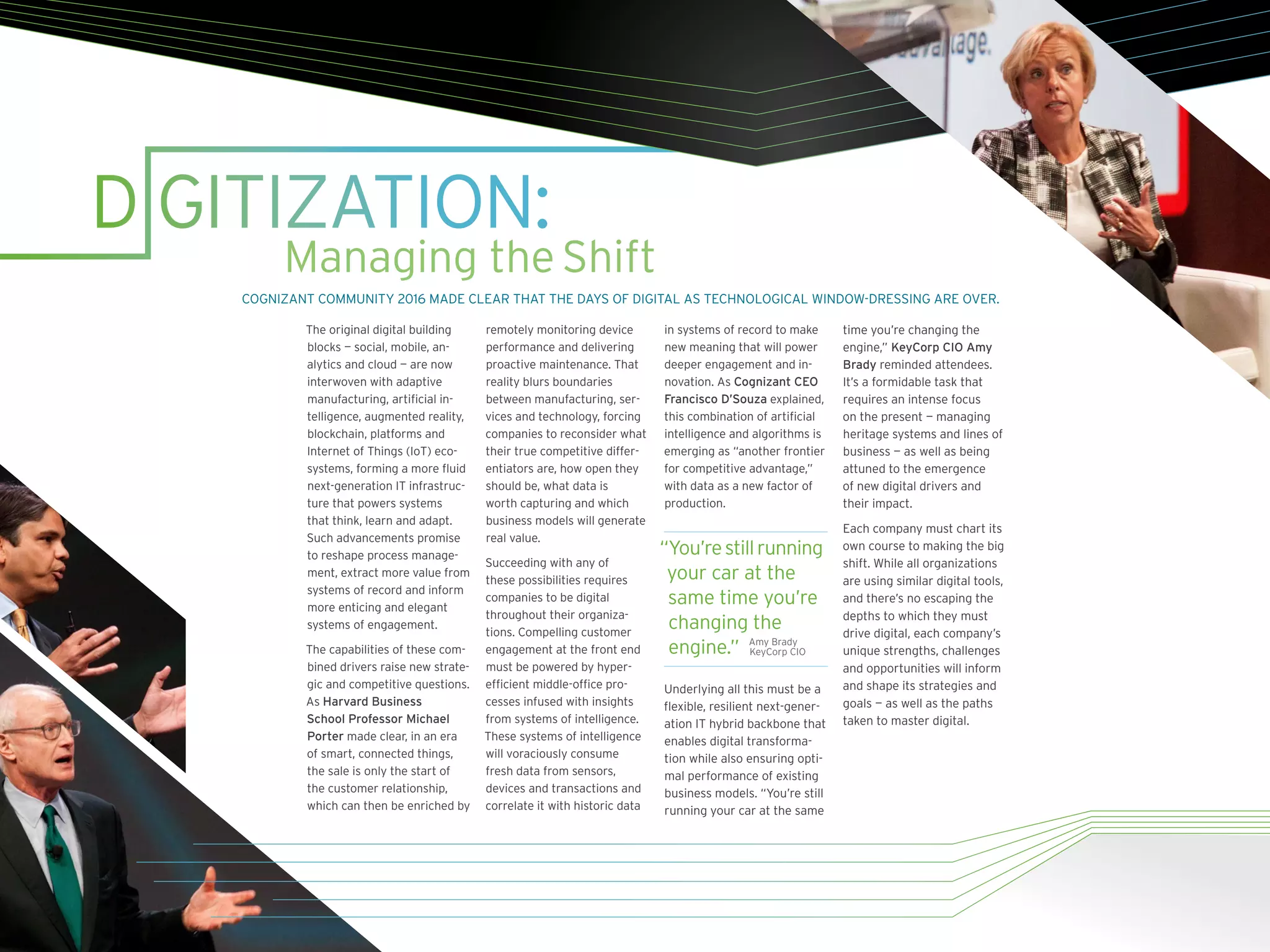
As Harvard Business
School Professor Michael
Porter made clear, in an era
of smart, connected things,
the sale is only the start of
the customer relationship,
which can then be enriched by
remotely monitoring device
performance and delivering
proactive maintenance. That
reality blurs boundaries
between manufacturing, ser-
vices and technology, forcing
companies to reconsider what
their true competitive differ-
entiators are, how open they
should be, what data is
worth capturing and which
business models will generate
real value.
Succeeding with any of
these possibilities requires
companies to be digital
throughout their organiza-
tions. Compelling customer
engagement at the front end
must be powered by hyper-
efficient middle-office pro-
cesses infused with insights
from systems of intelligence.
These systems of intelligence
will voraciously consume
fresh data from sensors,
devices and transactions and
correlate it with historic data
in systems of record to make
new meaning that will power
deeper engagement and in-
novation. As Cognizant CEO
Francisco D’Souza explained,
this combination of artificial
intelligence and algorithms is
emerging as “another frontier
for competitive advantage,”
with data as a new factor of
production.
“You’restillrunning
your car at the
same time you’re
changing the
engine.”
Underlying all this must be a
flexible, resilient next-gener-
ation IT hybrid backbone that
enables digital transforma-
tion while also ensuring opti-
mal performance of existing
business models. “You’re still
running your car at the same
time you’re changing the
engine,” KeyCorp CIO Amy
Brady reminded attendees.
It’s a formidable task that
requires an intense focus
on the present — managing
heritage systems and lines of
business — as well as being
attuned to the emergence
of new digital drivers and
their impact.
Each company must chart its
own course to making the big
shift. While all organizations
are using similar digital tools,
and there’s no escaping the
depths to which they must
drive digital, each company’s
unique strengths, challenges
and opportunities will inform
and shape its strategies and
goals — as well as the paths
taken to master digital.
COGNIZANT COMMUNITY 2016 MADE CLEAR THAT THE DAYS OF DIGITAL AS TECHNOLOGICAL WINDOW-DRESSING ARE OVER.
Amy Brady
KeyCorp CIO
EMBRACING BLOCKCHAIN
		 BEYOND CRYPTOCURRENCIES AND FIN-TECHS
”BLOCKCHAIN CAN BE THE FUNDAMENTAL BUILDING
BLOCK OF COLLABORATION TOOLS FOR THE 21ST CENTURY, IN
THE ENTERTAINMENT INDUSTRY AND BEYOND.”Ann Greenberg Entrepreneur, Founder of Gracenote and Sceneplay
Exploring blockchain tech-
nology is yet another way of
mastering digital — and not
just for financial services firms,
as blockchain pioneers on
Cognizant Community’s main
stage explained. Each expert
offered attendees a glimpse
of new business opportunities
made possible because distrib-
uted ledger technology is able
to create a shared, encrypted,
immutable record that dramati-
cally improves transparency and
security, while promising a more
frictionless and trusted way of
working.
Christopher Swanson, VP of
Research  Development
at U.S. Bank, is investigating
where blockchain can add the
most value by mitigating opera-
tional costs and delivering ma-
terial customer improvements,
and has found early opportu-
nity in streamlining inefficient,
limited-participant markets like
those for syndicated loans.
Beyond banking, blockchain can
reshape how content is created,
produced and monetized, said
Ann Greenberg, Founder/CEO
of Sceneplay. Her company’s
in-progress innovation, Smart
Script,™ capitalizes on block-
chain’s ability to secure content,
contract terms and ownership
rights, and then track that con-
tent’s consumption and royalty
payments. Greenberg envisions
marketplaces where artists sell
personalized content directly
to — even co-created with — fans,
with digital rights and payments
managed by smart contracts on
a blockchain.
All panelists exhorted attend-
ees to experiment with block-
chain through pilot projects
and prototypes. “Who better
to disrupt you than yourself?”
said Lata Varghese, leader
of Cognizant’s Blockchain
Practice.
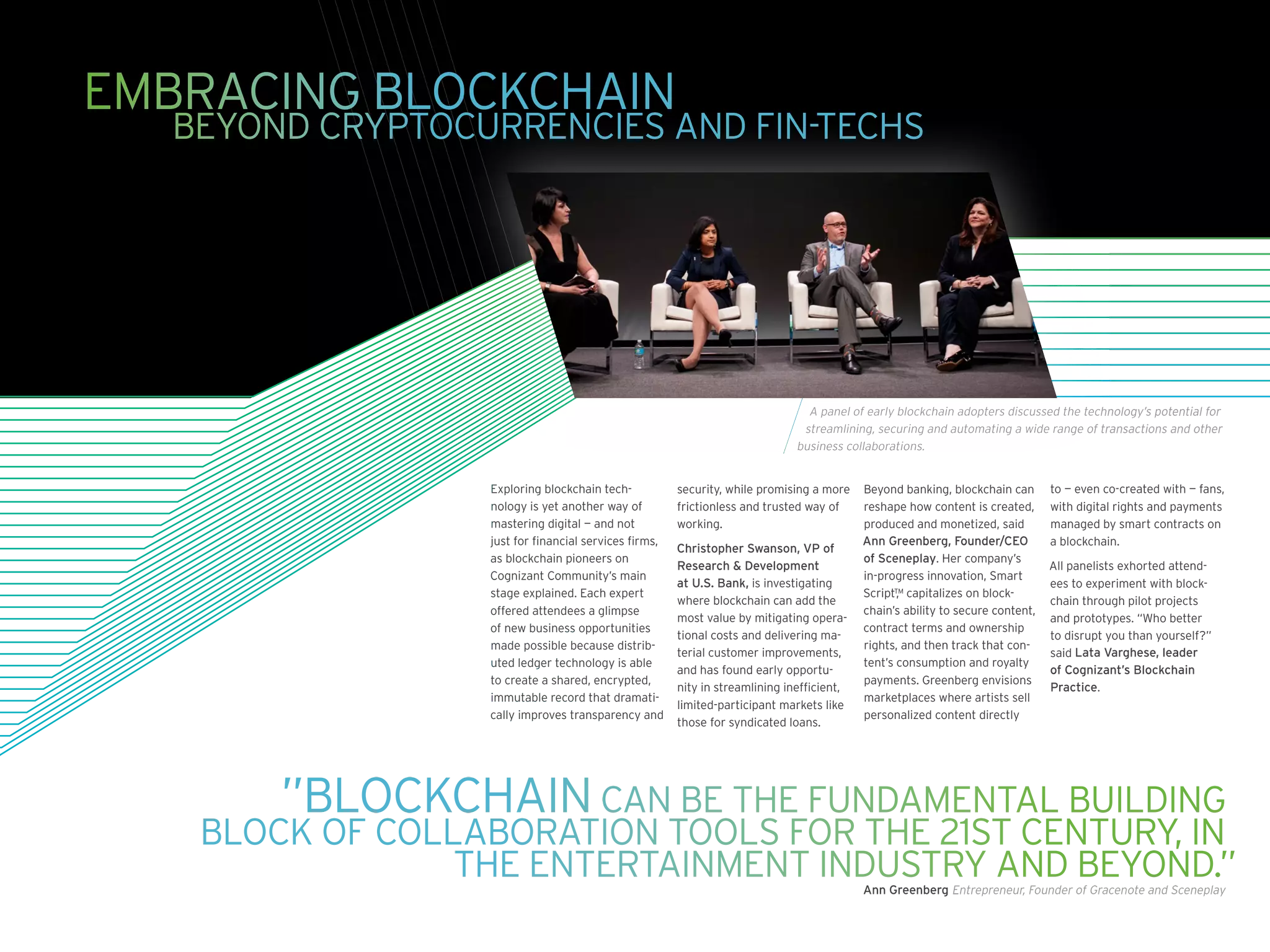
A panel of early blockchain adopters discussed the technology’s potential for
streamlining, securing and automating a wide range of transactions and other
business collaborations.
From software bots to machine
learning to narrow artificial intel-
ligence, automation will enable
organizations to participate in
what Cognizant Executive Vice-
President Malcolm Frank called
“the great digital build-out.” Digital
innovation in this phase will solve
hard problems in healthcare, ed-
ucation, transportation, financial
services and beyond, leading to a
new era of abundance.
Insights from organizations already
automating work illustrate its pos-
itive potential and impact. Robotic
process automation (RPA) expert
Mary Lacity noted how companies
are using RPA to reduce paperwork,
streamline processes, improve
customer service — and thus free
employees to focus on problem-
solving, innovation and other
rewarding activities. Contrary
to common perception, Lacity’s
research as Curators’ Professor of
Information Systems, University of
Missouri-St. Louis, shows RPA is
primarily driven by productivity, not
workforce reduction goals. In fact,
humans working
alongside software bots often treat
them as valued colleagues, giving
them names, personalities and
avatars.
RPA and artificial intelligence
will provide employees with the
insights to take “next best actions,”
as well as free them up to be
curious and innovative. Such ad-
vancements are the culmination of
humanity’s amazing last century or
so, during which more technologi-
cal advances have occurred than in
the previous 12,000 years, pointed
out Tim Urban, speaker, illustrator
and author. Urban posited that AI
is advancing faster than we may
appreciate and — alongside auto-
mation — is reshaping how we work
and live.
AI and machine learning will grow
increasingly smarter as these
technologies consume data from
systems of record and sensors to
feed a “virtuous positive cycle,”
Frank explained. In a time when
humanity’s collective intelligence
will likely fit on a smartphone,
businesses won’t base strategies
and decisions on guesswork but
on data-driven insights, unlocking
new horizons of innovation. New
products and services will emerge
that will be simultaneously obvious
and yet unimaginable. These dis-
coveries and inventions will power
new job growth and value creation.
Naysayers, he noted, suffer from a
“massive limitation of imagination”
at a time when progressive
businesses are poised to reap
abundant benefits from machine
intelligence, process digitization
and analytic tools.
AUTOMATION:
Powering Abundance in the Digital Business Era
JUST AS TEXTILE AUTOMATION LAUNCHED THE FIRST INDUSTRIAL REVOLUTION, AUTOMATION IS
AGAIN AN ESSENTIAL COMPONENT OF THE SO-CALLED FOURTH INDUSTRIAL REVOLUTION.
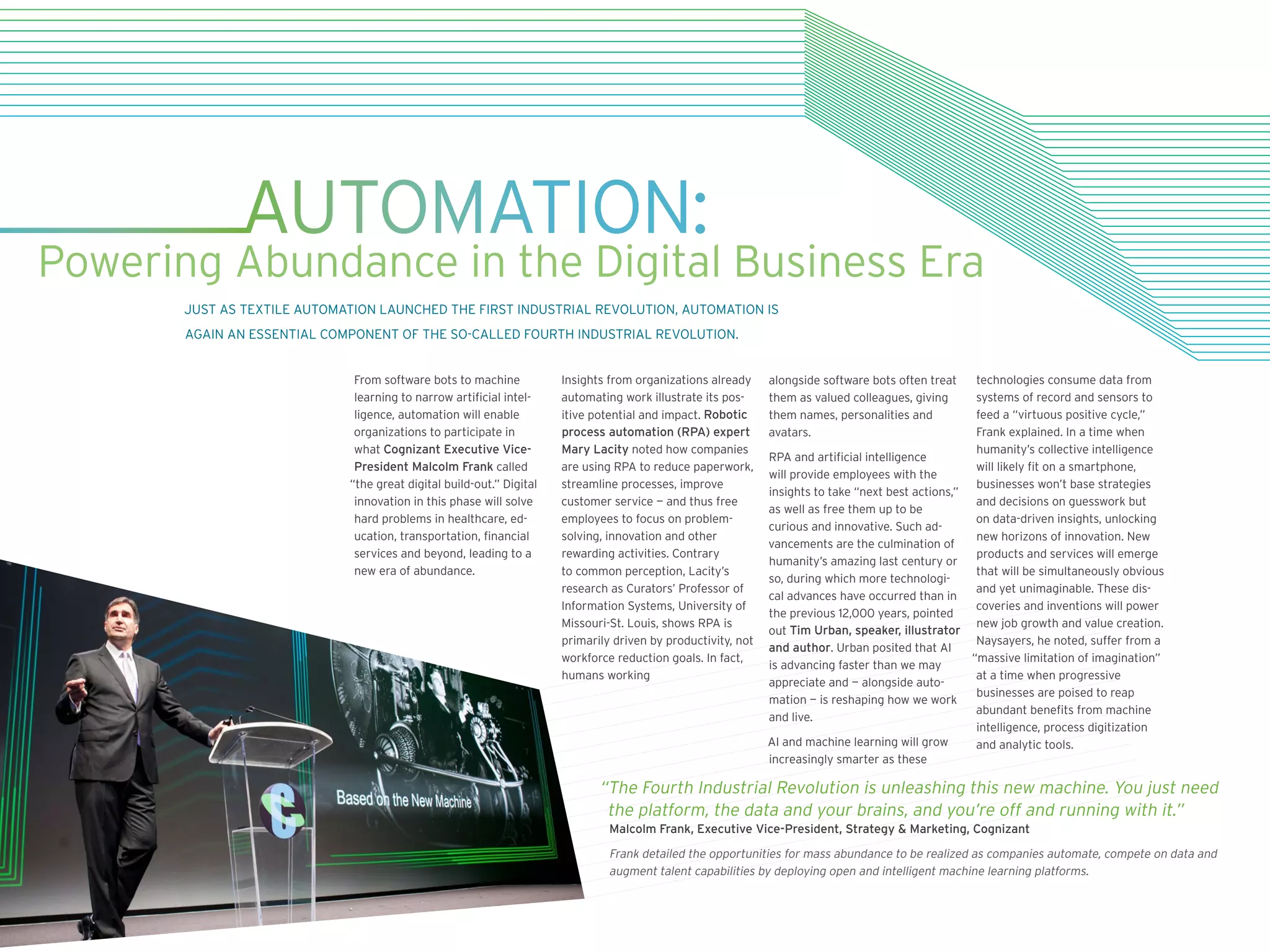
“The Fourth Industrial Revolution is unleashing this new machine. You just need
the platform, the data and your brains, and you’re off and running with it.”
Malcolm Frank, Executive Vice-President, Strategy  Marketing, Cognizant
Frank detailed the opportunities for mass abundance to be realized as companies automate, compete on data and
augment talent capabilities by deploying open and intelligent machine learning platforms.
“BY 2050, FOR $1,000, YOU’LL BE ABLE TO BUY A COMPUTER THAT
HAS THE PROCESSING POWER OF ALL THE HUMAN
BRAINS IN THE WORLD, COMBINED.”
Tim Urban, Speaker, Illustrator and Author, Wait But Why blog
Urban offered perspectives on the rise of artificial intelligence and
its potential impact on human progress.
While they could not join the
many renowned speakers on
the main stage, software bots
played a strong supporting role
at Cognizant Community 2016.
These bits of code are enabling
companies to swiftly automate
a wide array of repetitive, rules-
based tasks, such as adjudicat-
ing medical claims and gener-
ating paperwork for financial
transactions.
RPA can automate the connec-
tions among different systems
to complete a transaction or
assemble a comprehensive
customer history, eliminating
the “swivel-chair syndrome”
that results from inter- and in-
tra-process gaps and hand-offs,
and giving employees more in-
formation for decision-making.
RPA also frees employees from
the drudgery of tedious, menial
tasks so they can focus on work
that’s more rewarding to them —
and to their organizations.
Cognizant Community 2016
breakout sessions offered
guidelines for identifying
processes ripe for RPA and
detailed deployment strategies.
(For an overview, see our white
paper “The Robot and I.”)
“OUR ORGANIZATION HAS FOUND A HALF-DOZEN
OPPORTUNITIES FOR [RPA] TECHNOLOGY SINCE I
RETURNED FROM COMMUNITY. THIS MAY BE A REAL
GAME-CHANGER FOR US.”
— Cognizant Community 2016 attendee
THE SOFTWARE BOTS TAKE A BOW
Digital Showcase: Robotic Process Automation
“Increasingly, we are seeing companies deploy
RPA to enhance customer journeys and give
customers better, quicker and faster service.”
Mary Lacity, Curators’ Professor of Information Systems,
University of Missouri-St. Louis
Lacity shared case studies about the performance improvements companies
are achieving with practical applications of robotic process automation.
Understanding the Human Side of Digital
Paired with human imagination,
digital technologies can unleash
exciting new ideas, from aug-
mented reality to self-driving
cars. Yet innovations can also be
confined by narrow perspectives
and experiences. Querying sets of
big data does not always expand
these horizons because the queries
themselves are often shaped by
experiential and cultural biases.
Companies planning to invest deep-
ly in digital technologies should
“de-risk” those investments by pair-
ing big data with “thick data,” said
Christian Madsbjerg, who leads
ReD Associates, a human sciences
consultancy and Cognizant partner.
Madsbjerg and his ReD Associates
colleagues gather thick data using
social science and anthropolog-
ical study techniques to explore
target consumers’ relationships
with particular products or ser-
vices to reveal important insights.
This enables ReD researchers to
understand, for example, why au-
tomotive lane-keeping features are
welcomed in Detroit or Munich but
greatly annoy drivers in India and
China, where road lanes are casual
and rarely honored.
“When you only use 20% of what’s
in your car, that’s expensive and
dumb,” Madsbjerg asserted, point-
ing out the propensity for many
businesses to make blind bets on
which and how many functions to
include. Big data plus contextual
thick data gives companies a better
real-world understanding of which
features will solve problems cus-
tomers actually care about. “You
must ask the right queries to get
real value from investments in big
data,” he said.
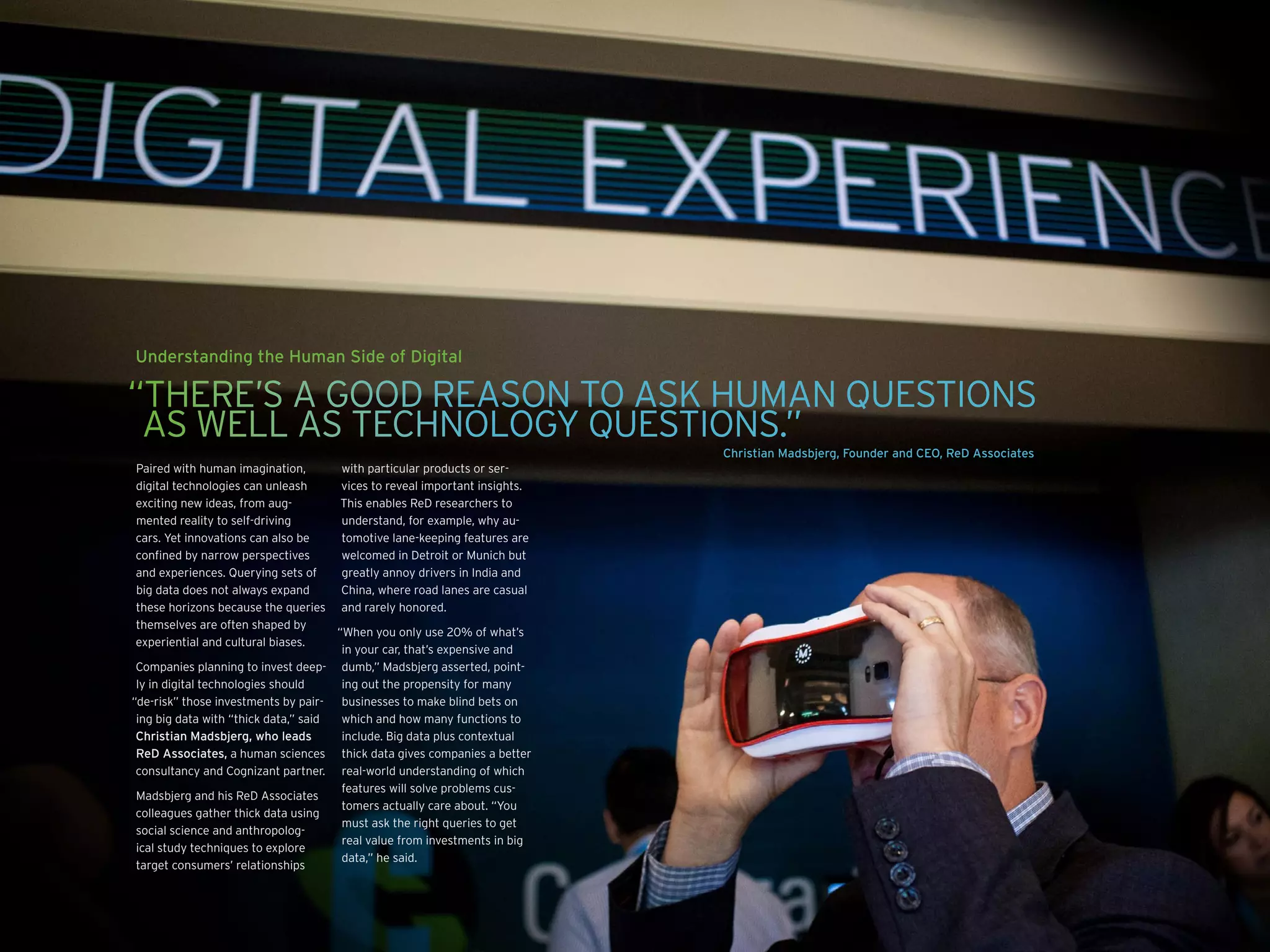
“THERE’S A GOOD REASON TO ASK HUMAN QUESTIONS
AS WELL AS TECHNOLOGY QUESTIONS.”
Christian Madsbjerg, Founder and CEO, ReD Associates
INSPIRAT ON:
Disrupting the Status Quo with Digital
FOR MOST COMPANIES, SUCCESSFULLY NAVIGATING THE SHIFT
TO DIGITAL BUSINESS REQUIRES CHANGE.
For all their promise, digital
drivers such as automa-
tion, APIs and augmented
reality are inert tools until
they are applied with human
imagination, creativity and
persistence. The challenge
is that many organizations
remain comfortable with the
status quo. “Before you can
lead with hope about change,
you have to destabilize [peo-
ple’s] enthusiasm for the way
they already operate,” noted
Adam Grant, professor at
the Wharton School of the
University of Pennsylvania
and best-selling author.
Deutsche Telekom’s Chief
Product  Innovation
Officer Christian von
Reventlow enthusiastically
explained how the compa-
ny asked its customers of
the future — today’s 10- to
16-year-olds — what they
want from telecom providers.
The answer: free service —
because these young digital
natives see connectivity as a
right. “The kids were saying
there will be no phones. This
really challenged the foun-
dations of telecom,” von
Reventlow pointed out.
With its comfort in the status
quo sufficiently shaken,
Deutsche Telekom is now
laying the groundwork for
new business models that
don’t necessarily have phone
service at their core.
Developing digital business
models and innovating the
next “obvious yet unimag-
inable” product or service
may seem as ambitious for
industrial-era organizations
as it is for humankind to go
to Mars — or for twin broth-
ers to go from New Jersey
to outer space. Yet retired
NASA astronauts Mark
Kelly and Scott Kelly shared
their strategies for how they
did just that.
Scott recounted his expe-
rience as an “18-year-old
failure” reading Tom Wolfe’s
The Right Stuff. The book in-
spired him to begin a journey
that started in flight school
and culminated with his
year-long mission aboard the
International Space Station.
His brother Mark explained
how persistence, practice
and perseverance enabled
him to “overcome a lack
of aptitude” for flying and
eventually become a deco-
rated aviator who piloted two
space shuttle missions and
was commander of two more.
Disrupting the status quo,
gaining necessary new skills,
pushing limits — none of
that is easy. Yet excelling at
challenging, difficult work
is what the Kellys like best
about being astronauts. In
closing the event, the broth-
ers echoed the exhortation
of Cognizant’s Malcolm Frank
that now is the time to tran-
sition from digital that’s fun,
to digital that matters. As
Scott said, “If we choose to
do the hard things, the sky is
definitely not the limit.”
“You have to reduce the benefit of the status quo before
you can get people enthusiastic about change.”
Adam Grant, Professor, Wharton School, University of Pennsylvania,
and Author of Originals, a New York Times best-seller
Grant provided insights about how to encourage original thinking and
drive change and innovation in large organizations.
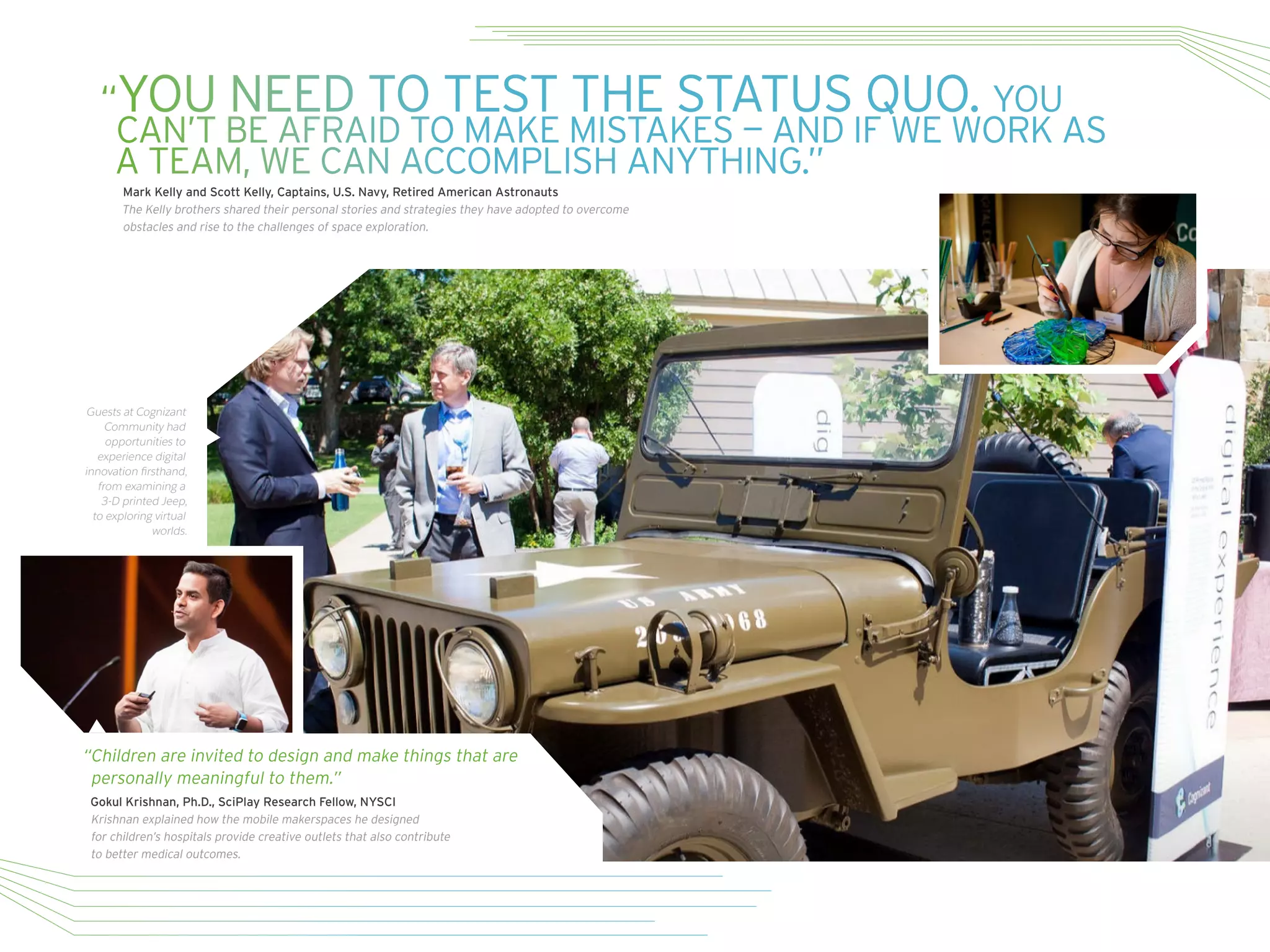
Guests at Cognizant
Community had
opportunities to
experience digital
innovation firsthand,
from examining a
3-D printed Jeep,
to exploring virtual
worlds.
“Children are invited to design and make things that are
personally meaningful to them.”
Gokul Krishnan, Ph.D., SciPlay Research Fellow, NYSCI
Krishnan explained how the mobile makerspaces he designed
for children’s hospitals provide creative outlets that also contribute
to better medical outcomes.
“YOU NEED TO TEST THE STATUS QUO. YOU
CAN’T BE AFRAID TO MAKE MISTAKES — AND IF WE WORK AS
A TEAM, WE CAN ACCOMPLISH ANYTHING.”
Mark Kelly and Scott Kelly, Captains, U.S. Navy, Retired American Astronauts
The Kelly brothers shared their personal stories and strategies they have adopted to overcome
obstacles and rise to the challenges of space exploration.
Compete on data.
Businesses need to instrument
products and transactions, in-
vestigate the human context and
invest in systems of intelligence.
This will enable them to make
meaning and create insights that
guide customer engagement and
fuel continuing cycles of innova-
tion and improvement.
Automate.
RPA is contributing handily to
organizational cost reduction
and productivity, as well as
employee satisfaction, by freeing
up people from rote work
and enabling them to apply
creativity to more meaningful
and valuable activities. Identify
your rules-based and repetitive
processes and turn those over
to software bots.
Find your platform.
Explore how your organization
can benefit from the power of
platforms (whether focused on
innovation, transactions or intel-
ligent insights) and open appli-
cation programming interfaces
(APIs), whether by launching a
platform, participating on exist-
ing platforms or engaging in a
hybrid strategy.
Embed change
management
planning
throughout the
organization.
Digital business changes the way
the sales and marketing func-
tions interact with customers
and how software developers
collaborate with IT operations
experts. Both talent and reward
structures are impacted by digi-
tal. Be prepared.
Develop your
next-generation
IT hybrid
infrastructure.
Hybrid infrastructures using
cloud, platforms, open APIs,
micro-services, service providers,
etc. will give companies the flexi-
bility and scalability they need to
support heritage systems.
Understand
blockchain.
Investigate how your organi-
zation and industry can apply
blockchain-based technology
and approaches to automate and
secure a wide array of interac-
tions and transactions; invest in
cryptography talent now before
demand outstrips supply.
ACTIONMastering Digital: What to Do Now
ATTENDEES LEFT COGNIZANT COMMUNITY 2016 WITH ACTIONABLE INSIGHTS TO
PURSUE DIGITAL MASTERY. TAKEAWAYS INCLUDED:
KEYNOTE SPEAKERS
Amy G. Brady
Chief Information Officer, KeyCorp
Francisco D’Souza
Chief Executive Officer, Cognizant
Peter C. Evans, Ph.D.
Vice-President, The Center for
Global Enterprise
Theodore “Theo” Forbath
Global Vice-President of Digital
Transformation, Cognizant
Malcolm Frank
Executive Vice-President, Strategy
 Marketing, Cognizant
Adam Grant
Professor, The Wharton School of
the University of Pennsylvania and
Author of Originals, a New York
Times best-seller
Ann Greenberg
Entrepreneur, Founder of
Sceneplay
Gajen Kandiah
Executive Vice-President and
President, Cognizant Digital Works
Mark Kelly
Captain, U.S. Navy, Retired
American Astronaut
Scott Kelly
Captain, U.S. Navy, Retired
American Astronaut
Gokul Krishnan, Ph.D.
SciPlay Research Fellow, NYSCI
Lynne LaCascia
Assistant Vice-President, Global
Director of Brand Narrative,
Cognizant
Mary Lacity
Professor of Information Systems,
University of Missouri-St. Louis
Christian Madsbjerg
Founder  Senior Partner,
ReD Associates
Michael E. Porter
Professor, Harvard Business School
Paul Roehrig, Ph.D.
Vice-President, Global Managing
Director, Center for the Future of
Work, Cognizant
Christopher Swanson
Vice-President
Innovation Research and
Development, U.S. Bank
Tim Urban
Speaker, Illustrator and Author,
Wait But Why blog
Lata Varghese
Assistant Vice-President,
Blockchain, Cognizant
Christian von Reventlow
Chief Product  Innovation Officer,
Deutsche Telekom
ABOUT COGNIZANT
Cognizant (NASDAQ: CTSH) is a leading provider of informa-
tion technology, consulting, and business process outsourcing
services, dedicated to helping the world’s leading companies
build stronger businesses. Headquartered in Teaneck, New
Jersey (U.S.), Cognizant combines a passion for client satis-
faction, technology innovation, deep industry and business
process expertise, and a global, collaborative workforce that
embodies the future of work. With over 100 development
and delivery centers worldwide and approximately 244,300
employees as of June 30, 2016, Cognizant is a member of the
NASDAQ-100, the SP 500, the Forbes Global 2000, and
the Fortune 500 and is ranked among the top performing and
fastest growing companies in the world. Visit us online at
www.cognizant.com or follow us on Twitter: Cognizant.
© Copyright 2016, Cognizant. All rights reserved. No part of
this document may be reproduced, stored in a retrieval system,
transmitted in any form or by any means, electronic, mechanical,
photocopying, recording, or otherwise, without the express written
permission from Cognizant. The information contained herein is
subject to change without notice. All other trademarks mentioned
herein are the property of their respective owners.
RELIVE THE COGNIZANT COMMUNITY 2016 EXPERIENCE

Cognizant Community 2016: Mastering Digital: How to Navigate the Shift to the Digital Business Era

  • 1.
    COMMUNITY COGNIZANT MASTERING DIGITAL How toNavigate the Shift to the Digital Business Era United States • 2016
  • 2.
    For more thana decade, this unique event has provided busy executives with an opportunity to exchange ideas and insights both with each other and with acclaimed subject matter experts on the panoply of topics critical to advancing their business objectives today — and tomorrow. Cognizant Community U.S. 2016 took this experience to another level. Captains of industry gathered just outside of Austin, TX, to hear world- class authorities, fellow practitioners and Cognizant thought leaders delve deeply into tackling “digital that matters.” Together they explored the next-generation infrastructure, process optimization and digital business solutions that are trans- forming individual companies and entire industries. Interactive break- out sessions revealed digital trends in specific industries and practical applications of automation, artifi- cial intelligence, augmented reality and more. The event also revealed the human side of digital, with thought-provoking cases and inspir- ing stories of digital innovation. Read on for a sampling of these major technology and business themes — and experiences — that captivated attendees at our 2016 event and equipped them to master digital. “VERY INSPIRATIONAL AND MOTIVATING.” “The WOW factor was off the charts … tons of great takeaways.” ”The most thought-provoking conference I’ve attended.” “A FIVE-STAR JOB.” IN A WORLD OF GENERIC CONFERENCES AND NOISY TRADE SHOWS, OUR CLIENTS SAY COGNIZANT COMMUNITY STANDS ALONE. — COGNIZANT COMMUNITY ATTENDEES COMMUNITY COGNIZANT
  • 3.
    SEE THE COMINGDIGITAL JOURNEY
  • 4.
    D GITIZATION: Managing theShift Theoriginal digital building blocks — social, mobile, an- alytics and cloud — are now interwoven with adaptive manufacturing, artificial in- telligence, augmented reality, blockchain, platforms and Internet of Things (IoT) eco- systems, forming a more fluid next-generation IT infrastruc- ture that powers systems that think, learn and adapt. Such advancements promise to reshape process manage- ment, extract more value from systems of record and inform more enticing and elegant systems of engagement. The capabilities of these com- bined drivers raise new strate- gic and competitive questions. As Harvard Business School Professor Michael Porter made clear, in an era of smart, connected things, the sale is only the start of the customer relationship, which can then be enriched by remotely monitoring device performance and delivering proactive maintenance. That reality blurs boundaries between manufacturing, ser- vices and technology, forcing companies to reconsider what their true competitive differ- entiators are, how open they should be, what data is worth capturing and which business models will generate real value. Succeeding with any of these possibilities requires companies to be digital throughout their organiza- tions. Compelling customer engagement at the front end must be powered by hyper- efficient middle-office pro- cesses infused with insights from systems of intelligence. These systems of intelligence will voraciously consume fresh data from sensors, devices and transactions and correlate it with historic data in systems of record to make new meaning that will power deeper engagement and in- novation. As Cognizant CEO Francisco D’Souza explained, this combination of artificial intelligence and algorithms is emerging as “another frontier for competitive advantage,” with data as a new factor of production. “You’restillrunning your car at the same time you’re changing the engine.” Underlying all this must be a flexible, resilient next-gener- ation IT hybrid backbone that enables digital transforma- tion while also ensuring opti- mal performance of existing business models. “You’re still running your car at the same time you’re changing the engine,” KeyCorp CIO Amy Brady reminded attendees. It’s a formidable task that requires an intense focus on the present — managing heritage systems and lines of business — as well as being attuned to the emergence of new digital drivers and their impact. Each company must chart its own course to making the big shift. While all organizations are using similar digital tools, and there’s no escaping the depths to which they must drive digital, each company’s unique strengths, challenges and opportunities will inform and shape its strategies and goals — as well as the paths taken to master digital. COGNIZANT COMMUNITY 2016 MADE CLEAR THAT THE DAYS OF DIGITAL AS TECHNOLOGICAL WINDOW-DRESSING ARE OVER. Amy Brady KeyCorp CIO
  • 5.
    EMBRACING BLOCKCHAIN BEYONDCRYPTOCURRENCIES AND FIN-TECHS ”BLOCKCHAIN CAN BE THE FUNDAMENTAL BUILDING BLOCK OF COLLABORATION TOOLS FOR THE 21ST CENTURY, IN THE ENTERTAINMENT INDUSTRY AND BEYOND.”Ann Greenberg Entrepreneur, Founder of Gracenote and Sceneplay Exploring blockchain tech- nology is yet another way of mastering digital — and not just for financial services firms, as blockchain pioneers on Cognizant Community’s main stage explained. Each expert offered attendees a glimpse of new business opportunities made possible because distrib- uted ledger technology is able to create a shared, encrypted, immutable record that dramati- cally improves transparency and security, while promising a more frictionless and trusted way of working. Christopher Swanson, VP of Research Development at U.S. Bank, is investigating where blockchain can add the most value by mitigating opera- tional costs and delivering ma- terial customer improvements, and has found early opportu- nity in streamlining inefficient, limited-participant markets like those for syndicated loans. Beyond banking, blockchain can reshape how content is created, produced and monetized, said Ann Greenberg, Founder/CEO of Sceneplay. Her company’s in-progress innovation, Smart Script,™ capitalizes on block- chain’s ability to secure content, contract terms and ownership rights, and then track that con- tent’s consumption and royalty payments. Greenberg envisions marketplaces where artists sell personalized content directly to — even co-created with — fans, with digital rights and payments managed by smart contracts on a blockchain. All panelists exhorted attend- ees to experiment with block- chain through pilot projects and prototypes. “Who better to disrupt you than yourself?” said Lata Varghese, leader of Cognizant’s Blockchain Practice. A panel of early blockchain adopters discussed the technology’s potential for streamlining, securing and automating a wide range of transactions and other business collaborations.
  • 6.
    From software botsto machine learning to narrow artificial intel- ligence, automation will enable organizations to participate in what Cognizant Executive Vice- President Malcolm Frank called “the great digital build-out.” Digital innovation in this phase will solve hard problems in healthcare, ed- ucation, transportation, financial services and beyond, leading to a new era of abundance. Insights from organizations already automating work illustrate its pos- itive potential and impact. Robotic process automation (RPA) expert Mary Lacity noted how companies are using RPA to reduce paperwork, streamline processes, improve customer service — and thus free employees to focus on problem- solving, innovation and other rewarding activities. Contrary to common perception, Lacity’s research as Curators’ Professor of Information Systems, University of Missouri-St. Louis, shows RPA is primarily driven by productivity, not workforce reduction goals. In fact, humans working alongside software bots often treat them as valued colleagues, giving them names, personalities and avatars. RPA and artificial intelligence will provide employees with the insights to take “next best actions,” as well as free them up to be curious and innovative. Such ad- vancements are the culmination of humanity’s amazing last century or so, during which more technologi- cal advances have occurred than in the previous 12,000 years, pointed out Tim Urban, speaker, illustrator and author. Urban posited that AI is advancing faster than we may appreciate and — alongside auto- mation — is reshaping how we work and live. AI and machine learning will grow increasingly smarter as these technologies consume data from systems of record and sensors to feed a “virtuous positive cycle,” Frank explained. In a time when humanity’s collective intelligence will likely fit on a smartphone, businesses won’t base strategies and decisions on guesswork but on data-driven insights, unlocking new horizons of innovation. New products and services will emerge that will be simultaneously obvious and yet unimaginable. These dis- coveries and inventions will power new job growth and value creation. Naysayers, he noted, suffer from a “massive limitation of imagination” at a time when progressive businesses are poised to reap abundant benefits from machine intelligence, process digitization and analytic tools. AUTOMATION: Powering Abundance in the Digital Business Era JUST AS TEXTILE AUTOMATION LAUNCHED THE FIRST INDUSTRIAL REVOLUTION, AUTOMATION IS AGAIN AN ESSENTIAL COMPONENT OF THE SO-CALLED FOURTH INDUSTRIAL REVOLUTION. “The Fourth Industrial Revolution is unleashing this new machine. You just need the platform, the data and your brains, and you’re off and running with it.” Malcolm Frank, Executive Vice-President, Strategy Marketing, Cognizant Frank detailed the opportunities for mass abundance to be realized as companies automate, compete on data and augment talent capabilities by deploying open and intelligent machine learning platforms.
  • 7.
    “BY 2050, FOR$1,000, YOU’LL BE ABLE TO BUY A COMPUTER THAT HAS THE PROCESSING POWER OF ALL THE HUMAN BRAINS IN THE WORLD, COMBINED.” Tim Urban, Speaker, Illustrator and Author, Wait But Why blog Urban offered perspectives on the rise of artificial intelligence and its potential impact on human progress. While they could not join the many renowned speakers on the main stage, software bots played a strong supporting role at Cognizant Community 2016. These bits of code are enabling companies to swiftly automate a wide array of repetitive, rules- based tasks, such as adjudicat- ing medical claims and gener- ating paperwork for financial transactions. RPA can automate the connec- tions among different systems to complete a transaction or assemble a comprehensive customer history, eliminating the “swivel-chair syndrome” that results from inter- and in- tra-process gaps and hand-offs, and giving employees more in- formation for decision-making. RPA also frees employees from the drudgery of tedious, menial tasks so they can focus on work that’s more rewarding to them — and to their organizations. Cognizant Community 2016 breakout sessions offered guidelines for identifying processes ripe for RPA and detailed deployment strategies. (For an overview, see our white paper “The Robot and I.”) “OUR ORGANIZATION HAS FOUND A HALF-DOZEN OPPORTUNITIES FOR [RPA] TECHNOLOGY SINCE I RETURNED FROM COMMUNITY. THIS MAY BE A REAL GAME-CHANGER FOR US.” — Cognizant Community 2016 attendee THE SOFTWARE BOTS TAKE A BOW Digital Showcase: Robotic Process Automation “Increasingly, we are seeing companies deploy RPA to enhance customer journeys and give customers better, quicker and faster service.” Mary Lacity, Curators’ Professor of Information Systems, University of Missouri-St. Louis Lacity shared case studies about the performance improvements companies are achieving with practical applications of robotic process automation.
  • 8.
    Understanding the HumanSide of Digital Paired with human imagination, digital technologies can unleash exciting new ideas, from aug- mented reality to self-driving cars. Yet innovations can also be confined by narrow perspectives and experiences. Querying sets of big data does not always expand these horizons because the queries themselves are often shaped by experiential and cultural biases. Companies planning to invest deep- ly in digital technologies should “de-risk” those investments by pair- ing big data with “thick data,” said Christian Madsbjerg, who leads ReD Associates, a human sciences consultancy and Cognizant partner. Madsbjerg and his ReD Associates colleagues gather thick data using social science and anthropolog- ical study techniques to explore target consumers’ relationships with particular products or ser- vices to reveal important insights. This enables ReD researchers to understand, for example, why au- tomotive lane-keeping features are welcomed in Detroit or Munich but greatly annoy drivers in India and China, where road lanes are casual and rarely honored. “When you only use 20% of what’s in your car, that’s expensive and dumb,” Madsbjerg asserted, point- ing out the propensity for many businesses to make blind bets on which and how many functions to include. Big data plus contextual thick data gives companies a better real-world understanding of which features will solve problems cus- tomers actually care about. “You must ask the right queries to get real value from investments in big data,” he said. “THERE’S A GOOD REASON TO ASK HUMAN QUESTIONS AS WELL AS TECHNOLOGY QUESTIONS.” Christian Madsbjerg, Founder and CEO, ReD Associates
  • 9.
    INSPIRAT ON: Disrupting theStatus Quo with Digital FOR MOST COMPANIES, SUCCESSFULLY NAVIGATING THE SHIFT TO DIGITAL BUSINESS REQUIRES CHANGE. For all their promise, digital drivers such as automa- tion, APIs and augmented reality are inert tools until they are applied with human imagination, creativity and persistence. The challenge is that many organizations remain comfortable with the status quo. “Before you can lead with hope about change, you have to destabilize [peo- ple’s] enthusiasm for the way they already operate,” noted Adam Grant, professor at the Wharton School of the University of Pennsylvania and best-selling author. Deutsche Telekom’s Chief Product Innovation Officer Christian von Reventlow enthusiastically explained how the compa- ny asked its customers of the future — today’s 10- to 16-year-olds — what they want from telecom providers. The answer: free service — because these young digital natives see connectivity as a right. “The kids were saying there will be no phones. This really challenged the foun- dations of telecom,” von Reventlow pointed out. With its comfort in the status quo sufficiently shaken, Deutsche Telekom is now laying the groundwork for new business models that don’t necessarily have phone service at their core. Developing digital business models and innovating the next “obvious yet unimag- inable” product or service may seem as ambitious for industrial-era organizations as it is for humankind to go to Mars — or for twin broth- ers to go from New Jersey to outer space. Yet retired NASA astronauts Mark Kelly and Scott Kelly shared their strategies for how they did just that. Scott recounted his expe- rience as an “18-year-old failure” reading Tom Wolfe’s The Right Stuff. The book in- spired him to begin a journey that started in flight school and culminated with his year-long mission aboard the International Space Station. His brother Mark explained how persistence, practice and perseverance enabled him to “overcome a lack of aptitude” for flying and eventually become a deco- rated aviator who piloted two space shuttle missions and was commander of two more. Disrupting the status quo, gaining necessary new skills, pushing limits — none of that is easy. Yet excelling at challenging, difficult work is what the Kellys like best about being astronauts. In closing the event, the broth- ers echoed the exhortation of Cognizant’s Malcolm Frank that now is the time to tran- sition from digital that’s fun, to digital that matters. As Scott said, “If we choose to do the hard things, the sky is definitely not the limit.” “You have to reduce the benefit of the status quo before you can get people enthusiastic about change.” Adam Grant, Professor, Wharton School, University of Pennsylvania, and Author of Originals, a New York Times best-seller Grant provided insights about how to encourage original thinking and drive change and innovation in large organizations.
  • 10.
    Guests at Cognizant Communityhad opportunities to experience digital innovation firsthand, from examining a 3-D printed Jeep, to exploring virtual worlds. “Children are invited to design and make things that are personally meaningful to them.” Gokul Krishnan, Ph.D., SciPlay Research Fellow, NYSCI Krishnan explained how the mobile makerspaces he designed for children’s hospitals provide creative outlets that also contribute to better medical outcomes. “YOU NEED TO TEST THE STATUS QUO. YOU CAN’T BE AFRAID TO MAKE MISTAKES — AND IF WE WORK AS A TEAM, WE CAN ACCOMPLISH ANYTHING.” Mark Kelly and Scott Kelly, Captains, U.S. Navy, Retired American Astronauts The Kelly brothers shared their personal stories and strategies they have adopted to overcome obstacles and rise to the challenges of space exploration.
  • 11.
    Compete on data. Businessesneed to instrument products and transactions, in- vestigate the human context and invest in systems of intelligence. This will enable them to make meaning and create insights that guide customer engagement and fuel continuing cycles of innova- tion and improvement. Automate. RPA is contributing handily to organizational cost reduction and productivity, as well as employee satisfaction, by freeing up people from rote work and enabling them to apply creativity to more meaningful and valuable activities. Identify your rules-based and repetitive processes and turn those over to software bots. Find your platform. Explore how your organization can benefit from the power of platforms (whether focused on innovation, transactions or intel- ligent insights) and open appli- cation programming interfaces (APIs), whether by launching a platform, participating on exist- ing platforms or engaging in a hybrid strategy. Embed change management planning throughout the organization. Digital business changes the way the sales and marketing func- tions interact with customers and how software developers collaborate with IT operations experts. Both talent and reward structures are impacted by digi- tal. Be prepared. Develop your next-generation IT hybrid infrastructure. Hybrid infrastructures using cloud, platforms, open APIs, micro-services, service providers, etc. will give companies the flexi- bility and scalability they need to support heritage systems. Understand blockchain. Investigate how your organi- zation and industry can apply blockchain-based technology and approaches to automate and secure a wide array of interac- tions and transactions; invest in cryptography talent now before demand outstrips supply. ACTIONMastering Digital: What to Do Now ATTENDEES LEFT COGNIZANT COMMUNITY 2016 WITH ACTIONABLE INSIGHTS TO PURSUE DIGITAL MASTERY. TAKEAWAYS INCLUDED:
  • 12.
    KEYNOTE SPEAKERS Amy G.Brady Chief Information Officer, KeyCorp Francisco D’Souza Chief Executive Officer, Cognizant Peter C. Evans, Ph.D. Vice-President, The Center for Global Enterprise Theodore “Theo” Forbath Global Vice-President of Digital Transformation, Cognizant Malcolm Frank Executive Vice-President, Strategy Marketing, Cognizant Adam Grant Professor, The Wharton School of the University of Pennsylvania and Author of Originals, a New York Times best-seller Ann Greenberg Entrepreneur, Founder of Sceneplay Gajen Kandiah Executive Vice-President and President, Cognizant Digital Works Mark Kelly Captain, U.S. Navy, Retired American Astronaut Scott Kelly Captain, U.S. Navy, Retired American Astronaut Gokul Krishnan, Ph.D. SciPlay Research Fellow, NYSCI Lynne LaCascia Assistant Vice-President, Global Director of Brand Narrative, Cognizant Mary Lacity Professor of Information Systems, University of Missouri-St. Louis Christian Madsbjerg Founder Senior Partner, ReD Associates Michael E. Porter Professor, Harvard Business School Paul Roehrig, Ph.D. Vice-President, Global Managing Director, Center for the Future of Work, Cognizant Christopher Swanson Vice-President Innovation Research and Development, U.S. Bank Tim Urban Speaker, Illustrator and Author, Wait But Why blog Lata Varghese Assistant Vice-President, Blockchain, Cognizant Christian von Reventlow Chief Product Innovation Officer, Deutsche Telekom ABOUT COGNIZANT Cognizant (NASDAQ: CTSH) is a leading provider of informa- tion technology, consulting, and business process outsourcing services, dedicated to helping the world’s leading companies build stronger businesses. Headquartered in Teaneck, New Jersey (U.S.), Cognizant combines a passion for client satis- faction, technology innovation, deep industry and business process expertise, and a global, collaborative workforce that embodies the future of work. With over 100 development and delivery centers worldwide and approximately 244,300 employees as of June 30, 2016, Cognizant is a member of the NASDAQ-100, the SP 500, the Forbes Global 2000, and the Fortune 500 and is ranked among the top performing and fastest growing companies in the world. Visit us online at www.cognizant.com or follow us on Twitter: Cognizant. © Copyright 2016, Cognizant. All rights reserved. No part of this document may be reproduced, stored in a retrieval system, transmitted in any form or by any means, electronic, mechanical, photocopying, recording, or otherwise, without the express written permission from Cognizant. The information contained herein is subject to change without notice. All other trademarks mentioned herein are the property of their respective owners. RELIVE THE COGNIZANT COMMUNITY 2016 EXPERIENCE