Securing Databases in the Cloud
Steven C. Markey, MSIS, PMP, CISSP, CIPP, CISM, CISA, STS-EV, CCSK, CompTIA Cloud
Essentials
Principal, nControl, LLC
Adjunct Professor
President, Cloud Security Alliance – Delaware Valley Chapter (CSA-DelVal)
• Presentation Overview
– Cloud Overview
– Database Overview
– Big Data Overview
– Cloud-Based DB Solutions
– Securing Cloud-Based DB Solutions
• Vulnerabilities Found in Cloud-Based Offerings
• Securing Your Relational Cloud-Based Offerings
• Securing Your Non-Relational Cloud-Based
Offerings
– Privacy & Data Protection for Cloud-Based DBs
– Case Study: MySQL & SimpleDB in the Cloud
Securing Databases in the Cloud
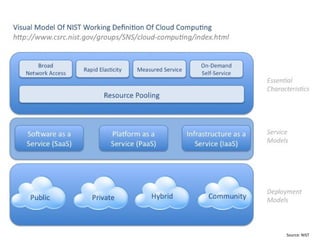
Source: NIST
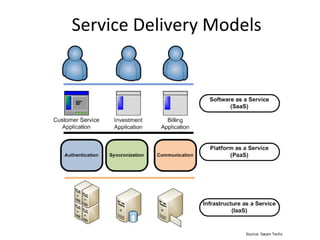
Service Delivery Models
Source: Swain Techs
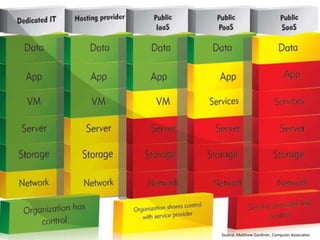
Source: Matthew Gardiner, Computer Associates
Securing Databases in the Cloud
• Database Overview
– Database Management Systems
• Relational Database Management Systems (RDBMS)
• Object-Oriented Database Management Systems (OODBMS)
• Non-Relational, Distributed DB Mgmt Systems (NRDBMS)
– Not only – Structured Query Language (NoSQL)
– Online Transaction Processing (OLTP)
• Real-time Data Warehousing
– Online Analytical Processing (OLAP)
• Operational Data Stores (ODS)
• Enterprise Data Warehouse (EDW)
Securing Databases in the Cloud
• Database Overview
– Online Analytical Processing (OLAP)
• Business Intelligence (BI)
– Data Mining
– Reporting
– OLAP
Securing Databases in the Cloud
• Database Overview
– OLAP (Continued)
• Business Intelligence (BI) (Continued)
– OLAP (Continued)
» Relational OLAP (ROLAP)
» Multi-Dimensional OLAP (MOLAP)
» Hybrid OLAP (HOLAP)
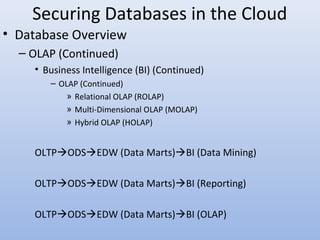
OLTPODSEDW (Data Marts)BI (Data Mining)
OLTPODSEDW (Data Marts)BI (Reporting)
OLTPODSEDW (Data Marts)BI (OLAP)
Securing Databases in the Cloud
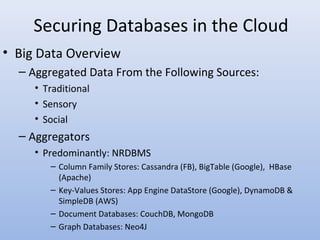
• Big Data Overview
– Aggregated Data From the Following Sources:
• Traditional
• Sensory
• Social
– Aggregators
• Predominantly: NRDBMS
– Column Family Stores: Cassandra (FB), BigTable (Google), HBase
(Apache)
– Key-Values Stores: App Engine DataStore (Google), DynamoDB &
SimpleDB (AWS)
– Document Databases: CouchDB, MongoDB
– Graph Databases: Neo4J
Securing Databases in the Cloud
• Big Data Overview
– Serial Processing
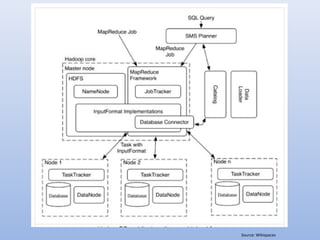
• Hadoop
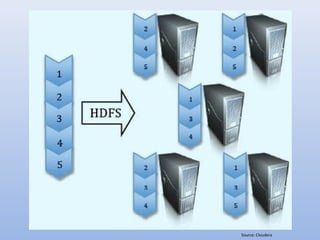
– Hadoop Distributed File System (HDFS)
– Hive – DW
– Pig – Querying Language
• Riak
– Parallel Processing
• HadoopDB
– Analytics
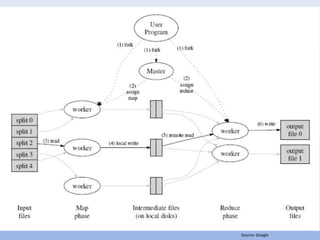
• Google MapReduce
• Apache MapReduce
• Splunk (for Security Information / Event Management [SIEM])
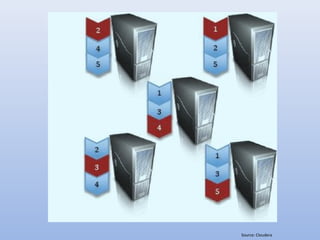
Source: Cloudera
Source: Wikispaces
Source: Google
Source: Cloudera
Securing Databases in the Cloud
• Cloud-Based Database Solutions
– PaaS
• DBaaS
– Force.com
– Intuit QuickBase
– Amazon Web Services (AWS)
» Relational Database Service (RDS) Oracle 11g / MySQL
» DynamoDB
» SimpleDB
– Google App Engine
» Datastore
– Oracle Public Cloud
» 11g
Securing Databases in the Cloud
• Cloud-Based Database Solutions
– IaaS
• Build MySQL, Microsoft SQL Server, or Oracle 11g Instance
• Leverage Compute Node & Storage Node Effectively
– AWS Elastic Compute Cloud (EC2)
– AWS Elastic Block Store (EBS)
– OpenStack Compute (Nova)
– OpenStack Storage (Swift)
Securing Databases in the Cloud
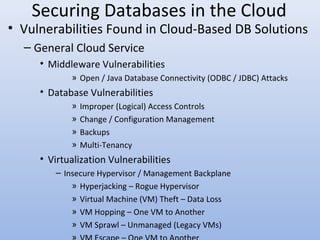
• Vulnerabilities Found in Cloud-Based DB Solutions
– General Cloud Service
• Middleware Vulnerabilities
» Open / Java Database Connectivity (ODBC / JDBC) Attacks
• Database Vulnerabilities
» Improper (Logical) Access Controls
» Change / Configuration Management
» Backups
» Multi-Tenancy
• Virtualization Vulnerabilities
– Insecure Hypervisor / Management Backplane
» Hyperjacking – Rogue Hypervisor
» Virtual Machine (VM) Theft – Data Loss
» VM Hopping – One VM to Another
» VM Sprawl – Unmanaged (Legacy VMs)
Securing Databases in the Cloud
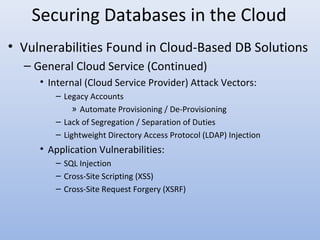
• Vulnerabilities Found in Cloud-Based DB Solutions
– General Cloud Service (Continued)
• Internal (Cloud Service Provider) Attack Vectors:
– Legacy Accounts
» Automate Provisioning / De-Provisioning
– Lack of Segregation / Separation of Duties
– Lightweight Directory Access Protocol (LDAP) Injection
• Application Vulnerabilities:
– SQL Injection
– Cross-Site Scripting (XSS)
– Cross-Site Request Forgery (XSRF)
Securing Databases in the Cloud
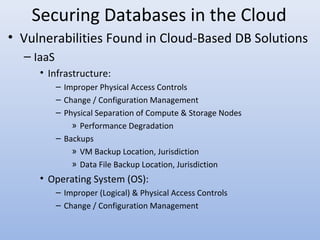
• Vulnerabilities Found in Cloud-Based DB Solutions
– IaaS
• Infrastructure:
– Improper Physical Access Controls
– Change / Configuration Management
– Physical Separation of Compute & Storage Nodes
» Performance Degradation
– Backups
» VM Backup Location, Jurisdiction
» Data File Backup Location, Jurisdiction
• Operating System (OS):
– Improper (Logical) & Physical Access Controls
– Change / Configuration Management
Source: Flickr
Securing Databases in the Cloud
• Securing Relational Cloud-Based DB Solutions
– PaaS
• DBaaS
– SIEM
– Logical Segregation / Separation of Duties (DBA, Developer)
– Enforce Logical Access Controls
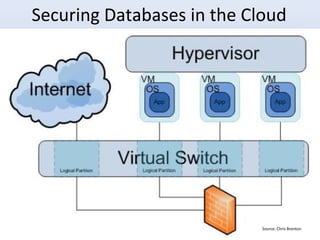
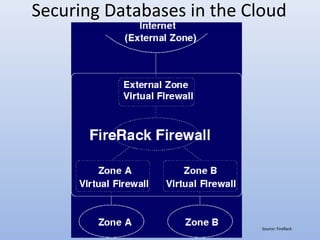
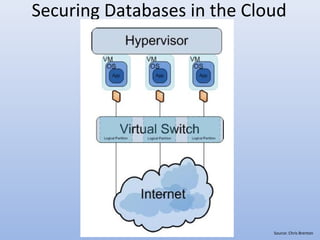
» Virtual Firewalls
– Encryption
» Enforce Compliance Encryption Requirements for Data
» Public Key Infrastructure (PKI): Remote & Application Access
» Key Management
– User Rights Management (URM)
» Identity & Access Management (IAM)
Securing Databases in the Cloud
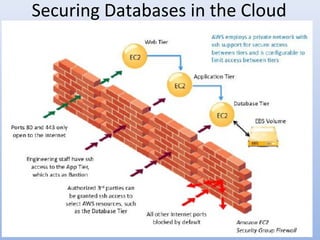
Source: Chris Brenton
Securing Databases in the Cloud
Source: FireRack
Securing Databases in the Cloud
Source: Chris Brenton
Securing Databases in the Cloud
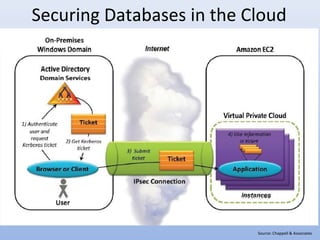
Source: Chappell & Associates
Securing Databases in the Cloud
• Securing Relational Cloud-Based DB Solutions
– PaaS
• DBaaS (Continued)
– Backups & Disaster Recovery
» Physically / Geographically Separate
» Build RTO & RPO Into SLA
» Regularly Test (Semi-Annually)
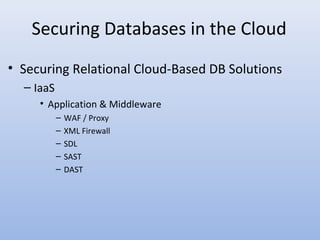
– Application & Middleware-level Security
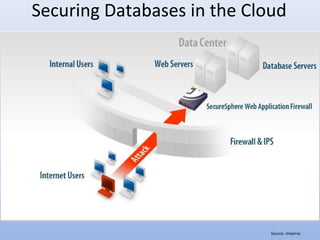
» Web Application Firewalls (WAF) / Proxy
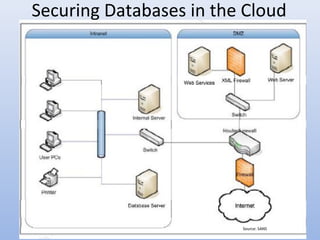
» XML Firewalls
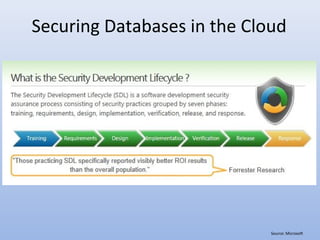
» Security Development Lifecycle (SDL)
» Static Application Security Testing (SAST)
» Dynamic Application Security testing (DAST)
Securing Databases in the Cloud
Source: Imperva
Securing Databases in the Cloud
Source: SANS
Securing Databases in the Cloud
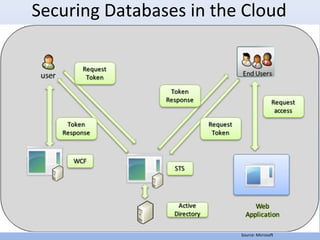
Source: Microsoft
Securing Databases in the Cloud
• Securing Relational Cloud-Based DB Solutions
– PaaS
• DBaaS (Continued)
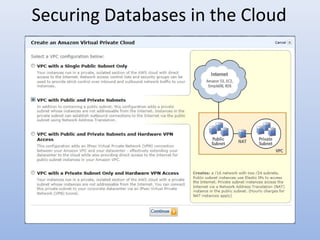
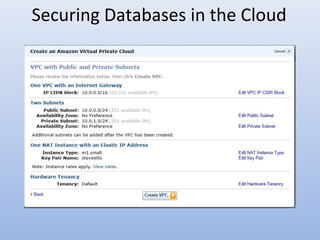
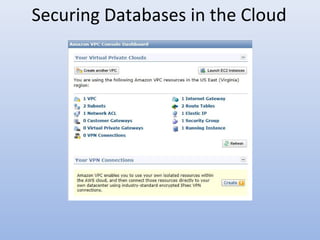
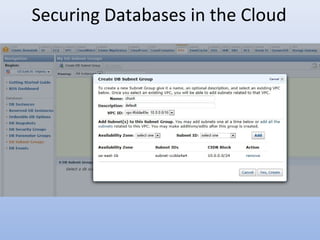
– AWS RDS Oracle 11g & Java Apache Tomcat EC2 Scenario:
» Setup VPC Public & Private via NAT w/ IPSec VPN
» Setup App Security Group
» Build Public App Instance on EC2 w/ Java & Apache Tomcat
» Setup DB Security Group w/ App Security Group Added
» Build Private AWS RDS Oracle 11g DB
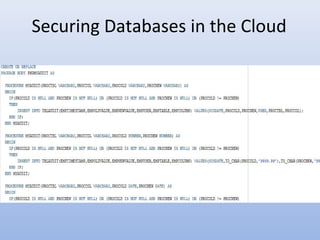
» Leverage PL/SQL Audit Triggers for Compliance
» Leverage CloudWatch for App & DB Instances
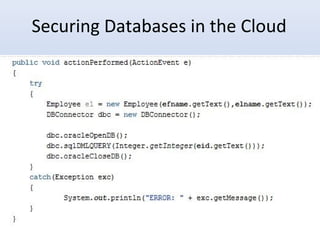
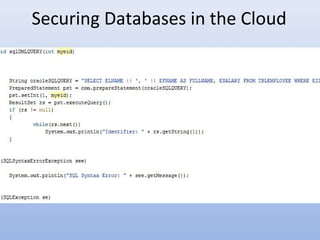
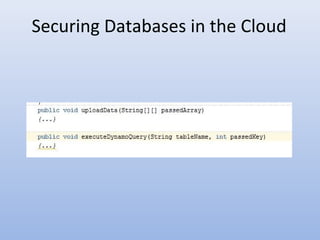
» Leverage Prepared Statements & Error / Exception Handling
Securing Databases in the Cloud
• Securing Relational Cloud-Based DB Solutions
– IaaS
• Server / Infrastructure
– Physical Access Controls
– Hypervisor / Management Backplane
» Grouping – Segmenting VMs
» Generalization – Leveraging a Template
» Aspect-Oriented Management – Tiering
» Automation Provisioning
» Air Gapping – Siloed Virtual Networks (VLANs)
Securing Databases in the Cloud
• Securing Relational Cloud-Based DB Solutions
– IaaS
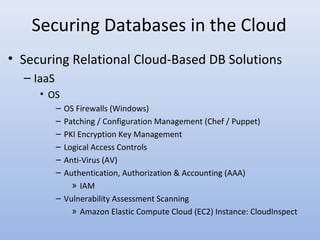
• OS
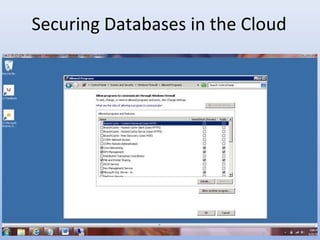
– OS Firewalls (Windows)
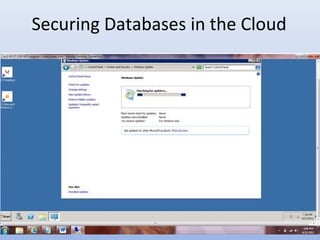
– Patching / Configuration Management (Chef / Puppet)
– PKI Encryption Key Management
– Logical Access Controls
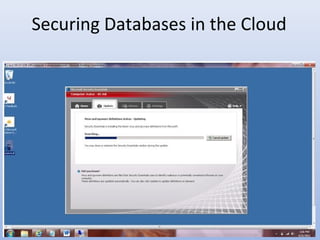
– Anti-Virus (AV)
– Authentication, Authorization & Accounting (AAA)
» IAM
– Vulnerability Assessment Scanning
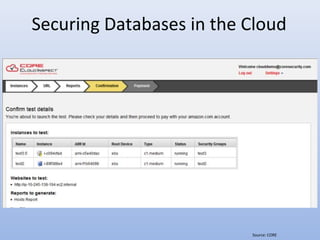
» Amazon Elastic Compute Cloud (EC2) Instance: CloudInspect
Securing Databases in the Cloud
Source: CORE
Securing Databases in the Cloud
• Securing Relational Cloud-Based DB Solutions
– IaaS
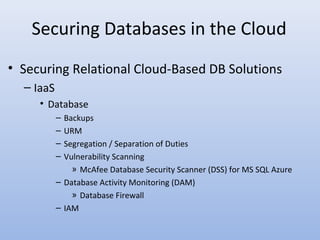
• Database
– Backups
– URM
– Segregation / Separation of Duties
– Vulnerability Scanning
» McAfee Database Security Scanner (DSS) for MS SQL Azure
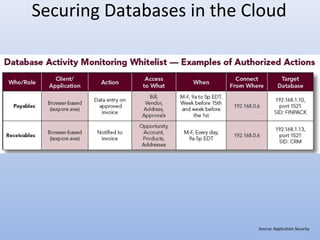
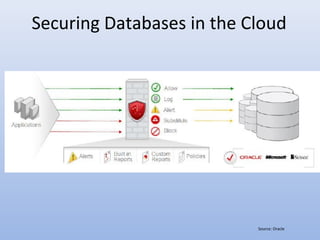
– Database Activity Monitoring (DAM)
» Database Firewall
– IAM
Securing Databases in the Cloud
InternetInternet
AWS CloudAWS Cloud
EC2 Availability Zone
EC2
S3 Storage
EBS
EBS
EC2 EC2
EBS
EBS
EBS
EBS
EBS
EBS
EBS
EBS
EBS
EBS EBS Snapshot
EBS Snapshot
EBS Snapshot
EBS Snapshot
EBS Snapshot
EBS Snapshot
EBS Snapshot
EBS Snapshot
EBS Snapshot
EBS Snapshot
Source: Amazon
Securing Databases in the Cloud
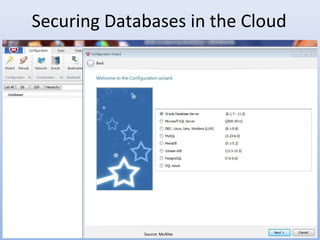
Source: McAfee
Securing Databases in the Cloud
Source: Application Security
Securing Databases in the Cloud
Source: Oracle
Securing Databases in the Cloud
• Securing Relational Cloud-Based DB Solutions
– IaaS
• Database
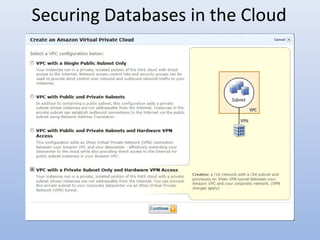
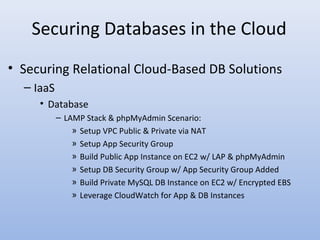
– LAMP Stack & phpMyAdmin Scenario:
» Setup VPC Public & Private via NAT
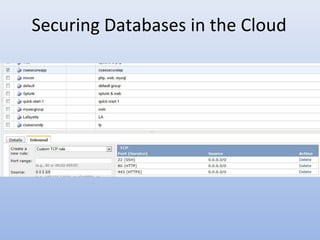
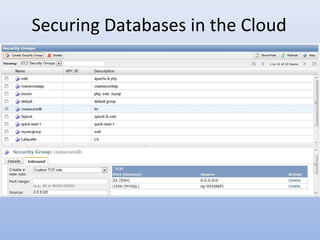
» Setup App Security Group
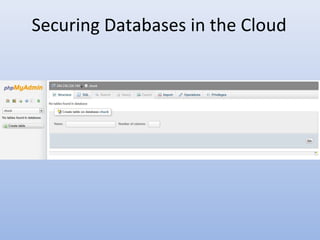
» Build Public App Instance on EC2 w/ LAP & phpMyAdmin
» Setup DB Security Group w/ App Security Group Added
» Build Private MySQL DB Instance on EC2 w/ Encrypted EBS
» Leverage CloudWatch for App & DB Instances
Securing Databases in the Cloud
• Securing Relational Cloud-Based DB Solutions
– IaaS
• Storage
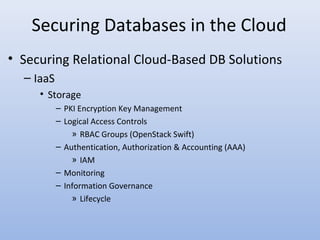
– PKI Encryption Key Management
– Logical Access Controls
» RBAC Groups (OpenStack Swift)
– Authentication, Authorization & Accounting (AAA)
» IAM
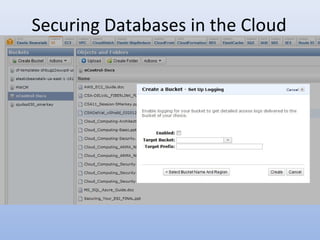
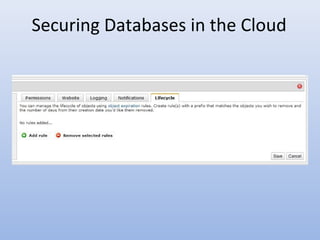
– Monitoring
– Information Governance
» Lifecycle
Securing Databases in the Cloud
• Securing Relational Cloud-Based DB Solutions
– IaaS
• Database
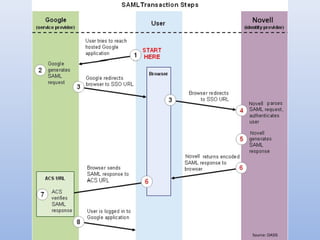
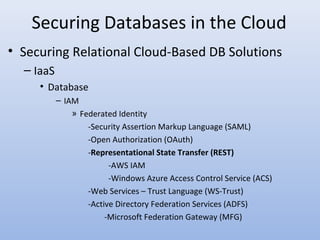
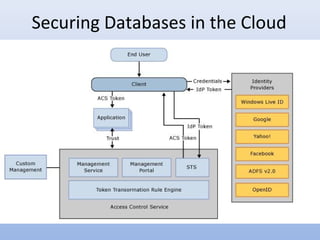
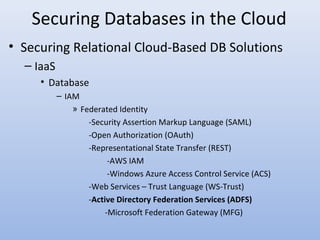
– IAM
» Federated Identity
-Security Assertion Markup Language (SAML)
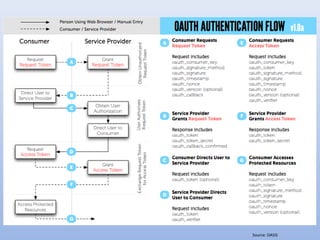
-Open Authorization (OAuth)
-Representational State Transfer (REST)
-AWS IAM
-Windows Azure Access Control Service (ACS)
-Web Services – Trust Language (WS-Trust)
-Active Directory Federation Services (ADFS)
-Microsoft Federation Gateway (MFG)
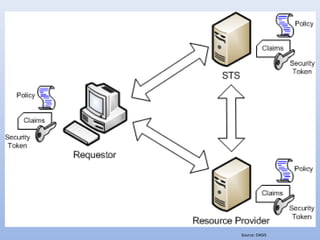
Source: OASIS
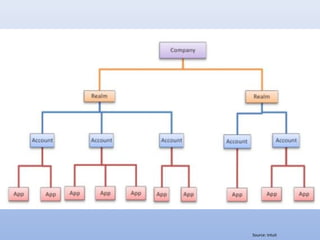
Source: Intuit
Securing Databases in the Cloud
• Securing Relational Cloud-Based DB Solutions
– IaaS
• Database
– IAM
» Federated Identity
-Security Assertion Markup Language (SAML)
-Open Authorization (OAuth)
-Representational State Transfer (REST)
-AWS IAM
-Windows Azure Access Control Service (ACS)
-Web Services – Trust Language (WS-Trust)
-Active Directory Federation Services (ADFS)
-Microsoft Federation Gateway (MFG)
Source: OASIS
Securing Databases in the Cloud
• Securing Relational Cloud-Based DB Solutions
– IaaS
• Database
– IAM
» Federated Identity
-Security Assertion Markup Language (SAML)
-Open Authorization (OAuth)
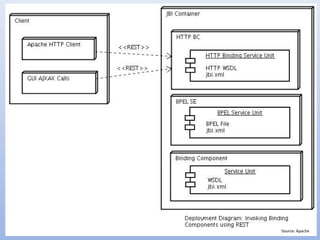
-Representational State Transfer (REST)
-AWS IAM
-Windows Azure Access Control Service (ACS)
-Web Services – Trust Language (WS-Trust)
-Active Directory Federation Services (ADFS)
-Microsoft Federation Gateway (MFG)
Source: Apache
Securing Databases in the Cloud
• Securing Relational Cloud-Based DB Solutions
– IaaS
• Database
– IAM
» Federated Identity
-Security Assertion Markup Language (SAML)
-Open Authorization (OAuth)
-Representational State Transfer (REST)
-AWS IAM
-Windows Azure Access Control Service (ACS)
-Web Services – Trust Language (WS-Trust)
-Active Directory Federation Services (ADFS)
-Microsoft Federation Gateway (MFG)
Source: OASIS
Securing Databases in the Cloud
• Securing Relational Cloud-Based DB Solutions
– IaaS
• Database
– IAM
» Federated Identity
-Security Assertion Markup Language (SAML)
-Open Authorization (OAuth)
-Representational State Transfer (REST)
-AWS IAM
-Windows Azure Access Control Service (ACS)
-Web Services – Trust Language (WS-Trust)
-Active Directory Federation Services (ADFS)
-Microsoft Federation Gateway (MFG)
Securing Databases in the Cloud
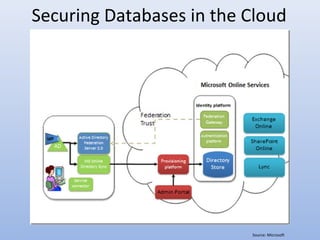
Source: Microsoft
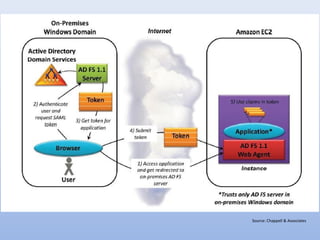
Source: Chappell & Associates
Securing Databases in the Cloud
Source: Microsoft
Securing Databases in the Cloud
• Securing Relational Cloud-Based DB Solutions
– IaaS
• Application & Middleware
– WAF / Proxy
– XML Firewall
– SDL
– SAST
– DAST
Securing Databases in the Cloud
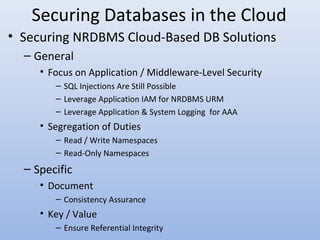
• Securing NRDBMS Cloud-Based DB Solutions
– General
• Focus on Application / Middleware-Level Security
– SQL Injections Are Still Possible
– Leverage Application IAM for NRDBMS URM
– Leverage Application & System Logging for AAA
• Segregation of Duties
– Read / Write Namespaces
– Read-Only Namespaces
– Specific
• Document
– Consistency Assurance
• Key / Value
– Ensure Referential Integrity
Securing Databases in the Cloud
• Privacy & Data Protection for Cloud-Based DBs
– Jurisdictions*
• Regional: EU DPA
• National: PIPEDA, GLBA, HIPAA / HITECH, COPPA, Safe Harbor
• Statutory: Bavarian, CA SB 1386 / 24, MA 201 CMR 17, NV SB 227
– Data Flow & Jurisdictional Adherence
• Data Sharing with Third Parties
– Pseudonymization / De-Identification
• Consent & Notices
– Contract Clauses
• Model Contracts
– Privacy Best Practices
• Generally Accepted Privacy Principles (GAPP) * Not all inclusive.
Securing Databases in the Cloud
• Case Study: MySQL & SimpleDB in the Cloud
– Background
• SMB Healthcare Service Provider (HIPAA Business Associate)
• Providing Services for Larger HIPAA Covered Entities
• Fall 2011 Project
– Drivers
• Cost Savings
• HIPAA / HITECH Compliance
• More Cost Effective & Simplistic BCP / DRP Planning
• Parse Out Non-Protected Health Information (PHI)
Securing Databases in the Cloud
• Case Study: MySQL & SimpleDB in the Cloud
– Technologies
• AWS:
– EC2
– EBS
– Simple Storage Service (S3)
– SimpleDB
• Linux (Ubuntu AMI), Apache, MySQL, & PHP (LAMP) Stack
• OpenLDAP
• Splunk
– Limitations
• Skill-Sets (AWS EC2, SimpleDB)
• Risk Posture
• Vendor Management
Securing Databases in the Cloud
• Case Study: MySQL & SimpleDB in the Cloud
– Risks
• Vendor Lock-In
– AWS EC2 and / or SimpleDB
• Legal Concerns
– Lack of Bargaining Power
– Service Level Agreements (SLAs)
• Data Security & Privacy Concerns
– Geographic Jurisdiction
• Business Continuity / Availability
– DataCom Circuits
• Variable Costs
– Data Transfer
Securing Databases in the Cloud
• Case Study: MySQL & SimpleDB in the Cloud
– Lessons Learned
• Cloud Strategy / Roadmap Matters
• Availability Issues w/ SimpleDB
• Learning Curve
– SimpleDB
– Elastic Block Store (EBS)
• Not as Cost Effective as First Thought
– Backups & S3
– Next Steps
• Leveraging NoSQL for More Log Data
• Enhanced use of Splunk for SIEM
• Splunk to the Cloud (on AWS EC2)
• Presentation Take-Aways
– Databases in the Cloud are Here to Stay
– Secure Cloud-Based DBs Through Defense-in-Depth
–Application / Database
–Middleware
–OS
–(Virtual) Infrastructure
– Stay Abreast of New Technologies / Services
–Big Data
–Federated Identities
Securing Databases in the Cloud
• Questions?
• Contact
– Email: steve@ncontrol-llc.com
– Twitter: markes1
– LI: http://www.linkedin.com/in/smarkey
– CSA-DelVal: http://www.csadelval.org/

Securing_Dbs_in_Cloud_v12

  • 1.
    Securing Databases inthe Cloud Steven C. Markey, MSIS, PMP, CISSP, CIPP, CISM, CISA, STS-EV, CCSK, CompTIA Cloud Essentials Principal, nControl, LLC Adjunct Professor President, Cloud Security Alliance – Delaware Valley Chapter (CSA-DelVal)
  • 2.
    • Presentation Overview –Cloud Overview – Database Overview – Big Data Overview – Cloud-Based DB Solutions – Securing Cloud-Based DB Solutions • Vulnerabilities Found in Cloud-Based Offerings • Securing Your Relational Cloud-Based Offerings • Securing Your Non-Relational Cloud-Based Offerings – Privacy & Data Protection for Cloud-Based DBs – Case Study: MySQL & SimpleDB in the Cloud Securing Databases in the Cloud
  • 3.
  • 4.
  • 5.
    Source: Matthew Gardiner,Computer Associates
  • 6.
    Securing Databases inthe Cloud • Database Overview – Database Management Systems • Relational Database Management Systems (RDBMS) • Object-Oriented Database Management Systems (OODBMS) • Non-Relational, Distributed DB Mgmt Systems (NRDBMS) – Not only – Structured Query Language (NoSQL) – Online Transaction Processing (OLTP) • Real-time Data Warehousing – Online Analytical Processing (OLAP) • Operational Data Stores (ODS) • Enterprise Data Warehouse (EDW)
  • 7.
    Securing Databases inthe Cloud • Database Overview – Online Analytical Processing (OLAP) • Business Intelligence (BI) – Data Mining – Reporting – OLAP
  • 8.
    Securing Databases inthe Cloud • Database Overview – OLAP (Continued) • Business Intelligence (BI) (Continued) – OLAP (Continued) » Relational OLAP (ROLAP) » Multi-Dimensional OLAP (MOLAP) » Hybrid OLAP (HOLAP) OLTPODSEDW (Data Marts)BI (Data Mining) OLTPODSEDW (Data Marts)BI (Reporting) OLTPODSEDW (Data Marts)BI (OLAP)
  • 9.
    Securing Databases inthe Cloud • Big Data Overview – Aggregated Data From the Following Sources: • Traditional • Sensory • Social – Aggregators • Predominantly: NRDBMS – Column Family Stores: Cassandra (FB), BigTable (Google), HBase (Apache) – Key-Values Stores: App Engine DataStore (Google), DynamoDB & SimpleDB (AWS) – Document Databases: CouchDB, MongoDB – Graph Databases: Neo4J
  • 10.
    Securing Databases inthe Cloud • Big Data Overview – Serial Processing • Hadoop – Hadoop Distributed File System (HDFS) – Hive – DW – Pig – Querying Language • Riak – Parallel Processing • HadoopDB – Analytics • Google MapReduce • Apache MapReduce • Splunk (for Security Information / Event Management [SIEM])
  • 11.
  • 12.
  • 13.
  • 14.
  • 15.
    Securing Databases inthe Cloud • Cloud-Based Database Solutions – PaaS • DBaaS – Force.com – Intuit QuickBase – Amazon Web Services (AWS) » Relational Database Service (RDS) Oracle 11g / MySQL » DynamoDB » SimpleDB – Google App Engine » Datastore – Oracle Public Cloud » 11g
  • 16.
    Securing Databases inthe Cloud • Cloud-Based Database Solutions – IaaS • Build MySQL, Microsoft SQL Server, or Oracle 11g Instance • Leverage Compute Node & Storage Node Effectively – AWS Elastic Compute Cloud (EC2) – AWS Elastic Block Store (EBS) – OpenStack Compute (Nova) – OpenStack Storage (Swift)
  • 17.
    Securing Databases inthe Cloud • Vulnerabilities Found in Cloud-Based DB Solutions – General Cloud Service • Middleware Vulnerabilities » Open / Java Database Connectivity (ODBC / JDBC) Attacks • Database Vulnerabilities » Improper (Logical) Access Controls » Change / Configuration Management » Backups » Multi-Tenancy • Virtualization Vulnerabilities – Insecure Hypervisor / Management Backplane » Hyperjacking – Rogue Hypervisor » Virtual Machine (VM) Theft – Data Loss » VM Hopping – One VM to Another » VM Sprawl – Unmanaged (Legacy VMs)
  • 18.
    Securing Databases inthe Cloud • Vulnerabilities Found in Cloud-Based DB Solutions – General Cloud Service (Continued) • Internal (Cloud Service Provider) Attack Vectors: – Legacy Accounts » Automate Provisioning / De-Provisioning – Lack of Segregation / Separation of Duties – Lightweight Directory Access Protocol (LDAP) Injection • Application Vulnerabilities: – SQL Injection – Cross-Site Scripting (XSS) – Cross-Site Request Forgery (XSRF)
  • 19.
    Securing Databases inthe Cloud • Vulnerabilities Found in Cloud-Based DB Solutions – IaaS • Infrastructure: – Improper Physical Access Controls – Change / Configuration Management – Physical Separation of Compute & Storage Nodes » Performance Degradation – Backups » VM Backup Location, Jurisdiction » Data File Backup Location, Jurisdiction • Operating System (OS): – Improper (Logical) & Physical Access Controls – Change / Configuration Management
  • 21.
  • 22.
    Securing Databases inthe Cloud • Securing Relational Cloud-Based DB Solutions – PaaS • DBaaS – SIEM – Logical Segregation / Separation of Duties (DBA, Developer) – Enforce Logical Access Controls » Virtual Firewalls – Encryption » Enforce Compliance Encryption Requirements for Data » Public Key Infrastructure (PKI): Remote & Application Access » Key Management – User Rights Management (URM) » Identity & Access Management (IAM)
  • 23.
    Securing Databases inthe Cloud Source: Chris Brenton
  • 24.
    Securing Databases inthe Cloud Source: FireRack
  • 25.
    Securing Databases inthe Cloud Source: Chris Brenton
  • 26.
  • 27.
    Securing Databases inthe Cloud Source: Chappell & Associates
  • 28.
  • 29.
  • 30.
  • 31.
  • 32.
  • 33.
    Securing Databases inthe Cloud • Securing Relational Cloud-Based DB Solutions – PaaS • DBaaS (Continued) – Backups & Disaster Recovery » Physically / Geographically Separate » Build RTO & RPO Into SLA » Regularly Test (Semi-Annually) – Application & Middleware-level Security » Web Application Firewalls (WAF) / Proxy » XML Firewalls » Security Development Lifecycle (SDL) » Static Application Security Testing (SAST) » Dynamic Application Security testing (DAST)
  • 34.
    Securing Databases inthe Cloud Source: Imperva
  • 35.
    Securing Databases inthe Cloud Source: SANS
  • 36.
    Securing Databases inthe Cloud Source: Microsoft
  • 37.
  • 38.
  • 39.
    Securing Databases inthe Cloud • Securing Relational Cloud-Based DB Solutions – PaaS • DBaaS (Continued) – AWS RDS Oracle 11g & Java Apache Tomcat EC2 Scenario: » Setup VPC Public & Private via NAT w/ IPSec VPN » Setup App Security Group » Build Public App Instance on EC2 w/ Java & Apache Tomcat » Setup DB Security Group w/ App Security Group Added » Build Private AWS RDS Oracle 11g DB » Leverage PL/SQL Audit Triggers for Compliance » Leverage CloudWatch for App & DB Instances » Leverage Prepared Statements & Error / Exception Handling
  • 40.
  • 41.
    Securing Databases inthe Cloud • Securing Relational Cloud-Based DB Solutions – IaaS • Server / Infrastructure – Physical Access Controls – Hypervisor / Management Backplane » Grouping – Segmenting VMs » Generalization – Leveraging a Template » Aspect-Oriented Management – Tiering » Automation Provisioning » Air Gapping – Siloed Virtual Networks (VLANs)
  • 42.
    Securing Databases inthe Cloud • Securing Relational Cloud-Based DB Solutions – IaaS • OS – OS Firewalls (Windows) – Patching / Configuration Management (Chef / Puppet) – PKI Encryption Key Management – Logical Access Controls – Anti-Virus (AV) – Authentication, Authorization & Accounting (AAA) » IAM – Vulnerability Assessment Scanning » Amazon Elastic Compute Cloud (EC2) Instance: CloudInspect
  • 43.
  • 44.
  • 45.
  • 46.
    Securing Databases inthe Cloud Source: CORE
  • 47.
    Securing Databases inthe Cloud • Securing Relational Cloud-Based DB Solutions – IaaS • Database – Backups – URM – Segregation / Separation of Duties – Vulnerability Scanning » McAfee Database Security Scanner (DSS) for MS SQL Azure – Database Activity Monitoring (DAM) » Database Firewall – IAM
  • 48.
    Securing Databases inthe Cloud InternetInternet AWS CloudAWS Cloud EC2 Availability Zone EC2 S3 Storage EBS EBS EC2 EC2 EBS EBS EBS EBS EBS EBS EBS EBS EBS EBS EBS Snapshot EBS Snapshot EBS Snapshot EBS Snapshot EBS Snapshot EBS Snapshot EBS Snapshot EBS Snapshot EBS Snapshot EBS Snapshot Source: Amazon
  • 49.
    Securing Databases inthe Cloud Source: McAfee
  • 50.
    Securing Databases inthe Cloud Source: Application Security
  • 51.
    Securing Databases inthe Cloud Source: Oracle
  • 52.
    Securing Databases inthe Cloud • Securing Relational Cloud-Based DB Solutions – IaaS • Database – LAMP Stack & phpMyAdmin Scenario: » Setup VPC Public & Private via NAT » Setup App Security Group » Build Public App Instance on EC2 w/ LAP & phpMyAdmin » Setup DB Security Group w/ App Security Group Added » Build Private MySQL DB Instance on EC2 w/ Encrypted EBS » Leverage CloudWatch for App & DB Instances
  • 53.
  • 54.
  • 55.
  • 56.
  • 57.
  • 58.
  • 59.
    Securing Databases inthe Cloud • Securing Relational Cloud-Based DB Solutions – IaaS • Storage – PKI Encryption Key Management – Logical Access Controls » RBAC Groups (OpenStack Swift) – Authentication, Authorization & Accounting (AAA) » IAM – Monitoring – Information Governance » Lifecycle
  • 60.
  • 61.
  • 62.
    Securing Databases inthe Cloud • Securing Relational Cloud-Based DB Solutions – IaaS • Database – IAM » Federated Identity -Security Assertion Markup Language (SAML) -Open Authorization (OAuth) -Representational State Transfer (REST) -AWS IAM -Windows Azure Access Control Service (ACS) -Web Services – Trust Language (WS-Trust) -Active Directory Federation Services (ADFS) -Microsoft Federation Gateway (MFG)
  • 63.
  • 64.
  • 65.
    Securing Databases inthe Cloud • Securing Relational Cloud-Based DB Solutions – IaaS • Database – IAM » Federated Identity -Security Assertion Markup Language (SAML) -Open Authorization (OAuth) -Representational State Transfer (REST) -AWS IAM -Windows Azure Access Control Service (ACS) -Web Services – Trust Language (WS-Trust) -Active Directory Federation Services (ADFS) -Microsoft Federation Gateway (MFG)
  • 66.
  • 67.
    Securing Databases inthe Cloud • Securing Relational Cloud-Based DB Solutions – IaaS • Database – IAM » Federated Identity -Security Assertion Markup Language (SAML) -Open Authorization (OAuth) -Representational State Transfer (REST) -AWS IAM -Windows Azure Access Control Service (ACS) -Web Services – Trust Language (WS-Trust) -Active Directory Federation Services (ADFS) -Microsoft Federation Gateway (MFG)
  • 68.
  • 69.
  • 70.
  • 71.
  • 72.
    Securing Databases inthe Cloud • Securing Relational Cloud-Based DB Solutions – IaaS • Database – IAM » Federated Identity -Security Assertion Markup Language (SAML) -Open Authorization (OAuth) -Representational State Transfer (REST) -AWS IAM -Windows Azure Access Control Service (ACS) -Web Services – Trust Language (WS-Trust) -Active Directory Federation Services (ADFS) -Microsoft Federation Gateway (MFG)
  • 73.
  • 74.
    Securing Databases inthe Cloud • Securing Relational Cloud-Based DB Solutions – IaaS • Database – IAM » Federated Identity -Security Assertion Markup Language (SAML) -Open Authorization (OAuth) -Representational State Transfer (REST) -AWS IAM -Windows Azure Access Control Service (ACS) -Web Services – Trust Language (WS-Trust) -Active Directory Federation Services (ADFS) -Microsoft Federation Gateway (MFG)
  • 75.
    Securing Databases inthe Cloud Source: Microsoft
  • 76.
  • 77.
    Securing Databases inthe Cloud Source: Microsoft
  • 78.
    Securing Databases inthe Cloud • Securing Relational Cloud-Based DB Solutions – IaaS • Application & Middleware – WAF / Proxy – XML Firewall – SDL – SAST – DAST
  • 79.
    Securing Databases inthe Cloud • Securing NRDBMS Cloud-Based DB Solutions – General • Focus on Application / Middleware-Level Security – SQL Injections Are Still Possible – Leverage Application IAM for NRDBMS URM – Leverage Application & System Logging for AAA • Segregation of Duties – Read / Write Namespaces – Read-Only Namespaces – Specific • Document – Consistency Assurance • Key / Value – Ensure Referential Integrity
  • 80.
  • 81.
  • 82.
    Securing Databases inthe Cloud • Privacy & Data Protection for Cloud-Based DBs – Jurisdictions* • Regional: EU DPA • National: PIPEDA, GLBA, HIPAA / HITECH, COPPA, Safe Harbor • Statutory: Bavarian, CA SB 1386 / 24, MA 201 CMR 17, NV SB 227 – Data Flow & Jurisdictional Adherence • Data Sharing with Third Parties – Pseudonymization / De-Identification • Consent & Notices – Contract Clauses • Model Contracts – Privacy Best Practices • Generally Accepted Privacy Principles (GAPP) * Not all inclusive.
  • 83.
    Securing Databases inthe Cloud • Case Study: MySQL & SimpleDB in the Cloud – Background • SMB Healthcare Service Provider (HIPAA Business Associate) • Providing Services for Larger HIPAA Covered Entities • Fall 2011 Project – Drivers • Cost Savings • HIPAA / HITECH Compliance • More Cost Effective & Simplistic BCP / DRP Planning • Parse Out Non-Protected Health Information (PHI)
  • 84.
    Securing Databases inthe Cloud • Case Study: MySQL & SimpleDB in the Cloud – Technologies • AWS: – EC2 – EBS – Simple Storage Service (S3) – SimpleDB • Linux (Ubuntu AMI), Apache, MySQL, & PHP (LAMP) Stack • OpenLDAP • Splunk – Limitations • Skill-Sets (AWS EC2, SimpleDB) • Risk Posture • Vendor Management
  • 85.
    Securing Databases inthe Cloud • Case Study: MySQL & SimpleDB in the Cloud – Risks • Vendor Lock-In – AWS EC2 and / or SimpleDB • Legal Concerns – Lack of Bargaining Power – Service Level Agreements (SLAs) • Data Security & Privacy Concerns – Geographic Jurisdiction • Business Continuity / Availability – DataCom Circuits • Variable Costs – Data Transfer
  • 86.
    Securing Databases inthe Cloud • Case Study: MySQL & SimpleDB in the Cloud – Lessons Learned • Cloud Strategy / Roadmap Matters • Availability Issues w/ SimpleDB • Learning Curve – SimpleDB – Elastic Block Store (EBS) • Not as Cost Effective as First Thought – Backups & S3 – Next Steps • Leveraging NoSQL for More Log Data • Enhanced use of Splunk for SIEM • Splunk to the Cloud (on AWS EC2)
  • 87.
    • Presentation Take-Aways –Databases in the Cloud are Here to Stay – Secure Cloud-Based DBs Through Defense-in-Depth –Application / Database –Middleware –OS –(Virtual) Infrastructure – Stay Abreast of New Technologies / Services –Big Data –Federated Identities Securing Databases in the Cloud
  • 88.
    • Questions? • Contact –Email: steve@ncontrol-llc.com – Twitter: markes1 – LI: http://www.linkedin.com/in/smarkey – CSA-DelVal: http://www.csadelval.org/

Editor's Notes

  • #34 Veracode, Acunetix
  • #35 modsecurity ZED Proxy
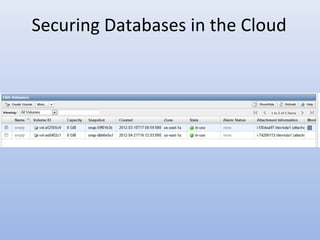
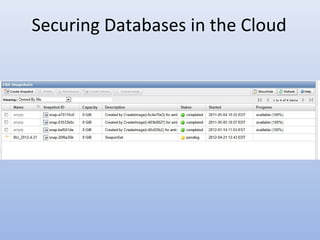
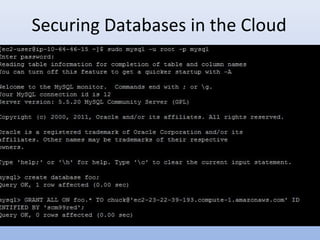
  • #49 http://qugstart.com/blog/amazon-web-services/how-to-set-up-db-server-on-amazon-ec2-with-data-stored-on-ebs-drive-formatted-with-xfs/ Here’s the procedure I decided on. It involves symlinking Mysql config files and data directories onto the EBS volume. Another trick I used because I needed to migrate about 20 GiB’s of data to get started, was that I initially set up an “X-tra large” instance, with 10 GiB’s RAM to handle the data import. After the data was migrated and imported to my database, I simply terminated my X-Large instance and spun up a small instance connected to the same EBS volume! All the databases were preserved nicely and I did not have to waste money paying for an X-Large instance anymore. This exemplifies the value of thinking in the “cloud” mindset – where you can spin up and down servers in a matter of seconds! Hope this article helps someone else out there!
  • #54 http://qugstart.com/blog/amazon-web-services/how-to-set-up-db-server-on-amazon-ec2-with-data-stored-on-ebs-drive-formatted-with-xfs/ Here’s the procedure I decided on. It involves symlinking Mysql config files and data directories onto the EBS volume. Another trick I used because I needed to migrate about 20 GiB’s of data to get started, was that I initially set up an “X-tra large” instance, with 10 GiB’s RAM to handle the data import. After the data was migrated and imported to my database, I simply terminated my X-Large instance and spun up a small instance connected to the same EBS volume! All the databases were preserved nicely and I did not have to waste money paying for an X-Large instance anymore. This exemplifies the value of thinking in the “cloud” mindset – where you can spin up and down servers in a matter of seconds! Hope this article helps someone else out there!
  • #55 http://qugstart.com/blog/amazon-web-services/how-to-set-up-db-server-on-amazon-ec2-with-data-stored-on-ebs-drive-formatted-with-xfs/ Here’s the procedure I decided on. It involves symlinking Mysql config files and data directories onto the EBS volume. Another trick I used because I needed to migrate about 20 GiB’s of data to get started, was that I initially set up an “X-tra large” instance, with 10 GiB’s RAM to handle the data import. After the data was migrated and imported to my database, I simply terminated my X-Large instance and spun up a small instance connected to the same EBS volume! All the databases were preserved nicely and I did not have to waste money paying for an X-Large instance anymore. This exemplifies the value of thinking in the “cloud” mindset – where you can spin up and down servers in a matter of seconds! Hope this article helps someone else out there!
  • #56 http://qugstart.com/blog/amazon-web-services/how-to-set-up-db-server-on-amazon-ec2-with-data-stored-on-ebs-drive-formatted-with-xfs/ Here’s the procedure I decided on. It involves symlinking Mysql config files and data directories onto the EBS volume. Another trick I used because I needed to migrate about 20 GiB’s of data to get started, was that I initially set up an “X-tra large” instance, with 10 GiB’s RAM to handle the data import. After the data was migrated and imported to my database, I simply terminated my X-Large instance and spun up a small instance connected to the same EBS volume! All the databases were preserved nicely and I did not have to waste money paying for an X-Large instance anymore. This exemplifies the value of thinking in the “cloud” mindset – where you can spin up and down servers in a matter of seconds! Hope this article helps someone else out there!
  • #57 http://qugstart.com/blog/amazon-web-services/how-to-set-up-db-server-on-amazon-ec2-with-data-stored-on-ebs-drive-formatted-with-xfs/ Here’s the procedure I decided on. It involves symlinking Mysql config files and data directories onto the EBS volume. Another trick I used because I needed to migrate about 20 GiB’s of data to get started, was that I initially set up an “X-tra large” instance, with 10 GiB’s RAM to handle the data import. After the data was migrated and imported to my database, I simply terminated my X-Large instance and spun up a small instance connected to the same EBS volume! All the databases were preserved nicely and I did not have to waste money paying for an X-Large instance anymore. This exemplifies the value of thinking in the “cloud” mindset – where you can spin up and down servers in a matter of seconds! Hope this article helps someone else out there!
  • #58 http://qugstart.com/blog/amazon-web-services/how-to-set-up-db-server-on-amazon-ec2-with-data-stored-on-ebs-drive-formatted-with-xfs/ Here’s the procedure I decided on. It involves symlinking Mysql config files and data directories onto the EBS volume. Another trick I used because I needed to migrate about 20 GiB’s of data to get started, was that I initially set up an “X-tra large” instance, with 10 GiB’s RAM to handle the data import. After the data was migrated and imported to my database, I simply terminated my X-Large instance and spun up a small instance connected to the same EBS volume! All the databases were preserved nicely and I did not have to waste money paying for an X-Large instance anymore. This exemplifies the value of thinking in the “cloud” mindset – where you can spin up and down servers in a matter of seconds! Hope this article helps someone else out there!
  • #59 http://qugstart.com/blog/amazon-web-services/how-to-set-up-db-server-on-amazon-ec2-with-data-stored-on-ebs-drive-formatted-with-xfs/ Here’s the procedure I decided on. It involves symlinking Mysql config files and data directories onto the EBS volume. Another trick I used because I needed to migrate about 20 GiB’s of data to get started, was that I initially set up an “X-tra large” instance, with 10 GiB’s RAM to handle the data import. After the data was migrated and imported to my database, I simply terminated my X-Large instance and spun up a small instance connected to the same EBS volume! All the databases were preserved nicely and I did not have to waste money paying for an X-Large instance anymore. This exemplifies the value of thinking in the “cloud” mindset – where you can spin up and down servers in a matter of seconds! Hope this article helps someone else out there!
  • #65 realm