Social Media, Confusion, and Small Business During the
COVID 19 Crisis 13
Daniel Sullivan, Daniel Fox, Robert Stoll, Raymond Jacobs
Airline Economics – Planning and Key Performance
Indicators Practical Guide for Students 23
Istvan Simon Hungary
Colombia’s Progress: Internal Peace and Foreign Trade 42
Andrew F. Johnson, Rusty V. Karst
False Hopes, Missed Opportunities: How Economic Models
Affect the IPCC Proposals in Special Report 15 "Global
Warming of 1.5 °C" (2018). An Analysis From the
Scientific Advisory Board of BUND 49
Joachim H. Spangenberg, Werner Neumann, Heinz Klöser,
Stefan Wittig, Tilmann Uhlenhaut, Martha Mertens,
Edo Günther, Ingo Valentin, Markus Große Ophoff
Wealth Effects of Dividend Announcements on Bondholders:
The Case of Taiwan Bond Market 73
Ming-Chang Cheng, Kai Chen, Chien-Chi Lee, Chih-Hsun Wu
Operational Risk for Funds of Hedge Funds – An Analysis of
Regulatory Requirements Under Dodd-Frank Act 98
Ohaness Paskelian, Stephen Bell, Julia Creek
The New Technologies and the Paradox of Global
Consumption 104
Liton Lanes Pilau Sobrinho
Clergy Attitudes Toward Credit/Debt 114
Kristina Terkun
75 Years After the Social Pact: A Brief History of the
Socio-Technical Evolution of Social Security in
Belgium 141
Raphael Van Lerberge
Revenue Management Perspectives in Small-Farm
Winery Operations 160
Marie G. Kulesza
The Cognitive Problem of the Behavioral Decision Theory
Through Game Theory: Biases and Heuristics 178
Alexandre Morais da Rosa
Conceptualizing Urban Economic Resilience at the
Time of Covid-19 and Beyond 193
Dmitry Pozhidaev
What Next for the Political Economy of Development in
Africa? Facing Up to the Challenge of Economic
Transformation 219
David Booth
Applying Problem Based Learning to Improve Student
Engagement in an Engineering Economics Course 252
Joseph A. Donndelinger
Comparing the Concept of Scarcity:
Conventional vs. Islamic Economics 258
Risa Bhinekawati
COVID-19 and Change 263
Miguel Goede
Payment Innovations, the Shadow Economy and Cash
Demand of Households in Euro Area Countries 316
Hans-Eggert Reimers, Friedrich Schneider, Franz Seitz
Decision-Making in Defined Contribution Pension Plans:
The Case of Israel 336
Ravit Rubinstein-Levi
Health Outcomes and Health Spending in the United
States and the Nordic Countries 361
Adnan Kisa
Journal
of
Applied
Business
and
Economics
Volume
23(3)
2021
Volume 23(3) 2021
Journal of
Applied Business and Economics
Journal of Applied Business and Economics Vol. 23(3) 2021 23
Airline Economics – Planning and Key Performance Indicators
Practical Guide for Students
Istvan Simon Hungary
This paper is a practical guide to assist students in understanding the Key Performance Indicators of airline
economics and the relationships between them. This assistance will be materialised in the form of an
example of calculating and presenting the core economic indicators of a hypothetical airline. A simplified
one-year operational and financial plan will be assembled. This guide is intended to be used as the basis
for class discussions.
Keywords: profit, planning, yield, network effect
INTRODUCTION
There are numerous students among my readers on the Academia.edu web site. I have decided to
prepare a practical guide to assist students in understanding the Key Performance Indicators of airline
economics and the relationships between them. This assistance will be materialised in the form of an
example of calculating and presenting the core economic indicators of a hypothetical airline. The equations
applied in this paper are laid down in my previous paper (AIRLINE PROFIT EQUATION REVISED -
Back to the basics) published on the Academia.edu website. To be consistent with my previous paper as
much as possible, I use the same notation (see Appendix 5.1) throughout the remainder of this paper.
I will set up a simplified airline. All the data are estimations based on certain assumptions. The student
may replace them with real data. Having set up my airline, I put together a one-year operational and
financial plan. As a simplification, I disregard detailed airline schedule and cost calculations in the plan.
The planning phase is followed with a What-If analysis to show the relationships between the Profit
Drivers (load factor, yield and unit cost).
The name of this hypothetical airline is “MyAir”; I concentrate on the passenger transportation sector
in this paper.
SETTING UP THE AIRLINE
Network
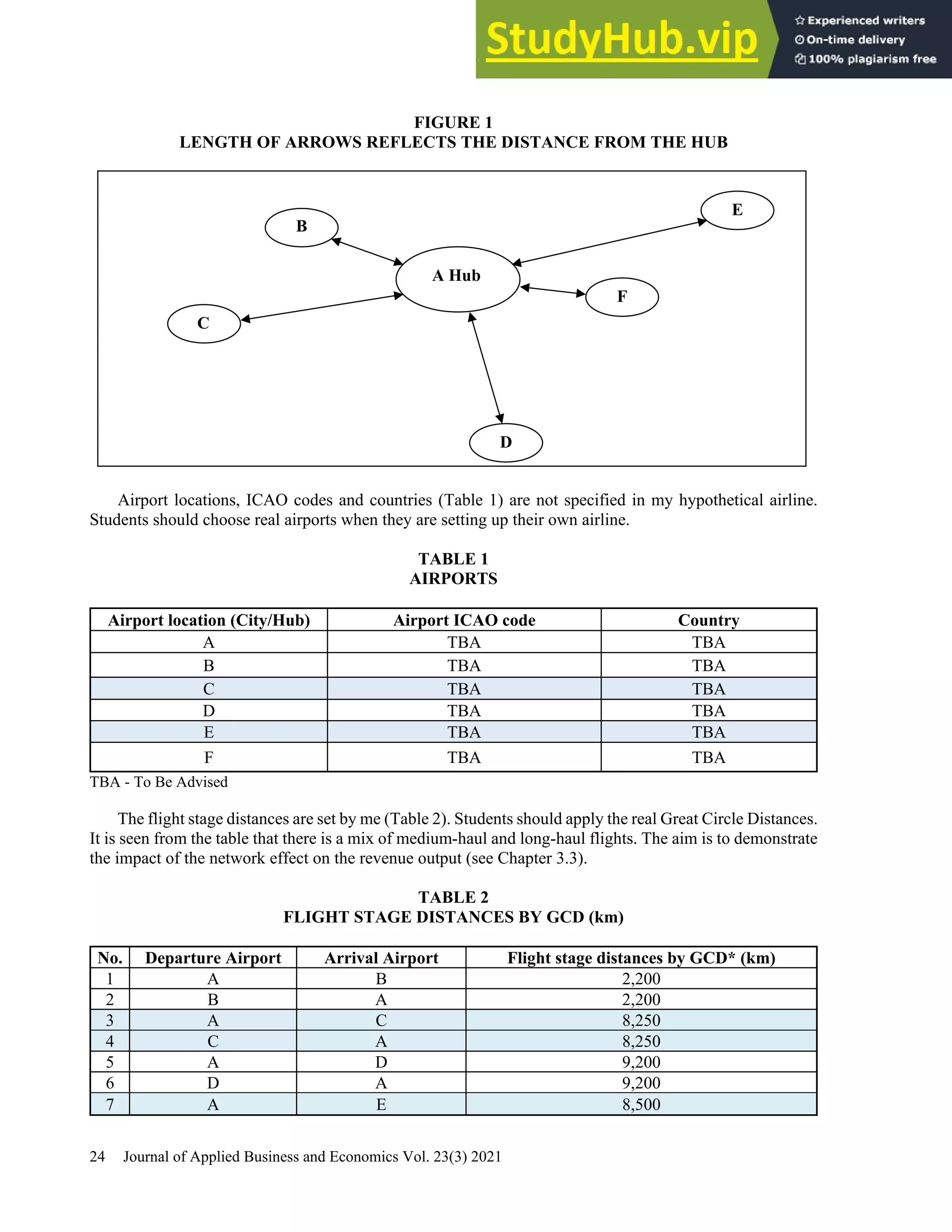
Let’s choose a simple hub and spoke network with six airports connected from Hub A (Figure 1).
24 Journal of Applied Business and Economics Vol. 23(3) 2021
FIGURE 1
LENGTH OF ARROWS REFLECTS THE DISTANCE FROM THE HUB
Airport locations, ICAO codes and countries (Table 1) are not specified in my hypothetical airline.
Students should choose real airports when they are setting up their own airline.
TABLE 1
AIRPORTS
Airport location (City/Hub) Airport ICAO code Country
A TBA TBA
B TBA TBA
C TBA TBA
D TBA TBA
E TBA TBA
F TBA TBA
TBA - To Be Advised
The flight stage distances are set by me (Table 2). Students should apply the real Great Circle Distances.
It is seen from the table that there is a mix of medium-haul and long-haul flights. The aim is to demonstrate
the impact of the network effect on the revenue output (see Chapter 3.3).
TABLE 2
FLIGHT STAGE DISTANCES BY GCD (km)
No. Departure Airport Arrival Airport Flight stage distances by GCD* (km)
1 A B 2,200
2 B A 2,200
3 A C 8,250
4 C A 8,250
5 A D 9,200
6 D A 9,200
7 A E 8,500
A Hub
C
D
F
E
B
Journal of Applied Business and Economics Vol. 23(3) 2021 25
8 E A 8,500
9 A F 1,600
10 F A 1,600
GCD* Great Circle Distance
Demand
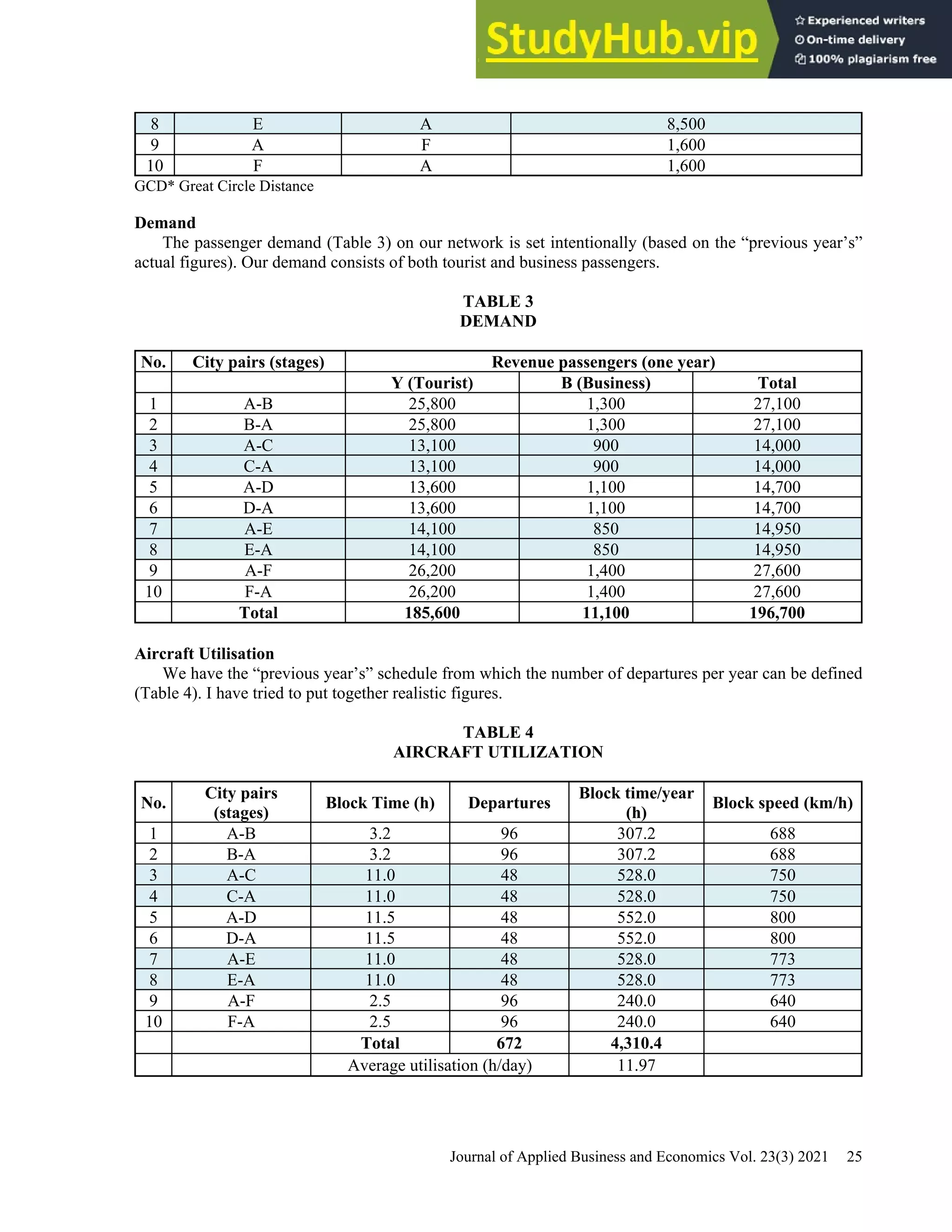
The passenger demand (Table 3) on our network is set intentionally (based on the “previous year’s”
actual figures). Our demand consists of both tourist and business passengers.
TABLE 3
DEMAND
No. City pairs (stages) Revenue passengers (one year)
Y (Tourist) B (Business) Total
1 A-B 25,800 1,300 27,100
2 B-A 25,800 1,300 27,100
3 A-C 13,100 900 14,000
4 C-A 13,100 900 14,000
5 A-D 13,600 1,100 14,700
6 D-A 13,600 1,100 14,700
7 A-E 14,100 850 14,950
8 E-A 14,100 850 14,950
9 A-F 26,200 1,400 27,600
10 F-A 26,200 1,400 27,600
Total 185,600 11,100 196,700
Aircraft Utilisation
We have the “previous year’s” schedule from which the number of departures per year can be defined
(Table 4). I have tried to put together realistic figures.
TABLE 4
AIRCRAFT UTILIZATION
No.
City pairs
(stages)
Block Time (h) Departures
Block time/year
(h)
Block speed (km/h)
1 A-B 3.2 96 307.2 688
2 B-A 3.2 96 307.2 688
3 A-C 11.0 48 528.0 750
4 C-A 11.0 48 528.0 750
5 A-D 11.5 48 552.0 800
6 D-A 11.5 48 552.0 800
7 A-E 11.0 48 528.0 773
8 E-A 11.0 48 528.0 773
9 A-F 2.5 96 240.0 640
10 F-A 2.5 96 240.0 640
Total 672 4,310.4
Average utilisation (h/day) 11.97
26 Journal of Applied Business and Economics Vol. 23(3) 2021
Block hours are the industry standard measure of aircraft utilisation. The average daily utilisation
should be around the industry average.
Reminder: The total amount of time a flight takes—from pushing back from the departure gate (“off-
blocks”) to arriving at the destination gate (“on-blocks”)—is called the “block time”. Block time includes
the time to taxi-out to the runway, the actual flight duration and the time to taxi to the arrival gate.
The block speed calculation is just for control to be sure that the block speed on a given route is realistic.
Attention: The block speed on long routes is higher than on short routes.
Type of Aircraft
We have to be sure that from both the passenger demand and the route stage distances’ perspective the
potential aircraft are suitable. In our case, the average number of tourist passengers per departure is 276,
the average number of business passengers per departure is 17 and the maximum route stage distance is
9,200 km. To meet the demand, we set a two-class seating configuration—24 business class seats (B) and
356 tourist seats (Y)—for a total of 380 seats.
The A330-200 and B777-200ER aircraft meet both conditions. Take care that the number of seats (in
our case 380) does not exceed the maximum number of seats specified by the manufacturer of the aircraft
by accounting for the seating configuration. Just for your information, the maximum number of seats (only
tourists) in the case of the A330-200 is 406 seats and in the case of B777-200ER, 440 seats. The range of
the A330-200 is 13,450 km and the range of the B777-200ER is 13,084 km.
Students can choose any seating configuration. From a practical point of view, I suggest choosing a
configuration applied by an airline flying the aircraft you have chosen.
Available Seats
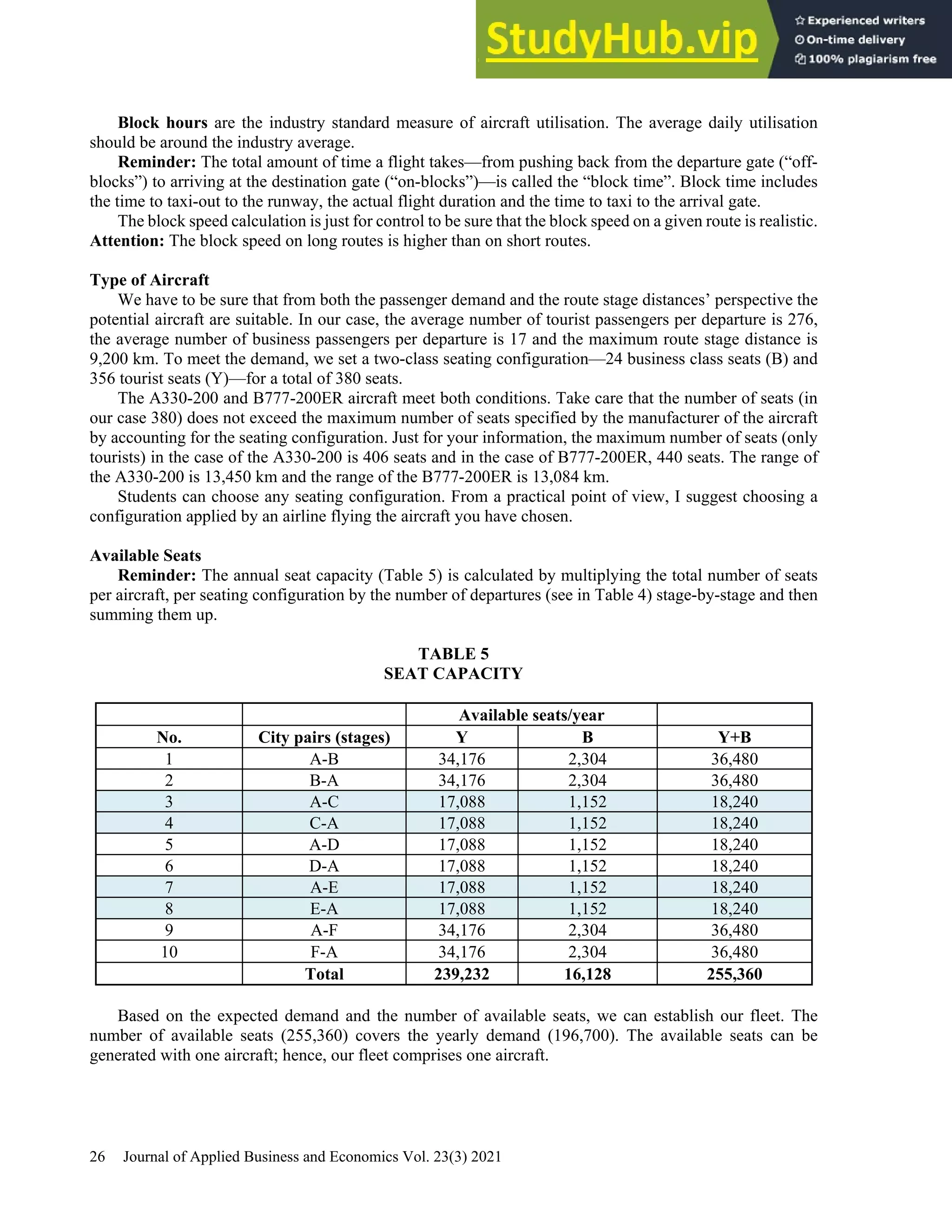
Reminder: The annual seat capacity (Table 5) is calculated by multiplying the total number of seats
per aircraft, per seating configuration by the number of departures (see in Table 4) stage-by-stage and then
summing them up.
TABLE 5
SEAT CAPACITY
Available seats/year
No. City pairs (stages) Y B Y+B
1 A-B 34,176 2,304 36,480
2 B-A 34,176 2,304 36,480
3 A-C 17,088 1,152 18,240
4 C-A 17,088 1,152 18,240
5 A-D 17,088 1,152 18,240
6 D-A 17,088 1,152 18,240
7 A-E 17,088 1,152 18,240
8 E-A 17,088 1,152 18,240
9 A-F 34,176 2,304 36,480
10 F-A 34,176 2,304 36,480
Total 239,232 16,128 255,360
Based on the expected demand and the number of available seats, we can establish our fleet. The
number of available seats (255,360) covers the yearly demand (196,700). The available seats can be
generated with one aircraft; hence, our fleet comprises one aircraft.
Journal of Applied Business and Economics Vol. 23(3) 2021 27
OPERATIONAL AND FINANCIAL PLAN
Our plan covers one year of operation.
Available Output (Capacity)
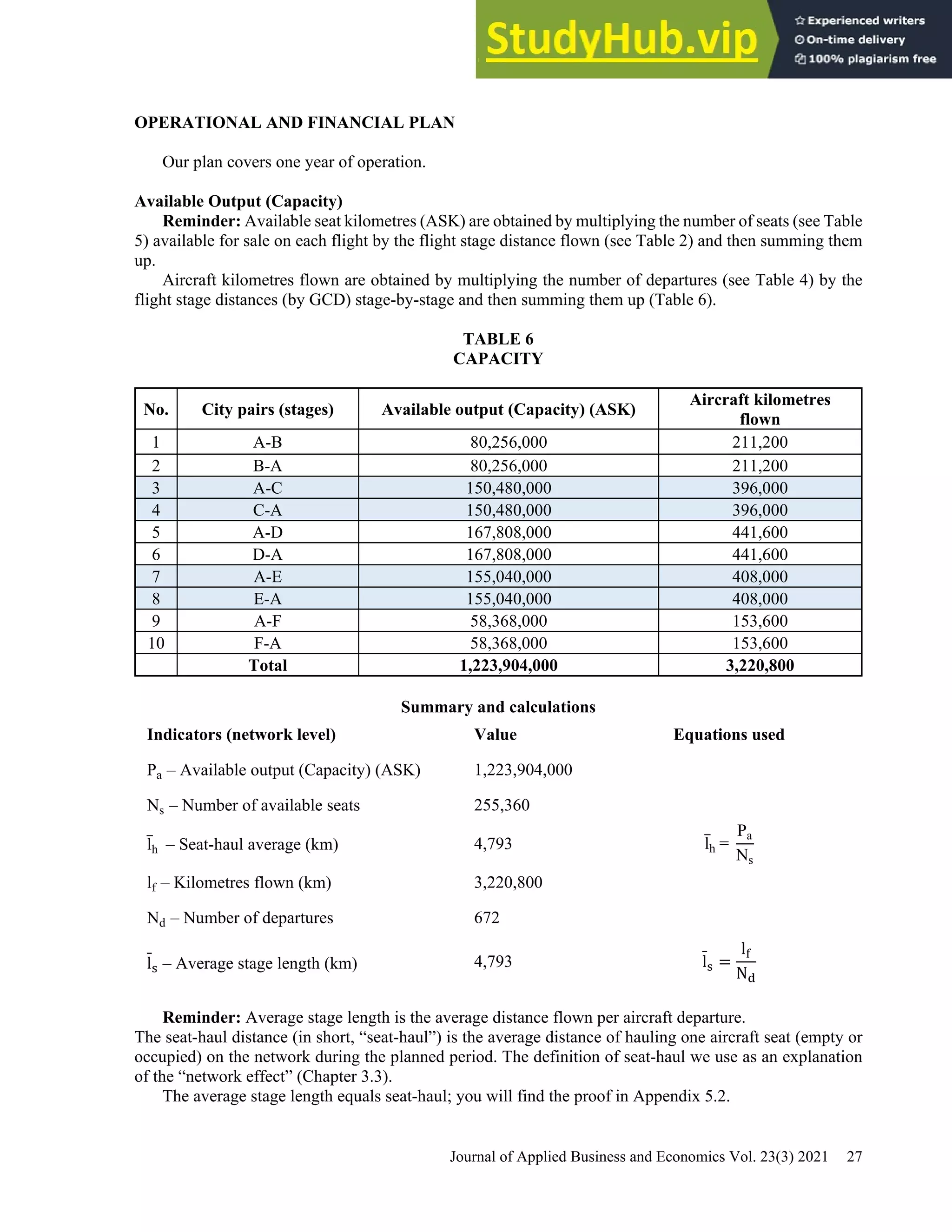
Reminder: Available seat kilometres (ASK) are obtained by multiplying the number of seats (see Table
5) available for sale on each flight by the flight stage distance flown (see Table 2) and then summing them
up.
Aircraft kilometres flown are obtained by multiplying the number of departures (see Table 4) by the
flight stage distances (by GCD) stage-by-stage and then summing them up (Table 6).
TABLE 6
CAPACITY
No. City pairs (stages) Available output (Capacity) (ASK)
Aircraft kilometres
flown
1 A-B 80,256,000 211,200
2 B-A 80,256,000 211,200
3 A-C 150,480,000 396,000
4 C-A 150,480,000 396,000
5 A-D 167,808,000 441,600
6 D-A 167,808,000 441,600
7 A-E 155,040,000 408,000
8 E-A 155,040,000 408,000
9 A-F 58,368,000 153,600
10 F-A 58,368,000 153,600
Total 1,223,904,000 3,220,800
Summary and calculations
Indicators (network level) Value Equations used
Pa – Available output (Capacity) (ASK) 1,223,904,000
Ns – Number of available seats 255,360
l̅h – Seat-haul average (km) 4,793 l̅h =
Pa
Ns
lf – Kilometres flown (km) 3,220,800
Nd – Number of departures 672
ls – Average stage length (km) 4,793 ls =
lf
Nd
Reminder: Average stage length is the average distance flown per aircraft departure.
The seat-haul distance (in short, “seat-haul”) is the average distance of hauling one aircraft seat (empty or
occupied) on the network during the planned period. The definition of seat-haul we use as an explanation
of the “network effect” (Chapter 3.3).
The average stage length equals seat-haul; you will find the proof in Appendix 5.2.
28 Journal of Applied Business and Economics Vol. 23(3) 2021
Revenue Output (Traffic)
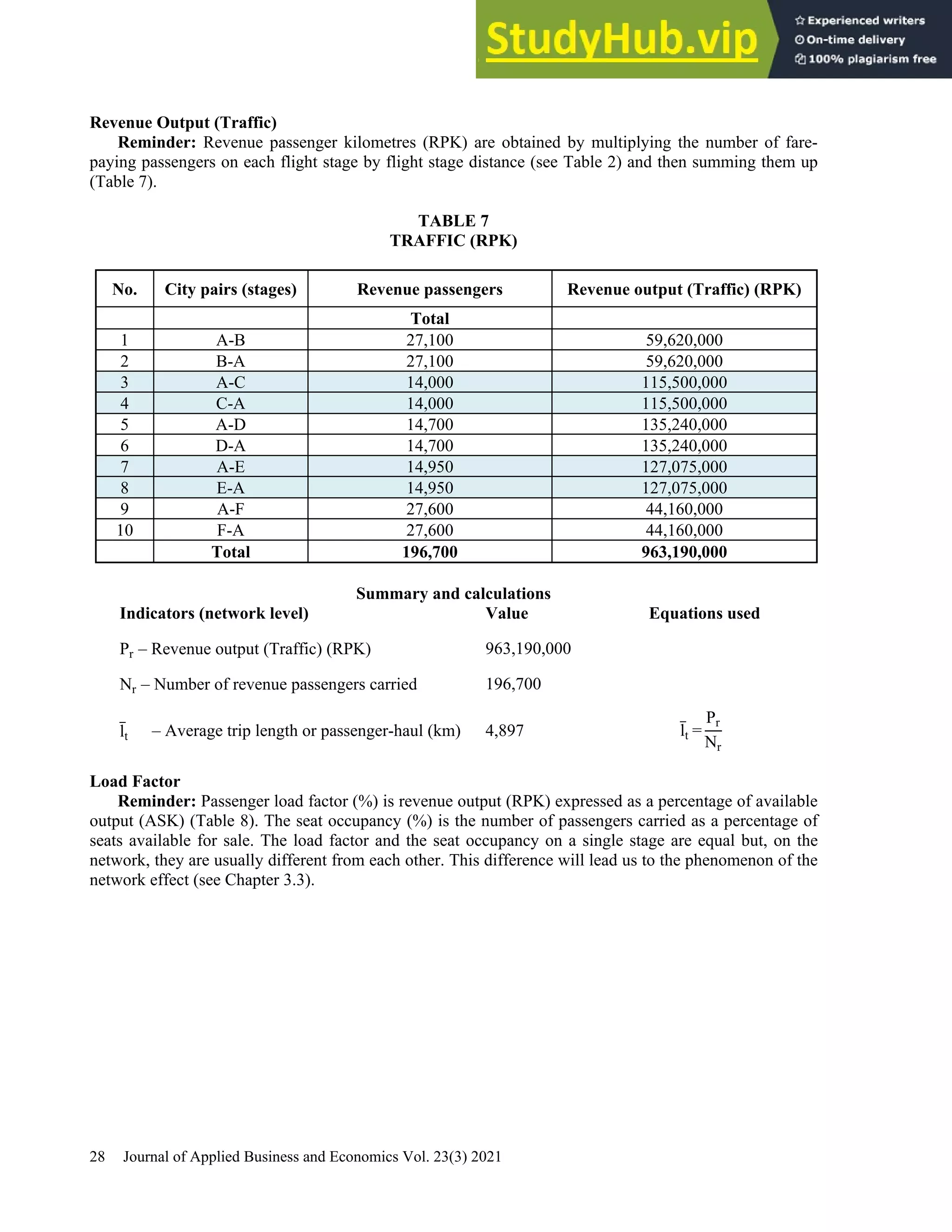
Reminder: Revenue passenger kilometres (RPK) are obtained by multiplying the number of fare-
paying passengers on each flight stage by flight stage distance (see Table 2) and then summing them up
(Table 7).
TABLE 7
TRAFFIC (RPK)
No. City pairs (stages) Revenue passengers Revenue output (Traffic) (RPK)
Total
1 A-B 27,100 59,620,000
2 B-A 27,100 59,620,000
3 A-C 14,000 115,500,000
4 C-A 14,000 115,500,000
5 A-D 14,700 135,240,000
6 D-A 14,700 135,240,000
7 A-E 14,950 127,075,000
8 E-A 14,950 127,075,000
9 A-F 27,600 44,160,000
10 F-A 27,600 44,160,000
Total 196,700 963,190,000
Summary and calculations
Indicators (network level) Value Equations used
Pr – Revenue output (Traffic) (RPK) 963,190,000
Nr – Number of revenue passengers carried 196,700
l̅t – Average trip length or passenger-haul (km) 4,897 l̅t =
Pr
Nr
Load Factor
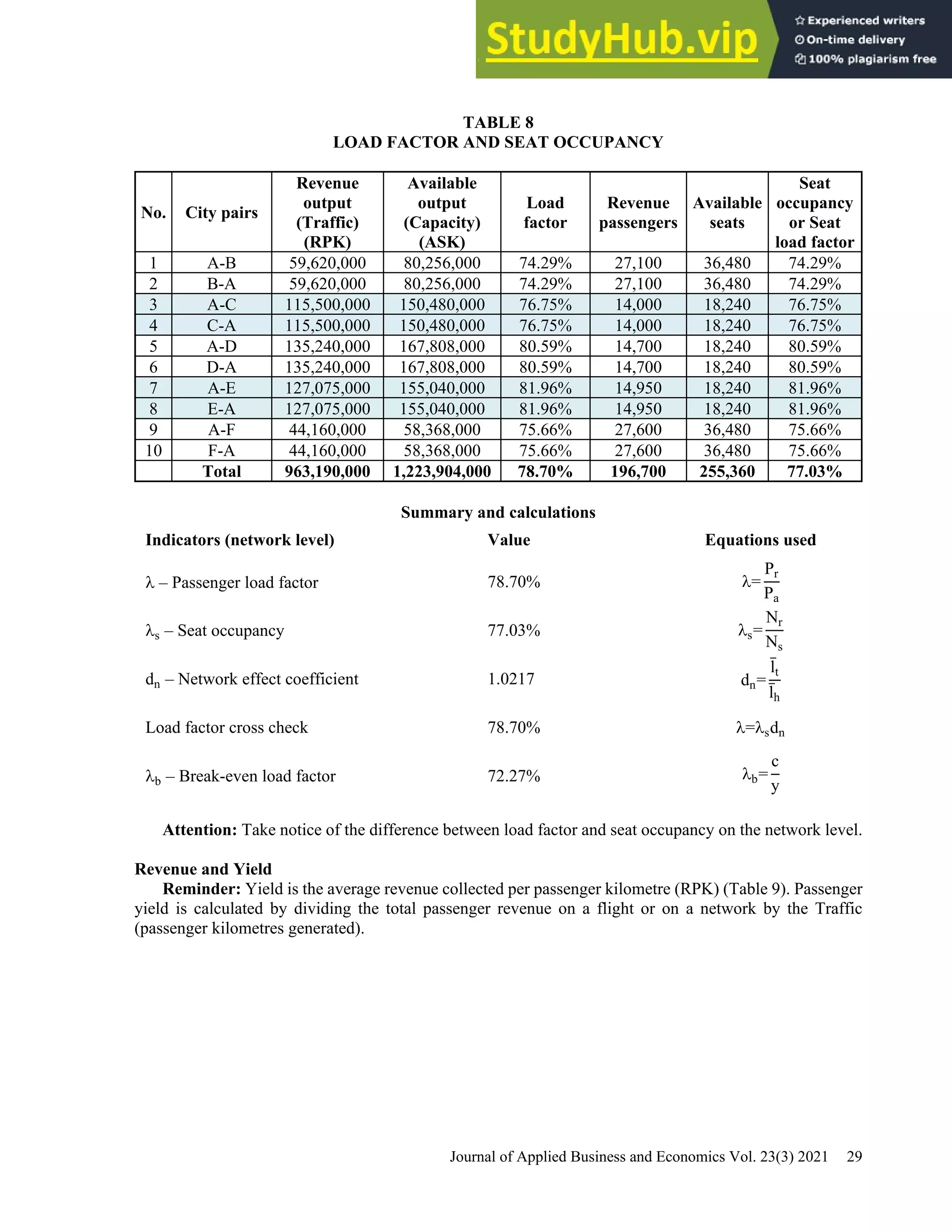
Reminder: Passenger load factor (%) is revenue output (RPK) expressed as a percentage of available
output (ASK) (Table 8). The seat occupancy (%) is the number of passengers carried as a percentage of
seats available for sale. The load factor and the seat occupancy on a single stage are equal but, on the
network, they are usually different from each other. This difference will lead us to the phenomenon of the
network effect (see Chapter 3.3).
Journal of Applied Business and Economics Vol. 23(3) 2021 29
TABLE 8
LOAD FACTOR AND SEAT OCCUPANCY
No. City pairs
Revenue
output
(Traffic)
(RPK)
Available
output
(Capacity)
(ASK)
Load
factor
Revenue
passengers
Available
seats
Seat
occupancy
or Seat
load factor
1 A-B 59,620,000 80,256,000 74.29% 27,100 36,480 74.29%
2 B-A 59,620,000 80,256,000 74.29% 27,100 36,480 74.29%
3 A-C 115,500,000 150,480,000 76.75% 14,000 18,240 76.75%
4 C-A 115,500,000 150,480,000 76.75% 14,000 18,240 76.75%
5 A-D 135,240,000 167,808,000 80.59% 14,700 18,240 80.59%
6 D-A 135,240,000 167,808,000 80.59% 14,700 18,240 80.59%
7 A-E 127,075,000 155,040,000 81.96% 14,950 18,240 81.96%
8 E-A 127,075,000 155,040,000 81.96% 14,950 18,240 81.96%
9 A-F 44,160,000 58,368,000 75.66% 27,600 36,480 75.66%
10 F-A 44,160,000 58,368,000 75.66% 27,600 36,480 75.66%
Total 963,190,000 1,223,904,000 78.70% 196,700 255,360 77.03%
Summary and calculations
Indicators (network level) Value Equations used
λ – Passenger load factor 78.70% λ=
Pr
Pa
λs – Seat occupancy 77.03% λs=
Nr
Ns
dn – Network effect coefficient 1.0217 dn=
l̅t
l̅h
Load factor cross check 78.70% λ=λsdn
λb – Break-even load factor 72.27% λb=
c
y
Attention: Take notice of the difference between load factor and seat occupancy on the network level.
Revenue and Yield
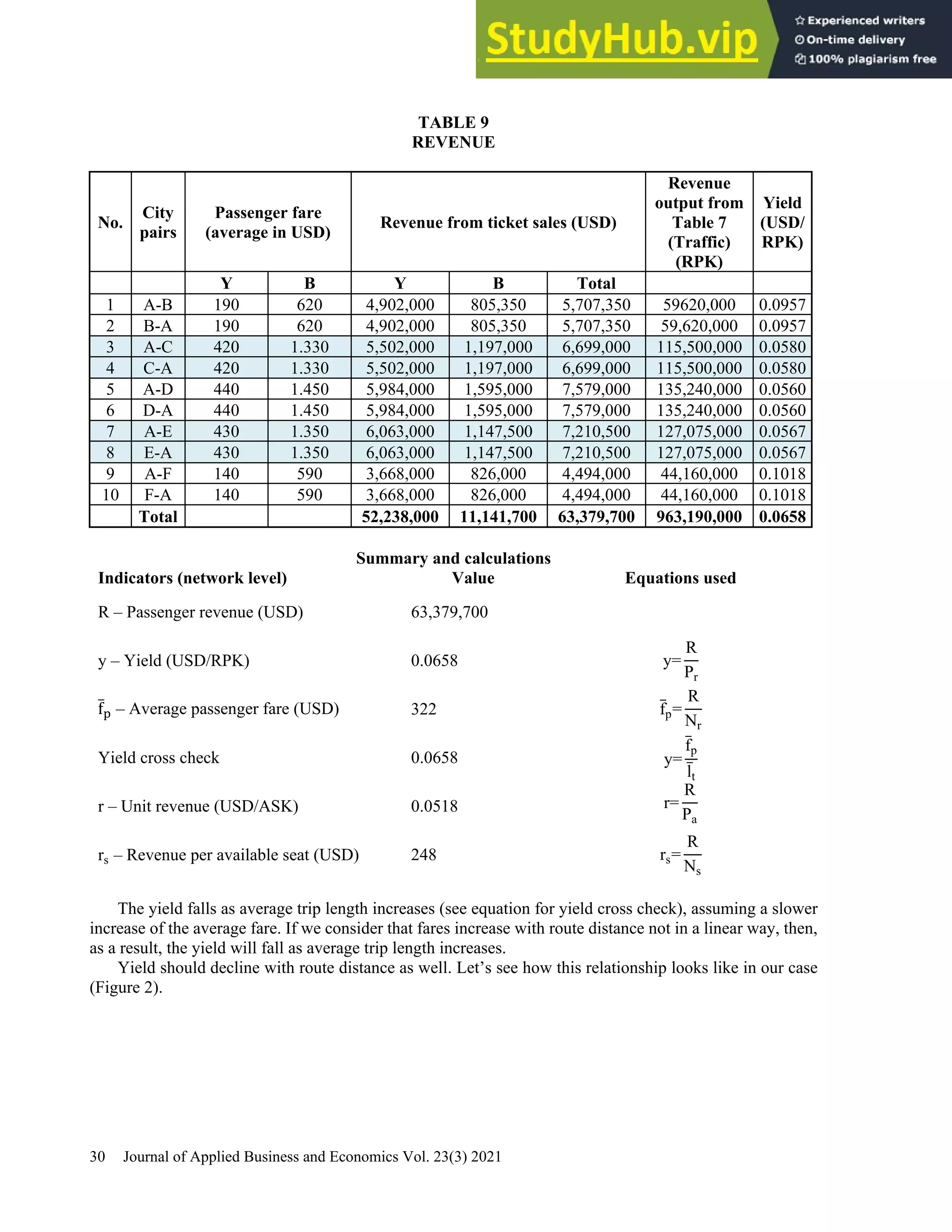
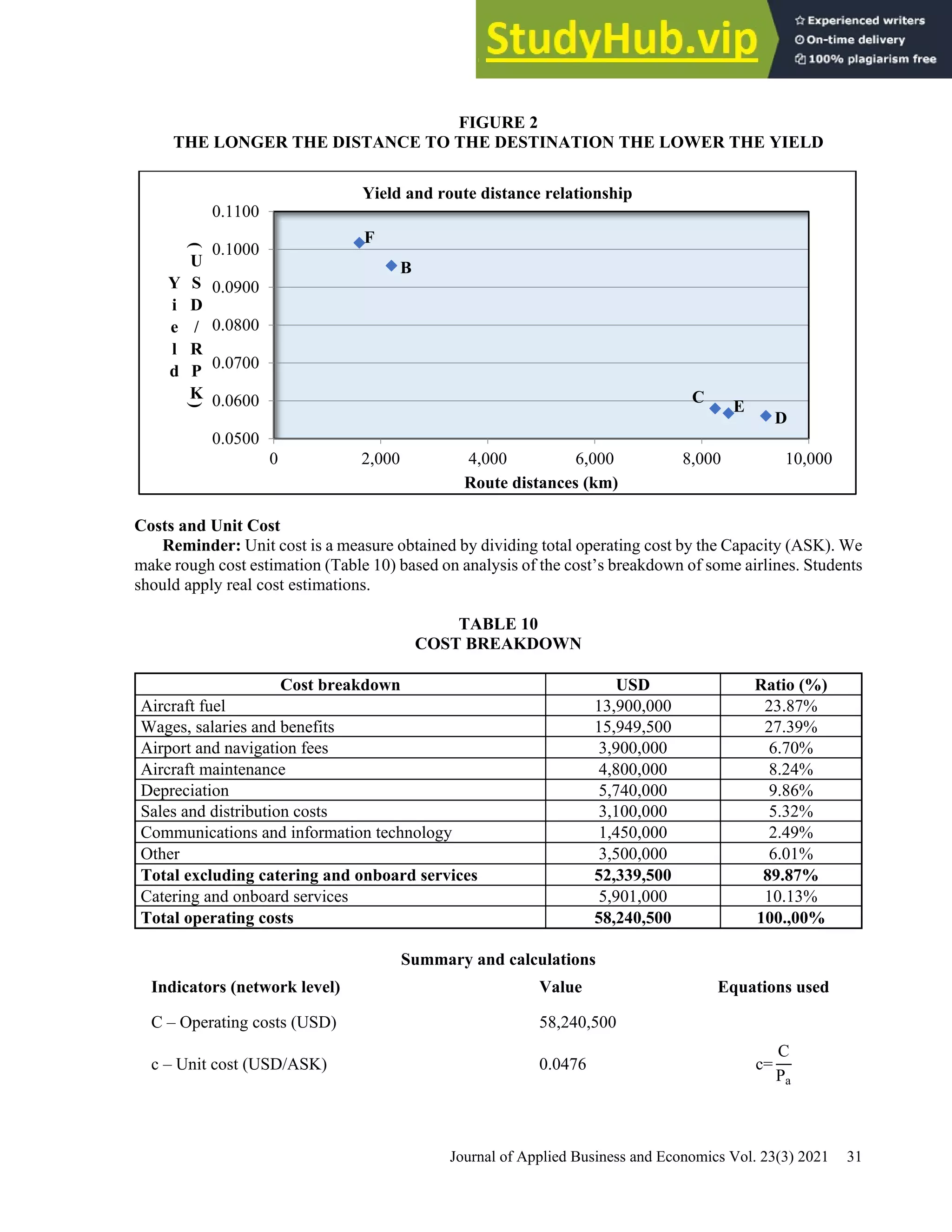
Reminder: Yield is the average revenue collected per passenger kilometre (RPK) (Table 9). Passenger
yield is calculated by dividing the total passenger revenue on a flight or on a network by the Traffic
(passenger kilometres generated).
30 Journal of Applied Business and Economics Vol. 23(3) 2021
TABLE 9
REVENUE
No.
City
pairs
Passenger fare
(average in USD)
Revenue from ticket sales (USD)
Revenue
output from
Table 7
(Traffic)
(RPK)
Yield
(USD/
RPK)
Y B Y B Total
1 A-B 190 620 4,902,000 805,350 5,707,350 59620,000 0.0957
2 B-A 190 620 4,902,000 805,350 5,707,350 59,620,000 0.0957
3 A-C 420 1.330 5,502,000 1,197,000 6,699,000 115,500,000 0.0580
4 C-A 420 1.330 5,502,000 1,197,000 6,699,000 115,500,000 0.0580
5 A-D 440 1.450 5,984,000 1,595,000 7,579,000 135,240,000 0.0560
6 D-A 440 1.450 5,984,000 1,595,000 7,579,000 135,240,000 0.0560
7 A-E 430 1.350 6,063,000 1,147,500 7,210,500 127,075,000 0.0567
8 E-A 430 1.350 6,063,000 1,147,500 7,210,500 127,075,000 0.0567
9 A-F 140 590 3,668,000 826,000 4,494,000 44,160,000 0.1018
10 F-A 140 590 3,668,000 826,000 4,494,000 44,160,000 0.1018
Total 52,238,000 11,141,700 63,379,700 963,190,000 0.0658
Summary and calculations
Indicators (network level) Value Equations used
R – Passenger revenue (USD) 63,379,700
y – Yield (USD/RPK) 0.0658 y=
R
Pr
f̅p – Average passenger fare (USD) 322 f̅p=
R
Nr
Yield cross check 0.0658 y=
f̅p
l̅t
r – Unit revenue (USD/ASK) 0.0518 r=
R
Pa
rs – Revenue per available seat (USD) 248 rs=
R
Ns
The yield falls as average trip length increases (see equation for yield cross check), assuming a slower
increase of the average fare. If we consider that fares increase with route distance not in a linear way, then,
as a result, the yield will fall as average trip length increases.
Yield should decline with route distance as well. Let’s see how this relationship looks like in our case
(Figure 2).
Journal of Applied Business and Economics Vol. 23(3) 2021 31
FIGURE 2
THE LONGER THE DISTANCE TO THE DESTINATION THE LOWER THE YIELD
Costs and Unit Cost
Reminder: Unit cost is a measure obtained by dividing total operating cost by the Capacity (ASK). We
make rough cost estimation (Table 10) based on analysis of the cost’s breakdown of some airlines. Students
should apply real cost estimations.
TABLE 10
COST BREAKDOWN
Cost breakdown USD Ratio (%)
Aircraft fuel 13,900,000 23.87%
Wages, salaries and benefits 15,949,500 27.39%
Airport and navigation fees 3,900,000 6.70%
Aircraft maintenance 4,800,000 8.24%
Depreciation 5,740,000 9.86%
Sales and distribution costs 3,100,000 5.32%
Communications and information technology 1,450,000 2.49%
Other 3,500,000 6.01%
Total excluding catering and onboard services 52,339,500 89.87%
Catering and onboard services 5,901,000 10.13%
Total operating costs 58,240,500 100.,00%
Summary and calculations
Indicators (network level) Value Equations used
C – Operating costs (USD) 58,240,500
c – Unit cost (USD/ASK) 0.0476 c=
C
Pa
B
C
D
E
F
0.0500
0.0600
0.0700
0.0800
0.0900
0.1000
0.1100
0 2,000 4,000 6,000 8,000 10,000
Y
i
e
l
d
(
U
S
D
/
R
P
K
)
Route distances (km)
Yield and route distance relationship
32 Journal of Applied Business and Economics Vol. 23(3) 2021
cs – Average cost per seat (USD/seat) 228 cs=
C
Ns
Unit cost cross check 0.0476 c =
cs
l̅h
Cp – On-board passenger services cost (USD) 5,901,000
cp – On-board services cost per PAX (USD) 30 cp=
Cp
Nr
Modifying the number of passengers carried, ceteris paribus (all other things remaining constant), the
unit cost will change because of the catering and on-board passenger service cost changes (in general
because of the load-related costs change). This is the reason why the catering and the on-board passenger
service cost are treated separately. This approach gives more precise results of calculations in the What-If
analysis (see Chapter 3). In the case where you are creating a Low-Cost Carrier (LCC), there is no on-board
passenger service cost and no need to separate this cost.
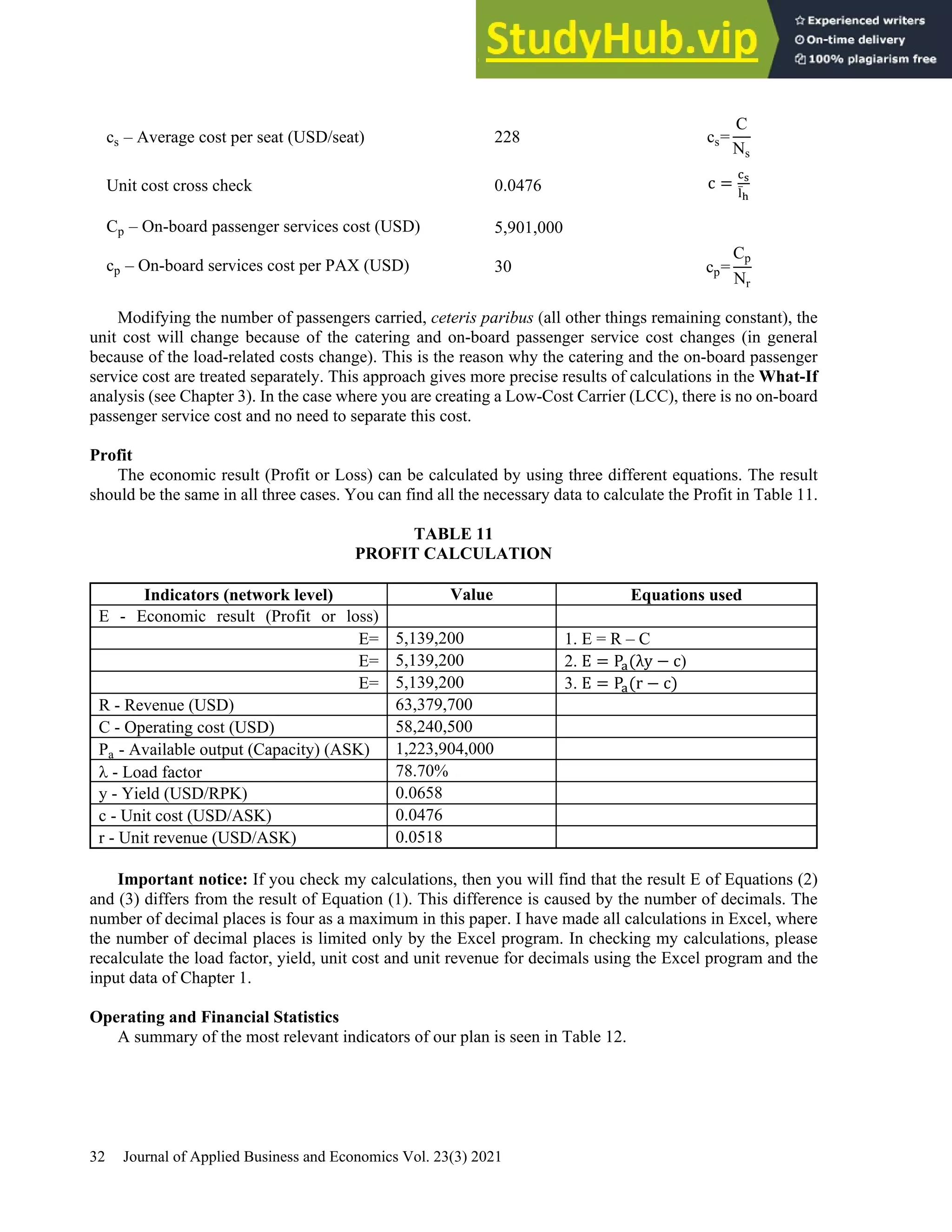
Profit
The economic result (Profit or Loss) can be calculated by using three different equations. The result
should be the same in all three cases. You can find all the necessary data to calculate the Profit in Table 11.
TABLE 11
PROFIT CALCULATION
Indicators (network level) Value Equations used
E - Economic result (Profit or loss)
E= 5,139,200 1. E = R – C
E= 5,139,200 2. E = Pa(λy − c)
E= 5,139,200 3. E = Pa(r − c)
R - Revenue (USD) 63,379,700
C - Operating cost (USD) 58,240,500
Pa - Available output (Capacity) (ASK) 1,223,904,000
λ - Load factor 78.70%
y - Yield (USD/RPK) 0.0658
c - Unit cost (USD/ASK) 0.0476
r - Unit revenue (USD/ASK) 0.0518
Important notice: If you check my calculations, then you will find that the result E of Equations (2)
and (3) differs from the result of Equation (1). This difference is caused by the number of decimals. The
number of decimal places is four as a maximum in this paper. I have made all calculations in Excel, where
the number of decimal places is limited only by the Excel program. In checking my calculations, please
recalculate the load factor, yield, unit cost and unit revenue for decimals using the Excel program and the
input data of Chapter 1.
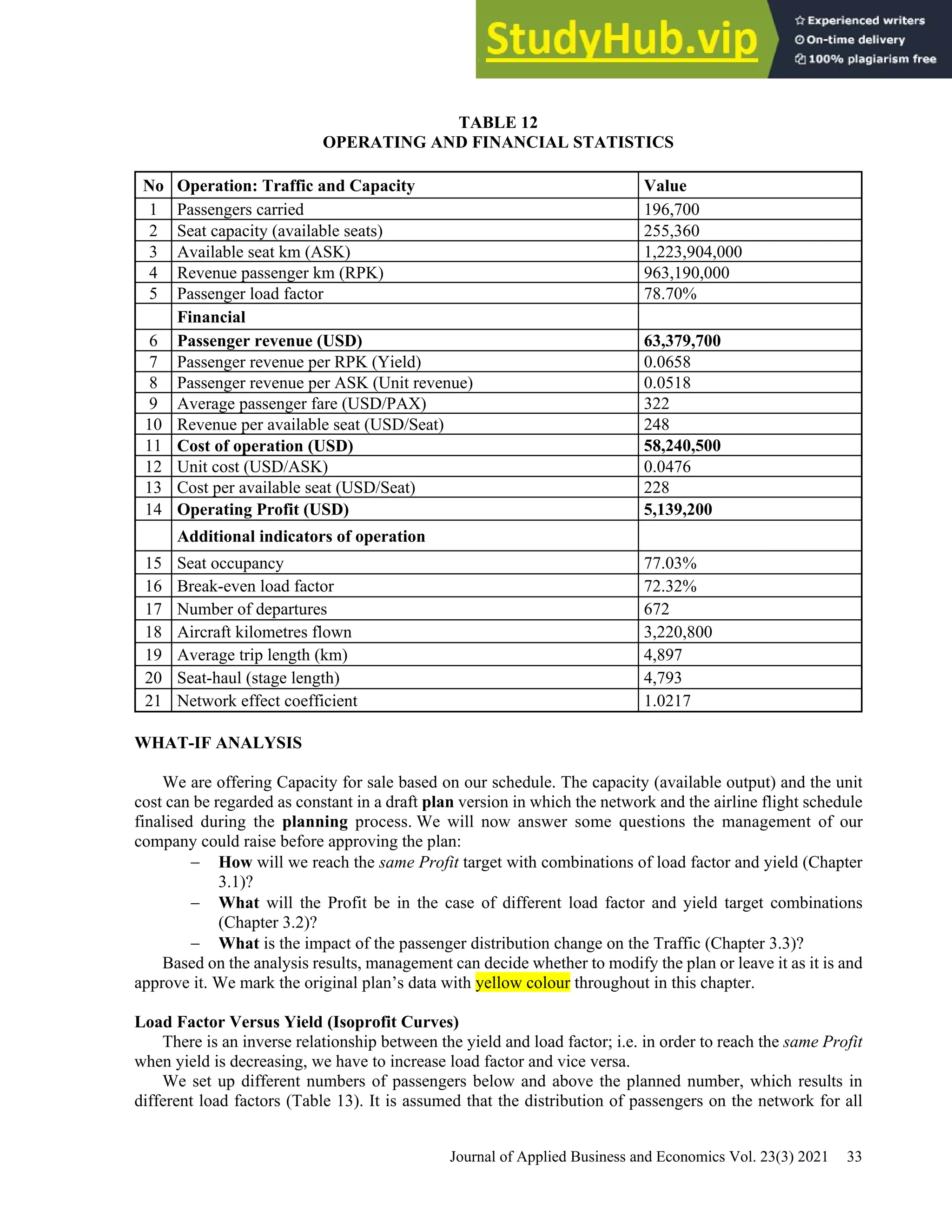
Operating and Financial Statistics
A summary of the most relevant indicators of our plan is seen in Table 12.
Journal of Applied Business and Economics Vol. 23(3) 2021 33
TABLE 12
OPERATING AND FINANCIAL STATISTICS
No Operation: Traffic and Capacity Value
1 Passengers carried 196,700
2 Seat capacity (available seats) 255,360
3 Available seat km (ASK) 1,223,904,000
4 Revenue passenger km (RPK) 963,190,000
5 Passenger load factor 78.70%
Financial
6 Passenger revenue (USD) 63,379,700
7 Passenger revenue per RPK (Yield) 0.0658
8 Passenger revenue per ASK (Unit revenue) 0.0518
9 Average passenger fare (USD/PAX) 322
10 Revenue per available seat (USD/Seat) 248
11 Cost of operation (USD) 58,240,500
12 Unit cost (USD/ASK) 0.0476
13 Cost per available seat (USD/Seat) 228
14 Operating Profit (USD) 5,139,200
Additional indicators of operation
15 Seat occupancy 77.03%
16 Break-even load factor 72.32%
17 Number of departures 672
18 Aircraft kilometres flown 3,220,800
19 Average trip length (km) 4,897
20 Seat-haul (stage length) 4,793
21 Network effect coefficient 1.0217
WHAT-IF ANALYSIS
We are offering Capacity for sale based on our schedule. The capacity (available output) and the unit
cost can be regarded as constant in a draft plan version in which the network and the airline flight schedule
finalised during the planning process. We will now answer some questions the management of our
company could raise before approving the plan:
− How will we reach the same Profit target with combinations of load factor and yield (Chapter
3.1)?
− What will the Profit be in the case of different load factor and yield target combinations
(Chapter 3.2)?
− What is the impact of the passenger distribution change on the Traffic (Chapter 3.3)?
Based on the analysis results, management can decide whether to modify the plan or leave it as it is and
approve it. We mark the original plan’s data with yellow colour throughout in this chapter.
Load Factor Versus Yield (Isoprofit Curves)
There is an inverse relationship between the yield and load factor; i.e. in order to reach the same Profit
when yield is decreasing, we have to increase load factor and vice versa.
We set up different numbers of passengers below and above the planned number, which results in
different load factors (Table 13). It is assumed that the distribution of passengers on the network for all
34 Journal of Applied Business and Economics Vol. 23(3) 2021
versions (from v1 to v5) is the same as in the plan; in other words, the average trip length and the network
effect coefficient are the same as well.
For the load factor calculation, we use the following equation:
λ=
Nr
Ns
dn
TABLE 13
PASSENGERS CARRIED AND THE LOAD FACTOR
Versions
v1 v2 Plan v4 v5
Passengers carried
188,700 192,700 196,700 200,700 204,700
Change in the number of PAX carried compared to planned
−8,000 −4,000 0 4,000 8,000
Load factor
75.50% 77.10% 78.70% 80.30% 81.90%
Operating costs contains costs that depends on the number of passengers carried (on-board passenger
service cost).
Having our 30 USD/PAX on-board passenger service cost, we recalculate the unit cost for each version
(Table 14). Students can change (increase or decrease) this passenger-related cost and see how the unit cost
is changing.
TABLE 14
UNIT COST IN RELATION TO NUMBER OF PASSENGERS CARRIED
v1 v2 Plan v4 v5
Change in on-board passenger service cost (USD)
−240,000 −120,000 0 120,000 240,000
Operating cost depending on the number of passengers carried
58,000,500 58,120,500 58,240,500 58,360,500 58,480,500
Unit cost depending on the number of passengers carried
0.0474 0.0475 0.0476 0.0477 0.0478
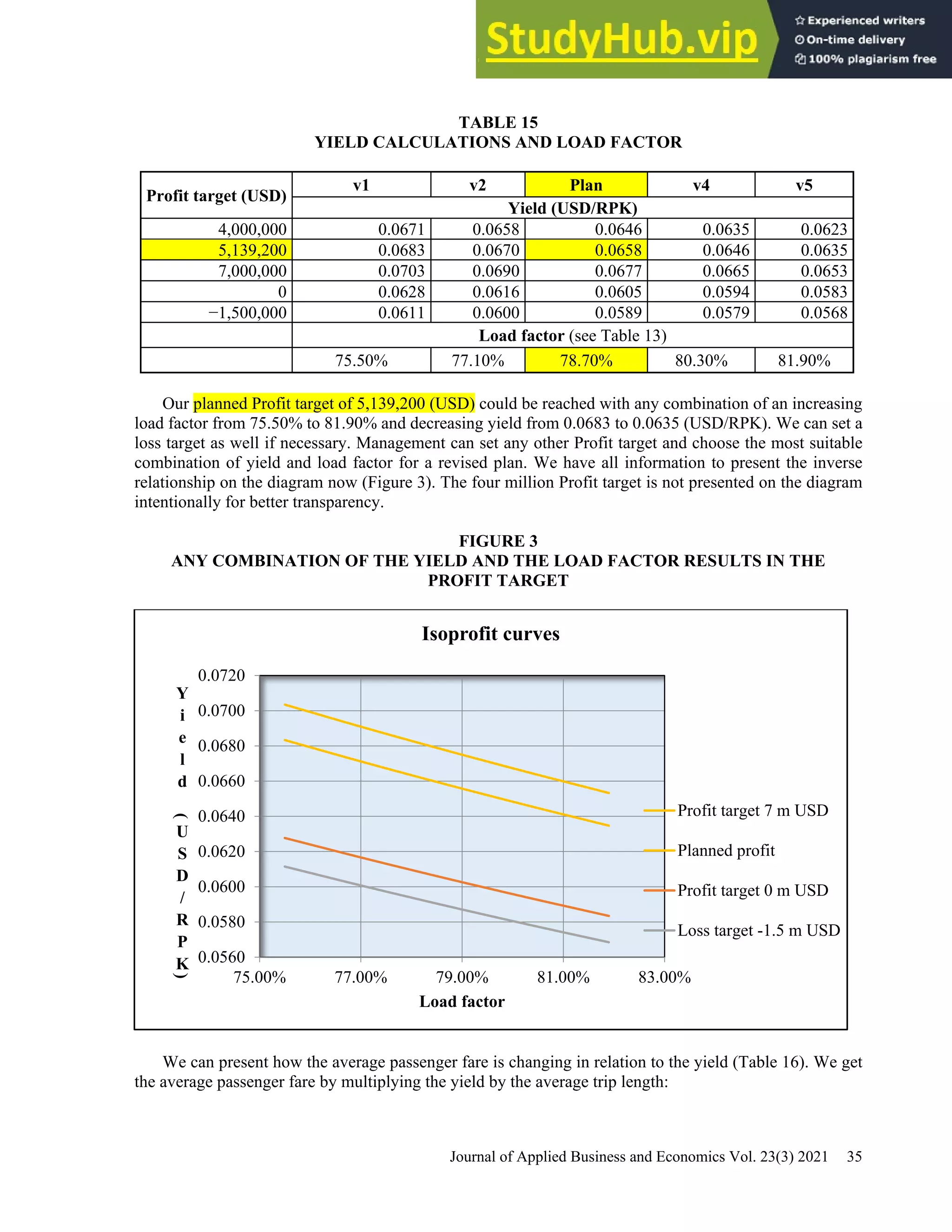
We set different Profit targets and calculate the yield to present the inverse relationship between load
factor and yield. Our aim is to demonstrate how the same Profit target could be reached with different
combinations of yield and load factor.
Remember: the available output is the same in all versions as in the plan. We calculate the yield (Table
15) using the following equation, which is derived from the Profit Equation (2) (see Table 11):
y =
E
Pa
+c
λ
Journal of Applied Business and Economics Vol. 23(3) 2021 35
TABLE 15
YIELD CALCULATIONS AND LOAD FACTOR
Profit target (USD)
v1 v2 Plan v4 v5
Yield (USD/RPK)
4,000,000 0.0671 0.0658 0.0646 0.0635 0.0623
5,139,200 0.0683 0.0670 0.0658 0.0646 0.0635
7,000,000 0.0703 0.0690 0.0677 0.0665 0.0653
0 0.0628 0.0616 0.0605 0.0594 0.0583
−1,500,000 0.0611 0.0600 0.0589 0.0579 0.0568
Load factor (see Table 13)
75.50% 77.10% 78.70% 80.30% 81.90%
Our planned Profit target of 5,139,200 (USD) could be reached with any combination of an increasing
load factor from 75.50% to 81.90% and decreasing yield from 0.0683 to 0.0635 (USD/RPK). We can set a
loss target as well if necessary. Management can set any other Profit target and choose the most suitable
combination of yield and load factor for a revised plan. We have all information to present the inverse
relationship on the diagram now (Figure 3). The four million Profit target is not presented on the diagram
intentionally for better transparency.
FIGURE 3
ANY COMBINATION OF THE YIELD AND THE LOAD FACTOR RESULTS IN THE
PROFIT TARGET
We can present how the average passenger fare is changing in relation to the yield (Table 16). We get
the average passenger fare by multiplying the yield by the average trip length:
0.0560
0.0580
0.0600
0.0620
0.0640
0.0660
0.0680
0.0700
0.0720
75.00% 77.00% 79.00% 81.00% 83.00%
Y
i
e
l
d
(
U
S
D
/
R
P
K
)
Load factor
Isoprofit curves
Profit target 7 m USD
Planned profit
Profit target 0 m USD
Loss target -1.5 m USD
36 Journal of Applied Business and Economics Vol. 23(3) 2021
f̅p=yl̅t.
When the Profit equals zero, we are at the break-even point. The break-even average passenger fare is
important information because below this fare the airline enters into loss.
TABLE 16
AVERAGE PASSENGER FARE
Profit target (USD)
v1 v2 Plan v4 v5
Average passenger fare (USD)
4,000,000 329 322 316 311 305
5,139,200 335 328 322 316 311
7,000,000 344 338 332 326 320
0 (break-even) 307 302 296 291 286
−1,500,000 299 294 288 283 278
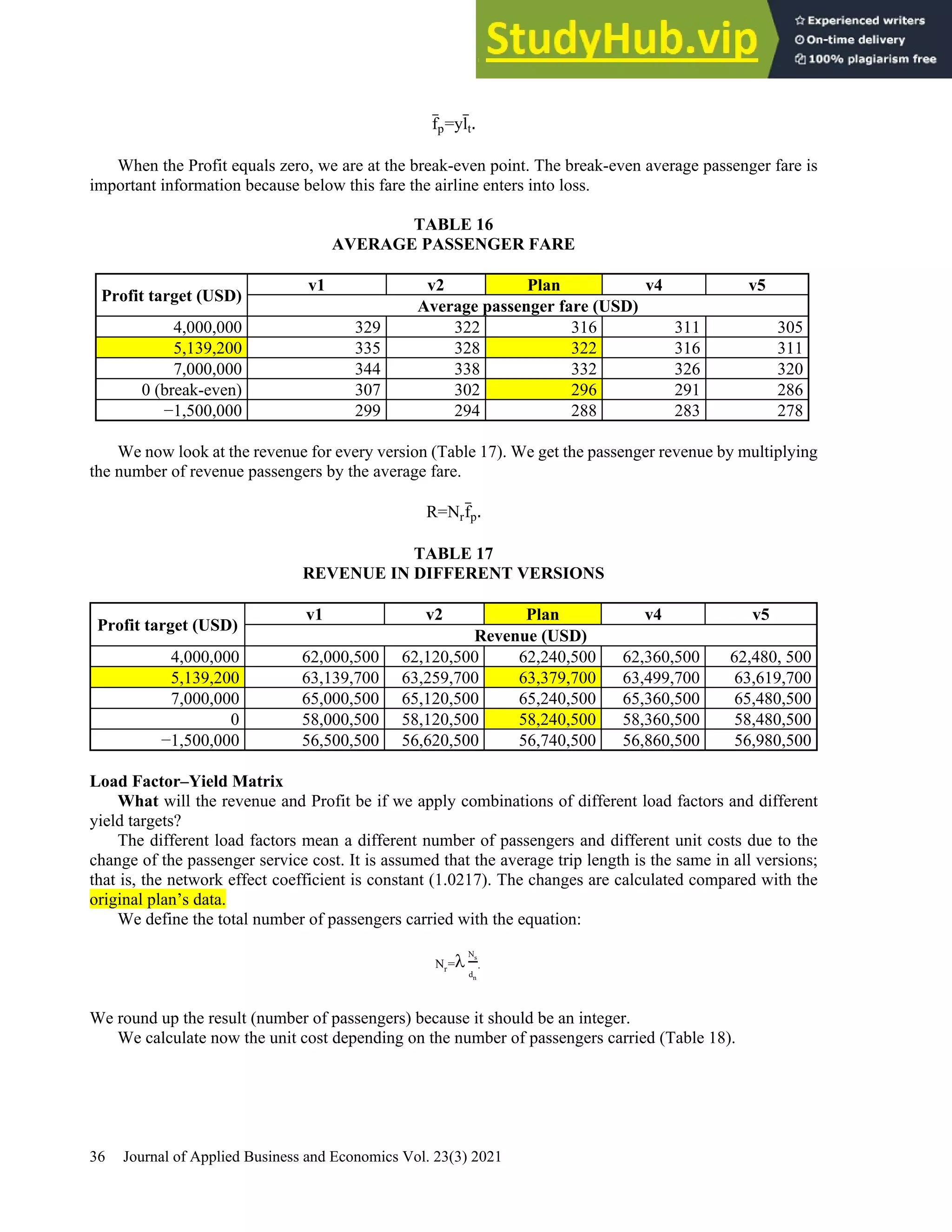
We now look at the revenue for every version (Table 17). We get the passenger revenue by multiplying
the number of revenue passengers by the average fare.
R=Nrf̅p.
TABLE 17
REVENUE IN DIFFERENT VERSIONS
Profit target (USD)
v1 v2 Plan v4 v5
Revenue (USD)
4,000,000 62,000,500 62,120,500 62,240,500 62,360,500 62,480, 500
5,139,200 63,139,700 63,259,700 63,379,700 63,499,700 63,619,700
7,000,000 65,000,500 65,120,500 65,240,500 65,360,500 65,480,500
0 58,000,500 58,120,500 58,240,500 58,360,500 58,480,500
−1,500,000 56,500,500 56,620,500 56,740,500 56,860,500 56,980,500
Load Factor–Yield Matrix
What will the revenue and Profit be if we apply combinations of different load factors and different
yield targets?
The different load factors mean a different number of passengers and different unit costs due to the
change of the passenger service cost. It is assumed that the average trip length is the same in all versions;
that is, the network effect coefficient is constant (1.0217). The changes are calculated compared with the
original plan’s data.
We define the total number of passengers carried with the equation:
Nr=λ
Ns
dn
.
We round up the result (number of passengers) because it should be an integer.
We calculate now the unit cost depending on the number of passengers carried (Table 18).
Journal of Applied Business and Economics Vol. 23(3) 2021 37
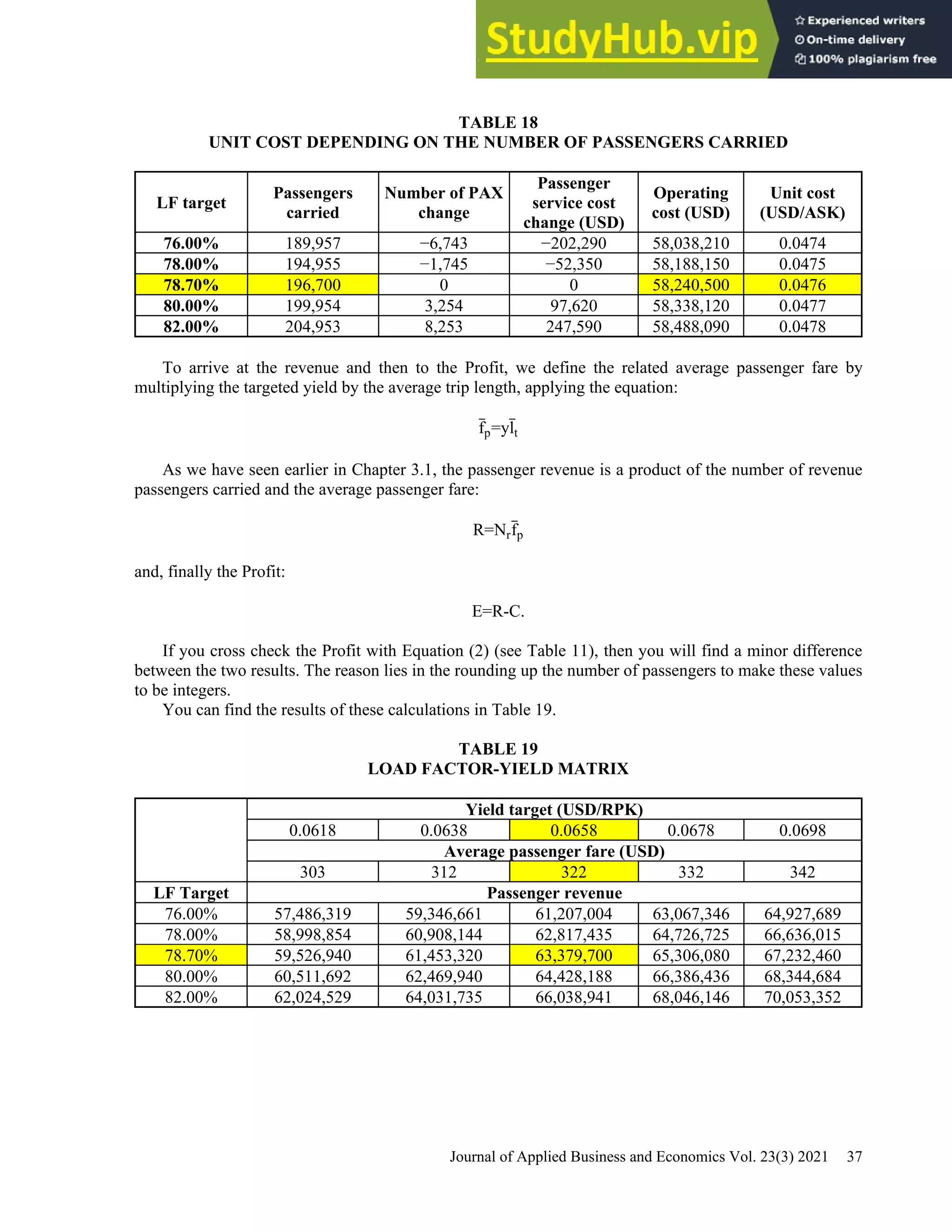
TABLE 18
UNIT COST DEPENDING ON THE NUMBER OF PASSENGERS CARRIED
LF target
Passengers
carried
Number of PAX
change
Passenger
service cost
change (USD)
Operating
cost (USD)
Unit cost
(USD/ASK)
76.00% 189,957 −6,743 −202,290 58,038,210 0.0474
78.00% 194,955 −1,745 −52,350 58,188,150 0.0475
78.70% 196,700 0 0 58,240,500 0.0476
80.00% 199,954 3,254 97,620 58,338,120 0.0477
82.00% 204,953 8,253 247,590 58,488,090 0.0478
To arrive at the revenue and then to the Profit, we define the related average passenger fare by
multiplying the targeted yield by the average trip length, applying the equation:
f̅p=yl̅t
As we have seen earlier in Chapter 3.1, the passenger revenue is a product of the number of revenue
passengers carried and the average passenger fare:
R=Nrf̅p
and, finally the Profit:
E=R-C.
If you cross check the Profit with Equation (2) (see Table 11), then you will find a minor difference
between the two results. The reason lies in the rounding up the number of passengers to make these values
to be integers.
You can find the results of these calculations in Table 19.
TABLE 19
LOAD FACTOR-YIELD MATRIX
Yield target (USD/RPK)
0.0618 0.0638 0.0658 0.0678 0.0698
Average passenger fare (USD)
303 312 322 332 342
LF Target Passenger revenue
76.00% 57,486,319 59,346,661 61,207,004 63,067,346 64,927,689
78.00% 58,998,854 60,908,144 62,817,435 64,726,725 66,636,015
78.70% 59,526,940 61,453,320 63,379,700 65,306,080 67,232,460
80.00% 60,511,692 62,469,940 64,428,188 66,386,436 68,344,684
82.00% 62,024,529 64,031,735 66,038,941 68,046,146 70,053,352
38 Journal of Applied Business and Economics Vol. 23(3) 2021
Profit
E = R − C
76.00% −551,891 1,308,451 3,168,794 5,029,136 6,889,479
78.00% 810,704 2,719,994 4,629,285 6,538,575 8,447,865
78.70% 1,286,440 3,212,820 5,139,200 7,065,580 8,991,960
80.00% 2,173,572 4,131,820 6,090,068 8,048,316 10,006,564
82.00% 3,536,439 5,543,645 7,550,851 9,558,056 11,565,262
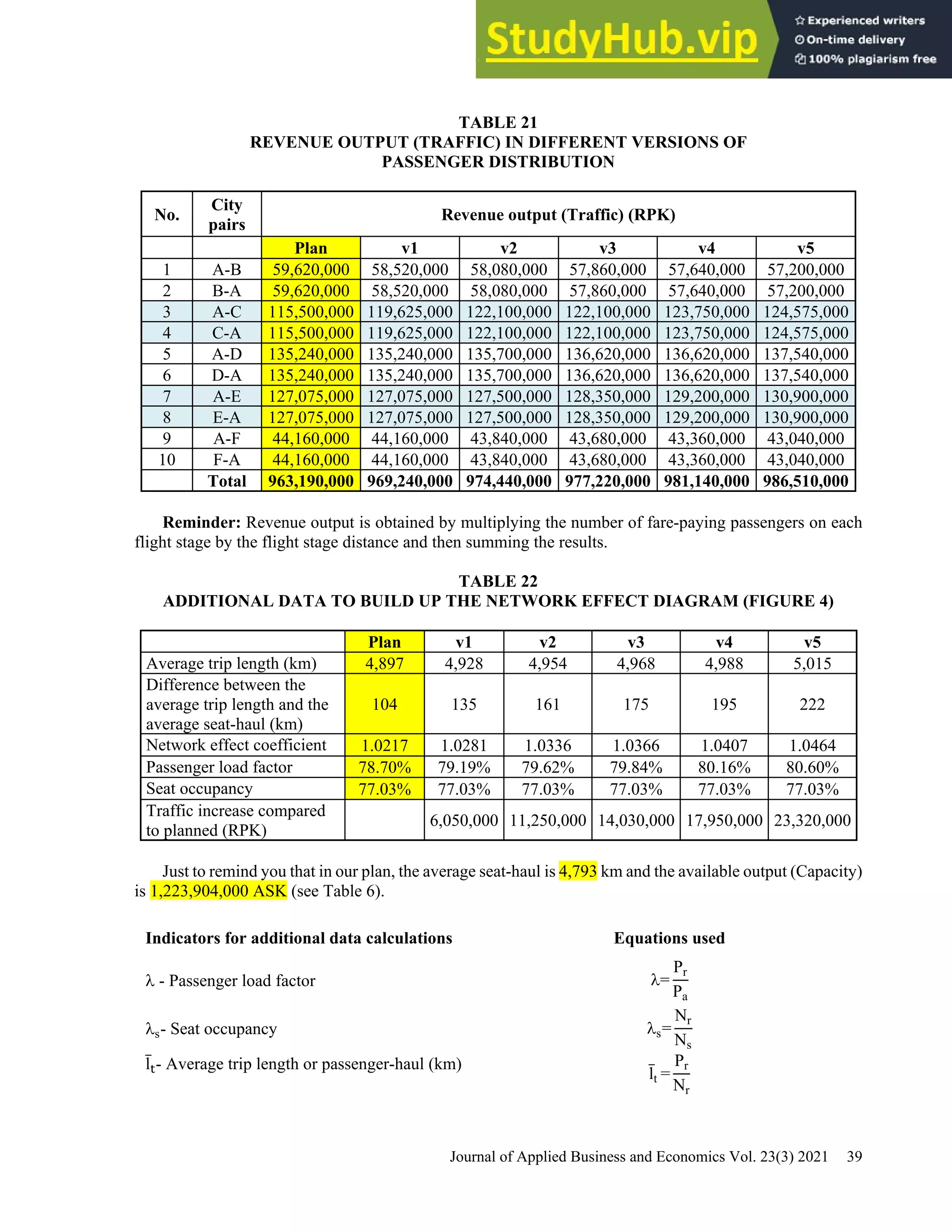
Management can ask during the plan approval process; for example, what will be the Profit if we set
the load factor target to 82% (increasing the number of revenue passengers) but do not increase the average
fare of 322 USD?
The answer is: 7,550,851 USD. By applying different load factor and yield (average passenger fare)
targets, management can fine-tune the plan to reach the desired Profit.
Network Effect
What happens if the demand for longer travel distances is prevailing over the demand for shorter travel
distances?
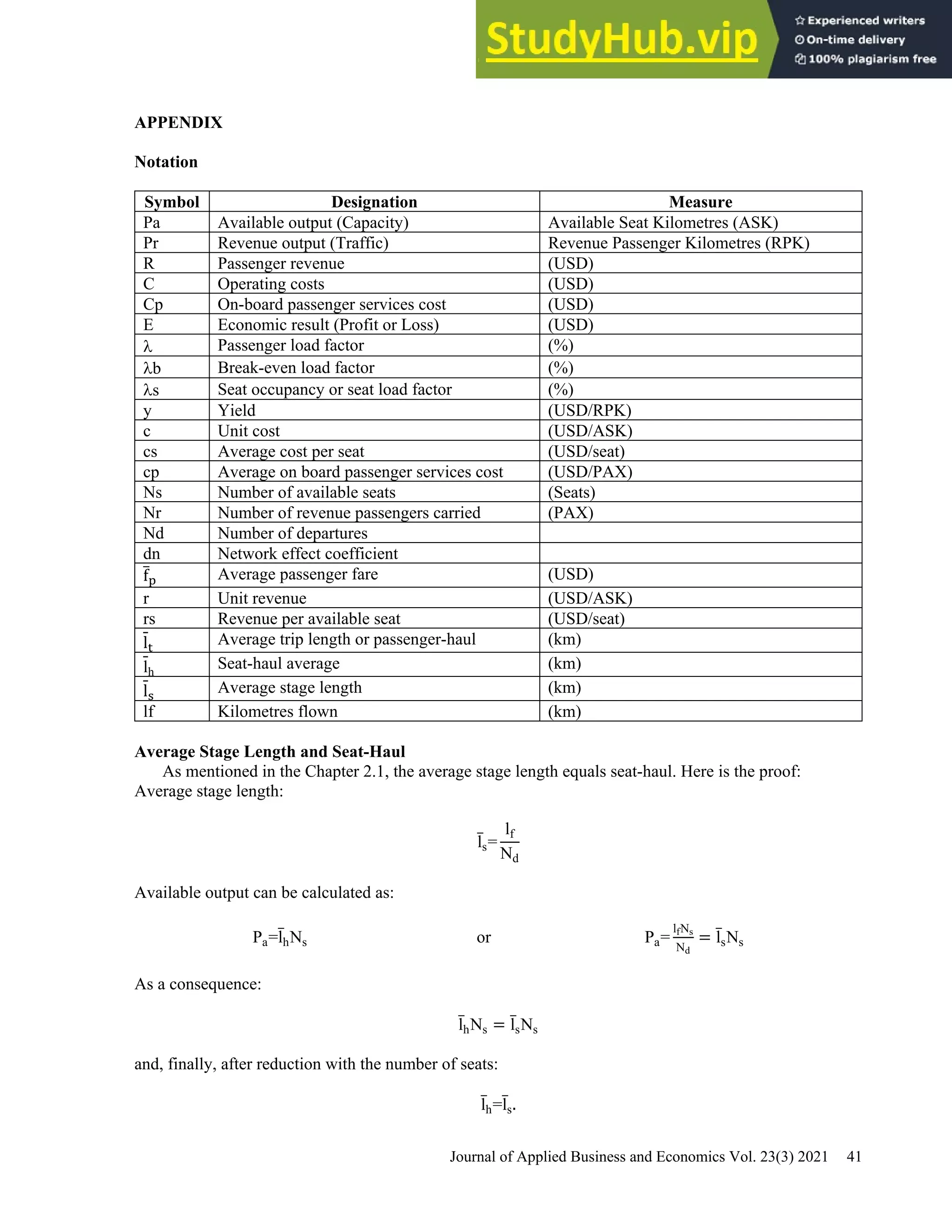
The shift of passengers to higher travel distances (while the total number of passengers remains
constant) will lead to higher revenue output and to higher Profit. Conversely, the shift of passengers to
shorter travel distances (while the total number of passengers remains constant) will lead to lower revenue
output and to lower Profit.
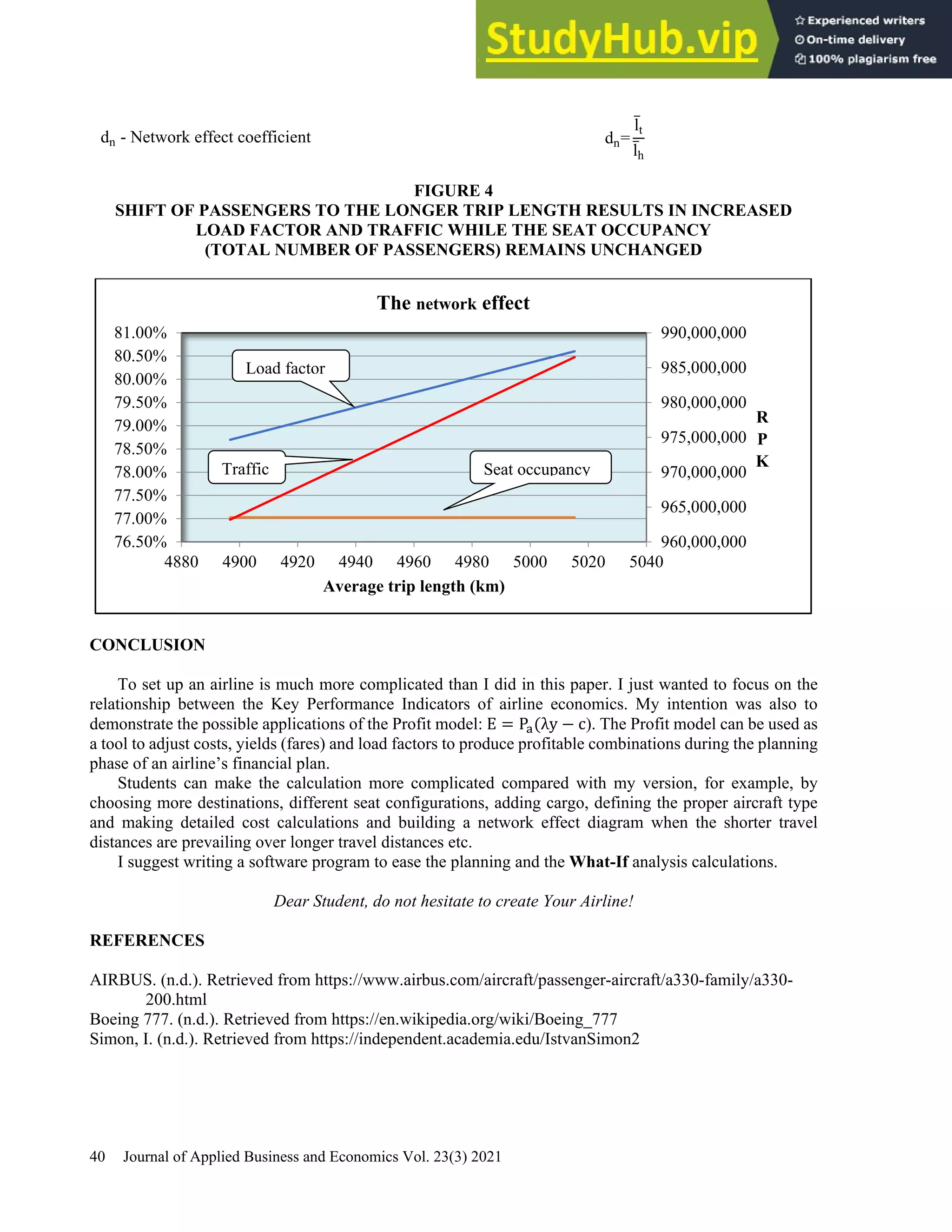
In our example, we increase the number of passengers on the long routes and decrease it on the short
routes such that the number of passengers constant (Table 20). As a result, the average trip length increases
(Table 22) as does the revenue output (Table 21).
TABLE 20
VERSIONS OF PASSENGER DISTRIBUTION ON THE NETWORK
No.
City
pairs
Flight
stage
distances
(km)
Passengers distribution on the network (PAX)
Plan v1 v2 v3 v4 v5
1 A-B 2,200 27,100 26,600 26,400 26,300 26,200 26,000
2 B-A 2,200 27,100 26,600 26,400 26,300 26,200 26,000
3 A-C 8,250 14,000 14,500 14,800 14,800 15,000 15,100
4 C-A 8,250 14,000 14,500 14,800 14,800 15,000 15,100
5 A-D 9,200 14,700 14,700 14,750 14,850 14,850 14,950
6 D-A 9,200 14,700 14,700 14,750 14,850 14,850 14,950
7 A-E 8,500 14,950 14,950 15,000 15,100 15,200 15,400
8 E-A 8,500 14,950 14,950 15,000 15,100 15,200 15,400
9 A-F 1,600 27,600 27,600 27,400 27,300 27,100 26,900
10 F-A 1,600 27,600 27,600 27,400 27,300 27,100 26,900
Total 196,700 196,700 196,700 196,700 196,700 196,700
Journal of Applied Business and Economics Vol. 23(3) 2021 39
TABLE 21
REVENUE OUTPUT (TRAFFIC) IN DIFFERENT VERSIONS OF
PASSENGER DISTRIBUTION
No.
City
pairs
Revenue output (Traffic) (RPK)
Plan v1 v2 v3 v4 v5
1 A-B 59,620,000 58,520,000 58,080,000 57,860,000 57,640,000 57,200,000
2 B-A 59,620,000 58,520,000 58,080,000 57,860,000 57,640,000 57,200,000
3 A-C 115,500,000 119,625,000 122,100,000 122,100,000 123,750,000 124,575,000
4 C-A 115,500,000 119,625,000 122,100,000 122,100,000 123,750,000 124,575,000
5 A-D 135,240,000 135,240,000 135,700,000 136,620,000 136,620,000 137,540,000
6 D-A 135,240,000 135,240,000 135,700,000 136,620,000 136,620,000 137,540,000
7 A-E 127,075,000 127,075,000 127,500,000 128,350,000 129,200,000 130,900,000
8 E-A 127,075,000 127,075,000 127,500,000 128,350,000 129,200,000 130,900,000
9 A-F 44,160,000 44,160,000 43,840,000 43,680,000 43,360,000 43,040,000
10 F-A 44,160,000 44,160,000 43,840,000 43,680,000 43,360,000 43,040,000
Total 963,190,000 969,240,000 974,440,000 977,220,000 981,140,000 986,510,000
Reminder: Revenue output is obtained by multiplying the number of fare-paying passengers on each
flight stage by the flight stage distance and then summing the results.
TABLE 22
ADDITIONAL DATA TO BUILD UP THE NETWORK EFFECT DIAGRAM (FIGURE 4)
Plan v1 v2 v3 v4 v5
Average trip length (km) 4,897 4,928 4,954 4,968 4,988 5,015
Difference between the
average trip length and the
average seat-haul (km)
104 135 161 175 195 222
Network effect coefficient 1.0217 1.0281 1.0336 1.0366 1.0407 1.0464
Passenger load factor 78.70% 79.19% 79.62% 79.84% 80.16% 80.60%
Seat occupancy 77.03% 77.03% 77.03% 77.03% 77.03% 77.03%
Traffic increase compared
to planned (RPK)
6,050,000 11,250,000 14,030,000 17,950,000 23,320,000
Just to remind you that in our plan, the average seat-haul is 4,793 km and the available output (Capacity)
is 1,223,904,000 ASK (see Table 6).
Indicators for additional data calculations Equations used
λ - Passenger load factor λ=
Pr
Pa
λs- Seat occupancy λs=
Nr
Ns
l̅t- Average trip length or passenger-haul (km)
l̅t =
Pr
Nr
40 Journal of Applied Business and Economics Vol. 23(3) 2021
dn - Network effect coefficient dn=
l̅t
l̅h
FIGURE 4
SHIFT OF PASSENGERS TO THE LONGER TRIP LENGTH RESULTS IN INCREASED
LOAD FACTOR AND TRAFFIC WHILE THE SEAT OCCUPANCY
(TOTAL NUMBER OF PASSENGERS) REMAINS UNCHANGED
CONCLUSION
To set up an airline is much more complicated than I did in this paper. I just wanted to focus on the
relationship between the Key Performance Indicators of airline economics. My intention was also to
demonstrate the possible applications of the Profit model: E = Pa(λy − c). The Profit model can be used as
a tool to adjust costs, yields (fares) and load factors to produce profitable combinations during the planning
phase of an airline’s financial plan.
Students can make the calculation more complicated compared with my version, for example, by
choosing more destinations, different seat configurations, adding cargo, defining the proper aircraft type
and making detailed cost calculations and building a network effect diagram when the shorter travel
distances are prevailing over longer travel distances etc.
I suggest writing a software program to ease the planning and the What-If analysis calculations.
Dear Student, do not hesitate to create Your Airline!
REFERENCES
AIRBUS. (n.d.). Retrieved from https://www.airbus.com/aircraft/passenger-aircraft/a330-family/a330-
200.html
Boeing 777. (n.d.). Retrieved from https://en.wikipedia.org/wiki/Boeing_777
Simon, I. (n.d.). Retrieved from https://independent.academia.edu/IstvanSimon2
960,000,000
965,000,000
970,000,000
975,000,000
980,000,000
985,000,000
990,000,000
76.50%
77.00%
77.50%
78.00%
78.50%
79.00%
79.50%
80.00%
80.50%
81.00%
4880 4900 4920 4940 4960 4980 5000 5020 5040
R
P
K
Average trip length (km)
The network effect
Traffic Seat occupancy
Load factor
Journal of Applied Business and Economics Vol. 23(3) 2021 41
APPENDIX
Notation
Symbol Designation Measure
Pa Available output (Capacity) Available Seat Kilometres (ASK)
Pr Revenue output (Traffic) Revenue Passenger Kilometres (RPK)
R Passenger revenue (USD)
C Operating costs (USD)
Cp On-board passenger services cost (USD)
E Economic result (Profit or Loss) (USD)
λ Passenger load factor (%)
λb Break-even load factor (%)
λs Seat occupancy or seat load factor (%)
y Yield (USD/RPK)
c Unit cost (USD/ASK)
cs Average cost per seat (USD/seat)
cp Average on board passenger services cost (USD/PAX)
Ns Number of available seats (Seats)
Nr Number of revenue passengers carried (PAX)
Nd Number of departures
dn Network effect coefficient
f̅p Average passenger fare (USD)
r Unit revenue (USD/ASK)
rs Revenue per available seat (USD/seat)
lt
Average trip length or passenger-haul (km)
lh
Seat-haul average (km)
ls
Average stage length (km)
lf Kilometres flown (km)
Average Stage Length and Seat-Haul
As mentioned in the Chapter 2.1, the average stage length equals seat-haul. Here is the proof:
Average stage length:
l̅s=
lf
Nd
Available output can be calculated as:
Pa=l̅hNs or Pa=
lfNs
Nd
= l̅sNs
As a consequence:
l̅hNs = l̅sNs
and, finally, after reduction with the number of seats:
l̅h=l̅s.

Airline Economics - Planning And Key Performance Indicators Practical Guide For Students

  • 1.
    Social Media, Confusion,and Small Business During the COVID 19 Crisis 13 Daniel Sullivan, Daniel Fox, Robert Stoll, Raymond Jacobs Airline Economics – Planning and Key Performance Indicators Practical Guide for Students 23 Istvan Simon Hungary Colombia’s Progress: Internal Peace and Foreign Trade 42 Andrew F. Johnson, Rusty V. Karst False Hopes, Missed Opportunities: How Economic Models Affect the IPCC Proposals in Special Report 15 "Global Warming of 1.5 °C" (2018). An Analysis From the Scientific Advisory Board of BUND 49 Joachim H. Spangenberg, Werner Neumann, Heinz Klöser, Stefan Wittig, Tilmann Uhlenhaut, Martha Mertens, Edo Günther, Ingo Valentin, Markus Große Ophoff Wealth Effects of Dividend Announcements on Bondholders: The Case of Taiwan Bond Market 73 Ming-Chang Cheng, Kai Chen, Chien-Chi Lee, Chih-Hsun Wu Operational Risk for Funds of Hedge Funds – An Analysis of Regulatory Requirements Under Dodd-Frank Act 98 Ohaness Paskelian, Stephen Bell, Julia Creek The New Technologies and the Paradox of Global Consumption 104 Liton Lanes Pilau Sobrinho Clergy Attitudes Toward Credit/Debt 114 Kristina Terkun 75 Years After the Social Pact: A Brief History of the Socio-Technical Evolution of Social Security in Belgium 141 Raphael Van Lerberge Revenue Management Perspectives in Small-Farm Winery Operations 160 Marie G. Kulesza The Cognitive Problem of the Behavioral Decision Theory Through Game Theory: Biases and Heuristics 178 Alexandre Morais da Rosa Conceptualizing Urban Economic Resilience at the Time of Covid-19 and Beyond 193 Dmitry Pozhidaev What Next for the Political Economy of Development in Africa? Facing Up to the Challenge of Economic Transformation 219 David Booth Applying Problem Based Learning to Improve Student Engagement in an Engineering Economics Course 252 Joseph A. Donndelinger Comparing the Concept of Scarcity: Conventional vs. Islamic Economics 258 Risa Bhinekawati COVID-19 and Change 263 Miguel Goede Payment Innovations, the Shadow Economy and Cash Demand of Households in Euro Area Countries 316 Hans-Eggert Reimers, Friedrich Schneider, Franz Seitz Decision-Making in Defined Contribution Pension Plans: The Case of Israel 336 Ravit Rubinstein-Levi Health Outcomes and Health Spending in the United States and the Nordic Countries 361 Adnan Kisa Journal of Applied Business and Economics Volume 23(3) 2021 Volume 23(3) 2021 Journal of Applied Business and Economics
  • 2.
    Journal of AppliedBusiness and Economics Vol. 23(3) 2021 23 Airline Economics – Planning and Key Performance Indicators Practical Guide for Students Istvan Simon Hungary This paper is a practical guide to assist students in understanding the Key Performance Indicators of airline economics and the relationships between them. This assistance will be materialised in the form of an example of calculating and presenting the core economic indicators of a hypothetical airline. A simplified one-year operational and financial plan will be assembled. This guide is intended to be used as the basis for class discussions. Keywords: profit, planning, yield, network effect INTRODUCTION There are numerous students among my readers on the Academia.edu web site. I have decided to prepare a practical guide to assist students in understanding the Key Performance Indicators of airline economics and the relationships between them. This assistance will be materialised in the form of an example of calculating and presenting the core economic indicators of a hypothetical airline. The equations applied in this paper are laid down in my previous paper (AIRLINE PROFIT EQUATION REVISED - Back to the basics) published on the Academia.edu website. To be consistent with my previous paper as much as possible, I use the same notation (see Appendix 5.1) throughout the remainder of this paper. I will set up a simplified airline. All the data are estimations based on certain assumptions. The student may replace them with real data. Having set up my airline, I put together a one-year operational and financial plan. As a simplification, I disregard detailed airline schedule and cost calculations in the plan. The planning phase is followed with a What-If analysis to show the relationships between the Profit Drivers (load factor, yield and unit cost). The name of this hypothetical airline is “MyAir”; I concentrate on the passenger transportation sector in this paper. SETTING UP THE AIRLINE Network Let’s choose a simple hub and spoke network with six airports connected from Hub A (Figure 1).
  • 3.
    24 Journal ofApplied Business and Economics Vol. 23(3) 2021 FIGURE 1 LENGTH OF ARROWS REFLECTS THE DISTANCE FROM THE HUB Airport locations, ICAO codes and countries (Table 1) are not specified in my hypothetical airline. Students should choose real airports when they are setting up their own airline. TABLE 1 AIRPORTS Airport location (City/Hub) Airport ICAO code Country A TBA TBA B TBA TBA C TBA TBA D TBA TBA E TBA TBA F TBA TBA TBA - To Be Advised The flight stage distances are set by me (Table 2). Students should apply the real Great Circle Distances. It is seen from the table that there is a mix of medium-haul and long-haul flights. The aim is to demonstrate the impact of the network effect on the revenue output (see Chapter 3.3). TABLE 2 FLIGHT STAGE DISTANCES BY GCD (km) No. Departure Airport Arrival Airport Flight stage distances by GCD* (km) 1 A B 2,200 2 B A 2,200 3 A C 8,250 4 C A 8,250 5 A D 9,200 6 D A 9,200 7 A E 8,500 A Hub C D F E B
  • 4.
    Journal of AppliedBusiness and Economics Vol. 23(3) 2021 25 8 E A 8,500 9 A F 1,600 10 F A 1,600 GCD* Great Circle Distance Demand The passenger demand (Table 3) on our network is set intentionally (based on the “previous year’s” actual figures). Our demand consists of both tourist and business passengers. TABLE 3 DEMAND No. City pairs (stages) Revenue passengers (one year) Y (Tourist) B (Business) Total 1 A-B 25,800 1,300 27,100 2 B-A 25,800 1,300 27,100 3 A-C 13,100 900 14,000 4 C-A 13,100 900 14,000 5 A-D 13,600 1,100 14,700 6 D-A 13,600 1,100 14,700 7 A-E 14,100 850 14,950 8 E-A 14,100 850 14,950 9 A-F 26,200 1,400 27,600 10 F-A 26,200 1,400 27,600 Total 185,600 11,100 196,700 Aircraft Utilisation We have the “previous year’s” schedule from which the number of departures per year can be defined (Table 4). I have tried to put together realistic figures. TABLE 4 AIRCRAFT UTILIZATION No. City pairs (stages) Block Time (h) Departures Block time/year (h) Block speed (km/h) 1 A-B 3.2 96 307.2 688 2 B-A 3.2 96 307.2 688 3 A-C 11.0 48 528.0 750 4 C-A 11.0 48 528.0 750 5 A-D 11.5 48 552.0 800 6 D-A 11.5 48 552.0 800 7 A-E 11.0 48 528.0 773 8 E-A 11.0 48 528.0 773 9 A-F 2.5 96 240.0 640 10 F-A 2.5 96 240.0 640 Total 672 4,310.4 Average utilisation (h/day) 11.97
  • 5.
    26 Journal ofApplied Business and Economics Vol. 23(3) 2021 Block hours are the industry standard measure of aircraft utilisation. The average daily utilisation should be around the industry average. Reminder: The total amount of time a flight takes—from pushing back from the departure gate (“off- blocks”) to arriving at the destination gate (“on-blocks”)—is called the “block time”. Block time includes the time to taxi-out to the runway, the actual flight duration and the time to taxi to the arrival gate. The block speed calculation is just for control to be sure that the block speed on a given route is realistic. Attention: The block speed on long routes is higher than on short routes. Type of Aircraft We have to be sure that from both the passenger demand and the route stage distances’ perspective the potential aircraft are suitable. In our case, the average number of tourist passengers per departure is 276, the average number of business passengers per departure is 17 and the maximum route stage distance is 9,200 km. To meet the demand, we set a two-class seating configuration—24 business class seats (B) and 356 tourist seats (Y)—for a total of 380 seats. The A330-200 and B777-200ER aircraft meet both conditions. Take care that the number of seats (in our case 380) does not exceed the maximum number of seats specified by the manufacturer of the aircraft by accounting for the seating configuration. Just for your information, the maximum number of seats (only tourists) in the case of the A330-200 is 406 seats and in the case of B777-200ER, 440 seats. The range of the A330-200 is 13,450 km and the range of the B777-200ER is 13,084 km. Students can choose any seating configuration. From a practical point of view, I suggest choosing a configuration applied by an airline flying the aircraft you have chosen. Available Seats Reminder: The annual seat capacity (Table 5) is calculated by multiplying the total number of seats per aircraft, per seating configuration by the number of departures (see in Table 4) stage-by-stage and then summing them up. TABLE 5 SEAT CAPACITY Available seats/year No. City pairs (stages) Y B Y+B 1 A-B 34,176 2,304 36,480 2 B-A 34,176 2,304 36,480 3 A-C 17,088 1,152 18,240 4 C-A 17,088 1,152 18,240 5 A-D 17,088 1,152 18,240 6 D-A 17,088 1,152 18,240 7 A-E 17,088 1,152 18,240 8 E-A 17,088 1,152 18,240 9 A-F 34,176 2,304 36,480 10 F-A 34,176 2,304 36,480 Total 239,232 16,128 255,360 Based on the expected demand and the number of available seats, we can establish our fleet. The number of available seats (255,360) covers the yearly demand (196,700). The available seats can be generated with one aircraft; hence, our fleet comprises one aircraft.
  • 6.
    Journal of AppliedBusiness and Economics Vol. 23(3) 2021 27 OPERATIONAL AND FINANCIAL PLAN Our plan covers one year of operation. Available Output (Capacity) Reminder: Available seat kilometres (ASK) are obtained by multiplying the number of seats (see Table 5) available for sale on each flight by the flight stage distance flown (see Table 2) and then summing them up. Aircraft kilometres flown are obtained by multiplying the number of departures (see Table 4) by the flight stage distances (by GCD) stage-by-stage and then summing them up (Table 6). TABLE 6 CAPACITY No. City pairs (stages) Available output (Capacity) (ASK) Aircraft kilometres flown 1 A-B 80,256,000 211,200 2 B-A 80,256,000 211,200 3 A-C 150,480,000 396,000 4 C-A 150,480,000 396,000 5 A-D 167,808,000 441,600 6 D-A 167,808,000 441,600 7 A-E 155,040,000 408,000 8 E-A 155,040,000 408,000 9 A-F 58,368,000 153,600 10 F-A 58,368,000 153,600 Total 1,223,904,000 3,220,800 Summary and calculations Indicators (network level) Value Equations used Pa – Available output (Capacity) (ASK) 1,223,904,000 Ns – Number of available seats 255,360 l̅h – Seat-haul average (km) 4,793 l̅h = Pa Ns lf – Kilometres flown (km) 3,220,800 Nd – Number of departures 672 ls – Average stage length (km) 4,793 ls = lf Nd Reminder: Average stage length is the average distance flown per aircraft departure. The seat-haul distance (in short, “seat-haul”) is the average distance of hauling one aircraft seat (empty or occupied) on the network during the planned period. The definition of seat-haul we use as an explanation of the “network effect” (Chapter 3.3). The average stage length equals seat-haul; you will find the proof in Appendix 5.2.
  • 7.
    28 Journal ofApplied Business and Economics Vol. 23(3) 2021 Revenue Output (Traffic) Reminder: Revenue passenger kilometres (RPK) are obtained by multiplying the number of fare- paying passengers on each flight stage by flight stage distance (see Table 2) and then summing them up (Table 7). TABLE 7 TRAFFIC (RPK) No. City pairs (stages) Revenue passengers Revenue output (Traffic) (RPK) Total 1 A-B 27,100 59,620,000 2 B-A 27,100 59,620,000 3 A-C 14,000 115,500,000 4 C-A 14,000 115,500,000 5 A-D 14,700 135,240,000 6 D-A 14,700 135,240,000 7 A-E 14,950 127,075,000 8 E-A 14,950 127,075,000 9 A-F 27,600 44,160,000 10 F-A 27,600 44,160,000 Total 196,700 963,190,000 Summary and calculations Indicators (network level) Value Equations used Pr – Revenue output (Traffic) (RPK) 963,190,000 Nr – Number of revenue passengers carried 196,700 l̅t – Average trip length or passenger-haul (km) 4,897 l̅t = Pr Nr Load Factor Reminder: Passenger load factor (%) is revenue output (RPK) expressed as a percentage of available output (ASK) (Table 8). The seat occupancy (%) is the number of passengers carried as a percentage of seats available for sale. The load factor and the seat occupancy on a single stage are equal but, on the network, they are usually different from each other. This difference will lead us to the phenomenon of the network effect (see Chapter 3.3).
  • 8.
    Journal of AppliedBusiness and Economics Vol. 23(3) 2021 29 TABLE 8 LOAD FACTOR AND SEAT OCCUPANCY No. City pairs Revenue output (Traffic) (RPK) Available output (Capacity) (ASK) Load factor Revenue passengers Available seats Seat occupancy or Seat load factor 1 A-B 59,620,000 80,256,000 74.29% 27,100 36,480 74.29% 2 B-A 59,620,000 80,256,000 74.29% 27,100 36,480 74.29% 3 A-C 115,500,000 150,480,000 76.75% 14,000 18,240 76.75% 4 C-A 115,500,000 150,480,000 76.75% 14,000 18,240 76.75% 5 A-D 135,240,000 167,808,000 80.59% 14,700 18,240 80.59% 6 D-A 135,240,000 167,808,000 80.59% 14,700 18,240 80.59% 7 A-E 127,075,000 155,040,000 81.96% 14,950 18,240 81.96% 8 E-A 127,075,000 155,040,000 81.96% 14,950 18,240 81.96% 9 A-F 44,160,000 58,368,000 75.66% 27,600 36,480 75.66% 10 F-A 44,160,000 58,368,000 75.66% 27,600 36,480 75.66% Total 963,190,000 1,223,904,000 78.70% 196,700 255,360 77.03% Summary and calculations Indicators (network level) Value Equations used λ – Passenger load factor 78.70% λ= Pr Pa λs – Seat occupancy 77.03% λs= Nr Ns dn – Network effect coefficient 1.0217 dn= l̅t l̅h Load factor cross check 78.70% λ=λsdn λb – Break-even load factor 72.27% λb= c y Attention: Take notice of the difference between load factor and seat occupancy on the network level. Revenue and Yield Reminder: Yield is the average revenue collected per passenger kilometre (RPK) (Table 9). Passenger yield is calculated by dividing the total passenger revenue on a flight or on a network by the Traffic (passenger kilometres generated).
  • 9.
    30 Journal ofApplied Business and Economics Vol. 23(3) 2021 TABLE 9 REVENUE No. City pairs Passenger fare (average in USD) Revenue from ticket sales (USD) Revenue output from Table 7 (Traffic) (RPK) Yield (USD/ RPK) Y B Y B Total 1 A-B 190 620 4,902,000 805,350 5,707,350 59620,000 0.0957 2 B-A 190 620 4,902,000 805,350 5,707,350 59,620,000 0.0957 3 A-C 420 1.330 5,502,000 1,197,000 6,699,000 115,500,000 0.0580 4 C-A 420 1.330 5,502,000 1,197,000 6,699,000 115,500,000 0.0580 5 A-D 440 1.450 5,984,000 1,595,000 7,579,000 135,240,000 0.0560 6 D-A 440 1.450 5,984,000 1,595,000 7,579,000 135,240,000 0.0560 7 A-E 430 1.350 6,063,000 1,147,500 7,210,500 127,075,000 0.0567 8 E-A 430 1.350 6,063,000 1,147,500 7,210,500 127,075,000 0.0567 9 A-F 140 590 3,668,000 826,000 4,494,000 44,160,000 0.1018 10 F-A 140 590 3,668,000 826,000 4,494,000 44,160,000 0.1018 Total 52,238,000 11,141,700 63,379,700 963,190,000 0.0658 Summary and calculations Indicators (network level) Value Equations used R – Passenger revenue (USD) 63,379,700 y – Yield (USD/RPK) 0.0658 y= R Pr f̅p – Average passenger fare (USD) 322 f̅p= R Nr Yield cross check 0.0658 y= f̅p l̅t r – Unit revenue (USD/ASK) 0.0518 r= R Pa rs – Revenue per available seat (USD) 248 rs= R Ns The yield falls as average trip length increases (see equation for yield cross check), assuming a slower increase of the average fare. If we consider that fares increase with route distance not in a linear way, then, as a result, the yield will fall as average trip length increases. Yield should decline with route distance as well. Let’s see how this relationship looks like in our case (Figure 2).
  • 10.
    Journal of AppliedBusiness and Economics Vol. 23(3) 2021 31 FIGURE 2 THE LONGER THE DISTANCE TO THE DESTINATION THE LOWER THE YIELD Costs and Unit Cost Reminder: Unit cost is a measure obtained by dividing total operating cost by the Capacity (ASK). We make rough cost estimation (Table 10) based on analysis of the cost’s breakdown of some airlines. Students should apply real cost estimations. TABLE 10 COST BREAKDOWN Cost breakdown USD Ratio (%) Aircraft fuel 13,900,000 23.87% Wages, salaries and benefits 15,949,500 27.39% Airport and navigation fees 3,900,000 6.70% Aircraft maintenance 4,800,000 8.24% Depreciation 5,740,000 9.86% Sales and distribution costs 3,100,000 5.32% Communications and information technology 1,450,000 2.49% Other 3,500,000 6.01% Total excluding catering and onboard services 52,339,500 89.87% Catering and onboard services 5,901,000 10.13% Total operating costs 58,240,500 100.,00% Summary and calculations Indicators (network level) Value Equations used C – Operating costs (USD) 58,240,500 c – Unit cost (USD/ASK) 0.0476 c= C Pa B C D E F 0.0500 0.0600 0.0700 0.0800 0.0900 0.1000 0.1100 0 2,000 4,000 6,000 8,000 10,000 Y i e l d ( U S D / R P K ) Route distances (km) Yield and route distance relationship
  • 11.
    32 Journal ofApplied Business and Economics Vol. 23(3) 2021 cs – Average cost per seat (USD/seat) 228 cs= C Ns Unit cost cross check 0.0476 c = cs l̅h Cp – On-board passenger services cost (USD) 5,901,000 cp – On-board services cost per PAX (USD) 30 cp= Cp Nr Modifying the number of passengers carried, ceteris paribus (all other things remaining constant), the unit cost will change because of the catering and on-board passenger service cost changes (in general because of the load-related costs change). This is the reason why the catering and the on-board passenger service cost are treated separately. This approach gives more precise results of calculations in the What-If analysis (see Chapter 3). In the case where you are creating a Low-Cost Carrier (LCC), there is no on-board passenger service cost and no need to separate this cost. Profit The economic result (Profit or Loss) can be calculated by using three different equations. The result should be the same in all three cases. You can find all the necessary data to calculate the Profit in Table 11. TABLE 11 PROFIT CALCULATION Indicators (network level) Value Equations used E - Economic result (Profit or loss) E= 5,139,200 1. E = R – C E= 5,139,200 2. E = Pa(λy − c) E= 5,139,200 3. E = Pa(r − c) R - Revenue (USD) 63,379,700 C - Operating cost (USD) 58,240,500 Pa - Available output (Capacity) (ASK) 1,223,904,000 λ - Load factor 78.70% y - Yield (USD/RPK) 0.0658 c - Unit cost (USD/ASK) 0.0476 r - Unit revenue (USD/ASK) 0.0518 Important notice: If you check my calculations, then you will find that the result E of Equations (2) and (3) differs from the result of Equation (1). This difference is caused by the number of decimals. The number of decimal places is four as a maximum in this paper. I have made all calculations in Excel, where the number of decimal places is limited only by the Excel program. In checking my calculations, please recalculate the load factor, yield, unit cost and unit revenue for decimals using the Excel program and the input data of Chapter 1. Operating and Financial Statistics A summary of the most relevant indicators of our plan is seen in Table 12.
  • 12.
    Journal of AppliedBusiness and Economics Vol. 23(3) 2021 33 TABLE 12 OPERATING AND FINANCIAL STATISTICS No Operation: Traffic and Capacity Value 1 Passengers carried 196,700 2 Seat capacity (available seats) 255,360 3 Available seat km (ASK) 1,223,904,000 4 Revenue passenger km (RPK) 963,190,000 5 Passenger load factor 78.70% Financial 6 Passenger revenue (USD) 63,379,700 7 Passenger revenue per RPK (Yield) 0.0658 8 Passenger revenue per ASK (Unit revenue) 0.0518 9 Average passenger fare (USD/PAX) 322 10 Revenue per available seat (USD/Seat) 248 11 Cost of operation (USD) 58,240,500 12 Unit cost (USD/ASK) 0.0476 13 Cost per available seat (USD/Seat) 228 14 Operating Profit (USD) 5,139,200 Additional indicators of operation 15 Seat occupancy 77.03% 16 Break-even load factor 72.32% 17 Number of departures 672 18 Aircraft kilometres flown 3,220,800 19 Average trip length (km) 4,897 20 Seat-haul (stage length) 4,793 21 Network effect coefficient 1.0217 WHAT-IF ANALYSIS We are offering Capacity for sale based on our schedule. The capacity (available output) and the unit cost can be regarded as constant in a draft plan version in which the network and the airline flight schedule finalised during the planning process. We will now answer some questions the management of our company could raise before approving the plan: − How will we reach the same Profit target with combinations of load factor and yield (Chapter 3.1)? − What will the Profit be in the case of different load factor and yield target combinations (Chapter 3.2)? − What is the impact of the passenger distribution change on the Traffic (Chapter 3.3)? Based on the analysis results, management can decide whether to modify the plan or leave it as it is and approve it. We mark the original plan’s data with yellow colour throughout in this chapter. Load Factor Versus Yield (Isoprofit Curves) There is an inverse relationship between the yield and load factor; i.e. in order to reach the same Profit when yield is decreasing, we have to increase load factor and vice versa. We set up different numbers of passengers below and above the planned number, which results in different load factors (Table 13). It is assumed that the distribution of passengers on the network for all
  • 13.
    34 Journal ofApplied Business and Economics Vol. 23(3) 2021 versions (from v1 to v5) is the same as in the plan; in other words, the average trip length and the network effect coefficient are the same as well. For the load factor calculation, we use the following equation: λ= Nr Ns dn TABLE 13 PASSENGERS CARRIED AND THE LOAD FACTOR Versions v1 v2 Plan v4 v5 Passengers carried 188,700 192,700 196,700 200,700 204,700 Change in the number of PAX carried compared to planned −8,000 −4,000 0 4,000 8,000 Load factor 75.50% 77.10% 78.70% 80.30% 81.90% Operating costs contains costs that depends on the number of passengers carried (on-board passenger service cost). Having our 30 USD/PAX on-board passenger service cost, we recalculate the unit cost for each version (Table 14). Students can change (increase or decrease) this passenger-related cost and see how the unit cost is changing. TABLE 14 UNIT COST IN RELATION TO NUMBER OF PASSENGERS CARRIED v1 v2 Plan v4 v5 Change in on-board passenger service cost (USD) −240,000 −120,000 0 120,000 240,000 Operating cost depending on the number of passengers carried 58,000,500 58,120,500 58,240,500 58,360,500 58,480,500 Unit cost depending on the number of passengers carried 0.0474 0.0475 0.0476 0.0477 0.0478 We set different Profit targets and calculate the yield to present the inverse relationship between load factor and yield. Our aim is to demonstrate how the same Profit target could be reached with different combinations of yield and load factor. Remember: the available output is the same in all versions as in the plan. We calculate the yield (Table 15) using the following equation, which is derived from the Profit Equation (2) (see Table 11): y = E Pa +c λ
  • 14.
    Journal of AppliedBusiness and Economics Vol. 23(3) 2021 35 TABLE 15 YIELD CALCULATIONS AND LOAD FACTOR Profit target (USD) v1 v2 Plan v4 v5 Yield (USD/RPK) 4,000,000 0.0671 0.0658 0.0646 0.0635 0.0623 5,139,200 0.0683 0.0670 0.0658 0.0646 0.0635 7,000,000 0.0703 0.0690 0.0677 0.0665 0.0653 0 0.0628 0.0616 0.0605 0.0594 0.0583 −1,500,000 0.0611 0.0600 0.0589 0.0579 0.0568 Load factor (see Table 13) 75.50% 77.10% 78.70% 80.30% 81.90% Our planned Profit target of 5,139,200 (USD) could be reached with any combination of an increasing load factor from 75.50% to 81.90% and decreasing yield from 0.0683 to 0.0635 (USD/RPK). We can set a loss target as well if necessary. Management can set any other Profit target and choose the most suitable combination of yield and load factor for a revised plan. We have all information to present the inverse relationship on the diagram now (Figure 3). The four million Profit target is not presented on the diagram intentionally for better transparency. FIGURE 3 ANY COMBINATION OF THE YIELD AND THE LOAD FACTOR RESULTS IN THE PROFIT TARGET We can present how the average passenger fare is changing in relation to the yield (Table 16). We get the average passenger fare by multiplying the yield by the average trip length: 0.0560 0.0580 0.0600 0.0620 0.0640 0.0660 0.0680 0.0700 0.0720 75.00% 77.00% 79.00% 81.00% 83.00% Y i e l d ( U S D / R P K ) Load factor Isoprofit curves Profit target 7 m USD Planned profit Profit target 0 m USD Loss target -1.5 m USD
  • 15.
    36 Journal ofApplied Business and Economics Vol. 23(3) 2021 f̅p=yl̅t. When the Profit equals zero, we are at the break-even point. The break-even average passenger fare is important information because below this fare the airline enters into loss. TABLE 16 AVERAGE PASSENGER FARE Profit target (USD) v1 v2 Plan v4 v5 Average passenger fare (USD) 4,000,000 329 322 316 311 305 5,139,200 335 328 322 316 311 7,000,000 344 338 332 326 320 0 (break-even) 307 302 296 291 286 −1,500,000 299 294 288 283 278 We now look at the revenue for every version (Table 17). We get the passenger revenue by multiplying the number of revenue passengers by the average fare. R=Nrf̅p. TABLE 17 REVENUE IN DIFFERENT VERSIONS Profit target (USD) v1 v2 Plan v4 v5 Revenue (USD) 4,000,000 62,000,500 62,120,500 62,240,500 62,360,500 62,480, 500 5,139,200 63,139,700 63,259,700 63,379,700 63,499,700 63,619,700 7,000,000 65,000,500 65,120,500 65,240,500 65,360,500 65,480,500 0 58,000,500 58,120,500 58,240,500 58,360,500 58,480,500 −1,500,000 56,500,500 56,620,500 56,740,500 56,860,500 56,980,500 Load Factor–Yield Matrix What will the revenue and Profit be if we apply combinations of different load factors and different yield targets? The different load factors mean a different number of passengers and different unit costs due to the change of the passenger service cost. It is assumed that the average trip length is the same in all versions; that is, the network effect coefficient is constant (1.0217). The changes are calculated compared with the original plan’s data. We define the total number of passengers carried with the equation: Nr=λ Ns dn . We round up the result (number of passengers) because it should be an integer. We calculate now the unit cost depending on the number of passengers carried (Table 18).
  • 16.
    Journal of AppliedBusiness and Economics Vol. 23(3) 2021 37 TABLE 18 UNIT COST DEPENDING ON THE NUMBER OF PASSENGERS CARRIED LF target Passengers carried Number of PAX change Passenger service cost change (USD) Operating cost (USD) Unit cost (USD/ASK) 76.00% 189,957 −6,743 −202,290 58,038,210 0.0474 78.00% 194,955 −1,745 −52,350 58,188,150 0.0475 78.70% 196,700 0 0 58,240,500 0.0476 80.00% 199,954 3,254 97,620 58,338,120 0.0477 82.00% 204,953 8,253 247,590 58,488,090 0.0478 To arrive at the revenue and then to the Profit, we define the related average passenger fare by multiplying the targeted yield by the average trip length, applying the equation: f̅p=yl̅t As we have seen earlier in Chapter 3.1, the passenger revenue is a product of the number of revenue passengers carried and the average passenger fare: R=Nrf̅p and, finally the Profit: E=R-C. If you cross check the Profit with Equation (2) (see Table 11), then you will find a minor difference between the two results. The reason lies in the rounding up the number of passengers to make these values to be integers. You can find the results of these calculations in Table 19. TABLE 19 LOAD FACTOR-YIELD MATRIX Yield target (USD/RPK) 0.0618 0.0638 0.0658 0.0678 0.0698 Average passenger fare (USD) 303 312 322 332 342 LF Target Passenger revenue 76.00% 57,486,319 59,346,661 61,207,004 63,067,346 64,927,689 78.00% 58,998,854 60,908,144 62,817,435 64,726,725 66,636,015 78.70% 59,526,940 61,453,320 63,379,700 65,306,080 67,232,460 80.00% 60,511,692 62,469,940 64,428,188 66,386,436 68,344,684 82.00% 62,024,529 64,031,735 66,038,941 68,046,146 70,053,352
  • 17.
    38 Journal ofApplied Business and Economics Vol. 23(3) 2021 Profit E = R − C 76.00% −551,891 1,308,451 3,168,794 5,029,136 6,889,479 78.00% 810,704 2,719,994 4,629,285 6,538,575 8,447,865 78.70% 1,286,440 3,212,820 5,139,200 7,065,580 8,991,960 80.00% 2,173,572 4,131,820 6,090,068 8,048,316 10,006,564 82.00% 3,536,439 5,543,645 7,550,851 9,558,056 11,565,262 Management can ask during the plan approval process; for example, what will be the Profit if we set the load factor target to 82% (increasing the number of revenue passengers) but do not increase the average fare of 322 USD? The answer is: 7,550,851 USD. By applying different load factor and yield (average passenger fare) targets, management can fine-tune the plan to reach the desired Profit. Network Effect What happens if the demand for longer travel distances is prevailing over the demand for shorter travel distances? The shift of passengers to higher travel distances (while the total number of passengers remains constant) will lead to higher revenue output and to higher Profit. Conversely, the shift of passengers to shorter travel distances (while the total number of passengers remains constant) will lead to lower revenue output and to lower Profit. In our example, we increase the number of passengers on the long routes and decrease it on the short routes such that the number of passengers constant (Table 20). As a result, the average trip length increases (Table 22) as does the revenue output (Table 21). TABLE 20 VERSIONS OF PASSENGER DISTRIBUTION ON THE NETWORK No. City pairs Flight stage distances (km) Passengers distribution on the network (PAX) Plan v1 v2 v3 v4 v5 1 A-B 2,200 27,100 26,600 26,400 26,300 26,200 26,000 2 B-A 2,200 27,100 26,600 26,400 26,300 26,200 26,000 3 A-C 8,250 14,000 14,500 14,800 14,800 15,000 15,100 4 C-A 8,250 14,000 14,500 14,800 14,800 15,000 15,100 5 A-D 9,200 14,700 14,700 14,750 14,850 14,850 14,950 6 D-A 9,200 14,700 14,700 14,750 14,850 14,850 14,950 7 A-E 8,500 14,950 14,950 15,000 15,100 15,200 15,400 8 E-A 8,500 14,950 14,950 15,000 15,100 15,200 15,400 9 A-F 1,600 27,600 27,600 27,400 27,300 27,100 26,900 10 F-A 1,600 27,600 27,600 27,400 27,300 27,100 26,900 Total 196,700 196,700 196,700 196,700 196,700 196,700
  • 18.
    Journal of AppliedBusiness and Economics Vol. 23(3) 2021 39 TABLE 21 REVENUE OUTPUT (TRAFFIC) IN DIFFERENT VERSIONS OF PASSENGER DISTRIBUTION No. City pairs Revenue output (Traffic) (RPK) Plan v1 v2 v3 v4 v5 1 A-B 59,620,000 58,520,000 58,080,000 57,860,000 57,640,000 57,200,000 2 B-A 59,620,000 58,520,000 58,080,000 57,860,000 57,640,000 57,200,000 3 A-C 115,500,000 119,625,000 122,100,000 122,100,000 123,750,000 124,575,000 4 C-A 115,500,000 119,625,000 122,100,000 122,100,000 123,750,000 124,575,000 5 A-D 135,240,000 135,240,000 135,700,000 136,620,000 136,620,000 137,540,000 6 D-A 135,240,000 135,240,000 135,700,000 136,620,000 136,620,000 137,540,000 7 A-E 127,075,000 127,075,000 127,500,000 128,350,000 129,200,000 130,900,000 8 E-A 127,075,000 127,075,000 127,500,000 128,350,000 129,200,000 130,900,000 9 A-F 44,160,000 44,160,000 43,840,000 43,680,000 43,360,000 43,040,000 10 F-A 44,160,000 44,160,000 43,840,000 43,680,000 43,360,000 43,040,000 Total 963,190,000 969,240,000 974,440,000 977,220,000 981,140,000 986,510,000 Reminder: Revenue output is obtained by multiplying the number of fare-paying passengers on each flight stage by the flight stage distance and then summing the results. TABLE 22 ADDITIONAL DATA TO BUILD UP THE NETWORK EFFECT DIAGRAM (FIGURE 4) Plan v1 v2 v3 v4 v5 Average trip length (km) 4,897 4,928 4,954 4,968 4,988 5,015 Difference between the average trip length and the average seat-haul (km) 104 135 161 175 195 222 Network effect coefficient 1.0217 1.0281 1.0336 1.0366 1.0407 1.0464 Passenger load factor 78.70% 79.19% 79.62% 79.84% 80.16% 80.60% Seat occupancy 77.03% 77.03% 77.03% 77.03% 77.03% 77.03% Traffic increase compared to planned (RPK) 6,050,000 11,250,000 14,030,000 17,950,000 23,320,000 Just to remind you that in our plan, the average seat-haul is 4,793 km and the available output (Capacity) is 1,223,904,000 ASK (see Table 6). Indicators for additional data calculations Equations used λ - Passenger load factor λ= Pr Pa λs- Seat occupancy λs= Nr Ns l̅t- Average trip length or passenger-haul (km) l̅t = Pr Nr
  • 19.
    40 Journal ofApplied Business and Economics Vol. 23(3) 2021 dn - Network effect coefficient dn= l̅t l̅h FIGURE 4 SHIFT OF PASSENGERS TO THE LONGER TRIP LENGTH RESULTS IN INCREASED LOAD FACTOR AND TRAFFIC WHILE THE SEAT OCCUPANCY (TOTAL NUMBER OF PASSENGERS) REMAINS UNCHANGED CONCLUSION To set up an airline is much more complicated than I did in this paper. I just wanted to focus on the relationship between the Key Performance Indicators of airline economics. My intention was also to demonstrate the possible applications of the Profit model: E = Pa(λy − c). The Profit model can be used as a tool to adjust costs, yields (fares) and load factors to produce profitable combinations during the planning phase of an airline’s financial plan. Students can make the calculation more complicated compared with my version, for example, by choosing more destinations, different seat configurations, adding cargo, defining the proper aircraft type and making detailed cost calculations and building a network effect diagram when the shorter travel distances are prevailing over longer travel distances etc. I suggest writing a software program to ease the planning and the What-If analysis calculations. Dear Student, do not hesitate to create Your Airline! REFERENCES AIRBUS. (n.d.). Retrieved from https://www.airbus.com/aircraft/passenger-aircraft/a330-family/a330- 200.html Boeing 777. (n.d.). Retrieved from https://en.wikipedia.org/wiki/Boeing_777 Simon, I. (n.d.). Retrieved from https://independent.academia.edu/IstvanSimon2 960,000,000 965,000,000 970,000,000 975,000,000 980,000,000 985,000,000 990,000,000 76.50% 77.00% 77.50% 78.00% 78.50% 79.00% 79.50% 80.00% 80.50% 81.00% 4880 4900 4920 4940 4960 4980 5000 5020 5040 R P K Average trip length (km) The network effect Traffic Seat occupancy Load factor
  • 20.
    Journal of AppliedBusiness and Economics Vol. 23(3) 2021 41 APPENDIX Notation Symbol Designation Measure Pa Available output (Capacity) Available Seat Kilometres (ASK) Pr Revenue output (Traffic) Revenue Passenger Kilometres (RPK) R Passenger revenue (USD) C Operating costs (USD) Cp On-board passenger services cost (USD) E Economic result (Profit or Loss) (USD) λ Passenger load factor (%) λb Break-even load factor (%) λs Seat occupancy or seat load factor (%) y Yield (USD/RPK) c Unit cost (USD/ASK) cs Average cost per seat (USD/seat) cp Average on board passenger services cost (USD/PAX) Ns Number of available seats (Seats) Nr Number of revenue passengers carried (PAX) Nd Number of departures dn Network effect coefficient f̅p Average passenger fare (USD) r Unit revenue (USD/ASK) rs Revenue per available seat (USD/seat) lt Average trip length or passenger-haul (km) lh Seat-haul average (km) ls Average stage length (km) lf Kilometres flown (km) Average Stage Length and Seat-Haul As mentioned in the Chapter 2.1, the average stage length equals seat-haul. Here is the proof: Average stage length: l̅s= lf Nd Available output can be calculated as: Pa=l̅hNs or Pa= lfNs Nd = l̅sNs As a consequence: l̅hNs = l̅sNs and, finally, after reduction with the number of seats: l̅h=l̅s.