


Driving Aviation Business
To Optimum Level
( Forecasting )
By : Mohammed Salem Awad
Adviser
Yemenia

Date: 20 March 2012
Forecasting


 "The easiest way to predict
  the future is to invent it."

Immanuel Kant
  German Philosopher


                                      Immanuel Kant
Outline
- Introduction
- Forecasting as planning tool for airlines and airports.
- Models of forecasting and their implementations in
practice.
- Factors, measuring the accuracy of forecasting.
- Defining airline seasonality model. Short term
forecasting
- Impact of the human touch in refinery the forecasting
results.
- Case Study
- Summary
- Contact
Forecasting
- Introduction
-Forecasting play a major roles in
Aviation.
- Industry Forecast
- ICAO , IATA, AIRBUS, BOEING,
- FAA
- Fleet Forecast, AIRBUS, BOEING
- Traffic Forecast, Airlines and
Airports
- Financial Forecast
Forecasting
- Forecasting as planning tool for airlines and airports.

   - Airline Starting up
   - Budget preparation
   - Opening new route
   - Airport Expansion
   - Setting Targets
   - Maintenance Planning
   - Defining Seasonality
   - Financial Planning
Forecasting
- Models of forecasting and their implementations in practice.
Forecasting
Trend Forecasting
Tell us in which direction (Growth) of
the historical data, and usually is a
long term forecast.
Seasonal Forecasting
Tell us the Seasonal, Cyclic shocks,
we used it to define the forecasting
Pattern
Trend vs Seasonal Forecasting
Forecasted Year of TREND
= Sum of 12 forecasted Seasonal
Months for same year,
                                                   7
Forecasting
- Measuring the accuracy of forecasting- Model Fairness
- Coefficient of Correlation
- Signal Tracking


                      Evaluation               Forecasting


          R2 = Coef. Of Determination   T. S. = Tracking Signal

                                                                  8
Forecasting
- Measuring the accuracy of forecasting- Model Fairness
- Coefficient of Correlation R
- Tracking Signal        T.S.

 Two Main factors: (conditions)

                       R2 > 80%
                           AND
                      -4 < T.S.< 4
  R2 = Coef. Of Determination    T. S. = Tracking Signal

                                                           9
Forecasting
- Defining Airline Seasonality Model. Short term forecasting
Forecasting
- Traffic Forecasting
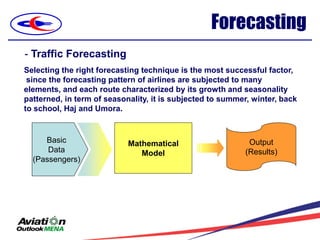
Selecting the right forecasting technique is the most successful factor,
 since the forecasting pattern of airlines are subjected to many
elements, and each route characterized by its growth and seasonality
patterned, in term of seasonality, it is subjected to summer, winter, back
to school, Haj and Umora.


     Basic                  Mathematical                     Output
      Data                     Model                        (Results)
  (Passengers)
Forecasting
- Defining Airline Seasonality Model.
Forecasting
- First Trail
Forecasting
- First Trail
Forecasting
- Impact of the human touch in refinery the forecasting results.
- By Adjusting the Model parameters; in second trail
Forecasting


Airlines
Forecasting
Forecasting
Forecasting
Forecasting
Forecasting


Airports
Forecasting
Forecasting
Forecasting
Case Study:
Amsterdam- Airport Schiphol
      Setting Goals
           And Targets


                               25
Targets
Targets:

Most of the airlines and airports working on
achieving goals, targets, and evaluate their
achievements by comparing the current achieved
results to results of previous week, month, or year
i.e looking backward to analysis current situation.

But for setting targets we have to look forward,
forecast, develop a plan for current situation, to
achieved these targets in future in most efficient
way, so we can compare the current achievement by
the target one, here we can measure our
performance & KPI.


                                                            26
Classical Vs Planning System

Classical System                 Planning System
Comparing with Past Values       Comparing with Planned Targets


                                                                  27
Forecasting
Amsterdam - Airport Schiphol


                                             28
Amsterdam- Airport Schiphol
Input Data: 1992 - 2011 ( October)


                                               29
Amsterdam- Airport Schiphol

Input Data –
Passengers Total –
Column 6 in slide no. 27

Trend Analysis
y = 1E+07Ln(x) + 1E+07
R2 = 0.9319
Result:
Forecast (2011) = 46,801,687 Pax

                                                30
Amsterdam- Airport Schiphol


                          31
Amsterdam- Airport Schiphol
Results:


R2 = 0.9319

Forecast (2011)


= 46,801,687 Pax
                                       32
Amsterdam- Airport Schiphol
Input Data –
Seasonal Model
2008,
2009,
2010


                                          33
Amsterdam- Airport Schiphol
1- Optimum Solution (Pax2010 > Pax2011 Forecast))
i.e 45,136,967 > 41,626,027 is not Practical)


                                                    34
Amsterdam- Airport Schiphol
2- Practical Case – Seasonal Model
   2011(Forecast) = 46,801,687 Pax


                                         35
Amsterdam- Airport Schiphol
2- Practical Case – Seasonal Model
   2011(Forecast) = 46,801,687 Pax


       n =12                         
      ∑
       i= 1
              Monthi = 46,801,687 Pax 
                                       2011 Forecast
                                     


          46,801,687
                                                        36
Amsterdam


            37
Amsterdam- Airport Schiphol
Comparison of Results


                               38
Summary
         Most of the airlines practice the classical methods, they
evaluate their current performance based on the past results, they just
looking to the back only for one Year ( or same period as month).
         While this study explore the effect of historical data in terms
of trends forecast, in which direction the airline business moves, and
the second part is addressing the short term impacts of seasonality
(here months) based on three (3) years monthly data base, keeping in
minds the model fairness constrains i.e (R2) and (T.S.) to minimise the
forecasting errors, then compare the forecasted/planned figures by the
actual one.


        The new constrain for this model is to match the accumulated forecasted
months by (Seasonal Model – 3 years data base) with the proposed forecasted year of
Trend analysis (Trend Model – 19 years data base).
Results:
By Planning method the accuracy is high in terms of Standard Deviation i.e 0.037
while the Classical method is 0.092.
                                                                                      39
Contact


Further Information:
Mohammed Salem Awad
Tel: 00967 736255814
Email: mohammed.hadi@yemenia.com   smartdecision2002@yahoo.com

                                                                 40

Forecasting - MENA 2012 Conference

  • 1.
    Driving Aviation Business ToOptimum Level ( Forecasting ) By : Mohammed Salem Awad Adviser Yemenia Date: 20 March 2012
  • 2.
    Forecasting "The easiestway to predict the future is to invent it." Immanuel Kant German Philosopher Immanuel Kant
  • 3.
    Outline - Introduction - Forecastingas planning tool for airlines and airports. - Models of forecasting and their implementations in practice. - Factors, measuring the accuracy of forecasting. - Defining airline seasonality model. Short term forecasting - Impact of the human touch in refinery the forecasting results. - Case Study - Summary - Contact
  • 4.
    Forecasting - Introduction -Forecasting playa major roles in Aviation. - Industry Forecast - ICAO , IATA, AIRBUS, BOEING, - FAA - Fleet Forecast, AIRBUS, BOEING - Traffic Forecast, Airlines and Airports - Financial Forecast
  • 5.
    Forecasting - Forecasting asplanning tool for airlines and airports. - Airline Starting up - Budget preparation - Opening new route - Airport Expansion - Setting Targets - Maintenance Planning - Defining Seasonality - Financial Planning
  • 6.
    Forecasting - Models offorecasting and their implementations in practice.
  • 7.
    Forecasting Trend Forecasting Tell usin which direction (Growth) of the historical data, and usually is a long term forecast. Seasonal Forecasting Tell us the Seasonal, Cyclic shocks, we used it to define the forecasting Pattern Trend vs Seasonal Forecasting Forecasted Year of TREND = Sum of 12 forecasted Seasonal Months for same year, 7
  • 8.
    Forecasting - Measuring theaccuracy of forecasting- Model Fairness - Coefficient of Correlation - Signal Tracking Evaluation Forecasting R2 = Coef. Of Determination T. S. = Tracking Signal 8
  • 9.
    Forecasting - Measuring theaccuracy of forecasting- Model Fairness - Coefficient of Correlation R - Tracking Signal T.S.  Two Main factors: (conditions) R2 > 80% AND -4 < T.S.< 4 R2 = Coef. Of Determination T. S. = Tracking Signal 9
  • 10.
    Forecasting - Defining AirlineSeasonality Model. Short term forecasting
  • 11.
    Forecasting - Traffic Forecasting Selectingthe right forecasting technique is the most successful factor, since the forecasting pattern of airlines are subjected to many elements, and each route characterized by its growth and seasonality patterned, in term of seasonality, it is subjected to summer, winter, back to school, Haj and Umora. Basic Mathematical Output Data Model (Results) (Passengers)
  • 12.
  • 13.
  • 14.
  • 15.
    Forecasting - Impact ofthe human touch in refinery the forecasting results. - By Adjusting the Model parameters; in second trail
  • 16.
  • 17.
  • 18.
  • 19.
  • 20.
  • 21.
  • 22.
  • 23.
  • 24.
  • 25.
    Case Study: Amsterdam- AirportSchiphol Setting Goals And Targets 25
  • 26.
    Targets Targets: Most of theairlines and airports working on achieving goals, targets, and evaluate their achievements by comparing the current achieved results to results of previous week, month, or year i.e looking backward to analysis current situation. But for setting targets we have to look forward, forecast, develop a plan for current situation, to achieved these targets in future in most efficient way, so we can compare the current achievement by the target one, here we can measure our performance & KPI. 26
  • 27.
    Classical Vs PlanningSystem Classical System Planning System Comparing with Past Values Comparing with Planned Targets 27
  • 28.
  • 29.
    Amsterdam- Airport Schiphol InputData: 1992 - 2011 ( October) 29
  • 30.
    Amsterdam- Airport Schiphol InputData – Passengers Total – Column 6 in slide no. 27 Trend Analysis y = 1E+07Ln(x) + 1E+07 R2 = 0.9319 Result: Forecast (2011) = 46,801,687 Pax 30
  • 31.
  • 32.
    Amsterdam- Airport Schiphol Results: R2= 0.9319 Forecast (2011) = 46,801,687 Pax 32
  • 33.
    Amsterdam- Airport Schiphol InputData – Seasonal Model 2008, 2009, 2010 33
  • 34.
    Amsterdam- Airport Schiphol 1-Optimum Solution (Pax2010 > Pax2011 Forecast)) i.e 45,136,967 > 41,626,027 is not Practical) 34
  • 35.
    Amsterdam- Airport Schiphol 2-Practical Case – Seasonal Model 2011(Forecast) = 46,801,687 Pax 35
  • 36.
    Amsterdam- Airport Schiphol 2-Practical Case – Seasonal Model 2011(Forecast) = 46,801,687 Pax  n =12  ∑  i= 1 Monthi = 46,801,687 Pax   2011 Forecast   46,801,687 36
  • 37.
  • 38.
  • 39.
    Summary  Most of the airlines practice the classical methods, they evaluate their current performance based on the past results, they just looking to the back only for one Year ( or same period as month).  While this study explore the effect of historical data in terms of trends forecast, in which direction the airline business moves, and the second part is addressing the short term impacts of seasonality (here months) based on three (3) years monthly data base, keeping in minds the model fairness constrains i.e (R2) and (T.S.) to minimise the forecasting errors, then compare the forecasted/planned figures by the actual one.  The new constrain for this model is to match the accumulated forecasted months by (Seasonal Model – 3 years data base) with the proposed forecasted year of Trend analysis (Trend Model – 19 years data base). Results: By Planning method the accuracy is high in terms of Standard Deviation i.e 0.037 while the Classical method is 0.092. 39
  • 40.
    Contact Further Information: Mohammed SalemAwad Tel: 00967 736255814 Email: mohammed.hadi@yemenia.com smartdecision2002@yahoo.com 40