Presentation By: Ishan Singh and Servesh Chaturvedi
CONTENTS
• The Need
• Some type of Systems
• The emergency system
• Questions and Answers
WHY, WHERE & HOW???
• The Human body is dependent on oxygen. As the altitude increases, the consequent
decrease in pressure reduces the amount of oxygen the human body can absorb when
breathing.
• To enable flight at high altitudes either the aircraft cabin has to be pressurised, to
replicate the pressure at a lower altitude, or the occupants of the aircraft have to be
given supplemental oxygen. This system is known as oxygen system
• Oxygen systems are designed to store or to generate a supply of pure oxygen and to
regulate, dilute as required and then distribute that oxygen to crew or passengers.
• They are installed in many military aircraft and in most commercial and business
aircraft types.
• Depending upon the type and the role of the aircraft concerned, the oxygen system(s)
may be used for normal operations, to provide supplemental oxygen for specific
situations or for provision of emergency oxygen in the event of smoke, fire, fumes or loss
of pressurisation.
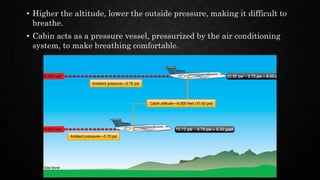
• Higher the altitude, lower the outside pressure, making it difficult to
breathe.
• Cabin acts as a pressure vessel, pressurized by the air conditioning
system, to make breathing comfortable.
OXYGEN SYSTEMS AND REGULATORS
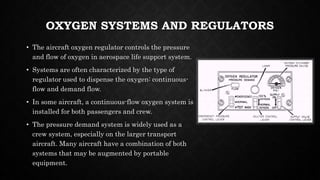
• The aircraft oxygen regulator controls the pressure
and flow of oxygen in aerospace life support system.
• Systems are often characterized by the type of
regulator used to dispense the oxygen: continuous-
flow and demand flow.
• In some aircraft, a continuous-flow oxygen system is
installed for both passengers and crew.
• The pressure demand system is widely used as a
crew system, especially on the larger transport
aircraft. Many aircraft have a combination of both
systems that may be augmented by portable
equipment.
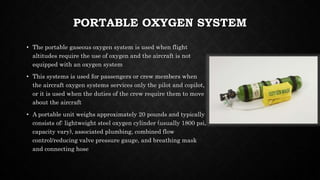
PORTABLE OXYGEN SYSTEM
• The portable gaseous oxygen system is used when flight
altitudes require the use of oxygen and the aircraft is not
equipped with an oxygen system
• This systems is used for passengers or crew members when
the aircraft oxygen systems services only the pilot and copilot,
or it is used when the duties of the crew require them to move
about the aircraft
• A portable unit weighs approximately 20 pounds and typically
consists of: lightweight steel oxygen cylinder (usually 1800 psi,
capacity vary), associated plumbing, combined flow
control/reducing valve pressure gauge, and breathing mask
and connecting hose
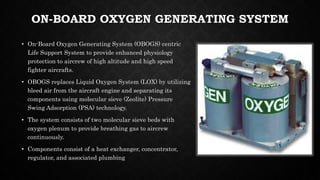
ON-BOARD OXYGEN GENERATING SYSTEM
• On-Board Oxygen Generating System (OBOGS) centric
Life Support System to provide enhanced physiology
protection to aircrew of high altitude and high speed
fighter aircrafts.
• OBOGS replaces Liquid Oxygen System (LOX) by utilizing
bleed air from the aircraft engine and separating its
components using molecular sieve (Zeolite) Pressure
Swing Adsorption (PSA) technology.
• The system consists of two molecular sieve beds with
oxygen plenum to provide breathing gas to aircrew
continuously.
• Components consist of a heat exchanger, concentrator,
regulator, and associated plumbing
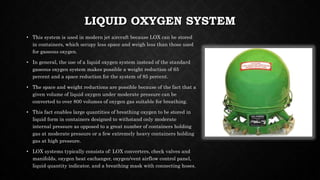
LIQUID OXYGEN SYSTEM
• This system is used in modern jet aircraft because LOX can be stored
in containers, which occupy less space and weigh less than those used
for gaseous oxygen.
• In general, the use of a liquid oxygen system instead of the standard
gaseous oxygen system makes possible a weight reduction of 65
percent and a space reduction for the system of 85 percent.
• The space and weight reductions are possible because of the fact that a
given volume of liquid oxygen under moderate pressure can be
converted to over 800 volumes of oxygen gas suitable for breathing.
• This fact enables large quantities of breathing oxygen to be stored in
liquid form in containers designed to withstand only moderate
internal pressure as opposed to a great number of containers holding
gas at moderate pressure or a few extremely heavy containers holding
gas at high pressure.
• LOX systems typically consists of: LOX converters, check valves and
manifolds, oxygen heat exchanger, oxygen/vent airflow control panel,
liquid quantity indicator, and a breathing mask with connecting hoses.
GENERAL PRECAUTIONS
• Keep the equipment clean
• Protect the oxygen mask from direct sunlight and dust.
Store in proper containers.
• Proper inspections are important, so your oxygen
equipment should be inspected regularly at an
authorized Federal Aviation Administration inspection
station.
• No smoking! Oxygen is highly flammable.
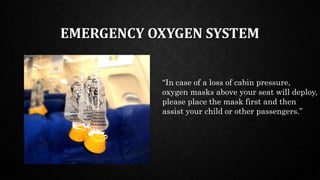
EMERGENCY OXYGEN SYSTEM
“In case of a loss of cabin pressure,
oxygen masks above your seat will deploy,
please place the mask first and then
assist your child or other passengers.”
THE MASK • Passenger masks are automatically deployed as
the system is triggered detecting an excessive
climb beyond 14000 feet in cabin altitude.
• Emergency descent procedure is initiated by the
pilot.
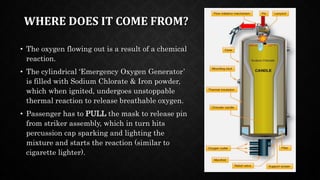
• The oxygen flowing out is a result of a chemical
reaction.
• The cylindrical ‘Emergency Oxygen Generator’
is filled with Sodium Chlorate & Iron powder,
which when ignited, undergoes unstoppable
thermal reaction to release breathable oxygen.
• Passenger has to PULL the mask to release pin
from striker assembly, which in turn hits
percussion cap sparking and lighting the
mixture and starts the reaction (similar to
cigarette lighter).
WHERE DOES IT COME FROM?
SOME OBVIOUS QUESTIONS
• Does each passenger have his own generator?
No, one generator supplies oxygen for one entire seat row.
• Can the flow be regulated?
No, the flow is fairly constant and continuous
• How long does the oxygen flow?
About 15 min, equivalent to time required for descending to 14000 feet.
• What if mask doesn’t come down?
Give the panel a bang with the hand and it should come down. In worst situation,
the crew will have to open it with a pin.
• What to do if in lavatory?
There is a minimum of two oxygen masks in each lavatory.
• Why is there a burning smell in the cabin?
The generator becomes very hot, and the plastic casing dissipates burning smell.
However, it’s fireproof, thus no need to worry.
• What about cockpit and cabin crew?
Master warning is triggered and pilots don their masks with supply for several
hours. Cabin crew uses same supply as passenger, however, have an option to use
pressurized bottles which can be carried around.
• How many masks are there on-board?
Legal requirement is minimum 10% more masks than passengers
THANK YOU AND SAFE FLYING!!!

Aircraft Oxygen System

  • 1.
    Presentation By: IshanSingh and Servesh Chaturvedi
  • 2.
    CONTENTS • The Need •Some type of Systems • The emergency system • Questions and Answers
  • 3.
    WHY, WHERE &HOW??? • The Human body is dependent on oxygen. As the altitude increases, the consequent decrease in pressure reduces the amount of oxygen the human body can absorb when breathing. • To enable flight at high altitudes either the aircraft cabin has to be pressurised, to replicate the pressure at a lower altitude, or the occupants of the aircraft have to be given supplemental oxygen. This system is known as oxygen system • Oxygen systems are designed to store or to generate a supply of pure oxygen and to regulate, dilute as required and then distribute that oxygen to crew or passengers. • They are installed in many military aircraft and in most commercial and business aircraft types. • Depending upon the type and the role of the aircraft concerned, the oxygen system(s) may be used for normal operations, to provide supplemental oxygen for specific situations or for provision of emergency oxygen in the event of smoke, fire, fumes or loss of pressurisation.
  • 4.
    • Higher thealtitude, lower the outside pressure, making it difficult to breathe. • Cabin acts as a pressure vessel, pressurized by the air conditioning system, to make breathing comfortable.
  • 5.
    OXYGEN SYSTEMS ANDREGULATORS • The aircraft oxygen regulator controls the pressure and flow of oxygen in aerospace life support system. • Systems are often characterized by the type of regulator used to dispense the oxygen: continuous- flow and demand flow. • In some aircraft, a continuous-flow oxygen system is installed for both passengers and crew. • The pressure demand system is widely used as a crew system, especially on the larger transport aircraft. Many aircraft have a combination of both systems that may be augmented by portable equipment.
  • 6.
    PORTABLE OXYGEN SYSTEM •The portable gaseous oxygen system is used when flight altitudes require the use of oxygen and the aircraft is not equipped with an oxygen system • This systems is used for passengers or crew members when the aircraft oxygen systems services only the pilot and copilot, or it is used when the duties of the crew require them to move about the aircraft • A portable unit weighs approximately 20 pounds and typically consists of: lightweight steel oxygen cylinder (usually 1800 psi, capacity vary), associated plumbing, combined flow control/reducing valve pressure gauge, and breathing mask and connecting hose
  • 7.
    ON-BOARD OXYGEN GENERATINGSYSTEM • On-Board Oxygen Generating System (OBOGS) centric Life Support System to provide enhanced physiology protection to aircrew of high altitude and high speed fighter aircrafts. • OBOGS replaces Liquid Oxygen System (LOX) by utilizing bleed air from the aircraft engine and separating its components using molecular sieve (Zeolite) Pressure Swing Adsorption (PSA) technology. • The system consists of two molecular sieve beds with oxygen plenum to provide breathing gas to aircrew continuously. • Components consist of a heat exchanger, concentrator, regulator, and associated plumbing
  • 8.
    LIQUID OXYGEN SYSTEM •This system is used in modern jet aircraft because LOX can be stored in containers, which occupy less space and weigh less than those used for gaseous oxygen. • In general, the use of a liquid oxygen system instead of the standard gaseous oxygen system makes possible a weight reduction of 65 percent and a space reduction for the system of 85 percent. • The space and weight reductions are possible because of the fact that a given volume of liquid oxygen under moderate pressure can be converted to over 800 volumes of oxygen gas suitable for breathing. • This fact enables large quantities of breathing oxygen to be stored in liquid form in containers designed to withstand only moderate internal pressure as opposed to a great number of containers holding gas at moderate pressure or a few extremely heavy containers holding gas at high pressure. • LOX systems typically consists of: LOX converters, check valves and manifolds, oxygen heat exchanger, oxygen/vent airflow control panel, liquid quantity indicator, and a breathing mask with connecting hoses.
  • 9.
    GENERAL PRECAUTIONS • Keepthe equipment clean • Protect the oxygen mask from direct sunlight and dust. Store in proper containers. • Proper inspections are important, so your oxygen equipment should be inspected regularly at an authorized Federal Aviation Administration inspection station. • No smoking! Oxygen is highly flammable.
  • 10.
    EMERGENCY OXYGEN SYSTEM “Incase of a loss of cabin pressure, oxygen masks above your seat will deploy, please place the mask first and then assist your child or other passengers.”
  • 11.
    THE MASK •Passenger masks are automatically deployed as the system is triggered detecting an excessive climb beyond 14000 feet in cabin altitude. • Emergency descent procedure is initiated by the pilot.
  • 12.
    • The oxygenflowing out is a result of a chemical reaction. • The cylindrical ‘Emergency Oxygen Generator’ is filled with Sodium Chlorate & Iron powder, which when ignited, undergoes unstoppable thermal reaction to release breathable oxygen. • Passenger has to PULL the mask to release pin from striker assembly, which in turn hits percussion cap sparking and lighting the mixture and starts the reaction (similar to cigarette lighter). WHERE DOES IT COME FROM?
  • 13.
    SOME OBVIOUS QUESTIONS •Does each passenger have his own generator? No, one generator supplies oxygen for one entire seat row. • Can the flow be regulated? No, the flow is fairly constant and continuous • How long does the oxygen flow? About 15 min, equivalent to time required for descending to 14000 feet. • What if mask doesn’t come down? Give the panel a bang with the hand and it should come down. In worst situation, the crew will have to open it with a pin.
  • 14.
    • What todo if in lavatory? There is a minimum of two oxygen masks in each lavatory. • Why is there a burning smell in the cabin? The generator becomes very hot, and the plastic casing dissipates burning smell. However, it’s fireproof, thus no need to worry. • What about cockpit and cabin crew? Master warning is triggered and pilots don their masks with supply for several hours. Cabin crew uses same supply as passenger, however, have an option to use pressurized bottles which can be carried around. • How many masks are there on-board? Legal requirement is minimum 10% more masks than passengers
  • 15.
    THANK YOU ANDSAFE FLYING!!!