MINE RESCUE
• Dealswith all measures and devices used for working in irrespirable
and toxic atmospheres occurring in mines for
– firefighting and sealing off mine fires and
– conducting rescue and recovery operations speedily and safely.
• the most important objective of mine rescue is saving of lives of men
overcome by toxic gases or O2-deficient atmospheres.
3.
• In theevent of a fire or explosion in underground coal mines, the air is
likely to be irrespirable because of toxic gases or the absence of O2.
• Therefore, all underground coal miners are required to have access to
emergency escape breathing apparatus.
• In order to recover the mine after a fire or explosion, or to rescue
trapped miners, mine rescue teams use long-duration, closed-circuit,
self-contained breathing apparatus for respiratory protection.
• These are commonly called rescue breathing apparatus (RBA).
4.
HUMAN RESPIRATORY SYSTEM
•When a person inhales air or O2, it is drawn into the lungs down the trachea
(windpipe) due to rhythmical respiratory movements of the chest.
• The trachea divides into a no. of bronchial tubes which end in multitudes (altogether
6 millions) of minute air-sacs or alveoli which form the ultimate structure of the
lungs.
• The alveoli are lined with a thin membrane over which the circulating blood is
spread in microscopic network of innumerable capillaries which, if joined in one
tube, would stretch over 3000 km.
• The red cells in them would have a surface for absorption of O2 of about 100 m2.
8.
• During thebrief exposure in the alveoli, there is interchange of gases
between the air and blood.
• The red cells of the venous blood combine with a fraction of the
inhaled O2 depending on the quantity and ability of the contained
haemoglobin, while the blood parts with its CO2 and water vapour
(respiratory exchange).
• Under normal conditions, 100 ml of blood carry from the lungs 18.5
to 20 ml of O2, out of which only 0.36 ml is in solution and the rest in
chemical combination.
• The circulating blood requires a continuous intake of O2 and the lungs
require an intermittent intake of O2 but in a regular way which is
provided by human breathing.
• If the supply of O2 to the blood stream or the lungs is stopped for a
few seconds, it results in death.
9.
Respiratory quotient (RQ)or respiratory coefficient
• It is a unit less number used in calculations of basal metabolic
rate (BMR).
• The CO2 given out is often less than the O2 absorbed in the same
time.
• The ratio of CO2 given out to the O2 consumed is called RQ and
calculated as follows:
RQ = CO2 eliminated / O2 consumed
• It depends on the type of diet taken. With normal diet, RQ = 0.85.
10.
Some terminologies
• Respiratoryair or tidal volume (TV): It is the quantity of air (about
500 ml) a man inspires or expires with quiet respiration.
• Complementary air: It is the additional amount of air (1500 ml) one
can take in on a very deep breath.
• Reserve air: It is the amount of air on a subsequent very deep
expiration one can give out (about 1500 ml) in addition to the 2000 ml
just breathed in.
11.
• Vital capacity(VC) of the lungs: It is the maximum amount of air a person
can expel from the lungs after a maximum inspiration.
• It is equal to the inspiratory reserve volume (complementary air) + the
tidal volume + the expiratory reserve volume (reserve air).
• It varies in different persons depending on age, health and respiratory
training.
• It is related to the body surface area and amounts to 2.6 litres/m2 surface
area.
• A normal adult has a vital capacity between 3 and 5 litres.
• After the age of 20 the vital capacity decreases approximately 250 cc per ten
years.
• A person's vital capacity can be measured by a spirometer.
12.
• Residual air:It is the amount of air (about 1200 ml), which occupies
the anatomical dead space and can not be breathed out.
• It is by no means pure air and contains about 5 to 6% CO2, 13 to 14%
O2 and 80% N2.
• Functional residual capacity: It is the vol. of air remaining in the
lungs after a normal expiration.
GENERAL FEATURES OFTHE APPARATUS
• All of the apparatus are similar in their basic functions, which are to provide
O2 and absorb CO2 produced by,the user.
• The standard parts of the breathing apparatus coming into contact with the
user's exhaled air are the face mask, breathing hoses, CO2-absorbent
canister and breathing bag.
• O2 is stored in the apparatus as either a solid (potassium superoxide
(KO2)), a liquid, or a gas.
• The CO2 absorbents used were lithium hydroxide (LiOH), calcium hydroxide
(CaOH), sodium hydroxide (NaOH), or a combination of these usually simply
poured into a canister (packed-bed design).
17.
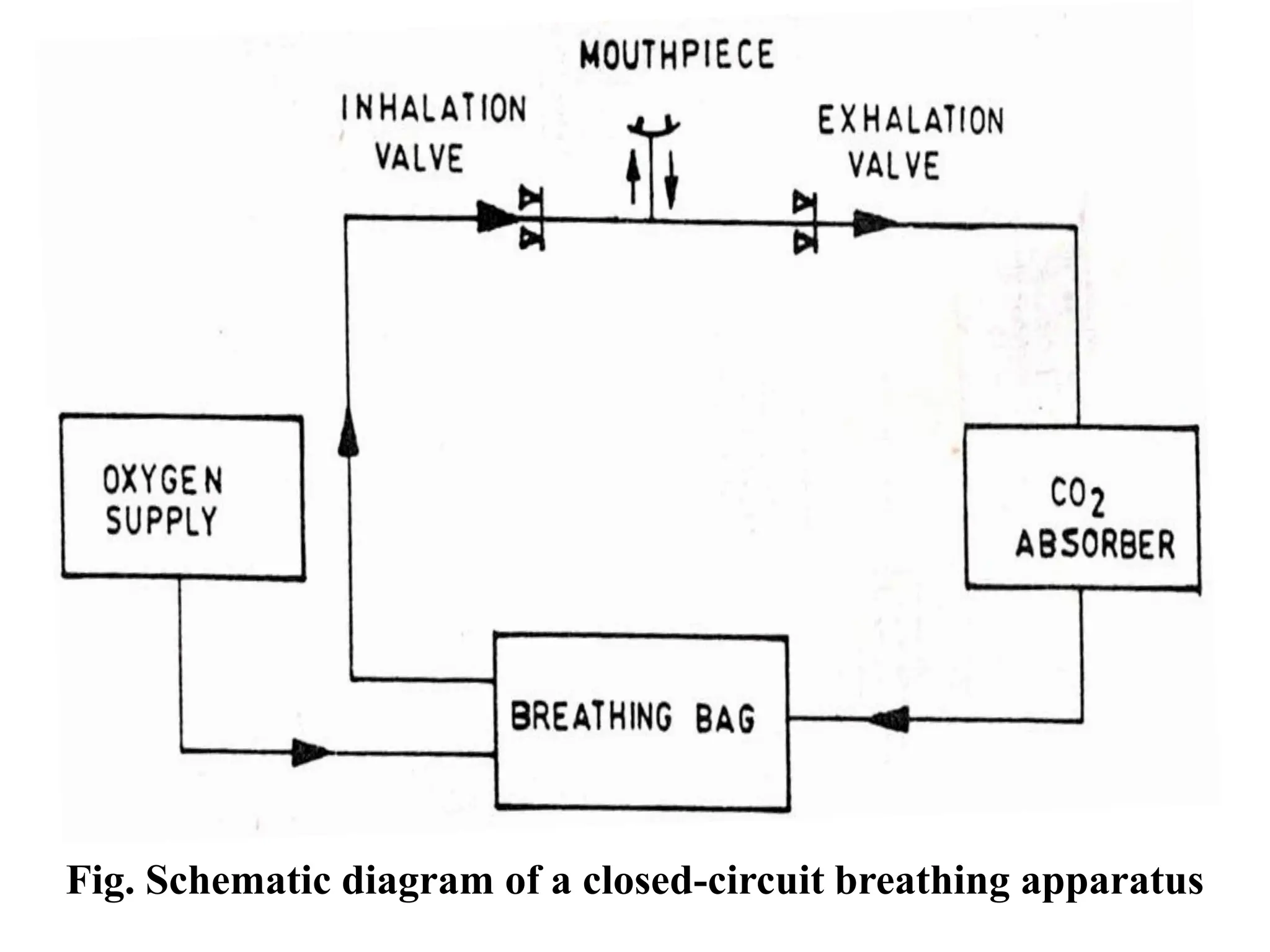
• In general,exhaled air is channeled through the exhalation breathing hose
to the CO2-absorbent canister where the user's CO2 is absorbed, and then
to the flexible breathing bag.
• It is stored there until it is drawn through the inhalation hose and into the
user's lungs upon inhalation.
• In most compressed-O2 apparatus, the O2 flows at a constant rate to the
breathing bag and is supplemented at times of higher O2 consumption by a
demand valve triggered by either low bag volume or a threshold inhalation
pressure.
• In contrast, when O2 consumption is lower than the constant flow, the
breathing bag fills to capacity and begins venting to ambient through a relief
valve triggered by either high bag volume or a threshold exhalation
pressure.
18.
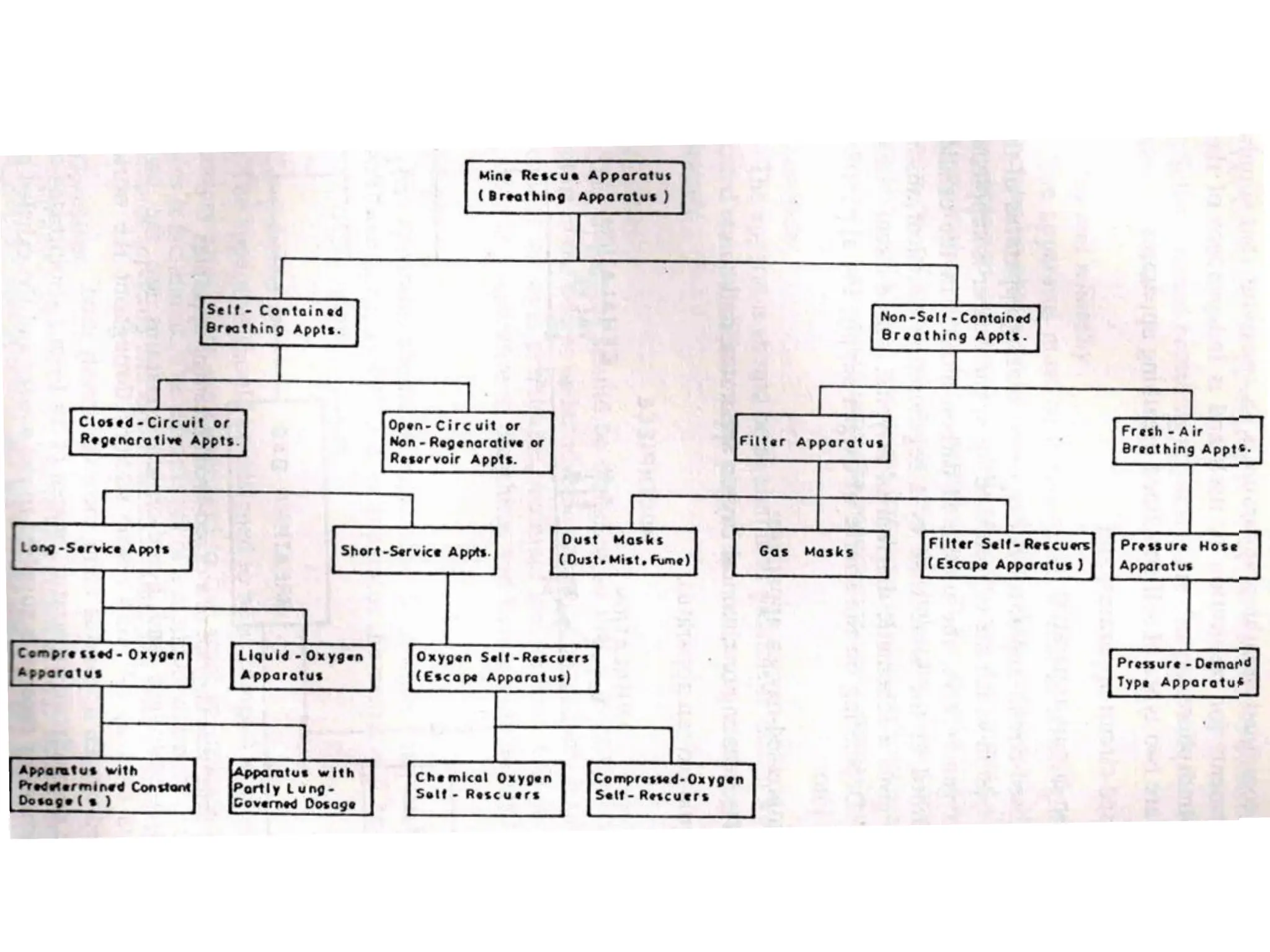
Rescue equipment andtheir uses
• Mine rescue apparatus, also called respirators or respiratory
protective equipment primarily provides protection to human
breathing system against poisonous and irrespirable gases.
• It includes:
– Reviving apparatus
– Escape apparatus
– Self rescuers
– Gas masks and
– Self-contained breathing apparatus with compressed O2 or liquid
O2.
19.
• They areprimarily used for respiratory protection of men employed
– in fighting mine fires and
– in rescue and recovery work after explosions.
20.
Classification of rescueapparatus
• Generally fall into the following three main classes:
a. Self-contained breathing apparatus (SCBA)
b. Filter apparatus or filter respirators
c. Fresh-air tube breathing apparatus or supplied air respirators.
22.
Self-contained breathing apparatus(SCBA)
• It is an apparatus that supplies all the requirements for respiration by itself
and is independent of the surrounding atmosphere.
• Sometimes referred to as a Compressed Air Breathing Apparatus
(CABA), Air Pack, or simply Breathing Apparatus (BA) is a device worn
by rescue workers, firefighters, and others to provide breathable air in
an IDLH (Immediate Danger to Life and Health) atmosphere.
Types: Two types
• Closed-circuit apparatus: It is regenerative type in which the O2 used up
by the wearer is supplemented from an O2 reserve. The unwanted CO2 in
the exhaled air is absorbed at the same time by a regenerating chemical
absorbent. Depending on the source of O2 supply, it may be divided into:
– Compressed-oxygen apparatus: most commonly used by all mine rescue
stations throughout the world
– Self-generating or chemical oxygen apparatus and
– Liquid-oxygen apparatus.
• Open-circuit apparatus: O2 or compressed air reserve is supplied to the
wearer and the exhaled O2 or air is discharged into the open and is put to no
further use. Also called reservoir or non-regenerative apparatus.
General requirements ofself-contained breathing apparatus
The apparatus are designed with the following objectives
• Safety and reliability: Apparatus must be designed on sound engineering
and scientific principles so that it is safe and reliable when used under the
most unfavorable and dangerous conditions encountered in mining.
• Simplicity: Should be as simple as possible in design.
• Comfort: It should give max possible comfort to the wearer under adverse
operating conditions.
• It should provide
– as cool an air as possible,
– maintain low levels of CO2 in the inspired air,
– offer low resistance to breathing, and
– have suitable head harness.
25.
• Weight: Shouldbe reasonably light when completely assembled and fully
charged so that the wearer will be able to perform a larger amount of work.
• Compactness: Should be as compact as possible and unnecessary
projections are eliminated so that work in intricate and confined spaces is
facilitated.
• Durability: Should be robust in construction.
• Before officially approved for use in mines, all individual parts of the
apparatus must pass laboratory and practical approval tests.
26.
The design andconstruction must:
• Permit the apparatus to be worn without undue discomfort and in such a
manner that it is practicable for the wearer to escape and not unduly impede
the wearer when walking or in a crouching position, crawling or maneuvering
in confined areas
• Give trouble free operation over the range of -5°C to 60°C (note: storage of
the apparatus must be within the temperature range specified by the
manufacturer)
• Prevent leakage from the circuit to atmosphere except through a relief valve
or exhalation valve on compressed air apparatus.
• Allow parts of the apparatus to be effectively sealed from atmospheric air
during storage
• Be such that the use of aluminium is limited to those applications that may
be justified on the grounds of safety and health
• Where change-over is required, be designed for easy removal when
changing from one unit to another.
27.
General design requirementsof closed-circuit modern self-contained
compressed-O2 breathing apparatus
• A steel cylinder: of 1 or 2 ltr capacity containing medical O2, under
pressure not less than 120 bar (usually 135, 150, 200 or 300 bar) for
supplying the wearer with O2.
• It is fitted with a main valve which should be opened fully and locked in the
open position when the apparatus is being worn.
• A pressure reducing valve: to reduce the pressure of O2 contained in the
cylinder and allow it to be supplied to the wearer at a fixed rate and at a
pressure slightly higher than the atmosphere.
• A regenerator purifying canister or purifier cartridge: to absorb the CO2
exhaled by the wearer.
28.
• It isa removable sheet metal container or canister charged or filled with a
specially prepared chemical which will completely absorb CO2 over the
prescribed wearing period.
• As a regenerative chemical, alkali (anhydrous sodium hydroxide), lithium
hydroxide, and soda-lime (a mixture of NaOH and CaOH) are used.
• A breathing bag: to serve as an air reservoir from and into which the
wearer breaths. It also provides flexibility to the circulatory system.
• It is made of high-grade rubber and of 4 to 6 ltr capacity.
29.
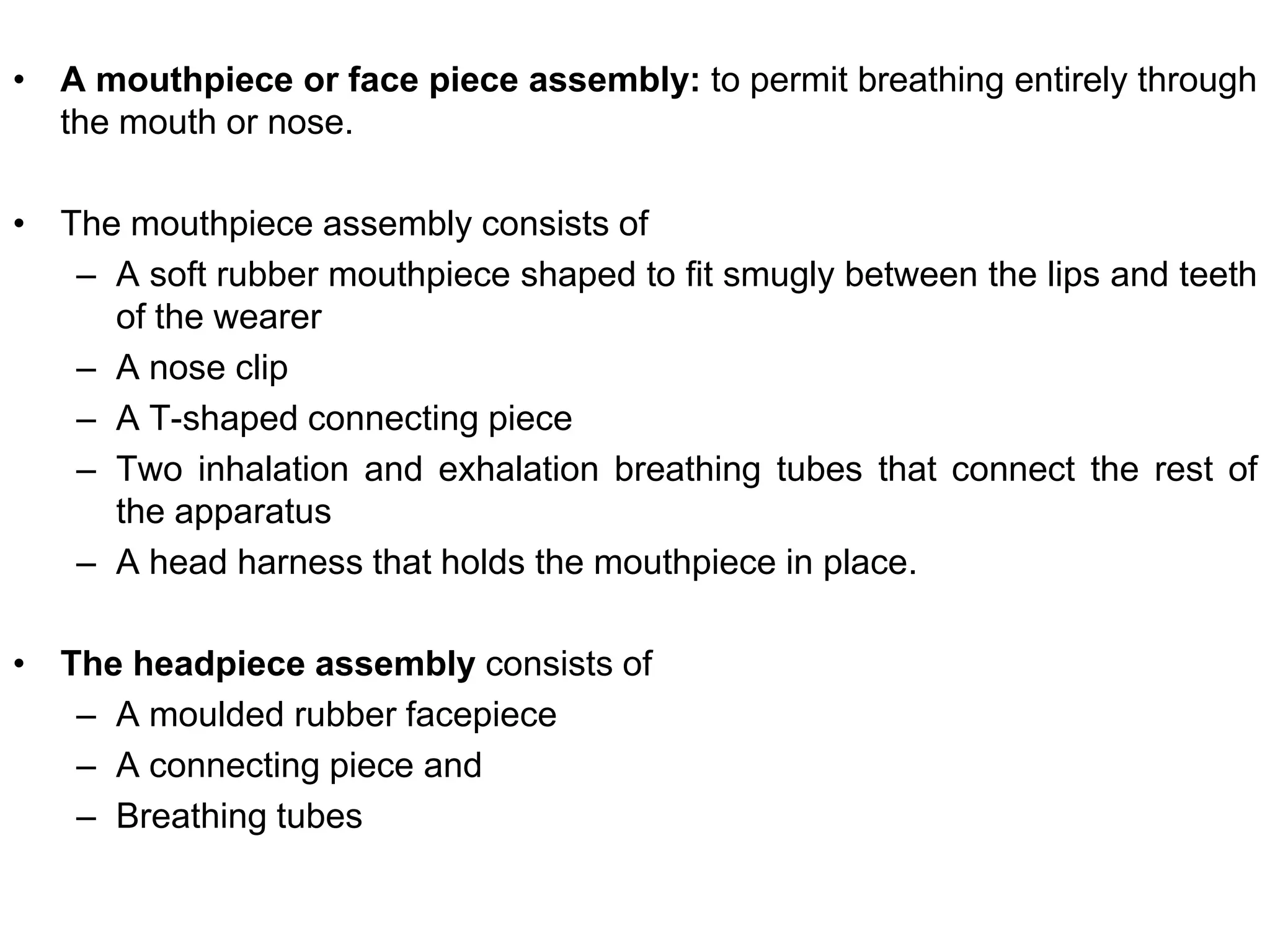
• A mouthpieceor face piece assembly: to permit breathing entirely through
the mouth or nose.
• The mouthpiece assembly consists of
– A soft rubber mouthpiece shaped to fit smugly between the lips and teeth
of the wearer
– A nose clip
– A T-shaped connecting piece
– Two inhalation and exhalation breathing tubes that connect the rest of
the apparatus
– A head harness that holds the mouthpiece in place.
• The headpiece assembly consists of
– A moulded rubber facepiece
– A connecting piece and
– Breathing tubes
30.
• The all-visionor wide-vision facepiece covering the whole face permits
breathing through the nose and also protects the eyes without use of
goggles.
• The breathing tubes: of 25-mm dia strong highly flexible, deeply corrugated
tubes of ageing resistance rubber with a fabric insert or neoprene.
• Inhalation and exhalation valves: to compel circulatory air to travel in one
direction. Usually spring loaded mica-disc type or of neoprene ruber type
and extremely sensitive.
• A pressure gauge: to indicate the wearer the available supply and duration
of O2 in the cylinder.
• A bypass valve: to supply O2 direct to the wearer when the reducing or the
lung-governed valve through any cause fail to act properly. Usually designed
as a self-closing push-botton valve.
31.
• A lung-governedO2 admission valve or regulator: to supply the
exact quantity of O2 to the wearer which his exertion may demand.
• Warning signals or alarms: to give a clearly audible whistling or
hooting sound in case the reducing valve fails to shut off at the proper
pressure or the cylinder is approaching exhaustion.
• A relief or excess pressure valve: to release any excess pressure
and to avoid accumulation of N2 in the respiratory system.
• May be located on the face piece or on the breathing bag and
operated manually or automatically by the breathing bag itself when it
expands.
32.
• A pre-flushingdevice: to automatically flush out the apparatus with 7-8 ltrs
of O2 when the cylinder valve is opened to purge the N2-rich ambient air
initially found in the breathing circuit.
• A saliva trap: to accumulate saliva of the wearer.
• It is located either in the inhalation tube or at the base of the mouthpiece or
face piece.
• May be provided with a release valve to permit discharge of saliva
accumulation.
• A casing: to protect the breathing bag, regenerator, reducing valves and
other vital parts against direct blows and falling material.
• Made of light metal of great strength, tough moulded fibreglass, or stainless
steel and so designed to permit ease passage through narrow mine
workings.
33.
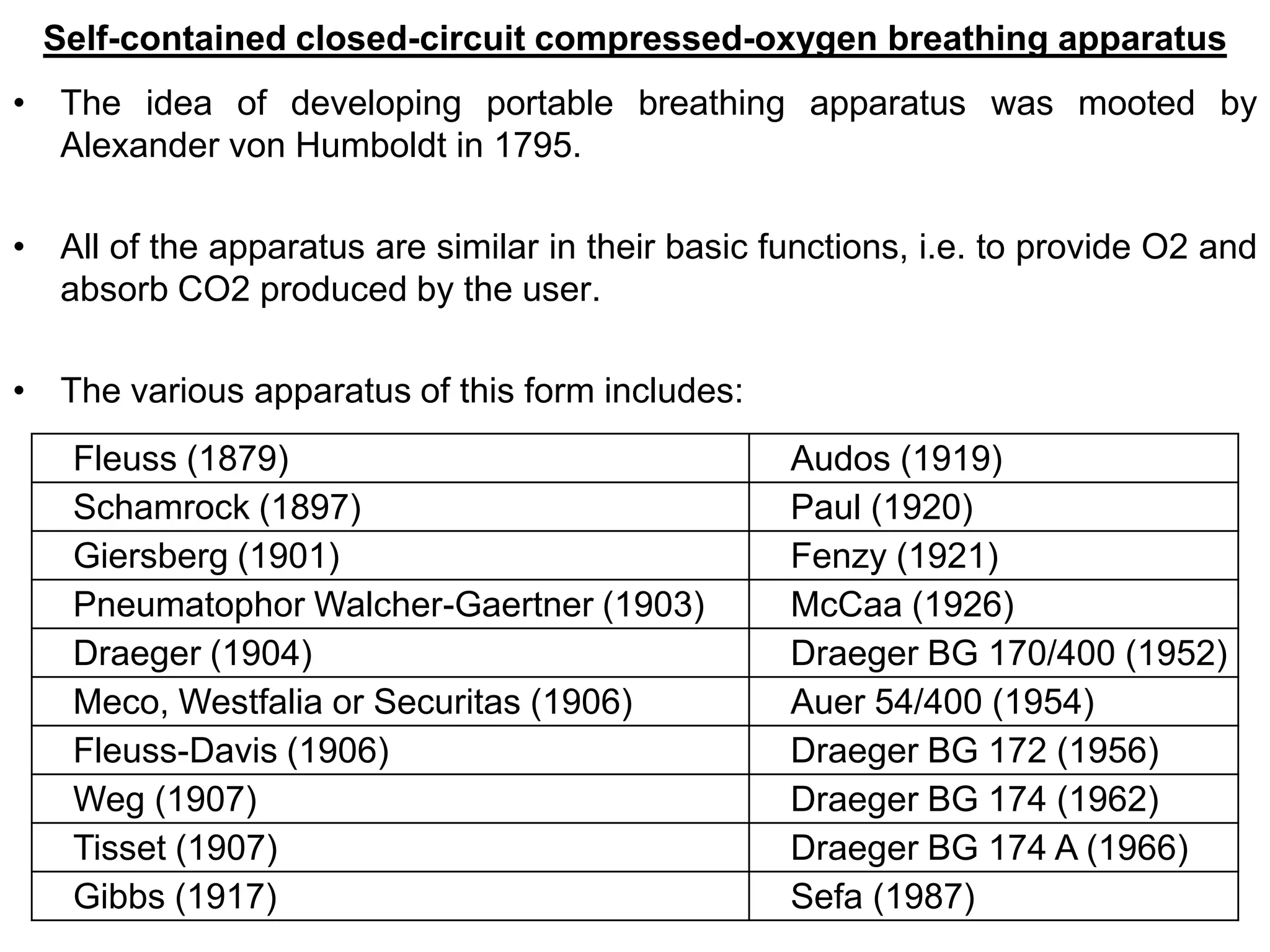
Self-contained closed-circuit compressed-oxygenbreathing apparatus
• The idea of developing portable breathing apparatus was mooted by
Alexander von Humboldt in 1795.
• All of the apparatus are similar in their basic functions, i.e. to provide O2 and
absorb CO2 produced by the user.
• The various apparatus of this form includes:
Fleuss (1879) Audos (1919)
Schamrock (1897) Paul (1920)
Giersberg (1901) Fenzy (1921)
Pneumatophor Walcher-Gaertner (1903) McCaa (1926)
Draeger (1904) Draeger BG 170/400 (1952)
Meco, Westfalia or Securitas (1906) Auer 54/400 (1954)
Fleuss-Davis (1906) Draeger BG 172 (1956)
Weg (1907) Draeger BG 174 (1962)
Tisset (1907) Draeger BG 174 A (1966)
Gibbs (1917) Sefa (1987)
34.
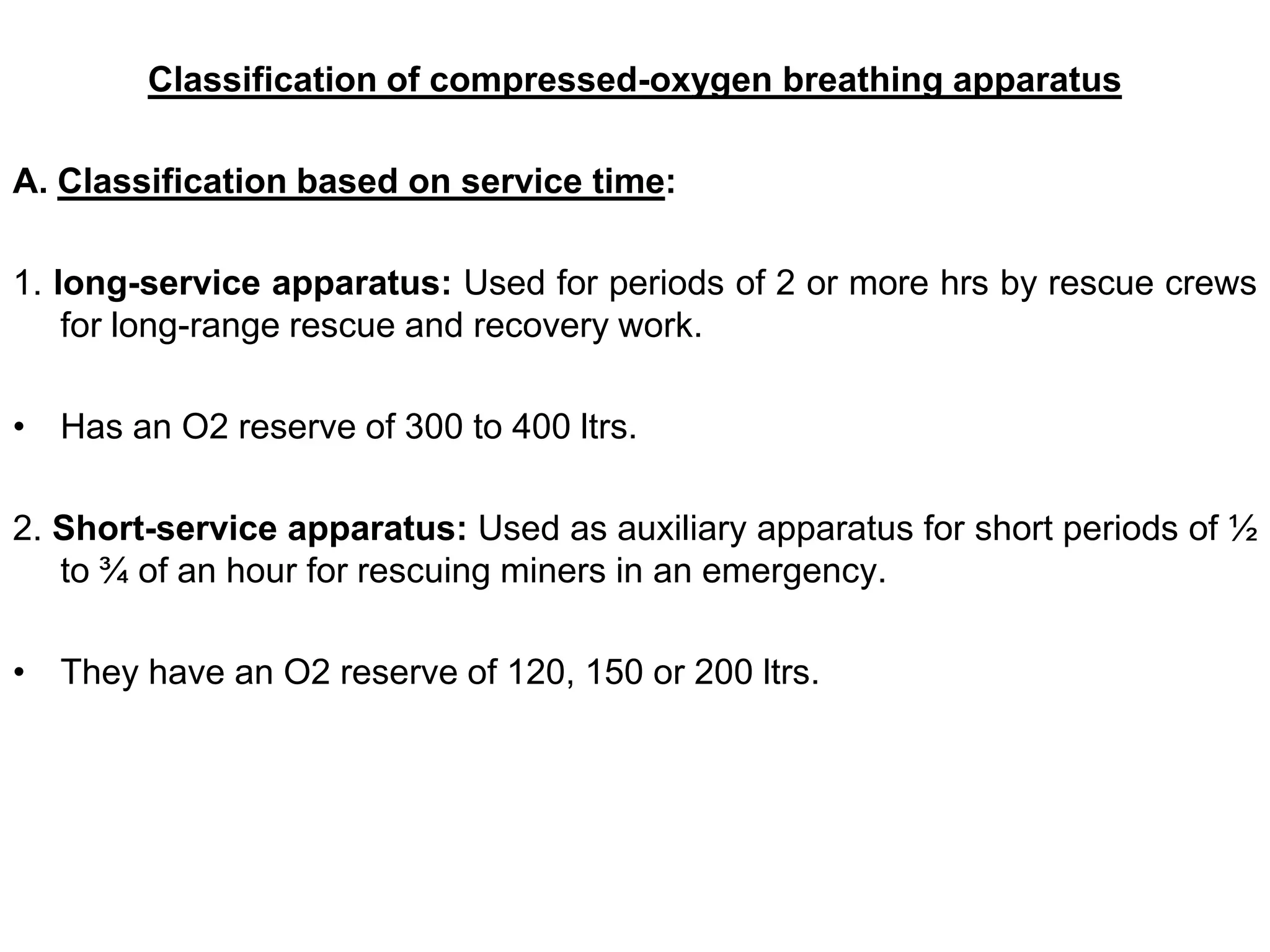
Classification of compressed-oxygenbreathing apparatus
A. Classification based on service time:
1. long-service apparatus: Used for periods of 2 or more hrs by rescue crews
for long-range rescue and recovery work.
• Has an O2 reserve of 300 to 400 ltrs.
2. Short-service apparatus: Used as auxiliary apparatus for short periods of ½
to ¾ of an hour for rescuing miners in an emergency.
• They have an O2 reserve of 120, 150 or 200 ltrs.
35.
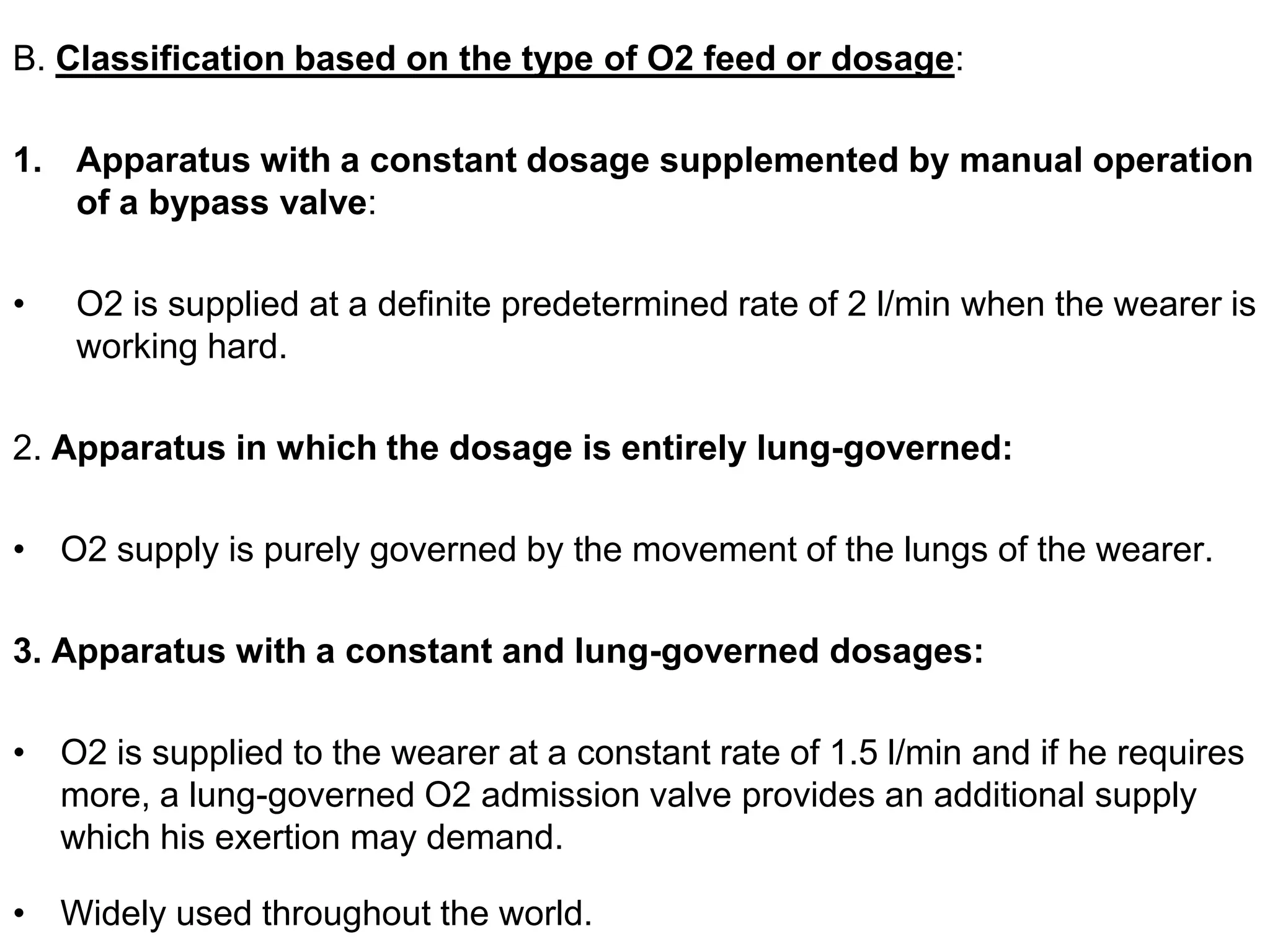
B. Classification basedon the type of O2 feed or dosage:
1. Apparatus with a constant dosage supplemented by manual operation
of a bypass valve:
• O2 is supplied at a definite predetermined rate of 2 l/min when the wearer is
working hard.
2. Apparatus in which the dosage is entirely lung-governed:
• O2 supply is purely governed by the movement of the lungs of the wearer.
3. Apparatus with a constant and lung-governed dosages:
• O2 is supplied to the wearer at a constant rate of 1.5 l/min and if he requires
more, a lung-governed O2 admission valve provides an additional supply
which his exertion may demand.
• Widely used throughout the world.
Draeger Model BG174 Apparatus
• Manufactured by Draegerwerk AG, Lubeck, GRG.
• It is a closed-circuit with a constant and lung-governed dosage of O2.
• It is widely used as a standard mine rescue apparatus in many countries.
39.
Specifications of BG174:
Endurance (normal) 4 hrs hard exertion at a
working pressure of 200 bar
Cylinder capacity, empty 2 ltrs
Cylinder capacity at 200 bar 400 ltrs
Breathing bag capacity, full 6 ltrs
O2 flow rate constant dosage 1.5 ltrs/min
Lung-governed dosage As required
Weight of apparatus 12.8 kg
40.
Special features ofthe apparatus:
• O2 regulator comprises of a pressure reducer, an automatic pre-flushing
device, a bypass valve and a pressure gauge shut-off valve.
• The lung-demand valve is a diaphragm-operated stem valve in a valve box
or housing. It is actuated by the control diaphragm responding to small –ve
pressure resulting from inhalation. The diaphragm also actuates a relief
valve to dissipate the excess circuit pressure.
• A pre-flushing device automatically purges N2 from the breathing circuit with
a burst of 7 ltrs of O2 hwn the cylinder valve is opened.
• Apparatus is mounted on the back of the wearer.
• A dry ice cooler may be substituted for the saliva trap in the inhalation tube
to cool the inhaled air temp. to 15oC.
• Anhydrous NaOH (1.5 kg) is used as CO2 absorbent.
41.
Draeger BG-174A
• Itis the most widely used long-duration closed-circuit compressed-O2
breathing apparatus in the world with a disposable CO2-absorbent canister.
• Originally certified in 1966 by the U.S. Bureau of Mines (USBM) as a 2-hr
apparatus.
• It was NIOSH-certified in 1975 as a 4-hr apparatus.
• The O2 cylinder contains approximately 395 L of O2 at the recommended fill
pressure of 3,135 psi at room temperature.
• The BG-174A has a constant flow of O2 of 1.5 L/min ATPD plus a pressure-
activated demand valve.
• The relief valve is also pressure-activated.
42.
• The CO2absorbent is NaOH suspended in a crisscross, corrugated-screen
bed designed to prevent the NaOH from melting into a solid mass during
use.
• The user exhales into the face mask, through the exhalation hose, past the
exhalation check valve, through the CO2-absorbent canister, and into the
breathing bag.
• Upon inhalation, the user draws air from the breathing bag, through the
valve box and inhalation check valve, through the inhalation hose, and back
to the face mask.
• The face mask includes a wiper that removes condensation from the inside
of the lens.
• If the user's O2 consumption rate is higher than the O2 constant flow rate
and the circuit contains a large quantity of N2, the O2 concentration in
compressed-O2 apparatus can fall to subambient levels before the demand
valve is activated.
Additional features inDraeger BG-174A
BG-174A is essentially same as Draeger BG-174 except for the following:
• It has 3- and 4-hour approval ratings.
• The low-O2 warning device is located in the O2 regulator instead of in the
demand regulator assembly or valve box.
• A second pressure gauge is mounted on the O2 cylinder.
• It incorporates a divider in the breathing hose facepiece connector.
• The O2 metering nozzle is located on the O2 regulator.
• The cylinder valve is of ‘step clutch’ design.
48.
Draeger BG 4
•It is a compressed-O2, closed-circuit apparatus with a disposable soda lime
CO2-absorbent canister .
• It has been NIOSH-certified four times (1995) as both a 3- and 4-hr
apparatus and a standard- and positive-pressure apparatus.
• The BG 4 has a constant flow of O2 of at least 1.5 L/min ATPD plus a
volume-activated demand valve.
• The relief valve is also volume-activated and purges exhaled air before it
enters the CO2-absorbent canister.
• The face mask is the same as that used with the BG-174A..
49.
• The userexhales into the face mask, through the exhalation check valve and
breathing hose, through the CO2-absorbent canister, and into the spring-
loaded breathing bag.
• Upon inhalation, the user draws air from the breathing bag, through the heat-
absorbent canister, the inhalation hose and check valve, and back to the
face mask.
• The heat-absorbent canister works by routing inhalation air around a
chamber containing a large cylinder of ice inserted just before use, formed in
a separate ice mold
52.
• The necessityof having well equipped rescue stations was deeply felt after a
series of disastrous fires and explosions shook the Indian mining industry
during the1930’s.
• The first mines rescue station in India was established in Kolar Gold Fields
as early as Nov 1923.
• In the coal mining sector, the first coal mines rescue rules were promulgated
in India in 1939 and two Central Rescue Stations were established in August
1941 at
– Dhansar (Jharkhand)
– Sitarampur (West Bengal)
• At present, 46 Rescue Stations in Coal Mining industry and 6 rescue
stations in Metal Mining industry are functional in India.
Rescue stations
53.
• The CoalMines Rescue Rules were modified in 1959 and made applicable
to all the coal companies in India.
• The Coal Mines Rescue Rules 1959 were replaced by the Mines Rescue
Rules 1985 as per the recommendations of the Mitra Committee.
54.
Functions of rescuestations as per The Mines Rescue Rules, 1985:
The functions include:
• Imparting initial training in rescue and recovery work.
• Imparting refresher training to rescue trained persons.
• Providing support by its own rescue teams and equipment in case of major
accidents or long-lasting rescue and recovery operations.
• Carrying out the functions of rescue room in respect of the below ground
mines where there is no rescue room.
55.
Types of rescuestations
• There are mainly 3 types of rescue stations:
1. Central rescue stations
2. District rescue stations
3. Rescue stations at mines
• The central rescue stations have wider objectives than the district rescue
stations and rescue stations at mines.
56.
The Central RescueStations:
• Established by the government in the centre of important coalfields
depending on their geographical location.
The District Rescue Stations:
• Established to serve a group of mines in a defined mining region or district.
• They may also be established at isolated mines with gas outburst and
explosion hazard and fully equipped for rescue work and training of rescue
men.
• District rescue stations must be equipped with a rescue van or truck.
• The central and district rescue stations should be located so that the radius
of action does not exceed 25 to 35 km. All stations must efficiently cooperate
with one another in emergencies.
57.
The Mine RescueStations:
• The mine rescue stations or mine rescue rooms are provided at mines
employing 100 or more persons underground on any shift and maintaining
rescue brigades.
• Neighboring mines belonging to a single large mining company or different
mining companies may maintain a joint rescue station at a suitable place,
provided the total no. of persons ordinarily employed below ground of all
such mines does not exceed 5000.
• A mine rescue station is equipped with specified breathing apparatus,
equipment and supplies which are maintained in good order and ready for
immediate use by the mine rescue brigade.
• It comprises of
– an apparatus room
– a maintenance room
– a lecture room and
– a test room
58.
A modern centralor district rescue station contains the following:
• Offices
• An apparatus room
• A repair or maintenance shop with an O2 pump and cleaning and drying
facilities
• A dormitory for members of the resident rescue corpse on continuous duty
• Wash-rooms
• A store
• A gas analysis laboratory
• A garage
• A driver’s waiting room
• A recreation and a guest room
59.
Station personnel
• Thepermanent personnel at every central or district rescue station usually
comprise
– one Superintendent ( first Class): Custodian of the station
– one or two Assistant Superintendents
– at least two instructors (Second Class)
– two mechanics and
– a Rescue Brigade of not less than 18 rescue trained persons.
60.
Station apparatus andequipment
• The mining regulations specify minimum no. of safety apparatus and
equipment of the officially-approved type that should be kept and maintained
at every rescue station.
• The equipment of a rescue station comprises the equipment stored at the
station and a mine rescue van which is kept fully stocked and ready to use
as a mobile rescue station during emergency.
61.
A rescue stationis equipped with
• Self-contained O2 breathing apparatus and necessary equipment for testing
such apparatus.
• A portable supply of liquid O2, pressurized O2, or O2-generating chemical
as applicable to the supplied breathing apparatus
• Tins of absorbent chemicals
• All-service gas masks
• Oxygen self-rescuers
• Gas detectors for CO and CH4
• O2 indicators
• Safety lamps (flame and electrical)
• Bird testers with O2 cylinders
62.
• Gas chromatographfor analysis of mine air samples
• Electric cap-lamp charging rack
• Resuscitators and inhalers
• First-aid materials
• Stretchers
• Portable mine rescue communication system or a sound-powered
communication system
• A mobile inert gas generator
• A rescue cage/capsule
• Adequate no. of necessary replacement parts of all apparatus
63.
Objectives of aCentral Rescue Station
• Recommend formulation of mine rescue rules as well as rules for protection
against toxic gases in auxiliary plants on the surface of the mines.
• To draw mutual-aid plans under which neighboring mines, after occurrence
of a major mine disaster, assists each other on a reciprocal basis.
• To train directors or in charges of rescue operations, leaders/captains and
apparatus mechanics or attendants in rescue and disaster techniques for
mine rescue brigades, and also to conduct refresher training courses for
them.
• To supervise the training of mine rescue brigade at mines and under certain
circumstances, even train mine rescue brigades.
64.
• To guideand supervise the conduct of rescue and recovery and reopening
operations in mines.
• To maintain a permanent rescue corpse in constant readiness where the
rescue station is required to help in conducting rescue and recovery
operations in mines falling within its radius of action.
• To store special types of equipment and apparatus for firefighting and mine
rescue work.
• To supervise the working of district rescue stations.
65.
• To inspectapparatus and equipment for mine rescue work maintained at
mines and report defects and shortcomings to the management.
• To conduct approval tests and give expert opinion on new designs of
equipment and apparatus for mine rescue work.
• To initiate development of new apparatus and equipment.
• To conduct approval tests of portable fire extinguishers for use in mines.
• To advise on all matters concerning mine rescue, protection against toxic
gases, fire protection, and working of seams or deposits liable to
spontaneous combustion.