The Aerospace Industry in Canada Salah Elatash Tanya D’Amico Melissa McCartney Nicolas Murcia Stefan Pentchev
Tonight’s Agenda Overview:Facts and Figures Profitability of Industry Embraer/Bombardier Trade Dispute SWOT Analysis and Porters Diamond Case: Bombardier Conclusions
OVERVIEW FACTS & FIGURES
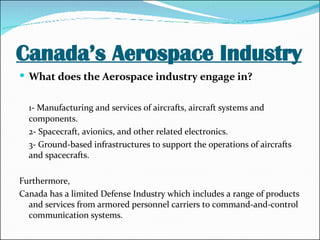
Canada’s Aerospace Industry What does the Aerospace industry engage in? 1- Manufacturing and services of aircrafts, aircraft systems and components. 2- Spacecraft, avionics, and other related electronics. 3- Ground-based infrastructures to support the operations of aircrafts and spacecrafts. Furthermore, Canada has a limited Defense Industry which includes a range of products and services from armored personnel carriers to command-and-control communication systems.
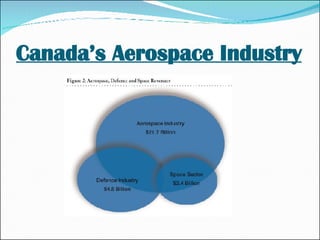
Canada’s Aerospace Industry
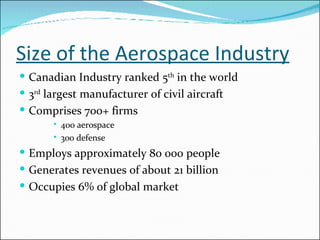
Size of the Aerospace Industry Canadian Industry ranked 5 th  in the world 3 rd  largest manufacturer of civil aircraft Comprises 700+ firms 400 aerospace 300 defense Employs approximately 80 000 people Generates revenues of about 21 billion Occupies 6% of global market
  Concentration of Aerospace Companies in Canada Bombardier Aerospace  – the world’s third-largest aircraft manufacturer, controlling 47 per cent of world market share in 20-90 seat turboprop and regional jets  Pratt & Whitney Canada  – accounts for 34 per cent of world market share in small gas-turbine engines and dominates the global turboprop market  CAE  – the world’s largest supplier of commercial flight simulators, with more than 80 per cent of the global market share  Bell Helicopter Canada  – one of the world’s leading commercial helicopter manufacturer, accounting for 14 per cent of the world market
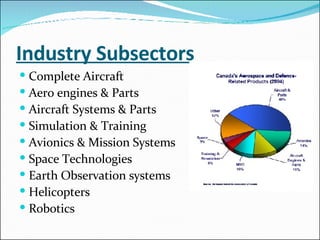
Industry Subsectors Complete Aircraft Aero engines & Parts Aircraft Systems & Parts Simulation & Training Avionics & Mission Systems Space Technologies Earth Observation systems Helicopters Robotics
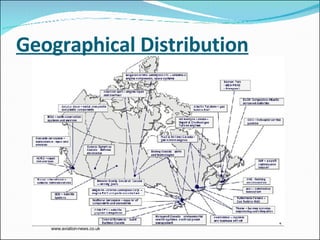
Geographical Distribution www.aviation-news.co.uk
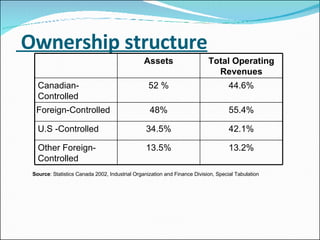
  Ownership structure   Source : Statistics Canada 2002, Industrial Organization and Finance Division, Special Tabulation   Assets Total Operating Revenues Canadian-Controlled 52 % 44.6% Foreign-Controlled 48% 55.4% U.S -Controlled 34.5% 42.1% Other Foreign-Controlled 13.5% 13.2%
Input-Output Analysis In  1990 for every additional $100 million of output from the aircraft and aircraft parts industry, output in the rest of the Canadian economy increased by an estimated $46.7 million $100 million increase in aircraft industry output generates approximately 1,185 new jobs throughout the Canadian economy
Input-Output Analysis Industry generated revenues of $21.7 billion in 2004, of which 84 percent came from exports Contributed $9.2 billion toward Canada's gross domestic product (GDP)(accounting for more than 5 percent of Canada's total manufacturing GDP)  The industry invested more than $1.2 billion on research and development (R&D) in 2004
 
 
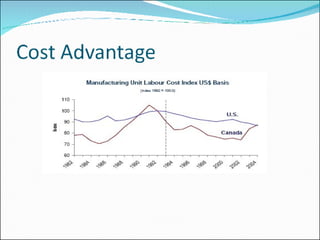
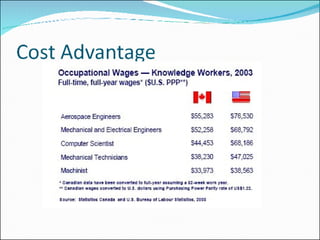
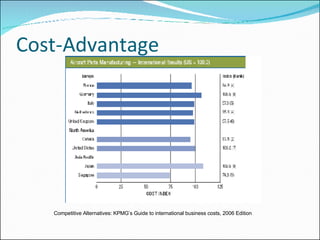
Cost-Advantage Competitive Alternatives: KPMG’s Guide to international business costs, 2006 Edition
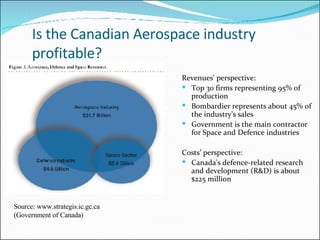
Is the Canadian Aerospace industry profitable? Revenues’ perspective: Top 30 firms representing 95% of production Bombardier represents about 45% of the industry's sales Government is the main contractor for Space and Defence industries Costs’ perspective: Canada's defence-related research and development (R&D) is about $225 million Source: www.strategis.ic.gc.ca (Government of Canada)
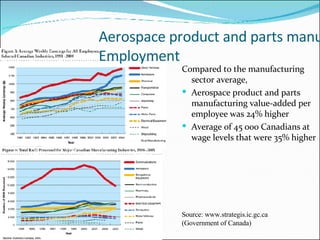
Compared to the manufacturing sector average, Aerospace product and parts manufacturing value-added per employee was 24% higher  Average of 45 000 Canadians at wage levels that were 35% higher Aerospace product and parts manufacturing: Employment Source: www.strategis.ic.gc.ca (Government of Canada)
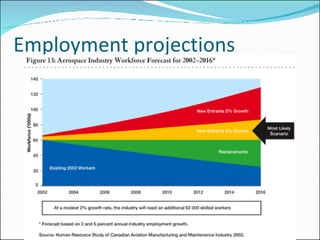
Employment projections
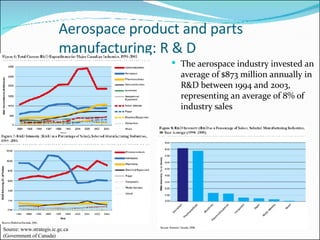
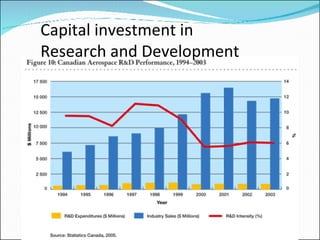
The aerospace industry invested an average of $873 million annually in R&D between 1994 and 2003, representing an average of 8% of industry sales Aerospace product and parts manufacturing: R & D Source: www.strategis.ic.gc.ca (Government of Canada)
Capital investment in  Research and Development
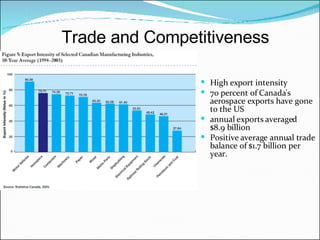
High export intensity 70 percent of Canada's aerospace exports have gone to the US annual exports averaged $8.9 billion Positive average annual trade balance of $1.7 billion per year. Trade and Competitiveness
Embraer (Brazil) vs. Bombardier (Canada): Compete for niche markets (ex: Business jet)  and rely on taxpayer subsidies such as government loan guarantees by using « dual-use » regulations. Canada  was granted authority to impose up to C$2.1 billion (U.S.$1.4 billion) in retaliation on Brazilian imports as a result of Brazil’s failure to comply with the  August 1999 WTO ruling  ( www.csis.org ) The WTO has also found Canada guilty of providing illegal subsidies to buyers of Bombardier jets ( www.csis.org )  Unfair competition  for the regional jet market? Embraer has taken advantage of low labor costs and cheap currency Bombardier has easier access to First World financing and technology -Maurício Botelho,  Embraer’s CEO: "The aerospace market right now is very sensitive to change."  -An industry advocacy group in Washington:  "Embraer is the risk-taking company that Bombardier used to be."  ( www.time.com ) Trade dispute and Competitiveness
Canada’s Aerospace Industry The industry is currently facing numerous challenges, business focuses are changing Now these demands have forced companies to focus more on process and product technologies, in order to come up with savings in product development, manufacturing and after-sales support . It used to be driven by technological innovation, but now customers are demanding high reductions in costs, while also demanding greater technological and operational sophistication.
Canadian Strengths and Weaknesses  Strengths World leadership in key segments Globally connected firms with world product mandates Range of capabilities from OEM in-service support providers Lucrative R&D incentives Cost Advantage
Canadian Strengths and Weaknesses  Weaknesses Fragmented supply base Few proprietary capabilities at lower end of the supply chain R&D concentrated in a few firms Minimal domestic defense procurement and defense R&D leverage and spending Government support programs are limited and inconsistent
Opportunities and Challenges Opportunities Strong after sales capabilities Supply chain productivity Sales financing policies and instruments Defense procurement policies are changing Investment & risk-sharing tools Public and political support
Opportunities and Challenges Major challenges  Value of $CDN relative to other currencies, esp. USD Productivity and competitiveness shortcomings Market access (US; procurement preference/influence) Access to civil programs driven by investment capacity; risk-share options New sources of competition (e.g. China, Japan)
Porter’s Diamond Rivalry: Industry is becoming more and more dominated by big players. As costs increases SMEs are less able to compete. Factor Conditions: “ Brain Drain”. Shortage of skilled workers, especially educated ones. Good technological infrastructure. R&D needs improvement.
Porter’s Diamond Demand: Defense industry demand is low. Demand is more external than internal. Related and Supporting Industries. Large number of SMEs surrounding large companies provide support to them. Government plays role in providing environment for supporting industries.
Case in point - Bombardier - The Cseries Announced 2005 Original Entry – 2010 –  Cancelled R & D costs Total - $2Billion Up to date - $120M 1/3 paid by CA, QC and UK governments Break-even point - 500 aircraft  New Entry – 2013 – not launched yet
Case in point - Bombardier New R & D Issues 15% Operational Cost Savings Engine & Key Parts suppliers Composite Materials Manufacturing Location – CA, US, MX, UK Complex Coordination Financing of R&D Financing of Sales Risk-sharing partners Suppliers Launch airline
Case in point - Bombardier Competition On what? – 3.4% profit New Entrants Russia – Sukhoi  Agreement with Boeing Japan – MRJ – Mitsubishi Heavy Industries COMPETITION ON TECHNOLOGY $1Billion R&D – 1/2 of C-series 20% increased fuel efficiency Composite materials – supplier for Boeing 787 China
Case in point - Bombardier China  AVIC I (state-owned) 90-seat ARJ21-700 – March 2008 Cooperation with the Competition Bombardier Invests $100M in R&D of AVIC I AVIC I Invests $400M in R&D of Cseries and construction of new facilities in China Good Importer - Good Exporter Space Program
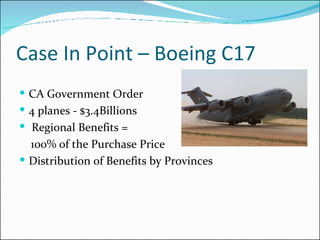
Case In Point – Boeing C17 CA Government Order  4 planes - $3.4Billions Regional Benefits =  100% of the Purchase Price Distribution of Benefits by Provinces
Going Forward Short-term emerging trends: Differences among product market segments  Pacific market will exceed the U.S. and European markets, account for 1/3 of total value of aircraft deliveries Strategies to reduce the risk through cost reduction efforts and to share that risk with suppliers and with former competitors. Long-term trends: The international aircraft manufacturing industry faces stagnant or uncertain markets over the next decade with more restructuring aircraft and aeroengine development costs have climbed beyond the financial capacity of individual firms
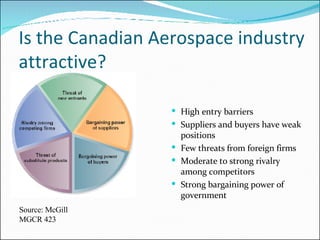
Is the Canadian Aerospace industry attractive? High entry barriers Suppliers and buyers have weak positions Few threats from foreign firms Moderate to strong rivalry among competitors Strong bargaining power of government Source: McGill  MGCR 423
Conclusion High profit potential: Attractive industry Aircraft industry is not particularly capital intensive; less than 20% of GDP Dependent on dollar Consolidation  complicated by the high degree of offshore ownership  Demand for significant reductions in the cost, while at the same time demanding greater technological and operational sophistication focus increasingly on process, as well as product technologies, in order to come up with savings in product development, manufacturing and after-sales support For Canadian industry, one that is focused on niche and foreign markets and dependent on a weak Canadian dollar for a competitive advantage, the only demonstrably effective industry-specific government policy lever has been R&D assistance; R&D is the lifeblood of this industry.

Aerospace Slides

  • 1.
    The Aerospace Industryin Canada Salah Elatash Tanya D’Amico Melissa McCartney Nicolas Murcia Stefan Pentchev
  • 2.
    Tonight’s Agenda Overview:Factsand Figures Profitability of Industry Embraer/Bombardier Trade Dispute SWOT Analysis and Porters Diamond Case: Bombardier Conclusions
  • 3.
  • 4.
    Canada’s Aerospace IndustryWhat does the Aerospace industry engage in? 1- Manufacturing and services of aircrafts, aircraft systems and components. 2- Spacecraft, avionics, and other related electronics. 3- Ground-based infrastructures to support the operations of aircrafts and spacecrafts. Furthermore, Canada has a limited Defense Industry which includes a range of products and services from armored personnel carriers to command-and-control communication systems.
  • 5.
  • 6.
    Size of theAerospace Industry Canadian Industry ranked 5 th in the world 3 rd largest manufacturer of civil aircraft Comprises 700+ firms 400 aerospace 300 defense Employs approximately 80 000 people Generates revenues of about 21 billion Occupies 6% of global market
  • 7.
      Concentration ofAerospace Companies in Canada Bombardier Aerospace – the world’s third-largest aircraft manufacturer, controlling 47 per cent of world market share in 20-90 seat turboprop and regional jets Pratt & Whitney Canada – accounts for 34 per cent of world market share in small gas-turbine engines and dominates the global turboprop market CAE – the world’s largest supplier of commercial flight simulators, with more than 80 per cent of the global market share Bell Helicopter Canada – one of the world’s leading commercial helicopter manufacturer, accounting for 14 per cent of the world market
  • 8.
    Industry Subsectors CompleteAircraft Aero engines & Parts Aircraft Systems & Parts Simulation & Training Avionics & Mission Systems Space Technologies Earth Observation systems Helicopters Robotics
  • 9.
  • 10.
      Ownership structure Source : Statistics Canada 2002, Industrial Organization and Finance Division, Special Tabulation Assets Total Operating Revenues Canadian-Controlled 52 % 44.6% Foreign-Controlled 48% 55.4% U.S -Controlled 34.5% 42.1% Other Foreign-Controlled 13.5% 13.2%
  • 11.
    Input-Output Analysis In 1990 for every additional $100 million of output from the aircraft and aircraft parts industry, output in the rest of the Canadian economy increased by an estimated $46.7 million $100 million increase in aircraft industry output generates approximately 1,185 new jobs throughout the Canadian economy
  • 12.
    Input-Output Analysis Industrygenerated revenues of $21.7 billion in 2004, of which 84 percent came from exports Contributed $9.2 billion toward Canada's gross domestic product (GDP)(accounting for more than 5 percent of Canada's total manufacturing GDP) The industry invested more than $1.2 billion on research and development (R&D) in 2004
  • 13.
  • 14.
  • 15.
    Cost-Advantage Competitive Alternatives:KPMG’s Guide to international business costs, 2006 Edition
  • 16.
    Is the CanadianAerospace industry profitable? Revenues’ perspective: Top 30 firms representing 95% of production Bombardier represents about 45% of the industry's sales Government is the main contractor for Space and Defence industries Costs’ perspective: Canada's defence-related research and development (R&D) is about $225 million Source: www.strategis.ic.gc.ca (Government of Canada)
  • 17.
    Compared to themanufacturing sector average, Aerospace product and parts manufacturing value-added per employee was 24% higher Average of 45 000 Canadians at wage levels that were 35% higher Aerospace product and parts manufacturing: Employment Source: www.strategis.ic.gc.ca (Government of Canada)
  • 18.
  • 19.
    The aerospace industryinvested an average of $873 million annually in R&D between 1994 and 2003, representing an average of 8% of industry sales Aerospace product and parts manufacturing: R & D Source: www.strategis.ic.gc.ca (Government of Canada)
  • 20.
    Capital investment in Research and Development
  • 21.
    High export intensity70 percent of Canada's aerospace exports have gone to the US annual exports averaged $8.9 billion Positive average annual trade balance of $1.7 billion per year. Trade and Competitiveness
  • 22.
    Embraer (Brazil) vs.Bombardier (Canada): Compete for niche markets (ex: Business jet) and rely on taxpayer subsidies such as government loan guarantees by using « dual-use » regulations. Canada was granted authority to impose up to C$2.1 billion (U.S.$1.4 billion) in retaliation on Brazilian imports as a result of Brazil’s failure to comply with the August 1999 WTO ruling ( www.csis.org ) The WTO has also found Canada guilty of providing illegal subsidies to buyers of Bombardier jets ( www.csis.org ) Unfair competition for the regional jet market? Embraer has taken advantage of low labor costs and cheap currency Bombardier has easier access to First World financing and technology -Maurício Botelho, Embraer’s CEO: "The aerospace market right now is very sensitive to change." -An industry advocacy group in Washington: "Embraer is the risk-taking company that Bombardier used to be." ( www.time.com ) Trade dispute and Competitiveness
  • 23.
    Canada’s Aerospace IndustryThe industry is currently facing numerous challenges, business focuses are changing Now these demands have forced companies to focus more on process and product technologies, in order to come up with savings in product development, manufacturing and after-sales support . It used to be driven by technological innovation, but now customers are demanding high reductions in costs, while also demanding greater technological and operational sophistication.
  • 24.
    Canadian Strengths andWeaknesses Strengths World leadership in key segments Globally connected firms with world product mandates Range of capabilities from OEM in-service support providers Lucrative R&D incentives Cost Advantage
  • 25.
    Canadian Strengths andWeaknesses Weaknesses Fragmented supply base Few proprietary capabilities at lower end of the supply chain R&D concentrated in a few firms Minimal domestic defense procurement and defense R&D leverage and spending Government support programs are limited and inconsistent
  • 26.
    Opportunities and ChallengesOpportunities Strong after sales capabilities Supply chain productivity Sales financing policies and instruments Defense procurement policies are changing Investment & risk-sharing tools Public and political support
  • 27.
    Opportunities and ChallengesMajor challenges Value of $CDN relative to other currencies, esp. USD Productivity and competitiveness shortcomings Market access (US; procurement preference/influence) Access to civil programs driven by investment capacity; risk-share options New sources of competition (e.g. China, Japan)
  • 28.
    Porter’s Diamond Rivalry:Industry is becoming more and more dominated by big players. As costs increases SMEs are less able to compete. Factor Conditions: “ Brain Drain”. Shortage of skilled workers, especially educated ones. Good technological infrastructure. R&D needs improvement.
  • 29.
    Porter’s Diamond Demand:Defense industry demand is low. Demand is more external than internal. Related and Supporting Industries. Large number of SMEs surrounding large companies provide support to them. Government plays role in providing environment for supporting industries.
  • 30.
    Case in point- Bombardier - The Cseries Announced 2005 Original Entry – 2010 – Cancelled R & D costs Total - $2Billion Up to date - $120M 1/3 paid by CA, QC and UK governments Break-even point - 500 aircraft New Entry – 2013 – not launched yet
  • 31.
    Case in point- Bombardier New R & D Issues 15% Operational Cost Savings Engine & Key Parts suppliers Composite Materials Manufacturing Location – CA, US, MX, UK Complex Coordination Financing of R&D Financing of Sales Risk-sharing partners Suppliers Launch airline
  • 32.
    Case in point- Bombardier Competition On what? – 3.4% profit New Entrants Russia – Sukhoi Agreement with Boeing Japan – MRJ – Mitsubishi Heavy Industries COMPETITION ON TECHNOLOGY $1Billion R&D – 1/2 of C-series 20% increased fuel efficiency Composite materials – supplier for Boeing 787 China
  • 33.
    Case in point- Bombardier China AVIC I (state-owned) 90-seat ARJ21-700 – March 2008 Cooperation with the Competition Bombardier Invests $100M in R&D of AVIC I AVIC I Invests $400M in R&D of Cseries and construction of new facilities in China Good Importer - Good Exporter Space Program
  • 34.
    Case In Point– Boeing C17 CA Government Order 4 planes - $3.4Billions Regional Benefits = 100% of the Purchase Price Distribution of Benefits by Provinces
  • 35.
    Going Forward Short-termemerging trends: Differences among product market segments Pacific market will exceed the U.S. and European markets, account for 1/3 of total value of aircraft deliveries Strategies to reduce the risk through cost reduction efforts and to share that risk with suppliers and with former competitors. Long-term trends: The international aircraft manufacturing industry faces stagnant or uncertain markets over the next decade with more restructuring aircraft and aeroengine development costs have climbed beyond the financial capacity of individual firms
  • 36.
    Is the CanadianAerospace industry attractive? High entry barriers Suppliers and buyers have weak positions Few threats from foreign firms Moderate to strong rivalry among competitors Strong bargaining power of government Source: McGill MGCR 423
  • 37.
    Conclusion High profitpotential: Attractive industry Aircraft industry is not particularly capital intensive; less than 20% of GDP Dependent on dollar Consolidation  complicated by the high degree of offshore ownership Demand for significant reductions in the cost, while at the same time demanding greater technological and operational sophistication focus increasingly on process, as well as product technologies, in order to come up with savings in product development, manufacturing and after-sales support For Canadian industry, one that is focused on niche and foreign markets and dependent on a weak Canadian dollar for a competitive advantage, the only demonstrably effective industry-specific government policy lever has been R&D assistance; R&D is the lifeblood of this industry.