New Product Development
        Airbus A-380
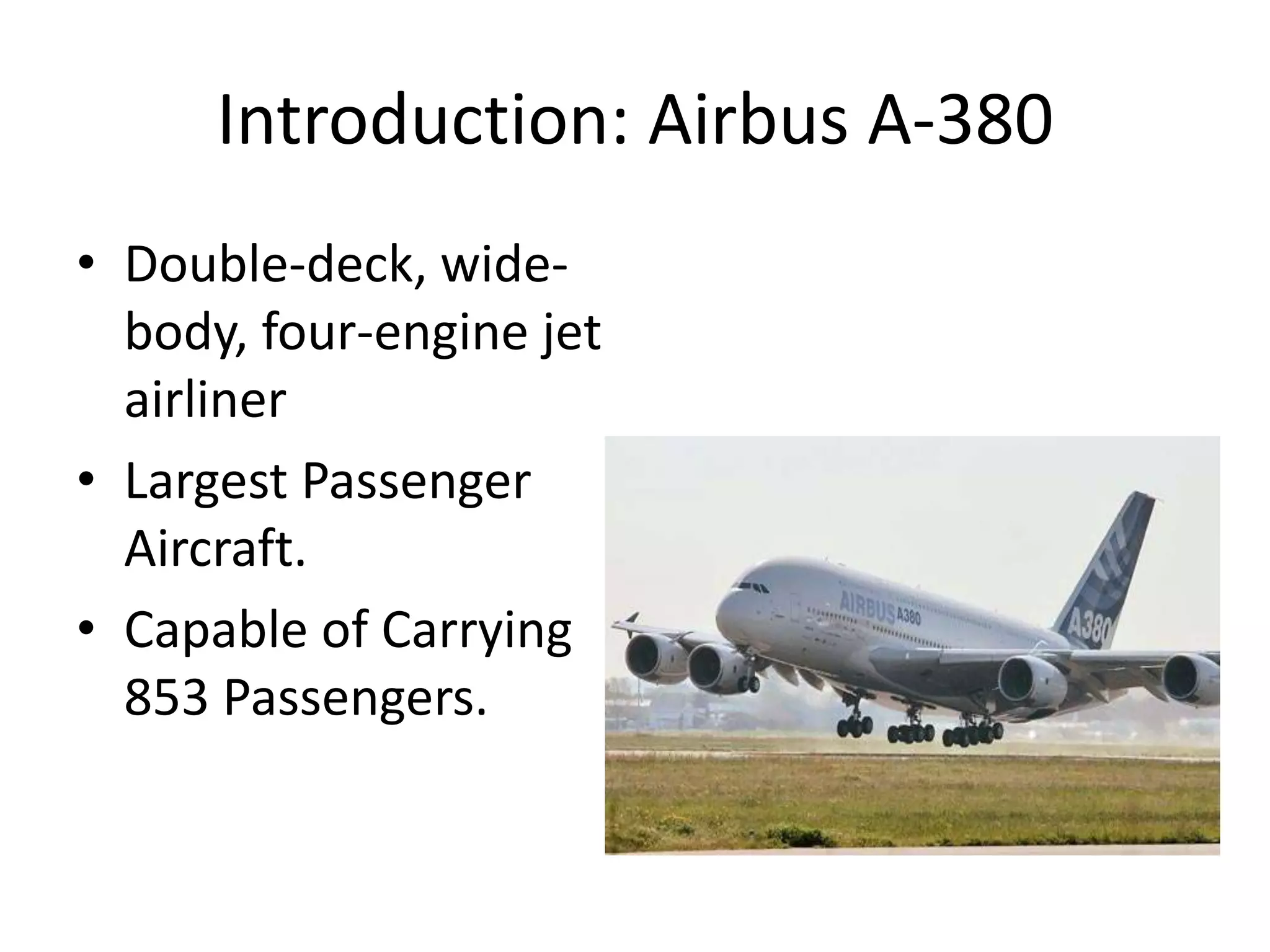
Introduction: Airbus A-380
• Double-deck, wide-
  body, four-engine jet
  airliner
• Largest Passenger
  Aircraft.
• Capable of Carrying
  853 Passengers.
DEFINING BUSINESS GOAL
Airbus A-380: Goals

• To gain a strategic
  advantage over its
  arch rival Boeing
• To enter into the VLA
  segment of the
  aircraft industry
Airbus A-380: Goals
• Economic Advantage
Airbus A-380: Goals
• Fill the Gap
Airbus A-380: Goals

• Change the Industry Structure

• Change from the Point to Point Structure to

  Hub and Spoke Structure.
PRODUCT DEVELOPMENT OF A-380
Channels for the Birth of A-380

• Product Improvement

• Technological Innovation
A-380: Concept Generation
Airbus organised four teams of designers, one
  from each of its partners
• Aérospatiale
• Deutsche Aerospace AG
• British Aerospace
• CASA
to develop Very Large Commercial Transport
  Aircraft designated A3XX
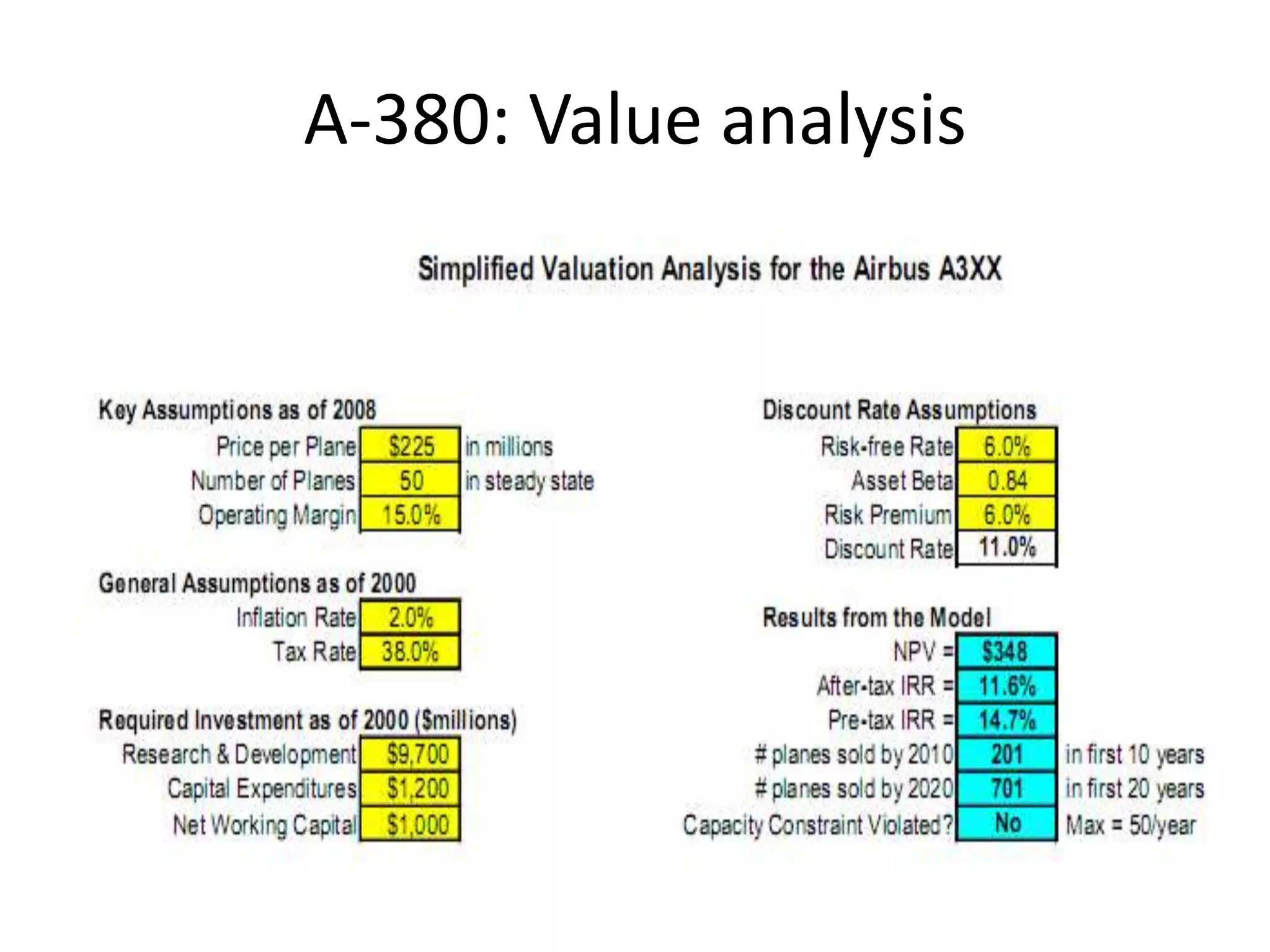
A-380: Value analysis
A-380: Product Design & Development

• Choosing of a double-decker design versus a
  single deck standard design.
• The above design gave more passenger
  volume.
• Extensive market analysis with over 200 focus
  groups to develop the product.
A-380: Product Design & Development

Various product test carried out.
• Handling, speed, High altitude test, Evacuation
  test, wing failure test.
• A380 received European Aviation Safety Agency
  (EASA) and United States Federal Aviation
  Administration (FAA) approval to carry up to 853
  passengers
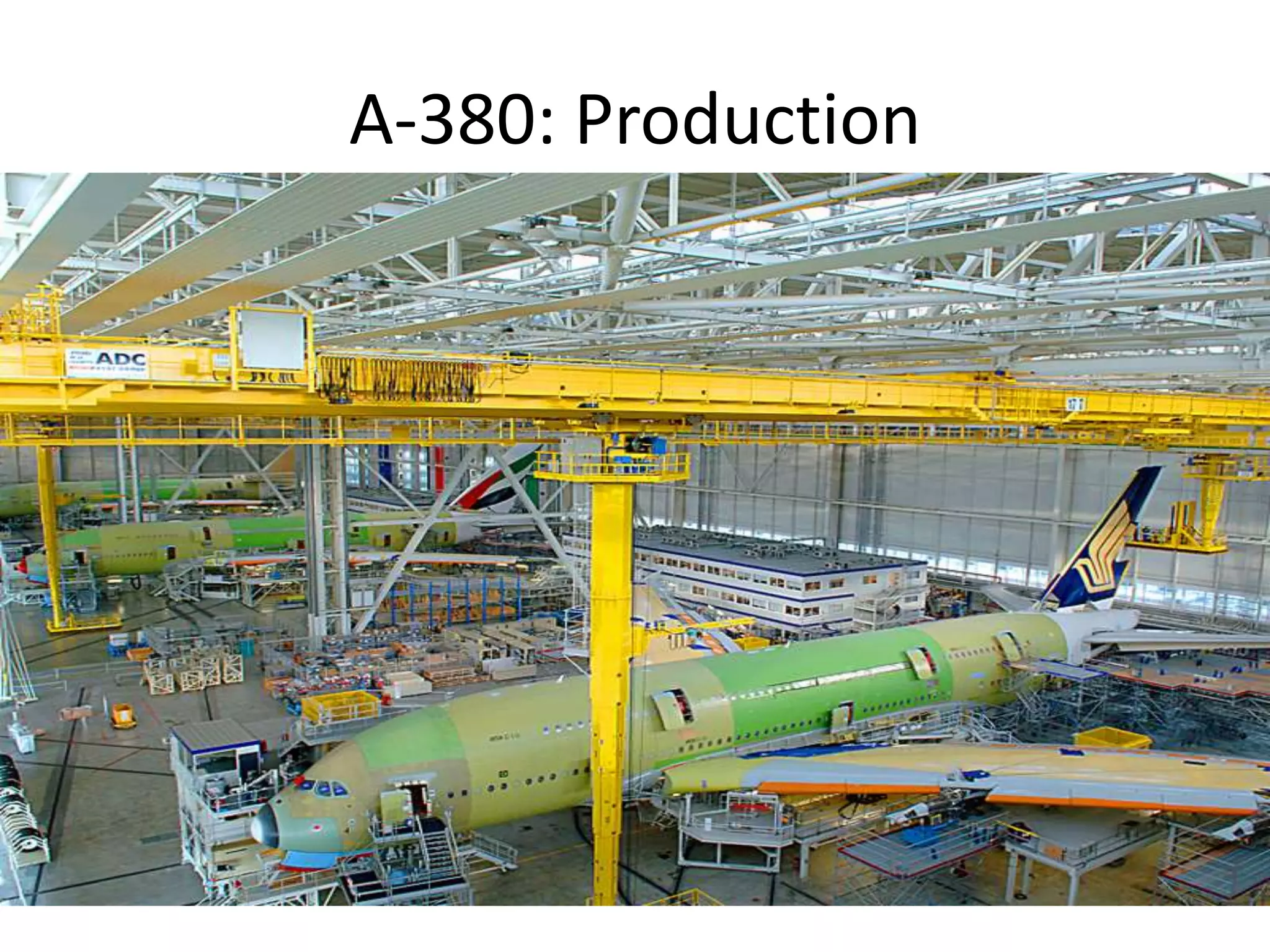
A-380: Production
• Major structural sections of the A380 are built
  in France, Germany, Spain, and the United
  Kingdom
• Components of the A380 are provided by
  suppliers from around the world; the five
  largest contributors are Rolls-Royce, Safran,
  United Technologies, General Electric and
  Goodrich
A-380: Production
A-380: Production
Airbus A-380 as of now
• Cumulative orders of A-380 as of July 2011.
CONCLUSION
References
• “Airbus vs. Boeing in Super Jumbos” by
  Benjamin E and Pankaj G., Harward Business
  School working paper.
• www.airbus.com
• Image courtesy: www.wikipedia.org
THANK YOU

New product development Airbus A380

Editor's Notes

  • #10 As we know that there are three channels for the birth of any new product ieMarketing innovationsProduct improvementAnd technological innovationsIn the case of airbus A-380 the last two ie the product improvement and the technological innovation have played a major role in the birth of the product.Product improvement: the existing benchmark of the 747 was improved upon and a new product which was better was served to the marketTechnological innovation: t3echnological innovations like the Integrated Modular Avionica like those used in F-22 Raptor made flying the aircraft easy and hence safe to the passengersPower by wire systems of military grade usedThrust reversers for better stoppability in less distacnceComposite materials
  • #17 assembly hall (the Jean-Luc Lagardère Plant) in Toulouse in France by surface transportation, though some parts are moved by the A300-600ST Beluga aircraft used in the construction of other Airbus modelsmovement of large A380 structural components, a complex route known as the Itinéraire à Grand Gabarit was developedThe front and rear sections of the fuselage are loaded onto one of three roll-on/roll-off (RORO) ships in Hamburg in northern Germany, from where they are shipped to the United KingdomThe wings, which are manufactured at Filton in Bristol and Broughton in North Wales, are transported by barge to Mostyn docks, where the ship adds them to its cargoIn Saint-Nazaire in western France, the ship trades the fuselage sections from Hamburg for larger, assembled sections, some of which include the nose. The ship unloads in Bordeaux. Afterwards, the ship picks up the belly and tail sections by ConstruccionesAeronáuticas SA in Cádiz in southern Spain, and delivers them to Bordeaux. From there, the A380 parts are transported by barge to Langon, and by oversize road convoys to the assembly hall in Toulouse
  • #18 assembly hall (the Jean-Luc Lagardère Plant) in Toulouse in France by surface transportation, though some parts are moved by the A300-600ST Beluga aircraft used in the construction of other Airbus modelsovement of large A380 structural components, a complex route known as the Itinéraire à Grand Gabarit was developedThe front and rear sections of the fuselage are loaded onto one of three roll-on/roll-off (RORO) ships in Hamburg in northern Germany, from where they are shipped to the United KingdomThe wings, which are manufactured at Filton in Bristol and Broughton in North Wales, are transported by barge to Mostyn docks, where the ship adds them to its cargoIn Saint-Nazaire in western France, the ship trades the fuselage sections from Hamburg for larger, assembled sections, some of which include the nose. The ship unloads in Bordeaux. Afterwards, the ship picks up the belly and tail sections by ConstruccionesAeronáuticas SA in Cádiz in southern Spain, and delivers them to Bordeaux. From there, the A380 parts are transported by barge to Langon, and by oversize road convoys to the assembly hall in Toulouse
  • #19 Breakeven of 240 aircrafts.New breakeven of 400 achieved by 2015.