AIR MASSES
Sourav kumar Sahu
Presented by
Introduction
Definition
Types of Air masses
Conclusion
INTRODUCTION :-
The climate of any region in the world is largely
determined by observing the characteristics of the
air mass that occupies it.
Weather can cause short term atmospheric changes
but the stable air mass determined the prevailing
weather condition of vast territory.
When two air masses that do not have the same
properties meet, they do not mix. Instead, a
boundary forms that is called FRONT.
DEFINITION :-
Air mass is the meteorological term for a
volume of air with a constant temperature and
humidity covering an area.
It varies in size from hundreds to thousands of
miles.
The region over which an air mass forms is
called a source region. This region can be a
land surface or body of water.
SOURCE REGION
TYPES OF AIR MASSES :-
According to Bergeron classification system the
classification air masses first takes place according to
the source regions from where they originate.
There are four central regions classified according to
their latitude :-
1. Arctic/Antarctic Air mass
2. Polar Air mass
3. Tropical Air mass
4. Equatorial Air mass
The amount of moisture in an air mass also plays a
significant role in forming its characteristics , which is
primarily the result of the type of surface over which it
occurs.
There are two types of surfaces have the most significant
influence on moisture levels :-
1. Continental
2. Maritime
Six primary types of global Air masses covering the
planet emerge when you combine the source region with
the kind of surface underlying on air mass :-
1. Continental Arctic (cA)/Continental Antarctic(cAA)
2. Continental Polar(cP)
3. Maritime Polar(mP)
4. Continental Tropical(cT)
5. Maritime Tropical(mT)
6. Maritime Equatorial(mE)
(GLOBALAIR MASSES)
1. Continental ARCTIC (cA)/CONTINENTALANTARCTIC (cAA) :-
The continental arctic (cA) air mass develops over the ice-
covered regions of the North pole and Greenland.
It mainly takes place over the ice and snow.
This air mass only takes place during the winter when solar
radiation during the day is almost non existent.
The icy condition , combined with a lack of moisture ,
creates very cold and dry atmospheric condition.
CONTINENTAL ARCTIC (cA)
2. CONTINENTAL POLAR (cP) :-
The continental polar (cP) Air mass develop over the land
masses of subpolar regions.
They primarily affect areas at high latitude like Canada , the
Northern USA , as well as Northern Asia.
It characterized by cold , dry weather with little cloud cover
and precipitation , especially during the winter.
It can provide a pleasant reprieve from warm weather
during the summer months.
CONTINENTAL POLAR (cP)
3. MARITIME POLAR (MP) :-
Maritime polar (mP) Air masses form over the
freezing North Atlantic and Pacific oceans near the
Arctic.
It characterized by cold , moist and unstable weather.
When it originates directly over the water , then air
mass can influence adjacent coastlines.
In the winter , they bring heavy snow and cold
MARITIME POLAR (mP)
Continental tropical Air masses form approximately 25
degree North and South of the Equator over the dry ,
mostly arid regions of the world.
It mainly occur over deserts , including the Sahara , the
desert of Mexico & the Arab peninsula.
It characterized by hot & dry weather conditions , with
clear skies , hot , low humidity.
Occurs in the summer , rarely in winter.
4. CONTINENTAL TROPICAL(CP) :-
CONTINENTAL TROPICAL (cT)
5. MARITIME TROPICAL(MT) :-
Maritime tropical (mT) Air masses mainly occur over the
warm oceans of the tropics and subtropical regions.
They covers vast areas of the South Atlantic , Indian & South
pacific oceans.
It characterized by very hot & humid weather condition.
Responsible for hot , humid summer days across the South &
the East , it also responsible for the majority of the country’s
Thunderstorms.
MARITIME TROPICAL (mT)
6. MARITIME EQUATORIAL(ME) :-
Air masses at or near the Equator primarily form over
water , and as a result , are all referred to as Maritime
Equatorial Air masses.
The small portion of the land that it covers consist
mostly of rainforests and not exposed dry land.
It characterized by hot & very humid weather
condition.
It causes high volumes of rainfall throughout the year.
MARITIME EQUATORIAL (mE)
(RAINFORESTS)
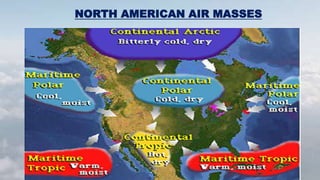
NORTH AMERICAN AIR MASSES
CONCLUSION:-
This article clearly illustrated the importance of
the world’s air masses.
They play a crucial role in the formation of the
weather and climate patterns that we attribute to
different regions and countries through out the
year.
THANK
YOU

TYPES OF AIR MASS PRESENTATION.pptx

  • 1.
    AIR MASSES Sourav kumarSahu Presented by
  • 2.
  • 3.
    INTRODUCTION :- The climateof any region in the world is largely determined by observing the characteristics of the air mass that occupies it. Weather can cause short term atmospheric changes but the stable air mass determined the prevailing weather condition of vast territory. When two air masses that do not have the same properties meet, they do not mix. Instead, a boundary forms that is called FRONT.
  • 4.
    DEFINITION :- Air massis the meteorological term for a volume of air with a constant temperature and humidity covering an area. It varies in size from hundreds to thousands of miles. The region over which an air mass forms is called a source region. This region can be a land surface or body of water.
  • 5.
  • 6.
    TYPES OF AIRMASSES :- According to Bergeron classification system the classification air masses first takes place according to the source regions from where they originate. There are four central regions classified according to their latitude :- 1. Arctic/Antarctic Air mass 2. Polar Air mass 3. Tropical Air mass 4. Equatorial Air mass
  • 7.
    The amount ofmoisture in an air mass also plays a significant role in forming its characteristics , which is primarily the result of the type of surface over which it occurs. There are two types of surfaces have the most significant influence on moisture levels :- 1. Continental 2. Maritime
  • 8.
    Six primary typesof global Air masses covering the planet emerge when you combine the source region with the kind of surface underlying on air mass :- 1. Continental Arctic (cA)/Continental Antarctic(cAA) 2. Continental Polar(cP) 3. Maritime Polar(mP) 4. Continental Tropical(cT) 5. Maritime Tropical(mT) 6. Maritime Equatorial(mE)
  • 9.
  • 10.
    1. Continental ARCTIC(cA)/CONTINENTALANTARCTIC (cAA) :- The continental arctic (cA) air mass develops over the ice- covered regions of the North pole and Greenland. It mainly takes place over the ice and snow. This air mass only takes place during the winter when solar radiation during the day is almost non existent. The icy condition , combined with a lack of moisture , creates very cold and dry atmospheric condition.
  • 11.
  • 12.
    2. CONTINENTAL POLAR(cP) :- The continental polar (cP) Air mass develop over the land masses of subpolar regions. They primarily affect areas at high latitude like Canada , the Northern USA , as well as Northern Asia. It characterized by cold , dry weather with little cloud cover and precipitation , especially during the winter. It can provide a pleasant reprieve from warm weather during the summer months.
  • 13.
  • 14.
    3. MARITIME POLAR(MP) :- Maritime polar (mP) Air masses form over the freezing North Atlantic and Pacific oceans near the Arctic. It characterized by cold , moist and unstable weather. When it originates directly over the water , then air mass can influence adjacent coastlines. In the winter , they bring heavy snow and cold
  • 15.
  • 16.
    Continental tropical Airmasses form approximately 25 degree North and South of the Equator over the dry , mostly arid regions of the world. It mainly occur over deserts , including the Sahara , the desert of Mexico & the Arab peninsula. It characterized by hot & dry weather conditions , with clear skies , hot , low humidity. Occurs in the summer , rarely in winter. 4. CONTINENTAL TROPICAL(CP) :-
  • 17.
  • 18.
    5. MARITIME TROPICAL(MT):- Maritime tropical (mT) Air masses mainly occur over the warm oceans of the tropics and subtropical regions. They covers vast areas of the South Atlantic , Indian & South pacific oceans. It characterized by very hot & humid weather condition. Responsible for hot , humid summer days across the South & the East , it also responsible for the majority of the country’s Thunderstorms.
  • 19.
  • 20.
    6. MARITIME EQUATORIAL(ME):- Air masses at or near the Equator primarily form over water , and as a result , are all referred to as Maritime Equatorial Air masses. The small portion of the land that it covers consist mostly of rainforests and not exposed dry land. It characterized by hot & very humid weather condition. It causes high volumes of rainfall throughout the year.
  • 21.
  • 22.
  • 24.
    CONCLUSION:- This article clearlyillustrated the importance of the world’s air masses. They play a crucial role in the formation of the weather and climate patterns that we attribute to different regions and countries through out the year.
  • 25.