AIR COMPRESSORS
Elements Of Mechincal Engineering
Electrical
INDEX
1. Introduction
2. Uses of Compressed air
3. Reciprocating compressors
4. Operation of a compressors
5. Work of compression
6. Power required
7. Reciprocating compressor efficiencies
8. Multistage reciprocating compressors
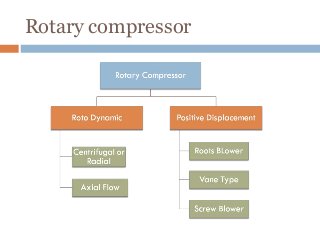
9. Rotary compressors
Introduction
•
•
•
•
•
The machine which takes in air or any other gas
at low pressure and compresses it to high
pressure are called compressors.
They are power consuming machines in which
mechanical work is converted into the pressure
head of air or gas.
They are also considered as reversed heat
engine.
Generally, the compressors are driven by electric
motors, I.C. engine or gas turbines.
A compressor is used for increasing the pressure
of air is called air compressor.
Uses of compres ed air
In refrigeration cycle
Operation tools like drill hammers etc.
Filling the air in automobile tyres
Spray painting
Increasing inlet pressure of I.C. engine
To operate air motor I mines where fire risk are more
Pumping water
Gas turbine power plant
Conveying the materials like sand and concrete along
a pipe line
For sand blasting
Operating blast furnace
Operating air brakes used in buses truck trains etc.
Positive displacement
compressor In the positive-displacement type, a given
quantity of air or gas is trapped in a
compression chamber and the volume it
occupies is mechanically reduced,
causing a corresponding rise in pressure
prior to discharge. At constant speed, the
air flow remains essentially constant with
variations in discharge pressure.
Ex: Reciprocating compressors, screw
compressors, vane compressors & so
on.
Prepare by :- Shivkumar 7
Dynamic
compressors:
 Dynamic compressors impart velocity energy
to continuously flowing air or gas by means
of impellers rotating at very high speeds. The
velocity energy is changed into pressure
energy both by the impellers and the
discharge volutes or diffusers. In the
centrifugal-type dynamic compressors, the
shape of the impeller blades determines the
relationship between air flow and the
pressure (or head) generate.
Ex: centrifugal compressors, axial compressors.
Prepare by :- Shivkumar 8
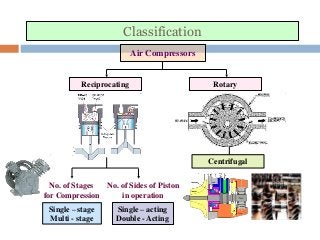
Classification
Air Compressors
Reciprocating Rotary
Single – acting
Double - Acting
No. of Sides of Piston
in operation
No. of Stages
for Compression
Centrifugal
Single – stage
Multi - stage
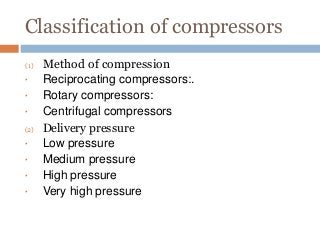
Classification of compressors
(1) Method of compression
•
•
•
Reciprocating compressors:.
Rotary compressors:
Centrifugal compressors
(2) Delivery pressure
•
•
•
•
Low pressure
Medium pressure
High pressure
Very high pressure
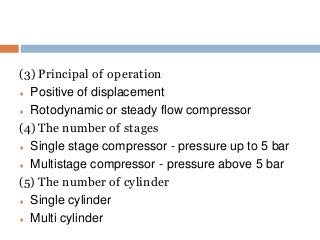
(3) Principal of operation
 Positive of displacement
 Rotodynamic or steady flow compressor
(4) The number of stages
 Single stage compressor - pressure up to 5 bar
 Multistage compressor - pressure above 5 bar
(5) The number of cylinder
 Single cylinder
 Multi cylinder
(6) Volume of air delivered
•
•
• Low capacity
Medium capacity
High capacity
(7) Fluid to be compres ed
•
•
• Air compressor
Gas compressor
Vapour compressor
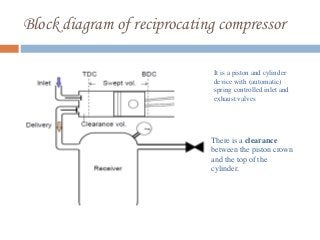
Block diagram of reciprocating compressor
It is a piston and cylinder
device with (automatic)
spring controlled inlet and
exhaust valves
There is a clearance
between the piston crown
and the top of the
cylinder.
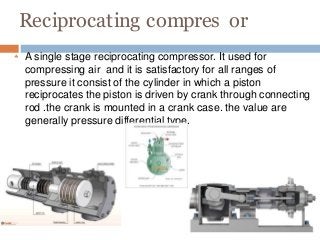
Reciprocating compres or
 A single stage reciprocating compressor. It used for
compressing air and it is satisfactory for all ranges of
pressure it consist of the cylinder in which a piston
reciprocates the piston is driven by crank through connecting
rod .the crank is mounted in a crank case. the value are
generally pressure differential type.
Reciprocating
compressors
r usually
has tw
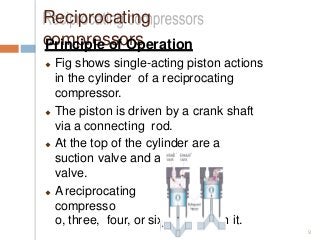
Principle of Operation
 Fig shows single-acting piston actions
in the cylinder of a reciprocating
compressor.
 The piston is driven by a crank shaft
via a connecting rod.
 At the top of the cylinder are a
suction valve and a discharge
valve.
 A reciprocating
compresso
o, three, four, or six cylinders in it.
9
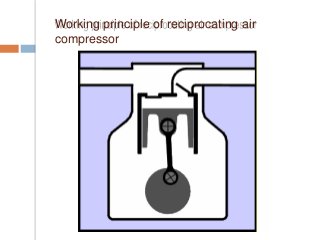
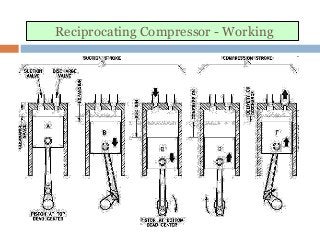
Working principle of reciprocating air
compressor
Working principle of reciprocating
air compressor
Working principle of double acting
reciprocating air compressor
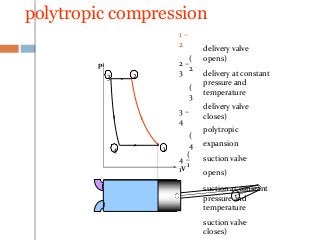
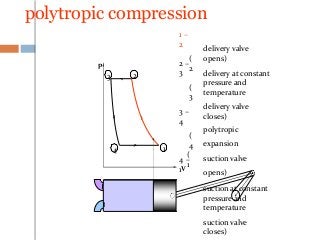
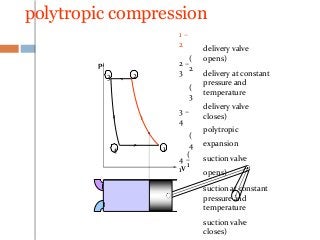
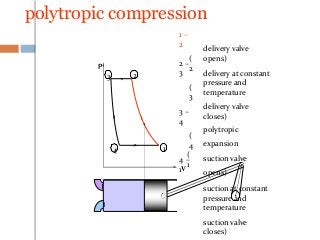
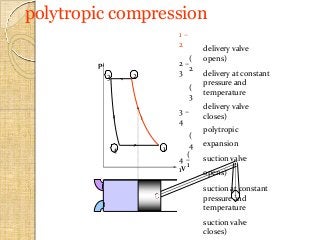
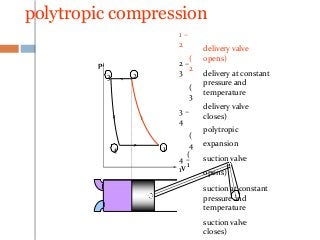
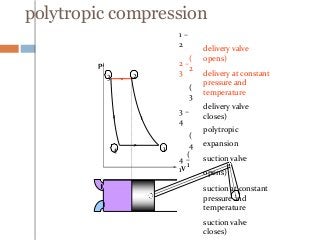
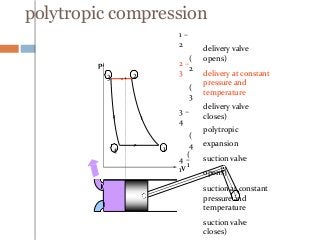
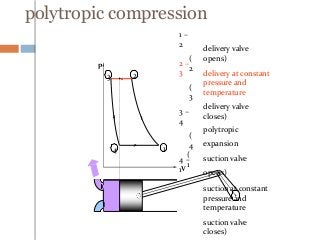
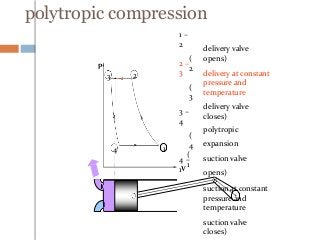
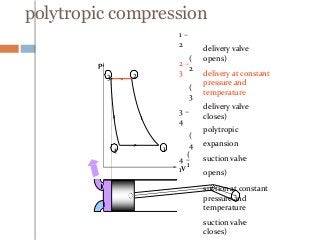
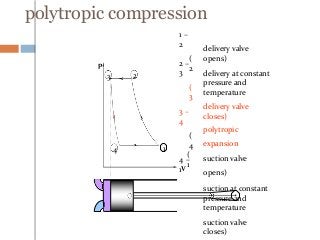
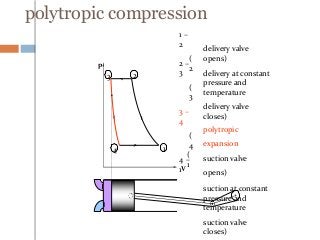
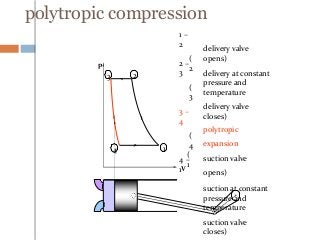
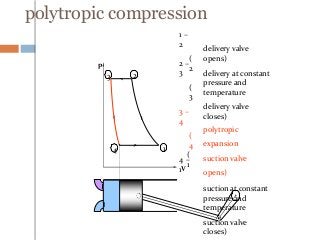
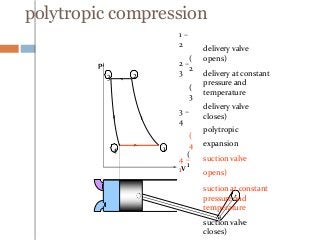
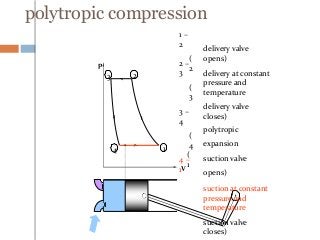
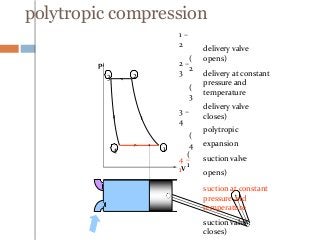
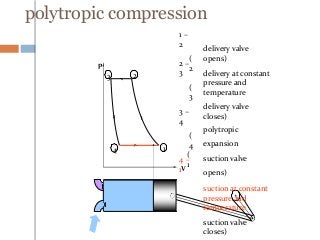
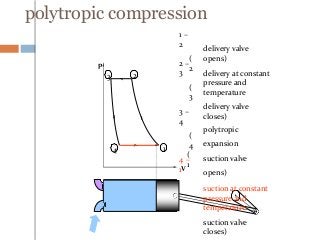
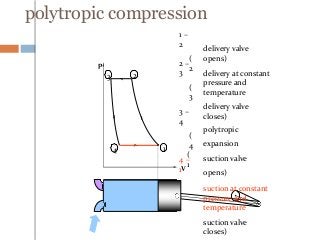
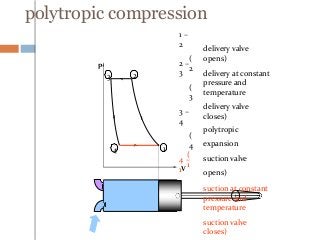
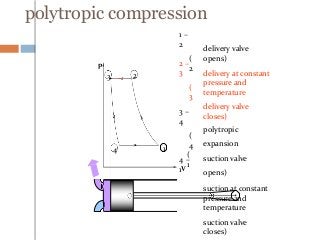
polytropic compression
1 –
2
(
2
2 –
3
(
3
3 –
4
(
4
4 –
1
(
1
delivery valve
opens)
delivery at constant
pressure and
temperature
delivery valve
closes)
polytropic
expansion
suction valve
opens)
suction at constant
pressure and
temperature
suction valve
closes)
p
V
1
23
4
polytropic compression
1 –
2
(
2
2 –
3
(
3
3 –
4
(
4
4 –
1
(
1
delivery valve
opens)
delivery at constant
pressure and
temperature
delivery valve
closes)
polytropic
expansion
suction valve
opens)
suction at constant
pressure and
temperature
suction valve
closes)
p
V
1
23
4
polytropic compression
1 –
2
(
2
2 –
3
(
3
3 –
4
(
4
4 –
1
(
1
delivery valve
opens)
delivery at constant
pressure and
temperature
delivery valve
closes)
polytropic
expansion
suction valve
opens)
suction at constant
pressure and
temperature
suction valve
closes)
p
V
1
23
4
polytropic compression
1 –
2
(
2
2 –
3
(
3
3 –
4
(
4
4 –
1
(
1
delivery valve
opens)
delivery at constant
pressure and
temperature
delivery valve
closes)
polytropic
expansion
suction valve
opens)
suction at constant
pressure and
temperature
suction valve
closes)
p
V
1
23
4
polytropic compression
1 –
2
(
2
2 –
3
(
3
3 –
4
(
4
4 –
1
(
1
delivery valve
opens)
delivery at constant
pressure and
temperature
delivery valve
closes)
polytropic
expansion
suction valve
opens)
suction at constant
pressure and
temperature
suction valve
closes)
p
V
1
23
4
polytropic compression
1 –
2
(
2
2 –
3
(
3
3 –
4
(
4
4 –
1
(
1
delivery valve
opens)
delivery at constant
pressure and
temperature
delivery valve
closes)
polytropic
expansion
suction valve
opens)
suction at constant
pressure and
temperature
suction valve
closes)
p
V
1
23
4
polytropic compression
1 –
2
(
2
2 –
3
(
3
3 –
4
(
4
4 –
1
(
1
delivery valve
opens)
delivery at constant
pressure and
temperature
delivery valve
closes)
polytropic
expansion
suction valve
opens)
suction at constant
pressure and
temperature
suction valve
closes)
p
V
1
23
4
polytropic compression
1 –
2
(
2
2 –
3
(
3
3 –
4
(
4
4 –
1
(
1
delivery valve
opens)
delivery at constant
pressure and
temperature
delivery valve
closes)
polytropic
expansion
suction valve
opens)
suction at constant
pressure and
temperature
suction valve
closes)
p
V
1
23
4
polytropic compression
1 –
2
(
2
2 –
3
(
3
3 –
4
(
4
4 –
1
(
1
delivery valve
opens)
delivery at constant
pressure and
temperature
delivery valve
closes)
polytropic
expansion
suction valve
opens)
suction at constant
pressure and
temperature
suction valve
closes)
p
V
1
23
4
p
V
1
23
4
polytropic compression
1 –
2
(
2
2 –
3
(
3
3 –
4
(
4
4 –
1
(
1
delivery valve
opens)
delivery at constant
pressure and
temperature
delivery valve
closes)
polytropic
expansion
suction valve
opens)
suction at constant
pressure and
temperature
suction valve
closes)
polytropic compression
1 –
2
(
2
2 –
3
(
3
3 –
4
(
4
4 –
1
(
1
delivery valve
opens)
delivery at constant
pressure and
temperature
delivery valve
closes)
polytropic
expansion
suction valve
opens)
suction at constant
pressure and
temperature
suction valve
closes)
p
V
1
23
4
polytropic compression
1 –
2
(
2
2 –
3
(
3
3 –
4
(
4
4 –
1
(
1
delivery valve
opens)
delivery at constant
pressure and
temperature
delivery valve
closes)
polytropic
expansion
suction valve
opens)
suction at constant
pressure and
temperature
suction valve
closes)
p
V
1
23
4
polytropic compression
1 –
2
(
2
2 –
3
(
3
3 –
4
(
4
4 –
1
(
1
delivery valve
opens)
delivery at constant
pressure and
temperature
delivery valve
closes)
polytropic
expansion
suction valve
opens)
suction at constant
pressure and
temperature
suction valve
closes)
p
V
1
23
4
polytropic compression
1 –
2
(
2
2 –
3
(
3
3 –
4
(
4
4 –
1
(
1
delivery valve
opens)
delivery at constant
pressure and
temperature
delivery valve
closes)
polytropic
expansion
suction valve
opens)
suction at constant
pressure and
temperature
suction valve
closes)
p
V
1
23
4
polytropic compression
1 –
2
(
2
2 –
3
(
3
3 –
4
(
4
4 –
1
(
1
delivery valve
opens)
delivery at constant
pressure and
temperature
delivery valve
closes)
polytropic
expansion
suction valve
opens)
suction at constant
pressure and
temperature
suction valve
closes)
p
V
1
23
4
polytropic compression
1 –
2
(
2
2 –
3
(
3
3 –
4
(
4
4 –
1
(
1
delivery valve
opens)
delivery at constant
pressure and
temperature
delivery valve
closes)
polytropic
expansion
suction valve
opens)
suction at constant
pressure and
temperature
suction valve
closes)
p
V
1
23
4
polytropic compression
1 –
2
(
2
2 –
3
(
3
3 –
4
(
4
4 –
1
(
1
delivery valve
opens)
delivery at constant
pressure and
temperature
delivery valve
closes)
polytropic
expansion
suction valve
opens)
suction at constant
pressure and
temperature
suction valve
closes)
p
V
1
23
4
polytropic compression
1 –
2
(
2
2 –
3
(
3
3 –
4
(
4
4 –
1
(
1
delivery valve
opens)
delivery at constant
pressure and
temperature
delivery valve
closes)
polytropic
expansion
suction valve
opens)
suction at constant
pressure and
temperature
suction valve
closes)
p
V
1
23
4
polytropic compression
1 –
2
(
2
2 –
3
(
3
3 –
4
(
4
4 –
1
(
1
delivery valve
opens)
delivery at constant
pressure and
temperature
delivery valve
closes)
polytropic
expansion
suction valve
opens)
suction at constant
pressure and
temperature
suction valve
closes)
p
V
1
23
4
polytropic compression
1 –
2
(
2
2 –
3
(
3
3 –
4
(
4
4 –
1
(
1
delivery valve
opens)
delivery at constant
pressure and
temperature
delivery valve
closes)
polytropic
expansion
suction valve
opens)
suction at constant
pressure and
temperature
suction valve
closes)
p
V
1
23
4
polytropic compression
1 –
2
(
2
2 –
3
(
3
3 –
4
(
4
4 –
1
(
1
delivery valve
opens)
delivery at constant
pressure and
temperature
delivery valve
closes)
polytropic
expansion
suction valve
opens)
suction at constant
pressure and
temperature
suction valve
closes)
p
V
1
23
4
polytropic compression
1 –
2
(
2
2 –
3
(
3
3 –
4
(
4
4 –
1
(
1
delivery valve
opens)
delivery at constant
pressure and
temperature
delivery valve
closes)
polytropic
expansion
suction valve
opens)
suction at constant
pressure and
temperature
suction valve
closes)
p
V
1
23
4
polytropic compression
1 –
2
(
2
2 –
3
(
3
3 –
4
(
4
4 –
1
(
1
delivery valve
opens)
delivery at constant
pressure and
temperature
delivery valve
closes)
polytropic
expansion
suction valve
opens)
suction at constant
pressure and
temperature
suction valve
closes)
p
V
1
23
4
polytropic compression
1 –
2
(
2
2 –
3
(
3
3 –
4
(
4
4 –
1
(
1
delivery valve
opens)
delivery at constant
pressure and
temperature
delivery valve
closes)
polytropic
expansion
suction valve
opens)
suction at constant
pressure and
temperature
suction valve
closes)
p
V
1
23
4
polytropic compression
1 –
2
(
2
2 –
3
(
3
3 –
4
(
4
4 –
1
(
1
delivery valve
opens)
delivery at constant
pressure and
temperature
delivery valve
closes)
polytropic
expansion
suction valve
opens)
suction at constant
pressure and
temperature
suction valve
closes)
p
V
1
23
4
polytropic compression
1 –
2
(
2
2 –
3
(
3
3 –
4
(
4
4 –
1
(
1
delivery valve
opens)
delivery at constant
pressure and
temperature
delivery valve
closes)
polytropic
expansion
suction valve
opens)
suction at constant
pressure and
temperature
suction valve
closes)
p
V
1
23
4
polytropic compression
1 –
2
(
2
2 –
3
(
3
3 –
4
(
4
4 –
1
(
1
delivery valve
opens)
delivery at constant
pressure and
temperature
delivery valve
closes)
polytropic
expansion
suction valve
opens)
suction at constant
pressure and
temperature
suction valve
closes)
p
V
1
23
4
polytropic compression
1 –
2
(
2
2 –
3
(
3
3 –
4
(
4
4 –
1
(
1
delivery valve
opens)
delivery at constant
pressure and
temperature
delivery valve
closes)
polytropic
expansion
suction valve
opens)
suction at constant
pressure and
temperature
suction valve
closes)
p
V
1
23
4
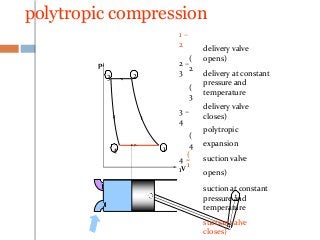
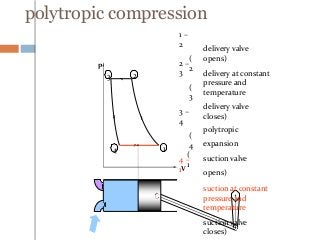
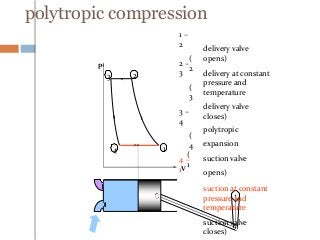
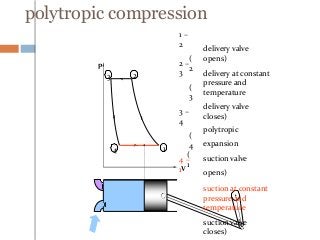
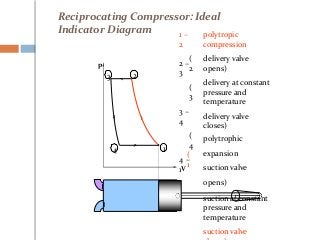
Reciprocating Compressor: Ideal
Indicator Diagram 1 –
2
(
2
2 –
3
(
3
3 –
4
(
4
4 –
1
(
1
polytropic
compression
delivery valve
opens)
delivery at constant
pressure and
temperature
delivery valve
closes)
polytrophic
expansion
suction valve
opens)
suction at constant
pressure and
temperature
suction valve
p
V
1
23
4
Reciprocating Compressor - Working
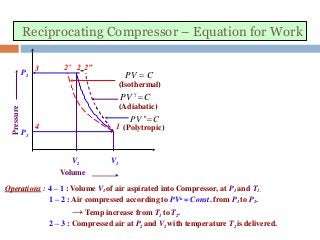
Reciprocating Compressor – Equation for Work
Pressure
P1
P2
3 2’ 2 2”
4 1 (Polytropic)
PV n
C
PV  C
(Isothermal)
PV 
C
(Adiabatic)
V2 V1
Volume
Operations : 4 – 1 : Volume V1 of air aspirated into Compressor, at P1 and T1.
1 – 2 : Air compressed according to PVn = Const. from P1 to P2.
→ Temp increase from T1 to T2.
2 – 3 : Compressed air at P2 and V2 with temperature T2 is delivered.
Reciprocating Compressor – Equation for Work
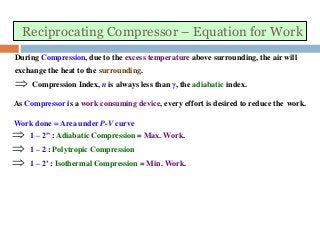
During Compression, due to the excess temperature above surrounding, the air will
exchange the heat to the surrounding.
 Compression Index, n is always less than γ, the adiabatic index.
As Compressor is a work consuming device, every effort is desired to reduce the work.
Work done = Area under P-V curve
 1 – 2” : Adiabatic Compression = Max. Work.
 1 – 2 : Polytropic Compression
 1 – 2’ : Isothermal Compression = Min. Work.
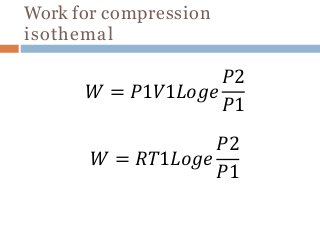
Work for compression
isothemal
𝑊 = 𝑃1𝑉1𝐿𝑜𝑔𝑒
𝑃2
𝑃1
𝑊 = 𝑅𝑇1𝐿𝑜𝑔𝑒
𝑃2
𝑃1
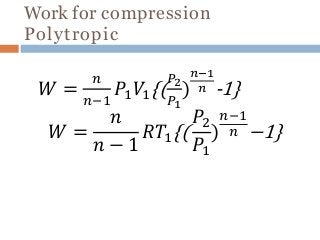
Work for compression
Polytropic
𝑊 =
𝑛
𝑛−1
𝑃1 𝑉1{(
𝑃2
𝑃1
)
𝑛−1
𝑛 -1}
𝑊 =
𝑛
𝑛 − 1
𝑅𝑇1{(
𝑃2
𝑃1
)
𝑛−1
𝑛 −1}
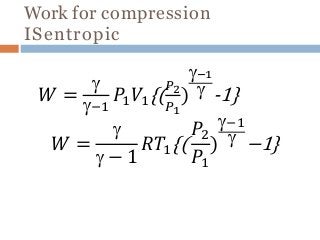
Work for compression
ISentropic
𝑊 =

−1
𝑃1 𝑉1{(
𝑃2
𝑃1
)
−1
 -1}
𝑊 =

 − 1
𝑅𝑇1{(
𝑃2
𝑃1
)
−1
 −1}
Reciprocating Compressor –
Efficiency
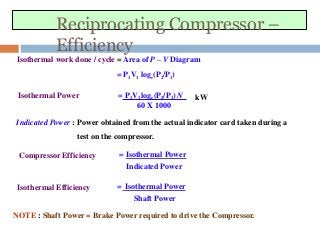
Isothermal work done / cycle = Area of P – V Diagram
= P1V1 loge(P2/P1)
Isothermal Power = P1V1 loge(P2/P1) N kW
60 X 1000
Indicated Power : Power obtained from the actual indicator card taken during a
test on the compressor.
Compressor Efficiency = Isothermal Power
Indicated Power
Isothermal Efficiency = Isothermal Power
Shaft Power
NOTE : Shaft Power = Brake Power required to drive the Compressor.
Reciprocating Compressor –
Efficiency
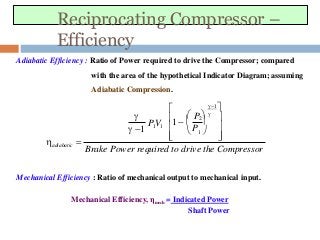
Adiabatic Efficiency : Ratio of Power required to drive the Compressor; compared
with the area of the hypothetical Indicator Diagram; assuming
Adiabatic Compression.
Brake Power required to drive the Compressor
adiabatic









 1

 1 
 P2 

1  
P

 1
P1V1
Mechanical Efficiency : Ratio of mechanical output to mechanical input.
Mechanical Efficiency, ηmech = Indicated Power
Shaft Power
Reciprocating Compressor –
Efficiency
Volumetric Efficiency :
Volumetric Efficiency :.
Efficiency, ηvol =1 - C [(p2/p1)1/-1)]
c=
𝑉𝑐
𝑉𝑠
Power required
KW
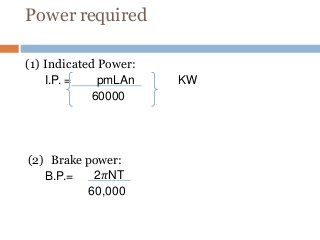
(1) Indicated Power:
I.P. = pmLAn
60000
(2) Brake power:
B.P.= 2𝜋NT
60,000
Reciprocating compres or
efficiencies
(1) Mechanical efficiency
ῃ=I.P/B.P
(2) Isothermal efficiency
ῃiso=
p1 V1 loge (p2/P1)
[ (n/n-1) p1V1 (p2/p1)n-1/n -1}]
Multistage Reciprocating
Compressors
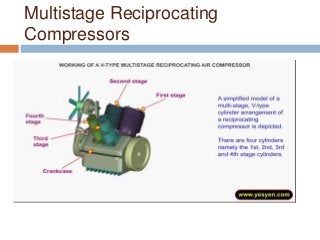
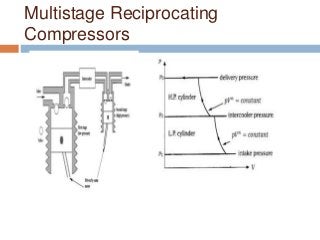
The compression of air in single stage has
many disadvantages and its use is limited
where low delivery pressure is required.
A multistage compression is more efficient
and mostly employed for high pressures.
Multistage Reciprocating
Compressors
Multistage Reciprocating
Compressors
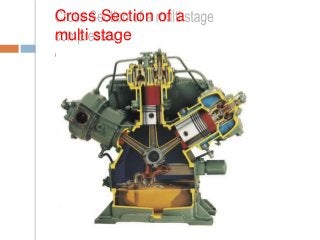
Cross Section of a
multi stage
compressor
Reciprocating Compressor –
Multistage
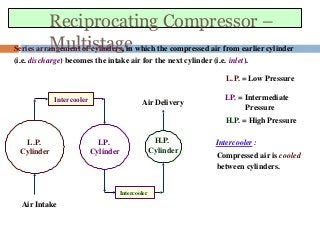
Intercooler :
Compressed air is cooled
between cylinders.
Series arrangement of cylinders, in which the compressed air from earlier cylinder
(i.e. discharge) becomes the intake air for the next cylinder (i.e. inlet).
L.P. = Low Pressure
I.P. = Intermediate
Pressure
H.P. = High Pressure
L.P.
Cylinder
I.P.
Cylinder
H.P.
Cylinder
Intercooler
Intercooler
Air Intake
Air Delivery
Reciprocating Compressor –
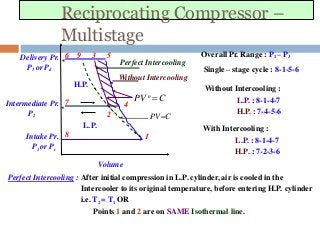
Multistage
Intake Pr.
P1 or Ps
P3 or Pd
2
1
PV n
C
8
Delivery Pr. 6 9 3 5
Intermediate Pr. 7 4
P2 PVC
Without Intercooling
Perfect Intercooling
L.P.
H.P.
Overall Pr. Range : P1 – P3
Single – stage cycle : 8-1-5-6
Without Intercooling :
L.P. : 8-1-4-7
H.P. : 7-4-5-6
With Intercooling :
L.P. : 8-1-4-7
H.P. : 7-2-3-6
Volume
Perfect Intercooling : After initial compression in L.P. cylinder, air is cooled in the
Intercooler to its original temperature, before entering H.P. cylinder
i.e. T2 = T1 OR
Points 1 and 2 are on SAME Isothermal line.
Multistage reciprocating
compressor
 There are several disadvantages to compress
the air at a high pressure in a single cylinder
the air is compressed by more than one
cylinder in series in a single stage compressor
if the pressure ratio is increased the volumetric
efficiency decrease.
Advantages of multistage
compressor
•
•
• Without inter cooling the curve of compression
will follow the path hence the saving work
input due to inter cooling .
Volumetric efficiency is increased due to the
smaller pressure range as the effect of
expansion of air in the clearance volume is
less
Less shaft power is required for a given
pressure ratio due to the saving in work input
 Due to smaller working temperature better
lubricating effect is provided
 Better mechanical balance and smoother
torque – angel diagram is obtained
 In multistage compressor the low pressure
cylinder is lighter
 There is less leakage problems due to less
pressure difference for each stage
Rotary compressor
Centrifugal compressor
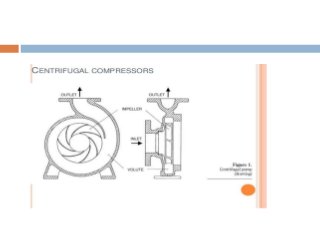
(1) Centrifugal compressor
•
he air enter
he
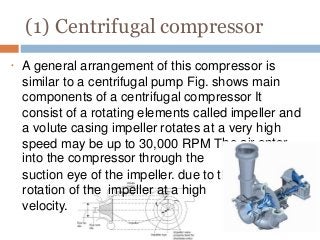
A general arrangement of this compressor is
similar to a centrifugal pump Fig. shows main
components of a centrifugal compressor It
consist of a rotating elements called impeller and
a volute casing impeller rotates at a very high
speed may be up to 30,000 RPM T
into the compressor through the
suction eye of the impeller. due to t
rotation of the impeller at a high
velocity.
• Then air with high velocity enter into a
diffuser ring. the diffuser blade of the
diffuser ring are so shaped that these
provided an increased area of passage to
the air which is passing outward due to
which the velocity of air leaving the impeller
is reduced and its pressure is increased the
high pressure air then flows to the divergent
passage of volute casing the velocity air is
further reduced due to increased cross
sectional area of volute casing causing very
small rise in pressure from the casing the
compressor air leads to exit pipe and finally
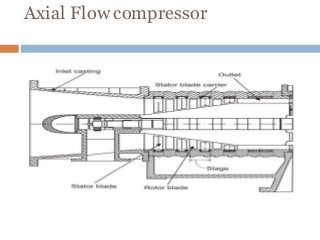
Axial Flow compressor
(2) Axial Flow compressor
•
•
•
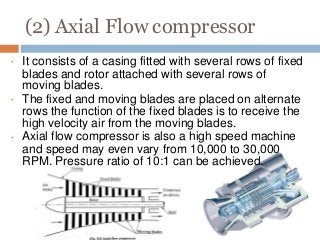
It consists of a casing fitted with several rows of fixed
blades and rotor attached with several rows of
moving blades.
The fixed and moving blades are placed on alternate
rows the function of the fixed blades is to receive the
high velocity air from the moving blades.
Axial flow compressor is also a high speed machine
and speed may even vary from 10,000 to 30,000
RPM. Pressure ratio of 10:1 can be achieved.
Axial Flow compressor
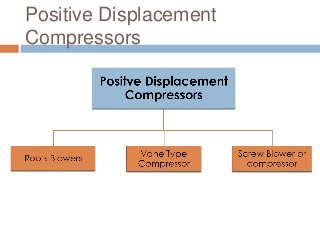
Positive Displacement
Compressors
Roots Blowers
Roots Blowers
(1) Roots Blowers
•
•
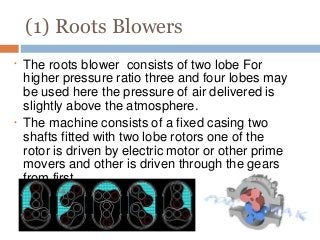
The roots blower consists of two lobe For
higher pressure ratio three and four lobes may
be used here the pressure of air delivered is
slightly above the atmosphere.
The machine consists of a fixed casing two
shafts fitted with two lobe rotors one of the
rotor is driven by electric motor or other prime
movers and other is driven through the gears
from first.
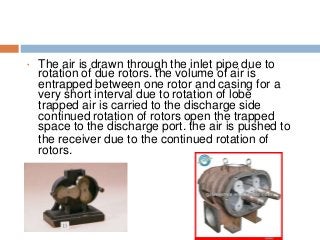
• The air is drawn through the inlet pipe due to
rotation of due rotors. the volume of air is
entrapped between one rotor and casing for a
very short interval due to rotation of lobe
trapped air is carried to the discharge side
continued rotation of rotors open the trapped
space to the discharge port. the air is pushed to
the receiver due to the continued rotation of
rotors.
Vane type compressor or Blower
(2) Vane type compressor or
Blower
•
• ein the slots. The volum
ion
the
eated
nd
ed to
into
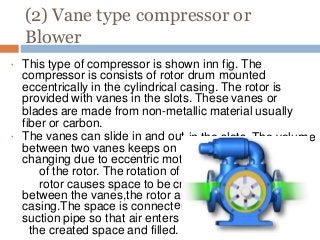
This type of compressor is shown inn fig. The
compressor is consists of rotor drum mounted
eccentrically in the cylindrical casing. The rotor is
provided with vanes in the slots. These vanes or
blades are made from non-metallic material usually
fiber or carbon.
The vanes can slide in and out
between two vanes keeps on
changing due to eccentric mot
of the rotor. The rotation of
rotor causes space to be cr
between the vanes,the rotor a
casing.The space is connect
suction pipe so that air enters
the created space and filled.
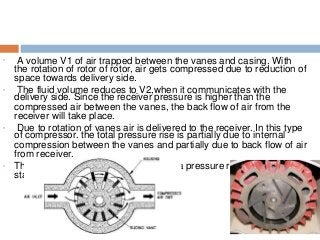
• A volume V1 of air trapped between the vanes and casing. With
the rotation of rotor of rotor, air gets compressed due to reduction of
space towards delivery side.
• The fluid volume reduces to V2,when it communicates with the
delivery side. Since the receiver pressure is higher than the
compressed air between the vanes, the back flow of air from the
receiver will take place.
• Due to rotation of vanes air is delivered to the receiver. In this type
of compressor. the total pressure rise is partially due to internal
compression between the vanes and partially due to back flow of air
from receiver.
• Th a pressure ratio up to 6 per
sta
is type of compressor can produce
ge
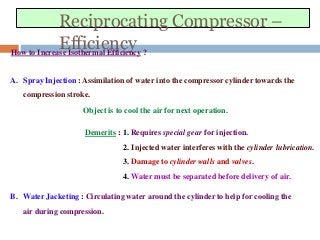
Reciprocating Compressor –
EfficiencyHow to Increase Isothermal Efficiency ?
A. Spray Injection : Assimilation of water into the compressor cylinder towards the
compression stroke.
Object is to cool the air for next operation.
Demerits : 1. Requires special gear for injection.
2. Injected water interferes with the cylinder lubrication.
3. Damage to cylinder walls and valves.
4. Water must be separated before delivery of air.
B. Water Jacketing : Circulating water around the cylinder to help for cooling the
air during compression.
Compressor by Patait S.B

  • 1.
    AIR COMPRESSORS Elements OfMechincal Engineering Electrical
  • 2.
    INDEX 1. Introduction 2. Usesof Compressed air 3. Reciprocating compressors 4. Operation of a compressors 5. Work of compression 6. Power required 7. Reciprocating compressor efficiencies 8. Multistage reciprocating compressors 9. Rotary compressors
  • 3.
    Introduction • • • • • The machine whichtakes in air or any other gas at low pressure and compresses it to high pressure are called compressors. They are power consuming machines in which mechanical work is converted into the pressure head of air or gas. They are also considered as reversed heat engine. Generally, the compressors are driven by electric motors, I.C. engine or gas turbines. A compressor is used for increasing the pressure of air is called air compressor.
  • 4.
    Uses of compresed air In refrigeration cycle Operation tools like drill hammers etc. Filling the air in automobile tyres Spray painting Increasing inlet pressure of I.C. engine To operate air motor I mines where fire risk are more Pumping water Gas turbine power plant Conveying the materials like sand and concrete along a pipe line For sand blasting Operating blast furnace Operating air brakes used in buses truck trains etc.
  • 5.
    Positive displacement compressor Inthe positive-displacement type, a given quantity of air or gas is trapped in a compression chamber and the volume it occupies is mechanically reduced, causing a corresponding rise in pressure prior to discharge. At constant speed, the air flow remains essentially constant with variations in discharge pressure. Ex: Reciprocating compressors, screw compressors, vane compressors & so on. Prepare by :- Shivkumar 7
  • 6.
    Dynamic compressors:  Dynamic compressorsimpart velocity energy to continuously flowing air or gas by means of impellers rotating at very high speeds. The velocity energy is changed into pressure energy both by the impellers and the discharge volutes or diffusers. In the centrifugal-type dynamic compressors, the shape of the impeller blades determines the relationship between air flow and the pressure (or head) generate. Ex: centrifugal compressors, axial compressors. Prepare by :- Shivkumar 8
  • 7.
    Classification Air Compressors Reciprocating Rotary Single– acting Double - Acting No. of Sides of Piston in operation No. of Stages for Compression Centrifugal Single – stage Multi - stage
  • 8.
    Classification of compressors (1)Method of compression • • • Reciprocating compressors:. Rotary compressors: Centrifugal compressors (2) Delivery pressure • • • • Low pressure Medium pressure High pressure Very high pressure
  • 9.
    (3) Principal ofoperation  Positive of displacement  Rotodynamic or steady flow compressor (4) The number of stages  Single stage compressor - pressure up to 5 bar  Multistage compressor - pressure above 5 bar (5) The number of cylinder  Single cylinder  Multi cylinder
  • 10.
    (6) Volume ofair delivered • • • Low capacity Medium capacity High capacity (7) Fluid to be compres ed • • • Air compressor Gas compressor Vapour compressor
  • 11.
    Block diagram ofreciprocating compressor It is a piston and cylinder device with (automatic) spring controlled inlet and exhaust valves There is a clearance between the piston crown and the top of the cylinder.
  • 12.
    Reciprocating compres or A single stage reciprocating compressor. It used for compressing air and it is satisfactory for all ranges of pressure it consist of the cylinder in which a piston reciprocates the piston is driven by crank through connecting rod .the crank is mounted in a crank case. the value are generally pressure differential type.
  • 13.
    Reciprocating compressors r usually has tw Principleof Operation  Fig shows single-acting piston actions in the cylinder of a reciprocating compressor.  The piston is driven by a crank shaft via a connecting rod.  At the top of the cylinder are a suction valve and a discharge valve.  A reciprocating compresso o, three, four, or six cylinders in it. 9
  • 14.
    Working principle ofreciprocating air compressor
  • 15.
    Working principle ofreciprocating air compressor
  • 16.
    Working principle ofdouble acting reciprocating air compressor
  • 17.
    polytropic compression 1 – 2 ( 2 2– 3 ( 3 3 – 4 ( 4 4 – 1 ( 1 delivery valve opens) delivery at constant pressure and temperature delivery valve closes) polytropic expansion suction valve opens) suction at constant pressure and temperature suction valve closes) p V 1 23 4
  • 18.
    polytropic compression 1 – 2 ( 2 2– 3 ( 3 3 – 4 ( 4 4 – 1 ( 1 delivery valve opens) delivery at constant pressure and temperature delivery valve closes) polytropic expansion suction valve opens) suction at constant pressure and temperature suction valve closes) p V 1 23 4
  • 19.
    polytropic compression 1 – 2 ( 2 2– 3 ( 3 3 – 4 ( 4 4 – 1 ( 1 delivery valve opens) delivery at constant pressure and temperature delivery valve closes) polytropic expansion suction valve opens) suction at constant pressure and temperature suction valve closes) p V 1 23 4
  • 20.
    polytropic compression 1 – 2 ( 2 2– 3 ( 3 3 – 4 ( 4 4 – 1 ( 1 delivery valve opens) delivery at constant pressure and temperature delivery valve closes) polytropic expansion suction valve opens) suction at constant pressure and temperature suction valve closes) p V 1 23 4
  • 21.
    polytropic compression 1 – 2 ( 2 2– 3 ( 3 3 – 4 ( 4 4 – 1 ( 1 delivery valve opens) delivery at constant pressure and temperature delivery valve closes) polytropic expansion suction valve opens) suction at constant pressure and temperature suction valve closes) p V 1 23 4
  • 22.
    polytropic compression 1 – 2 ( 2 2– 3 ( 3 3 – 4 ( 4 4 – 1 ( 1 delivery valve opens) delivery at constant pressure and temperature delivery valve closes) polytropic expansion suction valve opens) suction at constant pressure and temperature suction valve closes) p V 1 23 4
  • 23.
    polytropic compression 1 – 2 ( 2 2– 3 ( 3 3 – 4 ( 4 4 – 1 ( 1 delivery valve opens) delivery at constant pressure and temperature delivery valve closes) polytropic expansion suction valve opens) suction at constant pressure and temperature suction valve closes) p V 1 23 4
  • 24.
    polytropic compression 1 – 2 ( 2 2– 3 ( 3 3 – 4 ( 4 4 – 1 ( 1 delivery valve opens) delivery at constant pressure and temperature delivery valve closes) polytropic expansion suction valve opens) suction at constant pressure and temperature suction valve closes) p V 1 23 4
  • 25.
    polytropic compression 1 – 2 ( 2 2– 3 ( 3 3 – 4 ( 4 4 – 1 ( 1 delivery valve opens) delivery at constant pressure and temperature delivery valve closes) polytropic expansion suction valve opens) suction at constant pressure and temperature suction valve closes) p V 1 23 4
  • 26.
    p V 1 23 4 polytropic compression 1 – 2 ( 2 2– 3 ( 3 3 – 4 ( 4 4 – 1 ( 1 delivery valve opens) delivery at constant pressure and temperature delivery valve closes) polytropic expansion suction valve opens) suction at constant pressure and temperature suction valve closes)
  • 27.
    polytropic compression 1 – 2 ( 2 2– 3 ( 3 3 – 4 ( 4 4 – 1 ( 1 delivery valve opens) delivery at constant pressure and temperature delivery valve closes) polytropic expansion suction valve opens) suction at constant pressure and temperature suction valve closes) p V 1 23 4
  • 28.
    polytropic compression 1 – 2 ( 2 2– 3 ( 3 3 – 4 ( 4 4 – 1 ( 1 delivery valve opens) delivery at constant pressure and temperature delivery valve closes) polytropic expansion suction valve opens) suction at constant pressure and temperature suction valve closes) p V 1 23 4
  • 29.
    polytropic compression 1 – 2 ( 2 2– 3 ( 3 3 – 4 ( 4 4 – 1 ( 1 delivery valve opens) delivery at constant pressure and temperature delivery valve closes) polytropic expansion suction valve opens) suction at constant pressure and temperature suction valve closes) p V 1 23 4
  • 30.
    polytropic compression 1 – 2 ( 2 2– 3 ( 3 3 – 4 ( 4 4 – 1 ( 1 delivery valve opens) delivery at constant pressure and temperature delivery valve closes) polytropic expansion suction valve opens) suction at constant pressure and temperature suction valve closes) p V 1 23 4
  • 31.
    polytropic compression 1 – 2 ( 2 2– 3 ( 3 3 – 4 ( 4 4 – 1 ( 1 delivery valve opens) delivery at constant pressure and temperature delivery valve closes) polytropic expansion suction valve opens) suction at constant pressure and temperature suction valve closes) p V 1 23 4
  • 32.
    polytropic compression 1 – 2 ( 2 2– 3 ( 3 3 – 4 ( 4 4 – 1 ( 1 delivery valve opens) delivery at constant pressure and temperature delivery valve closes) polytropic expansion suction valve opens) suction at constant pressure and temperature suction valve closes) p V 1 23 4
  • 33.
    polytropic compression 1 – 2 ( 2 2– 3 ( 3 3 – 4 ( 4 4 – 1 ( 1 delivery valve opens) delivery at constant pressure and temperature delivery valve closes) polytropic expansion suction valve opens) suction at constant pressure and temperature suction valve closes) p V 1 23 4
  • 34.
    polytropic compression 1 – 2 ( 2 2– 3 ( 3 3 – 4 ( 4 4 – 1 ( 1 delivery valve opens) delivery at constant pressure and temperature delivery valve closes) polytropic expansion suction valve opens) suction at constant pressure and temperature suction valve closes) p V 1 23 4
  • 35.
    polytropic compression 1 – 2 ( 2 2– 3 ( 3 3 – 4 ( 4 4 – 1 ( 1 delivery valve opens) delivery at constant pressure and temperature delivery valve closes) polytropic expansion suction valve opens) suction at constant pressure and temperature suction valve closes) p V 1 23 4
  • 36.
    polytropic compression 1 – 2 ( 2 2– 3 ( 3 3 – 4 ( 4 4 – 1 ( 1 delivery valve opens) delivery at constant pressure and temperature delivery valve closes) polytropic expansion suction valve opens) suction at constant pressure and temperature suction valve closes) p V 1 23 4
  • 37.
    polytropic compression 1 – 2 ( 2 2– 3 ( 3 3 – 4 ( 4 4 – 1 ( 1 delivery valve opens) delivery at constant pressure and temperature delivery valve closes) polytropic expansion suction valve opens) suction at constant pressure and temperature suction valve closes) p V 1 23 4
  • 38.
    polytropic compression 1 – 2 ( 2 2– 3 ( 3 3 – 4 ( 4 4 – 1 ( 1 delivery valve opens) delivery at constant pressure and temperature delivery valve closes) polytropic expansion suction valve opens) suction at constant pressure and temperature suction valve closes) p V 1 23 4
  • 39.
    polytropic compression 1 – 2 ( 2 2– 3 ( 3 3 – 4 ( 4 4 – 1 ( 1 delivery valve opens) delivery at constant pressure and temperature delivery valve closes) polytropic expansion suction valve opens) suction at constant pressure and temperature suction valve closes) p V 1 23 4
  • 40.
    polytropic compression 1 – 2 ( 2 2– 3 ( 3 3 – 4 ( 4 4 – 1 ( 1 delivery valve opens) delivery at constant pressure and temperature delivery valve closes) polytropic expansion suction valve opens) suction at constant pressure and temperature suction valve closes) p V 1 23 4
  • 41.
    polytropic compression 1 – 2 ( 2 2– 3 ( 3 3 – 4 ( 4 4 – 1 ( 1 delivery valve opens) delivery at constant pressure and temperature delivery valve closes) polytropic expansion suction valve opens) suction at constant pressure and temperature suction valve closes) p V 1 23 4
  • 42.
    polytropic compression 1 – 2 ( 2 2– 3 ( 3 3 – 4 ( 4 4 – 1 ( 1 delivery valve opens) delivery at constant pressure and temperature delivery valve closes) polytropic expansion suction valve opens) suction at constant pressure and temperature suction valve closes) p V 1 23 4
  • 43.
    polytropic compression 1 – 2 ( 2 2– 3 ( 3 3 – 4 ( 4 4 – 1 ( 1 delivery valve opens) delivery at constant pressure and temperature delivery valve closes) polytropic expansion suction valve opens) suction at constant pressure and temperature suction valve closes) p V 1 23 4
  • 44.
    polytropic compression 1 – 2 ( 2 2– 3 ( 3 3 – 4 ( 4 4 – 1 ( 1 delivery valve opens) delivery at constant pressure and temperature delivery valve closes) polytropic expansion suction valve opens) suction at constant pressure and temperature suction valve closes) p V 1 23 4
  • 45.
    Reciprocating Compressor: Ideal IndicatorDiagram 1 – 2 ( 2 2 – 3 ( 3 3 – 4 ( 4 4 – 1 ( 1 polytropic compression delivery valve opens) delivery at constant pressure and temperature delivery valve closes) polytrophic expansion suction valve opens) suction at constant pressure and temperature suction valve p V 1 23 4
  • 46.
  • 47.
    Reciprocating Compressor –Equation for Work Pressure P1 P2 3 2’ 2 2” 4 1 (Polytropic) PV n C PV  C (Isothermal) PV  C (Adiabatic) V2 V1 Volume Operations : 4 – 1 : Volume V1 of air aspirated into Compressor, at P1 and T1. 1 – 2 : Air compressed according to PVn = Const. from P1 to P2. → Temp increase from T1 to T2. 2 – 3 : Compressed air at P2 and V2 with temperature T2 is delivered.
  • 48.
    Reciprocating Compressor –Equation for Work During Compression, due to the excess temperature above surrounding, the air will exchange the heat to the surrounding.  Compression Index, n is always less than γ, the adiabatic index. As Compressor is a work consuming device, every effort is desired to reduce the work. Work done = Area under P-V curve  1 – 2” : Adiabatic Compression = Max. Work.  1 – 2 : Polytropic Compression  1 – 2’ : Isothermal Compression = Min. Work.
  • 49.
    Work for compression isothemal 𝑊= 𝑃1𝑉1𝐿𝑜𝑔𝑒 𝑃2 𝑃1 𝑊 = 𝑅𝑇1𝐿𝑜𝑔𝑒 𝑃2 𝑃1
  • 50.
    Work for compression Polytropic 𝑊= 𝑛 𝑛−1 𝑃1 𝑉1{( 𝑃2 𝑃1 ) 𝑛−1 𝑛 -1} 𝑊 = 𝑛 𝑛 − 1 𝑅𝑇1{( 𝑃2 𝑃1 ) 𝑛−1 𝑛 −1}
  • 51.
    Work for compression ISentropic 𝑊=  −1 𝑃1 𝑉1{( 𝑃2 𝑃1 ) −1  -1} 𝑊 =   − 1 𝑅𝑇1{( 𝑃2 𝑃1 ) −1  −1}
  • 52.
    Reciprocating Compressor – Efficiency Isothermalwork done / cycle = Area of P – V Diagram = P1V1 loge(P2/P1) Isothermal Power = P1V1 loge(P2/P1) N kW 60 X 1000 Indicated Power : Power obtained from the actual indicator card taken during a test on the compressor. Compressor Efficiency = Isothermal Power Indicated Power Isothermal Efficiency = Isothermal Power Shaft Power NOTE : Shaft Power = Brake Power required to drive the Compressor.
  • 53.
    Reciprocating Compressor – Efficiency AdiabaticEfficiency : Ratio of Power required to drive the Compressor; compared with the area of the hypothetical Indicator Diagram; assuming Adiabatic Compression. Brake Power required to drive the Compressor adiabatic           1   1   P2   1   P   1 P1V1 Mechanical Efficiency : Ratio of mechanical output to mechanical input. Mechanical Efficiency, ηmech = Indicated Power Shaft Power
  • 54.
    Reciprocating Compressor – Efficiency VolumetricEfficiency : Volumetric Efficiency :. Efficiency, ηvol =1 - C [(p2/p1)1/-1)] c= 𝑉𝑐 𝑉𝑠
  • 55.
    Power required KW (1) IndicatedPower: I.P. = pmLAn 60000 (2) Brake power: B.P.= 2𝜋NT 60,000
  • 56.
    Reciprocating compres or efficiencies (1)Mechanical efficiency ῃ=I.P/B.P (2) Isothermal efficiency ῃiso= p1 V1 loge (p2/P1) [ (n/n-1) p1V1 (p2/p1)n-1/n -1}]
  • 57.
    Multistage Reciprocating Compressors The compressionof air in single stage has many disadvantages and its use is limited where low delivery pressure is required. A multistage compression is more efficient and mostly employed for high pressures.
  • 58.
  • 59.
  • 60.
    Cross Section ofa multi stage compressor
  • 61.
    Reciprocating Compressor – Multistage Intercooler: Compressed air is cooled between cylinders. Series arrangement of cylinders, in which the compressed air from earlier cylinder (i.e. discharge) becomes the intake air for the next cylinder (i.e. inlet). L.P. = Low Pressure I.P. = Intermediate Pressure H.P. = High Pressure L.P. Cylinder I.P. Cylinder H.P. Cylinder Intercooler Intercooler Air Intake Air Delivery
  • 62.
    Reciprocating Compressor – Multistage IntakePr. P1 or Ps P3 or Pd 2 1 PV n C 8 Delivery Pr. 6 9 3 5 Intermediate Pr. 7 4 P2 PVC Without Intercooling Perfect Intercooling L.P. H.P. Overall Pr. Range : P1 – P3 Single – stage cycle : 8-1-5-6 Without Intercooling : L.P. : 8-1-4-7 H.P. : 7-4-5-6 With Intercooling : L.P. : 8-1-4-7 H.P. : 7-2-3-6 Volume Perfect Intercooling : After initial compression in L.P. cylinder, air is cooled in the Intercooler to its original temperature, before entering H.P. cylinder i.e. T2 = T1 OR Points 1 and 2 are on SAME Isothermal line.
  • 63.
    Multistage reciprocating compressor  Thereare several disadvantages to compress the air at a high pressure in a single cylinder the air is compressed by more than one cylinder in series in a single stage compressor if the pressure ratio is increased the volumetric efficiency decrease.
  • 64.
    Advantages of multistage compressor • • •Without inter cooling the curve of compression will follow the path hence the saving work input due to inter cooling . Volumetric efficiency is increased due to the smaller pressure range as the effect of expansion of air in the clearance volume is less Less shaft power is required for a given pressure ratio due to the saving in work input
  • 65.
     Due tosmaller working temperature better lubricating effect is provided  Better mechanical balance and smoother torque – angel diagram is obtained  In multistage compressor the low pressure cylinder is lighter  There is less leakage problems due to less pressure difference for each stage
  • 66.
  • 67.
  • 68.
  • 69.
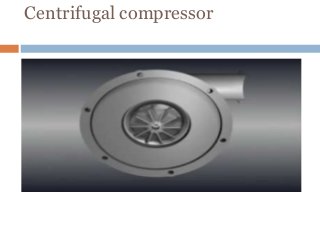
    (1) Centrifugal compressor • heair enter he A general arrangement of this compressor is similar to a centrifugal pump Fig. shows main components of a centrifugal compressor It consist of a rotating elements called impeller and a volute casing impeller rotates at a very high speed may be up to 30,000 RPM T into the compressor through the suction eye of the impeller. due to t rotation of the impeller at a high velocity.
  • 70.
    • Then airwith high velocity enter into a diffuser ring. the diffuser blade of the diffuser ring are so shaped that these provided an increased area of passage to the air which is passing outward due to which the velocity of air leaving the impeller is reduced and its pressure is increased the high pressure air then flows to the divergent passage of volute casing the velocity air is further reduced due to increased cross sectional area of volute casing causing very small rise in pressure from the casing the compressor air leads to exit pipe and finally
  • 72.
  • 73.
    (2) Axial Flowcompressor • • • It consists of a casing fitted with several rows of fixed blades and rotor attached with several rows of moving blades. The fixed and moving blades are placed on alternate rows the function of the fixed blades is to receive the high velocity air from the moving blades. Axial flow compressor is also a high speed machine and speed may even vary from 10,000 to 30,000 RPM. Pressure ratio of 10:1 can be achieved.
  • 74.
  • 75.
  • 76.
  • 77.
  • 78.
    (1) Roots Blowers • • Theroots blower consists of two lobe For higher pressure ratio three and four lobes may be used here the pressure of air delivered is slightly above the atmosphere. The machine consists of a fixed casing two shafts fitted with two lobe rotors one of the rotor is driven by electric motor or other prime movers and other is driven through the gears from first.
  • 79.
    • The airis drawn through the inlet pipe due to rotation of due rotors. the volume of air is entrapped between one rotor and casing for a very short interval due to rotation of lobe trapped air is carried to the discharge side continued rotation of rotors open the trapped space to the discharge port. the air is pushed to the receiver due to the continued rotation of rotors.
  • 80.
  • 81.
    (2) Vane typecompressor or Blower • • ein the slots. The volum ion the eated nd ed to into This type of compressor is shown inn fig. The compressor is consists of rotor drum mounted eccentrically in the cylindrical casing. The rotor is provided with vanes in the slots. These vanes or blades are made from non-metallic material usually fiber or carbon. The vanes can slide in and out between two vanes keeps on changing due to eccentric mot of the rotor. The rotation of rotor causes space to be cr between the vanes,the rotor a casing.The space is connect suction pipe so that air enters the created space and filled.
  • 82.
    • A volumeV1 of air trapped between the vanes and casing. With the rotation of rotor of rotor, air gets compressed due to reduction of space towards delivery side. • The fluid volume reduces to V2,when it communicates with the delivery side. Since the receiver pressure is higher than the compressed air between the vanes, the back flow of air from the receiver will take place. • Due to rotation of vanes air is delivered to the receiver. In this type of compressor. the total pressure rise is partially due to internal compression between the vanes and partially due to back flow of air from receiver. • Th a pressure ratio up to 6 per sta is type of compressor can produce ge
  • 83.
    Reciprocating Compressor – EfficiencyHowto Increase Isothermal Efficiency ? A. Spray Injection : Assimilation of water into the compressor cylinder towards the compression stroke. Object is to cool the air for next operation. Demerits : 1. Requires special gear for injection. 2. Injected water interferes with the cylinder lubrication. 3. Damage to cylinder walls and valves. 4. Water must be separated before delivery of air. B. Water Jacketing : Circulating water around the cylinder to help for cooling the air during compression.