The UC San Diego AntiViral Research Center sponsors weekly
presentations by infectious disease clinicians, physicians and
researchers. The goal of these presentations is to provide the most
current research, clinical practices and trends in HIV, HBV, HCV, TB
and other infectious diseases of global significance.
The slides from the AIDS Clinical Rounds presentation that you are
about to view are intended for the educational purposes of our
audience. They may not be used for other purposes without the
presenter’s express permission.
AIDS CLINICAL ROUNDS
Inflammation Persists Even During HIV Therapy
Sara Gianella Weibel, MD
Assistant Professor of Medicine
UCSD/CFAR
Slide adapted from P. Hunt
Background
The development of antiretroviral therapy (ART)
for the treatment of HIV is one of the greatest
achievements of modern medicine.
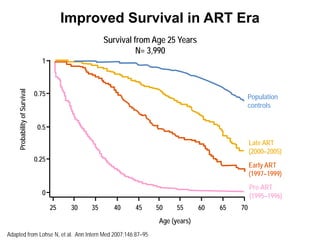
Improved Survival in ART Era
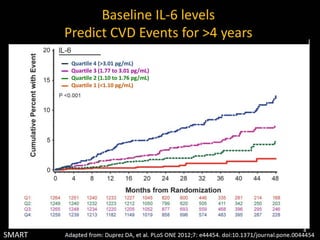
Adapted from Lohse N, et al. Ann Intern Med 2007;146:87–95
ProbabilityofSurvival
Pre-ART
(1995–1996)
Early ART
(1997–1999)
Survival from Age 25 Years
N= 3,990
1
0.75
0.5
0.25
0
25 30 35 40 45 50 55 60 65 70
Age (years)
Late ART
(2000–2005)
Population
controls
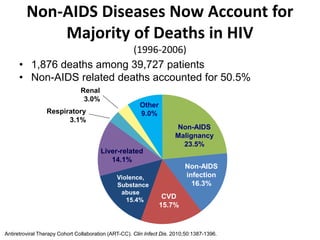
Non-AIDS Diseases Now Account for
Majority of Deaths in HIV
(1996-2006)
• 1,876 deaths among 39,727 patients
• Non-AIDS related deaths accounted for 50.5%
Antiretroviral Therapy Cohort Collaboration (ART-CC). Clin Infect Dis. 2010;50:1387-1396.
Non-AIDS
infection
16.3%
CVD
15.7%
Non-AIDS
Malignancy
23.5%
Violence,
Substance
abuse
15.4%
Liver-related
14.1%
Other
9.0%Respiratory
3.1%
Renal
3.0%
Respiratory
3.1%
Renal
3.0%
Antiretroviral Therapy Cohort Collaboration (ART-CC). Clin Infect Dis. 2010;50:1387-1396.
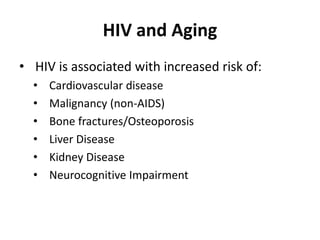
HIV and Aging
• HIV is associated with increased risk of:
• Cardiovascular disease
• Malignancy (non-AIDS)
• Bone fractures/Osteoporosis
• Liver Disease
• Kidney Disease
• Neurocognitive Impairment
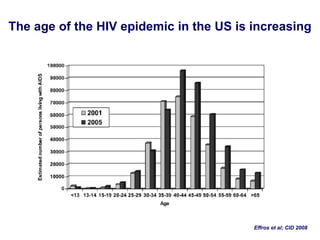
The age of the HIV epidemic in the US is increasing
Effros et al; CID 2008
Why do HIV infected people suffer
from “unsuccessful aging”?
Burning Question
Possible Reasons for “Unsuccessful
Aging” in HIV+
• Lifestyle factors (e.g. smoking)
• ART toxicity
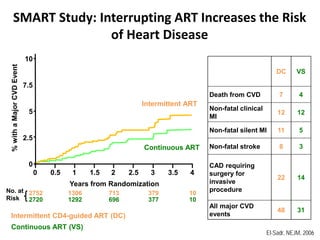
SMART Study: Interrupting ART Increases the Risk
of Heart Disease
%withaMajorCVDEvent
DC VS
Death from CVD 7 4
Non-fatal clinical
MI
12 12
Non-fatal silent MI 11 5
Non-fatal stroke 8 3
CAD requiring
surgery for
invasive
procedure
22 14
All major CVD
events
48 31
El-Sadr, NEJM, 2006
2752 1306 713 379 10
2720 1292 696 377 10
No. at
Risk
0.5 1.5 2.5 3.50 1 2 3 4
0
Years from Randomization
5
10
2.5
7.5
Intermittent CD4-guided ART (DC)
Continuous ART (VS)
Intermittent ART
Continuous ART
Many chronic diseases of aging are more
common in HIV+’s, even after adjustment
for ART use and lifestyle factors
• Lifestyle factors (e.g. smoking)
• ART toxicity
• Persistent Inflammation
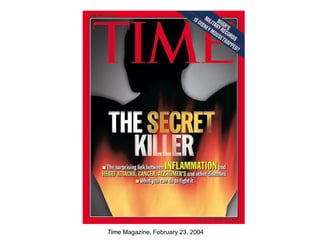
Time Magazine, February 23, 2004
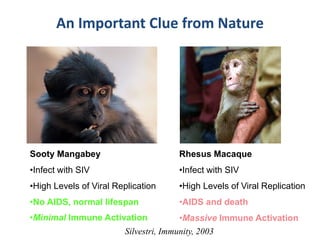
Sooty Mangabey
•Infect with SIV
•High Levels of Viral Replication
•No AIDS, normal lifespan
Rhesus Macaque
•Infect with SIV
•High Levels of Viral Replication
•AIDS and death
Silvestri, Immunity, 2003
An Important Clue from Nature
•Minimal Immune Activation •Massive Immune Activation
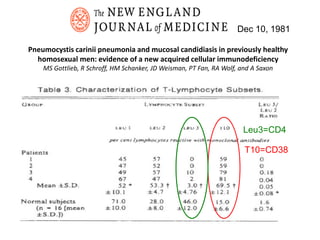
Pneumocystis carinii pneumonia and mucosal candidiasis in previously healthy
homosexual men: evidence of a new acquired cellular immunodeficiency
MS Gottlieb, R Schroff, HM Schanker, JD Weisman, PT Fan, RA Wolf, and A Saxon
Dec 10, 1981
T10=CD38
Leu3=CD4
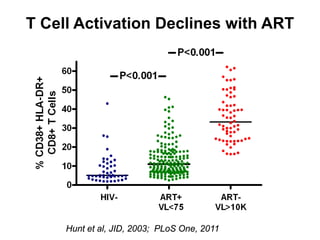
T Cell Activation Declines with ART
Hunt et al, JID, 2003; PLoS One, 2011
What are the consequences of
persistent inflammation during ART?
Burning Question
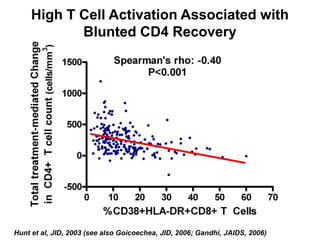
Hunt et al, JID, 2003 (see also Goicoechea, JID, 2006; Gandhi, JAIDS, 2006)
High T Cell Activation Associated with
Blunted CD4 Recovery
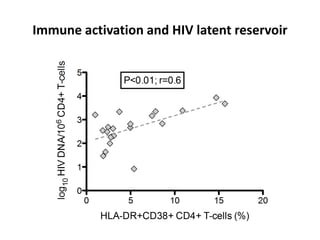
Immune activation and HIV latent reservoir
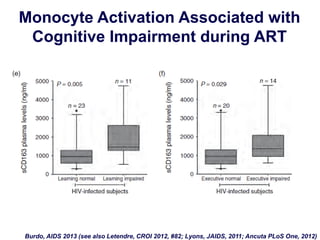
Monocyte Activation Associated with
Cognitive Impairment during ART
Burdo, AIDS 2013 (see also Letendre, CROI 2012, #82; Lyons, JAIDS, 2011; Ancuta PLoS One, 2012)
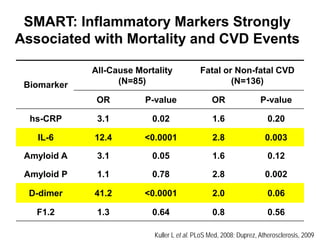
SMART: Inflammatory Markers Strongly
Associated with Mortality and CVD Events
Biomarker
All-Cause Mortality
(N=85)
Fatal or Non-fatal CVD
(N=136)
OR P-value OR P-value
hs-CRP 3.1 0.02 1.6 0.20
IL-6 12.4 <0.0001 2.8 0.003
Amyloid A 3.1 0.05 1.6 0.12
Amyloid P 1.1 0.78 2.8 0.002
D-dimer 41.2 <0.0001 2.0 0.06
F1.2 1.3 0.64 0.8 0.56
Kuller L et al. PLoS Med, 2008; Duprez, Atherosclerosis, 2009
What is causing inflammation during
suppressive ART??
Burning Question 2
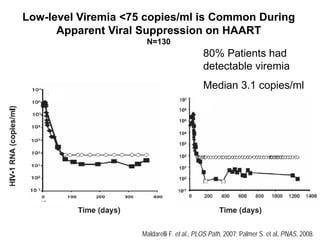
Maldarelli F. et al., PLOS Path, 2007; Palmer S. et al, PNAS, 2008.
Low-level Viremia <75 copies/ml is Common During
Apparent Viral Suppression on HAART
N=130
80% Patients had
detectable viremia
Median 3.1 copies/ml
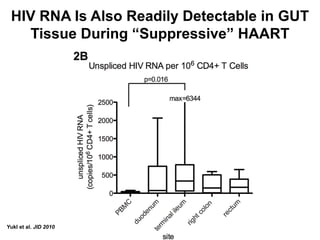
Yukl et al. JID 2010
HIV RNA Is Also Readily Detectable in GUT
Tissue During “Suppressive” HAART
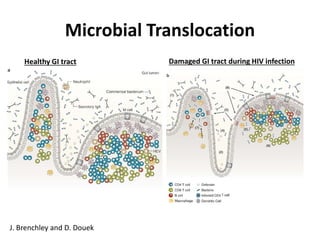
Microbial Translocation
J. Brenchley and D. Douek
Healthy GI tract Damaged GI tract during HIV infection
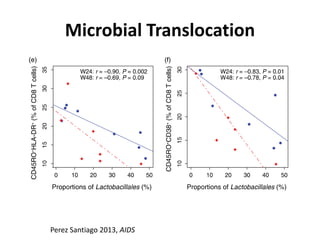
Microbial Translocation
Perez Santiago 2013, AIDS
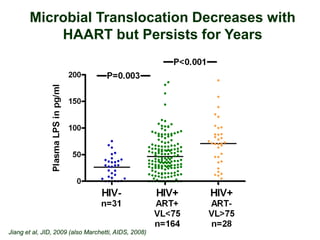
Microbial Translocation Decreases with
HAART but Persists for Years
Jiang et al, JID, 2009 (also Marchetti, AIDS, 2008)
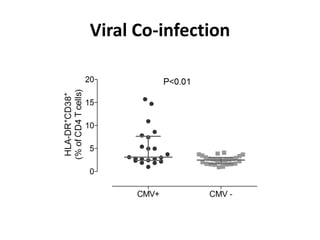
Viral Co-infection
Model for Inflammation
Deeks, Lancet 2013
What can we do to reduce
Inflammation?
Burning Question 3
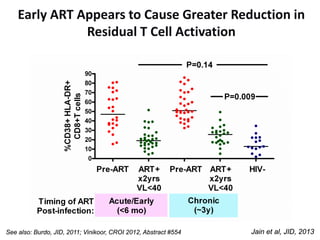
Early ART Appears to Cause Greater Reduction in
Residual T Cell Activation
Jain et al, JID, 2013See also: Burdo, JID, 2011; Vinikoor, CROI 2012, Abstract #554
Any Benefit to ART Intensification?
• Most studies fail to show
benefit on low-level
viremia by single-copy
assay.1-4
• Recent studies of RGV
intensification showed:
– ↓infection of new cells
(transient ↑2-LTR circles).5-7
– ↓T cell activation5-6 or D-
dimer levels.7
– Mostly PI-based regimens
1Dinoso JB, et al. Proc Natl Acad Sci USA. 2009;106:9403-9408. 2Gandhi R, et al. J Infect Dis. 2010; 201(2): 293-296. 3Jones J, et at. CROI
2009. Abstract 423b. 4Gandhi R, et al. PLoS Med. 2010; 7(8).
5Buzon M, et al. Nature Medicine. 2010; 16(4): 460-465; 6Llibre J. Antiviral Therapy, 2011; 7Hatano H, et al. J Infect Dis, 2013; 208(9):1437-1442.
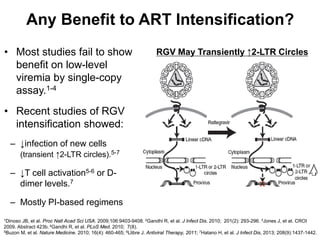
RGV May Transiently ↑2-LTR Circles
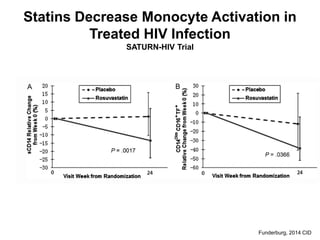
Funderburg, 2014 CID
Statins Decrease Monocyte Activation in
Treated HIV Infection
SATURN-HIV Trial
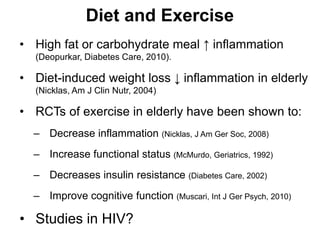
• High fat or carbohydrate meal ↑ inflammation
(Deopurkar, Diabetes Care, 2010).
• Diet-induced weight loss ↓ inflammation in elderly
(Nicklas, Am J Clin Nutr, 2004)
• RCTs of exercise in elderly have been shown to:
– Decrease inflammation (Nicklas, J Am Ger Soc, 2008)
– Increase functional status (McMurdo, Geriatrics, 1992)
– Decreases insulin resistance (Diabetes Care, 2002)
– Improve cognitive function (Muscari, Int J Ger Psych, 2010)
• Studies in HIV?
Diet and Exercise
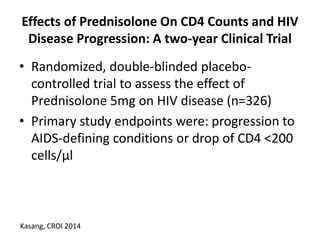
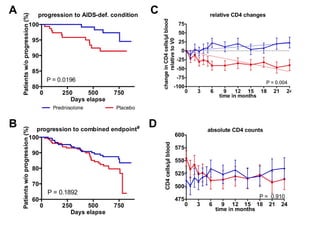
Effects of Prednisolone On CD4 Counts and HIV
Disease Progression: A two-year Clinical Trial
• Randomized, double-blinded placebo-
controlled trial to assess the effect of
Prednisolone 5mg on HIV disease (n=326)
• Primary study endpoints were: progression to
AIDS-defining conditions or drop of CD4 <200
cells/μl
Kasang, CROI 2014
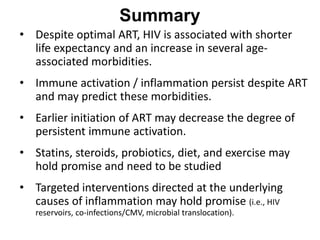
• Despite optimal ART, HIV is associated with shorter
life expectancy and an increase in several age-
associated morbidities.
• Immune activation / inflammation persist despite ART
and may predict these morbidities.
• Earlier initiation of ART may decrease the degree of
persistent immune activation.
• Statins, steroids, probiotics, diet, and exercise may
hold promise and need to be studied
• Targeted interventions directed at the underlying
causes of inflammation may hold promise (i.e., HIV
reservoirs, co-infections/CMV, microbial translocation).
Summary
Acknowledgments
• Peter Hunt and Michael Lederman for sharing
their slides
• Davey Smith, Doug Richman, Susan Little,
Sanjay Mehta, Josue Perez Santiago, Marta
Massanella and everybody in my lab.

Inflammation Persists Even During HIV Therapy

  • 1.
    The UC SanDiego AntiViral Research Center sponsors weekly presentations by infectious disease clinicians, physicians and researchers. The goal of these presentations is to provide the most current research, clinical practices and trends in HIV, HBV, HCV, TB and other infectious diseases of global significance. The slides from the AIDS Clinical Rounds presentation that you are about to view are intended for the educational purposes of our audience. They may not be used for other purposes without the presenter’s express permission. AIDS CLINICAL ROUNDS
  • 2.
    Inflammation Persists EvenDuring HIV Therapy Sara Gianella Weibel, MD Assistant Professor of Medicine UCSD/CFAR Slide adapted from P. Hunt
  • 3.
    Background The development ofantiretroviral therapy (ART) for the treatment of HIV is one of the greatest achievements of modern medicine.
  • 4.
    Improved Survival inART Era Adapted from Lohse N, et al. Ann Intern Med 2007;146:87–95 ProbabilityofSurvival Pre-ART (1995–1996) Early ART (1997–1999) Survival from Age 25 Years N= 3,990 1 0.75 0.5 0.25 0 25 30 35 40 45 50 55 60 65 70 Age (years) Late ART (2000–2005) Population controls
  • 5.
    Non-AIDS Diseases NowAccount for Majority of Deaths in HIV (1996-2006) • 1,876 deaths among 39,727 patients • Non-AIDS related deaths accounted for 50.5% Antiretroviral Therapy Cohort Collaboration (ART-CC). Clin Infect Dis. 2010;50:1387-1396. Non-AIDS infection 16.3% CVD 15.7% Non-AIDS Malignancy 23.5% Violence, Substance abuse 15.4% Liver-related 14.1% Other 9.0%Respiratory 3.1% Renal 3.0% Respiratory 3.1% Renal 3.0% Antiretroviral Therapy Cohort Collaboration (ART-CC). Clin Infect Dis. 2010;50:1387-1396.
  • 6.
    HIV and Aging •HIV is associated with increased risk of: • Cardiovascular disease • Malignancy (non-AIDS) • Bone fractures/Osteoporosis • Liver Disease • Kidney Disease • Neurocognitive Impairment
  • 7.
    The age ofthe HIV epidemic in the US is increasing Effros et al; CID 2008
  • 8.
    Why do HIVinfected people suffer from “unsuccessful aging”? Burning Question
  • 9.
    Possible Reasons for“Unsuccessful Aging” in HIV+ • Lifestyle factors (e.g. smoking) • ART toxicity
  • 10.
    SMART Study: InterruptingART Increases the Risk of Heart Disease %withaMajorCVDEvent DC VS Death from CVD 7 4 Non-fatal clinical MI 12 12 Non-fatal silent MI 11 5 Non-fatal stroke 8 3 CAD requiring surgery for invasive procedure 22 14 All major CVD events 48 31 El-Sadr, NEJM, 2006 2752 1306 713 379 10 2720 1292 696 377 10 No. at Risk 0.5 1.5 2.5 3.50 1 2 3 4 0 Years from Randomization 5 10 2.5 7.5 Intermittent CD4-guided ART (DC) Continuous ART (VS) Intermittent ART Continuous ART
  • 11.
    Many chronic diseasesof aging are more common in HIV+’s, even after adjustment for ART use and lifestyle factors • Lifestyle factors (e.g. smoking) • ART toxicity • Persistent Inflammation
  • 12.
  • 13.
    Sooty Mangabey •Infect withSIV •High Levels of Viral Replication •No AIDS, normal lifespan Rhesus Macaque •Infect with SIV •High Levels of Viral Replication •AIDS and death Silvestri, Immunity, 2003 An Important Clue from Nature •Minimal Immune Activation •Massive Immune Activation
  • 14.
    Pneumocystis carinii pneumoniaand mucosal candidiasis in previously healthy homosexual men: evidence of a new acquired cellular immunodeficiency MS Gottlieb, R Schroff, HM Schanker, JD Weisman, PT Fan, RA Wolf, and A Saxon Dec 10, 1981 T10=CD38 Leu3=CD4
  • 15.
    T Cell ActivationDeclines with ART Hunt et al, JID, 2003; PLoS One, 2011
  • 16.
    What are theconsequences of persistent inflammation during ART? Burning Question
  • 17.
    Hunt et al,JID, 2003 (see also Goicoechea, JID, 2006; Gandhi, JAIDS, 2006) High T Cell Activation Associated with Blunted CD4 Recovery
  • 18.
    Immune activation andHIV latent reservoir
  • 19.
    Monocyte Activation Associatedwith Cognitive Impairment during ART Burdo, AIDS 2013 (see also Letendre, CROI 2012, #82; Lyons, JAIDS, 2011; Ancuta PLoS One, 2012)
  • 20.
    SMART: Inflammatory MarkersStrongly Associated with Mortality and CVD Events Biomarker All-Cause Mortality (N=85) Fatal or Non-fatal CVD (N=136) OR P-value OR P-value hs-CRP 3.1 0.02 1.6 0.20 IL-6 12.4 <0.0001 2.8 0.003 Amyloid A 3.1 0.05 1.6 0.12 Amyloid P 1.1 0.78 2.8 0.002 D-dimer 41.2 <0.0001 2.0 0.06 F1.2 1.3 0.64 0.8 0.56 Kuller L et al. PLoS Med, 2008; Duprez, Atherosclerosis, 2009
  • 22.
    What is causinginflammation during suppressive ART?? Burning Question 2
  • 23.
    Maldarelli F. etal., PLOS Path, 2007; Palmer S. et al, PNAS, 2008. Low-level Viremia <75 copies/ml is Common During Apparent Viral Suppression on HAART N=130 80% Patients had detectable viremia Median 3.1 copies/ml
  • 24.
    Yukl et al.JID 2010 HIV RNA Is Also Readily Detectable in GUT Tissue During “Suppressive” HAART
  • 25.
    Microbial Translocation J. Brenchleyand D. Douek Healthy GI tract Damaged GI tract during HIV infection
  • 26.
  • 27.
    Microbial Translocation Decreaseswith HAART but Persists for Years Jiang et al, JID, 2009 (also Marchetti, AIDS, 2008)
  • 28.
  • 29.
  • 30.
    What can wedo to reduce Inflammation? Burning Question 3
  • 31.
    Early ART Appearsto Cause Greater Reduction in Residual T Cell Activation Jain et al, JID, 2013See also: Burdo, JID, 2011; Vinikoor, CROI 2012, Abstract #554
  • 32.
    Any Benefit toART Intensification? • Most studies fail to show benefit on low-level viremia by single-copy assay.1-4 • Recent studies of RGV intensification showed: – ↓infection of new cells (transient ↑2-LTR circles).5-7 – ↓T cell activation5-6 or D- dimer levels.7 – Mostly PI-based regimens 1Dinoso JB, et al. Proc Natl Acad Sci USA. 2009;106:9403-9408. 2Gandhi R, et al. J Infect Dis. 2010; 201(2): 293-296. 3Jones J, et at. CROI 2009. Abstract 423b. 4Gandhi R, et al. PLoS Med. 2010; 7(8). 5Buzon M, et al. Nature Medicine. 2010; 16(4): 460-465; 6Llibre J. Antiviral Therapy, 2011; 7Hatano H, et al. J Infect Dis, 2013; 208(9):1437-1442. RGV May Transiently ↑2-LTR Circles
  • 33.
    Funderburg, 2014 CID StatinsDecrease Monocyte Activation in Treated HIV Infection SATURN-HIV Trial
  • 34.
    • High fator carbohydrate meal ↑ inflammation (Deopurkar, Diabetes Care, 2010). • Diet-induced weight loss ↓ inflammation in elderly (Nicklas, Am J Clin Nutr, 2004) • RCTs of exercise in elderly have been shown to: – Decrease inflammation (Nicklas, J Am Ger Soc, 2008) – Increase functional status (McMurdo, Geriatrics, 1992) – Decreases insulin resistance (Diabetes Care, 2002) – Improve cognitive function (Muscari, Int J Ger Psych, 2010) • Studies in HIV? Diet and Exercise
  • 35.
    Effects of PrednisoloneOn CD4 Counts and HIV Disease Progression: A two-year Clinical Trial • Randomized, double-blinded placebo- controlled trial to assess the effect of Prednisolone 5mg on HIV disease (n=326) • Primary study endpoints were: progression to AIDS-defining conditions or drop of CD4 <200 cells/μl Kasang, CROI 2014
  • 37.
    • Despite optimalART, HIV is associated with shorter life expectancy and an increase in several age- associated morbidities. • Immune activation / inflammation persist despite ART and may predict these morbidities. • Earlier initiation of ART may decrease the degree of persistent immune activation. • Statins, steroids, probiotics, diet, and exercise may hold promise and need to be studied • Targeted interventions directed at the underlying causes of inflammation may hold promise (i.e., HIV reservoirs, co-infections/CMV, microbial translocation). Summary
  • 38.
    Acknowledgments • Peter Huntand Michael Lederman for sharing their slides • Davey Smith, Doug Richman, Susan Little, Sanjay Mehta, Josue Perez Santiago, Marta Massanella and everybody in my lab.