Expert System
BITS Pilani
Pilani Campus

Sagar Kr. Sharma
Artificial Intelligence
AI = “Making computers think like people.”

Artificial Intelligence (AI) is the part of
computer science concerned with designing
intelligent computer systems, that is, systems
that exhibit the characteristics we associate
with intelligence in human behavior –
understanding language, learning reasoning,
solving problems and so on.
Barr and Feigenbaum, 1981
BITS Pilani, Deemed to be University under Section 3 of UGC Act, 1956
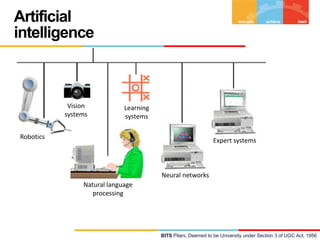
Artificial
intelligence

Vision
systems

Learning
systems

Robotics

Expert systems

Neural networks
Natural language
processing

BITS Pilani, Deemed to be University under Section 3 of UGC Act, 1956
Expert System
 A branch of Artificial Intelligence that makes an
extensive use of specialized knowledge to solve
problems at the level of an human expert.
“An expert system is a computer system that emulates, or
acts in all respects, with the decision-making capabilities of a
human expert.”
Professor Edward Feigenbaum
Stanford University

BITS Pilani, Deemed to be University under Section 3 of UGC Act, 1956
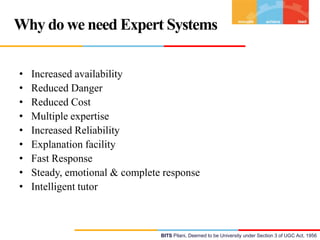
Why do we need Expert Systems
•
•
•
•
•
•
•
•
•

Increased availability
Reduced Danger
Reduced Cost
Multiple expertise
Increased Reliability
Explanation facility
Fast Response
Steady, emotional & complete response
Intelligent tutor

BITS Pilani, Deemed to be University under Section 3 of UGC Act, 1956
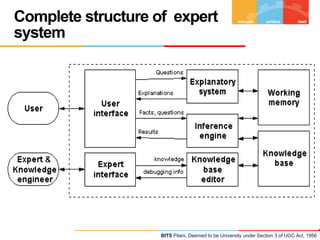
Complete structure of expert
system

BITS Pilani, Deemed to be University under Section 3 of UGC Act, 1956
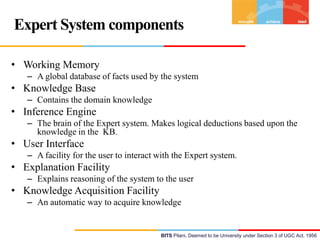
Expert System components
• Working Memory
– A global database of facts used by the system

• Knowledge Base
– Contains the domain knowledge

• Inference Engine
– The brain of the Expert system. Makes logical deductions based upon the
knowledge in the KB.

• User Interface
– A facility for the user to interact with the Expert system.

• Explanation Facility
– Explains reasoning of the system to the user

• Knowledge Acquisition Facility
– An automatic way to acquire knowledge

BITS Pilani, Deemed to be University under Section 3 of UGC Act, 1956
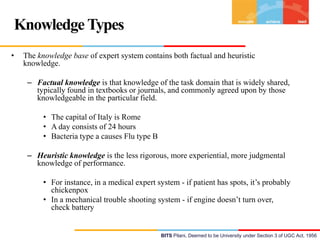
Knowledge Types
•

The knowledge base of expert system contains both factual and heuristic
knowledge.

– Factual knowledge is that knowledge of the task domain that is widely shared,
typically found in textbooks or journals, and commonly agreed upon by those
knowledgeable in the particular field.
• The capital of Italy is Rome
• A day consists of 24 hours
• Bacteria type a causes Flu type B
– Heuristic knowledge is the less rigorous, more experiential, more judgmental
knowledge of performance.
• For instance, in a medical expert system - if patient has spots, it’s probably
chickenpox
• In a mechanical trouble shooting system - if engine doesn’t turn over,
check battery

BITS Pilani, Deemed to be University under Section 3 of UGC Act, 1956
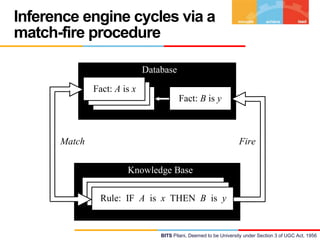
Inference engine cycles via a
match-fire procedure
Database
Fact: A is x
Fact: B is y

Match

Fire
Knowledge Base
Rule: IF A is x THEN B is y

BITS Pilani, Deemed to be University under Section 3 of UGC Act, 1956
Conflict Resolution
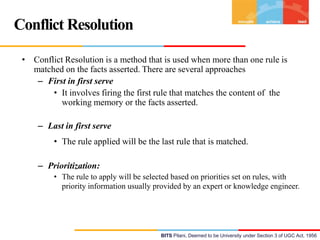
• Conflict Resolution is a method that is used when more than one rule is
matched on the facts asserted. There are several approaches
– First in first serve
• It involves firing the first rule that matches the content of the
working memory or the facts asserted.
– Last in first serve

• The rule applied will be the last rule that is matched.
– Prioritization:
• The rule to apply will be selected based on priorities set on rules, with
priority information usually provided by an expert or knowledge engineer.

BITS Pilani, Deemed to be University under Section 3 of UGC Act, 1956
Conflict Resolution
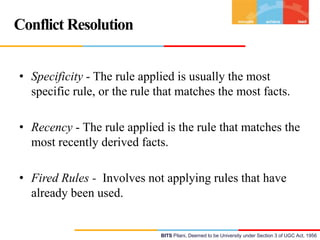
• Specificity - The rule applied is usually the most
specific rule, or the rule that matches the most facts.
• Recency - The rule applied is the rule that matches the
most recently derived facts.
• Fired Rules - Involves not applying rules that have
already been used.

BITS Pilani, Deemed to be University under Section 3 of UGC Act, 1956
Conflict Resolution (example)
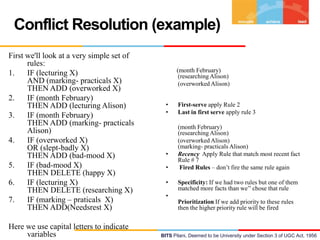
First we'll look at a very simple set of
rules:
1.
IF (lecturing X)
AND (marking- practicals X)
THEN ADD (overworked X)
2.
IF (month February)
THEN ADD (lecturing Alison)
3.
IF (month February)
THEN ADD (marking- practicals
Alison)
4.
IF (overworked X)
OR (slept-badly X)
THEN ADD (bad-mood X)
5.
IF (bad-mood X)
THEN DELETE (happy X)
6.
IF (lecturing X)
THEN DELETE (researching X)
7.
IF (marking – praticals X)
THEN ADD(Needsrest X)
Here we use capital letters to indicate
variables

(month February)
(researching Alison)
(overworked Alison)
•
•

•
•
•

First-serve apply Rule 2
Last in first serve apply rule 3
(month February)
(researching Alison)
(overworked Alison)
(marking- practicals Alison)
Recency Apply Rule that match most recent fact
Rule # 7
Fired Rules – don’t fire the same rule again
Specificity: If we had two rules but one of them
matched more facts than we’’ chose that rule

•
Prioritization If we add priority to these rules
then the higher priority rule will be fired

BITS Pilani, Deemed to be University under Section 3 of UGC Act, 1956
Problem-solving Models
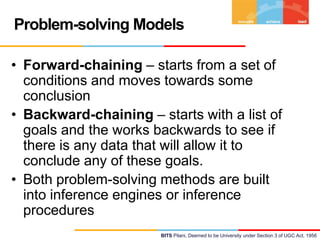
• Forward-chaining – starts from a set of
conditions and moves towards some
conclusion
• Backward-chaining – starts with a list of
goals and the works backwards to see if
there is any data that will allow it to
conclude any of these goals.
• Both problem-solving methods are built
into inference engines or inference
procedures
BITS Pilani, Deemed to be University under Section 3 of UGC Act, 1956
Forward Chaining
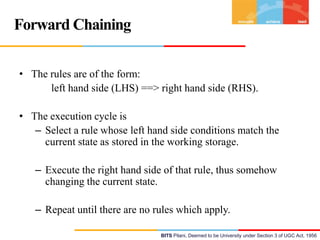
• The rules are of the form:
left hand side (LHS) ==> right hand side (RHS).
• The execution cycle is
– Select a rule whose left hand side conditions match the
current state as stored in the working storage.
– Execute the right hand side of that rule, thus somehow
changing the current state.
– Repeat until there are no rules which apply.
BITS Pilani, Deemed to be University under Section 3 of UGC Act, 1956
Forward Chaining
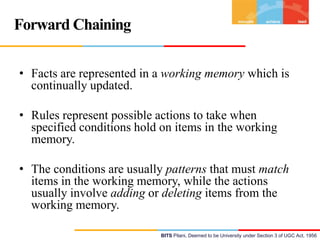
• Facts are represented in a working memory which is
continually updated.
• Rules represent possible actions to take when
specified conditions hold on items in the working
memory.
• The conditions are usually patterns that must match
items in the working memory, while the actions
usually involve adding or deleting items from the
working memory.
BITS Pilani, Deemed to be University under Section 3 of UGC Act, 1956
Forward Chaining (example)
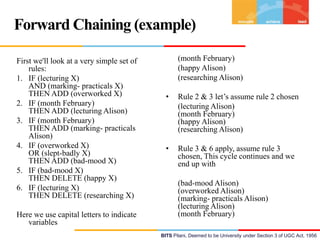
First we'll look at a very simple set of
rules:
1. IF (lecturing X)
AND (marking- practicals X)
THEN ADD (overworked X)
2. IF (month February)
THEN ADD (lecturing Alison)
3. IF (month February)
THEN ADD (marking- practicals
Alison)
4. IF (overworked X)
OR (slept-badly X)
THEN ADD (bad-mood X)
5. IF (bad-mood X)
THEN DELETE (happy X)
6. IF (lecturing X)
THEN DELETE (researching X)
Here we use capital letters to indicate
variables

(month February)
(happy Alison)
(researching Alison)
•

Rule 2 & 3 let’s assume rule 2 chosen
(lecturing Alison)
(month February)
(happy Alison)
(researching Alison)

•

Rule 3 & 6 apply, assume rule 3
chosen, This cycle continues and we
end up with
(bad-mood Alison)
(overworked Alison)
(marking- practicals Alison)
(lecturing Alison)
(month February)

BITS Pilani, Deemed to be University under Section 3 of UGC Act, 1956
Example of Forward Chaining
System
•

XCON
– Developed by DEC to configures computers.
– Starts with the data about the customer order and
works forward toward a configuration based on
that data.
– Written in the OPS5 (forward chaining rule based)
language.

BITS Pilani, Deemed to be University under Section 3 of UGC Act, 1956
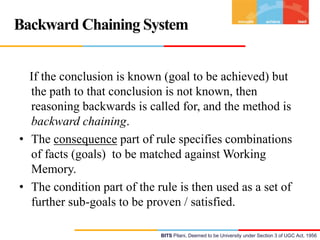
Backward Chaining System
If the conclusion is known (goal to be achieved) but
the path to that conclusion is not known, then
reasoning backwards is called for, and the method is
backward chaining.
• The consequence part of rule specifies combinations
of facts (goals) to be matched against Working
Memory.
• The condition part of the rule is then used as a set of
further sub-goals to be proven / satisfied.
BITS Pilani, Deemed to be University under Section 3 of UGC Act, 1956
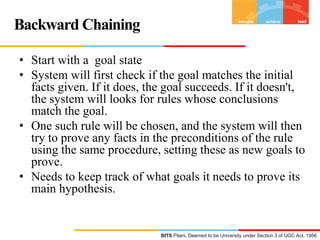
Backward Chaining
• Start with a goal state
• System will first check if the goal matches the initial
facts given. If it does, the goal succeeds. If it doesn't,
the system will looks for rules whose conclusions
match the goal.
• One such rule will be chosen, and the system will then
try to prove any facts in the preconditions of the rule
using the same procedure, setting these as new goals to
prove.
• Needs to keep track of what goals it needs to prove its
main hypothesis.

BITS Pilani, Deemed to be University under Section 3 of UGC Act, 1956
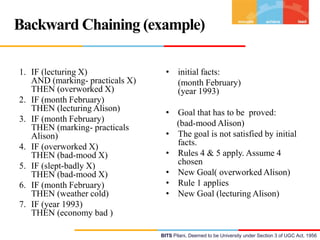
Backward Chaining (example)
1. IF (lecturing X)
AND (marking- practicals X)
THEN (overworked X)
2. IF (month February)
THEN (lecturing Alison)
3. IF (month February)
THEN (marking- practicals
Alison)
4. IF (overworked X)
THEN (bad-mood X)
5. IF (slept-badly X)
THEN (bad-mood X)
6. IF (month February)
THEN (weather cold)
7. IF (year 1993)
THEN (economy bad )

• initial facts:
(month February)
(year 1993)
• Goal that has to be proved:
(bad-mood Alison)
• The goal is not satisfied by initial
facts.
• Rules 4 & 5 apply. Assume 4
chosen
• New Goal( overworked Alison)
• Rule 1 applies
• New Goal (lecturing Alison)

BITS Pilani, Deemed to be University under Section 3 of UGC Act, 1956
Expert System Tools
•
•
•
•

•

•

PROLOG
– A programming language that uses backward chaining.
ART-IM (Inference Corporation)
– Following the distribution of NASA's CLIPS, Inference Corporation implemented
a forward-chaining only derivative of ART/CLIPS called ART-IM.
ART (Inference Corporation)
– In 1984, Inference Corporation developed the Automated Reasoning Tool (ART), a
forward chaining system.
CLIPS –
– NASA took the forward chaining capabilities and syntax of ART and introduced
the "C Language Integrated Production System" (i.e., CLIPS) into the public
domain.
OPS5 (Carnegie Mellon University)
– OPS5 (Carnegie Mellon University) – First AI language used for Production
System (XCON)
Eclipse (The Haley Enterprise, Inc.)
Eclipse is the only C/C++ inference engine that supports both forward and
Backward chaining.
BITS Pilani, Deemed to be University under Section 3 of UGC Act, 1956
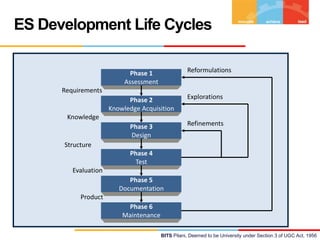
ES Development Life Cycles
Reformulations

Phase 1
Assessment

Requirements
Phase 2
Knowledge Acquisition

Explorations

Phase 3
Design

Refinements

Knowledge

Structure
Phase 4
Test
Evaluation
Phase 5
Documentation

Product
Phase 6
Maintenance

22
BITS Pilani, Deemed to be University under Section 3 of UGC Act, 1956
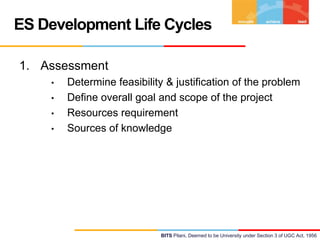
ES Development Life Cycles
1. Assessment
•
•
•
•

Determine feasibility & justification of the problem
Define overall goal and scope of the project
Resources requirement
Sources of knowledge

BITS Pilani, Deemed to be University under Section 3 of UGC Act, 1956
ES Development Life Cycles
2. Knowledge Acquisition
–
–
–

Acquire the knowledge of the problem
Involves meetings with expert
Bottleneck in ES development

BITS Pilani, Deemed to be University under Section 3 of UGC Act, 1956
ES Development Life Cycles
3. Design
–
–

–
–
–

Selecting knowledge representations approach and
problem solving strategies
Defined overall structure and organization of system
knowledge
Selection of software tools
Built initial prototype
Iterative process

BITS Pilani, Deemed to be University under Section 3 of UGC Act, 1956
ES Development Life Cycles
4. Testing
–
–
–
–

Continual process throughout the project
Testing and modifying system knowledge
Study the acceptability of the system by end user
Work closely with domain expert that guide the
growth of the knowledge and end user that guide in
user interface design

BITS Pilani, Deemed to be University under Section 3 of UGC Act, 1956
ES Development Life Cycles
5. Documentation
–

Compile all the projects information into a document
for the user and developers of the system such as:
•
•
•

User manual
diagrams
Knowledge dictionary

BITS Pilani, Deemed to be University under Section 3 of UGC Act, 1956
ES Development Life Cycles
6. Maintenance
–

Refined and update system knowledge to meet
current needs

BITS Pilani, Deemed to be University under Section 3 of UGC Act, 1956
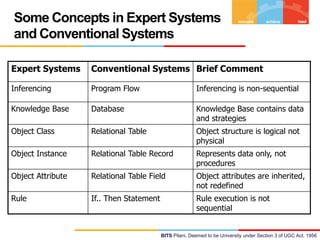
Some Concepts in Expert Systems
and Conventional Systems
Expert Systems

Conventional Systems Brief Comment

Inferencing

Program Flow

Inferencing is non-sequential

Knowledge Base

Database

Knowledge Base contains data
and strategies

Object Class

Relational Table

Object structure is logical not
physical

Object Instance

Relational Table Record

Represents data only, not
procedures

Object Attribute

Relational Table Field

Object attributes are inherited,
not redefined

Rule

If.. Then Statement

Rule execution is not
sequential

BITS Pilani, Deemed to be University under Section 3 of UGC Act, 1956
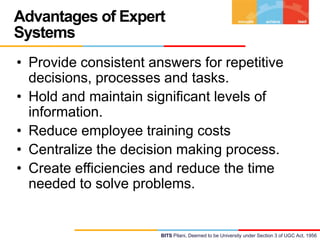
Advantages of Expert
Systems
• Provide consistent answers for repetitive
decisions, processes and tasks.
• Hold and maintain significant levels of
information.
• Reduce employee training costs
• Centralize the decision making process.
• Create efficiencies and reduce the time
needed to solve problems.

BITS Pilani, Deemed to be University under Section 3 of UGC Act, 1956
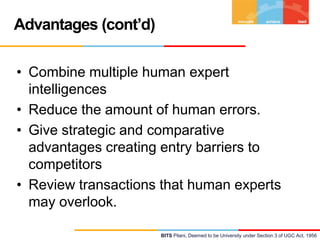
Advantages (cont’d)
• Combine multiple human expert
intelligences
• Reduce the amount of human errors.
• Give strategic and comparative
advantages creating entry barriers to
competitors
• Review transactions that human experts
may overlook.
BITS Pilani, Deemed to be University under Section 3 of UGC Act, 1956
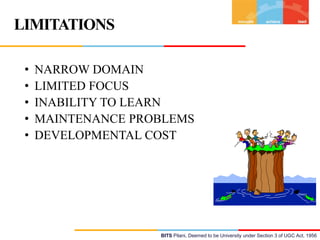
LIMITATIONS
•
•
•
•
•

NARROW DOMAIN
LIMITED FOCUS
INABILITY TO LEARN
MAINTENANCE PROBLEMS
DEVELOPMENTAL COST

BITS Pilani, Deemed to be University under Section 3 of UGC Act, 1956
Applications of Expert
Systems
•
•
•
•
•
•
•
•
•
•
•
•

Credit granting
Information management and retrieval
Plant layout
Hospitals and medical facilities
Help desks and assistance
Employee performance evaluation
Loan analysis
Virus detection
Repair and maintenance
Shipping
Marketing
Warehouse optimization
BITS Pilani, Deemed to be University under Section 3 of UGC Act, 1956
Applications of Expert
Systems
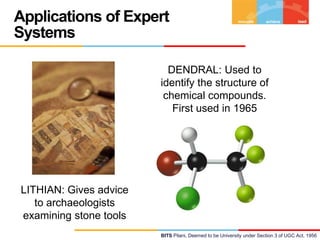
DENDRAL: Used to
identify the structure of
chemical compounds.
First used in 1965

LITHIAN: Gives advice
to archaeologists
examining stone tools
BITS Pilani, Deemed to be University under Section 3 of UGC Act, 1956
Applications of Expert
Systems
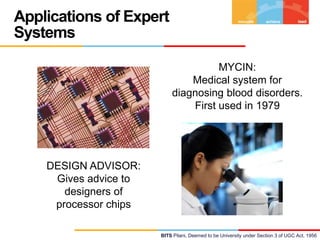
MYCIN:
Medical system for
diagnosing blood disorders.
First used in 1979

DESIGN ADVISOR:
Gives advice to
designers of
processor chips
BITS Pilani, Deemed to be University under Section 3 of UGC Act, 1956
Applications of Expert
Systems
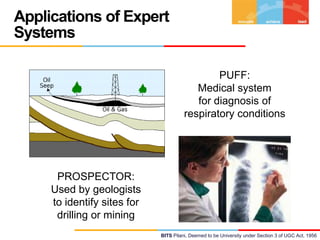
PUFF:
Medical system
for diagnosis of
respiratory conditions

PROSPECTOR:
Used by geologists
to identify sites for
drilling or mining
BITS Pilani, Deemed to be University under Section 3 of UGC Act, 1956
Conclusions
• Very interesting field of AI.
• Expert Systems are extremely useful in
the right domain.
• They are inflexible and require a lot of
collaboration between a knowledge
engineer and a domain expert.
• When implemented correctly, expert
systems remove human error from the
equation.
BITS Pilani, Deemed to be University under Section 3 of UGC Act, 1956
References
• Giarratano, Riley.1994. Expert Systems: Principles
and Programming, PWS Publishing
Company, Boston. (UBE - 325)
• Gonzales & Dankel, The Engineering of Knowledge
Based Systems, Prentice Hall, 1993
• Luger, G., Stubblefield, W.A., Artificial Intelligence:
Structures and Strategies for Complex Problem
Solving, The Benjamin/Cummings Publishing
Company, inc., 1993. (UBE - 34 )
• Awad Elias M.Building Expert Systems:
Principals, Procedures and Applications 1996.
(UBE- 334)

BITS Pilani, Deemed to be University under Section 3 of UGC Act, 1956
References
• “Expert Systems and Artificial Intelligence”.
Engelmore, R., Feigenbaum, E., Chapter 1.
http://www.wtec.org/loyola/kb/c1_s1.htm
• “The Origin of Rule-Based Systems in AI”,
Davis, R., King, J.
• “Expert System – Wikipedia”,
http://en.wikipedia.org/wiki/Expert_system

BITS Pilani, Deemed to be University under Section 3 of UGC Act, 1956

Expert system

  • 1.
    Expert System BITS Pilani PilaniCampus Sagar Kr. Sharma
  • 2.
    Artificial Intelligence AI =“Making computers think like people.” Artificial Intelligence (AI) is the part of computer science concerned with designing intelligent computer systems, that is, systems that exhibit the characteristics we associate with intelligence in human behavior – understanding language, learning reasoning, solving problems and so on. Barr and Feigenbaum, 1981 BITS Pilani, Deemed to be University under Section 3 of UGC Act, 1956
  • 3.
    Artificial intelligence Vision systems Learning systems Robotics Expert systems Neural networks Naturallanguage processing BITS Pilani, Deemed to be University under Section 3 of UGC Act, 1956
  • 4.
    Expert System  Abranch of Artificial Intelligence that makes an extensive use of specialized knowledge to solve problems at the level of an human expert. “An expert system is a computer system that emulates, or acts in all respects, with the decision-making capabilities of a human expert.” Professor Edward Feigenbaum Stanford University BITS Pilani, Deemed to be University under Section 3 of UGC Act, 1956
  • 5.
    Why do weneed Expert Systems • • • • • • • • • Increased availability Reduced Danger Reduced Cost Multiple expertise Increased Reliability Explanation facility Fast Response Steady, emotional & complete response Intelligent tutor BITS Pilani, Deemed to be University under Section 3 of UGC Act, 1956
  • 6.
    Complete structure ofexpert system BITS Pilani, Deemed to be University under Section 3 of UGC Act, 1956
  • 7.
    Expert System components •Working Memory – A global database of facts used by the system • Knowledge Base – Contains the domain knowledge • Inference Engine – The brain of the Expert system. Makes logical deductions based upon the knowledge in the KB. • User Interface – A facility for the user to interact with the Expert system. • Explanation Facility – Explains reasoning of the system to the user • Knowledge Acquisition Facility – An automatic way to acquire knowledge BITS Pilani, Deemed to be University under Section 3 of UGC Act, 1956
  • 8.
    Knowledge Types • The knowledgebase of expert system contains both factual and heuristic knowledge. – Factual knowledge is that knowledge of the task domain that is widely shared, typically found in textbooks or journals, and commonly agreed upon by those knowledgeable in the particular field. • The capital of Italy is Rome • A day consists of 24 hours • Bacteria type a causes Flu type B – Heuristic knowledge is the less rigorous, more experiential, more judgmental knowledge of performance. • For instance, in a medical expert system - if patient has spots, it’s probably chickenpox • In a mechanical trouble shooting system - if engine doesn’t turn over, check battery BITS Pilani, Deemed to be University under Section 3 of UGC Act, 1956
  • 9.
    Inference engine cyclesvia a match-fire procedure Database Fact: A is x Fact: B is y Match Fire Knowledge Base Rule: IF A is x THEN B is y BITS Pilani, Deemed to be University under Section 3 of UGC Act, 1956
  • 10.
    Conflict Resolution • ConflictResolution is a method that is used when more than one rule is matched on the facts asserted. There are several approaches – First in first serve • It involves firing the first rule that matches the content of the working memory or the facts asserted. – Last in first serve • The rule applied will be the last rule that is matched. – Prioritization: • The rule to apply will be selected based on priorities set on rules, with priority information usually provided by an expert or knowledge engineer. BITS Pilani, Deemed to be University under Section 3 of UGC Act, 1956
  • 11.
    Conflict Resolution • Specificity- The rule applied is usually the most specific rule, or the rule that matches the most facts. • Recency - The rule applied is the rule that matches the most recently derived facts. • Fired Rules - Involves not applying rules that have already been used. BITS Pilani, Deemed to be University under Section 3 of UGC Act, 1956
  • 12.
    Conflict Resolution (example) Firstwe'll look at a very simple set of rules: 1. IF (lecturing X) AND (marking- practicals X) THEN ADD (overworked X) 2. IF (month February) THEN ADD (lecturing Alison) 3. IF (month February) THEN ADD (marking- practicals Alison) 4. IF (overworked X) OR (slept-badly X) THEN ADD (bad-mood X) 5. IF (bad-mood X) THEN DELETE (happy X) 6. IF (lecturing X) THEN DELETE (researching X) 7. IF (marking – praticals X) THEN ADD(Needsrest X) Here we use capital letters to indicate variables (month February) (researching Alison) (overworked Alison) • • • • • First-serve apply Rule 2 Last in first serve apply rule 3 (month February) (researching Alison) (overworked Alison) (marking- practicals Alison) Recency Apply Rule that match most recent fact Rule # 7 Fired Rules – don’t fire the same rule again Specificity: If we had two rules but one of them matched more facts than we’’ chose that rule • Prioritization If we add priority to these rules then the higher priority rule will be fired BITS Pilani, Deemed to be University under Section 3 of UGC Act, 1956
  • 13.
    Problem-solving Models • Forward-chaining– starts from a set of conditions and moves towards some conclusion • Backward-chaining – starts with a list of goals and the works backwards to see if there is any data that will allow it to conclude any of these goals. • Both problem-solving methods are built into inference engines or inference procedures BITS Pilani, Deemed to be University under Section 3 of UGC Act, 1956
  • 14.
    Forward Chaining • Therules are of the form: left hand side (LHS) ==> right hand side (RHS). • The execution cycle is – Select a rule whose left hand side conditions match the current state as stored in the working storage. – Execute the right hand side of that rule, thus somehow changing the current state. – Repeat until there are no rules which apply. BITS Pilani, Deemed to be University under Section 3 of UGC Act, 1956
  • 15.
    Forward Chaining • Factsare represented in a working memory which is continually updated. • Rules represent possible actions to take when specified conditions hold on items in the working memory. • The conditions are usually patterns that must match items in the working memory, while the actions usually involve adding or deleting items from the working memory. BITS Pilani, Deemed to be University under Section 3 of UGC Act, 1956
  • 16.
    Forward Chaining (example) Firstwe'll look at a very simple set of rules: 1. IF (lecturing X) AND (marking- practicals X) THEN ADD (overworked X) 2. IF (month February) THEN ADD (lecturing Alison) 3. IF (month February) THEN ADD (marking- practicals Alison) 4. IF (overworked X) OR (slept-badly X) THEN ADD (bad-mood X) 5. IF (bad-mood X) THEN DELETE (happy X) 6. IF (lecturing X) THEN DELETE (researching X) Here we use capital letters to indicate variables (month February) (happy Alison) (researching Alison) • Rule 2 & 3 let’s assume rule 2 chosen (lecturing Alison) (month February) (happy Alison) (researching Alison) • Rule 3 & 6 apply, assume rule 3 chosen, This cycle continues and we end up with (bad-mood Alison) (overworked Alison) (marking- practicals Alison) (lecturing Alison) (month February) BITS Pilani, Deemed to be University under Section 3 of UGC Act, 1956
  • 17.
    Example of ForwardChaining System • XCON – Developed by DEC to configures computers. – Starts with the data about the customer order and works forward toward a configuration based on that data. – Written in the OPS5 (forward chaining rule based) language. BITS Pilani, Deemed to be University under Section 3 of UGC Act, 1956
  • 18.
    Backward Chaining System Ifthe conclusion is known (goal to be achieved) but the path to that conclusion is not known, then reasoning backwards is called for, and the method is backward chaining. • The consequence part of rule specifies combinations of facts (goals) to be matched against Working Memory. • The condition part of the rule is then used as a set of further sub-goals to be proven / satisfied. BITS Pilani, Deemed to be University under Section 3 of UGC Act, 1956
  • 19.
    Backward Chaining • Startwith a goal state • System will first check if the goal matches the initial facts given. If it does, the goal succeeds. If it doesn't, the system will looks for rules whose conclusions match the goal. • One such rule will be chosen, and the system will then try to prove any facts in the preconditions of the rule using the same procedure, setting these as new goals to prove. • Needs to keep track of what goals it needs to prove its main hypothesis. BITS Pilani, Deemed to be University under Section 3 of UGC Act, 1956
  • 20.
    Backward Chaining (example) 1.IF (lecturing X) AND (marking- practicals X) THEN (overworked X) 2. IF (month February) THEN (lecturing Alison) 3. IF (month February) THEN (marking- practicals Alison) 4. IF (overworked X) THEN (bad-mood X) 5. IF (slept-badly X) THEN (bad-mood X) 6. IF (month February) THEN (weather cold) 7. IF (year 1993) THEN (economy bad ) • initial facts: (month February) (year 1993) • Goal that has to be proved: (bad-mood Alison) • The goal is not satisfied by initial facts. • Rules 4 & 5 apply. Assume 4 chosen • New Goal( overworked Alison) • Rule 1 applies • New Goal (lecturing Alison) BITS Pilani, Deemed to be University under Section 3 of UGC Act, 1956
  • 21.
    Expert System Tools • • • • • • PROLOG –A programming language that uses backward chaining. ART-IM (Inference Corporation) – Following the distribution of NASA's CLIPS, Inference Corporation implemented a forward-chaining only derivative of ART/CLIPS called ART-IM. ART (Inference Corporation) – In 1984, Inference Corporation developed the Automated Reasoning Tool (ART), a forward chaining system. CLIPS – – NASA took the forward chaining capabilities and syntax of ART and introduced the "C Language Integrated Production System" (i.e., CLIPS) into the public domain. OPS5 (Carnegie Mellon University) – OPS5 (Carnegie Mellon University) – First AI language used for Production System (XCON) Eclipse (The Haley Enterprise, Inc.) Eclipse is the only C/C++ inference engine that supports both forward and Backward chaining. BITS Pilani, Deemed to be University under Section 3 of UGC Act, 1956
  • 22.
    ES Development LifeCycles Reformulations Phase 1 Assessment Requirements Phase 2 Knowledge Acquisition Explorations Phase 3 Design Refinements Knowledge Structure Phase 4 Test Evaluation Phase 5 Documentation Product Phase 6 Maintenance 22 BITS Pilani, Deemed to be University under Section 3 of UGC Act, 1956
  • 23.
    ES Development LifeCycles 1. Assessment • • • • Determine feasibility & justification of the problem Define overall goal and scope of the project Resources requirement Sources of knowledge BITS Pilani, Deemed to be University under Section 3 of UGC Act, 1956
  • 24.
    ES Development LifeCycles 2. Knowledge Acquisition – – – Acquire the knowledge of the problem Involves meetings with expert Bottleneck in ES development BITS Pilani, Deemed to be University under Section 3 of UGC Act, 1956
  • 25.
    ES Development LifeCycles 3. Design – – – – – Selecting knowledge representations approach and problem solving strategies Defined overall structure and organization of system knowledge Selection of software tools Built initial prototype Iterative process BITS Pilani, Deemed to be University under Section 3 of UGC Act, 1956
  • 26.
    ES Development LifeCycles 4. Testing – – – – Continual process throughout the project Testing and modifying system knowledge Study the acceptability of the system by end user Work closely with domain expert that guide the growth of the knowledge and end user that guide in user interface design BITS Pilani, Deemed to be University under Section 3 of UGC Act, 1956
  • 27.
    ES Development LifeCycles 5. Documentation – Compile all the projects information into a document for the user and developers of the system such as: • • • User manual diagrams Knowledge dictionary BITS Pilani, Deemed to be University under Section 3 of UGC Act, 1956
  • 28.
    ES Development LifeCycles 6. Maintenance – Refined and update system knowledge to meet current needs BITS Pilani, Deemed to be University under Section 3 of UGC Act, 1956
  • 29.
    Some Concepts inExpert Systems and Conventional Systems Expert Systems Conventional Systems Brief Comment Inferencing Program Flow Inferencing is non-sequential Knowledge Base Database Knowledge Base contains data and strategies Object Class Relational Table Object structure is logical not physical Object Instance Relational Table Record Represents data only, not procedures Object Attribute Relational Table Field Object attributes are inherited, not redefined Rule If.. Then Statement Rule execution is not sequential BITS Pilani, Deemed to be University under Section 3 of UGC Act, 1956
  • 30.
    Advantages of Expert Systems •Provide consistent answers for repetitive decisions, processes and tasks. • Hold and maintain significant levels of information. • Reduce employee training costs • Centralize the decision making process. • Create efficiencies and reduce the time needed to solve problems. BITS Pilani, Deemed to be University under Section 3 of UGC Act, 1956
  • 31.
    Advantages (cont’d) • Combinemultiple human expert intelligences • Reduce the amount of human errors. • Give strategic and comparative advantages creating entry barriers to competitors • Review transactions that human experts may overlook. BITS Pilani, Deemed to be University under Section 3 of UGC Act, 1956
  • 32.
    LIMITATIONS • • • • • NARROW DOMAIN LIMITED FOCUS INABILITYTO LEARN MAINTENANCE PROBLEMS DEVELOPMENTAL COST BITS Pilani, Deemed to be University under Section 3 of UGC Act, 1956
  • 33.
    Applications of Expert Systems • • • • • • • • • • • • Creditgranting Information management and retrieval Plant layout Hospitals and medical facilities Help desks and assistance Employee performance evaluation Loan analysis Virus detection Repair and maintenance Shipping Marketing Warehouse optimization BITS Pilani, Deemed to be University under Section 3 of UGC Act, 1956
  • 34.
    Applications of Expert Systems DENDRAL:Used to identify the structure of chemical compounds. First used in 1965 LITHIAN: Gives advice to archaeologists examining stone tools BITS Pilani, Deemed to be University under Section 3 of UGC Act, 1956
  • 35.
    Applications of Expert Systems MYCIN: Medicalsystem for diagnosing blood disorders. First used in 1979 DESIGN ADVISOR: Gives advice to designers of processor chips BITS Pilani, Deemed to be University under Section 3 of UGC Act, 1956
  • 36.
    Applications of Expert Systems PUFF: Medicalsystem for diagnosis of respiratory conditions PROSPECTOR: Used by geologists to identify sites for drilling or mining BITS Pilani, Deemed to be University under Section 3 of UGC Act, 1956
  • 37.
    Conclusions • Very interestingfield of AI. • Expert Systems are extremely useful in the right domain. • They are inflexible and require a lot of collaboration between a knowledge engineer and a domain expert. • When implemented correctly, expert systems remove human error from the equation. BITS Pilani, Deemed to be University under Section 3 of UGC Act, 1956
  • 38.
    References • Giarratano, Riley.1994.Expert Systems: Principles and Programming, PWS Publishing Company, Boston. (UBE - 325) • Gonzales & Dankel, The Engineering of Knowledge Based Systems, Prentice Hall, 1993 • Luger, G., Stubblefield, W.A., Artificial Intelligence: Structures and Strategies for Complex Problem Solving, The Benjamin/Cummings Publishing Company, inc., 1993. (UBE - 34 ) • Awad Elias M.Building Expert Systems: Principals, Procedures and Applications 1996. (UBE- 334) BITS Pilani, Deemed to be University under Section 3 of UGC Act, 1956
  • 39.
    References • “Expert Systemsand Artificial Intelligence”. Engelmore, R., Feigenbaum, E., Chapter 1. http://www.wtec.org/loyola/kb/c1_s1.htm • “The Origin of Rule-Based Systems in AI”, Davis, R., King, J. • “Expert System – Wikipedia”, http://en.wikipedia.org/wiki/Expert_system BITS Pilani, Deemed to be University under Section 3 of UGC Act, 1956