Module
     9
Planning
Version 2 CSE IIT, Kharagpur
Lesson
           23
Planning systems
        Version 2 CSE IIT, Kharagpur
9.3 Planning Systems
Classical Planners use the STRIPS (Stanford Research Institute Problem Solver)
language to describe states and operators. It is an efficient way to represent planning
algorithms.

9.3.1 Representation of States and Goals

States are represented by conjunctions of function-free ground literals, that is, predicates
applied to constant symbols, possibly negated.

An example of an initial state is:

At(Home) / -Have(Milk) / -Have(Bananas) / -Have(Drill) / ...

A state description does not have to be complete. We just want to obtain a successful plan
to a set of possible complete states. But if it does not mention a given positive literal, then
the literal can be assumed to be false.

Goals are a conjunction of literals. Therefore the goal is

   At(Home) / Have(Milk) / Have(Bananas) / Have(Drill)

Goals can also contain variables. Being at a store that sells milk is equivalent to

   At(x) / Sells(x,Milk)

We have to differentiate between a goal given to a planner which is producing a sequence
of actions that makes the goal true if executed, and a query given to a theorem prover that
produces true or false if there is truth in the sentences, given a knowledge base.

We also have to keep track of the changes rather than of the states themselves because
most actions change only a small part of the state representation.

9.3.2 Representation of Actions

Strips operators consist of three components

   •   action description: what an agent actually returns to the environment in order to
       do something.
   •   precondition: conjunction of atoms (positive literals), that says what must be true
       before an operator can be applied.
   •   effect of an operator: conjunction of literals (positive or negative) that describe
       how the situation changes when the operator is applied.

An example action of going from one place to another:
                                                              Version 2 CSE IIT, Kharagpur
Op(ACTION:Go(there), PRECOND:At(here) / Path(here, there)
EFFECT:At(there) / -At(here))

The following figure shows a diagram of the operator Go(there). The preconditions
appear above the action, and the effects below.


Operator Schema: an operator with variables.

    •   it is a family of actions, one for each of the different values of the variables.
    •   every variable must have a value

Preconditions and Effects are restrictive. Operator o is applicable in a state s if every
one of the preconditions in o are true in s. An example is if the initial situation includes
the literals

   At(Home, Path(Home, Supermarket)...

then the action Go(Supermarket) is applicable, and the resulting situation contains the
literals

   -At(Home),At(Supermarket), Path(Home, Supermarket)...

The result is all positive literals in Effect(o) hold, all literals in s hold and negative literals
in Effect(o) are ignored.

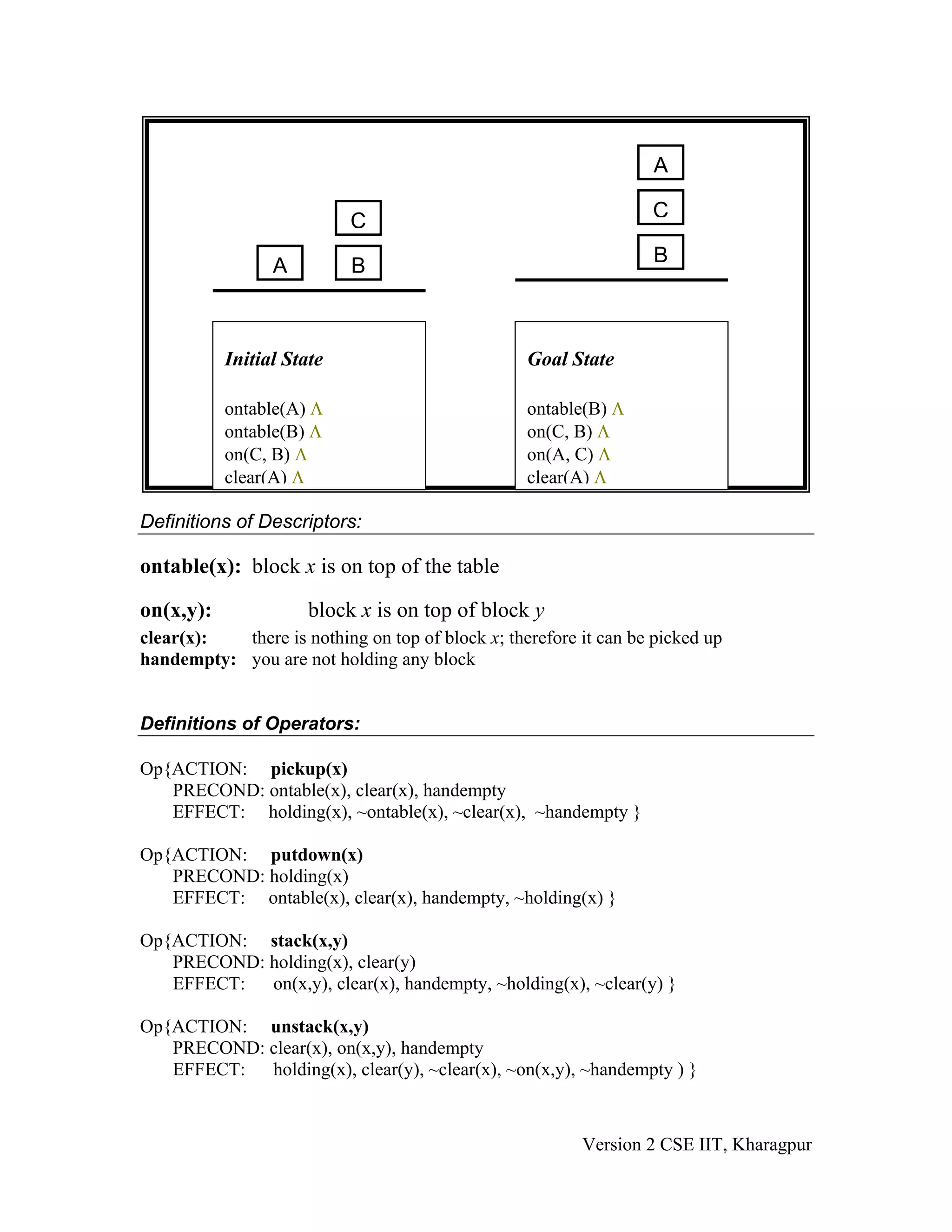
The set of operators for the “Box World” example problem is shown below:


                                                                 Version 2 CSE IIT, Kharagpur
A

                           C                                      C

                 A         B                                       B


           Initial State                          Goal State

           ontable(A) Λ                           ontable(B) Λ
           ontable(B) Λ                           on(C, B) Λ
           on(C, B) Λ                             on(A, C) Λ
           clear(A) Λ                             clear(A) Λ

Definitions of Descriptors:

ontable(x): block x is on top of the table

on(x,y):              block x is on top of block y
clear(x):  there is nothing on top of block x; therefore it can be picked up
handempty: you are not holding any block


Definitions of Operators:

Op{ACTION: pickup(x)
   PRECOND: ontable(x), clear(x), handempty
   EFFECT: holding(x), ~ontable(x), ~clear(x), ~handempty }

Op{ACTION: putdown(x)
   PRECOND: holding(x)
   EFFECT: ontable(x), clear(x), handempty, ~holding(x) }

Op{ACTION: stack(x,y)
   PRECOND: holding(x), clear(y)
   EFFECT:  on(x,y), clear(x), handempty, ~holding(x), ~clear(y) }

Op{ACTION: unstack(x,y)
   PRECOND: clear(x), on(x,y), handempty
   EFFECT:  holding(x), clear(y), ~clear(x), ~on(x,y), ~handempty ) }


                                                         Version 2 CSE IIT, Kharagpur

AI Lesson 23

  • 1.
    Module 9 Planning Version 2 CSE IIT, Kharagpur
  • 2.
    Lesson 23 Planning systems Version 2 CSE IIT, Kharagpur
  • 3.
    9.3 Planning Systems ClassicalPlanners use the STRIPS (Stanford Research Institute Problem Solver) language to describe states and operators. It is an efficient way to represent planning algorithms. 9.3.1 Representation of States and Goals States are represented by conjunctions of function-free ground literals, that is, predicates applied to constant symbols, possibly negated. An example of an initial state is: At(Home) / -Have(Milk) / -Have(Bananas) / -Have(Drill) / ... A state description does not have to be complete. We just want to obtain a successful plan to a set of possible complete states. But if it does not mention a given positive literal, then the literal can be assumed to be false. Goals are a conjunction of literals. Therefore the goal is At(Home) / Have(Milk) / Have(Bananas) / Have(Drill) Goals can also contain variables. Being at a store that sells milk is equivalent to At(x) / Sells(x,Milk) We have to differentiate between a goal given to a planner which is producing a sequence of actions that makes the goal true if executed, and a query given to a theorem prover that produces true or false if there is truth in the sentences, given a knowledge base. We also have to keep track of the changes rather than of the states themselves because most actions change only a small part of the state representation. 9.3.2 Representation of Actions Strips operators consist of three components • action description: what an agent actually returns to the environment in order to do something. • precondition: conjunction of atoms (positive literals), that says what must be true before an operator can be applied. • effect of an operator: conjunction of literals (positive or negative) that describe how the situation changes when the operator is applied. An example action of going from one place to another: Version 2 CSE IIT, Kharagpur
  • 4.
    Op(ACTION:Go(there), PRECOND:At(here) /Path(here, there) EFFECT:At(there) / -At(here)) The following figure shows a diagram of the operator Go(there). The preconditions appear above the action, and the effects below. Operator Schema: an operator with variables. • it is a family of actions, one for each of the different values of the variables. • every variable must have a value Preconditions and Effects are restrictive. Operator o is applicable in a state s if every one of the preconditions in o are true in s. An example is if the initial situation includes the literals At(Home, Path(Home, Supermarket)... then the action Go(Supermarket) is applicable, and the resulting situation contains the literals -At(Home),At(Supermarket), Path(Home, Supermarket)... The result is all positive literals in Effect(o) hold, all literals in s hold and negative literals in Effect(o) are ignored. The set of operators for the “Box World” example problem is shown below: Version 2 CSE IIT, Kharagpur
  • 5.
    A C C A B B Initial State Goal State ontable(A) Λ ontable(B) Λ ontable(B) Λ on(C, B) Λ on(C, B) Λ on(A, C) Λ clear(A) Λ clear(A) Λ Definitions of Descriptors: ontable(x): block x is on top of the table on(x,y): block x is on top of block y clear(x): there is nothing on top of block x; therefore it can be picked up handempty: you are not holding any block Definitions of Operators: Op{ACTION: pickup(x) PRECOND: ontable(x), clear(x), handempty EFFECT: holding(x), ~ontable(x), ~clear(x), ~handempty } Op{ACTION: putdown(x) PRECOND: holding(x) EFFECT: ontable(x), clear(x), handempty, ~holding(x) } Op{ACTION: stack(x,y) PRECOND: holding(x), clear(y) EFFECT: on(x,y), clear(x), handempty, ~holding(x), ~clear(y) } Op{ACTION: unstack(x,y) PRECOND: clear(x), on(x,y), handempty EFFECT: holding(x), clear(y), ~clear(x), ~on(x,y), ~handempty ) } Version 2 CSE IIT, Kharagpur