Artificial Intelligence: Introduction,
Challenges and applications
Dr. Lavanya Sharma
Ms. Sudhriti Sen Gupta
Agenda
• Introduction
• Challenging issues
• Application Areas
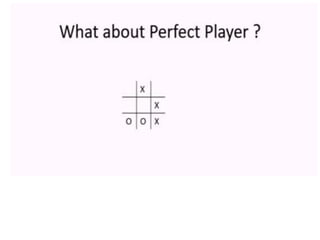
• Tic Tac gaming
CS 484 – Artificial Intelligence 3
Introduction
• What is Artificial Intelligence?
– Systems that think like humans
– Systems that act like humans
– Systems that act or think rationally (logically, correctly)
Introduction
• John McCarthy coined the phrase Artificial Intelligence (AI) in 1956
• It is the science and engineering of making intelligent machines,
especially intelligent computer programs.
• It is related to the similar task of using computers to understand
human or other intelligence
• AI is a collection of hard problems which can be solved by humans
and other living things, but for which we don’t have good algorithms
for solving.
– e. g., understanding spoken natural language, medical diagnosis,
chess playing, proving math theories and many more.
• Intelligence is the computational part of the ability to achieve goals
in the world.
What is Intelligence?
The Turing Test
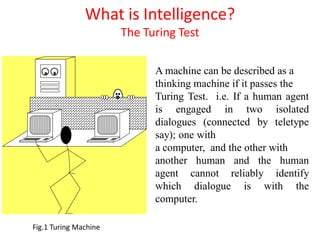
A machine can be described as a
thinking machine if it passes the
Turing Test. i.e. If a human agent

is engaged in two isolated
dialogues (connected by teletype
say); one with
a computer, and the other with
another human and the human
agent cannot reliably identify
which dialogue is with the
computer.
Fig.1 Turing Machine
ICAI'06 Eunika Mercier-Laurent 6
Challenges for AI
• Better understanding of our brain capacity
• Better use of computer capacity
• Data privacy and security: Most AI applications rely on huge
volumes of data to learn and make intelligent decisions
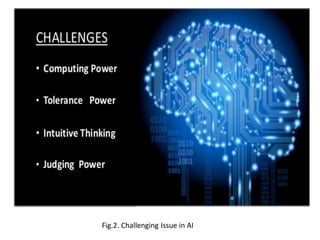
Fig.2. Challenging Issue in AI
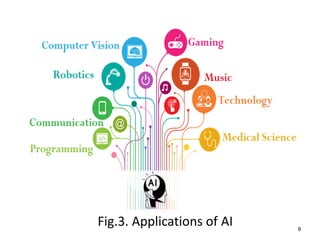
Applications Areas
9
Fig.3. Applications of AI
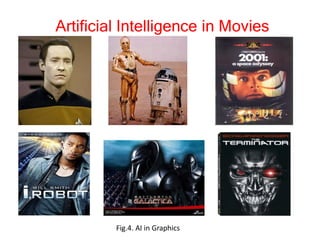
Artificial Intelligence in Movies
Fig.4. AI in Graphics
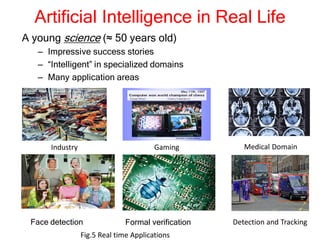
Artificial Intelligence in Real Life
A young science (≈ 50 years old)
– Impressive success stories
– “Intelligent” in specialized domains
– Many application areas
Face detection Formal verification
Industry Gaming Medical Domain
Detection and Tracking
Fig.5 Real time Applications
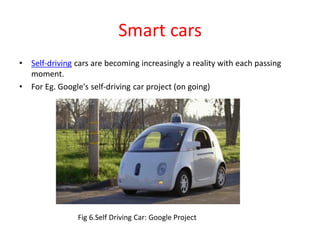
Smart cars
• Self-driving cars are becoming increasingly a reality with each passing
moment.
• For Eg. Google's self-driving car project (on going)
Fig 6.Self Driving Car: Google Project
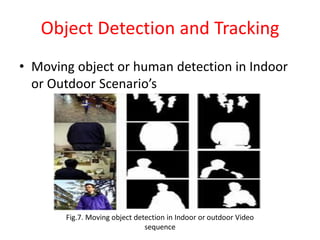
Object Detection and Tracking
• Moving object or human detection in Indoor
or Outdoor Scenario’s
Fig.7. Moving object detection in Indoor or outdoor Video
sequence
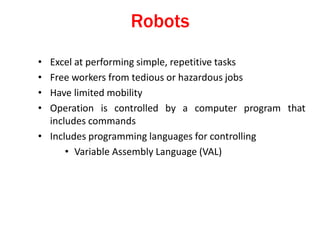
Robots
• Excel at performing simple, repetitive tasks
• Free workers from tedious or hazardous jobs
• Have limited mobility
• Operation is controlled by a computer program that
includes commands
• Includes programming languages for controlling
• Variable Assembly Language (VAL)
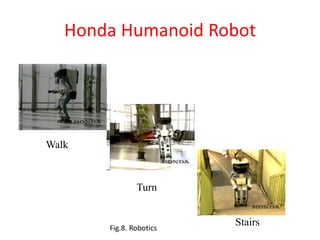
Honda Humanoid Robot
Walk
Turn
StairsFig.8. Robotics
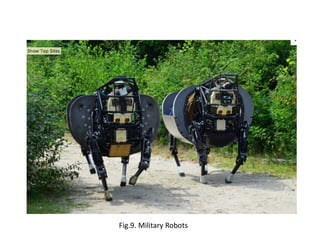
Fig.9. Military Robots
Expert Systems
• Mimics human expertise in a field to solve a problem in a
well-defined area
• Used for activities that human experts have already
handled successfully
• Tasks in medicine, geology, education, and oil
exploration
– For E.g. Dendril and Mycin
Surveillance
• AI can be trained using supervised exercises,
security algorithms to take input from security
cameras.
• Eventually, they can identify potential threats
and warn human security officers to
investigate further.
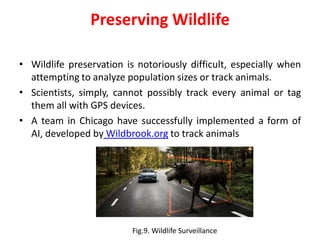
Preserving Wildlife
• Wildlife preservation is notoriously difficult, especially when
attempting to analyze population sizes or track animals.
• Scientists, simply, cannot possibly track every animal or tag
them all with GPS devices.
• A team in Chicago have successfully implemented a form of
AI, developed by Wildbrook.org to track animals
Fig.9. Wildlife Surveillance
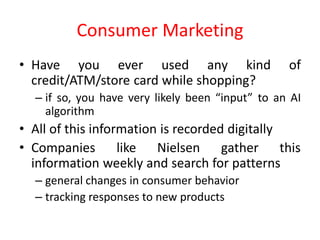
Consumer Marketing
• Have you ever used any kind of
credit/ATM/store card while shopping?
– if so, you have very likely been “input” to an AI
algorithm
• All of this information is recorded digitally
• Companies like Nielsen gather this
information weekly and search for patterns
– general changes in consumer behavior
– tracking responses to new products
Identification Technologies
• ID cards
– e.g., ATM cards
– can be a nuisance and security risk:
• cards can be lost, stolen, passwords forgotten, etc
• Biometric Identification
– walk up to a locked door
• camera
• fingerprint device
• microphone
– computer uses your biometric signature for
identification
• face, eyes, fingerprints, voice pattern
Machine Translation
• Language problems in international business
– e.g., at a meeting of Japanese, Korean, Vietnamese and
Swedish investors, no common language
– or: you are shipping your software manuals to 127
countries
– solution; hire translators to translate
– would be much cheaper if a machine could do this!
– algorithms are developed which combine dictionaries,
grammar models, etc.
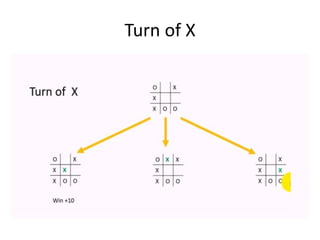
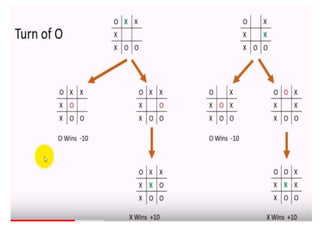
Turn of X
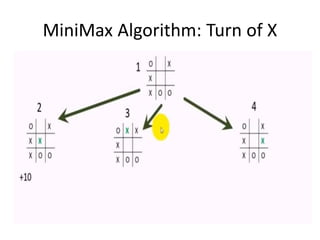
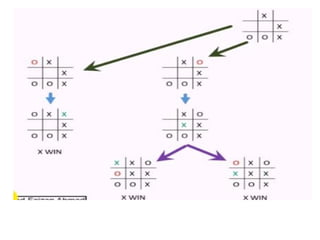
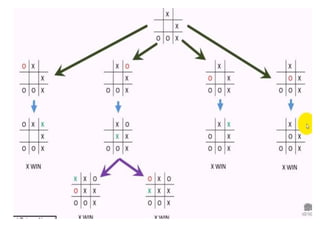
MiniMax Algorithm: Turn of X
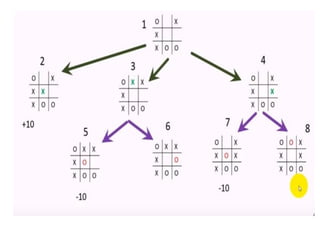
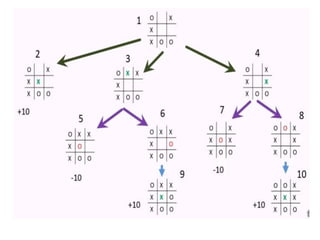
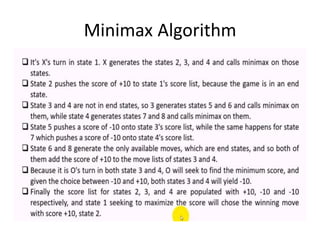
Minimax Algorithm
References
• Lavanya Sharma, “Introduction: From Visual Surveillance to Internet of Things”,
From Visual Surveillance to Internet of Things”, Taylor & Francis, CRC Press, Vol.1,
pp.14
• Shubham, Shubhankar, Mohit, Lavanya Sharma, “Use of Motion Capture in 3D
Animation: Motion Capture Systems, Challenges, and Recent Trends”, in 1st IEEE
International Conference on Machine Learning, Big Data, Cloud and Parallel
Computing (Com-IT-Con), India, pp. 309-313, 14th -16th Feb
• Sharma, L. (Ed.), Garg, P. (Ed.). (2020). From Visual Surveillance to Internet of
Things. New York: Chapman and Hall/CRC,
https://doi.org/10.1201/9780429297922
• Rich and Knight, “Artificial Intelligence”, Tata McGraw Hill, 1992
• S. Russel and P. Norvig, “Artificial Intelligence – A Modern Approach”, Second
Edition, Pearson Edu.
• KM Fu, "Neural Networks in Computer Intelligence", McGraw Hill
• Russel and Norvig, "Artificial Intelligence: A modern approach", Pearson Education
Thank you

Ai introduction ppt

  • 1.
    Artificial Intelligence: Introduction, Challengesand applications Dr. Lavanya Sharma Ms. Sudhriti Sen Gupta
  • 2.
    Agenda • Introduction • Challengingissues • Application Areas • Tic Tac gaming
  • 3.
    CS 484 –Artificial Intelligence 3 Introduction • What is Artificial Intelligence? – Systems that think like humans – Systems that act like humans – Systems that act or think rationally (logically, correctly)
  • 4.
    Introduction • John McCarthycoined the phrase Artificial Intelligence (AI) in 1956 • It is the science and engineering of making intelligent machines, especially intelligent computer programs. • It is related to the similar task of using computers to understand human or other intelligence • AI is a collection of hard problems which can be solved by humans and other living things, but for which we don’t have good algorithms for solving. – e. g., understanding spoken natural language, medical diagnosis, chess playing, proving math theories and many more. • Intelligence is the computational part of the ability to achieve goals in the world.
  • 5.
    What is Intelligence? TheTuring Test A machine can be described as a thinking machine if it passes the Turing Test. i.e. If a human agent is engaged in two isolated dialogues (connected by teletype say); one with a computer, and the other with another human and the human agent cannot reliably identify which dialogue is with the computer. Fig.1 Turing Machine
  • 6.
    ICAI'06 Eunika Mercier-Laurent6 Challenges for AI • Better understanding of our brain capacity • Better use of computer capacity • Data privacy and security: Most AI applications rely on huge volumes of data to learn and make intelligent decisions
  • 7.
  • 8.
  • 9.
  • 10.
    Artificial Intelligence inMovies Fig.4. AI in Graphics
  • 11.
    Artificial Intelligence inReal Life A young science (≈ 50 years old) – Impressive success stories – “Intelligent” in specialized domains – Many application areas Face detection Formal verification Industry Gaming Medical Domain Detection and Tracking Fig.5 Real time Applications
  • 12.
    Smart cars • Self-drivingcars are becoming increasingly a reality with each passing moment. • For Eg. Google's self-driving car project (on going) Fig 6.Self Driving Car: Google Project
  • 13.
    Object Detection andTracking • Moving object or human detection in Indoor or Outdoor Scenario’s Fig.7. Moving object detection in Indoor or outdoor Video sequence
  • 14.
    Robots • Excel atperforming simple, repetitive tasks • Free workers from tedious or hazardous jobs • Have limited mobility • Operation is controlled by a computer program that includes commands • Includes programming languages for controlling • Variable Assembly Language (VAL)
  • 15.
  • 16.
  • 17.
    Expert Systems • Mimicshuman expertise in a field to solve a problem in a well-defined area • Used for activities that human experts have already handled successfully • Tasks in medicine, geology, education, and oil exploration – For E.g. Dendril and Mycin
  • 18.
    Surveillance • AI canbe trained using supervised exercises, security algorithms to take input from security cameras. • Eventually, they can identify potential threats and warn human security officers to investigate further.
  • 19.
    Preserving Wildlife • Wildlifepreservation is notoriously difficult, especially when attempting to analyze population sizes or track animals. • Scientists, simply, cannot possibly track every animal or tag them all with GPS devices. • A team in Chicago have successfully implemented a form of AI, developed by Wildbrook.org to track animals Fig.9. Wildlife Surveillance
  • 24.
    Consumer Marketing • Haveyou ever used any kind of credit/ATM/store card while shopping? – if so, you have very likely been “input” to an AI algorithm • All of this information is recorded digitally • Companies like Nielsen gather this information weekly and search for patterns – general changes in consumer behavior – tracking responses to new products
  • 25.
    Identification Technologies • IDcards – e.g., ATM cards – can be a nuisance and security risk: • cards can be lost, stolen, passwords forgotten, etc • Biometric Identification – walk up to a locked door • camera • fingerprint device • microphone – computer uses your biometric signature for identification • face, eyes, fingerprints, voice pattern
  • 26.
    Machine Translation • Languageproblems in international business – e.g., at a meeting of Japanese, Korean, Vietnamese and Swedish investors, no common language – or: you are shipping your software manuals to 127 countries – solution; hire translators to translate – would be much cheaper if a machine could do this! – algorithms are developed which combine dictionaries, grammar models, etc.
  • 28.
  • 30.
  • 33.
  • 37.
    References • Lavanya Sharma,“Introduction: From Visual Surveillance to Internet of Things”, From Visual Surveillance to Internet of Things”, Taylor & Francis, CRC Press, Vol.1, pp.14 • Shubham, Shubhankar, Mohit, Lavanya Sharma, “Use of Motion Capture in 3D Animation: Motion Capture Systems, Challenges, and Recent Trends”, in 1st IEEE International Conference on Machine Learning, Big Data, Cloud and Parallel Computing (Com-IT-Con), India, pp. 309-313, 14th -16th Feb • Sharma, L. (Ed.), Garg, P. (Ed.). (2020). From Visual Surveillance to Internet of Things. New York: Chapman and Hall/CRC, https://doi.org/10.1201/9780429297922 • Rich and Knight, “Artificial Intelligence”, Tata McGraw Hill, 1992 • S. Russel and P. Norvig, “Artificial Intelligence – A Modern Approach”, Second Edition, Pearson Edu. • KM Fu, "Neural Networks in Computer Intelligence", McGraw Hill • Russel and Norvig, "Artificial Intelligence: A modern approach", Pearson Education
  • 38.