Government Holkar (Model,
Autonomous) Science
College, Indore (M.P.), INDIA
Department of
Physics
Seminar
topic :
Quantum
physics and
its important
terms.
Submitted
to: Dr.
R.C. Dixit
(H.O.D.)
Presented
by : Ram
Krishna
Namdev
(M.Sc.
Previous)
Contents
 Introduction
 Wave function
 Schrodinger’s equation
 Observer’s effect
 Some quantum phenomena and brief
explanation
 Applications and connections
 My Sources
INTRODUCTION TO
QUANTUM MECHANICS
Definition : Quantum
mechanics
including quantum field
theory, is a fundamental
theory in physics which
describes nature at the
smallest scales
of energy levels
of atoms and subatomic
particles.
In easy words
“Quantum mechanics is
the description of the
behaviour of matter and
light in all its details and,
in particular, of the
happenings on an atomic
scale.”
A beautiful subject
 We don’t know why it works, but just on the
basis of its strong rigorous mathematical
foundations , we can claim some of its
interesting consequences which are
groundbreaking.
 At the same time, it contains flavours of
philosophy and many see different shades of
spiritualism in it.
 It has a lot of abstract imagination to connect
the material world to the fantasies of
imagination.
How it differs from CLASSICAL
PHYSICS?
 Quantum mechanics differs from classical
physics in that energy, momentum, angular
momentum. Quantities of a system are
restricted to discrete values(quantization).
 There is an uncertainty principle in QM given
by Heisenberg.
 Most theories in classical physics can be
derived from quantum mechanics as an
approximation valid at large (macroscopic)
scale.
Einstein is the root of all that! And he
always denied about these
wierdness.
 As u all know about the paper of 1905(THE
MIRACLE YEAR) on the photoelectric effect,
which leads to the Nobel prize for Einstein
unexpectedly, which he was trying to get for
his Theory of General Relativity.
 He got the Nobel prize in 1921 (before De
Broglie-1928) for photoelectric effect, as he
unintentionally started the new era of quantum
mechanics.
 About which he said, “God can’t play dice with
us”.
NOW WHAT IS WAVE
FUNCTION!
 Just a mathematical expression.
 As the equation, y=4x+3 tells us two things
1. Slope
2. y-intercept
this equation is important to find the information of
line.
Similarly, the wave function is a complex
mathematical expression represented by Ѱ or ѱ.
1. Energy
2. Position
3. Momentum, etc.,
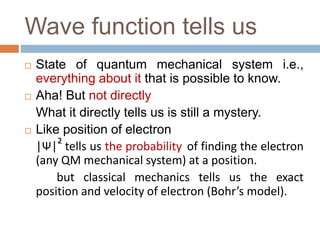
Wave function tells us
 State of quantum mechanical system i.e.,
everything about it that is possible to know.
 Aha! But not directly
What it directly tells us is still a mystery.
 Like position of electron
|Ѱ|
2
tells us the probability of finding the electron
(any QM mechanical system) at a position.
but classical mechanics tells us the exact
position and velocity of electron (Bohr’s model).
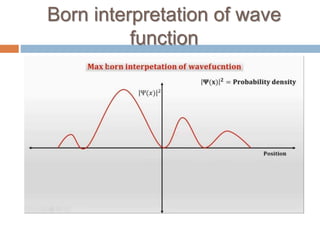
Charge density interpretation by
Schrodinger
Born interpretation of wave
function
Boundary surface plots
 Principle : Darker the region,
greater is the probability.
Schrodinger’s equation
 Richard Feynman once said, “Where did we
get that from ? It is not possible to derive it
from anything you know. It came out of the
mind of the Schrodinger.”
 This equation is used to find the allowed
energy values which a quantum mechanical
system can attain.
were H is Hamiltonian operator.
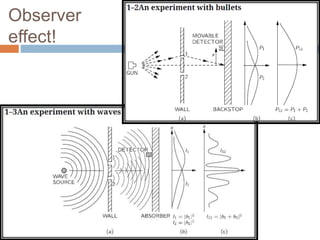
Observer
effect!
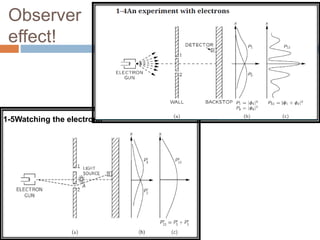
Observer
effect!
1-5Watching the electrons
Following questions arises :
 Is what inside the electron should not be
dependent on what we do?
 One might still like to ask: “How does it work?
What is the machinery behind the law?” No
one has found any machinery behind the law.
No one can “explain” any more than we have
just “explained.”
Some quantum phenomena
 Quantum Superposition
 Quantum Tunnelling
 Quantum Spin
 Quantum Entanglement
 Quantum Fluctuations(virtual particles)
 Quantum Computers (millions times faster
than supercomputer)
Quantum superposition
 Quantum superposition : It states that an
object that is not being observed, exists in all
possible states at once-it is in a superposition.
This means that a particle which is not
observed can have multiple velocities and be
at multiple places at once.
Quantum Spin
 Spin is a misnomer term for this fundamental
property of tiny particles.
 Spin does not mean rotation of tiny particles.
 Spin is that property of particles due to which
they acquire angular momentum, and hence
magnetism.
Little descriptions...
 Quantum tunnelling : A phenomenon wherein
particles or even whole atoms have a certain
probability of surpassing a barrier, even though
they do not have enough energy to surpass it,
which is against the principle of classical physics.
E.g.-Nuclear fusion in sun
 Quantum Entanglement : The state of a kind of
superposition, where observation of one object
determines the state of another object is called
Quantum Entanglement.
E.g.-Annihilation
Consequences/Connections
 A universe from nothing,
 Indeterminism
 Quantum field theory
 String theory , string cosmology
 Quantum information theory
 Super symmetry
 Phoenix theory
Applications
 Cosmological interpretations, spirituality
 Quantum computing, Quantum optics,
Quantum chemistry,
 Superconducting magnets, light-emitting
diodes, and the laser,
the transistor and semiconductors, electron
microscopy.
 Explanations for many biological and physical
phenomena are rooted in the nature of the
chemical bond, most notably the macro-
molecule DNA.
Some online MOOC courses and
sources for quantum studies
 EDX.org
 MIT open courseware(OCW)
 Feynman lectures Vol. III
 Quantum physics by H.C. verma
 Application “Quantum” by Stepan Brychta
 Wikipedia
 Nptel lectures “Quantum mechanics and its
applications” by Sir Ajoy Ghatak.
Quantum physics for dumies

Quantum physics for dumies

  • 1.
    Government Holkar (Model, Autonomous)Science College, Indore (M.P.), INDIA Department of Physics Seminar topic : Quantum physics and its important terms. Submitted to: Dr. R.C. Dixit (H.O.D.) Presented by : Ram Krishna Namdev (M.Sc. Previous)
  • 2.
    Contents  Introduction  Wavefunction  Schrodinger’s equation  Observer’s effect  Some quantum phenomena and brief explanation  Applications and connections  My Sources
  • 3.
    INTRODUCTION TO QUANTUM MECHANICS Definition: Quantum mechanics including quantum field theory, is a fundamental theory in physics which describes nature at the smallest scales of energy levels of atoms and subatomic particles. In easy words “Quantum mechanics is the description of the behaviour of matter and light in all its details and, in particular, of the happenings on an atomic scale.”
  • 4.
    A beautiful subject We don’t know why it works, but just on the basis of its strong rigorous mathematical foundations , we can claim some of its interesting consequences which are groundbreaking.  At the same time, it contains flavours of philosophy and many see different shades of spiritualism in it.  It has a lot of abstract imagination to connect the material world to the fantasies of imagination.
  • 5.
    How it differsfrom CLASSICAL PHYSICS?  Quantum mechanics differs from classical physics in that energy, momentum, angular momentum. Quantities of a system are restricted to discrete values(quantization).  There is an uncertainty principle in QM given by Heisenberg.  Most theories in classical physics can be derived from quantum mechanics as an approximation valid at large (macroscopic) scale.
  • 6.
    Einstein is theroot of all that! And he always denied about these wierdness.  As u all know about the paper of 1905(THE MIRACLE YEAR) on the photoelectric effect, which leads to the Nobel prize for Einstein unexpectedly, which he was trying to get for his Theory of General Relativity.  He got the Nobel prize in 1921 (before De Broglie-1928) for photoelectric effect, as he unintentionally started the new era of quantum mechanics.  About which he said, “God can’t play dice with us”.
  • 7.
    NOW WHAT ISWAVE FUNCTION!  Just a mathematical expression.  As the equation, y=4x+3 tells us two things 1. Slope 2. y-intercept this equation is important to find the information of line. Similarly, the wave function is a complex mathematical expression represented by Ѱ or ѱ. 1. Energy 2. Position 3. Momentum, etc.,
  • 8.
    Wave function tellsus  State of quantum mechanical system i.e., everything about it that is possible to know.  Aha! But not directly What it directly tells us is still a mystery.  Like position of electron |Ѱ| 2 tells us the probability of finding the electron (any QM mechanical system) at a position. but classical mechanics tells us the exact position and velocity of electron (Bohr’s model).
  • 9.
  • 10.
  • 11.
    Boundary surface plots Principle : Darker the region, greater is the probability.
  • 12.
    Schrodinger’s equation  RichardFeynman once said, “Where did we get that from ? It is not possible to derive it from anything you know. It came out of the mind of the Schrodinger.”  This equation is used to find the allowed energy values which a quantum mechanical system can attain. were H is Hamiltonian operator.
  • 13.
  • 14.
  • 15.
    Following questions arises:  Is what inside the electron should not be dependent on what we do?  One might still like to ask: “How does it work? What is the machinery behind the law?” No one has found any machinery behind the law. No one can “explain” any more than we have just “explained.”
  • 16.
    Some quantum phenomena Quantum Superposition  Quantum Tunnelling  Quantum Spin  Quantum Entanglement  Quantum Fluctuations(virtual particles)  Quantum Computers (millions times faster than supercomputer)
  • 17.
    Quantum superposition  Quantumsuperposition : It states that an object that is not being observed, exists in all possible states at once-it is in a superposition. This means that a particle which is not observed can have multiple velocities and be at multiple places at once.
  • 18.
    Quantum Spin  Spinis a misnomer term for this fundamental property of tiny particles.  Spin does not mean rotation of tiny particles.  Spin is that property of particles due to which they acquire angular momentum, and hence magnetism.
  • 19.
    Little descriptions...  Quantumtunnelling : A phenomenon wherein particles or even whole atoms have a certain probability of surpassing a barrier, even though they do not have enough energy to surpass it, which is against the principle of classical physics. E.g.-Nuclear fusion in sun  Quantum Entanglement : The state of a kind of superposition, where observation of one object determines the state of another object is called Quantum Entanglement. E.g.-Annihilation
  • 20.
    Consequences/Connections  A universefrom nothing,  Indeterminism  Quantum field theory  String theory , string cosmology  Quantum information theory  Super symmetry  Phoenix theory
  • 21.
    Applications  Cosmological interpretations,spirituality  Quantum computing, Quantum optics, Quantum chemistry,  Superconducting magnets, light-emitting diodes, and the laser, the transistor and semiconductors, electron microscopy.  Explanations for many biological and physical phenomena are rooted in the nature of the chemical bond, most notably the macro- molecule DNA.
  • 22.
    Some online MOOCcourses and sources for quantum studies  EDX.org  MIT open courseware(OCW)  Feynman lectures Vol. III  Quantum physics by H.C. verma  Application “Quantum” by Stepan Brychta  Wikipedia  Nptel lectures “Quantum mechanics and its applications” by Sir Ajoy Ghatak.

Editor's Notes

  • #4 Atomic behavior is so unlike ordinary experience, it is very difficult to get used to, and it appears peculiar and mysterious toeveryone—both to the novice and to the experienced physicist
  • #6 The foundations of quantum mechanics were established during the first half of the 20th century by Max Planck, Niels Bohr, Werner Heisenberg, Louis de Broglie, Arthur Compton, Albert Einstein, Erwin Schrödinger, Max Born, John von Neumann, Paul Dirac, Enrico Fermi, Wolfgang Pauli, Max von Laue, Freeman Dyson, David Hilbert, Wilhelm Wien, Satyendra Nath Bose, Arnold Sommerfeld, and others. The Copenhagen interpretation of Niels Bohr became widely accepted. Most of them were renowned theoritical physicists and mathematicians.
  • #10 Electronic charge distribution ; real part vs position
  • #12 The concept of orbitals comes out from here.
  • #19 Comparing to earth it was said spin.