Harris Academy South Norwood                               MEDIA Risk Assessment Record

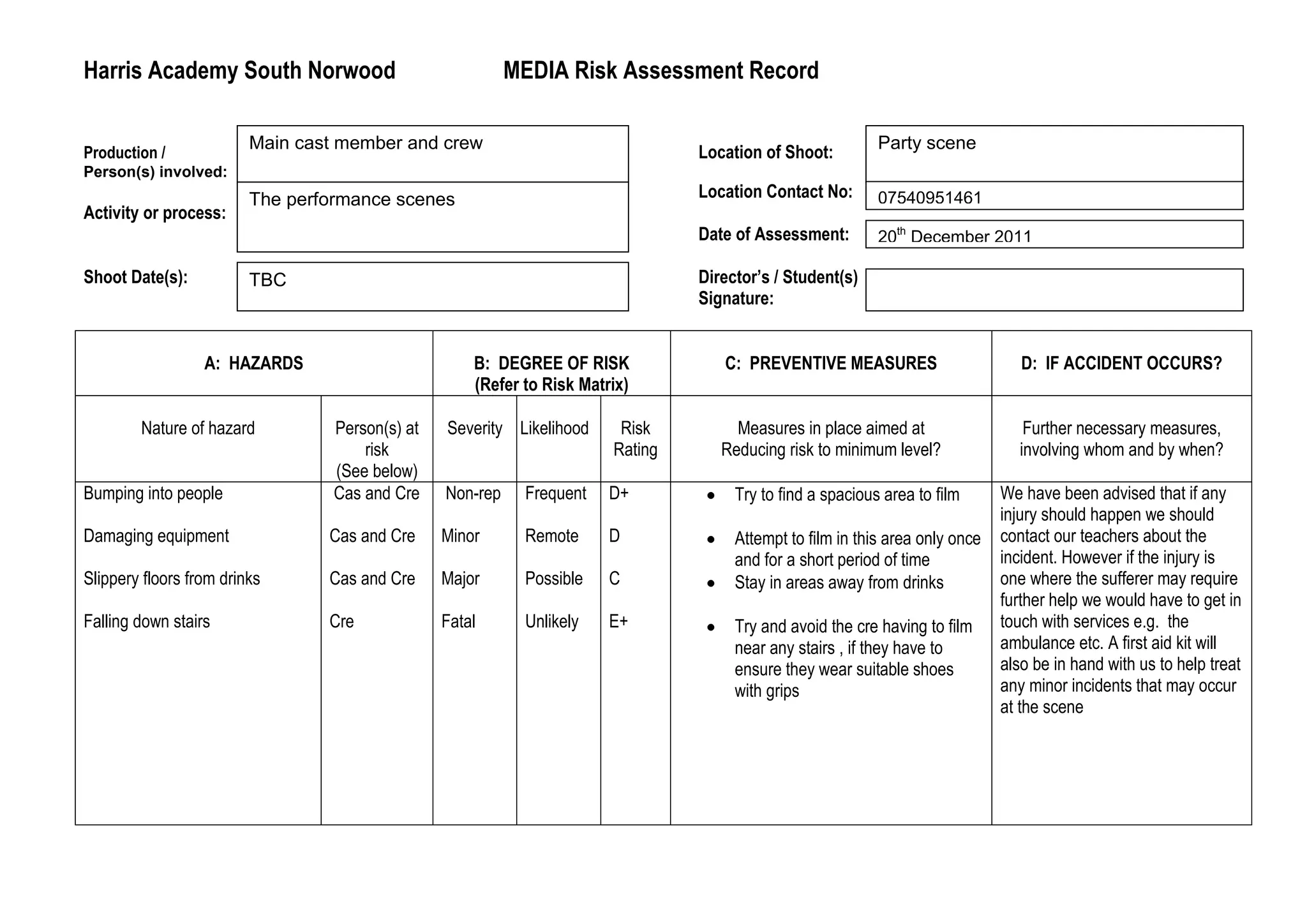
                         Main cast member and crew                                                          Party scene
Production /                                                                     Location of Shoot:
Person(s) involved:
                         The performance scenes                                  Location Contact No:       07540951461
Activity or process:
                                                                                 Date of Assessment:        20th December 2011

Shoot Date(s):           TBC                                                     Director’s / Student(s)
                                                                                 Signature:


                  A: HAZARDS                         B: DEGREE OF RISK              C: PREVENTIVE MEASURES                        D: IF ACCIDENT OCCURS?
                                                     (Refer to Risk Matrix)

        Nature of hazard          Person(s) at   Severity Likelihood     Risk         Measures in place aimed at                   Further necessary measures,
                                      risk                              Rating      Reducing risk to minimum level?               involving whom and by when?
                                  (See below)
Bumping into people               Cas and Cre    Non-rep    Frequent    D+            Try to find a spacious area to film      We have been advised that if any
                                                                                                                               injury should happen we should
Damaging equipment               Cas and Cre     Minor      Remote      D             Attempt to film in this area only once   contact our teachers about the
                                                                                      and for a short period of time           incident. However if the injury is
Slippery floors from drinks      Cas and Cre     Major      Possible    C             Stay in areas away from drinks           one where the sufferer may require
                                                                                                                               further help we would have to get in
Falling down stairs              Cre             Fatal      Unlikely    E+            Try and avoid the cre having to film     touch with services e.g. the
                                                                                      near any stairs , if they have to        ambulance etc. A first aid kit will
                                                                                      ensure they wear suitable shoes          also be in hand with us to help treat
                                                                                      with grips                               any minor incidents that may occur
                                                                                                                               at the scene
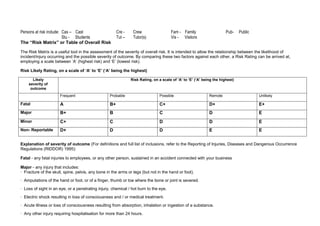
Persons at risk include: Cas – Cast                     Cre -    Crew                  Fam - Family                     Pub-    Public
                         Stu - Students                 Tut –    Tutor(s)              Vis - Visitors
The “Risk Matrix” or Table of Overall Risk

The Risk Matrix is a useful tool in the assessment of the severity of overall risk. It is intended to allow the relationship between the likelihood of
incident/injury occurring and the possible severity of outcome. By comparing these two factors against each other, a Risk Rating can be arrived at,
employing a scale between „A‟ (highest risk) and „E‟ (lowest risk).

Risk Likely Rating, on a scale of „A‟ to „E‟ („A‟ being the highest)

      Likely                                                    Risk Rating, on a scale of „A‟ to „E‟ („A‟ being the highest)
    severity of
     outcome
                      Frequent                     Probable                      Possible                     Remote                     Unlikely

Fatal                 A                            B+                            C+                           D+                         E+
Major                 B+                           B                             C                            D                          E
Minor                 C+                           C                             D                            D                          E
Non- Reportable       D+                           D                             D                            E                          E


Explanation of severity of outcome (For definitions and full list of inclusions, refer to the Reporting of Injuries, Diseases and Dangerous Occurrence
Regulations (RIDDOR) 1995):

Fatal - any fatal injuries to employees, or any other person, sustained in an accident connected with your business

Major - any injury that includes:
· Fracture of the skull, spine, pelvis, any bone in the arms or legs (but not in the hand or foot).
· Amputations of the hand or foot, or of a finger, thumb or toe where the bone or joint is severed.
· Loss of sight in an eye, or a penetrating injury, chemical / hot burn to the eye.
· Electric shock resulting in loss of consciousness and / or medical treatment.
· Acute illness or loss of consciousness resulting from absorption, inhalation or ingestion of a substance.
· Any other injury requiring hospitalisation for more than 24 hours.
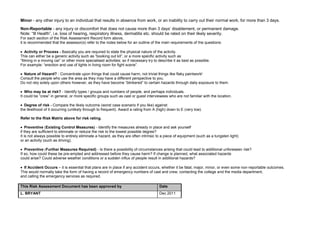
Minor - any other injury to an individual that results in absence from work, or an inability to carry out their normal work, for more than 3 days.
Non-Reportable - any injury or discomfort that does not cause more than 3 days‟ disablement, or permanent damage.
Note: “Ill Health”, i.e. loss of hearing, respiratory illness, dermatitis etc. should be rated on their likely severity.
For each section of the Risk Assessment Record form above,
it is recommended that the assessor(s) refer to the notes below for an outline of the main requirements of the questions:

    Activity or Process - Basically you are required to state the physical nature of the activity.
This can either be a generic activity such as “booking out kit”, or a more specific activity such as
“filming in a moving car” or other more specialised activities; so if necessary try to describe it as best as possible.
For example: “erection and use of lights in living room for fight scene”.

 Nature of Hazard? - Concentrate upon things that could cause harm, not trivial things like flaky paintwork!
Consult the people who use the area as they may have a different perspective to you.
Do not rely solely upon others however, as they have become “blinkered” to certain hazards through daily exposure to them.

   Who may be at risk? - Identify types / groups and numbers of people, and perhaps individuals.
It could be “crew” in general, or more specific groups such as cast or guest interviewees who are not familiar with the location.

  Degree of risk - Compare the likely outcome (worst case scenario if you like) against
the likelihood of it occurring (unlikely through to frequent). Award a rating from A (high) down to E (very low).

Refer to the Risk Matrix above for risk rating.

    Preventive (Existing Control Measures) - Identify the measures already in place and ask yourself
if they are sufficient to eliminate or reduce the risk to the lowest possible degree?
It is not always possible to entirely eliminate a hazard, as they are often intrinsic to a piece of equipment (such as a tungsten light)
or an activity (such as driving).

   Preventive Further Measures Required) - Is there a possibility of circumstances arising that could lead to additional unforeseen risk?
If so, how could these be pre-empted and addressed before they cause harm? If change is planned, what associated hazards
could arise? Could adverse weather conditions or a sudden influx of people result in additional hazards?

  If Accident Occurs – it is essential that plans are in place if any accident occurs, whether it be fatal, major, minor, or even some non-reportable outcomes.
This would normally take the form of having a record of emergency numbers of cast and crew, contacting the college and the media department,
and calling the emergency services as required.

This Risk Assessment Document has been approved by                                     Date
L. BRYANT                                                                              Dec 2011

Risk assessment party scene

  • 1.
    Harris Academy SouthNorwood MEDIA Risk Assessment Record Main cast member and crew Party scene Production / Location of Shoot: Person(s) involved: The performance scenes Location Contact No: 07540951461 Activity or process: Date of Assessment: 20th December 2011 Shoot Date(s): TBC Director’s / Student(s) Signature: A: HAZARDS B: DEGREE OF RISK C: PREVENTIVE MEASURES D: IF ACCIDENT OCCURS? (Refer to Risk Matrix) Nature of hazard Person(s) at Severity Likelihood Risk Measures in place aimed at Further necessary measures, risk Rating Reducing risk to minimum level? involving whom and by when? (See below) Bumping into people Cas and Cre Non-rep Frequent D+ Try to find a spacious area to film We have been advised that if any injury should happen we should Damaging equipment Cas and Cre Minor Remote D Attempt to film in this area only once contact our teachers about the and for a short period of time incident. However if the injury is Slippery floors from drinks Cas and Cre Major Possible C Stay in areas away from drinks one where the sufferer may require further help we would have to get in Falling down stairs Cre Fatal Unlikely E+ Try and avoid the cre having to film touch with services e.g. the near any stairs , if they have to ambulance etc. A first aid kit will ensure they wear suitable shoes also be in hand with us to help treat with grips any minor incidents that may occur at the scene
  • 2.
    Persons at riskinclude: Cas – Cast Cre - Crew Fam - Family Pub- Public Stu - Students Tut – Tutor(s) Vis - Visitors The “Risk Matrix” or Table of Overall Risk The Risk Matrix is a useful tool in the assessment of the severity of overall risk. It is intended to allow the relationship between the likelihood of incident/injury occurring and the possible severity of outcome. By comparing these two factors against each other, a Risk Rating can be arrived at, employing a scale between „A‟ (highest risk) and „E‟ (lowest risk). Risk Likely Rating, on a scale of „A‟ to „E‟ („A‟ being the highest) Likely Risk Rating, on a scale of „A‟ to „E‟ („A‟ being the highest) severity of outcome Frequent Probable Possible Remote Unlikely Fatal A B+ C+ D+ E+ Major B+ B C D E Minor C+ C D D E Non- Reportable D+ D D E E Explanation of severity of outcome (For definitions and full list of inclusions, refer to the Reporting of Injuries, Diseases and Dangerous Occurrence Regulations (RIDDOR) 1995): Fatal - any fatal injuries to employees, or any other person, sustained in an accident connected with your business Major - any injury that includes: · Fracture of the skull, spine, pelvis, any bone in the arms or legs (but not in the hand or foot). · Amputations of the hand or foot, or of a finger, thumb or toe where the bone or joint is severed. · Loss of sight in an eye, or a penetrating injury, chemical / hot burn to the eye. · Electric shock resulting in loss of consciousness and / or medical treatment. · Acute illness or loss of consciousness resulting from absorption, inhalation or ingestion of a substance. · Any other injury requiring hospitalisation for more than 24 hours.
  • 3.
    Minor - anyother injury to an individual that results in absence from work, or an inability to carry out their normal work, for more than 3 days. Non-Reportable - any injury or discomfort that does not cause more than 3 days‟ disablement, or permanent damage. Note: “Ill Health”, i.e. loss of hearing, respiratory illness, dermatitis etc. should be rated on their likely severity. For each section of the Risk Assessment Record form above, it is recommended that the assessor(s) refer to the notes below for an outline of the main requirements of the questions: Activity or Process - Basically you are required to state the physical nature of the activity. This can either be a generic activity such as “booking out kit”, or a more specific activity such as “filming in a moving car” or other more specialised activities; so if necessary try to describe it as best as possible. For example: “erection and use of lights in living room for fight scene”. Nature of Hazard? - Concentrate upon things that could cause harm, not trivial things like flaky paintwork! Consult the people who use the area as they may have a different perspective to you. Do not rely solely upon others however, as they have become “blinkered” to certain hazards through daily exposure to them. Who may be at risk? - Identify types / groups and numbers of people, and perhaps individuals. It could be “crew” in general, or more specific groups such as cast or guest interviewees who are not familiar with the location. Degree of risk - Compare the likely outcome (worst case scenario if you like) against the likelihood of it occurring (unlikely through to frequent). Award a rating from A (high) down to E (very low). Refer to the Risk Matrix above for risk rating. Preventive (Existing Control Measures) - Identify the measures already in place and ask yourself if they are sufficient to eliminate or reduce the risk to the lowest possible degree? It is not always possible to entirely eliminate a hazard, as they are often intrinsic to a piece of equipment (such as a tungsten light) or an activity (such as driving). Preventive Further Measures Required) - Is there a possibility of circumstances arising that could lead to additional unforeseen risk? If so, how could these be pre-empted and addressed before they cause harm? If change is planned, what associated hazards could arise? Could adverse weather conditions or a sudden influx of people result in additional hazards? If Accident Occurs – it is essential that plans are in place if any accident occurs, whether it be fatal, major, minor, or even some non-reportable outcomes. This would normally take the form of having a record of emergency numbers of cast and crew, contacting the college and the media department, and calling the emergency services as required. This Risk Assessment Document has been approved by Date L. BRYANT Dec 2011