AUM NAMASHIVAYA!
AMRITA VIDYALAYAM,TIRUPUR
SENIOR SECONDARY
CBSE AFFILIATION NO: 1930760
E-Mail: amritatejasavt@gmail.com
Grade: 8
GEORAPHY
CH:4 –AGRICULTURE
AGRICULTURE
• The transformation from a plant to a finished product involves
three types of economic activities-primary, secondary and tertiary.
Primary activities include the extraction and production of natural
resources. Examples- Agriculture, fishing and gathering.
• Secondary activities- the processing of these resources. Examples-
Manufacturing of steel, baking of bread and weaving of cloth.
Tertiary activities-provide support to the primary and secondary
sectors through services. Examples- Transport, trade, banking,
insurance and advertising.
• Agriculture is a primary activity. Favorable topography of soil and
climate are vital for agricultural activity
FARM SYSTEM
 Agriculture or farming can be looked at as a system. Important
inputs-seeds, fertilizers, machinery and labour. Operations
involved-ploughing, sowing, irrigation, weeding and harvesting.
The outputs from the system-crops, wool, dairy and poultry
products.
Types of Farming
 Subsistence farming and Commercial farming– main types of
farming depending upon the geographical conditions, demand
of produce, labour and level of technology.
 Subsistence farming- classified as intensive subsistence and
primitive subsistence farming.
SUBSISTENCE FARMING
•Intensive subsistence
•primitive subsistence farming.
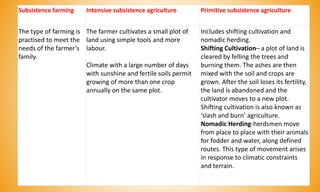
Subsistence farming Intensive subsistence agriculture Primitive subsistence agriculture
The type of farming is
practised to meet the
needs of the farmer’s
family.
The farmer cultivates a small plot of
land using simple tools and more
labour.
Climate with a large number of days
with sunshine and fertile soils permit
growing of more than one crop
annually on the same plot.
Includes shifting cultivation and
nomadic herding.
Shifting Cultivation– a plot of land is
cleared by felling the trees and
burning them. The ashes are then
mixed with the soil and crops are
grown. After the soil loses its fertility,
the land is abandoned and the
cultivator moves to a new plot.
Shifting cultivation is also known as
‘slash and burn’ agriculture.
Nomadic Herding-herdsmen move
from place to place with their animals
for fodder and water, along defined
routes. This type of movement arises
in response to climatic constraints
and terrain.
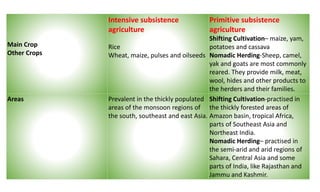
Main Crop
Other Crops
Intensive subsistence
agriculture
Rice
Wheat, maize, pulses and oilseeds
Primitive subsistence
agriculture
Shifting Cultivation– maize, yam,
potatoes and cassava
Nomadic Herding-Sheep, camel,
yak and goats are most commonly
reared. They provide milk, meat,
wool, hides and other products to
the herders and their families.
Areas Prevalent in the thickly populated
areas of the monsoon regions of
the south, southeast and east Asia.
Shifting Cultivation-practised in
the thickly forested areas of
Amazon basin, tropical Africa,
parts of Southeast Asia and
Northeast India.
Nomadic Herding– practised in
the semi-arid and arid regions of
Sahara, Central Asia and some
parts of India, like Rajasthan and
Jammu and Kashmir.
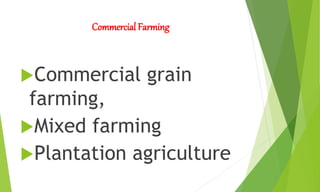
Commercial Farming
Commercial grain
farming,
Mixed farming
Plantation agriculture
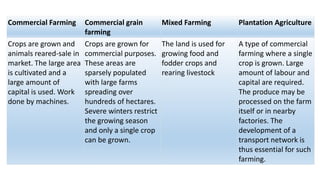
Commercial Farming Commercial grain
farming
Mixed Farming Plantation Agriculture
Crops are grown and
animals reared-sale in
market. The large area
is cultivated and a
large amount of
capital is used. Work
done by machines.
Crops are grown for
commercial purposes.
These areas are
sparsely populated
with large farms
spreading over
hundreds of hectares.
Severe winters restrict
the growing season
and only a single crop
can be grown.
The land is used for
growing food and
fodder crops and
rearing livestock
A type of commercial
farming where a single
crop is grown. Large
amount of labour and
capital are required.
The produce may be
processed on the farm
itself or in nearby
factories. The
development of a
transport network is
thus essential for such
farming.
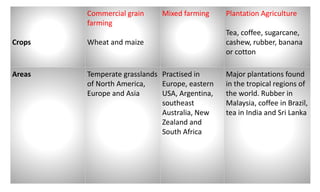
Crops
Commercial grain
farming
Wheat and maize
Mixed farming Plantation Agriculture
Tea, coffee, sugarcane,
cashew, rubber, banana
or cotton
Areas Temperate grasslands
of North America,
Europe and Asia
Practised in
Europe, eastern
USA, Argentina,
southeast
Australia, New
Zealand and
South Africa
Major plantations found
in the tropical regions of
the world. Rubber in
Malaysia, coffee in Brazil,
tea in India and Sri Lanka
MAJOR CROPS
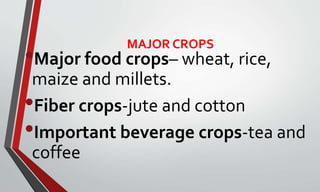
•Major food crops– wheat, rice,
maize and millets.
•Fiber crops-jute and cotton
•Important beverage crops-tea and
coffee
MAJOR CROPS
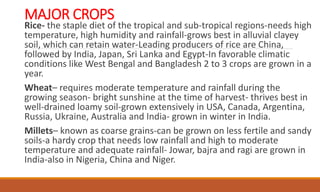
Rice- the staple diet of the tropical and sub-tropical regions-needs high
temperature, high humidity and rainfall-grows best in alluvial clayey
soil, which can retain water-Leading producers of rice are China,
followed by India, Japan, Sri Lanka and Egypt-In favorable climatic
conditions like West Bengal and Bangladesh 2 to 3 crops are grown in a
year.
Wheat– requires moderate temperature and rainfall during the
growing season- bright sunshine at the time of harvest- thrives best in
well-drained loamy soil-grown extensively in USA, Canada, Argentina,
Russia, Ukraine, Australia and India- grown in winter in India.
Millets– known as coarse grains-can be grown on less fertile and sandy
soils-a hardy crop that needs low rainfall and high to moderate
temperature and adequate rainfall- Jowar, bajra and ragi are grown in
India-also in Nigeria, China and Niger.
MAJOR CROPS
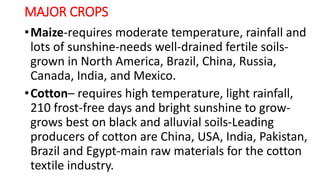
•Maize-requires moderate temperature, rainfall and
lots of sunshine-needs well-drained fertile soils-
grown in North America, Brazil, China, Russia,
Canada, India, and Mexico.
•Cotton– requires high temperature, light rainfall,
210 frost-free days and bright sunshine to grow-
grows best on black and alluvial soils-Leading
producers of cotton are China, USA, India, Pakistan,
Brazil and Egypt-main raw materials for the cotton
textile industry.
MAJOR CROPS
• Jute-known as the ‘Golden Fibre’-grows well on alluvial
soil- requires high temperature, heavy rainfall and humid
climate- grown in the tropical areas-Leading producers of
Jute are India and Bangladesh.
• Coffee– requires a warm and wet climate and well-
drained loamy soil-Hill slopes are more suitable for the
growth of crop-Leading producers are Brazil followed by
Columbia and India.
• Tea– a beverage crop grown on plantations-requires cool
climate and well-distributed high rainfall throughout the
year for the growth of its tender leaves-needs well-
drained loamy soils and gentle slopes-Kenya, India, China,
Sri Lanka produce the best quality tea in the world
AGRULTURE DEVELOPMENT
•Efforts made to increase farm production in order to meet
the growing demand of the increasing population-achieved
in many ways such as increasing the cropped area, the
number of crops grown, improving irrigation facilities, use
of fertilizers and high yielding variety of seeds-ultimate aim
of agricultural development is to increase food security.
•Developing countries with large populations practice
intensive agriculture where crops are grown on small
holdings mostly for subsistence-larger holdings are popular
for commercial agriculture.

Agriculture ppt GEOGRAPHY CBSE

  • 1.
    AUM NAMASHIVAYA! AMRITA VIDYALAYAM,TIRUPUR SENIORSECONDARY CBSE AFFILIATION NO: 1930760 E-Mail: amritatejasavt@gmail.com Grade: 8 GEORAPHY CH:4 –AGRICULTURE
  • 2.
    AGRICULTURE • The transformationfrom a plant to a finished product involves three types of economic activities-primary, secondary and tertiary. Primary activities include the extraction and production of natural resources. Examples- Agriculture, fishing and gathering. • Secondary activities- the processing of these resources. Examples- Manufacturing of steel, baking of bread and weaving of cloth. Tertiary activities-provide support to the primary and secondary sectors through services. Examples- Transport, trade, banking, insurance and advertising. • Agriculture is a primary activity. Favorable topography of soil and climate are vital for agricultural activity
  • 3.
    FARM SYSTEM  Agricultureor farming can be looked at as a system. Important inputs-seeds, fertilizers, machinery and labour. Operations involved-ploughing, sowing, irrigation, weeding and harvesting. The outputs from the system-crops, wool, dairy and poultry products. Types of Farming  Subsistence farming and Commercial farming– main types of farming depending upon the geographical conditions, demand of produce, labour and level of technology.  Subsistence farming- classified as intensive subsistence and primitive subsistence farming.
  • 4.
  • 5.
    Subsistence farming Intensivesubsistence agriculture Primitive subsistence agriculture The type of farming is practised to meet the needs of the farmer’s family. The farmer cultivates a small plot of land using simple tools and more labour. Climate with a large number of days with sunshine and fertile soils permit growing of more than one crop annually on the same plot. Includes shifting cultivation and nomadic herding. Shifting Cultivation– a plot of land is cleared by felling the trees and burning them. The ashes are then mixed with the soil and crops are grown. After the soil loses its fertility, the land is abandoned and the cultivator moves to a new plot. Shifting cultivation is also known as ‘slash and burn’ agriculture. Nomadic Herding-herdsmen move from place to place with their animals for fodder and water, along defined routes. This type of movement arises in response to climatic constraints and terrain.
  • 6.
    Main Crop Other Crops Intensivesubsistence agriculture Rice Wheat, maize, pulses and oilseeds Primitive subsistence agriculture Shifting Cultivation– maize, yam, potatoes and cassava Nomadic Herding-Sheep, camel, yak and goats are most commonly reared. They provide milk, meat, wool, hides and other products to the herders and their families. Areas Prevalent in the thickly populated areas of the monsoon regions of the south, southeast and east Asia. Shifting Cultivation-practised in the thickly forested areas of Amazon basin, tropical Africa, parts of Southeast Asia and Northeast India. Nomadic Herding– practised in the semi-arid and arid regions of Sahara, Central Asia and some parts of India, like Rajasthan and Jammu and Kashmir.
  • 7.
  • 8.
    Commercial Farming Commercialgrain farming Mixed Farming Plantation Agriculture Crops are grown and animals reared-sale in market. The large area is cultivated and a large amount of capital is used. Work done by machines. Crops are grown for commercial purposes. These areas are sparsely populated with large farms spreading over hundreds of hectares. Severe winters restrict the growing season and only a single crop can be grown. The land is used for growing food and fodder crops and rearing livestock A type of commercial farming where a single crop is grown. Large amount of labour and capital are required. The produce may be processed on the farm itself or in nearby factories. The development of a transport network is thus essential for such farming.
  • 9.
    Crops Commercial grain farming Wheat andmaize Mixed farming Plantation Agriculture Tea, coffee, sugarcane, cashew, rubber, banana or cotton Areas Temperate grasslands of North America, Europe and Asia Practised in Europe, eastern USA, Argentina, southeast Australia, New Zealand and South Africa Major plantations found in the tropical regions of the world. Rubber in Malaysia, coffee in Brazil, tea in India and Sri Lanka
  • 10.
    MAJOR CROPS •Major foodcrops– wheat, rice, maize and millets. •Fiber crops-jute and cotton •Important beverage crops-tea and coffee
  • 11.
    MAJOR CROPS Rice- thestaple diet of the tropical and sub-tropical regions-needs high temperature, high humidity and rainfall-grows best in alluvial clayey soil, which can retain water-Leading producers of rice are China, followed by India, Japan, Sri Lanka and Egypt-In favorable climatic conditions like West Bengal and Bangladesh 2 to 3 crops are grown in a year. Wheat– requires moderate temperature and rainfall during the growing season- bright sunshine at the time of harvest- thrives best in well-drained loamy soil-grown extensively in USA, Canada, Argentina, Russia, Ukraine, Australia and India- grown in winter in India. Millets– known as coarse grains-can be grown on less fertile and sandy soils-a hardy crop that needs low rainfall and high to moderate temperature and adequate rainfall- Jowar, bajra and ragi are grown in India-also in Nigeria, China and Niger.
  • 12.
    MAJOR CROPS •Maize-requires moderatetemperature, rainfall and lots of sunshine-needs well-drained fertile soils- grown in North America, Brazil, China, Russia, Canada, India, and Mexico. •Cotton– requires high temperature, light rainfall, 210 frost-free days and bright sunshine to grow- grows best on black and alluvial soils-Leading producers of cotton are China, USA, India, Pakistan, Brazil and Egypt-main raw materials for the cotton textile industry.
  • 13.
    MAJOR CROPS • Jute-knownas the ‘Golden Fibre’-grows well on alluvial soil- requires high temperature, heavy rainfall and humid climate- grown in the tropical areas-Leading producers of Jute are India and Bangladesh. • Coffee– requires a warm and wet climate and well- drained loamy soil-Hill slopes are more suitable for the growth of crop-Leading producers are Brazil followed by Columbia and India. • Tea– a beverage crop grown on plantations-requires cool climate and well-distributed high rainfall throughout the year for the growth of its tender leaves-needs well- drained loamy soils and gentle slopes-Kenya, India, China, Sri Lanka produce the best quality tea in the world
  • 14.
    AGRULTURE DEVELOPMENT •Efforts madeto increase farm production in order to meet the growing demand of the increasing population-achieved in many ways such as increasing the cropped area, the number of crops grown, improving irrigation facilities, use of fertilizers and high yielding variety of seeds-ultimate aim of agricultural development is to increase food security. •Developing countries with large populations practice intensive agriculture where crops are grown on small holdings mostly for subsistence-larger holdings are popular for commercial agriculture.