
Agriculture Extension ARS Syllabus
Unit 1: Fundamentals of Extension and Communication
• Concepts and scope of extension and communication particularly for primary and secondary
agriculture.
• Historical and emerging perspectives of agricultural, veterinary and animal husbandry
extension education in India and other countries.
• Community Development and Integrated Rural Development- concept, principles and
objectives.
• Role of agricultural extension in different sectors of agriculture and rural development.
• Agricultural Extension in the context of enhancing productivity, Quality, Nutrition, post
harvest technology, product processing, Profitability, Income and Employment.
• Concepts of yield gaps.
• FLD and OFT in relation to TOT programmes.
• Farming System Research and Extension (FSR&E) and participatory development
approaches.
• Concept and modules of communication, credibility, fidelity, empathy and feedback in
communication.
• Similarities and dissimilarities among extension education, adult education and
continuing/distance education.
• Andragogy and theories of adult learning.
• Human behavioural dimensions and gender sensitivity in extension education programmes.
Meaning and characteristics of attitude, factors affecting attitude change; Understanding of
basic rural institutions, social structure, culture and norms.
• Social and technological change processes, group dynamics, concepts and theories of rural
leadership.
• Group and mass communication, Interpersonal and Intrapersonal Communication Skills, Key
communicators and their role in animal husbandry development.
• Acquiring communication skills for development of local leaders and key communicators for
livestock development.
• Organizational communication.
• Rapport building with clientele.
• Problems and barriers in communication; distortion and noise in communication.
• Importance of feedback in veterinary extension,
• impact analysis of extension programmes.
Unit 2: Extension Methods & Farm Journalism
• Concepts of teaching and learning processes–principles of learning as applied to agricultural
extension.
• Individual, group and mass approaches in extension,
• audio-visual aids- classification, selection, use and production.
• Traditional media for communication in development programmes.
• Modularized communication- concept, approach, need, process of designing instruction for
transfer of communication.
• Basics of agricultural journalism, types of publications – bulletins, folders, leaflets, booklets,
newsletters, popular and scientific articles.
• Selection, planning and use of different extension teaching methods like demonstration,
exhibition, farmers fairs, field days, tours, extension literature, etc.
• Preparation and presentation of different projected and non-projected audio-visual aids.
• Public speaking. Preparation of radio/video script.
• Principles of photography and its use in extension.
Unit 3: Information Communication Technologies (ICT)
• Concept of ICT and its role in agriculture and rural development.
• ICT tools- print and electronic media, e-mail, Internet, use of multimedia, use of mobile
phony, video and teleconferencing, computer-assisted instructions, touch screens, micro-
computers, web technologies and information kiosks.
• Networking system of information and challenges in the use of ICT.
• E-learning, information resources, sharing and networking.
• Types of net work – PAN, LAN, WAN, Internet, AGRINET, AKIS, Indian National Agricultural
Research database.
• ICT programmes in livestock development,
• Problems and prospects of ICTs in livestock development, Digitisation, Simulation models,
Utilization of Internet for promoting advanced veterinary and animal husbandry practices;
communication with rural, semi-urban and urban livestock owners.
Unit 4: Training & Human Resource Development
• Human resources and their importance in agricultural development.
• Concept of human resource management.
• Training and development of human resources.
• Identifying training needs and assessment of training impact.
• Training – principles, importance, methods and factors.
• Phases of training - pre training and post training.
• Developing training modules, training requirements, training methods.
• Lecture cum demonstration method, case method, group brain storming, syndicate method,
business games, simulation exercises, in basket exercise, programmed instruction,
experiential learning techniques such as sensitivity training, T-group, transactional analysis
and fish bowl exercise.
• Evaluation of training - types and techniques of training evaluation.
• Motivation, stress management and organizational behaviour as facilitators of human
resource development.
• Capacity Building in relation to Dairying, Poultry, Piggery, Goat and Sheep farming, cottage
industries, Rabbit farming, Apiculture, Sericulture, Biofertilizer, Floriculture, and
Biopesticides.
Unit 5: Research Methodology in Extension Education
• Social research- concept, principles and approach.
• Selection and identification of research problems, methods of data collection- interview
method and mailed questionnaires, variables -meaning and types, independent, dependent
and intervening variables.
• Hypothesis – concept, characteristics, types and testing. Research design - concept and
types, field studies, case studies and survey method.
• Measurement – meaning and levels. Methods of sampling and statistical tests. Reliability
and validity of tests, normal distribution, tests of significance, ANOVA, correlation and
regression, scaling techniques.
• Processing of data, coding - tabulation.
• Analysis and interpretation.
• Writing scientific reports, citing references.
• Participatory approaches, PRA, RRA, PLA and PTD.
Unit 6: Programme Planning, Evaluation & Diffusion and Adoption of Innovations
• Concept, steps, principles and theories of programme planning.
• Steps in programme planning for livestock development, organizing campaigns, mass
vaccination programmes and variety of extension activities, evaluation of veterinary
extension programmes, compilation and report writing.
• Evaluation of animal husbandry development programmes and schemes. Monitoring and
evaluation – concept, significance, types, methods and tools.
• Theoretical models of programme planning.
• Felt needs; need-based programmes.
• Social action. Five Year Plans – critical analysis with special reference to programmes for
women, children and youth. SWOT/TOWS analysis of development programmes.
• Concept and elements of diffusion and adoption for social change.
• Diffusion process, adoption process, models of diffusion and adoption, adopter categories
and their characteristics.
• Factors influencing adoption and attributes of innovations.
• Concept and stages of Innovation-decision process, consequences of innovations.
Unit 7: Extension Management
• Concept and principles of administration and management,
• classical and modern theories, schools of management thought.
• Functions of management – planning, organizing, staffing, directing and leading, controlling,
coordinating, reporting and budgeting.
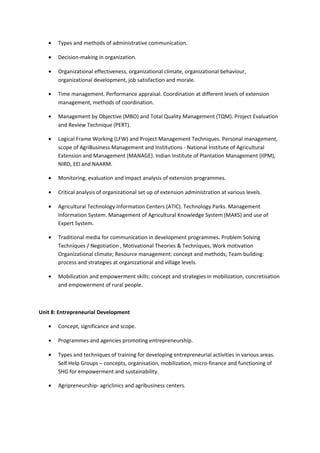
• Types and methods of administrative communication.
• Decision-making in organization.
• Organizational effectiveness, organizational climate, organizational behaviour,
organizational development, job satisfaction and morale.
• Time management. Performance appraisal. Coordination at different levels of extension
management, methods of coordination.
• Management by Objective (MBO) and Total Quality Management (TQM). Project Evaluation
and Review Technique (PERT).
• Logical Frame Working (LFW) and Project Management Techniques. Personal management,
scope of AgriBusiness Management and Institutions - National Institute of Agricultural
Extension and Management (MANAGE). Indian Institute of Plantation Management (IIPM),
NIRD, EEl and NAARM.
• Monitoring, evaluation and impact analysis of extension programmes.
• Critical analysis of organizational set up of extension administration at various levels.
• Agricultural Technology Information Centers (ATIC). Technology Parks. Management
Information System. Management of Agricultural Knowledge System (MAKS) and use of
Expert System.
• Traditional media for communication in development programmes. Problem Solving
Techniques / Negotiation , Motivational Theories & Techniques, Work motivation
Organizational climate; Resource management: concept and methods; Team building:
process and strategies at organizational and village levels.
• Mobilization and empowerment skills: concept and strategies in mobilization, concretisation
and empowerment of rural people.
Unit 8: Entrepreneurial Development
• Concept, significance and scope.
• Programmes and agencies promoting entrepreneurship.
• Types and techniques of training for developing entrepreneurial activities in various areas.
Self Help Groups – concepts, organisation, mobilization, micro-finance and functioning of
SHG for empowerment and sustainability.
• Agripreneurship- agriclinics and agribusiness centers.
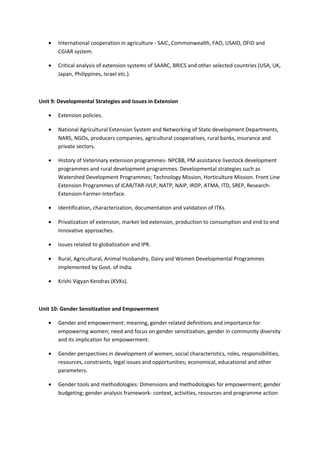
• International cooperation in agriculture - SAIC, Commonwealth, FAO, USAID, DFID and
CGIAR system.
• Critical analysis of extension systems of SAARC, BRICS and other selected countries (USA, UK,
Japan, Philippines, Israel etc.).
Unit 9: Developmental Strategies and Issues in Extension
• Extension policies.
• National Agricultural Extension System and Networking of State development Departments,
NARS, NGOs, producers companies, agricultural cooperatives, rural banks, insurance and
private sectors.
• History of Veterinary extension programmes- NPCBB, PM assistance livestock development
programmes and rural development programmes. Developmental strategies such as
Watershed Development Programmes; Technology Mission, Horticulture Mission. Front Line
Extension Programmes of ICAR/TAR-IVLP, NATP, NAIP, IRDP, ATMA, ITD, SREP, Research-
Extension-Farmer-Interface.
• Identification, characterization, documentation and validation of ITKs.
• Privatization of extension, market led extension, production to consumption and end to end
innovative approaches.
• Issues related to globalization and IPR.
• Rural, Agricultural, Animal Husbandry, Dairy and Women Developmental Programmes
implemented by Govt. of India.
• Krishi Vigyan Kendras (KVKs).
Unit 10: Gender Sensitization and Empowerment
• Gender and empowerment: meaning, gender related definitions and importance for
empowering women; need and focus on gender sensitization, gender in community diversity
and its implication for empowerment.
• Gender perspectives in development of women, social characteristics, roles, responsibilities,
resources, constraints, legal issues and opportunities; economical, educational and other
parameters.
• Gender tools and methodologies: Dimensions and methodologies for empowerment; gender
budgeting; gender analysis framework- context, activities, resources and programme action
profile; technologies and empowerment - gender specific technologies, household
technology interface, socio-cultural interface and women as consumer of technologies.
• Gender issues and development: health and nutrition, violence, governance, education and
media.

Agriculture extension ars syllabus

  • 1.
    Agriculture Extension ARSSyllabus Unit 1: Fundamentals of Extension and Communication • Concepts and scope of extension and communication particularly for primary and secondary agriculture. • Historical and emerging perspectives of agricultural, veterinary and animal husbandry extension education in India and other countries. • Community Development and Integrated Rural Development- concept, principles and objectives. • Role of agricultural extension in different sectors of agriculture and rural development. • Agricultural Extension in the context of enhancing productivity, Quality, Nutrition, post harvest technology, product processing, Profitability, Income and Employment. • Concepts of yield gaps. • FLD and OFT in relation to TOT programmes. • Farming System Research and Extension (FSR&E) and participatory development approaches. • Concept and modules of communication, credibility, fidelity, empathy and feedback in communication. • Similarities and dissimilarities among extension education, adult education and continuing/distance education. • Andragogy and theories of adult learning. • Human behavioural dimensions and gender sensitivity in extension education programmes. Meaning and characteristics of attitude, factors affecting attitude change; Understanding of basic rural institutions, social structure, culture and norms. • Social and technological change processes, group dynamics, concepts and theories of rural leadership. • Group and mass communication, Interpersonal and Intrapersonal Communication Skills, Key communicators and their role in animal husbandry development. • Acquiring communication skills for development of local leaders and key communicators for livestock development. • Organizational communication. • Rapport building with clientele.
  • 2.
    • Problems andbarriers in communication; distortion and noise in communication. • Importance of feedback in veterinary extension, • impact analysis of extension programmes. Unit 2: Extension Methods & Farm Journalism • Concepts of teaching and learning processes–principles of learning as applied to agricultural extension. • Individual, group and mass approaches in extension, • audio-visual aids- classification, selection, use and production. • Traditional media for communication in development programmes. • Modularized communication- concept, approach, need, process of designing instruction for transfer of communication. • Basics of agricultural journalism, types of publications – bulletins, folders, leaflets, booklets, newsletters, popular and scientific articles. • Selection, planning and use of different extension teaching methods like demonstration, exhibition, farmers fairs, field days, tours, extension literature, etc. • Preparation and presentation of different projected and non-projected audio-visual aids. • Public speaking. Preparation of radio/video script. • Principles of photography and its use in extension. Unit 3: Information Communication Technologies (ICT) • Concept of ICT and its role in agriculture and rural development. • ICT tools- print and electronic media, e-mail, Internet, use of multimedia, use of mobile phony, video and teleconferencing, computer-assisted instructions, touch screens, micro- computers, web technologies and information kiosks. • Networking system of information and challenges in the use of ICT. • E-learning, information resources, sharing and networking. • Types of net work – PAN, LAN, WAN, Internet, AGRINET, AKIS, Indian National Agricultural Research database.
  • 3.
    • ICT programmesin livestock development, • Problems and prospects of ICTs in livestock development, Digitisation, Simulation models, Utilization of Internet for promoting advanced veterinary and animal husbandry practices; communication with rural, semi-urban and urban livestock owners. Unit 4: Training & Human Resource Development • Human resources and their importance in agricultural development. • Concept of human resource management. • Training and development of human resources. • Identifying training needs and assessment of training impact. • Training – principles, importance, methods and factors. • Phases of training - pre training and post training. • Developing training modules, training requirements, training methods. • Lecture cum demonstration method, case method, group brain storming, syndicate method, business games, simulation exercises, in basket exercise, programmed instruction, experiential learning techniques such as sensitivity training, T-group, transactional analysis and fish bowl exercise. • Evaluation of training - types and techniques of training evaluation. • Motivation, stress management and organizational behaviour as facilitators of human resource development. • Capacity Building in relation to Dairying, Poultry, Piggery, Goat and Sheep farming, cottage industries, Rabbit farming, Apiculture, Sericulture, Biofertilizer, Floriculture, and Biopesticides. Unit 5: Research Methodology in Extension Education • Social research- concept, principles and approach. • Selection and identification of research problems, methods of data collection- interview method and mailed questionnaires, variables -meaning and types, independent, dependent and intervening variables. • Hypothesis – concept, characteristics, types and testing. Research design - concept and types, field studies, case studies and survey method.
  • 4.
    • Measurement –meaning and levels. Methods of sampling and statistical tests. Reliability and validity of tests, normal distribution, tests of significance, ANOVA, correlation and regression, scaling techniques. • Processing of data, coding - tabulation. • Analysis and interpretation. • Writing scientific reports, citing references. • Participatory approaches, PRA, RRA, PLA and PTD. Unit 6: Programme Planning, Evaluation & Diffusion and Adoption of Innovations • Concept, steps, principles and theories of programme planning. • Steps in programme planning for livestock development, organizing campaigns, mass vaccination programmes and variety of extension activities, evaluation of veterinary extension programmes, compilation and report writing. • Evaluation of animal husbandry development programmes and schemes. Monitoring and evaluation – concept, significance, types, methods and tools. • Theoretical models of programme planning. • Felt needs; need-based programmes. • Social action. Five Year Plans – critical analysis with special reference to programmes for women, children and youth. SWOT/TOWS analysis of development programmes. • Concept and elements of diffusion and adoption for social change. • Diffusion process, adoption process, models of diffusion and adoption, adopter categories and their characteristics. • Factors influencing adoption and attributes of innovations. • Concept and stages of Innovation-decision process, consequences of innovations. Unit 7: Extension Management • Concept and principles of administration and management, • classical and modern theories, schools of management thought. • Functions of management – planning, organizing, staffing, directing and leading, controlling, coordinating, reporting and budgeting.
  • 5.
    • Types andmethods of administrative communication. • Decision-making in organization. • Organizational effectiveness, organizational climate, organizational behaviour, organizational development, job satisfaction and morale. • Time management. Performance appraisal. Coordination at different levels of extension management, methods of coordination. • Management by Objective (MBO) and Total Quality Management (TQM). Project Evaluation and Review Technique (PERT). • Logical Frame Working (LFW) and Project Management Techniques. Personal management, scope of AgriBusiness Management and Institutions - National Institute of Agricultural Extension and Management (MANAGE). Indian Institute of Plantation Management (IIPM), NIRD, EEl and NAARM. • Monitoring, evaluation and impact analysis of extension programmes. • Critical analysis of organizational set up of extension administration at various levels. • Agricultural Technology Information Centers (ATIC). Technology Parks. Management Information System. Management of Agricultural Knowledge System (MAKS) and use of Expert System. • Traditional media for communication in development programmes. Problem Solving Techniques / Negotiation , Motivational Theories & Techniques, Work motivation Organizational climate; Resource management: concept and methods; Team building: process and strategies at organizational and village levels. • Mobilization and empowerment skills: concept and strategies in mobilization, concretisation and empowerment of rural people. Unit 8: Entrepreneurial Development • Concept, significance and scope. • Programmes and agencies promoting entrepreneurship. • Types and techniques of training for developing entrepreneurial activities in various areas. Self Help Groups – concepts, organisation, mobilization, micro-finance and functioning of SHG for empowerment and sustainability. • Agripreneurship- agriclinics and agribusiness centers.
  • 6.
    • International cooperationin agriculture - SAIC, Commonwealth, FAO, USAID, DFID and CGIAR system. • Critical analysis of extension systems of SAARC, BRICS and other selected countries (USA, UK, Japan, Philippines, Israel etc.). Unit 9: Developmental Strategies and Issues in Extension • Extension policies. • National Agricultural Extension System and Networking of State development Departments, NARS, NGOs, producers companies, agricultural cooperatives, rural banks, insurance and private sectors. • History of Veterinary extension programmes- NPCBB, PM assistance livestock development programmes and rural development programmes. Developmental strategies such as Watershed Development Programmes; Technology Mission, Horticulture Mission. Front Line Extension Programmes of ICAR/TAR-IVLP, NATP, NAIP, IRDP, ATMA, ITD, SREP, Research- Extension-Farmer-Interface. • Identification, characterization, documentation and validation of ITKs. • Privatization of extension, market led extension, production to consumption and end to end innovative approaches. • Issues related to globalization and IPR. • Rural, Agricultural, Animal Husbandry, Dairy and Women Developmental Programmes implemented by Govt. of India. • Krishi Vigyan Kendras (KVKs). Unit 10: Gender Sensitization and Empowerment • Gender and empowerment: meaning, gender related definitions and importance for empowering women; need and focus on gender sensitization, gender in community diversity and its implication for empowerment. • Gender perspectives in development of women, social characteristics, roles, responsibilities, resources, constraints, legal issues and opportunities; economical, educational and other parameters. • Gender tools and methodologies: Dimensions and methodologies for empowerment; gender budgeting; gender analysis framework- context, activities, resources and programme action
  • 7.
    profile; technologies andempowerment - gender specific technologies, household technology interface, socio-cultural interface and women as consumer of technologies. • Gender issues and development: health and nutrition, violence, governance, education and media.