OBJECTIVES
AND
PRINCIPLES
OF EXTENSION
Lecture 2
LECTURE OBJECTIVES
By the end of this lecture you should be able to:
Explain the objectives of extension
Discuss the reasons for studying extension
Discuss the principles that guide extension work
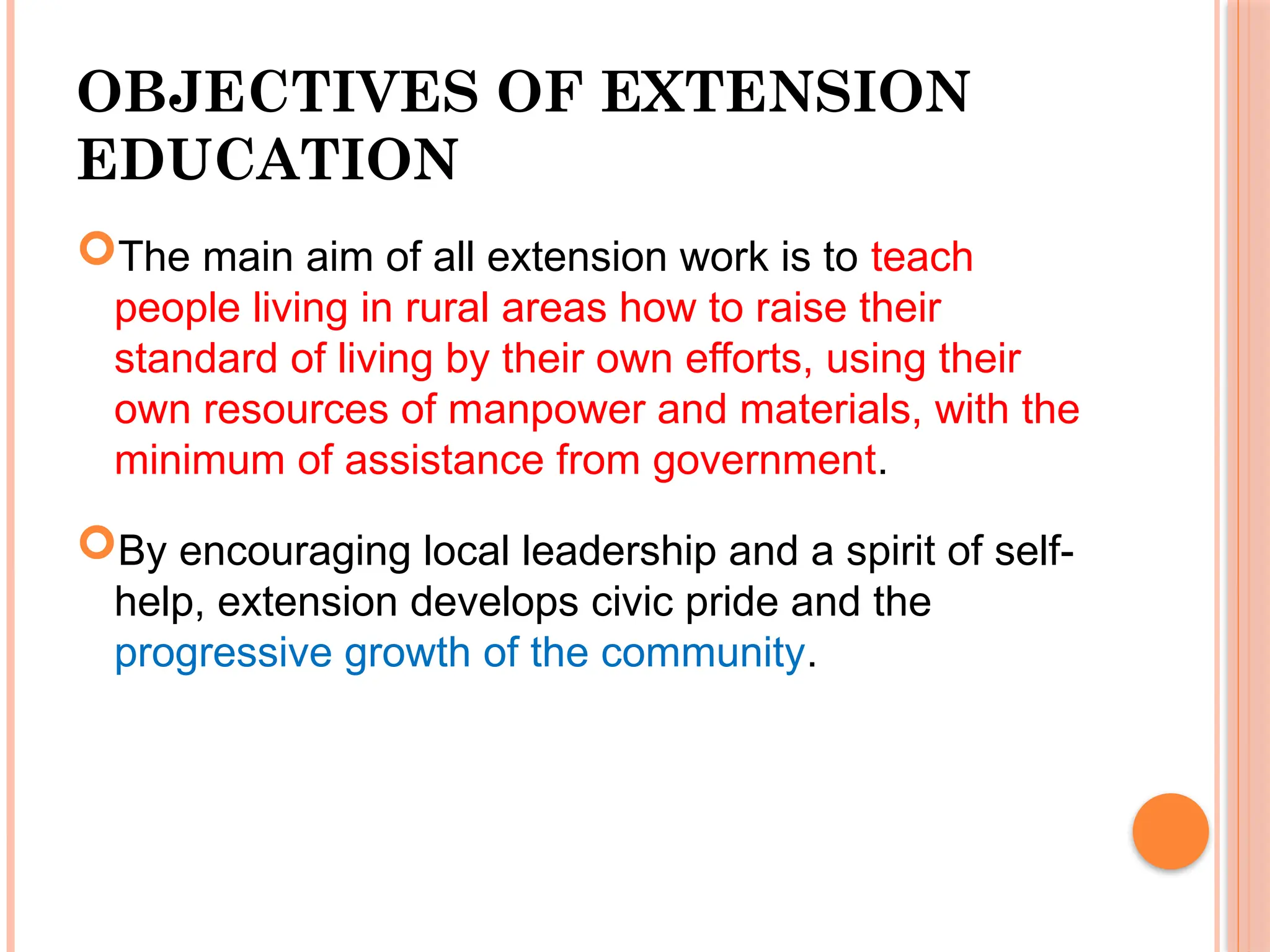
OBJECTIVES OF EXTENSION
EDUCATION
The main aim of all extension work is to teach
people living in rural areas how to raise their
standard of living by their own efforts, using their
own resources of manpower and materials, with the
minimum of assistance from government.
By encouraging local leadership and a spirit of self-
help, extension develops civic pride and the
progressive growth of the community.
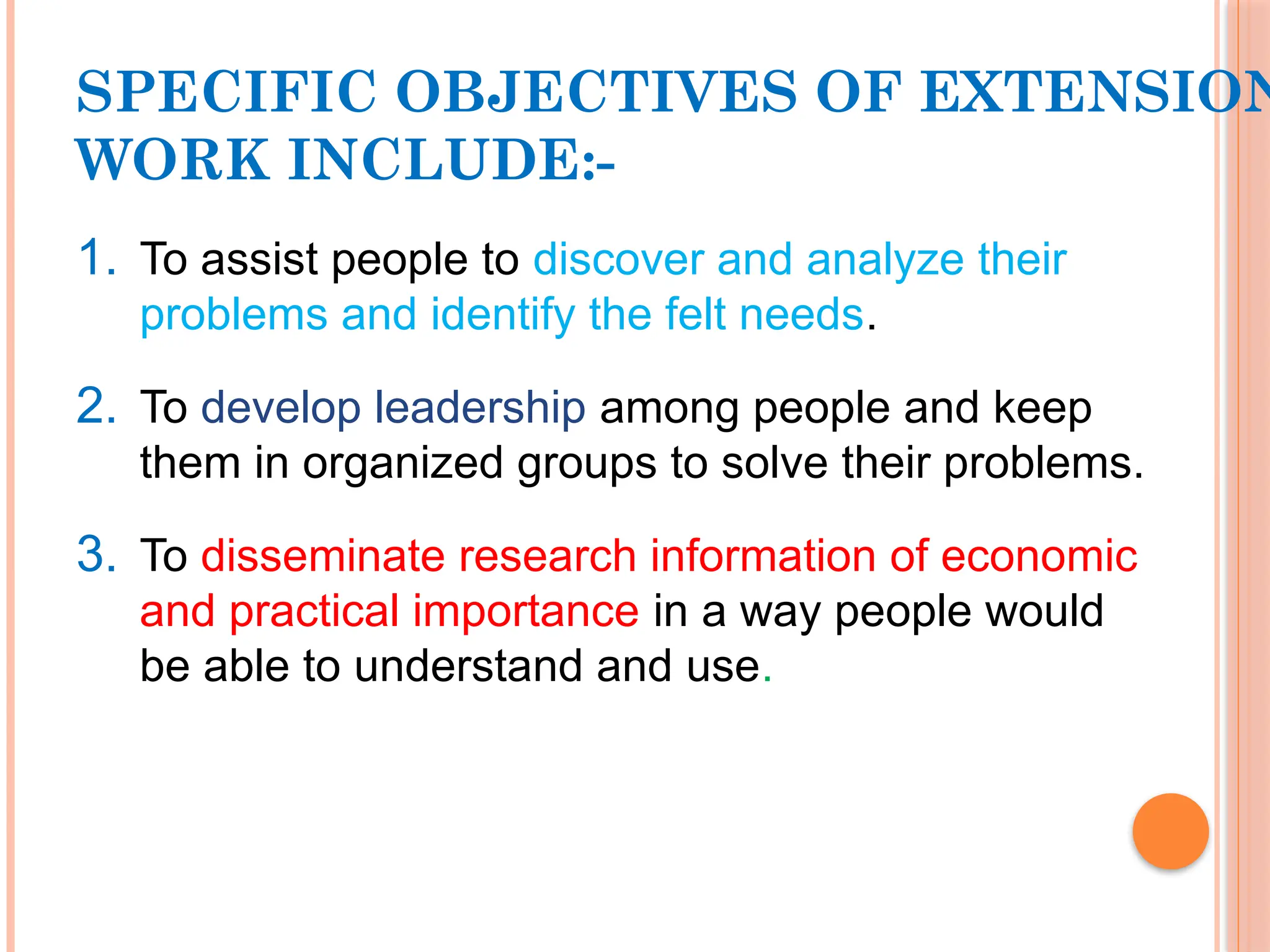
SPECIFIC OBJECTIVES OF EXTENSION
WORK INCLUDE:-
1. To assist people to discover and analyze their
problems and identify the felt needs.
2. To develop leadership among people and keep
them in organized groups to solve their problems.
3. To disseminate research information of economic
and practical importance in a way people would
be able to understand and use.
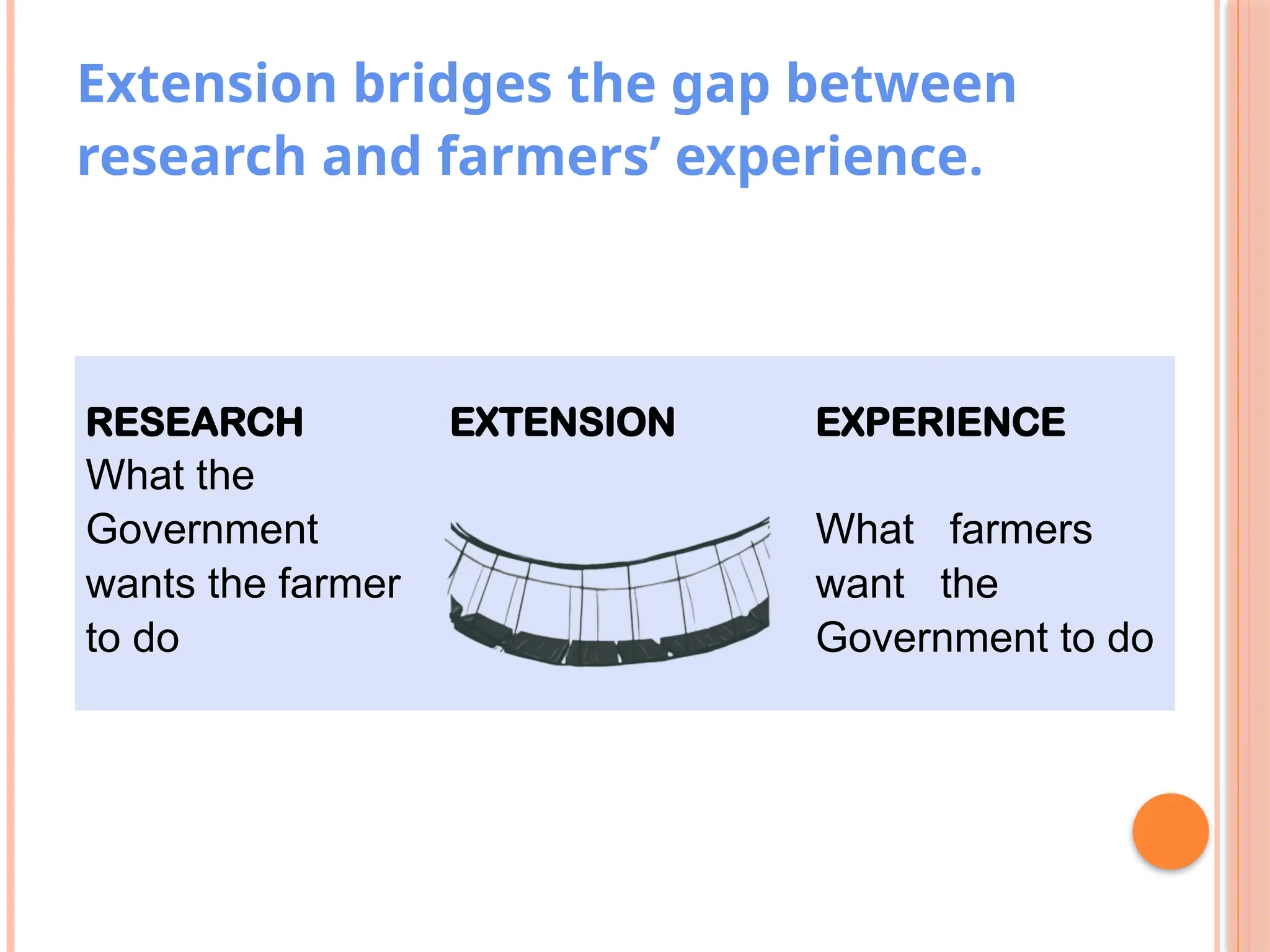
Extension bridges the gap between
research and farmers’ experience.
RESEARCH EXTENSION EXPERIENCE
What the
Government
wants the farmer
to do
What farmers
want the
Government to do
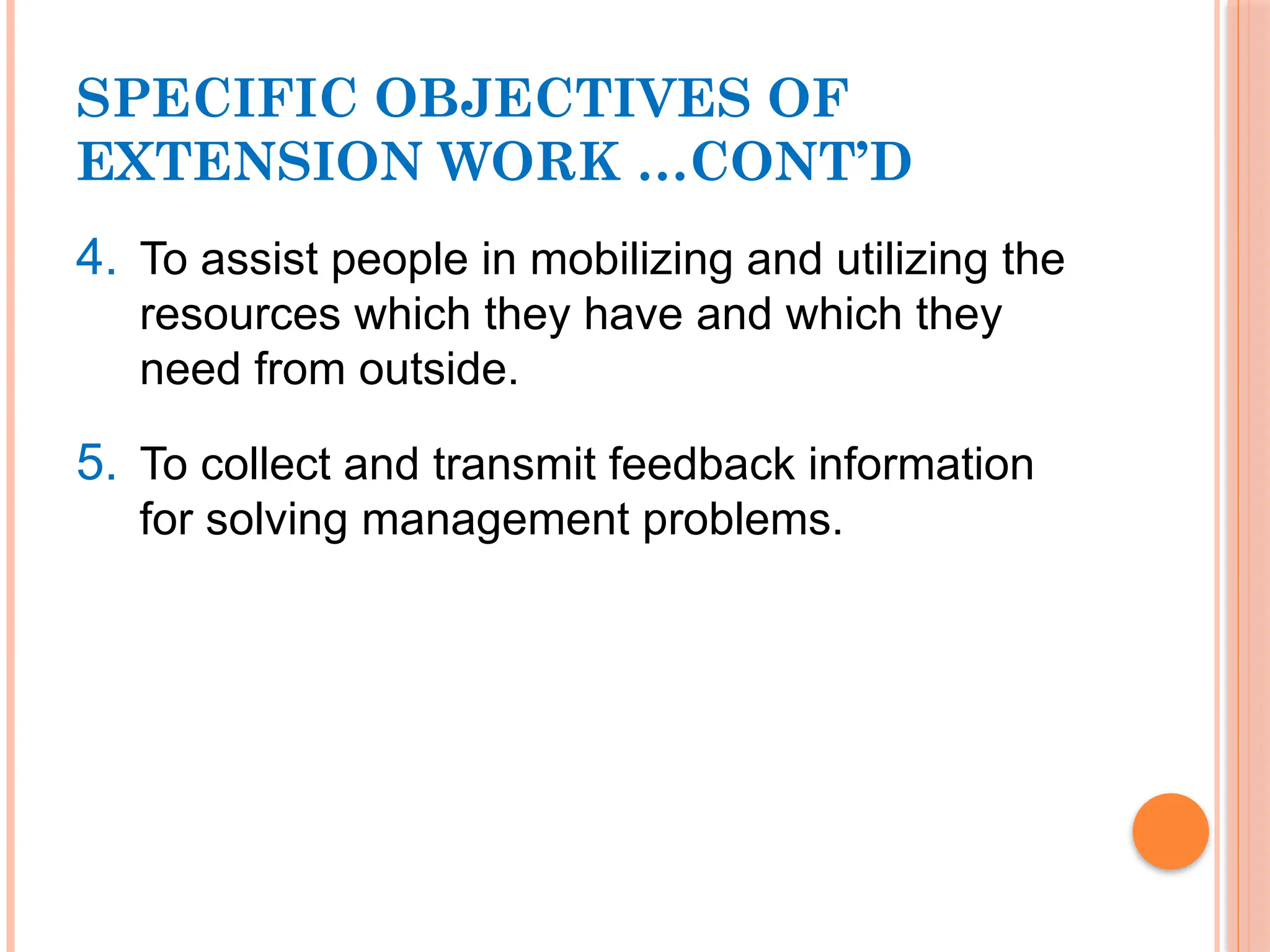
SPECIFIC OBJECTIVES OF
EXTENSION WORK …CONT’D
4. To assist people in mobilizing and utilizing the
resources which they have and which they
need from outside.
5. To collect and transmit feedback information
for solving management problems.
WHY STUDY EXTENSION?
1. To develop a conviction and general realization of
the fact that growth can be promoted, learning
acquired, social behavior improved and personality
adjustments effected.
2. To assist in defining and setting up extension
educational objectives and standards in terms of
desirable behavior for bringing them about.
3. To aid in developing an impartial but sympathetic
attitude towards clientele so that their behavior will
be regarded objectively.
WHY STUDY EXTENSION? …
CONT’D
4. To assist in achieving a better understanding of the
nature and importance of human relationships and
the methods of developing these in clientele e.g.
participation in group efforts and cooperation.
5. To provide a body of facts and principles that can be
used as problem oriented and project directed
solutions.
6. To aid in affording the extension educators a better
perspective for finding both the results of his own
efforts and the practices of others.
WHY STUDY EXTENSION? …
CONT’D
7. To furnish the teachers with the necessary facts
and techniques for analyzing behavior both of his
own and that of others to the end that normal
adjustment may be facilitated and growth effected.
8. To assist in defining, maintaining and combining
progressive extension methods, procedures and
techniques for the dissemination of sophisticated
technologies in a simple and understandable form.
THE BASIC
PRINCIPLES OF
EXTENSION
Principle is said to be a statement of policies to
guide decision and action in a consistent
manner.
It can also be said to be a universal truth that
has been observed and found to be true
considering varying conditions and
circumstances.
In the studies on extension education there are
certain general principles of extension
education which have been applied and tested.
1. PRINCIPLE OF INTERESTS
AND NEEDS
Interests and needs are the fuel which guides the
human genome into activity.
Therefore, to be effective, extension work must begin
with the interest and needs of the people.
These should not be the needs of the extension
worker.
 Must begin with the interests and needs which are
seen by the people as their own.
Extension agencies mould the needs and interests of
the people into realistic needs
2. PRINCIPLE OF GRASS ROOT
ORGANIZATION
For extension work to be effective and real, it has to
be a synthesis of democracy obtained at the level
of the family and more particularly at the village
level.
Things must spread from below and spread like
grass, concentrating on local groups, local
situations and local problems.
3. PRINCIPLE OF CULTURAL
DIFFERENCES
In order to make extension programmes effective
the approach and procedure must be suited to the
culture of the intended group of beneficiaries.
Different cultures require different approaches.
These differences can be perceived in the way of
life of the people, their attitudes, values, loyalties,
habits, customs and traditions.
4. PRINCIPLE OF CULTURAL
CHANGE
◌ The way of life undergoes a change in the process
of learning because changed wants must be learnt
and because all learning must be grafted on what is
already known.
☞ Extension agents must be ready to adjust to some
type of change.
5. PRINCIPLE OF
PARTICIPATION
Human individual are keen on learning while doing
things.
Good extension work helps the rural people in
identifying their problems and then helping them in
solving these problems.
People will not feel attached to the work if they are
given ready-made things e.g. can participate by
giving labor.
6. PRINCIPLE OF LEARNING BY
DOING
Learning remains far from perfect unless one is
involved in actually doing the work.
In extension work, farmers should be encouraged
to learn new things by doing and by direct
participation.
It is learning by doing, which is most effective in
changing people’s behavior and developing the
confidence to use the new methods in future.
7. PRINCIPLE OF
ADAPTABILITY
♡A single developed formula cannot be effective
under all situations.
♡People differ in their level of understanding and
knowledge and therefore, only one extension
method will not be of use for providing information
at all e.g. written materials can only be used for the
literate, radio for those who listen to radio.
8. PRINCIPLE OF TRAINED
SPECIALISTS
Trained specialists have to be provided, who keep
themselves in touch with their respective research
institutes on one hand, and extend to the extension
worker meaningful terms, the latest scientific
developments, which have scope for adoption in
particular areas.
These trained specialists are the link between
research and application of the research in farmers’
fields.
9. PRINCIPLE OF LEADERSHIP
An extension worker in the field can only be a
temporary leader.
This calls for the development of local voluntary
leadership.
The involvement of leaders in extension
programmes is the one single factor that
determines the success or failure of those
programmes.
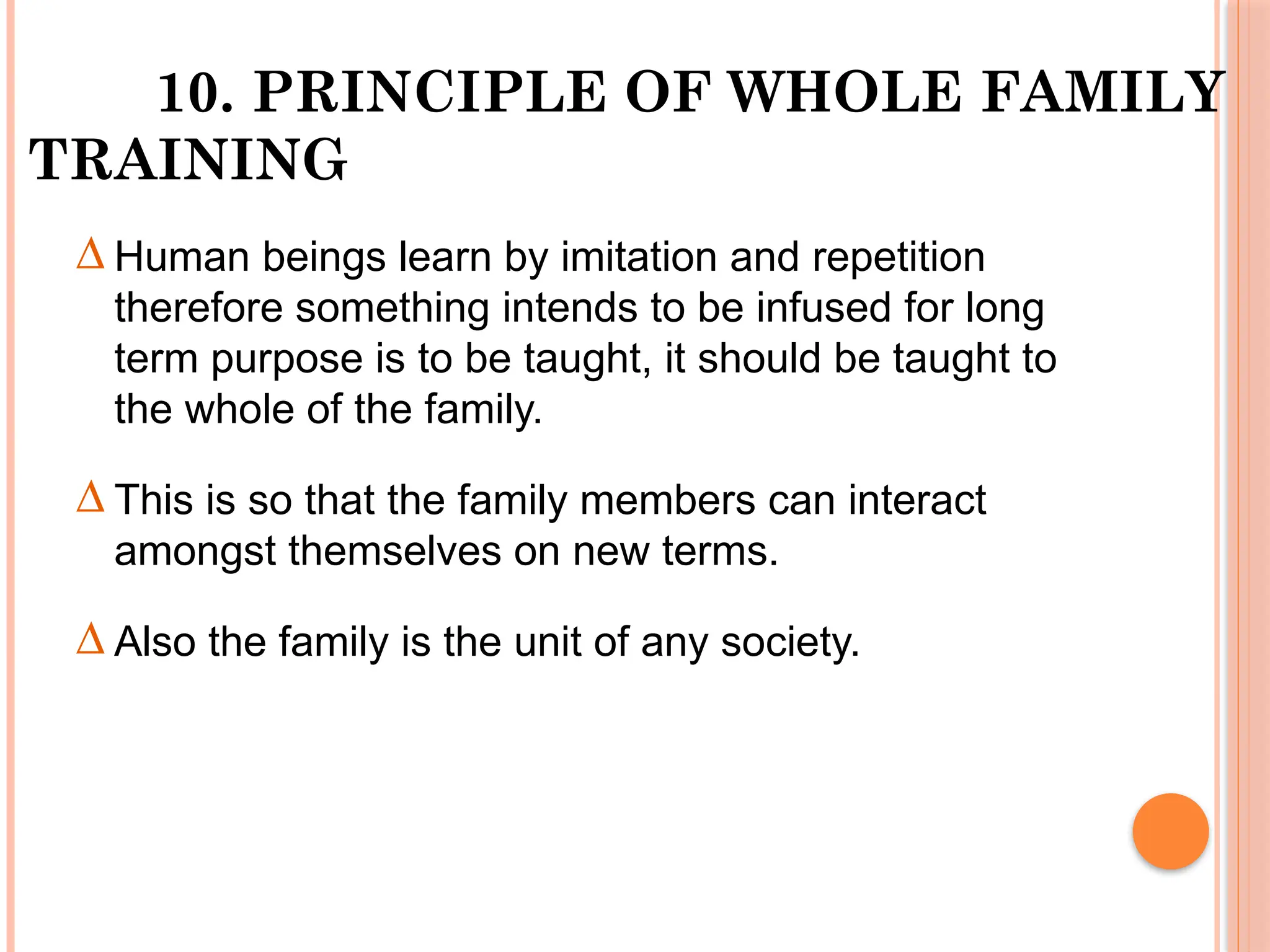
10. PRINCIPLE OF WHOLE FAMILY
TRAINING
∆ Human beings learn by imitation and repetition
therefore something intends to be infused for long
term purpose is to be taught, it should be taught to
the whole of the family.
∆ This is so that the family members can interact
amongst themselves on new terms.
∆ Also the family is the unit of any society.
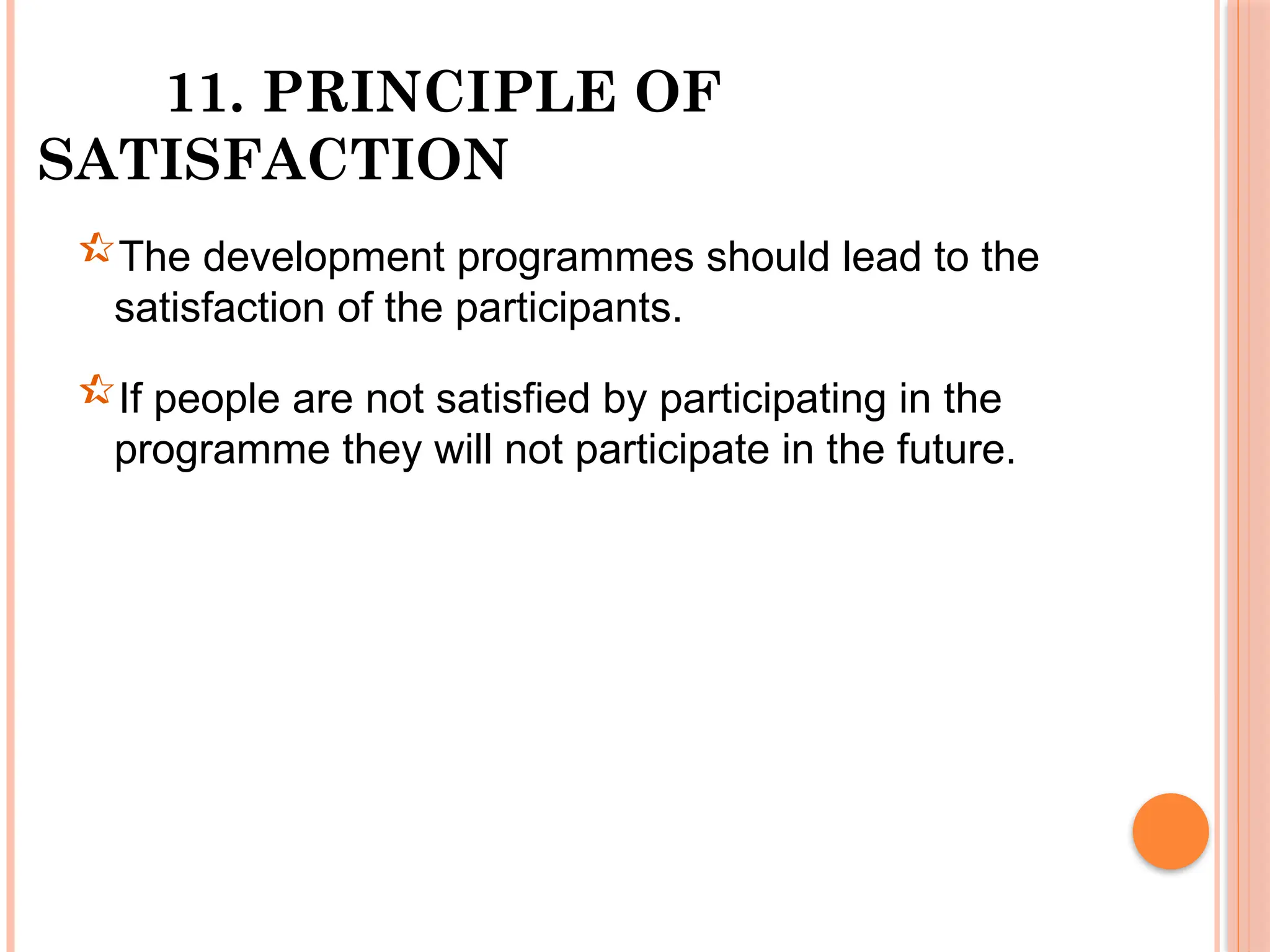
11. PRINCIPLE OF
SATISFACTION
The development programmes should lead to the
satisfaction of the participants.
If people are not satisfied by participating in the
programme they will not participate in the future.
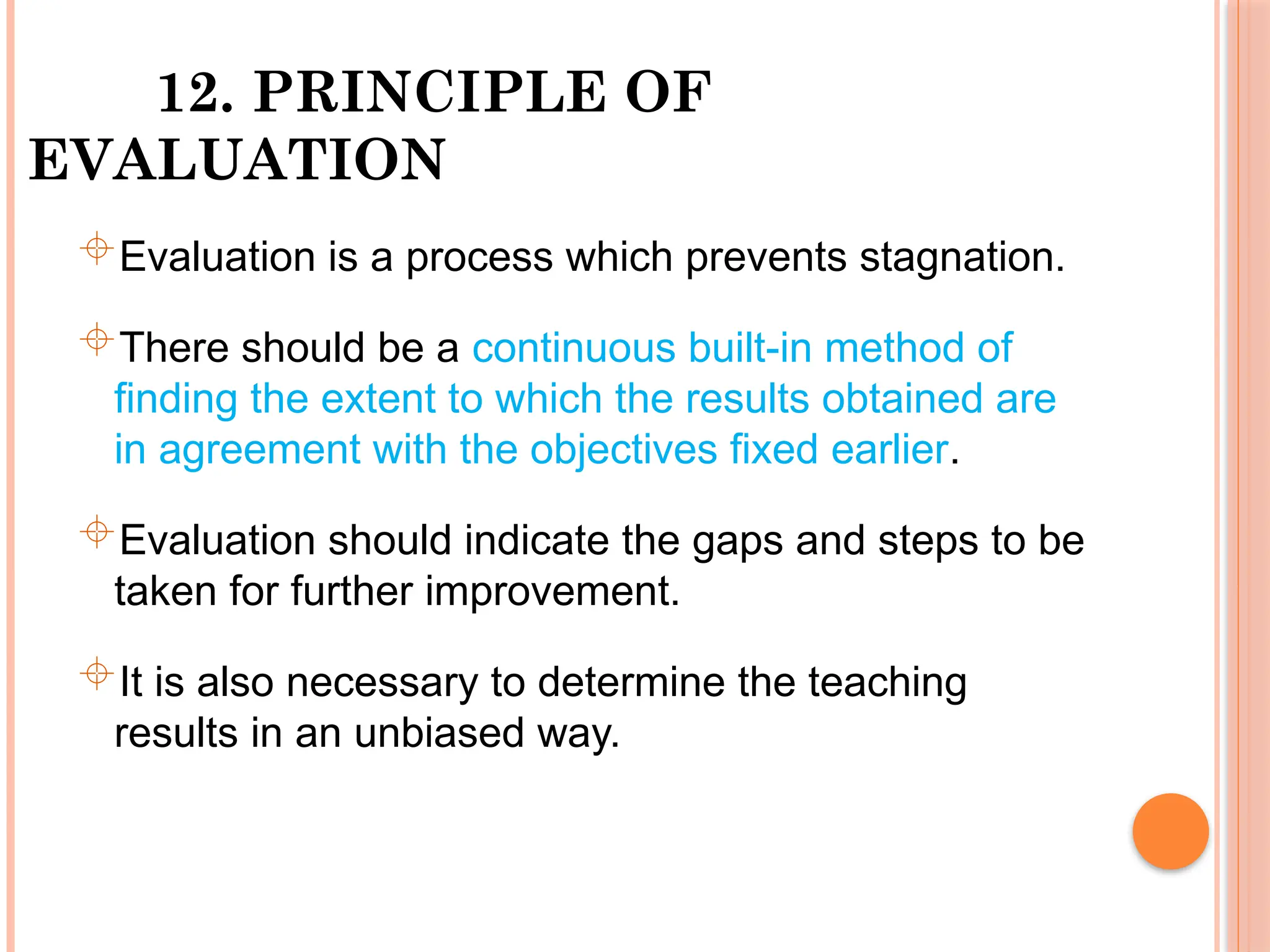
12. PRINCIPLE OF
EVALUATION
Evaluation is a process which prevents stagnation.
There should be a continuous built-in method of
finding the extent to which the results obtained are
in agreement with the objectives fixed earlier.
Evaluation should indicate the gaps and steps to be
taken for further improvement.
It is also necessary to determine the teaching
results in an unbiased way.
THE END
Any Questions

Lec 2.pptx objective and principles of extension

  • 1.
  • 2.
    LECTURE OBJECTIVES By theend of this lecture you should be able to: Explain the objectives of extension Discuss the reasons for studying extension Discuss the principles that guide extension work
  • 3.
    OBJECTIVES OF EXTENSION EDUCATION Themain aim of all extension work is to teach people living in rural areas how to raise their standard of living by their own efforts, using their own resources of manpower and materials, with the minimum of assistance from government. By encouraging local leadership and a spirit of self- help, extension develops civic pride and the progressive growth of the community.
  • 4.
    SPECIFIC OBJECTIVES OFEXTENSION WORK INCLUDE:- 1. To assist people to discover and analyze their problems and identify the felt needs. 2. To develop leadership among people and keep them in organized groups to solve their problems. 3. To disseminate research information of economic and practical importance in a way people would be able to understand and use.
  • 5.
    Extension bridges thegap between research and farmers’ experience. RESEARCH EXTENSION EXPERIENCE What the Government wants the farmer to do What farmers want the Government to do
  • 6.
    SPECIFIC OBJECTIVES OF EXTENSIONWORK …CONT’D 4. To assist people in mobilizing and utilizing the resources which they have and which they need from outside. 5. To collect and transmit feedback information for solving management problems.
  • 7.
    WHY STUDY EXTENSION? 1.To develop a conviction and general realization of the fact that growth can be promoted, learning acquired, social behavior improved and personality adjustments effected. 2. To assist in defining and setting up extension educational objectives and standards in terms of desirable behavior for bringing them about. 3. To aid in developing an impartial but sympathetic attitude towards clientele so that their behavior will be regarded objectively.
  • 8.
    WHY STUDY EXTENSION?… CONT’D 4. To assist in achieving a better understanding of the nature and importance of human relationships and the methods of developing these in clientele e.g. participation in group efforts and cooperation. 5. To provide a body of facts and principles that can be used as problem oriented and project directed solutions. 6. To aid in affording the extension educators a better perspective for finding both the results of his own efforts and the practices of others.
  • 9.
    WHY STUDY EXTENSION?… CONT’D 7. To furnish the teachers with the necessary facts and techniques for analyzing behavior both of his own and that of others to the end that normal adjustment may be facilitated and growth effected. 8. To assist in defining, maintaining and combining progressive extension methods, procedures and techniques for the dissemination of sophisticated technologies in a simple and understandable form.
  • 10.
    THE BASIC PRINCIPLES OF EXTENSION Principleis said to be a statement of policies to guide decision and action in a consistent manner. It can also be said to be a universal truth that has been observed and found to be true considering varying conditions and circumstances. In the studies on extension education there are certain general principles of extension education which have been applied and tested.
  • 11.
    1. PRINCIPLE OFINTERESTS AND NEEDS Interests and needs are the fuel which guides the human genome into activity. Therefore, to be effective, extension work must begin with the interest and needs of the people. These should not be the needs of the extension worker.  Must begin with the interests and needs which are seen by the people as their own. Extension agencies mould the needs and interests of the people into realistic needs
  • 12.
    2. PRINCIPLE OFGRASS ROOT ORGANIZATION For extension work to be effective and real, it has to be a synthesis of democracy obtained at the level of the family and more particularly at the village level. Things must spread from below and spread like grass, concentrating on local groups, local situations and local problems.
  • 13.
    3. PRINCIPLE OFCULTURAL DIFFERENCES In order to make extension programmes effective the approach and procedure must be suited to the culture of the intended group of beneficiaries. Different cultures require different approaches. These differences can be perceived in the way of life of the people, their attitudes, values, loyalties, habits, customs and traditions.
  • 14.
    4. PRINCIPLE OFCULTURAL CHANGE ◌ The way of life undergoes a change in the process of learning because changed wants must be learnt and because all learning must be grafted on what is already known. ☞ Extension agents must be ready to adjust to some type of change.
  • 15.
    5. PRINCIPLE OF PARTICIPATION Humanindividual are keen on learning while doing things. Good extension work helps the rural people in identifying their problems and then helping them in solving these problems. People will not feel attached to the work if they are given ready-made things e.g. can participate by giving labor.
  • 16.
    6. PRINCIPLE OFLEARNING BY DOING Learning remains far from perfect unless one is involved in actually doing the work. In extension work, farmers should be encouraged to learn new things by doing and by direct participation. It is learning by doing, which is most effective in changing people’s behavior and developing the confidence to use the new methods in future.
  • 17.
    7. PRINCIPLE OF ADAPTABILITY ♡Asingle developed formula cannot be effective under all situations. ♡People differ in their level of understanding and knowledge and therefore, only one extension method will not be of use for providing information at all e.g. written materials can only be used for the literate, radio for those who listen to radio.
  • 18.
    8. PRINCIPLE OFTRAINED SPECIALISTS Trained specialists have to be provided, who keep themselves in touch with their respective research institutes on one hand, and extend to the extension worker meaningful terms, the latest scientific developments, which have scope for adoption in particular areas. These trained specialists are the link between research and application of the research in farmers’ fields.
  • 19.
    9. PRINCIPLE OFLEADERSHIP An extension worker in the field can only be a temporary leader. This calls for the development of local voluntary leadership. The involvement of leaders in extension programmes is the one single factor that determines the success or failure of those programmes.
  • 20.
    10. PRINCIPLE OFWHOLE FAMILY TRAINING ∆ Human beings learn by imitation and repetition therefore something intends to be infused for long term purpose is to be taught, it should be taught to the whole of the family. ∆ This is so that the family members can interact amongst themselves on new terms. ∆ Also the family is the unit of any society.
  • 21.
    11. PRINCIPLE OF SATISFACTION Thedevelopment programmes should lead to the satisfaction of the participants. If people are not satisfied by participating in the programme they will not participate in the future.
  • 22.
    12. PRINCIPLE OF EVALUATION Evaluationis a process which prevents stagnation. There should be a continuous built-in method of finding the extent to which the results obtained are in agreement with the objectives fixed earlier. Evaluation should indicate the gaps and steps to be taken for further improvement. It is also necessary to determine the teaching results in an unbiased way.
  • 23.