1
Module 1
Subject: ABM 083: Introduction to Agribusiness Management
Chapter Title: Introduction of Management in Agribusiness
Lesson Title: Overview on Agribusiness
Lesson Objectives:
1. Define and describe agribusiness.
2. Understand the difference between agribusinesses and traditional businesses
3. Identify major components of agribusiness today.
4. Understand the importance of the management model to agribusiness.
5. Appreciate the growing opportunities in agribusiness.
Overview/Introduction:
Agribusiness as a concept was born in Harvard University in 1957 with the
publication of a book “A concept of Agri-business”, written by John David and A. Gold Berg.
It was introduced in Philippines in early 1966, when the University of the Philippines
offered an Agribusiness Management (ABM) program. In 1969, the first Advanced
Agribusiness Management seminar was held in Manila.
Activity:
1. Choose 1 agribusiness enterprise existing in the Philippines and discuss what the
firm all about in two (2) paragraphs only.
Analysis:
Answer the following questions based from your 2 paragraphs on your agribusiness choice.
1. What is/are the products/goods offered by the enterprise?
2. Is it similar to other traditional businesses?
3. What do you think are the other possible products they might to produce/sell?
Abstraction:
Agribusiness as an Opportunity
Agribusiness is an industry with tremendous potential for growth and development as well
as monumental and consequential issues it must address. The e Chinese symbol that
represents both crisis and opportunity could well serve as the logo for agribusiness. For
centuries, agricultural productivity came from the application of two resources: land and
labor. More recently a substantial proportion of increased productivity in agriculture output
in the United States has come from the use of another resource: capital, primarily in the form
2
of technological change including biotechnology, improved animal husbandry, and
improvements in machinery and chemicals. Future improvements will come from the
application of a fourth resource: management. Agribusiness is an industry that is becoming
chronically short of smart, clever, and concerned individuals. Thus, individuals who
understand the principles of business and the nuances of agribusiness are in greater need
than ever before. The industry needs individuals who can harness resources to move a
perishable product around the globe to sustain another equally perishable entity on our
planet: people. Understanding how to do that is what management is all about.
What Is Agribusiness?
Agribusiness involves the production, distribution, and consumption of food, clothing, and
even shelter. It includes all economic activity in the food and fiber system, which
encompasses the input supply industries, agricultural production, and post-harvest, value-
added activities such as commodity processing, food manufacturing, and food distribution.
Today, a half-century later, agribusiness firms ranging from large multinational corporations
to emerging food manufacturing and input supply firms present a strong demand for more
and better employees trained in both management and agricultural sciences. Students who
have mastered economic and business concepts along with agricultural sciences do
extremely well in finding rewarding careers following graduation. It is this labor demand
and the resulting career opportunities that led to the writing of the book that you are now
reading. Through one of its subsets—agriculture— agribusiness is older than business. For
centuries the two entities, agribusiness and agriculture, were considered separate; only in
the mid-twentieth century were their commonalities uncovered. Despite its uniqueness, the
agribusiness industry uses standard business terms for many of its transactions. This use is
a reflection of a very different heritage.
The Core Industries
Knowing the origin of the term agribusiness is helpful but does not explain what an
agribusiness is. We assume that everyone knows what “business” is, yet many students are
surprised by the length of the term’s definition in any good standard collegiate dictionary.
Agribusiness involves;
(1) Inputs — seeds, fertilizer, financing, equipment—that are used in production;
(2) Intermediate activities — grading, storage, processing, packaging, distribution,
pricing, marketing; and
(3) Final consumption activities — restaurants, groceries. The input supply
industries, production agriculture, and value added activities are
considered the agribusiness core industries. Similarly, these core
industries use the material and services of certain ancillary industries
which are considered agribusiness support industries
Farming and ranching are part of the core of agribusiness, representing its production
process stage. So, while they are part of agribusiness, they are not the end; in fact, they are
not even the beginning.
3
The Chain of Agribusiness
The Value Chain. The linkages between the agribusiness industry activities are frequently
referred to as the chain of agribusiness. This chain can be further refined as the agribusiness
value chain. It begins with raw materials and commodities of relatively low value; then each
step in the chain modifies the material or commodity and adds value to the product derived
from its step. For example, growers harvest raw fruits or vegetables that are transported in
bulk to processors or wholesalers, where they are modified or repackaged and transported
to grocery chains in processed form or in smaller batches, and finally to local grocers who
display and sell the products in quantities more suitable for consumers to purchase. It should
be noted also that both food and non-food products are involved, and the distinction between
them is not always clear. Cotton may seem like a non-food product, it is also considered a
food product as it can be used in the manufacture of some human foods and in cottonseed
oil used for cooking. Similarly, corn for human consumption is a food, but corn grown for
livestock consumption is regarded as a non-food product. Another way of looking at the term
agribusiness is much simpler. Agribusiness involves all the value chain activities usually
associated with a business or industry with the additional provision that most of the
materials, commodities, and end products are perishable. The perishable nature of a product,
along with variability in such factors as color, texture, size, and shape, is the distinguishing
characteristic of agribusiness products and industries from other businesses.
Differences between Agribusiness and Business
In the earlier section on the development of the agribusiness industry, we began a discussion
of the differences that exist between agribusinesses and traditional businesses. Now we will
discuss other significant differences between these two entities aside from the perishable
nature of the agribusiness product.
1. Family Orientation or Intent
Almost all agribusiness ventures begin as family endeavors—an orientation that not all of
today’s traditional businesses have. While many traditional businesses in the early and mid-
twentieth century had a family orientation, this is no longer the case. Indeed, many website-
based companies or application-oriented companies were developed by lone individuals to
demonstrate the feasibility of the business concept, seek out investors, sell the company, and
move on to other entrepreneurial ventures. But there is little intent to keep the business in
the family. Individuals with this approach to business development have even acquired a
label, serial entrepreneurs. There is nothing wrong with this approach: it is one of the great
engines of economic growth. But it does define a difference between agribusiness and
traditional business.
2. Initially Tied to Location or Commodity
Another distinction of agribusinesses involves a unique tie-in: its initial competitive
advantage was tied to a location and/or a commodity. Agribusiness firms are generally tied
to location and expand their expertise in a commodity or are tied to the commodity and seek
their locations internationally.
4
3. Needs Risk Mitigation
The location/commodity orientation of an agribusiness creates another distinguishing
characteristic: risk management. Risk management is an approach to control uncertainties
and potential dangers by assessing what those are, then developing strategies and tactics to
reduce them.22 All companies regardless of orientation consider risk management or
perhaps more correctly, risk-mitigation, an essential operational concern. The entire “hedge”
industry had its origin in the late nineteenth century as a service to agribusiness operations.
A business tied to a particular commodity or location was highly susceptible to the
vicissitudes of weather and other natural calamities. An agribusiness such as Coca-Cola, Inc.
may “hedge” the price of corn because of its need for high-fructose corn syrup as an essential
ingredient in syrup production
4. Produces Ingestible or Wearable Products
Agribusiness firms generally produce products that are personal. You may like the car you
drive, maybe even love it; you may enjoy the laptop computer you use (though it has become
a commodity, also) and you may treasure your entertainment system, but these products
rarely get as personal as agribusiness products. Agribusiness products are personal because
you literally consume them or wear them. You may enjoy the taste of wine or beer or distilled
spirit, but in this enjoyment you are consuming it and it becomes part of you. So it is with
Birdseye frozen foods, Kellogg’s ready-to-eat cereals, Hershey’s chocolates, and others.
Nothing is more personal than ingesting a product. Agribusiness consumption is very
personal.
5. Produces Highly Perishable Products
As mentioned earlier, the perishability of materials, commodities, and products is a
characteristic of many agribusiness products and industries that distinguish agribusiness
from other businesses. To make a profit, Summer Farms, for instance, must use or sell its
products before they become unusable or unfit to sell. This aspect of the agribusiness
industry is a key factor in all business decisions. Of course, all products have life cycles, but
agribusiness products by their nature are far more perishable and variable in size and
quality.
Agribusiness Today
Agribusiness has been changed greatly. It has evolved into an industry that encompasses the
globe. It is responsible for feeding and clothing the population of this planet. Today,
agribusiness touches on health, nutrition, safety, science, and politics.
1. Connection to Agriculture
The agricultural connection within agribusiness remains evident. Oddly, there are fewer
individuals involved in production. It is an industry that still retains tremendous potential.
It is an industry that must be able to feed the population of this planet as it grows and ages.
2. Connection to the Sciences
At the same time, agribusiness has broadened its connection to the sciences. Originally it was
chemistry and biology; today it is biotechnology and nanotechnology. Large agribusinesses
5
involved in the pre-production sector (e.g., Monsanto) have become leaders in
biotechnological advancements.
3. Connection to Financial Structures
Agribusiness also has become an industry involved with the development and evolution of
business financial structures.
4. Subject to Political Considerations
Agribusiness today is a global industry with a national anchor that is often affected by
political forces. Though our planet has witnessed remarkable progress, national food
security remains a significant issue. Perhaps more than money or access to money, the issue
of food security most clearly demarcates the “haves” from the “have-nots.” It has long been
the goal of this industry to diminish the gap between those who have access to adequate
nutritional resources and those who do not. However, the problem that plagues the industry
is that this imbalanced access is rarely a scientific, engineering, or financial issue as much as
it is a political issue.
5. Characterized as Economic Paradox
Similarly, agribusiness is an industry involved in a paradox. While many economically
advanced countries (e.g., the United States and the United Kingdom) have a large and
productive agribusiness industry; they possess also a very efficient production sector
operated by a declining percentage of individuals. The reverse is true also, as there remain
countries with a small agribusiness component and an extremely large but very inefficient
production sector. The latter are countries that use a significant portion of their economic
resources simply for securing an adequate food supply (e.g., Rwanda and Nepal). If the
purpose of writing and studying history is to provide lessons for the benefit of others, it is a
purpose that still needs explanation in this sector.
6. Close Ties to Natural Resources
Agribusiness is an industry that remains tied to natural resources. The most important of
these resources is water—fresh water. Certainly, Earth is a beautiful blue marble when
viewed from space, but most of that “blue” is salt water. The amount of available fresh water
is finite. Again, like many issues water lends itself to separating populations into “haves” and
“have-nots.” Access to clean and plentiful freshwater is the hallmark of agribusiness and a
personal necessity, yet it still remains an unfulfilled need for a fourth of the world’s
population. Technical solutions abound, but political considerations preclude application.
The Basic Management Model
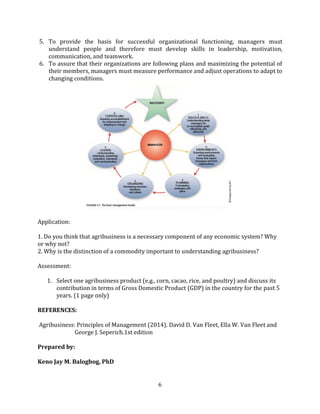
1. In their efforts to accomplish effective and efficient goals, managers must perform a
variety of roles requiring several different skills.
2. Using those skills, managers must develop an understanding of the complex
environments in which they must function and the numerous forces that affect them.
3. Using that understanding, managers must develop strategies and plans to achieve
organizational objectives.
4. Those strategies and plans help to shape the organization—its members, structure, and
culture.
6
5. To provide the basis for successful organizational functioning, managers must
understand people and therefore must develop skills in leadership, motivation,
communication, and teamwork.
6. To assure that their organizations are following plans and maximizing the potential of
their members, managers must measure performance and adjust operations to adapt to
changing conditions.
Application:
1. Do you think that agribusiness is a necessary component of any economic system? Why
or why not?
2. Why is the distinction of a commodity important to understanding agribusiness?
Assessment:
1. Select one agribusiness product (e.g., corn, cacao, rice, and poultry) and discuss its
contribution in terms of Gross Domestic Product (GDP) in the country for the past 5
years. (1 page only)
REFERENCES:
Agribusiness: Principles of Management (2014). David D. Van Fleet, Ella W. Van Fleet and
George J. Seperich.1st edition
Prepared by:
Keno Jay M. Balogbog, PhD

Module 1 Overview on Agribusiness

  • 1.
    1 Module 1 Subject: ABM083: Introduction to Agribusiness Management Chapter Title: Introduction of Management in Agribusiness Lesson Title: Overview on Agribusiness Lesson Objectives: 1. Define and describe agribusiness. 2. Understand the difference between agribusinesses and traditional businesses 3. Identify major components of agribusiness today. 4. Understand the importance of the management model to agribusiness. 5. Appreciate the growing opportunities in agribusiness. Overview/Introduction: Agribusiness as a concept was born in Harvard University in 1957 with the publication of a book “A concept of Agri-business”, written by John David and A. Gold Berg. It was introduced in Philippines in early 1966, when the University of the Philippines offered an Agribusiness Management (ABM) program. In 1969, the first Advanced Agribusiness Management seminar was held in Manila. Activity: 1. Choose 1 agribusiness enterprise existing in the Philippines and discuss what the firm all about in two (2) paragraphs only. Analysis: Answer the following questions based from your 2 paragraphs on your agribusiness choice. 1. What is/are the products/goods offered by the enterprise? 2. Is it similar to other traditional businesses? 3. What do you think are the other possible products they might to produce/sell? Abstraction: Agribusiness as an Opportunity Agribusiness is an industry with tremendous potential for growth and development as well as monumental and consequential issues it must address. The e Chinese symbol that represents both crisis and opportunity could well serve as the logo for agribusiness. For centuries, agricultural productivity came from the application of two resources: land and labor. More recently a substantial proportion of increased productivity in agriculture output in the United States has come from the use of another resource: capital, primarily in the form
  • 2.
    2 of technological changeincluding biotechnology, improved animal husbandry, and improvements in machinery and chemicals. Future improvements will come from the application of a fourth resource: management. Agribusiness is an industry that is becoming chronically short of smart, clever, and concerned individuals. Thus, individuals who understand the principles of business and the nuances of agribusiness are in greater need than ever before. The industry needs individuals who can harness resources to move a perishable product around the globe to sustain another equally perishable entity on our planet: people. Understanding how to do that is what management is all about. What Is Agribusiness? Agribusiness involves the production, distribution, and consumption of food, clothing, and even shelter. It includes all economic activity in the food and fiber system, which encompasses the input supply industries, agricultural production, and post-harvest, value- added activities such as commodity processing, food manufacturing, and food distribution. Today, a half-century later, agribusiness firms ranging from large multinational corporations to emerging food manufacturing and input supply firms present a strong demand for more and better employees trained in both management and agricultural sciences. Students who have mastered economic and business concepts along with agricultural sciences do extremely well in finding rewarding careers following graduation. It is this labor demand and the resulting career opportunities that led to the writing of the book that you are now reading. Through one of its subsets—agriculture— agribusiness is older than business. For centuries the two entities, agribusiness and agriculture, were considered separate; only in the mid-twentieth century were their commonalities uncovered. Despite its uniqueness, the agribusiness industry uses standard business terms for many of its transactions. This use is a reflection of a very different heritage. The Core Industries Knowing the origin of the term agribusiness is helpful but does not explain what an agribusiness is. We assume that everyone knows what “business” is, yet many students are surprised by the length of the term’s definition in any good standard collegiate dictionary. Agribusiness involves; (1) Inputs — seeds, fertilizer, financing, equipment—that are used in production; (2) Intermediate activities — grading, storage, processing, packaging, distribution, pricing, marketing; and (3) Final consumption activities — restaurants, groceries. The input supply industries, production agriculture, and value added activities are considered the agribusiness core industries. Similarly, these core industries use the material and services of certain ancillary industries which are considered agribusiness support industries Farming and ranching are part of the core of agribusiness, representing its production process stage. So, while they are part of agribusiness, they are not the end; in fact, they are not even the beginning.
  • 3.
    3 The Chain ofAgribusiness The Value Chain. The linkages between the agribusiness industry activities are frequently referred to as the chain of agribusiness. This chain can be further refined as the agribusiness value chain. It begins with raw materials and commodities of relatively low value; then each step in the chain modifies the material or commodity and adds value to the product derived from its step. For example, growers harvest raw fruits or vegetables that are transported in bulk to processors or wholesalers, where they are modified or repackaged and transported to grocery chains in processed form or in smaller batches, and finally to local grocers who display and sell the products in quantities more suitable for consumers to purchase. It should be noted also that both food and non-food products are involved, and the distinction between them is not always clear. Cotton may seem like a non-food product, it is also considered a food product as it can be used in the manufacture of some human foods and in cottonseed oil used for cooking. Similarly, corn for human consumption is a food, but corn grown for livestock consumption is regarded as a non-food product. Another way of looking at the term agribusiness is much simpler. Agribusiness involves all the value chain activities usually associated with a business or industry with the additional provision that most of the materials, commodities, and end products are perishable. The perishable nature of a product, along with variability in such factors as color, texture, size, and shape, is the distinguishing characteristic of agribusiness products and industries from other businesses. Differences between Agribusiness and Business In the earlier section on the development of the agribusiness industry, we began a discussion of the differences that exist between agribusinesses and traditional businesses. Now we will discuss other significant differences between these two entities aside from the perishable nature of the agribusiness product. 1. Family Orientation or Intent Almost all agribusiness ventures begin as family endeavors—an orientation that not all of today’s traditional businesses have. While many traditional businesses in the early and mid- twentieth century had a family orientation, this is no longer the case. Indeed, many website- based companies or application-oriented companies were developed by lone individuals to demonstrate the feasibility of the business concept, seek out investors, sell the company, and move on to other entrepreneurial ventures. But there is little intent to keep the business in the family. Individuals with this approach to business development have even acquired a label, serial entrepreneurs. There is nothing wrong with this approach: it is one of the great engines of economic growth. But it does define a difference between agribusiness and traditional business. 2. Initially Tied to Location or Commodity Another distinction of agribusinesses involves a unique tie-in: its initial competitive advantage was tied to a location and/or a commodity. Agribusiness firms are generally tied to location and expand their expertise in a commodity or are tied to the commodity and seek their locations internationally.
  • 4.
    4 3. Needs RiskMitigation The location/commodity orientation of an agribusiness creates another distinguishing characteristic: risk management. Risk management is an approach to control uncertainties and potential dangers by assessing what those are, then developing strategies and tactics to reduce them.22 All companies regardless of orientation consider risk management or perhaps more correctly, risk-mitigation, an essential operational concern. The entire “hedge” industry had its origin in the late nineteenth century as a service to agribusiness operations. A business tied to a particular commodity or location was highly susceptible to the vicissitudes of weather and other natural calamities. An agribusiness such as Coca-Cola, Inc. may “hedge” the price of corn because of its need for high-fructose corn syrup as an essential ingredient in syrup production 4. Produces Ingestible or Wearable Products Agribusiness firms generally produce products that are personal. You may like the car you drive, maybe even love it; you may enjoy the laptop computer you use (though it has become a commodity, also) and you may treasure your entertainment system, but these products rarely get as personal as agribusiness products. Agribusiness products are personal because you literally consume them or wear them. You may enjoy the taste of wine or beer or distilled spirit, but in this enjoyment you are consuming it and it becomes part of you. So it is with Birdseye frozen foods, Kellogg’s ready-to-eat cereals, Hershey’s chocolates, and others. Nothing is more personal than ingesting a product. Agribusiness consumption is very personal. 5. Produces Highly Perishable Products As mentioned earlier, the perishability of materials, commodities, and products is a characteristic of many agribusiness products and industries that distinguish agribusiness from other businesses. To make a profit, Summer Farms, for instance, must use or sell its products before they become unusable or unfit to sell. This aspect of the agribusiness industry is a key factor in all business decisions. Of course, all products have life cycles, but agribusiness products by their nature are far more perishable and variable in size and quality. Agribusiness Today Agribusiness has been changed greatly. It has evolved into an industry that encompasses the globe. It is responsible for feeding and clothing the population of this planet. Today, agribusiness touches on health, nutrition, safety, science, and politics. 1. Connection to Agriculture The agricultural connection within agribusiness remains evident. Oddly, there are fewer individuals involved in production. It is an industry that still retains tremendous potential. It is an industry that must be able to feed the population of this planet as it grows and ages. 2. Connection to the Sciences At the same time, agribusiness has broadened its connection to the sciences. Originally it was chemistry and biology; today it is biotechnology and nanotechnology. Large agribusinesses
  • 5.
    5 involved in thepre-production sector (e.g., Monsanto) have become leaders in biotechnological advancements. 3. Connection to Financial Structures Agribusiness also has become an industry involved with the development and evolution of business financial structures. 4. Subject to Political Considerations Agribusiness today is a global industry with a national anchor that is often affected by political forces. Though our planet has witnessed remarkable progress, national food security remains a significant issue. Perhaps more than money or access to money, the issue of food security most clearly demarcates the “haves” from the “have-nots.” It has long been the goal of this industry to diminish the gap between those who have access to adequate nutritional resources and those who do not. However, the problem that plagues the industry is that this imbalanced access is rarely a scientific, engineering, or financial issue as much as it is a political issue. 5. Characterized as Economic Paradox Similarly, agribusiness is an industry involved in a paradox. While many economically advanced countries (e.g., the United States and the United Kingdom) have a large and productive agribusiness industry; they possess also a very efficient production sector operated by a declining percentage of individuals. The reverse is true also, as there remain countries with a small agribusiness component and an extremely large but very inefficient production sector. The latter are countries that use a significant portion of their economic resources simply for securing an adequate food supply (e.g., Rwanda and Nepal). If the purpose of writing and studying history is to provide lessons for the benefit of others, it is a purpose that still needs explanation in this sector. 6. Close Ties to Natural Resources Agribusiness is an industry that remains tied to natural resources. The most important of these resources is water—fresh water. Certainly, Earth is a beautiful blue marble when viewed from space, but most of that “blue” is salt water. The amount of available fresh water is finite. Again, like many issues water lends itself to separating populations into “haves” and “have-nots.” Access to clean and plentiful freshwater is the hallmark of agribusiness and a personal necessity, yet it still remains an unfulfilled need for a fourth of the world’s population. Technical solutions abound, but political considerations preclude application. The Basic Management Model 1. In their efforts to accomplish effective and efficient goals, managers must perform a variety of roles requiring several different skills. 2. Using those skills, managers must develop an understanding of the complex environments in which they must function and the numerous forces that affect them. 3. Using that understanding, managers must develop strategies and plans to achieve organizational objectives. 4. Those strategies and plans help to shape the organization—its members, structure, and culture.
  • 6.
    6 5. To providethe basis for successful organizational functioning, managers must understand people and therefore must develop skills in leadership, motivation, communication, and teamwork. 6. To assure that their organizations are following plans and maximizing the potential of their members, managers must measure performance and adjust operations to adapt to changing conditions. Application: 1. Do you think that agribusiness is a necessary component of any economic system? Why or why not? 2. Why is the distinction of a commodity important to understanding agribusiness? Assessment: 1. Select one agribusiness product (e.g., corn, cacao, rice, and poultry) and discuss its contribution in terms of Gross Domestic Product (GDP) in the country for the past 5 years. (1 page only) REFERENCES: Agribusiness: Principles of Management (2014). David D. Van Fleet, Ella W. Van Fleet and George J. Seperich.1st edition Prepared by: Keno Jay M. Balogbog, PhD