Chapter Objectives:
• Defineagribusiness.
• Discuss the different misconceptions of
agribusiness
• Explain Agribusiness as a system.
• Give examples of participants in each
subsystem.
HISTORY OF AGRIBUSINESS
AGRIBUSINESS- as a concept was born in Harvard
University in 1957 with a book “Conception of
Agribusiness” by J. Davis and R. Goldberg
Philippines- 1966 UP offered Agribusiness program in
undergrad level
1969- 4 leading institutions (Asian Institutte of
Management, Ateneo de Manila University, De La
Salle College and University of the Philippines)
spsonsored the First Advanced Agribusiness Mgt.
Seminar in Manila
8.
MISCONCPETIONS/ FRAGMENTED VIEWSOF AGRIBUSINESS
1. Agricultural Production/ Farming
2. Big Business
3. Purely Private Undertaking
I.What is agribusiness?
It encompasses all activities from the paddock to the
consumer that contribute to the eventual production,
processing (value-addition), distribution, and retailing
of food, fiber, and products based on food or fiber.
sum total of all operations involve in the manufacture
and distribution of farm supplies production activities
in the farm storage, processing and distribution of
farm commodities and items made from them
11.
AGRIBUSINESS SECTOR –all
of agriculture + portion of
industrial sector + portion of
commercial sector
2. PRODUCTION SUBSYSTEM-all
farmers who produce products for
direct consumption or intermediate
products for processing
15.
3. PROCESSING SUSYSTEM-both
primary and final processors who
transforms and or store products of
the production subsystem
16.
4. MARKETING SUBSYSTEM-
marketers,assemblers, wholesalers,
retailers, exporters, importers of
both raw and processed products
directly linked to final consumers
AGRIBUSINESS
“sunshine sector”program presented
by the Phil. Government to the WB
Consultative Group of Creditor- calls
for strategy to maximize exports and
minimize imports through
diversification and promotion of
commercial export crops.
20.
FEATURES OF AGRIBUSINESS
1.Multi-faceted point of view
2. Successful decision making
3. Viability of the industry is traceable to
viability of firms that form part of the
industry
4. Market-oriented
21.
WHY AGRIBUSINESS PROGRAMS/PROJECTS FAIL
MASAGANA 99- low payment,
unprofitable pricing schemes, production
oriented
Very low prices at harvest/selling time
No market for the produce
No buyers
Untimely release of loan
22.
Considerations in AgribusinessDecisions
What business should the enterprise engage in?
How should it be formed? Should it be a corporation,
partnership or single proprietorship?
Where should it be located?
How should the land be?
Should the land be rented or owned?
How much starting capital should be raised?
How about the factors of production such as labor and
entrepreneurship? Should the labor be contractual or
regularly hired?
23.
What andhow big is the market for the produce
and how are the products be marketed and where?
What is the recovery period of the capital?
Is diversification necessary?
What government regulations and policies govern
the enterprise and the individual venturing in this
field?
Nature of successfulagribusiness
1. Clean objectives
2. Planning
3. Sound organization
4. Research
26.
5. Finance
6. ProperPlant location, layout and
size
7. Efficient management
8. Harmonious relations with the
workers
27.
The Concept ofEconomics to Agribusiness
Scarcity
Resources
Wants vs. Needs
Three Basic economic Questions
Economic System
28.
The Agribusiness Economy
The Agribusiness Input Sector – provides production
agriculturist with feeds, seeds, fertilizer, credit, machinery,
fuel, chemicals, etc.
The Agribusiness Output Sector – includes individuals that
handle agricultural products from the farm to the
consumers (buying, transporting, storing, warehousing,
grading, sorting, processing, assembling, packing,selling,
etc)
Processing and Manufacturing Sector - meat processing
industry, dairy processing, baking industry, canned, cured and
frozen foods industry, cotton/textile industry
29.
OTHER FACTS
USAgriculture- largest (private sector) employer in
US
US Agriculture- 1800’s- 50% of US workforce in
ag. Prod.
1990’s- 3% of US workforce in ag. Prod.
30.
INPUT SECTOR
Farmproductivity- risen 50% since
1967
Due in large part to improved seed,
feed, fertilizer chemicals and
equipment
Farmers purchase 70-80% of the
inputs they used
31.
FEEDS
Grain- corn,wheat, barley, etc.
Complete feeds- 14% dairy or hog
Concentrates/ supplements- 38%
dairy or 45% beef
Premixes- vitamin/ mineral mixes
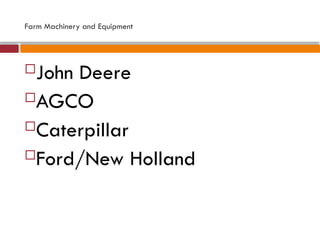
Farm Machinery andEquipment
John Deere
AGCO
Caterpillar
Ford/New Holland
38.
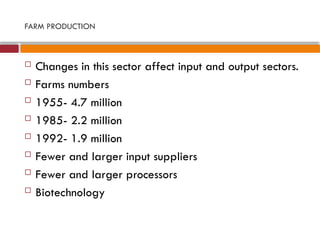
FARM PRODUCTION
Changesin this sector affect input and output sectors.
Farms numbers
1955- 4.7 million
1985- 2.2 million
1992- 1.9 million
Fewer and larger input suppliers
Fewer and larger processors
Biotechnology
39.
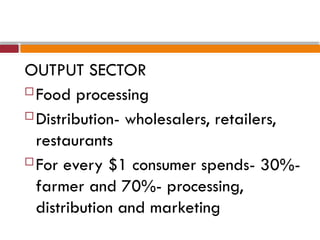
OUTPUT SECTOR
Foodprocessing
Distribution- wholesalers, retailers,
restaurants
For every $1 consumer spends- 30%-
farmer and 70%- processing,
distribution and marketing
SUMMARY
If you eat.....you are involved in
agribusiness!!!
Agribusiness is quite diverse—
spans numerous industries
Future: rise in population, rise in
demand for food
43.
AGRICULTURAL INPUT INDUSTRIES
•The ability to apply new technology has
been shown by industries that make up the
agricultural input
• Agricultural input industries sell feeds,
seeds, equipment, chemicals and many other
inputs
• Machine and chemicals have replaced
labor on the farm
44.
FARM EQUIPMENT INDUSTRIES
Tasks like sowing, tilling and reaping were
performed by farmer and family
JOHN DEERE-steel plow used to plow tough sod
CYRUS MCCORMICK- mechanical grain reaper
World War I- US began the process of replacing
their horse drawn equipment with gasoline powered
tractors
45.
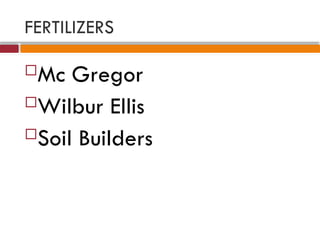
SEEDS AND FERTILIZERINDUSTRIES
• Most farms were self-sufficient
• 1930’s- hybrid or special seeds
were first made
• World War II- tremendous
increase in the demand for nitrogen
for explosives
46.
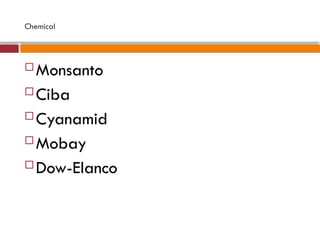
AGRICULTURAL CHEMICAL INDUSTRY
Geigy Chemical Co. discovered
insecticidal properties of Dichlorodiphenyl
tricloroetahne (DDT) – kill insects
2,4 Dichlorophenoxyaceticns acid
(2,4 D)- kill broadleaf weeds but did not
kill grasses- used in 1950’s and 1960’s
47.
PESTICIDE INDUSTRY
firmsthat produce chemicals used for the control of organisms
or living things that are considered pests- insecticides,
herbicides fungicides
3 MAJOR GROUPS OF THE INDUSTRY
1. MANUFACTURERS- few large chemical, petroleum and
drug comapny
2. DISTRIBUTORS- take an ownership position in pesticides,
warehouse the products, distributes them to the retailers and
provide the dealers with training and technical assistance
3. RETAILERS- sell products to farmers, warehousing, product
distribution, technical advice and extend credit
48.
SEED INDUSTRY
• Seedcompany first sold their
product through a local farm supply
stores
• DEKALB- farmer-dealer
representative to sell to other farmers
49.
PRODUCTION AGRICULTURE
•Includes also fishermen and forester
• Farmers and ranchers
• Agribusiness products suffered excess supply,
fierce competition and low market price
50.
PROBLEMS OF FARMERS
1.Money receive from marketing
their crops and livestock
2. Comparison of farm income
and non-farm income
3. Unstable farm commodities
prices
51.
DIFFERENT MARKETING ALTERNATIVES
1.Sell in cash market at harvest
time
2. Store at harvest and sell later
3. Contract growing scheme
4. Market grain as livestock feeds
5. Sell to the government
52.
COMMODITY AND FOODPROCESSING AND FOOD MANUFACTURING
INDUSTRIES
Commodity processing and food
manufacturing industries came into
being as a result of changes in
technology
53.
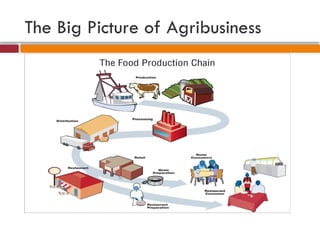
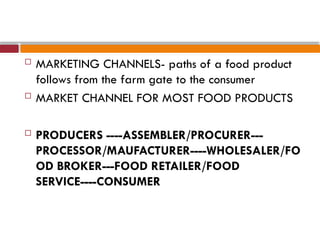
MARKETING CHANNELS-paths of a food product
follows from the farm gate to the consumer
MARKET CHANNEL FOR MOST FOOD PRODUCTS
PRODUCERS ----ASSEMBLER/PROCURER---
PROCESSOR/MAUFACTURER----WHOLESALER/FO
OD BROKER---FOOD RETAILER/FOOD
SERVICE----CONSUMER
54.
ASSEMBLERS—assemble manysmaller sized
amounts or lots of commodities produced by
individual farmers into large sized amounts needed
by processors—buying livestock and crops by
contract
PROCESSORS—first one to alter the form of the
raw agricultural commodity
55.
FOOD MANUFACTURERS—continuethe job started by
processor by further processing crop and livestock
products- raise the level of preservation, convenience and
quality
FOOD WHOLESALERS—buy large quanitities of food
products for delivery to their warehouse, break to smaller
units for shipment to individual food retailers of food
serviceestablishment
• Take title to their products and resell them to customers
56.
FOOD BROKERS—usedas link between
manufacturer/processors and retailers of some products- sales
representative
- Paid on commission, no tiltle to the products they sell
- Perform activities such as helping in promotional
campaigns, introducing new products and collecting out of date
or damaged products
FOOD RETAILERS/ FOOD SERVICE OPERATORS- includes
grocery stores as well as hotel, restaurants and trade institution
57.
EXPECTED OUTPUT 1
LISTOF SPECIFIC PARTICIPANTS/FIRMS/ENTITY IN
EACH AGRIBUSINESS SUBSYSTEM
INPUT SUBSYSTEM
PRODUCTION SUBSYSTEM
PROCESSING SUBSYSTEM
MARKETING SUBSYSTEM
SUPPORT SUBSYSTEM