Aging

Revised Edition
Aging
Modern Theories and Therapies
              Revised Edition


         Joseph pANNo, ph.D.
AGING: Modern Theories and Therapies, Revised Edition

Copyright © 2011, 2005 by Joseph Panno, Ph.D.

All rights reserved. No part of this book may be reproduced or utilized in any form
or by any means, electronic or mechanical, including photocopying, recording, or by
any information storage or retrieval systems, without permission in writing from the
publisher. For information contact:

Facts On File, Inc.
An imprint of Infobase Publishing
132 West 31st Street
New York NY 10001

Library of Congress Cataloging-in-Publication Data

Panno, Joseph.
  Aging: modern theories and therapies / Joseph Panno.—Rev. ed.
     p. cm.—(The new biology)
  Includes bibliographical references and index.
  ISBN 978-0-8160-6846-3 (hardcover)
  ISBN 978-1-4381-3364-5 (e-book)
  1. Aging. 2. Longevity. I. Title.
  QP86.P33 2001
  612.6'7—dc22                       2009047717

Facts On File books are available at special discounts when purchased in bulk
quantities for businesses, associations, institutions, or sales promotions. Please call
our Special Sales Department in New York at (212) 967-8800 or (800) 322-8755.

You can find Facts On File on the World Wide Web at http://www.factsonfile.com

Excerpts included herewith have been reprinted by permission of the copyright holders;
the author has made every effort to contact copyright holders. The publishers will be
glad to rectify, in future editions, any errors or omissions brought to their notice.

Text design by Erik Lindstrom
Composition by Hermitage Publishing Services
Illustrations by the author
Photo research by Diane K. French
Cover printed by Bang Printing, Brainerd, Minn.
Book printed and bound by Bang Printing, Brainerd, Minn.
Date printed: October 2010
Printed in the United States of America

10 9 8 7 6 5 4 3 2 1

This book is printed on acid-free paper.
Contents


Preface                                           ix
Acknowledgments                                  xiii
Introduction                                     xiv

     1  The Quest for Immortality                  1
        One Hour Upon the Stage                    6
        Growing Younger                           12
        The Road Ahead                            13

     2  The History of Gerontology               14
        The Early Years                          15
        DNA Structure Inspires New Theories      17
        Biotechnology Revolutionizes the Field   20
        The Post-Genomic Era                     26

     3  Aging Characteristics                    29
        Classical Aging                          30
        Modern Aging                             30
        Aging Mosaics                            34

     4  Aging Theories                           36
        Error Catastrophe Theory                 36
        Genes and Programmed Aging               38
        Telomeres                                39
Rate-of-Living Theory                41
    Free Radicals                        42
    Neuroendocrine Theory                43
    Concluding Remarks                   53

  5  Longevity Genes                     55
     Yeast                               56
     Nematode                            60
     Fruit Fly                           61
     Mouse                               64
     Human                               65
     Summary                             66

  6  Age-Related Diseases                68
     Alzheimer’s Disease                 68
     Arthritis                           82
     Cancer                              85
     Cardiovascular Disease              92
     Diabetes                            98
     Osteoporosis                       100

  7  Geriatrics                         108
     Our Aging Society                   109
     Evaluating the Geriatric Patient    110
     Managing Age-Related Disorders      112
     Drug Therapy                        115
     Nursing Homes                       116
     Ethical Issues                      117

  8  Rejuvenation                       120
     Turning Back the Clock             122
     DNA Microarray Analysis            123
     Nuclear Transfer Technology        125
     Cell Fusion Technology             128
Stem Cell Analysis              128
        Gene Therapy                    131
        The Final Package               132

      9  Clinical Trials                134
         Alzheimer’s Disease             135
         Cardiovascular Disease          139
         Hormone Replacement Therapy     142
         Nutrition and Lifestyle         145
         Osteoporosis                    148
         Parkinson’s Disease             149

    10  Resource Center                 151
        Cell Biology                    151
        Biotechnology                    174
        Gene Therapy                    182
        The Human Genome Project        187
        Understanding Clinical Trials   190
        Gene and Protein Nomenclature   192
        Weights and Measures            193

Glossary                                194
Further Resources                       223
Index                                   236
Preface
W      hen the first edition of this set was being written, the new
       biology was just beginning to come into its potential and to
experience some of its first failures. Dolly the sheep was alive and
well and had just celebrated her fifth birthday. Stem cell researchers,
working 12-hour days, were giddy with the prospect of curing every
disease known to humankind, but were frustrated by inconsistent
results and the limited availability of human embryonic stem cells.
Gene therapists, still reeling from the disastrous Gelsinger trial of
1998, were busy trying to figure out what had gone wrong and how
to improve the safety of a procedure that many believed would revo-
lutionize medical science. And cancer researchers, while experienc-
ing many successes, hit their own speed bump when a major survey
showed only modest improvements in the prognosis for all of the
deadliest cancers.


                                  ix
  AGING

         During the 1970s, when the new biology was born, recombinant
     technology served to reenergize the sagging discipline that biol-
     ogy had become. This same level of excitement reappeared in the
     1990s with the emergence of gene therapy, the cloning of Dolly the
     sheep, and the successful cultivation of stem cells. Recently, great
     excitement has come with the completion of the human genome
     project and the genome sequencing of more than 100 animal and
     plant species. Careful analysis of these genomes has spawned a new
     branch of biological research known as comparative genomics. The
     information that scientists can now extract from animal genomes is
     expected to improve all other branches of biological science. Not to
     be outdone, stem cell researchers have found a way to produce em-
     bryo-like stem cells from ordinary skin cells. This achievement not
     only marks the end of the great stem cell debate, but it also provides
     an immensely powerful procedure, known as cellular dedifferentia-
     tion, for studying and manipulating the very essence of a cell. This
     procedure will become a crucial weapon in the fight against cancer
     and many other diseases.
         The new biology, like our expanding universe, has been growing
     and spreading at an astonishing rate. The amount of information
     that is now available on these topics is of astronomical proportions.
     Thus, the problem of deciding what to leave out has become as dif-
     ficult as the decision of what to include. The guiding principle in
     writing this set has always been to provide a thorough overview
     of the topics without overwhelming the reader with a mountain
     of facts and figures. To be sure, this set contains many facts and
     figures, but these have been carefully chosen to illustrate only the
     essential principles.
         This edition, in keeping with the expansion of the biological
     disciplines, has grown to accommodate new material and new areas
     of research. Four new books have been added that focus on areas of
     biological research that are reaping the benefits of genome science
     and modern research technologies. Thus, the New Biology set now
     consists of the following 10 volumes:
Preface    i

     1. Aging, Revised Edition
     2. Animal Cloning, Revised Edition
     3. Cancer, Revised Edition
     4. The Cell, Revised Edition
     5. Gene Therapy, Revised Edition
     6. Stem Cell Research, Revised Edition
     7. Genome Research
     8. The Immune System
     9. Modern Medicine
    10. Viruses

    Many new chapters have been added to each of the original six
volumes, and the remaining chapters have been extensively revised
and updated. The number of figures and photos in each book has
increased significantly, and all are now rendered in full color. The
new volumes, following the same format as the originals, greatly
expand the scope of the New Biology set and serve to emphasize the
fact that these technologies are not just about finding cures for dis-
eases but are helping scientists understand a wide range of biologi-
cal processes. Even a partial list of these revelations is impressive:
detailed information on every gene and every protein that is needed
to build a human being; eventual identification of all cancer genes,
stem cell–specific genes, and longevity genes; mapping of safe chro-
mosomal insertion sites for gene therapy; and the identification of
genes that control the growth of the human brain, the development
of speech, and the maintenance of mental stability. In a stunning
achievement, genome researchers have been able to trace the exact
route our human ancestors used to emigrate from Africa nearly
65,000 years ago and even to estimate the number of individuals
who made up the original group.
    In addition to the accelerating pace of discovery, the new biol-
ogy has made great strides in resolving past mistakes and failures.
The Gelsinger trial was a dismal failure that killed a young man in
ii  AGING

      the prime of his life, but gene therapy trials in the next 10 years will
      be astonishing, both for their success and for their safety. For the
      past 50 years, cancer researchers have been caught in a desperate
      struggle as they tried to control the growth and spread of deadly
      tumors, but many scientists are now confident that cancer will be
      eliminated by 2020. Viruses, such as HIV or the flu, are resourceful
      and often deadly adversaries, but genome researchers are about to
      put the fight on more rational grounds as detailed information is
      obtained about viral genes, viral life cycles, and viruses’ uncanny
      ability to evade or cripple the human immune system.
          These struggles and more are covered in this edition of the New
      Biology set. I hope the discourse will serve to illustrate both the
      power of science and the near superhuman effort that has gone into
      the creation and validation of these technologies.
Acknowledgments
I  would first like to thank the legions of science graduate students
   and postdoctoral fellows who have made the new biology a prac-
tical reality. They are the unsung heroes of this discipline. The clar-
ity and accuracy of the initial manuscript for this book was much
improved by reviews and comments from Diana Dowsley, Michael
Panno, Rebecca Lapres, and later by Frank K. Darmstadt, executive
editor, and the rest of the Facts On File staff. I am also indebted
to Diane K. French and Elizabeth Oakes for their help in securing
photographs for the New Biology set. Finally, as always, I would
like to thank my wife and daughter for keeping the ship on an even
keel.


                                 xiii
Introduction
    I wasted time, and now doth time waste me.
                                       —William Shakespeare


I t is a fact of life that with the slow progression of time we all lose
  the health and vigor we enjoyed as children and young adults.
Statisticians, in a long version of Shakespeare’s eloquent statement,
sum it up by saying our chance of dying on any given day increases
the older we get. Biologists call this the aging process or, more spe-
cifically, cellular senescence.
     Aging is a common phenomenon, but it is not universal. It does
not occur among prokaryotes, protozoans, and simple multicellular
creatures such as sponges and corals. Indeed, if we think of pro-
karyotes or protozoans as being a single lineage, it is a life-form that
has been alive for 3 billion years (sponges can, in theory, live a very
long time, but because of predation few survive beyond 100 years).

                                  xiv
Introduction    v

There are those who think a human life span of 85 years is long
enough, but compared to 3 billion years it truly is the short end of
the stick. There are, to be sure, many animals that have a shorter life
span than we do: A horse has an average of 20 years, a dog is lucky
to see 15 summers, and the common housefly is born and dead of
old age in 30 days. On the other hand, some animals, such as the
Galápagos tortoise and the sturgeon, live for more than 200 years.
     On a cosmic scale, however, the difference in life span between
a housefly and a sturgeon is of no consequence. Moreover, the com-
parison begs the question of why we age in the first place. After
all, we have a reasonably good immune system; we heal well after
being hurt; we have a group of enzymes that monitor and repair our
DNA; and, as long as we eat well, our cells have plenty of energy to
take care of themselves from day to day. Yet, despite all that, we get
old with monotonous regularity. There appears to be neither rhyme
nor reason to it. Some scientists think aging is due to evolutionary
neglect: Natural selection was so busy finding ways to make us suc-
cessful in the short term that it forgot to cover us in our old age. It
is almost as though Mother Nature is saying, “I will do what I can
to get you up to your reproductive years, so you can have offspring,
but after that you are on your own.”
     Being on our own has meant that our bodies begin to break
down soon after our peak reproductive years have past. The elderly
cannot run as far, think as fast, or fight off infectious diseases nearly
as well as they did when they were young. Moreover, one’s physi-
cal appearance changes dramatically with age: The hair turns gray,
muscle mass declines, the ears get bigger, and the skin becomes
thin and wrinkled. On a deeper level, men and women approach-
ing their 80s converge on a common phenotype; men become more
feminine, and women become more masculine. In men this trend
becomes apparent as the shoulders get narrower, the hips broader,
the beard thinner, and the voice develops a higher pitch. In women
the shoulders become broader, the voice huskier, and hair begins
vi  AGING

     to grow on the chin and upper lip. Gerontologists (scientists who
     study gerontology, or the mechanisms involved in the aging pro-
     cess), in noting these changes, have pondered one of the most dif-
     ficult questions pertaining to the aging process: Is aging caused by
     the degenerative changes in a single organ, which then acts like an
     aging-clock for the rest of the body, or are all organs breaking down
     simultaneously?
          Answering this question has proven to be extremely difficult.
     Researchers have studied age-related changes in virtually all tis-
     sues, organs, and organ systems of the body (the endocrine system,
     consisting of many hormone-producing glands, is an example of
     an organ system). Some evidence suggest that the brain may be an
     aging-clock that determines the rate at which the whole body ages,
     but the results of many other studies suggest that the rate at which
     an animal ages may be the sum of age-related changes occurring
     simultaneously in all parts of the body.
          Consequently, the attempts to understand the aging process,
     involving such a complex system, have generated a great number
     of theories but few practical therapies. Traditional therapies are
     available that treat age-related diseases such as cancer and arthritis,
     but do not reverse the aging process itself. A common trend in ger-
     ontology, particularly since the completion of the human genome
     project, is to search for genes that have a demonstrable effect on
     life span, the so-called longevity genes. Many such genes have been
     identified, and although the manipulation of these genes does not
     stop the aging process, they are providing many valuable insights
     into the cellular mechanisms of aging. More recently interest has
     turned to the use of cloning technology, stem cell analysis, and
     genetic manipulation in order to produce an effective rejuvenation
     therapy for cells and the body as a whole.
          Aging, Revised Edition, one volume in the multivolume the New
     Biology set, describes the field of gerontology and the many theo-
     ries that scientists have developed over the years to explain the age-
Introduction    vii

related changes that occur in nearly all animals. This edition, now
with color photographs and line drawings, has been extensively
revised and expanded.
    Three new chapters (3, 8, and 9) have been added. Chapter 3 dis-
cusses the way in which humans age, and how the aging process has
changed over the past thousand years. Chapter 8 discusses the theo-
retical aspects of rejuvenation: how it could be accomplished and
what the consequences will be. Rejuvenation is usually discussed in
very general terms, but this chapter gives a detailed account of how
current technologies could be used to produce an effective rejuvena-
tion therapy. More practical therapies, based on clinical trials, are
discussed in chapter 9. This chapter describes some exciting studies
that may provide effective treatments for Alzheimer’s disease, car-
diovascular disease, and osteoporosis. The final chapter, as before,
provides background material on cell biology, biotechnology, and
other topics that are relevant to gerontology. The cell biology and
biotechnology primers presented in this chapter have been revised
and condensed in the hope that the reader will be able to obtain the
necessary background information as quickly as possible.
1
                 The Quest
              for Immortality
C    oncerns about human mortality date back at least 20,000 years
     when Cro-Magnons, the first Homo sapiens, prepared one of
their own for burial. Evidence for the existence of these people and
their burial practices was discovered simultaneously at Les Eyzies,
France, in 1868 (Les Eyzies is a village located in the Dordognes
region of southwest France). One day some hikers were exploring a
rock shelter, or cave, just south of the village when they came across
a number of flint tools and weapons. Archaeologists called to the
scene uncovered what was clearly a burial site containing at least
four individuals: a middle-aged man, two younger men, a young
woman and an infant two to three weeks old. They were buried with
flint tools, weapons, and seashells and animal teeth pierced with
holes. The teeth and seashells were probably part of necklaces and
bracelets that the adults wore, but the strings holding them together
had long since disintegrated. The artifacts were about 20,000 years
  AGING

     old, and scientists have since determined that people inhabited the
     site for at least 25,000 years. That rock shelter was known to the Les
     Eyzies villagers as Cro-Magnon. It was named after a local hermit
     named Magnou who had lived there for many years. The name of
     that cave is now synonymous with the name of our earliest human
     ancestors.
          Cro-Magnon funerals are taken as evidence by anthropologists
     that those people thought about life and death the same way that
     modern humans do. This is suggested by their habit of adorning the
     corpse with prized possessions, possibly thinking they would be of


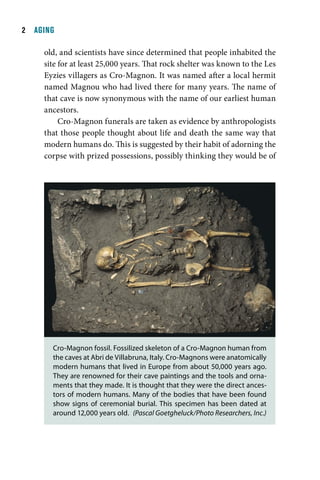
       Cro-Magnon fossil. Fossilized skeleton of a Cro-Magnon human from
       the caves at Abri de Villabruna, Italy. Cro-Magnons were anatomically
       modern humans that lived in Europe from about 50,000 years ago.
       They are renowned for their cave paintings and the tools and orna-
       ments that they made. It is thought that they were the direct ances-
       tors of modern humans. Many of the bodies that have been found
       show signs of ceremonial burial. This specimen has been dated at
       around 12,000 years old. (Pascal Goetgheluck/Photo Researchers, Inc.)
The Quest for Immortality    

use in a spiritual afterlife. In grieving for their lost loved ones, Cro-
Magnons were drawn to a quest for immortality, but one that dealt
with the soul rather than the body.
    Distant relatives of the Cro-Magnons, living 4,000 years ago in
Egypt, carried on the same tradition, but on a colossal scale. Egyp-
tian pharaohs were buried with all of their worldly possessions
and even a little food to see them on their way. Karnak, a village
on the Nile River at the northern extremity of Luxor, is the site of
the greatest assembly of ancient temples in Egypt. They occupy an
area of about 120 acres and are extremely old. By far the largest
and most important is the temple of Amun (Amon-Re) that was
built more than 4,000 years ago. Amun, called king of the gods, was
the supreme state god in the New Kingdom (1570 to 1085 b.c.e.).
During this period the Egyptians were ruled by such famous kings
as Amenhotep, Ramses, and Tutankhamun. The tombs of these
kings and the famous Egyptian queen Nefertari, wife of Ramses
II, were decorated with scenes carved in relief depicting religious
ceremonies and historical events. Hieroglyphic inscriptions usually
accompanied these scenes. Egyptian tombs also contained many
prized possessions, such as a beautiful sculpture of Nefertari and a
gold funeral mask of King Tutankhamun. Indeed, 3,500 items were
recovered from King Tut’s tomb, including 143 precious jewels and
amulets. Interestingly, Tut’s tomb is generally considered to be of
modest size and wealth. Ramses and Amenhotep had much grander
tombs, but most of the artifacts were pillaged by grave robbers long
before the archeologists found them.
    Although some of the objects placed within the tombs were
simply favored possessions, many of them were intended to help
the deceased in the afterlife. King Tut’s funeral mask, for example,
was carved in his likeness so that the gods would recognize him
after he was dead. Many of the inscriptions on the walls and on pa-
pyrus scrolls were a collection of magic spells intended to help the
deceased survive the afterlife. A large number of hymns praising
  AGING


       Gold death mask of King Tutankhamun. Egyptian Museum: Cairo,
       Egypt (Brian Brake/Photo Researchers, Inc.)


     various gods were also included for the same purpose. This collec-
     tion of spells and hymns has come to be known as The Book of the
     Dead. According to the mythology of the ancient Egyptians, the
     dead, if recognized and accepted, could pass to the spirit world of
The Quest for Immortality    

the Sun god, Amun-Re, and his sister, Amunet, where they would
live for eternity. The practice of burying the dead with all of their
belongings disappeared down through the millennia, but many
people still believe in the eternal life of chosen spirits.
     With the rise of science, and the appearance of powerful
medical therapies, the quest for immortality has shifted from the
spiritual to the physical. The accomplishments of Louis Pasteur
and other microbiologists at the turn of the last century, and the
explosive growth in biological research since then have provided
cures for many terrible diseases: diphtheria, polio, and smallpox,
to name but a few. These triumphs have given us reason to hope
that someday scientists will be able to reverse the effects of age. If
protozoans can live millions of years, why not the human body? But
so far, all attempts at physical rejuvenation have failed. Many such
attempts date back to the turn of the early 1900s and involved the
use of concoctions, potions, and even radioactive cocktails, often
with disastrous results. One such concoction, popular in the 1920s,
was Tho-Radia, a skin cream containing thorium and radium, two
radioisotopes discovered by the great French physicist Marie Cu-
rie. The radioactive material was supposed to have an anti-aging
effect on the skin, but their use was abandoned when Curie and
other scientists working with radioisotopes began having serious
medical problems. Madame Curie developed cataracts, kidney
failure, and a fatal leukemia, all from overexposure to radioactive
materials.
     More recently a new wave of anti-aging therapies have been de-
veloped, employing everything from a shift in lifestyle to specific
hormone supplements. Anti-aging creams are still with us, only
now the active ingredient is retinoic acid (vitamin A), instead of
radium. Whether any of these treatments will be successful is in
doubt, but the failures so far are like the first tentative steps of a
toddler. Scientists are only beginning to understand the tremen-
dous complexities of the cell and the way an organism changes with
  AGING

     time. As the science matures, it may be possible to reverse some
     affects of age, but whether this leads to physical immortality is a
     hotly debated topic.

     One HOur upOn tHe Stage
     When William Shakespeare’s Macbeth compared the human
     life span to one hour on the stage, he was being very generous. If
     humankind’s life span were indeed 1/24 of the 3 billion years that
     microbes have been alive, humans would live 125 million years. As
     it is, humankind’s life span, on a 24-hour timescale, is but a wink
     of an eye.
          Life spans vary considerably among the animal kingdom. In
     general, tiny animals bearing many offspring have short life spans,
     while large animals bearing few offspring live much longer. The
     fruit fly, Drosophila melanogaster, is an example of a small animal
     with a short life span. Drosophila has a maximum life span of 40
     days, but most of them are dead in two weeks. These animals are
     called holometabolous insects because the eggs hatch into worm-
     like larvae that feed for a time before pupating, during which time
     the larvae metamorphose into the adult form. The newly emerged
     males and females waste no time in producing the next generation.
     The females mate within 24 hours, and throughout their short lives,
     produce tens of thousands of offspring. In a survival strategy such
     as this, all of the biological adaptations have focused on preserva-
     tion of the species at the expense of the individual. Flies have many
     predators, and adaptations that could lengthen their life span would
     be useless since the flies would be eaten long before their biological
     time was up.
          Elephants, on the other hand, are large animals with few
     predators, and they produce a single offspring every five years.
     Elephants are mammals and, like all mammals, spend a great deal
     of time rearing and caring for their young. In this case adapta-
     tions to increase the life span make a lot of sense. With reduced
The Quest for Immortality    


                                    Scanning electron micrograph
                                    (SEM) of the fruit fly (Drosophila
                                    melanogaster). This little insect
                                    is about 3mm long, is com-
                                    monly found around spoiled
                                    fruit, and is an example of a
                                    very short-lived animal. It is
                                    also much studied by gerontol-
                                    ogists and geneticists around
                                    the world. Mutant flies, with
                                    defects in any of several thou-
                                    sand genes are available, and
                                    the entire genome has been
                                    sequenced. (David M. Phillips/
                                    Photo Researchers, Inc.)


pressure from predators, the young can afford a leisurely devel-
opmental period, during which time the adults teach them how
best to deal with their environment. The longer the adults live, the
more they learn, and the more they can pass on to their offspring.
Consequently, these animals have a relatively long life span of 75
to 100 years, similar to that of humans. In general, long-lived ani-
mals tend to be rather intelligent, but there are some exceptions,
the most notable of which are the sturgeon and the Galápagos
tortoise.
    The sturgeon is an extremely ancient fish that has existed for
more than 200,000 years, predating the rise of the dinosaurs dur-
ing the Jurassic period. Twenty species have been identified, all of
which live in the oceans, seas, and rivers of North America, Europe,
and Asia; none are found in the Tropics or the Southern Hemi-
sphere. Sturgeons often grow to a length of 30 feet and weigh a ton
or more. The adults can take up to 20 years to mature, after which
the females spawn every four to six years. Sturgeon eggs, called
caviar, are considered to be a great delicacy in many parts of the
  AGING


       African elephants (Loxodonta africana) in the Amboseli National Park,
       Kenya. These large intelligent animals have a maximum life span of
       about 100 years, very similar to that of humans. (Martin Harvey/Photo
       Researchers, Inc.)


     world, a fact that has led to the near extinction of several species
     in North America and Europe. The Caspian Sea beluga sturgeon,
     for example, lost 90 percent of its population in just 20 years, due
     entirely to overfishing for the caviar. The situation has become so
     serious that in 2006 the United Nations instituted an international
     trading ban on sturgeon caviar for the entire year. The ban was
     lifted in 2007, but the beluga sturgeon is still in danger of going
     extinct in the wild.
          The sturgeon is possibly the longest-lived animal, sometimes
     reaching 200 years or more, and yet they are no more intelligent
     than any other fish. Moreover, sturgeons like most fish, have thou-
     sands of offspring each year and spend no time taking care of them.
     The sturgeon’s strategy for longevity is simply to keep growing. They
The Quest for Immortality    

have hit upon a rule of nature that states that happy cells are dividing
cells. As long as a sturgeon keeps growing, its longevity is regulated
by external forces, such as accidents and predators, not by cellular
senescence. Being a poikilotherm (cold-blooded animal) reinforces
the sturgeon’s continuous-growth strategy since it minimizes the
growth rate and activity level of the animal. Continuous growth is
a strategy that also explains the longevity of certain plants, such as
the California redwood or the oak tree, which can live a thousand
years or more.
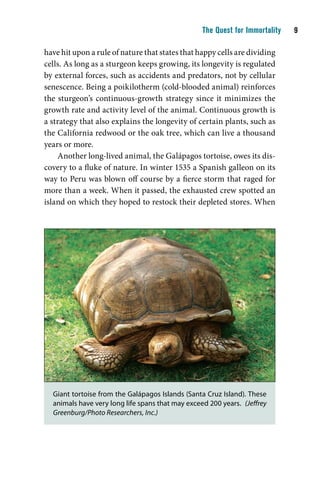
    Another long-lived animal, the Galápagos tortoise, owes its dis-
covery to a fluke of nature. In winter 1535 a Spanish galleon on its
way to Peru was blown off course by a fierce storm that raged for
more than a week. When it passed, the exhausted crew spotted an
island on which they hoped to restock their depleted stores. When


  Giant tortoise from the Galápagos Islands (Santa Cruz Island). These
  animals have very long life spans that may exceed 200 years. (Jeffrey
  Greenburg/Photo Researchers, Inc.)
10  AGING

     they reached shore, they discovered many strange animals, the most
     remarkable of which was an enormous land tortoise. So impressed
     were they with this animal that they decided to name the island
     Galápagos (Spanish for tortoise). Subsequent surveys by the Spanish
     and the English showed that Galápagos Island was part of an archi-
     pelago (island chain) located 600 miles (965.6 km) west of Ecua-
     dor, off the coast of South America. The Galápagos Islands figured
     prominently in the travels of Charles Darwin on the HMS Beagle
     (1826 to 1830) and the development of his theory of evolution.
          The Galápagos tortoise, as observed by the Spanish sailors, is in-
     deed a very large animal; it grows to a length of five feet (1.5 m) and
     can weigh more than 500 pounds (226.9 kg). The adults reach sexual
     maturity when they are 20 to 25 years old and can live for 250 years.
     These animals grow very slowly, so that even at two years of age they
     are still no larger than a baseball. At this rate it takes them more
     than 40 years to reach an adult size. They are not highly intelligent
     animals, at least not as mammals understand intelligence; nor do
     they spend any time taking care of their young. Indeed, the adults
     never see their young. The female lays a dozen spherical eggs in the
     sand, covers them over, and the rest is left to Mother Nature and a
     bit of luck. When the young hatch, they dig their way to the surface,
     a feat that can take a month to accomplish, and make straight for
     the water, which is usually 10 to 20 yards (9.1 to 18.2 m) away. The
     dash for the water is made through a predator gauntlet, and many of
     the young tortoises are caught by seagulls along the way. Those that
     make it to the water are preyed upon by fish in the sea, and the few
     that survive to adulthood return to the beaches of their birth, where
     they live out the rest of their lives. The tortoise, unlike the sturgeon,
     reaches a standard adult size, so that most of the cells in the adult’s
     body stop dividing, as occurs in mammals. The unusual longevity
     of this animal is believed to be due to its very low growth rate and,
     as it is a poikilotherm like the sturgeon, to its low metabolic rate
     and activity level.
The Quest for Immortality    11


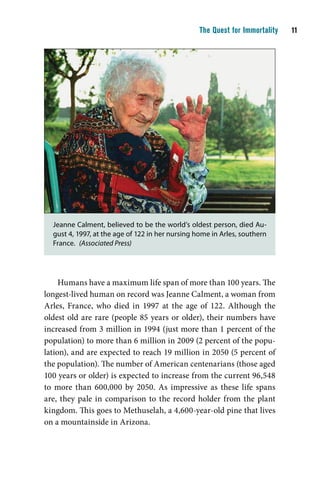
  Jeanne Calment, believed to be the world’s oldest person, died Au-
  gust 4, 1997, at the age of 122 in her nursing home in Arles, southern
  France. (Associated Press)


     Humans have a maximum life span of more than 100 years. The
longest-lived human on record was Jeanne Calment, a woman from
Arles, France, who died in 1997 at the age of 122. Although the
oldest old are rare (people 85 years or older), their numbers have
increased from 3 million in 1994 (just more than 1 percent of the
population) to more than 6 million in 2009 (2 percent of the popu-
lation), and are expected to reach 19 million in 2050 (5 percent of
the population). The number of American centenarians (those aged
100 years or older) is expected to increase from the current 96,548
to more than 600,000 by 2050. As impressive as these life spans
are, they pale in comparison to the record holder from the plant
kingdom. This goes to Methuselah, a 4,600-year-old pine that lives
on a mountainside in Arizona.
1  AGING


       A sculpture of an elderly couple in their 80s showing the general ef-
       fects of age and the age-related convergence of physical characteris-
       tics described in the introduction. (the author)


     grOwing YOunger
     Many gerontologists have claimed that it is impossible for humans
     to grow younger because it would be too difficult to rejuvenate all
     the cells and organs of the body. Such claims need to be taken with
     a large grain of salt; it should be remembered that just five years be-
     fore the first sheep was cloned, most scientists thought that cloning
     a mammal was biologically impossible. In addition, what scientists
     have learned about animal cloning and stem cells since 1996 sug-
     gests that it may indeed be possible to produce a therapy that will
     allow an individual to grow younger.
         Growing younger, at the cellular level, is analogous to the re-
     programming of a cloned cell nucleus: Both are a matter of convert-
     ing a cell from an aged phenotype (the physical expression of an
     organism’s genes) to a youthful phenotype. In a sense the cloning
The Quest for Immortality    1

of a cell nucleus is the most successful attempt at rejuvenation that
has yet been accomplished. In a cloning experiment the cytoplasm
of the recipient oocyte converts the donor nucleus from an aged
phenotype to one that is capable of supporting full embryonic de-
velopment. At the organismic level this is equivalent to converting
an adult to an embryo. If it can be done in one cell, it could be
done in many. And if all the nuclei in an old person’s body could be
reprogrammed to a youthful phenotype, it would lead to the com-
plete rejuvenation of all the cells in the body. If that happened, the
individual would grow younger. This possibility will be discussed
in chapter 8.

tHe rOad aHead
In 1900 life expectancy for the average North American was only 45
years. This has increased to the current expectancy of 80 years pri-
marily because of a dramatic reduction in infant mortality, cures for
various diseases, better hygiene, and better living conditions. This in-
crease occurred despite the enormous number of deaths per year from
cigarette smoking. A further increase of 20 to 30 years is expected if
cures are found for cancer and cardiovascular disease. Beyond that,
advances in life expectancy will have to wait for an improvement in
our understanding of the basic mechanisms of cellular senescence.
    Developing therapies that will reverse the aging process, allow-
ing individuals to grow younger, is theoretically possible, but the
realization of that goal will likely turn out to be the most difficult
challenge that biologists have ever faced. The development of aging
therapies will require a fusion of animal cloning, gene therapy, and
stem cell technologies. But even these technologies, as powerful as
they are, will not be enough. Gaining a deep understanding of the
basic mechanisms of aging will require detailed information about
every gene in our bodies and about what those genes are doing as
humans grow old. This information is only now being made avail-
able, but over the next 10 years researchers expect to see real gains
being made in the field of gerontology.
2
                The History
               of Gerontology
G     erontology is a branch of the biological sciences devoted to
      the study of the aging process and its effects on cells and or-
ganisms. Philosophers and scientists have been interested in this
subject for thousands of years, but this history will be confined to
the modern era, extending back no further than the late 1800s. The
history of gerontology, like many other branches of biological re-
search, may be divided into four epochs. The first, covering the early
years, began around 1870, with the invention of the compound mi-
croscope and ended in the 1950s. The second epoch began with the
discovery of the DNA double helix in 1952 and extended to the early
1970s. The third epoch began with the introduction of recombinant
DNA technology in 1973, ending in the early 1990s. The current
epoch, known as the post-genomic era, began with the formation
of a genome-sequencing consortium in 1990 and continues to the
present day.

                                 4
The History of Gerontology    1

    Gerontological research has always been driven by the same
questions: Why do people grow old? Why do they change with
time? Can the effects of age be reversed? Gerontologists have tried
to answer these questions using a variety of techniques, but with
the approach of the third and fourth epochs, the questions became
more numerous, more specific, and much more complex.

tHe earlY YearS
In 1868 the German physicist Ernst Abbe perfected the design of
the compound microscope and in so doing made it possible for
scientists to study the structure and function of individual cells in
a way that was never before possible. While many microbiologists
of the time concentrated on studying the link between disease and
microbes, many others began studying the life cycle of bacteria and
protozoa in the hope that it would shed some light on the aging pro-
cess. These studies were descriptive in nature; that is, the researcher
observed the behavior of the cells and recorded it without subject-
ing the system to experimental procedures that would modulate the
rate of the aging process.
    During this period scientists realized that senescence is not
universal; it occurs in multicellular creatures only. Bacteria and
protozoans do not grow old and die, but rejuvenate themselves ev-
ery hour or so by dividing into two new cells. A lifestyle such as
this can hardly serve as a model system for gerontological research.
Consequently, scientists all but abandoned the use of these cells to
gain insights into the cellular mechanisms of the aging process (see
the error catastrophe theory below for two exceptions).
    In 1882 August Weismann, a German embryologist, proposed
the first theory of senescence that tried to link life span to natural
selection. Weismann argued that the termination of life may have
a selective advantage, and that there is a connection between a spe-
cies’ life span and its ecological niche, body size, and intelligence.
During this same period German chemists were developing the first
biochemical techniques that allowed Hans Krebs to work out the
1  AGING

     cyclic details of energy metabolism that now bear his name (Krebs
     cycle, also known as the citric acid cycle). The new biochemical
     techniques were used by chemists to begin cataloging the many
     molecules of the cell, and by the time the citric acid cycle had been
     worked out in 1937, DNA had been identified and localized to the
     cell nucleus. During the last three decades of the 1800s, European
     scientists, most notably Anton Schneider, Paul Ehrlich, Santiago
     Ramón y Cajal, and Camillo Golgi, were developing special dyes
     and procedures that could be used to stain cells in order to better
     study the nucleus, cell division, and cytoplasmic organelles, giving
     birth to histochemistry and histology.
          Thus it was that light microscopy, biochemistry, histochemistry,
     and histology became the basic tool kit for gerontologists during the
     early years of scientific research in this field. Scientists at that time
     believed they had all the techniques that were needed to fully un-
     derstand the structure and the function of cells and animals. They
     were only partly right. The techniques of that day made it possible
     for scientists to gain a basic understanding of cell structure and, to
     some extent, how that structure changes with time, but they learned
     very little about the functional significance of those changes or how
     their knowledge could be used to form a physiological theory of the
     aging process. Much of this was due to the limited resolution of the
     techniques available at the time. Camillo Golgi, the Italian microbi-
     ologist, had discovered an unusual cellular structure that now bears
     his name (the Golgi apparatus), but no one had a clue as to the func-
     tional significance of this organelle nor were they able to explore
     the question with the methods at hand. Elie Metchnikoff, winner of
     the 1908 Nobel Prize for physiology or medicine for his work on the
     human immune system, attempted to form a physiological theory
     of the aging process by suggesting that lactic-acid bacteria (such as
     Bacillus acidophilus) in the digestive tract could prolong life by pre-
     venting putrefaction (decay). He noted that Bulgarian villagers, who
     eat large quantities of curded milk and yogurt, were known for their
The History of Gerontology    1

longevity. Other scientists of the time believed the secret of long life
depended on hormones and, in particular, claimed that an extract
of dog endocrine glands could reverse the signs of age. Studies such
as these make it clear that the early gerontologists had only vague
notions about the mechanisms of cellular senescence.
    Metchnikoff’s theory and the interest in hormone extracts was
part of a tendency among scientists of the era to believe in magic
potions that could cure many maladies at once or even reverse all
signs of the aging process. This is an ancient idea that can be found
in the medical practices of Egyptian physicians 4,000 years ago, and
the witchcraft of the Middle Ages. The ancient Egyptians had magi-
cal spells and potions that were reputed to be powerful rejuvena-
tors. Ancient Chinese physicians had a similar potion in the form
of a broth produced from the ginseng root. The favorite elixir of
the Middle Ages was the philosopher’s stone, popularized by J. K.
Rowling in the Harry Potter book series. The “stone” was a mineral,
or mineral concoction, of mythical powers that was discovered by
Nicholas Flamel, a French alchemist who lived in the 14th century.
Flamel and his followers claimed that in addition to transmuting
mercury and silver to gold, the philosopher’s stone could also re-
verse the aging process. Potions and elixirs of this kind have never
been authenticated, but the allure of a quick fix is always tempting,
even to scientists.

dna Structure inSpireS new tHeOrieS
On April 25, 1953, James Watson and Francis Crick published a
classic paper on DNA in the journal Nature: “A Structure for De-
oxyribose Nuclei Acid” not only proposed a structural model for
the DNA molecule but also showed how DNA could store a genetic
code, specifying a unique protein, and how that code could be du-
plicated, in a process now known as DNA replication. Watson and
Crick were also the first to propose the existence of a molecular in-
termediary (messenger RNA) between DNA and protein synthesis,
1  AGING


       The discoverers of the structure of DNA. James Watson (b. 1928) at
       left and Francis Crick (1916–2004), seen with their model of part of
       a DNA molecule in 1953. Crick and Watson met at the Cavendish
       Laboratory, Cambridge, in 1951. Their work on the structure of DNA
       was performed with a knowledge of Chargaff’s ratios of the bases in
       DNA and some access to the X-ray crystallography of Maurice Wilkins
       and Rosalind Franklin at King’s College London. Combining all of this
       work led to the deduction that DNA exists as a double helix, thus to
       its structure. Crick, Watson, and Wilkins shared the 1962 Nobel Prize
       in physiology or medicine, Franklin having died of cancer in 1958. (A.
       Barrington Brown/Photo Researchers, Inc.)


     and special adaptor molecules (transfer RNA) that were part of the
     protein synthesis machinery. By 1966, using synthetic messenger
     RNAs, other scientists had worked out the complete genetic code
     thereby establishing the one-gene-one-protein hypothesis and
The History of Gerontology    1

describing the functional relationships between replication, tran-
scription, and translation.
     Gerontologists of the second epoch quickly realized that the
genetic code and the events of protein synthesis gave them, for the
first time, testable theories of the aging process. The first, proposed
by Denham Harman in 1956, was the free radical theory, and the
second, proposed by Leslie Orgel in 1963, was the error catastrophe
theory. Both of these theories (discussed in chapter 4) suggest that
aging is due to errors in biosynthesis, due either to free radicals or to
inherent error frequencies associated with transcription and transla-
tion. In either case, according to the theories, the result is a buildup of
dysfunctional proteins that damage normal cellular functions, thus
reducing cell viability with time. The error catastrophe theory was
first tested on bacteria, experimental organisms introduced to ger-
ontology during the early years. To further test this theory and the
free radical theory, gerontologists of the second epoch began using
baker’s yeast (Saccharomyces cerevisiae), the housefly (Musca domes-
tica), the fruit fly (Drosophila melanogaster), the rat, and the mouse
(mus musculus). Experiments on all of these organisms, though of-
fering some support for the free radical theory, failed to substantiate
the original formulation of the error catastrophe theory.
     Many investigators, however, realized that even though in-
duced errors in protein synthesis had no effect on the rate of ag-
ing, other errors, involving replication or the repair of the DNA
molecule, could still be an important, if not primary, cause of the
aging process. Testing the revised catastrophe theory required
detailed information about the gene, but at the time there was no
way to sequence DNA or to infer the sequence of messenger RNA.
Throughout the 1960s physicists were busy perfecting the electron
microscope, which offered unparalleled resolution of cellular organ-
elles and tissue ultrastructure. Consequently, many gerontologists
turned their attention to refining the structural and biochemical
analysis of age-related changes that was begun by scientists of the
first epoch. These studies, carried out on the housefly, Drosophila,
0  AGING

     and mouse, introduced methods for modulating the life span of
     the organism. The life span of houseflies, for example, was tripled
     when they were reared in tiny cages that minimized flight activity.
     Caloric restriction was also introduced, which could extend the life
     span of a mouse by 30 to 40 percent. Finally, with extensive genetic
     data available for Drosophila, many researchers conducted studies
     on long-lived or short-lived mutants in an attempt to correlate their
     life span with changes at the cellular or biochemical level. Although
     the research in the second epoch used more powerful techniques
     than were available during the first epoch, the results were still
     largely descriptive in nature and generally fell far short of achieving
     a deeper understanding of the aging process.

     BiOtecHnOlOgY revOlutiOnizeS tHe Field
     In 1973 Paul Berg, a professor of biochemistry at Stanford Univer-
     sity, produced the first recombinant DNA molecule, consisting of a
     piece of mammalian DNA joined to a bacterial plasmid (a bacterial
     mini-chromosome). Bacteria have a natural tendency to take up
     plasmids from the medium they are growing in; once they do, the
     plasmid DNA, with any insert it may contain, is replicated along
     with the bacterial chromosome each time the cell divides. This pro-
     liferation of a segment of DNA is called amplification.
          To amplify a mammalian gene, bacteria are coaxed to take up a
     recombinant plasmid in a small test tube containing a special me-
     dium, after which they are transferred to a large flask containing
     nutrient broth and allowed to grow for 24 hours. By the end of the
     culturing period, the amount of cloned insert has increased more
     than a million fold. In 1977 Fred Sanger, a professor at Cambridge
     University, and Walter Gilbert, a professor at Harvard, developed
     methods for sequencing DNA. The production of recombinant
     clones, combined with the new sequencing technology, made it pos-
     sible to isolate any gene and to produce enough of it for sequencing
     and expression studies (see chapter 10 for more information).
The History of Gerontology    1

    Expression studies observe the transcription of a gene to
produce messenger RNA (mRNA), and the resulting translation
of mRNA into protein. Because most mRNA is automatically
translated into protein, conducting an expression study involves
determining the amount of mRNA being produced by a specific
gene. The information gained by doing so is extremely important
because all cellular processes are ultimately controlled by the dif-
ferential expression of various genes. Some genes in some cells al-
ways stay off, whereas some are always on (constitutive expression),
and some turn on or off, as conditions demand (regulative expres-
sion). One theory of aging suggests that the aging process is caused
by subtle disruptions in the normal control of gene expression.
At first gerontologists tried to test this assumption by examining
the protein products of translation with protein electrophoresis,
a technology introduced in the 1960s and refined in 1977. In this
procedure proteins are isolated from the tissue of interest and then
separated on a small gel slab subjected to an electric field (see Gel
Electrophoresis in chapter 10). After separation the gel is stained,
dried, and photographed. Proteins of different sizes appear as blue
bands in the photograph.
    But protein electrophoresis can detect only a few hundred pro-
teins; a typical cell is capable of producing thousands of different
proteins. Despite its limitations, many studies were conducted with
this procedure throughout the 1980s on wild-type (normal) or mu-
tant Drosophila. The hope was that electrophoresis would show that
old animals were completely missing a protein present in young an-
imals or that a new protein would appear in old animals that might
be responsible for the age-related changes. But no such results were
ever obtained, at least not on a consistent basis. The studies failed
to show a consistent change in any of the proteins that could be
visualized with this technique. The animals were clearly aging, but
they seemed to be making the same proteins when they were old as
when they were young.
  AGING


       Protein electrophoresis. In this procedure, proteins are extracted
       from cells of interest and then fractionated by electrophoresis on a
       polyacrylamide gel. After the gel is stained, or exposed to X-ray film,
       the proteins appear as bands. In the example shown, approximately
       30 different proteins (bands) have been identified. Lanes 1 to 3 are
       proteins extracted from housefly flight muscle at one, four, and eight
       days of age. Lanes 4 and 5 are size markers, which decrease in size
       from top to bottom. In a different form of this procedure, called two-
       dimensional protein electrophoresis, the proteins appear as spots
       over the face of the gel. Two-dimensional protein gels have a higher
       resolution and can detect about 1,000 different proteins, but this is
       still much less than the more than 20,000 proteins a typical animal
       cell can produce. (the author)
The History of Gerontology    

     To address the question of whether the absence or presence of a
given protein influenced aging, scientists abandoned protein elec-
trophoresis in favor of recombinant technology. With this technol-
ogy it is possible to study the mRNA expression of every gene in the
cell. Consequently, gerontologists of the third epoch conducted a
large number of expression studies involving genes coding for glo-
bin, actin, liver enzymes, microtubules, apolipoprotein (a protein
that carries lipids in the blood), brain- and kidney-specific proteins,
and several oncogenes. In most cases, the choice of which gene to
study was an equal mix of educated guess and common practicality.
If an investigator had a hunch that a particular liver enzyme was
responsible for some aspect of cellular aging, the expression of the
gene could be studied, but only if it had already been cloned (the
clone, as explained in chapter 10, serves as probe to localize and
quantify the mRNA). Since no one at the time had a clear idea of
which genes were responsible for the aging process, virtually any
gene for which a probe was available made a good candidate for an
expression study.
     It was during this epoch that Daniel Rudman and his colleagues
at Emory University Hospital in Atlanta, Georgia, demonstrated the
striking age-related decline in the expression of growth hormone
(GH) in humans. Soon after, many other investigators demon-
strated an age-related decline in a number of other hormones, such
as thyroid hormone, dehyroepiandrosterone (DHEA), estrogen,
and insulin-like growth factor (IGF). These studies, conducted on
humans, rats, and mice, all showed a similar trend. Other expres-
sion studies, however, carried out on rat, Drosophila, and housefly
tissues did not produce the striking results that most scientists were
expecting. The expression of some genes was shown to increase with
age while others decreased, but there was no obvious connection to
cellular senescence. Even worse, the expression of some genes was
shown to decrease with age in the rat, but not in Drosophila or the
mouse. Since the aging process should be similar for all animals,
  AGING

     those genes could not be the cause of a universal aging mechanism.
     When all expression studies were taken together, there appeared to
     be a general decline in the rate of gene expression with age, with the
     hormones mentioned above (GH, thyroid hormone, DHEA, estro-
     gen, and IGF) showing the most consistent trend.
         Scientists interested in chromatin structure and the role it plays
     in regulating gene expression adopted a different approach to the
     study of the aging process. Eukaryote chromosomes are a complex
     of DNA and proteins, called histones, that are arranged on the
     DNA like beads on a string. Each bead, consisting of several differ-
     ent kinds of histone, is called a nucleosome. This complex of DNA
     and histones is known as chromatin. The histones are essential
     for packing up the chromosomes in preparation for cell division.
     Phosphorylating the nucleosomes (adding phosphate groups to the
     proteins) is like releasing a stretched rubber band: The chromosome
     contracts to form a compact structure that is 10,000 times shorter
     than the bare piece of DNA. Just as a suitcase makes it possible for
     us to take our clothes on a trip, histones and the chromatin struc-
     ture they produce make it possible for the cell to package its genes
     in preparation for cell division (see Cell Biology in chapter 10 for
     additional information).
         Chromatin compaction, or condensation, is also used during in-
     terphase (the period between cell divisions) to help manage the chro-
     mosomes. It is also one mechanism for controlling gene expression.
     The packing ratio of interphase chromatin (condensed length divided
     by relaxed length) is about 1:1,000 overall, but there are highly con-
     densed regions where it can be as low as 1:10,000. This variation in
     the density of the chromatin accounts for the blotchy appearance that
     most interphase nuclei have. Areas of the nucleus that are very dark
     represent highly compacted chromatin, whereas the lighter regions
     contain chromatin in a more relaxed state. At the molecular level,
     chromatin condensation is an extremely dynamic process that is
     used to close down single genes or whole neighborhoods consisting
The History of Gerontology    


Pattern analysis of cell nuclei. A cell nucleus (A) is processed by a com-
puter to show low- (LDC), medium- (MDC), and high- (HDC) density
chromatin components. (B) Each component is analyzed for quantity
and spatial distribution. This type of analysis was used to characterize
nuclei from young and old houseflies. The computer then selected
images from the data files that best represented young (C) and old
(D) flies. These images show a dramatic decrease in total nuclear area,
an increase in the amount of HDC, a change in the HDC spatial dis-
tribution, and a decrease in the number of MDC clusters. LDC (pale
blue), MDC (blue), HDC (black). (the author)
  AGING

     of hundreds of genes. The mechanism by which this occurs is fairly
     straightforward: Highly condensed chromatin blocks the transcrip-
     tion machinery so it cannot get access to the gene.
         Many gerontologists of the third epoch studied chromatin con-
     densation as a function of age. These studies were either biochemi-
     cal or they relied on computerized histochemistry. The biochemical
     analysis depended on the fact that uncondensed chromatin is easy
     to dissociate (i.e., it is easy to separate the histones from the DNA)
     in certain buffers, whereas highly condensed chromatin is either
     very difficult to dissociate or does not dissociate at all. Studies such
     as these invariably showed that chromatin became more condensed
     with age. Consequently, condensed chromatin was believed to be
     responsible for the age-related reduction in transcriptional activity.
     Computerized histochemical analysis of intact nuclei supported the
     biochemical results and in addition, provided a way to visualize the
     progressive condensation of cell nuclei. Scientists produced a model
     of this event by analyzing the condensation pattern over the surface
     of the nucleus, and then, with the aid of computer algorithms, se-
     lecting nuclei that best represent the young and old groups.
         The third epoch was a productive period for gerontological re-
     search that provided many insights into the mechanisms control-
     ling the aging process. But many scientists came to realize that the
     available DNA sequence data was inadequate. They needed more
     in order to expand the expression profiles for the organisms being
     studied. Indeed, they needed the complete genomic sequence for
     humans and for all organisms for which age-related studies were
     under way.

     tHe pOSt-genOmic era
     An international genome-sequencing consortium was formed
     in 1990 to sequence the human, bacteria, yeast, nematode (Cae-
     norhabditis elegans, or simply C. elegans), Drosophila, and mouse
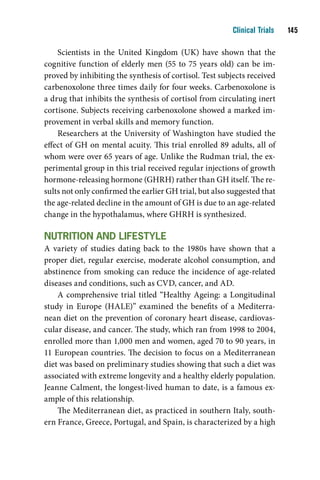
     genomes. This project was initiated by the U.S. Department of En-
The History of Gerontology    

ergy and the National Research Council and is coordinated by the
Human Genome Organization (HUGO). The principal consortium
members include the United States, United Kingdom, France, Ger-
many, Japan, and China. Sequencing of the human genome was
completed in early 2003, and work on the other organisms was
completed in 2008.
     In 1993 the American National Institute of Aging (NIA) started
a program to identify longevity genes in yeast, nematode, Drosophi-
la, and mice. This program provided research funding for scientists
at NIA, as well as other scientists working in university laboratories
around the country. The main interest of this program is single-
gene mutants that may be used to identify genes and physiological
factors that favor longevity in all animal species. These include the
insulinlike signaling pathway, stress resistance, and most recently,
chromosome and nuclear architecture. The ultimate goal is to use
information gathered from lower animals (i.e., invertebrates and
insects) to identify longevity genes in humans.
     In addition to financial support, the NIA program and the
genome-sequencing consortium provided encouragement and fo-
cus to the gerontological community. Research focus came in two
forms. First, by settling on just four research organisms, different
research groups could easily compare results. Gerontology of previ-
ous epochs was carried out to a great extent on houseflies and rats,
neither of which are genetically defined (i.e., mutants have not been
identified or characterized). The four organisms chosen by NIA
are well characterized genetically, and there are many long- and
short-lived mutants available that greatly expedite aging research.
Second, aging research shifted from projects aimed at testing one
of the many theories of the aging process to a narrower, thus more
practical approach involving the search for longevity genes. This
was done by selecting for long-lived individuals or by searching for
naturally occurring short-lived mutants. In some cases exposing
the animals to chemical mutagens generated short-lived mutants.
  AGING

     There is also a great deal of interest in Werner’s syndrome, a human
     disease that is characterized by a greatly accelerated rate of aging.
     Individuals suffering from this disease age so rapidly that they ap-
     pear to be in their 70s or 80s by the time they are 10 years old.
         The great value of the sequencing consortium in the effort to
     identify aging genes lies in the fact that all of the organisms under
     study, including humans, share a common cellular and genetic heri-
     tage. Thus, if a longevity gene is discovered in Drosophila, its homo-
     log (a gene having a similar or identical sequence) can be identified
     in humans simply by searching the human database for a gene that
     matches the Drosophila sequence. Research of this kind (discussed
     in chapter 5) is bringing us closer to identifying the physiological
     processes and molecular mechanisms that are important for lon-
     gevity. Reversal of the aging process and treatment of its clinical
     symptoms will become a practical reality after all of the genes con-
     trolling these processes have been identified and their functions
     clearly defined.
3
       Aging Characteristics
A     ll animals pass through three stages of development: embryo-
      genesis, growth and development, and senescence. The final
stage is commonly recognized as the aging process. That is, it repre-
sents those events that add up to a gradual deterioration of the body
and mind. A major problem associated with the study of senescence
is distinguishing between those traits that are caused by the aging
process and those that are caused by disease and illness. Senility
used to be thought of as a normal part of the aging process, but
scientists now know that it is caused by Alzheimer’s disease and
does not affect a large portion of the aging human population. Hu-
mans become frail with age, but severe frailty is due to the modern,
sedentary lifestyle and not the aging process.
    In the absence of disease, the body still ages, but the extent and
magnitude of the eventual disabilities are greatly reduced. This


                                 29
0  AGING

     gentle form of aging would have been common a thousand years
     ago when humans were more active and had a leaner diet. Many
     scientists refer to this as healthy or successful aging, whereas aging
     that is associated with disease is called normal aging. Unfortunately,
     this convention is confusing since “normal” often implies healthy.
     In the discussion that follows, aging in the absence of disease will
     be referred to as classical aging, and aging that is associated with
     disease will be called modern aging.

     claSSical aging
     Classical aging may be characterized as a gradual reduction in the
     functional capacity of the individual without the onset of severe
     disabilities. People who age in this way remain physically active well
     into their 80s and 90s. One such person was Jeanne Calment, men-
     tioned earlier on page 11, who rode her bike on daily errands until
     she was 100 years old. Such people seem rare now, but they repre-
     sent the condition of the elderly that was likely common hundreds
     of years ago. This is obscured by the fact that the mean human life
     span during the Middle Ages was only about 30 years as compared
     to the current average of more than 70 years. This difference implies
     that people aged more rapidly during the Middle Ages than they do
     now, but this is not the case. The short human life span during that
     period was due primarily to infectious diseases, which killed young
     and old alike and had nothing to do with the rate at which those
     people aged.

     mOdern aging
     The modern lifestyle, characterized by lack of exercise, smoking,
     and the consumption of high-fat foods, has seriously distorted the
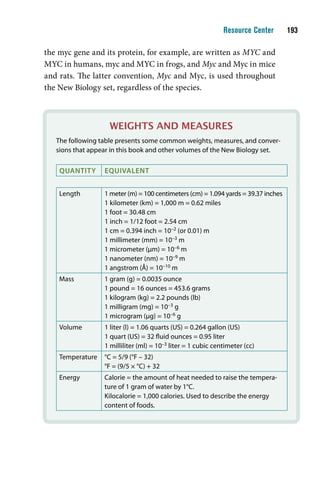
     way humans age. Individuals who age by the classical route remain
     hearty well into their 80s and 90s, whereas those who take the
     modern route are frail and racked with multiple disorders by the
     time they reach their 70th year. The difference between these two
     modes of aging is profound. Jeanne Calment, who typifies classical
Aging Characteristics    1

aging, lived 47 years beyond the typical North American life span
of 75 years.
     Critics point out that while Calment lived 122 years, many others
who apparently followed the classical route did not. This discrepancy
is due to a genetic component that modulates the aging process; long-
lived individuals often come from long-lived families. But the full ex-
tent of gene penetrance, or the influence of an individual’s genes, has
yet to be determined. Are genes responsible for long-lived families, or
are such families long-lived because they have a long cultural tradi-
tion of eating healthy foods and of getting regular exercise?
     In 1987, to clarify the interpretation of aging rates, NIA launched
the Biomarkers of Aging Project to identify biological signs, or bio-
markers, in human subjects that best characterize the classical aging
process. Biomarkers, which include the performance of the cardiovas-
cular system, blood insulin levels, blood pressure, and several other
factors, provide a way of estimating an individual’s physiological age
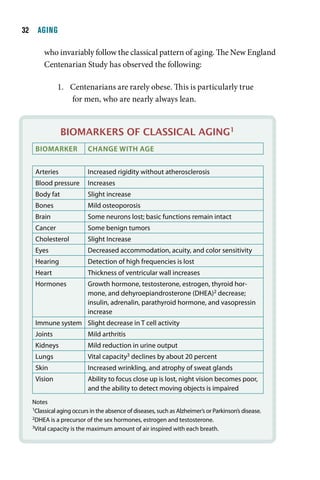
(see the table on page 32). The same biomarkers for modern aging are
shown in the table on page 33. These markers provide a simple way of
distinguishing between classical aging and modern aging. If the bio-
markers indicate a physiological age of 85 years, but the individual’s
chronological age is only 65, then that individual’s rate of aging has
been accelerated and is an example of modern aging. On the other
hand, if the physiological age is less than or equal to the chronologi-
cal, then that individual is aging by the classical route.
     Note that individuals aging by the classical or modern route share
some characteristics: Both may develop osteoporosis, but it is gener-
ally much milder with classical aging. Classical and modern aging
are both associated with a decline in the levels of certain hormones,
but the change in the hormonal environment is believed to be more
extreme with modern aging. When it comes to the skin, vision, and
hearing, the two modes of aging appear to be very similar.
     Some gerontologists, in the hope of further characterizing hu-
man aging, have focused their attention on centenarians, individuals
  AGING

      who invariably follow the classical pattern of aging. The New England
      Centenarian Study has observed the following:

            1. Centenarians are rarely obese. This is particularly true
               for men, who are nearly always lean.


              Biomarkers of ClassiCal aging1
   BIomArker             ChAnGe WIth AGe


   Arteries              Increased rigidity without atherosclerosis
   Blood pressure        Increases
   Body fat              Slight increase
   Bones                 Mild osteoporosis
   Brain                 Some neurons lost; basic functions remain intact
   Cancer                Some benign tumors
   Cholesterol           Slight Increase
   Eyes                  Decreased accommodation, acuity, and color sensitivity
   Hearing               Detection of high frequencies is lost
   Heart                 Thickness of ventricular wall increases
   Hormones              Growth hormone, testosterone, estrogen, thyroid hor-
                         mone, and dehyroepiandrosterone (DHEA)2 decrease;
                         insulin, adrenalin, parathyroid hormone, and vasopressin
                         increase
   Immune system Slight decrease in T cell activity
   Joints                Mild arthritis
   Kidneys               Mild reduction in urine output
   Lungs                 Vital capacity3 declines by about 20 percent
   Skin                  Increased wrinkling, and atrophy of sweat glands
   Vision                Ability to focus close up is lost, night vision becomes poor,
                         and the ability to detect moving objects is impaired
  Notes
  1Classical aging occurs in the absence of diseases, such as Alzheimer’s or Parkinson’s disease.

  2DHEA is a precursor of the sex hormones, estrogen and testosterone.

  3Vital capacity is the maximum amount of air inspired with each breath.
Aging Characteristics    

2. A history of smoking is rare.
3. Centenarians are invariably better able to handle
   stress than the majority of the population.
4. Many centenarians are mentally alert and show no signs
   of senility or the presence of Alzheimer’s disease.


            Biomarkers of modern aging1
 BIomArker           ChAnGe WIth AGe


 Arteries            Increased rigidity with atherosclerosis
 Blood pressure      Large Increase
 Body fat            Large increase
 Bones               Severe osteoporosis
 Brain               Many neurons lost; basic functions may be lost
 Cancer              Benign and malignant tumors
 Cholesterol         Increases greatly
 Eyes                Decreased accommodation, acuity, and color sensitivity
 Hearing             Detection of high frequencies is lost
 Heart               Thickness of ventricular wall increases
 Hormones            Growth hormone, testosterone, estrogen, thyroid hormone,
                     and dehyroepiandrosterone (DHEA)2 decrease; insulin,
                     adrenalin, parathyroid hormone, and vasopressin increase
 Immune system A decrease in T cell activity
 Joints              Severe, crippling arthritis
 Kidneys             Reduction in urine output
 Lungs               Vital capacity3 declines by about 40 percent
 Skin                Increased wrinkling, and atrophy of sweat glands
 Vision              Ability to focus close up is lost, night vision becomes poor,
                     and the ability to detect moving objects is impaired
Notes
1Modern aging is associated with several diseases, such as cancer, Alzheimer’s, or

Parkinson’s disease.
2DHEA is a precursor of the sex hormones, estrogen and testosterone.

3Vital capacity is the maximum amount of air inspired with each breath.
  AGING

         5. Many centenarian women have a history of bearing
            children later in life (ages 35 to 40), suggesting that
            their reproductive system is aging at a lower rate than
            the general population.
         6. Metastatic cancer is relatively rare among this group
            of people.
         7. About 88 percent of centenarians delay or escape the
            development of cardiac disease, stroke, and diabetes.
         8. More than 90 percent of centenarians are functionally
            independent.
         9. Exceptional longevity runs in families.

     aging mOSaicS
     The difference between modern and classical aging suggests that
     the human population is an aging mosaic, consisting of individuals
     that age at different rates. Aging mosaics can also be found at the
     level of the cells and tissues and were implied by the neuroendo-
     crine theory of the aging process, first proposed in the 1970s. This
     theory, described at length in the next chapter, suggests that the rate
     at which an individual ages is governed by the hypothalamus. The
     hypothalamus is assumed to be aging at its own rate, which would
     be higher than other tissues in the body.
         The existence of an aging mosaic, involving cells and tissues, was
     tested experimentally in the 1980s. A computerized histochemical
     analysis of intact nuclei was used to determine the rate at which
     chromatin changes with age in various tissues of the housefly. This
     analysis indicated that certain neurons in the housefly brain (type
     II) were aging at the highest rate, followed by muscle, and Malpighi-
     an tubule (insect kidney). Interestingly, not all of the neurons were
     aging at the type II rate. Most of the neurons examined were aging
     at the more leisurely pace observed in the Malpighian tubule.
         The existence of aging mosaics is extremely important. At the
     population level, long-lived individuals can be compared to their
Aging Characteristics    

short-lived brethren in the hope of identifying the factors that are
responsible for the difference, and at the same time shed some light
on the nature of the aging process itself. A similar strategy may
also be applied at the cellular and tissue levels. Some cells or tissues
may age more rapidly than others simply because the body places a
greater demand on their time; as a consequence, they are forced to
be extremely active and thus burn out more quickly. A common ex-
ample is the human heart, which has to beat nonstop for the life of
the individual. It is not surprising, therefore, that this organ is often
the first to go. A second example is the pancreatic β-cell. These cells
synthesize insulin, which stimulates the uptake of glucose by all of
the cells in the body. This is a very demanding job; so much so, that
β-cells often suffer metabolic burnout, resulting in the age-related
disease known as type II diabetes.
    By studying aging mosaics, gerontologists hope to gain a deeper
insight into the process of cellular and tissue senescence. This infor-
mation will be crucial for the development of therapies designed to
slow or reverse the aging process.
4
               Aging Theories
A    ging theories cover the genetic, biochemical, and physiologi-
     cal properties of a typical organism, as well as the way these
properties change with time. Genetic theories deal with specula-
tions regarding the identity of aging genes, accumulation of errors
in the genetic machinery, programmed senescence, and telomeres.
Biochemical theories are concerned with energy metabolism, gen-
eration of free radicals, the rate of living, and the health of mito-
chondria. Physiological theories deal almost entirely with the en-
docrine system and the role of hormones in regulating the rate of
cellular senescence.

errOr cataStrOpHe tHeOrY
Running a cell is a complex affair. RNA and proteins have to be syn-
thesized on a regular basis to maintain and run the cell’s machinery
(see chapter 10 for more information). Production of proteins, either


                                 36
Aging Theories    

for enzymes or structural materials, occurs in a two-step process:
transcription of the gene to produce mRNA, followed by translation
of the message to produce the protein. For cells that are actively di-
viding, a third step, replication of the DNA, precedes the other two.
Errors can occur all along the way; when they do, defective genes,
mRNA, and proteins are produced. The error catastrophe theory,
first proposed in the 1960s, suggests that over time, the number of
errors build up to a catastrophic level leading to the death of the cell
and, possibly, the entire organism.
     Soon after this theory was proposed, many scientists conducted
experiments that attempted to force a buildup of errors to see how
the cells would cope with it. Bacteria were grown on medium con-
taining defective amino acids to maximize the error frequency of
protein synthesis. Similar experiments were conducted on fruit flies
(Drosophila melanogaster) and mice, both of which were given food
containing defective amino acids. To everyone’s surprise, these ex-
periments had no effect on the bacteria’s or animal’s health, vigor,
or life span. Somehow the cells were able to avoid an error catas-
trophe. Today scientists understand why those experiments failed:
Cells have elaborate repair systems and strategies that detect and
destroy defective molecules. If a defective protein is synthesized, it
is quickly broken down and replaced with a normal copy. Only in
cases where the repair systems have been damaged would an error
catastrophe occur (e.g., Werner’s syndrome).
     In its original formulation, the error catastrophe theory focused
on protein synthesis, which apparently can tolerate a high error fre-
quency. Consequently, many scientists began to wonder if errors in
the genome, or possibly a defective regulation of the genes, might be
responsible for the aging process. After all, cells avoid an error ca-
tastrophe at the translational level because they can always try again
with a fresh mRNA from a good gene. But if the genes themselves are
damaged, or programmed for senescence, the outcome would be a
gradual decline in cell vigor and the eventual death of the organism.
  AGING

     geneS and prOgrammed aging
     Are humans programmed to get old? If so, is it like the program that
     guides our development from a single fertilized egg to a multicellu-
     lar organism? Or is aging the unfortunate side effect of adaptations
     that make it possible for us to have and protect our offspring? Many
     gerontologists believe that aging is a matter of evolutionary neglect,
     rather than design.
          However life spans evolved, it is clear that our genes have the
     final say in how long an individual will be on the stage. Even though
     flies and humans are constructed from the same kinds of cells (eu-
     karyotes), one animal lives two weeks, the other 80 years. If those
     eukaryotes had remained free-living, as their protozoan ancestors
     have done, they would live for millions of years.
          The genes in a multicellular organism appear to be regulating life
     span for the good of the cell community as a whole. The size of the
     community, the animal’s intelligence, the number of offspring, and
     the pressure the animal experiences from its predators, are all taken
     into account. The final life span seems to be a balance of all these
     forces, and given these forces may be the best deal the organism can
     hope for. There would be no point to nature’s producing a fruit fly
     that could live a thousand years since their predators eat them all in a
     matter of days. Scientists might try producing a fly that could live that
     long, but what in the world would an animal with that level of intel-
     ligence do for all that time? This is not just a whimsical point. There
     is a very strong correlation between longevity and the weight of the
     brain: “Smart” animals usually live longer than “dumb” animals.
          The goal of gerontologists is to try to get a better understand-
     ing of the covenant between the genes, the organism, and the en-
     vironment. Whether intended by evolution or not, many genes are
     directly responsible for an animal’s life span. These genes may be
     exerting their effects through inappropriate behavior (that is, they
     are turning on or off at the wrong time) or through a mutation that
     eventually damages the protein product.
Aging Theories    

    Damage at the gene level reinvokes the error catastrophe theory,
but many experiments have failed to establish a role for genetic (or
somatic) mutations in cell senescence. This is because the cell can
detect and repair DNA damage as easily as it deals with errors in
translation, and those repair systems remain intact long after the
animal shows visible signs of age.
    The inappropriate expression of certain genes as a major cause
of aging is only now being addressed in a comprehensive way. With
the sequence of the human genome now at hand, it will soon be pos-
sible to screen for the expression of all human genes, in every tissue
and organ of the body. When this job is complete (and it will be as
big a job as the genome project itself) researchers will finally have
an idea of which genes are responsible for the human life span.

telOmereS
Although scientists have not identified the genes controlling our life
span, there is a genetic element called a telomere that clearly regu-
lates the replicative life span of human cells in culture. A telomere
is a simple DNA sequence that is repeated many times, located at
the tips of each chromosome. Telomeres are not genes, but they are
needed for the proper duplication of the chromosomes in dividing
cells. Each time the chromosomes are duplicated, the telomeres
shrink a bit, until they get so short the DNA replication machinery
can no longer work. This occurs because the enzyme that dupli-
cates the DNA (DNA polymerase) has to have some portion of the
chromosome out ahead of it. Much like a train backing up on a
track, DNA polymerase preserves a safe distance from the end of
the DNA, so it does not slip off the end. Telomeres also provide a
guarantee that genes close to the ends of the chromosomes have
been replicated. DNA polymerase stalls automatically whenever it
gets too close to the end of the chromosome, permanently blocking
the ability of the cell to divide. When this happens, the cell is said
to have reached replicative senescence.
0  AGING


                  Cell


                                                               Nucleus


         Telomere


                               Chromosome


                                                                  Telomere

       © Infobase Publishing


       Telomeres. A telomere is a simple DNA sequence, located at the tips
       of each chromosome, that is repeated many times. Telomeres are not
       genes, but they are needed for the proper duplication of the chromo-
       somes in dividing cells.


         The telomeres in human fibroblasts are long enough to permit
     about 50 rounds of DNA replication. That is, the cell can divide about
     50 times in culture. This is often referred to as the Hayflick limit, after
     Leonard Hayflick, the scientist who was the first to notice that normal
Aging Theories    1

cells cannot divide indefinitely in culture. Cancer cells, on the other
hand, can divide indefinitely, and from them scientists isolated an
enzyme called telomerase that restores the telomeres after each cell
division. If the telomerase gene is added to normal fibroblasts, they
are no longer bound by the Hayflick limit and can divide indefinitely,
like an immortal cancer cell. The transformation of normal fibroblasts
with the telomerase gene was conducted for the first time in 1998 at
the Geron Corporation, a biotechnology company. The results gener-
ated a tremendous amount of excitement, for they seemed to imply
that reversal of replicative senescence would be followed very quickly
by the reversal of the aging process. Scientists at Geron began talking
about human life spans of several hundred years.
     Experiments since have shown, however, that while telomerase
can block replicative senescence in cultured cells, it has little to do
with the life span of the animal as a whole. Indeed, some animals with
long life spans have short telomeres and negligible telomerase activ-
ity, while other animals with short life spans have long telomeres and
active telomerase. This is not surprising if one remembers that most
cells in an animal’s body are post-mitotic; they stop dividing soon
after the individual is born. So the life span of the individual made
from those cells cannot be regulated by the length of the telomeres.

rate-OF-living tHeOrY
This theory takes a pragmatic approach to the regulation of life span.
Simply put, it claims that if you are going to live fast and hard, your
life will be short. The engine in a race car, run at full throttle, is lucky
to last a full day. On the other hand, engines that are driven care-
fully, at modest RPMs, can last for 10 to 20 years and may even log
200,000 miles (321,868 km). Of course, if you buy a new car, park it
in a garage, and rarely drive it, it will last even longer. This theory is
not concerned with the underlying mechanism of aging, but simply
advocates repair or replacement of body parts as they wear out, much
in the way one deals with a broken-down car.
  AGING

          Of course, some body parts, such as our brain and muscles, can-
     not be replaced, and if anything serious happens to them, it would
     likely be fatal. The rate-of-living theory tries to deal with senescence
     by adopting a preventive strategy, involving a reduction in activity
     level and caloric intake. These strategies have been tested in house-
     flies, mice, and rats with some success.
          Houseflies normally live one month in laboratory conditions,
     that is, in a large cage where they are fed and protected from their
     predators. If they are kept in tiny cages, no bigger than a teacup,
     their flight activity is severely restricted, and as a consequence, their
     life span is more than doubled. Caloric restriction has the same ef-
     fect, but is most likely due to the forced reduction in flight activity,
     due to a lack of energy. Raising mice or rats in confined quarters to
     lower their activity level has no effect and may even reduce the life
     span because of the stress that it causes in these animals. Caloric re-
     striction, however, can increase a rat’s life span by 50 to 60 percent.
          Researchers at the University of Wisconsin, led by Drs. Ricki
     Colman and Richard Weindruch, have recently completed a 20-
     year experiment in which rhesus monkeys were raised on a low-
     calorie diet (30 percent fewer calories per day). Compared to a
     control group that received a standard diet, the experimental group
     has shown a dramatic reduction in the incidence of diabetes, heart
     disease, neurological disorders, and cancer. Moreover, the low-
     calorie group looks younger and healthier than the control group,
     with slim physiques and smooth glossy coats. In terms of survival,
     Weindruch estimates that the life span of the experimental group
     will be extended by 10 to 20 percent. This is not as dramatic as the
     results for mice and rats, but it does suggest that a calorie-restricted
     diet could extend the human life span as well.

     Free radicalS
     The role of free radicals is closely related to the rate-of-living theory
     and was originally proposed in the 1950s. Free radicals are mol-
     ecules that have an unpaired electron, which makes them very reac-
Aging Theories    

tive. One of the most important, the oxygen free radical, is a toxic
exhaust produced by mitochondria during the very important met-
abolic process of oxidative phosphorylation. This process produces
the ATP that cells need to survive. The oxygen free radical can re-
move an electron from virtually any molecule in the cell, including
DNA, RNA, proteins, and the lipids in the cell membrane. When it
does so, it triggers a chain reaction of destabilized molecules react-
ing with other molecules to form new free radicals and a variety
of potentially dangerous compounds. Many gerontologists believe
free radicals are directly responsible for cellular senescence and the
aging of the animal as a whole.
     But cells do not give free radicals a free rein. A special enzyme,
called superoxide dismutase (SOD), neutralizes oxygen free radicals
as they are produced. Gerontologists in favor of the free radical the-
ory maintain that SOD does not neutralize all of the free radicals,
and that the damage is done by those that escape. Alternatively, ag-
ing may reduce the efficiency of SOD, such that the amount of free
radicals increases gradually with age. An anti-aging remedy, con-
sisting of a regular diet of antioxidants (chemicals that inactivate
free radicals) such as vitamin E or vitamin C, has been proposed.
Many experiments have been conducted on mice and rats to test
this remedy, but with limited success. The most recent study, con-
ducted in 2008 at the University College London, used the nema-
tode C. elegans to test the free radical theory. The UCL team, led by
Drs. Ryan Doonan and David Gems, genetically modified a group
of nematodes to permanently reduce their levels of free radicals.
According to the theory, the experimental group should have had
a much longer life span than the controls, but the results failed to
show such a difference. The researchers concluded that oxidative
damage is not a major driver of the aging process.

neurOendOcrine tHeOrY
The neuroendocrine system, which consists of several endocrine
glands under the control of the central nervous system, coordinates
  AGING


       The human central nervous system. The human brain consists of the
       cerebrum, the cerebellum, and the brain stem, which is continuous
       with the spinal cord. The brain and spinal cord are called the central
       nervous system (CNS). The pituitary gland, a crucial part of the neu-
       roendocrine system, is connected to the hypothalamus at the base
       of the brain (mid-sagittal section). The hippocampus, located on the
       basal surface of the brain, coordinates memory functions.
Aging Theories    


    Hypothalamus


    Pituitary gland


      Thyroid                                              Immune
       gland                                                system

          Adrenal                                      Mammary
           gland                                        glands


                Uterus                               Testes
                          Liver        Ovaries


© Infobase Publishing


  The human endocrine system is controlled by the hypothalamus,
  which regulates the production and release of various hormones
  from the pituitary gland. The pituitary hormones, in turn, regulate
  other glands, tissues, and organs of the body.
  AGING

     an animal’s physiology. This system consists of a command center
     located in the hypothalamus; a master endocrine gland called the
     pituitary, which is connected directly to the hypothalamus; and a
     variety of secondary endocrine glands located in various parts of
     the body. The hypothalamus controls the pituitary by releasing hor-
     mone messengers that pass directly to the gland, where they stimu-
     late or inhibit the release of pituitary hormones.
          The pituitary gland, also known as the master gland of the ver-
     tebrate body, is located at the base of the brain and is about the size
     of a cashew nut. Despite its small size, this gland is in charge of pro-
     ducing all of the hormones that coordinate the many physiological
     processes occurring in animals and humans. There are 10 different
     kinds of pituitary cells, all constructed of cuboidal epithelium. Each
     cell type specializes in the synthesis and release of a different hor-
     mone, and is named after the hormone it produces. Thus, growth
     hormone-producing cells are known as GH cells or somatotrophs,
     and thyroid hormone-producing cells are known as thyrotrophs.
          The cells that produce hormones that stimulate the gonads (ova-
     ries and testes) to develop are known as gonadotrophs. Other pitu-
     itary cells produce hormones that stimulate the adrenal glands (ad-
     renocorticotrophs) and lactation (lactotrophs). The three remaining
     cell types are involved in the production of oxytocin, vassopressin,
     and melanocyte-stimulating hormone (MSH). Oxytocin is a hor-
     mone that causes milk ejection from the breasts and contraction of
     the uterus during birth. Vassopressin is a hormone that regulates
     salt and water balance by stimulating the kidneys to retain water.
     MSH stimulates melanin synthesis in human melanocytes and is
     very important in lower vertebrates, such as lizards and amphib-
     ians, where its release can stimulate a rapid change in skin color.
     The pituitary hormones, released into the blood, control the activity
     of other glands, such as the adrenal and thyroid glands, as well as
     organs such as the ovaries, testes and liver. All of the hypothalamic
     messengers and the pituitary hormones are small proteins. Overall,
     the system is responsible for regulating reproductive cycles, growth,
Aging Theories    


Hormone-producing cell (Somatotrope). Colored transmission elec-
tron micrograph of a growth hormone-producing cell from the pitu-
itary gland. The pituitary gland is located at the base of the brain. Here
a growth hormone-secreting endocrine cell, known as a somatotroph,
is shown (large round). The hormone is in the numerous granules
(brown) within the cell cytoplasm (yellow). Visible cell organelles in-
clude mitochondria (round, green) and the nucleus (purple, center)
with its chromatin (pink). There are large amounts of rough endoplas-
mic reticulum (thin green) with the protein-synthesizing ribosomes
(black dots). Magnification 1,000×. (Quest/Photo Researchers, Inc.)
  AGING

     energy metabolism, storage and mobilization of food molecules,
     and the fight-or-flight response (see the table on page 51).
          The endocrine system is self-regulating, as illustrated by the
     control of the thyroid gland. The hypothalamus releases a messen-
     ger molecule called thyrotropin-releasing hormone, which stimu-
     lates the release of thyrotropin (also known as thyroid-stimulating
     hormone) from the pituitary. Thyrotropin, in turn, stimulates the
     thyroid gland to release thyroid hormones, the most important of
     which is thyroxin, a hormone that stimulates cell metabolism and
     growth. The self-regulating feature of this system is the ability of the
     hypothalamus to monitor the level of thyroxine in the blood. When
     it gets too high, the hypothalamus signals the pituitary to cut back
     on the release of thyrotropin, or to stop releasing it altogether.
          The regulation of the human female reproductive, or ovarian,
     cycle involves the same general scheme. In this case, the hypothala-
     mus releases a molecule called gonadotropin-releasing factor, which
     stimulates the pituitary to release follicle-stimulating hormone
     (FSH). FSH stimulates growth and development of ovarian follicles,
     each of which contain an oocyte. As the follicle cells mature, they
     synthesize and release the female hormone estrogen into the blood.
     The hypothalamus monitors the level of estrogen in the blood. Low
     levels of estrogen result in continuous release of FSH from the pi-
     tuitary gland, but high levels, achieved when the follicle is mature,
     cause the hypothalamus to block release of FSH from the pituitary
     and, at the same time, to stimulate release of luteinizing hormone
     (LH) to trigger ovulation. If the mature oocyte is fertilized and
     successfully implants in the uterus, cells surrounding the embryo
     produce large amounts of estrogen to prepare the mother’s body
     for the pregnancy and to block further release of FSH. If the egg
     is not fertilized, estrogen levels drop, signaling the hypothalamus
     to stimulate renewed synthesis and release of FSH to complete the
     cycle. FSH also promotes development of sperm in the male (see the
     table on page 51).
Aging Theories    


    Hypothalamus


   Pituitary gland


                                      Thyrotropin


   Thyroid gland


                                               Thyroid hormones


              Muscle

                                                         Kidney


                                           Liver
                         Heart
© Infobase Publishing


  Regulation of the thyroid gland. The hypothalamus instructs the pi-
  tuitary gland to release thyrotropin, leading to secretion of thyroid
  hormones, which stimulate the activity of several organs. Thyroid
  hormone levels are monitored by the hypothalamus. When they get
  too high, thyrotropin release is reduced or stopped.
0  AGING


            Hypothalamus


            Pituitary gland


                                              FSH


                                                        Oocyte

            Ovarian follicle


                              Follicle cell


                                                    Estrogen
      © Infobase Publishing


        Regulation of the ovarian cycle. The hypothalamus instructs the pitu-
        itary gland to release follicle-stimulating hormone (FSH), promoting
        maturation of ovarian follicle cells, which in turn begin synthesizing
        and releasing estrogen. Low estrogen levels stimulate FSH release.
        High levels of estrogen inhibit the release of FSH but stimulate the
        release of a pituitary hormone (not shown) that initiates ovulation.
Aging Theories    1


      Hormones of tHe Pituitary gland
hormone          DesCrIptIon


Adrenocortico-   This hormone stimulates release of adrenalin and other
tropin (ACTH)    steroids from the adrenal cortex. Adrenalin is involved
                 in the “flight-or-fight” response. ACTH is controlled by
                 a hypothalamic messenger called corticotropin-releas-
                 ing hormone.
Antidiuretic     ADH promotes water conservation by the kidneys. It is
hormone (ADH)    controlled by sensors that monitor the degree of body
                 dehydration.
Follicle         This hormone promotes development of sperm in the
stimulating      male and oocyte follicles in the female. Its release is
hormone (FSH)    controlled by a hypothalamic messenger called FSH-
                 releasing hormone.
Growth hormone   GH stimulates the uptake of glucose and amino acids
(GH)             by all tissues (except neurons). Its release is blocked
                 by a hypothalamic messenger called GH-inhibiting
                 hormone.
Luteinizing      LH Stimulates synthesis of testosterone by the testes
hormone (LH)     and ovulation in females. Its release is controlled by a
                 hypothalamic messenger called LH-releasing hormone.
Oxytocin         Oxytocin stimulates uterine contractions during child-
                 birth and the release of milk from mammary glands.
                 Its release is stimulated by cervical distension and
                 suckling.
Prolactin        Prolactin stimulates the growth of mammary glands and
                 milk production. Its release is blocked by a hypothalam-
                 ic messenger called prolactin-inhibiting hormone.
Thyrotropin      This hormone initiates the release of thyroid hormones
                 from the thyroid gland. Thyroid hormones are growth
                 factors that stimulate cellular activity and growth. The
                 release of thyrotropin is controlled by a hypothalamic
                 messenger called thyrotropin-releasing hormone
                 (TRH).
  AGING

          Given its breadth of influence, it is no wonder the endocrine
     system has captured the attention of gerontologists, many of whom
     believe that aging of the organism as a whole begins with the senes-
     cence of the hypothalamus. In this sense, the hypothalamus is like
     a clock that regulates the rate at which the individual grows older.
     With the age-related failure of the command center, hormonal levels
     of the body begin to change, and this in turn produces the physical
     symptoms of age.
          One of the most dramatic age-related changes in humans is the
     loss of the ovarian cycle in females, generally referred to as the on-
     set of menopause. Menopause usually occurs as women reach 50
     years of age and is marked by a cessation in development of ovarian
     follicles, and as a consequence, a dramatic drop in estrogen levels.
     Estrogen, aside from its role in reproduction, is important to female
     physiology for the maintenance of secondary sexual characteristics,
     skin tone, and bone development. Female mice and rats also go
     through menopause, although in these animals it is called diestrus,
     or the cessation of the estrous cycle.
          For gerontologists, the onset of menopause in mice and rats
     provides an experimental system that can be used to test the idea
     that the hypothalamus is an aging clock; that is, menopause or
     diestrus occurs because the hypothalamus stops releasing the nec-
     essary messenger molecules. When this happens, the reproductive
     system grinds to a halt. Many experiments were conducted in which
     pituitary glands or ovaries from old female rats were transplanted
     into young rats. In general, they showed that old pituitary glands
     functioned well in young bodies, and that old ovaries regained their
     estrus cycle. When prepubertal ovaries were transplanted to old fe-
     male rats the majority of them fail to regain their cycles. Similarly,
     when young pituitaries are transplanted into old rats, they are usu-
     ally unable to support a normal estrous cycle.
          Additional evidence in support of the role of the hypothalamus
     in the aging process comes from the observation that the levels of
Aging Theories    

several hormones gradually decrease with age. The overall effect of
this change is believed to be the loss of vigor, physical strength, and
endurance that is typical in an aging human. Accordingly, many
attempts have been made to reverse these effects with hormone
therapies that include GH, estrogen, or testosterone supplements.
While these therapies have alleviated some of the symptoms of old
age, they have not been able to reverse the aging process. With our
limited knowledge of the cell and the complexities of human physi-
ology and endocrinology, there are real dangers associated with
hormone therapies. Estrogen supplements can minimize bone thin-
ning in menopausal women, but constant exposure to this hormone
can lead to breast cancer. Similarly, androgen supplements in men
can increase vigor and physical strength, but constant exposure
to testosterone is known to be a leading cause of prostate cancer.
Growth hormone supplements suffer from similar problems in that
they can induce cancers; they can also lead to the development of
bone deformations.
    Despite its great promise and the fact that it has generated some
useful geriatric therapies, the hormonal disregulation or imbalance
theory has failed to produce a definitive model of the aging pro-
cess; nor have any of the hormonal therapies inspired by this theory
been able to reverse the effects of age. Instead, the application of this
theory, as with the other theories already discussed, merely allows
a somewhat healthier old age, an effect that can also be obtained
simply by eating well and getting lots of fresh air and exercise.

cOncluding remarkS
With the exception of the age-related role of telomeres, all of the
theories just described have been with us for more than 40 years,
and during that time scientists have subjected those theories to
thousands of experiments. The results have shown clearly that a
disregulation of the endocrine system is a central feature of hu-
man aging, and that caloric restriction can increase the life span
  AGING

     of several mammalian species, including the rhesus monkey. Mo-
     lecular and genetic models of cellular senescence have been more
     difficult to pin down, but with the sequence of the human genome
     now available, the search for longevity genes is well under way, the
     results of which are expected to revolutionize our understanding
     of the aging process.
5
             Longevity Genes
A     ging research throughout the first three epochs of gerontology
      was primarily concerned with describing general aspects of
the process covering all levels of biological organization, from the
molecular to the organismal. The data collected spawned a large
number of theories touching on all aspects of cellular structure and
function, as well as changes that may occur at the physiological lev-
el. Although these theories were crucial for producing advances in
the discipline, they failed to produce a clear picture of fundamental
mechanisms responsible for the aging process. Gerontology was
placed on firmer ground with an NIA program to isolate genes that
influence longevity, an effort that has greatly improved the genetic
analysis of the aging process.
     Thus, with the beginning of the current epoch and the launching
of comprehensive genome sequencing projects, the goal of gerontol-
ogy shifted to the identification and characterization of genes that

                                 55
  AGING

     promote longevity. Despite their name, longevity genes were not
     always selected by evolutionary forces to give an organism a long life
     span. Quite the contrary, since some of these genes, when function-
     ing normally, limit the life span; only after being mutated and made
     dysfunctional do they increase the organism’s life span. This type of
     longevity gene is said to be a negative regulator of life span because
     their normal function is to limit an organism’s life span. Other lon-
     gevity genes are said to be positive regulators because expression (or
     overexpression) of these genes increases the life span.
         The normal life span of an organism is produced by a complex
     mix of positive and negative regulator genes that seem to produce
     the optimum—not necessarily the longest—life span that best fits
     the organism’s size, metabolic rate, and activity level, as well as its
     position in the grander theater of predator-prey relationships. The
     search for longevity genes in yeast, nematode, Drosophila, mice,
     and humans has led to a much clearer picture of the mechanisms
     controlling the aging process. It has also shed light on how those
     mechanisms can be modulated to fine-tune an organism’s life span
     to maximize the survival, not of the individual, but of the species
     to which it belongs. But gerontologists expect that a clear under-
     standing of all longevity genes will provide a way of reversing or
     forestalling human aging.

     YeaSt
     Yeast are unicellular organisms that divide at regular intervals and,
     as a population, are nearly immortal. Each cell begins as a moth-
     er cell that produces a daughter cell each time it divides, but the
     mother cell ages with each cell division; thus its life span is limited
     to a finite number of cell divisions, after which it dies, while the
     daughter cells continue on for the same finite number cell divisions.
     The measure of the yeast life span is thus the number of divisions
     of the mother cell before it dies, not the amount time that it has
     lived. The identification of longevity genes in yeast provided the first
Longevity Genes    


  Yeasts, such as Saccharomyces cerevisiae, have been used by research-
  ers in the search for longevity genes. This image shows several of the
  cells in the process of cell division by budding, which produces a
  daughter cell that is initially smaller than the mother cell. (SciMAT/
  Photo Researchers, Inc.)


comprehensive list consisting of four processes that are believed to
control the aging process. These processes are metabolic control,
resistance to stress, gene disregulation, and the maintenance of ge-
netic stability.
    The first longevity gene, called Lag-1 (longevity assurance gene
number 1), was isolated from yeast by Dr. S. Michel Jazwinski and
his team at Louisiana State University in 1994. Since that time, 14
additional longevity genes have been identified in yeast. The Lag-
1 protein (Lag-1) is located in the membrane of the endoplasmic
reticulum and is involved in the production of glycolipids (gene
and protein nomenclature is discussed in chapter 10). Glycolipids
are an important component of the glycocalyx, a molecular “for-
est” that covers the surface of all cells. The glycocalyx is essential
  AGING

     for cell-to-cell communication and contains many receptors that
     regulate a host of cellular functions. Many glycolipids are involved
     in signaling pathways that regulate growth, stress resistance, and
     apoptosis. Lag-1 is a positive regulator of life span, and while the
     mechanism by which it influences life span is unclear, a mutation
     in this gene could reduce the cell’s ability to cope with stress, to
     block proliferation, or to induce apoptosis (see the table on page
     59).
          All eukaryotes have an intracellular signaling pathway, known
     as the retrograde response, that serves to coordinate mitochondrial
     function with the expression of mitochondrial genes in the cell
     nucleus. Although mitochondria have their own genome, most of
     the Krebs cycle enzymes (all of which function inside the mitochon-
     drion) are coded for by the cellular genome. The rate at which these
     genes are transcribed depends on how badly the mitochondria need
     the enzymes. During periods of stress, caused by high temperatures
     or an unfavorable environment, mitochondria are extremely ac-
     tive. Enzymes usually have a short life span, and during periods of
     extreme activity they must be replaced more frequently. The main
     function of the retrograde response is to ensure that the mitochon-
     dria always have enough Krebs cycle enzymes. Two other longev-
     ity genes, called Ras-1 and Ras-2 (rhymes with “gas”), regulate this
     pathway. Mutations in either or both of these genes eliminate the
     retrograde response, thus abolishing the cell’s ability to deal with
     stress of the kind described. Consequently, the cell does not receive
     sufficient amounts of ATP, the main energy source, at a time when
     it needs it the most, resulting in cellular damage and early death.
     Overexpression of Ras-2 can completely abolish the negative effect
     on life span of chronic heat stress. Yeast demonstrating natural
     thermotolerance early in life invariably have longer life spans than
     is normal.
          Gene disregulation has been observed in yeast that lose transcrip-
     tional silencing of genes in heterochromatic regions of the genome
Longevity Genes    


                       yeast longevity genes
     Gene          knoWn or proposeD FunCtIon


     Lag-1         The Lag-1 protein product (Lag-1) regulates traffic between
                   the endoplasmic reticulum and Golgi complex and is required
                   for the construction of a normal glycocalyx. The aging
                   mechanism is unclear but may involve cell-surface signaling
                   (mediated by the glycocalyx) that influences growth, stress
                   resistance, and apoptosis.
     Ras-1         The Ras-1 product (Ras-1) is responsible for regulating the
                   stress response.
     Ras-2         Its product regulates the mitochondrial retrograde response,
                   participates in the regulation of the stress response, and is
                   necessary for genetic stability.
     Rpd-3         Its product is a histone deacetylase that is needed for proper
                   gene silencing and regulation.
     Hda-1         Its product is another histone deacetylase that regulates
                   silencing of ribosomal RNA genes.
     Sir-2         Sir-2 regulates ribosomal RNA genes.
     Sgs-1         The Sgs-1 protein product (Sgs-1) codes for a DNA helicase
                   that is required for DNA replication. This gene is homologous
                   to the human wrn gene, which, when mutated, greatly
                   accelerates the rate of aging.

    Note: Gene and protein naming conventions are explained in chapter 10.


(i.e., genes in highly condensed regions are supposed to be turned
off). Active regions of the genome are associated with chromatin that
is acetylated; that is, the histones are modified with the addition of
acetyl groups, thus marking the region as being transcriptionally ac-
tive. Two yeast longevity genes, Rpd-3 and Hda-1, code for enzymes
called deacetylases that remove the acetyl groups, thus converting
chromatin from an active to an inactive configuration. A third gene,
0  AGING

     called Sir-2, is also responsible for gene silencing, but its mechanism
     of action is not clear. Damage to any of these silencing genes can
     shorten the life span of a yeast cell. Ribosomal RNA (rRNA) gene
     expression is one system that is affected by these longevity genes.
     Without appropriate gene silencing, production of rRNA is exces-
     sive and is not balanced by the synthesis of ribosomal proteins. The
     consequence is the assembly of defective ribosomes and a reduction
     in the efficiency of protein synthesis.
         The maintenance of genetic stability, the fourth major process
     affected by the aging process, is provided by a host of nuclear pro-
     teins and enzymes that repair DNA damage and by many other
     proteins that are needed for accurate replication. One such enzyme,
     called a helicase, is encoded by the Sgs-1 gene. The function of a
     helicase is to unwind the DNA helix in preparation for replication.
     Mutation of this gene leads to the corruption of many genes during
     replication and is associated with accelerated aging.

     nematOde
     A nematode is a very small round worm that inhabits the soil and
     sometimes the digestive tracts of mammals. Mammalian parasite
     nematodes are known as pinworms. The nematode Caenorhabditis
     elegans is a popular research organism among developmental biolo-
     gists and gerontologists. Several longevity genes have been identified
     in C. elegans, most of which are involved in an insulin-like signal-
     ing pathway. At the head of this pathway is the insulin-like receptor,
     encoded by the gene Daf-2 (see the table on page 62).
          The Daf-2 pathway mediates growth and proliferation signals
     necessary for the active lifestyle of an adult nematode. Mutation of
     Daf-2 shifts the entire physiology of the animal from active behav-
     ior to something resembling hibernation in mammals. Hibernation
     behavior in nematodes is known as a diapause state. Nematode
     diapause is characterized by a shift from active glucose metabolism
     (i.e., burning calories) to storage functions, such as the deposit of
Longevity Genes    1

fat. The animal’s activity level drops, and the life span is increased
by nearly 80 percent. Thus, Daf-2 is a negative regulator of life span;
it is an example of the kind of gene that limits life span as a result
of maximizing activity level and metabolic performance. The ef-
fects observed in Daf-2 mutants are very similar to the response
of mammals to hibernation or caloric restriction. The products of
other nematode longevity genes, such as Age-1, Daf-18, Akt-1, and
Daf-16, transduce the signal received by the Daf-2 receptor protein
(e.g., the Age-1 protein conveys the signal from the Daf-2 receptor
to the interior of the cell). Consequently, a mutation in any of these
genes will lead to the diapause state and extended life span.
     A second pathway has been identified that affects nematode lon-
gevity. The Daf-12 gene codes for a steroid hormone receptor that is
linked to a pathway that appears to regulate the stress response.
Indeed, this pathway specifies resistance to heat, ultraviolet radia-
tion, and oxidative stress. Accordingly, Daf-12 is a positive regulator
of life span. A mutation in Daf-12 or in Ctl-1, a component of the
pathway, shortens life span.

Fruit FlY
The fruit fly Drosophila melanogaster is a popular research organ-
ism. During the 1980s researchers managed to isolate long-lived
Drosophila through selective breeding. These flies showed a greater
metabolic capacity and enhanced resistance to stress initiated by
heat, desiccation, and ethanol vapors. In addition, they have higher
activities of antioxidative enzymes, they are more efficient at utiliz-
ing nutrients, and they have enhanced stores of lipid and glycogen.
Many of these features are held in common with long-lived nema-
todes and yeast.
    Direct support for the free radical theory of the aging process
came with the isolation and characterization of Sod-1, the gene cod-
ing for superoxide dismutase. Transgenic fruit flies overexpressing
Sod-1 live longer than normal and suffer much less oxidative damage
  AGING

      induced by free radicals. Interestingly, overexpression of Sod-1 in
      motorneurons alone is sufficient to nearly double the mean life
      span of these animals. Overexpression of another gene, Mth, also
      increases life span. The Mth protein product, called methuselah, is
      a cell surface receptor that is linked to a pathway that regulates the
      stress response (see the table on page 63).
           The retrograde response (described above) involving traf-
      fic between the cell nucleus, cytoplasm, and the mitochondria, is
      also involved in Drosophila aging. The Indy (I’m not dead yet) gene


                    Caenorhabditis elegans
                       longevity genes
   Gene               knoWn or proposeD FunCtIon


   Daf-2              The product of this gene is an insulin-like cell membrane
                      receptor (Daf-2). Disrupting this pathway extends life span.
   Age-1 / Daf-23     These genes code for two kinases, directly linked to the
                      Daf-2 signaling pathway.
   Daf-18             The protein product is on the Daf-2 pathway, downstream
                      from the Age-1/Daf-23 products.
   Akt-1 / Aakt-2     The products of these genes are on the Daf-2 pathway
                      downstream from Daf-18.
   Daf-16             Daf-16 is a multifunction factor that is activated by the
                      Daf-2, and Daf-12 pathways. Loss of function promotes a
                      “hibernation” response, involving the storage of fat and
                      glycogen that extends life span.
   Daf-12             Daf-12 is a steroid hormone receptor that is linked to a
                      pathway important in stress resistance. A mutation in this
                      gene shortens life span.
   Ctl-1              The protein product is a cytoplasmic enzyme (catalase) on
                      the Daf-12 stress-resistance pathway.

  Note: Gene and protein naming conventions are explained in chapter 10.
Longevity Genes    


                 drosophila longevity genes
    Gene            knoWn or proposeD FunCtIon


    Indy            This gene codes for a mitochondrial membrane protein
                    involved in transport of Krebs cycle intermediates. The loss
                    of function increases life span by reducing the availability of
                    nutrients (caloric restriction).
    Sod-1           The protein product is superoxide dismutase (Sod).
                    Overexpression increases life span by enhanced inactivation
                    of free radicals.
    Mth             Its product codes for a cell membrane receptor called
                    methuselah, which enhances the stress response, thus
                    increasing life span.
    Chico           The protein product, Chico, is a hormone similar to
                    mammalian insulin. Loss of function increases life span
                    through caloric restriction.
    Inr             This gene codes for the Chico receptor. Lose of function has
                    the same effect as a Chico mutation. This receptor is very
                    similar to the nematode DAF-2 receptor.
    Sugar baby      The protein product is a maltose permease. Overexpression
                    increases life span by shifting metabolism away from
                    glucose, thus invoking partial caloric restriction.

   Note: Gene and protein naming conventions are explained in chapter 10.


codes for a mitochondrial membrane protein involved in transport
of Krebs cycle intermediates. A mutation in the Indy gene blocks
import of these compounds, with an effect similar to caloric restric-
tion—a near doubling of life span. Insulin and insulin receptors
modulate life span in Drosophila much as they do in nematodes. The
Drosophila genes Chico and Inr (Insulin receptor) encode an insulin
protein and insulin receptor that are very similar to those found in
nematodes and mammals. Mutations in Chico or Inr have the same
  AGING

     physiological effects as described for the Daf-2 gene in nematodes.
     The Sugar baby gene achieves a similar though muted effect on
     life span. This gene codes for a maltose permease, an enzyme that
     enhances the uptake of maltose into cells. Overexpression of this
     gene shifts the animal’s physiology away from glucose utilization,
     thus mimicking the effects of caloric restriction. In this case, the
     increase in life span is about 20 percent, compared with the more
     than 80 percent increase observed in Inr mutants.

     mOuSe
     The most consistent way to extend the life span of a mammal is
     by caloric restriction. Such experiments (described in chapter 4)
     have extended the life spans of mice and rats by up to 50 percent.
     Moreover, these calorie-restricted animals show similar metabolic
     responses observed in yeast, nematodes, and fruit flies, including
     resistance to stress. In addition, calorie-restricted rodents show
     a postponement of age-related diseases, such as cancer, and have
     an increased lifetime metabolic capacity. These changes, like the
     hibernation response in nematodes and flies, are due to more ef-
     ficient utilization of glucose and a shift toward deposit of fat and
     glycogen.
          Three mouse genes have been identified that, when mutated,
     extend life span in a manner similar to caloric restriction. The
     gene Prop-1 (“Prophet of pit-1”) codes for a protein that regulates
     another gene, Pit-1, that codes for a pituitary-specific transcription
     factor. Mutation of Prop-1 or Pit-1 leads to developmental arrest
     of the pituitary gland, thus drastically reducing the normal levels
     of growth-inducing hormones such as growth hormone (GH) and
     thyroid hormone (TH). In the absence of these hormones, cells can-
     not utilize glucose or amino acids to promote growth and matura-
     tion. Consequently, Prop-1 mutants are dwarfs, but they have an
     extended life span. This mutation mimics a calorie-restricted diet
     that begins in the womb.
Longevity Genes    


  Lab mouse (Alix/Photo Researchers, Inc.)


    A second type of longevity gene has been identified in mice.
This is the P66shc gene, which codes for a component of a signaling
pathway that regulates the stress response and apoptosis. As with
the other positive longevity genes already described, overexpres-
sion of this gene increases life span, while animals possessing a
normally expressed P66shc have shorter life spans (see the table on
page 66).

Human
Identification of longevity genes in lower organisms has stimulated a
search for similar genes in the human genome. The human homolog
of yeast Lag-1 has already been cloned and is located on chromosome
19. Although the sequence homology is low, it can replace the yeast
gene where it performs a longevity function. Consequently, human
Lag-1 may be thought of as a human longevity gene, although much
work is needed to confirm its function in humans.
  AGING


                    mouse longevity genes
   Gene           knoWn or proposeD FunCtIon


   Prop-1         The protein product is a regulator of a pituitary-specific
                  transcription factor (Pit-1). Inactivation leads to poor
                  development of the pituitary and production of pituitary
                  hormones, particularly growth hormone. Mutated Prop-1
                  increases life span by about 50 percent.
   Pit-1          This gene codes for Pit-1, a protein transcription factor. The
                  inactivation of Pit-1 has the same effect as a Prop-1 mutation.
   P66shc         The protein product is a component of a signal transduction
                  pathway that makes cells resistant to apoptosis and oxidative
                  stress.

  Note: Gene and protein naming conventions are explained in chapter 10.


         Perhaps the most striking similarity between longevity genes in
     humans and lower organisms is the yeast Sgs-1 gene and the human
     Wrn gene. The Sgs-1 gene codes for a helicase, and when mutated,
     can accelerate the aging process. Werner’s syndrome is a disease in
     humans that is also associated with accelerated aging. The gene re-
     sponsible for this disease, called Wrn (for Werner’s syndrome), has
     been identified. The protein product of the Wrn gene is a helicase,
     not the same helicase encoded by the Sgs-1 gene, but a member of
     the same family, possessing a similar function. Mutations in these
     two genes provide dramatic evidence in support of the connection
     between life span and the maintenance of genetic stability.

     SummarY
     The search for longevity genes has identified four processes that
     influence life span. They are metabolic control, resistance to stress,
     gene disregulation, and genetic stability. Evidence supporting the
     involvement of metabolic control comes from the roles of Lag-1
Longevity Genes    

in yeast, Daf-2 in nematodes, Indy and Sod-1 in Drosophila, and
Prop-1 in mice. Resistance to stress is a function of several longevity
genes, such as Ras-2, Daf-12, Mth, and P66shc. Gene disregulation,
as a mechanism of aging, has been clearly demonstrated in yeast
with the isolation of three histone deacetylase genes, Rpd-3, Hda-1,
and Sir-2. Finally, the relationship between genetic stability and life
span is indicated by the effects of Sgs-1 mutants in yeast and the
human disease known as Werner’s syndrome, which is associated
with accelerated aging and is caused by the gene Wrn, a homolog
of Sgs-1.
     This collection of genes, small though it is, has given a power-
ful boost to aging research and provides an important conceptual
framework that future research may follow. The goal is to isolate
even more longevity genes from lower animals, and then to find
their counterparts in the human genome. This work has already
begun with the isolation of human Lag-1. The characterization of
all longevity genes will improve our understanding of cellular se-
nescence. Manipulation of these genes might also provide a way to
reverse some of the effects of the aging process.
6
       Age-Related Diseases
G    rowing old holds many pleasures, but for someone with Al-
     zheimer’s disease (AD), it can be a confusing and frightening
experience. The image of an absentminded elderly man or woman
has been with us for a long time. People today are in the habit of
thinking that this is the natural consequence of growing old, but
gerontologists have taught us to be cautious of this stereotype. Old
people may be slower at certain tasks, but they are not necessarily
senile or any more absentminded than a 20-year-old. Aging makes
us more susceptible to certain diseases, but those diseases are not
an inevitable consequence of growing old. Several other age-related
diseases are described in this chapter, but there are none so devas-
tating as Alzheimer’s disease.

alzHeimer’S diSeaSe
Alzheimer’s disease (AD) is a neurological disorder affecting the
central nervous system (CNS) that leads to a progressive loss of

                                68
Age-Related Diseases    

memory, language, and the ability to recognize friends and family.
The average course of the disease, from early symptoms to complete
loss of cognitive ability, is 10 years. Alois Alzheimer, a German neu-
rologist, first described AD in 1907, and it has since become the
fifth-leading cause of death among the elderly. The incidence of this
disease increases with age and is twice as common in women as
in men. The reason for this difference is unclear, but may be due
to the sharp decline in the amount of estrogen that occurs during
menopause. In 2009 more than 5 million men and women were liv-
ing with AD in the United States alone, and this number is expected
to increase to 16 million by 2050. Worldwide, there are more than
20 million recorded cases, but because poor medical facilities and
diagnostic procedures in many parts of the world result in under-
reporting of the disease, the real number is likely to be much higher.
In the United States, the annual cost of treating AD and other de-
mentias is 148 billion dollars.
     Understanding AD, and finding ways to treat it, has proved to
be extremely challenging. It affects the brain, the most complex or-
gan ever to evolve. Indeed, for most of the past 100 years scientists
have thought that this disease would prove be too difficult to re-
solve. The brain, after all, consists of 100 billion neurons linked into
a three-dimensional network consisting of 100 trillion connections.
Nevertheless, over the past 10 years scientists have gained a much
better understanding of AD and are now using their discoveries to
develop therapies for this terrible disease. These discoveries are the
subject of this chapter. AD therapies will be described more fully in
chapter 9.
     The Central Nervous System, which is affected by AD, consists
of the brain and the spinal cord. The main part of the brain is called
the cerebrum, which is the home of human intellect and the source
of individual personality. It also processes and analyzes information
from all the sensory nerves of the body. The cerebrum consists of
two morphologically identical cerebral hemispheres, connected by
a thick bundle of nerves called the corpus callosum. All of the nerve
0  AGING

     cell bodies are located in the outer layer of the cerebrum called the
     cerebral cortex. A special area of the cerebrum called the hippo-
     campus is important for processing memories for long-term storage
     in other parts of the brain. The cerebellum regulates fine motor con-
     trol over our muscles, making it possible for a person to learn how
     to play the piano, knit a sweater, and perform other activities that
     require intricate coordination. The brain stem is in control of our
     automatic functions, such as the rate at which the heart beats, the
     contraction of muscles of the digestive tract, and respiratory rate.
     It also controls our ability to sleep and to stay awake (see the figure
     on page 44).
          AD begins in the basal cerebral cortex, quickly spreading to the
     hippocampus. During the early stages, known as preclinical AD,
     some damage occurs to the brain, but not enough to produce out-
     ward signs of the disease. Over a period of years, AD spreads to
     many areas of the cerebrum, but it does not affect the cerebellum or
     the brain stem.
          The CNS is constructed of neurons, remarkable cells that are
     designed for communication. These cells have special structures,
     known as dendrites and axons, that receive and transmit signals. A
     signal in the form of an electrochemical jolt enters a neuron at its
     dendrites and is passed along to another neuron through the axon,
     a process that takes less than a microsecond. Neural circuits are
     constructed when axons make contact with the dendrites of other
     neurons. The connection between an axon and a dendrite is called a
     synapse. Circuits in the human brain consist of billions of neurons,
     each forming thousands of synaptic junctions with other neurons.
     These circuits give us our intellect, emotions, senses, and the ability
     to recognize our friends and loved ones.
          Although neurons communicate through the synapse, they
     do not actually touch one another. Close inspection of a synapse
     shows a small gap separating the axon from the dendrite. A signal
Age-Related Diseases    1


                                                         Preclinical AD


                                                         Moderate AD


                                                             Severe AD


© Infobase Publishing


  Progression of AD. Alzheimer’s disease (black circles) begins in the
  hippocampus, spreading over a period of years to affect several re-
  gions of the cerebrum.
  AGING


       Alzheimer’s disease. Sliced sections from two brains. On the left is a
       normal brain of a 70-year-old. On the right is the brain of a 70-year-
       old with Alzheimer’s disease. The right brain is atrophied with a loss
       of cortex and white matter. Alzheimer’s disease is not a normal part of
       aging. It is a dementing disorder that leads to the loss of mental and
       physical functions. The chance of developing this disease increases
       with age. (Biophoto Associates/Photo Researchers, Inc.)


     is transmitted across the gap by the release of small proteins called
     neurotransmitters, which are stored at the axon terminus in Golgi
     vesicles. The vesicles travel to the axon terminus on a “railroad”
     constructed of microtubules. When a neuron receives a signal, the
     Golgi vesicles at the terminus are released from the microtubules
     and fuse with the axonal membrane, dumping their cargo into
     the synaptic gap. The neurotransmitters quickly diffuse across the
     gap and bind to receptors on the dendrite membrane, triggering
     an electrochemical impulse in the target neuron, thus completing
     transmission of the signal. This may seem like an awkward way for
     neurons to signal one another, but the synaptic gap and the use of
Age-Related Diseases    


                                    Colored magnetic resonance
                                    imaging (MRI) scan of a sagittal
                                    section through the brain of a
                                    51-year-old male, showing cere-
                                    bral atrophy. Atrophy of parts of
                                    the cerebrum of the brain occurs
                                    in various disorders, including
                                    stroke, Alzheimer’s disease, and
                                    AIDS dementia. Here the area of
                                    the upper cerebrum affected by
                                    atrophy is colored dark red. At-
                                    rophy is shrinkage and wasting
                                    away of tissue. In stroke, brain
                                    cells die due to deprived blood
                                    supply to the brain; in Alzheimer’s
                                    disease, the brain shrinks lead-
                                    ing to senile dementia. (Simon
                                    Fraser/Photo Researchers, Inc.)


neurotransmitters are crucial for maintaining the strength of the
signal over a network that consists of billions of cells.
    Four genes have been identified as associated with the onset of
AD. The first of these is Tau, which codes for a protein (Tau) needed
for the construction of microtubules. The second gene, APP, codes
for amyloid precursor protein, APP, a glycoprotein that is embed-
ded in the cell membrane and may function as a cell-signaling re-
ceptor. The third gene, Sen (senilin, also known as presenilin and
secretase), codes for a protease (an enzyme that can cut a protein
into two or more pieces) that is involved in processing APP. The
fourth gene, ApoE, codes for a protein called apolipoprotein E. De-
fects in any of these genes can lead to the death of neurons that is
characteristic of AD.
    The Tau gene and its product have a crucial role in the mainte-
nance of neuronal signal transmission. The Tau protein is an im-
portant component of the microtubule railroad the Golgi vesicles
  AGING


                                   Nucleus               Signal


                                                            Axon
                                             Cell body

            Dendrites


                                                             Axon


            Dendrites


                                                          Axon


                        Dendrite


      © Infobase Publishing


       A neuron receives signals at its dendrites and passes them on to other
       neurons through its axon. Simple bipolar neurons (top) have the den-
       drites and the axon at opposite ends of the cell. Multipolar neurons
       (middle and bottom) have a complex dendritic structure that often
       surrounds the cell body (bottom). In such cases, the identity of the
       axon is not always obvious.
Age-Related Diseases    


© Infobase Publishing


  Neural circuits. These circuits are constructed with axon terminals
  making connections with the dendrites of other neurons. The con-
  nection between an axon and a dendrite is called a synapse. Circuits
  in the brain consist of billions of neurons, each forming thousands
  of synaptic junctions with other neurons. These circuits give humans
  intellect, emotions, ability to see the world, and much more.
  AGING


                                                       Microtubule

                 Axon


                                                            Golgi vesicle


                           Receptor                       Neurotransmitters


              Dendrite


       © Infobase Publishing


        Synaptic junction. Axons and dendrites do not touch each other but
        are separated by a small gap called the synapse or synaptic junction.
        A signal is transmitted by the release of small molecules called neu-
        rotransmitters that are stored at the axon terminus in Golgi vesicles.
        Binding of the neurotransmitter to the receptor on the dendrite
        membrane completes the transmission. The Golgi vesicles travel to
        the axon terminus on a transportation network constructed from
        microtubules.
Age-Related Diseases    

use to reach the axon terminus. A mutation in this gene produces a
defective protein, leading to the breakdown of microtubules and a
virtual collapse of the cell’s ability to pass on incoming signals. The
abnormal Tau and the disintegrating microtubules collect within the
cell as neurofibrillary tangles (NFTs). When a neuron loses its abil-
ity to communicate, it is as though it loses its will to live. This phe-
nomenon has been observed in patients suffering from a damaged
or severed spinal cord. Peripheral nerves starved for signals from the
CNS degenerate and die. Similarly, neurons in the brain of an AD
patient degenerate and die when signals stop coming in. In this case,
however, the loss is more than the movement of an arm or a leg; it
results in the destruction of the persona, the core of a person’s being.
     A second route to the development of AD involves the APP and
Sen genes. Neurons, like all cells, are covered in a molecular for-
est called the glycocalyx. This forest consists of a wide variety of
glycoproteins, resembling trees, that have many functions: Some
are hormone or glucose receptors; others are involved in processing
the electrochemical signals generated by neurotransmitters. An im-
portant member of a CNS neuron’s glycocalyx is the APP protein,
which is believed to be involved in hormonal signal transduction.
APP is processed through the Golgi complex and planted on the cell
surface by fusion of the Golgi vesicles with the cell membrane.
     Neurons suffering from AD fail to process App properly. Scien-
tists believe that senilin is activated as part of a normal signal trans-
duction pathway. Activation of the pathway begins when a signaling
molecule (as yet unidentified) binds to APP, which in turn activates
senilin in order to produce a secondary messenger, truncated App
(tAPP), as well as two other fragments: beta-amyloid and the glyco-
sylated portion of the protein. According to this hypothesis, tAPP
translocates into the nucleus, where it activates the appropriate
gene or genes. AD develops when a mutation in Sen results in the
production of a permanently activated senilin with a subsequent
  AGING


       Planting an APP forest. Amyloid precursor protein (APP) is a glyco-
       protein with a treelike structure that is an important member of the
       cell’s glycocalyx. The “trunk” (brown) is protein, and the “leaves” are
       sugar molecules (blue). Vesicles from the cell’s Golgi apparatus carry
       APP to the cell surface. Fusion of the vesicle membrane with the cell
       membrane automatically plants APP in the cell membrane.
Age-Related Diseases    

buildup of tAPP and beta-amyloid. Scientists have long assumed
that the accumulation of beta-amyloid plaques was toxic to neurons
and was directly responsible for the extensive neuronal death that is
typical of AD. In addition, the fourth AD gene, ApoE, was thought
to code for a product that helped clear beta-amyloid from the brain.
Loss of this function was the result of mutation being then respon-
sible for excessive plaque formation. Some research suggests that
neural damage is caused by an excess of tAPP, which somehow or-
chestrates the hyperphosphorylation of the Tau protein, leading to
its disintegration and the destruction of the cell’s railway.
     The chronic and inappropriate destruction of APP by a mutated
senilin poses an additional threat to the health of affected neurons.
APP is a major component of a neuron’s surface “forest.” A normal
glycocalyx is crucial for a cell’s survival in more ways than one.
The immune system uses the exact composition of the glycocalyx
to distinguish self from nonself. Those cells that are a normal part
of the body can be branded nonself, or invaders, if the glycocalyx
is abnormal. If this happens, the immune system can order the af-
fected cells to commit suicide, in a process known as apoptosis.
Thus, whether the onset of AD is through a defective Tau or Sen
gene, the final outcome—extensive neuronal death—is the same.
     At present, there is no way to cure AD, although treatments are
being developed to inhibit senilin and to reduce the accumulation of
the beta-amyloid, which could be responsible for some of the neural
damage. Other treatments being planned involve a combination of
gene therapy and stem cell transplants to correct the mutated Tau
and Sen genes and to replace the damaged or dying neuronal popu-
lation. Experiments show that stem cells injected into damaged rat
brains do differentiate into appropriate neurons; whether they make
the correct connections, however, is yet to be determined. Given
the delicacy of the central nervous system and the complexity of its
circuits, it is likely that such therapies will be extremely difficult to
develop. These therapies will be discussed in chapter 9.
0  AGING


       Production of beta-amyloid. In Alzheimer’s disease, APP is cut in two
       places, producing three fragments by a protease called presenilin or
       secretase: truncated APP (tAPP), beta-amyloid, and glycosylated APP
       (gAPP). The fate of tAPP is unclear, although it may translocate to the
       nucleus, where it acts as a transcription factor. Beta-amyloid collects
       in the intracellular space, where it forms the plaques that are char-
       acteristic of AD. The gAPP is recycled and does not contribute to the
       clinical symptoms of the disease.
Age-Related Diseases    1

    Researchers have long been frustrated by the lack of an effective
diagnostic procedure validating new AD therapies. Drs. William
Klunk and Chester Mathis, at the University of Pittsburgh, were


  Imaging beta-amyloid. A PET scan of the brain of a healthy volunteer
  (top pair) and a patient with Alzheimer’s disease (bottom pair). Amy-
  loid plaques show up as red, indicating high uptake of florbetapir. (Dr.
  Daniel Skovronsky; reproduced with permission of Avid Radiopharma-
  ceuticals, Inc.)
  AGING

     among the first to develop an effective AD diagnostic procedure.
     They began by testing various forms of a biological dye called
     thioflavin, which has a special affinity for beta-amyloid. They then
     found a way to attach the radioisotope carbon-11 to the molecule
     without reducing the dye’s affinity for beta-amyloid while at the
     same time ensuring that the labeled dye could enter the brain. This
     labeled dye is now known as Pittsburgh compound B (PiB). After
     injecting PiB into a patient, the location of the dye is determined
     with positron emission tomography (PET). The intensity of the sig-
     nal is proportional to the amount of beta-amyloid present. While
     accurate, this procedure is difficult to implement because of the
     very short half-life of carbon-11, which is only 20 minutes. Thus,
     PiB can only be used in a few hospitals that have the equipment to
     produce the dye onsite. Moreover, in many cases the PET scan can
     take up to 90 minutes to administer, which is nearly five times the
     half-life of the label.
          Dr. Daniel Skovronsky and his team have improved on this
     procedure by using a dye labeled with fluorine-18, a radioisotope
     with a half-life of 110 minutes. This labeled dye, called florbeta-
     pir, has an affinity for beta-amyloid that is similar to that of PiB
     and is more convenient to use. Skovronsky’s team has also gone
     to great lengths to validate the procedure by comparing the PET
     scan results with tissue sections obtained from the same patients
     after they have died. In most cases, the correspondence is good:
     Tissue sections testing positive for beta-amyloid were shown to
     have come from patients testing positive with the PET scan. In
     some cases, patients diagnosed with AD tested negative with the
     PET scan, and their tissue sections also tested negative, meaning
     the diagnosis had been wrong.

     artHritiS
     Although the term literally means “joint inflammation,” arthritis
     really refers to a group of more than 100 rheumatic diseases and
Age-Related Diseases    


Arthritic hand. Colored X-ray of the deformed hand of a patient suf-
fering from rheumatoid arthritis. The patient’s fingers are abnormally
bent because of damage to the joints (orange). Rheumatoid arthritis
is an autoimmune disorder. It occurs when the body’s immune sys-
tem attacks joint tissue, commonly in the hands and feet. Affected
joints become inflamed and painful, limiting movement. There is no
cure for the disease, but anti-inflammatory drugs and immunosup-
pressants may relieve the symptoms. Physiotherapy can help to keep
the joints supple, and special tools may compensate for the lack of
mobility. (CNRI/Photo Researchers, Inc.)
  AGING

     conditions that can cause pain, stiffness, and swelling in the joints.
     If left undiagnosed and untreated, arthritis can cause irreversible
     damage to the joints. There are two forms of this disease: osteoar-
     thritis and rheumatoid arthritis.
          Osteoarthritis, previously known as degenerative joint disease,
     results from the wear and tear of life. The pressure of gravity and
     extensive use causes physical damage to the joints and surrounding
     tissues, leading to pain, tenderness, and swelling. Initially, osteo-
     arthritis is noninflammatory, and its onset is subtle and gradual,
     usually involving one or only a few joints. The joints most often
     affected are the knee, hip, and hand. Pain is the earliest symptom,
     usually made worse by repetitive use. Osteoarthritis affects 21 mil-
     lion people in the United States, and the risk of getting it increases
     with age. Other risk factors include joint trauma, obesity, and re-
     petitive joint use; examples of the latter include pitcher’s elbow and
     the hip joint difficulties that professional dancers develop as they
     grow old.
          Rheumatoid arthritis is an autoimmune disease that occurs
     when the body’s own immune system mistakenly attacks the
     synovium (thin tissue layer lining the joints). This chronic, poten-
     tially disabling disease causes pain, stiffness, swelling, and loss of
     function in the joints. The cause of this disease is unclear, but could
     involve a mutation that affects the glycocalyx of the synovium, lead-
     ing to an immune attack. As described above, autoimmunity may
     also be responsible for the death of neurons in AD. Rheumatoid
     arthritis is much rarer than osteoarthritis, affecting about 2 mil-
     lion people in the United States. This disease affects women much
     more than men (the difference is twofold to threefold) and has led
     many scientists to suggest it is related to the decline of estrogen
     levels that occurs in women after menopause. Current treatment
     involves hormone supplements, but this can place the patient at
     high risk of developing breast or uterine cancer, as well as cardio-
     vascular disease.
Age-Related Diseases    

cancer
Cancer is a genetic disease brought on by the inappropriate ex-
pression or mutation of one or more genes. Oncologists (scientists
who study cancer) have identified two types of cancer genes: the
oncogenes and the tumor suppressor genes (TSGs). Oncogenes code
for proteins that stimulate cell growth and cell division, whereas
tumor suppressor genes are involved in repairing and maintaining
the genome. TSGs also code for proteins that monitor cell division
to make sure that all chromosomes are duplicated and aligned
properly before the cell divides. Overexpression of an oncogene can
force a cell to proliferate (grow and divide), a common characteris-
tic of cancer cells. A mutation in a TSG, which inactivates the gene
product, can lead to cancer development because the cell loses the
ability to repair its genome and to monitor the cell cycle.
     Normal cells become cancerous through a process called trans-
formation, leading to the uncontrolled growth of the cancer cells,
which produces a tumor or neoplasm. As long as the tumor remains
intact and the cells do not try to invade other parts of the body, the
tumor is considered benign and can usually be treated by surgical
removal. Tumors become dangerous and potentially deadly when
some of the cells develop the ability to leave the main tumor mass
and migrate to other parts of the body, where they form new tu-
mors. When this happens, the cancer is malignant and will spread
throughout the body by a process known as metastasis. Malignant
cancers can be very difficult, if not impossible, to treat. The danger
associated with all tumors is that they will switch from benign to
malignant before being detected.
     Cancers are classified according to the tissue and cell type from
which they arise. Cancers that develop from epithelial cells are
called carcinomas; those arising from connective tissue or muscles
are called sarcomas; and those arising from blood-forming tissue,
such as the bone marrow, are known as leukemias. More than 90
percent of all human cancers are carcinomas. Cancer names are
  AGING

     derived from their cell type, the specific tissue being affected, and
     whether the tumor is benign or malignant. An adenoma, for ex-
     ample, is a benign tumor originating in the adenoid gland, or other
     glandular tissue, which consists of epithelial cells. A malignant
     tumor from the same source is called an adenocarcinoma. A chon-
     droma is a benign tumor of cartilage, whereas a chondrosarcoma is
     a malignant cartilage tumor. Some cancer names can be real tongue
     twisters: A type of leukemia that affects blood-forming cells is called
     myelocytomatosis.
         Cancers generally retain characteristics that reflect their origin.
     One type of skin cancer called basal-cell carcinoma is derived from
     keratinocytes and will continue to synthesize keratin, the protein
     of hair and nails. Another form of skin cancer called melanoma is
     derived from pigment cells and is associated with overproduction
     of the skin pigment melanin. It is for this reason that these tumors
     are usually very dark in color. Cancers of the pituitary gland, which
     produces growth hormone, can lead to production of excessive
     amounts of this hormone, the effects of which can be more damag-
     ing than the cancer itself.
         When oncogenes and TSGs were discovered in the 1980s,
     many scientists believed that cures for all cancers were just around
     the corner. Their optimism was grounded in the assumption that
     these genes were the root cause of cancer. But after two decades
     of research, oncologists have failed to identify a particular set of
     oncogenes or TSGs that are typical of the most common forms of
     cancer. Moreover, the list of oncogenes and TSGs keeps increas-
     ing (currently, there are more than 100 known oncogenes and 15
     TSGs). This could mean that each cancer is unique and that cellular
     transformation can occur through many different routes. Recent
     comparisons between normal human karyotypes and karyotypes
     from cancer cells suggest that the activation of an oncogene or the
     mutation of a TSG is the result of a prior event (or events) that cor-
     rupts the entire genome.
Age-Related Diseases    


  A normal human karyotype. A karyotype represents the full set of chro-
  mosomes arranged with respect to size, shape, and number. Human
  cells contain 23 pairs of chromosomes, 22 autosomes and a pair of sex
  chromosomes. The sex chromosomes are either “X” or “Y.” Females
  have two “X” chromosomes, whereas males have an “X” and a “Y”
  chromosome. Karyotypes are used to diagnose genetic illnesses and
  are also used to characterize different forms of cancer. (the author)


    Consequently, a typical cancer cell karyotype is radically al-
tered, so much so that the interior of the nucleus sometimes looks
shattered. Some of the chromosomes break apart into smaller
fragments, some of which fuse with other chromosomes. The fu-
sion process is usually associated with the destruction of genes on
  AGING

     the host chromosome, thus amplifying the damage. In addition,
     whole chromosomes, often containing more than 1,000 genes, are
     sometimes lost or duplicated during cell division. These abnor-
     malities, known as aneuploidy, alter the normal gene expression
     profile of the cell with disastrous consequences. The net effect
     is the destruction of the highly ordered filing system that is
     typical of a normal genome. Consequently, if the transcription
     machinery receives an order for a particular protein, it cannot
     fill the order simply because it is unable to find the gene among
     the rubble of what was once a functional genome. In the case of
     a duplication, as mentioned above, the transcription machinery
     might find the gene, but may end up delivering too much of the
     required protein, which can be enough to drive the cell even
     closer to transformation.
          A classic example of chromosomal damage that can occur
     is the Philadelphia chromosome (so named because it was first
     identified in that city). This chromosomal abnormality involves
     the partial fragmentation of chromosomes 9 and 22, followed by
     an exchange or translocation of chromosome fragments between
     the long arms of each chromosome. This abnormality is associated
     with chronic myelogenous leukemia and can be found in the leu-
     kemic white blood cells of virtually every patient suffering from
     this form of cancer. The Philadelphia chromosome is but one of
     many chromosomal abnormalities that are characteristic of aneu-
     ploid nuclei.
          Many oncologists now believe that aneuploidy is the root cause
     of all cancers. But what causes the aneuploidy? The fact that most
     cancers strike when an individual is 50 years of age or older suggests
     that the most likely cause is the aging process, with environmental
     toxins, mutagens, and carcinogens holding second place. This does
     not mean that everyone will develop cancer when they get older.
     In fact, except for smokers and people who work with known car-
     cinogens, fewer than 30 percent of the population will ever develop
Age-Related Diseases    


           9                                      9q+


                                  Short arm (P)
                         22                                      Ph


                                   Centromere


                              Translocation


                                                           Long arm (q)


 © Infobase Publishing


   The Philadelphia chromosome (Ph) is produced by a translocation
   between the long arms of chromosomes 9 and 22. Red arrows mark
   the fragmentation points. The notation “9q+” indicates an addition
   to the long arm of chromosome 9. The chromosomes are aligned at
   the centromeres.


a cancer. This discrepancy may be due to the natural genetic vari-
ability within the human population. Everyone ages, but some of us
seem to retain the ability to fight cancer well past our 50th year. In
addition, there are some exceptions to the relationship between age
and the occurrence of cancer. Lung cancer, brought on by cigarette
smoke, and childhood leukemias are the most notable examples.
The chemicals in cigarette smoke are known to accelerate cancer
0  AGING

     development, but the factors responsible for cancer acceleration in
     children are still unclear.
          The age of the individual and the time element are important
     largely because the formation of a tumor is a multistep process that
     takes many years to complete. Over that time, the aging process
     weakens the individual’s immune system and dramatically alters
     his or her physiology and endocrinology (hormonal changes) so
     that the system can no longer deal with aneuploid cells as they ap-
     pear. Age-related hormonal changes include a shift in the ratio of
     estrogen to testosterone (ET ratio) in both men and women. Young
     women naturally have a high estrogen/testosterone ratio (a lot of
     estrogen, very little testosterone), whereas young men have a low
     estrogen/testosterone ratio (very little estrogen, a lot of testoster-
     one). Estrogen levels drop dramatically in women after menopause,
     and men show a similar decline in the level of testosterone at a
     corresponding age. As a consequence, men and women approach a
     similar ET ratio throughout their sixth to ninth decades, a condi-
     tion that is thought to influence the rate at which genetic instability
     occurs. In addition, many scientists believe the shift in the ET ratio
     is largely responsible for the weakening of the human immune sys-
     tem, leading to the increased occurrence not only of cancer but of
     many other diseases as well.
          Six steps have been identified that must occur before a normal
     cell becomes a deadly cancer. At each step the cell acquires new
     abilities that push it closer to transformation. These abilities in-
     clude the following: the loss of contact inhibition, or the tendency
     of cancer cells to keep growing even though neighboring cells are
     telling them to stop; the ability to divide in the absence of quality
     control, which tends to perpetuate chromosomal damage; the abil-
     ity to stimulate angiogenesis (the growth of blood vessels) so that
     the tumor can receive oxygen and nutrients; the ability to ignore
     an order to commit suicide from immune system cells that have
     detected the cancer cell’s abnormality; the acquisition of immortal-
     ity; and finally, the ability to metastasize, to leave the original tumor
Age-Related Diseases    1


  Brain tumor. Colored magnetic resonance imaging (MRI) scan of a
  coronal section through the brain of a 74-year-old woman, showing
  a large tumor. At upper center is the tumor (blue) within one cerebral
  hemisphere (orange) of the brain; the other cerebral hemisphere (at
  center left) is normal, containing a dark ventricle or cavity. The cer-
  ebellum of the brain is seen at lower center. Brain tumors may be
  primary tumors arising in the brain first, or they may be spread from
  cancer elsewhere in the body. A large tumor such as this may cause
  brain compression and nerve damage. (Simon Fraser/RNC, Newcastle
  upon Tyne/Photo Researchers, Inc.)


to colonize other parts of the body. On any given day, thousands
of cells in the body acquire one or more of these abilities without
causing a problem. Indeed, a cell could acquire the first five abilities
without being deadly since the tumor would remain at the original
  AGING

     site and could be removed surgically. But eventually, given enough
     time, one cell will acquire all of the abilities described above, and
     when it does, a new cancer is born.

     cardiOvaScular diSeaSe (cvd)
     The most common form of cardiovascular disease is called athero-
     sclerosis, a disease of the arteries that can strike at any age, although
     it is not a serious threat until our fifth or sixth decades. This disease
     is caused by an excess of low-density lipoprotein (LDL) in the blood,
     which leads to the buildup of fatty deposits (plaques) in the arteries.
     These deposits reduce the flexibility of the arteries, thus increasing
     blood pressure; they can also impede or block the flow of blood. The
     most common and deadliest form of atherosclerosis affects the cor-
     onary arteries, the vessels that carry blood to the heart. If coronary
     arteries become blocked or otherwise damaged, the cardiomyocytes
     (heart muscle cells) die from lack of oxygen. In serious cases, this
     can lead to a massive heart attack and death of the patient. In milder
     cases, damage to the heart is minimal, but coronary circulation is
     insufficient to allow the patient a normal lifestyle.
           To fully appreciate the onset and complications of this disease,
     one needs to take a brief journey back in time, when life first appeared
     on earth 3.5 billion years ago. The connection between CVD and the
     origin of life may seem tenuous, but the events of those long-gone days
     have, in a sense, come back to haunt us. Life on Earth began when
     single cells appeared in the oceans, very close to shore where the con-
     centration of dissolved nutrients was at its highest level. Among those
     nutrients was a fatty compound known as phospholipid. The first cells
     were microscopic phospholipid bubbles that contained a tiny drop
     of ocean water filled with nutrients and other useful molecules; they
     wrapped the phospholipid around themselves the way people wrap
     themselves in warm blankets or raincoats. Phospholipids not only
     protected the cells from the external world, but they made it possible
     for the cells to regulate their internal environment. As cells evolved,
Age-Related Diseases    


                                    Oil slick


                                                          Water

                              Oil


            Monolayer
             bubble


                                                Water


                        Bilayer
                        bubble


© Infobase Publishing


 Phospholipid bubbles. Phospholipid molecules have a hydrophilic
 head-end (red ovals) and two hydrophobic tails that do not mix with
 water and will avoid being surrounded by it. In an oil slick, the hydro-
 phobic tails mix with the oil, while the heads stay close to the water.
 In turbulence, phospholipids form two kinds of bubbles: a monolayer
 that can only capture a drop of oil and a bilayer that can capture a
 drop of water. The bilayer allows the hydrophobic tails to associate
 with themselves, while the heads associate with water on both the
 inside and outside surfaces of the bubble.
  AGING

     they improved the functional properties of their phospholipid “blan-
     ket” by adding cholesterol to it. The functional properties of phospho-
     lipids mixed with cholesterol are so important and so fundamental
     that to this day all cells are surrounded by a phospholipid membrane
     that contains cholesterol.
          During the single-celled period of life on Earth, which spanned
     more than a billion years, the only downside to this arrangement
     was the necessity of finding, or synthesizing, enough phosphorous,
     lipid, and cholesterol for repairs, or to make new membranes when
     the cells divided. But then, about two billion years ago, multicel-
     lular creatures began to appear, and many of them, like birds and
     mammals, came to depend on an aqueous circulatory system to
     supply the various tissues and organs with nutrients. Since all of the
     cells in an animal’s body require cholesterol and lipids (or fats) for
     their membranes, these materials had to be shipped to them by way
     of the circulatory system. Cholesterol and fats are not water soluble,
     so animals had to devise a special system in order to transport these
     compounds in the blood. The system they developed came in the
     form of two particles: LDL (mentioned above) and high-density
     lipoprotein (HDL), both of which can be transported in an aqueous
     environment.
          In mammals, lipids and cholesterol are absorbed by the cells
     in the gut and sent to the liver as large lipoprotein complexes. The
     liver processes these complexes to produce LDL and HDL, which
     are then released into the blood. LDL is the main source of fats and
     cholesterol for all of the tissues in the body. This particle is essen-
     tially a monolayer phospholipid bubble containing cholesterol and
     fat (the two are linked together by a chemical bond). The vesicle
     is stabilized by apoprotein, which contains a recognition site for
     the LDL receptor. All cells have LDL receptors, located in special
     regions of the cell membrane known as coated-pits. The binding of
     LDL to the receptor activates endocytosis, a process by which the
     cell ingests and utilizes the LDL. HDL has a structure similar to
     that of LDL, but it is a smaller vesicle with a higher concentration of
Age-Related Diseases    


                                                                 Cytoplasm


                                                             Coated pit


                                                                 Cytoplasm


                                                           LDL receptor

 Cell membrane


                                                           Fat
    Phospholipid vesicle


                  Apoprotein                           Cholesterol


© Infobase Publishing                 LDL

  Structure and transport of low-density lipoprotein (LDL). LDL is a phos-
  pholipid vesicle (bubble) that transports cholesterol (combined with
  fat) from the liver to all the cells of the body. The vesicle is encased in
  apoprotein, which contains a recognition site for the LDL receptor. Bind-
  ing of the apoprotein to the LDL receptor triggers the ingestion of the
  vesicle contents by a process known as receptor-mediated endocytosis.
  AGING


             Normal artery                                        Magnified area
                                                                                   Lymphocyte


                                               Fat cell


                                   Intima
                                   Media
                                   Adventitia
                                                                                               LDL

        Blood channel                                     Fibroblast
                                                                             Macrophage


            Clogged artery                                        Magnified area


                              Swollen intima
                                                                           Macrophage
                                                                       full of LDL particles
      © Infobase Publishing


        Normal and clogged coronary arteries. A normal coronary artery (shown
        in cross section) is a tri-layered tube consisting of the adventitia, media,
        and intima. The intima, covered in a thin layer of endothelium on the
        blood channel side, is a connective tissue consisting of fibroblasts, fat
        cells, and cells of the immune system (macrophages and lymphocytes).
        Excess LDL is taken up by the endothelium and collects in the intima. Ox-
        idation of the LDL triggers an immune response that draws great num-
        bers of macrophages and other immune cells into the area. Subsequent
        inflammation and faulty repair of the area leads to the formation of a
        swollen intima (plaque) that partially or completely blocks the artery.
Age-Related Diseases    


  Degeneration of the arterial wall and narrowing of the lumen in
  the coronary artery. The artery is almost completely clogged in this
  image. (Biophoto Associates/Photo Researchers, Inc.)


fat and cholesterol. HDL’s main job is that of a cholesterol regulator;
it collects excess cholesterol, secreted by the cells, and transports it
back to the liver.
     This system worked well for humans until the advent of the
modern lifestyle, characterized by high-fat diets and lack of exer-
cise. When plasma levels of LDL are low (less than 60 mg per 100
ml of blood), all of the circulating LDL is taken up by cells and uti-
lized. But when the plasma levels exceed 60 mg per ml, LDL tends to
collect in the intima, or innermost lining of the coronary arteries.
An unfortunate property of fats is that they tend to oxidize, or go
rancid, just like butter left out on the counter for too long a time.
The oxidation of the LDL fat is interpreted by the immune system
as an attack by a foreign body.
     White blood cells, macrophages in particular, converge on the
coronary plaque and begin ingesting as much of the LDL as they
can, so much so that under the microscope the interior of these
  AGING

     cells look as though they are full of a yellow foam. In the meantime,
     other white blood cells such as T lymphocytes release a variety of
     signaling molecules to coordinate the immune attack. The imme-
     diate response of this attack is the initiation of inflammation: The
     plaque and surrounding tissue becomes hot, red, and swollen, just
     like a cut finger or any other wound on the skin or in the body. Cells
     located at the intima-media boundary respond to the inflammation
     by migrating up to the top of the plaque in a misguided attempt to
     “heal” the wound. This cap of cells isolates the plaque from the cir-
     culatory system, but it increases the overall size of the deposit, thus
     obstructing the artery even more. But the plaque rarely grows large
     enough to completely block the artery; pathologists have shown
     that of all the fatal heart attacks so far studied only 15 percent were
     caused by such a plaque. The remaining 85 percent were caused
     when the plaque ruptures, which leads to the formation of a large
     blood clot that completely blocks the artery.
         Many treatments are available for cardiovascular disease, in-
     cluding surgical intervention, angioplasty, pharmaceuticals, diet,
     and exercise. The last three therapies are aimed at reducing plasma
     levels of LDL and promoting an increase in the amount of HDL.
     Plasma levels of LDL can be decreased with low-fat diets, regular
     exercise, and by not smoking cigarettes. Drugs, such as lovastatin,
     block the synthesis of cholesterol in the liver and have been used
     successfully to reduce plaque formation. Regular exercise and a
     glass of red wine a day are also known to increase plasma levels of
     HDL, which can reduce the rate of plaque formation substantially.
     But despite the success of these therapies, it is clear that while the
     onset of CVD is age-related it is mainly the result of lifestyle and not
     an inevitable consequence of age. A combination of adequate exer-
     cise and a healthy diet begun at an early age is the best treatment.

     diaBeteS
     The appearance of life on Earth was made possible to a great extent
     by the presence of glucose in the oceans and the ability of the first
Age-Related Diseases    

cells to use this sugar as a source of energy. To this day glucose is
central to energy metabolism in animals, plants, and microbes. In
mammals defects in glucose metabolism and utilization are caused
by a disease known as diabetes.
     For microbes the process of acquiring glucose and extracting
its energy is fairly straightforward. Each cell has receptors that im-
port glucose from the environment, and biochemical pathways that
break the sugar down to release the energy it contains. One of the
pathways, consisting of a coordinated set of enzymes, is called gly-
colysis (meaning sugar splitting), and the other is called the Krebs
cycle. These pathways convert the sugar’s energy to ATP, which is
used by all cells as an energy source.
     Glucose metabolism is more complex in humans and other mam-
mals. In mammals the uptake and utilization of glucose is coordi-
nated by the endocrine system to ensure that the system as a whole
has an adequate supply of energy. All cells in an animal’s body have
glucose receptors, but cells do not import glucose unless their recep-
tors are bound to a hormone called insulin, which is produced by the
pancreas, a large gland located just below the liver. The pancreas has
two types of cells, called α (alpha) and β (beta). The α cells produce
digestive enzymes that are secreted directly into the large intestine,
and the β cells produce insulin. Glucose in the blood stimulates the
β cells to make and release insulin; the amount of insulin released is
directly proportional to the concentration of glucose in the blood.
     One might wonder why the body bothers with such an indirect
mechanism: Why not let each cell take up glucose whenever it can?
The short answer to this question is that each cell would take up
the glucose—a process that requires energy—whether it needed it
or not. Dependence on insulin makes it possible for the endocrine
system to regulate the uptake of glucose. For example, if the ani-
mal has a meal, but each cell already has plenty of ATP on hand,
the endocrine system blocks the uptake of glucose everywhere but
the liver, which is instructed to convert the glucose into glycogen, a
molecule that serves as a storage depot.
100  AGING

         Diabetes destroys the β cells’ ability to manufacture insulin,
     leading to a buildup of glucose in the blood. A chronic elevation of
     blood glucose levels results in the inappropriate glycosylation (addi-
     tion of sugar to proteins) of many proteins in the blood, including
     hemoglobin, the oxygen-carrying protein, as well as many other
     proteins associated with the cells and tissues. Systemwide protein
     glycosylation can lead to blindness, heart disease, kidney failure,
     and neurological disease. Diabetes is a major health problem in
     North America, where it affects more than 23 million people and
     causes approximately 500,000 deaths every year. Treatment is very
     expensive, amounting to about $170 billion annually.
         There are two forms of this disease, known as type I and type
     II diabetes. Type I diabetes is an autoimmune disease, in which the
     white blood cells attack and destroy the β cells of the pancreas. This
     form of the disease is sometimes called juvenile diabetes because
     it occurs predominately in teenagers, although it can strike at any
     age. Type II diabetes affects older people, usually beginning when
     they are 50 to 60 years of age. In this case, the disease may be due
     to a genetic predisposition to short-lived β cells, or it may be due to
     beta cell burnout brought on by a lifelong preference for a diet that
     is heavy on sweets. This may account for the fact that more than
     90 percent of those suffering from type II diabetes are overweight.
     At last count, 10 genetic loci were known to be associated with the
     onset of both types of diabetes.

     OSteOpOrOSiS
     Osteoporosis is a skeletal disorder characterized by weakened bone
     strength leading to an increased risk of fracture. Healthy bone
     structure depends on the following elements: mineral content, pri-
     marily calcium; the function of osteoblasts, the cells that produce
     the underlying bone matrix; and osteoclasts, cells that dissolve the
     bone matrix in preparation for bone remodeling. The steroid hor-
     mones estrogen and testosterone control the activity of these cells.
Age-Related Diseases    101

                 The age-related decline in the amount of these hormones increases
sed edition / Figure ratio of osteoclasts to osteoblasts and is believed to be the major
                 the 31 / Panno
                 cause of osteoporosis.
                     Although bone may seem like an inert material, it is in fact a
                 living tissue like any other tissue or organ in the body. Osteoblasts,
                 the bone-forming cells, are derived from fibroblasts, the principal
                 cellular component of connective tissue. This tissue, consisting of a
                 meshwork of collagen and elastin protein fibers, gives the body shape,
                 holds organs together, and gives skin its elasticity and strength.


                                                Fibroblast


                   Epithelial cell                                        Connective tissue


                            Tentacle                                     Gut
                                                    Mouth


               © Infobase Publishing


                 Connective tissue in a jellyfish. The importance of connective tissue is
                 easy to see in a simple animal such as this. The shape of the creature
                 is determined almost entirely by the jellylike connective tissue, which
                 is produced and secreted by the fibroblasts. The internal organs, such
                 as the gut and gonads (not shown), are embedded in the connec-
                 tive tissue. These properties of the connective tissue hold true for all
                 animals, including humans. Note that the size of the epithelial cells,
                 relative to the whole organism, is exaggerated for clarity.
10  AGING


                                           Tissue


          Collagen
                                                                      Macrophage


      Fat globule
                                                                            Fat cell


                 Elastin                                              Lymphocyte

                                          Fibroblast

      © Infobase Publishing


        Connective tissue. All of the body’s cells are embedded in connective
        tissue (colored yellow at the top in a sample of soft, loose tissue). A
        portion of the connective tissue is shown magnified at the bottom.
        This tissue consists of collagen fibers, elastin, and three principal cell
        types: fibroblasts, fat cells, and cells of the immune system (macro-
        phages and lymphocytes).
Age-Related Diseases    10

                Bone is nothing more than calcified connective tissue. Osteoblasts
                synthesize bone as a collection of calcified collagen rods, known as
, revised edition / Figure 33 / Panno
                osteons, each of which consists of concentric rings. Blood vessels
                located in the Haversian canals at the center of each osteon supply
                the tissue with oxygen and nutrients. Every year, as one grows from
                an infant to an adult, new osteons are added and elongated. This
                process is so regular that barring traumas or starvation anthropolo-
                gists have been able to estimate the age of an individual at the time
                of death by determining the number osteons in the bones.
                      The human skeleton is subjected to a great deal of stress and
                strain, which produces many hairline fractures and, in extreme
                cases, broken bones. Consequently, our bones are in a constant


                                                                              Osteons

                      Haversian canal


                                                      Bone marrow


               © Infobase Publishing


                 Bone structure. Compact or dense bone is constructed from long
                 tubular structures called osteons that are built up in concentric rings.
                 The center of each osteon, called the Haversian canal, contains blood
                 vessels that supply the bone with oxygen and nourishment. The cen-
                 tral portion of the bone is porous and is called trabecular bone or,
                 more commonly, bone marrow.
10  AGING

     state of repair and remodeling. In the absence of fractures or broken
     bones, remodeling can strengthen specific areas of the skeleton that
     are subjected to repetitive stress. Estimates of bone replacement in
     humans range from 10 percent to nearly 20 percent per year, or a
     complete renewal of the skeleton every five to 10 years. Repair and
     remodeling are carried out in sequence by the osteoblasts and the
     osteoclasts. Osteoblasts regulate the process by releasing two growth
     factors at the appropriate time: macrophage-colony stimulating fac-
     tor to stimulate the production of osteoclasts, and osteoprotegerin
     to inhibit osteoclast production. Osteoblasts are large cells with a
     variable shape that ranges from cuboidal to pyramidal. They have
     a large nucleus with a single prominent nucleolus and a very ex-
     tensive endoplasmic reticulum. Osteoclasts are giant cells, about 50
     micrometers in diameter, with a remarkable anatomy. These cells
     have several nuclei, a cytoplasm that is stuffed with organelles, and
     a cell membrane that is highly ruffled over half of the cell’s surface.
     The ruffled membrane is brought into contact with the bone, where
     it secretes acids and hydrolases to dissolve away the bone matrix,
     after which the cavity is repaired by the osteoblasts. The complete
     repair cycle takes about 100 days. Osteoclasts function very much
     like macrophages, phagocytic cells of the immune system, which
     remove dead or dying cells as well as invading microbes from the
     tissues. Indeed, osteoclasts and macrophages are both derived from
     monocytes, a type of stem cell that gives rise to many cells of the
     immune system.
          Bone mineral density (BMD) is a common criterion used to
     evaluate the onset of osteoporosis, which affects more than 20 mil-
     lion people in North America alone. BMD is usually determined
     with a special, dual-energy X-ray machine. Women are four times
     more likely to develop this disease than men. One out of every two
     women and one in eight men over 50 will have an osteoporosis-
     related fracture in her or his lifetime. Osteoporosis is caused pri-
     marily by hormonal changes that affect women and men as they
Age-Related Diseases    10


                         Rough ER       Lysosome

                                                        Nuclei
     Mitochondrion


      Golgi                                                        Golgi
     vesicle                                                     apparatus


                  Ruffled membrane                     Bone


 © Infobase Publishing


  Osteoclast. The repair and remodeling of bone begins when osteo-
  clasts dissolve away an area of bone by secreting acids and hydrolases,
  all along their ruffled membrane. Osteoclasts can bore deep into the
  bone, often forming long tunnels. Once the bone has been removed,
  osteoblasts move in to repair the area by secreting a new bone matrix.


approach their sixth decade. For women this involves a dramatic
drop in estrogen levels at menopause, and for men a reduction in
the levels of testosterone at a comparable age.
    Osteoporosis is responsible for more than 1.5 million fractures
annually, including 300,000 hip fractures, approximately 700,000
vertebral (spinal) fractures, 250,000 wrist fractures, and more than
10  AGING

     300,000 fractures at other sites. In the presence of osteoporosis,
     fractures can occur from normal lifting and bending, as well as
     from falls. Osteoporotic fractures, particularly vertebral fractures,
     are usually associated with crippling pain. Hip fractures are by far
     the most serious and certainly the most debilitating. One in five
     patients dies one year following an osteoporotic hip fracture. Fifty
     percent of those people experiencing a hip fracture will be unable
     to walk without assistance, and about 30 percent will require long-
     term care.
          Current treatments involve calcium and vitamin D supplements
     (at about 400 to 1,000 IU per day for vitamin D). The preferred calci-
     um source is milk, cheese, or yogurt. Hormone replacement therapy,
     involving estrogen for women and testosterone for men, has proven
     to be very effective. Estrogen promotes bone growth by increasing
     the life span of osteoblasts. It also stimulates osteoblast production
     of osteoprotegrin (to inhibit osteoclast production) while weaken-
     ing and killing osteoclasts directly. The effective estrogen dose was
     once believed to be low enough that cancer induction was not a seri-
     ous concern, but a major study completed by the National Institutes
     of Health (NIH) indicated that this may not be so: Estrogen therapy
     does increase the risk of cancer development. As an alternative, sci-
     entists have synthesized a modified estrogen, called estren, which
     promotes bone growth in mice without simulating cellular growth
     in ovaries and testes. If these results are confirmed in human clini-
     cal trials, it will be possible to treat and prevent osteoporosis in men
     and women with a single hormone and without fear of cancer induc-
     tion. Other promising therapies involve a family of drugs known as
     bisphosphonates (or diphosphonates) and parathyroid hormone.
          Bisphosphonates are simple carbon compounds containing two
     phosphate groups and two variable groups attached to a single car-
     bon atom. These drugs, the best studied of which are risedronate
     (Actonel) and alendronate (Fosamax), are taken up selectively by the
     osteoclasts for which they are toxic compounds. As a consequence,
Age-Related Diseases    10

the ratio of osteoblasts to osteoclasts increases, and bone remodeling
shifts toward bone building. Fosamax increases bone density by 10
percent during the first year and reduces the frequency of fractures
by nearly 50 percent during the first three years of treatment. These
numbers suggest that bisphosphonates are as effective as estrogen,
but the long-term safety (beyond 10 years) of these drugs has not
been determined.
     Parathyroid hormone (PTH) is a small protein, or peptide, con-
taining 800 amino acids that is normally involved in stimulating
the release of calcium from bones and other calcium stores within
the body. Thus, it was a surprise when scientists discovered that
daily injections of a small amount of this hormone could increase
bone density by 10 percent after one year with a 60 percent reduc-
tion in the risk of fractures. PTH seems to exert its effect by stimu-
lating the release of insulinlike growth factor-1 (IGF-1) from the
liver. IGF-1, in turn, exerts its effect by stimulating the production
of osteoblasts. PTH was approved for general use by the U.S. Food
and Drug Administration (FDA) in 2002 under the brand name
Forteo. The long-term safety of this drug is yet to be determined.
In male and female rats, the drug is known to cause osteosarcoma
(malignant bone cancer), but currently the incidence of this cancer
in patients taking Forteo is unknown.
     In addition to drug therapies, regular exercise is recommended
as a way to prevent the onset of this disease or to minimize its ef-
fects once it has started. A sedentary lifestyle has a devastating ef-
fect on bone mass since the induction of osteoblasts (bone-forming
cells) is known to be dependent on physical activity. Consequently,
a lifelong habit of avoiding exercise is known to be a major risk fac-
tor in the onset of osteoporosis.
7
                     Geriatrics
G    eriatrics is a branch of the biomedical sciences devoted to
     helping the elderly (over 65 years old) deal with the effects
of age. The geriatric approach does not try to reverse the aging
process but rather to minimize its consequences by reducing or
inhibiting the progression to disability. This effort, conducted in
hospitals, clinics, and nursing homes, is based on a broad range of
therapies that are grounded in the biological, psychological, and
social sciences.
    Treating and caring for the elderly is a complex endeavor. Be-
cause of their age, older people are usually suffering from several
simultaneous disorders that cannot be treated with the drugs or
therapies that are routine for younger individuals. Drug therapies
assume a clearance time (physiological deactivation of the drug)
provided by a healthy liver, which may not be found in an older
patient. For example, drugs that are safely used to treat depression

                                08
Geriatrics    10

or cardiovascular disease in young patients can have devastating
effects on the elderly. In addition, accurate medical histories are
often difficult to obtain from elderly patients, either because of
poor memory, or because of psychological compensation by which
the patient ignores and minimizes danger signs and symptoms.
Growing old is a time of loss: An elderly patient may have lost her
husband, friends, physical abilities, and her family home may have
been given up for a room in a nursing home or hospital ward. All
of these elements complicate the diagnosis and the prognosis for a
geriatrics patient.
     The focus of this chapter is clinical geriatrics, which covers the
many problems associated with the care and treatment of the elder-
ly. The discussion begins with the demographics of North Ameri-
can society with respect to age distributions, epidemiology, and the
capacity of health-care providers to deal with the ever-expanding
geriatrics population.

Our aging SOcietY
Between 1900 and 1990 the total U.S. population increased three-
fold, while the number of elderly people increased tenfold. In 1990
more than 35 million Americans were over the age of 65, nearly
twice as many as in 1960. This number reached 38 million in 2007
(10 percent of the population) and is expected to increase further
to 88 million by 2050 (20 percent of the population). There are
currently more than 5 million people who are among the very old
(85 or older) and 96,548 centenarians (100 years or older), a num-
ber that is expected to increase to 600,000 by 2050. Women tend
to live longer than men, so that among the very old, for every 100
woman there are only 41 men. Before the age of 85, the elderly
usually live with relatives or a spouse, but after 85, 18 percent of
men and 28 percent of women live in nursing homes or hospital
wards.
     Per capita costs for acute and long-term (chronic) health-care
services are highest for the very old, so the growth of this group will
110  AGING

     have a profound affect on health-care costs. People over 65 currently
     represent just more than one in three of the patients seen by a pri-
     mary care physician, and over the next 20 years this ratio is expected
     to increase to one in two. While the costs of caring for the elderly is
     expected to rise, this is due not just to the patient’s age, but also to a
     general increase in the complexity and expense of diagnostic proce-
     dures and equipment. It is expected that as the proportion of older
     to younger people increases, less financial and social support will be
     available for the elderly. Medicare and Medicaid cover much of the
     financial burden of caring for the elderly in the United States. But
     even with these public services, the elderly still bear a considerable
     share of the expenses. Currently, geriatrics patients can expect to pay
     as much as 25 percent of their income for medical care.

     evaluating tHe geriatric patient
     Evaluation of a geriatrics patient is much different from that of a
     younger individual. Young patients generally have a single com-
     plaint that the physician can focus on, and there is usually no refer-
     ence to the patient’s socioeconomic environment. But the approach
     to a geriatrics patient usually begins with the physician asking the
     patient to describe a typical day in his or her life. In this way the
     physician can best assess the elderly person’s overall quality of life,
     liveliness of thought, and physical independence. This approach
     also helps develop a good patient-physician rapport, something that
     is especially important to elderly patients, who often take longer
     to answer questions, and may be shy because of it. In the initial
     interview, geriatricians are especially careful not to infantilize the
     patient by asking an attending relative questions pertaining to the
     patient’s history or medical status. It is for this reason that geriat-
     rics patients, unless suffering from dementia, are interviewed alone.
     During the initial evaluation and interview, the physician attempts
     to gather information about the patient’s medical, drug, nutrition,
     and psychiatric histories.
Geriatrics    111

medical History
With an elderly patient the medical history may extend back to a
time when society’s disease profile was different than it is today. For
example, rheumatic fever and tuberculosis were much more com-
mon in the mid 1900s than they are today. Consequently, the physi-
cian will ask about diseases that were common when the patient was
young. The patient will also be asked about outdated treatments,
such as mercury for syphilis or pneumothorax therapy for tuber-
culosis. Elderly people tend to underreport symptoms out of denial
or a fear of illness, disability, and the dependence these conditions
may bring. Aging can also alter the individual’s response to certain
diseases, such as a painless myocardial infarction or pneumonia
without a cough.

drug History
Although the physician will ask the patient, and the patient’s rela-
tives, about prescription drugs, some geriatricians have suggested
that the best approach is the “brown bag” technique, whereby the
patient is asked to empty his or her medicine cabinet into a brown
paper bag and then to bring it to the evaluation interview. Often the
complaints of older patients are traced to a drug or combination of
drugs they have been taking. The drug history includes determining
which drugs are used, at what dose, how often they are taken, who
prescribed them, and for what reason. Topical drugs are included,
such as eye drops for treating glaucoma, because there is the possi-
bility that systemic absorption may cause unexpected side effects in
the elderly. Over-the-counter drugs must be included because their
overuse can have serious consequences, such as constipation from
laxative use or salicylism from aspirin use. Patients are also asked
to demonstrate their ability to read the labels (often printed in very
small type) and to open the container, which may contain a child-
resistant lid. Because older patients are often treated with multiple
medications, they are at risk of noncompliance and adverse effects.
11  AGING

     nutrition History
     The physician tries to determine the type, quantity, and frequency of
     food eaten, including the number of hot meals per week. Special di-
     ets, self-prescribed fad diets, alcohol consumption, over-the-counter
     vitamins, and dietary fiber are also determined. For the elderly, it is
     very important to determine the amount of money the patient has
     to spend on food each week, and whether suitable cooking facilities
     are available. The patient’s ability to eat is assessed by examining the
     mouth and the condition of the teeth or dentures, if fitted. Poor vi-
     sion, arthritis, immobility, or tremors may affect an old person’s abil-
     ity to prepare food. A patient who suffers from urinary incontinence
     may reduce fluid intake, which could also lead to poor food intake.

     managing age-related diSOrderS
     The most common disorders of the elderly are dementia, cardiovas-
     cular disease, osteoporosis, and incontinence. It is not unusual for
     elderly patients to suffer from all of these disorders simultaneously.

     dementia
     Nearly half of all elderly patients suffer from various degrees of de-
     mentia. Two-thirds are caused by Alzheimer’s disease (AD) and are
     currently irreversible. Reversible dementias are caused by strokes,
     neoplasms, or toxins such as alcohol, or those produced by infec-
     tions. Although a complete cure for most dementias is not possible,
     optimal management can improve the ability of these patients to
     cope with basic tasks. In many cases, dementia is the result of one
     or more small strokes caused by hypertension. Thus the first step in
     managing dementia is aggressive treatment for high blood pressure.
     This is followed with pharmacological agents that enhance cogni-
     tion and function, and treat associated problems, such as depres-
     sion, paranoia, delusions, agitation, and even psychoses.
         Where AD is suspected, the patient may be treated with cholin-
     esterase inhibitors to maximize the half-life of brain neurotrans-
Geriatrics    11

mitters. There are three such drugs available: donepezil, rivastig-
mine, and galantamine. Clinical trials have shown that these drugs
can improve cognitive function. But side effects, including nausea,
vomiting, and diarrhea can lead to serious complications. Other
drugs, such as estrogen (for women), vitamin E, ginkgo biloba, and
nonsteroidal anti-inflammatory agents, are also used but their ef-
fectiveness is in doubt. While these agents may be ineffective as a
treatment for advanced dementia, they may be useful in treating
milder cases.

cardiovascular disease
Cardiac output and the response of the heart to exercise decreases
with age. Ventricular contractions become weaker with each de-
cade, a problem that is compounded by the age-related reduction
in blood vessel elasticity. Hardening of the arteries is the prime
cause of hypertension in the elderly, but it is not an unavoidable
consequence of aging. The first stage in managing hypertension and
cardiovascular disease is a change in lifestyle. Clinical trials have
shown that even the very old can benefit by this approach, which
involves maintaining an ideal body weight, no smoking, regular
aerobic exercises, and a diet consisting of fruits, vegetables, and
low-fat dairy products (all of which are rich in essential potassium,
calcium, and magnesium). If these procedures fail to reduce blood
pressure, drugs such as thiazide, beta-blockers, or calcium channel
blockers may be used, but the diet and exercise regimen should be
maintained.

Osteoporosis
Diminished bone mass can be determined most conveniently with
special X-ray machines (dual energy X-ray absorptiometry) or with
ultrasound densitometry. Both procedures determine the density as
g/cm2, which is compared to normal values from a younger popu-
lation and is used to estimate the likelihood of fracture. The first
11  AGING

     attempts to manage this disease involve a diet rich in calcium and
     vitamin D, along with regular weight-bearing exercises. Hormone
     replacement therapy has also been recommended, for men and
     women, but as discussed in a previous chapter, this approach can
     lead to dangerous side effects. An alternative drug therapy involves
     the use of bisphosphonates, antiresorptive drugs that are known to
     increase bone mass. The bisphosphonate, alendronate, was shown
     to decrease the incidence of vertebral and nonvertebral fractures by
     more than 50 percent in postmenopausal women. The major side
     effects are gastrointestinal, and the drug must be taken on an empty
     stomach in an upright position.

     incontinence
     Incontinence, or the involuntary loss of urine or stool, is very com-
     mon in the geriatric population. About 33 percent of elderly women
     and 20 percent of elderly men suffer from this disorder. The preva-
     lence may be as high as 80 percent in nursing homes or long-term
     care institutions. Incontinence may develop because of neurological
     damage sustained after a stroke, or it may be traced to age-related
     changes in the urinary system, in particular, the integrity of the
     urethra, and the holding volume of the bladder, which decreases
     with age. Delirium and the stress of being exposed to a new en-
     vironment, such as recent admission to hospital or nursing home,
     can also lead to incontinence in the elderly. Simply modifying the
     patient’s fluid intake and eliminating diuretics such as coffee or tea
     can often treat transient incontinence.
          Persistent or acute incontinence is managed initially by ensur-
     ing the patient can reach a toilet quickly. It may also be necessary
     to provide the patient with incontinence undergarments and pads.
     Often with special care and training the problem can be resolved.
     In other cases it may be necessary to resort to drug therapy. A com-
     monly used drug is a bladder relaxant, tolterodine, which is available
     in long-acting preparations. In severe cases surgery may be required
Geriatrics    11

to repair damaged sphincters that normally regulated urine flow
through the urethra. It may also be necessary to fit the patient with
a catheter that continually drains the bladder into a plastic bag.
Chronic indwelling catherization is not advised, however, as it is as-
sociated with a high risk of developing urinary system infections.

drug tHerapY
Geriatric patients are often prescribed a large number of drugs to
deal with the many disorders they suffer from. In many cases, there
are effective nonpharmacological therapies available that should
be attempted before resorting to drugs. All geriatric patients need
a careful and thorough review of the drugs they are prescribed to
ensure they are necessary and that there is no change of potentially
dangerous drug interactions. Effective drug therapy is often ham-
pered by faulty diagnosis. Older patients may underreport symp-
toms, or their complaints may be vague and multiple. In addition,
symptoms of physical diseases may overlap with psychological ill-
ness. Consequently, making the correct diagnosis and prescribing
the appropriate drugs is a very difficult task in geriatric medicine.
Finally, the aging process alters the elderly patient’s ability to deal
with drugs physiologically. This deficit occurs primarily at the liver
and at the kidneys.
    The liver contains about 30 enzymes that are involved in the
degradation of a wide variety of compounds that are consumed in
an average diet. These enzymes can also handle more exotic com-
pounds such as alcohol or pharmaceutical drugs. Age-related, or
even alcohol-induced, deterioration of these enzymes make a safe
drug dangerous when given to a geriatrics patient. Potentially fatal
ventricular arrthymias have been caused by certain antihistamines
when given to older patients with defective liver enzymes. The
situation, however, is too complex for a physician to assume that
an elderly patient with normal liver function tests will be able to
metabolize a given drug as efficiently as a younger patient.
11  AGING

         The kidneys also play an important role in ridding the body
     of foreign or unwanted chemicals and drugs. Drugs given to older
     patients are cleared more slowly by the kidneys and thus have a
     tendency to accumulate to high, possibly toxic, levels over the time-
     course of treatment. Thus drugs that have not been specifically
     tested for use on older subjects must be used with extreme caution.
     Medical servicing centers and pharmaceutical companies have de-
     veloped computer algorithms and databases to help evaluate drug
     usage and to detect possibly dangerous drug combinations that are
     prescribed for geriatrics patients.

     nurSing HOmeS
     The poor quality of care provided in nursing homes has been known
     for decades. There has been some improvement since the Institute
     of Medicine (IOM) released a critical report in 2000, but a recent re-
     port by congressional investigators shows that serious problems still
     exist. Quality of care is still generally poor in U.S. nursing homes.
     Chronic problems concerning residents’ pain, pressure sores, mal-
     nutrition, and urinary incontinence have not been resolved.
          Nursing homes are intended as places where the elderly can
     be cared for in their final years by a team of medical profession-
     als who specialize in geriatric medicine. In many cases, however,
     logistic and economic restraints make this a very difficult goal to
     realize. Physician involvement in nursing home care is often lim-
     ited to telephone conversations with the nursing staff. Restrictive
     Medicare and Medicaid reimbursement policies do not encourage
     physicians to make more than the required monthly or 60-day vis-
     its. Physician involvement in such essential services as attendance
     at the medical team conferences, family meetings, and counseling
     residents and surrogate decision makers on treatment plans in the
     event of terminal illness are usually not reimbursable at all. In addi-
     tion, most nursing homes lack expensive diagnostic equipment, and
     thus many of the residents are sent to hospital emergency rooms,
Geriatrics    11

where they are evaluated by staff who lack training and interest in
the care of frail elderly patients.
     Despite these many problems, the effectiveness of nursing
homes can be improved with more attention paid to the documen-
tation of the resident’s illness and treatment history, as well as the
introduction of nurse practitioners and physician assistants. These
medical practitioners could be very helpful in implementing some
of the screening and monitoring that is needed to ensure proper
care of the residents, and to this extent would function as an inde-
pendent patient advocate. They could also have an important role
in communicating with the staff, residents, and families when the
physician is not in the facility.
     The problems facing nursing homes over the next 40 years are
tremendous. In a recent report the IOM noted the urgent need for
research and data collection to obtain a better understanding and
description of the various long-term-care arrangements throughout
the country, including their size, the services provided and staffing
levels and training, the characteristics of those receiving care, and
the staffing and quality of care provided in the different settings
and services. They also called for increased funding, concluding
that “the amounts and ways we pay for long-term care are probably
inadequate to support a workforce sufficient in numbers, skills, sta-
bility, and commitment to provide adequate clinical and personal
services for the increasingly frail or complex populations using
long-term care.”

etHical iSSueS
The basic ethical principles governing the care of the elderly were
established in the 1970s in response to allegations that human sub-
jects in biomedical clinical trials were poorly treated. Principles
of respect for persons, beneficence, and informed consent apply
equally well to elderly patients in a nursing home, or hospital ward,
as they do to human subjects involved in clinical trials.
11  AGING

     respect for persons
     Respect for persons, in the context of clinical trials, demands that
     subjects enter into research voluntarily and with adequate informa-
     tion. This assumes the individuals are autonomous agents, that is,
     are competent to make up their own minds. There are, however,
     many instances of potential research subjects not really being au-
     tonomous: prisoners, patients in a mental institution, children, the
     elderly, and the infirm. All of these people require special protec-
     tion to ensure they are not being coerced or fooled into volunteering
     as research subjects. Geriatrics patients are especially vulnerable
     because of their many medical disorders, which often affect their
     ability to understand what is being done to them.

     Beneficence
     It is not enough to respect a potential subject’s decisions and to
     protect them from harm, but in addition it is necessary to do all
     that is possible to ensure their well-being. Beneficence is generally
     regarded as acts of kindness or charity, but in the case of geriatrics
     patients, weakened by illness and age, it is an obligation. In this
     sense, it is the natural extension of the Hippocratic oath that all
     physicians are expected to adhere to: I will give no deadly medicine
     to anyone if asked, nor suggest any such counsel. In other words,
     do no harm, and for those involved in biomedical research, never
     injure one person to benefit another. This is particularly relevant to
     prescribing drugs for the elderly, who are especially sensitive to this
     type of therapy.

     informed consent
     All participants in clinical trials must provide informed consent
     in writing. Moreover, steps must be taken to ensure the consent
     is, in fact, informed. This might involve an independent assess-
     ment of the individual’s ability to understand the language on the
     consent form and any instructions or explanations the investiga-
Geriatrics    11

tors have given. Geriatrics patients, many of whom suffer from
dementia, cannot be expected to give informed consent under
many circumstances. Consequently, it is necessary to proceed
with extreme caution in such cases and to ensure that an action
taken, such as moving an elderly person out of his or her home
and into an institution, is really in their best interest and not sim-
ply a convenience.
8
                  Rejuvenation
t    he treatment of the aging process and of the diseases associated
     with it could lead to the rejuvenation of the body, life-extension,
and immortality. Such an endeavor, however, would be extremely
difficult, and the mere suggestion of it is highly controversial. Many
scientists believe there is no such thing as a treatment that will
reverse the aging process. Indeed, a coalition of 51 gerontologists
and biologists, led by S. Jay Olshansky, took an unprecedented step
of publishing a paper titled “No Truth to the Fountain of Youth,”
which was sharply critical of antiaging medicines and the compa-
nies that market them. The following is an excerpt from their posi-
tion statement:

    There has been a resurgence and proliferation of health care
    providers and entrepreneurs who are promoting antiaging
    products and lifestyle changes that they claim will slow,

                                  20
Rejuvenation    11

   stop or reverse the processes of aging. Even though in most
   cases there is little or no scientific basis for these claims, the
   public is spending vast sums of money on these products
   and lifestyle changes, some of which may be harmful. Sci-
   entists are unwittingly contributing to the proliferation of
   these pseudoscientific antiaging products by failing to par-
   ticipate in the public dialogue about the genuine science of
   aging research. The purpose of this document is to warn the
   public against the use of ineffective and potentially harmful
   antiaging interventions.

    Although there is some truth in this statement, the tone is such
that it could discourage other scientists and the general public from
seeking an authentic rejuvenation therapy. This debate continues to
the present day and is currently focused not only on “entrepreneurs
who are promoting antiaging products” but also on a critique of
the British gerontologist Dr. Aubrey de Grey, who has chastised the
biogerontology community for being too conservative in their ap-
proach to rejuvenation. De Grey has proposed what he calls “strate-
gies for engineered negligible senescence” or SENS, which involves
an aggressive battery of preventative and therapeutic treatments.
Robert Butler, S. Jay Olshansky, George Martin, and other promi-
nent members of the biogerontology community have dismissed the
SENS protocol as mere science fantasy, and in a published statement
they have declared that they “wish to dissociate ourselves from the
cadre of those impressed by de Grey’s ideas in their present state.”
    Many scientists who have entered the field of gerontology have
done so with the stated intention of finding cures for age-related
diseases, but not therapies to reverse the aging process. These sci-
entists often shy away from any talk of rejuvenation for fear of be-
ing ridiculed by their colleagues. When Orville and Wilbur Wright
were working secretly on their motorized kite at Kitty Hawk, North
Carolina, most scientists thought the attempt to build a flying ma-
chine was pure folly and a complete waste of time. In the 1980s
1  AGING

     many scientists were equally contemptuous of any attempt to clone
     a mammal. Indeed, in 1984 James McGrath and Davor Solter, two
     leaders in the field of animal cloning, published an article in the
     journal Science, which claimed that cloning a mammal was biologi-
     cally impossible. Just 12 years later, Ian Wilmut and his team proved
     them wrong.
         This chapter will explore the controversial topic of rejuvenation
     and the science that could make it a practical reality. There is, of
     course, no way to reverse the aging process at the present time, but
     there are therapies available that treat age-related diseases. Some
     of these therapies, particularly those involving hormone supple-
     ments, can have dangerous side effects and should never be used
     without the supervision of a physician. But the goal of rejuvena-
     tion therapy is to treat and reverse the aging process itself, so that
     age-related diseases never occur in the first place. Accomplishing
     this feat will make the flight at Kitty Hawk seem like child’s play
     and will dwarf all other scientific endeavors, including the explora-
     tion of Mars and the Human Genome Project. Nevertheless, the
     following discussion will show that the necessary theories, tools,
     and techniques are now at hand to produce a viable rejuvenation
     therapy within the next 20 years.

     turning Back tHe clOck
     The basic goal of any rejuvenation therapy is to reset the clock in
     aged cells or tissues in order to move them back to a preexisting,
     youthful state. Anti-aging medicines, such as estrogen or testoster-
     one supplements, do not reverse the aging process, nor do they alle-
     viate all of the symptoms associated with a loss of those hormones.
     This is due to the age-related changes that occur in all of the cells in
     the body. Old cells do not respond to hormones the same way they
     did when they were young. Hormone receptors in the membranes
     of every cell change with time, as does the translation machinery
     that uses mRNA to synthesize proteins. Success with treating age-
Rejuvenation    1

related diseases, as described in chapter 9, will always be limited
until the health of each cell in the body is restored.
     The large number of aging theories suggests that rejuvenation
would have to consist of many therapies designed to reverse the
aging process simultaneously at the cell, tissue, and physiological
levels—a task that would be almost impossible to accomplish. A bet-
ter approach is to focus the therapy at the level of the cell nucleus,
which is, after all, at the heart of the age-related changes that occur
in humans and other animals. Nuclear rejuvenation therapy (NRT)
would require a gene expression profile for every kind of cell in the
body, as well as the identification of all gene regulatory molecules.
With this information at hand, gene expression could be manipu-
lated in order to rejuvenate the cells, which would lead automati-
cally to the rejuvenation of the whole body.
     Identification of all human genes, of which there are an estimat-
ed 30,000, is already under way. This information is being obtained
by research laboratories in several countries around the world as
part of the Human Genome Project (a brief history of the project is
described in chapter 10). Once the genes are identified, several pro-
cedures can be applied in order to determine expression profiles,
the identity of gene-regulatory molecules, and the manipulation of
specific genes. These procedures include DNA microarray analysis,
nuclear transfer technology, cell fusion technology, stem cell analy-
sis, and gene therapy.

dna micrOarraY analYSiS
Based on information provided by the genome project, a short piece
of every available gene can be spotted onto a solid support (usually,
a specially treated glass microscope slide) to produce a microarray
of gene fragments. The microarray can then be hybridized with la-
beled mRNA isolated from chosen cells. If a gene is active in the
cell, its mRNA will bind to the piece of that gene attached to the mi-
croarray, effectively labeling that particular point, or pixel, on the
1  AGING


      © Infobase Publishing


         Microarray analysis of gene expression. Fragments of genes are spot-
         ted onto a glass microscope slide to produce a two-dimensional
         array. Labeled mRNA is hybridized to the array to determine which
         genes are active (yellow spots) and which are not (blue spots). This
         simulated array shows the expression of 100 genes.


     array. Computers are used to compare the young and old cells, spot
     by spot, to gain a final estimate of expression for every gene repre-
     sented on the array. Microarrays were used recently by University
     of Wisconsin scientists, who evaluated the activity of 20,000 genes
     in cells from the prostate gland, before and after the cells attained
     replicative senescence.
         Microarray analysis provides an extremely powerful method for
     analyzing the aging process in an unbiased manner. That is, until
     the genome project was completed, gerontologists using available
Rejuvenation    1

theories as a guide had to make an educated guess as to which genes
might be involved in cellular senescence. Studies were then designed
around these genes in a few of the animal’s tissues or organs. It is
clear now that such a limited approach is doomed to failure. Aging
is a highly integrated phenomenon, involving all of the organs and
tissues of the body. Some tissues or organs may age at their own
rates, but they are all part of the same process.

nuclear tranSFer tecHnOlOgY
This technology involves the transfer of a nucleus from one cell into
another cell that has had its own nucleus removed. This procedure
has been used to clone amphibians and mammals and was originated
by the great 19th-century German embryologist Hans Spemann to
test two theories of cell differentiation. All animals originate from a
single cell, which grows and divides in a process called embryogen-
esis to produce an animal consisting of billions of cells.
     Embryogenesis is also associated with cellular differentiation.
That is, as the embryo grows, some of the cells become neurons
while others give rise to the heart, skin, bones, and all other cells
and tissues of the body. If all the cells originate from the same cell,
the egg, they must have the same genome (i.e., the same genes). But
if that is the case, how can they differentiate? One theory suggests
that cells differentiate by losing genes. A second theory states that
all cells in an adult have the same genes, but some are repressed and
thus nonfunctional. Spemann reasoned that if the second theory
was true, a nucleus from an advanced embryo (containing 16 cells)
should be able to support development when transferred into a 4-
cell embryo. Spemann’s experiment, using salamanders, produced
two healthy embryos, thus supporting the second theory.
     Full proof for the second theory, however, did not come un-
til 1996, when Ian Wilmut and his team cloned Dolly the sheep.
Wilmut’s experiment differed from Spemann’s in that the donor
nuclei came from adult cells. If a nucleus from an adult cell can sup-
port embryonic development, leading to the birth of a normal lamb,
Aging, revised edition / Figure 36 / Panno


       1  AGING

                              Poll Dorset                               Scottish Blackface


                                                                                       Egg


                          Donor cells
                        grown in culture


                                 Donor cell placed
                                  next to the egg                             Chromosomes
                                                                              removed from
                                                                                 the egg


                                               Electric shock
                                               fuses cells and
                                               starts development


                                                          Embryo is implanted in a
                                                          Blackface surrogate,
                                                          which carries it to term
               © Infobase Publishing


                 Cloning sheep. The Poll Dorset provides the nucleus, which is ob-
                 tained from cultured ovine mammary gland epithelial (OME) cells. The
                 blackface provides the egg, which is subsequently enucleated. If the
                 cloning process is successful, the clone will look like a Poll Dorset.
Rejuvenation    1


  Cloning technique. Light micrograph of a sheep egg being injected
  with an embryonic cell during sheep cloning. The egg (at center) has
  had its DNA genetic material removed. At left a pipette holds the
  egg; at right a microneedle injects an embryonic sheep cell into it.
  The implanted egg is then stimulated to grow into a lamb by a spark
  of electricity, nourished in the womb of a surrogate sheep. In 1996
  this research at the Roslin Institute in Edinburgh, Scotland, produced
  the world’s first cloned (genetically identical) sheep. (James King-
  Holmes/Photo Researchers, Inc.)


then all cells in the body must have the full complement of genes,
which are retained throughout the life span of the individual.
    These cloning experiments not only proved the validity of the
second theory of differentiation, but they also proved that it is pos-
sible to rejuvenate a nucleus, and that the molecules necessary to
effect this dramatic transformation are located in the cytoplasm
of the oocyte. In other words, animal cloning is a form of nuclear
rejuvenation. When a nucleus from an adult cell is placed inside an
enucleated egg, the environment of the egg reprograms, and rejuve-
nates, the older nucleus. Thus nuclear transfer, combined with mi-
croarray analysis, provides a powerful tool for developing a nuclear
rejuvenation therapy.
1  AGING

     cell FuSiOn tecHnOlOgY
     This technology is closely related to nuclear transfer in that the
     nucleus of one kind of cell is brought under the influence of the
     cytoplasm of a second type of cell. The two cells are exposed to a
     Sendai virus that stimulates fusion of the cells’ membranes. This
     procedure was first used by cell biologists in the 1960s to study the
     reactivation of avian erythrocyte nuclei exposed to a HeLa cell (a
     type of cancer cell). The HeLa cell is a highly active, immortalized
     cell, with a large round nucleus composed of decondensed chroma-
     tin. By contrast, the avian erythrocyte is highly differentiated with a
     small, inactive nucleus, consisting mostly of condensed chromatin.
     Fusion of these two cells results in a dramatic transformation of
     the erythrocyte nuclei, characterized by a reduction in the amount
     of condensed chromatin and an increase in nuclear volume.
          Scientists at Harvard University have reprogrammed somatic cell
     nuclei by fusing them with embryonic stem cells. Analysis of genome-
     wide transcriptional activity, along with additional tests, showed
     that the somatic genome was reprogrammed to an embryonic state.
     The use of stem cells in this way provides a very powerful method for
     identifying the factors responsible for nuclear rejuvenation.

     Stem cell analYSiS
     Stem cells are capable of differentiating into many different kinds
     of cells and are currently being used to regenerate normal bone
     marrow in patients suffering from leukemia. Future applications in-
     volve therapies to treat damaged spinal cords, Parkinson’s disease,
     Alzheimer’s disease, and cardiovascular disease.
         Stem cells may also be used to identify nuclear rejuvenation
     factors. This can be done in two ways: cell fusion experiments
     (described above) and directed differentiation, a process whereby
     cultured stem cells are induced to differentiate by exposing them
     to a variety of molecules. Experiments such as these will make it
     possible for scientists to identify cell-specific expression profiles.
     Studies have shown that stem cell differentiation to a neuron passes
     through several stages or levels, each of which is characterized by
Rejuvenation    1


   HeLa cell
                                                       Avian erythrocyte


                                      Nucleus


                                      Cytoplasm


                                      Fuse the two cells


                                      Incubate for 48 hours


© Infobase Publishing


   Cell Fusion. A HeLa cell was fused with an avian erythrocyte and
   allowed to incubate for 48 hours. Molecules in the HeLa cell cyto-
   plasm induced a dramatic change in the erythrocyte nucleus, which
   included an increase in size, a decrease in the amount of condensed
   chromatin, and a reactivation of transcriptional activity.
10  AGING


              Inner cell mass


                                                               Blastocyst
             Trophoblast


              Zona pellucida                    Inner cell mass
                                                grown in culture


                                                       Embryonic stem cell


         Blood cells            Neurons           Pancreatic           Muscle
                                                    cells

      © Infobase Publishing


        Differentiation of embryonic stem cells. Embryonic stem cells are ob-
        tained from the inner cell mass of a blastocyst. When cultured, these
        cells can differentiate into many different kinds of cells, representing
        the three germ layers.


     activation of a unique set of nuclear transcription factors (molecules
     that control gene expression). Aging is no doubt associated with a
     similar stage-specific set of nuclear factors. In this case a stage is
Rejuvenation    11


  Micrograph of a human embryo soon after fertilization. The cells, or
  blastomeres, result from divisions of the fertilized egg and are sur-
  rounded by the protective zona pellucida layer. The cells of embryos
  like these are sometimes harvested as stem cells. (Andrew Paul Leon-
  ard/Photo Researchers, Inc.)


likely to be a period of about 10 years, so that each decade will be
accompanied by a unique set of nuclear factors. Stem cell analysis,
combined with cell fusion and cloning technologies, would provide
a way to identify these factors, after which they could be used to
reset the apparent age of a nucleus to any decade desirable.

gene tHerapY
This therapy is used to modify or replace specific genes within the
nucleus (see chapter 10 for details). Gene therapy would be used to
correct random mutations that are likely to appear with age through-
out the genome. Rejuvenating the nucleus with an age-specific set of
1  AGING

     transcription factors would not undo this damage. Indeed, genetic
     mutations could accelerate aging or trigger cancer development.
     Since the location of these mutations is expected to vary among in-
     dividuals, it would be necessary to sequence the genome of every
     person who is interested in receiving rejuvenation therapy. Ultrafast
     sequencing machines are being developed now. The ultimate goal is
     a machine that can sequence the entire human genome in one day at
     a cost of about $1,000. These machines are expected to be available
     within the next 10 years.

     tHe Final package
     Delivery of rejuvenation therapy could be accomplished using li-
     posomes. Each liposome would contain the factors necessary to
     rejuvenate one type of cell. As a consequence, it would be necessary
     to produce a separate liposome package for each of the 200 known
     cell types in the human body. Liposomes can be targeted to spe-
     cific cells by embedding special recognition proteins in their mem-
     brane. Thus the liposomes would only bind to and enter specific
     cells. For example, a liposome package intended for cardiac muscle
     would have a cardiac muscle recognition protein embedded in its
     membrane. These recognition proteins can be designed to preclude
     cross-reactivity.
          The exact contents of each liposome package would vary de-
     pending on the outcome of the above analysis for each individual.
     All individuals would receive the basic package needed to rejuve-
     nate cells that have suffered age-related effects. But some patients
     may have a genetic predisposition for Alzheimer’s disease, which
     would require the inclusion of a gene therapy vector for the affected
     neurons. Others may suffer from random genetic mutations, cardio-
     vascular disease, osteoporosis, or diabetes, and thus would require
     special packages.
          The liposome packages could rejuvenate an individual, but
     they would not stop the clock. Immediately after the therapy, the
Rejuvenation    1

cells would begin to age again. Consequently, rejuvenation therapy
would have to be repeated from time to time.
    There would, of course, be many dangers associated with such a
radical therapy. As the liposome packages are produced, they would
have to be tested in a series of clinical trials before they could be
used as a medical therapy. If the mosaic theory of the aging process
holds true, only a fraction of the known cell types would have to be
treated. In this case the 20-year estimate quoted above, to obtain
a safe and effective therapy, would likely hold. On the other hand,
if 200 packages had to be tested, then rejuvenation therapy of the
kind described here would not be available for at least 50 years. At
this rate 40 packages would have to be developed and tested every
10 years. This estimate assumes an accelerated pace in testing and
validation procedures and an absence of serious complications in
the trials themselves.
9
                  Clinical Trials
A     ccording to data provided by the National Institutes of Health
      (NIH), more than 3,000 clinical trials have been launched since
the late 1990s to test potential therapies for age-related diseases such
as Alzheimer’s disease (AD), cardiovascular disease (CVD), osteo-
porosis, and Parkinson’s disease. These trials typically enroll any-
where from 50 to 5,000 subjects and can last for just a few months
to more than 50 years. The estimated cost of all of these trials is
more than $20 billion, much of which comes from pharmaceutical
companies. All of the trials discussed in this chapter were preceded
by years of basic research involving mice or primates, which estab-
lishes the basic protocol for subsequent human trials. Alzheimer’s
disease, CVD, and osteoporosis are easily the subjects of the greatest
number of trials, some of which have led to effective therapies. This
chapter also describes clinical trials involving Parkinson’s disease


                                  34
Clinical Trials    1

and the role of hormones, nutrition, and lifestyle in modulating the
onset of age-related diseases.

alzHeimer’S diSeaSe
Clinical trials involving AD have focused on therapies that might
rejuvenate the damaged neurons and eliminate the beta-amyloid
plaques that are associated with this disease. Three such therapies
that have been tested are antioxidants, amyloid immunotherapy,
and gene therapy.

antioxidants
According to the free radical theory of the aging process, antioxi-
dants should help reduce some of the symptoms associated with cel-
lular senescence. In addition, research on longevity genes has shown
that some of these genes code for proteins that minimize oxidative
damage to cells and tissues. Several lines of evidence going back to
the 1990s suggest that antioxidants, such as vitamin C and E, protect
the brain from Alzheimer’s disease and may even reverse some of the
clinical symptoms in those patients already affected. Presumably,
antioxidants block the formation of beta-amyloid and neurofibril-
lary tangles or they aid in the removal of these substances.
     Peter Zandi and his associates have studied the effects of vitamin
C and E, alone and in combination, on elderly subjects (age 65 or
older) in Cache County, Utah. All participants in the study were given
a standardized battery of tests to assess the prevalence of AD within
the group. Of the original 4,740 subjects, 1,513 either died or withdrew
before the trial was completed, leaving a total of 3,227 subjects. Par-
ticipants consumed at least 400 IU of vitamin E and/or 500 milligrams
(mg) of Vitamin C every two weeks. The results showed that vitamins
C and E, when taken together, reduced the prevalence and incidence
of AD. Neither vitamin, when taken alone, had any effect.
     In 2006 the American National Institute of Aging (NIA), a part
of NIH, launched a multicenter clinical trial to confirm and extend
1  AGING

     these results. This study, titled “Evaluation of the Safety, Tolerability
     and Impact on Biomarkers of Anti-Oxidant Treatment of Mild to
     Moderate Alzheimer’s Disease” is a phase I clinical trial that enrolled
     75 subjects, all of whom suffer from AD. The principal investigator
     is Douglas Galasko at the University of California, San Diego. All of
     the subjects were randomly sorted into three groups. One group re-
     ceived vitamin C, vitamin E, and an antioxidant, the second group
     received antioxidant only, and the third group was given a placebo.
     The treatment period is expected to last for five years. The effects of
     the two antioxidant treatments will be evaluated by determining the
     amount of beta-amyloid in the blood and cerebrospinal fluid (CSF)
     at the beginning and end of the period. A treatment that increases
     the removal of beta-amyloid from the brain is expected to decrease
     the level of this protein in general circulation and in the CSF.
          Vitamin B has also been tested on patients suffering from AD.
     Scientists believe that this vitamin could slow the progression of
     AD by inhibiting the formation of homocystein, an amino acid that
     is elevated in people suffering from this disease. Dr. Paul Aisen and
     his team at the University of California, San Diego, studied the ef-
     fects of vitamin B in 409 people with mild to moderate AD. These
     subjects were divided into two groups; one received the vitamin,
     and the other was given a placebo. Cognitive decline was then
     monitored over an 18-month period. The results showed that while
     the vitamin treatment did lower the levels of homocystein, it had no
     effect on reducing the incidence of cognitive decline and thus no ef-
     fect on lowering the risk for AD. Moreover, the group receiving the
     vitamin was more prone to depression than were those receiving
     the placebo. These results were published in the October 15, 2008,
     issue of JAMA (the Journal of the American Medical Association).

     amyloid immunotherapy
     An alternative to removing beta-amyloid from the brain with antiox-
     idants is to immunize the body against beta-amyloid. This approach
     was originated by scientists at Elan, a pharmaceutical company lo-
Clinical Trials    1

cated in Dublin, Ireland, that develops treatments for neurological
disorders. Preclinical research in the late 1990s demonstrated the
effectiveness of this type of therapy. It was hypothesized that injec-
tion of a synthetic amyloid, AN-1792, into the bloodstream would
lead to the formation of antibodies directed against AN-1792 as
well as the native beta-amyloid, and that these antibodies would
enhance clearance of beta-amyloid from the brain. Injection of AN-
1792 appeared to stimulate clearance of the protein from the brains
of experimental animals.
    Elan initiated a phase I study of AN-1792 in 2000. This trial
was designed to assess safety, tolerability, and immunogenicity (the
amount of antibody produced by each subject) in response to injec-
tions of various doses of AN-1792. The trial also helped to identify
doses and regimens that could be used in later studies. In 2001 Elan
initiated a phase II trial to determine the clinical effectiveness of
this therapy, but terminated it when four of the subjects developed
encephalitis, one of whom died as a consequence. Despite these
problems, the phase II trial provided evidence to support the beta-
amyloid immunotherapy approach. After 12 months of treatment,
several subjects responded with improved memory, attention, and
concentration. Levels of the Tau protein in the cerebrospinal fluid
decreased in the treated group, suggesting improved turnover and
clearance. To overcome the problems associated with AN-1792, re-
searchers at Elan adopted a different strategy by producing a mono-
clonal antibody called bapineuzumab (AAB-001) to beta-amyloid.
This antibody was used in a subsequent phase I trial involving 30
subjects who were given a range of doses (0.5 mg per kg to 5.0 mg
per kg). The trial was conducted for one year, and although one of
the patients receiving the highest dose developed a fever, none de-
veloped serious clinical symptoms. A multicenter phase II trial was
launched by NIA and Elan in April 2005 with 240 subjects enrolled.
This trial is expected to run until 2010. The subjects, all between
50 to 85 years of age and diagnosed as probable AD cases, were
randomly divided into two groups: one receiving the antibody and
1  AGING

     the other a placebo. The trial is double-blind, meaning that neither
     the subjects nor the personnel delivering the treatment know who is
     receiving the antibody or the placebo. Each patient’s participation is
     scheduled to last for approximately two years.

     gene therapy
     Mark Tuszynski and his team at the University of California in San
     Diego have used gene therapy in a phase I clinical trial to treat AD.
     Preclinical research has shown that neural growth factor (NGF),
     could slow the progression of AD symptoms when injected into the
     brains of mice. Tuszynski’s team began by isolating skin cells from
     each of the eight subjects enrolled in the trial, all of whom were di-
     agnosed as suffering from AD. The skin cells were transfected with
     a viral vector containing the NGF gene and grown in tissue culture
     to confirm expression of the NGF gene. Cells testing positive for
     NGF were injected into the brains of the subjects from whom they
     were isolated. The first two patients received the injections under
     local anesthetic. One of these patients moved during the procedure
     and subsequently died from a brain hemorrhage. The remaining
     subjects were injected under a general anesthetic; all recovered fully
     from the operation. A follow-up in 2006 has shown that the extra
     NGF, being produced by the transgene, slowed the normal progres-
     sion of the disease in six of the subjects. Memory tests indicated that
     cognitive decline was reduced by almost 50 percent. In addition,
     brain scans indicated increased activity levels over those obtained
     prior to the treatment. If these results are confirmed in other trials,
     it will be the first time a therapy actually prevented cell death in
     patients suffering from AD.

     ginkgo Biloba
     Ginko biloba is a deciduous tree of ancient lineage that once grew
     in many parts of the world. Today it grows wild primarily in the
     Zhejiang province of eastern China. Ginkos are very hardy, and
Clinical Trials    1

one specimen growing in China is said to be nearly 3,000 years
old. The Chinese have long used an extract of the leaves as an
herbal medicine to boost blood circulation and memory func-
tions. It is also one of the top 10 natural pharmaceuticals used by
Americans.
     A ginkgo biloba extract has been tested by scientists at NIH
for its ability to enhance memory in elderly subjects. Initial studies
showed some promise, but a randomized controlled clinical trial
concluded in 2008 that this herbal medicine is ineffective as a treat-
ment for Alzheimer’s disease. Moreover, the treatment failed to
reduce the incidence of cardiovascular disease, stroke, and overall
mortality. This trial enrolled more than 3,000 subjects who were
followed for nearly seven years.

cardiOvaScular diSeaSe
CVD trials are observational and experimental. Observational tri-
als study the lifestyle, diet, and natural progression of CVD in a
selected population. The experimental trials have examined several
possible therapies to treat atherosclerosis and damage to the heart
muscle itself, which often occurs after a heart attack. The trials dis-
cussed in this section examined a large number of potential thera-
pies for CVD, including an attempt to repair damaged heart muscle
with gene therapy.

the Framingham Heart Study
In 1948 the American National Heart, Lung, and Blood Institute, a
division of NIH, launched the Framingham heart study, the largest
and most comprehensive CVD trial to date. At that time very little
was known about CVD, but epidemiologists had noted that the
disease, which began to appear in the early 1900s, had reached epi-
demic proportions by the 1940s. The objective of this observational
study was to identify the common characteristics that contribute to
CVD by following its development over a long period of time in a
10  AGING

     large group of subjects who had not yet developed overt symptoms
     of CVD or suffered a heart attack or stroke.
          The researchers recruited more than 5,000 men and women
     between the ages of 30 and 62 from the town of Framingham, Mas-
     sachusetts, for extensive physical examinations and lifestyle inter-
     views that would be analyzed for their relevance to CVD. Since 1948
     the subjects have returned to the study every two years for a detailed
     medical history, physical examination, and laboratory tests. In 1971
     the study enrolled a second generation of subjects, consisting of the
     original participants’ adult children and their spouses. The study
     was expanded to include a third generation when the grandchildren
     of the original cohort were enrolled and currently involves more
     than 4,000 participants.
          Analysis of the data produced by the Framingham trial has
     identified several risk factors (a term that was coined by the trial
     researchers): high blood pressure, high blood cholesterol, smoking,
     obesity, diabetes, and physical inactivity. In addition, the trial col-
     lected a great deal of information on the effects of related factors,
     such as blood triglyceride and HDL cholesterol levels, age, gender,
     and psychosocial issues. Although the Framingham cohort is pri-
     marily white, the importance of the risk factors identified in this
     group have been shown in other studies to apply to all racial and
     ethnic groups. The many and varied results obtained by the Fram-
     ingham study have been the subject of more than 1,200 articles in
     science and medical journals. Over the past 10 years the identifica-
     tion of CVD risk factors has become the focus of many experimen-
     tal trials that have led to the development of effective therapies and
     preventive strategies.

     the women’s Health initiative (wHi)
     The Women’s Health Initiative (WHI), sponsored by NIH, was a
     long-term study of health issues involving postmenopausal women.
     This initiative consisted of an experimental clinical trial and an ob-
Clinical Trials    11

servational study (OS) with a combined enrollment of more than
160,000 women at 40 clinics in the United States. The clinical trial,
with an enrollment of more than 68,000 women, was divided into
three components: dietary modification (DM), calcium and vitamin
D supplementation (Cal-VDS), and hormone therapy (HT).
    The HT trial tested the effects of hormones, specifically equine
(horse) estrogen and progestin (a synthetic progesterone), on the
age-related progression of breast cancer, colon cancer, and heart
disease. The Cal-VDS trial (discussed in a later section) examined
the role of calcium and vitamin D supplements on the development
of osteoporosis and colon cancer, and the DM trial determined the
effect of a low-fat, high fruit and vegetables diet on CVD and colon
cancer. The OS tracked the medical history and health habits of
women who were not receiving a WHI intervention.
    The results of this initiative were surprising and disappointing.
The HT trial was terminated prematurely when the results began
to show that the treatment was doing more harm than good: It ac-
tually increased the incidence of CVD rather than reducing it. A
similar result was obtained with a second group of women treated
with equine estrogen only. The results of the DM trial, like the HT
trial, failed to show any benefit. Contrary to prevailing wisdom,
reducing total fat intake and increasing one’s consumption of fruits
and vegetables did not reduce the risk of developing CVD.
    As thorough as these studies were, they have been criticized on
several points:

   1. Using equine (horse) estrogen instead of 17β-estradiol
      (human estrogen) in the HT trial. These two forms of
      estrogen are not identical, and critics have pointed to
      a small clinical trial, concluded in 2001, that showed
      a reduction in the incidence of atherosclerosis among
      postmenopausal women receiving 17β-estradiol in-
      stead of the placebo.
1  AGING

         2. Failure to ensure a reasonable level of physical activ-
             ity in all subjects, whether they received the placebo
             or the HT. Interactions between physical activity and
             hormonal environment are known to be important in
             maintaining a healthy cardiovascular system. Varia-
             tions in this study parameter could have negated any
             beneficial effects of the treatment.
         3. Focusing on total fat rather than the type of fat in the
             DM trial. Medical researchers have known for de-
             cades that saturated fats from meat and dairy prod-
             ucts can be harmful, whereas unsaturated fats, such
             as those found in olive oil, can be beneficial. All of the
             subjects had to reduce total fat intake, but the results
             are flawed if some of the women received their entire
             daily fat quota from dairy products instead of olive
             oil or whole grains. Critics point to a small clinical
             trial, conducted by Ramon Estruch of the University
             of Barcelona, Spain, which showed that a high-fat
             Mediterranean diet (i.e., fat from olive oil, fruits, and
             nuts) was better for the cardiovascular system than a
             typical North American low-fat diet (all fat obtained
             from meat and dairy products). Thus the type of fat
             is the critical factor, not total fat. The results of this
             study were published in the Annals of Internal Medi-
             cine on July 4, 2006.

     HOrmOne replacement tHerapY (Hrt)
     Several prominent hormones, such as estrogen, testosterone, thy-
     roid hormone, and growth hormone (GH) decrease dramatically as
     people reach their sixth decade. One example is the drop in estro-
     gen levels when a woman goes through menopause. Men experience
     a similar, though more gradual, decline in testosterone levels when
     they reach a comparable age (referred to as andropause). The effect
Clinical Trials    1

of this decline on human physiology is profound. As described in
chapter 4, the problem is not simply a drop in the hormone level but
the change in the estrogen/testosterone ratio that occurs in both
sexes. A disturbance in this ratio weakens our bones, our immune
system, and places us at an elevated risk of developing cancer, ar-
thritis, osteoporosis and other diseases.
     Estrogen and testosterone supplementation, which has been a
routine medical procedure, is known to reverse the onset of osteo-
porosis and can alleviate the symptoms of osteoarthritis. The great
concern associated with the use of these steroids is their suspected
role in cancer induction. The results of the Women’s Health Initia-
tive, described above, showed an increased risk in the group receiv-
ing HRT for heart attacks, breast cancer, and stroke. But the effect
was relatively small. For example, the study suggested that of 10,000
women getting hormone therapy for a year, eight more will develop
invasive breast cancer and seven more will have heart attacks than a
similar group not taking hormones. The benefits would be six fewer
cases of colorectal cancer and five fewer hip fractures. A follow-
up study in 2009 confirmed the increased risk of breast cancer in
women receiving estrogen supplements. The American researchers
concluded that a 50 percent drop in the number of women taking
HRT means 1,000 fewer cases of breast cancer each year. Neverthe-
less, many physicians believe HRT is still an appropriate therapy in
many cases.
     Human growth hormone (hGH) is another hormone that has
been used in an effort to reverse the symptoms of age. The first
clinical trial to test the effects of growth hormone supplements on
the elderly was conducted in the early 1990s by Dr. Daniel Rud-
man and his colleagues at the Medical College of Wisconsin. The
trial ran for 21 months and enrolled 45 men, all of whom were 65
years of age or older. Half of the group received daily injections of
synthetic hGH, and the other half received no treatment. At the end
of the trial period, the experimental group showed an increase in
1  AGING

     bone density, lean muscle mass, and skin thickness, and a reduction
     in the amount of subcutaneous fat tissue.
          Since the Rudman trial, several companies have begun selling
     hGH as an anti-aging miracle drug. But this hormone is much more
     dangerous to use than are the sex steroids. Growth hormone, as its
     name implies, promotes growth in children and adolescents, but in
     a fully mature individual, GH takes care of many other physiologi-
     cal chores, including the daily mobilization of energy reserves and
     amino acids. The adult chores require much less hGH than would
     be present in a child or an adolescent. Replacement therapies of-
     ten produce dangerously high concentrations of hGH in the blood,
     which can lead to a condition known as acromegaly. This disease,
     first described in the 1930s, is the result of excessive GH production
     in an adult, leading to severe disfigurement of the face, hands, and
     feet, as well as overgrowth of soft tissue, leading to thickening of the
     skin and visceral organs.
          In recent years acromegaly has occurred in laboratory-bred
     transgenic salmon, containing an extra GH gene. Initially, these
     fish simply grow faster than their cohorts, but as they approach
     sexual maturity, they suffer extreme deformities of the head and
     spine, making it difficult for them to feed and swim (these fish are
     produced for research purposes only). Because of its dangerous side
     effects, companies that attempt to sell hGH as a medicinal drug face
     the imposition of very stiff fines from the FDA.
          Researchers at Washington University School of Medicine, St.
     Louis, Missouri, have shown an increase in bone density with a re-
     duction in fat content in 74-year-old men and women being treated
     with dehydroepiandrosterone (DHEA). The effect was similar in
     magnitude to that observed in the Rudman trial. This hormone, dis-
     cussed in chapter 3, is a precursor of testosterone and estrogen and
     is known to decrease with age in both men and women. The trial ran
     for six months, and the experimental group, consisting of 10 women
     and eight men, received oral DHEA replacement at 50 mg per day.
Clinical Trials    1

    Scientists in the United Kingdom (UK) have shown that the
cognitive function of elderly men (55 to 75 years old) can be im-
proved by inhibiting the synthesis of cortisol. Test subjects received
carbenoxolone three times daily for four weeks. Carbenoxolone is
a drug that inhibits the synthesis of cortisol from circulating inert
cortisone. Subjects receiving carbenoxolone showed a marked im-
provement in verbal skills and memory function.
    Researchers at the University of Washington have studied the
effect of GH on mental acuity. This trial enrolled 89 adults, all of
whom were over 65 years of age. Unlike the Rudman trial, the ex-
perimental group in this trial received regular injections of growth
hormone-releasing hormone (GHRH) rather than GH itself. The re-
sults not only confirmed the earlier GH trial, but also suggested that
the age-related decline in the amount of GH is due to an age-related
change in the hypothalamus, where GHRH is synthesized.

nutritiOn and liFeStYle
A variety of studies dating back to the 1980s have shown that a
proper diet, regular exercise, moderate alcohol consumption, and
abstinence from smoking can reduce the incidence of age-related
diseases and conditions, such as CVD, cancer, and AD.
    A comprehensive trial titled “Healthy Ageing: a Longitudinal
study in Europe (HALE)” examined the benefits of a Mediterra-
nean diet on the prevention of coronary heart disease, cardiovas-
cular disease, and cancer. The study, which ran from 1998 to 2004,
enrolled more than 1,000 men and women, aged 70 to 90 years, in
11 European countries. The decision to focus on a Mediterranean
diet was based on preliminary studies showing that such a diet was
associated with extreme longevity and a healthy elderly population.
Jeanne Calment, the longest-lived human to date, is a famous ex-
ample of this relationship.
    The Mediterranean diet, as practiced in southern Italy, south-
ern France, Greece, Portugal, and Spain, is characterized by a high
1  AGING

     consumption of fruit and vegetables, bread and other cereals, olive
     oil, fish, and regular but moderate quantities of red wine. This diet
     was first described in 1945 by Ancel Keys, an American physi-
     cian who noted that while North Americans and Mediterraneans
     consume an equivalent amount of fat, Mediterraneans experience
     lower rates of CVD, cancer, and other age-related diseases. Subse-
     quent analysis of the Mediterranean diet has shown that the fat,
     obtained primarily from olive oil, is unsaturated and contains a
     high concentration of powerful antioxidants, which, as explained
     in chapter 4, protect organs and cells from the damaging effects
     of free radicals. In addition, unlike the animal fat that is typical
     of a North American diet, olive oil lowers cholesterol levels in
     the blood and is resistant to oxidation; two features that could be
     directly responsible for the lower incidence of CVD in European
     populations.
          In the HALE study, subjects adhering to a Mediterranean diet
     had a 50 percent lower rate of cancer and CVD, thus confirming
     the benefits of a healthy diet in general, and the Mediterranean
     diet in particular. Whether the Mediterranean diet can increase
     the mean human life span, the way caloric restriction increases the
     mean rodent life span, is yet to be determined. A starvation diet
     appears to be the only sure way to increase the mean life span of
     a mammal. It has been shown to work in mice, rats, and Rhesus
     monkeys. In these cases, caloric restriction is associated with a
     reduction in the amount of low-density lipoprotein (LDL), a lower
     body weight, and a more youthful appearance. On the other hand,
     these animals, by necessity, are less active and much more boring
     than the control group.
          Caloric restriction is important from a theoretical point of view,
     but it is never likely to form a practical therapy. North Americans
     in general find it difficult maintaining even modest shifts in eating
     habits. The typical CR diet, which reduces caloric intake to one-
     third of normal levels, is not likely to attract a large following. Nev-
Clinical Trials    1

ertheless, CR experiments highlight the importance of diet on the
rate of aging, and this could at least encourage healthier, low caloric
eating habits.
     Several clinical trials have studied the benefits of physical activ-
ity in the elderly. One of the earliest of these trials was conducted
in 1994 on 100 frail nursing home patients with an age range of 72
to 98 years. This trial was funded by the National Institute of Aging
and conducted in Boston, Massachusetts. Half of the subjects, cho-
sen at random, engaged in daily weight lifting exercise (resistance
training) on a cable-pulley machine three days per week, 45 min-
utes per session, for 10 weeks. The control group engaged in three
activities of their choice offered by the recreational-therapy service
of the facility. No resistance training was allowed, but aerobic or
flexibility exercises were permitted. Typical activities were walk-
ing, calisthenics while the subject was seated, board games, crafts,
concerts, and group discussions. At the end of the trial, the experi-
mental group showed a dramatic improvement in muscle strength
(113 percent versus 3 percent in the control group). Gait velocity
improved by 12 percent in the exercisers, but declined by 1 percent
in the control group. Stair-climbing power improved by 28 percent
in the exercisers, but only by 4 percent in the nonexercisers. On a
qualitative level, the researchers noted an increase in the level of
spontaneous physical activity among the experimental group, but
not among the controls. The results also indicated that muscles in
the elderly, even in the very elderly, could respond to weight-bear-
ing exercise.
     Since the Massachusetts trial, many recent studies have shown
that exercise not only improves the overall physical well-being of
the elderly, but it reduces the incidence of CVD, cancer, diabetes,
and AD. Studies around the world have consistently shown that
people who reach a healthy advanced age (85 or older) invariably
have had a life-long habit of engaging in physical activity and gener-
ally adhere to a Mediterranean diet or something similar to it.
1  AGING

     OSteOpOrOSiS
     Many trials have been conducted to test a variety of treatments for
     osteoporosis. The most successful treatments to have come out of
     these trials include the bisphosphonates, parathyroid hormone, and
     estrogen.

     Bisphosphonates
     Risedronate (Actonel), alendronate (Fosamax) and ibandronate
     (Boniva) have been approved by the FDA for the treatment of osteo-
     porosis. Only the first two are available in oral formulations and thus
     figure prominently in the clinical trials discussed below. Actonel
     and Fosamax are usually administered with calcium and vitamin D
     supplements.
          Five placebo-controlled clinical trials have shown that Actonel and
     Fosamax substantially reduce the risk of vertebral fractures. In one
     trial, known as the hip intervention program (HIP), Actonel reduced
     hip and other nonvertebral fractures in 70- to 79-year-old women,
     who already had severe osteoporosis, by more than 60 percent. Similar
     results were obtained with Fosamax in a separate trial. A large multi-
     center trial known as the Vertebral Efficacy with Risedronate Therapy
     (VERT) study showed that Actonel is just as effective at preventing
     vertebral fractures (a reduction of 65 percent). A companion study
     known as the Fracture Intervention Trial (FIT) showed that Fosa-
     max reduced the incidence of bone fractures by 47 percent in elderly
     women who had already suffered vertebral fractures. The VERT trial,
     HIP, and FIT were three-year trials designed to test the effectiveness
     of Actonel and Fosamax on postmenopausal osteoporosis, which is
     the most severe form of this disease. It is important to note that these
     drugs not only increase bone mineral density (BMD), but also reduce
     the risk of secondary fractures, which are often the most debilitating.

     parathyroid Hormone
     Several recent trials have shown that daily injections of a recombi-
     nant human parathyroid hormone called Forteo reduced the risk of
Clinical Trials    1

vertebral fractures by 65 to 69 percent, and the risk of nonvertebral
fractures by 40 percent. The long-term effects of this treatment are
unknown; as a consequence, this drug is approved for a maximum
of two years of use, and only for patients with severe osteoporosis
who are at high risk of developing fractures.

estrogen
The Women’s Health Initiative (WHI), described above in relation to
CVD, also studied the effects of hormone therapy on osteoporosis.
The analysis concluded that hormone therapy reduced the risk of
vertebral and hip fractures by one-third as compared with a placebo.
Subsequent concerns regarding long-term estrogen therapy, coupled
with the success of the bisphosphonates, led to the recommendation
that estrogen not be used to treat or prevent osteoporosis.

parkinSOn’S diSeaSe
Most research concerning Parkinson’s disease is still at the preclini-
cal stage. The primary treatment for this disorder is a drug known
as levodopa, a precursor to dopamine. This drug alleviates some of
the symptoms of PD, but only for a limited time. In 2006 the FDA
approved a new drug call Azilect for the treatment of this disease.
The effectiveness of this new drug was established in three 18- to
26-week, randomized, placebo-controlled trials. In one of these tri-
als Azilect was given as initial monotherapy and in the other two as
adjunctive therapy to levodopa. The studies, which included more
than 1,500 patients, showed that Azilect slowed the progression of
PD while also demonstrating good tolerability.
     Azilect, produced by Teva Neuroscience, a pharmaceutical
company based in Israel, exerts its effect by inhibiting an enzyme
called monoamine oxidase (MAO), which in turn is responsible
for destroying dopamine. Inhibition of MAO leads to a buildup of
dopamine, which helps alleviate many of the symptoms associated
with PD. Azilect is prescribed as a daily monotherapy, and as an
addition to levodopa in more advanced cases.
10  AGING

         Many scientists believe that vitamin deficiencies could exacer-
     bate the progression of PD. Researchers at the Emory University
     School of Medicine in Atlanta, Georgia, tested this assumption in a
     trial consisting of 100 Parkinson’s patients, 97 Alzheimer’s patients,
     and 99 healthy people matched for age and other factors. The results
     showed that the subjects suffering from PD had the lowest con-
     centration of vitamin D (31.9 nanograms per milliliter of blood),
     compared with 34.8 nanograms among Alzheimer’s patients and 37
     nanograms among the healthy controls. Thus it may be possible that
     chronically low levels of vitamin D may increase the risk of develop-
     ing PD. This study was published in the October 2008 issue of the
     Archives of Neurology. Future studies will determine whether the
     maintenance of normal Vitamin D levels will improve the symp-
     toms associated with Parkinson’s disease.
10
             Resource Center
s   tudying the aging process is a complex endeavor that depends
    on an understanding of cell biology and a variety of research
techniques known as biotechnology. This chapter provides an intro-
duction to these topics as well as brief discussions of gene therapy,
the human genome project, and the design of clinical trials.

cell BiOlOgY
A cell is a microscopic life-form made from a variety of nature’s
building blocks. The smallest of these building blocks are sub-
atomic particles known as quarks and leptons that form protons,
neutrons, and electrons, which in turn form atoms. Scientists have
identified more than 200 atoms, each of which represents a funda-
mental element of nature; carbon, oxygen, and nitrogen are com-
mon examples. Atoms, in their turn, can associate with one another
to form another kind of building block known as a molecule. Sugar,

                                5
1  AGING


                                     Multicellular organisms
                                     Plants, animals, and fungi


                                              Cells
                                   Prokaryotes and eukaryotes


                                        Macromolecules
                              Protein, RNA, DNA, phospholipids, and
                                         polysaccharides


                                           Molecules
                                 Sugar, phosphate, glycerol, fatty
                                acids, amino acids, and nucleotides


                                             Atoms
                                  Oxygen, hydrogen, nitrogen,
                                   phosphorous, and carbon


      © Infobase Publishing


       Nature’s building blocks. Particles known as quarks and leptons,
       created in the heat of the big bang, formed the first atoms, which
       combined to form molecules in the oceans of the young Earth. Heat
       and electrical storms promoted the formation of macromolecules,
       providing the building blocks for cells, which in turn went on to form
       multicellular organisms.
Resource Center    1

for example, is a molecule constructed from carbon, oxygen, and
hydrogen, while ordinary table salt is a molecule consisting of just
two elements: sodium and chloride. Molecules can link up with
one another to form yet another kind of building block known as
a macromolecule. Macromolecules, present in the atmosphere of
the young Earth, gave rise to cells, which in turn went on to form
multicellular organisms; in forming those organisms, cells became
a new kind of building block.

the Origin of life
Molecules essential for life are thought to have formed spontane-
ously in the oceans of the primordial Earth about 4 billion years
ago. Under the influence of a hot stormy environment, the molecules
combined to produce macromolecules, which in turn formed mi-
croscopic bubbles that were bounded by a sturdy macromolecular
membrane analogous to the skin on a grape. It took about half a
billion years for the prebiotic bubbles to evolve into the first cells,
known as prokaryotes, and another 1 billion years for those cells to
evolve into the eukaryotes. Prokaryotes, also known as bacteria, are
small cells (about five micrometers in diameter) that have a relatively
simple structure and a genome consisting of about 4,000 genes. Eu-
karyotes are much larger (about 30 micrometers in diameter), with a
complex internal structure and a very large genome, often exceeding
20,000 genes. These genes are kept in a special organelle called the
nucleus (eukaryote means “true nucleus”). Prokaryotes are all single-
cell organisms, although some can form short chains or temporary
fruiting bodies. Eukaryotes, on the other hand, gave rise to all of the
multicellular plants and animals that now inhabit the Earth.

a typical eukaryote
Eukaryotes assume a variety of shapes that are variations on the
simple spheres from which they originated. Viewed from the side,
they often have a galactic profile, with a central bulge (the nucleus),
tapering to a thin perimeter. The internal structure is complex, be-
ing dominated by a large number of organelles.
1  AGING


                                             Nuclear pore
                                 Nucleolus
                                                            Peroxisome
                       Nucleus
                                                                         Ribosomes
      Endoplasmic
       reticulum                                                         Golgi apparatus


       Lysosome
                                                                                     Golgi
                                                                                     vesicle

           Mitochondrion
                                                                     Cell membrane

                                                              Centrosome
                          Cytoplasm
                                         Actin
                                                   Microtubule
                                       filaments

      © Infobase Publishing


        The eukaryote cell. The structural components shown here are pres-
        ent in organisms as diverse as protozoans, plants, and animals. The
        nucleus contains the DNA genome and an assembly plant for ribo-
        somal subunits (the nucleolus). The endoplasmic reticulum (ER) and
        the Golgi work together to modify proteins, most of which are des-
        tined for the cell membrane. These proteins travel from the ER to the
        Golgi and from the Golgi to their final destination in transport vesicles
        (red and yellow spheres). Mitochondria provide the cell with energy
        in the form of ATP. Ribosomes, some of which are attached to the ER,
        synthesize proteins. Lysosomes and peroxisomes recycle cellular ma-
        terial. The microtubules and centrosome form the spindle apparatus
        for moving chromosomes to the daughter cells during cell division.
        Actin and other protein filaments form a weblike cytoskeleton.
Resource Center    1

     The functional organization of a eukaryote is analogous to a
carpentry shop, which is usually divided into two main areas: the
shop floor where the machinery, building materials, and finishing
rooms are kept, and the shop office, where the work is coordinated
and where the blueprints are stored for everything the shop makes.
Carpentry shops keep a blueprint on file for every item that is made.
When the shop receives an order, perhaps for a chair, someone in
the office makes a copy of the chair’s blueprint and delivers it to the
carpenters on the shop floor. In this way the master copy is kept
out of harm’s way, safely stored in the filing cabinet. The carpen-
ters, using the blueprint copy and the materials and tools at hand,
build the chair, and then they send it into a special room where it
is painted. After the chair is painted, it is taken to another room
where it is polished and then packaged for delivery. The energy for
all of this activity comes through the electrical wires, which are
connected to a power generator somewhere in the local vicinity. The
shop communicates with other shops and its customers by using
the telephone, e-mail, or postal service.
     In the cell the shop floor is called the cytoplasm, and the shop of-
fice is the nucleus. Eukaryotes make a large number of proteins, and
they keep a blueprint for each one, only in this case the blueprints
are not pictures on pieces of paper but molecules of deoxyribonu-
cleic acid (DNA) that are kept in the nucleus. A cellular blueprint
is called a gene, and a typical cell has thousands of them. A human
cell, for example, has 30,000 genes, all of which are kept on 46 sepa-
rate DNA molecules known as chromosomes (23 from each parent).
When the cell decides to make a protein, it begins by making a ribo-
nucleic acid (RNA) copy of the protein’s gene. This blueprint copy,
known as messenger RNA, is made in the nucleus and delivered to
the cell’s carpenters in the cytoplasm. These carpenters are enzymes
that control and regulate all of the cell’s chemical reactions. Some
of the enzymes are part of a complex protein-synthesizing machine
known as a ribosome. Cytoplasmic enzymes and the ribosomes syn-
thesize proteins using mRNA as the template, after which many of
the proteins are sent to a compartment, known as the endoplasmic
1  AGING

     reticulum (ER), where they are glycosylated or “painted” with sugar
     molecules. From there they are shipped to another compartment
     called the Golgi apparatus, where the glycosylation is refined before
     the finished products, now looking like molecular trees, are loaded
     into transport bubbles and shipped to their final destination.
         The shape of the cell is maintained by an internal cytoskeleton
     comprising actin and intermediate filaments. Mitochondria, once
     free-living prokaryotes, provide the cell with energy in the form
     of adenosine triphosphate (ATP). The production of ATP is carried
     out by an assembly of metal-containing proteins, called the electron
     transport chain, located in the mitochondrion inner membrane. Ly-
     sosomes and peroxisomes process and recycle cellular material and
     molecules. The cell communicates with other cells and the outside
     world through a forest of glycoproteins, known as the glycocalyx,
     that covers the cell surface. Producing and maintaining the glyco-
     calyx is the principal function of the ER and Golgi apparatus and a
     major priority for all eukaryotes.
         Cells are biochemical entities that synthesize many thousands
     of molecules. Studying these chemicals, as well as the biochemistry
     of the cell, would be extremely difficult were it not for the fact that
     most of the chemical variation is based on six types of molecules
     that are assembled into just five types of macromolecules. The six
     basic molecules are: amino acids, phosphate, glycerol, sugars, fatty
     acids, and nucleotides. The five macromolecules are: proteins, DNA,
     RNA, phospholipids, and sugar polymers called polysaccharides.

     molecules of the cell
     Amino acids have a simple core structure consisting of an amino
     group, a carboxyl group, and a variable R group attached to a car-
     bon atom. There are 20 different kinds of amino acids, each with
     a unique R group. The simplest and most ancient amino acid is
     glycine, with an R group that consists only of hydrogen. The chem-
     istry of the various amino acids varies considerably: Some carry
     a positive electric charge, while others are negatively charged or
Resource Center    1


      Amino acid                                      Phosphate                                Glycerol
             H                                                                                                  OH
                                                             O

 H2N         C           COOH                         HO     P      O                    CH2           CH       CH2

         R                                                   O                       OH                OH
Amino group              Carboxyl group

                                                           Sugars
                          CH2OH
                         6                                                    CH2OH
                                                                          5        O
                             5        O                                                            OH
                                              OH
                 4                                1                       4                        1
                         OH
                 HO                                                              3             2
                             3            2
                                                                                OH         OH
                                OH
                         Glucose                                                 Ribose

                                                      Fatty acids
                                                                                          Hydrocarbon tail
                     O
                         C           CH2          CH2        CH2        CH2     CH2            CH2
                     O
Carboxylic acid

                                                      Nucleotides
       Pyrimidine base                            N                     Purine base            N                N


                     CH2                                                  CH2                  N            N
                                              N
                                 O                                                   O
 Phosphate


                                                  Deoxyribose                                      Ribose
                         OH           H                                        OH         OH
© Infobase Publishing


 Molecules of the cell. Amino acids are the building blocks for proteins.
 Phosphate is an important component of many other molecules and is
 added to proteins to modify their behavior. Glycerol is an alcohol that is
 an important ingredient in cell membranes and fat. Sugars, like glucose,
 are a primary energy source for most cells and also have many structural
 functions. Fatty acids are involved in the production of cell membranes
 and storage of fat. Nucleotides are the building blocks for DNA and RNA.
 Note that the sugar carbon atoms are numbered. P: Phosphate, C: Car-
 bon, H: Hydrogen, O: Oxygen, N: Nitrogen, R: Variable molecular group.
1  AGING

     electrically neutral; some are water soluble (hydrophilic), while oth-
     ers are hydrophobic.
          Phosphates are extremely important molecules that are used in
     the construction, or modification, of many other molecules. They
     are also used to store chemical-bond energy in the form of adenos-
     ine triphosphate (ATP). The production of phosphate-to-phosphate
     chemical bonds for use as an energy source is an ancient cellular
     process, dating back at least 2 billion years.
          Glycerol is a simple three-carbon alcohol that is an important
     component of cell membranes and fat reservoirs. This molecule may
     have stabilized the membranes of prebiotic bubbles. Interestingly, it
     is often used today as an ingredient in a solution for making long-
     lasting soap bubbles.
          Sugars are versatile molecules, belonging to a general class of
     compounds known as carbohydrates that serve a structural role as
     well as providing energy for the cell. Glucose, a six-carbon sugar,
     is the primary energy source for most cells and the principal sugar
     used to glycosylate the proteins and lipids that form the outer coat
     of all cells. Plants have exploited the structural potential of sugars
     in their production of cellulose; wood, bark, grasses, and reeds are
     all polymers of glucose and other monosaccharides. Ribose, a five-
     carbon sugar, is a component of nucleic acids as well as the cell’s
     main energy depot, ATP. The numbering convention for sugar car-
     bon atoms is shown in the figure on page 157. Ribose carbons are
     numbered as 1′ (1 prime), 2′, and so on. Consequently, references
     to nucleic acids, which include ribose, often refer to the 3′ or 5′
     carbon.
          Fatty acids consist of a carboxyl group (the hydrated form is
     called carboxylic acid) linked to a hydrophobic hydrocarbon tail.
     These molecules are used in the construction of cell membranes and
     fat. The hydrophobic nature of fatty acids is critically important to
     the normal function of the cell membrane since it prevents the pas-
     sive entry of water and water-soluble molecules.
Resource Center    1

     Nucleotides are building blocks for DNA and RNA. These mol-
ecules consist of three components: a phosphate, a ribose sugar, and
a nitrogenous (nitrogen-containing) ring compound that behaves
as a base in solution (a base is a substance that can accept a proton
in solution). Nucleotide bases appear in two forms: a single-ring
nitrogenous base, called a pyrimidine, and a double-ringed base,
called a purine. There are two kinds of purines (adenine and gua-
nine), and three pyrimidines (uracil, cytosine, and thymine). Ura-
cil is specific to RNA, substituting for thymine. In addition, RNA
nucleotides contain ribose, whereas DNA nucleotides contain de-
oxyribose (hence the origin of their names). Ribose has a hydroxyl
(OH) group attached to both the 2′ and 3′ carbons, whereas deoxy-
ribose is missing the 2′ hydroxyl group.

macromolecules of the cell
The six basic molecules are used by all cells to construct five es-
sential macromolecules: proteins, RNA, DNA, phospholipids, and
polysaccharides. Macromolecules have primary, secondary, and
tertiary structural levels. The primary structural level refers to the
chain that is formed by linking the building blocks together. The
secondary structure involves the bending of the linear chain to form
a three-dimensional object. Tertiary structural elements involve the
formation of chemical bonds between some of the building blocks
in the chain to stabilize the secondary structure. A quaternary
structure can also occur when two identical molecules interact to
form a dimer or double molecule.
     Proteins are long chains or polymers of amino acids. The pri-
mary structure is held together by peptide bonds that link the car-
boxyl end of one amino acid to the amino end of a second amino
acid. Thus once constructed, every protein has an amino end and a
carboxyl end. An average protein consists of about 400 amino acids.
There are 21 naturally occurring amino acids; with this number the
cell can produce an almost infinite variety of proteins. Evolution and
10  AGING


                                 Amino acid


       Protein


                                                                             Carboxyl end
                               Amino end


                                                                                 Nucleotide
       RNA


                                                                Nucleotide

       DNA


                                            Phosphate
                                                        Glycerol

       Phospholipid                                                 Fatty acid tail


                               Head group


                                               Monosaccharide
                                           O            O            O                O
       Polysaccharide
                                               O            O             O
       © Infobase Publishing


       Macromolecules of the cell. Protein is made from amino acids linked
       together to form a long chain that can fold up into a three-dimen-
       sional structure. RNA and DNA are long chains of nucleotides. RNA
       is generally single-stranded, but can form localized double-stranded
       regions. DNA is a double-stranded helix, with one strand coiling
       around the other. A phospholipid is composed of a hydrophilic head-
       group, a phosphate, a glycerol molecule and two hydrophobic fatty
       acid tails. Polysaccharides are sugar polymers.
Resource Center    11

natural selection, however, have weeded out most of these, so that
eukaryote cells function well with 10,000 to 30,000 different pro-
teins. In addition, this select group of proteins has been conserved
over the past 2 billion years (i.e., most of the proteins found in yeast
can also be found, in modified form, in humans and other higher
organisms) The secondary structure of a protein depends on the
amino acid sequence and can be quite complicated, often producing
three-dimensional structures possessing multiple functions.
     RNA is a polymer of the ribonucleotides adenine, uracil, cytosine
and guanine. RNA is generally single stranded, but it can form local-
ized double-stranded regions by a process known as complementary
base pairing, whereby adenine forms a bond with uracil and cytosine
pairs with guanine. RNA is involved in the synthesis of proteins and
is a structural and enzymatic component of ribosomes.


  Computer-generated model of lysozyme, an enzyme found in tears
  and mucus that protects against bacterial infection by literally dissolv-
  ing the bacteria. (Kenneth Eward/BioGrafx/Photo Researchers, Inc.)
1  AGING


       Molecule model of the 30S ribosomal subunit, which consists of pro-
       tein (corkscrew structures) and RNA (coiled ladders). The overall shape
       of the molecule is determined by the RNA, which is also responsible
       for the catalytic function of the ribosome. (V. Ramakrishnan, MRC
       Laboratory of Molecular Biology, Cambridge)


        DNA is a double-stranded nucleic acid. This macromol-
     ecule encodes cellular genes and is constructed from adenine,
     thymine, cytosine, and guanine deoxyribonucleotides. The two
Resource Center    1

DNA strands coil around each other like strands in a piece of
rope, creating a double helix. The two strands are complemen-
tary throughout the length of the molecule: adenine pairs with
thymine, and cytosine pairs with guanine. Thus if the sequence
of one strand is known to be ATCGTC, the sequence of the other
strand must be TAGCAG.
     Phospholipids are the main component in cell membranes;
these macromolecules are composed of a polar head group (usually
an alcohol), a phosphate, glycerol, and two hydrophobic fatty acid
tails. Fat that is stored in the body as an energy reserve has a struc-
ture similar to a phospholipid, being composed of three fatty acid
chains attached to a molecule of glycerol. The third fatty acid takes
the place of the phosphate and head group of a phospholipid.
     Polysaccharides are sugar polymers consisting of two or more
monosaccharides. Disaccharides (two monosaccharides), and oli-
gosaccharides (about three to 12 monosaccharides), are attached to
proteins and lipids destined for the cell surface or the extracellular
matrix. Polysaccharides, such as glycogen and starch, may contain
several hundred monosaccharides, and are stored in cells as an en-
ergy reserve.

Basic cellular Functions
There are six basic cellular functions: DNA replication, DNA main-
tenance, gene expression, power generation, cell division, and cell
communication. DNA replication usually occurs in conjunction
with cell division, but there are exceptions known as polyploidi-
zation (see the Glossary). Gene expression refers to the process
whereby the information stored in a gene is used to synthesize RNA
or protein. The production of power is accomplished by extracting
energy from food molecules and then storing that energy in a form
that is readily available to the cell. Cells communicate with their
environment and with other cells. The communication hardware
consists of a variety of special macromolecules that are embedded
in the cell membrane.
1  AGING

     DNA Replication
     Replication is made possible by the complementarity of the two
     DNA strands. Since adenine (A) always pairs with thymine (T) and
     guanine (G) always pairs with cytosine (C), replication enzymes
     are able to duplicate the molecule by treating each of the original
     strands as templates for the new strands. For example, if a portion
     of the template strand reads: ATCGTTGC, the new strand will be
     TAGCAACG.
          DNA replication requires the coordinated effort of a team of
     enzymes, led by DNA helicase and primase. The helicase separates
     the two DNA strands at the astonishing rate of 1,000 nucleotides
     every second. This enzyme gets its name from the fact that it un-
     winds the DNA helix as it separates the two strands. The enzyme
     that is directly responsible for reading the template strand, and for
     synthesizing the new daughter strand, is called DNA polymerase.
     This enzyme also has an editorial function; it checks the preceding
     nucleotide to make sure it is correct before it adds a nucleotide to
     the growing chain. The editor function of this enzyme introduces
     an interesting problem. How can the polymerase add the very
     first nucleotide, when it has to check a preceding nucleotide be-
     fore adding a new one? A special enzyme, called primase, which is
     attached to the helicase, solves this problem. Primase synthesizes
     short pieces of RNA that form a DNA-RNA double-stranded re-
     gion. The RNA becomes a temporary part of the daughter strand,
     thus priming the DNA polymerase by providing the crucial first
     nucleotide in the new strand. Once the chromosome is duplicated,
     DNA repair enzymes, discussed below, remove the RNA primers
     and replace them with DNA nucleotides.

     DNA Maintenance
     Every day in a typical human cell, thousands of nucleotides are be-
     ing damaged by spontaneous chemical events, environmental pol-
     lutants, and radiation. In many cases it takes only a single defective
Resource Center    1

nucleotide within the coding region of a gene to produce an inac-
tive, mutant protein. The most common forms of DNA damage are
depurination and deamination. Depurination is the loss of a purine
base (guanine or adenine), resulting in a gap in the DNA sequence,
referred to as a “missing tooth.” Deamination converts cytosine to
uracil, a base that is normally found only in RNA.
     About 5,000 purines are lost from each human cell every day,
and over the same time period 100 cytosines are deaminated per
cell. Depurination and deamination produce a great deal of dam-
age, and in either case the daughter strand ends up with a missing
nucleotide, and possibly a mutated gene, as the DNA replication
machinery simply bypasses the uracil or the missing tooth. If left
unrepaired, the mutated genes will be passed on to all daugh-
ter cells, with catastrophic consequences for the organism as a
whole.
     DNA damage caused by depurination is repaired by special
nuclear proteins that detect the missing tooth, excise about 10
nucleotides on either side of the damage, and then, using the
complementary strand as a guide, reconstruct the strand cor-
rectly. Deamination is dealt with by a special group of DNA repair
enzymes known as base-flippers. These enzymes inspect the DNA
one nucleotide at a time. After binding to a nucleotide, a base-
flipper breaks the hydrogen bonds holding the nucleotide to its
complementary partner. It then performs the maneuver for which
it gets its name. Holding onto the nucleotide, it rotates the base a
full 180 degrees, inspects it carefully, and, if it detects any dam-
age, cuts the base out and discards it. In this case the base-flipper
leaves the final repair to the missing-tooth crew that detects and
repairs the gap as described previously. If the nucleotide is normal,
the base-flipper rotates it back into place and reseals the hydrogen
bonds. Scientists have estimated that these maintenance crews in-
spect and repair the entire genome of a typical human cell in less
than 24 hours.
1  AGING

     Gene Expression
     Genes encode proteins and several kinds of RNA. Extracting the
     coded information from DNA requires two sequential processes
     known as transcription and translation. A gene is said to be ex-
     pressed when either or both of these processes have been completed.
     Transcription, catalyzed by the enzyme RNA polymerase, copies one
     strand of the DNA into a complementary strand of mRNA, which
     is sent to the cytoplasm, where it joins with a ribosome. Translation
     is a process that is orchestrated by the ribosomes. These particles
     synthesize proteins using mRNA and the genetic code as guides.
     The ribosome can synthesize any protein specified by the mRNA,
     and the mRNA can be translated many times before it is recycled.
     Some RNAs, such as ribosomal RNA and transfer RNA, are never
     translated. Ribosomal RNA (rRNA) is a structural and enzymatic
     component of ribosomes. Transfer RNA (tRNA), though separate
     from the ribosome, is part of the translation machinery.
          The genetic code provides a way for the translation machinery
     to interpret the sequence information stored in the DNA molecule
     and represented by mRNA. DNA is a linear sequence of four differ-
     ent kinds of nucleotides, so the simplest code could be one in which
     each nucleotide specifies a different amino acid; that is, adenine cod-
     ing for the amino acid glycine, cytosine for lysine, and so on. The
     earliest cells may have used this coding system, but it is limited to
     the construction of proteins consisting of only four different kinds
     of amino acids. Eventually a more elaborate code evolved in which
     a combination of three out of the four possible DNA nucleotides,
     called codons, specifies a single amino acid. With this scheme it is
     possible to have a unique code for each of the 20 naturally occurring
     amino acids. For example, the codon AGC specifies the amino acid
     serine, whereas TGC specifies the amino acid cysteine. Thus a gene
     may be viewed as a long continuous sequence of codons. However,
     not all codons specify an amino acid. The sequence TGA signals the
     end of the gene, and a special codon, ATG, signals the start site, in
Resource Center    1

addition to specifying the amino acid methionine. Consequently,
all proteins begin with this amino acid, although it is sometimes re-
moved once construction of the protein is complete. As mentioned
above, an average protein may consist of 300 to 400 amino acids;
since the codon consists of three nucleotides for each amino acid, a
typical gene may be 900 to 1,200 nucleotides long.

Power Generation
Dietary fats, sugars, and proteins, not targeted for growth, storage,
or repairs, are converted to ATP by the mitochondria. This pro-
cess requires a number of metal-binding proteins, called the respi-
ratory chain (also known as the electron transport chain), and a
special ion channel-enzyme called ATP synthase. The respiratory
chain consists of three major components: NADH dehydrogenase,
cytochrome b, and cytochrome oxidase. All of these components
are protein complexes with an iron (NADH dehydrogenase, cy-
tochrome b) or a copper core (cytochrome oxidase), and together
with the ATP synthase are located in the inner membrane of the
mitochondria.
     The respiratory chain is analogous to an electric cable that trans-
ports electricity from a hydroelectric dam to our homes, where it is
used to turn on lights or to run stereos. The human body, like that
of all animals, generates electricity by processing food molecules
through a metabolic pathway called the Krebs cycle, also located
within the mitochondria. The electrons (electricity) so generated
are transferred to hydrogen ions, which quickly bind to a special
nucleotide called nicotinamide adenine dinucleotide (NAD). Bind-
ing of the hydrogen ion to NAD is noted by abbreviating the result-
ing molecule as NADH. The electrons begin their journey down the
respiratory chain when NADH binds to NADH dehydrogenase, the
first component in the chain. This enzyme does just what its name
implies: It removes the hydrogen from NADH, releasing the stored
electrons, which are conducted through the chain by the iron and
1  AGING

     copper as though they were traveling along an electric wire. As the
     electrons travel from one end of the chain to the other, they energize
     the synthesis of ATP, which is released from the mitochondria for
     use by the cell. All electrical circuits must have a ground, that is,
     the electrons need someplace to go once they have completed the
     circuit. In the case of the respiratory chain, the ground is oxygen.
     After passing through cytochrome oxidase, the last component in
     the chain, the electrons are picked up by oxygen, which combines
     with hydrogen ions to form water.

     The Cell Cycle
     Free-living single cells divide as a way of reproducing their kind.
     Among plants and animals, cells divide as the organism grows from
     a seed, or an embryo, into a mature individual. This form of cell divi-
     sion, in which the parent cell divides into two identical daughter cells,
     is called mitosis. A second form of cell division, known as meiosis, is
     intended for sexual reproduction and occurs exclusively in gonads.
          Cell division is part of a grander process known as the cell cycle,
     which consists of two phases: interphase and M phase (meiosis or
     mitosis). Interphase is divided into three subphases called Gap 1
     (G1), S phase (a period of DNA synthesis) and Gap 2 (G2). The con-
     clusion of interphase, and with it the termination of G2, occurs with
     division of the cell and a return to G1. Cells may leave the cycle by
     entering a special phase called G0. Some cells, such as postmitotic
     neurons in an animal’s brain, remain in G0 for the life of the or-
     ganism. For most cells, the completion of the cycle, known as the
     generation time, can take 30 to 60 minutes.
          Cells grow continuously during interphase while preparing for
     the next round of division. Two notable events are the duplication of
     the spindle (the centrosome and associated microtubules), a struc-
     ture that is crucial for the movement of the chromosomes during
     cell division, and the appearance of an enzyme called maturation
     promoting factor (MPF) at the end of G2. MPF phosphorylates his-
     tones, proteins that bind to the DNA, and when phosphorylated
     compact (or condense) the chromosomes in preparation for cell
Resource Center    1


         G2 checkpoint
    Stop if DNA replication                  Metaphase checkpoint
       was incomplete
                                          Stop if all chromosomes are not
                                              attached to the spindle


                                              M
                         G2


                               Interphase


                         S                        G1


          G1 checkpoint                                    G0
  Stop if the DNA is damaged


 © Infobase Publishing


  The cell cycle. Many cells spend their time cycling between inter-
  phase and M phase (cell division by mitosis or meiosis). Interphase
  is divided into three subphases: Gap 1(G1), S phase (DNA synthesis),
  and Gap 2 (G2). Cells may exit the cycle by entering G0. The cell cycle
  is equipped with three checkpoints to ensure the daughter cells are
  identical and that there is no genetic damage. The yellow arrow indi-
  cates the direction of the cycle.


division. MPF is also responsible for the breakdown of the nuclear
membrane. When cell division is complete, MPF disappears, allow-
ing the chromosomes to decondense and the nuclear envelope to
10  AGING

     reform. Completion of a normal cell cycle always involves the division
     of a cell into two daughter cells, either meiotically or mitotically.
           Cell division is such a complex process that many things can,
     and do, go wrong. Cell cycle monitors, consisting of a team of en-
     zymes, check to make sure that everything is going well each time
     a cell divides, and if it is not, those monitors stop the cell from
     dividing until the problem is corrected. If the damage cannot be
     repaired, a cell remains stuck in midstream for the remainder of
     its life. If this happens to a cell in an animal’s body, it is forced to
     commit suicide, in a process called apoptosis, by other cells in the
     immediate neighborhood or by the immune system.
           The cell cycle includes three checkpoints: The first is a DNA
     damage checkpoint that occurs in G1. The monitors check for dam-
     age that may have occurred as a result of the last cell cycle or were
     caused by something in the environment, such as UV radiation or
     toxic chemicals. If damage is detected, DNA synthesis is blocked un-
     til it can be repaired. The second checkpoint occurs in G2, where the
     monitors make sure errors were not introduced when the chromo-
     somes were duplicated during S-phase. The G1 and G2 checkpoints
     are sometimes referred to collectively as DNA damage checkpoints.
     The third and final checkpoint occurs in M-phase, to ensure that
     all of the chromosomes are properly attached to the spindle. This
     checkpoint is intended to prevent gross abnormalities in the daugh-
     ter cells with regard to chromosome number. If a chromosome fails
     to attach to the spindle, one daughter cell will end up with too many
     chromosomes, while the other will have too few.

     Mitosis
     Mitosis is divided into four stages: prophase, metaphase, anaphase,
     and telophase. The behavior and movement of the chromosomes
     characterize each stage. At prophase, DNA replication has already
     occurred and the nuclear membrane begins to break down. Con-
     densation of the duplicated chromosomes initiates the phase (i.e. the
Resource Center    11

very long, thin chromosomes are folded up to produce short, thick
chromosomes that are easy to move and maneuver). Under the mi-
croscope the chromosomes become visible as X-shaped structures,
which are the two duplicated chromosomes, often called sister chro-
matids. A special region of each chromosome, called a centromere,
holds the chromatids together. Proteins bind to the centromere to
form a structure called the kinetochore. The centrosome is dupli-
cated, and the two migrate to opposite ends of the cell.
     During metaphase the chromosomes are sorted out and aligned
between the two centrosomes. By this time the nuclear membrane
has completely broken down. The two centrosomes and the micro-
tubules fanning out between them form the mitotic spindle. The
area in between the spindles, where the chromosomes are aligned,
is known as the metaphase plate. Some of the microtubules make
contact with the kinetochores, while others overlap, with motor
proteins situated in between.
     Anaphase begins when the duplicated chromosomes move to
opposite poles of the cell. The first step is the release of an enzyme
that breaks the bonds holding the kinetochores together, thus allow-
ing the sister chromatids to separate from each other while remain-
ing bound to their respective microtubules. Motor proteins, using
energy supplied by ATP, move along the microtubule dragging the
chromosomes to opposite ends of the cell.
     During telophase the daughter chromosomes arrive at the spin-
dle poles and decondense to form the relaxed chromosomes char-
acteristic of interphase nuclei. The nuclear envelope begins forming
around the chromosomes, marking the end of mitosis. By the end
of telophase individual chromosomes are no longer distinguishable
and are referred to as chromatin. While the nuclear membrane re-
forms, a contractile ring, made of the proteins myosin and actin,
begins pinching the parental cell in two. This stage, separate from
mitosis, is called cytokinesis, and leads to the formation of two
daughter cells, each with one nucleus.
1  AGING

     Meiosis
     Many eukaryotes reproduce sexually through the fusion of gam-
     etes (eggs and sperm). If gametes were produced mitotically, a
     catastrophic growth in the number of chromosomes would occur
     each time a sperm fertilized an egg. Meiosis is a special form of cell
     division that prevents this from happening by producing haploid
     gametes, each possessing half as many chromosomes as the diploid
     cell. When haploid gametes fuse, they produce an embryo with the
     correct number of chromosomes.
          Unlike mitosis, which produces two identical daughter cells,
     meiosis produces four genetically unique daughter cells that have
     half the number of chromosomes found in the parent cell. This is
     possible because meiosis consists of two rounds of cell division,
     called meiosis I and meiosis II, with only one round of DNA syn-
     thesis. Microbiologists discovered meiosis almost 100 years ago by
     comparing the number of chromosomes in somatic cells and germ
     cells. The roundworm, for example, was found to have four chro-
     mosomes in its somatic cells, but only two in its gametes. Many
     other studies also compared the amount of DNA in nuclei from so-
     matic cells and gonads, always with the same result: The amount of
     DNA in somatic cells is at least double the amount in fully mature
     gametes.
          Meiotic divisions are divided into the four mitotic stages dis-
     cussed above. Indeed, meiosis II is virtually identical to a mitotic
     division. Meiosis I resembles mitosis, but close examination shows
     two important differences: Gene swapping occurs between homolo-
     gous chromosomes in prophase, producing recombinant chromo-
     somes, and the distribution of maternal and paternal chromosomes
     to different daughter cells. At the end of meiosis I, one of the daugh-
     ter cells contains a mixture of normal and recombinant maternal
     chromosomes, and the other contains normal and recombinant
     paternal chromosomes. During meiosis II, the duplicated chro-
     mosomes are distributed to different daughter cells, yielding four,
Resource Center    1

genetically unique cells: paternal, paternal recombinant, maternal,
and maternal recombinant. Mixing genetic material in this way is
unique to meiosis, and it is one of the reasons sexual reproduction
has been such a powerful evolutionary force.

Cell Communication
A forest of glycoproteins and glycolipids covers the surface of every
cell like trees on the surface of the Earth. The cell’s forest is called
the glycocalyx, and many of its trees function like sensory antennae.
Cells use these antennae to communicate with their environment
and with other cells. In multicellular organisms the glycocalyx also
plays an important role in holding cells together. In this case the
antennae of adjacent cells are connected to one another through the
formation of chemical bonds.
     The sensory antennae, also known as receptors, are linked to a
variety of secondary molecules that serve to relay messages to the
interior of the cell. These molecules, some of which are called second
messengers, may activate machinery in the cytoplasm, or they may
enter the nucleus to activate gene expression. The signals that a cell
receives are of many different kinds, but generally fall into one of
five categories: 1) proliferation, which stimulates the cell to grow and
divide; 2) activation, which is a request for the cell to synthesize and
release specific molecules; 3) deactivation, which serves as a brake
for a previous activation signal; 4) navigation, which helps direct
the cell to a specific location (this is very important for free-living
cells hunting for food and for immune system cells that are hunting
for invading microorganisms); 5) termination, which is a signal that
orders the cell to commit suicide. This death signal occurs during
embryonic development (e.g. the loss of webbing between the fin-
gers and toes) and during an infection. In some cases the only way
the immune system can deal with an invading pathogenic microbe
is to order some of the infected cells to commit suicide. This process
is known as apoptosis.
1  AGING

     BiOtecHnOlOgY
     Biotechnology (also known as recombinant DNA technology) con-
     sists of several procedures that are used to study the structure and
     function of genes and their products. Central to this technology is
     the ability to clone specific pieces of DNA and to construct libraries
     of these DNA fragments that represent the genetic repertoire of an
     entire organism or a specific cell type. With these libraries at hand,
     scientists have been able to study the cell and whole organisms in
     unprecedented detail. The information so gained has revolutionized
     biology as well as many other disciplines, including medical science,
     pharmacology, psychiatry, and anthropology, to name but a few.

     dna cloning
     In 1973 scientists discovered that restriction enzymes (enzymes that
     can cut DNA at specific sites), DNA ligase (an enzyme that can join
     two pieces of DNA together), and bacterial plasmids could be used
     to clone DNA molecules. Plasmids are small (about 3,000 base pairs)
     circular minichromosomes that occur naturally in bacteria and are
     often exchanged between cells by passive diffusion. A bacterium is
     said to be transfected when it acquires a new plasmid. For bacteria,
     the main advantage to swapping plasmids is that they often carry
     antibiotic resistance genes, so that a cell sensitive to ampicillin can
     become resistant simply by acquiring the right plasmid. For scien-
     tists, plasmid swapping provided an ideal method for amplifying or
     cloning a specific piece of DNA.
          The first cloning experiment used a plasmid from the bacterium
     Escherichia coli that was cut with the restriction enzyme EcoRI. The
     plasmid had a single EcoRI site, so the restriction enzyme simply
     opened the circular molecule. Foreign DNA, cut with the same
     restriction enzyme, was incubated with the plasmid. Because the
     plasmid and foreign DNA were both cut with EcoRI, the DNA could
     insert itself into the plasmid to form a hybrid, or recombinant plas-
     mid, after which DNA ligase sealed the two together. The reaction
     mixture was added to a small volume of E. coli so that some of the
Resource Center    1

1            Restriction enzymes           2                  DNA cloning

                                               DNA fragment          Cloned fragment
    Hin dII         G T C G A C
                    C A G C T G


    Eco RI          G A A T T C
                    C T T A A G
                                           Plasmid                            Marker


3                  DNA libraries           4           Gel electrophoresis

 Virus                             Clone       –                                   +
                                                         Sample migration


                                                          Sample     Gel


5                 DNA sequencing           6            Gene expression

      A       T     C   G
                                    G              RNA blot                Detection
                                    A
                                    C
                                    G
                                    A
                                    T
                                    G
                                    C
© Infobase Publishing


    Biotechnology. This technology consists of six basic steps: 1) digestion
    of DNA with restriction enzymes in order to isolate specific DNA frag-
    ments; 2) cloning of restriction fragments in circular bacterial minichro-
    mosomes to increase their numbers; 3) storing the fragments for further
    study in viral-based DNA libraries; 4) isolation and purification of DNA
    fragments from gene libraries using gel electrophoresis; 5) sequencing
    cloned DNA fragments; 6) determining the expression profile of select-
    ed DNA clones using RNA blots and radioactive detection procedures.
1  AGING

     cells could take up the recombinant plasmid before being trans-
     ferred to a nutrient broth containing streptomycin. Only those cells
     carrying the recombinant plasmid, which contained an antistrepto-
     mycin gene, could grow in the presence of this antibiotic. Each time
     the cells divided, the plasmid DNA was duplicated along with the
     main chromosome. After the cells had grown overnight, the foreign
     DNA had been amplified billions of times and was easily isolated for
     sequencing or expression studies. In this procedure the plasmid is
     known as a cloning vector because it serves to transfer the foreign
     DNA into a cell.

     dna libraries
     The basic cloning procedure described above not only provides a
     way to amplify a specific piece of DNA, but it can also be used to
     construct DNA libraries. In this case, however, the cloning vector
     is a bacteriophage called lambda. The lambda genome is double-
     stranded DNA of about 40,000 base pairs (bp), much of which can
     be replaced by foreign DNA without sacrificing the ability of the
     virus to infect bacteria. This is the great advantage of lambda over a
     plasmid. Lambda can accommodate very long pieces of DNA, often
     long enough to contain an entire gene, whereas a plasmid cannot
     accommodate foreign DNA that is larger than 2,000 base pairs.
     Moreover, a bacteriophage has the natural ability to infect bacteria,
     so that the efficiency of transfection is 100 times greater than it is
     for plasmids.
         The construction of a DNA library begins with the isolation of
     genomic DNA and its digestion with a restriction enzyme to pro-
     duce fragments of 1,000 to 10,000 bp. These fragments are ligated
     into lambda genomes, which are subjected to a packaging reaction
     to produce mature viral particles, most of which carry a different
     piece of the genomic DNA. This collection of viruses is called a ge-
     nomic library and is used to study the structure and organization
     of specific genes. Clones from a library such as this contain the cod-
Resource Center    1

ing sequences, in addition to noncoding sequences such as introns,
intervening sequences, promoters, and enhancers. An alternative
form of a DNA library can be constructed by isolating messenger
RNA (mRNA) from a specific cell type. This RNA is converted to
the complementary DNA (cDNA) using an RNA-dependent DNA
polymerase called reverse transcriptase. The cDNA is ligated to
lambda genomes and packaged as for the genomic library. This col-
lection of recombinant viruses is known as a cDNA library and con-
tains genes that were being expressed by the cells when the mRNA
was extracted. It does not include introns or controlling elements as
these are lost during transcription and the processing that occurs
in the cell to make mature mRNA. Thus a cDNA library is intended
for the purpose of studying gene expression and the structure of the
coding region only.

labeling cloned dna
Many of the procedures used in biotechnology were inspired by the
events that occur during DNA replication (described above). This
includes the labeling of cloned DNA for use as probes in expres-
sion studies, DNA sequencing, and PCR (described below). DNA
replication involves duplicating one of the strands (the parent, or
template strand) by linking nucleotides in an order specified by the
template and depends on a large number of enzymes, the most im-
portant of which is DNA polymerase. This enzyme, guided by the
template strand, constructs a daughter strand by linking nucleo-
tides together. One such nucleotide is deoxyadenine triphosphate
(dATP). Deoxyribonucleotides have a single hydroxyl group located
at the 3′ carbon of the sugar group while the triphosphate is at-
tached to the 5′ carbon.
    The procedure for labeling DNA probes, developed in 1983, in-
troduces radioactive nucleotides into a DNA molecule. This method
supplies DNA polymerase with a single-stranded DNA template, a
primer, and the four nucleotides in a buffered solution to induce in
1  AGING

     vitro replication. The daughter strand, which becomes the labeled
     probe, is made radioactive by including a 32P-labeled nucleotide
     in the reaction mix. The radioactive nucleotide is usually deoxy-
     cytosine triphosphate (dCTP) or dATP. The 32P is always part of
     the α (alpha) phosphate (the phosphate closest to the 5′ carbon), as
     this is the one used by the polymerase to form the phosphodiester
     bond between nucleotides. Nucleotides can also be labeled with a
     fluorescent dye molecule.
         Single-stranded DNA hexamers (six bases long) are used as
     primers, and these are produced in such a way that they contain all
     possible permutations of four bases taken six at a time. Random-
     izing the base sequence for the primers ensures that there will be at
     least one primer site in a template that is only 50 bp long. Templates
     used in labeling reactions such as this are generally 100 to 800 bp
     long. This strategy of labeling DNA is known as random primer
     labeling.

     gel electrophoresis
     This procedure is used to separate DNA and RNA fragments by size
     in a slab of agarose (highly refined agar) or polyacrylamide subject-
     ed to an electric field. Nucleic acids carry a negative charge and thus
     will migrate toward a positively charged electrode. The gel acts as a
     sieving medium that impedes the movement of the molecules. Thus
     the rate at which the fragments migrate is a function of their size;
     small fragments migrate more rapidly than large fragments. The gel
     containing the samples is run submerged in a special pH-regulated
     solution, or buffer on page 175. Agarose gels are run horizontal as
     shown in the figure. But DNA sequencing gels, made of polyacryl-
     amide, are much bigger and are run in a vertical tank.

     dna Sequencing
     A sequencing reaction developed by the British biochemist Dr. Fred
     Sanger in 1976, is a technique that takes its inspiration from the
Resource Center    1

natural process of DNA replication. DNA polymerase requires a
primer with a free 3′ hydroxyl group. The polymerase adds the first
nucleotide to this group, and all subsequent bases are added to the
3′ hydroxyl of the previous base. Sequencing by the Sanger method
is usually performed with the DNA cloned into a special sequencing
plasmid. This simplifies the choice of the primers since their se-
quence can be derived from the known plasmid sequence. Once the
primer binds to the primer site, the cloned DNA may be replicated.
     Sanger’s innovation involved the synthesis of chain-terminat-
ing nucleotide analogues lacking the 3′ hydroxyl group. These ana-
logues, also known as dideoxynucleotides (ddATP, ddCTP, ddGTP
and ddTTP), terminate the growth of the daughter strand at the
point of insertion, and this can be used to determine the distance of
each base on the daughter strand from the primer. These distances
can be visualized by separating the Sanger reaction products on a
polyacrylamide gel, and then exposing the gel to X-ray film to pro-
duce an autoradiogram. The DNA sequence is read directly from
this film, beginning with the smallest fragment at the bottom of
the gel (the nucleotide closest to the primer), and ending with the
largest fragment at the top. A hypothetical autoradiogram and the
derived DNA sequence are shown in the figure on page 175 (panel
5). The smallest fragment in this example is the “C” nucleotide at
the bottom of lane 3. The next nucleotide in the sequence is the “G”
nucleotide in lane 4, then the “T” nucleotide in lane 2, and so on to
the top of the gel.
     Automated versions of the Sanger sequencing reaction use
fluorescent-labeled dideoxynucleotides, each with a different color,
so a computer can record the sequence of the template as the reaction
mix passes a sensitive photocell. Machines such as this were used to
sequence the human genome, a job that cost many millions of dol-
lars and took years to complete. Recent advances in DNA sequencing
technology will make it possible to sequence the human genome in
less than a week at a cost of $1,000.
10  AGING

     gene expression
     The production of a genomic or cDNA library, followed by the se-
     quencing of isolated clones, is a very powerful method for character-
     izing genes and the genomes from which they came. But the icing on
     the cake is the ability to determine the expression profile for a gene:
     That is, to determine which cells express the gene and exactly when
     the gene is turned on and off. Typical experiments may wish to de-
     termine the expression of specific genes in normal versus cancerous
     tissue, or tissues obtained from groups of different ages. There are
     essentially three methods for doing this: RNA blotting, Fluorescent
     In Situ Hybridization (FISH), and the Polymerase Chain Reaction.

     RNA Blotting
     This procedure consists of the following steps:

         1. Extract mRNA from the cells or tissue of interest.
         2. Fractionate (separate by size) the mRNA sample using
             gel electrophoresis.
         3. Transfer the fractionated sample to a nylon membrane
             (the blotting step).
         4. Incubate the membrane with a gene fragment (usu-
             ally a cDNA clone) that has been labeled with a
             radioisotope.
         5. Expose the membrane to X-ray film to visualize the
             signal.

         The RNA is transferred from the gel to a nylon membrane using
     a vacuum apparatus or a simple dish containing a transfer buffer
     topped by a large stack of ordinary paper towels and a weight. The
     paper towels pull the transfer buffer through the gel, eluting the
     RNA from the gel and trapping it on the membrane. The location of
     specific mRNAs can be determined by hybridizing the membrane
     to a radiolabeled cDNA or genomic clone. The hybridization proce-
Resource Center    11

dure involves placing the membrane in a buffer solution containing
a labeled probe. During a long incubation period, the probe binds
to the target sequence immobilized on the membrane. A-T and G-
C base pairing (also known as hybridization) mediate the binding
between the probe and target. The double-stranded molecule that is
formed is a hybrid, being formed between the RNA target, on the
membrane, and the DNA probe.

Fluorescent In Situ Hybridization (FISH)
Studying gene expression does not always depend on RNA blots and
membrane hybridization. In the 1980s scientists found that cDNA
probes could be hybridized to DNA or RNA in situ, that is, while
located within cells or tissue sections fixed on a microscope slide. In
this case the probe is labeled with a fluorescent dye molecule, rather
than a radioactive isotope. The samples are then examined and
photographed under a fluorescent microscope. FISH is an extremely
powerful variation on RNA blotting. This procedure gives precise
information regarding the identity of a cell that expresses a specific
gene, information that usually cannot be obtained with membrane
hybridization. Organs and tissues are generally composed of many
different kinds of cells, which cannot be separated from one an-
other using standard biochemical extraction procedures. Histologi-
cal sections, however, show clearly the various cell types, and when
subjected to FISH analysis, provide clear information as to which
cells express specific genes. FISH is also used in clinical laboratories
for the diagnosis of genetic abnormalities.

Polymerase Chain Reaction (PCR)
PCR is simply repetitive DNA replication over a limited, primer
defined, region of a suitable template. It provides a way of ampli-
fying a short segment of DNA without going through the cloning
procedures described above. The region defined by the primers is
amplified to such an extent that it can be easily isolated for further
1  AGING

     study. The reaction exploits the fact that a DNA duplex, in a low-
     salt buffer, will melt (i.e., separate into two single strands) at 167°F
     (75°C), but will reanneal (rehybridize) at 98.6°F (37°C).
          The reaction is initiated by melting the template, in the presence
     of primers and polymerase in a suitable buffer, cooling quickly to
     98.6°F (37°C), and allowing sufficient time for the polymerase to
     replicate both strands of the template. The temperature is then in-
     creased to 167°F (75°C) to melt the newly formed duplexes and then
     cooled to 98.6°F (37°C). At the lower temperature more primer will
     anneal to initiate another round of replication. The heating-cooling
     cycle is repeated 20 to 30 times, after which the reaction products
     are fractionated on an agarose gel, and the region containing the
     amplified fragment is cut out of the gel and purified for further
     study. The DNA polymerase used in these reactions is isolated from
     thermophilic bacteria that can withstand temperatures of 158°F
     (70°C) to 176°F (80°C). PCR applications are nearly limitless. It is
     used to amplify DNA from samples containing at times no more
     than a few cells. It is being used in the development of ultrafast DNA
     sequencers, identification of tissue samples in criminal investiga-
     tions, amplification of ancient DNA obtained from fossils, and the
     identification of genes that are turned on or off during embryonic
     development or during cellular transformation (cancer formation).

     gene tHerapY
     An illness is often due to invading microbes that destroy or damage
     cells and organs in our body. Cholera, smallpox, measles, diphthe-
     ria, AIDS, and the common cold are all examples of what is called
     an infectious disease. Such diseases may be treated with a drug that
     will in some cases remove the microbe from the body, thus curing
     the disease. Unfortunately, most diseases are not of the infectious
     kind. In such cases there are no microbes to fight, no drugs to apply.
     Instead, physicians are faced with a far more difficult problem, for
     this type of disease is an ailment that damages a gene. Gene therapy
Resource Center    1

attempts to cure these diseases by replacing, or supplementing, the
damaged gene.
     When a gene is damaged, it usually is caused by a point muta-
tion, a change that affects a single nucleotide. Sickle-cell anemia,
a disease affecting red blood cells, was the first genetic disorder
of this kind to be described. The mutation occurs in a gene that
codes for the β (beta) chain of hemoglobin, converting the codon
GAG to GTG, which substitutes the amino acid valine at position
6, for glutamic acid. This single amino-acid substitution is enough
to cripple the hemoglobin molecule, making it impossible for it to
carry enough oxygen to meet the demands of a normal adult. Sci-
entists have identified several thousand genetic disorders that are
known to be responsible for diseases such as breast cancer, colon
cancer, hemophilia, and two neurological disorders, Alzheimer’s
disease and Parkinson’s disease.
     Gene therapy is made possible by recombinant DNA technol-
ogy (biotechnology). Central to this technology is the use of viruses
to clone specific pieces of DNA. That is, the DNA is inserted into a
viral chromosome and is amplified as the virus multiplies. Viruses
are parasites that specialize in infecting bacterial and animal cells.
Consequently, scientists realized that a therapeutic gene could be
inserted into a patient’s cells by first introducing it into a virus and
then letting the virus carry it into the affected cells. In this context
the virus is referred to as gene therapy delivery vehicle or vector (in
recombinant technology it is referred to as a cloning vector).
     Commonly used viruses are the retrovirus and the adenovirus.
A retrovirus gets its name from the fact that it has an RNA genome
that is copied into DNA after it infects a cell. Corona viruses (which
cause the common cold) and the AIDS virus are common examples
of retroviruses. The adenovirus (from “adenoid,” a gland from which
the virus was first isolated) normally infects the upper respiratory
tract, causing colds and flulike symptoms. This virus, unlike the
retrovirus, has a DNA genome. Artificial vectors, called liposomes,
1  AGING


        Adenovirus                            Capsid


                                                              DNA chromosome


                                     Protein filament


        Retrovirus
                                    Capsid                    Envelope protein


                        RNA chromosome                          Envelope


         Liposome
                                                                Therapeutic gene


                               Phospholipid
                                  bilayer


       © Infobase Publishing


        Vectors used in gene therapy. Adenoviruses have a DNA genome,
        contained in a crystalline protein capsid, and normally infect cells
        of the upper respiratory tract, causing colds and flulike symptoms.
        The protein filaments are used to infect cells. Retroviruses have an
        RNA genome that is converted to DNA when a cell is infected. The
        capsid is enclosed in a phospholipid envelope, studded with proteins
        that are used to infect cells. The AIDS virus is a common example of a
        retrovirus. Artificial vectors have also been used, consisting of a phos-
        pholipid bilayer enclosing the therapeutic gene.
Resource Center    1

have also been used that consist of a phospholipid vesicle (bubble),
containing the therapeutic gene.
    Gene therapy vectors are prepared by cutting the viral chromo-
some and the therapeutic gene with the same restriction enzyme,
after which the two are joined together with a DNA ligase. This
recombinant chromosome is packaged into viral particles to form
the final vector. The vector may be introduced into cultured cells
suffering from a genetic defect and then returned to the patient
from whom they were derived (ex vivo delivery). Alternatively, the
vector may be injected directly into the patient’s circulatory system
(in vivo delivery). The ex vivo procedure is used when the genetic
defect appears in white blood cells, or stem cells that may be har-
vested from the patient and grown in culture. The in vivo procedure
is used when the genetic defect appears in an organ, such as the
liver, brain, or pancreas. This is the most common form of gene
therapy, but it is also potentially hazardous because the vector, be-
ing free in the circulatory system, may infect a wide range of cells,
thus activating an immune response that could lead to widespread
tissue and organ damage.
    The first gene therapy trial, conducted in 1990, used ex vivo
delivery. This trial cured a young patient named Ashi deSilva of
an immune deficiency (adenosine deaminase deficiency) that af-
fects white blood cells. Other trials since then have either been
ineffective or were devastating failures. Such a case occurred in
1999, when Jesse Gelsinger, an 18-year-old patient suffering from
a liver disease, died while participating in a gene therapy trial.
His death was caused by multiorgan failure brought on by the vi-
ral vector. In 2002 two children being treated for another form
of immune deficiency developed vector-induced leukemia (cancer
of the white blood cells). Subsequent studies, concluded in 2009,
appear to have resolved these problems. Gene therapy holds great
promise as a medical therapy. In the United States alone, there
are currently more than 900 trials in progress to treat a variety of
genetic disorders.
1  AGING


                  Vector                                      Therapeutic
               chromosome                                        gene


                                                   Join together


                                                   Package into viral particles


                      Ex vivo delivery                      In vivo delivery

      © Infobase Publishing


         Vector preparation and delivery. A viral chromosome and a thera-
         peutic gene are cut with the same restriction enzyme, and the two
         are joined together, after which, the recombinant chromosome is
         packaged into viral particles to form the vector. The vector may be
         introduced into cultured cells and then returned to the patient from
         whom they were derived (ex vivo delivery), or the vector may be in-
         jected directly into the patient’s circulatory system (in vivo delivery).
Resource Center    1

tHe Human genOme prOject
Sequencing the entire human genome is an idea that grew over a
period of 20 years, beginning in the early 1980s. At that time the
DNA-sequencing method invented by the British biochemist Fred
Sanger, then at the University of Cambridge, was but a few years
old and had only been used to sequence viral or mitochondrial ge-
nomes. Indeed, one of the first genomes to be sequenced was that
of bacteriophage G4, a virus that infects the bacterium Escherichia
coli (E. coli). The G4 genome consists of 5,577 nucleotide pairs (or
base pairs, abbreviated bp) and was sequenced in Dr. Sanger’s labo-
ratory in 1979. By 1982 the Sanger protocol was used by others to
sequence the genome of the animal virus SV40 (5,224 bp), the hu-
man mitochondrion (16,569 bp), and bacteriophage lambda (48,502
bp). Besides providing invaluable data, these projects demonstrated
the feasibility of sequencing very large genomes.
     The possibility of sequencing the entire human genome was first
discussed at scientific meetings organized by the U.S. Department
of Energy (DOE) between 1984 and 1986. A committee appointed
by the U.S. National Research Council endorsed the idea in 1988 but
recommended a broader program to include the sequencing of the
genes of humans, bacteria, yeast, worms, flies, and mice. They also
called for the establishment of research programs devoted to the
ethical, legal, and social issues raised by human genome research.
The program was formally launched in late 1990 as a consortium
consisting of coordinated sequencing projects in the United States,
Britain, France, Germany, Japan, and China. At about the same time,
the Human Genome Organization (HUGO) was founded to provide
a forum for international coordination of genomic research.
     By 1995 the consortium had established a strategy, called hi-
erarchical shotgun sequencing, which they applied to the human
genome as well as to the other organisms mentioned. With this
strategy, genomic DNA is cut into one-megabase (Mb) fragments
(i.e., each fragment consists of 1 million bases) that are cloned into
1  AGING

     bacterial artificial chromosomes (BACs) to form a library of DNA
     fragments. The BAC fragments are partially characterized, then
     organized into an overlapping assembly called a contig. Clones are
     selected from the contigs for shotgun sequencing. That is, each shot-
     gun clone is digested into small 1,000 bp fragments, sequenced, and
     then assembled into the final sequence with the aid of computers.
     Organizing the initial BAC fragments into contigs greatly simplifies
     the final assembly stage.
         Sequencing of the human genome was divided into two stages.
     The first stage, completed in 2001, was a rough draft that covered
     about 80 percent of the genome with an estimated size of more than
     3 billion bases (also expressed as 3 gigabases, or 3 Gb). The final
     draft, completed in April 2003, covers the entire genome and refines
     the data for areas of the genome that were difficult to sequence. It
     also filled in many gaps that occurred in the rough draft. The final
     draft of the human genome gives us a great deal of information that
     may be divided into three categories: gene content, gene origins,
     and gene organization.

     gene content
     Analysis of the final draft has shown that the human genome con-
     sists of 3.2 Gb of DNA that encodes about 30,000 genes (estimates
     range between 25,000 to 32,000). The estimated number of genes is
     surprisingly low; many scientists had believed the human genome
     contained 100,000 genes. By comparison, the fruit fly has 13,338
     genes and the simple roundworm, Caenorhabditis elegans (C. el-
     egans), has 18,266. The genome data suggests that human complex-
     ity, as compared to the fruit fly or the worm, is not simply due to the
     absolute number of genes but involves the complexity of the proteins
     that are encoded by those genes. In general, human proteins tend to
     be much more complex than those of lower organisms. Data from
     the final draft and other sources provides a detailed overview of the
     functional profile of human cellular proteins.
Resource Center    1

gene Origins
Fully one-half of human genes originated as transposable elements,
also known as jumping genes (these will be discussed at length in
a following section). Equally surprising is the fact that 220 of our
genes were obtained by horizontal transfer from bacteria, rather
than ancestral, or vertical, inheritance. In other words, humans ob-
tained these genes directly from bacteria, probably during episodes
of infection, in a kind of natural gene therapy, or gene swapping.
Scientists know this to be the case because while these genes occur
in bacteria, they are not present in yeast, fruit flies, or any other
eukaryotes that have been tested.
    The function of most of the horizontally transferred genes is
unclear, although a few may code for basic metabolic enzymes. A
notable exception is a gene that codes for an enzyme called mono-
amine oxidase (MAO). Monoamines are neurotransmitters, such
as dopamine, norepinephrine, and serotonin, which are needed for
neural signaling in the human central nervous system. Monoamine
oxidase plays a crucial role in the turnover of these neurotransmit-
ters. How MAO, obtained from bacteria, could have developed such
an important role in human physiology is a great mystery.

gene Organization
In prokaryotes, genes are simply arranged in tandem along the
chromosome, with little if any DNA separating one gene from
the other. Each gene is transcribed into messenger RNA (mRNA),
which is translated into protein. Indeed, in prokaryotes, which have
no nucleus, translation often begins even before transcription is
complete. In eukaryotes, as one might expect, gene organization
is more complex. Data from the genome project shows clearly that
eukaryote genes are split into subunits, called exons, and that each
exon is separated by a length of DNA, called an intron. A gene,
consisting of introns and exons, is separated from other genes by
long stretches of noncoding DNA called intervening sequences.
10  AGING

     Eukaryote genes are transcribed into a primary RNA molecule that
     includes exon and intron sequences. The primary transcript never
     leaves the nucleus and is never translated into protein. Nuclear en-
     zymes remove the introns from the primary transcript, after which
     the exons are joined together to form the mature mRNA. Thus only
     the exons carry the necessary code to produce a protein.

     underStanding clinical trialS
     Clinical trials are conducted in four phases and are always preceded
     by research conducted on experimental animals such as mice, rats,
     or monkeys. The format for preclinical research is informal; it is
     conducted in a variety of research labs around the world, with the
     results being published in scientific journals. Formal approval from
     a governmental regulatory body is not required.

     phase i clinical trial
     Pending the outcome of the preclinical research, investigators may
     apply for permission to try the experiments on human subjects. Ap-
     plications in the United States are made to the Food and Drug Ad-
     ministration (FDA), the National Institutes of Health (NIH), and
     the Recombinant DNA Advisory Committee (RAC). RAC was set
     up by NIH to monitor any research, including clinical trials, dealing
     with cloning, recombinant DNA, or gene therapy. Phase I trials are
     conducted on a small number of adult volunteers, usually between
     two and 20, who have given informed consent. That is, the investi-
     gators explain the procedure, the possible outcomes, and especially,
     the dangers associated with the procedure before the subjects sign
     a consent form. The purpose of the Phase I trial is to determine
     the overall effect the treatment has on humans. A treatment that
     works well in monkeys or mice may not work at all on humans.
     Similarly, a treatment that appears safe in lab animals may be toxic,
     even deadly, when given to humans. Since most clinical trials are
     testing a new drug of some kind, the first priority is to determine a
Resource Center    11

safe dosage for humans. Consequently, subjects in the Phase I trial
are given a range of doses, all of which, even the high dose, are less
than the highest dose given to experimental animals. If the results
from the Phase I trial are promising, the investigators may apply for
permission to proceed to Phase II.

phase ii clinical trial
Having established the general protocol, or procedure, the inves-
tigators now try to replicate the encouraging results from Phase I
but with a much larger number of subjects (100–300). Only with
a large number of subjects is it possible to prove the treatment
has an effect. In addition, dangerous side effects may have been
missed in Phase I because of a small sample size. The results from
Phase II will determine how safe the procedure is and whether it
works or not. If the statistics show the treatment is effective and
toxicity is low, the investigators may apply for permission to pro-
ceed to Phase III.

phase iii clinical trial
Based on Phase II results, the procedure may look very promising,
but before it can be used as a routine treatment, it must be tested
on thousands of patients at a variety of research centers. This is the
expensive part of bringing a new drug or therapy to market, cost-
ing millions, sometimes billions, of dollars. It is for this reason that
Phase III clinical trials invariably have the financial backing of large
pharmaceutical or biotechnology companies. If the results of the
Phase II trial are confirmed in Phase III, the FDA will approve the
use of the drug for routine treatment. The use of the drug or treat-
ment now passes into an informal Phase IV trial.

phase iv clinical trial
Even though the treatment has gained formal approval, its perfor-
mance is monitored for very long-term effects, sometimes stretching
1  AGING

     on for 10 to 20 years. In this way the FDA retains the power to recall
     the drug long after it has become a part of standard medical proce-
     dure. It can happen that in the long term, the drug costs more than
     an alternative, in which case health insurance providers may refuse
     to cover the cost of the treatment.

     gene and prOtein nOmenclature
     Scientists who were, in effect, probing around in the dark have dis-
     covered many genes and their encoded proteins. Once discovered,
     the new genes or proteins had to be named. Usually the “name” is
     nothing more than a lab-book code or an acronym suggested by the
     system under study at the time. Sometimes it turns out, after further
     study, that the function observed in the original study is a minor
     aspect of the gene’s role in the cell. It is for this reason that gene and
     protein names sometimes seem absurd and poorly chosen.
         In 2003 an International Committee on Standardized Genetic
     Nomenclature agreed to unify the rules and guidelines for gene and
     protein names for the mouse and rat. Similar committees have at-
     tempted to standardize gene-naming conventions for human, frog,
     zebrafish, and yeast genes. In general, the gene name is expected to be
     brief and to begin with a lowercase letter unless it is a person’s name.
     The gene symbols are acronyms taken from the gene name and are
     expected to be three to five characters long and not more than 10. The
     symbols must be written with Roman letters and Arabic numbers.
     The same symbol is used for orthologs (i.e. the same gene) among
     different species, such as human, mouse, or rat. Thus the gene sonic
     hedgehog is symbolized as shh, and the gene myelocytomatosis is
     symbolized as myc.
         Unfortunately, the various committees were unable to agree on
     a common presentation for the gene and protein symbols. A human
     gene symbol, for example, is italicized, uppercase letters, and the
     protein is uppercase and not italicized. A frog gene symbol is lower-
     case, and the protein is uppercase, while neither is italicized. Thus
Resource Center    1

the myc gene and its protein, for example, are written as MYC and
MYC in humans, myc and MYC in frogs, and Myc and Myc in mice
and rats. The latter convention, Myc and Myc, is used throughout
the New Biology set, regardless of the species.


                    WeigHts and measures
   The following table presents some common weights, measures, and conver-
   sions that appear in this book and other volumes of the New Biology set.

    QuAntIty      eQuIvAlent


    Length        1 meter (m) = 100 centimeters (cm) = 1.094 yards = 39.37 inches
                  1 kilometer (km) = 1,000 m = 0.62 miles
                  1 foot = 30.48 cm
                  1 inch = 1/12 foot = 2.54 cm
                  1 cm = 0.394 inch = 10–2 (or 0.01) m
                  1 millimeter (mm) = 10–3 m
                  1 micrometer (µm) = 10–6 m
                  1 nanometer (nm) = 10–9 m
                  1 angstrom (Å) = 10–10 m
    Mass          1 gram (g) = 0.0035 ounce
                  1 pound = 16 ounces = 453.6 grams
                  1 kilogram (kg) = 2.2 pounds (lb)
                  1 milligram (mg) = 10–3 g
                  1 microgram (µg) = 10–6 g
    Volume        1 liter (l) = 1.06 quarts (US) = 0.264 gallon (US)
                  1 quart (US) = 32 fluid ounces = 0.95 liter
                  1 milliliter (ml) = 10–3 liter = 1 cubic centimeter (cc)
    Temperature   °C = 5/9 (°F – 32)
                  °F = (9/5 × °C) + 32
    Energy        Calorie = the amount of heat needed to raise the tempera-
                  ture of 1 gram of water by 1°C.
                  Kilocalorie = 1,000 calories. Used to describe the energy
                  content of foods.
Glossary

acetyl A chemical group derived from acetic acid that is important in
   energy metabolism and for the modification of proteins.
acetylcholine A neurotransmitter released at axonal terminals by cho-
   linergic neurons, found in the central and peripheral nervous systems
   and released at the vertebrate neuromuscular junction.
acetyl-CoA A water-soluble molecule, coenzyme A (CoA) that carries
   acetyl groups in cells.
acid A substance that releases protons when dissolved in water; carries
   a net negative charge.
actin filament A protein filament formed by the polymerization of
   globular actin molecules; forms the cytoskeleton of all eukaryotes
   and part of the contractile apparatus of skeletal muscle.
action potential A self-propagating electrical impulse that occurs in
   the membranes of neurons, muscles, photoreceptors, and hair cells
   of the inner ear.
active transport Movement of molecules across the cell membrane,
   using the energy stored in ATP.
adenylate cyclase A membrane-bound enzyme that catalyzes the
   conversion of ATP to cyclic AMP; an important component of cell-
   signaling pathways.
adherens junction A cell junction in which the cytoplasmic face of the
   membrane is attached to actin filaments.
adipocyte A fat cell.
adrenaline (epinephrine) A hormone released by chromaffin cells in
   the adrenal gland; prepares an animal for extreme activity by increas-
   ing the heart rate and blood sugar levels.


                                  94
Glossary    1

adult stem cells Stem cells isolated from adult tissues, such as bone
    marrow or epithelium.
aerobic Refers to a process that either requires oxygen or occurs in
    its presence.
agar A polysaccharide isolated from seaweed that forms a gel when
    boiled in water and cooled to room temperature; used by microbi-
    ologists as a solid culture medium for the isolation and growth of
    bacteria and fungi.
agarose A purified form of agar that is used to fractionate (separate
    by size) biomolecules.
allele An alternate form of a gene. Diploid organisms have two alleles
    for each gene, located at the same locus (position) on homologous
    chromosomes.
allogeneic transplant A cell, tissue, or organ transplant from an unre-
    lated individual.
alpha helix A common folding pattern of proteins in which a linear
    sequence of amino acids twists into a right-handed helix stabilized
    by hydrogen bonds.
amino acid An organic molecule containing amino and carboxyl
    groups that is a building block of protein.
aminoacyl tRNA An amino acid linked by its carboxyl group to a
    hydroxyl group on tRNA.
aminoacyl-tRNA synthetase An enzyme that attaches the correct
    amino acid to a tRNA.
amino terminus The end of a protein or polypeptide chain that carries
    a free amino group.
amphipathic Having both hydrophilic and hydrophobic regions, as
    in a phospholipid.
anabolism A collection of metabolic reactions in a cell whereby large
    molecules are made from smaller ones.
anaerobic A cellular metabolism that does not depend on molecular
    oxygen.
anaphase A mitotic stage in which the two sets of chromosomes move
    away from each other toward opposite spindle poles.
anchoring junction A cell junction that attaches cells to each other.
angiogenesis Sprouting of new blood vessels from preexisting ones.
1  AGING

     angstrom A unit of length, equal to 10–10 meter or 0.1 nanometer
        (nM), that is used to measure molecules and atoms.
     anterior A position close to or at the head end of the body.
     antibiotic A substance made by bacteria, fungi, and plants that is
        toxic to microorganisms. Common examples are penicillin and
        streptomycin.
     antibody A protein made by B cells of the immune system in response
        to invading microbes.
     anticodon A sequence of three nucleotides in tRNA that is comple-
        mentary to a messenger RNA codon.
     antigen A molecule that stimulates an immune response, leading to
        the formation of antibodies.
     antigen-presenting cell A cell of the immune system, such as a mono-
        cyte, that presents pieces of an invading microbe (the antigen) to
        lymphocytes.
     antiparallel The relative orientation of the two strands in a DNA
        double helix; the polarity of one strand is oriented in the opposite
        direction to the other.
     antiporter A membrane carrier protein that transports two different
        molecules across a membrane in opposite directions.
     apoptosis Regulated or programmed form of cell death that may be
        activated by the cell itself or by the immune system to force cells
        to commit suicide when they become infected with a virus or
        bacterium.
     archaea The archaea are prokaryotes that are physically similar to
        bacteria (both lack a nucleus and internal organelles), but they have
        retained a primitive biochemistry and physiology that would have
        been commonplace 2 billion years ago.
     asexual reproduction The process of forming new individuals without
        gametes or the fertilization of an egg by a sperm. Individuals pro-
        duced this way are identical to the parent and referred to as a clone.
     aster The star-shaped arrangement of microtubules that is character-
        istic of a mitotic or meiotic spindle.
     ATP (adenosine triphosphate) A nucleoside consisting of adenine,
        ribose, and three phosphate groups that is the main carrier of chemi-
        cal energy in the cell.
Glossary    1

ATPase Any enzyme that catalyzes a biochemical reaction by extract-
   ing the necessary energy from ATP.
ATP synthase A protein located in the inner membrane of the mito-
   chondrion that catalyzes the formation of ATP from ADP and inor-
   ganic phosphate using the energy supplied by the electron transport
   chain.
autogeneic transplant A patient receives a transplant of his or her
   own tissue.
autologous Refers to tissues or cells derived from the patient’s own
   body.
autoradiograph (autoradiogram ) X-ray film that has been exposed
   to X-rays or to a source of radioactivity; used to visualize internal
   structures of the body and radioactive signals from sequencing gels
   and DNA or RNA blots.
autosome Any chromosome other than a sex chromosome.
axon A long extension of a neuron’s cell body that transmits an electri-
   cal signal to other neurons.
axonal transport The transport of organelles, such as Golgi vesicles,
   along an axon to the axonal terminus. Transport also flows from the
   terminus to the cell body.
bacteria One of the most ancient forms of cellular life (the other is
   the archaea). Bacteria are prokaryotes, and some are known to cause
   disease.
bacterial artificial chromosome (BAC) A cloning vector that accom-
   modates DNA inserts of up to 1 million base pairs.
bacteriophage A virus that infects bacteria. Bacteriophages were used
   to prove that DNA is the cell’s genetic material and are now used as
   cloning vectors.
base A substance that can accept a proton in solution. The purines
   and pyrimidines in DNA and RNA are organic bases and are often
   referred to simply as bases.
base pair Two nucleotides in RNA or DNA that are held together by
   hydrogen bonds. Adenine bound to thymine or guanine bound to
   cytosine are examples of base pairs
B cell (B lymphocyte) A white blood cell that makes antibodies and
   is part of the adaptive immune response.
1  AGING

     benign Tumors that grow to a limited size and do not spread to other
        parts of the body.
     beta sheet Common structural motif in proteins in which differ-
        ent strands of the protein run alongside one another and are held
        together by hydrogen bonds.
     biopsy The removal of cells or tissues for examination under a micro-
        scope. When only a sample of tissue is removed, the procedure is
        called an incisional biopsy or core biopsy. When an entire lump or
        suspicious area is removed, the procedure is called an excisional
        biopsy. When a sample of tissue or fluid is removed with a needle,
        the procedure is called a needle biopsy or fine-needle aspiration.
     biosphere The world of living organisms.
     biotechnology A set of procedures that are used to study and manipu-
        late genes and their products.
     blastomere A cell formed by the cleavage of a fertilized egg. Blasto-
        meres are the totipotent cells of the early embryo.
     blotting A technique for transferring DNA (southern blotting), RNA
        (northern blotting), or proteins (western blotting) from an agarose
        or polyacrylamide gel to a nylon membrane.
     BRCA1 (breast cancer gene 1) A gene on chromosome 17 that may
        be involved in regulating the cell cycle. A person who inherits an
        altered version of the BRCA1 gene has a higher risk of getting breast,
        ovarian, or prostate cancer.
     BRCA2 (breast cancer gene 2) A gene on chromosome 13 that, when
        mutated, increases the risk of getting breast, ovarian, or prostate
        cancer.
     budding yeast The common name for the baker’s yeast Saccharomyces
        cerevisiae, a popular experimental organism that reproduces by bud-
        ding off a parental cell.
     buffer A pH-regulated solution with a known electrolyte (salt) con-
        tent; used in the isolation, manipulation, and storage of biomolecules
        and medicinal products.
     cadherin Belongs to a family of proteins that mediates cell-cell adhe-
        sion in animal tissues.
     calorie A unit of heat. One calorie is the amount of heat needed to
        raise the temperature of one gram of water by 1°C. Kilocalories (1,000
        calories) are used to describe the energy content of foods.
Glossary    1

capsid The protein coat of a virus, formed by autoassembly of one or
    more proteins into a geometrically symmetrical structure.
carbohydrate A general class of compounds that includes sugars, con-
    taining carbon, hydrogen, and oxygen.
carboxyl group A carbon atom attached to an oxygen and a hydroxyl
    group.
carboxyl terminus The end of a protein containing a carboxyl group.
carcinogen A compound or form of radiation that can cause cancer.
carcinogenesis The formation of a cancer.
carcinoma Cancer of the epithelium, representing the majority of
    human cancers.
cardiac muscle Muscle of the heart; composed of myocytes that are
    linked together in a communication network based on free passage
    of small molecules through gap junctions.
caspase A protease involved in the initiation of apoptosis.
catabolism Enzyme regulated breakdown of large molecules for the
    extraction of chemical-bond energy. Intermediate products are called
    catabolites.
catalyst A substance that lowers the activation energy of a reaction.
CD28 Cell-surface protein located in T-cell membranes, necessary for
    the activation of T-cells by foreign antigens.
cDNA (complementary DNA) DNA that is synthesized from mRNA,
    thus containing the complementary sequence; cDNA contains cod-
    ing sequence, but not the regulatory sequences that are present in
    the genome. Labeled probes are made from cDNA for the study of
    gene expression.
cell adhesion molecule (CAM) A cell surface protein that is used to
    connect cells to one another.
cell body The main part of a cell containing the nucleus, Golgi com-
    plex, and endoplasmic reticulum; used in reference to neurons that
    have long processes (dendrites and axons) extending some distance
    from the nucleus and cytoplasmic machinery.
cell coat (see glycocalyx)
cell-cycle control system A team of regulatory proteins that governs
    progression through the cell cycle.
cell-division-cycle gene (cdc gene) A gene that controls a specific step
    in the cell cycle.
00  AGING

     cell fate The final differentiated state that a pluripotent embryonic cell
         is expected to attain.
     cell-medicated immune response Activation of specific cells to launch
         an immune response against an invading microbe.
     cell nuclear transfer Animal cloning technique whereby a somatic
         cell nucleus is transferred to an enucleated oocyte; synonymous with
         somatic cell nuclear transfer.
     celsius A measure of temperature. This scale is defined such that 0°C is
         the temperature at which water freezes and 100°C is the temperature
         at which water boils.
     central nervous system (CNS) That part of a nervous system that
         analyzes signals from the body and the environment. In animals, the
         CNS includes the brain and spinal cord.
     centriole A cylindrical array of microtubules that is found at the center
         of a centrosome in animal cells.
     centromere A region of a mitotic chromosome that holds sister chro-
         matids together. Microtubules of the spindle fiber connect to an area
         of the centromere called the kinetochore.
     centrosome Organizes the mitotic spindle and the spindle poles; in
         most animal cells it contains a pair of centrioles.
     chiasma (plural chiasmata) An X-shaped connection between
         homologous chromosomes that occurs during meiosis I, represent-
         ing a site of crossing-over, or genetic exchange between the two
         chromosomes.
     chromatid A duplicate chromosome that is still connected to the
         original at the centromere. The identical pair are called sister
         chromatids.
     chromatin A complex of DNA and proteins (histones and non-
         histones) that forms each chromosome and is found in the
         nucleus of all eukaryotes. Decondensed and threadlike during
         interphase.
     chromatin condensation Compaction of different regions of inter-
         phase chromosomes that is mediated by the histones.
     chromosome One long molecule of DNA that contains the organism’s
         genes. In prokaryotes, the chromosome is circular and naked; in
         eukaryotes, it is linear and complexed with histone and nonhistone
         proteins.
Glossary    01

chromosome condensation Compaction of entire chromosomes in
    preparation for cell division.
clinical breast exam An exam of the breast performed by a physician
    to check for lumps or other changes.
cnidoblast A stinging cell found in the Cnidarians (jellyfish).
cyclic adenosine monophosphate (cAMP) A second messenger in
    a cell-signaling pathway that is produced from ATP by the enzyme
    adenylate cyclase.
cyclin A protein that activates protein kinases (cyclin-dependent pro-
    tein kinases, or Cdk) that control progression from one stage of the
    cell cycle to another.
cytochemistry The study of the intracellular distribution of chemicals.
cytochrome Colored, iron-containing protein that is part of the elec-
    tron transport chain.
cytotoxic T cell A T lymphocyte that kills infected body cells.
dendrite An extension of a nerve cell that receives signals from other
    neurons.
dexrazoxane A drug used to protect the heart from the toxic effects
    of anthracycline drugs such as doxorubicin. It belongs to the family
    of drugs called chemoprotective agents.
dideoxynucleotide A nucleotide lacking the 2' and 3' hydroxyl
    groups.
dideoxy sequencing A method for sequencing DNA that employs
    dideoxyribose nucleotides; also known as the Sanger sequencing
    method, after Fred Sanger, a chemist who invented the procedure
    in 1976.
diploid A genetic term meaning two sets of homologous chromo-
    somes, one set from the mother and the other from the father. Thus,
    diploid organisms have two versions (alleles) of each gene in the
    genome.
DNA (deoxyribonucleic acid) A long polymer formed by linking four
    different kinds of nucleotides together likes beads on a string. The
    sequence of nucleotides is used to encode an organism’s genes.
DNA helicase An enzyme that separates and unwinds the two DNA
    strands in preparation for replication or transcription.
DNA library A collection of DNA fragments that are cloned into plas-
    mids or viral genomes.
0  AGING

     DNA ligase An enzyme that joins two DNA strands together to make
        a continuous DNA molecule.
     DNA microarray A technique for studying the simultaneous expres-
        sion of a very large number of genes.
     DNA polymerase An enzyme that synthesizes DNA using one strand
        as a template.
     DNA primase An enzyme that synthesizes a short strand of RNA that
        serves as a primer for DNA replication.
     dorsal The backside of an animal; also refers to the upper surface of
        anatomical structures, such as arms or wings.
     dorsalventral The body axis running from the backside to the front-
        side or the upperside to the underside of a structure.
     double helix The three-dimensional structure of DNA in which the
        two strands twist around each other to form a spiral.
     doxorubicin An anticancer drug that belongs to a family of antitumor
        antibiotics.
     Drosophila melanogaster Small species of fly, commonly called a fruit
        fly, that is used as an experimental organism in genetics, embryology,
        and gerontology.
     ductal carcinoma in situ (DCIS) Abnormal cells that involve only the
        lining of a breast duct. The cells have not spread outside the duct to
        other tissues in the breast; also called intraductal carcinoma.
     dynein A motor protein that is involved in chromosome movements
        during cell division.
     dysplasia Disordered growth of cells in a tissue or organ, often leading
        to the development of cancer.
     ectoderm An embryonic tissue that is the precursor of the epidermis
        and the nervous system.
     electrochemical gradient A differential concentration of an ion or
        molecule across the cell membrane that serves as a source of potential
        energy and may polarize the cell electrically.
     electron microscope A microscope that uses electrons to produce a
        high-resolution image of the cell.
     electrophoresis The movement of a molecule, such as protein, DNA,
        or RNA, through an electric field. In practice, the molecules migrate
        through a slab of agarose or polyacrylamide that is immersed in a
        special solution and subjected to an electric field.
Glossary    0

elution To remove one substance from another by washing it out with
   a buffer or solvent.
embryogenesis The development of an embryo from a fertilized egg.
embryonic stem cell (ES cell) A pluripotent cell derived from the
   inner cell mass (the cells that give rise to the embryo instead of the
   placenta) of a mammalian embryo.
endocrine cell A cell that is specialized for the production and release
   of hormones. Such cells make up hormone-producing tissue such as
   the pituitary gland or gonads.
endocytosis Cellular uptake of material from the environment by
   invagination of the cell membrane to form a vesicle called an endo-
   some. The endosome’s contents are made available to the cell after it
   fuses with a lysosome.
endoderm An embryonic tissue layer that gives rise to the gut.
endoplasmic reticulum (ER) Membrane-bounded chambers that are
   used to modify newly synthesized proteins with the addition of sugar
   molecules (glycosylation). When finished, the glycosylated proteins
   are sent to the Golgi apparatus in exocytotic vesicles.
enhancer A DNA-regulatory sequence that provides a binding site for
   transcription factors capable of increasing the rate of transcription
   for a specific gene; often located thousands of base pairs away from
   the gene it regulates.
enveloped virus A virus containing a capsid that is surrounded by a
   lipid bilayer originally obtained from the membrane of a previously
   infected cell.
enzyme A protein or RNA that catalyzes a specific chemical
   reaction.
epidermis The epithelial layer, or skin, that covers the outer surface
   of the body.
ER marker sequence The amino terminal sequence that directs pro-
   teins to enter the endoplasmic reticulum (ER). This sequence is
   removed once the protein enters the ER.
erythrocyte A red blood cell that contains the oxygen-carrying pig-
   ment hemoglobin; used to deliver oxygen to cells in the body.
Escherichia coli (E. coli) Rod-shape, gram-negative bacterium that
   inhabits the intestinal tract of most animals and is used as an experi-
   mental organism by geneticists and biomedical researchers.
0  AGING

     euchromatin Lightly staining portion of interphase chromatin, in con-
         trast to the darkly staining heterochromatin (condensed chromatin).
         Euchromatin contains most, if not all, of the active genes.
     eukaryote (eucaryote) A cell containing a nucleus and many mem-
         brane-bounded organelles. All life-forms, except bacteria and viruses,
         are composed of eukaryote cells.
     exocytosis The process by which molecules are secreted from a cell.
         Molecules to be secreted are located in Golgi-derived vesicles that
         fuse with the inner surface of the cell membrane, depositing the con-
         tents into the intercellular space.
     exon Coding region of a eukaryote gene that is represented in mes-
         senger RNA and thus directs the synthesis of a specific protein.
     expression studies Examination of the type and quantity of mRNA or
         protein that is produced by cells, tissues, or organs.
     fat A lipid material, consisting of triglycerides (fatty acids bound to
         glycerol), that is stored adipocytes as an energy reserve.
     fatty acid A compound that has a carboxylic acid attached to a long
         hydrocarbon chain. A major source of cellular energy and a compo-
         nent of phospholipids.
     fertilization The fusion of haploid male and female gametes to form
         a diploid zygote.
     fibroblast The cell type that, by secreting an extracellular matrix, gives
         rise to the connective tissue of the body.
     filopodium A fingerlike projection of a cell’s cytoplasmic membrane,
         commonly observed in amoeba and embryonic nerve cells.
     filter hybridization The detection of specific DNA or RNA molecules,
         fixed on a nylon filter (or membrane), by incubating the filter with a
         labeled probe that hybridizes to the target sequence; also known as
         membrane hybridization.
     fixative A chemical that is used to preserve cells and tissues. Common
         examples are formaldehyde, methanol, and acetic acid.
     flagellum (plural flagella) Whiplike structure found in prokaryotes
         and eukaryotes that is used to propel cells through water.
     fluorescein Fluorescent dye that produces a green light when illumi-
         nated with ultraviolet or blue light.
     fluorescent dye A dye that absorbs UV or blue light and emits light of
         a longer wavelength, usually as green or red light.
Glossary    0

fluorescent in situ hybridization (FISH) A procedure for detecting
    the expression of a specific gene in tissue sections or smears through
    the use of DNA probes labeled with a fluorescent dye.
fluorescent microscope A microscope that is equipped with special
    filters and a beam splitter for the examination of tissues and cells
    stained with a fluorescent dye.
follicle cell Cells that surround and help feed a developing oocyte.
G0 G “zero” refers to a phase of the cell cycle; state of withdrawal from
    the cycle as the cell enters a resting or quiescent stage; occurs in dif-
    ferentiated body cells, as well as in developing oocytes.
G1 Gap 1 refers to the phase of the cell cycle that occurs just after
    mitosis and before the next round of DNA synthesis.
G2 The Gap 2 phase of the cell cycle follows DNA replication and pre-
    cedes mitosis.
gap junction A communication channel in the membranes of adjacent
    cells that allows free passage of ions and small molecules.
gel electrophoresis A procedure that is used to separate biomolecules
    by forcing them to migrate through a gel matrix (agarose or poly-
    acrylamide) subjected to an electric field.
gene A region of the DNA that specifies a specific protein or RNA mole-
    cule that is handed down from one generation to the next. This region
    includes both the coding, noncoding, and regulatory sequences.
gene regulatory protein Any protein that binds to DNA and thereby
    affects the expression of a specific gene.
gene repressor protein A protein that binds to DNA and blocks tran-
    scription of a specific gene.
gene therapy A method for treating disease whereby a defective gene,
    causing the disease, is either repaired, replaced, or supplemented
    with a functional copy.
genetic code A set of rules that assigns a specific DNA or RNA triplet,
    consisting of a three-base sequence, to a specific amino acid.
genome All of the genes that belong to a cell or an organism.
genomic library A collection of DNA fragments, obtained by digest-
    ing genomic DNA with a restriction enzyme, that are cloned into
    plasmid or viral vectors.
genomics The study of DNA sequences and their role in the function
    and structure of an organism.
0  AGING

     genotype The genetic composition of a cell or organism.
     germ cell Cells that develop into gametes, either sperm or oocytes.
     glucose Six-carbon monosaccharide (sugar) that is the principal
        source of energy for many cells and organisms; stored as glycogen in
        animal cells and as starch in plants. Wood is an elaborate polymer of
        glucose and other sugars.
     glycerol A three-carbon alcohol that is an important component of
        phospholipids.
     glycocalyx A molecular “forest,” consisting of glycosylated proteins
        and lipids, that covers the surface of every cell. The glycoproteins and
        glycolipids, carried to the cell membrane by Golgi-derived vesicles,
        have many functions including the formation of ion channels, cell-
        signaling receptors, and transporters.
     glycogen A polymer of glucose, used to store energy in an animal
        cell.
     glycolysis The degradation of glucose with production of ATP.
     glycoprotein Any protein that has a chain of glucose molecules (oligo-
        saccharide) attached to some of the amino acid residues.
     glycosylation The process of adding one or more sugar molecules to
        proteins or lipids.
     glycosyl transferase An enzyme in the Golgi complex that adds glu-
        cose to proteins.
     Golgi complex (Golgi apparatus) Membrane-bounded organelle in
        eukaryote cells that receives glycoproteins from the ER, which are
        modified and sorted before being sent to their final destination. The
        Golgi complex is also the source of glycolipids that are destined for
        the cell membrane. The glycoproteins and glycolipids leave the Golgi
        by exocytosis. This organelle is named after the Italian histologist
        Camillo Golgi, who discovered it in 1898.
     Gram stain A bacterial stain that detects different species of bacteria
        based on the composition of their cell wall. Bacteria that retain the
        Gram stain are colored blue (Gram positive), whereas those that do
        not are colored orange (Gram negative).
     granulocyte A type of white blood cell that includes the neutrophils,
        basophils, and eosinophils.
     growth factor A small protein (polypeptide) that can stimulate cells
        to grow and proliferate.
Glossary    0

haploid Having only one set of chromosomes; a condition that is typi-
   cal in gametes, such as sperm and eggs.
HeLa cell A tumor-derived cell line, originally isolated from a cancer
   patient in 1951; currently used by many laboratories to study the cell
   biology of cancer and carcinogenesis.
helix-loop-helix A structural motif common to a group of gene-
   regulatory proteins.
helper T cell A type of T lymphocyte that helps stimulate B cells to
   make antibodies directed against a specific microbe or antigen.
hemoglobin An iron-containing protein complex, located in red blood
   cells, that picks up oxygen in the lungs and carries it to other tissues
   and cells of the body.
hemopoiesis Production of blood cells, occurring primarily in the
   bone marrow.
hematopoietic Refers to cells, derived form the bone marrow, that give
   rise to red and white blood cells.
hematopoietic stem cell transplantation (HSCT) The use of stem cells
   isolated from the bone marrow to treat leukemia and lymphoma.
hepatocyte A liver cell.
heterochromatin A region of a chromosome that is highly condensed
   and transcriptionally inactive.
histochemistry The study of chemical differentiation of tissues.
histology The study of tissues.
histone Small nuclear proteins, rich in the amino acids arginine and
   lysine, that form the nucleosome in eukaryote nuclei, a beadlike
   structure that is a major component of chromatin.
HIV The human immunodeficiency virus that is responsible for AIDS.
homolog One of two or more genes that have a similar sequence and
   are descended from a common ancestor gene.
homologous Organs or molecules that are similar in structure because
   they have descended from a common ancestor; used primarily in
   reference to DNA and protein sequences.
homologous chromosomes Two copies of the same chromosome, one
   inherited from the mother and the other from the father.
hormone A signaling molecule, produced and secreted by endocrine
   glands; usually released into general circulation for coordination of
   an animal’s physiology.
0  AGING

     housekeeping gene A gene that codes for a protein that is needed by all
         cells, regardless of the cell’s specialization. Genes encoding enzymes
         involved in glycolysis and Krebs cycle are common examples.
     hybridization A term used in molecular biology (recombinant DNA
         technology) meaning the formation a double-stranded nucleic acid
         through complementary base-pairing; a property that is exploited in
         filter hybridization; a procedure that is used to screen gene libraries
         and to study gene structure and expression.
     hydrolysis The breaking of a covalent chemical bond with the subse-
         quent addition of a molecule of water.
     hydrophilic A polar compound that mixes readily with water.
     hydrophobic A nonpolar molecule that dissolves in fat and lipid solu-
         tions, but not in water.
     hydroxyl group (-OH) Chemical group consisting of oxygen and
         hydrogen that is a prominent part of alcohol.
     image analysis A computerized method for extracting information
         from digitized microscopic images of cells or cell organelles.
     immunofluorescence Detection of a specific cellular protein with the
         aid of a fluorescent dye that is coupled to an antibody.
     immunoglobulin (Ig) An antibody made by B cells as part of the
         adaptive immune response.
     incontinence Inability to control the flow of urine from the bladder
         (urinary incontinence) or the escape of stool from the rectum (fecal
         incontinence).
     insertional mutagenesis Damage suffered by a gene when a virus or
         a jumping gene inserts itself into a chromosome.
     in situ hybridization A method for studying gene expression, whereby
         a labeled cDNA or RNA probe hybridizes to a specific mRNA in
         intact cells or tissues. The procedure is usually carried out on tissue
         sections or smears of individual cells.
     insulin Polypeptide hormone secreted by β (beta) cells in the verte-
         brate pancreas. Production of this hormone is regulated directly by
         the amount of glucose that is in the blood.
     interleukin A small protein hormone, secreted by lymphocytes, to
         activate and coordinate the adaptive immune response.
     interphase The period between each cell division, which includes the
         G1, S, and G2 phases of the cell cycle.
Glossary    0

intron A section of a eukaryotic gene that is noncoding. It is tran-
    scribed but does not appear in the mature mRNA.
in vitro Refers to cells growing in culture or a biochemical reaction
    occurring in a test tube (Latin for “in glass”).
in vivo A biochemical reaction, or a process, occurring in living cells
    or a living organism (Latin for “in life”).
ion An atom that has gained or lost electrons, thus acquiring a charge.
    Common examples are Na+ and Ca++ ions.
ion channel A transmembrane channel that allows ions to diffuse
    across the membrane down their electrochemical gradient.
ischemia An inadequate supply of blood to a part of the body caused
    by degenerative vascular disease.
Jak-STAT signaling pathway One of several cell signaling pathways
    that activates gene expression. The pathway is activated through cell
    surface receptors and cytoplasmic Janus kinases (Jaks) and signal
    transducers and activators of transcription (STATs).
karyotype A pictorial catalogue of a cell’s chromosomes, showing their
    number, size, shape, and overall banding pattern.
keratin Proteins produced by specialized epithelial cells called kerati-
    nocytes. Keratin is found in hair, fingernails, and feathers.
kilometer One thousand meters, which is equal to 0.621 miles.
kinesin A motor protein that uses energy obtained from the hydrolysis
    of ATP to move along a microtubule.
kinetochore A complex of proteins that forms around the centromere
    of mitotic or meiotic chromosomes, providing an attachment site
    for microtubules. The other end of each microtubule is attached to
    a chromosome.
Krebs cycle (citric acid cycle) The central metabolic pathway in all
    eukaryotes and aerobic prokaryotes; discovered by the German chem-
    ist Hans Krebs in 1937. The cycle oxidizes acetyl groups derived from
    food molecules. The end products are CO2, H2O, and high-energy
    electrons, which pass via NADH and FADH2 to the respiratory chain.
    In eukaryotes, the Krebs cycle is located in the mitochondria.
labeling reaction The addition of a radioactive atom or fluorescent
    dye to DNA or RNA for use as a probe in filter hybridization.
lagging strand One of the two newly synthesized DNA strands at a
    replication fork. The lagging strand is synthesized discontinuously
10  AGING

         and therefore its completion lags behind the second, or leading,
         strand.
     lambda bacteriophage A viral parasite that infects bacteria; widely
         used as a DNA cloning vector.
     leading strand One of the two newly synthesized DNA strands at a
         replication fork. The leading strand is made by continuous synthesis
         in the 5' to 3' direction.
     leucine zipper A structural motif of DNA binding proteins, in which
         two identical proteins are joined together at regularly spaced leucine
         residues, much like a zipper, to form a dimer.
     leukemia Cancer of white blood cells.
     lipid bilayer Two closely aligned sheets of phospholipids that form the
         core structure of all cell membranes. The two layers are aligned such
         that the hydrophobic tails are interior, while the hydrophilic head
         groups are exterior on both surfaces.
     liposome An artificial lipid bilayer vesicle used in membrane studies
         and as an artificial gene therapy vector.
     locus A term from genetics that refers to the position of a gene along
         a chromosome. Different alleles of the same gene occupy the same
         locus.
     long-term potentiation (LTP) A physical remodeling of synaptic
         junctions that receive continuous stimulation.
     lumen A cavity completely surrounded by epithelial cells.
     lymphocyte A type of white blood cell that is involved in the adaptive
         immune response. There are two kinds of lymphocytes: T lympho-
         cytes and B lymphocytes. T lymphocytes (T cells) mature in the thy-
         mus and attack invading microbes directly. B lymphocytes (B cells)
         mature in the bone marrow and make antibodies that are designed
         to immobilize or destroy specific microbes or antigens.
     lysis The rupture of the cell membrane followed by death of the cell.
     lysosome Membrane-bounded organelle of eukaryotes that contains
         powerful digestive enzymes.
     macromolecule A very large molecule that is built from smaller
         molecular subunits. Common examples are DNA, proteins, and
         polysaccharides.
     magnetic resonance imaging (MRI) A procedure in which radio
         waves and a powerful magnet linked to a computer are used to cre-
Glossary    11

  ate detailed pictures of areas inside the body. These pictures can show
  the difference between normal and diseased tissue. MRI makes bet-
  ter images of organs and soft tissue than other scanning techniques,
  such as CT or X-ray. MRI is especially useful for imaging the brain,
  spine, the soft tissue of joints, and the inside of bones. Also called
  nuclear magnetic resonance imaging.
major histocompatibility complex Vertebrate genes that code for a
  large family of cell-surface glycoproteins that bind foreign antigens
  and present them to T cells to induce an immune response.
malignant Refers to the functional status of a cancer cell that grows
  aggressively and is able to metastasize, or colonize, other areas of
  the body.
mammography The use of X-rays to create a picture of the breast.
MAP-kinase (mitogen-activated protein kinase) A protein kinase
  that is part of a cell proliferation–inducing signaling pathway.
M-cyclin A eukaryote enzyme that regulates mitosis.
meiosis A special form of cell division by which haploid gametes are
  produced. This is accomplished with two rounds of cell division, but
  only one round of DNA replication.
melanocyte A skin cell that produces the pigment melanin.
membrane The lipid bilayer and the associated glycocalyx that sur-
  round and enclose all cells.
membrane channel A protein complex that forms a pore or chan-
  nel through the membrane for the free passage of ions and small
  molecules.
membrane potential A buildup of charged ions on one side of the
  cell membrane establishes an electrochemical gradient that is mea-
  sured in millivolts (mV); an important characteristic of neurons as it
  provides the electrical current, when ion channels open, that enable
  these cells to communicate with one another.
mesoderm An embryonic germ layer that gives rise to muscle, con-
  nective tissue, bones, and many internal organs.
messenger RNA (mRNA) An RNA transcribed from a gene that is
  used as the gene template by the ribosomes and other components
  of the translation machinery to synthesize a protein.
metabolism The sum total of the chemical processes that occur in
  living cells.
1  AGING

     metaphase The stage of mitosis at which the chromosomes are attached
        to the spindle but have not begun to move apart.
     metaphase plate Refers to the imaginary plane established by the
        chromosomes as they line up at right angles to the spindle poles.
     metaplasia A change in the pattern of cellular behavior that often pre-
        cedes the development of cancer.
     metastasis Spread of cancer cells from the site of the original tumor
        to other parts of the body.
     meter Basic unit in the metric system; equal to 39.4 inches or 1.09 yards.
     methyl group (-CH3) Hydrophobic chemical group derived from
        methane; occurs at the end of a fatty acid.
     micrograph Photograph taken through a light, or electron, microscope.
     micrometer (µm or micron) Equal to 10–6 meters.
     microtubule A fine cylindrical tube made of the protein tubulin, form-
        ing a major component of the eukaryote cytoskeleton.
     millimeter (mm) Equal to 10–3 meters.
     mitochondrion (plural mitochondria) Eukaryote organelle, formerly
        free living, that produces most of the cell’s ATP.
     mitogen A hormone or signaling molecule that stimulates cells to
        grow and divide.
     mitosis Division of a eukaryotic nucleus; from the Greek mitos, mean-
        ing a thread, in reference to the threadlike appearance of interphase
        chromosomes.
     mitotic chromosome Highly condensed duplicated chromosomes
        held together by the centromere. Each member of the pair is referred
        to as a sister chromatid.
     mitotic spindle Array of microtubules, fanning out from the polar
        centrioles, and connecting to each of the chromosomes.
     molecule Two or more atoms linked together by covalent bonds.
     monoclonal antibody An antibody produced from a B cell–derived
        clonal line. Since all of the cells are clones of the original B cell, the
        antibodies produced are identical.
     monocyte A type of white blood cell that is involved in the immune
        response.
     motif An element of structure or pattern that may be a recurring
        domain in a variety of proteins.
Glossary    1

M phase The period of the cell cycle (mitosis or meiosis) when the chro-
   mosomes separate and migrate to the opposite poles of the spindle.
multipass transmembrane protein A membrane protein that passes
   back and forth across the lipid bilayer.
multipotency The property by which an undifferentiated animal cell
   can give rise to many of the body’s cell types.
mutant A genetic variation within a population.
mutation A heritable change in the nucleotide sequence of a
   chromosome.
myelin sheath Insulation applied to the axons of neurons. The sheath
   is produced by oligodendrocytes in the central nervous system and
   by Schwann cells in the peripheral nervous system.
myeloid cell White blood cells other than lymphocytes.
myoblast Muscle precursor cell; many myoblasts fuse into a syncy-
   tium, containing many nuclei, to form a single muscle cell.
myocyte A muscle cell.
NAD (nicotine adenine dinucleotide) Accepts a hydride ion (H–),
   produced by the Krebs cycle, forming NADH, the main carrier of
   electrons for oxidative phosphorylation.
NADH dehydrogenase Removes electrons from NADH and passes
   them down the electron transport chain.
nanometer (nm) Equal to 10–9 meters or 10–3 microns.
National Institutes of Health (NIH) A biomedical research center that
   is part of the U.S. Department of Health and Human Services. NIH
   consists of more than 25 research institutes, including the National
   Institute of Aging (NIA) and the National Cancer Institute (NCI). All
   of the institutes are funded by the federal government.
natural killer cell (NK cell) A lymphocyte that kills virus-infected
   cells in the body; also kills foreign cells associated with a tissue or
   organ transplant.
neuromodulator A chemical released by neurons at a synapse that
   modifies the behavior of the targeted neuron(s).
neuromuscular junction A special form of synapse between a motor
   neuron and a skeletal muscle cell.
neuron A cell specially adapted for communication that forms the
   nervous system of all animals.
1  AGING

     neurotransmitter A chemical released by the synapse that activates
         the targeted neuron.
     non–small cell lung cancer A group of lung cancers that includes
         squamous cell carcinoma, adenocarcinoma, and large cell carcinoma.
         The small cells are endocrine cells.
     northern blotting A technique for the study of gene expression. Mes-
         senger RNA (mRNA) is fractionated on an agarose gel and then
         transferred to a piece of nylon filter paper (or membrane). A spe-
         cific mRNA is detected by hybridization with a labeled DNA or RNA
         probe. The original blotting technique invented by E. M. Southern
         inspired the name. Also known as RNA blotting.
     nuclear envelope The double membrane (two lipid bilayers) enclosing
         the cell nucleus.
     nuclear localization signal (NLS) A short amino acid sequence located
         on proteins that are destined for the cell nucleus, after they are trans-
         lated in the cytoplasm.
     nucleic acid DNA or RNA, a macromolecule consisting of a chain of
         nucleotides.
     nucleolar organizer Region of a chromosome containing a cluster of
         ribosomal RNA genes that gives rise to the nucleolus.
     nucleolus A structure in the nucleus where ribosomal RNA is tran-
         scribed and ribosomal subunits are assembled.
     nucleoside A purine or pyrimidine linked to a ribose or deoxyribose
         sugar.
     nucleosome A beadlike structure, consisting of histone proteins.
     nucleotide A nucleoside containing one or more phosphate groups
         linked to the 5' carbon of the ribose sugar. DNA and RNA are nucleo-
         tide polymers.
     nucleus Eukaryote cell organelle that contains the DNA genome on
         one or more chromosomes.
     oligodendrocyte A myelinating glia cell of the vertebrate central ner-
         vous system.
     oligo labeling A method for incorporating labeled nucleotides into
         a short piece of DNA or RNA. Also known as the random-primer
         labeling method.
     oligomer A short polymer, usually consisting of amino acids (oli-
         gopeptides), sugars (oligosaccharides), or nucleotides (oligo-
Glossary    1

   nucleotides); taken from the Greek word oligos, meaning few or
   little.
oncogene A mutant form of a normal cellular gene, known as a proto-
   oncogene, that can transform a cell to a cancerous phenotype.
oocyte A female gamete or egg cell.
operator A region of a prokaryote chromosome that controls the
   expression of adjacent genes.
operon Two or more prokaryote genes that are transcribed into a
   single mRNA.
organelle A membrane-bounded structure, occurring in eukaryote
   cells, that has a specialized function. Examples are the nucleus, Golgi
   complex, and endoplasmic reticulum.
osmosis The movement of solvent across a semipermeable membrane
   that separates a solution with a high concentration of solutes from
   one with a low concentration of solutes. The membrane must be
   permeable to the solvent but not to the solutes. In the context of
   cellular osmosis, the solvent is always water, the solutes are ions and
   molecules, and the membrane is the cell membrane.
osteoblast Cells that form bones.
ovulation Rupture of a mature follicle with subsequent release of a
   mature oocyte from the ovary.
oxidative phosphorylation Generation of high-energy electrons from
   food molecules that are used to power the synthesis of ATP from
   ADP and inorganic phosphate. The electrons are eventually trans-
   ferred to oxygen, to complete the process; occurs in bacteria and
   mitochondria.
p53 A tumor suppressor gene that is mutated in about half of all human
   cancers. The normal function of the p53 protein is to block passage
   through the cell cycle when DNA damage is detected.
parthenogenesis A natural form of animal cloning whereby an indi-
   vidual is produced without the formation of haploid gametes and the
   fertilization of an egg.
pathogen An organism that causes disease.
PCR (polymerase chain reaction) A method for amplifying specific
   regions of DNA by temperature cycling a reaction mixture contain-
   ing the template, a heat-stable DNA polymerase, and replication
   primers.
1  AGING

     peptide bond The chemical bond that links amino acids together to
        form a protein.
     pH Measures the acidity of a solution as a negative logarithmic func-
        tion (p) of H+ concentration (H). Thus, a pH of 2.0 (10–2 molar H+)
        is acidic, whereas a pH of 8.0 (10–8 molar H+) is basic.
     phagocyte A cell that engulfs other cells or debris by phagocytosis.
     phagocytosis A process whereby cells engulf other cells or organic mate-
        rial by endocytosis. A common practice among protozoans and cells of
        the vertebrate immune system; from the Greek phagein, “to eat.”
     phenotype Physical characteristics of a cell or organism.
     phosphokinase An enzyme that adds phosphate to proteins.
     phospholipid The kind of lipid molecule used to construct cell mem-
        branes. Composed of a hydrophilic head-group, phosphate, glycerol,
        and two hydrophobic fatty acid tails.
     phosphorylation A chemical reaction in which a phosphate is cova-
        lently bonded to another molecule.
     photoreceptor A molecule or cell that responds to light.
     photosynthesis A biochemical process in which plants, algae, and cer-
        tain bacteria use energy obtained from sunlight to synthesize macro-
        molecules from CO2 and H2O.
     phylogeny The evolutionary history of a group of organisms, usually
        represented diagrammatically as a phylogenetic tree.
     pinocytosis A form of endocytosis whereby fluid is brought into the
        cell from the environment.
     pixel One element in a data array that represents an image or
        photograph.
     placebo An inactive substance that looks the same and is administered
        in the same way as a drug in a clinical trial.
     plasmid A minichromosome, often carrying antibiotic-resistant genes,
        that occurs naturally among prokaryotes; used extensively as a DNA
        cloning vector.
     platelet A cell fragment derived from megakaryocytes and lacking a
        nucleus that is present in the bloodstream and is involved in blood
        coagulation.
     ploidy The total number of chromosomes (n) that a cell has. Ploidy is
        also measured as the amount of DNA (C) in a given cell, relative to a
Glossary    1

   haploid nucleus of the same organism. Most organisms are diploid,
   having two sets of chromosomes, one from each parent, but there is
   great variation among plants and animals. The silk gland of the moth
   Bombyx mori, for example, has cells that are extremely polyploid,
   reaching values of 100,000C, flowers are often highly polyploid, and
   vertebrate hepatocytes may be 16C.
pluripotency The property by which an undifferentiated animal cell
   can give rise to most of the body’s cell types.
poikilotherm An animal incapable of regulating its body temperature
   independent of the external environment. It is for this reason that
   such animals are restricted to warm tropical climates.
point mutation A change in DNA, particularly in a region containing
   a gene, that alters a single nucleotide.
polarization A term used to describe the reestablishment of a sodium
   ion gradient across the membrane of a neuron. Polarization followed
   by depolarization is the fundamental mechanism by which neurons
   communicate with one another.
polyacrylamide A tough polymer gel that is used to fractionate DNA
   and protein samples.
polyploid Possessing more than two sets of homologous chromosomes.
polyploidization DNA replication in the absence of cell division; pro-
   vides many copies of particular genes and thus occurs in cells that
   highly active metabolically (see ploidy).
portal system A system of liver vessels that carries liver enzymes
   directly to the digestive tract.
post-mitotic Refers to a cell that has lost the ability to divide.
probe Usually a fragment of a cloned DNA molecule that is labeled
   with a radioisotope or fluorescent dye, and used to detect specific
   DNA or RNA molecules on southern or northern blots.
progenitor cell A cell that has developed from a stem cell but can still
   give rise to a limited variety of cell types.
proliferation A process whereby cells grow and divide.
promoter A DNA sequence to which RNA polymerase binds to initi-
   ate gene transcription.
prophase The first stage of mitosis; the chromosomes are duplicated
   and are beginning to condense but are attached to the spindle.
1  AGING

     protein A major constituent of cells and organisms. Proteins, made
        by linking amino acids together, are used for structural purposes
        and regulate many biochemical reactions in their alternative role as
        enzymes. Proteins range in size from just a few amino acids to more
        than 200.
     protein glycosylation The addition of sugar molecules to a protein.
     proto-oncogene A normal gene that can be converted to a cancer-
        causing gene (oncogene) by a point mutation or through inappropri-
        ate expression.
     protozoa Free-living, single-cell eukaryotes that feed on bacteria and
        other microorganisms. Common examples are Paramecium and
        Amoeba. Parasitic forms inhabit the digestive and urogenital tract of
        many animals, including humans.
     P-site The binding site on the ribosome for the growing protein (or
        peptide) chain.
     purine A nitrogen-containing compound that is found in RNA and
        DNA. Two examples are adenine and guanine.
     pyrimidine A nitrogen-containing compound found in RNA and
        DNA. Examples are cytosine, thymine, and uracil (RNA only).
     radioactive isotope An atom with an unstable nucleus that emits
        radiation as it decays.
     randomized clinical trial A study in which the participants are assigned
        by chance to separate groups that compare different treatments; neither
        the researchers nor the participants can choose which group. Using
        chance to assign people to groups means that the groups will be similar
        and that the treatments they receive can be compared objectively. At
        the time of the trial, it is not known which treatment is best.
     random primer labeling A method for incorporating labeled nucleo-
        tides into a short piece of DNA or RNA.
     reagent A chemical solution designed for a specific biochemical or
        histochemical procedure.
     recombinant DNA A DNA molecule that has been formed by joining
        two or more fragments from different sources.
     refractive index A measure of the ability of a substance to bend a
        beam of light expressed in reference to air that has, by definition, a
        refractive index of 1.0.
Glossary    1

regulatory sequence A DNA sequence to which proteins bind that
   regulate the assembly of the transcriptional machinery.
replication bubble Local dissociation of the DNA double helix in prep-
   aration for replication. Each bubble contains two replication forks.
replication fork The Y-shaped region of a replicating chromosome;
   associated with replication bubbles.
replication origin (origin of replication, ORI) The location at which
   DNA replication begins.
respiratory chain (electron transport chain) A collection of iron-
    and copper-containing proteins, located in the inner mitochondrion
    membrane, that use the energy of electrons traveling down the chain
    to synthesize ATP.
restriction enzyme An enzyme that cuts DNA at specific sites.
restriction map The size and number of DNA fragments obtained
   after digesting with one or more restriction enzymes.
retrovirus A virus that converts its RNA genome to DNA once it has
   infected a cell.
reverse transcriptase An RNA-dependent DNA polymerase. This
   enzyme synthesizes DNA by using RNA as a template, the reverse of
   the usual flow of genetic information from DNA to RNA.
ribosomal RNA (rRNA) RNA that is part of the ribosome and serves
   both a structural and functional role, possibly by catalyzing some of
   the steps involved in protein synthesis.
ribosome A complex of protein and RNA that catalyzes the synthesis
   of proteins.
rough endoplasmic reticulum (rough ER) Endoplasmic reticulum
   that has ribosomes bound to its outer surface.
Saccharomyces Genus of budding yeast that are frequently used in the
   study of eukaryote cell biology.
sarcoma Cancer of connective tissue.
Schwann cell Glia cell that produces myelin in the peripheral nervous
   system.
screening Checking for disease when there are no symptoms.
senescence Physical and biochemical changes that occur in cells and
   organisms with age; from the Latin word senex, meaning “old man”
   or “old age.”
0  AGING

     signal transduction A process by which a signal is relayed to the inte-
        rior of a cell where it elicits a response at the cytoplasmic or nuclear
        level.
     smooth muscle cell Muscles lining the intestinal tract and arteries;
        lack the striations typical of cardiac and skeletal muscle, giving a
        smooth appearance when viewed under a microscope.
     somatic cell Any cell in a plant or animal except those that produce
        gametes (germ cells or germ cell precursors).
     somatic cell nuclear transfer Animal cloning technique whereby a
         somatic cell nucleus is transferred to an enucleated oocyte. Synony-
         mous with cell nuclear transfer or replacement.
     Southern transfer The transfer of DNA fragments from an agarose
        gel to a piece of nylon filter paper. Specific fragments are identified
        by hybridizing the filter to a labeled probe; invented by the Scottish
        scientist E. M. Southern, in 1975; also known as DNA blotting.
     stem cell Pluripotent progenitor cell found in embryos and various
        parts of the body that can differentiate into a wide variety of cell
        types.
     steroid A hydrophobic molecule with a characteristic four-ringed
        structure. Sex hormones, such as estrogen and testosterone, are
        steroids.
     structural gene A gene that codes for a protein or an RNA; distin-
        guished from regions of the DNA that are involved in regulating gene
        expression but are noncoding.
     synapse A neural communication junction between an axon and a den-
        drite. Signal transmission occurs when neurotransmitters, released
        into the junction by the axon of one neuron, stimulate receptors on
        the dendrite of a second neuron.
     syncytium A large multinucleated cell. Skeletal muscle cells are syn-
        cytiums produced by the fusion of many myoblasts.
     syngeneic transplants A patient receives tissue or an organ from an
        identical twin.
     tamoxifen A drug that is used to treat breast cancer. Tamoxifen blocks
        the effects of the hormone estrogen in the body. It belongs to the
        family of drugs called antiestrogens.
     T cell (T lymphocyte) A white blood cell involved in activating and
        coordinating the immune response.
Glossary    1

telomere The end of a chromosome; replaced by the enzyme telom-
    erase with each round of cell division to prevent shortening of the
    chromosomes.
telophase The final stage of mitosis in which the chromosomes decon-
    dense and the nuclear envelope reforms.
template A single strand of DNA or RNA whose sequence serves as a
    guide for the synthesis of a complementary, or daughter, strand.
therapeutic cloning The cloning of a human embryo for the purpose
    of harvesting the inner cell mass (embryonic stem cells).
topoisomerase An enzyme that makes reversible cuts in DNA to
    relieve strain or to undo knots.
totipotency The property by which an undifferentiated animal cell
    can give rise to all of the body’s cell types. The fertilized egg and
    blastomeres from an early embryo are the only cells possessing this
    ability.
transcription The copying of a DNA sequence into RNA, catalyzed
    by RNA polymerase.
transcription factor A general term referring to a wide assortment of
    proteins needed to initiate or regulate transcription.
transfection Introduction of a foreign gene into a eukaryote or pro-
    karyote cell.
transfer RNA (tRNA) A collection of small RNA molecules that trans-
    fer an amino acid to a growing polypeptide chain on a ribosome.
    There is a separate tRNA for amino acid.
transgenic organism A plant or animal that has been transfected with
    a foreign gene.
trans Golgi network The membrane surfaces where glycoproteins and
    glycolipids exit the Golgi complex in transport vesicles.
translation A ribosome-catalyzed process whereby the nucleotide
    sequence of a mRNA is used as a template to direct the synthesis of
    a protein.
transposable element (transposon) A segment of DNA that can move
    from one region of a genome to another.
ultrasound (ultrasonography) A procedure in which high-energy
    sound waves (ultrasound) are bounced off internal tissues or organs
    producing echoes that are used to form a picture of body tissues (a
    sonogram).
  AGING

     umbilical cord blood stem cells Stem cells, produced by a human
        fetus and the placenta, that are found in the blood that passes from
        the placenta to the fetus.
     vector A virus or plasmid used to carry a DNA fragment into a bac-
        terial cell (for cloning) or into a eukaryote to produce a transgenic
        organism.
     vesicle A membrane-bounded bubble found in eukaryote cells. Ves-
        icles carry material from the ER to the Golgi and from the Golgi to
        the cell membrane.
     virus A particle containing an RNA or DNA genome surrounded by a
        protein coat. Viruses are cellular parasites that cause many diseases.
     western blotting The transfer of protein from a polyacrylamide gel
        to a piece of nylon filter paper. Specific proteins are detected with
        labeled antibodies. The name was inspired by the original blotting
        technique invented by the Scottish scientist E. M. Southern in 1975;
        also known as protein blotting.
     xenogeneic transplants (xenograft) A patient receives tissue or an
        organ from an animal of a different species.
     yeast Common term for unicellular eukaryotes that are used to brew
        beer and make bread. Saccharomyces cerevisiae (baker’s yeast) are also
        widely used in studies on cell biology.
     zygote A diploid cell produced by the fusion of a sperm and egg.
Further Resources


BOOkS
Alberts, Bruce, Dennis Bray, Karen Hopkins, and Alexander
  Johnson. Essential Cell Biology. 2d ed. New York: Garland, 2003.
  A basic introduction to cellular structure and function that is
  suitable for high school students.
Alberts, Bruce, Alexander Johnson, Julian Lewis, Martin Raff,
  Keith Roberts, and Peter Walter. Molecular Biology of the Cell.
  5th ed. New York: Garland, 2008. Advanced coverage of cell
  biology that is suitable for senior high school students and
  undergraduates.
Arking, Robert. Biology of Aging: Observations and Principles. 3rd
  ed. New York: Oxford University Press, 2006. A general intro-
  duction to gerontology.
Beers, Mark H., and Robert Berkow, eds. The Merck Manual of
  Geriatrics. 3rd ed. Whitehouse Station, N.J.: Merck Research
  Laboratories, 2000. Updates available online. URL: http://www.
  merck.com/mkgr/mmg/home.jsp. Accessed December 15, 2008.
  A very handy reference text covering all aspects of health care
  for the elderly.
de Grey, Aubrey, and Michael Rae. Ending Aging: The Rejuvena-
  tion Breakthroughs That Could Reverse Human Aging in Our
  Lifetime. New York: St. Martin’s Griffin, 2008. A comprehensive
  coverage of human aging aimed at the general public, high
  school students, and undergraduates.

                               223
  AGING

     Ganong, William. Review of Medical Physiology. 22nd ed. New
       York: McGraw-Hill, 2005. A well-written overview of human
       physiology, beginning with basic properties of cells and tissues.
     Guarente, Leonard, Linda Partridge, and Charles Douglas. Mo-
       lecular Biology of Aging. Cold Spring Harbor, N.Y.: Cold Spring
       Harbor Laboratory Press, 2007. A useful reference text for those
       who wish to delve deeper into the mysteries of cellular aging.
     Kane, Robert L., Joseph G. Ouslander, Itamar B. Abrass, and Bar-
       bara Resnick. Essentials of Clinical Geriatrics. 6th ed. New York:
       McGraw-Hill, 2008. A comprehensive coverage of the many
       problems associated with providing care for the elderly.
     Krause, W. J. Krause’s Essential Human Histology for Medical Stu-
       dents. Boca Raton, Fla.: Universal Publishers, 2005. This book
       goes well with histology videos provided free on Google video.
     Mader, Sylvia S. Biology. 9th ed. Boston: McGraw-Hill, 2007. A
       basic high school biology textbook.
     Panno, Joseph. Animal Cloning: The Science of Nuclear Transfer.
       Rev. ed. New York: Facts On File, 2010. Medical applications
       of cloning technology are discussed including therapeutic
       cloning.
     ———. The Cell: Exploring Nature’s First Life-form. Rev. ed. New
       York: Facts On File, 2010. Everything you need to know about
       the cell without having to read a 1,000-page textbook.
     ———. Cancer: The Role of Genes, Lifestyle, and Environment. Rev.
       ed. New York: Facts On File, 2010. The basic nature of cancer
       written for the general public and young students.
     ———. Gene Therapy: Treatments and Cures for Genetic Diseases.
       Rev. ed. New York: Facts On File, 2010. Discusses not only the
       great potential of this therapy, but also its dangers and its many
       failures.
     ———. Stem Cell Research: Medical Applications  Ethical Contro-
       versies. Rev. ed. New York: Facts On File, 2010. All about a spe-
       cial type of cell, the stem cell, and its use in medical therapies.
Further Resources    

jOurnalS and magazineS
Aisen, Paul, et al. “High-dose B Vitamin Supplementation and
  Cognitive Decline in Alzheimer Disease: a Randomized Con-
  trolled Trial.” Journal of the American Medical Association 300
  (2008): 1,774–1,783. This study found that Vitamin B does not
  slow cognitive decline in subjects with mild to moderate AD.
Brunet, Anne, and Thomas A. Rando. “Ageing: From Stem to
  Stern.” Nature 449 (2007): 288–289. This article discusses the
  topic of immortality and suggests that important insights may
  be obtained by studying aging in stem cells.
Church, George. “Genomes for All.” Scientific American 294 (Janu-
  ary 2006): 46–54. This article discusses fast and cheap DNA
  sequencers that could make it possible for everyone to have
  their genome sequenced, giving new meaning to personalized
  medicine.
Collins, Francis, Michael Morgan, and Aristides Patrinos. “The
  Human Genome Project: Lessons from Large-Scale Biology.”
  Science 300 (2003): 286–290. Provides an overview of the many
  organizational problems that had to be overcome in order to
  complete the project.
Colman, Ricki, et al. “Caloric Restriction Delays Disease Onset
  and Mortality in Rhesus Monkeys.” Science 325 (July 10, 2009):
  201–204. Colman and his group have shown that caloric restric-
  tion works in monkeys much as it does in rats and mice, and
  should be able to extend the human life span as well.
DeKosky, S. T., et al. “Ginkgo Biloba for Prevention of Dementia.”
  Journal of the American Medical Association. 300 (2008): 2,253–
  2,262. The results of a clinical trial, which showed that Ginkgo
  biloba does not prevent dementia.
Deretic, Vojo, and Daniel J. Klionsky. “How Cells Clean House.”
  Scientific American 298 (May 2008): 74–81. The mechanism for
  cellular house cleaning, called autophagy, may influence the rate
  at which humans age.
  AGING

     Doonan, Ryan, et al. “Against the Oxidative Damage Theory of
       Aging: Superoxide Dismutases Protect Against Oxidative Stress
       but Have Little or No Effect on Life Span in Caenorhabditis
       elegans.” Genes and Development 22 (2008): 3,236–3,324. This
       paper suggests that the oxygen free radical does influence the
       life span in C. elegans.
     Downs, Jodi, and Phyllis Wise. “The Role of the Brain in Female
       Reproductive Aging.” Molecular and Cellular Endocrinology 299
       (February 5, 2009): 32–38. Based on an examination of neural
       activity and neurotransmitter release, these authors conclude
       that the hypothalamus plays a crucial role in the age-related
       decline of the female reproductive system.
     Evatt, Marian, et al. “Prevalence of Vitamin D Insufficiency in
       Patients with Parkinson Disease and Alzheimer Disease.” The
       Archives of Neurology 65 (2008): 1,348–1,352. Patients suffering
       from Parkinson disease appear to have lower levels of vitamin
       D than healthy controls or patients with AD. These results sug-
       gest that a lack of vitamin D may play a role in the development
       of PD.
     Klunk, William, and Chester Mathis. “The Future of Amyloid-beta
       Imaging: A Tale of Radionuclides and Tracer Proliferation.”
       Current Opinion in Neurology 21, no. 6 (December 2008):
       683–687. The authors review the development of various meth-
       ods for detecting beta-amyloid in the human brain.
     McGrath, James, and Davor Solter. “Inability of Mouse Blastomere
       Nuclei Transferred to Enucleated Zygotes to Support Develop-
       ment in Vitro.” Science 226 (December 14, 1984): 1,317–1,319.
       The authors conclude from their research that the cloning of
       mammals is biologically impossible. Relevant here because
       many scientists today have concluded from their research that
       human rejuvenation is impossible.
     Mizoguchi, K., et al. “Aging Attenuates Glucocorticoid Negative
       Feedback in Rat Brain.” Neuroscience 159 (March 3, 2009):
Further Resources    

   259–270. Japanese researchers describe their work, which shows
   that aging in rats is associated with a reduction in the brain’s
   ability to respond to hormonal feedback inhibition.
Olshansky, S. J., Leonard Hayflick, and B. A. Carnes. “No Truth
   to the Fountain of Youth.” Scientific American 286 (June
   2002): 92–95. This article was written to warn the public
   about the many anti-aging remedies, none of which seem to
   work.
Perls, Thomas. “The Oldest Old” Scientific American 14 (2004):
   6–11. Discusses some of the physical attributes of people who
   live to be 90 or older. This is a special edition dedicated to the
   science of staying young.
———. “The Different Paths to 100” American Journal of Clini-
   cal Nutrition 83 (2006): 484S–487S. Perls discusses additional
   characteristics of centenarians, updating his discussion of 2004,
   cited above.
Sinclair, David, and Lenny Guarente. “Unlocking the Secrets of
   Longevity Genes.” Scientific American 294 (March 2006): 48–57.
   Discusses longevity genes and the possibility that they hold the
   key to extending the human life span.
Tavera-Mendoza, Luz, and John White. “Cell Defenses and the
   Sunshine Vitamin” Scientific American 257 (November 2007):
   62–72. A comprehensive overview of vitamin D and its role in
   human physiology and susceptibility to disease.
Warner, H., et al. “Science Fact and the SENS Agenda.” EMBO 6
   (2005): 1,006–1,008. A group of mainstream biogerontologists
   attack the SENS agenda, a rejuvenation strategy proposed by the
   British scientist Aubrey de Grey.
Wolfe, Michael. “Shutting Down Alzheimer’s.” Scientific American
   294 (May 2006): 73–79. A well-illustrated article that describes the
   role of beta-amyloid and the protein Tau in the progression of AD.
Wong, Dean, et al. “In Vivo Imaging of Amyloid Deposition in
   Alzheimer Disease Using the Radioligand 18F-AV-45 (Flobetapir
  AGING

      F 18).” Journal of Nuclear Medicine 51, no. 6913-920 (June 2010):
      913–920. Daniel Skovronsky and his collaborators describe their
      method for detecting beta-amyloid in the human brain.
     Wu, Di, Grace Lin, and Andrea Gore. “Age-related Changes in
      Hypothalamic Androgen Receptor and Estrogen Receptor α in
      Male Rats.” Journal of Comparative Neurology 512 (February 10,
      2009): 688–701. These authors examined the dysregulation of
      the hypothalamis-pituitary axis by examining androgen recep-
      tors in the brains of male rats.

     articleS On tHe internet
     Alzheimer’s Association. “2009 Alzheimer’s Disease Facts and
       Figures.” Available online. URL: http://www.alz.org/national/
       documents/report_alzfactsfigures2009.pdf. Accessed July 31,
       2009. A detailed report covering basic symptoms, prevalence,
       mortality, caregiving, and the overall costs of treating AD. A
       12-page executive summary is also available at the association’s
       Web site.
     American Institute of Physics. “Madam Curie and the Science of
       Radioactivity.” Available online. URL: http://www.aip.org/
       history/curie/radinst3.htm. Accessed September 4, 2009. This
       article discusses the life of Marie Curie and the dangers of
       working with radioactive materials.
     Bakalar, Nicholas. “Gentlemen, 5 Easy Steps to Living Long and
       Well.” New York Times. Available online. URL: http://www.
       nytimes.com/2008/02/19/health/19agin.html?scp=1sq=
       Gentlemen,%205 %20Easy%20Steps%20to%20Living%20Long%
       20and%20Wellst=cse. Accessed September 4, 2009. Describes
       a study which showed that not smoking, watching one’s weight,
       keeping the blood pressure low, exercising, and avoiding diabetes
       can have a dramatic effect on prolonging the human life span.
     BBC News. “Antioxidants Cannot Slow Ageing.” Available online.
       URL: http://news.bbc.co.uk/2/hi/health/7754644.stm. Accessed
Further Resources    

  November 4, 2009. A recent study on nematodes suggests that
  antioxidant vitamins, such as vitamins C and E, may not slow
  the aging process.
———. “HRT Cancer Connection Confirmed.” Available online.
  URL: http://news.bbc.co.uk/2/hi/health/7869679.stm. Accessed
  February 5, 2009. A recent American study has shown that
  hormone replacement therapy does increase a woman’s risk of
  developing breast cancer.
Boston University School of Medicine. “The New England Cen-
  tenarian Study.” Available online. URL: http://www.bumc.
  bu.edu/centenarian/overview. Accessed July 29, 2009. This study
  provides many insights into the health of men and women who
  are 100 years of age or older.
Choi, Charles. “Single Gene Could Lead to Long Life, Better
  Mental Function.” Scientific American. Available online. URL:
  http://www.sciam.com/article.cfm?id=single-gene-could-lead-
  to. Accessed September 4, 2009. Profiles the CETP gene, a
  variant of which produces a novel form of cholesterol that seems
  to be associated with longevity and mental acuity in the aged.
Dreifus, Claudia. “Deep in the Sea, Imagining the Cradle of Life
  on Earth.” New York Times. Available online. URL: http://www.
  nytimes.com/2007/10/16/science/16conv.html?scp=1sq=Deep%
  20in%2 0the%20Sea,%20Imagining%20the%20Cradle%20of%
  20Life%20on%20Earthst=cse. Accessed September 4, 2009. An
  article profiling the work of Dr. Cindy Lee Van Dover, a marine
  biologist who studies the ecology of the ocean floor.
———. “Finding Clues to Aging in the Fraying Tips of Chromo-
  somes.” New York Times. Available online. URL: http://www.
  nytimes.com/2007/07/03/science/03conv.html?scp=1sq=
  Finding%20Clu es%20to%20Aging%20in%20the%20Fraying%
  20Tips%20of%20Chromosomesst=cse. Accessed September
  4, 2009. This is an interview with Dr. Elizabeth Blackburn, an
0  AGING

        American scientist who studies telomeres and their role in the
        aging process.
     Fishing in BC, British Columbia, Canada. “The White Sturgeon.”
        Available online. URL: http://www.bcadventure.com/adventure/
        angling/game_fish/sturgeon.phtml. Accessed November 4, 2009.
        An interesting essay on the description, distribution, biology,
        and relation to man of the white sturgeon.
     Genetic Science Learning Center at the Eccles Institute of Human
        Genetics. “DNA Microarray Virtual Lab.” Available online.
        URL: http://learn.genetics.utah.edu/content/labs/microarray.
        Accessed September 4, 2009. From the Center at the University
        of Utah, an experiment to investigate the differences between a
        healthy cell and a cancer cell using a DNA microarray.
     Kinsella, Kevin, and Wan He. “An Aging World: 2008.” Available
        online. URL: http://www.census.gov/prod/2009pubs/p95-09-
        1.pdf. Accessed July 29, 2009. An exhaustive report on aging
        trends in the United States and around the world.
     Kolata, Gina. “Promise Seen for Detection of Alzheimer’s.” New
        York Times. Available online. URL: http://www.nytimes.com/
        2010/06/24/health/research/24scans.html?ref=science. Accessed
        June 24, 2010. A news article on the possibility of a dye that
        can identify and track the plaque in the brains of people with
        Alzheimer’s disease.
     Maugh, Thomas. “Researchers Prolong Life of Yeast.” Los Angeles
        Times. Available online. URL: http://articles.latimes.com/2008/
        jan/19/science/sci-yeast19. Accessed September 4, 2009. Caloric
        restriction was used to extend the life span of yeast 10-fold, the
        most dramatic life span extension ever recorded.
     National Institute of Arthritis and Musculoskeletal and Skin
        Disease. “Osteoporosis: Progress and Promise.” Available
        online. URL: http://www.niams.nih.gov/Health_Info/Bone/
        Osteoporosis/default.asp. Accessed September 4, 2009. One of
        many primers dealing with the aging process that is provided
Further Resources    1

  by NIH. Other primers, covering topics such as arthritis and
  Alzheimer’s disease, are readily accessible.
National Institute on Aging. “Ginkgo Evaluation of Memory
  (GEM) Study Fails to Show Benefit in Preventing Dementia
  in the Elderly.” Available online. URL: http://www.nia.nih.
  gov/NewsAndEvents/PressReleases/PR20081119ginkgo.htm.
  Accessed September 4, 2009. A news article concerning the use
  of Ginko as a therapy for dementia.
———. “Findings Show Exceptional Longevity Runs in Families.”
  Available online. URL: http://www.nia.nih.gov/NewsAnd
  Events/PressReleases/PR20020610Findings.htm. Accessed
  September 4, 2009. Profiles the work of Thomas Perls and his
  associates who have shown that brothers and sisters of centenar-
  ians also tend to live a very long time.
———. “Dramatic Changes in U.S. Aging Highlighted in New
  Census, NIH Report.” Available online. URL: http://www.nia.
  nih.gov/NewsAndEvents/PressReleases/PR2006030965Plus
  Report.htm. Accessed September 4, 2009. A detailed report on
  the aging population in America.
National Institutes of Health. “Stem Cell Information.” Available
  online. URL: http://stemcells.nih.gov/index.asp. Accessed Sep-
  tember 4, 2009. Several articles that cover the promise of stem
  cells and U.S. policy regarding stem cell research.
Nature Publishing Group. “Double Helix: 50 Years of DNA.”
  Available online. URL: http://www.nature.com/nature/dna50/
  index.html. Accessed September 4, 2009. A special issue of
  many articles assembled by the journal Nature to commemorate
  the 50th anniversary of James Watson and Francis Crick’s clas-
  sic paper describing the structure of DNA.
Pear, Robert. “Serious Deficiencies in Nursing Homes Are Often
  Missed, Report Says.” New York Times. Available online. URL:
  http://www.nytimes.com/2008/05/15/washington/15health.
  html?scp=1sq=Serious%2 0Deficiencies%20in%20Nursing%20
  AGING

        Homes%20Are%20Often%20Missed,%20Report%20Saysst=
        cse. Accessed September 4, 2009. Congressional investigators
        have discovered that nursing home inspectors are overlooking
        or minimizing serious problems, such as malnutrition and
        severe bed sores, that pose a threat to elderly patients.
     Schaffer, Amanda. “In Diabetes, a Complex of Causes.” New
        York Times. Available online. URL: http://www.nytimes.
        com/2007/10/16/health/16diab.html. Accessed July 18, 2009.
        This article profiles the work of Dr. Gerard Karsenty of Co-
        lumbia University, who has made some important discoveries
        regarding the onset of type II diabetes.
     Stein, Lisa. “Is Human Growth Hormone the Key to Eternal
        Youth?” Scientific American. Available online. URL: http://www.
        sciam.com/article.cfm?id=is-human-growth-hormone-t. Ac-
        cessed September 4, 2009. According to recent research, there is
        no proof to support the belief that growth hormone can reverse
        the aging process.
     U.S. Census Bureau News. “Older Americans Month: May 2009.”
        Available online. URL: http://www.census.gov/Press-Release/
        www/releases/archives/cb09ff-07.pdf. Accessed July 29, 2009.
        Facts and figures regarding centenarians and people over 65.
     Wade, Nicholas. “Atlas Squeaked: A Complete Map of the Brain of
        a Mouse.” New York Times. Available online. URL: http://www.
        nytimes.com/2006/09/26/science/26brain.html?scp=1sq=Atlas
        %20Squeaked:%20A%20Complete%20Map%20of%20the%20
        Brain%20of%20a%20Mousest=cse. Accessed September 4,
        2009. This articles profiles a $41 million project to map gene
        expression in specific neurons throughout the brain of a mouse.
     ———. “How Human Cells Get Their Marching Orders.” New
        York Times. Available online. URL: http://www.nytimes.
        com/2006/08/15/science/15skin.html?scp=1sq=How%20
        Human%20Cells%20Get%20Their%20Marching%20Ordersst
        =cse. Accessed September 4, 2009. When old cells in the human
Further Resources    

  body die, new ones form to take their place. This article de-
  scribes research that is attempting to explain how the new cells
  know where to go.

weB SiteS
Department of Energy Human Genome Project (United States).
  Available online. URL: http://genomics.energy.gov. Accessed
  September 4, 2009. Covers every aspect of the human genome
  project with extensive color illustrations.
Dr. Bob’s All Creature Site. “The Life Span of Animals.” Avail-
  able online. URL: http://www.sonic.net/~petdoc/life span.htm.
  Accessed September 4, 2009. This site is maintained by a veteri-
  nary hospital in California.
Genetic Science Learning Center at the Eccles Institute of Hu-
  man Genetics, University of Utah. Available online. URL:
  http://learn.genetics.utah.edu/. Accessed September 4, 2009.
  An excellent resource for beginning students. This site contains
  information and illustrations covering basic cell biology, animal
  cloning, gene therapy, and stem cells.
Google Video. Available online. URL: http://video.google.com/
  videosearch?q=histology+tissueemb=0aq=3oq=histology#.
  Accessed September 4, 2009. This site contains many videos
  covering human histology and cell biology.
Institute of Medicine, Washington, D.C. Available online. URL:
  http://www.iom.edu/CMS/3710.aspx. Accessed September 4,
  2009. This page of the institute’s Web site provides many reports
  dealing with the aging American population.
Institute of Molecular Biotechnology, Jena / Germany. Available
  online. URL: http://www.imb-jena.de/IMAGE.html. Accessed
  September 4, 2009. Image library of biological macromolecules.
National Center for Biotechnology Information (NCBI). Available
  online. URL: http://www.ncbi.nlm.nih.gov. Accessed September
  4, 2009. This site, established by the National Institutes of Health,
  AGING

       is an excellent resource for anyone interested in biology. The
       NCBI provides access to GenBank (DNA sequences), literature
       databases (Medline and others), molecular databases, and topics
       dealing with genomic biology. With the literature database, for
       example, anyone can access Medline’s 11,000,000 biomedical
       journal citations to research biomedical questions. Many of these
       links provide free access to full-length research papers.
     National Health Museum Resource Center. Washington, D.C.
       Available online. URL: http://www.accessexcellence.org/RC/.
       Accessed September 4, 2009. Covers many areas of biological
       research, supplemented with extensive graphics and animations.
     National Human Genome Research Institute. Available online.
       URL: http://www.genome.gov/. Accessed September 4, 2009. The
       institute supports genetic and genomic research, including the
       ethical, legal and social implications of genetics research.
     National Institute on Aging. Available online. URL: http://www.
       nia.nih.gov. Accessed September 4, 2009. A good source for
       research papers and news articles dealing with geriatrics, geron-
       tology, and Alzheimer’s disease.
     National Institutes of Health (NIH). Available online. URL:
       http://www.nih.gov. Accessed September 4, 2009. The NIH
       posts information on their Web site that covers a broad range of
       topics, including general health information, cell biology, aging,
       cancer research, and much more.
     Nature Publishing Group. Available online. URL: http://www.
       nature.com/nature/supplements/collections/humangenome/
       commentaries/. Accessed September 4, 2009. The journal Nature
       has provided a comprehensive guide to the human genome.
       This site provides links to the definitive historical record for the
       sequences and analyses of human chromosomes. All papers,
       which are free for downloading, are based on the final draft
       produced by the Human Genome Project.
     Sanger Institute (United Kingdom). Available online. URL: http://
       www.sanger.ac.uk. Accessed September 4, 2009. DNA sequenc-
Further Resources    

  ing center, named after Fred Sanger, inventor of the most
  commonly used method for sequencing DNA. The institute is
  also involved in projects that apply human DNA sequence data
  to find cures for cancer and other medical disorders.
U.S. Census Bureau. Available online. URL: http://www.census.
  gov/. Accessed July 29, 2009. The site to visit for population
  statistics, such as the number of centenarians in the U.S. today
  and expected number by 2050.
U.S. Food and Drug Administration. Available online. URL:
  http://www.fda.gov. Accessed September 4, 2009. Provides
  extensive coverage of general health issues and regulations.
World Health Organization. Available online. URL: http://www.
  who.int/en. Accessed September 4, 2009. Extensive coverage of
  age-related issues throughout the world.
Index

Note: Italic page numbers refer to illustrations.   α-cells, pancreatic 99
                                                    Alzheimer, Alois 69
                                                    Alzheimer’s disease (AD) 29, 68–82
A                                                       brain changes in 70, 71, 72, 73
Aakt-2 gene 61, 62                                      clinical trials in 134, 135–139
Abbe, Ernst 15                                          diagnosis of 81, 81–82
acromegaly 144                                          genes associated with 73–79
actin filaments 154, 156                                management of 112–113
activity restriction 42                                 preclinical 70, 71
Actonel 106–107, 148                                    progression of 71
adenine 159, 161–163, 164                           amino acids 156–161, 157
adenosine triphosphate 156, 158, 167–168            amplification, DNA 20
adrenocorticotrophs 46                              amyloid immunotherapy 136–138
adrenocorticotropin (ACTH) 51                       amyloid precursor protein 73, 77–79, 78, 80,
Age-1 gene 61, 62                                         81
age-related diseases 68–107. See also specific      anaphase 170–171
      diseases                                      androgen supplements 53
aging. See also specific entries                    andropause 142
    characteristics of 29–35                        anemia, sickle-cell 183
    classical 30                                    aneuploidy 88
    disease v. 29–34                                angiogenesis 90
    as evolutionary neglect xv, 38                  animal cloning 12, 121–122, 125–127, 126,
    future directions in study of 13                      127
    healthy or successful 30                        animal life spans xv, 6–12
    modern 30–34                                    antidiuretic hormone (ADH) 46, 51
    normal 30                                       antihistamines, in elderly 115
    physical appearance in xv–xvi, 12               antioxidants 43, 135–136
    programmed, genes and 38–39                     ApoE gene 73, 79
    theories of 19, 34, 36–54                       apolipoprotein E 73, 79
aging mosaics 34–35, 133                            apoptosis 90–91, 170, 174
aging process xiv                                   APP gene 73, 77–79
aging society 109–110                               arthritis 82–84, 83, 143
Akt-1 gene 61, 62                                   atherosclerosis 92–100, 96, 97
alendronate 106–107, 114, 148                       atoms 151–153, 152


                                                 236
Inde    

ATP synthase 167                            C
axons 70, 74, 75, 76                        Caenorhabditis elegans. See nematode
Azilect 149                                 calcium supplements 106, 114, 141
                                            Calment, Jeanne 11, 11, 30–31
                                            caloric restriction 20, 42, 53–54, 63–64,
B                                                  146–147
Bacillus acidophilus 16
                                            cancer 85–92
bacteria
                                                 aging process and 88–90
    evolution of 153
                                                 cellular transformation in 85, 90–92
    gene organization in 189
                                                 hormone therapy and 84, 106
    human genes obtained from 189
                                                 karyotypes of 86–88
    plasmids of 20, 174–176, 179
                                                 metastatic 85, 90–91
    structure of 153
                                            carbenoxolone 145
bacterial artificial chromosomes 187–188
                                            cardiovascular disease (CVD) 92–98
bacteriophage G4 genome 187
                                                 clinical trials in 134, 139–142
bacteriophage lambda 176–177, 187
                                                 origin of life and 92–94, 93
baker’s yeast 19–20. See also yeast
                                                 treatment of 98, 113
bapineuzumab 137–138
                                            cell(s)
base–flippers 165
                                                 basic functions of 163–173
bases, nucleotide 157, 159, 162–163
                                                 biology of 151–173
beneficence 118
                                                 communication of 57–58, 156, 163, 173
Berg, Paul 20
beta-amyloid 77–79, 80, 81, 82, 135–138          division of 163, 168–173
β-cells, pancreatic 35, 99–100                   macromolecules of 159–163, 160
biochemical theories of aging 36                 molecules of 156–159, 157
biomarkers of aging 31, 32, 33                   as nature’s building blocks 151, 152
Biomarkers of Aging Project 31              cell cycle 168–173, 169
biotechnology 14, 20–26, 151, 174–182,      cell fusion technology 128, 129
      183                                   cell membrane 154, 163
bisphosphonates 106–107, 114, 148           cellular differentiation 125
blotting, RNA 180–181                       cellular senescence xiv, 13
bone(s)                                     centenarians 11, 11, 31–34, 109
    health of 100–107                       central nervous system
    remodeling of 100, 103–104, 105              in Alzheimer’s disease 68–73
    structure of 103, 103                        components of 44, 69–70
bone mineral density 104, 113–114, 148           endocrine control by 43–46
Boniva 148                                  centromere 171
Book of the Dead, The 4                     centrosome 154, 168
brain 44, 69–70                             cerebellum 44, 70
    as aging clock xvi                      cerebral cortex 70
    in Alzheimer’s disease 70, 71, 72, 73   cerebral hemispheres 69
    weight of, and longevity 38             cerebrum 44, 69–70, 71
brain stem 44, 70                           Chico gene 63–64
brain tumor 91                              Chinese medicine 17
“brown bag” technique 111                   cholesterol 92, 94–97, 95
burial practices 1–5, 2, 4                  cholinesterase inhibitors 112–113
Butler, Robert 121                          chromatids 171
  AGING

     chromatin 171                                    cytosine 159, 161–163, 164
          age-related changes in housefly 34          cytoskeleton 156
          compaction or condensation of 24–26,
                25
          function of 24                              D
     chromosomes                                      Daf-2 gene 60–61, 62, 66–67
          bacterial artificial 187–188                Daf-12 gene 61, 62, 67
          chromatin and 24                            Daf-16 gene 61, 62
          damage, in cancer 87–88                     Daf-18 gene 61, 62
          eukaryotic 155–156                          Daf-23 gene 61, 62
          in meiosis 172–173                          Darwin, Charles 10
          in mitosis 171–172                          daughter cells, production of
          telomeres of, and aging 39–41                   damage checkpoints in 169, 170
     chronological age 31                                 in meiosis 170, 172–173
     citric acid (Krebs) cycle 15–16, 58, 99, 167         in mitosis 168, 170, 171–172
     classical aging 30, 32                               in yeast 56, 57
     clinical trials 134–150, 190–192                 deamination 165
     cloned DNA labeling 177–178                      De Grey, Aubrey 121
     cloning                                          dehydroepiandrosterone (DHEA) 23–24, 144
          animal 12, 121–122, 125–127, 126, 127       dementia 112–113. See also Alzheimer’s
          controversy over 121–122                           disease
          DNA 20, 174–176, 175                        dendrites 70, 74, 75, 76
          in rejuvenation therapy xvi, 12, 121–122,   deoxyribonucleic acid. See DNA
                125–127                               depurination 165
     cloning vector 176                               deSilva, Ashi 185
     coated pits 94, 95                               diabetes 98–100
     codons 166–167                                       type I 100
     Colman, Ricki 42                                     type II 35, 100
     complementary base pairing 162–163               diapause state 60–61
     complementary DNA (cDNA) 177                     diestrus 52
     compound B 82                                    dietary modification 141–142, 145–147
     compound microscope 14, 15–16                    disaccharides 163
     connective tissue 101, 101–103, 102              disease(s). See also specific diseases
     consent, informed 118–119, 190                       age-related 68–107
     constitutive expression 21                           v. aging 29–34
     contact inhibition, in cancer 90                 DNA 156, 162–165
     contigs 188                                          cloning of 20, 174–176, 175
     corpus callosum 69                                   complimentary 177
     cortisol inhibition 145                              damage checkpoints for 169, 170
     creams, anti-aging 5                                 enzymes modifying 174–177
     Crick, Francis 17, 18                                fluorescent in situ hybridization of 180,
     Cro-Magnons, burial practices of 1–3, 2                     181
     Ctl-1 gene 61, 62                                    functions of 163
     Curie, Marie 5                                       identification of 16
     cytochrome b 167                                     maintenance/repair of xv, 163, 164–165
     cytochrome oxidase 167                               nucleotides in 159, 160
     cytokinesis 171                                      polymerase chain reaction in 177, 180,
     cytoplasm 154, 155                                          181–182
Inde    

   recombinant 14, 20–26, 151, 174–182, 183   embryonic stem cells 130
   replication of 17, 163, 164                endocrine system 43–46, 45
        and DNA sequencing 178–179                in regulation of aging 34, 36, 43–54
        errors in, and aging 19, 36–37            self-regulation of 48
        Hayflick limit of 40–41               endocytosis 94
        and labeling cloned DNA 177–178       endoplasmic reticulum 154, 155–156
        telomeres and 39–41, 40               Energy, Department of 26–27, 183
   sequencing of 20–26, 175, 177, 178–179,    enhancers, gene 177
          187–188                             enzymes, restriction 174–177, 175
   structure of 14, 17, 159, 160, 163         error catastrophe theory 19, 36–37, 39
   transcription of 18–19, 21, 36–37, 166,    Escherichia coli 174–176, 187
          189–190                             estren 106
DNA amplification 20                          estrogen
DNA helicase 164                                  age-related decline in 23–24, 52, 142
DNA libraries 174, 175, 176–177                   and Alzheimer’s disease 69
DNA ligase 174, 176                               and bone health 100, 105, 106, 143, 149
DNA microarray analysis 123–125, 124              and cancer 106
DNA polymerase 39, 164, 177–179, 182              and cardiovascular disease 141
DNA primase 164                                   and dementia 113
Dolly (cloned sheep) 125–127, 126                 and ovarian cycle 48, 50
donepezil 113                                     ratio with testosterone 90, 143
Doonan, Ryan 43                                   and rejuvenation 122
dopamine 149                                      supplements/replacement of 53, 142–145
double helix of DNA 14, 160, 163              estrous cycle 52
Drosophila                                    Estruch, Ramon 142
   error catastrophe theory in 37             ethical issues 117–119
   expression studies in 21, 23–24            eukaryotes
   free radical theory in 61–62                   evolution of 153
   genome sequencing in 26–27                     gene organization in 189–190
   hormone levels in 23–24                        genome of 153
   life span of xv, 6, 7, 38                      structure of 153–156, 154
   longevity genes in 27–28, 61–64, 66–67     evolution
   number of genes in 188                         Darwin’s theory of 10
   as research subject 19–20                      of eukaryote cells 153
drug history, patient 111                         of multicellular organisms 153
drug therapy, geriatric 108–109, 115–116          origin of life 92–94, 93, 153
                                                  of prokaryote cells 153
                                              evolutionary neglect, aging as xv, 38
E                                             exercise 98, 107, 114, 147
EcoRI 174–176                                 exons 189–190
Egyptians 3–5, 4, 17                          expression studies 20–26
Ehrlich, Paul 16
electron(s) 151
electron microscope 19                        F
electron transport chain 156, 167–168         fatty acids 157, 158
electrophoresis 21, 22, 178                   female reproductive cycle 48, 50, 52
elephants, life span of 6–7, 8                fibroblasts 101, 101, 102
embryogenesis 29, 125                         Flamel, Nicholas 17
0  AGING

     flies. See Drosophila; Musca domestica          genome sequencing 14, 26–28, 54, 55–56, 123,
     florbetapir 81, 82                                     187–190
     fluorescent in situ hybridization 180, 181      genomic errors 37
     follicle-stimulating hormone 48, 50, 51         genomic libraries 176–177
     Food and Drug Administration (FDA) 190–192      geriatric patients
     Forteo 107, 148–149                                 drug history of 111
     Fosamax 106–107, 114, 148                           drug therapy in 108–109, 115–116
     fractures, osteoporotic 105–106                     evaluation of 110–112
     Framingham Heart Study 139–140                      managing age-related disorders in 112–115
     free radical theory 19, 36, 42–43, 61–62, 135       medical history of 109, 111
     fruit fly. See Drosophila                           nutrition history of 112
                                                     geriatrics 108–119
                                                         aging society and 109–110
     G                                                   clinical 109
     galantamine 113                                     definition of 108
     Galápagos tortoise xv, 9, 9–10                      ethical issues in 117–119
     gametes 172                                     Geron Corporation 41
     Gap phases 168, 169, 170                        gerontologists, definition of xvi
     gel electrophoresis 21, 22, 175, 178            gerontology
     Gelsinger, Jesse 185                                first epoch of 14, 15–17
     Gems, David 43                                      second epoch of 14, 17–20
     gene(s)                                             third epoch of 14, 20–26
         codons and 166–167                              fourth (current) epoch of 14, 26–28, 55–56
         errors in, and aging 37                         definition of xvi, 14
         eukaryotic 155                                  gains expected in 13
         horizontal transfer of 189                      goals of 38, 55–56
         human 188, 189–190                              history of 14–28
         longevity xvi, 27–28, 54, 55–67                 questions in 15
         naming conventions for 192–193                  trend in xvi
         organization of 189–190                     G4 genome 187
         and programmed aging 38–39                  Gilbert, Walter 20
     gene disregulation 57, 66, 67                   ginkgo biloba 113, 138–139
     gene expression 163, 166–167, 175, 180–182      glucose 98–100, 157, 158
         chromatin and 24–26, 25                     glycerol 156, 157, 158
         constitutive 21                             glycocalyx
         DNA microarray analysis of 123–125, 124         in Alzheimer’s disease 77–79, 78
         hormones and 23–24                              in cellular communication 57–58, 156, 173
         inappropriate, and aging 39                     in yeast 57–58
         regulative 21                               glycosylated APP (gAPP) 80
         studies of 20–26                            Golgi, Camillo 16
     gene therapy 182–185, 184, 186                  Golgi apparatus 16, 154, 156
         for Alzheimer’s disease 138                 Golgi vesicles 72, 76
         for rejuvenation 131–132                    gonadotrophs 46
     genetic code 17–20, 166–167                     gonadotropin-releasing factor 48
     genetic stability 57, 66, 67                    growth and development 29
         in human 66, 67                             growth hormone (GH) 51
         in yeast 57, 60, 67                             age-related decline in 23–24, 142
     genetic theories of aging 36                        cells producing 46, 47
Inde    1

   in mouse, genes and 64                      human longevity genes 65–66
   supplements of 53, 143–145                  hybridization 180–181
   tumors producing 86                         hypertension, management of 113
growth hormone-releasing hormone 145           hypothalamus 44, 45
guanine 159, 161–163, 164                         in regulation of aging 34, 52–53
                                                  in regulation of endocrine system 45, 46

H
Harman, Denham 19                              I
Haversian canals 103, 103                      ibandronate 148
Hayflick, Leonard 40–41                        immortality, quest for 1–13
Hayflick limit 40–41                               rejuvenation and 120
Hda-1 gene 59–60, 67                               scientific 5–6
healthy aging 30                                   spiritual 1–5
hearing 31                                     incontinence 114–115
heart 35                                       Indy gene 62–63, 66–67
HeLa cell 128, 129                             informed consent 118–119, 190
hierarchical shotgun sequencing 187–188        Inr gene 63–64
high-density lipoproteins (HDL) 94–98          Institute of Medicine (IOM) 116, 117
hip fractures 105–106, 148                     insulin 35, 63–64, 99
hippocampus 44, 70, 71                         insulin-like growth factor 23–24, 107
Hippocratic oath 118                           insulin-like receptor 60–61
histochemistry 16                              International Committee on Standardized
histology 16                                         Genetic Nomenclature 192
histone(s) 24, 170                             interphase 24, 168–170, 169
histone deacetylase 59–60                      intervening sequences 177, 189
homologous chromosomes 172–173                 interview, of geriatric patient 110
horizontal transfer of genes 189               introns 177
hormone(s)
    age-related decline in 23–24, 31, 52–53,
          90, 101, 104–105, 142                J
    in cancer development 90                   Jazwinski, S. Michel 57
    pituitary 45, 48, 49, 50, 51               jumping genes 189
    in regulation of aging 36
hormone extracts 17
hormone replacement therapy 142–145            K
hormone therapy 53                             karyotypes 86–88, 87
    for arthritis 84                           Keys, Ancel 146
    for cardiovascular disease 141–142         kinetochores 171
    health risks with 84, 106, 143             Klunk, William 81–82
    for osteoporosis 106, 114, 148–149         Krebs, Hans 15–16
    for rejuvenation 122                       Krebs cycle 15–16, 58, 99, 167
housefly. See Musca domestica
human genome 26–28, 54, 123, 187–190
Human Genome Organization 26–27, 187           L
Human Genome Project 123, 187–190              labeling, of cloned DNA 177–178
human growth hormone. See growth hormone       lactic-acid bacteria, and aging 16–17
human life span xv, 6, 11, 38                  lactotrophs 46
  AGING

     Lag-1 gene                                     Mathis, Chester 81–82
          human homolog of 65, 67                   maturation promoting factor 168–170
          in yeast 57–58, 59, 66–67                 McGrath, James 122
     lambda bacteriophage 176–177, 191              measures 193
     leptons 151, 152                               Medicaid 110, 116
     leukemia 85–86, 88, 89, 89–90                  medical history, patient 109, 111
     levodopa 149                                   Medicare 110, 116
     life, origin of 92–94, 93, 153                 Mediterranean diet 142, 145–147
     life span                                      meiosis 168, 170, 172–173
          comparison of animal xv, 6–12             meiosis I 172
          experimental manipulation of 19–20, 42    meiosis II 172–173
          genes and 38                              melanocyte-stimulating hormone (MSH) 46
          human xv, 6, 11                           men, aging characteristics in xv–xvi
          natural selection and xv, 15              menopause 52, 69, 90, 105, 142
          normal, production of 56                  messenger RNA (mRNA) 17–19, 37, 155–156,
     lifestyle 113, 145–147                              189–190
     light microscopy 16                               in DNA library construction 177
     lipoprotein(s)                                    in DNA microarray analysis 123–125, 124
          circulatory transport of 94–97               in expression studies 21, 166
          excess, in cardiovascular disease 92      metabolic burnout 35
          origin of life and 92–94, 93              metabolic control 57, 65–66
     liposomes, as vector 132–133, 183                 in fruit fly 61–64, 66–67
     longevity genes xvi, 27–28, 54, 55–67             in mouse 64, 66–67
          in fruit fly 27–28, 61–64, 66–67             in nematode 60–61, 66–67
          in human 65–66                               in yeast 57, 66–67
          in mouse 64–65, 66–67                     metaphase 170–171
          negative regulators of life span 56       metaphase checkpoint 169
          in nematode 27–28, 60–61, 62, 66–67       metaphase plate 171
          positive regulators of life span 56       metastasis 85, 90–91
          in yeast 27–28, 56–60, 57, 66–67          Metchnikoff, Elie 16–17
     lovastatin 98                                  microarray analysis 123–125, 124
     low-density lipoprotein (LDL) 92, 94–97, 95,   microscope(s)
            98                                         compound 14, 15–16
     lung cancer 89–90                                 electron 19
     luteinizing hormone (LH) 48, 51                   light 16
     lysosomes 154, 156                             microtubules 23, 154, 169–170, 171
     lysozyme 161                                   mitochondria 154, 156, 167, 191
                                                    mitosis (cell division) 168, 169, 170–171, 172
                                                    mitotic spindle 169–171
     M                                              modern aging 30–34
     Macbeth (fictional character) 6                molecules 151, 152
     macromolecules 152, 153, 159–163, 160             of cell 156–159, 157
     macrophages 97–98                                 in origin of life 153
     “magic potions” 17                             monkeys, caloric restriction in 42, 53–54, 146
     Malpighian tubule 34                           monoamine oxidase (MAO) 149, 189
     maltose permease 64                            monosaccharides 158, 160, 163
     MAO gene 189                                   mother cell 56, 57
     Martin, George 121                             motor proteins 171
Inde    

mouse                                            nuclear envelope 169–170, 171
   cessation of estrous cycle in 52              nuclear pore 154
   error catastrophe theory in 37                nuclear rejuvenation therapy (NRT) 123
   free radical theory in 43                     nuclear transfer technology 125–127
   genome sequencing in 26–27                    nucleic acids 158
   longevity genes in 64–65, 66–67               nucleolus 154
   as research subject 19–20, 65                 nucleosome 24
M phase 168, 169, 170                            nucleotides 157, 159, 160, 162–163
mRNA. See messenger RNA                          nucleus 153, 154, 155
Mth gene 62, 63, 67                              nursing homes 116–117
multicellular organisms                          nutrition 141–142, 145–147
   evolution of 153                              nutrition history, patient 112
   senescence in 15
Musca domestica 19, 34
muscles, aging of 34                             O
Myc gene 192–193                                 oldest person, world’s 11, 11
myelocytomatosis 86                              oligosaccharides 163
                                                 Olshansky, S. Jay 120–121
                                                 oncogenes 23, 85
N                                                oncologists 85
NADH dehydrogenase 167                           one-gene-one-protein hypothesis 18–19
National Institute of Aging (NIA) 27–28, 31,     organelles 153
      55, 135–136, 147                           organ systems xvi
National Institutes of Health (NIH) 106, 134,    Orgel, Leslie 19
      140, 190–192                               origin of life 92–94, 93, 153
National Research Council 26–27, 187             osteoarthritis 84, 143
natural selection, and life span xv, 15          osteoblasts 100, 101, 103, 104, 106–107
nature’s building blocks 151–153, 152            osteoclasts 100, 104, 105, 106–107
negative regulators, of life span 56             osteons 103, 103
nematode                                         osteoporosis 31, 100–107
    free radical theory in 43                        clinical trials in 134, 148–149
    genome sequencing in 26–27                       diagnosis of 113–114
    longevity genes in 27–28, 60–61, 62, 66–67       treatment of 106–107, 113–114
    number of genes in 188                       osteoprotegerin 104, 106
neural growth factor (NGF) 138                   osteosarcoma 107
neuroendocrine system 43–46, 45                  ovarian cycle 48, 50, 52
neuroendocrine theory 34, 43–54                  oxidative phosphorylation 43
neurofibrillary tangles 77                       oxygen free radical 43
neurons                                          oxytocin 46, 51
    aging of 34
    communication among 70–73, 74, 75
neurotransmitters 72–73, 76                      P
neutrons 151                                     P66shc gene 65, 66, 67
New England Centenarian Study 32–34              pancreas 99
nicotinamide adenine dinucleotide (NAD)          pancreatic α-cells 99
      167–168                                    pancreatic β-cells 35, 99–100
nitrogenous bases 159                            parathyroid hormone 106–107, 148–149
normal aging 30                                  Parkinson’s disease 134–135, 149–150
  AGING

     Pasteur, Louis 5                                 of meiosis I 172–173
     peptide bonds 159                                of mitosis 170–171
     peroxisomes 154, 156                         protein(s) 156
     phase I clinical trial 190–191                   complexity in humans 188
     phase II clinical trial 191                      errors in, and aging 19, 36–37
     phase III clinical trial 191                     expression studies of 20–26
     phase IV clinical trial 191–192                  glycosylation of, in diabetes 100
     phenotype                                        motor 171
         of aging xv–xvi                              naming conventions for 192–193
         conversion from aged to youthful 12–13       structure of 159–161, 160
     Philadelphia chromosome 88, 89                   synthesis of 17–20, 155–156, 163, 166
     philosopher’s stone 17                       protein electrophoresis 21, 22, 175, 178
     phosphate 156, 157, 158, 159                 protons 151
     phospholipid(s) 156, 163                     protozoans, lack of aging in xiv, 15
         and origin of life 92–94, 93             purine 157, 159
         structure of 160, 163                    pyrimidine 157, 159
     physical appearance, aging and xv–xvi, 12
     physiological age 31
     physiological theories, of aging 36          Q
     Pit-1 gene 64, 66                            quarks 151, 152
     pituitary gland 44, 45
         cells of 46–48, 47
         as master gland 46                       R
         tumors of 86                             radioactive cocktails 5
     pituitary hormones 45, 48, 49, 50, 51        Ramón y Cajal, Santiago 16
     plasmids 20, 174–176, 179                    random primer labeling 178
     polymerase chain reaction (PCR) 177, 180,    Ras-1 gene 58, 59
           181–182                                Ras-2 gene 58, 59, 67
     polyploidization 163                         rat(s)
     polysaccharides 156, 160, 163                    cessation of estrous cycle in 52
     positive regulators, of life span 56             free radical theory in 43
     post-genomic era 14, 26–28                       as research subject 19–20
     postmitotic cells 168                        rate-of-living theory 41–42
     Potter, Harry (fictional character) 17       receptors 173
     preclinical research 190                     Recombinant DNA Advisory Committee 190
     presenilin 73, 77–79                         recombinant DNA technology 14, 20–26, 151,
     primary transcript 190                              174–182, 183
     progestin 141                                regulative expression 21
     programmed aging, genes and 38–39            rejuvenation xvi, 5, 12–13, 120–133
     prokaryotes                                      cell fusion technology in 128, 129
         aging process lacking in xiv                 controversy over 120–122
         evolution of 153                             DNA microarray analysis in 123–125,
         gene organization in 189                            124
         genome of 153                                gene therapy in 131–132
         structure of 153                             liposome delivery of therapy 132–133
     prolactin 51                                     nuclear transfer technology in 125–127
     promoters, gene 177                              nucleus as focus in 123
     Prop-1 gene 64, 66                               stem cell analysis in 128–131
     prophase                                         telomerase and 41
Inde    

replication of DNA. See DNA, replication of      senilin 73, 77–79
replicative senescence 39–40                     senility, disease v. aging in 29
reproductive cycle, female 48, 50, 52            SENS protocol 121
respect for persons 118                          Sgs-1 gene
restriction enzymes 174–177, 175                     human homolog of 66, 67
retinoic acid 5                                      in yeast 59, 60, 67
retrograde response 58, 62–63                    Shakespeare, William xiv, 6
reverse transcriptase 177                        sheep, cloned 125–127, 126, 127
rhesus monkeys, caloric restriction in 42,       Shh gene 192
       53–54, 146                                shotgun sequencing, hierarchical 187–188
rheumatoid arthritis 83, 84                      sickle-cell anemia 183
ribonucleic acid. See RNA                        Sir-2 gene 59–60, 67
ribonucleotides 161                              sister chromatids 171
ribose 157, 158, 159                             skin, aging of 31
ribosomal RNA (rRNA) 59, 60, 166                 skin cancer 86
ribosomes 154, 155–156, 162, 166                 Skovronsky, Daniel 82
risedronate 106–107, 148                         Sod-1 gene 61–62, 63, 66–67
risk factors 140                                 Solter, Davor 122
rivastigmine 113                                 somatic cells, chromosomes in 172
RNA 156, 161                                     somatotrophs 46, 47
    functions of 163                             Spemann, Hans 125
    messenger. See messenger RNA                 spinal cord 44, 69
    nucleotides in 159, 160                      30S ribosomal unit 162
    ribosomal 59, 60, 166                        stem cell analysis xvi, 12, 128–131
    structure of 159, 160, 161                   stem cells 130, 131
    transcription to 18–19, 21, 36–37, 166,      “strategies for engineered negligible senescence”
          189–190                                       (SENS) 121
    transfer 17–18, 166                          stress resistance 57, 66, 67
    translation of 18–19, 21, 36–37, 122, 166,       in fruit fly 62
          189–190                                    in mouse 64–65
RNA blotting 180–181                                 in nematode 61
RNA polymerase 166                                   in yeast 57, 58
Rowling, J. K. 17                                sturgeon, life span of xv, 7–9
Rpd-3 gene 59–60, 67                             subatomic particles 151
Rudman, Daniel 23, 143–145                       successful aging 30
                                                 sugar(s) 151–153, 157, 158
                                                 Sugar baby gene 63–64
S                                                superoxide dismutase (SOD) 43, 61–62
Saccharomyces cerevisiae. See yeast              SV40 virus 187
Sanger, Fred 20, 178–179, 187                    synapse 70, 75, 76
Sanger sequencing method 178–179, 187            synaptic junction 70, 76
Schneider, Anton 16                              synaptic transmission 70–73, 75, 76
second messenger 173
senescence 29
    cellular xiv, 13                             T
    in multicellular organisms 15                Tau gene 73–77, 79
    replicative 39–40                            telomerase 41
    study of, problem with 29                    telomeres 39–41, 40, 53
Sen gene 73, 77–79                               telophase 170–171
  AGING

     testosterone                                   V
         and bone health 100, 105                   vasopressin. See antidiuretic hormone
         ratio with estrogen 90, 143                vectors
         and rejuvenation 122                           cloning 176
         supplements/replacement of 53, 142–143
                                                        gene therapy 183–185, 184, 186
     theories of aging 36–54
                                                        rejuvenation therapy 132–133
         biochemical 36
                                                    vertebral fractures 105–106, 148
         error catastrophe 19, 36–37, 39
                                                    viral vectors 183–185
         free radical 19, 36, 42–43, 61–62, 135
                                                    vision 31
         genetic 36
                                                    vitamin A 5
         neuroendocrine 34, 43–54
                                                    vitamin B 136
         physiological 36
                                                    vitamin C 43, 135–136
         rate-of-living 41–42
                                                    vitamin D 106, 114, 141, 149
         telomere 39–41, 40
                                                    vitamin E 43, 113, 135–136
     30S ribosomal subunit 162
     Tho-Radia 5
     thymine 159, 162–163, 164
     thyroid gland, regulation of 48, 49
                                                    W
                                                    Watson, James 17, 18
     thyroid hormone 23–24, 46, 64
                                                    weights and measures 193
     thyroid-stimulating hormone 48, 49
                                                    Weindruch, Richard 42
     thyrotrophs 46
     thyrotropin 48, 49, 51                         Weismann, August 15
     thyrotropin-releasing hormone 48, 49           Werner’s syndrome 28, 37, 66, 67
     T lymphocytes, in atherosclerosis 98           white blood cells, in atherosclerosis 97–98
     tolterodine 114–115                            Wilmut, Ian 125–127
     tortoise, life span of xv, 9, 9–10             witchcraft 17
     transcription 18–19, 21, 36–37, 166, 189–190   women, aging characteristics in xv–xvi
     transfection 174                               Women’s Health Initiative 140–142, 143
     transfer RNA (tRNA) 17–18, 166                 Wright, Orville 121–122
     transformation, in cancer 85, 90–92            Wright, Wilbur 121–122
     translation 18–19, 21, 36–37, 122, 166,        Wrn gene 66, 67
           189–190
     transposable elements 189
     tRNA. See transfer RNA                         Y
     truncated APP (tAPP) 77–79, 80                 yeast
     tumor(s)                                           budding of 57
         brain, imaging of 91                           genome sequencing in 26
         formation of 85, 90                            life span of 56
     tumor suppressor genes (TSGs) 85                   longevity genes in 27–28, 56–60, 57, 66–67
     Tuszynski, Mark 138                                as research subject 19–20
     Tutankhamum (Egyptian king) 3, 4               younger, growing 12–13. See also rejuvenation


     U                                              Z
     uracil 159, 161                                Zandi, Peter 135

Aging

  • 2.
  • 4.
    Aging Modern Theories andTherapies Revised Edition Joseph pANNo, ph.D.
  • 5.
    AGING: Modern Theoriesand Therapies, Revised Edition Copyright © 2011, 2005 by Joseph Panno, Ph.D. All rights reserved. No part of this book may be reproduced or utilized in any form or by any means, electronic or mechanical, including photocopying, recording, or by any information storage or retrieval systems, without permission in writing from the publisher. For information contact: Facts On File, Inc. An imprint of Infobase Publishing 132 West 31st Street New York NY 10001 Library of Congress Cataloging-in-Publication Data Panno, Joseph. Aging: modern theories and therapies / Joseph Panno.—Rev. ed. p. cm.—(The new biology) Includes bibliographical references and index. ISBN 978-0-8160-6846-3 (hardcover) ISBN 978-1-4381-3364-5 (e-book) 1. Aging. 2. Longevity. I. Title. QP86.P33 2001 612.6'7—dc22 2009047717 Facts On File books are available at special discounts when purchased in bulk quantities for businesses, associations, institutions, or sales promotions. Please call our Special Sales Department in New York at (212) 967-8800 or (800) 322-8755. You can find Facts On File on the World Wide Web at http://www.factsonfile.com Excerpts included herewith have been reprinted by permission of the copyright holders; the author has made every effort to contact copyright holders. The publishers will be glad to rectify, in future editions, any errors or omissions brought to their notice. Text design by Erik Lindstrom Composition by Hermitage Publishing Services Illustrations by the author Photo research by Diane K. French Cover printed by Bang Printing, Brainerd, Minn. Book printed and bound by Bang Printing, Brainerd, Minn. Date printed: October 2010 Printed in the United States of America 10 9 8 7 6 5 4 3 2 1 This book is printed on acid-free paper.
  • 6.
    Contents Preface ix Acknowledgments xiii Introduction xiv   1  The Quest for Immortality  1 One Hour Upon the Stage 6 Growing Younger 12 The Road Ahead 13   2  The History of Gerontology  14 The Early Years 15 DNA Structure Inspires New Theories 17 Biotechnology Revolutionizes the Field 20 The Post-Genomic Era 26   3  Aging Characteristics  29 Classical Aging 30 Modern Aging 30 Aging Mosaics 34   4  Aging Theories  36 Error Catastrophe Theory 36 Genes and Programmed Aging 38 Telomeres 39
  • 7.
    Rate-of-Living Theory 41 Free Radicals 42 Neuroendocrine Theory 43 Concluding Remarks 53   5  Longevity Genes  55 Yeast 56 Nematode 60 Fruit Fly 61 Mouse 64 Human 65 Summary 66   6  Age-Related Diseases  68 Alzheimer’s Disease 68 Arthritis 82 Cancer 85 Cardiovascular Disease 92 Diabetes 98 Osteoporosis 100   7  Geriatrics  108 Our Aging Society 109 Evaluating the Geriatric Patient 110 Managing Age-Related Disorders 112 Drug Therapy 115 Nursing Homes 116 Ethical Issues 117   8  Rejuvenation  120 Turning Back the Clock 122 DNA Microarray Analysis 123 Nuclear Transfer Technology 125 Cell Fusion Technology 128
  • 8.
    Stem Cell Analysis 128 Gene Therapy 131 The Final Package 132   9  Clinical Trials  134 Alzheimer’s Disease 135 Cardiovascular Disease 139 Hormone Replacement Therapy 142 Nutrition and Lifestyle 145 Osteoporosis 148 Parkinson’s Disease 149 10  Resource Center  151 Cell Biology 151 Biotechnology 174 Gene Therapy 182 The Human Genome Project 187 Understanding Clinical Trials 190 Gene and Protein Nomenclature 192 Weights and Measures 193 Glossary 194 Further Resources 223 Index 236
  • 10.
    Preface W hen the first edition of this set was being written, the new biology was just beginning to come into its potential and to experience some of its first failures. Dolly the sheep was alive and well and had just celebrated her fifth birthday. Stem cell researchers, working 12-hour days, were giddy with the prospect of curing every disease known to humankind, but were frustrated by inconsistent results and the limited availability of human embryonic stem cells. Gene therapists, still reeling from the disastrous Gelsinger trial of 1998, were busy trying to figure out what had gone wrong and how to improve the safety of a procedure that many believed would revo- lutionize medical science. And cancer researchers, while experienc- ing many successes, hit their own speed bump when a major survey showed only modest improvements in the prognosis for all of the deadliest cancers. ix
  • 11.
      AGING During the 1970s, when the new biology was born, recombinant technology served to reenergize the sagging discipline that biol- ogy had become. This same level of excitement reappeared in the 1990s with the emergence of gene therapy, the cloning of Dolly the sheep, and the successful cultivation of stem cells. Recently, great excitement has come with the completion of the human genome project and the genome sequencing of more than 100 animal and plant species. Careful analysis of these genomes has spawned a new branch of biological research known as comparative genomics. The information that scientists can now extract from animal genomes is expected to improve all other branches of biological science. Not to be outdone, stem cell researchers have found a way to produce em- bryo-like stem cells from ordinary skin cells. This achievement not only marks the end of the great stem cell debate, but it also provides an immensely powerful procedure, known as cellular dedifferentia- tion, for studying and manipulating the very essence of a cell. This procedure will become a crucial weapon in the fight against cancer and many other diseases. The new biology, like our expanding universe, has been growing and spreading at an astonishing rate. The amount of information that is now available on these topics is of astronomical proportions. Thus, the problem of deciding what to leave out has become as dif- ficult as the decision of what to include. The guiding principle in writing this set has always been to provide a thorough overview of the topics without overwhelming the reader with a mountain of facts and figures. To be sure, this set contains many facts and figures, but these have been carefully chosen to illustrate only the essential principles. This edition, in keeping with the expansion of the biological disciplines, has grown to accommodate new material and new areas of research. Four new books have been added that focus on areas of biological research that are reaping the benefits of genome science and modern research technologies. Thus, the New Biology set now consists of the following 10 volumes:
  • 12.
    Preface    i 1. Aging, Revised Edition 2. Animal Cloning, Revised Edition 3. Cancer, Revised Edition 4. The Cell, Revised Edition 5. Gene Therapy, Revised Edition 6. Stem Cell Research, Revised Edition 7. Genome Research 8. The Immune System 9. Modern Medicine 10. Viruses Many new chapters have been added to each of the original six volumes, and the remaining chapters have been extensively revised and updated. The number of figures and photos in each book has increased significantly, and all are now rendered in full color. The new volumes, following the same format as the originals, greatly expand the scope of the New Biology set and serve to emphasize the fact that these technologies are not just about finding cures for dis- eases but are helping scientists understand a wide range of biologi- cal processes. Even a partial list of these revelations is impressive: detailed information on every gene and every protein that is needed to build a human being; eventual identification of all cancer genes, stem cell–specific genes, and longevity genes; mapping of safe chro- mosomal insertion sites for gene therapy; and the identification of genes that control the growth of the human brain, the development of speech, and the maintenance of mental stability. In a stunning achievement, genome researchers have been able to trace the exact route our human ancestors used to emigrate from Africa nearly 65,000 years ago and even to estimate the number of individuals who made up the original group. In addition to the accelerating pace of discovery, the new biol- ogy has made great strides in resolving past mistakes and failures. The Gelsinger trial was a dismal failure that killed a young man in
  • 13.
    ii  AGING the prime of his life, but gene therapy trials in the next 10 years will be astonishing, both for their success and for their safety. For the past 50 years, cancer researchers have been caught in a desperate struggle as they tried to control the growth and spread of deadly tumors, but many scientists are now confident that cancer will be eliminated by 2020. Viruses, such as HIV or the flu, are resourceful and often deadly adversaries, but genome researchers are about to put the fight on more rational grounds as detailed information is obtained about viral genes, viral life cycles, and viruses’ uncanny ability to evade or cripple the human immune system. These struggles and more are covered in this edition of the New Biology set. I hope the discourse will serve to illustrate both the power of science and the near superhuman effort that has gone into the creation and validation of these technologies.
  • 14.
    Acknowledgments I wouldfirst like to thank the legions of science graduate students and postdoctoral fellows who have made the new biology a prac- tical reality. They are the unsung heroes of this discipline. The clar- ity and accuracy of the initial manuscript for this book was much improved by reviews and comments from Diana Dowsley, Michael Panno, Rebecca Lapres, and later by Frank K. Darmstadt, executive editor, and the rest of the Facts On File staff. I am also indebted to Diane K. French and Elizabeth Oakes for their help in securing photographs for the New Biology set. Finally, as always, I would like to thank my wife and daughter for keeping the ship on an even keel. xiii
  • 15.
    Introduction I wasted time, and now doth time waste me. —William Shakespeare I t is a fact of life that with the slow progression of time we all lose the health and vigor we enjoyed as children and young adults. Statisticians, in a long version of Shakespeare’s eloquent statement, sum it up by saying our chance of dying on any given day increases the older we get. Biologists call this the aging process or, more spe- cifically, cellular senescence. Aging is a common phenomenon, but it is not universal. It does not occur among prokaryotes, protozoans, and simple multicellular creatures such as sponges and corals. Indeed, if we think of pro- karyotes or protozoans as being a single lineage, it is a life-form that has been alive for 3 billion years (sponges can, in theory, live a very long time, but because of predation few survive beyond 100 years). xiv
  • 16.
    Introduction    v There arethose who think a human life span of 85 years is long enough, but compared to 3 billion years it truly is the short end of the stick. There are, to be sure, many animals that have a shorter life span than we do: A horse has an average of 20 years, a dog is lucky to see 15 summers, and the common housefly is born and dead of old age in 30 days. On the other hand, some animals, such as the Galápagos tortoise and the sturgeon, live for more than 200 years. On a cosmic scale, however, the difference in life span between a housefly and a sturgeon is of no consequence. Moreover, the com- parison begs the question of why we age in the first place. After all, we have a reasonably good immune system; we heal well after being hurt; we have a group of enzymes that monitor and repair our DNA; and, as long as we eat well, our cells have plenty of energy to take care of themselves from day to day. Yet, despite all that, we get old with monotonous regularity. There appears to be neither rhyme nor reason to it. Some scientists think aging is due to evolutionary neglect: Natural selection was so busy finding ways to make us suc- cessful in the short term that it forgot to cover us in our old age. It is almost as though Mother Nature is saying, “I will do what I can to get you up to your reproductive years, so you can have offspring, but after that you are on your own.” Being on our own has meant that our bodies begin to break down soon after our peak reproductive years have past. The elderly cannot run as far, think as fast, or fight off infectious diseases nearly as well as they did when they were young. Moreover, one’s physi- cal appearance changes dramatically with age: The hair turns gray, muscle mass declines, the ears get bigger, and the skin becomes thin and wrinkled. On a deeper level, men and women approach- ing their 80s converge on a common phenotype; men become more feminine, and women become more masculine. In men this trend becomes apparent as the shoulders get narrower, the hips broader, the beard thinner, and the voice develops a higher pitch. In women the shoulders become broader, the voice huskier, and hair begins
  • 17.
    vi  AGING to grow on the chin and upper lip. Gerontologists (scientists who study gerontology, or the mechanisms involved in the aging pro- cess), in noting these changes, have pondered one of the most dif- ficult questions pertaining to the aging process: Is aging caused by the degenerative changes in a single organ, which then acts like an aging-clock for the rest of the body, or are all organs breaking down simultaneously? Answering this question has proven to be extremely difficult. Researchers have studied age-related changes in virtually all tis- sues, organs, and organ systems of the body (the endocrine system, consisting of many hormone-producing glands, is an example of an organ system). Some evidence suggest that the brain may be an aging-clock that determines the rate at which the whole body ages, but the results of many other studies suggest that the rate at which an animal ages may be the sum of age-related changes occurring simultaneously in all parts of the body. Consequently, the attempts to understand the aging process, involving such a complex system, have generated a great number of theories but few practical therapies. Traditional therapies are available that treat age-related diseases such as cancer and arthritis, but do not reverse the aging process itself. A common trend in ger- ontology, particularly since the completion of the human genome project, is to search for genes that have a demonstrable effect on life span, the so-called longevity genes. Many such genes have been identified, and although the manipulation of these genes does not stop the aging process, they are providing many valuable insights into the cellular mechanisms of aging. More recently interest has turned to the use of cloning technology, stem cell analysis, and genetic manipulation in order to produce an effective rejuvenation therapy for cells and the body as a whole. Aging, Revised Edition, one volume in the multivolume the New Biology set, describes the field of gerontology and the many theo- ries that scientists have developed over the years to explain the age-
  • 18.
    Introduction    vii related changesthat occur in nearly all animals. This edition, now with color photographs and line drawings, has been extensively revised and expanded. Three new chapters (3, 8, and 9) have been added. Chapter 3 dis- cusses the way in which humans age, and how the aging process has changed over the past thousand years. Chapter 8 discusses the theo- retical aspects of rejuvenation: how it could be accomplished and what the consequences will be. Rejuvenation is usually discussed in very general terms, but this chapter gives a detailed account of how current technologies could be used to produce an effective rejuvena- tion therapy. More practical therapies, based on clinical trials, are discussed in chapter 9. This chapter describes some exciting studies that may provide effective treatments for Alzheimer’s disease, car- diovascular disease, and osteoporosis. The final chapter, as before, provides background material on cell biology, biotechnology, and other topics that are relevant to gerontology. The cell biology and biotechnology primers presented in this chapter have been revised and condensed in the hope that the reader will be able to obtain the necessary background information as quickly as possible.
  • 20.
    1 The Quest for Immortality C oncerns about human mortality date back at least 20,000 years when Cro-Magnons, the first Homo sapiens, prepared one of their own for burial. Evidence for the existence of these people and their burial practices was discovered simultaneously at Les Eyzies, France, in 1868 (Les Eyzies is a village located in the Dordognes region of southwest France). One day some hikers were exploring a rock shelter, or cave, just south of the village when they came across a number of flint tools and weapons. Archaeologists called to the scene uncovered what was clearly a burial site containing at least four individuals: a middle-aged man, two younger men, a young woman and an infant two to three weeks old. They were buried with flint tools, weapons, and seashells and animal teeth pierced with holes. The teeth and seashells were probably part of necklaces and bracelets that the adults wore, but the strings holding them together had long since disintegrated. The artifacts were about 20,000 years
  • 21.
      AGING old, and scientists have since determined that people inhabited the site for at least 25,000 years. That rock shelter was known to the Les Eyzies villagers as Cro-Magnon. It was named after a local hermit named Magnou who had lived there for many years. The name of that cave is now synonymous with the name of our earliest human ancestors. Cro-Magnon funerals are taken as evidence by anthropologists that those people thought about life and death the same way that modern humans do. This is suggested by their habit of adorning the corpse with prized possessions, possibly thinking they would be of Cro-Magnon fossil. Fossilized skeleton of a Cro-Magnon human from the caves at Abri de Villabruna, Italy. Cro-Magnons were anatomically modern humans that lived in Europe from about 50,000 years ago. They are renowned for their cave paintings and the tools and orna- ments that they made. It is thought that they were the direct ances- tors of modern humans. Many of the bodies that have been found show signs of ceremonial burial. This specimen has been dated at around 12,000 years old. (Pascal Goetgheluck/Photo Researchers, Inc.)
  • 22.
    The Quest for Immortality    use ina spiritual afterlife. In grieving for their lost loved ones, Cro- Magnons were drawn to a quest for immortality, but one that dealt with the soul rather than the body. Distant relatives of the Cro-Magnons, living 4,000 years ago in Egypt, carried on the same tradition, but on a colossal scale. Egyp- tian pharaohs were buried with all of their worldly possessions and even a little food to see them on their way. Karnak, a village on the Nile River at the northern extremity of Luxor, is the site of the greatest assembly of ancient temples in Egypt. They occupy an area of about 120 acres and are extremely old. By far the largest and most important is the temple of Amun (Amon-Re) that was built more than 4,000 years ago. Amun, called king of the gods, was the supreme state god in the New Kingdom (1570 to 1085 b.c.e.). During this period the Egyptians were ruled by such famous kings as Amenhotep, Ramses, and Tutankhamun. The tombs of these kings and the famous Egyptian queen Nefertari, wife of Ramses II, were decorated with scenes carved in relief depicting religious ceremonies and historical events. Hieroglyphic inscriptions usually accompanied these scenes. Egyptian tombs also contained many prized possessions, such as a beautiful sculpture of Nefertari and a gold funeral mask of King Tutankhamun. Indeed, 3,500 items were recovered from King Tut’s tomb, including 143 precious jewels and amulets. Interestingly, Tut’s tomb is generally considered to be of modest size and wealth. Ramses and Amenhotep had much grander tombs, but most of the artifacts were pillaged by grave robbers long before the archeologists found them. Although some of the objects placed within the tombs were simply favored possessions, many of them were intended to help the deceased in the afterlife. King Tut’s funeral mask, for example, was carved in his likeness so that the gods would recognize him after he was dead. Many of the inscriptions on the walls and on pa- pyrus scrolls were a collection of magic spells intended to help the deceased survive the afterlife. A large number of hymns praising
  • 23.
      AGING Gold death mask of King Tutankhamun. Egyptian Museum: Cairo, Egypt (Brian Brake/Photo Researchers, Inc.) various gods were also included for the same purpose. This collec- tion of spells and hymns has come to be known as The Book of the Dead. According to the mythology of the ancient Egyptians, the dead, if recognized and accepted, could pass to the spirit world of
  • 24.
    The Quest for Immortality    the Sungod, Amun-Re, and his sister, Amunet, where they would live for eternity. The practice of burying the dead with all of their belongings disappeared down through the millennia, but many people still believe in the eternal life of chosen spirits. With the rise of science, and the appearance of powerful medical therapies, the quest for immortality has shifted from the spiritual to the physical. The accomplishments of Louis Pasteur and other microbiologists at the turn of the last century, and the explosive growth in biological research since then have provided cures for many terrible diseases: diphtheria, polio, and smallpox, to name but a few. These triumphs have given us reason to hope that someday scientists will be able to reverse the effects of age. If protozoans can live millions of years, why not the human body? But so far, all attempts at physical rejuvenation have failed. Many such attempts date back to the turn of the early 1900s and involved the use of concoctions, potions, and even radioactive cocktails, often with disastrous results. One such concoction, popular in the 1920s, was Tho-Radia, a skin cream containing thorium and radium, two radioisotopes discovered by the great French physicist Marie Cu- rie. The radioactive material was supposed to have an anti-aging effect on the skin, but their use was abandoned when Curie and other scientists working with radioisotopes began having serious medical problems. Madame Curie developed cataracts, kidney failure, and a fatal leukemia, all from overexposure to radioactive materials. More recently a new wave of anti-aging therapies have been de- veloped, employing everything from a shift in lifestyle to specific hormone supplements. Anti-aging creams are still with us, only now the active ingredient is retinoic acid (vitamin A), instead of radium. Whether any of these treatments will be successful is in doubt, but the failures so far are like the first tentative steps of a toddler. Scientists are only beginning to understand the tremen- dous complexities of the cell and the way an organism changes with
  • 25.
      AGING time. As the science matures, it may be possible to reverse some affects of age, but whether this leads to physical immortality is a hotly debated topic. One HOur upOn tHe Stage When William Shakespeare’s Macbeth compared the human life span to one hour on the stage, he was being very generous. If humankind’s life span were indeed 1/24 of the 3 billion years that microbes have been alive, humans would live 125 million years. As it is, humankind’s life span, on a 24-hour timescale, is but a wink of an eye. Life spans vary considerably among the animal kingdom. In general, tiny animals bearing many offspring have short life spans, while large animals bearing few offspring live much longer. The fruit fly, Drosophila melanogaster, is an example of a small animal with a short life span. Drosophila has a maximum life span of 40 days, but most of them are dead in two weeks. These animals are called holometabolous insects because the eggs hatch into worm- like larvae that feed for a time before pupating, during which time the larvae metamorphose into the adult form. The newly emerged males and females waste no time in producing the next generation. The females mate within 24 hours, and throughout their short lives, produce tens of thousands of offspring. In a survival strategy such as this, all of the biological adaptations have focused on preserva- tion of the species at the expense of the individual. Flies have many predators, and adaptations that could lengthen their life span would be useless since the flies would be eaten long before their biological time was up. Elephants, on the other hand, are large animals with few predators, and they produce a single offspring every five years. Elephants are mammals and, like all mammals, spend a great deal of time rearing and caring for their young. In this case adapta- tions to increase the life span make a lot of sense. With reduced
  • 26.
    The Quest for Immortality    Scanning electron micrograph (SEM) of the fruit fly (Drosophila melanogaster). This little insect is about 3mm long, is com- monly found around spoiled fruit, and is an example of a very short-lived animal. It is also much studied by gerontol- ogists and geneticists around the world. Mutant flies, with defects in any of several thou- sand genes are available, and the entire genome has been sequenced. (David M. Phillips/ Photo Researchers, Inc.) pressure from predators, the young can afford a leisurely devel- opmental period, during which time the adults teach them how best to deal with their environment. The longer the adults live, the more they learn, and the more they can pass on to their offspring. Consequently, these animals have a relatively long life span of 75 to 100 years, similar to that of humans. In general, long-lived ani- mals tend to be rather intelligent, but there are some exceptions, the most notable of which are the sturgeon and the Galápagos tortoise. The sturgeon is an extremely ancient fish that has existed for more than 200,000 years, predating the rise of the dinosaurs dur- ing the Jurassic period. Twenty species have been identified, all of which live in the oceans, seas, and rivers of North America, Europe, and Asia; none are found in the Tropics or the Southern Hemi- sphere. Sturgeons often grow to a length of 30 feet and weigh a ton or more. The adults can take up to 20 years to mature, after which the females spawn every four to six years. Sturgeon eggs, called caviar, are considered to be a great delicacy in many parts of the
  • 27.
      AGING African elephants (Loxodonta africana) in the Amboseli National Park, Kenya. These large intelligent animals have a maximum life span of about 100 years, very similar to that of humans. (Martin Harvey/Photo Researchers, Inc.) world, a fact that has led to the near extinction of several species in North America and Europe. The Caspian Sea beluga sturgeon, for example, lost 90 percent of its population in just 20 years, due entirely to overfishing for the caviar. The situation has become so serious that in 2006 the United Nations instituted an international trading ban on sturgeon caviar for the entire year. The ban was lifted in 2007, but the beluga sturgeon is still in danger of going extinct in the wild. The sturgeon is possibly the longest-lived animal, sometimes reaching 200 years or more, and yet they are no more intelligent than any other fish. Moreover, sturgeons like most fish, have thou- sands of offspring each year and spend no time taking care of them. The sturgeon’s strategy for longevity is simply to keep growing. They
  • 28.
    The Quest for Immortality    have hitupon a rule of nature that states that happy cells are dividing cells. As long as a sturgeon keeps growing, its longevity is regulated by external forces, such as accidents and predators, not by cellular senescence. Being a poikilotherm (cold-blooded animal) reinforces the sturgeon’s continuous-growth strategy since it minimizes the growth rate and activity level of the animal. Continuous growth is a strategy that also explains the longevity of certain plants, such as the California redwood or the oak tree, which can live a thousand years or more. Another long-lived animal, the Galápagos tortoise, owes its dis- covery to a fluke of nature. In winter 1535 a Spanish galleon on its way to Peru was blown off course by a fierce storm that raged for more than a week. When it passed, the exhausted crew spotted an island on which they hoped to restock their depleted stores. When Giant tortoise from the Galápagos Islands (Santa Cruz Island). These animals have very long life spans that may exceed 200 years. (Jeffrey Greenburg/Photo Researchers, Inc.)
  • 29.
    10  AGING they reached shore, they discovered many strange animals, the most remarkable of which was an enormous land tortoise. So impressed were they with this animal that they decided to name the island Galápagos (Spanish for tortoise). Subsequent surveys by the Spanish and the English showed that Galápagos Island was part of an archi- pelago (island chain) located 600 miles (965.6 km) west of Ecua- dor, off the coast of South America. The Galápagos Islands figured prominently in the travels of Charles Darwin on the HMS Beagle (1826 to 1830) and the development of his theory of evolution. The Galápagos tortoise, as observed by the Spanish sailors, is in- deed a very large animal; it grows to a length of five feet (1.5 m) and can weigh more than 500 pounds (226.9 kg). The adults reach sexual maturity when they are 20 to 25 years old and can live for 250 years. These animals grow very slowly, so that even at two years of age they are still no larger than a baseball. At this rate it takes them more than 40 years to reach an adult size. They are not highly intelligent animals, at least not as mammals understand intelligence; nor do they spend any time taking care of their young. Indeed, the adults never see their young. The female lays a dozen spherical eggs in the sand, covers them over, and the rest is left to Mother Nature and a bit of luck. When the young hatch, they dig their way to the surface, a feat that can take a month to accomplish, and make straight for the water, which is usually 10 to 20 yards (9.1 to 18.2 m) away. The dash for the water is made through a predator gauntlet, and many of the young tortoises are caught by seagulls along the way. Those that make it to the water are preyed upon by fish in the sea, and the few that survive to adulthood return to the beaches of their birth, where they live out the rest of their lives. The tortoise, unlike the sturgeon, reaches a standard adult size, so that most of the cells in the adult’s body stop dividing, as occurs in mammals. The unusual longevity of this animal is believed to be due to its very low growth rate and, as it is a poikilotherm like the sturgeon, to its low metabolic rate and activity level.
  • 30.
    The Quest for Immortality    11 Jeanne Calment, believed to be the world’s oldest person, died Au- gust 4, 1997, at the age of 122 in her nursing home in Arles, southern France. (Associated Press) Humans have a maximum life span of more than 100 years. The longest-lived human on record was Jeanne Calment, a woman from Arles, France, who died in 1997 at the age of 122. Although the oldest old are rare (people 85 years or older), their numbers have increased from 3 million in 1994 (just more than 1 percent of the population) to more than 6 million in 2009 (2 percent of the popu- lation), and are expected to reach 19 million in 2050 (5 percent of the population). The number of American centenarians (those aged 100 years or older) is expected to increase from the current 96,548 to more than 600,000 by 2050. As impressive as these life spans are, they pale in comparison to the record holder from the plant kingdom. This goes to Methuselah, a 4,600-year-old pine that lives on a mountainside in Arizona.
  • 31.
    1  AGING A sculpture of an elderly couple in their 80s showing the general ef- fects of age and the age-related convergence of physical characteris- tics described in the introduction. (the author) grOwing YOunger Many gerontologists have claimed that it is impossible for humans to grow younger because it would be too difficult to rejuvenate all the cells and organs of the body. Such claims need to be taken with a large grain of salt; it should be remembered that just five years be- fore the first sheep was cloned, most scientists thought that cloning a mammal was biologically impossible. In addition, what scientists have learned about animal cloning and stem cells since 1996 sug- gests that it may indeed be possible to produce a therapy that will allow an individual to grow younger. Growing younger, at the cellular level, is analogous to the re- programming of a cloned cell nucleus: Both are a matter of convert- ing a cell from an aged phenotype (the physical expression of an organism’s genes) to a youthful phenotype. In a sense the cloning
  • 32.
    The Quest for Immortality    1 of acell nucleus is the most successful attempt at rejuvenation that has yet been accomplished. In a cloning experiment the cytoplasm of the recipient oocyte converts the donor nucleus from an aged phenotype to one that is capable of supporting full embryonic de- velopment. At the organismic level this is equivalent to converting an adult to an embryo. If it can be done in one cell, it could be done in many. And if all the nuclei in an old person’s body could be reprogrammed to a youthful phenotype, it would lead to the com- plete rejuvenation of all the cells in the body. If that happened, the individual would grow younger. This possibility will be discussed in chapter 8. tHe rOad aHead In 1900 life expectancy for the average North American was only 45 years. This has increased to the current expectancy of 80 years pri- marily because of a dramatic reduction in infant mortality, cures for various diseases, better hygiene, and better living conditions. This in- crease occurred despite the enormous number of deaths per year from cigarette smoking. A further increase of 20 to 30 years is expected if cures are found for cancer and cardiovascular disease. Beyond that, advances in life expectancy will have to wait for an improvement in our understanding of the basic mechanisms of cellular senescence. Developing therapies that will reverse the aging process, allow- ing individuals to grow younger, is theoretically possible, but the realization of that goal will likely turn out to be the most difficult challenge that biologists have ever faced. The development of aging therapies will require a fusion of animal cloning, gene therapy, and stem cell technologies. But even these technologies, as powerful as they are, will not be enough. Gaining a deep understanding of the basic mechanisms of aging will require detailed information about every gene in our bodies and about what those genes are doing as humans grow old. This information is only now being made avail- able, but over the next 10 years researchers expect to see real gains being made in the field of gerontology.
  • 33.
    2 The History of Gerontology G erontology is a branch of the biological sciences devoted to the study of the aging process and its effects on cells and or- ganisms. Philosophers and scientists have been interested in this subject for thousands of years, but this history will be confined to the modern era, extending back no further than the late 1800s. The history of gerontology, like many other branches of biological re- search, may be divided into four epochs. The first, covering the early years, began around 1870, with the invention of the compound mi- croscope and ended in the 1950s. The second epoch began with the discovery of the DNA double helix in 1952 and extended to the early 1970s. The third epoch began with the introduction of recombinant DNA technology in 1973, ending in the early 1990s. The current epoch, known as the post-genomic era, began with the formation of a genome-sequencing consortium in 1990 and continues to the present day. 4
  • 34.
    The History of Gerontology    1 Gerontological research has always been driven by the same questions: Why do people grow old? Why do they change with time? Can the effects of age be reversed? Gerontologists have tried to answer these questions using a variety of techniques, but with the approach of the third and fourth epochs, the questions became more numerous, more specific, and much more complex. tHe earlY YearS In 1868 the German physicist Ernst Abbe perfected the design of the compound microscope and in so doing made it possible for scientists to study the structure and function of individual cells in a way that was never before possible. While many microbiologists of the time concentrated on studying the link between disease and microbes, many others began studying the life cycle of bacteria and protozoa in the hope that it would shed some light on the aging pro- cess. These studies were descriptive in nature; that is, the researcher observed the behavior of the cells and recorded it without subject- ing the system to experimental procedures that would modulate the rate of the aging process. During this period scientists realized that senescence is not universal; it occurs in multicellular creatures only. Bacteria and protozoans do not grow old and die, but rejuvenate themselves ev- ery hour or so by dividing into two new cells. A lifestyle such as this can hardly serve as a model system for gerontological research. Consequently, scientists all but abandoned the use of these cells to gain insights into the cellular mechanisms of the aging process (see the error catastrophe theory below for two exceptions). In 1882 August Weismann, a German embryologist, proposed the first theory of senescence that tried to link life span to natural selection. Weismann argued that the termination of life may have a selective advantage, and that there is a connection between a spe- cies’ life span and its ecological niche, body size, and intelligence. During this same period German chemists were developing the first biochemical techniques that allowed Hans Krebs to work out the
  • 35.
    1  AGING cyclic details of energy metabolism that now bear his name (Krebs cycle, also known as the citric acid cycle). The new biochemical techniques were used by chemists to begin cataloging the many molecules of the cell, and by the time the citric acid cycle had been worked out in 1937, DNA had been identified and localized to the cell nucleus. During the last three decades of the 1800s, European scientists, most notably Anton Schneider, Paul Ehrlich, Santiago Ramón y Cajal, and Camillo Golgi, were developing special dyes and procedures that could be used to stain cells in order to better study the nucleus, cell division, and cytoplasmic organelles, giving birth to histochemistry and histology. Thus it was that light microscopy, biochemistry, histochemistry, and histology became the basic tool kit for gerontologists during the early years of scientific research in this field. Scientists at that time believed they had all the techniques that were needed to fully un- derstand the structure and the function of cells and animals. They were only partly right. The techniques of that day made it possible for scientists to gain a basic understanding of cell structure and, to some extent, how that structure changes with time, but they learned very little about the functional significance of those changes or how their knowledge could be used to form a physiological theory of the aging process. Much of this was due to the limited resolution of the techniques available at the time. Camillo Golgi, the Italian microbi- ologist, had discovered an unusual cellular structure that now bears his name (the Golgi apparatus), but no one had a clue as to the func- tional significance of this organelle nor were they able to explore the question with the methods at hand. Elie Metchnikoff, winner of the 1908 Nobel Prize for physiology or medicine for his work on the human immune system, attempted to form a physiological theory of the aging process by suggesting that lactic-acid bacteria (such as Bacillus acidophilus) in the digestive tract could prolong life by pre- venting putrefaction (decay). He noted that Bulgarian villagers, who eat large quantities of curded milk and yogurt, were known for their
  • 36.
    The History of Gerontology    1 longevity. Otherscientists of the time believed the secret of long life depended on hormones and, in particular, claimed that an extract of dog endocrine glands could reverse the signs of age. Studies such as these make it clear that the early gerontologists had only vague notions about the mechanisms of cellular senescence. Metchnikoff’s theory and the interest in hormone extracts was part of a tendency among scientists of the era to believe in magic potions that could cure many maladies at once or even reverse all signs of the aging process. This is an ancient idea that can be found in the medical practices of Egyptian physicians 4,000 years ago, and the witchcraft of the Middle Ages. The ancient Egyptians had magi- cal spells and potions that were reputed to be powerful rejuvena- tors. Ancient Chinese physicians had a similar potion in the form of a broth produced from the ginseng root. The favorite elixir of the Middle Ages was the philosopher’s stone, popularized by J. K. Rowling in the Harry Potter book series. The “stone” was a mineral, or mineral concoction, of mythical powers that was discovered by Nicholas Flamel, a French alchemist who lived in the 14th century. Flamel and his followers claimed that in addition to transmuting mercury and silver to gold, the philosopher’s stone could also re- verse the aging process. Potions and elixirs of this kind have never been authenticated, but the allure of a quick fix is always tempting, even to scientists. dna Structure inSpireS new tHeOrieS On April 25, 1953, James Watson and Francis Crick published a classic paper on DNA in the journal Nature: “A Structure for De- oxyribose Nuclei Acid” not only proposed a structural model for the DNA molecule but also showed how DNA could store a genetic code, specifying a unique protein, and how that code could be du- plicated, in a process now known as DNA replication. Watson and Crick were also the first to propose the existence of a molecular in- termediary (messenger RNA) between DNA and protein synthesis,
  • 37.
    1  AGING The discoverers of the structure of DNA. James Watson (b. 1928) at left and Francis Crick (1916–2004), seen with their model of part of a DNA molecule in 1953. Crick and Watson met at the Cavendish Laboratory, Cambridge, in 1951. Their work on the structure of DNA was performed with a knowledge of Chargaff’s ratios of the bases in DNA and some access to the X-ray crystallography of Maurice Wilkins and Rosalind Franklin at King’s College London. Combining all of this work led to the deduction that DNA exists as a double helix, thus to its structure. Crick, Watson, and Wilkins shared the 1962 Nobel Prize in physiology or medicine, Franklin having died of cancer in 1958. (A. Barrington Brown/Photo Researchers, Inc.) and special adaptor molecules (transfer RNA) that were part of the protein synthesis machinery. By 1966, using synthetic messenger RNAs, other scientists had worked out the complete genetic code thereby establishing the one-gene-one-protein hypothesis and
  • 38.
    The History of Gerontology    1 describing thefunctional relationships between replication, tran- scription, and translation. Gerontologists of the second epoch quickly realized that the genetic code and the events of protein synthesis gave them, for the first time, testable theories of the aging process. The first, proposed by Denham Harman in 1956, was the free radical theory, and the second, proposed by Leslie Orgel in 1963, was the error catastrophe theory. Both of these theories (discussed in chapter 4) suggest that aging is due to errors in biosynthesis, due either to free radicals or to inherent error frequencies associated with transcription and transla- tion. In either case, according to the theories, the result is a buildup of dysfunctional proteins that damage normal cellular functions, thus reducing cell viability with time. The error catastrophe theory was first tested on bacteria, experimental organisms introduced to ger- ontology during the early years. To further test this theory and the free radical theory, gerontologists of the second epoch began using baker’s yeast (Saccharomyces cerevisiae), the housefly (Musca domes- tica), the fruit fly (Drosophila melanogaster), the rat, and the mouse (mus musculus). Experiments on all of these organisms, though of- fering some support for the free radical theory, failed to substantiate the original formulation of the error catastrophe theory. Many investigators, however, realized that even though in- duced errors in protein synthesis had no effect on the rate of ag- ing, other errors, involving replication or the repair of the DNA molecule, could still be an important, if not primary, cause of the aging process. Testing the revised catastrophe theory required detailed information about the gene, but at the time there was no way to sequence DNA or to infer the sequence of messenger RNA. Throughout the 1960s physicists were busy perfecting the electron microscope, which offered unparalleled resolution of cellular organ- elles and tissue ultrastructure. Consequently, many gerontologists turned their attention to refining the structural and biochemical analysis of age-related changes that was begun by scientists of the first epoch. These studies, carried out on the housefly, Drosophila,
  • 39.
    0  AGING and mouse, introduced methods for modulating the life span of the organism. The life span of houseflies, for example, was tripled when they were reared in tiny cages that minimized flight activity. Caloric restriction was also introduced, which could extend the life span of a mouse by 30 to 40 percent. Finally, with extensive genetic data available for Drosophila, many researchers conducted studies on long-lived or short-lived mutants in an attempt to correlate their life span with changes at the cellular or biochemical level. Although the research in the second epoch used more powerful techniques than were available during the first epoch, the results were still largely descriptive in nature and generally fell far short of achieving a deeper understanding of the aging process. BiOtecHnOlOgY revOlutiOnizeS tHe Field In 1973 Paul Berg, a professor of biochemistry at Stanford Univer- sity, produced the first recombinant DNA molecule, consisting of a piece of mammalian DNA joined to a bacterial plasmid (a bacterial mini-chromosome). Bacteria have a natural tendency to take up plasmids from the medium they are growing in; once they do, the plasmid DNA, with any insert it may contain, is replicated along with the bacterial chromosome each time the cell divides. This pro- liferation of a segment of DNA is called amplification. To amplify a mammalian gene, bacteria are coaxed to take up a recombinant plasmid in a small test tube containing a special me- dium, after which they are transferred to a large flask containing nutrient broth and allowed to grow for 24 hours. By the end of the culturing period, the amount of cloned insert has increased more than a million fold. In 1977 Fred Sanger, a professor at Cambridge University, and Walter Gilbert, a professor at Harvard, developed methods for sequencing DNA. The production of recombinant clones, combined with the new sequencing technology, made it pos- sible to isolate any gene and to produce enough of it for sequencing and expression studies (see chapter 10 for more information).
  • 40.
    The History of Gerontology    1 Expression studies observe the transcription of a gene to produce messenger RNA (mRNA), and the resulting translation of mRNA into protein. Because most mRNA is automatically translated into protein, conducting an expression study involves determining the amount of mRNA being produced by a specific gene. The information gained by doing so is extremely important because all cellular processes are ultimately controlled by the dif- ferential expression of various genes. Some genes in some cells al- ways stay off, whereas some are always on (constitutive expression), and some turn on or off, as conditions demand (regulative expres- sion). One theory of aging suggests that the aging process is caused by subtle disruptions in the normal control of gene expression. At first gerontologists tried to test this assumption by examining the protein products of translation with protein electrophoresis, a technology introduced in the 1960s and refined in 1977. In this procedure proteins are isolated from the tissue of interest and then separated on a small gel slab subjected to an electric field (see Gel Electrophoresis in chapter 10). After separation the gel is stained, dried, and photographed. Proteins of different sizes appear as blue bands in the photograph. But protein electrophoresis can detect only a few hundred pro- teins; a typical cell is capable of producing thousands of different proteins. Despite its limitations, many studies were conducted with this procedure throughout the 1980s on wild-type (normal) or mu- tant Drosophila. The hope was that electrophoresis would show that old animals were completely missing a protein present in young an- imals or that a new protein would appear in old animals that might be responsible for the age-related changes. But no such results were ever obtained, at least not on a consistent basis. The studies failed to show a consistent change in any of the proteins that could be visualized with this technique. The animals were clearly aging, but they seemed to be making the same proteins when they were old as when they were young.
  • 41.
      AGING Protein electrophoresis. In this procedure, proteins are extracted from cells of interest and then fractionated by electrophoresis on a polyacrylamide gel. After the gel is stained, or exposed to X-ray film, the proteins appear as bands. In the example shown, approximately 30 different proteins (bands) have been identified. Lanes 1 to 3 are proteins extracted from housefly flight muscle at one, four, and eight days of age. Lanes 4 and 5 are size markers, which decrease in size from top to bottom. In a different form of this procedure, called two- dimensional protein electrophoresis, the proteins appear as spots over the face of the gel. Two-dimensional protein gels have a higher resolution and can detect about 1,000 different proteins, but this is still much less than the more than 20,000 proteins a typical animal cell can produce. (the author)
  • 42.
    The History of Gerontology    To address the question of whether the absence or presence of a given protein influenced aging, scientists abandoned protein elec- trophoresis in favor of recombinant technology. With this technol- ogy it is possible to study the mRNA expression of every gene in the cell. Consequently, gerontologists of the third epoch conducted a large number of expression studies involving genes coding for glo- bin, actin, liver enzymes, microtubules, apolipoprotein (a protein that carries lipids in the blood), brain- and kidney-specific proteins, and several oncogenes. In most cases, the choice of which gene to study was an equal mix of educated guess and common practicality. If an investigator had a hunch that a particular liver enzyme was responsible for some aspect of cellular aging, the expression of the gene could be studied, but only if it had already been cloned (the clone, as explained in chapter 10, serves as probe to localize and quantify the mRNA). Since no one at the time had a clear idea of which genes were responsible for the aging process, virtually any gene for which a probe was available made a good candidate for an expression study. It was during this epoch that Daniel Rudman and his colleagues at Emory University Hospital in Atlanta, Georgia, demonstrated the striking age-related decline in the expression of growth hormone (GH) in humans. Soon after, many other investigators demon- strated an age-related decline in a number of other hormones, such as thyroid hormone, dehyroepiandrosterone (DHEA), estrogen, and insulin-like growth factor (IGF). These studies, conducted on humans, rats, and mice, all showed a similar trend. Other expres- sion studies, however, carried out on rat, Drosophila, and housefly tissues did not produce the striking results that most scientists were expecting. The expression of some genes was shown to increase with age while others decreased, but there was no obvious connection to cellular senescence. Even worse, the expression of some genes was shown to decrease with age in the rat, but not in Drosophila or the mouse. Since the aging process should be similar for all animals,
  • 43.
      AGING those genes could not be the cause of a universal aging mechanism. When all expression studies were taken together, there appeared to be a general decline in the rate of gene expression with age, with the hormones mentioned above (GH, thyroid hormone, DHEA, estro- gen, and IGF) showing the most consistent trend. Scientists interested in chromatin structure and the role it plays in regulating gene expression adopted a different approach to the study of the aging process. Eukaryote chromosomes are a complex of DNA and proteins, called histones, that are arranged on the DNA like beads on a string. Each bead, consisting of several differ- ent kinds of histone, is called a nucleosome. This complex of DNA and histones is known as chromatin. The histones are essential for packing up the chromosomes in preparation for cell division. Phosphorylating the nucleosomes (adding phosphate groups to the proteins) is like releasing a stretched rubber band: The chromosome contracts to form a compact structure that is 10,000 times shorter than the bare piece of DNA. Just as a suitcase makes it possible for us to take our clothes on a trip, histones and the chromatin struc- ture they produce make it possible for the cell to package its genes in preparation for cell division (see Cell Biology in chapter 10 for additional information). Chromatin compaction, or condensation, is also used during in- terphase (the period between cell divisions) to help manage the chro- mosomes. It is also one mechanism for controlling gene expression. The packing ratio of interphase chromatin (condensed length divided by relaxed length) is about 1:1,000 overall, but there are highly con- densed regions where it can be as low as 1:10,000. This variation in the density of the chromatin accounts for the blotchy appearance that most interphase nuclei have. Areas of the nucleus that are very dark represent highly compacted chromatin, whereas the lighter regions contain chromatin in a more relaxed state. At the molecular level, chromatin condensation is an extremely dynamic process that is used to close down single genes or whole neighborhoods consisting
  • 44.
    The History of Gerontology    Pattern analysisof cell nuclei. A cell nucleus (A) is processed by a com- puter to show low- (LDC), medium- (MDC), and high- (HDC) density chromatin components. (B) Each component is analyzed for quantity and spatial distribution. This type of analysis was used to characterize nuclei from young and old houseflies. The computer then selected images from the data files that best represented young (C) and old (D) flies. These images show a dramatic decrease in total nuclear area, an increase in the amount of HDC, a change in the HDC spatial dis- tribution, and a decrease in the number of MDC clusters. LDC (pale blue), MDC (blue), HDC (black). (the author)
  • 45.
      AGING of hundreds of genes. The mechanism by which this occurs is fairly straightforward: Highly condensed chromatin blocks the transcrip- tion machinery so it cannot get access to the gene. Many gerontologists of the third epoch studied chromatin con- densation as a function of age. These studies were either biochemi- cal or they relied on computerized histochemistry. The biochemical analysis depended on the fact that uncondensed chromatin is easy to dissociate (i.e., it is easy to separate the histones from the DNA) in certain buffers, whereas highly condensed chromatin is either very difficult to dissociate or does not dissociate at all. Studies such as these invariably showed that chromatin became more condensed with age. Consequently, condensed chromatin was believed to be responsible for the age-related reduction in transcriptional activity. Computerized histochemical analysis of intact nuclei supported the biochemical results and in addition, provided a way to visualize the progressive condensation of cell nuclei. Scientists produced a model of this event by analyzing the condensation pattern over the surface of the nucleus, and then, with the aid of computer algorithms, se- lecting nuclei that best represent the young and old groups. The third epoch was a productive period for gerontological re- search that provided many insights into the mechanisms control- ling the aging process. But many scientists came to realize that the available DNA sequence data was inadequate. They needed more in order to expand the expression profiles for the organisms being studied. Indeed, they needed the complete genomic sequence for humans and for all organisms for which age-related studies were under way. tHe pOSt-genOmic era An international genome-sequencing consortium was formed in 1990 to sequence the human, bacteria, yeast, nematode (Cae- norhabditis elegans, or simply C. elegans), Drosophila, and mouse genomes. This project was initiated by the U.S. Department of En-
  • 46.
    The History of Gerontology    ergy andthe National Research Council and is coordinated by the Human Genome Organization (HUGO). The principal consortium members include the United States, United Kingdom, France, Ger- many, Japan, and China. Sequencing of the human genome was completed in early 2003, and work on the other organisms was completed in 2008. In 1993 the American National Institute of Aging (NIA) started a program to identify longevity genes in yeast, nematode, Drosophi- la, and mice. This program provided research funding for scientists at NIA, as well as other scientists working in university laboratories around the country. The main interest of this program is single- gene mutants that may be used to identify genes and physiological factors that favor longevity in all animal species. These include the insulinlike signaling pathway, stress resistance, and most recently, chromosome and nuclear architecture. The ultimate goal is to use information gathered from lower animals (i.e., invertebrates and insects) to identify longevity genes in humans. In addition to financial support, the NIA program and the genome-sequencing consortium provided encouragement and fo- cus to the gerontological community. Research focus came in two forms. First, by settling on just four research organisms, different research groups could easily compare results. Gerontology of previ- ous epochs was carried out to a great extent on houseflies and rats, neither of which are genetically defined (i.e., mutants have not been identified or characterized). The four organisms chosen by NIA are well characterized genetically, and there are many long- and short-lived mutants available that greatly expedite aging research. Second, aging research shifted from projects aimed at testing one of the many theories of the aging process to a narrower, thus more practical approach involving the search for longevity genes. This was done by selecting for long-lived individuals or by searching for naturally occurring short-lived mutants. In some cases exposing the animals to chemical mutagens generated short-lived mutants.
  • 47.
      AGING There is also a great deal of interest in Werner’s syndrome, a human disease that is characterized by a greatly accelerated rate of aging. Individuals suffering from this disease age so rapidly that they ap- pear to be in their 70s or 80s by the time they are 10 years old. The great value of the sequencing consortium in the effort to identify aging genes lies in the fact that all of the organisms under study, including humans, share a common cellular and genetic heri- tage. Thus, if a longevity gene is discovered in Drosophila, its homo- log (a gene having a similar or identical sequence) can be identified in humans simply by searching the human database for a gene that matches the Drosophila sequence. Research of this kind (discussed in chapter 5) is bringing us closer to identifying the physiological processes and molecular mechanisms that are important for lon- gevity. Reversal of the aging process and treatment of its clinical symptoms will become a practical reality after all of the genes con- trolling these processes have been identified and their functions clearly defined.
  • 48.
    3 Aging Characteristics A ll animals pass through three stages of development: embryo- genesis, growth and development, and senescence. The final stage is commonly recognized as the aging process. That is, it repre- sents those events that add up to a gradual deterioration of the body and mind. A major problem associated with the study of senescence is distinguishing between those traits that are caused by the aging process and those that are caused by disease and illness. Senility used to be thought of as a normal part of the aging process, but scientists now know that it is caused by Alzheimer’s disease and does not affect a large portion of the aging human population. Hu- mans become frail with age, but severe frailty is due to the modern, sedentary lifestyle and not the aging process. In the absence of disease, the body still ages, but the extent and magnitude of the eventual disabilities are greatly reduced. This 29
  • 49.
    0  AGING gentle form of aging would have been common a thousand years ago when humans were more active and had a leaner diet. Many scientists refer to this as healthy or successful aging, whereas aging that is associated with disease is called normal aging. Unfortunately, this convention is confusing since “normal” often implies healthy. In the discussion that follows, aging in the absence of disease will be referred to as classical aging, and aging that is associated with disease will be called modern aging. claSSical aging Classical aging may be characterized as a gradual reduction in the functional capacity of the individual without the onset of severe disabilities. People who age in this way remain physically active well into their 80s and 90s. One such person was Jeanne Calment, men- tioned earlier on page 11, who rode her bike on daily errands until she was 100 years old. Such people seem rare now, but they repre- sent the condition of the elderly that was likely common hundreds of years ago. This is obscured by the fact that the mean human life span during the Middle Ages was only about 30 years as compared to the current average of more than 70 years. This difference implies that people aged more rapidly during the Middle Ages than they do now, but this is not the case. The short human life span during that period was due primarily to infectious diseases, which killed young and old alike and had nothing to do with the rate at which those people aged. mOdern aging The modern lifestyle, characterized by lack of exercise, smoking, and the consumption of high-fat foods, has seriously distorted the way humans age. Individuals who age by the classical route remain hearty well into their 80s and 90s, whereas those who take the modern route are frail and racked with multiple disorders by the time they reach their 70th year. The difference between these two modes of aging is profound. Jeanne Calment, who typifies classical
  • 50.
    Aging Characteristics    1 aging, lived47 years beyond the typical North American life span of 75 years. Critics point out that while Calment lived 122 years, many others who apparently followed the classical route did not. This discrepancy is due to a genetic component that modulates the aging process; long- lived individuals often come from long-lived families. But the full ex- tent of gene penetrance, or the influence of an individual’s genes, has yet to be determined. Are genes responsible for long-lived families, or are such families long-lived because they have a long cultural tradi- tion of eating healthy foods and of getting regular exercise? In 1987, to clarify the interpretation of aging rates, NIA launched the Biomarkers of Aging Project to identify biological signs, or bio- markers, in human subjects that best characterize the classical aging process. Biomarkers, which include the performance of the cardiovas- cular system, blood insulin levels, blood pressure, and several other factors, provide a way of estimating an individual’s physiological age (see the table on page 32). The same biomarkers for modern aging are shown in the table on page 33. These markers provide a simple way of distinguishing between classical aging and modern aging. If the bio- markers indicate a physiological age of 85 years, but the individual’s chronological age is only 65, then that individual’s rate of aging has been accelerated and is an example of modern aging. On the other hand, if the physiological age is less than or equal to the chronologi- cal, then that individual is aging by the classical route. Note that individuals aging by the classical or modern route share some characteristics: Both may develop osteoporosis, but it is gener- ally much milder with classical aging. Classical and modern aging are both associated with a decline in the levels of certain hormones, but the change in the hormonal environment is believed to be more extreme with modern aging. When it comes to the skin, vision, and hearing, the two modes of aging appear to be very similar. Some gerontologists, in the hope of further characterizing hu- man aging, have focused their attention on centenarians, individuals
  • 51.
      AGING who invariably follow the classical pattern of aging. The New England Centenarian Study has observed the following: 1. Centenarians are rarely obese. This is particularly true for men, who are nearly always lean. Biomarkers of ClassiCal aging1 BIomArker ChAnGe WIth AGe Arteries Increased rigidity without atherosclerosis Blood pressure Increases Body fat Slight increase Bones Mild osteoporosis Brain Some neurons lost; basic functions remain intact Cancer Some benign tumors Cholesterol Slight Increase Eyes Decreased accommodation, acuity, and color sensitivity Hearing Detection of high frequencies is lost Heart Thickness of ventricular wall increases Hormones Growth hormone, testosterone, estrogen, thyroid hor- mone, and dehyroepiandrosterone (DHEA)2 decrease; insulin, adrenalin, parathyroid hormone, and vasopressin increase Immune system Slight decrease in T cell activity Joints Mild arthritis Kidneys Mild reduction in urine output Lungs Vital capacity3 declines by about 20 percent Skin Increased wrinkling, and atrophy of sweat glands Vision Ability to focus close up is lost, night vision becomes poor, and the ability to detect moving objects is impaired Notes 1Classical aging occurs in the absence of diseases, such as Alzheimer’s or Parkinson’s disease. 2DHEA is a precursor of the sex hormones, estrogen and testosterone. 3Vital capacity is the maximum amount of air inspired with each breath.
  • 52.
    Aging Characteristics    2. Ahistory of smoking is rare. 3. Centenarians are invariably better able to handle stress than the majority of the population. 4. Many centenarians are mentally alert and show no signs of senility or the presence of Alzheimer’s disease. Biomarkers of modern aging1 BIomArker ChAnGe WIth AGe Arteries Increased rigidity with atherosclerosis Blood pressure Large Increase Body fat Large increase Bones Severe osteoporosis Brain Many neurons lost; basic functions may be lost Cancer Benign and malignant tumors Cholesterol Increases greatly Eyes Decreased accommodation, acuity, and color sensitivity Hearing Detection of high frequencies is lost Heart Thickness of ventricular wall increases Hormones Growth hormone, testosterone, estrogen, thyroid hormone, and dehyroepiandrosterone (DHEA)2 decrease; insulin, adrenalin, parathyroid hormone, and vasopressin increase Immune system A decrease in T cell activity Joints Severe, crippling arthritis Kidneys Reduction in urine output Lungs Vital capacity3 declines by about 40 percent Skin Increased wrinkling, and atrophy of sweat glands Vision Ability to focus close up is lost, night vision becomes poor, and the ability to detect moving objects is impaired Notes 1Modern aging is associated with several diseases, such as cancer, Alzheimer’s, or Parkinson’s disease. 2DHEA is a precursor of the sex hormones, estrogen and testosterone. 3Vital capacity is the maximum amount of air inspired with each breath.
  • 53.
      AGING 5. Many centenarian women have a history of bearing children later in life (ages 35 to 40), suggesting that their reproductive system is aging at a lower rate than the general population. 6. Metastatic cancer is relatively rare among this group of people. 7. About 88 percent of centenarians delay or escape the development of cardiac disease, stroke, and diabetes. 8. More than 90 percent of centenarians are functionally independent. 9. Exceptional longevity runs in families. aging mOSaicS The difference between modern and classical aging suggests that the human population is an aging mosaic, consisting of individuals that age at different rates. Aging mosaics can also be found at the level of the cells and tissues and were implied by the neuroendo- crine theory of the aging process, first proposed in the 1970s. This theory, described at length in the next chapter, suggests that the rate at which an individual ages is governed by the hypothalamus. The hypothalamus is assumed to be aging at its own rate, which would be higher than other tissues in the body. The existence of an aging mosaic, involving cells and tissues, was tested experimentally in the 1980s. A computerized histochemical analysis of intact nuclei was used to determine the rate at which chromatin changes with age in various tissues of the housefly. This analysis indicated that certain neurons in the housefly brain (type II) were aging at the highest rate, followed by muscle, and Malpighi- an tubule (insect kidney). Interestingly, not all of the neurons were aging at the type II rate. Most of the neurons examined were aging at the more leisurely pace observed in the Malpighian tubule. The existence of aging mosaics is extremely important. At the population level, long-lived individuals can be compared to their
  • 54.
    Aging Characteristics    short-lived brethrenin the hope of identifying the factors that are responsible for the difference, and at the same time shed some light on the nature of the aging process itself. A similar strategy may also be applied at the cellular and tissue levels. Some cells or tissues may age more rapidly than others simply because the body places a greater demand on their time; as a consequence, they are forced to be extremely active and thus burn out more quickly. A common ex- ample is the human heart, which has to beat nonstop for the life of the individual. It is not surprising, therefore, that this organ is often the first to go. A second example is the pancreatic β-cell. These cells synthesize insulin, which stimulates the uptake of glucose by all of the cells in the body. This is a very demanding job; so much so, that β-cells often suffer metabolic burnout, resulting in the age-related disease known as type II diabetes. By studying aging mosaics, gerontologists hope to gain a deeper insight into the process of cellular and tissue senescence. This infor- mation will be crucial for the development of therapies designed to slow or reverse the aging process.
  • 55.
    4 Aging Theories A ging theories cover the genetic, biochemical, and physiologi- cal properties of a typical organism, as well as the way these properties change with time. Genetic theories deal with specula- tions regarding the identity of aging genes, accumulation of errors in the genetic machinery, programmed senescence, and telomeres. Biochemical theories are concerned with energy metabolism, gen- eration of free radicals, the rate of living, and the health of mito- chondria. Physiological theories deal almost entirely with the en- docrine system and the role of hormones in regulating the rate of cellular senescence. errOr cataStrOpHe tHeOrY Running a cell is a complex affair. RNA and proteins have to be syn- thesized on a regular basis to maintain and run the cell’s machinery (see chapter 10 for more information). Production of proteins, either 36
  • 56.
    Aging Theories    for enzymesor structural materials, occurs in a two-step process: transcription of the gene to produce mRNA, followed by translation of the message to produce the protein. For cells that are actively di- viding, a third step, replication of the DNA, precedes the other two. Errors can occur all along the way; when they do, defective genes, mRNA, and proteins are produced. The error catastrophe theory, first proposed in the 1960s, suggests that over time, the number of errors build up to a catastrophic level leading to the death of the cell and, possibly, the entire organism. Soon after this theory was proposed, many scientists conducted experiments that attempted to force a buildup of errors to see how the cells would cope with it. Bacteria were grown on medium con- taining defective amino acids to maximize the error frequency of protein synthesis. Similar experiments were conducted on fruit flies (Drosophila melanogaster) and mice, both of which were given food containing defective amino acids. To everyone’s surprise, these ex- periments had no effect on the bacteria’s or animal’s health, vigor, or life span. Somehow the cells were able to avoid an error catas- trophe. Today scientists understand why those experiments failed: Cells have elaborate repair systems and strategies that detect and destroy defective molecules. If a defective protein is synthesized, it is quickly broken down and replaced with a normal copy. Only in cases where the repair systems have been damaged would an error catastrophe occur (e.g., Werner’s syndrome). In its original formulation, the error catastrophe theory focused on protein synthesis, which apparently can tolerate a high error fre- quency. Consequently, many scientists began to wonder if errors in the genome, or possibly a defective regulation of the genes, might be responsible for the aging process. After all, cells avoid an error ca- tastrophe at the translational level because they can always try again with a fresh mRNA from a good gene. But if the genes themselves are damaged, or programmed for senescence, the outcome would be a gradual decline in cell vigor and the eventual death of the organism.
  • 57.
      AGING geneS and prOgrammed aging Are humans programmed to get old? If so, is it like the program that guides our development from a single fertilized egg to a multicellu- lar organism? Or is aging the unfortunate side effect of adaptations that make it possible for us to have and protect our offspring? Many gerontologists believe that aging is a matter of evolutionary neglect, rather than design. However life spans evolved, it is clear that our genes have the final say in how long an individual will be on the stage. Even though flies and humans are constructed from the same kinds of cells (eu- karyotes), one animal lives two weeks, the other 80 years. If those eukaryotes had remained free-living, as their protozoan ancestors have done, they would live for millions of years. The genes in a multicellular organism appear to be regulating life span for the good of the cell community as a whole. The size of the community, the animal’s intelligence, the number of offspring, and the pressure the animal experiences from its predators, are all taken into account. The final life span seems to be a balance of all these forces, and given these forces may be the best deal the organism can hope for. There would be no point to nature’s producing a fruit fly that could live a thousand years since their predators eat them all in a matter of days. Scientists might try producing a fly that could live that long, but what in the world would an animal with that level of intel- ligence do for all that time? This is not just a whimsical point. There is a very strong correlation between longevity and the weight of the brain: “Smart” animals usually live longer than “dumb” animals. The goal of gerontologists is to try to get a better understand- ing of the covenant between the genes, the organism, and the en- vironment. Whether intended by evolution or not, many genes are directly responsible for an animal’s life span. These genes may be exerting their effects through inappropriate behavior (that is, they are turning on or off at the wrong time) or through a mutation that eventually damages the protein product.
  • 58.
    Aging Theories    Damage at the gene level reinvokes the error catastrophe theory, but many experiments have failed to establish a role for genetic (or somatic) mutations in cell senescence. This is because the cell can detect and repair DNA damage as easily as it deals with errors in translation, and those repair systems remain intact long after the animal shows visible signs of age. The inappropriate expression of certain genes as a major cause of aging is only now being addressed in a comprehensive way. With the sequence of the human genome now at hand, it will soon be pos- sible to screen for the expression of all human genes, in every tissue and organ of the body. When this job is complete (and it will be as big a job as the genome project itself) researchers will finally have an idea of which genes are responsible for the human life span. telOmereS Although scientists have not identified the genes controlling our life span, there is a genetic element called a telomere that clearly regu- lates the replicative life span of human cells in culture. A telomere is a simple DNA sequence that is repeated many times, located at the tips of each chromosome. Telomeres are not genes, but they are needed for the proper duplication of the chromosomes in dividing cells. Each time the chromosomes are duplicated, the telomeres shrink a bit, until they get so short the DNA replication machinery can no longer work. This occurs because the enzyme that dupli- cates the DNA (DNA polymerase) has to have some portion of the chromosome out ahead of it. Much like a train backing up on a track, DNA polymerase preserves a safe distance from the end of the DNA, so it does not slip off the end. Telomeres also provide a guarantee that genes close to the ends of the chromosomes have been replicated. DNA polymerase stalls automatically whenever it gets too close to the end of the chromosome, permanently blocking the ability of the cell to divide. When this happens, the cell is said to have reached replicative senescence.
  • 59.
    0  AGING Cell Nucleus Telomere Chromosome Telomere © Infobase Publishing Telomeres. A telomere is a simple DNA sequence, located at the tips of each chromosome, that is repeated many times. Telomeres are not genes, but they are needed for the proper duplication of the chromo- somes in dividing cells. The telomeres in human fibroblasts are long enough to permit about 50 rounds of DNA replication. That is, the cell can divide about 50 times in culture. This is often referred to as the Hayflick limit, after Leonard Hayflick, the scientist who was the first to notice that normal
  • 60.
    Aging Theories    1 cells cannotdivide indefinitely in culture. Cancer cells, on the other hand, can divide indefinitely, and from them scientists isolated an enzyme called telomerase that restores the telomeres after each cell division. If the telomerase gene is added to normal fibroblasts, they are no longer bound by the Hayflick limit and can divide indefinitely, like an immortal cancer cell. The transformation of normal fibroblasts with the telomerase gene was conducted for the first time in 1998 at the Geron Corporation, a biotechnology company. The results gener- ated a tremendous amount of excitement, for they seemed to imply that reversal of replicative senescence would be followed very quickly by the reversal of the aging process. Scientists at Geron began talking about human life spans of several hundred years. Experiments since have shown, however, that while telomerase can block replicative senescence in cultured cells, it has little to do with the life span of the animal as a whole. Indeed, some animals with long life spans have short telomeres and negligible telomerase activ- ity, while other animals with short life spans have long telomeres and active telomerase. This is not surprising if one remembers that most cells in an animal’s body are post-mitotic; they stop dividing soon after the individual is born. So the life span of the individual made from those cells cannot be regulated by the length of the telomeres. rate-OF-living tHeOrY This theory takes a pragmatic approach to the regulation of life span. Simply put, it claims that if you are going to live fast and hard, your life will be short. The engine in a race car, run at full throttle, is lucky to last a full day. On the other hand, engines that are driven care- fully, at modest RPMs, can last for 10 to 20 years and may even log 200,000 miles (321,868 km). Of course, if you buy a new car, park it in a garage, and rarely drive it, it will last even longer. This theory is not concerned with the underlying mechanism of aging, but simply advocates repair or replacement of body parts as they wear out, much in the way one deals with a broken-down car.
  • 61.
      AGING Of course, some body parts, such as our brain and muscles, can- not be replaced, and if anything serious happens to them, it would likely be fatal. The rate-of-living theory tries to deal with senescence by adopting a preventive strategy, involving a reduction in activity level and caloric intake. These strategies have been tested in house- flies, mice, and rats with some success. Houseflies normally live one month in laboratory conditions, that is, in a large cage where they are fed and protected from their predators. If they are kept in tiny cages, no bigger than a teacup, their flight activity is severely restricted, and as a consequence, their life span is more than doubled. Caloric restriction has the same ef- fect, but is most likely due to the forced reduction in flight activity, due to a lack of energy. Raising mice or rats in confined quarters to lower their activity level has no effect and may even reduce the life span because of the stress that it causes in these animals. Caloric re- striction, however, can increase a rat’s life span by 50 to 60 percent. Researchers at the University of Wisconsin, led by Drs. Ricki Colman and Richard Weindruch, have recently completed a 20- year experiment in which rhesus monkeys were raised on a low- calorie diet (30 percent fewer calories per day). Compared to a control group that received a standard diet, the experimental group has shown a dramatic reduction in the incidence of diabetes, heart disease, neurological disorders, and cancer. Moreover, the low- calorie group looks younger and healthier than the control group, with slim physiques and smooth glossy coats. In terms of survival, Weindruch estimates that the life span of the experimental group will be extended by 10 to 20 percent. This is not as dramatic as the results for mice and rats, but it does suggest that a calorie-restricted diet could extend the human life span as well. Free radicalS The role of free radicals is closely related to the rate-of-living theory and was originally proposed in the 1950s. Free radicals are mol- ecules that have an unpaired electron, which makes them very reac-
  • 62.
    Aging Theories    tive. Oneof the most important, the oxygen free radical, is a toxic exhaust produced by mitochondria during the very important met- abolic process of oxidative phosphorylation. This process produces the ATP that cells need to survive. The oxygen free radical can re- move an electron from virtually any molecule in the cell, including DNA, RNA, proteins, and the lipids in the cell membrane. When it does so, it triggers a chain reaction of destabilized molecules react- ing with other molecules to form new free radicals and a variety of potentially dangerous compounds. Many gerontologists believe free radicals are directly responsible for cellular senescence and the aging of the animal as a whole. But cells do not give free radicals a free rein. A special enzyme, called superoxide dismutase (SOD), neutralizes oxygen free radicals as they are produced. Gerontologists in favor of the free radical the- ory maintain that SOD does not neutralize all of the free radicals, and that the damage is done by those that escape. Alternatively, ag- ing may reduce the efficiency of SOD, such that the amount of free radicals increases gradually with age. An anti-aging remedy, con- sisting of a regular diet of antioxidants (chemicals that inactivate free radicals) such as vitamin E or vitamin C, has been proposed. Many experiments have been conducted on mice and rats to test this remedy, but with limited success. The most recent study, con- ducted in 2008 at the University College London, used the nema- tode C. elegans to test the free radical theory. The UCL team, led by Drs. Ryan Doonan and David Gems, genetically modified a group of nematodes to permanently reduce their levels of free radicals. According to the theory, the experimental group should have had a much longer life span than the controls, but the results failed to show such a difference. The researchers concluded that oxidative damage is not a major driver of the aging process. neurOendOcrine tHeOrY The neuroendocrine system, which consists of several endocrine glands under the control of the central nervous system, coordinates
  • 63.
      AGING The human central nervous system. The human brain consists of the cerebrum, the cerebellum, and the brain stem, which is continuous with the spinal cord. The brain and spinal cord are called the central nervous system (CNS). The pituitary gland, a crucial part of the neu- roendocrine system, is connected to the hypothalamus at the base of the brain (mid-sagittal section). The hippocampus, located on the basal surface of the brain, coordinates memory functions.
  • 64.
    Aging Theories    Hypothalamus Pituitary gland Thyroid Immune gland system Adrenal Mammary gland glands Uterus Testes Liver Ovaries © Infobase Publishing The human endocrine system is controlled by the hypothalamus, which regulates the production and release of various hormones from the pituitary gland. The pituitary hormones, in turn, regulate other glands, tissues, and organs of the body.
  • 65.
      AGING an animal’s physiology. This system consists of a command center located in the hypothalamus; a master endocrine gland called the pituitary, which is connected directly to the hypothalamus; and a variety of secondary endocrine glands located in various parts of the body. The hypothalamus controls the pituitary by releasing hor- mone messengers that pass directly to the gland, where they stimu- late or inhibit the release of pituitary hormones. The pituitary gland, also known as the master gland of the ver- tebrate body, is located at the base of the brain and is about the size of a cashew nut. Despite its small size, this gland is in charge of pro- ducing all of the hormones that coordinate the many physiological processes occurring in animals and humans. There are 10 different kinds of pituitary cells, all constructed of cuboidal epithelium. Each cell type specializes in the synthesis and release of a different hor- mone, and is named after the hormone it produces. Thus, growth hormone-producing cells are known as GH cells or somatotrophs, and thyroid hormone-producing cells are known as thyrotrophs. The cells that produce hormones that stimulate the gonads (ova- ries and testes) to develop are known as gonadotrophs. Other pitu- itary cells produce hormones that stimulate the adrenal glands (ad- renocorticotrophs) and lactation (lactotrophs). The three remaining cell types are involved in the production of oxytocin, vassopressin, and melanocyte-stimulating hormone (MSH). Oxytocin is a hor- mone that causes milk ejection from the breasts and contraction of the uterus during birth. Vassopressin is a hormone that regulates salt and water balance by stimulating the kidneys to retain water. MSH stimulates melanin synthesis in human melanocytes and is very important in lower vertebrates, such as lizards and amphib- ians, where its release can stimulate a rapid change in skin color. The pituitary hormones, released into the blood, control the activity of other glands, such as the adrenal and thyroid glands, as well as organs such as the ovaries, testes and liver. All of the hypothalamic messengers and the pituitary hormones are small proteins. Overall, the system is responsible for regulating reproductive cycles, growth,
  • 66.
    Aging Theories    Hormone-producing cell(Somatotrope). Colored transmission elec- tron micrograph of a growth hormone-producing cell from the pitu- itary gland. The pituitary gland is located at the base of the brain. Here a growth hormone-secreting endocrine cell, known as a somatotroph, is shown (large round). The hormone is in the numerous granules (brown) within the cell cytoplasm (yellow). Visible cell organelles in- clude mitochondria (round, green) and the nucleus (purple, center) with its chromatin (pink). There are large amounts of rough endoplas- mic reticulum (thin green) with the protein-synthesizing ribosomes (black dots). Magnification 1,000×. (Quest/Photo Researchers, Inc.)
  • 67.
      AGING energy metabolism, storage and mobilization of food molecules, and the fight-or-flight response (see the table on page 51). The endocrine system is self-regulating, as illustrated by the control of the thyroid gland. The hypothalamus releases a messen- ger molecule called thyrotropin-releasing hormone, which stimu- lates the release of thyrotropin (also known as thyroid-stimulating hormone) from the pituitary. Thyrotropin, in turn, stimulates the thyroid gland to release thyroid hormones, the most important of which is thyroxin, a hormone that stimulates cell metabolism and growth. The self-regulating feature of this system is the ability of the hypothalamus to monitor the level of thyroxine in the blood. When it gets too high, the hypothalamus signals the pituitary to cut back on the release of thyrotropin, or to stop releasing it altogether. The regulation of the human female reproductive, or ovarian, cycle involves the same general scheme. In this case, the hypothala- mus releases a molecule called gonadotropin-releasing factor, which stimulates the pituitary to release follicle-stimulating hormone (FSH). FSH stimulates growth and development of ovarian follicles, each of which contain an oocyte. As the follicle cells mature, they synthesize and release the female hormone estrogen into the blood. The hypothalamus monitors the level of estrogen in the blood. Low levels of estrogen result in continuous release of FSH from the pi- tuitary gland, but high levels, achieved when the follicle is mature, cause the hypothalamus to block release of FSH from the pituitary and, at the same time, to stimulate release of luteinizing hormone (LH) to trigger ovulation. If the mature oocyte is fertilized and successfully implants in the uterus, cells surrounding the embryo produce large amounts of estrogen to prepare the mother’s body for the pregnancy and to block further release of FSH. If the egg is not fertilized, estrogen levels drop, signaling the hypothalamus to stimulate renewed synthesis and release of FSH to complete the cycle. FSH also promotes development of sperm in the male (see the table on page 51).
  • 68.
    Aging Theories    Hypothalamus Pituitary gland Thyrotropin Thyroid gland Thyroid hormones Muscle Kidney Liver Heart © Infobase Publishing Regulation of the thyroid gland. The hypothalamus instructs the pi- tuitary gland to release thyrotropin, leading to secretion of thyroid hormones, which stimulate the activity of several organs. Thyroid hormone levels are monitored by the hypothalamus. When they get too high, thyrotropin release is reduced or stopped.
  • 69.
    0  AGING Hypothalamus Pituitary gland FSH Oocyte Ovarian follicle Follicle cell Estrogen © Infobase Publishing Regulation of the ovarian cycle. The hypothalamus instructs the pitu- itary gland to release follicle-stimulating hormone (FSH), promoting maturation of ovarian follicle cells, which in turn begin synthesizing and releasing estrogen. Low estrogen levels stimulate FSH release. High levels of estrogen inhibit the release of FSH but stimulate the release of a pituitary hormone (not shown) that initiates ovulation.
  • 70.
    Aging Theories    1 Hormones of tHe Pituitary gland hormone DesCrIptIon Adrenocortico- This hormone stimulates release of adrenalin and other tropin (ACTH) steroids from the adrenal cortex. Adrenalin is involved in the “flight-or-fight” response. ACTH is controlled by a hypothalamic messenger called corticotropin-releas- ing hormone. Antidiuretic ADH promotes water conservation by the kidneys. It is hormone (ADH) controlled by sensors that monitor the degree of body dehydration. Follicle This hormone promotes development of sperm in the stimulating male and oocyte follicles in the female. Its release is hormone (FSH) controlled by a hypothalamic messenger called FSH- releasing hormone. Growth hormone GH stimulates the uptake of glucose and amino acids (GH) by all tissues (except neurons). Its release is blocked by a hypothalamic messenger called GH-inhibiting hormone. Luteinizing LH Stimulates synthesis of testosterone by the testes hormone (LH) and ovulation in females. Its release is controlled by a hypothalamic messenger called LH-releasing hormone. Oxytocin Oxytocin stimulates uterine contractions during child- birth and the release of milk from mammary glands. Its release is stimulated by cervical distension and suckling. Prolactin Prolactin stimulates the growth of mammary glands and milk production. Its release is blocked by a hypothalam- ic messenger called prolactin-inhibiting hormone. Thyrotropin This hormone initiates the release of thyroid hormones from the thyroid gland. Thyroid hormones are growth factors that stimulate cellular activity and growth. The release of thyrotropin is controlled by a hypothalamic messenger called thyrotropin-releasing hormone (TRH).
  • 71.
      AGING Given its breadth of influence, it is no wonder the endocrine system has captured the attention of gerontologists, many of whom believe that aging of the organism as a whole begins with the senes- cence of the hypothalamus. In this sense, the hypothalamus is like a clock that regulates the rate at which the individual grows older. With the age-related failure of the command center, hormonal levels of the body begin to change, and this in turn produces the physical symptoms of age. One of the most dramatic age-related changes in humans is the loss of the ovarian cycle in females, generally referred to as the on- set of menopause. Menopause usually occurs as women reach 50 years of age and is marked by a cessation in development of ovarian follicles, and as a consequence, a dramatic drop in estrogen levels. Estrogen, aside from its role in reproduction, is important to female physiology for the maintenance of secondary sexual characteristics, skin tone, and bone development. Female mice and rats also go through menopause, although in these animals it is called diestrus, or the cessation of the estrous cycle. For gerontologists, the onset of menopause in mice and rats provides an experimental system that can be used to test the idea that the hypothalamus is an aging clock; that is, menopause or diestrus occurs because the hypothalamus stops releasing the nec- essary messenger molecules. When this happens, the reproductive system grinds to a halt. Many experiments were conducted in which pituitary glands or ovaries from old female rats were transplanted into young rats. In general, they showed that old pituitary glands functioned well in young bodies, and that old ovaries regained their estrus cycle. When prepubertal ovaries were transplanted to old fe- male rats the majority of them fail to regain their cycles. Similarly, when young pituitaries are transplanted into old rats, they are usu- ally unable to support a normal estrous cycle. Additional evidence in support of the role of the hypothalamus in the aging process comes from the observation that the levels of
  • 72.
    Aging Theories    several hormonesgradually decrease with age. The overall effect of this change is believed to be the loss of vigor, physical strength, and endurance that is typical in an aging human. Accordingly, many attempts have been made to reverse these effects with hormone therapies that include GH, estrogen, or testosterone supplements. While these therapies have alleviated some of the symptoms of old age, they have not been able to reverse the aging process. With our limited knowledge of the cell and the complexities of human physi- ology and endocrinology, there are real dangers associated with hormone therapies. Estrogen supplements can minimize bone thin- ning in menopausal women, but constant exposure to this hormone can lead to breast cancer. Similarly, androgen supplements in men can increase vigor and physical strength, but constant exposure to testosterone is known to be a leading cause of prostate cancer. Growth hormone supplements suffer from similar problems in that they can induce cancers; they can also lead to the development of bone deformations. Despite its great promise and the fact that it has generated some useful geriatric therapies, the hormonal disregulation or imbalance theory has failed to produce a definitive model of the aging pro- cess; nor have any of the hormonal therapies inspired by this theory been able to reverse the effects of age. Instead, the application of this theory, as with the other theories already discussed, merely allows a somewhat healthier old age, an effect that can also be obtained simply by eating well and getting lots of fresh air and exercise. cOncluding remarkS With the exception of the age-related role of telomeres, all of the theories just described have been with us for more than 40 years, and during that time scientists have subjected those theories to thousands of experiments. The results have shown clearly that a disregulation of the endocrine system is a central feature of hu- man aging, and that caloric restriction can increase the life span
  • 73.
      AGING of several mammalian species, including the rhesus monkey. Mo- lecular and genetic models of cellular senescence have been more difficult to pin down, but with the sequence of the human genome now available, the search for longevity genes is well under way, the results of which are expected to revolutionize our understanding of the aging process.
  • 74.
    5 Longevity Genes A ging research throughout the first three epochs of gerontology was primarily concerned with describing general aspects of the process covering all levels of biological organization, from the molecular to the organismal. The data collected spawned a large number of theories touching on all aspects of cellular structure and function, as well as changes that may occur at the physiological lev- el. Although these theories were crucial for producing advances in the discipline, they failed to produce a clear picture of fundamental mechanisms responsible for the aging process. Gerontology was placed on firmer ground with an NIA program to isolate genes that influence longevity, an effort that has greatly improved the genetic analysis of the aging process. Thus, with the beginning of the current epoch and the launching of comprehensive genome sequencing projects, the goal of gerontol- ogy shifted to the identification and characterization of genes that 55
  • 75.
      AGING promote longevity. Despite their name, longevity genes were not always selected by evolutionary forces to give an organism a long life span. Quite the contrary, since some of these genes, when function- ing normally, limit the life span; only after being mutated and made dysfunctional do they increase the organism’s life span. This type of longevity gene is said to be a negative regulator of life span because their normal function is to limit an organism’s life span. Other lon- gevity genes are said to be positive regulators because expression (or overexpression) of these genes increases the life span. The normal life span of an organism is produced by a complex mix of positive and negative regulator genes that seem to produce the optimum—not necessarily the longest—life span that best fits the organism’s size, metabolic rate, and activity level, as well as its position in the grander theater of predator-prey relationships. The search for longevity genes in yeast, nematode, Drosophila, mice, and humans has led to a much clearer picture of the mechanisms controlling the aging process. It has also shed light on how those mechanisms can be modulated to fine-tune an organism’s life span to maximize the survival, not of the individual, but of the species to which it belongs. But gerontologists expect that a clear under- standing of all longevity genes will provide a way of reversing or forestalling human aging. YeaSt Yeast are unicellular organisms that divide at regular intervals and, as a population, are nearly immortal. Each cell begins as a moth- er cell that produces a daughter cell each time it divides, but the mother cell ages with each cell division; thus its life span is limited to a finite number of cell divisions, after which it dies, while the daughter cells continue on for the same finite number cell divisions. The measure of the yeast life span is thus the number of divisions of the mother cell before it dies, not the amount time that it has lived. The identification of longevity genes in yeast provided the first
  • 76.
    Longevity Genes    Yeasts, such as Saccharomyces cerevisiae, have been used by research- ers in the search for longevity genes. This image shows several of the cells in the process of cell division by budding, which produces a daughter cell that is initially smaller than the mother cell. (SciMAT/ Photo Researchers, Inc.) comprehensive list consisting of four processes that are believed to control the aging process. These processes are metabolic control, resistance to stress, gene disregulation, and the maintenance of ge- netic stability. The first longevity gene, called Lag-1 (longevity assurance gene number 1), was isolated from yeast by Dr. S. Michel Jazwinski and his team at Louisiana State University in 1994. Since that time, 14 additional longevity genes have been identified in yeast. The Lag- 1 protein (Lag-1) is located in the membrane of the endoplasmic reticulum and is involved in the production of glycolipids (gene and protein nomenclature is discussed in chapter 10). Glycolipids are an important component of the glycocalyx, a molecular “for- est” that covers the surface of all cells. The glycocalyx is essential
  • 77.
      AGING for cell-to-cell communication and contains many receptors that regulate a host of cellular functions. Many glycolipids are involved in signaling pathways that regulate growth, stress resistance, and apoptosis. Lag-1 is a positive regulator of life span, and while the mechanism by which it influences life span is unclear, a mutation in this gene could reduce the cell’s ability to cope with stress, to block proliferation, or to induce apoptosis (see the table on page 59). All eukaryotes have an intracellular signaling pathway, known as the retrograde response, that serves to coordinate mitochondrial function with the expression of mitochondrial genes in the cell nucleus. Although mitochondria have their own genome, most of the Krebs cycle enzymes (all of which function inside the mitochon- drion) are coded for by the cellular genome. The rate at which these genes are transcribed depends on how badly the mitochondria need the enzymes. During periods of stress, caused by high temperatures or an unfavorable environment, mitochondria are extremely ac- tive. Enzymes usually have a short life span, and during periods of extreme activity they must be replaced more frequently. The main function of the retrograde response is to ensure that the mitochon- dria always have enough Krebs cycle enzymes. Two other longev- ity genes, called Ras-1 and Ras-2 (rhymes with “gas”), regulate this pathway. Mutations in either or both of these genes eliminate the retrograde response, thus abolishing the cell’s ability to deal with stress of the kind described. Consequently, the cell does not receive sufficient amounts of ATP, the main energy source, at a time when it needs it the most, resulting in cellular damage and early death. Overexpression of Ras-2 can completely abolish the negative effect on life span of chronic heat stress. Yeast demonstrating natural thermotolerance early in life invariably have longer life spans than is normal. Gene disregulation has been observed in yeast that lose transcrip- tional silencing of genes in heterochromatic regions of the genome
  • 78.
    Longevity Genes    yeast longevity genes Gene knoWn or proposeD FunCtIon Lag-1 The Lag-1 protein product (Lag-1) regulates traffic between the endoplasmic reticulum and Golgi complex and is required for the construction of a normal glycocalyx. The aging mechanism is unclear but may involve cell-surface signaling (mediated by the glycocalyx) that influences growth, stress resistance, and apoptosis. Ras-1 The Ras-1 product (Ras-1) is responsible for regulating the stress response. Ras-2 Its product regulates the mitochondrial retrograde response, participates in the regulation of the stress response, and is necessary for genetic stability. Rpd-3 Its product is a histone deacetylase that is needed for proper gene silencing and regulation. Hda-1 Its product is another histone deacetylase that regulates silencing of ribosomal RNA genes. Sir-2 Sir-2 regulates ribosomal RNA genes. Sgs-1 The Sgs-1 protein product (Sgs-1) codes for a DNA helicase that is required for DNA replication. This gene is homologous to the human wrn gene, which, when mutated, greatly accelerates the rate of aging. Note: Gene and protein naming conventions are explained in chapter 10. (i.e., genes in highly condensed regions are supposed to be turned off). Active regions of the genome are associated with chromatin that is acetylated; that is, the histones are modified with the addition of acetyl groups, thus marking the region as being transcriptionally ac- tive. Two yeast longevity genes, Rpd-3 and Hda-1, code for enzymes called deacetylases that remove the acetyl groups, thus converting chromatin from an active to an inactive configuration. A third gene,
  • 79.
    0  AGING called Sir-2, is also responsible for gene silencing, but its mechanism of action is not clear. Damage to any of these silencing genes can shorten the life span of a yeast cell. Ribosomal RNA (rRNA) gene expression is one system that is affected by these longevity genes. Without appropriate gene silencing, production of rRNA is exces- sive and is not balanced by the synthesis of ribosomal proteins. The consequence is the assembly of defective ribosomes and a reduction in the efficiency of protein synthesis. The maintenance of genetic stability, the fourth major process affected by the aging process, is provided by a host of nuclear pro- teins and enzymes that repair DNA damage and by many other proteins that are needed for accurate replication. One such enzyme, called a helicase, is encoded by the Sgs-1 gene. The function of a helicase is to unwind the DNA helix in preparation for replication. Mutation of this gene leads to the corruption of many genes during replication and is associated with accelerated aging. nematOde A nematode is a very small round worm that inhabits the soil and sometimes the digestive tracts of mammals. Mammalian parasite nematodes are known as pinworms. The nematode Caenorhabditis elegans is a popular research organism among developmental biolo- gists and gerontologists. Several longevity genes have been identified in C. elegans, most of which are involved in an insulin-like signal- ing pathway. At the head of this pathway is the insulin-like receptor, encoded by the gene Daf-2 (see the table on page 62). The Daf-2 pathway mediates growth and proliferation signals necessary for the active lifestyle of an adult nematode. Mutation of Daf-2 shifts the entire physiology of the animal from active behav- ior to something resembling hibernation in mammals. Hibernation behavior in nematodes is known as a diapause state. Nematode diapause is characterized by a shift from active glucose metabolism (i.e., burning calories) to storage functions, such as the deposit of
  • 80.
    Longevity Genes    1 fat. Theanimal’s activity level drops, and the life span is increased by nearly 80 percent. Thus, Daf-2 is a negative regulator of life span; it is an example of the kind of gene that limits life span as a result of maximizing activity level and metabolic performance. The ef- fects observed in Daf-2 mutants are very similar to the response of mammals to hibernation or caloric restriction. The products of other nematode longevity genes, such as Age-1, Daf-18, Akt-1, and Daf-16, transduce the signal received by the Daf-2 receptor protein (e.g., the Age-1 protein conveys the signal from the Daf-2 receptor to the interior of the cell). Consequently, a mutation in any of these genes will lead to the diapause state and extended life span. A second pathway has been identified that affects nematode lon- gevity. The Daf-12 gene codes for a steroid hormone receptor that is linked to a pathway that appears to regulate the stress response. Indeed, this pathway specifies resistance to heat, ultraviolet radia- tion, and oxidative stress. Accordingly, Daf-12 is a positive regulator of life span. A mutation in Daf-12 or in Ctl-1, a component of the pathway, shortens life span. Fruit FlY The fruit fly Drosophila melanogaster is a popular research organ- ism. During the 1980s researchers managed to isolate long-lived Drosophila through selective breeding. These flies showed a greater metabolic capacity and enhanced resistance to stress initiated by heat, desiccation, and ethanol vapors. In addition, they have higher activities of antioxidative enzymes, they are more efficient at utiliz- ing nutrients, and they have enhanced stores of lipid and glycogen. Many of these features are held in common with long-lived nema- todes and yeast. Direct support for the free radical theory of the aging process came with the isolation and characterization of Sod-1, the gene cod- ing for superoxide dismutase. Transgenic fruit flies overexpressing Sod-1 live longer than normal and suffer much less oxidative damage
  • 81.
      AGING induced by free radicals. Interestingly, overexpression of Sod-1 in motorneurons alone is sufficient to nearly double the mean life span of these animals. Overexpression of another gene, Mth, also increases life span. The Mth protein product, called methuselah, is a cell surface receptor that is linked to a pathway that regulates the stress response (see the table on page 63). The retrograde response (described above) involving traf- fic between the cell nucleus, cytoplasm, and the mitochondria, is also involved in Drosophila aging. The Indy (I’m not dead yet) gene Caenorhabditis elegans longevity genes Gene knoWn or proposeD FunCtIon Daf-2 The product of this gene is an insulin-like cell membrane receptor (Daf-2). Disrupting this pathway extends life span. Age-1 / Daf-23 These genes code for two kinases, directly linked to the Daf-2 signaling pathway. Daf-18 The protein product is on the Daf-2 pathway, downstream from the Age-1/Daf-23 products. Akt-1 / Aakt-2 The products of these genes are on the Daf-2 pathway downstream from Daf-18. Daf-16 Daf-16 is a multifunction factor that is activated by the Daf-2, and Daf-12 pathways. Loss of function promotes a “hibernation” response, involving the storage of fat and glycogen that extends life span. Daf-12 Daf-12 is a steroid hormone receptor that is linked to a pathway important in stress resistance. A mutation in this gene shortens life span. Ctl-1 The protein product is a cytoplasmic enzyme (catalase) on the Daf-12 stress-resistance pathway. Note: Gene and protein naming conventions are explained in chapter 10.
  • 82.
    Longevity Genes    drosophila longevity genes Gene knoWn or proposeD FunCtIon Indy This gene codes for a mitochondrial membrane protein involved in transport of Krebs cycle intermediates. The loss of function increases life span by reducing the availability of nutrients (caloric restriction). Sod-1 The protein product is superoxide dismutase (Sod). Overexpression increases life span by enhanced inactivation of free radicals. Mth Its product codes for a cell membrane receptor called methuselah, which enhances the stress response, thus increasing life span. Chico The protein product, Chico, is a hormone similar to mammalian insulin. Loss of function increases life span through caloric restriction. Inr This gene codes for the Chico receptor. Lose of function has the same effect as a Chico mutation. This receptor is very similar to the nematode DAF-2 receptor. Sugar baby The protein product is a maltose permease. Overexpression increases life span by shifting metabolism away from glucose, thus invoking partial caloric restriction. Note: Gene and protein naming conventions are explained in chapter 10. codes for a mitochondrial membrane protein involved in transport of Krebs cycle intermediates. A mutation in the Indy gene blocks import of these compounds, with an effect similar to caloric restric- tion—a near doubling of life span. Insulin and insulin receptors modulate life span in Drosophila much as they do in nematodes. The Drosophila genes Chico and Inr (Insulin receptor) encode an insulin protein and insulin receptor that are very similar to those found in nematodes and mammals. Mutations in Chico or Inr have the same
  • 83.
      AGING physiological effects as described for the Daf-2 gene in nematodes. The Sugar baby gene achieves a similar though muted effect on life span. This gene codes for a maltose permease, an enzyme that enhances the uptake of maltose into cells. Overexpression of this gene shifts the animal’s physiology away from glucose utilization, thus mimicking the effects of caloric restriction. In this case, the increase in life span is about 20 percent, compared with the more than 80 percent increase observed in Inr mutants. mOuSe The most consistent way to extend the life span of a mammal is by caloric restriction. Such experiments (described in chapter 4) have extended the life spans of mice and rats by up to 50 percent. Moreover, these calorie-restricted animals show similar metabolic responses observed in yeast, nematodes, and fruit flies, including resistance to stress. In addition, calorie-restricted rodents show a postponement of age-related diseases, such as cancer, and have an increased lifetime metabolic capacity. These changes, like the hibernation response in nematodes and flies, are due to more ef- ficient utilization of glucose and a shift toward deposit of fat and glycogen. Three mouse genes have been identified that, when mutated, extend life span in a manner similar to caloric restriction. The gene Prop-1 (“Prophet of pit-1”) codes for a protein that regulates another gene, Pit-1, that codes for a pituitary-specific transcription factor. Mutation of Prop-1 or Pit-1 leads to developmental arrest of the pituitary gland, thus drastically reducing the normal levels of growth-inducing hormones such as growth hormone (GH) and thyroid hormone (TH). In the absence of these hormones, cells can- not utilize glucose or amino acids to promote growth and matura- tion. Consequently, Prop-1 mutants are dwarfs, but they have an extended life span. This mutation mimics a calorie-restricted diet that begins in the womb.
  • 84.
    Longevity Genes    Lab mouse (Alix/Photo Researchers, Inc.) A second type of longevity gene has been identified in mice. This is the P66shc gene, which codes for a component of a signaling pathway that regulates the stress response and apoptosis. As with the other positive longevity genes already described, overexpres- sion of this gene increases life span, while animals possessing a normally expressed P66shc have shorter life spans (see the table on page 66). Human Identification of longevity genes in lower organisms has stimulated a search for similar genes in the human genome. The human homolog of yeast Lag-1 has already been cloned and is located on chromosome 19. Although the sequence homology is low, it can replace the yeast gene where it performs a longevity function. Consequently, human Lag-1 may be thought of as a human longevity gene, although much work is needed to confirm its function in humans.
  • 85.
      AGING mouse longevity genes Gene knoWn or proposeD FunCtIon Prop-1 The protein product is a regulator of a pituitary-specific transcription factor (Pit-1). Inactivation leads to poor development of the pituitary and production of pituitary hormones, particularly growth hormone. Mutated Prop-1 increases life span by about 50 percent. Pit-1 This gene codes for Pit-1, a protein transcription factor. The inactivation of Pit-1 has the same effect as a Prop-1 mutation. P66shc The protein product is a component of a signal transduction pathway that makes cells resistant to apoptosis and oxidative stress. Note: Gene and protein naming conventions are explained in chapter 10. Perhaps the most striking similarity between longevity genes in humans and lower organisms is the yeast Sgs-1 gene and the human Wrn gene. The Sgs-1 gene codes for a helicase, and when mutated, can accelerate the aging process. Werner’s syndrome is a disease in humans that is also associated with accelerated aging. The gene re- sponsible for this disease, called Wrn (for Werner’s syndrome), has been identified. The protein product of the Wrn gene is a helicase, not the same helicase encoded by the Sgs-1 gene, but a member of the same family, possessing a similar function. Mutations in these two genes provide dramatic evidence in support of the connection between life span and the maintenance of genetic stability. SummarY The search for longevity genes has identified four processes that influence life span. They are metabolic control, resistance to stress, gene disregulation, and genetic stability. Evidence supporting the involvement of metabolic control comes from the roles of Lag-1
  • 86.
    Longevity Genes    in yeast,Daf-2 in nematodes, Indy and Sod-1 in Drosophila, and Prop-1 in mice. Resistance to stress is a function of several longevity genes, such as Ras-2, Daf-12, Mth, and P66shc. Gene disregulation, as a mechanism of aging, has been clearly demonstrated in yeast with the isolation of three histone deacetylase genes, Rpd-3, Hda-1, and Sir-2. Finally, the relationship between genetic stability and life span is indicated by the effects of Sgs-1 mutants in yeast and the human disease known as Werner’s syndrome, which is associated with accelerated aging and is caused by the gene Wrn, a homolog of Sgs-1. This collection of genes, small though it is, has given a power- ful boost to aging research and provides an important conceptual framework that future research may follow. The goal is to isolate even more longevity genes from lower animals, and then to find their counterparts in the human genome. This work has already begun with the isolation of human Lag-1. The characterization of all longevity genes will improve our understanding of cellular se- nescence. Manipulation of these genes might also provide a way to reverse some of the effects of the aging process.
  • 87.
    6 Age-Related Diseases G rowing old holds many pleasures, but for someone with Al- zheimer’s disease (AD), it can be a confusing and frightening experience. The image of an absentminded elderly man or woman has been with us for a long time. People today are in the habit of thinking that this is the natural consequence of growing old, but gerontologists have taught us to be cautious of this stereotype. Old people may be slower at certain tasks, but they are not necessarily senile or any more absentminded than a 20-year-old. Aging makes us more susceptible to certain diseases, but those diseases are not an inevitable consequence of growing old. Several other age-related diseases are described in this chapter, but there are none so devas- tating as Alzheimer’s disease. alzHeimer’S diSeaSe Alzheimer’s disease (AD) is a neurological disorder affecting the central nervous system (CNS) that leads to a progressive loss of 68
  • 88.
    Age-Related Diseases    memory, language,and the ability to recognize friends and family. The average course of the disease, from early symptoms to complete loss of cognitive ability, is 10 years. Alois Alzheimer, a German neu- rologist, first described AD in 1907, and it has since become the fifth-leading cause of death among the elderly. The incidence of this disease increases with age and is twice as common in women as in men. The reason for this difference is unclear, but may be due to the sharp decline in the amount of estrogen that occurs during menopause. In 2009 more than 5 million men and women were liv- ing with AD in the United States alone, and this number is expected to increase to 16 million by 2050. Worldwide, there are more than 20 million recorded cases, but because poor medical facilities and diagnostic procedures in many parts of the world result in under- reporting of the disease, the real number is likely to be much higher. In the United States, the annual cost of treating AD and other de- mentias is 148 billion dollars. Understanding AD, and finding ways to treat it, has proved to be extremely challenging. It affects the brain, the most complex or- gan ever to evolve. Indeed, for most of the past 100 years scientists have thought that this disease would prove be too difficult to re- solve. The brain, after all, consists of 100 billion neurons linked into a three-dimensional network consisting of 100 trillion connections. Nevertheless, over the past 10 years scientists have gained a much better understanding of AD and are now using their discoveries to develop therapies for this terrible disease. These discoveries are the subject of this chapter. AD therapies will be described more fully in chapter 9. The Central Nervous System, which is affected by AD, consists of the brain and the spinal cord. The main part of the brain is called the cerebrum, which is the home of human intellect and the source of individual personality. It also processes and analyzes information from all the sensory nerves of the body. The cerebrum consists of two morphologically identical cerebral hemispheres, connected by a thick bundle of nerves called the corpus callosum. All of the nerve
  • 89.
    0  AGING cell bodies are located in the outer layer of the cerebrum called the cerebral cortex. A special area of the cerebrum called the hippo- campus is important for processing memories for long-term storage in other parts of the brain. The cerebellum regulates fine motor con- trol over our muscles, making it possible for a person to learn how to play the piano, knit a sweater, and perform other activities that require intricate coordination. The brain stem is in control of our automatic functions, such as the rate at which the heart beats, the contraction of muscles of the digestive tract, and respiratory rate. It also controls our ability to sleep and to stay awake (see the figure on page 44). AD begins in the basal cerebral cortex, quickly spreading to the hippocampus. During the early stages, known as preclinical AD, some damage occurs to the brain, but not enough to produce out- ward signs of the disease. Over a period of years, AD spreads to many areas of the cerebrum, but it does not affect the cerebellum or the brain stem. The CNS is constructed of neurons, remarkable cells that are designed for communication. These cells have special structures, known as dendrites and axons, that receive and transmit signals. A signal in the form of an electrochemical jolt enters a neuron at its dendrites and is passed along to another neuron through the axon, a process that takes less than a microsecond. Neural circuits are constructed when axons make contact with the dendrites of other neurons. The connection between an axon and a dendrite is called a synapse. Circuits in the human brain consist of billions of neurons, each forming thousands of synaptic junctions with other neurons. These circuits give us our intellect, emotions, senses, and the ability to recognize our friends and loved ones. Although neurons communicate through the synapse, they do not actually touch one another. Close inspection of a synapse shows a small gap separating the axon from the dendrite. A signal
  • 90.
    Age-Related Diseases    1 Preclinical AD Moderate AD Severe AD © Infobase Publishing Progression of AD. Alzheimer’s disease (black circles) begins in the hippocampus, spreading over a period of years to affect several re- gions of the cerebrum.
  • 91.
      AGING Alzheimer’s disease. Sliced sections from two brains. On the left is a normal brain of a 70-year-old. On the right is the brain of a 70-year- old with Alzheimer’s disease. The right brain is atrophied with a loss of cortex and white matter. Alzheimer’s disease is not a normal part of aging. It is a dementing disorder that leads to the loss of mental and physical functions. The chance of developing this disease increases with age. (Biophoto Associates/Photo Researchers, Inc.) is transmitted across the gap by the release of small proteins called neurotransmitters, which are stored at the axon terminus in Golgi vesicles. The vesicles travel to the axon terminus on a “railroad” constructed of microtubules. When a neuron receives a signal, the Golgi vesicles at the terminus are released from the microtubules and fuse with the axonal membrane, dumping their cargo into the synaptic gap. The neurotransmitters quickly diffuse across the gap and bind to receptors on the dendrite membrane, triggering an electrochemical impulse in the target neuron, thus completing transmission of the signal. This may seem like an awkward way for neurons to signal one another, but the synaptic gap and the use of
  • 92.
    Age-Related Diseases    Colored magnetic resonance imaging (MRI) scan of a sagittal section through the brain of a 51-year-old male, showing cere- bral atrophy. Atrophy of parts of the cerebrum of the brain occurs in various disorders, including stroke, Alzheimer’s disease, and AIDS dementia. Here the area of the upper cerebrum affected by atrophy is colored dark red. At- rophy is shrinkage and wasting away of tissue. In stroke, brain cells die due to deprived blood supply to the brain; in Alzheimer’s disease, the brain shrinks lead- ing to senile dementia. (Simon Fraser/Photo Researchers, Inc.) neurotransmitters are crucial for maintaining the strength of the signal over a network that consists of billions of cells. Four genes have been identified as associated with the onset of AD. The first of these is Tau, which codes for a protein (Tau) needed for the construction of microtubules. The second gene, APP, codes for amyloid precursor protein, APP, a glycoprotein that is embed- ded in the cell membrane and may function as a cell-signaling re- ceptor. The third gene, Sen (senilin, also known as presenilin and secretase), codes for a protease (an enzyme that can cut a protein into two or more pieces) that is involved in processing APP. The fourth gene, ApoE, codes for a protein called apolipoprotein E. De- fects in any of these genes can lead to the death of neurons that is characteristic of AD. The Tau gene and its product have a crucial role in the mainte- nance of neuronal signal transmission. The Tau protein is an im- portant component of the microtubule railroad the Golgi vesicles
  • 93.
      AGING Nucleus Signal Axon Cell body Dendrites Axon Dendrites Axon Dendrite © Infobase Publishing A neuron receives signals at its dendrites and passes them on to other neurons through its axon. Simple bipolar neurons (top) have the den- drites and the axon at opposite ends of the cell. Multipolar neurons (middle and bottom) have a complex dendritic structure that often surrounds the cell body (bottom). In such cases, the identity of the axon is not always obvious.
  • 94.
    Age-Related Diseases    © InfobasePublishing Neural circuits. These circuits are constructed with axon terminals making connections with the dendrites of other neurons. The con- nection between an axon and a dendrite is called a synapse. Circuits in the brain consist of billions of neurons, each forming thousands of synaptic junctions with other neurons. These circuits give humans intellect, emotions, ability to see the world, and much more.
  • 95.
      AGING Microtubule Axon Golgi vesicle Receptor Neurotransmitters Dendrite © Infobase Publishing Synaptic junction. Axons and dendrites do not touch each other but are separated by a small gap called the synapse or synaptic junction. A signal is transmitted by the release of small molecules called neu- rotransmitters that are stored at the axon terminus in Golgi vesicles. Binding of the neurotransmitter to the receptor on the dendrite membrane completes the transmission. The Golgi vesicles travel to the axon terminus on a transportation network constructed from microtubules.
  • 96.
    Age-Related Diseases    use toreach the axon terminus. A mutation in this gene produces a defective protein, leading to the breakdown of microtubules and a virtual collapse of the cell’s ability to pass on incoming signals. The abnormal Tau and the disintegrating microtubules collect within the cell as neurofibrillary tangles (NFTs). When a neuron loses its abil- ity to communicate, it is as though it loses its will to live. This phe- nomenon has been observed in patients suffering from a damaged or severed spinal cord. Peripheral nerves starved for signals from the CNS degenerate and die. Similarly, neurons in the brain of an AD patient degenerate and die when signals stop coming in. In this case, however, the loss is more than the movement of an arm or a leg; it results in the destruction of the persona, the core of a person’s being. A second route to the development of AD involves the APP and Sen genes. Neurons, like all cells, are covered in a molecular for- est called the glycocalyx. This forest consists of a wide variety of glycoproteins, resembling trees, that have many functions: Some are hormone or glucose receptors; others are involved in processing the electrochemical signals generated by neurotransmitters. An im- portant member of a CNS neuron’s glycocalyx is the APP protein, which is believed to be involved in hormonal signal transduction. APP is processed through the Golgi complex and planted on the cell surface by fusion of the Golgi vesicles with the cell membrane. Neurons suffering from AD fail to process App properly. Scien- tists believe that senilin is activated as part of a normal signal trans- duction pathway. Activation of the pathway begins when a signaling molecule (as yet unidentified) binds to APP, which in turn activates senilin in order to produce a secondary messenger, truncated App (tAPP), as well as two other fragments: beta-amyloid and the glyco- sylated portion of the protein. According to this hypothesis, tAPP translocates into the nucleus, where it activates the appropriate gene or genes. AD develops when a mutation in Sen results in the production of a permanently activated senilin with a subsequent
  • 97.
      AGING Planting an APP forest. Amyloid precursor protein (APP) is a glyco- protein with a treelike structure that is an important member of the cell’s glycocalyx. The “trunk” (brown) is protein, and the “leaves” are sugar molecules (blue). Vesicles from the cell’s Golgi apparatus carry APP to the cell surface. Fusion of the vesicle membrane with the cell membrane automatically plants APP in the cell membrane.
  • 98.
    Age-Related Diseases    buildup oftAPP and beta-amyloid. Scientists have long assumed that the accumulation of beta-amyloid plaques was toxic to neurons and was directly responsible for the extensive neuronal death that is typical of AD. In addition, the fourth AD gene, ApoE, was thought to code for a product that helped clear beta-amyloid from the brain. Loss of this function was the result of mutation being then respon- sible for excessive plaque formation. Some research suggests that neural damage is caused by an excess of tAPP, which somehow or- chestrates the hyperphosphorylation of the Tau protein, leading to its disintegration and the destruction of the cell’s railway. The chronic and inappropriate destruction of APP by a mutated senilin poses an additional threat to the health of affected neurons. APP is a major component of a neuron’s surface “forest.” A normal glycocalyx is crucial for a cell’s survival in more ways than one. The immune system uses the exact composition of the glycocalyx to distinguish self from nonself. Those cells that are a normal part of the body can be branded nonself, or invaders, if the glycocalyx is abnormal. If this happens, the immune system can order the af- fected cells to commit suicide, in a process known as apoptosis. Thus, whether the onset of AD is through a defective Tau or Sen gene, the final outcome—extensive neuronal death—is the same. At present, there is no way to cure AD, although treatments are being developed to inhibit senilin and to reduce the accumulation of the beta-amyloid, which could be responsible for some of the neural damage. Other treatments being planned involve a combination of gene therapy and stem cell transplants to correct the mutated Tau and Sen genes and to replace the damaged or dying neuronal popu- lation. Experiments show that stem cells injected into damaged rat brains do differentiate into appropriate neurons; whether they make the correct connections, however, is yet to be determined. Given the delicacy of the central nervous system and the complexity of its circuits, it is likely that such therapies will be extremely difficult to develop. These therapies will be discussed in chapter 9.
  • 99.
    0  AGING Production of beta-amyloid. In Alzheimer’s disease, APP is cut in two places, producing three fragments by a protease called presenilin or secretase: truncated APP (tAPP), beta-amyloid, and glycosylated APP (gAPP). The fate of tAPP is unclear, although it may translocate to the nucleus, where it acts as a transcription factor. Beta-amyloid collects in the intracellular space, where it forms the plaques that are char- acteristic of AD. The gAPP is recycled and does not contribute to the clinical symptoms of the disease.
  • 100.
    Age-Related Diseases    1 Researchers have long been frustrated by the lack of an effective diagnostic procedure validating new AD therapies. Drs. William Klunk and Chester Mathis, at the University of Pittsburgh, were Imaging beta-amyloid. A PET scan of the brain of a healthy volunteer (top pair) and a patient with Alzheimer’s disease (bottom pair). Amy- loid plaques show up as red, indicating high uptake of florbetapir. (Dr. Daniel Skovronsky; reproduced with permission of Avid Radiopharma- ceuticals, Inc.)
  • 101.
      AGING among the first to develop an effective AD diagnostic procedure. They began by testing various forms of a biological dye called thioflavin, which has a special affinity for beta-amyloid. They then found a way to attach the radioisotope carbon-11 to the molecule without reducing the dye’s affinity for beta-amyloid while at the same time ensuring that the labeled dye could enter the brain. This labeled dye is now known as Pittsburgh compound B (PiB). After injecting PiB into a patient, the location of the dye is determined with positron emission tomography (PET). The intensity of the sig- nal is proportional to the amount of beta-amyloid present. While accurate, this procedure is difficult to implement because of the very short half-life of carbon-11, which is only 20 minutes. Thus, PiB can only be used in a few hospitals that have the equipment to produce the dye onsite. Moreover, in many cases the PET scan can take up to 90 minutes to administer, which is nearly five times the half-life of the label. Dr. Daniel Skovronsky and his team have improved on this procedure by using a dye labeled with fluorine-18, a radioisotope with a half-life of 110 minutes. This labeled dye, called florbeta- pir, has an affinity for beta-amyloid that is similar to that of PiB and is more convenient to use. Skovronsky’s team has also gone to great lengths to validate the procedure by comparing the PET scan results with tissue sections obtained from the same patients after they have died. In most cases, the correspondence is good: Tissue sections testing positive for beta-amyloid were shown to have come from patients testing positive with the PET scan. In some cases, patients diagnosed with AD tested negative with the PET scan, and their tissue sections also tested negative, meaning the diagnosis had been wrong. artHritiS Although the term literally means “joint inflammation,” arthritis really refers to a group of more than 100 rheumatic diseases and
  • 102.
    Age-Related Diseases    Arthritic hand.Colored X-ray of the deformed hand of a patient suf- fering from rheumatoid arthritis. The patient’s fingers are abnormally bent because of damage to the joints (orange). Rheumatoid arthritis is an autoimmune disorder. It occurs when the body’s immune sys- tem attacks joint tissue, commonly in the hands and feet. Affected joints become inflamed and painful, limiting movement. There is no cure for the disease, but anti-inflammatory drugs and immunosup- pressants may relieve the symptoms. Physiotherapy can help to keep the joints supple, and special tools may compensate for the lack of mobility. (CNRI/Photo Researchers, Inc.)
  • 103.
      AGING conditions that can cause pain, stiffness, and swelling in the joints. If left undiagnosed and untreated, arthritis can cause irreversible damage to the joints. There are two forms of this disease: osteoar- thritis and rheumatoid arthritis. Osteoarthritis, previously known as degenerative joint disease, results from the wear and tear of life. The pressure of gravity and extensive use causes physical damage to the joints and surrounding tissues, leading to pain, tenderness, and swelling. Initially, osteo- arthritis is noninflammatory, and its onset is subtle and gradual, usually involving one or only a few joints. The joints most often affected are the knee, hip, and hand. Pain is the earliest symptom, usually made worse by repetitive use. Osteoarthritis affects 21 mil- lion people in the United States, and the risk of getting it increases with age. Other risk factors include joint trauma, obesity, and re- petitive joint use; examples of the latter include pitcher’s elbow and the hip joint difficulties that professional dancers develop as they grow old. Rheumatoid arthritis is an autoimmune disease that occurs when the body’s own immune system mistakenly attacks the synovium (thin tissue layer lining the joints). This chronic, poten- tially disabling disease causes pain, stiffness, swelling, and loss of function in the joints. The cause of this disease is unclear, but could involve a mutation that affects the glycocalyx of the synovium, lead- ing to an immune attack. As described above, autoimmunity may also be responsible for the death of neurons in AD. Rheumatoid arthritis is much rarer than osteoarthritis, affecting about 2 mil- lion people in the United States. This disease affects women much more than men (the difference is twofold to threefold) and has led many scientists to suggest it is related to the decline of estrogen levels that occurs in women after menopause. Current treatment involves hormone supplements, but this can place the patient at high risk of developing breast or uterine cancer, as well as cardio- vascular disease.
  • 104.
    Age-Related Diseases    cancer Cancer isa genetic disease brought on by the inappropriate ex- pression or mutation of one or more genes. Oncologists (scientists who study cancer) have identified two types of cancer genes: the oncogenes and the tumor suppressor genes (TSGs). Oncogenes code for proteins that stimulate cell growth and cell division, whereas tumor suppressor genes are involved in repairing and maintaining the genome. TSGs also code for proteins that monitor cell division to make sure that all chromosomes are duplicated and aligned properly before the cell divides. Overexpression of an oncogene can force a cell to proliferate (grow and divide), a common characteris- tic of cancer cells. A mutation in a TSG, which inactivates the gene product, can lead to cancer development because the cell loses the ability to repair its genome and to monitor the cell cycle. Normal cells become cancerous through a process called trans- formation, leading to the uncontrolled growth of the cancer cells, which produces a tumor or neoplasm. As long as the tumor remains intact and the cells do not try to invade other parts of the body, the tumor is considered benign and can usually be treated by surgical removal. Tumors become dangerous and potentially deadly when some of the cells develop the ability to leave the main tumor mass and migrate to other parts of the body, where they form new tu- mors. When this happens, the cancer is malignant and will spread throughout the body by a process known as metastasis. Malignant cancers can be very difficult, if not impossible, to treat. The danger associated with all tumors is that they will switch from benign to malignant before being detected. Cancers are classified according to the tissue and cell type from which they arise. Cancers that develop from epithelial cells are called carcinomas; those arising from connective tissue or muscles are called sarcomas; and those arising from blood-forming tissue, such as the bone marrow, are known as leukemias. More than 90 percent of all human cancers are carcinomas. Cancer names are
  • 105.
      AGING derived from their cell type, the specific tissue being affected, and whether the tumor is benign or malignant. An adenoma, for ex- ample, is a benign tumor originating in the adenoid gland, or other glandular tissue, which consists of epithelial cells. A malignant tumor from the same source is called an adenocarcinoma. A chon- droma is a benign tumor of cartilage, whereas a chondrosarcoma is a malignant cartilage tumor. Some cancer names can be real tongue twisters: A type of leukemia that affects blood-forming cells is called myelocytomatosis. Cancers generally retain characteristics that reflect their origin. One type of skin cancer called basal-cell carcinoma is derived from keratinocytes and will continue to synthesize keratin, the protein of hair and nails. Another form of skin cancer called melanoma is derived from pigment cells and is associated with overproduction of the skin pigment melanin. It is for this reason that these tumors are usually very dark in color. Cancers of the pituitary gland, which produces growth hormone, can lead to production of excessive amounts of this hormone, the effects of which can be more damag- ing than the cancer itself. When oncogenes and TSGs were discovered in the 1980s, many scientists believed that cures for all cancers were just around the corner. Their optimism was grounded in the assumption that these genes were the root cause of cancer. But after two decades of research, oncologists have failed to identify a particular set of oncogenes or TSGs that are typical of the most common forms of cancer. Moreover, the list of oncogenes and TSGs keeps increas- ing (currently, there are more than 100 known oncogenes and 15 TSGs). This could mean that each cancer is unique and that cellular transformation can occur through many different routes. Recent comparisons between normal human karyotypes and karyotypes from cancer cells suggest that the activation of an oncogene or the mutation of a TSG is the result of a prior event (or events) that cor- rupts the entire genome.
  • 106.
    Age-Related Diseases    A normal human karyotype. A karyotype represents the full set of chro- mosomes arranged with respect to size, shape, and number. Human cells contain 23 pairs of chromosomes, 22 autosomes and a pair of sex chromosomes. The sex chromosomes are either “X” or “Y.” Females have two “X” chromosomes, whereas males have an “X” and a “Y” chromosome. Karyotypes are used to diagnose genetic illnesses and are also used to characterize different forms of cancer. (the author) Consequently, a typical cancer cell karyotype is radically al- tered, so much so that the interior of the nucleus sometimes looks shattered. Some of the chromosomes break apart into smaller fragments, some of which fuse with other chromosomes. The fu- sion process is usually associated with the destruction of genes on
  • 107.
      AGING the host chromosome, thus amplifying the damage. In addition, whole chromosomes, often containing more than 1,000 genes, are sometimes lost or duplicated during cell division. These abnor- malities, known as aneuploidy, alter the normal gene expression profile of the cell with disastrous consequences. The net effect is the destruction of the highly ordered filing system that is typical of a normal genome. Consequently, if the transcription machinery receives an order for a particular protein, it cannot fill the order simply because it is unable to find the gene among the rubble of what was once a functional genome. In the case of a duplication, as mentioned above, the transcription machinery might find the gene, but may end up delivering too much of the required protein, which can be enough to drive the cell even closer to transformation. A classic example of chromosomal damage that can occur is the Philadelphia chromosome (so named because it was first identified in that city). This chromosomal abnormality involves the partial fragmentation of chromosomes 9 and 22, followed by an exchange or translocation of chromosome fragments between the long arms of each chromosome. This abnormality is associated with chronic myelogenous leukemia and can be found in the leu- kemic white blood cells of virtually every patient suffering from this form of cancer. The Philadelphia chromosome is but one of many chromosomal abnormalities that are characteristic of aneu- ploid nuclei. Many oncologists now believe that aneuploidy is the root cause of all cancers. But what causes the aneuploidy? The fact that most cancers strike when an individual is 50 years of age or older suggests that the most likely cause is the aging process, with environmental toxins, mutagens, and carcinogens holding second place. This does not mean that everyone will develop cancer when they get older. In fact, except for smokers and people who work with known car- cinogens, fewer than 30 percent of the population will ever develop
  • 108.
    Age-Related Diseases    9 9q+ Short arm (P) 22 Ph Centromere Translocation Long arm (q) © Infobase Publishing The Philadelphia chromosome (Ph) is produced by a translocation between the long arms of chromosomes 9 and 22. Red arrows mark the fragmentation points. The notation “9q+” indicates an addition to the long arm of chromosome 9. The chromosomes are aligned at the centromeres. a cancer. This discrepancy may be due to the natural genetic vari- ability within the human population. Everyone ages, but some of us seem to retain the ability to fight cancer well past our 50th year. In addition, there are some exceptions to the relationship between age and the occurrence of cancer. Lung cancer, brought on by cigarette smoke, and childhood leukemias are the most notable examples. The chemicals in cigarette smoke are known to accelerate cancer
  • 109.
    0  AGING development, but the factors responsible for cancer acceleration in children are still unclear. The age of the individual and the time element are important largely because the formation of a tumor is a multistep process that takes many years to complete. Over that time, the aging process weakens the individual’s immune system and dramatically alters his or her physiology and endocrinology (hormonal changes) so that the system can no longer deal with aneuploid cells as they ap- pear. Age-related hormonal changes include a shift in the ratio of estrogen to testosterone (ET ratio) in both men and women. Young women naturally have a high estrogen/testosterone ratio (a lot of estrogen, very little testosterone), whereas young men have a low estrogen/testosterone ratio (very little estrogen, a lot of testoster- one). Estrogen levels drop dramatically in women after menopause, and men show a similar decline in the level of testosterone at a corresponding age. As a consequence, men and women approach a similar ET ratio throughout their sixth to ninth decades, a condi- tion that is thought to influence the rate at which genetic instability occurs. In addition, many scientists believe the shift in the ET ratio is largely responsible for the weakening of the human immune sys- tem, leading to the increased occurrence not only of cancer but of many other diseases as well. Six steps have been identified that must occur before a normal cell becomes a deadly cancer. At each step the cell acquires new abilities that push it closer to transformation. These abilities in- clude the following: the loss of contact inhibition, or the tendency of cancer cells to keep growing even though neighboring cells are telling them to stop; the ability to divide in the absence of quality control, which tends to perpetuate chromosomal damage; the abil- ity to stimulate angiogenesis (the growth of blood vessels) so that the tumor can receive oxygen and nutrients; the ability to ignore an order to commit suicide from immune system cells that have detected the cancer cell’s abnormality; the acquisition of immortal- ity; and finally, the ability to metastasize, to leave the original tumor
  • 110.
    Age-Related Diseases    1 Brain tumor. Colored magnetic resonance imaging (MRI) scan of a coronal section through the brain of a 74-year-old woman, showing a large tumor. At upper center is the tumor (blue) within one cerebral hemisphere (orange) of the brain; the other cerebral hemisphere (at center left) is normal, containing a dark ventricle or cavity. The cer- ebellum of the brain is seen at lower center. Brain tumors may be primary tumors arising in the brain first, or they may be spread from cancer elsewhere in the body. A large tumor such as this may cause brain compression and nerve damage. (Simon Fraser/RNC, Newcastle upon Tyne/Photo Researchers, Inc.) to colonize other parts of the body. On any given day, thousands of cells in the body acquire one or more of these abilities without causing a problem. Indeed, a cell could acquire the first five abilities without being deadly since the tumor would remain at the original
  • 111.
      AGING site and could be removed surgically. But eventually, given enough time, one cell will acquire all of the abilities described above, and when it does, a new cancer is born. cardiOvaScular diSeaSe (cvd) The most common form of cardiovascular disease is called athero- sclerosis, a disease of the arteries that can strike at any age, although it is not a serious threat until our fifth or sixth decades. This disease is caused by an excess of low-density lipoprotein (LDL) in the blood, which leads to the buildup of fatty deposits (plaques) in the arteries. These deposits reduce the flexibility of the arteries, thus increasing blood pressure; they can also impede or block the flow of blood. The most common and deadliest form of atherosclerosis affects the cor- onary arteries, the vessels that carry blood to the heart. If coronary arteries become blocked or otherwise damaged, the cardiomyocytes (heart muscle cells) die from lack of oxygen. In serious cases, this can lead to a massive heart attack and death of the patient. In milder cases, damage to the heart is minimal, but coronary circulation is insufficient to allow the patient a normal lifestyle. To fully appreciate the onset and complications of this disease, one needs to take a brief journey back in time, when life first appeared on earth 3.5 billion years ago. The connection between CVD and the origin of life may seem tenuous, but the events of those long-gone days have, in a sense, come back to haunt us. Life on Earth began when single cells appeared in the oceans, very close to shore where the con- centration of dissolved nutrients was at its highest level. Among those nutrients was a fatty compound known as phospholipid. The first cells were microscopic phospholipid bubbles that contained a tiny drop of ocean water filled with nutrients and other useful molecules; they wrapped the phospholipid around themselves the way people wrap themselves in warm blankets or raincoats. Phospholipids not only protected the cells from the external world, but they made it possible for the cells to regulate their internal environment. As cells evolved,
  • 112.
    Age-Related Diseases    Oil slick Water Oil Monolayer bubble Water Bilayer bubble © Infobase Publishing Phospholipid bubbles. Phospholipid molecules have a hydrophilic head-end (red ovals) and two hydrophobic tails that do not mix with water and will avoid being surrounded by it. In an oil slick, the hydro- phobic tails mix with the oil, while the heads stay close to the water. In turbulence, phospholipids form two kinds of bubbles: a monolayer that can only capture a drop of oil and a bilayer that can capture a drop of water. The bilayer allows the hydrophobic tails to associate with themselves, while the heads associate with water on both the inside and outside surfaces of the bubble.
  • 113.
      AGING they improved the functional properties of their phospholipid “blan- ket” by adding cholesterol to it. The functional properties of phospho- lipids mixed with cholesterol are so important and so fundamental that to this day all cells are surrounded by a phospholipid membrane that contains cholesterol. During the single-celled period of life on Earth, which spanned more than a billion years, the only downside to this arrangement was the necessity of finding, or synthesizing, enough phosphorous, lipid, and cholesterol for repairs, or to make new membranes when the cells divided. But then, about two billion years ago, multicel- lular creatures began to appear, and many of them, like birds and mammals, came to depend on an aqueous circulatory system to supply the various tissues and organs with nutrients. Since all of the cells in an animal’s body require cholesterol and lipids (or fats) for their membranes, these materials had to be shipped to them by way of the circulatory system. Cholesterol and fats are not water soluble, so animals had to devise a special system in order to transport these compounds in the blood. The system they developed came in the form of two particles: LDL (mentioned above) and high-density lipoprotein (HDL), both of which can be transported in an aqueous environment. In mammals, lipids and cholesterol are absorbed by the cells in the gut and sent to the liver as large lipoprotein complexes. The liver processes these complexes to produce LDL and HDL, which are then released into the blood. LDL is the main source of fats and cholesterol for all of the tissues in the body. This particle is essen- tially a monolayer phospholipid bubble containing cholesterol and fat (the two are linked together by a chemical bond). The vesicle is stabilized by apoprotein, which contains a recognition site for the LDL receptor. All cells have LDL receptors, located in special regions of the cell membrane known as coated-pits. The binding of LDL to the receptor activates endocytosis, a process by which the cell ingests and utilizes the LDL. HDL has a structure similar to that of LDL, but it is a smaller vesicle with a higher concentration of
  • 114.
    Age-Related Diseases    Cytoplasm Coated pit Cytoplasm LDL receptor Cell membrane Fat Phospholipid vesicle Apoprotein Cholesterol © Infobase Publishing LDL Structure and transport of low-density lipoprotein (LDL). LDL is a phos- pholipid vesicle (bubble) that transports cholesterol (combined with fat) from the liver to all the cells of the body. The vesicle is encased in apoprotein, which contains a recognition site for the LDL receptor. Bind- ing of the apoprotein to the LDL receptor triggers the ingestion of the vesicle contents by a process known as receptor-mediated endocytosis.
  • 115.
      AGING Normal artery Magnified area Lymphocyte Fat cell Intima Media Adventitia LDL Blood channel Fibroblast Macrophage Clogged artery Magnified area Swollen intima Macrophage full of LDL particles © Infobase Publishing Normal and clogged coronary arteries. A normal coronary artery (shown in cross section) is a tri-layered tube consisting of the adventitia, media, and intima. The intima, covered in a thin layer of endothelium on the blood channel side, is a connective tissue consisting of fibroblasts, fat cells, and cells of the immune system (macrophages and lymphocytes). Excess LDL is taken up by the endothelium and collects in the intima. Ox- idation of the LDL triggers an immune response that draws great num- bers of macrophages and other immune cells into the area. Subsequent inflammation and faulty repair of the area leads to the formation of a swollen intima (plaque) that partially or completely blocks the artery.
  • 116.
    Age-Related Diseases    Degeneration of the arterial wall and narrowing of the lumen in the coronary artery. The artery is almost completely clogged in this image. (Biophoto Associates/Photo Researchers, Inc.) fat and cholesterol. HDL’s main job is that of a cholesterol regulator; it collects excess cholesterol, secreted by the cells, and transports it back to the liver. This system worked well for humans until the advent of the modern lifestyle, characterized by high-fat diets and lack of exer- cise. When plasma levels of LDL are low (less than 60 mg per 100 ml of blood), all of the circulating LDL is taken up by cells and uti- lized. But when the plasma levels exceed 60 mg per ml, LDL tends to collect in the intima, or innermost lining of the coronary arteries. An unfortunate property of fats is that they tend to oxidize, or go rancid, just like butter left out on the counter for too long a time. The oxidation of the LDL fat is interpreted by the immune system as an attack by a foreign body. White blood cells, macrophages in particular, converge on the coronary plaque and begin ingesting as much of the LDL as they can, so much so that under the microscope the interior of these
  • 117.
      AGING cells look as though they are full of a yellow foam. In the meantime, other white blood cells such as T lymphocytes release a variety of signaling molecules to coordinate the immune attack. The imme- diate response of this attack is the initiation of inflammation: The plaque and surrounding tissue becomes hot, red, and swollen, just like a cut finger or any other wound on the skin or in the body. Cells located at the intima-media boundary respond to the inflammation by migrating up to the top of the plaque in a misguided attempt to “heal” the wound. This cap of cells isolates the plaque from the cir- culatory system, but it increases the overall size of the deposit, thus obstructing the artery even more. But the plaque rarely grows large enough to completely block the artery; pathologists have shown that of all the fatal heart attacks so far studied only 15 percent were caused by such a plaque. The remaining 85 percent were caused when the plaque ruptures, which leads to the formation of a large blood clot that completely blocks the artery. Many treatments are available for cardiovascular disease, in- cluding surgical intervention, angioplasty, pharmaceuticals, diet, and exercise. The last three therapies are aimed at reducing plasma levels of LDL and promoting an increase in the amount of HDL. Plasma levels of LDL can be decreased with low-fat diets, regular exercise, and by not smoking cigarettes. Drugs, such as lovastatin, block the synthesis of cholesterol in the liver and have been used successfully to reduce plaque formation. Regular exercise and a glass of red wine a day are also known to increase plasma levels of HDL, which can reduce the rate of plaque formation substantially. But despite the success of these therapies, it is clear that while the onset of CVD is age-related it is mainly the result of lifestyle and not an inevitable consequence of age. A combination of adequate exer- cise and a healthy diet begun at an early age is the best treatment. diaBeteS The appearance of life on Earth was made possible to a great extent by the presence of glucose in the oceans and the ability of the first
  • 118.
    Age-Related Diseases    cells touse this sugar as a source of energy. To this day glucose is central to energy metabolism in animals, plants, and microbes. In mammals defects in glucose metabolism and utilization are caused by a disease known as diabetes. For microbes the process of acquiring glucose and extracting its energy is fairly straightforward. Each cell has receptors that im- port glucose from the environment, and biochemical pathways that break the sugar down to release the energy it contains. One of the pathways, consisting of a coordinated set of enzymes, is called gly- colysis (meaning sugar splitting), and the other is called the Krebs cycle. These pathways convert the sugar’s energy to ATP, which is used by all cells as an energy source. Glucose metabolism is more complex in humans and other mam- mals. In mammals the uptake and utilization of glucose is coordi- nated by the endocrine system to ensure that the system as a whole has an adequate supply of energy. All cells in an animal’s body have glucose receptors, but cells do not import glucose unless their recep- tors are bound to a hormone called insulin, which is produced by the pancreas, a large gland located just below the liver. The pancreas has two types of cells, called α (alpha) and β (beta). The α cells produce digestive enzymes that are secreted directly into the large intestine, and the β cells produce insulin. Glucose in the blood stimulates the β cells to make and release insulin; the amount of insulin released is directly proportional to the concentration of glucose in the blood. One might wonder why the body bothers with such an indirect mechanism: Why not let each cell take up glucose whenever it can? The short answer to this question is that each cell would take up the glucose—a process that requires energy—whether it needed it or not. Dependence on insulin makes it possible for the endocrine system to regulate the uptake of glucose. For example, if the ani- mal has a meal, but each cell already has plenty of ATP on hand, the endocrine system blocks the uptake of glucose everywhere but the liver, which is instructed to convert the glucose into glycogen, a molecule that serves as a storage depot.
  • 119.
    100  AGING Diabetes destroys the β cells’ ability to manufacture insulin, leading to a buildup of glucose in the blood. A chronic elevation of blood glucose levels results in the inappropriate glycosylation (addi- tion of sugar to proteins) of many proteins in the blood, including hemoglobin, the oxygen-carrying protein, as well as many other proteins associated with the cells and tissues. Systemwide protein glycosylation can lead to blindness, heart disease, kidney failure, and neurological disease. Diabetes is a major health problem in North America, where it affects more than 23 million people and causes approximately 500,000 deaths every year. Treatment is very expensive, amounting to about $170 billion annually. There are two forms of this disease, known as type I and type II diabetes. Type I diabetes is an autoimmune disease, in which the white blood cells attack and destroy the β cells of the pancreas. This form of the disease is sometimes called juvenile diabetes because it occurs predominately in teenagers, although it can strike at any age. Type II diabetes affects older people, usually beginning when they are 50 to 60 years of age. In this case, the disease may be due to a genetic predisposition to short-lived β cells, or it may be due to beta cell burnout brought on by a lifelong preference for a diet that is heavy on sweets. This may account for the fact that more than 90 percent of those suffering from type II diabetes are overweight. At last count, 10 genetic loci were known to be associated with the onset of both types of diabetes. OSteOpOrOSiS Osteoporosis is a skeletal disorder characterized by weakened bone strength leading to an increased risk of fracture. Healthy bone structure depends on the following elements: mineral content, pri- marily calcium; the function of osteoblasts, the cells that produce the underlying bone matrix; and osteoclasts, cells that dissolve the bone matrix in preparation for bone remodeling. The steroid hor- mones estrogen and testosterone control the activity of these cells.
  • 120.
    Age-Related Diseases    101 The age-related decline in the amount of these hormones increases sed edition / Figure ratio of osteoclasts to osteoblasts and is believed to be the major the 31 / Panno cause of osteoporosis. Although bone may seem like an inert material, it is in fact a living tissue like any other tissue or organ in the body. Osteoblasts, the bone-forming cells, are derived from fibroblasts, the principal cellular component of connective tissue. This tissue, consisting of a meshwork of collagen and elastin protein fibers, gives the body shape, holds organs together, and gives skin its elasticity and strength. Fibroblast Epithelial cell Connective tissue Tentacle Gut Mouth © Infobase Publishing Connective tissue in a jellyfish. The importance of connective tissue is easy to see in a simple animal such as this. The shape of the creature is determined almost entirely by the jellylike connective tissue, which is produced and secreted by the fibroblasts. The internal organs, such as the gut and gonads (not shown), are embedded in the connec- tive tissue. These properties of the connective tissue hold true for all animals, including humans. Note that the size of the epithelial cells, relative to the whole organism, is exaggerated for clarity.
  • 121.
    10  AGING Tissue Collagen Macrophage Fat globule Fat cell Elastin Lymphocyte Fibroblast © Infobase Publishing Connective tissue. All of the body’s cells are embedded in connective tissue (colored yellow at the top in a sample of soft, loose tissue). A portion of the connective tissue is shown magnified at the bottom. This tissue consists of collagen fibers, elastin, and three principal cell types: fibroblasts, fat cells, and cells of the immune system (macro- phages and lymphocytes).
  • 122.
    Age-Related Diseases    10 Bone is nothing more than calcified connective tissue. Osteoblasts synthesize bone as a collection of calcified collagen rods, known as , revised edition / Figure 33 / Panno osteons, each of which consists of concentric rings. Blood vessels located in the Haversian canals at the center of each osteon supply the tissue with oxygen and nutrients. Every year, as one grows from an infant to an adult, new osteons are added and elongated. This process is so regular that barring traumas or starvation anthropolo- gists have been able to estimate the age of an individual at the time of death by determining the number osteons in the bones. The human skeleton is subjected to a great deal of stress and strain, which produces many hairline fractures and, in extreme cases, broken bones. Consequently, our bones are in a constant Osteons Haversian canal Bone marrow © Infobase Publishing Bone structure. Compact or dense bone is constructed from long tubular structures called osteons that are built up in concentric rings. The center of each osteon, called the Haversian canal, contains blood vessels that supply the bone with oxygen and nourishment. The cen- tral portion of the bone is porous and is called trabecular bone or, more commonly, bone marrow.
  • 123.
    10  AGING state of repair and remodeling. In the absence of fractures or broken bones, remodeling can strengthen specific areas of the skeleton that are subjected to repetitive stress. Estimates of bone replacement in humans range from 10 percent to nearly 20 percent per year, or a complete renewal of the skeleton every five to 10 years. Repair and remodeling are carried out in sequence by the osteoblasts and the osteoclasts. Osteoblasts regulate the process by releasing two growth factors at the appropriate time: macrophage-colony stimulating fac- tor to stimulate the production of osteoclasts, and osteoprotegerin to inhibit osteoclast production. Osteoblasts are large cells with a variable shape that ranges from cuboidal to pyramidal. They have a large nucleus with a single prominent nucleolus and a very ex- tensive endoplasmic reticulum. Osteoclasts are giant cells, about 50 micrometers in diameter, with a remarkable anatomy. These cells have several nuclei, a cytoplasm that is stuffed with organelles, and a cell membrane that is highly ruffled over half of the cell’s surface. The ruffled membrane is brought into contact with the bone, where it secretes acids and hydrolases to dissolve away the bone matrix, after which the cavity is repaired by the osteoblasts. The complete repair cycle takes about 100 days. Osteoclasts function very much like macrophages, phagocytic cells of the immune system, which remove dead or dying cells as well as invading microbes from the tissues. Indeed, osteoclasts and macrophages are both derived from monocytes, a type of stem cell that gives rise to many cells of the immune system. Bone mineral density (BMD) is a common criterion used to evaluate the onset of osteoporosis, which affects more than 20 mil- lion people in North America alone. BMD is usually determined with a special, dual-energy X-ray machine. Women are four times more likely to develop this disease than men. One out of every two women and one in eight men over 50 will have an osteoporosis- related fracture in her or his lifetime. Osteoporosis is caused pri- marily by hormonal changes that affect women and men as they
  • 124.
    Age-Related Diseases    10 Rough ER Lysosome Nuclei Mitochondrion Golgi Golgi vesicle apparatus Ruffled membrane Bone © Infobase Publishing Osteoclast. The repair and remodeling of bone begins when osteo- clasts dissolve away an area of bone by secreting acids and hydrolases, all along their ruffled membrane. Osteoclasts can bore deep into the bone, often forming long tunnels. Once the bone has been removed, osteoblasts move in to repair the area by secreting a new bone matrix. approach their sixth decade. For women this involves a dramatic drop in estrogen levels at menopause, and for men a reduction in the levels of testosterone at a comparable age. Osteoporosis is responsible for more than 1.5 million fractures annually, including 300,000 hip fractures, approximately 700,000 vertebral (spinal) fractures, 250,000 wrist fractures, and more than
  • 125.
    10  AGING 300,000 fractures at other sites. In the presence of osteoporosis, fractures can occur from normal lifting and bending, as well as from falls. Osteoporotic fractures, particularly vertebral fractures, are usually associated with crippling pain. Hip fractures are by far the most serious and certainly the most debilitating. One in five patients dies one year following an osteoporotic hip fracture. Fifty percent of those people experiencing a hip fracture will be unable to walk without assistance, and about 30 percent will require long- term care. Current treatments involve calcium and vitamin D supplements (at about 400 to 1,000 IU per day for vitamin D). The preferred calci- um source is milk, cheese, or yogurt. Hormone replacement therapy, involving estrogen for women and testosterone for men, has proven to be very effective. Estrogen promotes bone growth by increasing the life span of osteoblasts. It also stimulates osteoblast production of osteoprotegrin (to inhibit osteoclast production) while weaken- ing and killing osteoclasts directly. The effective estrogen dose was once believed to be low enough that cancer induction was not a seri- ous concern, but a major study completed by the National Institutes of Health (NIH) indicated that this may not be so: Estrogen therapy does increase the risk of cancer development. As an alternative, sci- entists have synthesized a modified estrogen, called estren, which promotes bone growth in mice without simulating cellular growth in ovaries and testes. If these results are confirmed in human clini- cal trials, it will be possible to treat and prevent osteoporosis in men and women with a single hormone and without fear of cancer induc- tion. Other promising therapies involve a family of drugs known as bisphosphonates (or diphosphonates) and parathyroid hormone. Bisphosphonates are simple carbon compounds containing two phosphate groups and two variable groups attached to a single car- bon atom. These drugs, the best studied of which are risedronate (Actonel) and alendronate (Fosamax), are taken up selectively by the osteoclasts for which they are toxic compounds. As a consequence,
  • 126.
    Age-Related Diseases    10 the ratioof osteoblasts to osteoclasts increases, and bone remodeling shifts toward bone building. Fosamax increases bone density by 10 percent during the first year and reduces the frequency of fractures by nearly 50 percent during the first three years of treatment. These numbers suggest that bisphosphonates are as effective as estrogen, but the long-term safety (beyond 10 years) of these drugs has not been determined. Parathyroid hormone (PTH) is a small protein, or peptide, con- taining 800 amino acids that is normally involved in stimulating the release of calcium from bones and other calcium stores within the body. Thus, it was a surprise when scientists discovered that daily injections of a small amount of this hormone could increase bone density by 10 percent after one year with a 60 percent reduc- tion in the risk of fractures. PTH seems to exert its effect by stimu- lating the release of insulinlike growth factor-1 (IGF-1) from the liver. IGF-1, in turn, exerts its effect by stimulating the production of osteoblasts. PTH was approved for general use by the U.S. Food and Drug Administration (FDA) in 2002 under the brand name Forteo. The long-term safety of this drug is yet to be determined. In male and female rats, the drug is known to cause osteosarcoma (malignant bone cancer), but currently the incidence of this cancer in patients taking Forteo is unknown. In addition to drug therapies, regular exercise is recommended as a way to prevent the onset of this disease or to minimize its ef- fects once it has started. A sedentary lifestyle has a devastating ef- fect on bone mass since the induction of osteoblasts (bone-forming cells) is known to be dependent on physical activity. Consequently, a lifelong habit of avoiding exercise is known to be a major risk fac- tor in the onset of osteoporosis.
  • 127.
    7 Geriatrics G eriatrics is a branch of the biomedical sciences devoted to helping the elderly (over 65 years old) deal with the effects of age. The geriatric approach does not try to reverse the aging process but rather to minimize its consequences by reducing or inhibiting the progression to disability. This effort, conducted in hospitals, clinics, and nursing homes, is based on a broad range of therapies that are grounded in the biological, psychological, and social sciences. Treating and caring for the elderly is a complex endeavor. Be- cause of their age, older people are usually suffering from several simultaneous disorders that cannot be treated with the drugs or therapies that are routine for younger individuals. Drug therapies assume a clearance time (physiological deactivation of the drug) provided by a healthy liver, which may not be found in an older patient. For example, drugs that are safely used to treat depression 08
  • 128.
    Geriatrics    10 or cardiovasculardisease in young patients can have devastating effects on the elderly. In addition, accurate medical histories are often difficult to obtain from elderly patients, either because of poor memory, or because of psychological compensation by which the patient ignores and minimizes danger signs and symptoms. Growing old is a time of loss: An elderly patient may have lost her husband, friends, physical abilities, and her family home may have been given up for a room in a nursing home or hospital ward. All of these elements complicate the diagnosis and the prognosis for a geriatrics patient. The focus of this chapter is clinical geriatrics, which covers the many problems associated with the care and treatment of the elder- ly. The discussion begins with the demographics of North Ameri- can society with respect to age distributions, epidemiology, and the capacity of health-care providers to deal with the ever-expanding geriatrics population. Our aging SOcietY Between 1900 and 1990 the total U.S. population increased three- fold, while the number of elderly people increased tenfold. In 1990 more than 35 million Americans were over the age of 65, nearly twice as many as in 1960. This number reached 38 million in 2007 (10 percent of the population) and is expected to increase further to 88 million by 2050 (20 percent of the population). There are currently more than 5 million people who are among the very old (85 or older) and 96,548 centenarians (100 years or older), a num- ber that is expected to increase to 600,000 by 2050. Women tend to live longer than men, so that among the very old, for every 100 woman there are only 41 men. Before the age of 85, the elderly usually live with relatives or a spouse, but after 85, 18 percent of men and 28 percent of women live in nursing homes or hospital wards. Per capita costs for acute and long-term (chronic) health-care services are highest for the very old, so the growth of this group will
  • 129.
    110  AGING have a profound affect on health-care costs. People over 65 currently represent just more than one in three of the patients seen by a pri- mary care physician, and over the next 20 years this ratio is expected to increase to one in two. While the costs of caring for the elderly is expected to rise, this is due not just to the patient’s age, but also to a general increase in the complexity and expense of diagnostic proce- dures and equipment. It is expected that as the proportion of older to younger people increases, less financial and social support will be available for the elderly. Medicare and Medicaid cover much of the financial burden of caring for the elderly in the United States. But even with these public services, the elderly still bear a considerable share of the expenses. Currently, geriatrics patients can expect to pay as much as 25 percent of their income for medical care. evaluating tHe geriatric patient Evaluation of a geriatrics patient is much different from that of a younger individual. Young patients generally have a single com- plaint that the physician can focus on, and there is usually no refer- ence to the patient’s socioeconomic environment. But the approach to a geriatrics patient usually begins with the physician asking the patient to describe a typical day in his or her life. In this way the physician can best assess the elderly person’s overall quality of life, liveliness of thought, and physical independence. This approach also helps develop a good patient-physician rapport, something that is especially important to elderly patients, who often take longer to answer questions, and may be shy because of it. In the initial interview, geriatricians are especially careful not to infantilize the patient by asking an attending relative questions pertaining to the patient’s history or medical status. It is for this reason that geriat- rics patients, unless suffering from dementia, are interviewed alone. During the initial evaluation and interview, the physician attempts to gather information about the patient’s medical, drug, nutrition, and psychiatric histories.
  • 130.
    Geriatrics    111 medical History Withan elderly patient the medical history may extend back to a time when society’s disease profile was different than it is today. For example, rheumatic fever and tuberculosis were much more com- mon in the mid 1900s than they are today. Consequently, the physi- cian will ask about diseases that were common when the patient was young. The patient will also be asked about outdated treatments, such as mercury for syphilis or pneumothorax therapy for tuber- culosis. Elderly people tend to underreport symptoms out of denial or a fear of illness, disability, and the dependence these conditions may bring. Aging can also alter the individual’s response to certain diseases, such as a painless myocardial infarction or pneumonia without a cough. drug History Although the physician will ask the patient, and the patient’s rela- tives, about prescription drugs, some geriatricians have suggested that the best approach is the “brown bag” technique, whereby the patient is asked to empty his or her medicine cabinet into a brown paper bag and then to bring it to the evaluation interview. Often the complaints of older patients are traced to a drug or combination of drugs they have been taking. The drug history includes determining which drugs are used, at what dose, how often they are taken, who prescribed them, and for what reason. Topical drugs are included, such as eye drops for treating glaucoma, because there is the possi- bility that systemic absorption may cause unexpected side effects in the elderly. Over-the-counter drugs must be included because their overuse can have serious consequences, such as constipation from laxative use or salicylism from aspirin use. Patients are also asked to demonstrate their ability to read the labels (often printed in very small type) and to open the container, which may contain a child- resistant lid. Because older patients are often treated with multiple medications, they are at risk of noncompliance and adverse effects.
  • 131.
    11  AGING nutrition History The physician tries to determine the type, quantity, and frequency of food eaten, including the number of hot meals per week. Special di- ets, self-prescribed fad diets, alcohol consumption, over-the-counter vitamins, and dietary fiber are also determined. For the elderly, it is very important to determine the amount of money the patient has to spend on food each week, and whether suitable cooking facilities are available. The patient’s ability to eat is assessed by examining the mouth and the condition of the teeth or dentures, if fitted. Poor vi- sion, arthritis, immobility, or tremors may affect an old person’s abil- ity to prepare food. A patient who suffers from urinary incontinence may reduce fluid intake, which could also lead to poor food intake. managing age-related diSOrderS The most common disorders of the elderly are dementia, cardiovas- cular disease, osteoporosis, and incontinence. It is not unusual for elderly patients to suffer from all of these disorders simultaneously. dementia Nearly half of all elderly patients suffer from various degrees of de- mentia. Two-thirds are caused by Alzheimer’s disease (AD) and are currently irreversible. Reversible dementias are caused by strokes, neoplasms, or toxins such as alcohol, or those produced by infec- tions. Although a complete cure for most dementias is not possible, optimal management can improve the ability of these patients to cope with basic tasks. In many cases, dementia is the result of one or more small strokes caused by hypertension. Thus the first step in managing dementia is aggressive treatment for high blood pressure. This is followed with pharmacological agents that enhance cogni- tion and function, and treat associated problems, such as depres- sion, paranoia, delusions, agitation, and even psychoses. Where AD is suspected, the patient may be treated with cholin- esterase inhibitors to maximize the half-life of brain neurotrans-
  • 132.
    Geriatrics    11 mitters. Thereare three such drugs available: donepezil, rivastig- mine, and galantamine. Clinical trials have shown that these drugs can improve cognitive function. But side effects, including nausea, vomiting, and diarrhea can lead to serious complications. Other drugs, such as estrogen (for women), vitamin E, ginkgo biloba, and nonsteroidal anti-inflammatory agents, are also used but their ef- fectiveness is in doubt. While these agents may be ineffective as a treatment for advanced dementia, they may be useful in treating milder cases. cardiovascular disease Cardiac output and the response of the heart to exercise decreases with age. Ventricular contractions become weaker with each de- cade, a problem that is compounded by the age-related reduction in blood vessel elasticity. Hardening of the arteries is the prime cause of hypertension in the elderly, but it is not an unavoidable consequence of aging. The first stage in managing hypertension and cardiovascular disease is a change in lifestyle. Clinical trials have shown that even the very old can benefit by this approach, which involves maintaining an ideal body weight, no smoking, regular aerobic exercises, and a diet consisting of fruits, vegetables, and low-fat dairy products (all of which are rich in essential potassium, calcium, and magnesium). If these procedures fail to reduce blood pressure, drugs such as thiazide, beta-blockers, or calcium channel blockers may be used, but the diet and exercise regimen should be maintained. Osteoporosis Diminished bone mass can be determined most conveniently with special X-ray machines (dual energy X-ray absorptiometry) or with ultrasound densitometry. Both procedures determine the density as g/cm2, which is compared to normal values from a younger popu- lation and is used to estimate the likelihood of fracture. The first
  • 133.
    11  AGING attempts to manage this disease involve a diet rich in calcium and vitamin D, along with regular weight-bearing exercises. Hormone replacement therapy has also been recommended, for men and women, but as discussed in a previous chapter, this approach can lead to dangerous side effects. An alternative drug therapy involves the use of bisphosphonates, antiresorptive drugs that are known to increase bone mass. The bisphosphonate, alendronate, was shown to decrease the incidence of vertebral and nonvertebral fractures by more than 50 percent in postmenopausal women. The major side effects are gastrointestinal, and the drug must be taken on an empty stomach in an upright position. incontinence Incontinence, or the involuntary loss of urine or stool, is very com- mon in the geriatric population. About 33 percent of elderly women and 20 percent of elderly men suffer from this disorder. The preva- lence may be as high as 80 percent in nursing homes or long-term care institutions. Incontinence may develop because of neurological damage sustained after a stroke, or it may be traced to age-related changes in the urinary system, in particular, the integrity of the urethra, and the holding volume of the bladder, which decreases with age. Delirium and the stress of being exposed to a new en- vironment, such as recent admission to hospital or nursing home, can also lead to incontinence in the elderly. Simply modifying the patient’s fluid intake and eliminating diuretics such as coffee or tea can often treat transient incontinence. Persistent or acute incontinence is managed initially by ensur- ing the patient can reach a toilet quickly. It may also be necessary to provide the patient with incontinence undergarments and pads. Often with special care and training the problem can be resolved. In other cases it may be necessary to resort to drug therapy. A com- monly used drug is a bladder relaxant, tolterodine, which is available in long-acting preparations. In severe cases surgery may be required
  • 134.
    Geriatrics    11 to repairdamaged sphincters that normally regulated urine flow through the urethra. It may also be necessary to fit the patient with a catheter that continually drains the bladder into a plastic bag. Chronic indwelling catherization is not advised, however, as it is as- sociated with a high risk of developing urinary system infections. drug tHerapY Geriatric patients are often prescribed a large number of drugs to deal with the many disorders they suffer from. In many cases, there are effective nonpharmacological therapies available that should be attempted before resorting to drugs. All geriatric patients need a careful and thorough review of the drugs they are prescribed to ensure they are necessary and that there is no change of potentially dangerous drug interactions. Effective drug therapy is often ham- pered by faulty diagnosis. Older patients may underreport symp- toms, or their complaints may be vague and multiple. In addition, symptoms of physical diseases may overlap with psychological ill- ness. Consequently, making the correct diagnosis and prescribing the appropriate drugs is a very difficult task in geriatric medicine. Finally, the aging process alters the elderly patient’s ability to deal with drugs physiologically. This deficit occurs primarily at the liver and at the kidneys. The liver contains about 30 enzymes that are involved in the degradation of a wide variety of compounds that are consumed in an average diet. These enzymes can also handle more exotic com- pounds such as alcohol or pharmaceutical drugs. Age-related, or even alcohol-induced, deterioration of these enzymes make a safe drug dangerous when given to a geriatrics patient. Potentially fatal ventricular arrthymias have been caused by certain antihistamines when given to older patients with defective liver enzymes. The situation, however, is too complex for a physician to assume that an elderly patient with normal liver function tests will be able to metabolize a given drug as efficiently as a younger patient.
  • 135.
    11  AGING The kidneys also play an important role in ridding the body of foreign or unwanted chemicals and drugs. Drugs given to older patients are cleared more slowly by the kidneys and thus have a tendency to accumulate to high, possibly toxic, levels over the time- course of treatment. Thus drugs that have not been specifically tested for use on older subjects must be used with extreme caution. Medical servicing centers and pharmaceutical companies have de- veloped computer algorithms and databases to help evaluate drug usage and to detect possibly dangerous drug combinations that are prescribed for geriatrics patients. nurSing HOmeS The poor quality of care provided in nursing homes has been known for decades. There has been some improvement since the Institute of Medicine (IOM) released a critical report in 2000, but a recent re- port by congressional investigators shows that serious problems still exist. Quality of care is still generally poor in U.S. nursing homes. Chronic problems concerning residents’ pain, pressure sores, mal- nutrition, and urinary incontinence have not been resolved. Nursing homes are intended as places where the elderly can be cared for in their final years by a team of medical profession- als who specialize in geriatric medicine. In many cases, however, logistic and economic restraints make this a very difficult goal to realize. Physician involvement in nursing home care is often lim- ited to telephone conversations with the nursing staff. Restrictive Medicare and Medicaid reimbursement policies do not encourage physicians to make more than the required monthly or 60-day vis- its. Physician involvement in such essential services as attendance at the medical team conferences, family meetings, and counseling residents and surrogate decision makers on treatment plans in the event of terminal illness are usually not reimbursable at all. In addi- tion, most nursing homes lack expensive diagnostic equipment, and thus many of the residents are sent to hospital emergency rooms,
  • 136.
    Geriatrics    11 where theyare evaluated by staff who lack training and interest in the care of frail elderly patients. Despite these many problems, the effectiveness of nursing homes can be improved with more attention paid to the documen- tation of the resident’s illness and treatment history, as well as the introduction of nurse practitioners and physician assistants. These medical practitioners could be very helpful in implementing some of the screening and monitoring that is needed to ensure proper care of the residents, and to this extent would function as an inde- pendent patient advocate. They could also have an important role in communicating with the staff, residents, and families when the physician is not in the facility. The problems facing nursing homes over the next 40 years are tremendous. In a recent report the IOM noted the urgent need for research and data collection to obtain a better understanding and description of the various long-term-care arrangements throughout the country, including their size, the services provided and staffing levels and training, the characteristics of those receiving care, and the staffing and quality of care provided in the different settings and services. They also called for increased funding, concluding that “the amounts and ways we pay for long-term care are probably inadequate to support a workforce sufficient in numbers, skills, sta- bility, and commitment to provide adequate clinical and personal services for the increasingly frail or complex populations using long-term care.” etHical iSSueS The basic ethical principles governing the care of the elderly were established in the 1970s in response to allegations that human sub- jects in biomedical clinical trials were poorly treated. Principles of respect for persons, beneficence, and informed consent apply equally well to elderly patients in a nursing home, or hospital ward, as they do to human subjects involved in clinical trials.
  • 137.
    11  AGING respect for persons Respect for persons, in the context of clinical trials, demands that subjects enter into research voluntarily and with adequate informa- tion. This assumes the individuals are autonomous agents, that is, are competent to make up their own minds. There are, however, many instances of potential research subjects not really being au- tonomous: prisoners, patients in a mental institution, children, the elderly, and the infirm. All of these people require special protec- tion to ensure they are not being coerced or fooled into volunteering as research subjects. Geriatrics patients are especially vulnerable because of their many medical disorders, which often affect their ability to understand what is being done to them. Beneficence It is not enough to respect a potential subject’s decisions and to protect them from harm, but in addition it is necessary to do all that is possible to ensure their well-being. Beneficence is generally regarded as acts of kindness or charity, but in the case of geriatrics patients, weakened by illness and age, it is an obligation. In this sense, it is the natural extension of the Hippocratic oath that all physicians are expected to adhere to: I will give no deadly medicine to anyone if asked, nor suggest any such counsel. In other words, do no harm, and for those involved in biomedical research, never injure one person to benefit another. This is particularly relevant to prescribing drugs for the elderly, who are especially sensitive to this type of therapy. informed consent All participants in clinical trials must provide informed consent in writing. Moreover, steps must be taken to ensure the consent is, in fact, informed. This might involve an independent assess- ment of the individual’s ability to understand the language on the consent form and any instructions or explanations the investiga-
  • 138.
    Geriatrics    11 tors havegiven. Geriatrics patients, many of whom suffer from dementia, cannot be expected to give informed consent under many circumstances. Consequently, it is necessary to proceed with extreme caution in such cases and to ensure that an action taken, such as moving an elderly person out of his or her home and into an institution, is really in their best interest and not sim- ply a convenience.
  • 139.
    8 Rejuvenation t he treatment of the aging process and of the diseases associated with it could lead to the rejuvenation of the body, life-extension, and immortality. Such an endeavor, however, would be extremely difficult, and the mere suggestion of it is highly controversial. Many scientists believe there is no such thing as a treatment that will reverse the aging process. Indeed, a coalition of 51 gerontologists and biologists, led by S. Jay Olshansky, took an unprecedented step of publishing a paper titled “No Truth to the Fountain of Youth,” which was sharply critical of antiaging medicines and the compa- nies that market them. The following is an excerpt from their posi- tion statement: There has been a resurgence and proliferation of health care providers and entrepreneurs who are promoting antiaging products and lifestyle changes that they claim will slow, 20
  • 140.
    Rejuvenation    11 stop or reverse the processes of aging. Even though in most cases there is little or no scientific basis for these claims, the public is spending vast sums of money on these products and lifestyle changes, some of which may be harmful. Sci- entists are unwittingly contributing to the proliferation of these pseudoscientific antiaging products by failing to par- ticipate in the public dialogue about the genuine science of aging research. The purpose of this document is to warn the public against the use of ineffective and potentially harmful antiaging interventions. Although there is some truth in this statement, the tone is such that it could discourage other scientists and the general public from seeking an authentic rejuvenation therapy. This debate continues to the present day and is currently focused not only on “entrepreneurs who are promoting antiaging products” but also on a critique of the British gerontologist Dr. Aubrey de Grey, who has chastised the biogerontology community for being too conservative in their ap- proach to rejuvenation. De Grey has proposed what he calls “strate- gies for engineered negligible senescence” or SENS, which involves an aggressive battery of preventative and therapeutic treatments. Robert Butler, S. Jay Olshansky, George Martin, and other promi- nent members of the biogerontology community have dismissed the SENS protocol as mere science fantasy, and in a published statement they have declared that they “wish to dissociate ourselves from the cadre of those impressed by de Grey’s ideas in their present state.” Many scientists who have entered the field of gerontology have done so with the stated intention of finding cures for age-related diseases, but not therapies to reverse the aging process. These sci- entists often shy away from any talk of rejuvenation for fear of be- ing ridiculed by their colleagues. When Orville and Wilbur Wright were working secretly on their motorized kite at Kitty Hawk, North Carolina, most scientists thought the attempt to build a flying ma- chine was pure folly and a complete waste of time. In the 1980s
  • 141.
    1  AGING many scientists were equally contemptuous of any attempt to clone a mammal. Indeed, in 1984 James McGrath and Davor Solter, two leaders in the field of animal cloning, published an article in the journal Science, which claimed that cloning a mammal was biologi- cally impossible. Just 12 years later, Ian Wilmut and his team proved them wrong. This chapter will explore the controversial topic of rejuvenation and the science that could make it a practical reality. There is, of course, no way to reverse the aging process at the present time, but there are therapies available that treat age-related diseases. Some of these therapies, particularly those involving hormone supple- ments, can have dangerous side effects and should never be used without the supervision of a physician. But the goal of rejuvena- tion therapy is to treat and reverse the aging process itself, so that age-related diseases never occur in the first place. Accomplishing this feat will make the flight at Kitty Hawk seem like child’s play and will dwarf all other scientific endeavors, including the explora- tion of Mars and the Human Genome Project. Nevertheless, the following discussion will show that the necessary theories, tools, and techniques are now at hand to produce a viable rejuvenation therapy within the next 20 years. turning Back tHe clOck The basic goal of any rejuvenation therapy is to reset the clock in aged cells or tissues in order to move them back to a preexisting, youthful state. Anti-aging medicines, such as estrogen or testoster- one supplements, do not reverse the aging process, nor do they alle- viate all of the symptoms associated with a loss of those hormones. This is due to the age-related changes that occur in all of the cells in the body. Old cells do not respond to hormones the same way they did when they were young. Hormone receptors in the membranes of every cell change with time, as does the translation machinery that uses mRNA to synthesize proteins. Success with treating age-
  • 142.
    Rejuvenation    1 related diseases,as described in chapter 9, will always be limited until the health of each cell in the body is restored. The large number of aging theories suggests that rejuvenation would have to consist of many therapies designed to reverse the aging process simultaneously at the cell, tissue, and physiological levels—a task that would be almost impossible to accomplish. A bet- ter approach is to focus the therapy at the level of the cell nucleus, which is, after all, at the heart of the age-related changes that occur in humans and other animals. Nuclear rejuvenation therapy (NRT) would require a gene expression profile for every kind of cell in the body, as well as the identification of all gene regulatory molecules. With this information at hand, gene expression could be manipu- lated in order to rejuvenate the cells, which would lead automati- cally to the rejuvenation of the whole body. Identification of all human genes, of which there are an estimat- ed 30,000, is already under way. This information is being obtained by research laboratories in several countries around the world as part of the Human Genome Project (a brief history of the project is described in chapter 10). Once the genes are identified, several pro- cedures can be applied in order to determine expression profiles, the identity of gene-regulatory molecules, and the manipulation of specific genes. These procedures include DNA microarray analysis, nuclear transfer technology, cell fusion technology, stem cell analy- sis, and gene therapy. dna micrOarraY analYSiS Based on information provided by the genome project, a short piece of every available gene can be spotted onto a solid support (usually, a specially treated glass microscope slide) to produce a microarray of gene fragments. The microarray can then be hybridized with la- beled mRNA isolated from chosen cells. If a gene is active in the cell, its mRNA will bind to the piece of that gene attached to the mi- croarray, effectively labeling that particular point, or pixel, on the
  • 143.
    1  AGING © Infobase Publishing Microarray analysis of gene expression. Fragments of genes are spot- ted onto a glass microscope slide to produce a two-dimensional array. Labeled mRNA is hybridized to the array to determine which genes are active (yellow spots) and which are not (blue spots). This simulated array shows the expression of 100 genes. array. Computers are used to compare the young and old cells, spot by spot, to gain a final estimate of expression for every gene repre- sented on the array. Microarrays were used recently by University of Wisconsin scientists, who evaluated the activity of 20,000 genes in cells from the prostate gland, before and after the cells attained replicative senescence. Microarray analysis provides an extremely powerful method for analyzing the aging process in an unbiased manner. That is, until the genome project was completed, gerontologists using available
  • 144.
    Rejuvenation    1 theories asa guide had to make an educated guess as to which genes might be involved in cellular senescence. Studies were then designed around these genes in a few of the animal’s tissues or organs. It is clear now that such a limited approach is doomed to failure. Aging is a highly integrated phenomenon, involving all of the organs and tissues of the body. Some tissues or organs may age at their own rates, but they are all part of the same process. nuclear tranSFer tecHnOlOgY This technology involves the transfer of a nucleus from one cell into another cell that has had its own nucleus removed. This procedure has been used to clone amphibians and mammals and was originated by the great 19th-century German embryologist Hans Spemann to test two theories of cell differentiation. All animals originate from a single cell, which grows and divides in a process called embryogen- esis to produce an animal consisting of billions of cells. Embryogenesis is also associated with cellular differentiation. That is, as the embryo grows, some of the cells become neurons while others give rise to the heart, skin, bones, and all other cells and tissues of the body. If all the cells originate from the same cell, the egg, they must have the same genome (i.e., the same genes). But if that is the case, how can they differentiate? One theory suggests that cells differentiate by losing genes. A second theory states that all cells in an adult have the same genes, but some are repressed and thus nonfunctional. Spemann reasoned that if the second theory was true, a nucleus from an advanced embryo (containing 16 cells) should be able to support development when transferred into a 4- cell embryo. Spemann’s experiment, using salamanders, produced two healthy embryos, thus supporting the second theory. Full proof for the second theory, however, did not come un- til 1996, when Ian Wilmut and his team cloned Dolly the sheep. Wilmut’s experiment differed from Spemann’s in that the donor nuclei came from adult cells. If a nucleus from an adult cell can sup- port embryonic development, leading to the birth of a normal lamb,
  • 145.
    Aging, revised edition/ Figure 36 / Panno 1  AGING Poll Dorset Scottish Blackface Egg Donor cells grown in culture Donor cell placed next to the egg Chromosomes removed from the egg Electric shock fuses cells and starts development Embryo is implanted in a Blackface surrogate, which carries it to term © Infobase Publishing Cloning sheep. The Poll Dorset provides the nucleus, which is ob- tained from cultured ovine mammary gland epithelial (OME) cells. The blackface provides the egg, which is subsequently enucleated. If the cloning process is successful, the clone will look like a Poll Dorset.
  • 146.
    Rejuvenation    1 Cloning technique. Light micrograph of a sheep egg being injected with an embryonic cell during sheep cloning. The egg (at center) has had its DNA genetic material removed. At left a pipette holds the egg; at right a microneedle injects an embryonic sheep cell into it. The implanted egg is then stimulated to grow into a lamb by a spark of electricity, nourished in the womb of a surrogate sheep. In 1996 this research at the Roslin Institute in Edinburgh, Scotland, produced the world’s first cloned (genetically identical) sheep. (James King- Holmes/Photo Researchers, Inc.) then all cells in the body must have the full complement of genes, which are retained throughout the life span of the individual. These cloning experiments not only proved the validity of the second theory of differentiation, but they also proved that it is pos- sible to rejuvenate a nucleus, and that the molecules necessary to effect this dramatic transformation are located in the cytoplasm of the oocyte. In other words, animal cloning is a form of nuclear rejuvenation. When a nucleus from an adult cell is placed inside an enucleated egg, the environment of the egg reprograms, and rejuve- nates, the older nucleus. Thus nuclear transfer, combined with mi- croarray analysis, provides a powerful tool for developing a nuclear rejuvenation therapy.
  • 147.
    1  AGING cell FuSiOn tecHnOlOgY This technology is closely related to nuclear transfer in that the nucleus of one kind of cell is brought under the influence of the cytoplasm of a second type of cell. The two cells are exposed to a Sendai virus that stimulates fusion of the cells’ membranes. This procedure was first used by cell biologists in the 1960s to study the reactivation of avian erythrocyte nuclei exposed to a HeLa cell (a type of cancer cell). The HeLa cell is a highly active, immortalized cell, with a large round nucleus composed of decondensed chroma- tin. By contrast, the avian erythrocyte is highly differentiated with a small, inactive nucleus, consisting mostly of condensed chromatin. Fusion of these two cells results in a dramatic transformation of the erythrocyte nuclei, characterized by a reduction in the amount of condensed chromatin and an increase in nuclear volume. Scientists at Harvard University have reprogrammed somatic cell nuclei by fusing them with embryonic stem cells. Analysis of genome- wide transcriptional activity, along with additional tests, showed that the somatic genome was reprogrammed to an embryonic state. The use of stem cells in this way provides a very powerful method for identifying the factors responsible for nuclear rejuvenation. Stem cell analYSiS Stem cells are capable of differentiating into many different kinds of cells and are currently being used to regenerate normal bone marrow in patients suffering from leukemia. Future applications in- volve therapies to treat damaged spinal cords, Parkinson’s disease, Alzheimer’s disease, and cardiovascular disease. Stem cells may also be used to identify nuclear rejuvenation factors. This can be done in two ways: cell fusion experiments (described above) and directed differentiation, a process whereby cultured stem cells are induced to differentiate by exposing them to a variety of molecules. Experiments such as these will make it possible for scientists to identify cell-specific expression profiles. Studies have shown that stem cell differentiation to a neuron passes through several stages or levels, each of which is characterized by
  • 148.
    Rejuvenation    1 HeLa cell Avian erythrocyte Nucleus Cytoplasm Fuse the two cells Incubate for 48 hours © Infobase Publishing Cell Fusion. A HeLa cell was fused with an avian erythrocyte and allowed to incubate for 48 hours. Molecules in the HeLa cell cyto- plasm induced a dramatic change in the erythrocyte nucleus, which included an increase in size, a decrease in the amount of condensed chromatin, and a reactivation of transcriptional activity.
  • 149.
    10  AGING Inner cell mass Blastocyst Trophoblast Zona pellucida Inner cell mass grown in culture Embryonic stem cell Blood cells Neurons Pancreatic Muscle cells © Infobase Publishing Differentiation of embryonic stem cells. Embryonic stem cells are ob- tained from the inner cell mass of a blastocyst. When cultured, these cells can differentiate into many different kinds of cells, representing the three germ layers. activation of a unique set of nuclear transcription factors (molecules that control gene expression). Aging is no doubt associated with a similar stage-specific set of nuclear factors. In this case a stage is
  • 150.
    Rejuvenation    11 Micrograph of a human embryo soon after fertilization. The cells, or blastomeres, result from divisions of the fertilized egg and are sur- rounded by the protective zona pellucida layer. The cells of embryos like these are sometimes harvested as stem cells. (Andrew Paul Leon- ard/Photo Researchers, Inc.) likely to be a period of about 10 years, so that each decade will be accompanied by a unique set of nuclear factors. Stem cell analysis, combined with cell fusion and cloning technologies, would provide a way to identify these factors, after which they could be used to reset the apparent age of a nucleus to any decade desirable. gene tHerapY This therapy is used to modify or replace specific genes within the nucleus (see chapter 10 for details). Gene therapy would be used to correct random mutations that are likely to appear with age through- out the genome. Rejuvenating the nucleus with an age-specific set of
  • 151.
    1  AGING transcription factors would not undo this damage. Indeed, genetic mutations could accelerate aging or trigger cancer development. Since the location of these mutations is expected to vary among in- dividuals, it would be necessary to sequence the genome of every person who is interested in receiving rejuvenation therapy. Ultrafast sequencing machines are being developed now. The ultimate goal is a machine that can sequence the entire human genome in one day at a cost of about $1,000. These machines are expected to be available within the next 10 years. tHe Final package Delivery of rejuvenation therapy could be accomplished using li- posomes. Each liposome would contain the factors necessary to rejuvenate one type of cell. As a consequence, it would be necessary to produce a separate liposome package for each of the 200 known cell types in the human body. Liposomes can be targeted to spe- cific cells by embedding special recognition proteins in their mem- brane. Thus the liposomes would only bind to and enter specific cells. For example, a liposome package intended for cardiac muscle would have a cardiac muscle recognition protein embedded in its membrane. These recognition proteins can be designed to preclude cross-reactivity. The exact contents of each liposome package would vary de- pending on the outcome of the above analysis for each individual. All individuals would receive the basic package needed to rejuve- nate cells that have suffered age-related effects. But some patients may have a genetic predisposition for Alzheimer’s disease, which would require the inclusion of a gene therapy vector for the affected neurons. Others may suffer from random genetic mutations, cardio- vascular disease, osteoporosis, or diabetes, and thus would require special packages. The liposome packages could rejuvenate an individual, but they would not stop the clock. Immediately after the therapy, the
  • 152.
    Rejuvenation    1 cells wouldbegin to age again. Consequently, rejuvenation therapy would have to be repeated from time to time. There would, of course, be many dangers associated with such a radical therapy. As the liposome packages are produced, they would have to be tested in a series of clinical trials before they could be used as a medical therapy. If the mosaic theory of the aging process holds true, only a fraction of the known cell types would have to be treated. In this case the 20-year estimate quoted above, to obtain a safe and effective therapy, would likely hold. On the other hand, if 200 packages had to be tested, then rejuvenation therapy of the kind described here would not be available for at least 50 years. At this rate 40 packages would have to be developed and tested every 10 years. This estimate assumes an accelerated pace in testing and validation procedures and an absence of serious complications in the trials themselves.
  • 153.
    9 Clinical Trials A ccording to data provided by the National Institutes of Health (NIH), more than 3,000 clinical trials have been launched since the late 1990s to test potential therapies for age-related diseases such as Alzheimer’s disease (AD), cardiovascular disease (CVD), osteo- porosis, and Parkinson’s disease. These trials typically enroll any- where from 50 to 5,000 subjects and can last for just a few months to more than 50 years. The estimated cost of all of these trials is more than $20 billion, much of which comes from pharmaceutical companies. All of the trials discussed in this chapter were preceded by years of basic research involving mice or primates, which estab- lishes the basic protocol for subsequent human trials. Alzheimer’s disease, CVD, and osteoporosis are easily the subjects of the greatest number of trials, some of which have led to effective therapies. This chapter also describes clinical trials involving Parkinson’s disease 34
  • 154.
    Clinical Trials    1 and therole of hormones, nutrition, and lifestyle in modulating the onset of age-related diseases. alzHeimer’S diSeaSe Clinical trials involving AD have focused on therapies that might rejuvenate the damaged neurons and eliminate the beta-amyloid plaques that are associated with this disease. Three such therapies that have been tested are antioxidants, amyloid immunotherapy, and gene therapy. antioxidants According to the free radical theory of the aging process, antioxi- dants should help reduce some of the symptoms associated with cel- lular senescence. In addition, research on longevity genes has shown that some of these genes code for proteins that minimize oxidative damage to cells and tissues. Several lines of evidence going back to the 1990s suggest that antioxidants, such as vitamin C and E, protect the brain from Alzheimer’s disease and may even reverse some of the clinical symptoms in those patients already affected. Presumably, antioxidants block the formation of beta-amyloid and neurofibril- lary tangles or they aid in the removal of these substances. Peter Zandi and his associates have studied the effects of vitamin C and E, alone and in combination, on elderly subjects (age 65 or older) in Cache County, Utah. All participants in the study were given a standardized battery of tests to assess the prevalence of AD within the group. Of the original 4,740 subjects, 1,513 either died or withdrew before the trial was completed, leaving a total of 3,227 subjects. Par- ticipants consumed at least 400 IU of vitamin E and/or 500 milligrams (mg) of Vitamin C every two weeks. The results showed that vitamins C and E, when taken together, reduced the prevalence and incidence of AD. Neither vitamin, when taken alone, had any effect. In 2006 the American National Institute of Aging (NIA), a part of NIH, launched a multicenter clinical trial to confirm and extend
  • 155.
    1  AGING these results. This study, titled “Evaluation of the Safety, Tolerability and Impact on Biomarkers of Anti-Oxidant Treatment of Mild to Moderate Alzheimer’s Disease” is a phase I clinical trial that enrolled 75 subjects, all of whom suffer from AD. The principal investigator is Douglas Galasko at the University of California, San Diego. All of the subjects were randomly sorted into three groups. One group re- ceived vitamin C, vitamin E, and an antioxidant, the second group received antioxidant only, and the third group was given a placebo. The treatment period is expected to last for five years. The effects of the two antioxidant treatments will be evaluated by determining the amount of beta-amyloid in the blood and cerebrospinal fluid (CSF) at the beginning and end of the period. A treatment that increases the removal of beta-amyloid from the brain is expected to decrease the level of this protein in general circulation and in the CSF. Vitamin B has also been tested on patients suffering from AD. Scientists believe that this vitamin could slow the progression of AD by inhibiting the formation of homocystein, an amino acid that is elevated in people suffering from this disease. Dr. Paul Aisen and his team at the University of California, San Diego, studied the ef- fects of vitamin B in 409 people with mild to moderate AD. These subjects were divided into two groups; one received the vitamin, and the other was given a placebo. Cognitive decline was then monitored over an 18-month period. The results showed that while the vitamin treatment did lower the levels of homocystein, it had no effect on reducing the incidence of cognitive decline and thus no ef- fect on lowering the risk for AD. Moreover, the group receiving the vitamin was more prone to depression than were those receiving the placebo. These results were published in the October 15, 2008, issue of JAMA (the Journal of the American Medical Association). amyloid immunotherapy An alternative to removing beta-amyloid from the brain with antiox- idants is to immunize the body against beta-amyloid. This approach was originated by scientists at Elan, a pharmaceutical company lo-
  • 156.
    Clinical Trials    1 cated inDublin, Ireland, that develops treatments for neurological disorders. Preclinical research in the late 1990s demonstrated the effectiveness of this type of therapy. It was hypothesized that injec- tion of a synthetic amyloid, AN-1792, into the bloodstream would lead to the formation of antibodies directed against AN-1792 as well as the native beta-amyloid, and that these antibodies would enhance clearance of beta-amyloid from the brain. Injection of AN- 1792 appeared to stimulate clearance of the protein from the brains of experimental animals. Elan initiated a phase I study of AN-1792 in 2000. This trial was designed to assess safety, tolerability, and immunogenicity (the amount of antibody produced by each subject) in response to injec- tions of various doses of AN-1792. The trial also helped to identify doses and regimens that could be used in later studies. In 2001 Elan initiated a phase II trial to determine the clinical effectiveness of this therapy, but terminated it when four of the subjects developed encephalitis, one of whom died as a consequence. Despite these problems, the phase II trial provided evidence to support the beta- amyloid immunotherapy approach. After 12 months of treatment, several subjects responded with improved memory, attention, and concentration. Levels of the Tau protein in the cerebrospinal fluid decreased in the treated group, suggesting improved turnover and clearance. To overcome the problems associated with AN-1792, re- searchers at Elan adopted a different strategy by producing a mono- clonal antibody called bapineuzumab (AAB-001) to beta-amyloid. This antibody was used in a subsequent phase I trial involving 30 subjects who were given a range of doses (0.5 mg per kg to 5.0 mg per kg). The trial was conducted for one year, and although one of the patients receiving the highest dose developed a fever, none de- veloped serious clinical symptoms. A multicenter phase II trial was launched by NIA and Elan in April 2005 with 240 subjects enrolled. This trial is expected to run until 2010. The subjects, all between 50 to 85 years of age and diagnosed as probable AD cases, were randomly divided into two groups: one receiving the antibody and
  • 157.
    1  AGING the other a placebo. The trial is double-blind, meaning that neither the subjects nor the personnel delivering the treatment know who is receiving the antibody or the placebo. Each patient’s participation is scheduled to last for approximately two years. gene therapy Mark Tuszynski and his team at the University of California in San Diego have used gene therapy in a phase I clinical trial to treat AD. Preclinical research has shown that neural growth factor (NGF), could slow the progression of AD symptoms when injected into the brains of mice. Tuszynski’s team began by isolating skin cells from each of the eight subjects enrolled in the trial, all of whom were di- agnosed as suffering from AD. The skin cells were transfected with a viral vector containing the NGF gene and grown in tissue culture to confirm expression of the NGF gene. Cells testing positive for NGF were injected into the brains of the subjects from whom they were isolated. The first two patients received the injections under local anesthetic. One of these patients moved during the procedure and subsequently died from a brain hemorrhage. The remaining subjects were injected under a general anesthetic; all recovered fully from the operation. A follow-up in 2006 has shown that the extra NGF, being produced by the transgene, slowed the normal progres- sion of the disease in six of the subjects. Memory tests indicated that cognitive decline was reduced by almost 50 percent. In addition, brain scans indicated increased activity levels over those obtained prior to the treatment. If these results are confirmed in other trials, it will be the first time a therapy actually prevented cell death in patients suffering from AD. ginkgo Biloba Ginko biloba is a deciduous tree of ancient lineage that once grew in many parts of the world. Today it grows wild primarily in the Zhejiang province of eastern China. Ginkos are very hardy, and
  • 158.
    Clinical Trials    1 one specimengrowing in China is said to be nearly 3,000 years old. The Chinese have long used an extract of the leaves as an herbal medicine to boost blood circulation and memory func- tions. It is also one of the top 10 natural pharmaceuticals used by Americans. A ginkgo biloba extract has been tested by scientists at NIH for its ability to enhance memory in elderly subjects. Initial studies showed some promise, but a randomized controlled clinical trial concluded in 2008 that this herbal medicine is ineffective as a treat- ment for Alzheimer’s disease. Moreover, the treatment failed to reduce the incidence of cardiovascular disease, stroke, and overall mortality. This trial enrolled more than 3,000 subjects who were followed for nearly seven years. cardiOvaScular diSeaSe CVD trials are observational and experimental. Observational tri- als study the lifestyle, diet, and natural progression of CVD in a selected population. The experimental trials have examined several possible therapies to treat atherosclerosis and damage to the heart muscle itself, which often occurs after a heart attack. The trials dis- cussed in this section examined a large number of potential thera- pies for CVD, including an attempt to repair damaged heart muscle with gene therapy. the Framingham Heart Study In 1948 the American National Heart, Lung, and Blood Institute, a division of NIH, launched the Framingham heart study, the largest and most comprehensive CVD trial to date. At that time very little was known about CVD, but epidemiologists had noted that the disease, which began to appear in the early 1900s, had reached epi- demic proportions by the 1940s. The objective of this observational study was to identify the common characteristics that contribute to CVD by following its development over a long period of time in a
  • 159.
    10  AGING large group of subjects who had not yet developed overt symptoms of CVD or suffered a heart attack or stroke. The researchers recruited more than 5,000 men and women between the ages of 30 and 62 from the town of Framingham, Mas- sachusetts, for extensive physical examinations and lifestyle inter- views that would be analyzed for their relevance to CVD. Since 1948 the subjects have returned to the study every two years for a detailed medical history, physical examination, and laboratory tests. In 1971 the study enrolled a second generation of subjects, consisting of the original participants’ adult children and their spouses. The study was expanded to include a third generation when the grandchildren of the original cohort were enrolled and currently involves more than 4,000 participants. Analysis of the data produced by the Framingham trial has identified several risk factors (a term that was coined by the trial researchers): high blood pressure, high blood cholesterol, smoking, obesity, diabetes, and physical inactivity. In addition, the trial col- lected a great deal of information on the effects of related factors, such as blood triglyceride and HDL cholesterol levels, age, gender, and psychosocial issues. Although the Framingham cohort is pri- marily white, the importance of the risk factors identified in this group have been shown in other studies to apply to all racial and ethnic groups. The many and varied results obtained by the Fram- ingham study have been the subject of more than 1,200 articles in science and medical journals. Over the past 10 years the identifica- tion of CVD risk factors has become the focus of many experimen- tal trials that have led to the development of effective therapies and preventive strategies. the women’s Health initiative (wHi) The Women’s Health Initiative (WHI), sponsored by NIH, was a long-term study of health issues involving postmenopausal women. This initiative consisted of an experimental clinical trial and an ob-
  • 160.
    Clinical Trials    11 servational study(OS) with a combined enrollment of more than 160,000 women at 40 clinics in the United States. The clinical trial, with an enrollment of more than 68,000 women, was divided into three components: dietary modification (DM), calcium and vitamin D supplementation (Cal-VDS), and hormone therapy (HT). The HT trial tested the effects of hormones, specifically equine (horse) estrogen and progestin (a synthetic progesterone), on the age-related progression of breast cancer, colon cancer, and heart disease. The Cal-VDS trial (discussed in a later section) examined the role of calcium and vitamin D supplements on the development of osteoporosis and colon cancer, and the DM trial determined the effect of a low-fat, high fruit and vegetables diet on CVD and colon cancer. The OS tracked the medical history and health habits of women who were not receiving a WHI intervention. The results of this initiative were surprising and disappointing. The HT trial was terminated prematurely when the results began to show that the treatment was doing more harm than good: It ac- tually increased the incidence of CVD rather than reducing it. A similar result was obtained with a second group of women treated with equine estrogen only. The results of the DM trial, like the HT trial, failed to show any benefit. Contrary to prevailing wisdom, reducing total fat intake and increasing one’s consumption of fruits and vegetables did not reduce the risk of developing CVD. As thorough as these studies were, they have been criticized on several points: 1. Using equine (horse) estrogen instead of 17β-estradiol (human estrogen) in the HT trial. These two forms of estrogen are not identical, and critics have pointed to a small clinical trial, concluded in 2001, that showed a reduction in the incidence of atherosclerosis among postmenopausal women receiving 17β-estradiol in- stead of the placebo.
  • 161.
    1  AGING 2. Failure to ensure a reasonable level of physical activ- ity in all subjects, whether they received the placebo or the HT. Interactions between physical activity and hormonal environment are known to be important in maintaining a healthy cardiovascular system. Varia- tions in this study parameter could have negated any beneficial effects of the treatment. 3. Focusing on total fat rather than the type of fat in the DM trial. Medical researchers have known for de- cades that saturated fats from meat and dairy prod- ucts can be harmful, whereas unsaturated fats, such as those found in olive oil, can be beneficial. All of the subjects had to reduce total fat intake, but the results are flawed if some of the women received their entire daily fat quota from dairy products instead of olive oil or whole grains. Critics point to a small clinical trial, conducted by Ramon Estruch of the University of Barcelona, Spain, which showed that a high-fat Mediterranean diet (i.e., fat from olive oil, fruits, and nuts) was better for the cardiovascular system than a typical North American low-fat diet (all fat obtained from meat and dairy products). Thus the type of fat is the critical factor, not total fat. The results of this study were published in the Annals of Internal Medi- cine on July 4, 2006. HOrmOne replacement tHerapY (Hrt) Several prominent hormones, such as estrogen, testosterone, thy- roid hormone, and growth hormone (GH) decrease dramatically as people reach their sixth decade. One example is the drop in estro- gen levels when a woman goes through menopause. Men experience a similar, though more gradual, decline in testosterone levels when they reach a comparable age (referred to as andropause). The effect
  • 162.
    Clinical Trials    1 of thisdecline on human physiology is profound. As described in chapter 4, the problem is not simply a drop in the hormone level but the change in the estrogen/testosterone ratio that occurs in both sexes. A disturbance in this ratio weakens our bones, our immune system, and places us at an elevated risk of developing cancer, ar- thritis, osteoporosis and other diseases. Estrogen and testosterone supplementation, which has been a routine medical procedure, is known to reverse the onset of osteo- porosis and can alleviate the symptoms of osteoarthritis. The great concern associated with the use of these steroids is their suspected role in cancer induction. The results of the Women’s Health Initia- tive, described above, showed an increased risk in the group receiv- ing HRT for heart attacks, breast cancer, and stroke. But the effect was relatively small. For example, the study suggested that of 10,000 women getting hormone therapy for a year, eight more will develop invasive breast cancer and seven more will have heart attacks than a similar group not taking hormones. The benefits would be six fewer cases of colorectal cancer and five fewer hip fractures. A follow- up study in 2009 confirmed the increased risk of breast cancer in women receiving estrogen supplements. The American researchers concluded that a 50 percent drop in the number of women taking HRT means 1,000 fewer cases of breast cancer each year. Neverthe- less, many physicians believe HRT is still an appropriate therapy in many cases. Human growth hormone (hGH) is another hormone that has been used in an effort to reverse the symptoms of age. The first clinical trial to test the effects of growth hormone supplements on the elderly was conducted in the early 1990s by Dr. Daniel Rud- man and his colleagues at the Medical College of Wisconsin. The trial ran for 21 months and enrolled 45 men, all of whom were 65 years of age or older. Half of the group received daily injections of synthetic hGH, and the other half received no treatment. At the end of the trial period, the experimental group showed an increase in
  • 163.
    1  AGING bone density, lean muscle mass, and skin thickness, and a reduction in the amount of subcutaneous fat tissue. Since the Rudman trial, several companies have begun selling hGH as an anti-aging miracle drug. But this hormone is much more dangerous to use than are the sex steroids. Growth hormone, as its name implies, promotes growth in children and adolescents, but in a fully mature individual, GH takes care of many other physiologi- cal chores, including the daily mobilization of energy reserves and amino acids. The adult chores require much less hGH than would be present in a child or an adolescent. Replacement therapies of- ten produce dangerously high concentrations of hGH in the blood, which can lead to a condition known as acromegaly. This disease, first described in the 1930s, is the result of excessive GH production in an adult, leading to severe disfigurement of the face, hands, and feet, as well as overgrowth of soft tissue, leading to thickening of the skin and visceral organs. In recent years acromegaly has occurred in laboratory-bred transgenic salmon, containing an extra GH gene. Initially, these fish simply grow faster than their cohorts, but as they approach sexual maturity, they suffer extreme deformities of the head and spine, making it difficult for them to feed and swim (these fish are produced for research purposes only). Because of its dangerous side effects, companies that attempt to sell hGH as a medicinal drug face the imposition of very stiff fines from the FDA. Researchers at Washington University School of Medicine, St. Louis, Missouri, have shown an increase in bone density with a re- duction in fat content in 74-year-old men and women being treated with dehydroepiandrosterone (DHEA). The effect was similar in magnitude to that observed in the Rudman trial. This hormone, dis- cussed in chapter 3, is a precursor of testosterone and estrogen and is known to decrease with age in both men and women. The trial ran for six months, and the experimental group, consisting of 10 women and eight men, received oral DHEA replacement at 50 mg per day.
  • 164.
    Clinical Trials    1 Scientists in the United Kingdom (UK) have shown that the cognitive function of elderly men (55 to 75 years old) can be im- proved by inhibiting the synthesis of cortisol. Test subjects received carbenoxolone three times daily for four weeks. Carbenoxolone is a drug that inhibits the synthesis of cortisol from circulating inert cortisone. Subjects receiving carbenoxolone showed a marked im- provement in verbal skills and memory function. Researchers at the University of Washington have studied the effect of GH on mental acuity. This trial enrolled 89 adults, all of whom were over 65 years of age. Unlike the Rudman trial, the ex- perimental group in this trial received regular injections of growth hormone-releasing hormone (GHRH) rather than GH itself. The re- sults not only confirmed the earlier GH trial, but also suggested that the age-related decline in the amount of GH is due to an age-related change in the hypothalamus, where GHRH is synthesized. nutritiOn and liFeStYle A variety of studies dating back to the 1980s have shown that a proper diet, regular exercise, moderate alcohol consumption, and abstinence from smoking can reduce the incidence of age-related diseases and conditions, such as CVD, cancer, and AD. A comprehensive trial titled “Healthy Ageing: a Longitudinal study in Europe (HALE)” examined the benefits of a Mediterra- nean diet on the prevention of coronary heart disease, cardiovas- cular disease, and cancer. The study, which ran from 1998 to 2004, enrolled more than 1,000 men and women, aged 70 to 90 years, in 11 European countries. The decision to focus on a Mediterranean diet was based on preliminary studies showing that such a diet was associated with extreme longevity and a healthy elderly population. Jeanne Calment, the longest-lived human to date, is a famous ex- ample of this relationship. The Mediterranean diet, as practiced in southern Italy, south- ern France, Greece, Portugal, and Spain, is characterized by a high
  • 165.
    1  AGING consumption of fruit and vegetables, bread and other cereals, olive oil, fish, and regular but moderate quantities of red wine. This diet was first described in 1945 by Ancel Keys, an American physi- cian who noted that while North Americans and Mediterraneans consume an equivalent amount of fat, Mediterraneans experience lower rates of CVD, cancer, and other age-related diseases. Subse- quent analysis of the Mediterranean diet has shown that the fat, obtained primarily from olive oil, is unsaturated and contains a high concentration of powerful antioxidants, which, as explained in chapter 4, protect organs and cells from the damaging effects of free radicals. In addition, unlike the animal fat that is typical of a North American diet, olive oil lowers cholesterol levels in the blood and is resistant to oxidation; two features that could be directly responsible for the lower incidence of CVD in European populations. In the HALE study, subjects adhering to a Mediterranean diet had a 50 percent lower rate of cancer and CVD, thus confirming the benefits of a healthy diet in general, and the Mediterranean diet in particular. Whether the Mediterranean diet can increase the mean human life span, the way caloric restriction increases the mean rodent life span, is yet to be determined. A starvation diet appears to be the only sure way to increase the mean life span of a mammal. It has been shown to work in mice, rats, and Rhesus monkeys. In these cases, caloric restriction is associated with a reduction in the amount of low-density lipoprotein (LDL), a lower body weight, and a more youthful appearance. On the other hand, these animals, by necessity, are less active and much more boring than the control group. Caloric restriction is important from a theoretical point of view, but it is never likely to form a practical therapy. North Americans in general find it difficult maintaining even modest shifts in eating habits. The typical CR diet, which reduces caloric intake to one- third of normal levels, is not likely to attract a large following. Nev-
  • 166.
    Clinical Trials    1 ertheless, CRexperiments highlight the importance of diet on the rate of aging, and this could at least encourage healthier, low caloric eating habits. Several clinical trials have studied the benefits of physical activ- ity in the elderly. One of the earliest of these trials was conducted in 1994 on 100 frail nursing home patients with an age range of 72 to 98 years. This trial was funded by the National Institute of Aging and conducted in Boston, Massachusetts. Half of the subjects, cho- sen at random, engaged in daily weight lifting exercise (resistance training) on a cable-pulley machine three days per week, 45 min- utes per session, for 10 weeks. The control group engaged in three activities of their choice offered by the recreational-therapy service of the facility. No resistance training was allowed, but aerobic or flexibility exercises were permitted. Typical activities were walk- ing, calisthenics while the subject was seated, board games, crafts, concerts, and group discussions. At the end of the trial, the experi- mental group showed a dramatic improvement in muscle strength (113 percent versus 3 percent in the control group). Gait velocity improved by 12 percent in the exercisers, but declined by 1 percent in the control group. Stair-climbing power improved by 28 percent in the exercisers, but only by 4 percent in the nonexercisers. On a qualitative level, the researchers noted an increase in the level of spontaneous physical activity among the experimental group, but not among the controls. The results also indicated that muscles in the elderly, even in the very elderly, could respond to weight-bear- ing exercise. Since the Massachusetts trial, many recent studies have shown that exercise not only improves the overall physical well-being of the elderly, but it reduces the incidence of CVD, cancer, diabetes, and AD. Studies around the world have consistently shown that people who reach a healthy advanced age (85 or older) invariably have had a life-long habit of engaging in physical activity and gener- ally adhere to a Mediterranean diet or something similar to it.
  • 167.
    1  AGING OSteOpOrOSiS Many trials have been conducted to test a variety of treatments for osteoporosis. The most successful treatments to have come out of these trials include the bisphosphonates, parathyroid hormone, and estrogen. Bisphosphonates Risedronate (Actonel), alendronate (Fosamax) and ibandronate (Boniva) have been approved by the FDA for the treatment of osteo- porosis. Only the first two are available in oral formulations and thus figure prominently in the clinical trials discussed below. Actonel and Fosamax are usually administered with calcium and vitamin D supplements. Five placebo-controlled clinical trials have shown that Actonel and Fosamax substantially reduce the risk of vertebral fractures. In one trial, known as the hip intervention program (HIP), Actonel reduced hip and other nonvertebral fractures in 70- to 79-year-old women, who already had severe osteoporosis, by more than 60 percent. Similar results were obtained with Fosamax in a separate trial. A large multi- center trial known as the Vertebral Efficacy with Risedronate Therapy (VERT) study showed that Actonel is just as effective at preventing vertebral fractures (a reduction of 65 percent). A companion study known as the Fracture Intervention Trial (FIT) showed that Fosa- max reduced the incidence of bone fractures by 47 percent in elderly women who had already suffered vertebral fractures. The VERT trial, HIP, and FIT were three-year trials designed to test the effectiveness of Actonel and Fosamax on postmenopausal osteoporosis, which is the most severe form of this disease. It is important to note that these drugs not only increase bone mineral density (BMD), but also reduce the risk of secondary fractures, which are often the most debilitating. parathyroid Hormone Several recent trials have shown that daily injections of a recombi- nant human parathyroid hormone called Forteo reduced the risk of
  • 168.
    Clinical Trials    1 vertebral fracturesby 65 to 69 percent, and the risk of nonvertebral fractures by 40 percent. The long-term effects of this treatment are unknown; as a consequence, this drug is approved for a maximum of two years of use, and only for patients with severe osteoporosis who are at high risk of developing fractures. estrogen The Women’s Health Initiative (WHI), described above in relation to CVD, also studied the effects of hormone therapy on osteoporosis. The analysis concluded that hormone therapy reduced the risk of vertebral and hip fractures by one-third as compared with a placebo. Subsequent concerns regarding long-term estrogen therapy, coupled with the success of the bisphosphonates, led to the recommendation that estrogen not be used to treat or prevent osteoporosis. parkinSOn’S diSeaSe Most research concerning Parkinson’s disease is still at the preclini- cal stage. The primary treatment for this disorder is a drug known as levodopa, a precursor to dopamine. This drug alleviates some of the symptoms of PD, but only for a limited time. In 2006 the FDA approved a new drug call Azilect for the treatment of this disease. The effectiveness of this new drug was established in three 18- to 26-week, randomized, placebo-controlled trials. In one of these tri- als Azilect was given as initial monotherapy and in the other two as adjunctive therapy to levodopa. The studies, which included more than 1,500 patients, showed that Azilect slowed the progression of PD while also demonstrating good tolerability. Azilect, produced by Teva Neuroscience, a pharmaceutical company based in Israel, exerts its effect by inhibiting an enzyme called monoamine oxidase (MAO), which in turn is responsible for destroying dopamine. Inhibition of MAO leads to a buildup of dopamine, which helps alleviate many of the symptoms associated with PD. Azilect is prescribed as a daily monotherapy, and as an addition to levodopa in more advanced cases.
  • 169.
    10  AGING Many scientists believe that vitamin deficiencies could exacer- bate the progression of PD. Researchers at the Emory University School of Medicine in Atlanta, Georgia, tested this assumption in a trial consisting of 100 Parkinson’s patients, 97 Alzheimer’s patients, and 99 healthy people matched for age and other factors. The results showed that the subjects suffering from PD had the lowest con- centration of vitamin D (31.9 nanograms per milliliter of blood), compared with 34.8 nanograms among Alzheimer’s patients and 37 nanograms among the healthy controls. Thus it may be possible that chronically low levels of vitamin D may increase the risk of develop- ing PD. This study was published in the October 2008 issue of the Archives of Neurology. Future studies will determine whether the maintenance of normal Vitamin D levels will improve the symp- toms associated with Parkinson’s disease.
  • 170.
    10 Resource Center s tudying the aging process is a complex endeavor that depends on an understanding of cell biology and a variety of research techniques known as biotechnology. This chapter provides an intro- duction to these topics as well as brief discussions of gene therapy, the human genome project, and the design of clinical trials. cell BiOlOgY A cell is a microscopic life-form made from a variety of nature’s building blocks. The smallest of these building blocks are sub- atomic particles known as quarks and leptons that form protons, neutrons, and electrons, which in turn form atoms. Scientists have identified more than 200 atoms, each of which represents a funda- mental element of nature; carbon, oxygen, and nitrogen are com- mon examples. Atoms, in their turn, can associate with one another to form another kind of building block known as a molecule. Sugar, 5
  • 171.
    1  AGING Multicellular organisms Plants, animals, and fungi Cells Prokaryotes and eukaryotes Macromolecules Protein, RNA, DNA, phospholipids, and polysaccharides Molecules Sugar, phosphate, glycerol, fatty acids, amino acids, and nucleotides Atoms Oxygen, hydrogen, nitrogen, phosphorous, and carbon © Infobase Publishing Nature’s building blocks. Particles known as quarks and leptons, created in the heat of the big bang, formed the first atoms, which combined to form molecules in the oceans of the young Earth. Heat and electrical storms promoted the formation of macromolecules, providing the building blocks for cells, which in turn went on to form multicellular organisms.
  • 172.
    Resource Center    1 for example,is a molecule constructed from carbon, oxygen, and hydrogen, while ordinary table salt is a molecule consisting of just two elements: sodium and chloride. Molecules can link up with one another to form yet another kind of building block known as a macromolecule. Macromolecules, present in the atmosphere of the young Earth, gave rise to cells, which in turn went on to form multicellular organisms; in forming those organisms, cells became a new kind of building block. the Origin of life Molecules essential for life are thought to have formed spontane- ously in the oceans of the primordial Earth about 4 billion years ago. Under the influence of a hot stormy environment, the molecules combined to produce macromolecules, which in turn formed mi- croscopic bubbles that were bounded by a sturdy macromolecular membrane analogous to the skin on a grape. It took about half a billion years for the prebiotic bubbles to evolve into the first cells, known as prokaryotes, and another 1 billion years for those cells to evolve into the eukaryotes. Prokaryotes, also known as bacteria, are small cells (about five micrometers in diameter) that have a relatively simple structure and a genome consisting of about 4,000 genes. Eu- karyotes are much larger (about 30 micrometers in diameter), with a complex internal structure and a very large genome, often exceeding 20,000 genes. These genes are kept in a special organelle called the nucleus (eukaryote means “true nucleus”). Prokaryotes are all single- cell organisms, although some can form short chains or temporary fruiting bodies. Eukaryotes, on the other hand, gave rise to all of the multicellular plants and animals that now inhabit the Earth. a typical eukaryote Eukaryotes assume a variety of shapes that are variations on the simple spheres from which they originated. Viewed from the side, they often have a galactic profile, with a central bulge (the nucleus), tapering to a thin perimeter. The internal structure is complex, be- ing dominated by a large number of organelles.
  • 173.
    1  AGING Nuclear pore Nucleolus Peroxisome Nucleus Ribosomes Endoplasmic reticulum Golgi apparatus Lysosome Golgi vesicle Mitochondrion Cell membrane Centrosome Cytoplasm Actin Microtubule filaments © Infobase Publishing The eukaryote cell. The structural components shown here are pres- ent in organisms as diverse as protozoans, plants, and animals. The nucleus contains the DNA genome and an assembly plant for ribo- somal subunits (the nucleolus). The endoplasmic reticulum (ER) and the Golgi work together to modify proteins, most of which are des- tined for the cell membrane. These proteins travel from the ER to the Golgi and from the Golgi to their final destination in transport vesicles (red and yellow spheres). Mitochondria provide the cell with energy in the form of ATP. Ribosomes, some of which are attached to the ER, synthesize proteins. Lysosomes and peroxisomes recycle cellular ma- terial. The microtubules and centrosome form the spindle apparatus for moving chromosomes to the daughter cells during cell division. Actin and other protein filaments form a weblike cytoskeleton.
  • 174.
    Resource Center    1 The functional organization of a eukaryote is analogous to a carpentry shop, which is usually divided into two main areas: the shop floor where the machinery, building materials, and finishing rooms are kept, and the shop office, where the work is coordinated and where the blueprints are stored for everything the shop makes. Carpentry shops keep a blueprint on file for every item that is made. When the shop receives an order, perhaps for a chair, someone in the office makes a copy of the chair’s blueprint and delivers it to the carpenters on the shop floor. In this way the master copy is kept out of harm’s way, safely stored in the filing cabinet. The carpen- ters, using the blueprint copy and the materials and tools at hand, build the chair, and then they send it into a special room where it is painted. After the chair is painted, it is taken to another room where it is polished and then packaged for delivery. The energy for all of this activity comes through the electrical wires, which are connected to a power generator somewhere in the local vicinity. The shop communicates with other shops and its customers by using the telephone, e-mail, or postal service. In the cell the shop floor is called the cytoplasm, and the shop of- fice is the nucleus. Eukaryotes make a large number of proteins, and they keep a blueprint for each one, only in this case the blueprints are not pictures on pieces of paper but molecules of deoxyribonu- cleic acid (DNA) that are kept in the nucleus. A cellular blueprint is called a gene, and a typical cell has thousands of them. A human cell, for example, has 30,000 genes, all of which are kept on 46 sepa- rate DNA molecules known as chromosomes (23 from each parent). When the cell decides to make a protein, it begins by making a ribo- nucleic acid (RNA) copy of the protein’s gene. This blueprint copy, known as messenger RNA, is made in the nucleus and delivered to the cell’s carpenters in the cytoplasm. These carpenters are enzymes that control and regulate all of the cell’s chemical reactions. Some of the enzymes are part of a complex protein-synthesizing machine known as a ribosome. Cytoplasmic enzymes and the ribosomes syn- thesize proteins using mRNA as the template, after which many of the proteins are sent to a compartment, known as the endoplasmic
  • 175.
    1  AGING reticulum (ER), where they are glycosylated or “painted” with sugar molecules. From there they are shipped to another compartment called the Golgi apparatus, where the glycosylation is refined before the finished products, now looking like molecular trees, are loaded into transport bubbles and shipped to their final destination. The shape of the cell is maintained by an internal cytoskeleton comprising actin and intermediate filaments. Mitochondria, once free-living prokaryotes, provide the cell with energy in the form of adenosine triphosphate (ATP). The production of ATP is carried out by an assembly of metal-containing proteins, called the electron transport chain, located in the mitochondrion inner membrane. Ly- sosomes and peroxisomes process and recycle cellular material and molecules. The cell communicates with other cells and the outside world through a forest of glycoproteins, known as the glycocalyx, that covers the cell surface. Producing and maintaining the glyco- calyx is the principal function of the ER and Golgi apparatus and a major priority for all eukaryotes. Cells are biochemical entities that synthesize many thousands of molecules. Studying these chemicals, as well as the biochemistry of the cell, would be extremely difficult were it not for the fact that most of the chemical variation is based on six types of molecules that are assembled into just five types of macromolecules. The six basic molecules are: amino acids, phosphate, glycerol, sugars, fatty acids, and nucleotides. The five macromolecules are: proteins, DNA, RNA, phospholipids, and sugar polymers called polysaccharides. molecules of the cell Amino acids have a simple core structure consisting of an amino group, a carboxyl group, and a variable R group attached to a car- bon atom. There are 20 different kinds of amino acids, each with a unique R group. The simplest and most ancient amino acid is glycine, with an R group that consists only of hydrogen. The chem- istry of the various amino acids varies considerably: Some carry a positive electric charge, while others are negatively charged or
  • 176.
    Resource Center    1 Amino acid Phosphate Glycerol H OH O H2N C COOH HO P O CH2 CH CH2 R O OH OH Amino group Carboxyl group Sugars CH2OH 6 CH2OH 5 O 5 O OH OH 4 1 4 1 OH HO 3 2 3 2 OH OH OH Glucose Ribose Fatty acids Hydrocarbon tail O C CH2 CH2 CH2 CH2 CH2 CH2 O Carboxylic acid Nucleotides Pyrimidine base N Purine base N N CH2 CH2 N N N O O Phosphate Deoxyribose Ribose OH H OH OH © Infobase Publishing Molecules of the cell. Amino acids are the building blocks for proteins. Phosphate is an important component of many other molecules and is added to proteins to modify their behavior. Glycerol is an alcohol that is an important ingredient in cell membranes and fat. Sugars, like glucose, are a primary energy source for most cells and also have many structural functions. Fatty acids are involved in the production of cell membranes and storage of fat. Nucleotides are the building blocks for DNA and RNA. Note that the sugar carbon atoms are numbered. P: Phosphate, C: Car- bon, H: Hydrogen, O: Oxygen, N: Nitrogen, R: Variable molecular group.
  • 177.
    1  AGING electrically neutral; some are water soluble (hydrophilic), while oth- ers are hydrophobic. Phosphates are extremely important molecules that are used in the construction, or modification, of many other molecules. They are also used to store chemical-bond energy in the form of adenos- ine triphosphate (ATP). The production of phosphate-to-phosphate chemical bonds for use as an energy source is an ancient cellular process, dating back at least 2 billion years. Glycerol is a simple three-carbon alcohol that is an important component of cell membranes and fat reservoirs. This molecule may have stabilized the membranes of prebiotic bubbles. Interestingly, it is often used today as an ingredient in a solution for making long- lasting soap bubbles. Sugars are versatile molecules, belonging to a general class of compounds known as carbohydrates that serve a structural role as well as providing energy for the cell. Glucose, a six-carbon sugar, is the primary energy source for most cells and the principal sugar used to glycosylate the proteins and lipids that form the outer coat of all cells. Plants have exploited the structural potential of sugars in their production of cellulose; wood, bark, grasses, and reeds are all polymers of glucose and other monosaccharides. Ribose, a five- carbon sugar, is a component of nucleic acids as well as the cell’s main energy depot, ATP. The numbering convention for sugar car- bon atoms is shown in the figure on page 157. Ribose carbons are numbered as 1′ (1 prime), 2′, and so on. Consequently, references to nucleic acids, which include ribose, often refer to the 3′ or 5′ carbon. Fatty acids consist of a carboxyl group (the hydrated form is called carboxylic acid) linked to a hydrophobic hydrocarbon tail. These molecules are used in the construction of cell membranes and fat. The hydrophobic nature of fatty acids is critically important to the normal function of the cell membrane since it prevents the pas- sive entry of water and water-soluble molecules.
  • 178.
    Resource Center    1 Nucleotides are building blocks for DNA and RNA. These mol- ecules consist of three components: a phosphate, a ribose sugar, and a nitrogenous (nitrogen-containing) ring compound that behaves as a base in solution (a base is a substance that can accept a proton in solution). Nucleotide bases appear in two forms: a single-ring nitrogenous base, called a pyrimidine, and a double-ringed base, called a purine. There are two kinds of purines (adenine and gua- nine), and three pyrimidines (uracil, cytosine, and thymine). Ura- cil is specific to RNA, substituting for thymine. In addition, RNA nucleotides contain ribose, whereas DNA nucleotides contain de- oxyribose (hence the origin of their names). Ribose has a hydroxyl (OH) group attached to both the 2′ and 3′ carbons, whereas deoxy- ribose is missing the 2′ hydroxyl group. macromolecules of the cell The six basic molecules are used by all cells to construct five es- sential macromolecules: proteins, RNA, DNA, phospholipids, and polysaccharides. Macromolecules have primary, secondary, and tertiary structural levels. The primary structural level refers to the chain that is formed by linking the building blocks together. The secondary structure involves the bending of the linear chain to form a three-dimensional object. Tertiary structural elements involve the formation of chemical bonds between some of the building blocks in the chain to stabilize the secondary structure. A quaternary structure can also occur when two identical molecules interact to form a dimer or double molecule. Proteins are long chains or polymers of amino acids. The pri- mary structure is held together by peptide bonds that link the car- boxyl end of one amino acid to the amino end of a second amino acid. Thus once constructed, every protein has an amino end and a carboxyl end. An average protein consists of about 400 amino acids. There are 21 naturally occurring amino acids; with this number the cell can produce an almost infinite variety of proteins. Evolution and
  • 179.
    10  AGING Amino acid Protein Carboxyl end Amino end Nucleotide RNA Nucleotide DNA Phosphate Glycerol Phospholipid Fatty acid tail Head group Monosaccharide O O O O Polysaccharide O O O © Infobase Publishing Macromolecules of the cell. Protein is made from amino acids linked together to form a long chain that can fold up into a three-dimen- sional structure. RNA and DNA are long chains of nucleotides. RNA is generally single-stranded, but can form localized double-stranded regions. DNA is a double-stranded helix, with one strand coiling around the other. A phospholipid is composed of a hydrophilic head- group, a phosphate, a glycerol molecule and two hydrophobic fatty acid tails. Polysaccharides are sugar polymers.
  • 180.
    Resource Center    11 natural selection,however, have weeded out most of these, so that eukaryote cells function well with 10,000 to 30,000 different pro- teins. In addition, this select group of proteins has been conserved over the past 2 billion years (i.e., most of the proteins found in yeast can also be found, in modified form, in humans and other higher organisms) The secondary structure of a protein depends on the amino acid sequence and can be quite complicated, often producing three-dimensional structures possessing multiple functions. RNA is a polymer of the ribonucleotides adenine, uracil, cytosine and guanine. RNA is generally single stranded, but it can form local- ized double-stranded regions by a process known as complementary base pairing, whereby adenine forms a bond with uracil and cytosine pairs with guanine. RNA is involved in the synthesis of proteins and is a structural and enzymatic component of ribosomes. Computer-generated model of lysozyme, an enzyme found in tears and mucus that protects against bacterial infection by literally dissolv- ing the bacteria. (Kenneth Eward/BioGrafx/Photo Researchers, Inc.)
  • 181.
    1  AGING Molecule model of the 30S ribosomal subunit, which consists of pro- tein (corkscrew structures) and RNA (coiled ladders). The overall shape of the molecule is determined by the RNA, which is also responsible for the catalytic function of the ribosome. (V. Ramakrishnan, MRC Laboratory of Molecular Biology, Cambridge) DNA is a double-stranded nucleic acid. This macromol- ecule encodes cellular genes and is constructed from adenine, thymine, cytosine, and guanine deoxyribonucleotides. The two
  • 182.
    Resource Center    1 DNA strandscoil around each other like strands in a piece of rope, creating a double helix. The two strands are complemen- tary throughout the length of the molecule: adenine pairs with thymine, and cytosine pairs with guanine. Thus if the sequence of one strand is known to be ATCGTC, the sequence of the other strand must be TAGCAG. Phospholipids are the main component in cell membranes; these macromolecules are composed of a polar head group (usually an alcohol), a phosphate, glycerol, and two hydrophobic fatty acid tails. Fat that is stored in the body as an energy reserve has a struc- ture similar to a phospholipid, being composed of three fatty acid chains attached to a molecule of glycerol. The third fatty acid takes the place of the phosphate and head group of a phospholipid. Polysaccharides are sugar polymers consisting of two or more monosaccharides. Disaccharides (two monosaccharides), and oli- gosaccharides (about three to 12 monosaccharides), are attached to proteins and lipids destined for the cell surface or the extracellular matrix. Polysaccharides, such as glycogen and starch, may contain several hundred monosaccharides, and are stored in cells as an en- ergy reserve. Basic cellular Functions There are six basic cellular functions: DNA replication, DNA main- tenance, gene expression, power generation, cell division, and cell communication. DNA replication usually occurs in conjunction with cell division, but there are exceptions known as polyploidi- zation (see the Glossary). Gene expression refers to the process whereby the information stored in a gene is used to synthesize RNA or protein. The production of power is accomplished by extracting energy from food molecules and then storing that energy in a form that is readily available to the cell. Cells communicate with their environment and with other cells. The communication hardware consists of a variety of special macromolecules that are embedded in the cell membrane.
  • 183.
    1  AGING DNA Replication Replication is made possible by the complementarity of the two DNA strands. Since adenine (A) always pairs with thymine (T) and guanine (G) always pairs with cytosine (C), replication enzymes are able to duplicate the molecule by treating each of the original strands as templates for the new strands. For example, if a portion of the template strand reads: ATCGTTGC, the new strand will be TAGCAACG. DNA replication requires the coordinated effort of a team of enzymes, led by DNA helicase and primase. The helicase separates the two DNA strands at the astonishing rate of 1,000 nucleotides every second. This enzyme gets its name from the fact that it un- winds the DNA helix as it separates the two strands. The enzyme that is directly responsible for reading the template strand, and for synthesizing the new daughter strand, is called DNA polymerase. This enzyme also has an editorial function; it checks the preceding nucleotide to make sure it is correct before it adds a nucleotide to the growing chain. The editor function of this enzyme introduces an interesting problem. How can the polymerase add the very first nucleotide, when it has to check a preceding nucleotide be- fore adding a new one? A special enzyme, called primase, which is attached to the helicase, solves this problem. Primase synthesizes short pieces of RNA that form a DNA-RNA double-stranded re- gion. The RNA becomes a temporary part of the daughter strand, thus priming the DNA polymerase by providing the crucial first nucleotide in the new strand. Once the chromosome is duplicated, DNA repair enzymes, discussed below, remove the RNA primers and replace them with DNA nucleotides. DNA Maintenance Every day in a typical human cell, thousands of nucleotides are be- ing damaged by spontaneous chemical events, environmental pol- lutants, and radiation. In many cases it takes only a single defective
  • 184.
    Resource Center    1 nucleotide withinthe coding region of a gene to produce an inac- tive, mutant protein. The most common forms of DNA damage are depurination and deamination. Depurination is the loss of a purine base (guanine or adenine), resulting in a gap in the DNA sequence, referred to as a “missing tooth.” Deamination converts cytosine to uracil, a base that is normally found only in RNA. About 5,000 purines are lost from each human cell every day, and over the same time period 100 cytosines are deaminated per cell. Depurination and deamination produce a great deal of dam- age, and in either case the daughter strand ends up with a missing nucleotide, and possibly a mutated gene, as the DNA replication machinery simply bypasses the uracil or the missing tooth. If left unrepaired, the mutated genes will be passed on to all daugh- ter cells, with catastrophic consequences for the organism as a whole. DNA damage caused by depurination is repaired by special nuclear proteins that detect the missing tooth, excise about 10 nucleotides on either side of the damage, and then, using the complementary strand as a guide, reconstruct the strand cor- rectly. Deamination is dealt with by a special group of DNA repair enzymes known as base-flippers. These enzymes inspect the DNA one nucleotide at a time. After binding to a nucleotide, a base- flipper breaks the hydrogen bonds holding the nucleotide to its complementary partner. It then performs the maneuver for which it gets its name. Holding onto the nucleotide, it rotates the base a full 180 degrees, inspects it carefully, and, if it detects any dam- age, cuts the base out and discards it. In this case the base-flipper leaves the final repair to the missing-tooth crew that detects and repairs the gap as described previously. If the nucleotide is normal, the base-flipper rotates it back into place and reseals the hydrogen bonds. Scientists have estimated that these maintenance crews in- spect and repair the entire genome of a typical human cell in less than 24 hours.
  • 185.
    1  AGING Gene Expression Genes encode proteins and several kinds of RNA. Extracting the coded information from DNA requires two sequential processes known as transcription and translation. A gene is said to be ex- pressed when either or both of these processes have been completed. Transcription, catalyzed by the enzyme RNA polymerase, copies one strand of the DNA into a complementary strand of mRNA, which is sent to the cytoplasm, where it joins with a ribosome. Translation is a process that is orchestrated by the ribosomes. These particles synthesize proteins using mRNA and the genetic code as guides. The ribosome can synthesize any protein specified by the mRNA, and the mRNA can be translated many times before it is recycled. Some RNAs, such as ribosomal RNA and transfer RNA, are never translated. Ribosomal RNA (rRNA) is a structural and enzymatic component of ribosomes. Transfer RNA (tRNA), though separate from the ribosome, is part of the translation machinery. The genetic code provides a way for the translation machinery to interpret the sequence information stored in the DNA molecule and represented by mRNA. DNA is a linear sequence of four differ- ent kinds of nucleotides, so the simplest code could be one in which each nucleotide specifies a different amino acid; that is, adenine cod- ing for the amino acid glycine, cytosine for lysine, and so on. The earliest cells may have used this coding system, but it is limited to the construction of proteins consisting of only four different kinds of amino acids. Eventually a more elaborate code evolved in which a combination of three out of the four possible DNA nucleotides, called codons, specifies a single amino acid. With this scheme it is possible to have a unique code for each of the 20 naturally occurring amino acids. For example, the codon AGC specifies the amino acid serine, whereas TGC specifies the amino acid cysteine. Thus a gene may be viewed as a long continuous sequence of codons. However, not all codons specify an amino acid. The sequence TGA signals the end of the gene, and a special codon, ATG, signals the start site, in
  • 186.
    Resource Center    1 addition tospecifying the amino acid methionine. Consequently, all proteins begin with this amino acid, although it is sometimes re- moved once construction of the protein is complete. As mentioned above, an average protein may consist of 300 to 400 amino acids; since the codon consists of three nucleotides for each amino acid, a typical gene may be 900 to 1,200 nucleotides long. Power Generation Dietary fats, sugars, and proteins, not targeted for growth, storage, or repairs, are converted to ATP by the mitochondria. This pro- cess requires a number of metal-binding proteins, called the respi- ratory chain (also known as the electron transport chain), and a special ion channel-enzyme called ATP synthase. The respiratory chain consists of three major components: NADH dehydrogenase, cytochrome b, and cytochrome oxidase. All of these components are protein complexes with an iron (NADH dehydrogenase, cy- tochrome b) or a copper core (cytochrome oxidase), and together with the ATP synthase are located in the inner membrane of the mitochondria. The respiratory chain is analogous to an electric cable that trans- ports electricity from a hydroelectric dam to our homes, where it is used to turn on lights or to run stereos. The human body, like that of all animals, generates electricity by processing food molecules through a metabolic pathway called the Krebs cycle, also located within the mitochondria. The electrons (electricity) so generated are transferred to hydrogen ions, which quickly bind to a special nucleotide called nicotinamide adenine dinucleotide (NAD). Bind- ing of the hydrogen ion to NAD is noted by abbreviating the result- ing molecule as NADH. The electrons begin their journey down the respiratory chain when NADH binds to NADH dehydrogenase, the first component in the chain. This enzyme does just what its name implies: It removes the hydrogen from NADH, releasing the stored electrons, which are conducted through the chain by the iron and
  • 187.
    1  AGING copper as though they were traveling along an electric wire. As the electrons travel from one end of the chain to the other, they energize the synthesis of ATP, which is released from the mitochondria for use by the cell. All electrical circuits must have a ground, that is, the electrons need someplace to go once they have completed the circuit. In the case of the respiratory chain, the ground is oxygen. After passing through cytochrome oxidase, the last component in the chain, the electrons are picked up by oxygen, which combines with hydrogen ions to form water. The Cell Cycle Free-living single cells divide as a way of reproducing their kind. Among plants and animals, cells divide as the organism grows from a seed, or an embryo, into a mature individual. This form of cell divi- sion, in which the parent cell divides into two identical daughter cells, is called mitosis. A second form of cell division, known as meiosis, is intended for sexual reproduction and occurs exclusively in gonads. Cell division is part of a grander process known as the cell cycle, which consists of two phases: interphase and M phase (meiosis or mitosis). Interphase is divided into three subphases called Gap 1 (G1), S phase (a period of DNA synthesis) and Gap 2 (G2). The con- clusion of interphase, and with it the termination of G2, occurs with division of the cell and a return to G1. Cells may leave the cycle by entering a special phase called G0. Some cells, such as postmitotic neurons in an animal’s brain, remain in G0 for the life of the or- ganism. For most cells, the completion of the cycle, known as the generation time, can take 30 to 60 minutes. Cells grow continuously during interphase while preparing for the next round of division. Two notable events are the duplication of the spindle (the centrosome and associated microtubules), a struc- ture that is crucial for the movement of the chromosomes during cell division, and the appearance of an enzyme called maturation promoting factor (MPF) at the end of G2. MPF phosphorylates his- tones, proteins that bind to the DNA, and when phosphorylated compact (or condense) the chromosomes in preparation for cell
  • 188.
    Resource Center    1 G2 checkpoint Stop if DNA replication Metaphase checkpoint was incomplete Stop if all chromosomes are not attached to the spindle M G2 Interphase S G1 G1 checkpoint G0 Stop if the DNA is damaged © Infobase Publishing The cell cycle. Many cells spend their time cycling between inter- phase and M phase (cell division by mitosis or meiosis). Interphase is divided into three subphases: Gap 1(G1), S phase (DNA synthesis), and Gap 2 (G2). Cells may exit the cycle by entering G0. The cell cycle is equipped with three checkpoints to ensure the daughter cells are identical and that there is no genetic damage. The yellow arrow indi- cates the direction of the cycle. division. MPF is also responsible for the breakdown of the nuclear membrane. When cell division is complete, MPF disappears, allow- ing the chromosomes to decondense and the nuclear envelope to
  • 189.
    10  AGING reform. Completion of a normal cell cycle always involves the division of a cell into two daughter cells, either meiotically or mitotically. Cell division is such a complex process that many things can, and do, go wrong. Cell cycle monitors, consisting of a team of en- zymes, check to make sure that everything is going well each time a cell divides, and if it is not, those monitors stop the cell from dividing until the problem is corrected. If the damage cannot be repaired, a cell remains stuck in midstream for the remainder of its life. If this happens to a cell in an animal’s body, it is forced to commit suicide, in a process called apoptosis, by other cells in the immediate neighborhood or by the immune system. The cell cycle includes three checkpoints: The first is a DNA damage checkpoint that occurs in G1. The monitors check for dam- age that may have occurred as a result of the last cell cycle or were caused by something in the environment, such as UV radiation or toxic chemicals. If damage is detected, DNA synthesis is blocked un- til it can be repaired. The second checkpoint occurs in G2, where the monitors make sure errors were not introduced when the chromo- somes were duplicated during S-phase. The G1 and G2 checkpoints are sometimes referred to collectively as DNA damage checkpoints. The third and final checkpoint occurs in M-phase, to ensure that all of the chromosomes are properly attached to the spindle. This checkpoint is intended to prevent gross abnormalities in the daugh- ter cells with regard to chromosome number. If a chromosome fails to attach to the spindle, one daughter cell will end up with too many chromosomes, while the other will have too few. Mitosis Mitosis is divided into four stages: prophase, metaphase, anaphase, and telophase. The behavior and movement of the chromosomes characterize each stage. At prophase, DNA replication has already occurred and the nuclear membrane begins to break down. Con- densation of the duplicated chromosomes initiates the phase (i.e. the
  • 190.
    Resource Center    11 very long,thin chromosomes are folded up to produce short, thick chromosomes that are easy to move and maneuver). Under the mi- croscope the chromosomes become visible as X-shaped structures, which are the two duplicated chromosomes, often called sister chro- matids. A special region of each chromosome, called a centromere, holds the chromatids together. Proteins bind to the centromere to form a structure called the kinetochore. The centrosome is dupli- cated, and the two migrate to opposite ends of the cell. During metaphase the chromosomes are sorted out and aligned between the two centrosomes. By this time the nuclear membrane has completely broken down. The two centrosomes and the micro- tubules fanning out between them form the mitotic spindle. The area in between the spindles, where the chromosomes are aligned, is known as the metaphase plate. Some of the microtubules make contact with the kinetochores, while others overlap, with motor proteins situated in between. Anaphase begins when the duplicated chromosomes move to opposite poles of the cell. The first step is the release of an enzyme that breaks the bonds holding the kinetochores together, thus allow- ing the sister chromatids to separate from each other while remain- ing bound to their respective microtubules. Motor proteins, using energy supplied by ATP, move along the microtubule dragging the chromosomes to opposite ends of the cell. During telophase the daughter chromosomes arrive at the spin- dle poles and decondense to form the relaxed chromosomes char- acteristic of interphase nuclei. The nuclear envelope begins forming around the chromosomes, marking the end of mitosis. By the end of telophase individual chromosomes are no longer distinguishable and are referred to as chromatin. While the nuclear membrane re- forms, a contractile ring, made of the proteins myosin and actin, begins pinching the parental cell in two. This stage, separate from mitosis, is called cytokinesis, and leads to the formation of two daughter cells, each with one nucleus.
  • 191.
    1  AGING Meiosis Many eukaryotes reproduce sexually through the fusion of gam- etes (eggs and sperm). If gametes were produced mitotically, a catastrophic growth in the number of chromosomes would occur each time a sperm fertilized an egg. Meiosis is a special form of cell division that prevents this from happening by producing haploid gametes, each possessing half as many chromosomes as the diploid cell. When haploid gametes fuse, they produce an embryo with the correct number of chromosomes. Unlike mitosis, which produces two identical daughter cells, meiosis produces four genetically unique daughter cells that have half the number of chromosomes found in the parent cell. This is possible because meiosis consists of two rounds of cell division, called meiosis I and meiosis II, with only one round of DNA syn- thesis. Microbiologists discovered meiosis almost 100 years ago by comparing the number of chromosomes in somatic cells and germ cells. The roundworm, for example, was found to have four chro- mosomes in its somatic cells, but only two in its gametes. Many other studies also compared the amount of DNA in nuclei from so- matic cells and gonads, always with the same result: The amount of DNA in somatic cells is at least double the amount in fully mature gametes. Meiotic divisions are divided into the four mitotic stages dis- cussed above. Indeed, meiosis II is virtually identical to a mitotic division. Meiosis I resembles mitosis, but close examination shows two important differences: Gene swapping occurs between homolo- gous chromosomes in prophase, producing recombinant chromo- somes, and the distribution of maternal and paternal chromosomes to different daughter cells. At the end of meiosis I, one of the daugh- ter cells contains a mixture of normal and recombinant maternal chromosomes, and the other contains normal and recombinant paternal chromosomes. During meiosis II, the duplicated chro- mosomes are distributed to different daughter cells, yielding four,
  • 192.
    Resource Center    1 genetically uniquecells: paternal, paternal recombinant, maternal, and maternal recombinant. Mixing genetic material in this way is unique to meiosis, and it is one of the reasons sexual reproduction has been such a powerful evolutionary force. Cell Communication A forest of glycoproteins and glycolipids covers the surface of every cell like trees on the surface of the Earth. The cell’s forest is called the glycocalyx, and many of its trees function like sensory antennae. Cells use these antennae to communicate with their environment and with other cells. In multicellular organisms the glycocalyx also plays an important role in holding cells together. In this case the antennae of adjacent cells are connected to one another through the formation of chemical bonds. The sensory antennae, also known as receptors, are linked to a variety of secondary molecules that serve to relay messages to the interior of the cell. These molecules, some of which are called second messengers, may activate machinery in the cytoplasm, or they may enter the nucleus to activate gene expression. The signals that a cell receives are of many different kinds, but generally fall into one of five categories: 1) proliferation, which stimulates the cell to grow and divide; 2) activation, which is a request for the cell to synthesize and release specific molecules; 3) deactivation, which serves as a brake for a previous activation signal; 4) navigation, which helps direct the cell to a specific location (this is very important for free-living cells hunting for food and for immune system cells that are hunting for invading microorganisms); 5) termination, which is a signal that orders the cell to commit suicide. This death signal occurs during embryonic development (e.g. the loss of webbing between the fin- gers and toes) and during an infection. In some cases the only way the immune system can deal with an invading pathogenic microbe is to order some of the infected cells to commit suicide. This process is known as apoptosis.
  • 193.
    1  AGING BiOtecHnOlOgY Biotechnology (also known as recombinant DNA technology) con- sists of several procedures that are used to study the structure and function of genes and their products. Central to this technology is the ability to clone specific pieces of DNA and to construct libraries of these DNA fragments that represent the genetic repertoire of an entire organism or a specific cell type. With these libraries at hand, scientists have been able to study the cell and whole organisms in unprecedented detail. The information so gained has revolutionized biology as well as many other disciplines, including medical science, pharmacology, psychiatry, and anthropology, to name but a few. dna cloning In 1973 scientists discovered that restriction enzymes (enzymes that can cut DNA at specific sites), DNA ligase (an enzyme that can join two pieces of DNA together), and bacterial plasmids could be used to clone DNA molecules. Plasmids are small (about 3,000 base pairs) circular minichromosomes that occur naturally in bacteria and are often exchanged between cells by passive diffusion. A bacterium is said to be transfected when it acquires a new plasmid. For bacteria, the main advantage to swapping plasmids is that they often carry antibiotic resistance genes, so that a cell sensitive to ampicillin can become resistant simply by acquiring the right plasmid. For scien- tists, plasmid swapping provided an ideal method for amplifying or cloning a specific piece of DNA. The first cloning experiment used a plasmid from the bacterium Escherichia coli that was cut with the restriction enzyme EcoRI. The plasmid had a single EcoRI site, so the restriction enzyme simply opened the circular molecule. Foreign DNA, cut with the same restriction enzyme, was incubated with the plasmid. Because the plasmid and foreign DNA were both cut with EcoRI, the DNA could insert itself into the plasmid to form a hybrid, or recombinant plas- mid, after which DNA ligase sealed the two together. The reaction mixture was added to a small volume of E. coli so that some of the
  • 194.
    Resource Center    1 1 Restriction enzymes 2 DNA cloning DNA fragment Cloned fragment Hin dII G T C G A C C A G C T G Eco RI G A A T T C C T T A A G Plasmid Marker 3 DNA libraries 4 Gel electrophoresis Virus Clone – + Sample migration Sample Gel 5 DNA sequencing 6 Gene expression A T C G G RNA blot Detection A C G A T G C © Infobase Publishing Biotechnology. This technology consists of six basic steps: 1) digestion of DNA with restriction enzymes in order to isolate specific DNA frag- ments; 2) cloning of restriction fragments in circular bacterial minichro- mosomes to increase their numbers; 3) storing the fragments for further study in viral-based DNA libraries; 4) isolation and purification of DNA fragments from gene libraries using gel electrophoresis; 5) sequencing cloned DNA fragments; 6) determining the expression profile of select- ed DNA clones using RNA blots and radioactive detection procedures.
  • 195.
    1  AGING cells could take up the recombinant plasmid before being trans- ferred to a nutrient broth containing streptomycin. Only those cells carrying the recombinant plasmid, which contained an antistrepto- mycin gene, could grow in the presence of this antibiotic. Each time the cells divided, the plasmid DNA was duplicated along with the main chromosome. After the cells had grown overnight, the foreign DNA had been amplified billions of times and was easily isolated for sequencing or expression studies. In this procedure the plasmid is known as a cloning vector because it serves to transfer the foreign DNA into a cell. dna libraries The basic cloning procedure described above not only provides a way to amplify a specific piece of DNA, but it can also be used to construct DNA libraries. In this case, however, the cloning vector is a bacteriophage called lambda. The lambda genome is double- stranded DNA of about 40,000 base pairs (bp), much of which can be replaced by foreign DNA without sacrificing the ability of the virus to infect bacteria. This is the great advantage of lambda over a plasmid. Lambda can accommodate very long pieces of DNA, often long enough to contain an entire gene, whereas a plasmid cannot accommodate foreign DNA that is larger than 2,000 base pairs. Moreover, a bacteriophage has the natural ability to infect bacteria, so that the efficiency of transfection is 100 times greater than it is for plasmids. The construction of a DNA library begins with the isolation of genomic DNA and its digestion with a restriction enzyme to pro- duce fragments of 1,000 to 10,000 bp. These fragments are ligated into lambda genomes, which are subjected to a packaging reaction to produce mature viral particles, most of which carry a different piece of the genomic DNA. This collection of viruses is called a ge- nomic library and is used to study the structure and organization of specific genes. Clones from a library such as this contain the cod-
  • 196.
    Resource Center    1 ing sequences,in addition to noncoding sequences such as introns, intervening sequences, promoters, and enhancers. An alternative form of a DNA library can be constructed by isolating messenger RNA (mRNA) from a specific cell type. This RNA is converted to the complementary DNA (cDNA) using an RNA-dependent DNA polymerase called reverse transcriptase. The cDNA is ligated to lambda genomes and packaged as for the genomic library. This col- lection of recombinant viruses is known as a cDNA library and con- tains genes that were being expressed by the cells when the mRNA was extracted. It does not include introns or controlling elements as these are lost during transcription and the processing that occurs in the cell to make mature mRNA. Thus a cDNA library is intended for the purpose of studying gene expression and the structure of the coding region only. labeling cloned dna Many of the procedures used in biotechnology were inspired by the events that occur during DNA replication (described above). This includes the labeling of cloned DNA for use as probes in expres- sion studies, DNA sequencing, and PCR (described below). DNA replication involves duplicating one of the strands (the parent, or template strand) by linking nucleotides in an order specified by the template and depends on a large number of enzymes, the most im- portant of which is DNA polymerase. This enzyme, guided by the template strand, constructs a daughter strand by linking nucleo- tides together. One such nucleotide is deoxyadenine triphosphate (dATP). Deoxyribonucleotides have a single hydroxyl group located at the 3′ carbon of the sugar group while the triphosphate is at- tached to the 5′ carbon. The procedure for labeling DNA probes, developed in 1983, in- troduces radioactive nucleotides into a DNA molecule. This method supplies DNA polymerase with a single-stranded DNA template, a primer, and the four nucleotides in a buffered solution to induce in
  • 197.
    1  AGING vitro replication. The daughter strand, which becomes the labeled probe, is made radioactive by including a 32P-labeled nucleotide in the reaction mix. The radioactive nucleotide is usually deoxy- cytosine triphosphate (dCTP) or dATP. The 32P is always part of the α (alpha) phosphate (the phosphate closest to the 5′ carbon), as this is the one used by the polymerase to form the phosphodiester bond between nucleotides. Nucleotides can also be labeled with a fluorescent dye molecule. Single-stranded DNA hexamers (six bases long) are used as primers, and these are produced in such a way that they contain all possible permutations of four bases taken six at a time. Random- izing the base sequence for the primers ensures that there will be at least one primer site in a template that is only 50 bp long. Templates used in labeling reactions such as this are generally 100 to 800 bp long. This strategy of labeling DNA is known as random primer labeling. gel electrophoresis This procedure is used to separate DNA and RNA fragments by size in a slab of agarose (highly refined agar) or polyacrylamide subject- ed to an electric field. Nucleic acids carry a negative charge and thus will migrate toward a positively charged electrode. The gel acts as a sieving medium that impedes the movement of the molecules. Thus the rate at which the fragments migrate is a function of their size; small fragments migrate more rapidly than large fragments. The gel containing the samples is run submerged in a special pH-regulated solution, or buffer on page 175. Agarose gels are run horizontal as shown in the figure. But DNA sequencing gels, made of polyacryl- amide, are much bigger and are run in a vertical tank. dna Sequencing A sequencing reaction developed by the British biochemist Dr. Fred Sanger in 1976, is a technique that takes its inspiration from the
  • 198.
    Resource Center    1 natural processof DNA replication. DNA polymerase requires a primer with a free 3′ hydroxyl group. The polymerase adds the first nucleotide to this group, and all subsequent bases are added to the 3′ hydroxyl of the previous base. Sequencing by the Sanger method is usually performed with the DNA cloned into a special sequencing plasmid. This simplifies the choice of the primers since their se- quence can be derived from the known plasmid sequence. Once the primer binds to the primer site, the cloned DNA may be replicated. Sanger’s innovation involved the synthesis of chain-terminat- ing nucleotide analogues lacking the 3′ hydroxyl group. These ana- logues, also known as dideoxynucleotides (ddATP, ddCTP, ddGTP and ddTTP), terminate the growth of the daughter strand at the point of insertion, and this can be used to determine the distance of each base on the daughter strand from the primer. These distances can be visualized by separating the Sanger reaction products on a polyacrylamide gel, and then exposing the gel to X-ray film to pro- duce an autoradiogram. The DNA sequence is read directly from this film, beginning with the smallest fragment at the bottom of the gel (the nucleotide closest to the primer), and ending with the largest fragment at the top. A hypothetical autoradiogram and the derived DNA sequence are shown in the figure on page 175 (panel 5). The smallest fragment in this example is the “C” nucleotide at the bottom of lane 3. The next nucleotide in the sequence is the “G” nucleotide in lane 4, then the “T” nucleotide in lane 2, and so on to the top of the gel. Automated versions of the Sanger sequencing reaction use fluorescent-labeled dideoxynucleotides, each with a different color, so a computer can record the sequence of the template as the reaction mix passes a sensitive photocell. Machines such as this were used to sequence the human genome, a job that cost many millions of dol- lars and took years to complete. Recent advances in DNA sequencing technology will make it possible to sequence the human genome in less than a week at a cost of $1,000.
  • 199.
    10  AGING gene expression The production of a genomic or cDNA library, followed by the se- quencing of isolated clones, is a very powerful method for character- izing genes and the genomes from which they came. But the icing on the cake is the ability to determine the expression profile for a gene: That is, to determine which cells express the gene and exactly when the gene is turned on and off. Typical experiments may wish to de- termine the expression of specific genes in normal versus cancerous tissue, or tissues obtained from groups of different ages. There are essentially three methods for doing this: RNA blotting, Fluorescent In Situ Hybridization (FISH), and the Polymerase Chain Reaction. RNA Blotting This procedure consists of the following steps: 1. Extract mRNA from the cells or tissue of interest. 2. Fractionate (separate by size) the mRNA sample using gel electrophoresis. 3. Transfer the fractionated sample to a nylon membrane (the blotting step). 4. Incubate the membrane with a gene fragment (usu- ally a cDNA clone) that has been labeled with a radioisotope. 5. Expose the membrane to X-ray film to visualize the signal. The RNA is transferred from the gel to a nylon membrane using a vacuum apparatus or a simple dish containing a transfer buffer topped by a large stack of ordinary paper towels and a weight. The paper towels pull the transfer buffer through the gel, eluting the RNA from the gel and trapping it on the membrane. The location of specific mRNAs can be determined by hybridizing the membrane to a radiolabeled cDNA or genomic clone. The hybridization proce-
  • 200.
    Resource Center    11 dure involvesplacing the membrane in a buffer solution containing a labeled probe. During a long incubation period, the probe binds to the target sequence immobilized on the membrane. A-T and G- C base pairing (also known as hybridization) mediate the binding between the probe and target. The double-stranded molecule that is formed is a hybrid, being formed between the RNA target, on the membrane, and the DNA probe. Fluorescent In Situ Hybridization (FISH) Studying gene expression does not always depend on RNA blots and membrane hybridization. In the 1980s scientists found that cDNA probes could be hybridized to DNA or RNA in situ, that is, while located within cells or tissue sections fixed on a microscope slide. In this case the probe is labeled with a fluorescent dye molecule, rather than a radioactive isotope. The samples are then examined and photographed under a fluorescent microscope. FISH is an extremely powerful variation on RNA blotting. This procedure gives precise information regarding the identity of a cell that expresses a specific gene, information that usually cannot be obtained with membrane hybridization. Organs and tissues are generally composed of many different kinds of cells, which cannot be separated from one an- other using standard biochemical extraction procedures. Histologi- cal sections, however, show clearly the various cell types, and when subjected to FISH analysis, provide clear information as to which cells express specific genes. FISH is also used in clinical laboratories for the diagnosis of genetic abnormalities. Polymerase Chain Reaction (PCR) PCR is simply repetitive DNA replication over a limited, primer defined, region of a suitable template. It provides a way of ampli- fying a short segment of DNA without going through the cloning procedures described above. The region defined by the primers is amplified to such an extent that it can be easily isolated for further
  • 201.
    1  AGING study. The reaction exploits the fact that a DNA duplex, in a low- salt buffer, will melt (i.e., separate into two single strands) at 167°F (75°C), but will reanneal (rehybridize) at 98.6°F (37°C). The reaction is initiated by melting the template, in the presence of primers and polymerase in a suitable buffer, cooling quickly to 98.6°F (37°C), and allowing sufficient time for the polymerase to replicate both strands of the template. The temperature is then in- creased to 167°F (75°C) to melt the newly formed duplexes and then cooled to 98.6°F (37°C). At the lower temperature more primer will anneal to initiate another round of replication. The heating-cooling cycle is repeated 20 to 30 times, after which the reaction products are fractionated on an agarose gel, and the region containing the amplified fragment is cut out of the gel and purified for further study. The DNA polymerase used in these reactions is isolated from thermophilic bacteria that can withstand temperatures of 158°F (70°C) to 176°F (80°C). PCR applications are nearly limitless. It is used to amplify DNA from samples containing at times no more than a few cells. It is being used in the development of ultrafast DNA sequencers, identification of tissue samples in criminal investiga- tions, amplification of ancient DNA obtained from fossils, and the identification of genes that are turned on or off during embryonic development or during cellular transformation (cancer formation). gene tHerapY An illness is often due to invading microbes that destroy or damage cells and organs in our body. Cholera, smallpox, measles, diphthe- ria, AIDS, and the common cold are all examples of what is called an infectious disease. Such diseases may be treated with a drug that will in some cases remove the microbe from the body, thus curing the disease. Unfortunately, most diseases are not of the infectious kind. In such cases there are no microbes to fight, no drugs to apply. Instead, physicians are faced with a far more difficult problem, for this type of disease is an ailment that damages a gene. Gene therapy
  • 202.
    Resource Center    1 attempts tocure these diseases by replacing, or supplementing, the damaged gene. When a gene is damaged, it usually is caused by a point muta- tion, a change that affects a single nucleotide. Sickle-cell anemia, a disease affecting red blood cells, was the first genetic disorder of this kind to be described. The mutation occurs in a gene that codes for the β (beta) chain of hemoglobin, converting the codon GAG to GTG, which substitutes the amino acid valine at position 6, for glutamic acid. This single amino-acid substitution is enough to cripple the hemoglobin molecule, making it impossible for it to carry enough oxygen to meet the demands of a normal adult. Sci- entists have identified several thousand genetic disorders that are known to be responsible for diseases such as breast cancer, colon cancer, hemophilia, and two neurological disorders, Alzheimer’s disease and Parkinson’s disease. Gene therapy is made possible by recombinant DNA technol- ogy (biotechnology). Central to this technology is the use of viruses to clone specific pieces of DNA. That is, the DNA is inserted into a viral chromosome and is amplified as the virus multiplies. Viruses are parasites that specialize in infecting bacterial and animal cells. Consequently, scientists realized that a therapeutic gene could be inserted into a patient’s cells by first introducing it into a virus and then letting the virus carry it into the affected cells. In this context the virus is referred to as gene therapy delivery vehicle or vector (in recombinant technology it is referred to as a cloning vector). Commonly used viruses are the retrovirus and the adenovirus. A retrovirus gets its name from the fact that it has an RNA genome that is copied into DNA after it infects a cell. Corona viruses (which cause the common cold) and the AIDS virus are common examples of retroviruses. The adenovirus (from “adenoid,” a gland from which the virus was first isolated) normally infects the upper respiratory tract, causing colds and flulike symptoms. This virus, unlike the retrovirus, has a DNA genome. Artificial vectors, called liposomes,
  • 203.
    1  AGING Adenovirus Capsid DNA chromosome Protein filament Retrovirus Capsid Envelope protein RNA chromosome Envelope Liposome Therapeutic gene Phospholipid bilayer © Infobase Publishing Vectors used in gene therapy. Adenoviruses have a DNA genome, contained in a crystalline protein capsid, and normally infect cells of the upper respiratory tract, causing colds and flulike symptoms. The protein filaments are used to infect cells. Retroviruses have an RNA genome that is converted to DNA when a cell is infected. The capsid is enclosed in a phospholipid envelope, studded with proteins that are used to infect cells. The AIDS virus is a common example of a retrovirus. Artificial vectors have also been used, consisting of a phos- pholipid bilayer enclosing the therapeutic gene.
  • 204.
    Resource Center    1 have alsobeen used that consist of a phospholipid vesicle (bubble), containing the therapeutic gene. Gene therapy vectors are prepared by cutting the viral chromo- some and the therapeutic gene with the same restriction enzyme, after which the two are joined together with a DNA ligase. This recombinant chromosome is packaged into viral particles to form the final vector. The vector may be introduced into cultured cells suffering from a genetic defect and then returned to the patient from whom they were derived (ex vivo delivery). Alternatively, the vector may be injected directly into the patient’s circulatory system (in vivo delivery). The ex vivo procedure is used when the genetic defect appears in white blood cells, or stem cells that may be har- vested from the patient and grown in culture. The in vivo procedure is used when the genetic defect appears in an organ, such as the liver, brain, or pancreas. This is the most common form of gene therapy, but it is also potentially hazardous because the vector, be- ing free in the circulatory system, may infect a wide range of cells, thus activating an immune response that could lead to widespread tissue and organ damage. The first gene therapy trial, conducted in 1990, used ex vivo delivery. This trial cured a young patient named Ashi deSilva of an immune deficiency (adenosine deaminase deficiency) that af- fects white blood cells. Other trials since then have either been ineffective or were devastating failures. Such a case occurred in 1999, when Jesse Gelsinger, an 18-year-old patient suffering from a liver disease, died while participating in a gene therapy trial. His death was caused by multiorgan failure brought on by the vi- ral vector. In 2002 two children being treated for another form of immune deficiency developed vector-induced leukemia (cancer of the white blood cells). Subsequent studies, concluded in 2009, appear to have resolved these problems. Gene therapy holds great promise as a medical therapy. In the United States alone, there are currently more than 900 trials in progress to treat a variety of genetic disorders.
  • 205.
    1  AGING Vector Therapeutic chromosome gene Join together Package into viral particles Ex vivo delivery In vivo delivery © Infobase Publishing Vector preparation and delivery. A viral chromosome and a thera- peutic gene are cut with the same restriction enzyme, and the two are joined together, after which, the recombinant chromosome is packaged into viral particles to form the vector. The vector may be introduced into cultured cells and then returned to the patient from whom they were derived (ex vivo delivery), or the vector may be in- jected directly into the patient’s circulatory system (in vivo delivery).
  • 206.
    Resource Center    1 tHe HumangenOme prOject Sequencing the entire human genome is an idea that grew over a period of 20 years, beginning in the early 1980s. At that time the DNA-sequencing method invented by the British biochemist Fred Sanger, then at the University of Cambridge, was but a few years old and had only been used to sequence viral or mitochondrial ge- nomes. Indeed, one of the first genomes to be sequenced was that of bacteriophage G4, a virus that infects the bacterium Escherichia coli (E. coli). The G4 genome consists of 5,577 nucleotide pairs (or base pairs, abbreviated bp) and was sequenced in Dr. Sanger’s labo- ratory in 1979. By 1982 the Sanger protocol was used by others to sequence the genome of the animal virus SV40 (5,224 bp), the hu- man mitochondrion (16,569 bp), and bacteriophage lambda (48,502 bp). Besides providing invaluable data, these projects demonstrated the feasibility of sequencing very large genomes. The possibility of sequencing the entire human genome was first discussed at scientific meetings organized by the U.S. Department of Energy (DOE) between 1984 and 1986. A committee appointed by the U.S. National Research Council endorsed the idea in 1988 but recommended a broader program to include the sequencing of the genes of humans, bacteria, yeast, worms, flies, and mice. They also called for the establishment of research programs devoted to the ethical, legal, and social issues raised by human genome research. The program was formally launched in late 1990 as a consortium consisting of coordinated sequencing projects in the United States, Britain, France, Germany, Japan, and China. At about the same time, the Human Genome Organization (HUGO) was founded to provide a forum for international coordination of genomic research. By 1995 the consortium had established a strategy, called hi- erarchical shotgun sequencing, which they applied to the human genome as well as to the other organisms mentioned. With this strategy, genomic DNA is cut into one-megabase (Mb) fragments (i.e., each fragment consists of 1 million bases) that are cloned into
  • 207.
    1  AGING bacterial artificial chromosomes (BACs) to form a library of DNA fragments. The BAC fragments are partially characterized, then organized into an overlapping assembly called a contig. Clones are selected from the contigs for shotgun sequencing. That is, each shot- gun clone is digested into small 1,000 bp fragments, sequenced, and then assembled into the final sequence with the aid of computers. Organizing the initial BAC fragments into contigs greatly simplifies the final assembly stage. Sequencing of the human genome was divided into two stages. The first stage, completed in 2001, was a rough draft that covered about 80 percent of the genome with an estimated size of more than 3 billion bases (also expressed as 3 gigabases, or 3 Gb). The final draft, completed in April 2003, covers the entire genome and refines the data for areas of the genome that were difficult to sequence. It also filled in many gaps that occurred in the rough draft. The final draft of the human genome gives us a great deal of information that may be divided into three categories: gene content, gene origins, and gene organization. gene content Analysis of the final draft has shown that the human genome con- sists of 3.2 Gb of DNA that encodes about 30,000 genes (estimates range between 25,000 to 32,000). The estimated number of genes is surprisingly low; many scientists had believed the human genome contained 100,000 genes. By comparison, the fruit fly has 13,338 genes and the simple roundworm, Caenorhabditis elegans (C. el- egans), has 18,266. The genome data suggests that human complex- ity, as compared to the fruit fly or the worm, is not simply due to the absolute number of genes but involves the complexity of the proteins that are encoded by those genes. In general, human proteins tend to be much more complex than those of lower organisms. Data from the final draft and other sources provides a detailed overview of the functional profile of human cellular proteins.
  • 208.
    Resource Center    1 gene Origins Fullyone-half of human genes originated as transposable elements, also known as jumping genes (these will be discussed at length in a following section). Equally surprising is the fact that 220 of our genes were obtained by horizontal transfer from bacteria, rather than ancestral, or vertical, inheritance. In other words, humans ob- tained these genes directly from bacteria, probably during episodes of infection, in a kind of natural gene therapy, or gene swapping. Scientists know this to be the case because while these genes occur in bacteria, they are not present in yeast, fruit flies, or any other eukaryotes that have been tested. The function of most of the horizontally transferred genes is unclear, although a few may code for basic metabolic enzymes. A notable exception is a gene that codes for an enzyme called mono- amine oxidase (MAO). Monoamines are neurotransmitters, such as dopamine, norepinephrine, and serotonin, which are needed for neural signaling in the human central nervous system. Monoamine oxidase plays a crucial role in the turnover of these neurotransmit- ters. How MAO, obtained from bacteria, could have developed such an important role in human physiology is a great mystery. gene Organization In prokaryotes, genes are simply arranged in tandem along the chromosome, with little if any DNA separating one gene from the other. Each gene is transcribed into messenger RNA (mRNA), which is translated into protein. Indeed, in prokaryotes, which have no nucleus, translation often begins even before transcription is complete. In eukaryotes, as one might expect, gene organization is more complex. Data from the genome project shows clearly that eukaryote genes are split into subunits, called exons, and that each exon is separated by a length of DNA, called an intron. A gene, consisting of introns and exons, is separated from other genes by long stretches of noncoding DNA called intervening sequences.
  • 209.
    10  AGING Eukaryote genes are transcribed into a primary RNA molecule that includes exon and intron sequences. The primary transcript never leaves the nucleus and is never translated into protein. Nuclear en- zymes remove the introns from the primary transcript, after which the exons are joined together to form the mature mRNA. Thus only the exons carry the necessary code to produce a protein. underStanding clinical trialS Clinical trials are conducted in four phases and are always preceded by research conducted on experimental animals such as mice, rats, or monkeys. The format for preclinical research is informal; it is conducted in a variety of research labs around the world, with the results being published in scientific journals. Formal approval from a governmental regulatory body is not required. phase i clinical trial Pending the outcome of the preclinical research, investigators may apply for permission to try the experiments on human subjects. Ap- plications in the United States are made to the Food and Drug Ad- ministration (FDA), the National Institutes of Health (NIH), and the Recombinant DNA Advisory Committee (RAC). RAC was set up by NIH to monitor any research, including clinical trials, dealing with cloning, recombinant DNA, or gene therapy. Phase I trials are conducted on a small number of adult volunteers, usually between two and 20, who have given informed consent. That is, the investi- gators explain the procedure, the possible outcomes, and especially, the dangers associated with the procedure before the subjects sign a consent form. The purpose of the Phase I trial is to determine the overall effect the treatment has on humans. A treatment that works well in monkeys or mice may not work at all on humans. Similarly, a treatment that appears safe in lab animals may be toxic, even deadly, when given to humans. Since most clinical trials are testing a new drug of some kind, the first priority is to determine a
  • 210.
    Resource Center    11 safe dosagefor humans. Consequently, subjects in the Phase I trial are given a range of doses, all of which, even the high dose, are less than the highest dose given to experimental animals. If the results from the Phase I trial are promising, the investigators may apply for permission to proceed to Phase II. phase ii clinical trial Having established the general protocol, or procedure, the inves- tigators now try to replicate the encouraging results from Phase I but with a much larger number of subjects (100–300). Only with a large number of subjects is it possible to prove the treatment has an effect. In addition, dangerous side effects may have been missed in Phase I because of a small sample size. The results from Phase II will determine how safe the procedure is and whether it works or not. If the statistics show the treatment is effective and toxicity is low, the investigators may apply for permission to pro- ceed to Phase III. phase iii clinical trial Based on Phase II results, the procedure may look very promising, but before it can be used as a routine treatment, it must be tested on thousands of patients at a variety of research centers. This is the expensive part of bringing a new drug or therapy to market, cost- ing millions, sometimes billions, of dollars. It is for this reason that Phase III clinical trials invariably have the financial backing of large pharmaceutical or biotechnology companies. If the results of the Phase II trial are confirmed in Phase III, the FDA will approve the use of the drug for routine treatment. The use of the drug or treat- ment now passes into an informal Phase IV trial. phase iv clinical trial Even though the treatment has gained formal approval, its perfor- mance is monitored for very long-term effects, sometimes stretching
  • 211.
    1  AGING on for 10 to 20 years. In this way the FDA retains the power to recall the drug long after it has become a part of standard medical proce- dure. It can happen that in the long term, the drug costs more than an alternative, in which case health insurance providers may refuse to cover the cost of the treatment. gene and prOtein nOmenclature Scientists who were, in effect, probing around in the dark have dis- covered many genes and their encoded proteins. Once discovered, the new genes or proteins had to be named. Usually the “name” is nothing more than a lab-book code or an acronym suggested by the system under study at the time. Sometimes it turns out, after further study, that the function observed in the original study is a minor aspect of the gene’s role in the cell. It is for this reason that gene and protein names sometimes seem absurd and poorly chosen. In 2003 an International Committee on Standardized Genetic Nomenclature agreed to unify the rules and guidelines for gene and protein names for the mouse and rat. Similar committees have at- tempted to standardize gene-naming conventions for human, frog, zebrafish, and yeast genes. In general, the gene name is expected to be brief and to begin with a lowercase letter unless it is a person’s name. The gene symbols are acronyms taken from the gene name and are expected to be three to five characters long and not more than 10. The symbols must be written with Roman letters and Arabic numbers. The same symbol is used for orthologs (i.e. the same gene) among different species, such as human, mouse, or rat. Thus the gene sonic hedgehog is symbolized as shh, and the gene myelocytomatosis is symbolized as myc. Unfortunately, the various committees were unable to agree on a common presentation for the gene and protein symbols. A human gene symbol, for example, is italicized, uppercase letters, and the protein is uppercase and not italicized. A frog gene symbol is lower- case, and the protein is uppercase, while neither is italicized. Thus
  • 212.
    Resource Center    1 the mycgene and its protein, for example, are written as MYC and MYC in humans, myc and MYC in frogs, and Myc and Myc in mice and rats. The latter convention, Myc and Myc, is used throughout the New Biology set, regardless of the species. WeigHts and measures The following table presents some common weights, measures, and conver- sions that appear in this book and other volumes of the New Biology set. QuAntIty eQuIvAlent Length 1 meter (m) = 100 centimeters (cm) = 1.094 yards = 39.37 inches 1 kilometer (km) = 1,000 m = 0.62 miles 1 foot = 30.48 cm 1 inch = 1/12 foot = 2.54 cm 1 cm = 0.394 inch = 10–2 (or 0.01) m 1 millimeter (mm) = 10–3 m 1 micrometer (µm) = 10–6 m 1 nanometer (nm) = 10–9 m 1 angstrom (Å) = 10–10 m Mass 1 gram (g) = 0.0035 ounce 1 pound = 16 ounces = 453.6 grams 1 kilogram (kg) = 2.2 pounds (lb) 1 milligram (mg) = 10–3 g 1 microgram (µg) = 10–6 g Volume 1 liter (l) = 1.06 quarts (US) = 0.264 gallon (US) 1 quart (US) = 32 fluid ounces = 0.95 liter 1 milliliter (ml) = 10–3 liter = 1 cubic centimeter (cc) Temperature °C = 5/9 (°F – 32) °F = (9/5 × °C) + 32 Energy Calorie = the amount of heat needed to raise the tempera- ture of 1 gram of water by 1°C. Kilocalorie = 1,000 calories. Used to describe the energy content of foods.
  • 213.
    Glossary acetyl A chemicalgroup derived from acetic acid that is important in energy metabolism and for the modification of proteins. acetylcholine A neurotransmitter released at axonal terminals by cho- linergic neurons, found in the central and peripheral nervous systems and released at the vertebrate neuromuscular junction. acetyl-CoA A water-soluble molecule, coenzyme A (CoA) that carries acetyl groups in cells. acid A substance that releases protons when dissolved in water; carries a net negative charge. actin filament A protein filament formed by the polymerization of globular actin molecules; forms the cytoskeleton of all eukaryotes and part of the contractile apparatus of skeletal muscle. action potential A self-propagating electrical impulse that occurs in the membranes of neurons, muscles, photoreceptors, and hair cells of the inner ear. active transport Movement of molecules across the cell membrane, using the energy stored in ATP. adenylate cyclase A membrane-bound enzyme that catalyzes the conversion of ATP to cyclic AMP; an important component of cell- signaling pathways. adherens junction A cell junction in which the cytoplasmic face of the membrane is attached to actin filaments. adipocyte A fat cell. adrenaline (epinephrine) A hormone released by chromaffin cells in the adrenal gland; prepares an animal for extreme activity by increas- ing the heart rate and blood sugar levels. 94
  • 214.
    Glossary    1 adult stemcells Stem cells isolated from adult tissues, such as bone marrow or epithelium. aerobic Refers to a process that either requires oxygen or occurs in its presence. agar A polysaccharide isolated from seaweed that forms a gel when boiled in water and cooled to room temperature; used by microbi- ologists as a solid culture medium for the isolation and growth of bacteria and fungi. agarose A purified form of agar that is used to fractionate (separate by size) biomolecules. allele An alternate form of a gene. Diploid organisms have two alleles for each gene, located at the same locus (position) on homologous chromosomes. allogeneic transplant A cell, tissue, or organ transplant from an unre- lated individual. alpha helix A common folding pattern of proteins in which a linear sequence of amino acids twists into a right-handed helix stabilized by hydrogen bonds. amino acid An organic molecule containing amino and carboxyl groups that is a building block of protein. aminoacyl tRNA An amino acid linked by its carboxyl group to a hydroxyl group on tRNA. aminoacyl-tRNA synthetase An enzyme that attaches the correct amino acid to a tRNA. amino terminus The end of a protein or polypeptide chain that carries a free amino group. amphipathic Having both hydrophilic and hydrophobic regions, as in a phospholipid. anabolism A collection of metabolic reactions in a cell whereby large molecules are made from smaller ones. anaerobic A cellular metabolism that does not depend on molecular oxygen. anaphase A mitotic stage in which the two sets of chromosomes move away from each other toward opposite spindle poles. anchoring junction A cell junction that attaches cells to each other. angiogenesis Sprouting of new blood vessels from preexisting ones.
  • 215.
    1  AGING angstrom A unit of length, equal to 10–10 meter or 0.1 nanometer (nM), that is used to measure molecules and atoms. anterior A position close to or at the head end of the body. antibiotic A substance made by bacteria, fungi, and plants that is toxic to microorganisms. Common examples are penicillin and streptomycin. antibody A protein made by B cells of the immune system in response to invading microbes. anticodon A sequence of three nucleotides in tRNA that is comple- mentary to a messenger RNA codon. antigen A molecule that stimulates an immune response, leading to the formation of antibodies. antigen-presenting cell A cell of the immune system, such as a mono- cyte, that presents pieces of an invading microbe (the antigen) to lymphocytes. antiparallel The relative orientation of the two strands in a DNA double helix; the polarity of one strand is oriented in the opposite direction to the other. antiporter A membrane carrier protein that transports two different molecules across a membrane in opposite directions. apoptosis Regulated or programmed form of cell death that may be activated by the cell itself or by the immune system to force cells to commit suicide when they become infected with a virus or bacterium. archaea The archaea are prokaryotes that are physically similar to bacteria (both lack a nucleus and internal organelles), but they have retained a primitive biochemistry and physiology that would have been commonplace 2 billion years ago. asexual reproduction The process of forming new individuals without gametes or the fertilization of an egg by a sperm. Individuals pro- duced this way are identical to the parent and referred to as a clone. aster The star-shaped arrangement of microtubules that is character- istic of a mitotic or meiotic spindle. ATP (adenosine triphosphate) A nucleoside consisting of adenine, ribose, and three phosphate groups that is the main carrier of chemi- cal energy in the cell.
  • 216.
    Glossary    1 ATPase Anyenzyme that catalyzes a biochemical reaction by extract- ing the necessary energy from ATP. ATP synthase A protein located in the inner membrane of the mito- chondrion that catalyzes the formation of ATP from ADP and inor- ganic phosphate using the energy supplied by the electron transport chain. autogeneic transplant A patient receives a transplant of his or her own tissue. autologous Refers to tissues or cells derived from the patient’s own body. autoradiograph (autoradiogram ) X-ray film that has been exposed to X-rays or to a source of radioactivity; used to visualize internal structures of the body and radioactive signals from sequencing gels and DNA or RNA blots. autosome Any chromosome other than a sex chromosome. axon A long extension of a neuron’s cell body that transmits an electri- cal signal to other neurons. axonal transport The transport of organelles, such as Golgi vesicles, along an axon to the axonal terminus. Transport also flows from the terminus to the cell body. bacteria One of the most ancient forms of cellular life (the other is the archaea). Bacteria are prokaryotes, and some are known to cause disease. bacterial artificial chromosome (BAC) A cloning vector that accom- modates DNA inserts of up to 1 million base pairs. bacteriophage A virus that infects bacteria. Bacteriophages were used to prove that DNA is the cell’s genetic material and are now used as cloning vectors. base A substance that can accept a proton in solution. The purines and pyrimidines in DNA and RNA are organic bases and are often referred to simply as bases. base pair Two nucleotides in RNA or DNA that are held together by hydrogen bonds. Adenine bound to thymine or guanine bound to cytosine are examples of base pairs B cell (B lymphocyte) A white blood cell that makes antibodies and is part of the adaptive immune response.
  • 217.
    1  AGING benign Tumors that grow to a limited size and do not spread to other parts of the body. beta sheet Common structural motif in proteins in which differ- ent strands of the protein run alongside one another and are held together by hydrogen bonds. biopsy The removal of cells or tissues for examination under a micro- scope. When only a sample of tissue is removed, the procedure is called an incisional biopsy or core biopsy. When an entire lump or suspicious area is removed, the procedure is called an excisional biopsy. When a sample of tissue or fluid is removed with a needle, the procedure is called a needle biopsy or fine-needle aspiration. biosphere The world of living organisms. biotechnology A set of procedures that are used to study and manipu- late genes and their products. blastomere A cell formed by the cleavage of a fertilized egg. Blasto- meres are the totipotent cells of the early embryo. blotting A technique for transferring DNA (southern blotting), RNA (northern blotting), or proteins (western blotting) from an agarose or polyacrylamide gel to a nylon membrane. BRCA1 (breast cancer gene 1) A gene on chromosome 17 that may be involved in regulating the cell cycle. A person who inherits an altered version of the BRCA1 gene has a higher risk of getting breast, ovarian, or prostate cancer. BRCA2 (breast cancer gene 2) A gene on chromosome 13 that, when mutated, increases the risk of getting breast, ovarian, or prostate cancer. budding yeast The common name for the baker’s yeast Saccharomyces cerevisiae, a popular experimental organism that reproduces by bud- ding off a parental cell. buffer A pH-regulated solution with a known electrolyte (salt) con- tent; used in the isolation, manipulation, and storage of biomolecules and medicinal products. cadherin Belongs to a family of proteins that mediates cell-cell adhe- sion in animal tissues. calorie A unit of heat. One calorie is the amount of heat needed to raise the temperature of one gram of water by 1°C. Kilocalories (1,000 calories) are used to describe the energy content of foods.
  • 218.
    Glossary    1 capsid Theprotein coat of a virus, formed by autoassembly of one or more proteins into a geometrically symmetrical structure. carbohydrate A general class of compounds that includes sugars, con- taining carbon, hydrogen, and oxygen. carboxyl group A carbon atom attached to an oxygen and a hydroxyl group. carboxyl terminus The end of a protein containing a carboxyl group. carcinogen A compound or form of radiation that can cause cancer. carcinogenesis The formation of a cancer. carcinoma Cancer of the epithelium, representing the majority of human cancers. cardiac muscle Muscle of the heart; composed of myocytes that are linked together in a communication network based on free passage of small molecules through gap junctions. caspase A protease involved in the initiation of apoptosis. catabolism Enzyme regulated breakdown of large molecules for the extraction of chemical-bond energy. Intermediate products are called catabolites. catalyst A substance that lowers the activation energy of a reaction. CD28 Cell-surface protein located in T-cell membranes, necessary for the activation of T-cells by foreign antigens. cDNA (complementary DNA) DNA that is synthesized from mRNA, thus containing the complementary sequence; cDNA contains cod- ing sequence, but not the regulatory sequences that are present in the genome. Labeled probes are made from cDNA for the study of gene expression. cell adhesion molecule (CAM) A cell surface protein that is used to connect cells to one another. cell body The main part of a cell containing the nucleus, Golgi com- plex, and endoplasmic reticulum; used in reference to neurons that have long processes (dendrites and axons) extending some distance from the nucleus and cytoplasmic machinery. cell coat (see glycocalyx) cell-cycle control system A team of regulatory proteins that governs progression through the cell cycle. cell-division-cycle gene (cdc gene) A gene that controls a specific step in the cell cycle.
  • 219.
    00  AGING cell fate The final differentiated state that a pluripotent embryonic cell is expected to attain. cell-medicated immune response Activation of specific cells to launch an immune response against an invading microbe. cell nuclear transfer Animal cloning technique whereby a somatic cell nucleus is transferred to an enucleated oocyte; synonymous with somatic cell nuclear transfer. celsius A measure of temperature. This scale is defined such that 0°C is the temperature at which water freezes and 100°C is the temperature at which water boils. central nervous system (CNS) That part of a nervous system that analyzes signals from the body and the environment. In animals, the CNS includes the brain and spinal cord. centriole A cylindrical array of microtubules that is found at the center of a centrosome in animal cells. centromere A region of a mitotic chromosome that holds sister chro- matids together. Microtubules of the spindle fiber connect to an area of the centromere called the kinetochore. centrosome Organizes the mitotic spindle and the spindle poles; in most animal cells it contains a pair of centrioles. chiasma (plural chiasmata) An X-shaped connection between homologous chromosomes that occurs during meiosis I, represent- ing a site of crossing-over, or genetic exchange between the two chromosomes. chromatid A duplicate chromosome that is still connected to the original at the centromere. The identical pair are called sister chromatids. chromatin A complex of DNA and proteins (histones and non- histones) that forms each chromosome and is found in the nucleus of all eukaryotes. Decondensed and threadlike during interphase. chromatin condensation Compaction of different regions of inter- phase chromosomes that is mediated by the histones. chromosome One long molecule of DNA that contains the organism’s genes. In prokaryotes, the chromosome is circular and naked; in eukaryotes, it is linear and complexed with histone and nonhistone proteins.
  • 220.
    Glossary    01 chromosome condensationCompaction of entire chromosomes in preparation for cell division. clinical breast exam An exam of the breast performed by a physician to check for lumps or other changes. cnidoblast A stinging cell found in the Cnidarians (jellyfish). cyclic adenosine monophosphate (cAMP) A second messenger in a cell-signaling pathway that is produced from ATP by the enzyme adenylate cyclase. cyclin A protein that activates protein kinases (cyclin-dependent pro- tein kinases, or Cdk) that control progression from one stage of the cell cycle to another. cytochemistry The study of the intracellular distribution of chemicals. cytochrome Colored, iron-containing protein that is part of the elec- tron transport chain. cytotoxic T cell A T lymphocyte that kills infected body cells. dendrite An extension of a nerve cell that receives signals from other neurons. dexrazoxane A drug used to protect the heart from the toxic effects of anthracycline drugs such as doxorubicin. It belongs to the family of drugs called chemoprotective agents. dideoxynucleotide A nucleotide lacking the 2' and 3' hydroxyl groups. dideoxy sequencing A method for sequencing DNA that employs dideoxyribose nucleotides; also known as the Sanger sequencing method, after Fred Sanger, a chemist who invented the procedure in 1976. diploid A genetic term meaning two sets of homologous chromo- somes, one set from the mother and the other from the father. Thus, diploid organisms have two versions (alleles) of each gene in the genome. DNA (deoxyribonucleic acid) A long polymer formed by linking four different kinds of nucleotides together likes beads on a string. The sequence of nucleotides is used to encode an organism’s genes. DNA helicase An enzyme that separates and unwinds the two DNA strands in preparation for replication or transcription. DNA library A collection of DNA fragments that are cloned into plas- mids or viral genomes.
  • 221.
    0  AGING DNA ligase An enzyme that joins two DNA strands together to make a continuous DNA molecule. DNA microarray A technique for studying the simultaneous expres- sion of a very large number of genes. DNA polymerase An enzyme that synthesizes DNA using one strand as a template. DNA primase An enzyme that synthesizes a short strand of RNA that serves as a primer for DNA replication. dorsal The backside of an animal; also refers to the upper surface of anatomical structures, such as arms or wings. dorsalventral The body axis running from the backside to the front- side or the upperside to the underside of a structure. double helix The three-dimensional structure of DNA in which the two strands twist around each other to form a spiral. doxorubicin An anticancer drug that belongs to a family of antitumor antibiotics. Drosophila melanogaster Small species of fly, commonly called a fruit fly, that is used as an experimental organism in genetics, embryology, and gerontology. ductal carcinoma in situ (DCIS) Abnormal cells that involve only the lining of a breast duct. The cells have not spread outside the duct to other tissues in the breast; also called intraductal carcinoma. dynein A motor protein that is involved in chromosome movements during cell division. dysplasia Disordered growth of cells in a tissue or organ, often leading to the development of cancer. ectoderm An embryonic tissue that is the precursor of the epidermis and the nervous system. electrochemical gradient A differential concentration of an ion or molecule across the cell membrane that serves as a source of potential energy and may polarize the cell electrically. electron microscope A microscope that uses electrons to produce a high-resolution image of the cell. electrophoresis The movement of a molecule, such as protein, DNA, or RNA, through an electric field. In practice, the molecules migrate through a slab of agarose or polyacrylamide that is immersed in a special solution and subjected to an electric field.
  • 222.
    Glossary    0 elution Toremove one substance from another by washing it out with a buffer or solvent. embryogenesis The development of an embryo from a fertilized egg. embryonic stem cell (ES cell) A pluripotent cell derived from the inner cell mass (the cells that give rise to the embryo instead of the placenta) of a mammalian embryo. endocrine cell A cell that is specialized for the production and release of hormones. Such cells make up hormone-producing tissue such as the pituitary gland or gonads. endocytosis Cellular uptake of material from the environment by invagination of the cell membrane to form a vesicle called an endo- some. The endosome’s contents are made available to the cell after it fuses with a lysosome. endoderm An embryonic tissue layer that gives rise to the gut. endoplasmic reticulum (ER) Membrane-bounded chambers that are used to modify newly synthesized proteins with the addition of sugar molecules (glycosylation). When finished, the glycosylated proteins are sent to the Golgi apparatus in exocytotic vesicles. enhancer A DNA-regulatory sequence that provides a binding site for transcription factors capable of increasing the rate of transcription for a specific gene; often located thousands of base pairs away from the gene it regulates. enveloped virus A virus containing a capsid that is surrounded by a lipid bilayer originally obtained from the membrane of a previously infected cell. enzyme A protein or RNA that catalyzes a specific chemical reaction. epidermis The epithelial layer, or skin, that covers the outer surface of the body. ER marker sequence The amino terminal sequence that directs pro- teins to enter the endoplasmic reticulum (ER). This sequence is removed once the protein enters the ER. erythrocyte A red blood cell that contains the oxygen-carrying pig- ment hemoglobin; used to deliver oxygen to cells in the body. Escherichia coli (E. coli) Rod-shape, gram-negative bacterium that inhabits the intestinal tract of most animals and is used as an experi- mental organism by geneticists and biomedical researchers.
  • 223.
    0  AGING euchromatin Lightly staining portion of interphase chromatin, in con- trast to the darkly staining heterochromatin (condensed chromatin). Euchromatin contains most, if not all, of the active genes. eukaryote (eucaryote) A cell containing a nucleus and many mem- brane-bounded organelles. All life-forms, except bacteria and viruses, are composed of eukaryote cells. exocytosis The process by which molecules are secreted from a cell. Molecules to be secreted are located in Golgi-derived vesicles that fuse with the inner surface of the cell membrane, depositing the con- tents into the intercellular space. exon Coding region of a eukaryote gene that is represented in mes- senger RNA and thus directs the synthesis of a specific protein. expression studies Examination of the type and quantity of mRNA or protein that is produced by cells, tissues, or organs. fat A lipid material, consisting of triglycerides (fatty acids bound to glycerol), that is stored adipocytes as an energy reserve. fatty acid A compound that has a carboxylic acid attached to a long hydrocarbon chain. A major source of cellular energy and a compo- nent of phospholipids. fertilization The fusion of haploid male and female gametes to form a diploid zygote. fibroblast The cell type that, by secreting an extracellular matrix, gives rise to the connective tissue of the body. filopodium A fingerlike projection of a cell’s cytoplasmic membrane, commonly observed in amoeba and embryonic nerve cells. filter hybridization The detection of specific DNA or RNA molecules, fixed on a nylon filter (or membrane), by incubating the filter with a labeled probe that hybridizes to the target sequence; also known as membrane hybridization. fixative A chemical that is used to preserve cells and tissues. Common examples are formaldehyde, methanol, and acetic acid. flagellum (plural flagella) Whiplike structure found in prokaryotes and eukaryotes that is used to propel cells through water. fluorescein Fluorescent dye that produces a green light when illumi- nated with ultraviolet or blue light. fluorescent dye A dye that absorbs UV or blue light and emits light of a longer wavelength, usually as green or red light.
  • 224.
    Glossary    0 fluorescent insitu hybridization (FISH) A procedure for detecting the expression of a specific gene in tissue sections or smears through the use of DNA probes labeled with a fluorescent dye. fluorescent microscope A microscope that is equipped with special filters and a beam splitter for the examination of tissues and cells stained with a fluorescent dye. follicle cell Cells that surround and help feed a developing oocyte. G0 G “zero” refers to a phase of the cell cycle; state of withdrawal from the cycle as the cell enters a resting or quiescent stage; occurs in dif- ferentiated body cells, as well as in developing oocytes. G1 Gap 1 refers to the phase of the cell cycle that occurs just after mitosis and before the next round of DNA synthesis. G2 The Gap 2 phase of the cell cycle follows DNA replication and pre- cedes mitosis. gap junction A communication channel in the membranes of adjacent cells that allows free passage of ions and small molecules. gel electrophoresis A procedure that is used to separate biomolecules by forcing them to migrate through a gel matrix (agarose or poly- acrylamide) subjected to an electric field. gene A region of the DNA that specifies a specific protein or RNA mole- cule that is handed down from one generation to the next. This region includes both the coding, noncoding, and regulatory sequences. gene regulatory protein Any protein that binds to DNA and thereby affects the expression of a specific gene. gene repressor protein A protein that binds to DNA and blocks tran- scription of a specific gene. gene therapy A method for treating disease whereby a defective gene, causing the disease, is either repaired, replaced, or supplemented with a functional copy. genetic code A set of rules that assigns a specific DNA or RNA triplet, consisting of a three-base sequence, to a specific amino acid. genome All of the genes that belong to a cell or an organism. genomic library A collection of DNA fragments, obtained by digest- ing genomic DNA with a restriction enzyme, that are cloned into plasmid or viral vectors. genomics The study of DNA sequences and their role in the function and structure of an organism.
  • 225.
    0  AGING genotype The genetic composition of a cell or organism. germ cell Cells that develop into gametes, either sperm or oocytes. glucose Six-carbon monosaccharide (sugar) that is the principal source of energy for many cells and organisms; stored as glycogen in animal cells and as starch in plants. Wood is an elaborate polymer of glucose and other sugars. glycerol A three-carbon alcohol that is an important component of phospholipids. glycocalyx A molecular “forest,” consisting of glycosylated proteins and lipids, that covers the surface of every cell. The glycoproteins and glycolipids, carried to the cell membrane by Golgi-derived vesicles, have many functions including the formation of ion channels, cell- signaling receptors, and transporters. glycogen A polymer of glucose, used to store energy in an animal cell. glycolysis The degradation of glucose with production of ATP. glycoprotein Any protein that has a chain of glucose molecules (oligo- saccharide) attached to some of the amino acid residues. glycosylation The process of adding one or more sugar molecules to proteins or lipids. glycosyl transferase An enzyme in the Golgi complex that adds glu- cose to proteins. Golgi complex (Golgi apparatus) Membrane-bounded organelle in eukaryote cells that receives glycoproteins from the ER, which are modified and sorted before being sent to their final destination. The Golgi complex is also the source of glycolipids that are destined for the cell membrane. The glycoproteins and glycolipids leave the Golgi by exocytosis. This organelle is named after the Italian histologist Camillo Golgi, who discovered it in 1898. Gram stain A bacterial stain that detects different species of bacteria based on the composition of their cell wall. Bacteria that retain the Gram stain are colored blue (Gram positive), whereas those that do not are colored orange (Gram negative). granulocyte A type of white blood cell that includes the neutrophils, basophils, and eosinophils. growth factor A small protein (polypeptide) that can stimulate cells to grow and proliferate.
  • 226.
    Glossary    0 haploid Havingonly one set of chromosomes; a condition that is typi- cal in gametes, such as sperm and eggs. HeLa cell A tumor-derived cell line, originally isolated from a cancer patient in 1951; currently used by many laboratories to study the cell biology of cancer and carcinogenesis. helix-loop-helix A structural motif common to a group of gene- regulatory proteins. helper T cell A type of T lymphocyte that helps stimulate B cells to make antibodies directed against a specific microbe or antigen. hemoglobin An iron-containing protein complex, located in red blood cells, that picks up oxygen in the lungs and carries it to other tissues and cells of the body. hemopoiesis Production of blood cells, occurring primarily in the bone marrow. hematopoietic Refers to cells, derived form the bone marrow, that give rise to red and white blood cells. hematopoietic stem cell transplantation (HSCT) The use of stem cells isolated from the bone marrow to treat leukemia and lymphoma. hepatocyte A liver cell. heterochromatin A region of a chromosome that is highly condensed and transcriptionally inactive. histochemistry The study of chemical differentiation of tissues. histology The study of tissues. histone Small nuclear proteins, rich in the amino acids arginine and lysine, that form the nucleosome in eukaryote nuclei, a beadlike structure that is a major component of chromatin. HIV The human immunodeficiency virus that is responsible for AIDS. homolog One of two or more genes that have a similar sequence and are descended from a common ancestor gene. homologous Organs or molecules that are similar in structure because they have descended from a common ancestor; used primarily in reference to DNA and protein sequences. homologous chromosomes Two copies of the same chromosome, one inherited from the mother and the other from the father. hormone A signaling molecule, produced and secreted by endocrine glands; usually released into general circulation for coordination of an animal’s physiology.
  • 227.
    0  AGING housekeeping gene A gene that codes for a protein that is needed by all cells, regardless of the cell’s specialization. Genes encoding enzymes involved in glycolysis and Krebs cycle are common examples. hybridization A term used in molecular biology (recombinant DNA technology) meaning the formation a double-stranded nucleic acid through complementary base-pairing; a property that is exploited in filter hybridization; a procedure that is used to screen gene libraries and to study gene structure and expression. hydrolysis The breaking of a covalent chemical bond with the subse- quent addition of a molecule of water. hydrophilic A polar compound that mixes readily with water. hydrophobic A nonpolar molecule that dissolves in fat and lipid solu- tions, but not in water. hydroxyl group (-OH) Chemical group consisting of oxygen and hydrogen that is a prominent part of alcohol. image analysis A computerized method for extracting information from digitized microscopic images of cells or cell organelles. immunofluorescence Detection of a specific cellular protein with the aid of a fluorescent dye that is coupled to an antibody. immunoglobulin (Ig) An antibody made by B cells as part of the adaptive immune response. incontinence Inability to control the flow of urine from the bladder (urinary incontinence) or the escape of stool from the rectum (fecal incontinence). insertional mutagenesis Damage suffered by a gene when a virus or a jumping gene inserts itself into a chromosome. in situ hybridization A method for studying gene expression, whereby a labeled cDNA or RNA probe hybridizes to a specific mRNA in intact cells or tissues. The procedure is usually carried out on tissue sections or smears of individual cells. insulin Polypeptide hormone secreted by β (beta) cells in the verte- brate pancreas. Production of this hormone is regulated directly by the amount of glucose that is in the blood. interleukin A small protein hormone, secreted by lymphocytes, to activate and coordinate the adaptive immune response. interphase The period between each cell division, which includes the G1, S, and G2 phases of the cell cycle.
  • 228.
    Glossary    0 intron Asection of a eukaryotic gene that is noncoding. It is tran- scribed but does not appear in the mature mRNA. in vitro Refers to cells growing in culture or a biochemical reaction occurring in a test tube (Latin for “in glass”). in vivo A biochemical reaction, or a process, occurring in living cells or a living organism (Latin for “in life”). ion An atom that has gained or lost electrons, thus acquiring a charge. Common examples are Na+ and Ca++ ions. ion channel A transmembrane channel that allows ions to diffuse across the membrane down their electrochemical gradient. ischemia An inadequate supply of blood to a part of the body caused by degenerative vascular disease. Jak-STAT signaling pathway One of several cell signaling pathways that activates gene expression. The pathway is activated through cell surface receptors and cytoplasmic Janus kinases (Jaks) and signal transducers and activators of transcription (STATs). karyotype A pictorial catalogue of a cell’s chromosomes, showing their number, size, shape, and overall banding pattern. keratin Proteins produced by specialized epithelial cells called kerati- nocytes. Keratin is found in hair, fingernails, and feathers. kilometer One thousand meters, which is equal to 0.621 miles. kinesin A motor protein that uses energy obtained from the hydrolysis of ATP to move along a microtubule. kinetochore A complex of proteins that forms around the centromere of mitotic or meiotic chromosomes, providing an attachment site for microtubules. The other end of each microtubule is attached to a chromosome. Krebs cycle (citric acid cycle) The central metabolic pathway in all eukaryotes and aerobic prokaryotes; discovered by the German chem- ist Hans Krebs in 1937. The cycle oxidizes acetyl groups derived from food molecules. The end products are CO2, H2O, and high-energy electrons, which pass via NADH and FADH2 to the respiratory chain. In eukaryotes, the Krebs cycle is located in the mitochondria. labeling reaction The addition of a radioactive atom or fluorescent dye to DNA or RNA for use as a probe in filter hybridization. lagging strand One of the two newly synthesized DNA strands at a replication fork. The lagging strand is synthesized discontinuously
  • 229.
    10  AGING and therefore its completion lags behind the second, or leading, strand. lambda bacteriophage A viral parasite that infects bacteria; widely used as a DNA cloning vector. leading strand One of the two newly synthesized DNA strands at a replication fork. The leading strand is made by continuous synthesis in the 5' to 3' direction. leucine zipper A structural motif of DNA binding proteins, in which two identical proteins are joined together at regularly spaced leucine residues, much like a zipper, to form a dimer. leukemia Cancer of white blood cells. lipid bilayer Two closely aligned sheets of phospholipids that form the core structure of all cell membranes. The two layers are aligned such that the hydrophobic tails are interior, while the hydrophilic head groups are exterior on both surfaces. liposome An artificial lipid bilayer vesicle used in membrane studies and as an artificial gene therapy vector. locus A term from genetics that refers to the position of a gene along a chromosome. Different alleles of the same gene occupy the same locus. long-term potentiation (LTP) A physical remodeling of synaptic junctions that receive continuous stimulation. lumen A cavity completely surrounded by epithelial cells. lymphocyte A type of white blood cell that is involved in the adaptive immune response. There are two kinds of lymphocytes: T lympho- cytes and B lymphocytes. T lymphocytes (T cells) mature in the thy- mus and attack invading microbes directly. B lymphocytes (B cells) mature in the bone marrow and make antibodies that are designed to immobilize or destroy specific microbes or antigens. lysis The rupture of the cell membrane followed by death of the cell. lysosome Membrane-bounded organelle of eukaryotes that contains powerful digestive enzymes. macromolecule A very large molecule that is built from smaller molecular subunits. Common examples are DNA, proteins, and polysaccharides. magnetic resonance imaging (MRI) A procedure in which radio waves and a powerful magnet linked to a computer are used to cre-
  • 230.
    Glossary    11 ate detailed pictures of areas inside the body. These pictures can show the difference between normal and diseased tissue. MRI makes bet- ter images of organs and soft tissue than other scanning techniques, such as CT or X-ray. MRI is especially useful for imaging the brain, spine, the soft tissue of joints, and the inside of bones. Also called nuclear magnetic resonance imaging. major histocompatibility complex Vertebrate genes that code for a large family of cell-surface glycoproteins that bind foreign antigens and present them to T cells to induce an immune response. malignant Refers to the functional status of a cancer cell that grows aggressively and is able to metastasize, or colonize, other areas of the body. mammography The use of X-rays to create a picture of the breast. MAP-kinase (mitogen-activated protein kinase) A protein kinase that is part of a cell proliferation–inducing signaling pathway. M-cyclin A eukaryote enzyme that regulates mitosis. meiosis A special form of cell division by which haploid gametes are produced. This is accomplished with two rounds of cell division, but only one round of DNA replication. melanocyte A skin cell that produces the pigment melanin. membrane The lipid bilayer and the associated glycocalyx that sur- round and enclose all cells. membrane channel A protein complex that forms a pore or chan- nel through the membrane for the free passage of ions and small molecules. membrane potential A buildup of charged ions on one side of the cell membrane establishes an electrochemical gradient that is mea- sured in millivolts (mV); an important characteristic of neurons as it provides the electrical current, when ion channels open, that enable these cells to communicate with one another. mesoderm An embryonic germ layer that gives rise to muscle, con- nective tissue, bones, and many internal organs. messenger RNA (mRNA) An RNA transcribed from a gene that is used as the gene template by the ribosomes and other components of the translation machinery to synthesize a protein. metabolism The sum total of the chemical processes that occur in living cells.
  • 231.
    1  AGING metaphase The stage of mitosis at which the chromosomes are attached to the spindle but have not begun to move apart. metaphase plate Refers to the imaginary plane established by the chromosomes as they line up at right angles to the spindle poles. metaplasia A change in the pattern of cellular behavior that often pre- cedes the development of cancer. metastasis Spread of cancer cells from the site of the original tumor to other parts of the body. meter Basic unit in the metric system; equal to 39.4 inches or 1.09 yards. methyl group (-CH3) Hydrophobic chemical group derived from methane; occurs at the end of a fatty acid. micrograph Photograph taken through a light, or electron, microscope. micrometer (µm or micron) Equal to 10–6 meters. microtubule A fine cylindrical tube made of the protein tubulin, form- ing a major component of the eukaryote cytoskeleton. millimeter (mm) Equal to 10–3 meters. mitochondrion (plural mitochondria) Eukaryote organelle, formerly free living, that produces most of the cell’s ATP. mitogen A hormone or signaling molecule that stimulates cells to grow and divide. mitosis Division of a eukaryotic nucleus; from the Greek mitos, mean- ing a thread, in reference to the threadlike appearance of interphase chromosomes. mitotic chromosome Highly condensed duplicated chromosomes held together by the centromere. Each member of the pair is referred to as a sister chromatid. mitotic spindle Array of microtubules, fanning out from the polar centrioles, and connecting to each of the chromosomes. molecule Two or more atoms linked together by covalent bonds. monoclonal antibody An antibody produced from a B cell–derived clonal line. Since all of the cells are clones of the original B cell, the antibodies produced are identical. monocyte A type of white blood cell that is involved in the immune response. motif An element of structure or pattern that may be a recurring domain in a variety of proteins.
  • 232.
    Glossary    1 M phaseThe period of the cell cycle (mitosis or meiosis) when the chro- mosomes separate and migrate to the opposite poles of the spindle. multipass transmembrane protein A membrane protein that passes back and forth across the lipid bilayer. multipotency The property by which an undifferentiated animal cell can give rise to many of the body’s cell types. mutant A genetic variation within a population. mutation A heritable change in the nucleotide sequence of a chromosome. myelin sheath Insulation applied to the axons of neurons. The sheath is produced by oligodendrocytes in the central nervous system and by Schwann cells in the peripheral nervous system. myeloid cell White blood cells other than lymphocytes. myoblast Muscle precursor cell; many myoblasts fuse into a syncy- tium, containing many nuclei, to form a single muscle cell. myocyte A muscle cell. NAD (nicotine adenine dinucleotide) Accepts a hydride ion (H–), produced by the Krebs cycle, forming NADH, the main carrier of electrons for oxidative phosphorylation. NADH dehydrogenase Removes electrons from NADH and passes them down the electron transport chain. nanometer (nm) Equal to 10–9 meters or 10–3 microns. National Institutes of Health (NIH) A biomedical research center that is part of the U.S. Department of Health and Human Services. NIH consists of more than 25 research institutes, including the National Institute of Aging (NIA) and the National Cancer Institute (NCI). All of the institutes are funded by the federal government. natural killer cell (NK cell) A lymphocyte that kills virus-infected cells in the body; also kills foreign cells associated with a tissue or organ transplant. neuromodulator A chemical released by neurons at a synapse that modifies the behavior of the targeted neuron(s). neuromuscular junction A special form of synapse between a motor neuron and a skeletal muscle cell. neuron A cell specially adapted for communication that forms the nervous system of all animals.
  • 233.
    1  AGING neurotransmitter A chemical released by the synapse that activates the targeted neuron. non–small cell lung cancer A group of lung cancers that includes squamous cell carcinoma, adenocarcinoma, and large cell carcinoma. The small cells are endocrine cells. northern blotting A technique for the study of gene expression. Mes- senger RNA (mRNA) is fractionated on an agarose gel and then transferred to a piece of nylon filter paper (or membrane). A spe- cific mRNA is detected by hybridization with a labeled DNA or RNA probe. The original blotting technique invented by E. M. Southern inspired the name. Also known as RNA blotting. nuclear envelope The double membrane (two lipid bilayers) enclosing the cell nucleus. nuclear localization signal (NLS) A short amino acid sequence located on proteins that are destined for the cell nucleus, after they are trans- lated in the cytoplasm. nucleic acid DNA or RNA, a macromolecule consisting of a chain of nucleotides. nucleolar organizer Region of a chromosome containing a cluster of ribosomal RNA genes that gives rise to the nucleolus. nucleolus A structure in the nucleus where ribosomal RNA is tran- scribed and ribosomal subunits are assembled. nucleoside A purine or pyrimidine linked to a ribose or deoxyribose sugar. nucleosome A beadlike structure, consisting of histone proteins. nucleotide A nucleoside containing one or more phosphate groups linked to the 5' carbon of the ribose sugar. DNA and RNA are nucleo- tide polymers. nucleus Eukaryote cell organelle that contains the DNA genome on one or more chromosomes. oligodendrocyte A myelinating glia cell of the vertebrate central ner- vous system. oligo labeling A method for incorporating labeled nucleotides into a short piece of DNA or RNA. Also known as the random-primer labeling method. oligomer A short polymer, usually consisting of amino acids (oli- gopeptides), sugars (oligosaccharides), or nucleotides (oligo-
  • 234.
    Glossary    1 nucleotides); taken from the Greek word oligos, meaning few or little. oncogene A mutant form of a normal cellular gene, known as a proto- oncogene, that can transform a cell to a cancerous phenotype. oocyte A female gamete or egg cell. operator A region of a prokaryote chromosome that controls the expression of adjacent genes. operon Two or more prokaryote genes that are transcribed into a single mRNA. organelle A membrane-bounded structure, occurring in eukaryote cells, that has a specialized function. Examples are the nucleus, Golgi complex, and endoplasmic reticulum. osmosis The movement of solvent across a semipermeable membrane that separates a solution with a high concentration of solutes from one with a low concentration of solutes. The membrane must be permeable to the solvent but not to the solutes. In the context of cellular osmosis, the solvent is always water, the solutes are ions and molecules, and the membrane is the cell membrane. osteoblast Cells that form bones. ovulation Rupture of a mature follicle with subsequent release of a mature oocyte from the ovary. oxidative phosphorylation Generation of high-energy electrons from food molecules that are used to power the synthesis of ATP from ADP and inorganic phosphate. The electrons are eventually trans- ferred to oxygen, to complete the process; occurs in bacteria and mitochondria. p53 A tumor suppressor gene that is mutated in about half of all human cancers. The normal function of the p53 protein is to block passage through the cell cycle when DNA damage is detected. parthenogenesis A natural form of animal cloning whereby an indi- vidual is produced without the formation of haploid gametes and the fertilization of an egg. pathogen An organism that causes disease. PCR (polymerase chain reaction) A method for amplifying specific regions of DNA by temperature cycling a reaction mixture contain- ing the template, a heat-stable DNA polymerase, and replication primers.
  • 235.
    1  AGING peptide bond The chemical bond that links amino acids together to form a protein. pH Measures the acidity of a solution as a negative logarithmic func- tion (p) of H+ concentration (H). Thus, a pH of 2.0 (10–2 molar H+) is acidic, whereas a pH of 8.0 (10–8 molar H+) is basic. phagocyte A cell that engulfs other cells or debris by phagocytosis. phagocytosis A process whereby cells engulf other cells or organic mate- rial by endocytosis. A common practice among protozoans and cells of the vertebrate immune system; from the Greek phagein, “to eat.” phenotype Physical characteristics of a cell or organism. phosphokinase An enzyme that adds phosphate to proteins. phospholipid The kind of lipid molecule used to construct cell mem- branes. Composed of a hydrophilic head-group, phosphate, glycerol, and two hydrophobic fatty acid tails. phosphorylation A chemical reaction in which a phosphate is cova- lently bonded to another molecule. photoreceptor A molecule or cell that responds to light. photosynthesis A biochemical process in which plants, algae, and cer- tain bacteria use energy obtained from sunlight to synthesize macro- molecules from CO2 and H2O. phylogeny The evolutionary history of a group of organisms, usually represented diagrammatically as a phylogenetic tree. pinocytosis A form of endocytosis whereby fluid is brought into the cell from the environment. pixel One element in a data array that represents an image or photograph. placebo An inactive substance that looks the same and is administered in the same way as a drug in a clinical trial. plasmid A minichromosome, often carrying antibiotic-resistant genes, that occurs naturally among prokaryotes; used extensively as a DNA cloning vector. platelet A cell fragment derived from megakaryocytes and lacking a nucleus that is present in the bloodstream and is involved in blood coagulation. ploidy The total number of chromosomes (n) that a cell has. Ploidy is also measured as the amount of DNA (C) in a given cell, relative to a
  • 236.
    Glossary    1 haploid nucleus of the same organism. Most organisms are diploid, having two sets of chromosomes, one from each parent, but there is great variation among plants and animals. The silk gland of the moth Bombyx mori, for example, has cells that are extremely polyploid, reaching values of 100,000C, flowers are often highly polyploid, and vertebrate hepatocytes may be 16C. pluripotency The property by which an undifferentiated animal cell can give rise to most of the body’s cell types. poikilotherm An animal incapable of regulating its body temperature independent of the external environment. It is for this reason that such animals are restricted to warm tropical climates. point mutation A change in DNA, particularly in a region containing a gene, that alters a single nucleotide. polarization A term used to describe the reestablishment of a sodium ion gradient across the membrane of a neuron. Polarization followed by depolarization is the fundamental mechanism by which neurons communicate with one another. polyacrylamide A tough polymer gel that is used to fractionate DNA and protein samples. polyploid Possessing more than two sets of homologous chromosomes. polyploidization DNA replication in the absence of cell division; pro- vides many copies of particular genes and thus occurs in cells that highly active metabolically (see ploidy). portal system A system of liver vessels that carries liver enzymes directly to the digestive tract. post-mitotic Refers to a cell that has lost the ability to divide. probe Usually a fragment of a cloned DNA molecule that is labeled with a radioisotope or fluorescent dye, and used to detect specific DNA or RNA molecules on southern or northern blots. progenitor cell A cell that has developed from a stem cell but can still give rise to a limited variety of cell types. proliferation A process whereby cells grow and divide. promoter A DNA sequence to which RNA polymerase binds to initi- ate gene transcription. prophase The first stage of mitosis; the chromosomes are duplicated and are beginning to condense but are attached to the spindle.
  • 237.
    1  AGING protein A major constituent of cells and organisms. Proteins, made by linking amino acids together, are used for structural purposes and regulate many biochemical reactions in their alternative role as enzymes. Proteins range in size from just a few amino acids to more than 200. protein glycosylation The addition of sugar molecules to a protein. proto-oncogene A normal gene that can be converted to a cancer- causing gene (oncogene) by a point mutation or through inappropri- ate expression. protozoa Free-living, single-cell eukaryotes that feed on bacteria and other microorganisms. Common examples are Paramecium and Amoeba. Parasitic forms inhabit the digestive and urogenital tract of many animals, including humans. P-site The binding site on the ribosome for the growing protein (or peptide) chain. purine A nitrogen-containing compound that is found in RNA and DNA. Two examples are adenine and guanine. pyrimidine A nitrogen-containing compound found in RNA and DNA. Examples are cytosine, thymine, and uracil (RNA only). radioactive isotope An atom with an unstable nucleus that emits radiation as it decays. randomized clinical trial A study in which the participants are assigned by chance to separate groups that compare different treatments; neither the researchers nor the participants can choose which group. Using chance to assign people to groups means that the groups will be similar and that the treatments they receive can be compared objectively. At the time of the trial, it is not known which treatment is best. random primer labeling A method for incorporating labeled nucleo- tides into a short piece of DNA or RNA. reagent A chemical solution designed for a specific biochemical or histochemical procedure. recombinant DNA A DNA molecule that has been formed by joining two or more fragments from different sources. refractive index A measure of the ability of a substance to bend a beam of light expressed in reference to air that has, by definition, a refractive index of 1.0.
  • 238.
    Glossary    1 regulatory sequenceA DNA sequence to which proteins bind that regulate the assembly of the transcriptional machinery. replication bubble Local dissociation of the DNA double helix in prep- aration for replication. Each bubble contains two replication forks. replication fork The Y-shaped region of a replicating chromosome; associated with replication bubbles. replication origin (origin of replication, ORI) The location at which DNA replication begins. respiratory chain (electron transport chain) A collection of iron- and copper-containing proteins, located in the inner mitochondrion membrane, that use the energy of electrons traveling down the chain to synthesize ATP. restriction enzyme An enzyme that cuts DNA at specific sites. restriction map The size and number of DNA fragments obtained after digesting with one or more restriction enzymes. retrovirus A virus that converts its RNA genome to DNA once it has infected a cell. reverse transcriptase An RNA-dependent DNA polymerase. This enzyme synthesizes DNA by using RNA as a template, the reverse of the usual flow of genetic information from DNA to RNA. ribosomal RNA (rRNA) RNA that is part of the ribosome and serves both a structural and functional role, possibly by catalyzing some of the steps involved in protein synthesis. ribosome A complex of protein and RNA that catalyzes the synthesis of proteins. rough endoplasmic reticulum (rough ER) Endoplasmic reticulum that has ribosomes bound to its outer surface. Saccharomyces Genus of budding yeast that are frequently used in the study of eukaryote cell biology. sarcoma Cancer of connective tissue. Schwann cell Glia cell that produces myelin in the peripheral nervous system. screening Checking for disease when there are no symptoms. senescence Physical and biochemical changes that occur in cells and organisms with age; from the Latin word senex, meaning “old man” or “old age.”
  • 239.
    0  AGING signal transduction A process by which a signal is relayed to the inte- rior of a cell where it elicits a response at the cytoplasmic or nuclear level. smooth muscle cell Muscles lining the intestinal tract and arteries; lack the striations typical of cardiac and skeletal muscle, giving a smooth appearance when viewed under a microscope. somatic cell Any cell in a plant or animal except those that produce gametes (germ cells or germ cell precursors). somatic cell nuclear transfer Animal cloning technique whereby a somatic cell nucleus is transferred to an enucleated oocyte. Synony- mous with cell nuclear transfer or replacement. Southern transfer The transfer of DNA fragments from an agarose gel to a piece of nylon filter paper. Specific fragments are identified by hybridizing the filter to a labeled probe; invented by the Scottish scientist E. M. Southern, in 1975; also known as DNA blotting. stem cell Pluripotent progenitor cell found in embryos and various parts of the body that can differentiate into a wide variety of cell types. steroid A hydrophobic molecule with a characteristic four-ringed structure. Sex hormones, such as estrogen and testosterone, are steroids. structural gene A gene that codes for a protein or an RNA; distin- guished from regions of the DNA that are involved in regulating gene expression but are noncoding. synapse A neural communication junction between an axon and a den- drite. Signal transmission occurs when neurotransmitters, released into the junction by the axon of one neuron, stimulate receptors on the dendrite of a second neuron. syncytium A large multinucleated cell. Skeletal muscle cells are syn- cytiums produced by the fusion of many myoblasts. syngeneic transplants A patient receives tissue or an organ from an identical twin. tamoxifen A drug that is used to treat breast cancer. Tamoxifen blocks the effects of the hormone estrogen in the body. It belongs to the family of drugs called antiestrogens. T cell (T lymphocyte) A white blood cell involved in activating and coordinating the immune response.
  • 240.
    Glossary    1 telomere Theend of a chromosome; replaced by the enzyme telom- erase with each round of cell division to prevent shortening of the chromosomes. telophase The final stage of mitosis in which the chromosomes decon- dense and the nuclear envelope reforms. template A single strand of DNA or RNA whose sequence serves as a guide for the synthesis of a complementary, or daughter, strand. therapeutic cloning The cloning of a human embryo for the purpose of harvesting the inner cell mass (embryonic stem cells). topoisomerase An enzyme that makes reversible cuts in DNA to relieve strain or to undo knots. totipotency The property by which an undifferentiated animal cell can give rise to all of the body’s cell types. The fertilized egg and blastomeres from an early embryo are the only cells possessing this ability. transcription The copying of a DNA sequence into RNA, catalyzed by RNA polymerase. transcription factor A general term referring to a wide assortment of proteins needed to initiate or regulate transcription. transfection Introduction of a foreign gene into a eukaryote or pro- karyote cell. transfer RNA (tRNA) A collection of small RNA molecules that trans- fer an amino acid to a growing polypeptide chain on a ribosome. There is a separate tRNA for amino acid. transgenic organism A plant or animal that has been transfected with a foreign gene. trans Golgi network The membrane surfaces where glycoproteins and glycolipids exit the Golgi complex in transport vesicles. translation A ribosome-catalyzed process whereby the nucleotide sequence of a mRNA is used as a template to direct the synthesis of a protein. transposable element (transposon) A segment of DNA that can move from one region of a genome to another. ultrasound (ultrasonography) A procedure in which high-energy sound waves (ultrasound) are bounced off internal tissues or organs producing echoes that are used to form a picture of body tissues (a sonogram).
  • 241.
      AGING umbilical cord blood stem cells Stem cells, produced by a human fetus and the placenta, that are found in the blood that passes from the placenta to the fetus. vector A virus or plasmid used to carry a DNA fragment into a bac- terial cell (for cloning) or into a eukaryote to produce a transgenic organism. vesicle A membrane-bounded bubble found in eukaryote cells. Ves- icles carry material from the ER to the Golgi and from the Golgi to the cell membrane. virus A particle containing an RNA or DNA genome surrounded by a protein coat. Viruses are cellular parasites that cause many diseases. western blotting The transfer of protein from a polyacrylamide gel to a piece of nylon filter paper. Specific proteins are detected with labeled antibodies. The name was inspired by the original blotting technique invented by the Scottish scientist E. M. Southern in 1975; also known as protein blotting. xenogeneic transplants (xenograft) A patient receives tissue or an organ from an animal of a different species. yeast Common term for unicellular eukaryotes that are used to brew beer and make bread. Saccharomyces cerevisiae (baker’s yeast) are also widely used in studies on cell biology. zygote A diploid cell produced by the fusion of a sperm and egg.
  • 242.
    Further Resources BOOkS Alberts, Bruce,Dennis Bray, Karen Hopkins, and Alexander Johnson. Essential Cell Biology. 2d ed. New York: Garland, 2003. A basic introduction to cellular structure and function that is suitable for high school students. Alberts, Bruce, Alexander Johnson, Julian Lewis, Martin Raff, Keith Roberts, and Peter Walter. Molecular Biology of the Cell. 5th ed. New York: Garland, 2008. Advanced coverage of cell biology that is suitable for senior high school students and undergraduates. Arking, Robert. Biology of Aging: Observations and Principles. 3rd ed. New York: Oxford University Press, 2006. A general intro- duction to gerontology. Beers, Mark H., and Robert Berkow, eds. The Merck Manual of Geriatrics. 3rd ed. Whitehouse Station, N.J.: Merck Research Laboratories, 2000. Updates available online. URL: http://www. merck.com/mkgr/mmg/home.jsp. Accessed December 15, 2008. A very handy reference text covering all aspects of health care for the elderly. de Grey, Aubrey, and Michael Rae. Ending Aging: The Rejuvena- tion Breakthroughs That Could Reverse Human Aging in Our Lifetime. New York: St. Martin’s Griffin, 2008. A comprehensive coverage of human aging aimed at the general public, high school students, and undergraduates. 223
  • 243.
      AGING Ganong, William. Review of Medical Physiology. 22nd ed. New York: McGraw-Hill, 2005. A well-written overview of human physiology, beginning with basic properties of cells and tissues. Guarente, Leonard, Linda Partridge, and Charles Douglas. Mo- lecular Biology of Aging. Cold Spring Harbor, N.Y.: Cold Spring Harbor Laboratory Press, 2007. A useful reference text for those who wish to delve deeper into the mysteries of cellular aging. Kane, Robert L., Joseph G. Ouslander, Itamar B. Abrass, and Bar- bara Resnick. Essentials of Clinical Geriatrics. 6th ed. New York: McGraw-Hill, 2008. A comprehensive coverage of the many problems associated with providing care for the elderly. Krause, W. J. Krause’s Essential Human Histology for Medical Stu- dents. Boca Raton, Fla.: Universal Publishers, 2005. This book goes well with histology videos provided free on Google video. Mader, Sylvia S. Biology. 9th ed. Boston: McGraw-Hill, 2007. A basic high school biology textbook. Panno, Joseph. Animal Cloning: The Science of Nuclear Transfer. Rev. ed. New York: Facts On File, 2010. Medical applications of cloning technology are discussed including therapeutic cloning. ———. The Cell: Exploring Nature’s First Life-form. Rev. ed. New York: Facts On File, 2010. Everything you need to know about the cell without having to read a 1,000-page textbook. ———. Cancer: The Role of Genes, Lifestyle, and Environment. Rev. ed. New York: Facts On File, 2010. The basic nature of cancer written for the general public and young students. ———. Gene Therapy: Treatments and Cures for Genetic Diseases. Rev. ed. New York: Facts On File, 2010. Discusses not only the great potential of this therapy, but also its dangers and its many failures. ———. Stem Cell Research: Medical Applications Ethical Contro- versies. Rev. ed. New York: Facts On File, 2010. All about a spe- cial type of cell, the stem cell, and its use in medical therapies.
  • 244.
    Further Resources    jOurnalS andmagazineS Aisen, Paul, et al. “High-dose B Vitamin Supplementation and Cognitive Decline in Alzheimer Disease: a Randomized Con- trolled Trial.” Journal of the American Medical Association 300 (2008): 1,774–1,783. This study found that Vitamin B does not slow cognitive decline in subjects with mild to moderate AD. Brunet, Anne, and Thomas A. Rando. “Ageing: From Stem to Stern.” Nature 449 (2007): 288–289. This article discusses the topic of immortality and suggests that important insights may be obtained by studying aging in stem cells. Church, George. “Genomes for All.” Scientific American 294 (Janu- ary 2006): 46–54. This article discusses fast and cheap DNA sequencers that could make it possible for everyone to have their genome sequenced, giving new meaning to personalized medicine. Collins, Francis, Michael Morgan, and Aristides Patrinos. “The Human Genome Project: Lessons from Large-Scale Biology.” Science 300 (2003): 286–290. Provides an overview of the many organizational problems that had to be overcome in order to complete the project. Colman, Ricki, et al. “Caloric Restriction Delays Disease Onset and Mortality in Rhesus Monkeys.” Science 325 (July 10, 2009): 201–204. Colman and his group have shown that caloric restric- tion works in monkeys much as it does in rats and mice, and should be able to extend the human life span as well. DeKosky, S. T., et al. “Ginkgo Biloba for Prevention of Dementia.” Journal of the American Medical Association. 300 (2008): 2,253– 2,262. The results of a clinical trial, which showed that Ginkgo biloba does not prevent dementia. Deretic, Vojo, and Daniel J. Klionsky. “How Cells Clean House.” Scientific American 298 (May 2008): 74–81. The mechanism for cellular house cleaning, called autophagy, may influence the rate at which humans age.
  • 245.
      AGING Doonan, Ryan, et al. “Against the Oxidative Damage Theory of Aging: Superoxide Dismutases Protect Against Oxidative Stress but Have Little or No Effect on Life Span in Caenorhabditis elegans.” Genes and Development 22 (2008): 3,236–3,324. This paper suggests that the oxygen free radical does influence the life span in C. elegans. Downs, Jodi, and Phyllis Wise. “The Role of the Brain in Female Reproductive Aging.” Molecular and Cellular Endocrinology 299 (February 5, 2009): 32–38. Based on an examination of neural activity and neurotransmitter release, these authors conclude that the hypothalamus plays a crucial role in the age-related decline of the female reproductive system. Evatt, Marian, et al. “Prevalence of Vitamin D Insufficiency in Patients with Parkinson Disease and Alzheimer Disease.” The Archives of Neurology 65 (2008): 1,348–1,352. Patients suffering from Parkinson disease appear to have lower levels of vitamin D than healthy controls or patients with AD. These results sug- gest that a lack of vitamin D may play a role in the development of PD. Klunk, William, and Chester Mathis. “The Future of Amyloid-beta Imaging: A Tale of Radionuclides and Tracer Proliferation.” Current Opinion in Neurology 21, no. 6 (December 2008): 683–687. The authors review the development of various meth- ods for detecting beta-amyloid in the human brain. McGrath, James, and Davor Solter. “Inability of Mouse Blastomere Nuclei Transferred to Enucleated Zygotes to Support Develop- ment in Vitro.” Science 226 (December 14, 1984): 1,317–1,319. The authors conclude from their research that the cloning of mammals is biologically impossible. Relevant here because many scientists today have concluded from their research that human rejuvenation is impossible. Mizoguchi, K., et al. “Aging Attenuates Glucocorticoid Negative Feedback in Rat Brain.” Neuroscience 159 (March 3, 2009):
  • 246.
    Further Resources    259–270. Japanese researchers describe their work, which shows that aging in rats is associated with a reduction in the brain’s ability to respond to hormonal feedback inhibition. Olshansky, S. J., Leonard Hayflick, and B. A. Carnes. “No Truth to the Fountain of Youth.” Scientific American 286 (June 2002): 92–95. This article was written to warn the public about the many anti-aging remedies, none of which seem to work. Perls, Thomas. “The Oldest Old” Scientific American 14 (2004): 6–11. Discusses some of the physical attributes of people who live to be 90 or older. This is a special edition dedicated to the science of staying young. ———. “The Different Paths to 100” American Journal of Clini- cal Nutrition 83 (2006): 484S–487S. Perls discusses additional characteristics of centenarians, updating his discussion of 2004, cited above. Sinclair, David, and Lenny Guarente. “Unlocking the Secrets of Longevity Genes.” Scientific American 294 (March 2006): 48–57. Discusses longevity genes and the possibility that they hold the key to extending the human life span. Tavera-Mendoza, Luz, and John White. “Cell Defenses and the Sunshine Vitamin” Scientific American 257 (November 2007): 62–72. A comprehensive overview of vitamin D and its role in human physiology and susceptibility to disease. Warner, H., et al. “Science Fact and the SENS Agenda.” EMBO 6 (2005): 1,006–1,008. A group of mainstream biogerontologists attack the SENS agenda, a rejuvenation strategy proposed by the British scientist Aubrey de Grey. Wolfe, Michael. “Shutting Down Alzheimer’s.” Scientific American 294 (May 2006): 73–79. A well-illustrated article that describes the role of beta-amyloid and the protein Tau in the progression of AD. Wong, Dean, et al. “In Vivo Imaging of Amyloid Deposition in Alzheimer Disease Using the Radioligand 18F-AV-45 (Flobetapir
  • 247.
      AGING F 18).” Journal of Nuclear Medicine 51, no. 6913-920 (June 2010): 913–920. Daniel Skovronsky and his collaborators describe their method for detecting beta-amyloid in the human brain. Wu, Di, Grace Lin, and Andrea Gore. “Age-related Changes in Hypothalamic Androgen Receptor and Estrogen Receptor α in Male Rats.” Journal of Comparative Neurology 512 (February 10, 2009): 688–701. These authors examined the dysregulation of the hypothalamis-pituitary axis by examining androgen recep- tors in the brains of male rats. articleS On tHe internet Alzheimer’s Association. “2009 Alzheimer’s Disease Facts and Figures.” Available online. URL: http://www.alz.org/national/ documents/report_alzfactsfigures2009.pdf. Accessed July 31, 2009. A detailed report covering basic symptoms, prevalence, mortality, caregiving, and the overall costs of treating AD. A 12-page executive summary is also available at the association’s Web site. American Institute of Physics. “Madam Curie and the Science of Radioactivity.” Available online. URL: http://www.aip.org/ history/curie/radinst3.htm. Accessed September 4, 2009. This article discusses the life of Marie Curie and the dangers of working with radioactive materials. Bakalar, Nicholas. “Gentlemen, 5 Easy Steps to Living Long and Well.” New York Times. Available online. URL: http://www. nytimes.com/2008/02/19/health/19agin.html?scp=1sq= Gentlemen,%205 %20Easy%20Steps%20to%20Living%20Long% 20and%20Wellst=cse. Accessed September 4, 2009. Describes a study which showed that not smoking, watching one’s weight, keeping the blood pressure low, exercising, and avoiding diabetes can have a dramatic effect on prolonging the human life span. BBC News. “Antioxidants Cannot Slow Ageing.” Available online. URL: http://news.bbc.co.uk/2/hi/health/7754644.stm. Accessed
  • 248.
    Further Resources    November 4, 2009. A recent study on nematodes suggests that antioxidant vitamins, such as vitamins C and E, may not slow the aging process. ———. “HRT Cancer Connection Confirmed.” Available online. URL: http://news.bbc.co.uk/2/hi/health/7869679.stm. Accessed February 5, 2009. A recent American study has shown that hormone replacement therapy does increase a woman’s risk of developing breast cancer. Boston University School of Medicine. “The New England Cen- tenarian Study.” Available online. URL: http://www.bumc. bu.edu/centenarian/overview. Accessed July 29, 2009. This study provides many insights into the health of men and women who are 100 years of age or older. Choi, Charles. “Single Gene Could Lead to Long Life, Better Mental Function.” Scientific American. Available online. URL: http://www.sciam.com/article.cfm?id=single-gene-could-lead- to. Accessed September 4, 2009. Profiles the CETP gene, a variant of which produces a novel form of cholesterol that seems to be associated with longevity and mental acuity in the aged. Dreifus, Claudia. “Deep in the Sea, Imagining the Cradle of Life on Earth.” New York Times. Available online. URL: http://www. nytimes.com/2007/10/16/science/16conv.html?scp=1sq=Deep% 20in%2 0the%20Sea,%20Imagining%20the%20Cradle%20of% 20Life%20on%20Earthst=cse. Accessed September 4, 2009. An article profiling the work of Dr. Cindy Lee Van Dover, a marine biologist who studies the ecology of the ocean floor. ———. “Finding Clues to Aging in the Fraying Tips of Chromo- somes.” New York Times. Available online. URL: http://www. nytimes.com/2007/07/03/science/03conv.html?scp=1sq= Finding%20Clu es%20to%20Aging%20in%20the%20Fraying% 20Tips%20of%20Chromosomesst=cse. Accessed September 4, 2009. This is an interview with Dr. Elizabeth Blackburn, an
  • 249.
    0  AGING American scientist who studies telomeres and their role in the aging process. Fishing in BC, British Columbia, Canada. “The White Sturgeon.” Available online. URL: http://www.bcadventure.com/adventure/ angling/game_fish/sturgeon.phtml. Accessed November 4, 2009. An interesting essay on the description, distribution, biology, and relation to man of the white sturgeon. Genetic Science Learning Center at the Eccles Institute of Human Genetics. “DNA Microarray Virtual Lab.” Available online. URL: http://learn.genetics.utah.edu/content/labs/microarray. Accessed September 4, 2009. From the Center at the University of Utah, an experiment to investigate the differences between a healthy cell and a cancer cell using a DNA microarray. Kinsella, Kevin, and Wan He. “An Aging World: 2008.” Available online. URL: http://www.census.gov/prod/2009pubs/p95-09- 1.pdf. Accessed July 29, 2009. An exhaustive report on aging trends in the United States and around the world. Kolata, Gina. “Promise Seen for Detection of Alzheimer’s.” New York Times. Available online. URL: http://www.nytimes.com/ 2010/06/24/health/research/24scans.html?ref=science. Accessed June 24, 2010. A news article on the possibility of a dye that can identify and track the plaque in the brains of people with Alzheimer’s disease. Maugh, Thomas. “Researchers Prolong Life of Yeast.” Los Angeles Times. Available online. URL: http://articles.latimes.com/2008/ jan/19/science/sci-yeast19. Accessed September 4, 2009. Caloric restriction was used to extend the life span of yeast 10-fold, the most dramatic life span extension ever recorded. National Institute of Arthritis and Musculoskeletal and Skin Disease. “Osteoporosis: Progress and Promise.” Available online. URL: http://www.niams.nih.gov/Health_Info/Bone/ Osteoporosis/default.asp. Accessed September 4, 2009. One of many primers dealing with the aging process that is provided
  • 250.
    Further Resources    1 by NIH. Other primers, covering topics such as arthritis and Alzheimer’s disease, are readily accessible. National Institute on Aging. “Ginkgo Evaluation of Memory (GEM) Study Fails to Show Benefit in Preventing Dementia in the Elderly.” Available online. URL: http://www.nia.nih. gov/NewsAndEvents/PressReleases/PR20081119ginkgo.htm. Accessed September 4, 2009. A news article concerning the use of Ginko as a therapy for dementia. ———. “Findings Show Exceptional Longevity Runs in Families.” Available online. URL: http://www.nia.nih.gov/NewsAnd Events/PressReleases/PR20020610Findings.htm. Accessed September 4, 2009. Profiles the work of Thomas Perls and his associates who have shown that brothers and sisters of centenar- ians also tend to live a very long time. ———. “Dramatic Changes in U.S. Aging Highlighted in New Census, NIH Report.” Available online. URL: http://www.nia. nih.gov/NewsAndEvents/PressReleases/PR2006030965Plus Report.htm. Accessed September 4, 2009. A detailed report on the aging population in America. National Institutes of Health. “Stem Cell Information.” Available online. URL: http://stemcells.nih.gov/index.asp. Accessed Sep- tember 4, 2009. Several articles that cover the promise of stem cells and U.S. policy regarding stem cell research. Nature Publishing Group. “Double Helix: 50 Years of DNA.” Available online. URL: http://www.nature.com/nature/dna50/ index.html. Accessed September 4, 2009. A special issue of many articles assembled by the journal Nature to commemorate the 50th anniversary of James Watson and Francis Crick’s clas- sic paper describing the structure of DNA. Pear, Robert. “Serious Deficiencies in Nursing Homes Are Often Missed, Report Says.” New York Times. Available online. URL: http://www.nytimes.com/2008/05/15/washington/15health. html?scp=1sq=Serious%2 0Deficiencies%20in%20Nursing%20
  • 251.
      AGING Homes%20Are%20Often%20Missed,%20Report%20Saysst= cse. Accessed September 4, 2009. Congressional investigators have discovered that nursing home inspectors are overlooking or minimizing serious problems, such as malnutrition and severe bed sores, that pose a threat to elderly patients. Schaffer, Amanda. “In Diabetes, a Complex of Causes.” New York Times. Available online. URL: http://www.nytimes. com/2007/10/16/health/16diab.html. Accessed July 18, 2009. This article profiles the work of Dr. Gerard Karsenty of Co- lumbia University, who has made some important discoveries regarding the onset of type II diabetes. Stein, Lisa. “Is Human Growth Hormone the Key to Eternal Youth?” Scientific American. Available online. URL: http://www. sciam.com/article.cfm?id=is-human-growth-hormone-t. Ac- cessed September 4, 2009. According to recent research, there is no proof to support the belief that growth hormone can reverse the aging process. U.S. Census Bureau News. “Older Americans Month: May 2009.” Available online. URL: http://www.census.gov/Press-Release/ www/releases/archives/cb09ff-07.pdf. Accessed July 29, 2009. Facts and figures regarding centenarians and people over 65. Wade, Nicholas. “Atlas Squeaked: A Complete Map of the Brain of a Mouse.” New York Times. Available online. URL: http://www. nytimes.com/2006/09/26/science/26brain.html?scp=1sq=Atlas %20Squeaked:%20A%20Complete%20Map%20of%20the%20 Brain%20of%20a%20Mousest=cse. Accessed September 4, 2009. This articles profiles a $41 million project to map gene expression in specific neurons throughout the brain of a mouse. ———. “How Human Cells Get Their Marching Orders.” New York Times. Available online. URL: http://www.nytimes. com/2006/08/15/science/15skin.html?scp=1sq=How%20 Human%20Cells%20Get%20Their%20Marching%20Ordersst =cse. Accessed September 4, 2009. When old cells in the human
  • 252.
    Further Resources    body die, new ones form to take their place. This article de- scribes research that is attempting to explain how the new cells know where to go. weB SiteS Department of Energy Human Genome Project (United States). Available online. URL: http://genomics.energy.gov. Accessed September 4, 2009. Covers every aspect of the human genome project with extensive color illustrations. Dr. Bob’s All Creature Site. “The Life Span of Animals.” Avail- able online. URL: http://www.sonic.net/~petdoc/life span.htm. Accessed September 4, 2009. This site is maintained by a veteri- nary hospital in California. Genetic Science Learning Center at the Eccles Institute of Hu- man Genetics, University of Utah. Available online. URL: http://learn.genetics.utah.edu/. Accessed September 4, 2009. An excellent resource for beginning students. This site contains information and illustrations covering basic cell biology, animal cloning, gene therapy, and stem cells. Google Video. Available online. URL: http://video.google.com/ videosearch?q=histology+tissueemb=0aq=3oq=histology#. Accessed September 4, 2009. This site contains many videos covering human histology and cell biology. Institute of Medicine, Washington, D.C. Available online. URL: http://www.iom.edu/CMS/3710.aspx. Accessed September 4, 2009. This page of the institute’s Web site provides many reports dealing with the aging American population. Institute of Molecular Biotechnology, Jena / Germany. Available online. URL: http://www.imb-jena.de/IMAGE.html. Accessed September 4, 2009. Image library of biological macromolecules. National Center for Biotechnology Information (NCBI). Available online. URL: http://www.ncbi.nlm.nih.gov. Accessed September 4, 2009. This site, established by the National Institutes of Health,
  • 253.
      AGING is an excellent resource for anyone interested in biology. The NCBI provides access to GenBank (DNA sequences), literature databases (Medline and others), molecular databases, and topics dealing with genomic biology. With the literature database, for example, anyone can access Medline’s 11,000,000 biomedical journal citations to research biomedical questions. Many of these links provide free access to full-length research papers. National Health Museum Resource Center. Washington, D.C. Available online. URL: http://www.accessexcellence.org/RC/. Accessed September 4, 2009. Covers many areas of biological research, supplemented with extensive graphics and animations. National Human Genome Research Institute. Available online. URL: http://www.genome.gov/. Accessed September 4, 2009. The institute supports genetic and genomic research, including the ethical, legal and social implications of genetics research. National Institute on Aging. Available online. URL: http://www. nia.nih.gov. Accessed September 4, 2009. A good source for research papers and news articles dealing with geriatrics, geron- tology, and Alzheimer’s disease. National Institutes of Health (NIH). Available online. URL: http://www.nih.gov. Accessed September 4, 2009. The NIH posts information on their Web site that covers a broad range of topics, including general health information, cell biology, aging, cancer research, and much more. Nature Publishing Group. Available online. URL: http://www. nature.com/nature/supplements/collections/humangenome/ commentaries/. Accessed September 4, 2009. The journal Nature has provided a comprehensive guide to the human genome. This site provides links to the definitive historical record for the sequences and analyses of human chromosomes. All papers, which are free for downloading, are based on the final draft produced by the Human Genome Project. Sanger Institute (United Kingdom). Available online. URL: http:// www.sanger.ac.uk. Accessed September 4, 2009. DNA sequenc-
  • 254.
    Further Resources    ing center, named after Fred Sanger, inventor of the most commonly used method for sequencing DNA. The institute is also involved in projects that apply human DNA sequence data to find cures for cancer and other medical disorders. U.S. Census Bureau. Available online. URL: http://www.census. gov/. Accessed July 29, 2009. The site to visit for population statistics, such as the number of centenarians in the U.S. today and expected number by 2050. U.S. Food and Drug Administration. Available online. URL: http://www.fda.gov. Accessed September 4, 2009. Provides extensive coverage of general health issues and regulations. World Health Organization. Available online. URL: http://www. who.int/en. Accessed September 4, 2009. Extensive coverage of age-related issues throughout the world.
  • 255.
    Index Note: Italic pagenumbers refer to illustrations. α-cells, pancreatic 99 Alzheimer, Alois 69 Alzheimer’s disease (AD) 29, 68–82 A brain changes in 70, 71, 72, 73 Aakt-2 gene 61, 62 clinical trials in 134, 135–139 Abbe, Ernst 15 diagnosis of 81, 81–82 acromegaly 144 genes associated with 73–79 actin filaments 154, 156 management of 112–113 activity restriction 42 preclinical 70, 71 Actonel 106–107, 148 progression of 71 adenine 159, 161–163, 164 amino acids 156–161, 157 adenosine triphosphate 156, 158, 167–168 amplification, DNA 20 adrenocorticotrophs 46 amyloid immunotherapy 136–138 adrenocorticotropin (ACTH) 51 amyloid precursor protein 73, 77–79, 78, 80, Age-1 gene 61, 62 81 age-related diseases 68–107. See also specific anaphase 170–171 diseases androgen supplements 53 aging. See also specific entries andropause 142 characteristics of 29–35 anemia, sickle-cell 183 classical 30 aneuploidy 88 disease v. 29–34 angiogenesis 90 as evolutionary neglect xv, 38 animal cloning 12, 121–122, 125–127, 126, future directions in study of 13 127 healthy or successful 30 animal life spans xv, 6–12 modern 30–34 antidiuretic hormone (ADH) 46, 51 normal 30 antihistamines, in elderly 115 physical appearance in xv–xvi, 12 antioxidants 43, 135–136 programmed, genes and 38–39 ApoE gene 73, 79 theories of 19, 34, 36–54 apolipoprotein E 73, 79 aging mosaics 34–35, 133 apoptosis 90–91, 170, 174 aging process xiv APP gene 73, 77–79 aging society 109–110 arthritis 82–84, 83, 143 Akt-1 gene 61, 62 atherosclerosis 92–100, 96, 97 alendronate 106–107, 114, 148 atoms 151–153, 152 236
  • 256.
    Inde    ATP synthase167 C axons 70, 74, 75, 76 Caenorhabditis elegans. See nematode Azilect 149 calcium supplements 106, 114, 141 Calment, Jeanne 11, 11, 30–31 caloric restriction 20, 42, 53–54, 63–64, B 146–147 Bacillus acidophilus 16 cancer 85–92 bacteria aging process and 88–90 evolution of 153 cellular transformation in 85, 90–92 gene organization in 189 hormone therapy and 84, 106 human genes obtained from 189 karyotypes of 86–88 plasmids of 20, 174–176, 179 metastatic 85, 90–91 structure of 153 carbenoxolone 145 bacterial artificial chromosomes 187–188 cardiovascular disease (CVD) 92–98 bacteriophage G4 genome 187 clinical trials in 134, 139–142 bacteriophage lambda 176–177, 187 origin of life and 92–94, 93 baker’s yeast 19–20. See also yeast treatment of 98, 113 bapineuzumab 137–138 cell(s) base–flippers 165 basic functions of 163–173 bases, nucleotide 157, 159, 162–163 biology of 151–173 beneficence 118 communication of 57–58, 156, 163, 173 Berg, Paul 20 beta-amyloid 77–79, 80, 81, 82, 135–138 division of 163, 168–173 β-cells, pancreatic 35, 99–100 macromolecules of 159–163, 160 biochemical theories of aging 36 molecules of 156–159, 157 biomarkers of aging 31, 32, 33 as nature’s building blocks 151, 152 Biomarkers of Aging Project 31 cell cycle 168–173, 169 biotechnology 14, 20–26, 151, 174–182, cell fusion technology 128, 129 183 cell membrane 154, 163 bisphosphonates 106–107, 114, 148 cellular differentiation 125 blotting, RNA 180–181 cellular senescence xiv, 13 bone(s) centenarians 11, 11, 31–34, 109 health of 100–107 central nervous system remodeling of 100, 103–104, 105 in Alzheimer’s disease 68–73 structure of 103, 103 components of 44, 69–70 bone mineral density 104, 113–114, 148 endocrine control by 43–46 Boniva 148 centromere 171 Book of the Dead, The 4 centrosome 154, 168 brain 44, 69–70 cerebellum 44, 70 as aging clock xvi cerebral cortex 70 in Alzheimer’s disease 70, 71, 72, 73 cerebral hemispheres 69 weight of, and longevity 38 cerebrum 44, 69–70, 71 brain stem 44, 70 Chico gene 63–64 brain tumor 91 Chinese medicine 17 “brown bag” technique 111 cholesterol 92, 94–97, 95 burial practices 1–5, 2, 4 cholinesterase inhibitors 112–113 Butler, Robert 121 chromatids 171
  • 257.
      AGING chromatin 171 cytosine 159, 161–163, 164 age-related changes in housefly 34 cytoskeleton 156 compaction or condensation of 24–26, 25 function of 24 D chromosomes Daf-2 gene 60–61, 62, 66–67 bacterial artificial 187–188 Daf-12 gene 61, 62, 67 chromatin and 24 Daf-16 gene 61, 62 damage, in cancer 87–88 Daf-18 gene 61, 62 eukaryotic 155–156 Daf-23 gene 61, 62 in meiosis 172–173 Darwin, Charles 10 in mitosis 171–172 daughter cells, production of telomeres of, and aging 39–41 damage checkpoints in 169, 170 chronological age 31 in meiosis 170, 172–173 citric acid (Krebs) cycle 15–16, 58, 99, 167 in mitosis 168, 170, 171–172 classical aging 30, 32 in yeast 56, 57 clinical trials 134–150, 190–192 deamination 165 cloned DNA labeling 177–178 De Grey, Aubrey 121 cloning dehydroepiandrosterone (DHEA) 23–24, 144 animal 12, 121–122, 125–127, 126, 127 dementia 112–113. See also Alzheimer’s controversy over 121–122 disease DNA 20, 174–176, 175 dendrites 70, 74, 75, 76 in rejuvenation therapy xvi, 12, 121–122, deoxyribonucleic acid. See DNA 125–127 depurination 165 cloning vector 176 deSilva, Ashi 185 coated pits 94, 95 diabetes 98–100 codons 166–167 type I 100 Colman, Ricki 42 type II 35, 100 complementary base pairing 162–163 diapause state 60–61 complementary DNA (cDNA) 177 diestrus 52 compound B 82 dietary modification 141–142, 145–147 compound microscope 14, 15–16 disaccharides 163 connective tissue 101, 101–103, 102 disease(s). See also specific diseases consent, informed 118–119, 190 age-related 68–107 constitutive expression 21 v. aging 29–34 contact inhibition, in cancer 90 DNA 156, 162–165 contigs 188 cloning of 20, 174–176, 175 corpus callosum 69 complimentary 177 cortisol inhibition 145 damage checkpoints for 169, 170 creams, anti-aging 5 enzymes modifying 174–177 Crick, Francis 17, 18 fluorescent in situ hybridization of 180, Cro-Magnons, burial practices of 1–3, 2 181 Ctl-1 gene 61, 62 functions of 163 Curie, Marie 5 identification of 16 cytochrome b 167 maintenance/repair of xv, 163, 164–165 cytochrome oxidase 167 nucleotides in 159, 160 cytokinesis 171 polymerase chain reaction in 177, 180, cytoplasm 154, 155 181–182
  • 258.
    Inde    recombinant 14, 20–26, 151, 174–182, 183 embryonic stem cells 130 replication of 17, 163, 164 endocrine system 43–46, 45 and DNA sequencing 178–179 in regulation of aging 34, 36, 43–54 errors in, and aging 19, 36–37 self-regulation of 48 Hayflick limit of 40–41 endocytosis 94 and labeling cloned DNA 177–178 endoplasmic reticulum 154, 155–156 telomeres and 39–41, 40 Energy, Department of 26–27, 183 sequencing of 20–26, 175, 177, 178–179, enhancers, gene 177 187–188 enzymes, restriction 174–177, 175 structure of 14, 17, 159, 160, 163 error catastrophe theory 19, 36–37, 39 transcription of 18–19, 21, 36–37, 166, Escherichia coli 174–176, 187 189–190 estren 106 DNA amplification 20 estrogen DNA helicase 164 age-related decline in 23–24, 52, 142 DNA libraries 174, 175, 176–177 and Alzheimer’s disease 69 DNA ligase 174, 176 and bone health 100, 105, 106, 143, 149 DNA microarray analysis 123–125, 124 and cancer 106 DNA polymerase 39, 164, 177–179, 182 and cardiovascular disease 141 DNA primase 164 and dementia 113 Dolly (cloned sheep) 125–127, 126 and ovarian cycle 48, 50 donepezil 113 ratio with testosterone 90, 143 Doonan, Ryan 43 and rejuvenation 122 dopamine 149 supplements/replacement of 53, 142–145 double helix of DNA 14, 160, 163 estrous cycle 52 Drosophila Estruch, Ramon 142 error catastrophe theory in 37 ethical issues 117–119 expression studies in 21, 23–24 eukaryotes free radical theory in 61–62 evolution of 153 genome sequencing in 26–27 gene organization in 189–190 hormone levels in 23–24 genome of 153 life span of xv, 6, 7, 38 structure of 153–156, 154 longevity genes in 27–28, 61–64, 66–67 evolution number of genes in 188 Darwin’s theory of 10 as research subject 19–20 of eukaryote cells 153 drug history, patient 111 of multicellular organisms 153 drug therapy, geriatric 108–109, 115–116 origin of life 92–94, 93, 153 of prokaryote cells 153 evolutionary neglect, aging as xv, 38 E exercise 98, 107, 114, 147 EcoRI 174–176 exons 189–190 Egyptians 3–5, 4, 17 expression studies 20–26 Ehrlich, Paul 16 electron(s) 151 electron microscope 19 F electron transport chain 156, 167–168 fatty acids 157, 158 electrophoresis 21, 22, 178 female reproductive cycle 48, 50, 52 elephants, life span of 6–7, 8 fibroblasts 101, 101, 102 embryogenesis 29, 125 Flamel, Nicholas 17
  • 259.
    0  AGING flies. See Drosophila; Musca domestica genome sequencing 14, 26–28, 54, 55–56, 123, florbetapir 81, 82 187–190 fluorescent in situ hybridization 180, 181 genomic errors 37 follicle-stimulating hormone 48, 50, 51 genomic libraries 176–177 Food and Drug Administration (FDA) 190–192 geriatric patients Forteo 107, 148–149 drug history of 111 Fosamax 106–107, 114, 148 drug therapy in 108–109, 115–116 fractures, osteoporotic 105–106 evaluation of 110–112 Framingham Heart Study 139–140 managing age-related disorders in 112–115 free radical theory 19, 36, 42–43, 61–62, 135 medical history of 109, 111 fruit fly. See Drosophila nutrition history of 112 geriatrics 108–119 aging society and 109–110 G clinical 109 galantamine 113 definition of 108 Galápagos tortoise xv, 9, 9–10 ethical issues in 117–119 gametes 172 Geron Corporation 41 Gap phases 168, 169, 170 gerontologists, definition of xvi gel electrophoresis 21, 22, 175, 178 gerontology Gelsinger, Jesse 185 first epoch of 14, 15–17 Gems, David 43 second epoch of 14, 17–20 gene(s) third epoch of 14, 20–26 codons and 166–167 fourth (current) epoch of 14, 26–28, 55–56 errors in, and aging 37 definition of xvi, 14 eukaryotic 155 gains expected in 13 horizontal transfer of 189 goals of 38, 55–56 human 188, 189–190 history of 14–28 longevity xvi, 27–28, 54, 55–67 questions in 15 naming conventions for 192–193 trend in xvi organization of 189–190 G4 genome 187 and programmed aging 38–39 Gilbert, Walter 20 gene disregulation 57, 66, 67 ginkgo biloba 113, 138–139 gene expression 163, 166–167, 175, 180–182 glucose 98–100, 157, 158 chromatin and 24–26, 25 glycerol 156, 157, 158 constitutive 21 glycocalyx DNA microarray analysis of 123–125, 124 in Alzheimer’s disease 77–79, 78 hormones and 23–24 in cellular communication 57–58, 156, 173 inappropriate, and aging 39 in yeast 57–58 regulative 21 glycosylated APP (gAPP) 80 studies of 20–26 Golgi, Camillo 16 gene therapy 182–185, 184, 186 Golgi apparatus 16, 154, 156 for Alzheimer’s disease 138 Golgi vesicles 72, 76 for rejuvenation 131–132 gonadotrophs 46 genetic code 17–20, 166–167 gonadotropin-releasing factor 48 genetic stability 57, 66, 67 growth and development 29 in human 66, 67 growth hormone (GH) 51 in yeast 57, 60, 67 age-related decline in 23–24, 142 genetic theories of aging 36 cells producing 46, 47
  • 260.
    Inde    1 in mouse, genes and 64 human longevity genes 65–66 supplements of 53, 143–145 hybridization 180–181 tumors producing 86 hypertension, management of 113 growth hormone-releasing hormone 145 hypothalamus 44, 45 guanine 159, 161–163, 164 in regulation of aging 34, 52–53 in regulation of endocrine system 45, 46 H Harman, Denham 19 I Haversian canals 103, 103 ibandronate 148 Hayflick, Leonard 40–41 immortality, quest for 1–13 Hayflick limit 40–41 rejuvenation and 120 Hda-1 gene 59–60, 67 scientific 5–6 healthy aging 30 spiritual 1–5 hearing 31 incontinence 114–115 heart 35 Indy gene 62–63, 66–67 HeLa cell 128, 129 informed consent 118–119, 190 hierarchical shotgun sequencing 187–188 Inr gene 63–64 high-density lipoproteins (HDL) 94–98 Institute of Medicine (IOM) 116, 117 hip fractures 105–106, 148 insulin 35, 63–64, 99 hippocampus 44, 70, 71 insulin-like growth factor 23–24, 107 Hippocratic oath 118 insulin-like receptor 60–61 histochemistry 16 International Committee on Standardized histology 16 Genetic Nomenclature 192 histone(s) 24, 170 interphase 24, 168–170, 169 histone deacetylase 59–60 intervening sequences 177, 189 homologous chromosomes 172–173 interview, of geriatric patient 110 horizontal transfer of genes 189 introns 177 hormone(s) age-related decline in 23–24, 31, 52–53, 90, 101, 104–105, 142 J in cancer development 90 Jazwinski, S. Michel 57 pituitary 45, 48, 49, 50, 51 jumping genes 189 in regulation of aging 36 hormone extracts 17 hormone replacement therapy 142–145 K hormone therapy 53 karyotypes 86–88, 87 for arthritis 84 Keys, Ancel 146 for cardiovascular disease 141–142 kinetochores 171 health risks with 84, 106, 143 Klunk, William 81–82 for osteoporosis 106, 114, 148–149 Krebs, Hans 15–16 for rejuvenation 122 Krebs cycle 15–16, 58, 99, 167 housefly. See Musca domestica human genome 26–28, 54, 123, 187–190 Human Genome Organization 26–27, 187 L Human Genome Project 123, 187–190 labeling, of cloned DNA 177–178 human growth hormone. See growth hormone lactic-acid bacteria, and aging 16–17 human life span xv, 6, 11, 38 lactotrophs 46
  • 261.
      AGING Lag-1 gene Mathis, Chester 81–82 human homolog of 65, 67 maturation promoting factor 168–170 in yeast 57–58, 59, 66–67 McGrath, James 122 lambda bacteriophage 176–177, 191 measures 193 leptons 151, 152 Medicaid 110, 116 leukemia 85–86, 88, 89, 89–90 medical history, patient 109, 111 levodopa 149 Medicare 110, 116 life, origin of 92–94, 93, 153 Mediterranean diet 142, 145–147 life span meiosis 168, 170, 172–173 comparison of animal xv, 6–12 meiosis I 172 experimental manipulation of 19–20, 42 meiosis II 172–173 genes and 38 melanocyte-stimulating hormone (MSH) 46 human xv, 6, 11 men, aging characteristics in xv–xvi natural selection and xv, 15 menopause 52, 69, 90, 105, 142 normal, production of 56 messenger RNA (mRNA) 17–19, 37, 155–156, lifestyle 113, 145–147 189–190 light microscopy 16 in DNA library construction 177 lipoprotein(s) in DNA microarray analysis 123–125, 124 circulatory transport of 94–97 in expression studies 21, 166 excess, in cardiovascular disease 92 metabolic burnout 35 origin of life and 92–94, 93 metabolic control 57, 65–66 liposomes, as vector 132–133, 183 in fruit fly 61–64, 66–67 longevity genes xvi, 27–28, 54, 55–67 in mouse 64, 66–67 in fruit fly 27–28, 61–64, 66–67 in nematode 60–61, 66–67 in human 65–66 in yeast 57, 66–67 in mouse 64–65, 66–67 metaphase 170–171 negative regulators of life span 56 metaphase checkpoint 169 in nematode 27–28, 60–61, 62, 66–67 metaphase plate 171 positive regulators of life span 56 metastasis 85, 90–91 in yeast 27–28, 56–60, 57, 66–67 Metchnikoff, Elie 16–17 lovastatin 98 microarray analysis 123–125, 124 low-density lipoprotein (LDL) 92, 94–97, 95, microscope(s) 98 compound 14, 15–16 lung cancer 89–90 electron 19 luteinizing hormone (LH) 48, 51 light 16 lysosomes 154, 156 microtubules 23, 154, 169–170, 171 lysozyme 161 mitochondria 154, 156, 167, 191 mitosis (cell division) 168, 169, 170–171, 172 mitotic spindle 169–171 M modern aging 30–34 Macbeth (fictional character) 6 molecules 151, 152 macromolecules 152, 153, 159–163, 160 of cell 156–159, 157 macrophages 97–98 in origin of life 153 “magic potions” 17 monkeys, caloric restriction in 42, 53–54, 146 Malpighian tubule 34 monoamine oxidase (MAO) 149, 189 maltose permease 64 monosaccharides 158, 160, 163 MAO gene 189 mother cell 56, 57 Martin, George 121 motor proteins 171
  • 262.
    Inde    mouse nuclear envelope 169–170, 171 cessation of estrous cycle in 52 nuclear pore 154 error catastrophe theory in 37 nuclear rejuvenation therapy (NRT) 123 free radical theory in 43 nuclear transfer technology 125–127 genome sequencing in 26–27 nucleic acids 158 longevity genes in 64–65, 66–67 nucleolus 154 as research subject 19–20, 65 nucleosome 24 M phase 168, 169, 170 nucleotides 157, 159, 160, 162–163 mRNA. See messenger RNA nucleus 153, 154, 155 Mth gene 62, 63, 67 nursing homes 116–117 multicellular organisms nutrition 141–142, 145–147 evolution of 153 nutrition history, patient 112 senescence in 15 Musca domestica 19, 34 muscles, aging of 34 O Myc gene 192–193 oldest person, world’s 11, 11 myelocytomatosis 86 oligosaccharides 163 Olshansky, S. Jay 120–121 oncogenes 23, 85 N oncologists 85 NADH dehydrogenase 167 one-gene-one-protein hypothesis 18–19 National Institute of Aging (NIA) 27–28, 31, organelles 153 55, 135–136, 147 organ systems xvi National Institutes of Health (NIH) 106, 134, Orgel, Leslie 19 140, 190–192 origin of life 92–94, 93, 153 National Research Council 26–27, 187 osteoarthritis 84, 143 natural selection, and life span xv, 15 osteoblasts 100, 101, 103, 104, 106–107 nature’s building blocks 151–153, 152 osteoclasts 100, 104, 105, 106–107 negative regulators, of life span 56 osteons 103, 103 nematode osteoporosis 31, 100–107 free radical theory in 43 clinical trials in 134, 148–149 genome sequencing in 26–27 diagnosis of 113–114 longevity genes in 27–28, 60–61, 62, 66–67 treatment of 106–107, 113–114 number of genes in 188 osteoprotegerin 104, 106 neural growth factor (NGF) 138 osteosarcoma 107 neuroendocrine system 43–46, 45 ovarian cycle 48, 50, 52 neuroendocrine theory 34, 43–54 oxidative phosphorylation 43 neurofibrillary tangles 77 oxygen free radical 43 neurons oxytocin 46, 51 aging of 34 communication among 70–73, 74, 75 neurotransmitters 72–73, 76 P neutrons 151 P66shc gene 65, 66, 67 New England Centenarian Study 32–34 pancreas 99 nicotinamide adenine dinucleotide (NAD) pancreatic α-cells 99 167–168 pancreatic β-cells 35, 99–100 nitrogenous bases 159 parathyroid hormone 106–107, 148–149 normal aging 30 Parkinson’s disease 134–135, 149–150
  • 263.
      AGING Pasteur, Louis 5 of meiosis I 172–173 peptide bonds 159 of mitosis 170–171 peroxisomes 154, 156 protein(s) 156 phase I clinical trial 190–191 complexity in humans 188 phase II clinical trial 191 errors in, and aging 19, 36–37 phase III clinical trial 191 expression studies of 20–26 phase IV clinical trial 191–192 glycosylation of, in diabetes 100 phenotype motor 171 of aging xv–xvi naming conventions for 192–193 conversion from aged to youthful 12–13 structure of 159–161, 160 Philadelphia chromosome 88, 89 synthesis of 17–20, 155–156, 163, 166 philosopher’s stone 17 protein electrophoresis 21, 22, 175, 178 phosphate 156, 157, 158, 159 protons 151 phospholipid(s) 156, 163 protozoans, lack of aging in xiv, 15 and origin of life 92–94, 93 purine 157, 159 structure of 160, 163 pyrimidine 157, 159 physical appearance, aging and xv–xvi, 12 physiological age 31 physiological theories, of aging 36 Q Pit-1 gene 64, 66 quarks 151, 152 pituitary gland 44, 45 cells of 46–48, 47 as master gland 46 R tumors of 86 radioactive cocktails 5 pituitary hormones 45, 48, 49, 50, 51 Ramón y Cajal, Santiago 16 plasmids 20, 174–176, 179 random primer labeling 178 polymerase chain reaction (PCR) 177, 180, Ras-1 gene 58, 59 181–182 Ras-2 gene 58, 59, 67 polyploidization 163 rat(s) polysaccharides 156, 160, 163 cessation of estrous cycle in 52 positive regulators, of life span 56 free radical theory in 43 post-genomic era 14, 26–28 as research subject 19–20 postmitotic cells 168 rate-of-living theory 41–42 Potter, Harry (fictional character) 17 receptors 173 preclinical research 190 Recombinant DNA Advisory Committee 190 presenilin 73, 77–79 recombinant DNA technology 14, 20–26, 151, primary transcript 190 174–182, 183 progestin 141 regulative expression 21 programmed aging, genes and 38–39 rejuvenation xvi, 5, 12–13, 120–133 prokaryotes cell fusion technology in 128, 129 aging process lacking in xiv controversy over 120–122 evolution of 153 DNA microarray analysis in 123–125, gene organization in 189 124 genome of 153 gene therapy in 131–132 structure of 153 liposome delivery of therapy 132–133 prolactin 51 nuclear transfer technology in 125–127 promoters, gene 177 nucleus as focus in 123 Prop-1 gene 64, 66 stem cell analysis in 128–131 prophase telomerase and 41
  • 264.
    Inde    replication ofDNA. See DNA, replication of senilin 73, 77–79 replicative senescence 39–40 senility, disease v. aging in 29 reproductive cycle, female 48, 50, 52 SENS protocol 121 respect for persons 118 Sgs-1 gene restriction enzymes 174–177, 175 human homolog of 66, 67 retinoic acid 5 in yeast 59, 60, 67 retrograde response 58, 62–63 Shakespeare, William xiv, 6 reverse transcriptase 177 sheep, cloned 125–127, 126, 127 rhesus monkeys, caloric restriction in 42, Shh gene 192 53–54, 146 shotgun sequencing, hierarchical 187–188 rheumatoid arthritis 83, 84 sickle-cell anemia 183 ribonucleic acid. See RNA Sir-2 gene 59–60, 67 ribonucleotides 161 sister chromatids 171 ribose 157, 158, 159 skin, aging of 31 ribosomal RNA (rRNA) 59, 60, 166 skin cancer 86 ribosomes 154, 155–156, 162, 166 Skovronsky, Daniel 82 risedronate 106–107, 148 Sod-1 gene 61–62, 63, 66–67 risk factors 140 Solter, Davor 122 rivastigmine 113 somatic cells, chromosomes in 172 RNA 156, 161 somatotrophs 46, 47 functions of 163 Spemann, Hans 125 messenger. See messenger RNA spinal cord 44, 69 nucleotides in 159, 160 30S ribosomal unit 162 ribosomal 59, 60, 166 stem cell analysis xvi, 12, 128–131 structure of 159, 160, 161 stem cells 130, 131 transcription to 18–19, 21, 36–37, 166, “strategies for engineered negligible senescence” 189–190 (SENS) 121 transfer 17–18, 166 stress resistance 57, 66, 67 translation of 18–19, 21, 36–37, 122, 166, in fruit fly 62 189–190 in mouse 64–65 RNA blotting 180–181 in nematode 61 RNA polymerase 166 in yeast 57, 58 Rowling, J. K. 17 sturgeon, life span of xv, 7–9 Rpd-3 gene 59–60, 67 subatomic particles 151 Rudman, Daniel 23, 143–145 successful aging 30 sugar(s) 151–153, 157, 158 Sugar baby gene 63–64 S superoxide dismutase (SOD) 43, 61–62 Saccharomyces cerevisiae. See yeast SV40 virus 187 Sanger, Fred 20, 178–179, 187 synapse 70, 75, 76 Sanger sequencing method 178–179, 187 synaptic junction 70, 76 Schneider, Anton 16 synaptic transmission 70–73, 75, 76 second messenger 173 senescence 29 cellular xiv, 13 T in multicellular organisms 15 Tau gene 73–77, 79 replicative 39–40 telomerase 41 study of, problem with 29 telomeres 39–41, 40, 53 Sen gene 73, 77–79 telophase 170–171
  • 265.
      AGING testosterone V and bone health 100, 105 vasopressin. See antidiuretic hormone ratio with estrogen 90, 143 vectors and rejuvenation 122 cloning 176 supplements/replacement of 53, 142–143 gene therapy 183–185, 184, 186 theories of aging 36–54 rejuvenation therapy 132–133 biochemical 36 vertebral fractures 105–106, 148 error catastrophe 19, 36–37, 39 viral vectors 183–185 free radical 19, 36, 42–43, 61–62, 135 vision 31 genetic 36 vitamin A 5 neuroendocrine 34, 43–54 vitamin B 136 physiological 36 vitamin C 43, 135–136 rate-of-living 41–42 vitamin D 106, 114, 141, 149 telomere 39–41, 40 vitamin E 43, 113, 135–136 30S ribosomal subunit 162 Tho-Radia 5 thymine 159, 162–163, 164 thyroid gland, regulation of 48, 49 W Watson, James 17, 18 thyroid hormone 23–24, 46, 64 weights and measures 193 thyroid-stimulating hormone 48, 49 Weindruch, Richard 42 thyrotrophs 46 thyrotropin 48, 49, 51 Weismann, August 15 thyrotropin-releasing hormone 48, 49 Werner’s syndrome 28, 37, 66, 67 T lymphocytes, in atherosclerosis 98 white blood cells, in atherosclerosis 97–98 tolterodine 114–115 Wilmut, Ian 125–127 tortoise, life span of xv, 9, 9–10 witchcraft 17 transcription 18–19, 21, 36–37, 166, 189–190 women, aging characteristics in xv–xvi transfection 174 Women’s Health Initiative 140–142, 143 transfer RNA (tRNA) 17–18, 166 Wright, Orville 121–122 transformation, in cancer 85, 90–92 Wright, Wilbur 121–122 translation 18–19, 21, 36–37, 122, 166, Wrn gene 66, 67 189–190 transposable elements 189 tRNA. See transfer RNA Y truncated APP (tAPP) 77–79, 80 yeast tumor(s) budding of 57 brain, imaging of 91 genome sequencing in 26 formation of 85, 90 life span of 56 tumor suppressor genes (TSGs) 85 longevity genes in 27–28, 56–60, 57, 66–67 Tuszynski, Mark 138 as research subject 19–20 Tutankhamum (Egyptian king) 3, 4 younger, growing 12–13. See also rejuvenation U Z uracil 159, 161 Zandi, Peter 135