Steve Mercier, Director of Software Engineering Practices

JP Chauvet, President
From Agile Teams 

to Agile Organizations
Who am I ?
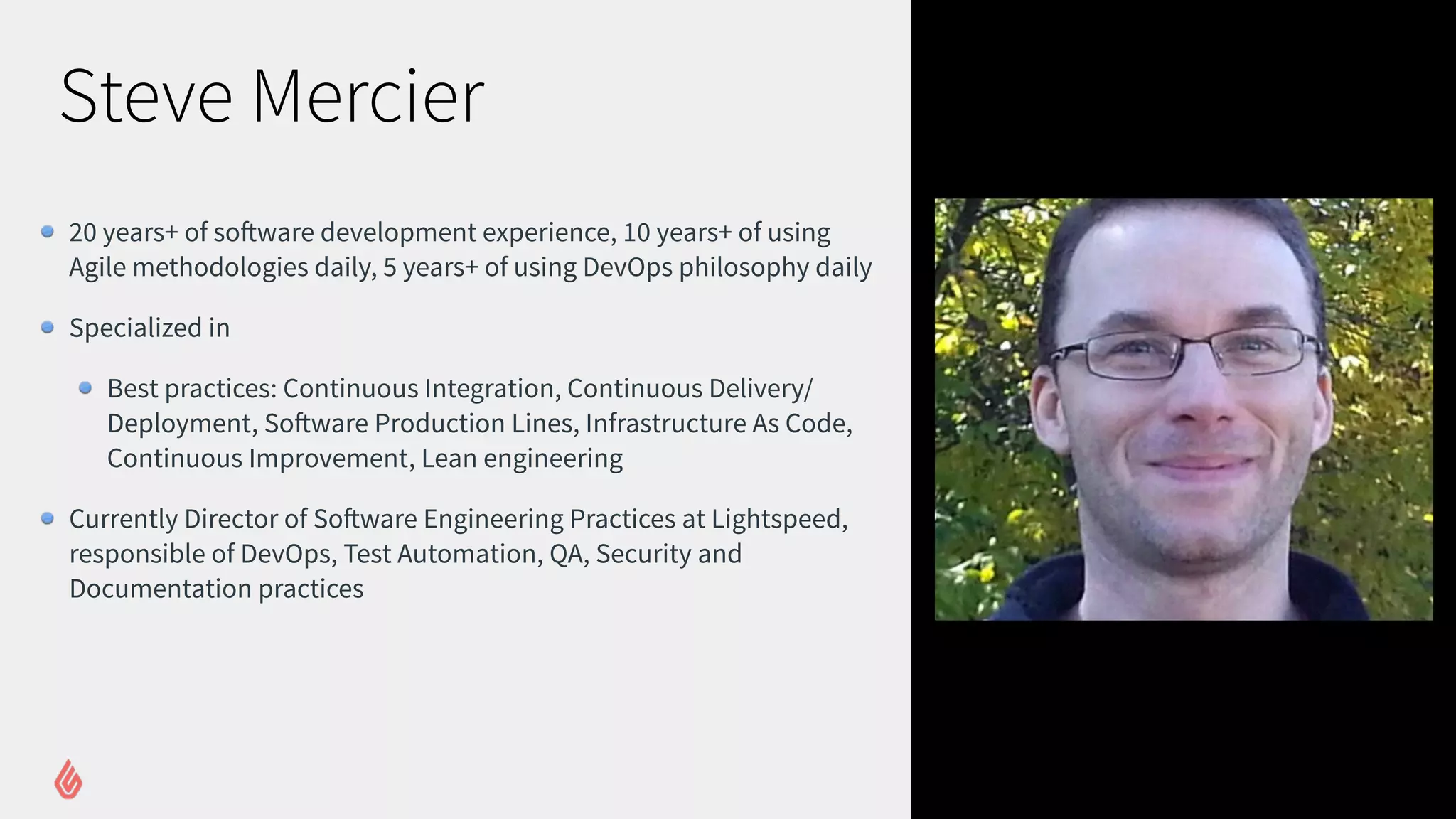
Steve Mercier
20 years+ of software development experience, 10 years+ of using
Agile methodologies daily, 5 years+ of using DevOps philosophy daily
Specialized in
Best practices: Continuous Integration, Continuous Delivery/
Deployment, Software Production Lines, Infrastructure As Code,
Continuous Improvement, Lean engineering
Currently Director of Software Engineering Practices at Lightspeed,
responsible of DevOps, Test Automation, QA, Security and
Documentation practices
The (ongoing/chaotic)
journey from Agile Teams
to Agile Organization
The Agile Organization Journey
‣ Promises
‣ Challenges
‣ Questions
‣ (Tentative) Answers
‣ Conclusion
‣ Q&A
The Agile Promises
The Agile Promises
‣ Faster time to market
‣ Development costs reduction
‣ Quality improvement
‣ Business value driven, aligned with customers needs
‣ Better team work, better focus
‣ Technical debt reduction
‣ No useless architecture and documents
‣ Only good code adding business value!
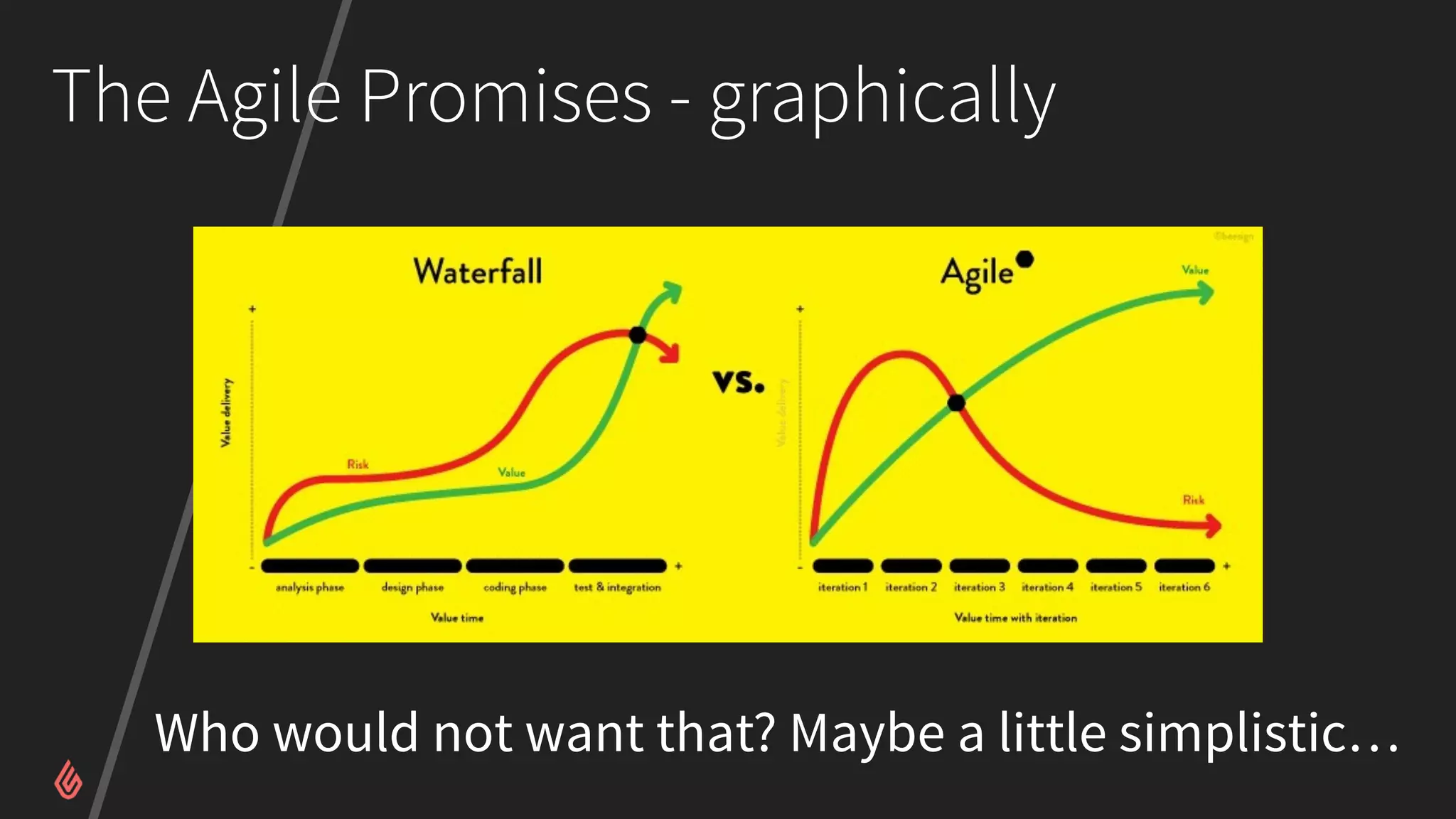
The Agile Promises - graphically
Who would not want that? Maybe a little simplistic…
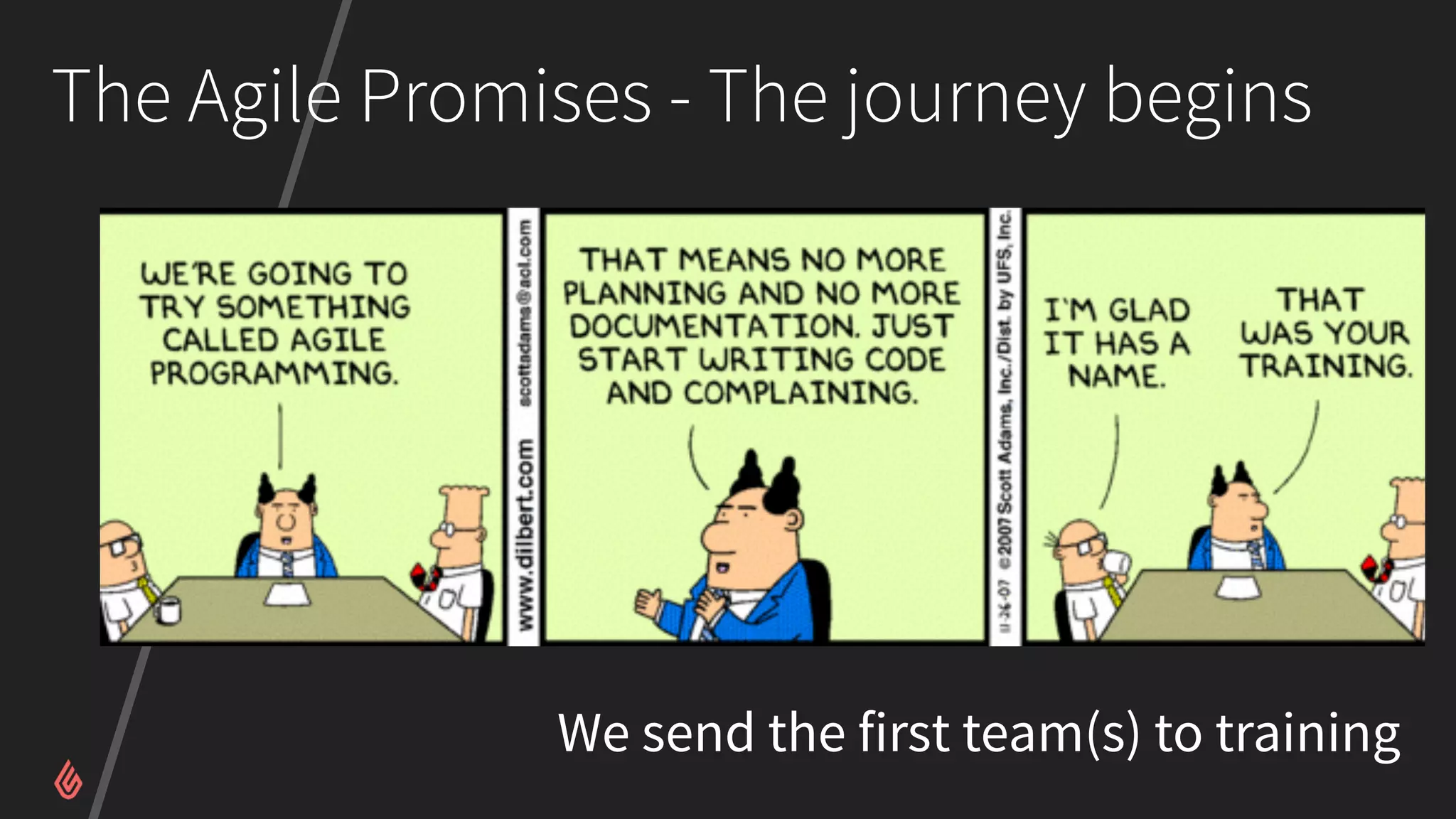
The Agile Promises - The journey begins
We send the first team(s) to training
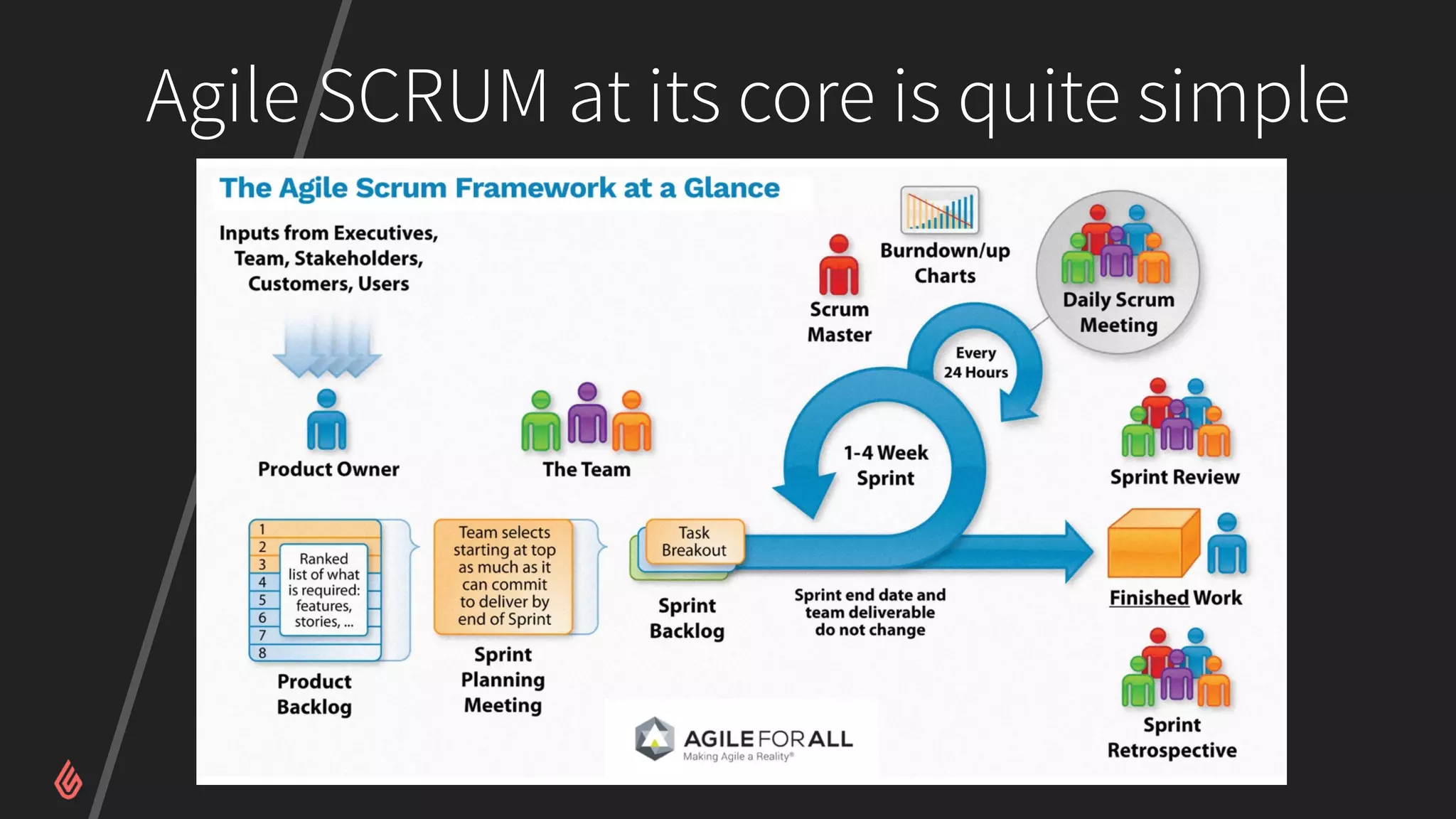
Agile SCRUM at its core is quite simple
The Agile Promises
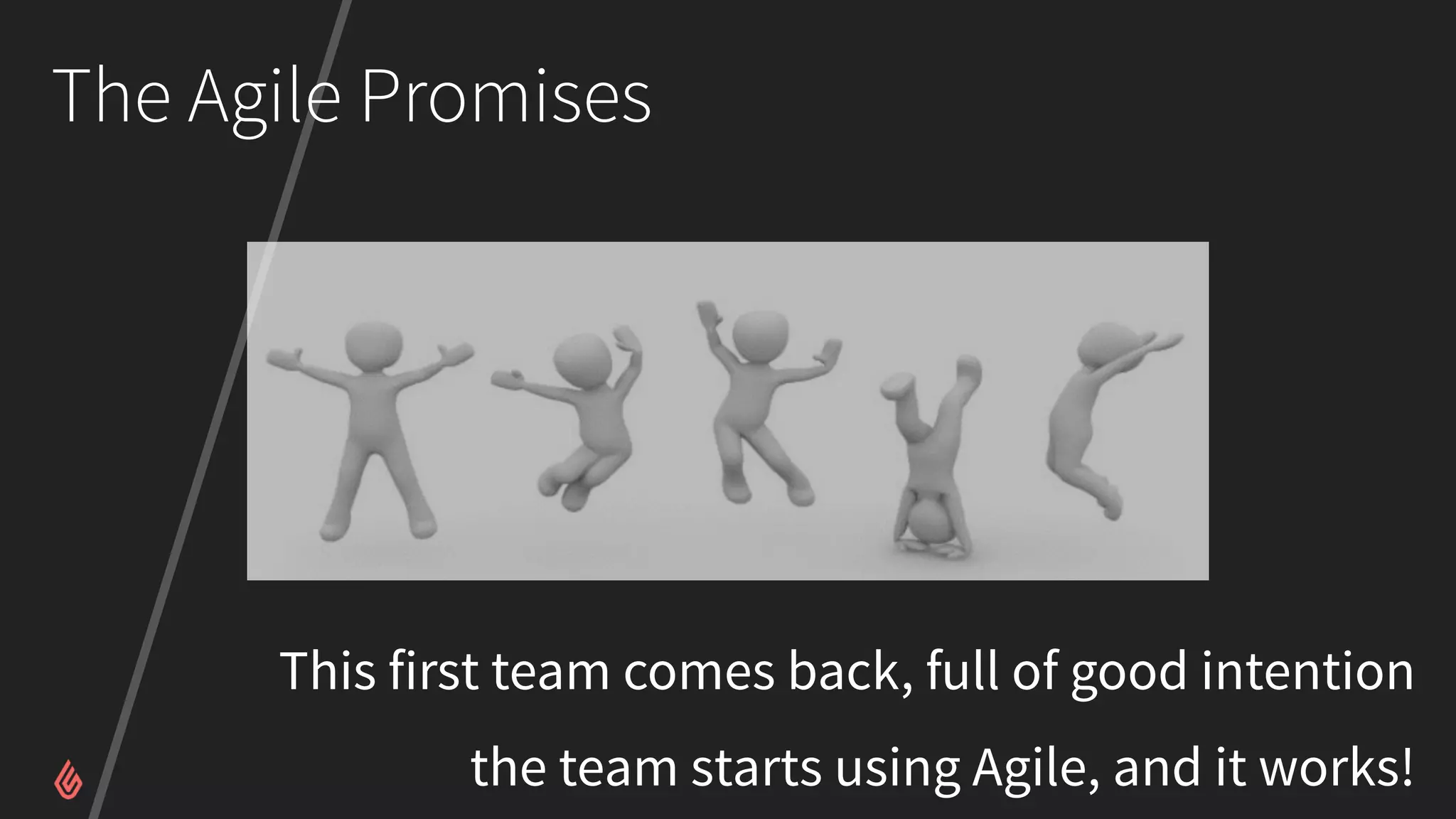
This first team comes back, full of good intention
the team starts using Agile, and it works!
The Agile Promises
So it seems Agile works, right?
Question: does it work for you?
The Agile Promises
By experience, Agile typically works well if:
You are working on new software, with small teams and a limited number of teams
Agile tends to work less if:
You are trying to scale Agile to multiple teams on larger projects
The Agile Challenges
Challenge #1 - Scaling to multiple
(independent) teams
Based on early successes, other teams are asked to try it
With possibly less training, less passion, less mentoring
possibly even resisting the transformation
Challenge #2 - Scaling it to dispersed
(independent) teams
Not colocated teams, across time zones
Teams have different cultures, values
Teams do not all see Agile in the same way
Challenges #3 - Scaling it to dispersed
dependent teams
Individual teams, OK, dispersed independent teams, also OK
But if the business requires different teams to deliver a common product
across continents… more challenging!
Scaling Agile to multiple teams is complex…
Challenge #4 - Wrong team composition
QA, Ops not part of the Agile teams
PO/PM not part of the teams or not available
Challenge #5 - Not having an end to end
Agile process
Having handoffs between the Agile teams and Ops
for example
Definition of Done not including Shipping It
Challenge #6 - Too much manual process
Red tape / Various Authorizations
Agile is about empowering teams
Challenge #7 - Old school management
“New” Agile management should focus on:
Creation of a “safe” environment for trying things,
enforcing the fail fast / fail differently model
Rewarding the right behaviours
Fostering a learning organization culture
The Questions
Is SCRUM enough to obtain Agile
organizations? No. Does it help? Sure!
Is Scrum of Scrums a solution?
‣ How could we frame the common work across multiple teams?
‣ How to structure the whole software development effort of many teams?
‣ Scrum of Scrums can help; sufficient?
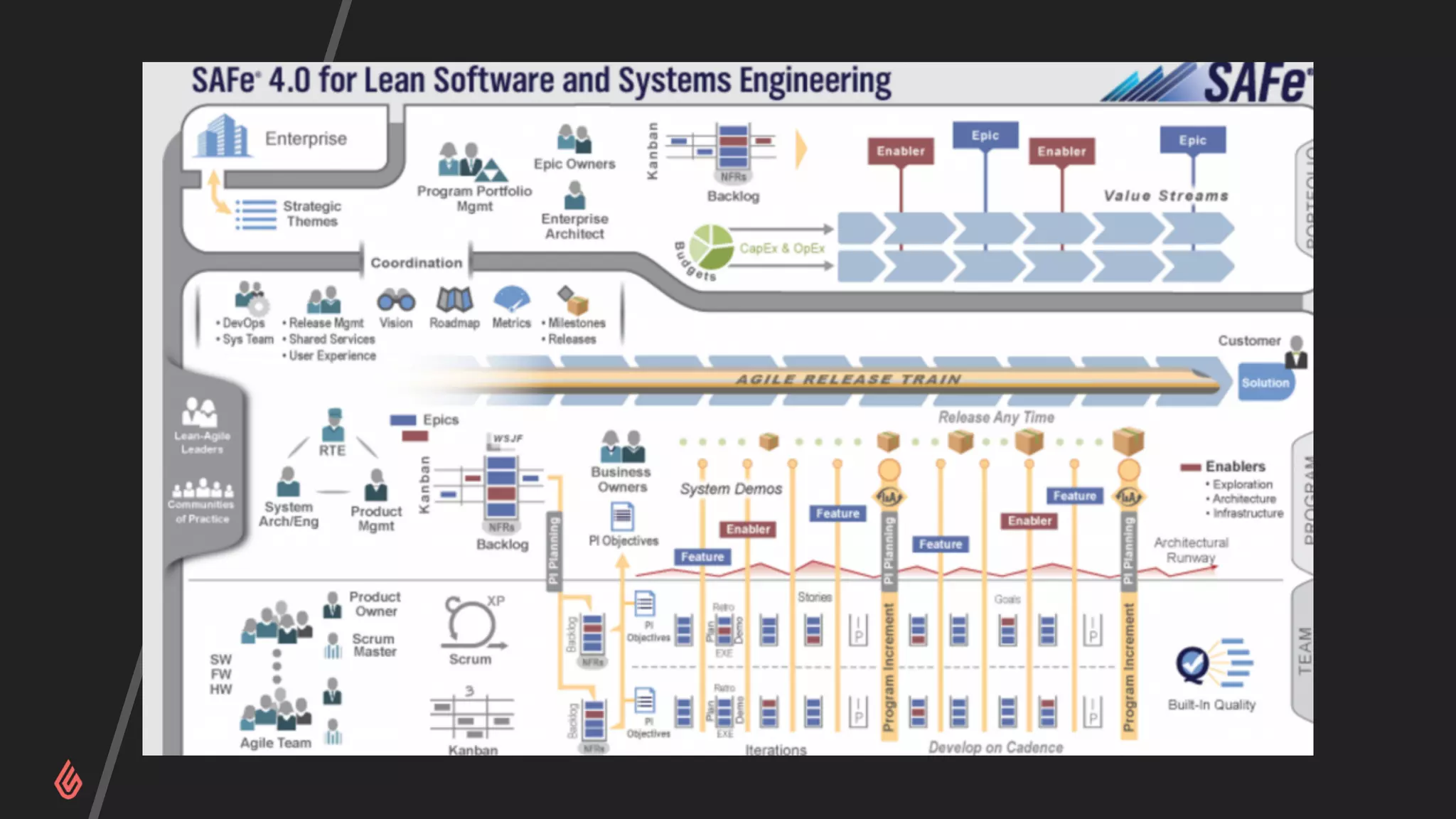
What could be this structuring frame?
The (Tentative) Answers
Hint: Ever heard of a Software Delivery Pipeline?
Step #1 - Leverage Software Engineering
Practices
‣ Use Software Engineering Best Practices as a frame to constrain how
software is developed and connected together
‣ Helps mostly with structuring the How
‣ Communities of Practices can be helpful
Step #2 - Develop/Use a Delivery Pipeline
System
Engrain those defined practices into a
single Software Delivery Pipeline system
Step #3 - Feed your system with the real
customers needs
Ensure you feed your delivery pipeline with the right things -
do the right thing for your customers
The best pipeline system in the world will not help your agility if
you do the wrong thing with it!
Step #4 - Apply Continuous Improvement
to your pipeline
Use Lean / Plan-Do-Check-Act principles and
Continuously reflect on the system to optimize it to your business
Why a Delivery Pipeline system?
“Average leaders have quotes.
Good leaders have a plan.
Exceptional leaders have a system.”
- Urban Meyer
Your Automated Delivery Pipeline is your system
But what should be in
a typical pipeline?
What is the scope of such a system?
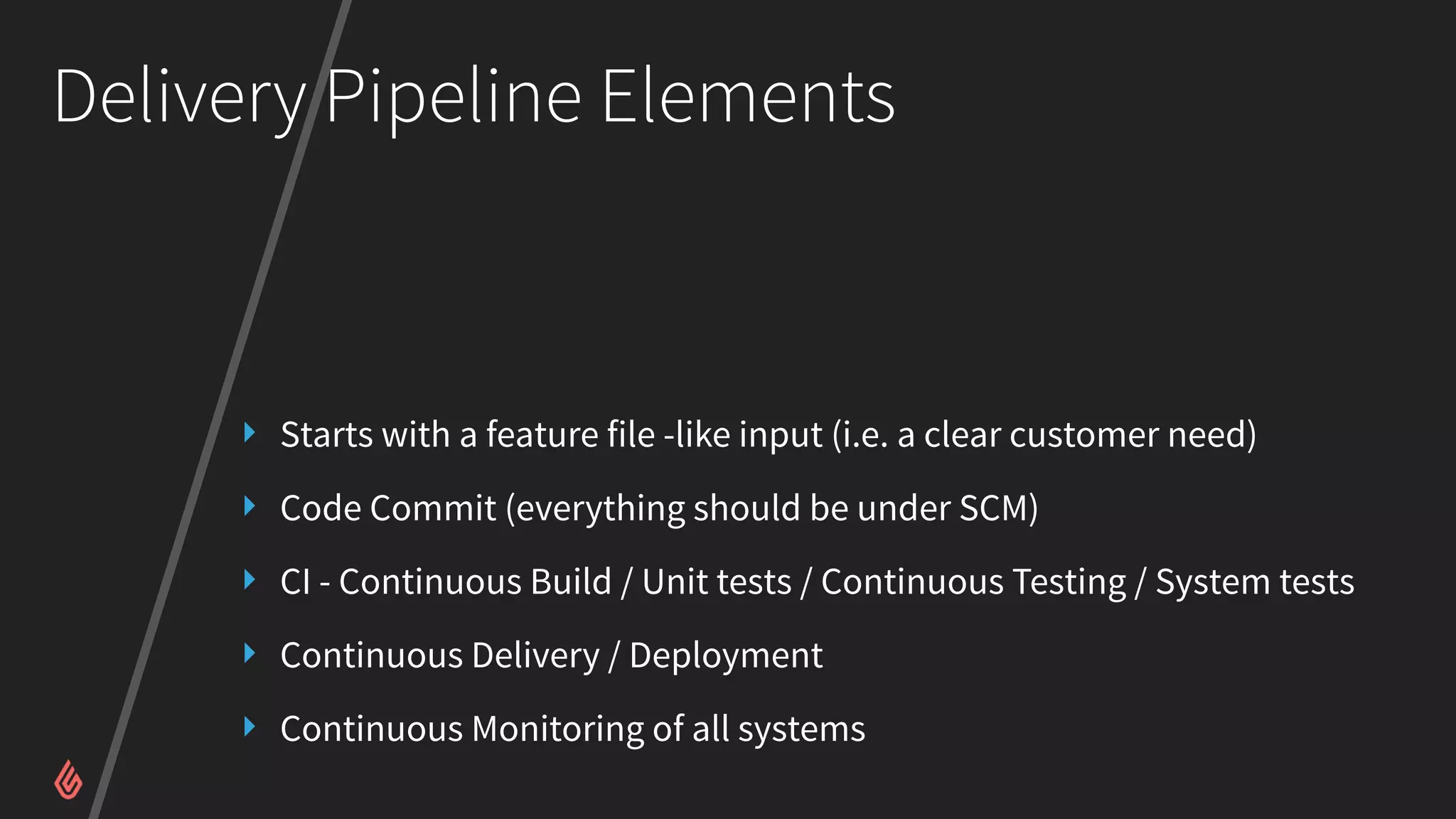
Delivery Pipeline Elements
‣ Starts with a feature file -like input (i.e. a clear customer need)
‣ Code Commit (everything should be under SCM)
‣ CI - Continuous Build / Unit tests / Continuous Testing / System tests
‣ Continuous Delivery / Deployment
‣ Continuous Monitoring of all systems
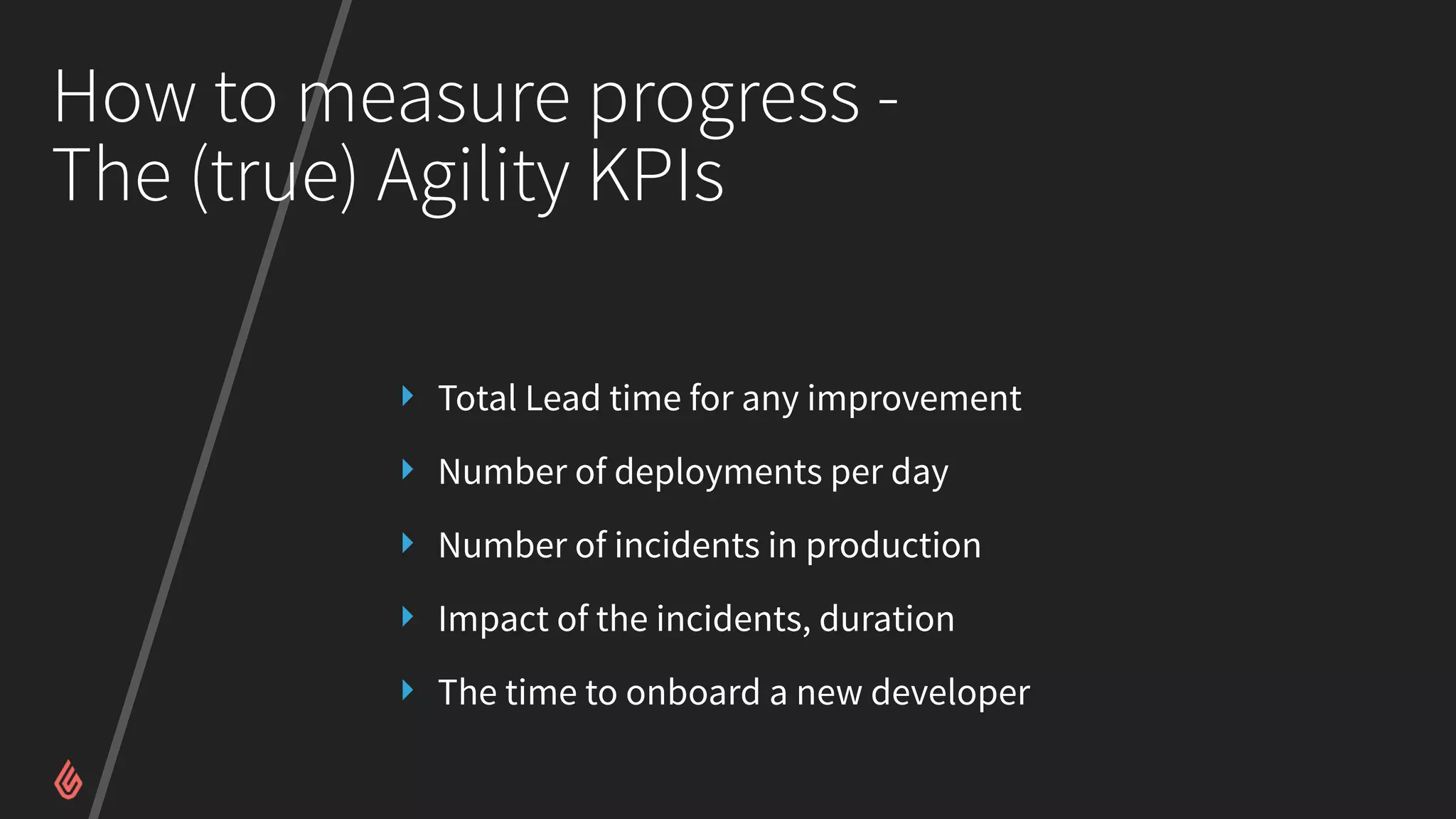
How to measure progress -
The (true) Agility KPIs
‣ Total Lead time for any improvement
‣ Number of deployments per day
‣ Number of incidents in production
‣ Impact of the incidents, duration
‣ The time to onboard a new developer
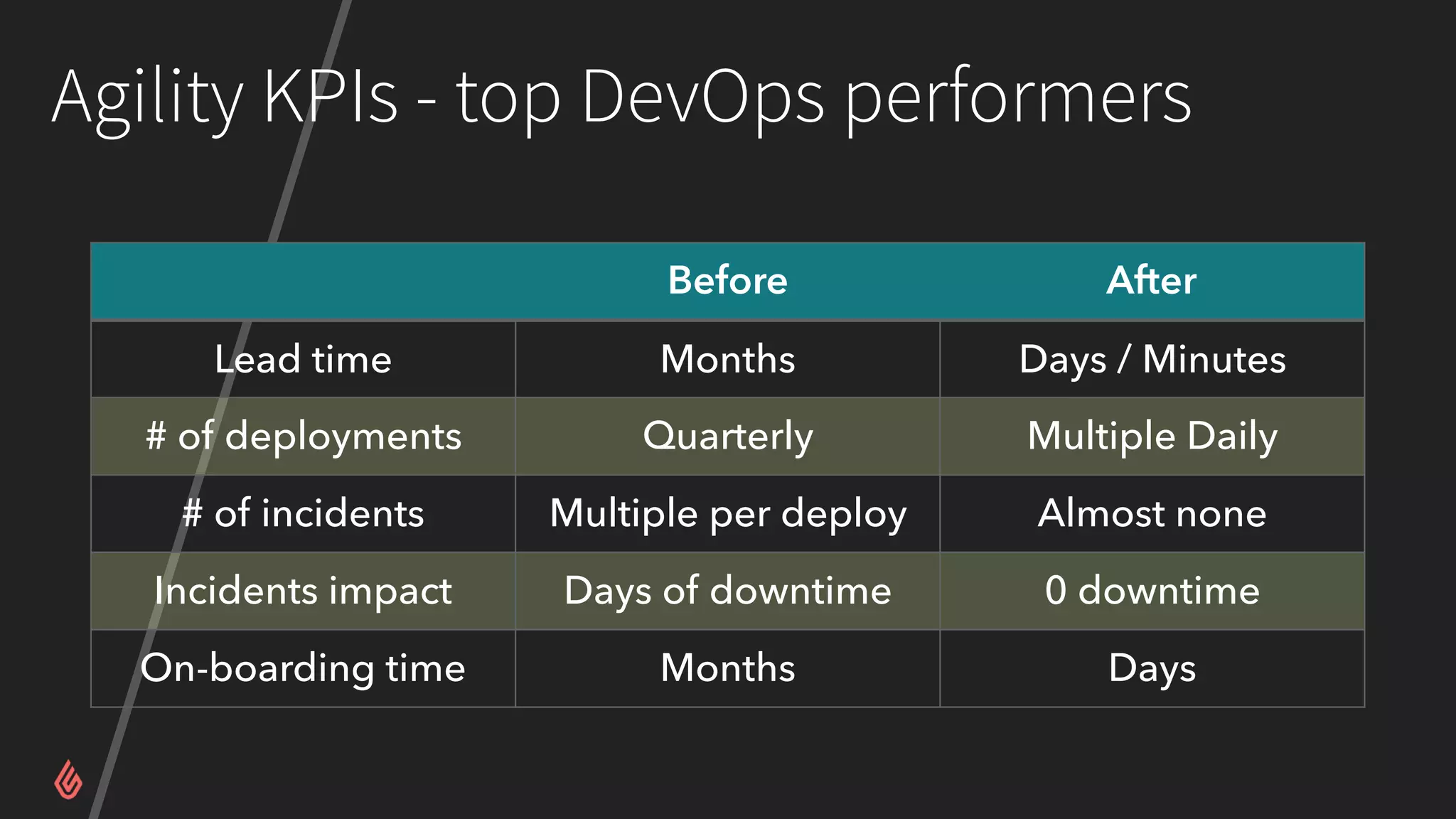
Agility KPIs - top DevOps performers
Before After
Lead time Months Days / Minutes
# of deployments Quarterly Multiple Daily
# of incidents Multiple per deploy Almost none
Incidents impact Days of downtime 0 downtime
On-boarding time Months Days
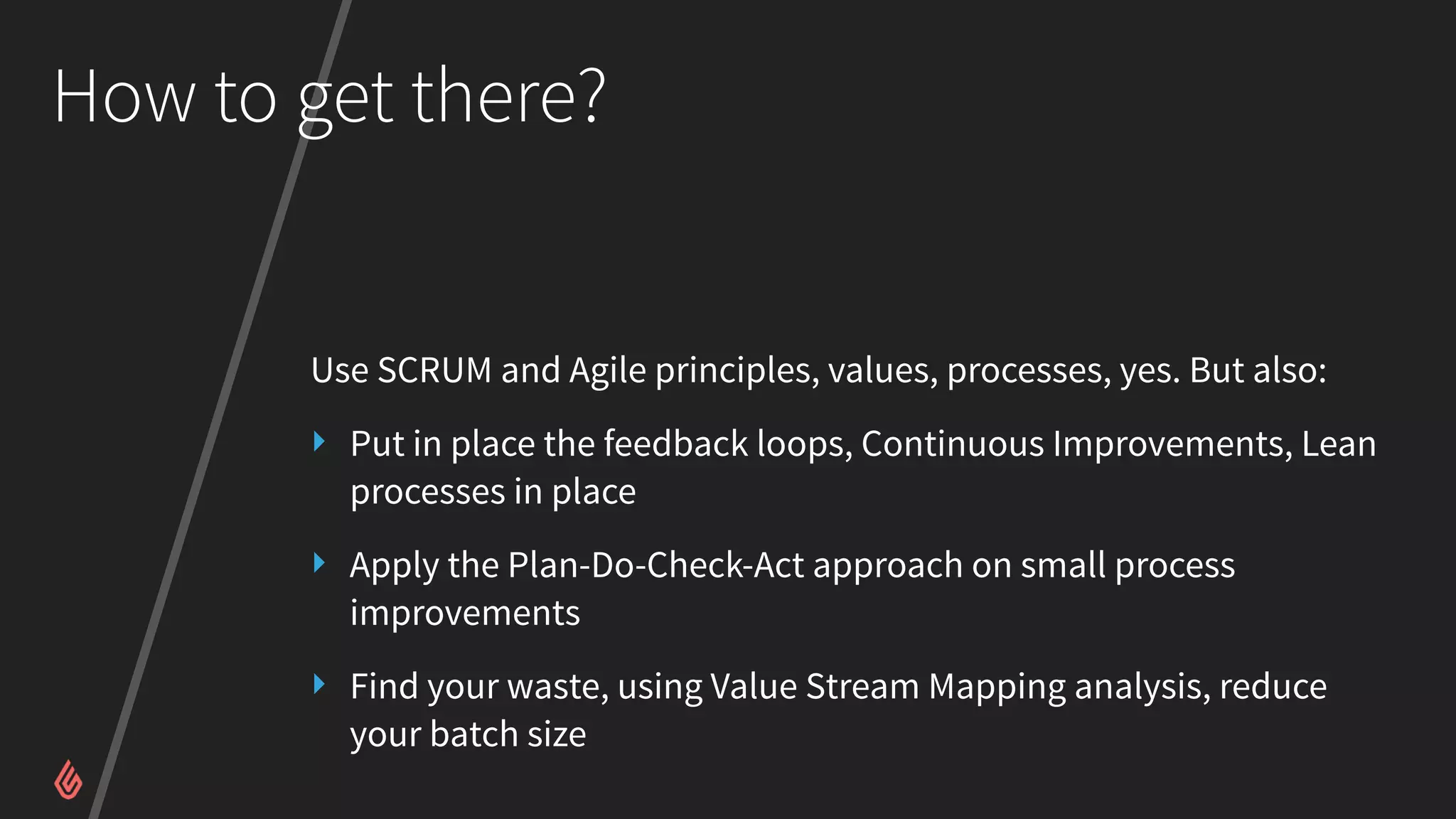
How to get there?
Use SCRUM and Agile principles, values, processes, yes. But also:
‣ Put in place the feedback loops, Continuous Improvements, Lean
processes in place
‣ Apply the Plan-Do-Check-Act approach on small process
improvements
‣ Find your waste, using Value Stream Mapping analysis, reduce
your batch size
Use your Pipeline to
make the issues visible
A global Continuous Delivery pipeline for all the company’s software would
help highlighting the issues, challenges, areas requiring improvements
Reduce cycle time by enforcing
Automation
‣ Continuous Integration with automatic tests at unit, system
and system of systems levels
‣ Continuous Delivery or Deployment using Infrastructure As
Code
Keep the focus on the global system,
not on small teams
Company Continuous Delivery pipeline help keep the focus on
the company delivered business value to external customers,
reducing the natural silos barriers impacts.
What more
‣ Teams’ composition is key - all the required roles must be fulfilled within
the teams
‣ Complement Agile and Scrum with other compatible approaches such
as LEAN and DevOps to optimize global organization and not just a small
team work
‣ Ensure an environment permitting trials and failures is in place; create a
safe environment for contributions; learn from failures, i.e. Fail fast and
fail differently each time
Conclusion
Conclusion
Having an Agile organization is a journey that can certainly start with Scrum,
but cannot really stop until all the software you produce and operate is
continuously delivered to your end customers
The key here is to deliver faster, faster than your competition, to disrupt
yourself before your competitors do disrupt your business
The Agile philosophy, values and tools are only a partial answer
The DevOps/Lean philosophy, values and tools are only a partial answer
Ask yourselves what prevents you from delivering value faster?
Conclusion
Break Silos, Work end-to-end, in small batches of work
Empower your teams, Evolve your management style
Remove all your red-tape and manual processes, one by one
Measure your true Agility KPIs
Put in place a system delivering customer’s value!
And be cautious…
“There is nothing quite so useless as doing with great
efficiency something that should not be done at all”
- Peter Drucker (the inventor of modern
management)
Q&A
Questions and answers - Let’s see the exec point of view!
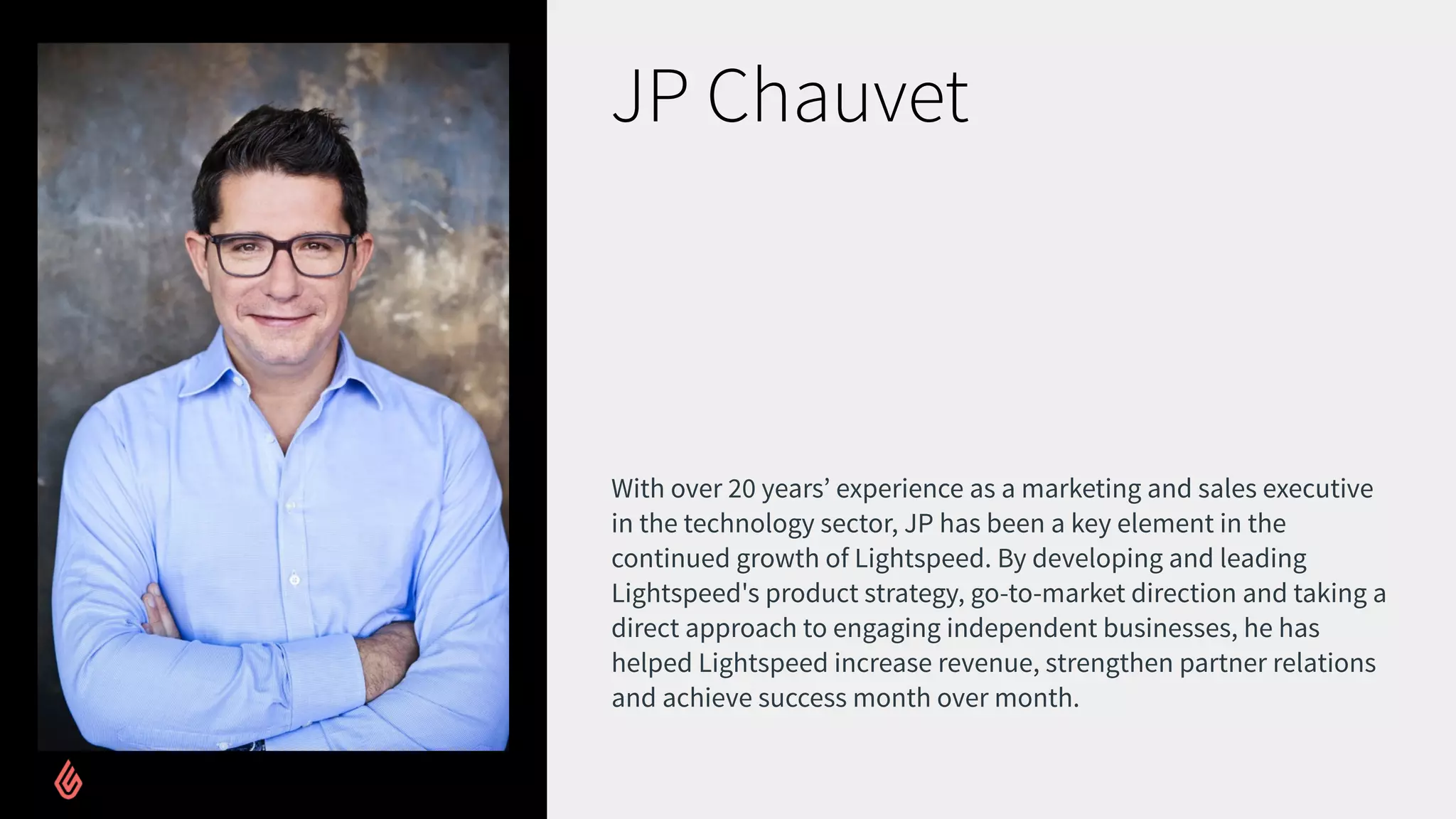
JP Chauvet
With over 20 years’ experience as a marketing and sales executive
in the technology sector, JP has been a key element in the
continued growth of Lightspeed. By developing and leading
Lightspeed's product strategy, go-to-market direction and taking a
direct approach to engaging independent businesses, he has
helped Lightspeed increase revenue, strengthen partner relations
and achieve success month over month.

Agile Project Management: From Agile Teams to Agile Organizations - Steve Mercier, Jean-Paul Chauvet

  • 1.
    Steve Mercier, Directorof Software Engineering Practices
 JP Chauvet, President From Agile Teams 
 to Agile Organizations
  • 2.
  • 3.
    Steve Mercier 20 years+of software development experience, 10 years+ of using Agile methodologies daily, 5 years+ of using DevOps philosophy daily Specialized in Best practices: Continuous Integration, Continuous Delivery/ Deployment, Software Production Lines, Infrastructure As Code, Continuous Improvement, Lean engineering Currently Director of Software Engineering Practices at Lightspeed, responsible of DevOps, Test Automation, QA, Security and Documentation practices
  • 4.
    The (ongoing/chaotic) journey fromAgile Teams to Agile Organization
  • 5.
    The Agile OrganizationJourney ‣ Promises ‣ Challenges ‣ Questions ‣ (Tentative) Answers ‣ Conclusion ‣ Q&A
  • 6.
  • 7.
    The Agile Promises ‣Faster time to market ‣ Development costs reduction ‣ Quality improvement ‣ Business value driven, aligned with customers needs ‣ Better team work, better focus ‣ Technical debt reduction ‣ No useless architecture and documents ‣ Only good code adding business value!
  • 8.
    The Agile Promises- graphically Who would not want that? Maybe a little simplistic…
  • 9.
    The Agile Promises- The journey begins We send the first team(s) to training
  • 10.
    Agile SCRUM atits core is quite simple
  • 11.
    The Agile Promises Thisfirst team comes back, full of good intention the team starts using Agile, and it works!
  • 12.
    The Agile Promises Soit seems Agile works, right? Question: does it work for you?
  • 13.
    The Agile Promises Byexperience, Agile typically works well if: You are working on new software, with small teams and a limited number of teams Agile tends to work less if: You are trying to scale Agile to multiple teams on larger projects
  • 14.
  • 15.
    Challenge #1 -Scaling to multiple (independent) teams Based on early successes, other teams are asked to try it With possibly less training, less passion, less mentoring possibly even resisting the transformation
  • 16.
    Challenge #2 -Scaling it to dispersed (independent) teams Not colocated teams, across time zones Teams have different cultures, values Teams do not all see Agile in the same way
  • 17.
    Challenges #3 -Scaling it to dispersed dependent teams Individual teams, OK, dispersed independent teams, also OK But if the business requires different teams to deliver a common product across continents… more challenging!
  • 18.
    Scaling Agile tomultiple teams is complex…
  • 20.
    Challenge #4 -Wrong team composition QA, Ops not part of the Agile teams PO/PM not part of the teams or not available
  • 21.
    Challenge #5 -Not having an end to end Agile process Having handoffs between the Agile teams and Ops for example Definition of Done not including Shipping It
  • 22.
    Challenge #6 -Too much manual process Red tape / Various Authorizations Agile is about empowering teams
  • 23.
    Challenge #7 -Old school management “New” Agile management should focus on: Creation of a “safe” environment for trying things, enforcing the fail fast / fail differently model Rewarding the right behaviours Fostering a learning organization culture
  • 24.
  • 25.
    Is SCRUM enoughto obtain Agile organizations? No. Does it help? Sure!
  • 26.
    Is Scrum ofScrums a solution? ‣ How could we frame the common work across multiple teams? ‣ How to structure the whole software development effort of many teams? ‣ Scrum of Scrums can help; sufficient?
  • 27.
    What could bethis structuring frame?
  • 28.
    The (Tentative) Answers Hint:Ever heard of a Software Delivery Pipeline?
  • 29.
    Step #1 -Leverage Software Engineering Practices ‣ Use Software Engineering Best Practices as a frame to constrain how software is developed and connected together ‣ Helps mostly with structuring the How ‣ Communities of Practices can be helpful
  • 30.
    Step #2 -Develop/Use a Delivery Pipeline System Engrain those defined practices into a single Software Delivery Pipeline system
  • 31.
    Step #3 -Feed your system with the real customers needs Ensure you feed your delivery pipeline with the right things - do the right thing for your customers The best pipeline system in the world will not help your agility if you do the wrong thing with it!
  • 32.
    Step #4 -Apply Continuous Improvement to your pipeline Use Lean / Plan-Do-Check-Act principles and Continuously reflect on the system to optimize it to your business
  • 33.
    Why a DeliveryPipeline system? “Average leaders have quotes. Good leaders have a plan. Exceptional leaders have a system.” - Urban Meyer Your Automated Delivery Pipeline is your system
  • 34.
    But what shouldbe in a typical pipeline? What is the scope of such a system?
  • 35.
    Delivery Pipeline Elements ‣Starts with a feature file -like input (i.e. a clear customer need) ‣ Code Commit (everything should be under SCM) ‣ CI - Continuous Build / Unit tests / Continuous Testing / System tests ‣ Continuous Delivery / Deployment ‣ Continuous Monitoring of all systems
  • 36.
    How to measureprogress - The (true) Agility KPIs ‣ Total Lead time for any improvement ‣ Number of deployments per day ‣ Number of incidents in production ‣ Impact of the incidents, duration ‣ The time to onboard a new developer
  • 37.
    Agility KPIs -top DevOps performers Before After Lead time Months Days / Minutes # of deployments Quarterly Multiple Daily # of incidents Multiple per deploy Almost none Incidents impact Days of downtime 0 downtime On-boarding time Months Days
  • 38.
    How to getthere? Use SCRUM and Agile principles, values, processes, yes. But also: ‣ Put in place the feedback loops, Continuous Improvements, Lean processes in place ‣ Apply the Plan-Do-Check-Act approach on small process improvements ‣ Find your waste, using Value Stream Mapping analysis, reduce your batch size
  • 39.
    Use your Pipelineto make the issues visible A global Continuous Delivery pipeline for all the company’s software would help highlighting the issues, challenges, areas requiring improvements
  • 40.
    Reduce cycle timeby enforcing Automation ‣ Continuous Integration with automatic tests at unit, system and system of systems levels ‣ Continuous Delivery or Deployment using Infrastructure As Code
  • 41.
    Keep the focuson the global system, not on small teams Company Continuous Delivery pipeline help keep the focus on the company delivered business value to external customers, reducing the natural silos barriers impacts.
  • 42.
    What more ‣ Teams’composition is key - all the required roles must be fulfilled within the teams ‣ Complement Agile and Scrum with other compatible approaches such as LEAN and DevOps to optimize global organization and not just a small team work ‣ Ensure an environment permitting trials and failures is in place; create a safe environment for contributions; learn from failures, i.e. Fail fast and fail differently each time
  • 43.
  • 44.
    Conclusion Having an Agileorganization is a journey that can certainly start with Scrum, but cannot really stop until all the software you produce and operate is continuously delivered to your end customers The key here is to deliver faster, faster than your competition, to disrupt yourself before your competitors do disrupt your business The Agile philosophy, values and tools are only a partial answer The DevOps/Lean philosophy, values and tools are only a partial answer Ask yourselves what prevents you from delivering value faster?
  • 45.
    Conclusion Break Silos, Workend-to-end, in small batches of work Empower your teams, Evolve your management style Remove all your red-tape and manual processes, one by one Measure your true Agility KPIs Put in place a system delivering customer’s value!
  • 46.
    And be cautious… “Thereis nothing quite so useless as doing with great efficiency something that should not be done at all” - Peter Drucker (the inventor of modern management)
  • 47.
    Q&A Questions and answers- Let’s see the exec point of view!
  • 48.
    JP Chauvet With over20 years’ experience as a marketing and sales executive in the technology sector, JP has been a key element in the continued growth of Lightspeed. By developing and leading Lightspeed's product strategy, go-to-market direction and taking a direct approach to engaging independent businesses, he has helped Lightspeed increase revenue, strengthen partner relations and achieve success month over month.