www.plays-in-business.com
www.Plays-in-Business.com
Agile – A New Kid in the Block?
What is Agile & Agile Project Management?
Michael Tarnowski, Plays-In-Business.com
www.plays-in-business.com
www.Plays-in-Business.com
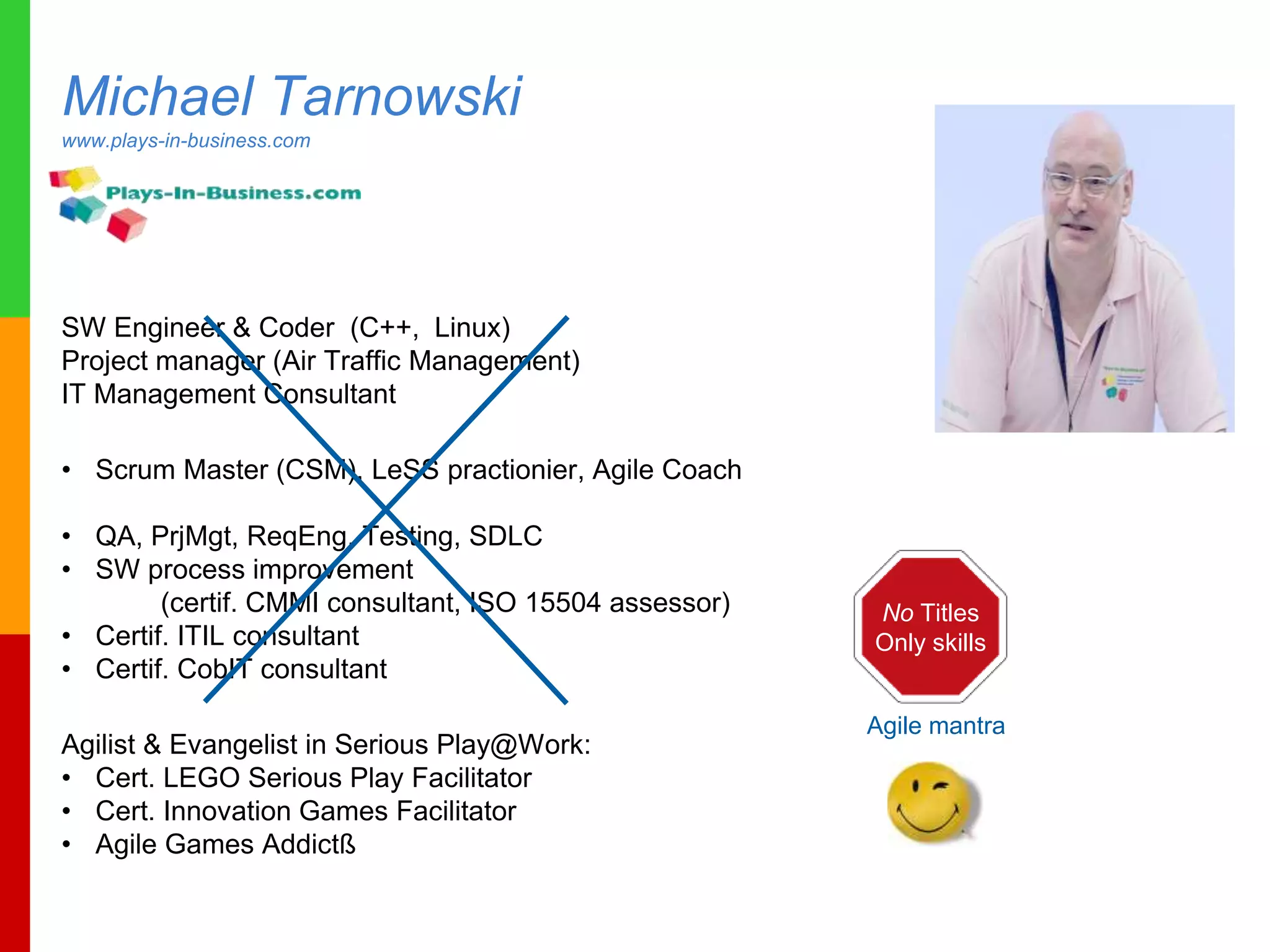
Michael Tarnowski
www.plays-in-business.com
SW Engineer & Coder (C++, Linux)
Project manager (Air Traffic Management)
IT Management Consultant
• Scrum Master (CSM), LeSS practionier, Agile Coach
• QA, PrjMgt, ReqEng, Testing, SDLC
• SW process improvement
(certif. CMMI consultant, ISO 15504 assessor)
• Certif. ITIL consultant
• Certif. CobIT consultant
Agilist & Evangelist in Serious Play@Work:
• Cert. LEGO Serious Play Facilitator
• Cert. Innovation Games Facilitator
• Agile Games Addictß
Agile mantra
No Titles
Only skills
www.plays-in-business.com
www.Plays-in-Business.com
Agile
…is about Values – not about Projects
…has no “Management”
Agile Project Management = Contradiction in Terms
www.plays-in-business.com
www.Plays-in-Business.com
Ok, you want the…
… you will get it now!
within the next slides…jump ahead!
www.plays-in-business.com
www.Plays-in-Business.com
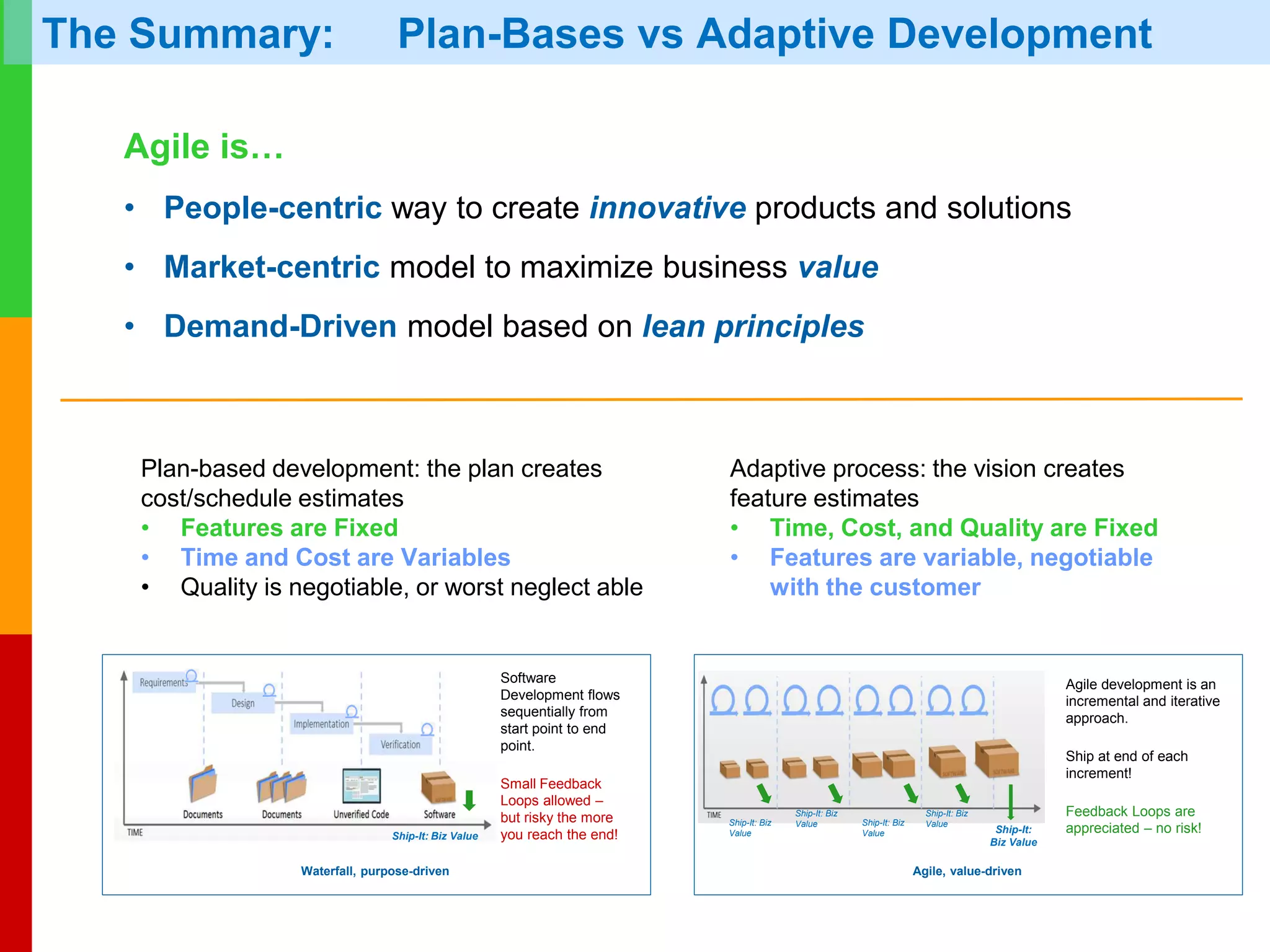
The Summary: Plan-Bases vs Adaptive Development
Agile is…
• People-centric way to create innovative products and solutions
• Market-centric model to maximize business value
• Demand-Driven model based on lean principles
Plan-based development: the plan creates
cost/schedule estimates
• Features are Fixed
• Time and Cost are Variables
• Quality is negotiable, or worst neglect able
Adaptive process: the vision creates
feature estimates
• Time, Cost, and Quality are Fixed
• Features are variable, negotiable
with the customer
Software
Development flows
sequentially from
start point to end
point.
Small Feedback
Loops allowed –
but risky the more
you reach the end!Ship-It: Biz Value
Waterfall, purpose-driven
Agile development is an
incremental and iterative
approach.
Ship at end of each
increment!
Feedback Loops are
appreciated – no risk!
Ship-It: Biz
Value
Ship-It: Biz
Value Ship-It: Biz
Value
Ship-It: Biz
Value
Ship-It:
Biz Value
Agile, value-driven
www.plays-in-business.com
www.Plays-in-Business.com
-6 -
28.11.2016
Not
adding components
incrementally
Stopping at latter phases
causes HUGE loss!
The Summary: Value-Driven, Risk-Minimization
by Henrik Kniberg, http://blog.crisp.se/2016/01/25/henrikkniberg/making-sense-of-mvp
Instead
creating stand-alone solutions
– increase value independent
You can stop at each phase
without loss!
By Design Thinking you get 3 innovation
phases!
Shift of Usability
Market Disruption
New Focus Groups
Innovation Shift of Usability
Market Disruption
New Focus Groups
Innovation
Shift of Usability
Market Disruption
New Focus Groups
Innovation
www.plays-in-business.com
www.Plays-in-Business.com
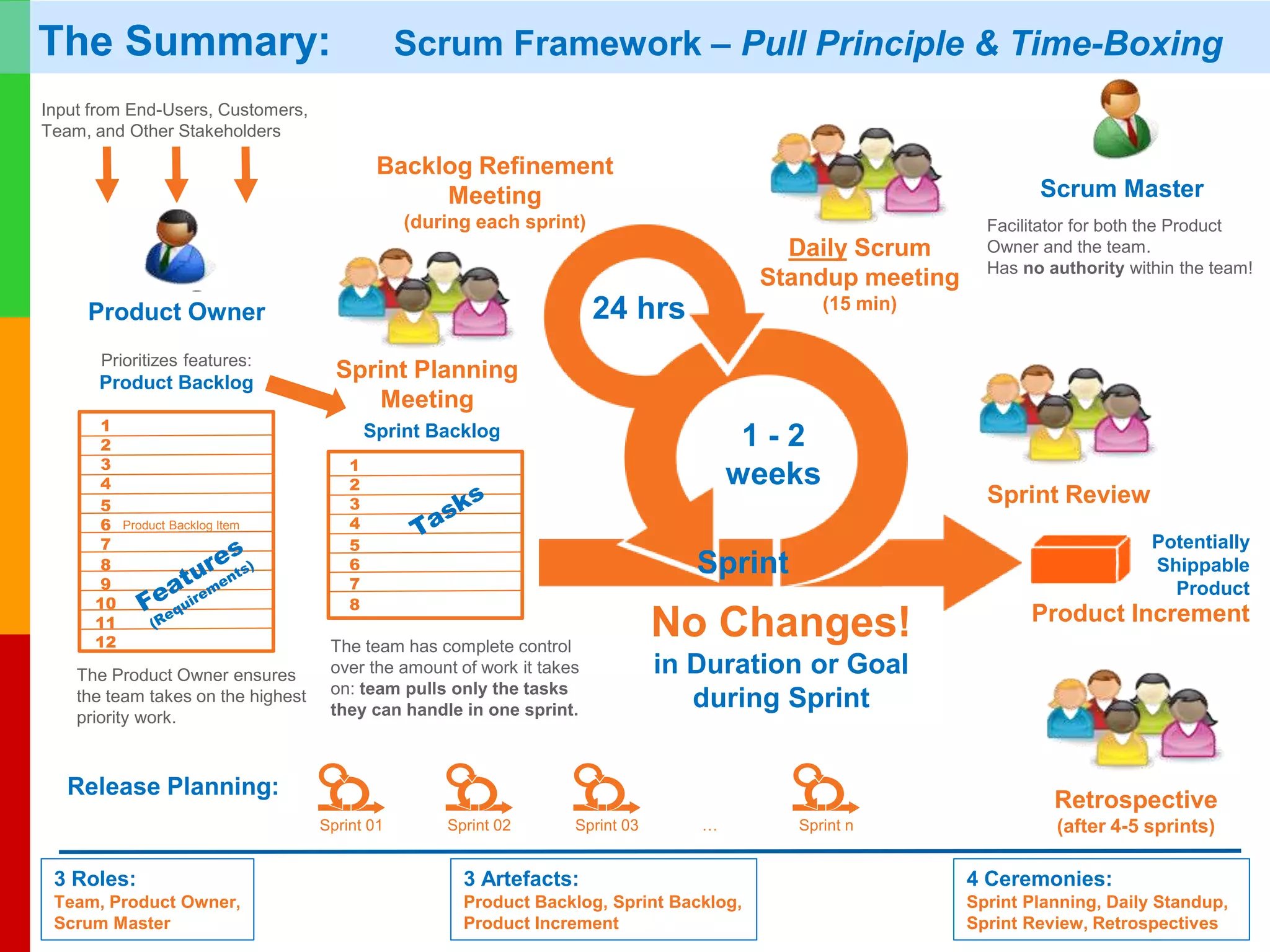
The Summary: Scrum Framework – Pull Principle & Time-Boxing
3 Roles:
Team, Product Owner,
Scrum Master
3 Artefacts:
Product Backlog, Sprint Backlog,
Product Increment
4 Ceremonies:
Sprint Planning, Daily Standup,
Sprint Review, Retrospectives
Product Owner
Prioritizes features:
Product Backlog
Input from End-Users, Customers,
Team, and Other Stakeholders
24 hrs
1 - 2
weeks
Sprint
Daily Scrum
Standup meeting
(15 min)
Sprint Review
Retrospective
(after 4-5 sprints)
Potentially
Shippable
Product
Backlog Refinement
Meeting
(during each sprint)
No Changes!
in Duration or Goal
during Sprint
Sprint 01 Sprint 02 Sprint 03 Sprint n…
Release Planning:
The team has complete control
over the amount of work it takes
on: team pulls only the tasks
they can handle in one sprint.
Sprint Planning
Meeting
Sprint Backlog1
2
3
4
5
6
7
8
9
10
Product Backlog Item
11
12
1
2
3
4
5
6
7
8
The Product Owner ensures
the team takes on the highest
priority work.
Product Increment
Scrum Master
Facilitator for both the Product
Owner and the team.
Has no authority within the team!
www.plays-in-business.com
www.Plays-in-Business.com
Agile, Agile Leadership & Line Management
• There is NO management in Agile.
• The Team manages itself together with Product Owner.
• The team is cross-functional: all needed skills are available instantly.
• T-shaped team members: they have in-depth skills and other broader skills.
• Leadership is given by the team according to competence and demand.
Agile and Traditional Line Management
Line Manager becomes Agile Leader if:
shows the Big Picture and sets the “guard
rails” for the team.
Don‘t Answer – Ask Questions Don‘t Correct Mistakes – Ask Questions
Help Teams Take Ownership
Create a Safe Space to Fail
Let the Team Make DecisionsTrust First and Be Trustworthy
Show the Vision
Connect Team with Customers
Enable & Empower the Team
www.plays-in-business.com
www.Plays-in-Business.com
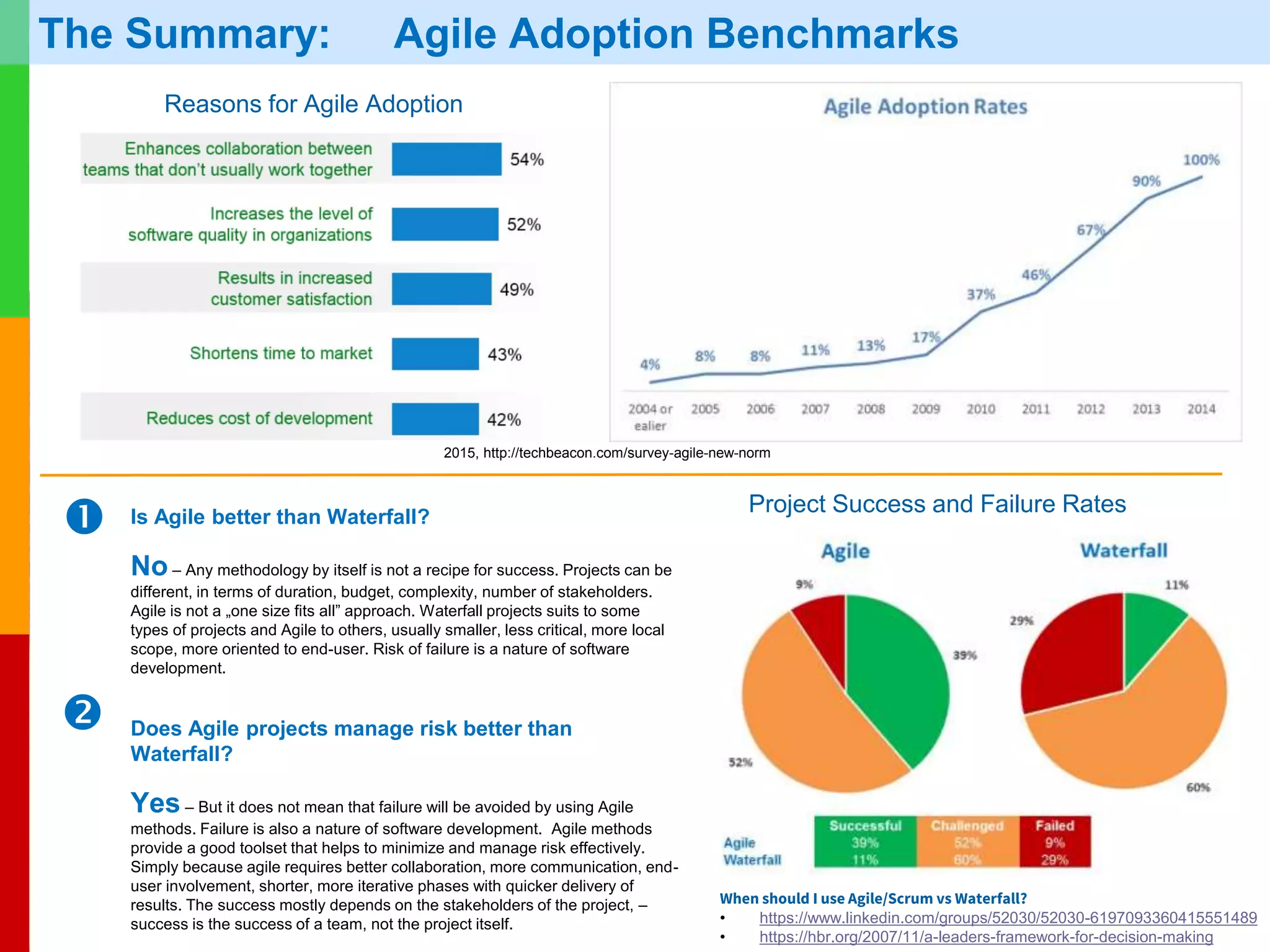
The Summary: Agile Adoption Benchmarks
Reasons for Agile Adoption
2015, http://techbeacon.com/survey-agile-new-norm
Project Success and Failure RatesIs Agile better than Waterfall?
No – Any methodology by itself is not a recipe for success. Projects can be
different, in terms of duration, budget, complexity, number of stakeholders.
Agile is not a „one size fits all” approach. Waterfall projects suits to some
types of projects and Agile to others, usually smaller, less critical, more local
scope, more oriented to end-user. Risk of failure is a nature of software
development.
Does Agile projects manage risk better than
Waterfall?
Yes – But it does not mean that failure will be avoided by using Agile
methods. Failure is also a nature of software development. Agile methods
provide a good toolset that helps to minimize and manage risk effectively.
Simply because agile requires better collaboration, more communication, end-
user involvement, shorter, more iterative phases with quicker delivery of
results. The success mostly depends on the stakeholders of the project, –
success is the success of a team, not the project itself.


When should I use Agile/Scrum vs Waterfall?
• https://www.linkedin.com/groups/52030/52030-6197093360415551489
• https://hbr.org/2007/11/a-leaders-framework-for-decision-making
www.plays-in-business.com
www.Plays-in-Business.com
The Summary: Common Misunderstandings
Desi, https://www.flickr.com/photos/desiitaly/2201907500/
Wrong!
Take regulations as additional features; control the process
Agile Doesn’t Fit in Regulative Environments
Wrong!
No Command-n-Control. Agile Leaders are servants leaders for the team
In Agile there is no Management, or Leadership
Wrong!
Full-Time is better but not necessary
In Agile all Team Member must be Full-Time
assigned in one project
Wrong!
Documentation has to have value!
In Agile there is no Documentation
Wrong!
Co-location is better but not necessary
In Agile all Team Members must be co-located
Wrong!
Agile has more planning!
In Agile there is no Project Plan resp. Planning
Wrong!
Requirements spanning sprints improve the flow.
In Agile Work must Fit in a Sprint
www.plays-in-business.com
www.Plays-in-Business.com
Ok, you wanted the Summary… you got it…
we are finished.
Stop here reading!
Oh, you want more Details?
Go ahead…
www.plays-in-business.com
www.Plays-in-Business.com
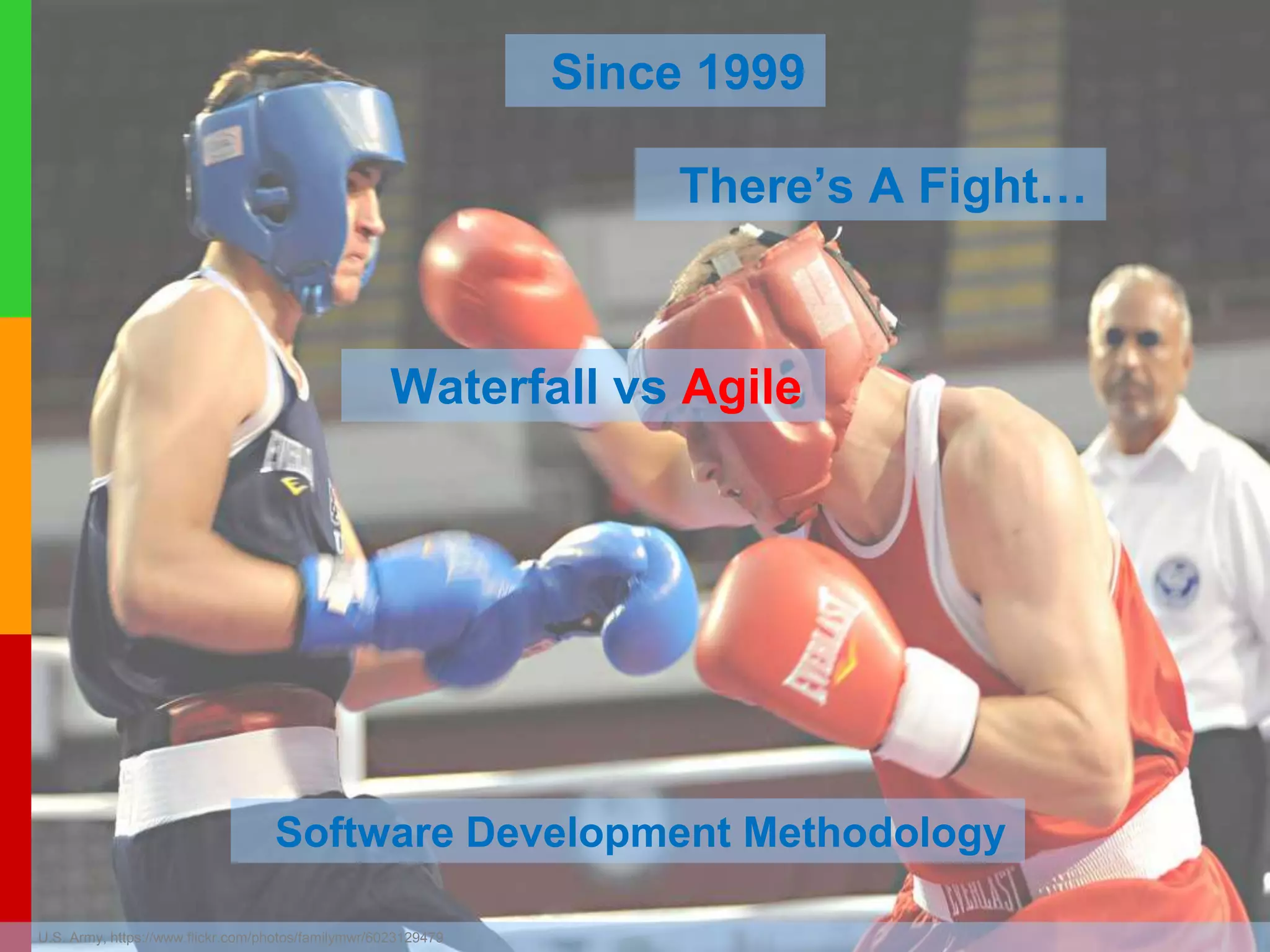
Waterfall vs Agile
U.S. Army, https://www.flickr.com/photos/familymwr/6023129479
Since 1999
There’s A Fight…
Software Development Methodology
www.plays-in-business.com
www.Plays-in-Business.com
Put it Short…
Agile is about working smarter, rather than harder.
It’s not about doing more work in less time.
It’s about generating more value with less work.
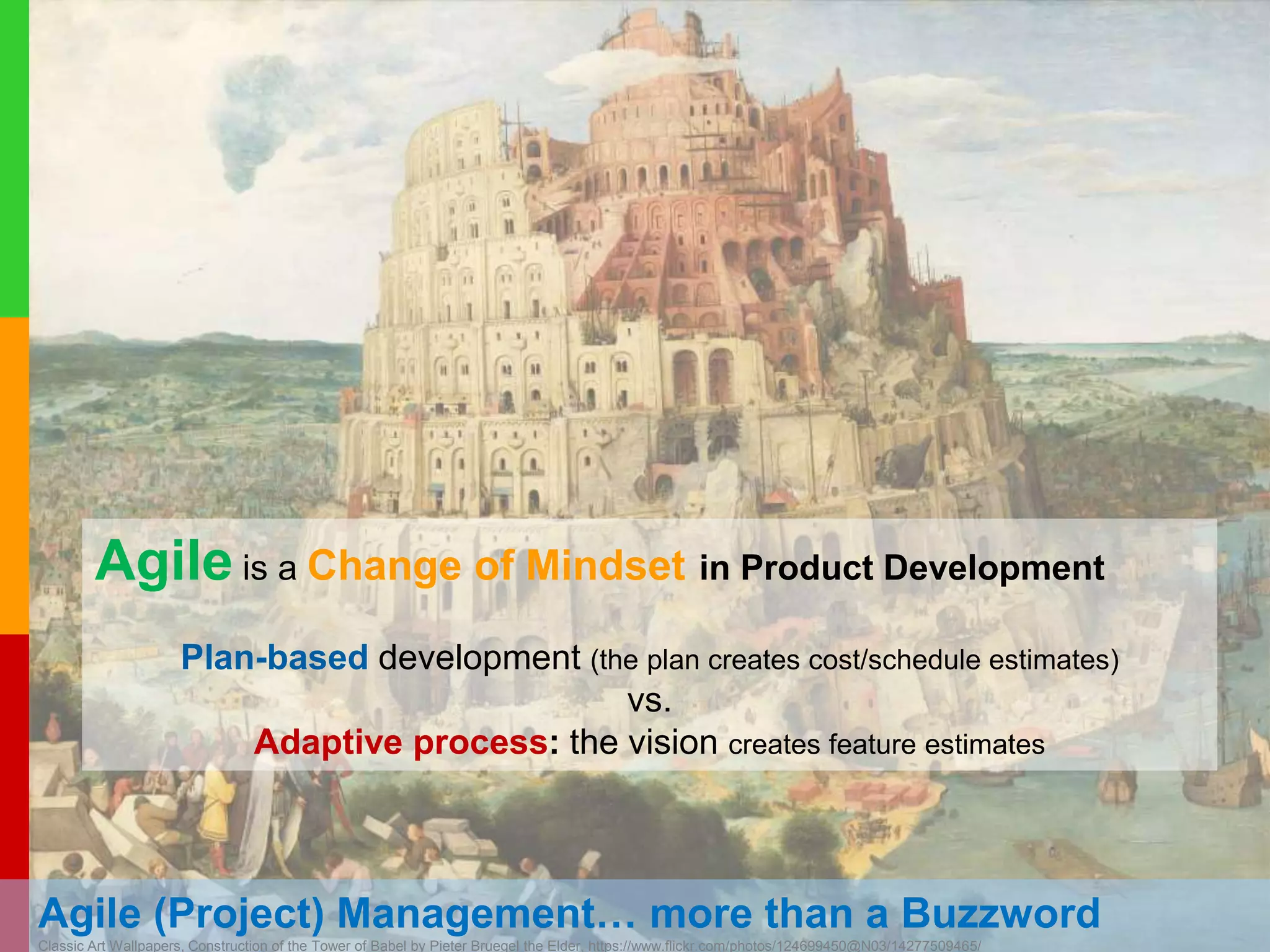
Agile (Project) Management… more than a Buzzword
Classic Art Wallpapers, Construction of the Tower of Babel by Pieter Bruegel the Elder, https://www.flickr.com/photos/124699450@N03/14277509465/
www.plays-in-business.com
www.Plays-in-Business.com
Agile is a Change of Mindset in Product Development
Plan-based development (the plan creates cost/schedule estimates)
vs.
Adaptive process: the vision creates feature estimates
Agile (Project) Management… more than a Buzzword
Classic Art Wallpapers, Construction of the Tower of Babel by Pieter Bruegel the Elder, https://www.flickr.com/photos/124699450@N03/14277509465/
www.plays-in-business.com
www.Plays-in-Business.com
Value Driven Development
PLAN-BASED DEVELOPMENT (WATERFALL)
Plan-based development: the plan creates
cost/schedule estimates
• Features are Fixed
• Time and Cost are Variables
• Quality is negotiable, or worst neglect able
VALUE DRIVEN (AGILE)
Adaptive process: the vision creates
feature estimates
• Time, Cost, and Quality are Fixed
• Features are variable, negotiable
with the customer
Quality
Time Cost
Features
Quality
Time Cost
Features
Value &
Vision-
Driven
Plan-
Driven
Constraints
Estimates
www.plays-in-business.com
www.Plays-in-Business.com
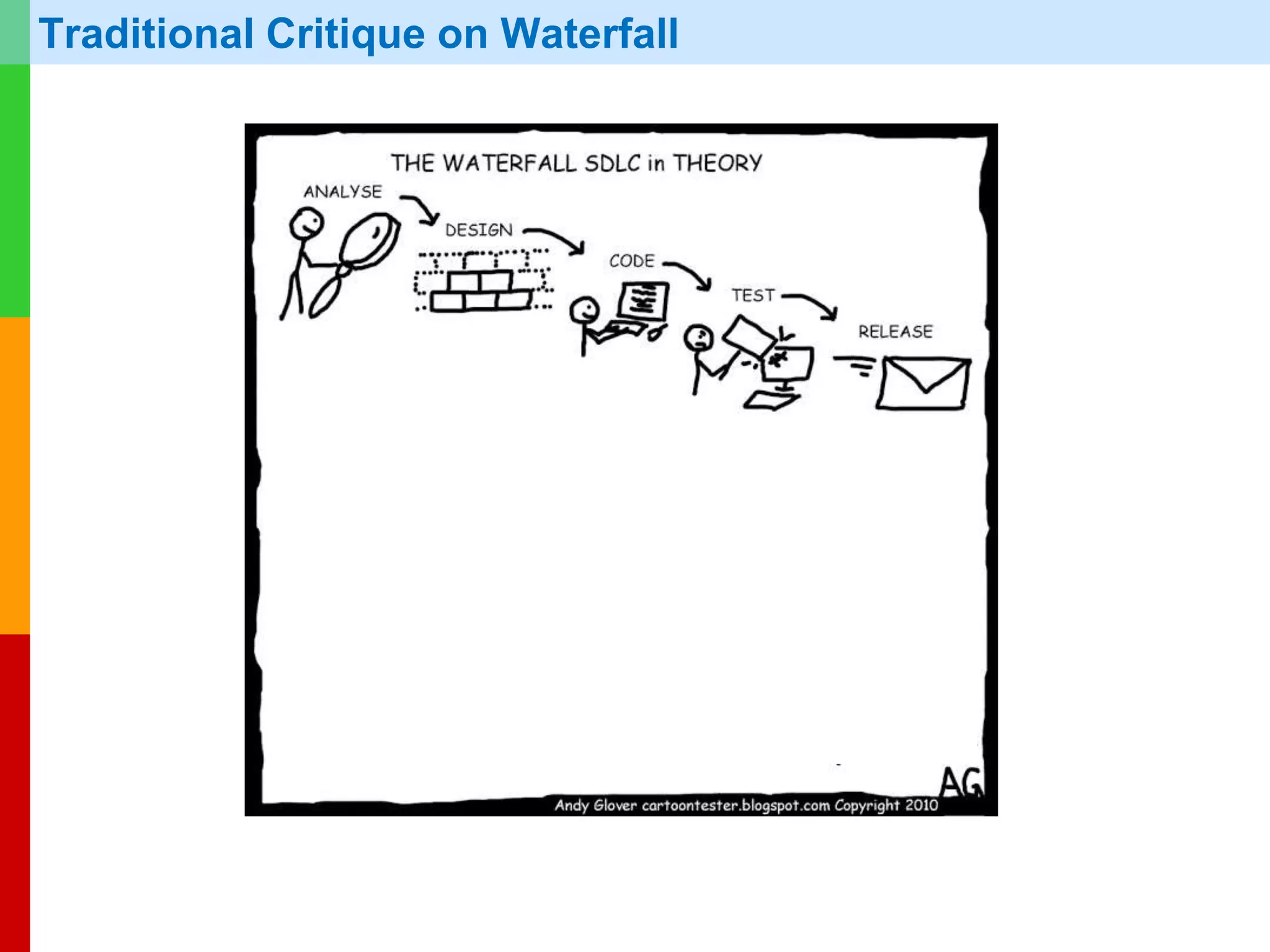
Traditional Critique on Waterfall
www.plays-in-business.com
www.Plays-in-Business.com
Agile Product Development
Agile Framework „Scrum“
Lean Methode: Kanban
Trust the team. – The people
doing the work know it best.
Make reliable commitments.
www.plays-in-business.com
www.Plays-in-Business.com
Partially Done Has No Value
http://blog.nongkhaidesign.com/tag/udon-thani/
Definition of Done (DoD)
Definition of Done are consistent acceptance criteria
across all User Stories (Requirements). It is a
simple list of activities (writing code, coding
comments, unit testing, integration testing, release
notes, design documents, etc.) that add verifiable/
demonstrable value to the product.
The DoD drives the quality of work and define when
a User Story has been completed.
www.plays-in-business.com
www.Plays-in-Business.com
Planning Fallacy – Cone of Uncertainty
EstimationvsVariability
Project Duration
Make them here once you had
change to clearify things
But management asks
for DETAILS HERE!
Don‘t make promises here!
www.plays-in-business.com
www.Plays-in-Business.com
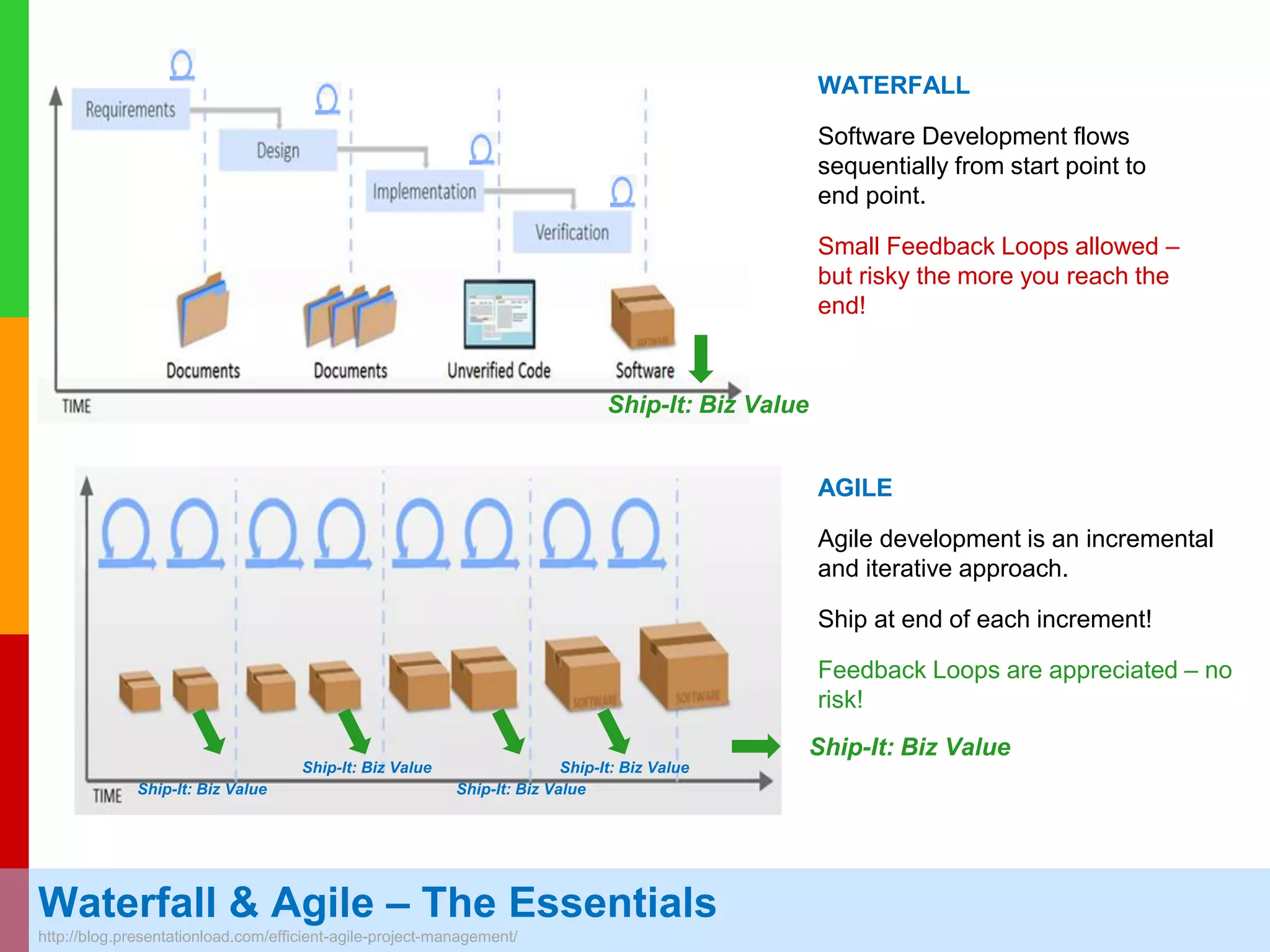
Waterfall & Agile – The Essentials
http://blog.presentationload.com/efficient-agile-project-management/
WATERFALL
Software Development flows
sequentially from start point to
end point.
Small Feedback Loops allowed –
but risky the more you reach the
end!
Ship-It: Biz Value
AGILE
Agile development is an incremental
and iterative approach.
Ship at end of each increment!
Feedback Loops are appreciated – no
risk!
Ship-It: Biz Value
Ship-It: Biz Value
Ship-It: Biz Value
Ship-It: Biz Value
Ship-It: Biz Value
www.plays-in-business.com
www.Plays-in-Business.com
-22 -
28.11.2016
Potential Shippable Product… Restrain to minimal releasable features
http://blog.crisp.se/2016/01/25/henrikkniberg/making-sense-of-mvp
Value-Driven Risk-Minimization
Not
adding components
incrementally
Stopping at latter phases
causes HUGE loss!
Instead
creating stand-alone solutions
– increase value independent
You can stop at each phase
without loss!
By Design Thinking you get 3 innovation
phases!
Shift of Usability
Market Disruption
New Focus Groups
Innovation Shift of Usability
Market Disruption
New Focus Groups
Innovation
Shift of Usability
Market Disruption
New Focus Groups
Innovation
www.plays-in-business.com
www.Plays-in-Business.com
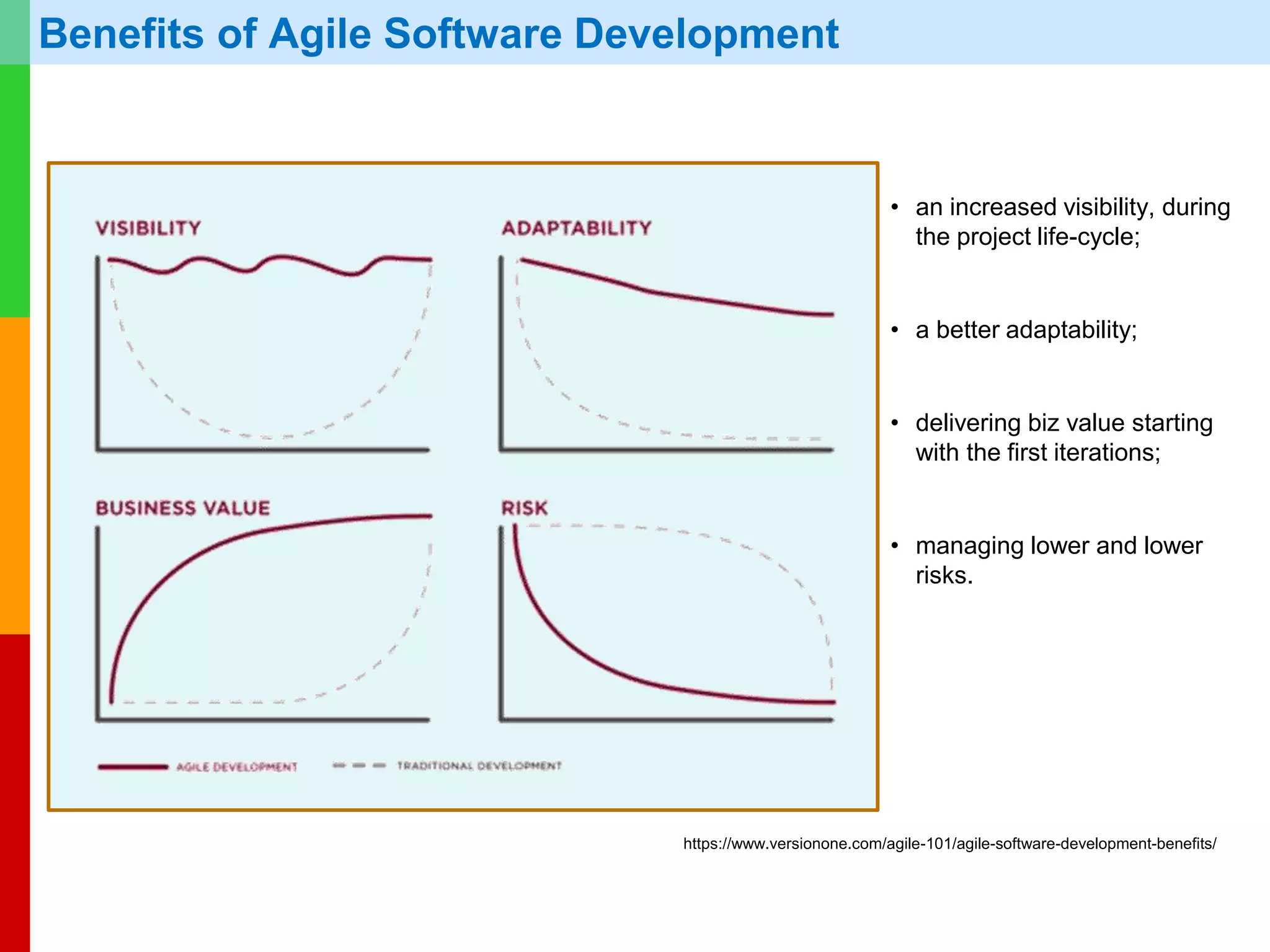
• an increased visibility, during
the project life-cycle;
• a better adaptability;
• delivering biz value starting
with the first iterations;
• managing lower and lower
risks.
https://www.versionone.com/agile-101/agile-software-development-benefits/
Benefits of Agile Software Development
www.plays-in-business.com
www.Plays-in-Business.com
Agile – Pull Principle
http://www.synagila.com/en/agile-project-management/
The team has complete control over
the amount of work it takes on.
The Team pulls only the tasks they
can handle in one iteration.
Product Management (PO) ensures the
team takes on the highest priority work.
Kanban principle, Toyota Production System (TPS),
Taiichi Ohno and Eiji Toyoda: 1948 – 1975.
www.plays-in-business.com
www.Plays-in-Business.com
Product Owner
Scrum MasterSelf-organized
Team
Scrum Master is facilitator for both
the Product Owner and the team.
He manages how information is
exchanged.
He removes obstacles -
“impediments” - that are impeding
the team's progress.
He protects the team from outside
distractions.
He has no authority within the
team (thus couldn’t also be the
Product Owner!)
Product owner is responsible to
have a vision of what he or she
wishes to build, and convey that
vision to the scrum team.
Someone from marketing, product
management or anyone with a
solid understanding of users, the
market place, the competition and
of future trends.
No Management!
self-organized team
Scrum Framework:
A Scrum team includes 7-14
members, plus or minus two.
Scrum teams are cross-
functional, including the
skills (but ideally not the job
titles) of software engineers,
architects, programmers,
analysts, QA experts, testers,
UI designers, etc.
Scrum Framework: 3 Roles – No Manager!
www.plays-in-business.com
www.Plays-in-Business.com
Scrum Framework – Pull Principle
Scrum Master
Product Owner
Prioritizes features:
Product Backlog
Input from End-Users, Customers,
Team, and Other Stakeholders
24 hrs
1 - 2
weeks
Sprint
Daily Scrum
Standup meeting
(15 min)
Sprint Review
Retrospective
(after 4-5 sprints)
Potentially
Shippable
Product
Backlog Refinement
Meeting
(during each sprint)
No Changes!
in Duration or Goal
during Sprint
Sprint 01 Sprint 02 Sprint 03 Sprint n…
Release Planning:
The team has complete control
over the amount of work it takes
on: team pulls only the tasks
they can handle in one sprint.
Sprint Planning
Meeting
Sprint Backlog1
2
3
4
5
6
7
8
9
10
Product Backlog Item
11
12
1
2
3
4
5
6
7
8
The Product Owner ensures
the team takes on the highest
priority work.
Product Increment
3 Roles:
Team, Product Owner,
Scrum Master
3 Artefacts:
Product Backlog, Sprint Backlog,
Product Increment
4 Ceremonies:
Sprint Planning, Daily Standup,
Sprint Review, Retrospectives
www.plays-in-business.com
www.Plays-in-Business.com
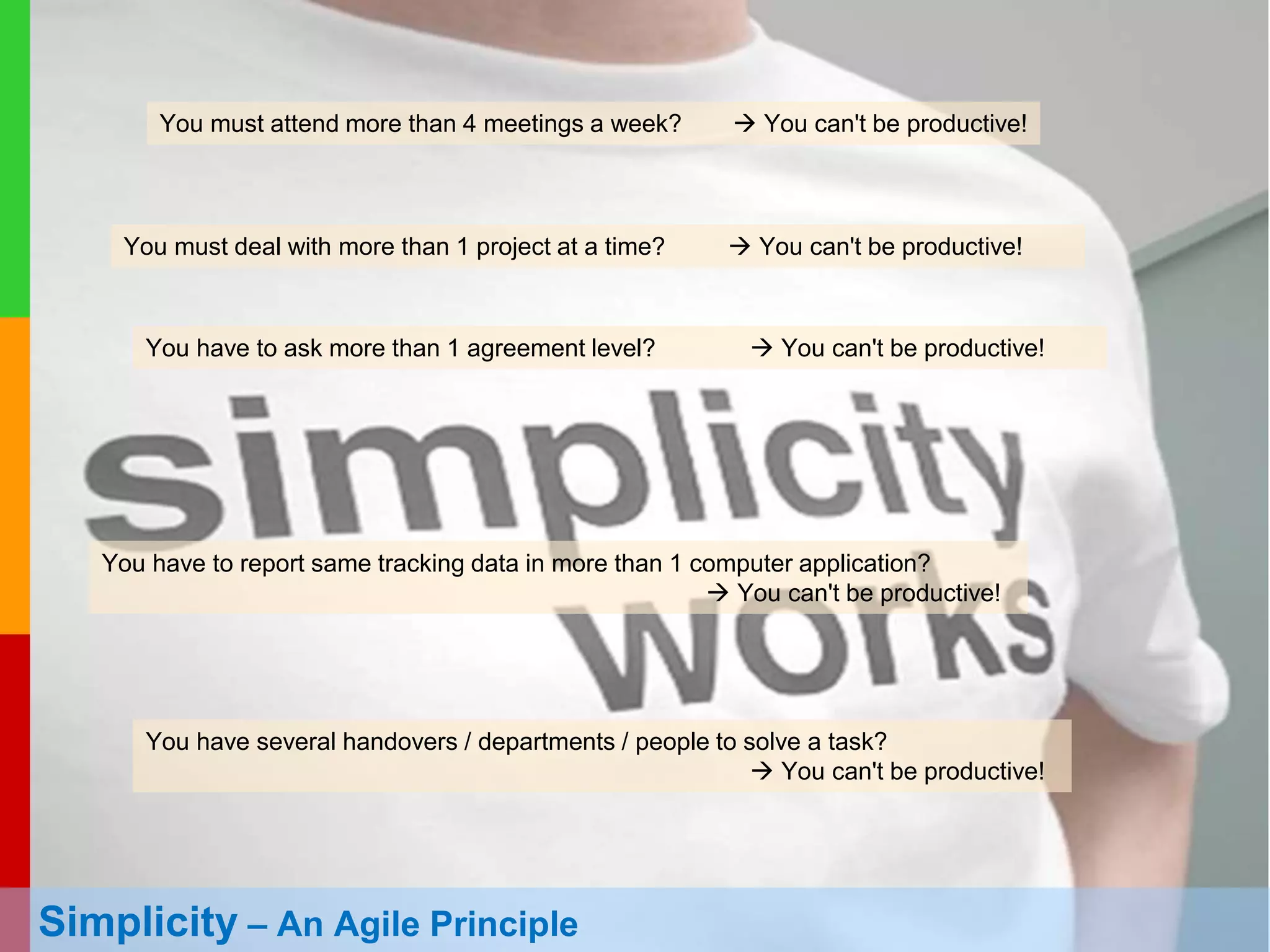
Simplicity – An Agile Principle: “the art of maximizing the amount of work not done”
You must attend more than 4 meetings a week?  You can't be productive!
You must deal with more than 1 project at a time?  You can't be productive!
You have to ask more than 1 agreement level?  You can't be productive!
You have to report same tracking data in more than 1 computer application?
 You can't be productive!
You have several handovers / departments / people to solve a task?
 You can't be productive!
www.plays-in-business.com
www.Plays-in-Business.com
blog.crisp.se
Scaling Agile – Agile Project Management
Scaled Agile Framework – SAFE
http://scaledagileframework.com/
Large Scale Scrum – LeSS
https://less.works/less/framework/index.html
Nexus – https://www.scrum.org/Resources/The-
Nexus-Guide
Minimize handovers –
Less meetings as possible!
Continuous Value Stream(s)
http://www.cio.com/article/2974436/agile-development/comparing-scaling-agile-frameworks.html
Project / Product LevelProduct A
Product C
Product B
SM‘
PO‘
SM‘
PO‘
SM‘
PO‘
Team LevelTeam 01
Team 03 Team 02
Team 04
SM
PO
SM
PO
SM
PO
SM
PO
www.plays-in-business.com
www.Plays-in-Business.com
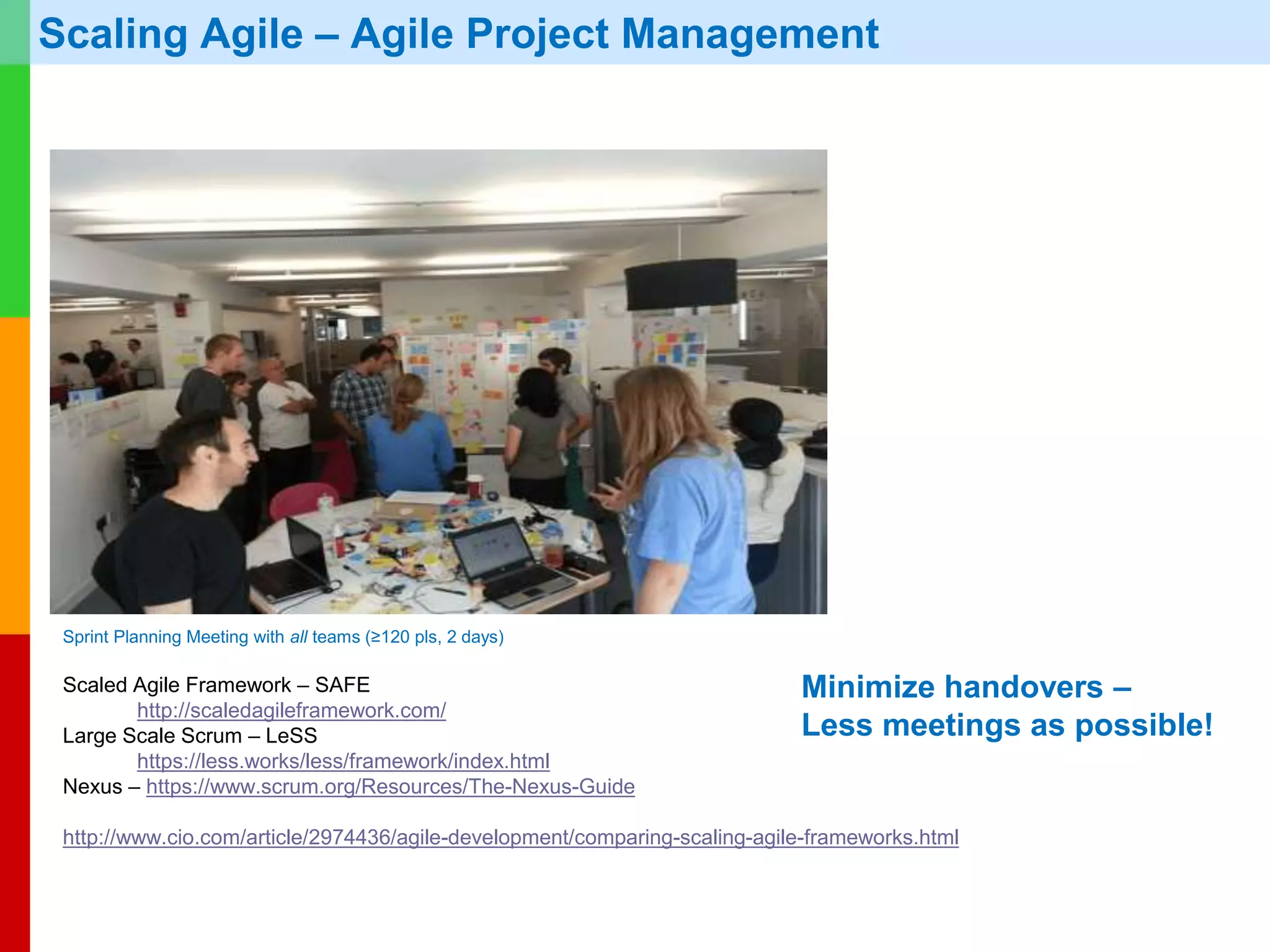
Sprint Planning Meeting with all teams (≥120 pls, 2 days)
Scaling Agile – Agile Project Management
Scaled Agile Framework – SAFE
http://scaledagileframework.com/
Large Scale Scrum – LeSS
https://less.works/less/framework/index.html
Nexus – https://www.scrum.org/Resources/The-Nexus-Guide
http://www.cio.com/article/2974436/agile-development/comparing-scaling-agile-frameworks.html
Minimize handovers –
Less meetings as possible!
www.plays-in-business.com
www.Plays-in-Business.com
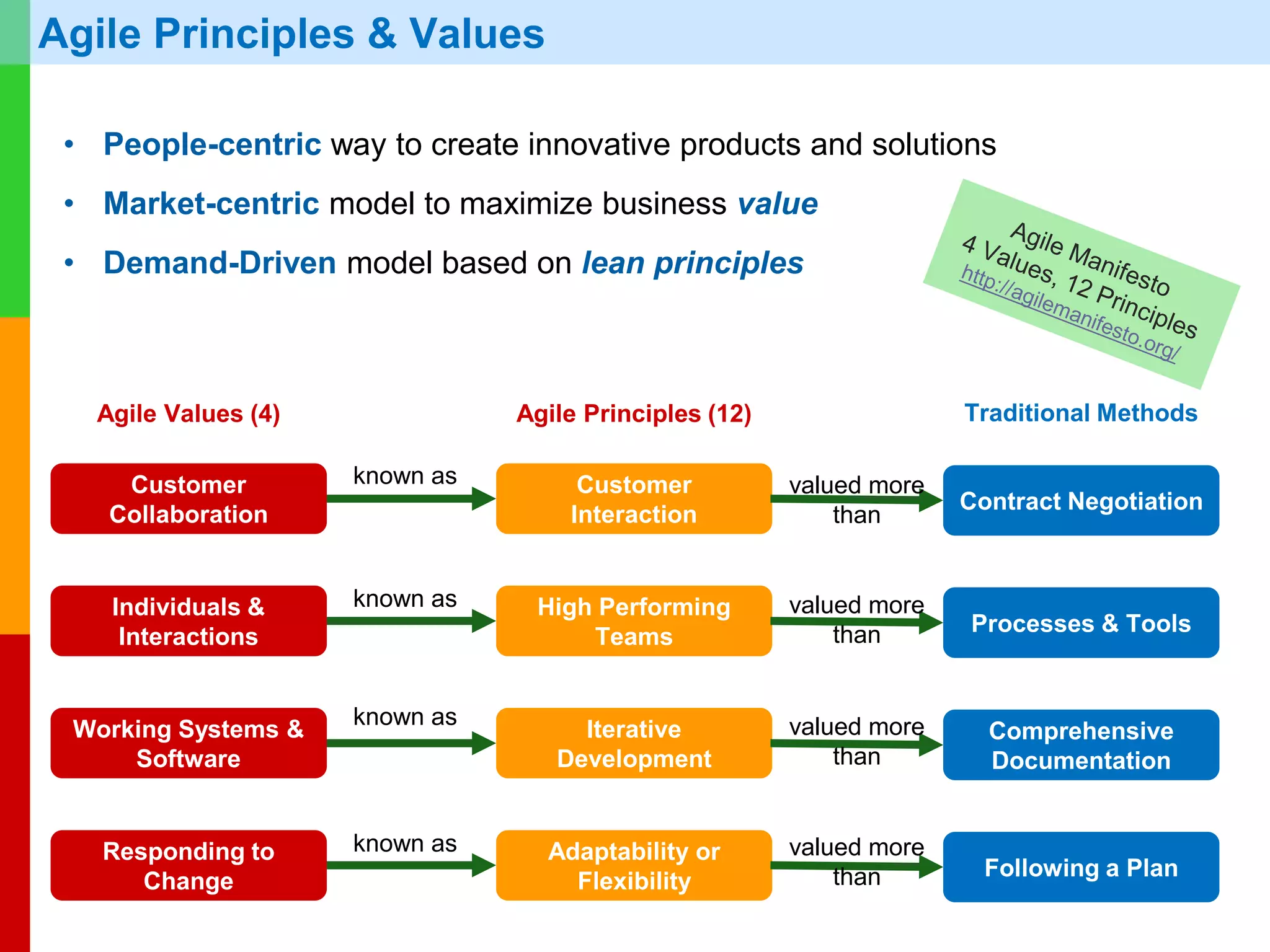
Customer
Collaboration
Individuals &
Interactions
Working Systems &
Software
Responding to
Change
Customer
Interaction
High Performing
Teams
Iterative
Development
Adaptability or
Flexibility
Contract Negotiation
Processes & Tools
Comprehensive
Documentation
Following a Plan
known as
known as
known as
known as
valued more
than
valued more
than
valued more
than
valued more
than
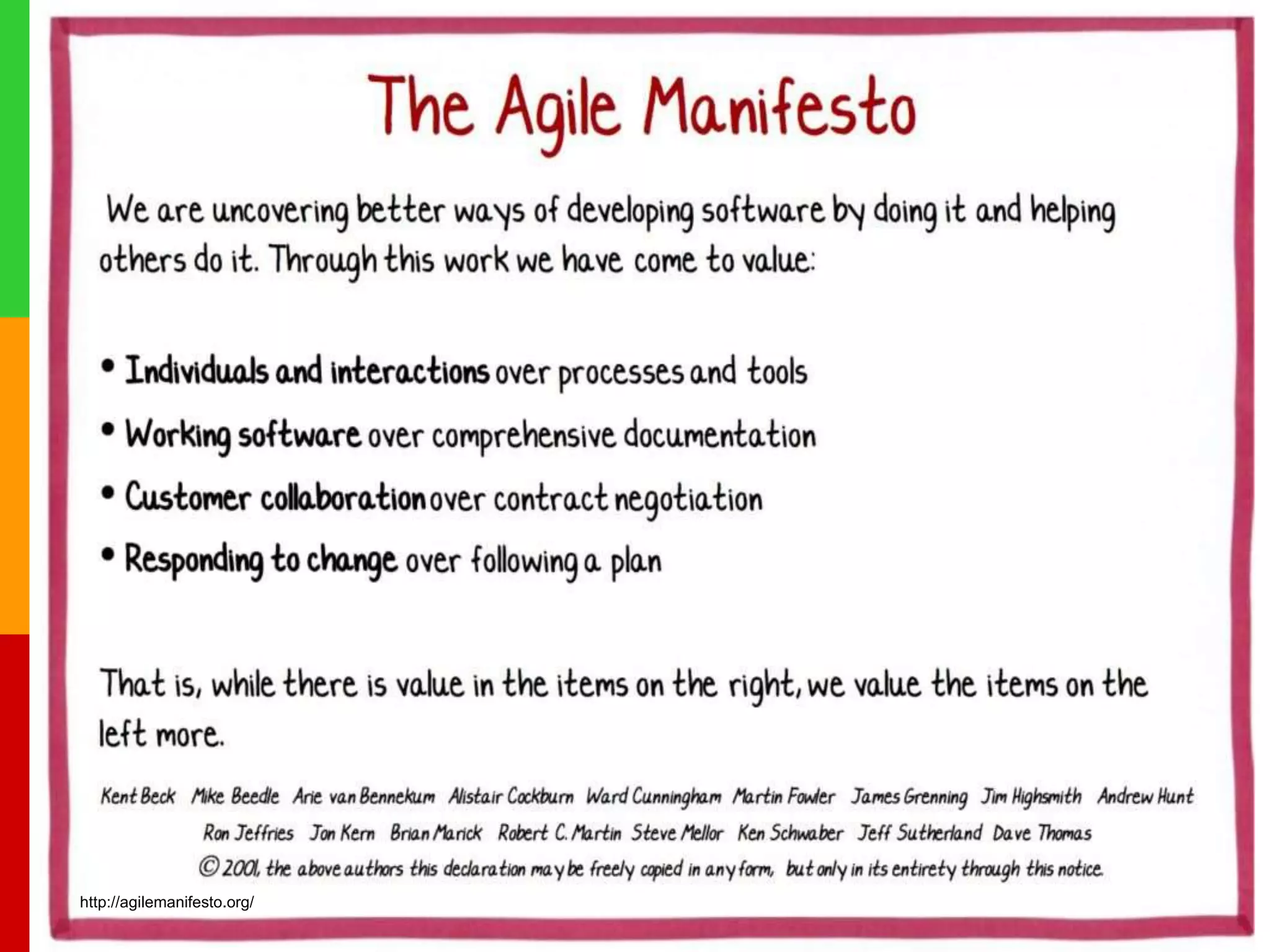
Traditional MethodsAgile Principles (12)Agile Values (4)
Agile Principles & Values
• People-centric way to create innovative products and solutions
• Market-centric model to maximize business value
• Demand-Driven model based on lean principles
www.plays-in-business.com
www.Plays-in-Business.com
http://agilemanifesto.org/
www.plays-in-business.com
www.Plays-in-Business.com
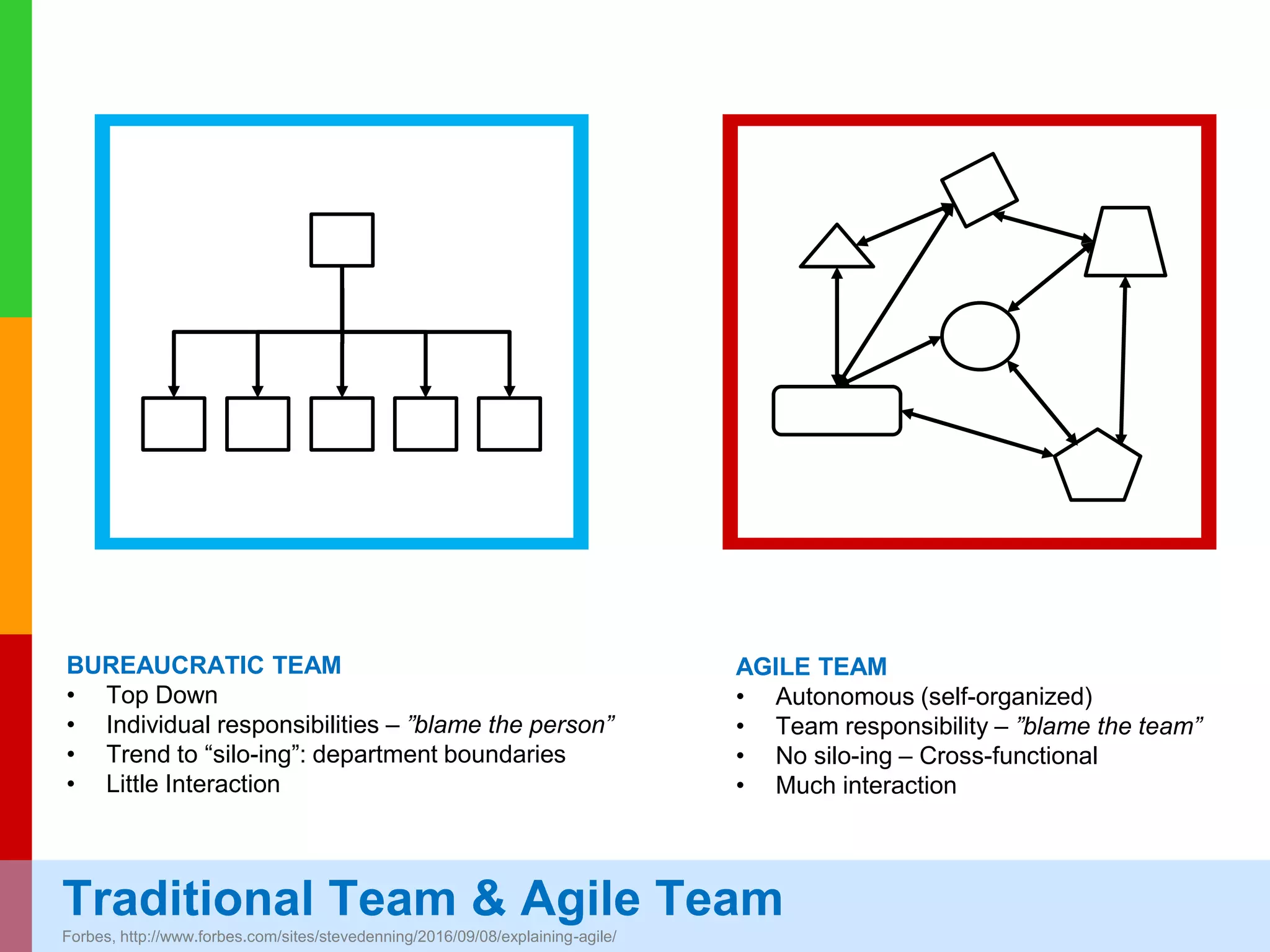
Traditional Team & Agile Team
Forbes, http://www.forbes.com/sites/stevedenning/2016/09/08/explaining-agile/
AGILE TEAM
• Autonomous (self-organized)
• Team responsibility – ”blame the team”
• No silo-ing – Cross-functional
• Much interaction
BUREAUCRATIC TEAM
• Top Down
• Individual responsibilities – ”blame the person”
• Trend to “silo-ing”: department boundaries
• Little Interaction
www.plays-in-business.com
www.Plays-in-Business.com
Exercise 1: Identify one as a aggressor, the other as your protégé.
Station yourself in between both thus your body works always as a
shield for the protégé.
Observation: The group doesn’t reach an equilibrium - it keeps always moving and never stops
Exercise 2: Identify one as aggressor, the other as your shield.
Station yourself in between both thus your shield always protects
you from your aggressor.
Observation: The group comes to a collapse: it stops moving
Exercise 3: Station yourself in between both thus you
three always forms a equal-sided triangle.
Observation: The group stabilize: it moves only to adapt change.
Self-Organized Teams
Exercise: Group is constantly moving in a room or space. Everyone takes for herself 2 persons
in the group – without making them public.
www.plays-in-business.com
www.Plays-in-Business.com
Agile, Agile Leadership & Line Management
• There is NO management in Agile.
• The Team manages itself together with Product Owner.
• The team is cross-functional: all needed skills are available instantly.
• T-shaped team members: they have in-depth skills and other broader skills.
• Leadership is given by the team according to competence and demand.
Agile and Traditional Line Management
Line Manager becomes Agile Leaders
shows the Big Picture and sets the “guard
rails” for the team.
Don‘t Answer – Ask Questions Don‘t Correct Mistakes – Ask Questions
Help Teams Take Ownership
Create a Safe Space to Fail
Let the Team Make DecisionsTrust First and Be Trustworthy
Show the Vision
Connect Team with Customers
Enable & Empower the Team
www.plays-in-business.com
www.Plays-in-Business.com
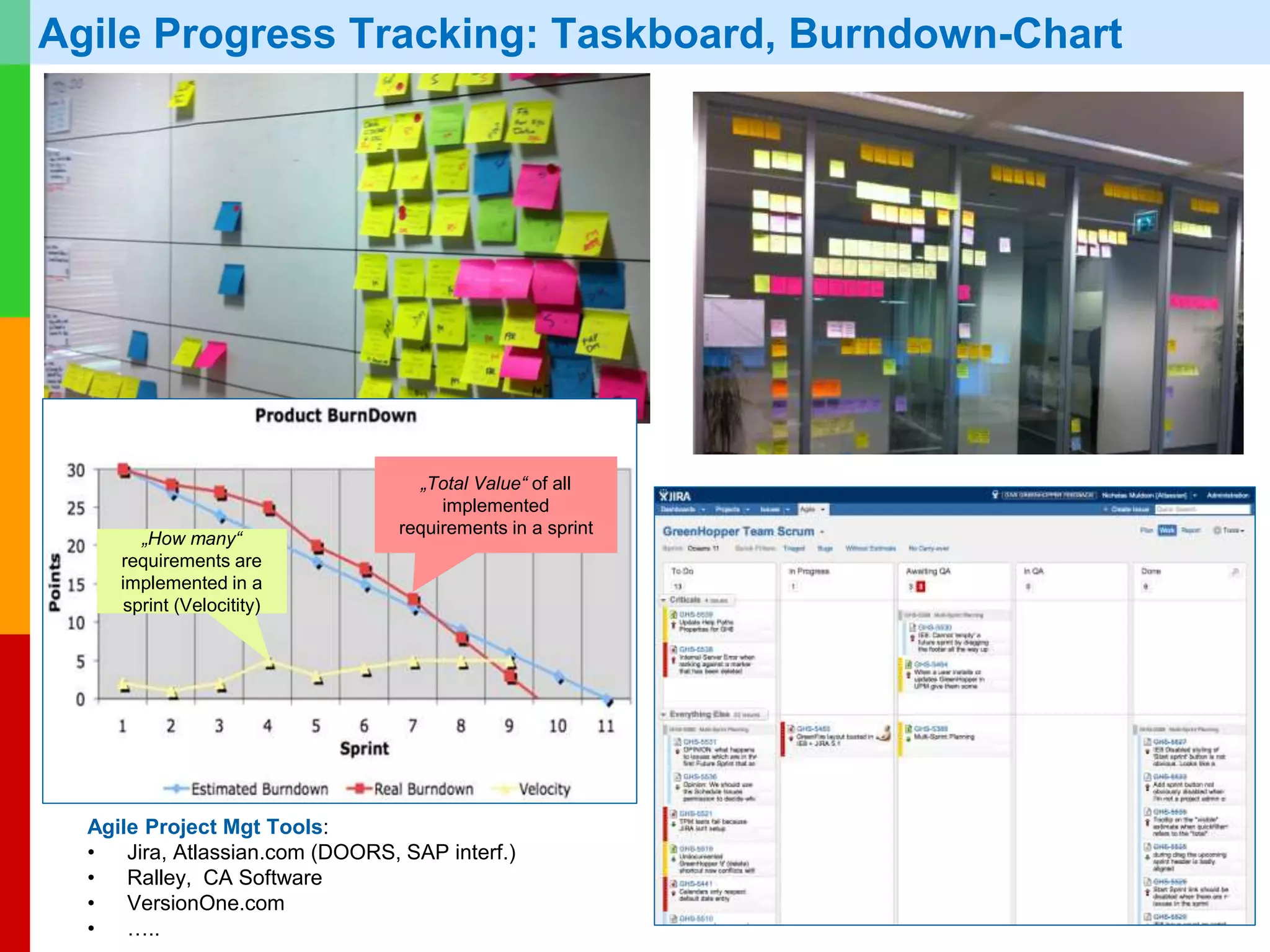
Agile Progress Tracking: Taskboard, Burndown-Chart
Agile Project Mgt Tools:
• Jira, Atlassian.com (DOORS, SAP interf.)
• Ralley, CA Software
• VersionOne.com
• …..
„Total Value“ of all
implemented
requirements in a sprint
„How many“
requirements are
implemented in a
sprint (Velocitity)
www.plays-in-business.com
www.Plays-in-Business.com
Agile Project Mgt Tools: Testing & Deployment
Continuous Integration system always builds and passes its tests, including all
deliveries from different sub-teams.
Continuous Delivery system always builds and deploys to the test environment and
passes its tests.
CD doesn't mean every change is deployed to production
immediately.
It means every change is proven to be deployable at any time.
Continuous Deployment system is always ready to deploy to production through a
largely automated process.
Continuous Deployment
Continuous Delivery
Continuous Integration
Deploy to
production
environment
Acceptance
test
Deploy to
testing
environment
Unit &
Integration
tests
Commit code
Automatic Testing and Continuous Integration
www.plays-in-business.com
www.Plays-in-Business.com
Agile Project Mgt Tools:
• Jira, Atlassian.com (DOORS, SAP interf.)
• Ralley, CA Software
• VersionOne.com
• …..
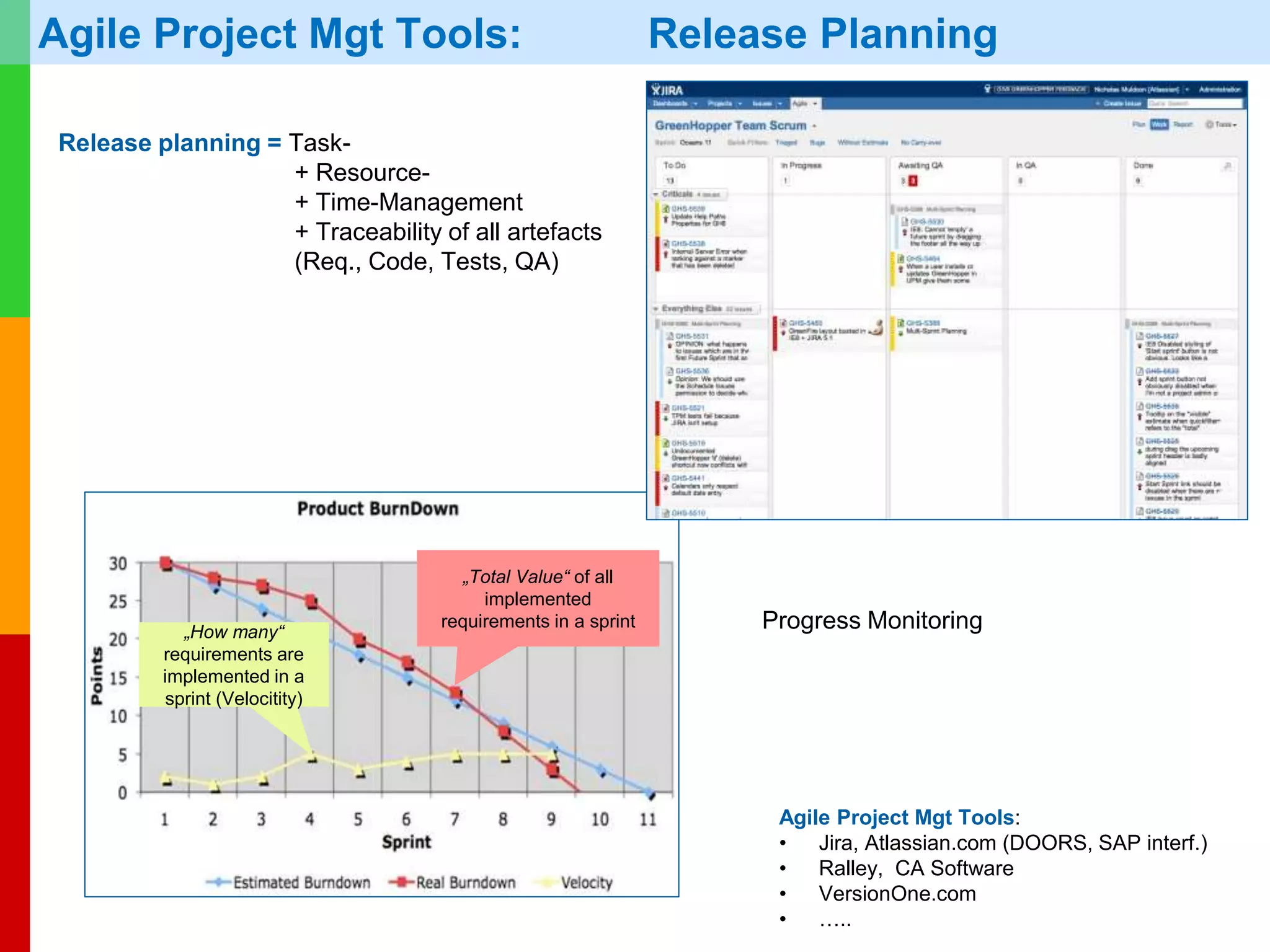
Agile Project Mgt Tools: Release Planning
„Total Value“ of all
implemented
requirements in a sprint
„How many“
requirements are
implemented in a
sprint (Velocitity)
Release planning = Task-
+ Resource-
+ Time-Management
+ Traceability of all artefacts
(Req., Code, Tests, QA)
Progress Monitoring
www.plays-in-business.com
www.Plays-in-Business.com
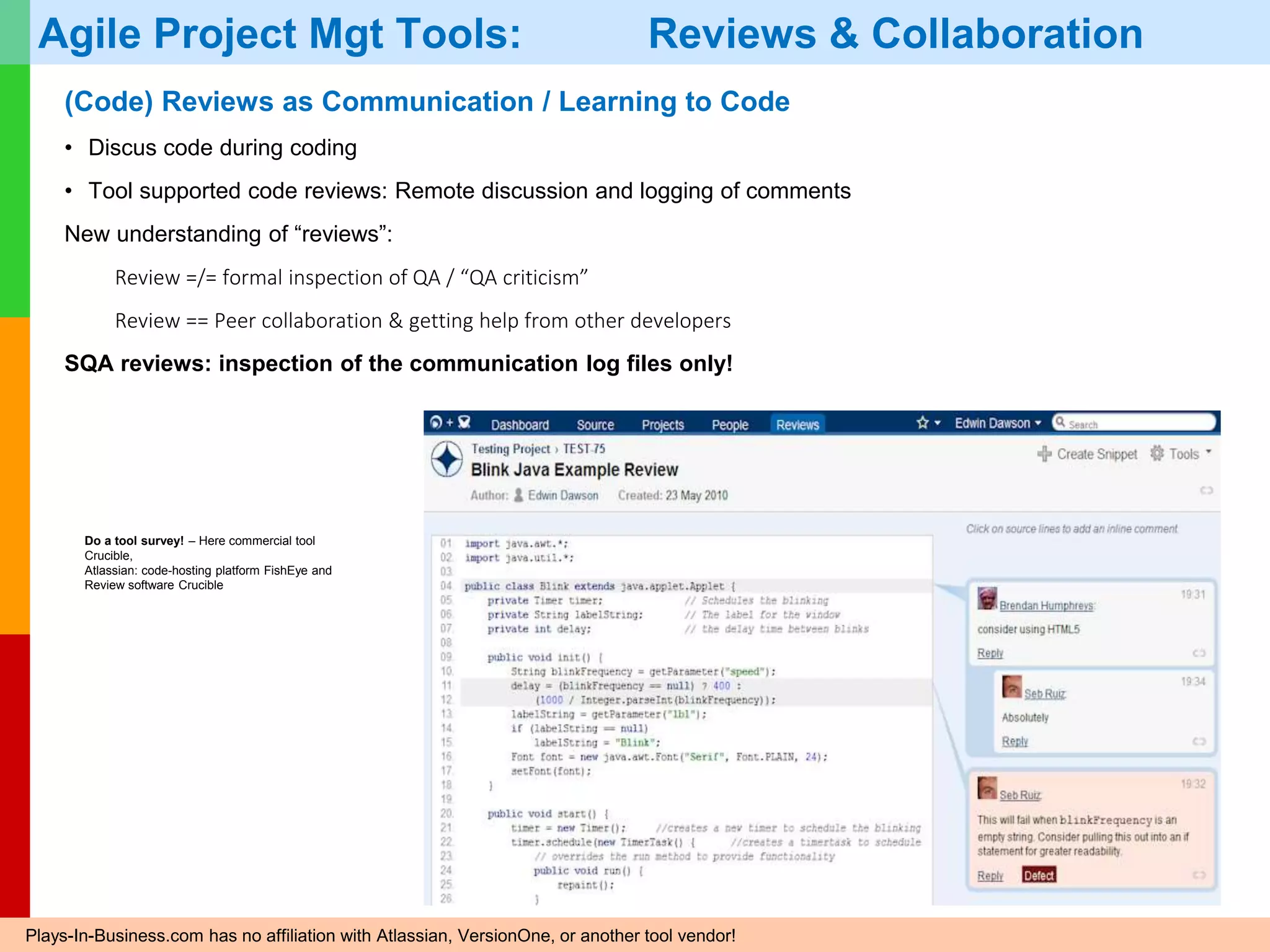
Agile Project Mgt Tools: Reviews & Collaboration
(Code) Reviews as Communication / Learning to Code
• Discus code during coding
• Tool supported code reviews: Remote discussion and logging of comments
New understanding of “reviews”:
Review =/= formal inspection of QA / “QA criticism”
Review == Peer collaboration & getting help from other developers
SQA reviews: inspection of the communication log files only!
Do a tool survey! – Here commercial tool
Crucible,
Atlassian: code-hosting platform FishEye and
Review software Crucible
Plays-In-Business.com has no affiliation with Atlassian, VersionOne, or another tool vendor!
www.plays-in-business.com
www.Plays-in-Business.com
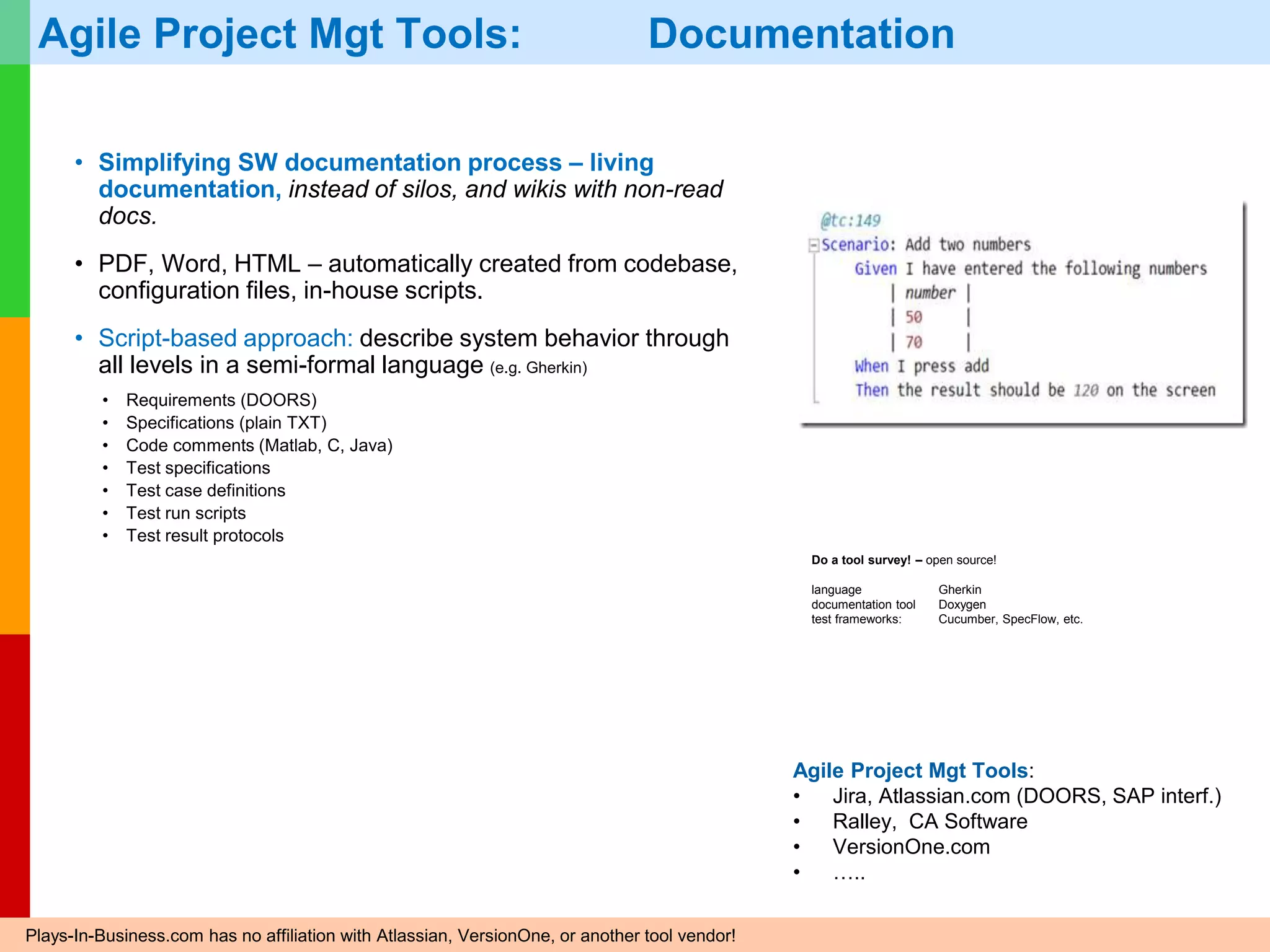
Agile Project Mgt Tools: Documentation
• Simplifying SW documentation process – living
documentation, instead of silos, and wikis with non-read
docs.
• PDF, Word, HTML – automatically created from codebase,
configuration files, in-house scripts.
• Script-based approach: describe system behavior through
all levels in a semi-formal language (e.g. Gherkin)
• Requirements (DOORS)
• Specifications (plain TXT)
• Code comments (Matlab, C, Java)
• Test specifications
• Test case definitions
• Test run scripts
• Test result protocols
Do a tool survey! – open source!
language Gherkin
documentation tool Doxygen
test frameworks: Cucumber, SpecFlow, etc.
Plays-In-Business.com has no affiliation with Atlassian, VersionOne, or another tool vendor!
Agile Project Mgt Tools:
• Jira, Atlassian.com (DOORS, SAP interf.)
• Ralley, CA Software
• VersionOne.com
• …..
www.plays-in-business.com
www.Plays-in-Business.com
Common Misunderstandings
Desi, https://www.flickr.com/photos/desiitaly/2201907500/
Wrong!
Take regulations as additional features; control the process
Agile Doesn’t Fit in Regulative Environments
Wrong!
No Command-n-Control. Agile Leaders are servants leaders for the team
In Agile there is no Management, or Leadership
Wrong!
Full-Time is better but not necessary
In Agile all Team Member must be Full-Time
assigned in one project
Wrong!
Documentation has to have value!
In Agile there is no Documentation
Wrong!
Co-location is better but not necessary
In Agile all Team Members must be co-located
Wrong!
Agile has more planning!
In Agile there is no Project Plan resp. Planning
Wrong!
Requirements spanning sprints improve the flow.
In Agile Work must Fit in a Sprint
www.plays-in-business.com
www.Plays-in-Business.com
Common Misunderstandings
In Agile there is no Project Plan resp. Planning
• Agile probably has more planning.
• Agile Planning is spread out through the whole development.
• Sprint is planned and strictly monitored on a daily level.
• In addition, most Agile projects will start with an initial iteration – Sprint 0 –, or even a classic
high-level analysis phase to determine the overall scope and complexity, fill the initial
product backlog, and provide overall estimation on cost and timing – ideally resulting in
high-level architectural blueprints and a release (e.g., Minimum Releasable Feature) plan.
Sprint 1 Sprint 2 Sprint 3 Sprint 4
Planning
Tasks
Planning
Tasks
Planning
Tasks
Planning
Tasks
Planning
Tasks
Executing
Tasks
Executing
Tasks
Executing
Tasks
Executing
Tasks
www.plays-in-business.com
www.Plays-in-Business.com
In Agile all Team Members must be co-located
• Colocation is the ideal situation for Agile (and really any project!), but increasingly rare in
today’s globalized business environment.
• There are great software-based tools that replace physical task boards; some as simple
as Excel, SharePoint, and web-cams or sophisticated tools as Rally or Jira.
• Distributed Teams certainly take more effort and skilled leadership – but it is not a show-
stopper.
Common Misunderstandings
www.plays-in-business.com
www.Plays-in-Business.com
In Agile there is no Documentation
• You can have as much documentation as you need.
• Documentation is just another deliverable.
• If it brings you any value the schedule it and produce it like anything else.
Paul, https://www.flickr.com/photos/doberdad/2264130166/
Common Misunderstandings
www.plays-in-business.com
www.Plays-in-Business.com
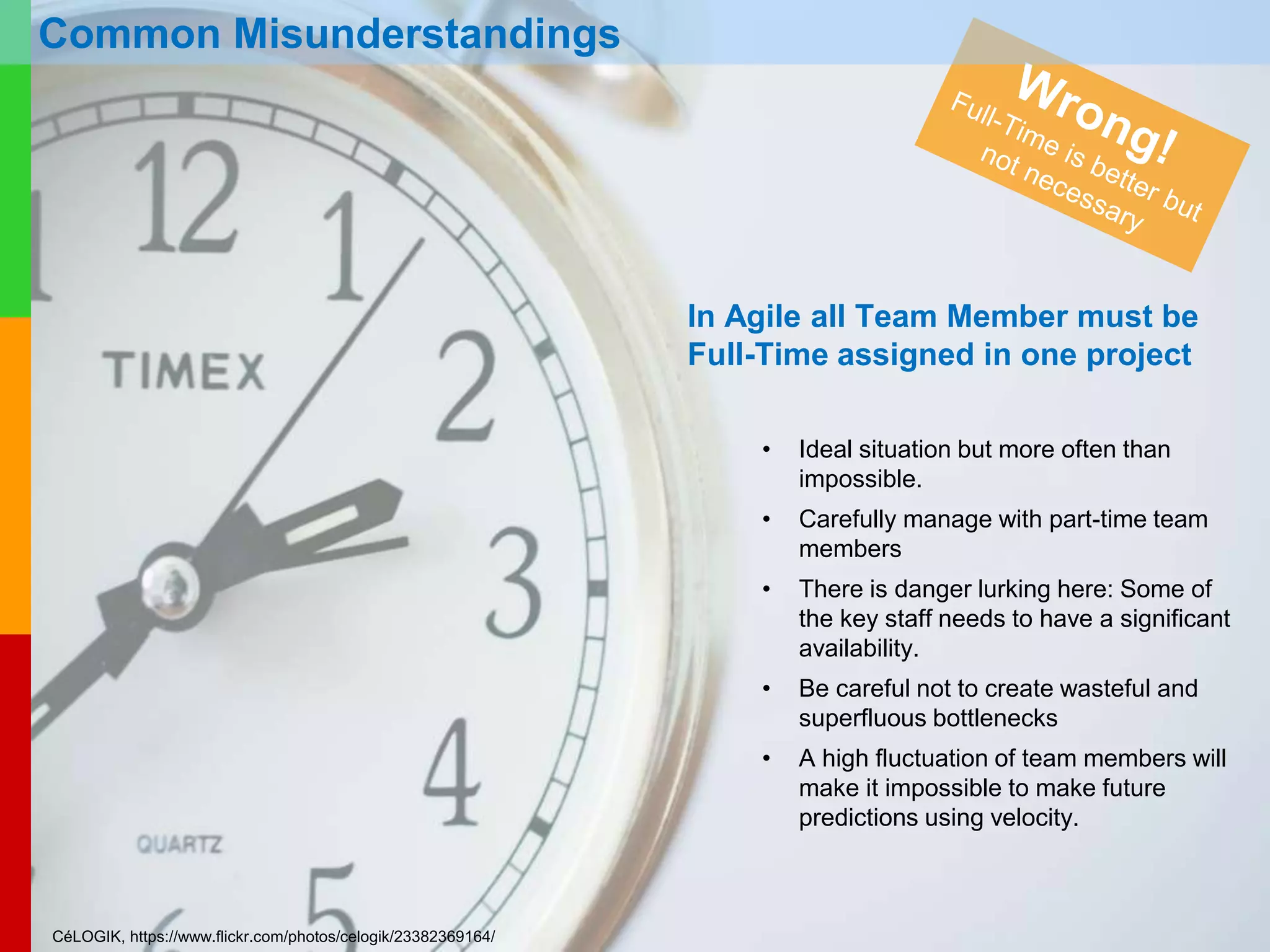
In Agile all Team Member must be
Full-Time assigned in one project
• Ideal situation but more often than
impossible.
• Carefully manage with part-time team
members
• There is danger lurking here: Some of
the key staff needs to have a significant
availability.
• Be careful not to create wasteful and
superfluous bottlenecks
• A high fluctuation of team members will
make it impossible to make future
predictions using velocity.
CéLOGIK, https://www.flickr.com/photos/celogik/23382369164/
Common Misunderstandings
www.plays-in-business.com
www.Plays-in-Business.com
Don‘t Take away Ownership
Don‘t Answer – Ask Questions
Don‘t Correct Mistakes – Ask Questions
Help Teams Find Trust
Create a Safe Space to Fail
Let the Team Make Decisions
Trust First and Be Trustworthy
Show the Vision
Connect Team with Customers
Enable the Team
Nina Matthews https://www.flickr.com/photos/21560098@N06/6722653055/sizes/l/
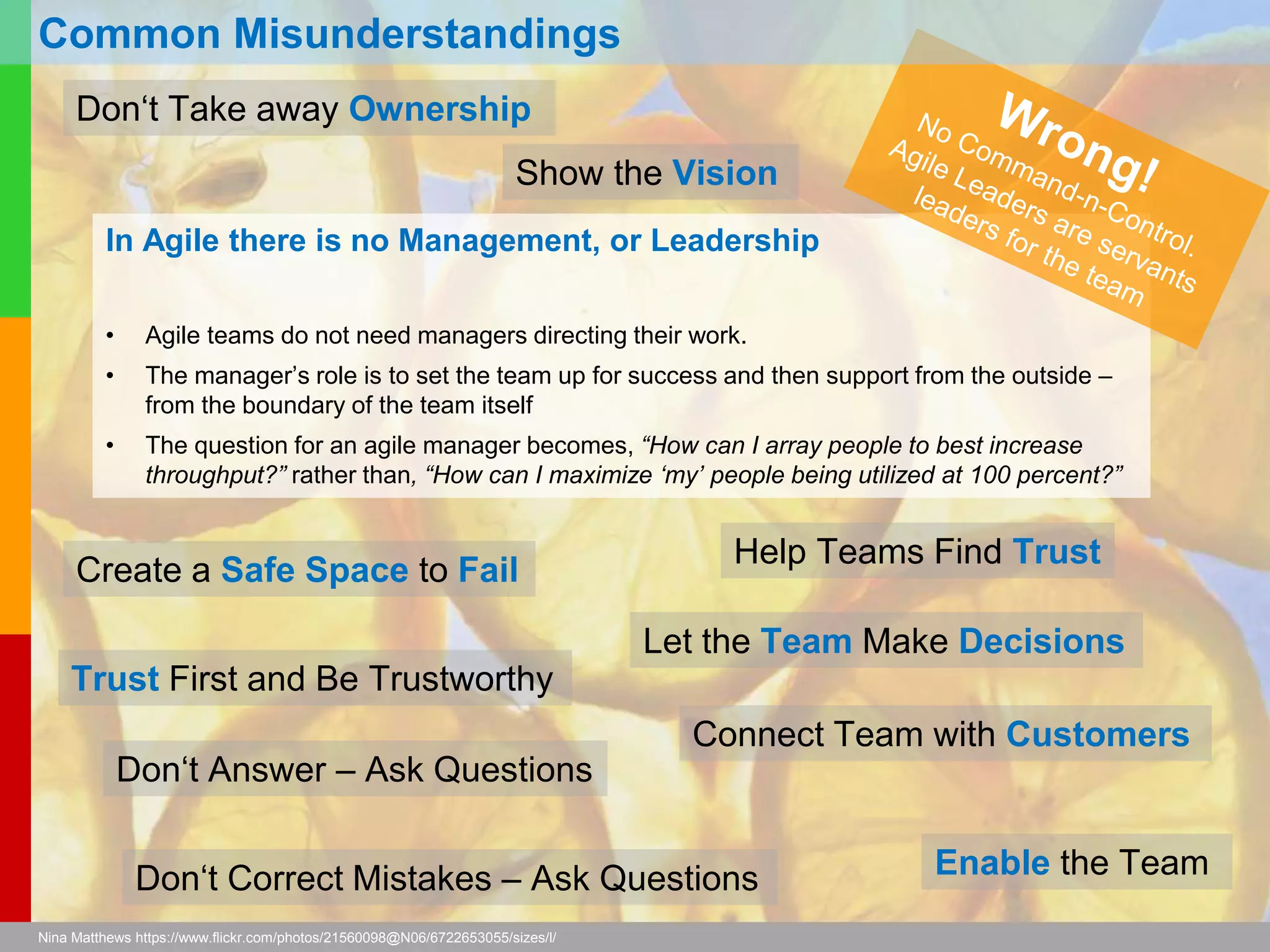
In Agile there is no Management, or Leadership
• Agile teams do not need managers directing their work.
• The manager’s role is to set the team up for success and then support from the outside –
from the boundary of the team itself
• The question for an agile manager becomes, “How can I array people to best increase
throughput?” rather than, “How can I maximize ‘my’ people being utilized at 100 percent?”
Common Misunderstandings
www.plays-in-business.com
www.Plays-in-Business.com
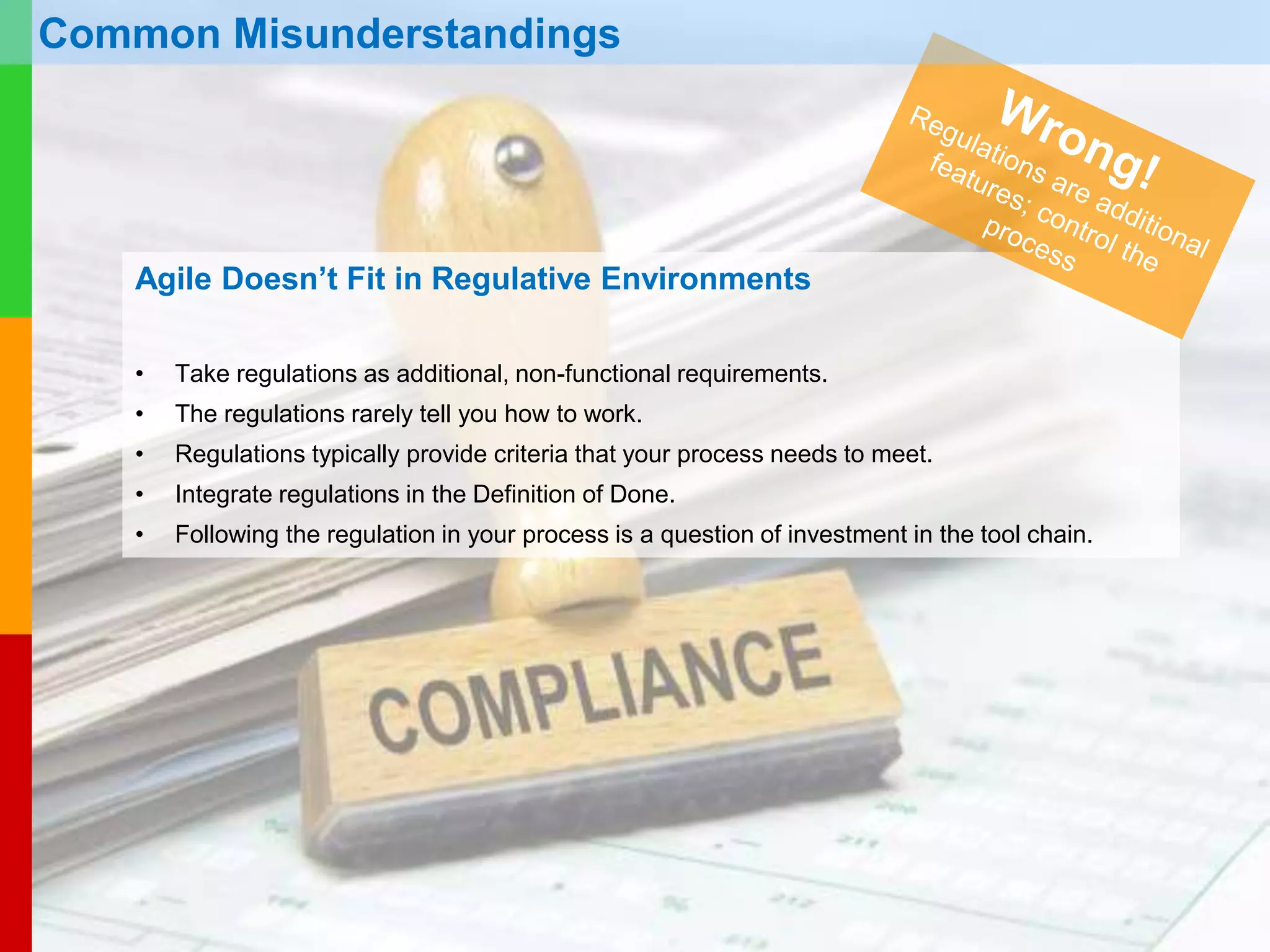
Agile Doesn’t Fit in Regulative Environments
• Take regulations as additional, non-functional requirements.
• The regulations rarely tell you how to work.
• Regulations typically provide criteria that your process needs to meet.
• Integrate regulations in the Definition of Done.
• Following the regulation in your process is a question of investment in the tool chain.
Common Misunderstandings
www.plays-in-business.com
www.Plays-in-Business.com
In Agile Work must Fit in a Sprint
• If you do Hard Core Scrum from the Book – YES.
• However, let stories (requirements) span sprints to improve flow.
• Nevertheless, slice huge stories in smaller chunks as often as possible.
• Small stories (requirements) are equivalent to small pieces of work
Sam Greenhalgh, https://www.flickr.com/photos/zapthedingbat/2208241379/
Common Misunderstandings
www.plays-in-business.com
www.Plays-in-Business.com
In Agile there is no Design
• Agile probably means MORE DESIGN.
• Design is inherent all the way through development at every planning meeting
Jamie, https://www.flickr.com/photos/jamiesrabbits/7640990538/
Common Misunderstandings
www.plays-in-business.com
www.Plays-in-Business.com
Agile Adoption… a Long and Windy Way
eflon, https://www.flickr.com/photos/eflon/8842584616/
You can not change people! – Change their (working)
environment instead. – Then people change their habits.
You can not create a new culture – the people define it.
Show by example.
• Change Leadership style from micro-managing to
showing Big Pictures instead.
• Create flat hierarchies – stop procedural hand-overs.
• Empower people.
• Create a trustful atmosphere.
• Give autonomy, mastery, goals
• Do not Scale Agile – Grow Agile!
www.plays-in-business.com
www.Plays-in-Business.com
Agile & Waterfall: Project Success and Failure Rates
Successful Challenged Failed
Agile 39% 52% 9%
Waterfall 11% 60% 29%
Successful: Delivered on time and on budget, with required features and functions.
Challenged: Late and over budget, or with fewer than the required features and functions.
Failed: Canceled prior to completion or the product was delivered but never used.
https://www.infoq.com/articles/standish-chaos-2015
https://www.scrumalliance.org/community/articles/2015/october/adopt-scrum-for-competitive-advantage
www.plays-in-business.com
www.Plays-in-Business.com
Reasons for Agile Adoption
2015, http://techbeacon.com/survey-agile-new-norm
www.plays-in-business.com
www.Plays-in-Business.com
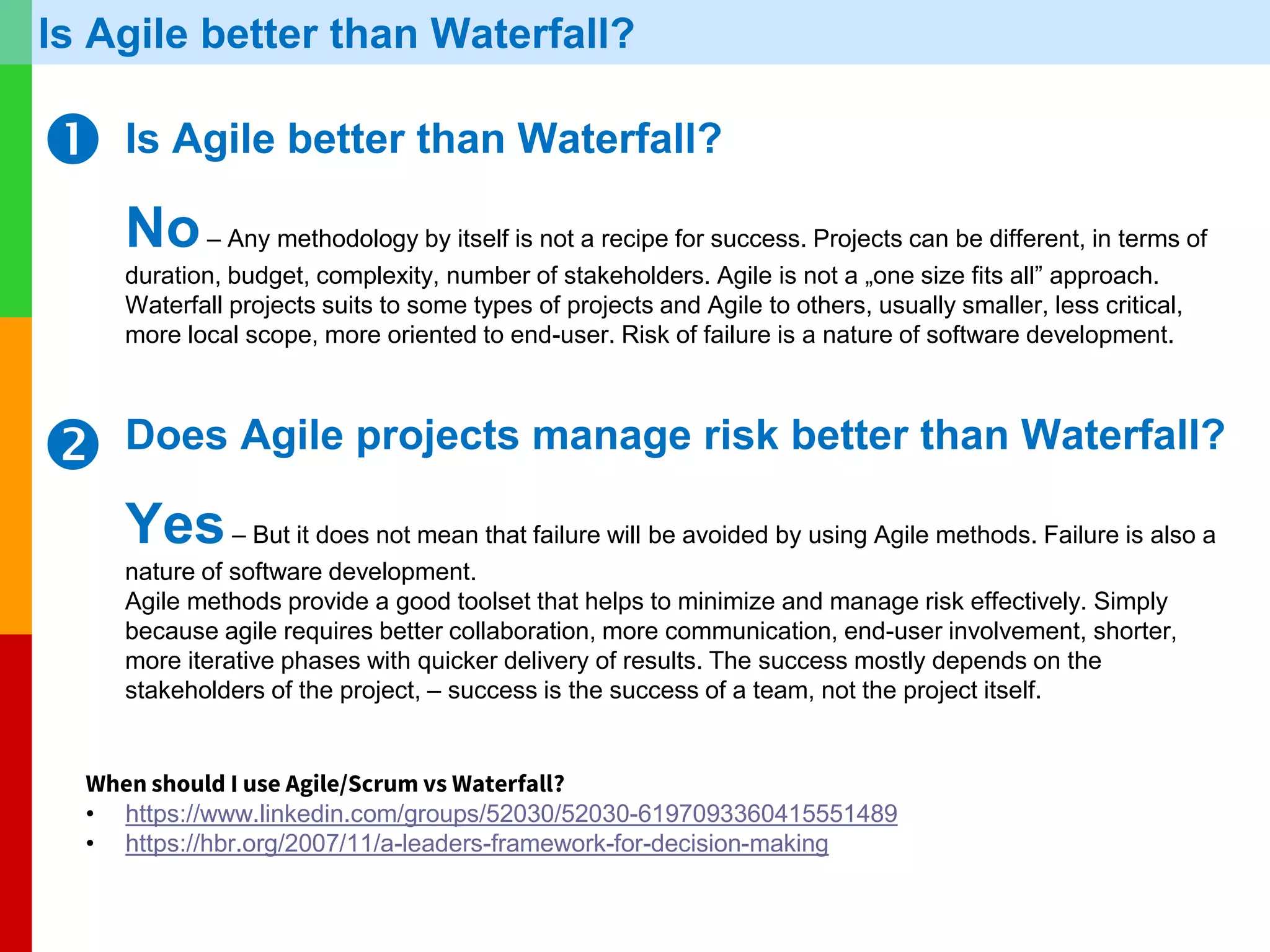
Is Agile better than Waterfall?
No– Any methodology by itself is not a recipe for success. Projects can be different, in terms of
duration, budget, complexity, number of stakeholders. Agile is not a „one size fits all” approach.
Waterfall projects suits to some types of projects and Agile to others, usually smaller, less critical,
more local scope, more oriented to end-user. Risk of failure is a nature of software development.
Does Agile projects manage risk better than Waterfall?
Yes– But it does not mean that failure will be avoided by using Agile methods. Failure is also a
nature of software development.
Agile methods provide a good toolset that helps to minimize and manage risk effectively. Simply
because agile requires better collaboration, more communication, end-user involvement, shorter,
more iterative phases with quicker delivery of results. The success mostly depends on the
stakeholders of the project, – success is the success of a team, not the project itself.


When should I use Agile/Scrum vs Waterfall?
• https://www.linkedin.com/groups/52030/52030-6197093360415551489
• https://hbr.org/2007/11/a-leaders-framework-for-decision-making
www.plays-in-business.com
www.Plays-in-Business.com
Agile Adoption Rates
2015, http://techbeacon.com/survey-agile-new-norm
Major uptick in Agile adoption began
to occur in 2009-2010
Most current Agile orgs have adopted
in just the past 5 years
www.plays-in-business.com
www.Plays-in-Business.com
http://searchsoftwarequality.techtarget.com/photostory/4500251243/VersionOne-surveys-Agile-
development-for-2015/1/Top-Agile-project-management-tools
Why Do Agile Projects Fail?
Agile is not the Silver Bullet!
www.plays-in-business.com
www.Plays-in-Business.com
Further Readings: Agile SW Development
www.plays-in-business.com
www.Plays-in-Business.com
Further Readings: Agile / Lean Management
www.plays-in-business.com
www.Plays-in-Business.com
Twitter: @M_Tarnowski, @PlaysInBusiness
Facebook: http://bit.ly/PiB-FB
LinkedIn: http://bit.ly/MT-LinkdIn
Xing: http://bit.ly/MT-Xing
SlideShare: http://bit.ly/MT-SShare
Or call me:
+49-172-69 152 61
You Enjoyed It? – Drop me a note:
info@plays-in-business.com
This document may be further distributed free-of-charge in its original, complete form only. Please credit Plays-in-Business.com.
All images used are – if not stated otherwise – taken from flickr.com under Common Creative License.
Julien GONG Min, https://www.flickr.com/photos/bfishadow/3634884928/

Agile – The New Kid in the Block?

  • 1.
    www.plays-in-business.com www.Plays-in-Business.com Agile – ANew Kid in the Block? What is Agile & Agile Project Management? Michael Tarnowski, Plays-In-Business.com
  • 2.
    www.plays-in-business.com www.Plays-in-Business.com Michael Tarnowski www.plays-in-business.com SW Engineer& Coder (C++, Linux) Project manager (Air Traffic Management) IT Management Consultant • Scrum Master (CSM), LeSS practionier, Agile Coach • QA, PrjMgt, ReqEng, Testing, SDLC • SW process improvement (certif. CMMI consultant, ISO 15504 assessor) • Certif. ITIL consultant • Certif. CobIT consultant Agilist & Evangelist in Serious Play@Work: • Cert. LEGO Serious Play Facilitator • Cert. Innovation Games Facilitator • Agile Games Addictß Agile mantra No Titles Only skills
  • 3.
    www.plays-in-business.com www.Plays-in-Business.com Agile …is about Values– not about Projects …has no “Management” Agile Project Management = Contradiction in Terms
  • 4.
    www.plays-in-business.com www.Plays-in-Business.com Ok, you wantthe… … you will get it now! within the next slides…jump ahead!
  • 5.
    www.plays-in-business.com www.Plays-in-Business.com The Summary: Plan-Basesvs Adaptive Development Agile is… • People-centric way to create innovative products and solutions • Market-centric model to maximize business value • Demand-Driven model based on lean principles Plan-based development: the plan creates cost/schedule estimates • Features are Fixed • Time and Cost are Variables • Quality is negotiable, or worst neglect able Adaptive process: the vision creates feature estimates • Time, Cost, and Quality are Fixed • Features are variable, negotiable with the customer Software Development flows sequentially from start point to end point. Small Feedback Loops allowed – but risky the more you reach the end!Ship-It: Biz Value Waterfall, purpose-driven Agile development is an incremental and iterative approach. Ship at end of each increment! Feedback Loops are appreciated – no risk! Ship-It: Biz Value Ship-It: Biz Value Ship-It: Biz Value Ship-It: Biz Value Ship-It: Biz Value Agile, value-driven
  • 6.
    www.plays-in-business.com www.Plays-in-Business.com -6 - 28.11.2016 Not adding components incrementally Stoppingat latter phases causes HUGE loss! The Summary: Value-Driven, Risk-Minimization by Henrik Kniberg, http://blog.crisp.se/2016/01/25/henrikkniberg/making-sense-of-mvp Instead creating stand-alone solutions – increase value independent You can stop at each phase without loss! By Design Thinking you get 3 innovation phases! Shift of Usability Market Disruption New Focus Groups Innovation Shift of Usability Market Disruption New Focus Groups Innovation Shift of Usability Market Disruption New Focus Groups Innovation
  • 7.
    www.plays-in-business.com www.Plays-in-Business.com The Summary: ScrumFramework – Pull Principle & Time-Boxing 3 Roles: Team, Product Owner, Scrum Master 3 Artefacts: Product Backlog, Sprint Backlog, Product Increment 4 Ceremonies: Sprint Planning, Daily Standup, Sprint Review, Retrospectives Product Owner Prioritizes features: Product Backlog Input from End-Users, Customers, Team, and Other Stakeholders 24 hrs 1 - 2 weeks Sprint Daily Scrum Standup meeting (15 min) Sprint Review Retrospective (after 4-5 sprints) Potentially Shippable Product Backlog Refinement Meeting (during each sprint) No Changes! in Duration or Goal during Sprint Sprint 01 Sprint 02 Sprint 03 Sprint n… Release Planning: The team has complete control over the amount of work it takes on: team pulls only the tasks they can handle in one sprint. Sprint Planning Meeting Sprint Backlog1 2 3 4 5 6 7 8 9 10 Product Backlog Item 11 12 1 2 3 4 5 6 7 8 The Product Owner ensures the team takes on the highest priority work. Product Increment Scrum Master Facilitator for both the Product Owner and the team. Has no authority within the team!
  • 8.
    www.plays-in-business.com www.Plays-in-Business.com Agile, Agile Leadership& Line Management • There is NO management in Agile. • The Team manages itself together with Product Owner. • The team is cross-functional: all needed skills are available instantly. • T-shaped team members: they have in-depth skills and other broader skills. • Leadership is given by the team according to competence and demand. Agile and Traditional Line Management Line Manager becomes Agile Leader if: shows the Big Picture and sets the “guard rails” for the team. Don‘t Answer – Ask Questions Don‘t Correct Mistakes – Ask Questions Help Teams Take Ownership Create a Safe Space to Fail Let the Team Make DecisionsTrust First and Be Trustworthy Show the Vision Connect Team with Customers Enable & Empower the Team
  • 9.
    www.plays-in-business.com www.Plays-in-Business.com The Summary: AgileAdoption Benchmarks Reasons for Agile Adoption 2015, http://techbeacon.com/survey-agile-new-norm Project Success and Failure RatesIs Agile better than Waterfall? No – Any methodology by itself is not a recipe for success. Projects can be different, in terms of duration, budget, complexity, number of stakeholders. Agile is not a „one size fits all” approach. Waterfall projects suits to some types of projects and Agile to others, usually smaller, less critical, more local scope, more oriented to end-user. Risk of failure is a nature of software development. Does Agile projects manage risk better than Waterfall? Yes – But it does not mean that failure will be avoided by using Agile methods. Failure is also a nature of software development. Agile methods provide a good toolset that helps to minimize and manage risk effectively. Simply because agile requires better collaboration, more communication, end- user involvement, shorter, more iterative phases with quicker delivery of results. The success mostly depends on the stakeholders of the project, – success is the success of a team, not the project itself.   When should I use Agile/Scrum vs Waterfall? • https://www.linkedin.com/groups/52030/52030-6197093360415551489 • https://hbr.org/2007/11/a-leaders-framework-for-decision-making
  • 10.
    www.plays-in-business.com www.Plays-in-Business.com The Summary: CommonMisunderstandings Desi, https://www.flickr.com/photos/desiitaly/2201907500/ Wrong! Take regulations as additional features; control the process Agile Doesn’t Fit in Regulative Environments Wrong! No Command-n-Control. Agile Leaders are servants leaders for the team In Agile there is no Management, or Leadership Wrong! Full-Time is better but not necessary In Agile all Team Member must be Full-Time assigned in one project Wrong! Documentation has to have value! In Agile there is no Documentation Wrong! Co-location is better but not necessary In Agile all Team Members must be co-located Wrong! Agile has more planning! In Agile there is no Project Plan resp. Planning Wrong! Requirements spanning sprints improve the flow. In Agile Work must Fit in a Sprint
  • 11.
    www.plays-in-business.com www.Plays-in-Business.com Ok, you wantedthe Summary… you got it… we are finished. Stop here reading! Oh, you want more Details? Go ahead…
  • 12.
    www.plays-in-business.com www.Plays-in-Business.com Waterfall vs Agile U.S.Army, https://www.flickr.com/photos/familymwr/6023129479 Since 1999 There’s A Fight… Software Development Methodology
  • 13.
    www.plays-in-business.com www.Plays-in-Business.com Put it Short… Agileis about working smarter, rather than harder. It’s not about doing more work in less time. It’s about generating more value with less work. Agile (Project) Management… more than a Buzzword Classic Art Wallpapers, Construction of the Tower of Babel by Pieter Bruegel the Elder, https://www.flickr.com/photos/124699450@N03/14277509465/
  • 14.
    www.plays-in-business.com www.Plays-in-Business.com Agile is aChange of Mindset in Product Development Plan-based development (the plan creates cost/schedule estimates) vs. Adaptive process: the vision creates feature estimates Agile (Project) Management… more than a Buzzword Classic Art Wallpapers, Construction of the Tower of Babel by Pieter Bruegel the Elder, https://www.flickr.com/photos/124699450@N03/14277509465/
  • 15.
    www.plays-in-business.com www.Plays-in-Business.com Value Driven Development PLAN-BASEDDEVELOPMENT (WATERFALL) Plan-based development: the plan creates cost/schedule estimates • Features are Fixed • Time and Cost are Variables • Quality is negotiable, or worst neglect able VALUE DRIVEN (AGILE) Adaptive process: the vision creates feature estimates • Time, Cost, and Quality are Fixed • Features are variable, negotiable with the customer Quality Time Cost Features Quality Time Cost Features Value & Vision- Driven Plan- Driven Constraints Estimates
  • 16.
  • 17.
    www.plays-in-business.com www.Plays-in-Business.com Agile Product Development AgileFramework „Scrum“ Lean Methode: Kanban Trust the team. – The people doing the work know it best. Make reliable commitments.
  • 18.
    www.plays-in-business.com www.Plays-in-Business.com Partially Done HasNo Value http://blog.nongkhaidesign.com/tag/udon-thani/ Definition of Done (DoD) Definition of Done are consistent acceptance criteria across all User Stories (Requirements). It is a simple list of activities (writing code, coding comments, unit testing, integration testing, release notes, design documents, etc.) that add verifiable/ demonstrable value to the product. The DoD drives the quality of work and define when a User Story has been completed.
  • 19.
    www.plays-in-business.com www.Plays-in-Business.com Planning Fallacy –Cone of Uncertainty EstimationvsVariability Project Duration Make them here once you had change to clearify things But management asks for DETAILS HERE! Don‘t make promises here!
  • 20.
    www.plays-in-business.com www.Plays-in-Business.com Waterfall & Agile– The Essentials http://blog.presentationload.com/efficient-agile-project-management/ WATERFALL Software Development flows sequentially from start point to end point. Small Feedback Loops allowed – but risky the more you reach the end! Ship-It: Biz Value AGILE Agile development is an incremental and iterative approach. Ship at end of each increment! Feedback Loops are appreciated – no risk! Ship-It: Biz Value Ship-It: Biz Value Ship-It: Biz Value Ship-It: Biz Value Ship-It: Biz Value
  • 21.
    www.plays-in-business.com www.Plays-in-Business.com -22 - 28.11.2016 Potential ShippableProduct… Restrain to minimal releasable features http://blog.crisp.se/2016/01/25/henrikkniberg/making-sense-of-mvp Value-Driven Risk-Minimization Not adding components incrementally Stopping at latter phases causes HUGE loss! Instead creating stand-alone solutions – increase value independent You can stop at each phase without loss! By Design Thinking you get 3 innovation phases! Shift of Usability Market Disruption New Focus Groups Innovation Shift of Usability Market Disruption New Focus Groups Innovation Shift of Usability Market Disruption New Focus Groups Innovation
  • 22.
    www.plays-in-business.com www.Plays-in-Business.com • an increasedvisibility, during the project life-cycle; • a better adaptability; • delivering biz value starting with the first iterations; • managing lower and lower risks. https://www.versionone.com/agile-101/agile-software-development-benefits/ Benefits of Agile Software Development
  • 23.
    www.plays-in-business.com www.Plays-in-Business.com Agile – PullPrinciple http://www.synagila.com/en/agile-project-management/ The team has complete control over the amount of work it takes on. The Team pulls only the tasks they can handle in one iteration. Product Management (PO) ensures the team takes on the highest priority work. Kanban principle, Toyota Production System (TPS), Taiichi Ohno and Eiji Toyoda: 1948 – 1975.
  • 24.
    www.plays-in-business.com www.Plays-in-Business.com Product Owner Scrum MasterSelf-organized Team ScrumMaster is facilitator for both the Product Owner and the team. He manages how information is exchanged. He removes obstacles - “impediments” - that are impeding the team's progress. He protects the team from outside distractions. He has no authority within the team (thus couldn’t also be the Product Owner!) Product owner is responsible to have a vision of what he or she wishes to build, and convey that vision to the scrum team. Someone from marketing, product management or anyone with a solid understanding of users, the market place, the competition and of future trends. No Management! self-organized team Scrum Framework: A Scrum team includes 7-14 members, plus or minus two. Scrum teams are cross- functional, including the skills (but ideally not the job titles) of software engineers, architects, programmers, analysts, QA experts, testers, UI designers, etc. Scrum Framework: 3 Roles – No Manager!
  • 25.
    www.plays-in-business.com www.Plays-in-Business.com Scrum Framework –Pull Principle Scrum Master Product Owner Prioritizes features: Product Backlog Input from End-Users, Customers, Team, and Other Stakeholders 24 hrs 1 - 2 weeks Sprint Daily Scrum Standup meeting (15 min) Sprint Review Retrospective (after 4-5 sprints) Potentially Shippable Product Backlog Refinement Meeting (during each sprint) No Changes! in Duration or Goal during Sprint Sprint 01 Sprint 02 Sprint 03 Sprint n… Release Planning: The team has complete control over the amount of work it takes on: team pulls only the tasks they can handle in one sprint. Sprint Planning Meeting Sprint Backlog1 2 3 4 5 6 7 8 9 10 Product Backlog Item 11 12 1 2 3 4 5 6 7 8 The Product Owner ensures the team takes on the highest priority work. Product Increment 3 Roles: Team, Product Owner, Scrum Master 3 Artefacts: Product Backlog, Sprint Backlog, Product Increment 4 Ceremonies: Sprint Planning, Daily Standup, Sprint Review, Retrospectives
  • 26.
    www.plays-in-business.com www.Plays-in-Business.com Simplicity – AnAgile Principle: “the art of maximizing the amount of work not done” You must attend more than 4 meetings a week?  You can't be productive! You must deal with more than 1 project at a time?  You can't be productive! You have to ask more than 1 agreement level?  You can't be productive! You have to report same tracking data in more than 1 computer application?  You can't be productive! You have several handovers / departments / people to solve a task?  You can't be productive!
  • 27.
    www.plays-in-business.com www.Plays-in-Business.com blog.crisp.se Scaling Agile –Agile Project Management Scaled Agile Framework – SAFE http://scaledagileframework.com/ Large Scale Scrum – LeSS https://less.works/less/framework/index.html Nexus – https://www.scrum.org/Resources/The- Nexus-Guide Minimize handovers – Less meetings as possible! Continuous Value Stream(s) http://www.cio.com/article/2974436/agile-development/comparing-scaling-agile-frameworks.html Project / Product LevelProduct A Product C Product B SM‘ PO‘ SM‘ PO‘ SM‘ PO‘ Team LevelTeam 01 Team 03 Team 02 Team 04 SM PO SM PO SM PO SM PO
  • 28.
    www.plays-in-business.com www.Plays-in-Business.com Sprint Planning Meetingwith all teams (≥120 pls, 2 days) Scaling Agile – Agile Project Management Scaled Agile Framework – SAFE http://scaledagileframework.com/ Large Scale Scrum – LeSS https://less.works/less/framework/index.html Nexus – https://www.scrum.org/Resources/The-Nexus-Guide http://www.cio.com/article/2974436/agile-development/comparing-scaling-agile-frameworks.html Minimize handovers – Less meetings as possible!
  • 29.
    www.plays-in-business.com www.Plays-in-Business.com Customer Collaboration Individuals & Interactions Working Systems& Software Responding to Change Customer Interaction High Performing Teams Iterative Development Adaptability or Flexibility Contract Negotiation Processes & Tools Comprehensive Documentation Following a Plan known as known as known as known as valued more than valued more than valued more than valued more than Traditional MethodsAgile Principles (12)Agile Values (4) Agile Principles & Values • People-centric way to create innovative products and solutions • Market-centric model to maximize business value • Demand-Driven model based on lean principles
  • 30.
  • 31.
    www.plays-in-business.com www.Plays-in-Business.com Traditional Team &Agile Team Forbes, http://www.forbes.com/sites/stevedenning/2016/09/08/explaining-agile/ AGILE TEAM • Autonomous (self-organized) • Team responsibility – ”blame the team” • No silo-ing – Cross-functional • Much interaction BUREAUCRATIC TEAM • Top Down • Individual responsibilities – ”blame the person” • Trend to “silo-ing”: department boundaries • Little Interaction
  • 32.
    www.plays-in-business.com www.Plays-in-Business.com Exercise 1: Identifyone as a aggressor, the other as your protégé. Station yourself in between both thus your body works always as a shield for the protégé. Observation: The group doesn’t reach an equilibrium - it keeps always moving and never stops Exercise 2: Identify one as aggressor, the other as your shield. Station yourself in between both thus your shield always protects you from your aggressor. Observation: The group comes to a collapse: it stops moving Exercise 3: Station yourself in between both thus you three always forms a equal-sided triangle. Observation: The group stabilize: it moves only to adapt change. Self-Organized Teams Exercise: Group is constantly moving in a room or space. Everyone takes for herself 2 persons in the group – without making them public.
  • 33.
    www.plays-in-business.com www.Plays-in-Business.com Agile, Agile Leadership& Line Management • There is NO management in Agile. • The Team manages itself together with Product Owner. • The team is cross-functional: all needed skills are available instantly. • T-shaped team members: they have in-depth skills and other broader skills. • Leadership is given by the team according to competence and demand. Agile and Traditional Line Management Line Manager becomes Agile Leaders shows the Big Picture and sets the “guard rails” for the team. Don‘t Answer – Ask Questions Don‘t Correct Mistakes – Ask Questions Help Teams Take Ownership Create a Safe Space to Fail Let the Team Make DecisionsTrust First and Be Trustworthy Show the Vision Connect Team with Customers Enable & Empower the Team
  • 34.
    www.plays-in-business.com www.Plays-in-Business.com Agile Progress Tracking:Taskboard, Burndown-Chart Agile Project Mgt Tools: • Jira, Atlassian.com (DOORS, SAP interf.) • Ralley, CA Software • VersionOne.com • ….. „Total Value“ of all implemented requirements in a sprint „How many“ requirements are implemented in a sprint (Velocitity)
  • 35.
    www.plays-in-business.com www.Plays-in-Business.com Agile Project MgtTools: Testing & Deployment Continuous Integration system always builds and passes its tests, including all deliveries from different sub-teams. Continuous Delivery system always builds and deploys to the test environment and passes its tests. CD doesn't mean every change is deployed to production immediately. It means every change is proven to be deployable at any time. Continuous Deployment system is always ready to deploy to production through a largely automated process. Continuous Deployment Continuous Delivery Continuous Integration Deploy to production environment Acceptance test Deploy to testing environment Unit & Integration tests Commit code Automatic Testing and Continuous Integration
  • 36.
    www.plays-in-business.com www.Plays-in-Business.com Agile Project MgtTools: • Jira, Atlassian.com (DOORS, SAP interf.) • Ralley, CA Software • VersionOne.com • ….. Agile Project Mgt Tools: Release Planning „Total Value“ of all implemented requirements in a sprint „How many“ requirements are implemented in a sprint (Velocitity) Release planning = Task- + Resource- + Time-Management + Traceability of all artefacts (Req., Code, Tests, QA) Progress Monitoring
  • 37.
    www.plays-in-business.com www.Plays-in-Business.com Agile Project MgtTools: Reviews & Collaboration (Code) Reviews as Communication / Learning to Code • Discus code during coding • Tool supported code reviews: Remote discussion and logging of comments New understanding of “reviews”: Review =/= formal inspection of QA / “QA criticism” Review == Peer collaboration & getting help from other developers SQA reviews: inspection of the communication log files only! Do a tool survey! – Here commercial tool Crucible, Atlassian: code-hosting platform FishEye and Review software Crucible Plays-In-Business.com has no affiliation with Atlassian, VersionOne, or another tool vendor!
  • 38.
    www.plays-in-business.com www.Plays-in-Business.com Agile Project MgtTools: Documentation • Simplifying SW documentation process – living documentation, instead of silos, and wikis with non-read docs. • PDF, Word, HTML – automatically created from codebase, configuration files, in-house scripts. • Script-based approach: describe system behavior through all levels in a semi-formal language (e.g. Gherkin) • Requirements (DOORS) • Specifications (plain TXT) • Code comments (Matlab, C, Java) • Test specifications • Test case definitions • Test run scripts • Test result protocols Do a tool survey! – open source! language Gherkin documentation tool Doxygen test frameworks: Cucumber, SpecFlow, etc. Plays-In-Business.com has no affiliation with Atlassian, VersionOne, or another tool vendor! Agile Project Mgt Tools: • Jira, Atlassian.com (DOORS, SAP interf.) • Ralley, CA Software • VersionOne.com • …..
  • 39.
    www.plays-in-business.com www.Plays-in-Business.com Common Misunderstandings Desi, https://www.flickr.com/photos/desiitaly/2201907500/ Wrong! Takeregulations as additional features; control the process Agile Doesn’t Fit in Regulative Environments Wrong! No Command-n-Control. Agile Leaders are servants leaders for the team In Agile there is no Management, or Leadership Wrong! Full-Time is better but not necessary In Agile all Team Member must be Full-Time assigned in one project Wrong! Documentation has to have value! In Agile there is no Documentation Wrong! Co-location is better but not necessary In Agile all Team Members must be co-located Wrong! Agile has more planning! In Agile there is no Project Plan resp. Planning Wrong! Requirements spanning sprints improve the flow. In Agile Work must Fit in a Sprint
  • 40.
    www.plays-in-business.com www.Plays-in-Business.com Common Misunderstandings In Agilethere is no Project Plan resp. Planning • Agile probably has more planning. • Agile Planning is spread out through the whole development. • Sprint is planned and strictly monitored on a daily level. • In addition, most Agile projects will start with an initial iteration – Sprint 0 –, or even a classic high-level analysis phase to determine the overall scope and complexity, fill the initial product backlog, and provide overall estimation on cost and timing – ideally resulting in high-level architectural blueprints and a release (e.g., Minimum Releasable Feature) plan. Sprint 1 Sprint 2 Sprint 3 Sprint 4 Planning Tasks Planning Tasks Planning Tasks Planning Tasks Planning Tasks Executing Tasks Executing Tasks Executing Tasks Executing Tasks
  • 41.
    www.plays-in-business.com www.Plays-in-Business.com In Agile allTeam Members must be co-located • Colocation is the ideal situation for Agile (and really any project!), but increasingly rare in today’s globalized business environment. • There are great software-based tools that replace physical task boards; some as simple as Excel, SharePoint, and web-cams or sophisticated tools as Rally or Jira. • Distributed Teams certainly take more effort and skilled leadership – but it is not a show- stopper. Common Misunderstandings
  • 42.
    www.plays-in-business.com www.Plays-in-Business.com In Agile thereis no Documentation • You can have as much documentation as you need. • Documentation is just another deliverable. • If it brings you any value the schedule it and produce it like anything else. Paul, https://www.flickr.com/photos/doberdad/2264130166/ Common Misunderstandings
  • 43.
    www.plays-in-business.com www.Plays-in-Business.com In Agile allTeam Member must be Full-Time assigned in one project • Ideal situation but more often than impossible. • Carefully manage with part-time team members • There is danger lurking here: Some of the key staff needs to have a significant availability. • Be careful not to create wasteful and superfluous bottlenecks • A high fluctuation of team members will make it impossible to make future predictions using velocity. CéLOGIK, https://www.flickr.com/photos/celogik/23382369164/ Common Misunderstandings
  • 44.
    www.plays-in-business.com www.Plays-in-Business.com Don‘t Take awayOwnership Don‘t Answer – Ask Questions Don‘t Correct Mistakes – Ask Questions Help Teams Find Trust Create a Safe Space to Fail Let the Team Make Decisions Trust First and Be Trustworthy Show the Vision Connect Team with Customers Enable the Team Nina Matthews https://www.flickr.com/photos/21560098@N06/6722653055/sizes/l/ In Agile there is no Management, or Leadership • Agile teams do not need managers directing their work. • The manager’s role is to set the team up for success and then support from the outside – from the boundary of the team itself • The question for an agile manager becomes, “How can I array people to best increase throughput?” rather than, “How can I maximize ‘my’ people being utilized at 100 percent?” Common Misunderstandings
  • 45.
    www.plays-in-business.com www.Plays-in-Business.com Agile Doesn’t Fitin Regulative Environments • Take regulations as additional, non-functional requirements. • The regulations rarely tell you how to work. • Regulations typically provide criteria that your process needs to meet. • Integrate regulations in the Definition of Done. • Following the regulation in your process is a question of investment in the tool chain. Common Misunderstandings
  • 46.
    www.plays-in-business.com www.Plays-in-Business.com In Agile Workmust Fit in a Sprint • If you do Hard Core Scrum from the Book – YES. • However, let stories (requirements) span sprints to improve flow. • Nevertheless, slice huge stories in smaller chunks as often as possible. • Small stories (requirements) are equivalent to small pieces of work Sam Greenhalgh, https://www.flickr.com/photos/zapthedingbat/2208241379/ Common Misunderstandings
  • 47.
    www.plays-in-business.com www.Plays-in-Business.com In Agile thereis no Design • Agile probably means MORE DESIGN. • Design is inherent all the way through development at every planning meeting Jamie, https://www.flickr.com/photos/jamiesrabbits/7640990538/ Common Misunderstandings
  • 48.
    www.plays-in-business.com www.Plays-in-Business.com Agile Adoption… aLong and Windy Way eflon, https://www.flickr.com/photos/eflon/8842584616/ You can not change people! – Change their (working) environment instead. – Then people change their habits. You can not create a new culture – the people define it. Show by example. • Change Leadership style from micro-managing to showing Big Pictures instead. • Create flat hierarchies – stop procedural hand-overs. • Empower people. • Create a trustful atmosphere. • Give autonomy, mastery, goals • Do not Scale Agile – Grow Agile!
  • 49.
    www.plays-in-business.com www.Plays-in-Business.com Agile & Waterfall:Project Success and Failure Rates Successful Challenged Failed Agile 39% 52% 9% Waterfall 11% 60% 29% Successful: Delivered on time and on budget, with required features and functions. Challenged: Late and over budget, or with fewer than the required features and functions. Failed: Canceled prior to completion or the product was delivered but never used. https://www.infoq.com/articles/standish-chaos-2015 https://www.scrumalliance.org/community/articles/2015/october/adopt-scrum-for-competitive-advantage
  • 50.
    www.plays-in-business.com www.Plays-in-Business.com Reasons for AgileAdoption 2015, http://techbeacon.com/survey-agile-new-norm
  • 51.
    www.plays-in-business.com www.Plays-in-Business.com Is Agile betterthan Waterfall? Is Agile better than Waterfall? No– Any methodology by itself is not a recipe for success. Projects can be different, in terms of duration, budget, complexity, number of stakeholders. Agile is not a „one size fits all” approach. Waterfall projects suits to some types of projects and Agile to others, usually smaller, less critical, more local scope, more oriented to end-user. Risk of failure is a nature of software development. Does Agile projects manage risk better than Waterfall? Yes– But it does not mean that failure will be avoided by using Agile methods. Failure is also a nature of software development. Agile methods provide a good toolset that helps to minimize and manage risk effectively. Simply because agile requires better collaboration, more communication, end-user involvement, shorter, more iterative phases with quicker delivery of results. The success mostly depends on the stakeholders of the project, – success is the success of a team, not the project itself.   When should I use Agile/Scrum vs Waterfall? • https://www.linkedin.com/groups/52030/52030-6197093360415551489 • https://hbr.org/2007/11/a-leaders-framework-for-decision-making
  • 52.
    www.plays-in-business.com www.Plays-in-Business.com Agile Adoption Rates 2015,http://techbeacon.com/survey-agile-new-norm Major uptick in Agile adoption began to occur in 2009-2010 Most current Agile orgs have adopted in just the past 5 years
  • 53.
  • 54.
  • 55.
  • 56.
    www.plays-in-business.com www.Plays-in-Business.com Twitter: @M_Tarnowski, @PlaysInBusiness Facebook:http://bit.ly/PiB-FB LinkedIn: http://bit.ly/MT-LinkdIn Xing: http://bit.ly/MT-Xing SlideShare: http://bit.ly/MT-SShare Or call me: +49-172-69 152 61 You Enjoyed It? – Drop me a note: info@plays-in-business.com This document may be further distributed free-of-charge in its original, complete form only. Please credit Plays-in-Business.com. All images used are – if not stated otherwise – taken from flickr.com under Common Creative License. Julien GONG Min, https://www.flickr.com/photos/bfishadow/3634884928/