Binto Varghese PaulAgile Unified Process
Agile Unified Process (AUP) is a simplified version of the Rational Unified Process .The Rational Unified Process (RUP) is an iterative software development process framework.AUP describes a simple, easy to understand approach to develop business application software. AUP has  seven  steps.
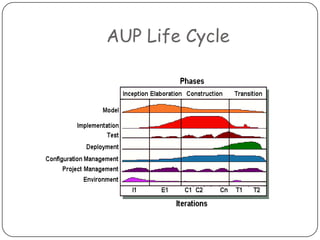
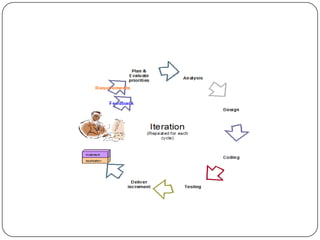
AUP Life Cycle
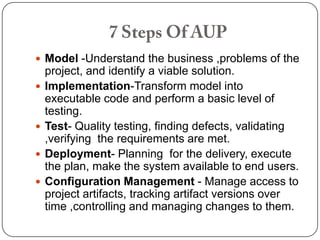
7 Steps Of AUPModel -Understand the business ,problems of the project, and identify a viable solution.Implementation-Transform model into executable code and perform a basic level of testing.Test- Quality testing, finding defects, validating ,verifying  the requirements are met.Deployment- Planning  for the delivery, execute the plan, make the system available to end users.Configuration Management -Manage access to project artifacts, tracking artifact versions over time ,controlling and managing changes to them.
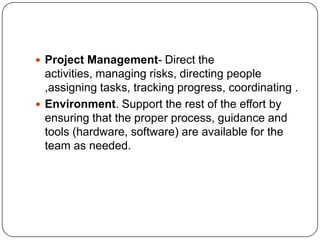
Project Management- Direct the activities, managing risks, directing people ,assigning tasks, tracking progress, coordinating .Environment. Support the rest of the effort by ensuring that the proper process, guidance and tools (hardware, software) are available for the team as needed.
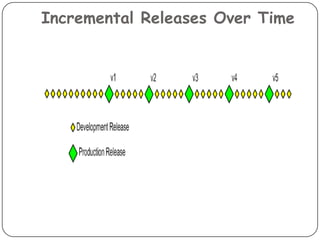
Incremental Releases Over Time
Releasing product in portions.eg. Version1 Version 2Development releases at the end of each iteration into.First production release takes longer time than subsequent releases.Eg. Software, O.S Thank You

Agile Process

  • 1.
    Binto Varghese PaulAgileUnified Process
  • 2.
    Agile Unified Process (AUP)is a simplified version of the Rational Unified Process .The Rational Unified Process (RUP) is an iterative software development process framework.AUP describes a simple, easy to understand approach to develop business application software. AUP has seven steps.
  • 3.
  • 4.
    7 Steps OfAUPModel -Understand the business ,problems of the project, and identify a viable solution.Implementation-Transform model into executable code and perform a basic level of testing.Test- Quality testing, finding defects, validating ,verifying the requirements are met.Deployment- Planning for the delivery, execute the plan, make the system available to end users.Configuration Management -Manage access to project artifacts, tracking artifact versions over time ,controlling and managing changes to them.
  • 5.
    Project Management- Directthe activities, managing risks, directing people ,assigning tasks, tracking progress, coordinating .Environment. Support the rest of the effort by ensuring that the proper process, guidance and tools (hardware, software) are available for the team as needed.
  • 7.
  • 8.
    Releasing product inportions.eg. Version1 Version 2Development releases at the end of each iteration into.First production release takes longer time than subsequent releases.Eg. Software, O.S Thank You