Agile Process
In software development, we mean
“Agile Software Development
with scrum methodology”
Connie Dmochowsky
5/20/2013 1
Manifesto for Agile Software Development
We are uncovering better ways of developing
software by doing it and helping others do it.
Through this work we have come to value:
• Individuals and interactions over processes and
tools
• Working software over comprehensive
documentation
• Customer collaboration over contract negotiation
• Responding to change over following a plan
5/20/2013 2
The goals of Agile
• Rapid product development
• On time delivery
• Excellent quality end products
• Customer satisfaction
• Team achievement
• Cost effective product development
• Quick adaption to business changes
5/20/2013 3
What is Scrum Methodology
• Scrum has been a framework for developing and
sustaining complex products since early 1990s.
• Developed and sustained by Ken Schwaber and
Jeff Sutherland.
• We can address complex adaptive
problems, while productively and creatively
delivering products of the highest possible value.
• Scrum is:
– Lightweight
– Simple to understand
– Extremely difficult to master
5/20/2013 4
Scrum process is based on
 Iterative processes
 Adaption - Empirical process control
 Transparency
 Inspection - Frequent review processes
 Collaboration
 Cooperation
 Commitment to Team goal
 Small team – 3 to 7 team members
 Time boxed approach
5/20/2013 5
Misconception of Scrum Process
• No requirement documents
• No technical design documents
• No QA testing
• No processes
• No end date
• No management reporting
• No scope management
• No control
5/20/2013 6
Scrum Team
• Pigs & Chickens
– Pigs - fully committed
– Chickens –involved - stakeholders
• Scrum roles
– Scrum Master
– Scrum product owner
– Scrum team
5/20/2013 7
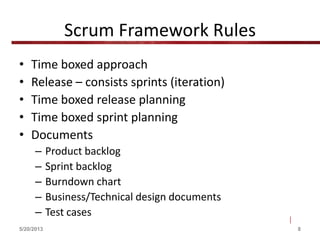
Scrum Framework Rules
• Time boxed approach
• Release – consists sprints (iteration)
• Time boxed release planning
• Time boxed sprint planning
• Documents
– Product backlog
– Sprint backlog
– Burndown chart
– Business/Technical design documents
– Test cases
5/20/2013 8
Scrum Framework
October 2010 9
Scrum Framework
Preparation Phase
Create User Stories – Written from user perspective
“As a sales clerk, I need to be able to enter a sales order”.
Step 1 – 1 day planning session
• 2-4 hour release planning per release
– Team, Scrum master & product owner discuss project requirements
– Assign story points to user story
– Team prioritize user stories identified for the release and group them
into sprints
• 2-4 hours sprint planning per sprint
– Poetize user stories selected for the sprint
– Team defines detailed tasks for each story
– Team selects tasks for each sprint
– Team members assign tasks to themselves
5/20/2013 10
Scrum Framework
Step 2 - Team works on the current sprint - 2 Weeks
• Daily 15 min. stand-up meeting – Team, Scrum Master, Product Owner
– What has been completed – competed work per each day
– What to do today
– What prevents each member from completing one’s work
Step 3 - Sprint review at the end of each sprint - 1 to 2 hours
• Provide a review session to discuss what has been completed with
team members, scrum master, product owner & steakholders
• Decide what would be considered completed within the current sprint
• Decide what needs to be moved into next sprint
5/20/2013 11
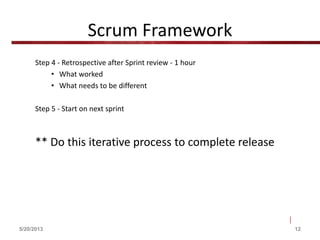
Scrum Framework
Step 4 - Retrospective after Sprint review - 1 hour
• What worked
• What needs to be different
Step 5 - Start on next sprint
** Do this iterative process to complete release
5/20/2013 12
Scrum Master –Responsibilities
• Services to Product Owner
– Effective Product Backlog management
– Clearly communicating vision, goals, and Product Backlog
items to the Development Team
– Teaching the Scrum Team to create clear and concise
Product Backlog items
– Understanding long-term product planning in an empirical
environment
– Understanding and practicing agility
– Facilitating Scrum events as requested or needed.
5/20/2013 13
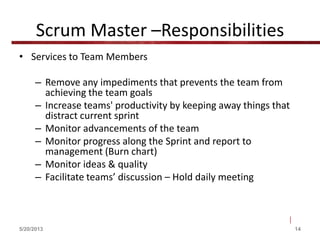
Scrum Master –Responsibilities
• Services to Team Members
– Remove any impediments that prevents the team from
achieving the team goals
– Increase teams' productivity by keeping away things that
distract current sprint
– Monitor advancements of the team
– Monitor progress along the Sprint and report to
management (Burn chart)
– Monitor ideas & quality
– Facilitate teams’ discussion – Hold daily meeting
5/20/2013 14
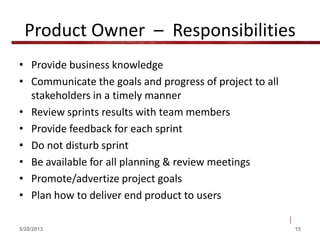
Product Owner – Responsibilities
• Provide business knowledge
• Communicate the goals and progress of project to all
stakeholders in a timely manner
• Review sprints results with team members
• Provide feedback for each sprint
• Do not disturb sprint
• Be available for all planning & review meetings
• Promote/advertize project goals
• Plan how to deliver end product to users
5/20/2013 15
Team member – Responsibilities
• Self-organizing Scrum Team – Heart of scrum
• Main job - Build product to deliver business value
• Needs to be cross-functional
• All members must be:
– Accountable
– Collaborative
– Trusting
– Committed & reliable
– Creative & innovative
• Be trusting, committed, creative, innovative, responsible, reliable,
business-value
5/20/2013 16
Scrum Challenges
• The fact that we are so used to the traditional
project management
• High level of motivation is needed to signing
up for work and reporting daily about
accomplishments
• Daily scrum meetings – Remember small
accomplishments and small goals
• Organizational obstacles become visible
quickly
5/20/2013 17
Scrum Challenges
• BAS & QA take part in the project on an going
basis and are really responsible for the
outcome of the project.
• Scrum is empirical.
– The team adapts to new situation
– The team has to adapt the process itself.
• Every team is allowed to change the time of a meeting,
however they are not allowed to skip a meeting
whatsoever.
5/20/2013 18
Product backlog and sprint planning
Sprint 1 Sprint 2 Sprint 3
290 190 80
Story 1 30 0
Story 2 50 0
Story 3 20 0
Story 4 10 10
Sprint 1
Story 5 20 20
Story 6 10 10
Story 7 30 30
Story 8 30 30
Story 9 20 20 10
Sprint 2
Story 10 40 40 40
Story 11 30 30 30
Release 1
5/20/2013 19
Burndown Chart
5/20/2013 20
290
210
80
00
50
100
150
200
250
300
350
1 2 3 4
Series1

Agile framework

  • 1.
    Agile Process In softwaredevelopment, we mean “Agile Software Development with scrum methodology” Connie Dmochowsky 5/20/2013 1
  • 2.
    Manifesto for AgileSoftware Development We are uncovering better ways of developing software by doing it and helping others do it. Through this work we have come to value: • Individuals and interactions over processes and tools • Working software over comprehensive documentation • Customer collaboration over contract negotiation • Responding to change over following a plan 5/20/2013 2
  • 3.
    The goals ofAgile • Rapid product development • On time delivery • Excellent quality end products • Customer satisfaction • Team achievement • Cost effective product development • Quick adaption to business changes 5/20/2013 3
  • 4.
    What is ScrumMethodology • Scrum has been a framework for developing and sustaining complex products since early 1990s. • Developed and sustained by Ken Schwaber and Jeff Sutherland. • We can address complex adaptive problems, while productively and creatively delivering products of the highest possible value. • Scrum is: – Lightweight – Simple to understand – Extremely difficult to master 5/20/2013 4
  • 5.
    Scrum process isbased on  Iterative processes  Adaption - Empirical process control  Transparency  Inspection - Frequent review processes  Collaboration  Cooperation  Commitment to Team goal  Small team – 3 to 7 team members  Time boxed approach 5/20/2013 5
  • 6.
    Misconception of ScrumProcess • No requirement documents • No technical design documents • No QA testing • No processes • No end date • No management reporting • No scope management • No control 5/20/2013 6
  • 7.
    Scrum Team • Pigs& Chickens – Pigs - fully committed – Chickens –involved - stakeholders • Scrum roles – Scrum Master – Scrum product owner – Scrum team 5/20/2013 7
  • 8.
    Scrum Framework Rules •Time boxed approach • Release – consists sprints (iteration) • Time boxed release planning • Time boxed sprint planning • Documents – Product backlog – Sprint backlog – Burndown chart – Business/Technical design documents – Test cases 5/20/2013 8
  • 9.
  • 10.
    Scrum Framework Preparation Phase CreateUser Stories – Written from user perspective “As a sales clerk, I need to be able to enter a sales order”. Step 1 – 1 day planning session • 2-4 hour release planning per release – Team, Scrum master & product owner discuss project requirements – Assign story points to user story – Team prioritize user stories identified for the release and group them into sprints • 2-4 hours sprint planning per sprint – Poetize user stories selected for the sprint – Team defines detailed tasks for each story – Team selects tasks for each sprint – Team members assign tasks to themselves 5/20/2013 10
  • 11.
    Scrum Framework Step 2- Team works on the current sprint - 2 Weeks • Daily 15 min. stand-up meeting – Team, Scrum Master, Product Owner – What has been completed – competed work per each day – What to do today – What prevents each member from completing one’s work Step 3 - Sprint review at the end of each sprint - 1 to 2 hours • Provide a review session to discuss what has been completed with team members, scrum master, product owner & steakholders • Decide what would be considered completed within the current sprint • Decide what needs to be moved into next sprint 5/20/2013 11
  • 12.
    Scrum Framework Step 4- Retrospective after Sprint review - 1 hour • What worked • What needs to be different Step 5 - Start on next sprint ** Do this iterative process to complete release 5/20/2013 12
  • 13.
    Scrum Master –Responsibilities •Services to Product Owner – Effective Product Backlog management – Clearly communicating vision, goals, and Product Backlog items to the Development Team – Teaching the Scrum Team to create clear and concise Product Backlog items – Understanding long-term product planning in an empirical environment – Understanding and practicing agility – Facilitating Scrum events as requested or needed. 5/20/2013 13
  • 14.
    Scrum Master –Responsibilities •Services to Team Members – Remove any impediments that prevents the team from achieving the team goals – Increase teams' productivity by keeping away things that distract current sprint – Monitor advancements of the team – Monitor progress along the Sprint and report to management (Burn chart) – Monitor ideas & quality – Facilitate teams’ discussion – Hold daily meeting 5/20/2013 14
  • 15.
    Product Owner –Responsibilities • Provide business knowledge • Communicate the goals and progress of project to all stakeholders in a timely manner • Review sprints results with team members • Provide feedback for each sprint • Do not disturb sprint • Be available for all planning & review meetings • Promote/advertize project goals • Plan how to deliver end product to users 5/20/2013 15
  • 16.
    Team member –Responsibilities • Self-organizing Scrum Team – Heart of scrum • Main job - Build product to deliver business value • Needs to be cross-functional • All members must be: – Accountable – Collaborative – Trusting – Committed & reliable – Creative & innovative • Be trusting, committed, creative, innovative, responsible, reliable, business-value 5/20/2013 16
  • 17.
    Scrum Challenges • Thefact that we are so used to the traditional project management • High level of motivation is needed to signing up for work and reporting daily about accomplishments • Daily scrum meetings – Remember small accomplishments and small goals • Organizational obstacles become visible quickly 5/20/2013 17
  • 18.
    Scrum Challenges • BAS& QA take part in the project on an going basis and are really responsible for the outcome of the project. • Scrum is empirical. – The team adapts to new situation – The team has to adapt the process itself. • Every team is allowed to change the time of a meeting, however they are not allowed to skip a meeting whatsoever. 5/20/2013 18
  • 19.
    Product backlog andsprint planning Sprint 1 Sprint 2 Sprint 3 290 190 80 Story 1 30 0 Story 2 50 0 Story 3 20 0 Story 4 10 10 Sprint 1 Story 5 20 20 Story 6 10 10 Story 7 30 30 Story 8 30 30 Story 9 20 20 10 Sprint 2 Story 10 40 40 40 Story 11 30 30 30 Release 1 5/20/2013 19
  • 20.