AGILE &
SCRUM
METHODOLOGY
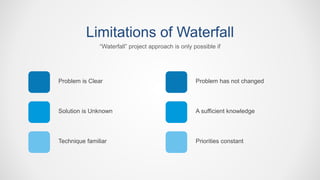
Problem is Clear
Solution is Unknown
Technique familiar
Limitations of Waterfall
“Waterfall” project approach is only possible if
Problem has not changed
A sufficient knowledge
Priorities constant
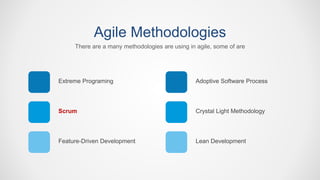
Extreme Programing
Scrum
Feature-Driven Development
Agile Methodologies
There are a many methodologies are using in agile, some of are
Adoptive Software Process
Crystal Light Methodology
Lean Development
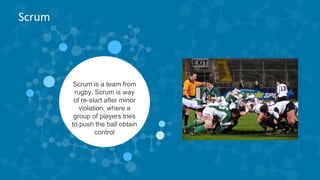
Scrum
Scrum is a team from
rugby. Scrum is way
of re-start after minor
violation, where a
group of players tries
to push the ball obtain
control
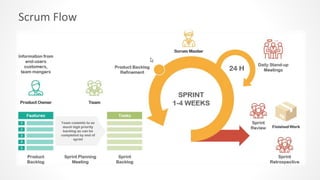
Scrum Flow
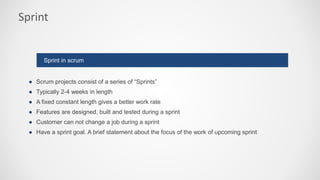
Sprint
● Scrum projects consist of a series of “Sprints”
● Typically 2-4 weeks in length
● A fixed constant length gives a better work rate
● Features are designed, built and tested during a sprint
● Customer can not change a job during a sprint
● Have a sprint goal. A brief statement about the focus of the work of upcoming sprint
Sprint in scrum
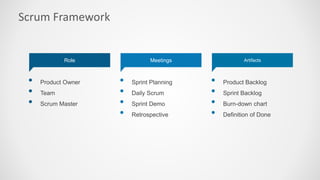
Scrum Framework
• Product Owner
• Team
• Scrum Master
Role
• Sprint Planning
• Daily Scrum
• Sprint Demo
• Retrospective
Meetings
• Product Backlog
• Sprint Backlog
• Burn-down chart
• Definition of Done
Artifacts
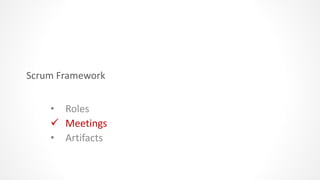
Scrum Framework
 Roles
• Meetings
• Artifacts
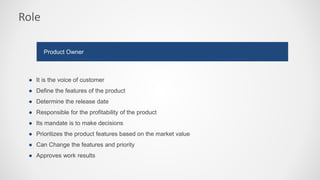
Role
● It is the voice of customer
● Define the features of the product
● Determine the release date
● Responsible for the profitability of the product
● Its mandate is to make decisions
● Prioritizes the product features based on the market value
● Can Change the features and priority
● Approves work results
Product Owner
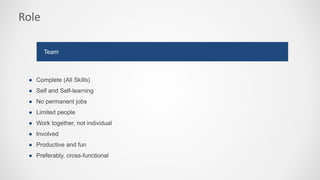
Role
● Complete (All Skills)
● Self and Self-learning
● No permanent jobs
● Limited people
● Work together, not individual
● Involved
● Productive and fun
● Preferably, cross-functional
Team
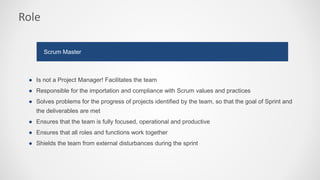
Role
● Is not a Project Manager! Facilitates the team
● Responsible for the importation and compliance with Scrum values and practices
● Solves problems for the progress of projects identified by the team, so that the goal of Sprint and
the deliverables are met
● Ensures that the team is fully focused, operational and productive
● Ensures that all roles and functions work together
● Shields the team from external disturbances during the sprint
Scrum Master
Scrum Framework
• Roles
 Meetings
• Artifacts
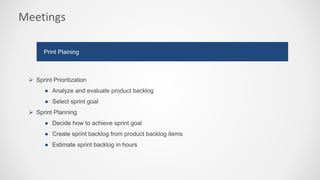
Meetings
 Sprint Prioritization
● Analyze and evaluate product backlog
● Select sprint goal
 Sprint Planning
● Decide how to achieve sprint goal
● Create sprint backlog from product backlog items
● Estimate sprint backlog in hours
Print Plaining
Meetings
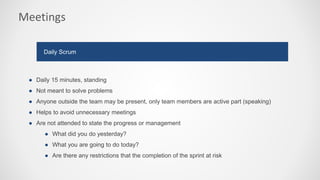
● Daily 15 minutes, standing
● Not meant to solve problems
● Anyone outside the team may be present, only team members are active part (speaking)
● Helps to avoid unnecessary meetings
● Are not attended to state the progress or management
● What did you do yesterday?
● What you are going to do today?
● Are there any restrictions that the completion of the sprint at risk
Daily Scrum
Meetings
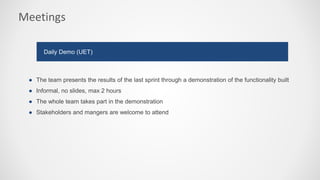
● The team presents the results of the last sprint through a demonstration of the functionality built
● Informal, no slides, max 2 hours
● The whole team takes part in the demonstration
● Stakeholders and mangers are welcome to attend
Daily Demo (UET)
Meetings
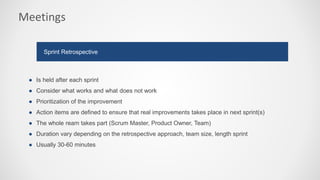
● Is held after each sprint
● Consider what works and what does not work
● Prioritization of the improvement
● Action items are defined to ensure that real improvements takes place in next sprint(s)
● The whole ream takes part (Scrum Master, Product Owner, Team)
● Duration vary depending on the retrospective approach, team size, length sprint
● Usually 30-60 minutes
Sprint Retrospective
Scrum Framework
• Roles
• Meetings
 Artifacts
Artifacts
● The requirements
● To-Do list of all the work required in the project
● Expressed from the user/client
● Not how but why
● By priority (by product owner)
● Iterative (changes ok, for each sprint)
● Items estimated effort required (by team)
● User Story format: As <type of user> I want <some goal> so that <some business reason>
Print Plaining
Artifacts
● The requirements
● To-Do list of all the work required in the project
● Expressed from the user/client
● Not how but why
● By priority (by product owner)
● Iterative (changes ok, for each sprint)
● Items estimated effort required (by team)
● User Story format: As <type of user> I want <some goal> so that <some business reason>
Print Plaining
Artifacts
● List of work done in the next sprint
● Breakdown of features into tasks (1-16 hours)
● Tasks are not assigned to team with Planning Poker
● Tasks are picked based on the right priories and the skills of team member
● Is usually visualized by a Scrum board
Sprint Backlog
Artifacts
● Hours remaining by Date
● Update daily by Scrum Master
● How much effort is left to be done
● Visible to all the team (whiteboard)
Burn-down Chart
Artifacts
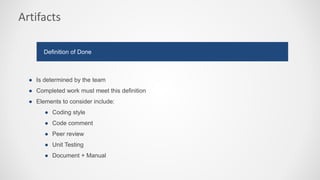
● Is determined by the team
● Completed work must meet this definition
● Elements to consider include:
● Coding style
● Code comment
● Peer review
● Unit Testing
● Document + Manual
Definition of Done
Thank You 

GUI & Modern UI Design

  • 1.
  • 2.
    Problem is Clear Solutionis Unknown Technique familiar Limitations of Waterfall “Waterfall” project approach is only possible if Problem has not changed A sufficient knowledge Priorities constant
  • 3.
    Extreme Programing Scrum Feature-Driven Development AgileMethodologies There are a many methodologies are using in agile, some of are Adoptive Software Process Crystal Light Methodology Lean Development
  • 4.
    Scrum Scrum is ateam from rugby. Scrum is way of re-start after minor violation, where a group of players tries to push the ball obtain control
  • 5.
  • 6.
    Sprint ● Scrum projectsconsist of a series of “Sprints” ● Typically 2-4 weeks in length ● A fixed constant length gives a better work rate ● Features are designed, built and tested during a sprint ● Customer can not change a job during a sprint ● Have a sprint goal. A brief statement about the focus of the work of upcoming sprint Sprint in scrum
  • 7.
    Scrum Framework • ProductOwner • Team • Scrum Master Role • Sprint Planning • Daily Scrum • Sprint Demo • Retrospective Meetings • Product Backlog • Sprint Backlog • Burn-down chart • Definition of Done Artifacts
  • 8.
    Scrum Framework  Roles •Meetings • Artifacts
  • 9.
    Role ● It isthe voice of customer ● Define the features of the product ● Determine the release date ● Responsible for the profitability of the product ● Its mandate is to make decisions ● Prioritizes the product features based on the market value ● Can Change the features and priority ● Approves work results Product Owner
  • 10.
    Role ● Complete (AllSkills) ● Self and Self-learning ● No permanent jobs ● Limited people ● Work together, not individual ● Involved ● Productive and fun ● Preferably, cross-functional Team
  • 11.
    Role ● Is nota Project Manager! Facilitates the team ● Responsible for the importation and compliance with Scrum values and practices ● Solves problems for the progress of projects identified by the team, so that the goal of Sprint and the deliverables are met ● Ensures that the team is fully focused, operational and productive ● Ensures that all roles and functions work together ● Shields the team from external disturbances during the sprint Scrum Master
  • 12.
    Scrum Framework • Roles Meetings • Artifacts
  • 13.
    Meetings  Sprint Prioritization ●Analyze and evaluate product backlog ● Select sprint goal  Sprint Planning ● Decide how to achieve sprint goal ● Create sprint backlog from product backlog items ● Estimate sprint backlog in hours Print Plaining
  • 14.
    Meetings ● Daily 15minutes, standing ● Not meant to solve problems ● Anyone outside the team may be present, only team members are active part (speaking) ● Helps to avoid unnecessary meetings ● Are not attended to state the progress or management ● What did you do yesterday? ● What you are going to do today? ● Are there any restrictions that the completion of the sprint at risk Daily Scrum
  • 15.
    Meetings ● The teampresents the results of the last sprint through a demonstration of the functionality built ● Informal, no slides, max 2 hours ● The whole team takes part in the demonstration ● Stakeholders and mangers are welcome to attend Daily Demo (UET)
  • 16.
    Meetings ● Is heldafter each sprint ● Consider what works and what does not work ● Prioritization of the improvement ● Action items are defined to ensure that real improvements takes place in next sprint(s) ● The whole ream takes part (Scrum Master, Product Owner, Team) ● Duration vary depending on the retrospective approach, team size, length sprint ● Usually 30-60 minutes Sprint Retrospective
  • 17.
    Scrum Framework • Roles •Meetings  Artifacts
  • 18.
    Artifacts ● The requirements ●To-Do list of all the work required in the project ● Expressed from the user/client ● Not how but why ● By priority (by product owner) ● Iterative (changes ok, for each sprint) ● Items estimated effort required (by team) ● User Story format: As <type of user> I want <some goal> so that <some business reason> Print Plaining
  • 19.
    Artifacts ● The requirements ●To-Do list of all the work required in the project ● Expressed from the user/client ● Not how but why ● By priority (by product owner) ● Iterative (changes ok, for each sprint) ● Items estimated effort required (by team) ● User Story format: As <type of user> I want <some goal> so that <some business reason> Print Plaining
  • 20.
    Artifacts ● List ofwork done in the next sprint ● Breakdown of features into tasks (1-16 hours) ● Tasks are not assigned to team with Planning Poker ● Tasks are picked based on the right priories and the skills of team member ● Is usually visualized by a Scrum board Sprint Backlog
  • 21.
    Artifacts ● Hours remainingby Date ● Update daily by Scrum Master ● How much effort is left to be done ● Visible to all the team (whiteboard) Burn-down Chart
  • 22.
    Artifacts ● Is determinedby the team ● Completed work must meet this definition ● Elements to consider include: ● Coding style ● Code comment ● Peer review ● Unit Testing ● Document + Manual Definition of Done
  • 23.

Editor's Notes

  • #24 You can safely remove this slide. This slide design was provided by SlideModel.com – You can download more templates, shapes and elements for PowerPoint from http://slidemodel.com/