

Eduardo Nofuentes
The Agile Contact Centre
AGILE BEYOND SOFTWARE
DEVELOPMENT
T H E A G I L E T R A N S F O R M AT I O N O F A C O N TA C T C E N T R E
Sue Visic
Thoughtworks
: @edumelbourne www.theagilecontactcentre.com.au
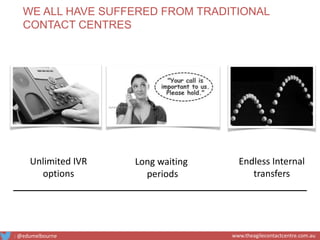
Unlimited IVR
options
Endless Internal
transfers
Long waiting
periods
WE ALL HAVE SUFFERED FROM TRADITIONAL
CONTACT CENTRES
: @edumelbourne www.theagilecontactcentre.com.au
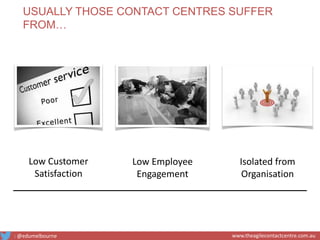
Low Customer
Satisfaction
Isolated from
Organisation
Low Employee
Engagement
USUALLY THOSE CONTACT CENTRES SUFFER
FROM…
: @edumelbourne www.theagilecontactcentre.com.au
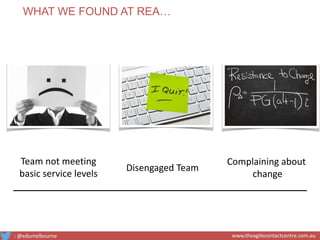
Team not meeting
basic service levels
Complaining about
change
Disengaged Team
WHAT WE FOUND AT REA…
: @edumelbourne www.theagilecontactcentre.com.au
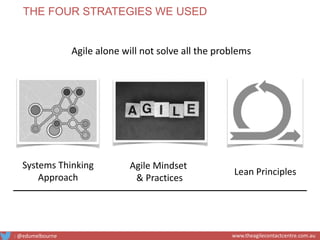
Agile alone will not solve all the problems
Systems Thinking
Approach
Agile Mindset
& Practices
Lean Principles
THE FOUR STRATEGIES WE USED
: @edumelbourne www.theagilecontactcentre.com.au
• Break into groups of 3-5 people
• Discuss with your group the situation and what would you do
• Think about the theories behind your proposed solutions
• What is the fourth “strategy” we applied?
• After that, each group will share one or two ideas with the
other groups
NOW IS YOUR TURN…
: @edumelbourne www.theagilecontactcentre.com.au
WHAT ACTUALLY HAPPENED…
: @edumelbourne www.theagilecontactcentre.com.au
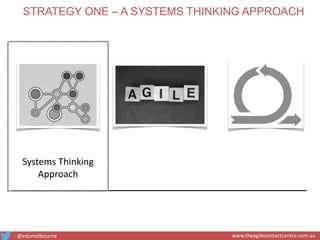
Systems Thinking
Approach
STRATEGY ONE – A SYSTEMS THINKING APPROACH
: @edumelbourne www.theagilecontactcentre.com.au
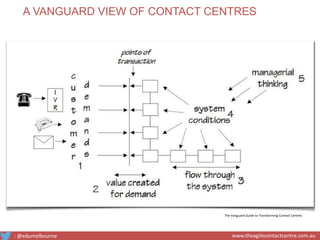
The Vanguard Guide to Transforming Contact Centres
A VANGUARD VIEW OF CONTACT CENTRES
: @edumelbourne www.theagilecontactcentre.com.au
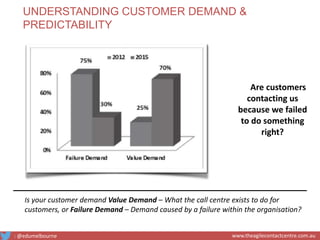
Is your customer demand Value Demand – What the call centre exists to do for
customers, or Failure Demand – Demand caused by a failure within the organisation?
Are customers
contacting us
because we failed
to do something
right?
UNDERSTANDING CUSTOMER DEMAND &
PREDICTABILITY
: @edumelbourne www.theagilecontactcentre.com.au
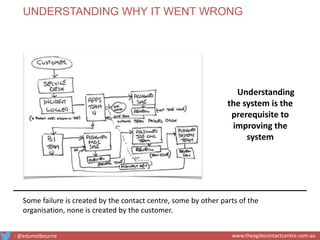
Some failure is created by the contact centre, some by other parts of the
organisation, none is created by the customer.
Understanding
the system is the
prerequisite to
improving the
system
UNDERSTANDING WHY IT WENT WRONG
: @edumelbourne www.theagilecontactcentre.com.au
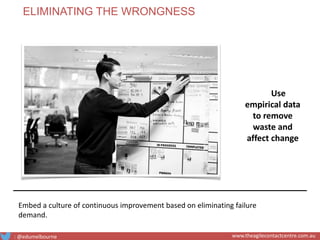
Embed a culture of continuous improvement based on eliminating failure
demand.
Use
empirical data
to remove
waste and
affect change
ELIMINATING THE WRONGNESS
: @edumelbourne www.theagilecontactcentre.com.au
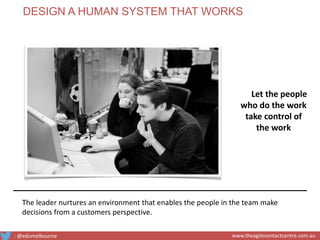
The leader nurtures an environment that enables the people in the team make
decisions from a customers perspective.
Let the people
who do the work
take control of
the work
DESIGN A HUMAN SYSTEM THAT WORKS
: @edumelbourne www.theagilecontactcentre.com.au
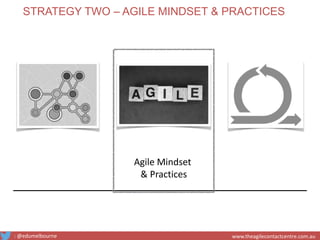
Agile Mindset
& Practices
STRATEGY TWO – AGILE MINDSET & PRACTICES
: @edumelbourne www.theagilecontactcentre.com.au
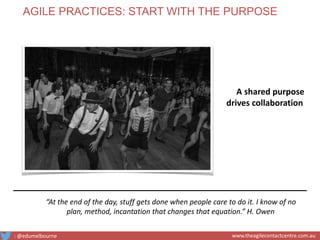
“At the end of the day, stuff gets done when people care to do it. I know of no
plan, method, incantation that changes that equation.” H. Owen
A shared purpose
drives collaboration
AGILE PRACTICES: START WITH THE PURPOSE
: @edumelbourne www.theagilecontactcentre.com.au
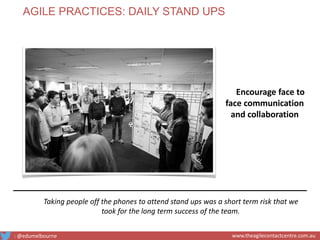
Taking people off the phones to attend stand ups was a short term risk that we
took for the long term success of the team.
Encourage face to
face communication
and collaboration
AGILE PRACTICES: DAILY STAND UPS
: @edumelbourne www.theagilecontactcentre.com.au
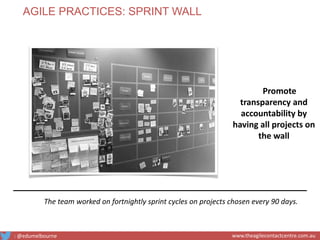
The team worked on fortnightly sprint cycles on projects chosen every 90 days.
Promote
transparency and
accountability by
having all projects on
the wall
AGILE PRACTICES: SPRINT WALL
: @edumelbourne www.theagilecontactcentre.com.au
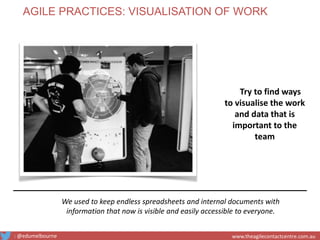
We used to keep endless spreadsheets and internal documents with
information that now is visible and easily accessible to everyone.
Try to find ways
to visualise the work
and data that is
important to the
team
AGILE PRACTICES: VISUALISATION OF WORK
: @edumelbourne www.theagilecontactcentre.com.au
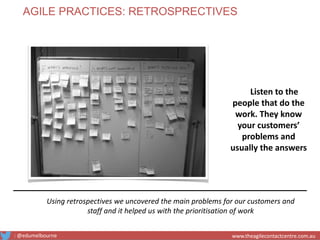
Using retrospectives we uncovered the main problems for our customers and
staff and it helped us with the prioritisation of work
Listen to the
people that do the
work. They know
your customers’
problems and
usually the answers
AGILE PRACTICES: RETROSPRECTIVES
: @edumelbourne www.theagilecontactcentre.com.auwww.theagilecontactcentre.com.au
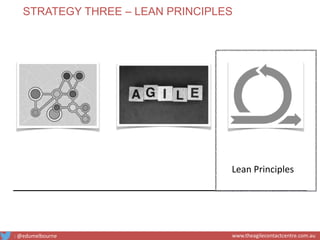
Lean Principles
STRATEGY THREE – LEAN PRINCIPLES
: @edumelbourne www.theagilecontactcentre.com.au
We launched a
new channel without
having to go through
our internal IT
department and
spending $300 in
licences.
“I have not failed. I’ve just found 10,000 ways that won’t work.” Thomas
Edison
LEAN PRINCIPLES: RAPID EXPERIMENTATION
: @edumelbourne www.theagilecontactcentre.com.au
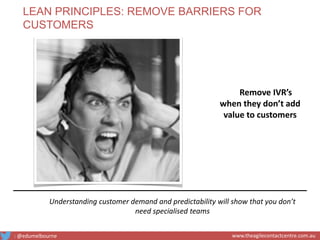
Remove IVR’s
when they don’t add
value to customers
Understanding customer demand and predictability will show that you don’t
need specialised teams
LEAN PRINCIPLES: REMOVE BARRIERS FOR
CUSTOMERS
: @edumelbourne www.theagilecontactcentre.com.au
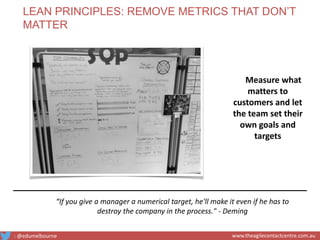
Measure what
matters to
customers and let
the team set their
own goals and
targets
“If you give a manager a numerical target, he'll make it even if he has to
destroy the company in the process." - Deming
LEAN PRINCIPLES: REMOVE METRICS THAT DON’T
MATTER
: @edumelbourne www.theagilecontactcentre.com.au
Brave
Leadership
Brave Leadership
THE FOURTH STRATEGY – BRAVE LEADERSHIP
: @edumelbourne www.theagilecontactcentre.com.au
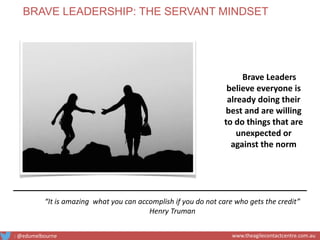
Brave Leaders
believe everyone is
already doing their
best and are willing
to do things that are
unexpected or
against the norm
“It is amazing what you can accomplish if you do not care who gets the credit”
Henry Truman
BRAVE LEADERSHIP: THE SERVANT MINDSET
: @edumelbourne www.theagilecontactcentre.com.au
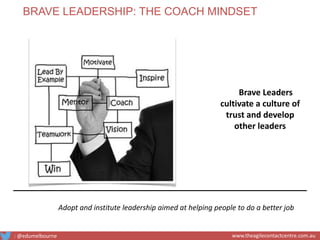
Brave Leaders
cultivate a culture of
trust and develop
other leaders
Adopt and institute leadership aimed at helping people to do a better job
BRAVE LEADERSHIP: THE COACH MINDSET
: @edumelbourne www.theagilecontactcentre.com.au
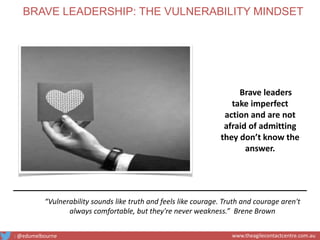
Brave leaders
take imperfect
action and are not
afraid of admitting
they don’t know the
answer.
“Vulnerability sounds like truth and feels like courage. Truth and courage aren't
always comfortable, but they're never weakness.” Brene Brown
BRAVE LEADERSHIP: THE VULNERABILITY MINDSET
: @edumelbourne www.theagilecontactcentre.com.au
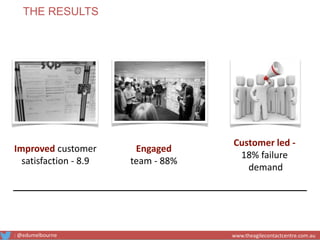
Improved customer
satisfaction - 8.9
Customer led -
18% failure
demand
Engaged
team - 88%
THE RESULTS
: @edumelbourne www.theagilecontactcentre.com.au
▫Does your team or company understand your customers’ demand?
▫What percentage of failure and value demand do you have in your organisation?
▫ Do you know the cost to your organisation of all of the failure demand?
▫Is your system designed from an inside-out view or from a customer view?
▫How can you apply Agile Practices and Lean Principles to your non software
development teams?
▫How brave are you as a leader? How brave is the leader in your team /
organisation?
ASK YOURSELF…
: @edumelbourne www.theagilecontactcentre.com.au
Eduardo Nofuentes
The Agile Contact Centre
www.theagilecontactcentre.com.au
eduardo@theagilecontactcentre.com.au
+61407 450 640
: @edumelbourne www.theagilecontactcentre.com.au
Sue Visic
Thoughtworks
www.thoughtworks.com
svisic@thoughtworks.com
+61419 194 423
THANK YOU

AGILE BEYOND SOFTWARE DEVELOPMENT

  • 1.
    Eduardo Nofuentes The AgileContact Centre AGILE BEYOND SOFTWARE DEVELOPMENT T H E A G I L E T R A N S F O R M AT I O N O F A C O N TA C T C E N T R E Sue Visic Thoughtworks : @edumelbourne www.theagilecontactcentre.com.au
  • 2.
    Unlimited IVR options Endless Internal transfers Longwaiting periods WE ALL HAVE SUFFERED FROM TRADITIONAL CONTACT CENTRES : @edumelbourne www.theagilecontactcentre.com.au
  • 3.
    Low Customer Satisfaction Isolated from Organisation LowEmployee Engagement USUALLY THOSE CONTACT CENTRES SUFFER FROM… : @edumelbourne www.theagilecontactcentre.com.au
  • 4.
    Team not meeting basicservice levels Complaining about change Disengaged Team WHAT WE FOUND AT REA… : @edumelbourne www.theagilecontactcentre.com.au
  • 5.
    Agile alone willnot solve all the problems Systems Thinking Approach Agile Mindset & Practices Lean Principles THE FOUR STRATEGIES WE USED : @edumelbourne www.theagilecontactcentre.com.au
  • 6.
    • Break intogroups of 3-5 people • Discuss with your group the situation and what would you do • Think about the theories behind your proposed solutions • What is the fourth “strategy” we applied? • After that, each group will share one or two ideas with the other groups NOW IS YOUR TURN… : @edumelbourne www.theagilecontactcentre.com.au
  • 7.
    WHAT ACTUALLY HAPPENED… :@edumelbourne www.theagilecontactcentre.com.au
  • 8.
    Systems Thinking Approach STRATEGY ONE– A SYSTEMS THINKING APPROACH : @edumelbourne www.theagilecontactcentre.com.au
  • 9.
    The Vanguard Guideto Transforming Contact Centres A VANGUARD VIEW OF CONTACT CENTRES : @edumelbourne www.theagilecontactcentre.com.au
  • 10.
    Is your customerdemand Value Demand – What the call centre exists to do for customers, or Failure Demand – Demand caused by a failure within the organisation? Are customers contacting us because we failed to do something right? UNDERSTANDING CUSTOMER DEMAND & PREDICTABILITY : @edumelbourne www.theagilecontactcentre.com.au
  • 11.
    Some failure iscreated by the contact centre, some by other parts of the organisation, none is created by the customer. Understanding the system is the prerequisite to improving the system UNDERSTANDING WHY IT WENT WRONG : @edumelbourne www.theagilecontactcentre.com.au
  • 12.
    Embed a cultureof continuous improvement based on eliminating failure demand. Use empirical data to remove waste and affect change ELIMINATING THE WRONGNESS : @edumelbourne www.theagilecontactcentre.com.au
  • 13.
    The leader nurturesan environment that enables the people in the team make decisions from a customers perspective. Let the people who do the work take control of the work DESIGN A HUMAN SYSTEM THAT WORKS : @edumelbourne www.theagilecontactcentre.com.au
  • 14.
    Agile Mindset & Practices STRATEGYTWO – AGILE MINDSET & PRACTICES : @edumelbourne www.theagilecontactcentre.com.au
  • 15.
    “At the endof the day, stuff gets done when people care to do it. I know of no plan, method, incantation that changes that equation.” H. Owen A shared purpose drives collaboration AGILE PRACTICES: START WITH THE PURPOSE : @edumelbourne www.theagilecontactcentre.com.au
  • 16.
    Taking people offthe phones to attend stand ups was a short term risk that we took for the long term success of the team. Encourage face to face communication and collaboration AGILE PRACTICES: DAILY STAND UPS : @edumelbourne www.theagilecontactcentre.com.au
  • 17.
    The team workedon fortnightly sprint cycles on projects chosen every 90 days. Promote transparency and accountability by having all projects on the wall AGILE PRACTICES: SPRINT WALL : @edumelbourne www.theagilecontactcentre.com.au
  • 18.
    We used tokeep endless spreadsheets and internal documents with information that now is visible and easily accessible to everyone. Try to find ways to visualise the work and data that is important to the team AGILE PRACTICES: VISUALISATION OF WORK : @edumelbourne www.theagilecontactcentre.com.au
  • 19.
    Using retrospectives weuncovered the main problems for our customers and staff and it helped us with the prioritisation of work Listen to the people that do the work. They know your customers’ problems and usually the answers AGILE PRACTICES: RETROSPRECTIVES : @edumelbourne www.theagilecontactcentre.com.auwww.theagilecontactcentre.com.au
  • 20.
    Lean Principles STRATEGY THREE– LEAN PRINCIPLES : @edumelbourne www.theagilecontactcentre.com.au
  • 21.
    We launched a newchannel without having to go through our internal IT department and spending $300 in licences. “I have not failed. I’ve just found 10,000 ways that won’t work.” Thomas Edison LEAN PRINCIPLES: RAPID EXPERIMENTATION : @edumelbourne www.theagilecontactcentre.com.au
  • 22.
    Remove IVR’s when theydon’t add value to customers Understanding customer demand and predictability will show that you don’t need specialised teams LEAN PRINCIPLES: REMOVE BARRIERS FOR CUSTOMERS : @edumelbourne www.theagilecontactcentre.com.au
  • 23.
    Measure what matters to customersand let the team set their own goals and targets “If you give a manager a numerical target, he'll make it even if he has to destroy the company in the process." - Deming LEAN PRINCIPLES: REMOVE METRICS THAT DON’T MATTER : @edumelbourne www.theagilecontactcentre.com.au
  • 24.
    Brave Leadership Brave Leadership THE FOURTHSTRATEGY – BRAVE LEADERSHIP : @edumelbourne www.theagilecontactcentre.com.au
  • 25.
    Brave Leaders believe everyoneis already doing their best and are willing to do things that are unexpected or against the norm “It is amazing what you can accomplish if you do not care who gets the credit” Henry Truman BRAVE LEADERSHIP: THE SERVANT MINDSET : @edumelbourne www.theagilecontactcentre.com.au
  • 26.
    Brave Leaders cultivate aculture of trust and develop other leaders Adopt and institute leadership aimed at helping people to do a better job BRAVE LEADERSHIP: THE COACH MINDSET : @edumelbourne www.theagilecontactcentre.com.au
  • 27.
    Brave leaders take imperfect actionand are not afraid of admitting they don’t know the answer. “Vulnerability sounds like truth and feels like courage. Truth and courage aren't always comfortable, but they're never weakness.” Brene Brown BRAVE LEADERSHIP: THE VULNERABILITY MINDSET : @edumelbourne www.theagilecontactcentre.com.au
  • 28.
    Improved customer satisfaction -8.9 Customer led - 18% failure demand Engaged team - 88% THE RESULTS : @edumelbourne www.theagilecontactcentre.com.au
  • 30.
    ▫Does your teamor company understand your customers’ demand? ▫What percentage of failure and value demand do you have in your organisation? ▫ Do you know the cost to your organisation of all of the failure demand? ▫Is your system designed from an inside-out view or from a customer view? ▫How can you apply Agile Practices and Lean Principles to your non software development teams? ▫How brave are you as a leader? How brave is the leader in your team / organisation? ASK YOURSELF… : @edumelbourne www.theagilecontactcentre.com.au
  • 31.
    Eduardo Nofuentes The AgileContact Centre www.theagilecontactcentre.com.au eduardo@theagilecontactcentre.com.au +61407 450 640 : @edumelbourne www.theagilecontactcentre.com.au Sue Visic Thoughtworks www.thoughtworks.com svisic@thoughtworks.com +61419 194 423 THANK YOU

Editor's Notes

  • #12 Follow the work backwards from the customer perspective and understand the root cause of failure How many hoops does a customer need to go through to get their need met? How many things are we doing that we don’t need to do?