

AGILE BEYOND SOFTWARE
H O W T O A C H I E V E O R G A N I S AT I O N A L A G I L I T Y
www.theagilecontactcentre.com.au
G E E L O N G L E A N P I Z Z A
ABOUT ME
www.theagilecontactcentre.com.au
EDUARDO NOFUENTES
Lean and Agile Coach |
Founder @ The Agile
Contact Centre|
Founding Partner @ The
Agile Eleven
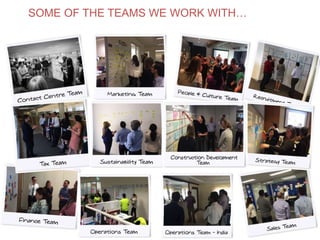
SOME OF THE TEAMS WE WORK WITH…
www.theagilecontactcentre.com.au
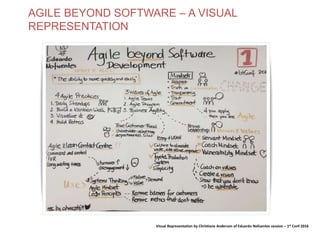
AGILE BEYOND SOFTWARE – A VISUAL
REPRESENTATION
Visual Representation by Christiane Anderson of Eduardo Nofuentes session – 1st Conf 2016
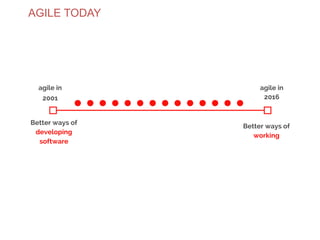
AGILE TODAY
www.theagilecontactcentre.com.au
OUR APPROACH
H O W D O W E W O R K W I T H N O N S O F T W A R E D E V E L O P M E N T
T E A M S ?
www.theagilecontactcentre.com.au
“The ability to move quickly and easily”
WHAT IS AGILE?
www.theagilecontactcentre.com.au
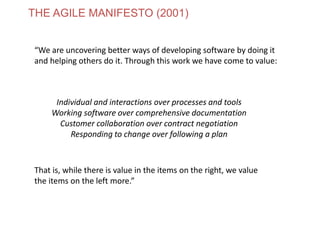
“We are uncovering better ways of developing software by doing it
and helping others do it. Through this work we have come to value:
THE AGILE MANIFESTO (2001)
That is, while there is value in the items on the right, we value
the items on the left more.”
Individual and interactions over processes and tools
Working software over comprehensive documentation
Customer collaboration over contract negotiation
Responding to change over following a plan
www.theagilecontactcentre.com.au
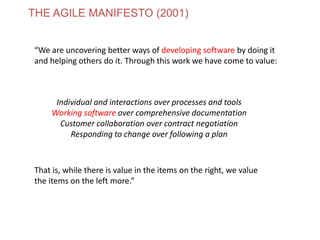
“We are uncovering better ways of developing software by doing it
and helping others do it. Through this work we have come to value:
THE AGILE MANIFESTO (2001)
That is, while there is value in the items on the right, we value
the items on the left more.”
Individual and interactions over processes and tools
Working software over comprehensive documentation
Customer collaboration over contract negotiation
Responding to change over following a plan
www.theagilecontactcentre.com.au
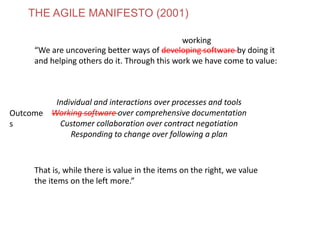
“We are uncovering better ways of developing software by doing it
and helping others do it. Through this work we have come to value:
THE AGILE MANIFESTO (2001)
That is, while there is value in the items on the right, we value
the items on the left more.”
Individual and interactions over processes and tools
Working software over comprehensive documentation
Customer collaboration over contract negotiation
Responding to change over following a plan
working
Outcome
s
www.theagilecontactcentre.com.au
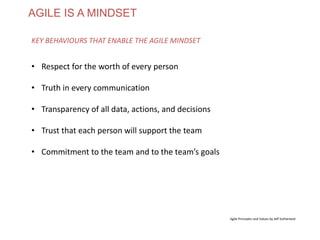
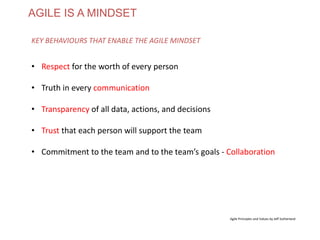
AGILE IS A MINDSET
• Respect for the worth of every person
• Truth in every communication
• Transparency of all data, actions, and decisions
• Trust that each person will support the team
• Commitment to the team and to the team’s goals
KEY BEHAVIOURS THAT ENABLE THE AGILE MINDSET
Agile Principles and Values by Jeff Sutherland
www.theagilecontactcentre.com.au
AGILE IS A MINDSET
• Respect for the worth of every person
• Truth in every communication
• Transparency of all data, actions, and decisions
• Trust that each person will support the team
• Commitment to the team and to the team’s goals - Collaboration
KEY BEHAVIOURS THAT ENABLE THE AGILE MINDSET
Agile Principles and Values by Jeff Sutherland
www.theagilecontactcentre.com.au
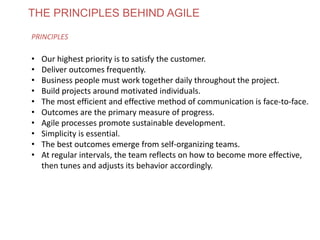
THE PRINCIPLES BEHIND AGILE
PRINCIPLES
• Our highest priority is to satisfy the customer.
• Deliver outcomes frequently.
• Business people must work together daily throughout the project.
• Build projects around motivated individuals.
• The most efficient and effective method of communication is face-to-face.
• Outcomes are the primary measure of progress.
• Agile processes promote sustainable development.
• Simplicity is essential.
• The best outcomes emerge from self-organizing teams.
• At regular intervals, the team reflects on how to become more effective,
then tunes and adjusts its behavior accordingly.
www.theagilecontactcentre.com.au
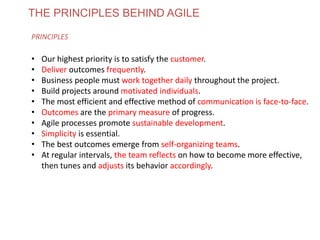
THE PRINCIPLES BEHIND AGILE
PRINCIPLES
• Our highest priority is to satisfy the customer.
• Deliver outcomes frequently.
• Business people must work together daily throughout the project.
• Build projects around motivated individuals.
• The most efficient and effective method of communication is face-to-face.
• Outcomes are the primary measure of progress.
• Agile processes promote sustainable development.
• Simplicity is essential.
• The best outcomes emerge from self-organizing teams.
• At regular intervals, the team reflects on how to become more effective,
then tunes and adjusts its behavior accordingly.
www.theagilecontactcentre.com.au
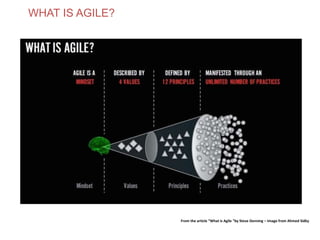
WHAT IS AGILE?
From the article “What is Agile “by Steve Denning – Image from Ahmed Sidky
THE GOOD NEWS…
If you are already applying these mindsets and
principles to your team or organisation, you are already
doing Agile…
…even if you don’t stick cards on the walls or stand up
every morning for 15 minutes.
www.theagilecontactcentre.com.auwww.theagilecontactcentre.com.au
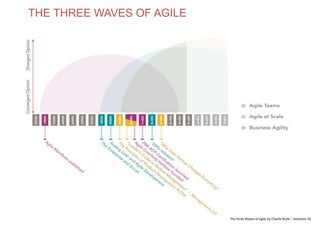
THE THREE WAVES OF AGILE
The three Waves of Agile by Charlie Rudd – Solutions IQ
www.theagilecontactcentre.com.au
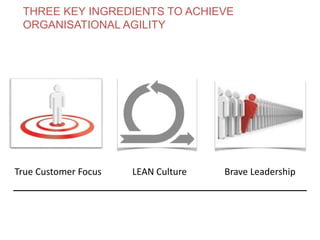
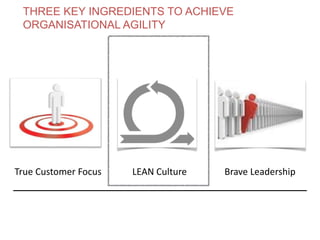
True Customer Focus LEAN Culture Brave Leadership
THREE KEY INGREDIENTS TO ACHIEVE
ORGANISATIONAL AGILITY
www.theagilecontactcentre.com.au
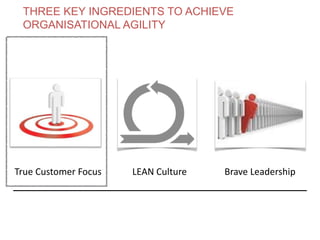
True Customer Focus LEAN Culture Brave Leadership
THREE KEY INGREDIENTS TO ACHIEVE
ORGANISATIONAL AGILITY
www.theagilecontactcentre.com.au
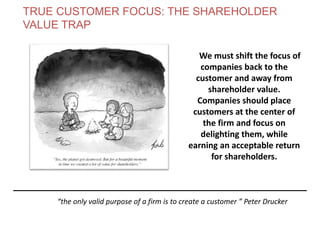
We must shift the focus of
companies back to the
customer and away from
shareholder value.
Companies should place
customers at the center of
the firm and focus on
delighting them, while
earning an acceptable return
for shareholders.
“the only valid purpose of a firm is to create a customer ” Peter Drucker
TRUE CUSTOMER FOCUS: THE SHAREHOLDER
VALUE TRAP
www.theagilecontactcentre.com.au
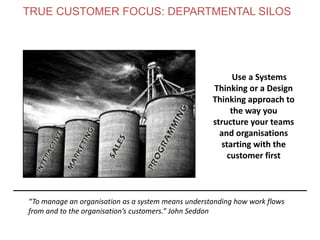
Use a Systems
Thinking or a Design
Thinking approach to
the way you
structure your teams
and organisations
starting with the
customer first
“To manage an organisation as a system means understanding how work flows
from and to the organisation’s customers.” John Seddon
TRUE CUSTOMER FOCUS: DEPARTMENTAL SILOS
www.theagilecontactcentre.com.au
True Customer Focus LEAN Culture Brave Leadership
THREE KEY INGREDIENTS TO ACHIEVE
ORGANISATIONAL AGILITY
www.theagilecontactcentre.com.au
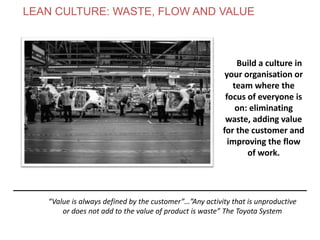
Build a culture in
your organisation or
team where the
focus of everyone is
on: eliminating
waste, adding value
for the customer and
improving the flow
of work.
“Value is always defined by the customer”…”Any activity that is unproductive
or does not add to the value of product is waste” The Toyota System
LEAN CULTURE: WASTE, FLOW AND VALUE
www.theagilecontactcentre.com.au
Build a culture where
SIMPLICITY is well regarded
and seen as a key
competitive advantage. Not
only on the way products or
services are designed, but
also the way internal
processes, meetings, and
collaboration tools are
designed and run.
“Everything should be made as simple as possible. But not simpler” Albert
Einstein
LEAN CULTURE: SIMPLICITY
www.theagilecontactcentre.com.au
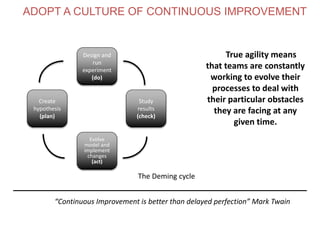
True agility means
that teams are constantly
working to evolve their
processes to deal with
their particular obstacles
they are facing at any
given time.
“Continuous Improvement is better than delayed perfection” Mark Twain
ADOPT A CULTURE OF CONTINUOUS IMPROVEMENT
Design and
run
experiment
(do)
Study
results
(check)
Evolve
model and
implement
changes
(act)
Create
hypothesis
(plan)
The Deming cycle
www.theagilecontactcentre.com.au
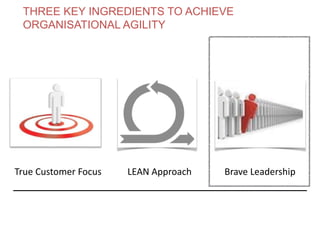
True Customer Focus LEAN Approach Brave Leadership
THREE KEY INGREDIENTS TO ACHIEVE
ORGANISATIONAL AGILITY
www.theagilecontactcentre.com.au
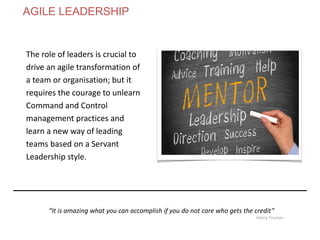
The role of leaders is crucial to
drive an agile transformation of
a team or organisation; but it
requires the courage to unlearn
Command and Control
management practices and
learn a new way of leading
teams based on a Servant
Leadership style.
“It is amazing what you can accomplish if you do not care who gets the credit”
Henry Truman
AGILE LEADERSHIP
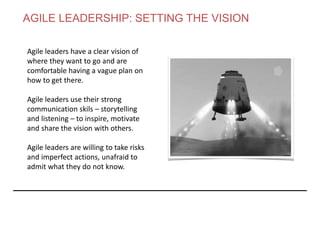
Agile leaders have a clear vision of
where they want to go and are
comfortable having a vague plan on
how to get there.
Agile leaders use their strong
communication skils – storytelling
and listening – to inspire, motivate
and share the vision with others.
Agile leaders are willing to take risks
and imperfect actions, unafraid to
admit what they do not know.
AGILE LEADERSHIP: SETTING THE VISION
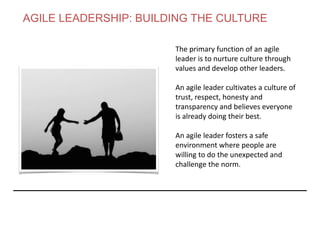
The primary function of an agile
leader is to nurture culture through
values and develop other leaders.
An agile leader cultivates a culture of
trust, respect, honesty and
transparency and believes everyone
is already doing their best.
An agile leader fosters a safe
environment where people are
willing to do the unexpected and
challenge the norm.
AGILE LEADERSHIP: BUILDING THE CULTURE
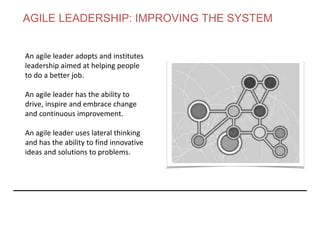
An agile leader adopts and institutes
leadership aimed at helping people
to do a better job.
An agile leader has the ability to
drive, inspire and embrace change
and continuous improvement.
An agile leader uses lateral thinking
and has the ability to find innovative
ideas and solutions to problems.
AGILE LEADERSHIP: IMPROVING THE SYSTEM
SOME OF THE PRACTICES
AND TOOLS WE USE
www.theagilecontactcentre.com.au
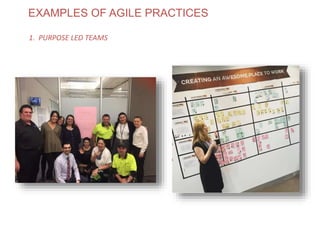
EXAMPLES OF AGILE PRACTICES
1. PURPOSE LED TEAMS
www.theagilecontactcentre.com.au
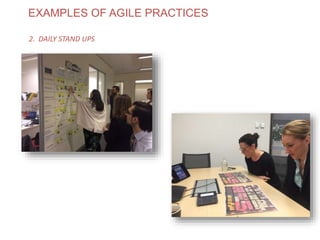
EXAMPLES OF AGILE PRACTICES
2. DAILY STAND UPS
www.theagilecontactcentre.com.au
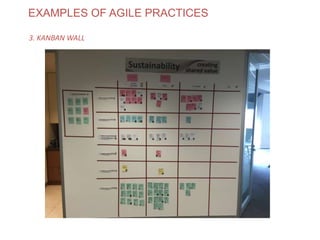
EXAMPLES OF AGILE PRACTICES
3. KANBAN WALL
www.theagilecontactcentre.com.au
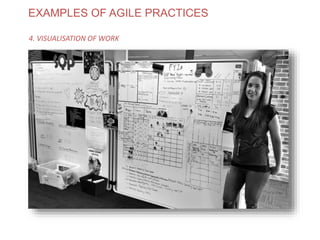
EXAMPLES OF AGILE PRACTICES
4. VISUALISATION OF WORK
www.theagilecontactcentre.com.au
EXAMPLES OF AGILE PRACTICES
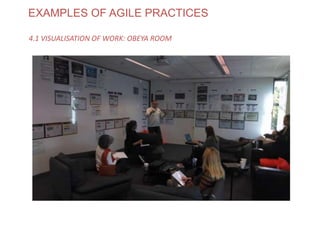
4.1 VISUALISATION OF WORK: OBEYA ROOM
www.theagilecontactcentre.com.au
EXAMPLES OF AGILE PRACTICES
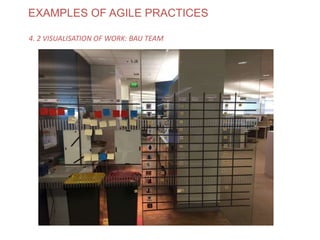
4. 2 VISUALISATION OF WORK: BAU TEAM
www.theagilecontactcentre.com.au
EXAMPLES OF AGILE PRACTICES
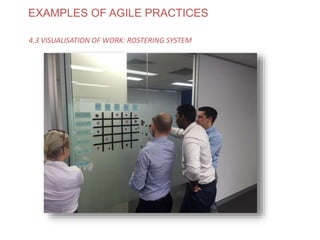
4.3 VISUALISATION OF WORK: ROSTERING SYSTEM
www.theagilecontactcentre.com.au
EXAMPLES OF AGILE PRACTICES
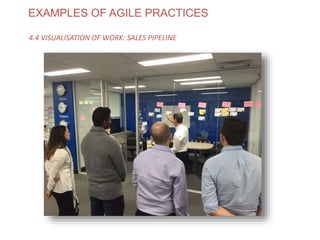
4.4 VISUALISATION OF WORK: SALES PIPELINE
www.theagilecontactcentre.com.au
EXAMPLES OF AGILE PRACTICES
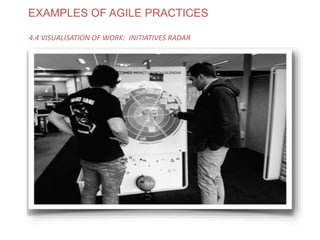
4.4 VISUALISATION OF WORK: INITIATIVES RADAR
www.theagilecontactcentre.com.au
EXAMPLES OF AGILE PRACTICES
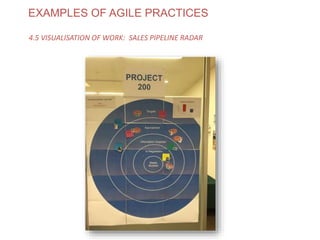
4.5 VISUALISATION OF WORK: SALES PIPELINE RADAR
www.theagilecontactcentre.com.au
EXAMPLES OF AGILE PRACTICES
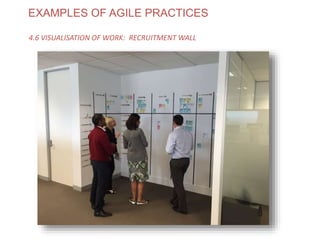
4.6 VISUALISATION OF WORK: RECRUITMENT WALL
www.theagilecontactcentre.com.au
EXAMPLES OF AGILE PRACTICES
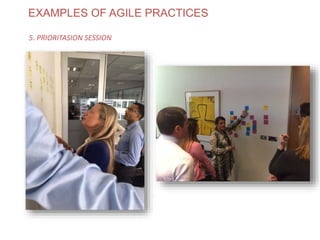
5. PRIORITASION SESSION
www.theagilecontactcentre.com.au
EXAMPLES OF AGILE PRACTICES
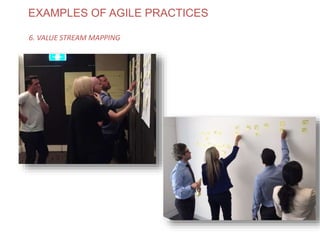
6. VALUE STREAM MAPPING
www.theagilecontactcentre.com.au
EXAMPLES OF AGILE PRACTICES
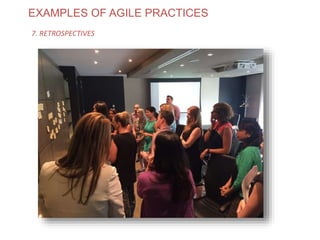
7. RETROSPECTIVES
www.theagilecontactcentre.com.au
EXAMPLES OF AGILE PRACTICES
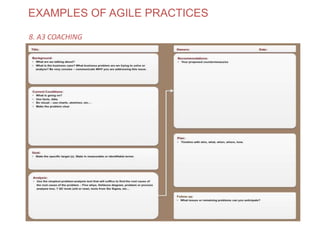
8. A3 COACHING
www.theagilecontactcentre.com.au
EXAMPLES OF AGILE PRACTICES
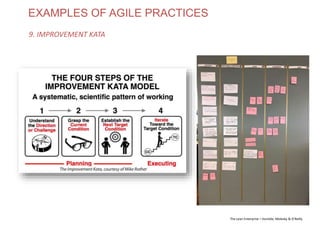
9. IMPROVEMENT KATA
www.theagilecontactcentre.com.au
The Lean Enterprise – Humble, Molesky & O’Reilly
EXAMPLES OF AGILE PRACTICES
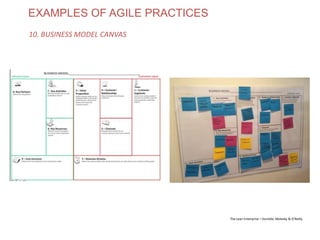
10. BUSINESS MODEL CANVAS
www.theagilecontactcentre.com.au
The Lean Enterprise – Humble, Molesky & O’Reilly
WANT TO CONVINCE YOUR
BOSS TO START “DOING”
AGILE?
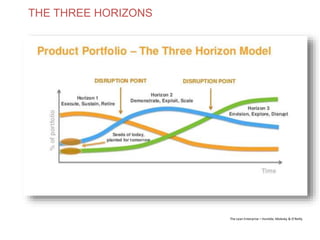
SHOW THEM THIS SLIDE…
THE THREE HORIZONS
The Lean Enterprise – Humble, Molesky & O’Reilly
THANK YOU
www.theagilecontactcentre.com.au

Agile Beyond Software - Geelong lean pizza

  • 1.
    AGILE BEYOND SOFTWARE HO W T O A C H I E V E O R G A N I S AT I O N A L A G I L I T Y www.theagilecontactcentre.com.au G E E L O N G L E A N P I Z Z A
  • 2.
    ABOUT ME www.theagilecontactcentre.com.au EDUARDO NOFUENTES Leanand Agile Coach | Founder @ The Agile Contact Centre| Founding Partner @ The Agile Eleven
  • 3.
    SOME OF THETEAMS WE WORK WITH… www.theagilecontactcentre.com.au
  • 4.
    AGILE BEYOND SOFTWARE– A VISUAL REPRESENTATION Visual Representation by Christiane Anderson of Eduardo Nofuentes session – 1st Conf 2016
  • 5.
  • 6.
    OUR APPROACH H OW D O W E W O R K W I T H N O N S O F T W A R E D E V E L O P M E N T T E A M S ? www.theagilecontactcentre.com.au
  • 7.
    “The ability tomove quickly and easily” WHAT IS AGILE? www.theagilecontactcentre.com.au
  • 8.
    “We are uncoveringbetter ways of developing software by doing it and helping others do it. Through this work we have come to value: THE AGILE MANIFESTO (2001) That is, while there is value in the items on the right, we value the items on the left more.” Individual and interactions over processes and tools Working software over comprehensive documentation Customer collaboration over contract negotiation Responding to change over following a plan www.theagilecontactcentre.com.au
  • 9.
    “We are uncoveringbetter ways of developing software by doing it and helping others do it. Through this work we have come to value: THE AGILE MANIFESTO (2001) That is, while there is value in the items on the right, we value the items on the left more.” Individual and interactions over processes and tools Working software over comprehensive documentation Customer collaboration over contract negotiation Responding to change over following a plan www.theagilecontactcentre.com.au
  • 10.
    “We are uncoveringbetter ways of developing software by doing it and helping others do it. Through this work we have come to value: THE AGILE MANIFESTO (2001) That is, while there is value in the items on the right, we value the items on the left more.” Individual and interactions over processes and tools Working software over comprehensive documentation Customer collaboration over contract negotiation Responding to change over following a plan working Outcome s www.theagilecontactcentre.com.au
  • 11.
    AGILE IS AMINDSET • Respect for the worth of every person • Truth in every communication • Transparency of all data, actions, and decisions • Trust that each person will support the team • Commitment to the team and to the team’s goals KEY BEHAVIOURS THAT ENABLE THE AGILE MINDSET Agile Principles and Values by Jeff Sutherland www.theagilecontactcentre.com.au
  • 12.
    AGILE IS AMINDSET • Respect for the worth of every person • Truth in every communication • Transparency of all data, actions, and decisions • Trust that each person will support the team • Commitment to the team and to the team’s goals - Collaboration KEY BEHAVIOURS THAT ENABLE THE AGILE MINDSET Agile Principles and Values by Jeff Sutherland www.theagilecontactcentre.com.au
  • 13.
    THE PRINCIPLES BEHINDAGILE PRINCIPLES • Our highest priority is to satisfy the customer. • Deliver outcomes frequently. • Business people must work together daily throughout the project. • Build projects around motivated individuals. • The most efficient and effective method of communication is face-to-face. • Outcomes are the primary measure of progress. • Agile processes promote sustainable development. • Simplicity is essential. • The best outcomes emerge from self-organizing teams. • At regular intervals, the team reflects on how to become more effective, then tunes and adjusts its behavior accordingly. www.theagilecontactcentre.com.au
  • 14.
    THE PRINCIPLES BEHINDAGILE PRINCIPLES • Our highest priority is to satisfy the customer. • Deliver outcomes frequently. • Business people must work together daily throughout the project. • Build projects around motivated individuals. • The most efficient and effective method of communication is face-to-face. • Outcomes are the primary measure of progress. • Agile processes promote sustainable development. • Simplicity is essential. • The best outcomes emerge from self-organizing teams. • At regular intervals, the team reflects on how to become more effective, then tunes and adjusts its behavior accordingly. www.theagilecontactcentre.com.au
  • 15.
    WHAT IS AGILE? Fromthe article “What is Agile “by Steve Denning – Image from Ahmed Sidky
  • 16.
    THE GOOD NEWS… Ifyou are already applying these mindsets and principles to your team or organisation, you are already doing Agile… …even if you don’t stick cards on the walls or stand up every morning for 15 minutes. www.theagilecontactcentre.com.auwww.theagilecontactcentre.com.au
  • 17.
    THE THREE WAVESOF AGILE The three Waves of Agile by Charlie Rudd – Solutions IQ www.theagilecontactcentre.com.au
  • 18.
    True Customer FocusLEAN Culture Brave Leadership THREE KEY INGREDIENTS TO ACHIEVE ORGANISATIONAL AGILITY www.theagilecontactcentre.com.au
  • 19.
    True Customer FocusLEAN Culture Brave Leadership THREE KEY INGREDIENTS TO ACHIEVE ORGANISATIONAL AGILITY www.theagilecontactcentre.com.au
  • 20.
    We must shiftthe focus of companies back to the customer and away from shareholder value. Companies should place customers at the center of the firm and focus on delighting them, while earning an acceptable return for shareholders. “the only valid purpose of a firm is to create a customer ” Peter Drucker TRUE CUSTOMER FOCUS: THE SHAREHOLDER VALUE TRAP www.theagilecontactcentre.com.au
  • 21.
    Use a Systems Thinkingor a Design Thinking approach to the way you structure your teams and organisations starting with the customer first “To manage an organisation as a system means understanding how work flows from and to the organisation’s customers.” John Seddon TRUE CUSTOMER FOCUS: DEPARTMENTAL SILOS www.theagilecontactcentre.com.au
  • 22.
    True Customer FocusLEAN Culture Brave Leadership THREE KEY INGREDIENTS TO ACHIEVE ORGANISATIONAL AGILITY www.theagilecontactcentre.com.au
  • 23.
    Build a culturein your organisation or team where the focus of everyone is on: eliminating waste, adding value for the customer and improving the flow of work. “Value is always defined by the customer”…”Any activity that is unproductive or does not add to the value of product is waste” The Toyota System LEAN CULTURE: WASTE, FLOW AND VALUE www.theagilecontactcentre.com.au
  • 24.
    Build a culturewhere SIMPLICITY is well regarded and seen as a key competitive advantage. Not only on the way products or services are designed, but also the way internal processes, meetings, and collaboration tools are designed and run. “Everything should be made as simple as possible. But not simpler” Albert Einstein LEAN CULTURE: SIMPLICITY www.theagilecontactcentre.com.au
  • 25.
    True agility means thatteams are constantly working to evolve their processes to deal with their particular obstacles they are facing at any given time. “Continuous Improvement is better than delayed perfection” Mark Twain ADOPT A CULTURE OF CONTINUOUS IMPROVEMENT Design and run experiment (do) Study results (check) Evolve model and implement changes (act) Create hypothesis (plan) The Deming cycle www.theagilecontactcentre.com.au
  • 26.
    True Customer FocusLEAN Approach Brave Leadership THREE KEY INGREDIENTS TO ACHIEVE ORGANISATIONAL AGILITY www.theagilecontactcentre.com.au
  • 27.
    The role ofleaders is crucial to drive an agile transformation of a team or organisation; but it requires the courage to unlearn Command and Control management practices and learn a new way of leading teams based on a Servant Leadership style. “It is amazing what you can accomplish if you do not care who gets the credit” Henry Truman AGILE LEADERSHIP
  • 28.
    Agile leaders havea clear vision of where they want to go and are comfortable having a vague plan on how to get there. Agile leaders use their strong communication skils – storytelling and listening – to inspire, motivate and share the vision with others. Agile leaders are willing to take risks and imperfect actions, unafraid to admit what they do not know. AGILE LEADERSHIP: SETTING THE VISION
  • 29.
    The primary functionof an agile leader is to nurture culture through values and develop other leaders. An agile leader cultivates a culture of trust, respect, honesty and transparency and believes everyone is already doing their best. An agile leader fosters a safe environment where people are willing to do the unexpected and challenge the norm. AGILE LEADERSHIP: BUILDING THE CULTURE
  • 30.
    An agile leaderadopts and institutes leadership aimed at helping people to do a better job. An agile leader has the ability to drive, inspire and embrace change and continuous improvement. An agile leader uses lateral thinking and has the ability to find innovative ideas and solutions to problems. AGILE LEADERSHIP: IMPROVING THE SYSTEM
  • 31.
    SOME OF THEPRACTICES AND TOOLS WE USE www.theagilecontactcentre.com.au
  • 32.
    EXAMPLES OF AGILEPRACTICES 1. PURPOSE LED TEAMS www.theagilecontactcentre.com.au
  • 33.
    EXAMPLES OF AGILEPRACTICES 2. DAILY STAND UPS www.theagilecontactcentre.com.au
  • 34.
    EXAMPLES OF AGILEPRACTICES 3. KANBAN WALL www.theagilecontactcentre.com.au
  • 35.
    EXAMPLES OF AGILEPRACTICES 4. VISUALISATION OF WORK www.theagilecontactcentre.com.au
  • 36.
    EXAMPLES OF AGILEPRACTICES 4.1 VISUALISATION OF WORK: OBEYA ROOM www.theagilecontactcentre.com.au
  • 37.
    EXAMPLES OF AGILEPRACTICES 4. 2 VISUALISATION OF WORK: BAU TEAM www.theagilecontactcentre.com.au
  • 38.
    EXAMPLES OF AGILEPRACTICES 4.3 VISUALISATION OF WORK: ROSTERING SYSTEM www.theagilecontactcentre.com.au
  • 39.
    EXAMPLES OF AGILEPRACTICES 4.4 VISUALISATION OF WORK: SALES PIPELINE www.theagilecontactcentre.com.au
  • 40.
    EXAMPLES OF AGILEPRACTICES 4.4 VISUALISATION OF WORK: INITIATIVES RADAR www.theagilecontactcentre.com.au
  • 41.
    EXAMPLES OF AGILEPRACTICES 4.5 VISUALISATION OF WORK: SALES PIPELINE RADAR www.theagilecontactcentre.com.au
  • 42.
    EXAMPLES OF AGILEPRACTICES 4.6 VISUALISATION OF WORK: RECRUITMENT WALL www.theagilecontactcentre.com.au
  • 43.
    EXAMPLES OF AGILEPRACTICES 5. PRIORITASION SESSION www.theagilecontactcentre.com.au
  • 44.
    EXAMPLES OF AGILEPRACTICES 6. VALUE STREAM MAPPING www.theagilecontactcentre.com.au
  • 45.
    EXAMPLES OF AGILEPRACTICES 7. RETROSPECTIVES www.theagilecontactcentre.com.au
  • 46.
    EXAMPLES OF AGILEPRACTICES 8. A3 COACHING www.theagilecontactcentre.com.au
  • 47.
    EXAMPLES OF AGILEPRACTICES 9. IMPROVEMENT KATA www.theagilecontactcentre.com.au The Lean Enterprise – Humble, Molesky & O’Reilly
  • 48.
    EXAMPLES OF AGILEPRACTICES 10. BUSINESS MODEL CANVAS www.theagilecontactcentre.com.au The Lean Enterprise – Humble, Molesky & O’Reilly
  • 49.
    WANT TO CONVINCEYOUR BOSS TO START “DOING” AGILE?
  • 50.
  • 51.
    THE THREE HORIZONS TheLean Enterprise – Humble, Molesky & O’Reilly
  • 52.