What is
AGILE?
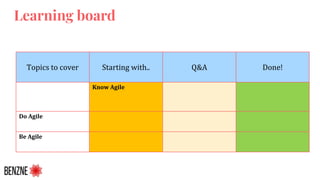
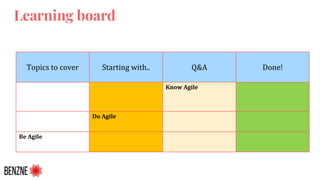
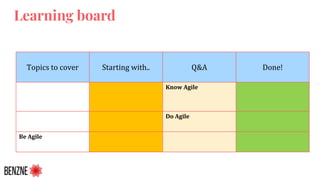
Topics to cover Starting with.. Q&A Done!
Know Agile
Do Agile
Be Agile
Learning board
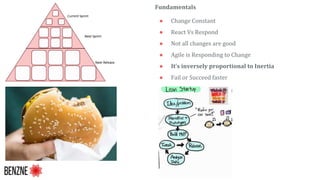
Fundamentals
● Change Constant
● React Vs Respond
● Not all changes are good
● Agile is Responding to Change
● It’s inversely proportional to Inertia
● Fail or Succeed faster
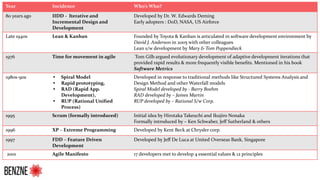
Year Incidence Who’s Who?
80 years ago IIDD - Iterative and
Incremental Design and
Development
Developed by Dr. W. Edwards Deming
Early adopters : DoD, NASA, US Airforce
Late 1940s Lean & Kanban Founded by Toyota & Kanban is articulated in software development environment by
David J. Anderson in 2005 with other colleagues
Lean s/w development by Mary & Tom Poppendieck
1976 Time for movement in agile Tom Gilb argued evolutionary development of adaptive development iterations that
provided rapid results & more frequently visible benefits. Mentioned in his book
Software Metrics
1980s-90s • Spiral Model
• Rapid prototyping,
• RAD (Rapid App.
Development),
• RUP (Rational Unified
Process)
Developed in response to traditional methods like Structured Systems Analysis and
Design Method and other Waterfall models
Spiral Model developed by - Barry Boehm
RAD developed by – James Martin
RUP developed by – Rational S/w Corp.
1995 Scrum (formally introduced) Initial idea by Hirotaka Takeuchi and Ikujiro Nonaka
Formally introduced by – Ken Schwaber, Jeff Sutherland & others
1996 XP – Extreme Programming Developed by Kent Beck at Chrysler corp.
1997 FDD – Feature Driven
Development
Developed by Jeff De Luca at United Overseas Bank, Singapore
2001 Agile Manifesto 17 developers met to develop 4 essential values & 12 principles
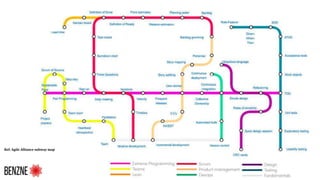
Ref: Agile Alliance subway map
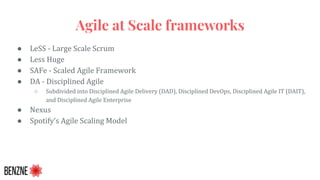
Agile at Scale frameworks
● LeSS - Large Scale Scrum
● Less Huge
● SAFe - Scaled Agile Framework
● DA - Disciplined Agile
○ Subdivided into Disciplined Agile Delivery (DAD), Disciplined DevOps, Disciplined Agile IT (DAIT),
and Disciplined Agile Enterprise
● Nexus
● Spotify’s Agile Scaling Model
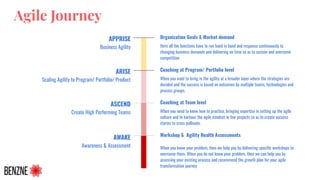
Agile Journey
APPRISE
Business Agility
Organization Goals & Market demand
Here all the functions have to run hand in hand and response continuously to
changing business demands and delivering on time so as to sustain and overcome
competition
ARISE
Scaling Agility to Program/ Portfolio/ Product
Coaching at Program/ Portfolio level
When you want to bring in the agility at a broader layer where the strategies are
decided and the success is based on outcomes by multiple teams, technologies and
process groups.
ASCEND
Create High Performing Teams
Coaching at Team level
When you need to know how to practice, bringing expertise in setting up the agile
culture and to harbour the agile mindset in few projects so as to create success
stories to cross pollinate.
Workshop & Agility Health Assessments
AWAKE
Awareness & Assessment When you know your problem, then we help you by delivering specific workshops to
overcome them. When you do not know your problem, then we can help you by
assessing your existing process and recommend the growth plan for your agile
transformation journey
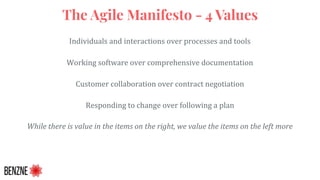
Individuals and interactions over processes and tools
Working software over comprehensive documentation
Customer collaboration over contract negotiation
Responding to change over following a plan
While there is value in the items on the right, we value the items on the left more
The Agile Manifesto - 4 Values
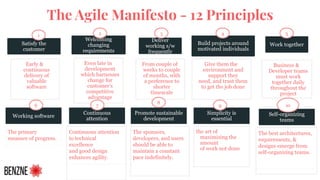
Satisfy the
customer
Early &
continuous
delivery of
valuable
software
Welcoming
changing
requirements
Even late in
development
which harnesses
change for
customer’s
competitive
advantage
Deliver
working s/w
frequently
From couple of
weeks to couple
of months, with
a preference to
shorter
timescale
Build projects around
motivated individuals
Give them the
environment and
support they
need, and trust them
to get the job done
Business &
Developer teams
must work
together daily
throughout the
project
Working software
The primary
measure of progress.
Continuous
attention
Continuous attention
to technical
excellence
and good design
enhances agility.
Promote sustainable
development
The sponsors,
developers, and users
should be able to
maintain a constant
pace indefinitely.
Simplicity is
essential
the art of
maximizing the
amount
of work not done
Work together
Self-organizing
teams
The best architectures,
requirements, &
designs emerge from
self-organizing teams.
1 2 3 4 5
6 7 8 9 10
The Agile Manifesto - 12 Principles
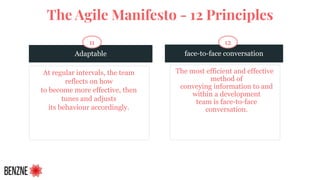
Adaptable
At regular intervals, the team
reflects on how
to become more effective, then
tunes and adjusts
its behaviour accordingly.
face-to-face conversation
The most efficient and effective
method of
conveying information to and
within a development
team is face-to-face
conversation.
11 12
The Agile Manifesto - 12 Principles
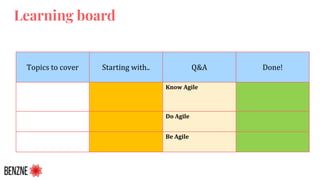
Topics to cover Starting with.. Q&A Done!
Know Agile
Do Agile
Be Agile
Learning board
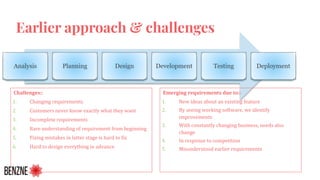
Earlier approach & challenges
Analysis Planning Design Development Testing Deployment
Challenges::
1. Changing requirements
2. Customers never know exactly what they want
3. Incomplete requirements
4. Rare understanding of requirement from beginning
5. Fixing mistakes in latter stage is hard to fix
6. Hard to design everything in advance
Emerging requirements due to::
1. New ideas about an existing feature
2. By seeing working software, we identify
improvements
3. With constantly changing business, needs also
change
4. In response to competition
5. Misunderstood earlier requirements
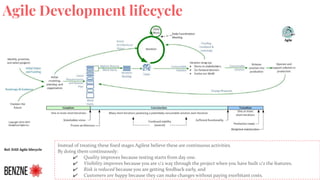
Agile Development lifecycle
Instead of treating these fixed stages Agilest believe these are continuous activities.
By doing them continuously:
✔ Quality improves because testing starts from day one.
✔ Visibility improves because you are 1/2 way through the project when you have built 1/2 the features.
✔ Risk is reduced because you are getting feedback early, and
✔ Customers are happy because they can make changes without paying exorbitant costs.
Ref: DAD Agile lifecycle
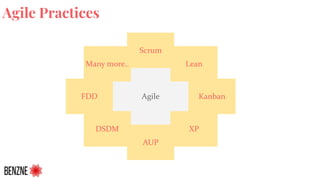
Agile Practices
Agile
Scrum
Lean
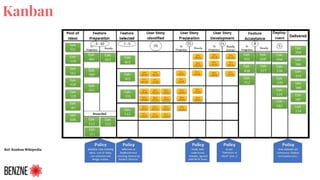
Kanban
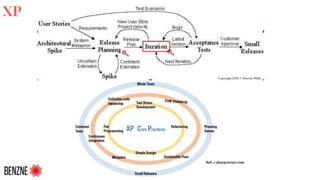
XP
AUP
DSDM
FDD
Many more..
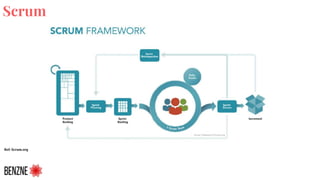
Scrum
Ref: Scrum.org
Kanban
Ref: Kanban Wikipedia
Ref: c-sharpcorner.com
XP
Topics to cover Starting with.. Q&A Done!
Know Agile
Do Agile
Be Agile
Learning board
Happiness
Effective
Communication
Motivating
Satisfy
Employees
Adaptable
Improving
Processes
Technical
Excellence
Predictable
Engaging
Spirit of
Oneness
Deliver Value
Respond to
Change
Trust & Respect
People
Development
Equality
Self-Organizing
Creative
Collaboration
Simplicity
BEING
AGILE
Fun at work
Continuous
Learning
Autonomous
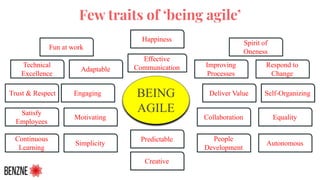
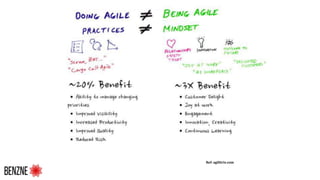
Few traits of ‘being agile’
Ref: agilitrix.com
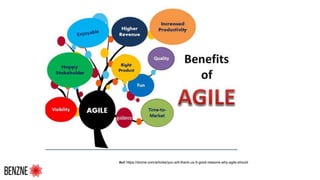
Ref: https://dzone.com/articles/you-will-thank-us-5-good-reasons-why-agile-should
Topics to cover Starting with.. Q&A Done!
Know Agile
Do Agile
Be Agile
Learning board
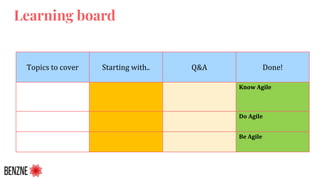
Topics to cover Starting with.. Q&A Done!
Know Agile
Do Agile
Be Agile
Learning board
THANK YOU
Anuj M Ojha
www.Benzne.com

What is agile

  • 1.
  • 2.
    Topics to coverStarting with.. Q&A Done! Know Agile Do Agile Be Agile Learning board
  • 3.
    Fundamentals ● Change Constant ●React Vs Respond ● Not all changes are good ● Agile is Responding to Change ● It’s inversely proportional to Inertia ● Fail or Succeed faster
  • 4.
    Year Incidence Who’sWho? 80 years ago IIDD - Iterative and Incremental Design and Development Developed by Dr. W. Edwards Deming Early adopters : DoD, NASA, US Airforce Late 1940s Lean & Kanban Founded by Toyota & Kanban is articulated in software development environment by David J. Anderson in 2005 with other colleagues Lean s/w development by Mary & Tom Poppendieck 1976 Time for movement in agile Tom Gilb argued evolutionary development of adaptive development iterations that provided rapid results & more frequently visible benefits. Mentioned in his book Software Metrics 1980s-90s • Spiral Model • Rapid prototyping, • RAD (Rapid App. Development), • RUP (Rational Unified Process) Developed in response to traditional methods like Structured Systems Analysis and Design Method and other Waterfall models Spiral Model developed by - Barry Boehm RAD developed by – James Martin RUP developed by – Rational S/w Corp. 1995 Scrum (formally introduced) Initial idea by Hirotaka Takeuchi and Ikujiro Nonaka Formally introduced by – Ken Schwaber, Jeff Sutherland & others 1996 XP – Extreme Programming Developed by Kent Beck at Chrysler corp. 1997 FDD – Feature Driven Development Developed by Jeff De Luca at United Overseas Bank, Singapore 2001 Agile Manifesto 17 developers met to develop 4 essential values & 12 principles
  • 5.
  • 6.
    Agile at Scaleframeworks ● LeSS - Large Scale Scrum ● Less Huge ● SAFe - Scaled Agile Framework ● DA - Disciplined Agile ○ Subdivided into Disciplined Agile Delivery (DAD), Disciplined DevOps, Disciplined Agile IT (DAIT), and Disciplined Agile Enterprise ● Nexus ● Spotify’s Agile Scaling Model
  • 7.
    Agile Journey APPRISE Business Agility OrganizationGoals & Market demand Here all the functions have to run hand in hand and response continuously to changing business demands and delivering on time so as to sustain and overcome competition ARISE Scaling Agility to Program/ Portfolio/ Product Coaching at Program/ Portfolio level When you want to bring in the agility at a broader layer where the strategies are decided and the success is based on outcomes by multiple teams, technologies and process groups. ASCEND Create High Performing Teams Coaching at Team level When you need to know how to practice, bringing expertise in setting up the agile culture and to harbour the agile mindset in few projects so as to create success stories to cross pollinate. Workshop & Agility Health Assessments AWAKE Awareness & Assessment When you know your problem, then we help you by delivering specific workshops to overcome them. When you do not know your problem, then we can help you by assessing your existing process and recommend the growth plan for your agile transformation journey
  • 8.
    Individuals and interactionsover processes and tools Working software over comprehensive documentation Customer collaboration over contract negotiation Responding to change over following a plan While there is value in the items on the right, we value the items on the left more The Agile Manifesto - 4 Values
  • 9.
    Satisfy the customer Early & continuous deliveryof valuable software Welcoming changing requirements Even late in development which harnesses change for customer’s competitive advantage Deliver working s/w frequently From couple of weeks to couple of months, with a preference to shorter timescale Build projects around motivated individuals Give them the environment and support they need, and trust them to get the job done Business & Developer teams must work together daily throughout the project Working software The primary measure of progress. Continuous attention Continuous attention to technical excellence and good design enhances agility. Promote sustainable development The sponsors, developers, and users should be able to maintain a constant pace indefinitely. Simplicity is essential the art of maximizing the amount of work not done Work together Self-organizing teams The best architectures, requirements, & designs emerge from self-organizing teams. 1 2 3 4 5 6 7 8 9 10 The Agile Manifesto - 12 Principles
  • 10.
    Adaptable At regular intervals,the team reflects on how to become more effective, then tunes and adjusts its behaviour accordingly. face-to-face conversation The most efficient and effective method of conveying information to and within a development team is face-to-face conversation. 11 12 The Agile Manifesto - 12 Principles
  • 11.
    Topics to coverStarting with.. Q&A Done! Know Agile Do Agile Be Agile Learning board
  • 12.
    Earlier approach &challenges Analysis Planning Design Development Testing Deployment Challenges:: 1. Changing requirements 2. Customers never know exactly what they want 3. Incomplete requirements 4. Rare understanding of requirement from beginning 5. Fixing mistakes in latter stage is hard to fix 6. Hard to design everything in advance Emerging requirements due to:: 1. New ideas about an existing feature 2. By seeing working software, we identify improvements 3. With constantly changing business, needs also change 4. In response to competition 5. Misunderstood earlier requirements
  • 13.
    Agile Development lifecycle Insteadof treating these fixed stages Agilest believe these are continuous activities. By doing them continuously: ✔ Quality improves because testing starts from day one. ✔ Visibility improves because you are 1/2 way through the project when you have built 1/2 the features. ✔ Risk is reduced because you are getting feedback early, and ✔ Customers are happy because they can make changes without paying exorbitant costs. Ref: DAD Agile lifecycle
  • 14.
  • 15.
  • 16.
  • 17.
  • 18.
    Topics to coverStarting with.. Q&A Done! Know Agile Do Agile Be Agile Learning board
  • 19.
    Happiness Effective Communication Motivating Satisfy Employees Adaptable Improving Processes Technical Excellence Predictable Engaging Spirit of Oneness Deliver Value Respondto Change Trust & Respect People Development Equality Self-Organizing Creative Collaboration Simplicity BEING AGILE Fun at work Continuous Learning Autonomous Few traits of ‘being agile’
  • 20.
  • 21.
  • 22.
    Topics to coverStarting with.. Q&A Done! Know Agile Do Agile Be Agile Learning board
  • 23.
    Topics to coverStarting with.. Q&A Done! Know Agile Do Agile Be Agile Learning board
  • 24.
    THANK YOU Anuj MOjha www.Benzne.com