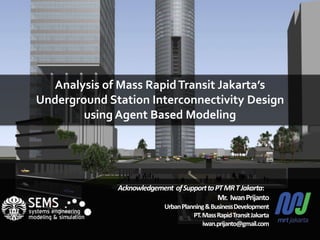
Analysis of Mass RapidTransit Jakarta’s
Underground Station Interconnectivity Design
using Agent Based Modeling
Akhmad Hidayatno, Stefan Darmansyah, Armand Omar Moeis
Systems Engineering Modeling and Simulation Lab
akhmad.hidayatno@ui.ac.id
systems.ie.ui.ac.id
Agenda
• Transit Oriented Development in MRT Jakarta
• Multi-Method Modeling Initiatives to Support MRT Jakarta
• Case Study: Pedestrian Modeling for MRT Jakarta Stations
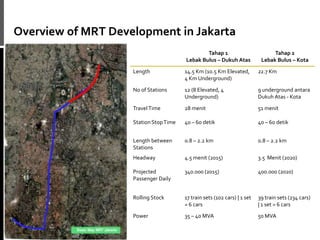
Overview of MRT Development in Jakarta
3© MRTJakarta 2009
Tahap 1
Lebak Bulus – Dukuh Atas
Tahap 2
Lebak Bulus – Kota
Length 14.5 Km (10.5 Km Elevated,
4 Km Underground)
22.7 Km
No of Stations 12 (8 Elevated, 4
Underground)
9 underground antara
Dukuh Atas - Kota
TravelTime 28 menit 51 menit
StationStopTime 40 – 60 detik 40 – 60 detik
Length between
Stations
0.8 – 2.2 km 0.8 – 2.2 km
Headway 4.5 menit (2015) 3.5 Menit (2020)
Projected
Passenger Daily
340.000 (2015) 400.000 (2020)
Rolling Stock 17 train sets (102 cars) | 1 set
= 6 cars
39 train sets (234 cars)
| 1 set = 6 cars
Power 35 – 40 MVA 50 MVA
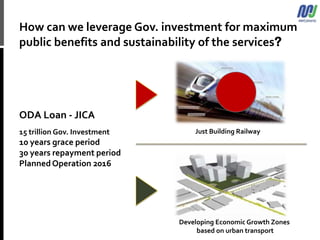
How can we leverage Gov. investment for maximum
public benefits and sustainability of the services?
15 trillion Gov. Investment
10 years grace period
30 years repayment period
PlannedOperation 2016
ODA Loan - JICA
Just Building Railway
Developing Economic Growth Zones
based on urban transport
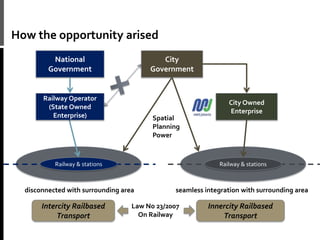
How the opportunity arised
National
Government
City
Government
Railway Operator
(State Owned
Enterprise)
disconnected with surrounding area
Spatial
Planning
Power
Railway & stations Railway & stations
City Owned
Enterprise
seamless integration with surrounding area
Intercity Railbased
Transport
Innercity Railbased
Transport
Law No 23/2007
On Railway
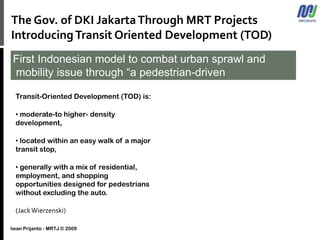
The Gov. of DKI JakartaThrough MRT Projects
IntroducingTransit Oriented Development (TOD)
First Indonesian model to combat urban sprawl and
mobility issue through “a pedestrian-driven
development”
Transit-Oriented Development (TOD) is:
• moderate-to higher- density
development,
• located within an easy walk of a major
transit stop,
• generally with a mix of residential,
employment, and shopping
opportunities designed for pedestrians
without excluding the auto.
(JackWierzenski)
Iwan Prijanto - MRTJ © 2009
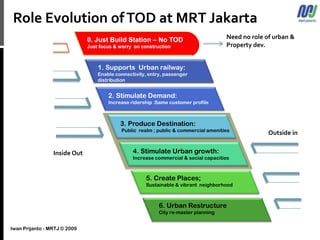
Role Evolution ofTOD at MRT Jakarta
1. Supports Urban railway:
Enable connectivity, entry, passenger
distribution
2. Stimulate Demand:
Increase ridership :Same customer profile
3. Produce Destination:
Public realm ; public & commercial amenities
4. Stimulate Urban growth:
Increase commercial & social capacities
5. Create Places;
Sustainable & vibrant neighborhood
6. Urban Restructure
City re-master planning
Inside Out
Outside in
0. Just Build Station – No TOD
Just focus & worry on construction
Need no role of urban &
Property dev.
Iwan Prijanto - MRTJ © 2009
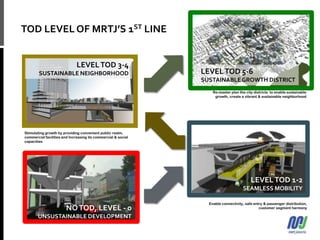
TOD LEVEL OF MRTJ’S 1ST LINE
Just focus & worry on construction. Situation to be avoided!!
LEVELTOD 1-2
SEAMLESS MOBILITY
LEVELTOD 5-6
SUSTAINABLEGROWTH DISTRICT
NOTOD, LEVEL - 0
UNSUSTAINABLE DEVELOPMENT
Enable connectivity, safe entry & passenger distribution,
customer segment harmony
Stimulating growth by providing convenient public realm,
commercial facilities and Increasing its commercial & social
capacities
Re-master plan the city districts to enable sustainable
growth, create a vibrant & sustainable neighborhood
LEVELTOD 3-4
SUSTAINABLE NEIGHBORHOOD
Iwan Prijanto - MRTJ © 2009
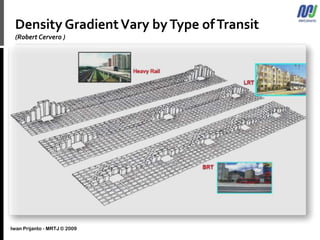
Density GradientVary byType ofTransit
(Robert Cervero )
Iwan Prijanto - MRTJ © 2009
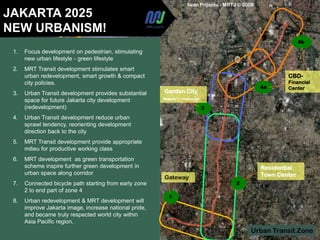
1
2
3
4a
4b
Residential
Town Center
Garden City
Rebirth Town Center
CBD-
Financial
Center
Gateway
JAKARTA 2025
NEW URBANISM!
1. Focus development on pedestrian, stimulating
new urban lifestyle - green lifestyle
2. MRT Transit development stimulates smart
urban redevelopment, smart growth & compact
city policies.
3. Urban Transit development provides substantial
space for future Jakarta city development
(redevelopment)
4. Urban Transit development reduce urban
sprawl tendency, reorienting development
direction back to the city
5. MRT Transit development provide appropriate
milieu for productive working class
6. MRT development as green transportation
scheme inspire further green development in
urban space along corridor
7. Connected bicycle path starting from early zone
2 to end part of zone 4
8. Urban redevelopment & MRT development will
improve Jakarta image, increase national pride,
and became truly respected world city within
Asia Pacific region.
Urban Transit Zone
Iwan Prijanto - MRTJ © 2009
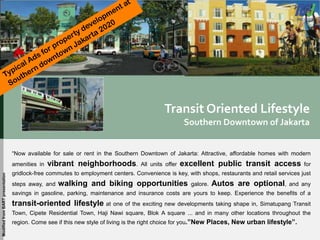
Transit Oriented Lifestyle
Southern Downtown of Jakarta
“Now available for sale or rent in the Southern Downtown of Jakarta: Attractive, affordable homes with modern
amenities in vibrant neighborhoods. All units offer excellent public transit access for
gridlock-free commutes to employment centers. Convenience is key, with shops, restaurants and retail services just
steps away, and walking and biking opportunities galore. Autos are optional, and any
savings in gasoline, parking, maintenance and insurance costs are yours to keep. Experience the benefits of a
transit-oriented lifestyle at one of the exciting new developments taking shape in, Simatupang Transit
Town, Cipete Residential Town, Haji Nawi square, Blok A square ... and in many other locations throughout the
region. Come see if this new style of living is the right choice for you.”New Places, New urban lifestyle”.
ModifiedfromBARTpresentation
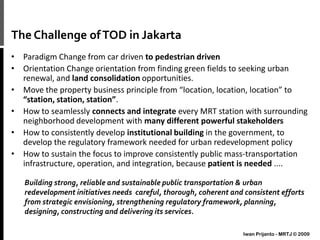
TOD 3 Bottom LinesValue (Robert Cervero)
Iwan Prijanto - MRTJ © 2009
increased
urban mobility
Improving
environmental
sustainability
Improving social
life quality
Stimulates further
economic growth
The Challenge ofTOD in Jakarta
• Paradigm Change from car driven to pedestrian driven
• Orientation Change orientation from finding green fields to seeking urban
renewal, and land consolidation opportunities.
• Move the property business principle from “location, location, location” to
“station, station, station”.
• How to seamlessly connects and integrate every MRT station with surrounding
neighborhood development with many different powerful stakeholders
• How to consistently develop institutional building in the government, to
develop the regulatory framework needed for urban redevelopment policy
• How to sustain the focus to improve consistently public mass-transportation
infrastructure, operation, and integration, because patient is needed ....
Building strong, reliable and sustainable public transportation & urban
redevelopment initiatives needs careful, thorough, coherent and consistent efforts
from strategic envisioning, strengthening regulatory framework, planning,
designing, constructing and delivering its services.
Iwan Prijanto - MRTJ © 2009
Agenda
• Transit Oriented Development in MRT Jakarta
• Multi-Method Modeling Initiatives to Support MRT Jakarta
• Case Study: Pedestrian Modeling for MRT Jakarta Stations
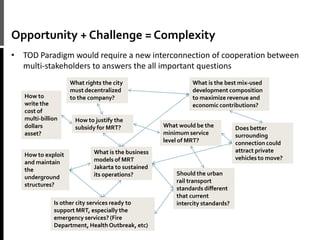
Opportunity + Challenge = Complexity
• TOD Paradigm would require a new interconnection of cooperation between
multi-stakeholders to answers the all important questions
What is the business
models of MRT
Jakarta to sustained
its operations?
What rights the city
must decentralized
to the company?
How to justify the
subsidy for MRT?
Is other city services ready to
support MRT, especially the
emergency services? (Fire
Department, HealthOutbreak, etc)
Should the urban
rail transport
standards different
that current
intercity standards?
Does better
surrounding
connection could
attract private
vehicles to move?
What would be the
minimum service
level of MRT?
What is the best mix-used
development composition
to maximize revenue and
economic contributions?
How to
write the
cost of
multi-billion
dollars
asset?
How to exploit
and maintain
the
underground
structures?
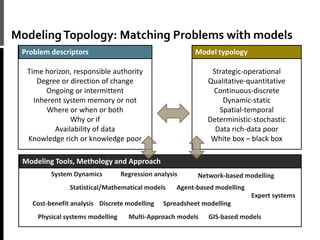
ModelingTopology: Matching Problems with models
16
Strategic-operational
Qualitative-quantitative
Continuous-discrete
Dynamic-static
Spatial-temporal
Deterministic-stochastic
Data rich-data poor
White box – black box
Time horizon, responsible authority
Degree or direction of change
Ongoing or intermittent
Inherent system memory or not
Where or when or both
Why or if
Availability of data
Knowledge rich or knowledge poor
Problem descriptors Model typology
Modeling Tools, Methology and Approach
System Dynamics
Discrete modelling
Physical systems modelling
Regression analysis
Cost-benefit analysis Spreadsheet modelling
GIS-based models
Agent-based modellingStatistical/Mathematical models
Expert systems
Network-based modelling
Multi-Approach models
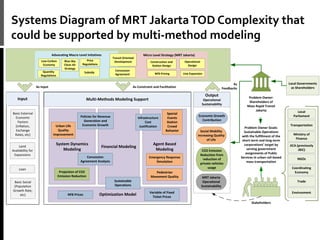
Systems Diagram of MRT JakartaTOD Complexity that
could be supported by multi-method modeling
Advocating Macro Level Initatives
Agent Based
Modeling
Problem Owner:
Shareholders of
Mass Rapid Transit
Jakarta
Problem Owner Goals:
Sustainable Operations
with the fulfillment of the
short-term and long-term
corporations’ target by
serving government
assignments of Public
Services in urban rail-based
mass transportation
Stakeholders
Output
Operational
Sustainability
Micro Level Strategy (MRT Jakarta)
Coordinating
Economy
NGOs
Transportation
Trade
Environment
Ministry of
Finance
Local Governments
as Shareholders
JICA (previously
JBIC)
Multi-Methods Modeling Support
Construction and
Station Design
Operational
Design
Blue-Sky
Clean Air
Strategy
NFB PricingSubsidy Line Expansion
Price
Regulations
Quantity
Regulations
Low-Carbon
Economy
Economic Growth
Contribution
Social Mobility
Increasing Quality
of Life
CO2 Emission
Reduction from
reduction of
private vehicles
usage
Input
Basic External
Economic
Factors
(Inflation,
Exchange
Rates, etc)
Land
Availability for
Expansions
Loan
Basic Social
(Population
Growth Rate,
etc)
MRT Jakarta
Operational
Sustainability
System Dynamics
Modeling
Financial Modeling
Policies for Revenue
Generation and
Economic Growth
Concession
Agreement Analysis
Infrastructure
Cost
Justification
Pedestrian
Movement Quality
As Input As Constraint and Facilitation
As
Feedbacks
Projection of CO2
Emission Reduction
Transit Oriented
Development
Concession
Agreement
Optimization Model
Urban Life
Quality
Improvement
Sustainable
Operations
Emergency Response
Simulation
Special
Events
Station
Crowd
Behavior
Local
Parliament
Variable of Fixed
Ticket Prices
NFB Prices
Agenda
• Transit Oriented Development in MRT Jakarta
• Multi-Method Modeling Initiatives to Support MRT Jakarta
• Case Study: Pedestrian Modeling for MRT Jakarta Stations
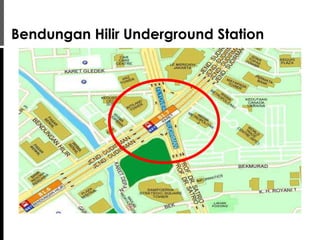
Bendungan Hilir Underground Station
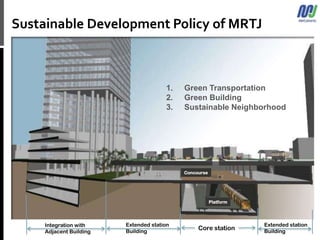
Sustainable Development Policy of MRTJ
Core station
Platform
Concourse
Extended station
Building
Extended station
Building
Integration with
Adjacent Building
1. Green Transportation
2. Green Building
3. Sustainable Neighborhood
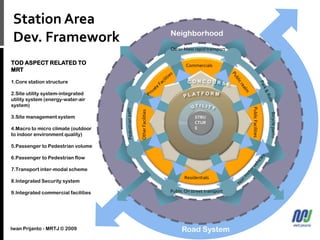
Station Area
Dev. Framework
StructureStructureStructureStructure
STRU
CTUR
E
Neighborhood
Commercials
Residentials
OtherFacilities
Public On street transport
Other Mass rapid transport
TOD ASPECT RELATED TO
MRT
1.Core station structure
2.Site utility system-integrated
utility system (energy-water-air
system)
3.Site management system
4.Macro to micro climate (outdoor
to indoor environment quality)
5.Passenger to Pedestrian volume
6.Passenger to Pedestrian flow
7.Transport inter-modal scheme
8.Integrated Security system
9.Integrated commercial facilities
Bicyclepaths
Road System
PublicFacilities
Iwan Prijanto - MRTJ © 2009
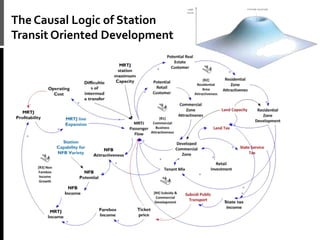
The Causal Logic of Station
Transit Oriented Development
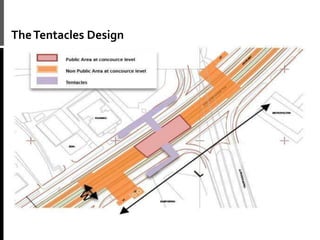
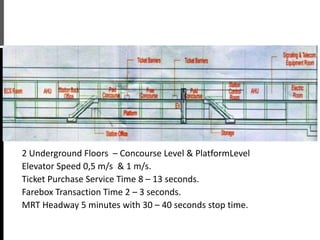
TheTentacles Design
Spesifikasi Lingkungan Stasiun (4)
2 Underground Floors – Concourse Level & PlatformLevel
Elevator Speed 0,5 m/s & 1 m/s.
Ticket Purchase Service Time 8 – 13 seconds.
Farebox Transaction Time 2 – 3 seconds.
MRT Headway 5 minutes with 30 – 40 seconds stop time.
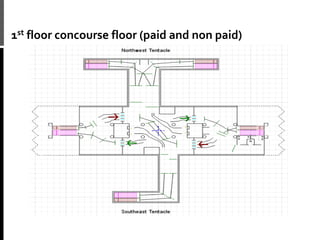
1st floor concourse floor (paid and non paid)
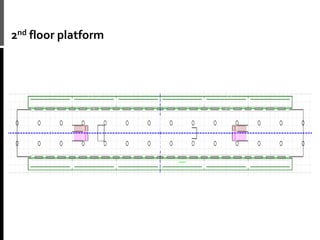
2nd floor platform
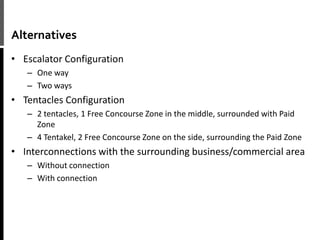
Alternatives
• Escalator Configuration
– One way
– Two ways
• Tentacles Configuration
– 2 tentacles, 1 Free Concourse Zone in the middle, surrounded with Paid
Zone
– 4 Tentakel, 2 Free Concourse Zone on the side, surrounding the Paid Zone
• Interconnections with the surrounding business/commercial area
– Without connection
– With connection
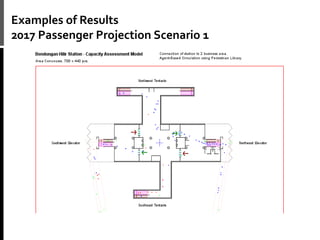
Examples of Results
2017 Passenger Projection Scenario 1
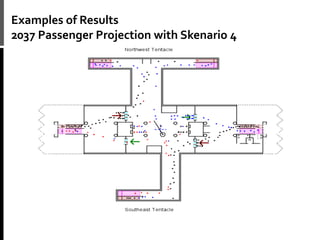
Examples of Results
2037 Passenger Projection with Skenario 4
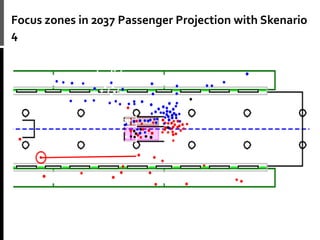
Focus zones in 2037 Passenger Projection with Skenario
4
Conclusion and Recommendation based on the Model
• The station draft design could served the minimum service level
standard set by the MRT Jakarta based on the current passenger
growth projections with the additional tentacles interconnections
• However, the final design should accommodate additional far-box
gateways, ticketing sales booth and the variable speed of escalator
Analysis of Mass RapidTransit Jakarta’s
Underground Station Interconnectivity Design
using Agent Based Modeling
Acknowledgement ofSupporttoPTMRTJakarta:
Mr. IwanPrijanto
UrbanPlanning&BusinessDevelopment
PT.MassRapidTransitJakarta
iwan.prijanto@gmail.com

Agent Based Pedestrian Modeling for Evaluation MRT Jakarta Underground Station Design

  • 1.
    Analysis of MassRapidTransit Jakarta’s Underground Station Interconnectivity Design using Agent Based Modeling Akhmad Hidayatno, Stefan Darmansyah, Armand Omar Moeis Systems Engineering Modeling and Simulation Lab akhmad.hidayatno@ui.ac.id systems.ie.ui.ac.id
  • 2.
    Agenda • Transit OrientedDevelopment in MRT Jakarta • Multi-Method Modeling Initiatives to Support MRT Jakarta • Case Study: Pedestrian Modeling for MRT Jakarta Stations
  • 3.
    Overview of MRTDevelopment in Jakarta 3© MRTJakarta 2009 Tahap 1 Lebak Bulus – Dukuh Atas Tahap 2 Lebak Bulus – Kota Length 14.5 Km (10.5 Km Elevated, 4 Km Underground) 22.7 Km No of Stations 12 (8 Elevated, 4 Underground) 9 underground antara Dukuh Atas - Kota TravelTime 28 menit 51 menit StationStopTime 40 – 60 detik 40 – 60 detik Length between Stations 0.8 – 2.2 km 0.8 – 2.2 km Headway 4.5 menit (2015) 3.5 Menit (2020) Projected Passenger Daily 340.000 (2015) 400.000 (2020) Rolling Stock 17 train sets (102 cars) | 1 set = 6 cars 39 train sets (234 cars) | 1 set = 6 cars Power 35 – 40 MVA 50 MVA
  • 4.
    How can weleverage Gov. investment for maximum public benefits and sustainability of the services? 15 trillion Gov. Investment 10 years grace period 30 years repayment period PlannedOperation 2016 ODA Loan - JICA Just Building Railway Developing Economic Growth Zones based on urban transport
  • 5.
    How the opportunityarised National Government City Government Railway Operator (State Owned Enterprise) disconnected with surrounding area Spatial Planning Power Railway & stations Railway & stations City Owned Enterprise seamless integration with surrounding area Intercity Railbased Transport Innercity Railbased Transport Law No 23/2007 On Railway
  • 6.
    The Gov. ofDKI JakartaThrough MRT Projects IntroducingTransit Oriented Development (TOD) First Indonesian model to combat urban sprawl and mobility issue through “a pedestrian-driven development” Transit-Oriented Development (TOD) is: • moderate-to higher- density development, • located within an easy walk of a major transit stop, • generally with a mix of residential, employment, and shopping opportunities designed for pedestrians without excluding the auto. (JackWierzenski) Iwan Prijanto - MRTJ © 2009
  • 7.
    Role Evolution ofTODat MRT Jakarta 1. Supports Urban railway: Enable connectivity, entry, passenger distribution 2. Stimulate Demand: Increase ridership :Same customer profile 3. Produce Destination: Public realm ; public & commercial amenities 4. Stimulate Urban growth: Increase commercial & social capacities 5. Create Places; Sustainable & vibrant neighborhood 6. Urban Restructure City re-master planning Inside Out Outside in 0. Just Build Station – No TOD Just focus & worry on construction Need no role of urban & Property dev. Iwan Prijanto - MRTJ © 2009
  • 8.
    TOD LEVEL OFMRTJ’S 1ST LINE Just focus & worry on construction. Situation to be avoided!! LEVELTOD 1-2 SEAMLESS MOBILITY LEVELTOD 5-6 SUSTAINABLEGROWTH DISTRICT NOTOD, LEVEL - 0 UNSUSTAINABLE DEVELOPMENT Enable connectivity, safe entry & passenger distribution, customer segment harmony Stimulating growth by providing convenient public realm, commercial facilities and Increasing its commercial & social capacities Re-master plan the city districts to enable sustainable growth, create a vibrant & sustainable neighborhood LEVELTOD 3-4 SUSTAINABLE NEIGHBORHOOD Iwan Prijanto - MRTJ © 2009
  • 9.
    Density GradientVary byTypeofTransit (Robert Cervero ) Iwan Prijanto - MRTJ © 2009
  • 10.
    1 2 3 4a 4b Residential Town Center Garden City RebirthTown Center CBD- Financial Center Gateway JAKARTA 2025 NEW URBANISM! 1. Focus development on pedestrian, stimulating new urban lifestyle - green lifestyle 2. MRT Transit development stimulates smart urban redevelopment, smart growth & compact city policies. 3. Urban Transit development provides substantial space for future Jakarta city development (redevelopment) 4. Urban Transit development reduce urban sprawl tendency, reorienting development direction back to the city 5. MRT Transit development provide appropriate milieu for productive working class 6. MRT development as green transportation scheme inspire further green development in urban space along corridor 7. Connected bicycle path starting from early zone 2 to end part of zone 4 8. Urban redevelopment & MRT development will improve Jakarta image, increase national pride, and became truly respected world city within Asia Pacific region. Urban Transit Zone Iwan Prijanto - MRTJ © 2009
  • 11.
    Transit Oriented Lifestyle SouthernDowntown of Jakarta “Now available for sale or rent in the Southern Downtown of Jakarta: Attractive, affordable homes with modern amenities in vibrant neighborhoods. All units offer excellent public transit access for gridlock-free commutes to employment centers. Convenience is key, with shops, restaurants and retail services just steps away, and walking and biking opportunities galore. Autos are optional, and any savings in gasoline, parking, maintenance and insurance costs are yours to keep. Experience the benefits of a transit-oriented lifestyle at one of the exciting new developments taking shape in, Simatupang Transit Town, Cipete Residential Town, Haji Nawi square, Blok A square ... and in many other locations throughout the region. Come see if this new style of living is the right choice for you.”New Places, New urban lifestyle”. ModifiedfromBARTpresentation
  • 12.
    TOD 3 BottomLinesValue (Robert Cervero) Iwan Prijanto - MRTJ © 2009 increased urban mobility Improving environmental sustainability Improving social life quality Stimulates further economic growth
  • 13.
    The Challenge ofTODin Jakarta • Paradigm Change from car driven to pedestrian driven • Orientation Change orientation from finding green fields to seeking urban renewal, and land consolidation opportunities. • Move the property business principle from “location, location, location” to “station, station, station”. • How to seamlessly connects and integrate every MRT station with surrounding neighborhood development with many different powerful stakeholders • How to consistently develop institutional building in the government, to develop the regulatory framework needed for urban redevelopment policy • How to sustain the focus to improve consistently public mass-transportation infrastructure, operation, and integration, because patient is needed .... Building strong, reliable and sustainable public transportation & urban redevelopment initiatives needs careful, thorough, coherent and consistent efforts from strategic envisioning, strengthening regulatory framework, planning, designing, constructing and delivering its services. Iwan Prijanto - MRTJ © 2009
  • 14.
    Agenda • Transit OrientedDevelopment in MRT Jakarta • Multi-Method Modeling Initiatives to Support MRT Jakarta • Case Study: Pedestrian Modeling for MRT Jakarta Stations
  • 15.
    Opportunity + Challenge= Complexity • TOD Paradigm would require a new interconnection of cooperation between multi-stakeholders to answers the all important questions What is the business models of MRT Jakarta to sustained its operations? What rights the city must decentralized to the company? How to justify the subsidy for MRT? Is other city services ready to support MRT, especially the emergency services? (Fire Department, HealthOutbreak, etc) Should the urban rail transport standards different that current intercity standards? Does better surrounding connection could attract private vehicles to move? What would be the minimum service level of MRT? What is the best mix-used development composition to maximize revenue and economic contributions? How to write the cost of multi-billion dollars asset? How to exploit and maintain the underground structures?
  • 16.
    ModelingTopology: Matching Problemswith models 16 Strategic-operational Qualitative-quantitative Continuous-discrete Dynamic-static Spatial-temporal Deterministic-stochastic Data rich-data poor White box – black box Time horizon, responsible authority Degree or direction of change Ongoing or intermittent Inherent system memory or not Where or when or both Why or if Availability of data Knowledge rich or knowledge poor Problem descriptors Model typology Modeling Tools, Methology and Approach System Dynamics Discrete modelling Physical systems modelling Regression analysis Cost-benefit analysis Spreadsheet modelling GIS-based models Agent-based modellingStatistical/Mathematical models Expert systems Network-based modelling Multi-Approach models
  • 17.
    Systems Diagram ofMRT JakartaTOD Complexity that could be supported by multi-method modeling Advocating Macro Level Initatives Agent Based Modeling Problem Owner: Shareholders of Mass Rapid Transit Jakarta Problem Owner Goals: Sustainable Operations with the fulfillment of the short-term and long-term corporations’ target by serving government assignments of Public Services in urban rail-based mass transportation Stakeholders Output Operational Sustainability Micro Level Strategy (MRT Jakarta) Coordinating Economy NGOs Transportation Trade Environment Ministry of Finance Local Governments as Shareholders JICA (previously JBIC) Multi-Methods Modeling Support Construction and Station Design Operational Design Blue-Sky Clean Air Strategy NFB PricingSubsidy Line Expansion Price Regulations Quantity Regulations Low-Carbon Economy Economic Growth Contribution Social Mobility Increasing Quality of Life CO2 Emission Reduction from reduction of private vehicles usage Input Basic External Economic Factors (Inflation, Exchange Rates, etc) Land Availability for Expansions Loan Basic Social (Population Growth Rate, etc) MRT Jakarta Operational Sustainability System Dynamics Modeling Financial Modeling Policies for Revenue Generation and Economic Growth Concession Agreement Analysis Infrastructure Cost Justification Pedestrian Movement Quality As Input As Constraint and Facilitation As Feedbacks Projection of CO2 Emission Reduction Transit Oriented Development Concession Agreement Optimization Model Urban Life Quality Improvement Sustainable Operations Emergency Response Simulation Special Events Station Crowd Behavior Local Parliament Variable of Fixed Ticket Prices NFB Prices
  • 18.
    Agenda • Transit OrientedDevelopment in MRT Jakarta • Multi-Method Modeling Initiatives to Support MRT Jakarta • Case Study: Pedestrian Modeling for MRT Jakarta Stations
  • 19.
  • 20.
    Sustainable Development Policyof MRTJ Core station Platform Concourse Extended station Building Extended station Building Integration with Adjacent Building 1. Green Transportation 2. Green Building 3. Sustainable Neighborhood
  • 21.
    Station Area Dev. Framework StructureStructureStructureStructure STRU CTUR E Neighborhood Commercials Residentials OtherFacilities PublicOn street transport Other Mass rapid transport TOD ASPECT RELATED TO MRT 1.Core station structure 2.Site utility system-integrated utility system (energy-water-air system) 3.Site management system 4.Macro to micro climate (outdoor to indoor environment quality) 5.Passenger to Pedestrian volume 6.Passenger to Pedestrian flow 7.Transport inter-modal scheme 8.Integrated Security system 9.Integrated commercial facilities Bicyclepaths Road System PublicFacilities Iwan Prijanto - MRTJ © 2009 Iwan Prijanto - MRTJ © 2009
  • 22.
    The Causal Logicof Station Transit Oriented Development
  • 23.
  • 24.
    Spesifikasi Lingkungan Stasiun(4) 2 Underground Floors – Concourse Level & PlatformLevel Elevator Speed 0,5 m/s & 1 m/s. Ticket Purchase Service Time 8 – 13 seconds. Farebox Transaction Time 2 – 3 seconds. MRT Headway 5 minutes with 30 – 40 seconds stop time.
  • 25.
    1st floor concoursefloor (paid and non paid)
  • 26.
  • 27.
    Alternatives • Escalator Configuration –One way – Two ways • Tentacles Configuration – 2 tentacles, 1 Free Concourse Zone in the middle, surrounded with Paid Zone – 4 Tentakel, 2 Free Concourse Zone on the side, surrounding the Paid Zone • Interconnections with the surrounding business/commercial area – Without connection – With connection
  • 28.
    Examples of Results 2017Passenger Projection Scenario 1
  • 29.
    Examples of Results 2037Passenger Projection with Skenario 4
  • 30.
    Focus zones in2037 Passenger Projection with Skenario 4
  • 31.
    Conclusion and Recommendationbased on the Model • The station draft design could served the minimum service level standard set by the MRT Jakarta based on the current passenger growth projections with the additional tentacles interconnections • However, the final design should accommodate additional far-box gateways, ticketing sales booth and the variable speed of escalator
  • 32.
    Analysis of MassRapidTransit Jakarta’s Underground Station Interconnectivity Design using Agent Based Modeling Acknowledgement ofSupporttoPTMRTJakarta: Mr. IwanPrijanto UrbanPlanning&BusinessDevelopment PT.MassRapidTransitJakarta iwan.prijanto@gmail.com

Editor's Notes

  • #17 Of course, we have options on what methods could fit to answer the questions, based on the problem descriptors and the model typology.