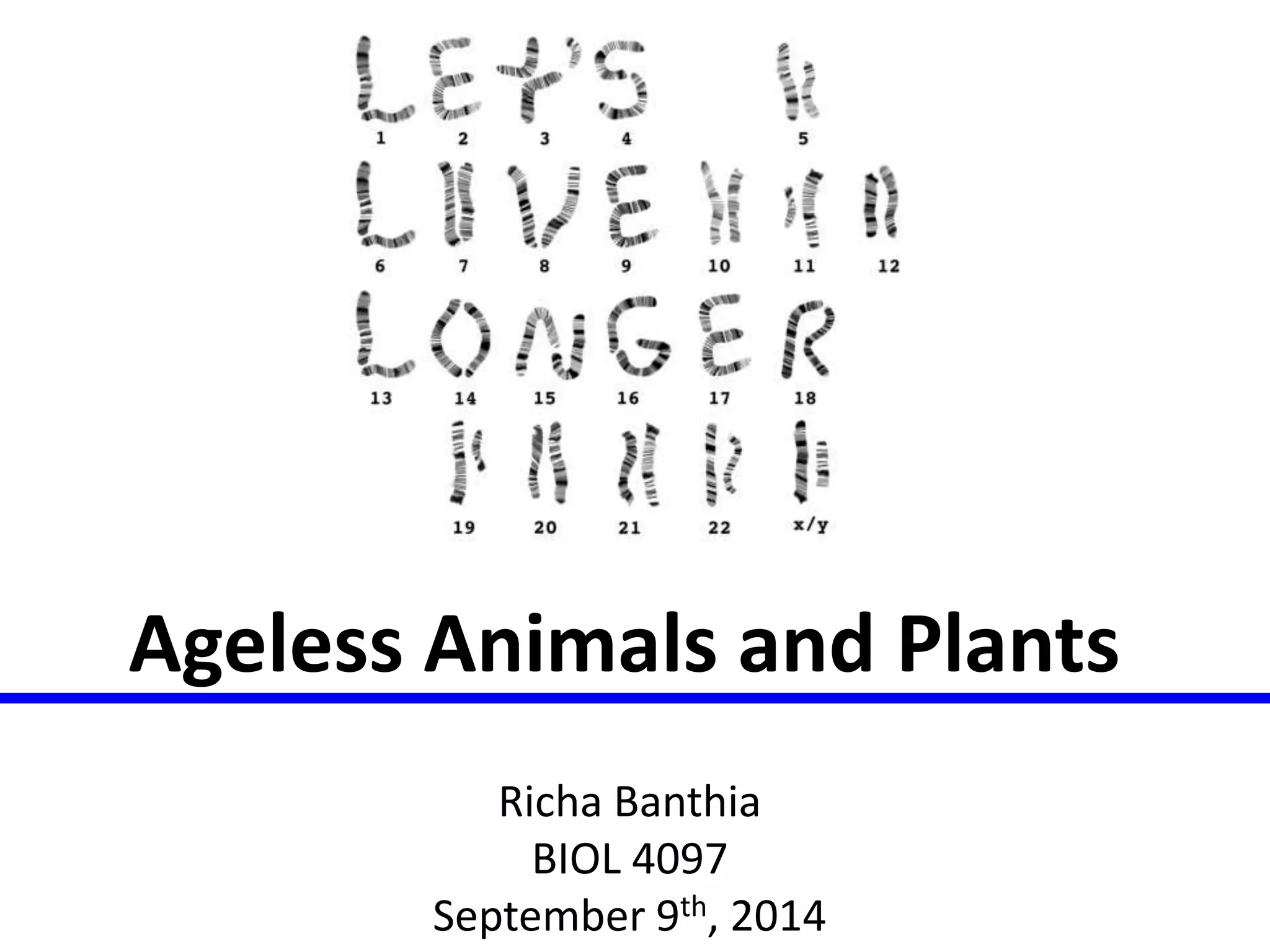
Ageless Animals and Plants 
Richa Banthia 
BIOL 4097 
September 9th, 2014
Introduction & Outline 
• Ageless Plants and Animals – Where is this 
research heading? Is aging not a requirement? 
• What is Aging? 
– Mechanisms of Aging 
– Theories of Aging 
• What is Negligible Senescence? 
• Review of Plants & Animals displaying NS 
• Conclusion and modern day Research
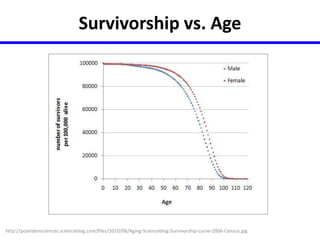
Survivorship vs. Age 
http://poseidonsciences.scienceblog.com/files/2010/08/Aging-Scienceblog-Survivorship-curve-2006-Census.jpg
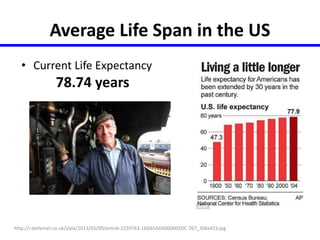
Average Life Span in the US 
• Current Life Expectancy 
78.74 years 
http://i.dailymail.co.uk/i/pix/2013/01/09/article-2259763-16D65AD6000005DC-767_306x423.jpg
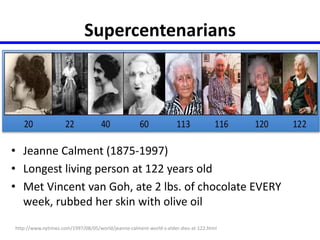
Supercentenarians 
• Jeanne Calment (1875-1997) 
• Longest living person at 122 years old 
• Met Vincent van Goh, ate 2 lbs. of chocolate EVERY 
week, rubbed her skin with olive oil 
http://www.nytimes.com/1997/08/05/world/jeanne-calment-world-s-elder-dies-at-122.html
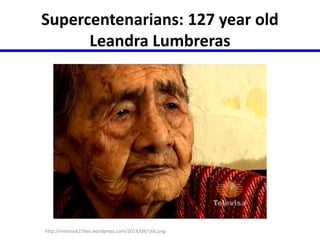
Supercentenarians: 127 year old 
Leandra Lumbreras 
http://metrouk2.files.wordpress.com/2014/08/166.png
Supercentenarians 
• Mexican woman Leandra Becerra 
Lumbreras turned 127 years old on Sunday, 
August 31st. 
• Born: August 31st, 1887 (no birth certificate) 
• 73 great-grand children 
• 55 great-great grand children 
• Secrets to long life: sing, eat chocolate, 
sleep and don’t get married 
http://www.dailymail.co.uk/news/article-2739036/Mexican-woman-Leandra-Becerra-Lumbreras-oldest- 
person-lived-127.html
What is aging? 
• Defined as “the condition or process of 
deterioration with age” and “the loss of a 
cell’s power of division and growth.” 
• Involves deterioration of cardiovascular, 
digestive, nervous, reproductive and urinary 
systems. 
• More prone to development of age related 
diseases 
http://www.hindawi.com/journals/tswj/2002/704240/abs/
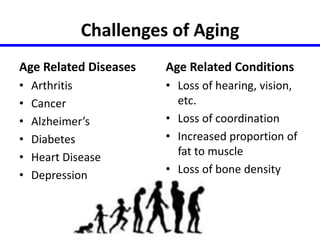
Challenges of Aging 
Age Related Diseases 
• Arthritis 
• Cancer 
• Alzheimer’s 
• Diabetes 
• Heart Disease 
• Depression 
Age Related Conditions 
• Loss of hearing, vision, 
etc. 
• Loss of coordination 
• Increased proportion of 
fat to muscle 
• Loss of bone density
Three Classical Theories of Aging 
1. Mutation Accumulation Theory 
Sir Peter Medawar 1952 
• Suggests that random mutations accumulate 
later in life such that they cannot be selected 
against 
• Why? By this time, you will have already 
passed your genes to offspring. 
• Over time, these mutations accumulate 
leading to increased mortality in later life. 
http://www.hindawi.com/journals/tswj/2002/704240/abs/
Three Classical Theories of Aging 
2. Antagonistic Pleiotropy Theory 
George C. Williams 1957 
• Pleiotropy: one gene influences multiple 
phenotypic traits 
• Tradeoff between fertility and longevity 
• Genes that are beneficial early in life in order 
to reproduce, become harmful later in life 
• Suggests that if the benefits outweigh the 
negatives, the gene will always be selected for. 
http://www.hindawi.com/journals/tswj/2002/704240/abs/
2. Antagonistic Pleiotropy Theory 
George C. Williams 1957 
Example: Testosterone production in males 
In early life, production of testosterone controls sex 
drive, sperm production, muscle mass, etc. Later in 
life, this same action can cause prostate issues. 
http://awarnach.mathstat.dal.ca/~joeb/biol3046/projects/AGE2/Antagonistic%20Pleiotropy%20Theory.ht 
m
Three Classical Theories of Aging 
3. Programmed Death Theory 
August Weismann 1882 
• Aging of cells is genetically programmed 
• Supported by the idea that within species, life 
span is fairly constant 
• Suggested that life span of species is dependent 
on the number of somatic cell regenerations 
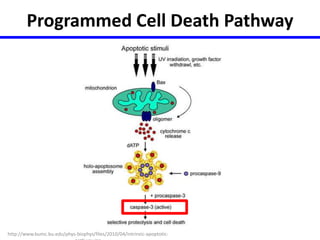
• Other evidence: “senescent cells are resistant to 
apoptosis” by inhibiting caspase 3 (part of 
programmed cell death pathway) which causes 
dysfunction of various tissues 
http://www.discoverymedicine.com/Jie-Shen/2009/11/24/programmed-cell-death-and-apoptosis-in-aging-and-life-span-regulation/
Programmed Cell Death Pathway 
http://www.bumc.bu.edu/phys-biophys/files/2010/04/intrinsic-apoptotic-pathway. 
jpg
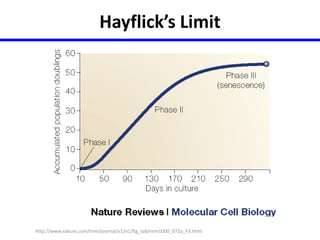
Hayflick’s Limit: Molecular Clock 
Leonard Hayflick 1961 
• A cell can multiply a limited number of times 
• 3 phases of cell growth: 
– Phase 1: Rapid cell division 
– Phase 2: Cell division slows 
– Phase 3: Cells stop dividing : “senescence” and cell 
death occurs. 
• Human cell’s stop dividing after 50 divisions 
http://longevity-science.org/Evolution.htm
Hayflick’s Limit 
http://www.nature.com/nrm/journal/v1/n1/fig_tab/nrm1000_072a_F3.html
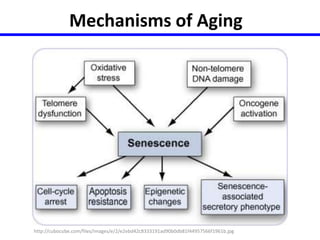
Mechanisms of Aging 
http://cubocube.com/files/images/e/2/e2ebd42c8333191ad90b0db81f44957566f1961b.jpg
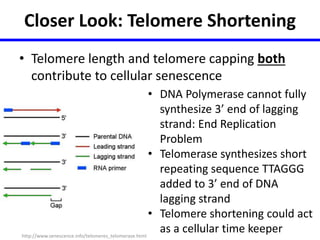
Closer Look: Telomere Shortening 
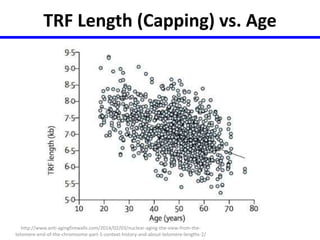
• Telomere length and telomere capping both 
contribute to cellular senescence 
• DNA Polymerase cannot fully 
synthesize 3’ end of lagging 
strand: End Replication 
Problem 
• Telomerase synthesizes short 
repeating sequence TTAGGG 
added to 3’ end of DNA 
lagging strand 
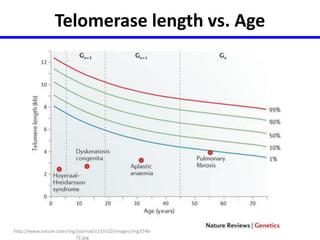
• Telomere shortening could act 
as a cellular time keeper 
http://www.senescence.info/telomeres_telomerase.html
Telomerase length vs. Age 
http://www.nature.com/nrg/journal/v13/n10/images/nrg3246- 
f2.jpg
Closer Look: Telomere Capping 
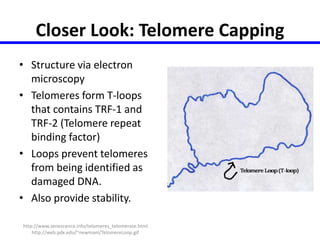
• Structure via electron 
microscopy 
• Telomeres form T-loops 
that contains TRF-1 and 
TRF-2 (Telomere repeat 
binding factor) 
• Loops prevent telomeres 
from being identified as 
damaged DNA. 
• Also provide stability. 
http://www.senescence.info/telomeres_telomerase.html 
http://web.pdx.edu/~newmanl/TelomereLoop.gif
TRF Length (Capping) vs. Age 
http://www.anti-agingfirewalls.com/2014/02/03/nuclear-aging-the-view-from-the-telomere- 
end-of-the-chromsome-part-1-context-history-and-about-telomere-lengths-2/
Fin? Noggin’? DUUUUDE! 
• https://www.youtube.com/watch?v=9YkxZvdCvYM
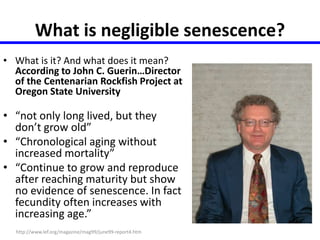
What is negligible senescence? 
• What is it? And what does it mean? 
According to John C. Guerin…Director 
of the Centenarian Rockfish Project at 
Oregon State University 
• “not only long lived, but they 
don’t grow old” 
• “Chronological aging without 
increased mortality” 
• “Continue to grow and reproduce 
after reaching maturity but show 
no evidence of senescence. In fact 
fecundity often increases with 
increasing age.” 
http://www.lef.org/magazine/mag99/june99-report4.htm
Research and Measurement 
Techniques 
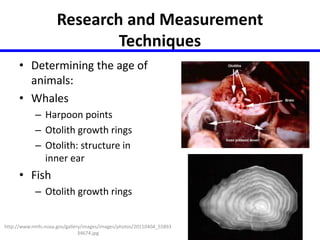
• Determining the age of 
animals: 
• Whales 
– Harpoon points 
– Otolith growth rings 
– Otolith: structure in 
inner ear 
• Fish 
– Otolith growth rings 
http://www.nmfs.noaa.gov/gallery/images/images/photos/20110404_55893 
34674.jpg
Research and Measurement 
Techniques 
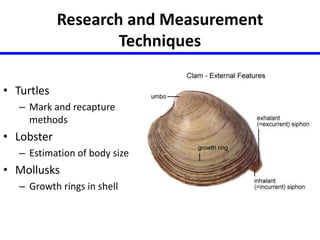
• Turtles 
– Mark and recapture 
methods 
• Lobster 
– Estimation of body size 
• Mollusks 
– Growth rings in shell
ANIMALS DISPLAYING 
NEGLIGIBLE SENESCENCE
Yellow Rockfish 
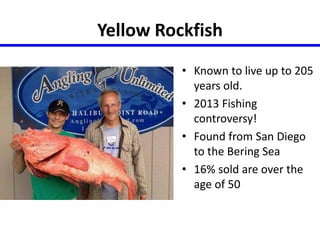
• Known to live up to 205 
years old. 
• 2013 Fishing 
controversy! 
• Found from San Diego 
to the Bering Sea 
• 16% sold are over the 
age of 50
Yellow Rockfish 
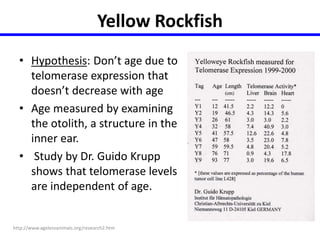
• Hypothesis: Don’t age due to 
telomerase expression that 
doesn’t decrease with age 
• Age measured by examining 
the otolith, a structure in the 
inner ear. 
• Study by Dr. Guido Krupp 
shows that telomerase levels 
are independent of age. 
http://www.agelessanimals.org/research2.htm
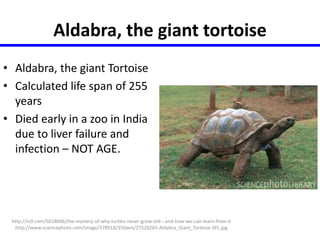
Aldabra, the giant tortoise 
• Aldabra, the giant Tortoise 
• Calculated life span of 255 
years 
• Died early in a zoo in India 
due to liver failure and 
infection – NOT AGE. 
http://io9.com/5618046/the-mystery-of-why-turtles-never-grow-old---and-how-we-can-learn-from-it 
http://www.sciencephoto.com/image/378918/350wm/Z7520265-Aldabra_Giant_Tortoise-SPL.jpg
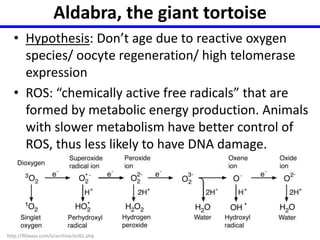
Aldabra, the giant tortoise 
• Hypothesis: Don’t age due to reactive oxygen 
species/ oocyte regeneration/ high telomerase 
expression 
• ROS: “chemically active free radicals” that are 
formed by metabolic energy production. Animals 
with slower metabolism have better control of 
ROS, thus less likely to have DNA damage. 
http://90ways.com/sciarchive/sci61.php
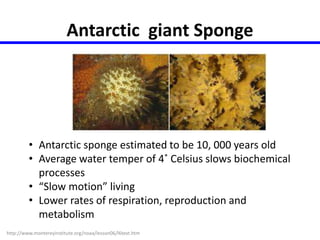
Antarctic giant Sponge 
• Antarctic sponge estimated to be 10, 000 years old 
• Average water temper of 4˚ Celsius slows biochemical 
processes 
• “Slow motion” living 
• Lower rates of respiration, reproduction and 
metabolism 
http://www.montereyinstitute.org/noaa/lesson06/l6text.htm
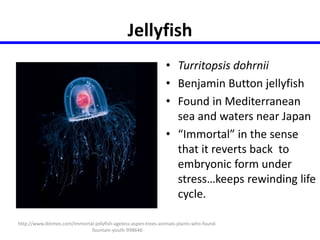
Jellyfish 
• Turritopsis dohrnii 
• Benjamin Button jellyfish 
• Found in Mediterranean 
sea and waters near Japan 
• “Immortal” in the sense 
that it reverts back to 
embryonic form under 
stress…keeps rewinding life 
cycle. 
http://www.ibtimes.com/immortal-jellyfish-ageless-aspen-trees-animals-plants-who-found-fountain- 
youth-998646
How does it work? 
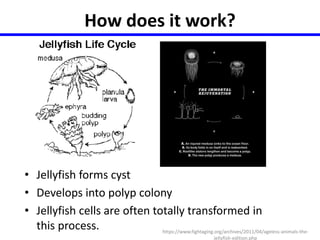
• Jellyfish forms cyst 
• Develops into polyp colony 
• Jellyfish cells are often totally transformed in 
this process. https://www.fightaging.org/archives/2011/04/ageless-animals-the-jellyfish- 
edition.php
Bowhead Whales 
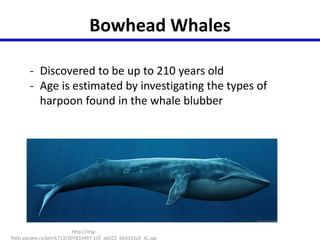
- Discovered to be up to 210 years old 
- Age is estimated by investigating the types of 
harpoon found in the whale blubber 
http://img-fotki. 
yandex.ru/get/6713/207833497.1/0_ab022_6b3333a5_XL.jpg
Lobsters 
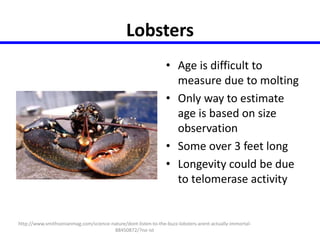
• Age is difficult to 
measure due to molting 
• Only way to estimate 
age is based on size 
observation 
• Some over 3 feet long 
• Longevity could be due 
to telomerase activity 
http://www.smithsonianmag.com/science-nature/dont-listen-to-the-buzz-lobsters-arent-actually-immortal- 
88450872/?no-ist
Leach’s Storm Petrel 
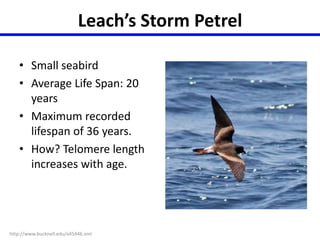
• Small seabird 
• Average Life Span: 20 
years 
• Maximum recorded 
lifespan of 36 years. 
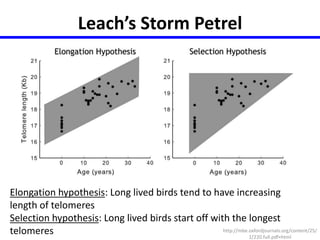
• How? Telomere length 
increases with age. 
http://www.bucknell.edu/x45446.xml
Leach’s Storm Petrel 
Elongation hypothesis: Long lived birds tend to have increasing 
length of telomeres 
Selection hypothesis: Long lived birds start off with the longest 
telomeres http://mbe.oxfordjournals.org/content/25/ 
1/220.full.pdf+html
Naked mole rat 
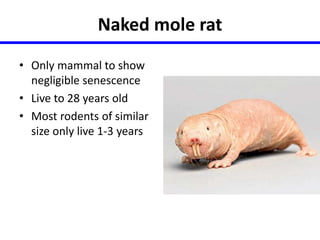
• Only mammal to show 
negligible senescence 
• Live to 28 years old 
• Most rodents of similar 
size only live 1-3 years
Quahog Clam 
• Artica islandica 
• Can live up to 400 years 
• Found off the coast of 
Iceland 
• Suggested that 
maintained antioxidant 
activity increases life 
span 
http://news.nationalgeographic.com/news/2007/10/071029-oldest-clam.html
PLANTS DISPLAYING 
NEGLIGIBLE SENESCENCE
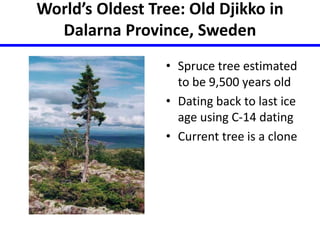
World’s Oldest Tree: Old Djikko in 
Dalarna Province, Sweden 
• Spruce tree estimated 
to be 9,500 years old 
• Dating back to last ice 
age using C-14 dating 
• Current tree is a clone
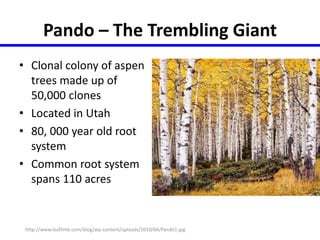
Pando – The Trembling Giant 
• Clonal colony of aspen 
trees made up of 
50,000 clones 
• Located in Utah 
• 80, 000 year old root 
system 
• Common root system 
spans 110 acres 
http://www.leaflimb.com/blog/wp-content/uploads/2010/04/Pando1.jpg
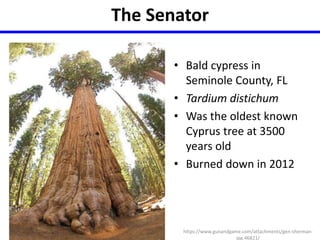
The Senator 
• Bald cypress in 
Seminole County, FL 
• Tardium distichum 
• Was the oldest known 
Cyprus tree at 3500 
years old 
• Burned down in 2012 
https://www.gunandgame.com/attachments/gen-sherman-jpg. 
46821/
Methuselah 
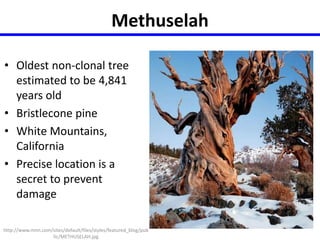
• Oldest non-clonal tree 
estimated to be 4,841 
years old 
• Bristlecone pine 
• White Mountains, 
California 
• Precise location is a 
secret to prevent 
damage 
http://www.mnn.com/sites/default/files/styles/featured_blog/pub 
lic/METHUSELAH.jpg
Chestnut Tree of One Hundred Horses 
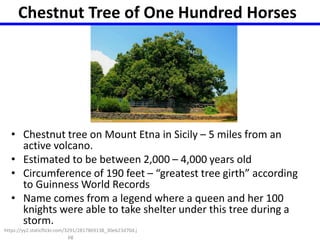
• Chestnut tree on Mount Etna in Sicily – 5 miles from an 
active volcano. 
• Estimated to be between 2,000 – 4,000 years old 
• Circumference of 190 feet – “greatest tree girth” according 
to Guinness World Records 
• Name comes from a legend where a queen and her 100 
knights were able to take shelter under this tree during a 
storm. 
https://yy2.staticflickr.com/3291/2817869138_30eb23d70d.j 
pg
Mediterranean Sea Grass 
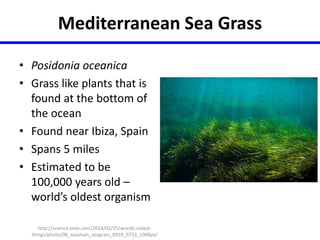
• Posidonia oceanica 
• Grass like plants that is 
found at the bottom of 
the ocean 
• Found near Ibiza, Spain 
• Spans 5 miles 
• Estimated to be 
100,000 years old – 
world’s oldest organism 
http://science.time.com/2014/02/25/worlds-oldest-things/ 
photo/08_sussman_seagrass_0910_0753_1068px/
Olive Tree of Vouves 
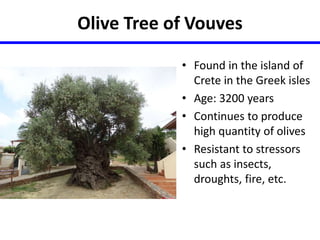
• Found in the island of 
Crete in the Greek isles 
• Age: 3200 years 
• Continues to produce 
high quantity of olives 
• Resistant to stressors 
such as insects, 
droughts, fire, etc.
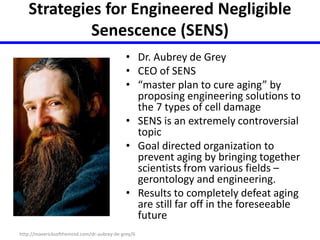
Strategies for Engineered Negligible 
Senescence (SENS) 
• Dr. Aubrey de Grey 
• CEO of SENS 
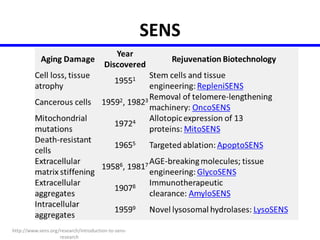
• “master plan to cure aging” by 
proposing engineering solutions to 
the 7 types of cell damage 
• SENS is an extremely controversial 
topic 
• Goal directed organization to 
prevent aging by bringing together 
scientists from various fields – 
gerontology and engineering. 
• Results to completely defeat aging 
are still far off in the foreseeable 
future 
http://mavericksofthemind.com/dr-aubrey-de-grey/6
SENS 
http://www.sens.org/research/introduction-to-sens-research
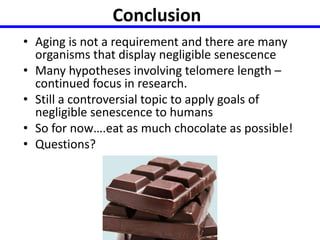
Conclusion 
• Aging is not a requirement and there are many 
organisms that display negligible senescence 
• Many hypotheses involving telomere length – 
continued focus in research. 
• Still a controversial topic to apply goals of 
negligible senescence to humans 
• So for now….eat as much chocolate as possible! 
• Questions?
References 
http://www.smart-publications.com/interviews/mavericks-of-medicine/john-guerin 
http://genetics.thetech.org/original_news/news10 
http://www.agelessanimals.org/ 
http://www.hindawi.com/journals/tswj/2002/704240/abs/ 
http://awarnach.mathstat.dal.ca/~joeb/biol3046/projects/AGE2/Antagonistic%20Pleiotropy%20Theory.htm 
http://www.programmed-aging.org/theories/antagonistic_pleiotropy.html 
http://poseidonsciences.scienceblog.com/files/2010/08/Aging-Scienceblog-Survivorship-curve-2006-Census.jpg 
http://books.google.com/books?id=X5Po92PzOtAC&pg=PA79&lpg=PA79&dq=depletion+of+follicle+and+antagonistic+pleiot 
ropy&source=bl&ots=Nh_xGTzbDz&sig=VrQcJUMAcI0EDKkYstp1bCwNG5M&hl=en&sa=X&ei=K_oIVOadB4PgiwK414CgDQ& 
ved=0CC8Q6AEwAg#v=onepage&q=depletion%20of%20follicle%20and%20antagonistic%20pleiotropy&f=false 
http://www.dailymail.co.uk/news/article-2739036/Mexican-woman-Leandra-Becerra-Lumbreras-oldest-person-lived- 
127.html 
http://www.discoverymedicine.com/Jie-Shen/2009/11/24/programmed-cell-death-and-apoptosis-in-aging-and-life-span-regulation/ 
http://www.nmfs.noaa.gov/gallery/images/images/photos/20110404_5589334674.jpg 
http://www.mnn.com/sites/default/files/styles/featured_blog/public/METHUSELAH.jpg 
http://www.smithsonianmag.com/science-nature/dont-listen-to-the-buzz-lobsters-arent-actually-immortal-88450872/?no-ist 
https://www.fightaging.org/archives/2011/04/ageless-animals-the-jellyfish-edition.php 
http://www.ibtimes.com/immortal-jellyfish-ageless-aspen-trees-animals-plants-who-found-fountain-youth-998646 
http://www.mavericksofthemind.com/wp-content/uploads/2011/11/John-Guerin-Photo.jpg 
http://www.senescence.info/telomeres_telomerase.html 
http://longevity-science.org/Evolution.htm 
http://www.sens.org/research/introduction-to-sens-research 
http://mavericksofthemind.com/dr-aubrey-de-grey/6 
http://science.time.com/2014/02/25/worlds-oldest-things/photo/08_sussman_seagrass_0910_0753_1068px/

Ageless Animals and Plants

  • 1.
    Ageless Animals andPlants Richa Banthia BIOL 4097 September 9th, 2014
  • 2.
    Introduction & Outline • Ageless Plants and Animals – Where is this research heading? Is aging not a requirement? • What is Aging? – Mechanisms of Aging – Theories of Aging • What is Negligible Senescence? • Review of Plants & Animals displaying NS • Conclusion and modern day Research
  • 3.
    Survivorship vs. Age http://poseidonsciences.scienceblog.com/files/2010/08/Aging-Scienceblog-Survivorship-curve-2006-Census.jpg
  • 4.
    Average Life Spanin the US • Current Life Expectancy 78.74 years http://i.dailymail.co.uk/i/pix/2013/01/09/article-2259763-16D65AD6000005DC-767_306x423.jpg
  • 5.
    Supercentenarians • JeanneCalment (1875-1997) • Longest living person at 122 years old • Met Vincent van Goh, ate 2 lbs. of chocolate EVERY week, rubbed her skin with olive oil http://www.nytimes.com/1997/08/05/world/jeanne-calment-world-s-elder-dies-at-122.html
  • 6.
    Supercentenarians: 127 yearold Leandra Lumbreras http://metrouk2.files.wordpress.com/2014/08/166.png
  • 7.
    Supercentenarians • Mexicanwoman Leandra Becerra Lumbreras turned 127 years old on Sunday, August 31st. • Born: August 31st, 1887 (no birth certificate) • 73 great-grand children • 55 great-great grand children • Secrets to long life: sing, eat chocolate, sleep and don’t get married http://www.dailymail.co.uk/news/article-2739036/Mexican-woman-Leandra-Becerra-Lumbreras-oldest- person-lived-127.html
  • 8.
    What is aging? • Defined as “the condition or process of deterioration with age” and “the loss of a cell’s power of division and growth.” • Involves deterioration of cardiovascular, digestive, nervous, reproductive and urinary systems. • More prone to development of age related diseases http://www.hindawi.com/journals/tswj/2002/704240/abs/
  • 9.
    Challenges of Aging Age Related Diseases • Arthritis • Cancer • Alzheimer’s • Diabetes • Heart Disease • Depression Age Related Conditions • Loss of hearing, vision, etc. • Loss of coordination • Increased proportion of fat to muscle • Loss of bone density
  • 10.
    Three Classical Theoriesof Aging 1. Mutation Accumulation Theory Sir Peter Medawar 1952 • Suggests that random mutations accumulate later in life such that they cannot be selected against • Why? By this time, you will have already passed your genes to offspring. • Over time, these mutations accumulate leading to increased mortality in later life. http://www.hindawi.com/journals/tswj/2002/704240/abs/
  • 11.
    Three Classical Theoriesof Aging 2. Antagonistic Pleiotropy Theory George C. Williams 1957 • Pleiotropy: one gene influences multiple phenotypic traits • Tradeoff between fertility and longevity • Genes that are beneficial early in life in order to reproduce, become harmful later in life • Suggests that if the benefits outweigh the negatives, the gene will always be selected for. http://www.hindawi.com/journals/tswj/2002/704240/abs/
  • 12.
    2. Antagonistic PleiotropyTheory George C. Williams 1957 Example: Testosterone production in males In early life, production of testosterone controls sex drive, sperm production, muscle mass, etc. Later in life, this same action can cause prostate issues. http://awarnach.mathstat.dal.ca/~joeb/biol3046/projects/AGE2/Antagonistic%20Pleiotropy%20Theory.ht m
  • 13.
    Three Classical Theoriesof Aging 3. Programmed Death Theory August Weismann 1882 • Aging of cells is genetically programmed • Supported by the idea that within species, life span is fairly constant • Suggested that life span of species is dependent on the number of somatic cell regenerations • Other evidence: “senescent cells are resistant to apoptosis” by inhibiting caspase 3 (part of programmed cell death pathway) which causes dysfunction of various tissues http://www.discoverymedicine.com/Jie-Shen/2009/11/24/programmed-cell-death-and-apoptosis-in-aging-and-life-span-regulation/
  • 14.
    Programmed Cell DeathPathway http://www.bumc.bu.edu/phys-biophys/files/2010/04/intrinsic-apoptotic-pathway. jpg
  • 15.
    Hayflick’s Limit: MolecularClock Leonard Hayflick 1961 • A cell can multiply a limited number of times • 3 phases of cell growth: – Phase 1: Rapid cell division – Phase 2: Cell division slows – Phase 3: Cells stop dividing : “senescence” and cell death occurs. • Human cell’s stop dividing after 50 divisions http://longevity-science.org/Evolution.htm
  • 16.
  • 17.
    Mechanisms of Aging http://cubocube.com/files/images/e/2/e2ebd42c8333191ad90b0db81f44957566f1961b.jpg
  • 18.
    Closer Look: TelomereShortening • Telomere length and telomere capping both contribute to cellular senescence • DNA Polymerase cannot fully synthesize 3’ end of lagging strand: End Replication Problem • Telomerase synthesizes short repeating sequence TTAGGG added to 3’ end of DNA lagging strand • Telomere shortening could act as a cellular time keeper http://www.senescence.info/telomeres_telomerase.html
  • 19.
    Telomerase length vs.Age http://www.nature.com/nrg/journal/v13/n10/images/nrg3246- f2.jpg
  • 20.
    Closer Look: TelomereCapping • Structure via electron microscopy • Telomeres form T-loops that contains TRF-1 and TRF-2 (Telomere repeat binding factor) • Loops prevent telomeres from being identified as damaged DNA. • Also provide stability. http://www.senescence.info/telomeres_telomerase.html http://web.pdx.edu/~newmanl/TelomereLoop.gif
  • 21.
    TRF Length (Capping)vs. Age http://www.anti-agingfirewalls.com/2014/02/03/nuclear-aging-the-view-from-the-telomere- end-of-the-chromsome-part-1-context-history-and-about-telomere-lengths-2/
  • 22.
    Fin? Noggin’? DUUUUDE! • https://www.youtube.com/watch?v=9YkxZvdCvYM
  • 23.
    What is negligiblesenescence? • What is it? And what does it mean? According to John C. Guerin…Director of the Centenarian Rockfish Project at Oregon State University • “not only long lived, but they don’t grow old” • “Chronological aging without increased mortality” • “Continue to grow and reproduce after reaching maturity but show no evidence of senescence. In fact fecundity often increases with increasing age.” http://www.lef.org/magazine/mag99/june99-report4.htm
  • 24.
    Research and Measurement Techniques • Determining the age of animals: • Whales – Harpoon points – Otolith growth rings – Otolith: structure in inner ear • Fish – Otolith growth rings http://www.nmfs.noaa.gov/gallery/images/images/photos/20110404_55893 34674.jpg
  • 25.
    Research and Measurement Techniques • Turtles – Mark and recapture methods • Lobster – Estimation of body size • Mollusks – Growth rings in shell
  • 26.
  • 27.
    Yellow Rockfish •Known to live up to 205 years old. • 2013 Fishing controversy! • Found from San Diego to the Bering Sea • 16% sold are over the age of 50
  • 28.
    Yellow Rockfish •Hypothesis: Don’t age due to telomerase expression that doesn’t decrease with age • Age measured by examining the otolith, a structure in the inner ear. • Study by Dr. Guido Krupp shows that telomerase levels are independent of age. http://www.agelessanimals.org/research2.htm
  • 29.
    Aldabra, the gianttortoise • Aldabra, the giant Tortoise • Calculated life span of 255 years • Died early in a zoo in India due to liver failure and infection – NOT AGE. http://io9.com/5618046/the-mystery-of-why-turtles-never-grow-old---and-how-we-can-learn-from-it http://www.sciencephoto.com/image/378918/350wm/Z7520265-Aldabra_Giant_Tortoise-SPL.jpg
  • 30.
    Aldabra, the gianttortoise • Hypothesis: Don’t age due to reactive oxygen species/ oocyte regeneration/ high telomerase expression • ROS: “chemically active free radicals” that are formed by metabolic energy production. Animals with slower metabolism have better control of ROS, thus less likely to have DNA damage. http://90ways.com/sciarchive/sci61.php
  • 31.
    Antarctic giant Sponge • Antarctic sponge estimated to be 10, 000 years old • Average water temper of 4˚ Celsius slows biochemical processes • “Slow motion” living • Lower rates of respiration, reproduction and metabolism http://www.montereyinstitute.org/noaa/lesson06/l6text.htm
  • 32.
    Jellyfish • Turritopsisdohrnii • Benjamin Button jellyfish • Found in Mediterranean sea and waters near Japan • “Immortal” in the sense that it reverts back to embryonic form under stress…keeps rewinding life cycle. http://www.ibtimes.com/immortal-jellyfish-ageless-aspen-trees-animals-plants-who-found-fountain- youth-998646
  • 33.
    How does itwork? • Jellyfish forms cyst • Develops into polyp colony • Jellyfish cells are often totally transformed in this process. https://www.fightaging.org/archives/2011/04/ageless-animals-the-jellyfish- edition.php
  • 34.
    Bowhead Whales -Discovered to be up to 210 years old - Age is estimated by investigating the types of harpoon found in the whale blubber http://img-fotki. yandex.ru/get/6713/207833497.1/0_ab022_6b3333a5_XL.jpg
  • 35.
    Lobsters • Ageis difficult to measure due to molting • Only way to estimate age is based on size observation • Some over 3 feet long • Longevity could be due to telomerase activity http://www.smithsonianmag.com/science-nature/dont-listen-to-the-buzz-lobsters-arent-actually-immortal- 88450872/?no-ist
  • 36.
    Leach’s Storm Petrel • Small seabird • Average Life Span: 20 years • Maximum recorded lifespan of 36 years. • How? Telomere length increases with age. http://www.bucknell.edu/x45446.xml
  • 37.
    Leach’s Storm Petrel Elongation hypothesis: Long lived birds tend to have increasing length of telomeres Selection hypothesis: Long lived birds start off with the longest telomeres http://mbe.oxfordjournals.org/content/25/ 1/220.full.pdf+html
  • 38.
    Naked mole rat • Only mammal to show negligible senescence • Live to 28 years old • Most rodents of similar size only live 1-3 years
  • 39.
    Quahog Clam •Artica islandica • Can live up to 400 years • Found off the coast of Iceland • Suggested that maintained antioxidant activity increases life span http://news.nationalgeographic.com/news/2007/10/071029-oldest-clam.html
  • 40.
  • 41.
    World’s Oldest Tree:Old Djikko in Dalarna Province, Sweden • Spruce tree estimated to be 9,500 years old • Dating back to last ice age using C-14 dating • Current tree is a clone
  • 42.
    Pando – TheTrembling Giant • Clonal colony of aspen trees made up of 50,000 clones • Located in Utah • 80, 000 year old root system • Common root system spans 110 acres http://www.leaflimb.com/blog/wp-content/uploads/2010/04/Pando1.jpg
  • 43.
    The Senator •Bald cypress in Seminole County, FL • Tardium distichum • Was the oldest known Cyprus tree at 3500 years old • Burned down in 2012 https://www.gunandgame.com/attachments/gen-sherman-jpg. 46821/
  • 44.
    Methuselah • Oldestnon-clonal tree estimated to be 4,841 years old • Bristlecone pine • White Mountains, California • Precise location is a secret to prevent damage http://www.mnn.com/sites/default/files/styles/featured_blog/pub lic/METHUSELAH.jpg
  • 45.
    Chestnut Tree ofOne Hundred Horses • Chestnut tree on Mount Etna in Sicily – 5 miles from an active volcano. • Estimated to be between 2,000 – 4,000 years old • Circumference of 190 feet – “greatest tree girth” according to Guinness World Records • Name comes from a legend where a queen and her 100 knights were able to take shelter under this tree during a storm. https://yy2.staticflickr.com/3291/2817869138_30eb23d70d.j pg
  • 46.
    Mediterranean Sea Grass • Posidonia oceanica • Grass like plants that is found at the bottom of the ocean • Found near Ibiza, Spain • Spans 5 miles • Estimated to be 100,000 years old – world’s oldest organism http://science.time.com/2014/02/25/worlds-oldest-things/ photo/08_sussman_seagrass_0910_0753_1068px/
  • 47.
    Olive Tree ofVouves • Found in the island of Crete in the Greek isles • Age: 3200 years • Continues to produce high quantity of olives • Resistant to stressors such as insects, droughts, fire, etc.
  • 48.
    Strategies for EngineeredNegligible Senescence (SENS) • Dr. Aubrey de Grey • CEO of SENS • “master plan to cure aging” by proposing engineering solutions to the 7 types of cell damage • SENS is an extremely controversial topic • Goal directed organization to prevent aging by bringing together scientists from various fields – gerontology and engineering. • Results to completely defeat aging are still far off in the foreseeable future http://mavericksofthemind.com/dr-aubrey-de-grey/6
  • 49.
  • 50.
    Conclusion • Agingis not a requirement and there are many organisms that display negligible senescence • Many hypotheses involving telomere length – continued focus in research. • Still a controversial topic to apply goals of negligible senescence to humans • So for now….eat as much chocolate as possible! • Questions?
  • 51.
    References http://www.smart-publications.com/interviews/mavericks-of-medicine/john-guerin http://genetics.thetech.org/original_news/news10 http://www.agelessanimals.org/ http://www.hindawi.com/journals/tswj/2002/704240/abs/ http://awarnach.mathstat.dal.ca/~joeb/biol3046/projects/AGE2/Antagonistic%20Pleiotropy%20Theory.htm http://www.programmed-aging.org/theories/antagonistic_pleiotropy.html http://poseidonsciences.scienceblog.com/files/2010/08/Aging-Scienceblog-Survivorship-curve-2006-Census.jpg http://books.google.com/books?id=X5Po92PzOtAC&pg=PA79&lpg=PA79&dq=depletion+of+follicle+and+antagonistic+pleiot ropy&source=bl&ots=Nh_xGTzbDz&sig=VrQcJUMAcI0EDKkYstp1bCwNG5M&hl=en&sa=X&ei=K_oIVOadB4PgiwK414CgDQ& ved=0CC8Q6AEwAg#v=onepage&q=depletion%20of%20follicle%20and%20antagonistic%20pleiotropy&f=false http://www.dailymail.co.uk/news/article-2739036/Mexican-woman-Leandra-Becerra-Lumbreras-oldest-person-lived- 127.html http://www.discoverymedicine.com/Jie-Shen/2009/11/24/programmed-cell-death-and-apoptosis-in-aging-and-life-span-regulation/ http://www.nmfs.noaa.gov/gallery/images/images/photos/20110404_5589334674.jpg http://www.mnn.com/sites/default/files/styles/featured_blog/public/METHUSELAH.jpg http://www.smithsonianmag.com/science-nature/dont-listen-to-the-buzz-lobsters-arent-actually-immortal-88450872/?no-ist https://www.fightaging.org/archives/2011/04/ageless-animals-the-jellyfish-edition.php http://www.ibtimes.com/immortal-jellyfish-ageless-aspen-trees-animals-plants-who-found-fountain-youth-998646 http://www.mavericksofthemind.com/wp-content/uploads/2011/11/John-Guerin-Photo.jpg http://www.senescence.info/telomeres_telomerase.html http://longevity-science.org/Evolution.htm http://www.sens.org/research/introduction-to-sens-research http://mavericksofthemind.com/dr-aubrey-de-grey/6 http://science.time.com/2014/02/25/worlds-oldest-things/photo/08_sussman_seagrass_0910_0753_1068px/

Editor's Notes

  • #2 http://thirdspacemedical.com/wp-content/uploads/2013/05/LetsLiveLonger.jpg
  • #4 http://poseidonsciences.scienceblog.com/files/2010/08/Aging-Scienceblog-Survivorship-curve-2006-Census.jpg
  • #5 Image: http://i.dailymail.co.uk/i/pix/2013/01/09/article-2259763-16D65AD6000005DC-767_306x423.jpg
  • #6 http://www.nytimes.com/1997/08/05/world/jeanne-calment-world-s-elder-dies-at-122.html
  • #7 http://metrouk2.files.wordpress.com/2014/08/166.png
  • #8 http://www.dailymail.co.uk/news/article-2739036/Mexican-woman-Leandra-Becerra-Lumbreras-oldest-person-lived-127.html Currently sleeps in 72 hour periods!
  • #9 http://www.hindawi.com/journals/tswj/2002/704240/abs/
  • #10 Is this necessary?? To talk about aging so much when the point is NOT AGING??
  • #11 From the evolutionary perspective, aging is an inevitable result of the declining force of natural selection with age. For example, a mutant gene that kills young children will be strongly selected against (will not be passed to the next generation) while a lethal mutation with effects confined to people over the age of 80 will experience no selection because people with this mutation will have already passed it to their offspring by that age. Over successive generations, late-acting deleterious mutations will accumulate, leading to an increase in mortality rates late in life.
  • #13 http://awarnach.mathstat.dal.ca/~joeb/biol3046/projects/AGE2/Antagonistic%20Pleiotropy%20Theory.htm http://www.chegg.com/homework-help/questions-and-answers/menopause-time-woman-s-life-menstruation-stops-permanently-longer-fertile-menopause-marked-q2435629 http://books.google.com/books?id=X5Po92PzOtAC&pg=PA79&lpg=PA79&dq=depletion+of+follicle+and+antagonistic+pleiotropy&source=bl&ots=Nh_xGTzbDz&sig=VrQcJUMAcI0EDKkYstp1bCwNG5M&hl=en&sa=X&ei=K_oIVOadB4PgiwK414CgDQ&ved=0CC8Q6AEwAg#v=onepage&q=depletion%20of%20follicle%20and%20antagonistic%20pleiotropy&f=false
  • #14 http://www.discoverymedicine.com/Jie-Shen/2009/11/24/programmed-cell-death-and-apoptosis-in-aging-and-life-span-regulation/
  • #15 In a 2009 study by Jie Shen, senescent cells block the Programmed Cell death pathway by inhibiting Caspase 3. Caspases are signalling molecules that when activated, act as a marker for cellular damage. By inhibiting caspase 3, apoptosis cannot occur to rid the body of damaged cells. These cells accumulate and can cause further tissue damage. http://www.bumc.bu.edu/phys-biophys/files/2010/04/intrinsic-apoptotic-pathway.jpg Cancer incidence increases exponentially during aging, making aging the greatest risk factor for cancer. PCD normally plays a critical role as an anti-cancer mechanism (Tan et al., 2009). Genetic and biochemical abnormalities within a cell normally trigger PCD, however, cancer cells have typically acquired mutations that allow them to escape or repress apoptosis and survive. One common mechanism observed is heat shock protein (hsp) “addiction,” wherein cancer cells survive due to dramatically up-regulated hsp expression that inhibits PCD pathways, for example, by inhibiting the activity of the key apoptosis regulator p53 (Tower, 2009). Most chemotherapies, including ionizing radiation, function by hyper-stimulating and activating these otherwise repressed PCD pathways. In addition to apoptosis, another critical anti-cancer mechanism is cellular senescence. Cellular senescence is an irreversible cell cycle arrest that can result from telomere erosion, oncogeneactivation, chromatin abnormalities and other types of damage. Increasing evidence suggests that senescent cells accumulate during aging and contribute to aging-related loss of function in various adult tissues. This accumulation may result from the fact that senescent cells are resistant to apoptosis due to repressed activity of PCD pathway components such as caspase 3 (Marcotte et al., 2004) and cell cycle factors that function in both cell division and apoptosis (King and Cidlowski, 1995).
  • #16 http://longevity-science.org/Evolution.htm http://science.howstuffworks.com/life/genetic/hayflick-limit.htm
  • #17 Image: http://www.nature.com/nrm/journal/v1/n1/fig_tab/nrm1000_072a_F3.html
  • #18 Image: http://cubocube.com/files/images/e/2/e2ebd42c8333191ad90b0db81f44957566f1961b.jpg
  • #19 How can negligible senescence be explained? Is it primarily explained by telomerase? http://www.senescence.info/telomeres_telomerase.html
  • #20 http://www.nature.com/nrg/journal/v13/n10/images/nrg3246-f2.jpg
  • #21 http://www.senescence.info/telomeres_telomerase.html Image: http://web.pdx.edu/~newmanl/TelomereLoop.gif
  • #22 http://www.anti-agingfirewalls.com/2014/02/03/nuclear-aging-the-view-from-the-telomere-end-of-the-chromsome-part-1-context-history-and-about-telomere-lengths-2/
  • #24 are we suggesting that aging in humans and other mammals is an evolutionary selection? Back in the days we selected for short life span but reproduction because we were being threatened all the time. But in today’s world, we have the potential to lead much longer lives. Are we being held back by natural selection for fecundity? Image: http://www.mavericksofthemind.com/wp-content/uploads/2011/11/John-Guerin-Photo.jpg http://www.lef.org/magazine/mag99/june99-report4.htm
  • #25 http://www.nmfs.noaa.gov/gallery/images/images/photos/20110404_5589334674.jpg
  • #28 Controversy: fishing controversy in Alaska/ man caught a fish that was 205 years old– not even old so can you imagine how much longer it could’ve lived? These fish are also in danger of extinction.
  • #29 http://www.agelessanimals.org/research2.htm
  • #30 http://www.sciencephoto.com/image/378918/350wm/Z7520265-Aldabra_Giant_Tortoise-SPL.jpg http://io9.com/5618046/the-mystery-of-why-turtles-never-grow-old---and-how-we-can-learn-from-it
  • #31 - Able to neutralize the ROS better as well. http://books.google.com/books?id=PP8uHih26JwC&pg=PA309&lpg=PA309&dq=giant+tortoise+reactive+oxygen+species&source=bl&ots=3Y0dAQvDHJ&sig=xg3hst7-vuroGLvqnSxBTSe0BAU&hl=en&sa=X&ei=4xcNVKqvIpKsogTbyIKwAQ&ved=0CCsQ6AEwAg#v=onepage&q=giant%20tortoise%20reactive%20oxygen%20species&f=false http://90ways.com/sciarchive/sci61.php
  • #32 http://www.montereyinstitute.org/noaa/lesson06/l6text.htm
  • #33 http://www.ibtimes.com/immortal-jellyfish-ageless-aspen-trees-animals-plants-who-found-fountain-youth-998646 https://www.fightaging.org/archives/2011/04/ageless-animals-the-jellyfish-edition.php Image: http://www.thatsreallypossible.com/wp-content/uploads/2012/12/Immortal-Jellyfish3.jpg
  • #35 Image: http://img-fotki.yandex.ru/get/6713/207833497.1/0_ab022_6b3333a5_XL.jpg
  • #36 Image: https://www.google.com/url?sa=i&rct=j&q=&esrc=s&source=images&cd=&cad=rja&uact=8&docid=qnbr_CttoX3KmM&tbnid=REd6x86Zxso30M:&ved=0CAUQjRw&url=http%3A%2F%2Fwww.telegraph.co.uk%2Fnews%2Fuknews%2F10294152%2FLobsters-may-hold-the-key-to-eternal-life.html&ei=QKsIVNnDOom68QG05IHIDg&bvm=bv.74649129,d.b2U&psig=AFQjCNE_BSyRToUQ4aRpOGgxUsksU_xSDQ&ust=1409940665641754 http://www.smithsonianmag.com/science-nature/dont-listen-to-the-buzz-lobsters-arent-actually-immortal-88450872/?no-ist
  • #37 Image: http://www.neseabirds.com/ssurnur/ssurnerleachsptop%20(2).jpg http://www.bucknell.edu/x45446.xml
  • #38 http://mbe.oxfordjournals.org/content/25/1/220.full.pdf+html
  • #40 http://news.nationalgeographic.com/news/2007/10/071029-oldest-clam.html
  • #43 http://www.leaflimb.com/blog/wp-content/uploads/2010/04/Pando1.jpg
  • #44 https://www.gunandgame.com/attachments/gen-sherman-jpg.46821/
  • #45 http://www.mnn.com/sites/default/files/styles/featured_blog/public/METHUSELAH.jpg
  • #46 https://yy2.staticflickr.com/3291/2817869138_30eb23d70d.jpg
  • #47 http://science.time.com/2014/02/25/worlds-oldest-things/photo/08_sussman_seagrass_0910_0753_1068px/
  • #49 http://mavericksofthemind.com/dr-aubrey-de-grey/6
  • #50 http://www.sens.org/research/introduction-to-sens-research