The Aegean  c. 3000-1100 BCECycladic Civilization
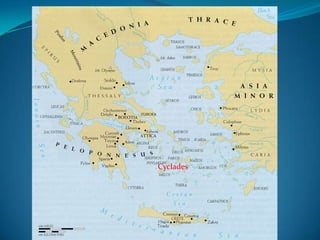
Cyclades
Cycladic Civilization (c. 3000-11th century BCE)
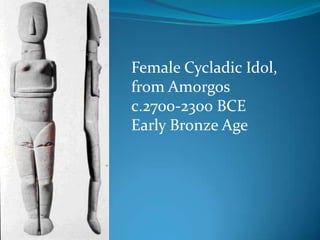
Female Cycladic Idol, from Amorgosc.2700-2300 BCEEarly Bronze Age
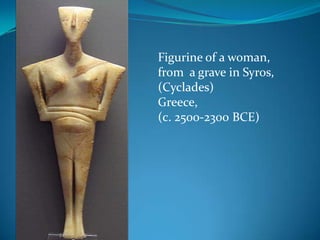
Figurine of a woman, from  a grave in Syros, (Cyclades)Greece, (c. 2500-2300 BCE)
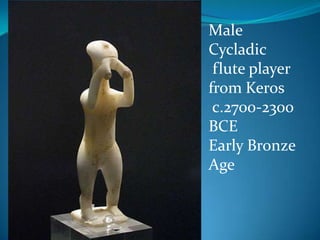
Male Cycladic flute player from Keros c.2700-2300 BCEEarly Bronze Age
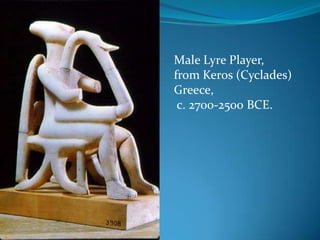
Male Lyre Player, from Keros (Cyclades)Greece, c. 2700-2500 BCE.
Minoan Civilization (c.3000-1100)
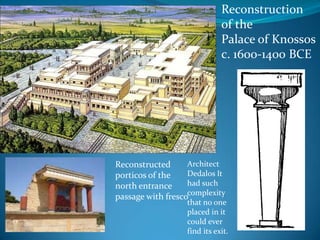
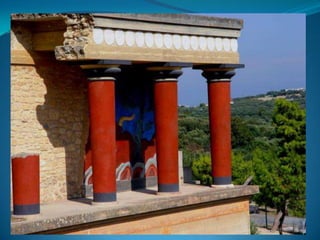
Reconstructionof the Palace of Knossosc. 1600-1400 BCEReconstructed porticos of the north entrance passage with frescoArchitect Dedalos It had such complexity that no one placed in it could ever find its exit.
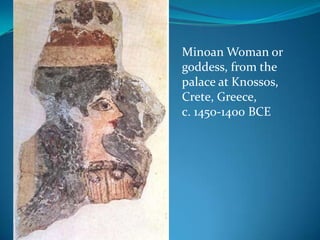
Minoan Woman or goddess, from the palace at Knossos, Crete, Greece, c. 1450-1400 BCE
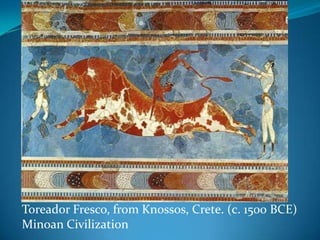
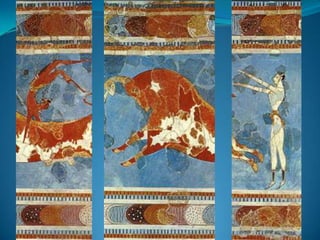
Toreador Fresco, from Knossos, Crete. (c. 1500 BCE)Minoan Civilization
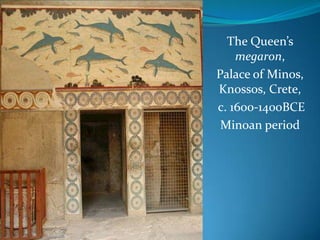
\\\\\\\The Queen’s megaron, Palace of Minos, Knossos, Crete, c. 1600-1400BCEMinoan period
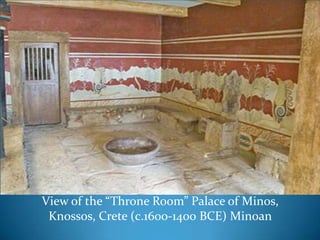
View of the “Throne Room” Palace of Minos,Knossos, Crete(c.1600-1400 BCE) Minoan
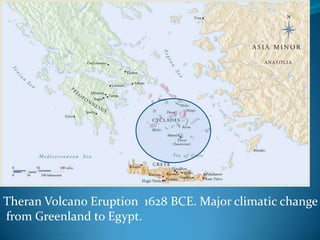
Theran Volcano Eruption  1628 BCE. Major climatic change  from Greenland to Egypt.
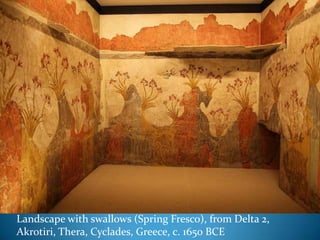
Landscape with swallows (Spring Fresco), from Delta 2, Akrotiri, Thera, Cyclades, Greece, c. 1650 BCE
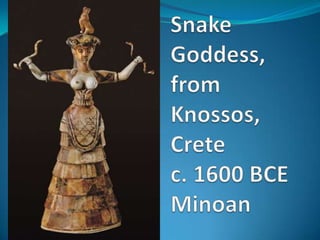
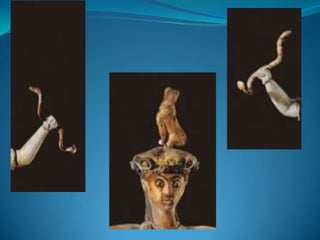
Snake Goddess, from Knossos, Crete c. 1600 BCEMinoan
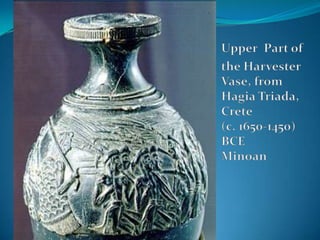
UpperPart of the Harvester Vase, from HagiaTriada, Crete(c. 1650-1450) BCEMinoan
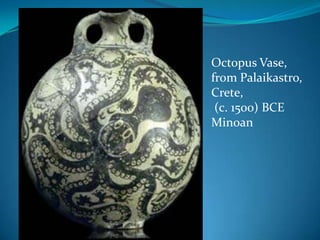
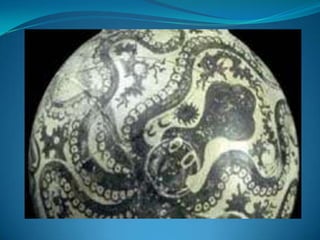
Octopus Vase, from Palaikastro, Crete, (c. 1500) BCEMinoan
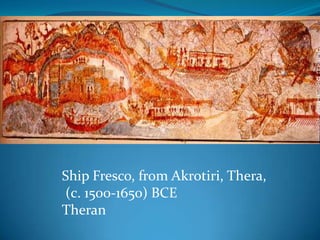
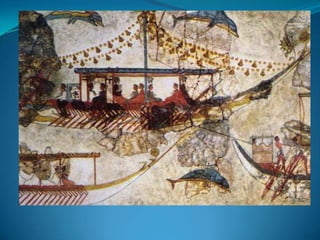
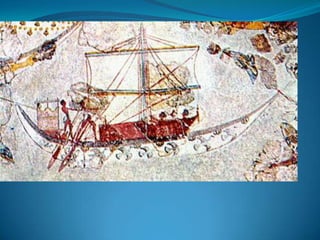
Ship Fresco, from Akrotiri, Thera, (c. 1500-1650) BCETheran
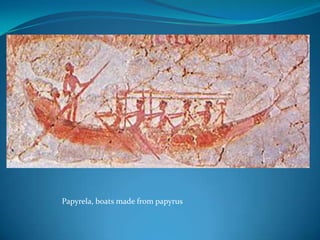
Papyrela, boats made from papyrus
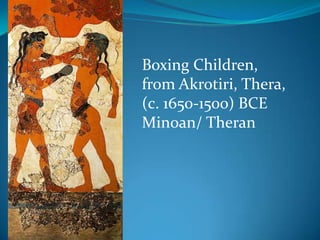
Boxing Children, from Akrotiri, Thera, (c. 1650-1500) BCEMinoan/ Theran
Mycenaean  Civilization  (c. 3000-1100 BCE)
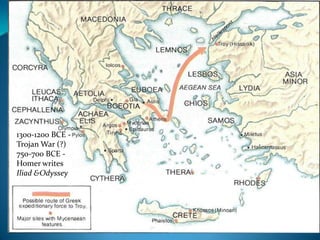
1300-1200 BCE - Trojan War (?)750-700 BCE - Homer writes Iliad &Odyssey
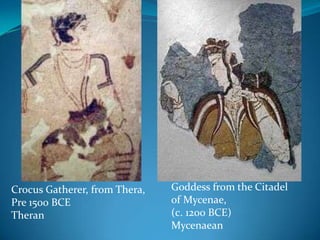
Goddess from the Citadel of Mycenae,(c. 1200 BCE)MycenaeanCrocus Gatherer, from Thera,Pre 1500 BCETheran
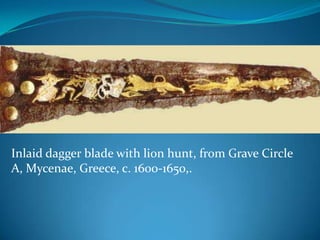
Inlaid dagger blade with lion hunt, from Grave Circle A, Mycenae, Greece, c. 1600-1650,.
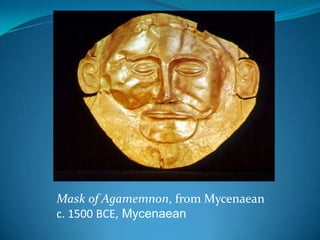
Mask of Agamemnon, from Mycenaeanc. 1500 BCE, Mycenaean
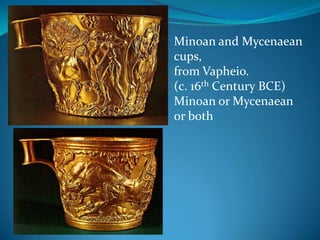
Minoan and Mycenaean cups,from Vapheio.(c. 16th Century BCE)Minoan or Mycenaean or both
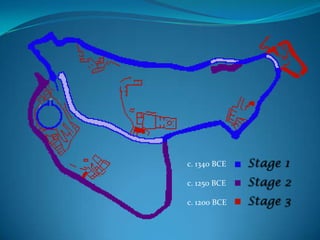
c. 1340 BCEc. 1250 BCEc. 1200 BCE
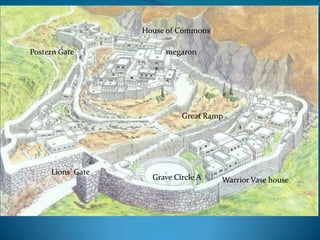
House of CommonsmegaronPostern GateGreat RampLions’ GateGrave Circle AWarrior Vase house
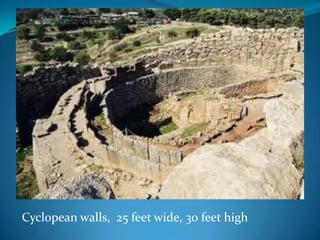
Cyclopean walls,  25 feet wide, 30 feet high
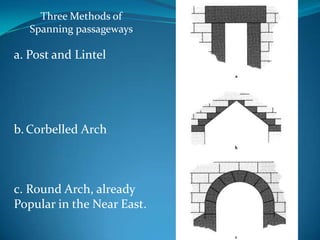
Three Methods of Spanning passagewaysPost and LintelCorbelled ArchRound Arch, already Popular in the Near East.
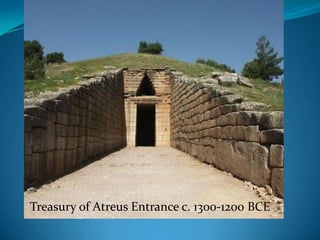
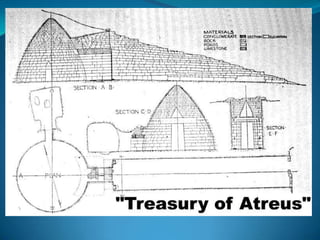
Treasury of Atreus Entrance c. 1300-1200 BCE
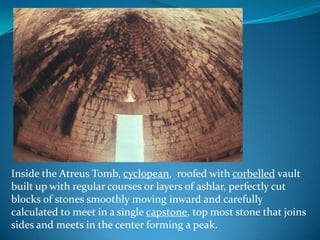
Inside the Atreus Tomb, cyclopean,  roofed with corbelled vault built up with regular courses or layers of ashlar, perfectly cutblocks of stones smoothly moving inward and carefully calculated to meet in a single capstone, top most stone that joins sides and meets in the center forming a peak.
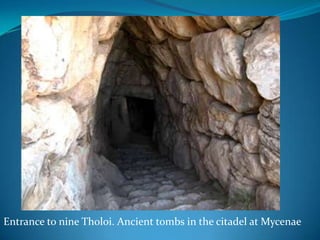
Entrance to nine Tholoi. Ancient tombs in the citadel at Mycenae
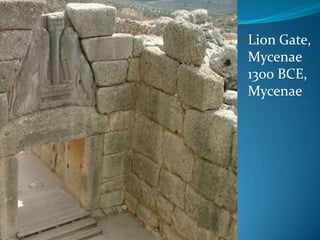
Lion Gate, Mycenae1300 BCE,Mycenae

Agean ppt 2

Editor's Notes

  • #32 Buried with the Mycenaean kings to attest to their wealth, Lion hunters are Minoan style, metal work is Near Eastern
  • #35 1340, 1250, 1200 BCE when the fortress was refortified and enlarged
  • #36 Mycenae only has foundations left, Knossos and Akrotiri had levels to their palaces. This is speculation. Minoan destination in Knossos was the courtyard, here it is the megaron
  • #37 Was it a temple, a community, a palace, a city, or for a god of the place?
  • #39 Tholos, axial architecture,
  • #43 Conglomerate stone that can be polished to shine many colors, corbelled relieving arch above the post-lintel, guardian beasts flanking a single Minoan Column that swells upward to a bulbous capital. Are they lions? The relief shows supple beasts supporting and defending the column on their hind legs, heads were put on dowels, Thought to be high relief. Lions rest their front paws on a Mycenae altar, column is also on an altar base, The column has an architrave, which supports the ends of the rafters of the roof, most likely represents the lions protecting the city itself, the citadel. If so it signifies that they are protecting a legitimate power in the citadel.