





AFRICAN
LITERATURE
 African literature is literature of or from Africa and includes oral literature (or "orature",
in the term coined by Ugandan scholar Pio Zirimu).
 As George Joseph notes in his chapter on African literature in Understanding
Contemporary Africa, whereas European views of literature often stressed a
separation of art and content, African awareness is inclusive:
 "Literature" can be the part of asian also imply an artistic use of words for the sake of
art alone. Traditionally, Africans do not radically separate art from teaching. Rather
than write or sing for beauty in itself, African writers, taking their cue from oral
literature, use beauty to help communicate important truths and information to society.
Indeed, an object is considered beautiful because of the truths it reveals and the
communities it helps to build.
Oral literature (or orature) may be in prose or verse. The prose is often
mythological or historical and can include tales of the trickster character.
Storytellers in Africa sometimes use call-and-response techniques to tell
their stories. Poetry, often sung, includes: narrative epic, occupational
verse, ritual verse, praise poemsrulers and other prominent people. Praise
singers, bards sometimes known as "griots", tell their stories with
music.[3] Also recited, often sung, are love songs, work songs, children's
songs, along with epigrams, proverbs and riddles.
 Precolonial literature
 Colonial
 Post-Colonial
1. Pre-colonial Literature
-Oral Literature
2. Colonial African Literature
-The African Colonial works best known in the West from the period of
colonization and the slave trade are primarily slave narratives.
-In the colonial period, Africans exposed to Western languages began
to write in those tongues.
-During this period, African plays written in English began to emerge.
-African literature in the late colonial period (between the end of World
War I and independence) increasingly showed themes of l
liberation, independence, and (among Africans in French-controlled
territories) négritude.
3. Postcolonial African literature
-With liberation and increased literacy since most African nations
gained their independence in the 1950s and 1960s, African literature has
grown dramatically in quantity and in recognition, with numerous African
works appearing in Western academic curricula and on "best of" lists
compiled at the end of the 19th century. African writers in this period wrote
both in Western languages (notably English, French, and Portuguese) and
in traditional African languages such as Hausa.
-Ali A. Mazrui and others mention seven conflicts as themes: the clash
between Africa's past and present, between tradition and modernity,
between indigenous and foreign, between individualism and community,
between socialism and capitalism, between development and self-reliance
and between Africanity and humanity. Other themes in this period include
social problems such as corruption, the economic disparities in newly
independent countries, and the rights and roles of women. Female writers
are today far better represented in published African literature than they
were prior to independence.
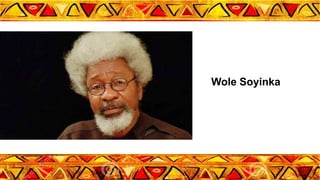
-In 1986, Wole Soyinka became the first post-independence African
writer to win the Nobel Prize in literature. Previously, Algerian-born Albert
Camus had been awarded the 1957 prize.
1. A Tradition of Myths and Stereotypes (Joseph Harris)
2. Life in Slve Ship (Olaudah Equiano)
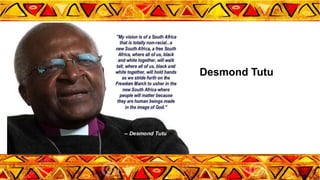
3. My Vision for South Africa (Desmond Tutu)
4. Concepts of Racial Thought in Three Short Stories of Nadine Godimer
5. Chinuan Achebe
-” Marriage is a Private Affair”
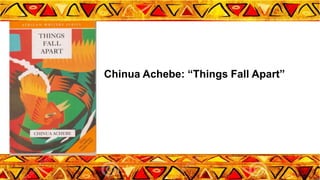
- “Things Fall Apart”
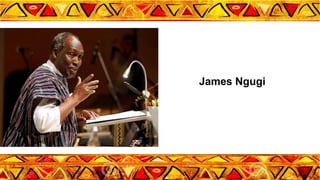
6. James Ngugi
7. Wole Soyinka
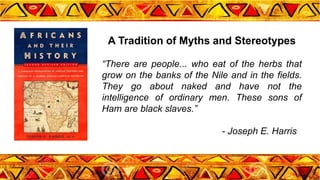
A Tradition of Myths and Stereotypes
“There are people... who eat of the herbs that
grow on the banks of the Nile and in the fields.
They go about naked and have not the
intelligence of ordinary men. These sons of
Ham are black slaves.”
- Joseph E. Harris
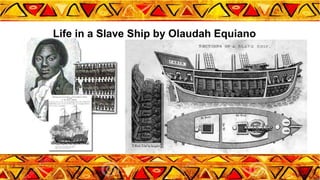
Life in a Slave Ship by Olaudah Equiano
Olaudah Equiano, describes being caputed and enslaved in his
autobiography:
One day, when all our people were gone out to their works as usual, and
only I and my dear sister were left to mind the house, two men and a
woman got over our walls, and in a moment seized us both. My sister and I
were separated and I ended up in the hands of a slave dealer who supplied
the Atlantic slave ships. Six months later I found myself on board a slave
ship.
The interesting life of Olaudah Equiano 1789
Description from Olaudah Equiano autobiography describing the
middle passage.
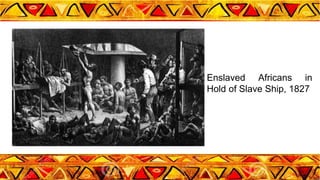
At last, when the ship we were in, had got in all her cargo, they made
ready with many fearful noises, and we were all put under deck, so
that we could not see how they managed the vessel. ...The stench of
the hold while we were on the coast was so intolerably
loathsome....The closeness of the place, and the heat of the climate,
added to the number in the ship, which was so crowded that each had
scarcely room to turn himself, almost suffocated us. This produced
copious perspirations, so that the air soon became unfit for
respiration, from a variety of loathsome smells, and brought on a
sickness among the slaves, of which many died -- thus falling victims
to the improvident avarice, as I may call it, of their purchasers.
The interesting life of Olaudah Equiano 1789
I have seen a slave beaten till some of his bones were broken, for
only letting a pot boil over. I have seen slaves put into scales and
weighed, and then sold from three pence to nine pence a pound.
The closeness of the place, and the heat of the climate, added to the
number in the ship, which was so crowded that each had scarcely room to
turn himself, almost suffocated us. The air soon became unfit for breathing,
from a variety of loathsome smells, and brought on a sickness among the
slaves, of which many died. This wretched situation was made worse by the
chains. The shrieks of women, and the groaning of the dying, created a
scene of horror almost unbelievable. Three desperate slaves tried to kill
themselves by jumping overboard. Two drowned, the other was captured
and beaten unmercifully. When I refused to eat, I too was beaten.
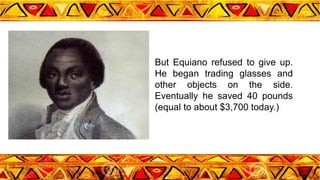
But Equiano refused to give up.
He began trading glasses and
other objects on the side.
Eventually he saved 40 pounds
(equal to about $3,700 today.)
Enslaved Africans in
Hold of Slave Ship, 1827
Desmond Tutu
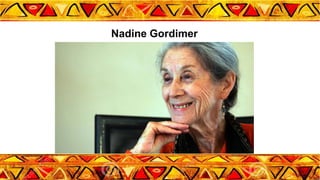
Nadine Gordimer
Which New Era Would That Be?
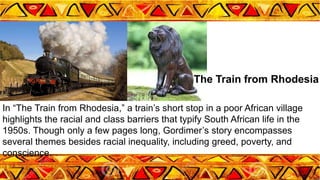
In “The Train from Rhodesia,” a train’s short stop in a poor African village
highlights the racial and class barriers that typify South African life in the
1950s. Though only a few pages long, Gordimer’s story encompasses
several themes besides racial inequality, including greed, poverty, and
conscience.
The Train from Rhodesia
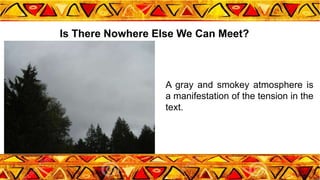
A gray and smokey atmosphere is
a manifestation of the tension in the
text.
Is There Nowhere Else We Can Meet?
Chinua Achebe: “Things Fall Apart”
Chinua Achebe:
“Marriage is a Private Affair”
James Ngugi
Wole Soyinka
https://en.wikipedia.org/wiki/African_literature
George, Joseph, "African Literature", in Gordon and Gordon,
Understanding Contemporary Africa (1996), ch. 14, p. 303.
http://ricardobarnhill.blogspot.com/2013/06/analysis-of-is-there-nowhere-
else-we.html
African Literature Report

African Literature Report

  • 9.
  • 17.
     African literatureis literature of or from Africa and includes oral literature (or "orature", in the term coined by Ugandan scholar Pio Zirimu).  As George Joseph notes in his chapter on African literature in Understanding Contemporary Africa, whereas European views of literature often stressed a separation of art and content, African awareness is inclusive:  "Literature" can be the part of asian also imply an artistic use of words for the sake of art alone. Traditionally, Africans do not radically separate art from teaching. Rather than write or sing for beauty in itself, African writers, taking their cue from oral literature, use beauty to help communicate important truths and information to society. Indeed, an object is considered beautiful because of the truths it reveals and the communities it helps to build.
  • 18.
    Oral literature (ororature) may be in prose or verse. The prose is often mythological or historical and can include tales of the trickster character. Storytellers in Africa sometimes use call-and-response techniques to tell their stories. Poetry, often sung, includes: narrative epic, occupational verse, ritual verse, praise poemsrulers and other prominent people. Praise singers, bards sometimes known as "griots", tell their stories with music.[3] Also recited, often sung, are love songs, work songs, children's songs, along with epigrams, proverbs and riddles.
  • 19.
     Precolonial literature Colonial  Post-Colonial
  • 20.
    1. Pre-colonial Literature -OralLiterature 2. Colonial African Literature -The African Colonial works best known in the West from the period of colonization and the slave trade are primarily slave narratives. -In the colonial period, Africans exposed to Western languages began to write in those tongues.
  • 21.
    -During this period,African plays written in English began to emerge. -African literature in the late colonial period (between the end of World War I and independence) increasingly showed themes of l liberation, independence, and (among Africans in French-controlled territories) négritude.
  • 22.
    3. Postcolonial Africanliterature -With liberation and increased literacy since most African nations gained their independence in the 1950s and 1960s, African literature has grown dramatically in quantity and in recognition, with numerous African works appearing in Western academic curricula and on "best of" lists compiled at the end of the 19th century. African writers in this period wrote both in Western languages (notably English, French, and Portuguese) and in traditional African languages such as Hausa.
  • 23.
    -Ali A. Mazruiand others mention seven conflicts as themes: the clash between Africa's past and present, between tradition and modernity, between indigenous and foreign, between individualism and community, between socialism and capitalism, between development and self-reliance and between Africanity and humanity. Other themes in this period include social problems such as corruption, the economic disparities in newly independent countries, and the rights and roles of women. Female writers are today far better represented in published African literature than they were prior to independence. -In 1986, Wole Soyinka became the first post-independence African writer to win the Nobel Prize in literature. Previously, Algerian-born Albert Camus had been awarded the 1957 prize.
  • 24.
    1. A Traditionof Myths and Stereotypes (Joseph Harris) 2. Life in Slve Ship (Olaudah Equiano) 3. My Vision for South Africa (Desmond Tutu) 4. Concepts of Racial Thought in Three Short Stories of Nadine Godimer 5. Chinuan Achebe -” Marriage is a Private Affair” - “Things Fall Apart” 6. James Ngugi 7. Wole Soyinka
  • 25.
    A Tradition ofMyths and Stereotypes “There are people... who eat of the herbs that grow on the banks of the Nile and in the fields. They go about naked and have not the intelligence of ordinary men. These sons of Ham are black slaves.” - Joseph E. Harris
  • 26.
    Life in aSlave Ship by Olaudah Equiano
  • 27.
    Olaudah Equiano, describesbeing caputed and enslaved in his autobiography: One day, when all our people were gone out to their works as usual, and only I and my dear sister were left to mind the house, two men and a woman got over our walls, and in a moment seized us both. My sister and I were separated and I ended up in the hands of a slave dealer who supplied the Atlantic slave ships. Six months later I found myself on board a slave ship. The interesting life of Olaudah Equiano 1789
  • 28.
    Description from OlaudahEquiano autobiography describing the middle passage. At last, when the ship we were in, had got in all her cargo, they made ready with many fearful noises, and we were all put under deck, so that we could not see how they managed the vessel. ...The stench of the hold while we were on the coast was so intolerably loathsome....The closeness of the place, and the heat of the climate, added to the number in the ship, which was so crowded that each had scarcely room to turn himself, almost suffocated us. This produced copious perspirations, so that the air soon became unfit for respiration, from a variety of loathsome smells, and brought on a sickness among the slaves, of which many died -- thus falling victims to the improvident avarice, as I may call it, of their purchasers. The interesting life of Olaudah Equiano 1789
  • 29.
    I have seena slave beaten till some of his bones were broken, for only letting a pot boil over. I have seen slaves put into scales and weighed, and then sold from three pence to nine pence a pound.
  • 30.
    The closeness ofthe place, and the heat of the climate, added to the number in the ship, which was so crowded that each had scarcely room to turn himself, almost suffocated us. The air soon became unfit for breathing, from a variety of loathsome smells, and brought on a sickness among the slaves, of which many died. This wretched situation was made worse by the chains. The shrieks of women, and the groaning of the dying, created a scene of horror almost unbelievable. Three desperate slaves tried to kill themselves by jumping overboard. Two drowned, the other was captured and beaten unmercifully. When I refused to eat, I too was beaten.
  • 31.
    But Equiano refusedto give up. He began trading glasses and other objects on the side. Eventually he saved 40 pounds (equal to about $3,700 today.)
  • 32.
    Enslaved Africans in Holdof Slave Ship, 1827
  • 33.
  • 34.
  • 35.
    Which New EraWould That Be?
  • 36.
    In “The Trainfrom Rhodesia,” a train’s short stop in a poor African village highlights the racial and class barriers that typify South African life in the 1950s. Though only a few pages long, Gordimer’s story encompasses several themes besides racial inequality, including greed, poverty, and conscience. The Train from Rhodesia
  • 37.
    A gray andsmokey atmosphere is a manifestation of the tension in the text. Is There Nowhere Else We Can Meet?
  • 39.
  • 41.
    Chinua Achebe: “Marriage isa Private Affair”
  • 42.
  • 43.
  • 44.
    https://en.wikipedia.org/wiki/African_literature George, Joseph, "AfricanLiterature", in Gordon and Gordon, Understanding Contemporary Africa (1996), ch. 14, p. 303. http://ricardobarnhill.blogspot.com/2013/06/analysis-of-is-there-nowhere- else-we.html