
French Literature
French literature, one of the world's most
brilliant, has been for centuries an impressive
aspect of French civilization, an object of
national pride, and a principal focus for
feelings of national identity. Because the
French are a literate people, passionately
interested in questions of language and in the
exploration of ideas, the influence of French
intellectuals on the course of French history
during the last three centuries has been great,
and remains so today.
A high proportion of European literary
trends have originated in France. The
continuing prestige of literature in France is
evidenced today by the innumerable private
societies devoted to individual authors and by
the large number of literary prizes awarded
each year. A knowledge of French literature,
in short, is the key to an understanding of the
French people.
About the Author
Guy de Maupassant (1850-1893)
-was born at the Château de Miromesniel,
on August 5, 1850.
-was a French author of naturalistic school
who is generally considered the greatest
French short story writer.
About the Author
Guy de Maupassant (1850-1893)
-was a popular French writer during the
19th century.
-he is considered one of the fathers of
the modern short story and one of the world’s
greatest writers of short fiction.
-his stories are characterized by their
economy of style and their efficient, effortless
endings.
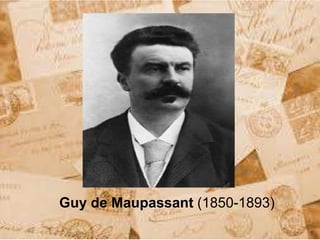
Guy de Maupassant (1850-1893)
A Dead Woman’s
Secret
Guy de Maupassant
Vocabulary Words
Appease (verb)- to bring to a state of peace
or quiet
Austere (adjective)-morally strict; severely
simple
Countenance (noun)-the appearance of a
person’s face
Epistle (noun)-composition in the form of a
letter
Frantically (adjective) -emotionally out of
control
Loathing (noun) -a very strong feeling of
hatred or disgust
Magistrate (noun) -an official exercising
administrative or judicial functions
Pell-mell (adv./noun)-in mingled confusion or
disorder
Squall(verb)-to utter in a strident voice
Characters:
Dead Woman- the mother of Eulalie and the
judge who seemed to die without pain.
Marguerite/Sister Eulalie- the daughter of the
dead woman; a nun
Magistrate- the son of the dead woman; a
judge
Priest- the one who watch over the wake of the
dead woman
Setting:
• At the house of the dead woman
•Night
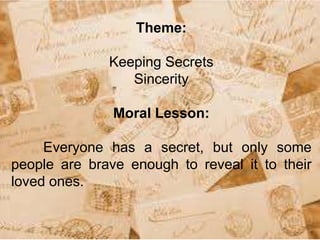
Theme:
Keeping Secrets
Sincerity
Moral Lesson:
Everyone has a secret, but only some
people are brave enough to reveal it to their
loved ones.
Thank
You !

French lit

  • 1.
  • 2.
    French literature, oneof the world's most brilliant, has been for centuries an impressive aspect of French civilization, an object of national pride, and a principal focus for feelings of national identity. Because the French are a literate people, passionately interested in questions of language and in the exploration of ideas, the influence of French intellectuals on the course of French history during the last three centuries has been great, and remains so today.
  • 3.
    A high proportionof European literary trends have originated in France. The continuing prestige of literature in France is evidenced today by the innumerable private societies devoted to individual authors and by the large number of literary prizes awarded each year. A knowledge of French literature, in short, is the key to an understanding of the French people.
  • 4.
    About the Author Guyde Maupassant (1850-1893) -was born at the Château de Miromesniel, on August 5, 1850. -was a French author of naturalistic school who is generally considered the greatest French short story writer.
  • 5.
    About the Author Guyde Maupassant (1850-1893) -was a popular French writer during the 19th century. -he is considered one of the fathers of the modern short story and one of the world’s greatest writers of short fiction. -his stories are characterized by their economy of style and their efficient, effortless endings.
  • 6.
    Guy de Maupassant(1850-1893)
  • 7.
  • 8.
    Vocabulary Words Appease (verb)-to bring to a state of peace or quiet Austere (adjective)-morally strict; severely simple Countenance (noun)-the appearance of a person’s face Epistle (noun)-composition in the form of a letter
  • 9.
    Frantically (adjective) -emotionallyout of control Loathing (noun) -a very strong feeling of hatred or disgust Magistrate (noun) -an official exercising administrative or judicial functions Pell-mell (adv./noun)-in mingled confusion or disorder Squall(verb)-to utter in a strident voice
  • 10.
    Characters: Dead Woman- themother of Eulalie and the judge who seemed to die without pain. Marguerite/Sister Eulalie- the daughter of the dead woman; a nun Magistrate- the son of the dead woman; a judge Priest- the one who watch over the wake of the dead woman
  • 11.
    Setting: • At thehouse of the dead woman •Night
  • 12.
    Theme: Keeping Secrets Sincerity Moral Lesson: Everyonehas a secret, but only some people are brave enough to reveal it to their loved ones.
  • 13.