First Semester
SY: 2023-2024
Survey of Philippine Literature in English
(Eng. 306 /12:30-2:00)
Prepared by:
JOCELYN S. UNGANG
Instructor
Hello! I’m...
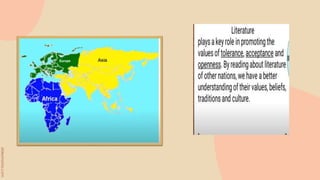
Mam JOY
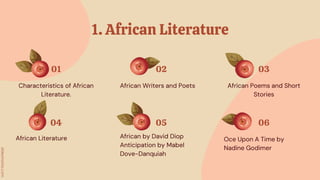
1. African Literature
Characteristics of African
Literature.
African Writers and Poets
African Literature African by David Diop
Anticipation by Mabel
Dove-Danquiah
01 02
04 05
African Poems and Short
Stories
Oce Upon A Time by
Nadine Godimer
03
06
Table of contents.
� We will talk about this first.
� We will talk about this second.
� After that we will talk about this.
� We will talk about this too.
� And we will talk about this last.
What is Literature? As the man started to walk the earth, he developed a system
of recording down things around him and interpreting them according to his
own perception. This act of documenting may have been the start of the medium;
not all written material may be considered literature. But, only those that closely
emulate the human experience, emotion and thought are regarded as literature.
Afro-Asian Literature is a term for writing; written by people from mixed
African-Arab ethnicity, or African-Asian ethnicity as described by Estroga
(2012).
Background Information: General Concepts & Theories, Techniques &
Conventions
Did you know?
 Afro-Asian Literature mirrors not only the customs and traditions of African and Asian
countries but also their philosophy of life which on the whole are deeply and
predominantly contemplative and hauntingly sweet.
 Afro-Asian Literature is the reflection of the storm and the stress of developing nations
seeking a place under the sun, which every student must understand so that she/he
may know how this literature affects the history and culture of a nation.
Many of the literary works are handed down by oral
tradition.
* In Africa, the lack of literacy did not make it possible to write literature
down.
Histories, myths, legends, including stories, dramas, riddles, songs, proverbs
and other literary works were handed by mouth from generation to generation
to entertain, educate and remind the people about their past, heroic deeds of
their people, ancestry and culture.
*The other importance is that this writing is able to teach people and allow
them to learn about different experiences and cultures from all over the world.
*The importance comes from the fact that Afro-Asian literature is a sign of
new and modern times.
*History Of Afro-Asian Literature -Told of the unique struggles and successes
of Afro-Asian people.
African literature isn't just the voices of African people during colonialism
and the slave trade. It is much more than that. It covers the stories of
African people before colonialism, during colonialism, and after
colonialism (this is known as post-colonial literature).
African literature reflects the stories of people from hundreds of years ago
and the people who live now. It is a hugely important part of the literary
world as it brings underrepresented voices to the fore and allows them to
re-tell their experiences of the world.
― Irene M. Pepperberg
Did you know?
Did you know?
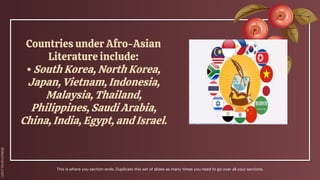
Countries under Afro-Asian
Literature include:
• South Korea, North Korea,
Japan, Vietnam, Indonesia,
Malaysia, Thailand,
Philippines, Saudi Arabia,
China, India, Egypt, and Israel.
This is where you section ends. Duplicate this set of slides as many times you need to go over all your sections.
Characteristics OF African Literature
African literature
comprises the oral and
written works of the
continent composed in
either African languages
(more than a thousand
languages and dialects)
or foreign ones.
The widespread
African oral
tradition is rich in
folktales, myths,
riddles, and
proverbs that not
only convey an
imaginative view
of the world, but
also serve as
religious, social,
and educational
function.
Language Before colonialism,
Africans would tell their
stories orally and through
performance, sometimes
using music as well.
After colonialism, the African
writers started to write
in European languages such
as English, Portuguese, and
French. Their stories would
share similar themes such as
denouncing European
colonisation of the African
countries, the greatness of
their African past before the
European countries invaded,
and hope for independence
in the future of Africa.
Characteristics OF African Literature
Historical influences
Another
characteristic of
African literature is
the writers’ focus
on themes of
*freedom and
independence,
*questions of
identity and
liberation.
In the period between
1881 and 1914, known
as the ‘Scramble for
Africa’, numerous
European powers took
control of most of
Africa. The only three
countries untouched by
the Europeans were
the Dervish State,
Liberia, and Ethiopia.
The slave trade that
lasted approximately
four hundred years is
also another key
historical influence on
African literature.
• The Atlantic slave trade
involved the movement of
more than twelve million
African people to America
to work as slaves.
• Some of these slaves
eventually gained their
freedom and those who were
literate started writing stories
to fight against slavery by
recounting their horrifying
experiences as slaves.
• The first generation of these
narrators was Ottobah
Cugoano, Olaudah
Equiano, and Ignatius
Sancho.
Characteristics OF African Literature
.
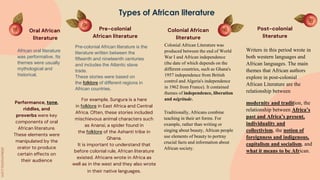
Oral African
literature
Pre-colonial
African literature
Colonial African
literature
Post-colonial
literature
Types of African literature
African oral literature
was performative. Its
themes were usually
mythological and
historical.
Performance, tone,
riddles, and
proverbs were key
components of oral
African literature.
These elements were
manipulated by the
orator to produce
certain effects on
their audience
Pre-colonial African literature is the
literature written between the
fifteenth and nineteenth centuries
and includes the Atlantic slave
trade.
These stories were based on
the folklore of different regions in
African countries.
For example, Sungura is a hare
in folklore in East Africa and Central
Africa. Often, these stories included
mischievous animal characters such
as Anansi, a spider found in
the folklore of the Ashanti tribe in
Ghana.
It is important to understand that
before colonial rule, African literature
existed. Africans wrote in Africa as
well as in the west and they also wrote
in their native languages.
Colonial African Literature was
produced between the end of World
War I and African independence
(the date of which depends on the
different countries, such as Ghana's
1957 independence from British
control and Algeria's independence
in 1962 from France). It contained
themes of independence, liberation
and négritude.
Traditionally, Africans combine
teaching in their art forms. For
example, rather than writing or
singing about beauty, African people
use elements of beauty to portray
crucial facts and information about
African society.
Writers in this period wrote in
both western languages and
African languages. The main
themes that African authors
explore in post-colonial
African Literature are the
relationship between
modernity and tradition, the
relationship between Africa’s
past and Africa’s present,
individuality and
collectivism, the notion of
foreignness and indigenous,
capitalism and socialism, and
what it means to be African.
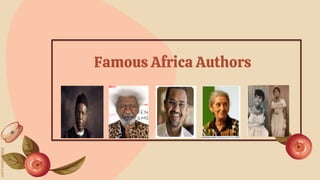
Famous Africa Authors
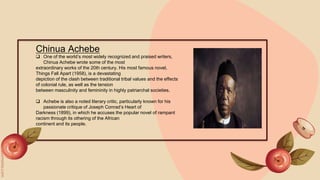
Chinua Achebe
 One of the world’s most widely recognized and praised writers,
Chinua Achebe wrote some of the most
extraordinary works of the 20th century. His most famous novel,
Things Fall Apart (1958), is a devastating
depiction of the clash between traditional tribal values and the effects
of colonial rule, as well as the tension
between masculinity and femininity in highly patriarchal societies.
 Achebe is also a noted literary critic, particularly known for his
passionate critique of Joseph Conrad’s Heart of
Darkness (1899), in which he accuses the popular novel of rampant
racism through its othering of the African
continent and its people.
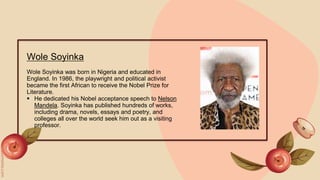
Wole Soyinka
Wole Soyinka was born in Nigeria and educated in
England. In 1986, the playwright and political activist
became the first African to receive the Nobel Prize for
Literature.
 He dedicated his Nobel acceptance speech to Nelson
Mandela. Soyinka has published hundreds of works,
including drama, novels, essays and poetry, and
colleges all over the world seek him out as a visiting
professor.
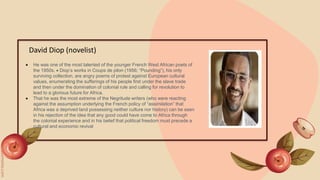
David Diop (novelist)
 He was one of the most talented of the younger French West African poets of
the 1950s.  Diop’s works in Coups de pilon (1956; “Pounding”), his only
surviving collection, are angry poems of protest against European cultural
values, enumerating the sufferings of his people first under the slave trade
and then under the domination of colonial rule and calling for revolution to
lead to a glorious future for Africa.
 That he was the most extreme of the Negritude writers (who were reacting
against the assumption underlying the French policy of “assimilation” that
Africa was a deprived land possessing neither culture nor history) can be seen
in his rejection of the idea that any good could have come to Africa through
the colonial experience and in his belief that political freedom must precede a
cultural and economic revival
Nadine Gordimer
(20 November 1923 – 13 July 2014) was a South African writer
and political activist. She received the Nobel Prize in Literature in
1991, recognized as a writer "who through her magnificent epic
writing has ... been of very great benefit to humanity".[1]
Gordimer's writing dealt with moral and racial issues,
particularly apartheid in South Africa. Under that regime, works such
as Burger's Daughter and July's People were banned. She was
active in the anti-apartheid movement, joining the African National
Congress during the days when the organization was banned, and
gave Nelson Mandela advice on his famous 1964 defence speech at
the trial which led to his conviction for life. She was also active
in HIV/AIDS causes.
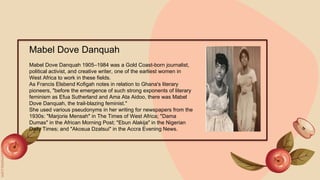
Mabel Dove Danquah
Mabel Dove Danquah 1905–1984 was a Gold Coast-born journalist,
political activist, and creative writer, one of the earliest women in
West Africa to work in these fields.
As Francis Elsbend Kofigah notes in relation to Ghana's literary
pioneers, "before the emergence of such strong exponents of literary
feminism as Efua Sutherland and Ama Ata Aidoo, there was Mabel
Dove Danquah, the trail-blazing feminist."
She used various pseudonyms in her writing for newspapers from the
1930s: "Marjorie Mensah" in The Times of West Africa; "Dama
Dumas" in the African Morning Post; "Ebun Alakija" in the Nigerian
Daily Times; and "Akosua Dzatsui" in the Accra Evening News.
Suggested Literary Pieces:
- Africa by David Diop
- Once Upon a Time by Nadine Gordimer
- Anticipation by Mabel Dove- Danquah
Thank you!

Eng.302Lesson1-2023in afroasianlite.pptx

  • 1.
    First Semester SY: 2023-2024 Surveyof Philippine Literature in English (Eng. 306 /12:30-2:00) Prepared by: JOCELYN S. UNGANG Instructor
  • 2.
  • 3.
    1. African Literature Characteristicsof African Literature. African Writers and Poets African Literature African by David Diop Anticipation by Mabel Dove-Danquiah 01 02 04 05 African Poems and Short Stories Oce Upon A Time by Nadine Godimer 03 06
  • 4.
    Table of contents. �We will talk about this first. � We will talk about this second. � After that we will talk about this. � We will talk about this too. � And we will talk about this last.
  • 5.
    What is Literature?As the man started to walk the earth, he developed a system of recording down things around him and interpreting them according to his own perception. This act of documenting may have been the start of the medium; not all written material may be considered literature. But, only those that closely emulate the human experience, emotion and thought are regarded as literature. Afro-Asian Literature is a term for writing; written by people from mixed African-Arab ethnicity, or African-Asian ethnicity as described by Estroga (2012). Background Information: General Concepts & Theories, Techniques & Conventions
  • 6.
    Did you know? Afro-Asian Literature mirrors not only the customs and traditions of African and Asian countries but also their philosophy of life which on the whole are deeply and predominantly contemplative and hauntingly sweet.  Afro-Asian Literature is the reflection of the storm and the stress of developing nations seeking a place under the sun, which every student must understand so that she/he may know how this literature affects the history and culture of a nation.
  • 7.
    Many of theliterary works are handed down by oral tradition. * In Africa, the lack of literacy did not make it possible to write literature down. Histories, myths, legends, including stories, dramas, riddles, songs, proverbs and other literary works were handed by mouth from generation to generation to entertain, educate and remind the people about their past, heroic deeds of their people, ancestry and culture. *The other importance is that this writing is able to teach people and allow them to learn about different experiences and cultures from all over the world. *The importance comes from the fact that Afro-Asian literature is a sign of new and modern times. *History Of Afro-Asian Literature -Told of the unique struggles and successes of Afro-Asian people.
  • 8.
    African literature isn'tjust the voices of African people during colonialism and the slave trade. It is much more than that. It covers the stories of African people before colonialism, during colonialism, and after colonialism (this is known as post-colonial literature). African literature reflects the stories of people from hundreds of years ago and the people who live now. It is a hugely important part of the literary world as it brings underrepresented voices to the fore and allows them to re-tell their experiences of the world. ― Irene M. Pepperberg
  • 9.
  • 10.
  • 12.
    Countries under Afro-Asian Literatureinclude: • South Korea, North Korea, Japan, Vietnam, Indonesia, Malaysia, Thailand, Philippines, Saudi Arabia, China, India, Egypt, and Israel. This is where you section ends. Duplicate this set of slides as many times you need to go over all your sections.
  • 13.
    Characteristics OF AfricanLiterature African literature comprises the oral and written works of the continent composed in either African languages (more than a thousand languages and dialects) or foreign ones. The widespread African oral tradition is rich in folktales, myths, riddles, and proverbs that not only convey an imaginative view of the world, but also serve as religious, social, and educational function. Language Before colonialism, Africans would tell their stories orally and through performance, sometimes using music as well. After colonialism, the African writers started to write in European languages such as English, Portuguese, and French. Their stories would share similar themes such as denouncing European colonisation of the African countries, the greatness of their African past before the European countries invaded, and hope for independence in the future of Africa.
  • 14.
    Characteristics OF AfricanLiterature Historical influences Another characteristic of African literature is the writers’ focus on themes of *freedom and independence, *questions of identity and liberation. In the period between 1881 and 1914, known as the ‘Scramble for Africa’, numerous European powers took control of most of Africa. The only three countries untouched by the Europeans were the Dervish State, Liberia, and Ethiopia. The slave trade that lasted approximately four hundred years is also another key historical influence on African literature. • The Atlantic slave trade involved the movement of more than twelve million African people to America to work as slaves. • Some of these slaves eventually gained their freedom and those who were literate started writing stories to fight against slavery by recounting their horrifying experiences as slaves. • The first generation of these narrators was Ottobah Cugoano, Olaudah Equiano, and Ignatius Sancho.
  • 15.
  • 16.
    Oral African literature Pre-colonial African literature ColonialAfrican literature Post-colonial literature Types of African literature African oral literature was performative. Its themes were usually mythological and historical. Performance, tone, riddles, and proverbs were key components of oral African literature. These elements were manipulated by the orator to produce certain effects on their audience Pre-colonial African literature is the literature written between the fifteenth and nineteenth centuries and includes the Atlantic slave trade. These stories were based on the folklore of different regions in African countries. For example, Sungura is a hare in folklore in East Africa and Central Africa. Often, these stories included mischievous animal characters such as Anansi, a spider found in the folklore of the Ashanti tribe in Ghana. It is important to understand that before colonial rule, African literature existed. Africans wrote in Africa as well as in the west and they also wrote in their native languages. Colonial African Literature was produced between the end of World War I and African independence (the date of which depends on the different countries, such as Ghana's 1957 independence from British control and Algeria's independence in 1962 from France). It contained themes of independence, liberation and négritude. Traditionally, Africans combine teaching in their art forms. For example, rather than writing or singing about beauty, African people use elements of beauty to portray crucial facts and information about African society. Writers in this period wrote in both western languages and African languages. The main themes that African authors explore in post-colonial African Literature are the relationship between modernity and tradition, the relationship between Africa’s past and Africa’s present, individuality and collectivism, the notion of foreignness and indigenous, capitalism and socialism, and what it means to be African.
  • 17.
  • 18.
    Chinua Achebe  Oneof the world’s most widely recognized and praised writers, Chinua Achebe wrote some of the most extraordinary works of the 20th century. His most famous novel, Things Fall Apart (1958), is a devastating depiction of the clash between traditional tribal values and the effects of colonial rule, as well as the tension between masculinity and femininity in highly patriarchal societies.  Achebe is also a noted literary critic, particularly known for his passionate critique of Joseph Conrad’s Heart of Darkness (1899), in which he accuses the popular novel of rampant racism through its othering of the African continent and its people.
  • 19.
    Wole Soyinka Wole Soyinkawas born in Nigeria and educated in England. In 1986, the playwright and political activist became the first African to receive the Nobel Prize for Literature.  He dedicated his Nobel acceptance speech to Nelson Mandela. Soyinka has published hundreds of works, including drama, novels, essays and poetry, and colleges all over the world seek him out as a visiting professor.
  • 20.
    David Diop (novelist) He was one of the most talented of the younger French West African poets of the 1950s.  Diop’s works in Coups de pilon (1956; “Pounding”), his only surviving collection, are angry poems of protest against European cultural values, enumerating the sufferings of his people first under the slave trade and then under the domination of colonial rule and calling for revolution to lead to a glorious future for Africa.  That he was the most extreme of the Negritude writers (who were reacting against the assumption underlying the French policy of “assimilation” that Africa was a deprived land possessing neither culture nor history) can be seen in his rejection of the idea that any good could have come to Africa through the colonial experience and in his belief that political freedom must precede a cultural and economic revival
  • 21.
    Nadine Gordimer (20 November1923 – 13 July 2014) was a South African writer and political activist. She received the Nobel Prize in Literature in 1991, recognized as a writer "who through her magnificent epic writing has ... been of very great benefit to humanity".[1] Gordimer's writing dealt with moral and racial issues, particularly apartheid in South Africa. Under that regime, works such as Burger's Daughter and July's People were banned. She was active in the anti-apartheid movement, joining the African National Congress during the days when the organization was banned, and gave Nelson Mandela advice on his famous 1964 defence speech at the trial which led to his conviction for life. She was also active in HIV/AIDS causes.
  • 22.
    Mabel Dove Danquah MabelDove Danquah 1905–1984 was a Gold Coast-born journalist, political activist, and creative writer, one of the earliest women in West Africa to work in these fields. As Francis Elsbend Kofigah notes in relation to Ghana's literary pioneers, "before the emergence of such strong exponents of literary feminism as Efua Sutherland and Ama Ata Aidoo, there was Mabel Dove Danquah, the trail-blazing feminist." She used various pseudonyms in her writing for newspapers from the 1930s: "Marjorie Mensah" in The Times of West Africa; "Dama Dumas" in the African Morning Post; "Ebun Alakija" in the Nigerian Daily Times; and "Akosua Dzatsui" in the Accra Evening News.
  • 23.
    Suggested Literary Pieces: -Africa by David Diop - Once Upon a Time by Nadine Gordimer - Anticipation by Mabel Dove- Danquah
  • 24.