AFRICAN
LITERATURE
Subject Teacher: Ms. Mary Grace S. Sepida
Arellano University
Objectives:
1
Learn
• Learn the rich cultural
heritage and literature of
Africa.
2
Appreciate
•Appreciate learning the cultural
heritage of Africa as an
important tool for
understanding its literature.
3
Create
• Create a short video showing
your appreciation of African
Literature.
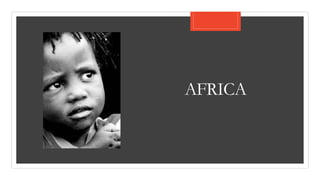
AFRICA
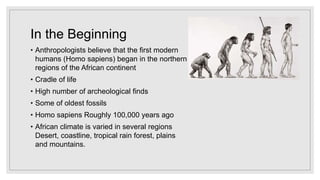
In the Beginning
• Anthropologists believe that the first modern
humans (Homo sapiens) began in the northern
regions of the African continent
• Cradle of life
• High number of archeological finds
• Some of oldest fossils
• Homo sapiens Roughly 100,000 years ago
• African climate is varied in several regions
Desert, coastline, tropical rain forest, plains
and mountains.
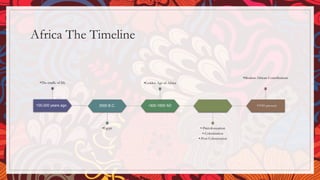
Africa The Timeline
100,000 years ago
•The cradle of life
3000 B.C.
•Egypt
•300-1600 AD
•Golden Age of Africa
•-Precolonization
•-Colonization
•-Post Colonization
•1950-present
•Modern African Contributions
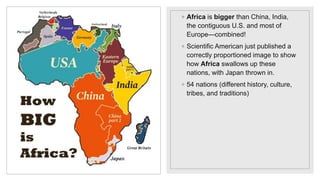
◦ Africa is bigger than China, India,
the contiguous U.S. and most of
Europe—combined!
◦ Scientific American just published a
correctly proportioned image to show
how Africa swallows up these
nations, with Japan thrown in.
◦ 54 nations (different history, culture,
tribes, and traditions)
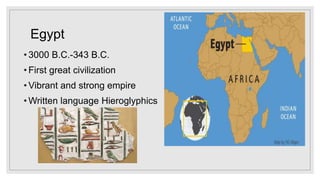
Egypt
• 3000 B.C.-343 B.C.
• First great civilization
• Vibrant and strong empire
• Written language Hieroglyphics
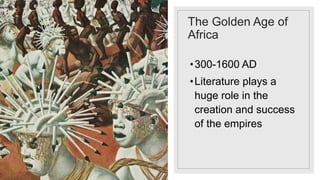
The Golden Age of
Africa
•300-1600 AD
•Literature plays a
huge role in the
creation and success
of the empires
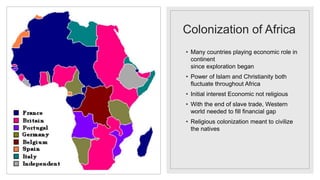
Colonization of Africa
• Many countries playing economic role in
continent
since exploration began
• Power of Islam and Christianity both
fluctuate throughout Africa
• Initial interest Economic not religious
• With the end of slave trade, Western
world needed to fill financial gap
• Religious colonization meant to civilize
the natives
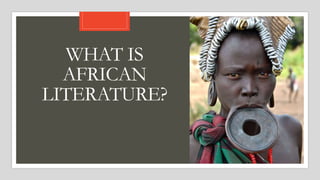
WHAT IS
AFRICAN
LITERATURE?
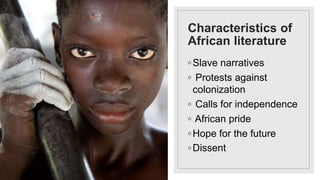
Characteristics of
African literature
◦Slave narratives
◦ Protests against
colonization
◦ Calls for independence
◦ African pride
◦Hope for the future
◦Dissent
PRE-COLONIAL AFRICAN
LITERATURE
Types of literature
Oral traditions stories passed from generation to generation
through word of mouth.
Dilemma/enigma tale moral tale that ends with question to allow
audience to share judgments
Chain/cumulative tale formulaic, each incident
is repeated as new incidents are added
• The 12 days of Christmas
• A single extended joke
Types of literature
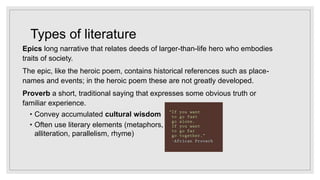
Epics long narrative that relates deeds of larger-than-life hero who embodies
traits of society.
The epic, like the heroic poem, contains historical references such as place-
names and events; in the heroic poem these are not greatly developed.
Proverb a short, traditional saying that expresses some obvious truth or
familiar experience.
• Convey accumulated cultural wisdom
• Often use literary elements (metaphors,
alliteration, parallelism, rhyme)
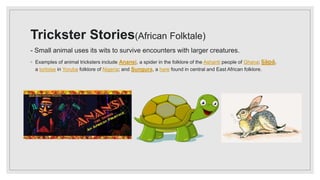
Trickster Stories(African Folktale)
- Small animal uses its wits to survive encounters with larger creatures.
◦ Examples of animal tricksters include Anansi, a spider in the folklore of the Ashanti people of Ghana; Ijàpá,
a tortoise in Yoruba folklore of Nigeria; and Sungura, a hare found in central and East African folklore.
COLONIAL AFRICAN LITERATURE
COLONIALIS
M ERA
History of Slavery, oppression or suppression,
violence and humiliations of their life.
X Not for entertainment,
X Not for aesthetic delight but such literature disturb
the mind , leads to think about Humanity and so many
other things.
X Not written out compassion but it is written out of
Disgustful life which is experienced by writers
themselves.
Flood of colonialism, capitalism and industrialism
lead them towards slave mentality.
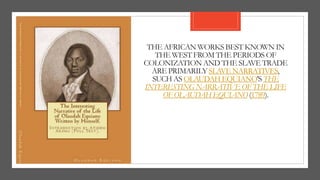
THE AFRICAN WORKS BEST KNOWN IN
THE WEST FROM THE PERIODS OF
COLONIZATION AND THE SLAVE TRADE
ARE PRIMARILY SLAVE NARRATIVES,
SUCH AS OLAUDAH EQUIANO'S THE
INTERESTING NARRATIVE OF THE LIFE
OF OLAUDAH EQUIANO(1789).
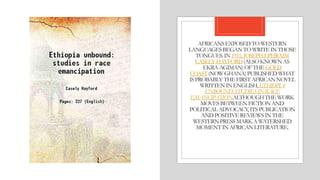
AFRICANSEXPOSEDTOWESTERN
LANGUAGESBEGANTOWRITEINTHOSE
TONGUES.IN1911, JOSEPHEPHRAIM
CASELYHAYFORD(ALSOKNOWNAS
EKRA-AGIMAN)OFTHEGOLD
COAST(NOWGHANA)PUBLISHEDWHAT
ISPROBABLY THEFIRSTAFRICANNOVEL
WRITTENINENGLISH,ETHIOPIA
UNBOUND:STUDIESINRACE
EMANCIPATION.ALTHOUGHTHEWORK
MOVESBETWEENFICTIONAND
POLITICALADVOCACY,ITSPUBLICATION
ANDPOSITIVEREVIEWSINTHE
WESTERNPRESSMARKAWATERSHED
MOMENTINAFRICANLITERATURE.
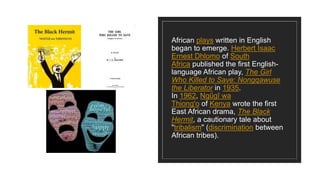
African plays written in English
began to emerge. Herbert Isaac
Ernest Dhlomo of South
Africa published the first English-
language African play, The Girl
Who Killed to Save: Nongqawuse
the Liberator in 1935.
In 1962, Ngũgĩ wa
Thiong'o of Kenya wrote the first
East African drama, The Black
Hermit, a cautionary tale about
"tribalism" (discrimination between
African tribes).
AMONGTHEFIRSTPIECESOFAFRICAN
LITERATURETORECEIVESIGNIFICANT
WORLDWIDECRITICALACCLAIMWAS THINGS
FALLAPART,BYCHINUAACHEBE.PUBLISHEDIN
1958,LATEINTHECOLONIALERA,THINGSFALL
APARTANALYZEDTHEEFFECTOF COLONIALISM
ONTRADITIONALAFRICANSOCIETY.[12]
An excerpt
from “Things
Fall Apart by
Chinua
Achebe”.
◦ “And at last the locusts did descend.
They settled on every tree and on
every blade of grass; they settled on
the roofs and covered the bare
ground. Mighty tree branches broke
away under them, and the whole
country became the brown-earth
color of the vast, hungry swarm.”
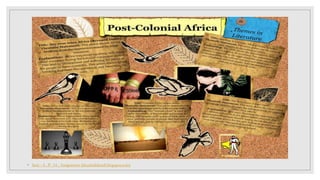
POST COLONIAL
AFRICAN
LITERATURE
◦ Independence in the 1950s and 1960s,
◦ African literature has grown dramatically in
quantity and in recognition
◦ African writers in this period wrote both in
Western languages (notably English, French,
and Portuguese) and in traditional African
languages such as Hausa.
◦ Other themes in this period include social
problems such as corruption, the economic
disparities in newly independent countries, and
the rights and roles of women.
◦ Female writers are today far better represented in
published African literature than they were prior to
independence.
◦ Sem - 4 , P- 14 , Assignment (khushalidave8.blogspot.com)
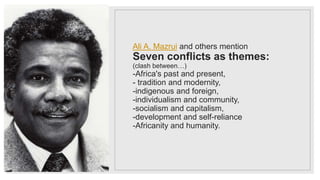
Ali A. Mazrui and others mention
Seven conflicts as themes:
(clash between…)
-Africa's past and present,
- tradition and modernity,
-indigenous and foreign,
-individualism and community,
-socialism and capitalism,
-development and self-reliance
-Africanity and humanity.
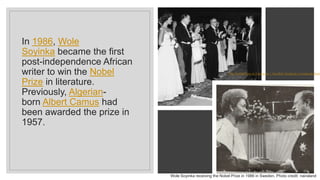
In 1986, Wole
Soyinka became the first
post-independence African
writer to win the Nobel
Prize in literature.
Previously, Algerian-
born Albert Camus had
been awarded the prize in
1957.
Wole Soyinka receiving the Nobel Prize in 1986 in Sweden. Photo credit: nairaland
The Nobel Prize in Literature | Swedish Academy (svenskaakademi
Contemporary Developments(1950-present)
◦ There are a lot of literary productions in Africa since the beginning of
the current decade (2010), even though readers do not always follow in
large numbers. One can also notice the appearance of certain writings
that break with the academic style.
◦ Shortage of literary critics
◦ Literary events seem to be very fashionable, including literary awards,
some of which can be distinguished by their original concepts.
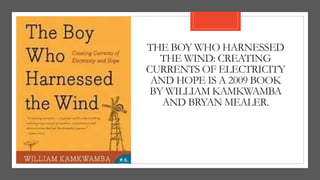
THE BOY WHO HARNESSED
THE WIND: CREATING
CURRENTS OF ELECTRICITY
AND HOPE IS A 2009 BOOK
BY WILLIAM KAMKWAMBA
AND BRYAN MEALER.
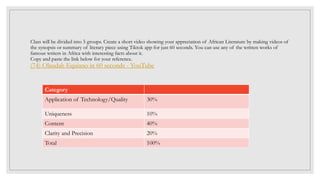
Class will be divided into 5 groups. Create a short video showing your appreciation of African Literature by making videos of
the synopsis or summary of literary piece using Tiktok app for just 60 seconds. You can use any of the written works of
famous writers in Africa with interesting facts about it.
Copy and paste the link below for your reference.
(74) Olaudah Equiano in 60 seconds - YouTube
Category
Application of Technology/Quality 30%
Uniqueness 10%
Content 40%
Clarity and Precision 20%
Total 100%
REFERENCES
◦ Five Lessons I Learned From The Boy Who Harnessed the Wind | by Emily Deneen | Medium
◦ African Literature: History & Characteristics - Video & Lesson Transcript | Study.com
◦ (63) The Boy Who Harnessed The Wind | Offical Trailer [HD] | Netflix – YouTube
◦ PPT – African Literature PowerPoint presentation | free to download - id: 72d1de-OWQ3N (powershow.com)
◦ African literature – Wikipedia
◦ summary on the development of african literature | shastine (wordpress.com)
◦ African literature | Infoplease
◦ Video/Throwback: Soyinka, now 86 and his 1986 Nobel Prize - P.M. News (pmnewsnigeria.com)
◦ Sem - 4 , P- 14 , Assignment (khushalidave8.blogspot.com)
◦ th (160×240) (bing.com)
◦ The African Literature (slideshare.net)

African-Literature.pptx

  • 1.
    AFRICAN LITERATURE Subject Teacher: Ms.Mary Grace S. Sepida Arellano University
  • 2.
    Objectives: 1 Learn • Learn therich cultural heritage and literature of Africa. 2 Appreciate •Appreciate learning the cultural heritage of Africa as an important tool for understanding its literature. 3 Create • Create a short video showing your appreciation of African Literature.
  • 3.
  • 4.
    In the Beginning •Anthropologists believe that the first modern humans (Homo sapiens) began in the northern regions of the African continent • Cradle of life • High number of archeological finds • Some of oldest fossils • Homo sapiens Roughly 100,000 years ago • African climate is varied in several regions Desert, coastline, tropical rain forest, plains and mountains.
  • 5.
    Africa The Timeline 100,000years ago •The cradle of life 3000 B.C. •Egypt •300-1600 AD •Golden Age of Africa •-Precolonization •-Colonization •-Post Colonization •1950-present •Modern African Contributions
  • 6.
    ◦ Africa isbigger than China, India, the contiguous U.S. and most of Europe—combined! ◦ Scientific American just published a correctly proportioned image to show how Africa swallows up these nations, with Japan thrown in. ◦ 54 nations (different history, culture, tribes, and traditions)
  • 7.
    Egypt • 3000 B.C.-343B.C. • First great civilization • Vibrant and strong empire • Written language Hieroglyphics
  • 8.
    The Golden Ageof Africa •300-1600 AD •Literature plays a huge role in the creation and success of the empires
  • 9.
    Colonization of Africa •Many countries playing economic role in continent since exploration began • Power of Islam and Christianity both fluctuate throughout Africa • Initial interest Economic not religious • With the end of slave trade, Western world needed to fill financial gap • Religious colonization meant to civilize the natives
  • 10.
  • 11.
    Characteristics of African literature ◦Slavenarratives ◦ Protests against colonization ◦ Calls for independence ◦ African pride ◦Hope for the future ◦Dissent
  • 12.
  • 13.
    Types of literature Oraltraditions stories passed from generation to generation through word of mouth. Dilemma/enigma tale moral tale that ends with question to allow audience to share judgments Chain/cumulative tale formulaic, each incident is repeated as new incidents are added • The 12 days of Christmas • A single extended joke
  • 14.
    Types of literature Epicslong narrative that relates deeds of larger-than-life hero who embodies traits of society. The epic, like the heroic poem, contains historical references such as place- names and events; in the heroic poem these are not greatly developed. Proverb a short, traditional saying that expresses some obvious truth or familiar experience. • Convey accumulated cultural wisdom • Often use literary elements (metaphors, alliteration, parallelism, rhyme)
  • 15.
    Trickster Stories(African Folktale) -Small animal uses its wits to survive encounters with larger creatures. ◦ Examples of animal tricksters include Anansi, a spider in the folklore of the Ashanti people of Ghana; Ijàpá, a tortoise in Yoruba folklore of Nigeria; and Sungura, a hare found in central and East African folklore.
  • 16.
  • 17.
    COLONIALIS M ERA History ofSlavery, oppression or suppression, violence and humiliations of their life. X Not for entertainment, X Not for aesthetic delight but such literature disturb the mind , leads to think about Humanity and so many other things. X Not written out compassion but it is written out of Disgustful life which is experienced by writers themselves. Flood of colonialism, capitalism and industrialism lead them towards slave mentality.
  • 18.
    THE AFRICAN WORKSBEST KNOWN IN THE WEST FROM THE PERIODS OF COLONIZATION AND THE SLAVE TRADE ARE PRIMARILY SLAVE NARRATIVES, SUCH AS OLAUDAH EQUIANO'S THE INTERESTING NARRATIVE OF THE LIFE OF OLAUDAH EQUIANO(1789).
  • 19.
  • 20.
    African plays writtenin English began to emerge. Herbert Isaac Ernest Dhlomo of South Africa published the first English- language African play, The Girl Who Killed to Save: Nongqawuse the Liberator in 1935. In 1962, Ngũgĩ wa Thiong'o of Kenya wrote the first East African drama, The Black Hermit, a cautionary tale about "tribalism" (discrimination between African tribes).
  • 21.
  • 22.
    An excerpt from “Things FallApart by Chinua Achebe”. ◦ “And at last the locusts did descend. They settled on every tree and on every blade of grass; they settled on the roofs and covered the bare ground. Mighty tree branches broke away under them, and the whole country became the brown-earth color of the vast, hungry swarm.”
  • 23.
    POST COLONIAL AFRICAN LITERATURE ◦ Independencein the 1950s and 1960s, ◦ African literature has grown dramatically in quantity and in recognition ◦ African writers in this period wrote both in Western languages (notably English, French, and Portuguese) and in traditional African languages such as Hausa. ◦ Other themes in this period include social problems such as corruption, the economic disparities in newly independent countries, and the rights and roles of women. ◦ Female writers are today far better represented in published African literature than they were prior to independence.
  • 24.
    ◦ Sem -4 , P- 14 , Assignment (khushalidave8.blogspot.com)
  • 25.
    Ali A. Mazruiand others mention Seven conflicts as themes: (clash between…) -Africa's past and present, - tradition and modernity, -indigenous and foreign, -individualism and community, -socialism and capitalism, -development and self-reliance -Africanity and humanity.
  • 26.
    In 1986, Wole Soyinkabecame the first post-independence African writer to win the Nobel Prize in literature. Previously, Algerian- born Albert Camus had been awarded the prize in 1957. Wole Soyinka receiving the Nobel Prize in 1986 in Sweden. Photo credit: nairaland The Nobel Prize in Literature | Swedish Academy (svenskaakademi
  • 27.
    Contemporary Developments(1950-present) ◦ Thereare a lot of literary productions in Africa since the beginning of the current decade (2010), even though readers do not always follow in large numbers. One can also notice the appearance of certain writings that break with the academic style. ◦ Shortage of literary critics ◦ Literary events seem to be very fashionable, including literary awards, some of which can be distinguished by their original concepts.
  • 28.
    THE BOY WHOHARNESSED THE WIND: CREATING CURRENTS OF ELECTRICITY AND HOPE IS A 2009 BOOK BY WILLIAM KAMKWAMBA AND BRYAN MEALER.
  • 30.
    Class will bedivided into 5 groups. Create a short video showing your appreciation of African Literature by making videos of the synopsis or summary of literary piece using Tiktok app for just 60 seconds. You can use any of the written works of famous writers in Africa with interesting facts about it. Copy and paste the link below for your reference. (74) Olaudah Equiano in 60 seconds - YouTube Category Application of Technology/Quality 30% Uniqueness 10% Content 40% Clarity and Precision 20% Total 100%
  • 31.
    REFERENCES ◦ Five LessonsI Learned From The Boy Who Harnessed the Wind | by Emily Deneen | Medium ◦ African Literature: History & Characteristics - Video & Lesson Transcript | Study.com ◦ (63) The Boy Who Harnessed The Wind | Offical Trailer [HD] | Netflix – YouTube ◦ PPT – African Literature PowerPoint presentation | free to download - id: 72d1de-OWQ3N (powershow.com) ◦ African literature – Wikipedia ◦ summary on the development of african literature | shastine (wordpress.com) ◦ African literature | Infoplease ◦ Video/Throwback: Soyinka, now 86 and his 1986 Nobel Prize - P.M. News (pmnewsnigeria.com) ◦ Sem - 4 , P- 14 , Assignment (khushalidave8.blogspot.com) ◦ th (160×240) (bing.com) ◦ The African Literature (slideshare.net)