AFRICA CENTRE: COMMUNITY ENGAGEMENT MODEL  PREPARED BY  Mduduzi F. Mahlinza Community Liaison Manager
COMMUNITY Community , refers to people with commonalities like culture, religion, single authority, geographically staying together, socio-economic similarities, ethnicity and physical or health condition.  Community engagement  or public participation as it is often referred to, is any process that involves the public in problem-solving or decision making and uses the public input to make more informed decisions -  International Association for Public Participation
COMMUNITY PROFILING Rural  Traditional Religious Political Unemployed Health challenges
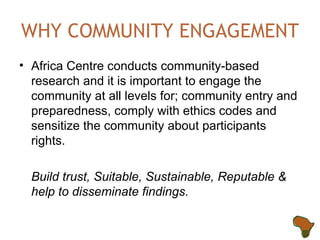
WHY COMMUNITY ENGAGEMENT Africa Centre conducts community-based research and it is important to engage the community at all levels for; community entry and preparedness, comply with ethics codes and sensitize the community about participants rights. Build trust, Suitable, Sustainable, Reputable & help to disseminate findings.
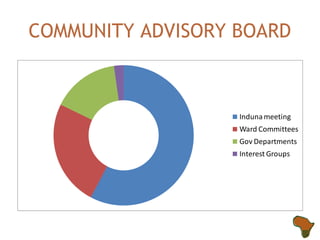
COMMUNITY ADVISORY BOARD
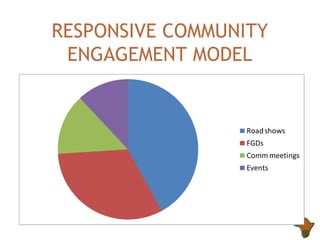
RESPONSIVE COMMUNITY ENGAGEMENT MODEL
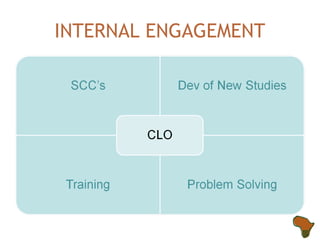
INTERNAL ENGAGEMENT
PLANNED COMMUNITY ENGAGEMENT ACTIVITIES Award for best Isigodi:    CAB’s direct  involvement in mobilising their  izigodi  for participation  -  with the idea of an award to the isigodi with the highest HIV consent rate. CAB as “ghost” participants: How ACDIS ( especially HIV Surveillance ) want to strengthen fieldworker training by way of using CAB members as “ghost” participants. 3. Youth Engagement Project…
YOUTH ENGAGEMENT PROJECT A sports-based community youth  mobilisation , outreach and education strategy to strengthen youth participation in research and research result dissemination. Targeting about 22, 800 youth (male and female) aged 15-35 living within the DSA.
PROJECT COMPONENTS: SPORTS LEAGUE & VCT Sports League: Soccer league of 32 teams for males Netball league of 32 teams for females  A team per  Isigodi Offer HIV rapid testing at each game HIV/AIDS discussions and research information dissemination before and after each game
PROJECT COMPONENTS: WORKSHOPS & ADVISORY CENTRE Series of one day workshops to be held with team representatives to train the trainers in household-based dissemination of research results Establish a Youth Advisory Centre to: provide continuous contact with project provide confidential one-on-one and group HIV/AIDS educational sessions to make referrals to AC based medical staff
PROJECT UPDATE & PROGRESS 2-year Grant awarded by Wellcome Trust Staff recruitment in progress Youth Engagement Coordinator Project Activities to commence 5 th  Jan, 2009 Establish sports league by March, 2009 Establish Youth Advisory Centre by April, 2009 1 st  Youth Workshop by June, 2009
CHALLENGES Striking balance between research and development. Working with the Traditional and Civil leadership. Resources to better reach-out to the intended communities. Realistic turn-around time for intervention.
SUCCESSES The Africa Centre has worked 10 years with one and the same community.  An even better understanding of how research works and the zeal to use evidence based programs  i.e. Qhubekani Primary School  (Mondi) Constantly finding out better and more effective modes of engagement and adjust our approach where necessary.
SIYABONGA

Africa Centre Community Engagement Model

  • 1.
    AFRICA CENTRE: COMMUNITYENGAGEMENT MODEL PREPARED BY Mduduzi F. Mahlinza Community Liaison Manager
  • 2.
    COMMUNITY Community ,refers to people with commonalities like culture, religion, single authority, geographically staying together, socio-economic similarities, ethnicity and physical or health condition. Community engagement or public participation as it is often referred to, is any process that involves the public in problem-solving or decision making and uses the public input to make more informed decisions - International Association for Public Participation
  • 3.
    COMMUNITY PROFILING Rural Traditional Religious Political Unemployed Health challenges
  • 4.
    WHY COMMUNITY ENGAGEMENTAfrica Centre conducts community-based research and it is important to engage the community at all levels for; community entry and preparedness, comply with ethics codes and sensitize the community about participants rights. Build trust, Suitable, Sustainable, Reputable & help to disseminate findings.
  • 5.
  • 6.
  • 7.
  • 8.
    PLANNED COMMUNITY ENGAGEMENTACTIVITIES Award for best Isigodi: CAB’s direct  involvement in mobilising their izigodi for participation - with the idea of an award to the isigodi with the highest HIV consent rate. CAB as “ghost” participants: How ACDIS ( especially HIV Surveillance ) want to strengthen fieldworker training by way of using CAB members as “ghost” participants. 3. Youth Engagement Project…
  • 9.
    YOUTH ENGAGEMENT PROJECTA sports-based community youth mobilisation , outreach and education strategy to strengthen youth participation in research and research result dissemination. Targeting about 22, 800 youth (male and female) aged 15-35 living within the DSA.
  • 10.
    PROJECT COMPONENTS: SPORTSLEAGUE & VCT Sports League: Soccer league of 32 teams for males Netball league of 32 teams for females A team per Isigodi Offer HIV rapid testing at each game HIV/AIDS discussions and research information dissemination before and after each game
  • 11.
    PROJECT COMPONENTS: WORKSHOPS& ADVISORY CENTRE Series of one day workshops to be held with team representatives to train the trainers in household-based dissemination of research results Establish a Youth Advisory Centre to: provide continuous contact with project provide confidential one-on-one and group HIV/AIDS educational sessions to make referrals to AC based medical staff
  • 12.
    PROJECT UPDATE &PROGRESS 2-year Grant awarded by Wellcome Trust Staff recruitment in progress Youth Engagement Coordinator Project Activities to commence 5 th Jan, 2009 Establish sports league by March, 2009 Establish Youth Advisory Centre by April, 2009 1 st Youth Workshop by June, 2009
  • 13.
    CHALLENGES Striking balancebetween research and development. Working with the Traditional and Civil leadership. Resources to better reach-out to the intended communities. Realistic turn-around time for intervention.
  • 14.
    SUCCESSES The AfricaCentre has worked 10 years with one and the same community. An even better understanding of how research works and the zeal to use evidence based programs i.e. Qhubekani Primary School (Mondi) Constantly finding out better and more effective modes of engagement and adjust our approach where necessary.
  • 15.