
High Level Fusion and
   Predictive Situational
     Awareness with
  Probabilistic Ontologies
Paulo Costa, KC Chang, Kathryn Laskey, & Rommel Carvalho
                 Center of Excellence in C4I
                  George Mason University


                                                           1
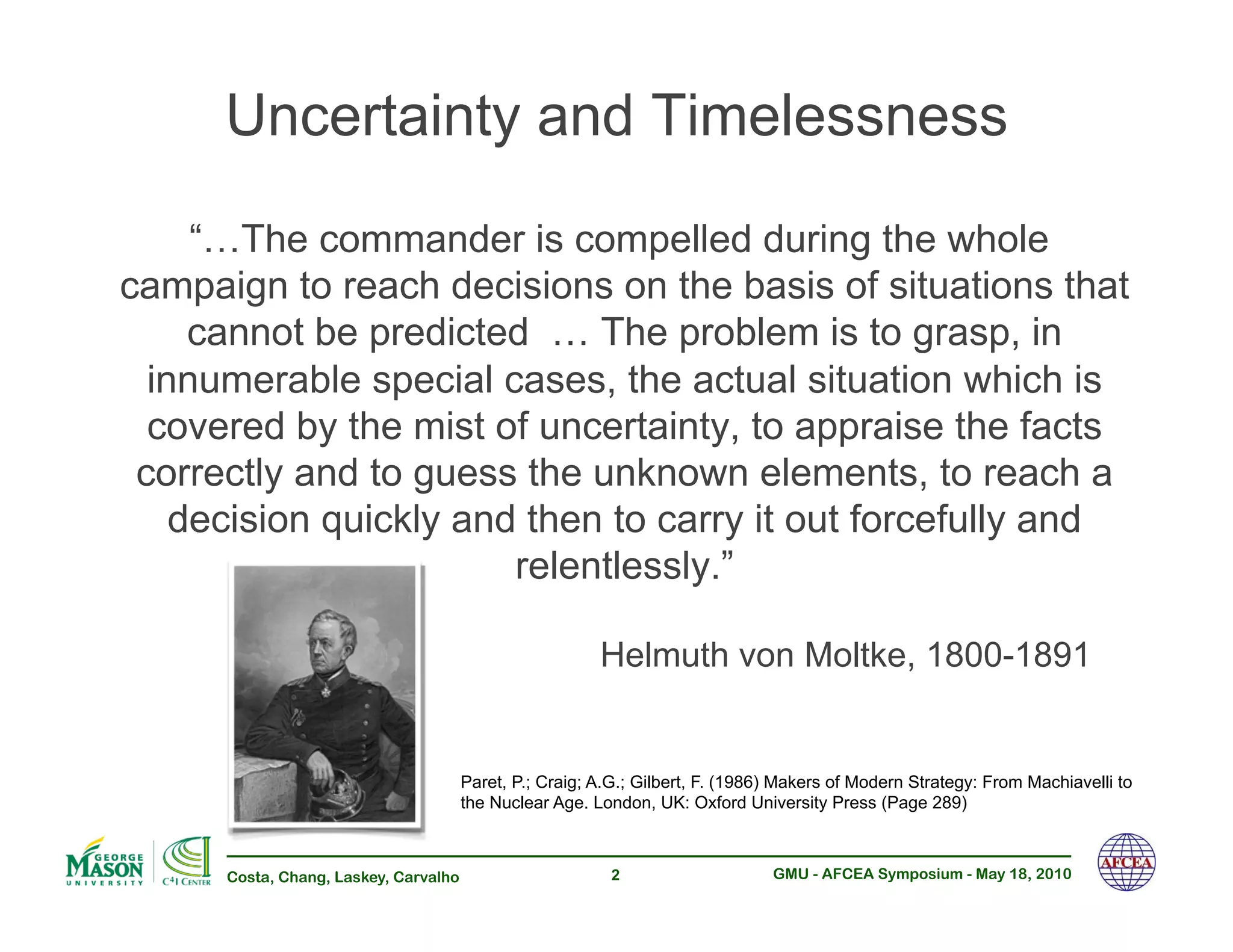
Uncertainty and Timelessness
     “…The commander is compelled during the whole
campaign to reach decisions on the basis of situations that
     cannot be predicted … The problem is to grasp, in
  innumerable special cases, the actual situation which is
  covered by the mist of uncertainty, to appraise the facts
 correctly and to guess the unknown elements, to reach a
    decision quickly and then to carry it out forcefully and
                        relentlessly.”

                                                         Helmuth von Moltke, 1800-1891


                                       Paret, P.; Craig; A.G.; Gilbert, F. (1986) Makers of Modern Strategy: From Machiavelli to
                                       the Nuclear Age. London, UK: Oxford University Press (Page 289)


      Costa, Chang, Laskey, Carvalho                      2                     GMU - AFCEA Symposium - May 18, 2010
Agenda
  •!Knowledge Exchange in C                              2


  •!Ontologies
  •!Probabilistic Ontologies
  •!Case Study: PROGNOS


Costa, Chang, Laskey, Carvalho     3      GMU - AFCEA Symposium - May 18, 2010
What is Preventing True Netcentricity?

•! Inability to produce a dynamic, comprehensive, and
   accurate battlespace picture for the warfighter that
   integrates tactical data from multiple intelligence
   sources.
•! Lack of automated techniques to integrate data
   (geolocation, detection, and identification) from multiple
   intelligence sources, in a consistent and timely manner.
•! Lack of accurate and timely information about
   battlespace objects and events to support warfighter
   decision making in an asymmetric warfare.


      Costa, Chang, Laskey, Carvalho   4   GMU - AFCEA Symposium - May 18, 2010
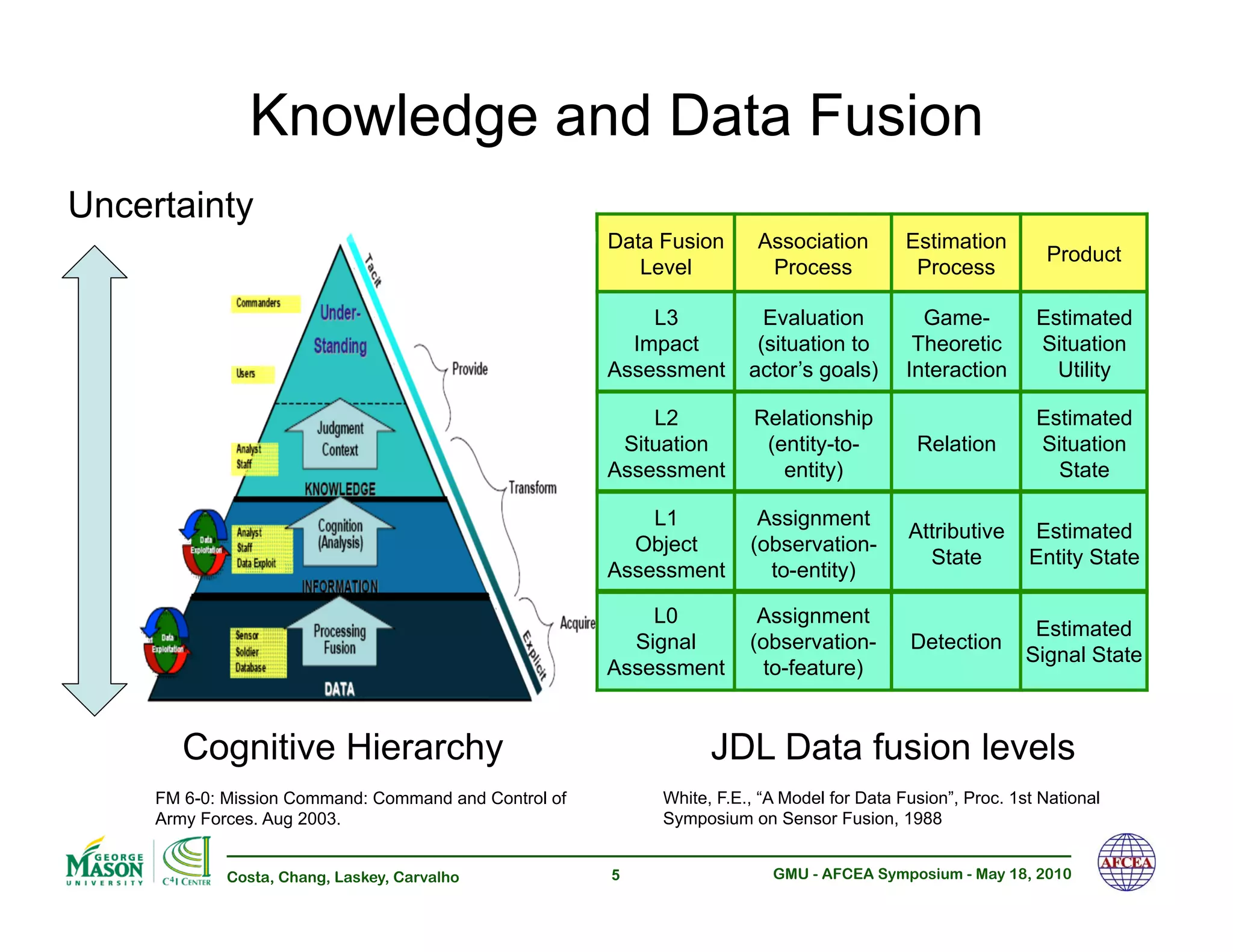
Knowledge and Data Fusion
Uncertainty
                                                       Data Fusion      Association         Estimation
                                                                                                              Product
                                                          Level          Process             Process

                                                           L3            Evaluation           Game-          Estimated
                                                         Impact         (situation to        Theoretic       Situation
                                                       Assessment      actor’s goals)       Interaction        Utility

                                                           L2           Relationship                         Estimated
                                                        Situation        (entity-to-         Relation        Situation
                                                       Assessment          entity)                             State

                                                           L1           Assignment
                                                                                            Attributive      Estimated
                                                         Object        (observation-
                                                                                              State         Entity State
                                                       Assessment        to-entity)

                                                           L0           Assignment
                                                                                                             Estimated
                                                         Signal        (observation-        Detection
                                                                                                            Signal State
                                                       Assessment        to-feature)


        Cognitive Hierarchy                                       JDL Data fusion levels
     FM 6-0: Mission Command: Command and Control of        White, F.E., “A Model for Data Fusion”, Proc. 1st National
     Army Forces. Aug 2003.                                 Symposium on Sensor Fusion, 1988


             Costa, Chang, Laskey, Carvalho            5                  GMU - AFCEA Symposium - May 18, 2010
Shortfalls of Current Approaches

•! Either cannot achieve fusion levels 2 and above
   (JDL model), or can do so only in controlled
   environments (limited scalability and expressivity).
•! Limited ability to cope with uncertainty, typically
   ignoring or mishandling it.
•! Can handle only standardized messages, special
   -case scenarios, and specific sensor types, leading
    to interoperability issues and less than optimal use
    of available information.


    Costa, Chang, Laskey, Carvalho   6   GMU - AFCEA Symposium - May 18, 2010
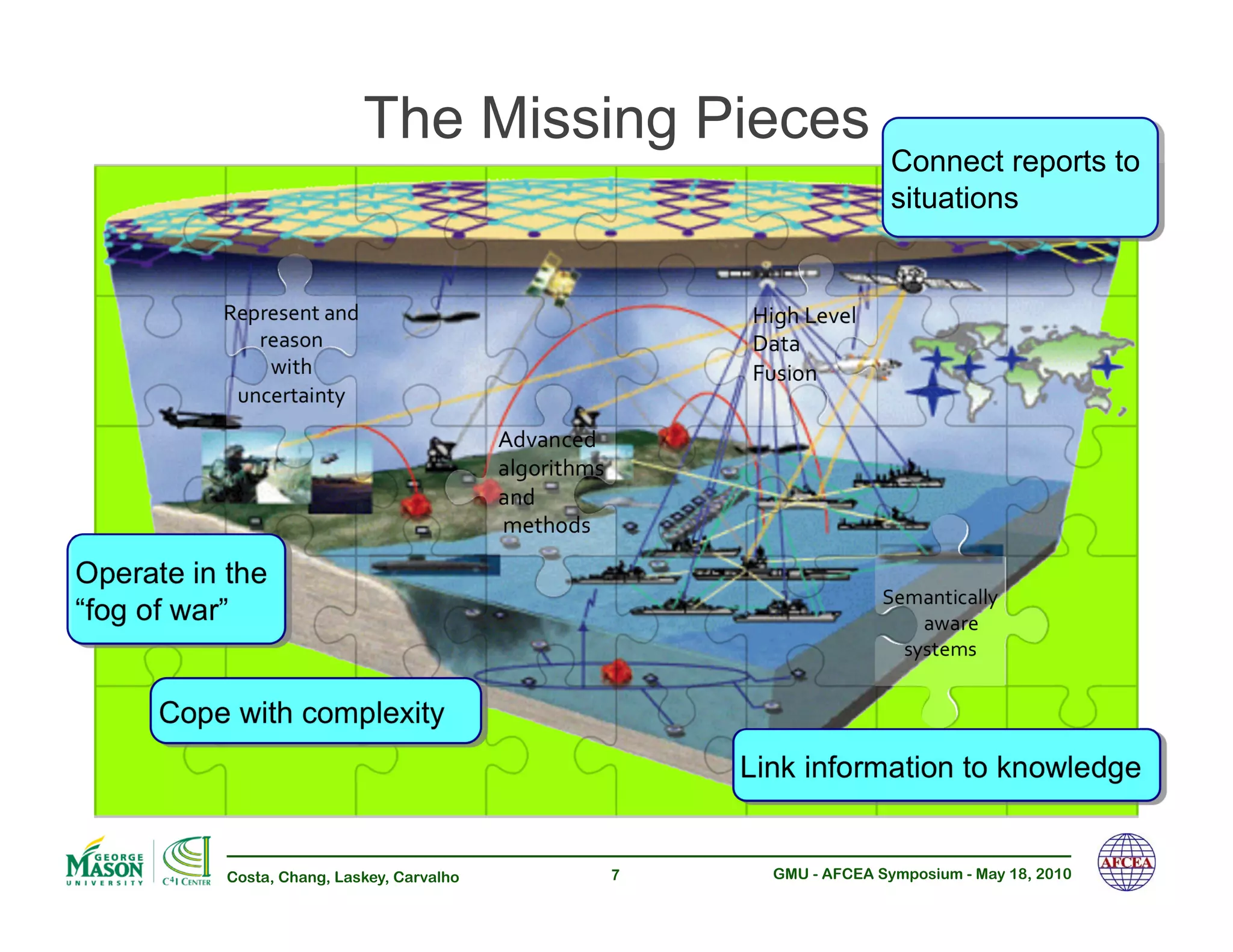
The Missing Pieces
                                                                              Connect reports to
                                                                              situations


          !"#$"%"&'()&*(                                      8-7.(9"6"4((
             $")%+&((                                         :)')((
              ,-'.(                                           ;/%-+&(
           /&0"$')-&'1(
                                            5*6)&0"*(
                                            )47+$-'.3%(
                                            )&*(
                                            (3"'.+*%(

Operate in the
                                                                             2"3)&'-0)441(
“fog of war”                                                                   (((((),)$"(
                                                                               %1%'"3%(


      Cope with complexity
                                                              Link information to knowledge


           Costa, Chang, Laskey, Carvalho                 7     GMU - AFCEA Symposium - May 18, 2010
The Way Forward
•! Rigorous mathematical foundation and efficient algorithms to
   combine data from diverse sources for reliable predictive
   situation assessment
•! Automated techniques to reduce warfighter's information
   processing load and provide timely actionable knowledge to
   decision makers
•! Interoperable methodologies for propagating uncertainty
   through the integration process to characterize and
   distinguish situational conditions for predictive analysis and
   impact assessment under various behaviors and
   environments
•! Semantically aware systems for interoperability in net-centric
   environment


      Costa, Chang, Laskey, Carvalho   8   GMU - AFCEA Symposium - May 18, 2010
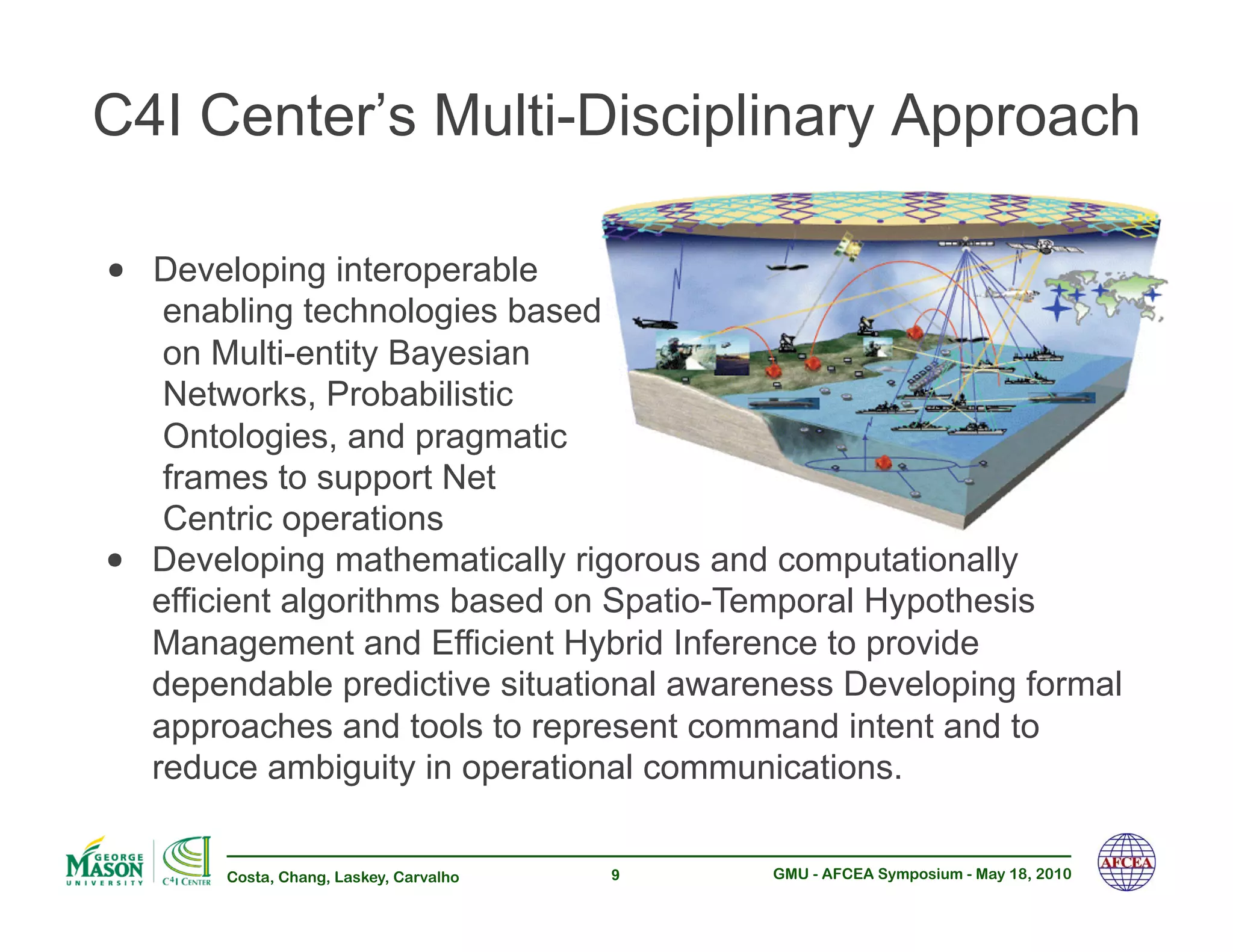
C4I Center’s Multi-Disciplinary Approach

•! Developing interoperable
      enabling technologies based
      on Multi-entity Bayesian
      Networks, Probabilistic
      Ontologies, and pragmatic
      frames to support Net
      Centric operations
•!   Developing mathematically rigorous and computationally
     efficient algorithms based on Spatio-Temporal Hypothesis
     Management and Efficient Hybrid Inference to provide
     dependable predictive situational awareness Developing formal
     approaches and tools to represent command intent and to
     reduce ambiguity in operational communications.

         Costa, Chang, Laskey, Carvalho   9   GMU - AFCEA Symposium - May 18, 2010
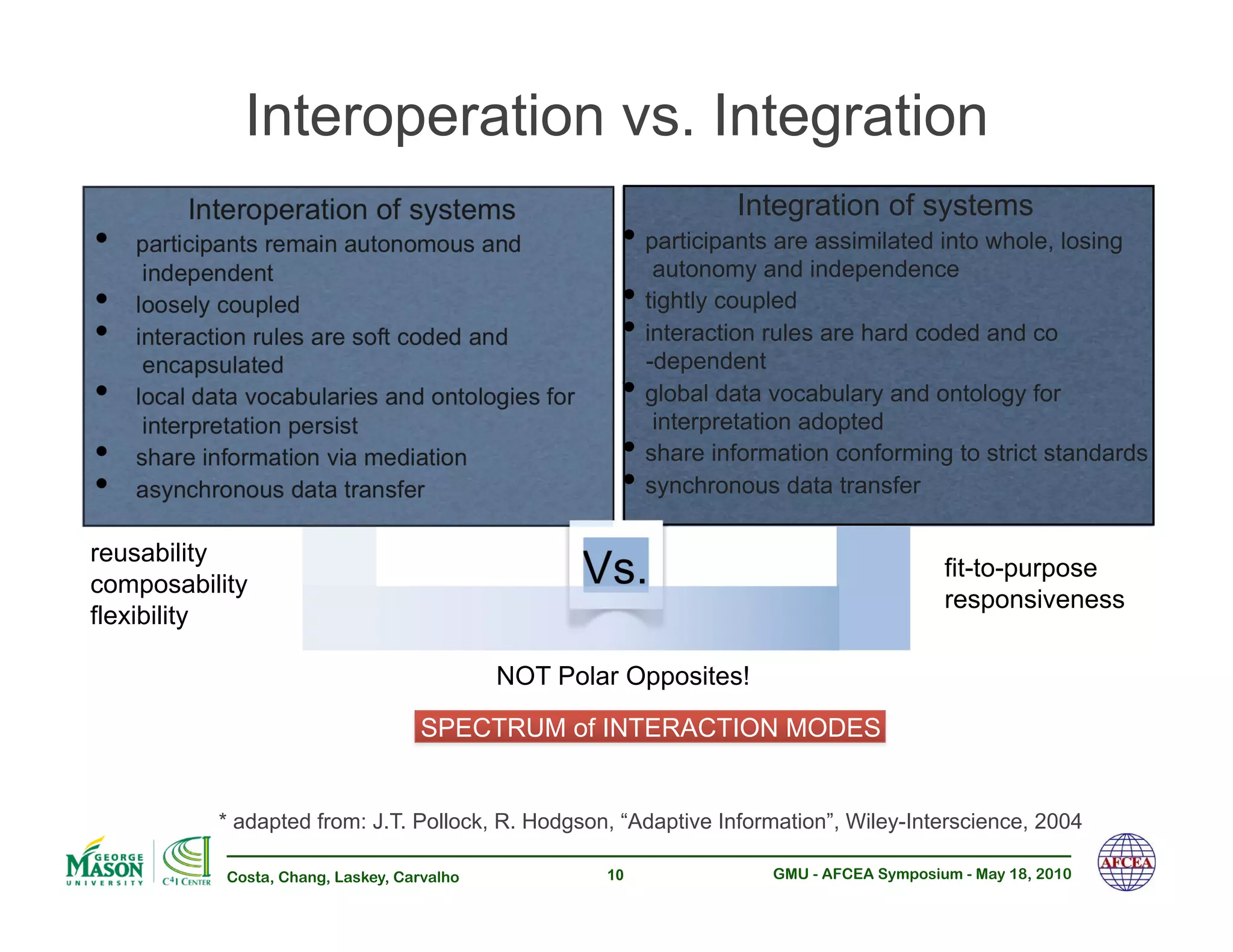
Interoperation vs. Integration
         Interoperation of systems                                Integration of systems
•!   participants remain autonomous and                •! participants are assimilated into whole, losing
                                                       •!participants are assimilated into whole,
      independent                                      losing autonomyindependence
                                                            autonomy and and independence
•!   loosely coupled                                   •!ightly coupled
                                                       •!t
                                                           tightly coupled
•!   interaction rules are soft coded and              •!nteraction rules are hard coded and coco-
                                                           interaction rules
                                                       •!i -dependent        are hard coded and
      encapsulated
•!   local data vocabularies and ontologies for        •! global data
                                                       dependent vocabulary and ontology for
      interpretation persist                           •!global data vocabulary and ontology for
                                                            interpretation adopted
•!   share information via mediation                   •! share information conforming to strict standards
                                                       interpretation adopted
•!   asynchronous data transfer                        •! synchronous data transfer
                                                       •!share information conforming to strict stand

reusability
composability                                       Vs.                                  fit-to-purpose
                                                                                         responsiveness
flexibility

                                              NOT Polar Opposites!

                                     SPECTRUM of INTERACTION MODES


            * adapted from: J.T. Pollock, R. Hodgson, “Adaptive Information”, Wiley-Interscience, 2004

             Costa, Chang, Laskey, Carvalho           10             GMU - AFCEA Symposium - May 18, 2010
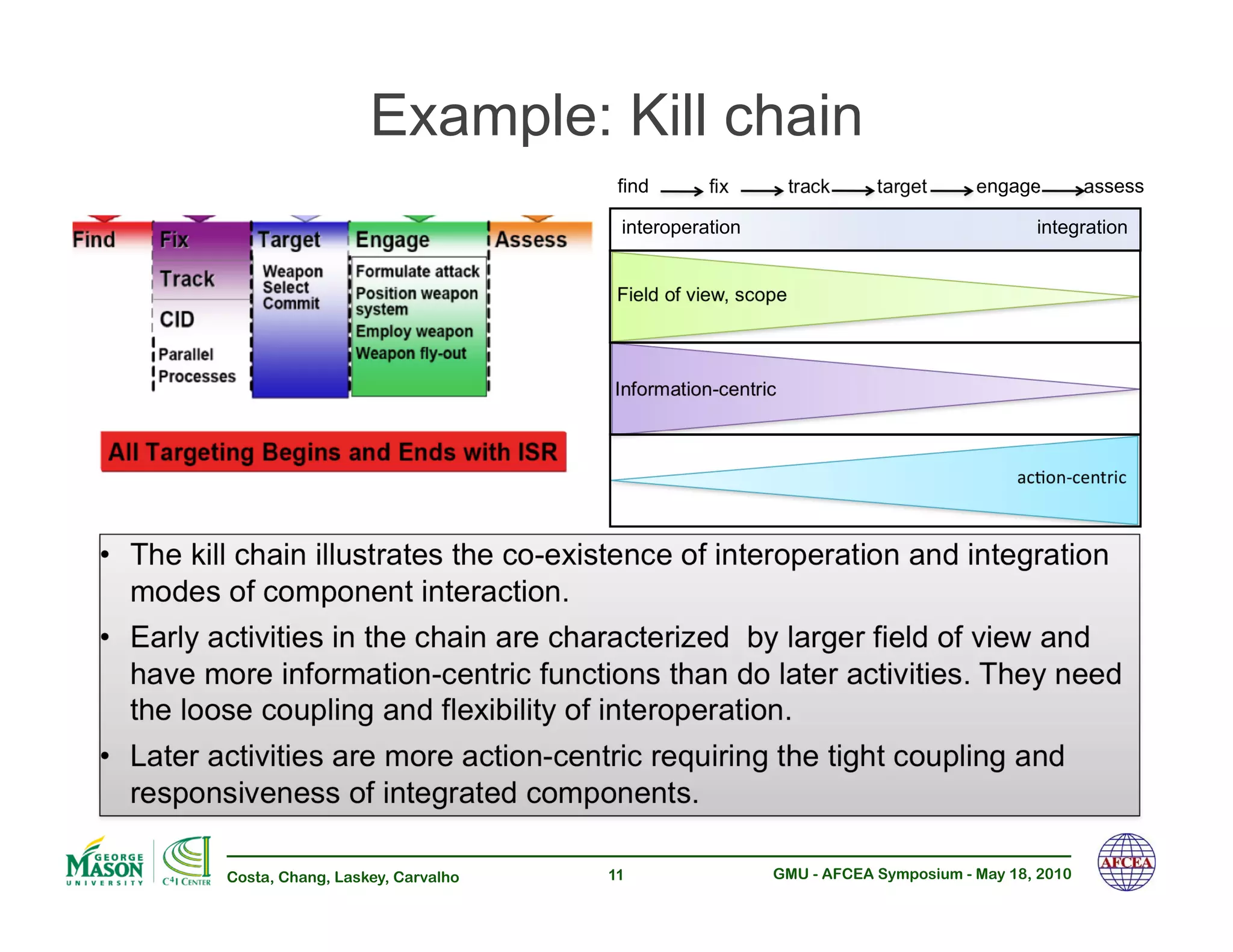
Example: Kill chain
                                           find      fix          track   target     engage         assess

                                           interoperation                                   integration


                                           Field of view, scope


                                          Information-centric


                                                                                          !"#$%&"'%()*"+


•! The kill chain illustrates the co-existence of interoperation and integration
   modes of component interaction.
•! Early activities in the chain are characterized by larger field of view and
   have more information-centric functions than do later activities. They need
   the loose coupling and flexibility of interoperation.
•! Later activities are more action-centric requiring the tight coupling and
   responsiveness of integrated components.

         Costa, Chang, Laskey, Carvalho   11                 GMU - AFCEA Symposium - May 18, 2010
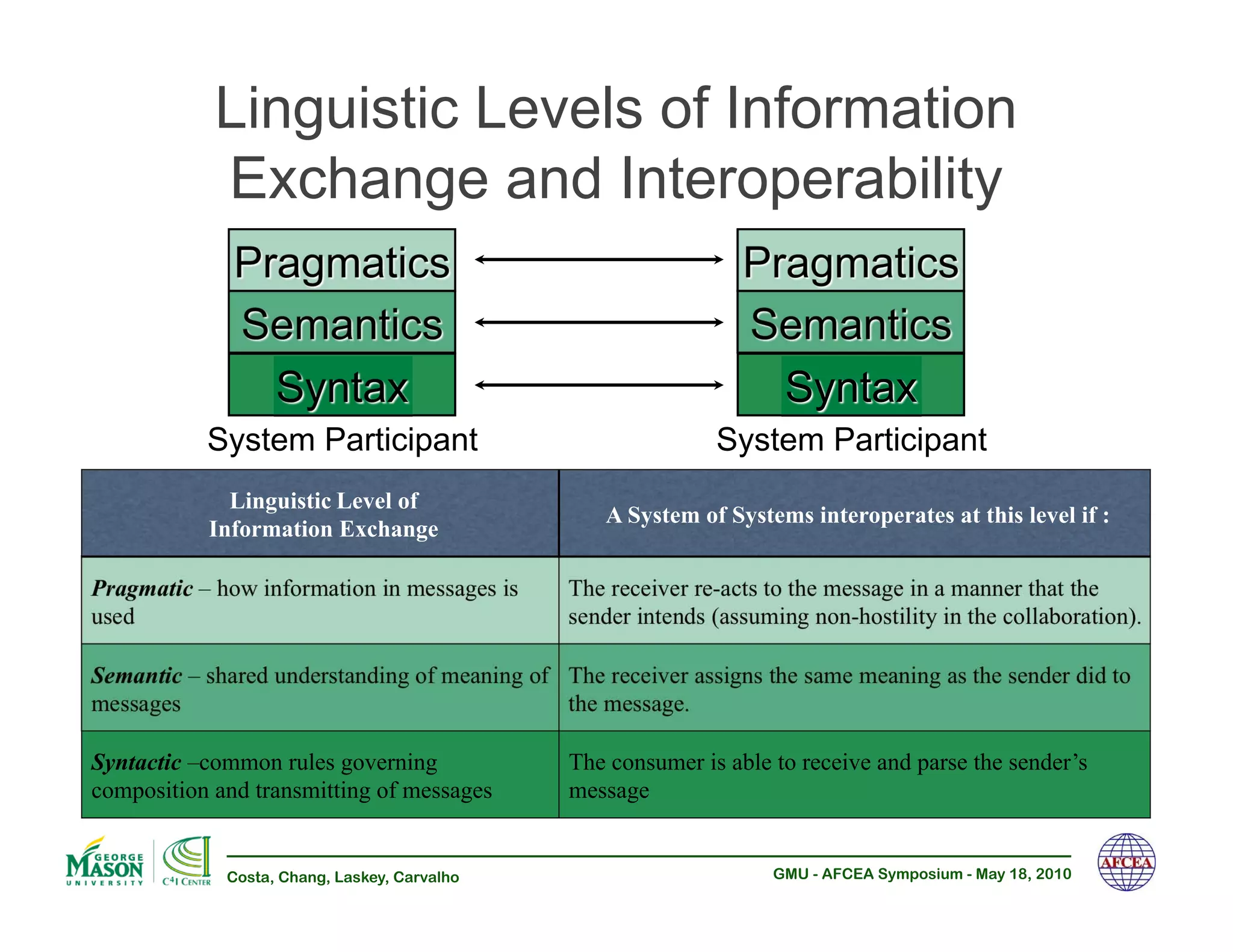
Linguistic Levels of Information
            Exchange and Interoperability


           System Participant                                 System Participant
             Linguistic Level of     !             A System of Systems interoperates at this level if :
           Information Exchange

Pragmatic – how information in messages is     The receiver re-acts to the message in a manner that the
used                                           sender intends (assuming non-hostility in the collaboration).

Semantic – shared understanding of meaning of The receiver assigns the same meaning as the sender did to
messages                                      the message.

Syntactic –common rules governing              The consumer is able to receive and parse the sender’s
composition and transmitting of messages       message


             Costa, Chang, Laskey, Carvalho                         GMU - AFCEA Symposium - May 18, 2010
Agenda
  •!Knowledge Exchange in C                              2


  •!Ontologies
  •!Probabilistic Ontologies
  •!Case Study: PROGNOS


Costa, Chang, Laskey, Carvalho     13     GMU - AFCEA Symposium - May 18, 2010
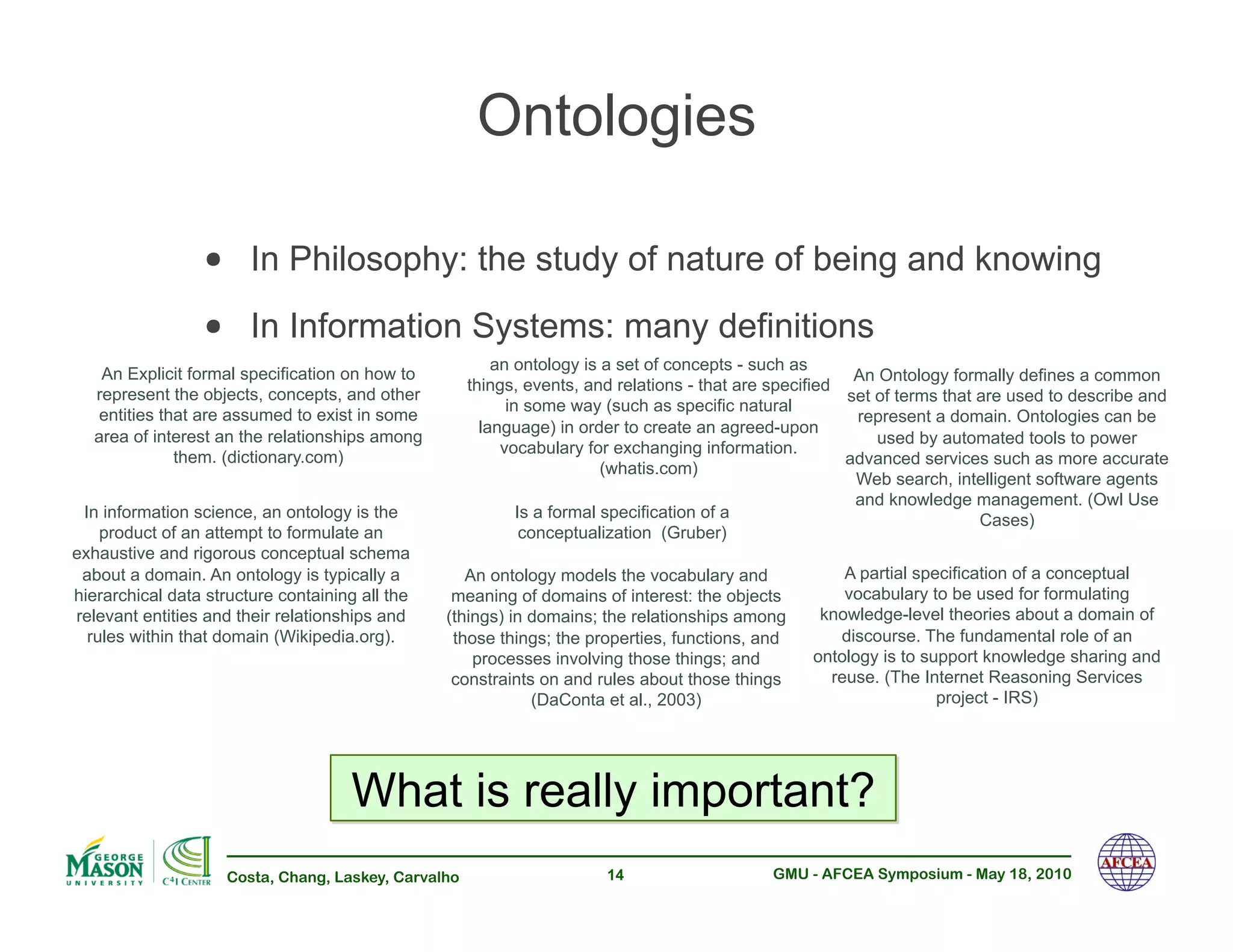
Ontologies

                 •! In Philosophy: the study of nature of being and knowing
                 •! In Information Systems: many definitions
                                                          an ontology is a set of concepts - such as
    An Explicit formal specification on how to                                                            An Ontology formally defines a common
                                                      things, events, and relations - that are specified
   represent the objects, concepts, and other                                                            set of terms that are used to describe and
                                                            in some way (such as specific natural
    entities that are assumed to exist in some                                                            represent a domain. Ontologies can be
                                                        language) in order to create an agreed-upon
   area of interest an the relationships among                                                               used by automated tools to power
                                                           vocabulary for exchanging information.
               them. (dictionary.com)                                                                    advanced services such as more accurate
                                                                          (whatis.com)
                                                                                                          Web search, intelligent software agents
                                                                                                          and knowledge management. (Owl Use
 In information science, an ontology is the                   Is a formal specification of a                               Cases)
    product of an attempt to formulate an                      conceptualization (Gruber)
exhaustive and rigorous conceptual schema
 about a domain. An ontology is typically a         An ontology models the vocabulary and              A partial specification of a conceptual
hierarchical data structure containing all the    meaning of domains of interest: the objects          vocabulary to be used for formulating
relevant entities and their relationships and    (things) in domains; the relationships among       knowledge-level theories about a domain of
  rules within that domain (Wikipedia.org).       those things; the properties, functions, and        discourse. The fundamental role of an
                                                     processes involving those things; and         ontology is to support knowledge sharing and
                                                  constraints on and rules about those things        reuse. (The Internet Reasoning Services
                                                             (DaConta et al., 2003)                                 project - IRS)


                                      What is really important?
                     Costa, Chang, Laskey, Carvalho                     14                    GMU - AFCEA Symposium - May 18, 2010
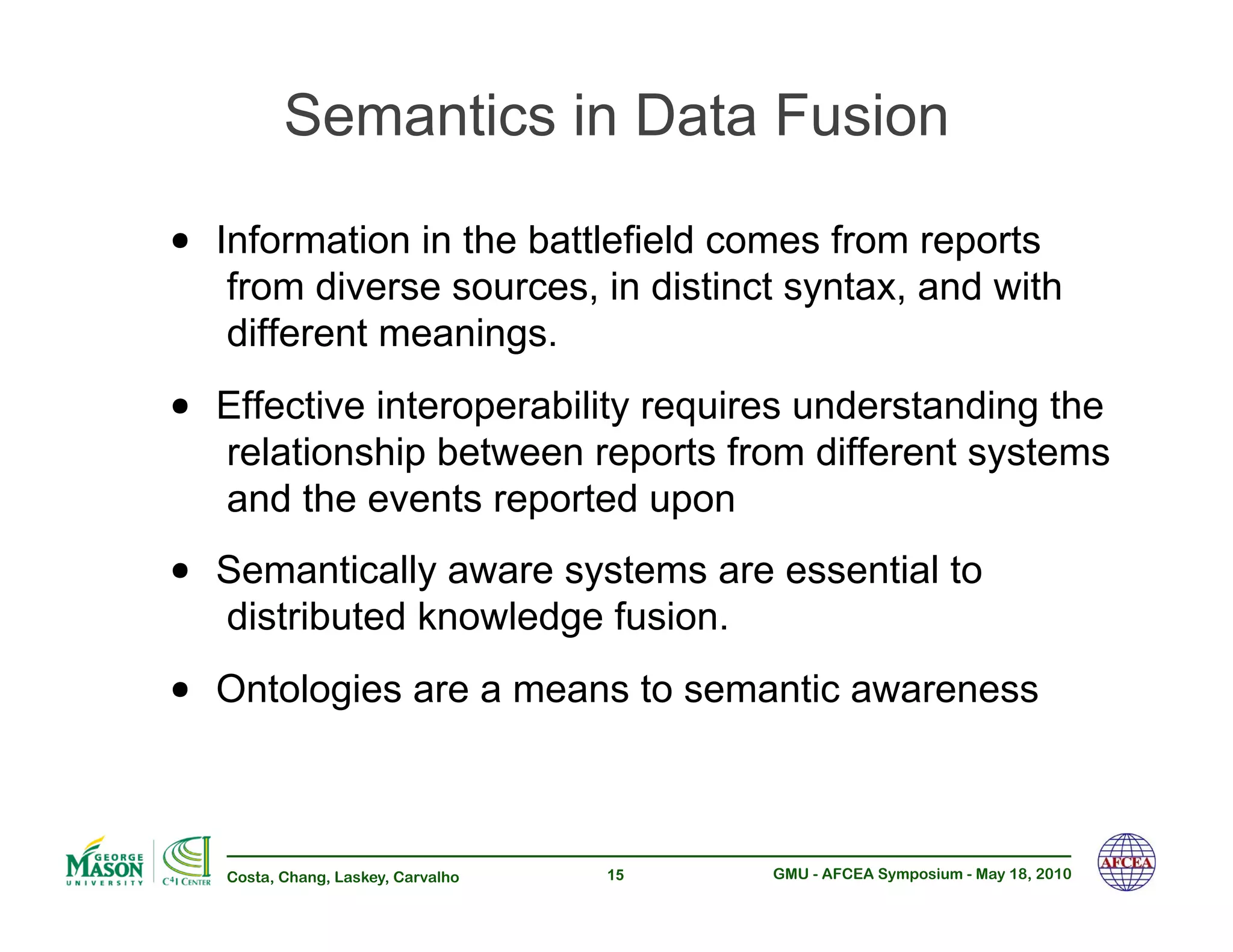
Semantics in Data Fusion

•! Information in the battlefield comes from reports
   from diverse sources, in distinct syntax, and with
   different meanings.
•! Effective interoperability requires understanding the
   relationship between reports from different systems
   and the events reported upon
•! Semantically aware systems are essential to
   distributed knowledge fusion.
•! Ontologies are a means to semantic awareness

   Costa, Chang, Laskey, Carvalho   15   GMU - AFCEA Symposium - May 18, 2010
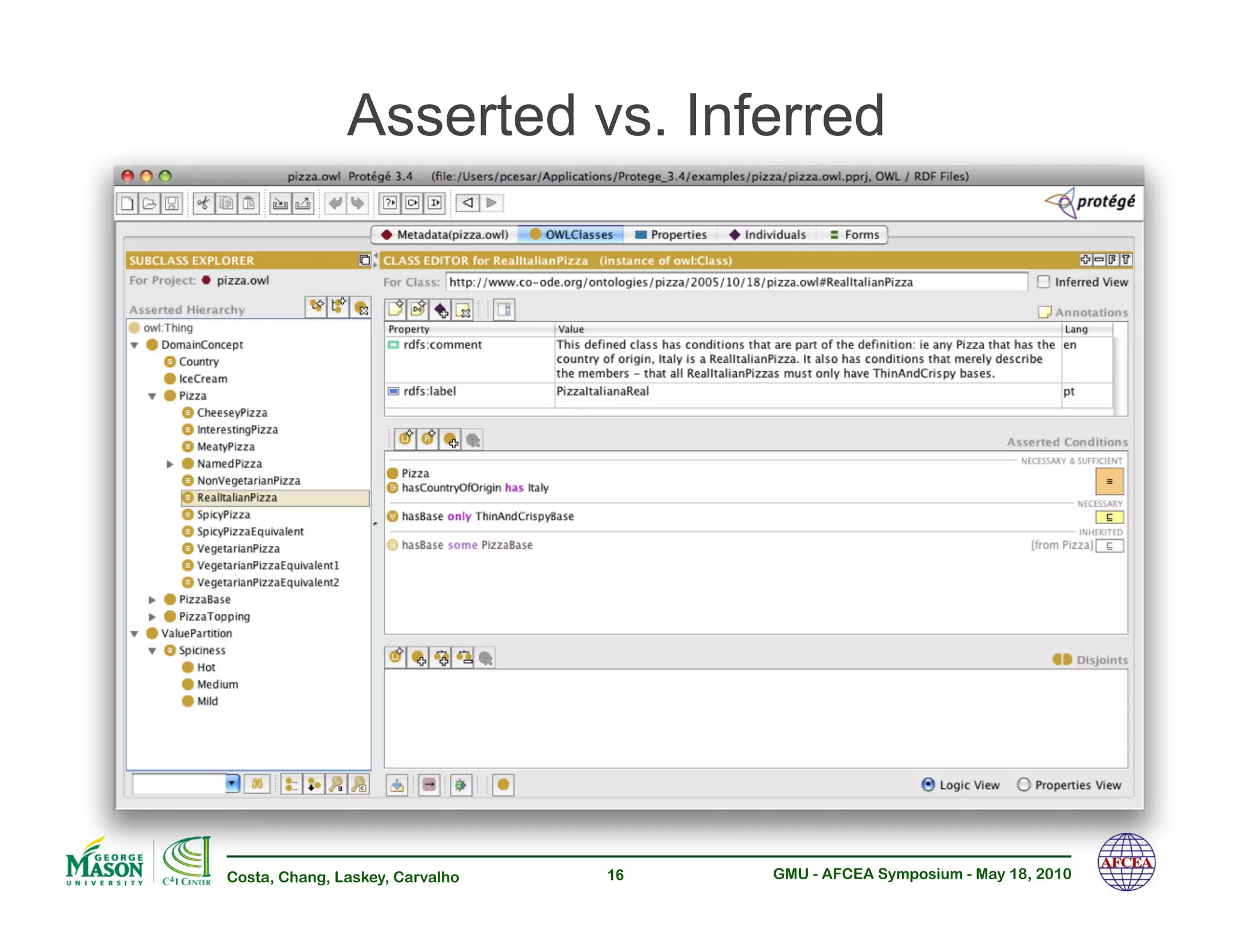
Asserted vs. Inferred


Costa, Chang, Laskey, Carvalho   16   GMU - AFCEA Symposium - May 18, 2010
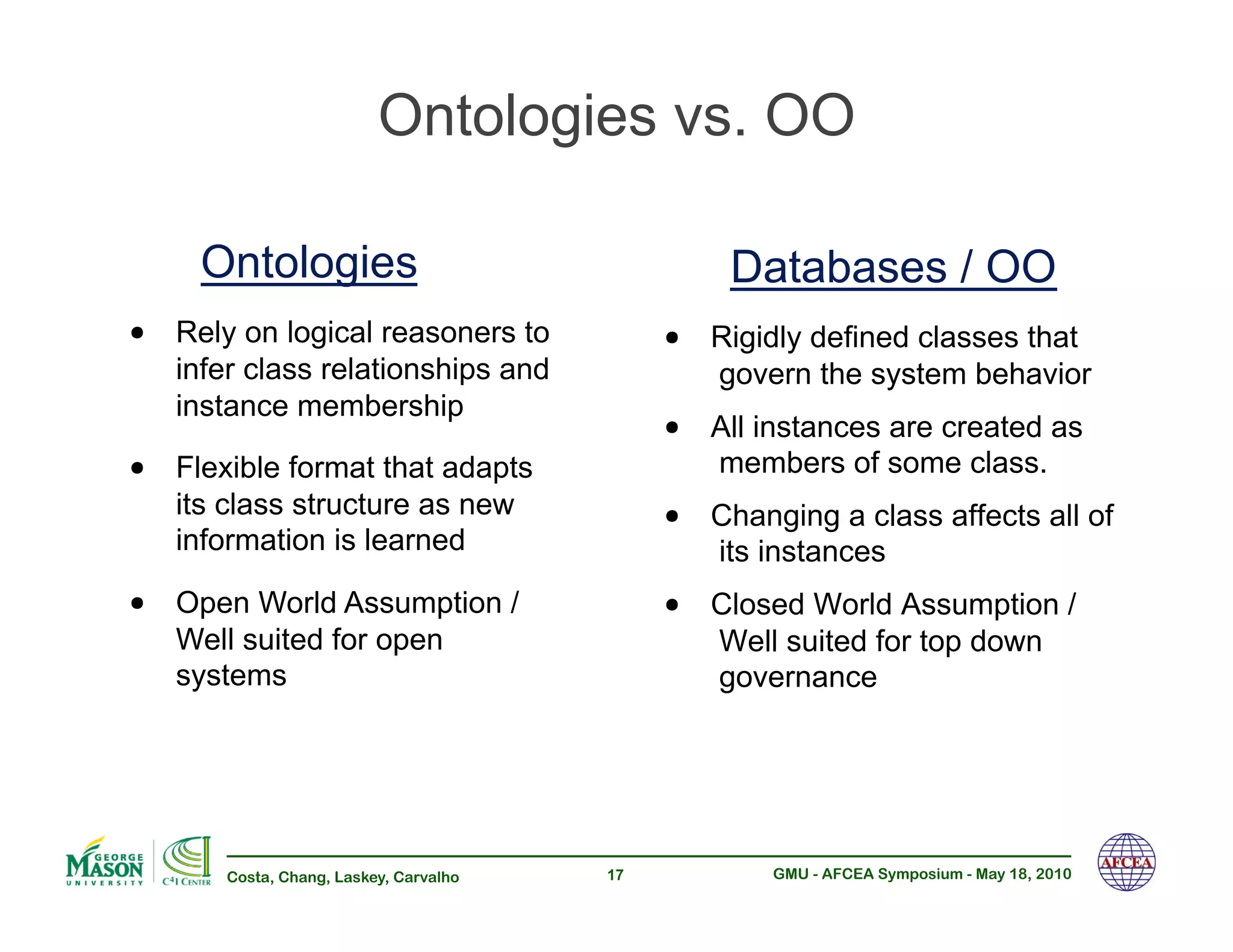
Ontologies vs. OO

      Ontologies                                    Databases / OO
•!   Rely on logical reasoners to             •!   Rigidly defined classes that
     infer class relationships and                 govern the system behavior
     instance membership
                                              •!   All instances are created as
•!   Flexible format that adapts                   members of some class.
     its class structure as new
     information is learned
                                              •!   Changing a class affects all of
                                                   its instances
•!   Open World Assumption /                  •!   Closed World Assumption /
     Well suited for open                          Well suited for top down
     systems                                       governance


        Costa, Chang, Laskey, Carvalho   17            GMU - AFCEA Symposium - May 18, 2010
Ontologies and Uncertainty

•! There are many kinds of uncertainty, e.g.:
  !!   Noise in sensors
  !!   Incorrect, incomplete, deceptive human intelligence
  !!   Lack of understanding of cause and effect mechanisms in the world

•! Representing and reasoning with uncertainty is essential
•! But...


          Costa, Chang, Laskey, Carvalho   18   GMU - AFCEA Symposium - May 18, 2010
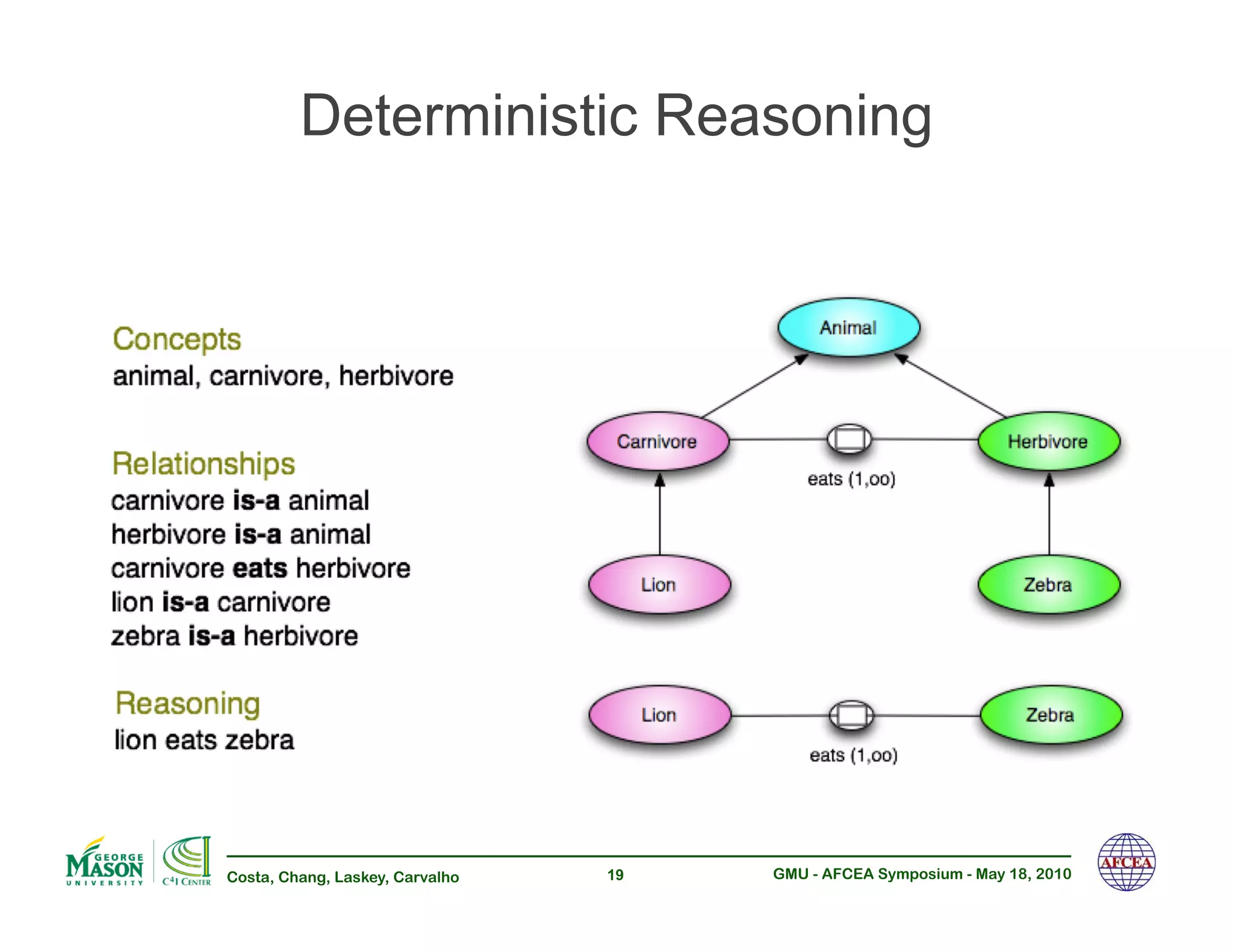
Deterministic Reasoning


Costa, Chang, Laskey, Carvalho   19   GMU - AFCEA Symposium - May 18, 2010
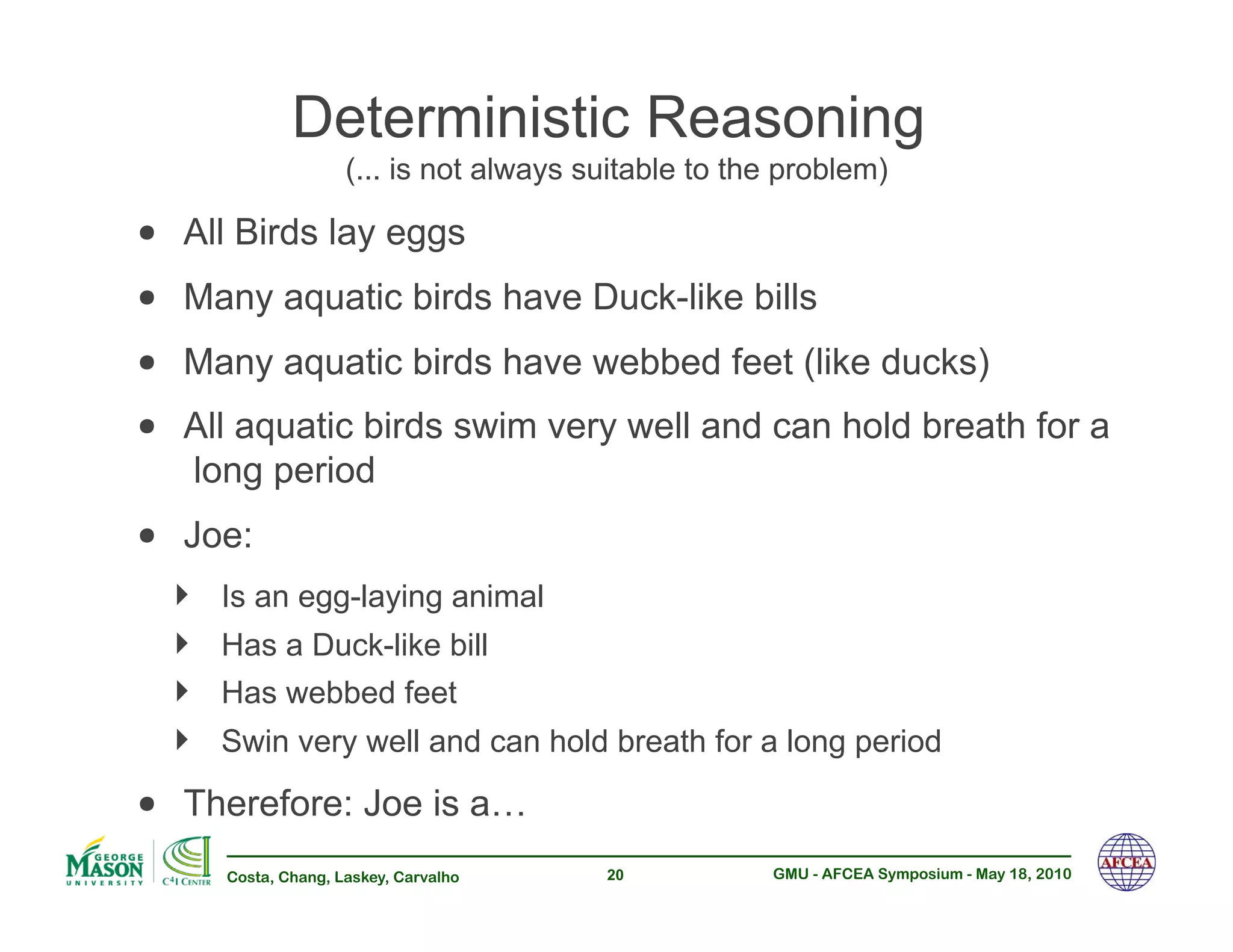
Deterministic Reasoning
                      (... is not always suitable to the problem)

•! All Birds lay eggs
•! Many aquatic birds have Duck-like bills
•! Many aquatic birds have webbed feet (like ducks)
•! All aquatic birds swim very well and can hold breath for a
   long period
•! Joe:
  !!   Is an egg-laying animal
  !!   Has a Duck-like bill
  !!   Has webbed feet
  !!   Swin very well and can hold breath for a long period

•! Therefore: Joe is a…
       Costa, Chang, Laskey, Carvalho     20           GMU - AFCEA Symposium - May 18, 2010
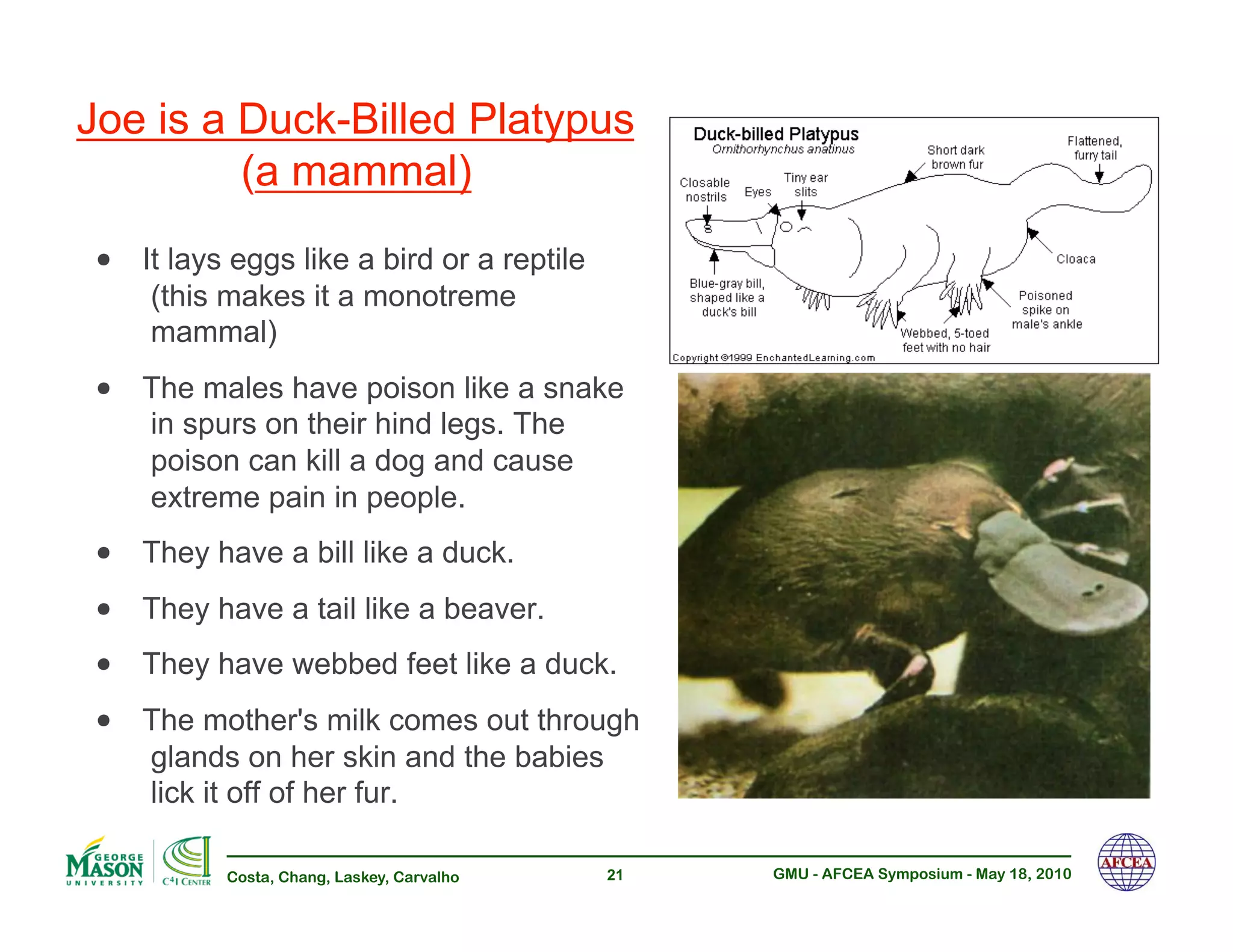
Joe is a Duck-Billed Platypus
         (a mammal)
•!   It lays eggs like a bird or a reptile
      (this makes it a monotreme
      mammal)
•!   The males have poison like a snake
     in spurs on their hind legs. The
     poison can kill a dog and cause
     extreme pain in people.
•!   They have a bill like a duck.
•!   They have a tail like a beaver.
•!   They have webbed feet like a duck.
•!   The mother's milk comes out through
     glands on her skin and the babies
     lick it off of her fur.

            Costa, Chang, Laskey, Carvalho   21   GMU - AFCEA Symposium - May 18, 2010
Agenda
  •!Knowledge Exchange in C                              2


  •!Ontologies
  •!Probabilistic Ontologies
  •!Case Study: PROGNOS


Costa, Chang, Laskey, Carvalho     22     GMU - AFCEA Symposium - May 18, 2010
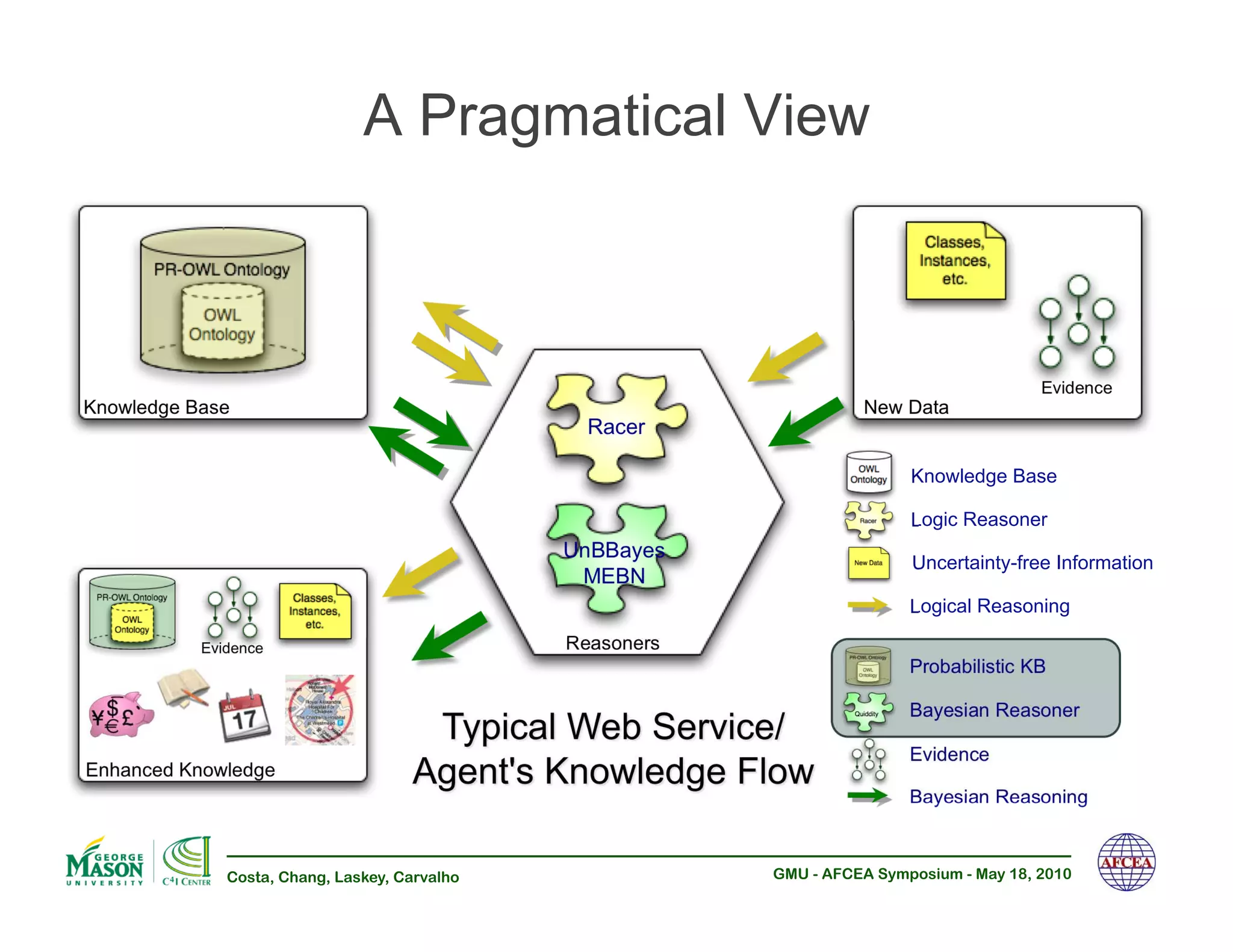
A Pragmatical View


                                                                                           Evidence
Knowledge Base                                                       New Data
                                                 Racer

                                                                           Knowledge Base

                                                                           Logic Reasoner
                                               UnBBayes
                                                                           Uncertainty-free Information
                                                MEBN
                                                                           Logical Reasoning

           Evidence                            Reasoners
                                                                           Probabilistic KB

                                                                           Bayesian Reasoner

                                                                           Evidence
Enhanced Knowledge
                                                                           Bayesian Reasoning


              Costa, Chang, Laskey, Carvalho               GMU - AFCEA Symposium - May 18, 2010
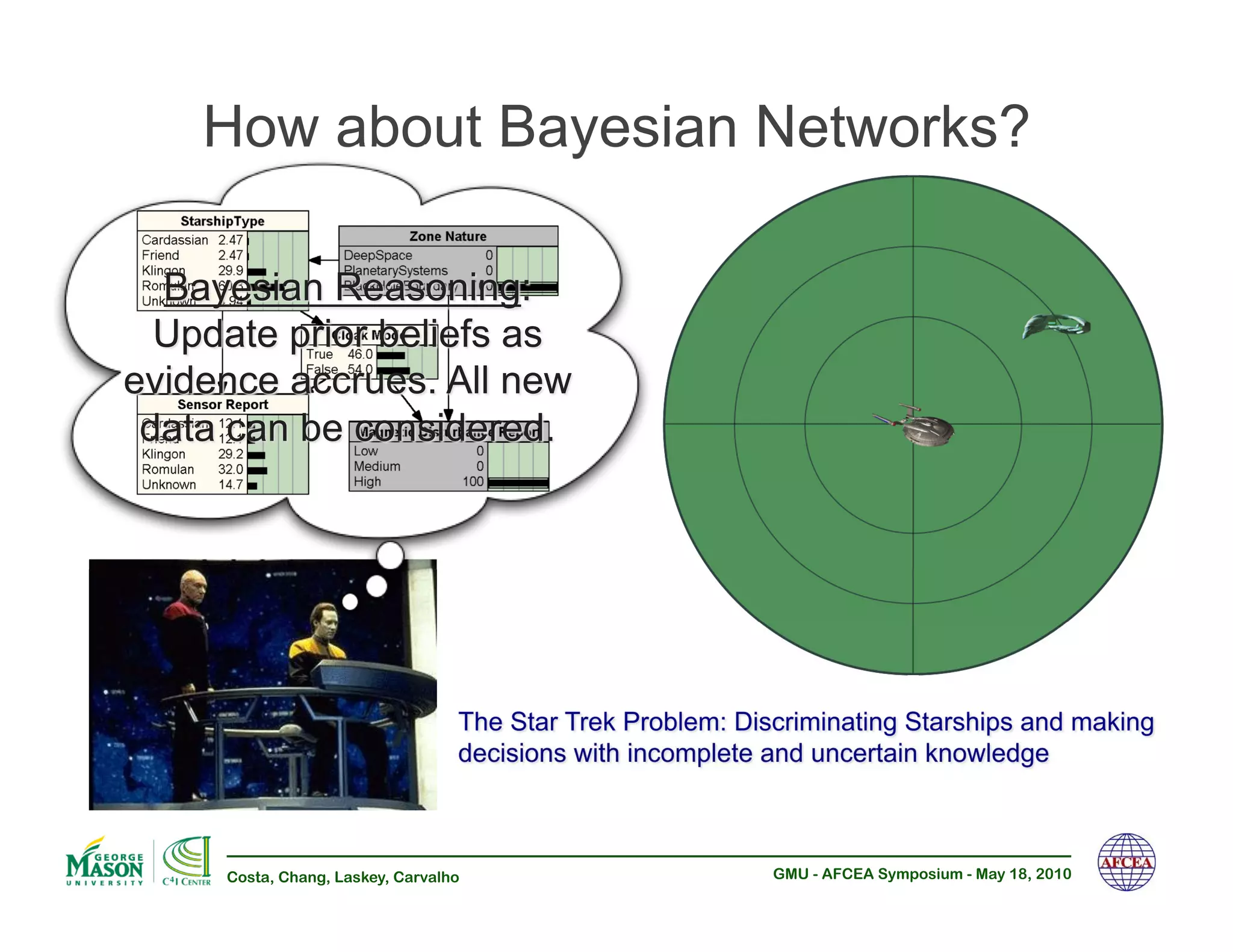
How about Bayesian Networks?


Costa, Chang, Laskey, Carvalho   GMU - AFCEA Symposium - May 18, 2010
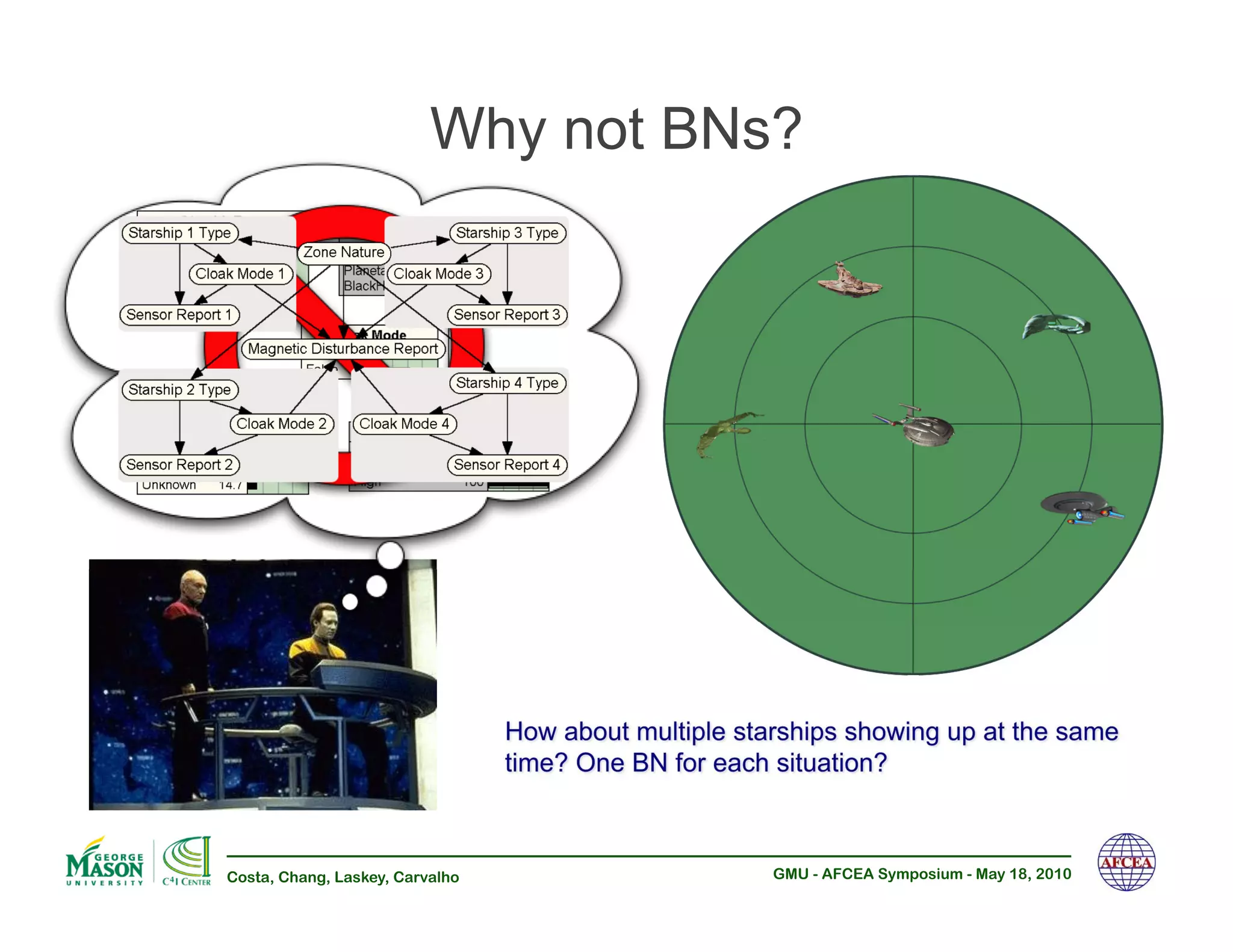
Why not BNs?


Costa, Chang, Laskey, Carvalho       GMU - AFCEA Symposium - May 18, 2010
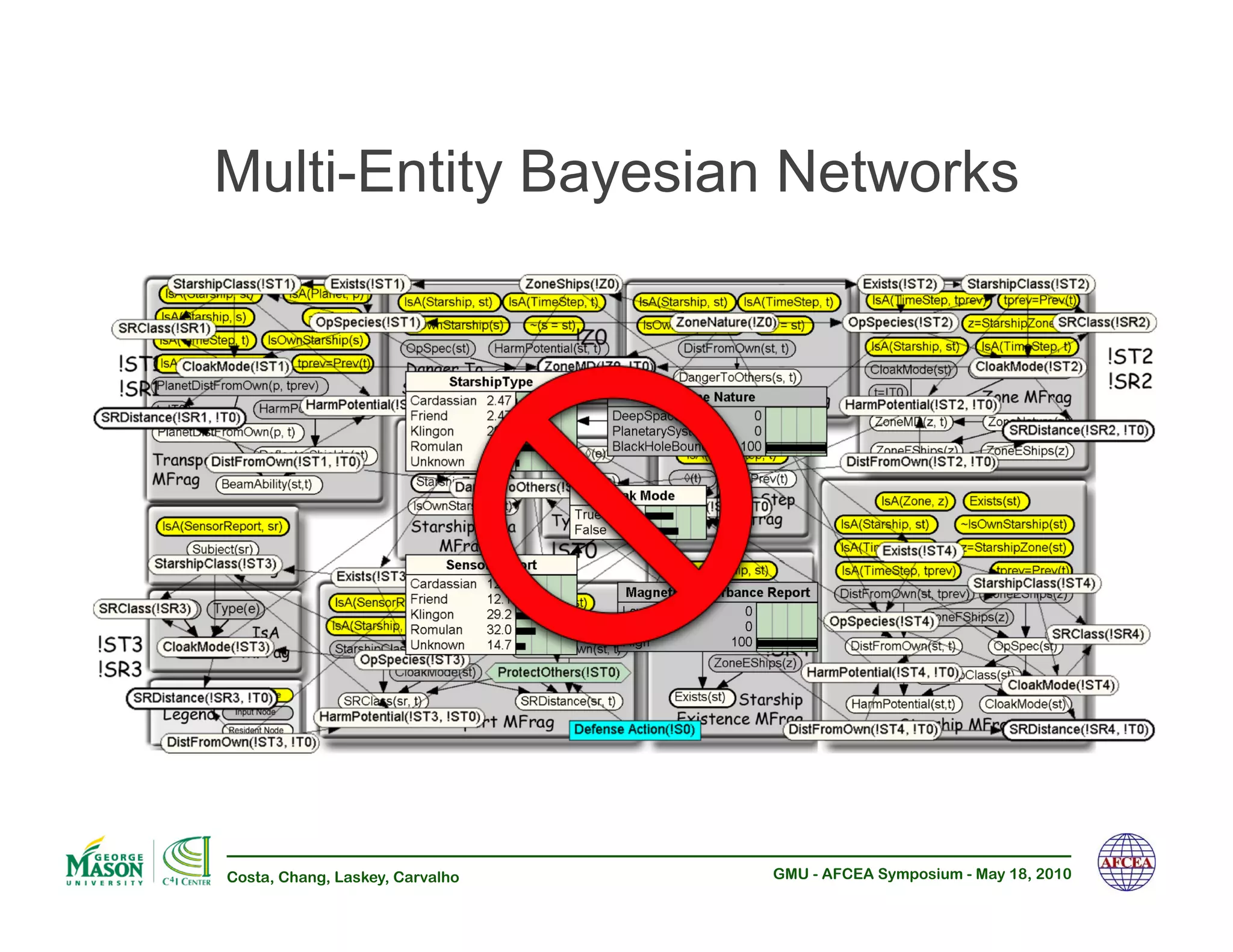
Multi-Entity Bayesian Networks


Costa, Chang, Laskey, Carvalho   GMU - AFCEA Symposium - May 18, 2010
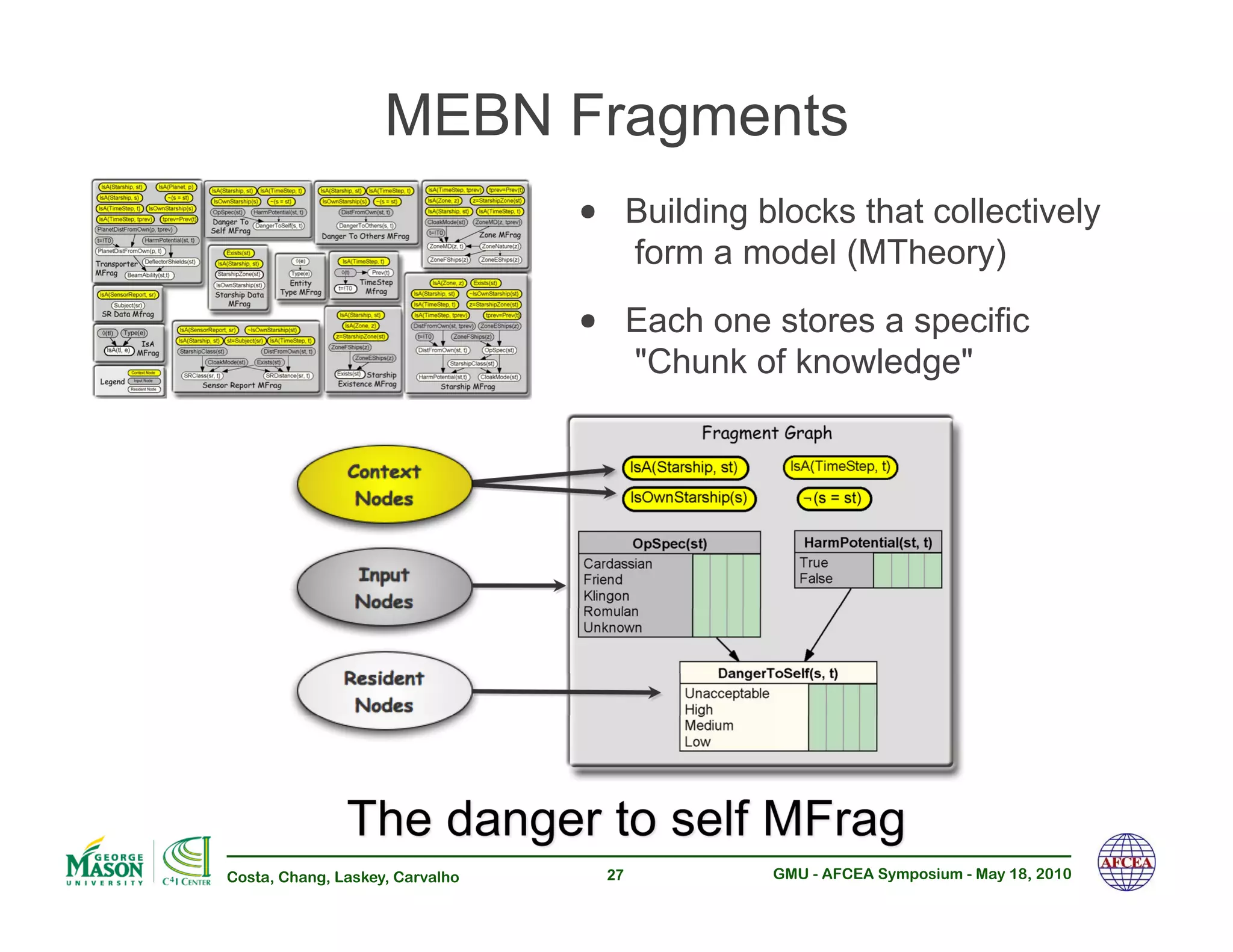
MEBN Fragments
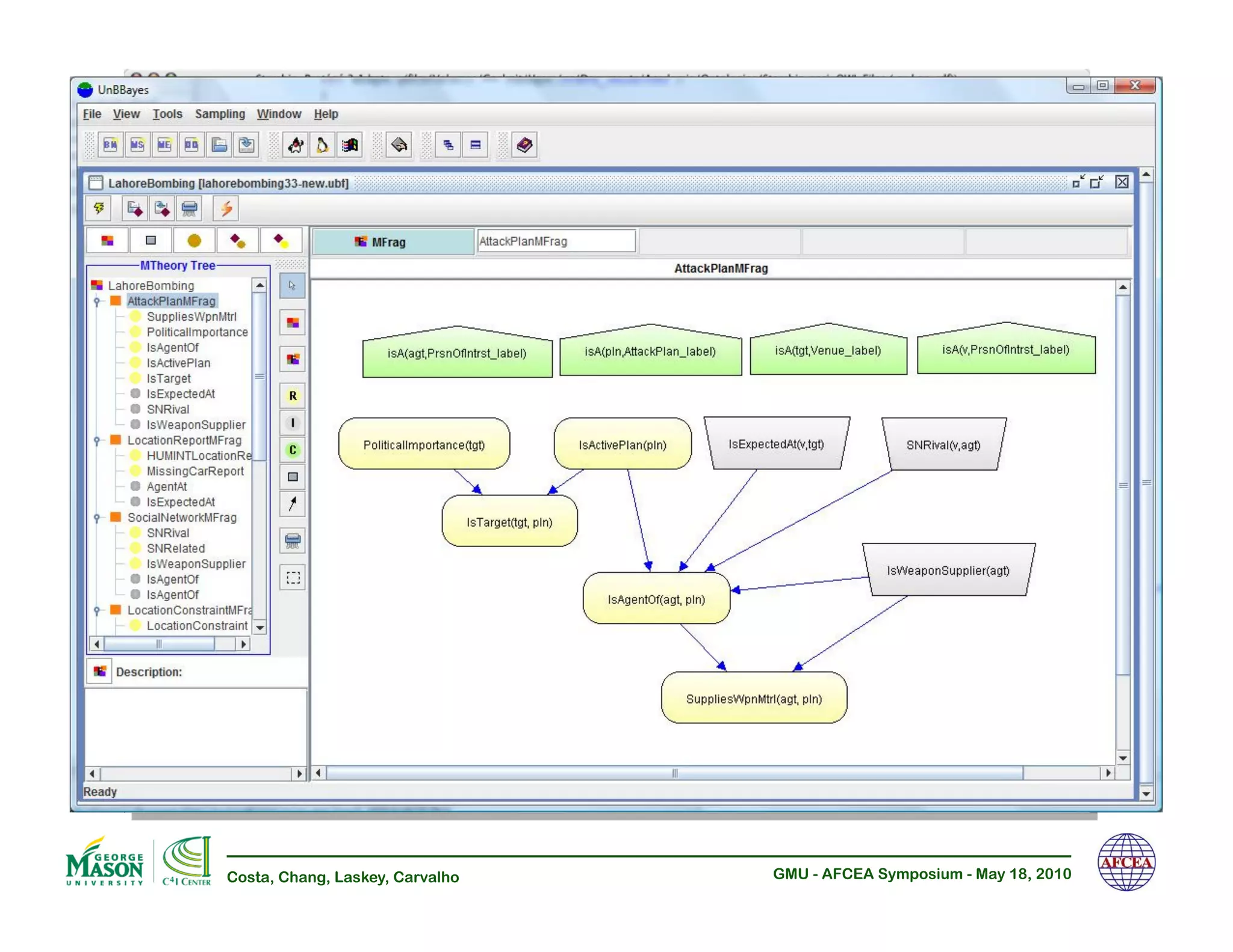
                         •! Building blocks that collectively
                                       form a model (MTheory)
                                 •! Each one stores a specific
                                       "Chunk of knowledge"


Costa, Chang, Laskey, Carvalho    27           GMU - AFCEA Symposium - May 18, 2010
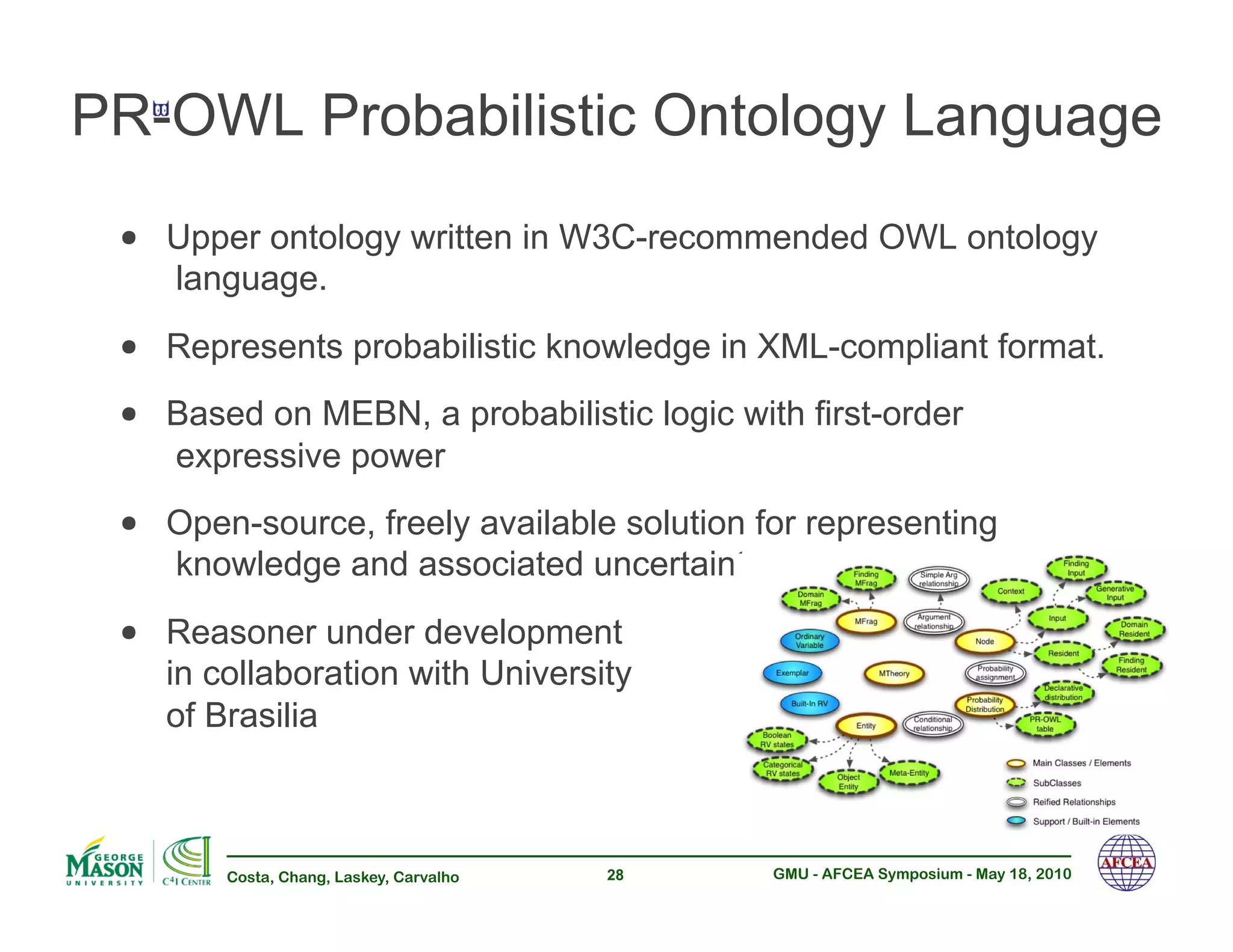
PR-OWL Probabilistic Ontology Language
 •! Upper ontology written in W3C-recommended OWL ontology
    language.
 •! Represents probabilistic knowledge in XML-compliant format.
 •! Based on MEBN, a probabilistic logic with first-order
    expressive power
 •! Open-source, freely available solution for representing
    knowledge and associated uncertainty.
 •! Reasoner under development
    in collaboration with University
    of Brasilia


        Costa, Chang, Laskey, Carvalho   28   GMU - AFCEA Symposium - May 18, 2010
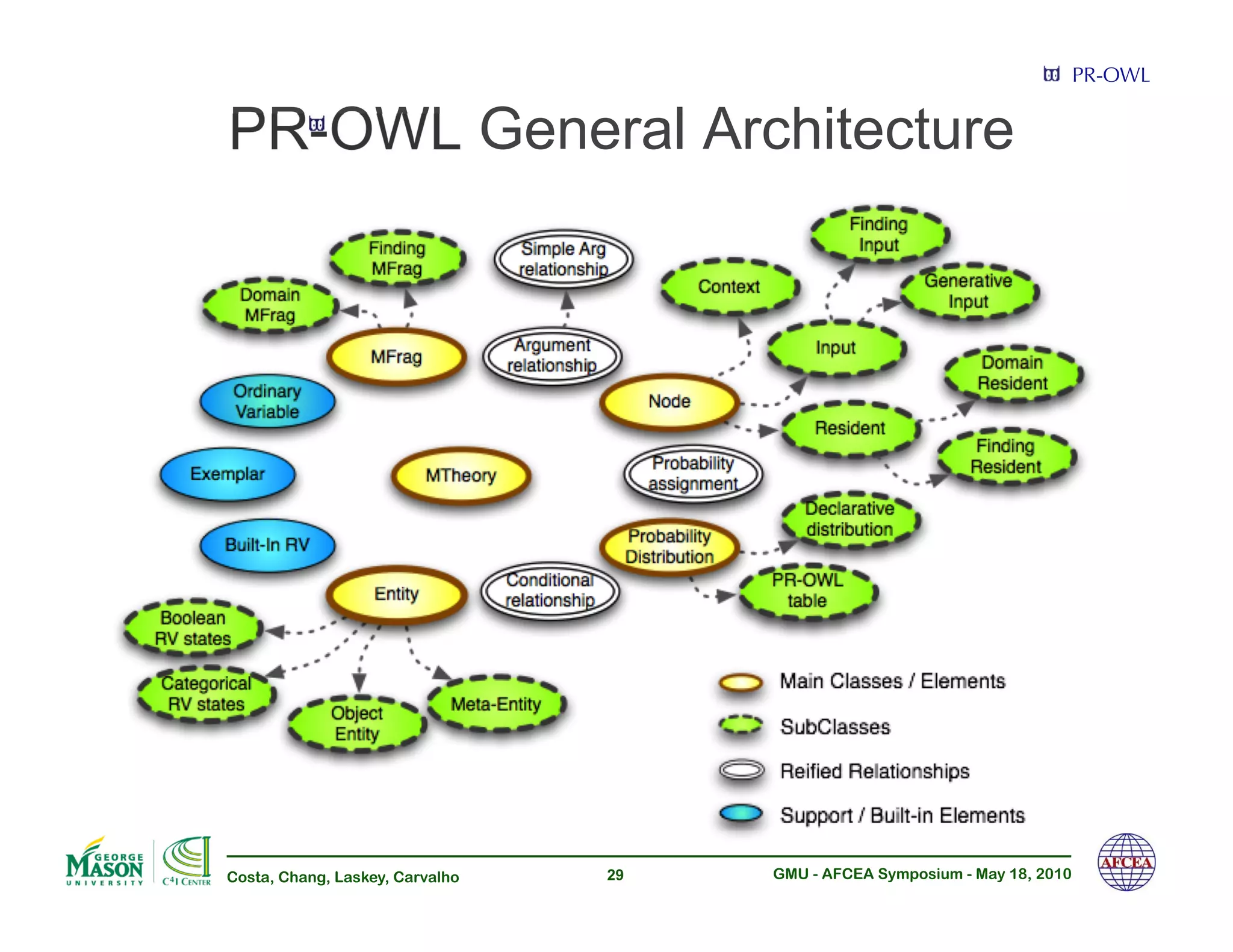
PR-OWL


PR-OWL General Architecture


Costa, Chang, Laskey, Carvalho   29   GMU - AFCEA Symposium - May 18, 2010
Costa, Chang, Laskey, Carvalho   GMU - AFCEA Symposium - May 18, 2010
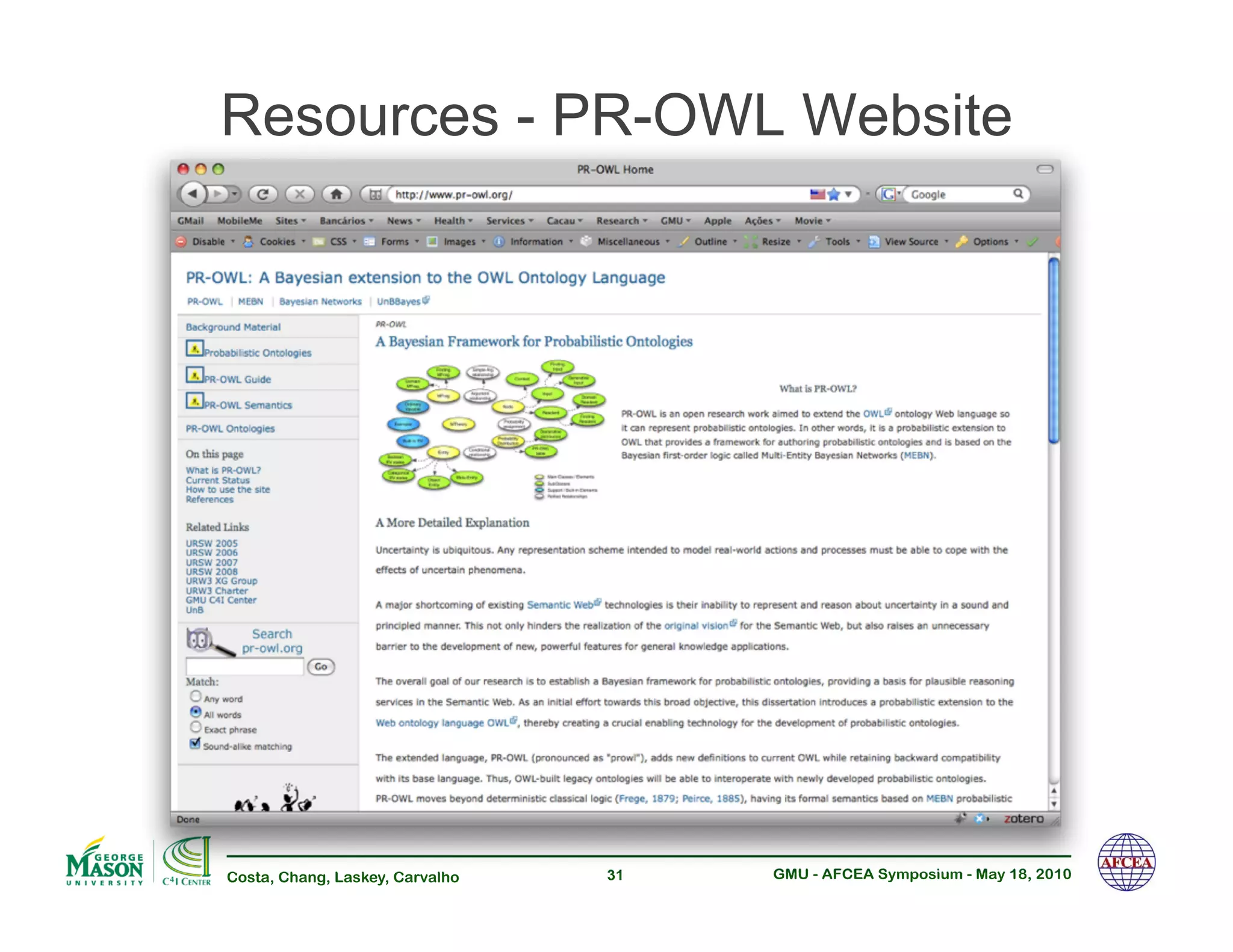
Resources - PR-OWL Website


Costa, Chang, Laskey, Carvalho   31   GMU - AFCEA Symposium - May 18, 2010
Agenda
  •!Knowledge Exchange in C                              2


  •!Ontologies
  •!Probabilistic Ontologies
  •!Case Study: PROGNOS


Costa, Chang, Laskey, Carvalho     32     GMU - AFCEA Symposium - May 18, 2010
Prognos Vision
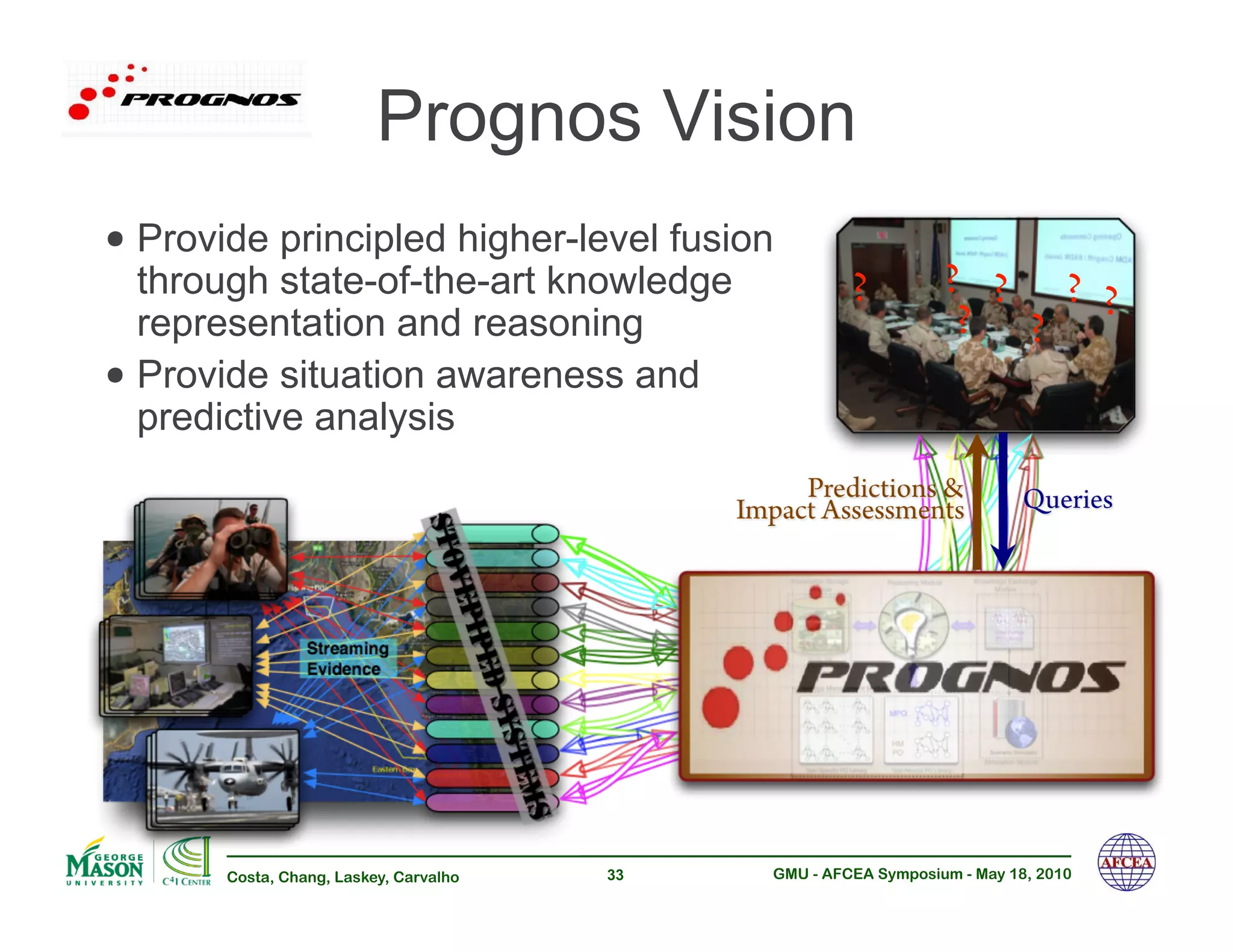
•!Provide principled higher-level fusion
  through state-of-the-art knowledge                     ?          ? ? ? ?
  representation and reasoning                                       ? ?
•!Provide situation awareness and
  predictive analysis


                                             Low level fusion + Stovepiped
                                               systems + Fog of War =
                                                 Cognitive Overload


       Costa, Chang, Laskey, Carvalho   33      GMU - AFCEA Symposium - May 18, 2010
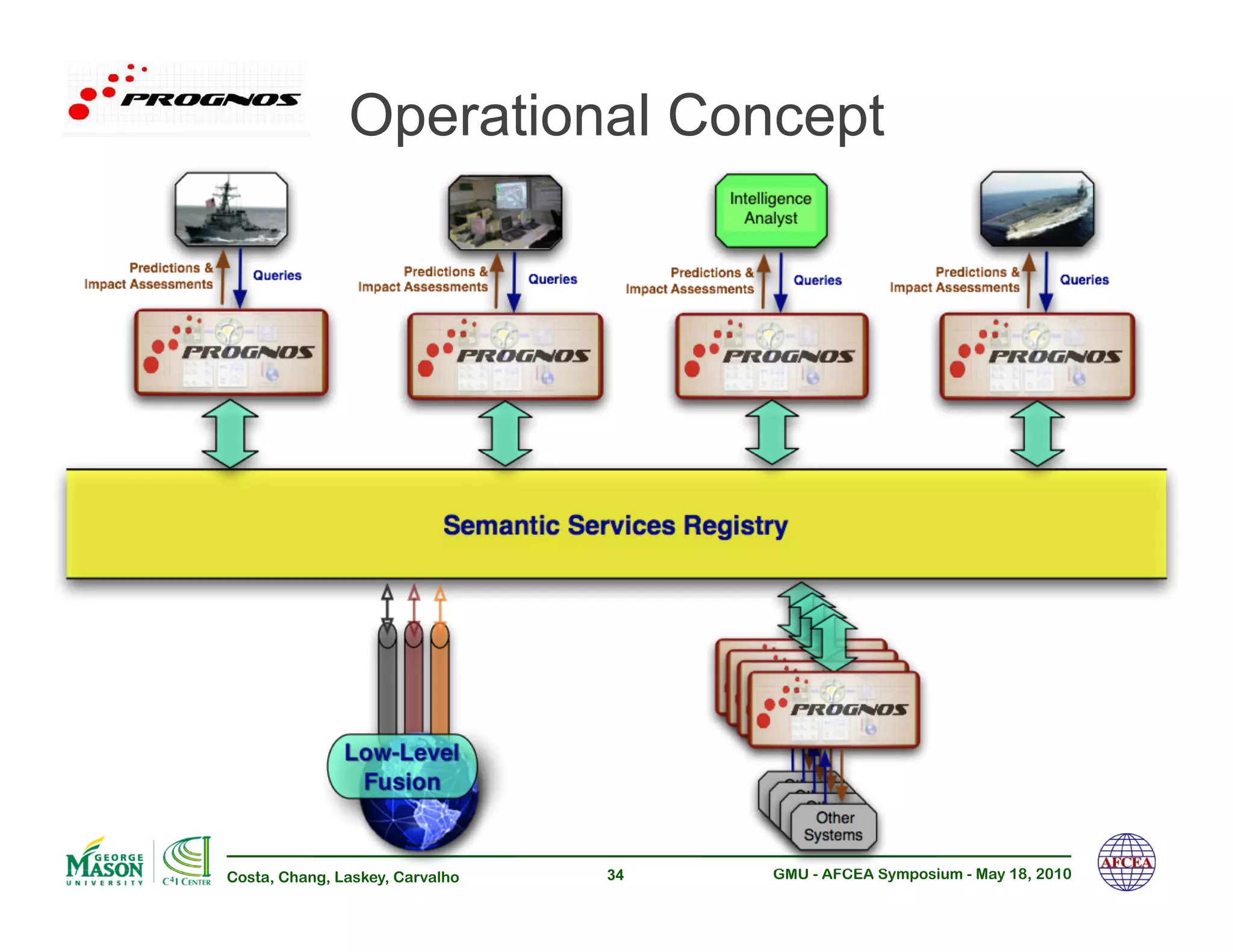
Operational Concept


Costa, Chang, Laskey, Carvalho   34   GMU - AFCEA Symposium - May 18, 2010
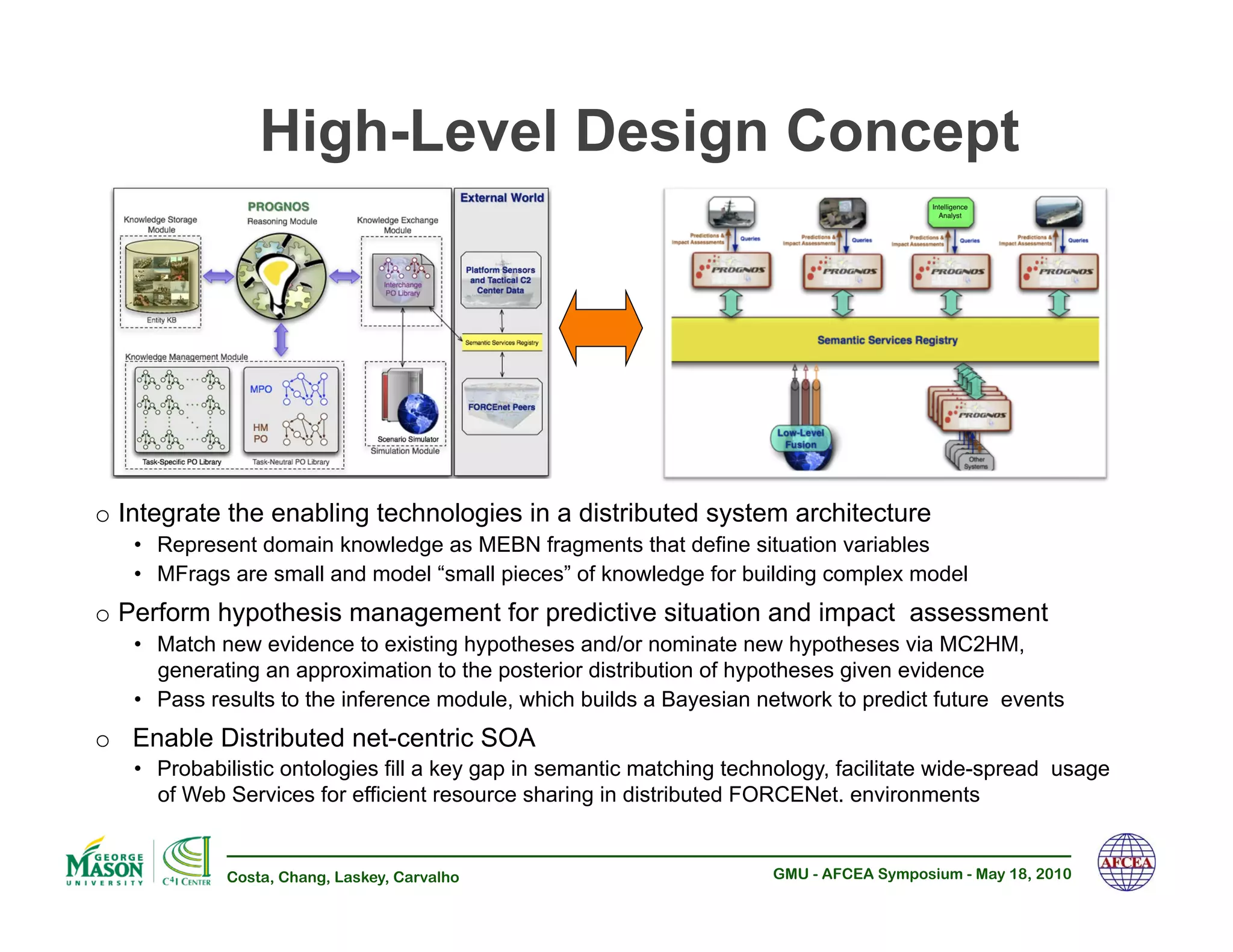
High-Level Design Concept


o! Integrate the enabling technologies in a distributed system architecture
   •! Represent domain knowledge as MEBN fragments that define situation variables
   •! MFrags are small and model “small pieces” of knowledge for building complex model
o! Perform hypothesis management for predictive situation and impact assessment
   •! Match new evidence to existing hypotheses and/or nominate new hypotheses via MC2HM,
      generating an approximation to the posterior distribution of hypotheses given evidence
   •! Pass results to the inference module, which builds a Bayesian network to predict future events
o! Enable Distributed net-centric SOA
   •! Probabilistic ontologies fill a key gap in semantic matching technology, facilitate wide-spread usage
      of Web Services for efficient resource sharing in distributed FORCENet. environments


            Costa, Chang, Laskey, Carvalho                             GMU - AFCEA Symposium - May 18, 2010
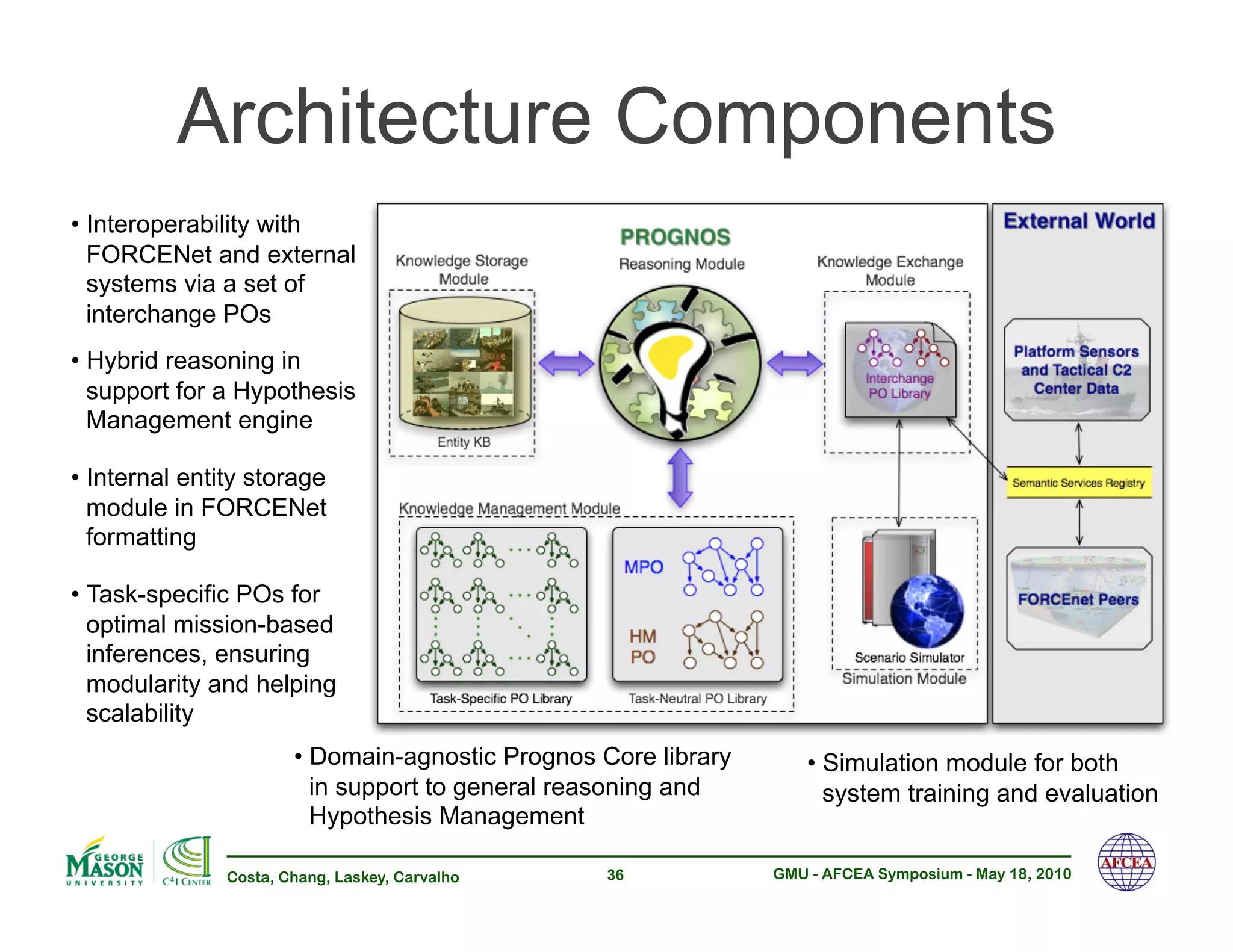
Architecture Components
•! Interoperability with
   FORCENet and external
   systems via a set of
   interchange POs
•! Hybrid reasoning in
   support for a Hypothesis
   Management engine

•! Internal entity storage
   module in FORCENet
   formatting

•! Task-specific POs for
   optimal mission-based
   inferences, ensuring
   modularity and helping
   scalability
                       •! Domain-agnostic Prognos Core library       •! Simulation module for both
                          in support to general reasoning and           system training and evaluation
                          Hypothesis Management

               Costa, Chang, Laskey, Carvalho     36             GMU - AFCEA Symposium - May 18, 2010
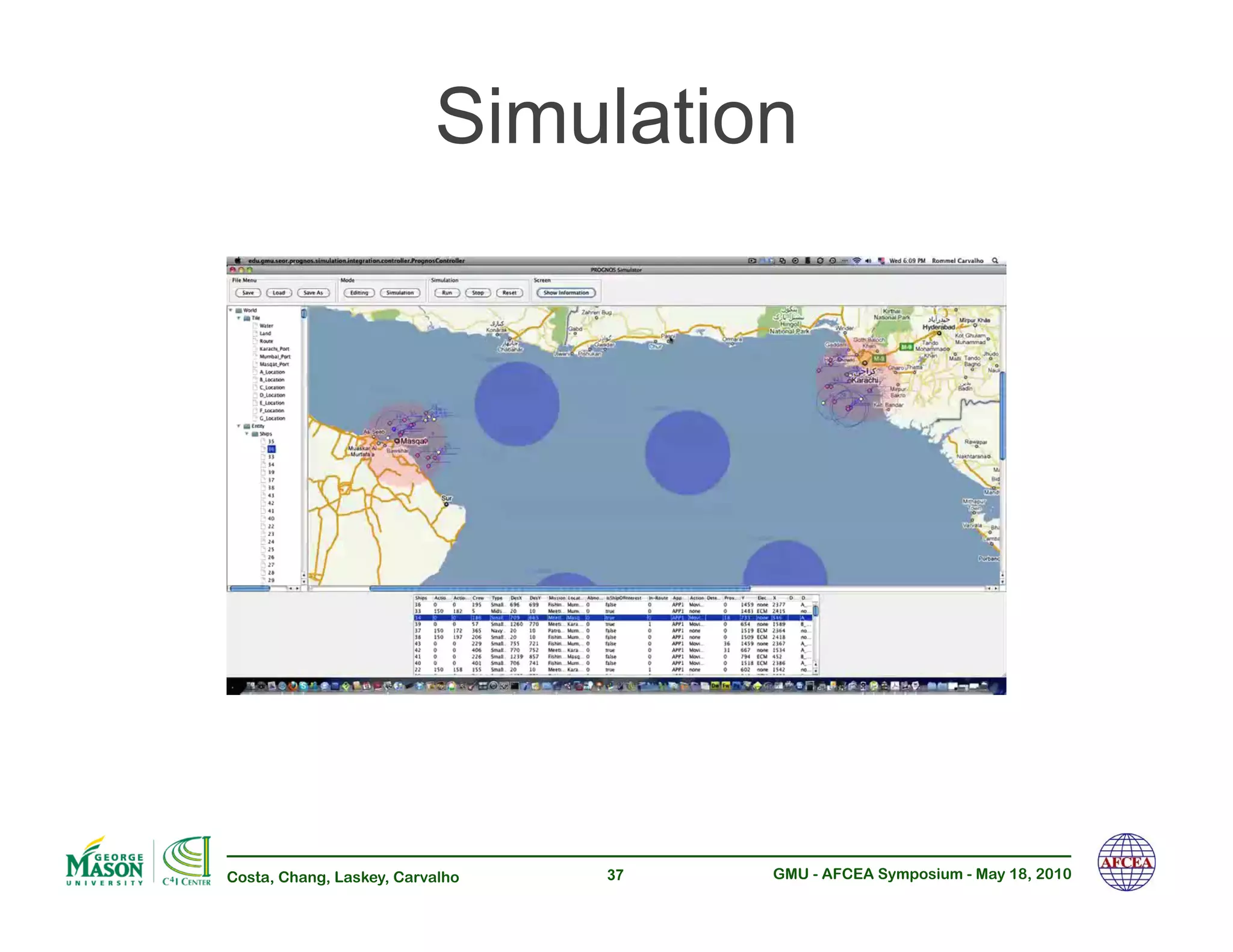
Simulation


Costa, Chang, Laskey, Carvalho   37   GMU - AFCEA Symposium - May 18, 2010
Links and Contact Data
•!   Contact:
     !!   http://c4i.gmu.edu/~pcosta
•!   C4I Center:
     !!   http://c4i.gmu.edu
•!   PR-OWL
     !!   http://www.pr-owl.org
•!   Uncertainty Reasoning for the Semantic Web
     !!   http://c4i.gmu.edu/ursw/2009
•!   Semantic Technologies for Intelligence, Defense, and
     Security (STIDS 2010)
     !!   http://c4i.gmu.edu/stids2010

 Costa, Chang, Laskey, Carvalho   38      GMU - AFCEA Symposium - May 18, 2010
Thanks for your Attention!!!


  Costa, Chang, Laskey, Carvalho   39   GMU - AFCEA Symposium - May 18, 2010

AFCEA 2010 - High Level Fusion and Predictive Situational Awareness with Probabilistic Ontologies

  • 1.
    High Level Fusionand Predictive Situational Awareness with Probabilistic Ontologies Paulo Costa, KC Chang, Kathryn Laskey, & Rommel Carvalho Center of Excellence in C4I George Mason University 1
  • 2.
    Uncertainty and Timelessness “…The commander is compelled during the whole campaign to reach decisions on the basis of situations that cannot be predicted … The problem is to grasp, in innumerable special cases, the actual situation which is covered by the mist of uncertainty, to appraise the facts correctly and to guess the unknown elements, to reach a decision quickly and then to carry it out forcefully and relentlessly.” Helmuth von Moltke, 1800-1891 Paret, P.; Craig; A.G.; Gilbert, F. (1986) Makers of Modern Strategy: From Machiavelli to the Nuclear Age. London, UK: Oxford University Press (Page 289) Costa, Chang, Laskey, Carvalho 2 GMU - AFCEA Symposium - May 18, 2010
  • 3.
    Agenda •!KnowledgeExchange in C 2 •!Ontologies •!Probabilistic Ontologies •!Case Study: PROGNOS Costa, Chang, Laskey, Carvalho 3 GMU - AFCEA Symposium - May 18, 2010
  • 4.
    What is PreventingTrue Netcentricity? •! Inability to produce a dynamic, comprehensive, and accurate battlespace picture for the warfighter that integrates tactical data from multiple intelligence sources. •! Lack of automated techniques to integrate data (geolocation, detection, and identification) from multiple intelligence sources, in a consistent and timely manner. •! Lack of accurate and timely information about battlespace objects and events to support warfighter decision making in an asymmetric warfare. Costa, Chang, Laskey, Carvalho 4 GMU - AFCEA Symposium - May 18, 2010
  • 5.
    Knowledge and DataFusion Uncertainty Data Fusion Association Estimation Product Level Process Process L3 Evaluation Game- Estimated Impact (situation to Theoretic Situation Assessment actor’s goals) Interaction Utility L2 Relationship Estimated Situation (entity-to- Relation Situation Assessment entity) State L1 Assignment Attributive Estimated Object (observation- State Entity State Assessment to-entity) L0 Assignment Estimated Signal (observation- Detection Signal State Assessment to-feature) Cognitive Hierarchy JDL Data fusion levels FM 6-0: Mission Command: Command and Control of White, F.E., “A Model for Data Fusion”, Proc. 1st National Army Forces. Aug 2003. Symposium on Sensor Fusion, 1988 Costa, Chang, Laskey, Carvalho 5 GMU - AFCEA Symposium - May 18, 2010
  • 6.
    Shortfalls of CurrentApproaches •! Either cannot achieve fusion levels 2 and above (JDL model), or can do so only in controlled environments (limited scalability and expressivity). •! Limited ability to cope with uncertainty, typically ignoring or mishandling it. •! Can handle only standardized messages, special -case scenarios, and specific sensor types, leading to interoperability issues and less than optimal use of available information. Costa, Chang, Laskey, Carvalho 6 GMU - AFCEA Symposium - May 18, 2010
  • 7.
    The Missing Pieces Connect reports to situations !"#$"%"&'()&*( 8-7.(9"6"4(( $")%+&(( :)')(( ,-'.( ;/%-+&( /&0"$')-&'1( 5*6)&0"*( )47+$-'.3%( )&*( (3"'.+*%( Operate in the 2"3)&'-0)441( “fog of war” (((((),)$"( %1%'"3%( Cope with complexity Link information to knowledge Costa, Chang, Laskey, Carvalho 7 GMU - AFCEA Symposium - May 18, 2010
  • 8.
    The Way Forward •!Rigorous mathematical foundation and efficient algorithms to combine data from diverse sources for reliable predictive situation assessment •! Automated techniques to reduce warfighter's information processing load and provide timely actionable knowledge to decision makers •! Interoperable methodologies for propagating uncertainty through the integration process to characterize and distinguish situational conditions for predictive analysis and impact assessment under various behaviors and environments •! Semantically aware systems for interoperability in net-centric environment Costa, Chang, Laskey, Carvalho 8 GMU - AFCEA Symposium - May 18, 2010
  • 9.
    C4I Center’s Multi-DisciplinaryApproach •! Developing interoperable enabling technologies based on Multi-entity Bayesian Networks, Probabilistic Ontologies, and pragmatic frames to support Net Centric operations •! Developing mathematically rigorous and computationally efficient algorithms based on Spatio-Temporal Hypothesis Management and Efficient Hybrid Inference to provide dependable predictive situational awareness Developing formal approaches and tools to represent command intent and to reduce ambiguity in operational communications. Costa, Chang, Laskey, Carvalho 9 GMU - AFCEA Symposium - May 18, 2010
  • 10.
    Interoperation vs. Integration Interoperation of systems Integration of systems •! participants remain autonomous and •! participants are assimilated into whole, losing •!participants are assimilated into whole, independent losing autonomyindependence autonomy and and independence •! loosely coupled •!ightly coupled •!t tightly coupled •! interaction rules are soft coded and •!nteraction rules are hard coded and coco- interaction rules •!i -dependent are hard coded and encapsulated •! local data vocabularies and ontologies for •! global data dependent vocabulary and ontology for interpretation persist •!global data vocabulary and ontology for interpretation adopted •! share information via mediation •! share information conforming to strict standards interpretation adopted •! asynchronous data transfer •! synchronous data transfer •!share information conforming to strict stand reusability composability Vs. fit-to-purpose responsiveness flexibility NOT Polar Opposites! SPECTRUM of INTERACTION MODES * adapted from: J.T. Pollock, R. Hodgson, “Adaptive Information”, Wiley-Interscience, 2004 Costa, Chang, Laskey, Carvalho 10 GMU - AFCEA Symposium - May 18, 2010
  • 11.
    Example: Kill chain find fix track target engage assess interoperation integration Field of view, scope Information-centric !"#$%&"'%()*"+ •! The kill chain illustrates the co-existence of interoperation and integration modes of component interaction. •! Early activities in the chain are characterized by larger field of view and have more information-centric functions than do later activities. They need the loose coupling and flexibility of interoperation. •! Later activities are more action-centric requiring the tight coupling and responsiveness of integrated components. Costa, Chang, Laskey, Carvalho 11 GMU - AFCEA Symposium - May 18, 2010
  • 12.
    Linguistic Levels ofInformation Exchange and Interoperability System Participant System Participant Linguistic Level of ! A System of Systems interoperates at this level if : Information Exchange Pragmatic – how information in messages is The receiver re-acts to the message in a manner that the used sender intends (assuming non-hostility in the collaboration). Semantic – shared understanding of meaning of The receiver assigns the same meaning as the sender did to messages the message. Syntactic –common rules governing The consumer is able to receive and parse the sender’s composition and transmitting of messages message Costa, Chang, Laskey, Carvalho GMU - AFCEA Symposium - May 18, 2010
  • 13.
    Agenda •!KnowledgeExchange in C 2 •!Ontologies •!Probabilistic Ontologies •!Case Study: PROGNOS Costa, Chang, Laskey, Carvalho 13 GMU - AFCEA Symposium - May 18, 2010
  • 14.
    Ontologies •! In Philosophy: the study of nature of being and knowing •! In Information Systems: many definitions an ontology is a set of concepts - such as An Explicit formal specification on how to An Ontology formally defines a common things, events, and relations - that are specified represent the objects, concepts, and other set of terms that are used to describe and in some way (such as specific natural entities that are assumed to exist in some represent a domain. Ontologies can be language) in order to create an agreed-upon area of interest an the relationships among used by automated tools to power vocabulary for exchanging information. them. (dictionary.com) advanced services such as more accurate (whatis.com) Web search, intelligent software agents and knowledge management. (Owl Use In information science, an ontology is the Is a formal specification of a Cases) product of an attempt to formulate an conceptualization (Gruber) exhaustive and rigorous conceptual schema about a domain. An ontology is typically a An ontology models the vocabulary and A partial specification of a conceptual hierarchical data structure containing all the meaning of domains of interest: the objects vocabulary to be used for formulating relevant entities and their relationships and (things) in domains; the relationships among knowledge-level theories about a domain of rules within that domain (Wikipedia.org). those things; the properties, functions, and discourse. The fundamental role of an processes involving those things; and ontology is to support knowledge sharing and constraints on and rules about those things reuse. (The Internet Reasoning Services (DaConta et al., 2003) project - IRS) What is really important? Costa, Chang, Laskey, Carvalho 14 GMU - AFCEA Symposium - May 18, 2010
  • 15.
    Semantics in DataFusion •! Information in the battlefield comes from reports from diverse sources, in distinct syntax, and with different meanings. •! Effective interoperability requires understanding the relationship between reports from different systems and the events reported upon •! Semantically aware systems are essential to distributed knowledge fusion. •! Ontologies are a means to semantic awareness Costa, Chang, Laskey, Carvalho 15 GMU - AFCEA Symposium - May 18, 2010
  • 16.
    Asserted vs. Inferred Costa,Chang, Laskey, Carvalho 16 GMU - AFCEA Symposium - May 18, 2010
  • 17.
    Ontologies vs. OO Ontologies Databases / OO •! Rely on logical reasoners to •! Rigidly defined classes that infer class relationships and govern the system behavior instance membership •! All instances are created as •! Flexible format that adapts members of some class. its class structure as new information is learned •! Changing a class affects all of its instances •! Open World Assumption / •! Closed World Assumption / Well suited for open Well suited for top down systems governance Costa, Chang, Laskey, Carvalho 17 GMU - AFCEA Symposium - May 18, 2010
  • 18.
    Ontologies and Uncertainty •!There are many kinds of uncertainty, e.g.: !! Noise in sensors !! Incorrect, incomplete, deceptive human intelligence !! Lack of understanding of cause and effect mechanisms in the world •! Representing and reasoning with uncertainty is essential •! But... Costa, Chang, Laskey, Carvalho 18 GMU - AFCEA Symposium - May 18, 2010
  • 19.
    Deterministic Reasoning Costa, Chang,Laskey, Carvalho 19 GMU - AFCEA Symposium - May 18, 2010
  • 20.
    Deterministic Reasoning (... is not always suitable to the problem) •! All Birds lay eggs •! Many aquatic birds have Duck-like bills •! Many aquatic birds have webbed feet (like ducks) •! All aquatic birds swim very well and can hold breath for a long period •! Joe: !! Is an egg-laying animal !! Has a Duck-like bill !! Has webbed feet !! Swin very well and can hold breath for a long period •! Therefore: Joe is a… Costa, Chang, Laskey, Carvalho 20 GMU - AFCEA Symposium - May 18, 2010
  • 21.
    Joe is aDuck-Billed Platypus (a mammal) •! It lays eggs like a bird or a reptile (this makes it a monotreme mammal) •! The males have poison like a snake in spurs on their hind legs. The poison can kill a dog and cause extreme pain in people. •! They have a bill like a duck. •! They have a tail like a beaver. •! They have webbed feet like a duck. •! The mother's milk comes out through glands on her skin and the babies lick it off of her fur. Costa, Chang, Laskey, Carvalho 21 GMU - AFCEA Symposium - May 18, 2010
  • 22.
    Agenda •!KnowledgeExchange in C 2 •!Ontologies •!Probabilistic Ontologies •!Case Study: PROGNOS Costa, Chang, Laskey, Carvalho 22 GMU - AFCEA Symposium - May 18, 2010
  • 23.
    A Pragmatical View Evidence Knowledge Base New Data Racer Knowledge Base Logic Reasoner UnBBayes Uncertainty-free Information MEBN Logical Reasoning Evidence Reasoners Probabilistic KB Bayesian Reasoner Evidence Enhanced Knowledge Bayesian Reasoning Costa, Chang, Laskey, Carvalho GMU - AFCEA Symposium - May 18, 2010
  • 24.
    How about BayesianNetworks? Costa, Chang, Laskey, Carvalho GMU - AFCEA Symposium - May 18, 2010
  • 25.
    Why not BNs? Costa,Chang, Laskey, Carvalho GMU - AFCEA Symposium - May 18, 2010
  • 26.
    Multi-Entity Bayesian Networks Costa,Chang, Laskey, Carvalho GMU - AFCEA Symposium - May 18, 2010
  • 27.
    MEBN Fragments •! Building blocks that collectively form a model (MTheory) •! Each one stores a specific "Chunk of knowledge" Costa, Chang, Laskey, Carvalho 27 GMU - AFCEA Symposium - May 18, 2010
  • 28.
    PR-OWL Probabilistic OntologyLanguage •! Upper ontology written in W3C-recommended OWL ontology language. •! Represents probabilistic knowledge in XML-compliant format. •! Based on MEBN, a probabilistic logic with first-order expressive power •! Open-source, freely available solution for representing knowledge and associated uncertainty. •! Reasoner under development in collaboration with University of Brasilia Costa, Chang, Laskey, Carvalho 28 GMU - AFCEA Symposium - May 18, 2010
  • 29.
    PR-OWL PR-OWL General Architecture Costa,Chang, Laskey, Carvalho 29 GMU - AFCEA Symposium - May 18, 2010
  • 30.
    Costa, Chang, Laskey,Carvalho GMU - AFCEA Symposium - May 18, 2010
  • 31.
    Resources - PR-OWLWebsite Costa, Chang, Laskey, Carvalho 31 GMU - AFCEA Symposium - May 18, 2010
  • 32.
    Agenda •!KnowledgeExchange in C 2 •!Ontologies •!Probabilistic Ontologies •!Case Study: PROGNOS Costa, Chang, Laskey, Carvalho 32 GMU - AFCEA Symposium - May 18, 2010
  • 33.
    Prognos Vision •!Provide principledhigher-level fusion through state-of-the-art knowledge ? ? ? ? ? representation and reasoning ? ? •!Provide situation awareness and predictive analysis Low level fusion + Stovepiped systems + Fog of War = Cognitive Overload Costa, Chang, Laskey, Carvalho 33 GMU - AFCEA Symposium - May 18, 2010
  • 34.
    Operational Concept Costa, Chang,Laskey, Carvalho 34 GMU - AFCEA Symposium - May 18, 2010
  • 35.
    High-Level Design Concept o!Integrate the enabling technologies in a distributed system architecture •! Represent domain knowledge as MEBN fragments that define situation variables •! MFrags are small and model “small pieces” of knowledge for building complex model o! Perform hypothesis management for predictive situation and impact assessment •! Match new evidence to existing hypotheses and/or nominate new hypotheses via MC2HM, generating an approximation to the posterior distribution of hypotheses given evidence •! Pass results to the inference module, which builds a Bayesian network to predict future events o! Enable Distributed net-centric SOA •! Probabilistic ontologies fill a key gap in semantic matching technology, facilitate wide-spread usage of Web Services for efficient resource sharing in distributed FORCENet. environments Costa, Chang, Laskey, Carvalho GMU - AFCEA Symposium - May 18, 2010
  • 36.
    Architecture Components •! Interoperabilitywith FORCENet and external systems via a set of interchange POs •! Hybrid reasoning in support for a Hypothesis Management engine •! Internal entity storage module in FORCENet formatting •! Task-specific POs for optimal mission-based inferences, ensuring modularity and helping scalability •! Domain-agnostic Prognos Core library •! Simulation module for both in support to general reasoning and system training and evaluation Hypothesis Management Costa, Chang, Laskey, Carvalho 36 GMU - AFCEA Symposium - May 18, 2010
  • 37.
    Simulation Costa, Chang, Laskey,Carvalho 37 GMU - AFCEA Symposium - May 18, 2010
  • 38.
    Links and ContactData •! Contact: !! http://c4i.gmu.edu/~pcosta •! C4I Center: !! http://c4i.gmu.edu •! PR-OWL !! http://www.pr-owl.org •! Uncertainty Reasoning for the Semantic Web !! http://c4i.gmu.edu/ursw/2009 •! Semantic Technologies for Intelligence, Defense, and Security (STIDS 2010) !! http://c4i.gmu.edu/stids2010 Costa, Chang, Laskey, Carvalho 38 GMU - AFCEA Symposium - May 18, 2010
  • 39.
    Thanks for yourAttention!!! Costa, Chang, Laskey, Carvalho 39 GMU - AFCEA Symposium - May 18, 2010