
GUIDELINES FOR
RATING ELEMENTARY
SCHOOL PUPILS
mr. nick l. bio // division coordinator
I. ASSESSMENT OF THE
FOUR (4) LEVELS OF
ASSESSMENT
For every quarter, pupils shall be assessed
at these four levels of assessment:
a.Knowledge (15%)
b.Process or Skills (25%)
c.Understanding(s) (30%)
d.Products / Performances (30%)
Being holistic, Assessment performs triple
functions:
Diagnostic (Pre-Assessment)
Formative / Developmental
Summative / Evaluative
Levels of Assessment What Will I
Assess?
How Will I
Assess?
How Will I
Score?
KNOWLEDGE
(15%)
PROCESS /
SKILLS
(25%)
UNDERSTANDING
(30%)
PRODUCT /
PERFORMANCE
(30%)
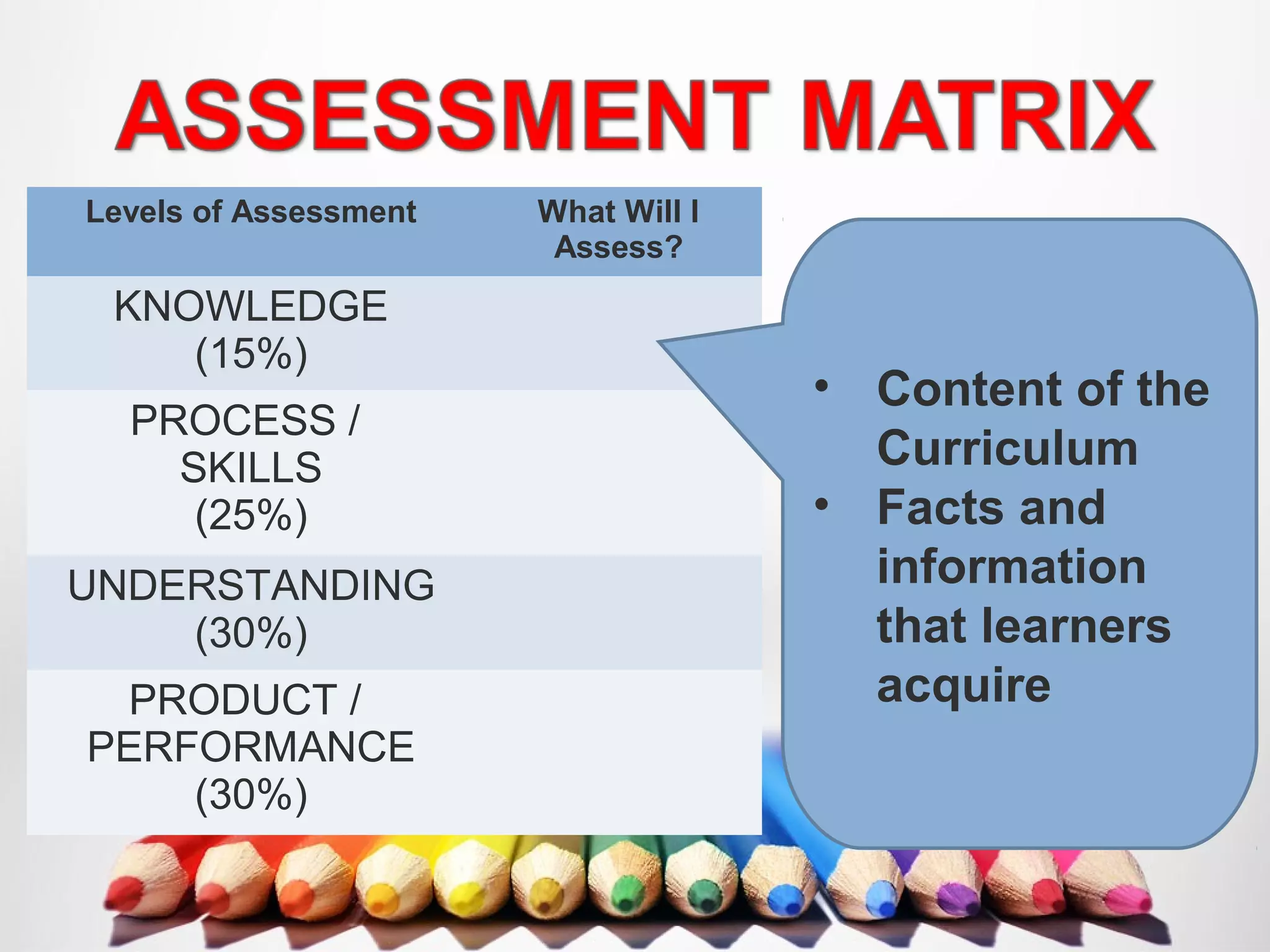
Levels of Assessment What Will I
Assess?
KNOWLEDGE
(15%)
PROCESS /
SKILLS
(25%)
UNDERSTANDING
(30%)
PRODUCT /
PERFORMANCE
(30%)
• Content of the
Curriculum
• Facts and
information
that learners
acquire
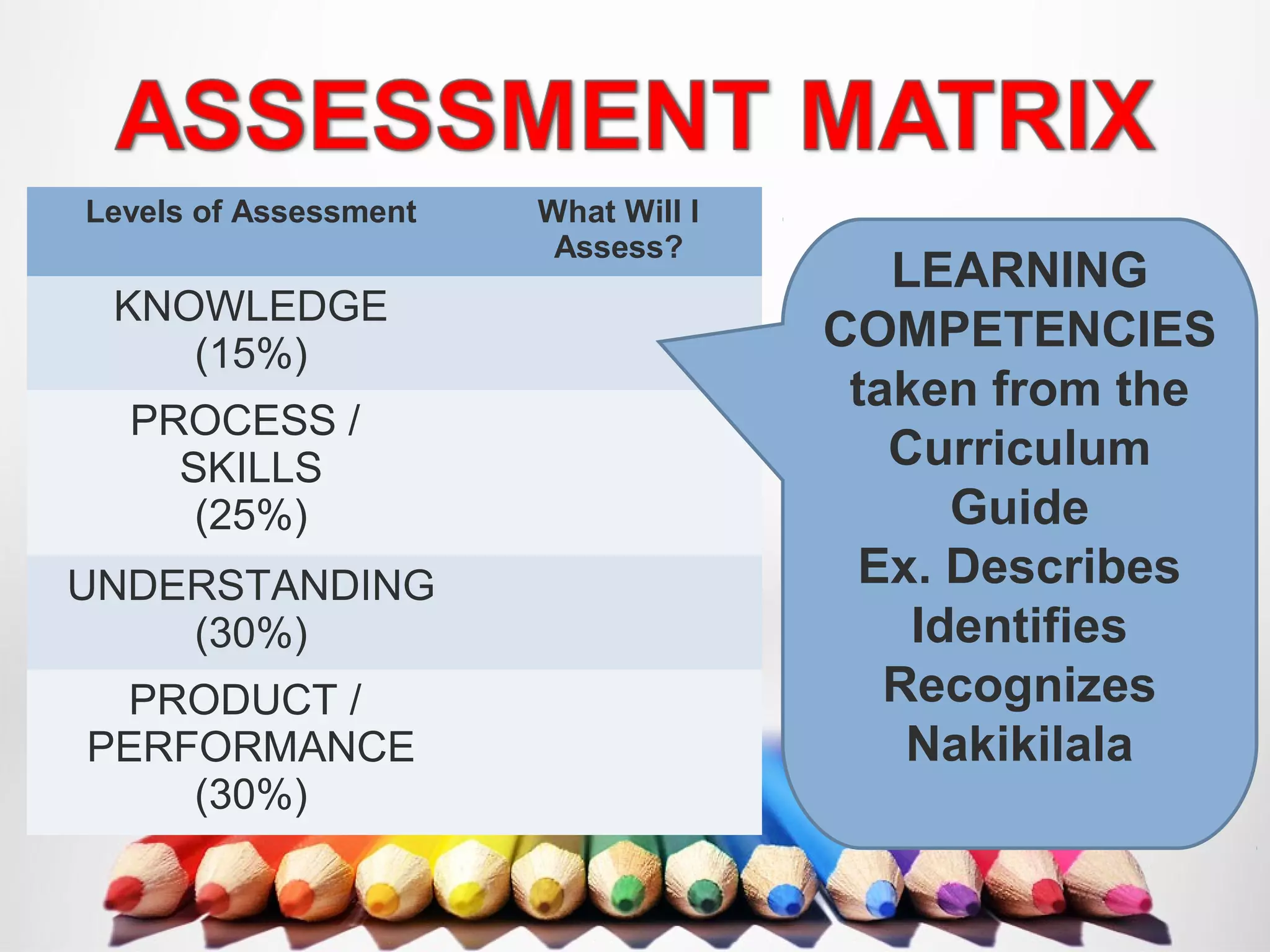
Levels of Assessment What Will I
Assess?
KNOWLEDGE
(15%)
PROCESS /
SKILLS
(25%)
UNDERSTANDING
(30%)
PRODUCT /
PERFORMANCE
(30%)
LEARNING
COMPETENCIES
taken from the
Curriculum
Guide
Ex. Describes
Identifies
Recognizes
Nakikilala
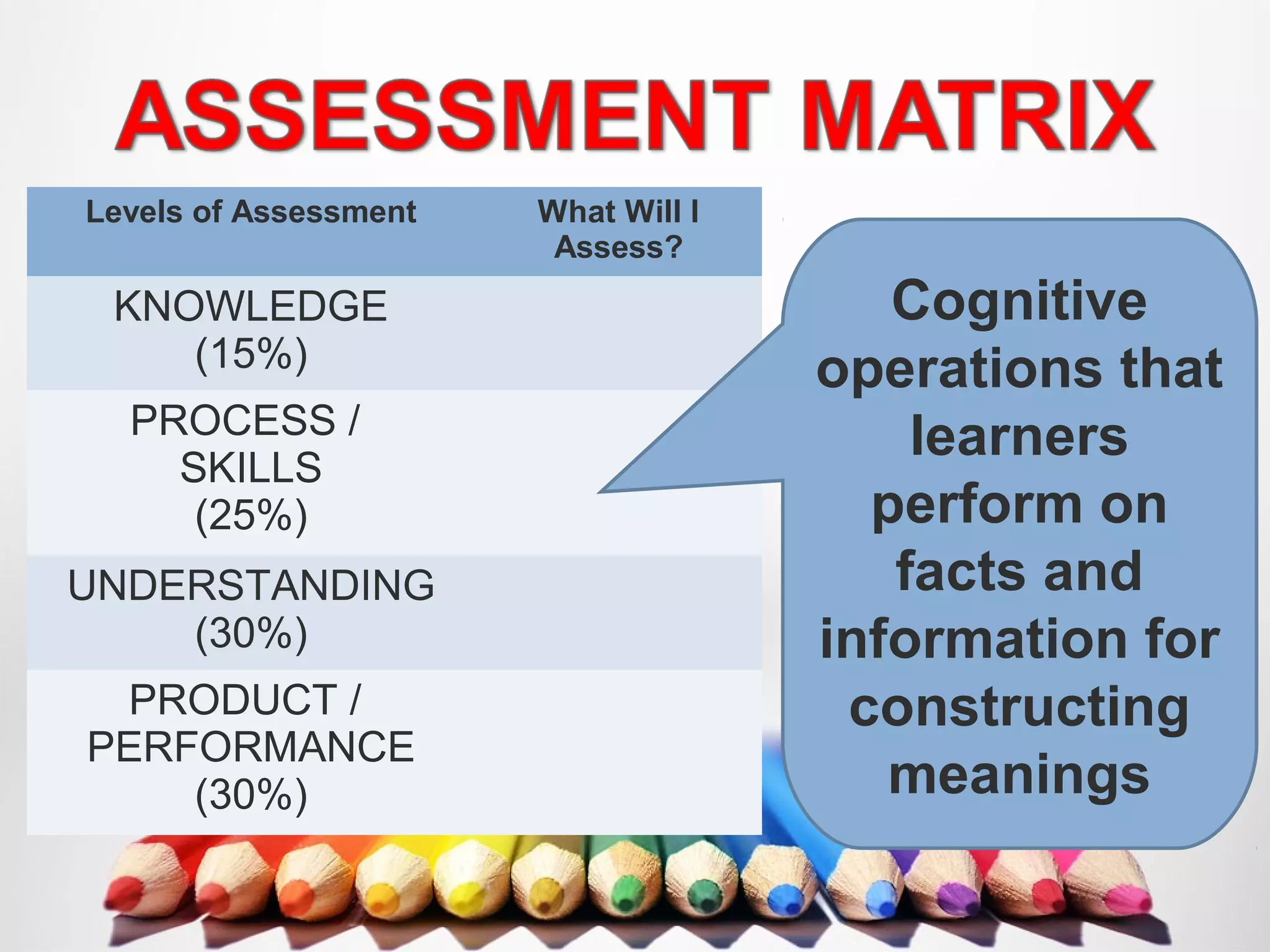
Levels of Assessment What Will I
Assess?
KNOWLEDGE
(15%)
PROCESS /
SKILLS
(25%)
UNDERSTANDING
(30%)
PRODUCT /
PERFORMANCE
(30%)
Cognitive
operations that
learners
perform on
facts and
information for
constructing
meanings
Levels of Assessment What Will I
Assess?
KNOWLEDGE
(15%)
PROCESS /
SKILLS
(25%)
UNDERSTANDING
(30%)
PRODUCT /
PERFORMANCE
(30%)
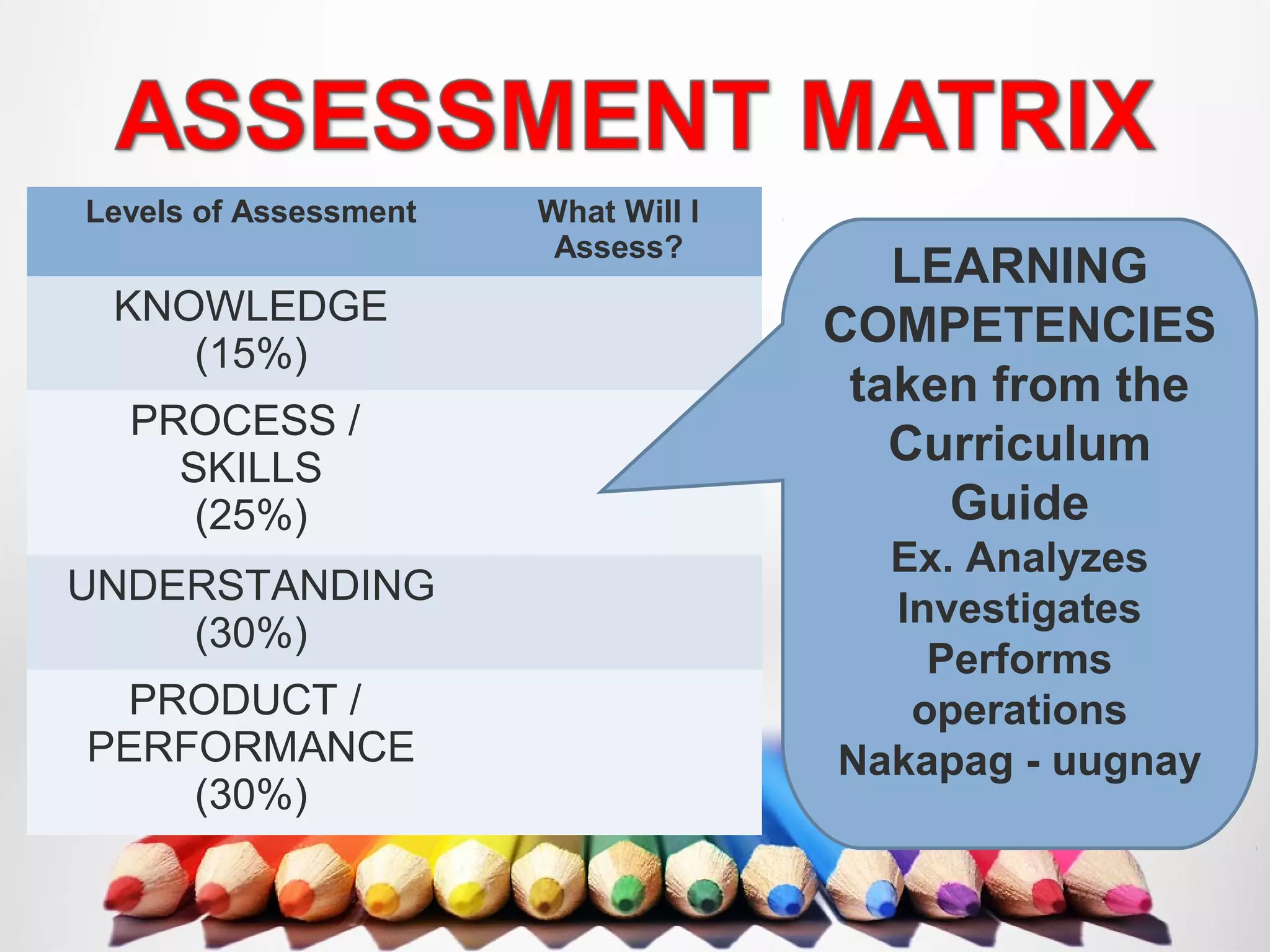
LEARNING
COMPETENCIES
taken from the
Curriculum
Guide
Ex. Analyzes
Investigates
Performs
operations
Nakapag - uugnay
Levels of Assessment What Will I
Assess?
KNOWLEDGE
(15%)
PROCESS /
SKILLS
(25%)
UNDERSTANDING
(30%)
PRODUCT /
PERFORMANCE
(30%)
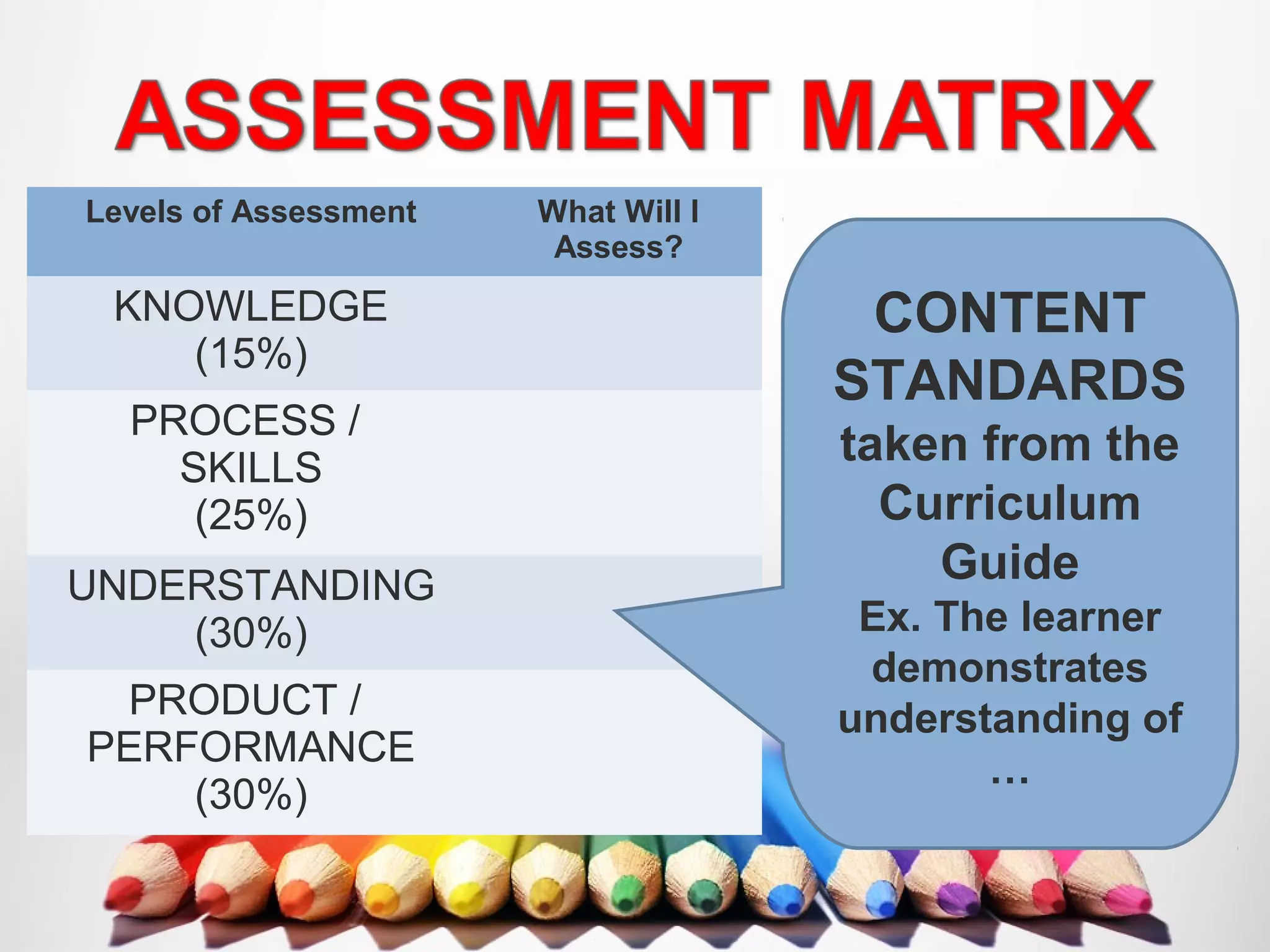
CONTENT
STANDARDS
taken from the
Curriculum
Guide
Ex. The learner
demonstrates
understanding of
…
Levels of Assessment What Will I
Assess?
KNOWLEDGE
(15%)
PROCESS /
SKILLS
(25%)
UNDERSTANDING
(30%)
PRODUCT /
PERFORMANCE
(30%)
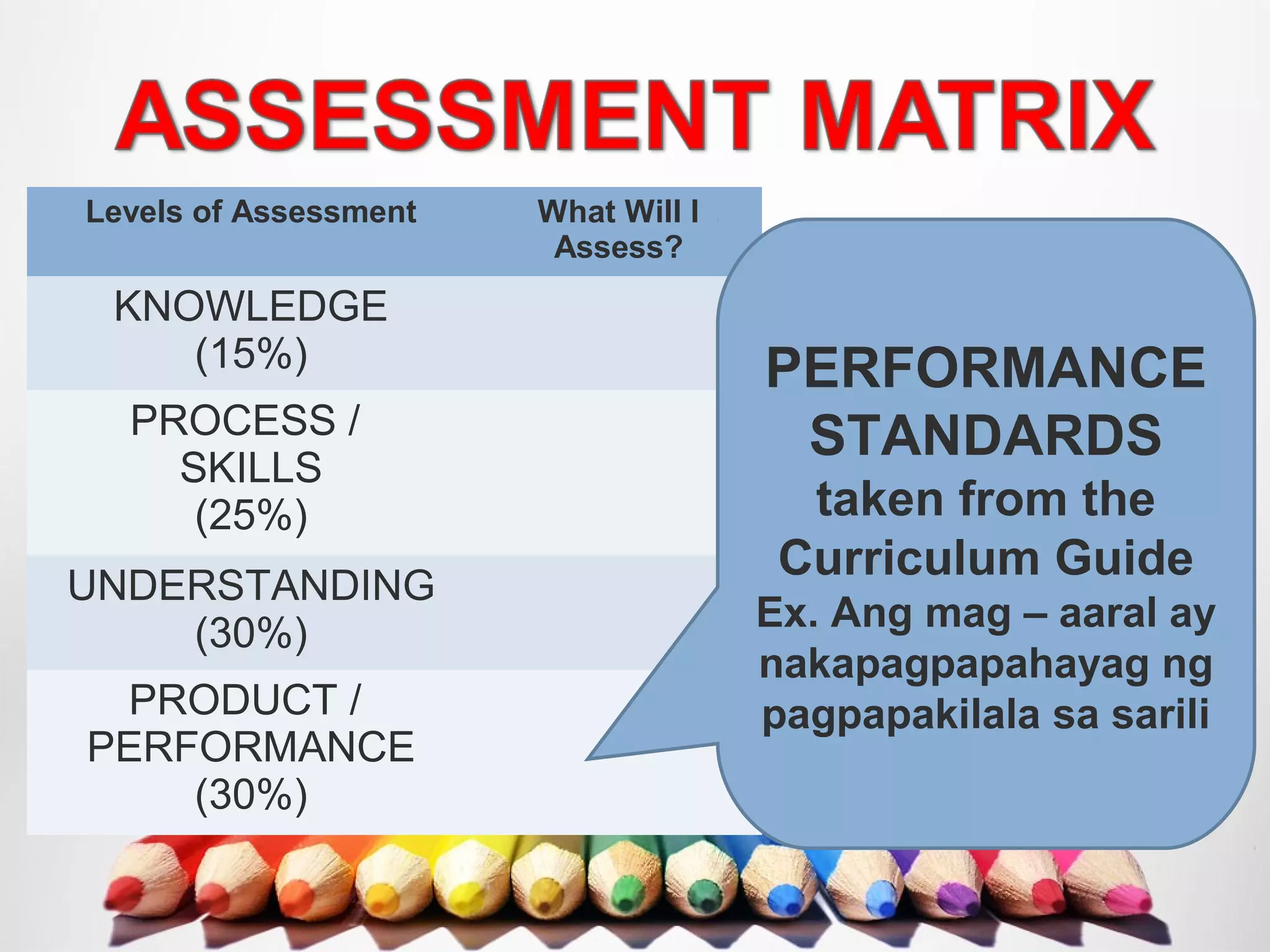
PERFORMANCE
STANDARDS
taken from the
Curriculum Guide
Ex. Ang mag – aaral ay
nakapagpapahayag ng
pagpapakilala sa sarili
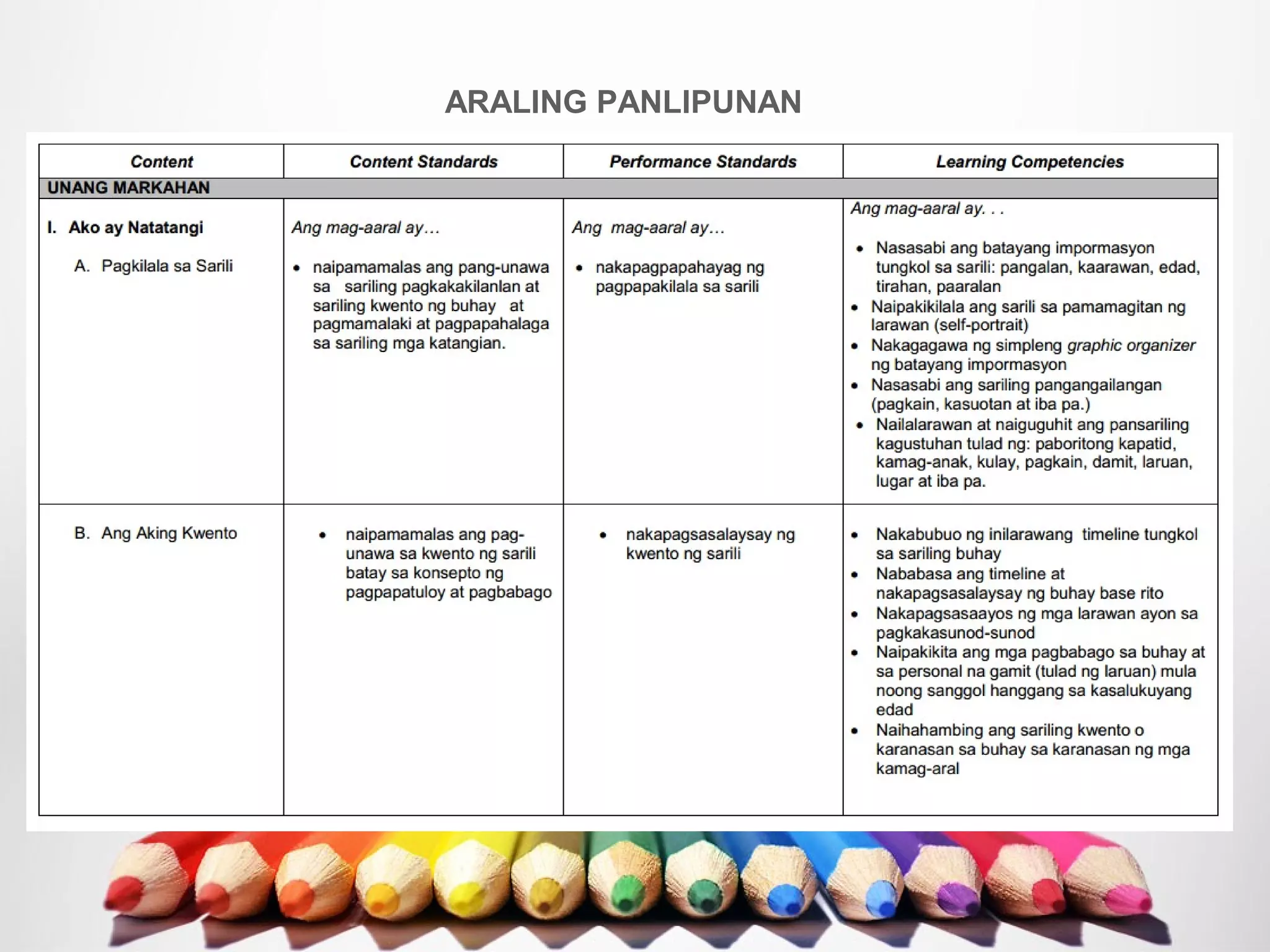
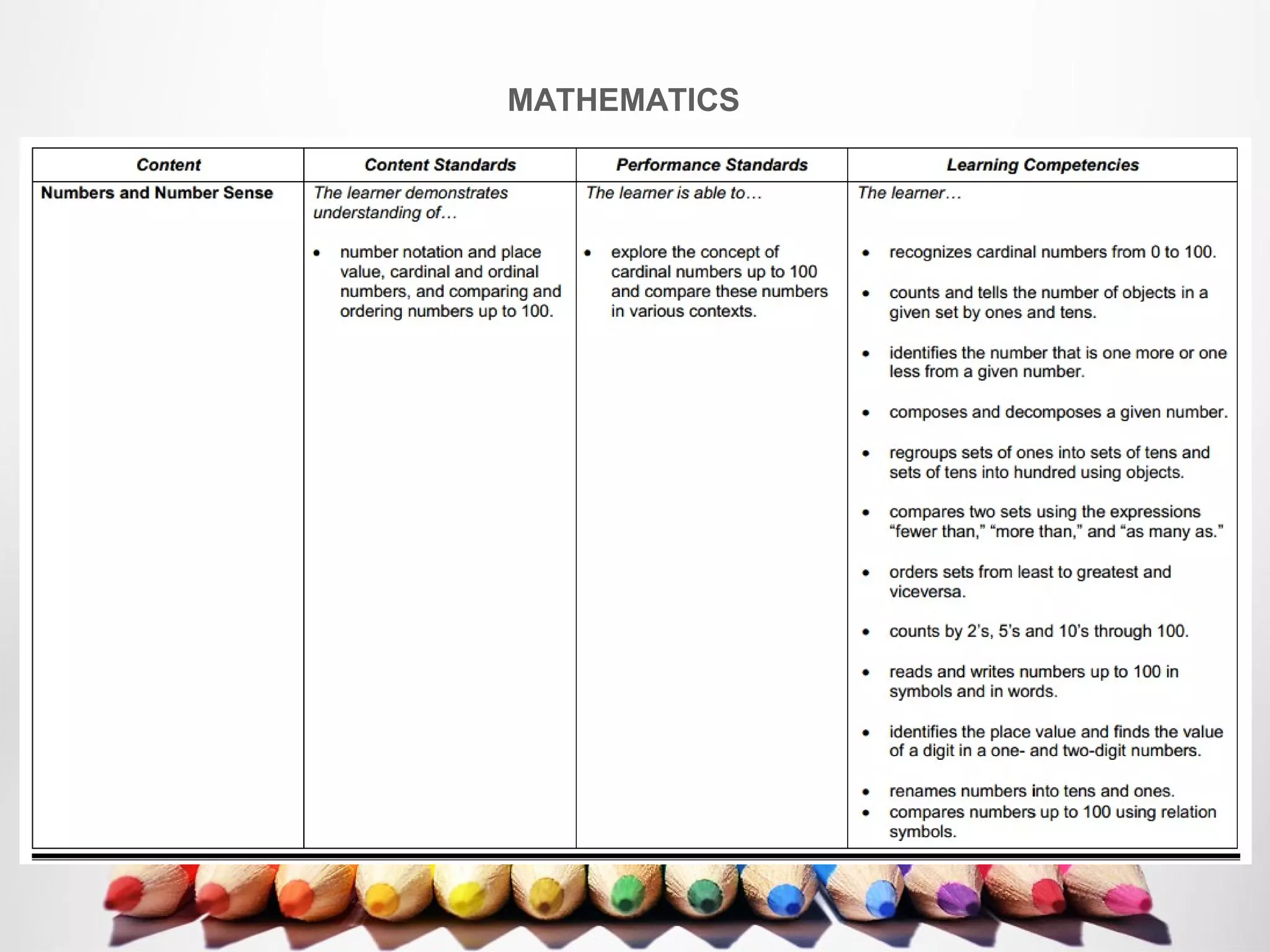
ARALING PANLIPUNAN
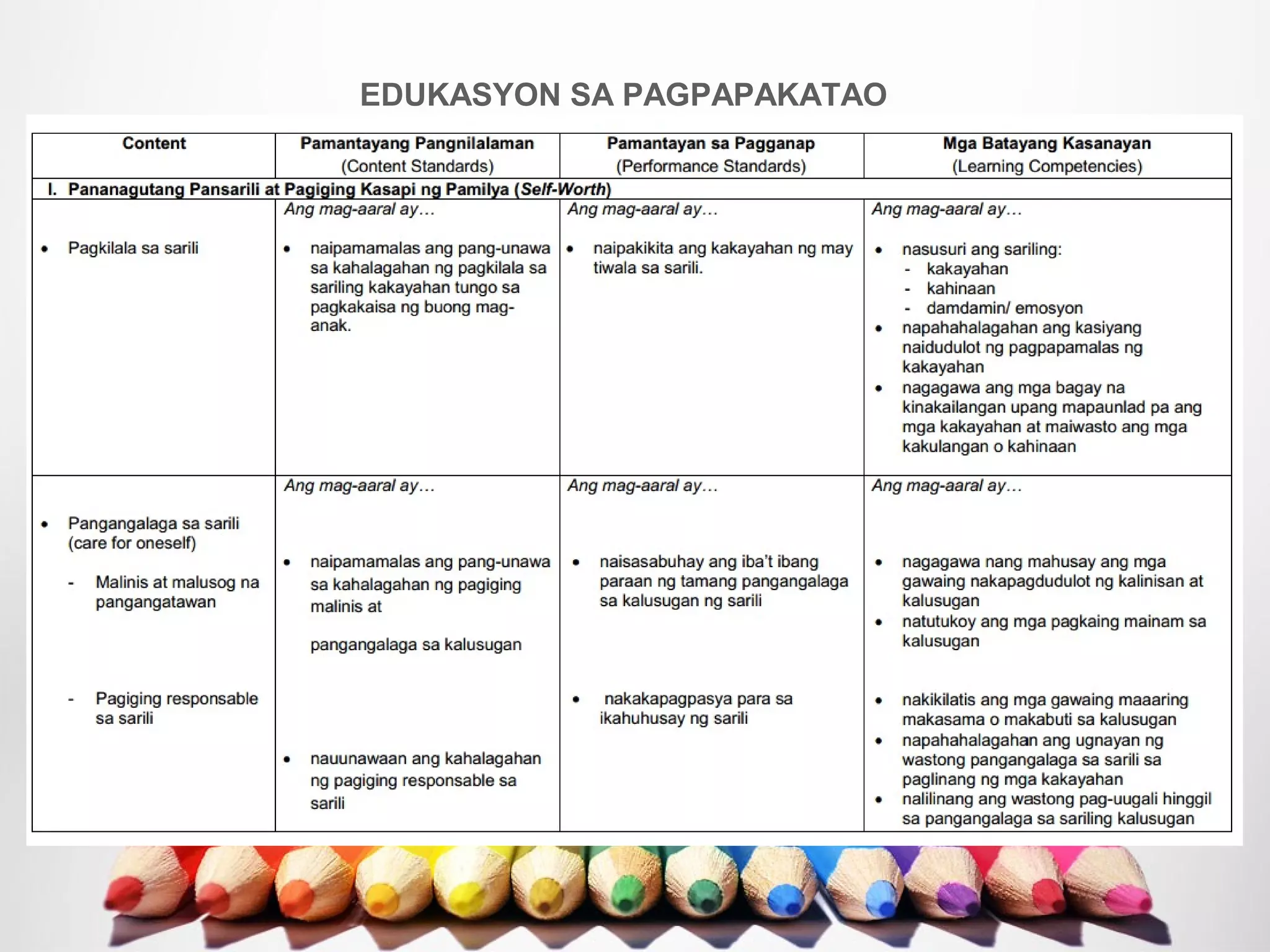
EDUKASYON SA PAGPAPAKATAO
MATHEMATICS
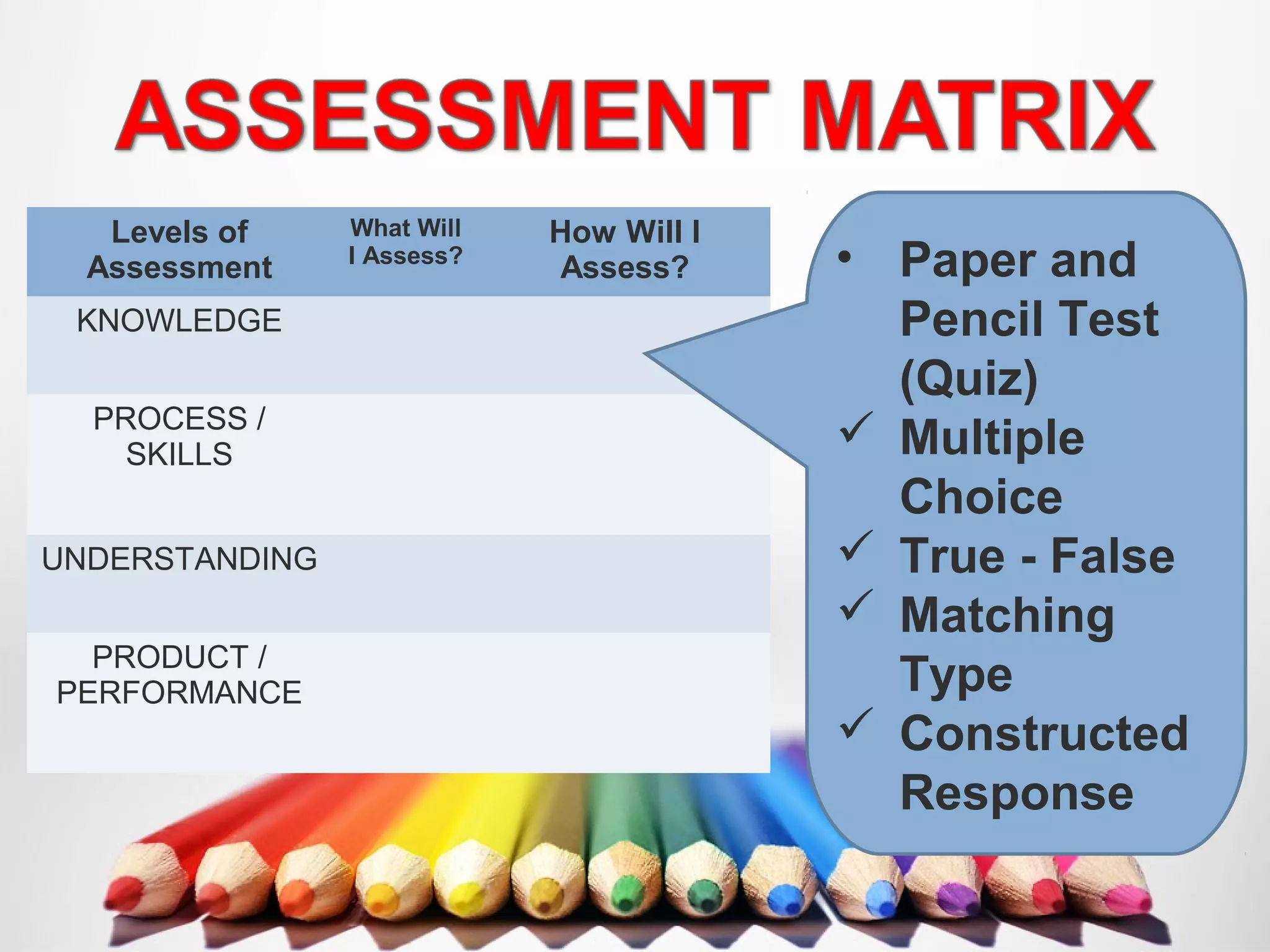
Levels of
Assessment
What Will
I Assess?
How Will I
Assess?
KNOWLEDGE
PROCESS /
SKILLS
UNDERSTANDING
PRODUCT /
PERFORMANCE
• Paper and
Pencil Test
(Quiz)
 Multiple
Choice
 True - False
 Matching
Type
 Constructed
Response
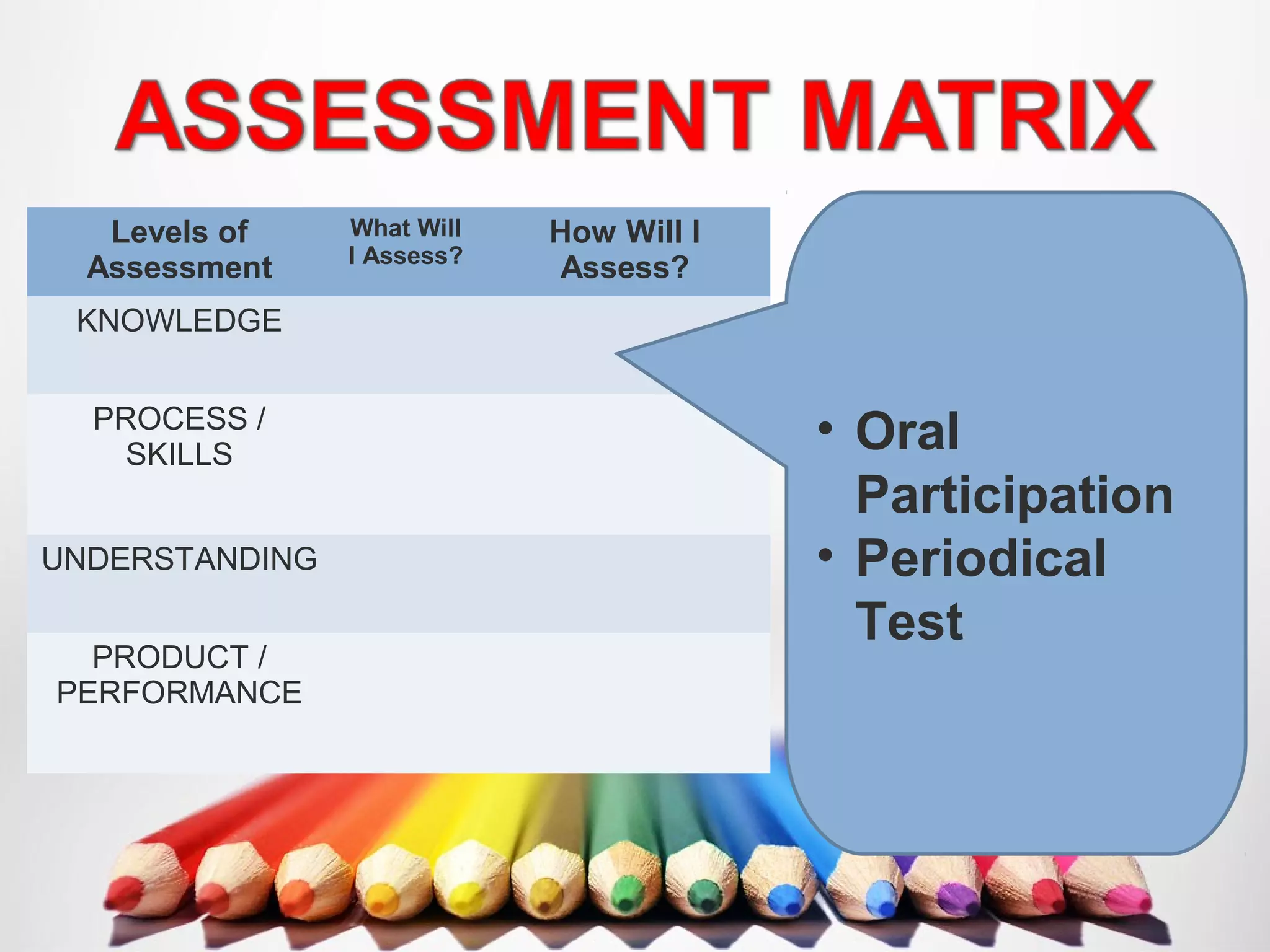
Levels of
Assessment
What Will
I Assess?
How Will I
Assess?
KNOWLEDGE
PROCESS /
SKILLS
UNDERSTANDING
PRODUCT /
PERFORMANCE
• Oral
Participation
• Periodical
Test
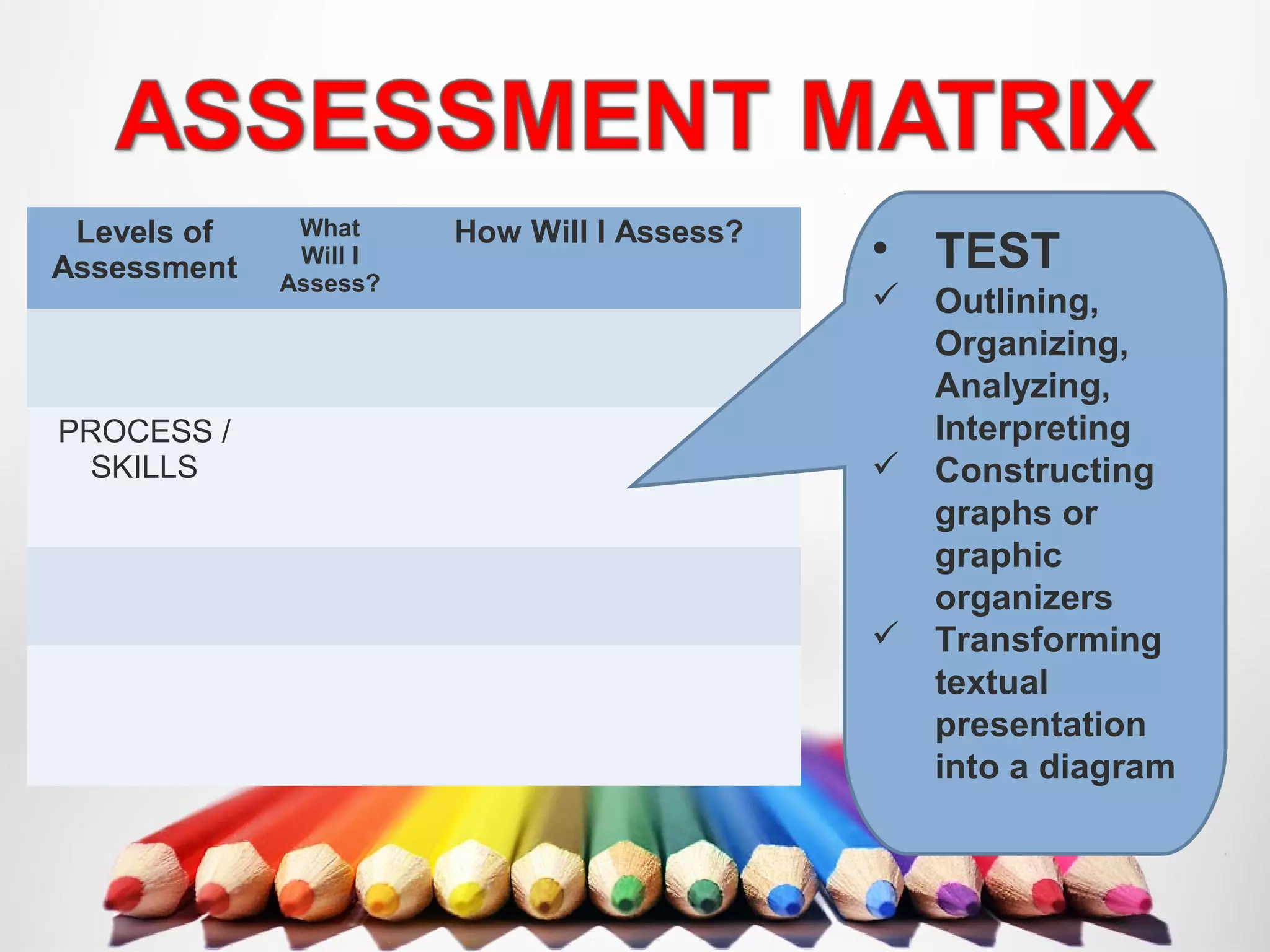
Levels of
Assessment
What
Will I
Assess?
How Will I Assess?
PROCESS /
SKILLS
• TEST
 Outlining,
Organizing,
Analyzing,
Interpreting
 Constructing
graphs or
graphic
organizers
 Transforming
textual
presentation
into a diagram
Levels of
Assessment
What
Will I
Assess?
How Will I Assess?
PROCESS /
SKILLS
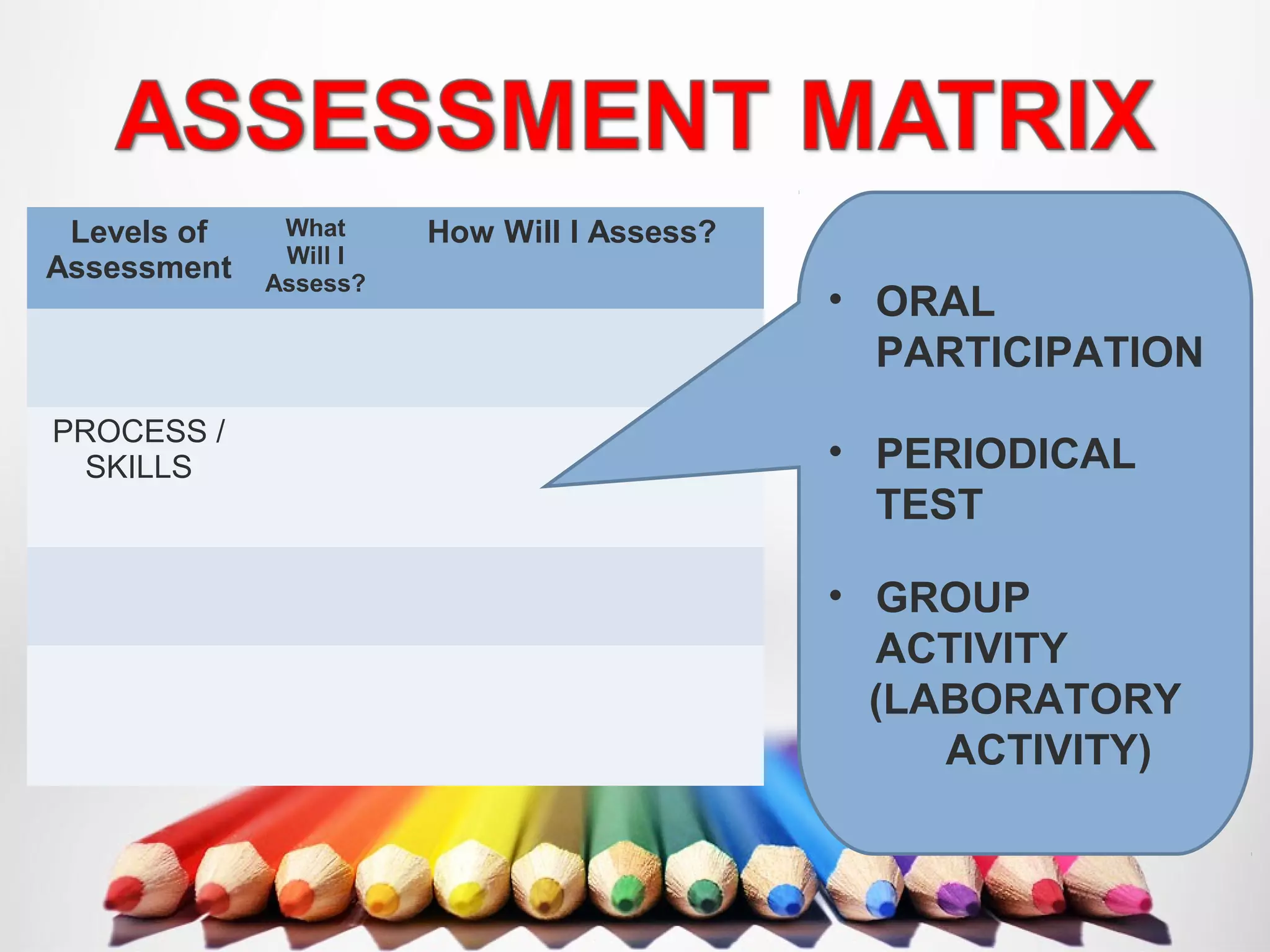
• ORAL
PARTICIPATION
• PERIODICAL
TEST
• GROUP
ACTIVITY
(LABORATORY
ACTIVITY)
Levels of
Assessment
What Will
I Assess?
How Will I
Assess?
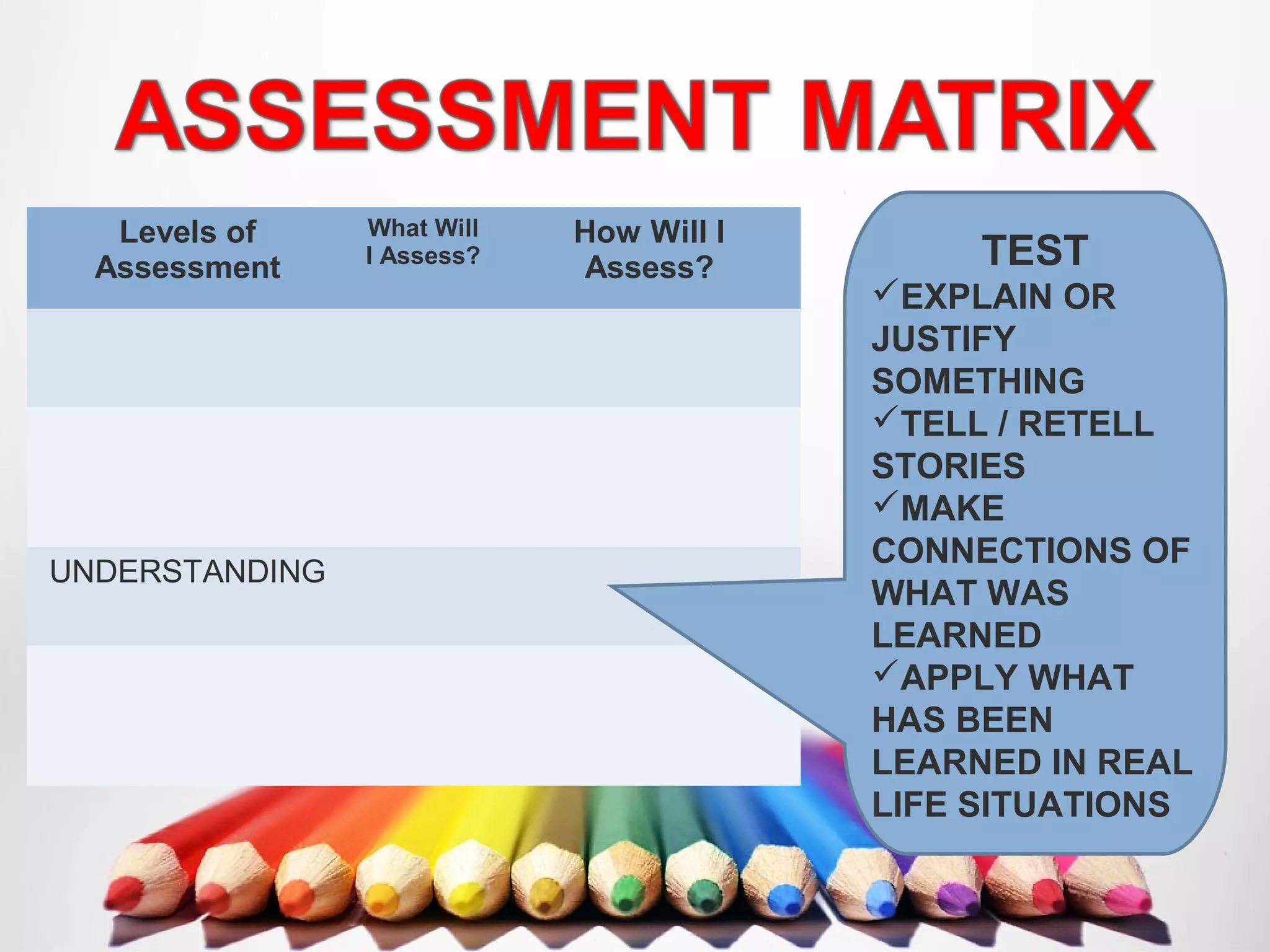
UNDERSTANDING
TEST
EXPLAIN OR
JUSTIFY
SOMETHING
TELL / RETELL
STORIES
MAKE
CONNECTIONS OF
WHAT WAS
LEARNED
APPLY WHAT
HAS BEEN
LEARNED IN REAL
LIFE SITUATIONS
Levels of
Assessment
What Will
I Assess?
How Will I
Assess?
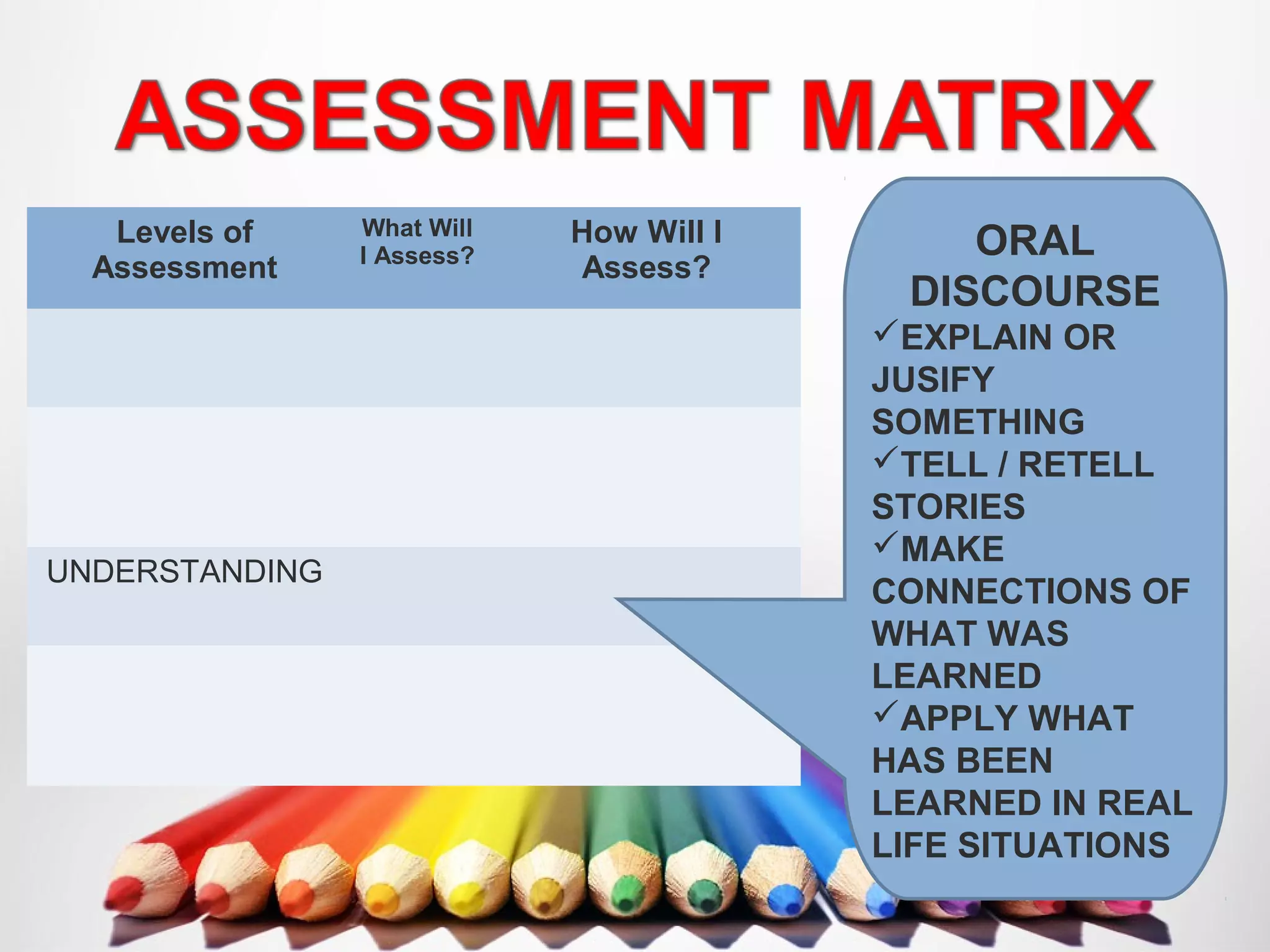
UNDERSTANDING
ORAL
DISCOURSE
EXPLAIN OR
JUSIFY
SOMETHING
TELL / RETELL
STORIES
MAKE
CONNECTIONS OF
WHAT WAS
LEARNED
APPLY WHAT
HAS BEEN
LEARNED IN REAL
LIFE SITUATIONS
Levels of
Assessment
What Will
I Assess?
How Will I
Assess?
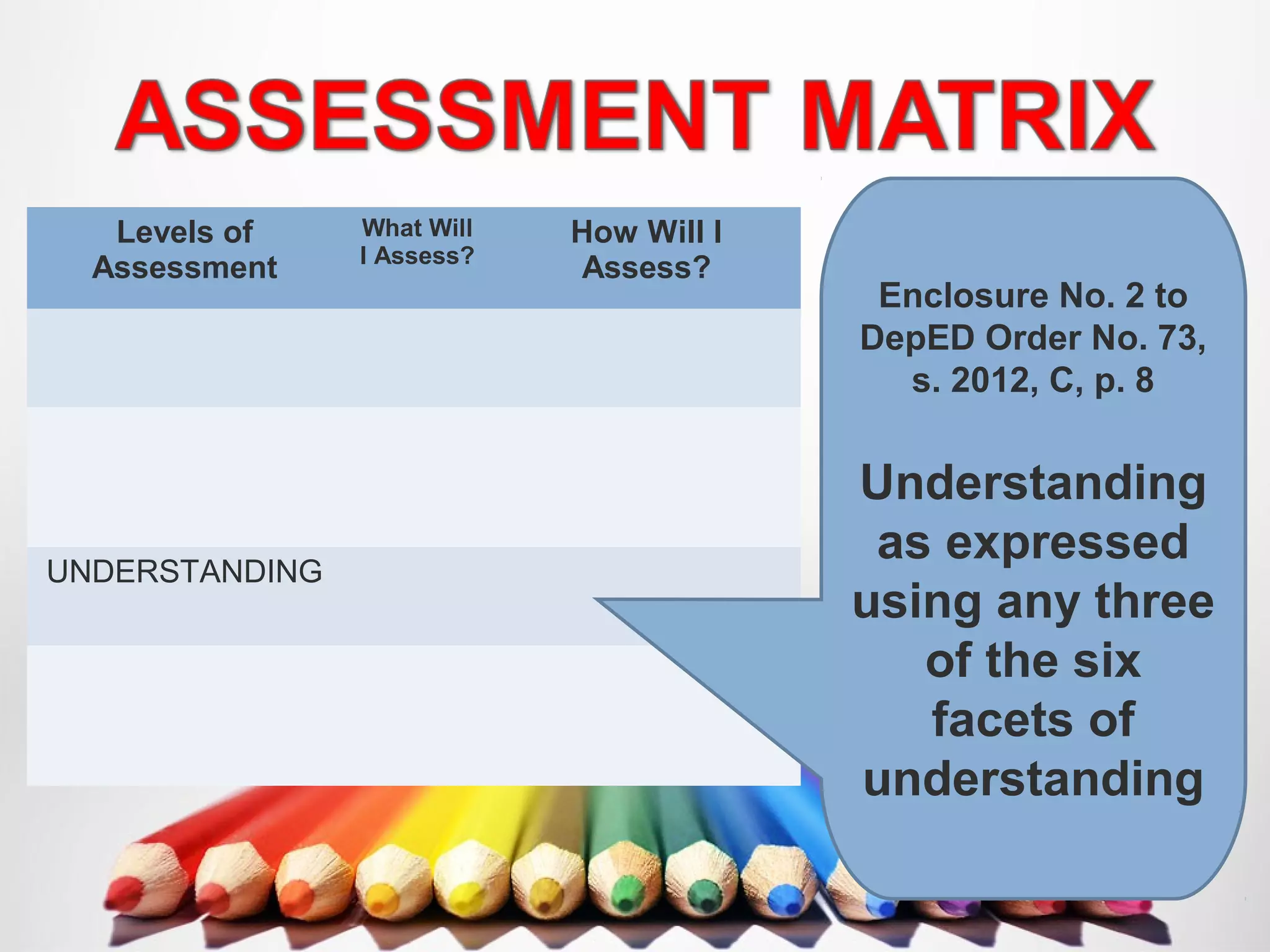
UNDERSTANDING
Enclosure No. 2 to
DepED Order No. 73,
s. 2012, C, p. 8
Understanding
as expressed
using any three
of the six
facets of
understanding
Levels of
Assessment
What Will I
Assess?
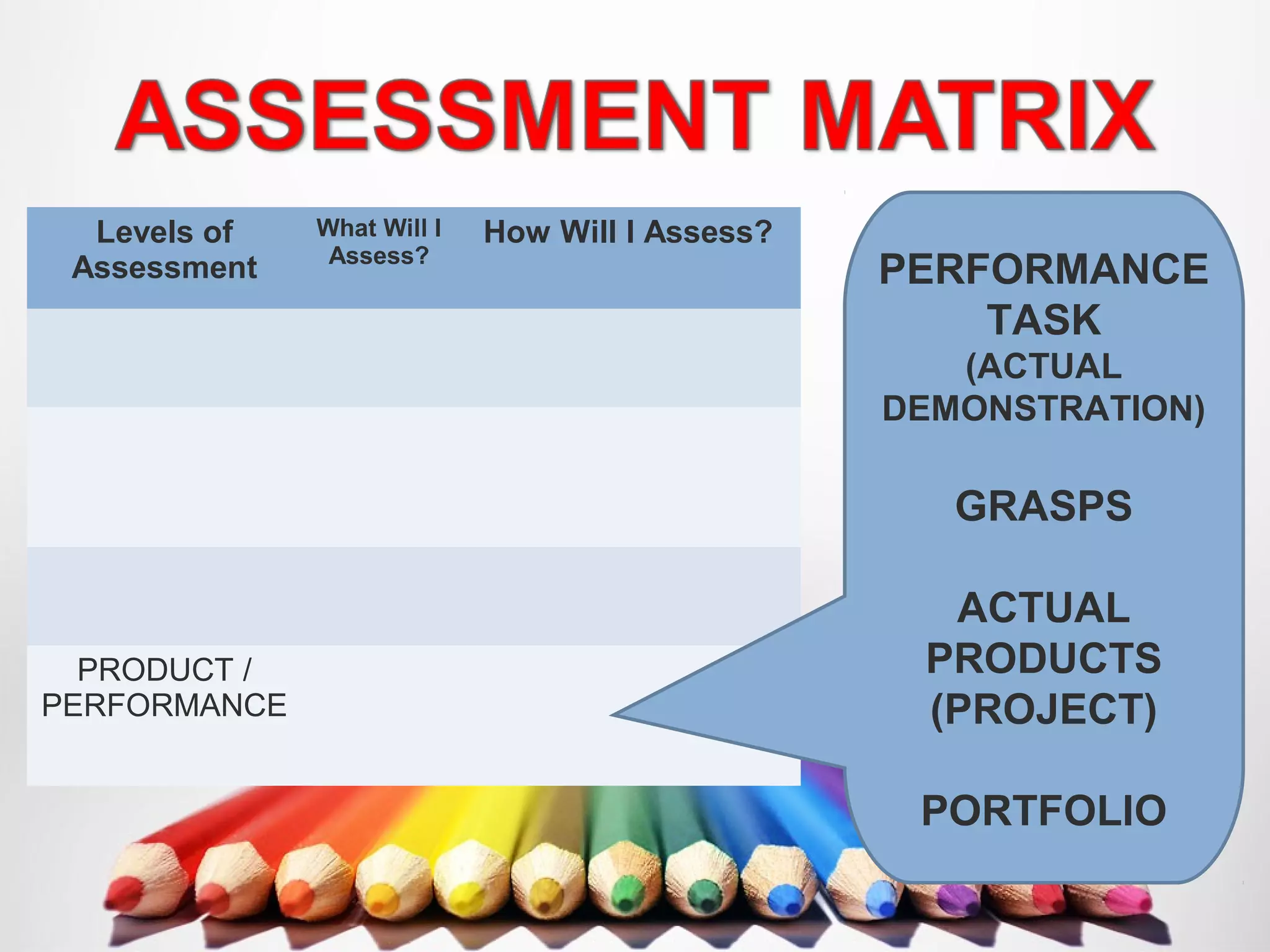
How Will I Assess?
PRODUCT /
PERFORMANCE
PERFORMANCE
TASK
(ACTUAL
DEMONSTRATION)
GRASPS
ACTUAL
PRODUCTS
(PROJECT)
PORTFOLIO
Levels of Assessment What Will I
Assess?
How Will I
Assess?
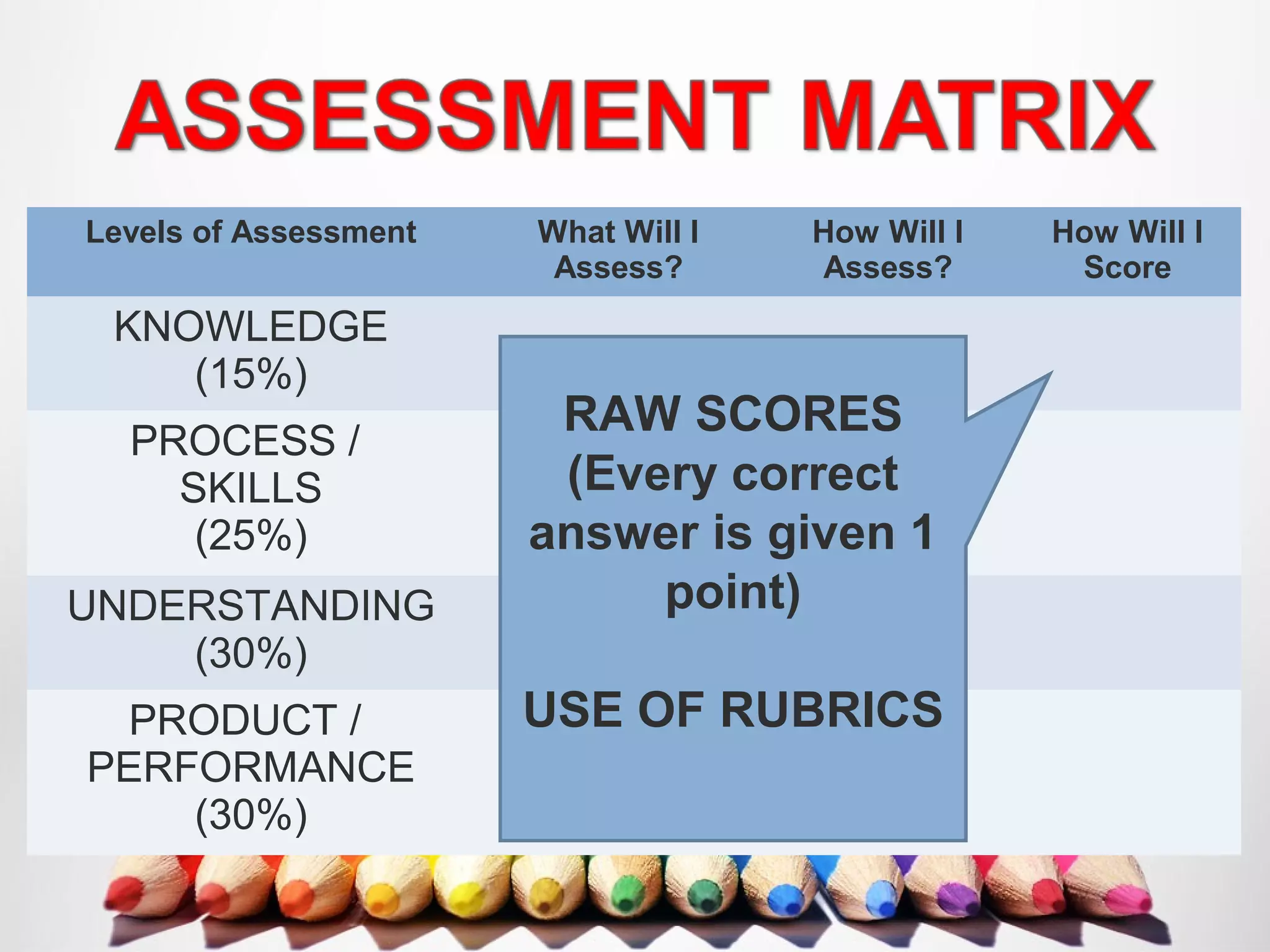
How Will I
Score
KNOWLEDGE
(15%)
PROCESS /
SKILLS
(25%)
UNDERSTANDING
(30%)
PRODUCT /
PERFORMANCE
(30%)
RAW SCORES
(Every correct
answer is given 1
point)
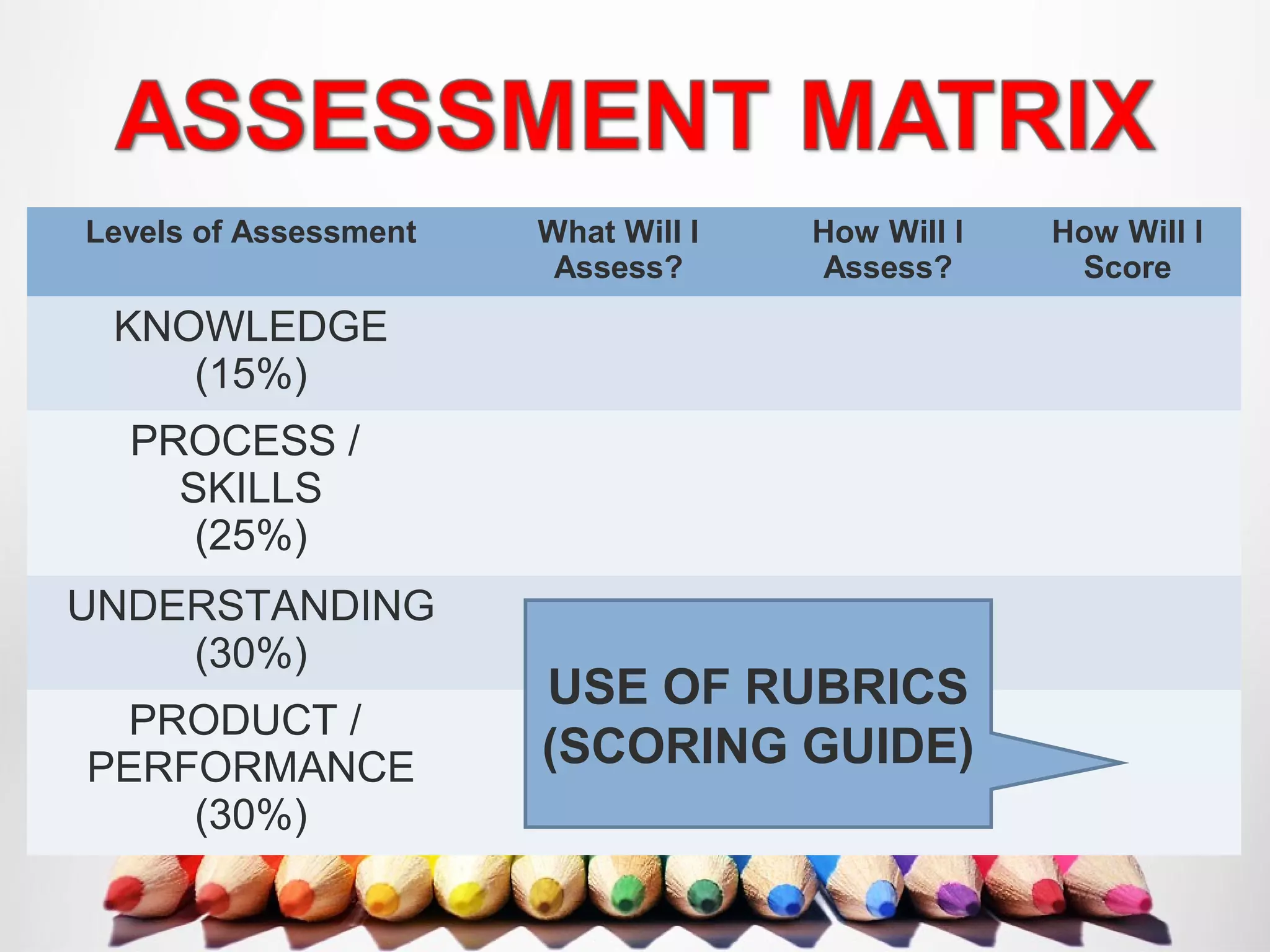
USE OF RUBRICS
Levels of Assessment What Will I
Assess?
How Will I
Assess?
How Will I
Score
KNOWLEDGE
(15%)
PROCESS /
SKILLS
(25%)
UNDERSTANDING
(30%)
PRODUCT /
PERFORMANCE
(30%)
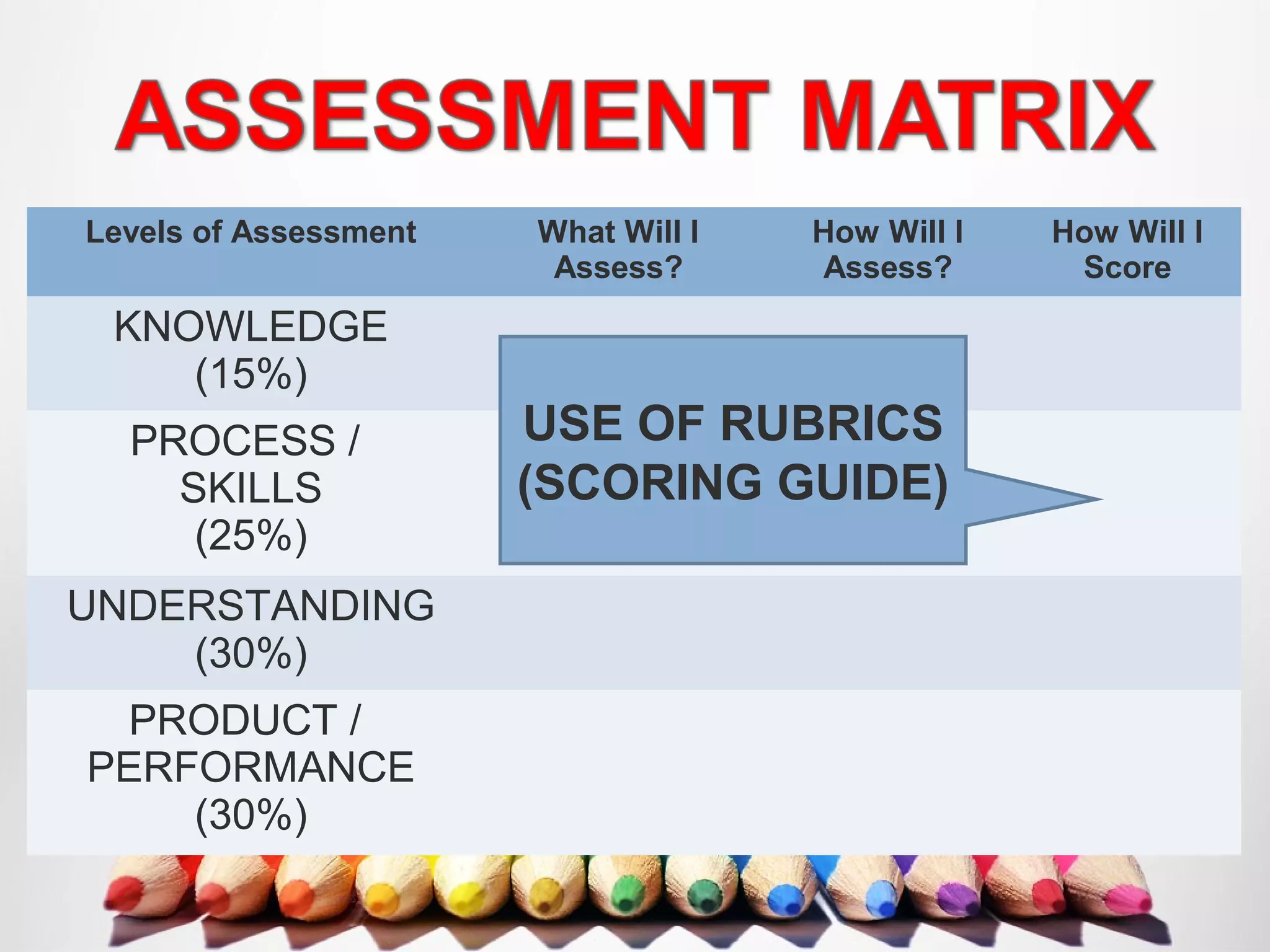
USE OF RUBRICS
(SCORING GUIDE)
Levels of Assessment What Will I
Assess?
How Will I
Assess?
How Will I
Score
KNOWLEDGE
(15%)
PROCESS /
SKILLS
(25%)
UNDERSTANDING
(30%)
PRODUCT /
PERFORMANCE
(30%)
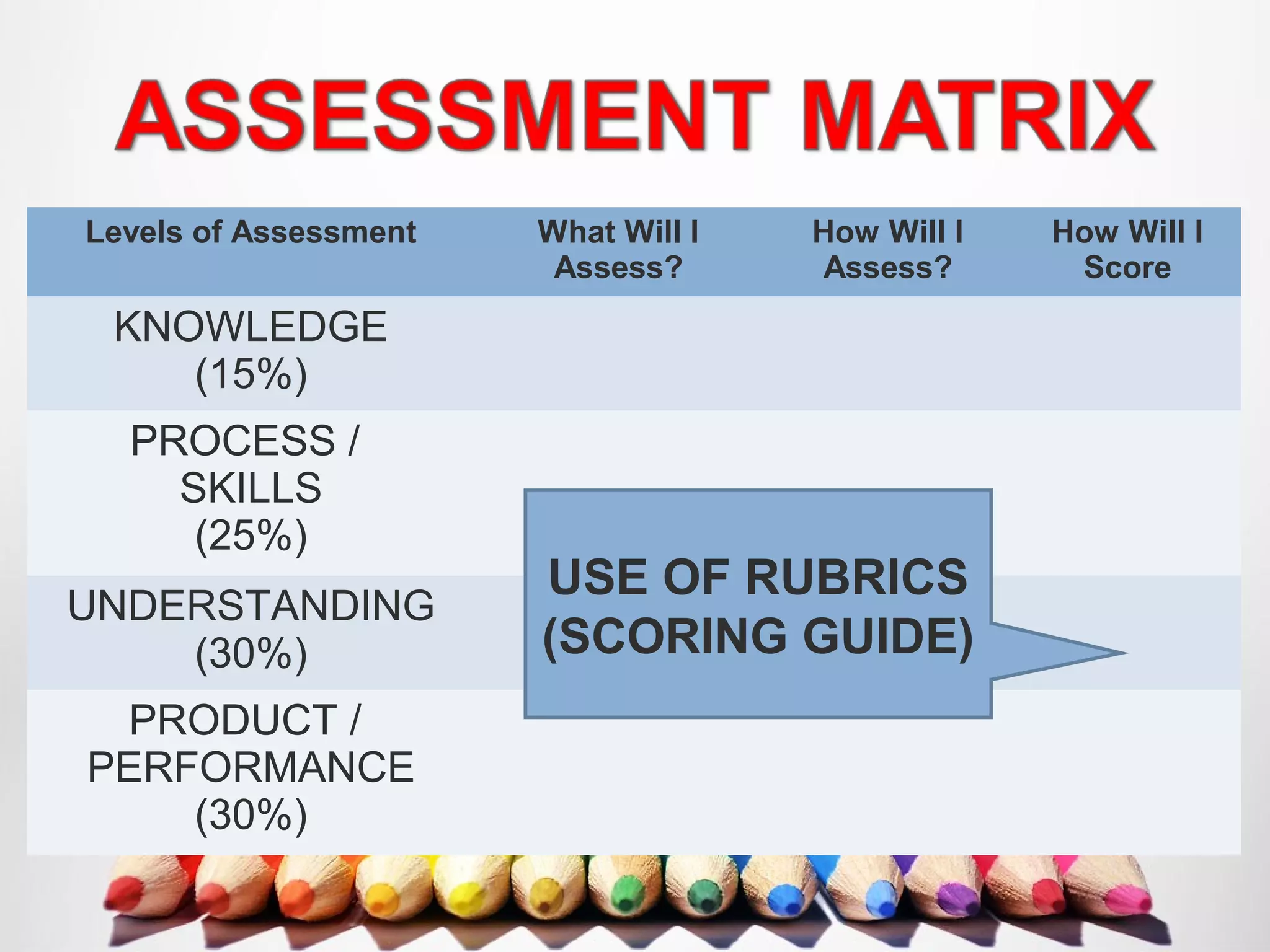
USE OF RUBRICS
(SCORING GUIDE)
Levels of Assessment What Will I
Assess?
How Will I
Assess?
How Will I
Score
KNOWLEDGE
(15%)
PROCESS /
SKILLS
(25%)
UNDERSTANDING
(30%)
PRODUCT /
PERFORMANCE
(30%)
USE OF RUBRICS
(SCORING GUIDE)
How to
compute?
II. SAMPLE COMPUTATION
OF PUPIL RATING
To determine the rating for the
learning area in a grading
period, which includes Mother
Tongue,
get the average of all the
ratings entered in the
Class Record under
each measure of
achievement.
Multiply the result by
the corresponding
percentage weight.
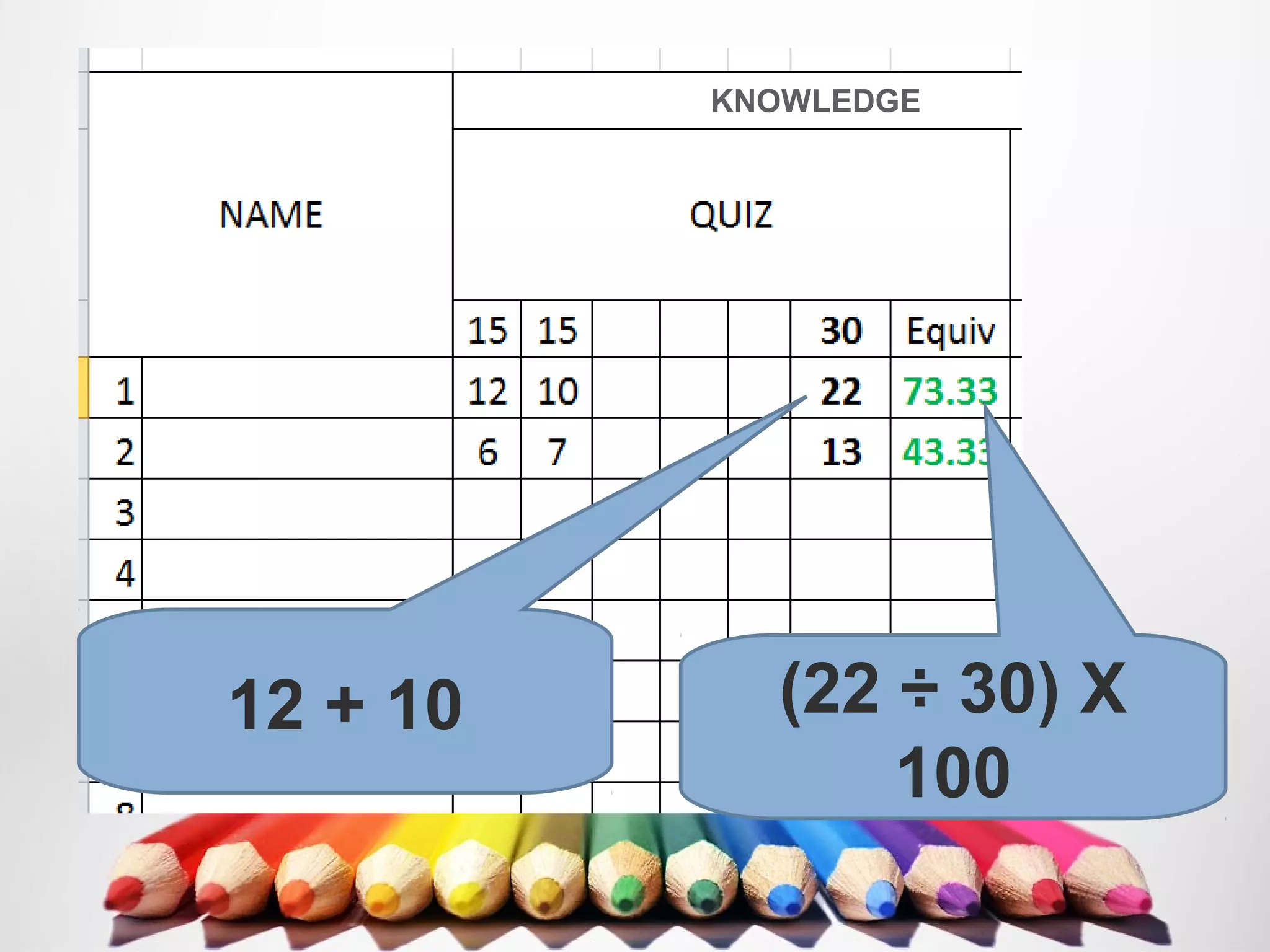
12 + 10 (22 Ć· 30) X
100
KNOWLEDGE
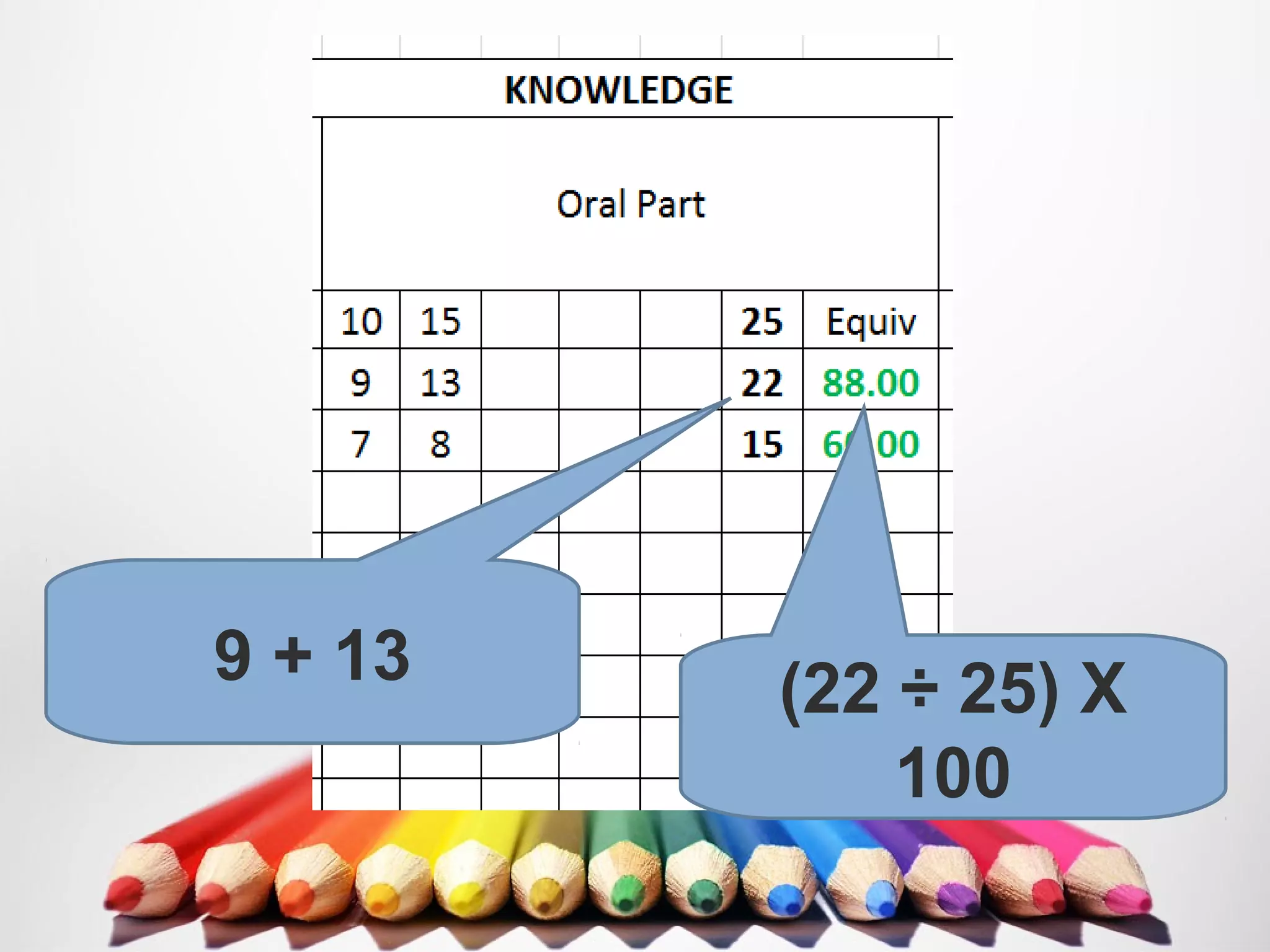
(22 Ć· 25) X
100
9 + 13
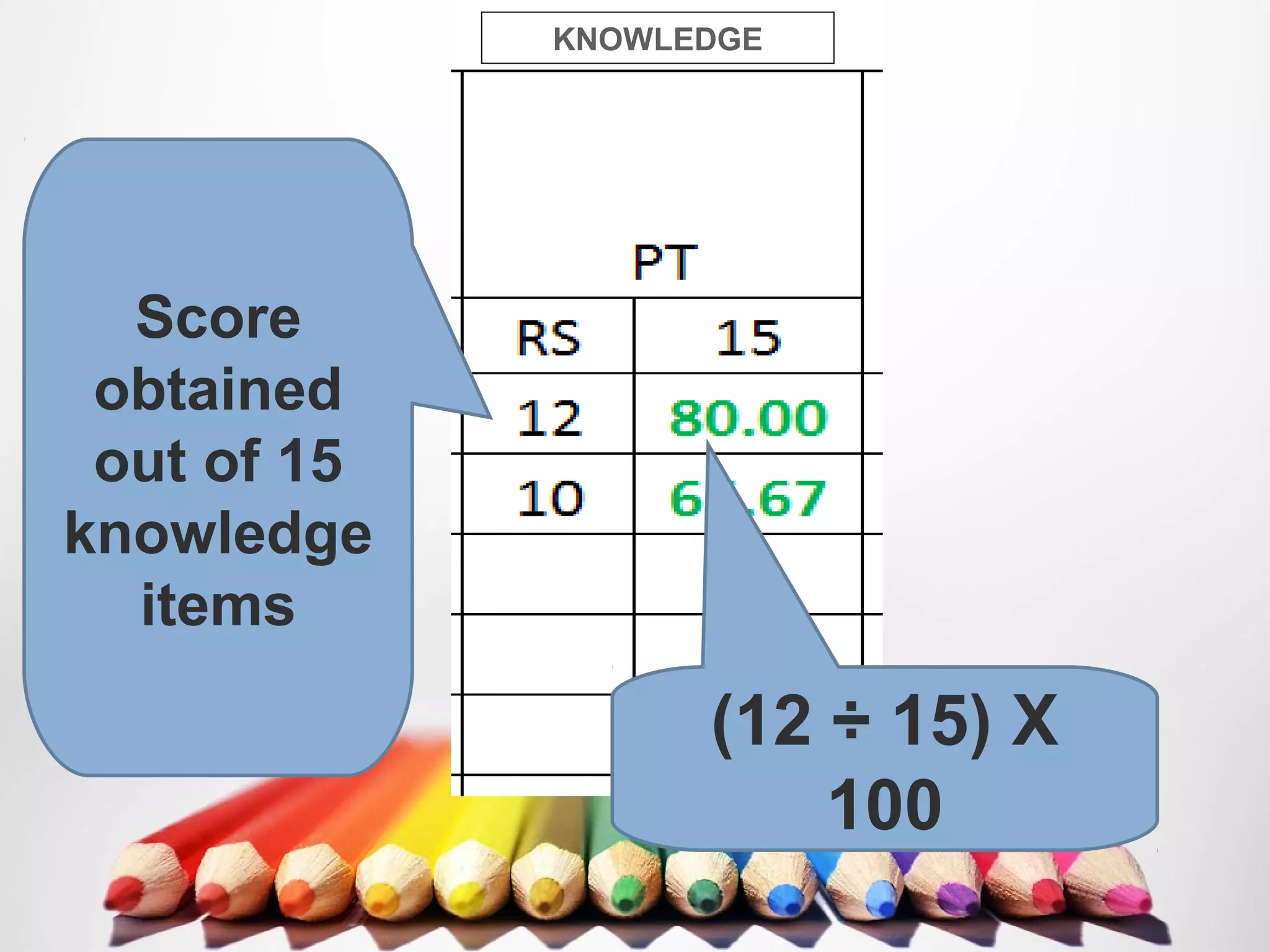
Score
obtained
out of 15
knowledge
items
(12 Ć· 15) X
100
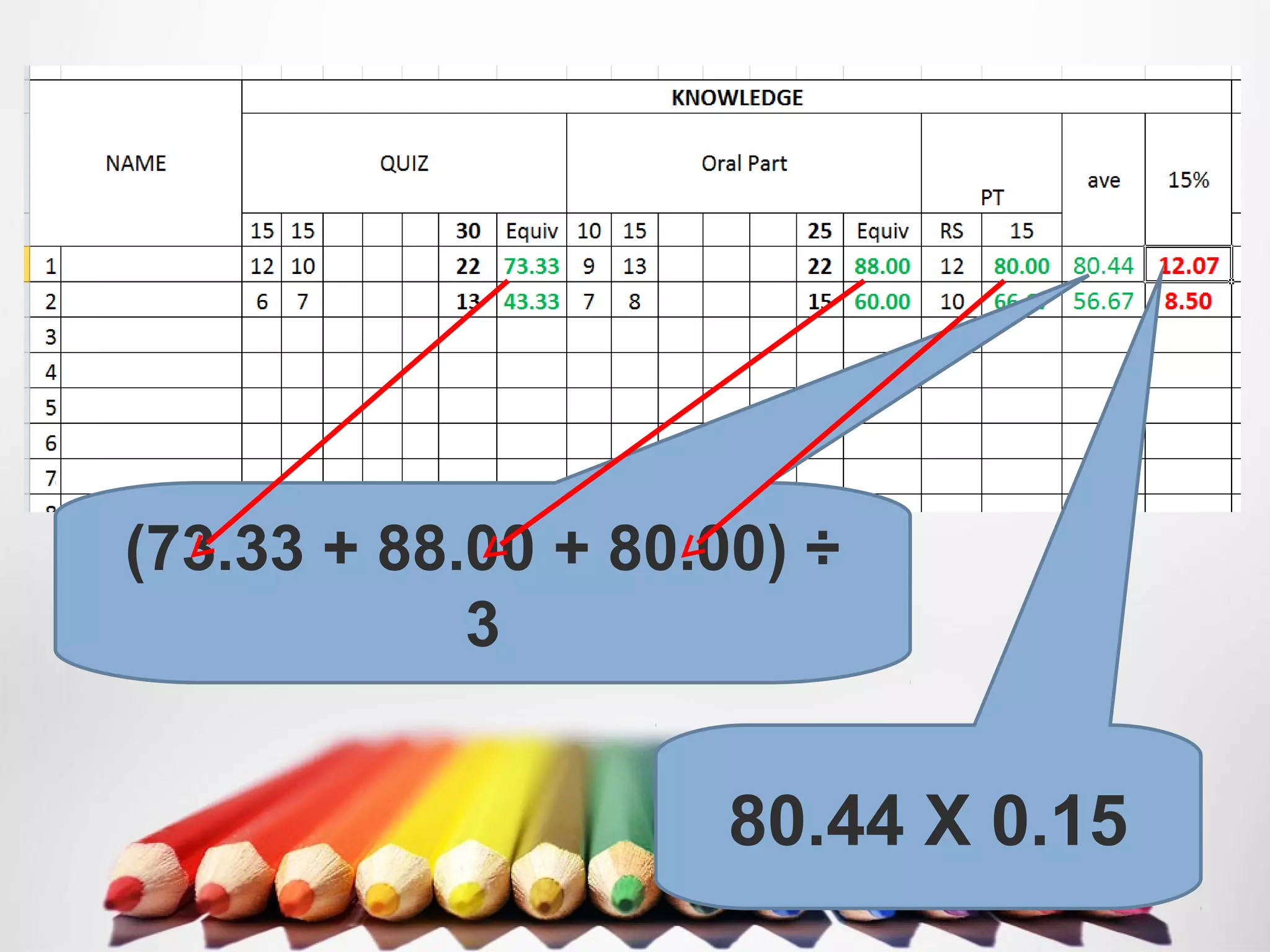
KNOWLEDGE
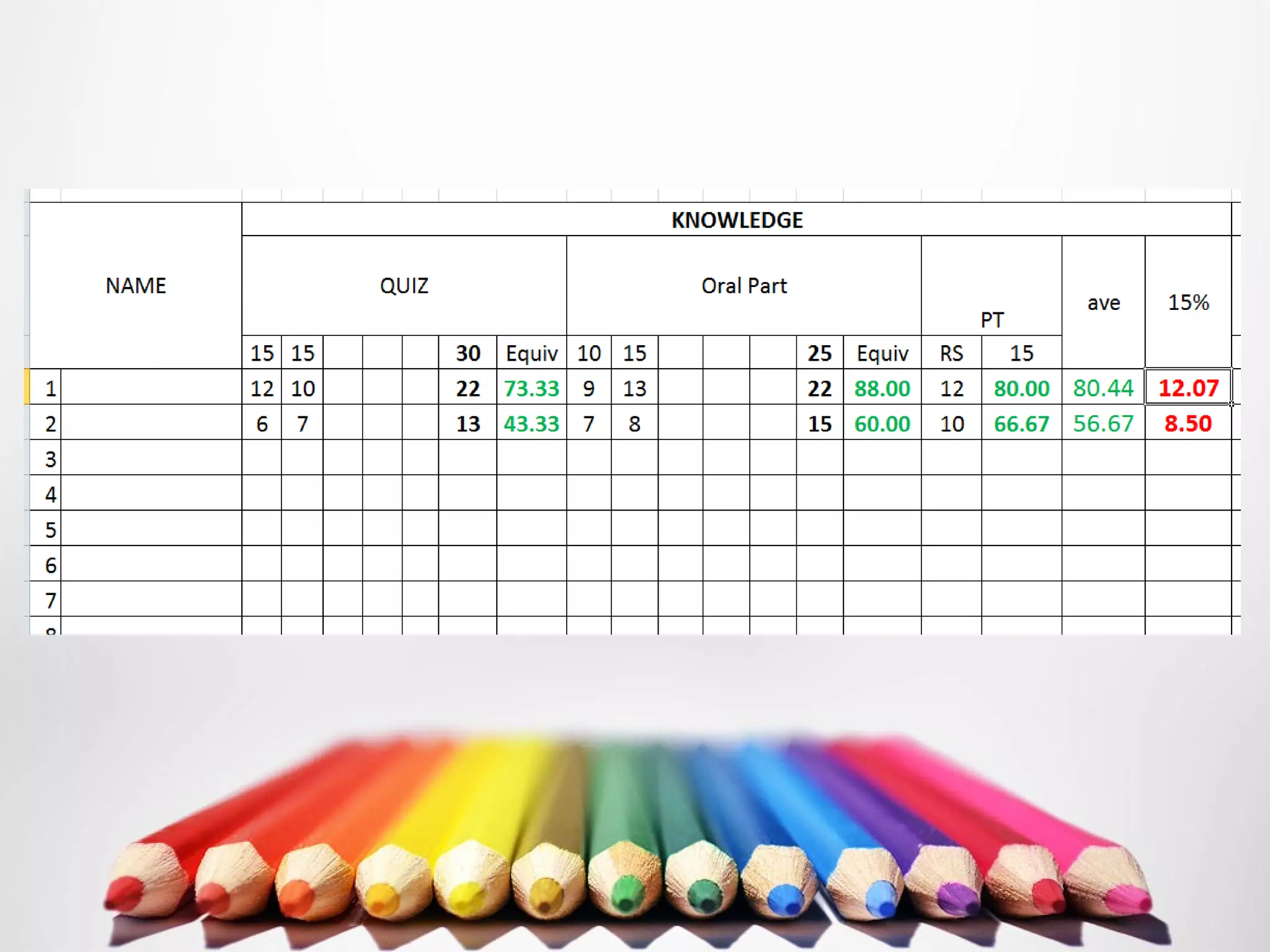
(73.33 + 88.00 + 80.00) Ć·
3
80.44 X 0.15
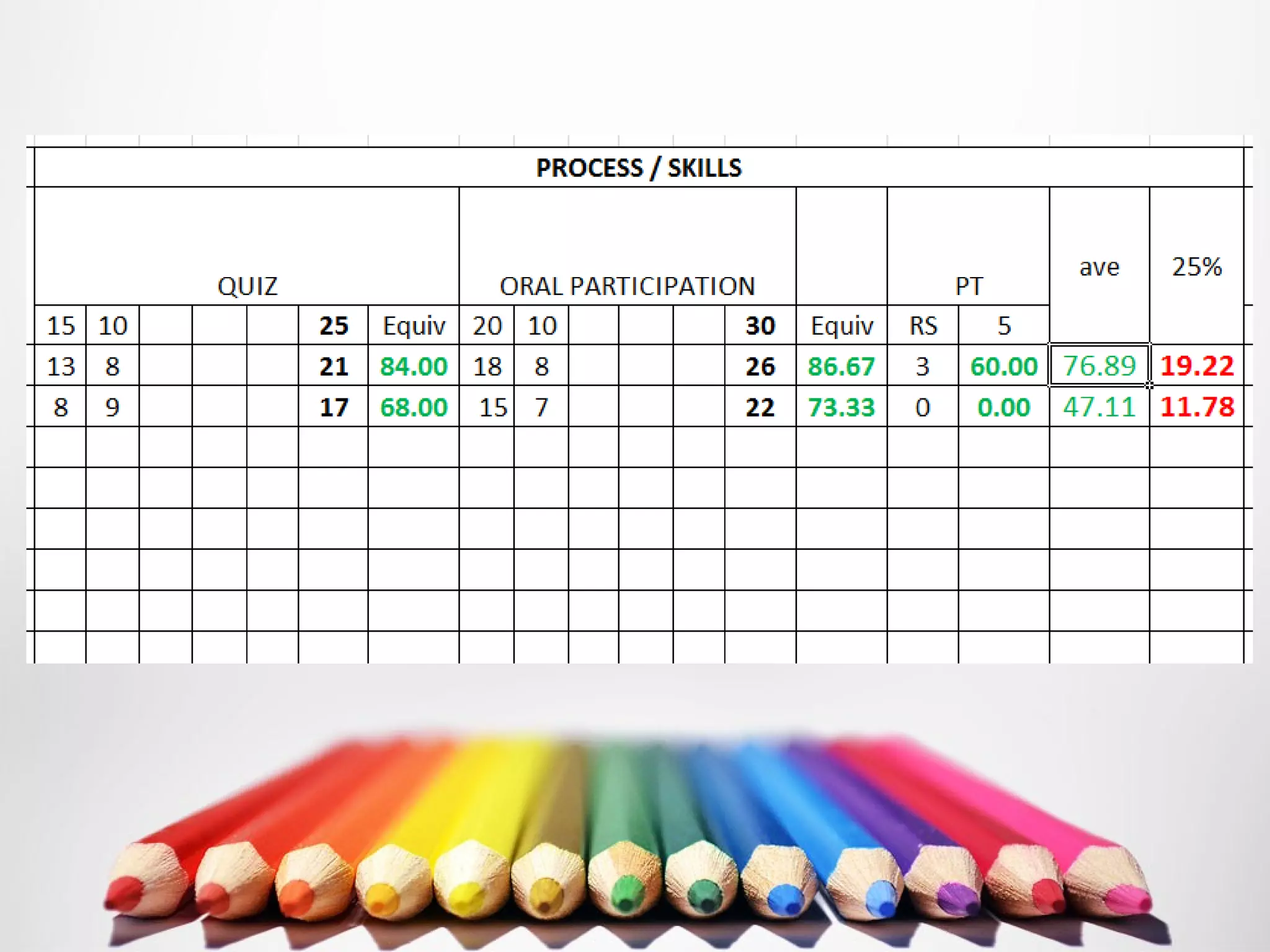
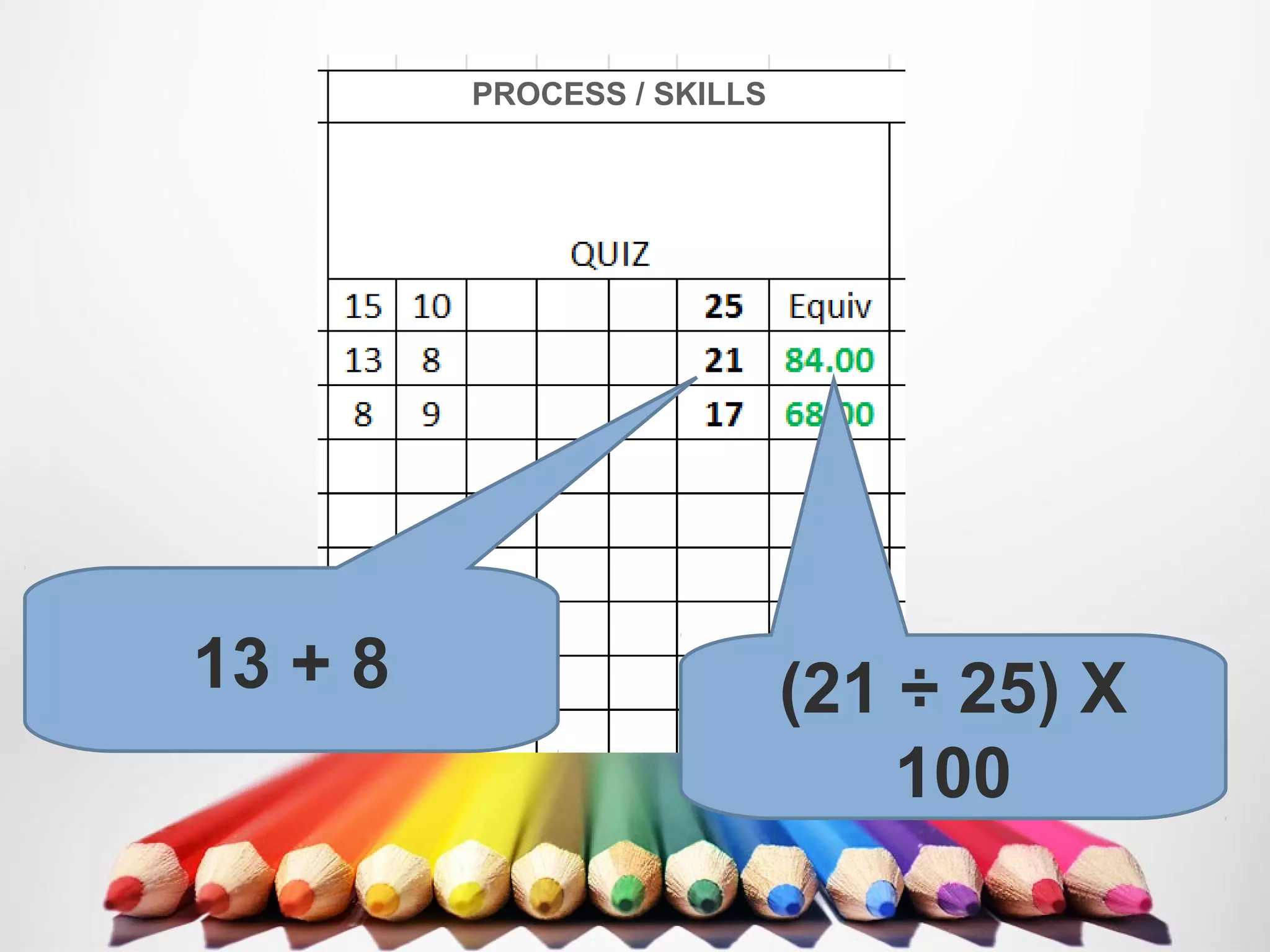
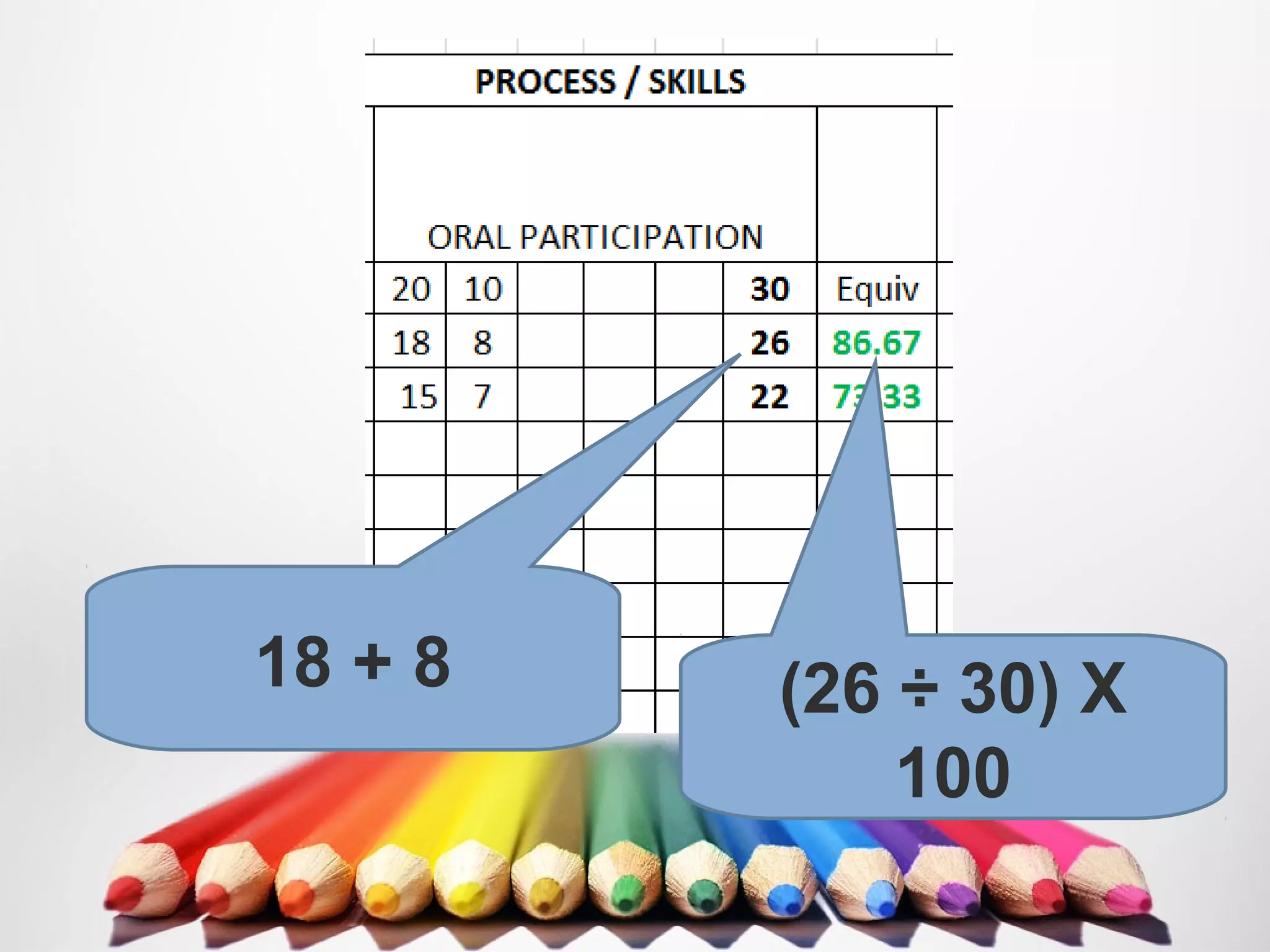
13 + 8 (21 Ć· 25) X
100
PROCESS / SKILLS
18 + 8 (26 Ć· 30) X
100
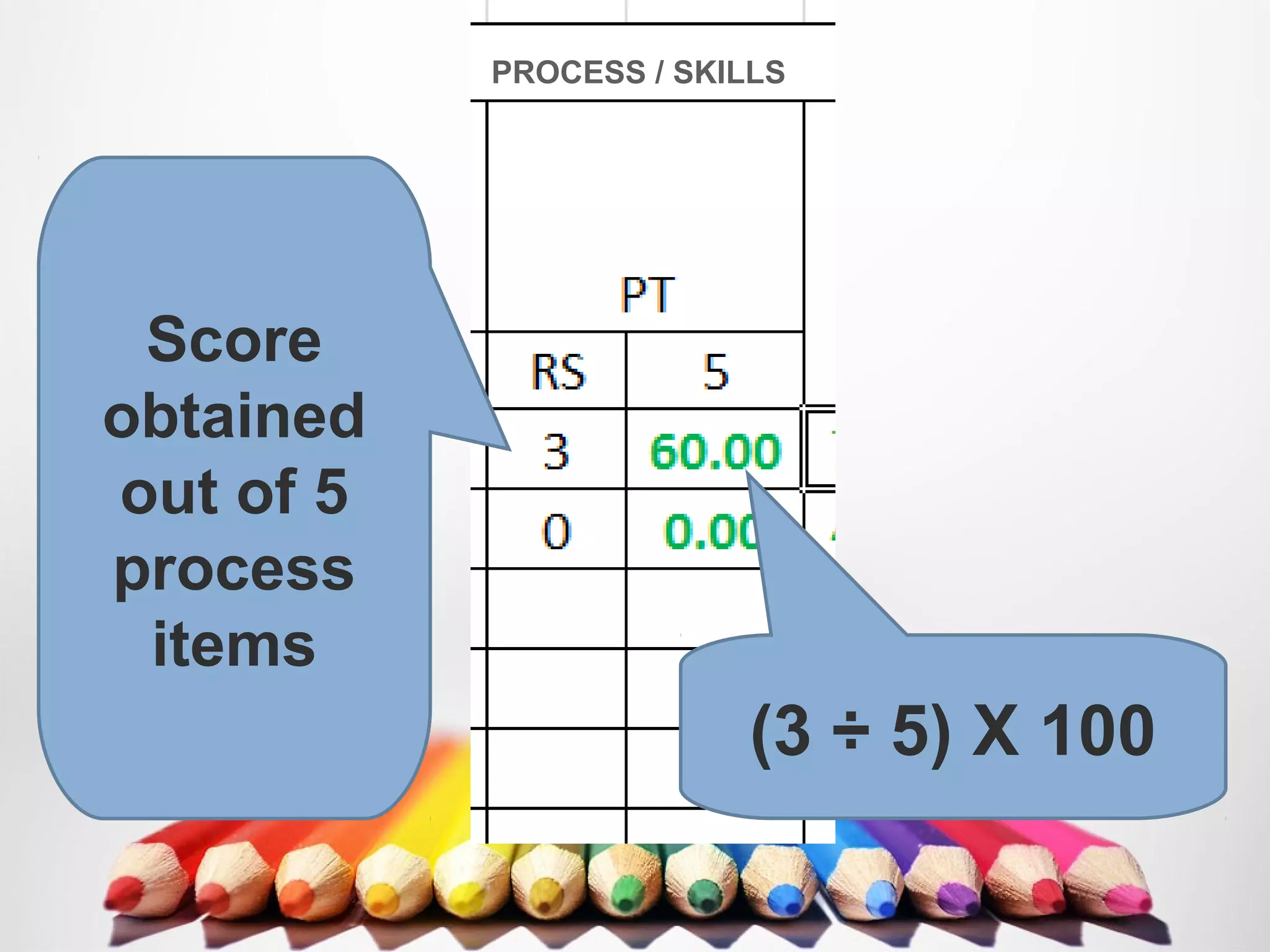
Score
obtained
out of 5
process
items
(3 Ć· 5) X 100
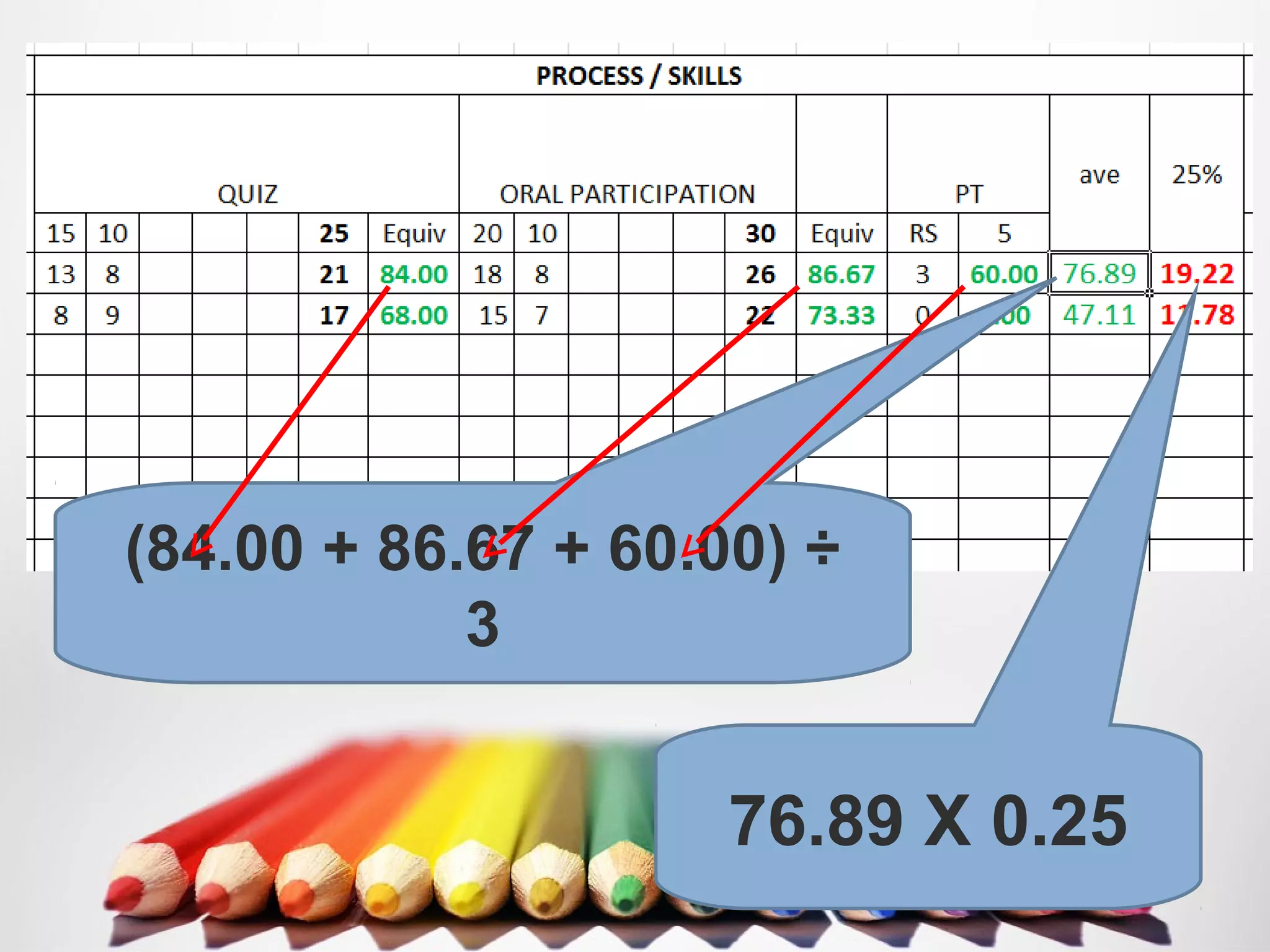
PROCESS / SKILLS
(84.00 + 86.67 + 60.00) Ć·
3
76.89 X 0.25
III. MARKING for MAPEH
each of the four (4)
component areas shall be
taught separately and
pupils will be rated per
component area
There shall be one
rating for MAPEH, which
is the average of the
four component areas.
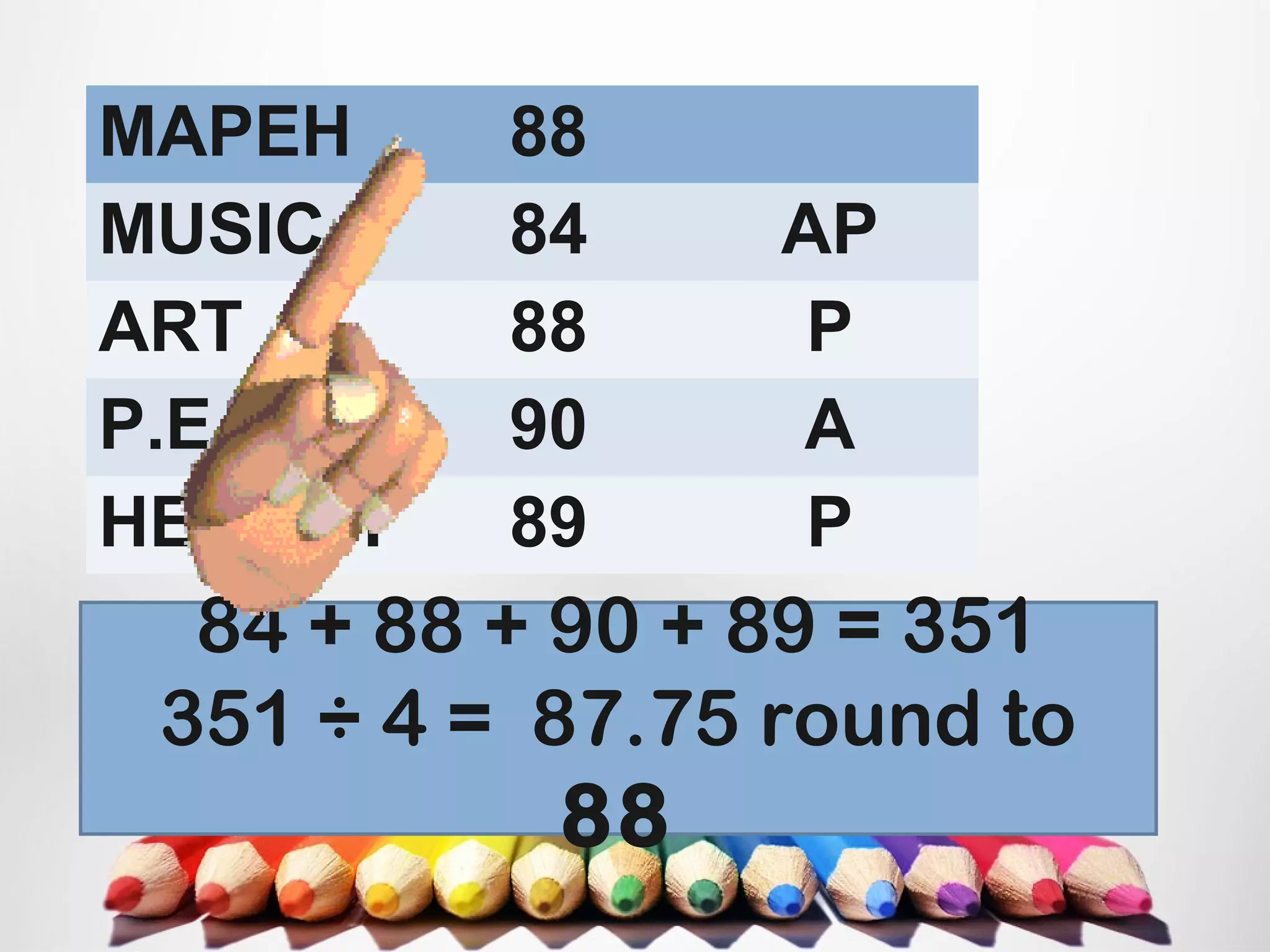
MAPEH 88
MUSIC 84 AP
ART 88 P
P.E. 90 A
HEALTH 89 P
84 + 88 + 90 + 89 = 351
351 Ć· 4 = 87.75 round to
88
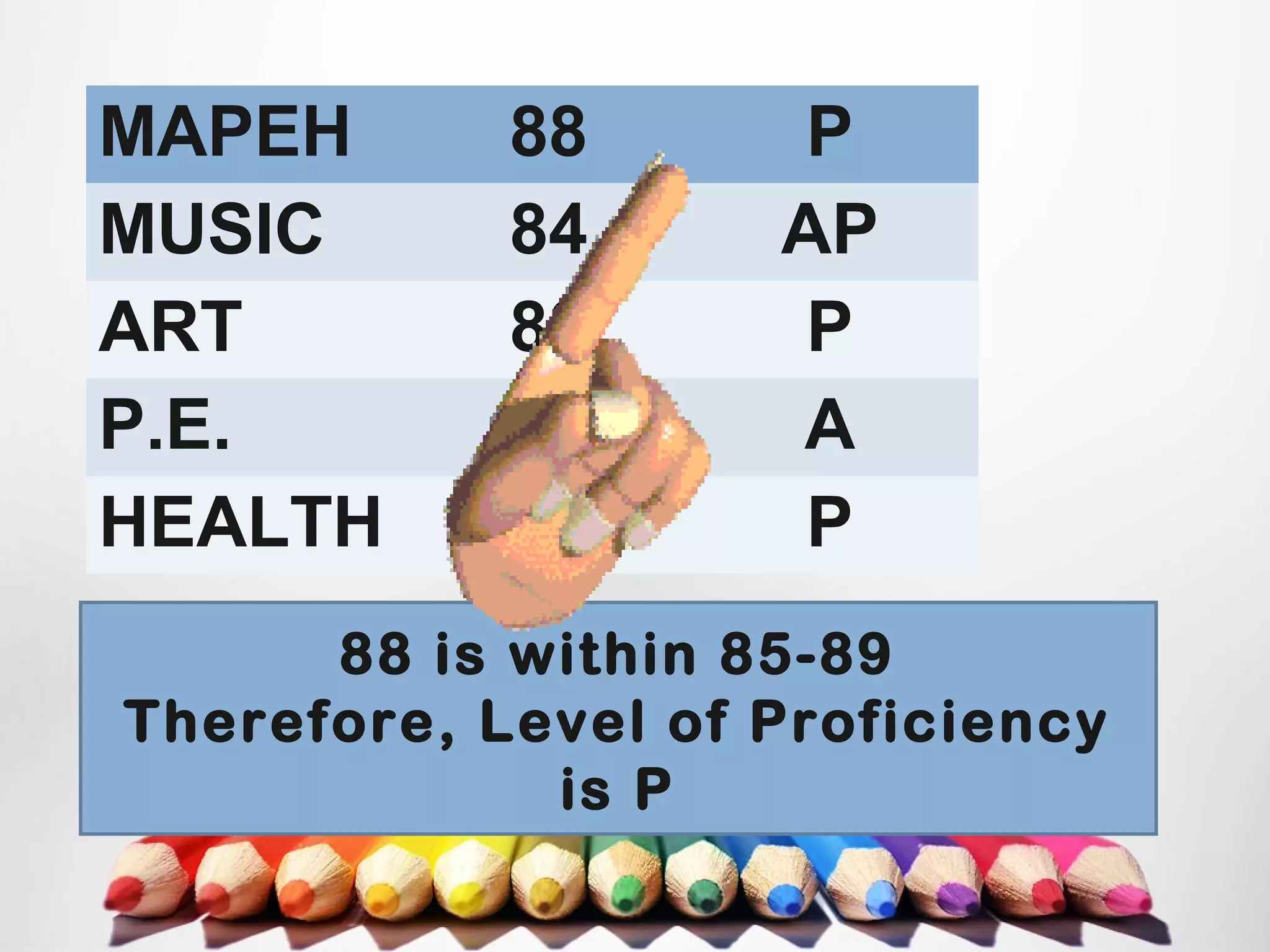
MAPEH 88 P
MUSIC 84 AP
ART 88 P
P.E. 90 A
HEALTH 89 P
88 is within 85-89
Therefore, Level of Proficiency
is P
IV. Marking for Oral Fluency
in Filipino and English
Like the other learning
areas, assessment of
Oral Fluency in Filipino
and English shall also be
at four (4) levels
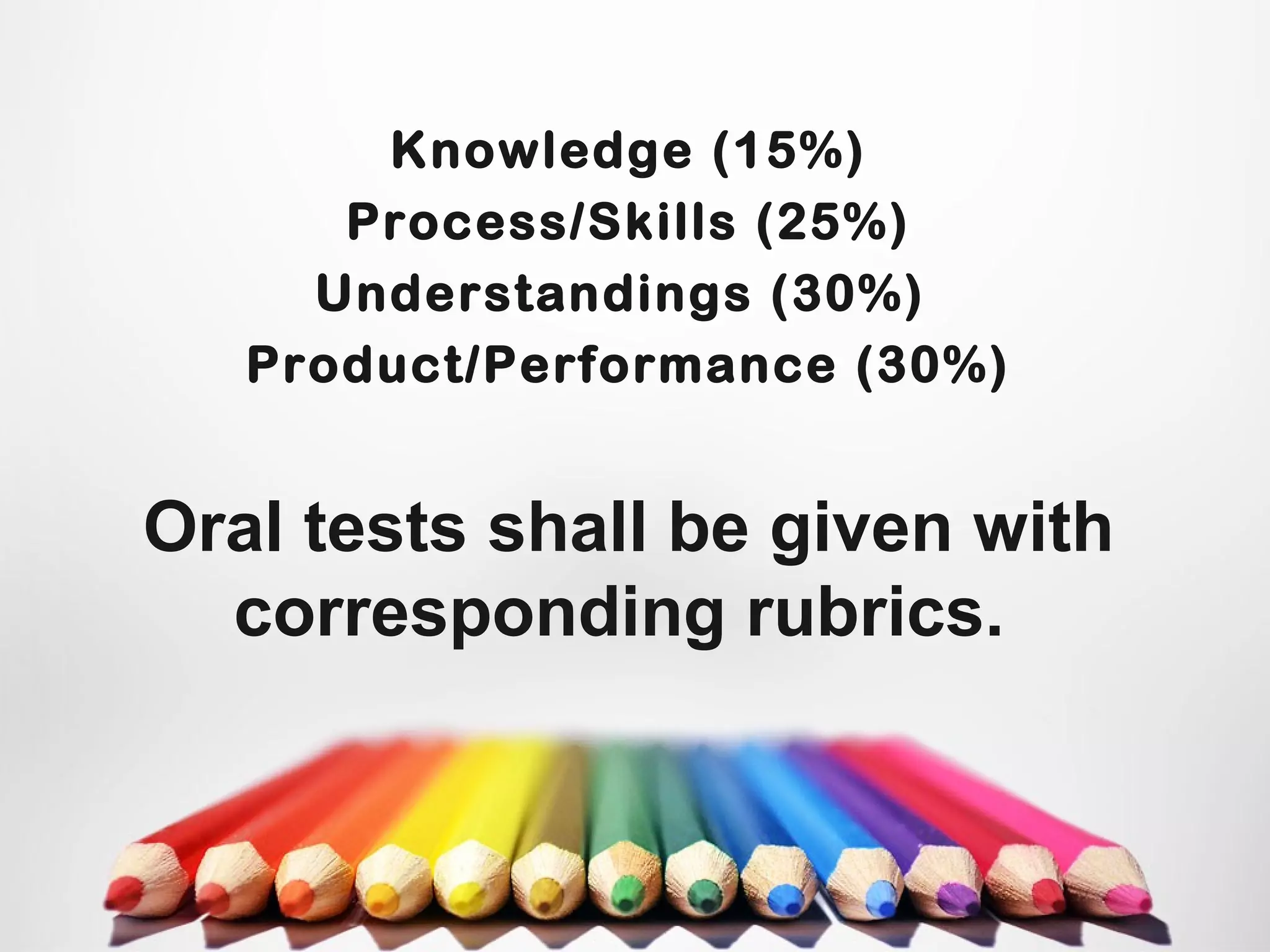
Knowledge (15%)
Process/Skills (25%)
Understandings (30%)
Product/Performance (30%)
Oral tests shall be given with
corresponding rubrics.
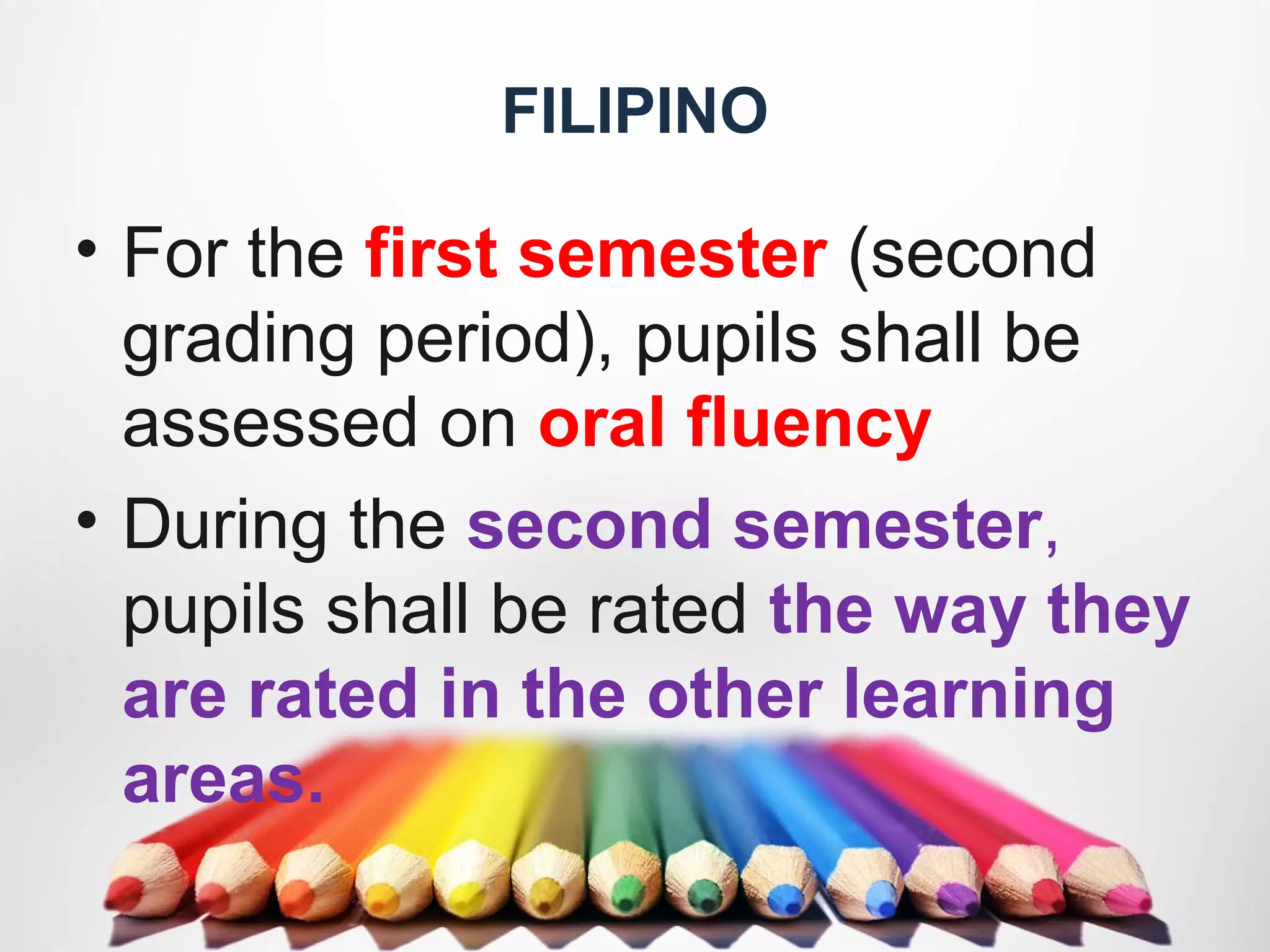
FILIPINO
• For the first semester (second
grading period), pupils shall be
assessed on oral fluency
• During the second semester,
pupils shall be rated the way they
are rated in the other learning
areas.
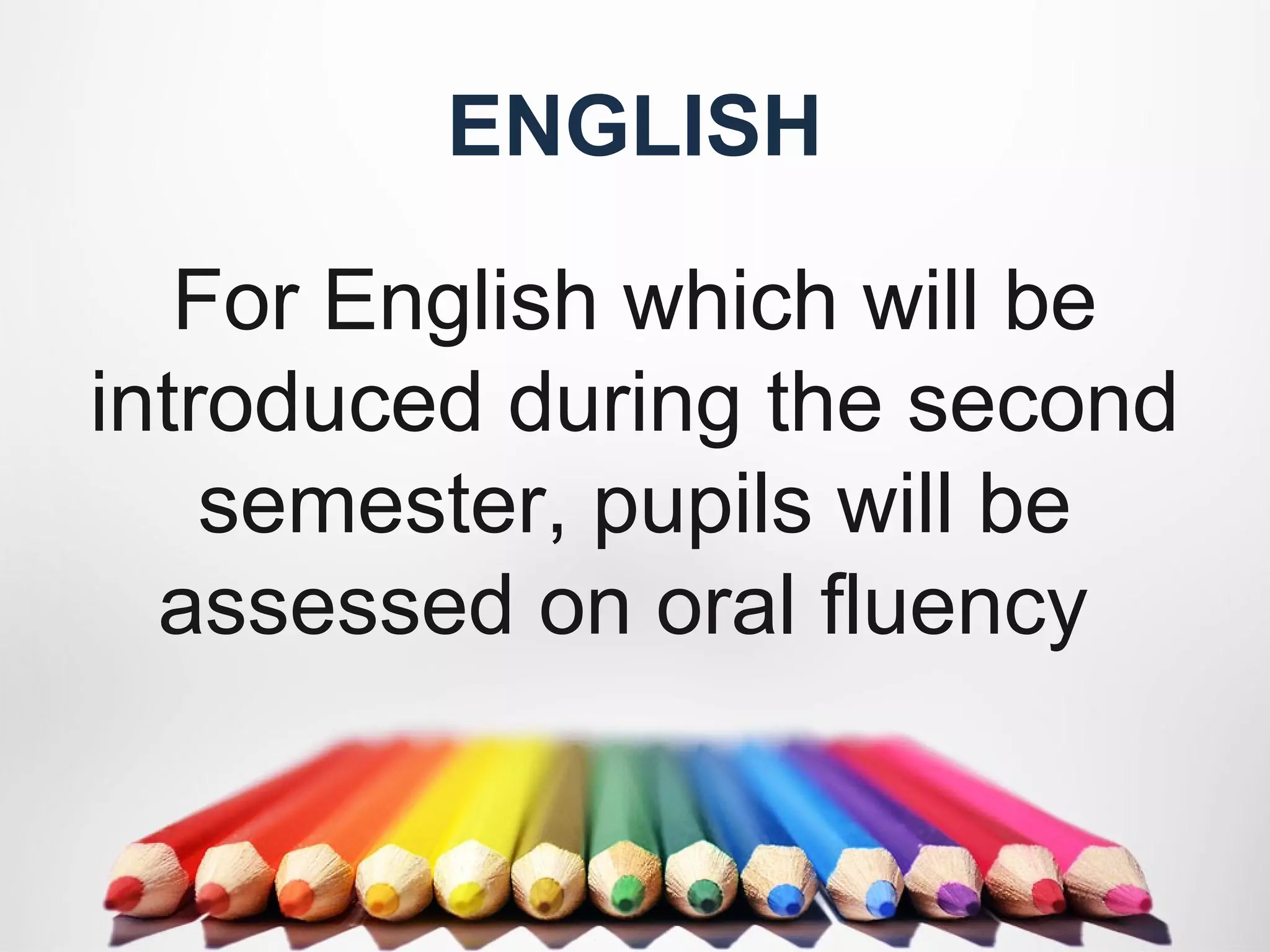
ENGLISH
For English which will be
introduced during the second
semester, pupils will be
assessed on oral fluency
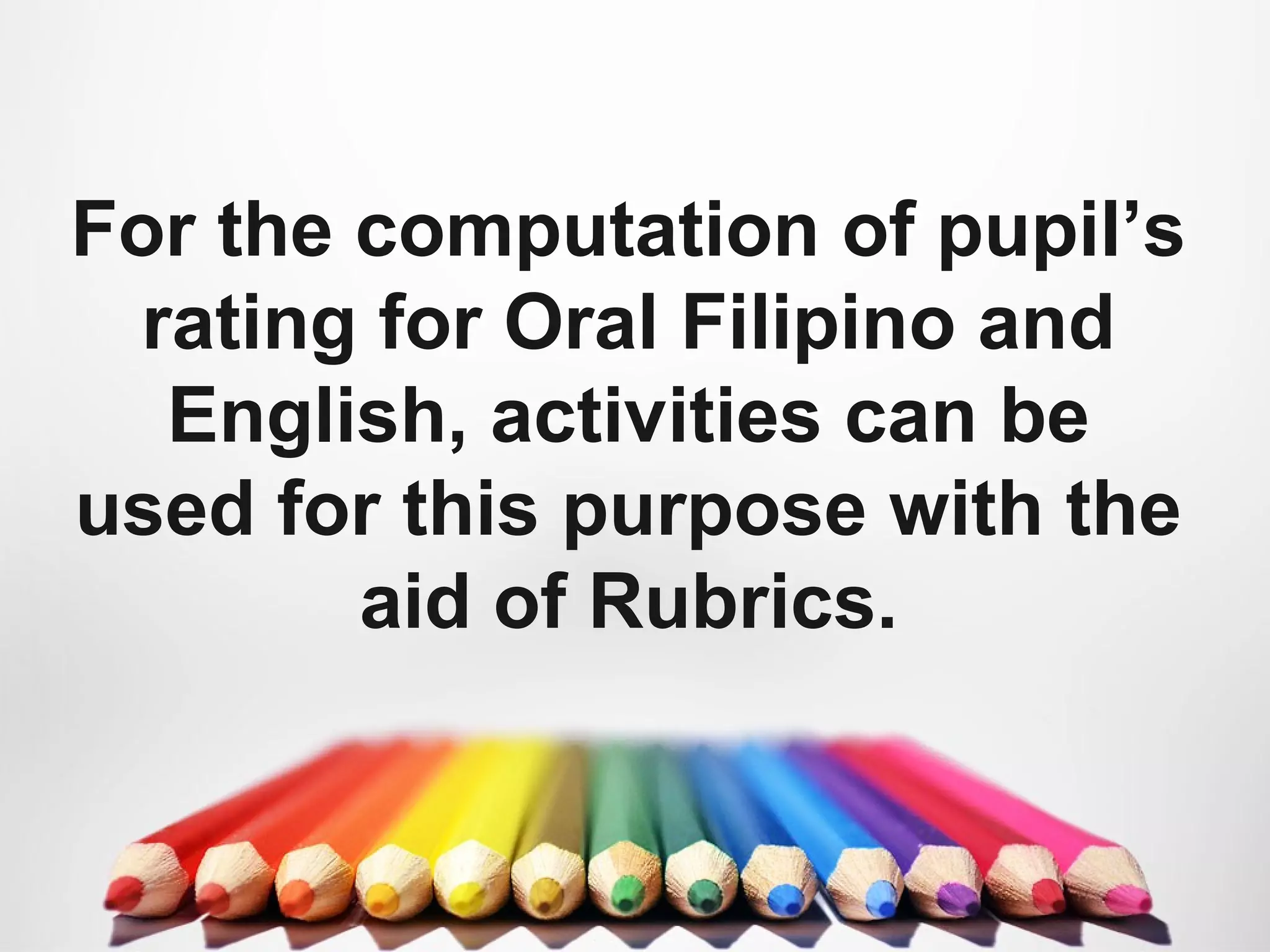
For the computation of pupil’s
rating for Oral Filipino and
English, activities can be
used for this purpose with the
aid of Rubrics.
V. ASSESSING THE MOTHER
TONGUE SUBJECT
Since MT is a language subject,
its assessment follows the four
levels of assessment with its
corresponding weight and the
level of proficiency as indicated
in DO No. 31 s. 2012.
MT should not be treated as a
different or distinct subject from the
rest of the subjects.
Oral language proficiency of the
students and small and big group
activities will be measured using the
rubrics.
VI. MARKING FOR CHARACTER
TRAITS
Existing Guidelines
stipulated in DepEd Order
No. 33, s. 2004 for Marking
Character Traits shall be
applied.
VII. Scoring Quizzes and
Periodic Test
(Refer to DepEd Order No. 33, s. 2004,
Paragraph 5)
Transmutation table shall not
be used in computing grades.
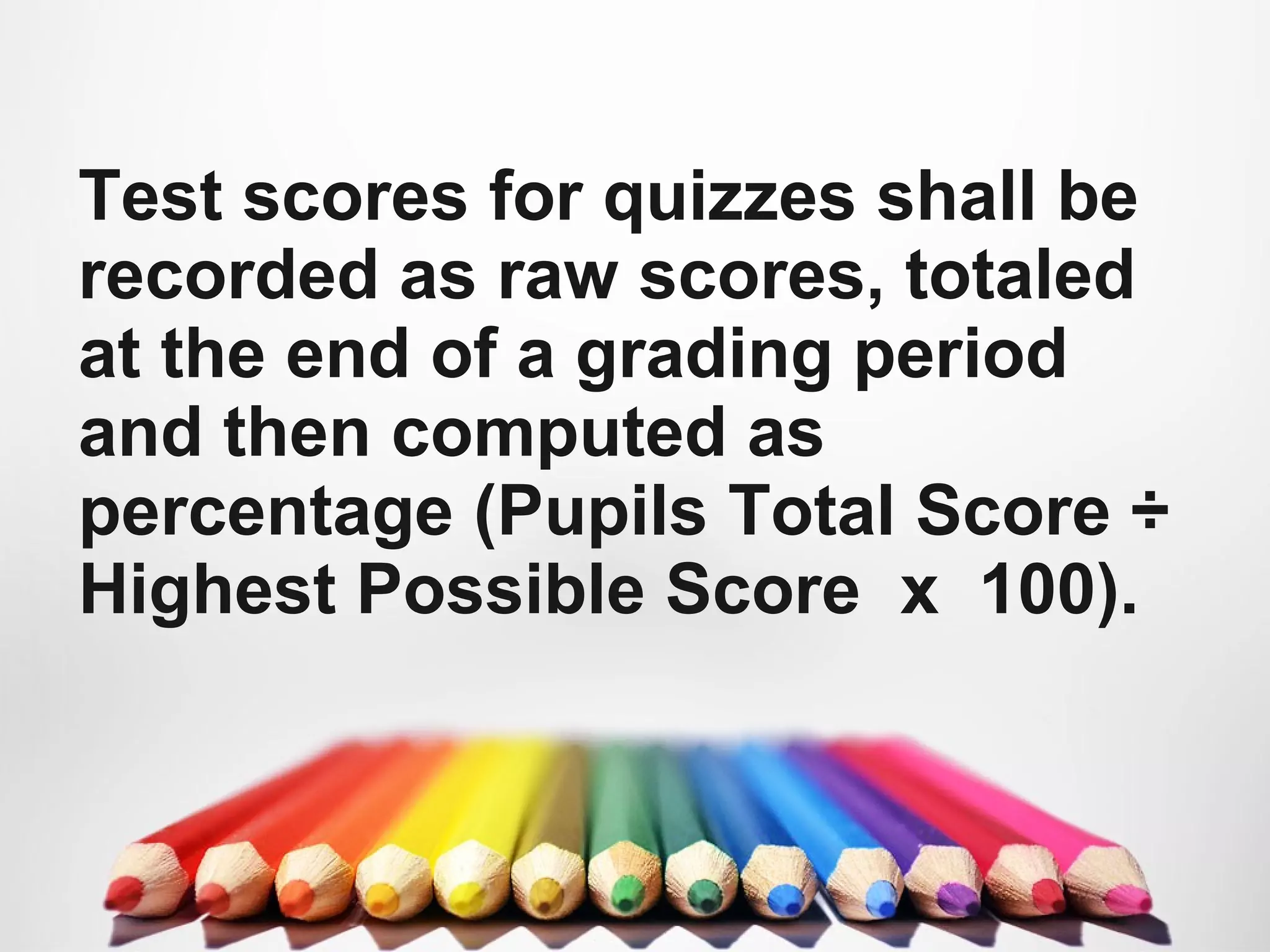
Test scores for quizzes shall be
recorded as raw scores, totaled
at the end of a grading period
and then computed as
percentage (Pupils Total Score Ć·
Highest Possible Score x 100).
Periodic test score shall also
be computed as percentage
using the same formula.
VIII. Rating Oral Participation, Group
Participation, Projects, Performances,
Homework, Experiments, Portfolio, and
others
Rubrics shall be utilized for rating
individual or group participation,
project, performances etc. (Teachers
are encouraged to prepare their own rubrics)
IX .Computation of the Final Rating
for each Learning Area
To determine the Final rating
for each learning area, get the
average of the numerical
values of the four (4)
quarters.
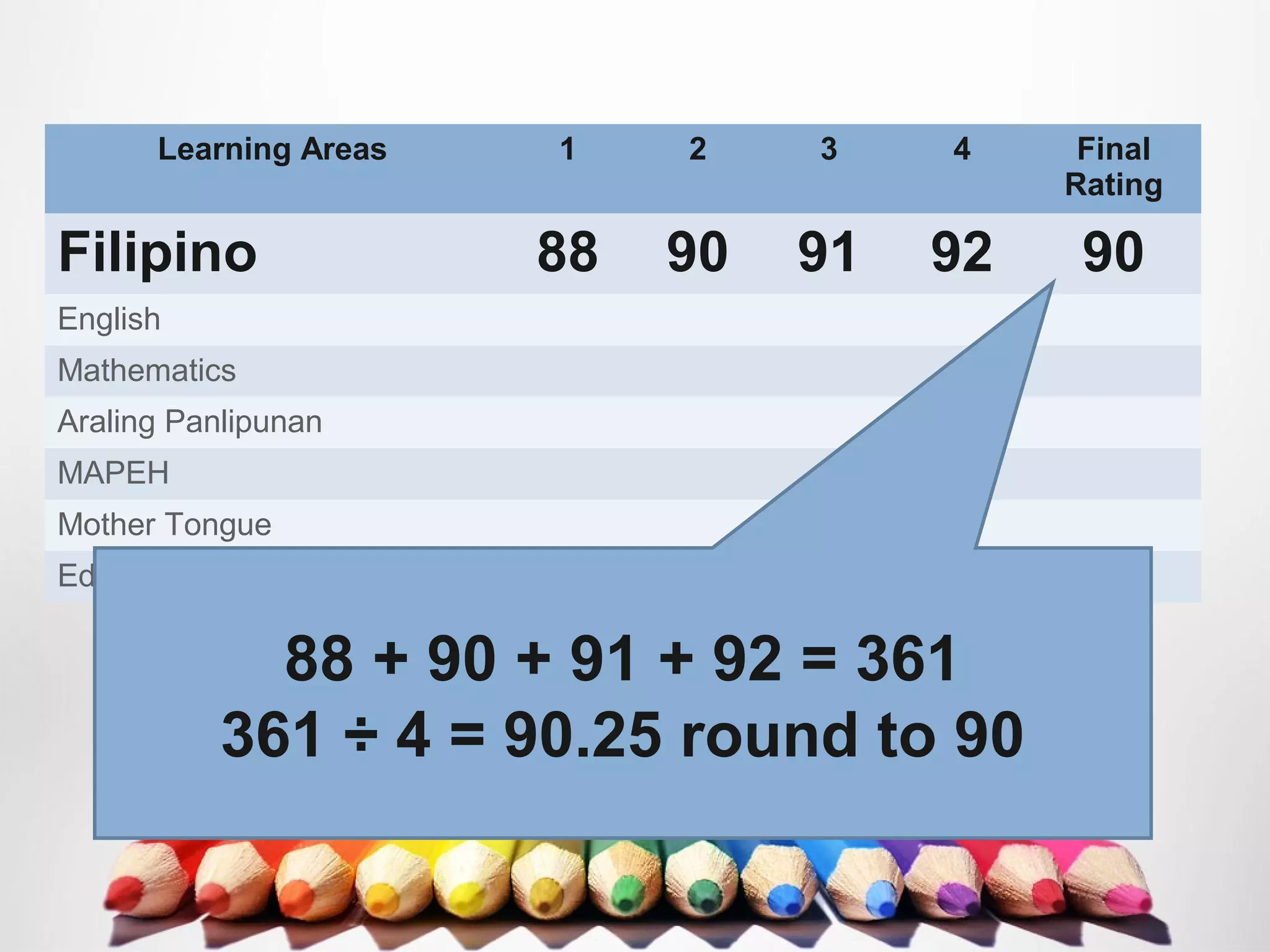
Learning Areas 1 2 3 4 Final
Rating
Filipino 88 90 91 92 90
English
Mathematics
Araling Panlipunan
MAPEH
Mother Tongue
Edukasyon sa Pagpapakatao
88 + 90 + 91 + 92 = 361
361 Ć· 4 = 90.25 round to 90
The final rating in numerical
value which is 90.00 shall not
be entered into the progress
report card but its descriptive
equivalent. In this case 90 is
Advanced (A).
X. Computation of the
General Average
To arrive at the General Average of
the pupil, add all the numerical
ratings for the Descriptive
Equivalents under the column for
Final Ratings in the Progress Report
card. Divide the sum by the number
of learning areas in the grade level.
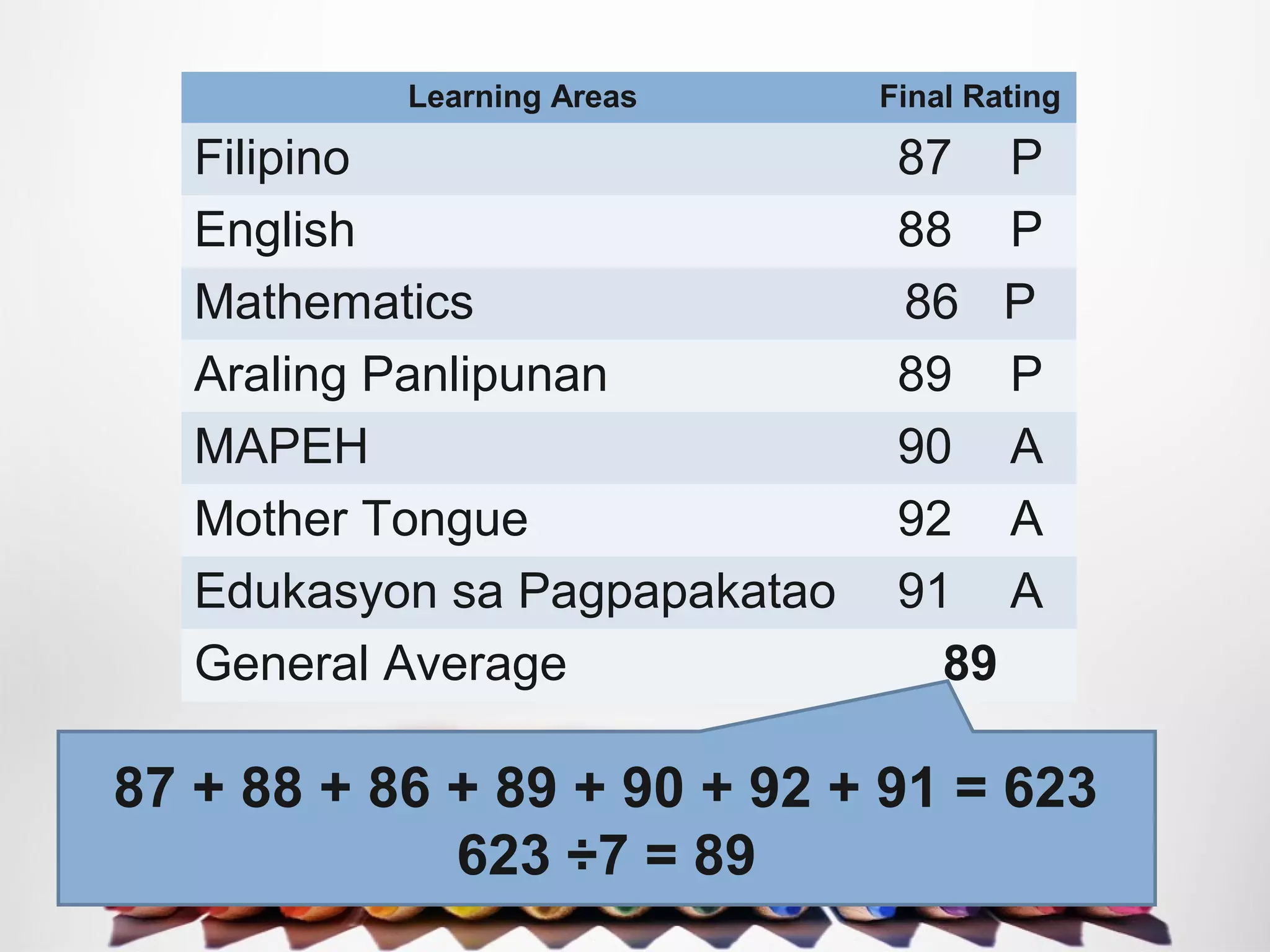
Learning Areas Final Rating
Filipino 87 P
English 88 P
Mathematics 86 P
Araling Panlipunan 89 P
MAPEH 90 A
Mother Tongue 92 A
Edukasyon sa Pagpapakatao 91 A
General Average 89
87 + 88 + 86 + 89 + 90 + 92 + 91 = 623
623 Ć·7 = 89
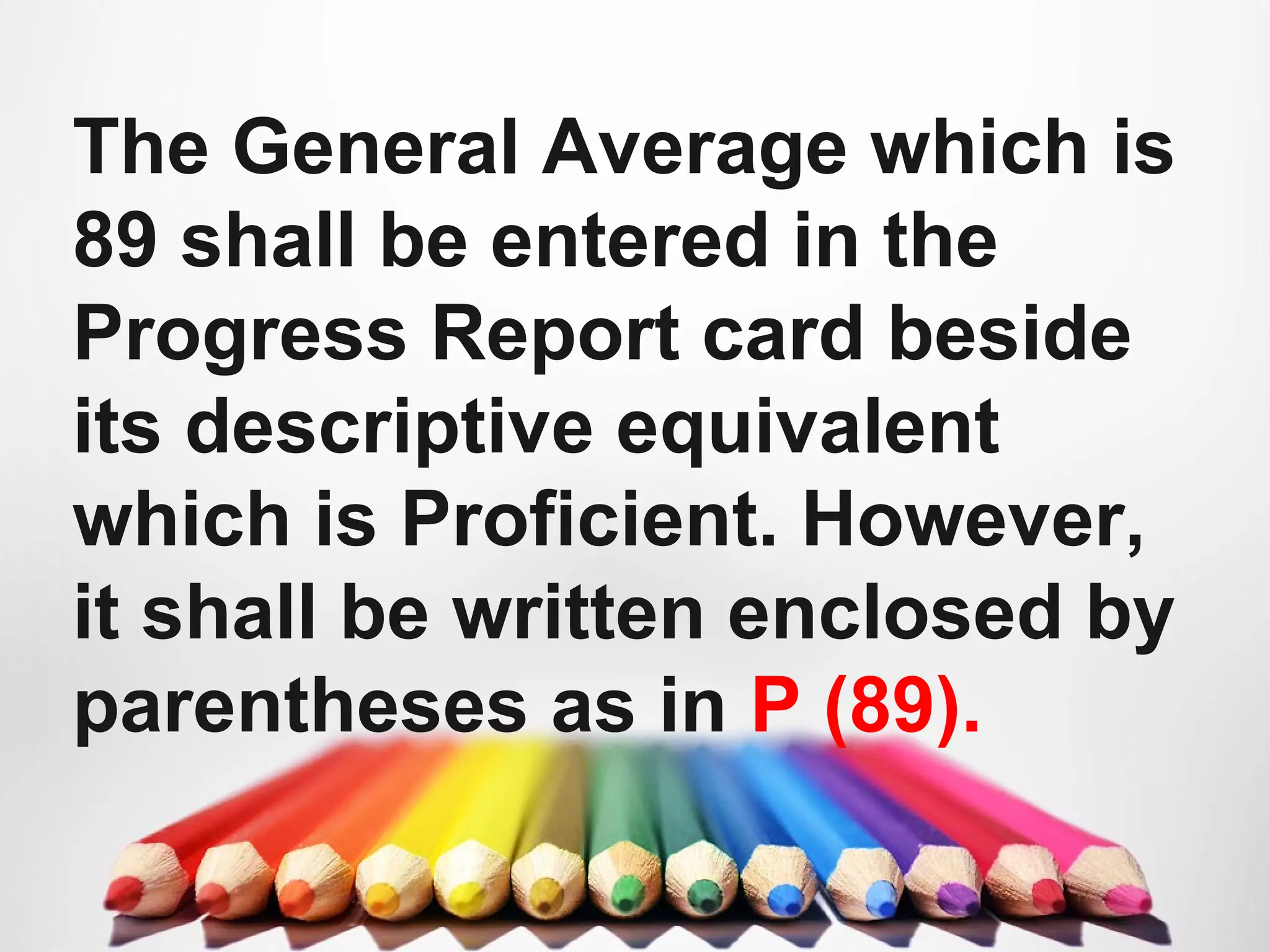
The General Average which is
89 shall be entered in the
Progress Report card beside
its descriptive equivalent
which is Proficient. However,
it shall be written enclosed by
parentheses as in P (89).
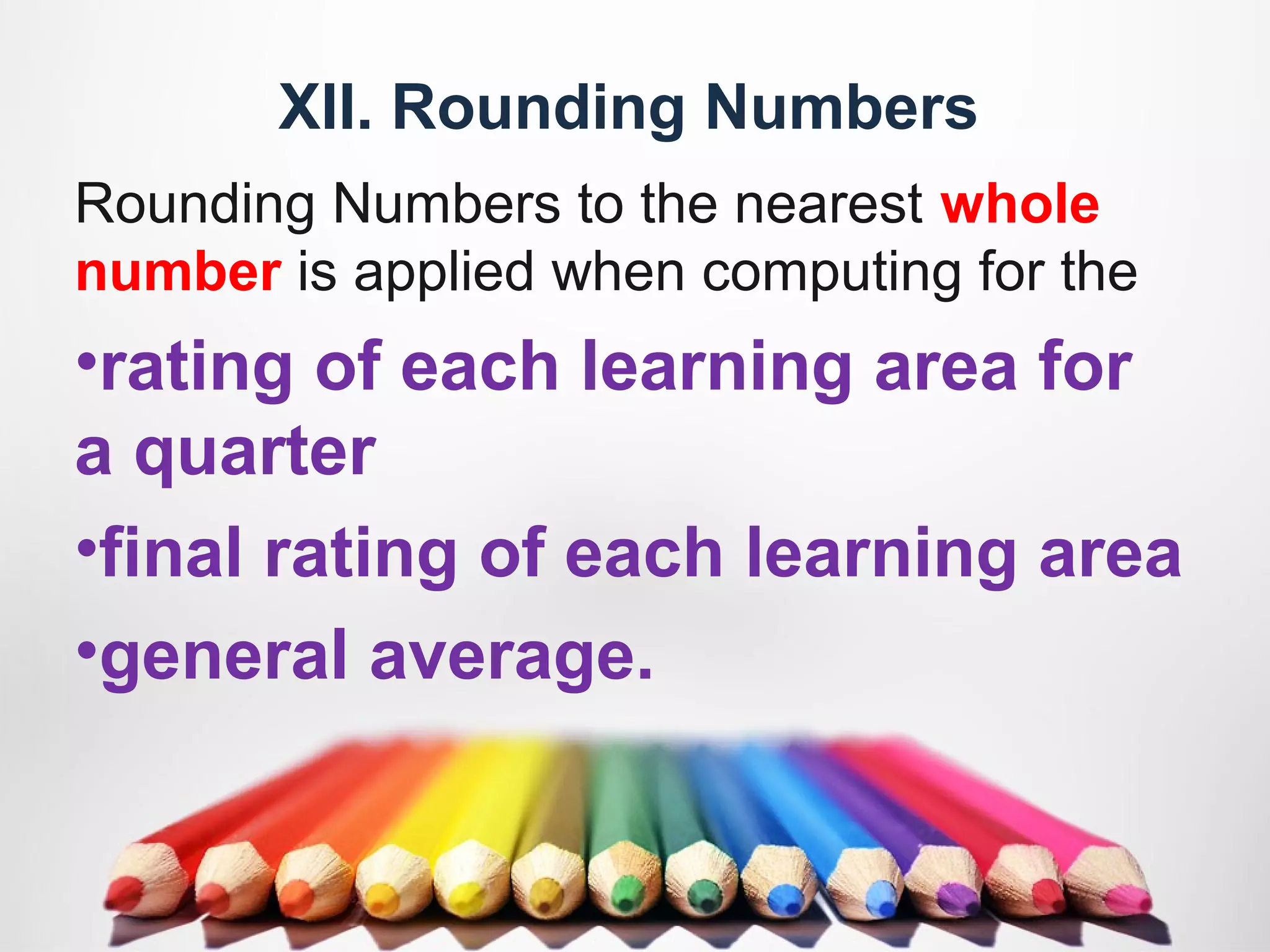
XII. Rounding Numbers
Rounding Numbers to the nearest whole
number is applied when computing for the
•rating of each learning area for
a quarter
•final rating of each learning area
•general average.
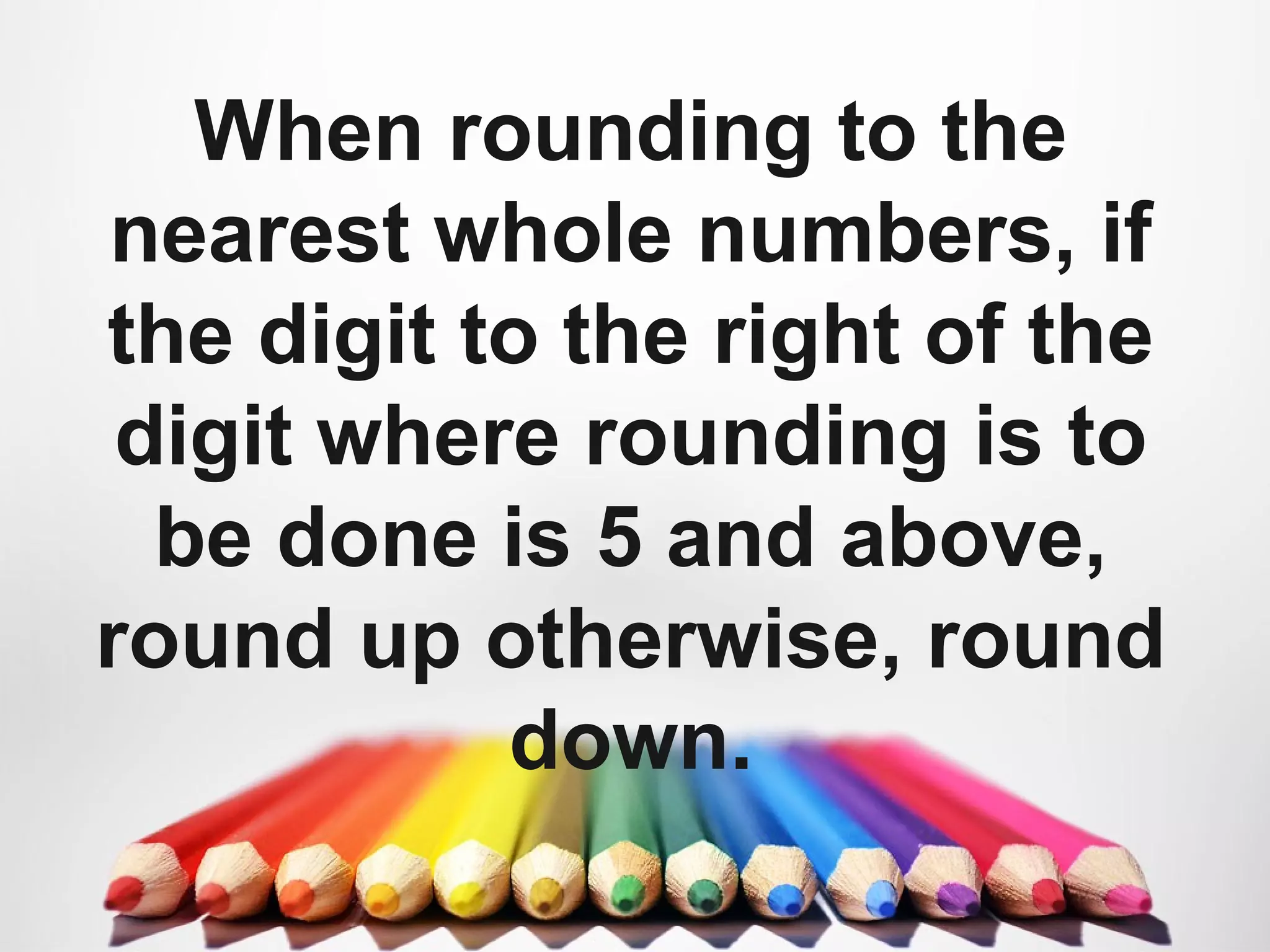
When rounding to the
nearest whole numbers, if
the digit to the right of the
digit where rounding is to
be done is 5 and above,
round up otherwise, round
down.
For the selection of honors /
ranking purposes, ā€œrounding
numbersā€ SHALL NOT BE
APPLIED for the following:
•Final rating for each learning
area
•General Average
XII. Promotion and Intervention
• PROMOTED TO THE NEXT GRADE LEVEL
Pupils with general average belonging to the
following levels of proficiency:
Advanced (A)
Proficient (P)
Approaching Proficiency (AP)
Developing (D)
However, appropriate
intervention is
necessary for those at
the Developing Level.
Pupils at the Beginning (B) Level
of proficiency after a specific
quarter for any learning area,
shall be provided with immediate
and appropriate intervention or
referred to special programs in
order to cope with the rest of the
class.
Pupils at the Beginning (B) Level
of Proficiency as the general
average after a school year,
despite the interventions provided,
shall take make-up or summer
classes in the learning areas
where he/she needs help to be
able to cope up in the next grade
level.

Assessment matrix elem

  • 1.
    GUIDELINES FOR RATING ELEMENTARY SCHOOLPUPILS mr. nick l. bio // division coordinator
  • 2.
    I. ASSESSMENT OFTHE FOUR (4) LEVELS OF ASSESSMENT For every quarter, pupils shall be assessed at these four levels of assessment: a.Knowledge (15%) b.Process or Skills (25%) c.Understanding(s) (30%) d.Products / Performances (30%)
  • 3.
    Being holistic, Assessmentperforms triple functions: Diagnostic (Pre-Assessment) Formative / Developmental Summative / Evaluative
  • 4.
    Levels of AssessmentWhat Will I Assess? How Will I Assess? How Will I Score? KNOWLEDGE (15%) PROCESS / SKILLS (25%) UNDERSTANDING (30%) PRODUCT / PERFORMANCE (30%)
  • 5.
    Levels of AssessmentWhat Will I Assess? KNOWLEDGE (15%) PROCESS / SKILLS (25%) UNDERSTANDING (30%) PRODUCT / PERFORMANCE (30%) • Content of the Curriculum • Facts and information that learners acquire
  • 6.
    Levels of AssessmentWhat Will I Assess? KNOWLEDGE (15%) PROCESS / SKILLS (25%) UNDERSTANDING (30%) PRODUCT / PERFORMANCE (30%) LEARNING COMPETENCIES taken from the Curriculum Guide Ex. Describes Identifies Recognizes Nakikilala
  • 7.
    Levels of AssessmentWhat Will I Assess? KNOWLEDGE (15%) PROCESS / SKILLS (25%) UNDERSTANDING (30%) PRODUCT / PERFORMANCE (30%) Cognitive operations that learners perform on facts and information for constructing meanings
  • 8.
    Levels of AssessmentWhat Will I Assess? KNOWLEDGE (15%) PROCESS / SKILLS (25%) UNDERSTANDING (30%) PRODUCT / PERFORMANCE (30%) LEARNING COMPETENCIES taken from the Curriculum Guide Ex. Analyzes Investigates Performs operations Nakapag - uugnay
  • 9.
    Levels of AssessmentWhat Will I Assess? KNOWLEDGE (15%) PROCESS / SKILLS (25%) UNDERSTANDING (30%) PRODUCT / PERFORMANCE (30%) CONTENT STANDARDS taken from the Curriculum Guide Ex. The learner demonstrates understanding of …
  • 10.
    Levels of AssessmentWhat Will I Assess? KNOWLEDGE (15%) PROCESS / SKILLS (25%) UNDERSTANDING (30%) PRODUCT / PERFORMANCE (30%) PERFORMANCE STANDARDS taken from the Curriculum Guide Ex. Ang mag – aaral ay nakapagpapahayag ng pagpapakilala sa sarili
  • 11.
  • 12.
  • 13.
  • 14.
    Levels of Assessment What Will IAssess? How Will I Assess? KNOWLEDGE PROCESS / SKILLS UNDERSTANDING PRODUCT / PERFORMANCE • Paper and Pencil Test (Quiz)  Multiple Choice  True - False  Matching Type  Constructed Response
  • 15.
    Levels of Assessment What Will IAssess? How Will I Assess? KNOWLEDGE PROCESS / SKILLS UNDERSTANDING PRODUCT / PERFORMANCE • Oral Participation • Periodical Test
  • 16.
    Levels of Assessment What Will I Assess? HowWill I Assess? PROCESS / SKILLS • TEST  Outlining, Organizing, Analyzing, Interpreting  Constructing graphs or graphic organizers  Transforming textual presentation into a diagram
  • 17.
    Levels of Assessment What Will I Assess? HowWill I Assess? PROCESS / SKILLS • ORAL PARTICIPATION • PERIODICAL TEST • GROUP ACTIVITY (LABORATORY ACTIVITY)
  • 18.
    Levels of Assessment What Will IAssess? How Will I Assess? UNDERSTANDING TEST EXPLAIN OR JUSTIFY SOMETHING TELL / RETELL STORIES MAKE CONNECTIONS OF WHAT WAS LEARNED APPLY WHAT HAS BEEN LEARNED IN REAL LIFE SITUATIONS
  • 19.
    Levels of Assessment What Will IAssess? How Will I Assess? UNDERSTANDING ORAL DISCOURSE EXPLAIN OR JUSIFY SOMETHING TELL / RETELL STORIES MAKE CONNECTIONS OF WHAT WAS LEARNED APPLY WHAT HAS BEEN LEARNED IN REAL LIFE SITUATIONS
  • 20.
    Levels of Assessment What Will IAssess? How Will I Assess? UNDERSTANDING Enclosure No. 2 to DepED Order No. 73, s. 2012, C, p. 8 Understanding as expressed using any three of the six facets of understanding
  • 21.
    Levels of Assessment What WillI Assess? How Will I Assess? PRODUCT / PERFORMANCE PERFORMANCE TASK (ACTUAL DEMONSTRATION) GRASPS ACTUAL PRODUCTS (PROJECT) PORTFOLIO
  • 22.
    Levels of AssessmentWhat Will I Assess? How Will I Assess? How Will I Score KNOWLEDGE (15%) PROCESS / SKILLS (25%) UNDERSTANDING (30%) PRODUCT / PERFORMANCE (30%) RAW SCORES (Every correct answer is given 1 point) USE OF RUBRICS
  • 23.
    Levels of AssessmentWhat Will I Assess? How Will I Assess? How Will I Score KNOWLEDGE (15%) PROCESS / SKILLS (25%) UNDERSTANDING (30%) PRODUCT / PERFORMANCE (30%) USE OF RUBRICS (SCORING GUIDE)
  • 24.
    Levels of AssessmentWhat Will I Assess? How Will I Assess? How Will I Score KNOWLEDGE (15%) PROCESS / SKILLS (25%) UNDERSTANDING (30%) PRODUCT / PERFORMANCE (30%) USE OF RUBRICS (SCORING GUIDE)
  • 25.
    Levels of AssessmentWhat Will I Assess? How Will I Assess? How Will I Score KNOWLEDGE (15%) PROCESS / SKILLS (25%) UNDERSTANDING (30%) PRODUCT / PERFORMANCE (30%) USE OF RUBRICS (SCORING GUIDE)
  • 26.
  • 27.
    II. SAMPLE COMPUTATION OFPUPIL RATING To determine the rating for the learning area in a grading period, which includes Mother Tongue,
  • 28.
    get the averageof all the ratings entered in the Class Record under each measure of achievement.
  • 29.
    Multiply the resultby the corresponding percentage weight.
  • 31.
    12 + 10(22 Ć· 30) X 100 KNOWLEDGE
  • 32.
    (22 Ć· 25)X 100 9 + 13
  • 33.
  • 34.
    (73.33 + 88.00+ 80.00) Ć· 3 80.44 X 0.15
  • 36.
    13 + 8(21 Ć· 25) X 100 PROCESS / SKILLS
  • 37.
    18 + 8(26 Ć· 30) X 100
  • 38.
    Score obtained out of 5 process items (3Ć· 5) X 100 PROCESS / SKILLS
  • 39.
    (84.00 + 86.67+ 60.00) Ć· 3 76.89 X 0.25
  • 41.
    III. MARKING forMAPEH each of the four (4) component areas shall be taught separately and pupils will be rated per component area
  • 42.
    There shall beone rating for MAPEH, which is the average of the four component areas.
  • 43.
    MAPEH 88 MUSIC 84AP ART 88 P P.E. 90 A HEALTH 89 P 84 + 88 + 90 + 89 = 351 351 Ć· 4 = 87.75 round to 88
  • 44.
    MAPEH 88 P MUSIC84 AP ART 88 P P.E. 90 A HEALTH 89 P 88 is within 85-89 Therefore, Level of Proficiency is P
  • 45.
    IV. Marking forOral Fluency in Filipino and English Like the other learning areas, assessment of Oral Fluency in Filipino and English shall also be at four (4) levels
  • 46.
    Knowledge (15%) Process/Skills (25%) Understandings(30%) Product/Performance (30%) Oral tests shall be given with corresponding rubrics.
  • 47.
    FILIPINO • For thefirst semester (second grading period), pupils shall be assessed on oral fluency • During the second semester, pupils shall be rated the way they are rated in the other learning areas.
  • 48.
    ENGLISH For English whichwill be introduced during the second semester, pupils will be assessed on oral fluency
  • 49.
    For the computationof pupil’s rating for Oral Filipino and English, activities can be used for this purpose with the aid of Rubrics.
  • 50.
    V. ASSESSING THEMOTHER TONGUE SUBJECT Since MT is a language subject, its assessment follows the four levels of assessment with its corresponding weight and the level of proficiency as indicated in DO No. 31 s. 2012.
  • 51.
    MT should notbe treated as a different or distinct subject from the rest of the subjects. Oral language proficiency of the students and small and big group activities will be measured using the rubrics.
  • 52.
    VI. MARKING FORCHARACTER TRAITS Existing Guidelines stipulated in DepEd Order No. 33, s. 2004 for Marking Character Traits shall be applied.
  • 54.
    VII. Scoring Quizzesand Periodic Test (Refer to DepEd Order No. 33, s. 2004, Paragraph 5) Transmutation table shall not be used in computing grades.
  • 55.
    Test scores forquizzes shall be recorded as raw scores, totaled at the end of a grading period and then computed as percentage (Pupils Total Score Ć· Highest Possible Score x 100).
  • 56.
    Periodic test scoreshall also be computed as percentage using the same formula.
  • 57.
    VIII. Rating OralParticipation, Group Participation, Projects, Performances, Homework, Experiments, Portfolio, and others Rubrics shall be utilized for rating individual or group participation, project, performances etc. (Teachers are encouraged to prepare their own rubrics)
  • 58.
    IX .Computation ofthe Final Rating for each Learning Area To determine the Final rating for each learning area, get the average of the numerical values of the four (4) quarters.
  • 59.
    Learning Areas 12 3 4 Final Rating Filipino 88 90 91 92 90 English Mathematics Araling Panlipunan MAPEH Mother Tongue Edukasyon sa Pagpapakatao 88 + 90 + 91 + 92 = 361 361 Ć· 4 = 90.25 round to 90
  • 60.
    The final ratingin numerical value which is 90.00 shall not be entered into the progress report card but its descriptive equivalent. In this case 90 is Advanced (A).
  • 61.
    X. Computation ofthe General Average To arrive at the General Average of the pupil, add all the numerical ratings for the Descriptive Equivalents under the column for Final Ratings in the Progress Report card. Divide the sum by the number of learning areas in the grade level.
  • 62.
    Learning Areas FinalRating Filipino 87 P English 88 P Mathematics 86 P Araling Panlipunan 89 P MAPEH 90 A Mother Tongue 92 A Edukasyon sa Pagpapakatao 91 A General Average 89 87 + 88 + 86 + 89 + 90 + 92 + 91 = 623 623 Ć·7 = 89
  • 63.
    The General Averagewhich is 89 shall be entered in the Progress Report card beside its descriptive equivalent which is Proficient. However, it shall be written enclosed by parentheses as in P (89).
  • 64.
    XII. Rounding Numbers RoundingNumbers to the nearest whole number is applied when computing for the •rating of each learning area for a quarter •final rating of each learning area •general average.
  • 65.
    When rounding tothe nearest whole numbers, if the digit to the right of the digit where rounding is to be done is 5 and above, round up otherwise, round down.
  • 66.
    For the selectionof honors / ranking purposes, ā€œrounding numbersā€ SHALL NOT BE APPLIED for the following: •Final rating for each learning area •General Average
  • 67.
    XII. Promotion andIntervention • PROMOTED TO THE NEXT GRADE LEVEL Pupils with general average belonging to the following levels of proficiency: Advanced (A) Proficient (P) Approaching Proficiency (AP) Developing (D)
  • 68.
    However, appropriate intervention is necessaryfor those at the Developing Level.
  • 69.
    Pupils at theBeginning (B) Level of proficiency after a specific quarter for any learning area, shall be provided with immediate and appropriate intervention or referred to special programs in order to cope with the rest of the class.
  • 70.
    Pupils at theBeginning (B) Level of Proficiency as the general average after a school year, despite the interventions provided, shall take make-up or summer classes in the learning areas where he/she needs help to be able to cope up in the next grade level.