Workplace Technology Devices: Session 5
1
Architecture Framework Advisory Committee Meeting
May 26, 2014
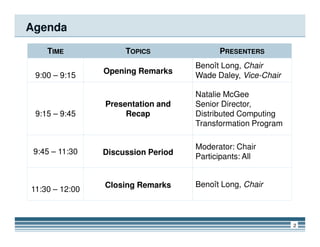
Agenda
TIME TOPICS PRESENTERS
9:00 – 9:15
Opening Remarks
Benoît Long, Chair
Wade Daley, Vice-Chair
9:15 – 9:45
Presentation and
Recap
Natalie McGee
Senior Director,
Distributed Computing
Transformation Program
2
Transformation Program
9:45 – 11:30 Discussion Period
Moderator: Chair
Participants: All
11:30 – 12:00
Closing Remarks Benoît Long, Chair
Objectives for Today
• Recap of the last Architecture Framework Advisory
Committee (AFAC) meeting on Workplace
Technology Devices (WTD)
• Conclude the consultation roadmap
3
• Conclude the consultation roadmap
• Thank you
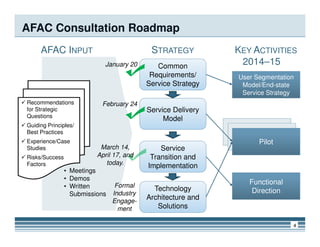
AFAC Consultation Roadmap
STRATEGY KEY ACTIVITIES
2014–15
AFAC INPUT
Recommendations
for Strategic
Questions
Guiding Principles/
Common
Requirements/
Service Strategy
Service Delivery
Model
User Segmentation
Model/End-state
Service Strategy
January 20
February 24
4
Guiding Principles/
Best Practices
Experience/Case
Studies
Risks/Success
Factors
Service
Transition and
Implementation
Technology
Architecture and
Solutions
r Segmentation
Model
Segmentation
ModelPilot
Functional
Direction
• Meetings
• Demos
• Written
Submissions
Formal
Industry
Engage-
ment
March 14,
April 17, and
today.
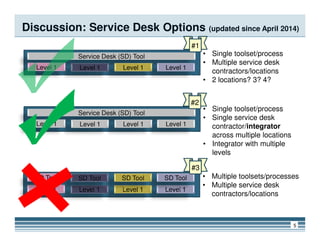
Discussion: Service Desk Options (updated since April 2014)
• Single toolset/process
• Multiple service desk
contractors/locations
• 2 locations? 3? 4?
Service Desk (SD) Tool
Level 1 Level 1 Level 1 Level 1
• Single toolset/process
• Single service desk
contractor/integrator
Service Desk (SD) Tool
Level 1 Level 1 Level 1 Level 1
#2
#1
5
contractor/integrator
across multiple locations
• Integrator with multiple
levels
Level 1 Level 1 Level 1 Level 1
• Multiple toolsets/processes
• Multiple service desk
contractors/locations
Level 1 Level 1 Level 1 Level 1
SD Tool SD Tool SD Tool SD Tool
#3
What we heard: User Segmentation and Service Delivery Model
User Segmentation
•Members had many opinions, however most rejected segmenting users on number
of applications.
•The idea of segmenting users on level of mobility or security seemed most favoured
by members.
• In general, mobility factors can a be key driver that should be a main focus for GC.
6
•In some cases members spoke about segmentation by “persona”, suggesting that
users could have multiple personas that would be different for different
circumstances.
Service Desk
• In almost all cases participants suggested the need for common processes and
common tools (Option 2).
• Most members did not support Option 3 (multiple tools and processes).
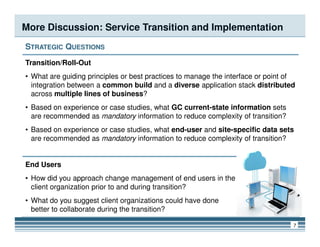
More Discussion: Service Transition and Implementation
STRATEGIC QUESTIONS
Transition/Roll-Out
• What are guiding principles or best practices to manage the interface or point of
integration between a common build and a diverse application stack distributed
across multiple lines of business?
• Based on experience or case studies, what GC current-state information sets
are recommended as mandatory information to reduce complexity of transition?
7
• Based on experience or case studies, what end-user and site-specific data sets
are recommended as mandatory information to reduce complexity of transition?
End Users
• How did you approach change management of end users in the
client organization prior to and during transition?
• What do you suggest client organizations could have done
better to collaborate during the transition?
More Discussion: Service Transition and Implementation
STRATEGIC QUESTIONS
Service Transition and Implementation
• Is there value in the GC defining a common image/enterprise desktop baseline,
and then starting to transition to this baseline (including application remediation)?
8
• What process would you follow to get to a common image / base platform?
• What are your suggestions on the on-going operational model between the
desktop management provider and the application teams in departments /
agencies to maintain / patch the baseline?
Thank You
• Conclusion of AFAC consultation.
• Next steps to watch for are the initiation of formal
procurement activity in the Workplace Technology
Devices initiative.
9
Devices initiative.
Reference
10
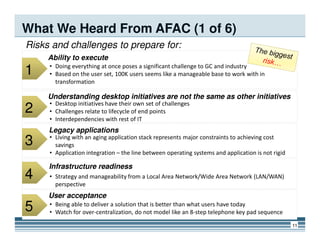
What We Heard From AFAC (1 of 6)
Risks and challenges to prepare for:
Ability to execute
Understanding desktop initiatives are not the same as other initiatives
1 • Doing everything at once poses a significant challenge to GC and industry
• Based on the user set, 100K users seems like a manageable base to work with in
transformation
• Desktop initiatives have their own set of challenges
• Challenges relate to lifecycle of end points
• Interdependencies with rest of IT
2
11
5
3
Legacy applications
• Living with an aging application stack represents major constraints to achieving cost
savings
• Application integration – the line between operating systems and application is not rigid
Infrastructure readiness
User acceptance
4 • Strategy and manageability from a Local Area Network/Wide Area Network (LAN/WAN)
perspective
• Being able to deliver a solution that is better than what users have today
• Watch for over-centralization, do not model like an 8-step telephone key pad sequence
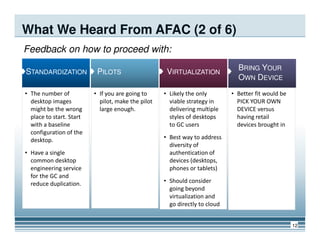
What We Heard From AFAC (2 of 6)
Feedback on how to proceed with:
STANDARDIZATION
• The number of
desktop images
might be the wrong
place to start. Start
with a baseline
PILOTS
• If you are going to
pilot, make the pilot
large enough.
VIRTUALIZATION
• Likely the only
viable strategy in
delivering multiple
styles of desktops
to GC users
• Better fit would be
PICK YOUR OWN
DEVICE versus
having retail
devices brought in
BRING YOUR
OWN DEVICE
12
with a baseline
configuration of the
desktop.
• Have a single
common desktop
engineering service
for the GC and
reduce duplication.
to GC users
• Best way to address
diversity of
authentication of
devices (desktops,
phones or tablets)
• Should consider
going beyond
virtualization and
go directly to cloud
devices brought in
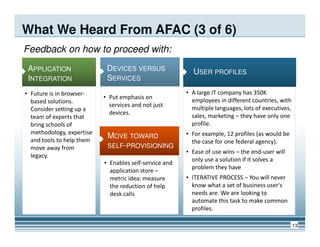
What We Heard From AFAC (3 of 6)
Feedback on how to proceed with:
APPLICATION
INTEGRATION
• Future is in browser-
based solutions.
Consider setting up a
team of experts that
bring schools of
DEVICES VERSUS
SERVICES
• Put emphasis on
services and not just
devices.
• A large IT company has 350K
employees in different countries, with
multiple languages, lots of executives,
sales, marketing – they have only one
profile.
USER PROFILES
13
bring schools of
methodology, expertise
and tools to help them
move away from
legacy.
MOVE TOWARD
SELF-PROVISIONING
• Enables self-service and
application store –
metric idea: measure
the reduction of help
desk calls
profile.
• For example, 12 profiles (as would be
the case for one federal agency).
• Ease of use wins – the end-user will
only use a solution if it solves a
problem they have
• ITERATIVE PROCESS – You will never
know what a set of business user's
needs are. We are looking to
automate this task to make common
profiles.
What We Heard From AFAC (4 of 6)
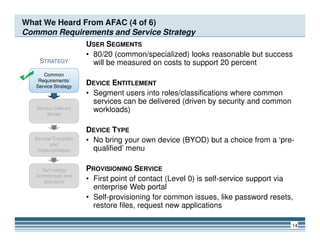
Common Requirements and Service Strategy
USER SEGMENTS
• 80/20 (common/specialized) looks reasonable but success
will be measured on costs to support 20 percent
DEVICE ENTITLEMENT
• Segment users into roles/classifications where common
services can be delivered (driven by security and common
workloads)
STRATEGY
Common
Requirements/
Service Strategy
Service Delivery
Model
14
DEVICE TYPE
• No bring your own device (BYOD) but a choice from a ‘pre-
qualified’ menu
PROVISIONING SERVICE
• First point of contact (Level 0) is self-service support via
enterprise Web portal
• Self-provisioning for common issues, like password resets,
restore files, request new applications
Service Transition
and
Implementation
Technology
Architecture and
Solutions
What We Heard from AFAC (5 of 6)
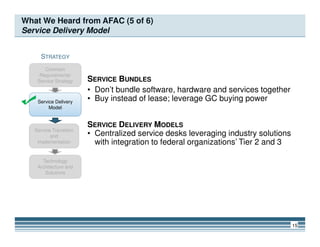
Service Delivery Model
SERVICE BUNDLES
• Don’t bundle software, hardware and services together
• Buy instead of lease; leverage GC buying power
SERVICE DELIVERY MODELS
STRATEGY
Common
Requirements/
Service Strategy
Service Delivery
Model
15
SERVICE DELIVERY MODELS
• Centralized service desks leveraging industry solutions
with integration to federal organizations’ Tier 2 and 3
Technology
Architecture and
Solutions
Service Transition
and
Implementation
What We Heard From AFAC (6 of 6)
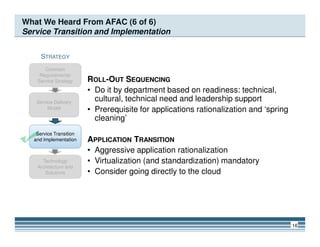
Service Transition and Implementation
ROLL-OUT SEQUENCING
• Do it by department based on readiness: technical,
cultural, technical need and leadership support
• Prerequisite for applications rationalization and ‘spring
cleaning’
STRATEGY
Common
Requirements/
Service Strategy
Service Delivery
Model
16
APPLICATION TRANSITION
• Aggressive application rationalization
• Virtualization (and standardization) mandatory
• Consider going directly to the cloud
Service Transition
and Implementation
Technology
Architecture and
Solutions

Shared Services Canada - Architect Framework Advisory Committee WTD Session 5 May 26, 2015

  • 1.
    Workplace Technology Devices:Session 5 1 Architecture Framework Advisory Committee Meeting May 26, 2014
  • 2.
    Agenda TIME TOPICS PRESENTERS 9:00– 9:15 Opening Remarks Benoît Long, Chair Wade Daley, Vice-Chair 9:15 – 9:45 Presentation and Recap Natalie McGee Senior Director, Distributed Computing Transformation Program 2 Transformation Program 9:45 – 11:30 Discussion Period Moderator: Chair Participants: All 11:30 – 12:00 Closing Remarks Benoît Long, Chair
  • 3.
    Objectives for Today •Recap of the last Architecture Framework Advisory Committee (AFAC) meeting on Workplace Technology Devices (WTD) • Conclude the consultation roadmap 3 • Conclude the consultation roadmap • Thank you
  • 4.
    AFAC Consultation Roadmap STRATEGYKEY ACTIVITIES 2014–15 AFAC INPUT Recommendations for Strategic Questions Guiding Principles/ Common Requirements/ Service Strategy Service Delivery Model User Segmentation Model/End-state Service Strategy January 20 February 24 4 Guiding Principles/ Best Practices Experience/Case Studies Risks/Success Factors Service Transition and Implementation Technology Architecture and Solutions r Segmentation Model Segmentation ModelPilot Functional Direction • Meetings • Demos • Written Submissions Formal Industry Engage- ment March 14, April 17, and today.
  • 5.
    Discussion: Service DeskOptions (updated since April 2014) • Single toolset/process • Multiple service desk contractors/locations • 2 locations? 3? 4? Service Desk (SD) Tool Level 1 Level 1 Level 1 Level 1 • Single toolset/process • Single service desk contractor/integrator Service Desk (SD) Tool Level 1 Level 1 Level 1 Level 1 #2 #1 5 contractor/integrator across multiple locations • Integrator with multiple levels Level 1 Level 1 Level 1 Level 1 • Multiple toolsets/processes • Multiple service desk contractors/locations Level 1 Level 1 Level 1 Level 1 SD Tool SD Tool SD Tool SD Tool #3
  • 6.
    What we heard:User Segmentation and Service Delivery Model User Segmentation •Members had many opinions, however most rejected segmenting users on number of applications. •The idea of segmenting users on level of mobility or security seemed most favoured by members. • In general, mobility factors can a be key driver that should be a main focus for GC. 6 •In some cases members spoke about segmentation by “persona”, suggesting that users could have multiple personas that would be different for different circumstances. Service Desk • In almost all cases participants suggested the need for common processes and common tools (Option 2). • Most members did not support Option 3 (multiple tools and processes).
  • 7.
    More Discussion: ServiceTransition and Implementation STRATEGIC QUESTIONS Transition/Roll-Out • What are guiding principles or best practices to manage the interface or point of integration between a common build and a diverse application stack distributed across multiple lines of business? • Based on experience or case studies, what GC current-state information sets are recommended as mandatory information to reduce complexity of transition? 7 • Based on experience or case studies, what end-user and site-specific data sets are recommended as mandatory information to reduce complexity of transition? End Users • How did you approach change management of end users in the client organization prior to and during transition? • What do you suggest client organizations could have done better to collaborate during the transition?
  • 8.
    More Discussion: ServiceTransition and Implementation STRATEGIC QUESTIONS Service Transition and Implementation • Is there value in the GC defining a common image/enterprise desktop baseline, and then starting to transition to this baseline (including application remediation)? 8 • What process would you follow to get to a common image / base platform? • What are your suggestions on the on-going operational model between the desktop management provider and the application teams in departments / agencies to maintain / patch the baseline?
  • 9.
    Thank You • Conclusionof AFAC consultation. • Next steps to watch for are the initiation of formal procurement activity in the Workplace Technology Devices initiative. 9 Devices initiative.
  • 10.
  • 11.
    What We HeardFrom AFAC (1 of 6) Risks and challenges to prepare for: Ability to execute Understanding desktop initiatives are not the same as other initiatives 1 • Doing everything at once poses a significant challenge to GC and industry • Based on the user set, 100K users seems like a manageable base to work with in transformation • Desktop initiatives have their own set of challenges • Challenges relate to lifecycle of end points • Interdependencies with rest of IT 2 11 5 3 Legacy applications • Living with an aging application stack represents major constraints to achieving cost savings • Application integration – the line between operating systems and application is not rigid Infrastructure readiness User acceptance 4 • Strategy and manageability from a Local Area Network/Wide Area Network (LAN/WAN) perspective • Being able to deliver a solution that is better than what users have today • Watch for over-centralization, do not model like an 8-step telephone key pad sequence
  • 12.
    What We HeardFrom AFAC (2 of 6) Feedback on how to proceed with: STANDARDIZATION • The number of desktop images might be the wrong place to start. Start with a baseline PILOTS • If you are going to pilot, make the pilot large enough. VIRTUALIZATION • Likely the only viable strategy in delivering multiple styles of desktops to GC users • Better fit would be PICK YOUR OWN DEVICE versus having retail devices brought in BRING YOUR OWN DEVICE 12 with a baseline configuration of the desktop. • Have a single common desktop engineering service for the GC and reduce duplication. to GC users • Best way to address diversity of authentication of devices (desktops, phones or tablets) • Should consider going beyond virtualization and go directly to cloud devices brought in
  • 13.
    What We HeardFrom AFAC (3 of 6) Feedback on how to proceed with: APPLICATION INTEGRATION • Future is in browser- based solutions. Consider setting up a team of experts that bring schools of DEVICES VERSUS SERVICES • Put emphasis on services and not just devices. • A large IT company has 350K employees in different countries, with multiple languages, lots of executives, sales, marketing – they have only one profile. USER PROFILES 13 bring schools of methodology, expertise and tools to help them move away from legacy. MOVE TOWARD SELF-PROVISIONING • Enables self-service and application store – metric idea: measure the reduction of help desk calls profile. • For example, 12 profiles (as would be the case for one federal agency). • Ease of use wins – the end-user will only use a solution if it solves a problem they have • ITERATIVE PROCESS – You will never know what a set of business user's needs are. We are looking to automate this task to make common profiles.
  • 14.
    What We HeardFrom AFAC (4 of 6) Common Requirements and Service Strategy USER SEGMENTS • 80/20 (common/specialized) looks reasonable but success will be measured on costs to support 20 percent DEVICE ENTITLEMENT • Segment users into roles/classifications where common services can be delivered (driven by security and common workloads) STRATEGY Common Requirements/ Service Strategy Service Delivery Model 14 DEVICE TYPE • No bring your own device (BYOD) but a choice from a ‘pre- qualified’ menu PROVISIONING SERVICE • First point of contact (Level 0) is self-service support via enterprise Web portal • Self-provisioning for common issues, like password resets, restore files, request new applications Service Transition and Implementation Technology Architecture and Solutions
  • 15.
    What We Heardfrom AFAC (5 of 6) Service Delivery Model SERVICE BUNDLES • Don’t bundle software, hardware and services together • Buy instead of lease; leverage GC buying power SERVICE DELIVERY MODELS STRATEGY Common Requirements/ Service Strategy Service Delivery Model 15 SERVICE DELIVERY MODELS • Centralized service desks leveraging industry solutions with integration to federal organizations’ Tier 2 and 3 Technology Architecture and Solutions Service Transition and Implementation
  • 16.
    What We HeardFrom AFAC (6 of 6) Service Transition and Implementation ROLL-OUT SEQUENCING • Do it by department based on readiness: technical, cultural, technical need and leadership support • Prerequisite for applications rationalization and ‘spring cleaning’ STRATEGY Common Requirements/ Service Strategy Service Delivery Model 16 APPLICATION TRANSITION • Aggressive application rationalization • Virtualization (and standardization) mandatory • Consider going directly to the cloud Service Transition and Implementation Technology Architecture and Solutions