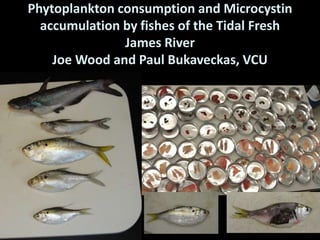
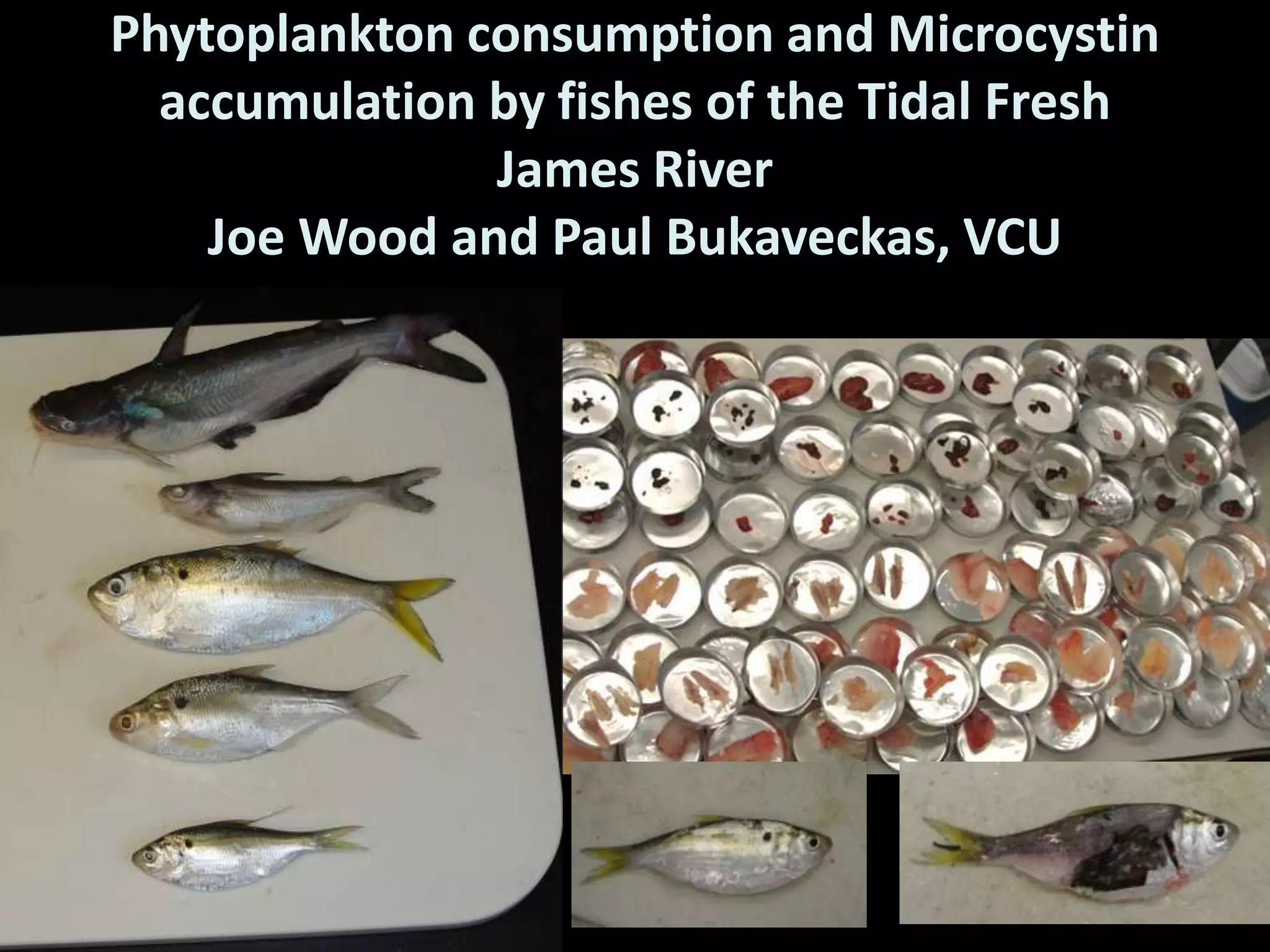
Phytoplankton consumption and Microcystin
  accumulation by fishes of the Tidal Fresh
               James River
    Joe Wood and Paul Bukaveckas, VCU
Outline
•   Background on the James River CHLa Study
•   What is Microcystin?
•   Research Questions
•   Methods & Results
•   Conclusions & Questions
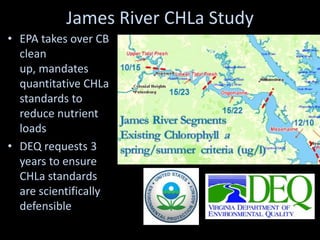
James River CHLa Study
• EPA takes over CB
  clean
  up, mandates
  quantitative CHLa
  standards to
  reduce nutrient
  loads
• DEQ requests 3
  years to ensure
  CHLa standards
  are scientifically
  defensible
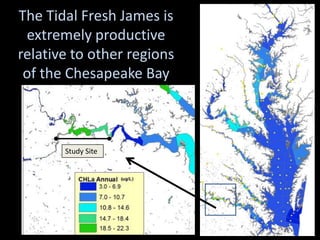
The Tidal Fresh James is
 extremely productive
relative to other regions
 of the Chesapeake Bay


       Study Site
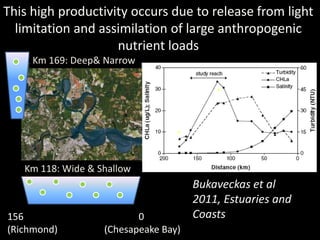
This high productivity occurs due to release from light
  limitation and assimilation of large anthropogenic
                    nutrient loads
     Km 169: Deep& Narrow


   Km 118: Wide & Shallow
                                      Bukaveckas et al
                                      2011, Estuaries and
156                       0           Coasts
(Richmond)         (Chesapeake Bay)
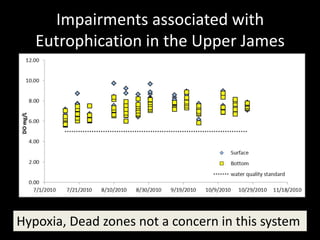
Impairments associated with
   Eutrophication in the Upper James


Hypoxia, Dead zones not a concern in this system
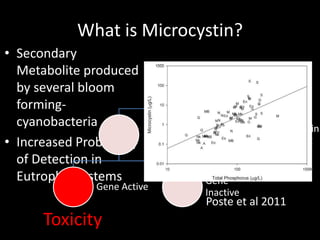
What is Microcystin?
• Secondary
  Metabolite produced
                                    Cyanobacteria
  by several bloom
  forming-
                                                    Lacks
  cyanobacteria                 Contains
                                                    Microcystin
                             Microcystin
• Increased Probability   producing gene
                                                    producing
                                                    gene
  of Detection in
  Eutrophic Systems                   Gene
               Gene Active
                                      Inactive
                                      Poste et al 2011
      Toxicity
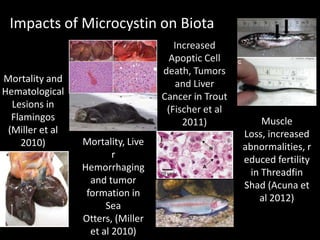
Impacts of Microcystin on Biota
                                      Increased
                                     Apoptic Cell
                                   death, Tumors
Mortality and                         and Liver
Hematological                      Cancer in Trout
  Lesions in                        (Fischer et al
  Flamingos                             2011)             Muscle
 (Miller et al                                       Loss, increased
    2010)        Mortality, Live                     abnormalities, r
                         r                           educed fertility
                 Hemorrhaging                          in Threadfin
                   and tumor                         Shad (Acuna et
                  formation in                           al 2012)
                       Sea
                 Otters, (Miller
                   et al 2010)
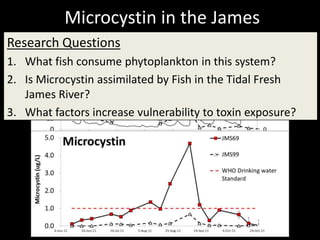
Microcystin in the James
Research Questions
1. What fish consume phytoplankton in this 2011system?
2. Is Microcystin assimilated by Fish in the Tidal Fresh
   James River?
3. What factors increase vulnerability to toxin exposure?
       WHO
       Drinking
       Water
       Standard
Methods
• Fish collection & Species Background
• Gut Contents analysis
• Microcystin Extraction techniques
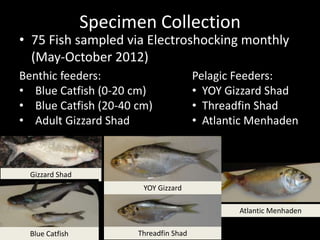
Specimen Collection
• 75 Fish sampled via Electroshocking monthly
  (May-October 2012)
Benthic feeders:                        Pelagic Feeders:
• Blue Catfish (0-20 cm)                • YOY Gizzard Shad
• Blue Catfish (20-40 cm)               • Threadfin Shad
• Adult Gizzard Shad                    • Atlantic Menhaden


  Gizzard Shad
                        YOY Gizzard

                                                Atlantic Menhaden

  Blue Catfish         Threadfin Shad
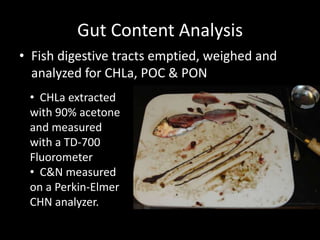
Gut Content Analysis
• Fish digestive tracts emptied, weighed and
  analyzed for CHLa, POC & PON
 • CHLa extracted
 with 90% acetone
 and measured
 with a TD-700
 Fluorometer
 • C&N measured
 on a Perkin-Elmer
 CHN analyzer.
Microcystin Extractions
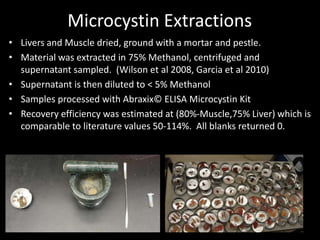
• Livers and Muscle dried, ground with a mortar and pestle.
• Material was extracted in 75% Methanol, centrifuged and
  supernatant sampled. (Wilson et al 2008, Garcia et al 2010)
• Supernatant is then diluted to < 5% Methanol
• Samples processed with Abraxix© ELISA Microcystin Kit
• Recovery efficiency was estimated at (80%-Muscle,75% Liver) which is
  comparable to literature values 50-114%. All blanks returned 0.
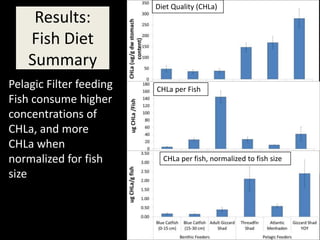
Diet Quality (CHLa)
     Results:
    Fish Diet
    Summary
Pelagic Filter feeding   CHLa per Fish
Fish consume higher
concentrations of
CHLa, and more
CHLa when
normalized for fish        CHLa per fish, normalized to fish size

size
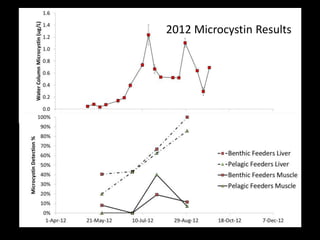
2012 Microcystin Results
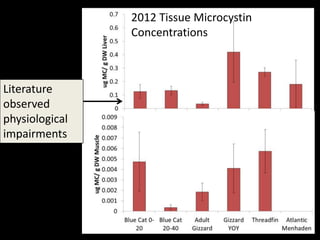
2012 Tissue Microcystin
                Concentrations


Literature
observed
physiological
impairments
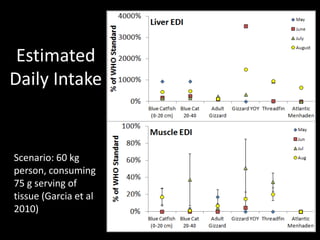
Estimated
Daily Intake


Scenario: 60 kg
person, consuming
75 g serving of
tissue (Garcia et al
2010)
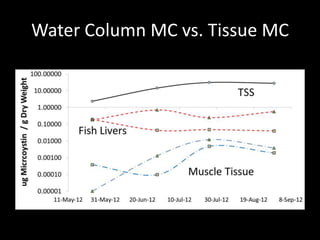
Water Column MC vs. Tissue MC
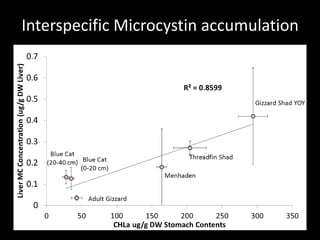
Interspecific Microcystin accumulation
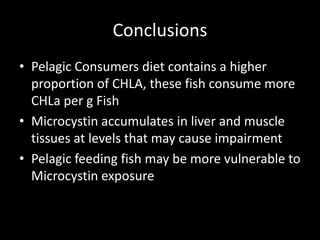
Conclusions
• Pelagic Consumers diet contains a higher
  proportion of CHLA, these fish consume more
  CHLa per g Fish
• Microcystin accumulates in liver and muscle
  tissues at levels that may cause impairment
• Pelagic feeding fish may be more vulnerable to
  Microcystin exposure
Future Work
• Do algiviorous fish have any role as top down
  control on phytoplankton? Do they Exacerbate
  Algal blooms?
• How far does Microcystin move up the food
  web? Piscivorous Birds?
• What are the physiological impairments
  associated with this level of Toxin
  accumulation?
• How far does this toxin spread geographically?
Acknowledgements
•   Mac Lee
•   Ryan Weaver
•   Aaron Porter
•   Dave Hopler
•   Chuck Fredrickson
•   Jamie Brunkow
•   Geoff Austin
•   James River Association
•   DEQ
•   City of Richmond
•   VCU Rice Center
Questions ?

Aers fall 2012

  • 1.
    Phytoplankton consumption andMicrocystin accumulation by fishes of the Tidal Fresh James River Joe Wood and Paul Bukaveckas, VCU
  • 2.
    Outline • Background on the James River CHLa Study • What is Microcystin? • Research Questions • Methods & Results • Conclusions & Questions
  • 3.
    James River CHLaStudy • EPA takes over CB clean up, mandates quantitative CHLa standards to reduce nutrient loads • DEQ requests 3 years to ensure CHLa standards are scientifically defensible
  • 4.
    The Tidal FreshJames is extremely productive relative to other regions of the Chesapeake Bay Study Site
  • 5.
    This high productivityoccurs due to release from light limitation and assimilation of large anthropogenic nutrient loads Km 169: Deep& Narrow Km 118: Wide & Shallow Bukaveckas et al 2011, Estuaries and 156 0 Coasts (Richmond) (Chesapeake Bay)
  • 6.
    Impairments associated with Eutrophication in the Upper James Hypoxia, Dead zones not a concern in this system
  • 7.
    What is Microcystin? •Secondary Metabolite produced Cyanobacteria by several bloom forming- Lacks cyanobacteria Contains Microcystin Microcystin • Increased Probability producing gene producing gene of Detection in Eutrophic Systems Gene Gene Active Inactive Poste et al 2011 Toxicity
  • 8.
    Impacts of Microcystinon Biota Increased Apoptic Cell death, Tumors Mortality and and Liver Hematological Cancer in Trout Lesions in (Fischer et al Flamingos 2011) Muscle (Miller et al Loss, increased 2010) Mortality, Live abnormalities, r r educed fertility Hemorrhaging in Threadfin and tumor Shad (Acuna et formation in al 2012) Sea Otters, (Miller et al 2010)
  • 9.
    Microcystin in theJames Research Questions 1. What fish consume phytoplankton in this 2011system? 2. Is Microcystin assimilated by Fish in the Tidal Fresh James River? 3. What factors increase vulnerability to toxin exposure? WHO Drinking Water Standard
  • 10.
    Methods • Fish collection& Species Background • Gut Contents analysis • Microcystin Extraction techniques
  • 11.
    Specimen Collection • 75Fish sampled via Electroshocking monthly (May-October 2012) Benthic feeders: Pelagic Feeders: • Blue Catfish (0-20 cm) • YOY Gizzard Shad • Blue Catfish (20-40 cm) • Threadfin Shad • Adult Gizzard Shad • Atlantic Menhaden Gizzard Shad YOY Gizzard Atlantic Menhaden Blue Catfish Threadfin Shad
  • 12.
    Gut Content Analysis •Fish digestive tracts emptied, weighed and analyzed for CHLa, POC & PON • CHLa extracted with 90% acetone and measured with a TD-700 Fluorometer • C&N measured on a Perkin-Elmer CHN analyzer.
  • 13.
    Microcystin Extractions • Liversand Muscle dried, ground with a mortar and pestle. • Material was extracted in 75% Methanol, centrifuged and supernatant sampled. (Wilson et al 2008, Garcia et al 2010) • Supernatant is then diluted to < 5% Methanol • Samples processed with Abraxix© ELISA Microcystin Kit • Recovery efficiency was estimated at (80%-Muscle,75% Liver) which is comparable to literature values 50-114%. All blanks returned 0.
  • 14.
    Diet Quality (CHLa) Results: Fish Diet Summary Pelagic Filter feeding CHLa per Fish Fish consume higher concentrations of CHLa, and more CHLa when normalized for fish CHLa per fish, normalized to fish size size
  • 15.
  • 16.
    2012 Tissue Microcystin Concentrations Literature observed physiological impairments
  • 17.
    Estimated Daily Intake Scenario: 60kg person, consuming 75 g serving of tissue (Garcia et al 2010)
  • 18.
    Water Column MCvs. Tissue MC
  • 19.
  • 20.
    Conclusions • Pelagic Consumersdiet contains a higher proportion of CHLA, these fish consume more CHLa per g Fish • Microcystin accumulates in liver and muscle tissues at levels that may cause impairment • Pelagic feeding fish may be more vulnerable to Microcystin exposure
  • 21.
    Future Work • Doalgiviorous fish have any role as top down control on phytoplankton? Do they Exacerbate Algal blooms? • How far does Microcystin move up the food web? Piscivorous Birds? • What are the physiological impairments associated with this level of Toxin accumulation? • How far does this toxin spread geographically?
  • 22.
    Acknowledgements • Mac Lee • Ryan Weaver • Aaron Porter • Dave Hopler • Chuck Fredrickson • Jamie Brunkow • Geoff Austin • James River Association • DEQ • City of Richmond • VCU Rice Center
  • 23.

Editor's Notes

  • #2 Hello, My name is Joe wood and I am a PhD Student at VCU in Richmond Virginia. Today I will be talking about some of my work on phytoplankton consumption by fish and accumulation of the algal toxin Microcystin.
  • #3 Here is a Brief Outline of what I hope to cover today, First I’ll provide some background on the James River CHLa study which funds this work, I will give a brief description on what Microcystin is and its impacts, I will describe the research questions of the study, Go over my methods and results, and finish with some conclusions of what we have learned about this system.
  • #4 So,Chesapeake Bay restoration has had somewhat limited success under the purview of state governments and as a result the EPA has taken control of the restoration efforts. One of the EPAs goals is moving from qualitative standards to numeric criteria which can be objectively judged. In the James the EPA has set quantitative spring and summer CHLa standards throughout the watershed. As of right now, these standards are rarely met; and the cost of meeting them would Be 2-3 billion dollars. As a first response to these criteria the VA DEQ has asked for a grace period of 3 years to determine if the CHLa standards are scientifically appropriate, determine impacts of algal blooms and to build an improved CHLaModel for the James. The DEQ argues that when the Chesapeake Bay CHLa model was developed several years ago, the James River didn’t receive the same amount of attention as some other tributaries in the upper bay because impacts of the James were thought to be lower. As a result the DEQ has funded several projects associated with algal blooms on the James. Paul and I’s work is focused on the upper James River.
  • #5 Our study site, The Tidal Fresh James represents one of the most productive systems in the Chesapeake Bay with average annual Chlorophyll levels near 23 ug/L. This map was constructed with 5 years of data from the Chesapeake Bay Program Monitoring stations. This is not to say that CHLa levels are always higher in the James River, in fact the highest observed values of CHLa typically occur in the lower James. The upper James, however is much more consistently productive whereas the lower james has events that are more sporadic in nature.
  • #6 The reason the tidal fresh James is so tremendously productive is a combination of heavy nutrient loads and light availability. This area of the river is just past the fall line and has the feeling of an estuary but the water is fresh. As we move from a deep narrow constricted channel to a wide shallow channel, the amount of total light availability for phytoplankton drastically increases. As a result phytoplankton which were previously limited by light can start assimilating large loads of inorganic nutrients. This productivity drops off as the channel again deepens and as you approach the estuarine turbidity maximum.
  • #7 Despite these high levels of Primary Production, the Tidal fresh James never has problems with dead zones or hypoxic conditions, even in late summer. We think this is probably because of the combination of the proximity to freshwater inputs and a large tidal prism. So as a result, A CHLa standard relies upon some form of impairment which is why the DEQ is funding so much work on Microcystin in the Upper James.
  • #8 SoI’d like to provide a little background on microcystin for those that are unfamiliar, Microcystin is a secondary metabolite produced by cyanobacteria. It was first discovered in the cyanobacteria Microcystis, thus its name, but since then it has been shown to be produced by a number of different strands of cyanobacteria. There are several molecular variants of the toxin but all are considered hepatotoxins which cause a health problems in biota and humans. Cell counts can be used to determine the presence of harmful algae, but toxicity might not be directly correlated because cyanobacteria may or may not have the gene to produce the toxin. Even in situations when the gene is present it may be also be inactive. As a result tracking the toxin is necessary to elucidate toxicity. Little is known about the ecological function of the toxin, and what triggers it’s production, but it is more commonly found in nutrient loaded eutrophic systems.
  • #9 There have been a variety of harmful impacts of microcystin published in the literature on variety of biota. Several lakes in Africa have observed liver tumors and lesions in flamingos. In the San Francisco Estuary several dead sea otters were found with high microcystin concentrations and liver hemorrhages. What was especially frightening about this case was that the problematic bloom occurred in a lake several Kilometers from the ocean, and then bio-accumulated in bivalves down stream which the sea otters were consuming. Several impacts on fish have been published which include reduced fertility, reduced growth rate, abnormalities, liver tumors among others. So the point here is this stuff is harmful, for a variety of reasons with an emphasis on liver function and its impact can disperse from the site of bloom initiation.
  • #10 So Our first task was to determine weather we even have this toxin in the James, we knew from phytoplankton counts from Harold Marshall’s lab that Microcystis does occur in the tidal fresh James and cyanobacteria dominate, but we didn’t know weather the toxin producing strand was present.Last year we initiated weekly monitoring and detected the toxin throughout the growing season. This first plot shows a times series of CHLa at our study site and an upstream site in Richmond, and you can see according the current EPA standard is not being met regularly at our study site. Also shown on the secondary axis is discharge, and you can see that flushing can play a role for algal blooms. Microcystin did not directly correspond with CHLa, Levels gradually rose throughout until late summer when levels surged. Shown on this plot is the World Health Organization’s Drinking water standard. Values of Microcystin also responded to this flushing event. The World Health Organization has declared Drinking water standards (1 ug/L), Recreational Contact Standards (20 ug/L, though this is 6 ug/L in the state of Virginia), and finally a fish consumption standard of .04 ug per kg consumer body weight per day. So now that we know this toxin occurs in the water column we have been working to see if it accumulates in Biota, Today I’ll be talking about accumulation in fish but we have also been monitoring Blue Crabs, Sediments and Wedge clams- see the poster for some details on it’s influence on filtration rates. Our first question is What fish in this system consume phytoplankton and this is focused on identifying consumers that are at risk,Our second task is to determine if this toxin is being assimilatedAnd finally we want to take a look at what fish are most vulnerable to this toxin.First, What fish in this system consume phytoplankton and how much? Secondly, are these fish accumulating Microcystin?And finally does this represent a human health concern regarding fish consumption or ecological concern?
  • #11 Next I will describe the methods I used to address these questions. First I will go over our some background on our target species and our sampling regime. Then I will describe our Gut Contents Analysis methods and finally I will describe our Microcystin Extraction techniques.
  • #12 Each month we went out and obtained fish 75 fish by elecrofishingFor this study we chose to look at 2 size ranges of Blue Catfish, 2 size ranges of gizzard shad as well as threadfin shad and Atlantic Menhaden. Just a little background on our species of Interest: Blue Catfish are an invasive species in this system introduced for sport fishing; According to local fish biologist they are likely the most abundant fish in this portion of the river, however few estimates of fish abundance are available. Gizzard Shad are also thought to be very common in this system. This species has an ontogenetic Diet shift- as juvenilles they feed primarily out of the water column on phytoplankton and zooplankton, but as they reach ~ 1 year of age they become facultative detritivores and feed off sediments. A lot of research has been done on the potential of gizzard shad to recycle nutrients and sustain algal blooms. In Lakes in Florida they have tried eradicating the species to control eutrophication.Threadfin Shad is an introduced species in the James that is functionally similar to juvenille gizzard shad feeding out of the water column- they are short lived and only reach about 15 cm.And finally Atlantic Menhaden which are widely know for the ecological importance as a high energy food and also for commercial importance to fish oil production.
  • #13 Upon returning to the lab fish were dissected, Digestive tracts were emptied, massed and analyzed for CHLa, C &amp; N. Wet and Dry subsamples were weighed so that all values could be reported as m/g dry weight. CHLa was extracted with 90% acetone and measure on TD-700 flouorometer. Carbon and Nitrogen Content was measured on a perkin-Elmer CHN analyzer.
  • #14 For Microcystin Analyses, Livers and Muscle tissues were obtained, dried, and ground with a mortar and pestle. This material was then extracted in Methanol for 24 hours, centrifuged and the supernatant collected. This is then diluted and run on an Abraxis Microcystin Enzyme Linked Immunosorbent Assay plate. This method essentially uses a Microcystin specific antibody which will bind the toxin and can be measured colorimetrically. In order to test our extraction method we performed several spike experiments where pure microcystin is injected, and recovery is estimated. This was recommended by several scientists who have worked on microcystin in other systems. We estimated an extraction efficiency of 75% for Muscle and 80% for Liver, which is comparable with literature values. Additionally all of our blanks came back with 0 values.
  • #15 The Results of our Gut Content analysis studies indicate the fish we have described as pelagic feeders (threadfin, juvenile gizzard, and Atlantic Menhaden) consume food which is more concentrated with CHLa. When considering a mass of CHLa consumed per fish, Adult Gizzard Shad are by far the most important, but this is driven by the larger size of the adults. When normalized for fish size, the pelagic feeders also consume more CHLa, per gram fish.
  • #16 For Microcystin, the2012 Microcystin Bloom has had a different pattern than 2011 when there was a single Large Bloom in Late August. This summer we had an early bloom in the beginning of July, and a second bloom in late August. When we look at seasonal trends in Microcystin accumulation in fish, there is clearly a rise in proportion detection throughout the growing season as expected. Detection of Microcystin in fish livers was significantly higher (as is expected) One interesting thing to note is that prior to significant toxin abundance in the water column, Liver tissues were already providing positive results. So there may potentially be a carry over of microcystin from year to year in liver tissues however we will have to further investigate. In the next year of sampling we are planning to take samples from February or so to confirm this.
  • #17 In addition to proportion detection, Fish Livers also contained higher concentrations of toxins of toxins by nearly 2 orders of magnitude. The Liver Concentrations of Pelagic Feeders was generally higher than those of benthic feeders. These liver accumulation levels are as high or higher than values reported in several papers that study growth rate impacts and other physiological responses fish in this system are likely experiencing some harmful impacts.
  • #18 To put these toxin levels into perspective of World Health Organization Standards,I have plotted our average values as a percent of recomended daily intake, given a 60 kg person consuming 75 g of specimen tissue; these scenarios were taken from a published figure regarding fish consumption concerns. Obviously there are not many people eating threadfin shad Livers but it is useful as a point of comparison. For fish muscle average fish tissue represent 10-20% of the daily recommended intake. For liver these values are well above the consumption limit.
  • #19 This next figure is presented in order to give you some perspective on the magnitude of difference between concentration of particulate matter and the concentration of biota. The suspended material in the water column is 2-3 orders of magnitude higher than liver tissue and 6-7 orders of magnitude higher than muscle tissue.
  • #20 Finally, When looking at Diet composition and Microcystin simultaneously it appears that diets higher in algal composition lead to increased exposure to microcystin in liver tissues. So in this system there is a food quality difference between feeding out of the water column and feeding on the sediments, water column material is obviously much higher in nutrient content and calories, but based on these results and some monitoring of sediments, there may be some benefit to feeding off sediments, because of decreased microcystin exposure. Microcystis does tend to have bouyant properties, and we suspect that microcystin may never have a chance to settle out- It has been shown to accumulate in the sediments of some lake systems but In this system where there are strong mixing forces.
  • #21 Some closing thoughts,
  • #22 How far Another section of my dissertation is focused on looking at top down controls on phytoplankton in this systems and determining weather fish constrain or potentially even exacerbate blooms through recycling.