Dima Jennifer Nicolas Saadia Sergiu Group 3:
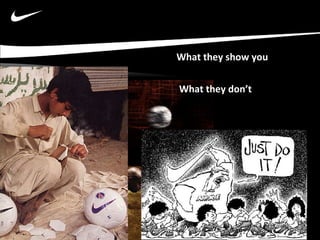
What they show you What they don’t
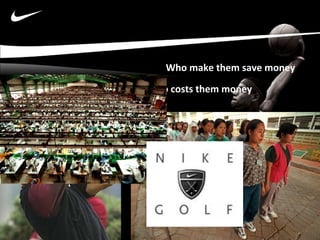
Who costs them money Who make them save money
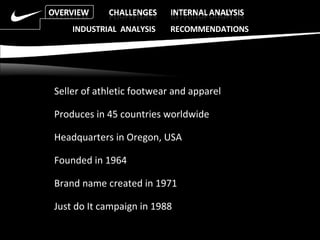
Seller of athletic footwear and apparel Produces in 45 countries worldwide Headquarters in Oregon, USA Founded in 1964 Brand name created in 1971 Just do It campaign in 1988 INDUSTRIAL  ANALYSIS  RECOMMENDATIONS
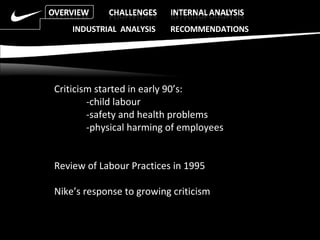
Criticism started in early 90’s: -child labour -safety and health problems -physical harming of employees Review of Labour Practices in 1995 Nike’s response to growing criticism INDUSTRIAL  ANALYSIS  RECOMMENDATIONS
Matrix Structure Each department overlapped by geographic divisions and product categories Overlap in managerial responsibilities Fluid leadership structure No formal communication link between regional and product heads INDUSTRIAL  ANALYSIS  RECOMMENDATIONS Organizational Structure
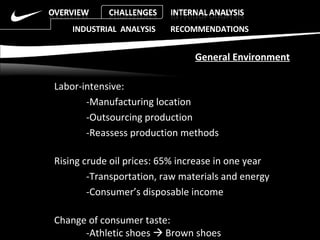
Labor-intensive: -Manufacturing location  -Outsourcing production  -Reassess production methods Rising crude oil prices: 65% increase in one year -Transportation, raw materials and energy  -Consumer’s disposable income  Change of consumer taste:  -Athletic shoes    Brown shoes INDUSTRIAL  ANALYSIS  RECOMMENDATIONS General Environment
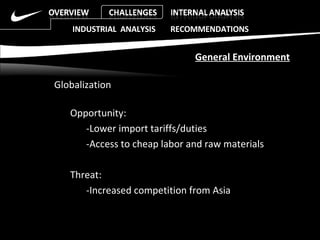
Globalization Opportunity:  -Lower import tariffs/duties -Access to cheap labor and raw materials Threat: -Increased competition from Asia INDUSTRIAL  ANALYSIS  RECOMMENDATIONS General Environment
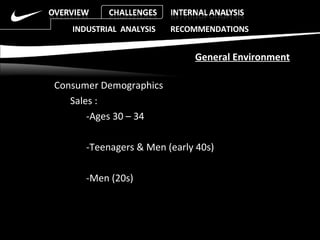
Consumer Demographics Sales : -Ages 30 – 34 -Teenagers & Men (early 40s) -Men (20s) INDUSTRIAL  ANALYSIS  RECOMMENDATIONS General Environment
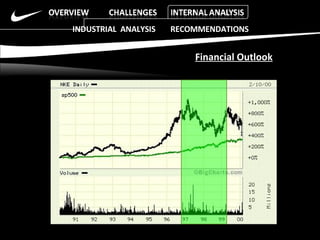
INDUSTRIAL  ANALYSIS  RECOMMENDATIONS Financial Outlook
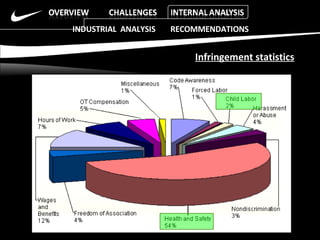
INDUSTRIAL  ANALYSIS  RECOMMENDATIONS Infringement statistics
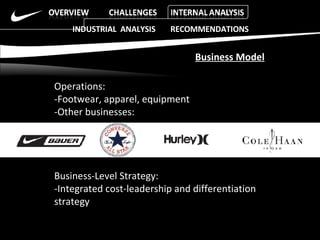
Operations:  -Footwear, apparel, equipment  -Other businesses: Business-Level Strategy:  -Integrated   cost-leadership and differentiation strategy INDUSTRIAL  ANALYSIS  RECOMMENDATIONS Business Model
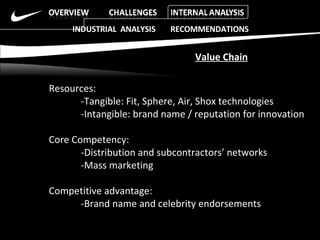
INDUSTRIAL  ANALYSIS  RECOMMENDATIONS Resources: -Tangible: Fit, Sphere, Air, Shox technologies -Intangible: brand name / reputation for innovation Core Competency:  -Distribution and subcontractors’ networks -Mass marketing Competitive advantage: -Brand name and celebrity endorsements Value Chain
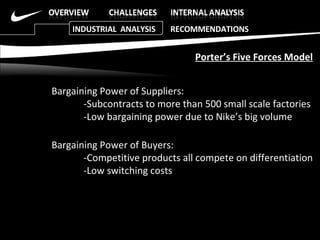
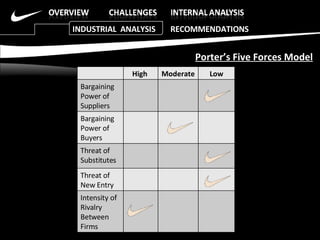
Bargaining Power of Suppliers: -Subcontracts to more than 500 small scale factories  -Low bargaining power due to Nike’s big volume Bargaining Power of Buyers: -Competitive products all compete on differentiation -Low switching costs Porter’s Five Forces Model INDUSTRIAL  ANALYSIS  RECOMMENDATIONS
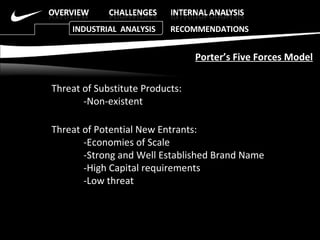
Threat of Substitute Products: -Non-existent Threat of Potential New Entrants: -Economies of Scale -Strong and Well Established Brand Name -High Capital requirements -Low threat Porter’s Five Forces Model INDUSTRIAL  ANALYSIS  RECOMMENDATIONS
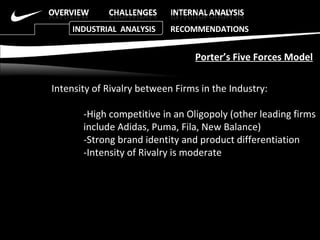
Intensity of Rivalry between Firms in the Industry: -High competitive in an Oligopoly (other leading firms  include Adidas, Puma, Fila, New Balance)  -Strong brand identity and product differentiation  -Intensity of Rivalry is moderate  Porter’s Five Forces Model INDUSTRIAL  ANALYSIS  RECOMMENDATIONS
Porter’s Five Forces Model INDUSTRIAL  ANALYSIS  RECOMMENDATIONS High  Moderate Low Bargaining Power of Suppliers Bargaining Power of Buyers Threat of Substitutes Threat of New Entry Intensity of Rivalry Between Firms
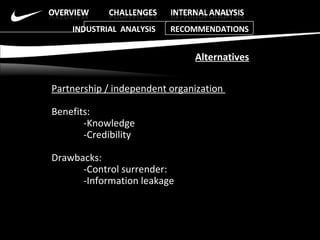
Partnership / independent organization  Benefits: -Knowledge -Credibility Drawbacks: -Control surrender:  -Information leakage Alternatives INDUSTRIAL  ANALYSIS  RECOMMENDATIONS
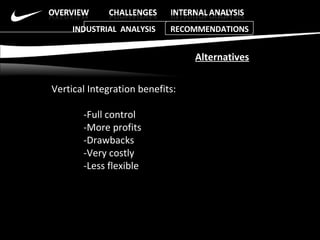
Vertical Integration benefits: -Full control -More profits -Drawbacks -Very costly -Less flexible Alternatives INDUSTRIAL  ANALYSIS  RECOMMENDATIONS
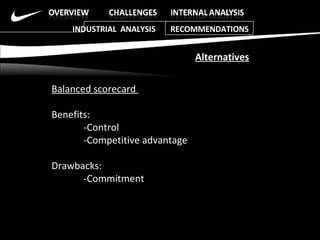
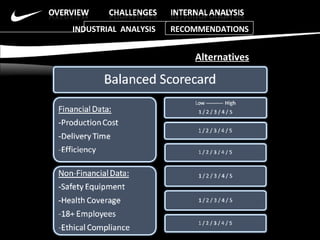
Balanced scorecard  Benefits: -Control -Competitive advantage Drawbacks: -Commitment INDUSTRIAL  ANALYSIS  RECOMMENDATIONS Alternatives
INDUSTRIAL  ANALYSIS  RECOMMENDATIONS Alternatives
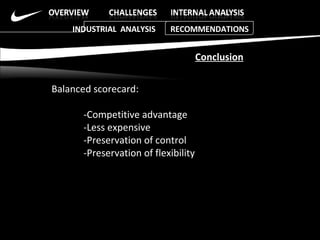
Balanced scorecard: -Competitive advantage -Less expensive -Preservation of control -Preservation of flexibility INDUSTRIAL  ANALYSIS  RECOMMENDATIONS Conclusion
We are one step ahead Thank you for your attention. Feel free to ask if you have any question.

Nike Ethics

  • 1.
    Dima Jennifer NicolasSaadia Sergiu Group 3:
  • 2.
    What they showyou What they don’t
  • 3.
    Who costs themmoney Who make them save money
  • 4.
    Seller of athleticfootwear and apparel Produces in 45 countries worldwide Headquarters in Oregon, USA Founded in 1964 Brand name created in 1971 Just do It campaign in 1988 INDUSTRIAL ANALYSIS RECOMMENDATIONS
  • 5.
    Criticism started inearly 90’s: -child labour -safety and health problems -physical harming of employees Review of Labour Practices in 1995 Nike’s response to growing criticism INDUSTRIAL ANALYSIS RECOMMENDATIONS
  • 6.
    Matrix Structure Eachdepartment overlapped by geographic divisions and product categories Overlap in managerial responsibilities Fluid leadership structure No formal communication link between regional and product heads INDUSTRIAL ANALYSIS RECOMMENDATIONS Organizational Structure
  • 7.
    Labor-intensive: -Manufacturing location -Outsourcing production -Reassess production methods Rising crude oil prices: 65% increase in one year -Transportation, raw materials and energy -Consumer’s disposable income Change of consumer taste: -Athletic shoes  Brown shoes INDUSTRIAL ANALYSIS RECOMMENDATIONS General Environment
  • 8.
    Globalization Opportunity: -Lower import tariffs/duties -Access to cheap labor and raw materials Threat: -Increased competition from Asia INDUSTRIAL ANALYSIS RECOMMENDATIONS General Environment
  • 9.
    Consumer Demographics Sales: -Ages 30 – 34 -Teenagers & Men (early 40s) -Men (20s) INDUSTRIAL ANALYSIS RECOMMENDATIONS General Environment
  • 10.
    INDUSTRIAL ANALYSIS RECOMMENDATIONS Financial Outlook
  • 11.
    INDUSTRIAL ANALYSIS RECOMMENDATIONS Infringement statistics
  • 12.
    Operations: -Footwear,apparel, equipment -Other businesses: Business-Level Strategy: -Integrated cost-leadership and differentiation strategy INDUSTRIAL ANALYSIS RECOMMENDATIONS Business Model
  • 13.
    INDUSTRIAL ANALYSIS RECOMMENDATIONS Resources: -Tangible: Fit, Sphere, Air, Shox technologies -Intangible: brand name / reputation for innovation Core Competency: -Distribution and subcontractors’ networks -Mass marketing Competitive advantage: -Brand name and celebrity endorsements Value Chain
  • 14.
    Bargaining Power ofSuppliers: -Subcontracts to more than 500 small scale factories -Low bargaining power due to Nike’s big volume Bargaining Power of Buyers: -Competitive products all compete on differentiation -Low switching costs Porter’s Five Forces Model INDUSTRIAL ANALYSIS RECOMMENDATIONS
  • 15.
    Threat of SubstituteProducts: -Non-existent Threat of Potential New Entrants: -Economies of Scale -Strong and Well Established Brand Name -High Capital requirements -Low threat Porter’s Five Forces Model INDUSTRIAL ANALYSIS RECOMMENDATIONS
  • 16.
    Intensity of Rivalrybetween Firms in the Industry: -High competitive in an Oligopoly (other leading firms include Adidas, Puma, Fila, New Balance) -Strong brand identity and product differentiation -Intensity of Rivalry is moderate Porter’s Five Forces Model INDUSTRIAL ANALYSIS RECOMMENDATIONS
  • 17.
    Porter’s Five ForcesModel INDUSTRIAL ANALYSIS RECOMMENDATIONS High Moderate Low Bargaining Power of Suppliers Bargaining Power of Buyers Threat of Substitutes Threat of New Entry Intensity of Rivalry Between Firms
  • 18.
    Partnership / independentorganization Benefits: -Knowledge -Credibility Drawbacks: -Control surrender: -Information leakage Alternatives INDUSTRIAL ANALYSIS RECOMMENDATIONS
  • 19.
    Vertical Integration benefits:-Full control -More profits -Drawbacks -Very costly -Less flexible Alternatives INDUSTRIAL ANALYSIS RECOMMENDATIONS
  • 20.
    Balanced scorecard Benefits: -Control -Competitive advantage Drawbacks: -Commitment INDUSTRIAL ANALYSIS RECOMMENDATIONS Alternatives
  • 21.
    INDUSTRIAL ANALYSIS RECOMMENDATIONS Alternatives
  • 22.
    Balanced scorecard: -Competitiveadvantage -Less expensive -Preservation of control -Preservation of flexibility INDUSTRIAL ANALYSIS RECOMMENDATIONS Conclusion
  • 23.
    We are onestep ahead Thank you for your attention. Feel free to ask if you have any question.