AAC (Autoclaved aerated concrete) Block
INTRODUCTION
- AAC (Autoclaved aerated concrete):-
Autoclaved aerated concrete (AAC),also known as autoclaved cellular concrete
(AAC), autoclaved lightweight concrete (ALC), autoclaved concrete, cellular
concrete, porous concrete, it is a lightweight, precast, Foam concrete building
material invented in the mid-1920s that simultaneously provides structure,
insulation, and fire- and mould resistance. AAC products include blocks, wall
panels, floor and roof panels and lintels.
AAC was perfected in the mid-1920s by the Swedish architect and inventor Dr.
Johan Axel Eriksson, working with Professor Henrik Kreuger at the Royal Institute
of Technology. It went into production in Sweden in 1929 in a factory in
Hallabrottet and quickly became very popular.
AAC is a highly thermally insulating concrete-based material used for both
internal and external construction. Besides AAC's insulating capability, one of its
advantages in construction is its quick and easy installation, because the material
can be routed or cut to size on site using standard carbon steel power tools.
AAC is well suited for urban areas with high rise buildings and those with high
temperature variations. Due to its lower density, high rise buildings constructed
using AAC require less steel and concrete for structural members. The
requirement of mortar for laying of AAC blocks is reduced due to the lower
number of joints. Similarly, the material required for rendering is also lower due
to the dimensional accuracy of AAC. The increased thermal efficiency of AAC
makes it suitable for use in areas with extreme temperatures, as it eliminates the
need for separate materials for construction and insulation, leading to faster
construction and costsavings
OBJECTIVE
ACC:-
1. To construct economical buildings (cost comparison) by replacing
clay bricks by AAC blocks.
2. To make productive use of recycled industrial waste (fly ash).
3. To cast standard ACC blocks in the laboratory and conduct various
tests to check the strength and capacity of blocks.
4. To conduct experimentation on modified AAC blocks by adding
materials such as paddy husk, quarry dust, M-sand and super plastisizer
to increase the efficiency of AAC blocks.
METHODOLOGY
* Materials required:-
1. Portland cement.
2. Lime.
3. Aluminum powder.
4. Sand.
5. Fly ash.
6. M-sand.
7. Super plastizer.
8. Casting molds and equipment.
Preparation process of AAC blocks:-
* Raw Material Preparation and storage
The first step of AAC production is grinding of silica rich material (sand, fly ash,
etc) in ball mills. For different materials, different processing is adopted, such as
dry grinding (into powder), wet grinding (into slurry) or mixed grinding with
quicklime (CaO). There are two methods for mixed milling. One is dry mixing to
produce binding material, and the other method is wet mixing. Since most
quicklime is agglomerate, it should be crushed and then grinded. Gypsum is
normallynot ball milled separately. It is grinded with flyash or with quicklime, or
it could be grinded with the same miller for quicklime in turn. Other
supplementary and chemicals are also have tobe prepared.
Raw material storage assures the continuous production and material stability.
The continuous production guarantees the non-stop & on-time supply, and the
material stability guarantees the quality of products, since the raw material might
come from different sources, with different qualities. Raw material preparation &
storageis the pre-step for proportioning batching. This pre-step guarantees theraw
material meet the standard for AAC production, and it is also finishes the storage,
homogenization and aging process. It is the basic process that assures the smooth
production and production quality.
*Dosingandmixing
Maintaining ratio of all ingredients as per the selected recipe is critical to ensure
consistent quality of production. This is accomplished by using various control
systems tomeasureand release therequiredquantityofvariousraw materials.
A dosing and mixing unit is used to form the correct mix to produce
Autoclaved Aerated Concrete (AAC) blocks. Fly ash/sand slurry is pumped
into a separate container. Once the desired weight is poured in, pumping is stopped.
Similarly lime powder, cement and gypsum are poured into individual containers
using screw conveyers. Once required amount of each ingredient is filled into their
individual containers control system releases all ingredients into mixing drum.
Mixing drumislikeagiantbowl withastirrerrotatinginsideto ensureproper mixing
ofingredients.Steam mightalso befedto theunit to maintaintemperatureinrangeof
40-42 degree C. A smaller bowl type structure used for feeding Aluminum powder
is also attached as a part of mixing unit. Once the mixture has-been churned for set
time, itis readyto be pouredinto moldsusing dosing unit.Dosingunit releases these
mixtures per set quantities into molds for foaming. Dosing and mixing process is
carried out continuously because if there is a long gap between charging and
discharging of ingredients, residual mixture might start hardening and choke up the
entireunit.
In modern plants, entire dosing and mixing operation is completely automated and
requires minimum human intervention. This entire operation is monitored using
controlsystemsintegratedwithcomputerandCCTV cameras. Aswithanyindustrial
operation, there is provision for human intervention and emergency actions
integrated insidethe controlsystem.
*Casting,FoamingandPre-curing
Oncethe desiredmixisready, itis pouredinto moulds.Thesemouldscan beofvarious
sizesdependingontheproductioncapacityofamanufacturingunit.Oncemixispoured
into moulds, it is ready for pre-curing. After casting, the slurry in molds will be
in the pre-curing chamber to finish foaming and hardening. Foaming and
hardening actuallystartswhen the slurryis fedinto molds, which includes gas-forming
expansionandperform curingto achieve certain strength, whichis enough forcutting.
Pre-curing is always done under set temperature; hence it is also called as heating-
room-pre-curing.Pre-curing is not a complicated process, but should avoid vibration.
Operatorsmust keep eyesto monitorthe slurry change during foaming and provide
feedback to dosing, mixing and castingoperators.Pre-form defects (cracking, sinking,
etc)mainlyoccurduringtheprocess.
*CUTTING
Duringthis process,thepre-curedblockgoesthrough cutting andshaping,into different
size& shapes as perrequirements.The highworkabilityandlargevarietyofsizesmake
AAC production more suitable for massive production with higher mechanization.
Cutting can bedonemechanicallyormanually. With a cutting machine, theproduction
efficiencyanddimensionalaccuracyiseasilyachieved.
* Autoclaved Curing
After cutting into the desired sizes & shapes, ‘green’ AAC blocks are
transferred into autoclaves. Auto claves are used for steam curing under
pressure.AACmustbepre-curedandsteam curedtofinishthephysical and chemical
changes,andthentoachieveenoughstrengthfordesiredusage.AbatchofAACblocks
is steam cured for 10-12hours at a pressure of12 bars and temperatureof 190°C. In
hotand humidconditions,AACblocksundergolast stages ofhydro-thermalsynthesis
reaction totransform into anewproductwith required strengthand various physical
performances. Autoclaved curing imparts inherent properties and performance of
AAC.
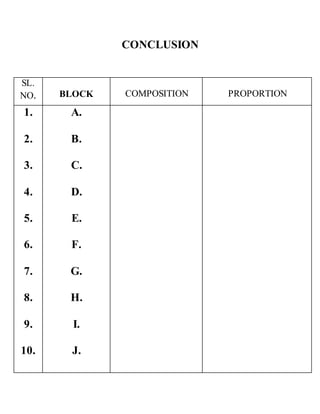
CONCLUSION
SL.
NO. BLOCK COMPOSITION PROPORTION
1.
2.
3.
4.
5.
6.
7.
8.
9.
10.
A.
B.
C.
D.
E.
F.
G.
H.
I.
J.
USES
AAC is a highly thermally insulating concrete-based material used for
both internal and external construction. Besides AAC's insulating
capability, one of its advantages in construction is its quick and easy
installation, because the material can be routed, sanded, or cut to size on
site using standard carbon steel power tools.
AAC is well suited for urban areas with high rise buildings and those
with high temperature variations. Due to its lower density, high rise
buildings constructed using AAC require less steel and concrete for
structural members. The requirement of mortar for laying of AAC
blocks is reduced due to the lower number of joints. Similarly, the
material required for rendering is also lower due to the dimensional
accuracy of AAC. The increased thermal efficiency of AAC makes it
suitable for use in areas with extreme temperatures, as it eliminates the
need for separate materials for construction and insulation, leading to
faster construction and cost savings.
Even though regular cement mortar can be used, most of the buildings
erected with AAC materials use thin bed mortar in thicknesses around
⅛ inch, depending on the national building codes. AAC materials can be
coated with stucco or plaster compound to guard against the elements, or
covered with siding materials such as brick or vinyl.
ADVANTAGES
* Improved thermal efficiency reduces the heating and cooling load in buildings.
* Porous structure allows for superior fire resistance.
* Workability allows accurate cutting, which minimizes the generation of solid waste
during use.
* Resource efficiency gives it lower environmental impact in all phases of its life cycle,
from the processing of raw materials to the disposal of waste.
* Light weight saves cost & energy in transportation, labor expenses, and increases
chances of survival during seismic activity.
* Larger size blocks leads to faster masonry work.
* Reduces the cost of the project.
* Environmentally friendly: When used, it helps to reduce at least 30% of environmental
waste as opposed to going with traditional concrete. There is a decrease of 50% of
greenhouse gas emissions. When possible, using autoclaved aerated concrete is a better
choice for the environment.
* Energy saving: It is an excellent property that makes it an excellent insulator and that
means the interior environment is easier to maintain. When it is used, there is usually
not a need for any supplementary insulation.
* Fire resistant: Just like with regular concrete, AAC is fire resistant. This material is
completely inorganic and not combustible.
* Great ventilation: This material is very airy and allows for the diffusion of water. This
will reduce the humidity within the building. AAC will absorb moisture and release
humidity; this helps to prevent condensation and other problems that are related to
mildew.
* Non-toxic: There are no toxic gases or other toxic substances in autoclaved aerated
concrete. It does not attract rodents or other pests nor can it be damaged by such.
* Lightweight: Concrete blocks that are made out of AAC weigh about one-fifth of
typical concrete. They are also produced in sizes that are easy to handle for quick
construction.
* Accuracy: The panels and blocks made of autoclaved aerated concrete are produced
to the exact sizes needed before they even leave the factory. There is less need for on-
site trimming. Since the blocks and panels fit so well together, there is a reduced use of
finishing materials such as mortar.
* Long lasting: The life of this material is extended because it is not affected by harsh
climates or extreme changes in weather conditions. It will not degrade under normal
climate changes either.
* Quick assembly: Since it is a lightweight material and easy to work with, the assembly
is much quicker and smoother.
DISADVANTAGE
*Installation during rainy weather: aircrete is known to crack after
installation, which can be avoided by reducing the strength of the
mortar and ensuring the blocks are dry during and after installation.
* Brittle nature: they need to be handled more carefully than clay bricks
to avoid breakages.
* Fixings: the brittle nature of the blocks requires longer thinner screws
when fitting cabinets and wall hangings and wood-suitable drill bits or
hammering in. Special, large diameter wall plugs (aircrete anchor) are
available, though at a higher cost than common wall plugs.
* Insulation requirements in newer building codes of northern
European countries would require very thick walls when using AAC
alone. Thus many builders choose to return to traditional building
methods installing an extra layer of insulation around the building as a
whole.
* Hydrogen generated by manufacture outgasses to the atmosphere as
a greenhouse gas.
ANAYLISIS
REPORT
RESULT
PRECAUTION
IN INDIA
AAC block is the future of our country because it is easy to
make and the work process is very fast and cheep in price. The
actual price of AAC block (1 pec) is approx Rs 40. The
manufacture of any wall by AAC blocks is approx 2000 and
compare to Red clay brick
IN FUTURE
DEVLOPMENT
Acc block Synopsis

Acc block Synopsis

  • 1.
    AAC (Autoclaved aeratedconcrete) Block INTRODUCTION - AAC (Autoclaved aerated concrete):- Autoclaved aerated concrete (AAC),also known as autoclaved cellular concrete (AAC), autoclaved lightweight concrete (ALC), autoclaved concrete, cellular concrete, porous concrete, it is a lightweight, precast, Foam concrete building material invented in the mid-1920s that simultaneously provides structure, insulation, and fire- and mould resistance. AAC products include blocks, wall panels, floor and roof panels and lintels. AAC was perfected in the mid-1920s by the Swedish architect and inventor Dr. Johan Axel Eriksson, working with Professor Henrik Kreuger at the Royal Institute of Technology. It went into production in Sweden in 1929 in a factory in Hallabrottet and quickly became very popular. AAC is a highly thermally insulating concrete-based material used for both internal and external construction. Besides AAC's insulating capability, one of its advantages in construction is its quick and easy installation, because the material can be routed or cut to size on site using standard carbon steel power tools. AAC is well suited for urban areas with high rise buildings and those with high temperature variations. Due to its lower density, high rise buildings constructed using AAC require less steel and concrete for structural members. The requirement of mortar for laying of AAC blocks is reduced due to the lower number of joints. Similarly, the material required for rendering is also lower due to the dimensional accuracy of AAC. The increased thermal efficiency of AAC makes it suitable for use in areas with extreme temperatures, as it eliminates the need for separate materials for construction and insulation, leading to faster construction and costsavings
  • 2.
    OBJECTIVE ACC:- 1. To constructeconomical buildings (cost comparison) by replacing clay bricks by AAC blocks. 2. To make productive use of recycled industrial waste (fly ash). 3. To cast standard ACC blocks in the laboratory and conduct various tests to check the strength and capacity of blocks. 4. To conduct experimentation on modified AAC blocks by adding materials such as paddy husk, quarry dust, M-sand and super plastisizer to increase the efficiency of AAC blocks. METHODOLOGY * Materials required:- 1. Portland cement. 2. Lime. 3. Aluminum powder. 4. Sand. 5. Fly ash. 6. M-sand. 7. Super plastizer. 8. Casting molds and equipment.
  • 3.
    Preparation process ofAAC blocks:- * Raw Material Preparation and storage The first step of AAC production is grinding of silica rich material (sand, fly ash, etc) in ball mills. For different materials, different processing is adopted, such as dry grinding (into powder), wet grinding (into slurry) or mixed grinding with quicklime (CaO). There are two methods for mixed milling. One is dry mixing to produce binding material, and the other method is wet mixing. Since most quicklime is agglomerate, it should be crushed and then grinded. Gypsum is normallynot ball milled separately. It is grinded with flyash or with quicklime, or it could be grinded with the same miller for quicklime in turn. Other supplementary and chemicals are also have tobe prepared. Raw material storage assures the continuous production and material stability. The continuous production guarantees the non-stop & on-time supply, and the material stability guarantees the quality of products, since the raw material might come from different sources, with different qualities. Raw material preparation & storageis the pre-step for proportioning batching. This pre-step guarantees theraw material meet the standard for AAC production, and it is also finishes the storage, homogenization and aging process. It is the basic process that assures the smooth production and production quality.
  • 4.
    *Dosingandmixing Maintaining ratio ofall ingredients as per the selected recipe is critical to ensure consistent quality of production. This is accomplished by using various control systems tomeasureand release therequiredquantityofvariousraw materials. A dosing and mixing unit is used to form the correct mix to produce Autoclaved Aerated Concrete (AAC) blocks. Fly ash/sand slurry is pumped into a separate container. Once the desired weight is poured in, pumping is stopped. Similarly lime powder, cement and gypsum are poured into individual containers using screw conveyers. Once required amount of each ingredient is filled into their individual containers control system releases all ingredients into mixing drum. Mixing drumislikeagiantbowl withastirrerrotatinginsideto ensureproper mixing ofingredients.Steam mightalso befedto theunit to maintaintemperatureinrangeof 40-42 degree C. A smaller bowl type structure used for feeding Aluminum powder is also attached as a part of mixing unit. Once the mixture has-been churned for set time, itis readyto be pouredinto moldsusing dosing unit.Dosingunit releases these mixtures per set quantities into molds for foaming. Dosing and mixing process is carried out continuously because if there is a long gap between charging and discharging of ingredients, residual mixture might start hardening and choke up the entireunit. In modern plants, entire dosing and mixing operation is completely automated and requires minimum human intervention. This entire operation is monitored using controlsystemsintegratedwithcomputerandCCTV cameras. Aswithanyindustrial operation, there is provision for human intervention and emergency actions integrated insidethe controlsystem.
  • 5.
    *Casting,FoamingandPre-curing Oncethe desiredmixisready, itispouredinto moulds.Thesemouldscan beofvarious sizesdependingontheproductioncapacityofamanufacturingunit.Oncemixispoured into moulds, it is ready for pre-curing. After casting, the slurry in molds will be in the pre-curing chamber to finish foaming and hardening. Foaming and hardening actuallystartswhen the slurryis fedinto molds, which includes gas-forming expansionandperform curingto achieve certain strength, whichis enough forcutting. Pre-curing is always done under set temperature; hence it is also called as heating- room-pre-curing.Pre-curing is not a complicated process, but should avoid vibration. Operatorsmust keep eyesto monitorthe slurry change during foaming and provide feedback to dosing, mixing and castingoperators.Pre-form defects (cracking, sinking, etc)mainlyoccurduringtheprocess. *CUTTING Duringthis process,thepre-curedblockgoesthrough cutting andshaping,into different size& shapes as perrequirements.The highworkabilityandlargevarietyofsizesmake AAC production more suitable for massive production with higher mechanization. Cutting can bedonemechanicallyormanually. With a cutting machine, theproduction efficiencyanddimensionalaccuracyiseasilyachieved. * Autoclaved Curing After cutting into the desired sizes & shapes, ‘green’ AAC blocks are transferred into autoclaves. Auto claves are used for steam curing under pressure.AACmustbepre-curedandsteam curedtofinishthephysical and chemical changes,andthentoachieveenoughstrengthfordesiredusage.AbatchofAACblocks is steam cured for 10-12hours at a pressure of12 bars and temperatureof 190°C. In hotand humidconditions,AACblocksundergolast stages ofhydro-thermalsynthesis reaction totransform into anewproductwith required strengthand various physical performances. Autoclaved curing imparts inherent properties and performance of AAC.
  • 6.
    CONCLUSION SL. NO. BLOCK COMPOSITIONPROPORTION 1. 2. 3. 4. 5. 6. 7. 8. 9. 10. A. B. C. D. E. F. G. H. I. J.
  • 7.
    USES AAC is ahighly thermally insulating concrete-based material used for both internal and external construction. Besides AAC's insulating capability, one of its advantages in construction is its quick and easy installation, because the material can be routed, sanded, or cut to size on site using standard carbon steel power tools. AAC is well suited for urban areas with high rise buildings and those with high temperature variations. Due to its lower density, high rise buildings constructed using AAC require less steel and concrete for structural members. The requirement of mortar for laying of AAC blocks is reduced due to the lower number of joints. Similarly, the material required for rendering is also lower due to the dimensional accuracy of AAC. The increased thermal efficiency of AAC makes it suitable for use in areas with extreme temperatures, as it eliminates the need for separate materials for construction and insulation, leading to faster construction and cost savings. Even though regular cement mortar can be used, most of the buildings erected with AAC materials use thin bed mortar in thicknesses around ⅛ inch, depending on the national building codes. AAC materials can be coated with stucco or plaster compound to guard against the elements, or covered with siding materials such as brick or vinyl.
  • 8.
    ADVANTAGES * Improved thermalefficiency reduces the heating and cooling load in buildings. * Porous structure allows for superior fire resistance. * Workability allows accurate cutting, which minimizes the generation of solid waste during use. * Resource efficiency gives it lower environmental impact in all phases of its life cycle, from the processing of raw materials to the disposal of waste. * Light weight saves cost & energy in transportation, labor expenses, and increases chances of survival during seismic activity. * Larger size blocks leads to faster masonry work. * Reduces the cost of the project. * Environmentally friendly: When used, it helps to reduce at least 30% of environmental waste as opposed to going with traditional concrete. There is a decrease of 50% of greenhouse gas emissions. When possible, using autoclaved aerated concrete is a better choice for the environment. * Energy saving: It is an excellent property that makes it an excellent insulator and that means the interior environment is easier to maintain. When it is used, there is usually not a need for any supplementary insulation. * Fire resistant: Just like with regular concrete, AAC is fire resistant. This material is completely inorganic and not combustible. * Great ventilation: This material is very airy and allows for the diffusion of water. This will reduce the humidity within the building. AAC will absorb moisture and release humidity; this helps to prevent condensation and other problems that are related to mildew. * Non-toxic: There are no toxic gases or other toxic substances in autoclaved aerated concrete. It does not attract rodents or other pests nor can it be damaged by such. * Lightweight: Concrete blocks that are made out of AAC weigh about one-fifth of typical concrete. They are also produced in sizes that are easy to handle for quick construction. * Accuracy: The panels and blocks made of autoclaved aerated concrete are produced to the exact sizes needed before they even leave the factory. There is less need for on- site trimming. Since the blocks and panels fit so well together, there is a reduced use of finishing materials such as mortar. * Long lasting: The life of this material is extended because it is not affected by harsh climates or extreme changes in weather conditions. It will not degrade under normal climate changes either. * Quick assembly: Since it is a lightweight material and easy to work with, the assembly is much quicker and smoother.
  • 9.
    DISADVANTAGE *Installation during rainyweather: aircrete is known to crack after installation, which can be avoided by reducing the strength of the mortar and ensuring the blocks are dry during and after installation. * Brittle nature: they need to be handled more carefully than clay bricks to avoid breakages. * Fixings: the brittle nature of the blocks requires longer thinner screws when fitting cabinets and wall hangings and wood-suitable drill bits or hammering in. Special, large diameter wall plugs (aircrete anchor) are available, though at a higher cost than common wall plugs. * Insulation requirements in newer building codes of northern European countries would require very thick walls when using AAC alone. Thus many builders choose to return to traditional building methods installing an extra layer of insulation around the building as a whole. * Hydrogen generated by manufacture outgasses to the atmosphere as a greenhouse gas.
  • 10.
  • 11.
    REPORT RESULT PRECAUTION IN INDIA AAC blockis the future of our country because it is easy to make and the work process is very fast and cheep in price. The actual price of AAC block (1 pec) is approx Rs 40. The manufacture of any wall by AAC blocks is approx 2000 and compare to Red clay brick IN FUTURE DEVLOPMENT