Advocacy for SLMS
Steven M. Baule
Community Unit School District 201
Recently on an Illinois Listserv
• Question from Supt.:
– I have to replace a retiring librarian next year,
what do other districts do regarding extended
contracts?
• Answer from another Supt.:
– I hired an aide for each building and let the
remaining SMLS work between two schools,
saved money, no downside.
• Paraphrased for space
• School Board Members
• Administrators
• Other Educators
• Potential SLMSs
• Students
• Parents
• Community
Succinctly
• Let people know what you are doing!
• Never identify a problem without providing a
potential solution as well
• Don’t belabor points or point out issues that are
obviously beyond his or her control
• Mention what positive things the administrator has
done in the past for you
• Always follow up with a thank you note, even if
just for taking time to meet with you
Communicate Considerately
Communicate Professionally
• Avoid folksy styles unless that is the administrator’s
style
• Type memos: don’t handwrite notes on the back of
the school bulletin
• Always provide enough detail that the administrator
can start to consider the issue without having to seek
you out simply to clarify the concern or need
Communicate Professionally
• Draft memos about your issues
– Don’t ever expect that the administrator will have time
to write a letter for you without providing a draft or at
least an outline
– Do not send five page memos to an administrator
except for the most important and detailed of issues. In
those cases, provide an executive summary
• If you need a letter of support, especially for
grants, provide a draft that can be modified or just
signed
Communicate Professionally
• Dress in business attire for presentations – P.E.
teachers shouldn’t come to Board meetings in
sweats and SLMSs should not come to such
meetings in I Love Books vests, etc.
• Prepare presentation materials in a professional
manner, provide covers, executive summaries, etc.
• Ensure there are no obvious typos, grammatical
errors, etc.
Balance Communication
• Don’t continuously
complain, ask, or plead,
etc.
• Compliment when
possible
– Unsolicited and justified
compliments will go far
towards building a positive
relationship
• Preemptively serve your
administration as the
mind-reading librarian
you are
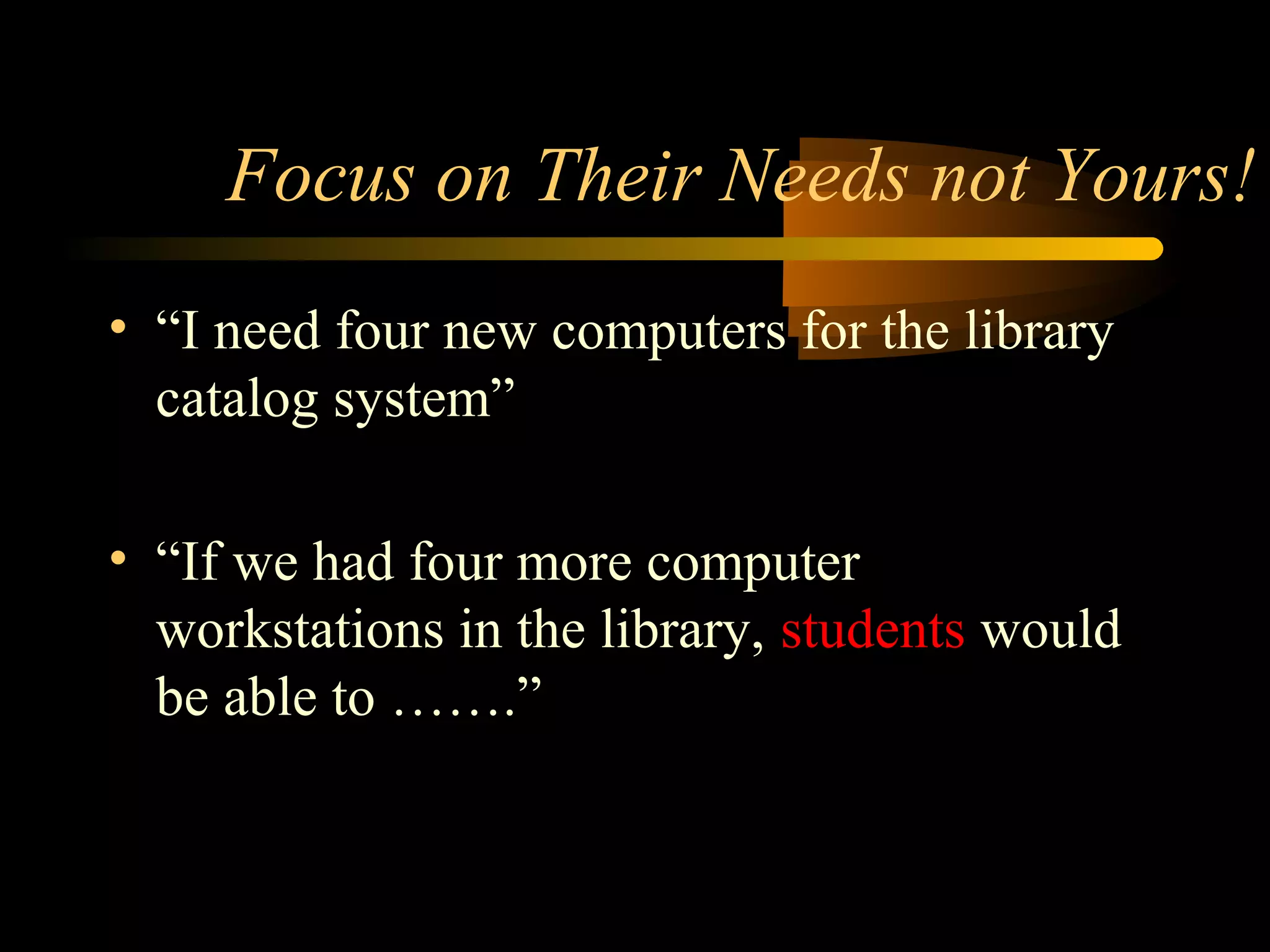
Focus on Their Needs not Yours!
• “I need four new computers for the library
catalog system”
• “If we had four more computer
workstations in the library, students would
be able to …….”
Always Frame your Requests
around the School’s Strategic
Plan, Technology Plan or SIP
• Quote the plan in all requests
• Focus on the student impact
• Speak in the terms of “student
achievement”
Recent Studies
• Let’s not hang our hats entirely on recent
studies….
– They are correlative, they show a possible relationship
– They do not show causation
– Given to an administrative team who knows research as
an “imperative” for stronger SLMPs, they may really
backfire
– That doesn’t mean those studies don’t have value, they
are a first step
As a professional community
• We need action research that shows causation
• You can do this at the system or district level with
potentially significant results
• Look to a small part of the Iowa Study that does
show causation in the number of books checked
out
• Talk to your library software vendors about
software modules of enhancements that can track
library usage to test scores, etc.
At the School or District Level
• Ensure that the administrative team knows
what you do and what you need
• Send copies of your newsletters to the
Board & superintendent
Showcase your program
• Apply for grants
• Apply for awards
– Look to DGS as an
example
• Nominate others
• Communicate with
the PTO/PTA/LSC
Excel at what you do – Merit
does have its place

Advocating for School Library Programs

  • 1.
    Advocacy for SLMS StevenM. Baule Community Unit School District 201
  • 2.
    Recently on anIllinois Listserv • Question from Supt.: – I have to replace a retiring librarian next year, what do other districts do regarding extended contracts? • Answer from another Supt.: – I hired an aide for each building and let the remaining SMLS work between two schools, saved money, no downside. • Paraphrased for space
  • 3.
    • School BoardMembers • Administrators • Other Educators • Potential SLMSs • Students • Parents • Community
  • 4.
    Succinctly • Let peopleknow what you are doing!
  • 5.
    • Never identifya problem without providing a potential solution as well • Don’t belabor points or point out issues that are obviously beyond his or her control • Mention what positive things the administrator has done in the past for you • Always follow up with a thank you note, even if just for taking time to meet with you Communicate Considerately
  • 6.
    Communicate Professionally • Avoidfolksy styles unless that is the administrator’s style • Type memos: don’t handwrite notes on the back of the school bulletin • Always provide enough detail that the administrator can start to consider the issue without having to seek you out simply to clarify the concern or need
  • 7.
    Communicate Professionally • Draftmemos about your issues – Don’t ever expect that the administrator will have time to write a letter for you without providing a draft or at least an outline – Do not send five page memos to an administrator except for the most important and detailed of issues. In those cases, provide an executive summary • If you need a letter of support, especially for grants, provide a draft that can be modified or just signed
  • 8.
    Communicate Professionally • Dressin business attire for presentations – P.E. teachers shouldn’t come to Board meetings in sweats and SLMSs should not come to such meetings in I Love Books vests, etc. • Prepare presentation materials in a professional manner, provide covers, executive summaries, etc. • Ensure there are no obvious typos, grammatical errors, etc.
  • 9.
    Balance Communication • Don’tcontinuously complain, ask, or plead, etc. • Compliment when possible – Unsolicited and justified compliments will go far towards building a positive relationship • Preemptively serve your administration as the mind-reading librarian you are
  • 10.
    Focus on TheirNeeds not Yours! • “I need four new computers for the library catalog system” • “If we had four more computer workstations in the library, students would be able to …….”
  • 11.
    Always Frame yourRequests around the School’s Strategic Plan, Technology Plan or SIP • Quote the plan in all requests • Focus on the student impact • Speak in the terms of “student achievement”
  • 12.
    Recent Studies • Let’snot hang our hats entirely on recent studies…. – They are correlative, they show a possible relationship – They do not show causation – Given to an administrative team who knows research as an “imperative” for stronger SLMPs, they may really backfire – That doesn’t mean those studies don’t have value, they are a first step
  • 13.
    As a professionalcommunity • We need action research that shows causation • You can do this at the system or district level with potentially significant results • Look to a small part of the Iowa Study that does show causation in the number of books checked out • Talk to your library software vendors about software modules of enhancements that can track library usage to test scores, etc.
  • 14.
    At the Schoolor District Level • Ensure that the administrative team knows what you do and what you need • Send copies of your newsletters to the Board & superintendent
  • 15.
    Showcase your program •Apply for grants • Apply for awards – Look to DGS as an example • Nominate others • Communicate with the PTO/PTA/LSC
  • 16.
    Excel at whatyou do – Merit does have its place