The Open Access Community, and OAIster Michelle Harper Director of Special Collections
One Column Paragraph Layout Lorem ipsum dolor sit amet, consectetur adipisicingelit, sed do eiusmod tempor incididunt ut labore et dolore magna aliqua. Lorem ipsum dolor sit amet, consectetur adipisicingelit, sed do eiusmod tempor incididunt ut labore et dolore magna aliqua. Ut enim adminim veniam, quis: “ Lorem ipsum dolor sit amet, consectetur adipisicingelit, sed do eiusmod tempor incididunt ut labore et dolore magna aliqua.” — Name
Open Archives Initiative First meeting: October 21-22 1999, Santa Fe, New Mexico “ The Open Archives initiative has been set up to create a forum to discuss and solve matters of interoperability between author self-archiving solutions, as a way to promote their global acceptance.”
 
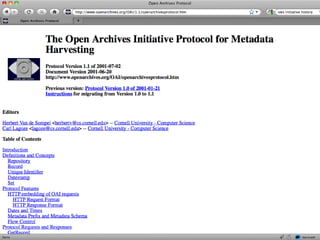
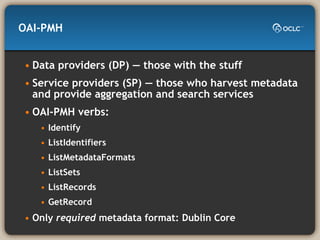
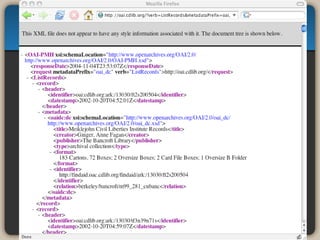
OAI-PMH Data providers (DP) — those with the stuff Service providers (SP) — those who harvest metadata and provide aggregation and search services OAI-PMH verbs: Identify ListIdentifiers ListMetadataFormats ListSets ListRecords GetRecord Only  required  metadata format: Dublin Core


OAI was developed to make it easier (not exhaustive) to  create a place  “where they typically find things.” And to find things they typically can’t find elsewhere OAIster was designed to  be the place Funded by a Andrew W Mellon Foundation   grant program designed to test the feasibility of using OAI-PMH to harvest digital object metadata from multiple and varied digital object repositories.  And to develop a service to allow end-users to access that metadata . Origins of OAIster
A no “dead-ends” OAI service provider Designed to expose the “hidden web”—digital resources not easily found by Google, Yahoo! or other search engines—or in a library’s OPAC.  No “dead ends.”  Not just metadata but links to the online representations of those resources. Must be scholarly or informational—includes everything from  pre-prints, post-prints, published articles, scanned images, archival videos… Over 23 million records from over 1100 organizations
The University of Michigan approached OCLC about assuming OAIster to insure its continuation and support on a stable infrastructure into the future.  OAIster complemented the types of resources already cataloged in WorldCat & broadened the scope of OCLC’s collections to include open archives. Met a need that had been identified by OCLC member libraries to add new collections and open archives of interest to WorldCat .  OCLC and OAIster
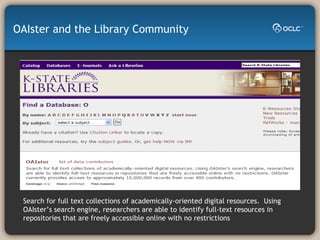
OAIster and the Library Community Search for full text collections of academically-oriented digital resources.  Using OAIster’s search engine, researchers are able to identify full-text resources in repositories that are freely accessible online with no restrictions
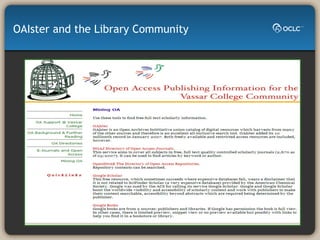
OAIster and the Library Community
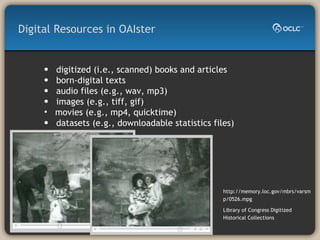
digitized (i.e., scanned) books and articles  born-digital texts  audio files (e.g., wav, mp3)  images (e.g., tiff, gif)  movies (e.g., mp4, quicktime)  datasets (e.g., downloadable statistics files) Digital Resources in OAIster http://memory.loc.gov/mbrs/varsmp/0526.mpg Library of Congress Digitized Historical Collections
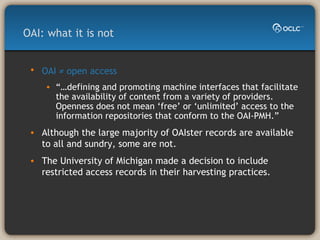
OAI ≠ open access   “… defining and promoting machine interfaces that facilitate the availability of content from a variety of providers. Openness does not mean ‘free’ or ‘unlimited’ access to the information repositories that conform to the OAI-PMH.” Although the large majority of OAIster records are available to all and sundry, some are not. The University of Michigan made a decision to include restricted access records in their harvesting practices. OAI: what it is not
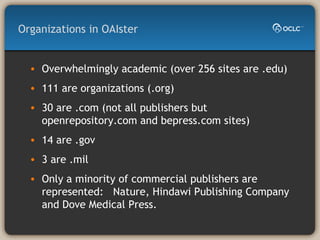
Organizations in OAIster Overwhelmingly academic (over 256 sites are .edu) 111 are organizations (.org) 30 are .com (not all publishers but openrepository.com and bepress.com sites) 14 are .gov 3 are .mil Only a minority of commercial publishers are represented:  Nature, Hindawi Publishing Company and Dove Medical Press.
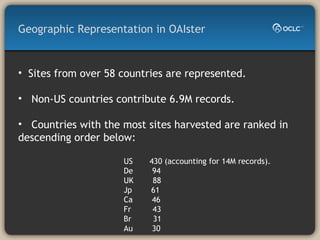
Geographic Representation in OAIster Sites from over 58 countries are represented.  Non-US countries contribute 6.9M records.  Countries with the most sites harvested are ranked in descending order below: US  430 (accounting for 14M records). De  94 UK  88 Jp  61 Ca  46 Fr  43 Br  31 Au  30
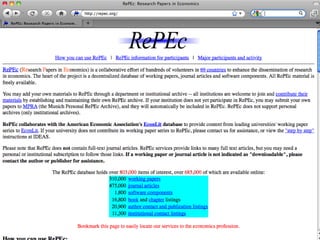
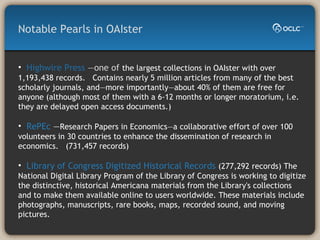
Highwire Press  —one of  the largest collections in OAIster with over 1,193,438 records.  Contains nearly 5 million articles from many of the best scholarly journals, and—more importantly—about 40% of them are free for anyone (although most of them with a 6-12 months or longer moratorium, i.e. they are delayed open access documents.) RePEc  — Research Papers in Economics—a collaborative effort of over 100 volunteers in 30 countries to enhance the dissemination of research in economics.  (731,457 records) Library of Congress Digitized Historical Records  (277,292 records) The National Digital Library Program of the Library of Congress is working to digitize the distinctive, historical Americana materials from the Library's collections and to make them available online to users worldwide. These materials include photographs, manuscripts, rare books, maps, recorded sound, and moving pictures. Notable Pearls in OAIster
OAIster Terms and Conditions OCLC harvests contributor’s metadata and loads it into WorldCat.org (note:  OAIster records are NOT loaded to the WorldCat bibliographic and holdings database at this time) OCLC “Information for OAIster Metadata Contributors” states contributor’s metadata “may be used and transferred by OCLC and others” OCLC will investigate allegations of copyright infringement and remove the infringing metadata if appropriate; OCLC disclaims liability Simple take-down policy if contributors ask OCLC to remove their metadata  No other terms and conditions concerning contributor metadata
Embassies abroad used it a lot to see what type of research was being  performed on their countries: for example,  two small counties, Malawi and Rwanda, used OAISTER extensively to track the type of agricultural research done on those countries by researchers abroad and in the U.S.  This was even tracked by the Ministries of Agriculture in those countries, who would not otherwise have known what exactly type of research was being conducted and being published, even if it was published a decade ago.  They would disseminate the results of this research to Ag Colleges and even to farmers to increase crop yields. Stephen Perry, US Department of State  Facilitates World Wide Research
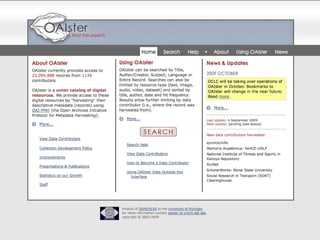
Where to Find the Pearls OAIster records were made freely discoverable in WC.org in October   An open access discrete view of the OAIster records was made available through a URL specific to OAIster in January 2010.  www.oaister.worldcat.org
OAIster A (growing) rich resource for scholarly, hard to find digital resources, representing the intellectual output from many institutions worldwide. Provides exposure not only for the largest repositories but also for the smaller ones, described by Kat Hagedorn, Metadata Harvesting Librarian for OAIster, as “the true force behind OAI:  it is easy to install, it provides access to a wide variety of content, and even small repositories of content can be included.” Preservation and increased discoverability of these digital resources for everyone.
THANK YOU!

The Open Access Community, and OAIster

  • 1.
    The Open AccessCommunity, and OAIster Michelle Harper Director of Special Collections
  • 2.
    One Column ParagraphLayout Lorem ipsum dolor sit amet, consectetur adipisicingelit, sed do eiusmod tempor incididunt ut labore et dolore magna aliqua. Lorem ipsum dolor sit amet, consectetur adipisicingelit, sed do eiusmod tempor incididunt ut labore et dolore magna aliqua. Ut enim adminim veniam, quis: “ Lorem ipsum dolor sit amet, consectetur adipisicingelit, sed do eiusmod tempor incididunt ut labore et dolore magna aliqua.” — Name
  • 3.
    Open Archives InitiativeFirst meeting: October 21-22 1999, Santa Fe, New Mexico “ The Open Archives initiative has been set up to create a forum to discuss and solve matters of interoperability between author self-archiving solutions, as a way to promote their global acceptance.”
  • 4.
  • 5.
    OAI-PMH Data providers(DP) — those with the stuff Service providers (SP) — those who harvest metadata and provide aggregation and search services OAI-PMH verbs: Identify ListIdentifiers ListMetadataFormats ListSets ListRecords GetRecord Only required metadata format: Dublin Core
  • 6.
  • 7.
  • 8.
  • 9.
  • 10.
  • 11.
    OAI was developedto make it easier (not exhaustive) to create a place “where they typically find things.” And to find things they typically can’t find elsewhere OAIster was designed to be the place Funded by a Andrew W Mellon Foundation grant program designed to test the feasibility of using OAI-PMH to harvest digital object metadata from multiple and varied digital object repositories. And to develop a service to allow end-users to access that metadata . Origins of OAIster
  • 12.
    A no “dead-ends”OAI service provider Designed to expose the “hidden web”—digital resources not easily found by Google, Yahoo! or other search engines—or in a library’s OPAC. No “dead ends.” Not just metadata but links to the online representations of those resources. Must be scholarly or informational—includes everything from pre-prints, post-prints, published articles, scanned images, archival videos… Over 23 million records from over 1100 organizations
  • 13.
    The University ofMichigan approached OCLC about assuming OAIster to insure its continuation and support on a stable infrastructure into the future. OAIster complemented the types of resources already cataloged in WorldCat & broadened the scope of OCLC’s collections to include open archives. Met a need that had been identified by OCLC member libraries to add new collections and open archives of interest to WorldCat . OCLC and OAIster
  • 14.
    OAIster and theLibrary Community Search for full text collections of academically-oriented digital resources. Using OAIster’s search engine, researchers are able to identify full-text resources in repositories that are freely accessible online with no restrictions
  • 15.
    OAIster and theLibrary Community
  • 16.
    digitized (i.e., scanned)books and articles born-digital texts audio files (e.g., wav, mp3) images (e.g., tiff, gif) movies (e.g., mp4, quicktime) datasets (e.g., downloadable statistics files) Digital Resources in OAIster http://memory.loc.gov/mbrs/varsmp/0526.mpg Library of Congress Digitized Historical Collections
  • 17.
    OAI ≠ openaccess “… defining and promoting machine interfaces that facilitate the availability of content from a variety of providers. Openness does not mean ‘free’ or ‘unlimited’ access to the information repositories that conform to the OAI-PMH.” Although the large majority of OAIster records are available to all and sundry, some are not. The University of Michigan made a decision to include restricted access records in their harvesting practices. OAI: what it is not
  • 18.
    Organizations in OAIsterOverwhelmingly academic (over 256 sites are .edu) 111 are organizations (.org) 30 are .com (not all publishers but openrepository.com and bepress.com sites) 14 are .gov 3 are .mil Only a minority of commercial publishers are represented: Nature, Hindawi Publishing Company and Dove Medical Press.
  • 19.
    Geographic Representation inOAIster Sites from over 58 countries are represented. Non-US countries contribute 6.9M records. Countries with the most sites harvested are ranked in descending order below: US 430 (accounting for 14M records). De 94 UK 88 Jp 61 Ca 46 Fr 43 Br 31 Au 30
  • 20.
    Highwire Press —one of the largest collections in OAIster with over 1,193,438 records. Contains nearly 5 million articles from many of the best scholarly journals, and—more importantly—about 40% of them are free for anyone (although most of them with a 6-12 months or longer moratorium, i.e. they are delayed open access documents.) RePEc — Research Papers in Economics—a collaborative effort of over 100 volunteers in 30 countries to enhance the dissemination of research in economics. (731,457 records) Library of Congress Digitized Historical Records (277,292 records) The National Digital Library Program of the Library of Congress is working to digitize the distinctive, historical Americana materials from the Library's collections and to make them available online to users worldwide. These materials include photographs, manuscripts, rare books, maps, recorded sound, and moving pictures. Notable Pearls in OAIster
  • 21.
    OAIster Terms andConditions OCLC harvests contributor’s metadata and loads it into WorldCat.org (note: OAIster records are NOT loaded to the WorldCat bibliographic and holdings database at this time) OCLC “Information for OAIster Metadata Contributors” states contributor’s metadata “may be used and transferred by OCLC and others” OCLC will investigate allegations of copyright infringement and remove the infringing metadata if appropriate; OCLC disclaims liability Simple take-down policy if contributors ask OCLC to remove their metadata No other terms and conditions concerning contributor metadata
  • 22.
    Embassies abroad usedit a lot to see what type of research was being performed on their countries: for example, two small counties, Malawi and Rwanda, used OAISTER extensively to track the type of agricultural research done on those countries by researchers abroad and in the U.S. This was even tracked by the Ministries of Agriculture in those countries, who would not otherwise have known what exactly type of research was being conducted and being published, even if it was published a decade ago. They would disseminate the results of this research to Ag Colleges and even to farmers to increase crop yields. Stephen Perry, US Department of State Facilitates World Wide Research
  • 23.
    Where to Findthe Pearls OAIster records were made freely discoverable in WC.org in October An open access discrete view of the OAIster records was made available through a URL specific to OAIster in January 2010. www.oaister.worldcat.org
  • 24.
    OAIster A (growing)rich resource for scholarly, hard to find digital resources, representing the intellectual output from many institutions worldwide. Provides exposure not only for the largest repositories but also for the smaller ones, described by Kat Hagedorn, Metadata Harvesting Librarian for OAIster, as “the true force behind OAI: it is easy to install, it provides access to a wide variety of content, and even small repositories of content can be included.” Preservation and increased discoverability of these digital resources for everyone.
  • 25.

Editor's Notes

  • #17 As for the document types, they include digital text, pictures, moving images, audio files and data sets. Text documents represent about three quarters of the documents, followed by images at nearly 20%. Although video and audio files represent a tiny percent of the collection, their absolute number at more than 30,000 and 20,000 respectively, is impressive.