
Investment Manager Selection
                 February 20, 2013
     ©2003 – 2013 Multnomah Group, Inc. All Rights Reserved.
Agenda
• Investment Philosophy

• Process Overview

• Quantitative Analysis

• Qualitative Due Diligence


2                Investment Manager Selection
Scott Cameron, CFA
Scott is the Chief Investment Officer for the Multnomah Group and a Founding
Principal of the firm. In that role, Scott leads Multnomah Group’s Investment
Committee, is responsible for the development of the firm’s investment
research methodology, and conducts investment manager due diligence. Scott
also consults with plan sponsors on investment menu design, investment
manager selection, fiduciary governance, and vendor fees/services.
Prior to founding the Multnomah Group, Scott was an investment consultant
with a national retirement services firm.
Scott is a member of the CFA Institute, the CFA Society of Portland, the
Investment Management Consultants Association, and the Portland Chapter of
the Western Pension & Benefits Council. Scott holds a B.S in Management
from Purdue University.


3                Investment Manager Selection
Investment Philosophy
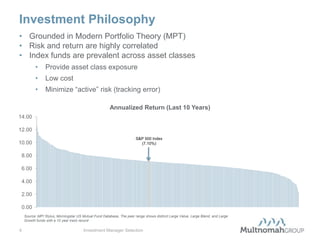
• Grounded in Modern Portfolio Theory (MPT)
• Risk and return are highly correlated
• Index funds are prevalent across asset classes
          •     Provide asset class exposure
          •     Low cost
          •     Minimize “active” risk (tracking error)

                                                       Annualized Return (Last 10 Years)
14.00

12.00
                                                                      S&P 500 Index
10.00                                                                   (7.10%)


 8.00

 6.00

 4.00

 2.00

 0.00
    Source: MPI Stylus, Morningstar US Mutual Fund Database, The peer range shows distinct Large Value, Large Blend, and Large
    Growth funds with a 10 year track record

4                                      Investment Manager Selection
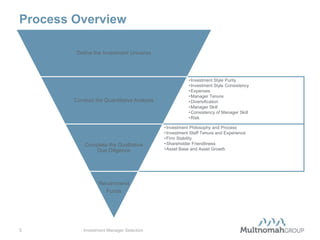
Process Overview

         Define the Investment Universe


                                                        • Investment Style Purity
                                                        • Investment Style Consistency
                                                        • Expenses
                                                        • Manager Tenure
        Conduct the Quantitative Analysis               • Diversification
                                                        • Manager Skill
                                                        • Consistency of Manager Skill
                                                        • Risk

                                            • Investment Philosophy and Process
                                            • Investment Staff Tenure and Experience
                                            • Firm Stability
            Complete the Qualitative        • Shareholder Friendliness
               Due Diligence                • Asset Base and Asset Growth


                  Recommend
                    Funds


5          Investment Manager Selection
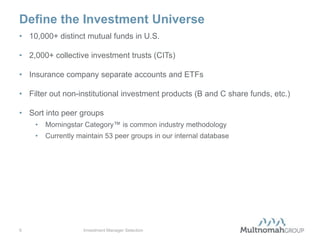
Define the Investment Universe
• 10,000+ distinct mutual funds in U.S.

• 2,000+ collective investment trusts (CITs)

• Insurance company separate accounts and ETFs

• Filter out non-institutional investment products (B and C share funds, etc.)

• Sort into peer groups
    •   Morningstar Category™ is common industry methodology
    •   Currently maintain 53 peer groups in our internal database


6                   Investment Manager Selection
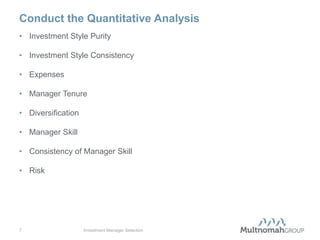
Conduct the Quantitative Analysis
• Investment Style Purity

• Investment Style Consistency

• Expenses

• Manager Tenure

• Diversification

• Manager Skill

• Consistency of Manager Skill

• Risk


7                   Investment Manager Selection
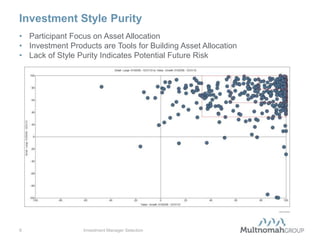
Investment Style Purity
• Participant Focus on Asset Allocation
• Investment Products are Tools for Building Asset Allocation
• Lack of Style Purity Indicates Potential Future Risk


8                 Investment Manager Selection
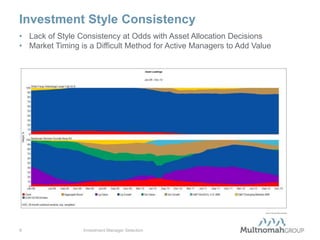
Investment Style Consistency
• Lack of Style Consistency at Odds with Asset Allocation Decisions
• Market Timing is a Difficult Method for Active Managers to Add Value


9                Investment Manager Selection
Expenses
• Net of Fee Performance is What Investors Care About

• High Expenses Create Hurdle for Active Management
     •   Need to Earn Higher Gross Returns to Deliver Equivalent Net Returns
     •   Rewards Should Accrue to Investors, Not Investment Manager

• Expense Ratio May Include Revenue Sharing
     •   Focus on Institutional Share Class for Apples-to-Apples Analysis
     •   Revenue Sharing is a Separate Decision From Investment Manager Selection

• Turnover Ratio
     •   Proxy for Trading Costs and Market Impacts
     •   Impact is Dependent on Liquidity of the Market and Size of the Portfolio


10                   Investment Manager Selection
Manager Tenure
• Is the Performance Track Record Relevant?

• Longer Tenure:
     •   Historical Performance is Less Attributable to Market Dynamics
     •   Stability is Indicative of Future Stability

• Tenure is a Flag for Qualitative Analysis of Investment Team.


11                    Investment Manager Selection
Diversification
• Measure of Risk Management
     •   Concentrated Portfolios Are Generally Not Appropriate in DC Investment Menu

• Total Number of Holdings

• % of Assets in Top 10 Holdings

• Level of Diversification May Vary by Asset Class
     •   Government Bond Funds
     •   REITS
     •   Sector Funds
     •   TIPS


12                  Investment Manager Selection
Manager Skill
• Seeking to Identify Managers that Can Outperform the Market on a Risk-
  Adjusted Basis

• Fund’s Returns are attributable to:
     •   Market Performance – performance attributable to market exposure (available
         through index fund)
     •   Market Timing – performance attributable to deviations from long-term style
     •   Security Selection – performance attributable to picking securities within
         benchmark

• Different Measures of Manager Skill
     •   Excess Return – simplest measure comparing fund’s performance against
         benchmark performance
     •   Security Selection – used style-adjusted customized benchmark to evaluate
         value added (subtracted) through security selection decisions
     •   Alpha – style-adjusted customized benchmark that identifies whether a fund has
         outperformed expectations given its style exposure


13                   Investment Manager Selection
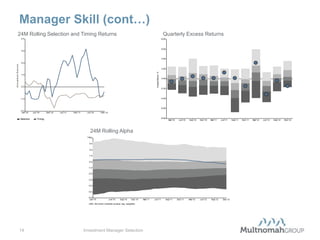
Manager Skill (cont…)
                24M Rolling Selection and Timing Returns                                                                                                               Quarterly Excess Returns
                                 4.0                                                                                                                                 8.00


                                                                                                                                                                     6.00
                                 3.0


                                                                                                                                                                     4.00
                                 2.0
A n n u a liz e d R e t u rn s


                                                                                                                                                                     2.00


                                                                                                                                                  Excess Return, %
                                 1.0
                                                                                                                                                                     0.00


                                 0.0
                                                                                                                                                                     -2.00


                                 -1.0                                                                                                                                -4.00


                                                                                                                                                                     -6.00
                                 -2.0
                                  Jan-10     Jun-10      Dec-10   Jun-11   Dec-11    Jun-12      Dec-12


                                 Selection      Timing                                                                                                               -8.00
                                                                                                                                                                             Mar-10    Jun-10   Sep-10   Dec-10   Mar-11   Jun-11    Sep-11   Dec-11   Mar-12   Jun-12   Sep-12   Dec-12


                                                                                       24M Rolling Alpha
                                                                                      4.0

                                                                                      3.0


                                                                                      2.0

                                                                                      1.0


                                                                                      0.0

                                                                                      -1.0

                                                                                      -2.0


                                                                                      -3.0

                                                                                      -4.0


                                                                                      -5.0

                                                                                      -6.0
                                                                                       Jan-10             Jun-10   Sep-10     Dec-10   Mar-11   Jun-11                   Sep-11       Dec-11    Mar-12   Jun-12   Sep-12    Dec-12

                                                                                      USD, 36-month centered window; exp. weighted


                                 14                                                 Investment Manager Selection
Consistency of Manager Skill
• Past Performance Can Be
  Misleading
     •   One Strong Period Can Skew
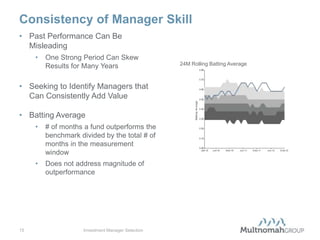
         Results for Many Years                     24M Rolling Batting Average


• Seeking to Identify Managers that
  Can Consistently Add Value

• Batting Average
     •   # of months a fund outperforms the
         benchmark divided by the total # of
         months in the measurement
         window
     •   Does not address magnitude of
         outperformance


15                   Investment Manager Selection
Risk
• Risk is Defined Many Ways
     •       Volatility
     •       Loss of Principal
     •       By Type of Risk
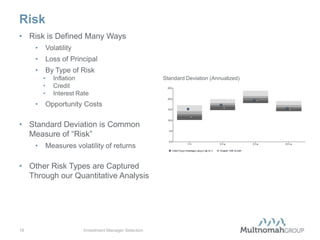
         •      Inflation                                 Standard Deviation (Annualized)
         •      Credit
         •      Interest Rate
     •       Opportunity Costs

• Standard Deviation is Common
  Measure of “Risk”
     •       Measures volatility of returns

• Other Risk Types are Captured
  Through our Quantitative Analysis


16                         Investment Manager Selection
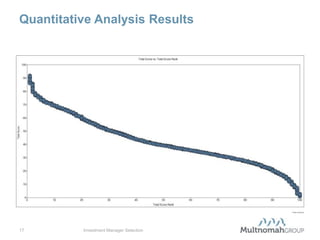
Quantitative Analysis Results


17        Investment Manager Selection
Qualitative Due Diligence
• Quantitative Analysis is the Guide

• Qualitative Review is Ultimately Most Important Step

• Trying to Understand “Why” a Fund Behaves the Way it Does

• Areas of Focus
     •   The Firm
     •   Investment Personnel
     •   Investment Strategy
     •   Shareholder Friendliness


18                  Investment Manager Selection
The Firm
• What Type of Firm is It?
     •   Small, boutique investment manager
     •   Insurance company
     •   Publicly traded asset manager
     •   Bank subsidiary

• One Size Does Not Fit All

• What is the Ownership Structure of the Firm?
     •   How does ownership impact the culture?
     •   Is a transition/succession plan in place?
     •   Is the business core to the parent organization?

• How Stable has the Firm Been Historically?
     •   Have their been changes in ownership structure?
     •   Have their been changes in leadership?

• What is the Firm’s Culture?
     •   How does the firm’s structure support or demonstrate its culture?

19                   Investment Manager Selection
Investment Personnel
• Funds Don’t Have Track Records, People Do.

• What is the Structure of the Investment Team?
     •   Single portfolio manager or team?
     •   Centralized research analysts or team-specific?
     •   Analysts assigned a sector or generalists?

• What is the Experience of the Investment Team Together?
     •   Portfolio Manager(s) [Manager tenure is a limited measure of experience]
     •   Research analysts

• How Does the Team Interact?
     •   Is there a king?
     •   Does the team strive for consensus?
     •   Does everyone understand their roles and responsibilities


20                   Investment Manager Selection
Investment Strategy
• How Do They View the Market?

• What is Their Unique Edge in Adding Value?

• Is it Consistent with Their Investment Philosophy?

• Is it Reasonably Grounded in Fundamental Research?

• What is the “Buy” Discipline?
     •   How do securities end up in the portfolio?

• What is the “Sell” Discipline?
     •   How do securities leave the portfolio?

• Is the Historical Track Record Consistent with the Articulated Investment
  Strategy?


21                   Investment Manager Selection
Shareholder Friendliness
• What is the Capacity of the Fund?

• How Do They Manage Capacity?
     •   Have they implemented fund closures?
     •   Do they compensate managers for performance or asset growth?

• Do They Charge Reasonable Fees?
     •   Have they lowered fees as funds grow in size?

• Do They Communicate Changes in a Timely Manner?


22                  Investment Manager Selection
Recommend Fund
• There is No “Best” Fund.

• Is it Consistent With the Client’s Investment Objectives?

• How Does it Compare to the Rest of the Investment Menu?

• Are There Any Operational Issues with the Fund?


23                Investment Manager Selection
Disclosures
Multnomah Group, Inc. is an Oregon corporation and SEC registered investment
adviser.
Investment performance and returns are based on historical information and are not
a guarantee of future performance. Investing contains risk. Some asset classes
involve significantly higher risk because of the nature of the investments and the
low liquidity/high volatility of the securities.
Any information and materials contained herein or on our website are provided for
general informational purposes only and are not intended to be comprehensive for
any particular subject. Multnomah Group utilizes information from third party
sources believed to be reliable but not guaranteed, and as a result, information is
provided to you "as is." We do not represent, guarantee, or provide any warranties
(either express or implied) regarding the completeness, accuracy, or currency of
information or its suitability for any particular purpose. Multnomah Group shall not
be liable to you or any third party resulting from any use or misuse of information
provided.
Receipt of information or materials provided herein or on our website does not
create an adviser-client relationship between Multnomah Group and you.
Multnomah Group does not provide tax or legal advice or opinions. You should
consult with your own tax or legal adviser for advice about your specific situation.


24                 Investment Manager Selection

Investment Manager Selection

  • 1.
    Investment Manager Selection February 20, 2013 ©2003 – 2013 Multnomah Group, Inc. All Rights Reserved.
  • 2.
    Agenda • Investment Philosophy •Process Overview • Quantitative Analysis • Qualitative Due Diligence 2 Investment Manager Selection
  • 3.
    Scott Cameron, CFA Scottis the Chief Investment Officer for the Multnomah Group and a Founding Principal of the firm. In that role, Scott leads Multnomah Group’s Investment Committee, is responsible for the development of the firm’s investment research methodology, and conducts investment manager due diligence. Scott also consults with plan sponsors on investment menu design, investment manager selection, fiduciary governance, and vendor fees/services. Prior to founding the Multnomah Group, Scott was an investment consultant with a national retirement services firm. Scott is a member of the CFA Institute, the CFA Society of Portland, the Investment Management Consultants Association, and the Portland Chapter of the Western Pension & Benefits Council. Scott holds a B.S in Management from Purdue University. 3 Investment Manager Selection
  • 4.
    Investment Philosophy • Groundedin Modern Portfolio Theory (MPT) • Risk and return are highly correlated • Index funds are prevalent across asset classes • Provide asset class exposure • Low cost • Minimize “active” risk (tracking error) Annualized Return (Last 10 Years) 14.00 12.00 S&P 500 Index 10.00 (7.10%) 8.00 6.00 4.00 2.00 0.00 Source: MPI Stylus, Morningstar US Mutual Fund Database, The peer range shows distinct Large Value, Large Blend, and Large Growth funds with a 10 year track record 4 Investment Manager Selection
  • 5.
    Process Overview Define the Investment Universe • Investment Style Purity • Investment Style Consistency • Expenses • Manager Tenure Conduct the Quantitative Analysis • Diversification • Manager Skill • Consistency of Manager Skill • Risk • Investment Philosophy and Process • Investment Staff Tenure and Experience • Firm Stability Complete the Qualitative • Shareholder Friendliness Due Diligence • Asset Base and Asset Growth Recommend Funds 5 Investment Manager Selection
  • 6.
    Define the InvestmentUniverse • 10,000+ distinct mutual funds in U.S. • 2,000+ collective investment trusts (CITs) • Insurance company separate accounts and ETFs • Filter out non-institutional investment products (B and C share funds, etc.) • Sort into peer groups • Morningstar Category™ is common industry methodology • Currently maintain 53 peer groups in our internal database 6 Investment Manager Selection
  • 7.
    Conduct the QuantitativeAnalysis • Investment Style Purity • Investment Style Consistency • Expenses • Manager Tenure • Diversification • Manager Skill • Consistency of Manager Skill • Risk 7 Investment Manager Selection
  • 8.
    Investment Style Purity •Participant Focus on Asset Allocation • Investment Products are Tools for Building Asset Allocation • Lack of Style Purity Indicates Potential Future Risk 8 Investment Manager Selection
  • 9.
    Investment Style Consistency •Lack of Style Consistency at Odds with Asset Allocation Decisions • Market Timing is a Difficult Method for Active Managers to Add Value 9 Investment Manager Selection
  • 10.
    Expenses • Net ofFee Performance is What Investors Care About • High Expenses Create Hurdle for Active Management • Need to Earn Higher Gross Returns to Deliver Equivalent Net Returns • Rewards Should Accrue to Investors, Not Investment Manager • Expense Ratio May Include Revenue Sharing • Focus on Institutional Share Class for Apples-to-Apples Analysis • Revenue Sharing is a Separate Decision From Investment Manager Selection • Turnover Ratio • Proxy for Trading Costs and Market Impacts • Impact is Dependent on Liquidity of the Market and Size of the Portfolio 10 Investment Manager Selection
  • 11.
    Manager Tenure • Isthe Performance Track Record Relevant? • Longer Tenure: • Historical Performance is Less Attributable to Market Dynamics • Stability is Indicative of Future Stability • Tenure is a Flag for Qualitative Analysis of Investment Team. 11 Investment Manager Selection
  • 12.
    Diversification • Measure ofRisk Management • Concentrated Portfolios Are Generally Not Appropriate in DC Investment Menu • Total Number of Holdings • % of Assets in Top 10 Holdings • Level of Diversification May Vary by Asset Class • Government Bond Funds • REITS • Sector Funds • TIPS 12 Investment Manager Selection
  • 13.
    Manager Skill • Seekingto Identify Managers that Can Outperform the Market on a Risk- Adjusted Basis • Fund’s Returns are attributable to: • Market Performance – performance attributable to market exposure (available through index fund) • Market Timing – performance attributable to deviations from long-term style • Security Selection – performance attributable to picking securities within benchmark • Different Measures of Manager Skill • Excess Return – simplest measure comparing fund’s performance against benchmark performance • Security Selection – used style-adjusted customized benchmark to evaluate value added (subtracted) through security selection decisions • Alpha – style-adjusted customized benchmark that identifies whether a fund has outperformed expectations given its style exposure 13 Investment Manager Selection
  • 14.
    Manager Skill (cont…) 24M Rolling Selection and Timing Returns Quarterly Excess Returns 4.0 8.00 6.00 3.0 4.00 2.0 A n n u a liz e d R e t u rn s 2.00 Excess Return, % 1.0 0.00 0.0 -2.00 -1.0 -4.00 -6.00 -2.0 Jan-10 Jun-10 Dec-10 Jun-11 Dec-11 Jun-12 Dec-12 Selection Timing -8.00 Mar-10 Jun-10 Sep-10 Dec-10 Mar-11 Jun-11 Sep-11 Dec-11 Mar-12 Jun-12 Sep-12 Dec-12 24M Rolling Alpha 4.0 3.0 2.0 1.0 0.0 -1.0 -2.0 -3.0 -4.0 -5.0 -6.0 Jan-10 Jun-10 Sep-10 Dec-10 Mar-11 Jun-11 Sep-11 Dec-11 Mar-12 Jun-12 Sep-12 Dec-12 USD, 36-month centered window; exp. weighted 14 Investment Manager Selection
  • 15.
    Consistency of ManagerSkill • Past Performance Can Be Misleading • One Strong Period Can Skew Results for Many Years 24M Rolling Batting Average • Seeking to Identify Managers that Can Consistently Add Value • Batting Average • # of months a fund outperforms the benchmark divided by the total # of months in the measurement window • Does not address magnitude of outperformance 15 Investment Manager Selection
  • 16.
    Risk • Risk isDefined Many Ways • Volatility • Loss of Principal • By Type of Risk • Inflation Standard Deviation (Annualized) • Credit • Interest Rate • Opportunity Costs • Standard Deviation is Common Measure of “Risk” • Measures volatility of returns • Other Risk Types are Captured Through our Quantitative Analysis 16 Investment Manager Selection
  • 17.
    Quantitative Analysis Results 17 Investment Manager Selection
  • 18.
    Qualitative Due Diligence •Quantitative Analysis is the Guide • Qualitative Review is Ultimately Most Important Step • Trying to Understand “Why” a Fund Behaves the Way it Does • Areas of Focus • The Firm • Investment Personnel • Investment Strategy • Shareholder Friendliness 18 Investment Manager Selection
  • 19.
    The Firm • WhatType of Firm is It? • Small, boutique investment manager • Insurance company • Publicly traded asset manager • Bank subsidiary • One Size Does Not Fit All • What is the Ownership Structure of the Firm? • How does ownership impact the culture? • Is a transition/succession plan in place? • Is the business core to the parent organization? • How Stable has the Firm Been Historically? • Have their been changes in ownership structure? • Have their been changes in leadership? • What is the Firm’s Culture? • How does the firm’s structure support or demonstrate its culture? 19 Investment Manager Selection
  • 20.
    Investment Personnel • FundsDon’t Have Track Records, People Do. • What is the Structure of the Investment Team? • Single portfolio manager or team? • Centralized research analysts or team-specific? • Analysts assigned a sector or generalists? • What is the Experience of the Investment Team Together? • Portfolio Manager(s) [Manager tenure is a limited measure of experience] • Research analysts • How Does the Team Interact? • Is there a king? • Does the team strive for consensus? • Does everyone understand their roles and responsibilities 20 Investment Manager Selection
  • 21.
    Investment Strategy • HowDo They View the Market? • What is Their Unique Edge in Adding Value? • Is it Consistent with Their Investment Philosophy? • Is it Reasonably Grounded in Fundamental Research? • What is the “Buy” Discipline? • How do securities end up in the portfolio? • What is the “Sell” Discipline? • How do securities leave the portfolio? • Is the Historical Track Record Consistent with the Articulated Investment Strategy? 21 Investment Manager Selection
  • 22.
    Shareholder Friendliness • Whatis the Capacity of the Fund? • How Do They Manage Capacity? • Have they implemented fund closures? • Do they compensate managers for performance or asset growth? • Do They Charge Reasonable Fees? • Have they lowered fees as funds grow in size? • Do They Communicate Changes in a Timely Manner? 22 Investment Manager Selection
  • 23.
    Recommend Fund • Thereis No “Best” Fund. • Is it Consistent With the Client’s Investment Objectives? • How Does it Compare to the Rest of the Investment Menu? • Are There Any Operational Issues with the Fund? 23 Investment Manager Selection
  • 24.
    Disclosures Multnomah Group, Inc.is an Oregon corporation and SEC registered investment adviser. Investment performance and returns are based on historical information and are not a guarantee of future performance. Investing contains risk. Some asset classes involve significantly higher risk because of the nature of the investments and the low liquidity/high volatility of the securities. Any information and materials contained herein or on our website are provided for general informational purposes only and are not intended to be comprehensive for any particular subject. Multnomah Group utilizes information from third party sources believed to be reliable but not guaranteed, and as a result, information is provided to you "as is." We do not represent, guarantee, or provide any warranties (either express or implied) regarding the completeness, accuracy, or currency of information or its suitability for any particular purpose. Multnomah Group shall not be liable to you or any third party resulting from any use or misuse of information provided. Receipt of information or materials provided herein or on our website does not create an adviser-client relationship between Multnomah Group and you. Multnomah Group does not provide tax or legal advice or opinions. You should consult with your own tax or legal adviser for advice about your specific situation. 24 Investment Manager Selection